
🌙 Welcome to Tekin Night — May 24, 2026
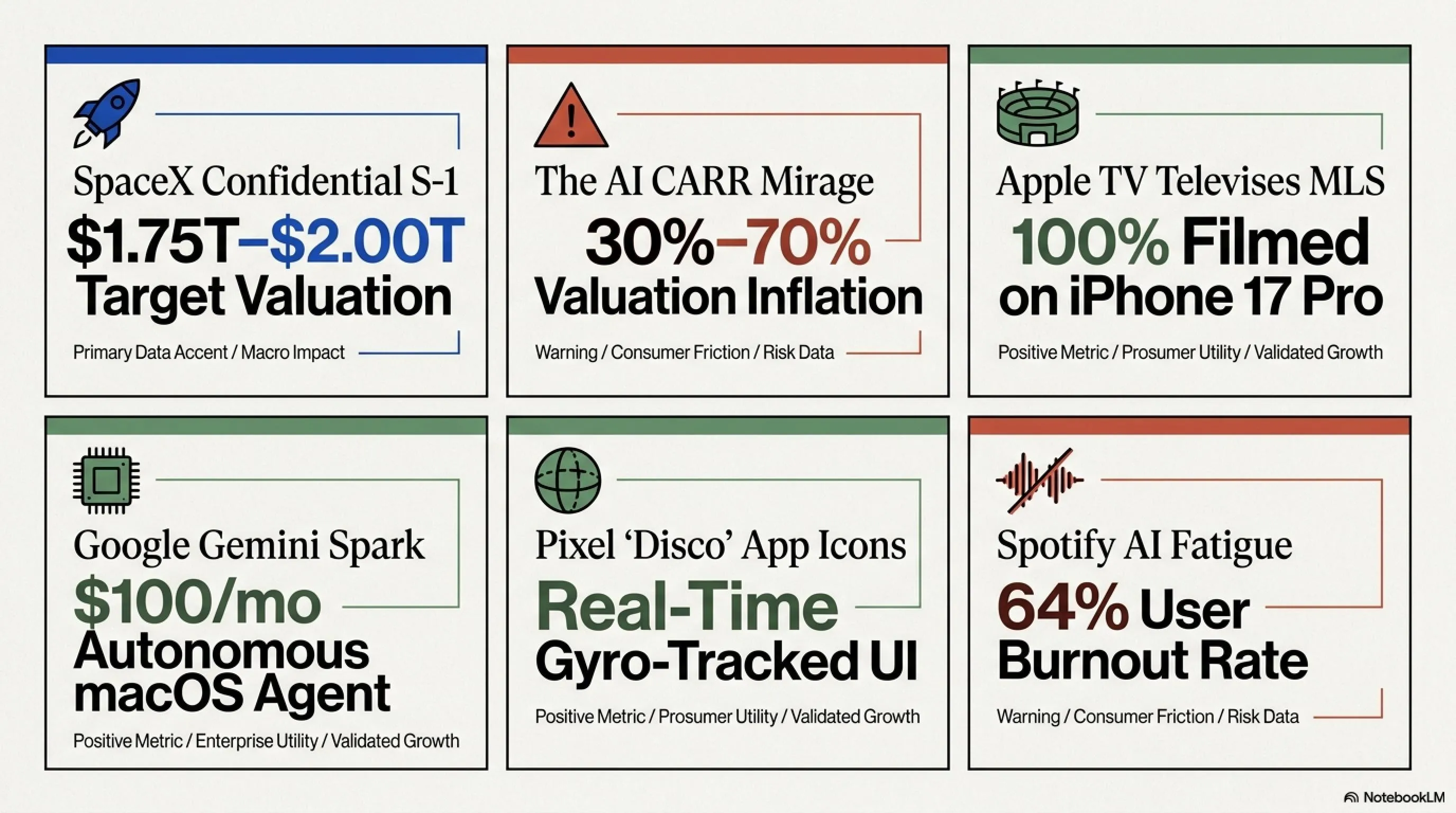
Good evening, tech elite! Tonight, Sunday, May 24, 2026, we unpack six era-defining technical and financial breakthroughs shaping the trajectory of tech. From SpaceX’s historic $2 trillion S-1 filing shaking up Wall Street, to the controversial "CARR" metric used by VCs to inflate AI startup valuations, to Google’s whimsical Disco app icons on Pixel, Apple’s groundbreaking all-iPhone MLS broadcast, Spotify’s AI-overload fatigue, and Google's new background agent Spark landing on macOS. Let’s dive straight in.
⚡ Tonight's Briefing:
🚀 SpaceX Files Confidential S-1 for Historic $1.75T-$2T Public Listing
💰 The CARR Mirage: How VCs Use Contracted ARR to Crown AI Startups
✨ Google Pixel Launches Shiny, Gyro-Tracked 'Disco Ball' Icon Pack
📱 Broadcast History: Apple TV Televises MLS Match Shot Entirely on iPhone 17 Pro
🎵 Spotify’s Aggressive AI Bet Sparks Backlash from Weary Listeners
🖥️ Google Debuts 'Gemini Spark' Agent and Deep Voice Control for macOS
☕ Grab your nightcap and let's get into the technical nitty-gritty of today's biggest shifts!
🚀 SpaceX Files S-1 Prospectus for Historic $1.75T-$2T IPO
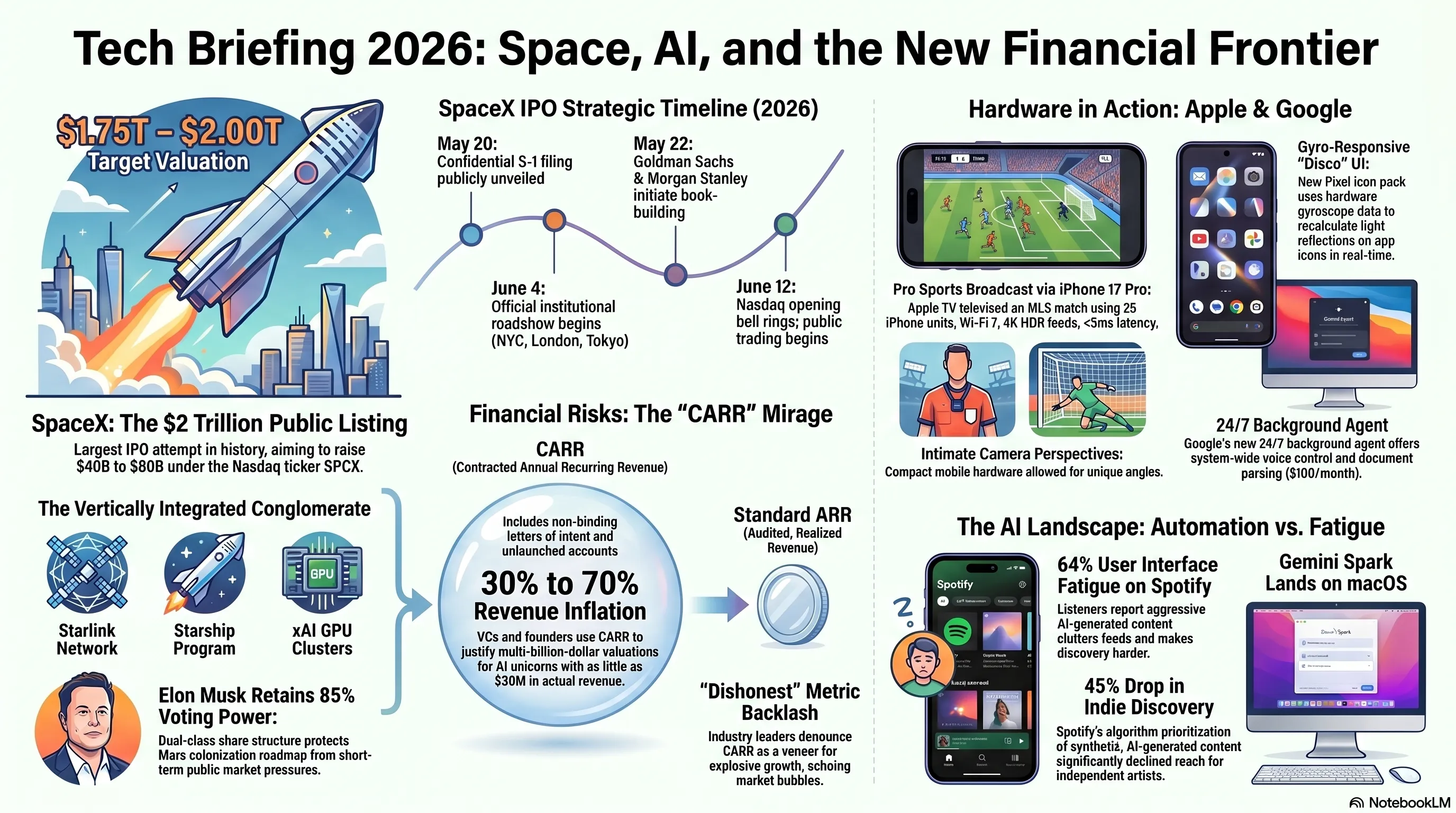
One of the most anticipated financial milestones in the aerospace and technology sectors has officially begun. On May 20, 2026, Elon Musk’s SpaceX publicly unveiled its confidential S-1 registration statement with the SEC, paving the way for the largest initial public offering (IPO) in stock market history under the ticker symbol SPCX on the Nasdaq. Targeting an eye-watering valuation of **$1.75 trillion to $2.00 trillion**, the prospectus details a massive capital raises ranging from $40 billion to $80 billion, signaling a new era of space commercialization.
The S-1 filing reveals that SpaceX is no longer just a rocket launching service, but a sprawling, vertically integrated technology conglomerate. It brings together the massive cash-flowing satellite network Starlink, the deep space system Starship, and the newly integrated artificial intelligence arm xAI. While Starlink’s commercial operations have matured into a highly profitable powerhouse, the capital expenditures required for Starship’s rapid orbital test cadence and xAI’s heavy GPU cluster acquisitions have contributed to substantial, albeit controlled, quarterly losses. Wall Street, however, appears eager to finance this multi-planetary roadmap due to SpaceX's absolute monopoly in global launch capacity.
📊 Key Metrics from SpaceX's S-1 Registration Statement
| Metric | Details & Projected Values |
|---|---|
| Target Market Valuation | $1.75 Trillion – $2.00 Trillion |
| Total Target Raise | $40 Billion – $80 Billion |
| Share Structure & Voting Rights | Dual-class; Elon Musk retains 85% voting power |
| Roadshow Kickoff Date | June 4, 2026 |
| Public Trading Launch (Est.) | June 12, 2026 on Nasdaq (Ticker: SPCX) |
The dual-class structure of the offering is particularly telling. While institutional and retail investors will be granted the opportunity to capture financial upside, Elon Musk retains 85% of the total voting power, ensuring his long-term roadmap for Mars colonization is shielded from short-term public market pressures. Starlink's massive profitability, now generating robust free cash flows from its consumer, defense, and maritime offerings, serves as the ultimate anchor for this valuation.
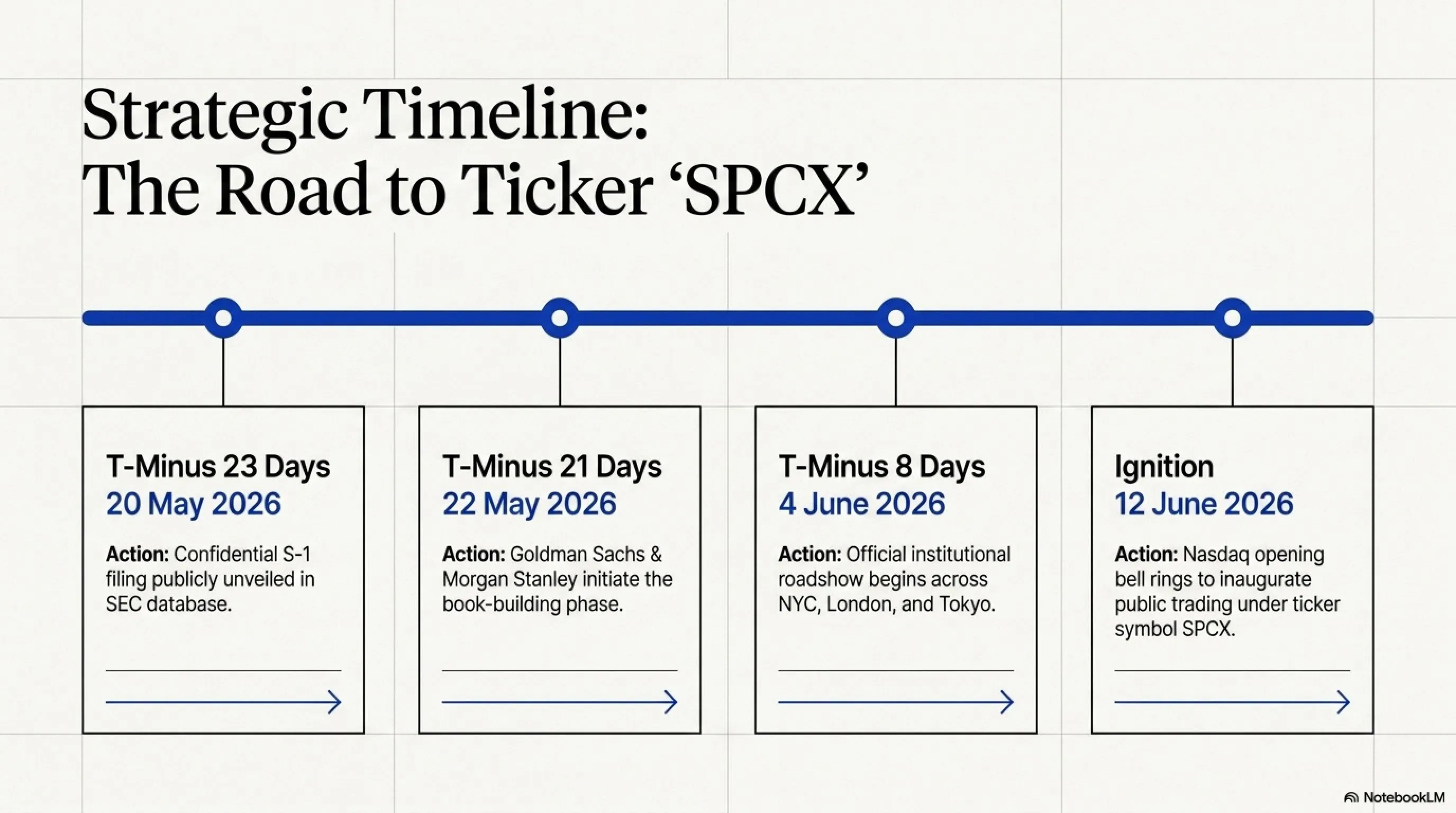
📅 Strategic Timeline for the Historic SpaceX IPO (2026)
| Target Date | Operational / Financial Action |
|---|---|
| May 20, 2026 | Confidential S-1 filing publicly unveiled in SEC database |
| May 22, 2026 | Goldman Sachs & Morgan Stanley initiate book-building phase |
| June 4, 2026 | Official institutional roadshow begins in NYC, London, and Tokyo |
| June 12, 2026 | Nasdaq opening bell rings to inaugurate SPCX public trading |
However, incorporating xAI’s balance sheet is not without risk. While it positions SpaceX as a cutting-edge artificial intelligence pioneer, the immense cash burn associated with scaling heavy Nvidia H200 and Blackwell supercomputing clusters represents a huge capital commitment. Wall Street seems highly willing to overlook these early capital losses because of Starlink's global bandwidth domination and Starship’s unparalleled heavy-lift capability.
💰 The CARR Mirage: How VCs and Founders Kingmake AI Startups
The booming AI sector is facing intense scrutiny following a massive financial exposé. On May 22, 2026, TechCrunch published a detailed investigative report highlighting a questionable practice sweeping through Silicon Valley: the widespread inflation of startup revenues using an custom metric known as CARR (Contracted Annual Recurring Revenue). The report outlines how founders and top-tier venture capitalists (VCs) rely on these non-standard metrics to justify astronomical, multi-billion-dollar valuations.
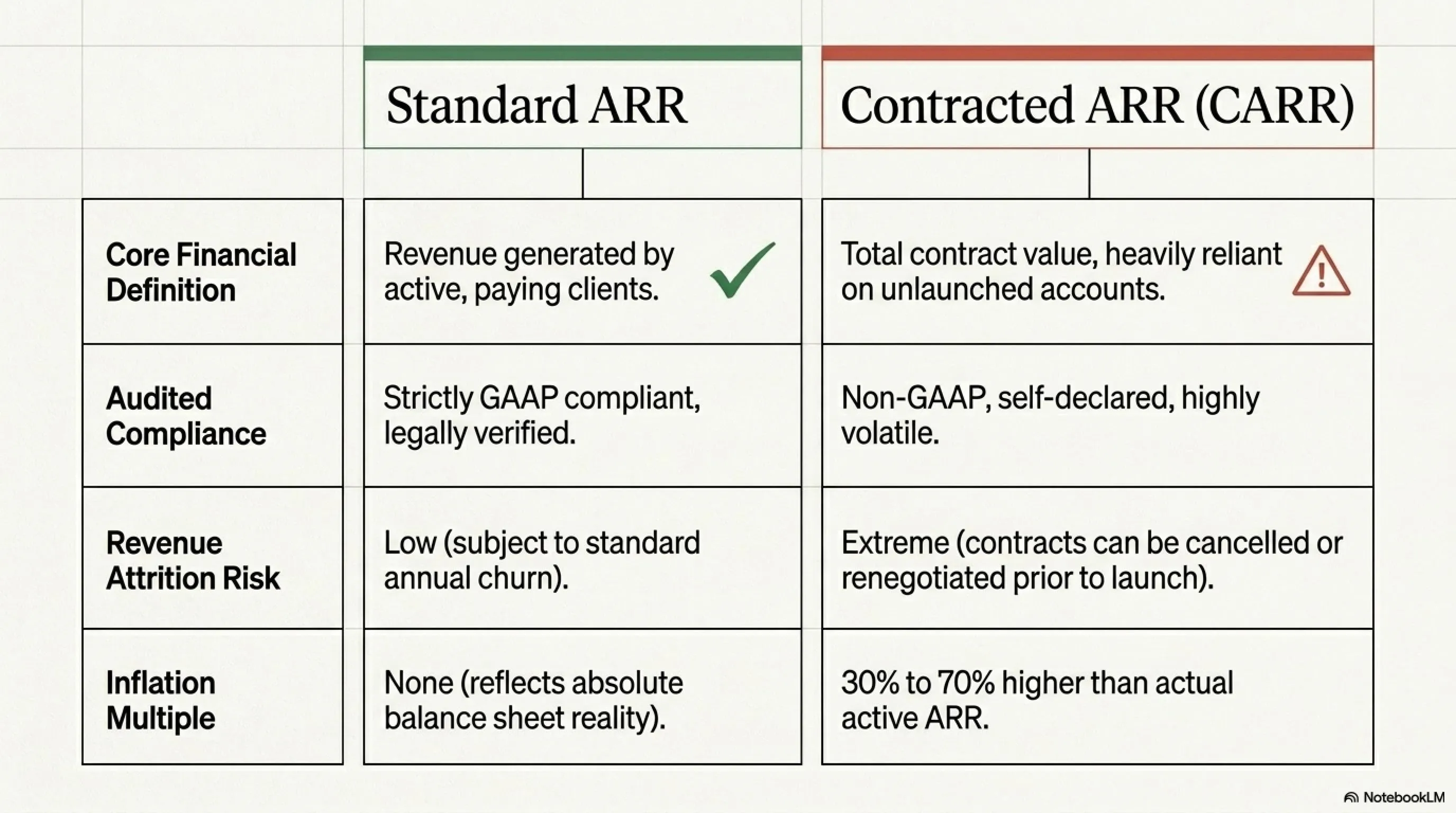
Standard ARR (Annual Recurring Revenue) is strictly audited and represents actual recurring revenue from paying, active users under contract. Conversely, CARR includes a large volume of "squishy" numbers—such as non-binding letters of intent, signed contracts where the service has not yet been implemented, or cloud capacity bookings that have yet to launch. By substituting ARR with CARR, AI startups are creating a veneer of explosive growth. VCs often stay silent or actively encourage this practice because it artificially inflates their portfolio valuations, helping them raise larger funds from institutional backers.
⚖️ ARR vs. CARR: A Comparative Breakdown of Tech Accounting Metrics
| Accounting Feature | Standard ARR (Realized) | Contracted ARR (CARR) |
|---|---|---|
| Core Financial Definition | Revenue generated by active, paying clients | Total contract value, including unlaunched accounts |
| Audited Compliance (GAAP) | Strictly compliant, legally verified | Non-GAAP, self-declared, highly volatile |
| Revenue Attrition Risk | Low (subject to standard annual churn) | Extreme (contracts can be canceled or renegotiated) |
| Inflation Multiple Range | None (reflects absolute balance sheet reality) | Often 30% to 70% higher than actual active ARR |
The public debate exploded after Scott Stevenson, CEO of prominent legal AI startup Spellbook, publicly denounced the "dishonest" use of these metrics on X. His critique quickly resonated across the tech ecosystem, revealing that multiple highly-touted AI unicorns closed massive $1.5 billion funding rounds based on $100 million in CARR, when their actual audited ARR sat below $30 million. Critics warn that this trend echoes previous market bubbles, threatening a major structural correction as startups struggle to live up to these highly inflated performance expectations.
✨ Google goes for the glitter with disco-ball icons
Android customizability is taking a playful, shimmering leap forward. Google has officially introduced a custom "Disco" icon pack for its Pixel lineup. This visual addition, covered by TechCrunch, began as a lighthearted social media exchange on X. Sameer Samat, the head of the Android ecosystem, shared an image of a Chrome browser icon redesigned as a shiny, retro disco ball and jokingly asked: "Are y'all sure you still want this?" Following an overwhelmingly enthusiastic response from Android enthusiasts, Google’s Material Design team integrated the pack into the May 2026 Pixel Drop.
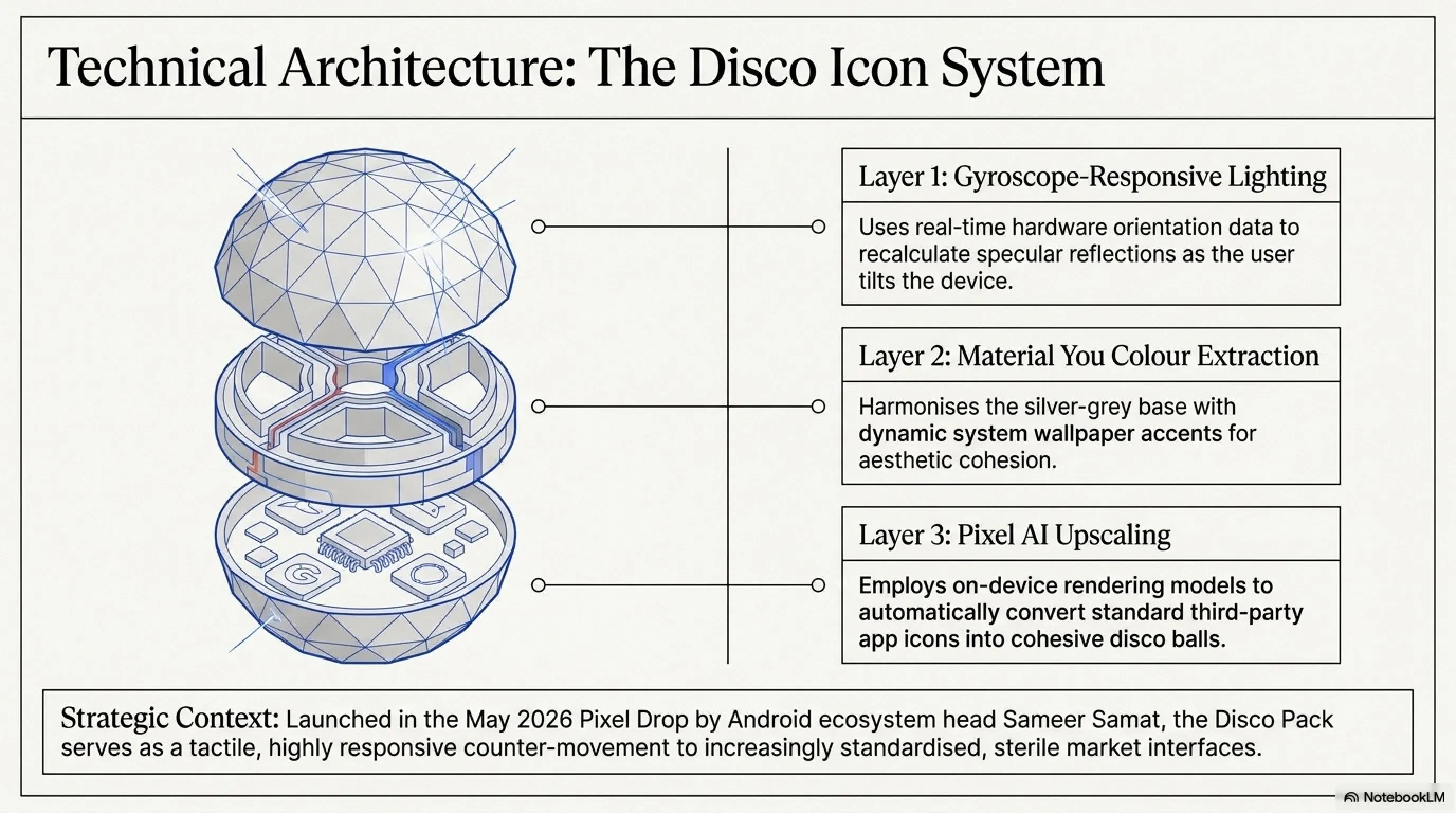
The introduction of these glittering icons is a humorous response to the minor controversy surrounding a temporary disco-ball icon Spotify released for its 20th anniversary, which drew mixed reactions from users who found it cluttered. Google’s implementation, however, is a technical marvel. The pack leverages the phone's gyroscope to dynamically adjust the light reflection across the tiny mirrored surfaces of the disco ball as the user tilts their device. It also hooks into Android’s Material You system, subtly tinting the silver reflections to match the user's active wallpaper and accent colors.
📱 Technical and Visual Highlights of Pixel's New Disco Icons
- Gyroscope-Responsive Lighting: Uses real-time hardware orientation data to recalculate specular reflections, making the app icons appear to catch real-world light.
- Material You Color Extraction: Harmonizes the silver-gray base with dynamic system accents, maintaining aesthetic cohesion across the home screen.
- Pixel AI Upscaling: Employs on-device rendering models to automatically convert third-party app icons that lack custom assets into fully cohesive disco balls.
- Optimized High-Contrast Mode: Includes a togglable utility in system settings to dim the shimmer effect in low-light environments, preventing eye fatigue.
While some industry analysts view this feature as a whimsical distraction, it demonstrates Android’s continued commitment to expressive, user-centric customization. Following the launch of style packages like "Scribbles" and "Easel" in the March Pixel Drop, the Disco Pack provides Pixel owners with a highly tactile and responsive interface that stands out in an increasingly standardized market.
📱 Apple TV MLS Match Shot Entirely on iPhone 17 Pro
Apple and Major League Soccer have achieved a historic milestone in sports broadcasting. On May 23, 2026, the MLS clash between the LA Galaxy and the Houston Dynamo FC was broadcast live on Apple TV, having been captured entirely using the iPhone 17 Pro. This event represents the first time a major, live professional sporting event has been filmed exclusively on mobile hardware, challenging the necessity of traditional, multi-million-dollar broadcast setups.
To cover Dignity Health Sports Park, the production team deployed over 25 iPhone 17 Pro units throughout the venue. In addition to replacing standard heavy cameras in traditional high-vantage positions, the compact size and portability of the iPhones allowed the crew to secure unique angles previously impossible to capture. Units were placed inside the goalposts, directly behind the nets for goal-line perspectives, and worn on chest rigs by referees during player introductions and pre-game warmups, delivering an exceptionally intimate viewing experience.
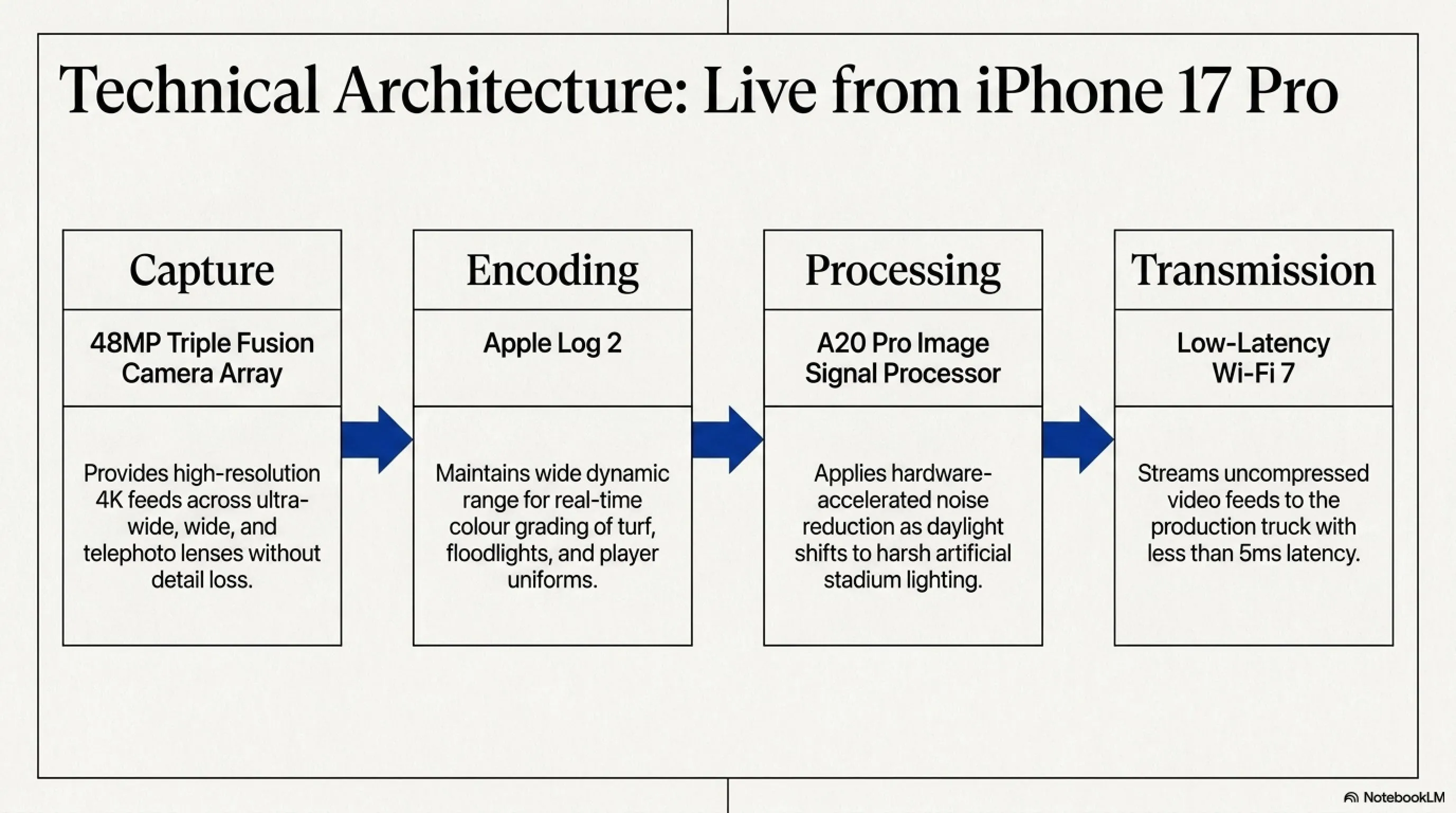
⚙️ iPhone 17 Pro Hardware & Software Stack in Live Sports Production
| Feature / Technology | Role in Professional Live Broadcast |
|---|---|
| 48MP Triple Fusion Camera Array | Provides high-resolution 4K feeds across ultra-wide, wide, and telephoto lenses without detail loss. |
| Apple Log 2 Encoding | Maintains wide dynamic range for real-time color grading of turf, stadium floodlights, and player uniforms. |
| Low-Latency Wi-Fi 7 Live Transmission | Streams uncompressed video feeds to the production truck with less than 5ms latency. |
| A20 Pro Image Signal Processor (ISP) | Applies hardware-accelerated noise reduction as daylight shifts to harsh artificial floodlighting. |
This broadcast follows extensive trials, including smaller-scale iPhone integrations during a "Friday Night Baseball" game in late 2025. By successfully executing this live 4K HDR stream, Apple and MLS have demonstrated that consumer mobile hardware has reached a level of sophistication capable of handling demanding professional workflows. This opens new doors for smaller independent leagues and content creators to produce broadcast-quality media with minimal budgets.
🎵 Spotify's AI Bet: More of Everything, Less of What You Want
The world’s largest music streaming service, Spotify, is aggressively expanding its AI portfolio, but this strategic rush is beginning to trigger notable backlash and user fatigue. A comprehensive analysis by TechCrunch, written by Ivan Mehta and published on May 22, 2026, examines Spotify’s relentless push into creator-focused AI tools. Following a major licensing deal with Universal Music Group (UMG) for AI-generated music covers, the integration of ElevenLabs’ narration for audiobooks, and the launch of automated podcast generation utilities, the platform’s interface has become increasingly crowded.
The core critique highlighted in the report is a fundamental shift in Spotify’s strategic focus. Rather than using artificial intelligence to help listeners discover organic talent, independent artists, and curated, high-quality music, the platform is increasingly pushing users to consume and create synthetic content. This "quantity-over-quality" approach has filled search feeds with low-value, AI-generated background music and robotic podcasts, making it harder for users to locate human-made, high-fidelity artistry.
📊 Spotify AI Feature Burnout and User Behavioral Metrics (2026)
Listeners reporting that recommendation feeds feel cluttered and less aligned with their personal taste.
Decline in listener reach for independent artists due to algorithm prioritization of AI-generated content.
Rise in duplicate, low-fidelity AI tracks uploaded to the platform by third-party click farms.
This trend raises a critical question for the streaming industry: does over-saturating the platform with AI-generated content protect margins, or does it erode the service's core value? As competitors like Apple Music lean into human-curated editorial content and high-resolution spatial audio, Spotify risks alienating its premium subscriber base. Finding the right balance between tech-driven scale and human-centric artistry is essential to maintaining long-term user loyalty.
🖥️ Gemini Mac Spark & Voice Control Coming
Following announcements at Google I/O 2026, Google is readying a major desktop integration. The company has officially unveiled its new 24/7 personal AI agent, Gemini Spark, alongside an advanced native voice control experience for macOS, slated to launch later this summer. The update transforms Gemini from a standard chat interface into an autonomous background agent deeply integrated into the desktop environment.
A standout addition is the high-performance system-wide voice dictation feature. By holding down a customizable hotkey (such as the Function key), users can dictate complex instructions. Utilizing real-time on-screen context, the local Gemini engine processes the request, structures the response, and inserts the formatted output directly into the active text field where the cursor is positioned. The agent operates smoothly across both native macOS apps and third-party development tools, dramatically accelerating productivity.
💻 Core Capabilities of Gemini Spark on the macOS Platform
| Feature Category | Operational Impact & Workflow Automation |
|---|---|
| System-Wide Context Aware Dictation | Translates free-form voice commands into formatted text blocks, targeting the active cursor directly. |
| Local Document Parsing | Analyzes local PDFs, images, and text documents directly on device, maintaining user privacy. |
| Multi-App Workspace Orchestration | Coordinates tasks seamlessly between Gmail, Google Docs, local directories, and terminal windows. |
| Google AI Ultra Access | Offered exclusively under the $100/month tier, utilizing high-performance server-side reasoning models. |
This desktop push intensifies the competition between Google and Apple. While Apple’s native Apple Intelligence focuses on Siri and system integrations, Google’s cross-platform Spark agent delivers a highly sophisticated and versatile assistant directly into the macOS ecosystem. The $100 monthly pricing is significant, but for power users and enterprise professionals, the automation capabilities offer unmatched value.
🏁 Strategic Analysis: Pros and Cons (PROS & CONS)
🟢 Key Opportunities (PROS)
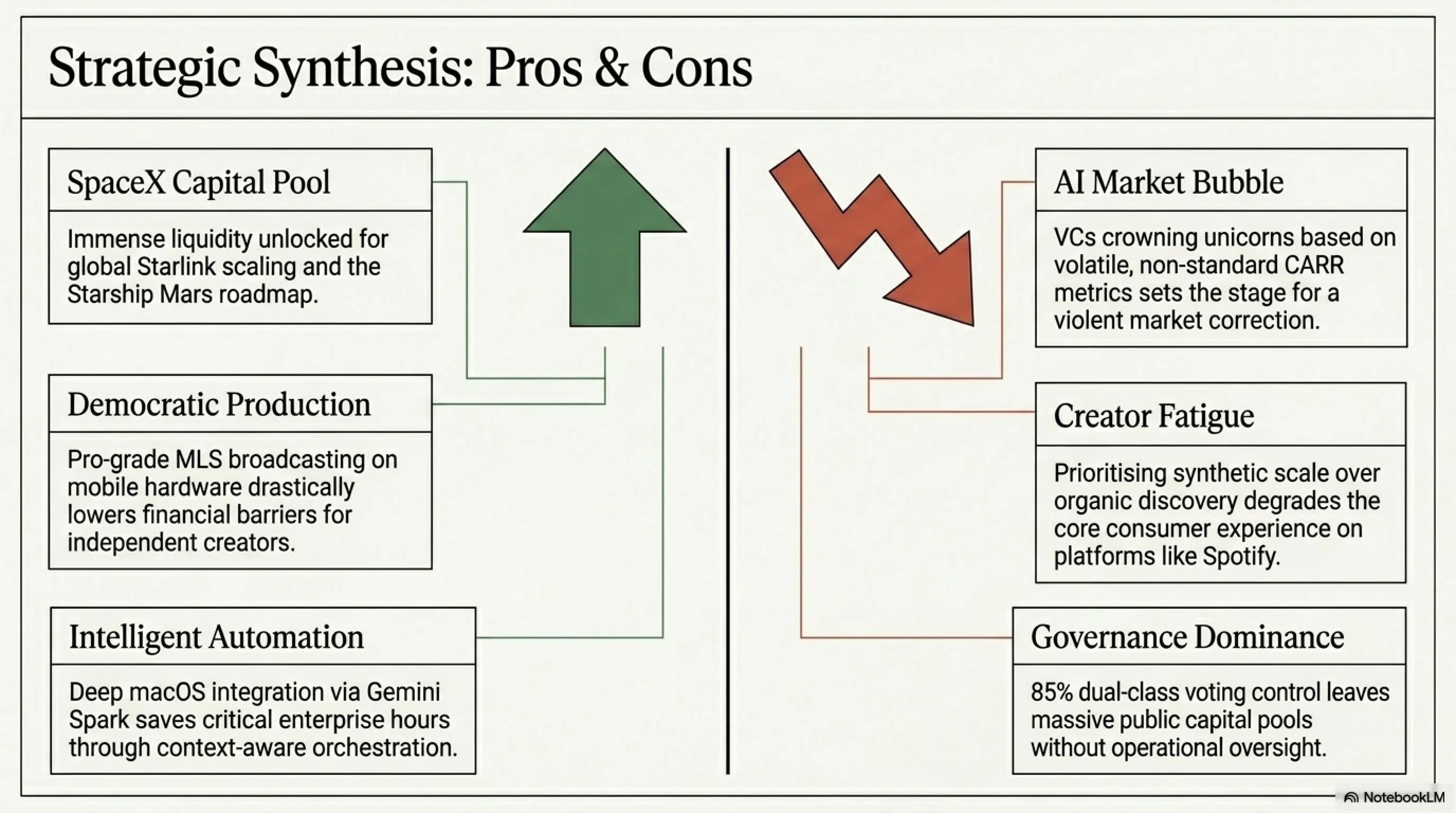
- SpaceX Capital Pool: The historic S-1 listing equips SpaceX with immense funding to scale the Starlink network globally and push Starship to Mars.
- Democratic Production: Capturing a professional MLS match on iPhone 17 Pro demonstrates that premium broadcasting is now accessible at a fraction of standard costs.
- Intelligent Automation: Gemini Spark's system-wide integration on macOS significantly reduces manual workloads and streamlines business flows.
🔴 Key Risks & Challenges (CONS)
- AI Market Bubble: Using non-standard metrics like CARR to boost valuations risks a sharp market correction.
- Creator Fatigue: Spotify's heavy reliance on synthetic content threatens user experience and dilutes editorial quality.
- Governance Concents: The dual-class share structure keeps 85% of voting power with Elon Musk, leaving public shareholders with little voice.
🔮 Final Thoughts & Strategic Verdict
Tonight's stories demonstrate that technology is simultaneously expanding into deep space and integrating more deeply into our daily digital interactions. However, valuation scandals and algorithmic saturation serve as a reminder that consumer satisfaction remains the ultimate test of long-term survival. The companies that succeed in 2026 will be those that balance advanced AI and financial growth with genuine user experience and artistic integrity.
❓ Frequently Asked Questions (FAQ)
1. What is the target valuation and capital raise for SpaceX's historic IPO?
SpaceX is targeting a total market valuation of approximately $1.75 trillion to $2.00 trillion in its S-1 filing, aiming to raise between $40 billion and $80 billion in what is expected to become the largest IPO in stock market history.
2. How does CARR differ from standard ARR, and why is this distinction controversial?
Standard ARR reflects realized recurring revenue from active accounts, while CARR (Contracted ARR) includes unfulfilled agreements and letters of intent. Many AI startups and VCs rely on CARR to inflate growth figures by up to 70% to secure higher valuations, raising concerns about a potential market correction.
3. Are the Google Pixel custom Disco Pack icons available to other Android devices?
No, the premium Disco Pack is currently exclusive to Google Pixel devices, launching as a highlighted feature in the May 2026 Pixel Drop. The pack utilizes the system's gyroscope and Material You color extraction to adjust reflections dynamically.
4. How was the MLS match broadcast shot entirely on iPhones executed?
The production team utilized 25 iPhone 17 Pro units positioned across the stadium, capturing high-resolution 4K HDR feeds encoded in Apple Log 2. Real-time footage was streamed over Wi-Fi 7 to the production deck with less than 5ms latency.
5. When is Gemini Spark launching on macOS, and how much does it cost?
Google has slated the macOS launch of Gemini Spark for late summer 2026. The 24/7 background agent and advanced voice dictation features will be available to Google AI Ultra subscribers, priced at $100/month.
📚 Sources & References
1. U.S. Securities and Exchange Commission (SEC) — SpaceX Confidential S-1 Registration Filings
2. Wall Street Journal & Bloomberg Intelligence — SpaceX & xAI Consolidated Financial Appraisals
3. TechCrunch Silicon Valley Bureau — VC ARR and CARR Accounting Standard Audits (May 2026)
4. Google Android Developer Network — Pixel May Feature Drop and Material Design Guidelines
5. Apple Newsroom & MLS Season Pass Technical Division — iPhone 17 Pro Live Broadcast Specifications
6. TechCrunch Creator Economy — Spotify AI Integration and Audio Streaming Burnout Reports
7. Google I/O 2026 Desktop Engineering — macOS Gemini Spark & Voice Dictation API Roadmaps
Research, Drafting, and Editorial Review: Takin Plus Technical Research Team
🌐 Stay Connected With Us 🎮✨
For the latest tech, gaming, and gadget news, follow us on our official social media channels: