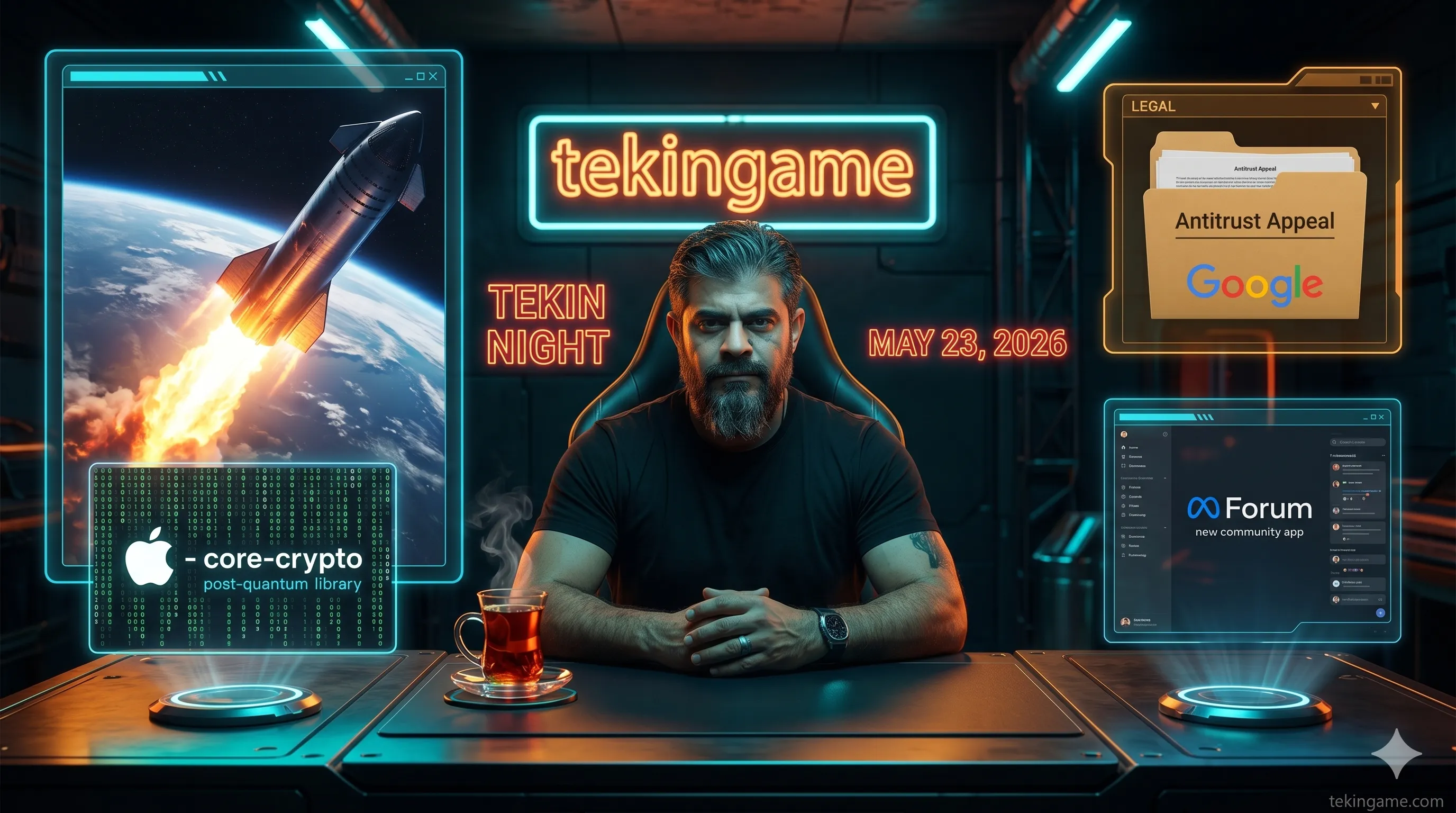
🌙 Welcome to Tekin Night May 23, 2026
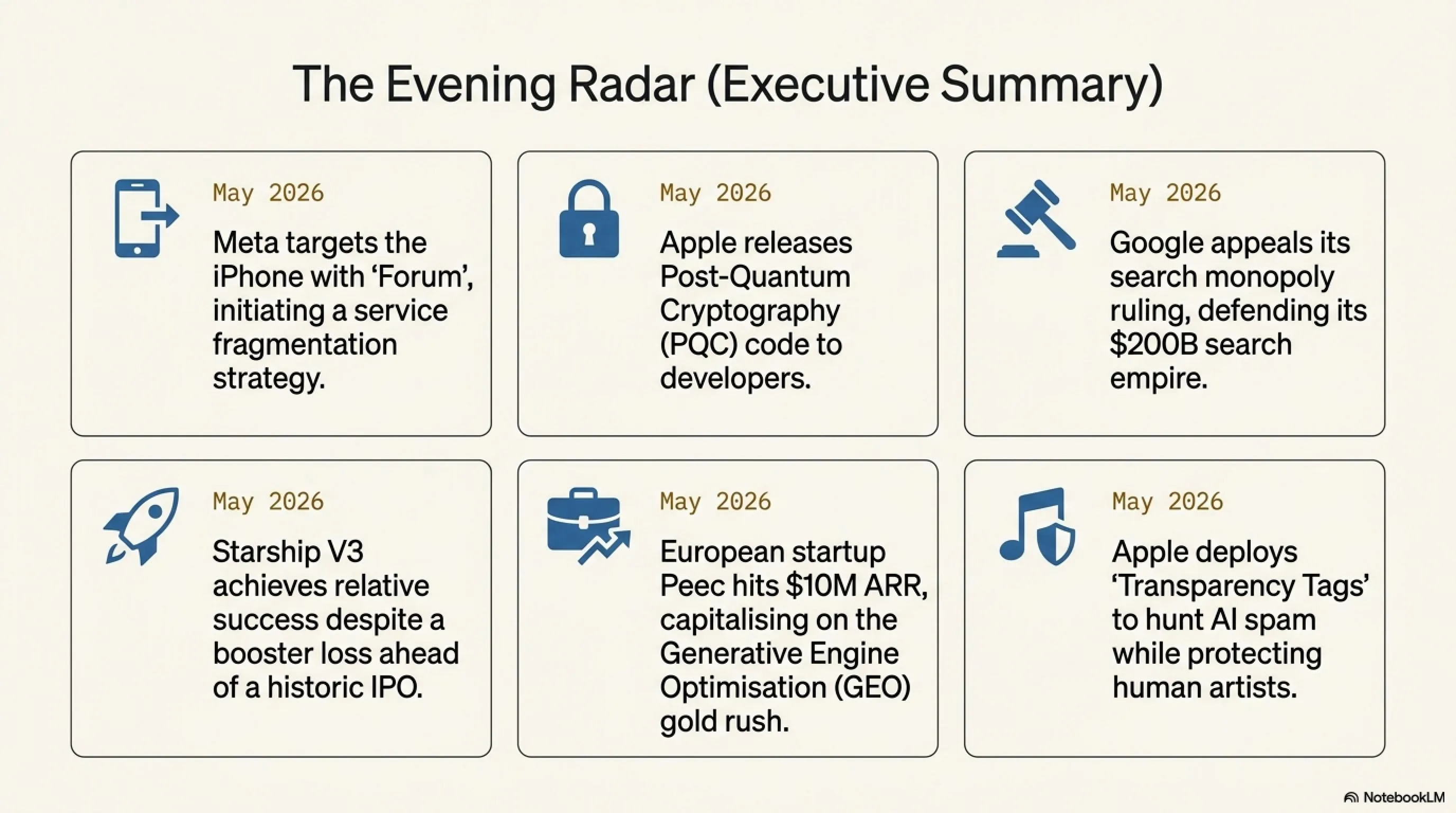
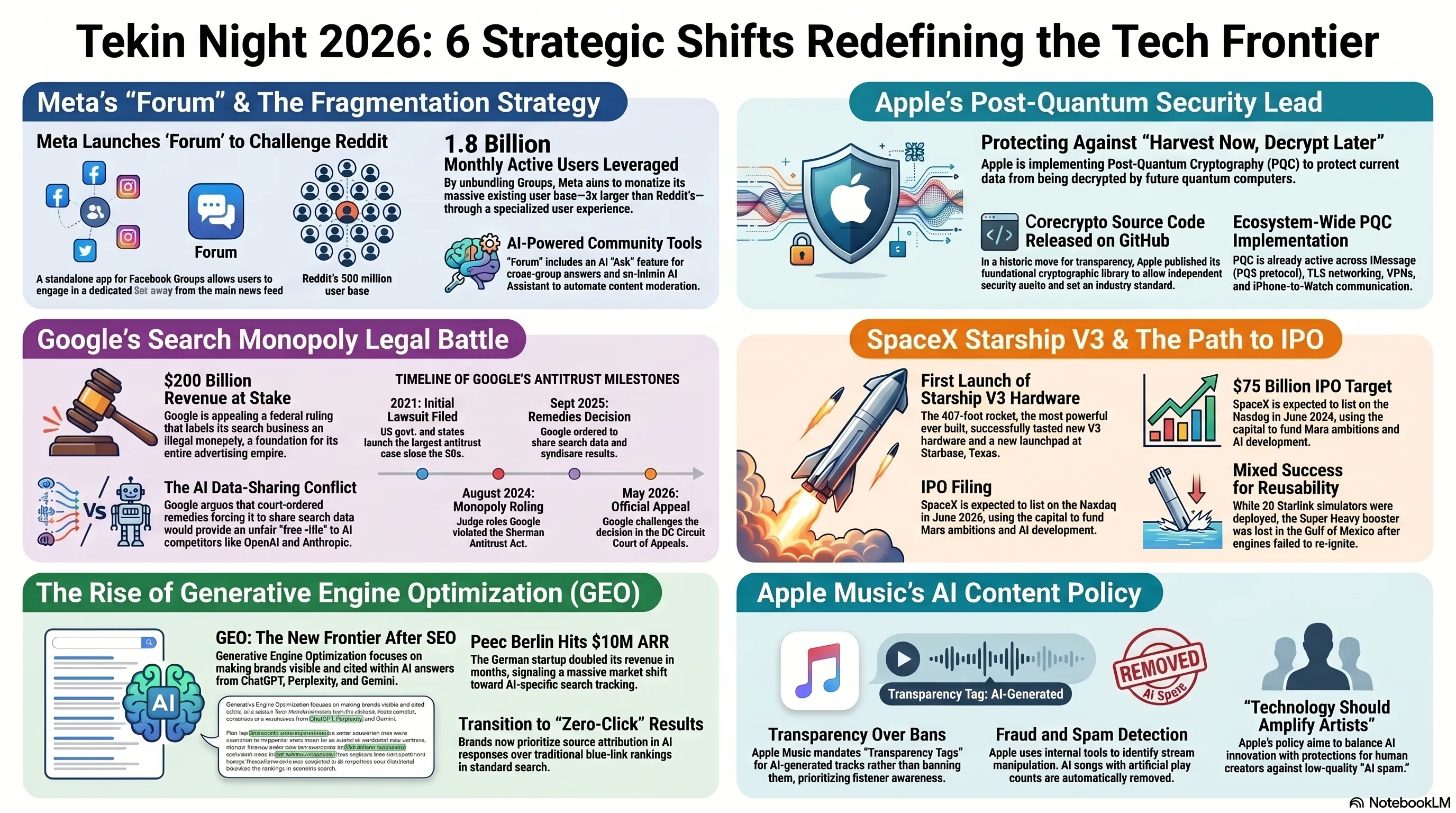
Good evening, tech enthusiasts! Tonight we bring you six strategic and groundbreaking stories from the world of technology. From Meta's bold move to challenge Reddit, to Apple's historic step in quantum security, to Google's legal battle against monopoly ruling, to SpaceX's relative success with Starship V3, and European startups building gold in the AI era. Tonight we witness major transformations shaping the future of the tech industry.
⚡ Tonight's Headlines:
📱 Meta Targets iPhone with Two New Apps
🔐 Apple Releases Post-Quantum Cryptography Code
⚖️ Google Appeals Search Monopoly Ruling
🚀 SpaceX Launches First Starship V3
💼 Peec Berlin Hits $10M Annual Revenue
🎵 Apple Music Hunts AI Spam with New Tools
☕ Grab your evening beverage and join us on an exciting journey through the tech world!
📱 Meta Attacks iPhone with Two New Apps: Forum and the Service Fragmentation Strategy
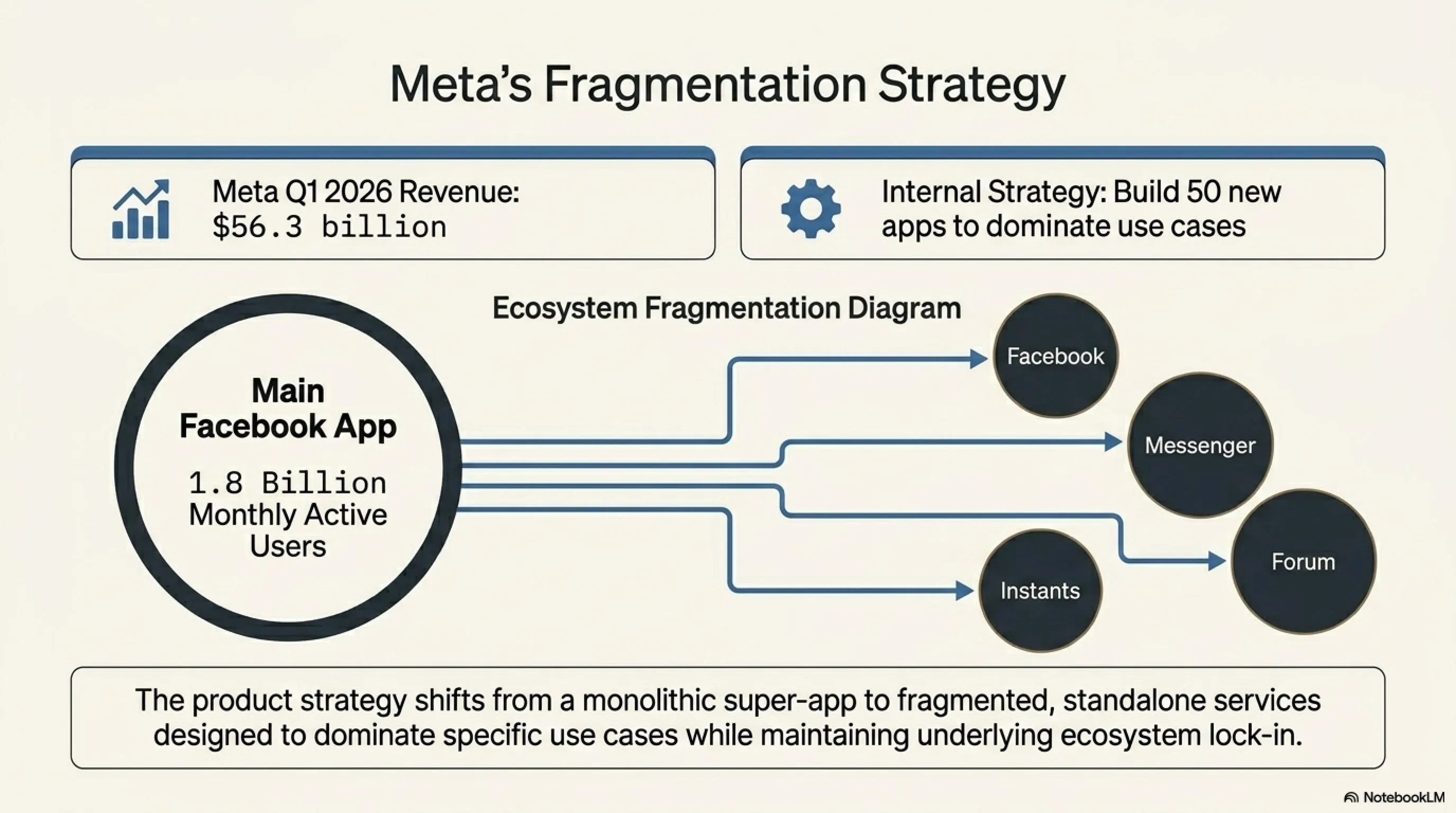
Meta introduced two new iPhone apps in May 2026, signaling a major strategic shift for the company. The latest app, called Forum, is a dedicated app for Facebook Groups that was released on the App Store without any official announcement, press conference, or advance notice. This quiet launch is highly unusual for a company that generated $56.3 billion in revenue in Q1 2026 alone.
Forum is officially called "Forum, a Facebook app" and allows users to view all their Facebook Groups in a dedicated feed separate from the main Facebook experience. The app joins the standalone Facebook and Messenger apps, and also joins Instants, the new iPhone app launched by Meta's Instagram earlier in May. This represents a fundamental shift in Meta's product strategy: fragmenting services into standalone applications.
The timing is significant. Mark Zuckerberg told staff in May that he and Chris Cox had discussed building 50 new apps. Forum is the first tangible example of this strategy in action. But why now? And why target Reddit so directly? The answer lies in a combination of market dynamics, competitive pressure, and Meta's need to defend its massive Groups ecosystem—which boasts over 1.8 billion monthly active users.
🎯 Forum's Key Features: A Deep Dive
| Feature | Description | Strategic Value |
|---|---|---|
| Dedicated Group Space | Sign in with Facebook account; groups, profile, and activity carry over automatically | Reduces friction, leverages existing network effects |
| Nickname Posting | Option to post with a nickname for privacy | Directly competes with Reddit's pseudonymous culture |
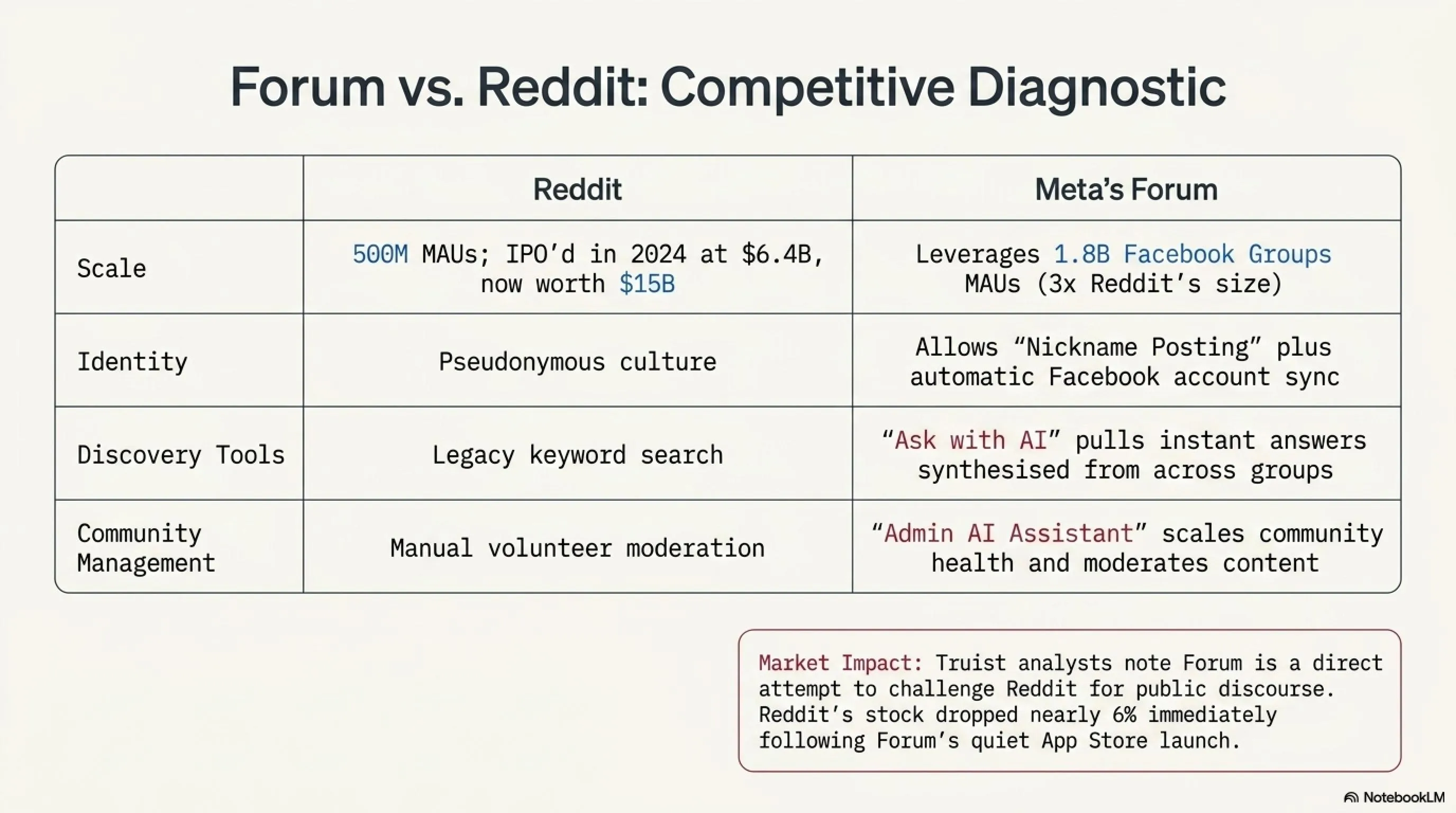
| Ask with AI | Pulls together responses from across groups for instant answers | AI-powered discovery, superior to Reddit's search |
| Admin AI Assistant | Helps manage groups, moderate content, and maintain community health | Reduces admin burden, scales community management |
| Facebook Sync | Anything shared on Forum is visible in Facebook Groups | Maintains ecosystem lock-in while offering specialized UX |
The market reaction was immediate and telling. Reddit's stock dropped nearly 6% following the Forum announcement. Truist analysts wrote in a note that Forum represents "an attempt by the company to compete against Reddit as an online forum for public discourse" and "represents a new threat." This isn't hyperbole—Meta has the resources, user base, and AI capabilities to seriously challenge Reddit's dominance in online communities.
🔍 Tekin Analysis: Why Meta Is Going After Reddit Now
The launch of Forum isn't just about competing with Reddit—it's about Meta's existential need to defend and monetize its Groups ecosystem. Here's the strategic calculus:
1. Reddit's Explosive Growth: Reddit has grown from a niche platform to a mainstream social network with over 500 million monthly active users. Its IPO in 2024 valued the company at $6.4 billion, and it's now worth over $15 billion. Reddit's communities are sticky, engaged, and increasingly valuable for advertisers.
2. Facebook Groups: An Undermonetized Asset: Meta has 1.8 billion monthly active users in Facebook Groups—more than 3x Reddit's entire user base. But Groups have been buried inside the main Facebook app, competing for attention with News Feed, Stories, Reels, and Marketplace. By giving Groups a dedicated app, Meta can finally unlock their full potential.
3. The AI Advantage: Meta's AI capabilities—particularly in content moderation, recommendation algorithms, and now generative AI—give it a significant edge. The "Ask" feature, which uses AI to pull answers from across groups, is something Reddit can't easily replicate. The Admin AI Assistant could make managing large communities dramatically easier, attracting more group creators to the platform.
4. The Fragmentation Strategy: By splitting services into standalone apps, Meta can optimize each experience for its specific use case. Forum can have a Reddit-like interface optimized for discussion threads, while the main Facebook app focuses on social networking. This is the same strategy that worked for Messenger.
Tekin Prediction: If Forum succeeds, expect Meta to launch more standalone apps for other Facebook and Instagram features. We could see dedicated apps for Marketplace, Events, Dating, and more. This strategy allows Meta to compete with specialized platforms (Reddit, Craigslist, Eventbrite, Tinder) while maintaining ecosystem lock-in through Facebook account integration.
What This Means for You: If you're a community manager or group admin, Forum's AI tools could significantly reduce your workload. If you're a Reddit user, you now have a credible alternative with better AI features and a larger potential audience. And if you're an investor, watch Reddit's stock closely—Meta just declared war.
🔐 Apple Releases Post-Quantum Cryptography Code on GitHub: Preparing for the Quantum Era
📚 Classified & Related Dossiers in TekinGame
If you wish to explore beyond this report and delve into cybernetic frontiers and autonomous AI architectures, do not miss these three exclusive deep-dives in the Tekin Garage:
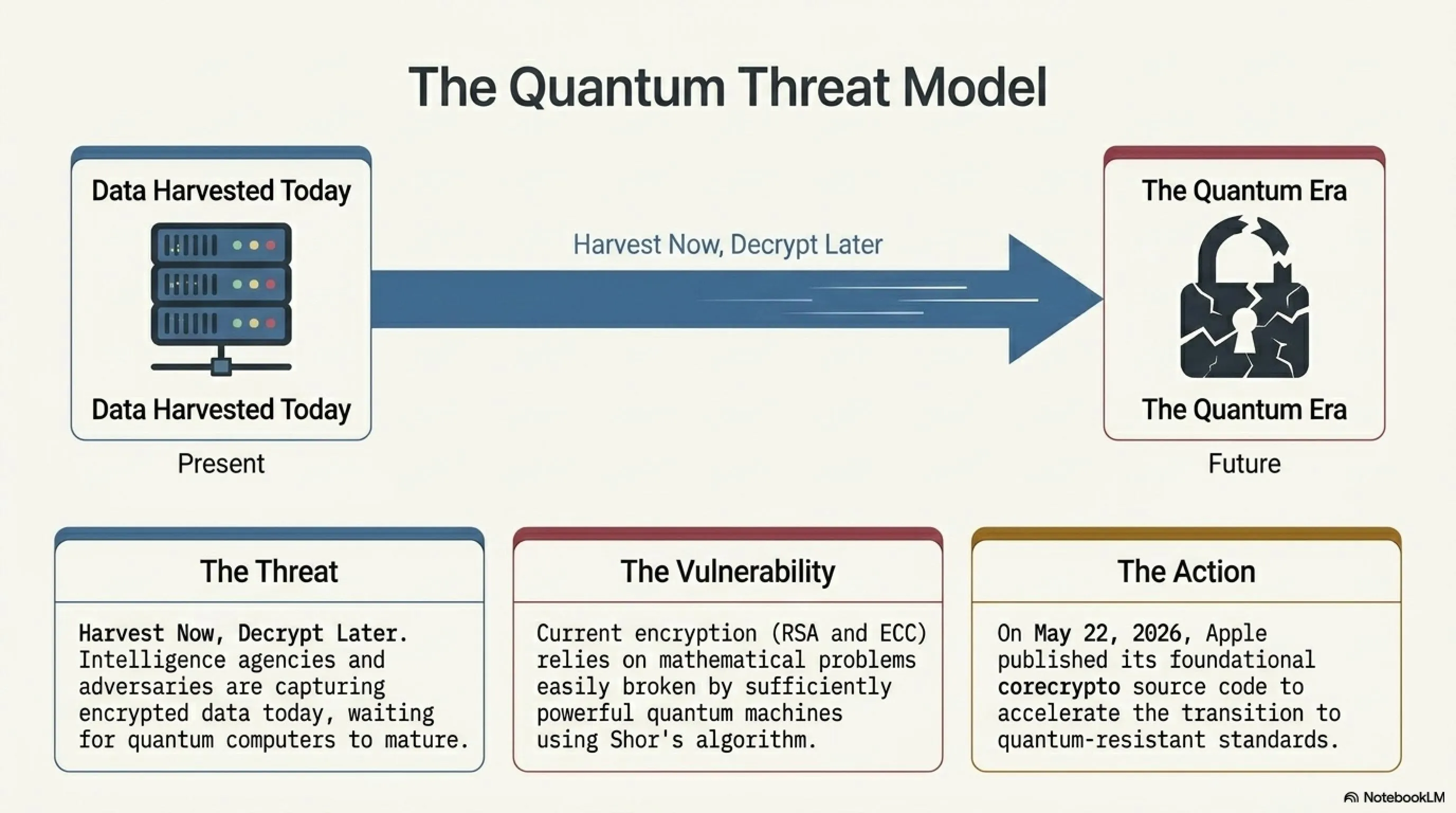
In a historic move for transparency and security, Apple on May 22, 2026, published new corecrypto source code on GitHub. This release is accompanied by a detailed technical post explaining the intricate work behind its post-quantum cryptography (PQC) efforts across iPhone, Mac, and other Apple devices.
corecrypto is the foundational cryptographic library upon which the security of all Apple platforms is built. With its release on May 22, 2026, Apple is offering a deeper insight into its encryption architecture than ever before. At its core lies corecrypto—the cryptographic core library upon which the security frameworks of all Apple devices are built. This isn't just a symbolic gesture; it's a strategic move that positions Apple as a leader in the post-quantum security race.
The release includes implementations of NIST-standardized post-quantum algorithms that Apple has integrated across its ecosystem. These algorithms are designed to resist attacks from quantum computers—machines that don't yet exist at scale but could, within the next decade, break most of today's encryption standards. Apple's proactive approach means that data encrypted today will remain secure even when quantum computers become powerful enough to threaten current cryptographic methods.
🛡️ Understanding Post-Quantum Cryptography: The Quantum Threat
Post-quantum cryptography (PQC) refers to cryptographic algorithms that are resistant to attacks by quantum computers. Current encryption methods like RSA and ECC rely on mathematical problems that are hard for classical computers to solve but could be easily broken by sufficiently powerful quantum computers using algorithms like Shor's algorithm.
The threat isn't theoretical. Intelligence agencies and adversaries are already engaging in "harvest now, decrypt later" attacks—collecting encrypted data today with the expectation that they'll be able to decrypt it once quantum computers become available. This makes PQC implementation urgent, not optional.
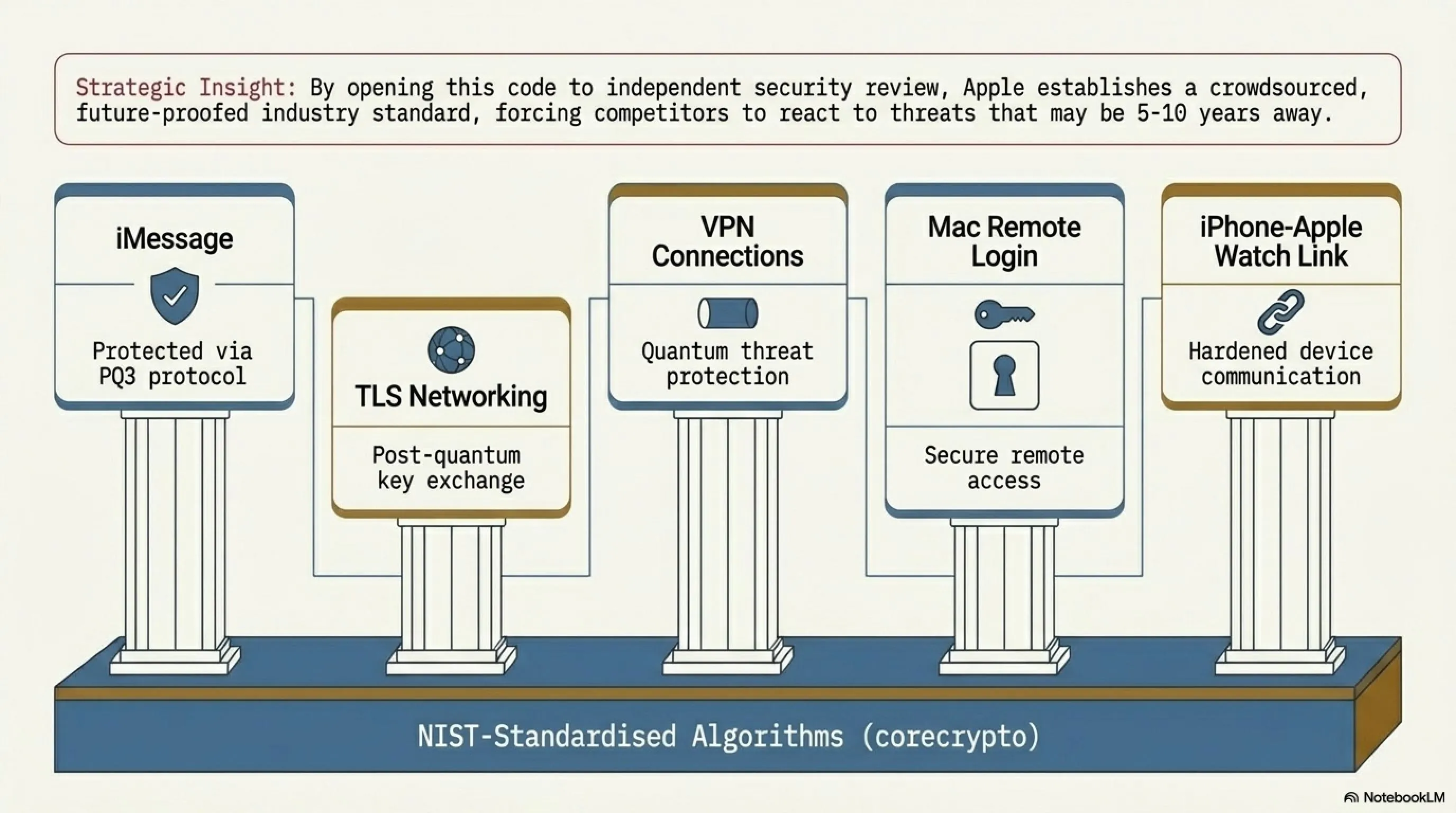
| Platform/Service | PQC Implementation | Status |
|---|---|---|
| iMessage | PQ3 protocol (launched 2024) | ✅ Active |
| TLS Networking | Post-quantum key exchange for network connections | ✅ Active |
| VPN Connections | Protection against quantum threats for VPN traffic | ✅ Active |
| Mac Remote Login | Secure remote login with NIST algorithms | ✅ Active |
| iPhone-Apple Watch Link | Secure communication between iPhone and Apple Watch | ✅ Active |
Apple's security documentation now details how post-quantum cryptography is built into iPhone and Mac across iMessage, TLS networking, VPN connections, Mac remote login, and the iPhone-to-Apple Watch link. All of it runs on NIST-standardized algorithms, wired into the frameworks developers already use. This means developers don't need to change their code—the quantum-resistant security is built into the platform.
💡 Why This Release Matters: Industry Leadership and Transparency
The release of corecrypto code on GitHub is a major step for transparency and security, and it positions Apple as a leader in the post-quantum security race:
- Independent Security Review: Security researchers and developers can now review the code and identify potential vulnerabilities. This crowdsourced security audit is far more effective than closed-source approaches.
- Industry Standard: By using NIST-standardized algorithms, Apple demonstrates commitment to global standards rather than proprietary solutions. This makes interoperability easier and builds trust.
- Future-Proofing: By implementing PQC now, Apple is preparing its devices for quantum threats that may emerge in the next 5-10 years. This is proactive security, not reactive.
- Industry Leadership: Apple is one of the first major tech companies to publicly release its post-quantum cryptography code. This sets a precedent and puts pressure on competitors to follow suit.
- Developer Ecosystem: By making the code open source, Apple enables developers to understand and potentially contribute to the security of the platform. This builds a stronger security ecosystem.
What This Means for You: If you're an iPhone or Mac user, your data is now protected against future quantum computer attacks. If you're a developer, you can review Apple's implementation and understand how to build quantum-resistant applications. And if you're a security researcher, you now have access to one of the most advanced post-quantum cryptography implementations in the world.
⚖️ Google Appeals Search Monopoly Ruling: "We Won Fair and Square"
Google officially filed its appeal of the federal ruling deeming it an illegal search monopolist, arguing the decision "crashed" through legal guardrails. In its legal filing, Google writes: "Google just prevailed in the marketplace fair and square." This appeal sets up what could be a multi-year legal battle that will shape the future of search, AI, and antitrust enforcement in the tech industry.
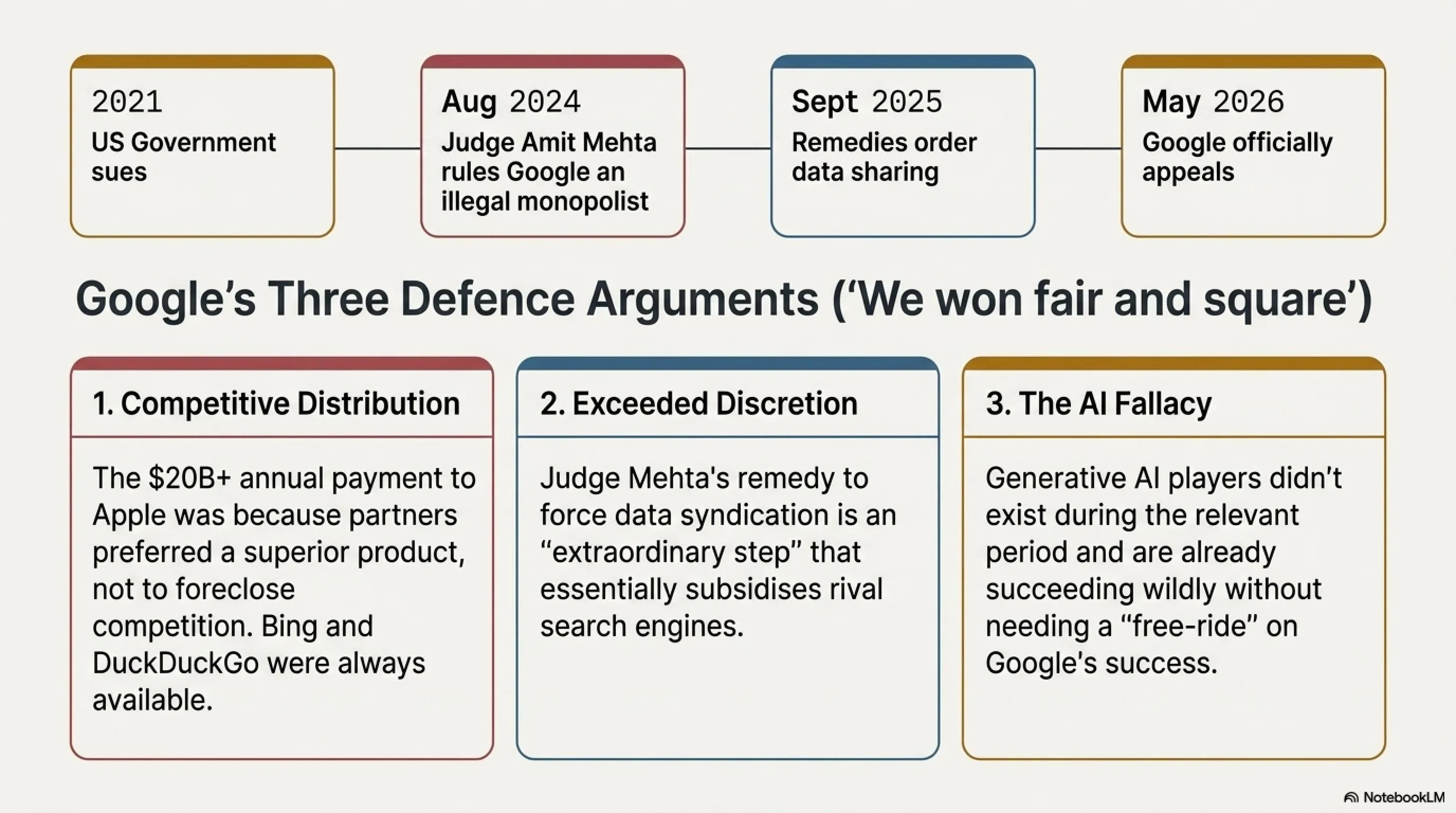
Google had already announced it would appeal the ruling, which includes both the August 2024 decision about its illegal monopolization and the September 2025 remedies decision that ordered it to share some search data with competitors. The appeal brief filed Friday provides more insight into how the company plans to fight Judge Amit Mehta's ruling. The stakes couldn't be higher: Google's search business generates over $200 billion in annual revenue and is the foundation of its entire advertising empire.
📊 Timeline of Google's Monopoly Case
| Date | Event | Impact |
|---|---|---|
| 2021 | US government and coalition of states file lawsuit against Google | Largest antitrust case since Microsoft in 1990s |
| August 2024 | Judge Mehta rules Google is an illegal monopolist | Google found to have violated Sherman Antitrust Act |
| September 2025 | Remedies decision: Google must share search data with competitors | Could reshape competitive landscape of search |
| May 2026 | Google officially files appeal | Case moves to DC Circuit Court of Appeals |
Lee-Anne Mulholland, Google's VP of regulatory affairs, said in a statement: "We are asking the court to overturn this flawed decision—partners and users have many options and choose Google because it provides the best, most helpful results." This framing—that Google won through superior product quality rather than anticompetitive behavior—is central to the company's defense strategy.
⚔️ Google's Key Arguments: A Legal Strategy Breakdown
Google's appeal rests on several key arguments, each designed to undermine different aspects of Judge Mehta's ruling:
1. Distribution Agreements Were Competitive, Not Anticompetitive: Google argues that its search distribution agreements with browser and device makers (including the famous $20+ billion annual payment to Apple) were simply the result of partners preferring its superior product. The company contends that these agreements didn't foreclose competition—rivals like Bing and DuckDuckGo remained available, users could easily switch default search engines, and partners chose Google because it delivered better results and more revenue.
2. Remedies "Egregiously Exceeded" Judicial Discretion: Google argues that Judge Mehta went too far in ordering the company to share search data and syndicate results to competitors. The company calls this an "extraordinary step" that amounts to forcing Google to "boost its competitors" and essentially subsidize rival search engines. Google contends that such remedies go beyond what's necessary to address any competitive harm.
3. The AI Argument: Perhaps most interesting is Google's argument about generative AI. The company takes issue with remedies requiring data sharing with generative AI players, arguing these companies "could not have been affected by Google's conduct because they did not even exist during the relevant period, and are already succeeding as wildly as any technology in human history without any need to free-ride on Google's success." This is a direct shot at OpenAI, Anthropic, and other AI companies that could benefit from access to Google's search data.
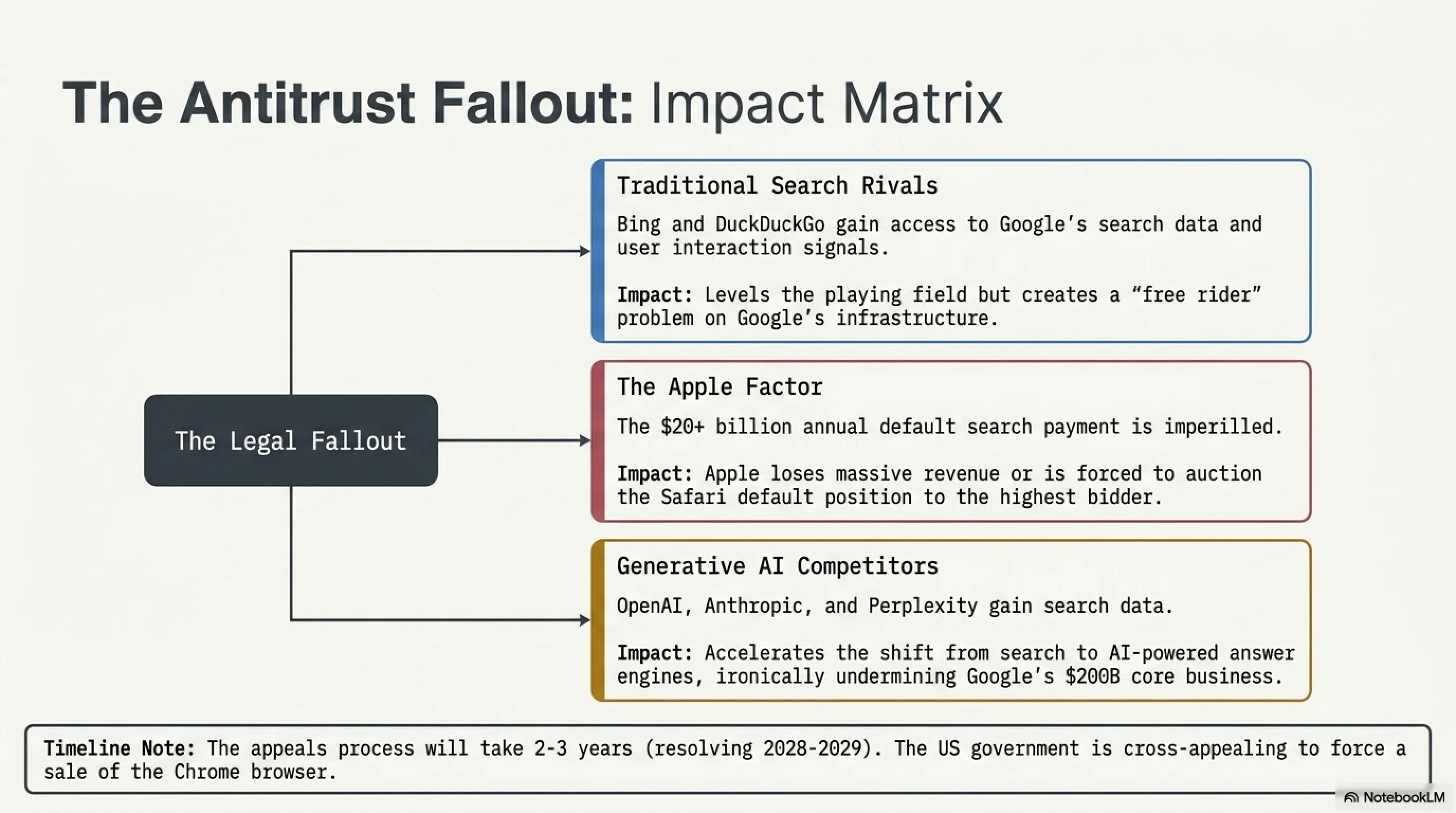
The US government and a coalition of states that sued alongside it are also appealing the same decision, but from the opposite direction—arguing that Judge Mehta should have gone further in his remedies. The government had asked for more dramatic measures, including a forced sale of Google's Chrome browser, which it argues is a key distribution platform for search offerings. Mehta declined to grant this request, leading to the government's cross-appeal.
About five years since the initial case was filed, it's now up to a federal appeals court in DC to determine what should happen next. From there, the case could eventually go all the way up to the Supreme Court. Legal experts predict the appeals process could take 2-3 years, meaning a final resolution might not come until 2028 or 2029. In the meantime, Google must begin implementing the remedies ordered by Judge Mehta, unless it can secure a stay pending appeal.
🔍 Tekin Analysis: What This Means for Search, AI, and Competition
This case is about far more than Google—it's about the future of search, AI, and how we regulate dominant tech platforms. Here's what's really at stake:
The Search Market: If the remedies stand, competitors like Bing, DuckDuckGo, and newer AI-powered search engines could gain access to Google's search data and user interaction signals. This could level the playing field and enable genuine competition in search for the first time in decades. However, it could also create a "free rider" problem where competitors benefit from Google's massive investment in search infrastructure without bearing the costs.
The AI Race: Google's argument about AI companies is particularly interesting. OpenAI's ChatGPT, Anthropic's Claude, and Perplexity are already succeeding without access to Google's search data. But if they were to gain such access, they could potentially build even more powerful AI search products. This could accelerate the shift from traditional search to AI-powered answer engines—ironically undermining Google's core business even as the company fights to protect it.
The Apple Factor: The $20+ billion annual payment from Google to Apple to be the default search engine on Safari is a key part of this case. If this arrangement is deemed anticompetitive, Apple could lose a significant revenue stream—or it could auction off the default search position to the highest bidder, potentially creating a new competitive dynamic.
Tekin Prediction: The appeals court will likely uphold the finding that Google is a monopolist but may scale back some of the remedies, particularly those related to AI companies. The case will probably reach the Supreme Court, where the outcome will depend heavily on the Court's composition and its appetite for aggressive antitrust enforcement. In the meantime, expect Google to continue dominating search while simultaneously investing heavily in AI to prepare for a post-search world.
🚀 SpaceX Launches First Starship V3: Relative Success Despite Booster Loss
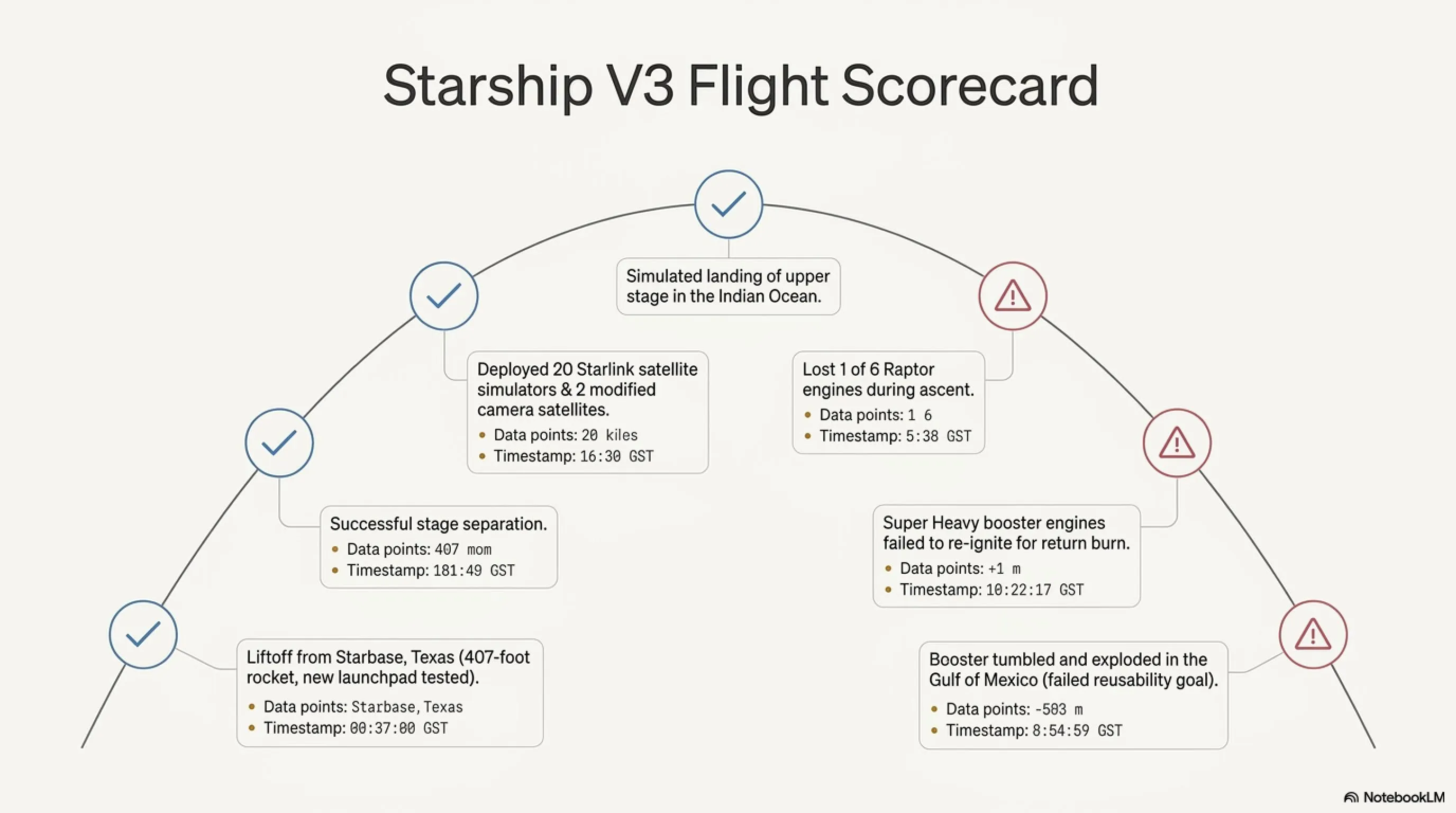
SpaceX on May 22, 2026, launched the upgraded third version of its Starship rocket for the first time, though the test launch didn't go perfectly for Elon Musk's spaceflight company. The 407-foot rocket—the most powerful ever built—lifted off from SpaceX's company town Starbase, Texas, at 5:30 p.m. local time. Just a few minutes later, the upper stage ship separated from the Super Heavy booster and continued on into space.
The booster pitched away from the Starship vehicle and headed back to Earth, where it was supposed to perform a simulated landing in the Gulf of Mexico. But the booster's engines did not properly re-ignite for the sustained burn meant to deliver it back to the launch site. The booster then tumbled down to the water, where it likely exploded. This was a significant setback, as recovering and reusing the Super Heavy booster is critical to SpaceX's goal of making Starship fully reusable.
📊 Starship V3 Launch Results: A Mixed Scorecard
✅ Successes
- Successful launch of 407-foot rocket
- Successful stage separation
- Deployed 20 Starlink satellite simulators
- Deployed 2 modified Starlink satellites for filming
- Simulated landing in Indian Ocean
- Successful test of new V3 hardware
- First use of new launchpad at Starbase
❌ Challenges
- Lost Super Heavy booster
- Engines failed to re-ignite for return
- Lost one of six Raptor engines during ascent
- Booster crashed into Gulf of Mexico
- Likely booster explosion
- Failed to achieve full reusability goal
Meanwhile, Starship lost one of its six Raptor engines as it ascended into space. But it successfully deployed all 20 Starlink satellite simulators along with two modified Starlink satellites designed to record footage of Starship's exterior. Roughly one hour after liftoff, Starship simulated a landing in the Indian Ocean, before tipping over and exploding as expected. The Ship upper stage performed most of its planned objectives despite the engine loss, demonstrating the redundancy built into the V3 design.
While it didn't go exactly according to plan, this was an important test launch for SpaceX. It was the first real shakedown of the upgraded Starship V3 hardware, which has been in development for months. The company was also testing out an all-new launchpad at Starbase that it's been developing and building for years. The new pad features improved flame diverters, stronger hold-down clamps, and better propellant loading systems—all designed to support SpaceX's goal of launching Starship multiple times per day.
🔍 Tekin Analysis: Why This Launch Matters—IPO Timing and Mars Ambitions
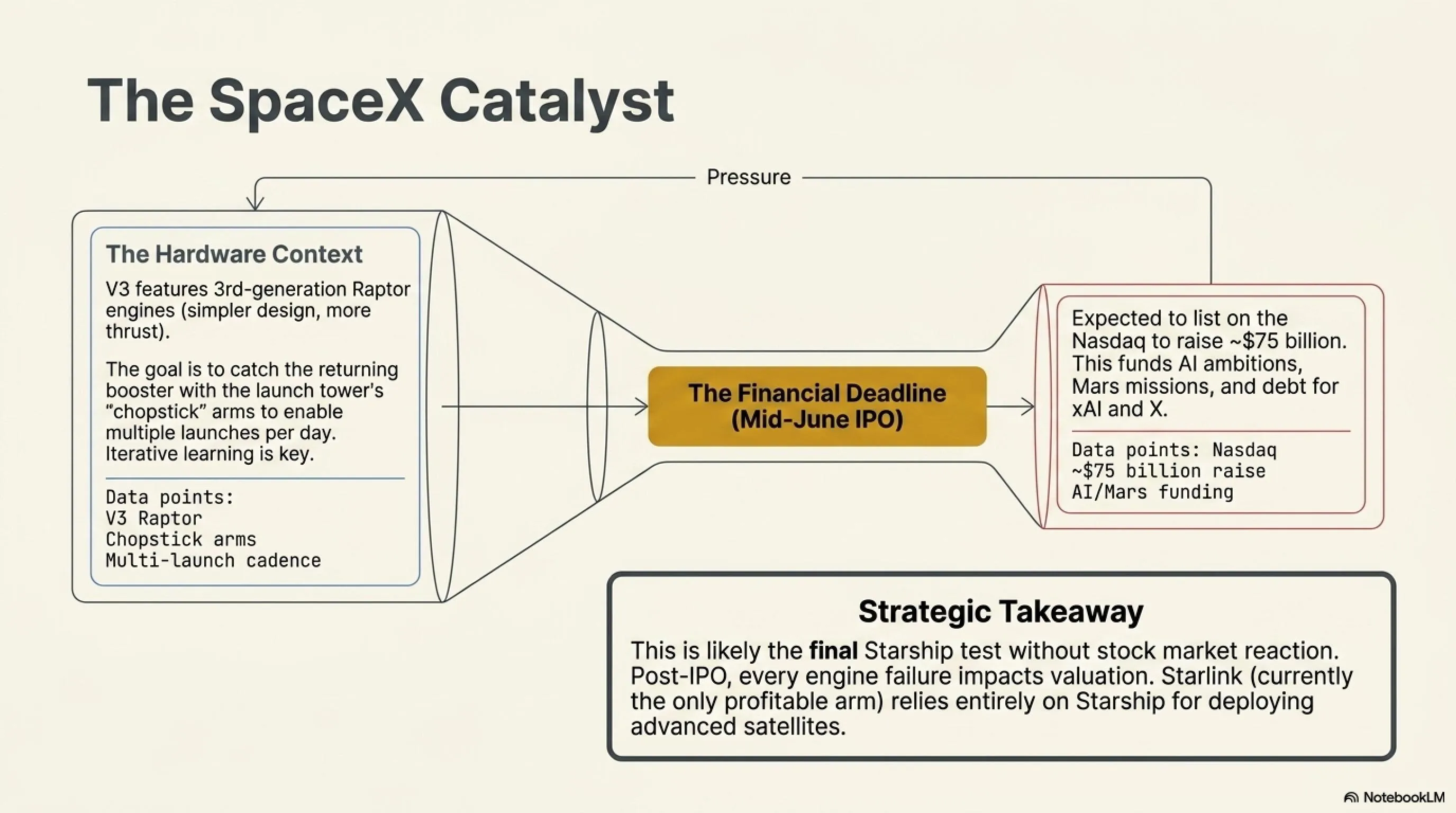
The test launch also comes at a historical inflection point for SpaceX as a company. Its IPO filing was made public this week, and SpaceX is expected to list on the Nasdaq in mid-June. The IPO is reportedly supposed to raise around $75 billion for SpaceX, which the company plans to use to fuel further development, massive AI ambitions, and to pay off some of the debt associated with xAI and Musk's social media company X.
This means this could be the last Starship test launch to happen without a stock market reaction. Once SpaceX goes public, every success or failure will have a direct impact on the company's stock price. Investors will scrutinize each launch, each engine failure, each delay. The pressure to succeed will intensify dramatically.
SpaceX has spent years and billions of dollars developing Starship, which it sees as crucial to its mission of making life multi-planetary. The company plans to use Starship for NASA missions to the moon, and eventually Mars. But the big job it needs to perform in the near-term is delivering more advanced Starlink satellites to Earth orbit, as Starlink is the only profitable part of SpaceX's business.
This new version of Starship features SpaceX's third-generation Raptor engines, which have more thrust and a far simpler design than previous versions. The new booster is designed for faster takeoffs and easier catches by the launch tower—SpaceX's ultimate goal is to catch the returning booster with the tower's "chopstick" arms, eliminating the need for landing legs and enabling rapid reuse.
Tekin Prediction: SpaceX will achieve a successful booster catch within the next 3-4 launches. The company's iterative development approach—launch, learn, improve, repeat—has proven remarkably effective. The V3 hardware represents a significant step forward, and the data from this launch will inform rapid improvements. By the time of the IPO in June, SpaceX will likely have at least one more successful launch under its belt, helping to boost investor confidence.
💼 Peec Berlin: European Startup Hits $10M Annual Revenue in AI Gold Rush
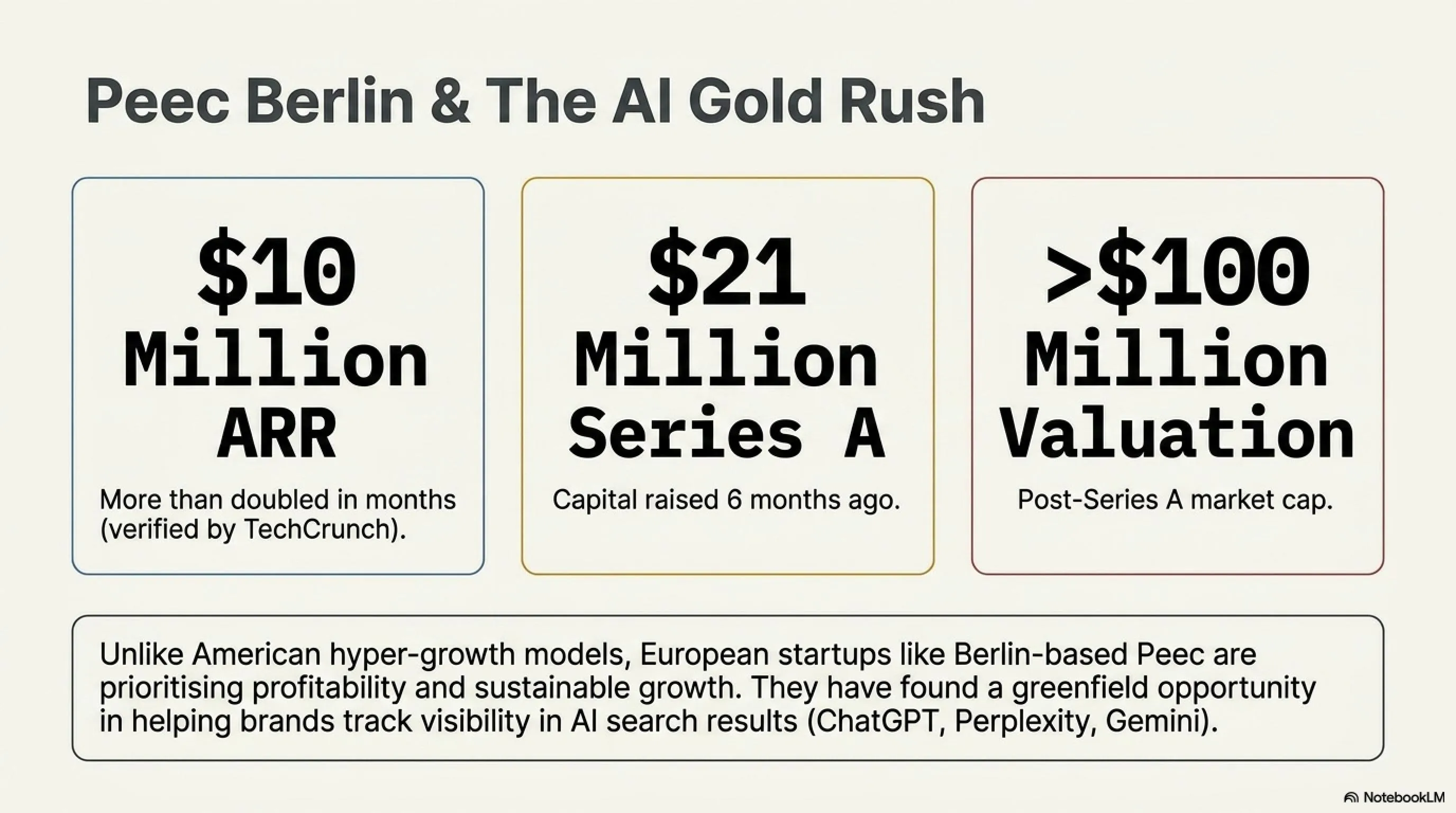
Peec, a Berlin-based startup that helps brands track their presence in AI search results, more than doubled its annualized revenue in just a few months to reach $10 million. This information comes from internal dashboard data seen and verified by TechCrunch. The company represents a key trend among European startups: focusing on profitability and sustainable growth rather than hyper-growth at all costs.
Peec AI raised its $21 million Series A six months ago at a valuation exceeding $100 million. The company focuses on GEO (Generative Engine Optimization)—a new field that helps brands become visible in AI search engine results like ChatGPT, Perplexity, and Google Gemini. As traditional SEO becomes less relevant in an AI-powered search world, GEO is emerging as the next frontier of digital marketing.
📈 Peec's Rapid Growth: By the Numbers
| Metric | Value | Context |
|---|---|---|
| Current ARR | $10 million | More than doubled in months |
| Series A | $21 million | Raised 6 months ago |
| Valuation | $100+ million | Post-Series A valuation |
| Focus | GEO (Generative Engine Optimization) | Next frontier after SEO |
| Location | Berlin, Germany | Part of Europe's AI startup boom |
Peec's success signals a key trend among European startups: focus on profitability over hyper-growth. While many American startups focus on rapid growth and raising capital, European startups like Peec are demonstrating that sustainable, profitable growth is possible—and perhaps more valuable in the long run. This approach is particularly well-suited to the current market environment, where investors are increasingly prioritizing profitability over growth at all costs.
The company's rapid revenue growth also reflects the massive opportunity in GEO. As AI-powered search engines like ChatGPT, Perplexity, and Google's AI Overviews become more popular, brands need new tools to track and optimize their presence in these results. Traditional SEO tools don't work for AI search, creating a greenfield opportunity for companies like Peec.
💡 What Is GEO and Why Does It Matter?
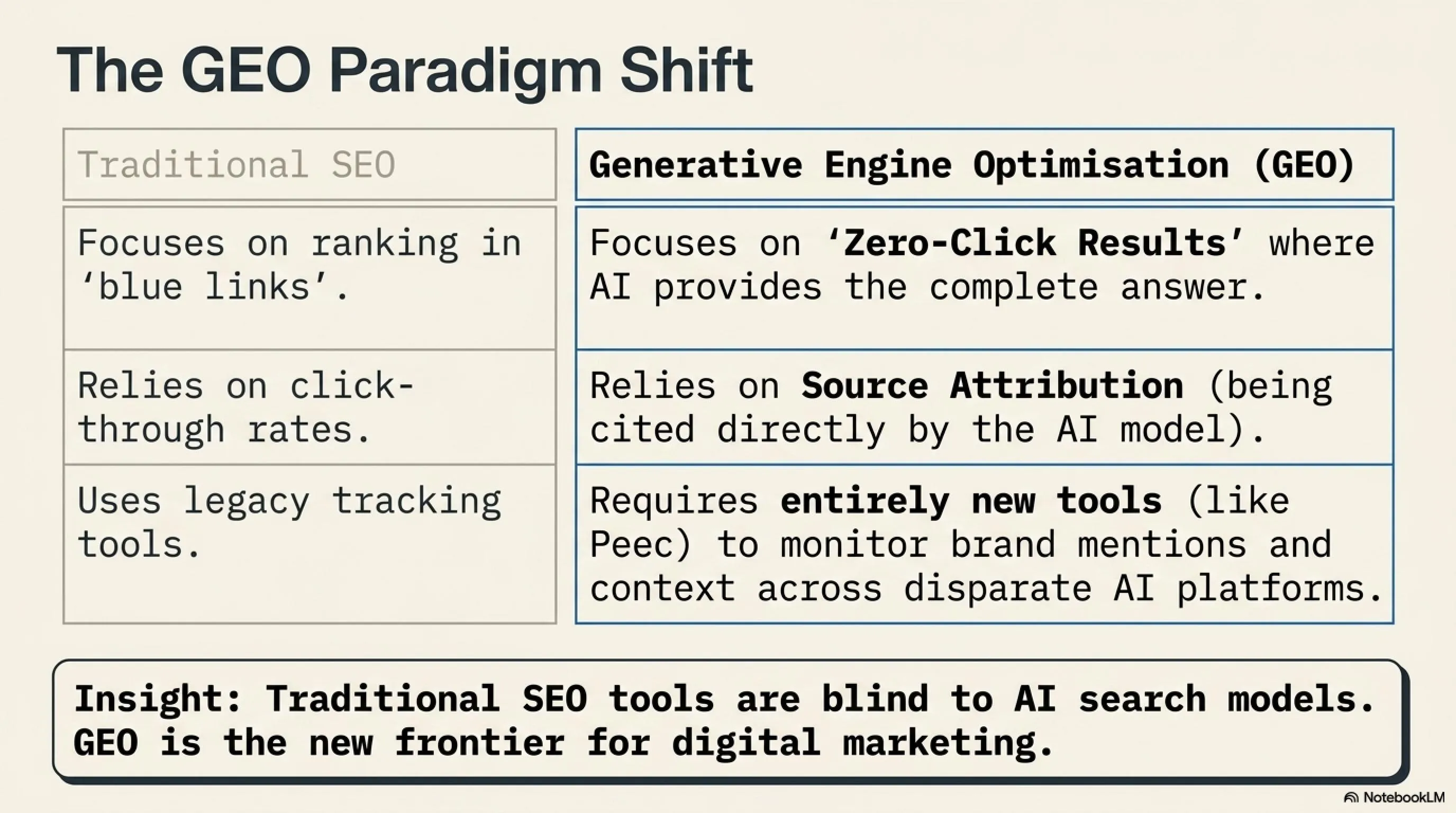
Generative Engine Optimization (GEO) is the practice of optimizing content to appear in AI-generated search results. Unlike traditional SEO, which focuses on ranking in Google's blue links, GEO focuses on being cited by AI models when they generate answers to user queries.
This matters because AI search is fundamentally different from traditional search:
- Zero-Click Results: AI search engines often provide complete answers without requiring users to click through to websites. This means brands need to be cited in the AI's response, not just rank highly in search results.
- Source Attribution: AI models cite their sources, creating a new form of visibility. Being cited by ChatGPT or Perplexity can drive significant brand awareness and traffic.
- Context Matters: AI models consider context and nuance in ways that traditional search algorithms don't. GEO requires understanding how AI models interpret and synthesize information.
- Measurement Challenges: Traditional SEO tools can't track AI search visibility. Companies like Peec fill this gap by monitoring brand mentions across AI platforms.
What This Means for You: If you're a marketer or brand manager, you need to start thinking about GEO now. As AI search grows, traditional SEO will become less important. Tools like Peec can help you track and optimize your AI search presence before your competitors do.
🎵 Apple Music Hunts AI Spam: "Technology Should Amplify Artists, Not Replace Them"
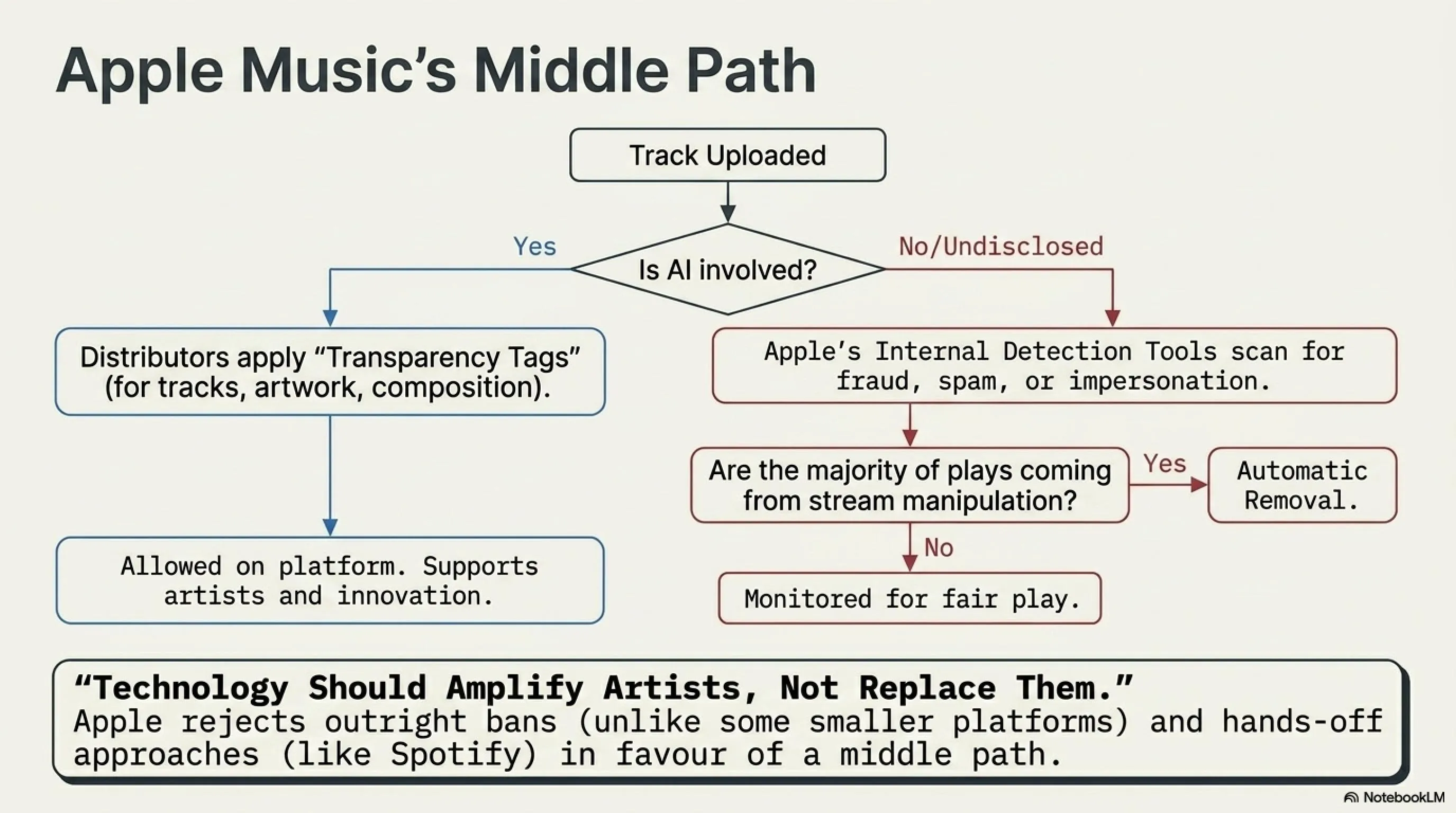
Apple Music in May 2026 clarified its stance on AI-generated music: instead of banning AI-generated music outright, Apple is choosing a disclosure-based approach. The company has asked record labels and distributors to apply "Transparency Tags" to music involving artificial intelligence. These tags can identify AI-generated tracks, artwork, compositions, or music videos.
Back in March 2026, Apple Music became one of the first major streaming services to introduce tagging support for AI-generated content. That means distributors can now supply metadata that identifies whether music contains AI-generated elements, with the intention for all providers to do this eventually. This approach balances innovation with artist protection—allowing AI music while ensuring transparency for listeners.
🛡️ Apple's Strategy to Combat AI Spam
Additionally, Apple has developed internal tools that help identify AI-generated content in its ongoing fight against fraud, spam, and impersonation. When a majority of plays for an AI song are coming from stream manipulation, Apple Music automatically removes that song from the service.
- Transparency Tags: Identify AI-generated tracks, artwork, compositions, or music videos
- Internal Detection Tools: Automatically identify AI-generated content to fight fraud
- Automatic Removal: Songs using stream manipulation are automatically removed
- Artist Support: Focus on keeping music "fair" for real artists
- No Outright Ban: AI music is allowed, but must be transparent
Apple's approach stands in contrast to some other platforms. Spotify has taken a more hands-off approach, while some smaller platforms have banned AI music entirely. Apple's middle path—transparency without prohibition—could become the industry standard. It acknowledges the reality that AI is becoming a tool in music production while protecting against the flood of low-quality AI spam that has plagued streaming platforms.
⚔️ Pros & Cons Battle: AI Music on Apple Music
✅ Pros
- Transparency for users
- Supports real artists
- Fights fraud and spam
- Maintains content quality
- Balanced approach (no total ban)
- Allows AI innovation
- Industry-leading policy
❌ Cons
- Complexity for distributors
- Potential for false positives
- Limitations for AI artists
- Requires ongoing monitoring
- Implementation challenges
- May stigmatize AI music
💭 Final Thoughts: A Night of Major Transformations
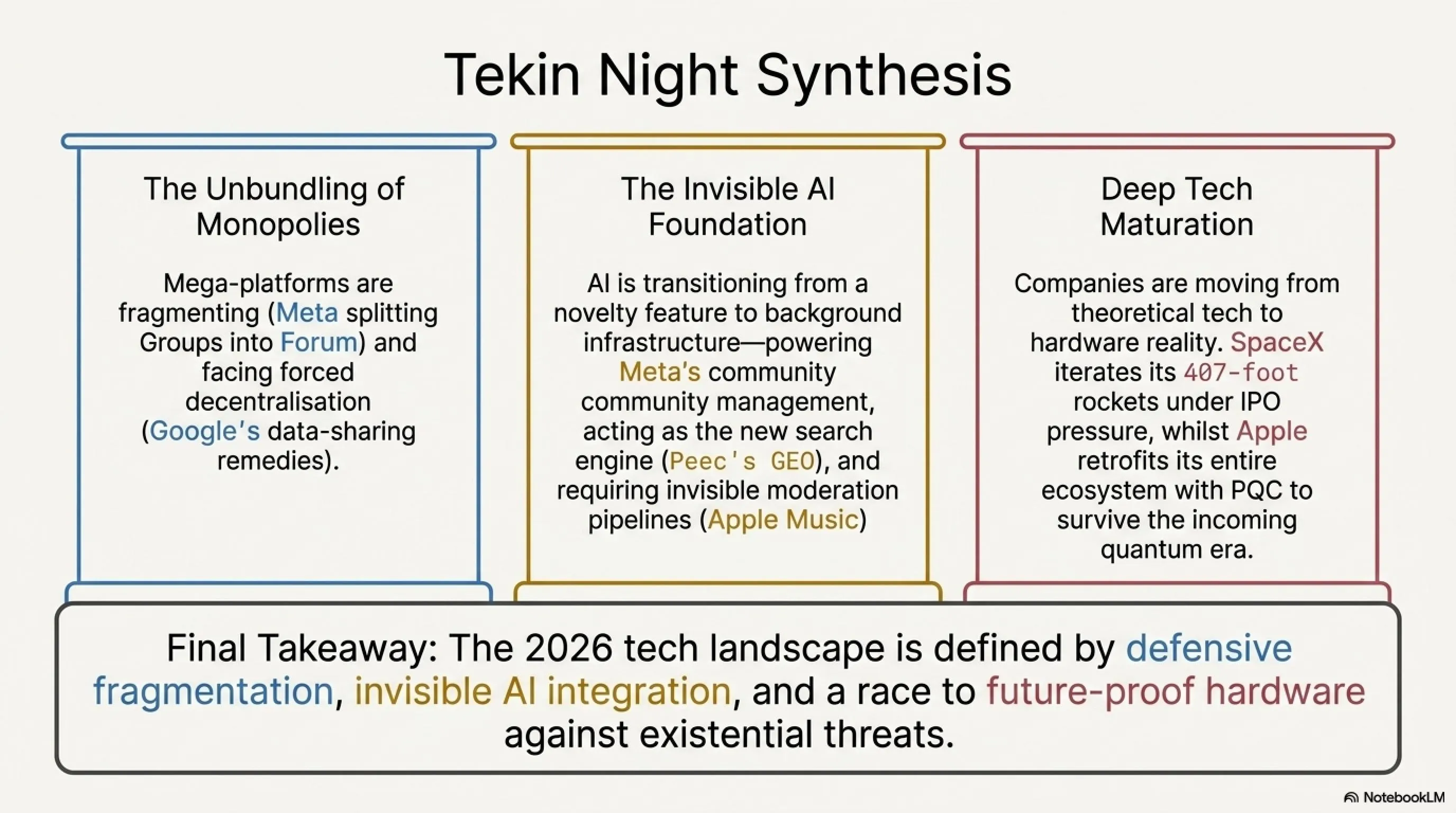
Tonight we witnessed six strategic stories, each shaping the future of the tech industry in its own way. Meta's launch of Forum demonstrates its intent to challenge specialized competitors like Reddit by fragmenting services into standalone apps. Apple's release of its post-quantum cryptography code showcases industry leadership in security and transparency, preparing for threats that don't yet exist at scale.
Google's appeal of the search monopoly ruling sets up a multi-year legal battle that will determine the future of search, AI, and antitrust enforcement. SpaceX's Starship V3 launch, despite challenges, demonstrates continued progress toward ambitious goals—and comes at a critical moment just before the company's historic IPO.
Peec Berlin shows that European startups can build profitable, sustainable businesses in the AI era by focusing on emerging opportunities like GEO. And Apple Music's balanced approach to AI music demonstrates how platforms can embrace innovation while protecting artists and maintaining quality.
Tonight's Key Takeaway: The tech industry is transforming—from new competitive battles to future security, from legal wars to space conquest, and from startup growth to smart AI management. The future is exciting, challenging, and full of opportunity for those who can adapt and innovate.
❓ Why did Meta launch the Forum app?
Meta launched Forum to transform Facebook Groups into a standalone, focused experience and compete directly with Reddit. This is part of Meta's broader strategy to fragment services into specialized apps. Forum includes features like AI-powered Ask, an AI assistant for admins, and the ability to post with nicknames. The app leverages Meta's 1.8 billion monthly active users in Facebook Groups—more than 3x Reddit's entire user base.
❓ What is post-quantum cryptography and why does it matter?
Post-quantum cryptography (PQC) refers to cryptographic algorithms that are resistant to attacks by quantum computers. Powerful quantum computers of the future could break many current encryption algorithms like RSA and ECC. Apple's release of its corecrypto code and implementation of PQC across iMessage, TLS, VPN, and other services prepares its devices for future quantum threats. This is proactive security—protecting data encrypted today against computers that don't yet exist at scale.
❓ Was the Starship V3 launch successful?
The Starship V3 launch was a relative success. The rocket successfully launched, the upper stage separated, 20 Starlink satellite simulators were deployed, and a simulated landing in the Indian Ocean was performed. However, the Super Heavy booster was lost on return and crashed into the Gulf of Mexico. One Raptor engine also failed during ascent. Despite these challenges, this was the first real test of V3 hardware and provided valuable data for future launches. The timing is significant—this could be the last Starship test before SpaceX's IPO in June 2026.
❓ How does Apple handle AI-generated music?
Instead of banning AI music outright, Apple uses a disclosure-based approach. The company asks distributors to apply "Transparency Tags" to music involving AI. Apple has also developed internal tools to identify AI-generated content and fight fraud. When a majority of plays for an AI song come from stream manipulation, Apple Music automatically removes that song. This balanced approach allows AI innovation while protecting artists and maintaining quality.
❓ What is GEO and why is Peec growing so fast?
GEO (Generative Engine Optimization) is the practice of optimizing content to appear in AI-generated search results from platforms like ChatGPT, Perplexity, and Google Gemini. As AI search grows, traditional SEO becomes less relevant. Peec helps brands track and optimize their presence in AI search results, filling a critical gap in the market. The company more than doubled its revenue to $10 million ARR in just months, demonstrating the massive opportunity in this emerging field.
📚 Sources
Primary Sources: 9to5Mac, The Verge, TechCrunch, MacRumors, Reuters, CNBC, Aviation Week, Apple Security Blog, GitHub, Yahoo Finance, Channel News Asia, Space.com, Florida Today, Truist Securities
Research and Analysis: Tekin Editorial Team
Publication Date: May 23, 2026
🌐 Stay Connected With Us 🎮✨
For the latest tech, gaming, and gadget news, follow us on our official social media channels:
Additional Gallery: 🌙 Tekin Night May 23, 2026: Meta Attacks with Forum, Apple Quantum Code, Google Legal War & Starship V3 Launch