In the May 19, 2026 Tekin Night briefing, we dissect six explosive tech stories. We analyze the launch of the world's first 1000Hz gaming monitor by LG and Google's new Android XR smart glasses. Furthermore, we explore Apple's official WWDC 2026 dates and the sudden, massive price hike for Sony's PlayStation Plus service. Finally, we cover Apple's compelling Apple Card offers for iPhone credit and T-Mobile's aggressive "Free iPhone 14" promotion with its specific caveats.
🌙 Welcome to Tekin Night May 19, 2026
Good evening, tech enthusiasts! Tonight we're diving deep into the most exciting and significant tech news from around the globe. From LG's groundbreaking 1000Hz gaming monitor to Google's Android XR smart glasses, from Apple's WWDC 2026 announcement to Sony's PlayStation Plus price hike, and compelling offers from Apple and T-Mobile for new customers. Tonight showcases the fierce competition among tech giants that's reshaping the industry landscape.
⚡ Tonight's Headlines:
🖥️ LG unveils world's first 1000Hz gaming monitor
🥽 Google reveals Android XR smart glasses at I/O 2026
🍎 Apple announces WWDC 26 in Google I/O's shadow
🎮 Sony raises PlayStation Plus subscription prices
🎧 Apple Card offers free AirPods Pro 3 with conditions
📱 T-Mobile gives away iPhone 17 for free
☕ Grab your evening beverage and join us on this thrilling tech journey!
🖥️ LG Unveils World's First 1000Hz Gaming Monitor
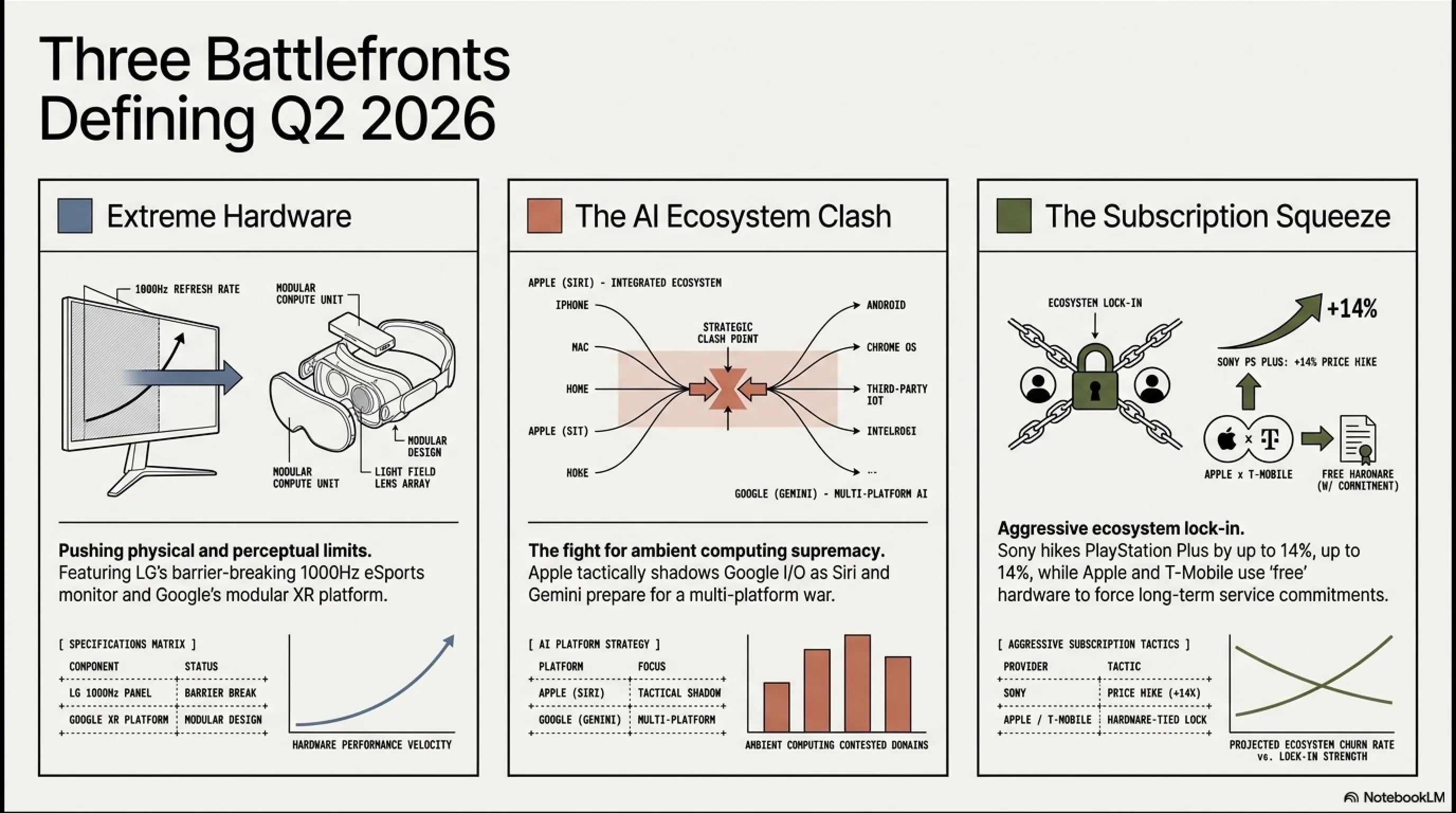
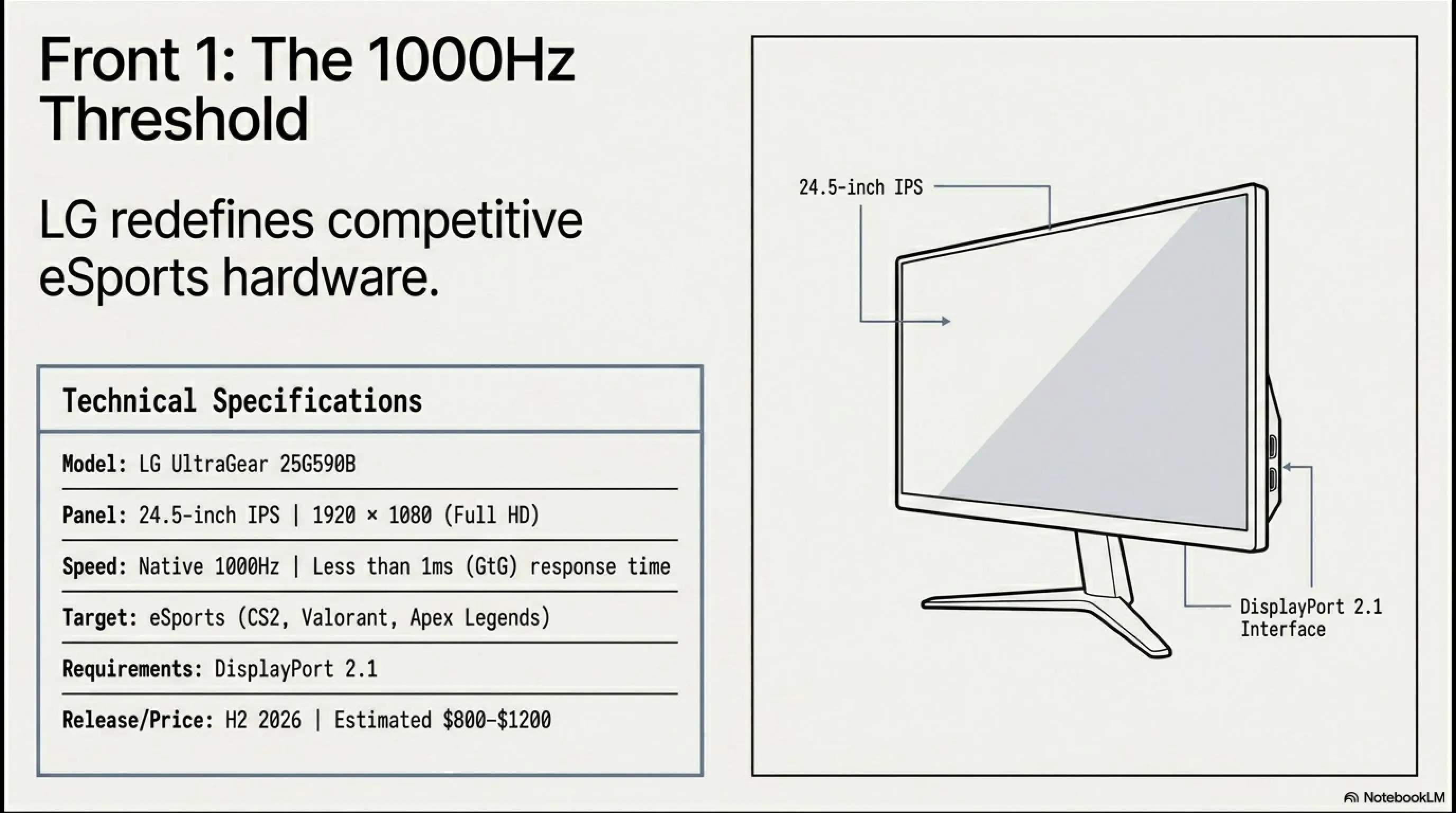
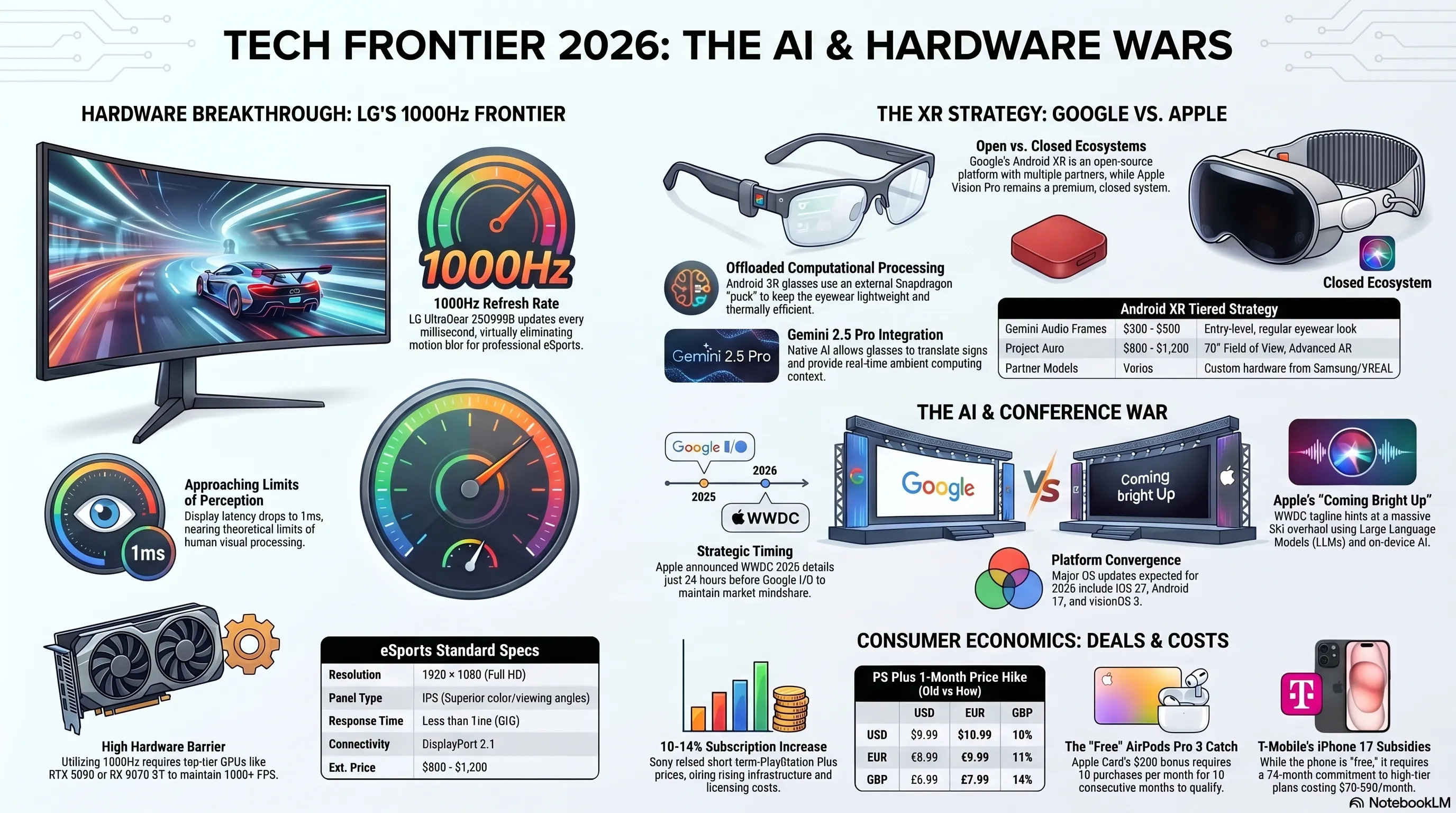
On May 18, 2026, LG Electronics officially unveiled the world's first gaming monitor with a native 1000Hz refresh rate. The UltraGear 25G590B features a 24.5-inch IPS display with Full HD resolution (1920×1080) and is engineered to deliver the speed, clarity, and consistency demanded by professional gamers and eSports competitors. This product represents a watershed moment in the gaming display industry, defining a new frontier for competitive gaming experiences.
The significance of reaching 1000Hz cannot be overstated. For years, the gaming monitor market has been locked in an arms race, progressing from 60Hz to 144Hz, then 240Hz, 360Hz, and even 500Hz. But 1000Hz represents both a psychological and technical milestone. At this refresh rate, the display updates every single millisecond, providing an unprecedented level of visual fluidity that can genuinely impact competitive performance in fast-paced first-person shooters like Counter-Strike 2, Valorant, and Apex Legends.
📊 LG UltraGear 25G590B Technical Specifications
| Specification | Details |
| Screen Size | 24.5 inches |
| Resolution | 1920 × 1080 (Full HD) |
| Refresh Rate | 1000Hz (Native) |
| Panel Type | IPS |
| Response Time | Less than 1ms (GtG) |
| Connectivity | DisplayPort 2.1 (required) |
| Additional Features | Minimalist stand, headset hook, customizable lighting |
| Release Date | Second half of 2026 |
| Expected Price | $800-$1200 (estimated) |
The 25G590B is specifically engineered with fast-paced first-person shooters in mind. The 24.5-inch form factor, commonly adopted for eSports tournaments, enables players to track adversaries and scan the in-game environment with minimal eye movement, supporting faster reaction times and tactical decision-making. The choice of IPS technology is particularly noteworthy—while TN panels traditionally dominated the high-refresh-rate market due to their faster response times, modern IPS panels have closed the gap while offering superior color accuracy and viewing angles, crucial for content creators who also game.
🎯 Tekin Analysis: Why 1000Hz is a Revolutionary Leap
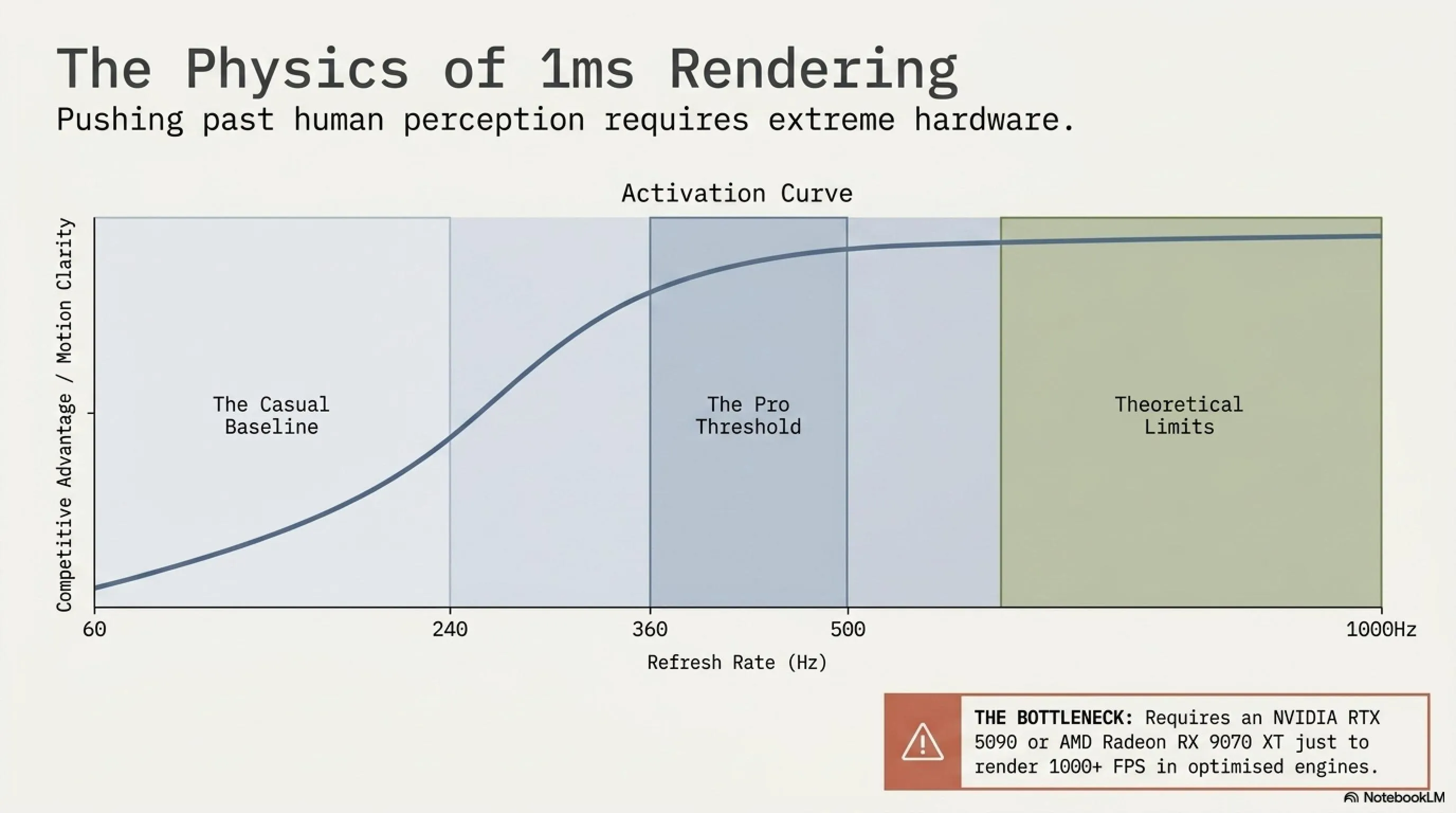
The jump from 360Hz to 1000Hz represents more than just a numerical increase—it's a fundamental shift in how we think about display technology. At 1000Hz, the display latency (the time between a frame being rendered and displayed) drops to just 1 millisecond. Combined with modern GPUs that can achieve sub-1ms render latency, we're approaching the theoretical limits of human perception.
But here's the critical question: Can humans actually perceive the difference? Research from NVIDIA and academic institutions suggests that professional gamers can detect improvements up to approximately 500-600Hz, with diminishing returns beyond that point. However, the benefits extend beyond pure perception. At 1000Hz, motion blur is virtually eliminated, and the consistency of frame delivery becomes paramount. Even if you can't consciously perceive individual frames, your brain processes the smoother motion information, potentially improving aim tracking and target acquisition in competitive scenarios.
The hardware requirements for driving a 1000Hz display are substantial. To fully utilize this monitor, you'll need a graphics card capable of consistently delivering over 1000 frames per second. In 2026, this means top-tier GPUs like the NVIDIA RTX 5090 or AMD Radeon RX 9070 XT. Even then, only competitive titles with optimized engines (Counter-Strike 2, Valorant, Rainbow Six Siege) can realistically hit these frame rates. AAA titles with cutting-edge graphics will struggle to reach even 500 FPS at 1080p on maximum settings.
LG hasn't revealed pricing or an exact release date beyond "second half of 2026," but industry analysts predict a launch price between $800 and $1200. For context, current 360Hz monitors typically retail between $400 and $700, while 500Hz displays command $600-$900. The premium for 1000Hz technology reflects not just the advanced panel manufacturing but also the sophisticated electronics required to process and display data at such extreme speeds.
⚖️ Pros & Cons: LG's 1000Hz Monitor
✅ Advantages
- Fastest refresh rate on the market
- Sub-1ms response time (GtG)
- Ideal for competitive FPS gaming
- IPS panel with excellent viewing angles
- 24.5" eSports standard size
- Minimalist, functional design
- Future-proof technology
❌ Disadvantages
- Limited to 1080p resolution
- Requires extremely powerful GPU
- Expected high price ($800-$1200)
- Only suitable for pro gamers
- Likely high power consumption
- Release date still unconfirmed
- Diminishing returns above 500Hz
💡 Market Impact: LG's 1000Hz monitor will likely trigger a new wave of competition. ASUS, Acer, and BenQ are reportedly working on their own ultra-high-refresh-rate displays. However, the real question is whether this technology will trickle down to mainstream gaming or remain a niche product for professional eSports athletes. The $50 billion gaming peripheral market is watching closely, as this could redefine expectations for competitive gaming hardware.
🥽 Google Unveils Android XR Smart Glasses at I/O 2026
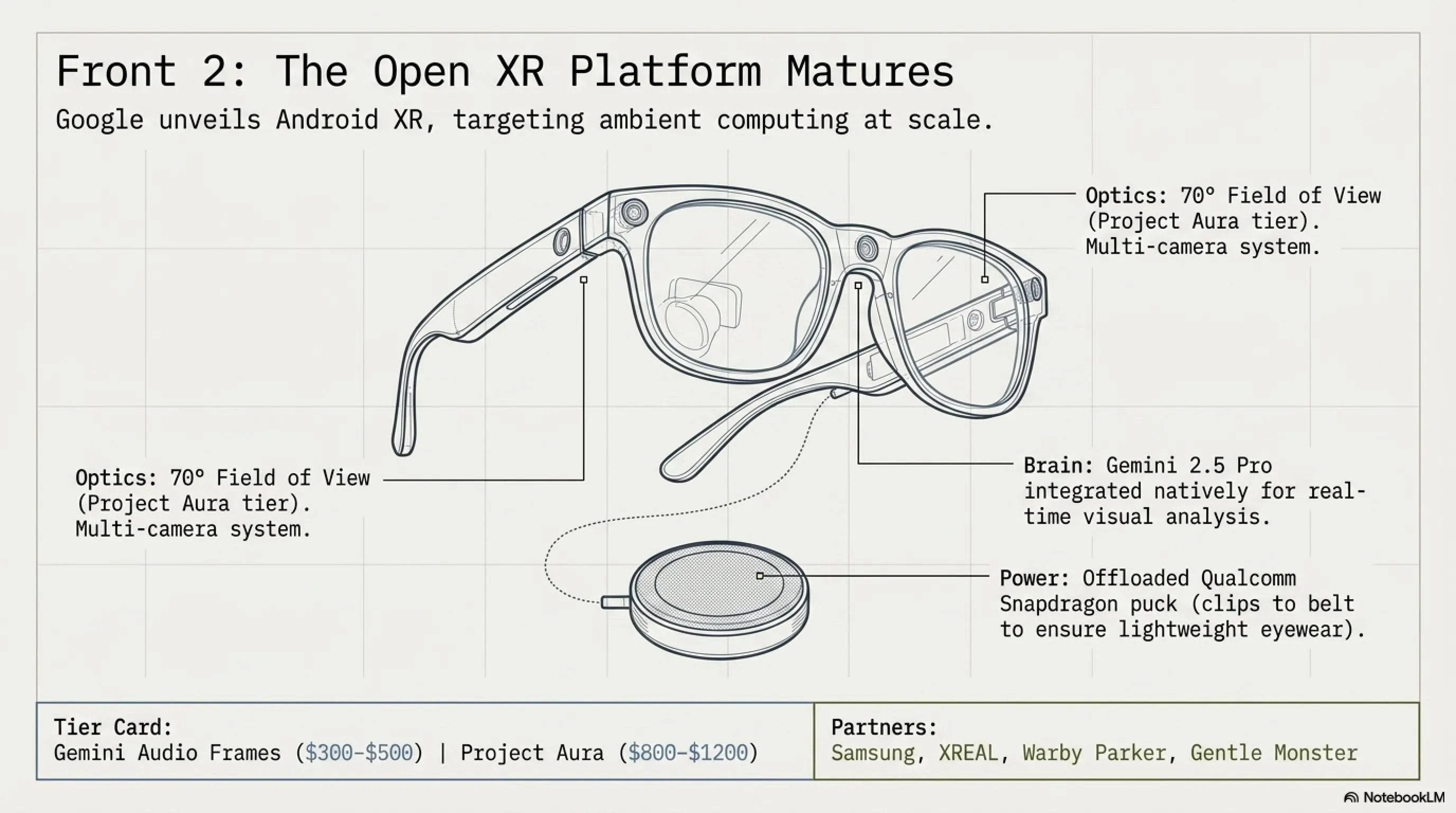
Google is set to officially unveil its Android XR smart glasses at the Google I/O 2026 conference, taking place May 19-20. These glasses, developed in collaboration with Samsung, XREAL, Warby Parker, and Gentle Monster, aim to revolutionize the augmented reality (AR) and virtual reality (VR) landscape. Android XR is an open-source, unified operating system built on Android and specifically designed for extended reality devices.
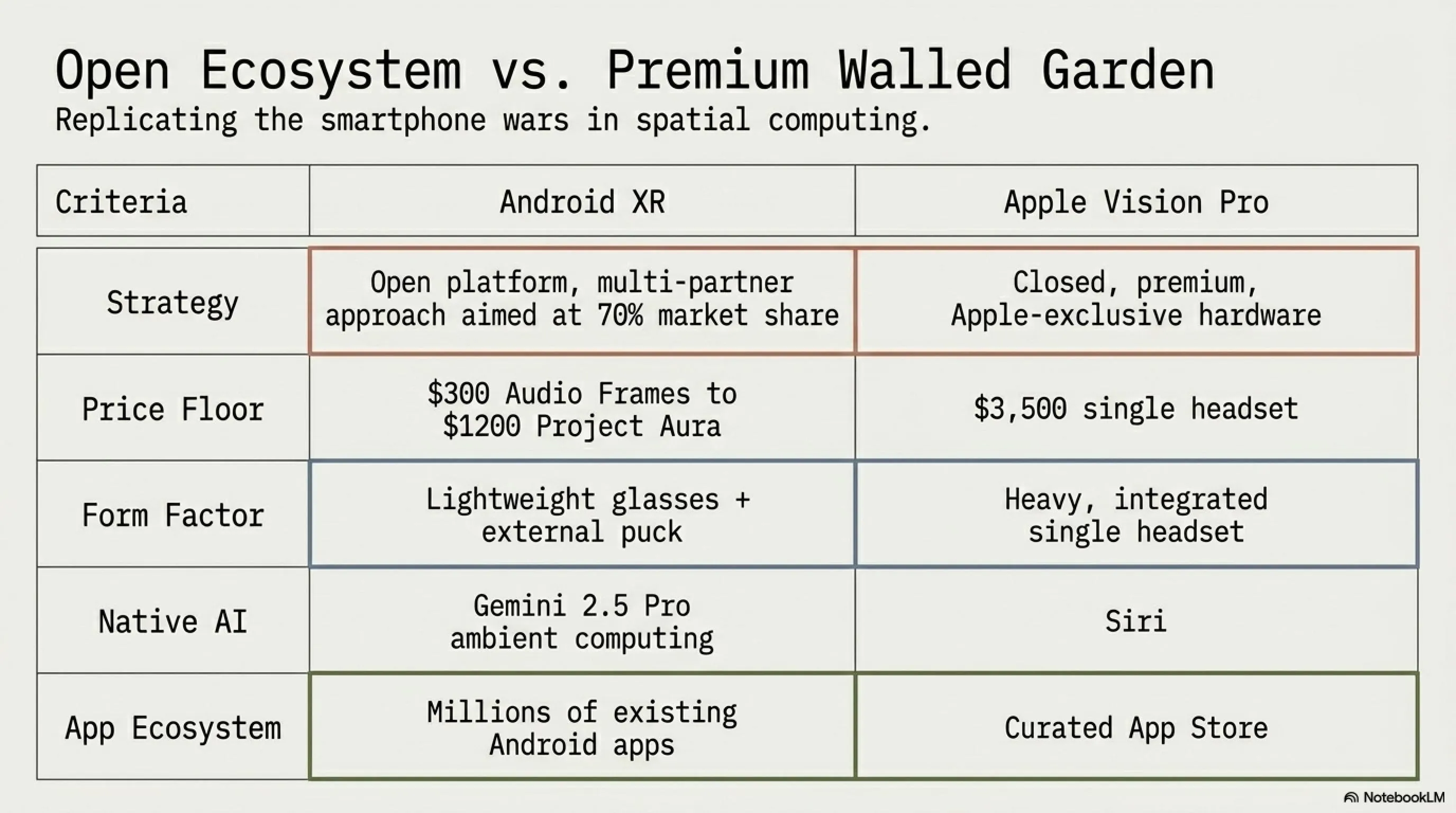
The strategic timing of this announcement is no coincidence. Google is positioning Android XR as a direct competitor to Apple Vision Pro, but with a fundamentally different approach. While Apple's $3,500 headset represents a closed, premium ecosystem, Android XR embraces an open platform strategy with multiple hardware partners offering devices across various price points. This mirrors Google's successful Android smartphone strategy that captured over 70% of the global mobile market.
🔍 Android XR Smart Glasses: Key Features
| Feature | Details |
| Operating System | Android XR (Android-based) |
| AI Integration | Gemini 2.5 Pro (native) |
| Field of View | 70° (Project Aura) |
| Processor | Qualcomm Snapdragon (external puck) |
| Camera System | Multi-camera with real-time editing |
| Hardware Partners | Samsung, XREAL, Warby Parker, Gentle Monster |
| Product Tiers | Audio Frames ($300-500), Project Aura ($800-1200) |
| Release Date | Late 2026 |
Google previewed some Gemini capabilities at MWC 2026 in February, including the ability to use the camera and Nano Banana tool to capture and instantly edit photos. The glasses will be offered in three distinct tiers: Gemini Audio Frames (entry-level with regular eyewear appearance), Project Aura (advanced AR glasses with 70° field of view), and custom models from commercial partners. Google's goal is to create an open, unified ecosystem where developers can build applications that work seamlessly across all Android XR devices.
One of the most innovative aspects is the use of an external Snapdragon processing puck. Rather than cramming all the hardware into the glasses themselves, the computational heavy lifting is offloaded to a separate device. This design choice makes the glasses lighter and more comfortable for extended wear, though users must carry the puck (which can clip to a belt or fit in a pocket). This approach is similar to what Magic Leap and early HoloLens iterations employed, but with significantly more advanced Qualcomm technology that balances performance with thermal efficiency.
🎯 Tekin Analysis: Can Android XR Compete with Apple Vision Pro?
Google's strategy is fundamentally different from Apple's. While Apple Vision Pro is a $3,500 closed ecosystem targeting premium users, Android XR is an open platform with multiple partners offering diverse price points. Gemini Audio Frames will likely retail for $300-500, while Project Aura could command $800-1200. The key advantage of Android XR is deep integration with the Android ecosystem, access to millions of apps, and advanced Gemini AI capabilities.
However, Apple has significant advantages: a mature developer ecosystem, superior hardware-software integration, and the "Apple premium" brand appeal. Vision Pro's spatial computing interface is widely regarded as the most polished in the industry. For Android XR to succeed, Google must convince developers to build compelling AR/VR experiences. The platform's success hinges on whether Google can replicate its Android smartphone triumph in the XR space. Early indicators are promising—Samsung's involvement brings manufacturing expertise and distribution channels, while XREAL's existing AR glasses provide a proven hardware foundation.
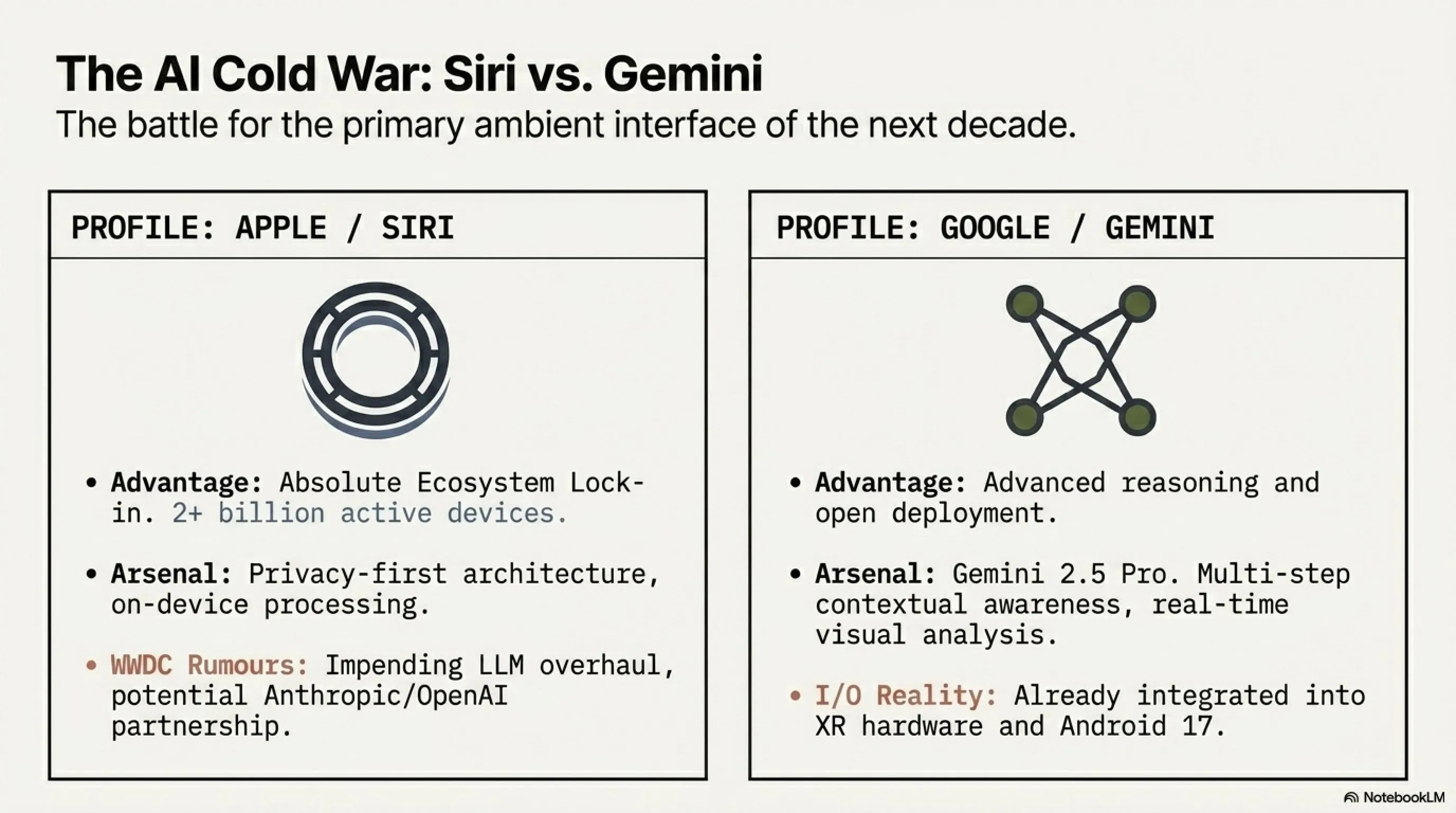
The integration of Gemini 2.5 Pro is particularly compelling. Unlike Siri's limited contextual awareness, Gemini can understand complex multi-step queries, analyze visual information in real-time, and provide contextually relevant suggestions. Imagine walking through a foreign city and having Gemini translate signs, recommend restaurants based on your dietary preferences, and provide historical context about landmarks—all through your glasses without touching your phone. This vision of ambient computing has been promised for years, but Gemini's advanced language understanding might finally make it practical.
💡 Developer Opportunity: Google is offering early access to Android XR development tools for registered developers. The platform supports Unity, Unreal Engine, and native Android development, making it easier for existing mobile developers to transition to XR. With the global AR/VR market projected to reach $300 billion by 2028, this represents a significant opportunity for developers willing to invest in the platform early.
🍎 Apple Announces WWDC 2026 in Google I/O's Shadow
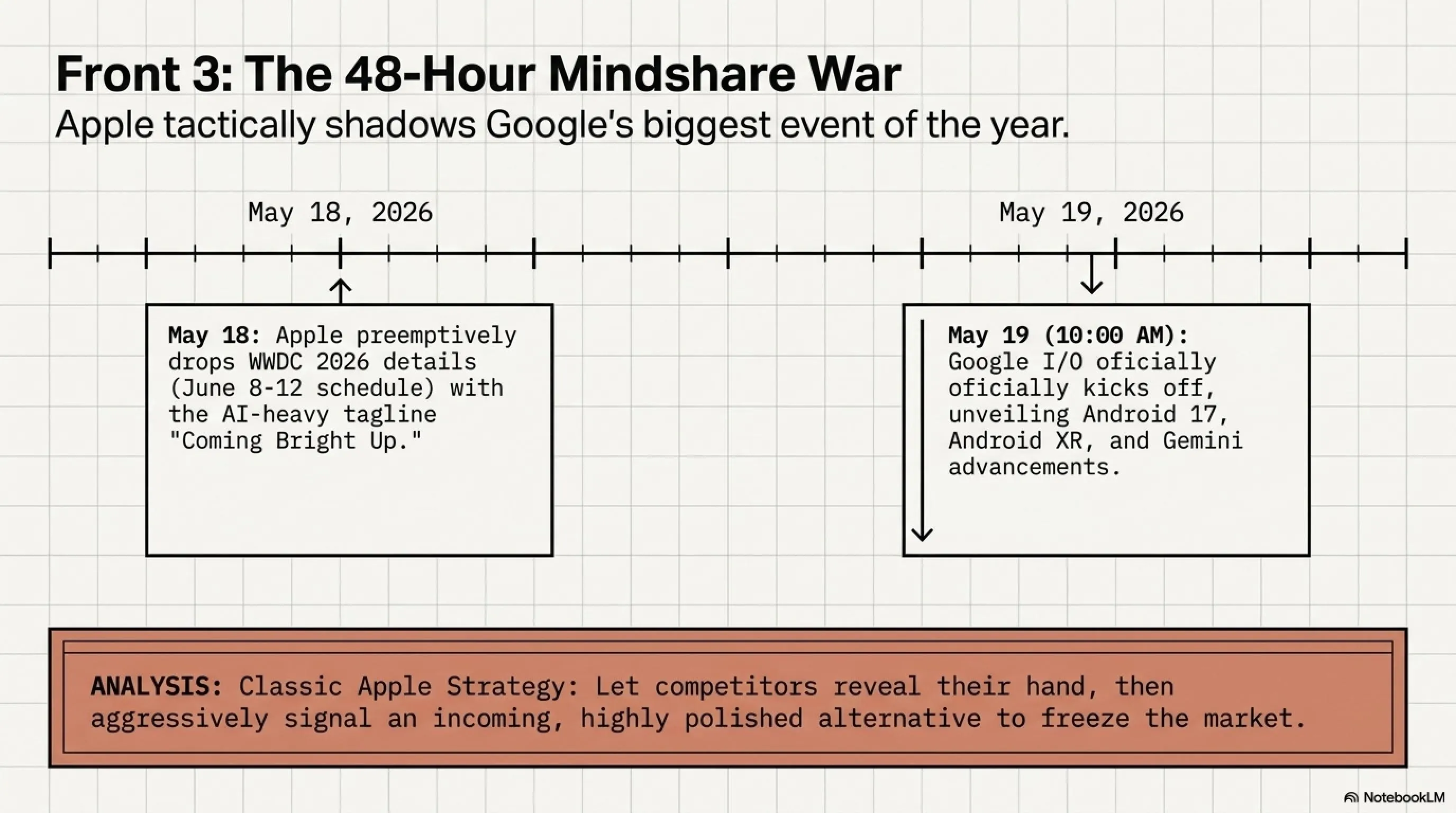
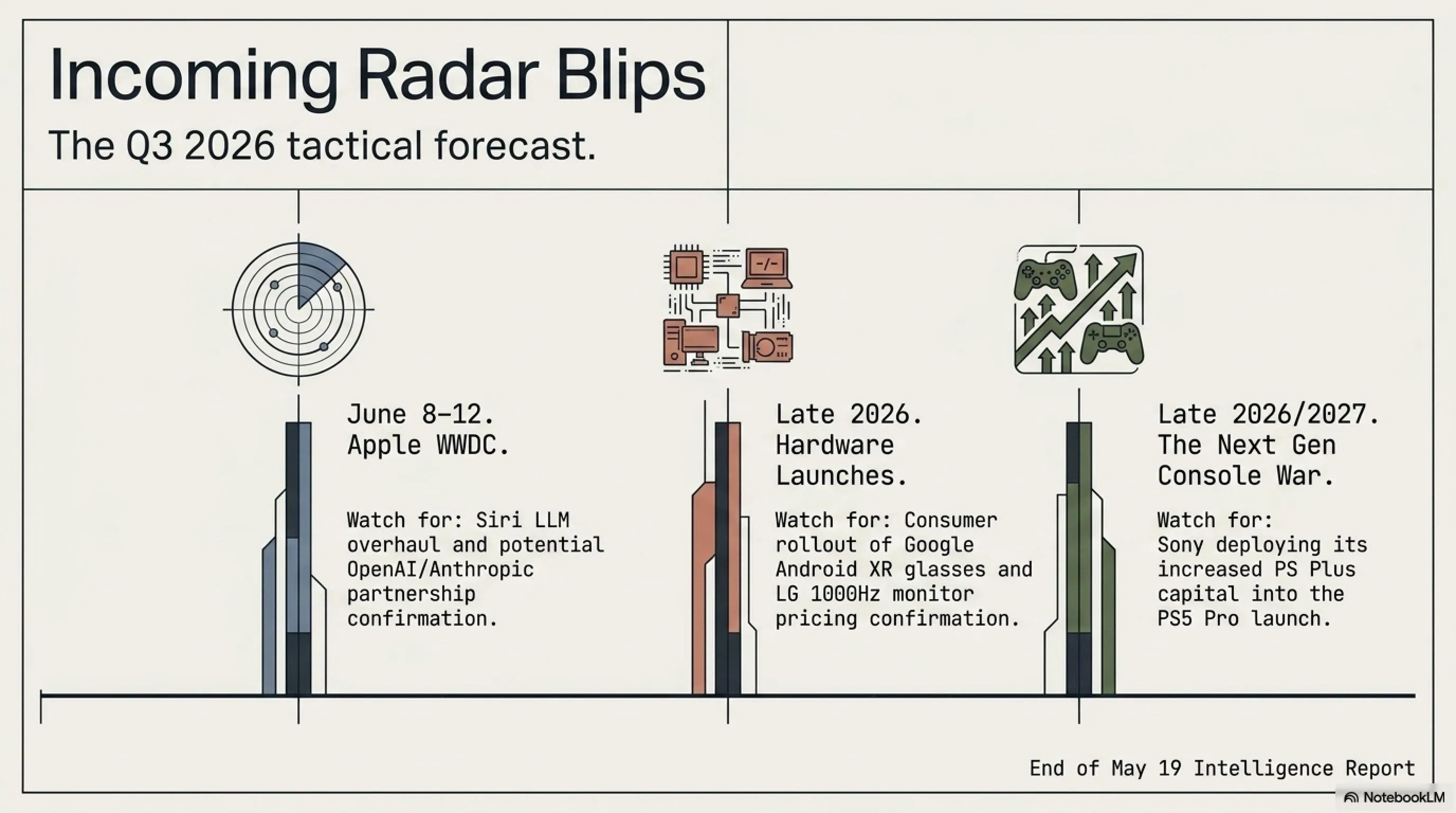
On May 18, 2026, just one day before Google I/O kicks off, Apple released complete details for its annual Worldwide Developers Conference (WWDC) 2026. The conference will run from June 8-12, with the main keynote beginning June 8 at 10:00 AM Pacific Time (1:00 PM Eastern). Apple has also sent invitations to select media members for an in-person keynote viewing at Apple Park, though the event will be streamed globally for free.
The timing of this announcement is strategically significant. Google I/O 2026 begins May 19, where Google will unveil Android 17, Android XR glasses, and major Gemini AI advancements. By announcing WWDC details just hours before Google's event, Apple is attempting to steal some thunder and remind the tech world that it remains a formidable competitor in the AI race. This is classic Apple strategy—let competitors show their hand first, then respond with a more polished, integrated solution.
📅 WWDC 2026 Schedule
| Date | Event | Time (PT / ET) |
| June 8 | Main Keynote | 10:00 AM / 1:00 PM |
| June 8 | Platforms State of the Union | 1:00 PM / 4:00 PM |
| June 9-12 | Developer Sessions & Workshops | Various |
| June 8-12 | Apple Design Awards | TBA |
Apple is expected to unveil iOS 27, macOS 16, watchOS 14, tvOS 20, and visionOS 3. However, the real focus will be on artificial intelligence. This year's tagline, "Coming Bright Up", strongly suggests major AI announcements. Industry insiders predict Apple will unveil a comprehensive AI strategy that includes an upgraded Siri with large language model capabilities, on-device AI processing improvements, and potentially a partnership with OpenAI or Anthropic.
This marks the first time Apple has explicitly mentioned "AI advancements" in a WWDC invitation. For years, Apple has been criticized for falling behind Google and Microsoft in AI innovation. While Google has Gemini and Microsoft has Copilot, Siri has remained relatively stagnant. WWDC 2026 represents Apple's opportunity to prove it hasn't been sleeping—that it's been quietly developing AI capabilities that leverage its unique advantages: on-device processing, privacy-first architecture, and tight hardware-software integration.
🎯 Tekin Analysis: The Conference War—Apple vs. Google
The timing of Apple's WWDC announcement, just hours before Google I/O, is a calculated strategic move. Google will showcase Android 17, Android XR glasses, and Gemini AI advancements at I/O. Apple, by announcing WWDC dates early, is attempting to maintain mindshare and signal that it's not conceding the AI battlefield. The core competition centers on personal AI assistants: Siri versus Gemini.
Apple must prove that Siri can compete with Gemini's advanced capabilities. Rumors suggest Apple may announce "Apple GPT" or a strategic partnership with OpenAI or Anthropic. Additionally, with Google unveiling Android XR glasses, Apple will likely provide more details about Vision Pro 2 or a more affordable Vision variant. The stakes are enormous: the company that wins the AI assistant war will control how billions of people interact with technology for the next decade. Apple's advantages include its massive installed base (2+ billion active devices), superior privacy reputation, and ecosystem lock-in. Google's advantages include superior AI technology, open platform strategy, and broader device reach.
💡 For Developers: WWDC 2026 is free and accessible online for all developers worldwide. Registration is open through the Apple Developer website or app. This is an excellent opportunity to learn about the latest Apple technologies, connect with the global developer community, and potentially get your app featured in the keynote or win an Apple Design Award. Early registration is recommended as some workshops have limited capacity.
🎮 Sony Raises PlayStation Plus Subscription Prices
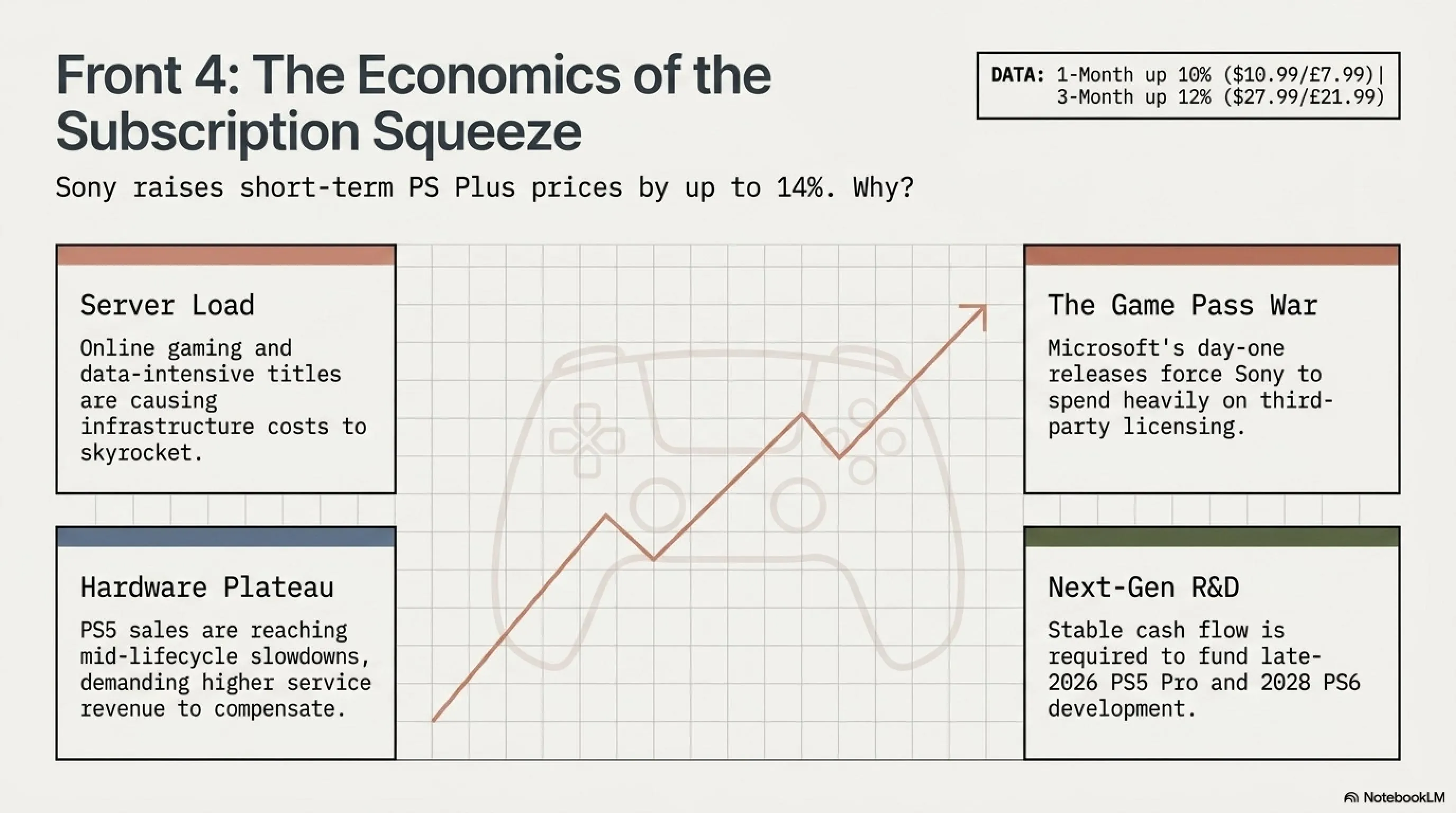
Sony announced on May 19, 2026, that starting May 20, short-term PlayStation Plus subscription prices will increase for new subscribers in "select regions." This price hike affects one-month and three-month subscriptions, while annual subscriptions remain unchanged for now. Sony cited "ongoing market conditions" as the reason, though it provided no additional details.
💰 New PlayStation Plus Pricing Structure
| Subscription Type | Old Price | New Price | Increase |
| 1-Month (USD) | $9.99 | $10.99 | +$1 (10%) |
| 3-Month (USD) | $24.99 | $27.99 | +$3 (12%) |
| 1-Month (EUR) | €8.99 | €9.99 | +€1 (11%) |
| 3-Month (EUR) | €24.99 | €27.99 | +€3 (12%) |
| 1-Month (GBP) | £6.99 | £7.99 | +£1 (14%) |
| 3-Month (GBP) | £19.99 | £21.99 | +£2 (10%) |
Critically, this price increase applies only to new subscribers. Existing subscribers who renew before May 20 will continue paying current rates. This strategy is designed to retain existing customers while extracting more revenue from new sign-ups. However, eventually all users will face the new pricing unless they opt for annual subscriptions, which haven't been adjusted yet.
🎯 Tekin Analysis: Why Sony Had to Raise Prices
This marks the third PlayStation Plus price increase in two years. Several factors are driving this decision: (1) Rising server and infrastructure costs—as online gaming grows and games become more data-intensive, server maintenance expenses have skyrocketed. (2) Competition with Xbox Game Pass—Microsoft's day-one game releases on Game Pass have forced Sony to spend more on third-party licensing to remain competitive. (3) Declining PS5 hardware sales—as the PS5 reaches mid-lifecycle, console sales are slowing, making Sony more dependent on services revenue. (4) Inflation and operational costs—game development costs, licensing fees, and labor expenses have all increased significantly.
Additionally, Sony is preparing for PS5 Pro (expected late 2026) and PS6 (projected 2028). The company needs stable cash flow to fund next-generation R&D. Last year, Sony raised PS5 hardware prices in the US and repriced subscriptions across Latin America, Southeast Asia, Australia, Canada, and South Korea. This global repricing strategy suggests Sony is systematically adjusting to new economic realities rather than responding to temporary market fluctuations.
The gaming subscription market has become increasingly competitive. Xbox Game Pass offers over 400 games including day-one releases for $16.99/month (Ultimate tier). PlayStation Plus Extra provides 400+ games for $14.99/month, while PlayStation Plus Premium adds classic games and cloud streaming for $17.99/month. With these price increases, Sony is narrowing the value gap with Xbox, potentially pushing some price-sensitive gamers toward Microsoft's ecosystem.
💡 Money-Saving Tip: If you're planning to subscribe to PlayStation Plus, act before May 20 to lock in current pricing. Annual subscriptions offer the best value and haven't been increased yet. Buying a 12-month subscription now could save you $12-24 over the next year compared to monthly payments at the new rates. Additionally, watch for sales during major gaming events like E3 or Black Friday, when Sony typically offers discounted subscription codes.
🎧 Apple Card Offers Free AirPods Pro 3 (With Conditions)
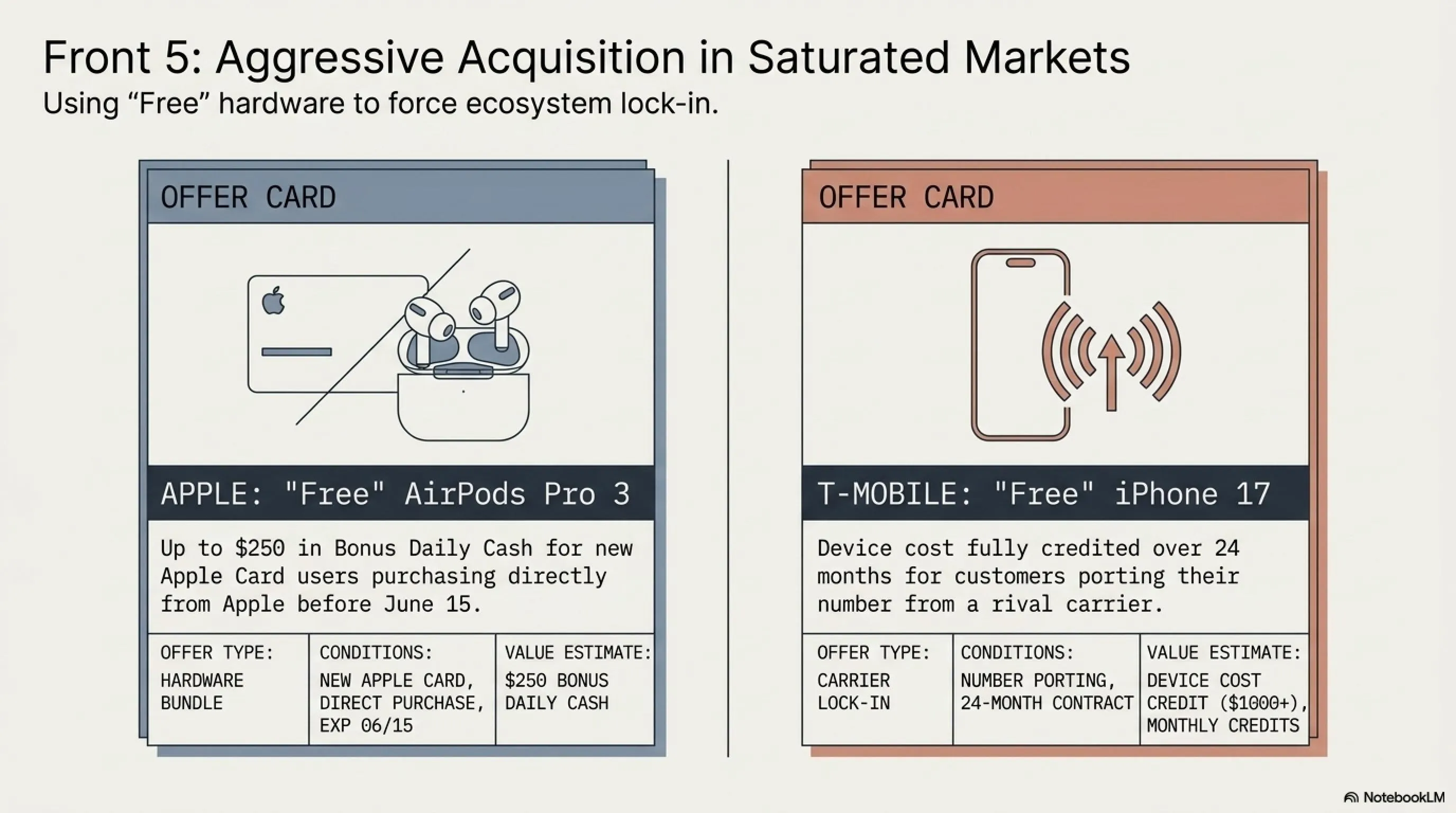
On May 18, 2026, Apple launched its largest Apple Card sign-up promotion to date. New Apple Card users who purchase AirPods Pro 3 directly from Apple can earn up to $250 in Bonus Daily Cash, effectively making the earbuds free. However, this offer comes with specific conditions that require careful consideration.
📋 Apple Card Promotion Terms & Conditions
| Requirement | Details |
| Eligibility | New Apple Card users only |
| Required Purchase | AirPods Pro 3 directly from Apple |
| Purchase Deadline | By June 15, 2026 |
| Cash Back Distribution | $25 per month (10 months) |
| Monthly Requirement | Minimum 10 purchases with Apple Card |
| Payment Period | July 1, 2026 - April 30, 2027 |
| Total Cash Back | $250 |
| Family Purchases | Do NOT count toward 10-purchase requirement |
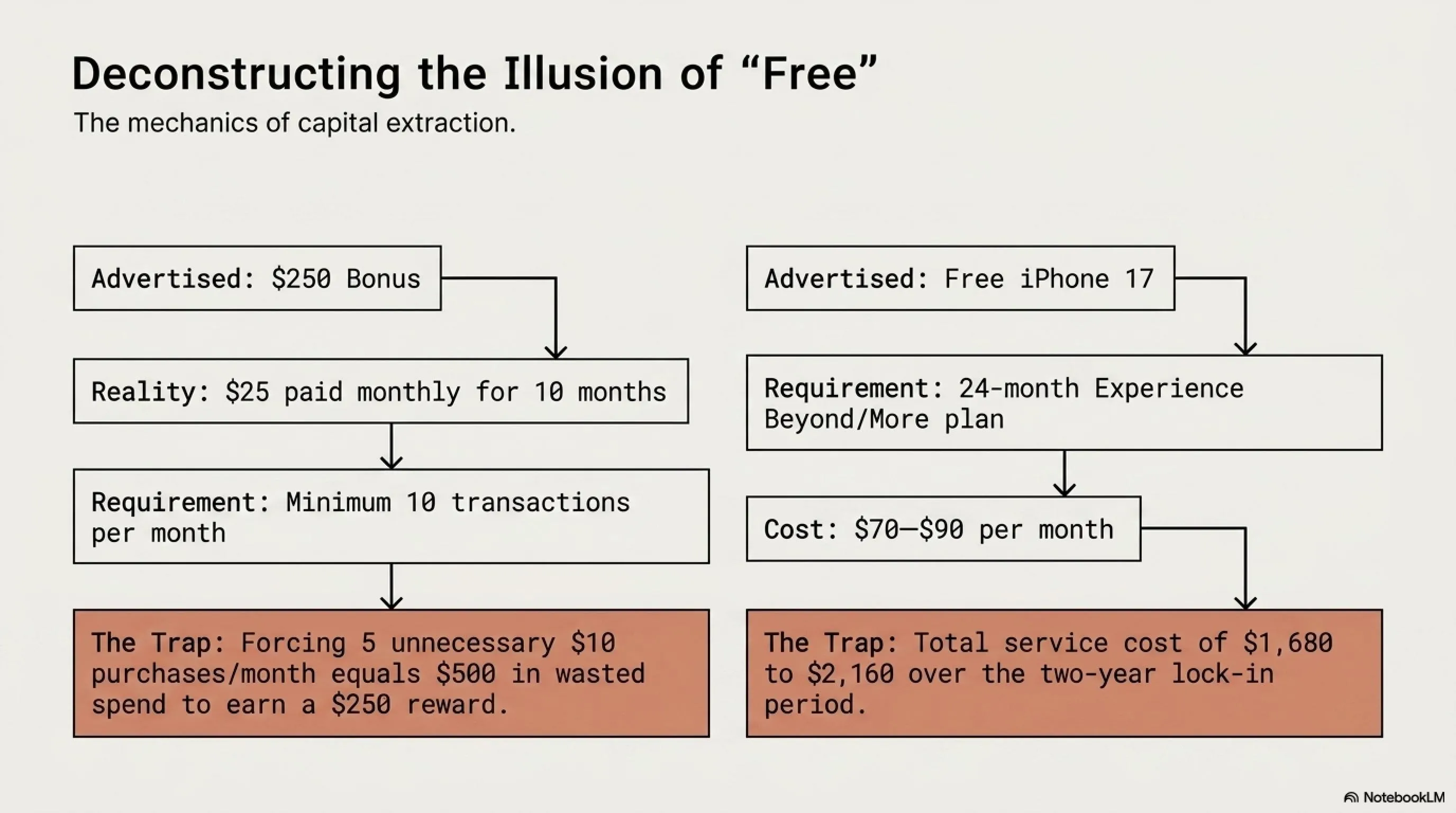
The critical detail: cash back isn't paid upfront. Instead, you receive $25 per month for 10 months, but only if you make at least 10 purchases with your Apple Card each month. If you fall short in any given month, you forfeit that month's $25 bonus. This means you must make a total of 100 purchases over 10 months to receive the full $250. For context, that's roughly 2-3 purchases per week consistently for nearly a year.
⚖️ Pros & Cons: Apple Card AirPods Pro 3 Promotion
✅ Advantages
- AirPods Pro 3 essentially free
- No trade-in required
- $250 total cash back
- Standard Apple Card benefits
- No annual fee
- Seamless Apple Wallet integration
- Privacy-focused design
❌ Disadvantages
- Requires 10 purchases monthly (10 months)
- Cash back paid gradually, not upfront
- Short purchase window (until June 15)
- New cardholders only
- Family member purchases don't count
- Must buy from Apple directly
- Risk of unnecessary spending
🎯 Tekin Analysis: Is This Deal Actually Worth It?
At first glance, free AirPods Pro 3 sounds fantastic. But the 10-purchase monthly requirement for 10 months represents a significant commitment. If you naturally make 10+ purchases per month (groceries, gas, bills, online shopping), this is an excellent deal. However, if you typically make fewer purchases, you might be tempted to make unnecessary transactions to hit the threshold, ultimately spending more than the AirPods cost.
Simple math: If you need to make 5 extra purchases monthly at $10 each to reach the 10-transaction minimum, that's $50/month × 10 months = $500 in unnecessary spending—double the AirPods' retail price! The sweet spot is users who already make 10-15 purchases monthly and can simply switch those transactions to Apple Card. This promotion is Apple's strategy to increase Apple Card usage and collect transaction fee revenue. It's a clever way to compete with credit cards like Chase Sapphire and American Express that offer attractive sign-up bonuses.
Apple Card currently has approximately 12 million users in the United States. This promotion aims to significantly expand that user base by offering a compelling incentive. Once users have Apple Card and integrate it into Apple Wallet, they're more likely to continue using it due to convenience and ecosystem lock-in. Apple earns a percentage of every transaction, making this a long-term revenue play disguised as a generous promotion.
💡 Pro Tip: Before signing up, track your current monthly purchase patterns for 2-3 months. If you consistently make 10+ transactions, this deal is worthwhile. If not, consider whether you can realistically shift existing purchases to Apple Card without creating unnecessary spending. Also, note that Apple Card is only available in the United States, so international users cannot participate in this promotion.
📱 T-Mobile Gives Away iPhone 17 for Free
T-Mobile has launched one of 2026's most aggressive carrier promotions: iPhone 17 completely free for customers who switch carriers. This offer, which began in mid-May, includes all iPhone 17 models (iPhone 17e, iPhone 17, iPhone Air, and iPhone 17 Pro), but comes with specific requirements that must be met.
📋 T-Mobile Free iPhone 17 Requirements
| Requirement | Details |
| Carrier Switch | Port number from another carrier to T-Mobile |
| Required Plan | Experience Beyond or Experience More |
| Trade-In | Eligible device (optional for additional discount) |
| Payment Method | 24-month installment with monthly credits |
| Eligible Models | iPhone 17e, 17, Air, 17 Pro |
| Plan Cost | Starting at $70/month |
| Contract Length | 24 months (early termination requires full payment) |
Here's how it works: You purchase the iPhone 17 on a 24-month installment plan, but T-Mobile credits your account each month for the equivalent of the monthly payment. In other words, you pay nothing for the phone, but you must remain a T-Mobile subscriber for 24 months. If you switch carriers before the 24 months end, you must pay the remaining phone balance in full. This is a classic carrier lock-in strategy that ensures customer retention.
🎯 Tekin Analysis: Calculating the Real Cost
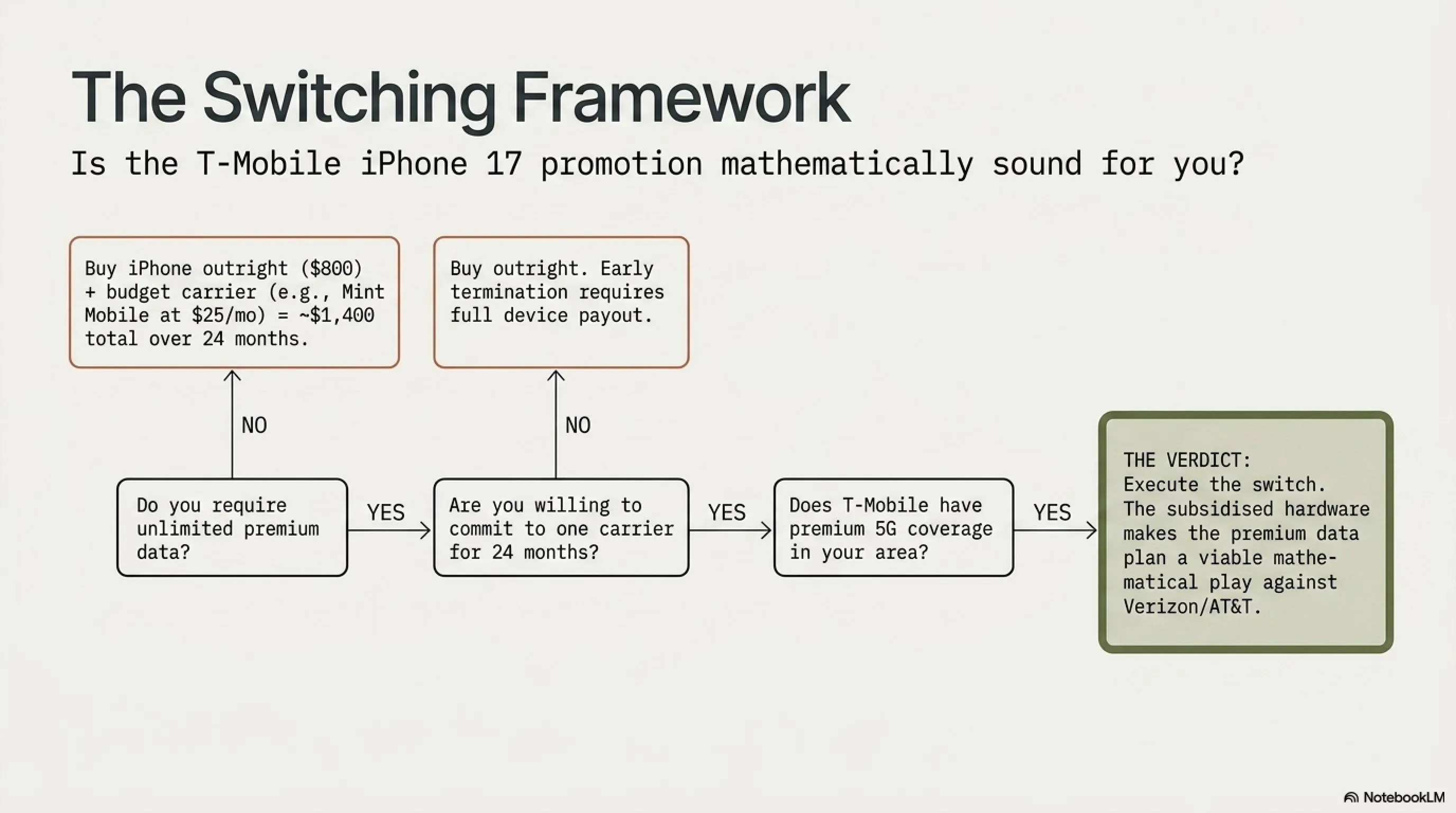
While the phone is "free," you must factor in the monthly plan cost. The Experience Beyond plan costs approximately $70-90 per month. Over 24 months, that's $1,680 to $2,160 in service fees. By comparison, if you buy an iPhone 17 outright (approximately $800-1,200) and use a budget carrier like Mint Mobile ($25/month), you'd spend roughly $1,400-1,800 over 24 months.
So the "free" phone isn't truly free—it's subsidized through higher service costs. However, if you need unlimited data with premium network quality, T-Mobile's offer is competitive. The value proposition depends on your usage patterns. Heavy data users benefit from unlimited plans, while light users might save money buying the phone outright and using a cheaper carrier. Additionally, T-Mobile's network has significantly improved in recent years, now offering comparable coverage to Verizon and AT&T in most urban and suburban areas.
📊 Carrier iPhone 17 Deals Comparison
| Carrier | Offer | Requirements |
| T-Mobile | Free with carrier switch | Experience Beyond/More plan |
| Verizon | Up to $1,000 off | Trade-in + Unlimited Plus plan |
| AT&T | Up to $800 off | Trade-in + Unlimited Premium plan |
| Apple Store | Up to $650 trade-in | No contract required |
| Best Buy | Up to $900 off | Activation + select carriers |
This T-Mobile promotion is part of the intense carrier war for customers in 2026. With smartphone market growth slowing in the United States, carriers must offer increasingly aggressive deals to steal customers from competitors. T-Mobile, as the third-largest US carrier, is using this offensive strategy to gain market share from Verizon and AT&T. The company has invested heavily in 5G infrastructure and now offers competitive coverage in most areas, making it a viable alternative to the traditional "big two" carriers.
💡 Decision Framework: This deal makes sense if: (1) You need unlimited data with premium network quality, (2) You're unhappy with your current carrier, (3) You plan to stay with T-Mobile for at least 24 months, (4) T-Mobile has good coverage in your area. It doesn't make sense if: (1) You're a light data user who could save with a budget carrier, (2) You value carrier flexibility and don't want a 24-month commitment, (3) T-Mobile coverage is poor in your area. Check T-Mobile's coverage map and read local reviews before switching.
💭 Final Thoughts
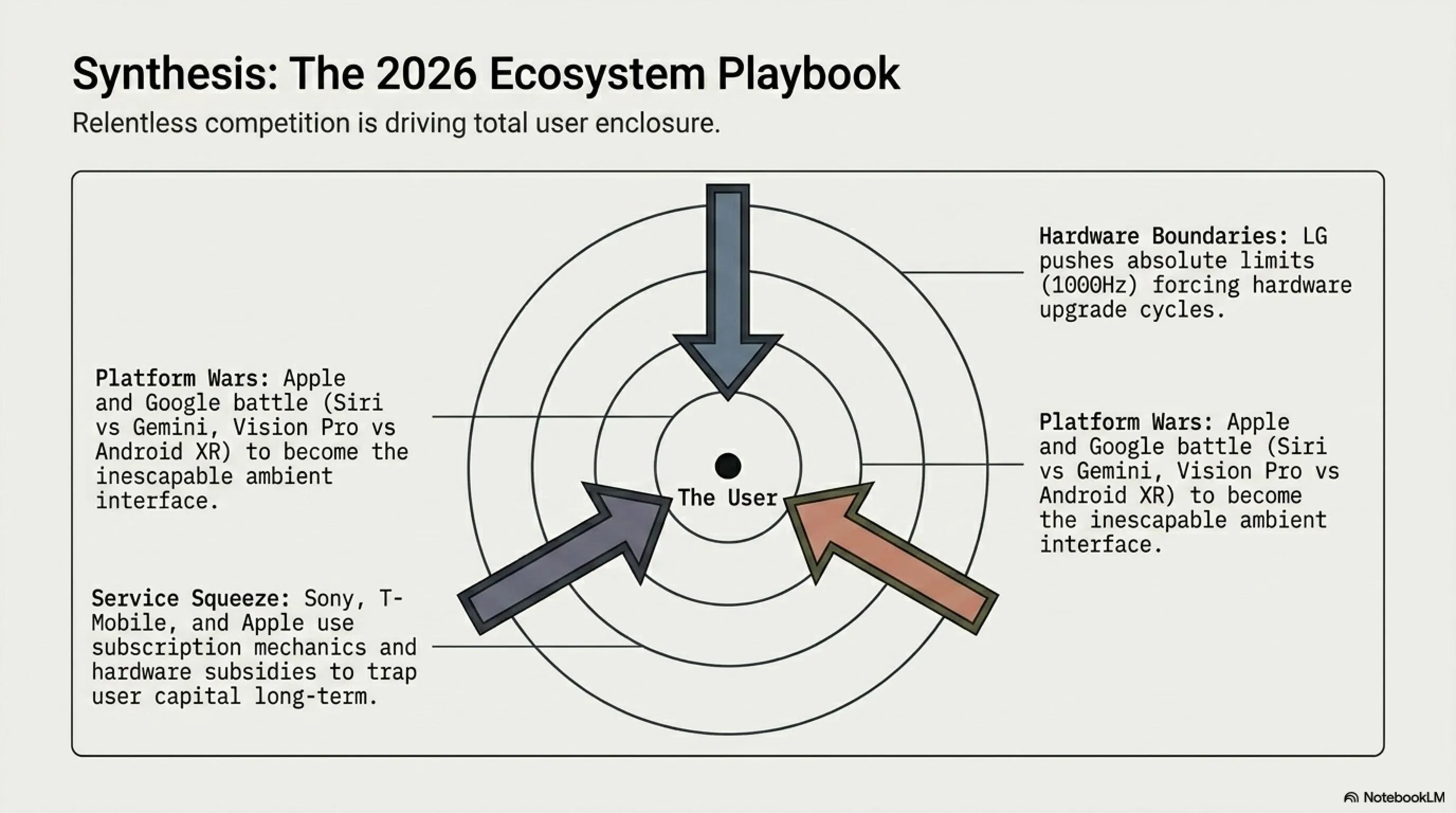
Tonight we witnessed the fierce competition among tech giants that's reshaping the industry. LG's 1000Hz monitor defines new frontiers in competitive gaming, pushing the boundaries of what's technically possible and commercially viable. Google's Android XR glasses represent a bold challenge to Apple's Vision Pro, embracing an open platform strategy that could democratize AR/VR technology. Apple's WWDC 2026 announcement, strategically timed just before Google I/O, signals that the AI war is intensifying and neither company will concede ground easily.
Sony's PlayStation Plus price increase reveals the economic realities of the gaming industry: rising infrastructure costs, intense competition with Xbox Game Pass, and the need to fund next-generation development. Meanwhile, Apple and T-Mobile's aggressive promotions demonstrate how difficult customer acquisition has become in saturated markets. These companies are willing to offer substantial incentives—free AirPods, free iPhones—to lock customers into their ecosystems for the long term.
The common thread across all these stories is relentless competition. In the tech world of 2026, companies must constantly innovate, offer competitive pricing, and deliver superior user experiences to survive. For consumers, this competition means better products, more reasonable prices, and more advanced technologies. But it also means more difficult choices and the need for more research before making purchasing decisions. The winners will be those who can balance innovation with value, and openness with integration.
In the coming weeks, with Google I/O and WWDC on the horizon, we'll see even bigger announcements. The battle between Google and Apple in AI, the unveiling of Android 17 and iOS 27, and more details about smart glasses and Vision Pro 2 are all coming. Stay tuned with Tekin to ensure you don't miss any important news! 🚀
❓ Frequently Asked Questions (FAQ)
Is the LG 1000Hz monitor suitable for casual gaming?
The LG UltraGear 25G590B is specifically designed for professional and competitive gamers. For casual and single-player gaming, 144Hz or 240Hz monitors are more than sufficient and cost significantly less. Additionally, to utilize 1000Hz, you need an extremely powerful graphics card capable of producing over 1000 frames per second, which is impractical for most games. The monitor's 1080p resolution also limits its appeal for gamers who prioritize visual fidelity over competitive performance. Unless you're a professional eSports athlete or aspiring to be one, a 240Hz or 360Hz monitor offers better value.
What's the difference between Android XR glasses and Apple Vision Pro?
Key differences include: (1) Price: Android XR starts at $300, Vision Pro costs $3,500. (2) Ecosystem: Android XR is open with multiple partners, Vision Pro is closed and Apple-exclusive. (3) Design: Android XR includes lightweight glasses and advanced headsets, Vision Pro is a single heavy headset. (4) AI: Android XR uses Gemini, Vision Pro uses Siri. (5) Apps: Android XR accesses millions of Android apps, Vision Pro is limited to App Store. (6) Strategy: Google aims for mass market adoption through diverse price points, Apple targets premium users with a unified experience. Both have strengths—Android XR offers accessibility and openness, while Vision Pro delivers polish and integration.
Is the Apple Card AirPods Pro 3 promotion worth it?
It depends on your spending habits. If you naturally make 10+ purchases per month (groceries, gas, bills, online shopping), this is an excellent deal—you'll receive $250 in cash back over 10 months, effectively making the AirPods Pro 3 free. However, if you typically make fewer purchases, you might be tempted to make unnecessary transactions to reach the threshold, ultimately spending more than the AirPods cost. Critical calculation: If you need to make 5 extra $10 purchases monthly to hit 10 transactions, that's $500 in unnecessary spending over 10 months—double the AirPods' price! Track your current purchase patterns for 2-3 months before deciding. The deal is best for people who already use credit cards frequently and can simply switch those transactions to Apple Card.
Why did Sony raise PlayStation Plus prices?
Multiple factors are driving this decision: (1) Rising server and infrastructure costs as online gaming grows and games become more data-intensive. (2) Competition with Xbox Game Pass, which forces Sony to spend more on third-party game licensing. (3) Declining PS5 hardware sales as the console reaches mid-lifecycle, making Sony more dependent on services revenue. (4) Inflation and increased operational costs including game development, licensing fees, and labor. (5) Investment in next-generation consoles (PS5 Pro and PS6). This is the third price increase in two years, suggesting Sony is systematically adjusting to new economic realities rather than responding to temporary market fluctuations. The gaming subscription market has become increasingly competitive, and Sony needs stable cash flow to remain competitive with Microsoft's aggressive Game Pass strategy.
Is T-Mobile's free iPhone 17 deal actually worth it?
It depends on your needs. The phone is "free," but you must subscribe to Experience Beyond or More plans ($70-90/month) for 24 months, totaling $1,680-$2,160 in service costs. By comparison, buying an iPhone 17 outright ($800-1,200) and using a budget carrier like Mint Mobile ($25/month) costs roughly $1,400-$1,800 over 24 months. So the "free" phone is subsidized through higher service costs. The deal makes sense if: (1) You need unlimited data with premium network quality, (2) You're unhappy with your current carrier, (3) You plan to stay with T-Mobile for 24 months, (4) T-Mobile has good coverage in your area. It doesn't make sense if: (1) You're a light data user, (2) You value carrier flexibility, (3) T-Mobile coverage is poor in your area. Check coverage maps and local reviews before switching.
What should I expect from WWDC 2026 and Google I/O?
Google I/O (May 19-20): Expect Android 17 with new AI features, Android XR smart glasses official launch, Gemini 2.5 Pro advancements, new Pixel devices, and updates to Google's developer tools. The focus will be on AI integration across all Google products and the open Android XR ecosystem. WWDC 2026 (June 8-12): Expect iOS 27, macOS 16, watchOS 14, tvOS 20, and visionOS 3. The major focus will be AI—likely an upgraded Siri with LLM capabilities, on-device AI improvements, and possibly "Apple GPT" or a partnership with OpenAI/Anthropic. We may also see Vision Pro 2 details or a more affordable Vision variant. Both conferences represent the escalating AI war between these tech giants, with each trying to prove their AI assistant is superior.
📚 Sources
Primary Sources: The Verge, Mashable, Android Central, 9to5Mac, MacRumors, IGN, Polygon, Yahoo Tech, Tom's Guide, MacWorld, AppleInsider, CNET, TechRadar
Official Sources: LG Electronics Press Release, Apple Newsroom, Google I/O 2026, Sony PlayStation Blog, T-Mobile Official, PR Newswire
Research & Analysis: Tekin Editorial Team
Publication Date: May 19, 2026
🌐 Stay Connected With Us
For the latest tech, gaming, and gadget news, follow us on social media:
📸 Instagram 🆔 Telegram Arabia 🆔 Telegram Global 🆔 Telegram Iran 💬 Direct Contact 📧 majid@tekingame.com💜 Thank you for being part of the Tekin community!
🌐 Stay Connected With Us 🎮✨
For the latest tech, gaming, and gadget news, follow us on our official social media channels:
Supplementary Image Gallery: 🌙 Tekin Night May 19, 2026: LG's 1000Hz Monitor, Android XR Glasses, WWDC Announcement & PS Plus Price Hike