
🌙 Welcome to Tekin Night June 6, 2026 - Saturday Night Edition
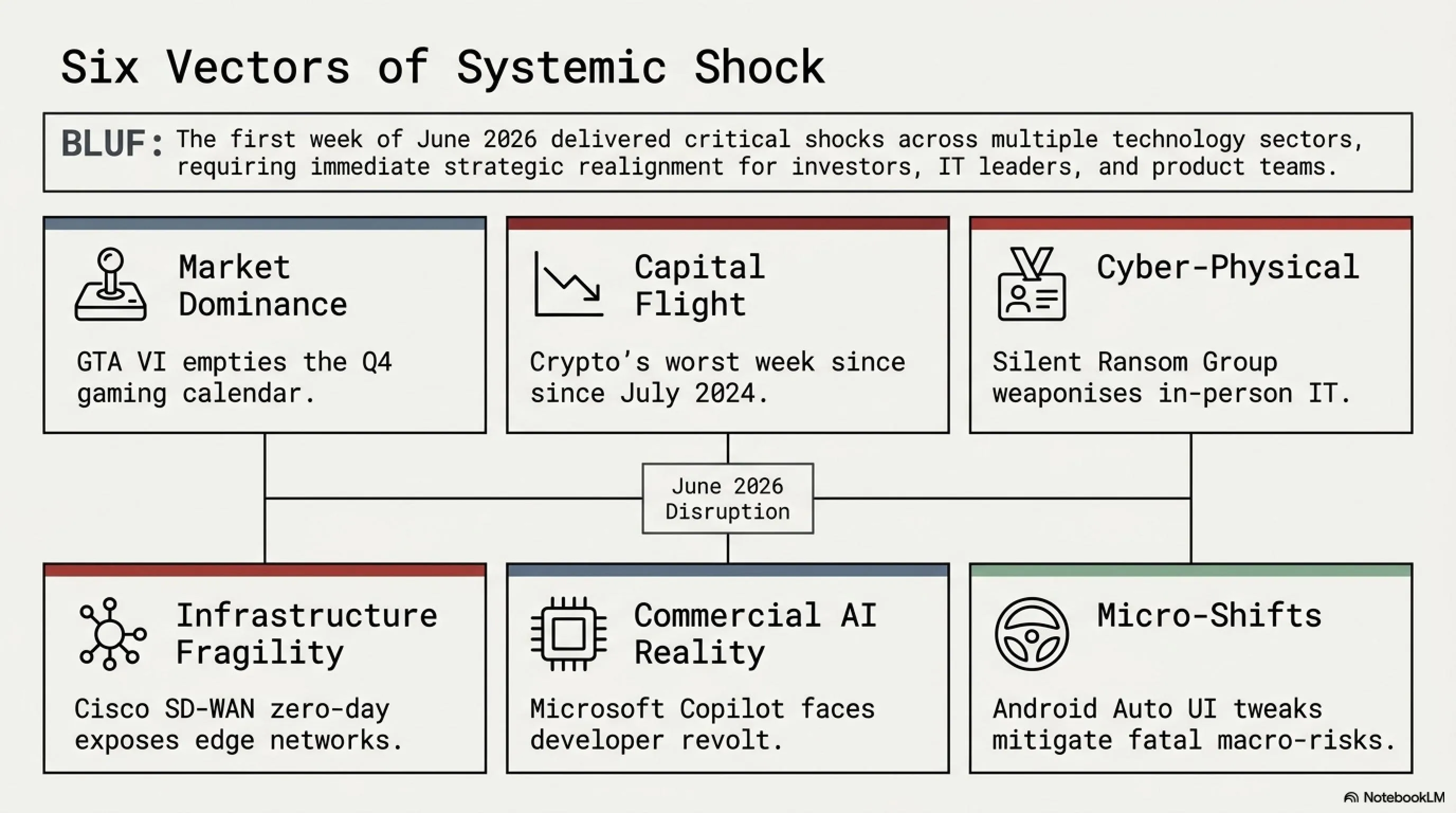
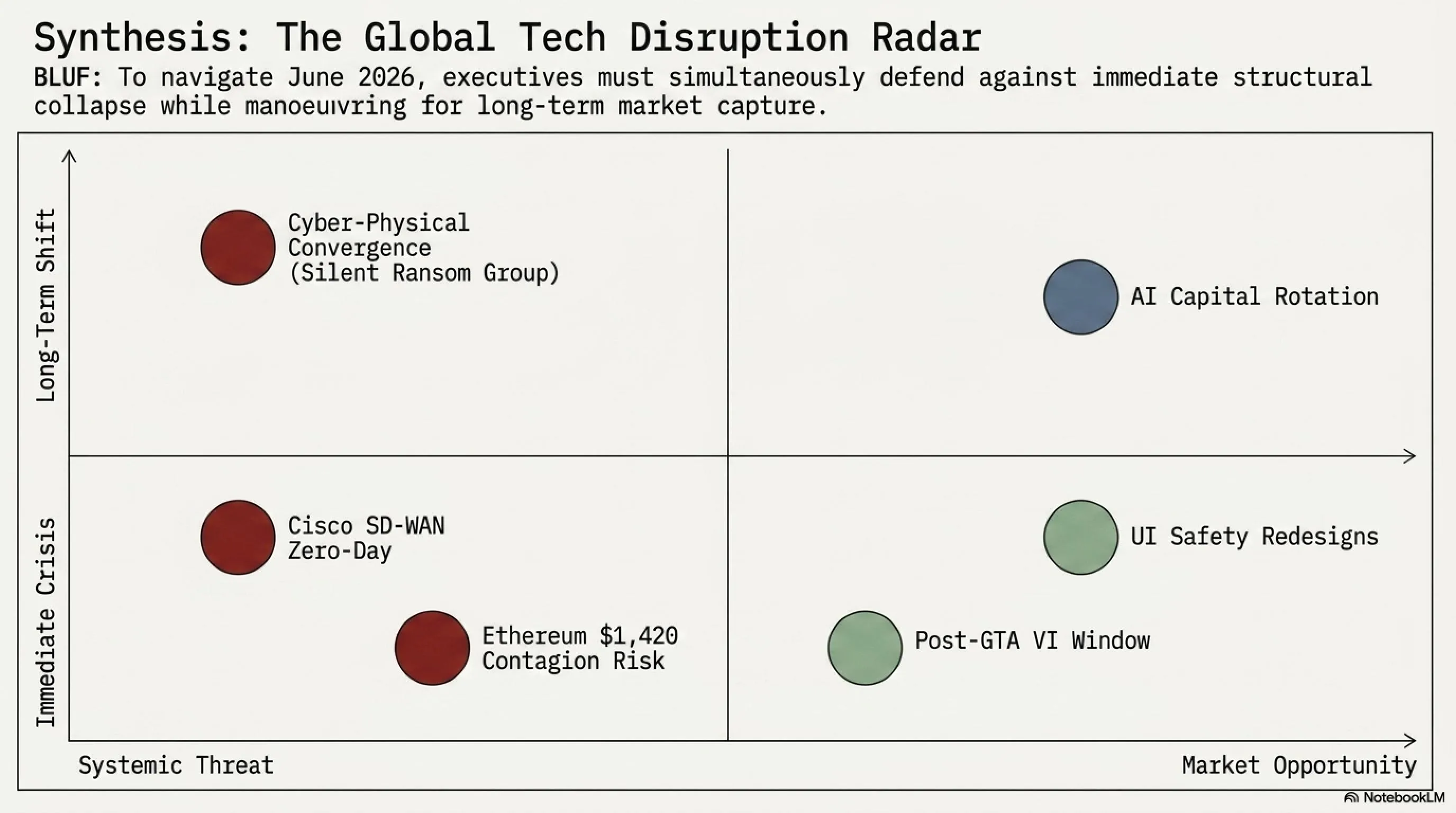
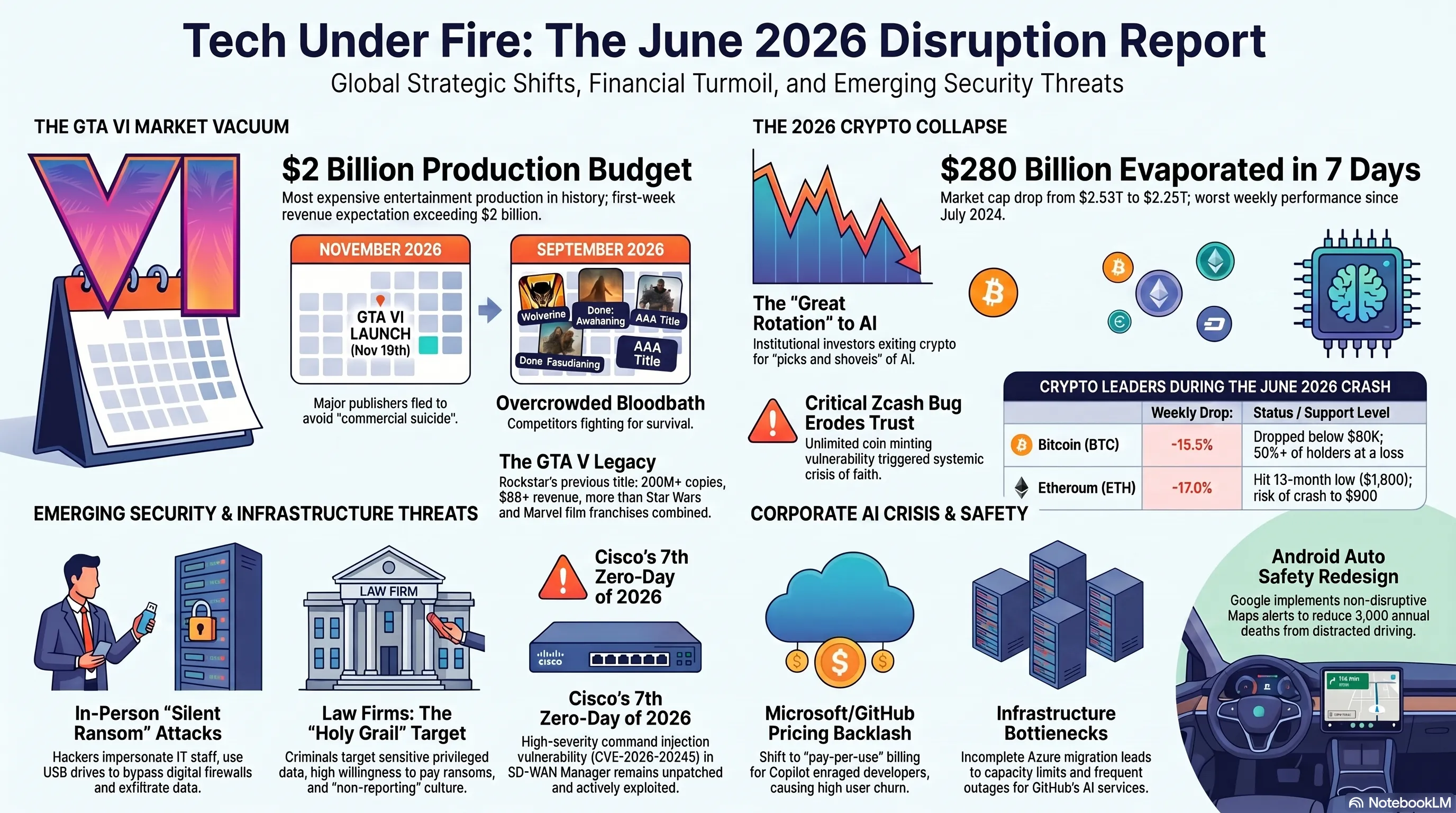
Good evening, Tekin Legion! We're kicking off Saturday night with six explosive stories covering gaming industry disruption, financial market turmoil, cybersecurity evolution, infrastructure vulnerabilities, AI product failures, and safety innovations. Tonight we witness developments that could reshape the future of technology: GTA VI emptying November, crypto's worst week, hackers showing up at your door, Microsoft in crisis, and more!
⚡ Tonight's Key Headlines:
🎮 GTA VI empties November - publishers flee to September bloodbath
💸 Crypto worst week since July 2024: Bitcoin below $60K
🚨 Silent Ransom: In-person hackers with USB drives invade offices
🔓 Cisco 7th Zero-Day of 2026 with no patch available
🪟 Microsoft in crisis: AI not selling, GitHub struggling
🚗 Android Auto: Google redesigns Maps alerts for safety
🍿 Grab your late-night drink and let's dive into the heart of tech disruption!
1. GTA VI Reshapes the Gaming Calendar: Why November is Empty 🎮
In an unprecedented event demonstrating the true power of a single franchise, Grand Theft Auto VI has forced the entire gaming industry to rewrite its release calendar. With the confirmed November 19, 2026 release date, Rockstar Games has effectively cleared an entire month from the gaming calendar, forcing competitors into strategic retreat. November 2026 is now virtually empty except for GTA VI - a testament to the franchise's overwhelming market dominance.
According to reports from The Verge, IGN, and multiple industry sources, major publishers including Sony, Marvel Studios (for Wolverine), and Funcom (for Dune: Awakening) have rapidly shifted their release dates to September and October. This strategic shift reveals what every game publisher knows: competing with GTA VI in the same month is commercial suicide.
The context is staggering: GTA V, released in 2013, has sold over 200 million copies and generated more than $8 billion in revenue for Take-Two Interactive. It broke the first-week sales record in entertainment history, earning $1 billion in just 24 hours - a record that still stands today. GTA V single-handedly became more profitable than most Hollywood blockbuster franchises, surpassing earnings of Star Wars, Harry Potter, and Marvel's highest-grossing films combined.
📊 Fall 2026 Release Calendar: Before & After GTA VI
| Month | Major Releases | Status |
|---|---|---|
| September 2026 | Control Resonant, Wolverine, Dune: Awakening, 10+ AAA titles | Overcrowded 🔴 |
| October 2026 | Mid-tier titles, indie games | Busy 🟡 |
| November 2026 | GTA VI (Nov 19) | Empty 🟢 |
| December 2026 | Holiday titles, smaller releases | Relatively Empty 🟣 |
| January 2027+ | Tomb Raider: Legacy, multiple delayed AAA | Gradual Return 🔵 |
Why Is Everyone Fleeing GTA VI? Strategic Analysis
The reason for this mass exodus is simple but profound: GTA VI is not just a game - it's a cultural phenomenon. The franchise commands a level of market attention that can suffocate any competing release. Let's examine why publishers are terrified of November 2026:
1. Media Attention Vacuum: GTA VI will dominate gaming media, YouTube, Twitch, social media, and mainstream news for weeks before and after launch. Any game releasing near it will struggle to get coverage. Reviewers, streamers, and content creators will prioritize GTA VI content because it drives massively higher engagement and views.
2. Consumer Wallet Share: GTA VI costs $70 (standard) to $100+ (special editions), and with GTA Online microtransactions likely embedded from day one, players will spend hundreds of dollars in the first month. This leaves little budget for other games in November or December.
3. Time Commitment: With a rumored map larger than Red Dead Redemption 2 and GTA V combined, plus a narrative campaign potentially exceeding 60-80 hours, GTA VI will consume player time for months. Competing for player attention when they're immersed in Vice City is futile.
4. Retailer Focus: Physical and digital storefronts will prioritize GTA VI merchandising, homepage placement, and promotional deals. Other games will be buried beneath Rockstar's marketing behemoth.
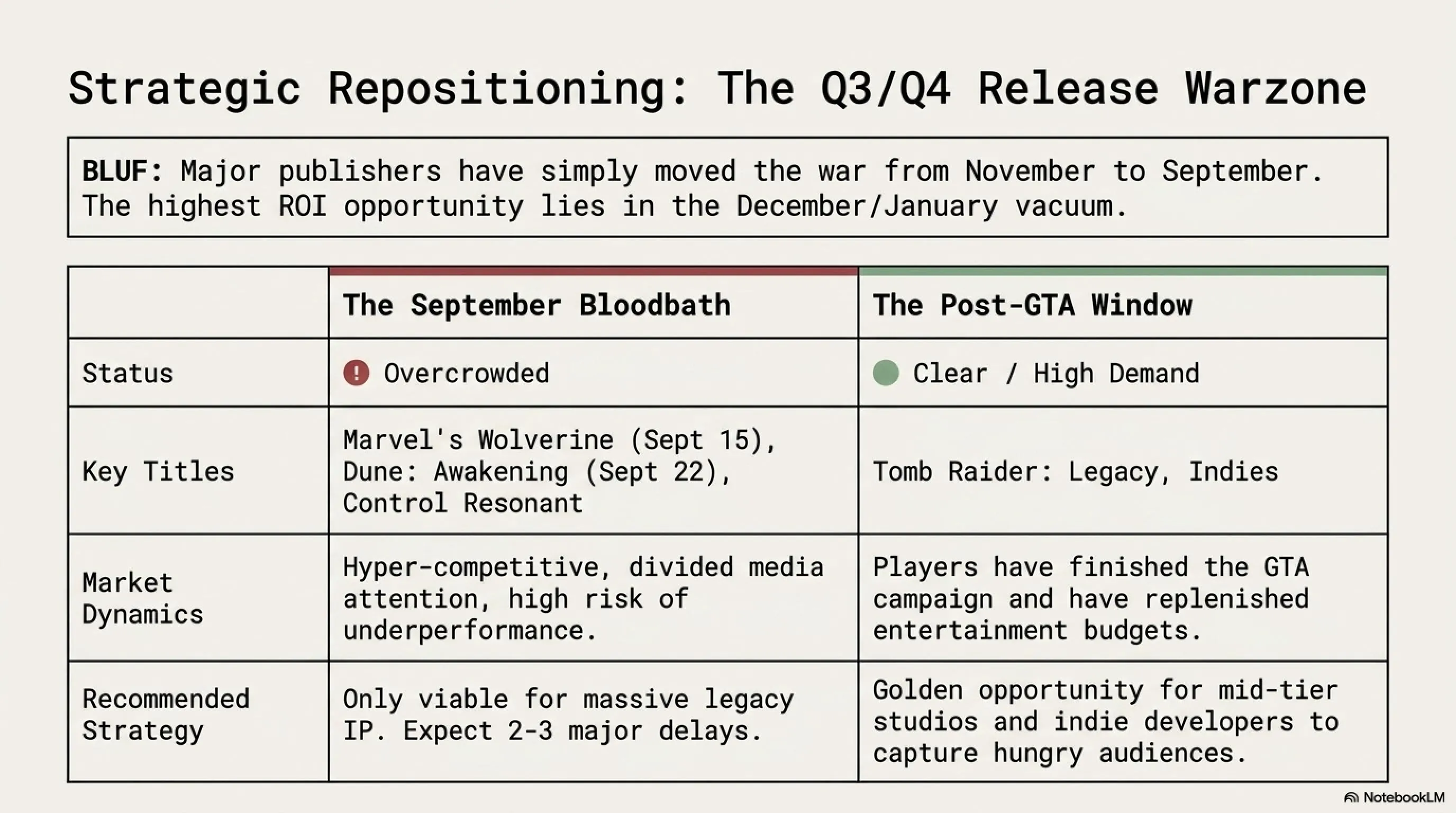
🔥 Tekin Analysis: Can September Survive This Bloodbath?
The critical question now is: can September 2026 handle this influx of AAA titles? History suggests no. When multiple blockbuster games release in the same window, only one or two succeed financially while others underperform or outright fail.
Historical Precedent: November 2020 saw Cyberpunk 2077, Assassin's Creed Valhalla, Call of Duty: Black Ops Cold War, and Spider-Man: Miles Morales all launch within weeks. Only Call of Duty and Spider-Man succeeded; Cyberpunk became infamous for bugs and performance issues, while Valhalla sold below expectations despite being a solid game.
September 2026 is now a warzone: Marvel's Wolverine (Sony, Sept 15), Dune: Awakening (Sept 22), Control Resonant (early Sept), and multiple other AAA titles. Marketers know not to compete with GTA VI, but have they simply moved the war from November to September?
Tekin Prediction: Expect at least 2-3 games from this list to either delay again or suffer below-target sales. Only games with strong IP recognition (like Wolverine) or unique experiences (like Dune MMO) will survive this September massacre.
The Winners: Games that delay to December 2026 or January 2027. This is the "post-GTA window" when players have completed the campaign and are hungry for new experiences. Indie developers and mid-tier studios should target this period.
GTA VI By The Numbers: Why Rockstar Commands This Power
To understand why GTA VI can reshape an entire industry's calendar, let's examine the franchise's unprecedented commercial success and market influence:
📊 GTA V Legacy
- 200+ million copies sold
- $8 billion+ total revenue
- $1B in first 24 hours (record)
- 13 years of continuous updates
- Most profitable entertainment product ever
🎯 GTA VI Expectations
- $2B production budget (biggest ever)
- Vice City + Cuba combined map
- Photorealistic graphics (next-gen exclusive)
- Trailer 1: 200M views in 24hrs
- Expected $2B+ first week
With a production budget estimated at $2 billion (making it the most expensive entertainment production in history, surpassing even blockbuster films like Avatar and Avengers: Endgame), GTA VI represents an unprecedented bet on interactive entertainment. The game's first trailer in December 2025 shattered records with 200 million views in 24 hours, becoming the most-watched videogame trailer of all time.
💡 Key Takeaway for Developers: This situation creates a golden opportunity for indie and mid-tier studios. Target the "post-GTA window" of December 2026-January 2027 when players have completed GTA VI's campaign and are seeking new experiences. History shows this window is highly profitable for quality games that offer something different.
✅ Summary: GTA VI's Market Power
GTA VI has single-handedly reshaped the gaming industry calendar just by announcing its November 19 release date. Major publishers fled to September, creating an overcrowded month while leaving November virtually empty. This level of market power demonstrates that Rockstar doesn't just make games - they control the industry. The September bloodbath will likely result in multiple delays or underperforming titles, while the post-GTA window of December-January becomes the smart target for savvy developers.
2. Crypto's Worst Week Since July 2024: Bitcoin and Ethereum in Crisis 💸
The cryptocurrency market is on track for its worst week since July 2024, with Bitcoin crashing below $60,000 and Ethereum hitting a 13-month low. On Friday, June 5, Bitcoin plunged to $59,099 - the lowest level since October 2024 - while Ethereum collapsed to $1,600, dangerously close to the critical support level of $1,420 last seen in April 2025.
According to data from CoinDesk and Coinglass, the carnage is staggering: Bitcoin has lost nearly 15.5% this week and Ethereum more than 17%, marking crypto's worst weekly performance in nearly a year. In the past 24 hours alone, $1.75 billion in leveraged positions were liquidated, wiping out 351,233 traders across crypto markets. Monthly spot trading volume has plummeted to its lowest level since October 2023 - a clear signal of capital flight from the crypto ecosystem.
📉 The Bloodbath: Crypto Market Collapse Statistics
| Asset | Current Price | Weekly Drop | Status |
|---|---|---|---|
| Bitcoin (BTC) | $61,500 | -15.5% | Lowest since Oct 2024 |
| Ethereum (ETH) | $1,600 | -17% | 13-month low |
| 24hr Liquidations | $1.75 Billion | 351K traders | |
| Monthly Spot Volume | Lowest since Oct 2023 | Liquidity crisis | |
| Bitcoin in Loss | Over 50% | Worst since May 2025 | |
| Market Cap Loss (7d) | $2.53T → $2.25T | $280B evaporated | |
Three Critical Factors Behind the Collapse
1. The Zcash Bug and Trust Erosion: On Thursday, a critical security vulnerability was discovered in Zcash, a privacy-focused cryptocurrency. The bug could have allowed attackers to mint unlimited coins, fundamentally breaking the scarcity assumption that underpins all cryptocurrencies. While Zcash developers claim the bug was never exploited, the mere revelation sent shockwaves through the market, raising questions about the security of other crypto protocols.
This isn't just about Zcash - it's about systemic confidence. If a bug in a privacy coin can create unlimited supply, what other hidden vulnerabilities lurk in Bitcoin, Ethereum, or DeFi protocols? The incident triggered a crisis of faith among institutional investors who were already nervous about crypto's long-term viability.
2. Capital Rotation to AI Infrastructure: CNBC data reveals that institutional investors are aggressively exiting crypto and pouring capital into AI infrastructure stocks. The SpaceX IPO, Nvidia's continued rally, and new AI chip startups are absorbing liquidity that previously flowed into Bitcoin. This is the "Great Rotation" - capital moving from speculative digital assets to tangible revenue-generating AI companies.
The narrative shift is profound: Bitcoin was sold as "digital gold" and a hedge against inflation, but when confronted with AI companies generating real profits and transforming industries, investors are choosing substance over speculation. As one hedge fund manager told Bloomberg: "Why hold Bitcoin when I can own the picks and shovels of the AI gold rush?"
3. Strong US Jobs Data and Fed Policy: Friday's blowout jobs report (272,000 new jobs in May, crushing expectations of 180,000) signals the US economy remains robust. This means the Federal Reserve has no urgency to cut interest rates, maintaining a tight monetary environment that's hostile to risk assets like crypto.
Higher interest rates make risk-free Treasury bonds more attractive relative to volatile crypto. When you can earn 5%+ annually in T-bills with zero risk, why gamble on Bitcoin that could drop 20% in a week? This interest rate dynamic is crypto's kryptonite.
🔥 Tekin Analysis: Will Ethereum Drop Below $900?
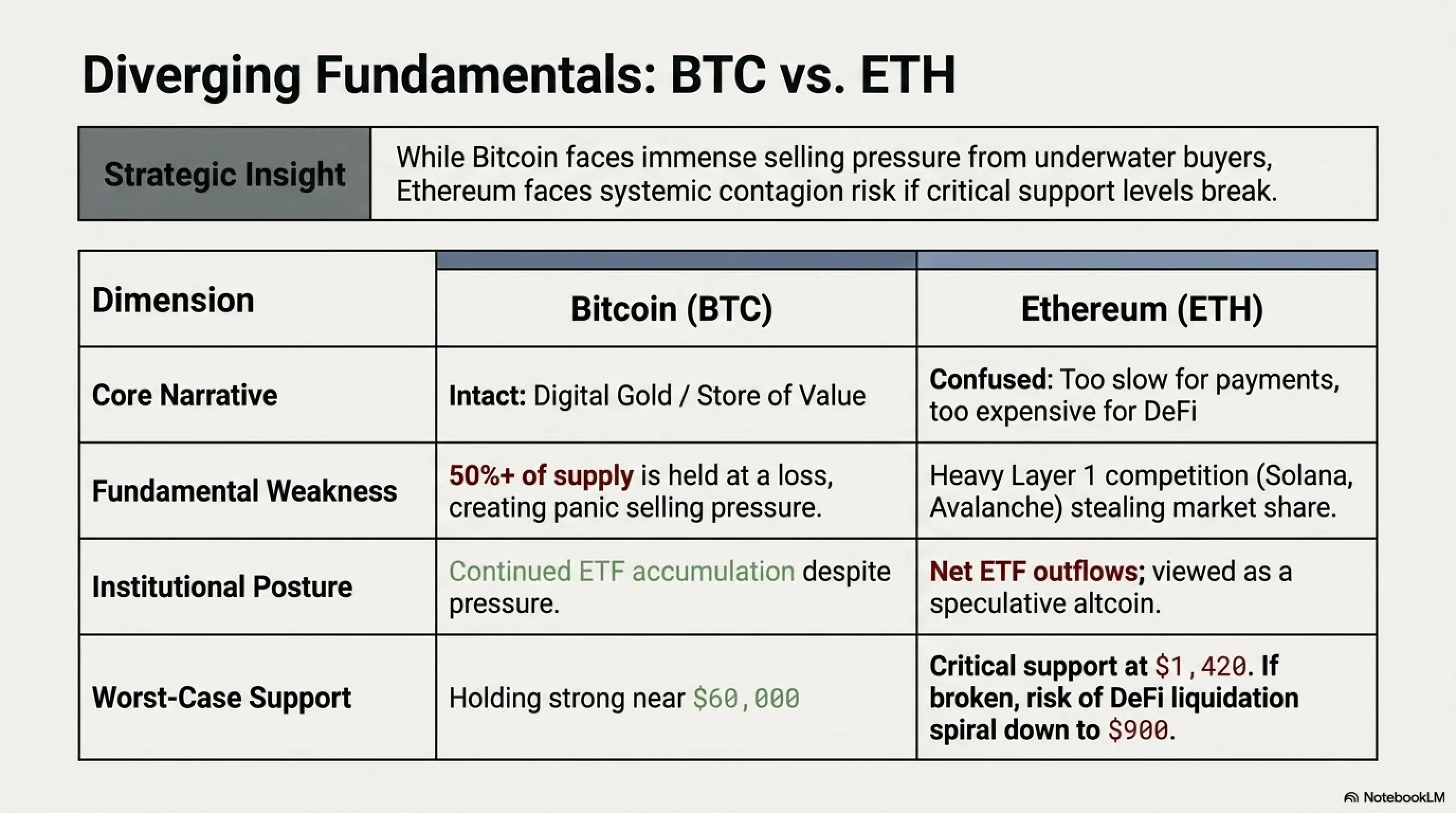
Ethereum's current support at $1,420 is the same level where it bounced in April 2025. If this level breaks, analysts believe ETH could crash to $900 - a price level last seen during the 2022 bear market. Let's examine why Ethereum is weaker than Bitcoin:
Why ETH is Underperforming BTC:
1. Layer 1 Competition: Solana, Avalanche, and other blockchains are stealing market share from Ethereum's DeFi and NFT dominance. Solana's speed and low fees have attracted developers building high-frequency DeFi protocols that can't function on Ethereum's expensive network.
2. Scalability Issues Persist: Despite multiple upgrades (The Merge, Shanghai, Dencun), Ethereum still suffers from high gas fees during peak usage. Users routinely pay $50-100 for simple transactions, making it impractical for everyday use.
3. Institutional Selling: Ethereum ETFs are experiencing net outflows, while Bitcoin ETFs - despite pressure - still show institutional accumulation. This divergence suggests professional investors view Bitcoin as the only "legitimate" crypto, treating everything else as speculative altcoins.
4. DeFi Contagion Risk: Most DeFi protocols use ETH as collateral. If ETH drops below $1,400, automated liquidations could trigger a cascade effect, forcing protocols to sell more ETH to maintain collateral ratios, which drives prices even lower in a death spiral.
The Black Swan Scenario: If ETH breaks $1,400, we could see mass liquidations push the price to $1,100, then $900. At $900, the entire DeFi ecosystem is at risk of systemic collapse. This isn't fearmongering - it's mathematical inevitability based on current over-leveraged positions.
Bitcoin vs Ethereum: Tale of Two Crises
While both assets are down significantly, their fundamental situations differ dramatically. Bitcoin, despite the pain, maintains stronger institutional backing and clearer use cases as "digital gold" or a store of value. Ethereum, on the other hand, faces an existential identity crisis: it's too slow and expensive to be a payments network, too complex to be simple money, and too competitive to be the only smart contract platform.
More than half of all Bitcoin in circulation is now held at a loss (purchased at prices higher than $61,500). This creates immense selling pressure as holders who bought near the October 2025 peak of $126,000 panic and capitulate. However, Bitcoin's narrative as a long-term inflation hedge remains intact for true believers.
Ethereum lacks this clear narrative. Is it a platform for DeFi? A network for NFTs? A settlement layer for Layer 2s? This narrative confusion, combined with fierce competition and persistent scalability issues, makes it vulnerable to deeper crashes.
👍 Bull Case
- Buying opportunity for long-term holders
- Liquidations purge excessive leverage from system
- Bitcoin holding $60K - relatively strong support
- Institutional selling nearing exhaustion
- Weak hands shaken out = stronger base
- Historical precedent: Q4 typically bullish
👎 Bear Case
- 50%+ of BTC underwater = selling pressure
- ETH near critical $1,420 support - break = $900
- Capital rotation to AI continues accelerating
- Volume at 3-year lows = no new buyers
- Fed keeping rates high = hostile environment
- Trust crisis from Zcash bug unresolved
💡 Strategic Insight: This crash could be a golden opportunity for dollar-cost averaging (DCA) strategies - but only if you have a 2-3 year time horizon and can stomach 50%+ drawdowns. If ETH drops below $1,400, a small position could be profitable long-term. However, never allocate more than 5-10% of your portfolio to crypto - volatility remains extreme and regulatory risks are ever-present.
✅ Summary: Crypto Market in Crisis
With Bitcoin down 15.5% and Ethereum down 17%, the crypto market is experiencing its worst week since July 2024. The Zcash bug, capital rotation to AI, and strong US economic data have intensified pressure. Ethereum approaches critical support at $1,420 - if this breaks, a crash to $900 is possible. More than half of Bitcoin holders are underwater, creating immense selling pressure. This is either a generational buying opportunity or the beginning of crypto winter 2.0.
3. Silent Ransom Group: The Age of In-Person Hackers 🚨
The FBI and Google have issued a joint warning about a disturbing evolution in cybersecurity threats: Silent Ransom Group (SRG), a ransomware operation that has begun sending fake IT workers to victim offices to steal data in person. Starting in spring 2026, this group has been targeting law firms by impersonating IT support staff, gaining physical access to systems, and using USB drives or remote access tools to exfiltrate sensitive data before extorting victims for ransom.
According to TechCrunch and the FBI's public alert, SRG (also known as Luna Moth, Chatty Spider, and UNC3753) has been active since at least 2022 using traditional phishing and social engineering tactics. However, the "in-person hacker" approach represents a dangerous new innovation that bridges the gap between cyber and physical threats. This is social engineering taken to its logical and terrifying conclusion: if you can't hack the system remotely, just walk in the front door.
🔒 Silent Ransom Group Attack Timeline
| Phase | Attack Method | Objective |
|---|---|---|
| 1. Initial Phishing | Fake email from "IT Department" or "Technical Support" | Build trust, map organizational structure |
| 2. Phone Call | Attacker calls as "IT technician" | Coordinate "on-site visit" |
| 3. Physical Visit | Fake worker with professional attire, fake ID badge | Gain physical access to systems |
| 4. System Compromise | Install RAT via USB or download from "official site" | Establish complete remote control |
| 5. Data Theft | Exfiltrate files, emails, documents | Collect leverage for extortion |
| 6. Extortion | Threatening email: "Pay or data leaks" | Receive ransom (usually crypto) |
Why This Tactic Works: Advanced Social Engineering
The reason SRG succeeds is disarmingly simple: humans trust people they can see more than emails they receive. When a well-dressed "IT technician" with a professional ID badge, technical knowledge, and confident demeanor shows up at your office saying "I'm from tech support, I need to check your system," most employees grant access without question.
Google's security blog explains that SRG uses open-source intelligence (OSINT) from LinkedIn and company websites to map organizational structures. Attackers even use real IT manager names to convince employees this is a legitimate request. "John from IT sent me to fix your computer" becomes devastatingly effective when "John" is the actual name of your IT director.
This represents the weaponization of workplace culture. In most offices, IT support staff are trusted implicitly - they're the people who fix problems and keep systems running. Employees are conditioned to cooperate with IT requests. SRG exploits this cultural trust to bypass all technical security measures. Firewalls, antivirus, endpoint detection - none of it matters when you hand over physical access.
🔥 Tekin Analysis: Why Target Law Firms?
Law firms are among the most valuable targets for ransomware operations. Let's examine why:
1. Extraordinarily Sensitive Data: Law firms hold attorney-client privileged information, major corporate contracts, litigation strategies, financial documents, and personal data that could destroy clients' businesses or reputations if leaked. A single data breach at a corporate law firm could expose merger documents, patent filings, or regulatory violations worth billions.
2. Weak Cybersecurity Posture: Unlike banks or tech companies, many small and mid-size law firms operate with minimal cybersecurity budgets. They often rely on basic firewalls, outdated antivirus software, and lack dedicated security teams. Partners view cybersecurity as a cost center rather than a necessity, until it's too late.
3. High Willingness to Pay: Lawyers understand that client data breaches lead to malpractice lawsuits, regulatory fines, and catastrophic reputation damage. They know that paying $500K-$2M in ransom is cheaper than losing a $50M client or facing disbarment. This makes law firms statistically more likely to pay than other industries.
4. Non-Reporting Culture: Many law firms prefer to pay quietly rather than report attacks to authorities or media. Client trust is their core asset - admitting a breach destroys that trust. This creates a perverse incentive: pay the ransom, sign an NDA with the attacker (yes, this happens), and hope it stays quiet.
5. Privileged Access Networks: Law firms often have VPN access to client networks for document review and case management. Compromising a law firm can provide attackers with lateral movement opportunities into Fortune 500 companies, government agencies, and financial institutions.
The Perfect Storm: Law firms combine maximum data value, minimal security, high payment likelihood, and privileged network access. For ransomware operators, they're the holy grail of targets.
The Evolution of Ransomware: From Digital to Physical
Silent Ransom Group's tactics represent a broader trend in cybercrime: the convergence of digital and physical attacks. Traditional ransomware relied on remote exploitation - phishing emails, software vulnerabilities, or brute-force attacks on exposed systems. These methods are increasingly difficult as security improves.
The in-person approach bypasses technical controls entirely. You don't need a zero-day exploit when you can physically plug in a USB drive. You don't need to crack passwords when the user willingly provides access. This is "hacking humans" at its most literal.
Security experts have long warned that "users are the weakest link," but SRG has industrialized this weakness. They've created a repeatable playbook: research the target, craft a believable pretext, send a professional-looking operative, gain access, deploy tools, exfiltrate data, extort. It's ransomware-as-a-service meets confidence scam.
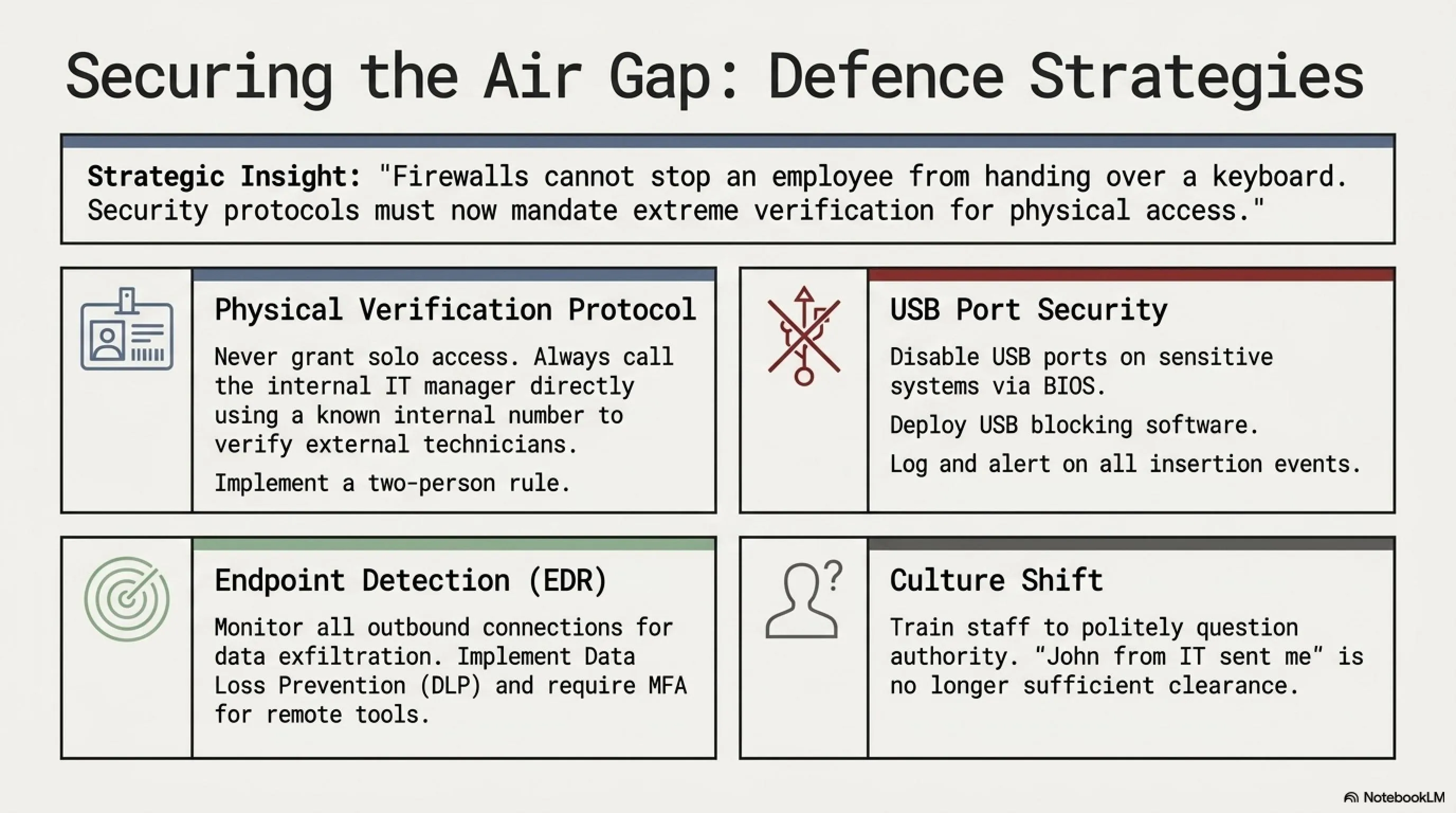
🛡️ Defense Strategies: How to Stop In-Person Attacks
1. Physical Access Verification Protocol:
- Never allow unknown individuals access to systems
- Always call your actual IT manager to verify visits
- Require technicians to provide pre-arranged access codes
- Photograph and log ID badges, take names
- Implement two-person rule: no solo access
- Use visitor management systems with photo verification
2. USB Port Security:
- Disable USB ports on sensitive systems via BIOS/policy
- Deploy USB blocking software (Device Control, USB Block)
- Only allow encrypted, company-issued USB devices
- Log all USB insertion events and alert on anomalies
3. Employee Security Training:
- Conduct regular security awareness training
- Run simulated social engineering exercises
- Promote "verify first, trust later" culture
- Teach employees to question authority politely
- Create easy reporting channels for suspicious visitors
4. Network Monitoring & EDR:
- Deploy Endpoint Detection & Response solutions
- Monitor all outbound connections for data exfiltration
- Set alerts for suspicious file access patterns
- Implement Data Loss Prevention (DLP) policies
- Require MFA for all remote access tools
5. Reception and Physical Security:
- Train reception staff to verify all service visits
- Maintain visitor logs with photo ID scanning
- Escort all external technicians at all times
- Install security cameras in server rooms
- Implement badge access controls
💡 Critical Takeaway: The age of purely digital cybersecurity is over. Organizations must now defend against physical intrusions disguised as legitimate service visits. Implement strict verification protocols: never grant system access to unverified individuals, even if they claim to be from IT support. When in doubt, call your IT manager directly using a known phone number - not the number the "technician" provides. This simple step could prevent a catastrophic breach.
✅ Summary: Physical Threats in a Digital Age
Silent Ransom Group has evolved ransomware from digital to physical by sending fake IT workers to offices with USB drives and social engineering skills. Law firms are prime targets due to sensitive data, weak security, high payment likelihood, and reluctance to report. Organizations must implement physical access verification protocols, USB security controls, employee training, and EDR solutions. The convergence of cyber and physical threats requires a fundamental rethinking of security strategies.
4. Cisco SD-WAN Zero-Day: The 7th Exploit of 2026 With No Patch 🔓
Cisco disclosed on Thursday, June 5, that a high-severity vulnerability CVE-2026-20245 in Catalyst SD-WAN Manager is being actively exploited in the wild. This marks Cisco's seventh zero-day of 2026, revealing that the company's SD-WAN products have become a favored target for advanced threat actors. What makes this disclosure particularly concerning: there is currently no patch available.
According to Cisco's advisory, the vulnerability exists in the command-line interface (CLI) of Catalyst SD-WAN Manager and stems from insufficient validation of user-supplied input. An attacker with local access and netadmin privileges can upload a specially crafted file to execute arbitrary commands as root - the highest privilege level in Linux systems. This is a textbook command injection vulnerability that grants complete system control.
⚠️ CVE-2026-20245 Technical Details
| Parameter | Details |
|---|---|
| CVE ID | CVE-2026-20245 |
| CVSS Score | 7.8 / 10 (High) |
| Vulnerability Type | Command Injection |
| Access Required | Local + netadmin privilege |
| Access Gained | Root (Superuser) |
| Affected Products | All Catalyst SD-WAN Manager (On-Prem, Cloud, FedRAMP) |
| Patch Status | Not Yet Available |
| Exploitation Evidence | Confirmed - Limited Cases |
| Attack Chain Potential | Can chain with CVE-2026-20182, CVE-2026-20127 |
Cisco's Nightmare Year: Seven Zero-Days in 2026
CVE-2026-20245 is the seventh actively exploited zero-day in Cisco products this year, according to SecurityWeek and DailySecurityReview. This alarming statistic reveals that Cisco SD-WAN has become a high-priority target for Advanced Persistent Threat (APT) groups and ransomware operators. The frequency of these discoveries suggests either a fundamental security flaw in SD-WAN architecture or that attackers have found Cisco's SD-WAN codebase particularly vulnerable to exploitation.
The critical detail: CVE-2026-20245 can be chained with two other vulnerabilities - CVE-2026-20182 and CVE-2026-20127. These bugs allow remote unauthenticated attackers to gain administrative access by sending specially crafted requests that bypass authentication controls. Imagine the attack chain: first, exploit CVE-2026-20182 to gain initial access without credentials, then leverage CVE-2026-20245 to escalate to root. This is a complete compromise pathway.
Cisco noted in its advisory that it observed "limited cases" where exploitation resulted in configuration changes pushed to edge devices. This means attackers aren't just compromising the SD-WAN manager - they're using it to manipulate network routing, potentially redirecting traffic, stealing data, or setting up persistent backdoors across entire enterprise networks.
🔥 Tekin Analysis: Why Is SD-WAN So Vulnerable?
SD-WAN (Software-Defined Wide Area Network) is a relatively new technology that manages enterprise networks through software rather than traditional hardware. While this creates tremendous flexibility, it also dramatically expands the attack surface.
Why SD-WAN Has High Vulnerability Rates:
1. Code Complexity: SD-WAN combines network management, security, routing, and automation - millions of lines of code that must be audited for vulnerabilities. Each integration point is a potential weakness.
2. Centralized Management: SD-WAN Manager is a single point of control for entire networks. Compromise this system and you control everything - routing tables, firewall rules, VPN configurations, traffic flows. It's the crown jewel.
3. Rapid Deployment: Many companies implemented SD-WAN quickly to reduce costs and improve performance, often without thorough security audits. Speed to market trumped security review.
4. Attractive Target: Because SD-WAN controls all network traffic, a successful attack provides access to every device, data center, and cloud resource. It's a hacker's dream - one vulnerability, total access.
5. Legacy Integration: SD-WAN must integrate with older networking equipment and protocols, creating compatibility layers that often introduce security weaknesses.
Why Cisco Specifically?
Cisco is the world's largest SD-WAN vendor with over 40% market share. By targeting Cisco products, attackers can potentially compromise thousands of enterprise networks simultaneously. Moreover, Cisco SD-WAN is deployed in government agencies, banks, and Fortune 500 companies - extremely high-value targets.
The Defender's Dilemma: SD-WAN is critical infrastructure that can't be easily replaced or shut down. Organizations are stuck running vulnerable systems until patches arrive, creating windows of opportunity that sophisticated attackers exploit ruthlessly.
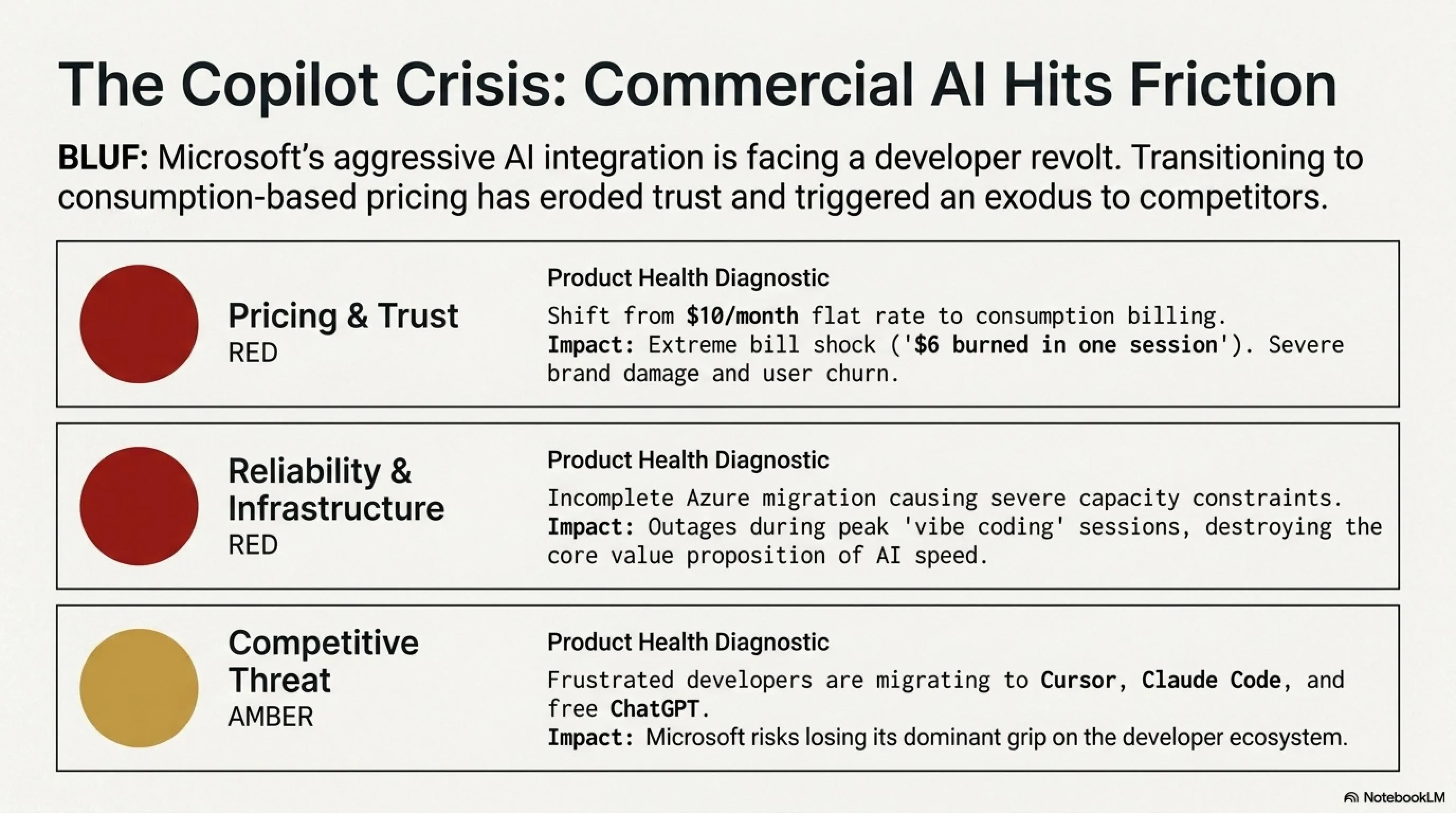
5. Microsoft in Crisis: AI Products Not Selling, GitHub Struggles 🪟
WIRED published a provocative article titled "Has Microsoft Lost Its Mojo (Again)?" featuring an interview with Scott Hanselman, Microsoft VP and member of GitHub's technical staff. The piece raises a critical question: despite Microsoft's multi-billion dollar investment in OpenAI and aggressive integration of Copilot across all products, is the company failing to capitalize on the AI revolution it helped enable?
The evidence is troubling. GitHub Copilot, which was supposed to revolutionize programming, faces serious problems: repeated outages, an unfinished migration to Azure that's limiting computing capacity, and a shift to consumption-based pricing that has enraged developers. Meanwhile, Microsoft's broader AI products are struggling to gain market traction despite massive marketing spend.
📊 Microsoft's 2026 AI Challenges
| Area | Problem | Impact |
|---|---|---|
| GitHub Copilot | Consumption billing, frequent outages | User anger, high churn |
| GitHub Infrastructure | Incomplete Azure migration, capacity limits | Service slowdowns, trust erosion |
| AI Products | Low sales, ChatGPT competition | Negative ROI on investment |
| Competitive Threat | OpenAI building GitHub alternative | Strategic existential risk |
| Developer Sentiment | Frustration with pricing, reliability | Brand damage, platform exodus |
The GitHub Copilot Debacle: From "All You Can Eat" to "Pay Per Use"
According to The Register, GitHub changed Copilot's pricing model in April 2026 from a flat monthly subscription ($10/month) to consumption-based billing (pay-per-use). The reason? Copilot was hemorrhaging money - some power users consumed enough compute to cost Microsoft $50+ per month while only paying $10.
Developer reaction was swift and brutal. One Reddit user reported: "I requested a single change to my project and it burned more than $6 in one session." Many users cancelled subscriptions and migrated to alternatives like Cursor, Claude Code, or even free ChatGPT. The trust damage is severe - developers feel Microsoft pulled a bait-and-switch.
CNBC reported in May that GitHub's drawn-out migration to Microsoft Azure has created capacity constraints, leading to outages during peak usage. When developers need Copilot most - during "vibe coding" sessions with tight deadlines - the service fails. This reliability crisis is pushing even loyal users to competitors.
6. Android Auto Safety Redesign: Google Reduces Distraction 🚗
Google redesigned pop-up alerts on Google Maps in Android Auto to reduce driver distraction, according to 9to5Google. The new alerts appear directly over the estimated arrival time without moving existing UI elements, disappearing after a few seconds. This contrasts with previous alerts that covered large portions of the screen and disrupted the navigation interface.
This seemingly minor change represents a major safety upgrade. Distracted driving causes approximately 3,000 deaths annually in the US alone, and in-car technology is a growing contributor. By minimizing visual disruption and cognitive load, Google is demonstrating that even small UI improvements can save lives.
✅ Final Thoughts: A Night of Strategic Shifts
Tonight we witnessed six major developments: GTA VI reshaped the gaming calendar, crypto suffered its worst week since July 2024, hackers began showing up at offices, Cisco disclosed its 7th zero-day of 2026, Microsoft's AI strategy faces crisis, and Google improved driving safety. Each story reveals that technology continues to evolve rapidly and sometimes dangerously. We hope these analyses help you better understand the future. Good night, and see you in Tekin Morning!
❓ Frequently Asked Questions (FAQ)
1. Is November 2026 really empty?
Yes, except for GTA VI on November 19, virtually no AAA games are releasing that month. All major publishers moved to September or December.
2. Will Bitcoin drop below $50K?
It's possible if Ethereum breaks $1,420 support, triggering cascade liquidations. However, precise prediction in crypto markets is impossible. Watch the $60K level closely.
3. How do we protect against in-person hackers?
Never grant system access to unverified individuals. Always call your IT manager to confirm visits. Disable USB ports and implement EDR solutions.
4. Is Cisco SD-WAN safe to use?
Cisco is working on a patch, but until release, implement temporary workarounds: restrict CLI access, monitor suspicious activity, and segment networks.
5. Should I still use GitHub Copilot?
If budget is limited, consider alternatives like Cursor (flat pricing) or Claude Code. Copilot is still powerful but the new pricing model is expensive for heavy users.
📚 Sources
🌐 Stay Connected With Us 🎮✨
For the latest tech, gaming, and gadget news, follow us on our official social media channels: