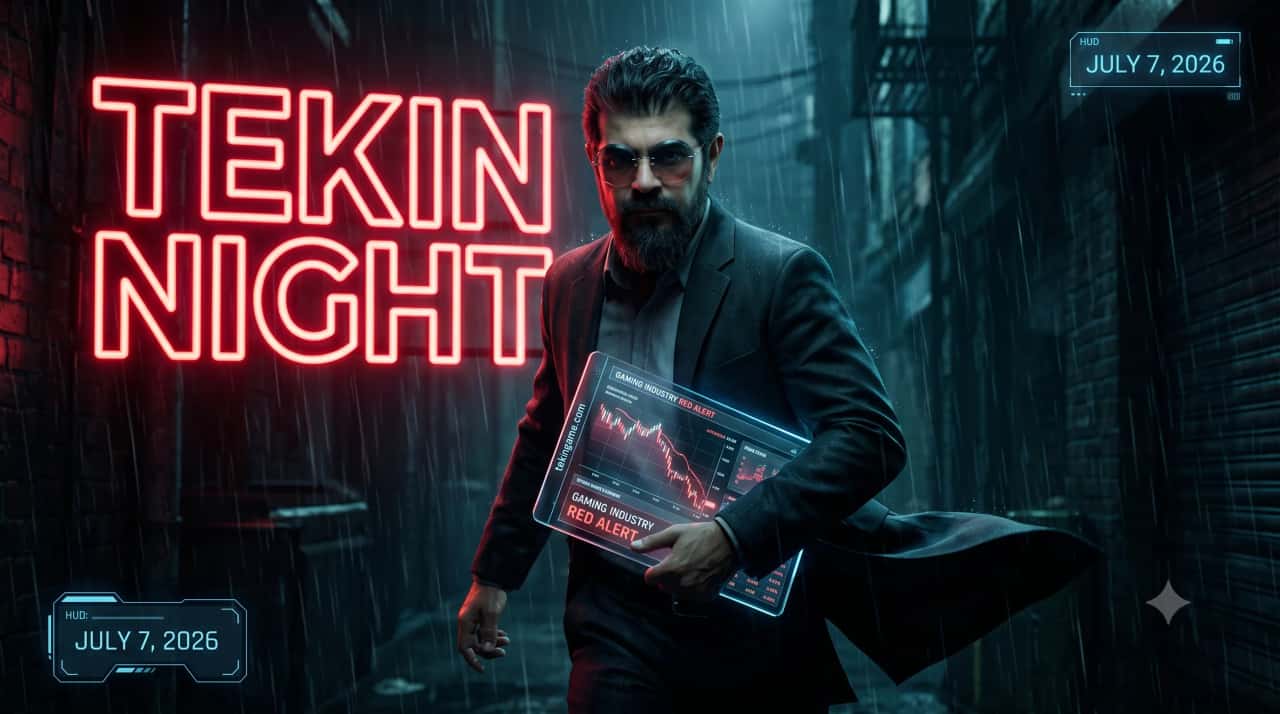
Tuesday night, July 7, 2026, marks a historic paradigm shift across the gaming and technology sectors. Nintendo dropped a bombshell announcement that it will discontinue all Switch models in Europe by February 2027 due to stringent new EU battery regulations. Simultaneously, Xbox is undergoing its most severe reset in history, axing 3,200 employees and spinning off four major studios amid admissions of unsustainable profit margins. Meanwhile, the U.S. Space Force pitted two satellites against each other to test
🌙 Tekin Night | Dark Hours in Gaming
Tonight we witness massive earthquakes shaking the gaming and tech industries to their core.
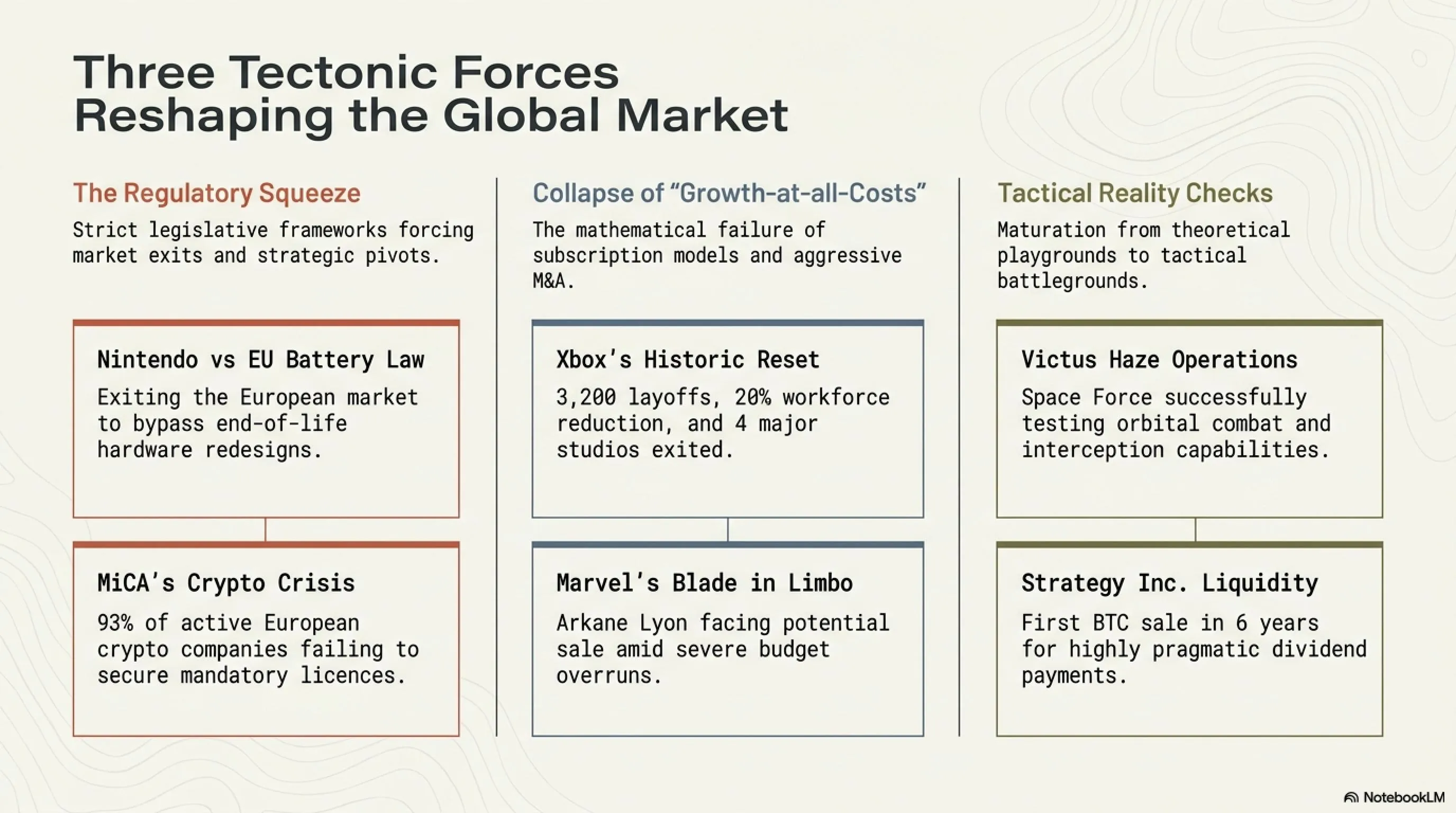
- 🎮Switch Exits Europe- Nintendo discontinues all Switch models by February 2027 due to EU battery regulations
- 🎧Xbox Collapse- 3,200 layoffs and 4 studios leaving Microsoft in biggest reset ever
- 🚀Space Warfare- Space Force pits two satellites against each other in orbital combat drill
- 🗡️Historic Bitcoin Sale- Strategy sells $216M BTC in record liquidation
- 📰MiCA Crisis- Binance warns fragmented crypto regulations will destroy European market
- 🎮Blade's Uncertain Fate- Marvel's Blade and Arkane Lyon face potential sale or cancellation
It's nearing midnight, and tonight's news feels heavier than ever. The gaming industry is navigating one of its darkest periods, where giants are either retreating from major markets or laying off thousands of employees. Tonight, we're diving into a world that's rapidly transforming - a world where boundaries extend far beyond video games into space, cryptocurrencies, and European political decisions.
When Nintendo announces it's pulling the Switch from Europe, when Xbox confirms 3,200 layoffs essentially admitting strategic failure, and when Space Force trains satellites for space warfare, we must accept we're no longer living in yesterday's world. This night is for dissecting these seismic shifts together - not as casual consumers, but as analysts who understand that complex strategies drive every headline.
At a Glance
- Nintendo Switch exits Europe by February 2027 due to EU battery law requiring user-replaceable batteries
- Xbox undergoes biggest reset ever with 3,200 layoffs and 4 studios exiting Microsoft
- Space Force conducts orbital war game with two satellites testing combat capabilities
- Strategy breaks 6-year streak with $216M Bitcoin sale for dividend payments
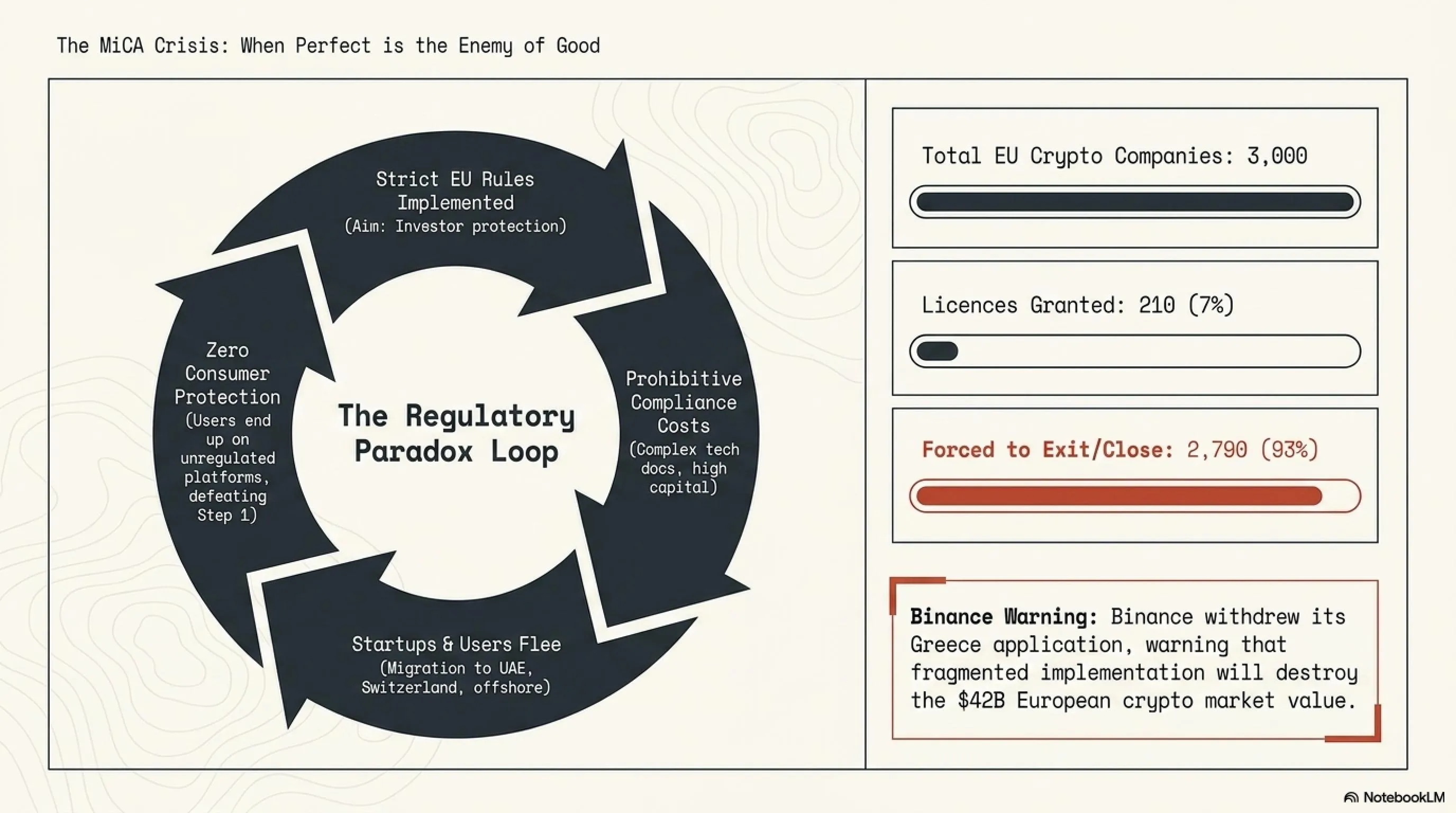
- MiCA regulations threaten to fragment European crypto market as only 210 of 3,000 companies get licenses
- Marvel's Blade faces uncertain future as Arkane Lyon enters consultation process
Nintendo's Silent Earthquake: When EU Regulations Force a Console Generation Into History
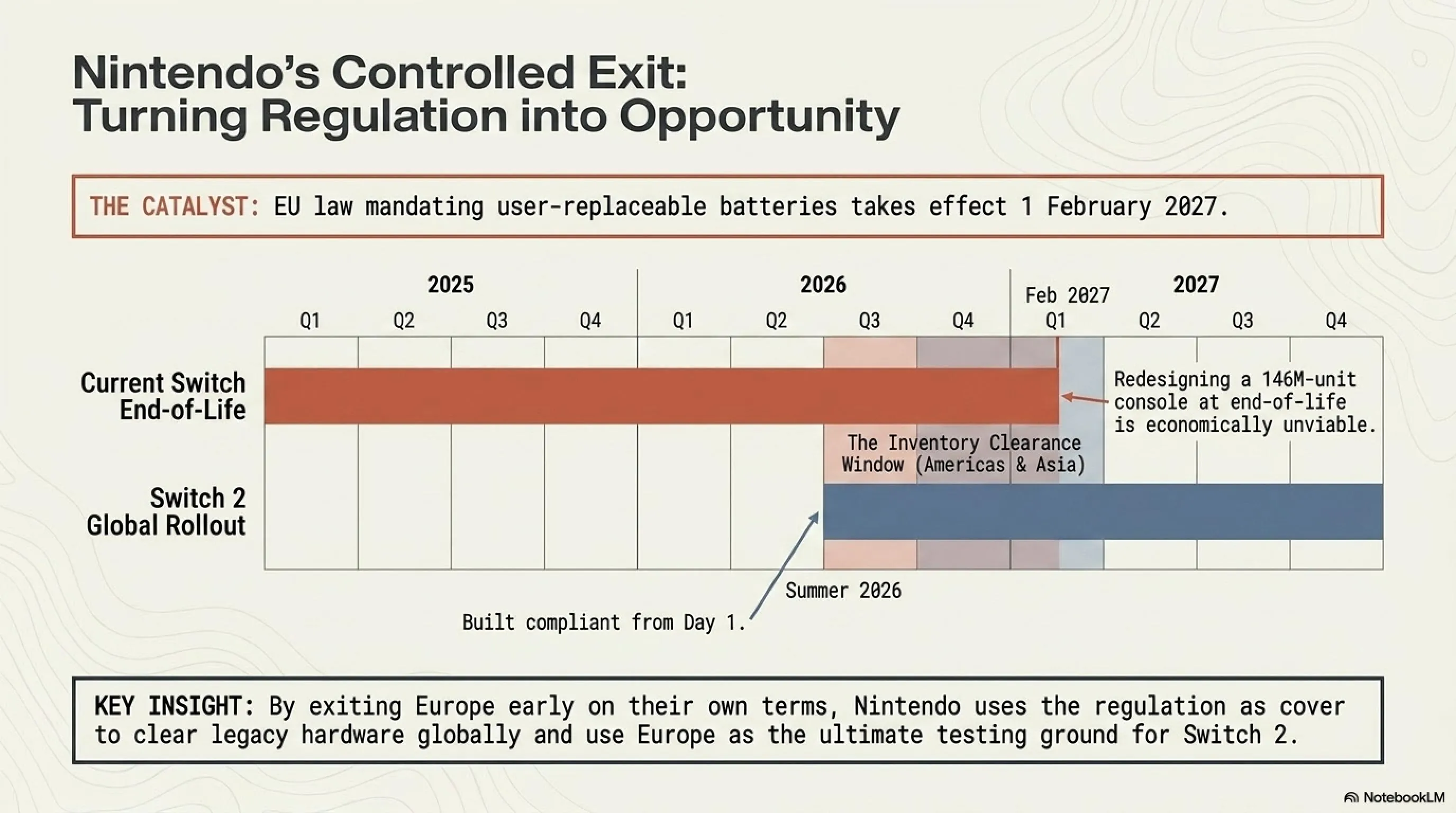
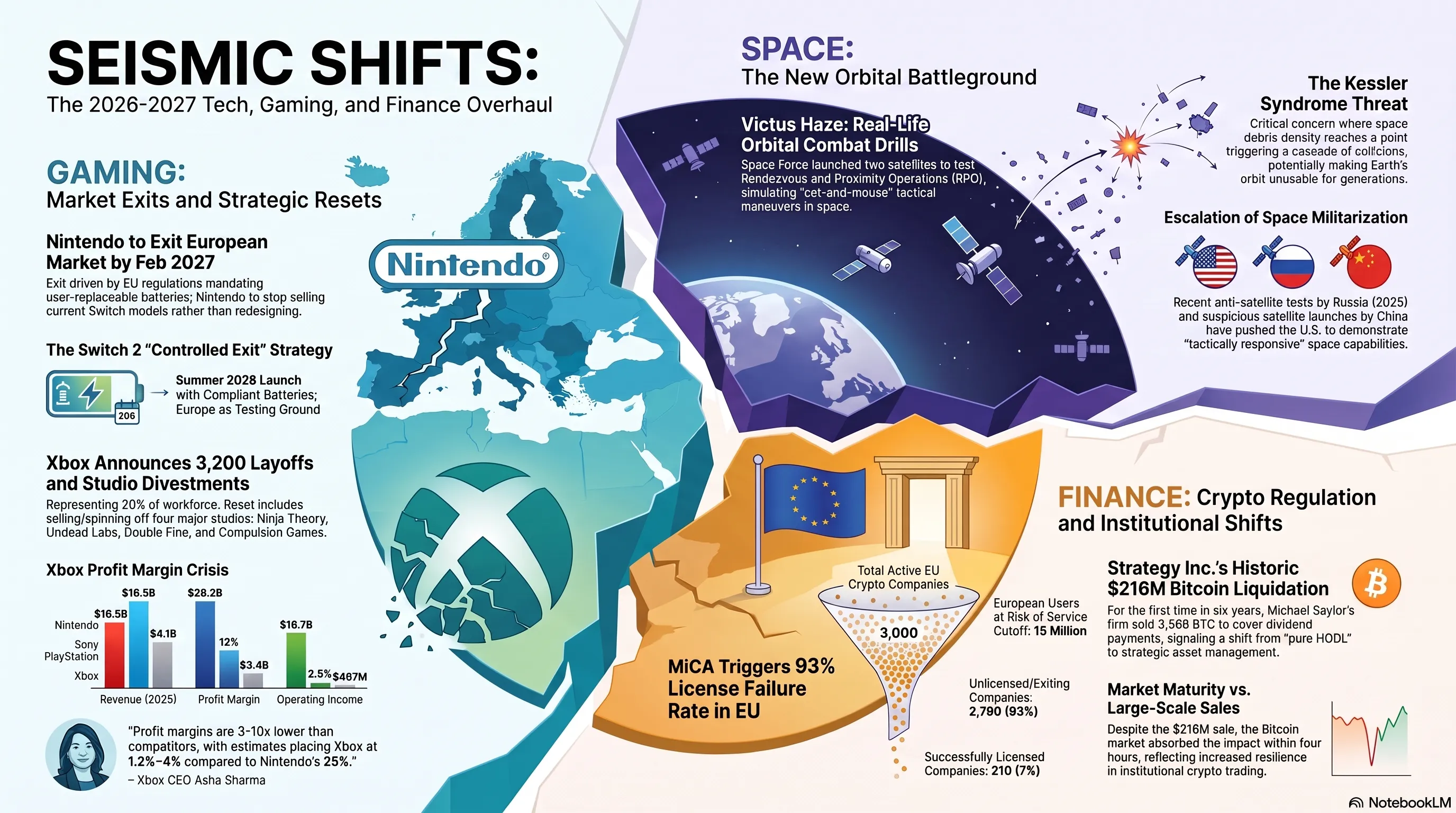
Imagine waking up to news that Nintendo has decided to pull the Switch, Switch Lite, and Switch OLED from the European market. Not because of poor sales - this is a console that's moved over 146 million units - but because of one simple regulation: user-replaceable batteries. That's right; the European Union passed a law in June 2023 mandating that all electronic devices must have batteries users can replace themselves to reduce electronic waste.
This regulation becomes fully enforceable on February 1, 2027, and Nintendo has decided that rather than redesigning the current generation, it will exit the market entirely. But this decision is far more than a simple reaction to regulations. Nintendo is actually preparing the ground for the Switch 2 - a new generation slated for summer 2026 release with user-replaceable batteries built in from day one.
Jargon Buster: User-Replaceable Battery
The key question is: why only Europe? Why does Nintendo continue selling the old Switch in America and Japan? The answer lies in Nintendo's global strategy. Europe, with its population of 450 million and stringent environmental regulations, is a market Japanese companies prefer to approach cautiously. Nintendo knows that creating a special European Switch version with replaceable batteries doesn't make economic sense given how close the product is to end-of-life.
Impact of EU Battery Law on Gaming Industry
This regulation doesn't target Nintendo alone. Sony, Microsoft, and even wireless controller manufacturers must reconsider their strategies. PlayStation 5 and Xbox Series X controllers with internal batteries will face similar challenges in the near future. This means either redesigning products - which carries enormous costs - or exiting the European market.
The reality is more bitter than these words suggest. Market analysts believe Nintendo is seizing this opportunity to clear its old Switch inventory in other markets while focusing entirely on Switch 2 to launch a completely new generation. This strategy is called Controlled Exit - meaning you leave a market on your own terms rather than waiting for competitors or regulations to force an emergency evacuation.
Tekin Analysis: Nintendo's Behind-the-Scenes Strategy
Nintendo is executing a three-phase plan: 1) Exit Europe using regulations as cover (February 2027) 2) Launch Switch 2 with replaceable battery (Summer 2026) 3) Clear old Switch inventory in Americas and Asia through end of 2026. This means Nintendo plans to use Europe as a testing ground for Switch 2, then launch globally after proving success there.
Global Ripple Effects
This isn't just about Nintendo or Europe. The precedent set here could influence regulatory bodies worldwide. California already has similar legislation pending. If the world's major markets all adopt user-replaceable battery requirements, we're looking at a fundamental redesign of portable gaming devices. This could mean thicker devices, higher costs, but potentially longer lifespans and better repairability.
For gamers, this is a double-edged sword. On one hand, being able to replace your console battery yourself means you're not locked into expensive manufacturer repairs. On the other hand, current Switch owners in Europe will find their devices become collectibles in a few months, with no official support or new units available.
Xbox Reset: When a Giant Admits Defeat
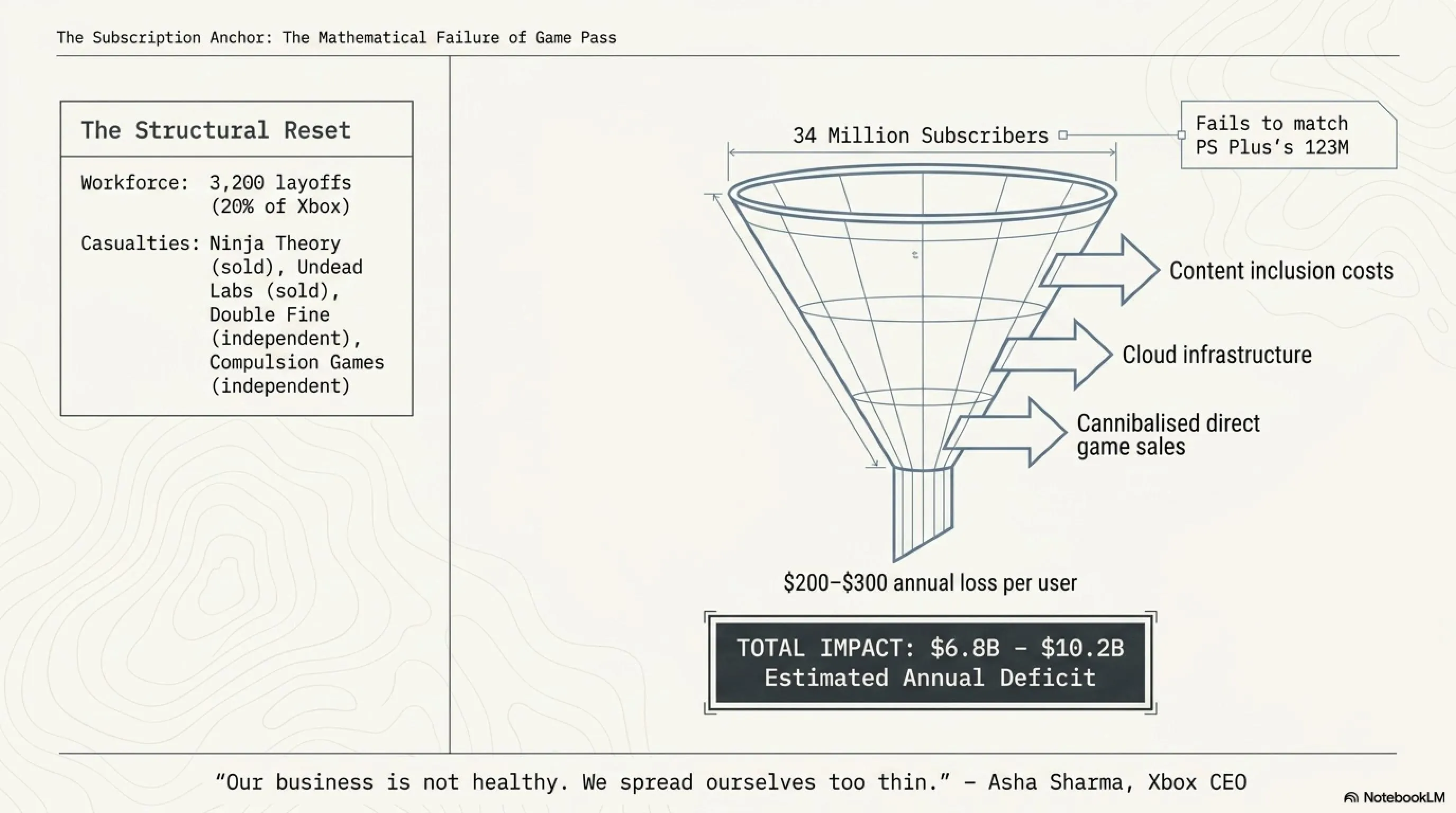
If Nintendo's news shocked you, the next story will likely leave you stunned. Asha Sharma, Xbox's new CEO, announced in an exclusive Fortune interview that Microsoft plans to lay off 3,200 Xbox employees - representing 20% of the division's entire workforce. But that's not all.
Four major studios are also leaving Microsoft: Ninja Theory and Undead Labs are being sold, Double Fine and Compulsion Games will go independent, and Arkane Lyon is in consultation - which in corporate speak means we don't know what to do with this studio.
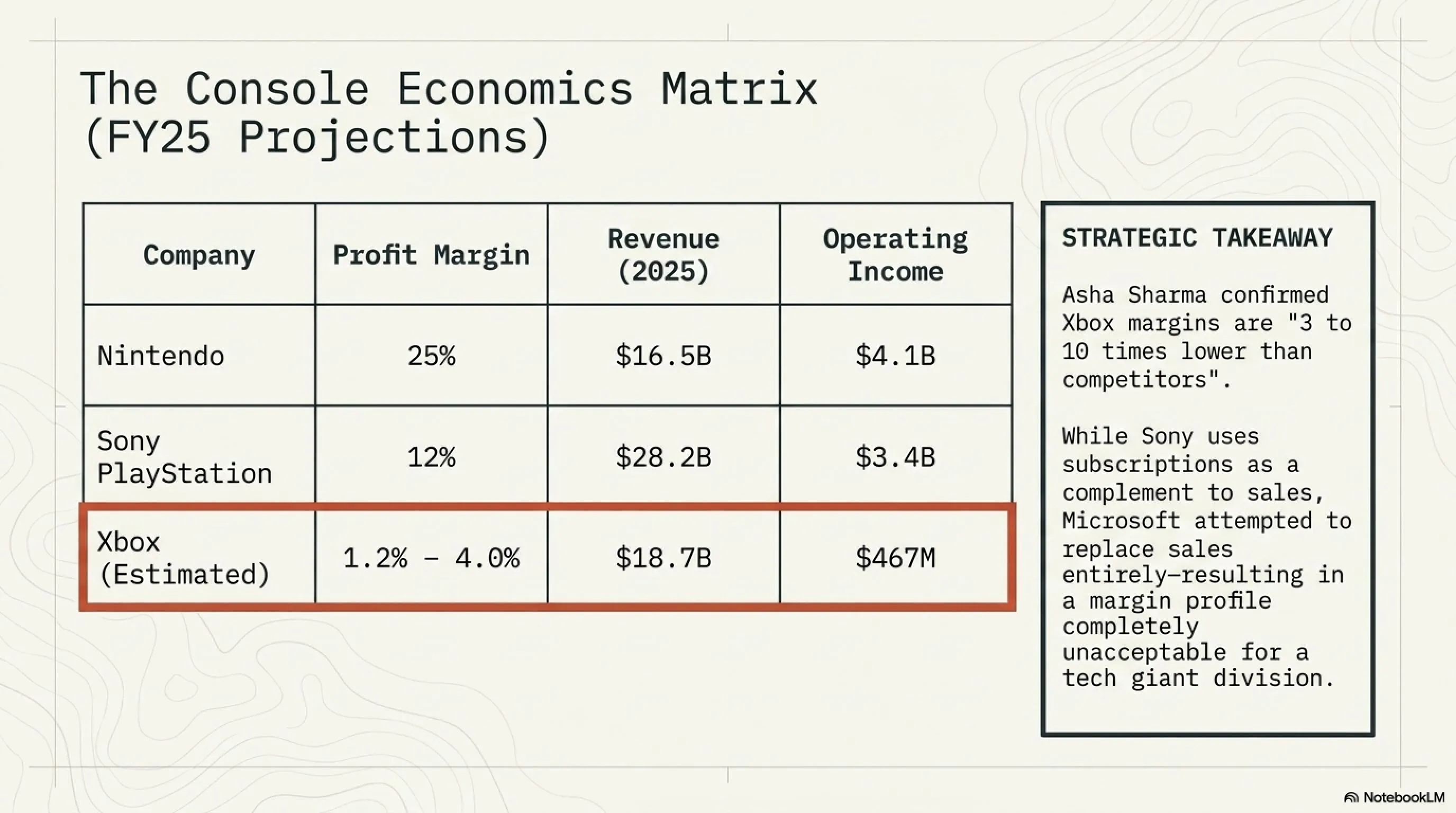
Asha Sharma spoke a sentence in this interview that should be engraved on the walls of gaming history: Our business is not healthy. We spread ourselves too thin. Our profit margins are 3 to 10 times lower than our competitors. This marks the first time a senior Xbox executive has openly admitted that Xbox's business model has failed.
Why Did Xbox Reach This Point?
The answer lies in the Game Pass strategy. Microsoft invested years into a subscription model meant to be the Netflix of gaming. But the reality is that gamers, unlike film and TV viewers, aren't willing to pay for a monthly subscription when they can buy specific games they want. Game Pass with 34 million subscribers versus PlayStation Plus's 123 million subscribers represents a clear failure.
Studios That Became Casualties
Ninja Theory, creator of acclaimed titles Hellblade and Senua's Saga, is among the first studios being sold. Microsoft acquired this studio in 2018, and now it's being handed off to a private investment firm. Undead Labs, makers of the State of Decay series, faces a similar fate. Double Fine and Compulsion Games will go independent - meaning Microsoft is cutting their budgets and support.
Timeline: Xbox's Downfall
| Date | Event | Impact |
|---|---|---|
| January 2024 | 1,900 Activision Blizzard layoffs | Crisis begins |
| May 2024 | Tango Gameworks and Arkane Austin closed | Industry shock |
| July 2026 | 3,200 layoffs and 4 studios exit | Complete reset |
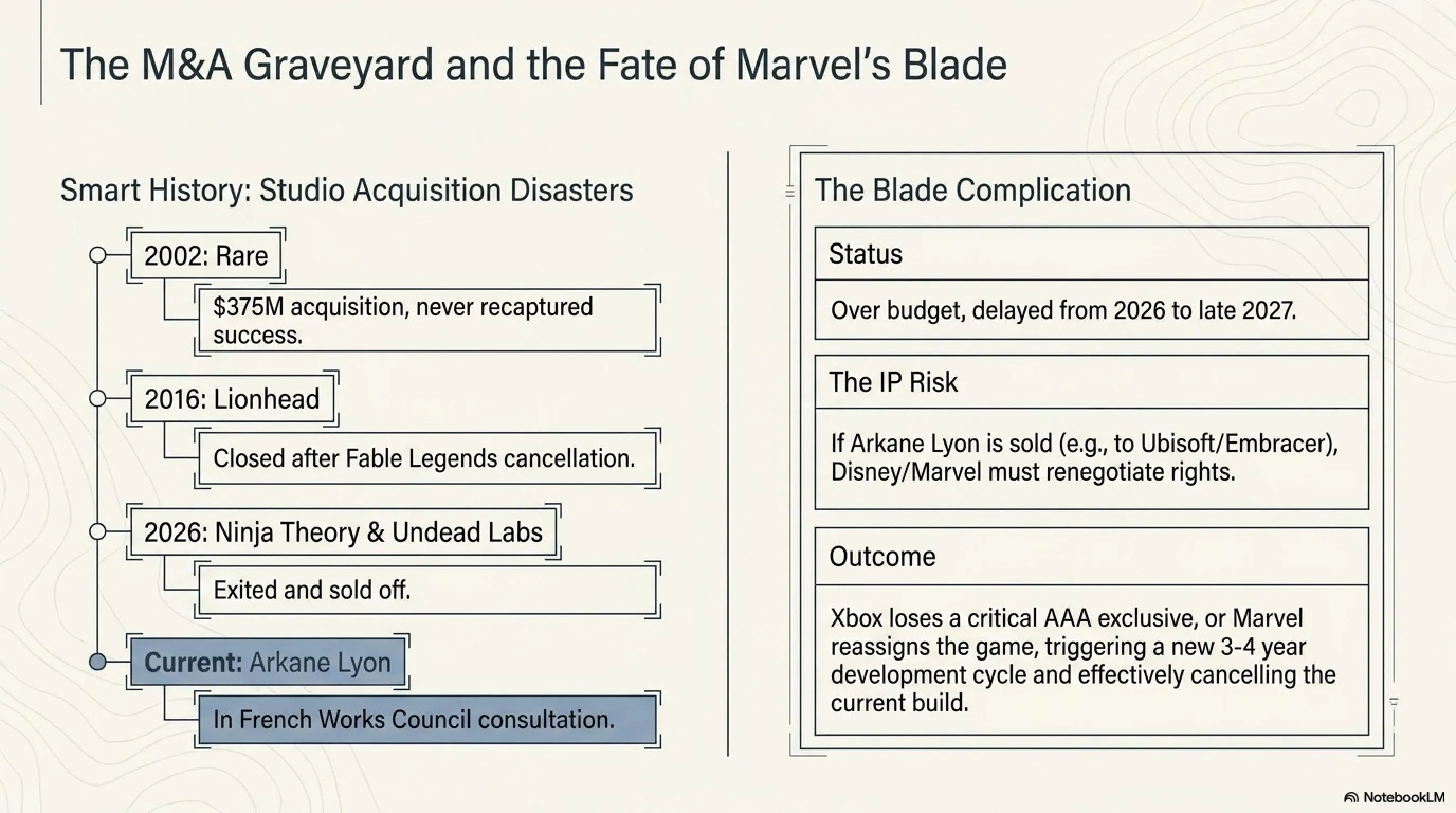
The main concern centers on Arkane Lyon. This studio is developing Marvel's Blade - a game meant to be one of Xbox's biggest exclusive titles in coming years. Reports indicate the game has gone over budget and delayed from 2026 to late 2027. Now with the studio's uncertain status, the game's future hangs in a cloud of ambiguity.
Xbox's Profit Margins Versus Competitors
Asha Sharma revealed Xbox's profit margins are 3 to 10 times lower than competitors. Let's analyze these numbers. Sony reported a 12% profit margin for its gaming division in fiscal year 2025. Nintendo leads the industry at 25% margins. If Xbox is 3 to 10 times lower, that puts them at 1.2% to 4% - completely unacceptable for a division of a tech giant like Microsoft.
Financial Breakdown: Xbox vs Competitors
| Company | Profit Margin | Revenue (2025) | Operating Income |
|---|---|---|---|
| Nintendo | 25% | $16.5B | $4.1B |
| Sony PlayStation | 12% | $28.2B | $3.4B |
| Xbox (estimated) | 2.5% | $18.7B | $467M |
- Focus on quality over quantity
- Reduced operational costs
- Selling money-losing studios
- Potential return to console-focused strategy
- Losing major talent
- Weakened game portfolio
- Damaged gamer trust
- Falling further behind PlayStation
Game Pass: The Anchor Dragging Xbox Down
The core problem is Game Pass itself. While it seemed brilliant on paper - unlimited games for a monthly fee - the economics don't work. Microsoft pays developers for Game Pass inclusion, loses direct game sales, and subscribers don't spend enough on microtransactions to offset losses. Sony figured this out early and kept PlayStation Plus as a complement to game purchases, not a replacement.
Industry insiders estimate Microsoft loses $200-300 per Game Pass subscriber annually when factoring in content costs, infrastructure, and lost sales. With 34 million subscribers, that's $6.8 to $10.2 billion in annual losses - losses that even Microsoft can't sustain indefinitely.
Victus Haze: When Satellites Learn to Fight
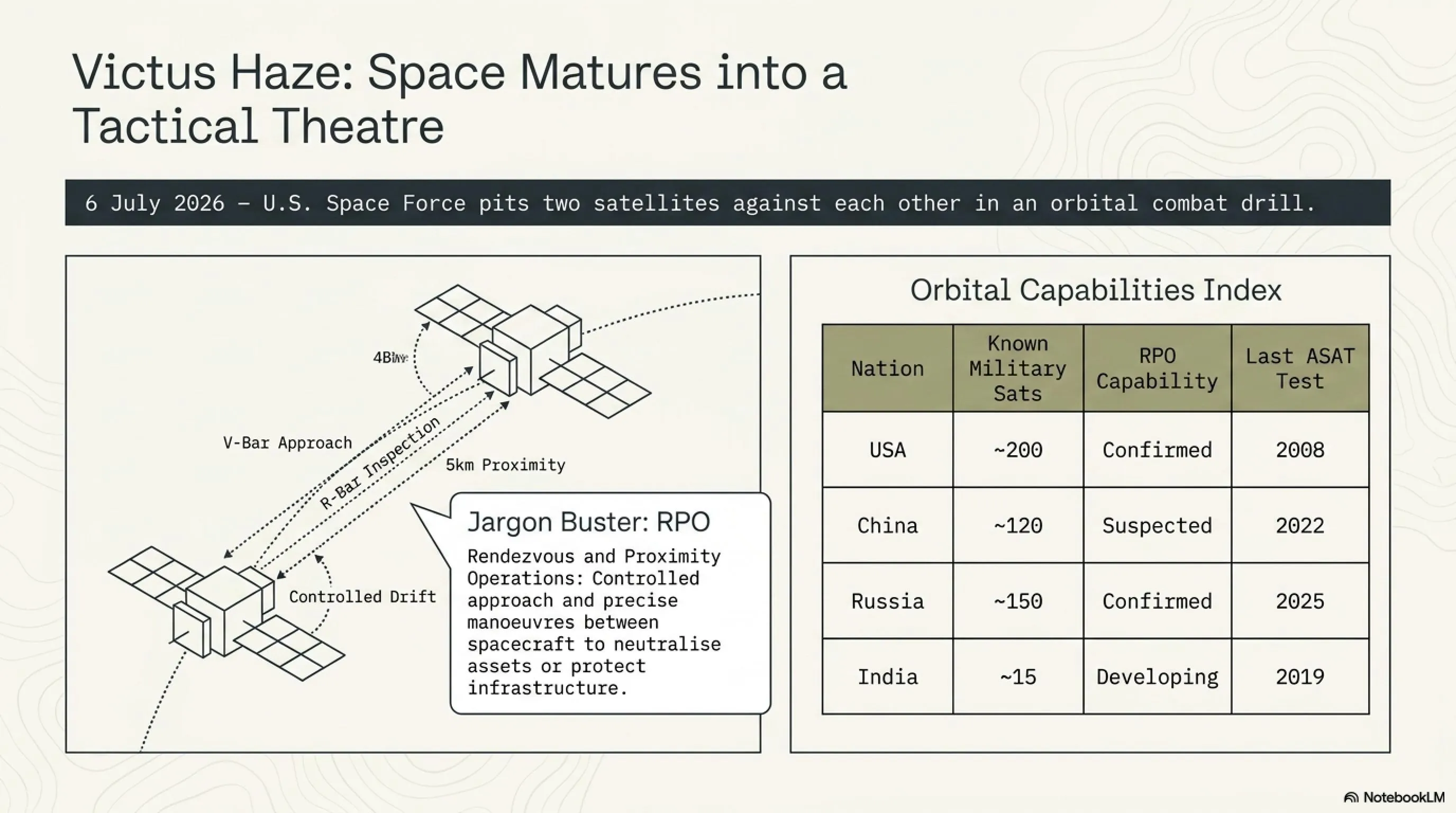
Now let's shift from gaming to space - where reality is stranger than any sci-fi game. The United States Space Force launched two satellites on July 6, 2026, and set them against each other in a real-life cat-and-mouse game. This mission, called Victus Haze, is part of the Tactically Responsive Space program - designed to prepare for space warfare scenarios.
These two satellites are equipped with Rendezvous and Proximity Operations (RPO) systems - meaning they can approach each other, create distance, and execute tactical maneuvers. In a real scenario, these capabilities could neutralize hostile satellites, protect critical assets, or even attack enemy targets.
Jargon Buster: RPO
Why This Test Matters
Until just a few years ago, space was a peaceful environment for scientific research. But now with escalating geopolitical tensions between America, China, and Russia, space has become a potential battleground. China has launched several satellites in recent years with suspicious capabilities that can approach other satellites. Russia conducted an anti-satellite test in 2025 that generated thousands of pieces of space debris.
Space Force wants to demonstrate that America can also conduct tactical operations in space if needed. But this raises serious concerns about space militarization. If every nation starts sending armed or maneuverable satellites into orbit, we might witness a space arms race with catastrophic consequences for all humanity.
Space Warfare Capabilities Comparison
| Nation | Known Military Satellites | RPO Capability | Anti-Satellite Tests |
|---|---|---|---|
| USA | ~200 | Confirmed | Last: 2008 |
| China | ~120 | Suspected | Last: 2022 |
| Russia | ~150 | Confirmed | Last: 2025 |
| India | ~15 | Developing | Last: 2019 |
The Kessler Syndrome Threat
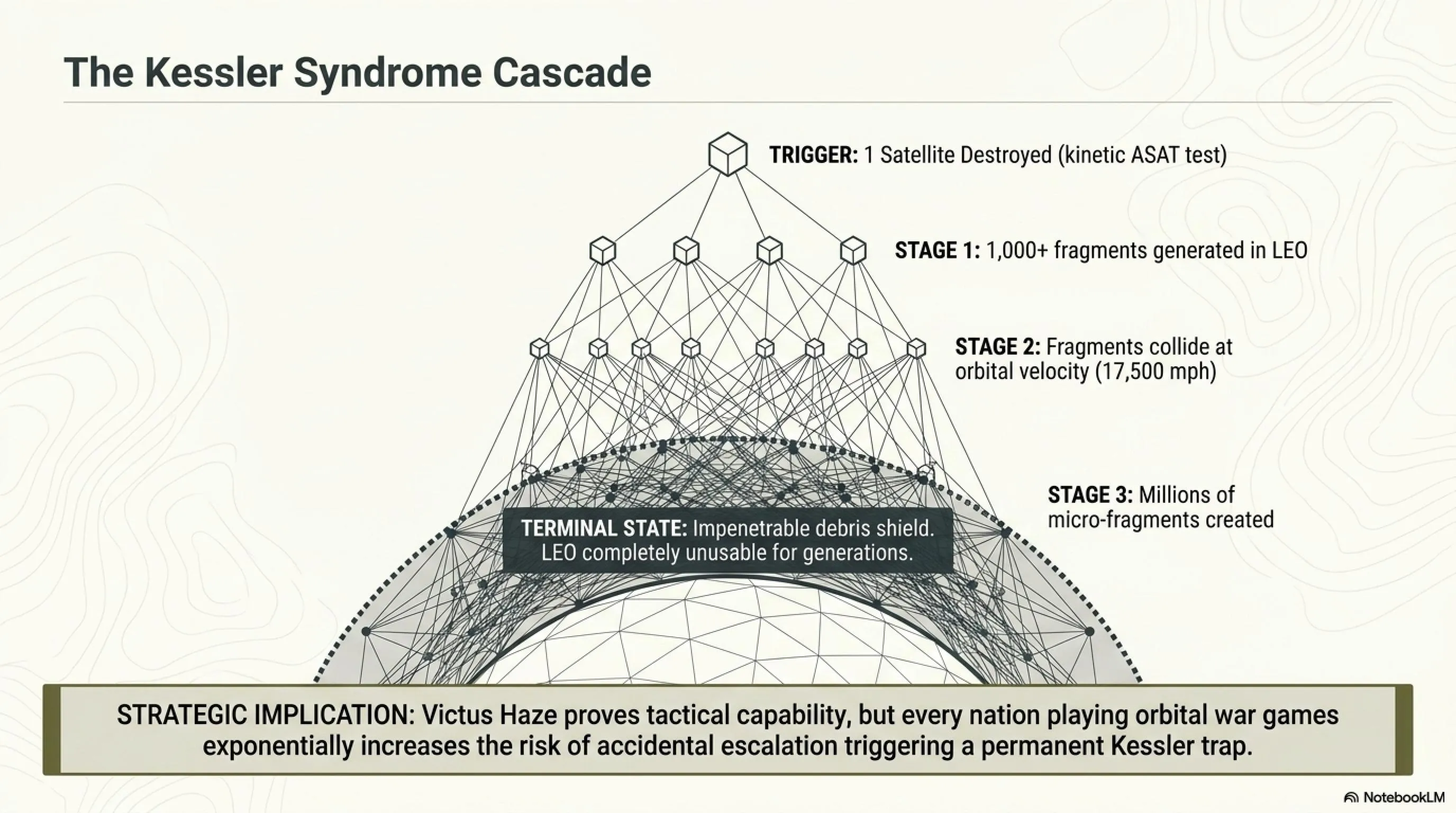
Scientists warn of the Kessler Syndrome - a scenario where space debris density reaches critical mass, causing cascading collisions that generate exponentially more debris. One destroyed satellite creates thousands of fragments. Those fragments destroy other satellites, creating millions more fragments. Eventually, low Earth orbit becomes a deadly debris field, making space launches impossible for generations.
Victus Haze, while demonstrating American capabilities, also demonstrates the fragility of space as an operational environment. Every nation playing these war games increases the risk of accidental collisions, miscommunication, or escalation that could trigger the very catastrophe we're trying to prevent.
Strategy's Historic $216M Bitcoin Sale
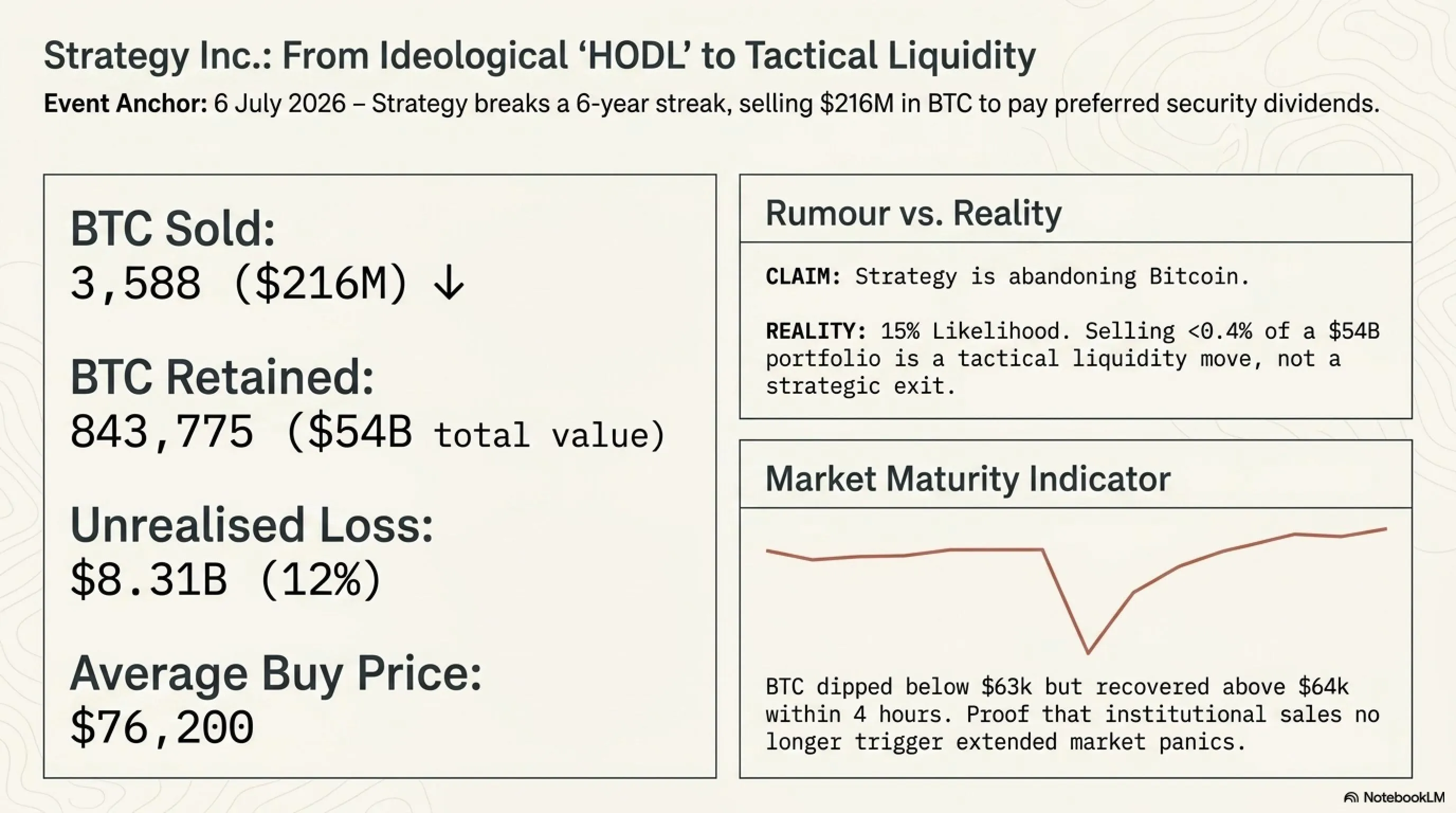
From space we return to the digital currency world. Strategy Inc., managed by Michael Saylor and known as the largest institutional Bitcoin holder, decided on July 6, 2026, to sell 3,588 Bitcoin worth $216 million. This represents the biggest liquidation in the company's 6-year history - a company that adamantly declared it would never sell its Bitcoin.
Rumor vs Reality
Claim: Strategy is changing strategy and exiting Bitcoin
Reality: 15% Likelihood
Analysis: Selling $216M against a $54B portfolio (less than 0.4%) indicates this is a tactical move for short-term liquidity, not a fundamental strategy shift.
What prompted this sale? Dividend payments on preferred securities. Strategy reported unrealized losses of $8.31 billion in Q2 2026 - meaning their Bitcoin's current value is less than purchase price. However, the company still holds 843,775 Bitcoin, worth approximately $54 billion at current prices around $64,000.
Market Reaction to Strategy's Sale
Bitcoin's price briefly dropped below $63,000 following this news. But interestingly, the market quickly recovered, with Bitcoin bouncing back above $64,000. This demonstrates market maturity - large sales can no longer impact prices for extended periods.
Strategy Portfolio Breakdown
| Metric | Amount | Change |
|---|---|---|
| BTC Held | 843,775 | -3,588 |
| Current Portfolio Value | $54B | -$216M |
| Average Purchase Price | $76,200 | Unchanged |
| Unrealized Loss | $8.31B | -12% |
The critical question is: does this sale signal a Michael Saylor strategy shift? Analysts say no. Saylor remains committed to his long-term Bitcoin thesis, and this sale was purely for short-term liquidity needs. However, some critics argue Strategy is in a dangerous position - a company that's put all eggs in one basket, and if Bitcoin crashes severely, could face serious crisis.
Market Sentiment Indicator
Bitcoin Market Sentiment (July 7, 2026)
Fear & Greed Index: 48/100 (Neutral)
24h Volume: $28.4B (+12%)
Strategy Sale Impact: Minimal - market absorbed sale within 4 hours
Analyst Consensus: Strategy remains committed to Bitcoin long-term
The Bigger Picture: Institutional Bitcoin Strategy
Strategy's sale, despite being historic for the company, represents a broader trend in institutional Bitcoin holdings. Companies are realizing they need flexibility - the ability to tap Bitcoin reserves for operational needs without completely abandoning the asset. This is maturing from pure HODL culture to strategic asset management.
Other institutional holders like Tesla, Block, and Marathon Digital have already demonstrated this approach. They accumulate during bear markets, hold through volatility, and occasionally sell portions to fund operations or take profits. This is healthier than the all-or-nothing approach that dominated early institutional adoption.
MiCA and Europe's Crypto Crisis
From Bitcoin we move to a fresh crisis threatening Europe's entire crypto industry. Markets in Crypto-Assets (MiCA) is the European Union's new legal framework for regulating digital currency markets. This law was supposed to give Europe leadership in crypto regulation, but it appears to be turning into a disaster.
MiCA's transition period ended July 1, 2026, and all crypto companies without licenses must cease European operations. The problem? Of 3,000 active crypto companies in Europe, only 210 successfully obtained licenses. That means over 90% of companies must either shut down operations or leave Europe.
Binance's Warning About Market Fragmentation
Binance's CEO issued a formal statement warning that if different EU countries implement MiCA inconsistently, Europe's crypto market will fragment, and companies, users, and capital will abandon the region. Binance, the world's largest crypto exchange, withdrew its Greece license application and restricted services for EU users.
MiCA Stats: The Great Divide
- 3,000 active crypto companies in EU
- 210 licensed companies (7%)
- 2,790 unlicensed companies (93%)
- 15 million European crypto users at risk of service cutoff
- $42B European crypto market value
- 27 EU member states with varying implementation approaches
The core problem lies in licensing complexity. Companies must submit extremely complex technical documentation, maintain high initial capital, and meet stringent security standards. For small startups, these costs are prohibitive, and many prefer migrating to countries like Switzerland, Singapore, or the UAE.
Impact on Everyday Users
For regular users, this means more limited exchange access, fewer coins available, higher fees, and risk of losing assets if their exchange shuts down. Many European users are transferring assets to personal wallets or non-European exchanges - a move contrary to MiCA's core goal of investor protection.
The Regulatory Paradox
MiCA illustrates a fundamental paradox in crypto regulation: the more comprehensive and strict the rules, the more they drive activity to unregulated jurisdictions. European users can't access licensed European exchanges, so they turn to offshore platforms with zero consumer protection. Startups can't afford European compliance, so they incorporate in crypto havens with minimal oversight.
Compare this to the UK's approach post-Brexit - a principles-based framework that's more flexible and has attracted crypto companies leaving the EU. Or Singapore's progressive stance that balances innovation with consumer protection. Europe's one-size-fits-all approach is proving that sometimes perfect is the enemy of good.
Marvel's Blade: A Game That May Never Launch
We return to gaming with one of tonight's most concerning stories: Marvel's Blade's uncertain fate. Arkane Lyon, the studio developing this game, is undergoing consultation - a process French labor law requires before any major studio decision like sale, closure, or strategic restructuring must involve the Works Council.
Reports indicate Marvel's Blade has gone over budget and delayed from 2026 to late 2027. Microsoft says no announced first-party games will be canceled, but if Arkane Lyon is sold or goes independent, the game's future becomes completely unclear. In such a scenario, Disney and Marvel must enter negotiations since they own the IP rights.
Why Blade Is Critical for Xbox
Marvel's Blade was one of the few AAA exclusive Xbox titles slated for coming years. With other projects like Fable and Perfect Dark canceled or severely delayed, Xbox desperately needs big titles to remain competitive with PlayStation. If Blade also gets canceled or heavily delayed, it's a major blow to Xbox's credibility.
Arkane Lyon History
Arkane Lyon is a French studio that created acclaimed games like Dishonored 2 and Deathloop. The studio is known for creative level design and immersive sim gameplay. Microsoft acquired this studio in 2021 through the ZeniMax Media purchase. Arkane Lyon has been working on Marvel's Blade since 2023 - a single-player action-adventure game set in Marvel's vampire hunter universe.
Some analysts believe Microsoft might sell Arkane Lyon to a major European studio like Ubisoft or Embracer. In that case, the Blade development contract likely transfers, but the game won't be Xbox exclusive and will release for PlayStation and Nintendo too. That's good news for gamers but represents strategic failure for Xbox.
The Marvel Gaming Universe Complication
Blade's situation is further complicated by Marvel's broader gaming strategy. Marvel has licensed multiple games to different publishers - Spider-Man to Sony/Insomniac, Wolverine to Sony, Midnight Suns to 2K, and Blade to Microsoft/Arkane. If Arkane exits Microsoft, does Marvel reassign Blade to another developer? Does it demand Xbox exclusivity be dropped? These questions have no clear answers.
Industry sources suggest Marvel is increasingly frustrated with Microsoft's instability and may prefer working with more reliable partners. If Blade gets reassigned to another studio, we're looking at another 3-4 year development cycle, effectively canceling the current version.
Smart History: Xbox's Studio Acquisition Disasters
Xbox's studio acquisition strategy has been plagued with failures:
- Rare (2002): Acquired for $375M, produced few hits, never recaptured Nintendo-era success
- Lionhead Studios (2006-2016): Closed after Fable Legends cancelation
- Ensemble Studios (2009): Closed despite Halo Wars success
- Press Play & Twisted Pixel (2011-2015): Both closed after failed projects
- Now (2026): Ninja Theory, Undead Labs, and potentially Arkane Lyon all exiting
The pattern is clear: Microsoft struggles to nurture acquired studios, often imposing unrealistic demands or cutting funding prematurely.
Final Thoughts
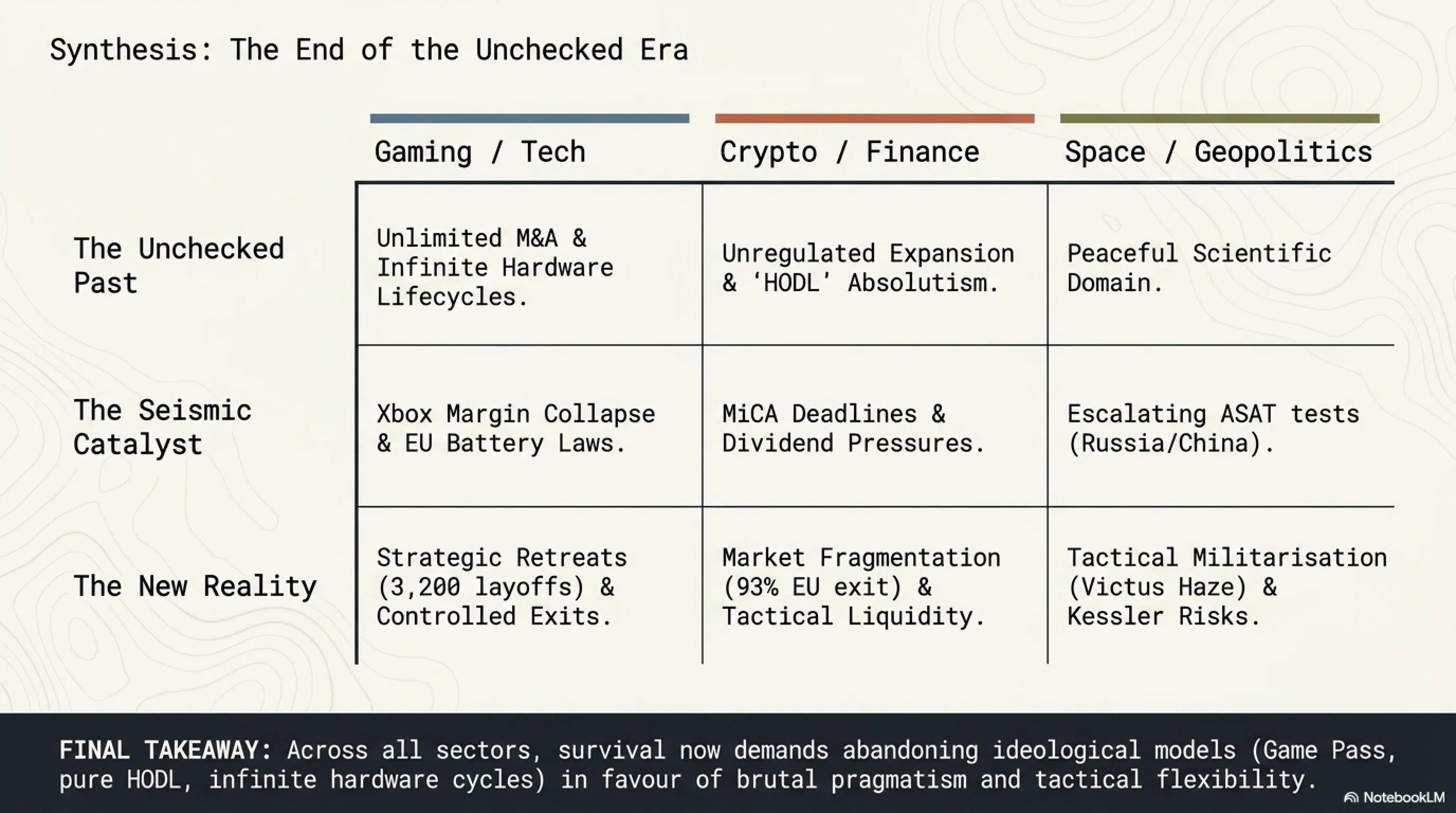
Tonight we witnessed major upheavals: Nintendo exiting Europe, Xbox undergoing its biggest reset ever, Space Force preparing for space warfare, Strategy breaking its Bitcoin holding streak with a $216M sale, MiCA pushing Europe's crypto market toward crisis, and Marvel's Blade facing potential cancelation or severe delay. These events demonstrate that the tech and gaming industries are navigating a period of fundamental transformation - one where winners and losers remain undetermined.
Frequently Asked Questions
Why is Nintendo Switch leaving Europe?
Due to new European Union law taking effect February 1, 2027, requiring all electronic devices to have user-replaceable batteries. Rather than redesign the current generation, Nintendo chose to exit the market entirely and focus on Switch 2.
How many people is Xbox laying off?
3,200 employees, representing 20% of Xbox's entire workforce. 1,600 are immediate layoffs, with another 1,600 in the next fiscal year. Additionally, 4 major studios are leaving Microsoft.
What was the Victus Haze mission?
Space Force launched two satellites and engaged them in a cat-and-mouse game to test Rendezvous and Proximity Operations capabilities for potential space warfare scenarios.
Why did Strategy sell Bitcoin for the first time?
To pay dividends on preferred securities. The company sold 3,588 Bitcoin worth $216M but still holds 843,775 BTC worth approximately $54B.
What is MiCA and why is it problematic?
Markets in Crypto-Assets is the EU's new legal framework for crypto regulation. The problem is that only 210 of 3,000 crypto companies obtained licenses, forcing 93% to cease operations or leave Europe.
What's happening with Marvel's Blade?
Uncertain. Arkane Lyon is in consultation process and may be sold or go independent. If that happens, the game's future depends on negotiations between the new owner, Microsoft, and Disney/Marvel.
Is Switch 2 compliant with EU regulations from day one?
Yes. Nintendo confirmed Switch 2 will launch from summer 2026 with user-replaceable batteries, fully compliant with new EU regulations.
What is Xbox's profit margin?
According to the new Xbox CEO, profit margins are 3 to 10 times lower than competitors. Given Sony's 12% margin, that puts Xbox at approximately 1.2% to 4% - unacceptable for a Microsoft division.
Sources & References
- GameSpot: Nintendo Switch Discontinued in Europe
- The Verge: Nintendo Switch Europe Discontinuation
- Fortune: Exclusive Xbox CEO Asha Sharma Interview
- CBS News: Microsoft Xbox Job Cuts
- Gizmodo: Space Force War Game Satellites
- CoinDesk: Strategy Bitcoin Sales
- Bitcoin.com: Strategy Sells Bitcoin for Dividends
- Bitcoin.com: Binance CEO Warns on MiCA
- GameSpot: Marvel's Blade and Arkane Lyon Status
Additional Gallery: 🌙 Tekin Night July 7, 2026: Nintendo Exits Europe & Xbox Collapses