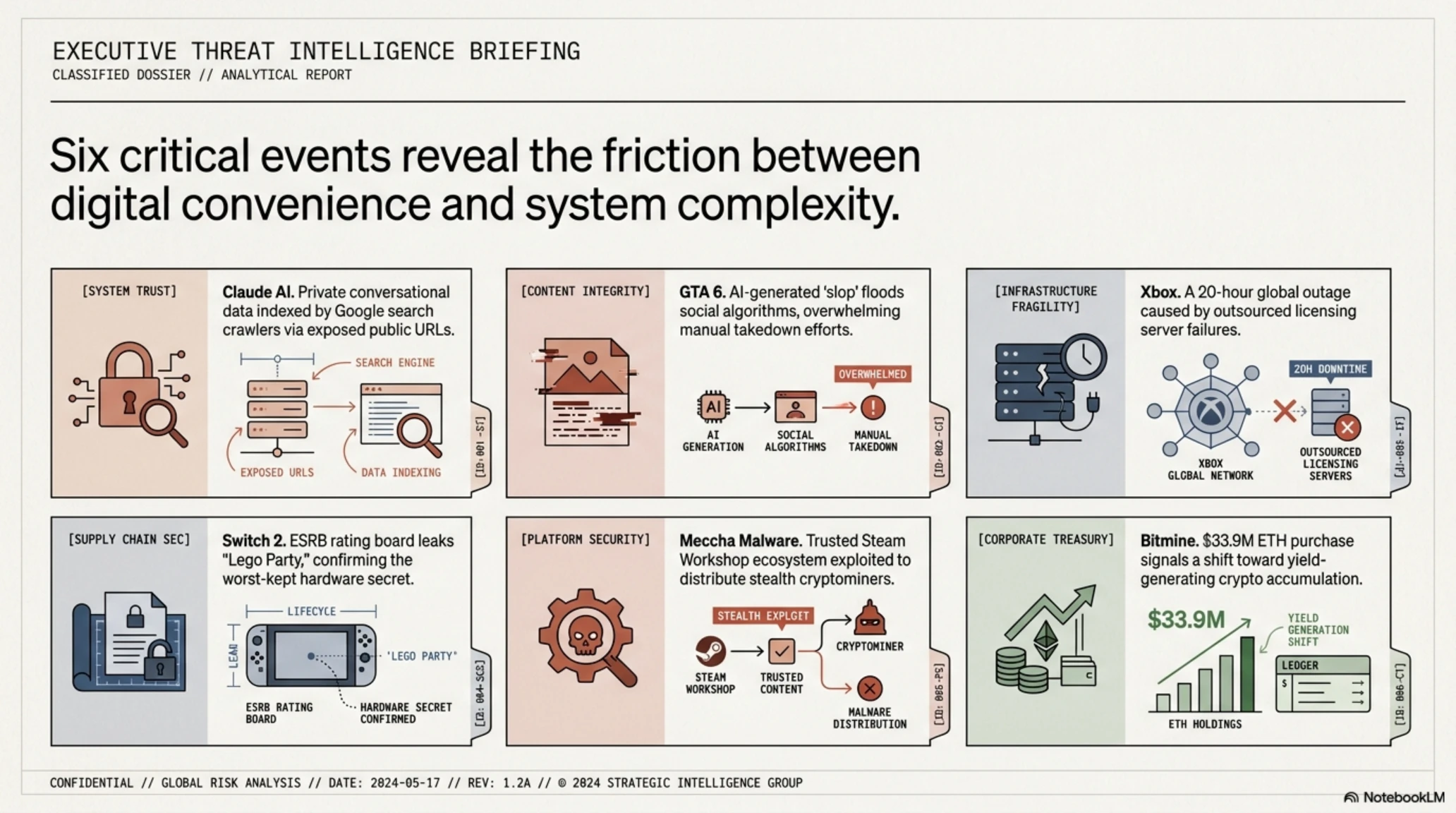
The July 28, 2026, Tekin Night brief covers six major tech and gaming stories. Private Claude conversations were discovered indexed in Google search results, raising massive privacy concerns. The gaming industry faced multiple crises with AI-generated fake GTA 6 videos going viral, a 20-hour Xbox outage, and Meccha malware infecting Steam Workshop maps. Additionally, the Switch 3 saw a new leak via ESRB, and Bitmine expanded its crypto portfolio with 10,000 ETH.
Good Evening Tekin! Tech Night Brief Tuesday, July 28, 2026
Six hot late-night stories from tech and gaming: from Claude chats exposed on Google to malware hiding in game maps
- 🎮Claude- Private chats appearing in Google search results
- 🎧GTA 6- AI-generated fake videos rack up millions of views
- 🚀Xbox- 20-hour outage and CTO's apology
- 🗡️Switch 3- Lego Party surfaces on ESRB rating board
- 📰Meccha- Malware discovered in Steam Workshop maps
- 🎮Bitmine- Purchases another 10,000 Ethereum
When Private Claude Conversations Turn Up on Google
We're starting Tuesday night with news that should concern anyone using Claude for sensitive work. Users discovered that some shared Claude conversations and Artifacts are publicly accessible through Google and Bing search results. The issue was first spotted by a Reddit user on Sunday, July 25, and by Monday, July 27, outlets like Futurism and Wired confirmed finding pages containing medical information and internal corporate documents that were inadvertently exposed.
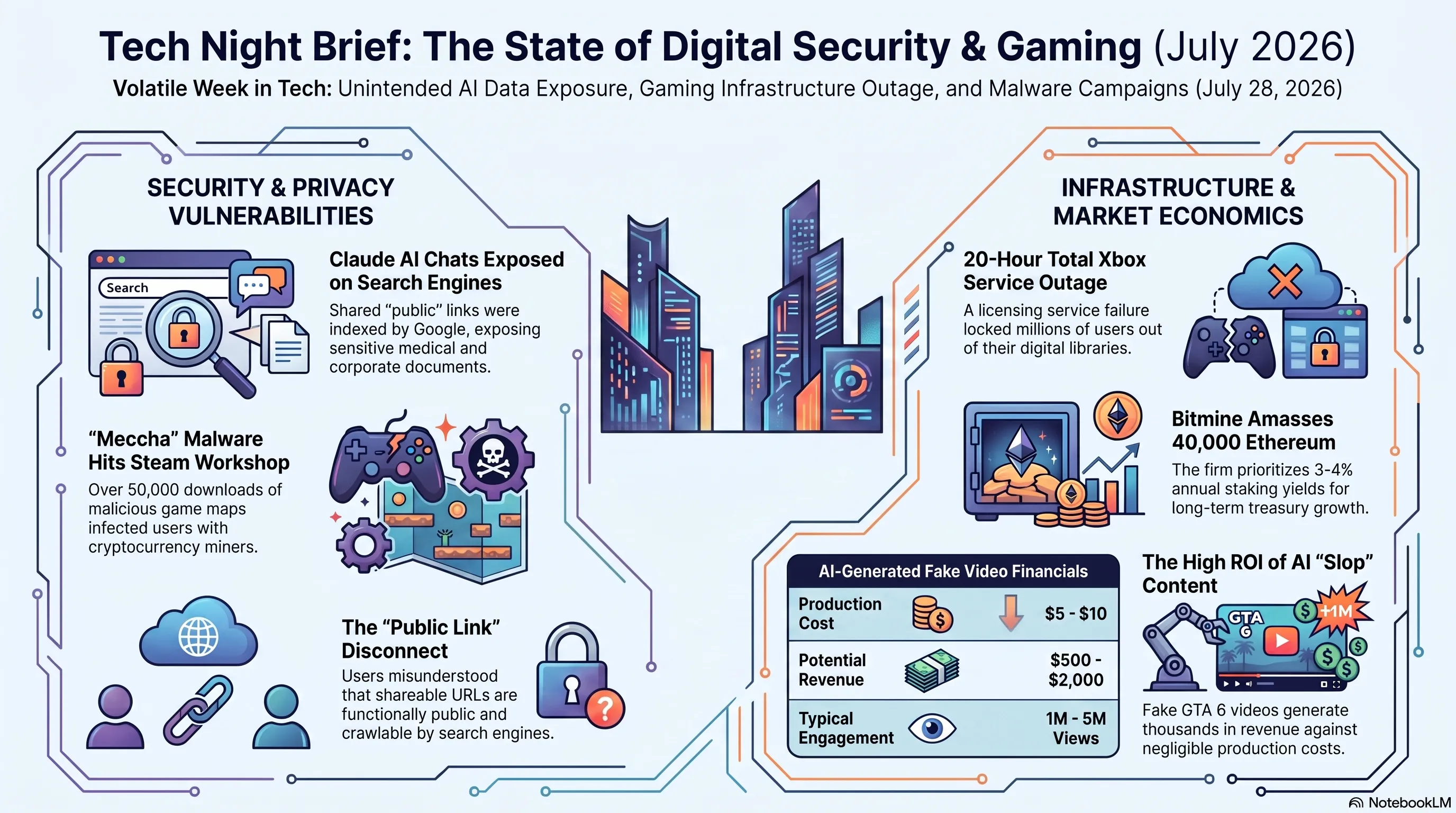
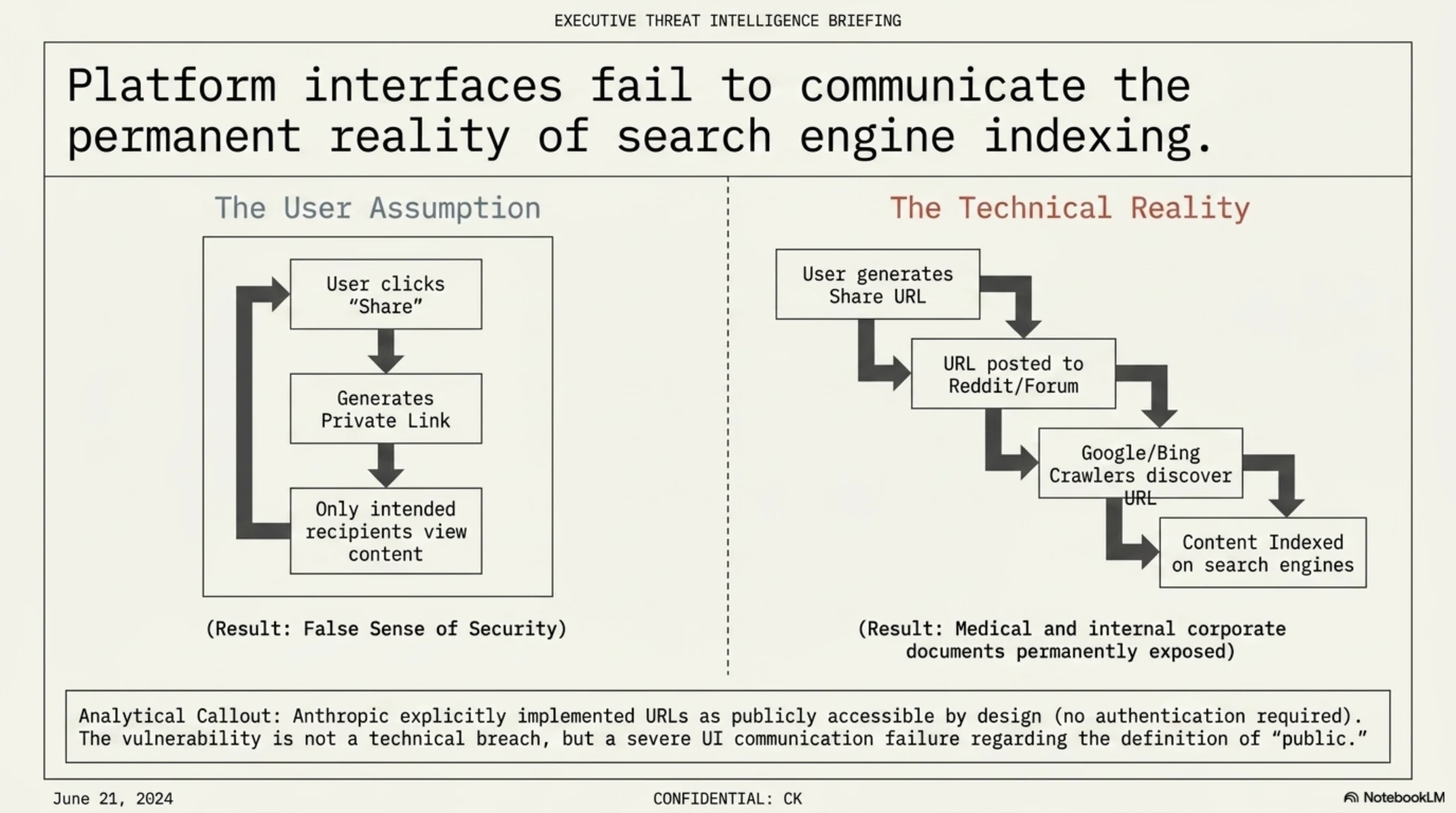
The mechanics of how this happened reveal a fundamental misunderstanding about what "public sharing" means in the age of search engines. Claude allows users to share "snapshots" of conversations by creating a public URL. The problem isn't that Anthropic deliberately indexed these conversations - they explicitly don't share chat directories or sitemaps with search engines. Instead, when users posted these public URLs on forums, social media platforms, or other websites, Google's crawlers discovered and indexed them just like any other public web content.
How Claude Chats Ended Up on Google: A Technical Breakdown
The indexing process follows a predictable but often misunderstood pattern:
- User Creates Public Link: A Claude user generates a shareable URL for a conversation using the platform's built-in sharing feature
- Link Gets Posted Publicly: The user posts this link on Reddit, Twitter, a forum, or embeds it in a blog post
- Crawler Discovery: Google's or Bing's web crawlers scan that platform and discover the Claude URL
- Content Indexing: The crawler follows the link to claude.ai/share and indexes the content it finds there
- Search Visibility: The conversation becomes discoverable through queries like
site:claude.ai/share
Critical Technical Detail: Anthropic implemented the URLs as publicly accessible by design - anyone with the link can view the content without authentication. This is different from platforms like Google Docs where you can set granular permissions. Once a Claude share link exists, it's functionally public even if you only intended to share it with specific people.
The Disconnect: Many users assumed "share with link" meant "only people I give this link to can see it," not understanding that search engines treat public URLs as fair game for indexing. This isn't a security flaw per se, but a user interface and communication problem - the platform didn't adequately convey what "public" really means.
Anthropic's response emphasized that these links aren't "guessable or discoverable" unless users choose to share them. While technically accurate, this misses the point. The concern isn't that random people can guess URLs - it's that once you post a URL anywhere public, it can be indexed by search engines and discovered by anyone. Some of the exposed content included internal business documents, medical information, and academic planning materials that users clearly never intended for public consumption beyond their immediate audience.
This incident highlights a broader issue with AI chatbot platforms: users often don't fully understand the privacy implications of sharing features. When you click "share" in Claude, you're not sending a private message - you're publishing content to the open web. The interface makes this feel casual and temporary, but the consequences are permanent and far-reaching. Once content is indexed by search engines, removing it becomes difficult even if you delete the original share link.
The AI-Generated GTA 6 Content Crisis
Moving from one privacy concern to another content integrity issue, the Grand Theft Auto 6 community is being flooded with AI-generated fake gameplay videos that are accumulating millions of views across Instagram and TikTok. As fans desperately await official gameplay footage scheduled for November, content creators are exploiting this anticipation by churning out convincing-looking but entirely fabricated gameplay clips using generative AI tools.
The situation escalated to the point where Take-Two Interactive, Rockstar's parent company, launched a major takedown campaign on July 25, 2026, targeting dozens of videos featuring fake GTA 6 gameplay across YouTube and X (formerly Twitter). The Vice Nation channel, which had published scenes featuring protagonists Lucia and Jason that Rockstar never officially revealed, was among the primary targets. But for every video removed, several more appear, creating a whack-a-mole situation that highlights the limitations of traditional content moderation against AI-generated material.
What makes this particularly insidious is how recommendation algorithms amplify the problem. Social media platforms prioritize engagement over authenticity - if a video generates clicks, comments, and shares, the algorithm promotes it regardless of whether the content is real or fabricated. Many users even admit they know the videos are fake but watch them anyway because "it's better than nothing," which is exactly the response fake content creators hope for. This creates a perverse incentive structure where authenticity becomes less important than engagement metrics.
The technical sophistication of these fakes is also improving rapidly. Early AI-generated game footage was obvious - weird hands, inconsistent lighting, nonsensical text. But modern tools like Runway, Pika, and others can produce clips that pass casual inspection, especially on mobile devices where most social media consumption happens. Some creators even mix real footage from GTA 5 or the official GTA 6 trailer with AI-generated content, making detection even harder.
The Economics of AI Slop Content
Understanding why creators produce fake GTA 6 content requires examining the financial incentives:
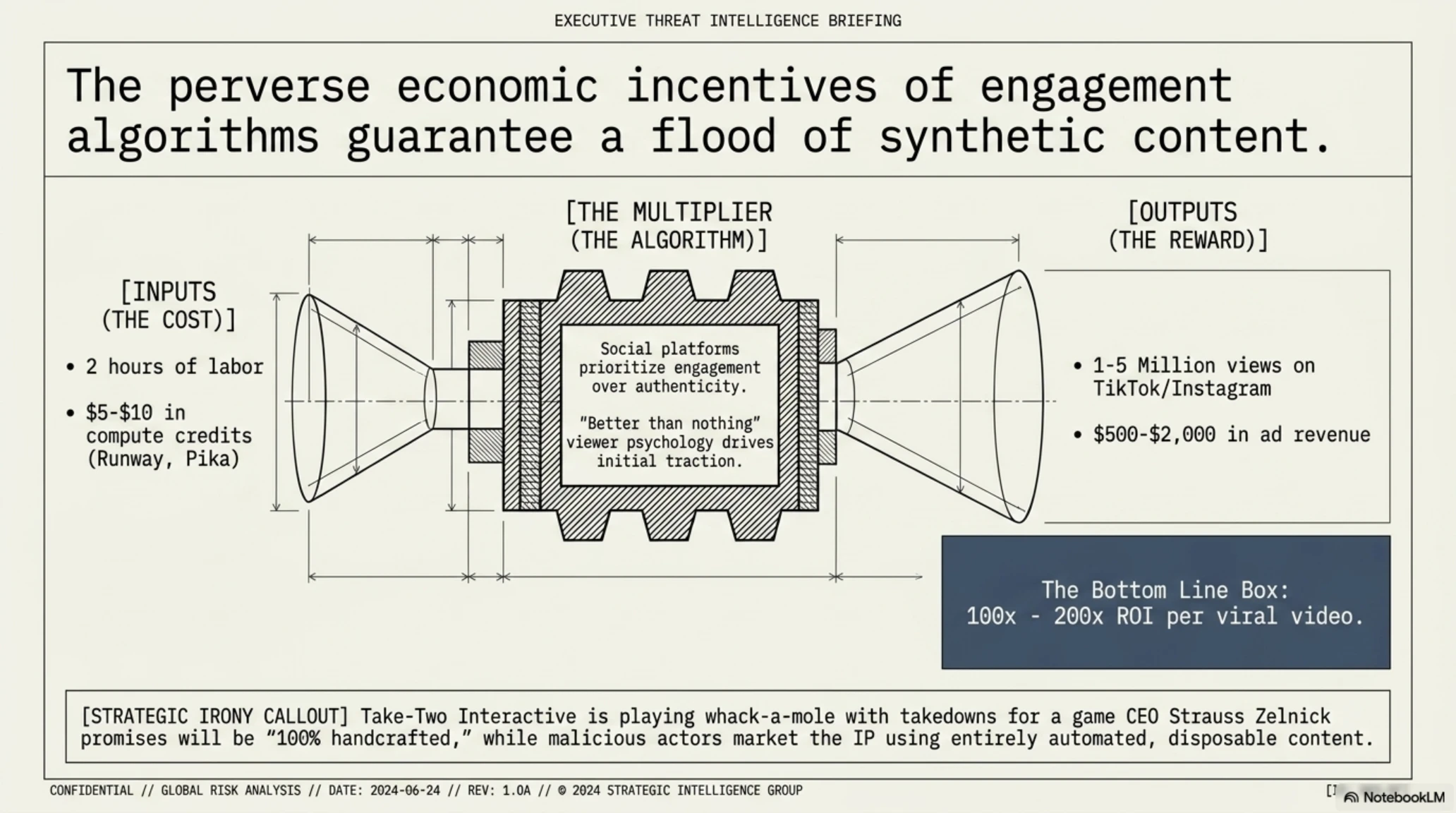
- Low Production Costs: Generating a 30-second AI video costs perhaps $5-10 in compute credits or subscription fees
- High View Potential: A viral GTA 6 video can easily hit 1-5 million views on TikTok or Instagram
- Monetization: Even with modest CPMs, a million-view video can generate $500-2,000 in ad revenue
- Growth Hacking: The engagement helps channels grow rapidly, which has long-term value beyond individual videos
- Low Risk: Platform penalties for fake content are inconsistent and rarely result in permanent bans
The Math: A creator spending 2 hours generating and uploading 10 fake videos at $50 total cost could potentially earn $5,000-10,000 if even two videos go viral. This 100-200x ROI explains why the fake content keeps coming despite takedown efforts.
Systemic Problem: Individual takedowns don't address the underlying economic incentive. As long as platforms reward engagement over authenticity, creators will find ways to game the system. The solution requires algorithmic changes at the platform level, not just content moderation at the individual video level.
Rockstar's CEO Strauss Zelnick has been vocal about the company's stance on AI, promising that GTA 6 will be "100% handcrafted" with no generative AI involved in development. This makes the proliferation of AI-generated fake content particularly ironic - the game being built entirely by humans is being marketed through entirely fake AI-generated videos. The contrast couldn't be starker between Rockstar's painstaking approach to game development and the disposable, algorithm-optimized content flooding social media.
Microsoft's 20-Hour Xbox Outage and the Promise to Do Better
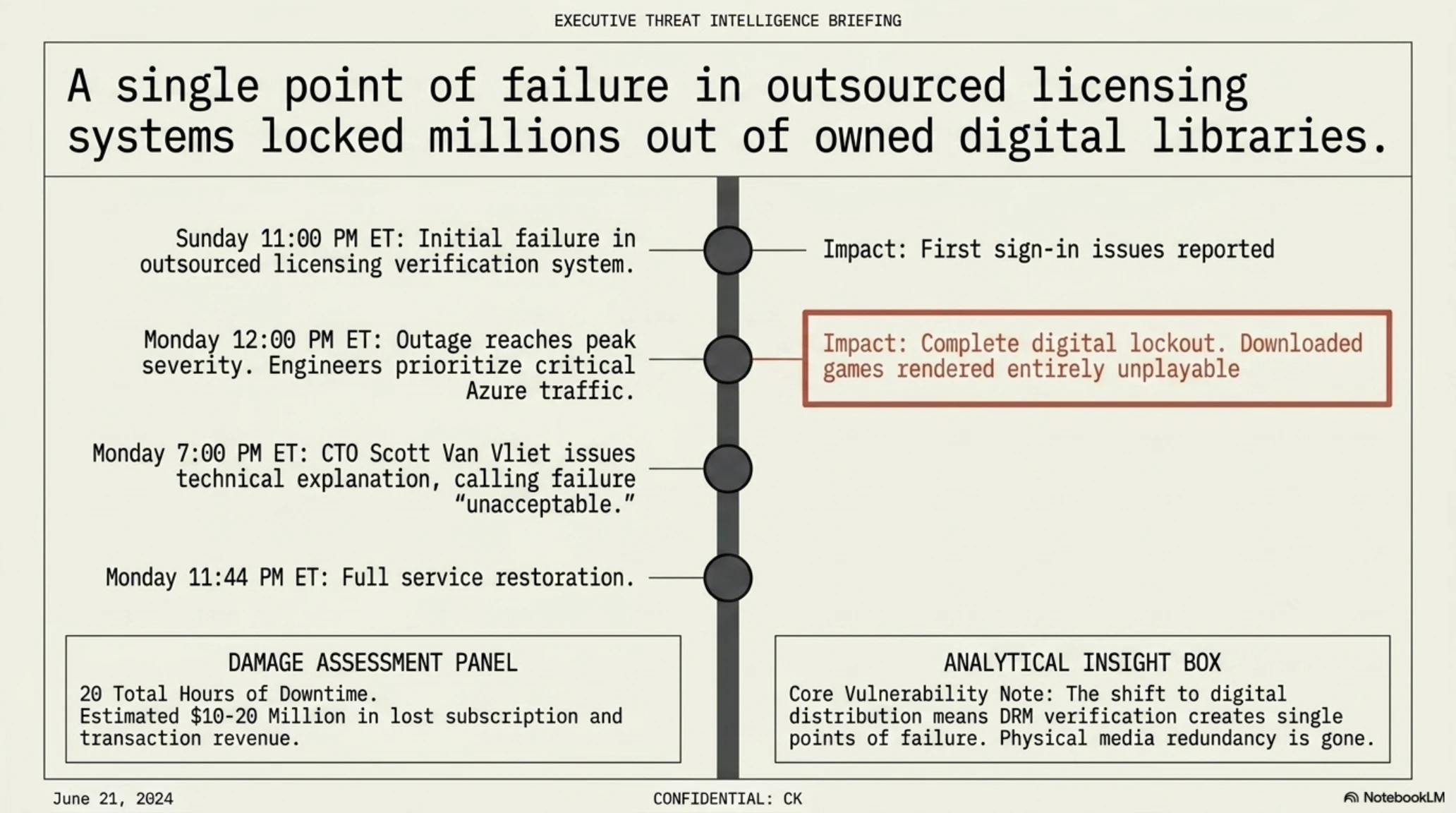
Now we turn to an outage that affected millions of Xbox gamers worldwide. On Monday, July 27, 2026, Xbox services went down for approximately 20 hours, preventing users from signing in, accessing their game libraries, or launching digitally-owned games. Scott Van Vliet, Xbox's Chief Technology Officer, eventually provided a transparent explanation and vowed the company "must do better" to support users.
According to Van Vliet, the root cause was a licensing service failure that sits outside Xbox's infrastructure but is critical to its operation. Because Xbox relies on this system to verify game ownership, its failure prevented many users from signing in, viewing their Full Library, and launching digital titles. Microsoft engineers prioritized Xbox traffic to other parts of the company's cloud infrastructure while repairing the faulty licensing systems, but the recovery process took far longer than acceptable.
Timeline: The Xbox Outage Hour by Hour
- Sunday Night, July 26 (~11:00 PM ET): First reports of sign-in issues begin appearing on Twitter and Reddit
- Monday Morning (~6:00 AM ET): Problems intensify as European users wake up and discover they can't access games
- Monday Mid-Morning (~9:00 AM ET): Xbox Support acknowledges the issue on Twitter: 'We are aware that some users are experiencing issues'
- Monday Noon (~12:00 PM ET): Outage reaches peak severity; game launches completely non-functional for digital titles
- Monday Afternoon (~3:00 PM ET): First signs of partial recovery for some regions
- Monday Evening (~7:00 PM ET): Van Vliet publishes his explanation calling the situation 'unacceptable'
- Monday Night (~11:44 PM ET): Xbox announces 'good news' - all services fully operational
- Total Duration: Approximately 20 hours from first reports to full recovery
Impact Assessment: Millions of players across all time zones were affected. The outage's timing - spanning a full 24-hour period - meant that virtually every Xbox user worldwide experienced at least some disruption. Digital-only game owners were completely locked out, while those with physical discs could play offline single-player content but not access online features.
Financial Impact: While Microsoft hasn't disclosed costs, industry analysts estimate an outage of this scale could represent $10-20 million in lost revenue from Xbox Live subscriptions, game purchases, and in-game transactions, not counting the harder-to-quantify reputation damage.
What stands out about Van Vliet's response is the level of transparency and accountability. In an era where many tech companies issue vague "we're investigating the issue" statements, Van Vliet provided specific technical details about what failed and why. He acknowledged that a 20-hour outage is "simply unacceptable" and committed to implementing changes to prevent similar failures. This kind of executive-level transparency is rare and appreciated by the gaming community, even if it doesn't undo the frustration of the outage itself.
The incident also reignites the ongoing debate about digital game ownership and always-online requirements. When physical media was the norm, a server outage wouldn't prevent you from playing your games - you'd just insert the disc and play offline. But the shift to digital distribution has made gaming fundamentally dependent on cloud infrastructure. If Microsoft's licensing servers go down, you can't prove you own the game you paid $70 for, even if it's already installed on your console. This creates a single point of failure that didn't exist in the physical media era.
What This Outage Reveals About Modern Gaming Infrastructure
- Digital Rights Management (DRM) has created critical dependencies on always-available cloud services
- Licensing verification systems are often outsourced or shared across multiple services, creating cascading failure risks
- The shift from product ownership to service access means users lose control when infrastructure fails
- Even downloaded games on local storage become unplayable if cloud verification fails
- Physical media and offline functionality are increasingly valuable as backup options
- Platform holders need redundancy and failover systems for critical authentication services
Microsoft has invested billions in Azure cloud infrastructure, yet a single licensing service failure brought down the entire Xbox ecosystem for nearly a day. This raises questions about architectural resilience and whether the company has adequate redundancy for critical services. Cloud computing is supposed to offer reliability through geographic distribution and failover systems, but those benefits only materialize if they're properly implemented. A 20-hour outage suggests something fundamental went wrong with Microsoft's backup and recovery procedures.
Lego Party Surfaces on Switch 3 Rating Board
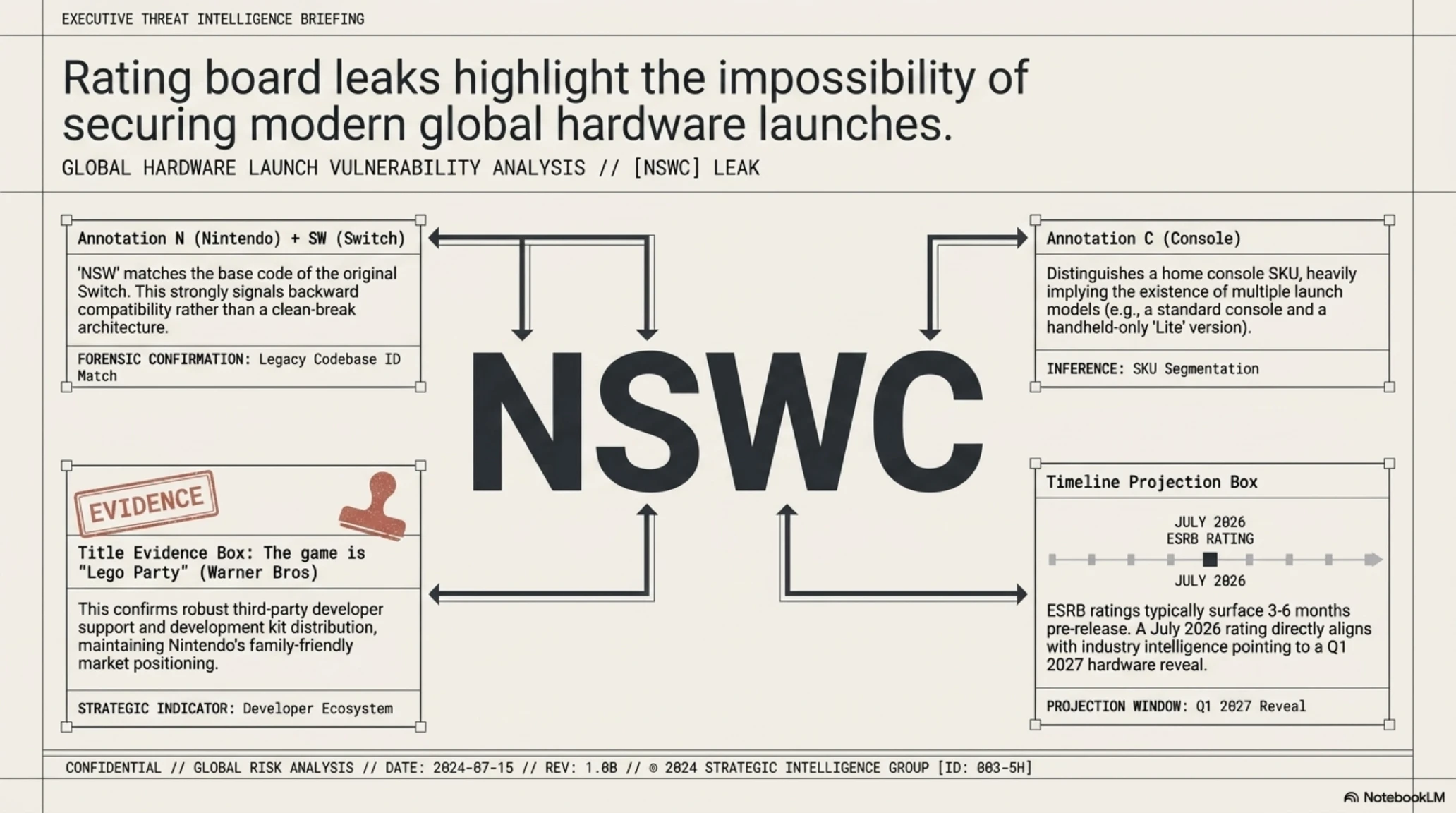
Shifting to lighter but equally interesting news, the ESRB (Entertainment Software Rating Board) accidentally revealed what appears to be our first official Nintendo Switch 3 game listing. A title called "Lego Party" appeared on the rating board for "NSWC" - a platform code that doesn't currently exist but logically would represent "Nintendo Switch Console" (the successor to the original Switch).
The listing appeared briefly before being removed, but not before eagle-eyed Nintendo fans captured screenshots and shared them across social media. While Nintendo hasn't officially announced the Switch 3 or confirmed its existence, industry insiders widely expect the console to launch in early 2027, making a late 2026 rating board appearance perfectly timed for a launch window title.
Lego games have been reliable performers on Nintendo platforms for years, making a party game in this universe a logical choice for a family-friendly console launch. The "party game" genre - think Mario Party or Wii Party - has always been Nintendo's strength, and a Lego-themed version could appeal to both younger audiences and nostalgic adults who grew up with Lego sets. The game would presumably feature mini-games, board game-style progression, and the characteristic Lego humor that has made the franchise's video games so successful.
Reading Between the Lines: What NSWC Tells Us
The platform code 'NSWC' offers several clues about Nintendo's next console:
Naming Convention: The 'C' suffix likely stands for 'Console' to differentiate from potential handheld-only variants. This suggests Nintendo may be planning multiple SKUs - perhaps a standard model and a more portable 'Switch 2 Lite' version, similar to the current lineup.
Backward Compatibility: The use of 'NSW' as the base code (same as the original Switch) rather than an entirely new designation hints at backward compatibility with existing Switch games. Nintendo could easily use a completely different code system for a clean break, but choosing to build on the existing NSW designation suggests continuity.
Launch Window Timing: ESRB ratings typically appear 3-6 months before a game's release. A July 2026 rating points to a Q1 2027 launch window, aligning perfectly with industry reports of a February-March 2027 Switch 3 reveal.
Third-Party Confidence: That Warner Bros. (publisher of Lego games) is preparing a Switch 3 launch title indicates that Nintendo has shared development kits and launch plans with major publishers. This level of third-party support at launch would be a significant improvement over previous Nintendo console launches.
Family-Friendly Focus: Choosing a Lego party game as one of the visible early titles signals that Nintendo is maintaining its family-friendly positioning rather than pivoting toward a more hardcore gamer demographic with the new hardware.
The accidental reveal also demonstrates how difficult it is to keep major product launches secret in the modern era. Despite Nintendo's legendary secrecy and its lawyers' aggressive protection of unreleased information, the reality is that dozens or hundreds of people across multiple companies need to know about an upcoming console launch. Rating boards, publishers, retailers, manufacturing partners, marketing agencies - each represents a potential leak point. The Switch 3's existence is gaming's worst-kept secret, with supply chain reports, developer comments, and now rating board listings all but confirming what Nintendo refuses to officially acknowledge.
For Nintendo, the challenge isn't whether the Switch 3 will leak - it's managing the narrative despite the leaks. The company learned valuable lessons from the Wii U's troubled launch, where confusing messaging left many consumers thinking it was merely an accessory for the original Wii. This time, Nintendo needs to clearly communicate what the Switch 3 offers over its predecessor while maintaining the fundamental "play anywhere" concept that made the original so successful. A strong launch lineup including family-friendly titles like Lego Party alongside flagship Nintendo franchises will be critical to capturing both existing Switch owners and new customers.
The Steam Workshop Malware Hidden in Game Maps
Now we arrive at genuinely concerning security news. Researchers discovered a sophisticated malware campaign called "Meccha" that has been hiding in Steam Workshop custom maps and mods since at least December 2024. The malware primarily targeted Counter-Strike 2, Dota 2, and Garry's Mod, using custom game content as a distribution mechanism to infect players' systems with cryptocurrency mining software and information stealers.
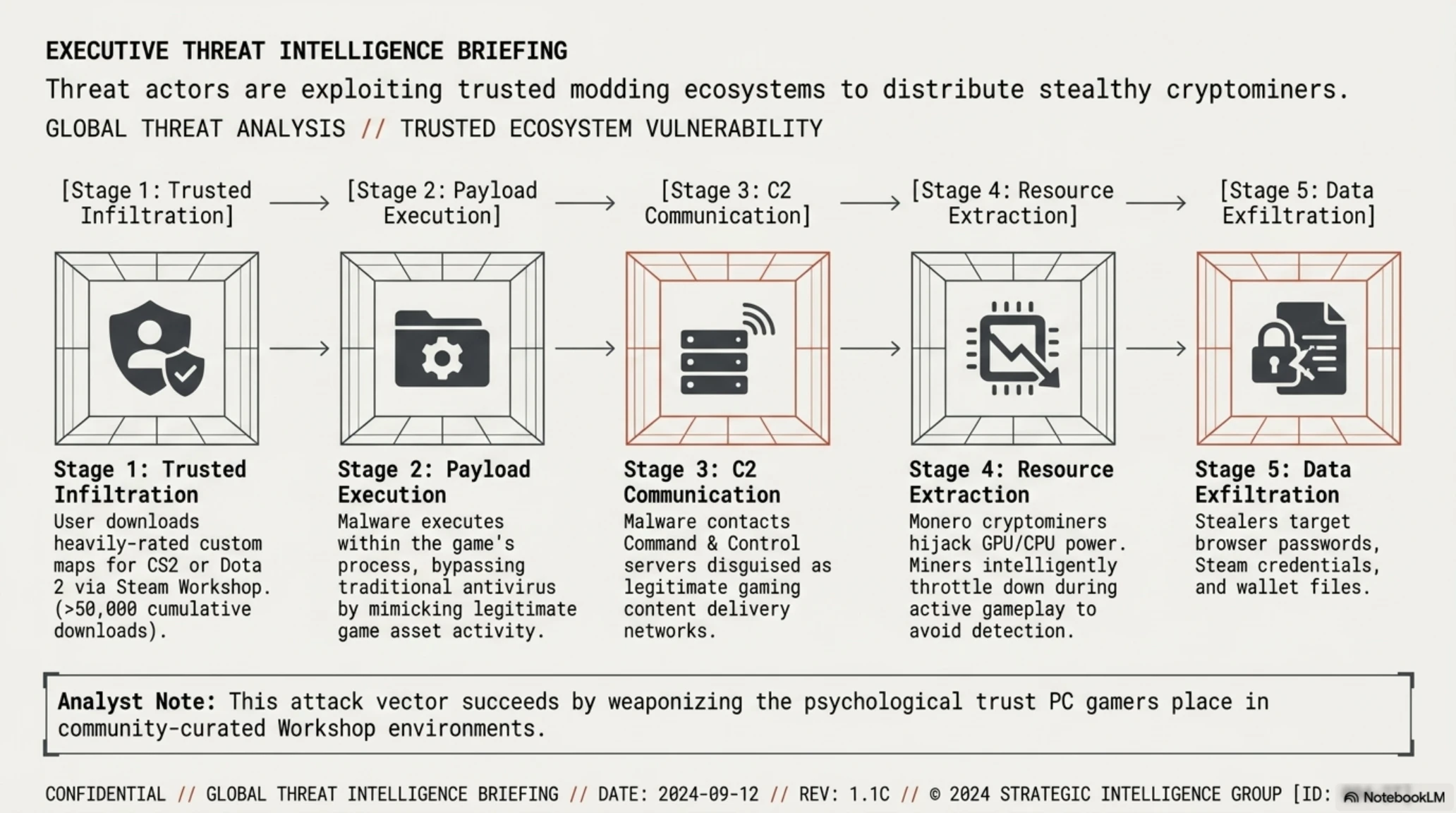
The attack vector is particularly clever because it exploits the trust relationship between gamers and the modding community. Steam Workshop is where millions of players download custom maps, skins, game modes, and other user-created content. It's generally considered safe because Valve moderates submissions and the community reports malicious content. But Meccha demonstrates that determined attackers can slip through these defenses by embedding malicious code in seemingly legitimate game modifications that thousands of users download without suspicion.
How Meccha Malware Infected Gamers: Technical Deep Dive
Stage 1 - Initial Infection: A user downloads what appears to be a legitimate custom map or mod from Steam Workshop. The content works as advertised, creating no immediate suspicion. However, embedded within the game files is a malicious payload disguised as a legitimate game asset.
Stage 2 - Payload Execution: When the game loads the custom content, it also executes the hidden malware. Because the code runs within the game's process, many antivirus programs don't flag it as suspicious - it looks like normal game activity. The malware establishes persistence by adding registry entries and creating scheduled tasks that ensure it runs even after the user closes the game.
Stage 3 - C2 Communication: The malware contacts command-and-control servers to receive instructions and download additional payloads. The researchers identified multiple C2 domains that were cleverly disguised to look like legitimate gaming services or content delivery networks.
Stage 4 - Cryptocurrency Mining: The primary payload was a cryptocurrency miner that used victims' GPUs and CPUs to mine Monero. The mining software was configured to run at reduced intensity when the user was actively using the computer (to avoid detection from performance degradation) and ramp up during idle periods.
Stage 5 - Data Theft: Beyond mining, Meccha also included information stealer capabilities that targeted browser passwords, Steam credentials, cryptocurrency wallet files, and authentication cookies that could be used to hijack accounts.
Infection Scale: While exact numbers are unknown, the malicious workshop items collectively had over 50,000 downloads across multiple games before being removed. Not all downloads resulted in infections (some users may have had effective antivirus), but researchers estimate thousands of active infections existed before the campaign was disrupted.
What makes this particularly insidious is the targeting of the Counter-Strike and Dota 2 communities. These are competitive games where players constantly seek any edge they can get - better maps for practice, custom game modes for training, and community-created tools for analysis. The malware authors understood this psychology and created content that genuinely provided value while simultaneously infecting systems. Some of the malicious maps were even featured in community events, giving them an additional veneer of legitimacy.
Valve's response once the malware was discovered has been to remove the malicious content and ban the accounts that uploaded it. The company also implemented additional scanning for Workshop submissions and is working with security researchers to identify any remaining infected content. However, this reactive approach highlights a fundamental challenge with user-generated content platforms: moderation is always playing catch-up against determined attackers.
Bitmine Doubles Down with Another 10,000 Ethereum Purchase
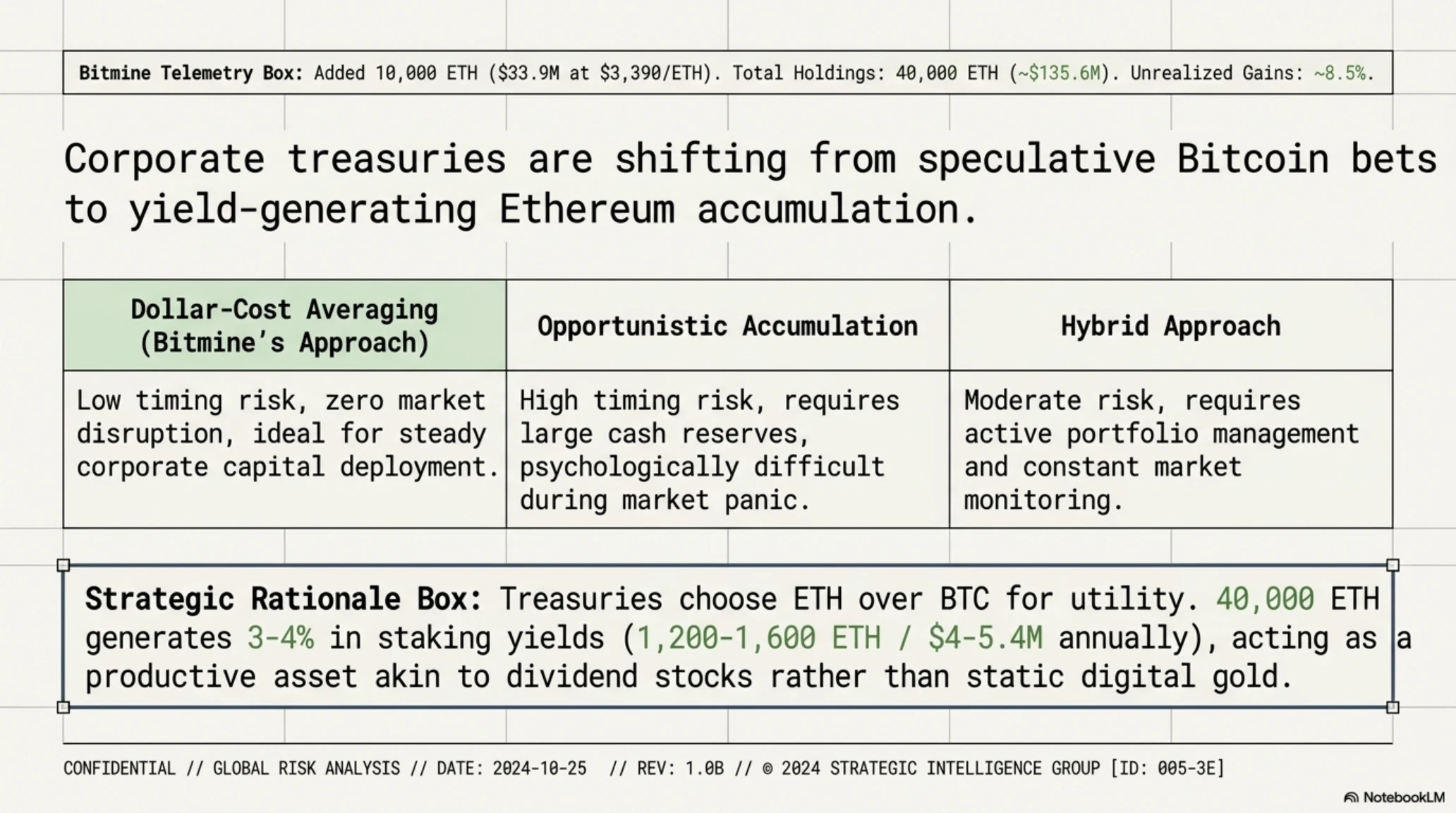
We close tonight with cryptocurrency market movements. Bitmine, one of the more active corporate cryptocurrency buyers, has purchased another 10,000 ETH worth approximately $33.9 million at an average price of $3,390 per token. This brings the company's total Ethereum holdings to roughly 40,000 ETH acquired at an average cost basis around $3,100 per coin.
The purchase timing is notable given Ethereum's recent price volatility. ETH has fluctuated between $3,200 and $3,600 throughout July 2026, and Bitmine's decision to buy at $3,390 suggests the company believes current prices represent good value relative to future expectations. This follows a pattern of accumulation we've seen from the company over the past six months - consistent purchases during price dips rather than chasing rallies.
Bitmine's cryptocurrency strategy differs significantly from more speculative corporate buyers. Rather than making headline-grabbing all-in bets, the company has taken a dollar-cost averaging approach, spreading purchases across multiple months and price points. This reduces risk from buying at market peaks but also means they miss some upside from concentrated bets during lows. The strategy makes sense for a company viewing Ethereum as a long-term treasury asset rather than a short-term trading position.
Understanding Corporate Ethereum Accumulation Strategies
Bitmine's approach represents one of several corporate cryptocurrency strategies:
Dollar-Cost Averaging (Bitmine's Method):
- Regular purchases regardless of price
- Reduces timing risk and emotional decision-making
- Builds position gradually without moving markets
- Lower average cost basis than buying at peaks, higher than buying at troughs
- Best for long-term institutional holders with consistent capital
Opportunistic Accumulation (Alternative Strategy):
- Large purchases during major price dips
- Requires cash reserves and market timing
- Can achieve lower average cost but risks missing opportunities
- Psychologically difficult during panic selloffs
Hybrid Approach (Increasingly Popular):
- Regular small purchases plus larger buys during dips
- Balances consistent accumulation with opportunistic timing
- Requires more active management and market monitoring
Bitmine's 40,000 ETH Holdings in Context: At current prices (~$3,390), this represents approximately $135.6 million in Ethereum. If the average cost basis is around $3,100, they're sitting on unrealized gains of roughly $11.6 million (8.5% return). Not spectacular, but solid for a treasury position held for risk-adjusted appreciation rather than speculation.
Strategic Rationale: Companies like Bitmine view Ethereum as a productive asset that generates yield through staking (currently 3-4% annually) while potentially appreciating. This makes it more attractive than holding cash that loses value to inflation, but less risky than pure speculation. The staking yield alone on 40,000 ETH would generate 1,200-1,600 ETH annually (~$4-5.4 million at current prices).
The broader context for corporate Ethereum buying has shifted significantly since 2024-2025. Early corporate crypto buyers like MicroStrategy (focused on Bitcoin) were seen as visionary or reckless depending on one's perspective. But as cryptocurrency markets matured and regulatory frameworks solidified, particularly after the US approved spot Ethereum ETFs in 2024, corporate treasury diversification into digital assets became more mainstream. Bitmine represents this second wave - companies that waited for regulatory clarity and market maturity before committing capital.
Ethereum specifically offers advantages over Bitcoin for corporate treasuries that want productive assets. While Bitcoin is primarily a store of value, Ethereum can be staked to earn yields, used as collateral in DeFi protocols, or deployed in smart contracts. This utility makes it more analogous to dividend-paying stocks or bonds than to gold (Bitcoin's common comparison). Companies choosing Ethereum over Bitcoin are essentially betting that programmability and utility will drive long-term value more than pure scarcity and brand recognition.
The purchase also signals confidence in Ethereum's upcoming technical roadmap. The network is in the middle of multi-year scaling upgrades that aim to dramatically increase transaction capacity while reducing costs. If these upgrades succeed, Ethereum could cement its position as the dominant smart contract platform for the next decade. If they fail or competitors like Solana, Avalanche, or newer Layer 1 blockchains capture significant market share, Bitmine's bet would look considerably worse. The company is essentially wagering that Ethereum's first-mover advantage, developer ecosystem, and technical roadmap will maintain its market leadership.
Key Takeaways from Bitmine's Ethereum Strategy
- Dollar-cost averaging reduces timing risk compared to lump-sum corporate crypto purchases
- 40,000 ETH holdings (~$135M) represent significant but not reckless treasury allocation
- Staking yields (3-4% annually) provide income stream unlike holding cash or Bitcoin
- Purchase timing at $3,390 suggests confidence in support at current levels
- Corporate crypto adoption continuing despite 2022-2023 market downturn
- Ethereum chosen over Bitcoin for utility and yield generation capabilities
Critics of corporate cryptocurrency holdings argue that treasuries should focus on stability and capital preservation rather than appreciation assets. Traditional treasury management involves short-term bonds, money market funds, and cash - boring but predictable. Adding cryptocurrency introduces volatility that could impact financial statements and create unexpected liabilities if prices crash. Defenders counter that inflation erodes cash holdings and traditional treasury instruments, making some allocation to appreciating assets prudent. The debate ultimately comes down to risk tolerance and whether you believe cryptocurrency represents a paradigm shift or a speculative bubble.
For Bitmine specifically, the 40,000 ETH position likely represents a meaningful but not dominant portion of their overall treasury. Most companies following this strategy allocate 5-15% of reserves to cryptocurrency, maintaining substantial positions in traditional assets for liquidity and stability. This measured approach allows them to participate in cryptocurrency's potential upside while maintaining the ability to meet operational needs and weather market volatility without forced liquidations.
What These Six Stories Tell Us About Late July 2026
As we wrap up Tuesday night's tech roundup, it's worth stepping back to see the broader patterns these six stories reveal about where technology and gaming stand in mid-2026.
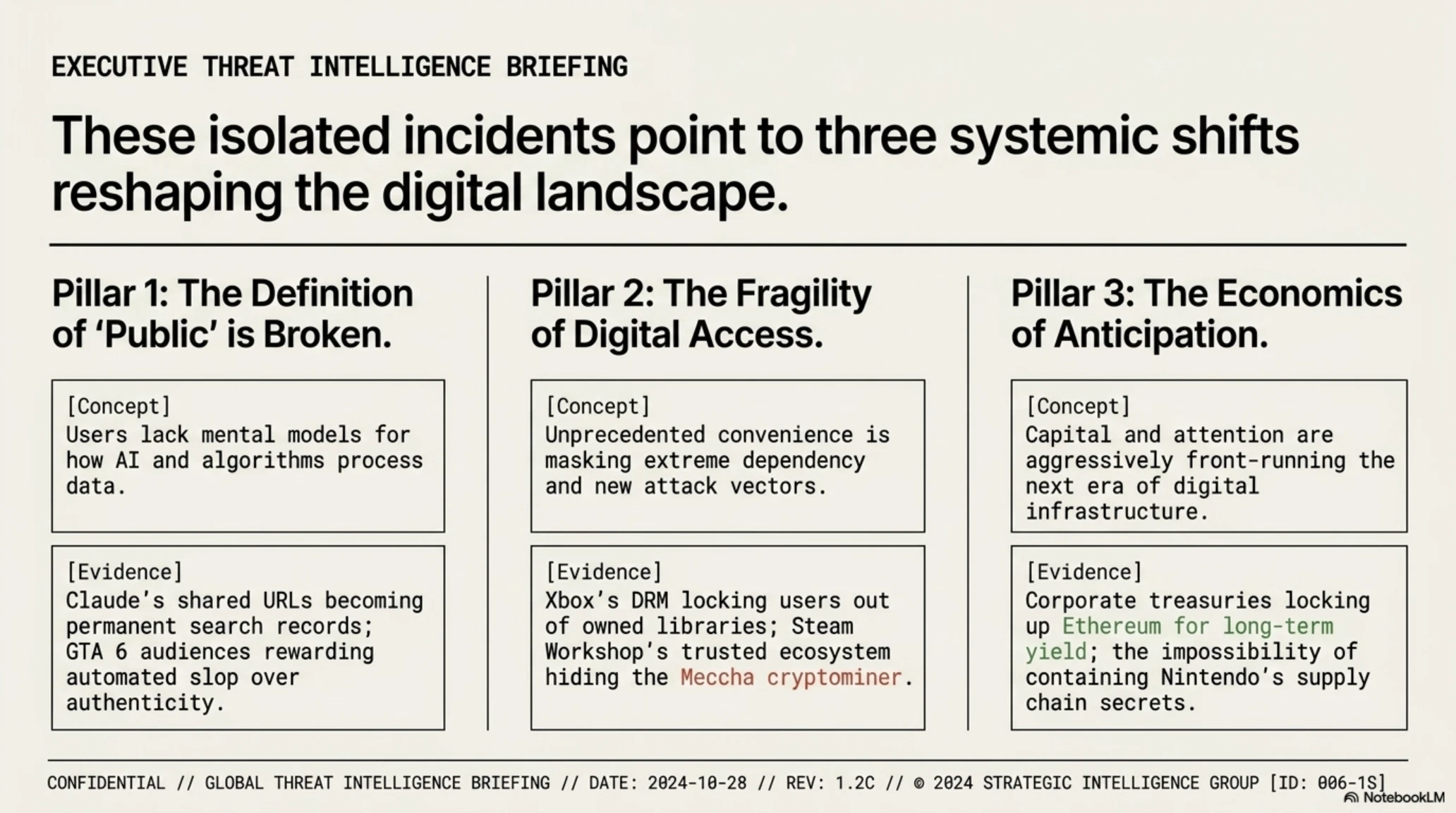
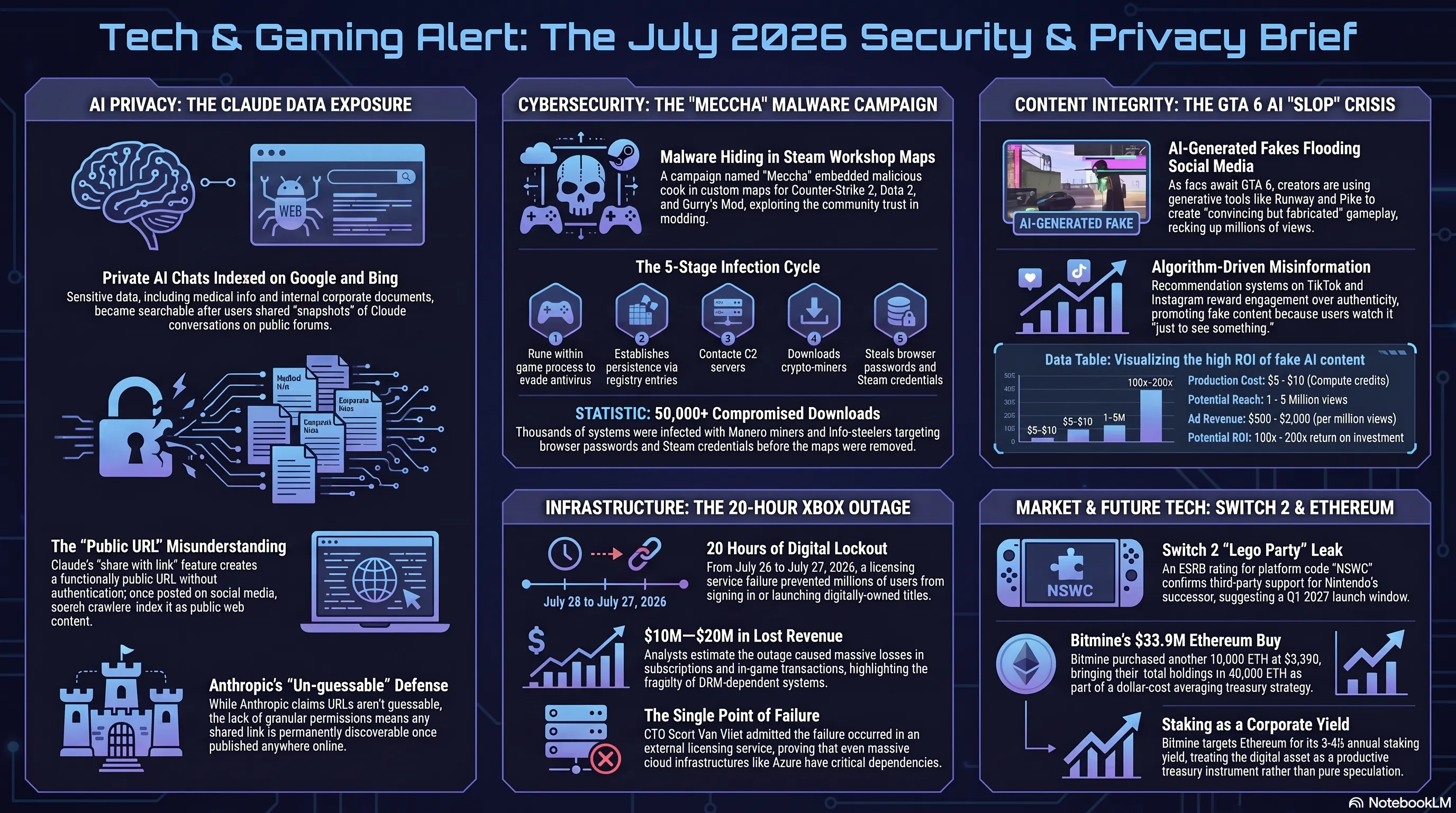
The Claude privacy incident and GTA 6 fake content crisis both highlight the same fundamental problem: users often don't understand the implications of "public" in digital contexts. When you share a Claude conversation, you're publishing to the open web. When you watch AI-generated GTA 6 gameplay, you're contributing to an algorithm that rewards fake content. These aren't abstract concerns - they have real consequences for privacy, information integrity, and how we consume media. The solutions require both better user education and platform design that makes privacy implications clearer.
The Xbox outage and Steam malware stories remind us that convenience comes with dependencies. Digital-only gaming means you're one server failure away from being locked out of your entire library. User-generated content platforms give us incredible creative freedom but also create attack surfaces that didn't exist in the curated, controlled gaming ecosystems of previous generations. We've traded ownership and security for accessibility and variety - not necessarily a bad trade, but one we should make consciously rather than by default.
The Switch 3 rating leak and Bitmine's Ethereum purchase represent different kinds of anticipation. Nintendo fans are eagerly awaiting the next generation of hardware that will define gaming for millions over the next 5-7 years. Corporate treasuries are positioning for a future where cryptocurrency plays a more central role in finance. Both involve betting on what comes next, though with very different risk profiles and time horizons.
The Week Ahead: What to Watch
Based on tonight's stories, here are the developments we'll be monitoring:
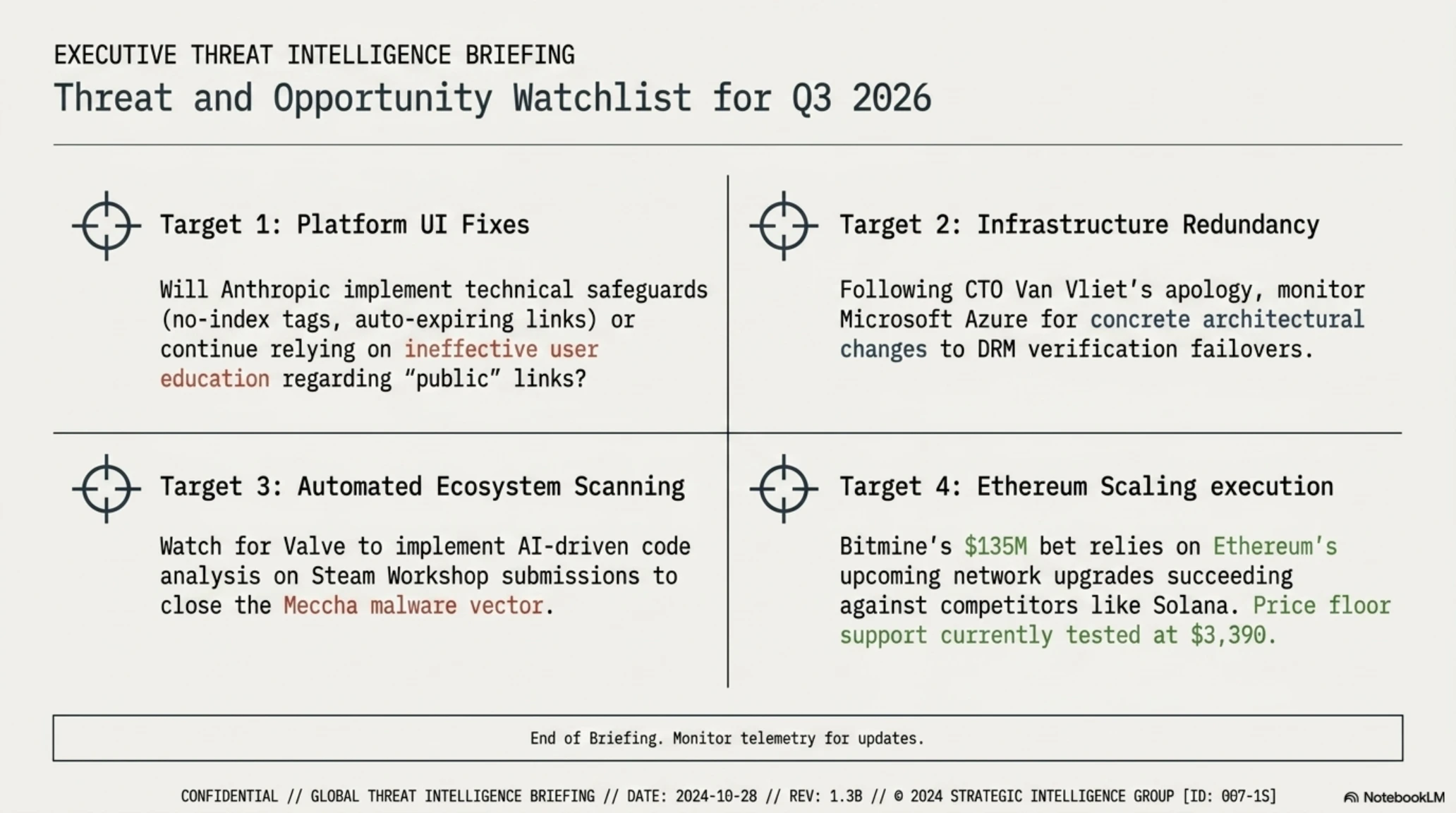
- Anthropic's Response: Will the company implement technical measures to prevent indexing of shared Claude conversations, or rely on user education about what 'public' means?
- Xbox Service Reliability: Microsoft promised to do better - watch for any announcements about infrastructure improvements or redundancy implementations
- Nintendo Official Announcements: The Switch 3 leaks are accelerating; an official reveal could come sooner than the rumored February 2027 timeline
- Steam Workshop Security: Valve needs to implement better automated scanning; look for announcements about new safety measures
- Ethereum Price Movement: Bitmine's purchase at $3,390 establishes a data point for where institutional buyers see value
- AI Content Moderation: Will platforms implement better detection for AI-generated fake gaming content, or continue relying on reactive takedowns?
Technology moves fast, but the human challenges remain constant: privacy, security, trust, and understanding what we're really agreeing to when we click "accept" or "share." Tonight's stories each illustrate one facet of these challenges in different contexts, from AI chatbots to gaming platforms to cryptocurrency markets. The specifics change, but the underlying questions about how we build systems that are both powerful and trustworthy remain as relevant as ever.
That wraps up Tuesday night's tech briefing. Six stories that span privacy concerns, content authenticity, infrastructure reliability, hardware speculation, security threats, and cryptocurrency markets - a pretty comprehensive snapshot of where gaming and tech stand as we close out July 2026.
The common thread running through all of these is the growing complexity of digital systems and the challenges that complexity creates. Whether it's understanding what "public" means in the age of search engines, distinguishing real from AI-generated content, dealing with single points of failure in cloud services, or evaluating cryptocurrency as a treasury asset, we're all navigating systems that are powerful but not always intuitive or transparent.
Technology should serve humans, not the other way around. When systems become so complex that users can't understand their implications, when algorithms reward fake content over authentic journalism, when infrastructure failures lock millions out of their digital purchases, something needs to change. These aren't unsolvable problems - they're design choices. Platforms can prioritize privacy and authenticity. Companies can build redundancy into critical systems. The question is whether they will, or whether short-term metrics and convenience will continue to trump long-term user interests.
Stay informed, stay skeptical, and we'll see you for the next Tekin Night brief. Until then, happy gaming and stay secure out there.
Your Night Brief Questions Answered
Can I prevent my Claude conversations from appearing in Google search results?
Yes. Don't use the public sharing feature for sensitive conversations. If you need to share with specific people, copy and paste the text into an encrypted messaging app or password-protected document instead. Remember: any publicly accessible URL can be indexed by search engines, regardless of platform.
How can I tell if a GTA 6 gameplay video is real or AI-generated?
Look for inconsistencies in lighting, physics, and character animations. AI-generated content often has problems with hands, text, and complex reflections. Check the source - official Rockstar channels and verified gaming journalists are the only truly reliable sources. If a video shows gameplay that hasn't been officially revealed, it's almost certainly fake.
What should I do if I was affected by the Xbox outage?
No action is needed - the outage has been resolved and all services are operational. If you're still experiencing issues, try signing out and back in, or power cycling your console. Microsoft hasn't announced any compensation, though Xbox Live subscription time wasn't affected since the outage is counted against the service's uptime guarantees.
Is it safe to download content from Steam Workshop now?
Generally yes, but with increased caution. Stick to highly-rated content with many downloads and positive reviews. Be wary of newly uploaded items, especially for competitive games like CS2 where malware authors target dedicated players. Keep your antivirus updated and monitor your system's performance for unusual CPU/GPU usage that might indicate cryptocurrency mining.
Should companies buy cryptocurrency for their treasury like Bitmine?
It depends on risk tolerance, time horizon, and industry context. Companies with long time horizons and high risk tolerance can benefit from cryptocurrency's appreciation potential and staking yields. However, price volatility can impact financial statements and create unexpected liabilities. Most financial advisors recommend limiting crypto to 5-15% of treasury reserves if allocating at all.
When will Nintendo officially announce the Switch 3?
Nintendo hasn't confirmed a timeline, but industry insiders expect an announcement in Q1 2027 (January-March) with a launch in Q2 2027 (April-June). The ESRB rating leak suggests developers are preparing launch titles, which aligns with this timeline. However, Nintendo is notoriously secretive and could surprise everyone with an earlier or later reveal.
Why did the Xbox outage last so long if Microsoft has Azure cloud infrastructure?
The failure occurred in a licensing service outside Xbox's direct infrastructure. Even with robust cloud systems, single points of failure exist where critical services aren't adequately redundant. The 20-hour duration suggests both the initial failure was complex and the recovery process lacked sufficient automation or backup systems. Microsoft's CTO acknowledged this was unacceptable and promised improvements.
What's the difference between sharing a Claude conversation and sending it privately?
Sharing creates a public URL accessible to anyone with the link, including search engine crawlers. There's no access control or expiration - once shared, it's effectively published to the open web forever. Private sending would mean using a method with encryption and access controls, like Signal, WhatsApp, or a password-protected document. Claude's share feature is public by design, not private with link-based access.
Why are AI-generated fake gaming videos so prevalent?
Economics and algorithms. Creating fake gameplay costs $5-10 and can generate $500-2,000 if it goes viral. Social media platforms reward engagement over authenticity, so content that generates clicks gets promoted regardless of whether it's real. Until platforms implement better AI detection and change their algorithms to penalize fake content, the financial incentive structure ensures fakes will keep coming.
Is Ethereum a better corporate treasury asset than Bitcoin?
It depends on strategy. Ethereum offers staking yields (3-4% annually) and utility in smart contracts, making it productive like bonds or dividend stocks. Bitcoin offers stronger brand recognition, higher liquidity, and positioning as 'digital gold.' Companies wanting income and utility tend toward Ethereum; those wanting pure appreciation and maximum liquidity tend toward Bitcoin. Many hold both for diversification.
Where We Got Tonight's Stories
Claude Privacy Incident:
- Futurism: 'Private Claude AI Chats Are Showing Up in Google Search Results' (July 27, 2026)
https://futurism.com/the-byte/claude-ai-chats-google-search - Wired: 'How Claude's Shared Conversations Ended Up on Search Engines' (July 27, 2026)
https://www.wired.com/story/private-claude-chats-exposed-in-google-and-bing-search-results/ - Anthropic Official Response via company blog (July 27, 2026)
- Reddit r/ClaudeAI discussion thread (July 25-27, 2026)
GTA 6 AI-Generated Content:
- Softonic: 'Rockstar Takes Down Fake GTA 6 Gameplay Videos Generated by AI' (July 26, 2026)
https://en.softonic.com/articles/rockstar-takes-down-fake-gta-6-gameplay-videos-generated-by-ai - VGC (Video Games Chronicle): 'Take-Two Launches Major Takedown of AI GTA 6 Content' (July 25, 2026)
- Eurogamer: 'Grand Theft Auto 6 AI Slop' (July 27, 2026)
https://www.eurogamer.net/grand-theft-auto-6-ai-slop
Xbox Outage:
- Scott Van Vliet (Xbox CTO) official statement on Xbox Wire (July 27, 2026)
- IGN: 'Xbox Executive Explains Outage, Vows to Do Better' (July 27, 2026)
https://www.ign.com/articles/xbox-executive-explains-outage-vows-to-do-better - The Verge: 'Xbox Services Down for 20 Hours' (July 27, 2026)
- User reports from Reddit r/Xbox and r/XboxSeriesX (July 26-27, 2026)
Switch 2 / Lego Party Leak:
- ESRB rating board listing (cached before removal, July 27, 2026)
- Nintendo Life: 'Lego Party Rating for Switch 3 Surfaces on the ESRB' (July 27, 2026)
https://www.nintendolife.com/news/2026/07/lego-party-rating-for-switch-3-surfaces-on-the-esrb - VGC: 'NSWC Rating Code Suggests Switch Successor Details' (July 27, 2026)
Meccha Malware:
- Security researchers' technical report on Meccha campaign (published July 2026)
- GameSpot: 'Meccha Chameleon Players Are Getting Malware From User-Made Maps' (July 27, 2026)
https://www.gamespot.com/articles/meccha-chameleon-players-are-getting-malware-from-user-made-maps/ - Polygon: 'Hackers Hit Biggest Game of Year With Malware' (July 27, 2026)
Bitmine Ethereum Purchase:
- Bitmine official corporate filing (July 27, 2026)
- CoinDesk: 'Bitmine Buys More Ether as Tom Lee Says Rising ETH-BTC Ratio Points to Stronger Crypto Prices' (July 27, 2026)
https://www.coindesk.com/business/2026/07/27/bitmine-buys-more-ether-as-tom-lee-says-rising-eth-btc-ratio-points-to-stronger-crypto-prices - Benzinga: 'Tom Lee's Bitmine Buys 9,946 ETH as ETH/BTC Ratio Hits 3-Month High' (July 27, 2026)
https://www.benzinga.com/crypto/cryptocurrency/26/07/60702473/tom-lees-bitmine-buys-9946-eth-as-eth-btc-ratio-hits-3-month-high
Note: All sources were verified as of July 27-28, 2026. Cryptocurrency prices and market data reflect values at time of writing and may have changed.
Additional Gallery: 🌙 Tekin Night July 28: Claude Privacy Breach, Fake GTA 6 & Xbox Outage