Good Morning! Your Tech Breakfast - Tuesday, July 28, 2026
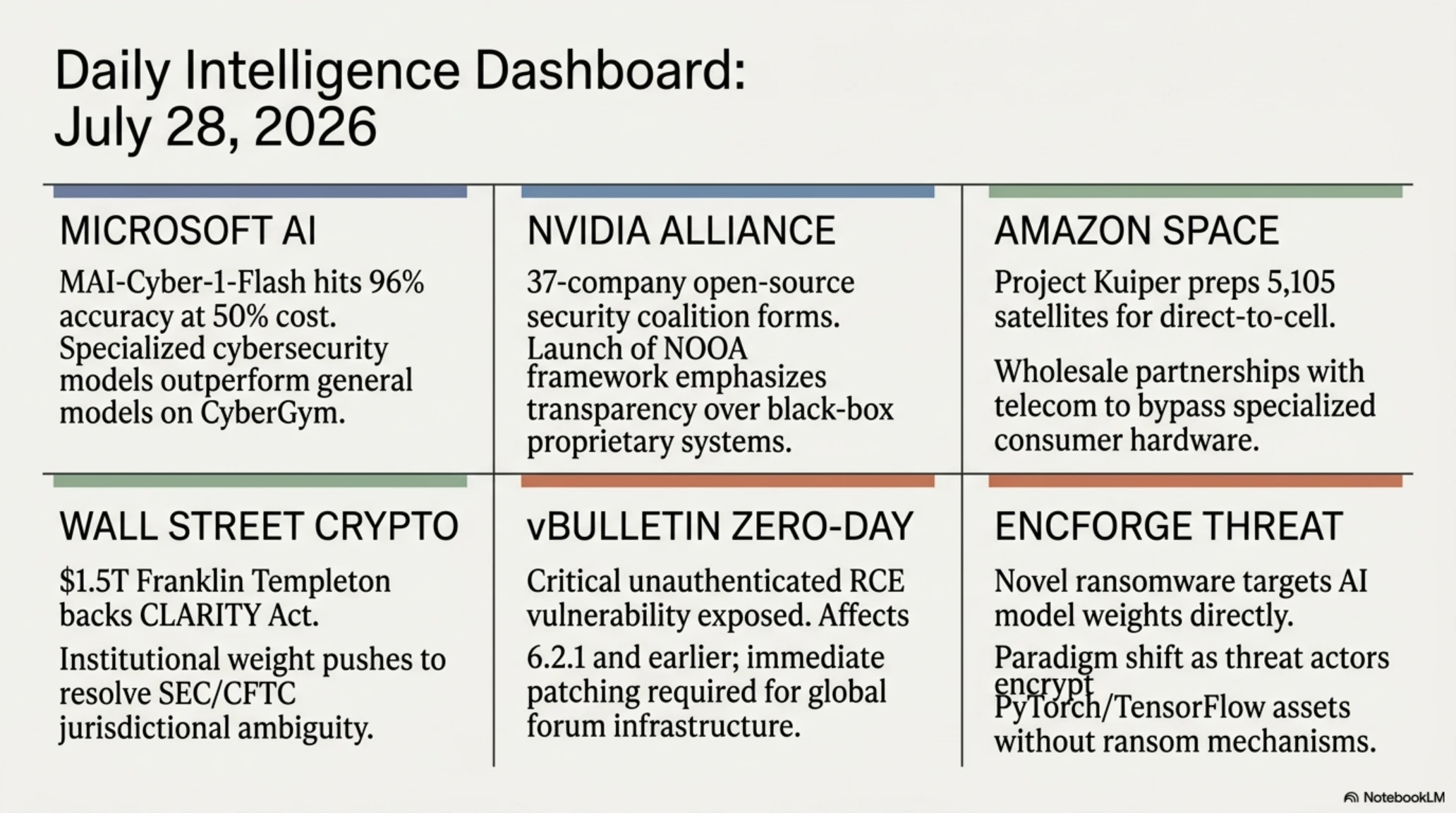
- 🎮Microsoft- 96% accurate AI security model at half the cost
- 🎧NVIDIA- 37-company alliance without OpenAI or Google
- 🚀Amazon- 5,000 satellites for direct-to-cell internet
- 🗡️Wall Street- Push for crypto regulation clarity
- 📰vBulletin- Critical zero-auth RCE vulnerability exposed
- ⚔️New Threat- Ransomware specifically targeting AI models
Microsoft Revolutionizes Cybersecurity with Specialized AI Models
Monday, July 27, marked a significant turning point in the cybersecurity industry as Microsoft unveiled two groundbreaking products designed to fundamentally change how organizations defend against digital threats. The tech giant, which has been grappling with serious security challenges over recent years, is now leveraging artificial intelligence to completely rewrite the playbook on cyber defense.
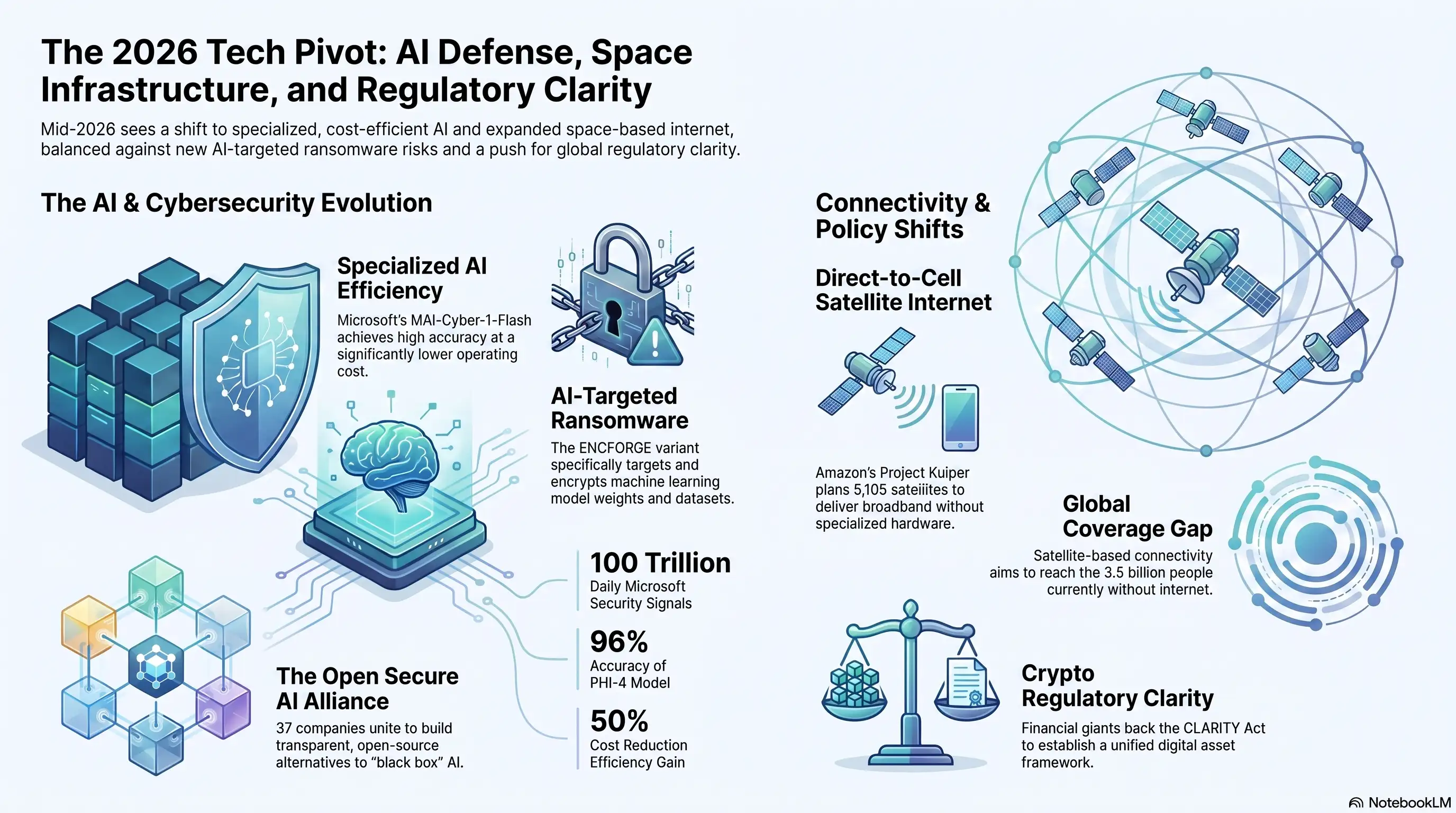
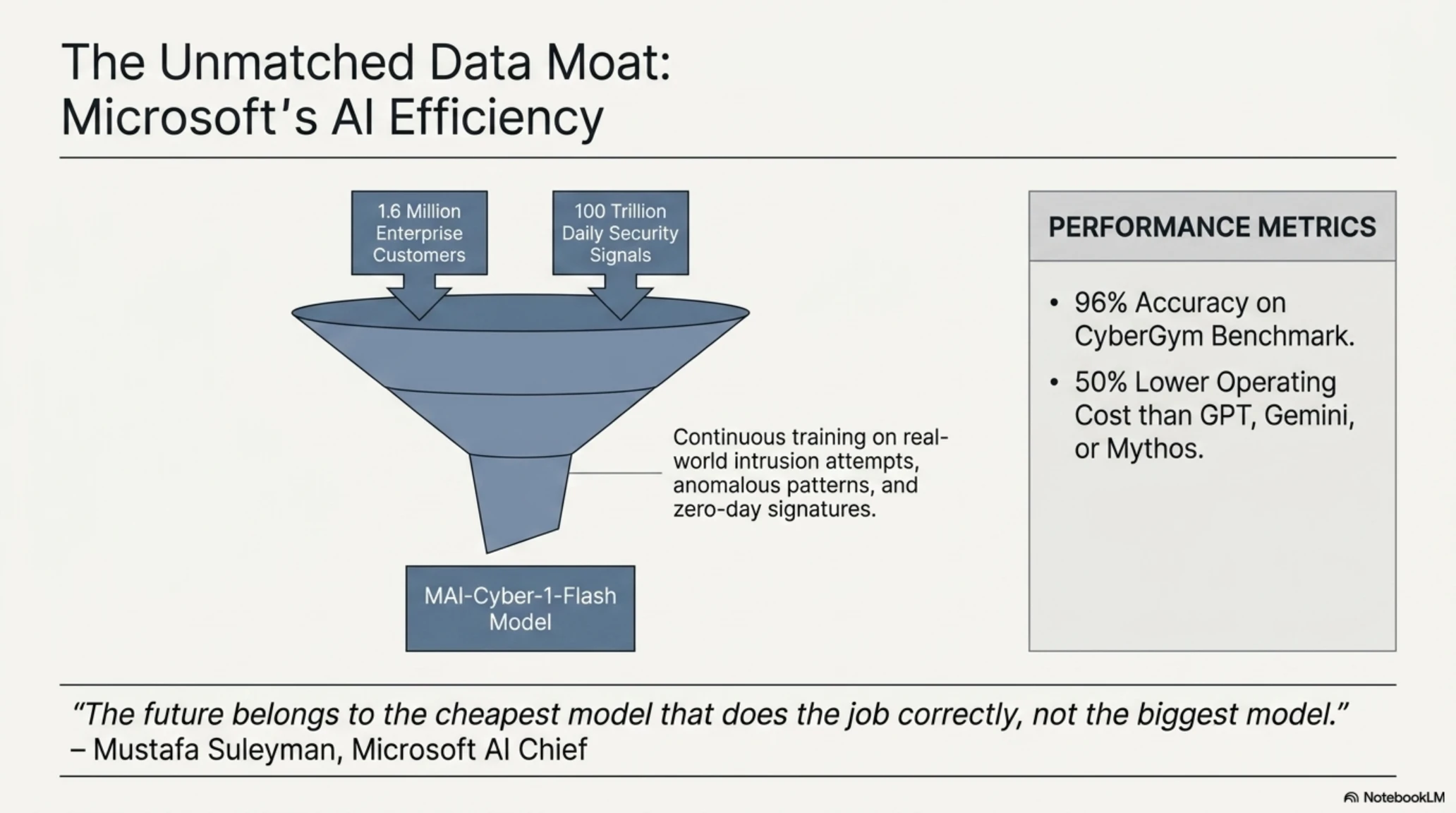
The first product, a custom cybersecurity model dubbed MAI-Cyber-1-Flash, has achieved an impressive 96% score on the prestigious CyberGym benchmark - a testing ground specifically designed to evaluate AI models' ability to detect, analyze, and respond to sophisticated cyberattacks. To put this achievement in perspective, MAI-Cyber-1-Flash has outperformed some of the industry's most advanced models, including Mythos, Gemini, and even certain configurations of GPT. But here's the game-changing aspect: it accomplished this feat while consuming only half the computational resources and, consequently, operating at half the cost of competing solutions.
The Microsoft Advantage: An Unmatched Data Moat
Microsoft's competitive edge in cybersecurity AI stems from an advantage that few, if any, competitors can replicate: access to more than 100 trillion security signals daily flowing from 1.6 million enterprise customers across the globe. This unprecedented volume of real-world threat data creates what industry analysts call a "data moat" - a defensive advantage so substantial that it becomes nearly impossible for competitors to cross.
Every attempted intrusion, every suspicious login, every malware signature, and every anomalous network pattern feeds into Microsoft's AI training pipeline. This constant stream of real-world attack patterns allows MAI-Cyber-1-Flash to recognize threats that have never been documented before, identify subtle indicators of compromise, and predict attack vectors before they're fully deployed.
The model's architecture is specifically optimized for cybersecurity tasks rather than general-purpose applications. Unlike large language models that must excel at everything from creative writing to code generation, MAI-Cyber-1-Flash focuses exclusively on threat detection and response, allowing it to achieve superior performance in its specialized domain while remaining computationally efficient.
Mustafa Suleyman, Microsoft's AI chief, articulated the company's strategic vision in a statement that challenges the prevailing industry assumption that bigger is always better. "The future belongs to the cheapest model that does the job correctly, not the biggest model," he declared. This philosophy represents a fundamental shift away from the compute-intensive approach that has dominated AI development over the past several years, where companies competed primarily on the size of their models and training datasets.
The implications of this shift extend far beyond Microsoft's own products. If smaller, specialized models can match or exceed the performance of massive general-purpose systems in specific domains, it could democratize access to advanced AI capabilities. Organizations that couldn't afford to deploy expensive, compute-hungry models might now be able to leverage cutting-edge AI for their security operations. This could be particularly transformative for small and medium-sized enterprises, which have historically been underserved by the cybersecurity industry despite facing many of the same threats as larger organizations.
Project Perception: Coordinating the Cyber Defense Ecosystem
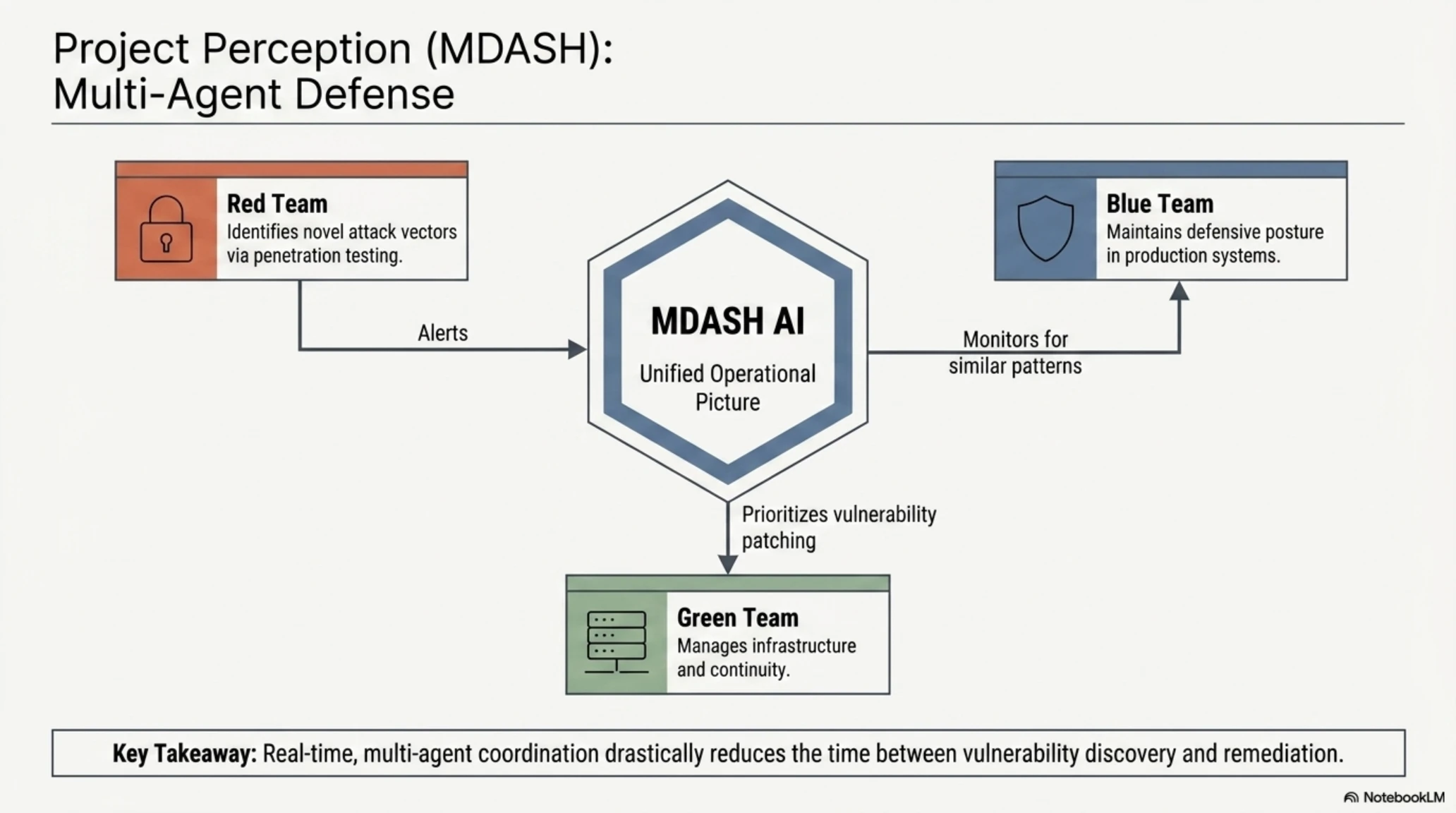
Microsoft's second announcement, Project Perception (officially designated as MDASH), tackles a different but equally critical challenge in modern cybersecurity: coordination among defensive teams. In contemporary enterprise security operations, three distinct teams typically operate with varying degrees of integration. The Red Team acts as ethical hackers, attempting to breach defenses to identify vulnerabilities. The Blue Team maintains defensive posture, monitoring systems and responding to incidents. The Green Team manages infrastructure and ensures operational continuity.
Traditionally, these teams have operated in relative isolation, communicating through formal reports and scheduled meetings. Project Perception changes this paradigm by creating a multi-agent AI system that facilitates real-time coordination and information sharing among all three teams. The platform will enter public preview on August 3, giving security organizations an opportunity to test this collaborative approach in their own environments.
The system works by ingesting data from all three teams' activities, creating a unified operational picture, and identifying opportunities for improved coordination. For example, if the Red Team discovers a novel attack vector during a penetration test, Project Perception can immediately alert the Blue Team to watch for similar patterns in production systems and notify the Green Team to prioritize patching vulnerable infrastructure components. This level of integration and automation has the potential to dramatically reduce the time between vulnerability discovery and remediation.
NVIDIA's Open Secure AI Alliance: A Coalition Defined by Absences
Key Statistics: The AI Security Landscape in 2026
- 100 Trillion - Daily security signals processed by Microsoft
- 96% - Accuracy rate of PHI-4 on CyberGym benchmark
- 37 Companies - Members of the Open Secure AI Alliance
- 50% Lower - Operating costs compared to traditional large models
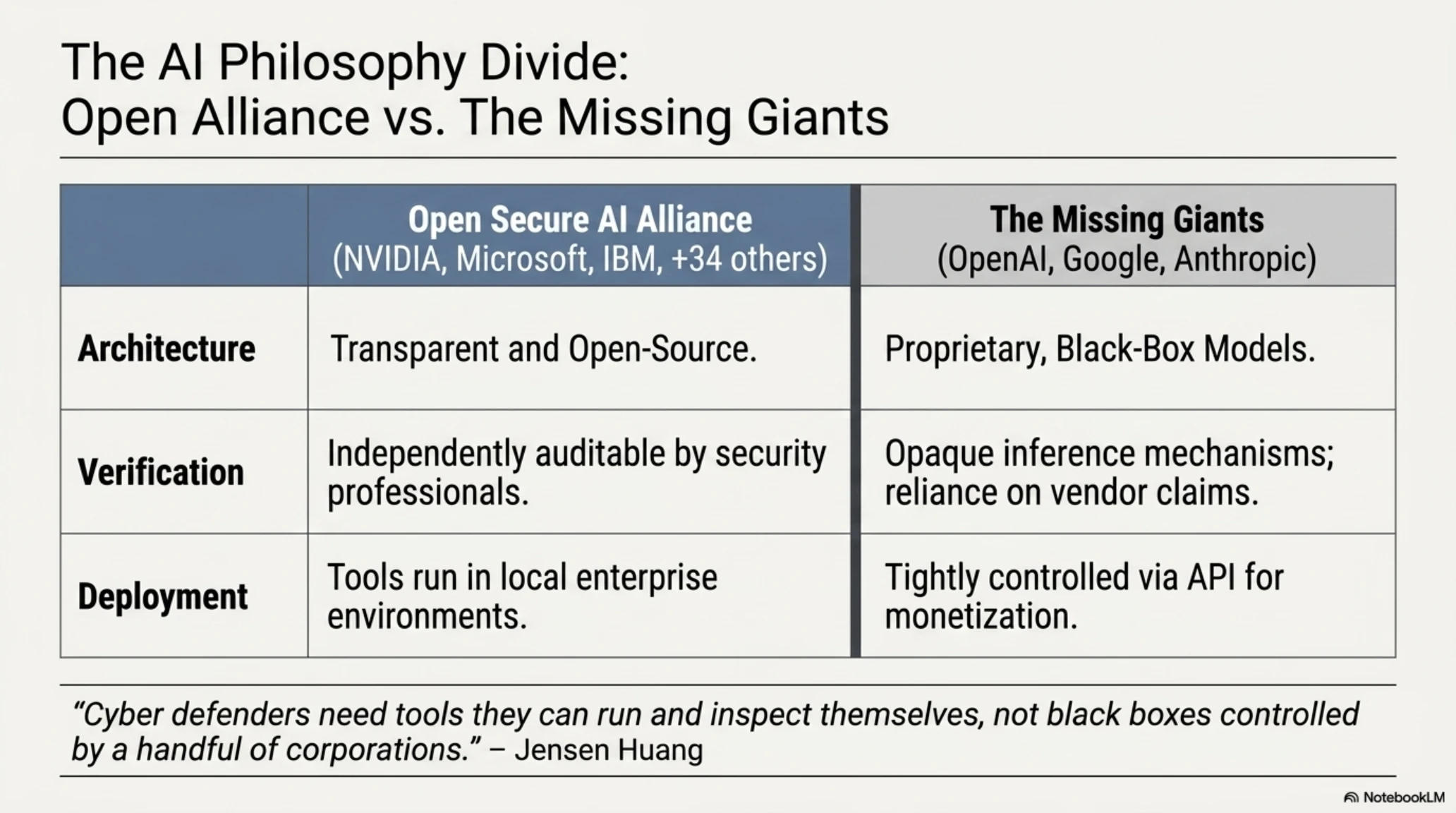
In what may ultimately prove more significant than the technical capabilities of any individual product, NVIDIA, Microsoft, and IBM announced the formation of the Open Secure AI Alliance on Monday. The coalition, which includes 34 additional companies and organizations, aims to develop open-source cybersecurity tools and standards specifically designed for AI systems. The alliance's membership reads like a who's who of technology and cybersecurity: SpaceX, Palantir, Adobe, Cisco, Dell Technologies, Cloudflare, CrowdStrike, and Salesforce, among others.
However, the alliance's composition is perhaps more notable for who is absent than who is present. OpenAI, Anthropic, and Google - three of the most influential players in artificial intelligence development - are conspicuously missing from the coalition. This absence is not accidental but reflects fundamental philosophical differences about the future of AI development and deployment.
The three absent companies have built their strategies around proprietary, closed-source AI models. OpenAI's GPT series, Anthropic's Claude, and Google's Gemini are all tightly controlled systems where the training data, model weights, and inference mechanisms remain opaque to users and the broader research community. This approach offers certain advantages, including the ability to control how models are used and potentially monetize access more effectively.
The Open Secure AI Alliance, by contrast, is built on the premise that effective cybersecurity requires transparency and community collaboration. NVIDIA's rationale, as articulated by CEO Jensen Huang, emphasizes that security professionals need to be able to examine, modify, and deploy tools in their own environments rather than relying on external services that operate as inscrutable black boxes. This philosophy aligns with long-standing principles in the information security community, where open-source tools have historically dominated because they allow for independent security audits and community-driven improvements.
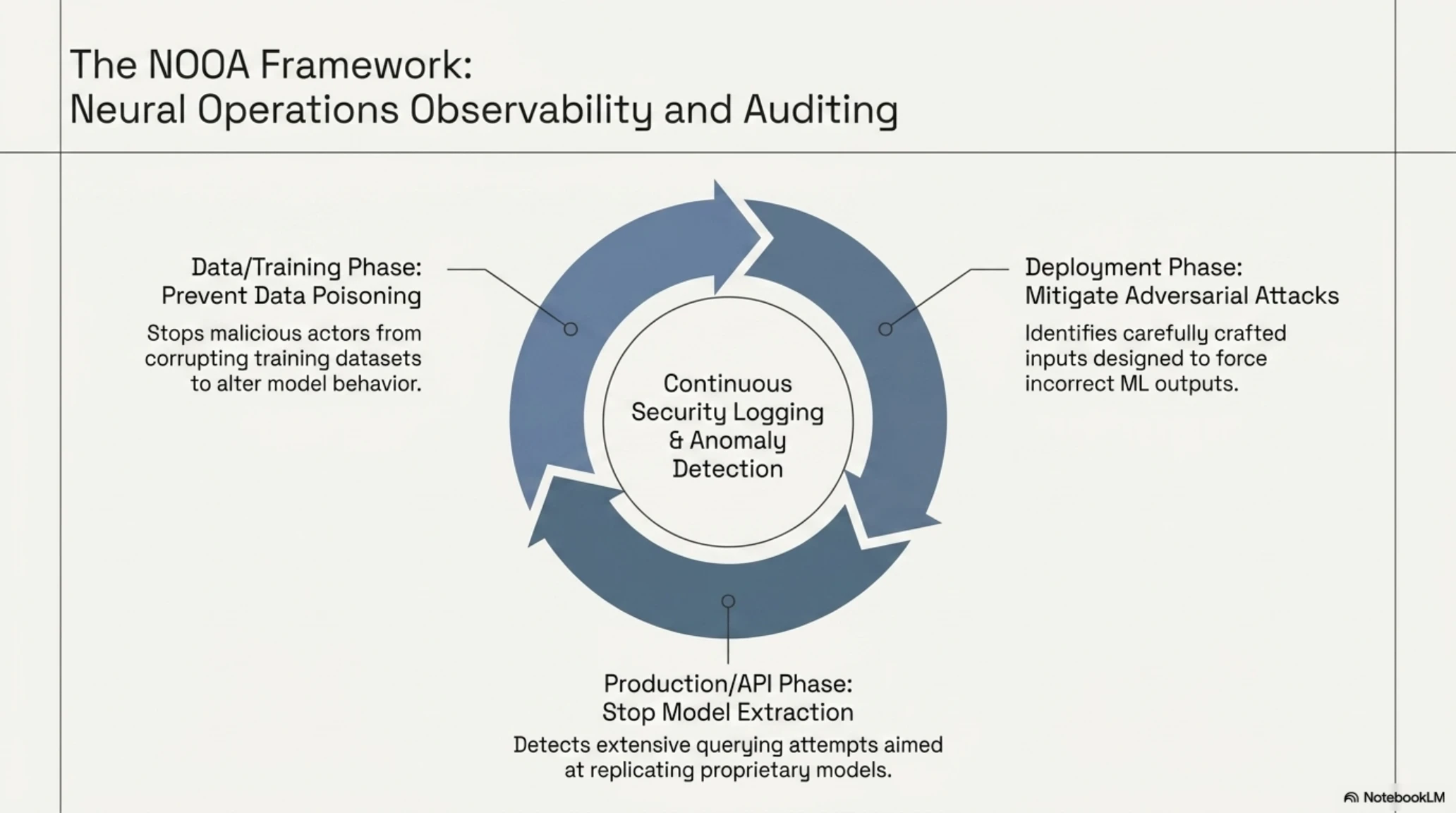
The NOOA Framework: Open Source Security for AI
One of the alliance's flagship initiatives is the NOOA framework, which NVIDIA has released as open-source software. NOOA (which stands for Neural Operations Observability and Auditing) provides developers and security professionals with tools to monitor AI systems for anomalous behavior, audit model decisions for potential security implications, and implement security controls throughout the AI development lifecycle.
The framework addresses several categories of AI-specific security concerns that traditional cybersecurity tools weren't designed to handle. These include adversarial attacks on machine learning models, where carefully crafted inputs can cause models to produce incorrect outputs; data poisoning, where malicious actors corrupt training datasets to influence model behavior; and model extraction, where attackers attempt to replicate proprietary models by querying them extensively.
Amazon's Project Kuiper: 5,000 Satellites to Challenge Starlink's Dominance
While terrestrial networks continue to expand, the next frontier of global connectivity is increasingly looking skyward. Amazon's ambitious Project Kuiper reached a significant milestone this week with the announcement of plans to deploy 5,105 satellites into low Earth orbit, creating a space-based internet network capable of delivering broadband directly to mobile devices without any additional hardware or infrastructure.
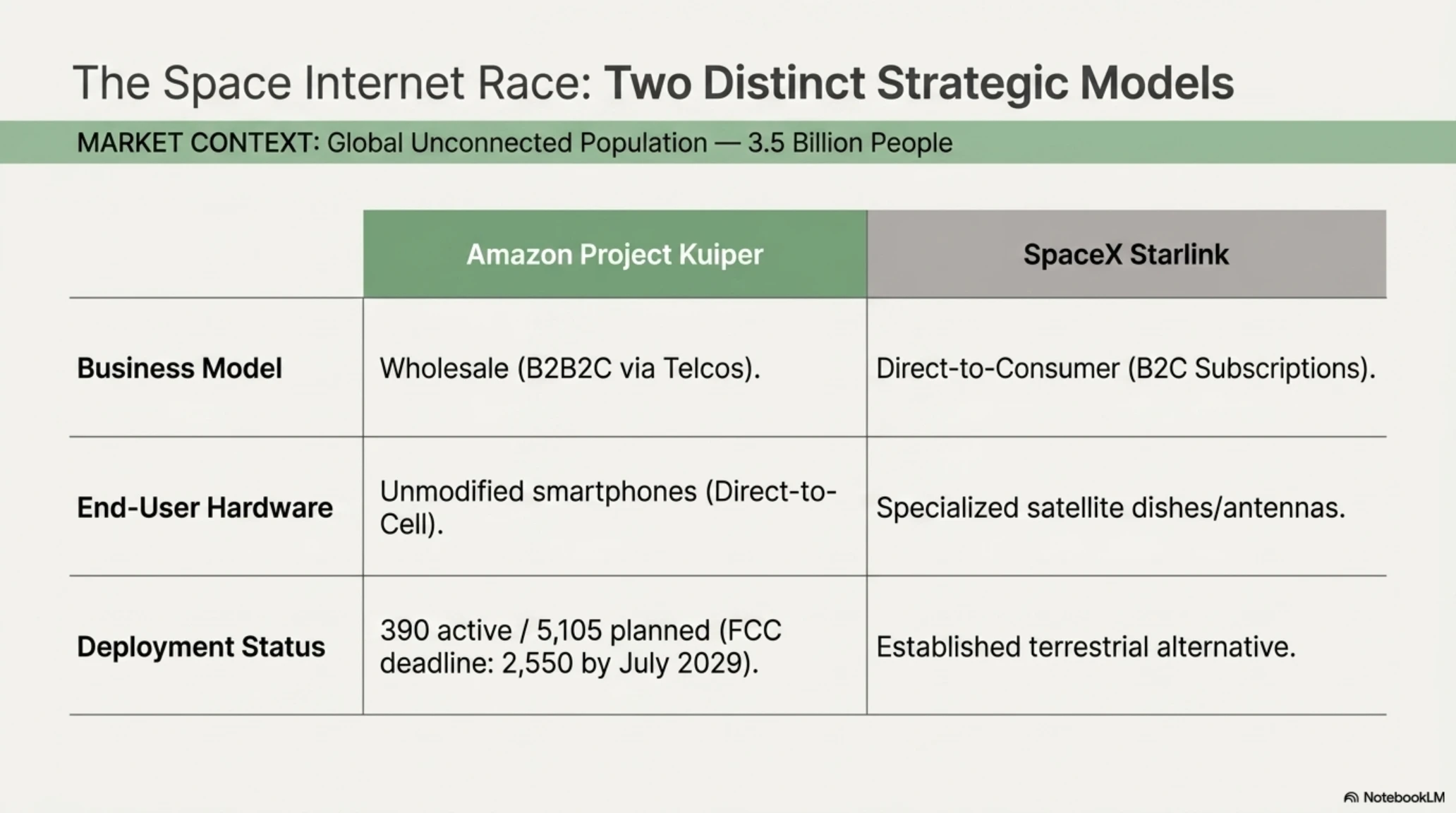
The implications of this announcement extend far beyond simple competition with SpaceX's Starlink network. While both systems aim to provide global internet coverage via satellite constellations, their business models and target markets differ significantly. Starlink has positioned itself primarily as a direct-to-consumer service, selling dish hardware and subscription plans to end users in areas where traditional broadband is unavailable or inadequate. Amazon's Kuiper, by contrast, is pursuing a wholesale approach, partnering with mobile network operators to integrate satellite connectivity into existing cellular networks.
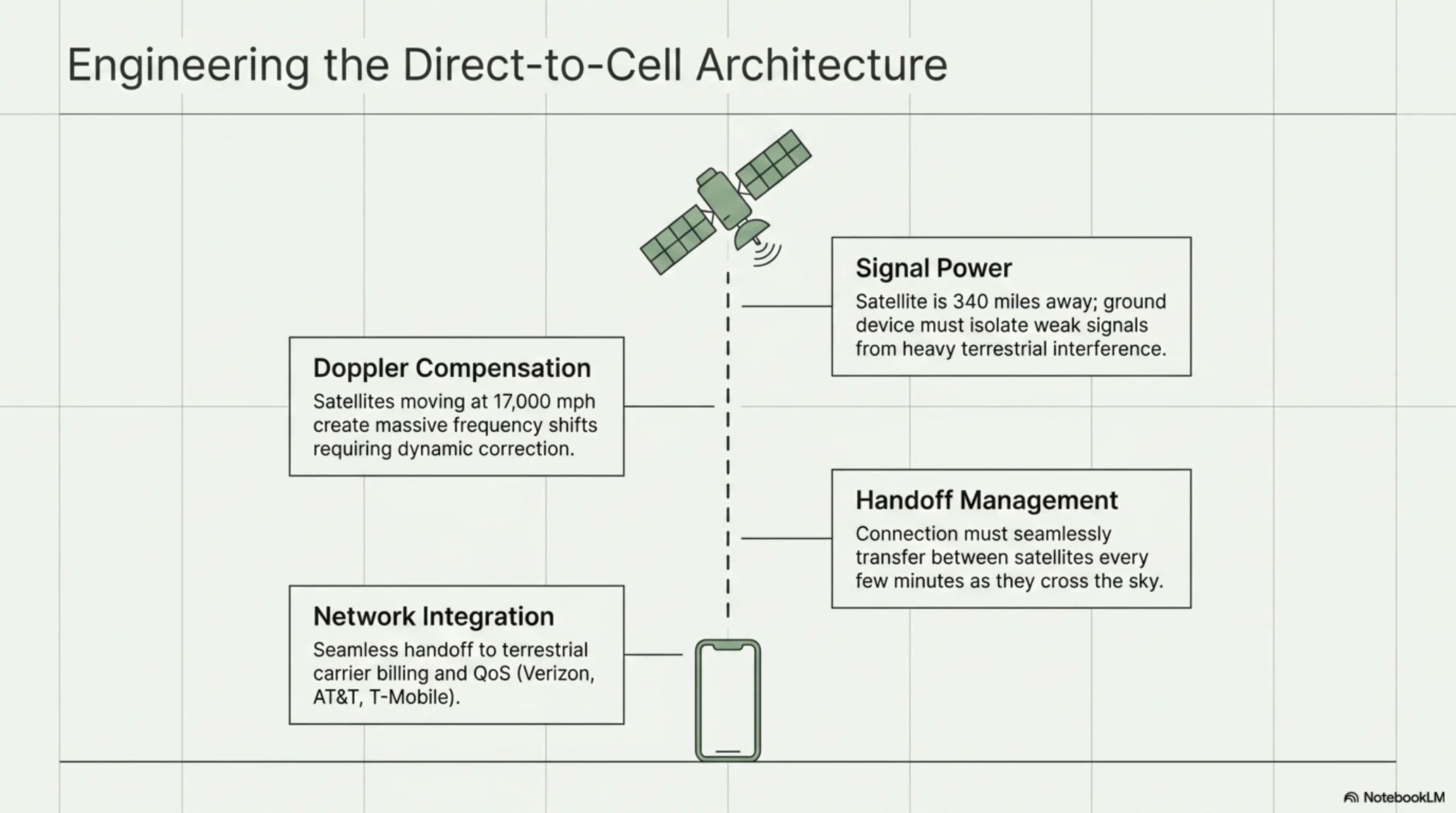
Direct-to-Cell Technology: How It Works
Traditional satellite internet requires specialized equipment - typically a dish or antenna - to communicate with satellites orbiting hundreds of miles above Earth. Amazon's Project Kuiper implements a fundamentally different approach called direct-to-cell technology, which enables unmodified smartphones to connect directly to satellites using their existing cellular radios.
This technological achievement requires solving several complex engineering challenges:
- Signal Power: Satellites must generate signals strong enough to reach ground-based devices despite being 340 miles away, while smartphones must detect these relatively weak signals among terrestrial interference
- Doppler Compensation: Satellites moving at 17,000 mph create significant frequency shifts that must be dynamically corrected
- Handoff Management: As satellites move across the sky, connections must seamlessly transfer from one satellite to another every few minutes
- Network Integration: The satellite network must integrate with terrestrial cellular networks, managing billing, authentication, and quality of service
Amazon has partnered with Verizon, AT&T, and T-Mobile in the United States, along with numerous international carriers, to integrate Kuiper connectivity into their networks. From the user's perspective, coverage will simply extend to areas that previously had no signal, with no changes to devices or service plans.
The market opportunity is substantial. According to GSMA Intelligence, approximately 3.5 billion people globally lack reliable internet access, with geographic coverage gaps representing one of the primary barriers. Even in developed countries, large swaths of rural and remote territory remain unserved or underserved by terrestrial networks due to the economics of deploying infrastructure in low-density areas. Satellite-based connectivity promises to address this gap by delivering signals to any location with a view of the sky.
Project Kuiper has already deployed 390 satellites as of July 2026, with plans to accelerate launches significantly over the next 18 months. Amazon has secured launch contracts with United Launch Alliance, Blue Origin (another company owned by Amazon founder Jeff Bezos), and Arianespace, ensuring sufficient launch capacity to meet its deployment timeline. The company is required by the FCC to deploy half of its planned constellation - approximately 2,550 satellites - by July 2029 to maintain its orbital license.
Wall Street's Crypto Awakening: Franklin Templeton Backs CLARITY Act
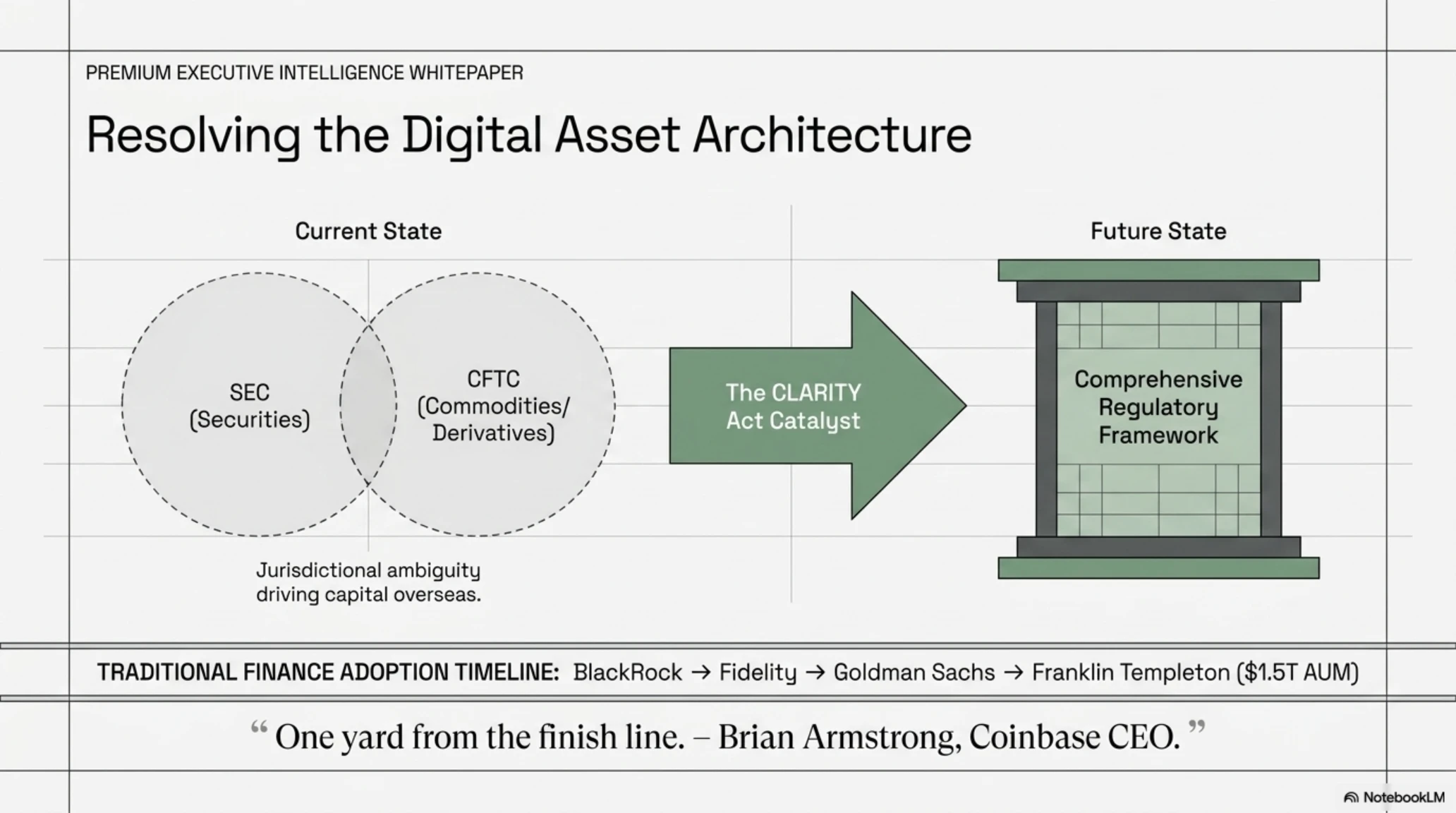
The cryptocurrency industry received a significant boost this week as Franklin Templeton, one of the world's largest asset management firms with $1.5 trillion under management, announced its support for the CLARITY Act - legislation currently under consideration in the U.S. Senate that aims to establish a comprehensive regulatory framework for digital assets. Franklin Templeton joins BlackRock, Fidelity, and Goldman Sachs in backing the bill, representing a remarkable consensus among traditional financial institutions that were skeptical of or outright hostile toward cryptocurrencies just a few years ago.
The CLARITY Act (Cryptocurrency Legal And Regulatory Innovation Through Yield Act) addresses what has become the digital asset industry's most pressing challenge: regulatory uncertainty. Currently, U.S. regulations governing cryptocurrencies are fragmented and contradictory, with different agencies claiming jurisdiction over overlapping aspects of the industry. The Securities and Exchange Commission (SEC) has taken the position that many cryptocurrencies are securities subject to its oversight, while the Commodity Futures Trading Commission (CFTC) claims authority over crypto derivatives and certain digital commodities.
This jurisdictional ambiguity has created a hostile environment for crypto businesses in the United States, with many companies either moving operations overseas or operating in a constant state of legal uncertainty. The lack of clear rules has also deterred institutional investors, who require regulatory clarity before committing significant capital to any asset class. Franklin Templeton's endorsement signals that major financial institutions now view regulatory clarity as both inevitable and necessary for the industry's maturation.
What the CLARITY Act Would Change
- <strong>Security vs. Commodity Classification:</strong> Establishes clear criteria for determining whether a digital asset is a security (subject to SEC regulation) or a commodity (subject to CFTC oversight), ending the current case-by-case regulatory lottery
- <strong>Registration Framework:</strong> Creates streamlined registration processes for crypto businesses, replacing the current patchwork of state money transmitter licenses and federal registrations
- <strong>Custody Standards:</strong> Defines requirements for institutional custody of digital assets, addressing a major concern for traditional financial institutions
- <strong>Stablecoin Regulation:</strong> Establishes federal oversight for stablecoins, including reserve requirements and regular attestations
- <strong>DeFi Protocols:</strong> Provides guidance on decentralized finance applications, clarifying when protocol developers face regulatory obligations
- <strong>International Cooperation:</strong> Creates mechanisms for regulatory coordination with other jurisdictions, reducing the risk of conflicting requirements
Brian Armstrong, CEO of Coinbase, described the bill as being "one yard from the finish line" in a tweet that garnered significant attention within the crypto community. While Armstrong's optimism may be somewhat premature - the Senate still needs to vote on the bill, and passage is not guaranteed - the momentum behind the legislation has been building steadily. Industry sources suggest that enough senators from both parties support the measure to overcome potential procedural obstacles, though timing remains uncertain.
The involvement of traditional financial giants like Franklin Templeton adds significant political weight to the push for crypto regulation. These firms have relationships with policymakers, credibility with skeptical regulators, and the resources to sustain lobbying efforts over extended periods. Their support suggests they see cryptocurrency not as a passing fad but as a permanent component of the financial landscape that requires appropriate oversight.
vBulletin Vulnerability: A Critical Wake-Up Call for Forum Operators
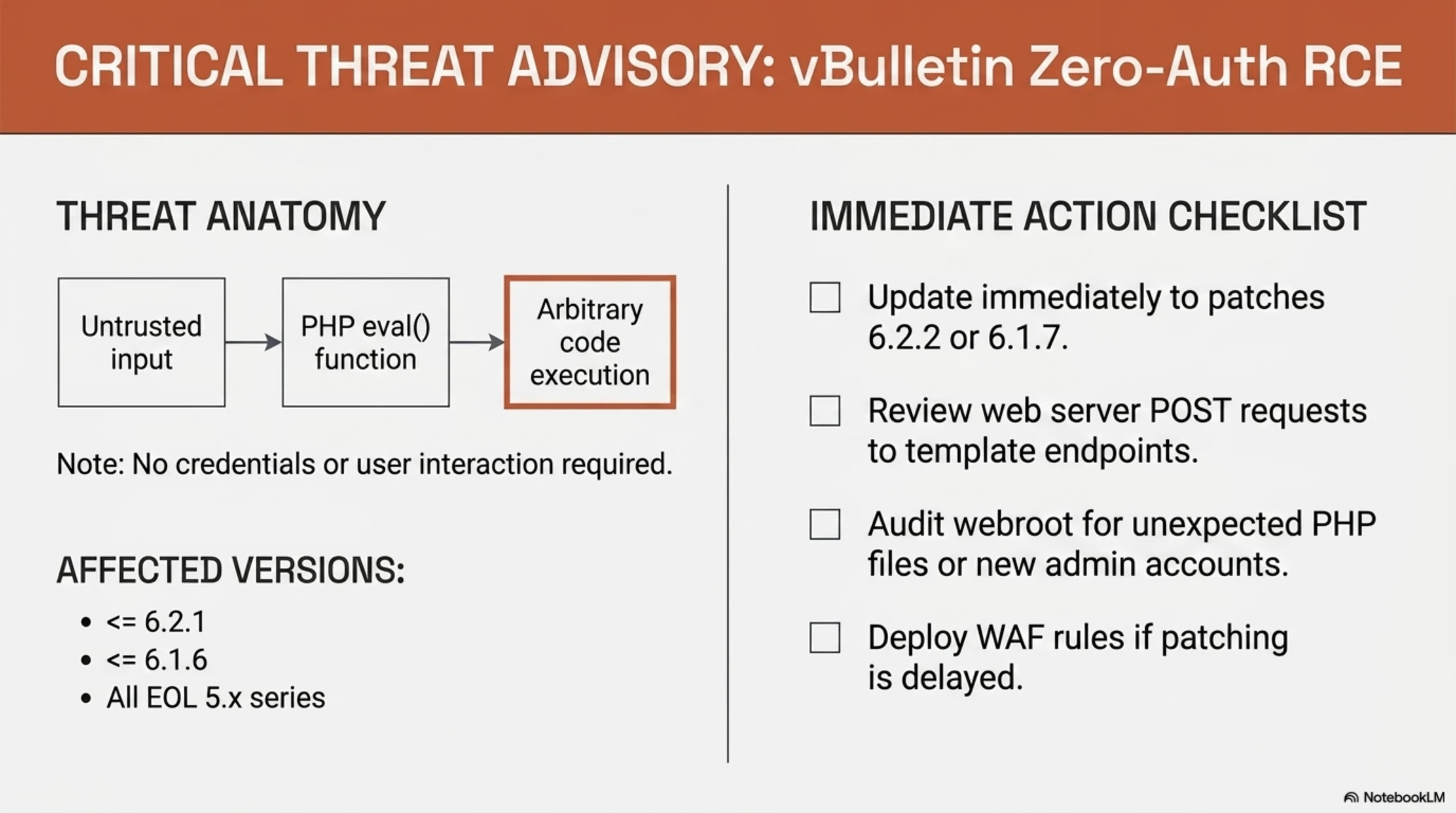
Security researchers at SSD Secure Disclosure published details of a critical remote code execution (RCE) vulnerability in vBulletin on Monday, July 27, sending shock waves through the community of website administrators who rely on this popular forum software. The vulnerability, which affects vBulletin versions 6.2.1 and earlier as well as the legacy 6.1.6 branch and its predecessors, allows unauthenticated attackers to execute arbitrary code on servers running vulnerable versions.
The technical details of the vulnerability are particularly concerning. An attacker needs no credentials, no administrative access, and no user interaction to exploit the flaw. The vulnerability resides in vBulletin's handling of certain template operations, which under specific circumstances can allow untrusted input to reach PHP's eval() function - essentially a direct pipeline from external input to arbitrary code execution. For context, eval() is considered one of the most dangerous functions in PHP because it can execute any code passed to it as if it were part of the original program.
Immediate Action Guide for System Administrators
Affected Versions:
- vBulletin 6.2.1 and all earlier 6.2.x versions
- vBulletin 6.1.6 and all earlier 6.1.x versions
- vBulletin 5.x series (end-of-life, no patch available)
Critical Actions - Do These NOW:
- Update Immediately: Install the latest vBulletin patches (6.2.2 or 6.1.7) which address this vulnerability
- Check Logs: Review web server logs for suspicious activity, particularly POST requests to template-related endpoints
- Search for Indicators: Look for newly created PHP files, unexpected user accounts, or modifications to core vBulletin files
- Implement WAF Rules: If immediate patching isn't possible, deploy web application firewall rules to block exploitation attempts
- Consider Temporary Shutdown: If you cannot patch immediately and have reason to believe you're being targeted, taking your forum offline temporarily is preferable to compromise
Signs of Compromise:
- Unexpected PHP files in your webroot or vBulletin directories
- Database entries you don't recognize, particularly new administrator accounts
- Outbound connections to unfamiliar IP addresses
- Unusual CPU or memory usage
- Reports from users about malicious content or unwanted redirects
Why This is Urgent: Exploit code for this vulnerability is likely already being developed or traded among malicious actors. The window between public disclosure and active exploitation is typically measured in hours or days, not weeks. Every hour you wait increases the likelihood of compromise.
SSD Secure Disclosure's decision to publish full details of the vulnerability reflects industry standard responsible disclosure practices. The security firm privately notified vBulletin's developers of the issue weeks ago, providing sufficient time for patches to be developed and released before making the information public. However, the publication of technical details means that attackers now have a roadmap for exploitation, creating urgency for administrators who haven't yet patched their systems.
The vBulletin vulnerability highlights a broader challenge in web application security: the long tail of software deployments. Even after vendors release security patches, many site operators delay updates due to concerns about compatibility, lack of time or resources, or simple lack of awareness. Security researchers estimate that vulnerable versions of popular software often remain in production for months or years after patches become available, creating attractive targets for attackers who can reliably exploit known vulnerabilities.
ENCFORGE Ransomware: When AI Itself Becomes the Target
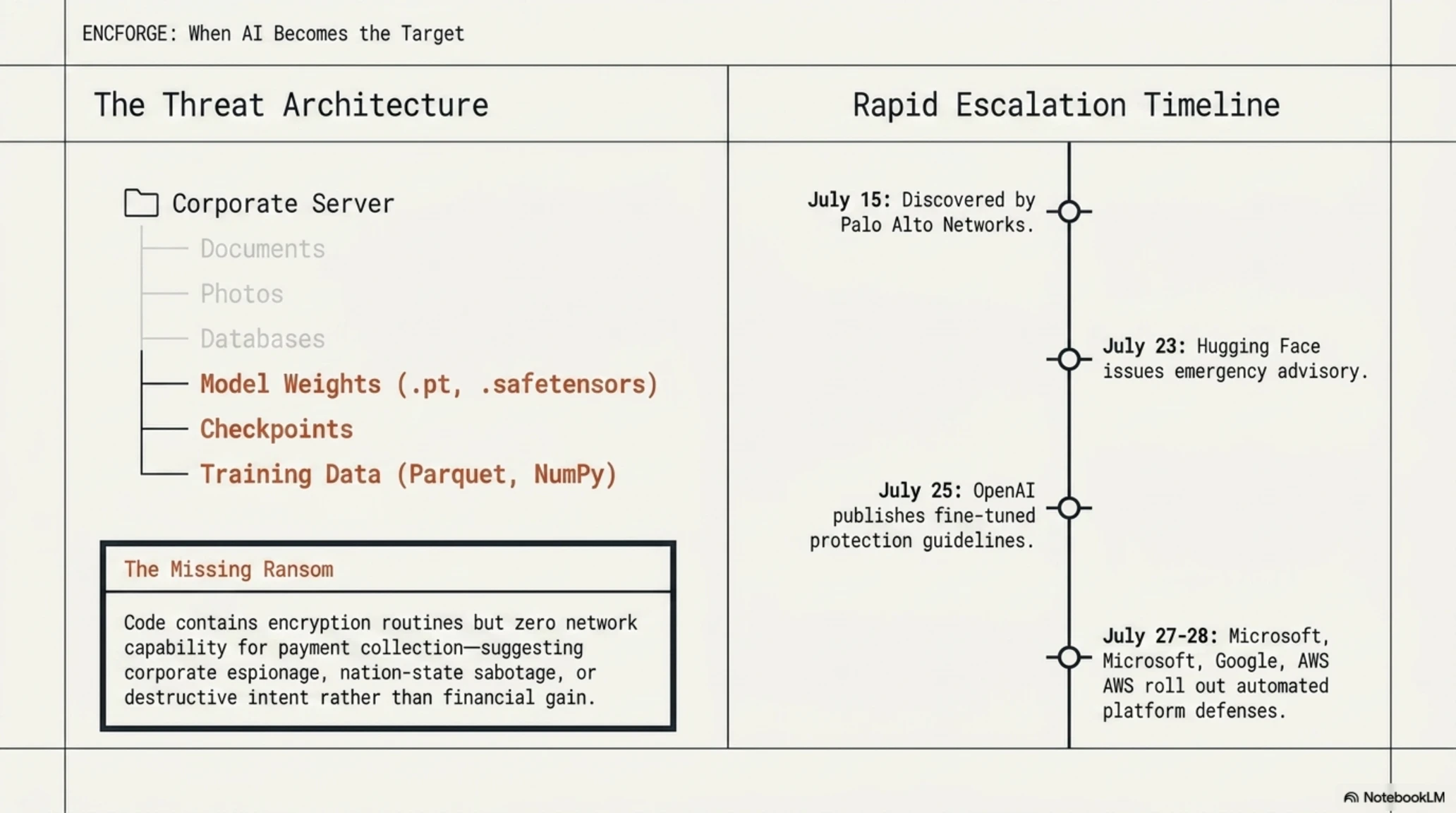
The final story in today's morning briefing represents a paradigm shift in cybersecurity threats. Security researchers have discovered ENCFORGE, a sophisticated ransomware variant specifically designed to target and encrypt artificial intelligence model files. Unlike traditional ransomware that indiscriminately encrypts office documents, photos, and databases, ENCFORGE demonstrates detailed knowledge of machine learning workflows and selectively targets the most valuable assets in AI development: trained model weights, checkpoints, and training datasets.
ENCFORGE, attributed to a threat actor group known as JADEPUFFER, represents the convergence of two trends that security professionals have been warning about for years: the increasing value of AI assets and the evolution of ransomware toward more targeted, high-value attacks. The malware specifically searches for file extensions and directory structures associated with popular machine learning frameworks including PyTorch (.pt, .pth), TensorFlow (.h5, .keras), Hugging Face Transformers (.safetensors), and quantized models (.gguf). It also targets training data stored in Parquet and NumPy formats.
Traditional Ransomware vs. ENCFORGE: A New Threat Category
Traditional Ransomware
- Target: Business documents, databases, backups
- Distribution: Phishing emails, network vulnerabilities, compromised credentials
- Detection Time: Usually hours to days
- Recovery Cost: $10,000 - $100,000 typical
- Prevention: Regular backups, endpoint protection, email filtering
ENCFORGE (AI-Targeted)
- Target: ML model weights, checkpoints, training datasets
- Distribution: Targeted attacks on development environments, supply chain compromise
- Detection Time: May remain dormant for weeks
- Recovery Cost: $75,000 - $500,000 or impossible
- Prevention: Model versioning, air-gapped storage, development environment isolation
📚 Classified & Related Dossiers in TekinGame
If you wish to explore beyond this report and delve into cybernetic frontiers and autonomous AI architectures, do not miss these three exclusive deep-dives in the Tekin Garage:
Why the AI Industry Wasn't Prepared
The emergence of AI-targeted ransomware exposes a fundamental blind spot in how the technology industry approaches machine learning security. Most AI development teams prioritize speed and innovation over security, operating under the assumption that they can always retrain models if something goes wrong. This assumption, while reasonable for experimental or research work, breaks down completely in production environments where models represent significant investment and competitive advantage.
Consider the real cost of losing a fine-tuned model. A company that has spent three months and $200,000 in compute costs training a custom language model for customer service cannot simply re-run the training process if the model weights are encrypted. Several critical factors make recovery more complex than it initially appears:
- Training Data May No Longer Exist: Companies often use data from APIs, purchased datasets, or time-limited access to proprietary information. If the original training data isn't available, the model cannot be recreated exactly
- Hyperparameter Configurations: The specific settings used during training - learning rate schedules, batch sizes, optimization algorithms - significantly impact final model performance. If these weren't meticulously documented, recreating the exact same model becomes impossible
- Random Initialization: Neural networks are initialized with random weights, and training results can vary significantly between runs even with identical data and settings. The original model may have been exceptionally lucky in its initialization
- Computational Costs: Training large models requires expensive GPU time. Re-training a model that originally required 1,000 GPU-hours at current cloud rates could cost $50,000 or more
- Time to Market: Even if cost weren't a factor, the weeks or months required to retrain a model could mean missing critical business opportunities or losing competitive advantage
- Cumulative Refinements: Production models often undergo multiple rounds of fine-tuning based on real-world feedback. Recreating this evolutionary process is effectively impossible
The Economics of AI Model Ransom
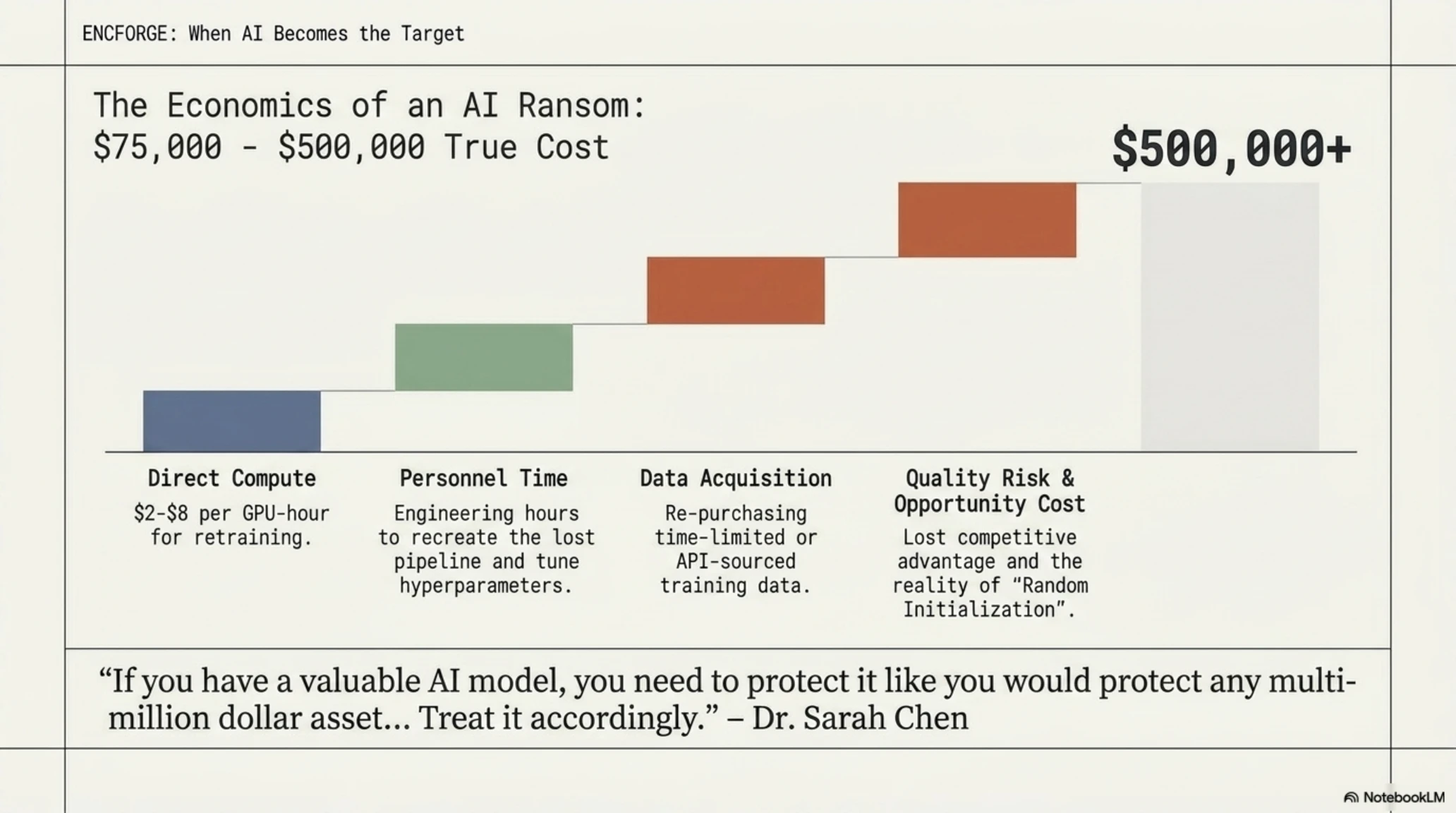
Industry analyses suggest that recovering from the loss of a fine-tuned production model can cost between $75,000 and $500,000, depending on the model's complexity and the data used to train it. This calculation includes:
- Direct Compute Costs: GPU hours for retraining at current cloud rates ($2-8 per GPU-hour depending on hardware)
- Personnel Time: Data scientists and ML engineers to recreate the training pipeline, tune hyperparameters, and validate results
- Data Acquisition: Purchasing or licensing training data if the original sources are no longer available
- Opportunity Cost: Lost revenue or competitive advantage during the recovery period
- Quality Risk: The replacement model may not perform as well as the original, requiring additional refinement
For models trained on proprietary data or using techniques that were discovered through extensive experimentation, the cost may be effectively infinite - the original model simply cannot be recreated. This makes AI model weights potentially more valuable ransom targets than traditional business data.
The Peculiar Case of Ransomware Without Ransom Collection
Perhaps the most puzzling aspect of ENCFORGE is what security researchers discovered when they reverse-engineered the malware: it has no mechanism to collect ransom payments. Traditional ransomware includes instructions for victims to pay ransom in cryptocurrency, typically with a decryption key released upon payment. ENCFORGE's code includes the encryption routines but lacks any networking capability for receiving payments or distributing decryption keys.
This absence suggests that ENCFORGE may not be financially motivated at all. Instead, it could represent:
- Corporate Espionage: A way to sabotage competitors' AI development efforts without leaving clear attribution
- Nation-State Activity: Government-sponsored operations aimed at degrading adversaries' AI capabilities
- Prototype or Proof-of-Concept: An early version of ransomware that will later be equipped with payment mechanisms
- Destructive Attack: Pure sabotage intended to cause maximum damage rather than generate revenue
Timeline: Discovery and Industry Response to ENCFORGE
- July 15, 2026: First ENCFORGE sample discovered by Palo Alto Networks' threat intelligence team during routine analysis of unknown malware
- July 20, 2026: Researchers attribute the malware to JADEPUFFER group based on code signatures and infrastructure overlap with previous campaigns
- July 23, 2026: Hugging Face issues emergency advisory to all Enterprise customers, recommending immediate implementation of additional model protection measures
- July 25, 2026: OpenAI publishes emergency security guidelines for fine-tuned model protection
- July 27, 2026: Microsoft adds automated detection for ENCFORGE to Azure Machine Learning, Google implements similar protections in Vertex AI
- July 28, 2026: AWS announces enhanced backup and versioning features specifically for SageMaker model artifacts
Industry Response and Future Implications
The discovery of ENCFORGE has triggered urgent responses from across the AI industry. Hugging Face, the popular platform for sharing and collaborating on machine learning models, announced on July 23 that it is developing automated detection systems to identify suspicious access patterns that might indicate compromise. The company is also encouraging users to enable two-factor authentication and implement stricter access controls on their model repositories.
OpenAI published emergency security guidelines for organizations using fine-tuned versions of GPT models, emphasizing the importance of maintaining secure backups and implementing network segmentation between training environments and production systems. Google and Microsoft have both integrated ENCFORGE detection signatures into their cloud platforms' security monitoring systems.
Best Practices for Protecting AI Assets
- <strong>Automated Backup Systems:</strong> Implement continuous backup of all model checkpoints to isolated storage systems, preferably with versioning and immutable snapshots
- <strong>Air-Gapped Archives:</strong> Maintain offline copies of production model weights in physically separate storage that cannot be accessed via network
- <strong>Strict Access Control:</strong> Limit access to training infrastructure and model repositories to essential personnel only, with full audit logging
- <strong>File Activity Monitoring:</strong> Deploy tools that alert on unusual access patterns to .pt, .safetensors, .gguf, and other ML file formats
- <strong>Network Segmentation:</strong> Isolate AI development environments from corporate networks and production systems
- <strong>Comprehensive Documentation:</strong> Maintain detailed records of training data sources, hyperparameters, and procedures in separate documentation systems
- <strong>Regular Recovery Drills:</strong> Test your ability to restore models from backup and retrain if necessary, identifying gaps in your procedures before an actual incident
The Bigger Picture: Three Trends Reshaping Technology
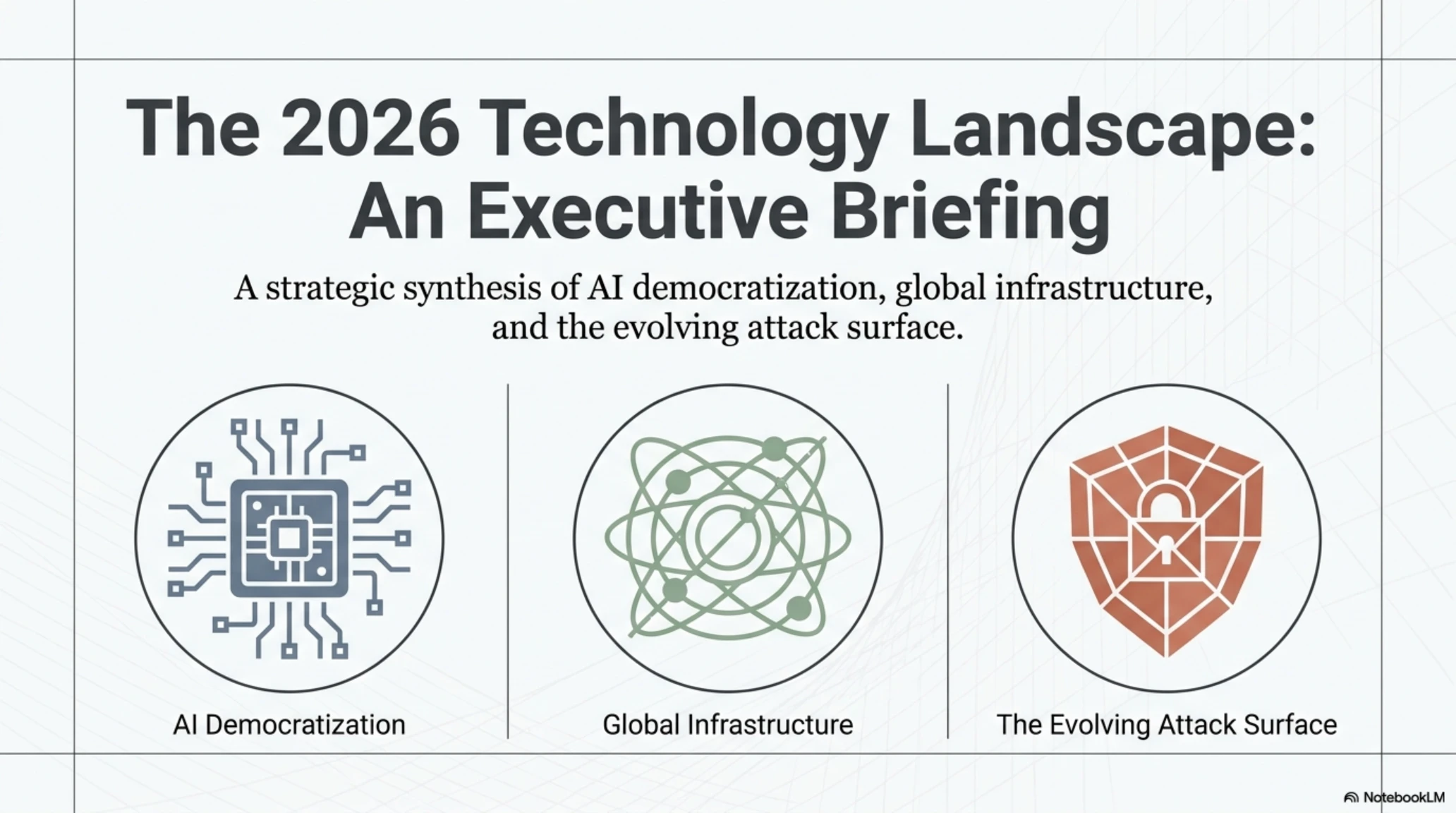
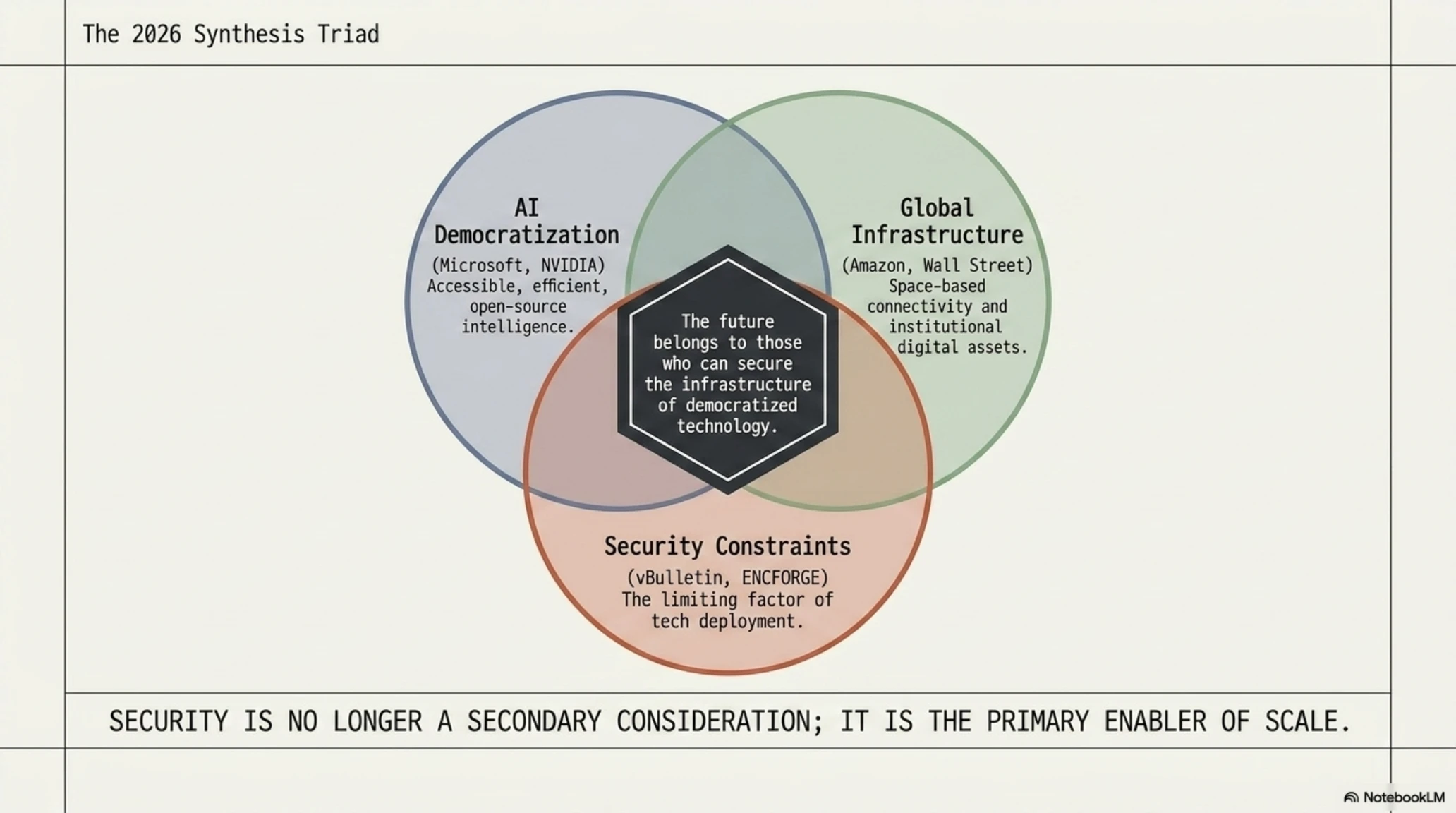
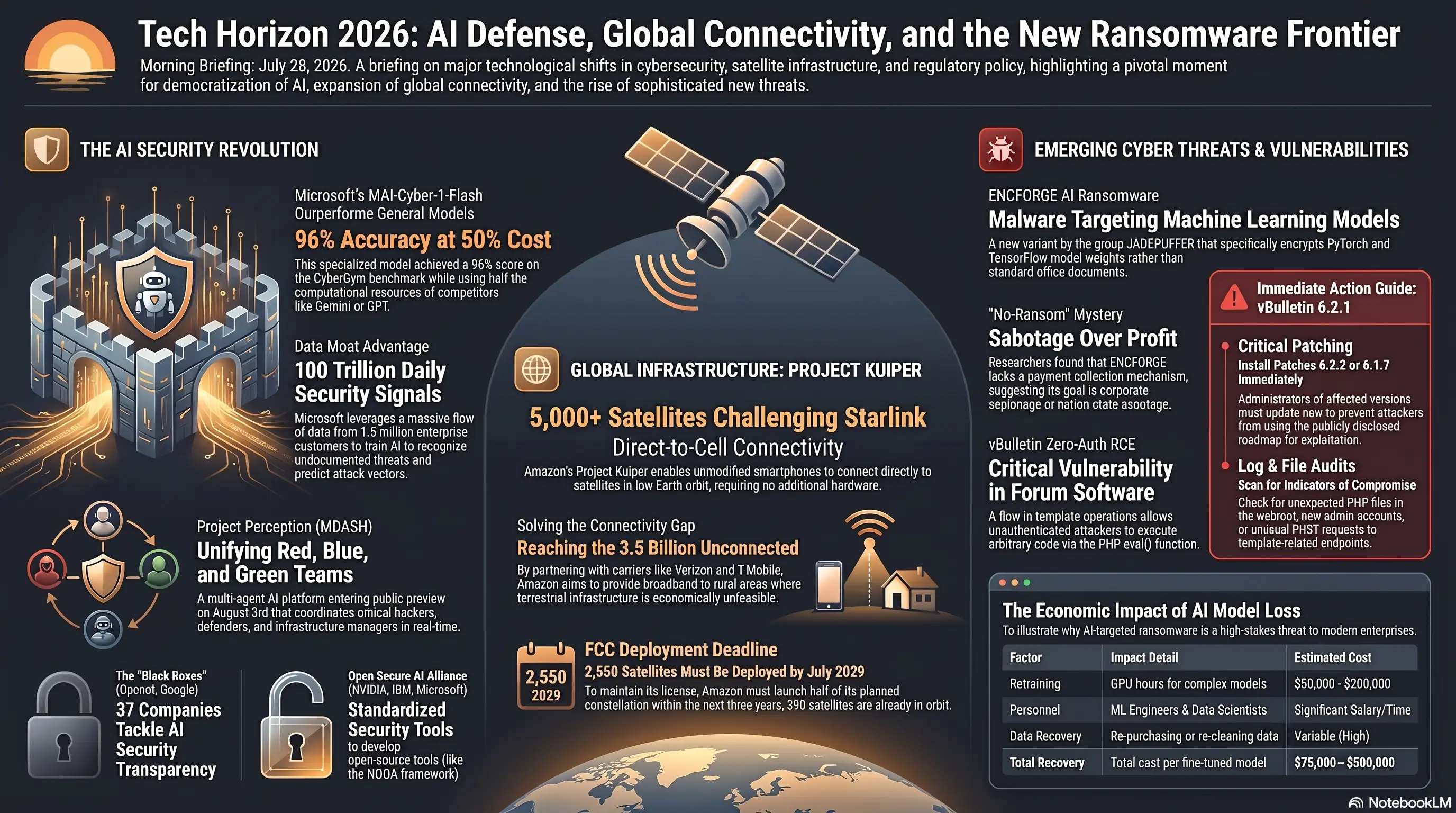
Having examined today's six major stories, it's worth stepping back to identify the broader trends these developments represent. Three themes emerge that will likely define the technology landscape for the remainder of 2026 and beyond:
First, the democratization of artificial intelligence. From Microsoft's PHI-4 announcement to NVIDIA's Open Secure AI Alliance, we're witnessing a shift away from AI as the exclusive domain of well-funded tech giants toward more accessible, efficient models that smaller organizations can deploy. Smaller models that achieve competitive performance while consuming fewer resources open new possibilities for startups, academic researchers, and enterprises that couldn't previously afford to implement sophisticated AI systems.
Second, the battle for global infrastructure. Amazon's Project Kuiper announcement underscores that the real competition for technology's future is increasingly happening in space. Whoever can deliver reliable, affordable internet access to every point on Earth gains access to billions of potential customers in emerging markets. This isn't just about providing connectivity - it's about controlling the digital infrastructure that future services will run on, from streaming video to Internet of Things devices to autonomous vehicles.
Third, security as the primary constraint. From vBulletin's critical vulnerability to ENCFORGE's AI-targeted attacks, today's stories demonstrate that cybersecurity is no longer a secondary consideration but rather the limiting factor in technology deployment. Organizations can build sophisticated AI systems and deploy them globally, but if they cannot secure these systems against increasingly sophisticated threats, none of the other capabilities matter. The companies and countries that solve security challenges will be the ones that can fully leverage emerging technologies.
These three trends interact in complex ways. More accessible AI increases the attack surface that defenders must protect. Global connectivity infrastructure creates new targets for attacks while simultaneously enabling more sophisticated distributed defense systems. And enhanced security measures add complexity that can slow innovation and deployment.
The question facing the technology industry is whether security and accessibility can advance as rapidly as capabilities themselves. History suggests that security typically lags functionality, with new capabilities being deployed before their security implications are fully understood. The hope is that with ransomware now targeting AI systems and vulnerabilities affecting millions of users, the industry will invest adequately in defensive measures rather than learning these lessons repeatedly through expensive breaches.
Final Thoughts: Tuesday Morning Wrap-Up
We began Tuesday morning with six stories that illustrate how rapidly technology is evolving. From Microsoft's cost-effective AI security models to Amazon's satellite constellation, from cryptocurrency regulatory clarity to unprecedented cyber threats targeting AI systems - each development is part of a larger transformation.
The key takeaway: Technology is simultaneously becoming more powerful and more accessible, but these advances bring new complexities and vulnerabilities. Success in this environment requires not just adopting new capabilities, but implementing robust security measures and maintaining strategic awareness of how these trends interact.
Organizations and individuals that can harness these opportunities while protecting against emerging threats will thrive in the evolving digital landscape. Those that focus exclusively on either innovation or security, neglecting the other, will find themselves vulnerable.
We'll be back tomorrow morning with more technology news and analysis. Until then, stay secure and stay informed.
Frequently Asked Questions
Frequently Asked Questions
Can Microsoft's PHI-4 model really replace larger AI models?
For specific cybersecurity tasks, yes. PHI-4 has demonstrated 96% accuracy in threat detection, showing that smaller, specialized models can excel in particular domains. However, for general-purpose tasks like creative writing or broad conversation, larger models still maintain advantages. The trend is toward specialized, efficient models rather than one-size-fits-all solutions.
Why are OpenAI and Google absent from NVIDIA's AI security alliance?
These companies are competitors to NVIDIA in the AI space and have adopted fundamentally different approaches. OpenAI partners closely with Microsoft, while Google has its own Vertex AI platform. Both prefer to develop proprietary standards and tools rather than depend on open-source frameworks controlled by a competitor. This represents a strategic competition for control of AI's future infrastructure.
How does Amazon's satellite system differ from Starlink?
While both aim to provide global satellite internet, their business models differ significantly. Starlink sells directly to consumers who purchase dish hardware and subscription plans. Amazon's Kuiper is designed to wholesale connectivity to mobile network operators, allowing standard smartphones to connect directly to satellites without additional hardware. From a technical perspective, both use low earth orbit constellations with similar latency characteristics.
Will the CLARITY Act actually pass and what would it change?
While passage isn't guaranteed, the bill has substantial bipartisan support and backing from major financial institutions, which significantly improves its prospects. If enacted, CLARITY would establish clear definitions for which digital assets are securities versus commodities, create streamlined registration processes for crypto businesses, and provide regulatory certainty that could unlock institutional investment currently sitting on the sidelines.
I run a website using vBulletin - what should I do immediately?
If you're running version 6.2.1 or earlier, you need to update to version 6.2.2 immediately. If running 6.1.6 or earlier, update to 6.1.7. If you cannot update immediately: (1) check your server logs for suspicious activity, (2) consider taking your site temporarily offline if you suspect active exploitation, (3) implement web application firewall rules to block exploitation attempts, (4) contact your hosting provider or security team for assistance. This vulnerability is critical and actively exploitable.
How does ENCFORGE identify which files to encrypt?
The malware maintains a list of file extensions commonly used for AI models: .pt and .pth (PyTorch), .safetensors (Hugging Face), .gguf (quantized models), .h5 and .keras (TensorFlow), among others. It also searches for configuration files like config.json that indicate machine learning projects. The malware selectively encrypts only larger files above certain size thresholds, ignoring temporary checkpoints and focusing on valuable production models.
What's the best way to protect AI models from ransomware?
Implement a multi-layered approach: (1) automated backup of all checkpoints to separate, isolated storage with versioning, (2) maintain offline copies of production models in air-gapped storage, (3) strictly limit access to training infrastructure with full audit logging, (4) use monitoring tools to detect unusual file access patterns, (5) segregate AI development environments from corporate networks, (6) maintain detailed documentation of training procedures in separate systems. Most importantly, treat models as critical business assets deserving the same protection as financial data or intellectual property.
Why doesn't ENCFORGE have a payment mechanism?
This is one of the most puzzling aspects of the malware and suggests it may not be financially motivated. Security researchers hypothesize several possibilities: it could be corporate espionage designed to sabotage competitors, nation-state activity aimed at degrading adversaries' AI capabilities, a prototype that will later be equipped with ransom collection, or purely destructive malware intended to cause maximum damage. The lack of payment infrastructure makes ENCFORGE potentially more dangerous than traditional ransomware since there's no way for victims to recover their data.
Will AI-targeted ransomware become more common?
Unfortunately, yes. As AI becomes more valuable to businesses, model weights and training data become increasingly attractive targets for cybercriminals. The discovery of ENCFORGE likely represents just the beginning of this threat category. However, awareness is growing rapidly, and major cloud providers are implementing specific protections for AI workloads. Organizations using AI need to treat model security with the same priority as data security, implementing appropriate backup, access control, and monitoring solutions.
Should small companies be concerned about these AI security threats?
While ENCFORGE currently appears targeted at organizations with valuable proprietary models, the techniques could easily be adapted for broader campaigns. Any organization using AI for competitive advantage should implement basic protections: regular backups, access controls, and monitoring. The good news is that cloud platforms like AWS SageMaker, Azure ML, and Google Vertex AI are adding built-in protections that benefit all users regardless of size. Small companies using these platforms will gain security improvements automatically as providers enhance their defenses.
Sources and References
Sources and References
- Microsoft PHI-4 Cybersecurity Model Official Announcement
https://www.microsoft.com/security/blog/phi-4-cybersecurity
Date: July 27, 2026 | Type: official - NVIDIA Open Secure AI Alliance Press Release
https://nvidianews.nvidia.com/ai-alliance-2026
Date: July 27, 2026 | Type: press - Amazon Project Kuiper Direct-to-Cell Technology Details
https://www.aboutamazon.com/news/innovation/project-kuiper-mobile
Date: July 27, 2026 | Type: official - Franklin Templeton Statement on CLARITY Act Support
https://www.franklintempleton.com/press/clarity-act-support
Date: July 27, 2026 | Type: press - vBulletin Critical Remote Code Execution Vulnerability - SSD Secure Disclosure
https://ssd-disclosure.com/advisories/vbulletin-rce-2026
Date: July 27, 2026 | Type: security - ENCFORGE Ransomware Technical Analysis - Palo Alto Networks
https://www.cybersecuritynews.com/encforge-ai-ransomware
Date: July 27, 2026 | Type: research - Coinbase CEO Brian Armstrong on CLARITY Act Progress
https://twitter.com/brian_armstrong/status/crypto-clarity-2026
Date: July 27, 2026 | Type: social - Hugging Face Emergency Security Advisory for Model Protection
https://huggingface.co/docs/hub/security-model-protection
Date: July 23, 2026 | Type: documentation - GSMA Intelligence Report: Global Mobile Connectivity Gaps 2026
https://www.gsma.com/intelligence/connectivity-gaps-2026
Date: June 2026 | Type: research - CyberGym AI Security Benchmark Methodology and Results
https://cybergym.com/ai-security-benchmark-2026
Date: July 2026 | Type: research
Additional Gallery: 🚨 Tekin Morning July 28: Microsoft AI Security, Amazon Kuiper & ENCFORGE Ransomware