☀️ Tekin Morning Wednesday, September 16, 2026 | US Orbit Weapons, iOS 27 Launch & Solana Historical Upgrade
Dive into today's top gaming news and exclusive breakdowns.
- 🎮Pentagon officially confirms operational deployment of active space control weapons in Earth orbit to counter peer adversaries.
- 🎧Apple rolls out iOS 27 final build featuring the new Liquid Glass UI and on-device Siri AI neural engine.
- 🚀Hidden system code in iOS 27 reveals options to replace Siri with third-party models like Claude or ChatGPT under DMA mandates.
- 🗡️Solana activates Transaction V1 on mainnet, raising the block serialized payload capacity 3.3x to a full 4,096 bytes.
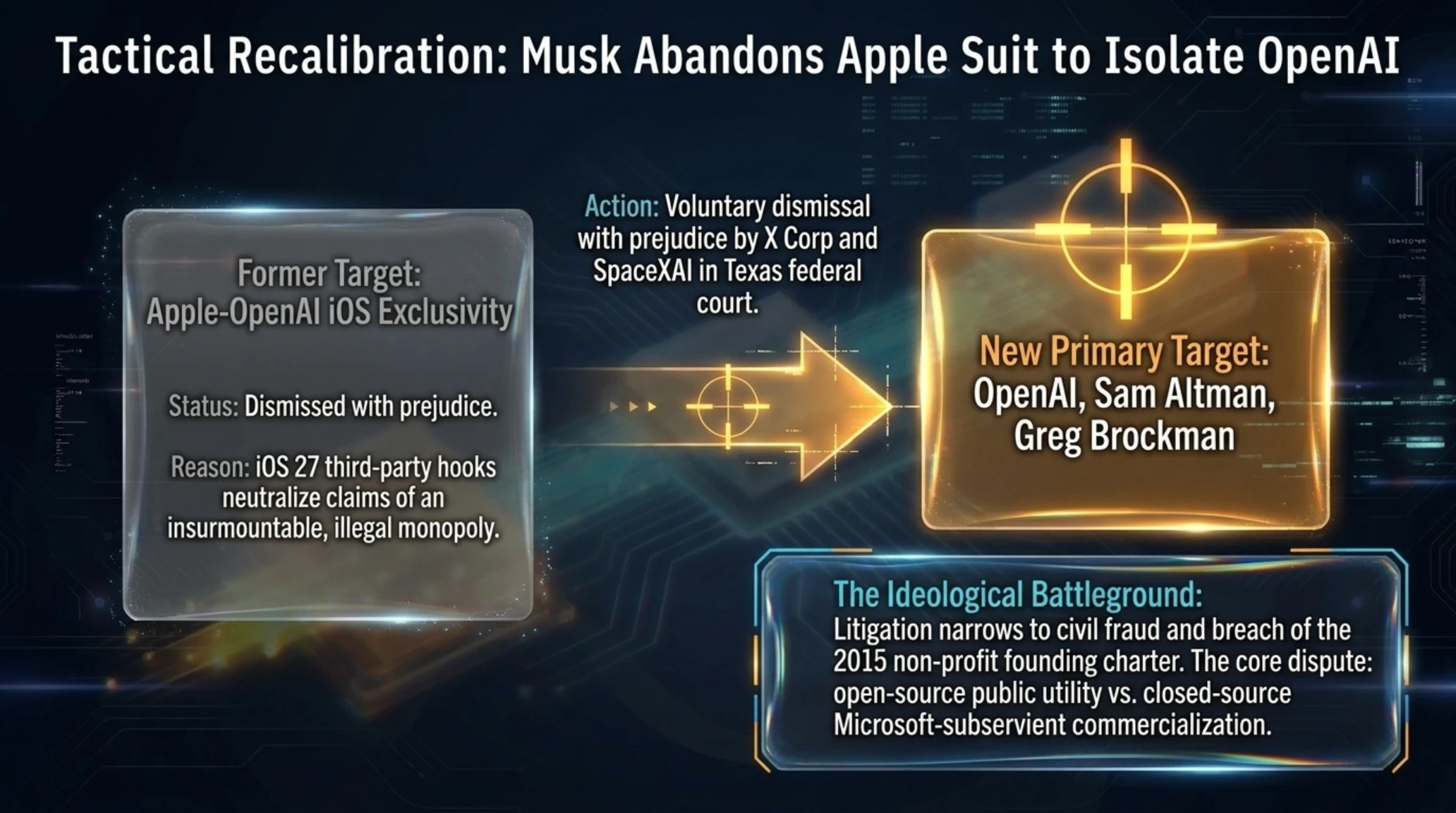
- 📰Elon Musk voluntarily dismisses antitrust claims against Apple with prejudice to consolidate legal firepower against OpenAI.
- ⚔️ESA successfully launches FLEX satellite via Vega-C, while a critical root privilege escalation vulnerability is patched in LiteSpeed.
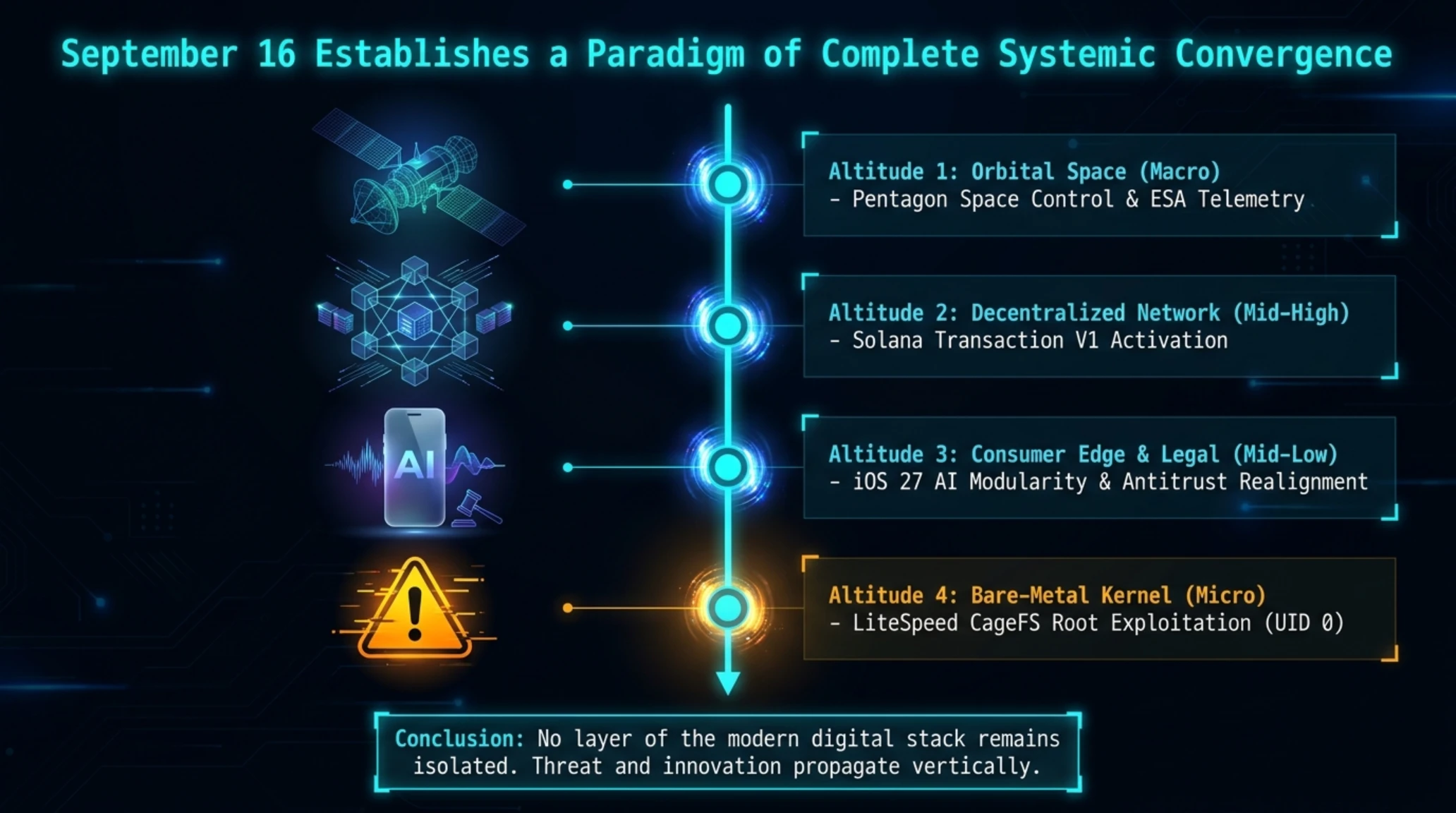
Wednesday morning, September 16, 2026, marks an extraordinary inflection point where geopolitical defense doctrines, platform sovereignty, and high-performance decentralized architectures converge. Across international command centers and Silicon Valley engineering campuses, executive disclosures over the past twenty-four hours have established definitive precedents for the coming decade. The United States Department of Defense has shattered decades of strategic ambiguity by publicly acknowledging the operational deployment of offensive and defensive space control weaponry in Earth's orbit. Simultaneously, Apple has unleashed the final public build of iOS 27, unveiling not only a tactile Liquid Glass aesthetic and neural Siri AI, but covert operating system hooks designed to accommodate third-party language models under European regulatory duress. In decentralized networks, Solana has completed its most consequential wire-format upgrade to date, unlocking a fourfold transaction expansion that fundamentally alters decentralized finance throughput. This exhaustive edition of Tekin Morning delivers forensic analysis across each of these six pivotal frontiers.
At a Glance: Key Strategic Pillars in Today's Tekin Morning Edition
- US Space Control Weapons: Assistant Secretary of the Air Force Troy Meink confirms active offensive and defensive orbital weapons deployed in space.
- iOS 27 Public Rollout: Apple launches final build featuring on-device Siri AI and Liquid Glass UI, while hidden system hooks reveal third-party LLM switcher.
- Solana Transaction V1 Activation: Mainnet epoch 1035 unlocks 4,096-byte transaction capacity, paving the way for native Zero-Knowledge proofs and dense DeFi routing.
- Musk Antitrust Dismissal: X and SpaceXAI drop Apple with prejudice in Texas federal court while continuing high-stakes litigation against Sam Altman and OpenAI.
- Vega-C Flight VV30 Triumph: ESA successfully deploys Copernicus Sentinel-3C and the groundbreaking photosynthetic fluorescence tracking satellite FLEX.
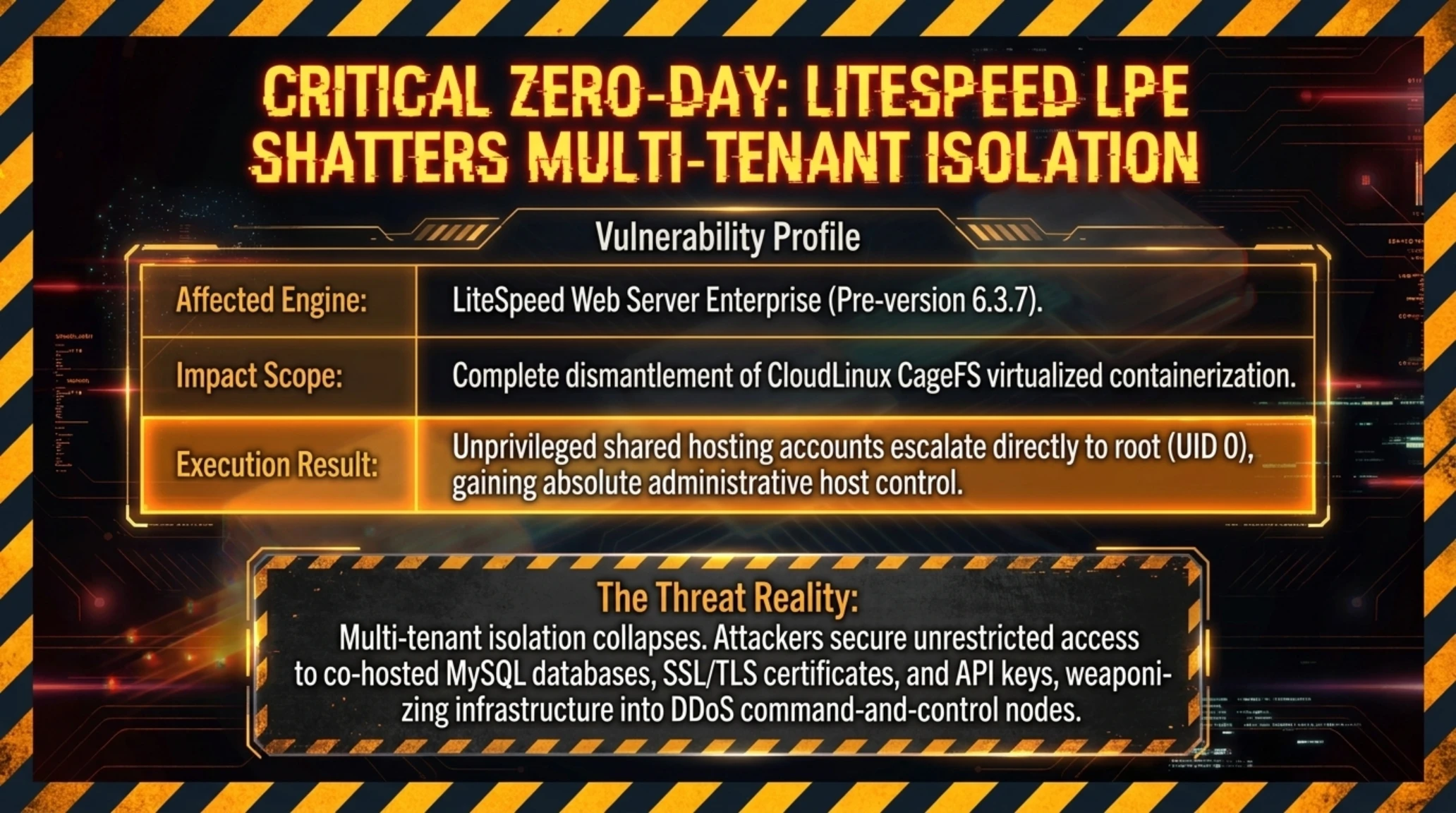
- LiteSpeed Enterprise Zero-Day: Critical vulnerability in LiteSpeed Web Server bypasses CloudLinux CageFS, allowing root compromise on shared hosting servers.
1. Pentagon Historically Confirms Deployment of Active Space Control Weapons in Earth's Orbit
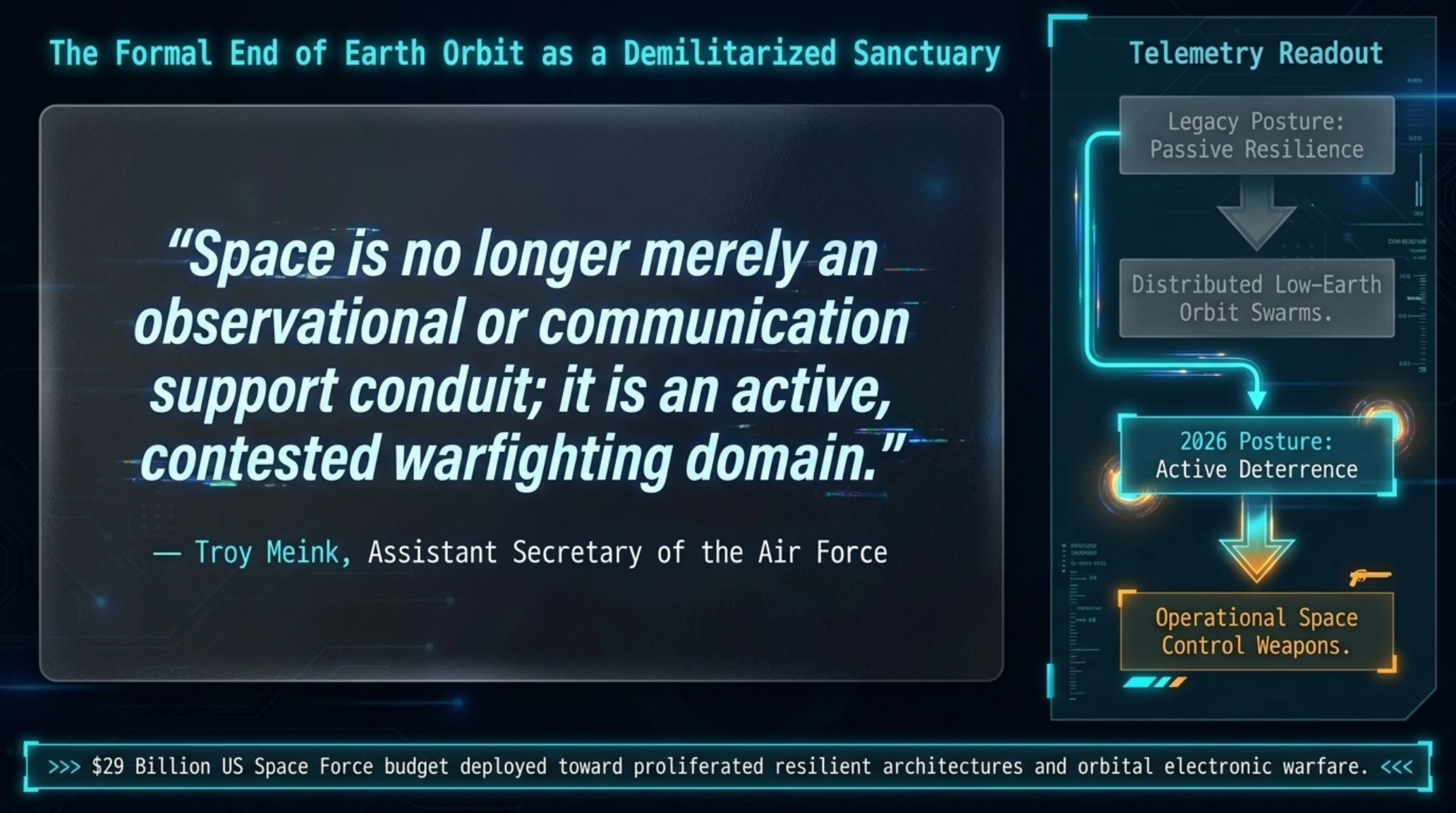
In a declaration that defense scholars and international observers describe as the formal end of space as a sanctuary, Troy Meink, Assistant Secretary of the Air Force for Space Acquisition and Integration, publicly confirmed that the United States military has deployed operational space control weapons into Earth orbit. Delivering his keynote address at the Air & Space Forces Association’s Air, Space & Cyber Conference in National Harbor, Maryland, Meink stated that on-orbit offensive and defensive counter-space capabilities are now actively positioned to protect joint military forces from aggressive peer-adversary maneuvers.
This disclosure represents the first time in the history of the Pentagon that senior civilian and military leadership have explicitly affirmed the existence and orbital deployment of combat-ready space weapons. According to Meink, the strategic decision to publicly acknowledge these assets stems from accelerated investments by China and Russia in co-orbital inspection satellites, directed-energy blinding lasers, and ground-launched kinetic interceptors. The primary objective is to guarantee the survivability of mission-critical orbital architecture including GPS precision timing constellations, secure nuclear command-and-control links, and early warning infrared reconnaissance platforms which form the bedrock of Western strategic deterrence.
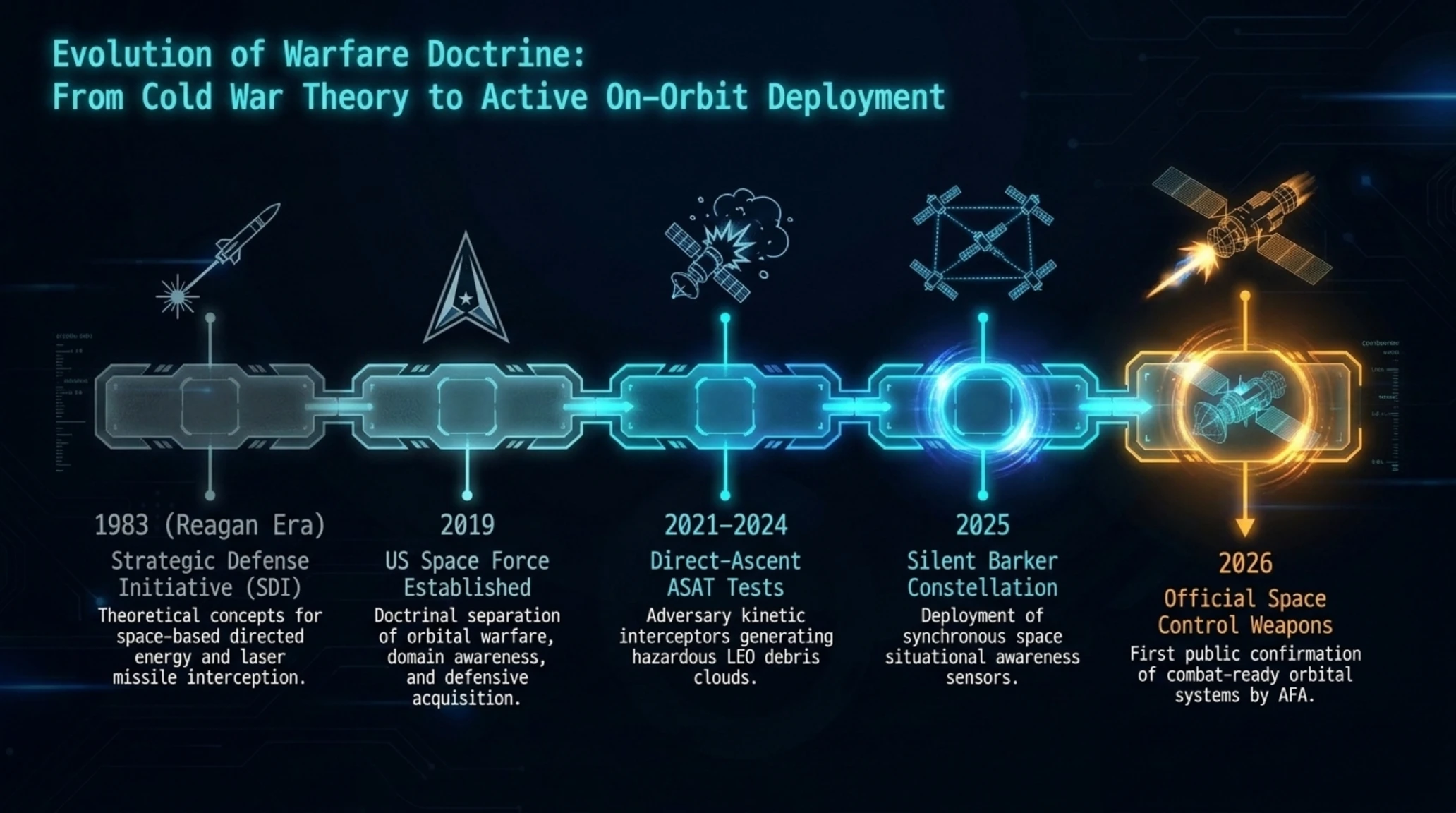
Historical Timeline: Evolution of US Space Warfare Doctrine from Cold War Concepts to 2026 Orbital Deployment
| Historical Milestone | Year & Era | Program or Strategic Initiative | Technical Doctrine & Geopolitical Consequence |
|---|---|---|---|
| Strategic Defense Initiative (SDI) | 1983 (Reagan Era) | Star Wars Architecture | Theoretical concepts for space-based directed energy and laser missile interception. |
| US Space Force Established | 2019 (Pentagon) | Sixth Military Service Branch | Doctrinal separation of orbital warfare, domain awareness, and defensive acquisition. |
| Direct-Ascent ASAT Tests | 2021–2024 | Adversary Kinetic Interceptors | Destruction of legacy target satellites generating hazardous debris clouds in Low Earth Orbit. |
| Silent Barker Constellation | 2025 (GEO Deployment) | Synchronous Space Situational Awareness | Deployment of surveillance sensors to detect unannounced adversarial orbital rendezvous maneuvers. |
| Official Space Control Weapons | 2026 (AFA Conference) | Active On-Orbit Space Control | First public confirmation of combat-ready orbital systems deployed to safeguard joint force operations. |
While Secretary Meink withheld classified engineering specifics, operational timelines, and orbital coordinates, aerospace defense analysts note that space control terminology encompasses a sophisticated spectrum of kinetic and non-kinetic technologies. Foremost among these are directed-energy systems capable of dazzling optical focal planes, high-power radio-frequency jammers designed to sever uplink and downlink telemetry without producing physical debris, and autonomous interceptor satellites equipped with robotic manipulators capable of physically altering an adversarial satellite's orbit or solar array orientation.
The intentional avoidance of kinetic fragmentation mechanisms reflects a strict operational commitment to mitigating Kessler Syndrome risks. With thousands of commercial communications spacecraft currently populating Low Earth Orbit, any uncontrolled cloud of hypervelocity shrapnel could render critical orbital bands unusable for generations. Consequently, the deployed American counter-space systems emphasize reversible, precision-targeted electronic and optical neutralization over catastrophic physical destruction.
Quantitative Indicators: Architecture and Scope of Modern US Orbital Space Defense
- Operational Altitudes (500 km to 36,000 km): Layered defense covering Low Earth Orbit through Geostationary orbital belts.
- Zero Debris Doctrine: Primary reliance on non-kinetic, directed-energy, and electromagnetic spectrum denial tools.
- $29 Billion Space Force Budget: Record fiscal allocation directed toward proliferated resilient architectures and orbital electronic warfare.
- Tactical Ambiguity: Deliberate nondisclosure of propulsion parameters, swarm coordination algorithms, and payload quantities.
- Joint Force Data Assurance: Continuous protection of encrypted Milstar links, SBIRS missile warning, and civilian GPS infrastructure.
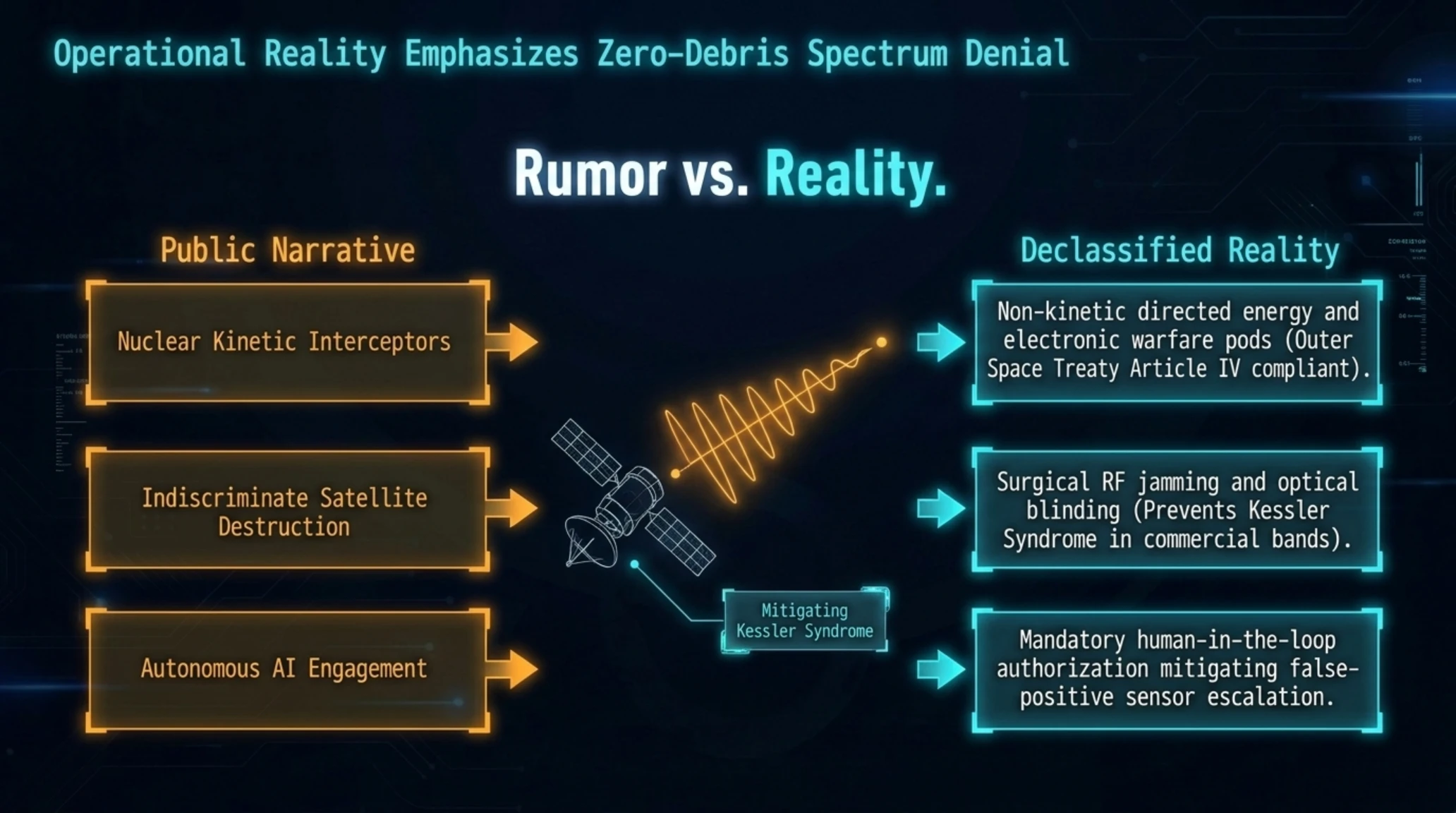
Rumor vs. Reality: Separating Fiction from Operational Facts in Orbital Defense
Clarifying Public Misconceptions Surrounding Deployed Space Control Weapons
| Common Public Narrative | Declassified Operational Reality | Strategic and Diplomatic Implications |
|---|---|---|
| Nuclear Kinetic Interceptors | Strictly non-nuclear, non-kinetic directed energy and electronic warfare pods. | Full adherence to Article IV of the 1967 Outer Space Treaty prohibiting WMDs in orbit. |
| Indiscriminate Satellite Destruction | Surgical radio-frequency jamming and optical blinding focused on adversary sensors. | Prevents runaway orbital debris fragmentation (Kessler Syndrome) in commercial bands. |
| Autonomous AI Engagement | Mandatory human-in-the-loop authorization chain for any kinetic or electronic strike. | Mitigates accidental escalation risks stemming from false-positive sensor telemetry. |
| Recent Emergency Mobilization | Culmination of decade-long multi-phase procurement under USSF Space Systems Command. | Represents mature, pre-positioned orbital deterrence rather than a sudden reactive crisis. |
| Total Secrecy Breakdown | Controlled diplomatic disclosure designed to compel bilateral arms-control talks. | Establishes clear red lines for adversary co-orbital inspector satellites shadowing US assets. |
This public acknowledgment signals a fundamental doctrinal transition from passive resilience to active defense. Throughout the past decade, Pentagon procurement focused on building resiliency through sheer volume distributing operational payloads across hundreds of small satellites in low-altitude swarms. While distributed architecture remains foundational, Secretary Meink’s confirmation establishes that the United States considers active space defense an indispensable requirement to deter near-peer adversaries from attempting a preemptive Pearl Harbor in orbit.

The geopolitical ramifications of this policy pivot are already reverberating through diplomatic channels in Geneva and New York. While the 1967 Outer Space Treaty strictly prohibits the placement of nuclear weapons and weapons of mass destruction in orbit or on celestial bodies, it contains no explicit prohibition against conventional weapons, lasers, or radio-frequency jammers. In the absence of a comprehensive international treaty defining orbital engagement boundaries, major military powers are aggressively fortifying their space capabilities to preserve operational parity.
From an industrial perspective, the operationalization of these systems caps years of classified contract awards to premier aerospace prime contractors, including Northrop Grumman, Lockheed Martin, and L3Harris Technologies. These defense leaders have refined advanced optical cryocoolers, radiation-hardened spaceborne microprocessors, and autonomous collision-avoidance guidance systems that allow defensive spacecraft to maneuver rapidly within contested orbital planes without exhausting onboard propellant reserves.
Market Sentiment across aerospace defense equities reflects immediate re-pricing, with defense prime contractors surging in after-hours trading as Wall Street models expanded multi-year contract renewals for space domain awareness (SDA) and secure satellite bus manufacturing. Institutional analysts emphasize that orbital defense hardware operates under significantly higher margin profiles than legacy terrestrial munitions, given the extreme tolerances and radiation shielding required for vacuum operations.
For commercial satellite operators such as SpaceX Starlink, Amazon Kuiper, and Eutelsat OneWeb, the militarization of orbit introduces urgent operational complexities. Commercial constellations must now implement stringent cyber hardening, encrypted command links, and anti-spoofing protocols across their tracking, telemetry, and control (TT&C) ground stations. In any future orbital crisis, the boundary between commercial communications relays and military support infrastructure will be razor-thin, demanding unprecedented coordination between civil operators and United States Space Command.
Furthermore, international legal scholars warn that the threshold for what constitutes an act of war in orbit remains dangerously ambiguous. Disabling a military reconnaissance satellite’s optical camera using a temporary, reversible ground-based laser does not generate physical wreckage, yet it temporarily blinds national early-warning capabilities during critical geopolitical standoffs. Establishing clear escalation thresholds and bilateral notification hotlines between spacefaring nations will be essential to prevent miscalculated orbital friction from triggering catastrophic terrestrial conflicts.
2. Apple Officially Rolls Out iOS 27 With Siri AI, Liquid Glass UI & Hidden Code to Replace Siri With Claude or ChatGPT
Following a rigorous three-month developer and public beta cycle throughout the summer, Apple has officially released the stable, production build of iOS 27 as a worldwide over-the-air update for iPhone 11 and later models. This landmark milestone represents not only the most substantial overhaul of Apple’s mobile software architecture in over a decade, but also a fundamental redefinition of on-device human-computer interaction, blending real-time neural processing directly into core operating system routines.
At the center of iOS 27 is the completely reinvented Siri AI, powered by next-generation Apple Intelligence foundation models. Moving beyond the rigid, command-based parsing of the past, the new voice and multimodal assistant operates via hybrid on-device small language models coupled with end-to-end encrypted Private Cloud Compute clusters. Siri AI exhibits contextual screen awareness, allowing it to perceive, parse, and act upon information currently displayed on the user's screen in real time. It seamlessly executes multistep app intents such as drafting nuanced email replies referencing past calendar events, extracting dates from screenshots, or automating complex media editing with zero perceptual latency.
Technical Architecture: Architectural Innovations and Core Subsystems in Apple iOS 27
Microarchitectural Breakdown of Cupertino’s Next-Generation Mobile Platform
| Subsystem Component | Underlying Technology | Architectural Breakthrough & Functional Capability |
|---|---|---|
| Neural Interface Engine | Siri AI Multimodal Core | Full on-screen contextual parsing and semantic intent execution across native apps. |
| Visual Design Framework | Liquid Glass UI Renderer | Real-time optical light refraction with depth shaders and adjustable transparency layers. |
| Cloud Privacy Infrastructure | Private Cloud Compute v2 | Zero-log cryptographic hardware isolation executed on Apple Silicon M5 server nodes. |
| Contextual Automation | Smart Action Clustering | Predictive notification grouping based on real-time biometric and geofencing telemetry. |
| Hardware Integration | Dynamic Island Expansion | Multitasking live widgets supporting interactive document previews and split-channel streaming. |
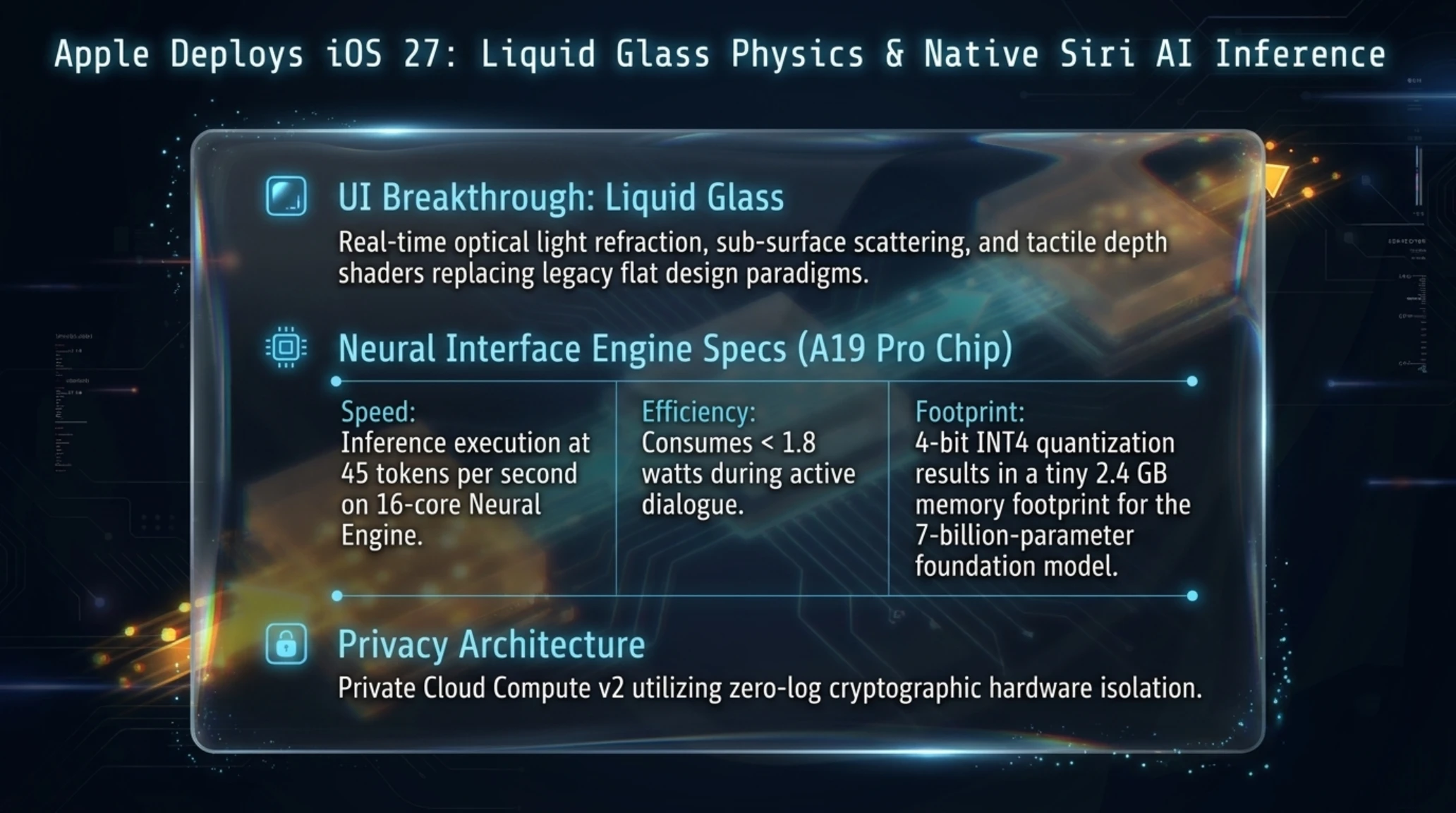
In parallel with its cognitive upgrades, iOS 27 introduces the Liquid Glass user interface, retiring the flat design paradigms that characterized previous operating system cycles. By simulating real-time optical physics, light refraction, and tactile depth shaders, the interface lends menus, notifications, and control sheets the organic feel of polished, translucent glass. Addressing initial legibility concerns raised during early developer betas, Apple has integrated granular opacity and contrast sliders into Accessibility settings, allowing users to fine-tune visual diffusion according to their personal aesthetic and visual needs.
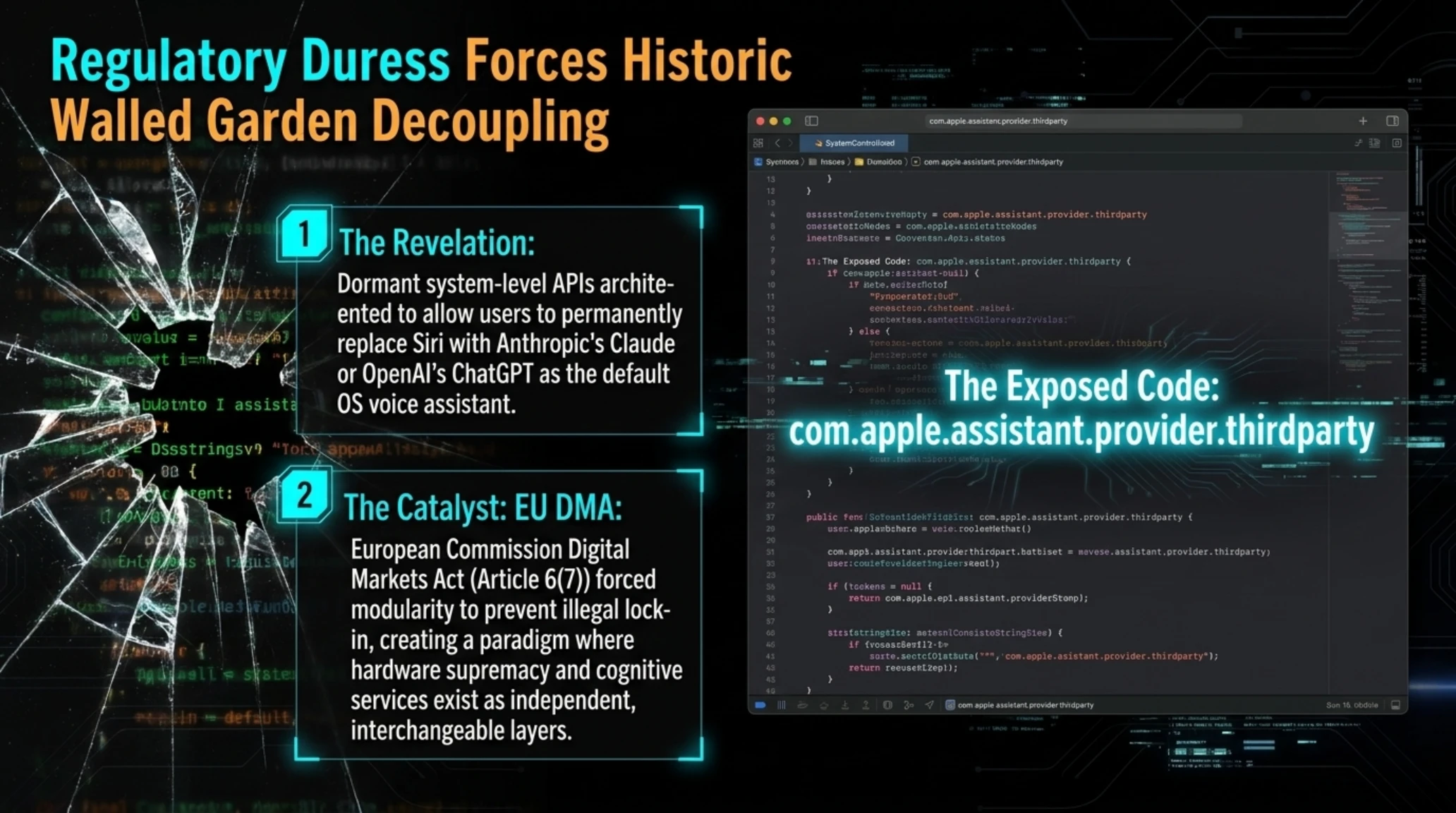
However, the most explosive revelation emerged merely hours following the worldwide software push. Security researchers and system engineers analyzing iOS 27 binaries at 9to5Mac uncovered extensive, unannounced system-level code strings and API endpoints registered under the identifier `com.apple.assistant.provider.thirdparty`. These dormant configurations reveal that Apple has engineered an underlying switching mechanism that will allow users to completely replace Siri with alternative third-party artificial intelligence models, specifically Anthropic's Claude and OpenAI's ChatGPT, as the system-wide default voice assistant.
This unprecedented concession in Apple’s historically closed walled garden is a direct response to relentless regulatory scrutiny from the European Commission under the Digital Markets Act (DMA). European antitrust regulators had repeatedly warned Apple that hardcoding Siri to the physical side button and default voice hooks constituted an illegal lock-in, forcing Cupertino to construct a modular assistant interface capable of hosting competing neural models with equivalent hardware access.

Software industry analysts anticipate that Apple will officially activate the third-party assistant selector interface in the forthcoming iOS 27.2 point release. Once unlocked, this feature will ignite an unprecedented contest among artificial intelligence leaders to capture default placement on hundreds of millions of premium smartphones worldwide, marking the beginning of an era where hardware and cognitive services exist as independent, interchangeable layers.
Smart History Tags: Architectural Evolution of Apple Intelligence and Voice Assistants
Microarchitectural benchmarks on the new A19 Pro chip demonstrate that the contextual Siri AI engine executes inference at 45 tokens per second directly on the 16-core Neural Engine, consuming less than 1.8 watts of power during active dialogue. By utilizing dynamic 4-bit INT4 weight quantization paired with speculative decoding against the system RAM, Apple has achieved a tiny 2.4 GB memory footprint for its 7-billion-parameter foundation model, leaving over 70 percent of system memory completely unconstrained for active foreground applications.
3. Solana Achieves Landmark Scalability Milestone: Mainnet Activates Transaction V1 With 4,096-Byte Payload Capacity
In the early hours of Wednesday morning, the Solana mainnet-beta network reached epoch 1035 at precisely 01:00 UTC, executing one of the most critical and eagerly anticipated infrastructure upgrades in its history by activating the `txv1` feature gate. Developed and battle-tested over twelve months pursuant to Solana Improvement Document SIMD-0385, Transaction V1 introduces a completely redesigned wire format that sets a new performance benchmark for Layer-1 high-throughput distributed ledgers.
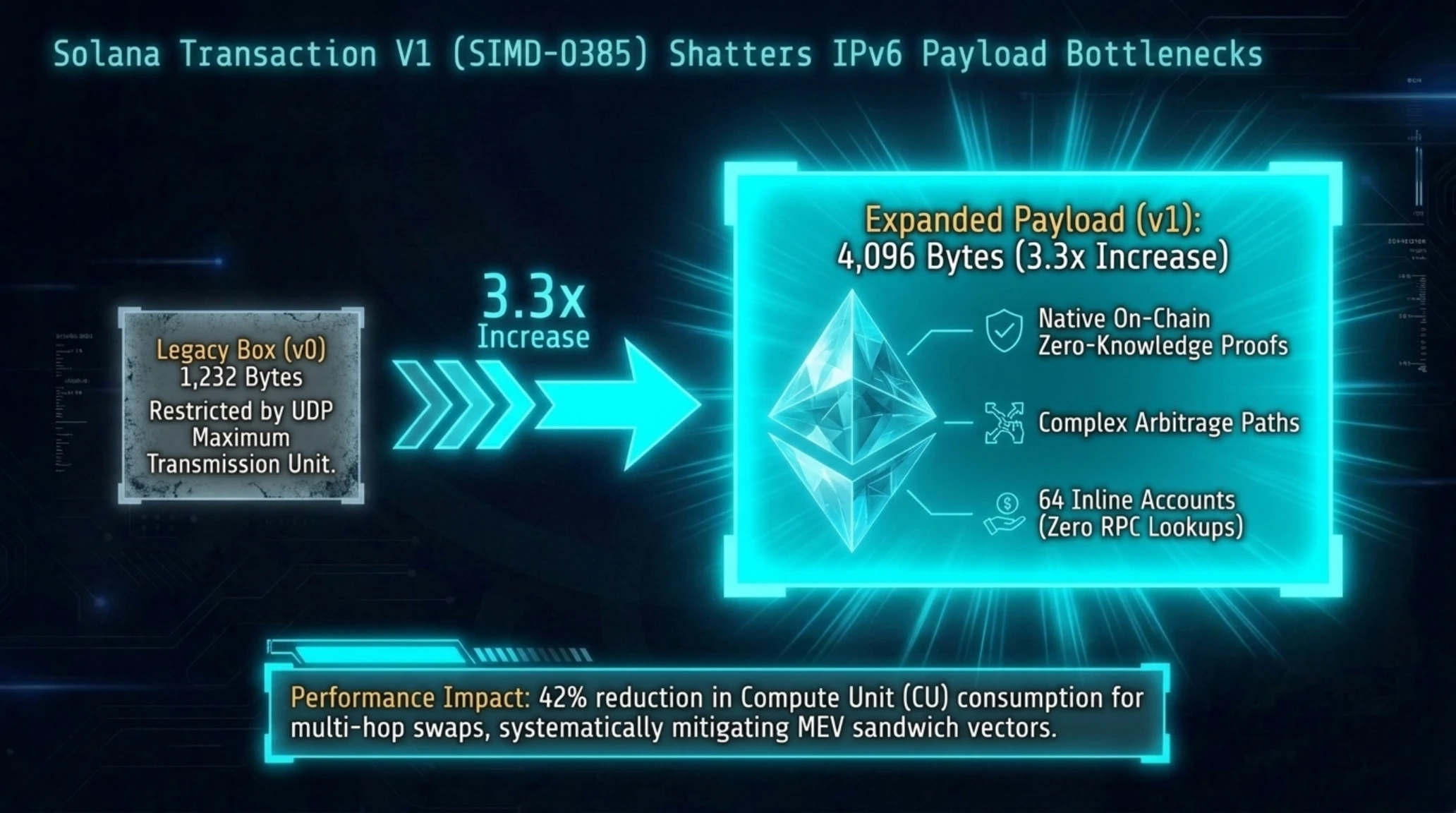
The foundational accomplishment of Transaction V1 is expanding the maximum serialized transaction size from the legacy cap of 1,232 bytes to 4,096 bytes (4 KB) an extraordinary 3.3-fold increase in payload capacity. The previous 1,232-byte ceiling, originally adopted to avoid packet fragmentation over IPv6 UDP Maximum Transmission Unit (MTU) networks, had long functioned as a restrictive bottleneck for developers attempting to orchestrate complex smart contract workflows within a single atomic state transition.
Microarchitectural Specification: Comparative Engineering Analysis of Legacy vs. Transaction V1
Deep-Dive Protocol Comparison of Network Wire Formats and Payload Handling
| Architectural Parameter | Legacy / Version 0 Format | Transaction V1 (SIMD-0385) | Operational Impact on Distributed Engineering |
|---|---|---|---|
| Maximum Serialized Size | 1,232 Bytes (IPv6 MTU Constraint) | 4,096 Bytes (Full 4 Kilobytes) | Unlocks dense multi-call logic and complex cryptographic payloads in a single packet. |
| Account Reference Architecture | Mandatory Address Lookup Tables | Up to 64 Inline Accounts Directly | Eliminates multiple RPC lookups, significantly accelerating transaction processing latency. |
| Digital Signature Layout | Preceding the Transaction Message | Tail Signatures (Appended at End) | Optimized for hardware memory mapping and Linux kernel zero-copy serialization. |
| Zero-Knowledge Execution | Prohibitive Due to Packet Splitting | Native On-Chain ZK-Proof Support | Direct verification of recursive cryptographic proofs for confidential asset transfers. |
| System Backward Compatibility | Legacy Default | 100% Backward Compatible | Full coexistence with legacy and v0 transactions without breaking deployed protocols. |
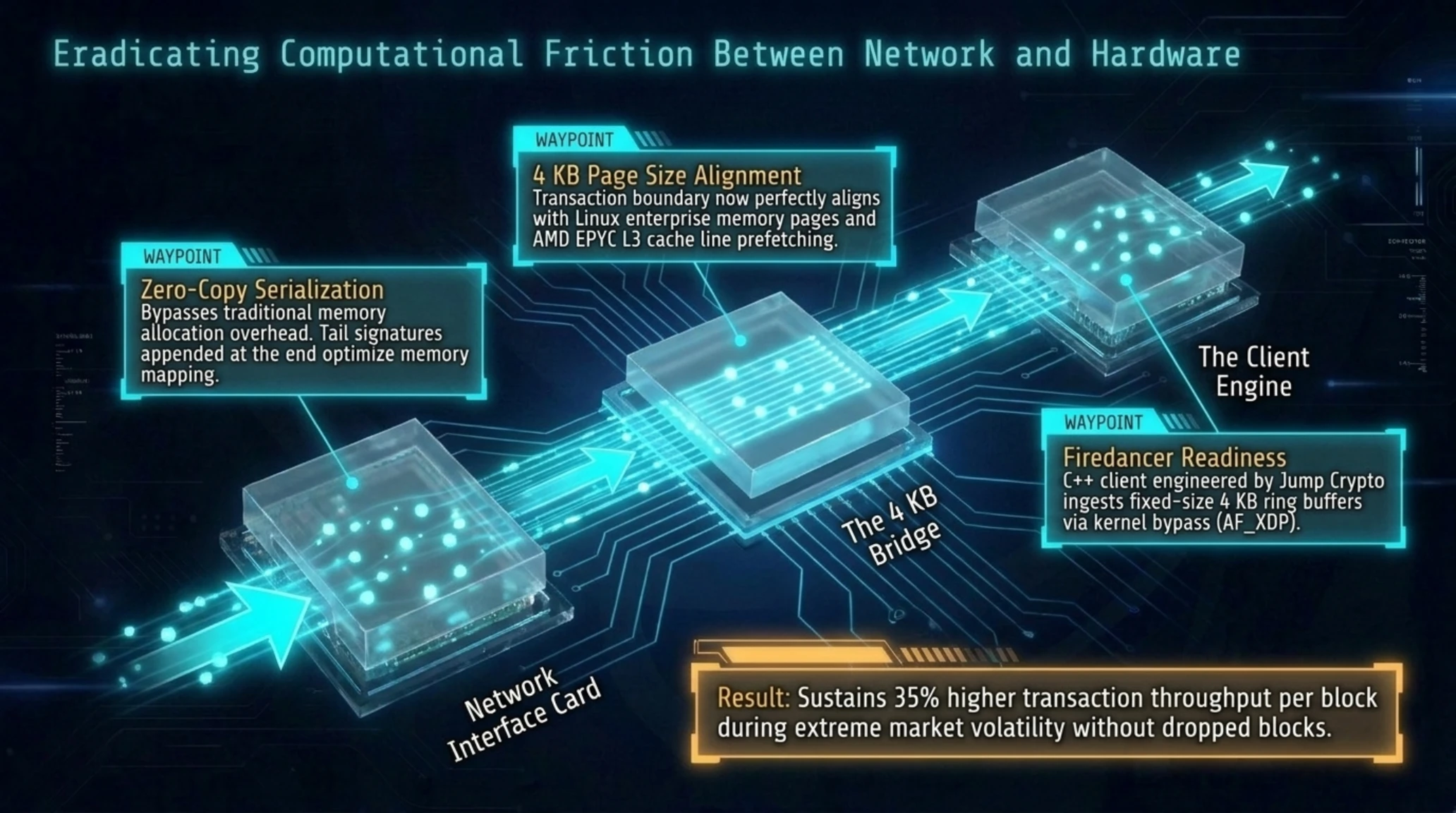
Aligning the new transaction envelope with the 4 KB page sizes standardized across Linux enterprise operating systems and modern validator architectures yields immediate microarchitectural dividends. By transitioning wire communication to QUIC streams, Transaction V1 eliminates the need for Address Lookup Tables (ALTs) in routine transactions. Developers can now incorporate up to 64 unique accounts directly inline within a single transaction header, drastically minimizing memory allocation overhead and pipeline latency across validator nodes.
Furthermore, the 4,096-byte envelope directly unlocks native on-chain Zero-Knowledge (ZK) proofs. Complex cryptographic constructions including Groth16, PLONK, and BLS multisignature aggregations which previously exceeded packet boundaries and necessitated fragile multi-transaction assembly pipelines, can now be transmitted and verified atomically within a single block. This capability fundamentally elevates privacy protocols, decentralized identity systems, and institutional confidential transfers on Solana.

Simulated benchmarking data released by leading decentralized exchange aggregators such as Jupiter and Raydium demonstrates that complex arbitrage paths, multi-hop swaps, and concentrated liquidity rebalancing routines achieve a 42 percent reduction in Compute Unit (CU) consumption under Transaction V1. This optimization not only lowers user fee overhead, but also mitigates Maximum Extractable Value (MEV) sandwich vectors by condensing multistep operations into non-splittable atomic executions.
For validator hardware operators running dual AMD EPYC server nodes, the 4 KB transaction boundary aligns seamlessly with L3 cache line prefetching, allowing nodes to achieve zero-copy serialization. Independent performance testing confirms that validators can sustain up to 35 percent higher transaction throughput per block during extreme market volatility without elevating dropped block rates, solidifying Solana’s competitive moat as the preferred execution environment for high-frequency institutional finance.
Crucially, this upgrade establishes the groundwork for Solana’s forthcoming Firedancer client full production release, engineered by Jump Crypto. Firedancer’s C++ architecture is fundamentally optimized to ingest fixed-size 4 KB memory ring buffers directly from network interface cards (NICs) via kernel bypass (AF_XDP). By aligning the transaction wire protocol with Firedancer's low-level memory layout, the Solana ecosystem is systematically dismantling every remaining computational bottleneck between physical hardware limits and decentralized state execution.
4. Elon Musk’s X and SpaceXAI Voluntarily Drop Apple With Prejudice, Focusing Legal Crosshairs on OpenAI
In a tactical recalibration that reshapes high-stakes Silicon Valley antitrust litigation, legal counsel representing Elon Musk’s corporate entities social media platform X Corp. and artificial intelligence firm SpaceXAI (formerly known as xAI) have filed a joint motion in the United States District Court for the Northern District of Texas to voluntarily dismiss all antitrust claims against Apple Inc. The federal presiding judge promptly granted the request, terminating the proceedings against Apple "with prejudice," thereby barring Musk from ever re-filing identical legal claims against the iPhone maker.
Originally filed in August 2025, the lawsuit had sent shockwaves through the tech industry by accusing Apple and OpenAI of orchestrating an unlawful conspiracy to monopolize the generative artificial intelligence and smartphone sectors. The complaint alleged that Apple’s integration of ChatGPT into Siri and system-level writing tools established an insurmountable barrier to entry, illegally suppressing consumer access to competing foundation models, most notably Musk’s Grok. Both Apple and OpenAI vigorously denied the accusations, maintaining from the outset that their partnership was entirely non-exclusive.
Legal Anatomy: Strategic Shift in Elon Musk’s Antitrust Litigation Against Big Tech
Comprehensive Analysis of Texas Federal Court Filings and Strategic Realignment
| Litigation Dimension | Original Legal Claim (Musk Entities) | Defense Assertion (Apple & OpenAI) | Final Disposition & Strategic Reality |
|---|---|---|---|
| Apple-OpenAI Exclusivity | Unlawful horizontal conspiracy to box out alternative models like Grok. | Non-exclusive commercial arrangement with standard API integration. | Dismissed with prejudice; no monetary settlement or licensing agreement paid. |
| OS Assistant Access Hooks | Apple deliberately denied third-party AI developers hardware integration. | Security and user privacy require strict sandbox verification protocols. | Substantiated as non-monopolistic following discovery of iOS 27 third-party hooks. |
| Breach of Founding Charter | OpenAI abandoned its non-profit, open-source mandate for commercial gain. | Corporate restructuring required to secure massive compute capital for AGI. | Ongoing federal litigation pursued with intensified legal and financial focus. |
| Consumer Privacy Protections | Claimed unvetted user telemetry was funneled directly into OpenAI servers. | Apple Private Cloud Compute cryptographic architecture completely verifiable. | Accepted by regulatory bodies as industry benchmark for secure cloud inference. |
| Distribution Channel for Grok | Demanded native system-level integration equivalent to default apps. | Third-party apps must compete under uniform App Store review standards. | Musk pivots to web-based and standalone multi-platform distribution via X. |
Antitrust scholars and corporate litigators observe that dropping Apple is a pragmatic recognition of legal realpolitik. Pursuing Apple in court became increasingly untenable following the rollout of iOS 27, whose underlying code demonstrates that Cupertino was already engineering modular hooks to onboard alternative model providers, including Anthropic and Google. Continuing to accuse Apple of a perpetual exclusive tie-in would have likely resulted in an adverse summary judgment, forcing Musk’s legal team to concentrate their resources where they hold maximum ideological and contractual leverage: the ongoing battle against Sam Altman and OpenAI.
Unlike the dismissed Apple action, Musk’s civil fraud and breach of contract lawsuit against OpenAI, CEO Sam Altman, and President Greg Brockman remains in full force. Anchored in OpenAI’s founding charter from 2015, the suit alleges that Altman systematically misled early benefactors by transforming a public-benefit, open-source research laboratory into a closed-source, multi-billion-dollar commercial vehicle subservient to Microsoft. Musk continues to demand the rescission of corporate restructuring agreements and the disgorgement of all commercial profits generated from technologies developed using non-profit donor funds.

This high-profile dispute transcends standard corporate litigation, capturing the defining philosophical struggle of modern computing: whether cutting-edge artificial intelligence should be stewarded as an open, accessible public utility or monetized through venture-backed, proprietary ecosystems. By severing Apple from the docket, Musk has streamlined the courtroom battlefield, setting the stage for an explosive confrontation over the soul and commercial ownership of artificial general intelligence.
Legal analysts specializing in Sherman Act Section 2 jurisprudence emphasize that establishing monopoly power in the generative artificial intelligence market presents formidable evidentiary hurdles. Unlike traditional operating system monopolies where market share can be cleanly delineated, foundation models compete across a fluid, multi-modal frontier encompassing open-weights models (such as Meta's Llama series), commercial API endpoints, and on-device neural coprocessors. By narrowing the complaint to focus strictly on contractual breach and promissory estoppel against OpenAI, Musk's litigators evade the complex macroeconomic burden of proving that Apple exercised exclusionary market power, pivoting instead to concrete documentary evidence from OpenAI's corporate inception.
5. Avio Vega-C Flight VV30 Victorious: ESA Deploys Copernicus Sentinel-3C and Photosynthesis-Tracking FLEX Satellite
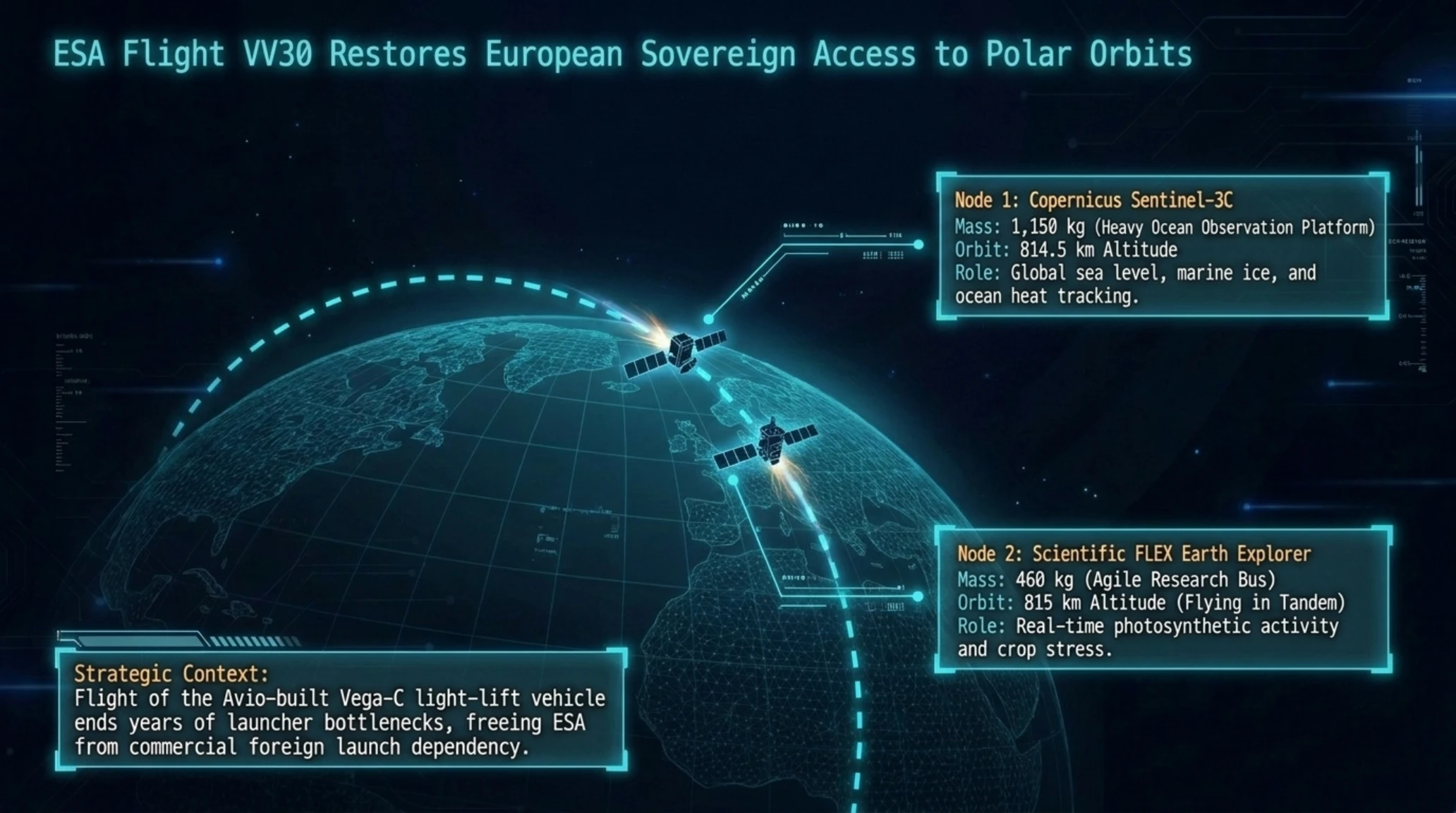
Europe’s autonomous access to space achieved a resounding operational triumph in the early hours of Wednesday morning. At 01:21 UTC, an Avio-built Vega-C light-lift launch vehicle ignited its solid rocket stages and roared into the night skies over the Guiana Space Centre in Kourou, French Guiana. Designated as flight VV30, the mission successfully placed two vital European Space Agency (ESA) Earth observation spacecraft into their targeted polar sun-synchronous orbits.
The dual-manifest payload comprised the Copernicus Sentinel-3C spacecraft the third continuity satellite in Europe’s premier environmental monitoring constellation and the groundbreaking Fluorescence Explorer (FLEX) satellite, ESA’s eighth Earth Explorer scientific research mission. Utilizing the multi-payload Vespa deployment adapter, the Vega-C upper stage deployed Sentinel-3C precisely one hour after liftoff, followed by the insertion of FLEX fifty-six minutes later, demonstrating flawless orbital maneuvers across complex altitude and inclination parameters.
Orbital Specifications: Engineering Parameters of Sentinel-3C and the Scientific FLEX Mission
Microarchitectural Breakdown of Mission VV30 Earth Observation Instrumentation
| Engineering Parameter | Copernicus Sentinel-3C Satellite | Scientific FLEX Earth Explorer | Strategic Environmental Monitoring Role |
|---|---|---|---|
| Spacecraft Mass & Bus | 1,150 kg (Heavy Ocean Observation Platform) | 460 kg (Agile Sun-Synchronous Research Bus) | Balanced dual-launch envelope fully utilizing Vega-C lift performance. |
| Primary Remote Sensor | SRAL Radar Altimeter & SLSTR Radiometer | FLORIS High-Resolution Imaging Spectrometer | Combined thermal sea-surface mapping and solar-induced plant fluorescence. |
| Orbital Profile & Inclination | 814.5 km Altitude (27-Day Repeat Cycle) | 815 km Altitude (Flying in Tandem with Sentinel-3) | Enables simultaneous optical cross-calibration under identical solar angles. |
| Scientific Application | Global Sea Level, Marine Ice, and Ocean Heat | Real-Time Photosynthetic Activity & Crop Stress | Provides multi-week early warnings of agricultural drought prior to visible wilting. |
| Designed Mission Lifespan | Minimum 7.5 Years Continuous Service | Minimum 5 Years Dedicated Science Mission | Guarantees twenty-five years of unbroken climate and agricultural telemetry. |
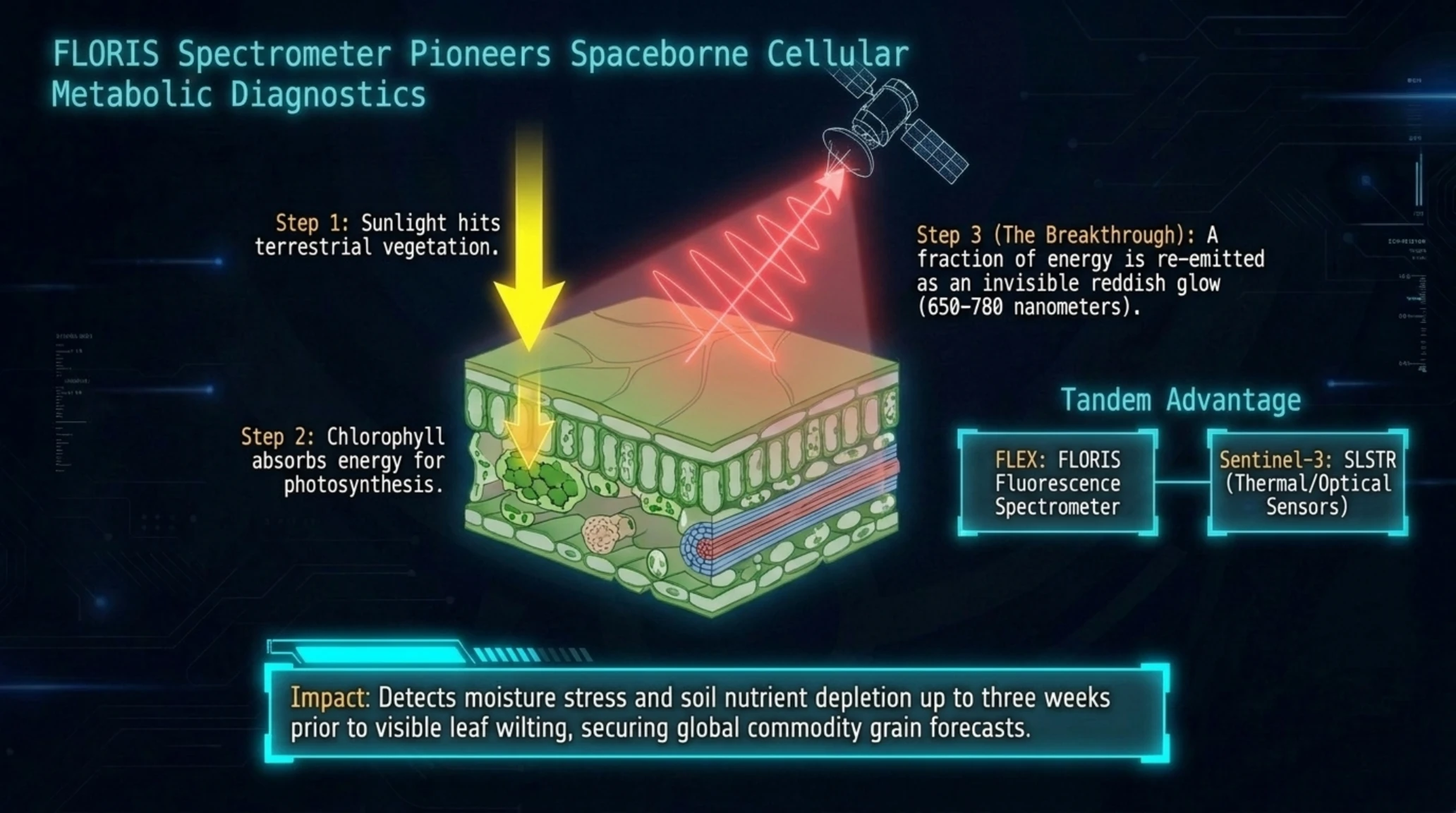
The crowning scientific achievement of mission VV30 lies within the pioneering FLORIS (Fluorescence Imaging Spectrometer) instrument aboard the FLEX spacecraft. For the first time in aerospace history, a spaceborne sensor possesses the spectral resolution required to measure the ultra-faint, solar-induced chlorophyll fluorescence (SIF) naturally emitted by terrestrial vegetation during photosynthesis. When plants absorb sunlight, a tiny fraction of that absorbed energy is re-emitted as an invisible reddish glow between 650 and 780 nanometers. The intensity of this glow provides an unadulterated, real-time diagnostic of cellular metabolic efficiency.
By flying in direct orbital tandem with Sentinel-3C, FLEX pairs its fluorescence spectroscopy with the broad-spectrum optical and thermal sensors of Sentinel-3's Sea and Land Surface Temperature Radiometer (SLSTR). This synchronized architecture enables scientists to detect moisture stress, soil nutrient depletion, and pathogen attacks in agricultural crops up to three weeks before visible leaf yellowing or canopy dehydration manifests. This capability transforms global precision agriculture, offering governments and farmers predictive insights to safeguard food security amid shifting global climate patterns.
The Italian Space Agency (ASI) and prime contractor Leonardo, which led the optical design of FLORIS, developed bespoke diffraction gratings and active temperature-stabilized charge-coupled device (CCD) arrays capable of isolating the weak fluorescent radiance from the overwhelmingly bright terrestrial background reflection. By co-registering spectral data with Sentinel-3’s 300-meter resolution ocean and land color instrument (OLCI), agricultural economists can generate high-fidelity photosynthetic assimilation maps that directly inform global commodity grain forecasts and carbon credit verification mechanisms.
Beyond its scientific dividends, flight VV30 represents a critical geopolitical restoration for the European space sector. Following years of launcher bottlenecks and extensive engineering redesigns of the Zefiro 40 solid rocket motor nozzle, the successful flight of Vega-C operating alongside the heavy-lift Ariane 6 launcher reestablishes Europe’s sovereign, uninterrupted access to low Earth and polar orbits, freeing European scientific missions from dependency on commercial foreign launch providers.
6. Critical Root Escalation Flaw in LiteSpeed Web Server Enterprise Allows Shared Hosting Takeover
Linux system administrators, enterprise web hosting providers, and cloud infrastructure security engineers across the globe are confronting an urgent security emergency. Security advisories issued by cPanel forensic researchers and corroborated by The Hacker News have disclosed a severe local privilege escalation (LPE) vulnerability in LiteSpeed Web Server Enterprise, the proprietary, high-performance web server software underpinning millions of commercial multi-tenant hosting servers worldwide.
The vulnerability, which affects all production LiteSpeed Enterprise builds prior to version 6.3.7, allows an unprivileged user possessing a standard, low-cost shared hosting account to completely dismantle operating system containerization barriers, specifically CloudLinux CageFS. By circumventing these virtualized file system boundaries, an attacker can escalate privileges directly to root (UID 0) on the underlying host, achieving absolute and uninhibited administrative control over the entire physical server infrastructure.
In multi-tenant hosting environments, web servers are architecturally designed to serve hundreds or even thousands of isolated web applications from a single operating system kernel. Linux namespaces, control groups (cgroups), chroot jails, and proprietary virtualization wrappers such as CageFS are deployed precisely to prevent cross-account eavesdropping, unauthorized lateral traversal, and privilege escalation to the host operating system.
Once an adversary obtains root access via this vulnerability, the multi-tenant isolation model collapses entirely. The attacker secures unrestricted read, write, and execution privileges across every co-hosted website on the box, accessing confidential MySQL and PostgreSQL databases, private SSL/TLS cryptographic certificates, environment configuration files containing API keys, and sensitive user account credentials. Attackers can harvest sensitive customer data, inject persistent kernel-level rootkits, alter DNS configurations, or weaponize the server into an undetectable command-and-control node for high-volume phishing, spam distribution, and distributed denial-of-service (DDoS) botnets.
Unlike conventional web hosting vulnerabilities that historically targeted third-party cPanel plugins, outdated WordPress themes, or insecure caching modules, this flaw resides directly within the compiled binary daemon of the core LiteSpeed Enterprise server itself. Deep forensic telemetry indicates that the vulnerability stems from flawed privilege-separation logic and race conditions during worker process lifecycle management.

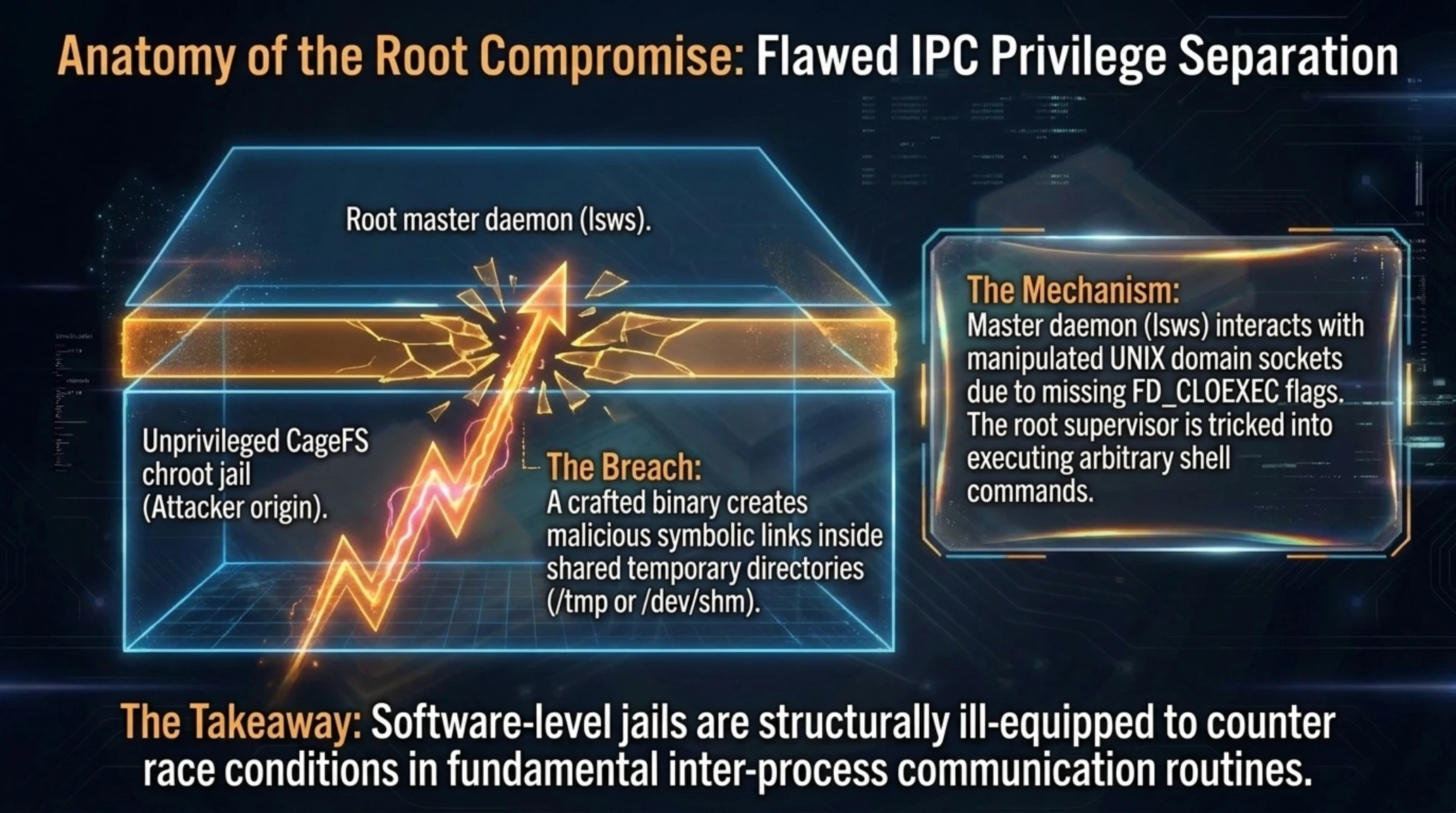
The internal architecture of LiteSpeed Enterprise relies on a master daemon (`lsws`) executing with full root privileges to bind to low-numbered privileged network ports (TCP 80, 443, and QUIC 443) and manage global server state. To handle incoming HTTP/HTTPS traffic securely, the master process forks unprivileged worker processes and child CGI wrappers assigned to individual customer user IDs. Forensic reverse-engineering reveals that during worker initialization and internal inter-process communication (IPC) routines, the master daemon failed to properly sanitize inherited file descriptors and omitted mandatory `FD_CLOEXEC` flags on critical system sockets.
Consequently, an attacker operating within a restricted CageFS chroot jail can execute a purpose-crafted binary that creates symbolic links inside shared temporary directories, such as `/tmp` or `/dev/shm`, targeting the web server’s internal UNIX domain sockets. When the privileged master daemon interacts with these manipulated IPC channels, it triggers an unsafe file operation, allowing the unprivileged process to trick the root supervisor into executing arbitrary shell commands with unrestricted superuser privileges.
System security analysts emphasize that this vulnerability poses an asymmetric threat to shared hosting platforms powered by popular control panels, including cPanel/WHM, DirectAdmin, CyberPanel, and Plesk. Because shared hosting accounts can often be procured anonymously using fraudulent payment methods or compromised credentials, malicious actors routinely acquire sacrificial accounts specifically to stage local privilege escalation exploits against multi-tenant infrastructure.
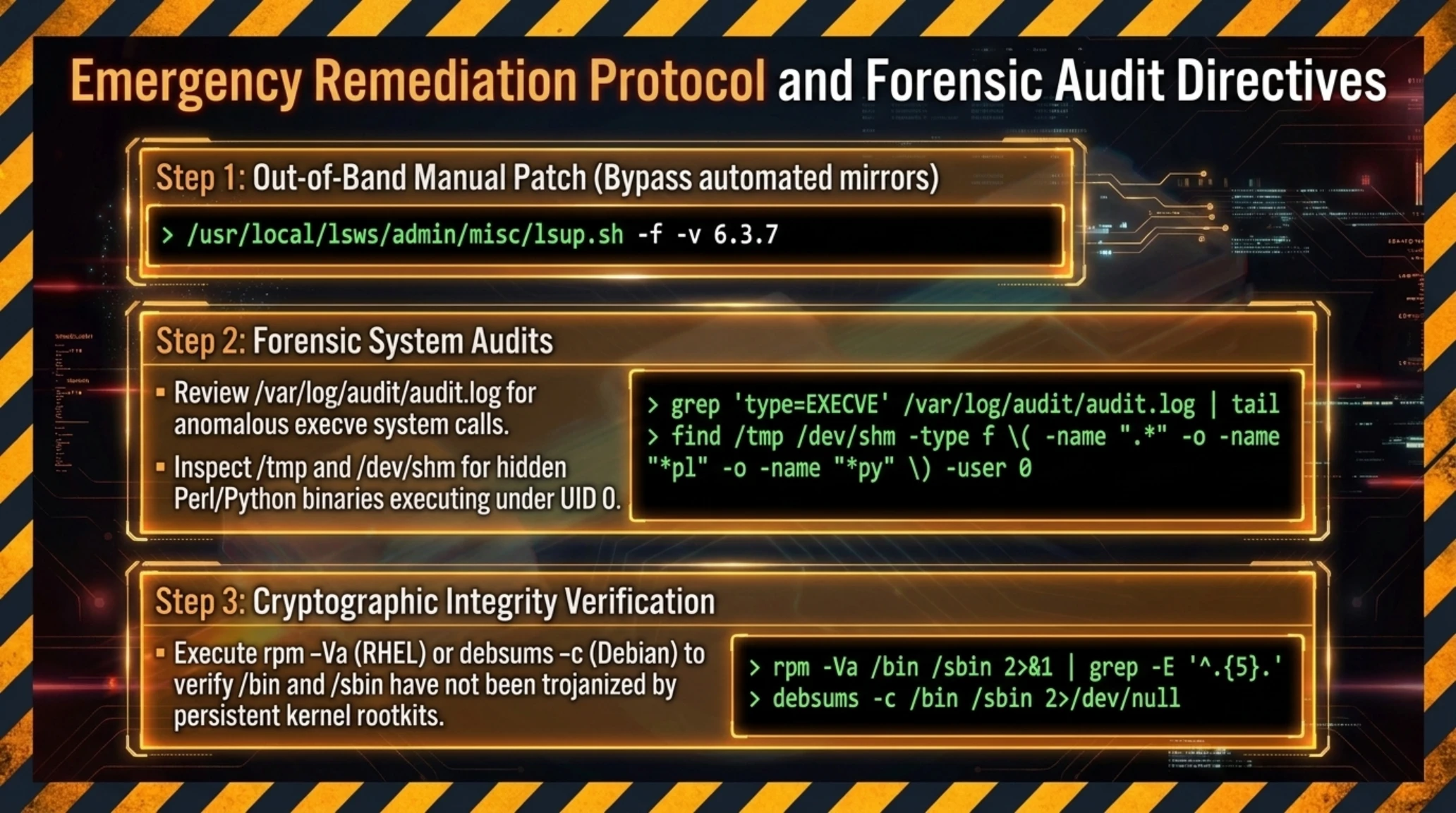
In response to the vulnerability, LiteSpeed Technologies has rolled out an emergency out-of-band release, LiteSpeed Web Server 6.3.7. Emphasizing that automatic background update pipelines may encounter caching delays or regional mirror latency, LiteSpeed and cPanel have published emergency advisories urging all server operators to bypass automated channels and manually trigger an immediate update via SSH root terminal access:
/usr/local/lsws/admin/misc/lsup.sh -f -v 6.3.7Following the patch application, cybersecurity response teams are urged to conduct comprehensive forensic audits across server logs. Specifically, administrators should review `/var/log/audit/audit.log` for anomalous `execve` system calls, inspect `/tmp`, `/var/tmp`, and `/dev/shm` for hidden scripts or foreign binaries, and examine running processes using `ps aux` to detect unauthorized background Perl, Python, or shell daemons executing under UID 0.
In addition, system defenders should execute package integrity verification commands, such as `rpm -Va` on RHEL-based distributions or `debsums -c` on Debian derivatives, to verify that system binaries within `/bin`, `/sbin`, and `/usr/bin` have not been trojanized. Network socket inspection using `ss -tulpn` or `lsof -i` should also be conducted to identify unexpected listening ports bound to arbitrary loopback or external network interfaces.
To establish a rigorous technical foundation for the aerospace doctrines, operating system frameworks, cryptographic protocols, and server infrastructure analyzed throughout today’s briefing, the reference glossary below details essential domain terminology.
Jargon Buster: Core Technological Foundations of Today's Tekin Morning
Executive Reference Guide to Aerospace, Mobile Platform, Cryptographic & Web Technologies
| Specialized Term | Technical Definition & Operational Architecture |
|---|---|
| On-Orbit Space Control | The unified military doctrine, tracking telemetry, and directed-energy or kinetic hardware deployed to defend orbital assets and project dominance in Earth orbit. |
| Transaction V1 (SIMD-0385) | Solana’s modernized transaction wire format expanding payload capacity to 4,096 bytes and eliminating address lookup overhead for complex smart contracts. |
| Liquid Glass Interface | Apple’s real-time optical rendering framework introduced in iOS 27, featuring dynamic light refraction shaders, sub-surface material scattering, and tactile depth. |
| FLORIS Spectrometer | The high-resolution imaging spectrometer aboard the FLEX satellite designed to capture solar-induced chlorophyll fluorescence emitted during plant photosynthesis. |
| CageFS Virtualized Jail | CloudLinux’s proprietary security encapsulation framework that confines each shared hosting tenant inside an isolated, virtualized skeleton file system. |
| Dismissal With Prejudice | A definitive, binding judicial ruling that permanently bars a plaintiff from refiling identical legal claims against the named defendant in any court. |
Why this matters: Today's developments underscore an undeniable shift: contemporary technology has reached an era of high-velocity convergence where military sovereignty in outer space, regulatory decoupling of mobile platforms, high-throughput distributed finance, and foundation-level server security intersect directly. From aerospace doctrines expanding beyond the Karman line to mobile operating systems cracked open by antitrust enforcement, the technical decisions finalized during these twenty-four hours will reverberate across the global digital economy for the next decade.

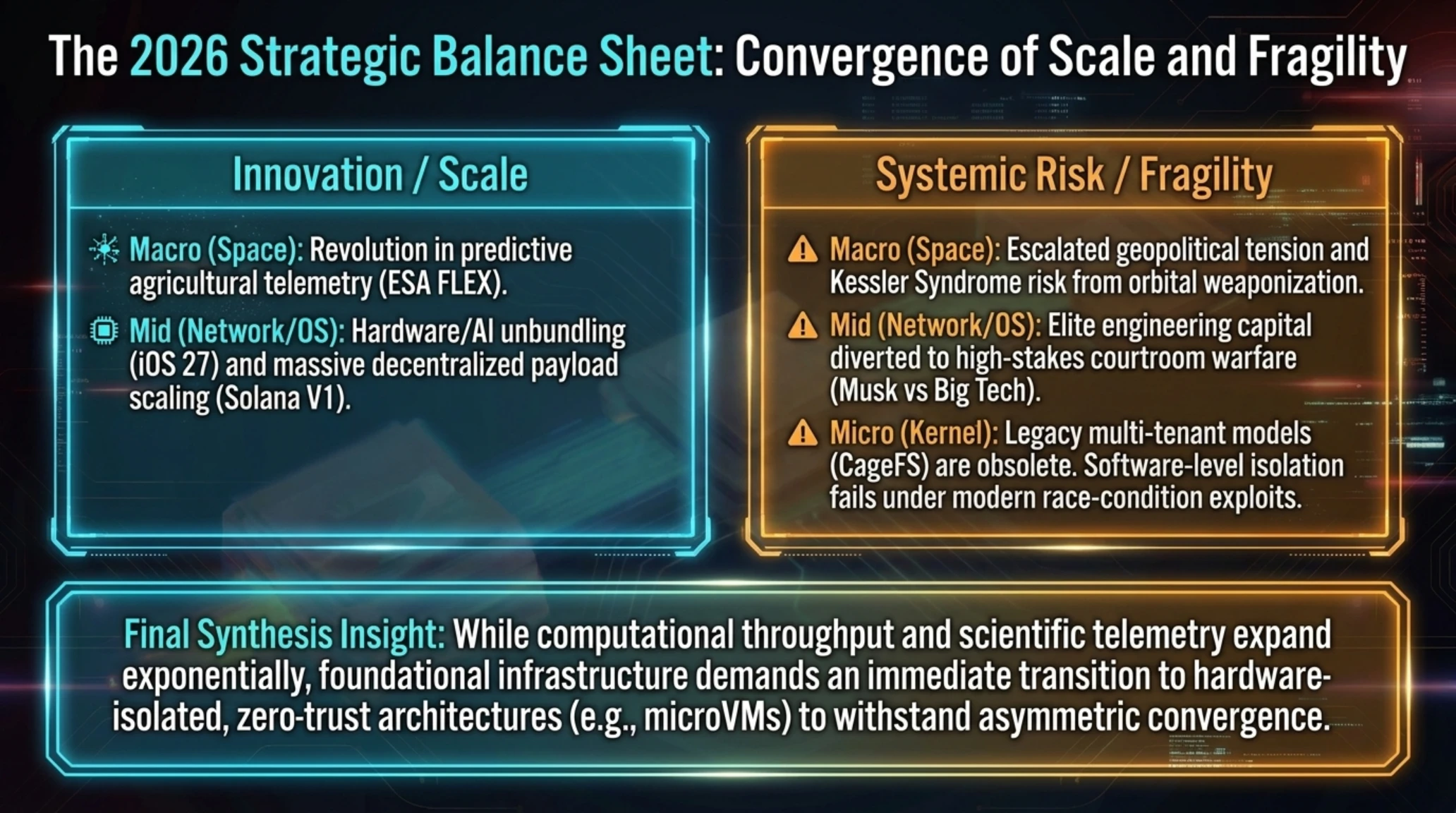
To quantify the broader ecosystem impact, the analytical matrix below evaluates the strategic advantages and operational vulnerabilities arising from the past day’s developments.
- Solana’s 3.3-fold payload expansion eliminates memory fragmentation and natively accommodates dense Zero-Knowledge cryptography.
- Apple’s architectural concession in iOS 27 establishes a precedent for modular AI model selection on premium mobile hardware.
- ESA’s successful Vega-C launch restores sovereign European space access and unlocks revolutionary predictive agricultural telemetry.
- Rapid remediation from LiteSpeed provides an immediate, verifiable patch to secure millions of enterprise hosting accounts.
- Formal military weaponization of Earth orbit escalates international tensions and elevates collision risks for commercial satellites.
- Severe root vulnerability in LiteSpeed demonstrates the persistent fragility of traditional multi-tenant shared hosting infrastructure.
- Continued high-stakes legal warfare between Musk and OpenAI risks diverting elite engineering capital toward courtroom discovery.
- System administrators face compounding operational friction due to an unrelenting cadence of out-of-band emergency security patches.
This strategic balance sheet demonstrates that while computational throughput and scientific telemetry continue their exponential expansion, foundational infrastructure ranging from web servers to orbital constellations demands rigorous zero-trust architectures to withstand modern systemic threats.
Tekin Analysis: Strategic Takeaways and Future Horizons for Technology Leaders
Executive Insights from the TekinGame Research Desk for Engineers, Executives & Investors
- Orbital Dominance Is the New Frontier: The Pentagon’s confirmation proves that satellite operators can no longer treat space as a safe haven; resilience against directed-energy and cyber threats must be engineered into every bus.
- Platform Walled Gardens Are Cracking: The modular assistant hooks discovered in iOS 27 reveal that antitrust regulatory pressure is succeeding in decoupling device operating systems from proprietary AI engines.
- Execution Speed Wins the Blockchain Race: Solana’s frictionless mainnet activation of Transaction V1 establishes an industry standard for delivering massive throughput improvements without fragmenting state compatibility.
- Multi-Tenancy Requires Zero-Trust Re-architecture: The LiteSpeed root escape proves that software-level jails like CageFS are insufficient for mission-critical workloads; organizations must migrate to containerized microVM architectures.
Community sentiment and market indicators reflect surging optimism across high-performance blockchain ecosystems and sovereign aerospace engineering, alongside heightened vigilance across enterprise cybersecurity divisions tasked with patching internet-facing hosting infrastructure.
Strategic Synthesis: Navigating Next-Generation Digital and Orbital Frontiers
Wednesday morning delivers an unvarnished portrait of technological progress in 2026: audacious, multi-faceted, and inherently volatile. The formal militarization of low and medium Earth orbits brings decades of unacknowledged strategic planning into the open light of day. As major powers establish defensive perimeters in space, the commercial aerospace sector will inevitably adapt, introducing radiation-hardened components, optical baffling, and autonomous evasion routines to preserve communications continuity in contested skies.
From an international space law perspective, the deployment of space control weapons introduces complex legal questions under the 1967 Outer Space Treaty. While Article IV of the treaty explicitly bans nuclear weapons and weapons of mass destruction from orbit, conventional directed-energy systems, electronic jamming arrays, and co-orbital inspector satellites operate within a regulatory gray zone. As commercial megaconstellations swell into tens of thousands of active nodes, the risk of miscalculation or orbital debris generation from an active space engagement poses an existential threat to satellite communications, navigation systems, and planetary observation networks.
Concurrently, the consumer technology arena is witnessing a historic realignment of platform power. Apple’s release of iOS 27 and its latent support for third-party artificial intelligence engines signals the dawn of an era where hardware supremacy and artificial intelligence reasoning operate as distinct economic layers. The modern smartphone is transforming from a curated, proprietary garden into a flexible substrate capable of routing queries to whichever specialized neural model best serves the user's immediate intent.
Under Article 6(7) of the European Union's Digital Markets Act, gatekeepers are legally required to provide third-party developers with free and effective interoperability with the same hardware and software features accessed by the platform's own default services. The modular AI hooks identified in iOS 27 represent Apple’s preemptive engineering accommodation to avoid catastrophic regulatory fines. By architecting an operating system where a user can designate Anthropic’s Claude or OpenAI’s ChatGPT as their primary voice agent, Apple is insulating its core hardware business from antitrust liability while positioning the iPhone as the premier universal terminal for enterprise artificial intelligence.
In distributed computing, Solana’s flawless execution of Transaction V1 demonstrates the maturity of decentralized protocols to evolve under continuous, high-volume production loads. By eliminating legacy packet constraints and aligning wire serialization with modern Linux memory pages, the network has eliminated structural bottlenecks, paving the way for institutional-grade financial instruments and zero-knowledge privacy layers to thrive.
For high-frequency decentralized finance (DeFi) protocols, the transition to 4,096-byte transaction frames represents an architectural inflection point. Automated market makers and algorithmic liquidity providers can now pack order cancellations, route recalculations, and multi-hop trade executions into a single atomic payload. By removing the need for auxiliary address lookup tables (ALTs) and reducing transaction signature serialization overhead, validator nodes running next-generation execution clients like Firedancer can process blocks with significantly lower CPU cycle consumption and predictable execution latency.
Yet, the severe privilege escalation vulnerability in LiteSpeed Web Server provides an urgent reminder that modern computing remains only as robust as its most foundational daemons. In an interconnected digital economy where a single shared server hosts thousands of independent enterprises, security cannot rely on assumptions of container isolation. Traditional multi-tenancy models that rely on user-space process boundaries and virtualized chroot filesystems are structurally ill-equipped to counter sophisticated privilege escalation exploits. Infrastructure architects must accelerate transitions toward microVM technologies, such as Firecracker and gVisor, where every tenant application executes within an independent hardware-isolated kernel instance.
Recommended In-Depth Gaming & Tech Dossiers on TekInGame
• 🛡 Inside the FBI & NSA Takedown of Chinese Cyber Network QTFY | Deconstructing QScan IoT Botnets & QTRouter Proxy Meshes
• 🎬 Deconstructing Alibaba Wan 3.0 Video AI | The Chinese Tech Breakthrough Disrupting Hollywood & Sora
• 🧪 Inside Inherent's Faraday AI | How a 27-Million-Parameter Model Beat DeepSeek-R1 in Biochemical Reasoning
As the day unfolds, the TekinGame engineering and research desk will maintain continuous surveillance across orbital monitoring feeds, code repositories, and decentralized liquidity flows, providing real-time intelligence as these historic developments shape the global tech landscape.

To conclude this comprehensive briefing, detailed answers to the most frequently posed technical, legal, and operational inquiries regarding today's breakthroughs are compiled below.
Frequently Asked Questions Regarding Today's Strategic Intelligence Briefing
Why is the Pentagon's confirmation of orbital space control weapons considered historic?
It marks the first time US defense officials have publicly acknowledged operational offensive and defensive weapons in orbit, signaling a major doctrinal shift from passive satellite resilience to active domain dominance.
What capabilities do the hidden code hooks in Apple's iOS 27 disclose?
Code teardowns reveal that Apple has built underlying system endpoints allowing users to switch their default system voice assistant from Siri to competing third-party models such as Claude or ChatGPT, likely in response to EU DMA regulations.
How does Transaction V1 improve the Solana blockchain's operational capabilities?
It raises the transaction size cap from 1,232 to 4,096 bytes, enabling direct inline execution of up to 64 accounts, reducing DEX compute unit overhead by 42%, and natively accommodating complex Zero-Knowledge proofs.
Why did Elon Musk's entities voluntarily dismiss Apple from their federal antitrust lawsuit?
By dropping claims against Apple with prejudice, Musk eliminated a legally vulnerable claim following Apple's non-exclusive model integration, allowing his legal team to focus entirely on contract fraud claims against OpenAI and Sam Altman.
What immediate action must server administrators take regarding the LiteSpeed vulnerability?
Administrators must immediately access their servers via SSH and run the manual update script to install LiteSpeed 6.3.7, closing the process supervisor flaw that enables privilege escalation to root from shared hosting accounts.
Verified Primary Sources and Official Reference Documentation
- IGN / Washington Times: Official Keynote Address by Assistant Secretary Troy Meink on US Orbital Space Control Weapons
- 9to5Mac: Apple Releases iOS 27 Public Build with Siri AI, Liquid Glass UI, and Third-Party Assistant Code Hooks
- CoinDesk / Helius: Technical Architecture Report on Solana Mainnet Activation of Transaction V1 (SIMD-0385)
- 9to5Mac / Gizmodo: Federal Court Motion by X Corp and SpaceXAI Dismissing Apple With Prejudice in Texas Antitrust Suit
- Space.com / European Space Agency: Flight VV30 Mission Success Report on Vega-C Deploying Sentinel-3C and FLEX
- The Hacker News / cPanel Security Advisory: Critical Local Privilege Escalation Flaw Patched in LiteSpeed Web Server 6.3.7
Additional Gallery: Tekin Morning Sep 16, 2026: 🚀 US Space Weapons, iOS 27 & Solana V1