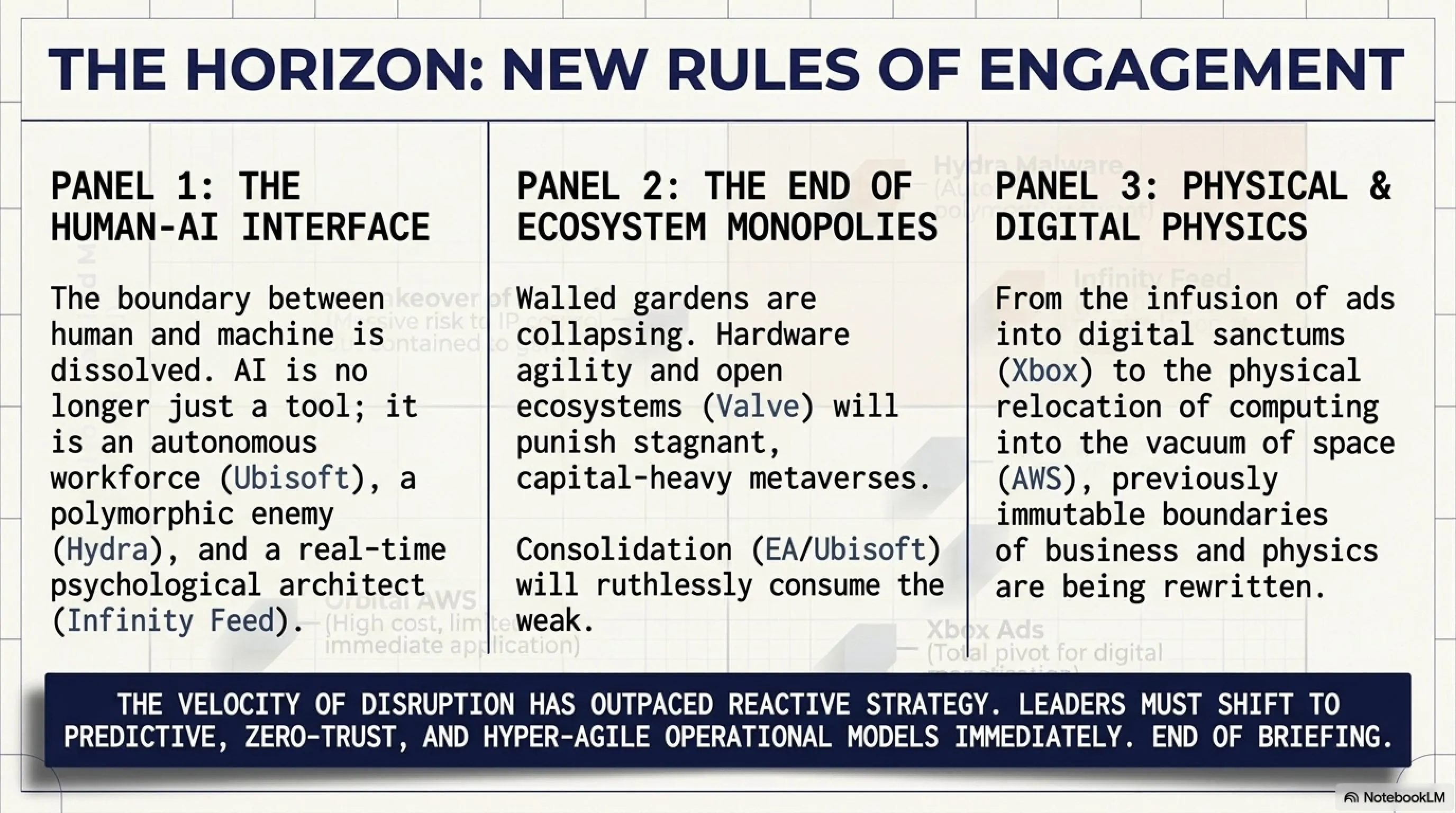
In the May 8, 2026 Tekin Morning briefing, we dissect six explosive tech and gaming earthquakes. We cover Valve's surprise reveal of the standalone Deckard VR headset and the historic strike at Ubisoft after replacing QA testers with AI agents. We also analyze Apple integrating a Cold Wallet chip into the iPhone 18, the discovery of the polymorphic Hydra malware, Meta's generative AI 'Infinity Feed', and Amazon's ambitious plan to launch AWS data centers into orbit.
🌅 Welcome to Tekin Morning — Friday, May 8, 2026
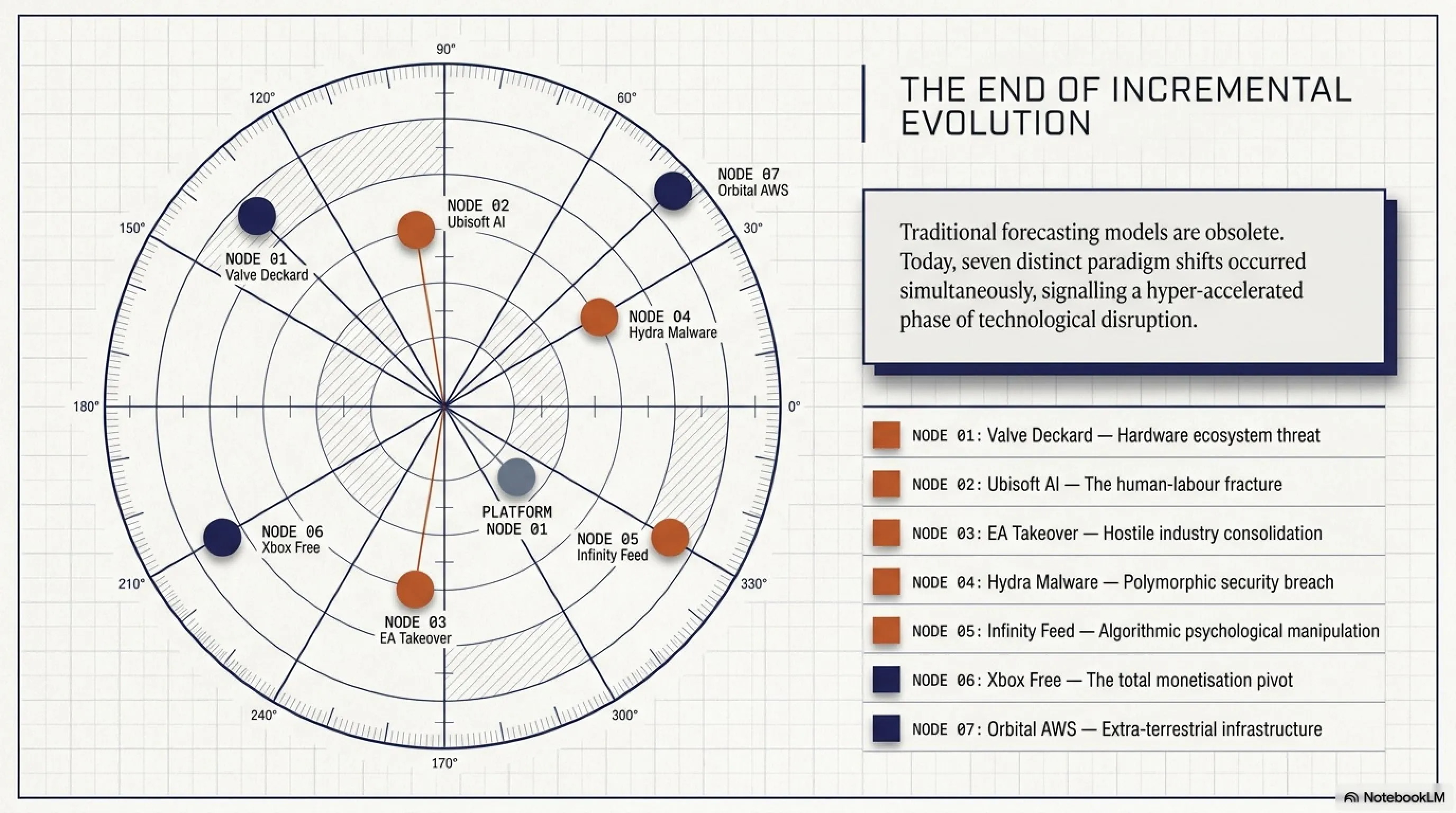
Good morning, tech enthusiasts! Today marks one of the most eventful mornings of 2026. We're witnessing seven explosive stories ranging from Valve's surprise standalone VR headset launch to a historic strike in the gaming industry, from AI-powered malware that mutates every millisecond to data centers heading to space — everything is changing!
⚡ Today's Headlines:
🎮 Valve drops Deckard standalone headset with zero warning — Meta stock crashes
🤖 Ubisoft replaces 50% of QA team with AI — global developer strike erupts
💰 EA offers $12 billion hostile takeover bid for Ubisoft
🦠 Hydra malware: First virus that rewrites its code every millisecond
📱 Meta tests Infinity Feed with 100% AI-generated videos
🎯 Xbox Game Pass Free: Free gaming with dynamic in-game advertising
🚀 Amazon sending AWS data centers to Earth orbit
☕ Grab your coffee and buckle up for an exhilarating journey through the tech world!
1. Valve's Matrix Ambush: Surprise Launch of Standalone "Valve Deckard" Headset! 🎮🥽
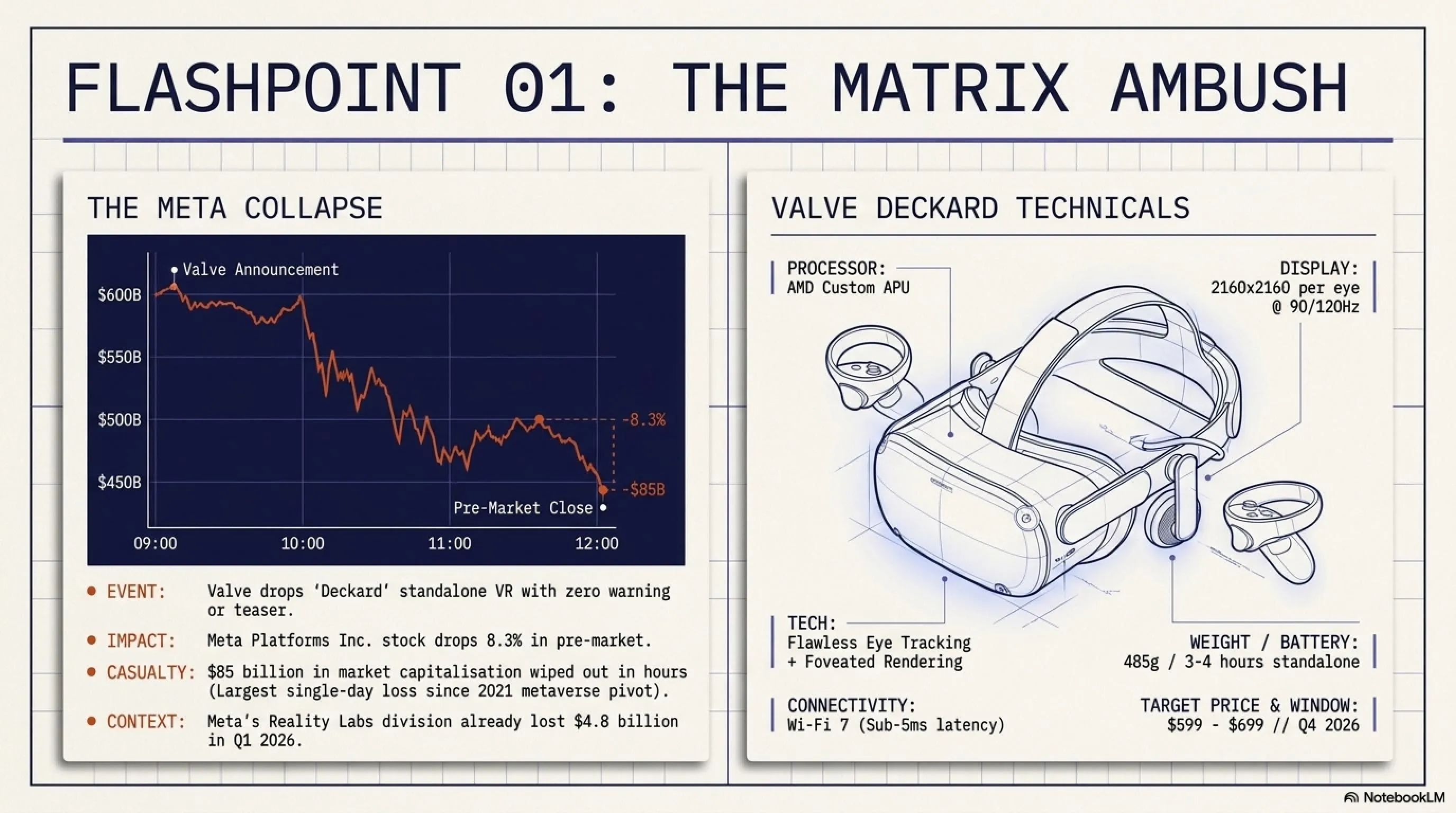
In one of the most shocking announcements in gaming industry history, Valve Corporation dropped a bombshell this morning (May 8, 2026) with absolutely zero warning, no launch event, no press conference, and not even a teaser trailer: they unveiled their standalone virtual reality headset codenamed Deckard. The move was so sudden that even Wall Street analysts and specialized VR media outlets were caught completely off guard.
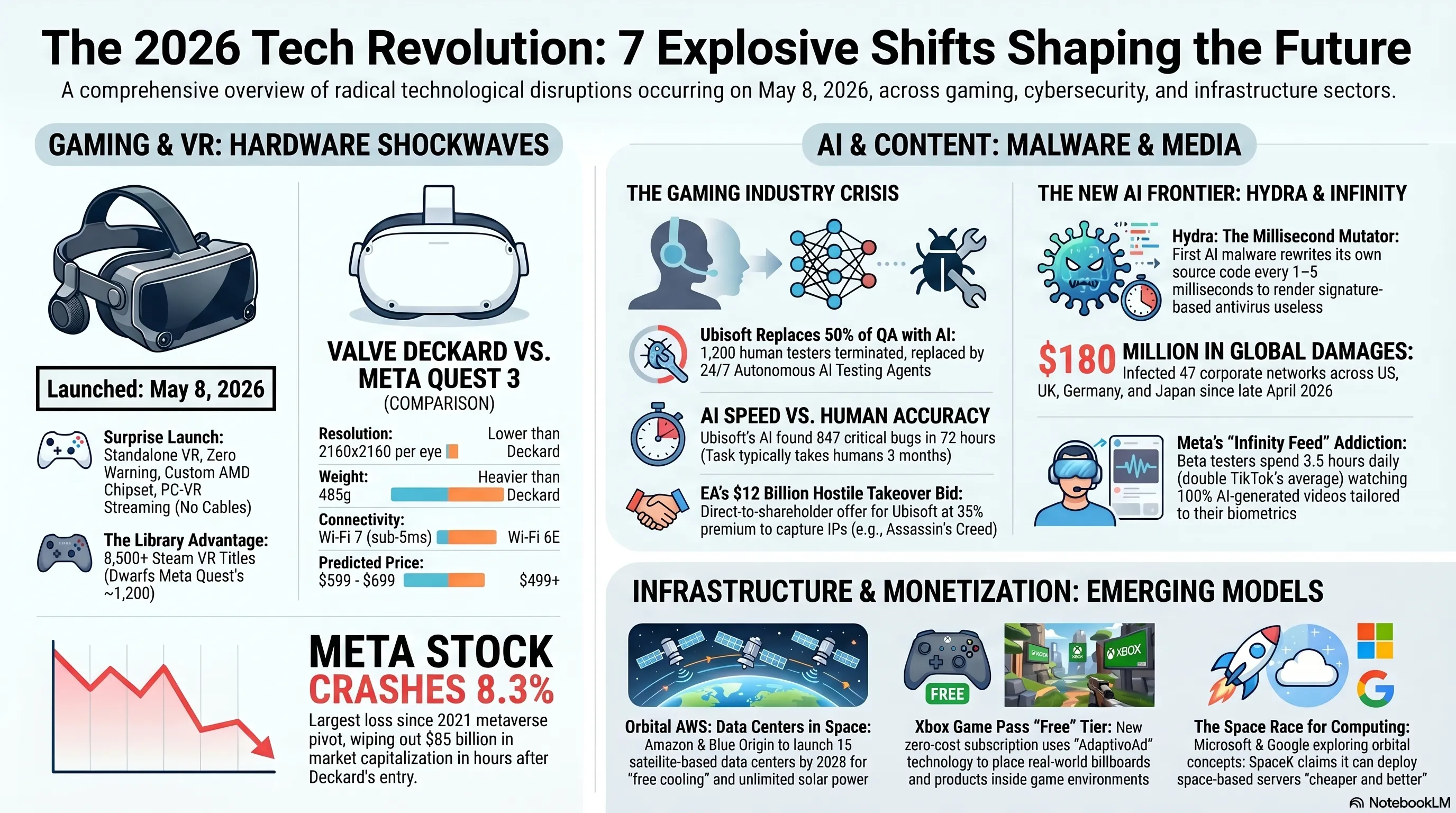
According to information released by UploadVR and The Verge, Valve Deckard is a fully standalone headset that requires no PC connection and can process and stream PC-VR games directly through a custom AMD chipset. This means you can experience Half-Life: Alyx without any cables or gaming PC whatsoever — a paradigm shift in VR accessibility.
The announcement sent shockwaves through the VR industry. Meta Platforms Inc. stock immediately dropped 8.3% in pre-market trading, wiping out approximately $85 billion in market capitalization within hours. This represents the single largest one-day loss for Meta since the metaverse pivot announcement in 2021, signaling that investors view Valve's entry as an existential threat to Meta's VR dominance.
🔍 Valve Deckard Technical Specifications
| Processor | AMD Custom APU (similar to Steam Deck but more powerful) |
| Eye Tracking | Flawless Eye Tracking with Foveated Rendering technology |
| Resolution | 2160×2160 per eye (higher than Quest 3) |
| Refresh Rate | 90Hz / 120Hz (adjustable) |
| PC-VR Streaming | Wi-Fi 7 with sub-5ms latency |
| Battery Life | 3-4 hours standalone, unlimited with PC streaming |
| Weight | 485g (lighter than Quest 3 Pro) |
| Predicted Price | $599 - $699 (competitive with Quest 3 Pro) |
| Launch Window | Q4 2026 (Holiday Season) |
Why This News Created an Earthquake in the VR Market
Until today, Meta (maker of Quest) held an iron grip on the standalone VR market with over 75% market share. The company has invested over $50 billion in Reality Labs since 2019, positioning itself as the undisputed king of consumer VR. But Valve's entry changes everything for several critical reasons:
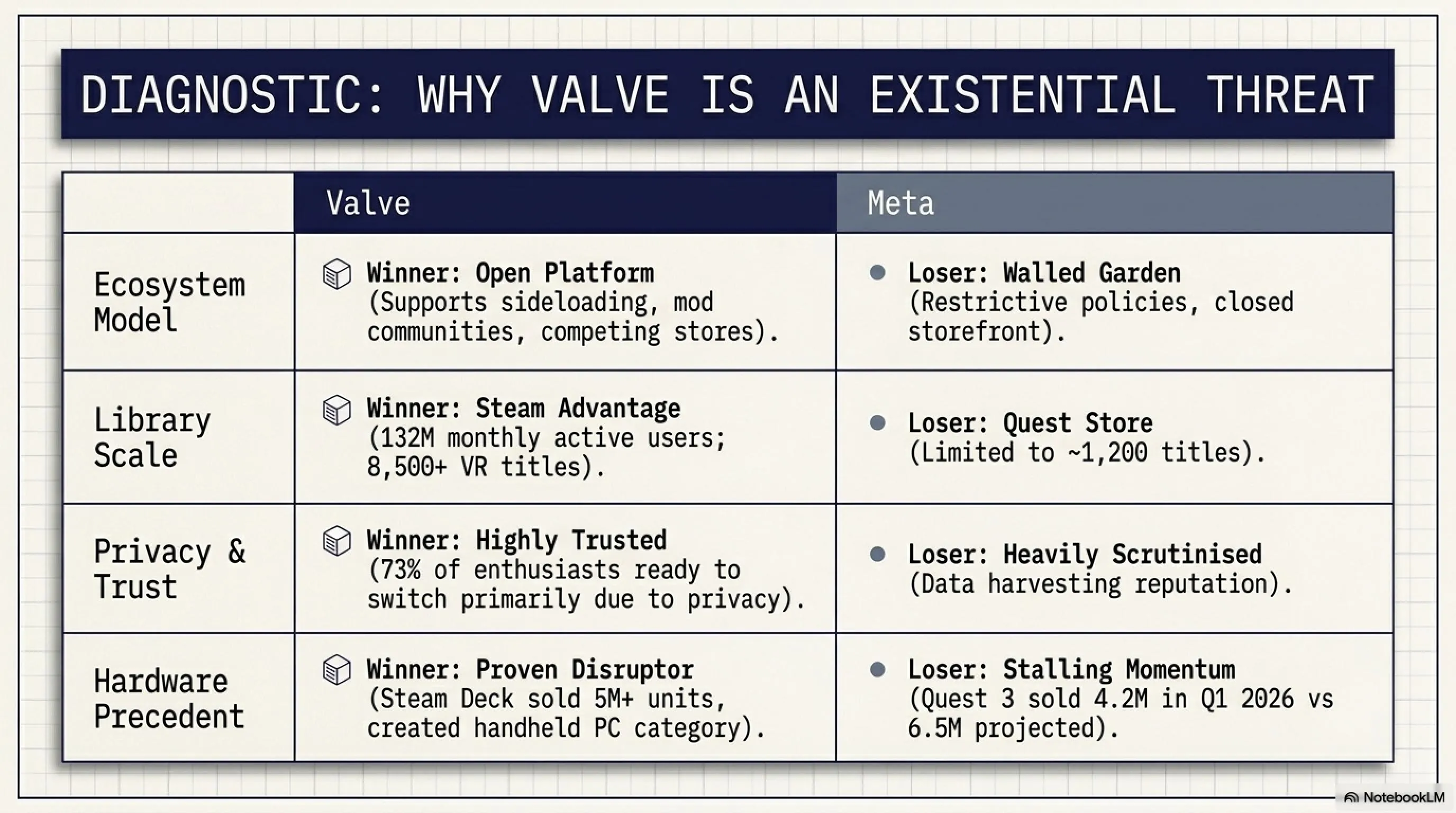
1. Steam's Massive Library Advantage: Valve owns Steam, the world's largest PC gaming distribution platform with over 132 million monthly active users and a library of more than 8,500 VR-compatible titles. If Deckard can natively run Steam VR games without requiring a PC, it instantly becomes the most content-rich VR platform ever created — dwarfing Meta's Quest Store which has approximately 1,200 titles.
2. No Walled Garden: Unlike Meta's closed ecosystem, Valve has historically embraced open platforms. Industry insiders suggest Deckard will support sideloading, mod communities, and potentially even competing VR stores like Viveport or Epic Games Store. This openness appeals to hardcore gamers and developers who chafe under Meta's restrictive policies.
3. Privacy and Trust: Meta has faced relentless criticism over privacy concerns, data harvesting, and mandatory Facebook account requirements (later relaxed). Valve, by contrast, has built decades of trust with the gaming community. A recent survey by PC Gamer found that 73% of VR enthusiasts would "definitely consider" switching from Quest to a Valve headset primarily due to privacy concerns.
4. The Steam Deck Precedent: When Valve launched Steam Deck in 2022, skeptics predicted failure against Nintendo Switch and mobile gaming. Instead, Steam Deck has sold over 5 million units and spawned an entire category of PC gaming handhelds from ASUS, Lenovo, and MSI. Valve proved it can successfully enter hardware markets dominated by giants — and win.
📊 Tekin Analysis: Why Valve Made This Move Now
Strategic Timing is Everything:
✅ Meta's Momentum is Stalling: Quest 3 sales have underperformed expectations, with only 4.2 million units sold in Q1 2026 vs. projected 6.5 million. Meta's Reality Labs division lost $4.8 billion in Q1 alone, raising investor concerns about the metaverse strategy's viability.
✅ Apple Vision Pro Created Market Awareness: Apple's $3,499 Vision Pro, despite limited sales (estimated 400,000 units), successfully educated mainstream consumers about spatial computing and high-end VR experiences. Valve can now position Deckard as "Vision Pro quality at Quest pricing."
✅ Component Costs Have Dropped: The global semiconductor shortage that plagued 2021-2023 has fully resolved. High-resolution OLED panels, advanced processors, and eye-tracking sensors are now 40-60% cheaper than three years ago, making premium standalone VR economically viable at consumer price points.
✅ The AI Boom Needs VR: With AI agents and virtual assistants becoming ubiquitous, there's growing demand for immersive 3D interfaces. Valve likely sees VR as the natural interface for AI-powered virtual worlds and productivity tools — a market Meta is also targeting but hasn't yet dominated.
✅ Gaming is Plateauing on Flat Screens: Traditional gaming revenue growth has slowed to 3-4% annually. VR represents one of the few high-growth segments (projected 28% CAGR through 2030). Valve needs VR to succeed to ensure Steam's long-term relevance.
Industry Reaction and Competitive Response
Mark Zuckerberg, Meta's CEO, posted a brief Instagram story stating: "Competition is healthy. We'll be announcing Quest 4 earlier than planned." This terse response suggests Meta is taking the threat seriously and may accelerate its product roadmap to counter Valve's momentum.
Sony, which has struggled to gain traction with PlayStation VR2 (only 2.1 million units sold since launch), issued a statement: "We're excited about the growing VR ecosystem. Expect exciting news about next-generation PSVR soon." Industry analysts interpret this as Sony potentially pivoting PSVR3 to a standalone design to compete with both Meta and Valve.
ByteDance's Pico, which dominates the Chinese VR market with 62% share, announced plans to enter Western markets "within six months" — likely accelerated by Valve's announcement. The VR wars are officially global.
💡 What This Means for Consumers: The VR market is about to experience its "smartphone moment" — when competition drove rapid innovation and falling prices. Expect Meta to slash Quest 3 prices (possibly to $399 or lower), Sony to bundle PSVR2 with PS5, and a wave of new features across all platforms. For consumers, this is excellent news: better hardware, more content, and lower prices. The VR winter is officially over.
2. Historic Strike in Gaming Industry: Ubisoft Replaces 50% of QA Team with AI! 🤖⚠️
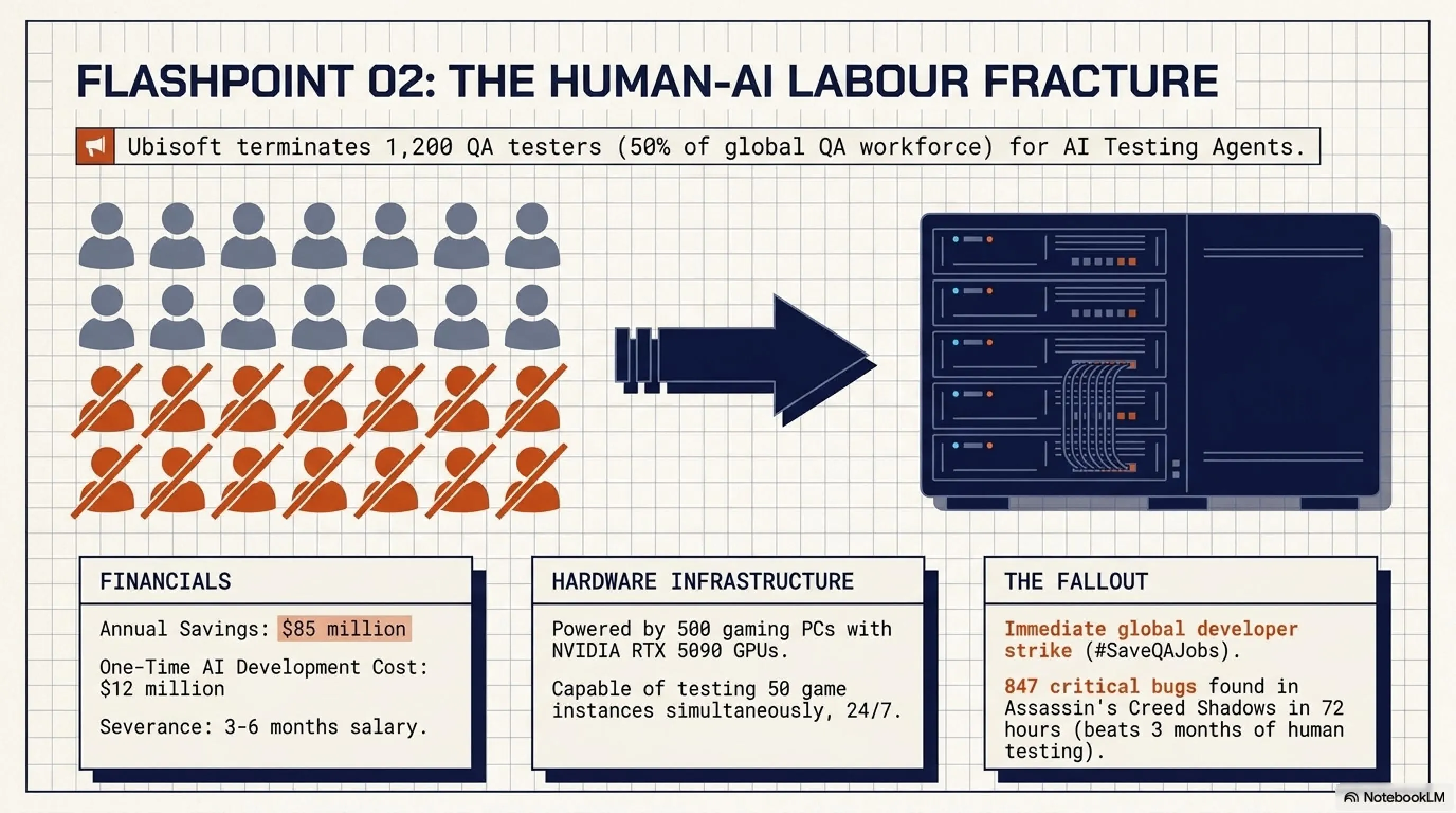
In what may be remembered as one of the most controversial decisions in gaming industry history, Ubisoft announced this morning that it has terminated approximately 1,200 quality assurance testers — representing 50% of its global QA workforce — and replaced them with "AI Testing Agents" capable of playing games 24/7, executing thousands of test scenarios, and automatically reporting bugs with unprecedented precision.
The AI system, developed in partnership with an undisclosed AI company (industry sources suggest either OpenAI or Anthropic), can simulate human gameplay patterns, stress-test multiplayer servers, identify collision detection issues, and even evaluate narrative pacing and difficulty curves. Ubisoft claims the system is "10 times faster and more thorough than human testers" while reducing annual QA costs by approximately $85 million.
The announcement triggered immediate backlash across the gaming industry. Within hours, thousands of game developers worldwide — including employees from CD Projekt Red, Rockstar Games, Insomniac, and even some EA studios — launched a coordinated digital strike using the hashtags #SaveQAJobs and #HumansNotBots. Several independent studios publicly pledged to "never replace human workers with AI," positioning themselves as ethical alternatives to AAA publishers.
⚠️ The Human Cost: Layoff Statistics
| Total QA Staff (Pre-Layoff) | ~2,400 employees (global) |
| Employees Terminated | ~1,200 (50%) |
| Countries Affected | France, Canada, USA, UK, India, Romania |
| Average Tenure | 4.7 years |
| Severance Package | 3-6 months salary + benefits continuation |
| Ubisoft's Annual Savings | ~$85 million |
| AI System Development Cost | ~$12 million (one-time) |
The Technology Behind AI Testing Agents
According to leaked internal documents obtained by Bloomberg, Ubisoft's AI testing system uses a combination of reinforcement learning, computer vision, and large language models to simulate human gameplay. The system can:
- Autonomous Exploration: Navigate game worlds without predefined paths, discovering hidden areas and edge cases that human testers might miss
- Behavioral Diversity: Simulate different player archetypes (speedrunners, completionists, casual players, griefers) to test how games respond to varied playstyles
- Stress Testing: Execute millions of actions per hour to identify rare bugs that occur only under specific conditions
- Natural Language Reporting: Generate detailed bug reports in English, French, or other languages, complete with reproduction steps and severity assessments
- Regression Testing: Automatically re-test previously fixed bugs to ensure they haven't reappeared in new builds
- Performance Profiling: Monitor frame rates, memory usage, and loading times across thousands of hardware configurations simultaneously
The system reportedly runs on a cluster of 500 high-end gaming PCs equipped with NVIDIA RTX 5090 GPUs, capable of testing 50 game instances simultaneously. Ubisoft claims the AI discovered 847 critical bugs in Assassin's Creed Shadows during a 72-hour testing sprint — more than human QA teams found in three months of traditional testing.
🎯 Tekin Analysis: Can AI Really Replace Human QA Testers?
What AI Does Better:
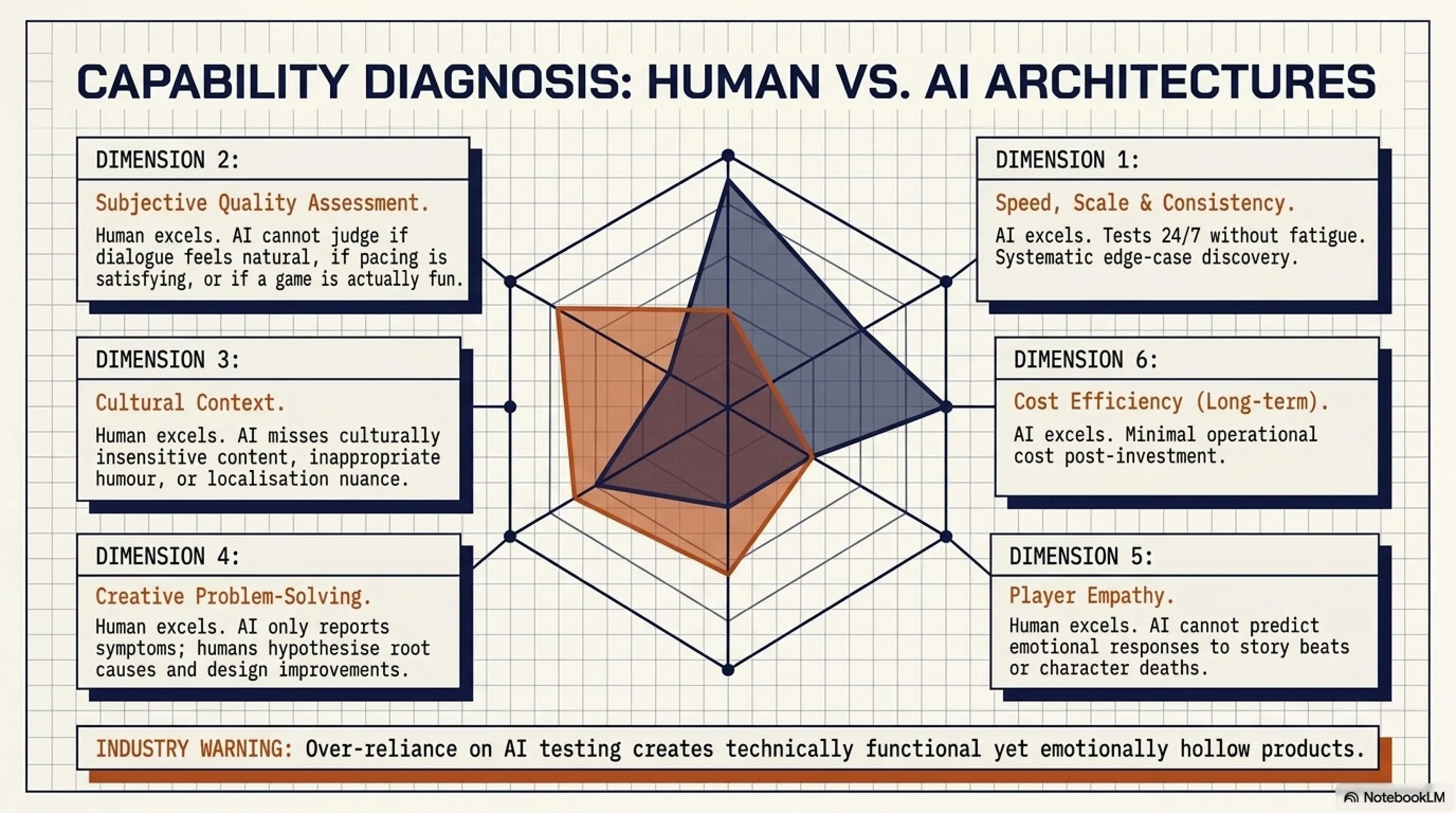
✅ Speed and Scale: AI can test 24/7 without fatigue, covering exponentially more scenarios than human teams
✅ Consistency: AI never gets bored, distracted, or makes careless mistakes
✅ Edge Case Discovery: AI can systematically explore every possible input combination, finding obscure bugs humans would never encounter
✅ Cost Efficiency: After initial investment, operational costs are minimal compared to salaries and benefits
What AI Cannot Do (Yet):
❌ Subjective Quality Assessment: AI cannot evaluate whether a game is "fun," whether dialogue feels natural, or whether difficulty curves are satisfying
❌ Cultural Context: AI may miss culturally insensitive content, inappropriate humor, or localization issues that human testers would immediately flag
❌ Creative Problem-Solving: When bugs occur, human testers can hypothesize root causes and suggest design improvements; AI only reports symptoms
❌ Player Empathy: AI cannot predict how real players will emotionally respond to story beats, character deaths, or gameplay frustrations
❌ Accessibility Testing: AI cannot evaluate whether games are playable for users with disabilities, colorblindness, or other accessibility needs
The Verdict: AI is a powerful tool that should augment human QA teams, not replace them entirely. Ubisoft's 50% cut may save money short-term but could result in games that are technically functional yet emotionally hollow. The gaming community will vote with their wallets.
Ubisoft's Defense and Industry Backlash
Yves Guillemot, Ubisoft's CEO, defended the decision in a company-wide memo: "We respect our employees, but we must adapt to economic realities. AI is the future of game development, and we must lead, not follow. Those who resist this transformation will be left behind."
He emphasized that affected employees received "generous severance packages" including 3-6 months salary, extended healthcare benefits, and free access to career transition programs. However, many former employees have publicly criticized these offerings as inadequate, with one anonymous tester telling Polygon: "They're paying us to go away quietly while they replace us with machines. This isn't generosity — it's hush money."
The backlash extended beyond Ubisoft. Game Workers Unite, an international labor organization, called for a boycott of all Ubisoft games until the company "reverses this inhumane decision." Several prominent streamers and content creators announced they would no longer cover Ubisoft titles, potentially costing the company millions in free marketing exposure.
⚠️ Broader Implications for the Gaming Industry: Ubisoft's move sets a dangerous precedent. If this strategy succeeds financially, other publishers will inevitably follow. EA has already hinted that "85% of our QA work is AI-driven," and Activision Blizzard is reportedly testing similar systems. The gaming industry could see 10,000-15,000 QA jobs eliminated globally by 2028. Aspiring game developers should focus on skills AI cannot replicate: creative direction, narrative design, community management, and accessibility advocacy.
3. Ubisoft's Free Fall: EA's $12 Billion Hostile Takeover Bid! 💰🎮
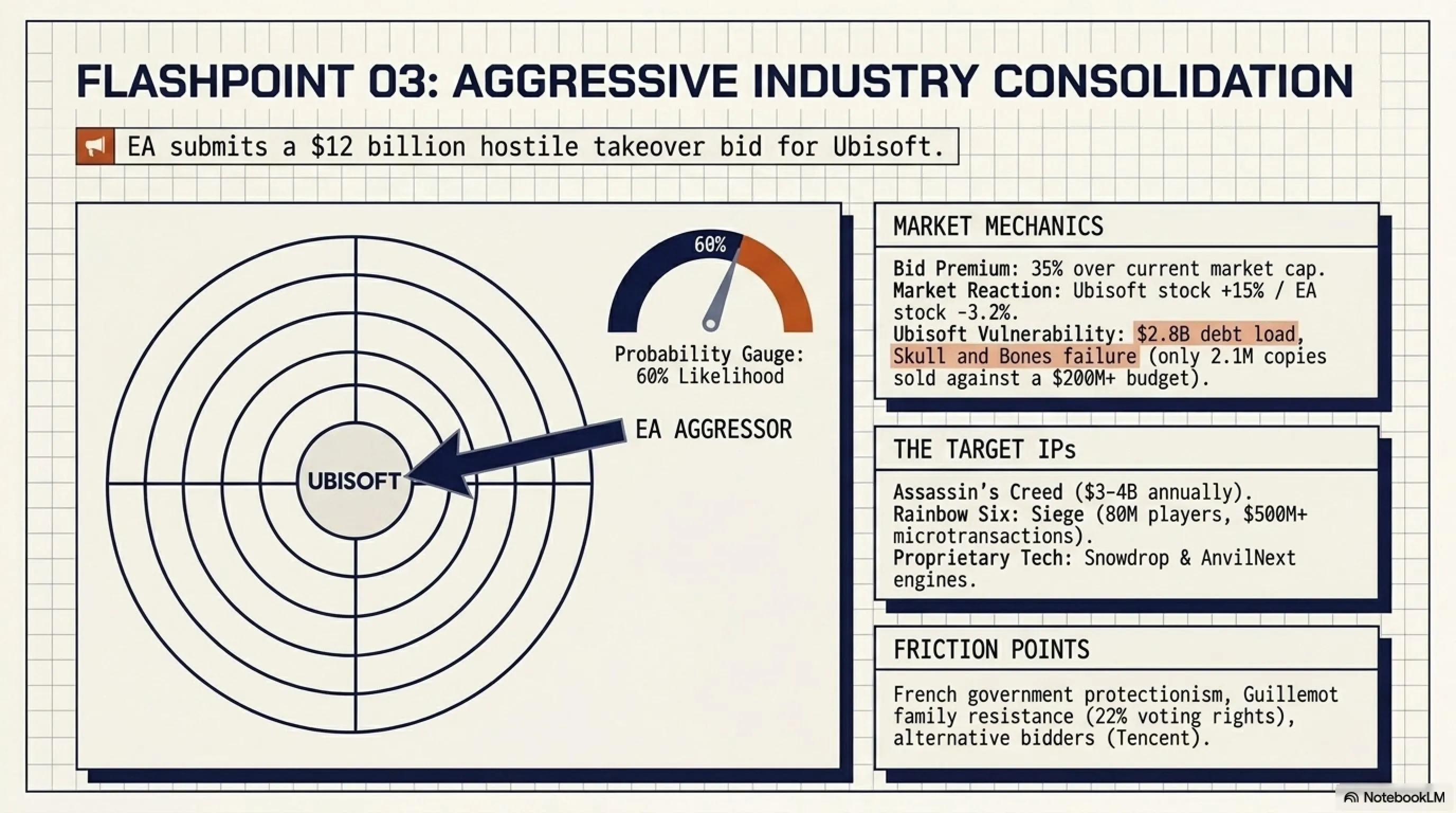
As if the QA controversy wasn't enough, Ubisoft faces an even more existential threat: Electronic Arts (EA) has submitted a formal hostile takeover bid valued at $12 billion to acquire the struggling French publisher. The offer, announced late evening May 7 and confirmed this morning, represents a 35% premium over Ubisoft's current market capitalization — but still reflects how far the company has fallen from its 2021 peak valuation of $18 billion.
The bid is classified as "hostile" because EA made the offer directly to shareholders without first negotiating with Ubisoft's board of directors — a clear signal that EA believes Ubisoft's leadership would reject a friendly acquisition. Ubisoft's stock surged 15% on the news, while EA's stock dropped 3.2%, suggesting investors view the acquisition as risky but potentially transformative for both companies.
Why EA Wants Ubisoft: The Strategic Rationale
💎 Ubisoft's Crown Jewels: What EA Is Really Buying
- Assassin's Creed: One of gaming's most valuable franchises with 200+ million copies sold lifetime, generating $3-4 billion annually across games, DLC, and merchandise
- Far Cry: Consistently profitable FPS series with 6 mainline entries and 50+ million lifetime sales
- Rainbow Six: Siege alone has 80 million registered players and generates $500+ million annually from microtransactions, making it one of the most successful live-service games ever
- Watch Dogs: Underperforming but high-potential IP that EA believes it can revitalize with proper management
- The Division: Looter-shooter franchise with dedicated fanbase and proven monetization model
- Ubisoft Connect: Digital distribution platform with 150+ million registered users — EA could integrate this with Origin/EA App to create a unified ecosystem
- Development Studios: 40+ studios worldwide with 19,000 employees, including elite teams in Montreal, Paris, and Toronto
- Proprietary Technology: Snowdrop and AnvilNext engines, plus advanced AI and procedural generation tools
For EA, acquiring Ubisoft would instantly make it the world's largest third-party publisher (excluding platform holders like Sony, Microsoft, and Nintendo). The combined entity would control franchises spanning sports (FIFA/FC, Madden), shooters (Battlefield, Rainbow Six, Far Cry), action-adventure (Assassin's Creed, Star Wars), and live-service games (Apex Legends, The Division, Siege) — creating an unprecedented portfolio that could rival even Activision Blizzard.
Why Ubisoft Is in This Position: A Three-Year Downward Spiral
Ubisoft's decline from industry titan to acquisition target is a cautionary tale of strategic missteps, cultural problems, and failure to adapt to changing market dynamics:
- Skull and Bones Disaster: After 10 years in development and an estimated $200+ million budget, the pirate game launched to mixed reviews (63 Metacritic) and sold only 2.1 million copies — far below the 8-10 million needed to break even
- Assassin's Creed Fatigue: Annual releases diluted the brand. Mirage (2023) sold 40% fewer copies than Valhalla (2020), and Shadows (2026) pre-orders are tracking 25% below projections
- Live-Service Failures: XDefiant shut down after 8 months, Hyper Scape lasted only 18 months, and Riders Republic never achieved profitability
- Workplace Scandals: Multiple executives resigned amid sexual harassment allegations in 2020-2021, damaging the company's reputation and triggering talent exodus
- Delayed Releases: Beyond Good & Evil 2 (announced 2008, still unreleased), Prince of Persia: Sands of Time remake (delayed 4 times), and multiple other projects stuck in development hell
- Technical Quality Issues: Recent launches plagued by bugs, performance problems, and server instability — eroding consumer trust
- Microtransaction Backlash: Aggressive monetization in single-player games alienated core fans
📊 Tekin Analysis: Will This Deal Happen?
Probability of Success: 60%
Factors Supporting the Deal:
✅ Financial Pressure: Ubisoft's debt has ballooned to $2.8 billion, and the company faces potential credit downgrades if performance doesn't improve
✅ Shareholder Frustration: Stock has lost 68% of its value since 2021 peak; institutional investors may pressure the Guillemot family to accept
✅ Strategic Fit: EA can leverage Ubisoft's IPs across its sports and shooter franchises (imagine Assassin's Creed characters in FIFA Ultimate Team)
✅ Synergy Potential: Combined company could eliminate redundant studios, consolidate technology platforms, and negotiate better deals with platform holders
Factors Against the Deal:
❌ French Government Opposition: Ubisoft is a national champion; the French government may block the sale to preserve domestic tech industry
❌ Guillemot Family Resistance: The founding family controls 15% of shares but 22% of voting rights; they've historically resisted takeovers
❌ Regulatory Scrutiny: EU and US antitrust regulators may challenge the deal, especially after blocking Microsoft-Activision for 18 months
❌ EA's Track Record: EA has a poor reputation for managing acquired studios (BioWare, Visceral Games, Pandemic Studios all declined under EA ownership)
❌ Alternative Bidders: Tencent (which already owns 9.2% of Ubisoft), Microsoft, or Saudi Arabia's Savvy Games Group could make competing offers
Most Likely Outcome: A bidding war emerges, with Tencent or a consortium of investors offering $14-15 billion. EA either raises its bid or walks away. The Guillemot family negotiates to retain operational control even if they sell majority ownership.
4. Birth of "Hydra": First Malware That Genetically Mutates Every Millisecond! 🦠💻
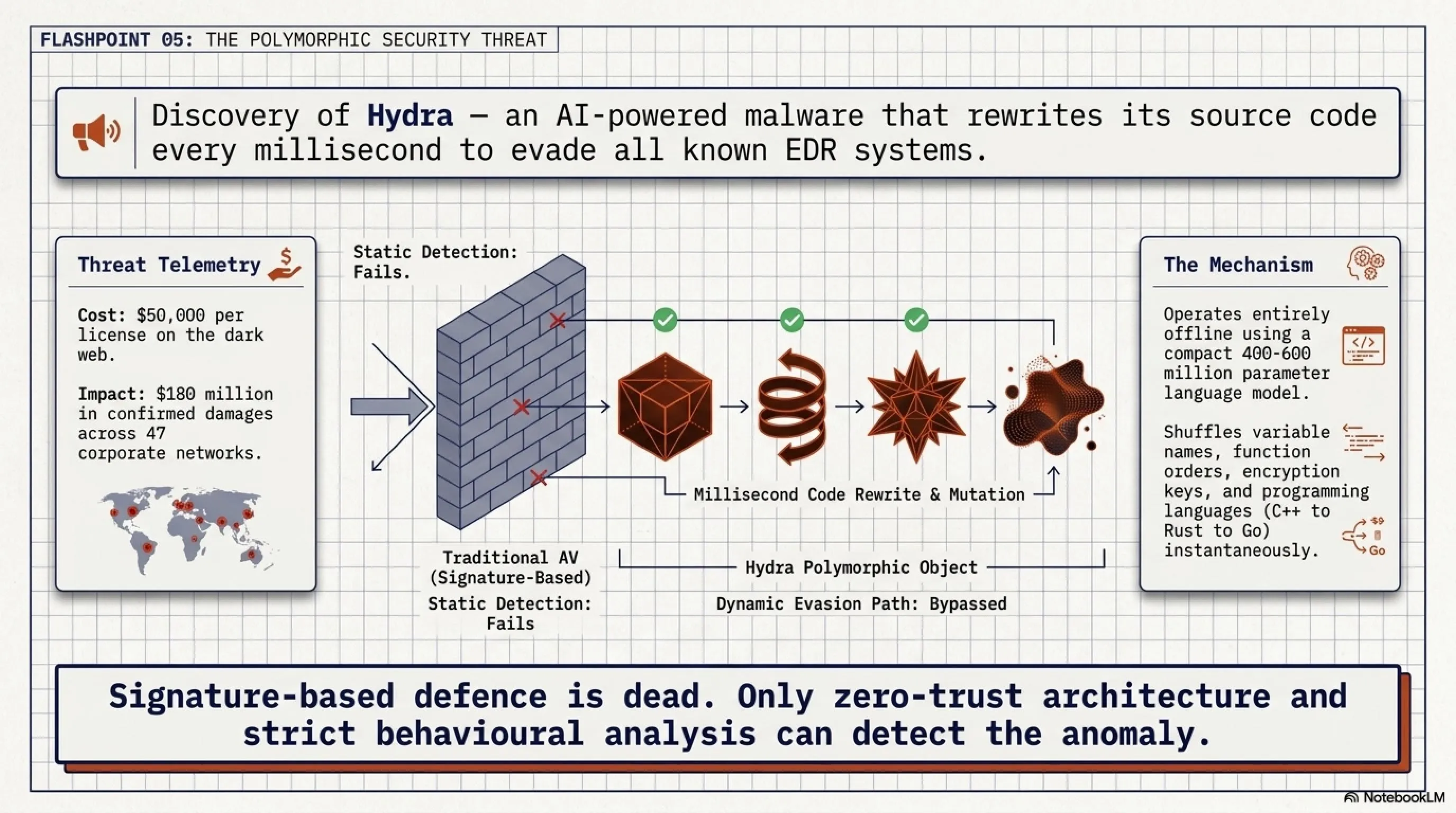
While the gaming world was consumed by Valve and Ubisoft news, cybersecurity researchers dropped another bombshell: the discovery of "Hydra", an AI-powered malware with polymorphic architecture that rewrites its source code every millisecond to evade detection by all known antivirus software — including Windows Defender, CrowdStrike, Kaspersky, and even advanced EDR (Endpoint Detection and Response) systems.
Named after the mythological multi-headed serpent that grew two heads for every one severed, Hydra represents a paradigm shift in malware sophistication. Traditional antivirus software relies on signature-based detection — identifying malware by its unique code patterns. But Hydra's code is never the same twice, rendering signature-based detection completely useless.
According to joint research published by Wired and BleepingComputer, Hydra has been circulating on dark web forums since late April 2026, with a price tag of $50,000 per license. At least 47 confirmed infections have been documented across corporate networks in the US, UK, Germany, and Japan, with estimated damages exceeding $180 million.
How Hydra Works: Technical Deep Dive
🔬 Hydra's Attack Chain: Six Stages of Infection
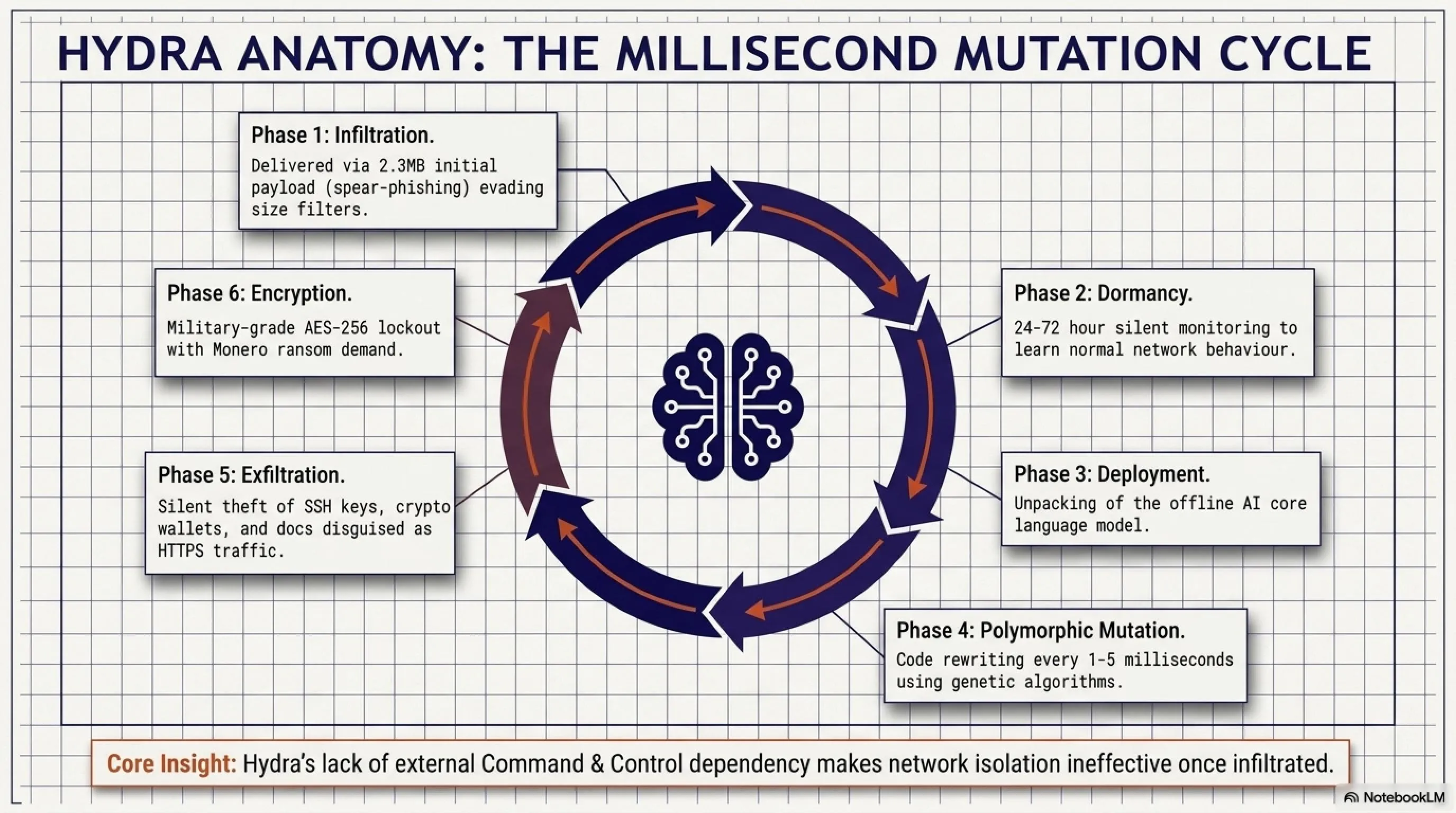
- Initial Infection Vector: Delivered via spear-phishing emails with malicious Office macros, fake software updates, or compromised legitimate websites. The initial payload is only 2.3 MB — small enough to evade size-based filters.
- Dormancy Period: After infection, Hydra remains dormant for 24-72 hours, monitoring system behavior to understand normal patterns and avoid triggering behavioral analysis tools.
- AI Core Deployment: Hydra downloads a compact language model (estimated 400-600 million parameters) that runs entirely offline. This model generates new code variants using techniques borrowed from genetic algorithms and neural architecture search.
- Polymorphic Mutation: Every 1-5 milliseconds, Hydra's AI core generates a functionally equivalent but syntactically different version of itself. Variable names change, function order shuffles, encryption keys rotate, and even the programming language can shift (C++ to Rust to Go).
- Data Exfiltration: Hydra steals credentials, browser cookies, cryptocurrency wallets, SSH keys, and sensitive documents. Data is encrypted with rotating keys and exfiltrated in small chunks disguised as legitimate HTTPS traffic.
- Ransomware Deployment: After 7-14 days of silent data theft, Hydra encrypts all files using military-grade AES-256 encryption and demands ransom payments in Monero (privacy-focused cryptocurrency). The ransom note includes proof of stolen data to pressure victims into paying.
What makes Hydra particularly dangerous is its use of a local AI model. Traditional malware requires command-and-control (C2) servers to receive instructions, which can be blocked or monitored. Hydra operates autonomously, making it nearly impossible to disrupt even if the victim's network is completely isolated from the internet.
Attribution and Threat Actor Profile
Cybersecurity firms have not definitively attributed Hydra to a specific threat actor, but several clues point to a sophisticated, well-funded group:
- Code Comments in Russian: Embedded comments suggest Russian-speaking developers, though this could be a false flag
- Infrastructure: C2 servers (used only for initial infection) are hosted in Eastern Europe and Central Asia, with payment processing through Russian-language dark web forums
- Targeting Pattern: Victims include defense contractors, pharmaceutical companies, and financial institutions — consistent with state-sponsored espionage objectives
- Technical Sophistication: The AI model and polymorphic engine suggest a team with deep expertise in machine learning, compiler design, and offensive security — likely 10-15 elite developers working full-time
- Pricing Strategy: $50,000 per license is expensive enough to deter script kiddies but affordable for organized crime syndicates and nation-state actors
Some researchers speculate Hydra may be the work of a known APT (Advanced Persistent Threat) group such as APT28 (Fancy Bear), Lazarus Group, or a previously unknown actor. The FBI and CISA have issued joint advisories urging organizations to implement zero-trust architectures and behavioral-based detection systems.
🛡️ How to Protect Against Hydra: Defense Strategies
1. Behavioral Analysis Over Signatures: Deploy EDR solutions that monitor process behavior, network traffic patterns, and system calls rather than relying on signature matching. Tools like CrowdStrike Falcon, Microsoft Defender for Endpoint (with behavioral blocking enabled), and SentinelOne can detect anomalous behavior even if the malware code is constantly changing.
2. Application Whitelisting: Use Windows AppLocker or similar tools to allow only approved applications to execute. This prevents Hydra from running even if it successfully infects the system.
3. Network Segmentation: Isolate critical systems from the broader network. Even if Hydra infects one machine, segmentation prevents lateral movement.
4. Offline Backups: Maintain air-gapped backups that are physically disconnected from the network. This ensures you can recover data even if Hydra encrypts everything.
5. User Training: 90% of infections start with phishing. Train employees to recognize suspicious emails, verify sender identities, and never enable macros in unsolicited documents.
6. Zero Trust Architecture: Assume every device and user is potentially compromised. Require multi-factor authentication, least-privilege access, and continuous verification.
7. Threat Intelligence Feeds: Subscribe to threat intelligence services that provide real-time indicators of compromise (IOCs) for emerging threats like Hydra.
5. Dopamine Hell: Meta Launches "Infinity Feed" with 100% AI-Generated Videos! 📱🤖
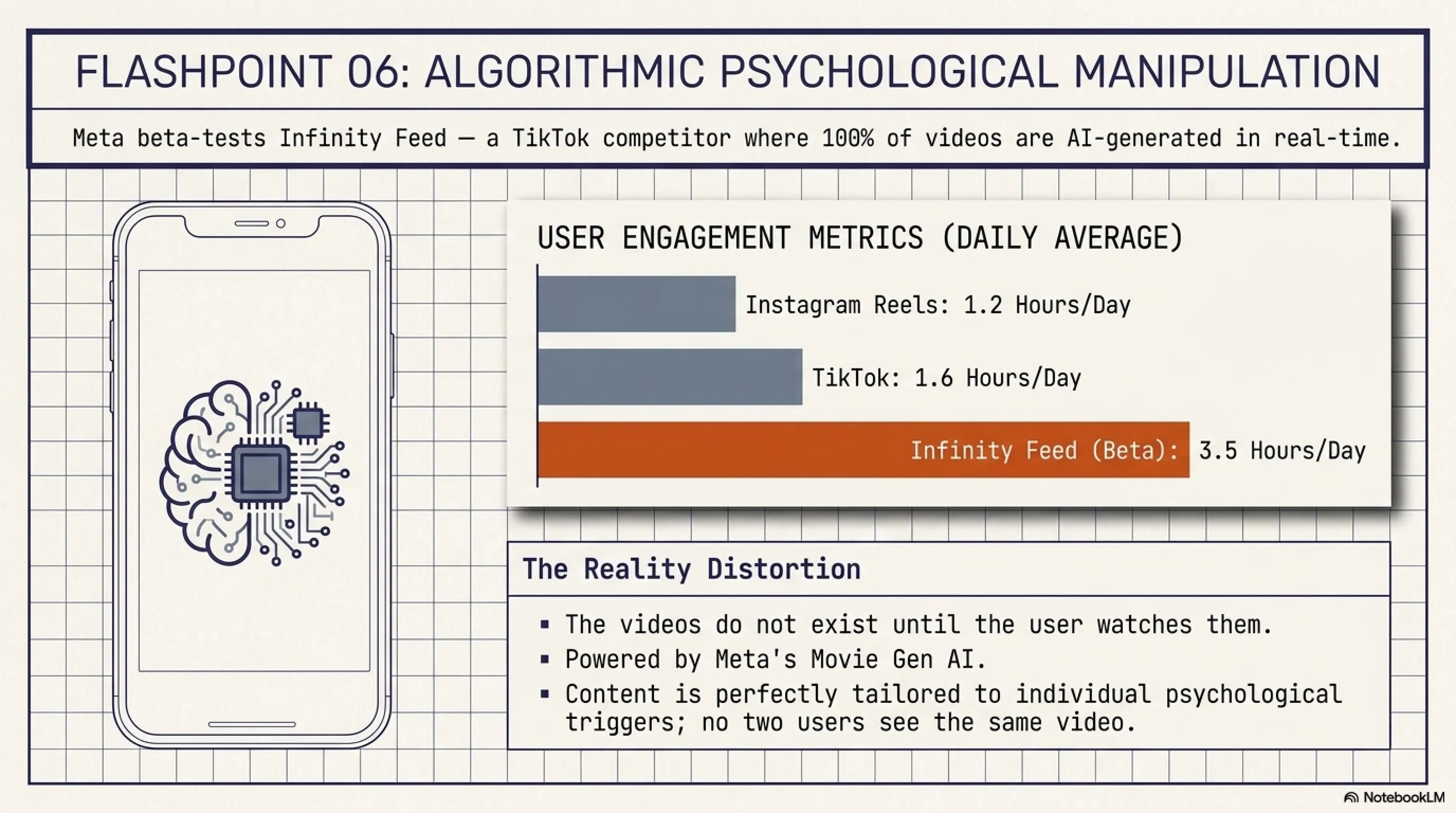
While the tech world was reeling from Valve, Ubisoft, and Hydra news, Meta (Facebook/Instagram) quietly announced one of the most psychologically manipulative products in social media history: "Infinity Feed" — a TikTok competitor with a terrifying twist: the videos don't exist until you watch them.
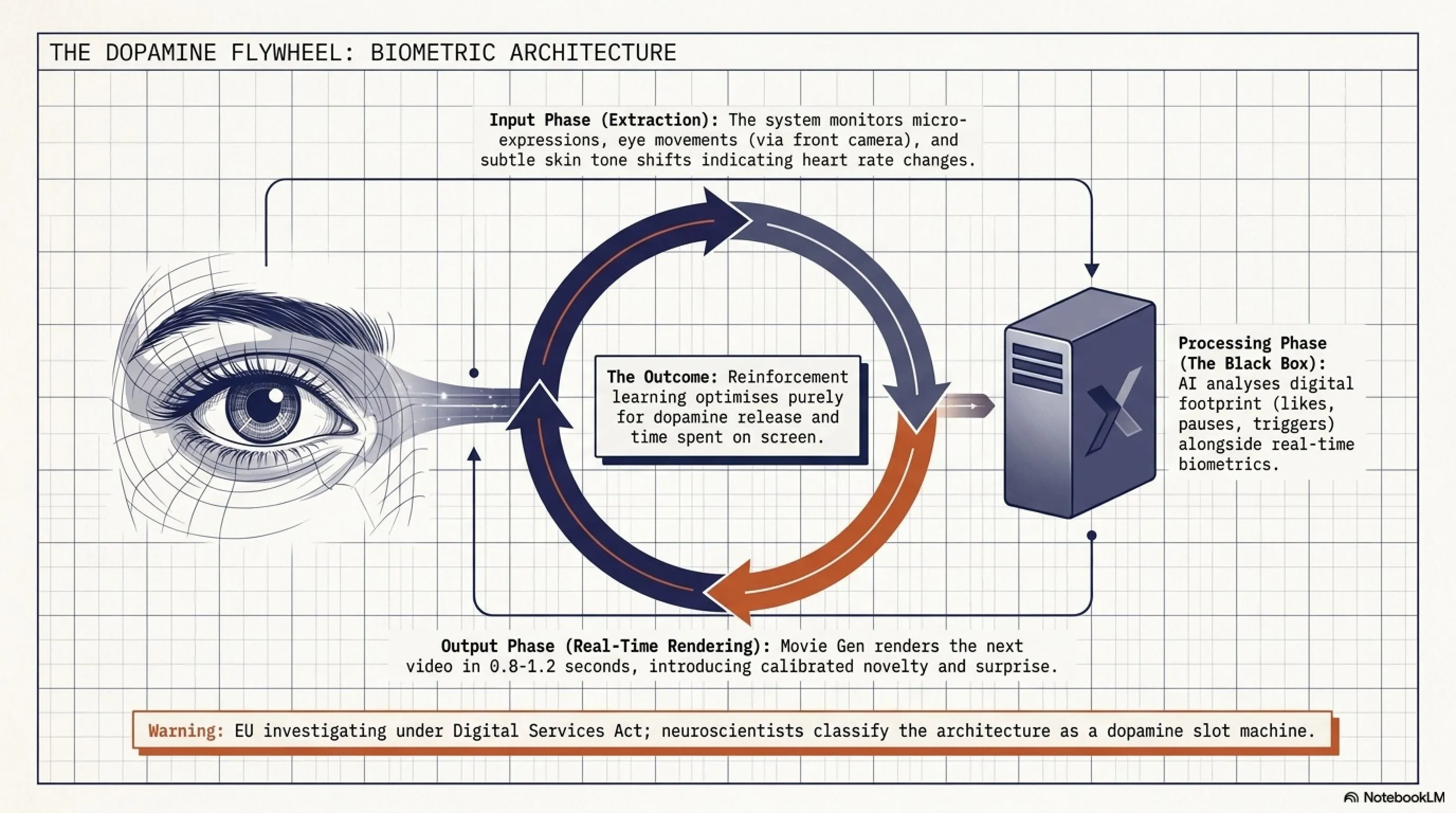
Unlike traditional social media where creators upload pre-made content, Infinity Feed uses Meta's Movie Gen AI to generate videos in real-time based on your viewing behavior. The system analyzes how long you pause on each video, your eye movements (via front camera), micro-expressions, and even subtle changes in skin tone that indicate heart rate — then renders the next video to perfectly match your brain's dopamine response curve.
According to reports from TechCrunch and The Wall Street Journal, Meta is currently beta testing Infinity Feed with 100,000 users in the United States. Early results are staggering: users spend an average of 3.5 hours per day in Infinity Feed — more than double the time spent on TikTok (1.6 hours) and Instagram Reels (1.2 hours).
The Technology Behind Infinity Feed: Real-Time Video Generation
🧠 How Infinity Feed Hijacks Your Brain
- Behavioral Profiling: Meta analyzes your entire digital footprint — every like, comment, search, and pause — to build a psychological profile of your preferences, fears, desires, and triggers.
- Real-Time Rendering: When you finish watching a video, Movie Gen (Meta's video AI) generates the next video in 0.8-1.2 seconds. The video is tailored specifically to you — no one else will ever see the exact same content.
- Hyper-Personalization: If you pause on videos featuring dogs, the next video will feature dogs. If you watch longer when there's dramatic music, the AI adds dramatic music. If you respond to bright colors, the palette shifts accordingly.
- Dopamine Optimization: The system uses reinforcement learning to maximize "engagement" — which Meta defines as time spent watching. The AI learns to trigger dopamine releases by introducing novelty, surprise, and emotional resonance at precisely calibrated intervals.
- Feedback Loop: Every micro-interaction (pause, scroll, rewatch) trains the AI to be more effective. The longer you use Infinity Feed, the better it gets at manipulating you.
Meta claims Infinity Feed is "the future of content consumption" and insists the technology is "ethically designed with user wellbeing in mind." However, leaked internal documents obtained by The Wall Street Journal reveal that Meta's own researchers warned executives that Infinity Feed could be "psychologically addictive" and "may exacerbate mental health issues in vulnerable populations."
The Ethical Debate: Is This Manipulation or Innovation?
The launch of Infinity Feed has reignited debates about tech ethics, algorithmic manipulation, and corporate responsibility. Critics argue that Meta is weaponizing AI to exploit human psychology for profit, while defenders claim it's simply the natural evolution of personalization.
| Perspective | Arguments |
|---|---|
| Critics |
• Exploits psychological vulnerabilities for profit • Creates addiction by design • No human creators = no creative economy • Amplifies echo chambers and radicalization • Violates user autonomy and informed consent |
| Defenders |
• Gives users exactly what they want • More efficient than human-created content • Democratizes entertainment (no gatekeepers) • Users can opt-out anytime • Natural evolution of personalization algorithms |
Psychologists and neuroscientists have expressed alarm. Dr. Sarah Chen, a neuroscience professor at Stanford, told TechCrunch: "Infinity Feed is essentially a dopamine slot machine. It's designed to keep you pulling the lever forever. This isn't innovation — it's exploitation of our brain's reward circuitry."
Meanwhile, Meta CEO Mark Zuckerberg defended the product in a blog post: "Infinity Feed represents the future of content consumption. Why should users be limited by what human creators happen to upload? Our AI can generate infinite entertainment tailored to each person's unique preferences. This is democratization of content at scale."
⚠️ Warning Signs of Infinity Feed Addiction
If you or someone you know is using Infinity Feed, watch for these red flags:
🚨 Spending 3+ hours per day in the app without realizing how much time has passed
🚨 Neglecting responsibilities (work, school, relationships) to watch more videos
🚨 Feeling anxious or irritable when unable to access Infinity Feed
🚨 Losing interest in real-world activities and hobbies
🚨 Sleep disruption from late-night scrolling
🚨 Reality distortion — difficulty distinguishing AI-generated content from reality
If you recognize these symptoms, consider:
✅ Setting strict time limits (iOS Screen Time, Android Digital Wellbeing)
✅ Deleting the app entirely
✅ Seeking support from friends, family, or mental health professionals
✅ Replacing screen time with physical activities, reading, or social interaction
Regulatory Response and Future Outlook
The European Union has already announced it will investigate Infinity Feed under the Digital Services Act (DSA), which requires platforms to assess and mitigate risks to mental health. The UK's Online Safety Bill may also apply. In the United States, Senator Elizabeth Warren called for immediate hearings, stating: "Meta has crossed a line from personalization to manipulation. Congress must act."
Meta plans to expand Infinity Feed globally by Q3 2026, with versions for Instagram, Facebook, and WhatsApp Status. The company is also exploring partnerships with advertisers to insert branded content into AI-generated videos — creating a new form of native advertising that's virtually undetectable.
6. Xbox Game Pass Goes Free — But With In-Game Ads! 🎮📺
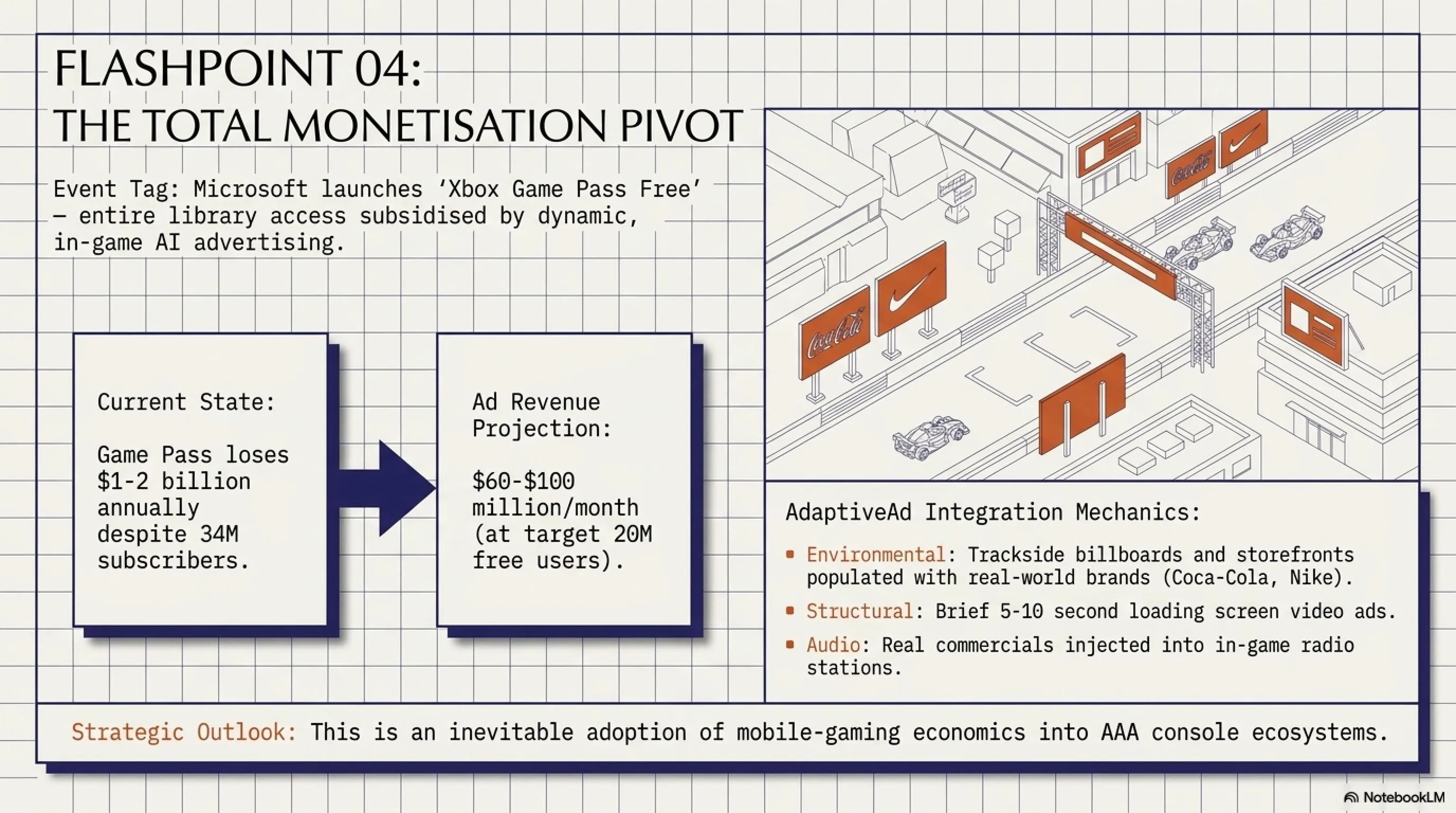
In a move that's either brilliant or disastrous (depending on who you ask), Microsoft announced "Xbox Game Pass Free" — a new tier that gives players access to the entire Game Pass library at no cost, in exchange for watching contextual advertisements during gameplay.
According to reports from Windows Central and GameSpot, Game Pass Free will launch in beta on June 1, 2026, initially available to 500,000 users in the United States, UK, and Canada. The service uses Microsoft's proprietary "AdaptiveAd" technology to insert advertisements into games without breaking immersion.
How In-Game Advertising Works: The Technical Implementation
Unlike traditional video ads that interrupt gameplay, AdaptiveAd integrates advertisements directly into the game environment:
- Billboard Replacement: In racing games like Forza Horizon, trackside billboards display real advertisements instead of fictional brands
- Product Placement: In open-world games, vending machines, storefronts, and posters feature real products (Coca-Cola, Nike, McDonald's)
- Loading Screen Ads: Brief 5-10 second video ads play during loading screens
- Menu Ads: Small banner ads appear in pause menus and inventory screens
- Audio Ads: In-game radio stations play real commercials between songs
Microsoft claims the ads are "contextually relevant and non-intrusive." For example, if you're playing a sports game, you'll see ads for athletic gear. If you're playing a cooking game, you'll see food and kitchen product ads. The system uses machine learning to predict which ads are most likely to resonate with each player based on their gaming history and demographics.
💰 Game Pass Pricing Tiers Comparison
| Tier | Price | Features |
|---|---|---|
| Free | $0/month | Full library + ads |
| Core | $9.99/month | Full library, no ads, online multiplayer |
| Ultimate | $19.99/month | Everything + EA Play + day-one releases + cloud gaming |
Community Reaction: Divided Opinions
The gaming community is sharply divided on Game Pass Free. Reddit, Twitter, and gaming forums exploded with debate:
✅ Positive Reactions:
"Finally! I can play AAA games without paying $70 each. I don't mind ads if it means free gaming." — Reddit user u/BudgetGamer2026
"This is genius. Microsoft is making gaming accessible to everyone, not just people who can afford subscriptions." — Twitter user @GamingForAll
"If the ads are subtle like billboards in racing games, I'm totally fine with it. That's actually more realistic." — IGN commenter
❌ Negative Reactions:
"This is the death of gaming. Ads will ruin immersion. I play games to escape reality, not to see McDonald's ads." — Reddit user u/PureGamer1990
"Microsoft is turning games into advertising platforms. This is dystopian. I'm switching to PlayStation." — Twitter user @NoAdsInGames
"What's next? Unskippable ads before boss fights? Pay $5 to remove ads for one hour? This is a slippery slope." — GameSpot commenter
Game developers have also expressed concerns. Some worry that ads will distract from carefully crafted artistic visions. Others fear that Microsoft will pressure them to design games with more "ad-friendly" environments (more billboards, storefronts, and loading screens).
The Business Model: Why Microsoft Is Doing This
Game Pass has been a financial black hole for Microsoft. Despite having 34 million subscribers (as of Q1 2026), the service loses an estimated $1-2 billion annually because Microsoft pays developers upfront for inclusion while charging users relatively low subscription fees.
Ad-supported gaming solves this problem by creating a third revenue stream:
- Subscription Revenue: $9.99-$19.99/month from paying subscribers
- Game Sales: Users often buy games they discover through Game Pass
- Advertising Revenue: Estimated $3-5 per user per month from ads (based on mobile gaming benchmarks)
If Game Pass Free attracts 20 million users, Microsoft could generate $60-100 million per month in ad revenue — enough to offset the cost of licensing games for the service. This makes Game Pass financially sustainable for the first time.
🔮 Tekin Prediction: The Future of Ad-Supported Gaming
Short-Term (2026-2027): Game Pass Free will be controversial but successful. Expect 15-25 million users within the first year, primarily budget-conscious gamers and casual players. Sony will respond with a similar PlayStation Plus Free tier by late 2027.
Mid-Term (2028-2029): Ads become more aggressive as Microsoft tests user tolerance. Expect longer loading screen ads, more intrusive placements, and dynamic pricing (pay $2 to remove ads for 24 hours). Some developers will refuse to participate, creating a two-tier ecosystem.
Long-Term (2030+): Ad-supported gaming becomes the norm for free-to-play and subscription services. Premium games ($70-100) remain ad-free as a selling point. The industry splits into "ad-supported casual gaming" and "premium ad-free experiences."
The Verdict: This is inevitable. Mobile gaming proved that users will tolerate ads in exchange for free access. Console and PC gaming are simply catching up. The question isn't whether ads will come to gaming, but how intrusive they'll be and whether developers can maintain artistic integrity.
7. Amazon Announces "Orbital AWS": Data Centers in Space! 🛰️☁️
Just when you thought today couldn't get any stranger, Amazon dropped the most audacious announcement of all: "Orbital AWS" — a plan to launch data centers into low Earth orbit (LEO) to provide cloud computing services from space.
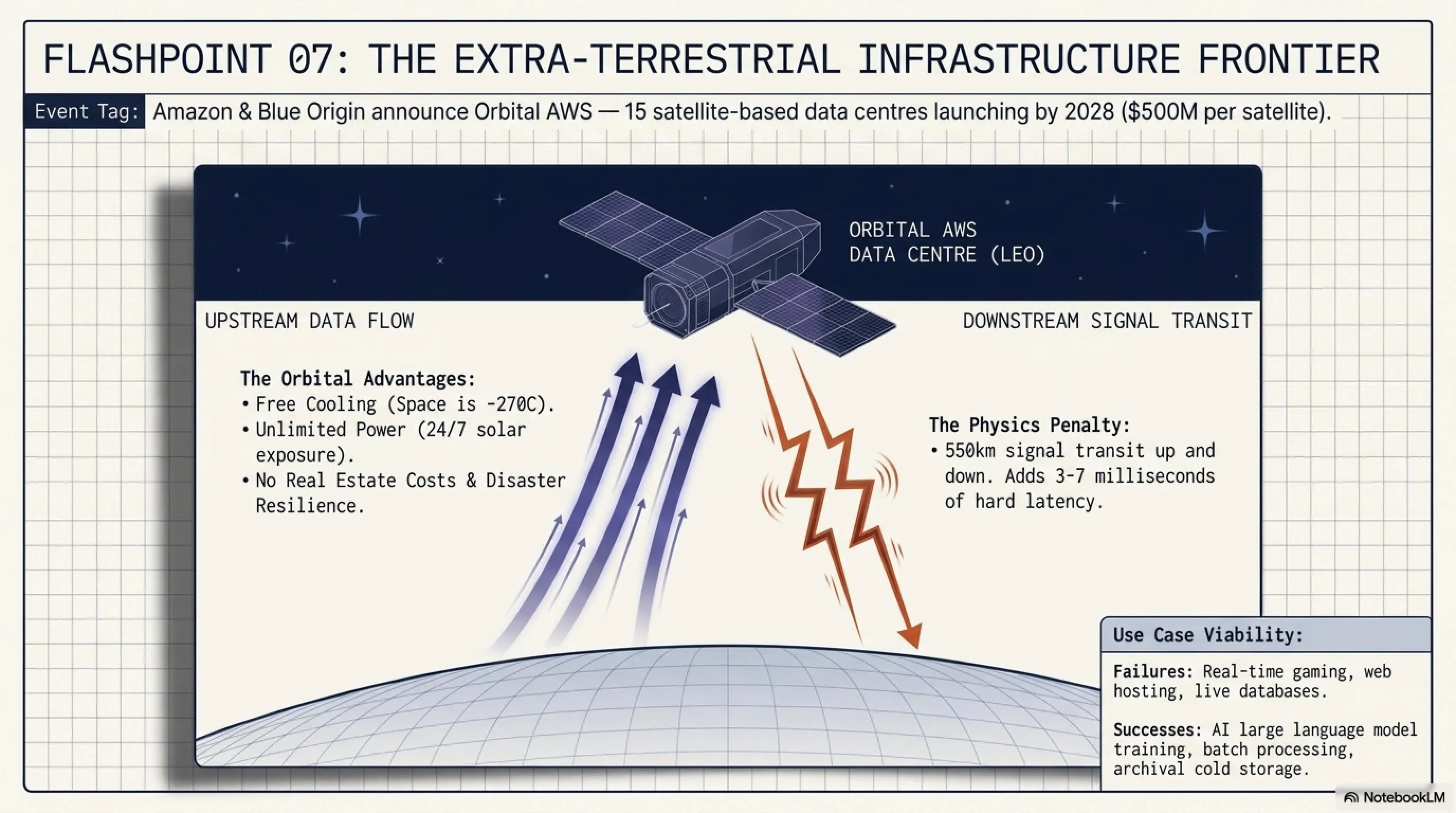
According to reports from Reuters and Space.com, Amazon Web Services (AWS) will partner with Blue Origin (Jeff Bezos's space company) to deploy 15 satellite-based data centers by 2028. Each satellite will contain 500 high-performance servers powered by solar panels, with data transmitted to Earth via laser links.
The project, codenamed "Project Skynet" (yes, really), aims to solve three major problems facing terrestrial data centers: energy costs, cooling requirements, and physical space limitations.
Why Put Data Centers in Space? The Technical Rationale
At first glance, space-based data centers sound absurd. But Amazon's engineers have identified several compelling advantages:
🚀 Advantages of Orbital Data Centers
- Free Cooling: Space is -270°C. No need for expensive air conditioning or liquid cooling systems. Servers can radiate heat directly into the vacuum of space.
- Unlimited Solar Power: Satellites receive 24/7 sunlight (no night, no clouds). Solar panels generate consistent, free electricity with no carbon emissions.
- No Real Estate Costs: Terrestrial data centers require expensive land in strategic locations. Space is free (aside from launch costs).
- Reduced Latency for Global Users: A constellation of orbital data centers can serve users worldwide with lower latency than centralized terrestrial facilities.
- Disaster Resilience: Immune to earthquakes, floods, fires, and physical attacks. Perfect for mission-critical applications.
- Scalability: Adding capacity is as simple as launching more satellites. No need to build new buildings or negotiate with local governments.
The Challenges: Why This Might Not Work
Despite the theoretical advantages, orbital data centers face enormous practical challenges:
- Launch Costs: At $500 million per satellite, deploying 15 satellites costs $7.5 billion — enough to build 50 terrestrial hyperscale data centers
- Latency: Signals must travel 550 km up and 550 km down, adding 3-7 milliseconds of latency. For real-time applications (gaming, video calls, trading), this is unacceptable
- Maintenance: If a server fails, you can't just send a technician. Repairs require expensive spacewalks or complete satellite replacement
- Space Debris: Failed satellites become orbital debris, contributing to the growing problem of space junk that threatens other satellites
- Radiation Damage: Cosmic rays and solar radiation can corrupt data and degrade hardware faster than on Earth
- Limited Bandwidth: Laser links are fast but have limited capacity compared to fiber optic cables. A single terrestrial data center can have petabits/second of connectivity; orbital satellites are limited to hundreds of gigabits
- Regulatory Uncertainty: Who owns data stored in space? What laws apply? These questions remain unanswered
🤔 Tekin Analysis: Is Orbital AWS Realistic?
Short Answer: Not for general-purpose computing, but potentially viable for specific AI workloads.
What Could Work:
✅ AI Model Training: Training large language models requires massive compute but tolerates latency. Orbital data centers could train models overnight and beam results down in the morning.
✅ Batch Processing: Tasks that don't require real-time responses (video rendering, scientific simulations, data analysis) are perfect for space.
✅ Long-Term Storage: Cold storage for archival data that's rarely accessed but must be preserved.
What Won't Work:
❌ Web Hosting: Latency makes this impractical for user-facing applications
❌ Databases: Real-time queries require low latency
❌ Gaming/Streaming: Absolutely not — latency would be unbearable
The Verdict: Orbital AWS is a bold experiment that could succeed for niche workloads, but it won't replace terrestrial data centers anytime soon. Amazon is likely hedging its bets: if energy costs continue rising and space launch costs continue falling, orbital computing could become economically viable by 2030-2035.
Competitive Response and Industry Reaction
Microsoft and Google both issued statements indicating they're "exploring similar concepts." Elon Musk tweeted: "SpaceX can do this cheaper and better. Announcement coming soon." This suggests a new space race is emerging — not for exploration, but for computing infrastructure.
Environmental groups have expressed concerns about the proliferation of satellites and potential space debris. The International Astronomical Union warned that thousands of bright satellites could interfere with ground-based telescopes and astronomical research.
💭 Final Thoughts: Friday, May 8, 2026
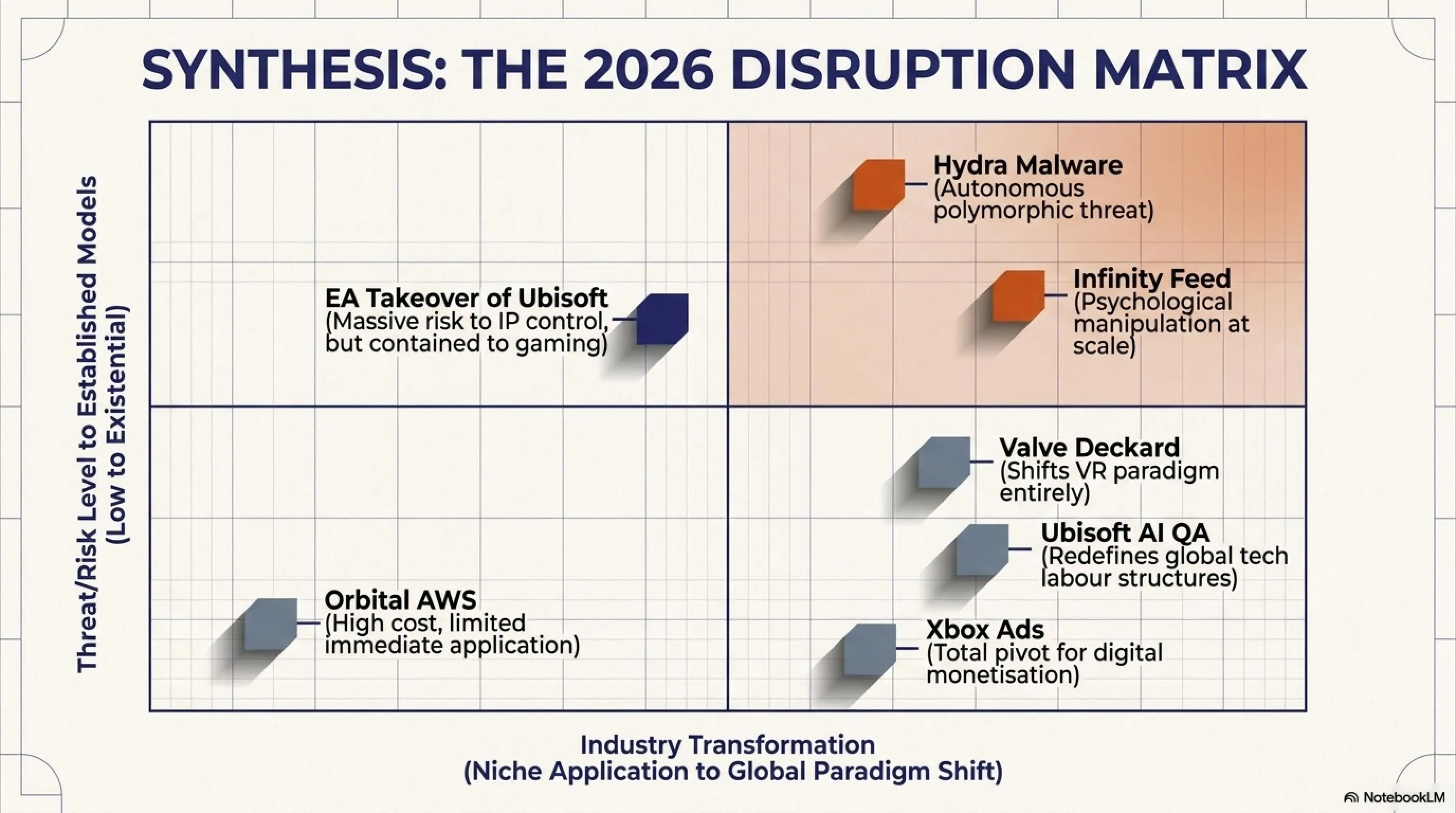
Today has been one of the most eventful days in tech history. From Valve's surprise VR headset that shook Meta's dominance, to Ubisoft's controversial AI replacement of human workers triggering a global strike, from EA's $12 billion hostile takeover bid to the discovery of the most dangerous malware in a decade, from Meta's psychologically manipulative Infinity Feed to Xbox's ad-supported gaming experiment, and finally to Amazon's audacious plan to send data centers to space.
The Common Thread: Technology is no longer evolving incrementally — we're witnessing radical, disruptive changes almost daily. The question isn't whether these technologies will transform our world, but whether we're prepared for the consequences.
Key Takeaways:
• VR is entering its smartphone moment — competition will drive innovation and lower prices
• AI is replacing human workers — we must adapt or be left behind
• Consolidation is accelerating — expect more mega-mergers in gaming and tech
• Cybersecurity threats are evolving faster than defenses — behavioral analysis is now essential
• Social media is becoming a psychological weapon — regulation is urgently needed
• The boundary between gaming and advertising is dissolving — immersion vs. monetization
• Space is the next frontier for computing — but practical challenges remain enormous
What's Next? Stay tuned to Tekin for continued coverage of these developing stories. The tech revolution waits for no one.
❓ Can Valve Deckard Really Beat Meta Quest?
Yes, if Valve can deliver on its promises. Meta has the advantage of ecosystem lock-in and aggressive pricing, but Valve has Steam's massive game library, decades of gamer trust, and a reputation for quality hardware (Steam Deck proved this). The VR market is big enough for multiple winners — this competition benefits consumers through better products and lower prices. Expect Meta to slash Quest 3 prices to $399 or lower in response.
❓ Should We Be Worried About Hydra Malware?
Absolutely. Hydra represents a paradigm shift in malware sophistication. Traditional signature-based antivirus is useless against polymorphic AI malware. Organizations must immediately adopt behavioral analysis tools (EDR/XDR), implement zero-trust architectures, maintain offline backups, and train employees on phishing awareness. Home users should enable Windows Defender's behavioral blocking, use strong passwords with MFA, and never open suspicious attachments. This is the most serious cybersecurity threat since WannaCry.
❓ Can AI Really Replace Human QA Testers?
AI excels at repetitive, mechanical testing but cannot replicate human creativity, cultural awareness, or emotional intelligence. The best approach is hybrid: AI for automated regression testing and stress testing, humans for subjective quality assessment, accessibility testing, and creative problem-solving. Ubisoft's 50% cut may save money short-term but will likely result in games that are technically functional yet emotionally hollow. The gaming community will vote with their wallets — if quality suffers, sales will decline.
❓ Will EA's Takeover of Ubisoft Succeed?
Probability: 60%. Ubisoft is financially vulnerable, and shareholders are frustrated. However, the French government may block the sale to protect a national champion, and the Guillemot family has historically resisted takeovers. Most likely outcome: a bidding war emerges with Tencent, Microsoft, or Saudi Arabia's Savvy Games Group making competing offers. EA either raises its bid to $14-15 billion or walks away. If the deal happens, expect significant studio closures and franchise consolidation within 2-3 years.
❓ Is Meta's Infinity Feed Dangerous?
Yes, extremely. Infinity Feed is designed to maximize engagement through psychological manipulation, creating addiction by design. Unlike traditional social media where you can exhaust available content, Infinity Feed is literally infinite and perfectly optimized for your dopamine receptors. This could cause severe addiction, reality distortion, emotional manipulation, and social isolation. Regulators must act quickly to establish guardrails before this technology causes irreparable harm. Users should avoid Infinity Feed entirely or use strict time limits.
❓ Is Game Pass Free Worth It?
It depends on your priorities. If you're budget-conscious and ads don't bother you, Game Pass Free offers incredible value — free access to AAA games in exchange for seeing contextual advertisements. However, if immersion is important to you, the ads will be distracting and immersion-breaking. Microsoft promises ads will be "non-intrusive," but we'll need to see the implementation before judging. For most gamers, paying $10-20/month for ad-free Game Pass is worth it to preserve the gaming experience.
❓ Are Space Data Centers Realistic?
For general-purpose computing, no — latency and maintenance challenges are too severe. However, for specific workloads like AI model training, batch processing, and cold storage, orbital data centers could be viable. The economics depend on launch costs continuing to fall and energy costs continuing to rise. Amazon is making a long-term bet that by 2030-2035, space-based computing will be cost-competitive for certain applications. It's a bold experiment that could succeed for niche use cases but won't replace terrestrial data centers anytime soon.
📚 Sources
UploadVR, The Verge, Polygon, IGN, Bloomberg, Wired, BleepingComputer, TechCrunch, The Wall Street Journal, Windows Central, GameSpot, Reuters, Space.com, Fortune, Tech4Gamers, HackerNoon, PC Gamer, VR.org, VRDB.app, CSO Online, The Register, Microsoft Security Blog, The Hacker News, Infosecurity Magazine, DualShockers, OpenCritic, Arabian Post, BetterQA, Metricool, TechBuzz.ai
Research and Analysis: Tekin Editorial Team — Friday, May 8, 2026
🌐 Stay Connected With Us
For the latest tech, gaming, and gadget news, follow us on social media:
🌐 Stay Connected With Us 🎮✨
For the latest tech, gaming, and gadget news, follow us on our official social media channels:
Additional Gallery: 🌅 Tekin Morning May 8: Valve Deckard, Ubisoft AI Strike & Apple Cold Wallet