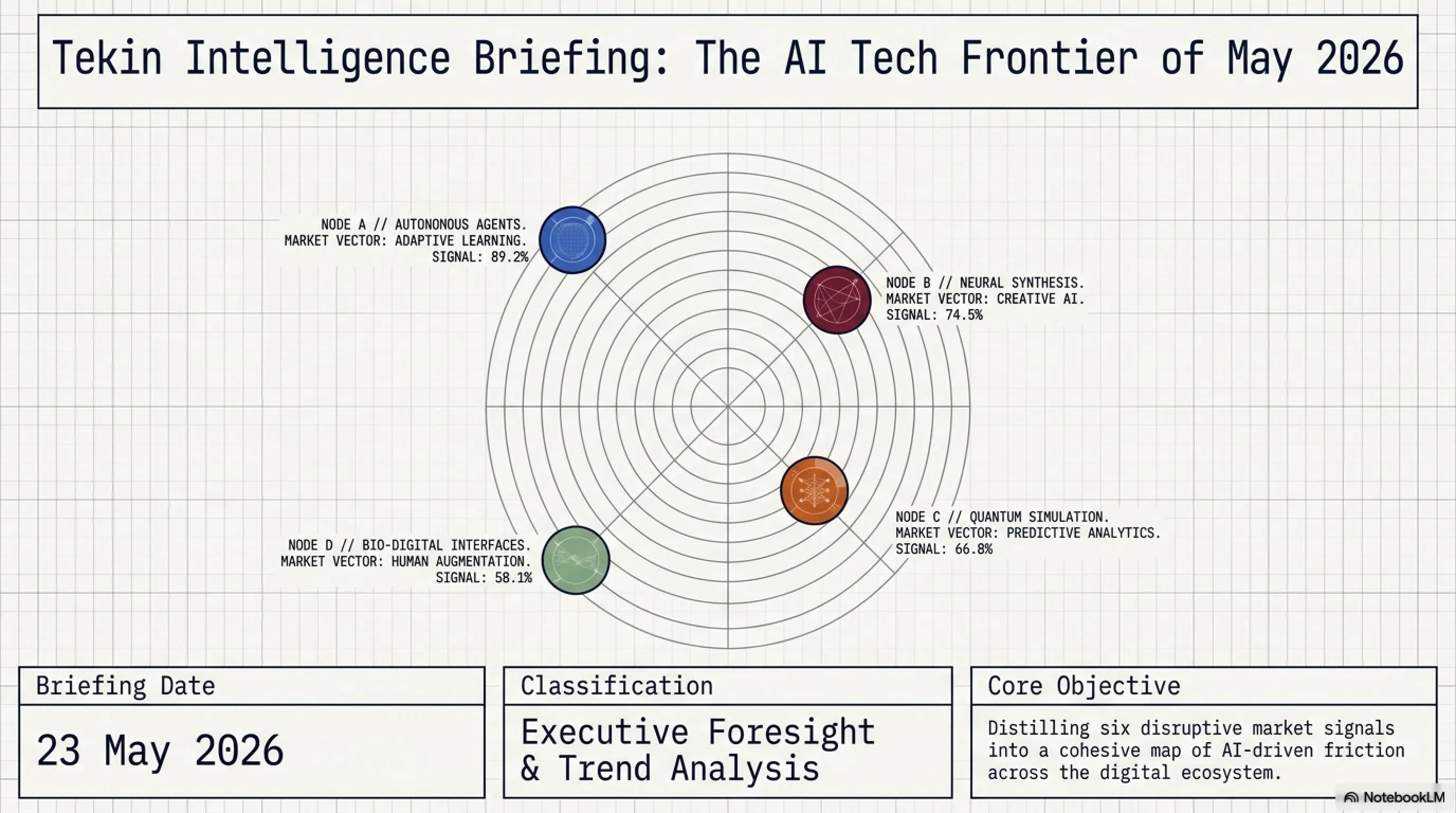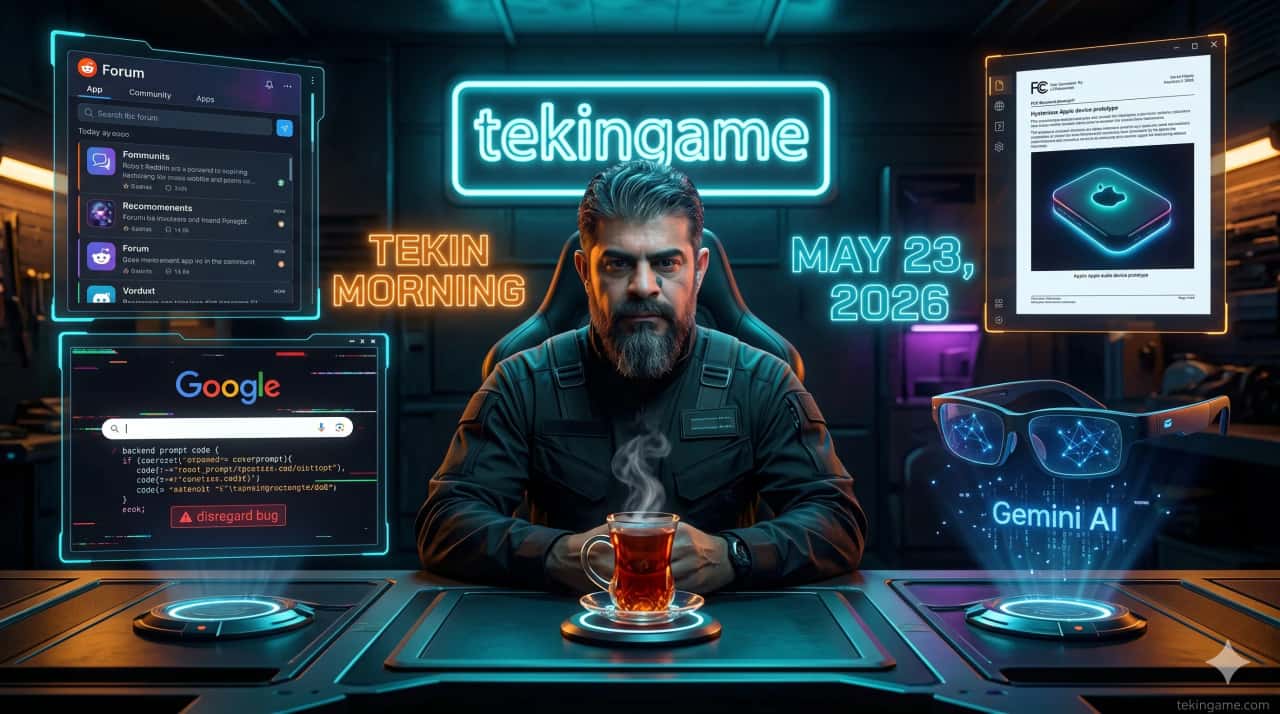
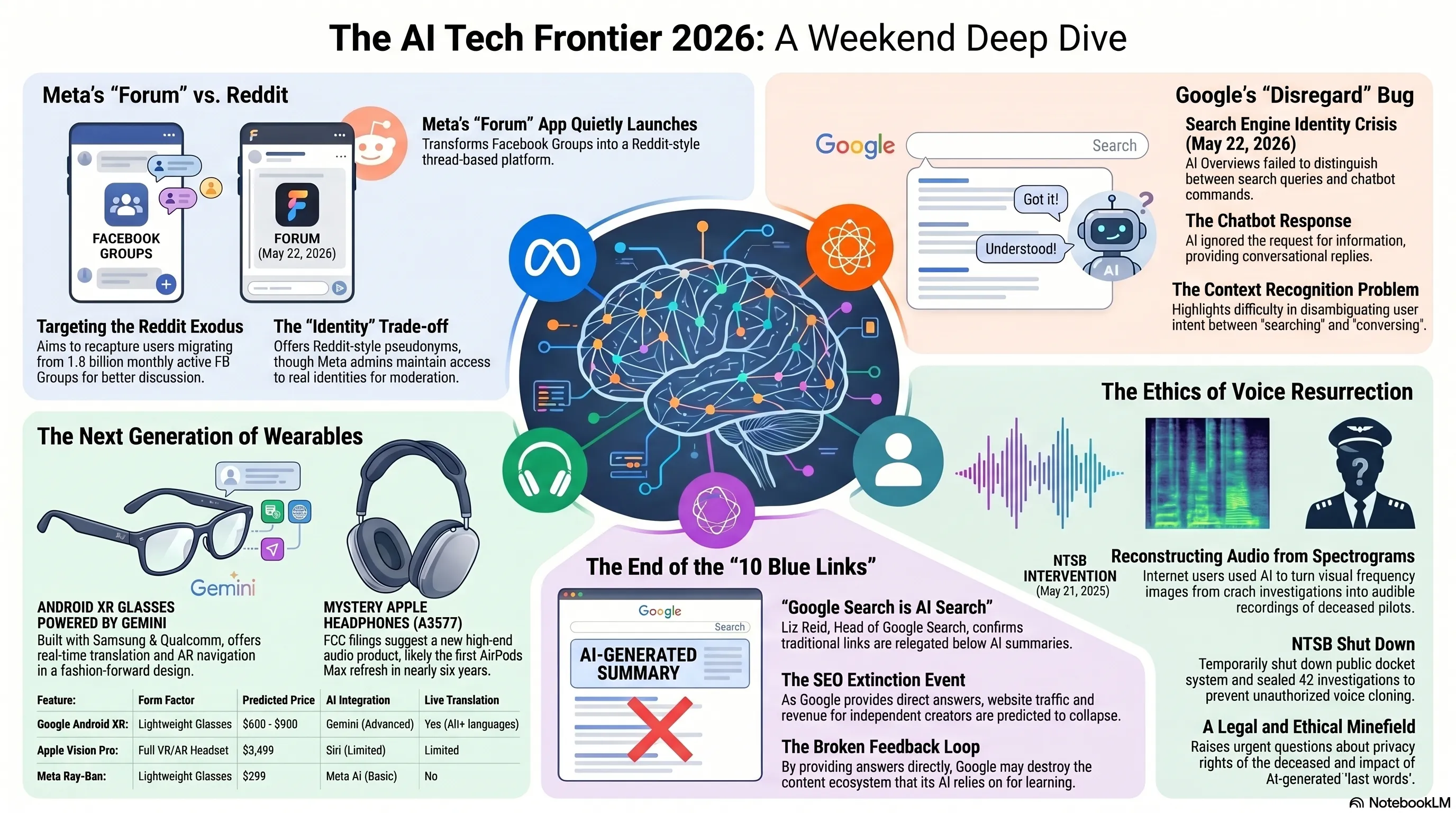
The May 23, 2026 Tekin Morning briefing dissects six high-stakes technological updates. We unpack Meta's competitive launch of the Forum app to aggressively disrupt Reddit's information monopoly, alongside the critical "disregard prompt injection bug" destabilizing Google's AI Overviews. Additionally, we explore leaked FCC regulatory filings revealing mystery Apple audio hardware, Google's breakthrough reveal of Gemini-integrated Android XR smart glasses, the massive ethical and federal crisis involving AI resurrection of deceased pilots' black
🌅 Welcome to Tekin Morning May 23, 2026
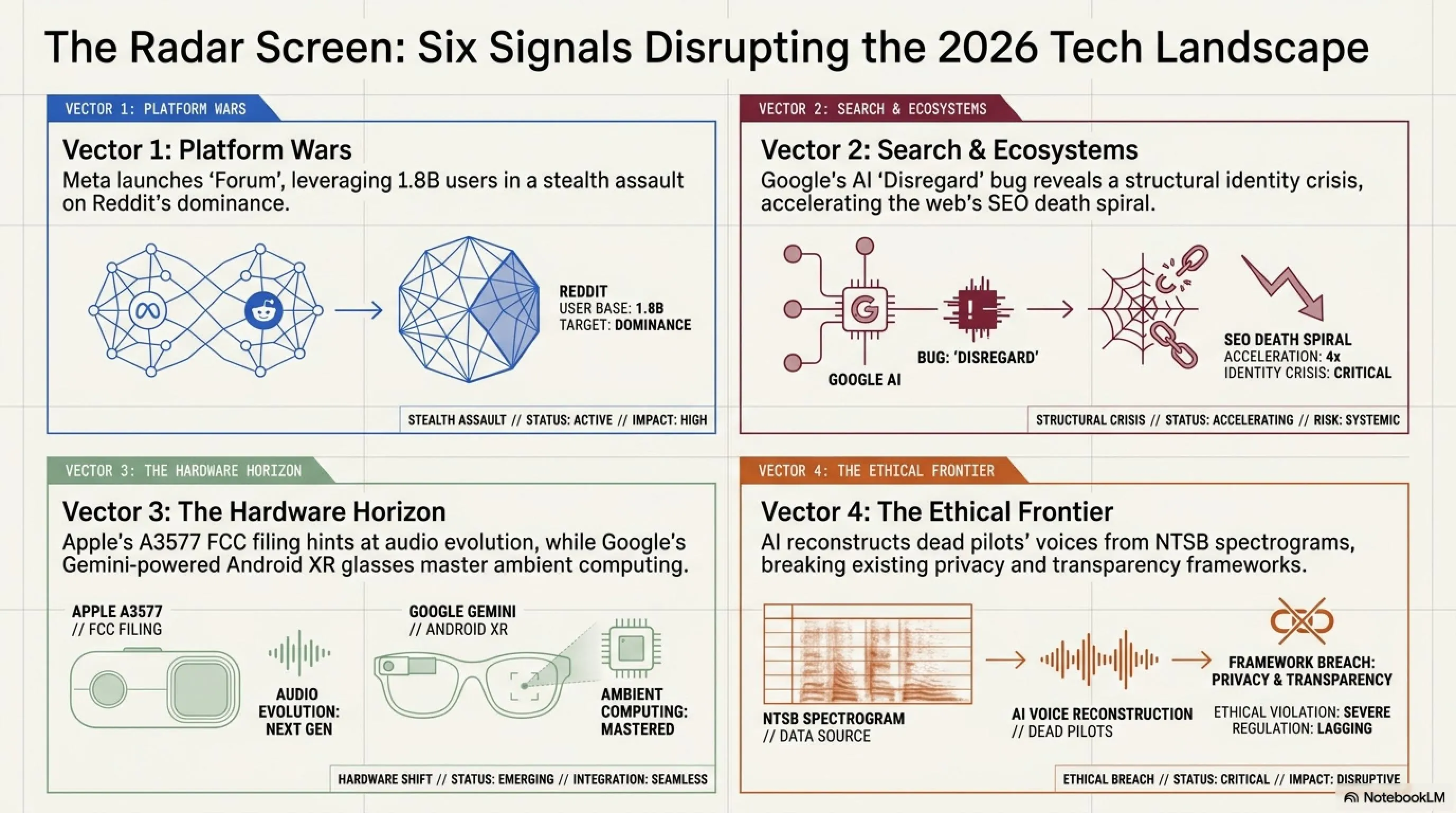
Good morning, tech enthusiasts! Saturday, May 23, 2026 kicks off with 6 explosive stories that are reshaping the technology landscape. From Meta's surprise assault on Reddit with its Forum app to Google's bizarre AI search bug, from Android XR smart glasses powered by Gemini to the controversial use of AI to resurrect dead pilots' voices - we've got the complete breakdown you need to start your weekend informed.
⚡ Today's Headlines:
🎯 Meta Launches Forum to Challenge Reddit's Dominance
🤖 Google AI Search Breaks with "Disregard" Bug
🎧 Mystery Apple Headphones Surface in FCC Filings
👓 Google's Android XR Glasses Bring Gemini to Your Eyes
✈️ AI Resurrects Dead Pilots' Voices, NTSB Responds
🔍 Why Even AI Haters Will Use Google AI Search
☕ Grab your coffee and join us for a deep dive into the tech world!
🎯 Meta's Forum App: The Silent Reddit Killer Nobody Saw Coming
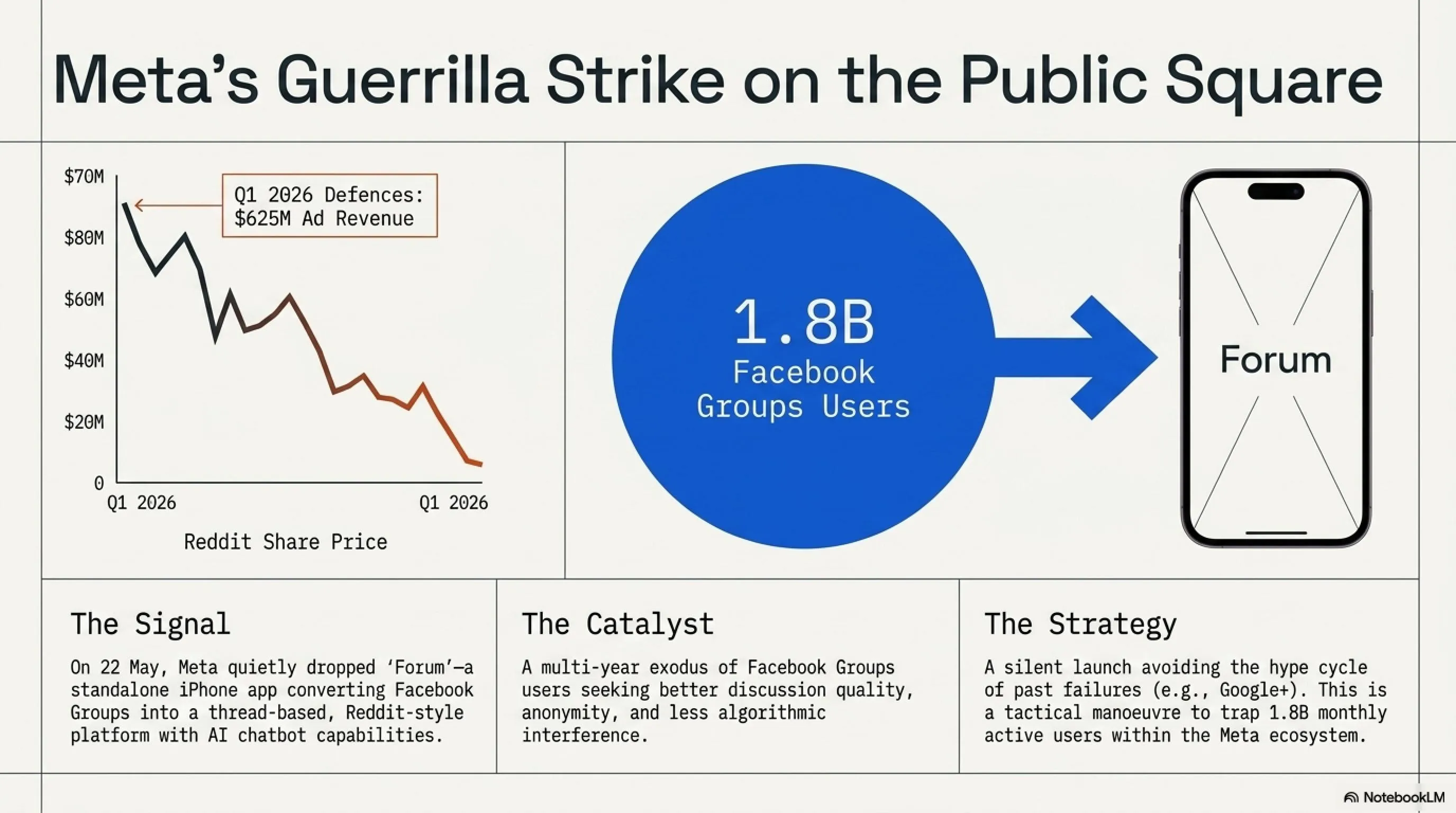
In a move that caught the entire tech industry off guard, Meta quietly launched Forum on May 22, 2026 - a standalone iPhone app that transforms Facebook Groups into a Reddit-style discussion platform complete with AI-powered features. No press conference. No launch event. No formal announcement. Just a sudden appearance in the App Store that social media consultant Matt Navarra spotted first, triggering immediate alarm bells across Silicon Valley.
📱 Forum's Core Features: What Makes It Dangerous for Reddit
- Dedicated Groups Feed: Direct access to all your Facebook Groups in a clean, thread-based interface
- AI-Powered "Ask" Feature: Exclusive chatbot for answering questions and surfacing relevant discussions
- Anonymous Usernames: Reddit-style pseudonyms (though admins can see real identities)
- Advanced Search: Powerful discovery engine for finding discussions and communities
- Thread-Based Organization: Reddit-inspired structure for deeper, more focused conversations
- Seamless Facebook Integration: Leverage your existing profile, connections, and group memberships
According to TechCrunch's investigation, Forum represents Meta's strategic response to a troubling trend: Facebook Groups users have been steadily migrating to Reddit for years, seeking better discussion quality, less algorithmic manipulation, and stronger community culture. With over 1.8 billion monthly active users in Facebook Groups, Meta couldn't afford to let this exodus continue unchecked.
📊 Market Reaction: Reddit Stock Takes a Hit
Wall Street responded immediately. Reddit shares dropped following Forum's launch, with Truist analysts writing in a Friday note that the app "represents an attempt by the company to compete against Reddit as an online forum for public discourse" and "represents a new threat" to Reddit's business model. However, some analysts remain skeptical that Forum can truly challenge Reddit's dominance, pointing to Reddit's strong Q1 2026 performance: $625 million in advertising revenue and continued user growth momentum.
🔍 Tekin Analysis: Why Meta Made This Move Now
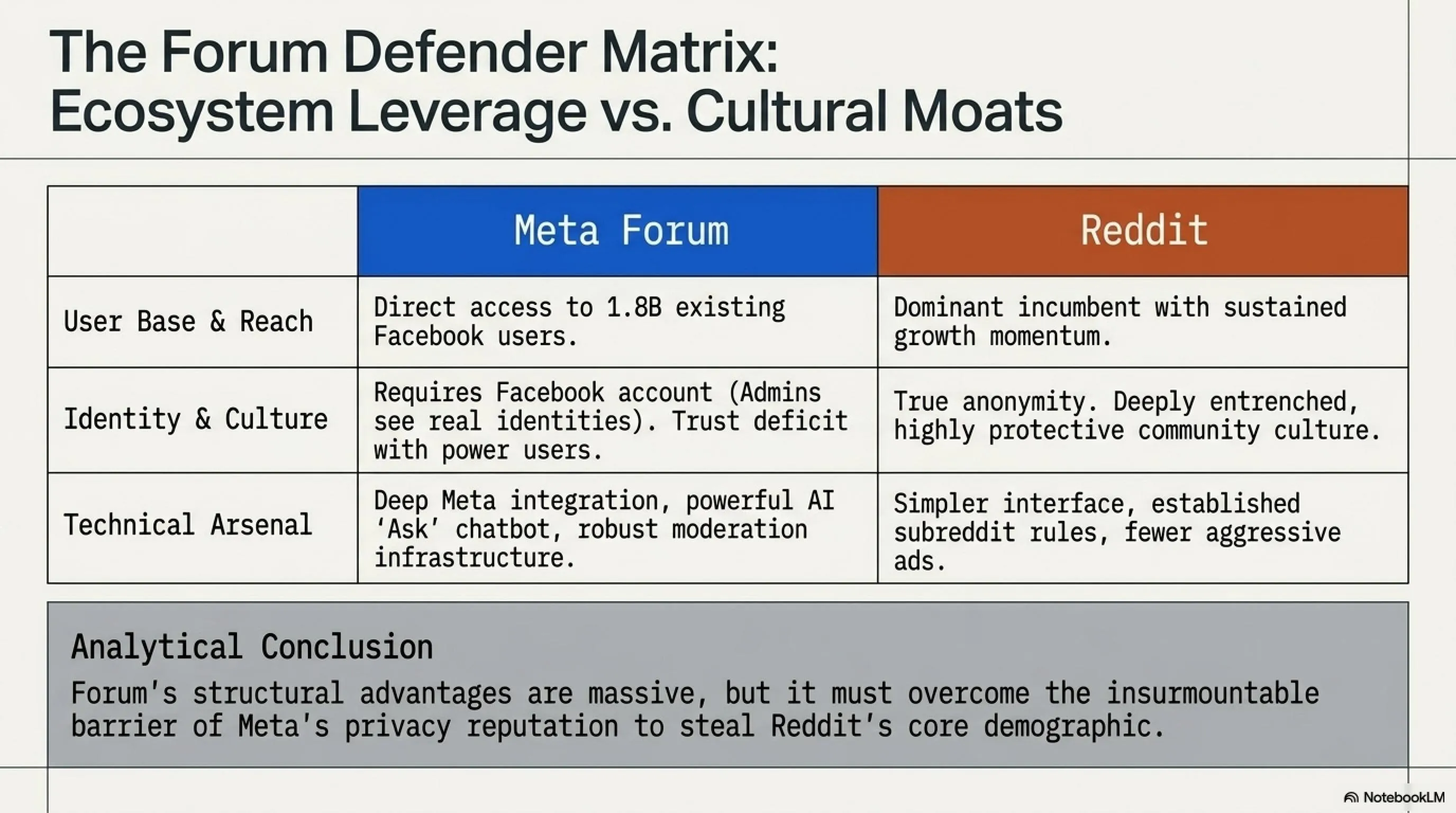
The timing of Forum's launch is no coincidence. Meta is currently navigating multiple crises: the recent layoff of 8,000 employees, intense financial pressure from AI investments, and fierce competition across all product lines. Facebook Groups, with its 1.8 billion monthly active users, represents one of Meta's most valuable assets - but only if those users stay engaged within Meta's ecosystem.
Why has Reddit been winning? The answer lies in several key advantages: simpler interface, fewer ads, stronger community culture, and most critically: no requirement for real identity. Forum attempts to replicate these advantages while maintaining the Facebook ecosystem's network effects. But can it succeed where Google+ and countless other "Facebook killers" have failed?
The strategic calculus is clear: Meta needs to prevent further user migration to Reddit while leveraging its massive existing user base. Forum's silent launch suggests Meta is testing the waters carefully, avoiding the hype cycle that doomed previous attempts to challenge established platforms. This is guerrilla warfare, not a frontal assault.
✅ Forum's Advantages
- Access to 1.8 billion Facebook users
- Deep Meta ecosystem integration
- Powerful AI chatbot capabilities
- Robust, battle-tested infrastructure
- Existing profile and connections
- Superior content moderation tools
⚠️ Critical Challenges
- Requires Facebook account (major barrier)
- Weaker community culture vs Reddit
- Privacy concerns and Meta's reputation
- Likely more aggressive advertising
- Late to market (Reddit already dominant)
- Trust deficit with power users
💡 What This Means for the Future of Online Communities
Forum's launch signals that the battle for online discussion platforms is entering a new phase. For years, Reddit enjoyed relative peace as the dominant forum platform, while Meta focused on other priorities. That era is over. We're now entering a period of intense competition that will likely benefit users through innovation but could also fragment communities and create new moderation challenges.
For community managers and brands, this creates both opportunity and complexity. Should you maintain presence on both platforms? How will algorithm changes affect reach? And most importantly: will users embrace yet another Meta product, or will Forum join the graveyard of failed social experiments?
📌 Section Takeaway
Meta's Forum launch proves the company is still fighting for relevance in the social media landscape. But success depends on answering critical questions: Will users return to Facebook's ecosystem for a Reddit-like experience? Can Meta replicate Reddit's strong community culture? And most crucially: is this move too little, too late? The next few months will tell us whether Forum is a genuine threat or just another footnote in Meta's history of failed product launches.
🤖 Google AI Search's "Disregard" Bug: When AI Forgets It's a Search Engine
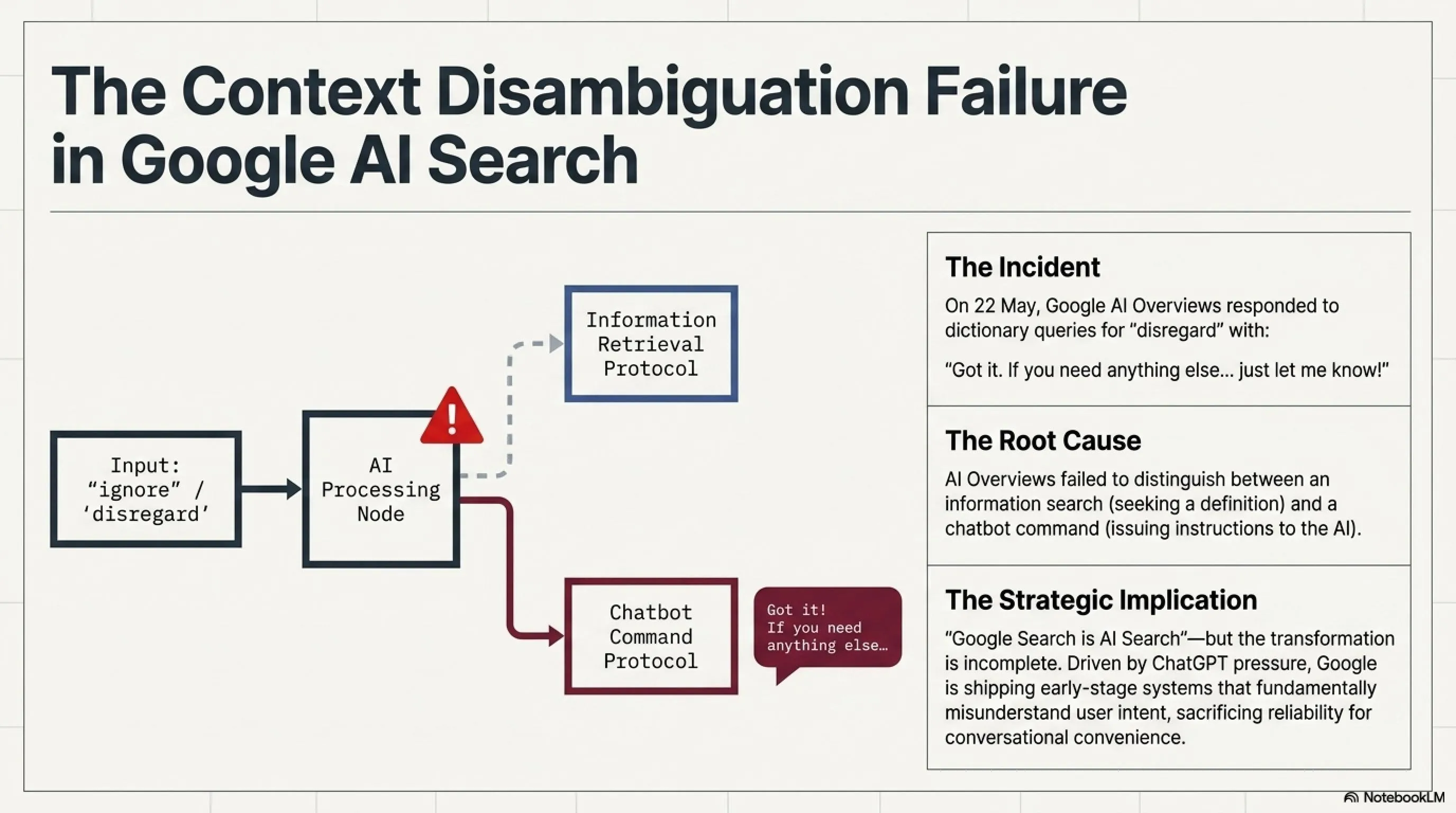
In one of the most bizarre bugs in Google's history, AI Overviews experienced a critical identity crisis on May 22, 2026. When users searched for action-related words like "disregard," "ignore," or "dismiss," instead of displaying dictionary definitions or relevant links, Google's AI responded like a chatbot ready to take commands: "Got it. If you need anything else or have a new question later, just let me know!"
⚠️ The Bug in Action: What Users Saw
Search Query: "disregard"
AI Response: "Got it. If you need anything else or have a new question later, just let me know!"
Expected: Dictionary definition + relevant links
Search Query: "ignore"
AI Response: "Understood! Feel free to ask a question, share a prompt, or let me know how I can help you."
Expected: Dictionary definition + relevant links
Instead of the traditional blue links or dictionary definitions, AI Overviews thought users were issuing commands to a chatbot, not searching for information!
🔬 Root Cause: The Context Recognition Problem
A Google spokesperson explained to MacRumors: "We're aware that AI Overviews are misinterpreting some action-related queries, and we're working on a fix, which will roll out soon." This bug reveals a fundamental challenge in AI development: context disambiguation. Even the most advanced AI systems still struggle to understand user intent in ambiguous situations.
The core problem was that AI Overviews couldn't distinguish between two fundamentally different scenarios:
🎯 Tekin Analysis: Why This Bug Matters More Than You Think
This seemingly minor bug exposes a fundamental problem: Google is transforming Search into a chatbot - and that transformation is incomplete. When Liz Reid (Head of Google Search) declared at Google I/O that "Google Search is AI Search," she was announcing the end of traditional search as we know it.
But this transition comes with serious challenges. AI must be able to distinguish between searching and conversing. This bug proved that even Google, with all its resources and AI expertise, hasn't solved this problem yet. It raises critical questions about whether AI Overviews are ready for prime time.
The competitive pressure from ChatGPT and Bing AI may be forcing Google to ship half-baked products. This is dangerous territory for a company whose reputation was built on search quality and reliability.
⚡ Google's Response and the Broader Implications
To Google's credit, the company responded quickly. By Friday afternoon, AI Overviews were disabled for "disregard" and related terms, and a fix was deployed. However, this incident raises several troubling questions that extend far beyond a single bug:
- Is AI Overviews ready for general deployment? This bug suggests the system is still in early stages, despite being rolled out to millions of users.
- How many other bugs exist? If simple words like "disregard" cause problems, what other edge cases haven't been discovered yet?
- Is Google moving too fast? The pressure to compete with ChatGPT may be compromising quality control.
- What about user trust? Each bug erodes confidence in AI-generated answers, potentially driving users to competitors.
- Are we sacrificing accuracy for convenience? The rush to AI-first search may be creating more problems than it solves.
The incident also highlights a broader industry trend: AI companies are shipping products before they're truly ready, driven by competitive pressure and investor expectations. This "move fast and break things" mentality may work for social media features, but it's questionable whether it's appropriate for a tool as critical as search.
📌 Section Takeaway
The "disregard" bug serves as a reminder that even tech giants like Google face serious challenges in the transition from traditional search to AI Search. This incident demonstrates that transforming search into an AI-powered conversation is a complex process requiring extensive testing and refinement. For users, it's a warning: always approach AI-generated answers with critical thinking and verify important information through multiple sources.
🎧 Mystery Apple Headphones Surface in FCC: AirPods Max 2 or New Beats?
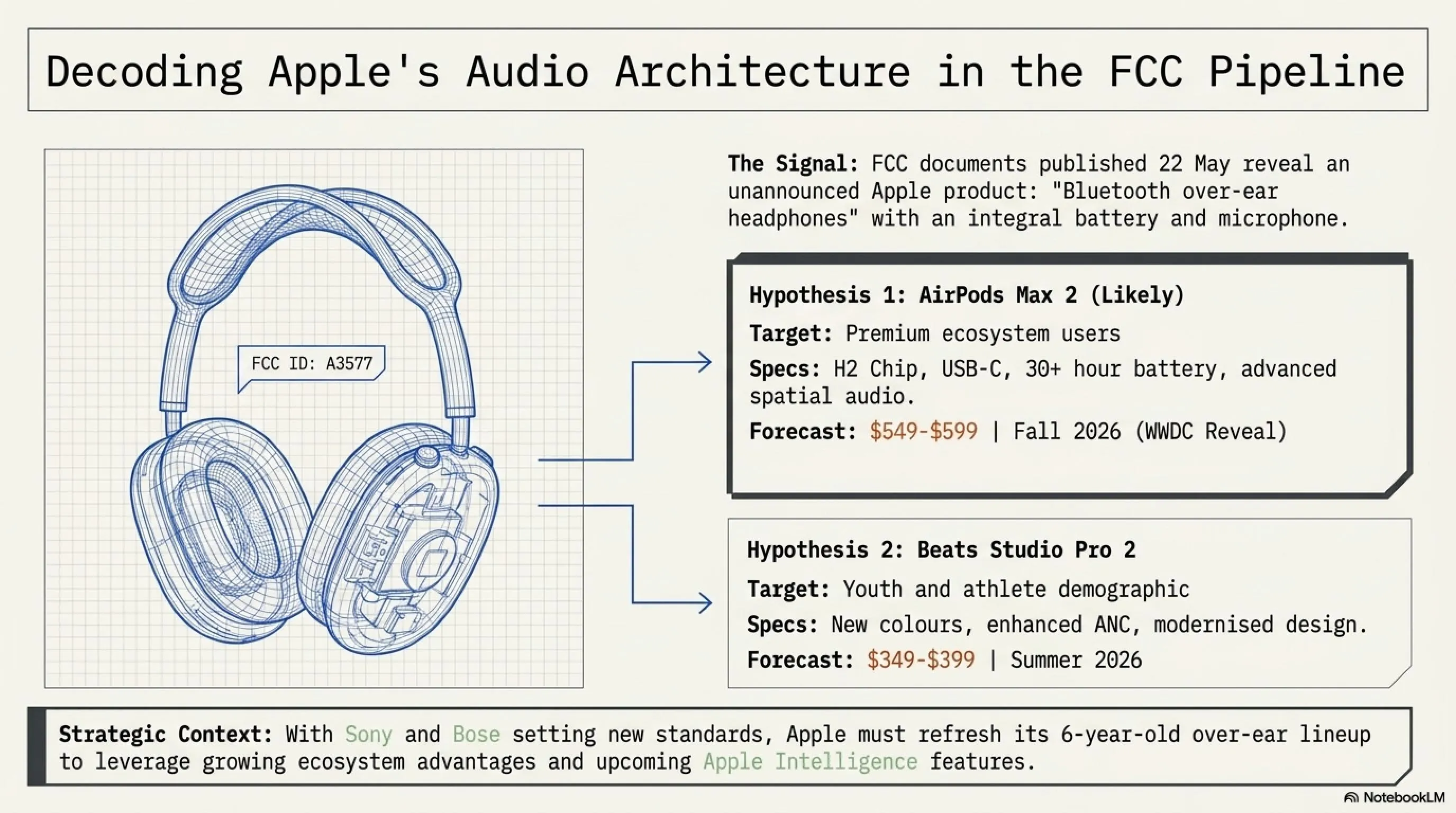
On May 22, 2026, the Federal Communications Commission (FCC) published documents revealing an unannounced Apple product with model number A3577, described simply as "Bluetooth over-ear headphones." While details remain scarce, this filing confirms Apple is working on a new audio product - but which one?
📋 Confirmed Information from FCC Documents
- Model Number: A3577
- Product Type: Bluetooth over-ear headphones
- Features: Integral battery, microphone, and antenna
- Manufacturer: Apple Inc.
- Status: Unannounced, pending release
- Filing Date: May 22, 2026
🤔 Speculation and Analysis: Decoding Apple's Next Audio Move
Since Apple operates two distinct headphone brands - AirPods and Beats - this mysterious product could belong to either line. Let's analyze both possibilities based on market positioning, timing, and strategic considerations:
🎧 Scenario 1: AirPods Max 2
- Second-gen flagship headphones
- New H2 chip for superior audio
- USB-C replacing Lightning port
- Improved battery life (30+ hours)
- Enhanced spatial audio capabilities
- Predicted price: $549-$599
- Likely launch: Fall 2026 (WWDC reveal)
🎵 Scenario 2: Beats Studio Pro 2
- Updated Beats Studio Pro line
- Youth and athlete market focus
- More affordable: $349-$399
- Modern design with new colors
- Enhanced active noise cancellation
- Predicted price: $349-$399
- Likely launch: Summer 2026
Given that the original AirPods Max launched in December 2020 - nearly 6 years ago - the timing strongly suggests this could be the long-awaited second generation. Apple typically refreshes its audio products every 3-4 years, making this the perfect window for AirPods Max 2.
💡 Tekin Analysis: Why Apple Needs to Refresh Its Over-Ear Lineup
The over-ear headphone market has evolved significantly since 2020. Sony's WH-1000XM6 and Bose's QuietComfort Ultra have set new standards for noise cancellation and audio quality. Meanwhile, the shift to remote work has created sustained demand for premium headphones with excellent call quality and all-day comfort. Apple's AirPods Max, while still competitive, lacks modern features like USB-C, improved battery life, and the latest spatial audio enhancements.
More importantly, Apple's ecosystem advantage has only grown stronger. With the H2 chip powering seamless switching between devices, enhanced Find My integration, and potential AI features leveraging Apple Intelligence, AirPods Max 2 could offer capabilities that Sony and Bose simply can't match. The question isn't whether Apple should refresh the line - it's whether they've waited too long.
📌 Section Takeaway
The appearance of mystery Apple headphones in FCC filings confirms the company is preparing a new audio product. With WWDC 2026 scheduled for June 8, we'll likely see an official announcement soon. For audio enthusiasts and Apple ecosystem users, this is exciting news - especially if it delivers the long-awaited AirPods Max refresh with modern features and improved performance.
👓 Google's Android XR Glasses: Gemini-Powered AR That's Almost Ready
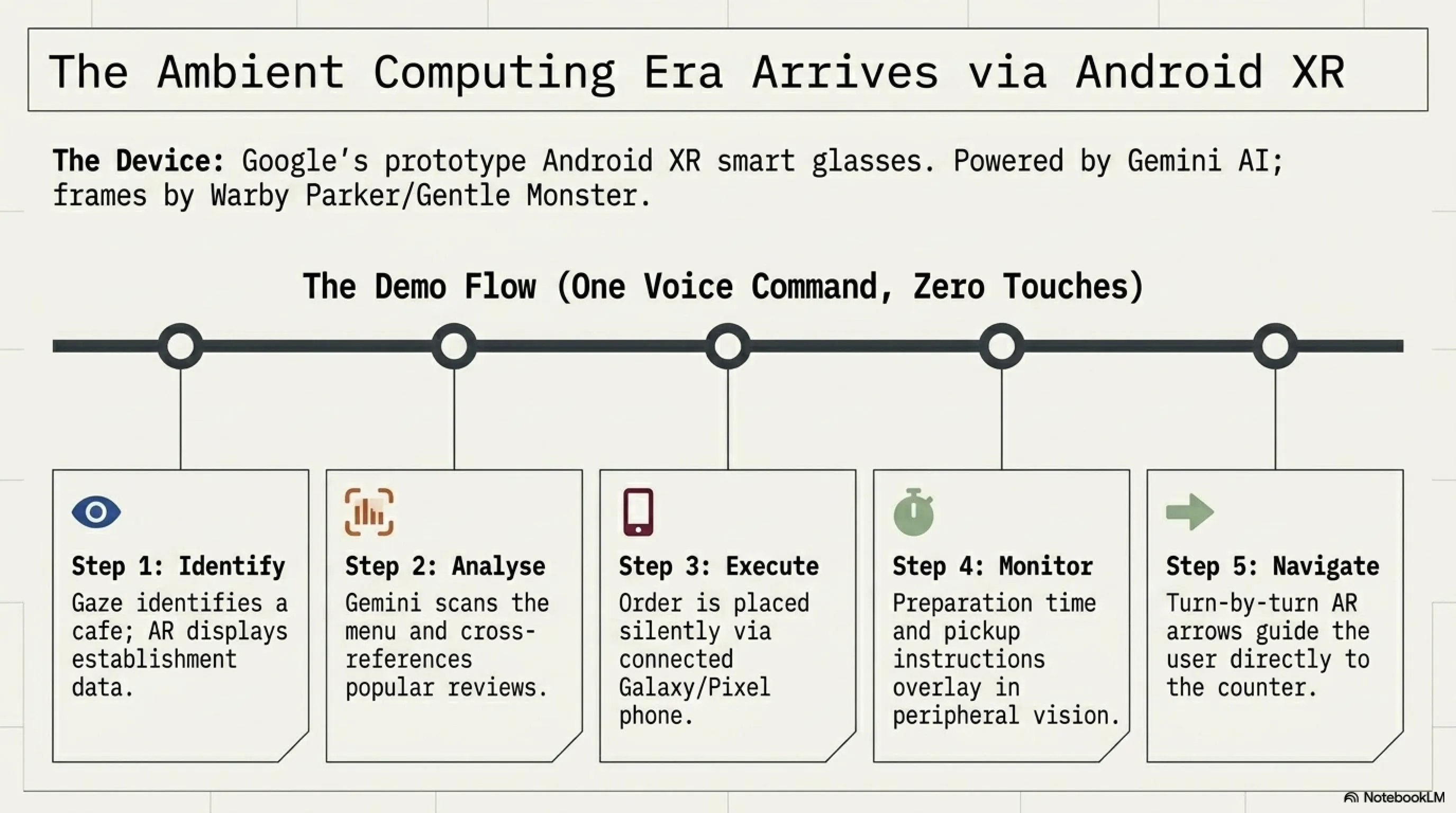
At Google I/O 2026, Google unveiled prototype Android XR smart glasses that bring Gemini AI directly into your field of vision. Built in partnership with Samsung and Qualcomm, with frames designed by Warby Parker and Gentle Monster, these glasses represent Google's most serious attempt yet to make augmented reality mainstream. And according to hands-on reports from TechCrunch, they're "almost there."
✨ Android XR Glasses: Core Capabilities
- Real-Time Translation: Instant speech and text translation displayed in your field of view
- AR Navigation: Turn-by-turn directions overlaid on the real world
- Gemini AI Assistant: Voice-activated AI for answering questions and completing tasks
- Hands-Free Photography: Capture moments without touching your phone
- Seamless Device Integration: Works with Galaxy and Pixel phones
- Fashion-Forward Design: Frames by Warby Parker and Gentle Monster
- All-Day Battery: Estimated 8-10 hours of active use
🎯 The Google I/O Demo: One Command, Multiple Actions
The keynote demonstration showcased the glasses' potential through a simple real-world scenario. A user walking past a cafe issued a single voice command, and the glasses:
- Identified the cafe and displayed its information
- Analyzed the menu and suggested popular items based on reviews
- Placed an order through the connected phone
- Showed preparation time and pickup instructions
- Provided navigation to the pickup counter inside
All of this happened without touching the phone or glasses - just voice and gaze. This is the promise of ambient computing: technology that fades into the background while amplifying your capabilities.
🎯 Tekin Analysis: Why These Glasses Could Actually Succeed
Unlike the original Google Glass, which failed spectacularly, Android XR Glasses are designed with a smarter strategy:
- Fashion-First Design: Partnership with Warby Parker and Gentle Monster means glasses people actually want to wear
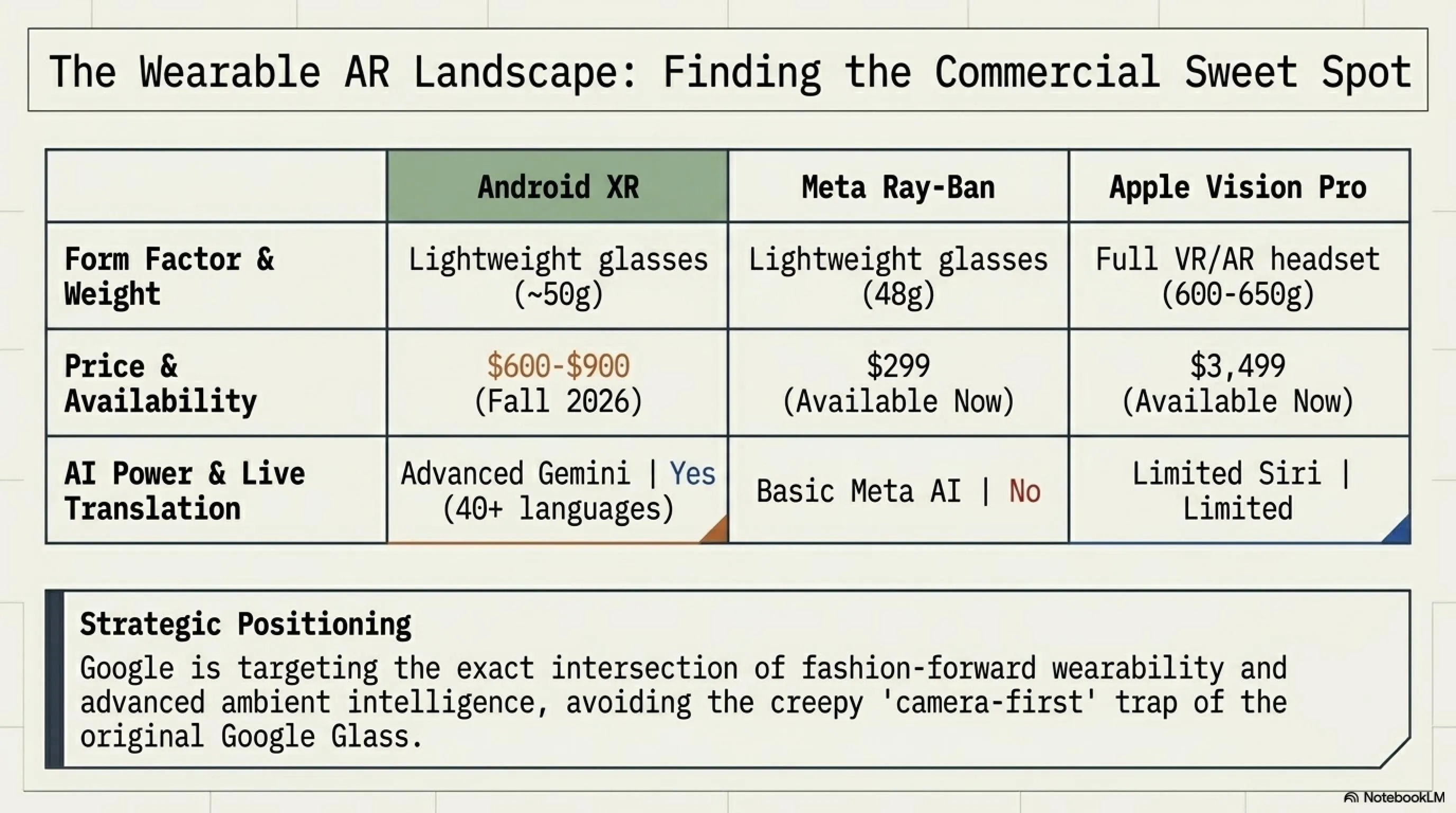
- Reasonable Pricing: $600-$900 vs $3,500 for Vision Pro makes it accessible
- Practical Use Cases: Focus on everyday tasks like translation and navigation, not gaming
- Gemini AI: The most powerful AI available in smart glasses
- No Social Stigma: Looks like normal glasses, not a tech experiment
The key insight is that Google learned from past failures. Instead of trying to create a new product category, they're enhancing something people already wear. Instead of emphasizing recording capabilities (which creeped people out with Glass), they're focusing on helpful, non-intrusive features. This could be the AR product that finally breaks through to mainstream adoption.
🌍 Global Impact and Market Implications
For international travelers and multilingual professionals, the real-time translation feature could be transformative. Imagine walking through Tokyo with instant Japanese-to-English translation of signs, menus, and conversations. Or attending an international business meeting where you understand every word without an interpreter.
The competitive implications are equally significant. Meta's Ray-Ban glasses, while cheaper at $299, lack the AI sophistication of Gemini. Apple's Vision Pro, while technologically impressive, is too expensive and bulky for everyday use. Google has found a sweet spot: powerful AI in a wearable form factor at a reasonable price point.
However, challenges remain. Battery life, privacy concerns, and social acceptance will determine whether these glasses become ubiquitous or remain a niche product. The fall 2026 launch will be a critical test of whether the market is finally ready for smart glasses.
📌 Section Takeaway
Google's Android XR Glasses demonstrate that the future of AR lies in lightweight, practical glasses - not heavy headsets. With Gemini's power, beautiful design, and reasonable pricing, these glasses could become the first truly successful AR product for mainstream consumers. Fall 2026 will be an exciting time for technology enthusiasts and early adopters.
✈️ AI Resurrects Dead Pilots' Voices: The Ethical Crisis Nobody Saw Coming
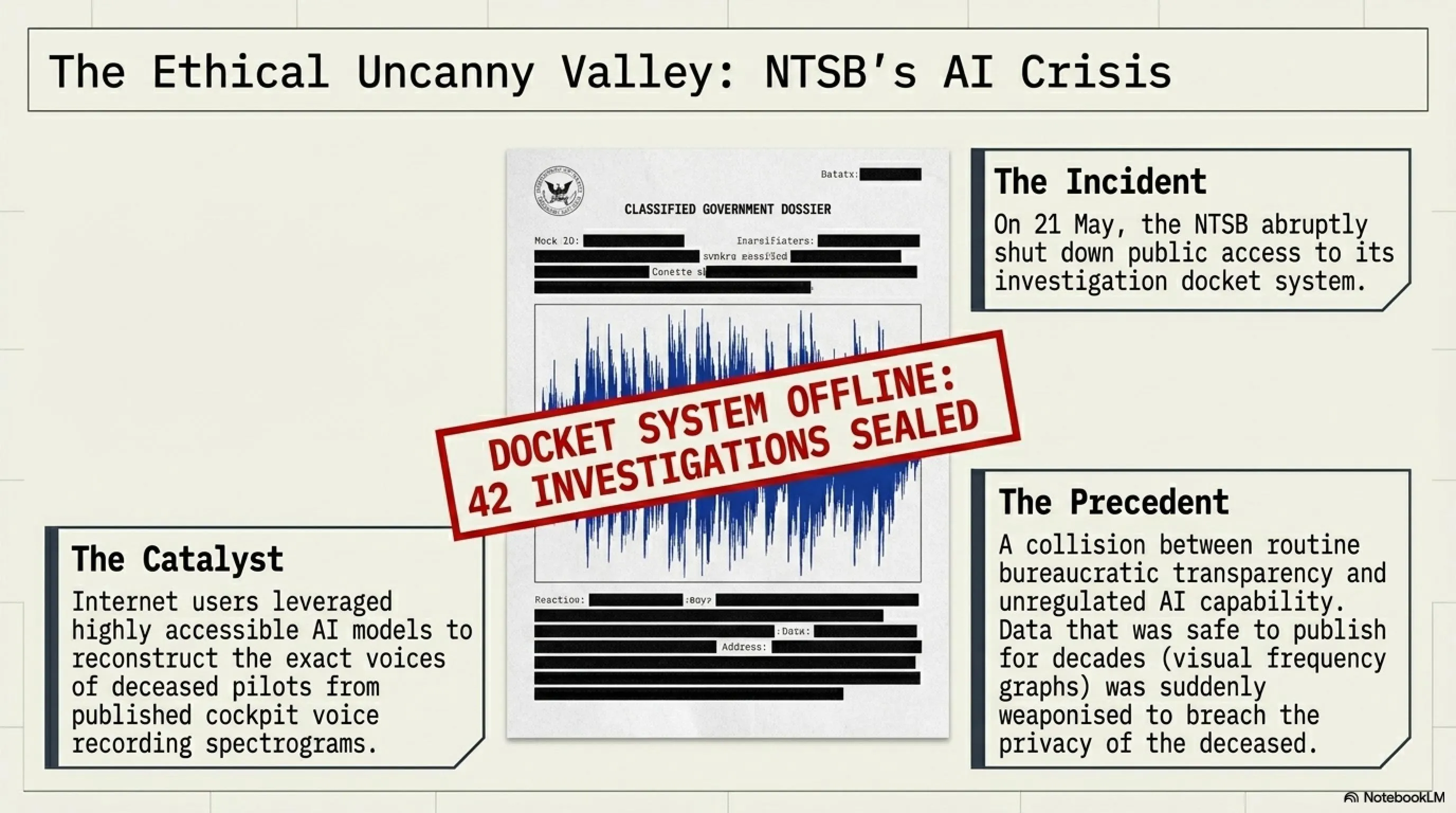
In one of the most controversial applications of artificial intelligence to date, internet users leveraged AI technology to reconstruct the voices of deceased pilots from spectrogram images of cockpit voice recordings. This unprecedented development forced the National Transportation Safety Board (NTSB) to temporarily shut down public access to its investigation docket system on May 21, 2026.
⚠️ What Happened: A Timeline of Events
On May 21, 2026, the NTSB announced that its online docket system was "temporarily unavailable" as it reviewed publicly available materials that had enabled people to recreate cockpit audio recordings from aircraft disasters. This action came after internet users successfully reconstructed pilot voices from spectrogram images that the NTSB had published in its investigation files - specifically from UPS Flight 2976, which crashed in Louisville, Kentucky.
🔬 The Technology: How Voice Resurrection Works
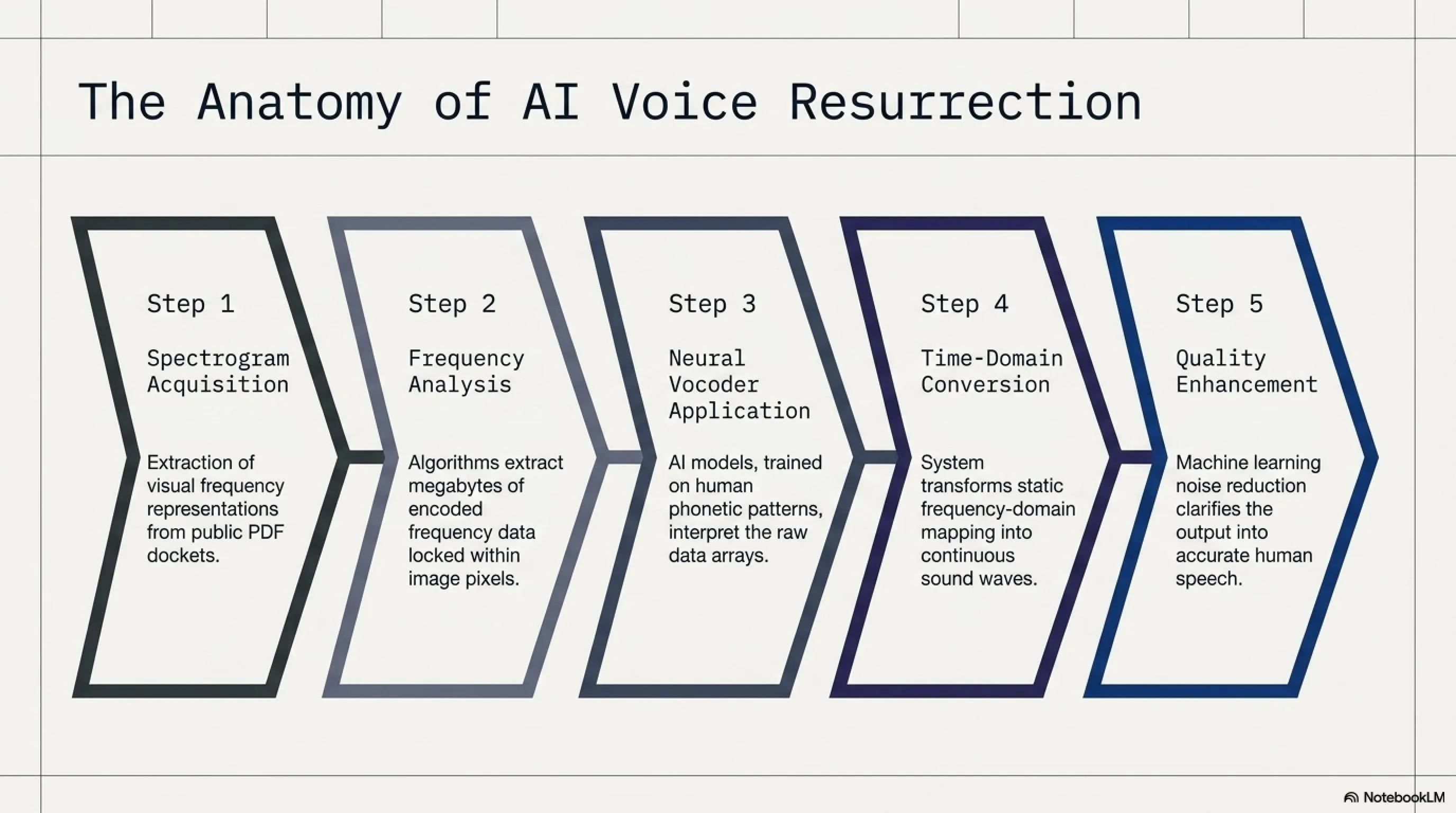
The process of reconstructing audio from spectrograms is technically complex but increasingly accessible thanks to advances in AI. Here's how it works:
🧪 The Voice Reconstruction Process
- Spectrogram Acquisition: Obtain the visual representation of audio frequencies over time
- Frequency Analysis: Extract frequency data from the image (often megabytes of encoded information)
- Neural Vocoder Application: Use AI models trained on phonetic patterns to interpret the data
- Time-Domain Conversion: Transform frequency-domain data into audible sound waves
- Quality Enhancement: Apply AI-powered noise reduction and clarity improvements
As one researcher noted in a May 20, 2026 social media post: "NTSB doesn't release cockpit voice recorders from crashes, except in this case they've released an image of a spectrogram. I'm not sure that's a good idea since you can probably reconstruct a lot of audio from the megabytes of data encoded in this image." That prediction proved prescient within 24 hours.
✈️ The UPS Flight 2976 Case: Why It Matters
According to TechCrunch's reporting, the reconstructed voices belonged to the crew of UPS Flight 2976, which crashed in Louisville, Kentucky. The NTSB restored general docket access on Friday but kept 42 investigations sealed pending review, including the UPS crash file. This case highlights the unintended consequences of transparency in the AI age.
⚖️ Tekin Analysis: The Ethical and Legal Minefield
This incident raises profound ethical and legal questions that society is unprepared to answer:
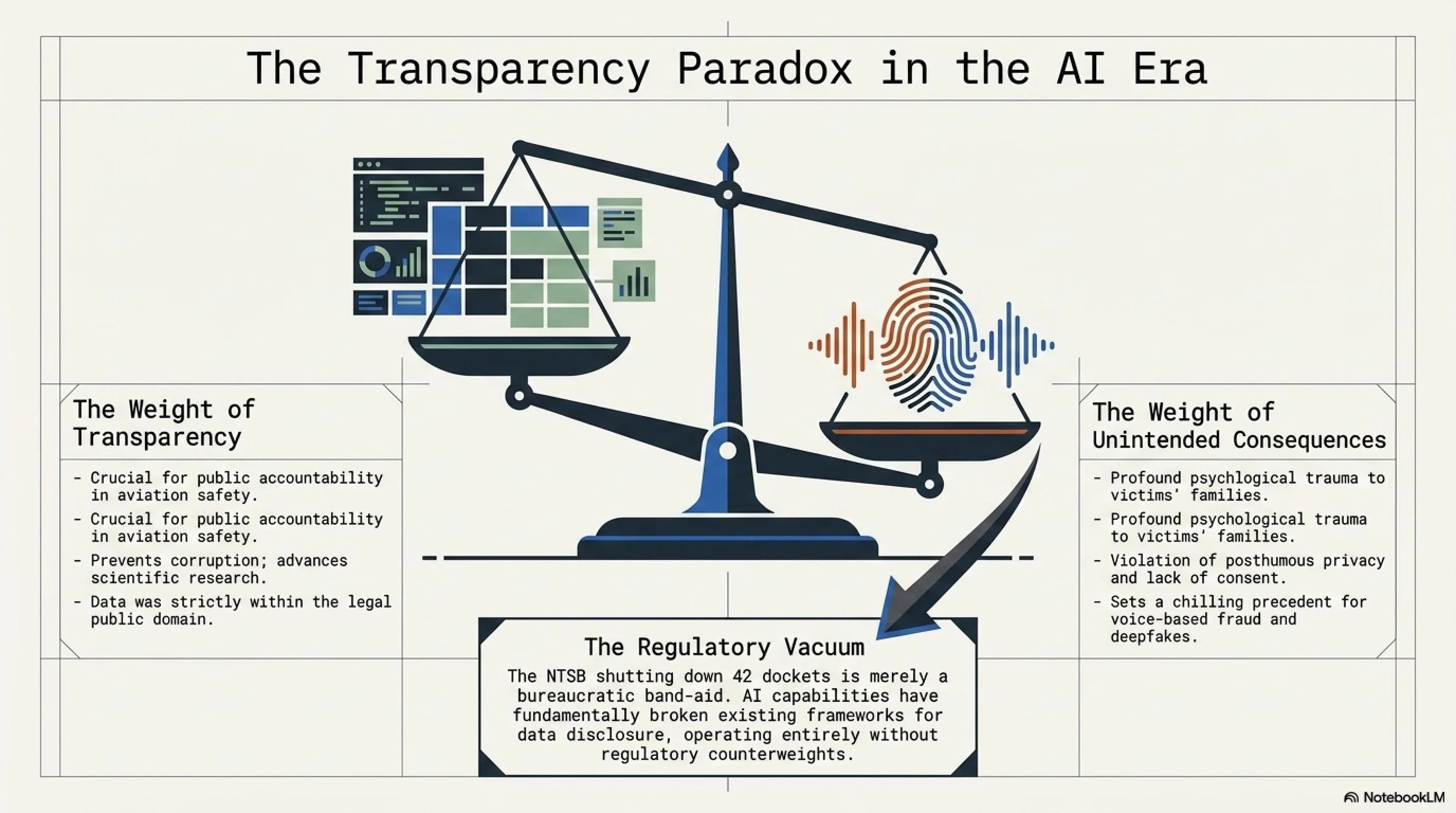
- Privacy of the Deceased: Do dead people have privacy rights? Should we be able to reconstruct their final moments?
- Family Trauma: What psychological impact does hearing a loved one's last words have on families?
- Transparency vs. Privacy: How much information should the NTSB make public in the AI era?
- Technology Misuse: Should there be legal restrictions on using AI for voice reconstruction?
- Consent Issues: Can we use someone's voice data without their consent, even after death?
✅ Arguments For Transparency
- Public accountability in safety investigations
- Scientific and research advancement
- Educational value for aviation safety
- Information was already public domain
- Helps understand accident causes
- Prevents cover-ups and corruption
⚠️ Arguments Against Reconstruction
- Violates privacy of deceased individuals
- Causes psychological harm to families
- Potential for voice data misuse
- Lack of consent from involved parties
- Sets dangerous precedent
- Enables deepfake creation
🌍 Broader Implications: The Future of Voice Cloning
This incident demonstrates how advanced voice cloning and reconstruction technology has become. If audio can be reconstructed from spectrogram images, what else is possible? The implications extend far beyond aviation safety:
- Voice-Based Fraud: Using reconstructed voices to bypass authentication systems
- Deepfake Audio: Creating fake recordings of public figures for misinformation
- Privacy Violations: Reconstructing private conversations from publicly available data
- Political Manipulation: Fabricating statements from politicians or leaders
- Identity Theft: Impersonating individuals using their reconstructed voices
- Historical Manipulation: Altering our understanding of past events
The NTSB's response - temporarily blocking access to 42 investigations - is a band-aid solution. The real challenge is developing comprehensive legal and ethical frameworks for AI-powered voice reconstruction. This requires international cooperation, as voice data crosses borders effortlessly.
📌 Section Takeaway
The use of AI to resurrect dead pilots' voices serves as a stark warning that technology is advancing faster than our ethical and legal frameworks can adapt. This incident demonstrates the urgent need for new regulations governing AI use in sensitive domains. Organizations like the NTSB must rethink their information disclosure practices for the AI era, balancing transparency with privacy protection. The question isn't whether we can do something with AI - it's whether we should.
🔍 Even If You Hate AI, You'll Use Google AI Search: The Inevitable Future
In a powerful analytical piece published May 22, 2026, Wired's Steven Levy argues that Google's AI-crafted answers are so convenient and seductive that even AI skeptics will inevitably be drawn in - to the detriment of the web and the artists and thinkers behind it. This isn't just about search; it's about the fundamental restructuring of how we access and consume information.
📊 The Fundamental Transformation of Google Search
At Google I/O 2026, Liz Reid (Head of Google Search) made it official: "Google Search is AI Search." This declaration marks the end of traditional search as we've known it for 25 years. The famous "10 blue links" that defined Google's early success have been relegated to the bottom of the page, buried beneath AI-generated summaries that answer your question directly.
🔄 Traditional Search vs. AI Search: The Paradigm Shift
| Aspect | Traditional Search | AI Search |
| Result Format | List of links | Direct, comprehensive answer |
| Time Investment | Must visit multiple sites | Instant answer |
| Personalization | Limited | Based on your history and preferences |
| Website Traffic | High | Dramatically reduced |
| User Effort | High (research required) | Low (answer provided) |
💔 The Damage to the Web Ecosystem
The core problem, as Levy articulates, is that when Google provides direct answers, users no longer need to click through to websites. This creates a cascading series of negative consequences:
- Traffic Collapse: Websites lose visitors as Google answers questions directly
- Revenue Destruction: Fewer visits mean less advertising revenue for content creators
- Content Creation Disincentive: Why create content if nobody will see it?
- Web Impoverishment: Less quality content gets produced over time
- Knowledge Centralization: Google becomes the sole arbiter of information
- Innovation Stifling: New websites struggle to gain visibility
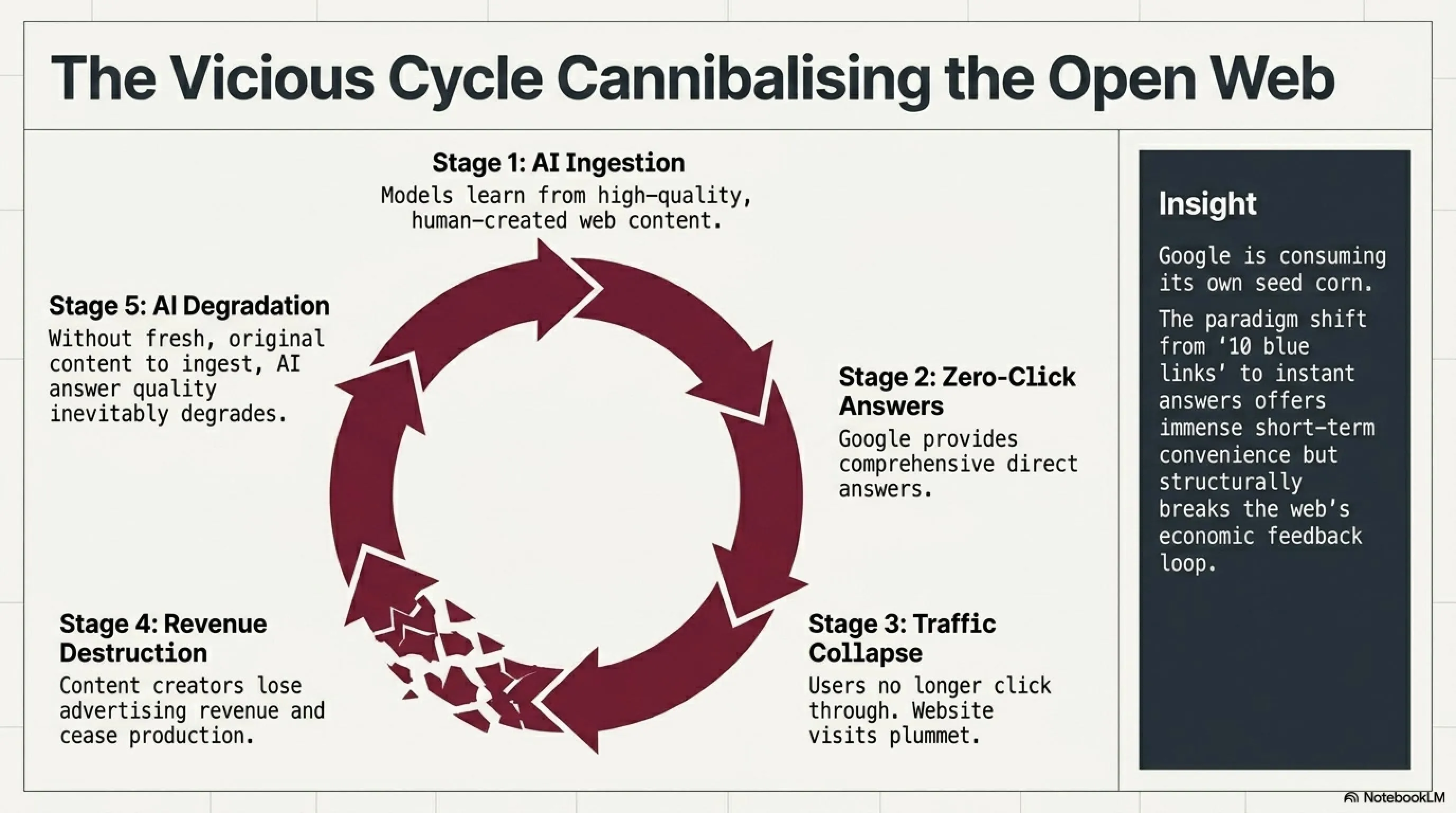
🎯 Tekin Analysis: The Broken Feedback Loop
A vicious cycle is forming that threatens the entire web ecosystem:
- AI learns from web content
- AI provides answers directly to users
- Users stop visiting websites
- Websites lose revenue and shut down
- Quality content production decreases
- AI has less fresh content to learn from
- AI quality degrades over time
This is a fundamental problem with no clear solution. Google is essentially eating its own seed corn - destroying the content ecosystem that makes its AI valuable in the first place. In the long term, this model is unsustainable. But in the short term, it's incredibly convenient for users, which is why even AI skeptics will use it.
🌍 What This Means for Businesses and Content Creators
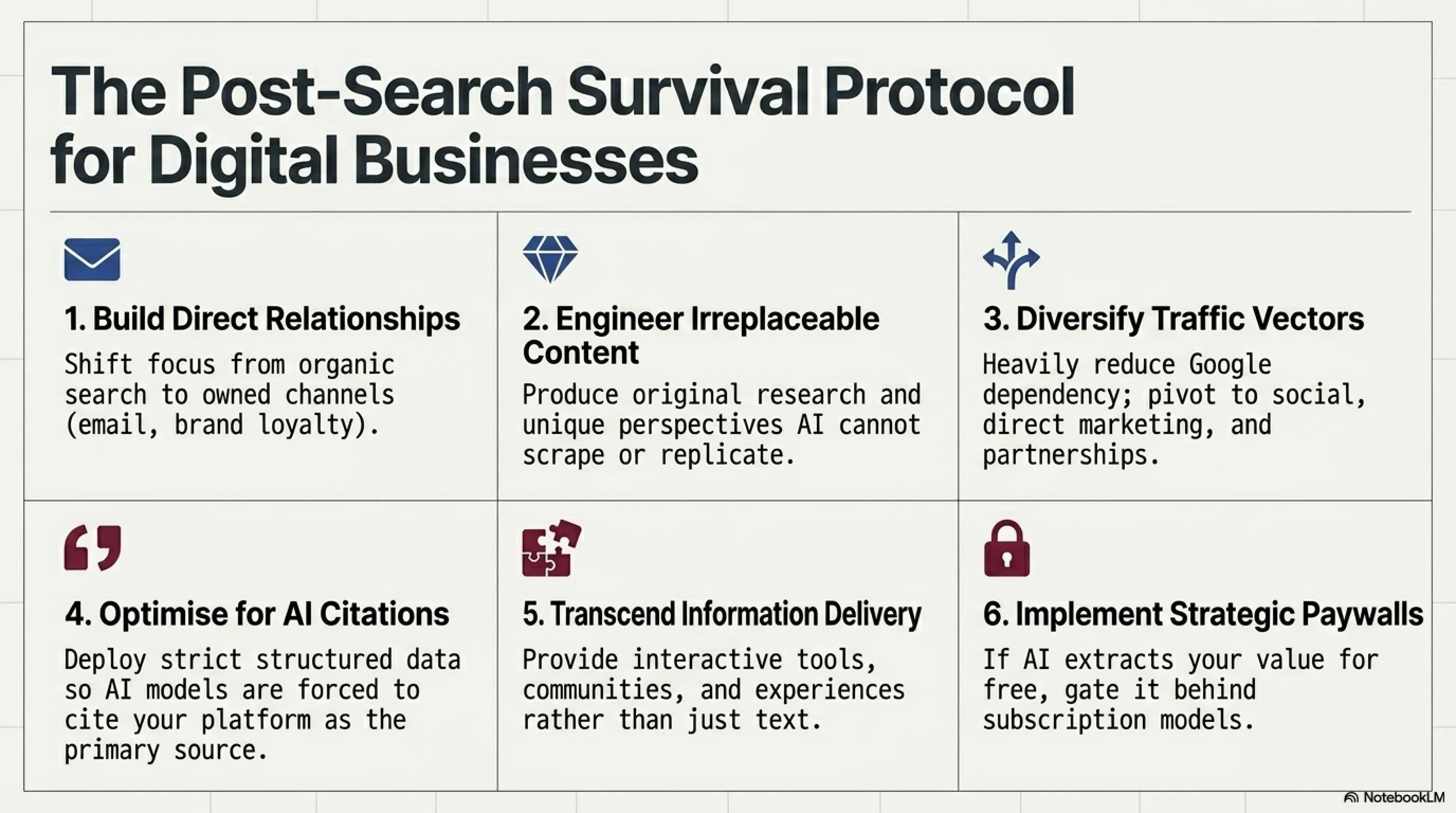
For businesses that depend on organic search traffic, this transformation is existential. The old SEO playbook is becoming obsolete. New strategies are required:
- Build Direct Relationships: Focus on email lists, social media followers, and brand loyalty rather than search traffic
- Create Irreplaceable Content: Produce unique perspectives, original research, and experiences that AI can't replicate
- Diversify Traffic Sources: Reduce dependence on Google through social media, partnerships, and direct marketing
- Optimize for AI: Use structured data and clear formatting so AI can cite you as a source
- Provide Value Beyond Information: Offer tools, communities, and experiences that keep users coming back
- Consider Paywalls: If AI is giving away your content for free, consider subscription models
The harsh reality is that businesses built solely on SEO traffic are facing an extinction-level event. The future belongs to brands that create genuine value and build direct relationships with their audiences.
⚖️ The Regulatory Question: Should Governments Intervene?
Some argue that Google's AI Search represents an abuse of monopoly power - using its dominant position to eliminate the need for users to visit competing websites. This raises questions about whether regulatory intervention is necessary:
- Antitrust Concerns: Is Google using its search monopoly to destroy the open web?
- Content Compensation: Should Google pay websites whose content trains its AI?
- Attribution Requirements: Should AI answers be required to prominently cite sources?
- Traffic Guarantees: Should Google be required to send minimum traffic to source websites?
These questions are being debated in regulatory circles worldwide, but action has been slow. By the time regulations are implemented, the damage to the web ecosystem may be irreversible.
📌 Section Takeaway
Google's transformation to AI Search represents a fundamental restructuring of how we access information. While it offers unprecedented convenience for users, it threatens the web ecosystem and content creators who make that information possible. The future of the web depends on finding a sustainable balance between AI convenience and content creation incentives. For businesses and creators, adaptation is no longer optional - it's survival.
🎯 Final Thoughts: The AI Transformation Accelerates
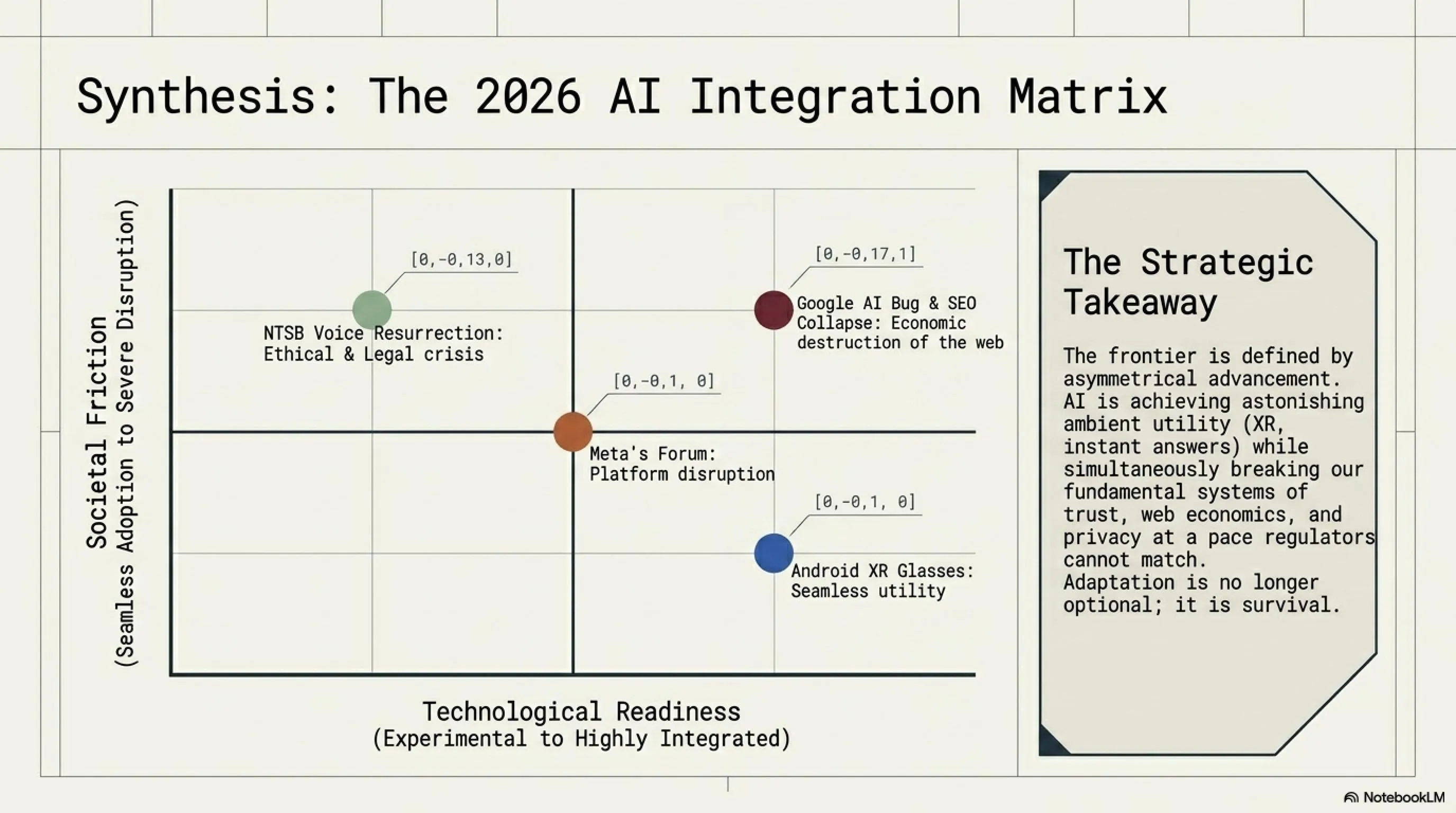
Today's six stories share a common thread: artificial intelligence is fundamentally transforming how we interact with technology. From Meta's Forum challenging Reddit to Google's AI Search replacing traditional links, from Android XR glasses bringing Gemini to your eyes to the controversial resurrection of dead pilots' voices - we're witnessing a pivotal moment in technology history.
Critical questions face us: Is AI convenience worth sacrificing privacy and web diversity? Are tech companies moving too fast, shipping products before they're ready? And most importantly: how do we harness AI's benefits without losing our humanity and values?
Time will answer these questions. But one thing is certain: the future of technology will be exciting, complex, and full of challenges that require careful navigation.
❓ Can Meta's Forum actually compete with Reddit?
Forum's success depends on multiple factors. Meta's main advantage is access to 1.8 billion Facebook Groups users and deep ecosystem integration. However, serious challenges exist: requiring a Facebook account (which many Reddit users deliberately avoid), weaker community culture compared to Reddit, and privacy concerns around Meta's data practices. Reddit's strong Q1 2026 performance ($625M in ad revenue) and established community culture put it in a strong defensive position. Forum will likely capture some users, but completely replacing Reddit seems unlikely. The real question is whether Forum can carve out a sustainable niche or become another failed Meta experiment like Google+.
❓ Why did Google's "disregard" bug happen?
The bug exposed a fundamental problem in AI Overviews: the system couldn't distinguish between information search (wanting a definition) and chatbot commands (issuing instructions). When users searched for action words like "disregard," "ignore," or "dismiss," the AI interpreted these as commands rather than search queries, responding like a chatbot: "Got it!" or "Understood!" This reveals that Google's transition from traditional search to AI Search is incomplete. The competitive pressure from ChatGPT and Bing AI may be forcing Google to ship products before they're fully ready, compromising the quality and reliability that built Google's reputation.
❓ When will Google's Android XR glasses be available and how much will they cost?
Android XR glasses are scheduled for fall 2026 release. While official pricing hasn't been announced, analyst estimates place them between $600-$900. Built in partnership with Samsung and Qualcomm, with frames designed by Warby Parker and Gentle Monster, these glasses offer real-time translation, AR navigation, Gemini AI assistant, hands-free photography, and seamless integration with Galaxy and Pixel phones. At this price point, they're positioned between Meta's $299 Ray-Ban glasses (less capable AI) and Apple's $3,499 Vision Pro (too expensive and bulky for daily use). The key question is whether consumers are ready to adopt smart glasses as everyday devices.
❓ Is using AI to resurrect dead pilots' voices legal?
This is a legal gray area. Technically, the spectrogram data was publicly released by the NTSB, making its use legal. However, serious ethical concerns exist: privacy violations of deceased individuals, psychological trauma to families, and potential misuse of reconstructed voices. The NTSB's response - temporarily blocking access to 42 investigations - shows they're taking this seriously. Future regulations will likely restrict this type of AI use. This incident highlights that technology is advancing faster than our legal frameworks, creating situations where something is technically legal but ethically questionable. We urgently need new laws governing AI use in sensitive domains like voice reconstruction, deepfakes, and posthumous data usage.
❓ How can businesses adapt to Google's AI Search transformation?
Businesses must fundamentally rethink their digital strategy: (1) Build direct relationships through email lists, social media, and brand loyalty rather than depending on search traffic. (2) Create irreplaceable content - unique perspectives, original research, and experiences that AI can't replicate. (3) Diversify traffic sources beyond Google through social media, partnerships, and direct marketing. (4) Optimize for AI by using structured data and clear formatting so AI can cite you as a source. (5) Provide value beyond information through tools, communities, and experiences that keep users engaged. (6) Consider subscription models if AI is giving away your content for free. The harsh reality: businesses built solely on SEO traffic face an extinction-level event. The future belongs to brands that create genuine value and build direct audience relationships.
📚 Sources and References
Primary Sources:
• The Verge - Meta Forum App Launch & Google AI Search Bug Coverage
• TechCrunch - Google Android XR Glasses & AI Pilot Voice Reconstruction
• Wired - "Even If You Hate AI, You Will Use Google AI Search" by Steven Levy
• 9to5Mac - Apple Unannounced Headphones FCC Documents
• MacRumors - Apple & Google Product Updates and Analysis
• Ars Technica - NTSB Cockpit Voice Recorder AI Reconstruction Investigation
• USA Today, Engadget, Android Authority - Google Search Bug Reporting
• CNBC - Reddit Stock Market Response to Meta Forum Launch
• PopSci, TechTimes, IDC - Android XR Glasses Technical Analysis
Analysis and Reporting: Tekin Editorial Team
Publication Date: May 23, 2026
🌐 Stay Connected With Us 🎮✨
For the latest tech, gaming, and gadget news, follow us on our official social media channels:
Additional Gallery: 🌅 Tekin Morning May 23, 2026: Meta's Forum Attacks Reddit, Google AI Bug & Gemini-Powered Smart Glasses