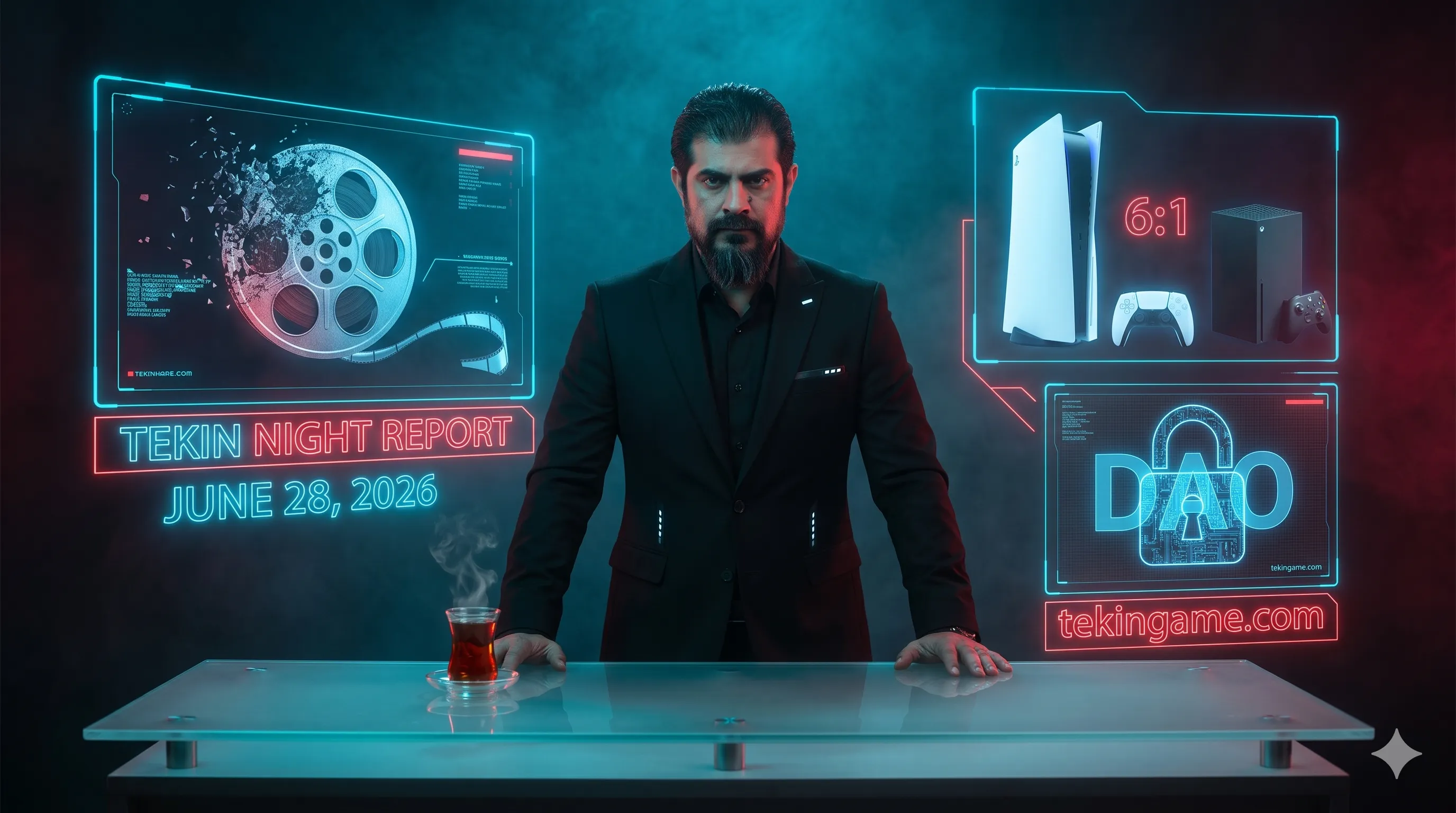
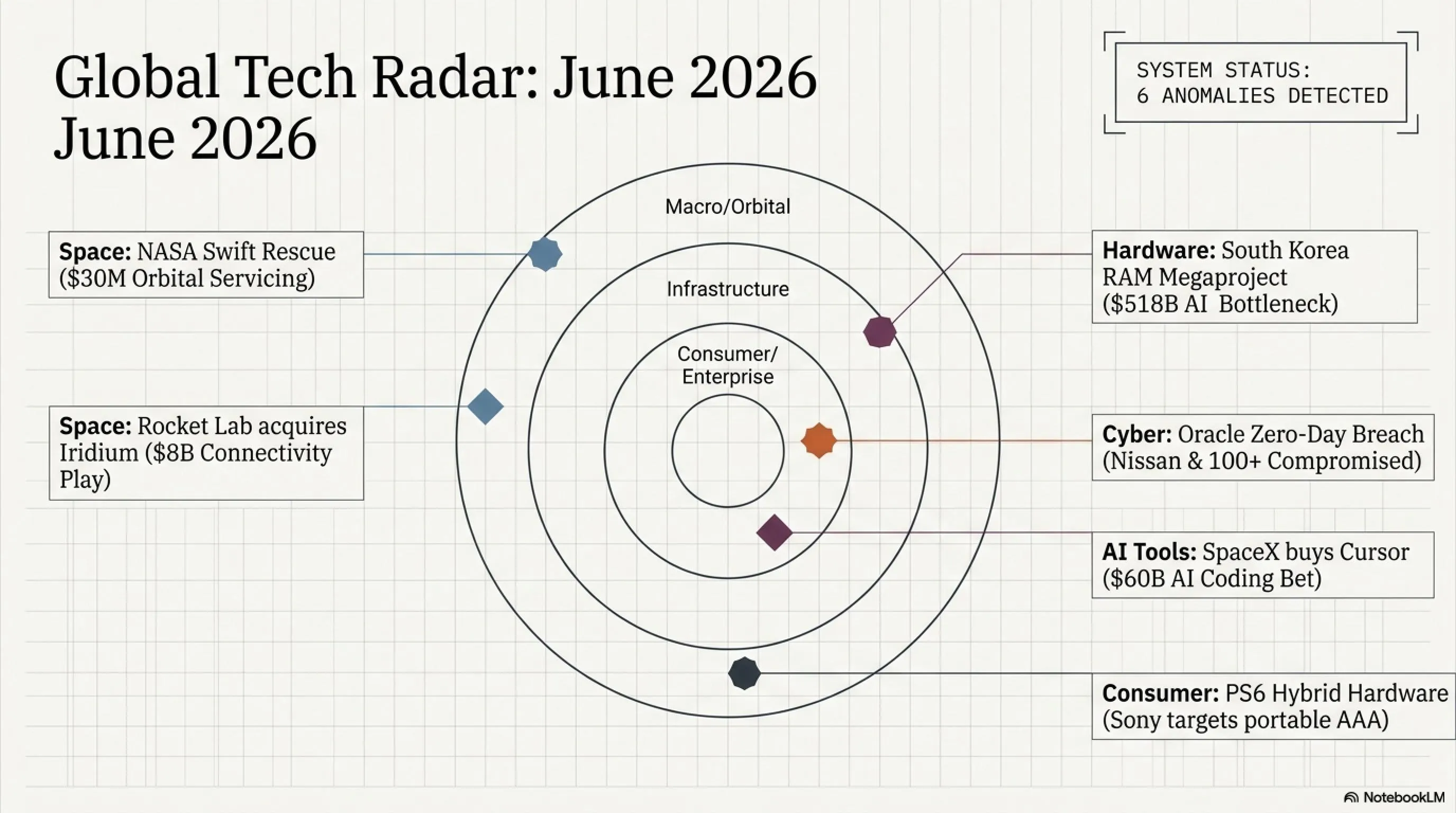
Tuesday, June 30, 2026, brings six massive stories. NASA launches a historic $30M orbital rescue for the Swift telescope. Rocket Lab acquires Iridium for $8B, rivaling Starlink. Sony hints the PS6 could feature a Switch-like hybrid design. South Korea invests $518B to combat the global AI memory shortage (RAMageddon). Nissan suffers a major data breach via an Oracle zero-day, and SpaceX’s Cursor drops its highly anticipated iOS app.
☀️ Tekin Morning | Tuesday, June 30, 2026
Good morning! Start your day energized with the latest tech and gaming news.
- 🎮NASA Swift Telescope Rescue- Historic $30M mission to save orbital observatory from atmospheric burnup
- 🎧Rocket Lab's $8B Iridium Acquisition- New competition emerges for Starlink and Project Kuiper
- 🚀PS6 Could Work Like Nintendo Switch- Sony hints at seamless gaming experience beyond the living room
- 🗡️South Korea's $518B Memory Investment- Samsung & SK Hynix tackle RAMageddon crisis with massive fab expansion
- 📰Nissan Hit by Oracle Zero-Day Attack- Employee data breach linked to CVE-2026-35273 PeopleSoft vulnerability
- 🎮Cursor Launches iOS App- Following SpaceX's record-breaking $60B acquisition
Tuesday, June 30, 2026 kicks off with six electrifying stories spanning space exploration, gaming hardware, cybersecurity, and artificial intelligence. NASA is launching the first-ever orbital rescue mission to save the Swift space telescope, while Rocket Lab makes a power move by acquiring Iridium Communications for $8 billion, positioning itself as a legitimate competitor to SpaceX's Starlink dominance.
In gaming, Sony's PlayStation CEO dropped tantalizing hints that the PS6 could adopt a Nintendo Switch-like hybrid approach, marking a potential return to portable gaming. Meanwhile, South Korea announced a staggering $518 billion investment plan to combat the global RAMageddon crisis, Nissan disclosed a devastating data breach stemming from an Oracle zero-day vulnerability, and SpaceX-owned Cursor released its first mobile app following the largest startup acquisition in history.
At a Glance
- NASA launches today a $30M rescue mission to save the Swift Observatory from atmospheric reentry
- Rocket Lab acquires Iridium Communications for $8B, becoming Starlink's newest rival
- Sony hints PS6 will enable seamless gaming beyond the living room, similar to Nintendo Switch
- South Korea commits $518B to build four new memory fabs and HBM facilities
- Nissan discloses employee data breach after ShinyHunters exploited Oracle PeopleSoft zero-day CVE-2026-35273
- Cursor releases iPhone and iPad app following SpaceX's record $60B acquisition of Anysphere
NASA Launches Historic Mission to Rescue Swift Space Telescope
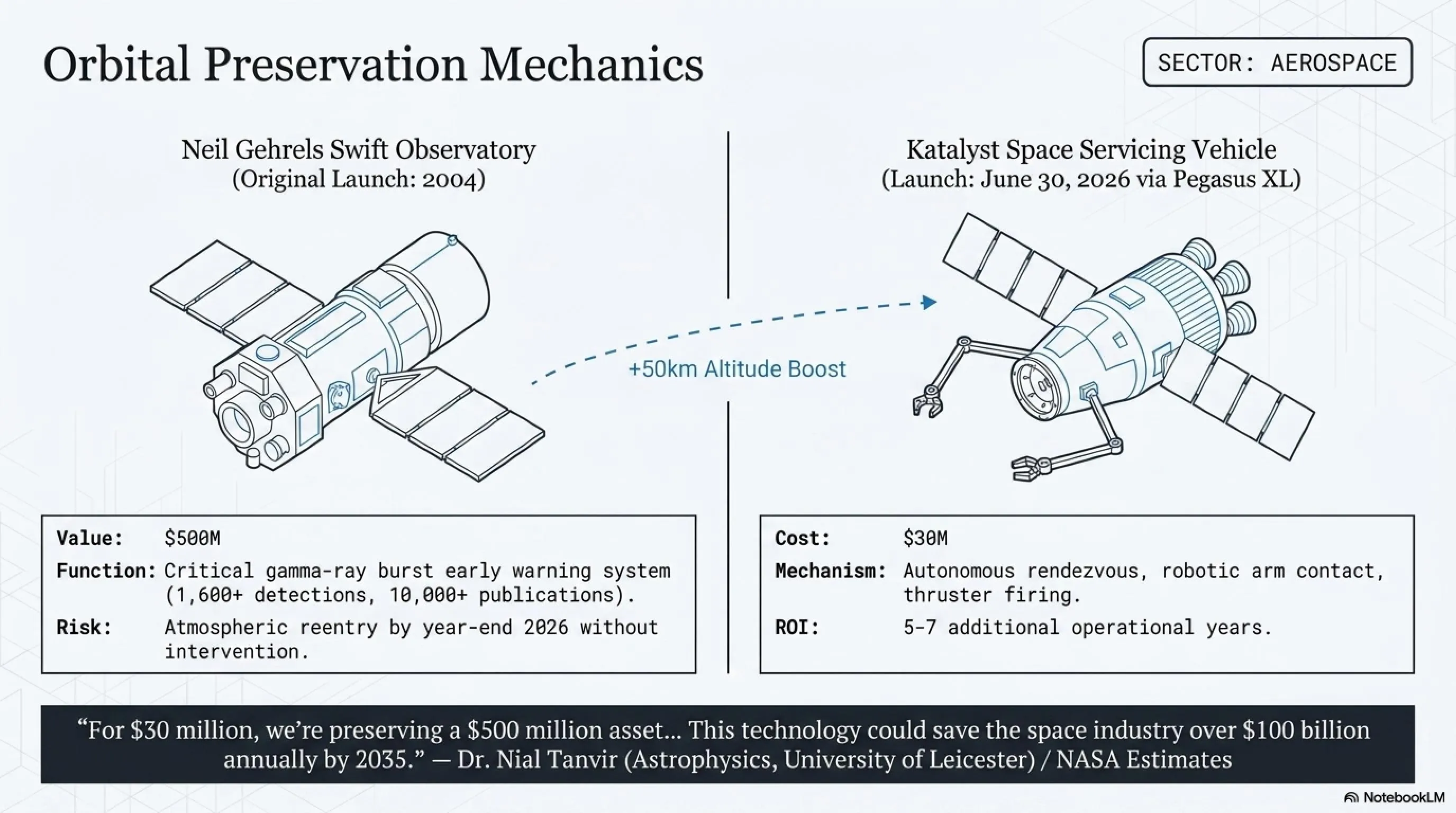
NASA is making history today, Tuesday June 30, 2026, with the launch of the first-ever orbital servicing mission designed to rescue the Neil Gehrels Swift Observatory from burning up in Earth's atmosphere. The venerable space telescope, operational for over 20 years since its 2004 launch, faces imminent destruction due to orbital decay unless this unprecedented rescue succeeds.
A Northrop Grumman Pegasus XL rocket will carry a Katalyst Space servicing spacecraft to rendezvous with Swift and boost its orbit to a safer altitude. This groundbreaking mission, costing $30 million, represents the first time NASA has attempted to extend the operational life of a space telescope through in-orbit servicing rather than simply accepting its loss.
Swift has been instrumental in detecting gamma-ray bursts and other astronomical phenomena for over two decades. Without intervention, this invaluable scientific instrument would have deorbited and disintegrated in Earth's atmosphere by year-end 2026, representing a significant loss to the astronomical community worldwide.
Swift Rescue Mission Specifications
Observatory Name: Neil Gehrels Swift Observatory
Original Launch: 2004 (20+ years operational)
Launch Vehicle: Northrop Grumman Pegasus XL
Servicing Spacecraft: Katalyst Space Servicing Vehicle
Launch Date: June 30, 2026
Mission Cost: $30 million
Primary Objective: Orbital altitude boost to prevent atmospheric reentry
Expected Lifespan Extension: 5-7 additional years
Why Saving Swift Matters for Astronomy
The Swift Observatory remains one of the world's most critical instruments for detecting and characterizing gamma-ray bursts—the most energetic explosions in the universe since the Big Bang. These cataclysmic events, produced by collapsing massive stars or colliding neutron stars, provide invaluable insights into stellar evolution, gravitational wave events, and the fundamental physics of extreme conditions.
Swift's unique capability lies in its rapid response system. Within seconds of detecting a gamma-ray burst, Swift can autonomously slew to the source location and alert ground-based observatories worldwide, enabling immediate follow-up observations across the electromagnetic spectrum. Losing Swift would create a critical gap in the global gamma-ray burst detection network that would take years and billions of dollars to replace.
The telescope has detected over 1,600 gamma-ray bursts during its operational lifetime and has been cited in more than 10,000 scientific publications. Its contributions to multi-messenger astronomy—particularly during the 2017 neutron star merger that produced both gravitational waves and electromagnetic radiation—proved invaluable for understanding cosmic phenomena.
Pioneering Orbital Servicing Technology
The Katalyst Space servicing vehicle represents cutting-edge technology in autonomous rendezvous and proximity operations. Using advanced electric propulsion and AI-guided navigation systems, the spacecraft will approach Swift, make physical contact using robotic arms, and then fire its thrusters to raise the observatory's orbit by approximately 50 kilometers—enough to extend its operational life by 5-7 years.
This mission serves as a technology demonstration for future orbital servicing capabilities. If successful, similar missions could refuel satellites, repair damaged spacecraft, upgrade aging systems, or deorbit defunct satellites in a controlled manner. The economic implications are staggering: instead of building and launching replacement satellites costing hundreds of millions or billions, operators could extend existing assets' lives for a fraction of the cost.
NASA's investment in orbital servicing aligns with broader efforts to make space operations more sustainable and cost-effective. The agency estimates that widespread adoption of servicing capabilities could save the space industry over $100 billion annually by 2035.
Rocket Lab Becomes Starlink Rival with $8 Billion Iridium Acquisition
Rocket Lab announced yesterday it will acquire Iridium Communications for $8 billion in a cash-and-stock deal valued at $54 per share, marking one of the largest consolidation moves in the commercial space industry. This transformative acquisition instantly positions Rocket Lab as a vertically integrated space powerhouse capable of competing directly with SpaceX's Starlink constellation and Amazon's Project Kuiper.
Iridium operates a constellation of 75+ satellites in low Earth orbit providing global voice, data, and IoT connectivity services, including coverage in the most remote corners of the planet where traditional telecommunications infrastructure doesn't exist. The satellite network serves critical customers in aviation, maritime, government, military, and emergency services sectors.
Prior to this acquisition, Rocket Lab was primarily known as a launch services provider with its Electron rocket and satellite manufacturing capabilities through its Photon spacecraft platform. By acquiring Iridium, Rocket Lab gains immediate access to steady recurring revenue, an established customer base, and operational experience managing a large satellite constellation—capabilities that took SpaceX years to develop organically with Starlink.
Rocket Lab-Iridium Deal Breakdown
Acquisition Price: $8 billion ($54/share in cash and stock)
Iridium Active Satellites: 75+ operational satellites
Geographic Coverage: 100% of Earth's surface including poles and oceans
Services Offered: Voice, messaging, data, and IoT connectivity
2025 Revenue: $780 million with positive operating margins
Active Subscribers: 1.5+ million
Main Competitors: SpaceX Starlink, Amazon Project Kuiper, Inmarsat
Deal Closure: Expected Q3 2026 pending regulatory approval
Strategic Rationale Behind the Mega-Deal
Rocket Lab's acquisition strategy differs markedly from the typical venture capital-backed startup playbook of organic growth. CEO Peter Beck has repeatedly emphasized that the launch services market alone cannot sustain long-term profitability at scale, citing intense competition and downward pricing pressure as SpaceX continues to dominate with its reusable Falcon 9 and upcoming Starship vehicles.
Iridium brings something Rocket Lab desperately needed: predictable, recurring revenue. Satellite operators pay Iridium subscription fees for connectivity services, creating a steady cash flow that isn't dependent on winning individual launch contracts. This financial stability will allow Rocket Lab to invest more aggressively in next-generation technologies, including its Neutron medium-lift rocket currently under development.
The acquisition also provides Rocket Lab with a proven business model for satellite constellation operations. As the company develops its own future satellite networks, the operational experience and ground infrastructure gained from managing Iridium's 75+ satellite fleet will prove invaluable. Rocket Lab can leverage its launch capabilities to deploy new Iridium satellites at cost, creating significant operational synergies.
How Rocket Lab Compares to Satellite Internet Competitors
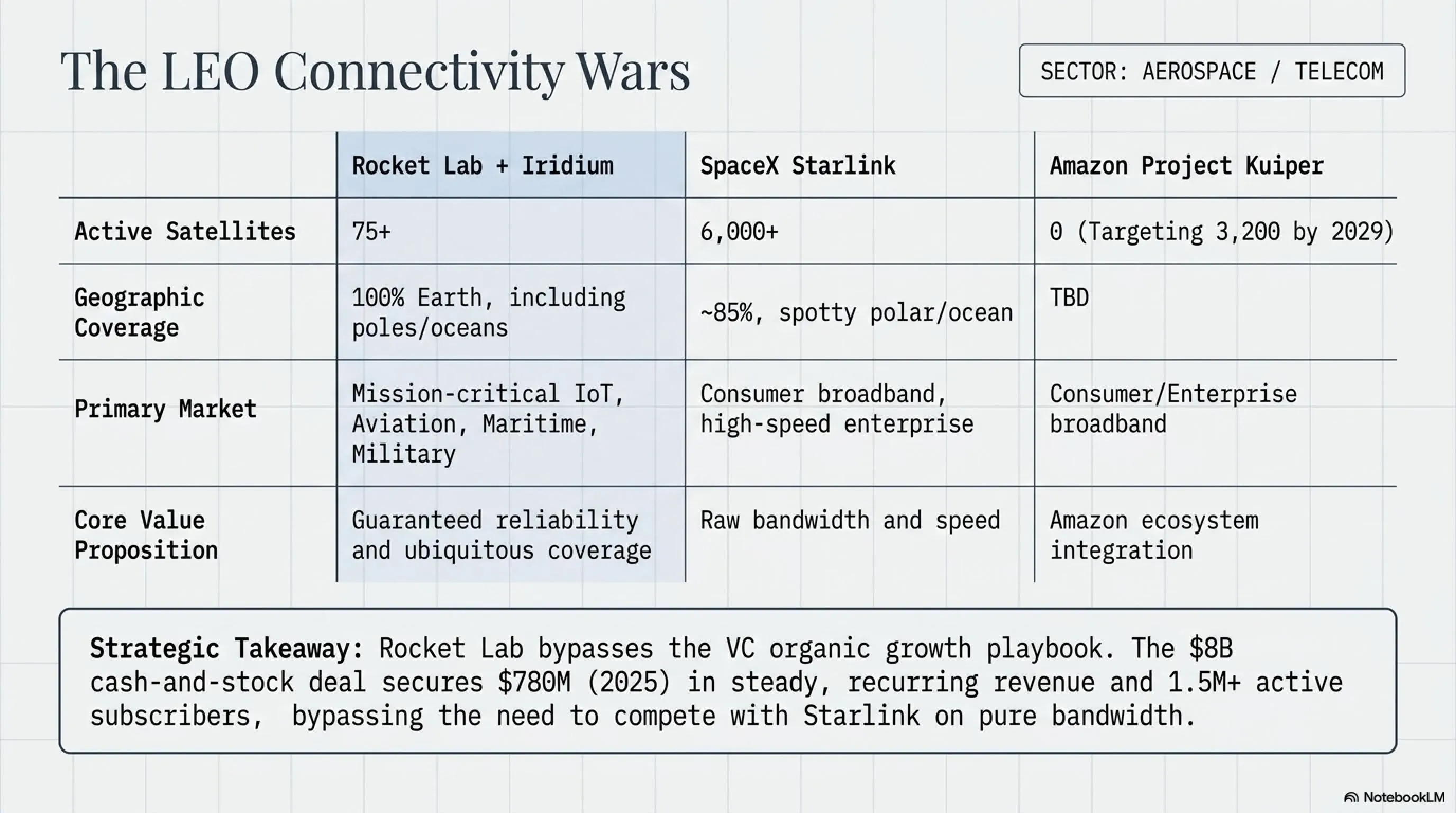
With the Iridium acquisition complete, Rocket Lab becomes the third major player in the satellite connectivity market, albeit with a distinctly different business model than SpaceX Starlink. While Starlink targets consumer broadband with thousands of satellites providing high-speed internet, Iridium focuses on reliable connectivity for mission-critical applications where guaranteed service matters more than raw bandwidth.
SpaceX Starlink currently operates over 6,000 active satellites and serves more than 3 million subscribers globally, generating estimated annual revenue exceeding $6 billion. Amazon's Project Kuiper, despite massive investment, has yet to launch a single operational satellite, though the company plans to deploy over 3,200 satellites by 2029. OneWeb, backed by the UK government and Bharti Global, operates approximately 600 satellites serving primarily enterprise and government customers.
Satellite Network Comparison
| Feature | Starlink (SpaceX) | Iridium (Rocket Lab) | Project Kuiper (Amazon) | OneWeb |
|---|---|---|---|---|
| Active Satellites | 6,000+ | 75+ | 0 (in development) | ~600 |
| Geographic Coverage | ~85% of Earth | 100% of Earth | Not yet operational | Global |
| Download Speed | 150-250 Mbps | 100-150 Kbps | TBD | 50-150 Mbps |
| Subscribers | 3+ million | 1.5 million | 0 | Undisclosed |
| Target Market | Consumer & Enterprise | Government, Military, IoT | Consumer | Enterprise & Gov |
| Company Valuation | $180+ billion | $8 billion | Part of Amazon | ~$3 billion |
Rocket Lab's strategy with Iridium emphasizes reliability and ubiquitous coverage rather than competing on speed. Iridium satellites provide true pole-to-pole coverage including over oceans and polar regions where Starlink coverage remains spotty. This makes Iridium indispensable for maritime vessels, aircraft, military operations, and emergency services that require guaranteed connectivity regardless of location.
The acquisition also positions Rocket Lab to capitalize on the exploding IoT market. Iridium's low-bandwidth, low-power connectivity is ideal for remote sensors, shipping containers, agricultural equipment, and infrastructure monitoring—applications where Starlink's higher-cost, higher-power terminals make little economic sense.
Sony Hints PS6 Could Adopt Nintendo Switch-Style Hybrid Design
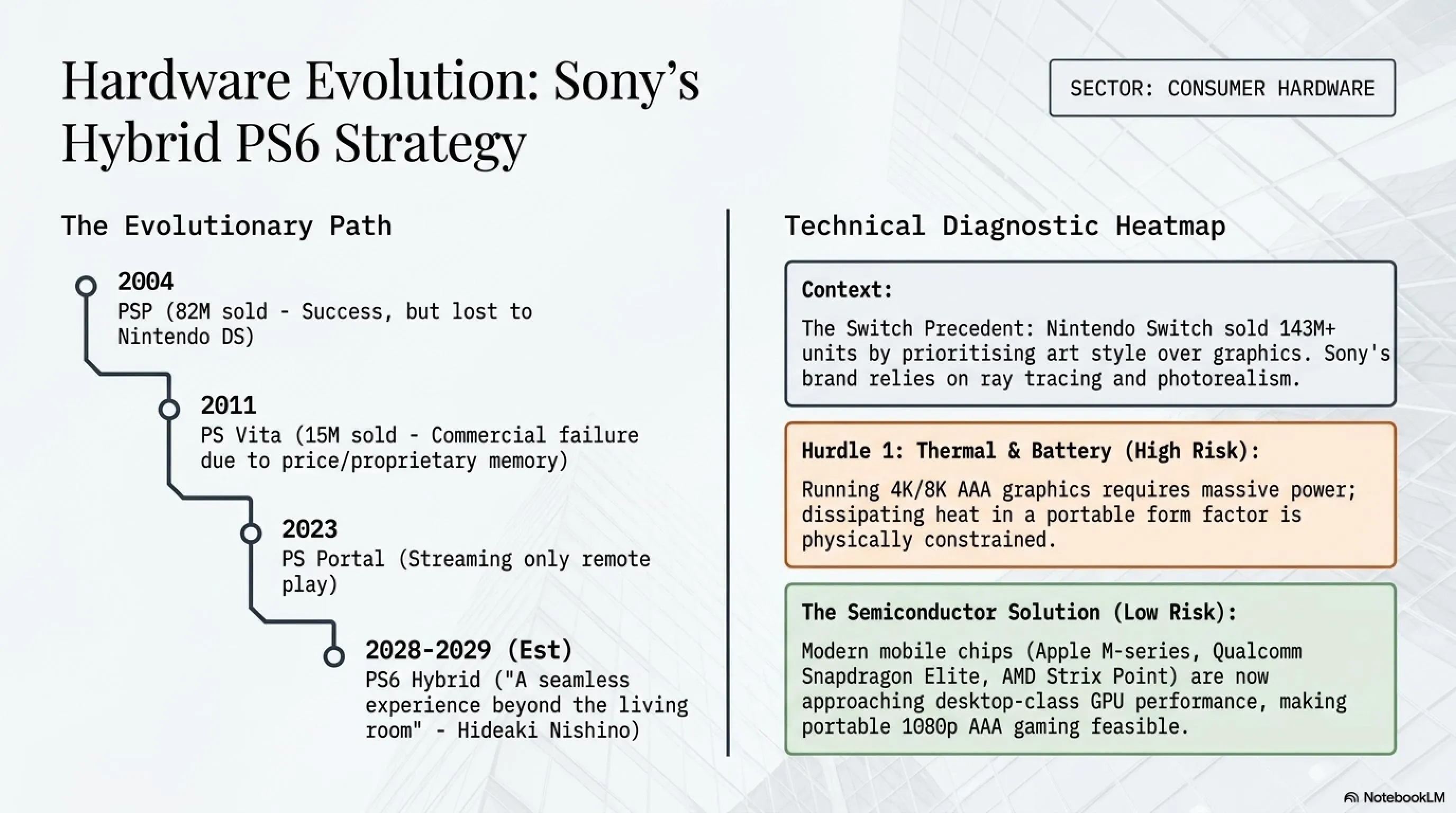
PlayStation CEO Hideaki Nishino ignited speculation about Sony's next-generation console direction in a recent interview, suggesting the PS6 could enable "a seamless experience that can be enjoyed naturally beyond the living room"—language strikingly similar to how Nintendo describes the Switch. These comments represent Sony's clearest hint yet that it's considering a return to the portable gaming market it abandoned with the PS Vita.
Nishino emphasized Sony's commitment to delivering value unique to PlayStation through technological advancement and expansion of usage styles. While he stopped short of explicitly confirming a handheld PS6, the deliberate parallel to Switch's hybrid approach sent gaming forums into overdrive analyzing what Sony might be planning for its next console generation.
Nintendo Switch has proven the viability of the hybrid model, selling over 143 million units and becoming one of the best-selling consoles in history. The Switch's success stems from offering flexibility—players can enjoy full-featured games on their TV at home, then seamlessly continue playing the same game in handheld mode during their commute or while traveling.
Sony's Portable Gaming History
PSP (PlayStation Portable): Launched 2004, sold 82 million units, commercially successful but lost to Nintendo DS (154M units)
PS Vita: Launched 2011, sold only 15 million units, commercial failure due to high price, proprietary memory cards, and lack of third-party support
Production End: Sony discontinued PS Vita in 2019, effectively exiting portable gaming market for years
PlayStation Portal: Released 2023 as remote play device, streams from PS5 but isn't a standalone portable console
Market Context: Steam Deck, ASUS ROG Ally, and Lenovo Legion Go revitalized PC handheld gaming market in 2022-2025
Could PS6 Really Work as a Portable Console?
The technical challenges of creating a portable PlayStation capable of running next-generation AAA games are formidable. Nintendo Switch succeeds partly because Nintendo's first-party games prioritize art style and gameplay over cutting-edge graphics, allowing them to run smoothly on mobile hardware. PlayStation, conversely, has built its brand on visual fidelity, ray tracing, high frame rates, and photorealistic graphics—all extremely demanding of power and thermal management.
However, semiconductor advances since the PS Vita era have been dramatic. Modern mobile processors like Apple's M-series chips and Qualcomm's Snapdragon Elite series deliver performance approaching desktop-class GPUs from just a few years ago. AMD's recent Strix Point mobile processors can run demanding PC games at 1080p with acceptable frame rates, suggesting the technical barriers may finally be surmountable.
Sony could adopt several strategies for a hybrid PS6: a powerful base station that renders full-fidelity games at 4K/8K when docked, with the portable unit using lower resolution and graphical settings similar to Steam Deck's approach; cloud streaming for the most demanding titles when in portable mode; or a dual-SKU strategy with separate home and portable versions that share the same game library.
Market Impact and Competitive Dynamics
If Sony successfully launches a hybrid PS6, the console market landscape would shift dramatically. Xbox, already struggling with declining market share, would face even more pressure. Current generation sales figures show PS5 at approximately 65 million units sold versus Xbox Series X|S at roughly 30 million—a substantial gap that a portable PS6 could widen further.
Nintendo would also face its first true portable competition since the PS Vita. The Switch 2, rumored for 2025/2026 launch, will likely feature improved hardware but may struggle to compete against PlayStation's superior third-party game library and exclusive titles. However, Nintendo's strong first-party franchises (Mario, Zelda, Pokemon) and family-friendly positioning give it defensible differentiation.
The PC handheld market, currently dominated by Steam Deck, would see major disruption. While Steam Deck offers access to an enormous existing PC game library, it lacks the console optimization and exclusive titles that make PlayStation attractive. Sony could potentially capture consumers who want portable AAA gaming but prefer console simplicity over PC gaming's complexity.
- Gaming flexibility between home and portable modes
- Access to PlayStation's massive exclusive game library
- Likely backward compatibility with PS5 titles
- Could capture market share from Switch 2 and PC handhelds
- Addresses consumer demand for portable AAA gaming
- Technical challenge maintaining graphical fidelity in portable mode
- Battery life concerns for demanding AAA games
- Likely high price point ($600-700+) limiting mass market appeal
- Potential game development complexity supporting two form factors
- Heat dissipation challenges in portable form factor
South Korea Commits $518 Billion to Combat RAMageddon Crisis
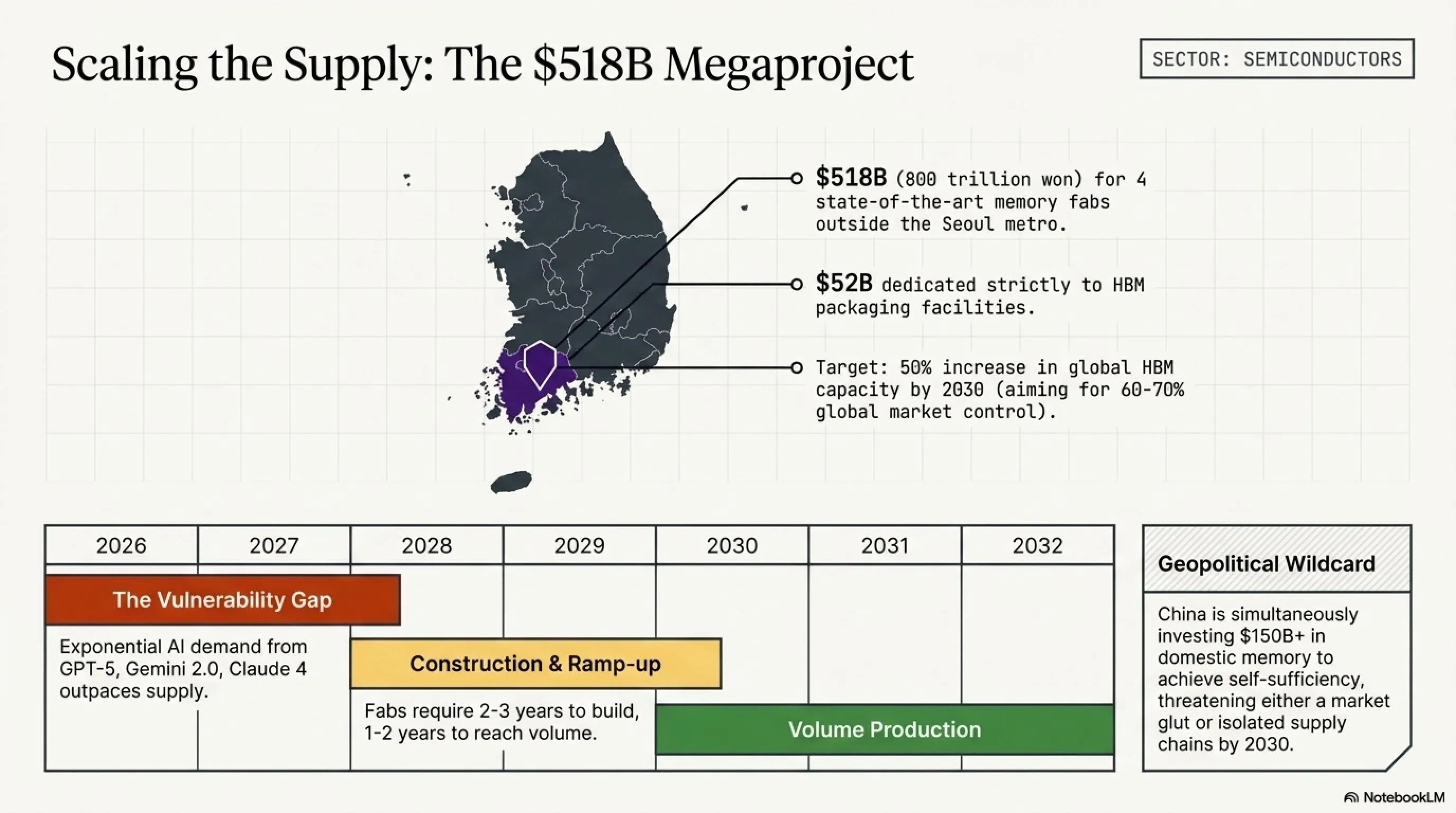
The South Korean government, alongside Samsung Electronics and SK Hynix, unveiled a monumental $518 billion investment plan to construct four new memory chip fabrication facilities and HBM (High Bandwidth Memory) production centers. This unprecedented commitment aims to cement South Korea's position as the world's AI chip powerhouse while addressing the global "RAMageddon" crisis that has sent memory prices skyrocketing and constrained AI development.
The investment package includes $518 billion for memory fabs in southwestern South Korea (outside the traditional Seoul cluster) and an additional $52 billion for HBM packaging infrastructure. This represents the largest single industrial investment in South Korean history and one of the biggest semiconductor manufacturing commitments globally, dwarfing even Intel's recent $100 billion U.S. expansion plans.
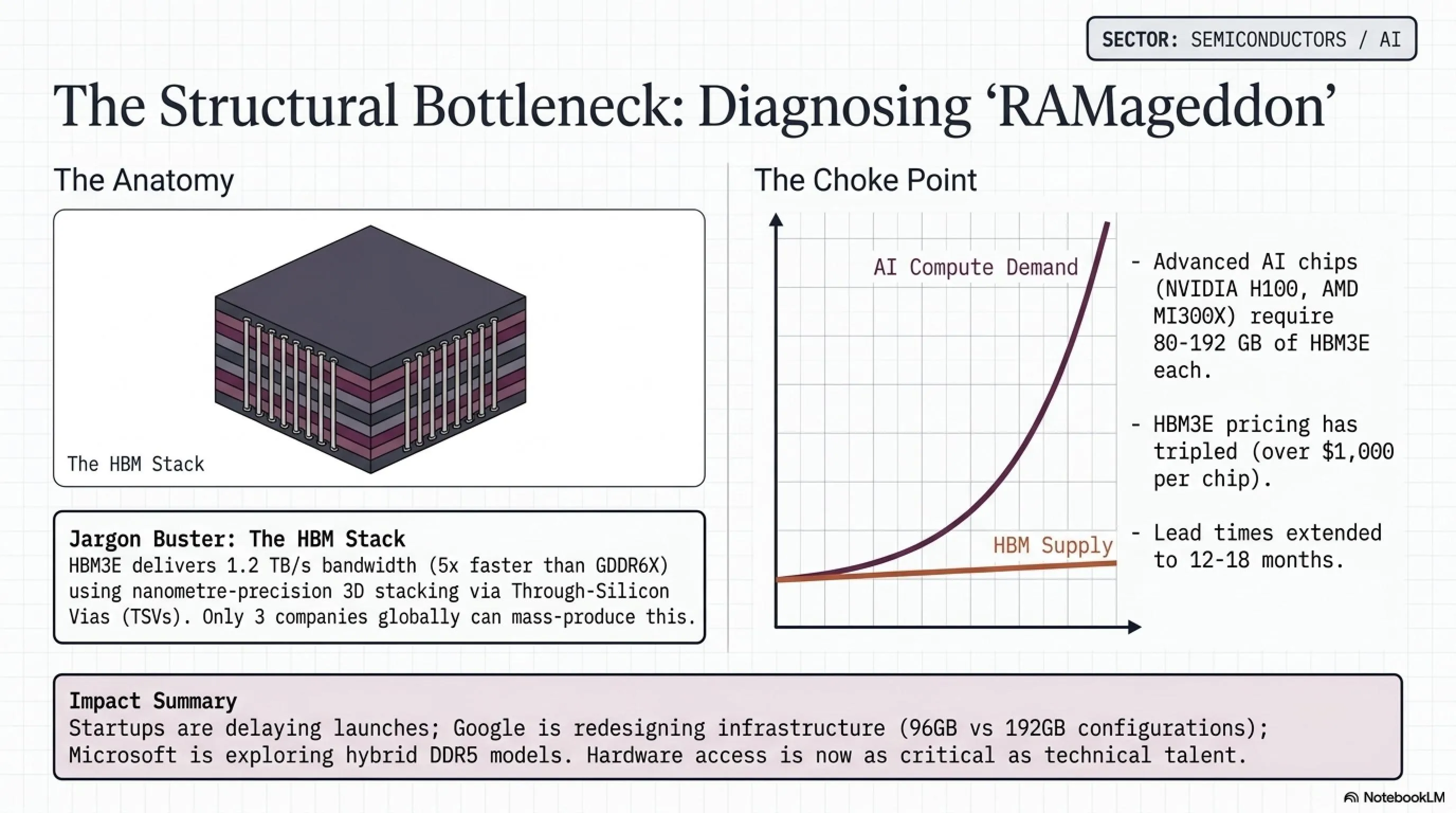
The plan responds directly to explosive demand for AI accelerators, which require massive amounts of high-bandwidth memory. Each advanced AI chip like NVIDIA H100 or AMD MI300X requires 80-192 GB of HBM3E memory, and global AI infrastructure buildouts are consuming memory supply faster than manufacturers can scale production.
South Korea Memory Investment Details
Total Investment: $518 billion (800 trillion won)
Primary Companies: Samsung Electronics, SK Hynix
New Fabrication Plants: 4 state-of-the-art memory fabs
Location: Southwestern South Korea (new manufacturing cluster outside Seoul metro)
HBM Investment: Additional $52 billion for HBM packaging facilities
Job Creation: 150,000+ direct and indirect positions
Completion Timeline: Phased rollout 2027-2032
Production Target: 50% increase in global HBM capacity by 2030
Understanding the RAMageddon Crisis
The term "RAMageddon" describes the severe shortage of DRAM and HBM in global markets, reaching crisis levels in 2026. The shortage stems from explosive growth in AI infrastructure deployment outpacing semiconductor industry capacity expansion. Every major tech company—Microsoft, Google, Meta, Amazon, Tesla, and dozens of AI startups—is competing for limited memory supply to power their AI ambitions.
HBM3E pricing has more than tripled from 2024 levels, reaching over $1,000 per chip in spot markets. Lead times for HBM orders have extended to 12-18 months, forcing AI companies to secure supply through long-term contracts and, in some cases, making equity investments in memory manufacturers to guarantee allocation. The shortage has become the primary bottleneck constraining AI development, more limiting than even GPU availability.
The crisis has created severe distortions throughout the tech ecosystem. Cloud providers are rationing AI compute capacity, startups struggle to secure hardware for training runs, and even established tech giants like Google and Microsoft have had to scale back datacenter expansion plans due to memory constraints.
Jargon Buster: What is HBM?
HBM (High Bandwidth Memory) is a type of ultra-fast memory stacked vertically in multiple layers and connected directly to the processor chip using advanced packaging technology called through-silicon vias (TSVs). This 3D stacking provides dramatically higher bandwidth than traditional GDDR memory.
HBM3E is the latest generation, delivering up to 1.2 TB/s bandwidth per stack—roughly 5x faster than GDDR6X. The 'E' stands for enhanced, offering higher capacity (up to 36 GB per stack) and improved power efficiency.
Only three companies globally can mass-produce HBM: SK Hynix (South Korea), Samsung (South Korea), and Micron (USA). The manufacturing process requires nanometer precision and advanced packaging capabilities that take years to develop, making supply constraints difficult to resolve quickly.
Will the Investment Solve RAMageddon?
While South Korea's $518 billion commitment is unprecedented, industry analysts remain divided on whether it will fully resolve the memory crisis. The fundamental challenge is timing: new fabs take 2-3 years to construct and another 1-2 years to ramp to full production volumes. This means meaningful supply relief won't materialize until 2028-2029 at the earliest, leaving the industry constrained through most of the critical 2026-2028 AI infrastructure buildout period.
Furthermore, AI demand continues growing exponentially. OpenAI's projected compute requirements for training next-generation models beyond GPT-5 exceed current global HBM production capacity by orders of magnitude. Google's Gemini 2.0, Anthropic's Claude 4, and Meta's Llama 4 all require massive memory allocations for training and inference. The memory market may remain supply-constrained even after South Korea's new capacity comes online.
Geopolitical factors add complexity. China is simultaneously investing over $150 billion in domestic memory manufacturing to achieve semiconductor self-sufficiency, though U.S. export controls limit Chinese access to the most advanced manufacturing equipment. This parallel capacity buildout could either glut the market by 2030 or simply meet China's domestic demand, depending on how AI adoption evolves globally.
Tekin Analysis: Is $518B Enough?
Our analysis suggests South Korea's investment, while massive, may prove insufficient to fully resolve RAMageddon for several reasons:
- Demand Curve Acceleration: AI compute demand is growing faster than even optimistic supply projections
- Production Ramp Timeline: New fabs won't reach full capacity until 2029-2030, leaving 3-4 years of continued shortage
- Competing Investments: China's parallel $150B+ memory investment adds uncertainty to global supply-demand balance
- Physical Constraints: HBM manufacturing requires nanometer precision and advanced packaging—hard to scale quickly even with unlimited capital
- Architectural Shifts: Next-gen AI models may require even more memory per chip, moving the goalposts
That said, this investment demonstrates South Korea's long-term commitment to memory leadership and should prevent competitors from gaining ground. By 2030, South Korea will likely control 60-70% of global HBM production capacity.
Impact on Tech Giants and AI Development
Major tech companies are already adapting strategies to the memory shortage. Google announced it's redesigning AI training infrastructure to use chips with 96GB HBM instead of 192GB configurations, allowing it to deploy twice as many servers with the same memory allocation. Microsoft is exploring hybrid approaches combining HBM with slower but more abundant DDR5 memory for less latency-sensitive workloads.
Startups face more severe constraints. Many AI companies have delayed product launches or scaled back model training ambitions due to inability to secure compute resources. Some venture capitalists now evaluate AI startup pitches partly based on whether the team has secured long-term cloud compute commitments or GPU allocations—hardware access has become as important as technical talent.
The shortage is also driving architectural innovation. Companies like Groq and Cerebras designed custom AI chips that use SRAM instead of HBM, trading off memory capacity for lower latency. Others are exploring memory compression techniques, sparse model architectures, and mixture-of-experts designs that reduce memory requirements while maintaining model capability.
Nissan Discloses Major Data Breach from Oracle Zero-Day Attack
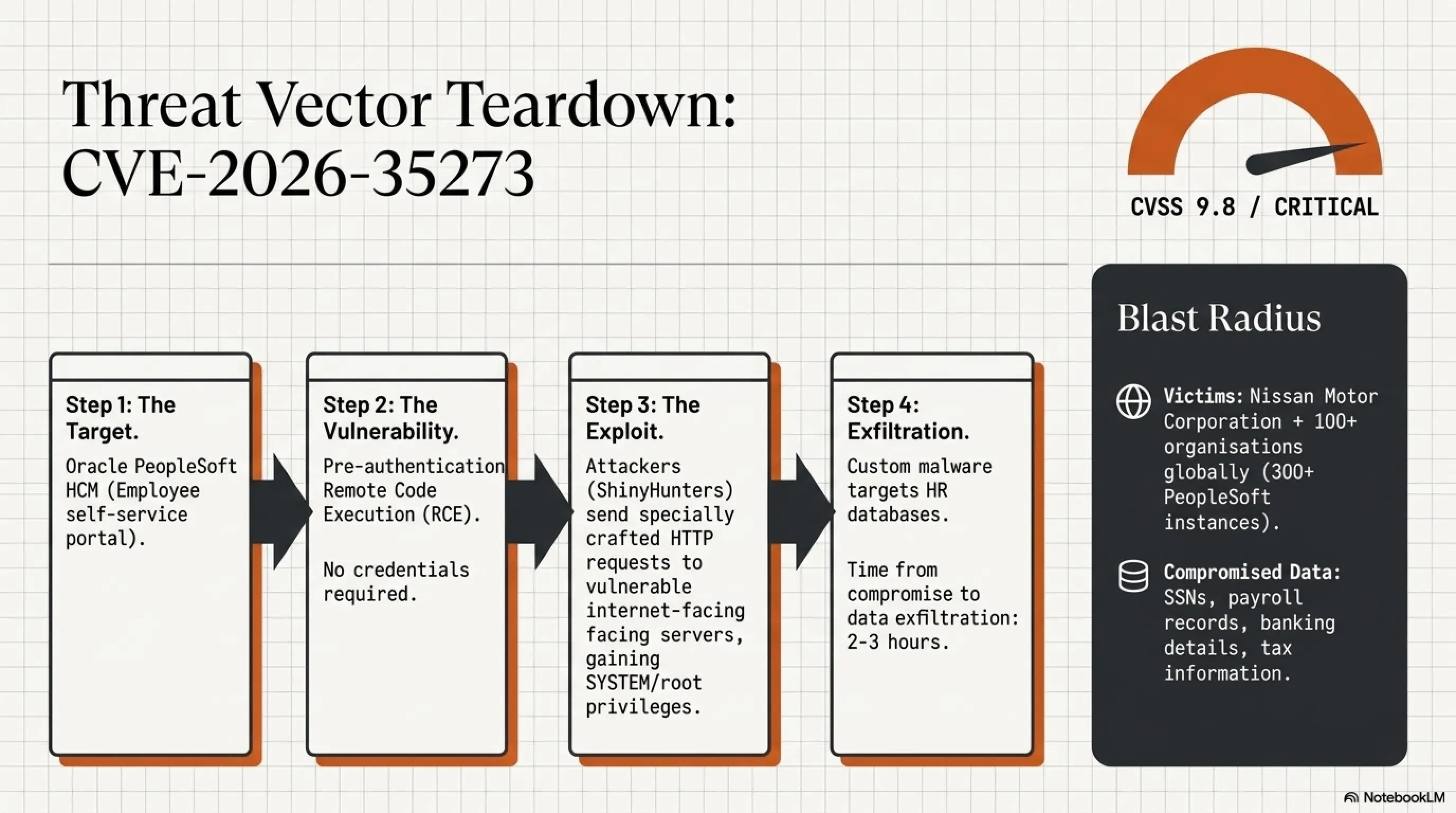
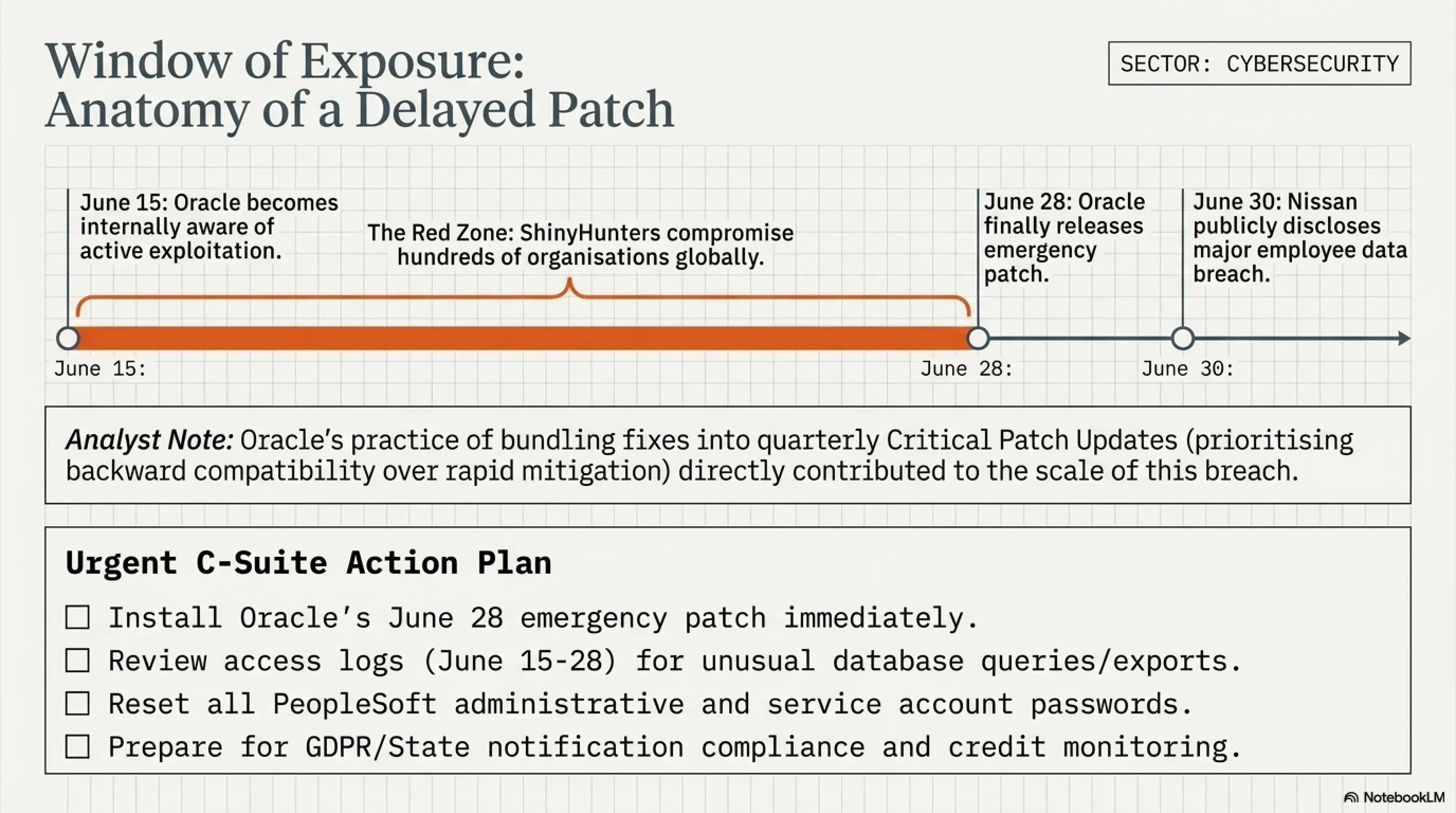
Nissan Motor Corporation disclosed today that it suffered a significant data breach affecting current and former employees after threat actors exploited CVE-2026-35273, a critical zero-day vulnerability in Oracle PeopleSoft HCM software. The attack, attributed to the notorious ShinyHunters extortion group, compromised over 100 organizations and 300+ PeopleSoft instances globally in a coordinated campaign during mid-June.
Stolen data includes Social Security numbers, payroll records, banking details, tax information, and other highly sensitive employee data. The vulnerability carries a CVSS severity score of 9.8 out of 10 and requires zero authentication to exploit, making it trivially easy for attackers to compromise vulnerable systems exposed to the internet.
What makes this breach particularly egregious is Oracle's delayed response. Security researchers have established that Oracle became aware of the vulnerability at least two weeks before publicly disclosing it and releasing an emergency patch, giving ShinyHunters and other threat actors ample time to compromise hundreds of organizations before victims could protect themselves.
Nissan-Oracle Breach Details
Vulnerability: CVE-2026-35273 (Oracle PeopleSoft HCM)
CVSS Score: 9.8/10 (Critical severity)
Attack Type: Remote Code Execution, zero authentication required
Threat Actor: ShinyHunters (ransomware and extortion group)
Victims: 100+ organizations, 300+ PeopleSoft instances compromised
Data Stolen: SSNs, payroll, banking details, tax information
Discovery Date: June 15, 2026 (Oracle internally aware)
Public Disclosure: June 28, 2026 (13-day delay)
Nissan Announcement: June 30, 2026
Technical Analysis of the Exploit
CVE-2026-35273 is a pre-authentication Remote Code Execution (RCE) vulnerability in PeopleSoft's HCM module, specifically affecting the employee self-service portal. The flaw allows unauthenticated attackers to send specially crafted HTTP requests to vulnerable PeopleSoft servers, triggering code execution with SYSTEM-level privileges on the underlying Windows server or equivalent root access on Linux deployments.
Once inside, ShinyHunters deployed custom data exfiltration tools designed specifically for PeopleSoft database schemas. The malware automatically identified HR databases, located tables containing employee records, and exfiltrated data to attacker-controlled servers using encrypted channels to evade network monitoring. The entire compromise-to-exfiltration cycle took as little as 2-3 hours for some victims.
Security researchers analyzing the attack noted ShinyHunters demonstrated sophisticated understanding of PeopleSoft's internal architecture, suggesting the group either includes former Oracle insiders or purchased detailed exploitation intelligence from initial access brokers who specialize in enterprise software vulnerabilities.
Oracle's Controversial Response Timeline
The most controversial aspect of this incident is Oracle's handling of vulnerability disclosure and patch release. Evidence from security researchers and anonymous Oracle insiders suggests the company became aware of active exploitation on or around June 15, yet didn't release an emergency patch until June 28—a 13-day window during which hundreds of organizations were compromised.
Oracle has faced criticism for its historically slow response to security issues and opaque patch release practices. Unlike many software vendors who have adopted 24-48 hour emergency patch timelines for actively exploited critical vulnerabilities, Oracle typically bundles security fixes into quarterly Critical Patch Updates, prioritizing testing and backward compatibility over rapid threat mitigation.
This approach, while reducing the risk of patches breaking production systems, leaves customers vulnerable during the window between vulnerability discovery and patch availability. In this case, that window allowed ShinyHunters to compromise hundreds of high-value targets, stealing potentially millions of employee records.
ShinyHunters Attack Timeline
Who Else is at Risk?
Any organization running Oracle PeopleSoft HCM is potentially vulnerable if they haven't applied the June 28 emergency patch. PeopleSoft remains one of the world's most widely deployed enterprise HR management systems, used by thousands of large corporations, government agencies, and universities globally to manage employee data, payroll, benefits, and recruiting.
BleepingComputer reported that in addition to Nissan, several other Fortune 500 companies were compromised but have not yet publicly disclosed breaches. Security researchers estimate the true victim count may reach thousands of organizations once all compromises are discovered through forensic investigations and log analysis.
Organizations in regulated industries face potential fines and legal liability. Under GDPR, companies that fail to adequately protect personal data can be fined up to 4% of global annual revenue. U.S. state breach notification laws require companies to notify affected individuals and offer credit monitoring services, costs that can reach millions of dollars for large breaches.
Cursor Launches iPhone App Following SpaceX's Record $60B Acquisition
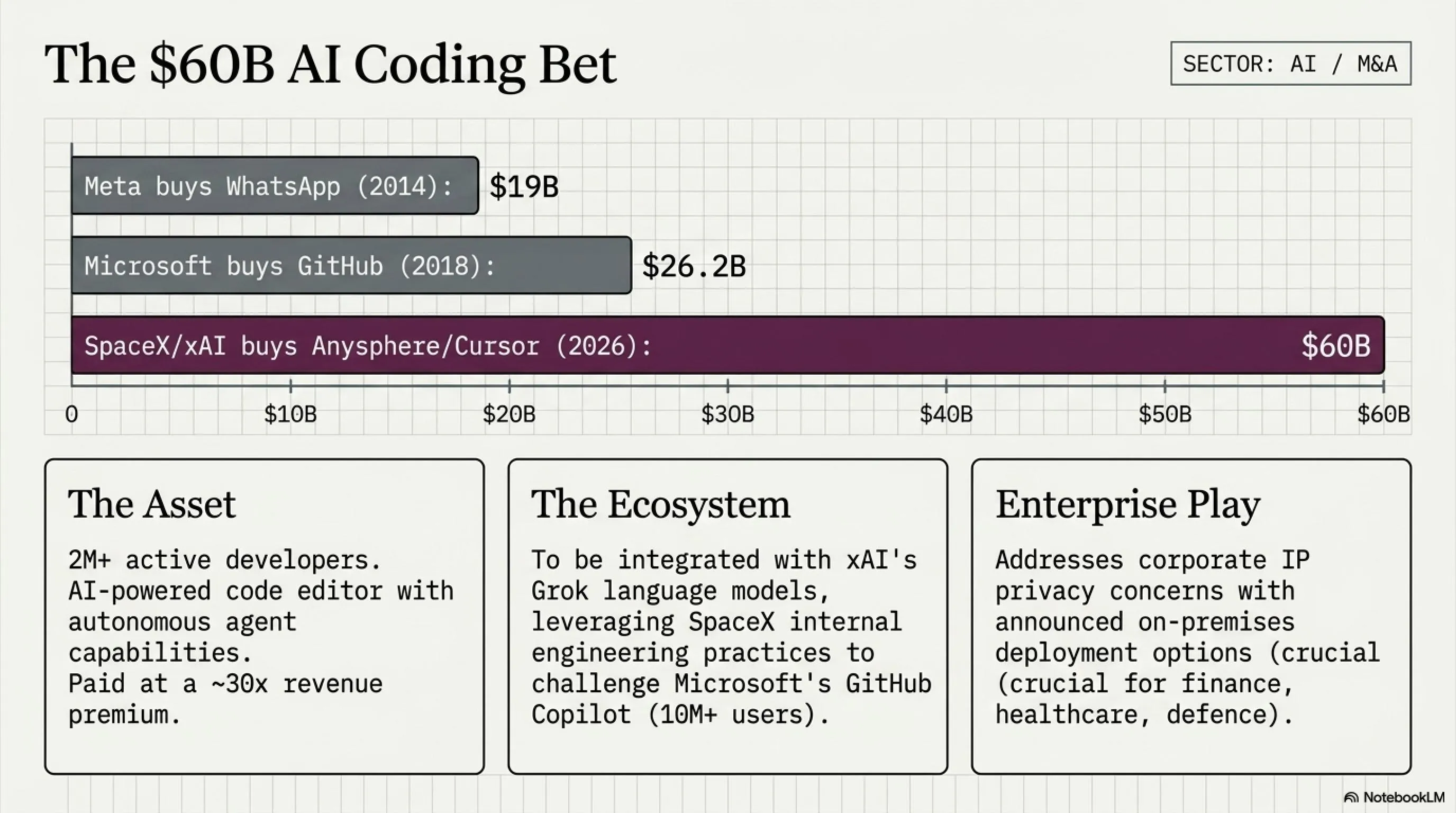
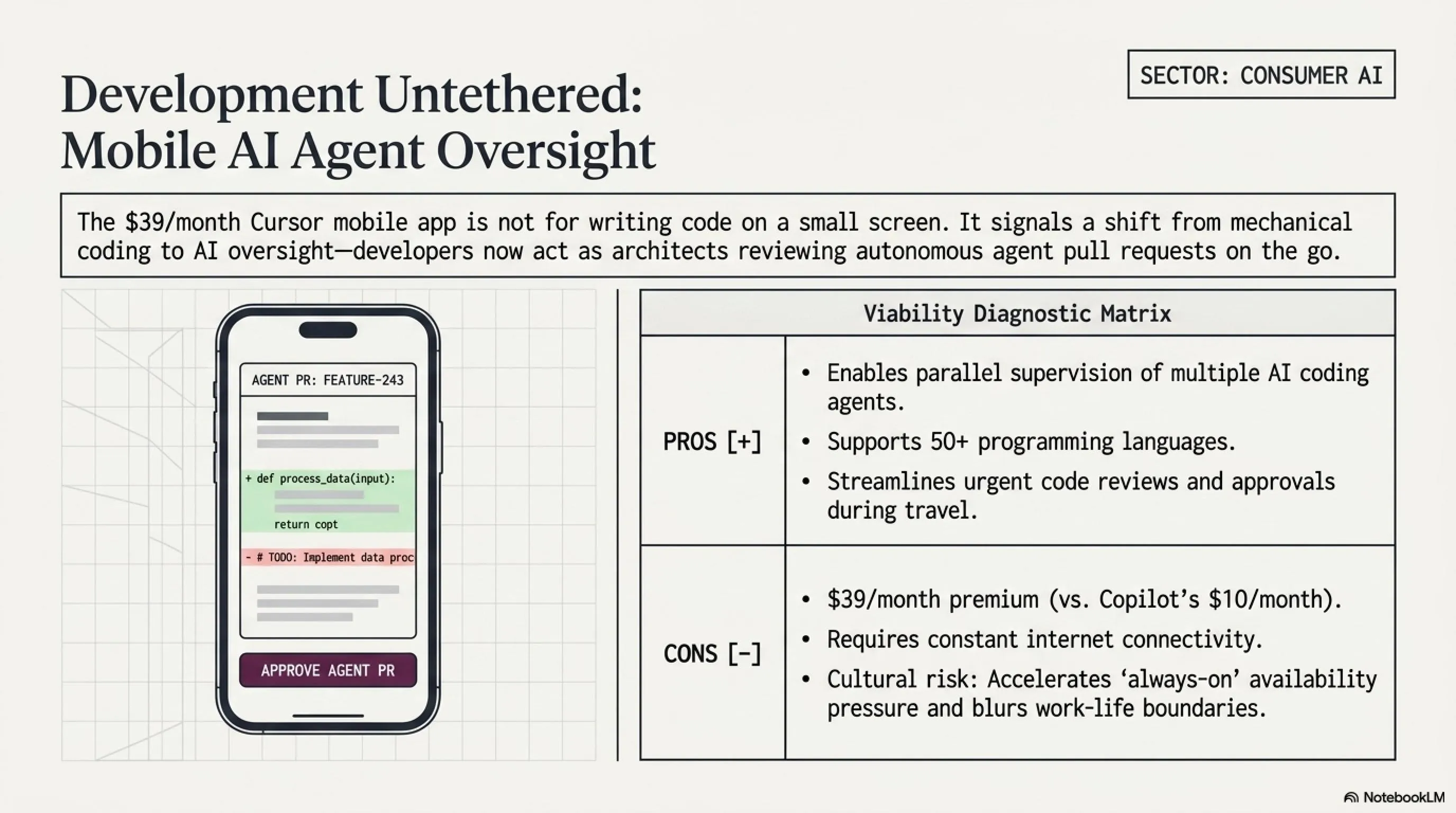
Cursor released its first iPhone and iPad application following SpaceX and xAI's $60 billion acquisition of Anysphere, the startup behind the popular AI-powered code editor. This acquisition represents the largest-ever purchase of a venture-backed startup, eclipsing Microsoft's $26.2 billion GitHub acquisition and Meta's $19 billion WhatsApp deal.
The mobile app enables developers to monitor AI coding agents on the go, review code changes, and provide feedback remotely—capabilities that could significantly change how software development teams operate. SpaceX aims to leverage Cursor to expand its presence in the lucrative enterprise AI tools market, competing directly with Microsoft's GitHub Copilot, Anthropic's Claude Code, and OpenAI's Codex.
SpaceX-Cursor Acquisition Breakdown
Acquisition Price: $60 billion (all cash and stock)
Acquirer: SpaceX and xAI (Elon Musk companies)
Target: Anysphere (Cursor developer)
Transaction Date: Early June 2026
Record: Largest VC-backed startup acquisition in history
Cursor Users: 2+ million active developers worldwide
Primary Product: AI-powered code editor with agent capabilities
Key Competitors: GitHub Copilot (Microsoft), Claude Code (Anthropic), Codex (OpenAI)
Why SpaceX Paid $60 Billion for a Code Editor
Cursor has become one of the most popular AI coding assistants, used by over 2 million developers globally including engineers at major tech companies, startups, and open-source projects. The tool uses advanced language models to help programmers write code, debug issues, refactor legacy systems, and even generate entire features from natural language descriptions.
SpaceX and Elon Musk's xAI paid a staggering premium—approximately 30x Anysphere's most recent revenue estimates—because they see AI-assisted software development as a strategic market with winner-take-all dynamics. The company projecting AI developer tools market to reach $50+ billion annually by 2030, with the leading platforms capturing disproportionate market share through network effects and data advantages.
The acquisition also gives SpaceX and xAI access to Anysphere's talented engineering team and proprietary technology, including their code understanding models, agent orchestration systems, and integration frameworks. These capabilities will be integrated with xAI's Grok language models, potentially creating a formidable competitor to Microsoft's GitHub Copilot, which currently dominates the market with over 10 million users.
Elon Musk has stated publicly that one of xAI's strategic priorities is building the best AI tools for engineers and technical users, viewing this segment as underserved by consumer-focused AI companies like OpenAI and Anthropic. Cursor provides an instant foothold in this market with an established user base and proven product-market fit.
Mobile Coding: Gimmick or Game-Changer?
The new Cursor iPhone and iPad apps aren't designed for writing code on small screens—an activity most developers find impractical. Instead, they focus on code review, monitoring AI agents, approving or rejecting suggested changes, and maintaining awareness of project status while away from a development workstation.
This approach reflects an emerging reality in software development: AI agents increasingly handle routine coding tasks autonomously, with human developers serving more as reviewers, architects, and decision-makers. The mobile app enables developers to supervise multiple AI coding agents working in parallel, intervening when necessary but allowing the AI to handle mechanical implementation work.
Early user feedback has been mixed. Some developers appreciate the ability to review pull requests during commutes or approve urgent fixes while traveling. Others question whether constant connectivity and expectation of code review availability creates unhealthy work-life boundaries. The debate mirrors broader discussions about smartphone productivity tools enabling always-on work culture.
- Mobile oversight of AI coding agents
- Integration with xAI Grok ecosystem
- Support for 50+ programming languages
- Intuitive interface designed for review workflows
- Enables code review during commutes/travel
- Expensive $39/month subscription (vs $10 for Copilot)
- Requires constant internet connectivity
- Code privacy concerns with cloud-based AI
- Still in beta with occasional bugs
- May create pressure for always-on availability
The AI Coding Assistant Market Heats Up
The AI coding tools market is experiencing explosive growth and intensifying competition. GitHub Copilot, launched in 2021, pioneered the category and currently claims over 10 million users generating billions in annual recurring revenue for Microsoft. The tool has become deeply embedded in developer workflows, with some programmers reporting 30-40% of their code is now AI-generated.
Anthropic entered the market in late 2025 with Claude Code, emphasizing superior code quality and safety compared to competitors. Early benchmarks showed Claude Code producing fewer bugs and better adhering to coding best practices, though it operated more slowly than Copilot. Google announced Gemini Code in early 2026, leveraging its vast code search index and AlphaCode competition experience.
SpaceX and xAI's entry with Cursor raises the stakes significantly. Elon Musk has stated xAI will integrate Cursor with Grok language models and leverage SpaceX's internal engineering practices to create "the best AI coding assistant in the world." The company plans to offer both cloud-based and on-premises deployment options, addressing enterprise customers' code security concerns.
AI Coding Assistant Comparison
| Feature | Cursor (SpaceX/xAI) | GitHub Copilot | Claude Code | Gemini Code |
|---|---|---|---|---|
| Active Users | 2+ million | 10+ million | 500K+ | 1+ million |
| Monthly Price | $39 | $10 | $20 | $25 |
| Mobile App | ✅ iOS/iPad | ❌ | ❌ | ❌ |
| Base AI Model | Grok + GPT-4 | GPT-4 Turbo | Claude 3.5 Sonnet | Gemini 1.5 Pro |
| IDE Integration | VS Code, standalone | All major IDEs | VS Code | Android Studio, VS Code |
| Languages | 50+ | 100+ | 40+ | 60+ |
| On-Premise Option | Coming 2026 | Enterprise only | Yes | Enterprise only |
Privacy Concerns and Enterprise Adoption
One persistent concern about AI coding assistants is code privacy. When developers use these tools, their code gets sent to cloud servers for processing by AI models—raising questions about intellectual property protection, trade secret exposure, and potential data leaks. Several high-profile companies including Apple, Amazon, and banks have restricted or banned employee use of third-party AI coding tools for this reason.
Cursor and SpaceX are addressing this with announced plans for on-premises deployment options, allowing enterprises to run the entire system within their own infrastructure. Code never leaves the company's network, and organizations can fine-tune models on their proprietary codebases without exposing data to external parties.
This capability could prove decisive for winning enterprise contracts, particularly in regulated industries like finance, healthcare, and defense where code security is paramount. GitHub Copilot offers similar on-premises options but only for premium enterprise plans costing $39 per user monthly—the same price as Cursor's standard tier.
Morning Wrap-Up
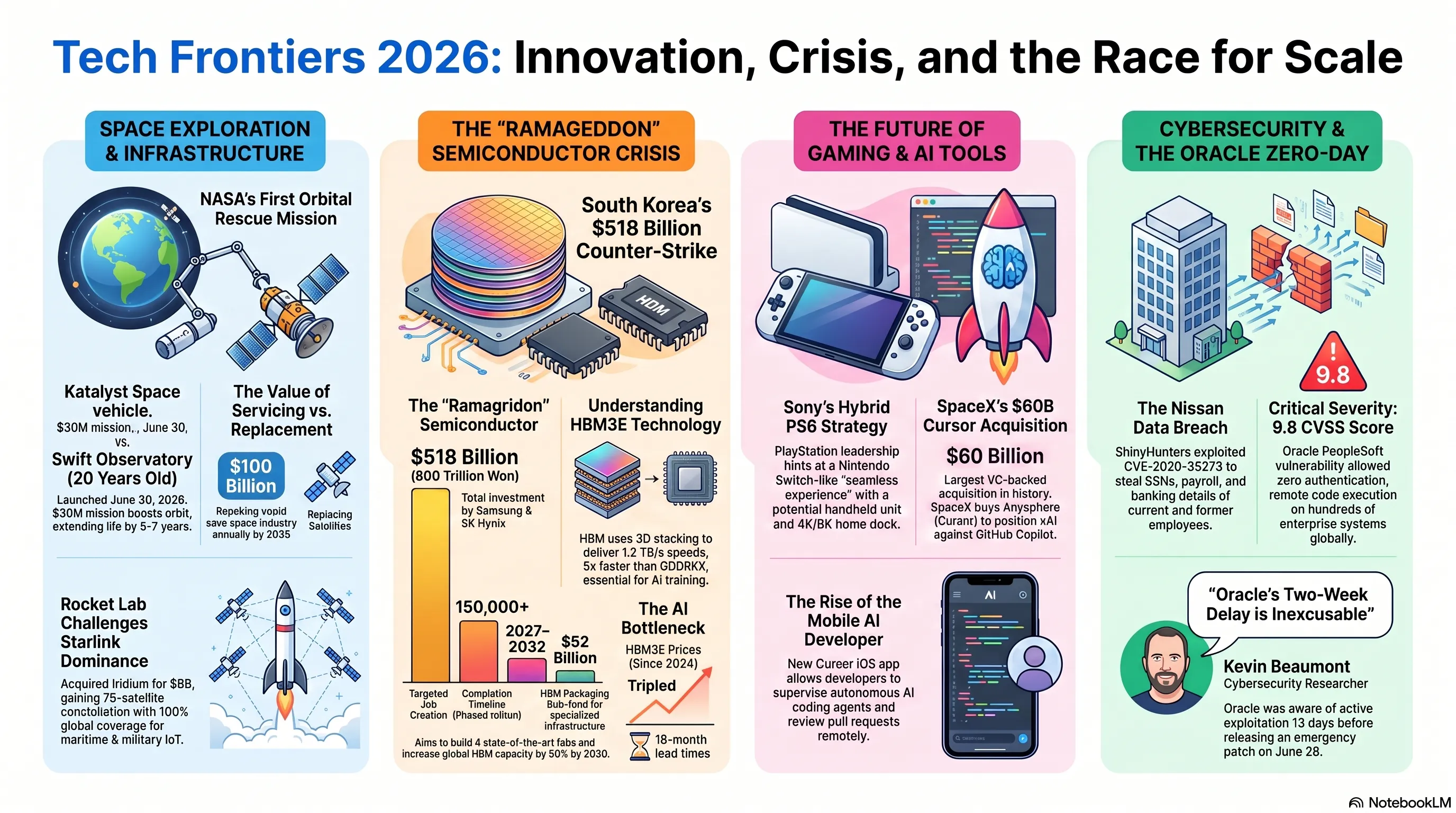
Tuesday morning, June 30, 2026 delivered a remarkable set of stories spanning space, gaming, semiconductors, cybersecurity, and AI development. NASA made history launching the first-ever orbital rescue mission to save the Swift telescope, while Rocket Lab positioned itself as a legitimate Starlink competitor through its massive Iridium acquisition.
Sony tantalized gamers with hints that PS6 could adopt a Switch-like hybrid approach, potentially revolutionizing console gaming. South Korea committed an unprecedented $518 billion to combat the RAMageddon crisis, though questions remain whether even this massive investment will suffice given explosive AI demand growth.
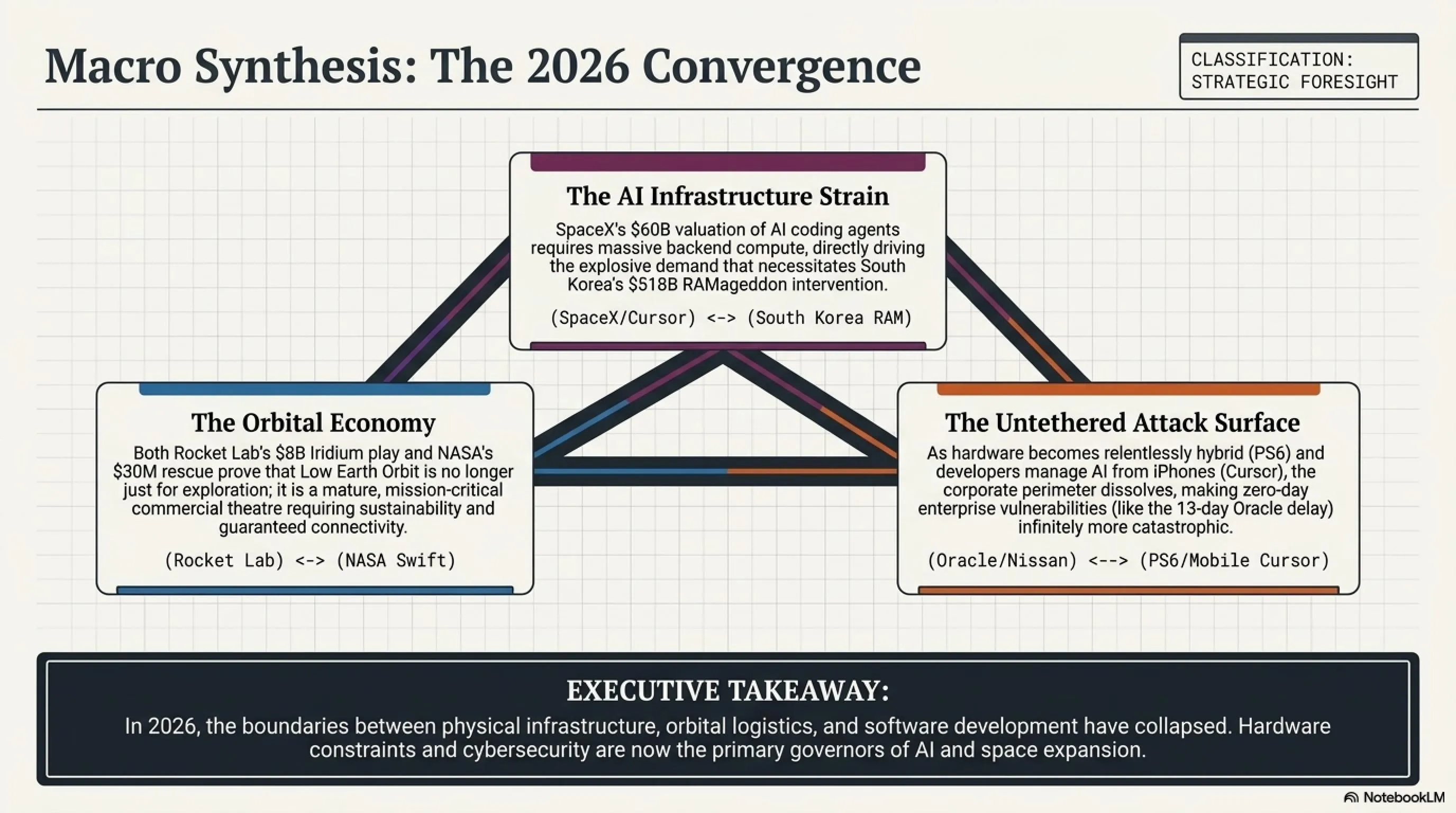
The Nissan-Oracle breach reminded us that enterprise software vulnerabilities pose catastrophic risks when vendors delay patches, and SpaceX's Cursor acquisition with accompanying iOS app launch signaled the tech giant's serious intent to compete in AI developer tools. Each story reveals how rapidly technology continues evolving across every sector, from orbital mechanics to code generation, with billions of dollars and fundamental industry structures at stake.
Frequently Asked Questions
Why is NASA rescuing Swift instead of launching a replacement telescope?
Rescuing Swift costs $30 million versus $500+ million to build and launch a replacement. Swift still functions perfectly; it just needs an orbital boost. This mission also demonstrates orbital servicing technology that could save the industry $100+ billion annually by extending satellite lifespans instead of replacing them.
Can Rocket Lab really compete with Starlink after acquiring Iridium?
Rocket Lab isn't trying to compete directly with Starlink's consumer internet service. Iridium targets a different market: government, military, maritime, aviation, and IoT applications requiring reliable global coverage including poles and oceans. These markets value reliability over speed, and Iridium's 100% Earth coverage beats Starlink's ~85%.
When will PS6 launch and how much will it cost?
Sony hasn't announced official PS6 timing, but analysts predict a 2028-2029 launch based on typical console cycles (PS5 launched 2020). If it's a hybrid portable/home console as hinted, expect pricing between $600-700. A premium positioning above current consoles seems likely given the advanced technology required for portable AAA gaming.
Will South Korea's $518B investment actually solve RAMageddon?
Partially, but not entirely. New fabs won't reach full production until 2028-2029, leaving 2-3 years of continued shortage. Meanwhile, AI demand keeps growing exponentially—OpenAI's next models require more memory than current global production. The investment prevents competitors from gaining ground but may not fully resolve supply constraints given demand trajectory.
Should I be worried if my company uses Oracle PeopleSoft?
If your organization hasn't applied Oracle's June 28 emergency patch, yes—you're vulnerable to the same attack that hit Nissan and 100+ other organizations. Install the patch immediately. Even if patched now, review logs from June 15-28 for suspicious activity. The vulnerability required zero authentication, making exploitation trivially easy for attackers.
Is Cursor better than GitHub Copilot?
They serve different use cases. Copilot integrates into existing editors and costs $10/month, making it accessible to most developers. Cursor is a standalone editor costing $39/month with more advanced agent capabilities and now mobile app access. Cursor may be better for teams embracing AI-autonomous development; Copilot better for individuals wanting affordable AI assistance in familiar tools.
Sources
Article Sources:
Supplementary Image Gallery: ☀️ Tekin Morning | Tuesday June 30, 2026: Swift Rescue to Iridium Acquisition