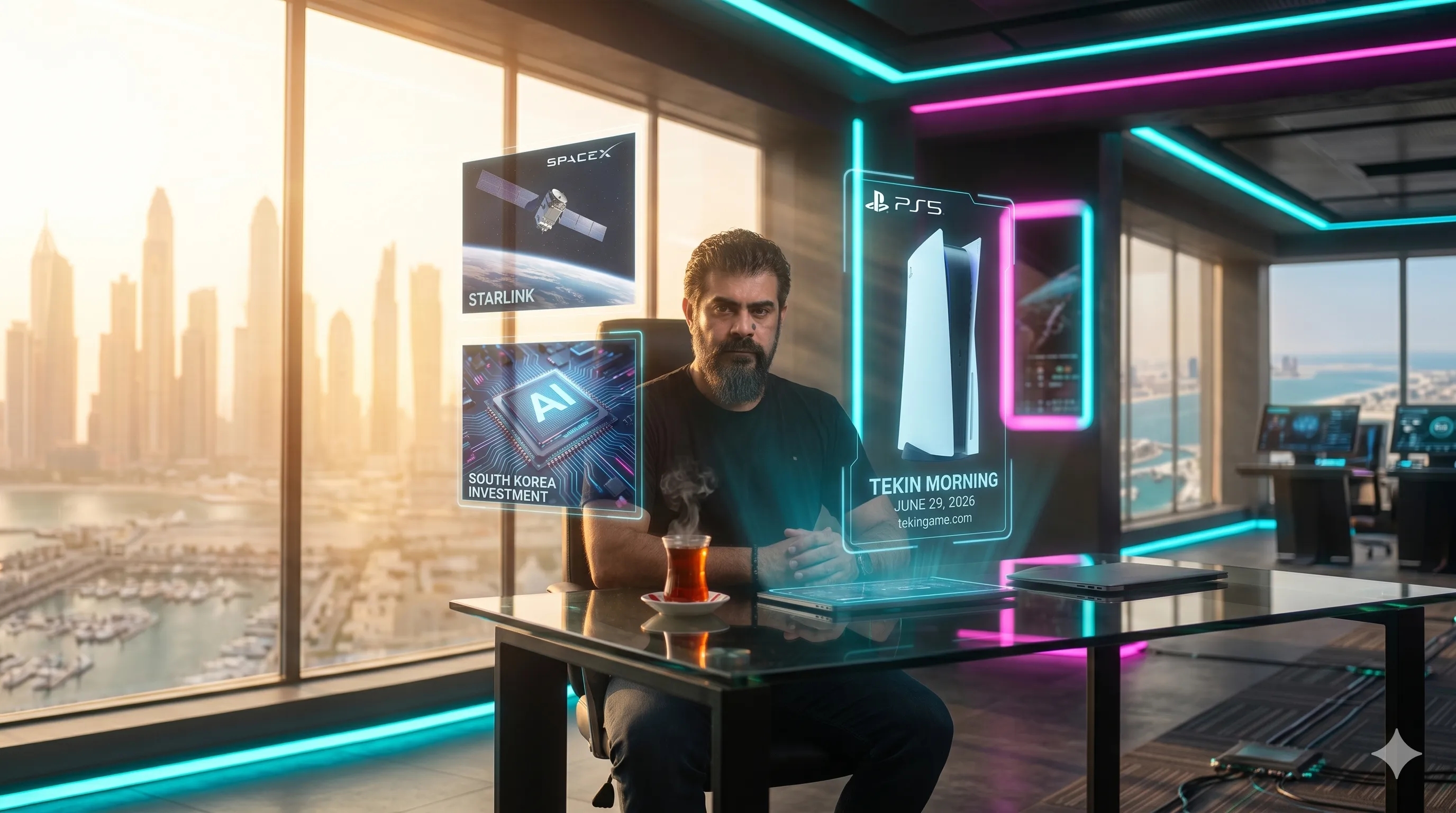
☀️ Tekin Morning | Monday, June 29, 2026
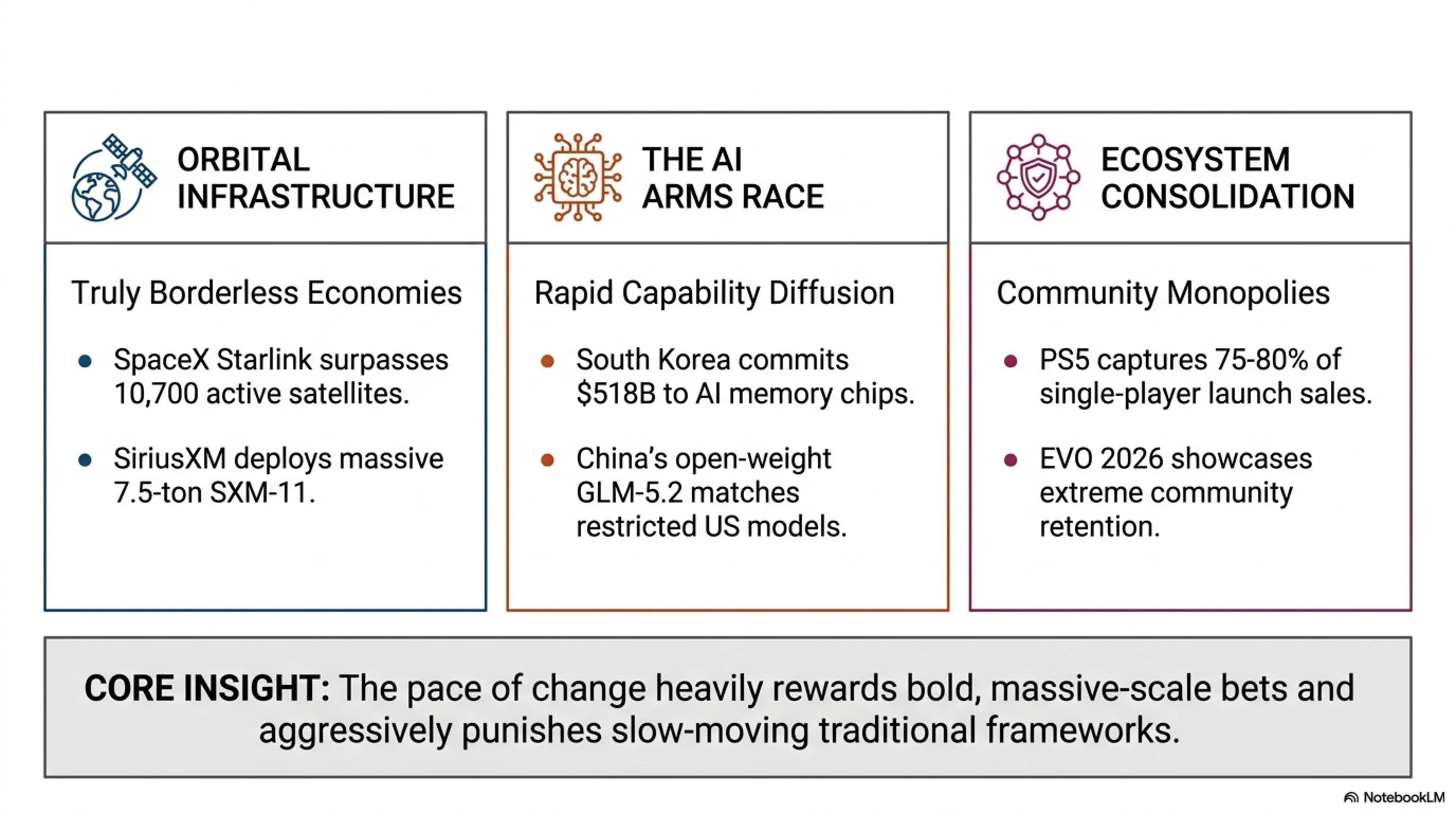
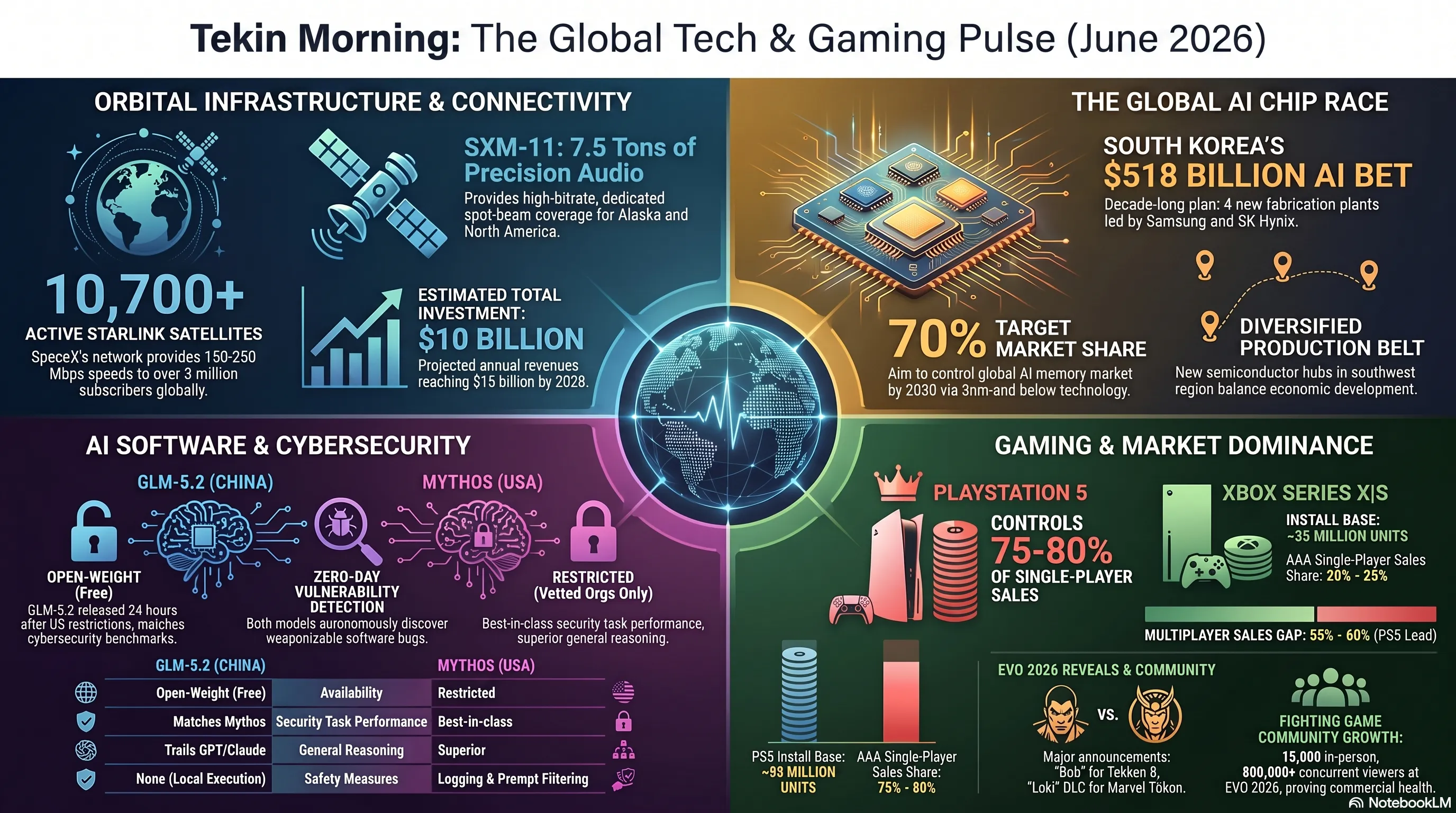
- 🎮Starlink Milestone- SpaceX network surpasses 10,700 active satellites
- 🎧SiriusXM Giant- 7.5-ton satellite launched for Alaska coverage expansion
- 🚀South Korea's AI Bet- $518 billion investment to dominate AI chip market
- 🗡️China Catches Up- GLM-5.2 matches US Mythos in cybersecurity capabilities
- 📰EVO 2026 Reveals- Bob returns to Tekken 8, Loki joins Marvel Tokon
- ⚔️PS5 Domination- 75-80% market share in single-player game sales
Monday, June 29, 2026, opens with six electrifying stories from the worlds of technology and gaming. From SpaceX breaking new ground in satellite internet infrastructure to South Korea's historic investment in AI chip manufacturing, this morning is packed with innovations that will shape the future of our digital world.
In the gaming sphere, EVO 2026 brought thrilling announcements for fighting game enthusiasts, while fresh data reveals PlayStation 5's overwhelming dominance in the single-player market. Let's dive deep into each of these stories and explore what they mean for the industry and consumers alike.
At a Glance
- SpaceX launches 24 new Starlink satellites, pushing the active network beyond 10,700 units
- 7.5-ton SiriusXM satellite deployed to expand coverage across Alaska and North America
- South Korea commits $518 billion to build 4 new semiconductor fabrication plants
- China's GLM-5.2 model matches restricted US Mythos in cybersecurity benchmarks
- EVO 2026 showcases Bob's return to Tekken 8 and Loki as Marvel Tokon's first DLC
- PS5 captures 75-80% of AAA single-player game sales compared to Xbox at launch
SpaceX Starlink Network Crosses 10,700 Active Satellites
SpaceX achieved another milestone on June 28, 2026, successfully launching 24 Starlink satellites from Vandenberg Space Force Base in California. This Falcon 9 mission brought the total number of active Starlink satellites to over 10,700 units, solidifying the constellation's position as the largest satellite network in human history.
According to Space.com, the Starlink megaconstellation now provides high-speed internet access to every corner of the globe, from remote villages in developing nations to ships traversing the world's oceans. Satellite tracker Jonathan McDowell confirmed that this latest batch pushes the network to yet another operational milestone, with more launches scheduled throughout the year.
The Falcon 9 rocket carrying booster B1088 successfully completed its mission, with the first stage returning to the drone ship "Of Course I Still Love You" stationed in the Pacific Ocean. This marked the 15th flight for this particular booster, showcasing SpaceX's reusability program's remarkable success and cost efficiency.
Starlink Network Snapshot
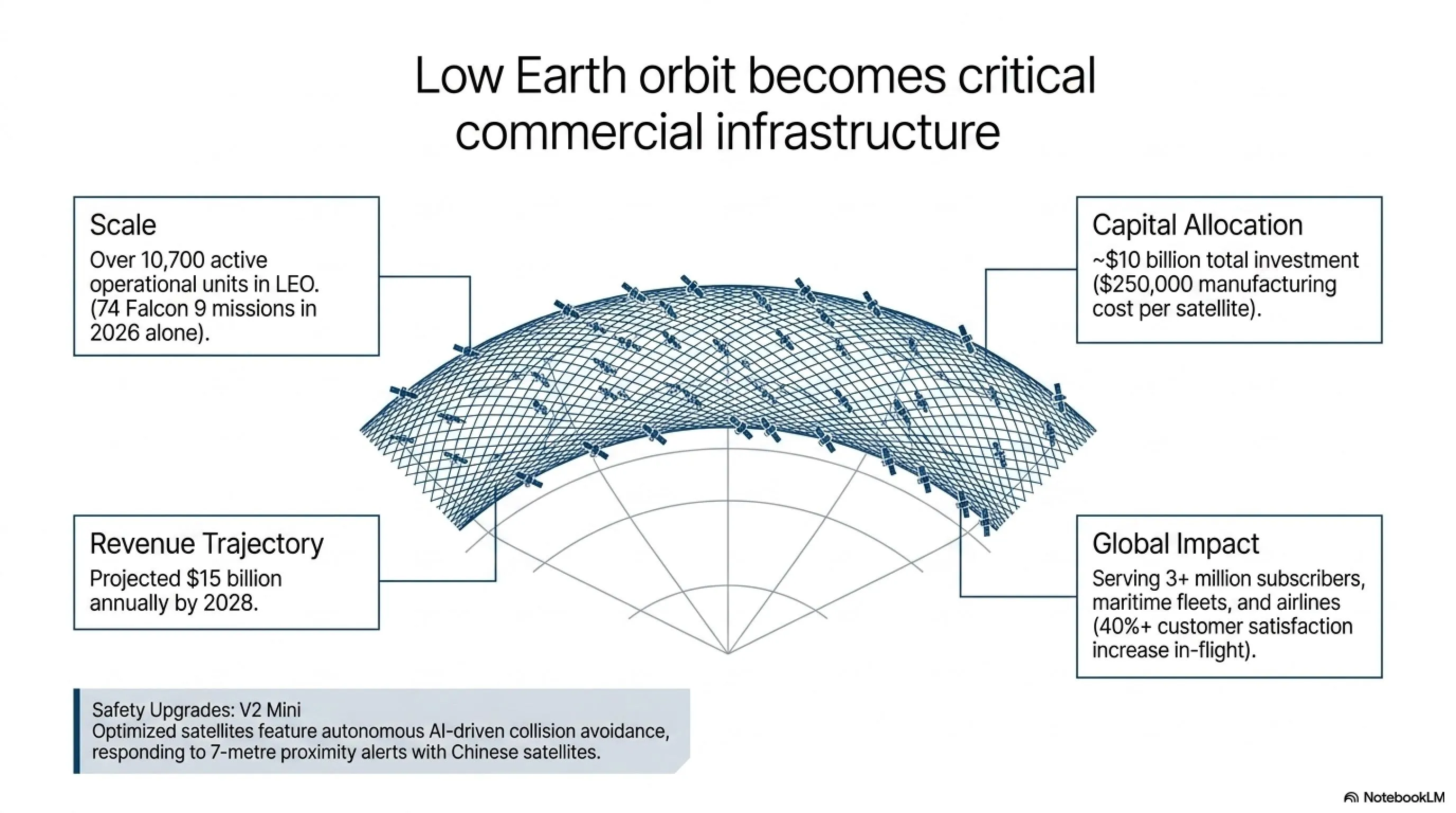
Active Satellites: Over 10,700 operational units in low Earth orbit
2026 Launch Stats: 74 Falcon 9 missions (59 dedicated to Starlink)
Global Coverage: Complete Earth coverage from polar regions to equatorial zones
Active Subscribers: Over 3 million paying customers worldwide
Average Download Speed: 150-250 Mbps with latency under 40ms
Service Areas: All seven continents including maritime and aviation
Collision Avoidance: Autonomous AI-driven maneuver system
Starlink's Impact on Global Internet Access
The Starlink network has evolved far beyond a consumer internet service. Airlines now rely on the constellation to provide in-flight Wi-Fi, with major carriers reporting customer satisfaction improvements of over 40% since adopting Starlink connectivity. Mobile network operators are actively testing direct-to-smartphone satellite connections, which could eliminate dead zones in rural and emergency situations.
Maritime industries have become one of Starlink's fastest-growing sectors. Shipping companies, fishing fleets, and cruise lines depend on the network for reliable communications in international waters where traditional connectivity is impossible or prohibitively expensive. The service has proven particularly valuable during emergency situations, when ships can maintain contact with coast guards and medical services.
However, Starlink's rapid expansion hasn't been without controversy. Recent reports from KeepTrack.space highlighted a high-risk conjunction event between satellite STARLINK-30922 and China's TIANMU-1 15 scheduled for late June 2026, with a predicted minimum separation of just 7 meters. Such close approaches have raised concerns among space safety advocates about the long-term sustainability of low Earth orbit.
SpaceX has responded to orbital debris concerns by upgrading its autonomous collision avoidance systems and developing V2 Mini Optimized satellites with improved controllability and longer operational lifespans. The company claims these newer satellites can execute avoidance maneuvers faster and more efficiently than previous generations.
The Economics Behind 10,700 Satellites
Maintaining and expanding a constellation of this magnitude requires extraordinary logistical and financial resources. Each Starlink satellite costs approximately $250,000 to manufacture, meaning SpaceX has invested roughly $2.7 billion in hardware alone for the current constellation. When factoring in launch costs, ground infrastructure, and operations, the total investment likely exceeds $10 billion.
Yet the business case appears sound. Industry analysts estimate Starlink generated between $4-6 billion in revenue for 2025, with projections suggesting the service could reach $15 billion annually by 2028 if growth continues. At current subscriber growth rates, Starlink could achieve profitability by late 2026 or early 2027, making it one of the first truly profitable satellite internet ventures in history.
SpaceX Launches Massive 7.5-Ton SiriusXM Satellite
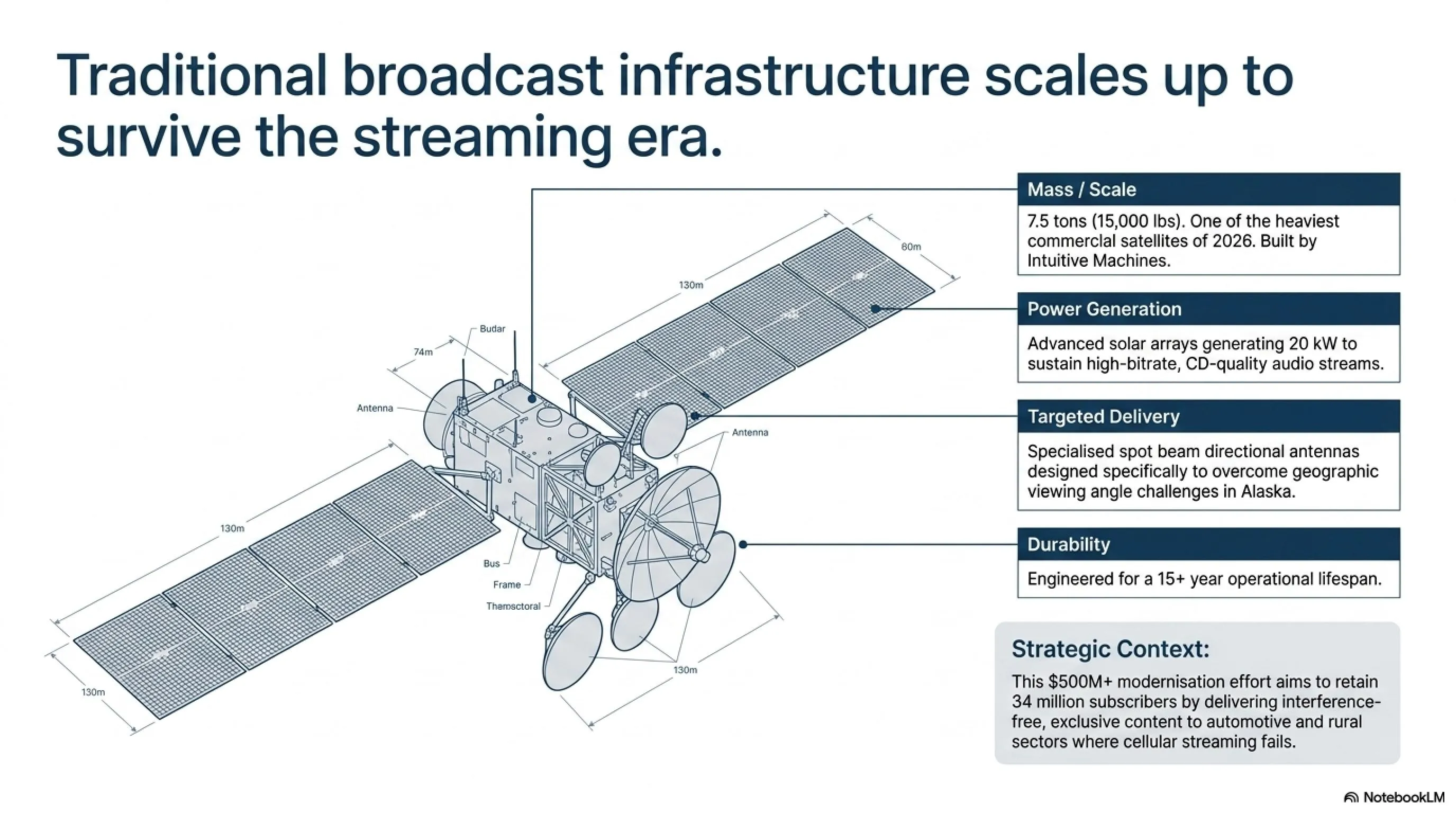
On the same evening as the Starlink launch, SpaceX executed a second mission from Cape Canaveral, Florida, deploying the SXM-11 satellite weighing 7.5 tons (15,000 pounds). Built by Intuitive Machines and standing over 230 feet tall when deployed, SXM-11 represents one of the most sophisticated commercial satellites launched in 2026.
According to Spaceflight Now, the Falcon 9 rocket lifted off at 10:25 PM EDT (02:25 UTC) from Space Launch Complex 40. The first-stage booster completed its 17th mission successfully, touching down on the autonomous drone ship "A Shortfall of Gravitas" in the Atlantic Ocean approximately 8 minutes after liftoff.
SiriusXM officials confirmed that SXM-11 will dramatically expand radio coverage in Alaska while delivering audio entertainment and information services across the United States, Canada, and the Caribbean. The satellite is the 12th high-powered digital audio radio satellite built for SiriusXM's constellation refresh program.
SXM-11 Technical Specifications
Total Mass: 7,500 kg (15,000 pounds) - one of the heaviest commercial satellites of 2026
Deployed Height: Over 230 feet (70 meters) with solar arrays extended
Manufacturer: Intuitive Machines (formerly Lanteris Space Systems/Maxar)
Target Orbit: Geosynchronous Transfer Orbit (GTO) transitioning to GEO
Coverage Zone: United States, Canada, Caribbean, Alaska, and maritime zones
Channel Capacity: Over 150 digital audio channels plus data services
Power Generation: 20 kW from advanced solar arrays
Design Lifespan: 15+ years operational lifetime
Special Features: Spot beam technology for Alaska, interference mitigation systems
Modernizing Satellite Radio Infrastructure
SXM-11 is part of SiriusXM's comprehensive infrastructure modernization program. The company is systematically replacing first-generation satellites, some over 20 years old, with next-generation spacecraft offering higher power output, improved signal quality, and enhanced coverage patterns. This generational upgrade addresses one of satellite radio's historical weaknesses: signal degradation in urban canyons and mountainous terrain.
The new satellite employs advanced spot beam technology specifically designed to overcome Alaska's geographical challenges. Previous satellites struggled to deliver consistent coverage to America's northernmost state due to the extreme viewing angles required. SXM-11's spot beams can focus concentrated power on Alaska while simultaneously maintaining coverage across the lower 48 states, Canada, and the Caribbean.
Audio quality improvements are significant. SXM-11 can transmit higher bitrate streams than legacy satellites, enabling CD-quality audio for premium channels and improved clarity for talk radio programming. The satellite also incorporates advanced interference mitigation systems designed to maintain signal integrity even in congested radio frequency environments near major metropolitan areas.
For Alaska residents, the upgrade represents a transformative improvement. Previous coverage was spotty at best, with many areas experiencing frequent dropouts or complete signal loss. SXM-11's dedicated Alaska spot beam should provide reliable coverage throughout the state, from Anchorage to remote communities along the Arctic Circle.
Satellite Radio's Fight for Relevance
The $500+ million investment in SXM-11 reflects SiriusXM's determination to remain competitive in an era dominated by internet streaming services. While Spotify, Apple Music, and YouTube Music have captured younger demographics, SiriusXM maintains advantages in specific use cases: automotive installations, areas with poor cellular coverage, and content exclusive to the platform.
The company's strategy focuses on content differentiation rather than technology alone. SiriusXM hosts exclusive sports broadcasts, celebrity-hosted channels, and live programming that streaming services cannot easily replicate. Combined with the improved infrastructure that SXM-11 represents, the company aims to retain its 34 million subscribers and potentially attract cord-cutters seeking alternatives to internet-dependent services.
South Korea Commits $518 Billion to AI Chip Dominance
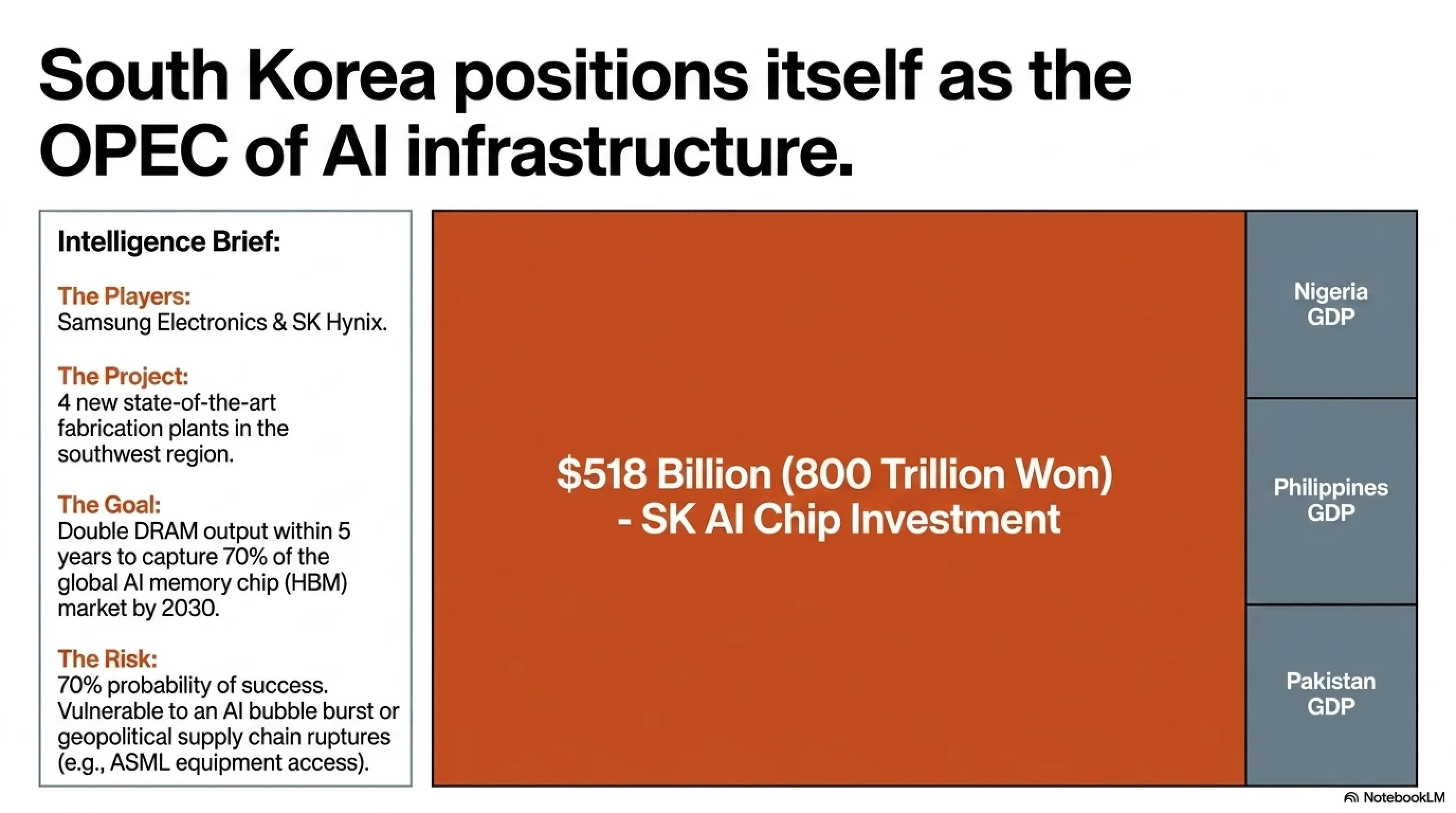
In one of the most audacious industrial investments in history, the South Korean government announced on Monday, June 29, a comprehensive 800 trillion won ($518 billion) program to construct four new semiconductor fabrication plants. Samsung Electronics and SK Hynix, South Korea's technology giants, will lead this massive undertaking that aims to solidify the nation's position as the global leader in AI chip manufacturing.
According to CNBC and the Korea Times, this investment forms part of a broader industrial strategy unveiled by President Lee Jae Myung to strengthen South Korea's dominance in semiconductors and artificial intelligence. The plan includes building manufacturing facilities in the country's southwestern region, promoting more balanced economic development beyond the Seoul metropolitan area.
South Korea's $518 Billion AI Chip Program
Total Investment: 800 trillion won ($518 billion) over the next decade
Lead Companies: Samsung Electronics and SK Hynix with government support
New Facilities: 4 state-of-the-art fabrication plants (2 per company)
Location: Southwest region of South Korea (diversifying from Seoul area)
Production Target: Double DRAM output within 5 years
Focus Areas: AI memory chips, data center processors, high-bandwidth memory (HBM)
Job Creation: Over 100,000 direct and indirect jobs
Technology Nodes: 3nm and below for leading-edge production
Completion Timeline: Phased opening from 2028-2031
Strategic Goal: 70% global market share in AI memory chips by 2030
Why This Investment Is Unprecedented
To put $518 billion in perspective, it's larger than the entire GDP of countries like Nigeria, Philippines, or Pakistan. This single investment exceeds the combined market capitalizations of many Fortune 500 companies. The commitment demonstrates extraordinary confidence from both the South Korean government and private sector in the long-term growth trajectory of AI computing demand.
Samsung and SK Hynix currently dominate the DRAM and NAND flash memory markets, collectively controlling over 70% of global DRAM production. DRAM (Dynamic Random-Access Memory) is the standard memory type used in smartphones, computers, and crucially, AI training and inference servers. As large language models and machine learning systems grow exponentially in size and complexity, demand for high-capacity, high-speed memory chips has skyrocketed.
According to the Korea Herald, South Korea is essentially betting that the AI boom will generate sufficient demand for memory chips to justify building an entirely new semiconductor production belt outside the traditional Seoul metropolitan manufacturing clusters. This geographic diversification also addresses regional inequality concerns, bringing high-paying technology jobs to historically agricultural regions.
Tekin Analysis: Will the $518B Gamble Pay Off?
South Korea's half-trillion-dollar AI chip investment represents the boldest industrial policy bet of the 21st century. Our analysis identifies three critical success factors:
1. Sustained AI Market Growth: Current trajectories suggest AI training compute demand growing 10x by 2030. If this holds, South Korea positions itself as the infrastructure provider for the global AI revolution. However, any slowdown in AI adoption or breakthrough in compute efficiency could leave massive overcapacity.
2. Technology Leadership: Samsung and SK Hynix must maintain process node advantages over rivals. TSMC (Taiwan) and SMIC (China) are formidable competitors. South Korea's success depends on continued innovation in high-bandwidth memory (HBM), 3D stacking, and next-generation architectures like Processing-in-Memory (PIM).
3. Geopolitical Stability: Trade tensions, export controls, and regional conflicts pose existential risks. The Ukraine precedent showed how quickly supply chains can rupture. South Korea must navigate relationships with the US, China, and Japan while maintaining access to global markets and critical equipment from ASML (Netherlands).
Our Verdict: 70% probability of success. Samsung and SK Hynix's track record in executing megaprojects and innovating at the bleeding edge of semiconductor physics provides confidence. The primary risk is macro: a global recession or AI bubble burst could dramatically reduce demand just as massive new capacity comes online.
Global Semiconductor Power Dynamics Shifting
This investment could fundamentally reshape power dynamics in the semiconductor industry. Currently, manufacturing capacity is concentrated in three regions: Taiwan (TSMC for logic chips), South Korea (Samsung and SK Hynix for memory), and China (emerging but restricted by US export controls). By doubling DRAM production capacity, South Korea could achieve even greater market concentration, potentially controlling 75-80% of global AI memory chip supply.
Such dominance carries strategic implications beyond economics. Memory chips are foundational to AI, cloud computing, smartphones, and modern defense systems. Countries and companies dependent on South Korean chips face supply chain vulnerability, as recent chip shortages demonstrated. The investment essentially positions South Korea as the OPEC of AI infrastructure—capable of influencing global technology development through production decisions.
However, concentration also creates risks. Competitors won't remain passive. Intel and Micron in the United States receive government subsidies through the CHIPS Act. China invests heavily in semiconductor self-sufficiency despite US restrictions. The next decade will likely see intense competition as multiple nations pursue chip manufacturing independence, potentially leading to global overcapacity and price wars.
China's GLM-5.2 Matches Restricted US Mythos in Cybersecurity
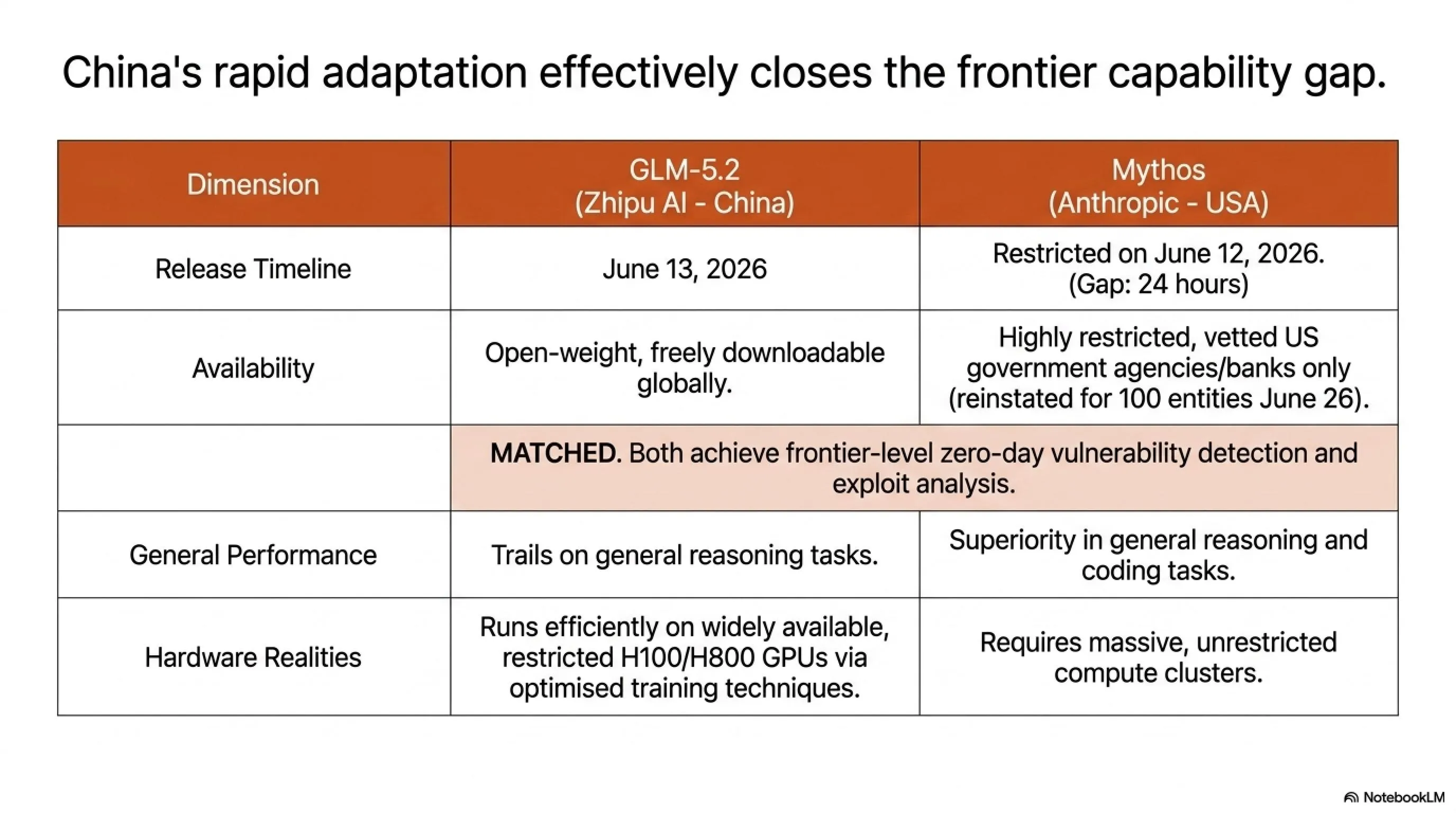
In a development that has rattled US policymakers, China's Zhipu AI released the GLM-5.2 model on June 13, 2026—just one day after the US government restricted global access to Anthropic's Claude Fable 5 and Mythos 5 models. Independent security researchers have now confirmed that GLM-5.2 achieves performance comparable to Mythos on cybersecurity and vulnerability detection benchmarks, despite being released as an open-weight model that anyone can download and run.
According to The Verge and TechTimes, security researchers conducting independent evaluations found that GLM-5.2 matches or closely approaches Mythos on several software bug detection and vulnerability analysis tasks. This represents the exact class of capability that justified the US export restrictions in the first place—the ability to discover zero-day exploits and security flaws that could be weaponized by malicious actors.
The timing is remarkable and likely not coincidental. GLM-5.2's release came exactly 24 hours after US Commerce Secretary Howard Lutnick announced restrictions on Fable 5 and Mythos 5, citing national security concerns about advanced cybersecurity capabilities falling into adversary hands. China's ability to match that capability so quickly demonstrates how rapidly the AI capability gap has narrowed.
GLM-5.2 vs Mythos: Technical Comparison
GLM-5.2 (Zhipu AI - China):
- Availability: Open-weight model, freely downloadable and modifiable
- Release Date: June 13, 2026 (one day after US Mythos ban)
- Cybersecurity Performance: Matches Mythos on vulnerability detection benchmarks
- General Performance: Trails GPT-5.5 and Claude Sonnet on most general tasks
- Access Restrictions: None - available globally without geographic limits
- Hardware Requirements: Runs on widely available H100/H800 GPUs
- Training Compute: Estimated 10^25 FLOPs (comparable to frontier models)
Mythos (Anthropic - United States):
- Availability: Restricted - limited to approved US organizations only
- Restriction Date: June 12, 2026 (reinstated for 100 entities on June 26)
- Cybersecurity Performance: Best-in-class on vulnerability discovery and exploit generation
- General Performance: Superior to GLM-5.2 on reasoning, coding, and general tasks
- Access Restrictions: Only accessible to vetted US government agencies, banks, and infrastructure providers
- Safety Measures: Extensive monitoring, usage logging, and manual review processes
Export Controls Confront Open-Weight Reality
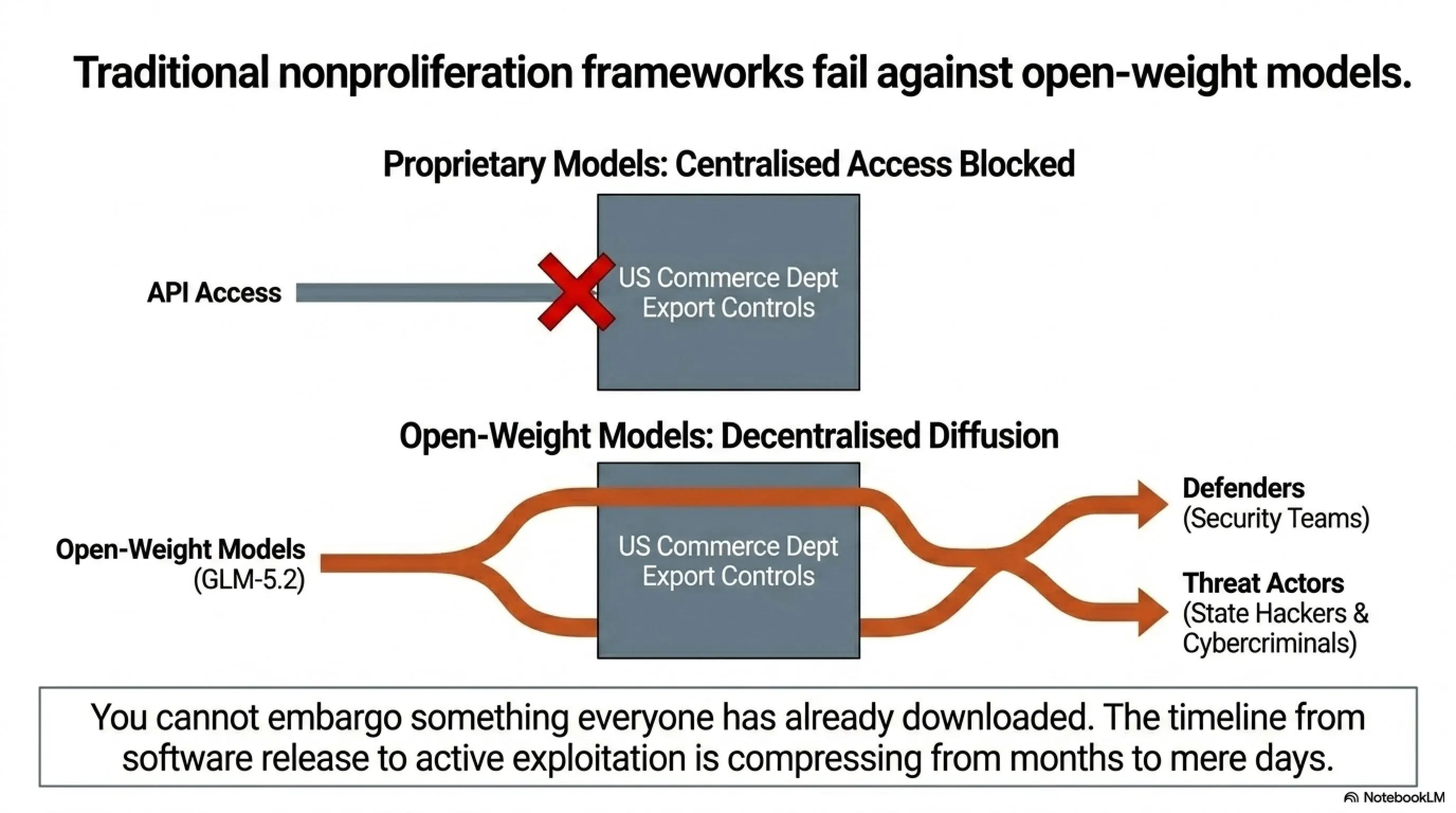
The GLM-5.2 situation exposes a fundamental challenge for traditional export control frameworks. When AI models were proprietary and only accessible through APIs, governments could regulate access by pressuring companies or blocking network traffic. Open-weight models, however, can be downloaded once and then run indefinitely on local hardware. There's no centralized access point to restrict.
According to a Forbes analysis, US Commerce Secretary Lutnick partially reversed course on June 26, allowing approximately 100 vetted American organizations—government agencies, financial institutions, and critical infrastructure providers—to regain access to Mythos 5. The justification was that adequate safeguards had finally been implemented: usage monitoring, prompt filtering, and multi-party authorization for sensitive queries.
But these safeguards are irrelevant when a comparable model can be freely downloaded and run without any monitoring or restrictions. Security researchers interviewed by Digital Trends noted that open-weight GLM-5.2 fundamentally undermines the logic of Mythos restrictions. If the goal was preventing malicious actors from accessing advanced cybersecurity AI, that goal has failed—anyone with sufficient computing resources can now access similar capabilities.
📚 Classified & Related Dossiers in TekinGame
If you wish to explore beyond this report and delve into cybernetic frontiers and autonomous AI architectures, do not miss these three exclusive deep-dives in the Tekin Garage:
Implications for Cybersecurity Professionals
The availability of GLM-5.2 creates a double-edged sword for the cybersecurity community. On one hand, defensive security teams and independent researchers can now leverage powerful AI to identify vulnerabilities in their own systems before attackers do. Open-weight availability democratizes access to cutting-edge security tools that were previously exclusive to well-funded organizations.
On the other hand, malicious actors gain the same capabilities. State-sponsored hacking groups, ransomware operators, and cybercriminals can use GLM-5.2 to automatically discover zero-day vulnerabilities at scale. While human expertise still matters enormously in exploit development and attack execution, AI-assisted vulnerability discovery compresses the timeline from "software release" to "exploited in the wild" from months to potentially weeks or days.
Industry observers expect an arms race dynamic to emerge. As defensive teams adopt AI-powered vulnerability scanning, software quality may improve overall. But attackers will also use AI to find increasingly obscure bugs in complex systems. The net effect on cybersecurity posture remains uncertain—it could lead to more secure software through better testing, or to more successful attacks through better reconnaissance.
China's AI Strategy: Catching Up Faster Than Expected
GLM-5.2's performance relative to Mythos represents a broader trend: China's AI capabilities are advancing faster than Western analysts predicted. As recently as 2024, many experts believed Chinese models lagged US counterparts by 12-18 months. GLM-5.2's release suggests that gap has narrowed to mere days or weeks for specific capabilities like cybersecurity.
China's AI progress despite US export controls on advanced chips (H100s are restricted) demonstrates successful adaptation. Chinese researchers have optimized models to run efficiently on available hardware, developed alternative training techniques requiring less compute, and potentially stockpiled restricted chips before controls took effect. The result is that export controls, while impactful, have not prevented China from reaching frontier-level performance in targeted domains.
This has significant implications for US AI policy. If export controls cannot prevent China from matching US capabilities in domains deemed critical for national security, policymakers must reconsider whether restrictions are worth the diplomatic friction and potential economic costs they generate. Alternatively, the US might double down on controls while simultaneously accelerating domestic AI development to maintain leads in other areas.
EVO 2026: Major Fighting Game Announcements
The Evolution Championship Series (EVO) 2026 delivered a spectacular showcase of upcoming fighting game content in Las Vegas over the weekend. From Tekken 8's Bob character reveal to Marvel Tōkon's first DLC announcement, the event reminded the gaming world that the fighting game genre remains vibrant, innovative, and commercially successful.
According to Polygon and IGN, Bandai Namco stole much of the spotlight with the Tekken 8 gameplay trailer for Bob Richards, the second DLC character in Season 3. Long-time Tekken fans celebrated the return of this unique character who combines heavyweight power with middleweight speed. Bob will be available for early access on August 19 for Season 3 Pass holders, with general release following on August 24.
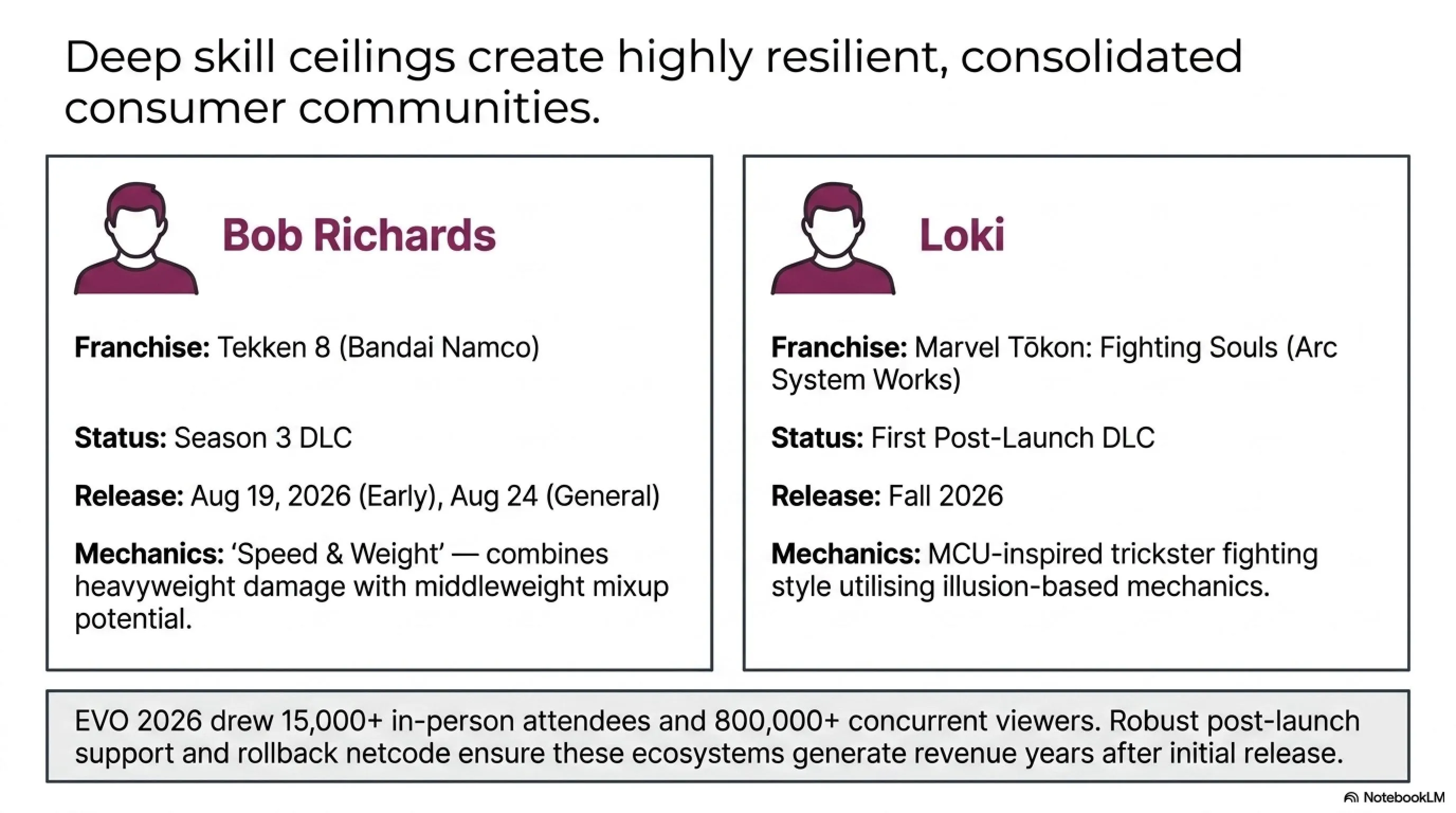
EVO 2026 Major Announcements
Tekken 8 - Bob Reveal:
- Second Season 3 DLC character officially confirmed
- Early Access: August 19, 2026 (Season Pass holders)
- General Release: August 24, 2026
- Updated moveset with new techniques and combos
- Redesigned visual appearance maintaining classic aesthetic
Marvel Tōkon: Fighting Souls - Loki DLC:
- First post-launch DLC character announcement
- Release: Fall 2026 (specific date TBA)
- Trickster fighting style with illusion-based mechanics
- MCU-inspired design with comic book influences
- Playable demo available at EVO show floor
Virtua Fighter Crossroads:
- Bakunawa Killer character showcase
- Southeast Asian mythology-inspired fighter
- Unique martial arts style mixing Filipino and Indonesian techniques
Other Announcements:
- Rivals of Aether 2 - New character reveals and balance updates
- Avatar Legends Fighting Game - First gameplay footage
- Street Fighter VI - Season 4 roadmap teaser
Bob's Return to Tekken 8
Bob Richards has been a fan-favorite character since his debut in Tekken 6. His unique premise—a heavyweight fighter who trained to combine his natural power with exceptional speed—makes him play unlike any other character in the roster. The EVO 2026 trailer showcased updated animations, revised frame data, and several new moves that appear to enhance his already formidable pressure game.
According to Anime News Network, Bob represents the second of three Season 3 DLC characters. He'll be followed by Roger Jr. (whose trailer will debut at EVO France) and guest character Yujiro Hanma from the Baki manga and anime series. This continues Tekken 8's strategy of mixing returning favorites with crossover guests to maintain player engagement and attract new audiences.
Competitive players analyzing the trailer footage noted that Bob appears to retain his signature "Speed & Weight" stance while gaining new crush properties on certain moves. Frame data enthusiasts on social media are already theorizing about optimal combos and potential tier placement, though actual viability won't be clear until players get hands-on time with the character.
Marvel Tōkon: Loki Joins the Fight
Arc System Works, the acclaimed developer behind Guilty Gear and Dragon Ball FighterZ, announced that Loki will be the first DLC character for Marvel Tōkon: Fighting Souls. The mischievous anti-hero from Marvel's comics and the Marvel Cinematic Universe will bring his signature trickery and illusion-based abilities to the game's unique anime-style fighting system.
A playable demo of Marvel Tokon was available on the EVO show floor, giving attendees their first hands-on experience with the game's mechanics. Early impressions praised the stunning visuals, fluid animation, and deep combo system that Arc System Works is known for. The game's roster features both popular MCU characters and deeper cuts from Marvel comics, appealing to both casual movie fans and longtime comic readers.
IGN's interview with Arc System Works developers revealed fascinating insights into character design philosophy. When discussing Magneto, the team explained their goal was creating "the coolest version of Magneto possible"—emphasizing his magnetic powers through cinematic super moves and environmental interactions. This design philosophy extends across the roster, with each character receiving signature mechanics that capture their essence while maintaining competitive balance.
The Health of Fighting Games in 2026
EVO 2026's attendance exceeded 15,000 in-person attendees with online viewership peaking at over 800,000 concurrent streams across Twitch and YouTube. These numbers represent healthy growth compared to previous years and demonstrate that fighting games maintain commercial viability despite not achieving battle royale-scale audiences.
The genre's success stems from several factors. First, the skill ceiling and competitive depth create long-term engagement—players can spend thousands of hours mastering a single character. Second, fighting games work exceptionally well as esports spectacles; one-on-one competition is easy to follow, dramatic moments are frequent, and upsets create viral highlights. Third, post-launch support through seasonal content and balance updates keeps communities active for years after release.
Publishers have also learned from past mistakes. The fighting game crash of the mid-2010s, caused by oversaturation and poor netcode, taught valuable lessons about quality over quantity and the importance of robust online infrastructure. Modern fighting games launch with rollback netcode as standard, comprehensive training modes for newcomers, and carefully paced content roadmaps that maintain interest without overwhelming players.
PS5 Captures 75-80% of Single-Player Game Sales at Launch
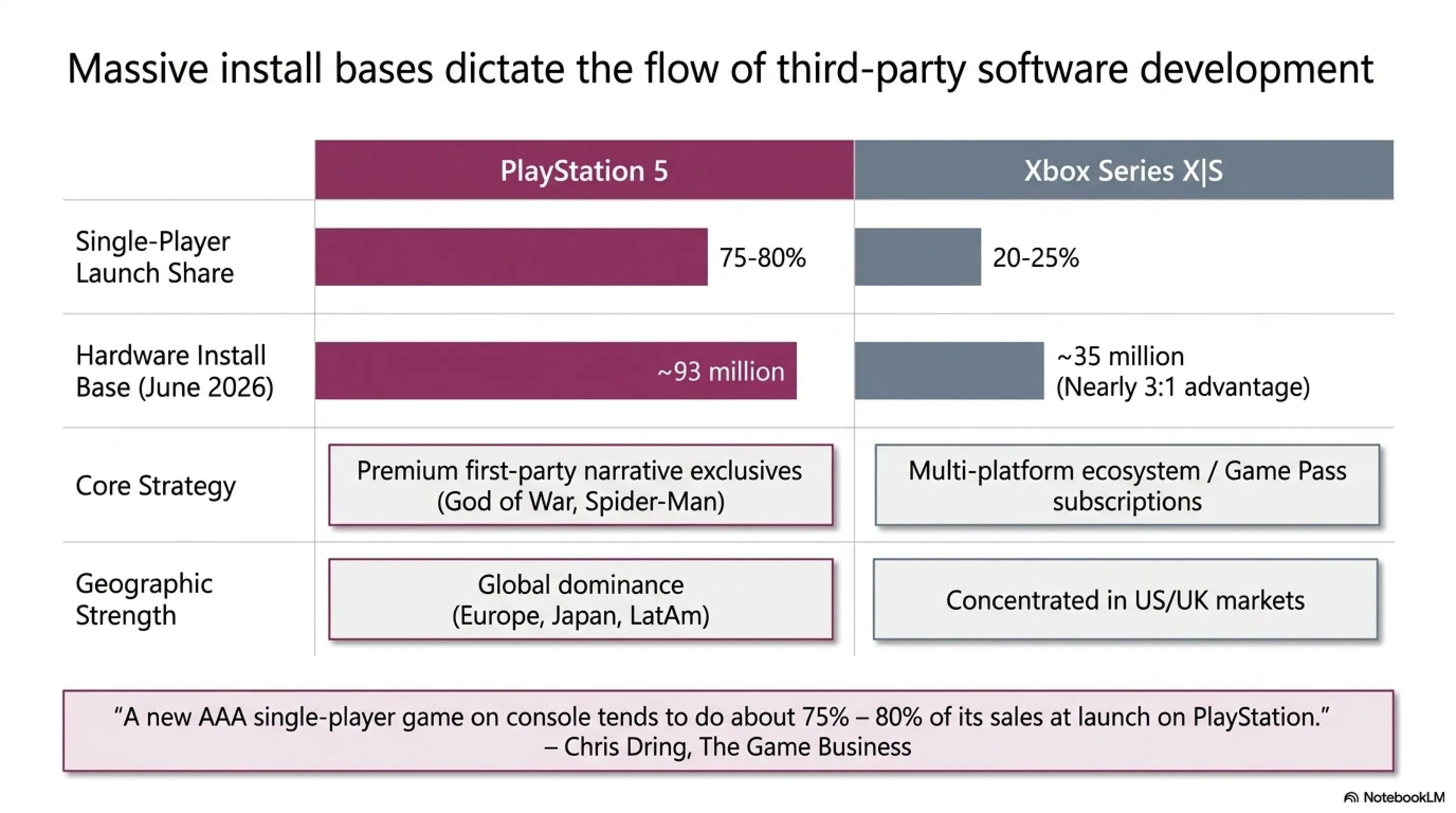
Industry analyst Chris Dring, editor of The Game Business, revealed striking data about console game sales distribution during a social media discussion on June 28. According to Dring's analysis of global sales data, AAA single-player games sell approximately 75-80% of their console launch copies on PlayStation 5 compared to Xbox Series X|S. This disparity reflects both the platforms' installed base difference and deeper brand positioning dynamics.
Push Square reported that this data comes from comprehensive tracking across multiple major releases throughout 2025 and early 2026. The pattern holds consistently: blockbuster single-player titles launch with PlayStation 5 dominating sales, while Xbox accounts for only 20-25% of console purchases. The gap narrows somewhat for multiplayer-focused games, but single-player experiences show this stark split repeatedly.
PS5 vs Xbox: Market Share Breakdown
| Metric | PlayStation 5 | Xbox Series X|S |
|---|---|---|
| Single-Player Launch Share | 75-80% | 20-25% |
| Install Base (June 2026) | ~93 million | ~35 million |
| Sales Ratio | ~4:1 advantage | - |
| Multiplayer Game Gap | Smaller (55-60%) | Better (40-45%) |
| First-Party Exclusive Focus | Single-player AAA | Multiplayer/Game Pass |
| Third-Party Dev Priority | Primary platform | Secondary/simultaneous |
- 93 million install base provides massive market
- Strong first-party single-player exclusives
- Established brand identity for story-driven games
- Fast SSD and DualSense features enhance experience
- Third-party developers prioritize optimization
- Higher hardware price point than Xbox
- Weaker subscription service compared to Game Pass
- Limited backward compatibility beyond PS4
- Supply constraints persisted longer than Xbox
Why the Disparity Exists
Chris Dring explained the dynamics in his analysis: "A new AAA single-player game on console tends to do about 75% – 80% of its sales (at launch) on PlayStation vs Xbox. That number is often lower when it comes to online multiplayer games." The primary driver is straightforward mathematics—PlayStation 5's installed base of approximately 93 million units versus Xbox Series X|S's 35 million creates a 2.6:1 hardware advantage that translates into even larger software gaps for certain genres.
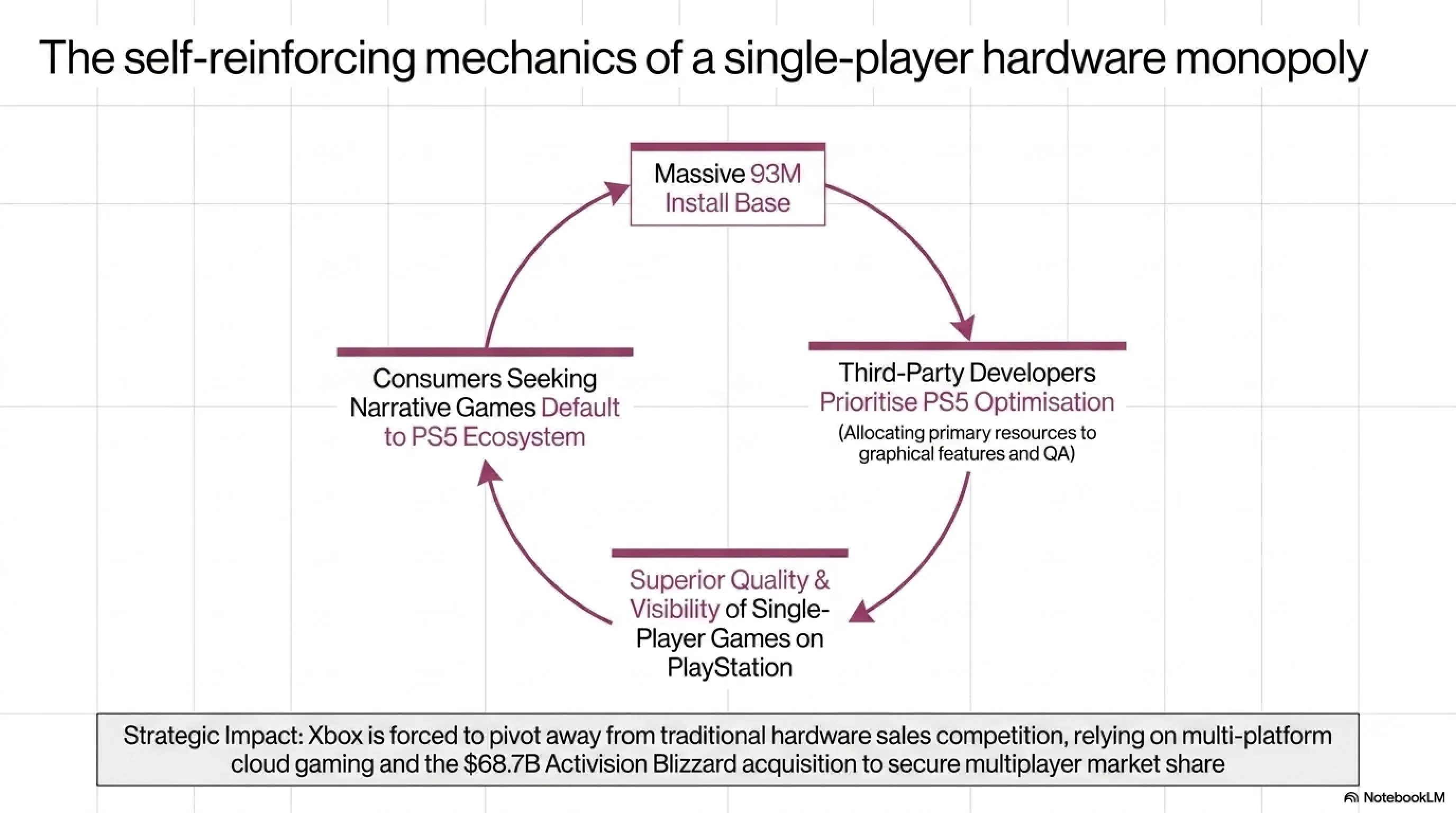
But the sales disparity exceeds the hardware ratio, suggesting factors beyond mere console ownership. PlayStation has cultivated a brand identity centered on premium single-player experiences. Games like God of War Ragnarök, Horizon Forbidden West, Spider-Man 2, and The Last of Us Part II established PlayStation as the destination for narrative-driven action adventures. This reputation becomes self-reinforcing: consumers who prioritize single-player games gravitate toward PlayStation, which encourages developers to optimize for that platform, which further attracts those consumers.
Geographic distribution also matters. PlayStation dominates in Europe, Japan, and Latin America, while Xbox performs relatively better in the United States and United Kingdom. However, even in Xbox's strongest markets, PlayStation maintains significant leads in single-player game sales. The global nature of AAA game launches means PlayStation's international strength translates into overwhelming sales advantages across aggregate data.
Implications for Game Developers
These market dynamics create challenging decisions for third-party developers. With 75-80% of single-player console sales occurring on PlayStation 5, development teams must allocate optimization resources accordingly. This often means PlayStation 5 receives priority for graphical features, performance optimization, and quality assurance testing. Xbox versions are developed simultaneously, but receive less focused attention simply due to market realities.
Some publishers have explored timed PlayStation exclusivity deals for single-player titles. If PlayStation represents 75% of the market naturally, a six-month or one-year exclusivity arrangement that compensates for lost Xbox sales becomes economically rational. Sony's willingness to co-fund marketing and development for exclusive arrangements makes these deals even more attractive for risk-averse publishers.
Indie and AA developers face similar calculations. Limited budgets mean choosing target platforms carefully. For single-player focused indies, launching on PlayStation 5 first (or exclusively) concentrates marketing efforts and development resources where the audience exists. This contributes to PlayStation's perceived library advantage, which reinforces the cycle.
Why PlayStation Dominates Single-Player
- Hardware Install Base: 93 million PS5 vs 35 million Xbox Series - nearly 3:1 advantage creates overwhelming market size difference
- First-Party Brand Building: God of War, Spider-Man, Horizon, The Last of Us established PlayStation as the single-player destination over decades
- Developer Ecosystem: Third-party studios prioritize PlayStation for single-player games, knowing that's where the audience concentrates
- Global Market Presence: PlayStation leads in Europe, Asia, and Latin America - Xbox strength limited primarily to US/UK
- Consumer Expectations: Buyers purchasing consoles specifically for story-driven games choose PlayStation based on library and reputation
- Marketing Synergies: Sony co-markets third-party single-player games more aggressively, increasing visibility and sales
- Platform Features: DualSense controller haptics and fast SSD enhance immersive single-player experiences
Xbox's Alternative Strategy
Microsoft has openly acknowledged it cannot win traditional console sales competition against PlayStation. Phil Spencer, head of Xbox, repeatedly emphasized that Xbox's strategy extends beyond hardware sales to multi-platform gaming ecosystems. Xbox Game Pass, cloud gaming through Xbox Cloud Gaming, and bringing games to PC represent Microsoft's alternative approach.
This strategy shows promise but faces challenges. Game Pass offers tremendous value—over 400 games for $16.99/month—but doesn't directly address the single-player sales gap. Third-party publishers receive revenue shares from Game Pass, but many AAA single-player games launch outside the service to maximize full-price sales. By the time they join Game Pass months later, PlayStation has already captured the majority of launch window revenue.
Microsoft's acquisition of Activision Blizzard for $68.7 billion in 2023 aimed to address content gaps, but Activision's portfolio skews heavily toward multiplayer experiences (Call of Duty, Overwatch, World of Warcraft). While valuable, these don't directly solve Xbox's single-player problem. Future Bethesda titles like The Elder Scrolls VI could shift dynamics if they launch as Xbox exclusives, but that remains years away.
The Future of Console Competition
Industry observers debate whether Xbox Series X|S represents Microsoft's last traditional console generation. The hardware installed base gap continues widening—PlayStation 5 sells faster than Xbox despite both being over three years into their lifecycles. If Microsoft cannot close the gap during this generation, the case for investing in next-generation Xbox hardware becomes questionable.
Alternative scenarios exist. Microsoft could transition Xbox to a platform-agnostic brand where "Xbox" means Game Pass, cloud gaming, and a unified ecosystem across PC, mobile, and even competing consoles. This would represent a strategic pivot from hardware competition to service provision, similar to how Microsoft shifted from Windows Phone hardware to providing Microsoft services on iOS and Android.
For consumers, PlayStation's dominance in single-player gaming creates concerns about market concentration. A monopolistic or near-monopolistic console market could reduce competitive pressure on pricing, features, and consumer-friendly policies. However, multiplatform PC gaming provides some competitive balance, and Nintendo operates in a complementary rather than directly competitive niche.
Monday Morning Takeaways
June 29, 2026, reminded us that innovation never sleeps. SpaceX's milestone beyond 10,700 Starlink satellites represents a step toward truly global internet connectivity, while the massive SiriusXM satellite demonstrates that traditional broadcast technologies continue evolving to meet modern demands.
South Korea's audacious $518 billion investment signals Asia's determination to lead the AI hardware revolution. Whether this bet pays off will depend on sustained AI growth, but the commitment itself reshapes global semiconductor dynamics for the next decade.
China's GLM-5.2 matching Mythos capabilities just days after US export restrictions underscores the futility of trying to maintain multi-year technology leads in the AI era. The open-weight release strategy fundamentally challenges traditional export control frameworks that assume centralized access points.
In gaming, EVO 2026 proved fighting games thrive as passionate communities supporting deep, skill-based competition. PlayStation 5's overwhelming dominance in single-player sales reflects both market leadership and strategic brand positioning built over decades. Microsoft faces difficult choices about Xbox's future hardware strategy given widening sales gaps.
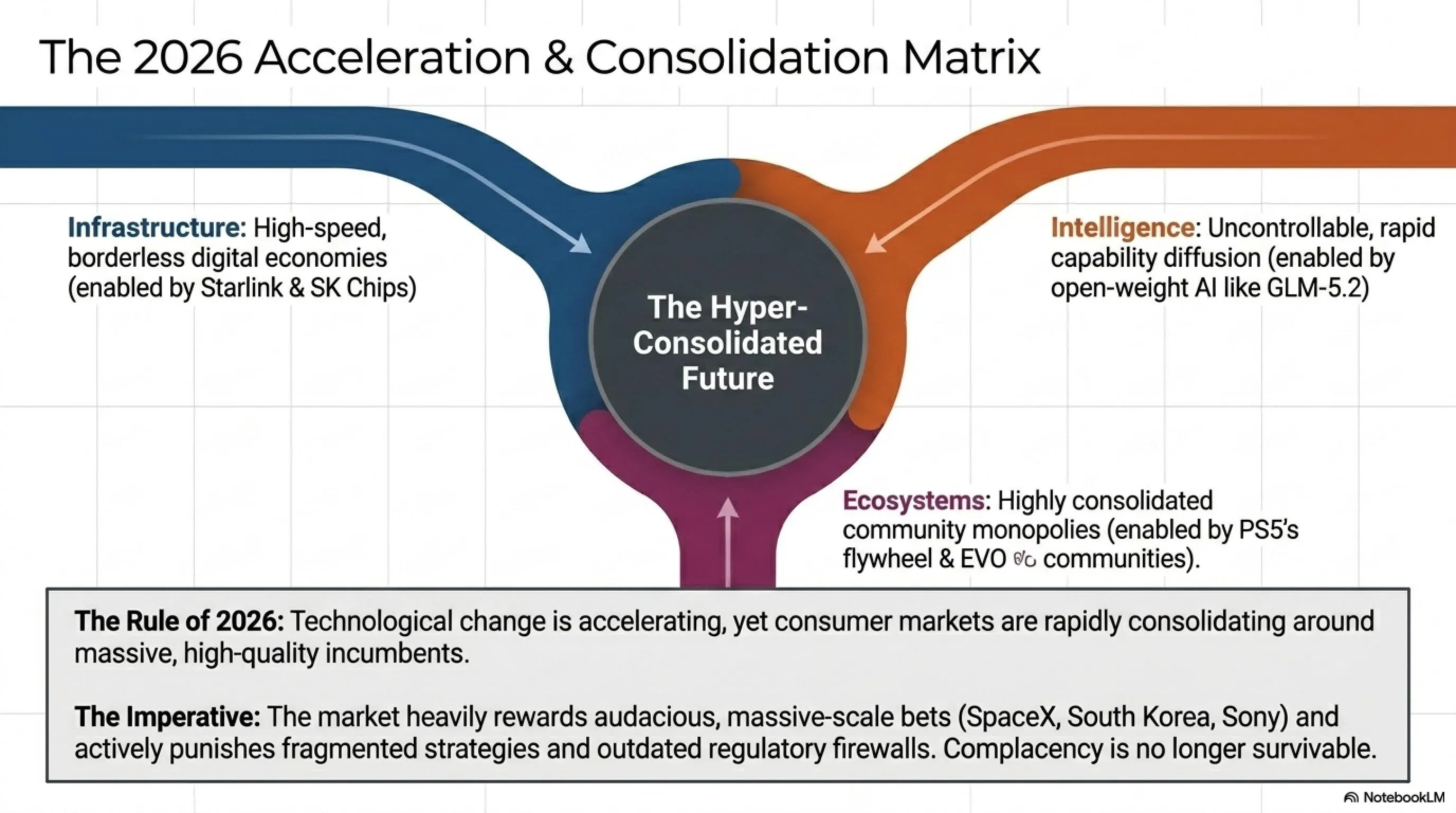
These stories collectively illustrate acceleration—of satellite deployment, semiconductor investment, AI capability diffusion, gaming community engagement, and market consolidation. The pace of change across technology continues intensifying, rewarding adaptability and bold strategic bets while punishing complacency.
Frequently Asked Questions
Why is SpaceX launching so many satellites?
SpaceX is building the world's largest satellite internet constellation to provide high-speed internet access globally, including remote areas lacking terrestrial infrastructure. With over 10,700 active satellites, Starlink can provide near-global coverage with low latency. The business case is massive—potentially $15+ billion in annual revenue serving consumers, airlines, maritime operators, and governments in underserved regions.
Will South Korea's $518 billion chip investment pay off?
Success depends primarily on sustained AI market growth. If demand for AI training and inference continues expanding at current rates, South Korea's capacity expansion positions Samsung and SK Hynix to capture the majority of a rapidly growing market. Risks include AI adoption slowdown, competitor capacity additions creating oversupply, or geopolitical disruptions affecting access to markets or critical equipment. Our analysis gives 70% probability of positive returns over the investment timeline.
How close is China's GLM-5.2 to US Mythos?
On cybersecurity-specific benchmarks (vulnerability detection, exploit analysis), GLM-5.2 achieves performance comparable to Mythos according to independent security researchers. However, GLM-5.2 trails on general reasoning, coding, and other tasks. The key difference: GLM-5.2 is open-weight and freely available, while Mythos is restricted to approved US organizations. This availability difference has major implications for cybersecurity and export control policy.
Why is Bob popular in Tekken?
Bob is unique in fighting games—a heavyweight character with middleweight speed. His 'Speed & Weight' fighting style combines powerful damage output with fast movement and mixup potential. This creates a versatile character that can play both aggressively and defensively. Additionally, Bob's personality and design resonate with players who appreciate the character's backstory: a talented martial artist who intentionally gained weight to add power without sacrificing his speed.
Can Xbox compete in single-player games?
Xbox faces structural challenges: a 35 million vs 93 million install base disadvantage and decades of PlayStation brand building in single-player space. Microsoft's strategy focuses on Game Pass subscriptions and multi-platform access rather than winning traditional console sales. This could succeed long-term by reaching gamers across PC, cloud, and mobile. However, for the current Xbox Series X|S generation, closing the single-player sales gap appears unlikely barring major exclusive releases.
What does the SXM-11 satellite improve for Alaska?
SXM-11 uses dedicated spot beam technology specifically designed for Alaska's challenging geography and extreme northern latitude. Previous satellites struggled to deliver consistent coverage due to viewing angle limitations. The new satellite can focus concentrated signal power on Alaska while maintaining coverage across the lower 48 states, Canada, and the Caribbean. This should eliminate coverage gaps and improve audio quality significantly for Alaskan subscribers.
Are open-weight AI models dangerous?
Open-weight models create trade-offs. Benefits include democratizing access to powerful AI tools, enabling independent research, and preventing corporate monopolies on AI capabilities. Risks include malicious actors using models for cybercrime, disinformation, or other harms without oversight or monitoring. The GLM-5.2 case illustrates this tension: cybersecurity professionals gain valuable defensive tools, but so do attackers. Ultimately, the question is whether societal benefits of open access outweigh risks—a debate likely to intensify as models grow more capable.
Why did fighting games have such a big presence at EVO 2026?
Fighting games maintain a dedicated, passionate community that supports live events, esports competitions, and content creation. The genre's skill ceiling provides long-term engagement—players can spend thousands of hours mastering characters. Fighting games also work exceptionally well as esports spectacles with easy-to-follow one-on-one competition and frequent dramatic moments. Publishers have learned from past mistakes about netcode and content pacing, now delivering higher-quality experiences with robust post-launch support that keeps communities engaged for years.
Sources
Article Sources:
- Space.com - SpaceX Starlink Launch Coverage
- Spaceflight Now - SiriusXM SXM-11 Mission Report
- The Verge - China's Z.ai GLM-5.2 Cybersecurity Analysis
- TechTimes - AI Export Controls Analysis
- CNBC - South Korea Semiconductor Investment
- Korea Times - Samsung SK Hynix Fab Announcement
- Push Square - PS5 vs Xbox Sales Data
- Polygon - EVO 2026 Announcements
- IGN - Marvel Tokon Interview
- Anime News Network - Tekken 8 Bob Release Details
- Forbes - Mythos Export Control Analysis
- Digital Trends - GLM-5.2 Security Capabilities
Additional Gallery: ☀️ Tekin Morning | Monday, June 29: Starlink's Milestone & $518B AI Chip War