Good Morning! Tekin Morning Monday, June 22
Ready to kickstart your week with the freshest tech, space, crypto, and mobile news? We've curated 6 essential stories to power your Monday.
Today's Headlines
🎮
SpaceX Sets New Record
- 72nd Falcon 9 launch of 2026 delivers 24 Starlink satellites
🎧
Bitcoin Stays Near $64K
- US-Iran peace roadmap fails to spark crypto rally
🚀
INTERPOL Sounds Alarm
- Phishing dominates cybercrime across Asia-Pacific
🗡️
Ethereum's Controversial Proposal
- Should validators redirect 10% of staking rewards?
📰
T-Mobile's iPhone Giveaway
- Get iPhone 17 free with qualifying plans
⚔️
Android Gets Stricter
- Developer Options may be locked in Advanced Protection
Monday mornings typically start with caffeine and inbox clearing, but today brings something more energizing: SpaceX just logged another launch, the crypto world is navigating geopolitical waters, and Google is tightening Android security in ways that matter to power users. Let's dive into the six most important developments from the past 24 hours.
This article is built for readers who want signal, not noise. We've gathered, verified, and analyzed stories from trusted sources so you can start your week informed and confident.
SpaceX Achieves 72nd Falcon 9 Launch of 2026 with Starlink Mission
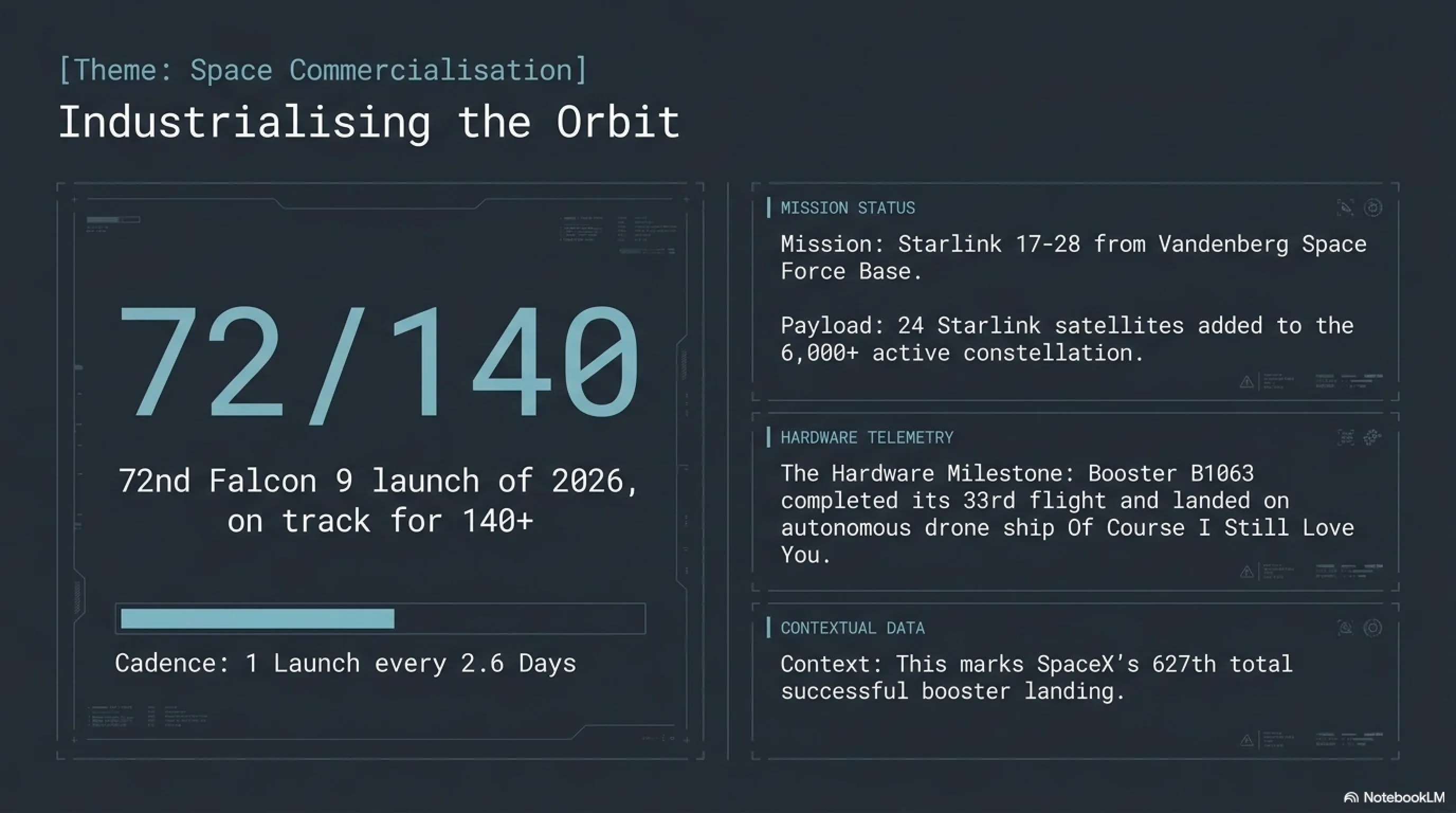
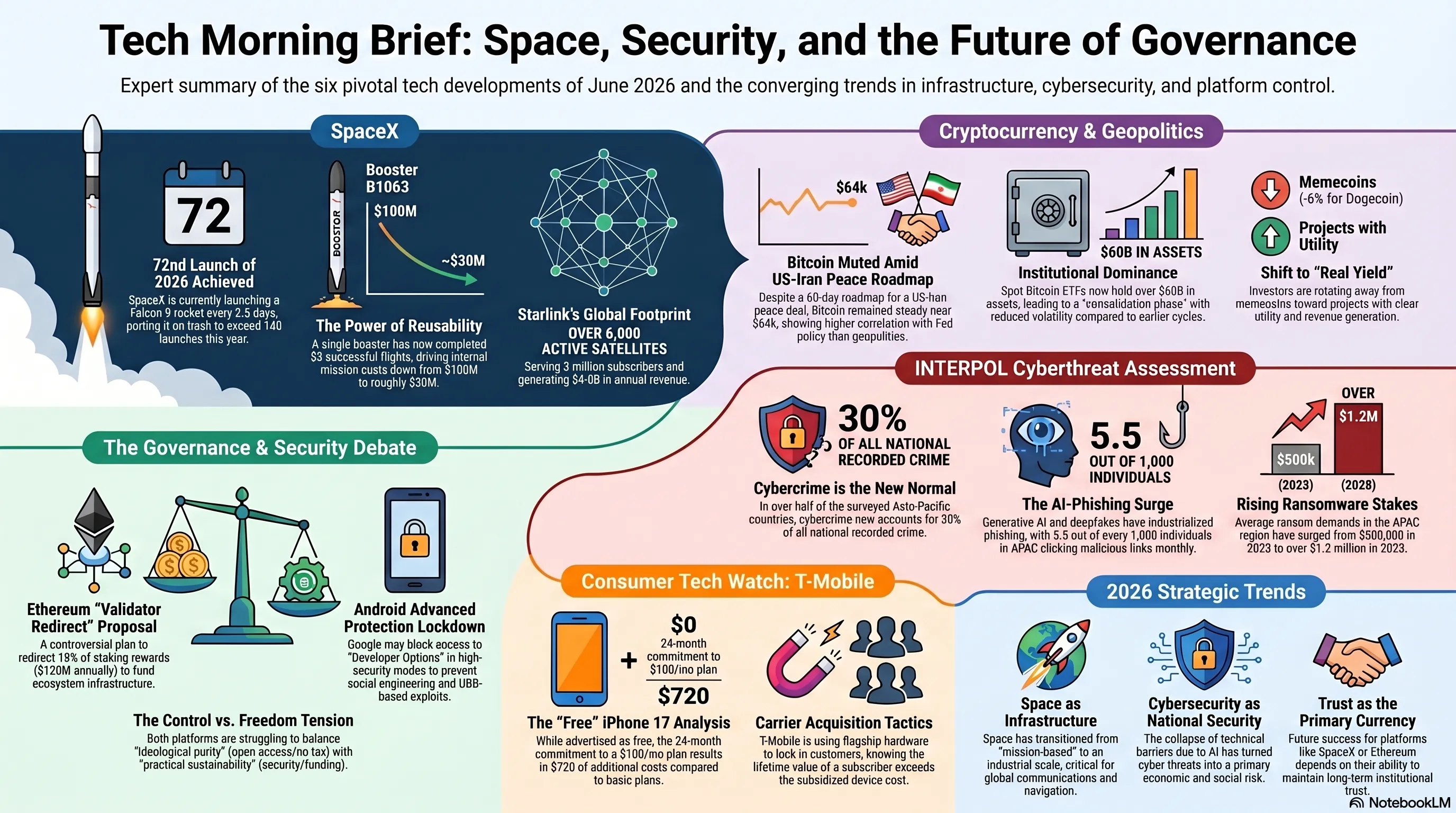
Sunday, June 21, at 9:39 AM Pacific Time, a familiar scene played out at Vandenberg Space Force Base in California: a Falcon 9 rocket lifted off and delivered 24 more Starlink satellites into low Earth orbit. The Starlink 17-28 mission marked the 72nd Falcon 9 launch of 2026, continuing SpaceX's unprecedented launch cadence.
But the real story here is booster B1063. This particular first stage completed its 33rd successful flight and landed on the autonomous drone ship "Of Course I Still Love You" in the Pacific Ocean. This was the 204th landing on this particular vessel and SpaceX's 627th successful booster recovery overall.
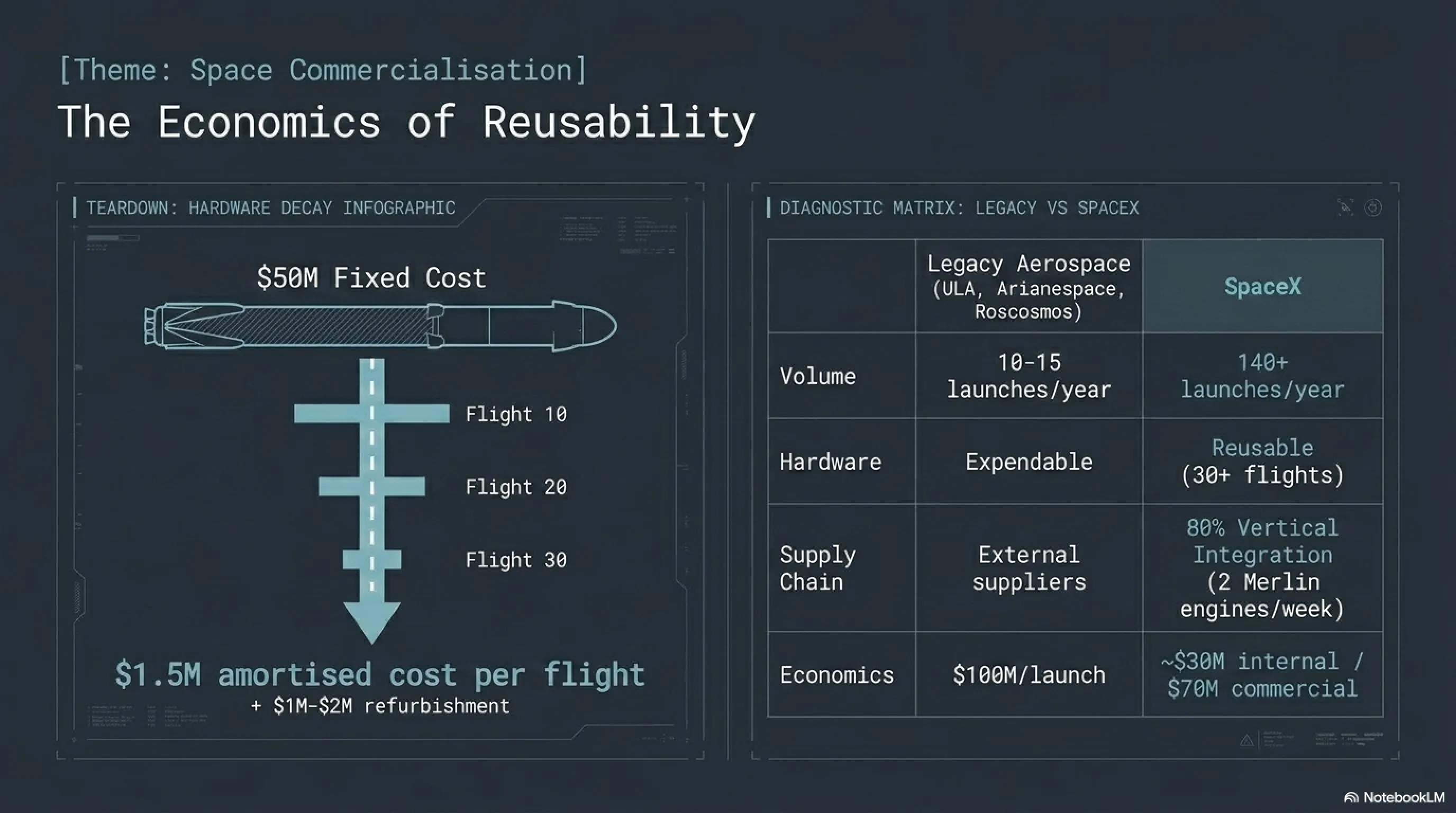
To understand the significance of these numbers, we need context. SpaceX launched 96 times in 2023, which was a record at the time. In 2024, that number jumped to 120 launches. At the current pace, 2026 is on track to exceed 140 launches, which means SpaceX is launching approximately every 2.6 days.
- Booster B1063 achieved its 33rd successful flight
- 204th landing on drone ship OCISLY
- 627th total booster landing for SpaceX
- 72nd Falcon 9 launch of 2026
- 24 Starlink satellites added to constellation
The reusability technology underpinning this achievement deserves attention. Each Falcon 9 booster is designed for at least 15 flights, but in practice, some boosters like B1063 have exceeded 30 missions. This dramatically reduces launch costs. Where a traditional expendable rocket might cost $100 million per launch, SpaceX has driven costs down to roughly $30 million for internal missions and under $70 million for commercial customers.
The Starlink constellation now comprises over 6,000 active satellites, providing internet service to more than 3 million subscribers globally. SpaceX plans to expand this to 12,000 satellites for complete global coverage, including polar regions and maritime areas where traditional internet infrastructure is impossible.
From a business perspective, Starlink is becoming increasingly important to SpaceX's revenue model. While exact figures remain private, industry analysts estimate Starlink generates between $4-6 billion annually, funding both constellation expansion and SpaceX's Starship development program.
Vandenberg Space Force Base in California is SpaceX's West Coast launch facility, primarily used for polar and high-inclination orbits. Its location allows rockets to fly south over the Pacific Ocean, avoiding populated areas during ascent and providing safe downrange landing zones for boosters.
The mission timeline followed SpaceX's now-standard operational pattern: liftoff at T+0, main engine cutoff at T+2:30, stage separation at T+2:33, booster landing at T+8:30, and satellite deployment beginning at T+62:00. The entire sequence has become so routine that SpaceX no longer hosts full webcast coverage for every Starlink mission, focusing resources instead on customer launches and Starship development.
Looking ahead, SpaceX has ambitious plans. The company aims to launch Starlink V3 satellites starting in late 2026, featuring improved bandwidth and inter-satellite laser links. These next-generation satellites will be launched exclusively on Starship, SpaceX's fully reusable super heavy-lift vehicle currently in testing.
Bitcoin Holds Near $64,000 as Crypto Markets Sit Out Geopolitical Rally
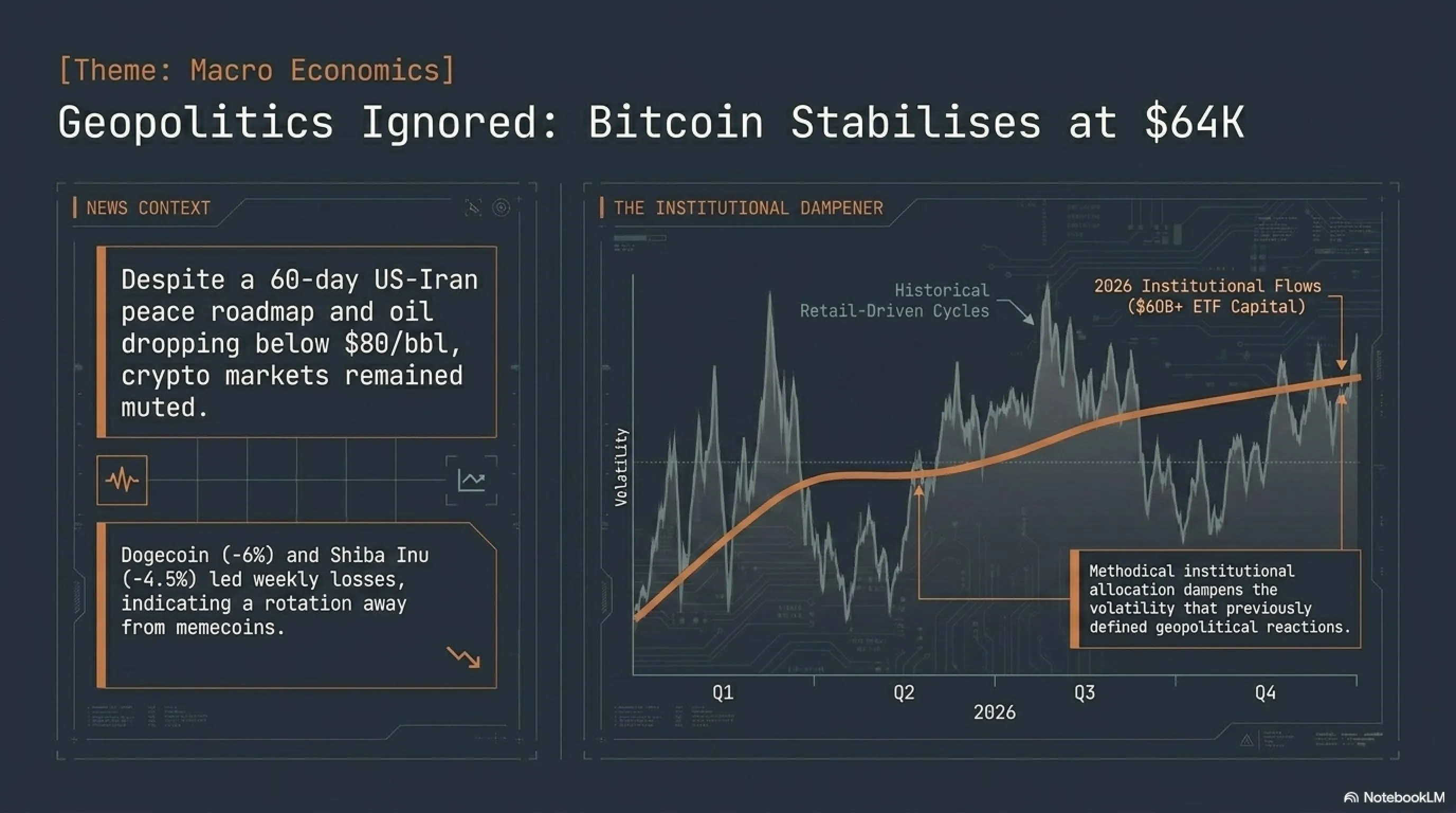
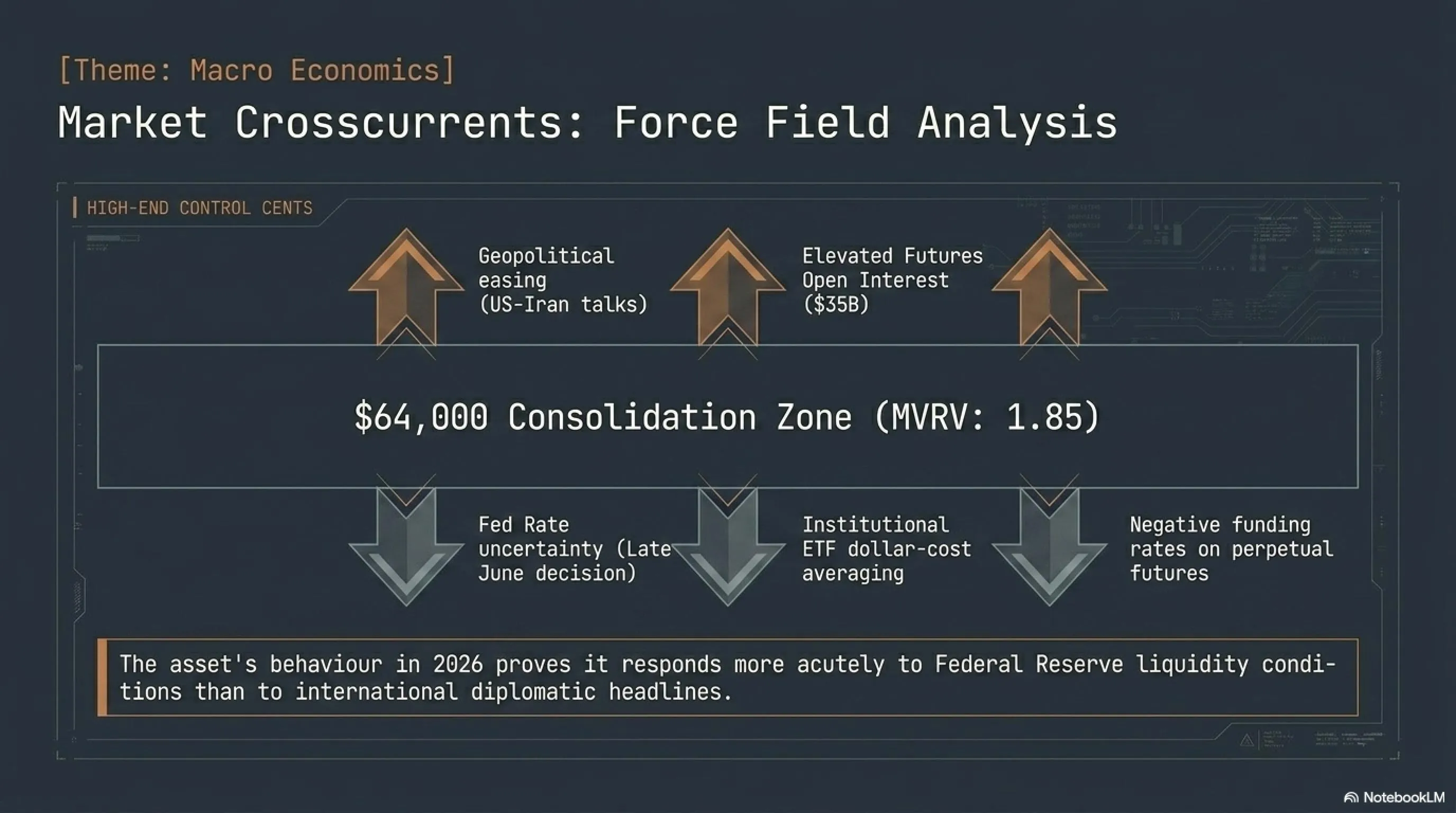
While Asian equity markets and tech sectors rallied on news of diplomatic progress between the United States and Iran, cryptocurrency markets remained notably muted. Bitcoin traded around $64,000 Monday morning, down 2% for the week, as investors focused on Federal Reserve policy rather than geopolitical developments.
According to media reports facilitated by mediators Qatar and Pakistan, the United States and Iran have agreed on a roadmap toward a final peace deal within 60 days. Technical talks are beginning immediately, focusing on sanctions relief, Strait of Hormuz navigation, and regional security arrangements.
Historically, Bitcoin has been characterized as a "safe haven" asset during geopolitical uncertainty, similar to gold. But this characterization increasingly appears oversimplified. The asset's behavior in 2026 suggests it responds more to monetary policy and institutional capital flows than to headlines about international relations.
Several factors explain crypto's subdued response to positive geopolitical news:
First, markets are currently focused on Federal Reserve interest rate decisions. The central bank's next meeting is scheduled for late June, and speculation about rate cuts dominates investor attention. Cryptocurrencies, particularly Bitcoin, have shown strong correlation with tech stocks and liquidity conditions. When interest rates fall, risk assets typically benefit; when rates rise or remain elevated, capital flows toward safer investments.
Second, institutional investors now dominate crypto markets in ways that didn't exist during previous geopolitical crises. Spot Bitcoin ETFs approved in early 2024 have accumulated over $60 billion in assets, representing steady, methodical capital allocation rather than reactive trading. These institutional flows move slowly and deliberately, smoothing out the volatility that characterized earlier crypto cycles.
Third, oil markets told a different story. Crude prices dropped below $80 per barrel as tensions eased, signaling reduced concern about energy supply disruptions through the Strait of Hormuz. Traditionally, falling oil prices correlate with increased risk appetite across financial markets, but crypto failed to participate in this risk-on sentiment.
Within the crypto ecosystem, memecoins experienced the steepest declines. Dogecoin dropped 6% and Shiba Inu fell 4.5% over the week, while Solana and Tron managed modest weekly gains. This divergence suggests investors are rotating toward projects with clearer utility and revenue generation.
CoinDesk analysts suggest Bitcoin is in a "consolidation phase," likely to trade between $62,000 and $66,000 until a stronger catalyst emerges. Potential catalysts include regulatory clarity from the SEC, significant new institutional adoption, or major central bank policy shifts.
The broader crypto market capitalization stood at $2.38 trillion Monday morning, with Bitcoin dominance at 54.2%. Ethereum traded around $3,400, down slightly but holding key support levels. Alternative layer-1 blockchains showed mixed performance, with Avalanche gaining 3% while Cardano declined 2%.
Looking at derivatives markets provides additional insight. Bitcoin futures open interest on major exchanges remains elevated at approximately $35 billion, indicating sustained institutional participation. However, the funding rate for perpetual futures has been slightly negative, suggesting more traders are positioned for downside than upside in the near term.
One technical indicator worth monitoring is the MVRV (Market Value to Realized Value) ratio, currently at 1.85. This metric compares Bitcoin's market capitalization to its "realized" cap (based on when coins last moved). Historically, MVRV readings between 1.5 and 2.5 indicate fair valuation, neither extremely oversold nor overbought.
INTERPOL Report Reveals Phishing as Asia-Pacific's Dominant Cyber Threat
INTERPOL's newly released 2025/2026 Asia and South Pacific Cyberthreat Assessment Report paints a concerning picture: phishing has emerged as the most widespread and financially damaging form of cybercrime across the region, with attack sophistication increasing thanks to artificial intelligence.
According to the report, one-third of surveyed countries reported more than 10,000 phishing cases between January 2024 and March 2025. But these official figures likely represent only a fraction of actual incidents, as many victims never report attacks due to embarrassment, lack of awareness, or distrust of authorities.
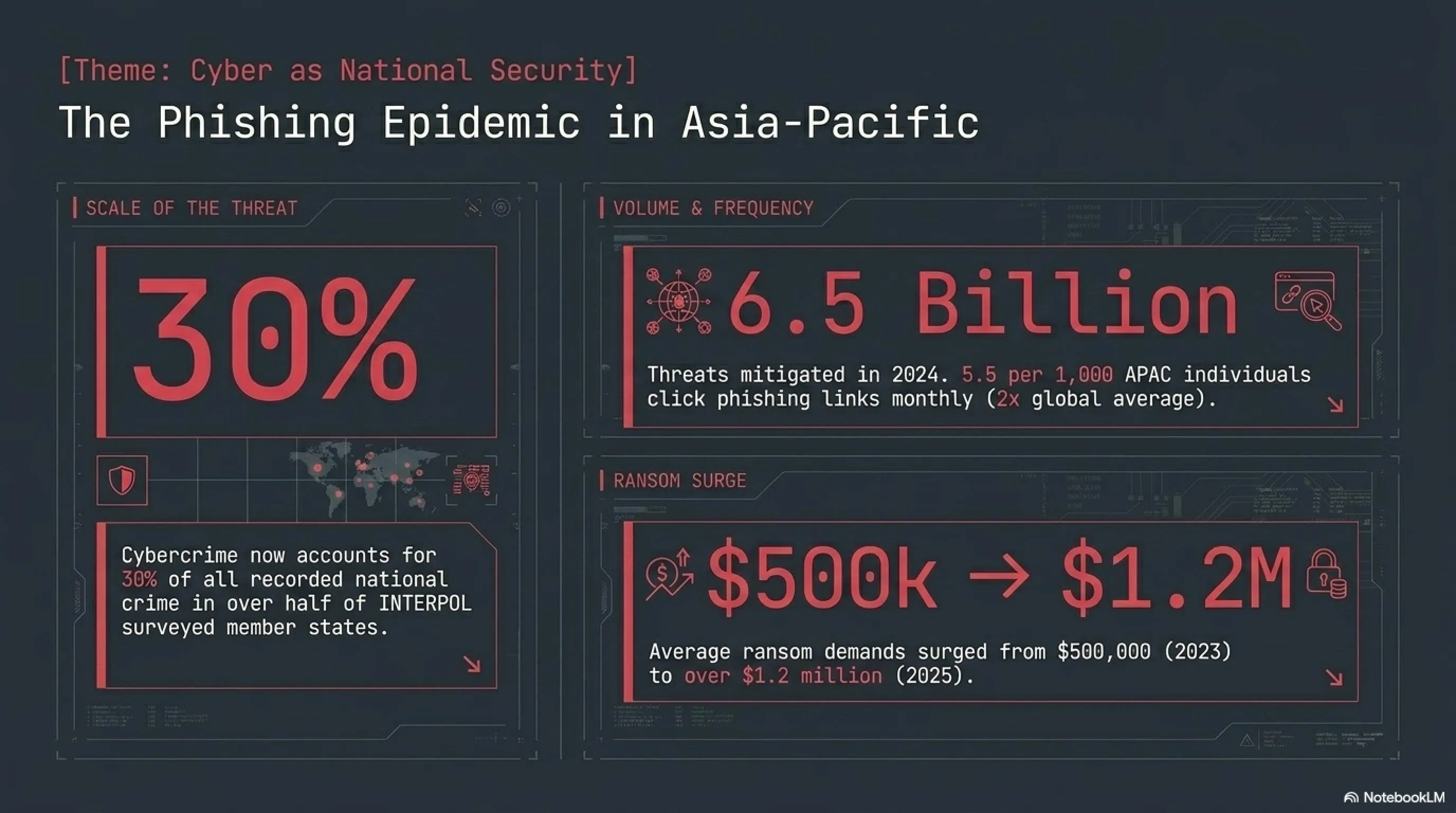
Of the 18 INTERPOL member states participating in the survey, more than half reported that cybercrime now accounts for 30% of all recorded national crime. This represents a fundamental shift in the criminal landscape. Digital crime is no longer a subset of traditional crime; in many jurisdictions, it has become the primary threat vector.
The statistics are sobering: approximately 5.5 out of every 1,000 individuals in the Asia-Pacific region click on phishing links monthly, roughly twice the global average. Cloud applications represent the primary target, with attackers focusing on email platforms, collaboration tools, and cloud storage services to gain access to corporate and government networks.
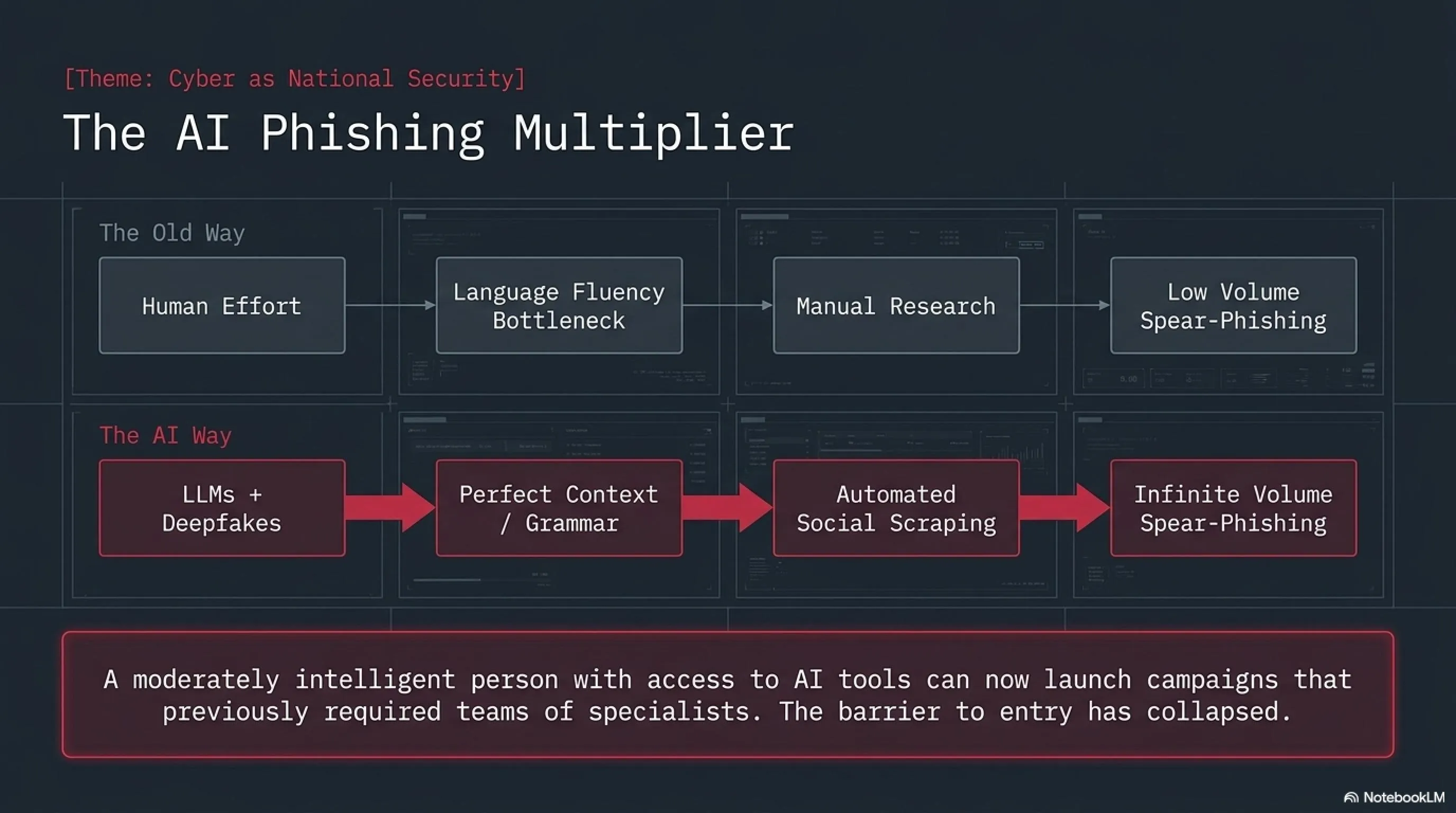
Artificial intelligence has dramatically lowered the barrier to entry for cybercrime. Attackers now use language models to generate convincing phishing emails in multiple languages with perfect grammar and contextual awareness. Deepfake technology enables voice and video impersonation, making CEO fraud and identity-based scams far more effective.
Neal Jetton, INTERPOL's Director of Cybercrime, emphasized in an interview with Channel News Asia that three primary factors drive this surge: rapid digitalization across the region, the democratization of AI tools, and increasingly sophisticated criminal networks operating across borders.
The rapid digitalization factor is particularly relevant in Southeast Asia, where smartphone adoption has outpaced cybersecurity education. Countries like Indonesia, Vietnam, and the Philippines have seen explosive growth in digital payment systems, e-commerce, and mobile banking, but security awareness among users remains relatively low. This creates what security professionals call a "target-rich environment."
Ransomware attacks are also rising significantly, though they affect fewer victims than phishing. The report indicates that average ransom demands in the Asia-Pacific region have increased from $500,000 in 2023 to over $1.2 million in 2025. These attacks increasingly target critical infrastructure, healthcare systems, and government agencies rather than just private corporations.
One particularly concerning trend is the rise of "ransomware-as-a-service" (RaaS) operations. These criminal enterprises provide ransomware tools, infrastructure, and support to affiliates who carry out attacks, splitting the proceeds. This business model has industrialized ransomware, allowing technically unsophisticated criminals to launch sophisticated attacks.
INTERPOL's report also highlighted the growing problem of investment scams, often called "pig butchering" scams in Asia. These long-term confidence schemes involve criminals building relationships with victims over weeks or months through dating apps or social media, gradually convincing them to invest in fraudulent cryptocurrency or forex platforms. Losses from these scams frequently exceed $100,000 per victim.
The report recommends several countermeasures. At the national level, governments should increase investment in cybersecurity education, strengthen international cooperation frameworks, and implement stricter penalties for cybercrime. Organizations should mandate multi-factor authentication (MFA), conduct regular security awareness training, and implement zero-trust network architectures.
For individual users, the advice remains consistent: never click links in unexpected emails, verify sender identities through independent channels, use unique passwords for each service, enable MFA wherever available, and maintain healthy skepticism toward unsolicited communications promising financial gain or threatening consequences.
Private sector data provided to INTERPOL revealed that over 6.5 billion cyber threats were detected and mitigated across the Asia-Pacific region between January and December 2024. This staggering number represents only detected threats; the true volume of attempted attacks is likely far higher.
Ethereum's Controversial Validator Revenue Redirect Proposal
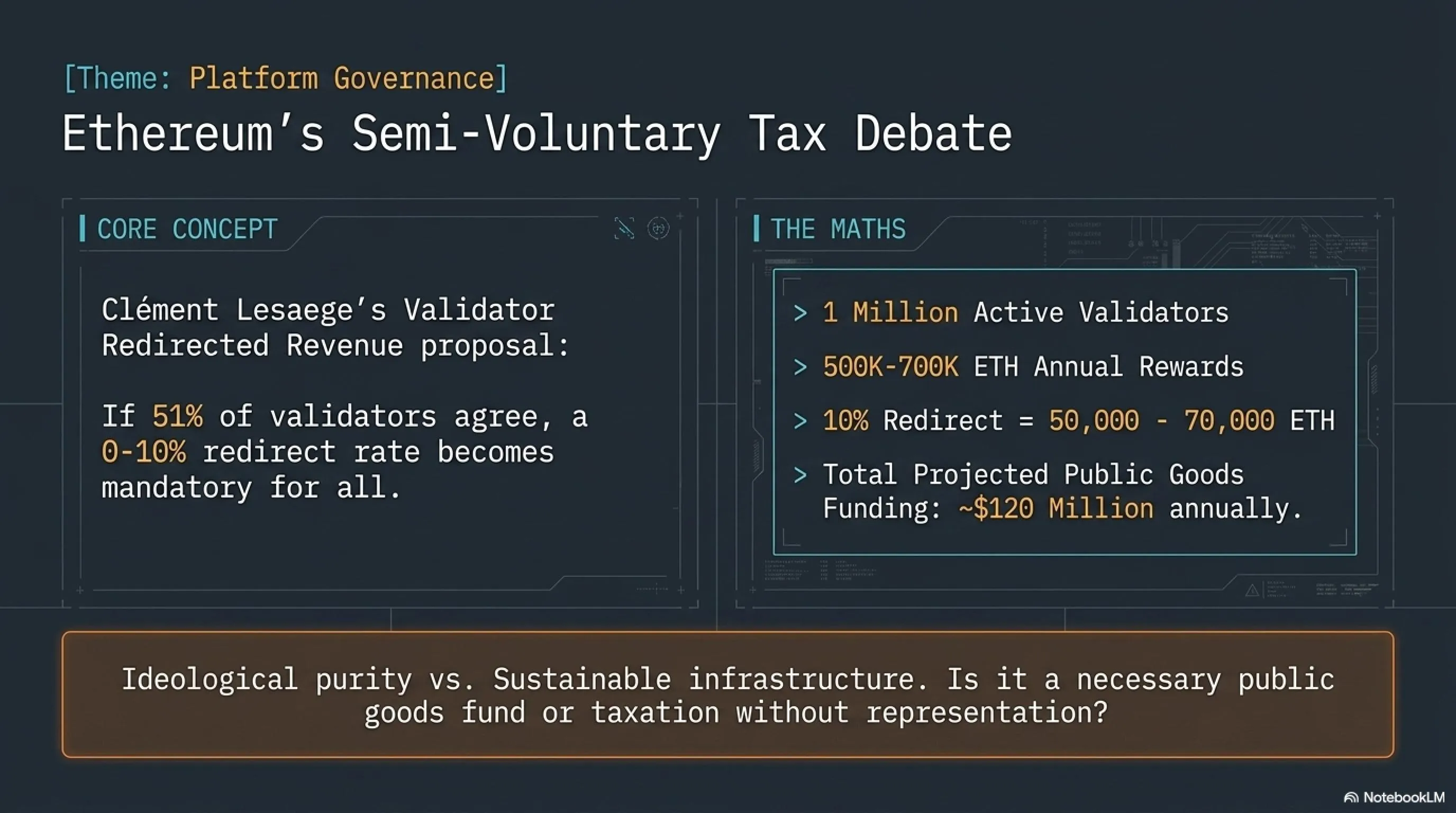
A new governance proposal in the Ethereum ecosystem has ignited debate about funding, fairness, and the boundaries of decentralized decision-making. Clément Lesaege, founder of Kleros, has proposed a mechanism called "Validator Redirected Revenue" that would allow network validators to redirect between 0% and 10% of their staking rewards toward ecosystem funding.
Here's how the mechanism would work: If more than 51% of validators agree to implement a redirect rate above 0%, that rate becomes mandatory for all validators. This creates what Lesaege calls a "semi-voluntary" system—individual validators vote, but once the majority decides, everyone participates.
The potential impact is substantial. Ethereum currently has approximately 1 million active validators, collectively earning around 500,000 to 700,000 ETH annually in staking rewards. A redirect rate of 5-10% could channel 50,000 to 70,000 ETH (approximately $120 million at current prices) toward public goods annually.
7.5
Controversial but LogicalPROS
- Sustainable funding for infrastructure projects
- Reduces dependence on private grants
- Strengthens Ethereum ecosystem long-term
- More transparent resource allocation
- Aligns validator incentives with network health
CONS
- Effectively a mandatory tax on validators
- Decision authority over fund allocation unclear
- May discourage smaller validators
- Risk of political capture of funds
- Could set precedent for future mandatory fees
The proposal has sparked passionate responses from across the Ethereum community. Critics frame it as taxation without proper representation, arguing that validators signed up to secure the network, not to fund external projects. Some worry that large staking pools could coordinate to activate the mechanism against the wishes of smaller, independent validators.
Supporters counter that Ethereum, as a public good network, requires sustainable funding for essential infrastructure that benefits everyone but generates no direct revenue. Currently, much of Ethereum's development depends on Ethereum Foundation grants or venture capital funding. This creates potential conflicts of interest and sustainability concerns if funding sources dry up.
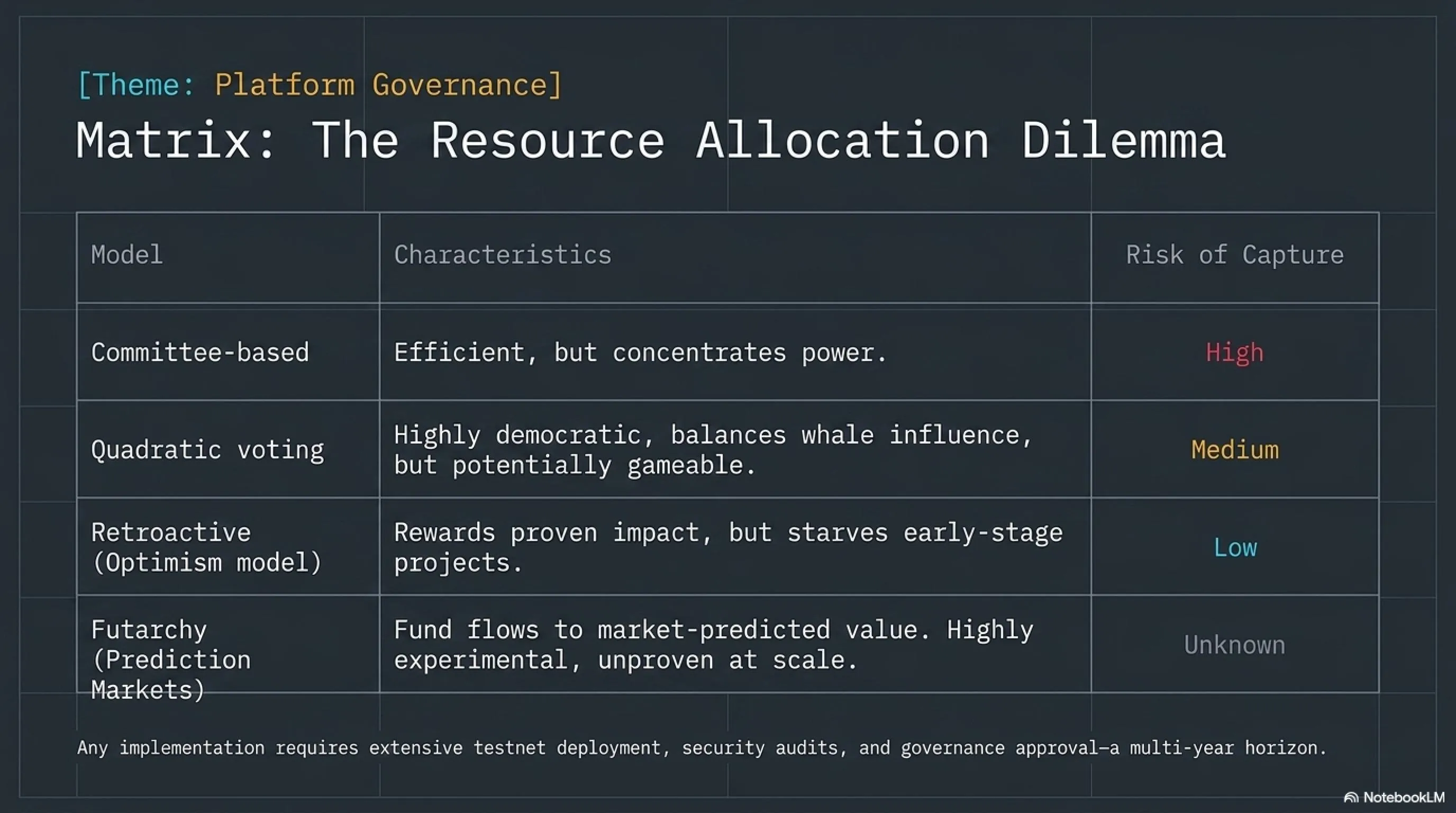
The allocation question remains perhaps the most contentious aspect. Who decides which projects receive funding? Possible governance models include:
Committee-based allocation: A elected committee reviews applications and distributes funds based on defined criteria. This provides efficiency but concentrates power.
Quadratic voting: Community members vote on projects using quadratic voting mechanisms that balance whale influence. This is more democratic but potentially gameable.
Retroactive public goods funding: Projects are funded after demonstrating value, similar to Optimism's RetroPGF model. This rewards proven impact but doesn't help early-stage projects.
Futarchy-based prediction markets: Markets predict which projects will create the most value, with funding flowing to highest-ranked proposals. This is experimental and unproven at scale.
Some observers compare this proposal to Zcash's "dev tax," which allocates 20% of mining rewards to developers and the Zcash Foundation. However, Zcash implemented this mechanism from genesis, whereas Ethereum would be introducing it post-launch, raising different governance challenges.
The proposal is still in early discussion stages on Ethereum's research forum. Before implementation, it must undergo extensive review, testnet deployment, security audits, and ultimately approval through Ethereum's governance process. This could take months or years.
Regardless of whether this specific proposal succeeds, it highlights growing tensions in decentralized networks between maintaining ideological purity and solving practical sustainability problems. As blockchains mature, they face the same institutional challenges as traditional organizations: how to fund shared infrastructure, who makes allocation decisions, and how to balance efficiency with decentralization.
T-Mobile Offers Free iPhone 17 with Qualifying Plans
T-Mobile has launched one of the most aggressive carrier promotions of 2026: get an iPhone 17e, iPhone 17, or iPhone 17 Pro completely free when you switch to eligible unlimited plans. But as with all carrier deals, the devil lives in the details.
To qualify for this offer, customers must port their number from another carrier to T-Mobile and commit to either the Experience More or Experience Beyond unlimited plan. The Experience Beyond plan, which T-Mobile actively promotes for this deal, costs $100 per month with AutoPay enabled and includes unlimited talk, text, and data, unlimited mobile hotspot, and free subscriptions to Netflix and Hulu.
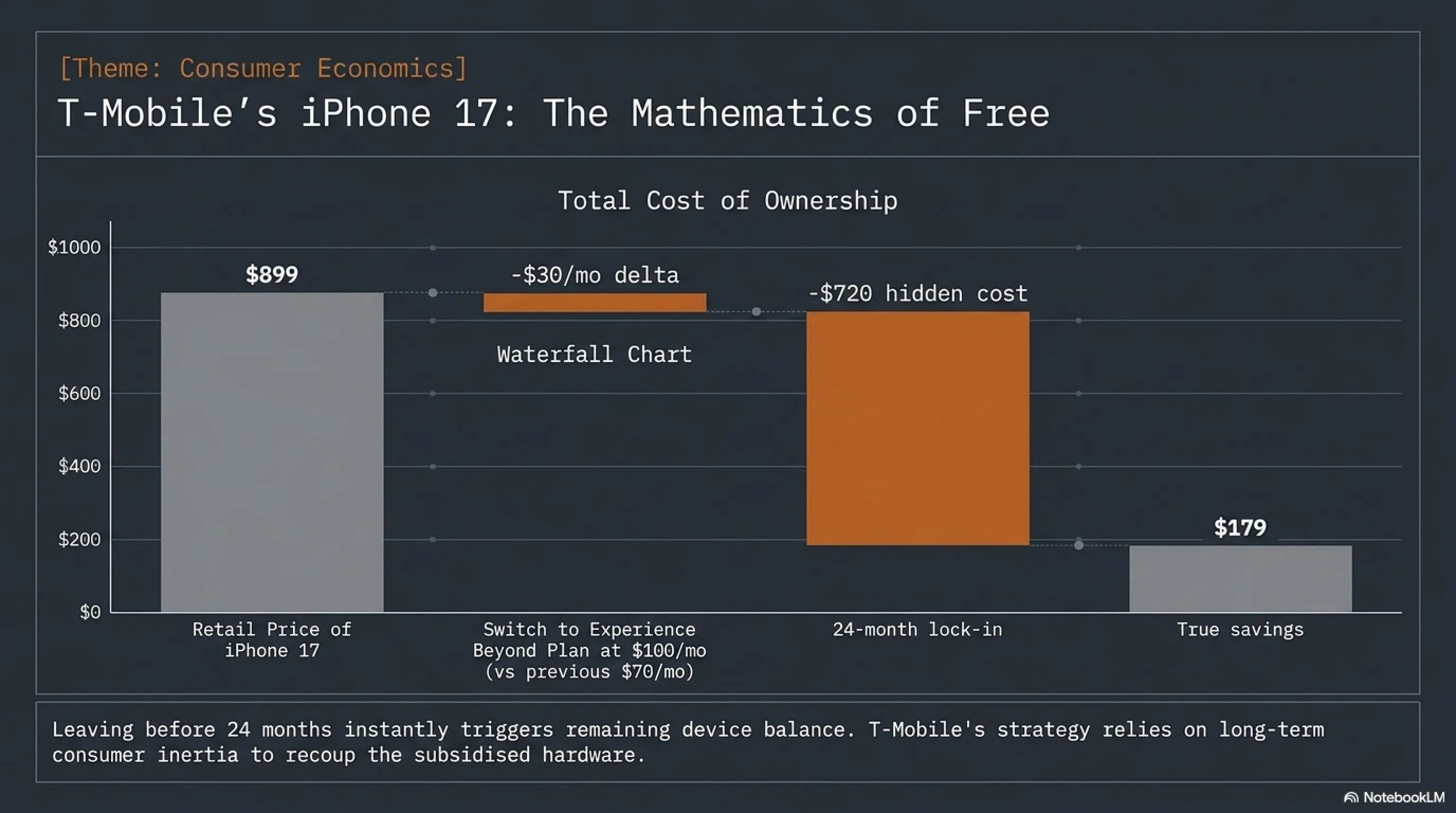
Let's do the math. The base iPhone 17 retails for $899, while the iPhone 17 Pro starts at $1,099. If you currently pay $70 per month with another carrier, switching to T-Mobile at $100 per month means an additional $30 monthly cost. Over the typical 24-month commitment period, that's $720 in extra expenses.
So for the base iPhone 17, you're actually paying $720 of the $899 retail price through higher plan costs. That's still a $179 savings, but far from "free." However, if you choose the iPhone 17 Pro and actively use the included streaming services (which would otherwise cost approximately $25 monthly), the economics become more favorable.
If you cancel service before completing 24 monthly bill credits, the credits stop immediately and you owe the remaining balance on the device financing agreement. This locks you into T-Mobile for two full years. Additionally, this offer requires trade-in of an eligible device or new line activation with qualifying credit.
T-Mobile deploys this strategy to capture market share from rivals Verizon and AT&T. In the "carrier wars," free flagship devices are a time-tested acquisition tactic. Carriers know that most customers stay far beyond their initial contract due to inertia, and the lifetime value of a customer typically exceeds the subsidized device cost.
For customers already planning to switch carriers and purchase a new iPhone, this promotion offers genuine value. But current T-Mobile customers won't benefit from this specific offer; it targets switchers exclusively to drive subscriber growth.
It's worth noting that competitors have similar promotions. AT&T recently offered $800 off iPhone 17 with qualifying trade-ins, while Verizon provides aggressive discounts with its Unlimited Ultimate plans. Before committing, compare total cost of ownership across carriers: monthly plan cost, device subsidy, included perks, network coverage in your area, and early termination penalties.
One factor often overlooked in these comparisons is network performance. T-Mobile has invested heavily in mid-band 5G spectrum and generally offers strong performance in urban and suburban areas. However, rural coverage may lag behind Verizon in some regions. Check coverage maps and read user reviews specific to your location before switching.
Android Advanced Protection May Block Developer Options Access
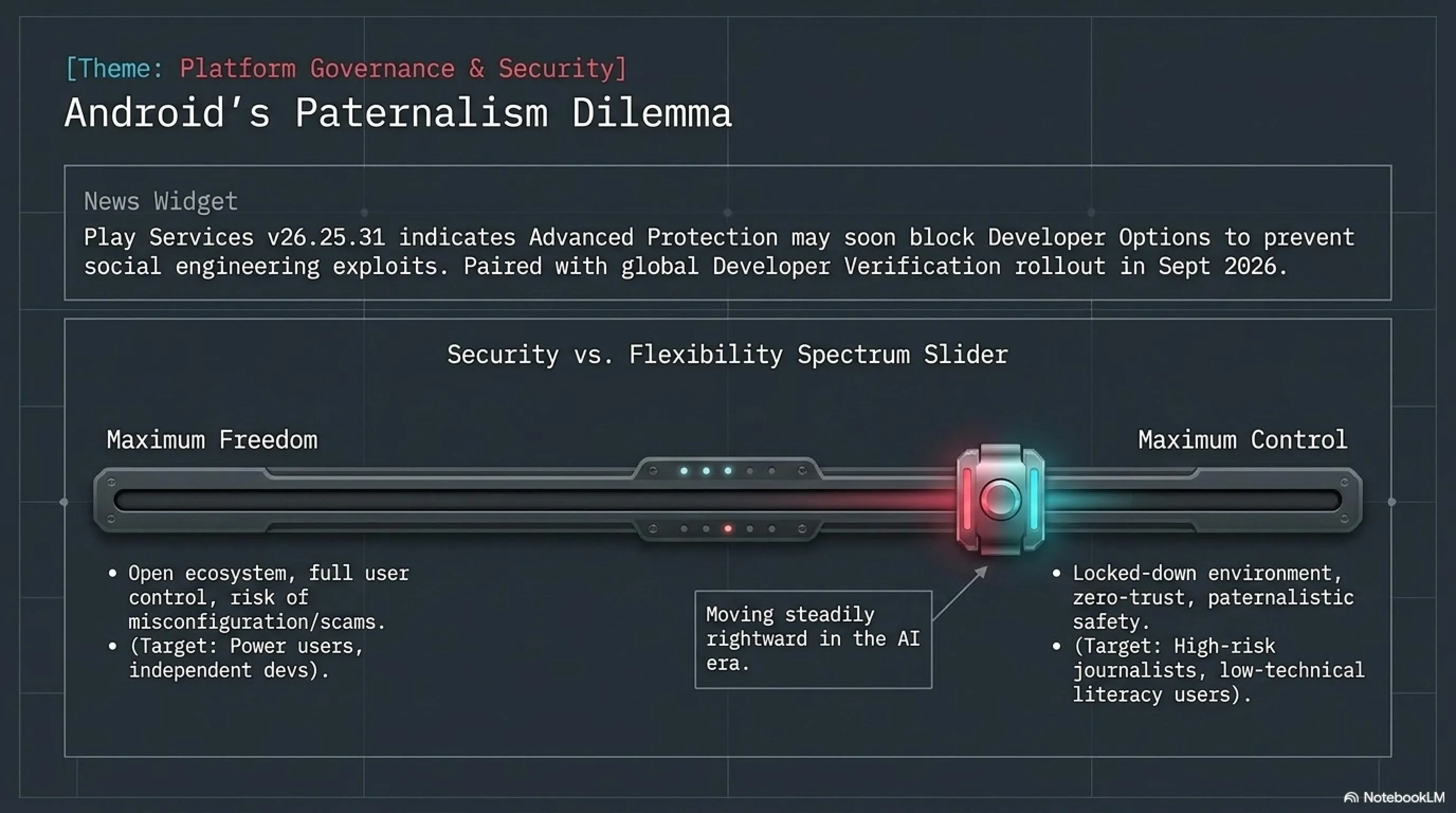
Google is preparing to make Android's Advanced Protection mode even more restrictive by potentially blocking access to Developer Options, according to code discovered in the latest version of Google Play Services (version 26.25.31). This change targets a security vulnerability but raises concerns among power users and developers who rely on these settings for legitimate purposes.
Advanced Protection mode, introduced with Android 16, bundles a comprehensive set of security features designed for high-risk users such as journalists, political activists, corporate executives, and others who face elevated threats. Once enabled, the system prevents accidental or malicious disabling of individual security features through a "defense-in-depth" strategy where multiple layers work together.
The logic behind blocking Developer Options is straightforward: these settings can be exploited by malicious actors to circumvent security protections. For example, USB debugging—a feature within Developer Options—allows external devices to execute commands on the phone, potentially bypassing lock screens or extracting data. Scammers have been documented using social engineering to trick victims into enabling these settings.
📚 Classified & Related Dossiers in TekinGame
If you wish to explore beyond this report and delve into cybernetic frontiers and autonomous AI architectures, do not miss these three exclusive deep-dives in the Tekin Garage:
Advanced Protection Mode implements strict security configurations including: blocking sideloading from unknown sources, enhanced phishing protection, automatic scanning of potentially harmful apps, restrictions on insecure network connections, and now potentially Developer Options lockdown. It's opt-in and designed for users facing above-average security threats.
However, this protection comes at the cost of flexibility for legitimate use cases. Android developers, beta testers, accessibility users, and tech enthusiasts rely on Developer Options for numerous purposes: debugging applications during development, adjusting animation speeds for better usability, monitoring CPU and GPU performance, enabling USB tethering for internet sharing, forcing specific display resolutions, and accessing dozens of other advanced configurations.
Critics argue that Google should trust users who explicitly enable Advanced Protection to make informed decisions about Developer Options. The Android platform has historically been defined by openness and user control, and excessive restrictions may undermine this philosophical foundation.
It's important to contextualize this change: it only affects users who deliberately enable Advanced Protection mode. For the vast majority of Android users who never activate this feature, nothing changes. Developer Options remains fully accessible as before.
This modification is part of Google's broader security enhancement strategy for Android. Simultaneously, Google is implementing Developer Verification requirements that begin rolling out September 30, 2026, in Brazil, Indonesia, Singapore, and Thailand before expanding globally in 2027. This system will block installation of apps from unverified developers unless users explicitly override the warning.
The Developer Verification program requires developers to register with Google, agree to terms of service, potentially pay fees, and provide identification documents. Supporters argue this protects users from malware and scam apps. Critics, including the Keep Android Open campaign, warn that it centralizes control and could harm independent developers and open-source projects.
These parallel initiatives—locking Developer Options in Advanced Protection and requiring Developer Verification for sideloading—reflect Google's evolving approach to Android security. The company is attempting to balance the platform's open ecosystem with protection against increasingly sophisticated threats.
One perspective worth considering: as Android expands into markets with less technical literacy, the potential harm from accidental misconfiguration or social engineering attacks may outweigh the benefits of universal access to advanced settings. Restricting dangerous capabilities for high-risk users while preserving them for the general population represents a middle ground.
Nevertheless, the debate highlights a fundamental tension in platform governance: who decides the appropriate balance between security and freedom? Should platforms make paternalistic decisions to protect users from themselves, or should they provide maximum control and trust users to manage their own risk?
For now, if you're a power user who needs Developer Options, simply don't enable Advanced Protection mode. But if you're a high-risk user who genuinely needs both maximum security and developer access, you may soon face a difficult choice.
Tekin Analysis: Three Major Trends Shaping This Monday
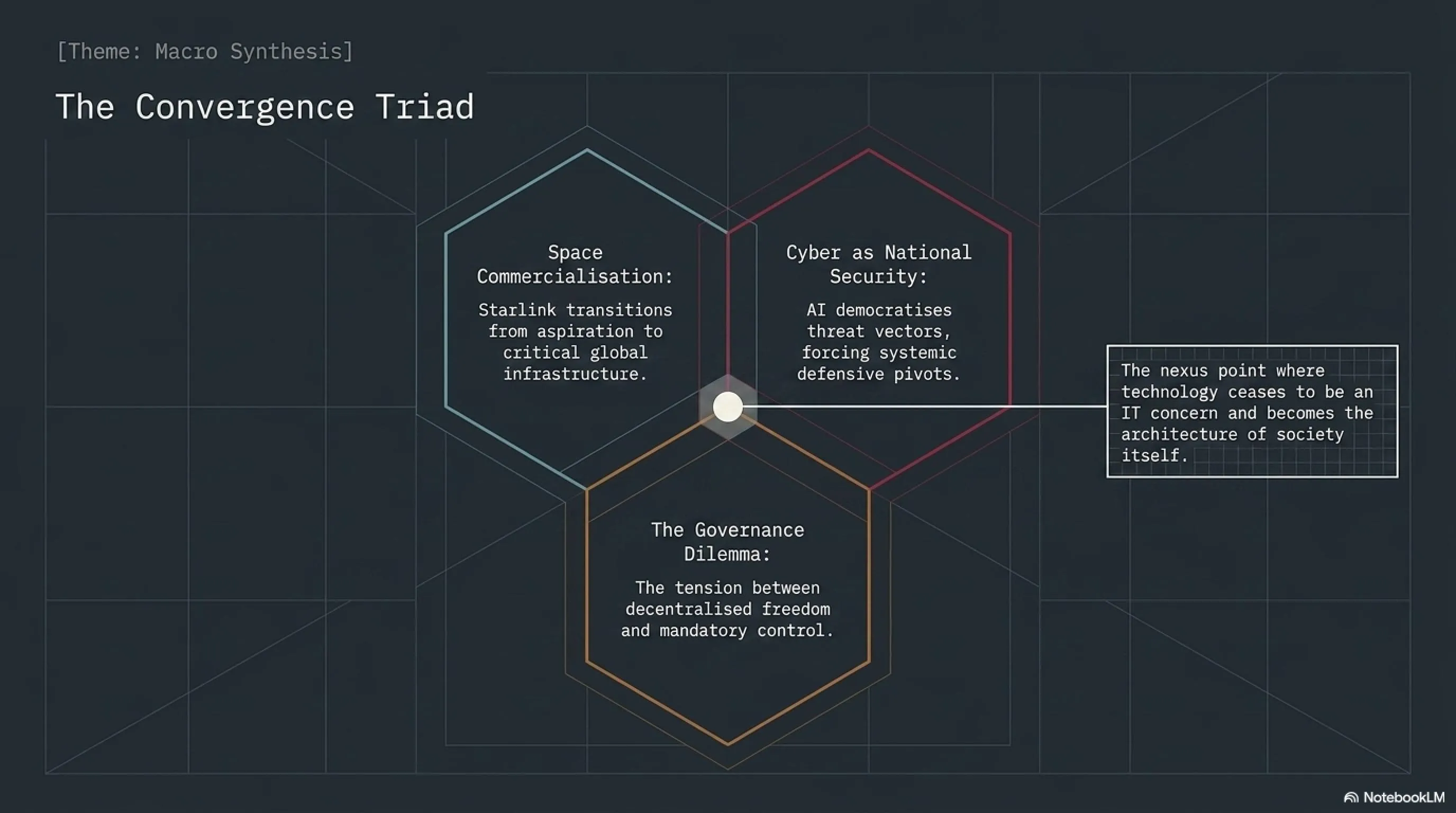
Stepping back from individual stories, three significant patterns emerge from today's news that deserve attention:
First, space commercialization has transitioned from aspiration to infrastructure. When SpaceX launches every 2.6 days, we're no longer discussing "space missions" as exceptional events. This is industrial-scale production. The Starlink constellation is becoming critical global infrastructure, comparable to undersea internet cables. This shift carries geopolitical implications: nations with advanced space capabilities gain strategic advantages in communications, navigation, and reconnaissance. China's response with its own megaconstellation and Europe's efforts to develop sovereign launch capabilities reflect recognition of space as contested strategic terrain.
Second, cybersecurity has evolved from an IT concern to a national security crisis. When 30% of a country's total crime is cyber-related, we're facing an economic and social threat that demands government-level response. Artificial intelligence amplifies this crisis by democratizing attack capabilities. Historical barriers to cybercrime—technical skill, infrastructure, international coordination—are collapsing. A moderately intelligent person with access to AI tools can now launch sophisticated phishing campaigns that previously required teams of specialists. The defensive response must evolve at similar speed, but currently lags dangerously behind.
Third, the control-versus-freedom debate remains central to digital platforms. Whether discussing Developer Options in Android, Ethereum governance, or cryptocurrency regulation, the fundamental question persists: who decides, and how much freedom is acceptable? There are no simple answers. Pure freedom enables abuse; pure control stifles innovation. Finding the optimal balance requires continuous negotiation between platform operators, users, regulators, and the broader public.
🎧
Tekin Editorial Team
Editor's Note
These stories demonstrate that technology no longer occupies a separate domain. Space infrastructure, cybersecurity, cryptocurrency, and platform governance are interconnected. Understanding the future requires seeing these connections rather than treating each domain in isolation.
Consider how these trends intersect: SpaceX's Starlink provides internet access in regions with limited infrastructure, but this also creates new attack surfaces for the cyber threats INTERPOL warns about. Cryptocurrency offers financial inclusion but faces the same control-versus-freedom tensions that Android faces with Developer Options. Platform governance in Ethereum mirrors governance challenges in mobile operating systems.
These parallels aren't coincidental. They reflect fundamental challenges in managing complex systems where many stakeholders have competing interests. Traditional hierarchical governance (one company or government decides) provides clarity but concentrates power. Decentralized governance (community decides) distributes power but creates coordination challenges and potential deadlock.
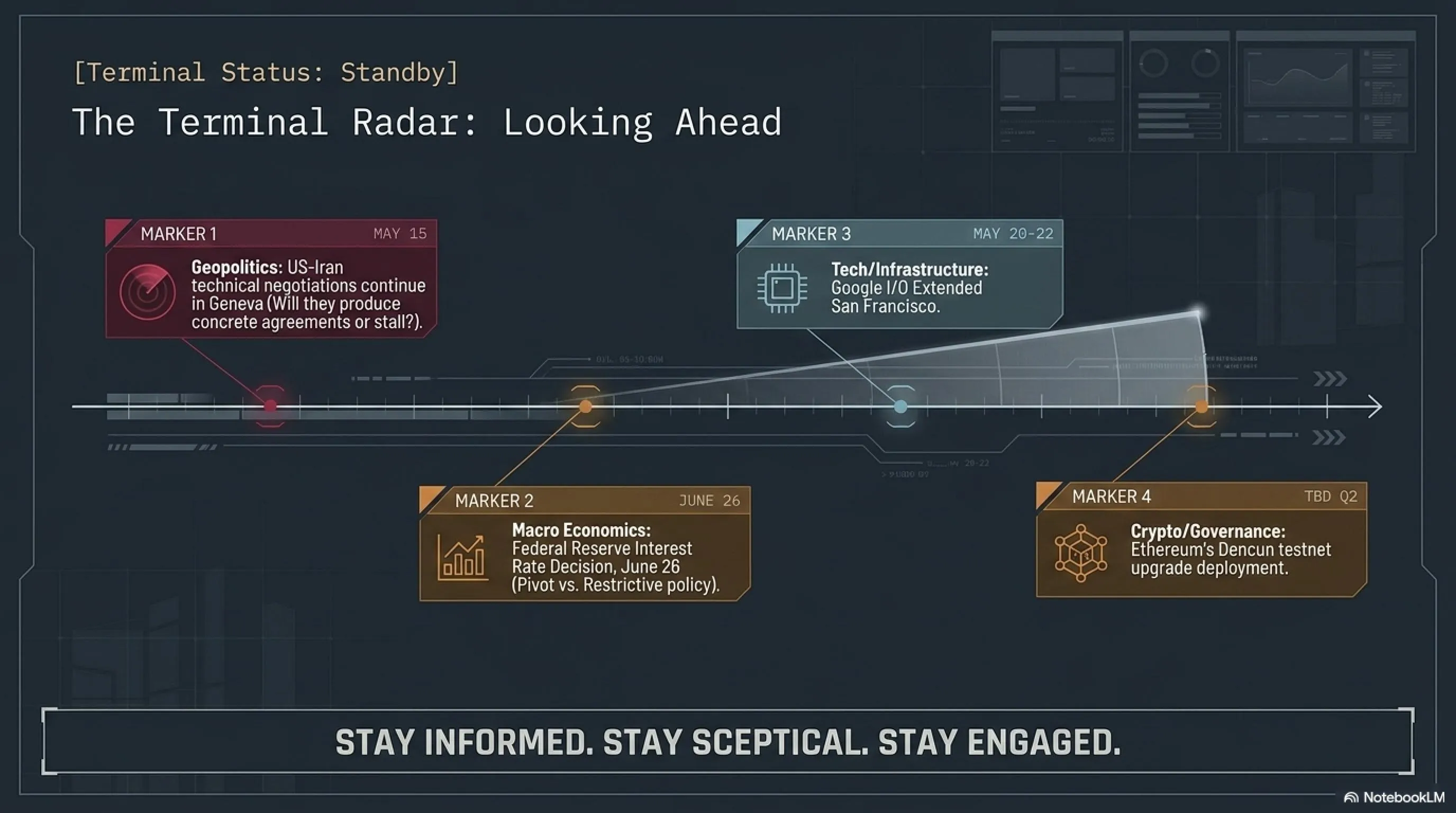
Key events to monitor: US-Iran technical negotiations continue in Geneva, Federal Reserve interest rate decision expected June 26, Google I/O Extended developer conference in San Francisco, and Ethereum's Dencun testnet upgrade deployment. Each could significantly impact financial markets and technology sectors.
The week ahead will likely bring more clarity on several fronts. Will US-Iran negotiations produce concrete agreements or stall on implementation details? Will the Federal Reserve finally pivot toward rate cuts, or maintain restrictive policy longer than markets expect? Will Ethereum's governance process provide a path forward on validator funding, or will the controversy force a retreat?
Deep Dive: The Economics Behind SpaceX's Launch Dominance
To truly understand SpaceX's achievement of 72 launches in half a year, we need to examine the economic and technological innovations that make this possible. Traditional aerospace companies like United Launch Alliance, Arianespace, and Roscosmos struggle to achieve 10-15 launches annually. What enables SpaceX to operate at 5-10 times that cadence?
The answer lies in vertical integration, reusability, and ruthless operational efficiency. SpaceX manufactures approximately 80% of its components in-house, from rocket engines to avionics to the satellite payloads themselves for Starlink missions. This eliminates supplier dependencies, reduces costs, and accelerates iteration cycles.
Consider the Merlin engine that powers Falcon 9's first stage. SpaceX produces these engines at a rate of approximately two per week at their Hawthorne, California facility. Each Falcon 9 booster uses nine Merlins, meaning SpaceX manufactures enough engines for one complete booster every 4.5 weeks. Traditional aerospace manufacturers might take 6-12 months to produce equivalent engines.
The reusability factor fundamentally changes launch economics. A new Falcon 9 costs approximately $50 million to manufacture. If that booster flies once and is discarded, the per-launch cost is $50 million plus operational expenses. But if it flies 30 times like B1063, the amortized hardware cost drops to less than $2 million per launch. Add refurbishment costs of perhaps $1-2 million per flight, and the marginal cost of a launch becomes remarkably low.
This economic model enables SpaceX to profit even when charging commercial customers $60-70 million per launch, prices that would be loss-making for traditional providers. And for internal Starlink missions, where SpaceX is effectively launching for itself, the cost drops to little more than fuel, range fees, and personnel time.
SpaceX's next-generation Starship vehicle aims to make Falcon 9's economics look expensive. Fully reusable with a payload capacity of 100-150 tons, Starship could reduce cost-per-kilogram to orbit by another order of magnitude. Early test flights have been promising, with the first successful orbital flight and booster catch achieved in late 2025.
But technology and economics alone don't explain SpaceX's dominance. Organizational culture matters enormously. SpaceX operates with a startup mentality despite employing over 13,000 people. Engineers are empowered to make rapid decisions, testing is aggressive, and failures are treated as learning opportunities rather than career-ending mistakes.
This contrasts sharply with traditional aerospace culture, where risk aversion, bureaucratic processes, and cost-plus contracting create incentives for slow, conservative development. NASA's Space Launch System, for comparison, has cost over $20 billion in development funds and has launched twice since 2022. SpaceX developed Falcon 9 for under $500 million in development costs.
The geopolitical implications of SpaceX's launch dominance are profound. The United States now controls over 80% of global launch capacity, a strategic advantage comparable to controlling critical maritime chokepoints or semiconductor manufacturing. Other nations recognize this vulnerability and are responding with their own programs, but catching up to SpaceX's decade of reusability experience proves challenging.
China's space program, well-funded and technically capable, is developing its own reusable rockets. Long March 9, currently in development, aims to match Falcon Heavy's capabilities with partial reusability. But as of mid-2026, China has not demonstrated the rapid reusability that SpaceX achieves routinely.
Europe faces even greater challenges. Arianespace's Ariane 6 rocket, which entered service in 2024, is expendable and cannot compete economically with reusable vehicles. The European Space Agency is studying reusable concepts, but deployment is likely years away.
Cryptocurrency Market Dynamics: Beyond the Headlines
While Bitcoin's price movement around $64,000 captures headlines, more significant shifts are occurring beneath the surface of cryptocurrency markets. The maturation of the asset class is changing how, why, and by whom crypto is traded.
Institutional adoption, long promised but slow to materialize, has accelerated dramatically in 2025-2026. Spot Bitcoin ETFs launched in early 2024 have accumulated over $60 billion in assets under management. Major pension funds, endowments, and insurance companies have begun allocating 1-3% of portfolios to Bitcoin as a portfolio diversifier.
This institutional participation fundamentally changes market dynamics. Retail traders tend to be momentum-driven, buying rallies and selling dips, creating volatility. Institutional investors typically deploy capital systematically through dollar-cost averaging or tactical allocations based on risk models. This steadier flow dampens volatility and reduces the sharp swings that characterized earlier crypto cycles.
Ethereum's evolution from proof-of-work to proof-of-stake in 2022, followed by multiple successful upgrades improving scalability and reducing fees, has positioned it as the infrastructure layer for decentralized applications. Real economic activity—DeFi protocols handling billions in daily volume, NFT marketplaces, decentralized autonomous organizations managing treasuries—occurs on Ethereum and its layer-2 scaling solutions.
The emergence of "real yield" as a metric for evaluating blockchain projects represents another maturation signal. Instead of focusing solely on token price appreciation, investors now analyze protocol revenue, fee generation, and sustainable value capture. Projects that generate genuine revenue by providing useful services are increasingly valued over those that simply distribute inflationary tokens.
Regulatory clarity, while still incomplete, has improved significantly. The SEC's approval of spot ETFs in 2024 established Bitcoin and Ethereum as non-securities. Other jurisdictions including the EU (with MiCA regulations) and Singapore (with progressive but clear frameworks) have provided workable rules for crypto businesses.
However, significant challenges remain. Crypto's reputation still suffers from association with scams, hacks, and illicit activity. High-profile collapses like FTX in 2022 and subsequent revelations of fraud in other exchanges have reinforced skepticism. Rebuilding trust requires time, transparency, and consistent delivery of useful products.
The philosophical tension between decentralization ideals and practical governance requirements persists. Bitcoin maximalists argue that anything beyond simple, ossified protocols compromises decentralization. Ethereum and other platforms accept greater complexity to enable programmability, creating governance challenges like the validator funding debate.
Looking forward, the next major catalyst for crypto adoption likely comes from stablecoins and cross-border payments rather than speculative investment. Stablecoins processed over $15 trillion in transaction volume in 2025, providing faster and cheaper international transfers than traditional banking. Major corporations are integrating stablecoin rails for supply chain payments and treasury management.
Central bank digital currencies (CBDCs) represent both competition and validation for crypto. Over 100 countries are researching or piloting CBDCs, with China's digital yuan most advanced. These government-issued digital currencies may compete with decentralized crypto, but they also normalize the concept of digital money and blockchain technology.
Cybersecurity in the AI Era: A Rapidly Escalating Arms Race
INTERPOL's report on phishing in Asia-Pacific represents one theater in a global cybersecurity crisis that's accelerating due to artificial intelligence. Understanding this crisis requires examining how AI changes both offense and defense in cyber conflicts.
On the offensive side, AI lowers barriers to entry dramatically. Historically, effective phishing required social engineering skills, language fluency, and cultural knowledge to craft convincing messages. AI language models now generate highly convincing phishing emails in any language, with perfect grammar and contextual awareness, in seconds.
Deepfake technology adds another dimension. Voice cloning requires only a few seconds of audio to generate convincing fake phone calls. Video deepfakes, while still detectable by experts, are good enough to fool casual observers. "CEO fraud" schemes, where criminals impersonate executives to authorize fraudulent transfers, have become far more effective.
AI also enables personalization at scale. Attackers can scrape social media profiles, analyze interests and relationships, and generate targeted phishing messages that reference specific details about the victim's life. This "spear phishing" approach, previously labor-intensive and reserved for high-value targets, can now be automated against thousands of victims simultaneously.
On the defensive side, AI provides powerful tools for threat detection and response. Machine learning models can analyze network traffic patterns to identify anomalies indicating intrusions. Behavioral analytics can detect when user accounts behave suspiciously, even if credentials are legitimate. Automated systems can contain threats faster than human responders.
But defense faces a fundamental asymmetry: attackers need to succeed only once, while defenders must succeed continuously. A single clicked phishing link or misconfigured server can compromise an entire network. Defenders must protect every possible entry point, while attackers can probe for weaknesses at their leisure.
The human factor remains the weakest link. Security awareness training helps, but humans remain fallible. We're pattern-recognition machines optimized for social interaction, not paranoid security gatekeepers. Tricking humans through social engineering will always be easier than breaking technical protections.Modern security frameworks embrace 'zero trust' principles: never trust, always verify. Every access request, even from inside the network, requires authentication and authorization. Micro-segmentation limits lateral movement if attackers breach the perimeter. This approach assumes breach is inevitable and focuses on limiting damage.
The ransomware epidemic illustrates the stakes. In 2025, global ransomware damages exceeded $30 billion, with average downtime for affected organizations reaching three weeks. Healthcare systems, unable to access patient records, have delayed treatments. Manufacturers have halted production lines. Government services have gone offline for days.
Paying ransoms, while discouraged by law enforcement, often appears rational from a business perspective when recovery costs exceed the ransom demand. This economic calculus sustains the ransomware ecosystem. Until the economics change—either through better backups and recovery capabilities, or through law enforcement disrupting criminal operations—ransomware will persist.
International cooperation on cybercrime remains inadequate. Many major ransomware groups operate from jurisdictions that don't cooperate with Western law enforcement. Russia and North Korea, in particular, harbor cybercriminal groups and state-sponsored hackers who target Western institutions with little fear of prosecution.
Cryptocurrency provides the payment infrastructure that enables ransomware. Bitcoin's pseudonymous nature, combined with mixing services and privacy coins, makes tracing payments difficult though not impossible. Some argue that without cryptocurrency, ransomware would be far less viable since traditional payment systems could more easily block or reverse fraudulent transactions.
The path forward requires multiple complementary approaches: better security technology, improved user education, stronger legal frameworks, international cooperation, and perhaps fundamental rethinking of how we design systems. The internet and most software were built prioritizing functionality and convenience over security. Retrofitting security onto inherently insecure foundations has limits.
Some technologists argue for a more radical approach: designing new internet protocols and operating systems with security as the primary design constraint. Projects like Google's Fuchsia OS and various "clean slate" internet architecture research efforts explore this direction. But replacing entrenched infrastructure is incredibly difficult, and the installed base of existing systems will persist for decades.
The questions raised by Android's Developer Options lockdown and Ethereum's validator funding debate exemplify a central challenge of the digital age: how should platforms be governed, and who should make the rules?
Traditional governance models provide limited guidance. Corporations govern through hierarchy: executives make decisions, boards provide oversight, shareholders vote on major issues. Governments govern through democracy (ideally): elected representatives make laws, courts interpret them, citizens participate through voting and advocacy.
But digital platforms don't fit neatly into either model. They're private companies, but they provide essential public infrastructure. They serve billions of users across hundreds of jurisdictions, making any single government's authority incomplete. They enable commerce, speech, and social organization at unprecedented scale, making their governance decisions consequential for society.
Google's decision about Developer Options illustrates this tension. From one perspective, Google owns Android and can make whatever design decisions it wants. From another perspective, Android is an open-source platform used by billions of people, giving Google outsized influence over digital life that perhaps shouldn't be exercised unilaterally.
Ethereum faces a different version of the same challenge. It's explicitly designed to be decentralized, with no single controlling authority. But decentralization doesn't eliminate the need for decisions; it distributes decision-making power across many stakeholders. The validator funding debate shows how difficult distributed decision-making becomes when stakeholders have conflicting interests.
These challenges will intensify as technology becomes more central to human existence. When AI systems make consequential decisions about credit, employment, healthcare, and criminal justice, who ensures they're fair and accountable? When autonomous vehicles must be programmed with ethical rules about unavoidable accidents, who decides those rules? When brain-computer interfaces enable direct neural connection to digital systems, who controls access and ensures safety?
Various governance models are being experimented with:
Multi-stakeholder governance: Representative groups of users, developers, governments, and civil society participate in decision-making. ICANN's governance of internet domain names follows this model.
Decentralized autonomous organizations (DAOs): Token holders vote on proposals, with voting weight proportional to holdings. This plutocratic approach faces criticism but enables rapid experimentation.
Regulatory oversight: Governments impose rules on platforms, enforcing compliance through fines and sanctions. The EU's Digital Services Act and GDPR exemplify this approach.
Competitive markets: Allow multiple platforms to compete, letting users choose their preferred governance model by selecting platforms. This requires genuine interoperability and low switching costs.
No single model works for all situations. The optimal governance structure depends on the specific context, stakeholders, and values at stake. But the status quo—where platform companies make unilateral decisions with limited oversight or accountability—increasingly appears inadequate for the power they wield.
The next decade will likely see intense experimentation, debate, and conflict over digital governance. The outcomes will shape whether the digital world amplifies or undermines human freedom, whether it concentrates or distributes power, and whether it serves broad human flourishing or narrow commercial interests.
Final Thoughts
Monday, June 22, 2026, opened with a mixture of inspiring achievements and concerning developments. SpaceX demonstrated that humanity can reliably and routinely access space. The crypto market showed it still struggles to respond coherently to geopolitical developments. INTERPOL's report reminded us that the digital world remains dangerous without adequate defenses. And proposals like Ethereum's Validator Redirected Revenue illustrated that decentralized governance is genuinely difficult.
But the most important takeaway is interconnection. These stories don't exist in isolation. The future we're building combines space technology, blockchain systems, cybersecurity imperatives, and platform governance. No single story tells the complete narrative.
Our role at Tekin is connecting these dots and revealing the larger picture. We hope this article has equipped you to start your week with greater energy and awareness.
As technology continues accelerating, the challenge isn't merely keeping pace with individual developments. The challenge is understanding how they fit together, what they mean collectively, and where they're taking us. That's the work we do here, every morning.
The pace of change can feel overwhelming. New launches, new vulnerabilities, new governance proposals, new regulations—the stream never stops. But within this complexity, patterns emerge. By identifying these patterns, we can navigate uncertainty more effectively.
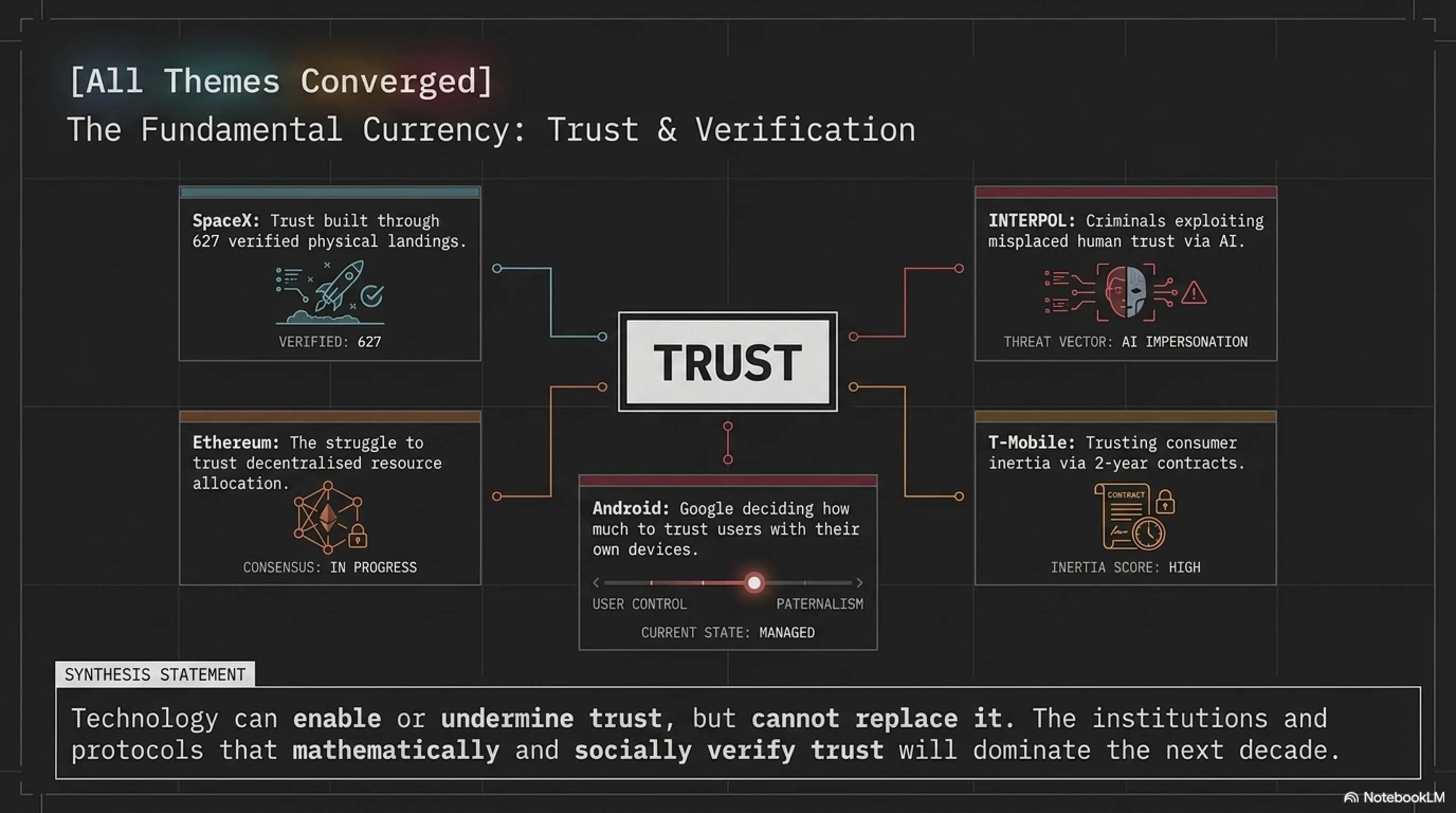
One final observation: Notice how often today's stories involved questions of trust and verification. SpaceX has built trust through 627 consecutive successful landings. INTERPOL warns that criminals exploit misplaced trust through phishing. Ethereum struggles with who to trust for resource allocation. T-Mobile asks you to trust them with a two-year commitment. Google decides how much to trust users with Developer Options.
Trust is the fundamental currency of the digital age. Technology can enable or undermine trust, but cannot replace it. The institutions, platforms, and systems that earn and maintain trust will shape our collective future. Those that betray or ignore trust will eventually fail, regardless of their technical sophistication.
With that perspective, we wish you an energized and productive Monday. Stay informed, stay skeptical, and stay engaged.
Does SpaceX hold the record for most launches in a single year?
Yes, SpaceX set the record with 120 launches in 2024 and is on pace to exceed 140 launches in 2026, far surpassing any other launch provider in history.
Why didn't Bitcoin rally on positive US-Iran geopolitical news?
Bitcoin currently responds more to monetary policy and institutional capital flows than to geopolitical headlines. Markets are focused on Federal Reserve interest rate decisions, which have more direct impact on crypto valuations than short-term diplomatic developments.
Is T-Mobile's iPhone 17 offer actually free?
Not entirely. You must commit to a more expensive unlimited plan, which typically costs $20-30 more monthly than basic plans. Over 24 months, you effectively pay for a portion of the device through higher plan costs. However, if you need the premium plan features anyway, the deal provides genuine value.
Will all Android users lose access to Developer Options?
No. This change only affects users who explicitly enable Advanced Protection mode, which is designed for high-risk individuals facing elevated security threats. The vast majority of Android users who don't enable this optional security mode will see no change.
When will Ethereum's Validator Redirected Revenue proposal be implemented?
The proposal is in early discussion stages. It must undergo extensive review, testnet deployment, security audits, and governance approval, which could take many months or years. There's no guarantee it will be implemented in its current form.
How can I protect myself from phishing attacks?
Key protections include: never clicking links in unexpected emails, verifying sender identities through independent channels, using unique passwords for each service, enabling multi-factor authentication wherever available, and maintaining healthy skepticism toward unsolicited communications. Security awareness training helps build instincts for recognizing suspicious patterns.