🌙 Tekin Night | Wednesday, August 5, 2026
Good evening! Tonight we bring you six major stories from the worlds of technology and gaming.
- 🎮EA Goes to Saudi Arabia- Gaming's biggest deal at $55 billion closes
- 🎧Xbox 360 on PC- Microsoft launches Disc to Digital program
- 🚀SpaceX's Historic Flight- First attempt to catch Ship from the sky
- 🗡️SpaceX Stock Plummets- 8% drop despite record revenue
- 📰Telegram and Apple- Temporary removal over illegal content
- ⚔️Ethereum Advances- EIP-7702 for smarter wallets
Gaming Giant Goes to Saudi Arabia: Electronic Arts Sold for $55 Billion
One of the biggest deals in video game industry history has officially closed. Electronic Arts, the powerhouse behind iconic franchises like FIFA (now EA Sports FC), Battlefield, The Sims, and Apex Legends, has been acquired for $55 billion by a consortium led by Saudi Arabia's Public Investment Fund (PIF). The deal, which began in October 2025, officially closed on August 4, 2026, marking the end of EA's 36-year run as a publicly traded company.
PIF, Saudi Arabia's sovereign wealth fund, now owns 94% of EA. The other partners in this massive transaction are Silver Lake, a prominent private equity firm, and Affinity Partners, the investment firm managed by Jared Kushner, former president Donald Trump's son-in-law. This is the largest leveraged buyout (LBO) in gaming history and ranks as the second-largest gaming acquisition ever, trailing only Microsoft's purchase of Activision Blizzard.

What is an LBO?
Financial Details of the Deal
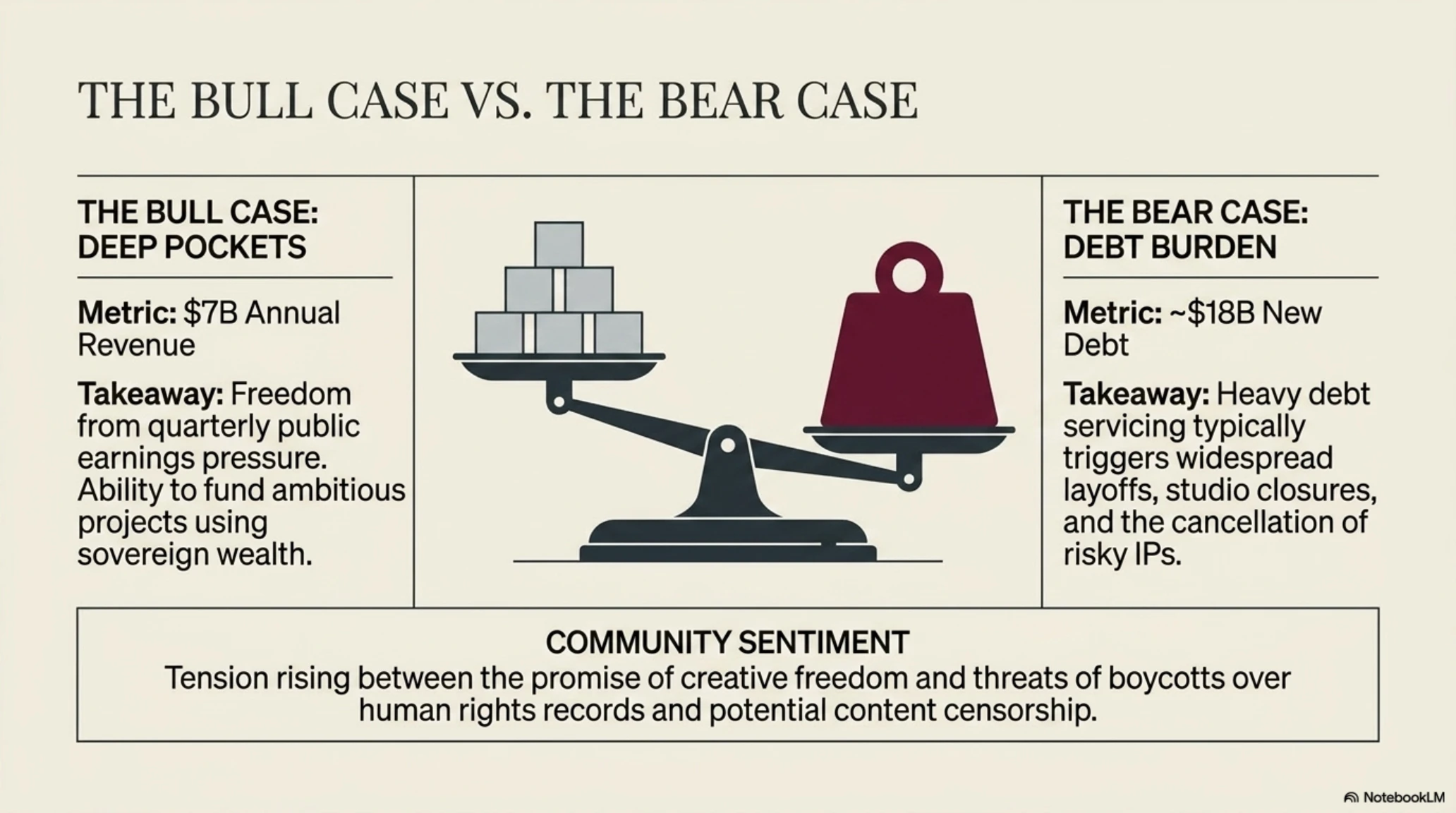
Under the terms of the agreement, EA shareholders received $210 per share in cash, representing a 25% premium over the stock price on September 25, 2025, when the deal was announced. PIF, which already owned 9.9% of EA before the acquisition, rolled over its existing stake and now controls the majority of the company. The concerning part is that this deal came with approximately $18 billion in new debt that EA must now service from its future earnings.
According to reports from GameSpot and Polygon, this massive debt load has raised concerns about EA's future. Analysts predict the company may resort to widespread layoffs, studio closures, or project cancellations to reduce costs. While no official announcements have been made yet, historical patterns show that LBO deals often involve significant workforce reductions to meet debt obligations and maintain profitability targets.
Key Points of the EA Deal
- Final price: $55 billion
- PIF Saudi Arabia owns 94%
- Shareholders received $210 per share
- EA exits public markets after 36 years
- New debt: approximately $18 billion
- Concerns about layoffs and studio closures
Why Saudi Arabia Wants EA
This isn't Saudi Arabia's first major investment in gaming. PIF has spent billions on stakes in Nintendo, Activision Blizzard, Take-Two Interactive, and Epic Games over recent years. Additionally, Savvy Games Group, a PIF subsidiary, has earmarked more than $38 billion for gaming industry investments. The strategy is part of Saudi Arabia's Vision 2030 initiative, which aims to diversify the kingdom's economy away from oil dependency.
With EA now in its portfolio, Saudi Arabia controls one of the world's largest game publishers and can exert significant influence over the industry's future direction. EA's annual revenue exceeds $7 billion, and its sports franchises alone reach hundreds of millions of players globally. This gives Saudi Arabia not just financial returns, but also soft power and cultural influence.
Gaming Community Reactions
The response to this acquisition has been mixed. Some analysts argue that PIF's deep pockets could enable EA to pursue more ambitious projects without worrying about quarterly earnings pressures. However, serious concerns exist about creative independence, content censorship, and the influence of Saudi government policies on company decisions. Saudi Arabia's controversial human rights record has also drawn criticism, with some gamers calling for boycotts of EA products.
Industry veterans have noted that major publishers under private ownership often face intense pressure to maximize short-term profits to service debt. This could mean fewer risks on innovative new IPs and more focus on proven franchises with guaranteed revenue streams. The coming months will reveal whether EA's creative culture can survive this transition or if we'll see a more risk-averse, financially-driven approach to game development.
Nostalgia Returns: Xbox 360 Games Coming to PC
Microsoft is preparing a significant move for Xbox fans. According to leaked documents confirmed by The Verge and GamesRadar, the company plans to bring Xbox 360 games to PC through official emulation. Additionally, a program called "Disc to Digital" that allows users to convert physical games into digital licenses will launch in August 2026 for Xbox One and Xbox Series X/S owners.
This initiative is part of Microsoft's broader strategy to create a unified Xbox ecosystem where players can enjoy their games on any device they prefer, including PCs, Xbox consoles, and even the company's upcoming handheld devices. The move represents a fundamental shift in how Microsoft views platform exclusivity and game preservation.
How Disc to Digital Works
The feature, which was discovered by users in the Xbox PC app code in July, allows users to insert a physical game disc into their console, install the game, and then receive a permanent digital license for it. This means you no longer need to keep the disc to play the game, and it becomes part of your digital library permanently. The system essentially converts your physical collection into a digital one without requiring repurchase.
According to the leaked documents, this program will be available for Xbox One and Xbox Series X/S games, but unfortunately, Xbox 360 and original Xbox games won't support this conversion feature. Nevertheless, this capability could revolutionize how players manage their physical game libraries and represents a significant value-add for Xbox console owners.
Why Xbox 360 Matters
Rollout Timeline
Based on the released information, Microsoft has a phased approach to this initiative. First, the Disc to Digital program launches in August 2026 for Xbox One and Series X/S. Second, original Xbox games will come to PC in October 2026, though initially only four titles will be supported. Third, Xbox 360 games will gradually arrive on PC and next-generation Xbox devices (such as Project Helix and the rumored handheld) between 2027 and 2028.
Developers must opt-in to allow their Xbox 360 games to run on these new platforms, so not every Xbox 360 title will be available. However, this move demonstrates Microsoft's commitment to game preservation and backwards compatibility, setting them apart from competitors who often abandon previous generation libraries.
The gradual rollout suggests Microsoft wants to ensure quality and stability before expanding the program. Each Xbox 360 game will need testing and potential optimization to run properly on modern PC hardware through emulation. Given that many Xbox 360 games were designed for very different hardware architectures, this technical challenge explains the extended timeline.
Competition with Unofficial Emulators
Currently, the best Xbox 360 emulator for PC is Xenia, a community-developed project that supports over 600 games. Xenia is free and open-source but requires technical knowledge and manual configuration. Microsoft's official emulator will certainly offer a more user-friendly experience and likely better performance, as Microsoft has direct access to Xbox 360 source code and proprietary documentation that community developers lack.
The existence of Xenia demonstrates strong demand for Xbox 360 emulation on PC. Many gamers who never owned a 360 or who sold their consoles years ago want to experience these games. Microsoft's official solution will provide a legal, supported path that benefits both players and developers through potential renewed interest and sales.

SpaceX and the Impossible Mission: Catching Starship from the Sky
Elon Musk announced during SpaceX's first earnings call since its IPO that the next Starship test flight (Flight 14) will take place in late August 2026, and for the first time, the company will attempt to catch the upper-stage Ship with the launch tower's mechanical arms, just as it has done three times successfully with the Super Heavy booster. If this mission succeeds, it will represent one of the greatest achievements in spaceflight history.
Musk also revealed that this flight will deploy the first operational Starlink Version 3 satellites. These satellites represent the most advanced generation of SpaceX's internet constellation, offering significantly more capacity and speed than previous versions. Until now, SpaceX has successfully caught the Super Heavy booster with the tower three times, but has never attempted to catch the Ship (upper stage).
Why Catching the Ship Matters So Much
One of SpaceX's primary objectives is creating a fully reusable rocket system. This means both the booster and Ship must be able to return to Earth, be refurbished, and launch again without building new components. If SpaceX can catch the Ship with the tower as well, the cost per launch decreases dramatically and enables rapid reusability with minimal turnaround time.
The tower catch technology (nicknamed "Chopsticks") offers several advantages over traditional landing: faster recovery operations, reduced need for complex landing systems on the vehicle itself, and immediate access for inspection and refurbishment. However, this technology is extremely complex, requiring millimeter-precision timing, velocity control, and positioning. The Ship will be descending at high speed and must align perfectly with the tower's arms at exactly the right moment.
What is Starship?
The Role of Starlink V3 in This Mission
The Starlink Version 3 satellites being carried on this flight represent a new generation of SpaceX's satellite internet constellation. These satellites are larger and more capable than previous versions and can only be launched by Starship, as Falcon 9 lacks the payload capacity to carry them. Version 3 is expected to increase internet speeds by up to 10x and reduce latency below 10 milliseconds, making Starlink competitive with terrestrial fiber connections.
Each Starlink V3 satellite weighs approximately 2 tons and measures about 7 meters in length when deployed. The satellites feature upgraded phased array antennas, more powerful solar panels, and advanced propulsion systems for longer operational lifespans. SpaceX plans to deploy thousands of these satellites, creating a next-generation internet infrastructure accessible from anywhere on Earth.

SpaceX stated that if regulatory approvals are granted, the Flight 14 mission will occur in late August. Musk added that he expects Starship launch frequency to "increase rapidly" and the company is targeting 50 Starship flights per year by 2027. This ambitious goal would transform space access economics and enable projects previously considered impossible due to launch cost constraints.
The Paradox of Success: SpaceX Beats Revenue But Stock Crashes
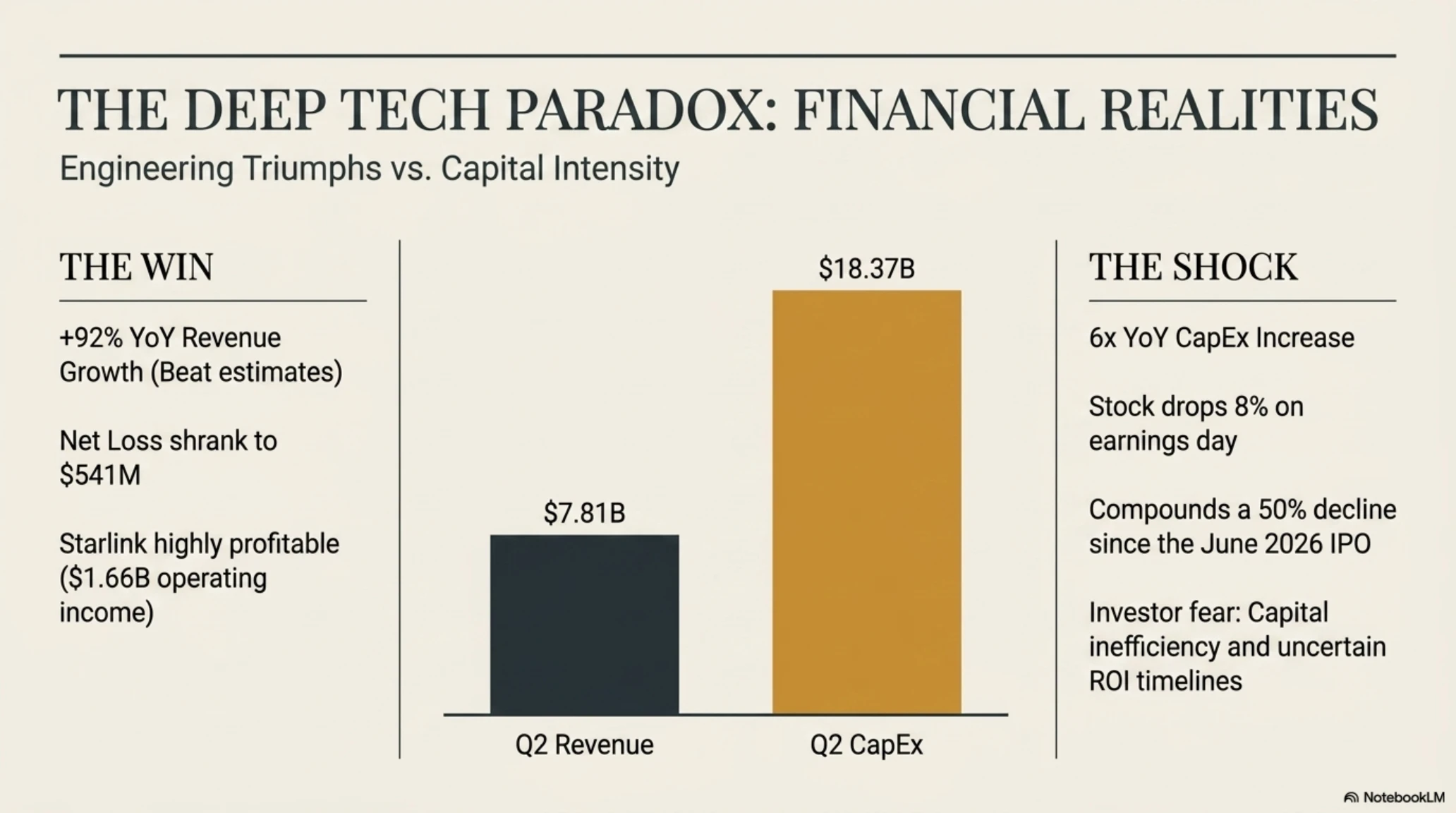
In a strange but explainable occurrence, SpaceX stock dropped 8% on Tuesday, August 4, after announcing its first earnings report as a public company, despite beating all Wall Street revenue expectations. This market reaction reflects investor concerns about the astronomical artificial intelligence costs SpaceX is incurring.
Q2 2026 Numbers
According to the published report, SpaceX generated $7.81 billion in revenue during Q2 2026, representing 92% year-over-year growth and 12.7% above analyst expectations of $6.81 billion. The company's adjusted EBITDA reached $3.5 billion, nearly triple the previous year. Net loss also improved to $541 million, down from $1 billion a year ago, and the company beat earnings per share estimates.
However, the factor that triggered the stock drop was unexpected capital expenditure (CapEx). SpaceX spent $18.37 billion in CapEx during Q2, more than double Q1 ($10.1 billion) and six times the previous year ($2.83 billion). Analysts had forecasted approximately $13 billion, so this figure shocked investors and raised questions about capital allocation and return on investment timelines.
Understanding CapEx
The AI Division is the Main Culprit
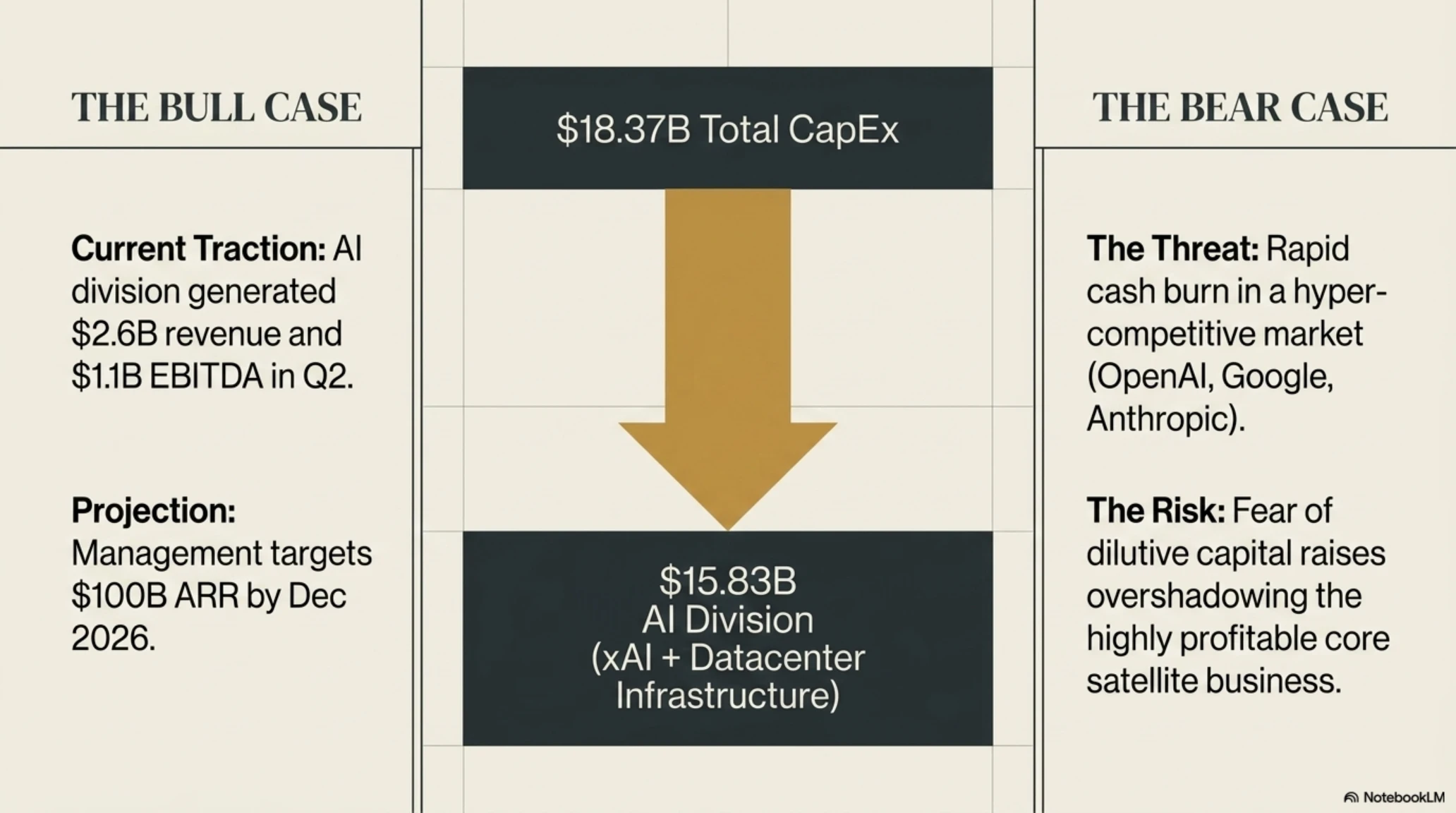
Of the $18.37 billion CapEx total, $15.83 billion went to SpaceX's AI division. This segment, created from the February 2026 acquisition of xAI (Elon Musk's artificial intelligence company), is building massive computational infrastructure to train large language models. SpaceX has cloud services contracts with Anthropic and Google and is constructing dedicated datacenters with hundreds of thousands of high-end GPUs.
Despite the enormous spending, the AI division generated $2.6 billion in revenue during Q2 and achieved positive adjusted EBITDA of $1.1 billion, demonstrating the business is moving toward profitability. Management projected that by December 2026, the AI division's annual recurring revenue (ARR) will reach $100 billion, which would justify the current investment level if achieved. However, investors remain skeptical given the highly competitive AI market and uncertain regulatory environment.
Performance Across SpaceX's Different Divisions
Beyond the AI division, the Connectivity segment (Starlink) remains SpaceX's primary revenue driver. Starlink revenue grew by $1.7 billion in Q2, achieving 66% year-over-year growth. This segment's operating income was $1.66 billion, demonstrating that Starlink is highly profitable and essentially funds SpaceX's other ventures. The Space division (Falcon 9 launches and space missions) posted an operating loss of $542 million, though this is expected as SpaceX invests heavily in Starship development.
SpaceX Q2 2026 Revenue Breakdown
| Division | Q2 2026 Revenue | YoY Growth | Operating Income |
|---|---|---|---|
| Connectivity (Starlink) | $4.2B | +66% | $1.66B |
| AI | $2.6B | +247% | $1.1B |
| Space (Launches) | $1.0B | +12% | -$542M |
| Total | $7.8B | +92% | $2.22B |
Why Did the Stock Drop?
Despite strong revenue numbers, investors worry that SpaceX is burning cash too quickly in the AI division. This segment is still in early stages, and the AI market is extremely crowded with competitors like OpenAI, Google, Anthropic, Meta, and others. The key question is whether SpaceX can achieve sustainable profitability at this investment pace, or if it will need to raise additional capital at dilutive terms.
Additionally, SpaceX stock has declined more than 50% since its June 2026 IPO, meaning investors were already underwater coming into this earnings report. This was SpaceX's first opportunity to prove its value as a public company, but the market appears unconvinced. Some analysts suggest the company went public too early, before demonstrating sustainable profitability across all divisions, leading to the current valuation challenges.

Apple and Telegram: Forty Minutes That Sparked Controversy
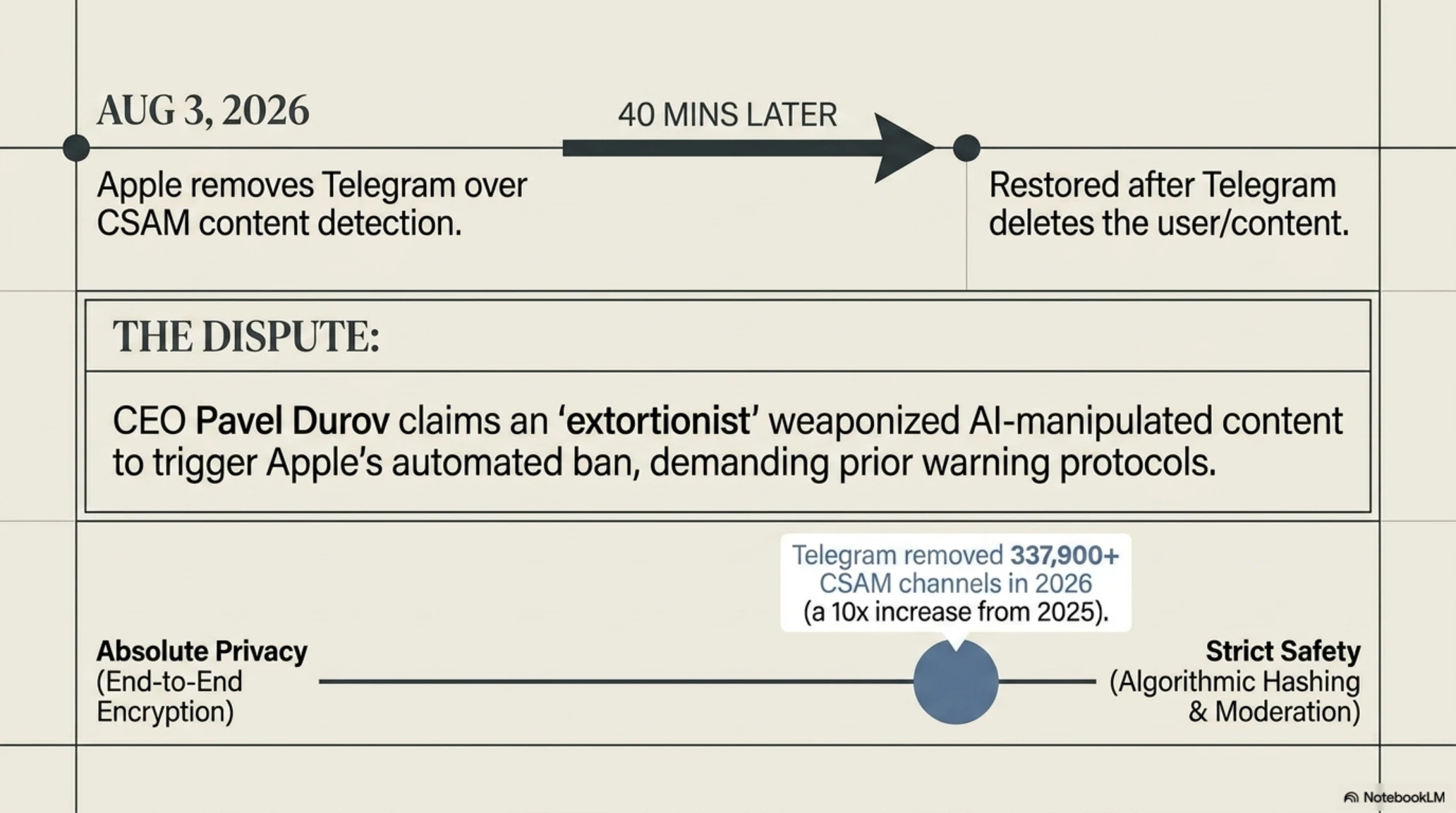
On Monday night, August 3, 2026, users worldwide noticed they couldn't download Telegram from the App Store. The application had been temporarily removed from Apple's app marketplace. The reason? Apple discovered content related to child sexual abuse material (CSAM) during a routine review. But the story doesn't end there.
Details of the Removal and Restoration
According to reports from MacRumors and Forbes, Apple removed Telegram around 8 PM local US time from the App Store. Telegram immediately responded, identifying and blocking the responsible user and removing the reported content. Approximately 40 minutes later, Apple restored the application. In a statement Apple released, the company said: "We briefly removed Telegram from the App Store after our review found content that violates our strict guidelines prohibiting child sexual abuse material. The app was subsequently restored after the developer promptly removed the content and banned the user who posted it."
Telegram stated in its own release that this involved a single user who was immediately banned. The company also announced that in 2026 it has removed more than 337,900 groups and channels related to CSAM, a significant increase from 29,640 removals in 2025. This dramatic increase reflects either improved detection systems or a growing problem on the platform, depending on interpretation.
Pavel Durov's Claim: Cyber Extortion
However, Telegram CEO Pavel Durov told a different story. In a post on X (formerly Twitter), he claimed that an "extortionist" uploaded AI-manipulated CSAM content to Telegram specifically to force Apple to remove the app. Durov stated: "Apple removed Telegram without contacting us first. This creates a systemic risk for every mobile app. If an app used by more than a billion people can be removed from the App Store without prior warning, any app can be."
Durov's allegation raises serious questions about App Store policies and whether bad actors can weaponize content moderation systems to harm competitors. If true, this represents a significant vulnerability in how major platforms enforce policies. However, Apple has not confirmed Durov's extortion narrative and maintains it simply responded to CSAM content it discovered during standard review procedures.

What is CSAM?
Content Moderation Challenges for Large Platforms
This incident highlights the difficult challenge messaging platforms face: they must protect user privacy while also detecting and removing illegal content. Telegram has long been criticized by child safety organizations for its liberal content moderation policies and end-to-end encryption that makes it difficult to scan content at scale. The platform's emphasis on privacy and free speech attracts both legitimate users and bad actors.
This isn't the first time Telegram has faced such problems. In recent years, several countries have temporarily or permanently blocked Telegram, including Russia, Iran, and some Middle Eastern nations. However, removal from Apple's App Store is a rare event that demonstrates Apple's willingness to enforce its policies even against major applications with massive user bases.
The broader debate centers on balancing privacy with safety. Strong encryption protects users from surveillance and hacking but also makes it harder to detect illegal activity. Companies like Apple must navigate complex trade-offs between security, privacy, and content moderation, often facing criticism regardless of which priority they emphasize. This incident will likely fuel ongoing debates about platform responsibility and appropriate enforcement mechanisms.
Ethereum's Next Step: What is EIP-7702 and Why It Matters
If you think crypto wallets are complicated and insecure, there's good news: Ethereum is working on a solution that could completely transform the crypto user experience. EIP-7702, a proposal recently introduced in the Ethereum ecosystem, aims to add capabilities like gasless transactions, wallet recovery, and multi-signature authorization to regular wallets (EOAs).
What's the Difference Between EOA and Smart Accounts?
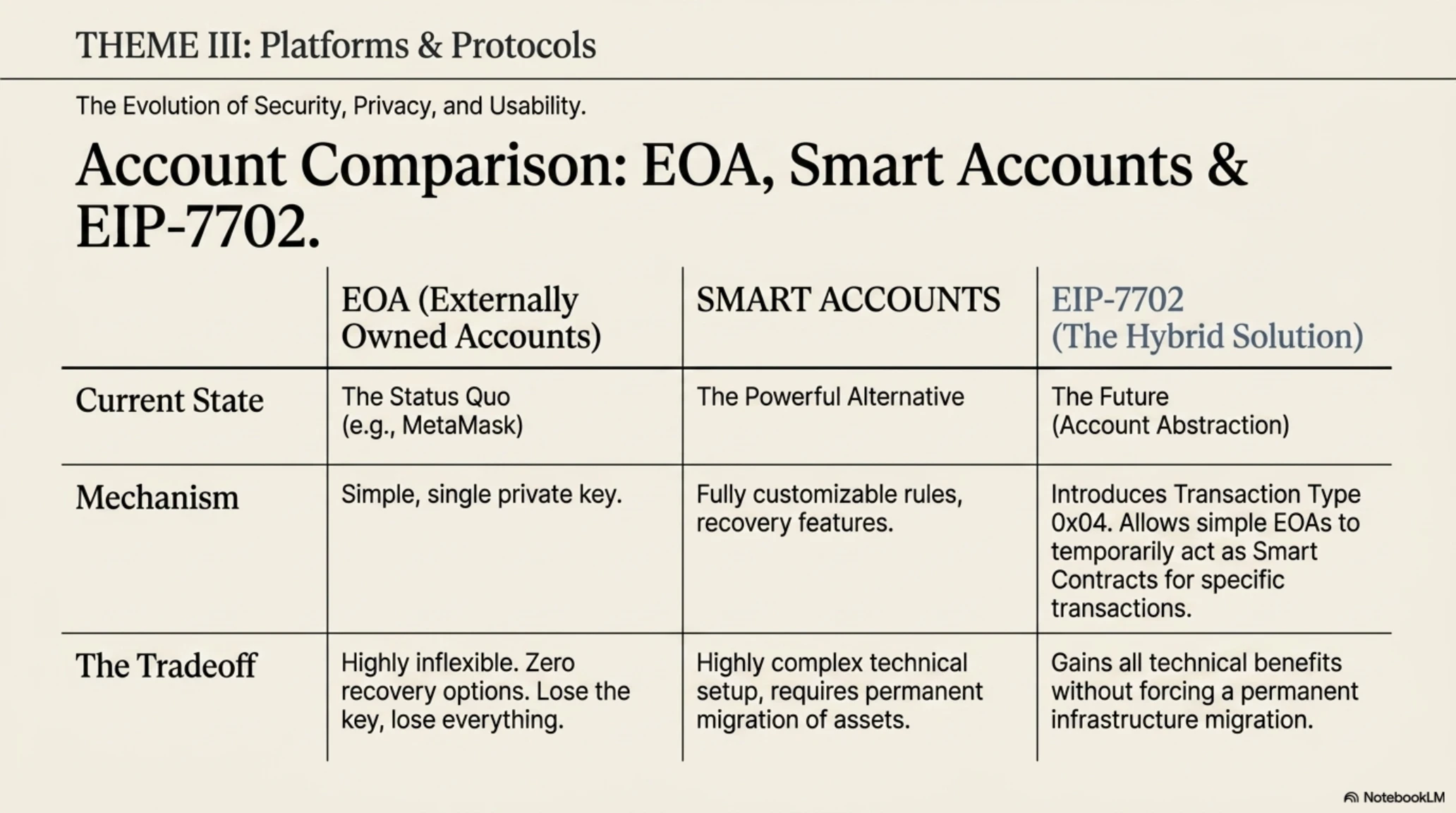
Currently, most Ethereum users rely on EOA (Externally Owned Account) wallets like MetaMask. These wallets are controlled by a single private key, and if you lose that key, you permanently lose access to your assets with no recovery option. Conversely, Smart Accounts (controlled by smart contracts) offer advanced features like wallet recovery, spending limits, and batch transactions, but setting them up and using them is complex and requires technical knowledge.
The fundamental difference is that EOAs are simple but inflexible, while Smart Accounts are powerful but complicated. EIP-7702 aims to bridge this gap by allowing EOAs to temporarily "act like" Smart Accounts when needed, giving users the best of both worlds without forcing them to migrate to entirely new wallet infrastructure.

Account Abstraction Explained Simply
How Does EIP-7702 Work?
EIP-7702 introduces a new transaction type (Type 0x04) that allows EOA wallets to temporarily point to smart contract code. This means you can activate Smart Account capabilities for a specific transaction without permanently changing your wallet. In other words, your EOA can "temporarily" behave like a Smart Account when needed, then return to normal operation.
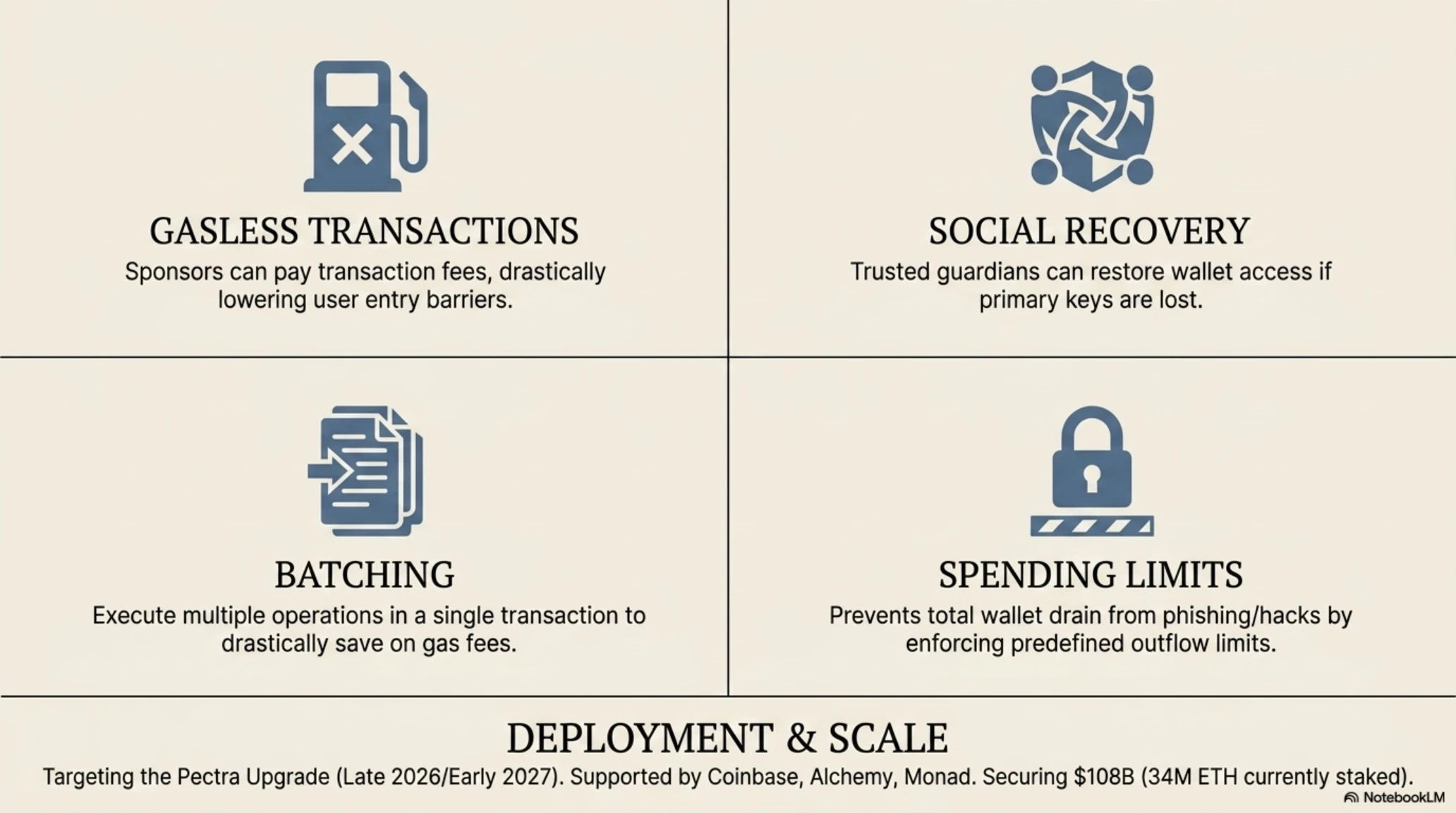
The advantages of this approach include several key features. First, gasless transactions (Gas Sponsorship) where someone else pays transaction fees, lowering barriers for new users. Second, wallet recovery through Social Recovery or Guardian systems that allow trusted contacts to help recover access. Third, batch transactions that execute multiple operations in a single transaction, saving gas fees. Fourth, spending limits that prevent total wallet drainage if compromised, limiting potential losses from hacks or phishing attacks.
Difference Between EIP-7702 and EIP-4337
Before EIP-7702, the EIP-4337 proposal for Account Abstraction was introduced, which required a separate mempool for UserOps and Bundler infrastructure. EIP-7702 is simpler because it works directly at the Ethereum protocol layer and doesn't require additional infrastructure. This means wallets can implement this capability faster and users can benefit sooner without waiting for complex ecosystem changes.
Companies like Coinbase, Alchemy, and QuickNode are building tools for developers to easily integrate EIP-7702. Additionally, Monad, an Ethereum-compatible blockchain, has announced full support for EIP-7702, potentially becoming one of the first chains to offer these features at launch. The ecosystem support suggests EIP-7702 could see rapid adoption once finalized.
Ethereum Staking Status August 2026
When Will EIP-7702 Activate?
EIP-7702 is planned to be part of the Pectra upgrade, scheduled for late 2026 or early 2027. Pectra will be one of Ethereum's most significant upgrades after The Merge and will include several other improvements as well. Developers are currently testing EIP-7702 on test networks, and feedback has been positive. The proposal has strong support from major wallet providers and infrastructure companies who see it as a crucial step toward mainstream crypto adoption.

Conclusion: A Night Full of Major Developments
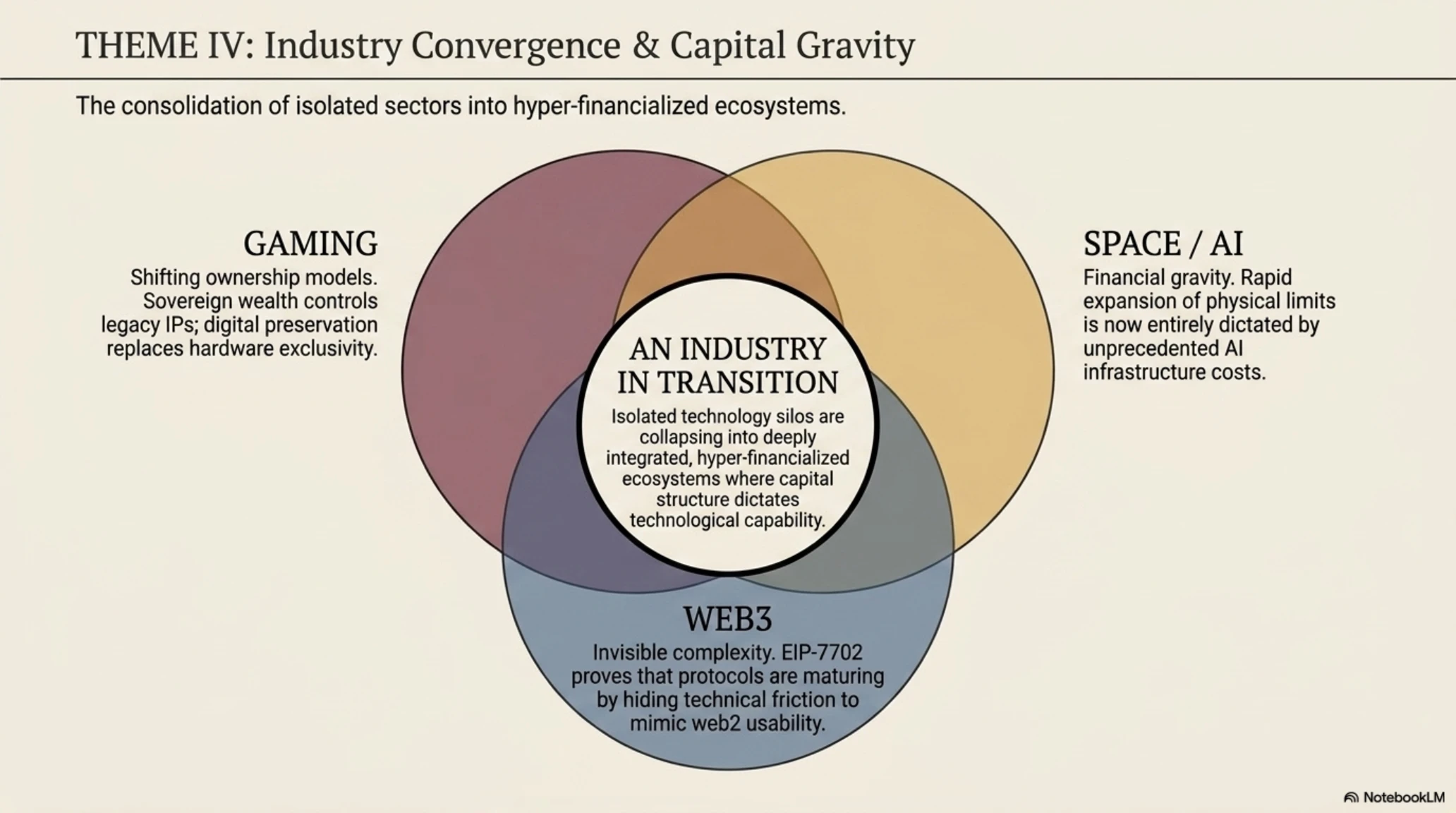
Tonight we witnessed six important stories, each revealing the future direction of the technology and gaming industries. EA's acquisition by Saudi Arabia demonstrates that regional powers are making serious entries into gaming. Microsoft's Disc to Digital program and Xbox 360 coming to PC shows the company's commitment to preserving gaming heritage. SpaceX aims to break new ground in space technology with Flight 14, though significant financial challenges lie ahead that cannot be ignored.
The Telegram and Apple incident reminds us that major platforms continue to wrestle with content moderation challenges. Finally, Ethereum's EIP-7702 proposal shows that the crypto world is evolving to become more user-friendly and secure. These developments collectively point toward an industry in transition, where established business models face disruption, new players gain influence, and technological boundaries continue to expand. Good night, and stay tuned for tomorrow's news!
Frequently Asked Questions
Will Saudi Arabia's purchase of EA affect game quality?
It's unclear yet, but experience shows LBO deals often involve cost-cutting and pressure for short-term profitability. Smaller studios might close or risky projects might be canceled to service debt obligations.
When can we play Xbox 360 games on PC?
Full rollout is planned between 2027 and 2028. However, you can already play many Xbox 360 games on PC using the Xenia emulator, though it requires technical setup.
How does SpaceX catch the Ship from the sky?
Using two giant mechanical arms (nicknamed Chopsticks) mounted on the launch tower. As the Ship descends, these arms catch it mid-air, like catching a falling rocket. It requires millimeter-precision timing and positioning.
Why did SpaceX stock drop despite good revenue?
Due to extremely high capital expenditure in the AI division. Investors worry SpaceX is burning cash too quickly and may take longer to achieve profitable returns on these massive investments.
Was Telegram actually hacked?
No. According to Pavel Durov's claim, an extortionist deliberately uploaded CSAM content to force Apple to remove the app. However, Apple hasn't confirmed this narrative and says it simply responded to content violations discovered during review.
What problem does EIP-7702 solve?
It solves the complexity and insecurity of crypto wallets. With this proposal, users can have features like wallet recovery, gasless transactions, and multi-signature authorization without needing to change their existing wallets or migrate to complex new systems.
Sources
The Guardian - EA Bought by Saudi-led Group
Polygon - EA Deal Complete
Kotaku - EA Officially Sold
Xbox 360 to PC:
The Verge - Xbox 360 Games Coming to PC
GamesRadar - Disc to Digital Launch
SpaceX Starship Flight 14:
Space.com - Starship Flight 14
The Next Web - SpaceX Ship Catch
SpaceX Earnings:
CNBC - SpaceX Q2 Earnings
SiliconANGLE - SpaceX Stock Falls
Apple and Telegram:
MacRumors - Telegram Removed
Forbes - Telegram CSAM Issue
Ethereum EIP-7702:
Ethereum.org - Account Abstraction
QuickNode - EIP-7702 Guide
Additional Gallery: Tekin Night August 5: Saudi Arabia Buys EA, Xbox 360 on PC & SpaceX's Historic Flight