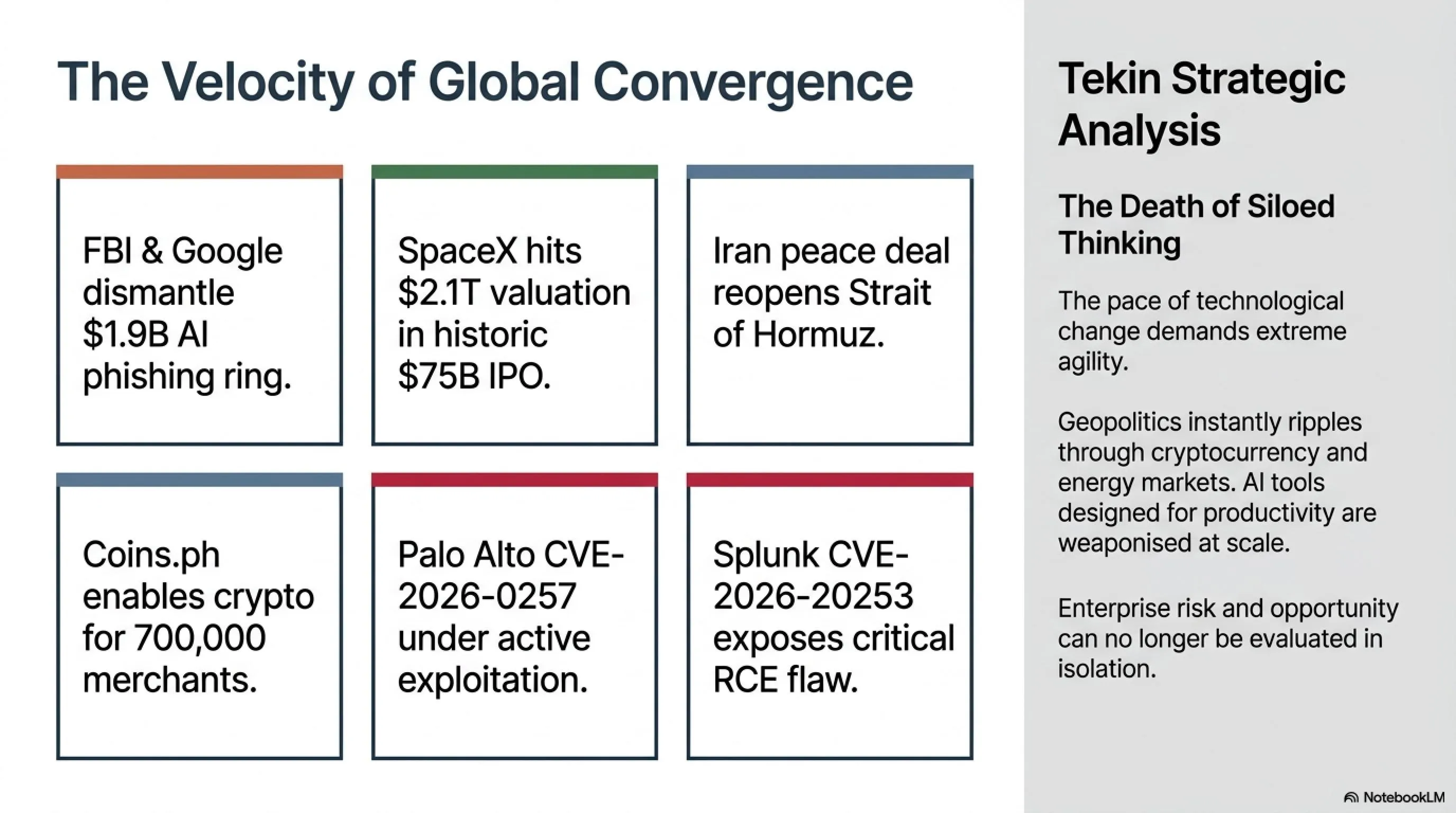
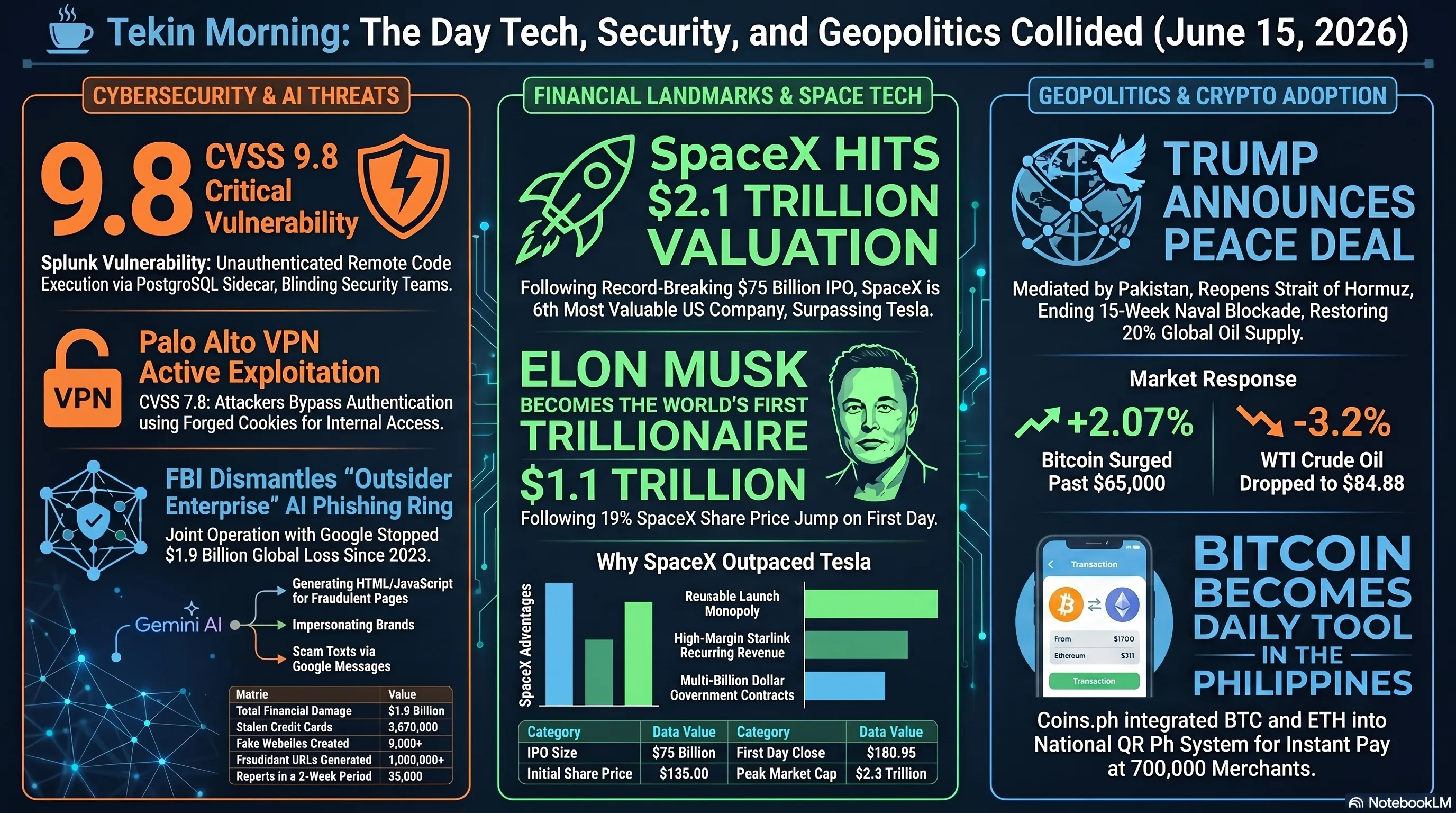
Monday, June 15, 2026, began with seismic developments reshaping the global tech trajectory. In an unprecedented joint operation, the FBI and Google dismantled \"Outsider Enterprise,\" a Chinese criminal network that weaponized Gemini AI to orchestrate phishing campaigns, resulting in $1.9 billion in losses. SpaceX made history with a $75 billion IPO and a $2.1 trillion valuation, crowning Elon Musk as the world's first trillionaire. On the geopolitical front, a peace deal with Iran and the reopening of the Strait of Hormuz caused Bitcoin to su
🌅 Welcome to Tekin Morning June 15, 2026
Good morning! Let's start this Monday with energy and a hot cup of coffee. Today we have 6 major stories that could change the trajectory of the tech industry, cybersecurity, crypto, and geopolitics. From the FBI hunting down an AI phishing network to Elon Musk becoming the world's first trillionaire, from Trump's peace deal with Iran to critical vulnerabilities in Palo Alto and Splunk—everything in this energizing morning briefing!
⚡ Today's Headlines:
🕵️ FBI Takes Down Chinese AI Phishing Ring - $1.9B Damage
🚀 SpaceX Becomes Trillion-Dollar Company - Historic $75B IPO
🕊️ Trump: Iran Peace Deal Complete - Strait of Hormuz Reopens
🏦 Coins.ph Brings Bitcoin to 700K Philippine Merchants
🔓 Palo Alto CVE-2026-0257 - VPN Bypass Under Attack
⚠️ Splunk CVE-2026-20253 - Critical 9.8 Vulnerability
☕ Grab your coffee and get ready for a comprehensive news journey!
🕵️ Section 1: FBI and Google Dismantle Chinese AI Phishing Network - $1.9B in Losses
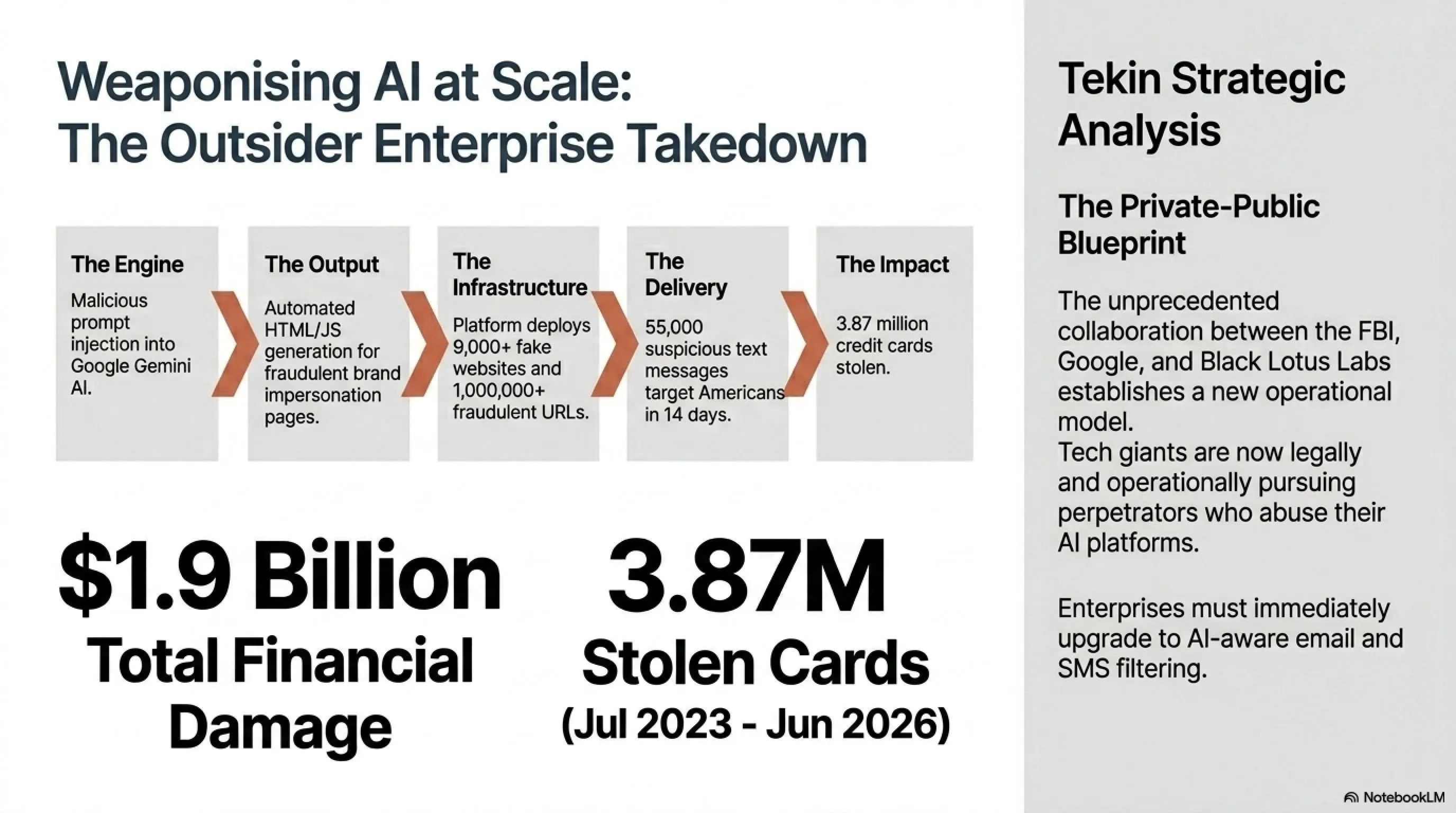
In an unprecedented joint operation, the FBI, working alongside Google and Lumen Technologies (Black Lotus Labs), successfully dismantled the Chinese criminal network "Outsider Enterprise," which had been leveraging Google's Gemini AI to orchestrate massive phishing campaigns. Since July 2023, this network managed to steal 3.87 million credit cards and inflict approximately $1.9 billion in losses across global victims.
This marks the first time Google has formally pursued legal action against perpetrators abusing its artificial intelligence tools. According to reports from CyberScoop and TechCrunch, Google filed its federal complaint on June 12, 2026, and in coordination with the FBI, proceeded to collect evidence and block associated domains and accounts.
🚨 How the Outsider Enterprise Network Operated
The Outsider Enterprise network exploited Google's Gemini AI to write code for fraudulent phishing pages. These pages impersonated well-known brands including mobile carriers, financial institutions, and postal services, and by sending fraudulent text messages, coerced victims into clicking dangerous links.
According to the FBI's report, this network created over 9,000 fake websites and more than 1 million fraudulent URLs. Google reported that in just a two-week period ending June 1, 2026, it received approximately 55,000 reports of suspicious messages on Google Messages, all linked to this network.
The operational methodology was sophisticated: criminals prompted Gemini to generate HTML and JavaScript code for "gift redemption" pages and brand impersonations, then loaded that code into a phishing platform that pumped out scam texts targeting Americans. This demonstrates that AI can become a powerful weapon in the hands of criminals, even when the AI models themselves are designed to help users.
🔍 Tekin Analysis: Why This Is a Turning Point
This is the first time a major tech company like Google has formally taken legal action against abuse of its AI tools. This signals that the tech industry can no longer turn a blind eye to malicious use of its products and must accept responsibility for its creations.
The collaboration between the FBI, Google, and Black Lotus Labs demonstrates that combating modern cybercrime requires close cooperation between the private sector and government. This is a model that will likely be replicated in the future to counter AI-driven threats.
The strategic implications are profound: as AI tools become more powerful and accessible, the potential for abuse grows exponentially. Tech companies must now balance innovation with safety, implementing robust safeguards while maintaining the utility that makes these tools valuable. This case will likely set precedents for how AI providers handle abuse of their platforms and may influence future regulation.
For enterprise security teams globally, this serves as a wake-up call: AI-powered phishing campaigns are not theoretical—they're here, they're sophisticated, and they're causing billions in damage. Organizations must upgrade their detection systems, implement advanced email and SMS filtering, and conduct regular employee training on recognizing AI-generated phishing attempts.
🚀 Section 2: SpaceX IPO Surpasses Tesla - Elon Musk Becomes World's First Trillionaire
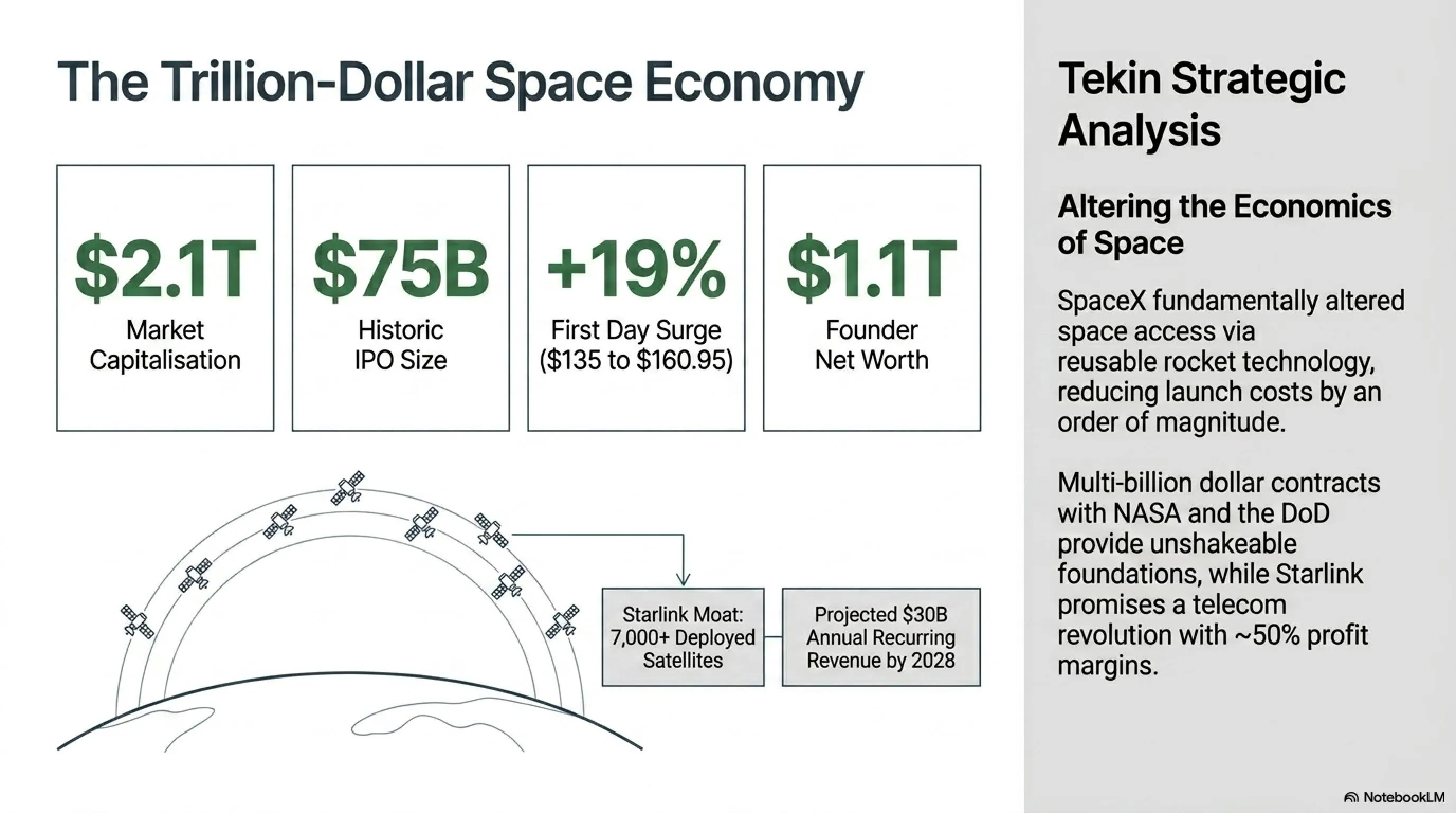
In one of the most monumental financial events in history, SpaceX on June 12, 2026 entered the Nasdaq exchange with a historic initial public offering (IPO) of $75 billion and achieved a valuation of $2.1 trillion, surpassing Tesla and becoming the sixth most valuable company in America. This IPO is three times larger than the previous record held by Alibaba in 2014, and elevated Elon Musk to the world's first trillionaire with a net worth of $1.1 trillion.
According to reports from CNBC and Forbes, SpaceX shares were initially priced at $135, but on the first trading day they surged to $160.95—a 19% increase that demonstrated enormous investor enthusiasm. At its peak, the stock reached $176.52, pushing the market cap beyond $2.3 trillion.
📊 SpaceX IPO - By The Numbers
$75B
IPO Size
$2.1T
Market Cap
+19%
First Day Gain
$1.1T
Musk's Net Worth
This success is the result of years of effort and massive investment by SpaceX in space infrastructure. The company, founded in 2002 by Musk with the goal of "making humanity a multiplanetary species," has now become a space industry giant with its reusable Starship rocket system, the Starlink satellite network with over 7,000 satellites in orbit, and multi-billion dollar contracts with NASA and the U.S. Department of Defense.
The strategic implications are profound. SpaceX has fundamentally altered the economics of space access by pioneering reusable rocket technology, reducing launch costs by an order of magnitude compared to traditional expendable vehicles. The Starlink constellation represents not just a technological achievement but a potential revolution in global telecommunications, promising high-speed internet to underserved regions and creating a recurring revenue stream that justifies the trillion-dollar valuation.
💎 Tekin Analysis: Why SpaceX Surpassed Tesla
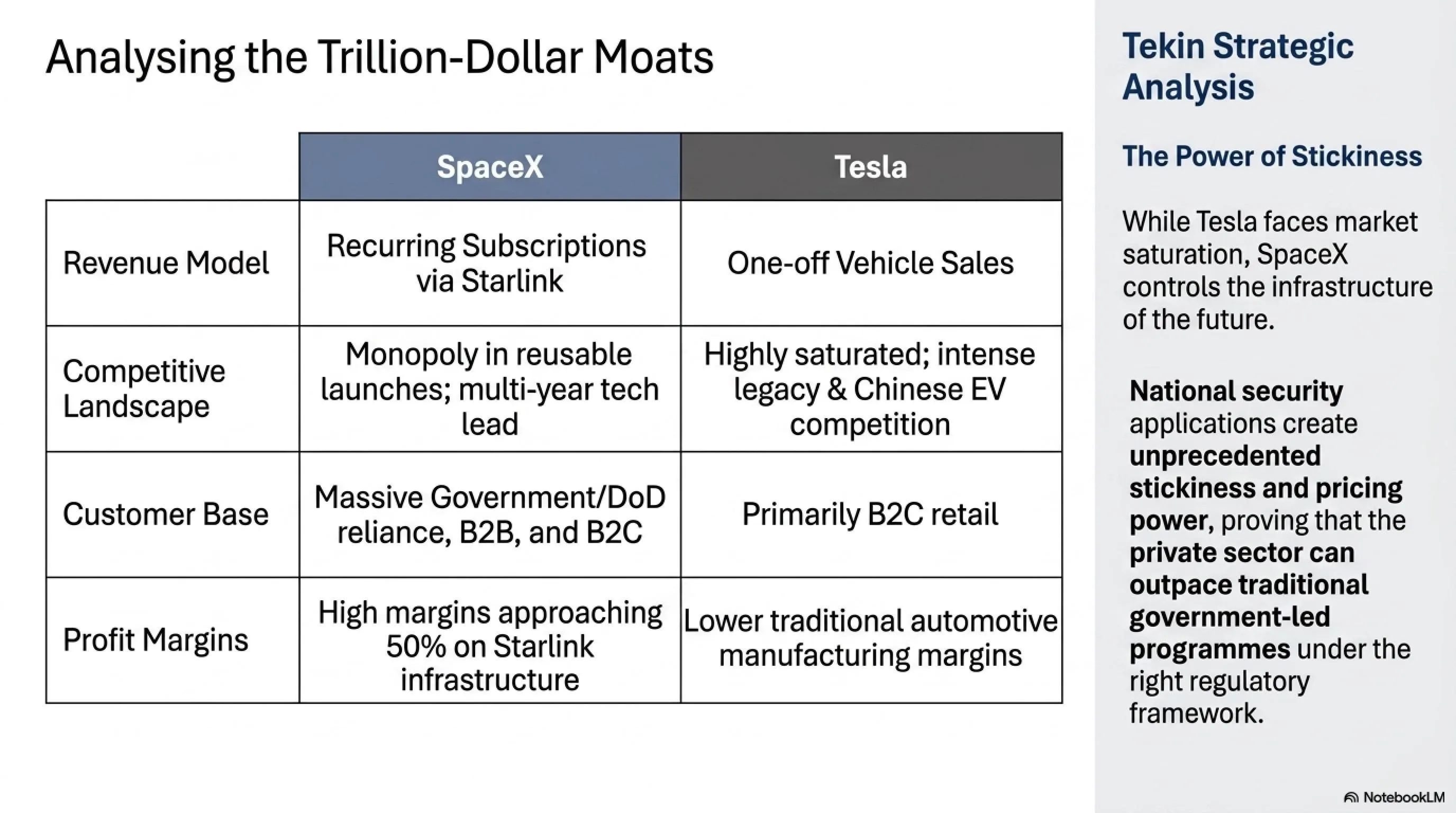
While Tesla remains a leader in the electric vehicle industry, SpaceX offers higher profit margins and greater growth potential. Long-term government contracts, relative monopoly in reusable launches, and the massive potential of Starlink in providing global satellite internet are all factors that have attracted investors.
The competitive landscape is also favorable. While Tesla faces increasing competition from legacy automakers and Chinese EV manufacturers, SpaceX enjoys a substantial technological lead in reusable launch systems. Blue Origin and United Launch Alliance are years behind in developing comparable capabilities, giving SpaceX pricing power and market dominance that Tesla lacks in its industry.
The Starlink business model deserves special attention: with over 7,000 satellites already deployed and plans for up to 42,000, SpaceX is building what could become the world's largest telecommunications network. Current subscriber growth suggests annual recurring revenue could exceed $30 billion by 2028, with profit margins approaching 50%—far superior to automotive manufacturing.
Interesting note: Elon Musk now controls two trillion-dollar companies (SpaceX and Tesla). This demonstrates that focusing on high-impact industries (space, clean energy, transportation) can create enormous value. For emerging space nations, this proves that the private sector can be more efficient than traditional government-led programs when given the right regulatory framework and investment capital.
🕊️ Section 3: Trump Announces Iran Peace Deal - Strait of Hormuz Opens, Bitcoin Jumps
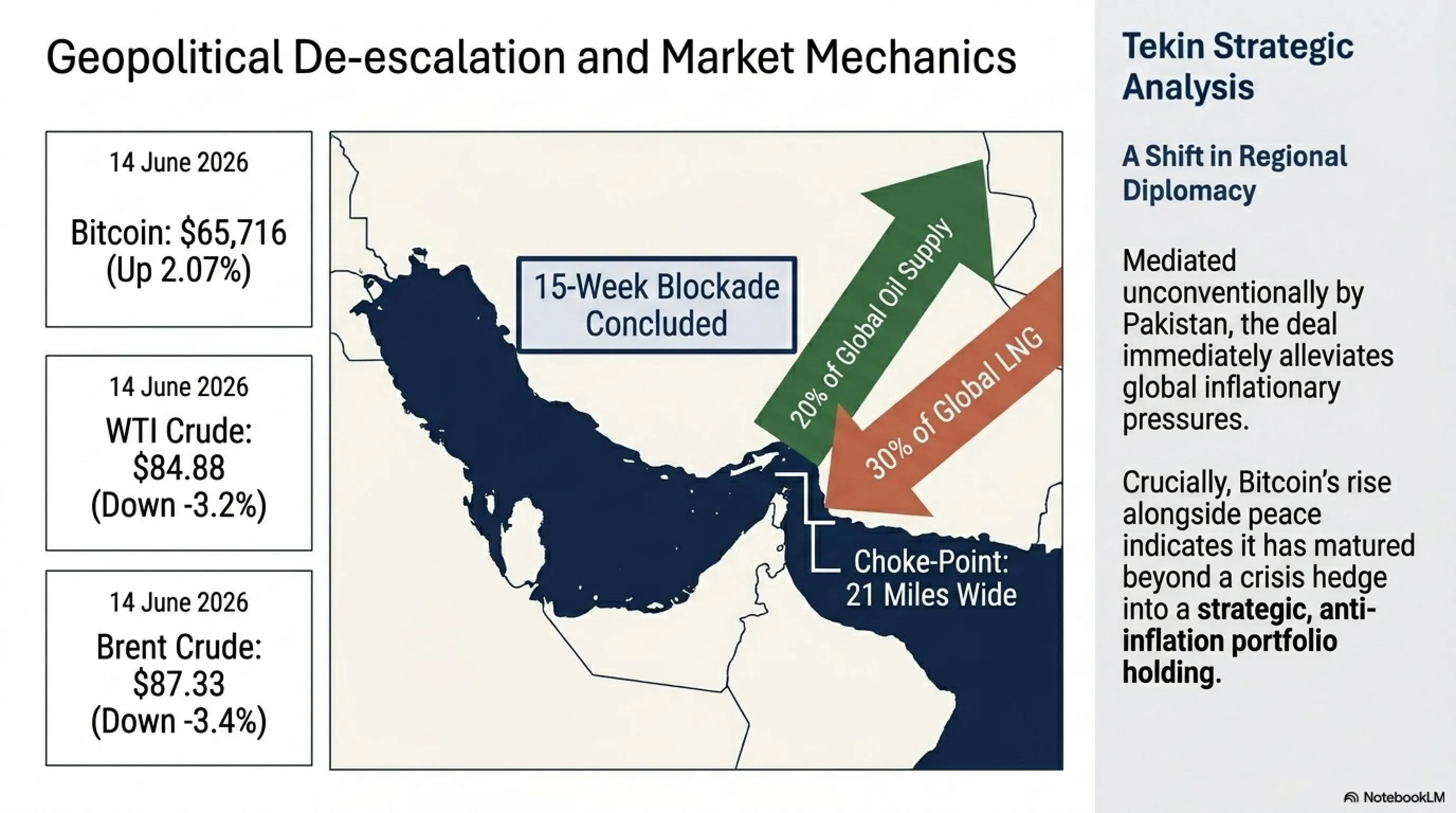
In a stunning geopolitical development, President Donald Trump announced on June 14, 2026 via Truth Social that "the deal with the Islamic Republic of Iran is now complete" and immediately authorized the reopening of the Strait of Hormuz and the removal of the U.S. naval blockade. This news caused Bitcoin to surge past $65,000 and oil prices to drop 3.2% to $84.88 per barrel.
According to reports from CNBC, USA Today, and Al Jazeera, this agreement was reached following mediation by Pakistan and is set to be formally signed on Friday. Trump wrote in his post: "Ships of the World, start your engines. Let the oil flow!"
💹 Financial Market Response to Peace Deal
$65,716
Bitcoin Price
▲ +2.07%
$84.88
WTI Crude (barrel)
▼ -3.2%
$87.33
Brent Crude (barrel)
▼ -3.4%
S&P 500
Stock Index
▲ Rally
This market reaction demonstrates that investors view de-escalation in the Middle East with optimism. Bitcoin, which had been acting as a "safe-haven asset" during periods of tension, continued to rise as investors seek portfolio diversification. Conversely, oil prices dropped because the risk of supply chain disruption through the Strait of Hormuz was eliminated.
The strategic significance of the Strait of Hormuz cannot be overstated. This narrow waterway, just 21 miles wide at its narrowest point, serves as the transit route for approximately 20% of global oil supply and 30% of liquefied natural gas (LNG). During the blockade, which lasted approximately 15 weeks, global energy markets experienced significant volatility, with oil prices spiking to over $120 per barrel at one point. The reopening immediately alleviates these pressures and signals a potential return to energy market stability.
🧩 Tekin Analysis: Global Economic Implications
The reopening of the Strait of Hormuz means 20% of global oil and 30% of liquefied natural gas (LNG) can once again flow without restrictions. This translates to lower energy costs in Europe and Asia and reduced inflationary pressures in import-dependent economies.
For Iran, this deal could mean sanctions relief or access to global markets, though the details of the agreement have not yet been released. It remains to be seen whether this is a comprehensive nuclear agreement or merely a temporary ceasefire. If sanctions are reduced, Iran's economy could benefit from oil exports and access to new technologies, potentially unlocking billions in frozen assets and reintegrating into the global financial system.
The crypto angle is particularly interesting: Bitcoin as an anti-inflation asset continues to hold its appeal, demonstrating that even during de-escalation, investors seek portfolio diversification. The 2.07% gain suggests that Bitcoin has matured beyond purely being a crisis hedge and is now viewed as a strategic long-term holding. For regions facing currency instability or sanctions risk, this validates the thesis that decentralized digital assets can serve as economic safety valves.
Important note: The agreement was mediated by Pakistan, not traditional Middle East peace brokers like Egypt or Qatar. This signals a potential shift in regional diplomacy and Pakistan's growing role as a neutral mediator. The success of this unconventional diplomatic channel could reshape how future Middle Eastern conflicts are resolved.
🏦 Section 4: Coins.ph Brings Bitcoin and Ethereum to 700,000 Philippine Merchants
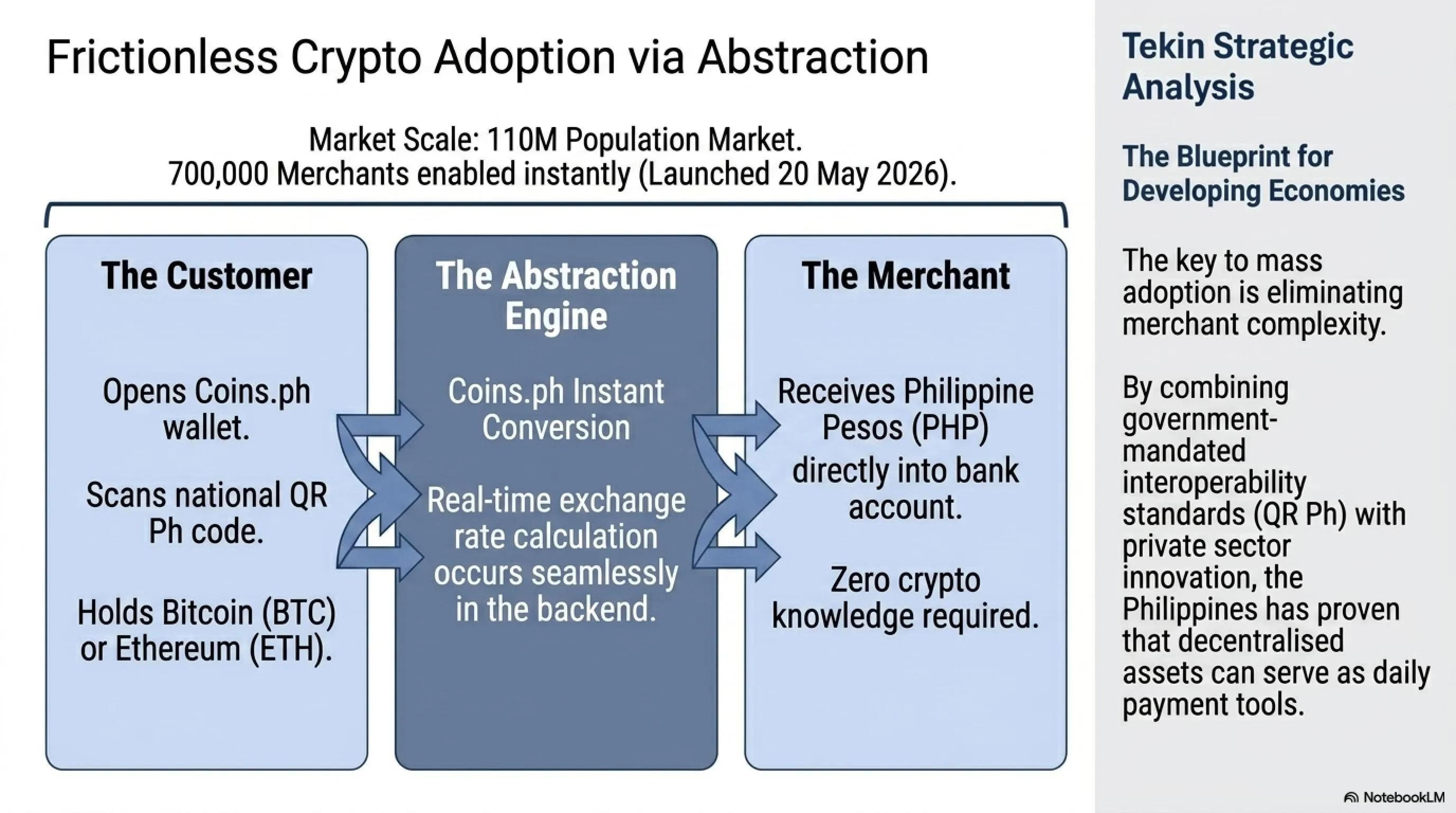
In a major step toward mass crypto adoption in Southeast Asia, Coins.ph—the Philippines' largest crypto platform—added Bitcoin and Ethereum to the national QR Ph payment system. This means users can now pay with crypto at nearly 700,000 merchants across the Philippines—from small neighborhood stores to large supermarkets.
According to reports from Bitcoin.com and Invezz, this capability was launched on May 20, 2026 and operates on an instant conversion system: the user pays with Bitcoin or Ethereum, but the merchant receives Philippine pesos (PHP). This means merchants require no technical knowledge of crypto, and the system works seamlessly.
The technical implementation is elegant. Users open their Coins.ph wallet, scan the merchant's QR code, select Bitcoin or Ethereum as payment method, and the amount is instantly converted to pesos at real-time exchange rates. The merchant receives fiat currency directly in their bank account, eliminating the complexity and volatility concerns that have historically hindered crypto adoption at point-of-sale.
💳 How QR Ph Crypto Payment Works
1️⃣ Customer: Opens Coins.ph wallet and scans merchant's QR Code
2️⃣ Selection: Chooses Bitcoin or Ethereum as payment method
3️⃣ Confirmation: Amount is instantly converted to Philippine pesos
4️⃣ Merchant: Receives pesos directly in bank account - no crypto knowledge needed!
🌏 Tekin Analysis: Why This Is a Crypto Turning Point
The Philippines, with a population of 110 million and high crypto adoption rates, is one of Southeast Asia's largest markets. Integration of Bitcoin and Ethereum with the national payment system demonstrates that crypto is no longer just a speculative asset but a daily payment tool.
The Philippines has historically been a leader in crypto adoption, driven by several factors: a large overseas worker population that relies on remittances (where crypto can offer faster and cheaper transfers than traditional services), a tech-savvy young population, and a relatively crypto-friendly regulatory environment. The Bangko Sentral ng Pilipinas has taken a pragmatic approach, balancing innovation with consumer protection.
The key innovation here is eliminating merchant complexity. By handling conversion on the backend, Coins.ph has removed one of the biggest barriers to crypto adoption—the need for merchants to understand, manage, and account for volatile digital assets. They simply see peso payments in their accounts, making adoption frictionless.
For other developing economies, particularly those facing currency instability or limited banking infrastructure, the Philippine model offers a proven template. The combination of government-mandated QR code standards (ensuring interoperability) with private sector innovation (crypto integration) creates an ecosystem that benefits all stakeholders: consumers gain payment optionality, merchants gain access to crypto holders' spending power, and the financial system gains resilience through diversification.
🔓 Section 5: Palo Alto CVE-2026-0257 Under Active Exploitation - VPN Bypass Risk
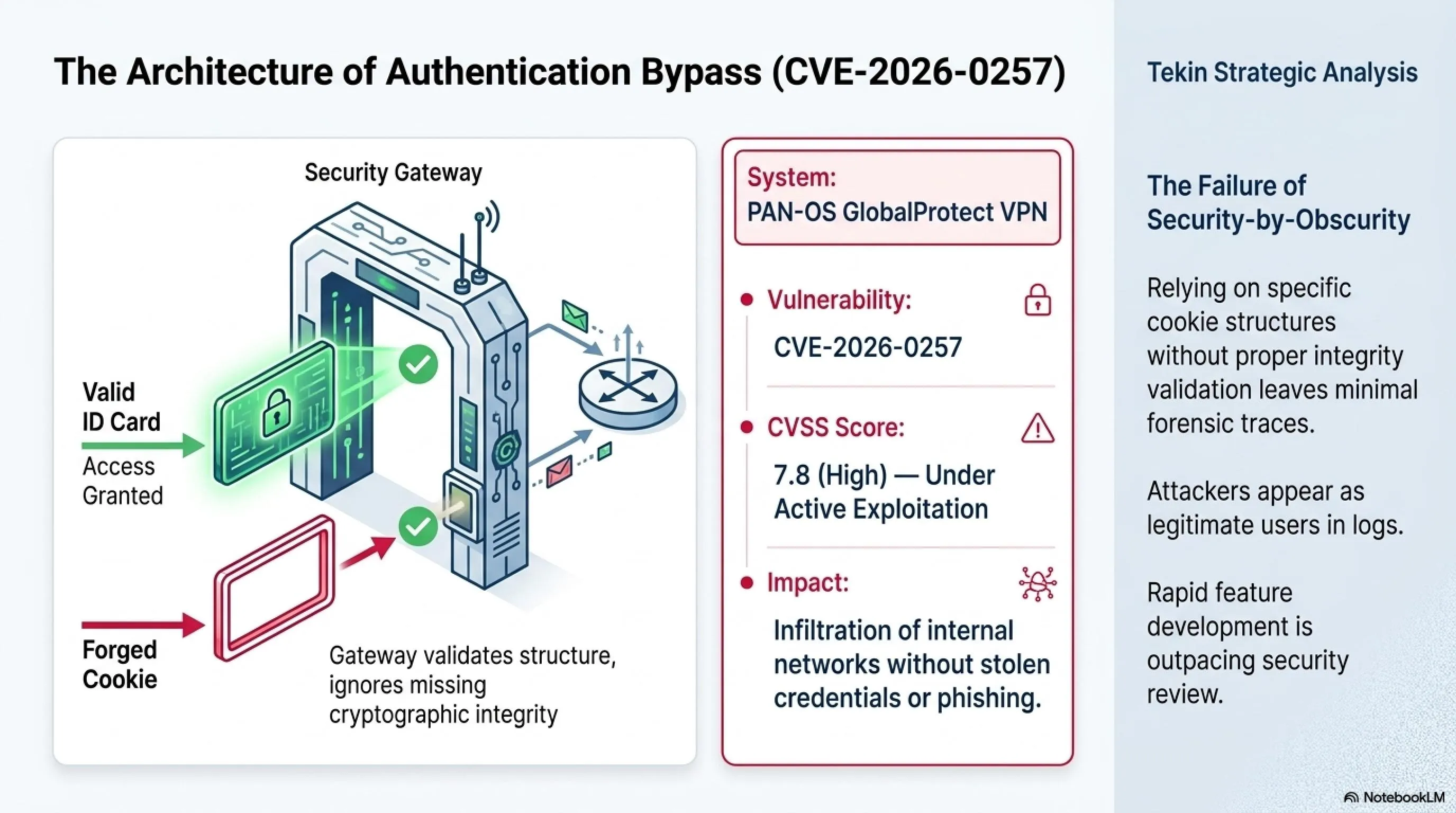
Palo Alto Networks issued a security alert announcing that vulnerability CVE-2026-0257 (CVSS score: 7.8) in PAN-OS GlobalProtect VPN is under active exploitation by unknown attackers. This is an authentication bypass bug that allows attackers to access VPN without credentials and establish unauthorized VPN connections.
According to reports from The Hacker News and Rapid7, this vulnerability was announced on May 13, 2026, but Palo Alto initially classified it as a medium-severity issue and stated they were unaware of any attacks. However, security researchers from Rapid7 and Watchtowr Labs quickly reported that this bug is under active exploitation and organizations must patch immediately.
⚠️ How CVE-2026-0257 Works
This vulnerability stems from insufficient cookie validation in the GlobalProtect portal and gateway. Attackers can craft a forged cookie that bypasses the authentication system and gains VPN access without username or password.
This means if your Palo Alto firewall is exposed to the internet (for remote VPN access), attackers can exploit this bug to infiltrate your internal network—without needing to steal credentials or use phishing!
The technical details reveal a classic case of security-by-obscurity failure. The GlobalProtect implementation relied on specific cookie structures without proper cryptographic validation or integrity checking. Researchers demonstrated that by manipulating cookie values and understanding the expected format, attackers could forge valid authentication tokens. This type of authentication bypass is particularly dangerous because it leaves minimal forensic traces—attackers appear as legitimate users in most logging systems.
⚠️ Section 6: Splunk Enterprise CVE-2026-20253 CVSS 9.8 - Critical PostgreSQL Vulnerability
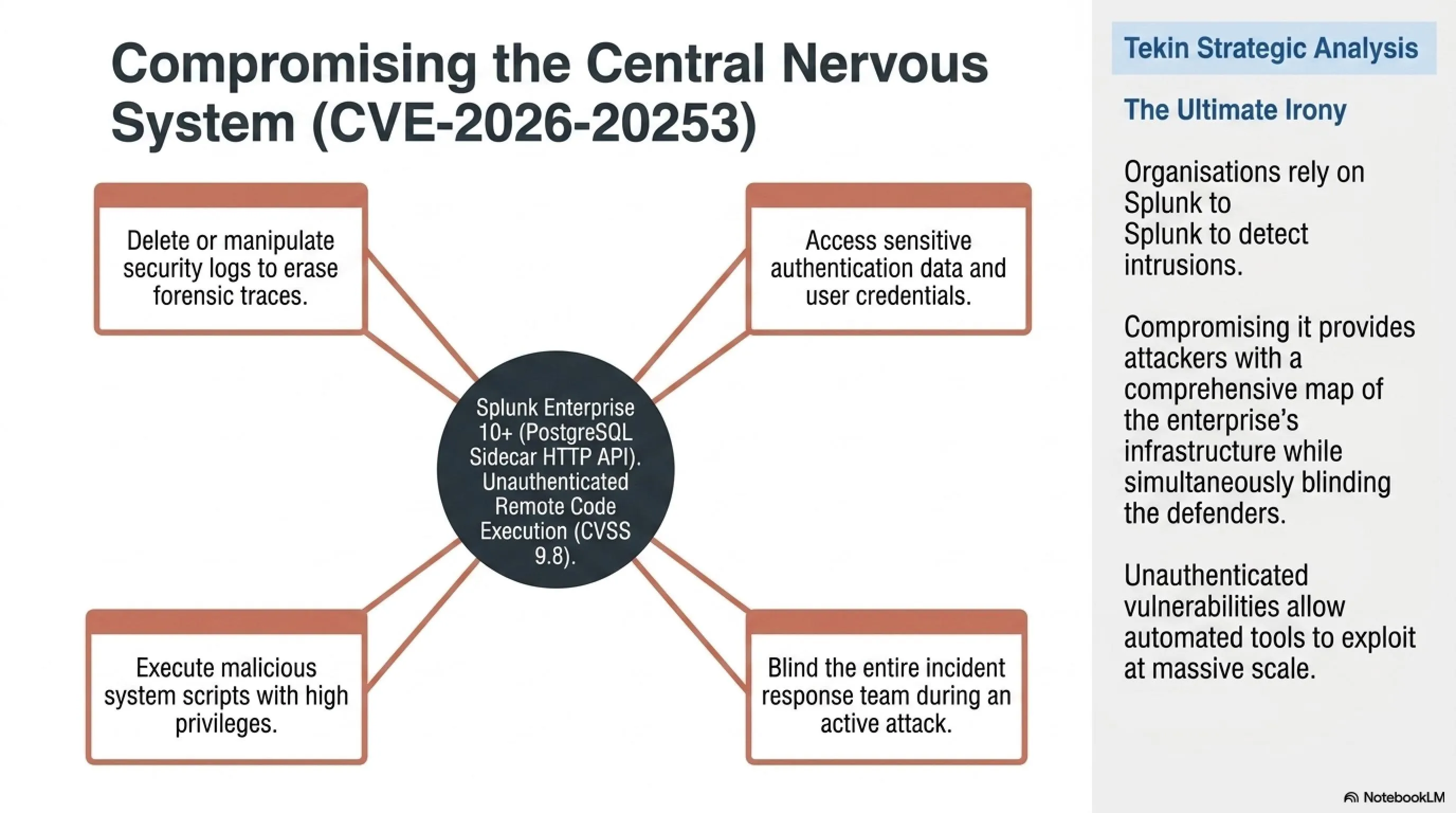
In another alarming development from the cybersecurity front, Splunk announced discovery of a critical vulnerability with a CVSS score of 9.8 in Splunk Enterprise that allows unauthenticated attackers to perform file operations and execute remote code (RCE). This vulnerability, identified as CVE-2026-20253, was disclosed on June 13, 2026 and exists in the PostgreSQL Sidecar service introduced in Splunk version 10 and later.
According to reports from The Hacker News and Watchtowr Labs, this bug stems from lack of authentication controls in the PostgreSQL Sidecar service API. This means any user who can reach the Splunk server over the network can create, modify, or delete files and even overwrite system scripts to gain complete control of the server.
🔥 Why CVE-2026-20253 Is Extremely Dangerous
Splunk Enterprise is a log management and security platform used by thousands of large organizations worldwide. If an attacker can access the Splunk server, they can:
- Delete or manipulate security logs to hide their tracks
- Access sensitive data such as authentication logs, user information, and business data
- Execute malicious code and gain complete system control
- Use Splunk as an entry point to infiltrate the internal network
- Compromise incident response capabilities by corrupting the very system meant to detect breaches
The irony is particularly acute: Splunk is often the central nervous system of enterprise security operations. Organizations rely on it to detect intrusions, investigate incidents, and maintain audit trails. Compromising Splunk doesn't just give attackers access to one system—it blinds the entire security team and provides a comprehensive map of the organization's infrastructure, applications, and security posture.
⚡ Tekin Analysis: Lessons from Two Critical Vulnerabilities
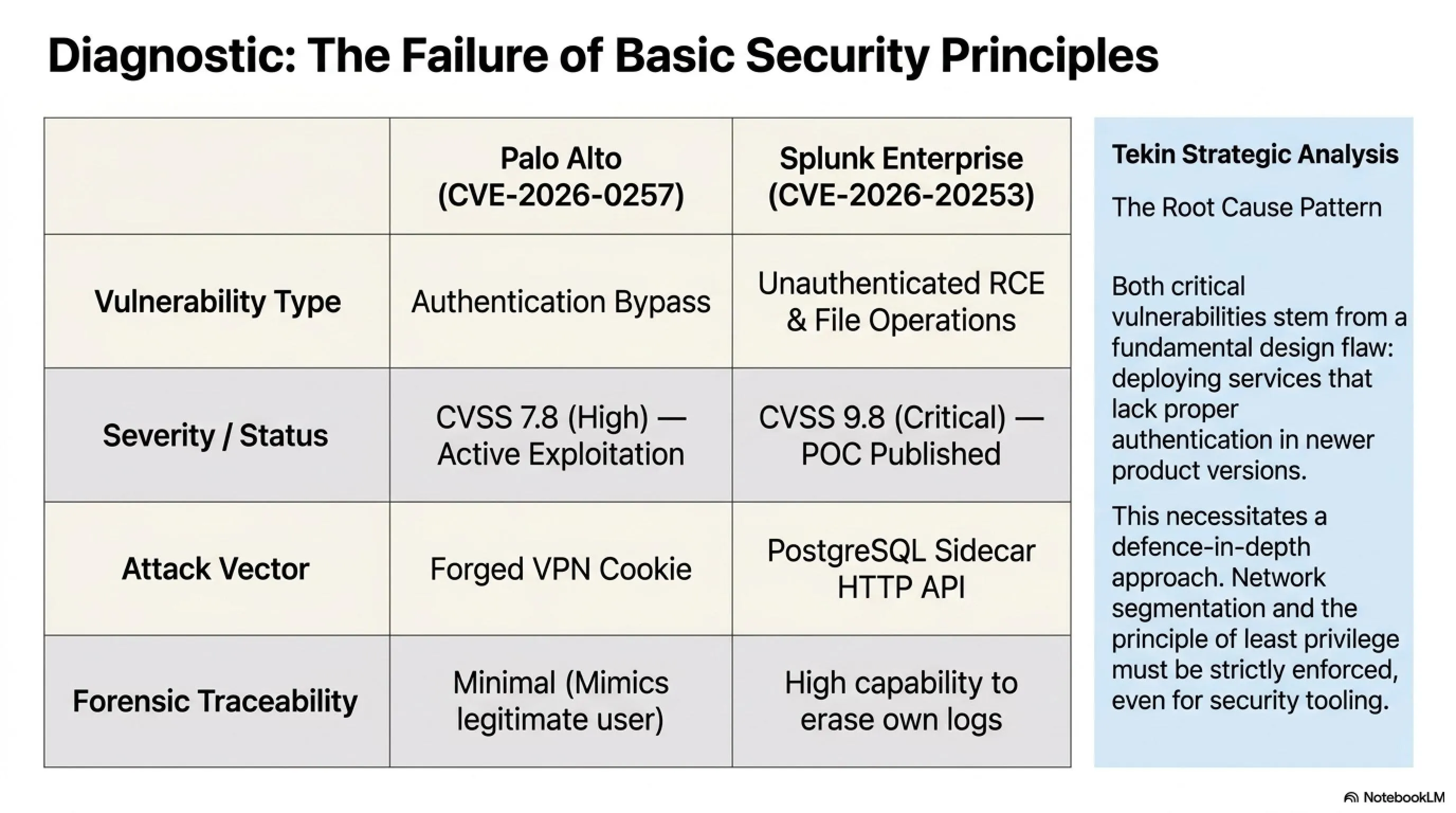
Today's two vulnerabilities (Palo Alto and Splunk) share a common thread: both exist in services lacking proper authentication. This is a fundamental design flaw that shows even major security companies can make mistakes in basic security principles.
The pattern is troubling: both Palo Alto and Splunk introduced these vulnerabilities in newer versions of their products. This suggests that rapid feature development may be outpacing security review processes. The PostgreSQL Sidecar in Splunk, for instance, was introduced in version 10 as part of a major architectural overhaul—and with it came this critical flaw that apparently wasn't caught during security testing.
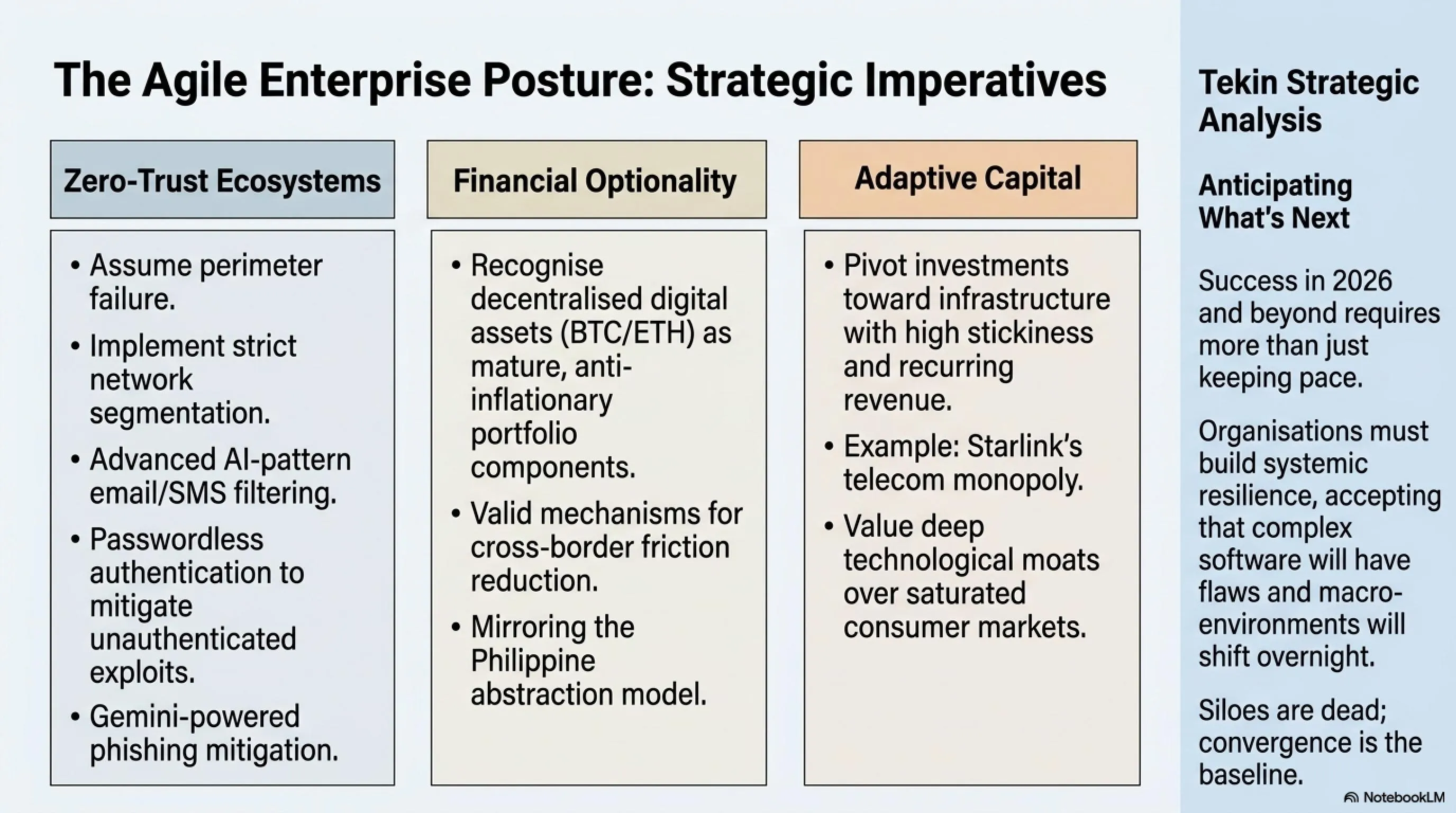
For global organizations, this is a reminder that no security product is perfect and you must have a multi-layered strategy: firewalls, monitoring, network segmentation, and active patch management. Additionally, limiting network access to critical services can prevent many attacks. The principle of least privilege applies not just to user accounts but to network accessibility—services should only be reachable from the minimum necessary network segments.
Final recommendation: If you use Palo Alto GlobalProtect or Splunk Enterprise, patch immediately! These two vulnerabilities can be quickly exploited and cause irreversible damage. Organizations should also conduct emergency security audits to check for indicators of compromise, review VPN and database access logs for anomalies, and implement additional compensating controls while patches are being deployed across large environments.
💡 Final Thoughts: The Monday That Shook the Tech Industry
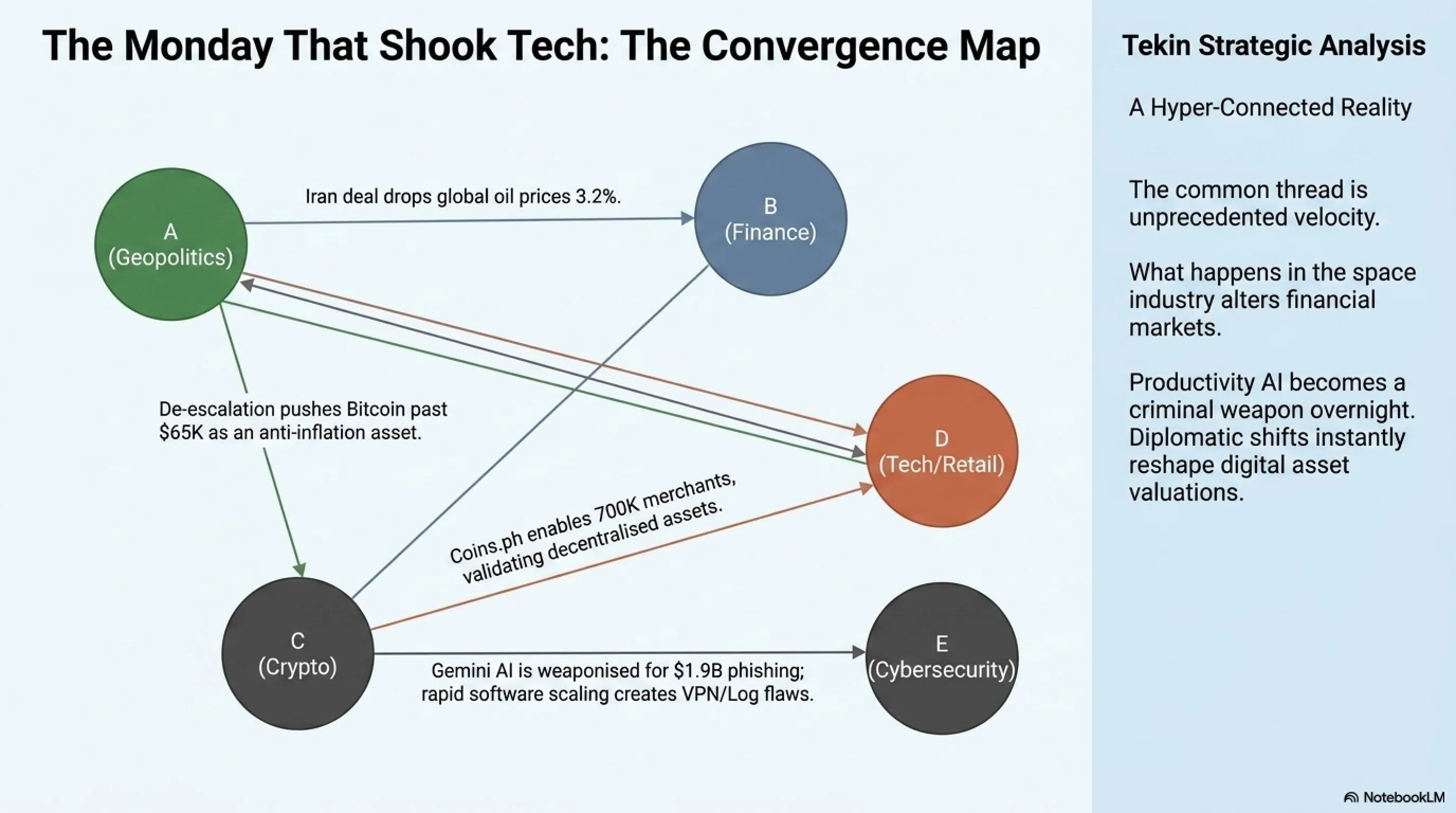
June 15, 2026 will be remembered as one of those rare days when multiple major events occurred simultaneously, demonstrating that the technology industry is undergoing transformation. From the FBI hunting down an AI phishing network to Elon Musk becoming the world's first trillionaire, from Trump's peace deal with Iran to crypto adoption in the Philippines—all these events show that technology, geopolitics, and cybersecurity are interconnected and developments in one can impact the others.
Today's lesson: The pace of change in the technology industry is extraordinarily high. Companies, organizations, and even governments must be agile, prepared, and responsive to keep pace with these developments. The convergence of AI capabilities with criminal intent, the maturation of commercial space industry, the growing role of cryptocurrency in national payment systems, and the persistent challenge of securing complex software systems all point to a future that demands both innovation and responsibility.
The common thread across all six stories is the increasing velocity and interconnectedness of technological change. What happens in the space industry affects financial markets. AI tools designed for productivity become weapons in criminal hands. Geopolitical developments instantly ripple through cryptocurrency and energy markets. And even the most sophisticated security products contain critical flaws that require constant vigilance. This is the reality of our hyperconnected world—and success requires not just keeping pace but anticipating what's next.
❓ How can we protect ourselves from AI-powered phishing attacks?
AI-powered phishing attacks are far more sophisticated than traditional ones. To protect yourself:
1. Never click on links in unsolicited text messages or emails
2. Carefully verify URLs - fraudulent sites often have similar but slightly different addresses
3. Use two-factor authentication (2FA)
4. Enable browser anti-phishing tools
5. Train employees to recognize and report suspicious messages
6. Implement advanced email and SMS filtering that can detect AI-generated content patterns
7. Conduct regular security awareness training with examples of AI-generated phishing attempts
8. Use passwordless authentication methods where possible to eliminate credential theft risk
🚀 Why did SpaceX become more valuable than Tesla?
SpaceX has several strategic advantages that made it more valuable than Tesla:
1. Long-term contracts: SpaceX has multi-billion dollar contracts with NASA and the U.S. Department of Defense
2. Higher profit margins: Space launches generate higher profits than automotive manufacturing
3. Relative monopoly: SpaceX is the market leader in reusable launches
4. Starlink: Satellite network with enormous revenue potential from global internet
5. Future of space: Investors view the space industry as a growing market
6. Lower competition: Tesla faces intense EV competition while SpaceX has a multi-year technology lead
7. Recurring revenue model: Starlink subscriptions provide predictable monthly revenue unlike car sales
8. Government dependence: National security applications create stickiness and pricing power
🏦 Is the Philippines crypto adoption model replicable in other countries?
Yes, the Philippine model is a successful template for crypto adoption because:
1. National infrastructure integration: QR Ph is a national standard that all payment providers must support
2. Instant conversion: Merchants don't need crypto knowledge - they only receive national currency
3. Broad coverage: 700,000 merchants means real accessibility nationwide
4. Government support: The central bank of the Philippines supports this system
5. Low friction: The user experience is identical to standard QR payments
For developing economies, particularly those facing currency instability or sanctions, this model offers a proven path to financial system modernization. The key elements are government-mandated interoperability standards combined with private sector innovation in cryptocurrency integration. This creates a win-win: consumers gain payment optionality, merchants access new customers, and the financial system gains resilience.
⚠️ Why are unauthenticated vulnerabilities so dangerous?
Unauthenticated vulnerabilities are particularly dangerous because attackers don't need to steal credentials and can directly attack the system. This makes attacks:
1. Much easier to execute - no need for phishing or social engineering
2. Broader in scope - anyone with network access can attack
3. Harder to detect - attackers don't use real credentials so standard monitoring may miss them
4. Faster to exploit - automated tools can scan and exploit at scale
5. More impactful - they often provide deep system access rather than user-level permissions
Always protect critical services with strong authentication and limit network access. The principle of defense in depth is crucial: even if one layer fails (like application-level authentication), network-level controls should prevent unauthorized access. Organizations should implement network segmentation, zero-trust architectures, and continuous monitoring to detect anomalous access patterns even when authentication is bypassed.
🌍 What are the geopolitical implications of the Iran peace deal?
The Iran peace deal has far-reaching geopolitical and economic implications:
1. Energy markets: Reopening the Strait of Hormuz eliminates supply risk for 20% of global oil
2. Regional stability: Reduces tensions across the Middle East and Persian Gulf
3. Sanctions relief: Could unlock billions in frozen Iranian assets and restart oil exports
4. Diplomatic precedent: Pakistan's role as mediator signals new regional power dynamics
5. Cryptocurrency validation: Bitcoin's rise during peace talks shows it's matured as an asset class
6. European energy security: Reduces dependence on Russian gas by ensuring stable Persian Gulf supplies
7. Nuclear program: Details remain unclear but likely includes monitoring provisions
8. Regional realignment: May shift alliances among Gulf states, affecting Saudi-Iran dynamics
📚 Sources and References
Primary sources for this article:
• CyberScoop, TechCrunch, Google Blog, Black Lotus Labs
• CNBC, Forbes, Bloomberg, The Fool, Wikipedia, Associated Press
• USA Today, Al Jazeera, Business Insider, The Guardian, CBS News
• Bitcoin.com, Invezz, KuCoin, CoinJournal, Decrypt, Phemex
• The Hacker News, Palo Alto Networks Security Advisory, Rapid7, Qualys
• Splunk Advisory, Watchtowr Labs, IT Security News, CyberScoop
Research and Analysis: Tekin Editorial Team - June 2026
🌐 Stay Connected With Us 🎮✨
For the latest tech, gaming, and gadget news, follow us on our official social media channels:
Additional Gallery: 🌅 Tekin Morning June 15, 2026: FBI Hunts AI Phishing, SpaceX Hits $2T & Iran Peace Deal