
🌅 Good Morning! Welcome to Tekin Morning June 12, 2026
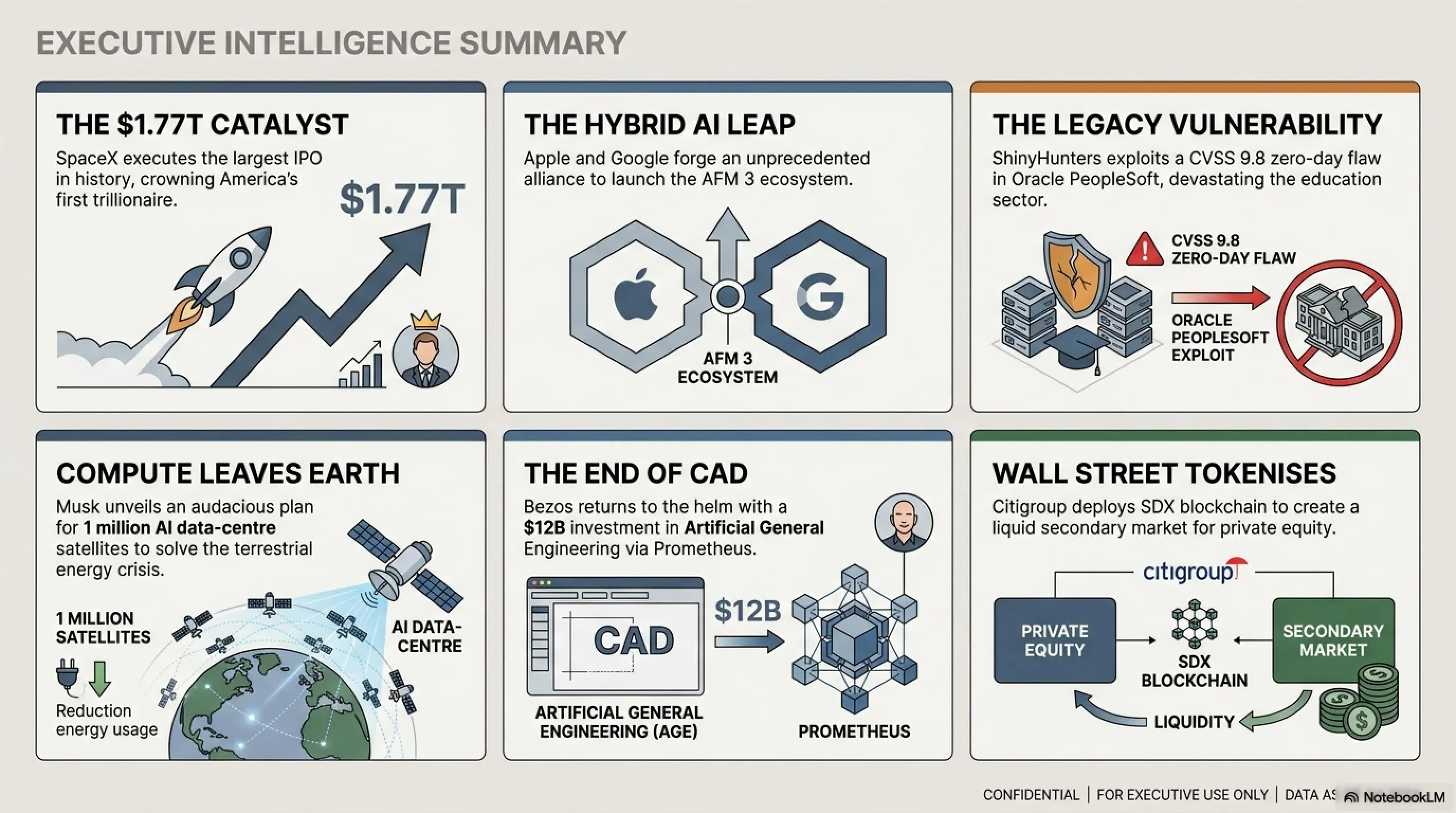
Happy Friday morning! Today we're bringing you an extraordinary and historic news breakfast that could mark a turning point in technology, space, and global finance. The six stories we have today—from the largest space company IPO ever to Apple's AI revolution, from a massive security breach to Elon Musk's audacious space plans, from Jeff Bezos' return to the startup world to a blockchain transformation in traditional banking—all demonstrate that the world is changing at a breathtaking pace!
⚡ Today's Headlines:
🚀 SpaceX IPO - Largest offering in history at $1.77 trillion valuation
🍎 Apple AFM 3 - 5 AI models built with Google collaboration
🛡️ Oracle PeopleSoft Zero-Day - ShinyHunters breach 100+ organizations
🛰️ 1 Million AI Satellites - Musk's audacious plan for space
💰 Bezos' Prometheus - $12B for Artificial General Engineer
🏦 Citi Blockchain - Tokenizing private company shares
☕ Grab your coffee and join us for an exciting journey through technology, space, and the future!
Section 1️⃣: SpaceX Historic IPO — The Largest Public Offering Ever at $1.77 Trillion Valuation 🚀💸
June 11, 2026, will be remembered as one of the most significant days in the history of global financial markets. Elon Musk's SpaceX priced its IPO shares at $135, achieving a final valuation of $1.77 trillion and raising $75 billion—a record no company has ever achieved. According to reports from CNBC, Variety, and Business Times, SpaceX sold 555.6 million Class A shares on Thursday, with trading set to begin Friday morning, June 12, on Nasdaq.
This IPO is unprecedented not only in terms of capital raised but also because SpaceX has become the seventh most valuable U.S. company—even surpassing Tesla, Musk's other company. According to Wikipedia and Business Insider reports, this IPO has crowned Elon Musk as America's first dollar trillionaire, as he owns approximately 42% of SpaceX shares. With this calculation, Musk's wealth has exceeded $800 billion.
But why is this IPO so historic? To answer, we need to examine the nature of SpaceX's business. SpaceX is no longer just a rocket launch company; it's a multi-faceted space technology giant with three core divisions: (1) reusable Falcon and Starship launch services, (2) the Starlink satellite network with over 6,400 active satellites providing high-speed internet to more than 3 million subscribers worldwide, and (3) forward-looking programs like Starlink Direct to Cell, AI satellites, and even human missions to Mars.
📊 SpaceX IPO Key Metrics (June 2026)
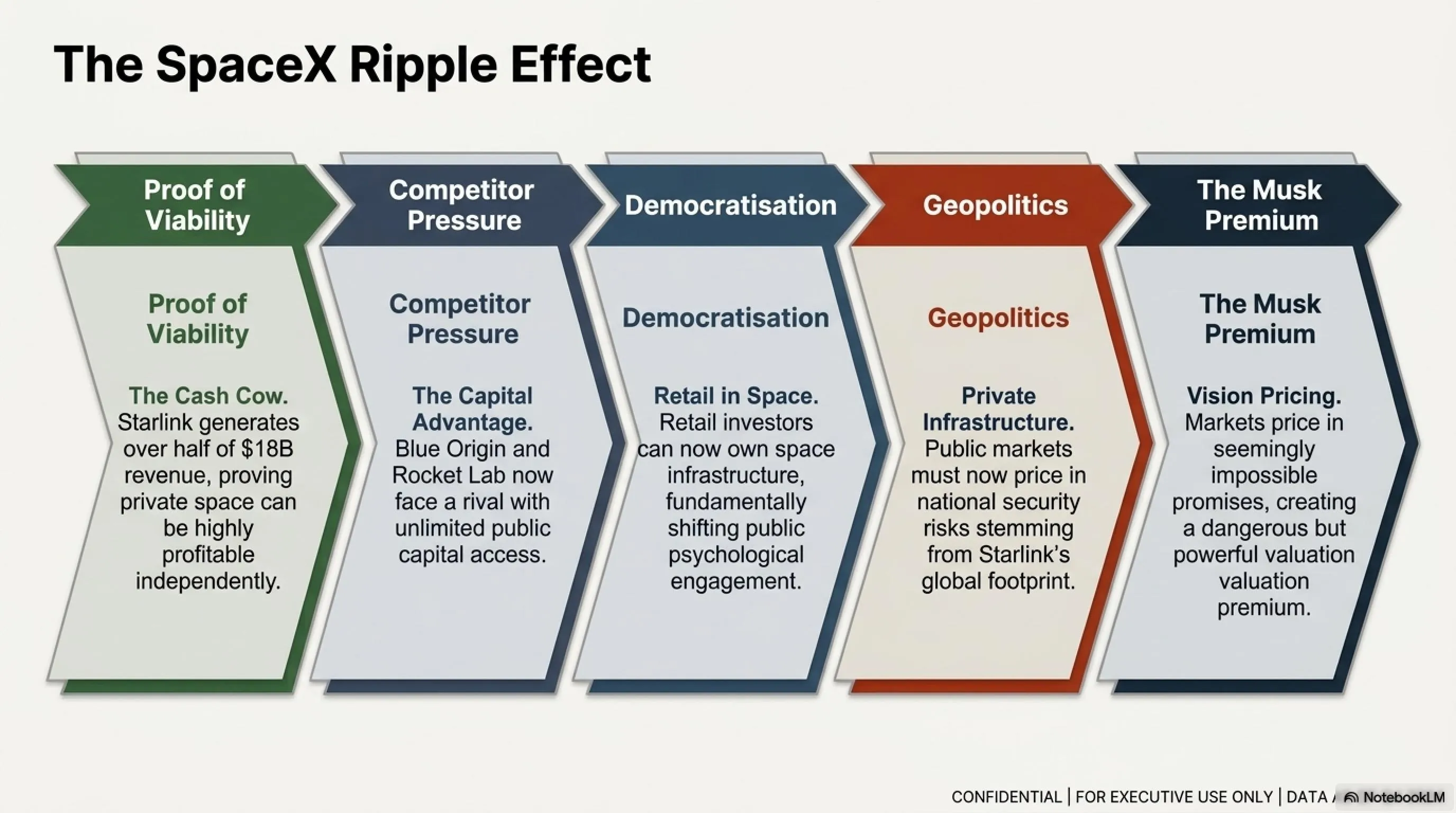
According to reports from PitchBook and Axios, SpaceX's annual revenue reached $18 billion in 2025, with more than half coming from Starlink. This demonstrates that SpaceX has successfully transformed from a government-dependent contractor into an independent, profitable business. In fact, Starlink has become a financial "cash cow" capable of funding other ambitious programs like Starship and Mars missions.
What makes this IPO particularly remarkable is the timing and market conditions. Unlike many tech IPOs that struggle in volatile markets, SpaceX went public during a period of economic uncertainty and still commanded premium valuation. This speaks to investor confidence not just in Musk's vision, but in the fundamental business model SpaceX has built. The company's diversified revenue streams—launch services, Starlink subscriptions, and government contracts—provide stability that most space startups lack.
🔍 Tekin Analysis: Why This IPO Is a Turning Point for the Space Industry
1. Proof of Business Model Viability: For the first time in history, a private space company has proven it can be profitable. Before SpaceX, the space industry was entirely government-centric, with private companies serving only as contractors. But SpaceX, with reusable Falcon 9 rockets and Starlink, has built a sustainable business model that generates consistent revenue and profits—something no space company has achieved at this scale.
2. Competitive Pressure on Rivals: This IPO puts immense pressure on competitors like Jeff Bezos' Blue Origin, Rocket Lab, and even government players like ULA and Arianespace. SpaceX now has access to public capital markets, enabling massive investments that will intensify competition. Blue Origin, still private and reportedly burning through Bezos' personal fortune, faces a critical decision: go public or risk falling further behind.
3. Democratization of Space Investment: With SpaceX going public, any individual can become a shareholder in a space company. This could dramatically increase public interest in space exploration and inspire a new generation of engineers and investors. The psychological impact cannot be understated—space is no longer just for governments and billionaires.
4. Geopolitical Implications: SpaceX is no longer just a company; it's a geopolitical tool. Starlink played a critical role in the Ukraine conflict, and with this IPO, that power intensifies. Governments cannot ignore that a private company controls such vast space infrastructure. This raises questions about regulation, national security, and the role of private entities in critical infrastructure.
5. The Musk Premium Effect: Elon Musk's track record with Tesla, PayPal, and now SpaceX creates what analysts call the "Musk Premium"—investors are willing to pay higher valuations because they believe in his ability to deliver on seemingly impossible promises. Whether this premium is justified remains to be seen, but it undeniably shaped this IPO's success.
However, not everything is positive. Critics argue that SpaceX, at its current valuation, is significantly overpriced. Some analysts point out that comparing SpaceX's P/E ratio (price-to-earnings) with similar companies like Boeing or Lockheed Martin reveals that expectations for SpaceX are extraordinarily high. For instance, if SpaceX's annual revenue is $18 billion and net profit (hypothetically) is $2 billion, its P/E ratio would be around 885—while traditional aerospace companies typically have P/E ratios of 15-20!
The response to this criticism is that SpaceX is an aggressive growth company, not a traditional aerospace contractor. Investors are betting on SpaceX's future: Starship, which could reduce launch costs to 1/10th of current rates, Mars mission programs, and new markets like space tourism and asteroid mining. If SpaceX delivers on these promises, the current valuation will be justified. If not, early investors could face significant losses.
💡 Forward-Looking Analysis: The next 12-18 months will be critical for SpaceX. Key milestones to watch include: (1) Starship's first commercial payload launch, (2) Starlink's path to 10 million subscribers, (3) profitability metrics in quarterly earnings reports, and (4) regulatory approval for the Mars mission program. If SpaceX hits these targets, the stock could soar. If delays or technical failures occur, expect significant volatility. For long-term investors, SpaceX represents a bet on humanity's multi-planetary future—a bet that Musk has spent two decades preparing to win.
Section 2️⃣: Apple AFM 3 Models — Five Foundation Models Built with Google's Deep Collaboration 🍎🤖
At WWDC 2026, Apple unveiled its biggest transformation in a decade: the introduction of third-generation Apple Foundation Models (AFM 3), built through deep collaboration with Google and leveraging Gemini technology. This news would have seemed unbelievable just months ago—Apple and Google, longtime rivals, joining forces to build the future of artificial intelligence. According to reports from 9to5Mac, Apple Insider, and The Next Web, this collaboration represents a dual-track strategy: Google provided the foundational technology, while Apple customized its models through distillation and fine-tuning processes.
The AFM 3 family comprises five distinct models, each designed for a specific role. Two on-device models and three cloud-based models that together create a unified AI ecosystem for iOS 21, macOS 15, and all Apple products. Craig Federighi, Apple's Senior Vice President of Software Engineering, described this architecture as "a fundamental transformation in how users interact with technology."
🧠 The Five Models of AFM 3 Family
The critical point to understand is that AFM 3 models are not simply rebranded Gemini models. According to Apple Insider and MacWorld reports, Apple used a process called "distillation" where large Gemini models act as teachers, and smaller AFM models learn from them. Apple then fine-tuned these models on its own data and optimized their performance for specific use cases. Thus, AFM 3 represents a hybrid of Gemini's knowledge and Apple's customization.
One of the most prominent features of AFM 3 Code Advanced is its sparse 20-billion-parameter architecture. Unlike traditional dense models that activate all parameters for each prediction, sparse models only activate a portion of the network, resulting in dramatic reductions in energy consumption and increased speed. This is the same technique used in models like Claude Mythos and GPT-5.5. Additionally, this model is natively multimodal, meaning it can simultaneously process text, images, audio, and video—something the old Siri never had.
The technical innovation extends beyond just model architecture. Apple has built a custom silicon infrastructure specifically optimized for AI inference. The M4 chips powering Macs and the A18 chips in iPhones include dedicated Neural Engine cores with up to 40 TOPS (trillion operations per second) of AI performance. This hardware-software co-design gives Apple a unique advantage: on-device models can run complex AI tasks without draining battery or compromising privacy.
🔍 Tekin Analysis: Why Did Apple Turn to Google?
1. The Technology Gap: Apple had fallen behind in the AI race. Siri remained stagnant for years while competitors like Google Assistant, Alexa, and Claude all surpassed Apple. The company needed to close the gap quickly, and building models from scratch would take years. Partnering with Google—which has been investing in AI since the 2010s—provided a shortcut.
2. Computational Infrastructure: Google operates the world's largest AI infrastructure: millions of Nvidia GPUs and proprietary TPUs. Apple couldn't build such massive infrastructure quickly. By collaborating with Google, Apple gained access to this infrastructure while maintaining control over the final product through distillation and customization.
3. Privacy Preservation: Apple didn't want to use Gemini directly because it conflicted with Apple's privacy-first philosophy. By building AFM 3 and using Private Cloud Compute (PCC), Apple could leverage Google's technology while maintaining user privacy. PCC ensures that data is processed in Apple-controlled data centers with end-to-end encryption and no persistent storage.
4. Competitive Strategy: By collaborating with Google, Apple can directly compete with OpenAI and Anthropic. If AFM 3 succeeds, Apple can solidify its position in the AI market and reduce dependence on external partners. This partnership also sends a strategic message to OpenAI and Microsoft: Apple has alternatives and won't be locked into any single ecosystem.
5. The Revenue Sharing Model: According to industry sources, Google pays Apple approximately $20 billion annually to be the default search engine on Safari. This partnership likely includes provisions for Apple to use Gemini technology while maintaining independence. It's a win-win: Google retains Safari's search traffic, and Apple gains AI capabilities without massive R&D investment.
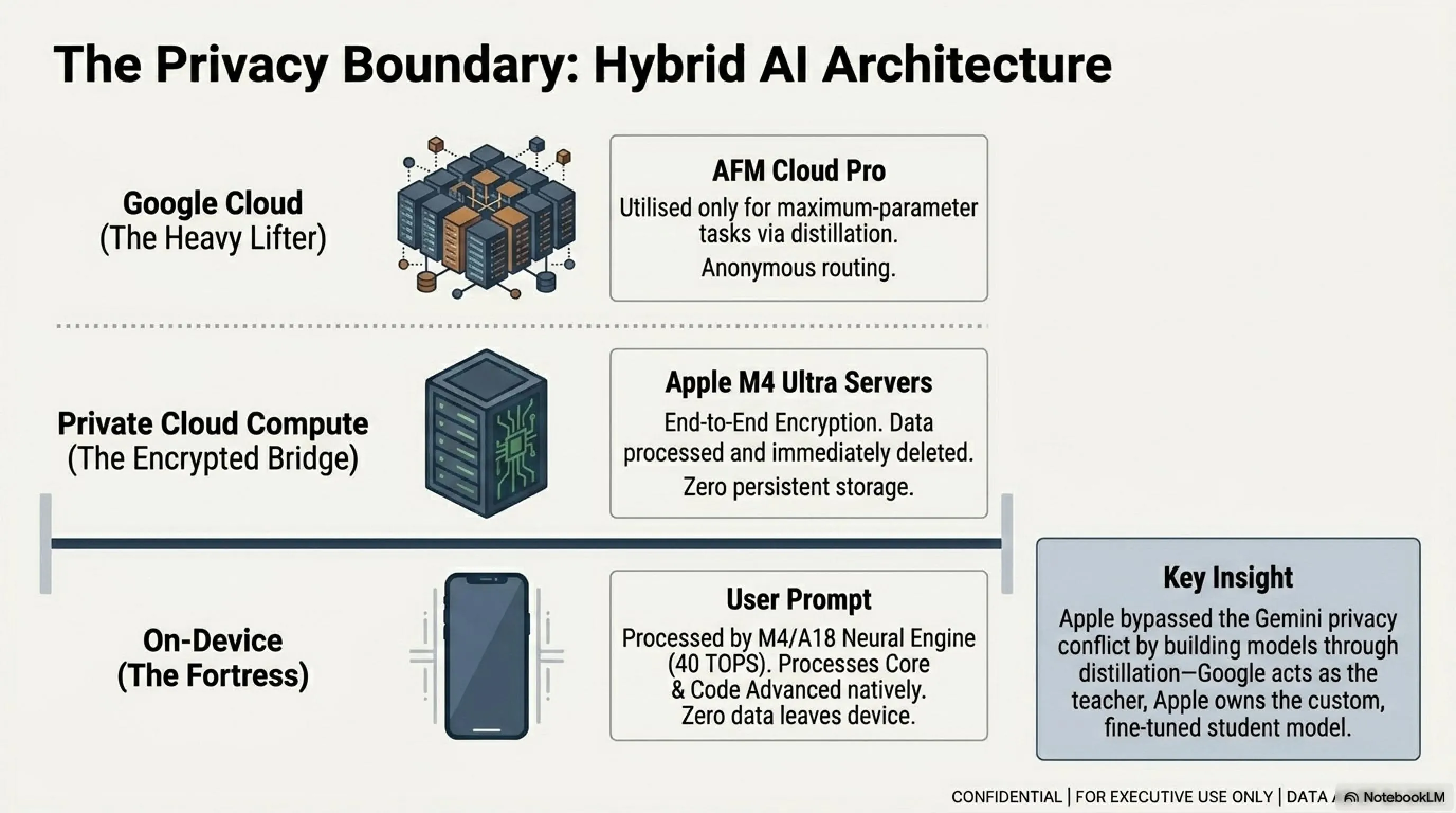
One of the most intriguing aspects of AFM 3 architecture is Private Cloud Compute (PCC). Apple claims this system is "the world's most secure cloud infrastructure." According to MacStories and Lifehacker reports, PCC uses Apple's proprietary M4 Ultra chips, and all data is end-to-end encrypted. Even Apple cannot access user data. This means when Siri needs to perform a complex task, data is sent to PCC, processed, and immediately deleted—no long-term storage exists.
However, not everything is perfect. Critics note that Apple still lags behind competitors in certain benchmarks. According to published data, AFM 3 Code Advanced scored 79.1% on SWE-bench (a real-world coding test), while Claude Mythos 5 achieved 84.7% and GPT-5.5 scored 78.3%. This means AFM 3 is competitive but doesn't have a decisive advantage. Additionally, some advanced features like real-time voice interaction and advanced coding agents are currently only in beta and likely won't be fully released until fall 2026.
✅ AFM 3 Advantages
- Unparalleled privacy with PCC
- Fast, energy-efficient on-device processing
- Seamless integration with Apple ecosystem
- Native multimodal (text, image, audio, video)
- Access to Google Cloud infrastructure
- Hardware-software co-optimization
⚠️ Challenges & Limitations
- Still trails competitors in some benchmarks
- Dependence on Google for cloud models
- Some features only in beta
- Limited to Apple devices
- Requires internet for complex tasks
- Regional restrictions may apply
💡 What This Means for Developers: AFM 3 will be accessible through new Apple Intelligence APIs in iOS 21 and macOS 15. Developers can integrate these models for smart features in their apps. However, access to AFM 3 Cloud may be restricted due to regional limitations. We recommend focusing on on-device models that run locally without requiring server access. The App Intents framework has been significantly enhanced to support agentic workflows, enabling apps to chain multiple AI operations seamlessly.
Section 3️⃣: Oracle PeopleSoft Massive Breach — ShinyHunters and CVE-2026-35273 Target 100+ Organizations 🛡️💥
Now we turn to one of the biggest cybersecurity disasters of 2026. The notorious hacking group ShinyHunters exploited a critical zero-day vulnerability in Oracle PeopleSoft, breaching over 100 organizations and stealing sensitive data from millions of individuals. According to reports from TechCrunch, The Hacker News, and Help Net Security, this attack occurred between May 27 and June 9, 2026, primarily targeting universities and educational institutions.
The vulnerability in question is CVE-2026-35273, a Remote Code Execution (RCE) bug in PeopleSoft's Environment Management component. This flaw, rated CVSS 9.8 (Critical), allows attackers to execute arbitrary code on PeopleSoft servers without any authentication, over the internet. In simple terms, anyone who knows the IP address of an organization's PeopleSoft server can hack it—no username, password, or special access required!
🚨 CVE-2026-35273 Technical Details
According to reports from Google Mandiant and Google Threat Intelligence Group (GTIG), ShinyHunters used this vulnerability to gain access to PeopleSoft systems and steal sensitive data including personal information, academic records, financial data, and even passwords. In one confirmed case, a major U.S. university reported that data from nearly 500,000 current and former students and employees was stolen. ShinyHunters then leaked this data and demanded ransom from victims.
The concerning aspect is that Oracle was initially unaware of this vulnerability's existence. When ShinyHunters began selling stolen data on the dark web, security teams realized a zero-day was being actively exploited. Oracle issued an out-of-band security alert on June 11, 2026, urging all PeopleSoft customers to immediately install the security patch. Unfortunately, many organizations were compromised before patches could be deployed.
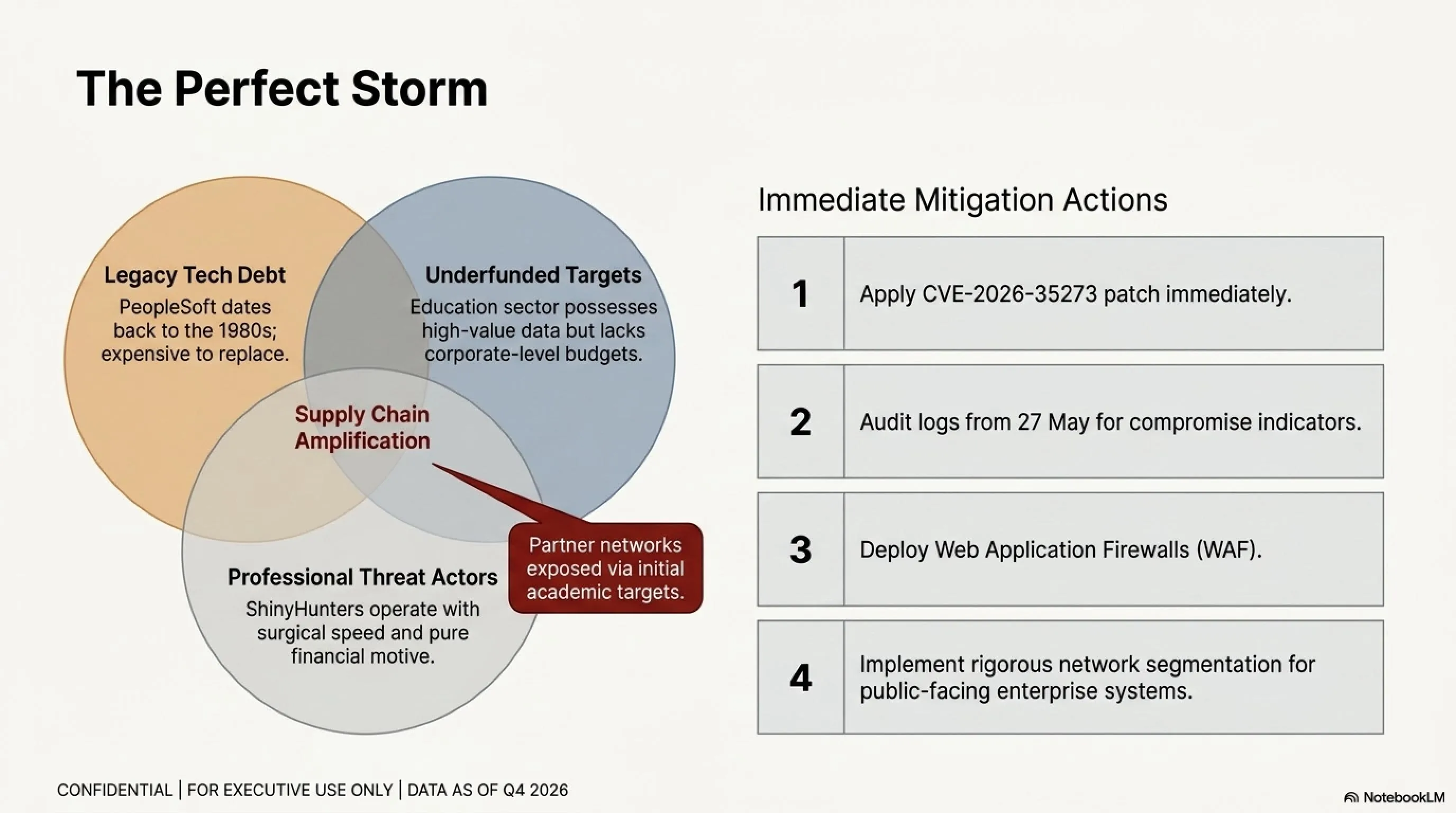
What makes this particularly devastating is the perfect storm of factors that converged. First, PeopleSoft is legacy enterprise software from the 1980s, widely used by large organizations because replacing it is prohibitively expensive. Second, universities typically have smaller cybersecurity budgets compared to private companies and often run older software versions. Third, ShinyHunters is a sophisticated criminal group with a proven track record of high-profile breaches including AT&T, Ticketmaster, and now Oracle. They exploited the vulnerability with surgical precision, targeting the education sector where data is valuable but defenses are weaker.
🔍 Tekin Analysis: Why Was This Attack So Devastating?
1. Zero-Day Without Patch: This was a true zero-day—Oracle had no patch ready. Attackers had several days to exploit the vulnerability without any resistance. This is precisely the nightmare scenario that security teams fear most. The window between discovery and patch deployment is when organizations are completely defenseless.
2. Education Sector Targeting: Universities typically have lower cybersecurity budgets compared to private companies and run older systems. ShinyHunters knew this and deliberately targeted this sector. Moreover, universities possess vast amounts of sensitive data that can be sold expensively on the dark web—student records, research data, financial information, and credentials for accessing other systems.
3. PeopleSoft — Old but Widespread: PeopleSoft is one of the oldest ERP (Enterprise Resource Planning) systems, existing since the 1980s. Many organizations still use it because replacing it is extremely expensive and disruptive. But this age means legacy code, weaker security architecture, and greater exposure to vulnerabilities. Technical debt becomes security debt.
4. ShinyHunters — Professional Operators: ShinyHunters is a well-known malicious group with a history of major attacks on companies like AT&T, Ticketmaster, and now Oracle. They operate purely for financial gain and typically immediately sell stolen data on the dark web or extort ransom from victims. Their professionalism and speed make them particularly dangerous.
5. Supply Chain Amplification: Many organizations don't just use PeopleSoft for their own operations—they're connected to partner institutions. A breach at one university can potentially provide access to consortium networks, research collaborations, and shared administrative systems. The attack surface extends far beyond the initial victim.
The good news is that Oracle has now released a security patch, and all organizations using PeopleSoft must install it immediately. Additionally, Oracle has recommended that organizations should:
- Immediately install the CVE-2026-35273 patch
- Review PeopleSoft server logs from May 27 onwards to check for signs of compromise
- If compromise indicators are found, immediately reset passwords for all users
- Enable IDS/IPS systems to detect suspicious traffic
- Implement network segmentation to isolate PeopleSoft servers from the public internet
- Conduct forensic analysis to determine the full extent of data exfiltration
- Notify affected individuals and regulatory authorities as required by law
⚠️ Critical Reminder for Enterprise IT Teams: If your organization uses Oracle PeopleSoft or similar legacy ERP systems, verify immediately that security patches are installed. Conduct a comprehensive security audit of all internet-facing enterprise systems. Implement zero-trust architecture where possible, use WAF (Web Application Firewall) for protection, and ensure incident response plans are current. The time to act is now—waiting for the next breach is not an option.
Section 4️⃣: Musk's Audacious Plan — 1 Million AI Satellites and the GigaSat Factory 🛰️🤯
If you thought SpaceX's historic IPO was Elon Musk's most audacious news today, think again! In interviews with Space.com and Tom's Hardware, Musk announced that SpaceX plans to launch one million AI-equipped satellites into Earth orbit by 2030 to create a network of space-based data centers capable of processing heavy AI workloads in space. To achieve this goal, SpaceX has opened an 11-million-square-foot (approximately 1 million square meters) factory called GigaSat in Bastrop, Texas.
According to Tom's Hardware, the GigaSat factory will begin mass-producing AI satellites by late 2027, targeting 1 gigawatt per year capacity. Each satellite will be equipped with dedicated AI chips (likely based on Nvidia or AMD) capable of processing large language models and AI workloads directly in orbit. Power will be supplied by solar panels that, in space, generate electricity continuously without any day-night or weather limitations.
🚀 Timeline of Musk's AI Satellite Plan
But why does Musk want to move AI data centers to space? The answer is simple: the energy crisis. According to The Next Web and Forbes reports, the entire AI industry faces a major problem: large language models like GPT, Claude, and Gemini consume enormous amounts of electricity. For example, a large AI data center can consume 100 megawatts—equivalent to a small city's power consumption! In many countries, power grids cannot supply this volume, and electricity prices are rising.
Musk's solution? Move data centers to space! In space, the sun shines 24/7, there's no night or day, no clouds block the light, and energy is completely free. Additionally, cooling—one of the biggest challenges for terrestrial data centers—is much simpler in space because the temperature approaches absolute zero. Of course, this doesn't mean no cooling system is needed—space is a vacuum and heat transfer only occurs through radiation, but it's still far more efficient than terrestrial systems.
The economics are compelling on paper. Terrestrial data centers spend roughly 40% of their electricity on cooling alone. In space, passive radiative cooling can handle most thermal management. Solar panels operate at peak efficiency without atmospheric absorption. And with Starship's projected launch costs of $100/kg (compared to current $10,000/kg), the capital cost of deploying space infrastructure becomes manageable. A 1-gigawatt space data center could potentially be deployed for $100-200 billion—expensive, but not prohibitive for the scale of AI computing demand.
🔍 Tekin Analysis: Feasible Vision or Impossible Dream?
Strengths: Musk has proven he can make the impossible possible. Starlink, with over 6,400 satellites, is the largest satellite constellation in history. Starship, capable of lifting 150 tons to orbit, could reduce launch costs from $10,000/kg to $100/kg—making this plan economically viable. SpaceX's vertical integration and manufacturing prowess are unmatched in the industry.
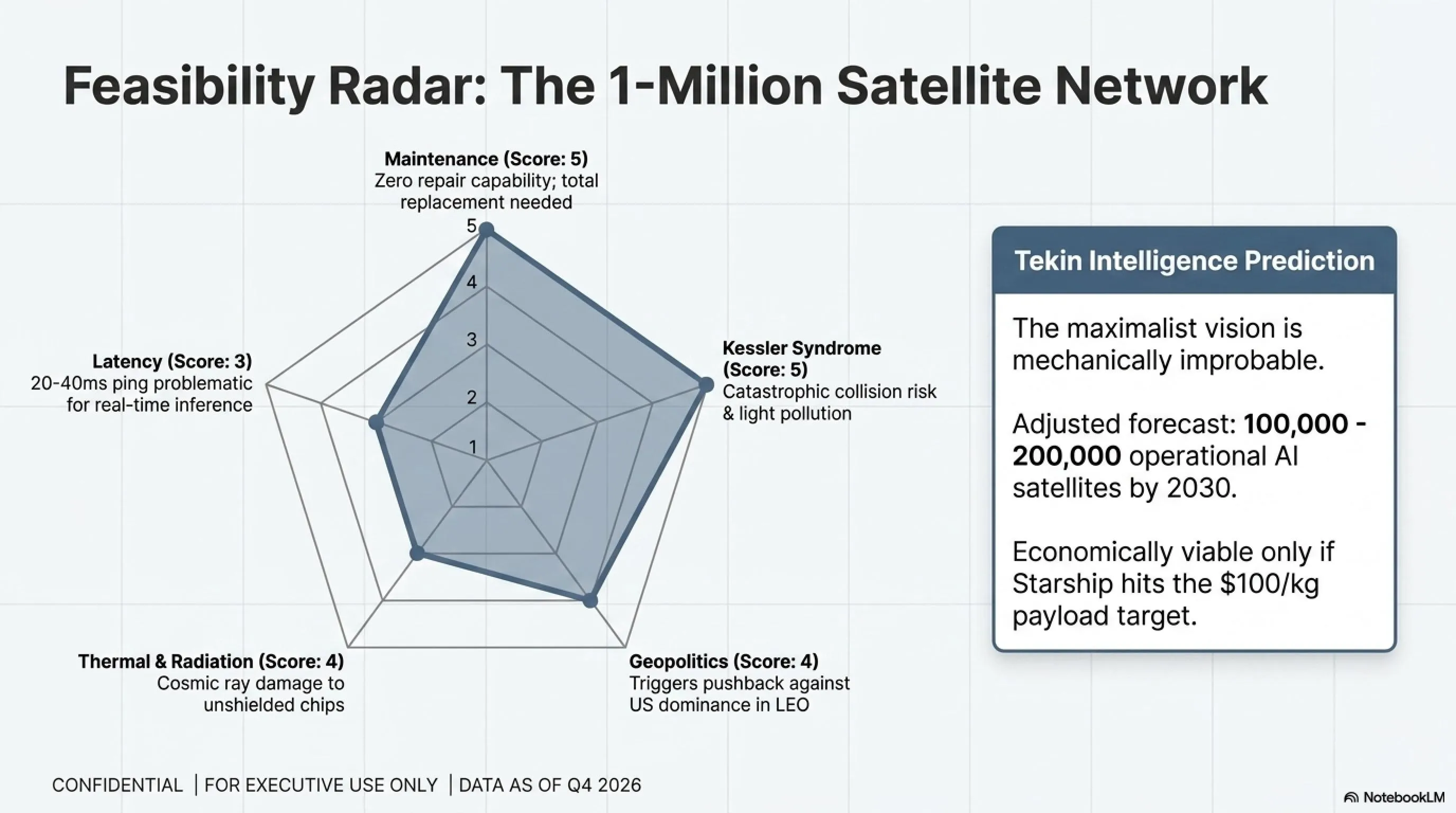
Technical Challenges: (1) Latency — Even with LEO (Low Earth Orbit), ping times are 20-40 milliseconds, problematic for some real-time workloads. (2) Maintenance — If a satellite fails, it cannot be repaired; it must be replaced. (3) Radiation — Cosmic rays can damage electronic chips, requiring special hardening. (4) Thermal cycling — Satellites experience extreme temperature swings between sunlight and shadow, stressing components. (5) Data uplink/downlink — Moving massive datasets to/from space requires enormous bandwidth and ground station infrastructure.
Environmental and Scientific Concerns: Scientists and astronomers worry that 1 million satellites could create severe light pollution, making astronomical observations nearly impossible. Additionally, there's the risk of Kessler Syndrome—if the number of objects in orbit becomes excessive, collisions could trigger a chain reaction, rendering space unusable for decades. The International Astronomical Union has already expressed alarm at Starlink's impact on astronomy; scaling to 1 million would be catastrophic for ground-based observatories.
Geopolitical Dimensions: Governments, especially China and Russia, are concerned that an American company would have such enormous control over near-Earth space. This could lead to international tensions and even a new space race. China has already announced plans for its own mega-constellations in response to Starlink. A space infrastructure arms race could define 21st-century geopolitics.
Regulatory Hurdles: The FCC approval process for 1 million satellites will be extraordinarily complex. Environmental impact statements, frequency coordination, collision avoidance protocols, and deorbiting requirements all must be addressed. International coordination through the ITU (International Telecommunication Union) adds another layer of complexity. Musk's timeline assumes regulatory approval at unprecedented speed—a major assumption.
💡 Tekin Prediction: The full plan likely won't materialize by 2030, but initial phases (several thousand satellites by 2028) are entirely feasible. If successful, this could fundamentally transform AI and cloud computing industries. However, if it fails, SpaceX could face a serious financial crisis—as Forbes has warned. Our estimate: by 2030, expect 100,000-200,000 AI satellites, not 1 million. Still revolutionary, but more realistic than Musk's maximalist vision. The real question isn't whether space-based computing is possible—it's whether it's economically competitive with terrestrial alternatives once nuclear fusion and renewable energy mature.
Section 5️⃣: Bezos' Prometheus — $12 Billion Investment to Build Artificial General Engineer 💰🤖
While Elon Musk conquers space, Jeff Bezos is conquering the physical industries of the world! Prometheus, the AI startup where Bezos serves as co-CEO, announced Thursday, June 11, that it raised $12 billion in Series B funding, achieving a $41 billion valuation. According to reports from TechCrunch, Semafor, and CNBC, this investment includes participation from financial giants JPMorgan Chase, Goldman Sachs, BlackRock, DST Global, and Arch Venture Partners.
But what is Prometheus and what does it do? Bezos says Prometheus aims to build an "Artificial General Engineer" (AGE)—an AI system capable of automating the entire engineering process from initial design to performance testing to final manufacturing. In simple terms, imagine an AI that can design a jet engine, a pharmaceutical drug, a computer chip, or an automotive part from scratch, simulate it, test it, and prepare it for manufacturing—without requiring a human engineer!
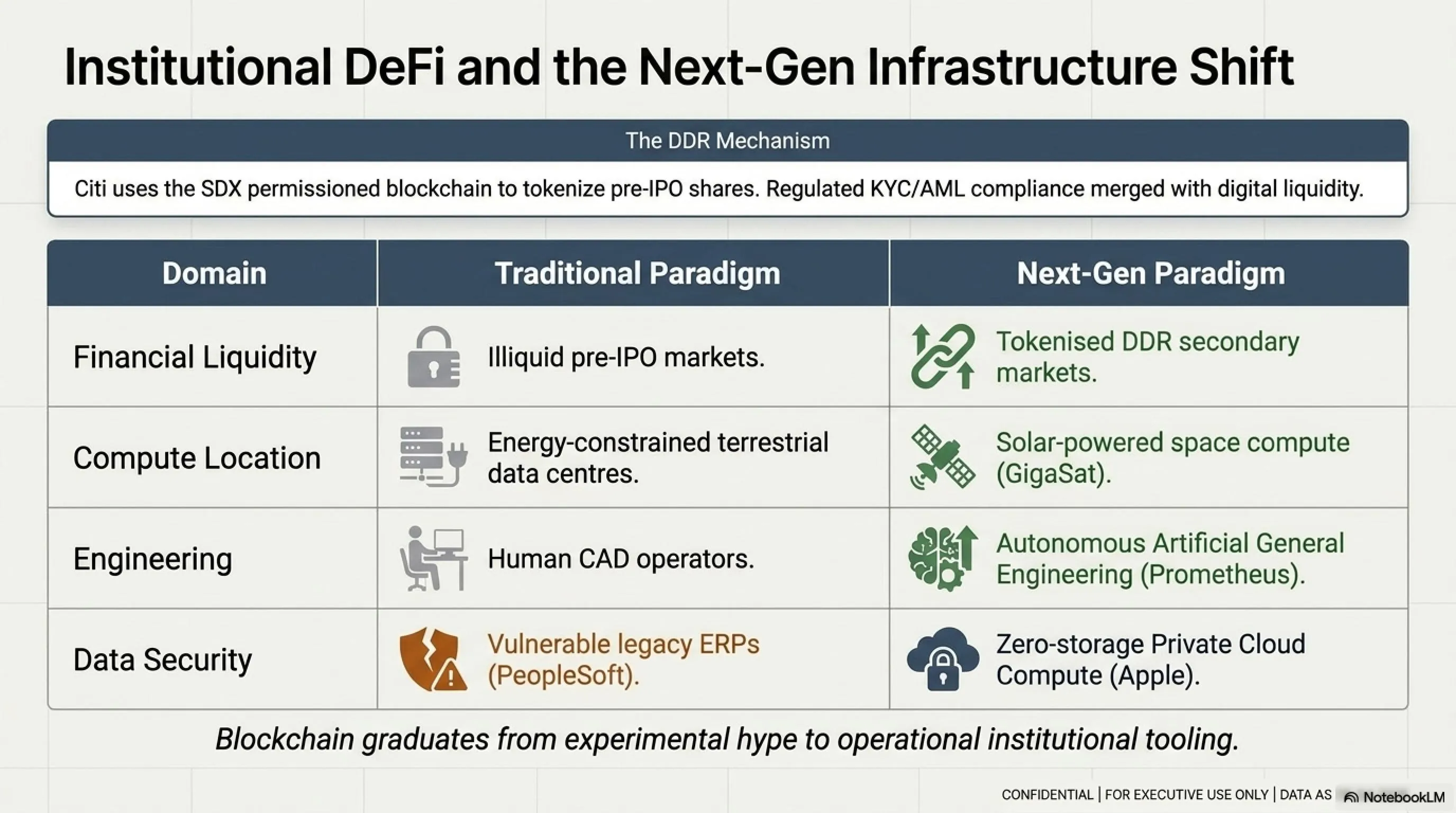
🏭 Prometheus Target Industries
- Aerospace: Design and optimization of jet engines, aircraft fuselage, space propulsion systems
- Automotive: Automotive component design, electric powertrains, autonomous driving systems
- Computing & Semiconductors: Design of new chips, processor architecture optimization
- Advanced Manufacturing: Industrial robots, automation systems, CNC tooling
- Pharmaceuticals: Drug discovery, molecule design, prediction of drug effects
According to Financial Express and GeekWire, Prometheus currently employs about 150 people—most of them engineers and scientists with expertise in machine learning, computational physics, materials science, and CAD/CAM. In an interview with CNBC, Bezos said it's still "premature" to disclose technical details, but he indicated that Prometheus uses a combination of generative AI, advanced simulation engines, and optimization algorithms to "democratize" engineering.
The interesting aspect is that this is the first time since 2021 that Bezos has taken on the CEO role. He stepped down from Amazon in July 2021, and it was widely thought he would never return to active business. But Prometheus demonstrates that Bezos remains passionate about innovation—this time in a field that could fundamentally impact all physical industries.
The technical approach Prometheus is taking represents a significant departure from traditional CAD/CAM workflows. Instead of human engineers using software tools to design products, AGE systems autonomously explore vast design spaces using reinforcement learning and evolutionary algorithms. The AI generates thousands of candidate designs, simulates their performance using computational fluid dynamics, finite element analysis, and molecular dynamics, then iteratively refines designs based on multi-objective optimization criteria like cost, performance, manufacturability, and sustainability.
💡 Tekin Analysis: If Prometheus succeeds, it could completely transform industries like aerospace and automotive manufacturing. Imagine a small startup able to design complex products like jet engines without needing a massive engineering team. This could reduce costs, accelerate innovation cycles, and enable developing countries to compete in advanced industries. For emerging economies, this represents a strategic opportunity—if such tools become accessible, domestic industries could progress much faster. The implications for engineering education are profound: future engineers may become "AI supervisors" rather than traditional designers.
Section 6️⃣: Citi's Blockchain Revolution — Tokenizing Private Company Shares 🏦⛓️
Finally, we come to one of the most fascinating developments in the financial world. Citigroup announced Thursday that it has launched the world's first blockchain platform for buying and selling private company shares. According to reports from CoinDesk, CryptoNews, and Markets Media, this product is called Digital Depositary Receipts (DDR) and enables tokenization of pre-IPO company shares for wealthy and institutional investors.
The DDR structure is based on the traditional Depositary Receipts (DR) model that has been used in financial markets for years. In this model, the bank acts as custodian, holding the actual company shares, then issues substitute securities (DRs) representing ownership of those shares. The difference with DDR is that these securities are recorded on blockchain and can be traded faster, more transparently, and more cheaply.
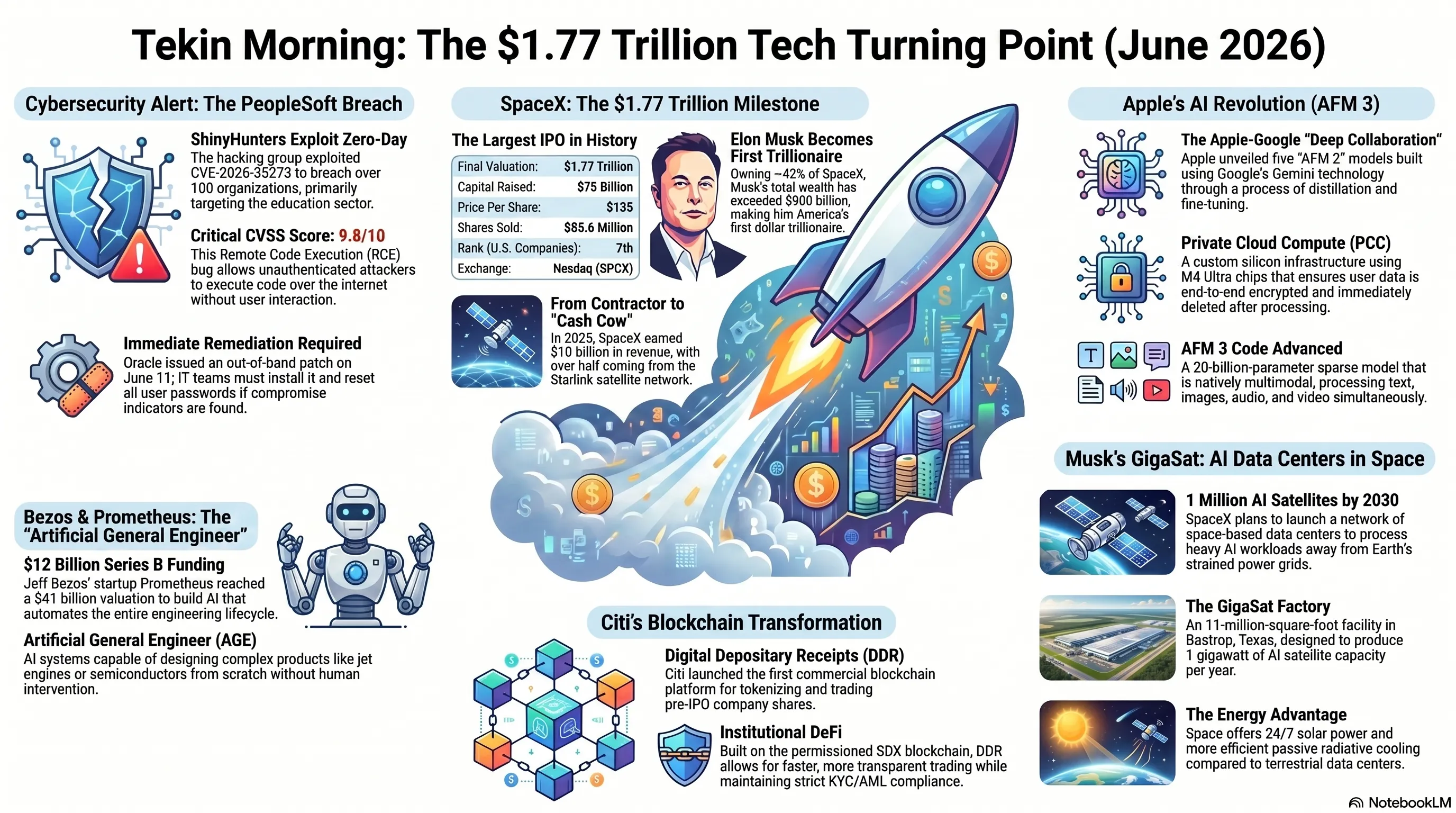
According to Citigroup, DDR is built on SDX blockchain infrastructure—a permissioned blockchain operated by SIX Swiss Exchange. This means that unlike public blockchains like Ethereum where anyone can access, SDX is only available to authorized financial institutions. This model allows Citi to enforce KYC/AML (Know Your Customer and Anti-Money Laundering) regulations while still leveraging blockchain benefits like transparency and speed.
🔍 Tekin Analysis: Why This Is a Turning Point for Blockchain
1. Real Institutional Adoption: Until now, most blockchain projects in the financial sector were just pilots or experiments. DDR is the first fully commercial product from a major global bank built entirely on blockchain. This demonstrates that blockchain is no longer just hype but an operational technology.
2. Democratizing Private Markets: Until now, investing in pre-IPO companies was only possible for very wealthy individuals and large funds. DDR could open this market and allow smaller investors to participate in innovative companies. This could fundamentally reshape venture capital and private equity.
3. Increased Liquidity: One major problem with private shares is illiquidity—you cannot easily sell your shares. DDR, by creating a digital secondary market, increases liquidity and allows investors to exit earlier. This could reduce the private-to-public timeline and change IPO dynamics.
4. Competition with Crypto Exchanges: Traditional banks are responding to the cryptocurrency threat. DDR shows that banks can use blockchain to create new products and compete in the digital market. This is institutional DeFi—regulated, compliant, but leveraging blockchain's efficiency.
5. Regulatory Precedent: Citi's successful launch of DDR creates a regulatory pathway for other institutions. The SEC and other regulators are observing closely. If DDR succeeds without major compliance issues, expect similar products from JPMorgan, Goldman Sachs, and other major banks within 12-18 months.
Of course, DDR has limitations. According to Wall Street Journal, this product is currently only available to non-U.S. investors due to complex SEC regulations. Additionally, only specific companies can tokenize their shares, not just any company. Citi hopes that in the future, other financial institutions will also use this structure and create an industry standard.
❓ Frequently Asked Questions (FAQ)
▶️ Can I invest in the SpaceX IPO?
Yes, if you have access to U.S. stock markets. SpaceX begins trading Friday, June 12, 2026, on Nasdaq under ticker symbol SPCX. International investors can access through brokers offering U.S. market access. For indirect exposure, consider space-focused ETFs like ARKX. Keep in mind that IPO pricing may differ from opening trading price due to market demand.
▶️ Will Apple AFM 3 be available in all regions?
On-device models (AFM 3 Core and Code Advanced) that run locally will work everywhere. However, cloud-based models may have regional restrictions due to Apple Intelligence availability. Developers can use on-device APIs without issues, but should test whether cloud features work in their target markets. Apple typically rolls out AI features gradually by region.
▶️ Our organization uses Oracle PeopleSoft. What should we do?
Immediately contact your IT team and ensure the CVE-2026-35273 patch is installed. Review server logs from May 27 onwards for compromise indicators. If limited access to Oracle updates exists, use WAF (Web Application Firewall) to block unauthorized access. Implement network segmentation to isolate PeopleSoft servers from public internet. Consider engaging a cybersecurity firm for forensic analysis if any suspicious activity is detected.
▶️ Is Musk's 1 million satellite plan realistic?
The full plan by 2030? Unlikely. But initial phases (10,000-50,000 satellites by 2028) are entirely feasible. Musk has a proven track record with Starlink. However, technical challenges (latency, maintenance), environmental concerns (light pollution, Kessler Syndrome), and geopolitical reactions (China, Russia) could be obstacles. Our prediction: by 2030, expect 100,000-200,000 AI satellites, not 1 million. Still revolutionary, but more realistic than Musk's maximalist vision.
▶️ How can I access Citi's DDR platform?
Currently, DDR is only available to institutional investors and high-net-worth individuals, with initial focus on non-U.S. investors due to SEC regulations. To access, you would need to work with Citi's private banking division and meet minimum wealth/institutional requirements. As the platform matures, expect broader access and potentially integration with other banks' systems. For retail investors, indirect exposure through private equity funds or venture capital trusts may become available.
🎯 Final Thoughts
Friday, June 12, 2026, will be remembered as a watershed moment—the day SpaceX's historic IPO proved that space is no longer a dream but a profitable reality, Apple with AFM 3 demonstrated it can compete in the AI race, ShinyHunters reminded us that cybersecurity is a serious and ongoing challenge, Musk with his 1 million satellite plan blurred the lines between imagination and reality, Bezos with Prometheus showed he's still in the innovation game, and Citi with DDR reminded us that blockchain is no longer just hype but a real tool for financial transformation.
For global observers, these developments signal opportunities to learn from successful innovation patterns, the critical need for enhanced cybersecurity vigilance, the importance of investing in emerging technologies, and a reminder that the world is rapidly changing—we must keep pace not just as consumers, but as creators and innovators.
Final message: The future belongs to those who start building it today! 🚀
📚 Sources
- CNBC - "SpaceX Raises $75 Billion in Record-Setting IPO"
- 9to5Mac - "Apple's Third-Generation Foundation Models Explained"
- TechCrunch - "Oracle Warns of Security Bug ShinyHunters Abused to Breach 100+ Companies"
- Space.com - "Elon Musk Wants to Put 1 Million AI Satellites in Space"
- TechCrunch - "Jeff Bezos's Prometheus Raises $12B to Build Artificial General Engineer"
- CoinDesk - "Citi Opens New Route Into Private Markets with Tokenized Share Offering"
- Tom's Hardware - "SpaceX Unveils 11-Million-Square-Foot GigaSat Factory"
- The Hacker News - "ShinyHunters Exploits Oracle PeopleSoft Zero-Day"
- Google Mandiant - "Active Oracle PeopleSoft Exploitation Campaign"
- Variety - "SpaceX Stock IPO Shares Trading at $1.77 Trillion Valuation"
🌐 Stay Connected With Us 🎮✨
For the latest tech, gaming, and gadget news, follow us on our official social media channels: