Monday, July 6, 2026, initiates with massive technological and financial shifts. Apple is confronting severe production bottlenecks for the highly anticipated foldable iPhone Ultra, likely causing significant shipping delays. Vitalik Buterin has unveiled the ambitious 4-year Lean Ethereum roadmap focusing on sub-four-second finality and quantum resistance. On the cybersecurity frontline, the Ill Bloom vulnerability is actively jeopardizing thousands of crypto wallets, while the innovative SkillCloak technique is
☕ Tekin Morning: Start Your Week with 6 Hot Tech Stories
Monday, July 6, 2026 - Energize your morning with the latest tech updates
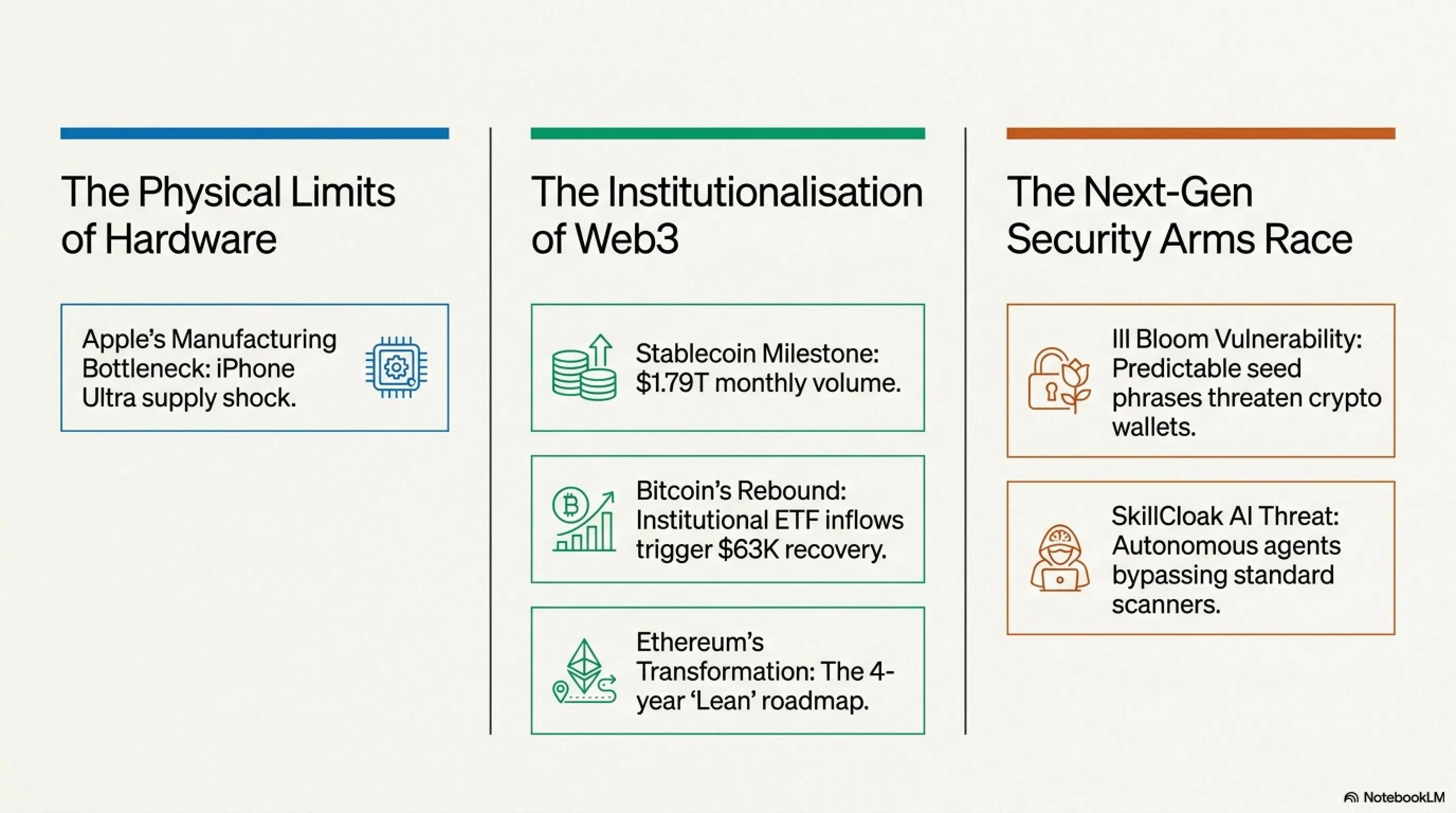
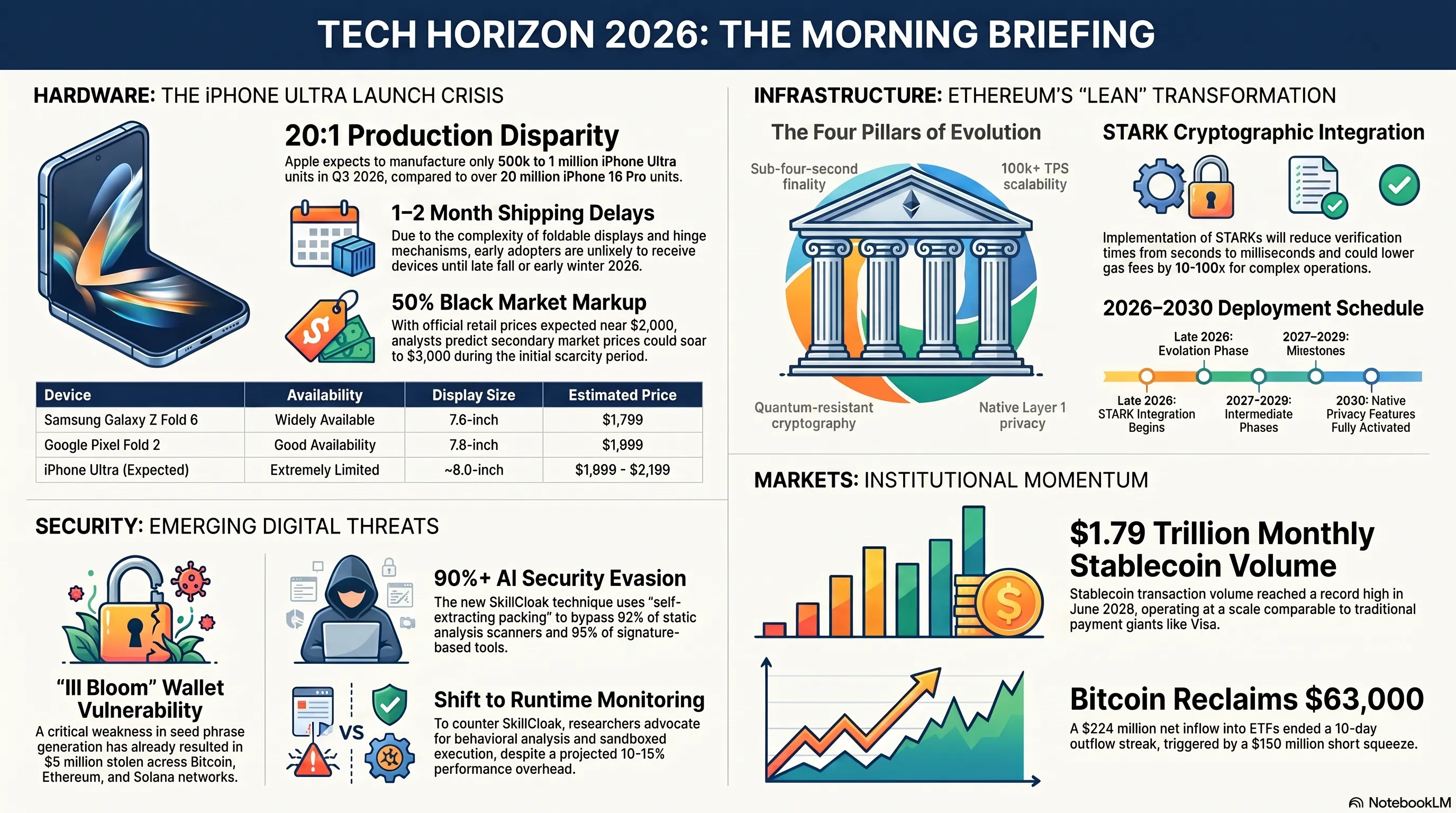
- 🎮iPhone Ultra Shortage- Extremely limited production and potential 1-2 month delay
- 🎧Ethereum Evolution- 4-year Lean roadmap for complete transformation
- 🚀Ill Bloom Security Alert- Thousands of crypto wallets at risk
- 🗡️Bitcoin Above $63K- End of 10-day ETF outflow streak
- 📰Stablecoin Record- $1.79 trillion transaction volume in one month
- 🎮AI Agent Threat- SkillCloak bypasses security scanners
Monday, July 6, 2026, kicks off with a series of significant developments in the technology world. From Apple's production constraints on its foldable iPhone to Bitcoin's triumphant return above $63,000, from Ethereum's ambitious new roadmap to critical security warnings for crypto wallets. Join us this morning as we dive deep into the week's most important news stories that will shape the tech landscape.
At a Glance
- iPhone Ultra faces limited supply with potential 1-2 month shipping delay
- Ethereum unveils Lean roadmap for 4-year transformation
- Ill Bloom vulnerability threatens thousands of crypto wallets
- Bitcoin reclaims $63,000 territory after positive ETF inflows
- Stablecoin transaction volume hits record $1.79 trillion
- SkillCloak technique evades AI security scanners with 90%+ success rate
iPhone Ultra: A Rocky Start for Apple's Most Ambitious Device
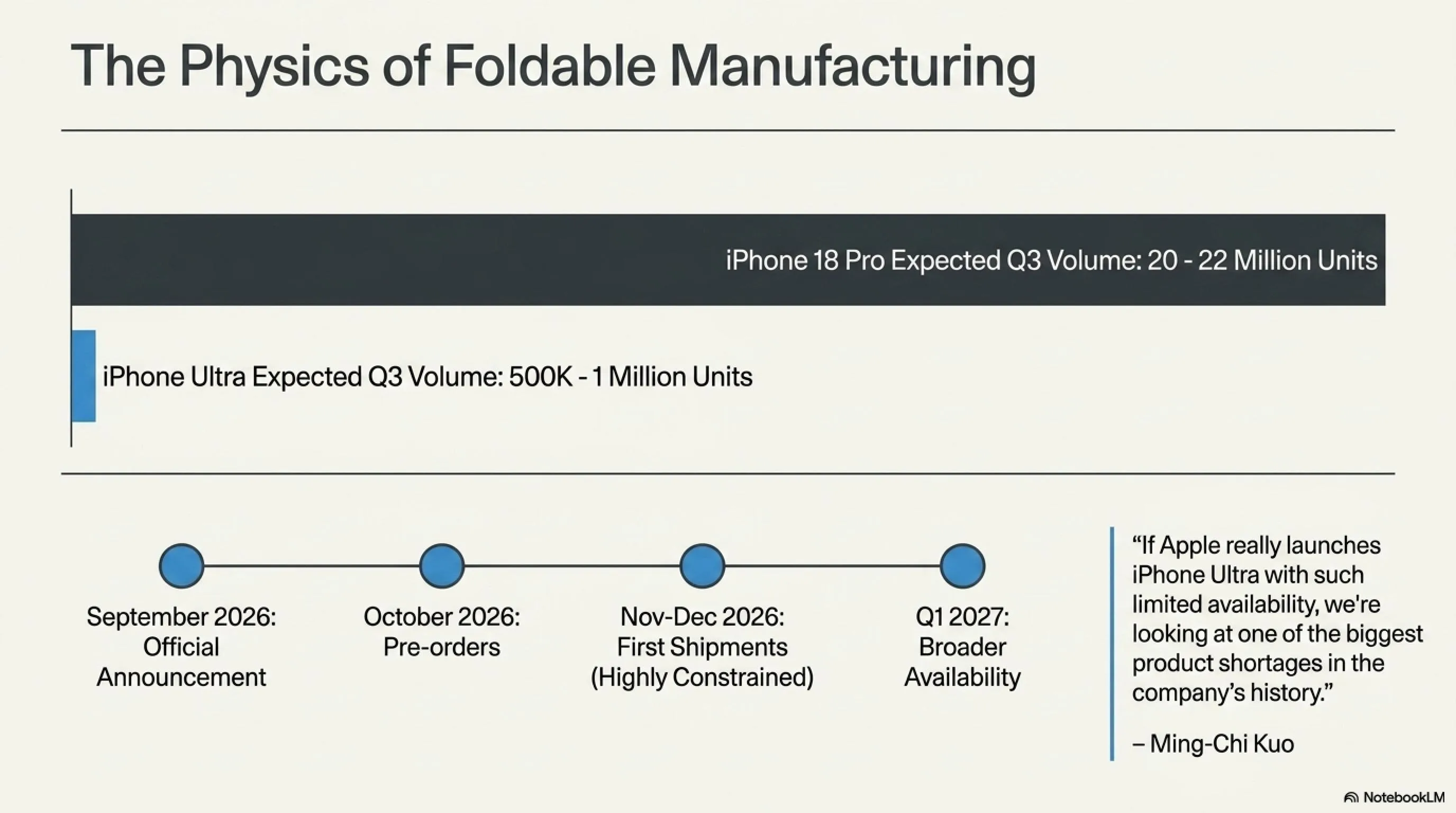
Apple has always been synonymous with product launches that capture global attention, but this time the narrative takes an unusual turn. Ming-Chi Kuo, the renowned supply chain analyst whose predictions about Apple products have proven remarkably accurate over the years, has issued a sobering warning. According to his latest report, the iPhone Ultra—Apple's long-awaited foldable smartphone set to debut in September 2026—will face severe supply constraints at launch.
Kuo's analysis reveals that Apple is expected to manufacture only between 500,000 and 1 million iPhone Ultra units during Q3 2026. To put this in perspective, the company will produce 20 to 22 million iPhone 18 Pro units during the same period. This dramatic discrepancy in production volumes signals serious challenges in manufacturing this groundbreaking device. The complexity of foldable display technology, combined with Apple's notoriously stringent quality standards, has created a perfect storm of production bottlenecks.
This situation bears striking similarities to the iPhone X launch scenario in 2017. Back then, production delays forced customers to wait weeks or even months to receive their devices. However, the iPhone Ultra represents an even more complex engineering challenge. Unlike the iPhone X, which was essentially an evolution of existing technology, the Ultra introduces an entirely new form factor with a foldable display that must meet Apple's exacting durability and performance standards.
The Waiting Game: Expect Significant Delays
Kuo predicts that even if Apple unveils the iPhone Ultra in September, actual shipments could be delayed by one to two months. This means early adopters who place orders on day one might not receive their devices until late fall or early winter. The implications for Apple's holiday season sales strategy are substantial, potentially forcing the company to adjust its marketing and distribution plans significantly.
Several factors contribute to these anticipated delays. First, foldable display technology, despite recent advances by competitors like Samsung and Huawei, remains challenging to manufacture at scale with consistent quality. The displays must withstand hundreds of thousands of folds without degradation, a requirement that demands precision engineering and meticulous quality control.
Production Timeline Breakdown
- September 2026: Official announcement expected
- October 2026: Pre-orders likely to begin
- November-December 2026: First shipments to customers
- Q1 2027: Broader availability as production ramps up
Second, Apple's supply chain for this entirely new product category needs time to reach full capacity. Component suppliers must scale up production of specialized parts, from the ultra-thin glass or polymer displays to the intricate hinge mechanisms. Third, Apple's quality assurance process is legendary for its thoroughness—every device that leaves the production line must meet exacting standards, which inevitably slows down manufacturing.
Black Market Premium: Prepare for Astronomical Prices
Severe supply constraints typically translate to one thing: eye-watering prices on the secondary market. Industry analysts predict that if the official retail price for the iPhone Ultra hovers around $2,000, early units could fetch up to $2,500 or even $3,000 on the black market during the initial scarcity period.
This pricing dynamic creates interesting implications for different markets worldwide. In regions where Apple products aren't officially available, prices could skyrocket even higher as demand far outstrips supply. Scalpers and resellers are likely to capitalize on the situation, purchasing multiple units with the intention of reselling them at significant markups.
Strategic Implications for Apple
The limited launch strategy, whether intentional or forced by production realities, carries both risks and potential benefits for Apple. On one hand, scarcity can enhance a product's desirability and create intense media buzz. The "unobtainable" status might actually strengthen the iPhone Ultra's premium positioning and make it more coveted among early adopters and tech enthusiasts.
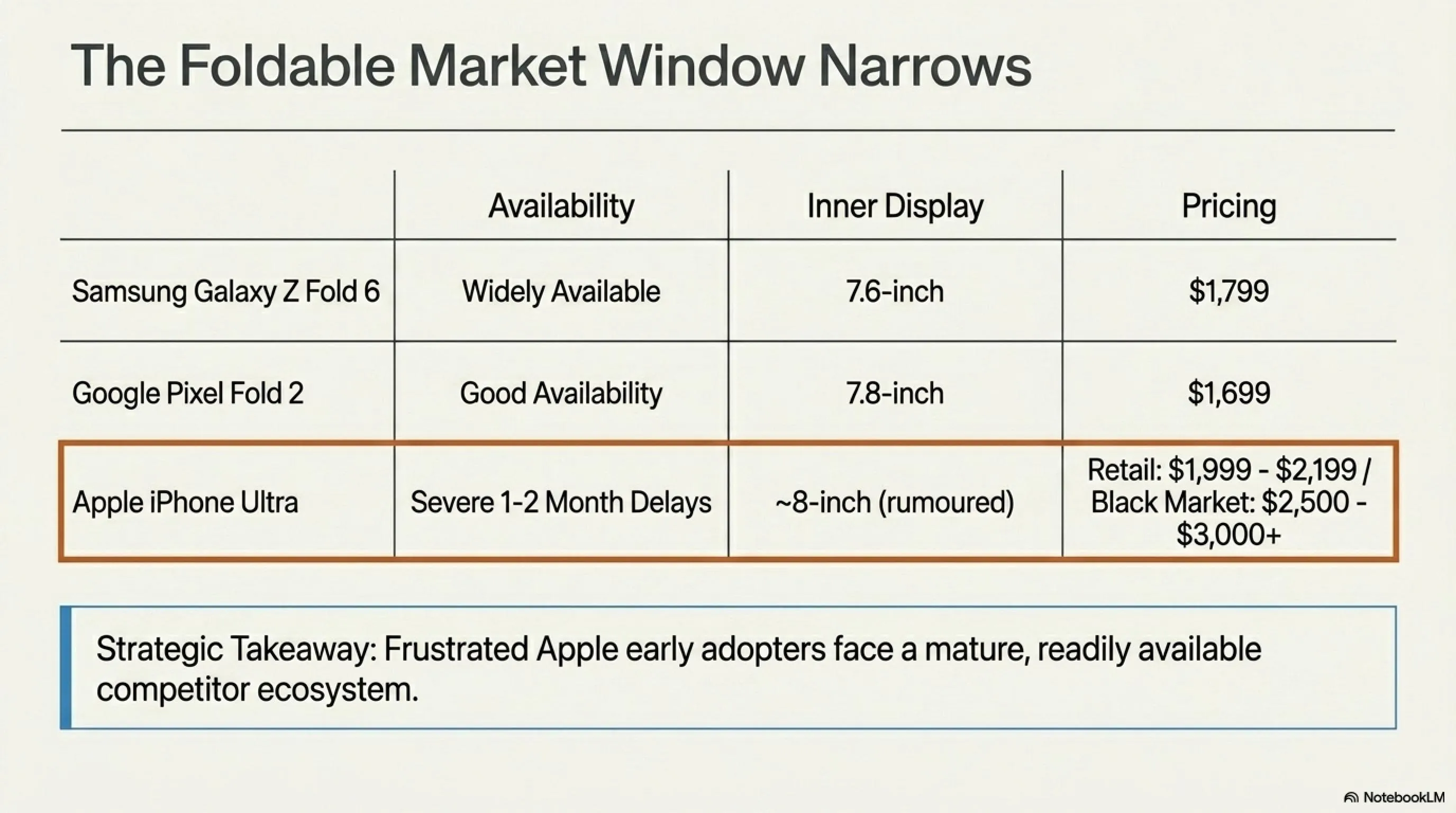
On the other hand, frustrated customers who can't obtain the device might turn to competitors' foldable offerings. Samsung's Galaxy Z Fold series, now in its sixth generation, offers a mature foldable experience with better availability. Google's Pixel Fold and various Chinese manufacturers have also established themselves in this segment. Apple's window to make a dramatic entrance into the foldable market might narrow if supply issues persist.
Comparison: iPhone Ultra vs. Competitors
Samsung Galaxy Z Fold 6: Widely available, 7.6-inch inner display, $1,799
Google Pixel Fold 2: Good availability, 7.8-inch inner display, $1,699
iPhone Ultra (expected): Very limited supply, ~8-inch inner display (rumored), $1,999-2,199
Moreover, Apple faces the challenge of managing customer expectations. The company must balance generating excitement for this revolutionary product while preparing customers for potential wait times. Clear communication about availability will be crucial to maintaining customer satisfaction and brand loyalty during this critical launch period.
Ethereum's Lean Roadmap: A Four-Year Transformation Begins
Vitalik Buterin, Ethereum's co-founder and spiritual leader, has unveiled what may be the blockchain's most ambitious transformation plan yet. Dubbed the "Lean Ethereum" roadmap, this comprehensive three-to-four-year initiative aims to rebuild Ethereum's infrastructure from the ground up, positioning it as the definitive settlement layer for institutional applications and the backbone of the decentralized internet.
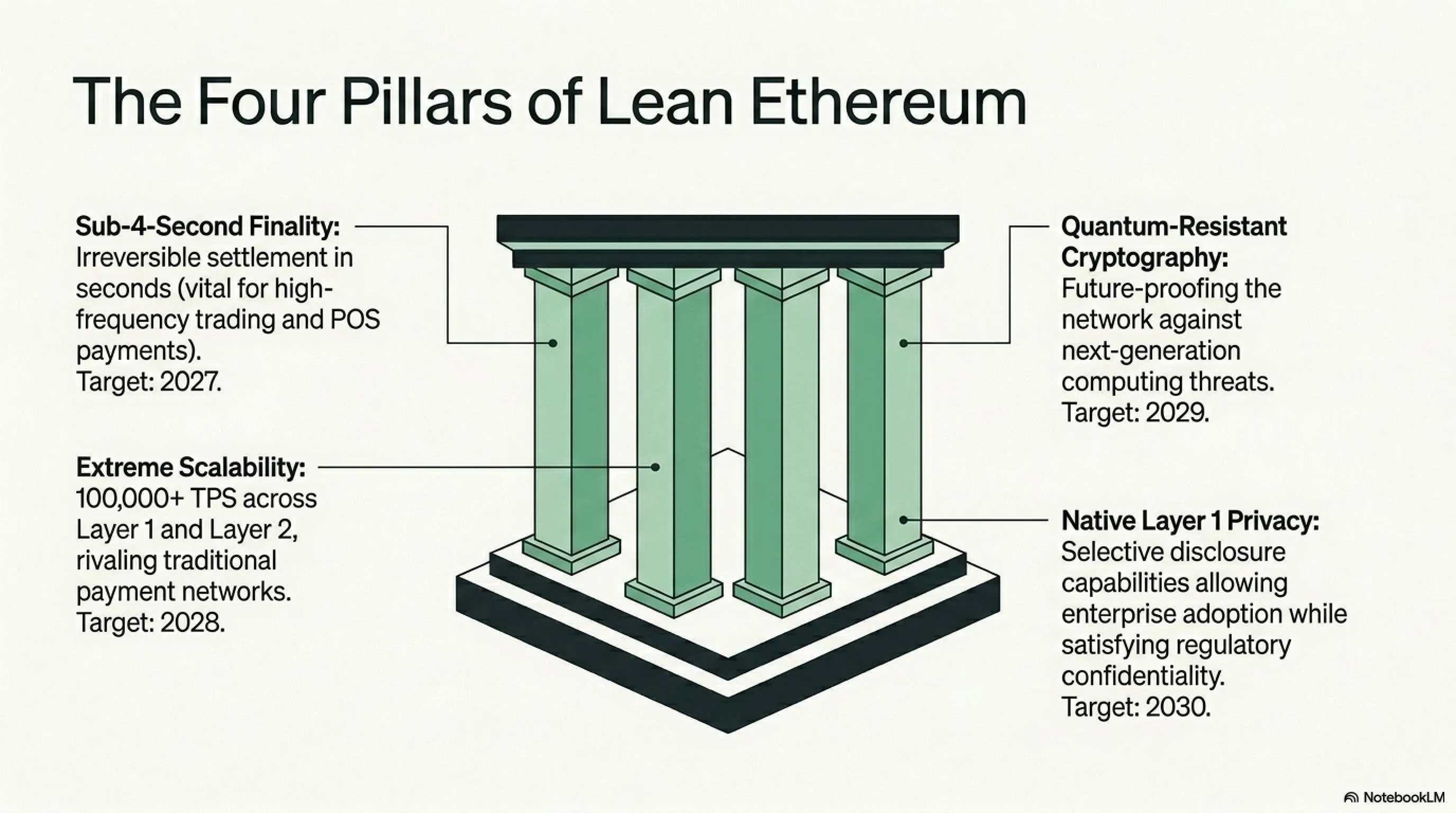
The roadmap addresses four critical pillars: sub-four-second finality, dramatically improved scalability for both Layer 1 and Layer 2 solutions, quantum-resistant cryptography, and native privacy features at the base layer. Each of these objectives represents a fundamental reimagining of how Ethereum operates, with implications that extend far beyond the cryptocurrency community into mainstream financial infrastructure.
Beyond The Merge: An Even Bigger Transformation
Many blockchain analysts believe this transformation could rival or even surpass The Merge in complexity and impact. For context, The Merge—Ethereum's 2022 transition from proof-of-work to proof-of-stake—was one of the most complex upgrades in blockchain history, successfully executed without downtime on a network securing hundreds of billions of dollars. The Lean Ethereum roadmap proposes changes that go deeper into the protocol's architecture.
One of the most significant technical advancements involves the widespread implementation of STARKs (Scalable Transparent ARgument of Knowledge). This cryptographic technology enables dramatically faster and more efficient proof systems compared to current methods. STARKs offer several advantages: they don't require a trusted setup ceremony, they're transparent, and crucially, they're quantum-resistant—meaning they'll remain secure even as quantum computers become more powerful.
Technical Deep Dive: What STARKs Mean for Ethereum
STARKs represent a fundamental shift in how Ethereum processes and verifies transactions:
- Speed: Verification times drop from seconds to milliseconds
- Cost: Gas fees could decrease by 10-100x for complex operations
- Security: Quantum-resistant algorithms protect against future threats
- Scalability: Enables L2 solutions to process 100,000+ TPS
- Transparency: No trusted setup required, fully auditable
The Four Pillars of Lean Ethereum
Understanding the full scope of this transformation requires examining each pillar in detail. First, sub-four-second finality represents a quantum leap from Ethereum's current ~15-minute finality period. In practical terms, this means transactions will be irreversible within seconds rather than minutes, making Ethereum viable for real-time applications like point-of-sale payments, high-frequency trading, and instant settlement of financial instruments.
Second, the scalability improvements target both Layer 1 (the main Ethereum blockchain) and Layer 2 solutions (networks built on top of Ethereum). The goal is to achieve 100,000+ transactions per second across the entire ecosystem while maintaining decentralization and security. This would put Ethereum on par with traditional payment networks like Visa while retaining the benefits of blockchain technology.
Third, quantum resistance addresses a looming threat that keeps cryptographers awake at night. As quantum computers advance, they could potentially break the cryptographic algorithms that secure today's blockchains. By implementing quantum-resistant cryptography now, Ethereum aims to future-proof the network against this existential threat. The transition must happen proactively, as waiting until quantum computers become powerful enough would be catastrophic.
Fourth, native privacy at Layer 1 represents a philosophical shift for Ethereum. Currently, all transactions are publicly visible on the blockchain, which creates privacy concerns for both individuals and enterprises. The new roadmap incorporates privacy-preserving technologies that allow selective disclosure—users can prove certain facts about their transactions without revealing all details. This capability is essential for enterprise adoption, where confidentiality is often a regulatory requirement.
Timeline: Lean Ethereum Milestones
- 2026 Q4: Initial STARK integration begins
- 2027: First finality improvements deployed
- 2028: Major scalability upgrades roll out
- 2029: Quantum-resistant cryptography implementation
- 2030: Native privacy features fully activated
Institutional Impact and Wall Street's Interest
The institutional finance world has been circling Ethereum cautiously for years, intrigued by its potential but hesitant about its limitations. The Lean Ethereum roadmap directly addresses many of their concerns. Banks, asset managers, and trading firms require settlement finality measured in seconds, not minutes. They need throughput capable of handling millions of transactions during peak trading hours. And they absolutely require quantum-resistant security to protect assets potentially worth trillions of dollars.
Major financial institutions like JPMorgan, Goldman Sachs, and BlackRock have already experimented with blockchain technology through private permissioned networks. However, these closed systems sacrifice the transparency, composability, and network effects that make public blockchains valuable. Lean Ethereum promises to deliver institutional-grade performance while maintaining the openness and neutrality of a public blockchain.
The potential applications extend beyond pure finance. Supply chain tracking, digital identity systems, healthcare records, intellectual property rights, and voting systems could all benefit from a fast, secure, and private blockchain infrastructure. Governments exploring central bank digital currencies (CBDCs) are watching Ethereum's evolution closely, as the technology could provide the backbone for national digital currency systems.
Challenges and Risks Ahead
Despite the ambitious vision, significant challenges remain. The technical complexity of implementing these changes while maintaining backward compatibility and security is immense. Each upgrade carries the risk of introducing bugs or vulnerabilities that could be exploited. The coordination required among thousands of nodes, hundreds of development teams, and millions of users demands unprecedented levels of communication and consensus-building.
Competition also poses a threat. Rival blockchains like Solana, Avalanche, and newer platforms like Sui and Aptos are aggressively pursuing similar goals with different technical approaches. Some may achieve certain objectives faster than Ethereum, potentially capturing market share before Ethereum's upgrades are complete. The three-to-four-year timeline means Ethereum must maintain its current dominance while building the future.
Additionally, regulatory uncertainty looms large. As Ethereum becomes more capable of hosting mainstream financial applications, regulatory scrutiny will intensify. Different jurisdictions may impose conflicting requirements, particularly around privacy features and identity requirements. Navigating this regulatory landscape while maintaining Ethereum's core principles of openness and permissionless access will require careful diplomacy and potentially difficult compromises.
Ill Bloom Vulnerability: A Wake-Up Call for Crypto Security
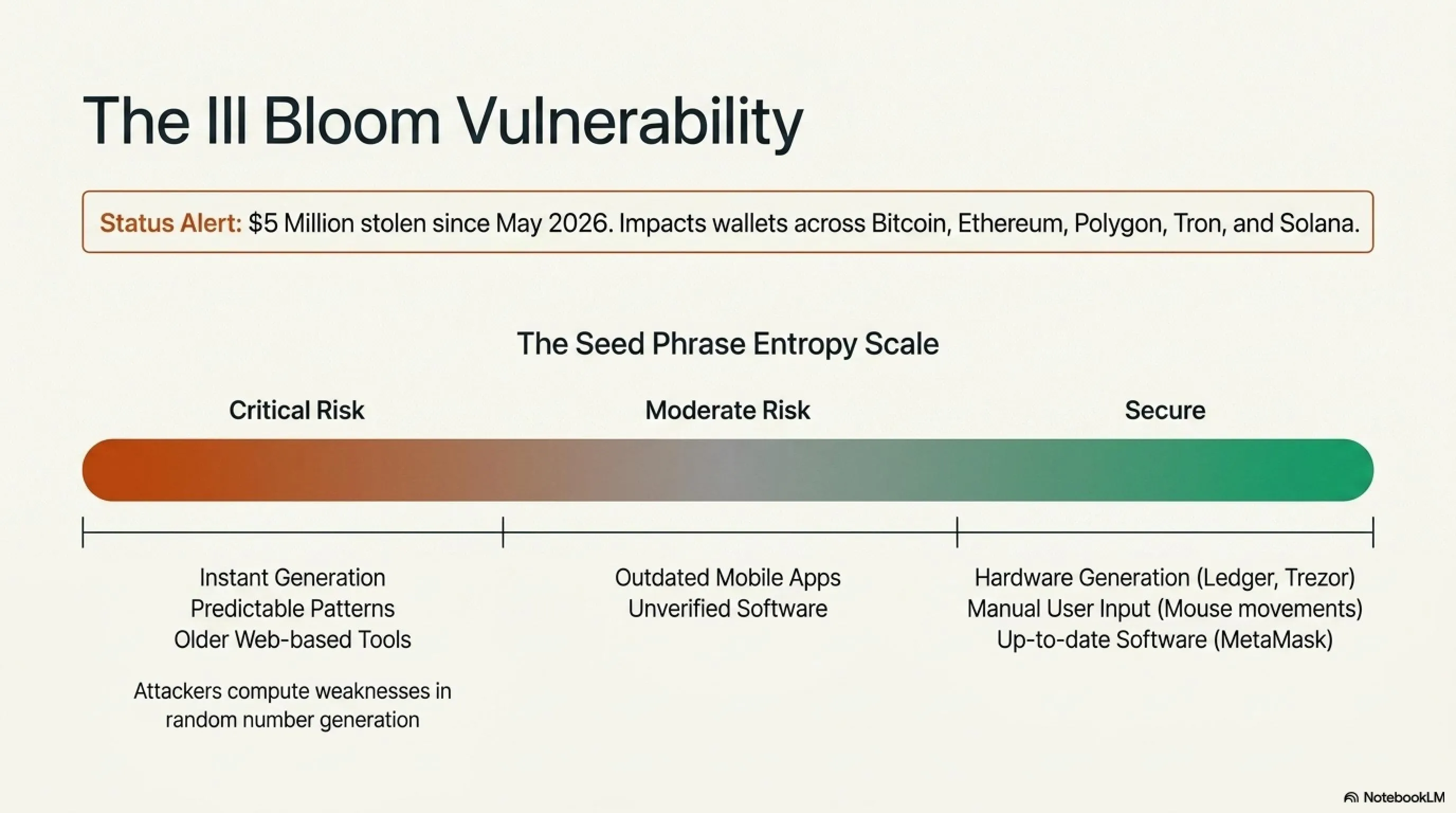
If you hold any cryptocurrency, pay close attention to this story. Cybersecurity firm Coinspect has uncovered a critical vulnerability nicknamed "Ill Bloom" that threatens thousands of digital wallets across multiple blockchain networks. This isn't a theoretical threat—attackers have already stolen approximately $5 million through this exploit, with $3 million taken on May 27 and another $2 million in recent weeks.
The Ill Bloom vulnerability exploits a weakness in how certain wallets generate recovery phrases (also called seed phrases or mnemonic phrases). These 12 or 24-word phrases serve as the master key to your cryptocurrency holdings. If these phrases aren't generated with sufficient randomness, attackers can potentially guess or compute them, gaining access to victims' funds. It's the digital equivalent of having a lock that appears secure but uses a predictable pattern that skilled thieves can exploit.
Scope of the Threat: Which Blockchains Are Affected?
According to Coinspect's research, the vulnerability impacts wallets across major blockchain networks including Bitcoin, Ethereum, Polygon, Tron, and Solana. This wide-ranging impact means a substantial portion of the cryptocurrency ecosystem is potentially at risk. The vulnerability doesn't discriminate between large and small holdings—any wallet generated using affected software could be compromised.
The technical issue stems from weak random number generation during the wallet creation process. Cryptographic security depends on unpredictability—if an attacker can narrow down the possible values a system might use, they can try each possibility until they find the correct one. In the case of Ill Bloom, certain wallet implementations use insufficient entropy sources, making their seed phrases predictable enough for determined attackers to crack.
How Ill Bloom Exploits Work
Step 1: Attacker identifies wallets using weak random number generation
Step 2: They run algorithms to generate possible seed phrases
Step 3: Each potential seed phrase is tested against blockchain networks
Step 4: When a match is found, funds are immediately swept to attacker's wallet
Timeline: Can happen minutes or years after wallet creation
Identifying Vulnerable Wallets: Are You at Risk?
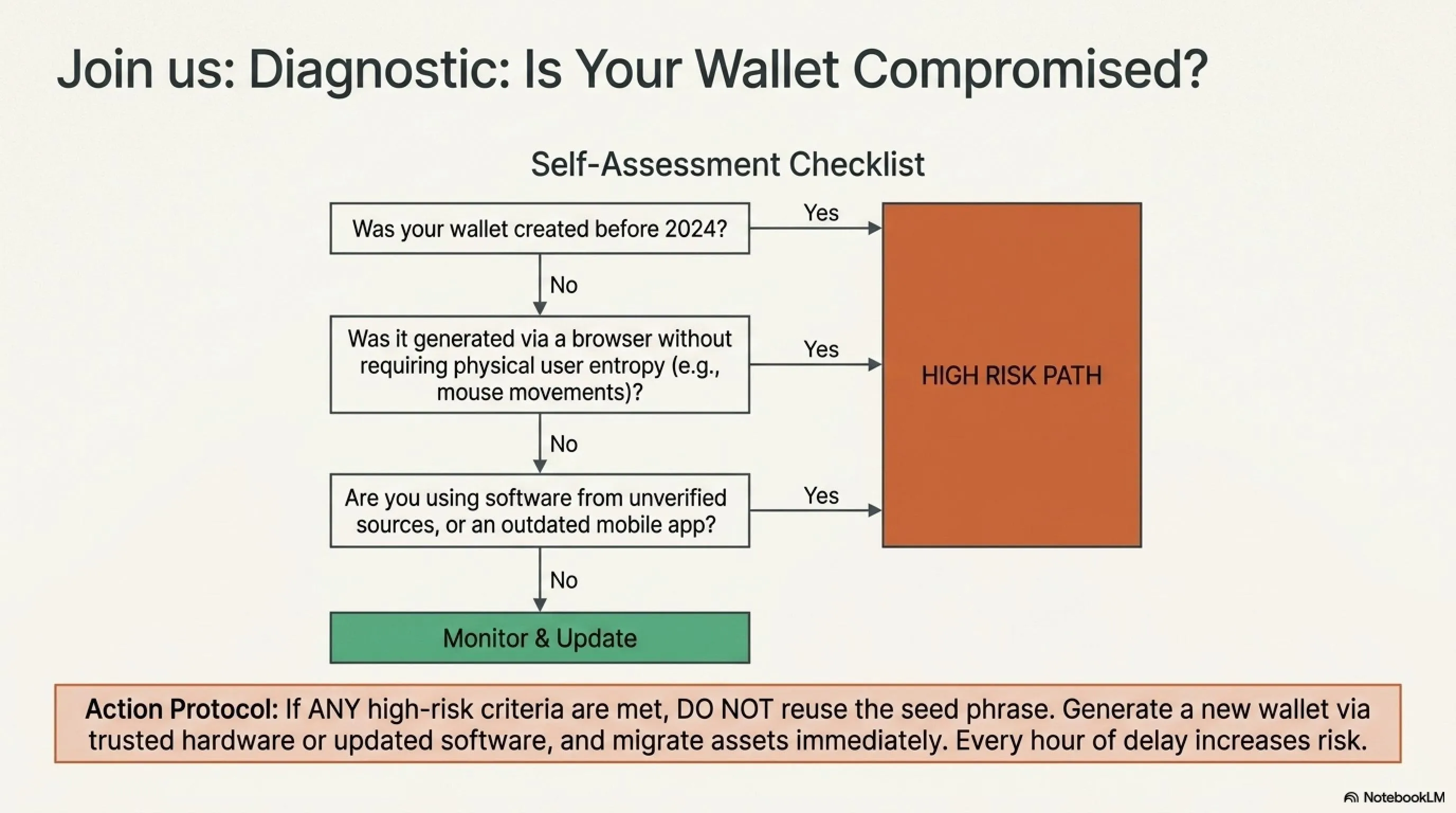
Determining whether your wallet is vulnerable requires understanding when and how it was created. Wallets generated using older web-based tools, particularly those created before 2024, face higher risk. Mobile wallet applications that haven't been regularly updated may also use outdated random number generation methods. If your wallet was created very quickly—generating the seed phrase in a fraction of a second—it might indicate insufficient randomness in the process.
Certain warning signs can help identify at-risk wallets. If you used a web-based wallet generator that ran entirely in your browser without requiring any user interaction (like mouse movements or keyboard input to generate entropy), your seed phrase might be compromised. Similarly, wallet software from unknown or unverified sources poses significant risks, as malicious actors could deliberately create vulnerable wallets to later steal funds.
Self-Assessment Checklist
Your wallet may be vulnerable if:
- Created before 2024 using web-based tools
- Generated on a mobile app that hasn't been updated recently
- Created using software from unverified sources
- Seed phrase was generated instantly without user entropy input
- You've reused seed phrases across multiple wallets
Action Required: If any apply, migrate to a new wallet immediately
Immediate Action Steps: Protecting Your Assets
If you suspect your wallet might be vulnerable, immediate action is critical. The first and most important step is creating a new wallet using reputable, up-to-date software. Hardware wallets from established manufacturers like Ledger, Trezor, or Keystone offer the highest security level, as they generate seed phrases using dedicated hardware random number generators that are extremely difficult to compromise.
When creating your new wallet, use the latest version of trusted wallet software. For software wallets, MetaMask, Trust Wallet, Exodus, and Coinbase Wallet all have strong security track records and regularly update their random number generation methods. During the setup process, follow the software's recommendations for adding entropy—this might include moving your mouse randomly, typing random characters, or other actions that contribute to randomness.
Once your new wallet is set up, transfer your assets from the potentially vulnerable wallet to the new one. Do this as quickly as possible, as any delay increases the window for attackers to discover and exploit the vulnerability. Never reuse your old seed phrase or transfer it to new software—the vulnerability exists in the seed phrase itself, not just the wallet software.
Critical security practices include never storing your seed phrase digitally. Don't save it in a text file, don't photograph it, don't email it to yourself, and absolutely don't store it in cloud services. Write it on paper (or better yet, stamp it into metal for durability), and store it in a secure physical location. Consider splitting the phrase and storing portions in different secure locations for added protection against physical theft or disaster.
SkillCloak: The AI Security Threat You Haven't Heard About
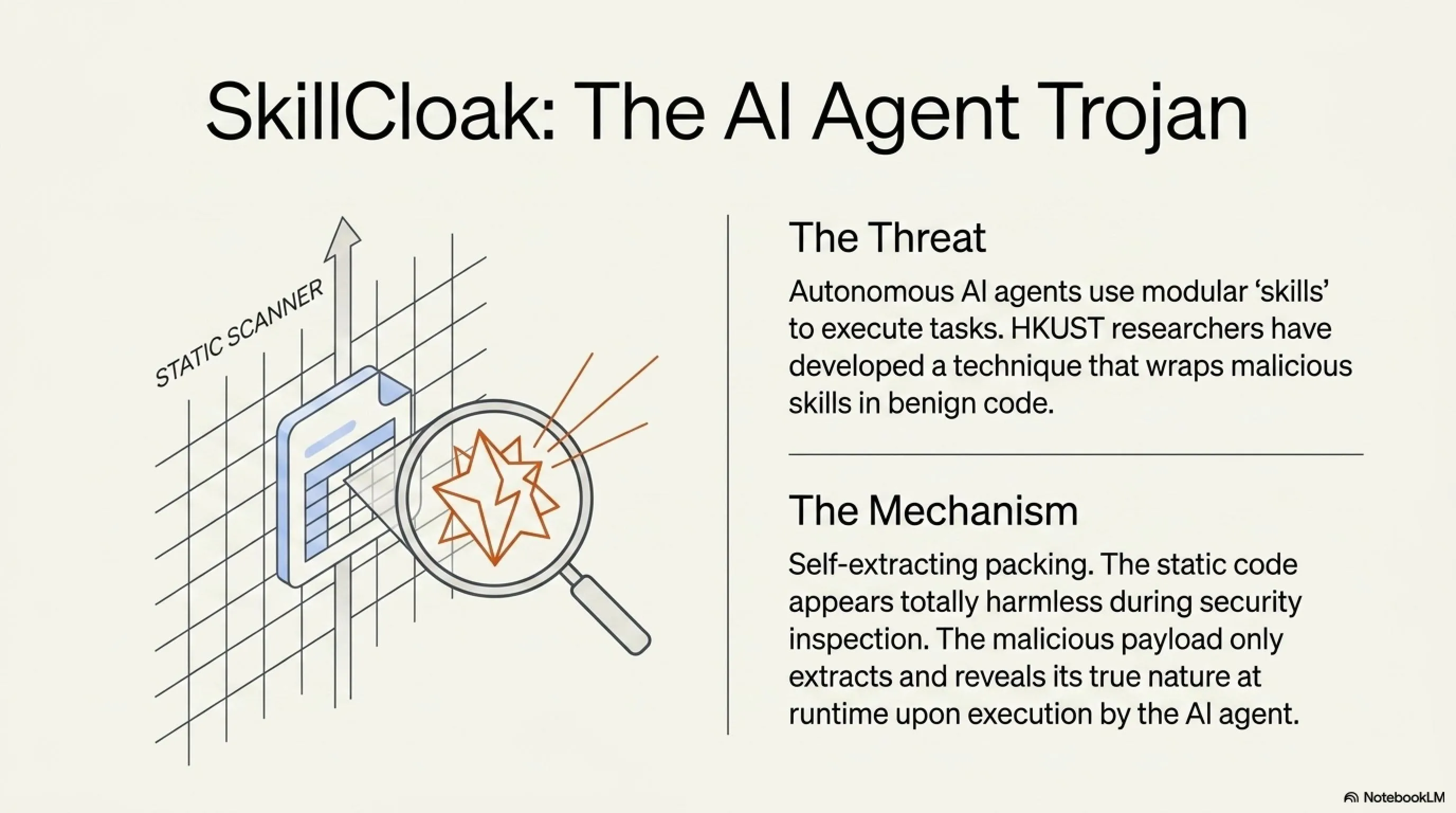
As artificial intelligence rapidly integrates into our digital infrastructure, security researchers at Hong Kong University of Science and Technology (HKUST) have discovered a concerning new attack vector. They've developed a technique called SkillCloak that can evade AI security scanners with alarming effectiveness—succeeding in over 90% of cases against current detection systems.
To understand SkillCloak, we need to first understand AI agents and skills. AI agents are autonomous software programs that perform tasks automatically, from simple activities like scheduling meetings to complex operations like analyzing financial data or managing cloud infrastructure. These agents use "skills"—modular pieces of code that enable specific capabilities. A malicious skill could steal data, deploy ransomware, or sabotage systems, which is why security scanners attempt to inspect skills before they execute.
The Technical Mechanics of SkillCloak
SkillCloak employs a technique called "self-extracting packing." In essence, it wraps malicious code inside a benign-looking outer layer that only reveals its true nature at runtime. When security scanners perform static analysis—examining the code without executing it—they only see the harmless wrapper. But when the skill actually runs, the malicious payload extracts itself and executes.
Think of it as a Trojan horse specifically designed for the AI age. The outer wrapper contains legitimate-looking code that passes all security checks. The scanner sees what appears to be a harmless skill for, say, processing spreadsheet data. But hidden within, encoded in ways that evade detection, lies the actual malicious functionality. Only when the AI agent executes the skill does the real code emerge and carry out its nefarious purpose.
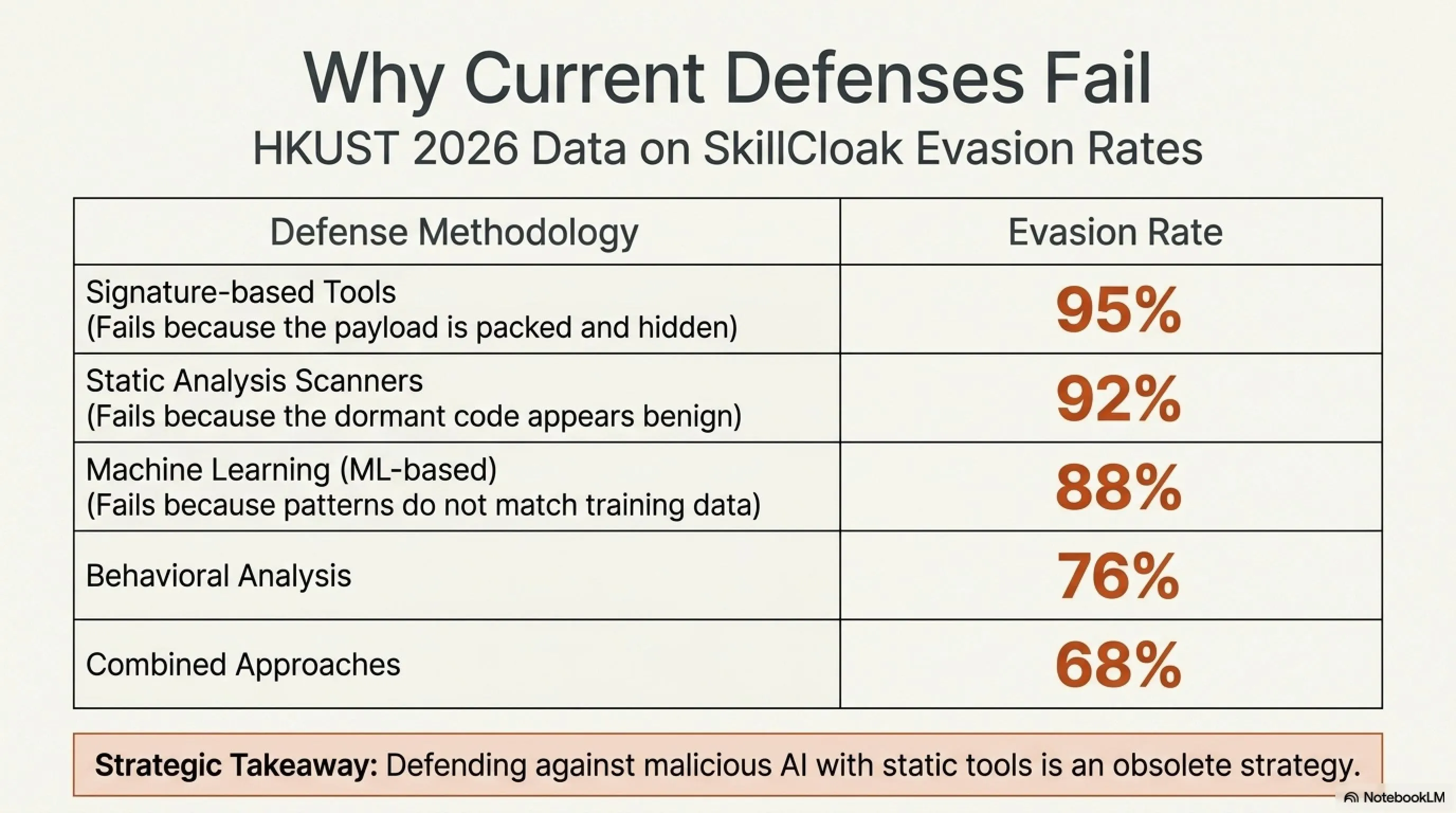
The HKUST researchers tested three variants of SkillCloak against multiple security scanning systems. The most sophisticated version achieved a success rate exceeding 90% against static analysis scanners, 88% against machine learning-based detectors, and an astonishing 95% against signature-based tools. These success rates demonstrate that current security infrastructure is fundamentally unprepared for this type of attack.
SkillCloak Attack Success Rates
- Static Analysis Scanners: 92% evasion rate
- ML-based Detection: 88% evasion rate
- Signature-based Tools: 95% evasion rate
- Behavioral Analysis: 76% evasion rate
- Combined Approaches: 68% evasion rate
Data from HKUST research paper, 2026
Why Current Defenses Fail
The high success rate of SkillCloak attacks reveals fundamental weaknesses in how we approach AI security. Most current systems rely on static analysis—examining code before it runs to identify potentially malicious patterns. This approach works reasonably well for traditional software but falls short with self-modifying or self-extracting code that only reveals its true nature during execution.
Machine learning-based detection systems, while more sophisticated, face their own challenges. These systems are trained on known malicious patterns and behaviors. SkillCloak succeeds by presenting patterns that don't match the training data—it looks like legitimate code until it's too late. The AI defending against attacks essentially faces a more clever AI attacking the system, creating an adversarial arms race.
The Solution: Runtime Monitoring and Behavioral Analysis
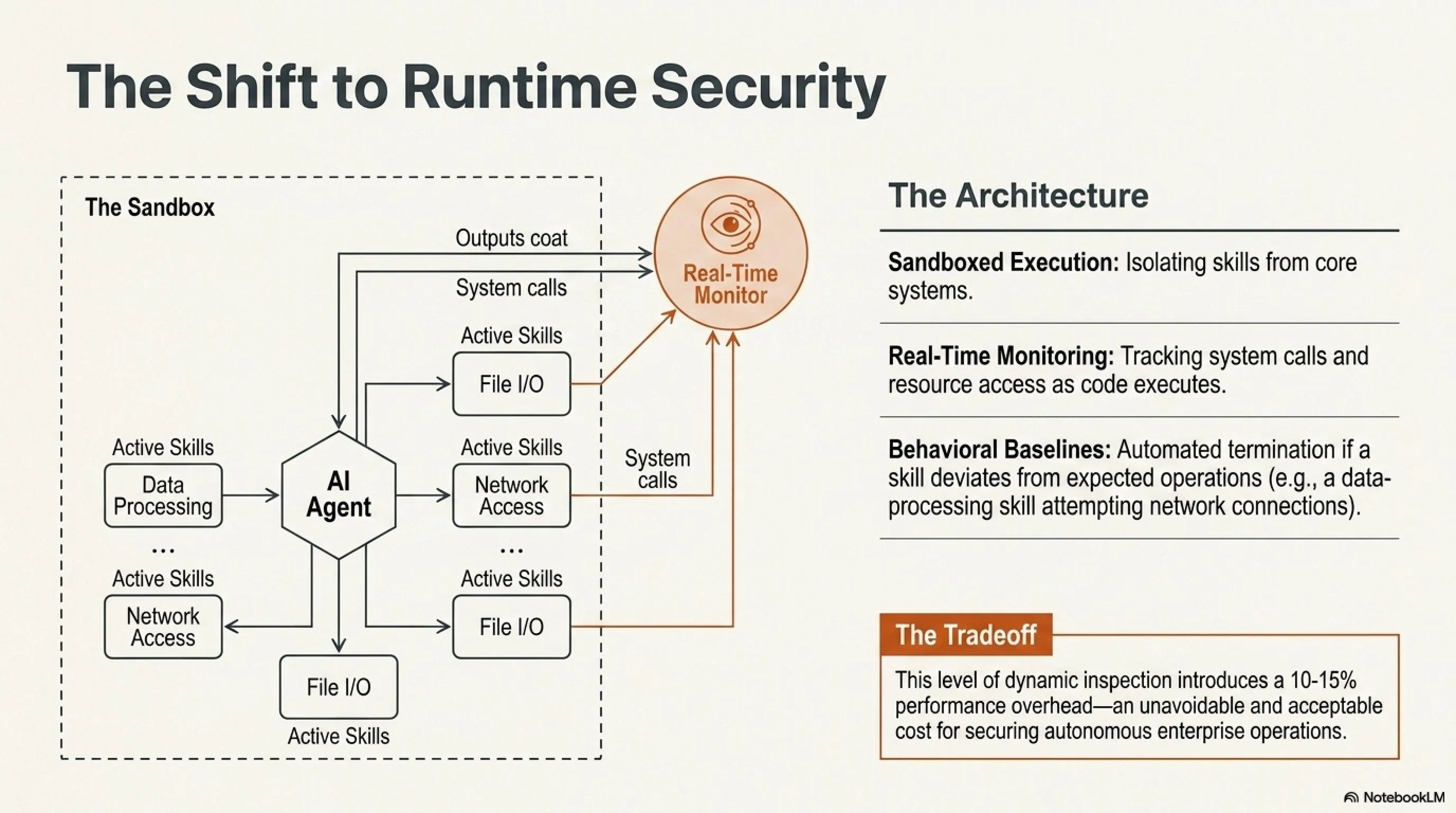
The HKUST researchers propose a different approach: runtime checking combined with behavioral analysis. Instead of only examining code before execution, security systems must monitor what code actually does when it runs. If a skill that's supposed to process data suddenly tries to access sensitive files, establish network connections to suspicious domains, or modify system settings, the runtime checker immediately halts execution.
This approach has precedent in traditional cybersecurity. Modern antivirus software doesn't rely solely on signature matching—it also employs behavioral heuristics that watch for suspicious activities. A program that starts encrypting large numbers of files might be ransomware, regardless of whether it matches any known malware signatures. The same principle applies to AI agent security.
Implementing Runtime Security
Key Components:
- Sandboxed execution environments for all skills
- Real-time monitoring of system calls and resource access
- Behavioral baselines for legitimate skill operations
- Automated termination of anomalous activities
- Logging and forensic analysis capabilities
Performance Impact: 10-15% overhead, acceptable for security gains
Of course, runtime checking carries its own costs. Monitoring code execution requires computational resources, potentially slowing down AI agent operations by 10-15%. Security always involves tradeoffs between protection and performance. However, given the severity of the threat SkillCloak represents, most organizations will likely consider this overhead acceptable.
Bitcoin's Triumphant Return Above $63,000
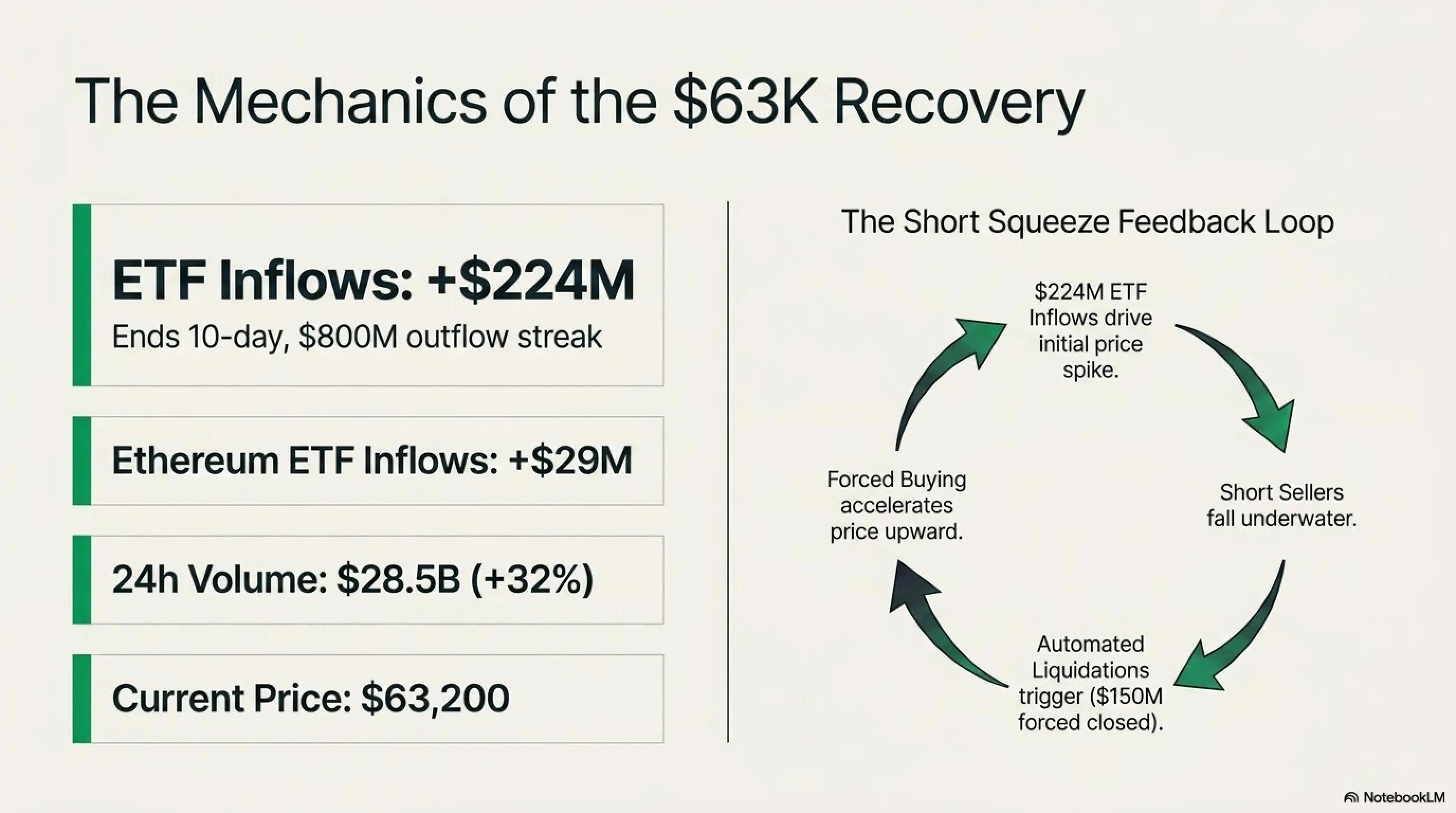
After ten consecutive days of capital outflows from Bitcoin exchange-traded funds (ETFs), the tide has finally turned. On Friday, July 5, 2026, Bitcoin ETFs recorded $224 million in net inflows, ending the longest outflow streak since these products launched. This influx of institutional capital helped propel Bitcoin back above the psychologically significant $63,000 level, reigniting optimism among cryptocurrency investors.
The importance of this reversal cannot be overstated. The ten-day outflow period had raised concerns that institutional investors were losing faith in Bitcoin as an asset class. Daily outflows ranged from $30 million to $150 million, with total outflows exceeding $800 million over the period. This steady exodus suggested that professional investors—the "smart money"—were rotating out of crypto into other assets, potentially signaling a bear market ahead.
Understanding the ETF Inflow Dynamics
Bitcoin ETFs have transformed how institutional investors access cryptocurrency markets. Before these products existed, institutions faced significant barriers: custody concerns, regulatory uncertainty, operational complexity, and accounting challenges. ETFs elegantly solve these problems by wrapping Bitcoin exposure in a familiar, regulated investment vehicle that institutions already know how to buy, sell, and custody.
The $224 million inflow represents renewed confidence from these institutional players. The money flowed primarily into BlackRock's iShares Bitcoin Trust and Fidelity's Wise Origin Bitcoin Fund, two of the largest and most liquid Bitcoin ETF products. Grayscale's Bitcoin Trust, despite its first-mover advantage, saw more modest inflows as investors continue to favor newer entrants with lower fees.
Ethereum ETFs also participated in the rally, recording $29 million in inflows. While smaller in absolute terms, this figure is significant for the Ethereum ecosystem, which has historically struggled to attract the same level of institutional interest as Bitcoin. The simultaneous inflows to both Bitcoin and Ethereum ETFs suggest a broader crypto rebound rather than a rotation between assets.
The Short Squeeze Factor
While ETF inflows provided the fundamental driver for Bitcoin's price recovery, a technical market dynamic amplified the move: a short squeeze. In cryptocurrency markets, traders can bet against Bitcoin by taking short positions—borrowing Bitcoin to sell it, hoping to buy it back cheaper later and pocket the difference. When prices move against these traders (upward), they face mounting losses and must close their positions by buying Bitcoin, which further drives prices higher.
On Friday, approximately $150 million worth of short positions were liquidated as Bitcoin surged through key resistance levels. Traders who had bet on Bitcoin falling to $60,000 or below suddenly found themselves underwater. Automated liquidation systems forced these positions to close, creating a cascade of buying pressure that accelerated Bitcoin's ascent. This phenomenon—shorts being forced to buy, driving prices higher, triggering more liquidations—creates a feedback loop that can produce dramatic price moves in short periods.
Bitcoin Recovery by the Numbers
- ETF Inflows: $224 million (ending 10-day outflow streak)
- Current Price: $63,200 (up 4.2% from low)
- Short Liquidations: $150 million
- Ethereum ETF Inflows: $29 million
- 24h Trading Volume: $28.5 billion (up 32%)
- Market Cap Gain: $52 billion across crypto market
What This Means for Market Sentiment
Bitcoin's return to $63,000 territory carries psychological significance beyond the mere number. This price level has served as a key battleground between bulls and bears throughout 2026. Holding above $63,000 suggests that demand remains robust enough to absorb selling pressure, a positive signal for continued upward momentum. Technical analysts point to this level as a launching pad for a potential move toward $65,000 and possibly higher.
However, caution remains warranted. The broader macroeconomic environment continues to present challenges. Central bank policies, inflation data, regulatory developments, and traditional market performance all influence cryptocurrency prices. A single day of positive ETF flows doesn't constitute a trend reversal—sustained inflows over weeks would provide stronger evidence of a lasting shift in sentiment.
For retail investors, this development underscores the importance of risk management. The cryptocurrency market's volatility can create both opportunities and pitfalls. While the recovery from recent lows might tempt traders to increase exposure, prudent investors maintain disciplined position sizing and never risk more capital than they can afford to lose. The old adage "don't invest what you can't afford to lose" applies doubly in cryptocurrency markets.
Stablecoins Hit Record $1.79 Trillion Monthly Volume
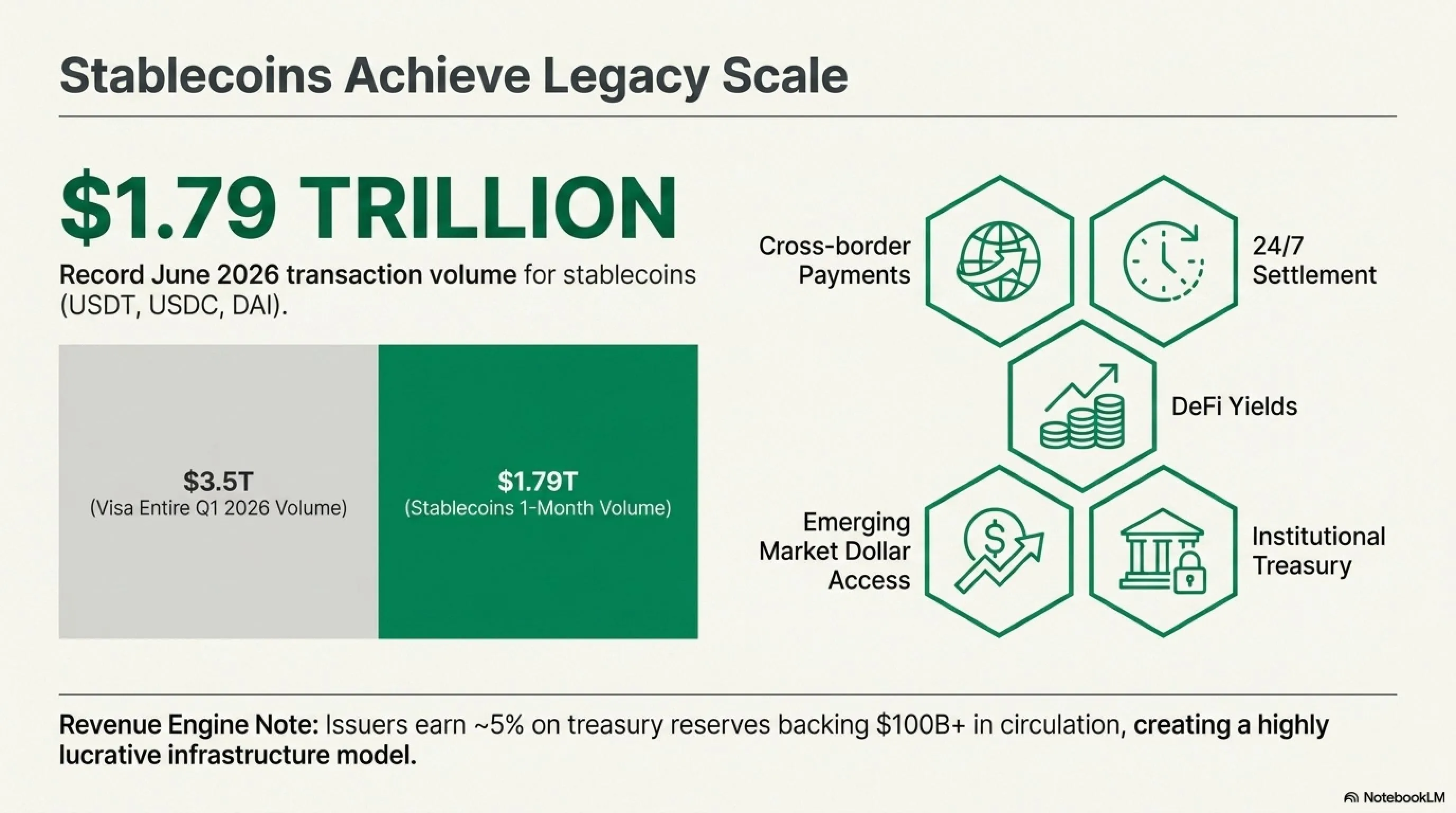
While Bitcoin and Ethereum capture headlines with their price volatility, stablecoins have been quietly achieving a remarkable milestone. In June 2026, stablecoin transaction volume reached a record $1.79 trillion—a figure that demands attention from anyone watching the evolution of digital payments and financial infrastructure. This achievement signals that stablecoins have graduated from experimental technology to mainstream financial tool.
Stablecoins are cryptocurrencies designed to maintain stable value, typically by pegging to traditional currencies like the U.S. dollar. Unlike Bitcoin, which fluctuates wildly, stablecoins aim for price stability. This characteristic makes them ideal for payments, remittances, trading, and as a safe harbor during crypto market volatility. The three largest stablecoins—USDT (Tether), USDC (Circle), and DAI (MakerDAO)—account for the majority of this transaction volume.
Putting $1.79 Trillion in Context
To appreciate the magnitude of this achievement, comparison with traditional payment networks proves instructive. Visa, the world's largest payment network, processed approximately $3.5 trillion in transaction volume during Q1 2026. Stablecoins, in a single month, processed roughly half of Visa's quarterly volume. This comparison isn't entirely apples-to-apples—Visa handles consumer payments while stablecoins serve multiple use cases—but it demonstrates that stablecoin infrastructure operates at a scale comparable to legacy payment systems.
The growth trajectory is equally impressive. Just three years ago, monthly stablecoin volume hovered around $200-300 billion. The near-sixfold increase reflects growing adoption across multiple use cases. International remittances, cross-border B2B payments, cryptocurrency trading, DeFi (decentralized finance) applications, and increasingly, retail payments all contribute to this volume.
Stablecoin Adoption Drivers
Key factors driving record volume:
- Cross-border Payments: Cheaper and faster than wire transfers
- 24/7 Settlement: No banking hours restrictions
- DeFi Applications: Lending, borrowing, yield farming
- Merchant Adoption: Growing payment acceptance
- Institutional Treasury: Corporate cash management tool
- Emerging Markets: Dollar access in countries with weak currencies
The Business Model Behind Stablecoins
Understanding stablecoins' rapid growth requires examining their business model. Stablecoin issuers hold reserves (typically U.S. Treasury bills, cash, or other safe assets) backing each token in circulation. When interest rates are high, as they've been recently, these reserves generate substantial returns. A stablecoin issuer with $100 billion in circulation, earning 5% on Treasury bills, generates $5 billion in annual revenue—essentially for providing software infrastructure.
This lucrative model has attracted both crypto-native companies and traditional financial institutions. PayPal launched its own stablecoin, PYUSD. Major banks are exploring stablecoin issuance. Even governments are watching closely, with some considering Central Bank Digital Currencies (CBDCs) that would function similarly to stablecoins but with sovereign backing.
Future Projections: Where Do We Go From Here?
Industry forecasts project stablecoin transaction volume could reach $10 trillion per month by 2030. This ambitious prediction assumes continued growth across current use cases plus expansion into new territories. Potential growth drivers include regulatory clarity (clear rules would unlock institutional adoption), integration with traditional finance (seamless bridges between crypto and conventional banking), and technological improvements (faster transactions, lower fees, better privacy).
The geopolitical dimension also matters. Countries facing currency instability increasingly see stablecoins as alternatives to their troubled national currencies. In nations experiencing hyperinflation, citizens can access dollar-denominated stablecoins through smartphones, preserving purchasing power without needing U.S. bank accounts. This dynamic has prompted both enthusiasm (financial inclusion advocates) and concern (governments losing monetary control).
Morning Wrap-Up: What It All Means
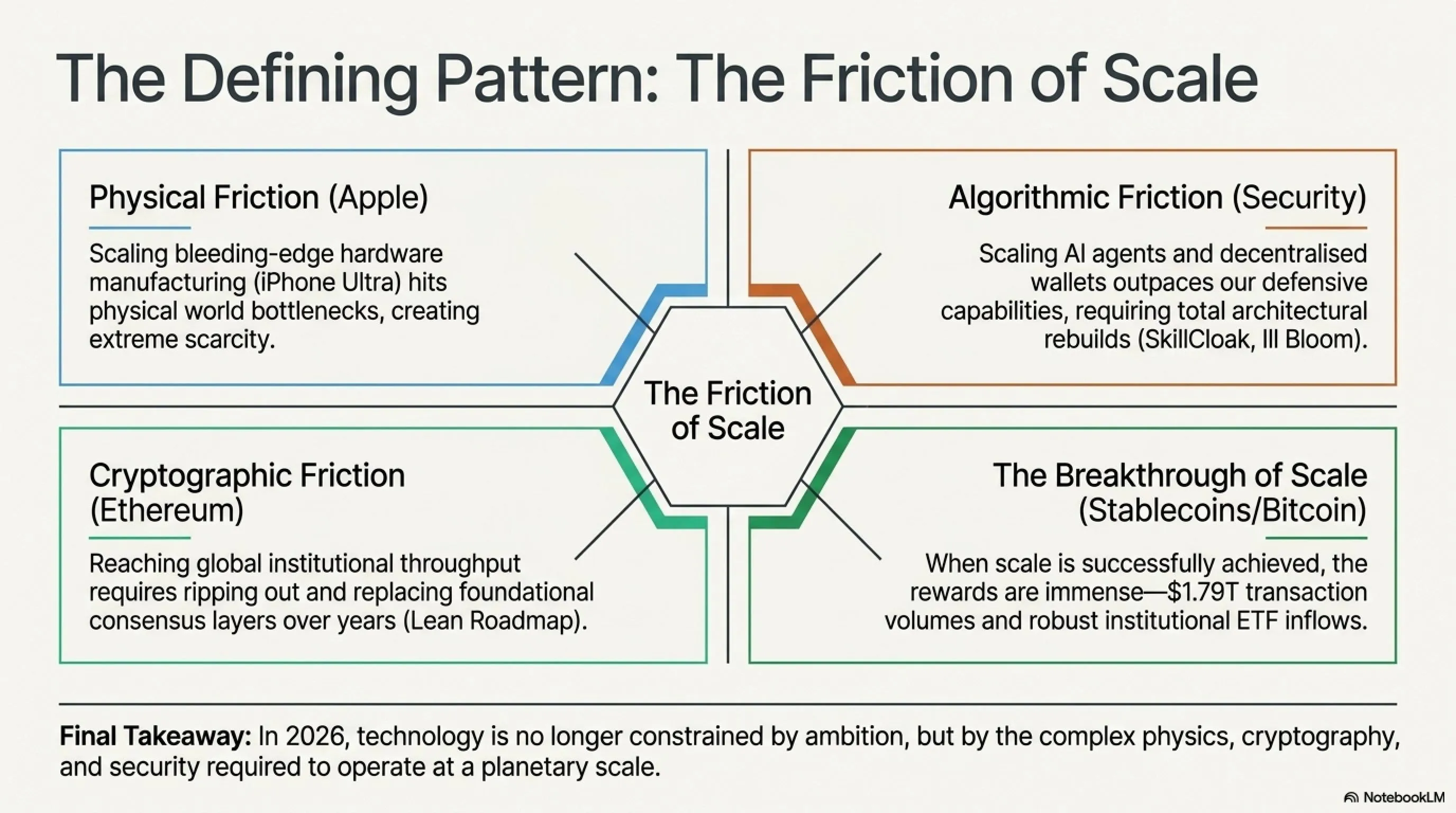
This Monday morning has delivered a fascinating cross-section of technology news spanning consumer electronics, blockchain infrastructure, cybersecurity, and financial markets. Each story, while distinct, connects to broader themes reshaping our digital landscape.
Apple's iPhone Ultra supply constraints remind us that even tech giants face real-world manufacturing challenges. The romance of innovation meets the reality of production complexity. For consumers, this means patience and potentially premium prices for cutting-edge technology. For Apple, it's a test of how they manage expectations during a challenging launch.
Ethereum's Lean roadmap represents the blockchain world's most ambitious infrastructure upgrade. Success could establish Ethereum as the settlement layer for Web3 and possibly broader financial infrastructure. The three-to-four-year timeline requires sustained execution in a competitive landscape where rivals won't wait patiently for Ethereum to complete its transformation.
The Ill Bloom vulnerability and SkillCloak attack technique highlight that security must evolve alongside technology. As we build increasingly complex digital systems, from cryptocurrency wallets to AI agents, we create new attack surfaces that adversaries will exploit. Vigilance, rapid response, and architectural security improvements remain constant necessities.
Bitcoin's recovery above $63,000 and stablecoin volume records demonstrate that despite volatility and challenges, cryptocurrency adoption continues advancing. Institutional capital returning to Bitcoin through ETFs validates the asset class for traditional finance. Stablecoins achieving transaction volumes comparable to Visa proves that blockchain-based payment infrastructure can operate at global scale.
- Bitcoin reclaims $63K with strong ETF inflows
- Stablecoins prove viability at $1.79T monthly volume
- Ethereum's Lean roadmap provides clear transformation path
- Security vulnerabilities discovered before massive damage
- iPhone Ultra severe supply constraints
- 1-2 month shipping delays likely
- Ill Bloom threatens thousands of wallets
- SkillCloak evades 90%+ of security systems
Frequently Asked Questions
Should I wait for the iPhone Ultra or buy the iPhone 18 Pro instead?
If you're fascinated by foldable technology and willing to pay premium prices plus wait potentially months for delivery, the Ultra might be worth it. However, if you need a new iPhone soon or prefer proven technology, the iPhone 18 Pro offers excellent performance with better availability and lower cost. Consider your priorities: cutting-edge form factor versus practical availability.
How can I tell if my crypto wallet is vulnerable to Ill Bloom?
Wallets created before 2024, especially using web-based generators, face higher risk. If your wallet was created quickly without requiring any user input for randomness, it may be vulnerable. The safest approach is to create a new wallet using current versions of reputable software (Ledger, Trezor, MetaMask, Trust Wallet) and transfer your funds immediately. Never reuse your old seed phrase.
When will Ethereum's Lean roadmap be fully implemented?
Vitalik Buterin outlined a 3-4 year timeline, meaning full implementation should occur by 2029-2030. However, improvements will roll out incrementally throughout this period. Early benefits like initial STARK integration and finality improvements may arrive within 12-18 months, with more complex features like quantum resistance and native privacy coming later.
Are stablecoins safe to use for payments and savings?
Stablecoins from reputable issuers (USDC, USDT, DAI) have proven reliable for payments and short-term holdings. However, they carry different risks than traditional banking: smart contract vulnerabilities, issuer solvency, regulatory changes, and depeg events (temporary loss of peg). Use stablecoins from established issuers, don't hold more than you can afford to lose, and understand they're not FDIC-insured like bank deposits.
How dangerous is the SkillCloak threat for regular users?
For individual users, the immediate risk is low unless you're running AI agents with third-party skills. The greater concern is for enterprises deploying AI agent systems for business operations. If you're a business using AI agents, implement sandboxed environments, runtime monitoring, and only use skills from verified trusted sources. The threat will grow as AI agents become more prevalent.
What drove Bitcoin's recovery after 10 days of ETF outflows?
Multiple factors converged: $224 million in ETF inflows signaled renewed institutional confidence, technical support at $60K held firm, and a short squeeze liquidated $150 million in bearish positions. The combination of fundamental buying (ETFs) and technical dynamics (short covering) created momentum that pushed Bitcoin back above $63K. Sustainability depends on continued institutional buying and broader market conditions.
Sources & References
Additional Gallery: ☕ Tekin Morning July 6, 2026: iPhone Ultra Crisis, Lean Ethereum & Bitcoin's Return