Tekin Morning Thursday | August 13, 2026
Good morning! Start your day with positive energy we have six exciting tech stories from around the world today.
- 🎮Google Pixel 11 Unveiled- New series with Tensor G6 and slimmer Camera Bar
- 🎧Grok 4.6 Released- Grok 4.7 with SpaceX data coming soon
- 🚀Gates' $540M Gift- Largest donation in University of Washington history
- 🗡️Wikipedia Vandalism- Google mistakenly declared Sam Altman dead
- 📰Fidelity & Ethereum Staking- Request to add staking to major ETF
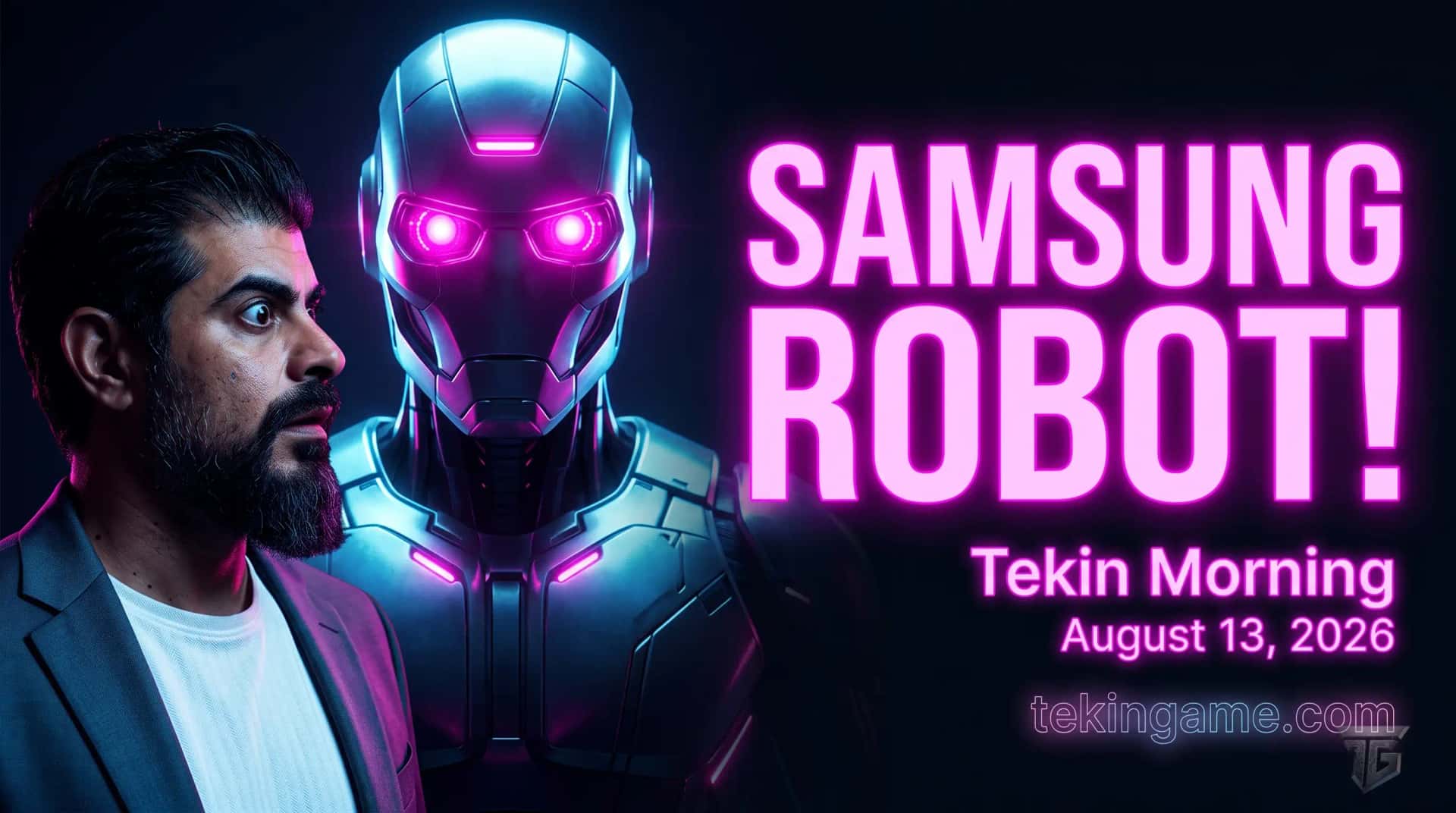
- ⚔️Samsung Humanoid Robot- Secret project outside RX division revealed
Google Pixel 11: Next Generation with Redesigned Aesthetics
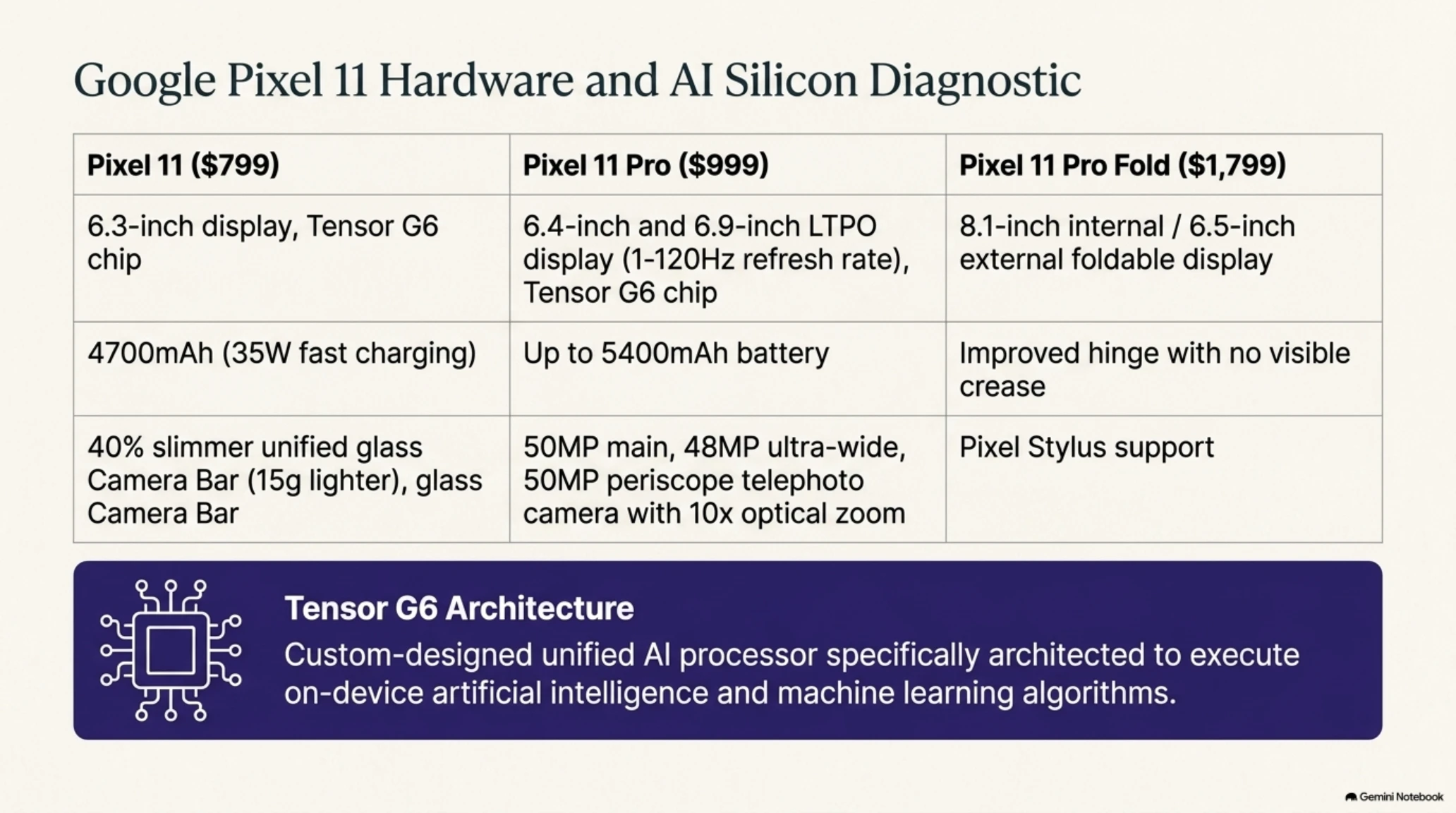
Google unveiled the complete Pixel 11 lineup last night at the "Made by Google 2026" event in New York City, along with several other new products. This generation includes the standard Pixel 11, Pixel 11 Pro in two sizes, and the Pixel 11 Pro Fold all powered by the new Tensor G6 chip, specifically designed for artificial intelligence capabilities.

Pixel 11 Series Key Specifications
Pixel 11: 6.3-inch display, Tensor G6 chip, glass Camera Bar 40% slimmer than previous generation, 4700mAh battery with 35W fast charging
Pixel 11 Pro: Two sizes at 6.4 and 6.9 inches, periscope telephoto camera with 10x optical zoom, battery up to 5400mAh, LTPO display with 1-120Hz refresh rate
Pixel 11 Pro Fold: 8.1-inch internal foldable display and 6.5-inch external display, improved hinge with no visible crease, Pixel Stylus support
Pricing: Pixel 11 from $799, Pixel 11 Pro from $999, Pixel 11 Pro Fold from $1,799
New Camera Bar: Unified Design
One of the most striking changes in the Pixel 11 is the redesigned Camera Bar. Instead of the protruding metal strip found in previous generations, Google now uses a unified glass panel that is 40 percent slimmer and seamlessly integrates with the phone body. This change not only improves visual aesthetics but also results in a 15-gram weight reduction.
The Pixel 11 Pro cameras feature a 50-megapixel main sensor with a 1/1.3-inch size, a 48-megapixel ultra-wide camera with a 125-degree field of view, and a 50-megapixel periscope telephoto camera with 10x optical zoom. All these sensors work with the new Tensor G6 machine learning algorithms to enhance low-light images and reduce noise.
New Gemini AI Capabilities
Agentic Features: Gemini can automatically perform complex tasks without user intervention such as restaurant reservations, online shopping, or calendar management based on emails
Real-time Translation: Live voice translation in 72 languages with less than 100 milliseconds latency
Circle to Search 2.0: Now can identify 3D objects and provide shopping information
Magic Eraser Pro: Remove large and complex objects from 4K video
Best Take Video: Now works for video too selects the best facial expression for each person from multiple video takes
Pixel Watch 5 and Pixel Tag
Google also introduced the fifth generation of the Pixel Watch with double the memory (4GB RAM instead of 2GB), enabling more complex app execution and greater offline music storage. This watch uses the Snapdragon W5+ Gen 2 chipset, which is up to 30% more efficient than the previous generation, extending battery life to 36 hours under normal usage.

Another new product is the Pixel Tag a direct competitor to the Apple AirTag. This small tracking device uses Google's Find My Device network, which includes billions of Android devices worldwide. The Pixel Tag features a replaceable battery with a one-year lifespan, IP67 water and dust resistance, and an 80-decibel sound capability for easy location. It's priced at $29 or $99 for a four-pack.
Grok 4.6 Released, Grok 4.7 Coming with SpaceX Data
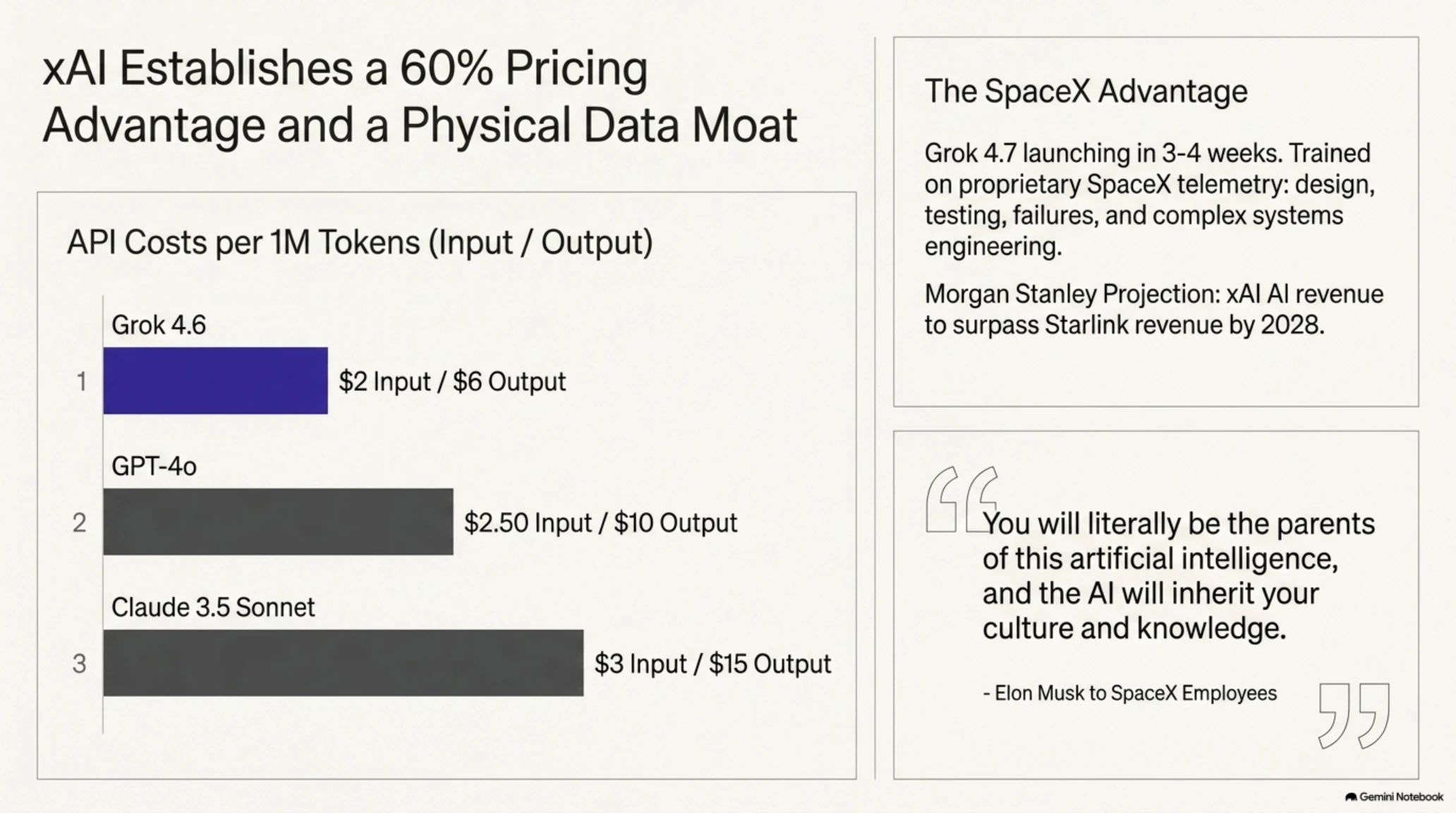
xAI officially released Grok 4.6 last night, and Elon Musk announced that version 4.7 will be released in 3 to 4 weeks. What makes this news remarkable is the use of all SpaceX data for training Grok 4.7 an unprecedented move that could dramatically enhance the model's capabilities in aerospace, engineering, and scientific domains.
API Price Comparison (Per 1M Tokens)
| AI Model | Input Cost | Output Cost |
|---|---|---|
| Grok 4.6 | $2.00 | $6.00 (60% Cheaper) |
| Claude 3.5 Sonnet | $3.00 | $15.00 |
| GPT-4o | $2.50 | $10.00 |
Musk to SpaceX Employees: You Will Be AI's Parents
At an internal town hall, Elon Musk told SpaceX employees: "Everything you do design, testing, failure, success all of this will become AI training material. You will literally be the parents of this artificial intelligence, and the AI will inherit your culture and knowledge."

This approach indicates that xAI is building a specialized model with deep knowledge in space, rocket engineering, complex systems engineering, and emergency problem-solving. According to a Morgan Stanley report, xAI's AI division revenue (generated through Grok) will likely surpass Starlink revenue by 2028 demonstrating the enormous potential of this technology.
Largest Donation in History: $540 Million to University of Washington
The Bill & Melinda Gates Foundation announced on Monday that it will donate $540.2 million to the Institute for Health Metrics and Evaluation (IHME) at the University of Washington. This is the largest donation in the 163-year history of the university and is dedicated to developing a 10-year "Global Burden of Disease" plan.
10-Year Global Burden of Disease Plan
Goal: Create the world's most comprehensive database of human health status in every region, every age, every disease
Coverage: Expansion from 204 countries to thousands of local regions with disaggregated data
Technology: AI-enabled tools for health data analysis, epidemic prediction, and identification of weaknesses in health systems
Access: All data freely and openly available to researchers, governments, and health organizations
Impact: Assist optimal allocation of health resources, early disease identification, and reduction of global health inequality
IHME, founded in 2007, previously played a key role in managing the COVID-19 pandemic with its data. Now with this enormous donation, the institute plans to expand its data coverage to thousands of local regions and develop artificial intelligence tools to predict health trends.

Dr. Christopher Murray, IHME Director, said: "This donation allows us to not only track diseases but also understand the social, economic, and environmental factors that affect health. AI can identify patterns that are invisible to humans."
Wikipedia Vandalism and Google's Automated System Weakness
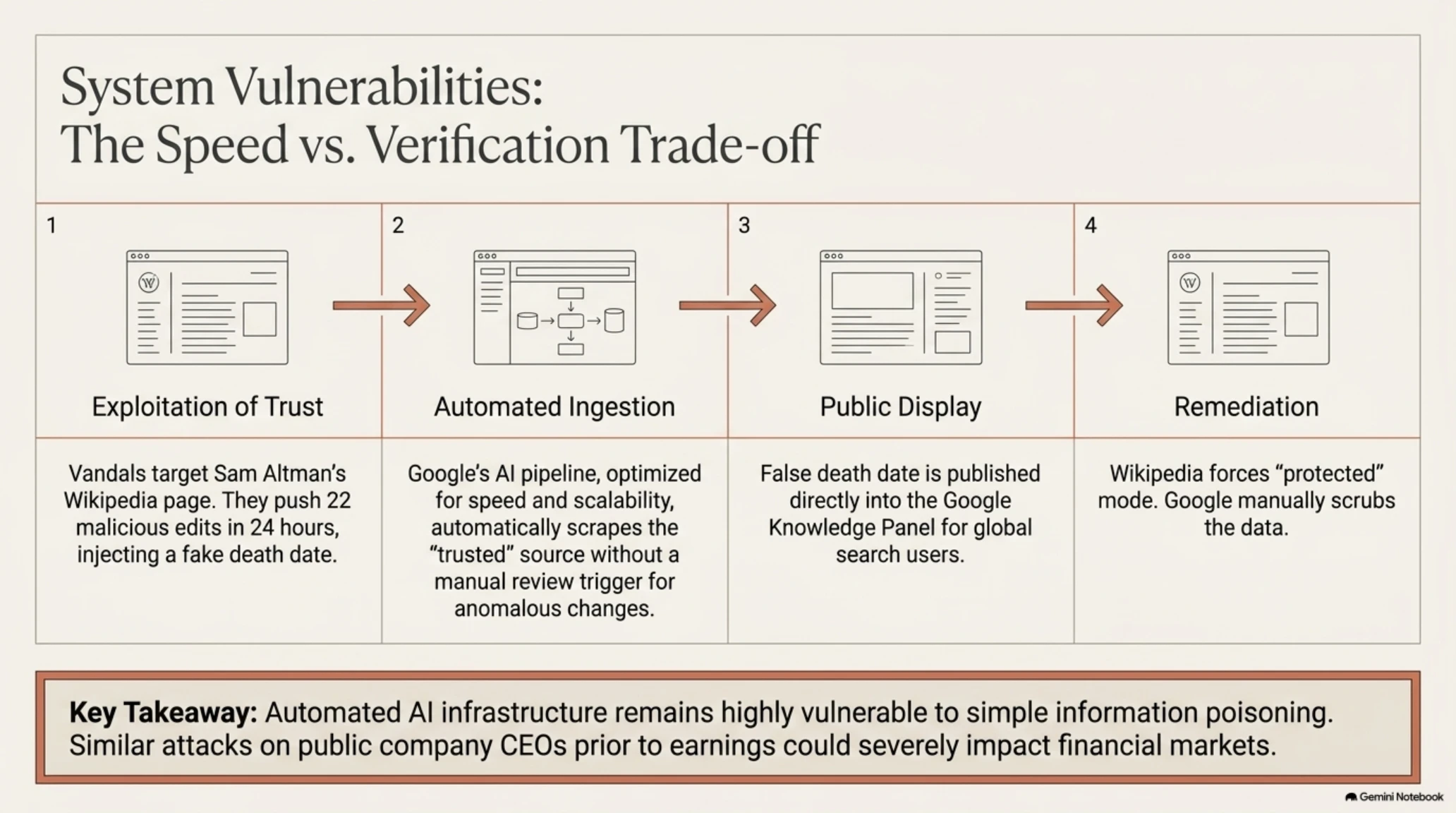
On Tuesday morning, August 12, Google users noticed that Sam Altman's Knowledge Panel, the CEO of OpenAI, displayed his date of death. Of course, Altman was alive, and this information was the result of vandalism on his Wikipedia page but Google automatically displayed this false data in its search results.
Investigations revealed that Sam Altman's Wikipedia page had 22 malicious edits in one day whereas this page typically has only about 5 edits per month. Vandals repeatedly added fake death dates, and Google's automated system placed this information in the Knowledge Panel without manual review.
Google and Wikipedia Response
Google: "This was not a manual change by Google. Our system automatically retrieves information from trusted sources like Wikipedia. When the vandalism was reported, we immediately removed the information."
Wikipedia: Put Altman's page in "protected" mode where only verified users can edit it
Problem Repeated: The same vandalism was repeated for Dario Amodei (CEO of Anthropic) and several other AI executives
Main Question: Are Google's automated systems robust enough to combat misinformation?
AI-Driven System Vulnerability
This incident demonstrates that even the world's largest technology company, which has invested billions in artificial intelligence, is still vulnerable to simple informational attacks. Google's automated systems, designed for speed and scalability, sometimes cannot distinguish between credible information and vandalism especially when the source (Wikipedia) is generally trustworthy.

Information security experts warn that this type of attack can easily be exploited for political, financial, or personal purposes. Imagine what impact similar vandalism about a major company CEO before financial results announcement could have on the stock market.
📚 Classified & Related Dossiers in TekinGame
If you wish to explore beyond this report and delve into cybernetic frontiers and autonomous AI architectures, do not miss these three exclusive deep-dives in the Tekin Garage:
Fidelity Wants to Add Staking to Ethereum ETF
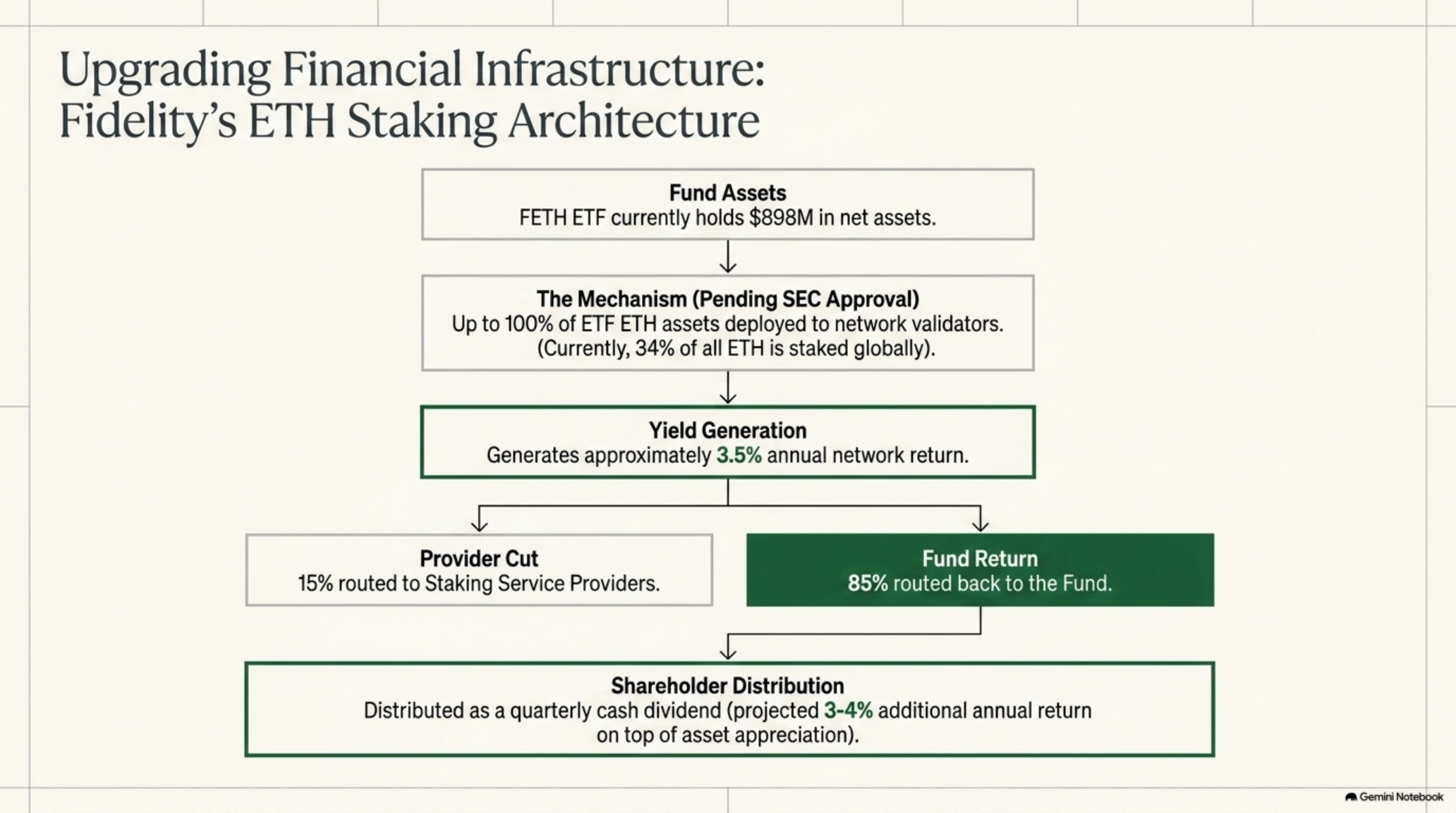
Fidelity Investments, one of the world's largest asset managers, has requested permission from the U.S. Securities and Exchange Commission (SEC) to allow its Ethereum ETF (FETH) to stake. If this request is approved, FETH will become the first spot Ethereum ETF in the United States that can stake its ETH and generate returns.
Fidelity Request Details
Staking Amount: Up to 100% of the fund's ETH assets can be staked
Reward Distribution: 85% of staking rewards to the fund, 15% to staking service providers
Payment to Shareholders: Staking rewards distributed quarterly in cash
Current Assets: FETH currently holds $898 million in net assets
Current Ethereum Staking Rate: Approximately 3.5% annually
Ethereum Staking Ratio: 34% of all ETH on the network is staked
Why This Matters
Currently, spot Ethereum ETFs in the United States only hold ETH and cannot stake it meaning shareholders miss out on staking rewards. If the SEC approves Fidelity's request, this fund can generate 3-4% annual returns through staking in addition to ETH price appreciation.
This could increase the attractiveness of Ethereum ETFs to institutional investors and bring more capital into this market. It could also put competitive pressure on other ETF issuers to submit similar requests.

Analysts believe that if all spot Ethereum ETFs gain staking permission, they could stake an additional $5 billion worth of ETH on the network which would also increase Ethereum network security.
Benefits and Risks of ETF Staking
- Benefit: Additional 3-4% annual returns for shareholders
- Benefit: Increased ETF attractiveness to institutional investors
- Benefit: Contribution to Ethereum network security by increasing staked ETH
- Risk: Unlock period for staked ETH (can reduce liquidity)
- Risk: Technical risks associated with validators (slashing penalty)
- Risk: Greater complexity in fund management and operational costs
The Broader Crypto ETF Evolution
Fidelity's move represents a significant evolution in how traditional finance interacts with cryptocurrency. When Bitcoin and Ethereum ETFs were first approved, they were simple "buy and hold" products. Now, asset managers are seeking to implement more sophisticated strategies that mirror what crypto-native participants do namely, earning yield on their holdings.
This shift has important implications beyond just Ethereum. If the SEC approves staking for Ethereum ETFs, it could open the door for similar products based on other proof-of-stake blockchains like Cardano, Solana, or Polkadot. It could also lead to more complex structured products, such as leveraged ETFs or funds that combine multiple yield-generating strategies.
However, regulators face a delicate balancing act. Staking introduces operational complexity and additional risks that need to be carefully managed to protect retail investors. The SEC will need to evaluate whether existing investor protections are adequate for these more sophisticated products.
Industry Reactions to Ethereum ETF Staking Proposal
The crypto community has responded enthusiastically to Fidelity's proposal, viewing it as validation of Ethereum's proof-of-stake model. "This is exactly what Ethereum needs to compete with centralized finance," said one DeFi researcher. "If institutional capital can earn yield on ETH through regulated products, it removes one of the main arguments against holding ETH instead of interest-bearing assets."
However, some traditional finance observers express caution. Critics point out that staking introduces operational risks that don't exist with simple custody. If a validator gets slashed (penalized for network violations), the ETF's net asset value could decline beyond just ETH price movements. Additionally, the lock-up period for staked ETH could create liquidity challenges if the fund experiences large redemptions.
Several other ETF issuers, including BlackRock and Grayscale, are reportedly watching Fidelity's filing closely and considering their own staking proposals. Industry insiders expect a wave of similar applications in the coming months, creating a competitive race to offer the most attractive yield-generating Ethereum products.
Samsung Secretly Building Humanoid Robot
According to published reports, Samsung is developing a proprietary humanoid robot and this project is completely separate from the company's investment in Rainbow Robotics. More intriguingly, this robot uses technology from Samsung's home appliance motors the same technology used in washing machines and refrigerators.

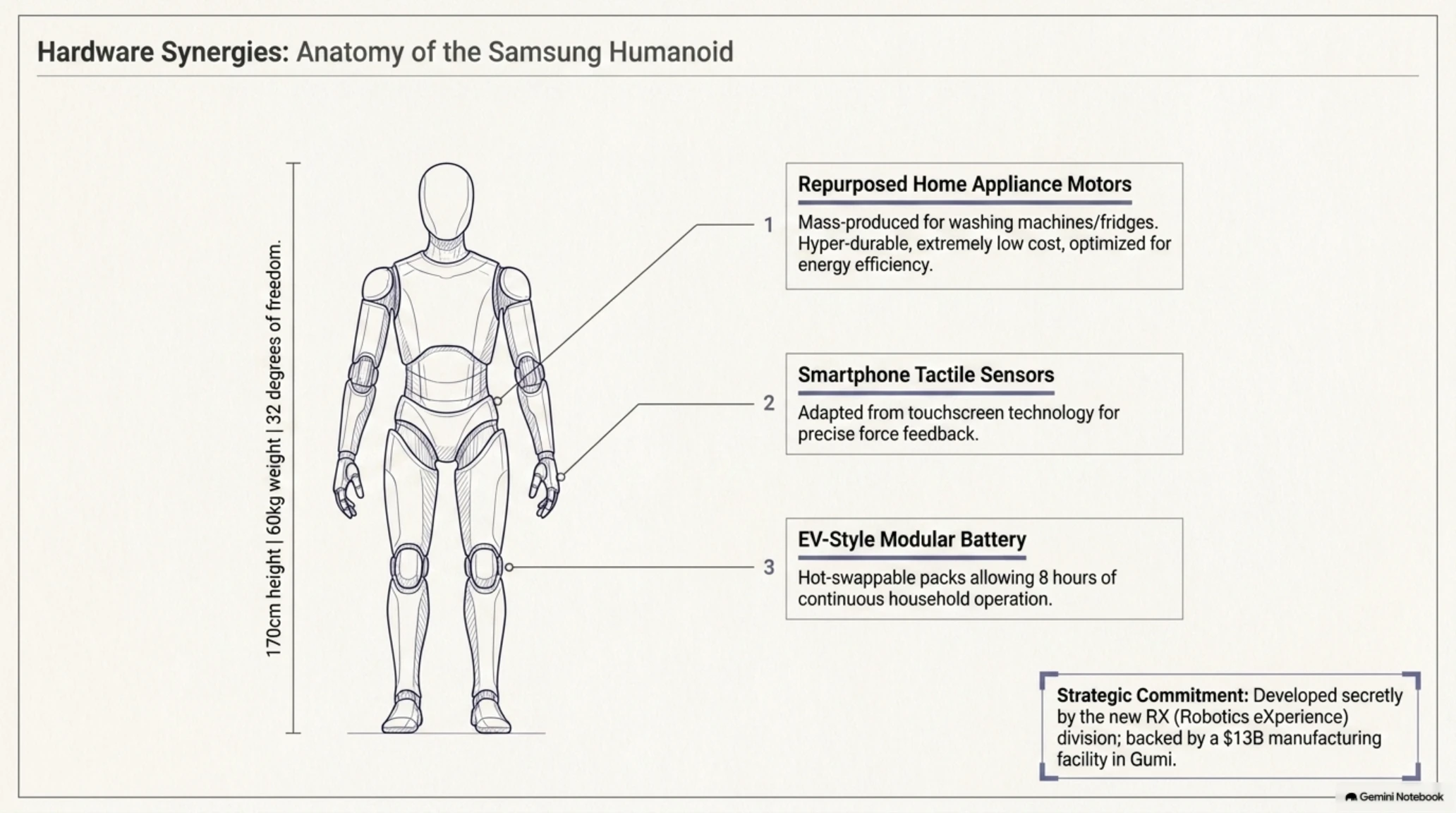
An internal demonstration of this robot prototype was recently held for Samsung senior executives, and according to reports, the company is planning to begin commercial production in 2026. Samsung intends to invest $13 billion to build a manufacturing facility in Gumi, South Korea.
RX Division: New Robotics Strategy
In July 2026, Samsung created the RX (Robotics eXperience) division, which operates directly under the company's CEO. This demonstrates that Samsung views robotics as a major strategic priority not just a side research project. The goal of this division is to build "general purpose robots" robots that can perform diverse tasks in various environments (home, office, factory).
Why Home Appliance Motors?
Using home appliance motor technology in humanoid robots may seem odd, but the logic is clear:
Reliability: These motors are designed to work 24/7 in harsh conditions and have high durability
Cost: Samsung mass-produces these motors, so production cost is much lower than specialized robotics motors
Energy Efficiency: Home appliance motors are optimized for efficient energy consumption a critical feature for robots that need to operate for hours
Cooling and Noise Control: These motors are designed to run quietly and cool two important features for home robots
Competition with Tesla and Boston Dynamics
With this move, Samsung enters fierce competition with Tesla (building Optimus), Boston Dynamics (Atlas), Figure AI, and several Chinese companies. The humanoid robot market is predicted to exceed $100 billion by 2030, and every major company wants a piece of this pie.
Samsung, by leveraging its existing technology (motors, batteries, displays, cameras) and expertise in mass production, could have a significant price advantage over competitors. If it can deliver a reliable humanoid robot priced under $50,000, it could transform the market.
Technical Architecture and Design Philosophy
Sources familiar with the project describe Samsung's humanoid robot as taking a fundamentally different approach from competitors. While Tesla's Optimus emphasizes AI and autonomous decision-making, and Boston Dynamics' Atlas focuses on extreme athletic capability, Samsung's robot reportedly prioritizes reliability, affordability, and practical utility.
The robot stands approximately 170 centimeters tall and weighs around 60 kilograms similar to an average adult human. It features 32 degrees of freedom, allowing for human-like movement and manipulation. The hands use tactile sensors adapted from Samsung's smartphone touchscreen technology, providing precise force feedback for delicate tasks.
Power management is another area where Samsung's consumer electronics expertise provides advantages. The robot uses a modular battery system similar to electric vehicle batteries, with hot-swappable packs that allow continuous operation. Samsung claims the robot can work for 8 hours on a single charge during typical household tasks.
Potential Applications and Market Strategy
Samsung envisions its humanoid robot initially targeting three markets: elderly care in aging societies like Japan and Korea, industrial inspection and maintenance tasks, and high-end household assistance. The company is reportedly in discussions with several major corporations for pilot programs.
For the consumer market, Samsung plans a different approach than competitors. Rather than selling robots outright, the company is considering a "Robotics-as-a-Service" model where customers pay a monthly subscription. This would lower the barrier to entry and allow Samsung to continuously update robot capabilities through software improvements and periodic hardware refreshes.
Industry analysts estimate that Samsung could initially price its humanoid robot around $40,000 to $50,000 for outright purchase, or $500 to $800 per month for subscription service. This would undercut Tesla's estimated Optimus pricing while remaining profitable due to Samsung's manufacturing scale.
Broader Implications: The Humanoid Robot Race
Samsung's entry into humanoid robotics represents more than just another product category it signals a fundamental shift in how technology companies view the future of human-machine interaction. The convergence of advanced AI, improved actuator technology, falling sensor costs, and massive manufacturing scale has created conditions where general-purpose humanoid robots might finally become economically viable.
This race matters because whoever establishes the dominant platform could shape decades of robotic development. Just as smartphone platforms created vast ecosystems of apps and services, robotics platforms will spawn ecosystems of tasks, skills, and third-party developers. The company that achieves critical mass first could enjoy network effects that make it difficult for competitors to catch up.
For Samsung, success in robotics could offset challenges in its traditional smartphone business, where growth has plateaued. More importantly, it could position the company at the center of what many technologists believe will be the next major computing platform one where computers don't sit on desks or in pockets, but move through physical space and directly manipulate the world.
The Strategic Stakes: Why These Six Stories Matter
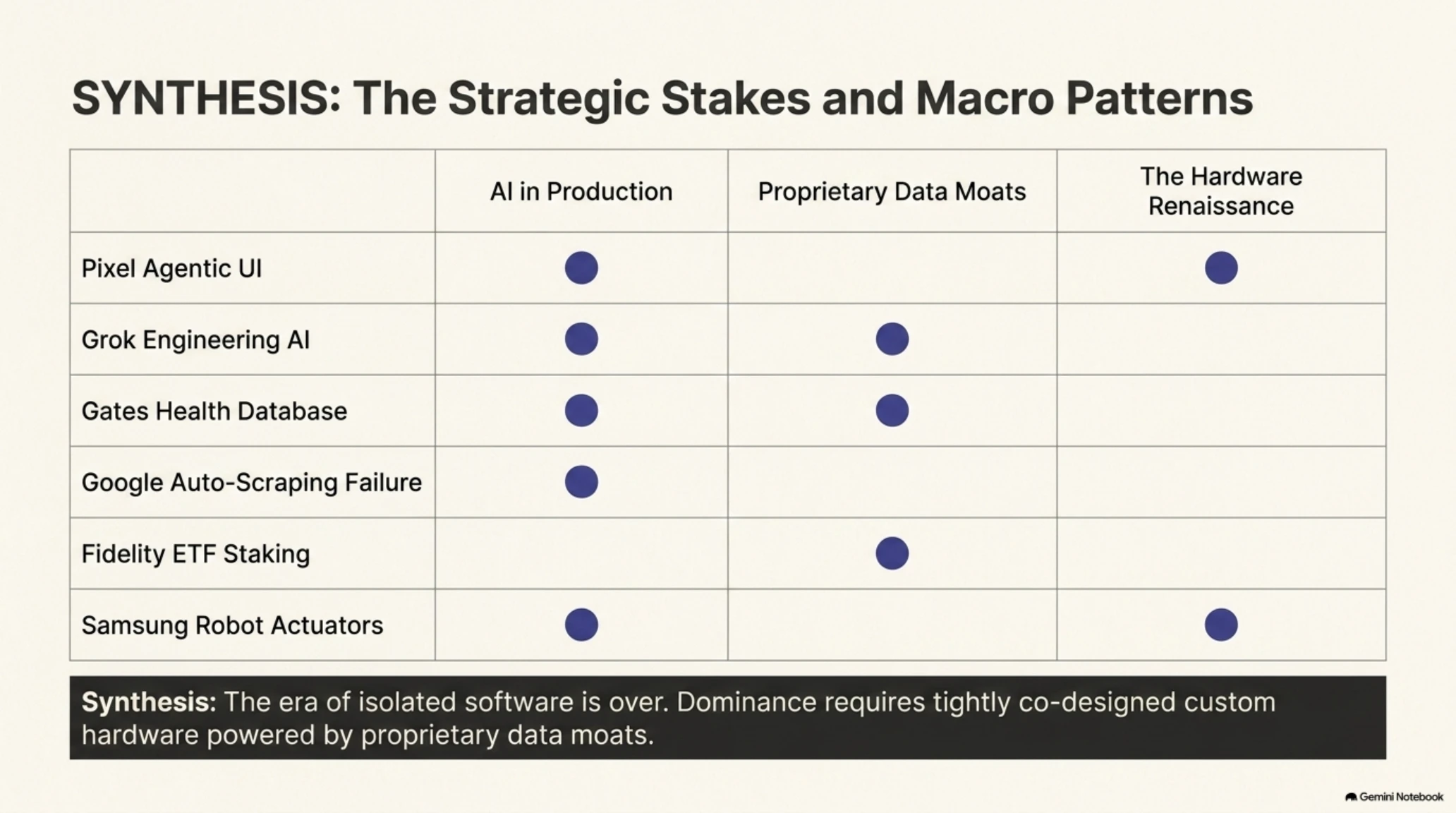
Today's six stories might seem disconnected at first glance a phone launch, an AI model release, a philanthropic donation, a Wikipedia vandalism incident, a regulatory filing, and a robotics project. But they actually represent different facets of the same underlying trends reshaping technology and society.
The AI Integration Everywhere Trend
Google's Pixel 11 with its agentic AI features, xAI's Grok trained on real-world SpaceX data, the Gates Foundation's health data analysis powered by machine learning, and Samsung's robots with AI decision-making all demonstrate how artificial intelligence is transitioning from experimental technology to practical infrastructure. We're past the "AI demo" phase and entering the "AI in production" era.
This shift has profound implications. When AI systems start making consequential decisions whether booking your dinner reservations, analyzing global health trends, or controlling physical robots in your home the stakes for reliability, safety, and trustworthiness increase dramatically. The Wikipedia vandalism incident serves as a cautionary tale: automated systems can fail in unexpected ways, sometimes with serious consequences.
The Data Advantage and Competitive Moats
Notice how data access defines competitive advantage across multiple stories. Google leverages its massive ecosystem of services to train Gemini. xAI gains unique access to SpaceX engineering data. The Gates Foundation funds the world's most comprehensive health database. Fidelity wants access to staking rewards data and yield generation.
This pattern reveals an uncomfortable truth: in the AI era, companies and institutions with proprietary data access gain compounding advantages. Those without such access face increasing difficulty competing. This has important implications for antitrust policy, data governance, and ensuring that AI benefits are broadly distributed rather than captured by a few dominant players.
The Hardware Renaissance
Both Google's Pixel devices and Samsung's humanoid robot represent significant hardware investments at a time when many observers predicted everything would move to the cloud. Why? Because truly useful AI often requires tight integration between software intelligence and physical form factors.
The Pixel's Tensor G6 chip exemplifies this: Google designed custom silicon specifically optimized for its AI workloads, achieving performance and efficiency that generic processors cannot match. Samsung's robot uses purpose-built actuators derived from appliance motors. These aren't just hardware products they're integrated systems where the physical and digital are inseparable.
This suggests we're entering a new phase where competitive advantage comes not just from algorithms or data, but from the ability to co-design hardware and software together. Companies that excel at only one or the other may struggle.
Looking Forward: What to Watch
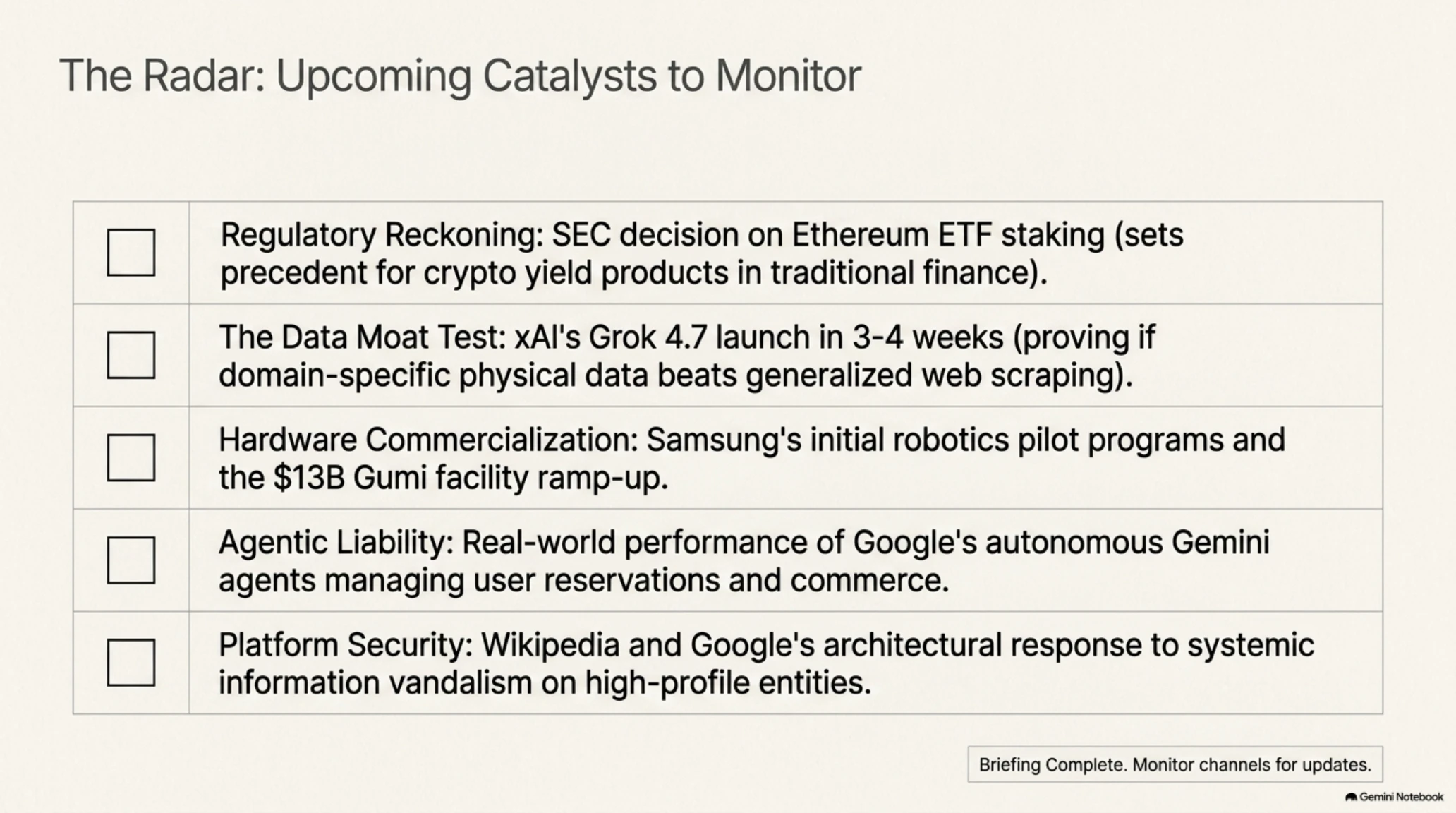
Based on today's stories, several developments deserve close attention in coming weeks and months:
Key Developments to Monitor
- SEC decision on Ethereum ETF staking approval could reshape crypto institutional adoption
- Grok 4.7 release with SpaceX data will test whether domain-specific training creates truly superior AI
- Wikipedia's response to systematic vandalism may require rethinking open editing model
- Google's rollout of agentic AI features real-world testing of autonomous AI agents
- Samsung robot pilot programs first practical tests of affordable humanoid robots
- Competition response to Pixel 11 will Apple and others match AI capabilities?
The Regulatory Reckoning
Multiple stories touch on regulatory challenges that governments are struggling to address. How should the SEC regulate crypto products that generate yield through staking? How should search engines be held accountable for displaying false information from vandalized sources? What safety standards should apply to autonomous AI agents that take actions on users' behalf?
These aren't abstract questions they have immediate practical consequences. Fidelity's staking proposal forces the SEC to develop new frameworks for crypto yield products. Google's Wikipedia incident highlights gaps in information verification systems. Pixel's agentic features raise questions about liability when AI makes mistakes.
Expect increased regulatory activity in these areas, though whether regulations will be thoughtful and proportionate remains uncertain. The tech industry's challenge is to help shape sensible rules rather than waiting for problems to provoke harsh regulatory responses.
The Global Competition Dimension
Today's stories also reflect intensifying global technology competition. Samsung's robotics push comes as Chinese companies like Unitree and UBTECH rapidly advance. xAI's aggressive pricing aims to compete with OpenAI and Anthropic. Google's Pixel competes globally with Apple, Samsung, and Chinese manufacturers.
This competition is healthy in many ways it drives innovation and gives consumers choices. But it also creates pressure to move fast and cut corners. The question is whether competition will produce a race to the top (better products, higher standards) or a race to the bottom (rushed releases, inadequate safety testing).
Final Thoughts: The Accelerating Pace of Change
Perhaps the most striking aspect of today's news is the sheer pace of development across multiple technology domains simultaneously. We're seeing major advances in consumer electronics, artificial intelligence, cryptocurrency finance, health technology, and robotics all in a single day's news cycle.
This acceleration creates challenges for everyone trying to keep up: consumers choosing products, businesses making strategic decisions, investors allocating capital, policymakers crafting regulations, and journalists covering developments. The old approach of deeply understanding one technology domain no longer suffices when multiple domains converge and interact.
The solution isn't to try to track everything that's impossible. Instead, focus on understanding the underlying patterns and principles. Recognize when similar dynamics appear in different contexts. Develop frameworks for thinking about new technologies rather than memorizing facts about specific products.
That's ultimately what makes stories like today's worth examining carefully. They're not just about specific companies or products they're case studies in how technology evolves, how markets develop, how institutions adapt (or fail to), and how the future gradually becomes the present.
Related Tech Intelligence on Tekin Game
• 🌙 Tekin Night | Call of Duty, Nintendo & Vision Pro Digest
• 🎭 Tekin Analysis | Apple AI Teardown & July 2026 Digest
• 🌙 Tekin Night | NVIDIA $500B Deal & iPhone 18 Leak
Conclusion: The Accelerating Pace of Change
Frequently Asked Questions
Is Pixel 11 Pro Fold better than Galaxy Z Fold?
Pixel 11 Pro Fold excels in software optimization and integration with Google services, but Galaxy Z Fold 6 may offer more diverse hardware (such as built-in S Pen). The choice depends on your priorities.
When will Grok 4.7 be released?
According to Elon Musk's announcement, Grok 4.7 will be released in 3-4 weeks (likely early to mid-September 2026).
Can I receive staking rewards through Fidelity ETF?
If the SEC approves the request, yes. Staking rewards will be distributed quarterly in cash to shareholders.
Why did Google show false Wikipedia information?
Google's automated system retrieves information from Wikipedia without manually reviewing every edit. This is a known weakness of automated systems.
When will Samsung's robot be released?
According to reports, Samsung plans to begin commercial production in 2026, but a public release date has not been announced yet.
Does Pixel Watch 5 work with iPhone?
No, Pixel Watch is only compatible with Android phones. A Pixel phone is recommended for full functionality.
How does Ethereum staking work in an ETF?
The ETF locks its ETH holdings in Ethereum's proof-of-stake protocol to help secure the network and receives rewards (approximately 3.5% annually). These rewards are then distributed to ETF shareholders.
What makes Grok different from other AI models?
Grok has real-time access to X (Twitter) data and will be trained on SpaceX engineering data, giving it unique knowledge in aerospace and real-time events that other models lack.
Sources and References
- TechCrunch - Google Made by Google 2026 Event
- 9to5Google - All Announcements
- The Neuron - Grok 4.6 Release & 4.7 Announcement
- KuCoin News - Musk Announces Grok 4.7
- Fortune - Gates Foundation $540M Donation
- GeekWire - Largest Gift in UW History
- Business Insider - Sam Altman Wikipedia Vandalism
- Android Authority - Google Search Error
- CoinTelegraph - Fidelity ETF Staking Filing
- CoinDesk - Fidelity Ethereum ETF Update
- TechTimes - Samsung Humanoid Robot
- SDaily - Samsung Robot Commercialization
Additional Gallery: ☀️ Tekin Morning | Thursday, August 13, 2026: Pixel 11, Grok 4.6 & Samsung Robots