In the April 30, 2026 Tekin Morning briefing, we analyze the US dominance with 4,032 data centers (37% of the global share) winning the AI infrastructure war. We also dissect the standardization of satellite calling in smartphones, Sultan Qaboos University's new USPTO patents, and the stock market impact of recent CS updates.
🌅 Welcome to Tekin Morning — April 30, 2026
Good morning, tech enthusiasts! Start your day with the most important and latest technology news from around the world. Today we have 5 exciting stories covering cybersecurity, hardware, smartphones, and gaming — everything you need to start your day with confidence and awareness.
⚡ Today's Headlines:
🏛️ US Dominance: 4,032 Active Data Centers (37% Global)
📡 Satellite Calling Standardized: S26 & Note 60
🎓 Sultan Qaboos University USPTO Patent Filings
📈 CS Updates That Rocked Tech Stocks
🎙️ Awake Technology Podcast: AI's Future & Global Impact
☕ Grab your coffee and get ready for a comprehensive news journey through the world of technology!
🏛️ The Infrastructure War is Over: US Dominates with 4,032 Data Centers vs China's 368
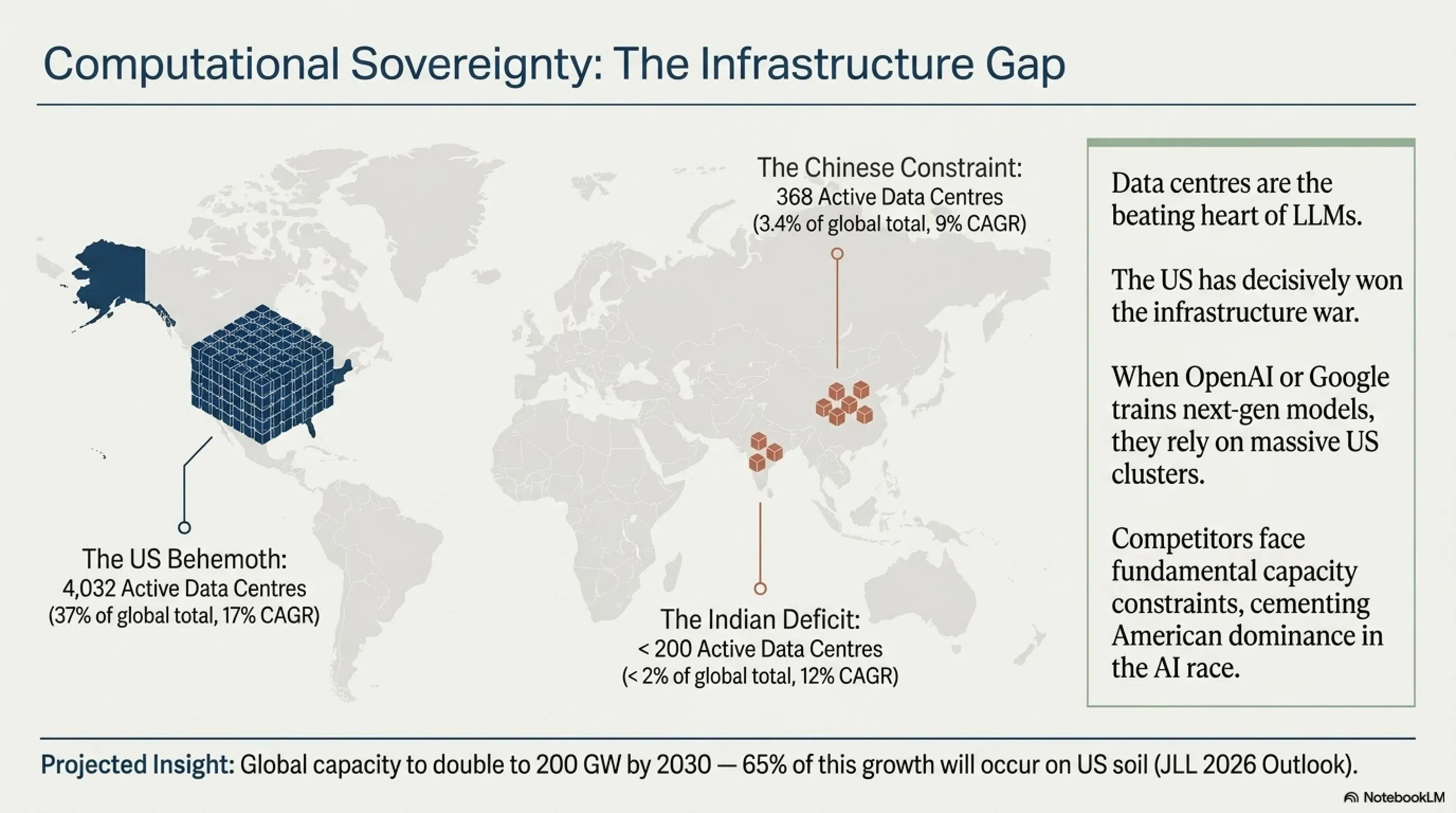
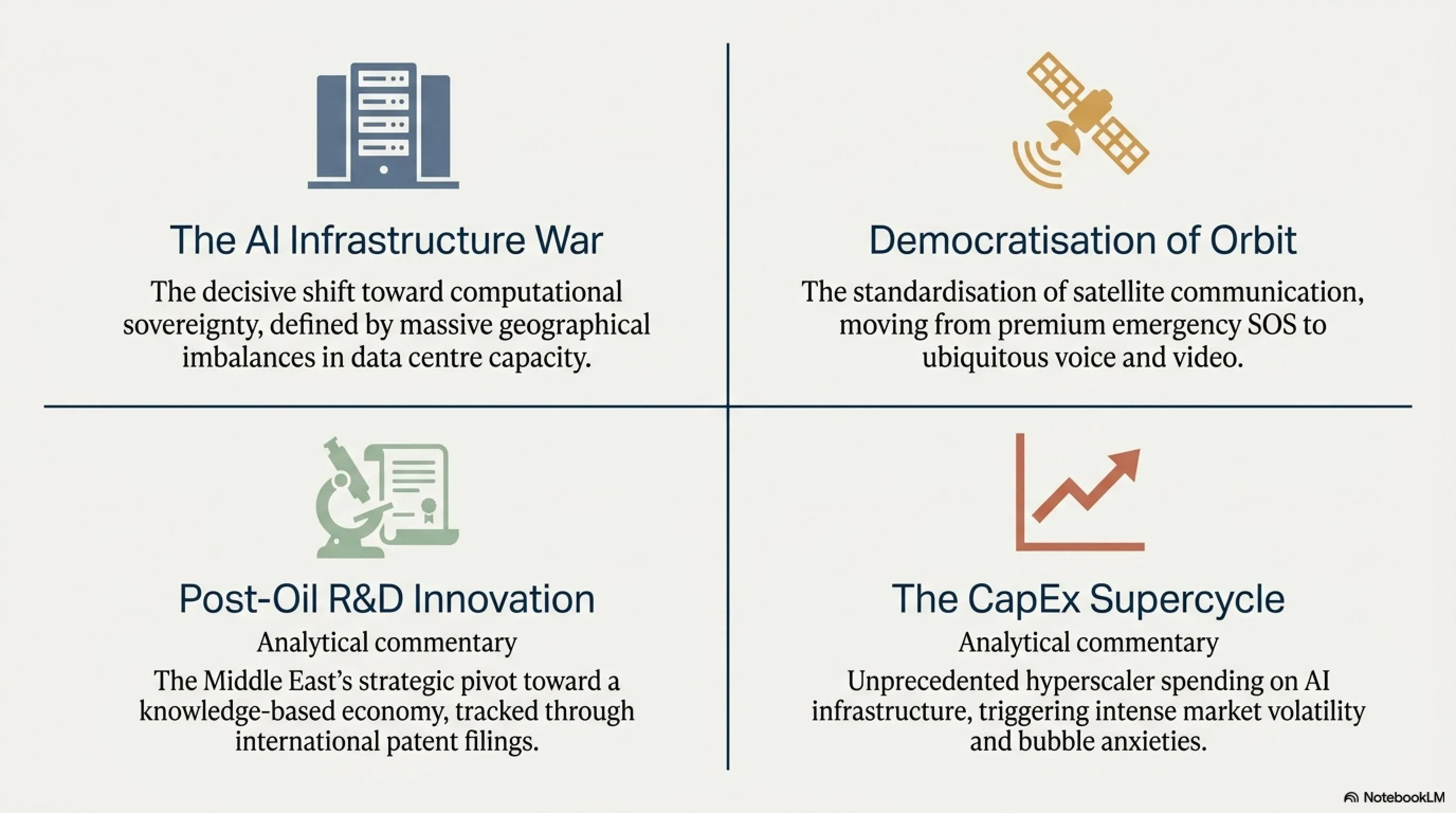
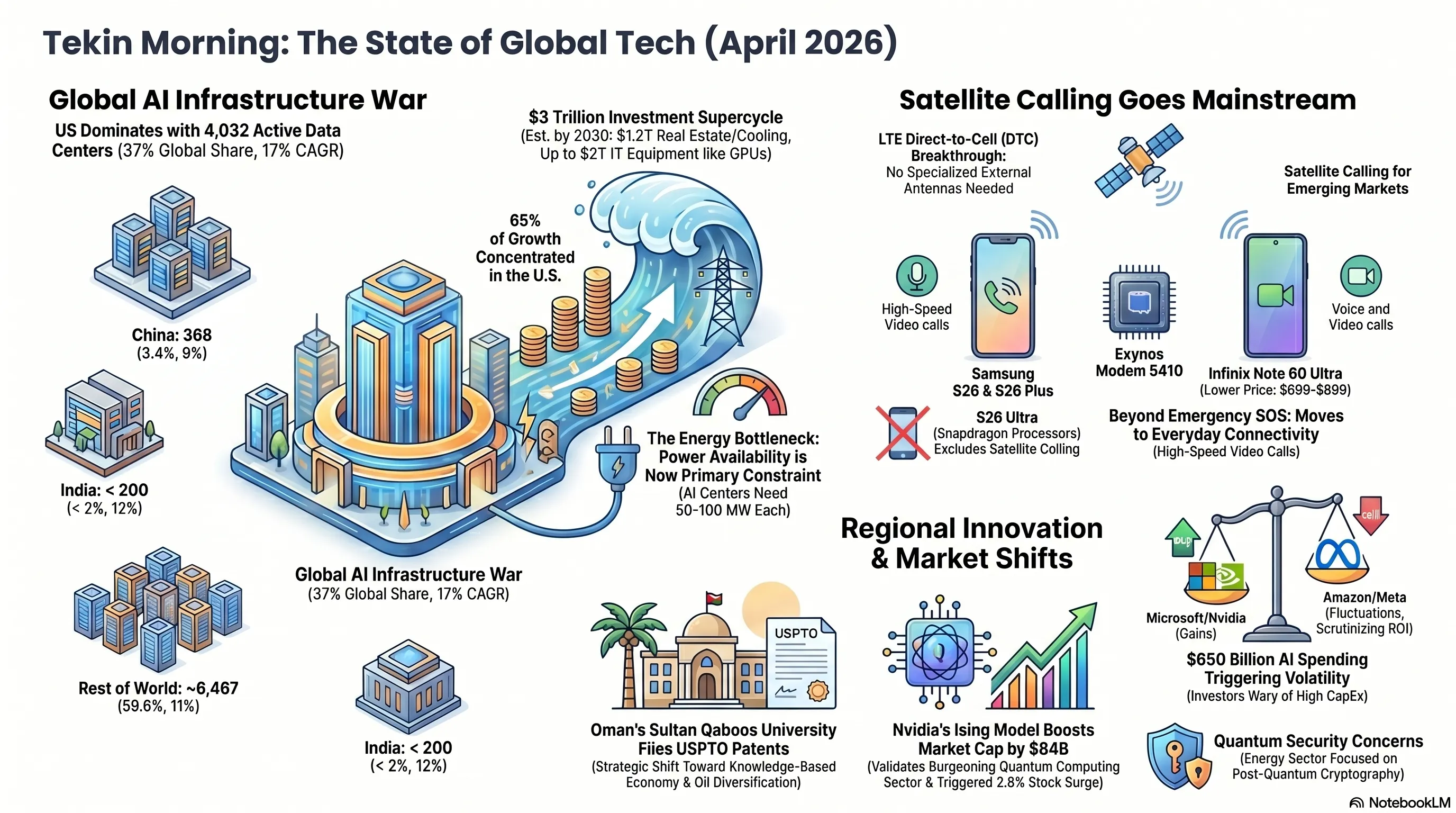
According to statistics released at the India AI Impact Summit 2026 (April 17-29), the United States has cemented its dominance in global digital infrastructure with 4,032 active data centers — representing approximately 37% of the worldwide total. In stark contrast, China operates only 368 data centers, while India lags even further behind. This massive gap confirms that the AI infrastructure war has been decisively won by Washington, and the margin is only expected to widen in the coming years.
📊 Global Data Center Statistics (April 2026)
| Country/Region | Data Centers | Global Share | Growth Rate (CAGR) |
|---|---|---|---|
| 🇺🇸 United States | 4,032 | 37% | 17% |
| 🇨🇳 China | 368 | 3.4% | 9% |
| 🇮🇳 India | < 200 | < 2% | 12% |
| 🌍 Rest of World | ~6,467 | 59.6% | 11% |
| Global Total | ~10,867 | 100% | 14% |
Source: Global South World (India AI Impact Summit 2026), JLL's 2026 Global Data Center Outlook
These statistics, compiled from reports by Global South World and JLL's 2026 Global Data Center Outlook, paint a clear picture: global data center capacity is projected to nearly double to 200 GW by 2030. However, the critical insight is that 65% of this growth will occur on US soil, further cementing American dominance in the AI infrastructure race.
🔍 Tekin Deep Dive: Why This Gap Matters
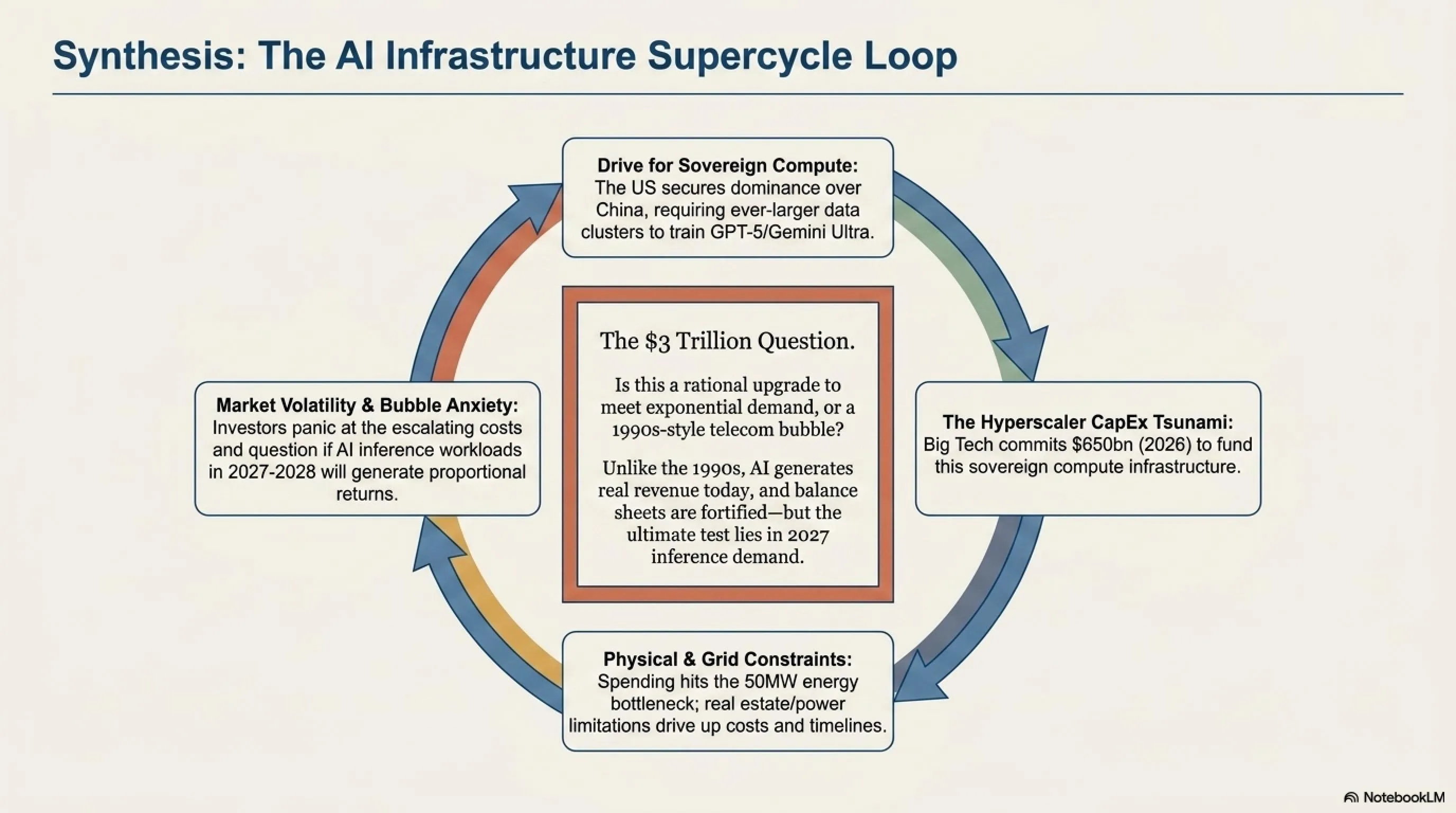
1. Infrastructure Control = AI Future Control: Data centers are the beating heart of Large Language Models (LLMs), AI inference systems, and cloud services. The country with more infrastructure can build more powerful models and innovate faster. This isn't just about storage — it's about computational sovereignty. When OpenAI trains GPT-5 or Google develops Gemini Ultra, they rely on massive US-based data center clusters. China's relative scarcity means its AI companies (Baidu, Alibaba, ByteDance) face a fundamental capacity constraint.
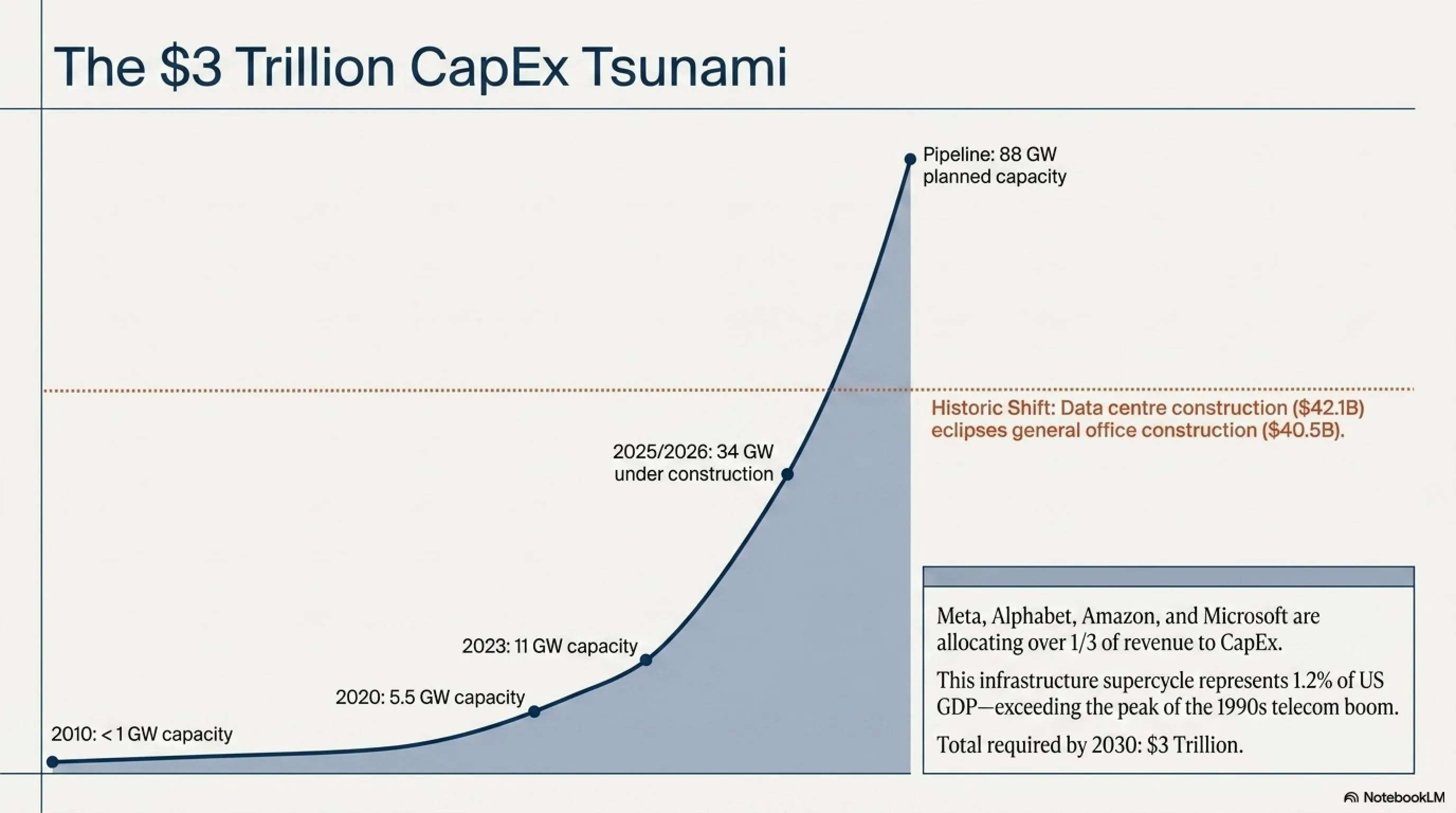
2. The Hyperscaler Investment Tsunami: Meta, Alphabet, Amazon, and Microsoft are currently funneling more than one-third of their revenue into CapEx (capital expenditures), with the majority allocated to data center construction. This figure has reached 1.2% of US GDP — exceeding the peak of the 1990s telecom boom! According to JLL's analysis, this represents an infrastructure investment supercycle requiring up to $3 trillion by 2030: $1.2 trillion for real estate (land, buildings, cooling systems) and $1-2 trillion for IT equipment (servers, GPUs, networking).
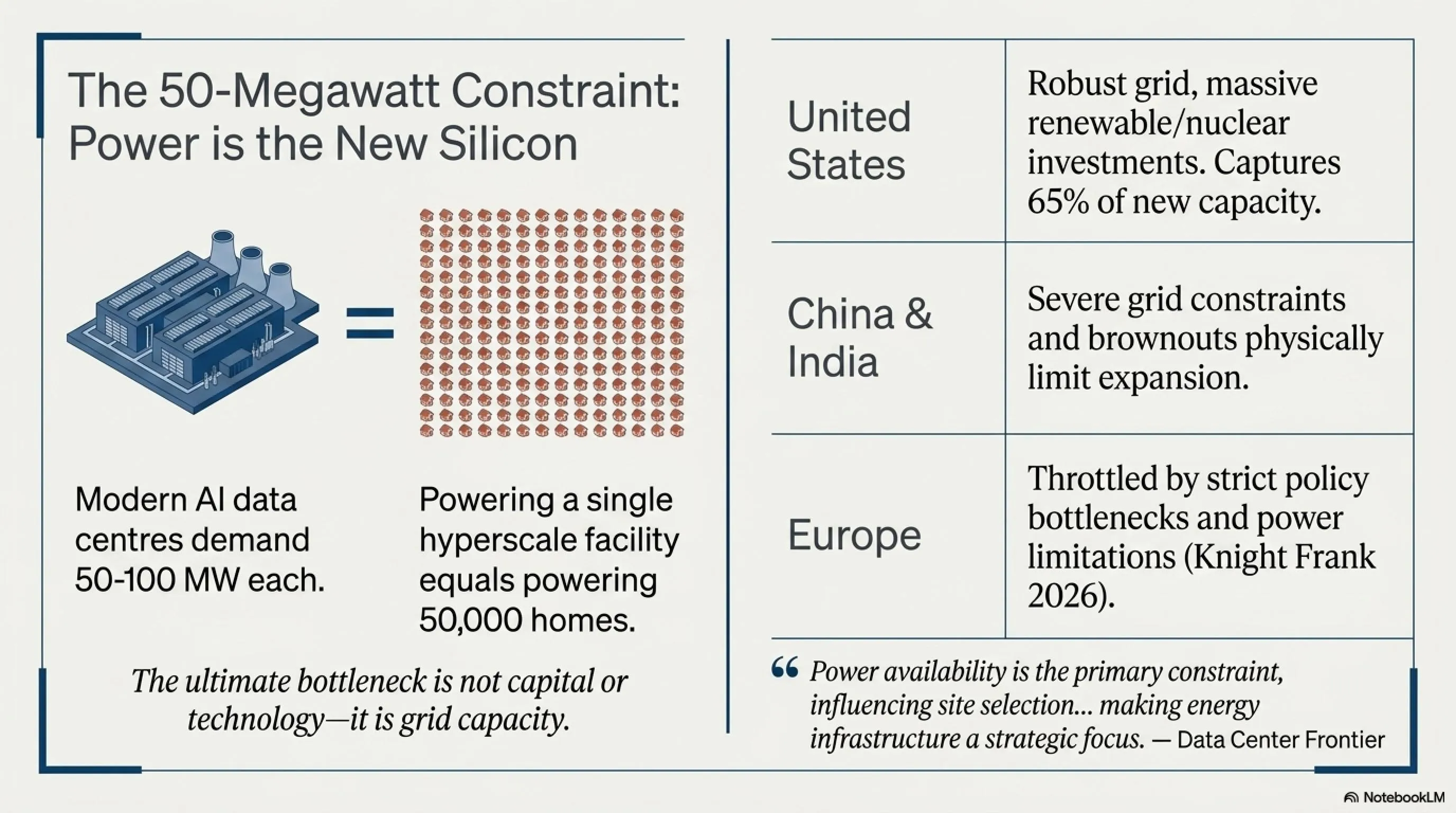
3. The Energy Bottleneck: The biggest constraint on data center growth isn't capital or technology — it's power availability. Modern AI data centers consume 50-100 MW each, equivalent to powering 50,000 homes. The US, with its robust electrical grid and investments in renewable energy (solar, wind, nuclear), manages this challenge better than competitors. China and India face severe grid constraints, brownouts, and regulatory hurdles that physically limit expansion. Knight Frank's 2026 report confirms that power and policy bottlenecks are throttling growth in Europe and Asia, while the US captures 65% of new capacity.
💰 The $3 Trillion Question: Boom or Bubble?
Industry analysts are divided on whether this unprecedented infrastructure build-out represents rational catch-up to surging AI demand or the early signs of a bubble reminiscent of the 1990s telecom crash or 1870s railroad overbuilding. The Appraisal (April 2026 substack analysis) notes that data center construction spending has nearly eclipsed general office construction — $42.1B vs $40.5B annually — a historic shift.
The capacity pipeline tells a dramatic story: In 2010, the US had less than 1 GW of total data center capacity. It took a decade to reach 4 GW. Then the curve bent sharply — 5.5 GW in 2020, 9.2 GW in 2022, 11 GW in 2023. By 2025, there are 34 GW under construction and 88 GW in the planned pipeline. This exponential growth is unprecedented in modern infrastructure history.
🌐 Expert Perspective: What Industry Leaders Say
"The Americas is the largest data center region, representing about 50% of global capacity. The Americas also has the fastest growth rate of the three global regions, with a projected 17% supply CAGR through to 2030, preserving its position as the dominant data center region. The U.S. drives most of the activity in the region, accounting for about 90% of capacity in the Americas."
— JLL's 2026 Global Data Center Outlook
"Power availability is the primary constraint, influencing site selection, development timelines, and infrastructure investments, making energy infrastructure a strategic focus."
— Data Center Frontier, analyzing JLL's market transformation report
📡 Satellite Calling is No Longer Luxury — It's Standard: S26 & Note 60 with Exynos 5410
On April 29, 2026, two major announcements confirmed that satellite voice and video calling is no longer a luxury feature reserved for flagship devices — it's becoming an industry standard. Samsung with the Galaxy S26 and Infinix with the Note 60 Ultra both utilize the Exynos Modem 5410, which supports LTE Direct-to-Cell (DTC) technology — a breakthrough that enables full satellite voice and video calls without requiring specialized antennas or external hardware.
🛰️ Exynos Modem 5410: The Heart of Satellite Calling
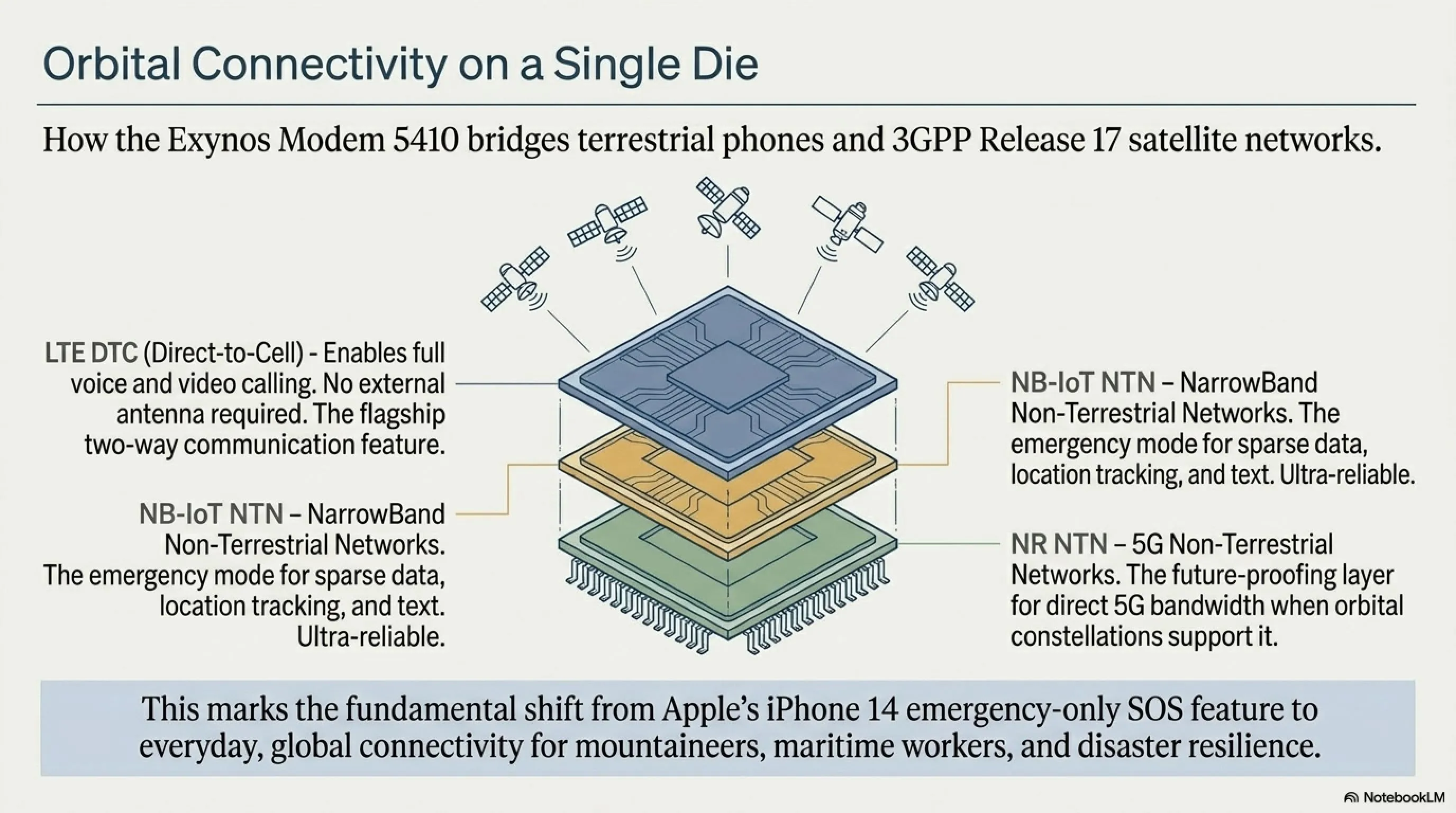
The Exynos Modem 5410 is the first chip to integrate three distinct satellite modes on a single die, built for the 3GPP Release 17 era:
- LTE DTC (Direct-to-Cell): Full voice and video calling with satellites — no additional antenna required. This is the flagship feature that enables true two-way communication in remote areas.
- NB-IoT NTN (NarrowBand IoT Non-Terrestrial Networks): Low-throughput data communication for location tracking and text messaging. Think of this as the "emergency mode" — sparse data but ultra-reliable.
- NR NTN (5G Non-Terrestrial Networks): Direct 5G satellite connection for higher speeds. This is the future-proofing layer, designed for when satellite constellations support full 5G bandwidth.
This means users can make calls in areas without cellular coverage (mountains, oceans, deserts) — not just emergency SOS messages, but full voice and video calls. According to Gadgets360 and GSMArena, this marks a fundamental shift from "emergency-only" satellite features (like Apple's iPhone 14 SOS) to "everyday connectivity" satellite services.
📱 Head-to-Head: Samsung S26 vs Infinix Note 60 Ultra
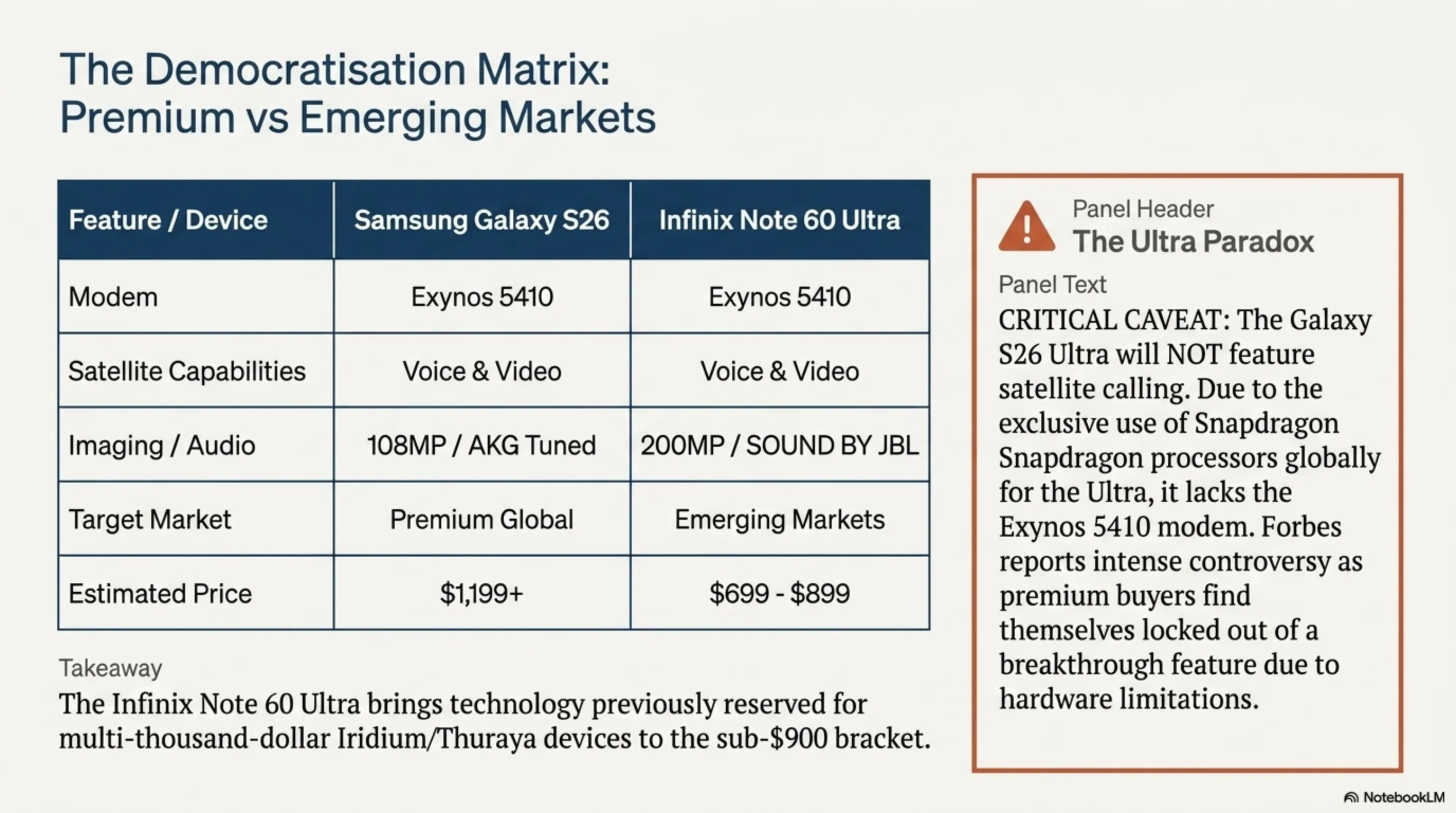
| Feature | Samsung Galaxy S26 | Infinix Note 60 Ultra |
|---|---|---|
| Modem | Exynos 5410 | Exynos 5410 |
| Satellite Voice Calling | ✅ Yes | ✅ Yes |
| Satellite Video Calling | ✅ Yes | ✅ Yes |
| Global Coverage | 3GPP Release 17 | 3GPP Release 17 |
| Main Camera | 108MP (estimated) | 200MP Ultra-HD |
| Audio | AKG Tuned | SOUND BY JBL |
| Target Market | Premium Global | Emerging Markets |
| Estimated Price | $1,199+ | $699-$899 |
Source: Gadgets360, GSMArena, Forbes, Android Central
Critical Caveat: All Galaxy S26 Ultra models worldwide use Snapdragon processors (not Exynos), which means the S26 Ultra will NOT have satellite calling capability. Only the standard S26 and S26 Plus models with Exynos 5410 will support this feature. This is a hardware limitation that cannot be resolved with software updates. According to Forbes, this decision has sparked controversy among Ultra buyers who feel locked out of a breakthrough feature.
🔍 Tekin Deep Dive: Why This is a Game-Changer
1. Democratizing Satellite Communications: Until just a few years ago, satellite calling required specialized multi-thousand-dollar phones like Iridium or Thuraya. These devices were bulky, expensive, and limited to voice-only communication. Now, this technology is being standardized in mainstream smartphones. The Infinix Note 60 Ultra, priced under $900, brings satellite calling to emerging markets — a demographic that has historically been excluded from this technology. This is the mobile equivalent of what Starlink did for internet access: making the previously impossible, accessible.
2. Competing with Starlink and Apple: Apple introduced satellite SOS with the iPhone 14, but it was limited to emergency text messages. The Exynos 5410 takes this a giant leap forward by enabling full voice and video calls. This puts Samsung and Infinix ahead of Apple in satellite connectivity — a rare reversal in the premium smartphone market. Industry analysts at Android Central note that "Samsung seems to be aiming beyond emergency SOS, with the Galaxy S26 potentially offering full satellite voice calling" — a feature that could become a key differentiator in the 2026-2027 smartphone wars.
3. Target Markets & Use Cases: The primary beneficiaries are mountaineers, sailors, oil/gas workers, and rural residents without cellular coverage. But there's a broader strategic play: disaster resilience. When hurricanes, earthquakes, or wildfires knock out terrestrial cell towers, satellite-enabled phones become lifelines. Governments and emergency services are already exploring bulk purchases of satellite-capable devices for first responders. According to Tribune.com.pk, "Samsung is preparing a major leap in smartphone connectivity, with its upcoming Galaxy S26 lineup expected to support full satellite voice calling, moving beyond the emergency-only messaging currently available on most devices."
🌐 Industry Expert Perspective
"This hardware is designed to equip the future Galaxy S26 series with a revolutionary capability: full satellite connectivity. The idea is that users can communicate from anywhere on the planet, even where terrestrial networks don't reach."
— Foro3D, analyzing Samsung's Exynos 5410 announcement
"A professional-grade 200MP ultra-high-definition imaging system, built-in multi-country satellite communication connectivity, and immersive audio precision-tuned by SOUND BY JBL come together to challenge expectations in the premium segment."
— The Nation Online, on Infinix Note 60 Ultra's premium positioning
🎓 Middle East Enters the Innovation Arena: Sultan Qaboos University Files Two USPTO Patents
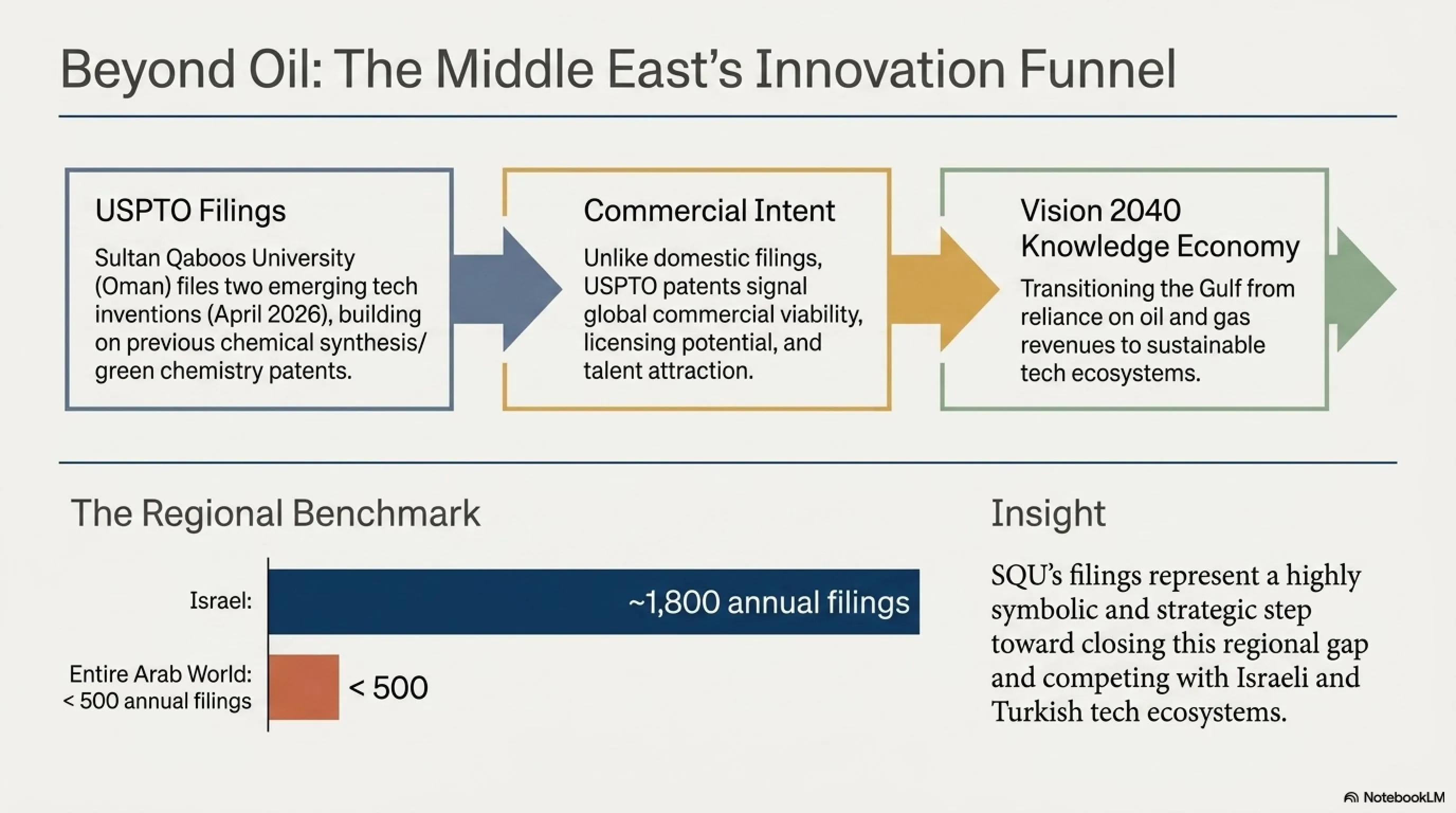
Between April 25-29, 2026, Sultan Qaboos University (SQU) in Oman filed two new inventions with the United States Patent and Trademark Office (USPTO). These patents, focused on emerging technologies, signal that the Middle East is making serious inroads into technology innovation beyond its traditional oil and gas sectors. While specific details of the inventions remain under USPTO review, the filings represent a strategic shift in the Gulf region's approach to economic diversification.
📜 About Sultan Qaboos University
Founded in 1986, Sultan Qaboos University is one of Oman's two public universities and is named after Sultan Qaboos bin Said al-Said, who ruled Oman from 1970 to 2020. The university has been steadily building its research capabilities, with a particular focus on engineering, computer science, and applied sciences. According to the official SQU website, the institution is currently hosting the Third International Conference on Unmanned Vehicle Systems — Oman 2026, demonstrating its commitment to cutting-edge technology research.
Previous patents filed by SQU (searchable on Justia Patents) include innovations in chemical synthesis, particularly methods of forming delta-lactone compounds through reactions of dienes with carbon dioxide in the presence of palladium and phosphine ligands — indicating a strong foundation in materials science and green chemistry.
🔍 Tekin Deep Dive: Why This Matters for the Region
1. Economic Diversification Beyond Oil: Gulf nations (Oman, UAE, Saudi Arabia) are aggressively pursuing strategies to reduce dependence on oil and gas revenues. Investment in R&D and international patent filings is a core component of this strategy. Oman's Vision 2040 explicitly targets a knowledge-based economy, and USPTO patents are a measurable indicator of progress. Unlike domestic patents, USPTO filings signal global commercial intent — these aren't just academic exercises, but potential products or licensing opportunities.
2. Competing with Israel and Turkey: In the Middle East, Israel and Turkey have historically dominated patent filings and tech innovation. Israel's tech sector (particularly cybersecurity and defense tech) and Turkey's growing startup ecosystem have set the regional benchmark. The entry of Arab universities into this arena could shift the regional balance. According to WIPO statistics, Israel files approximately 1,800 international patents annually, while the entire Arab world combined files fewer than 500. SQU's USPTO filings, though modest in number, represent a symbolic and strategic step toward closing this gap.
3. Talent Attraction and International Collaboration: International patent filings help universities attract top-tier researchers and students. They also facilitate partnerships with multinational corporations and research institutions. For Oman, a relatively small nation of 5 million people, leveraging international collaboration is essential for building a sustainable innovation ecosystem. The USPTO patents could serve as a foundation for joint ventures, licensing deals, or spin-off companies — all critical components of a thriving startup ecosystem.
📈 Computer Science Updates That Shook Tech Stocks — AI and Quantum Take Center Stage
On April 29, 2026, an analytical video covering recent Computer Science breakthroughs triggered significant volatility in technology stocks. The video, which focused on advances in Artificial Intelligence (AI) and Quantum Computing, forced investors to reassess their portfolios as the market digested implications for the next wave of innovation. The timing coincided with Big Tech earnings reports, creating a perfect storm of information that sent markets on a rollercoaster ride.
🔬 Key Highlights from the CS Update
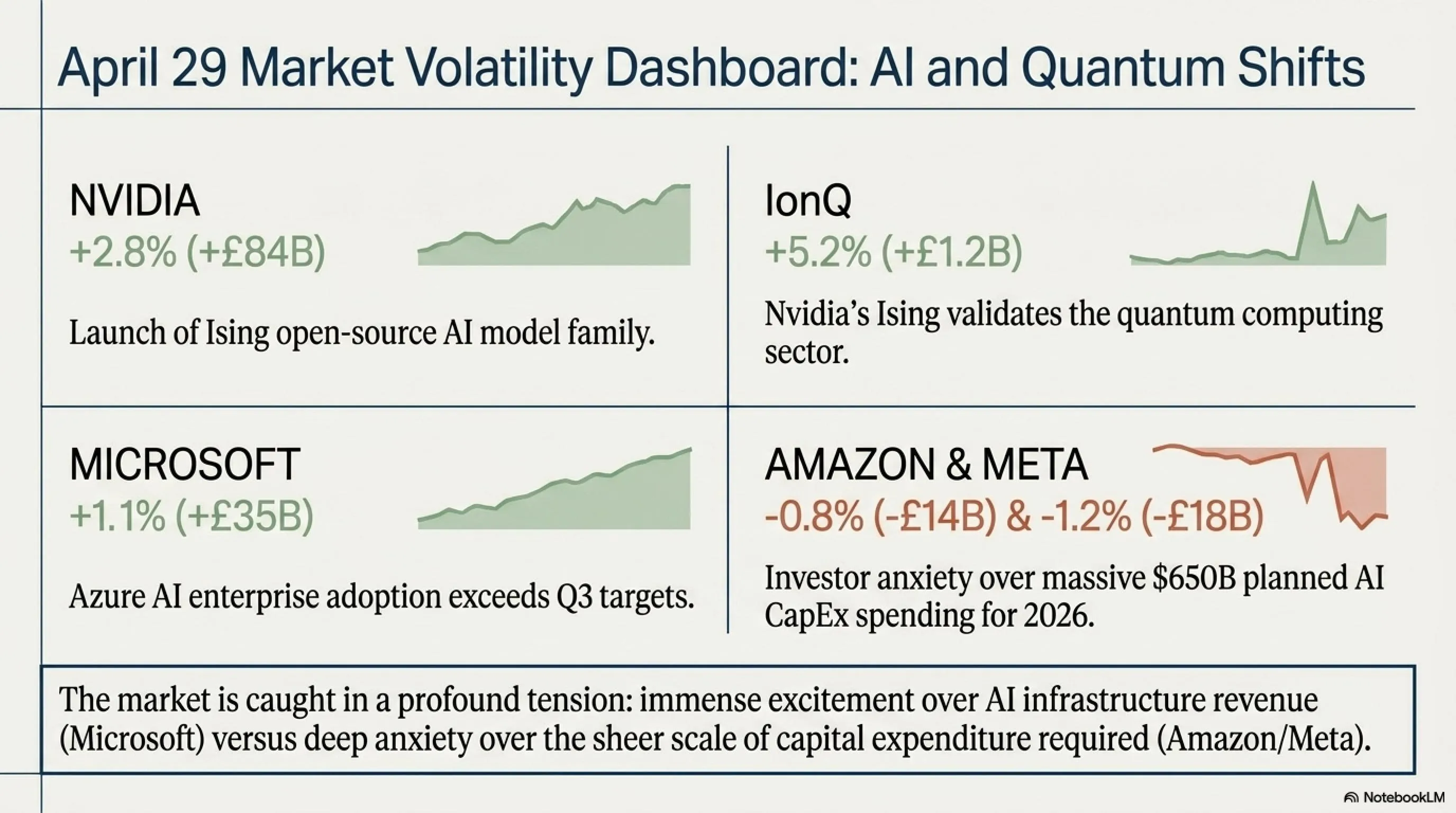
- Nvidia's Ising Model Family: Nvidia unveiled its Ising open-source AI model family, a move that investors interpreted as strong validation of the quantum computing sector. The announcement triggered a surge in quantum computing stocks, with IonQ jumping 5.2% and Xanadu's CEO becoming a billionaire overnight. According to IT Security News, "Quantum computing stocks jumped after Nvidia unveiled its Ising open-source AI model family."
- Microsoft's Azure AI Dominance: Microsoft announced that its AI and Cloud Computing revenue exceeded fiscal Q3 targets, driven by enterprise adoption of Azure OpenAI services. The stock gained 1.1%, reinforcing Microsoft's position as the infrastructure backbone of the AI revolution.
- Big Tech Earnings Volatility: Amazon, Meta, and Alphabet stocks swung wildly after releasing earnings reports. Investors are scrutinizing the massive CapEx spending on AI infrastructure — collectively $650 billion planned for 2026. According to The Guardian, "The four companies have together planned to spend $650bn in 2026 on AI infrastructure. Investors and economists anticipate that poor results could throw the market into turmoil."
- Quantum Security Concerns: EPRI hosted a panel on quantum security and the future of energy systems, highlighting growing concerns about post-quantum cryptography. The discussion centered on how quantum computers could break current encryption standards, necessitating a complete overhaul of cybersecurity infrastructure.
💹 Stock Market Impact (April 29, 2026)
| Company/Index | Change | Reason | Market Cap Impact |
|---|---|---|---|
| Nvidia | +2.8% | Ising Model Launch | +$84B |
| IonQ (Quantum) | +5.2% | Nvidia Validation | +$1.2B |
| Microsoft | +1.1% | Strong Azure AI Revenue | +$35B |
| Amazon | -0.8% | CapEx Concerns | -$14B |
| Meta | -1.2% | High AI Spending | -$18B |
| Nasdaq Composite | +0.04% | Mixed Signals | — |
| S&P 500 | -0.04% | Tech Drag | — |
Source: Yahoo Finance, Investor's Business Daily, The Guardian, TS2.tech
According to Daily Mail, "Markets went on a wild ride on Wednesday as four giant tech companies worth a quarter of the value of the entire stock market reported results." The volatility underscores a fundamental tension: investors are torn between excitement about AI's transformative potential and anxiety about whether the massive infrastructure investments will generate proportional returns.
🎙️ Awake Technology Podcast: Deep Dive into AI's Future, New Services & Global Impact
Between April 13-29, 2026, the Awake Technology podcast engaged in extensive discussions about the future of artificial intelligence, emerging services, and the global ramifications of technological advancement. This podcast series has become essential listening for analysts, technology strategists, and anyone interested in understanding where the industry is headed beyond the hype cycles.
🎧 Key Topics Covered
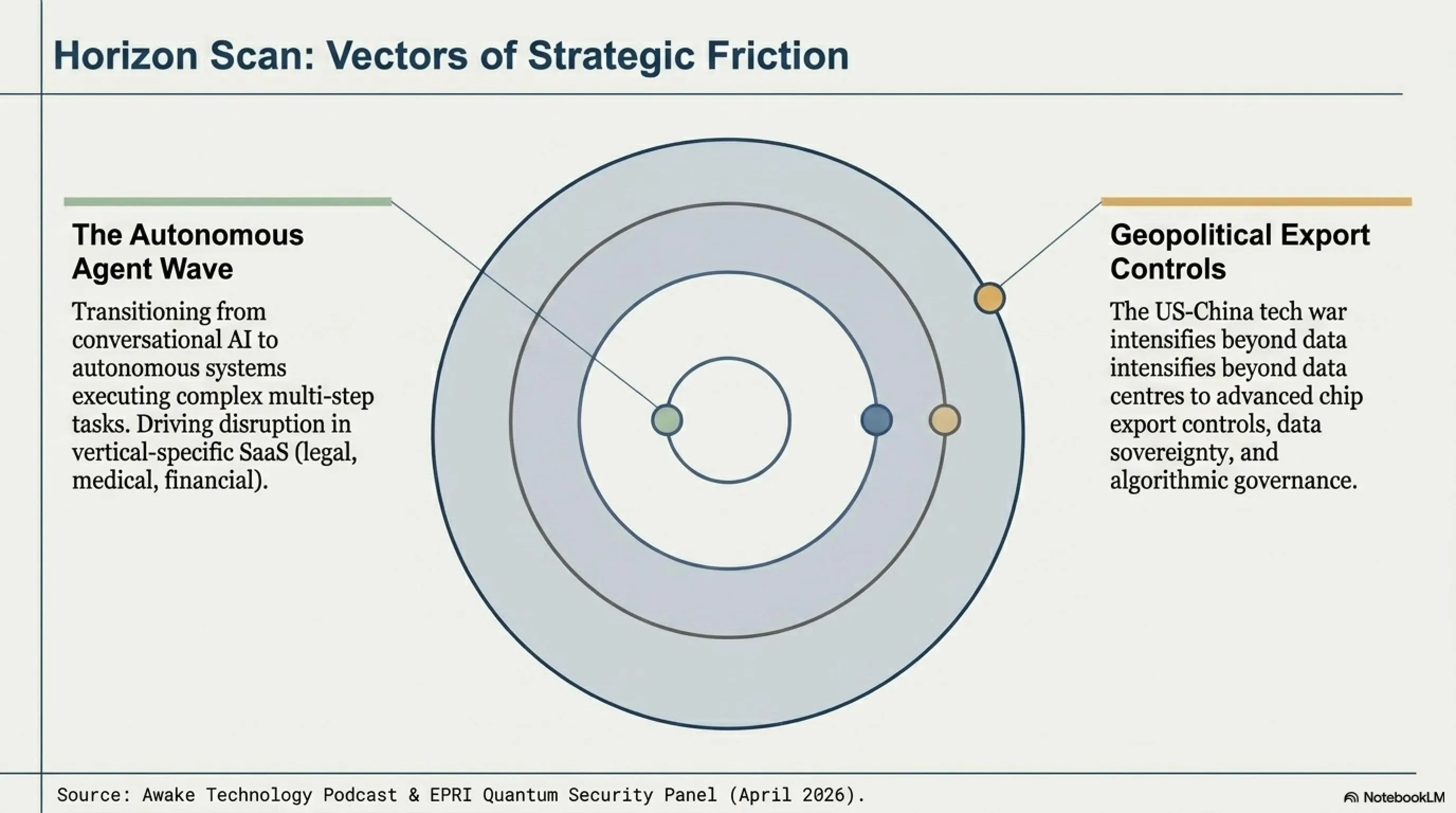
- The Future of AI Agents: How intelligent agents are transforming the way we work, with deep dives into autonomous systems that can handle complex multi-step tasks without human intervention.
- Emerging SaaS Services: Analysis of startups leveraging AI to disrupt traditional software markets, including vertical-specific AI tools for legal, medical, and financial sectors.
- Geopolitical Impacts: How the US-China technology war is reshaping the industry, including export controls on advanced chips, data sovereignty concerns, and the race for AI supremacy.
- AI Ethics and Governance: Discussions on algorithmic bias, social responsibility, and the urgent need for regulatory frameworks that balance innovation with safety.
🎯 Final Thoughts: The Future Taking Shape
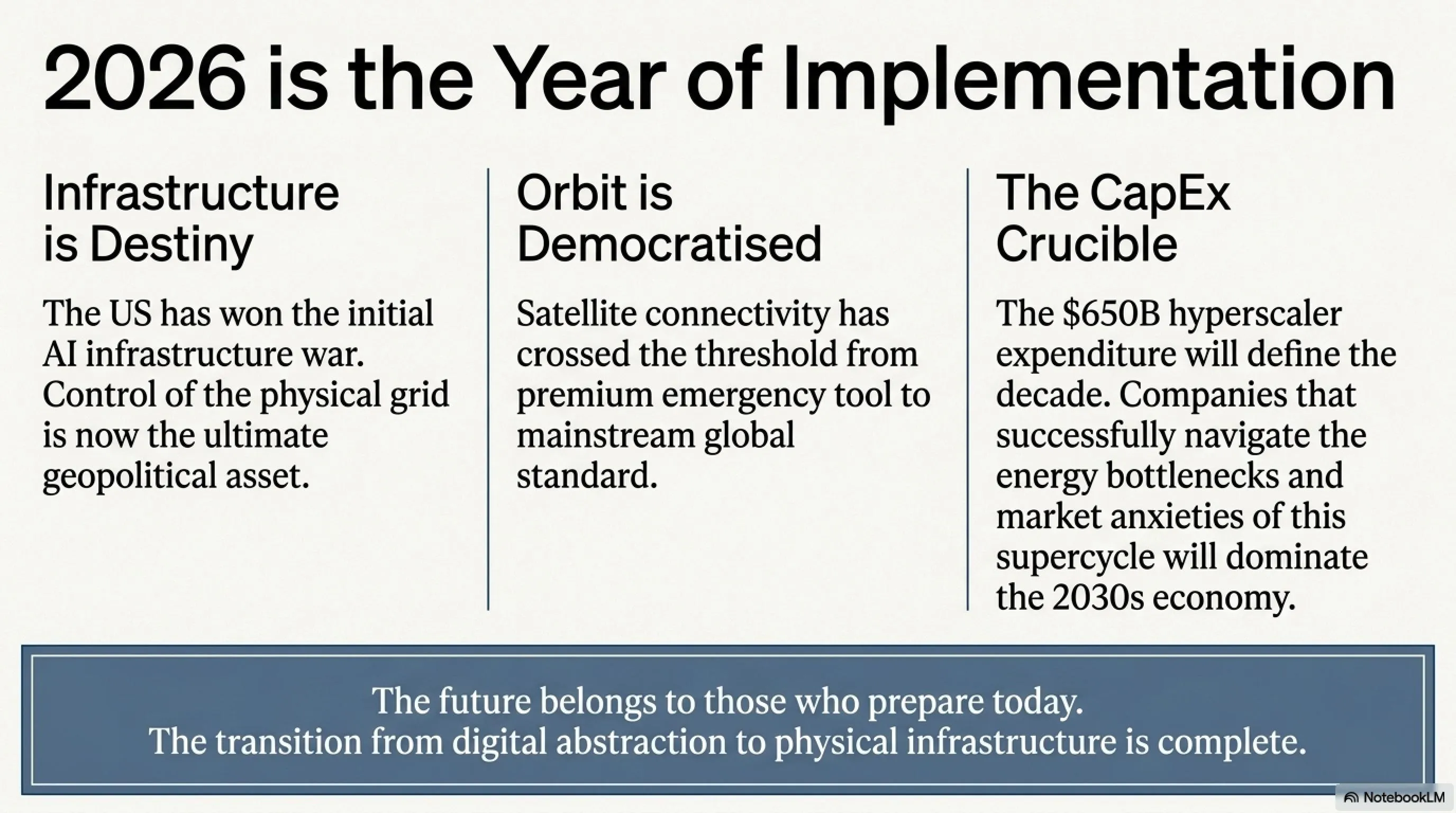
The morning of April 30, 2026 revealed that the technology world is undergoing fundamental transformation across multiple dimensions. America's dominance with 4,032 data centers confirms that the AI infrastructure war has been decisively won by Washington — China's 368 data centers represent less than 10% of the US total. This gap will only widen in coming years, as 65% of global data center growth is projected to occur on American soil. The implications are profound: whoever controls the infrastructure controls the future of AI development, deployment, and monetization.
Satellite calling is no longer a luxury feature — with the Exynos 5410 in the S26 and Note 60, this technology is becoming standardized. Users can make voice and video calls from anywhere on the planet, even without cellular coverage. This represents the biggest leap in democratizing satellite communications since the launch of commercial satellite phones in the 1990s. The fact that a sub-$900 device (Infinix Note 60 Ultra) now offers this capability signals a fundamental shift in accessibility.
The Middle East, with Sultan Qaboos University's USPTO patent filings, demonstrated that it is making serious inroads into technology innovation. This is just the beginning — we expect to see significant growth in the region's startup ecosystem in the coming years, particularly as Gulf nations aggressively pursue economic diversification beyond oil and gas.
And finally, the stock market revealed that investors are carefully scrutinizing the massive AI spending. Are these investments rational catch-up to surging demand, or are we witnessing the early signs of a bubble reminiscent of the 1990s telecom crash? Time will tell, but one thing is certain: the companies that successfully navigate this infrastructure supercycle will define the next decade of technology.
⚡ The future belongs to those who prepare today ⚡
❓ Frequently Asked Questions
Why does the US have so many more data centers than China?
The primary reasons are: 1) Massive investment by Big Tech (Meta, Amazon, Google, Microsoft) with minimal regulatory friction 2) Superior access to electricity and renewable energy infrastructure 3) Open business environment with strong property rights and contract enforcement 4) Robust network infrastructure and fiber connectivity. China faces energy constraints, stricter government oversight of data centers, and geopolitical tensions that complicate international partnerships. Additionally, US data centers benefit from economies of scale and clustering effects — once a region becomes a data center hub (like Northern Virginia or Silicon Valley), it attracts more investment due to existing infrastructure and talent pools.
Is satellite calling on the S26 free?
No. Satellite calling requires a separate subscription. Samsung has not yet announced pricing, but it's expected to be similar to Apple's Emergency SOS service: 2 years free with phone purchase, then approximately $5-$10 per month for basic emergency services. Full voice and video calling will likely cost more — industry estimates suggest $15-$25 per month for unlimited satellite calling, or pay-per-minute rates of $1-$2 per minute. The exact pricing will depend on partnerships with satellite operators (likely Globalstar, Iridium, or emerging LEO constellations).
Why doesn't the S26 Ultra have satellite calling?
Because all Galaxy S26 Ultra models worldwide use Snapdragon processors, not Exynos. The Exynos Modem 5410, which enables satellite calling, is only available in standard S26 and S26 Plus models (in select markets). This is a hardware limitation that cannot be resolved with software updates. Samsung made this decision to ensure the Ultra model has consistent performance globally (Snapdragon is generally considered superior for sustained performance), but it came at the cost of excluding a breakthrough feature. According to Forbes, this has sparked controversy among Ultra buyers who feel "locked out" of satellite connectivity.
Are we in an AI infrastructure bubble?
It's too early to tell definitively, but warning signs exist. The $650 billion in planned AI infrastructure spending by Big Tech in 2026 is unprecedented. Historical parallels to the 1990s telecom boom (which ended in a crash) and 1870s railroad overbuilding are concerning. However, there are key differences: 1) AI is already generating real revenue (not speculative), 2) Demand for AI services is growing exponentially, 3) The companies investing (Microsoft, Amazon, Google) have strong balance sheets and can weather downturns. The real test will come in 2027-2028 when we see whether AI inference workloads justify the massive capacity build-out. If demand falls short, we could see a painful correction. If demand meets or exceeds projections, this will be remembered as a rational infrastructure upgrade.
📚 Sources & References
Sources: Global South World (India AI Impact Summit 2026), JLL's 2026 Global Data Center Outlook, Knight Frank Data Center Report, The Appraisal (Substack), Gadgets360 (Samsung Exynos 5410), Forbes (Galaxy S26 Satellite), GSMArena, Android Central, Tribune.com.pk, The Nation Online (Infinix Note 60), The Guardian (Tech Giants AI Spending), Yahoo Finance, Investor's Business Daily, Daily Mail, TS2.tech, The Quantum Insider, IT Security News, USPTO Patent Database, Justia Patents, Sultan Qaboos University Official Website
Tekin Morning April 30, 2026 — Research and Analysis: Tekin Editorial Team
🌐 Stay Connected With Us
For the latest tech, gaming, and gadget news, follow us on social media:
🌐 Stay Connected With Us 🎮✨
For the latest tech, gaming, and gadget news, follow us on our official social media channels:
Additional Gallery: 🌅 Tekin Morning April 30: US Data Center Dominance & Satellite Calling