🤖💼 The AI Job Apocalypse: 16,000 Jobs Lost Monthly
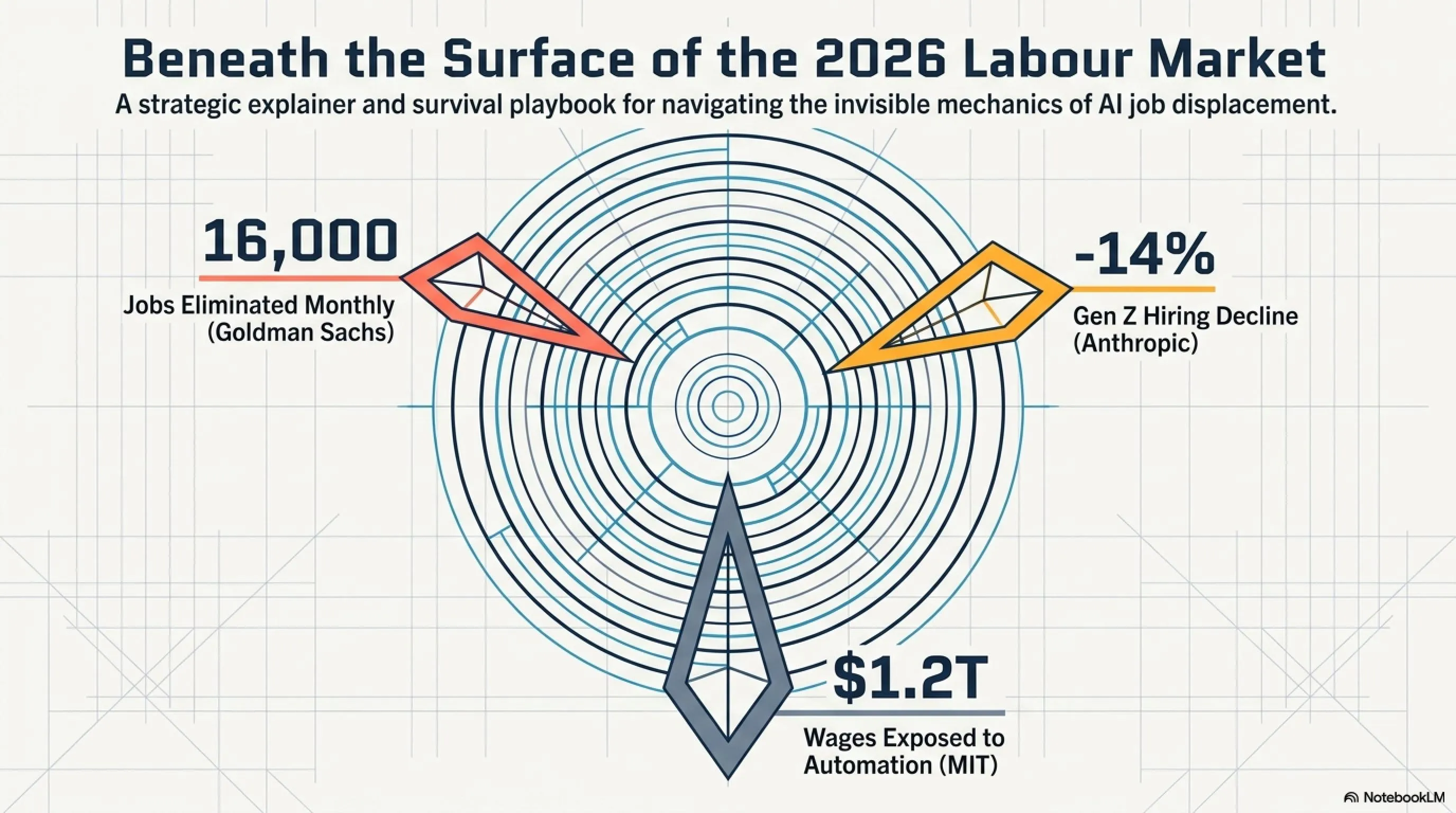
Welcome to the most comprehensive analysis of the 2026 labor market transformation. Goldman Sachs confirmed in April 2026: 16,000 US jobs per month are being directly eliminated by AI-driven automation. This isn't a projection — this is actual displacement data happening right now.
⚠️ Key 2026 Statistics:
📊 16,000 US jobs/month eliminated (Goldman Sachs)
👨💼 37-41% of companies replacing workers with AI by end of 2026
📉 14% decline in entry-level hiring for Gen Z in AI-exposed fields
💰 $1.2 trillion in wages exposed to automation (MIT)
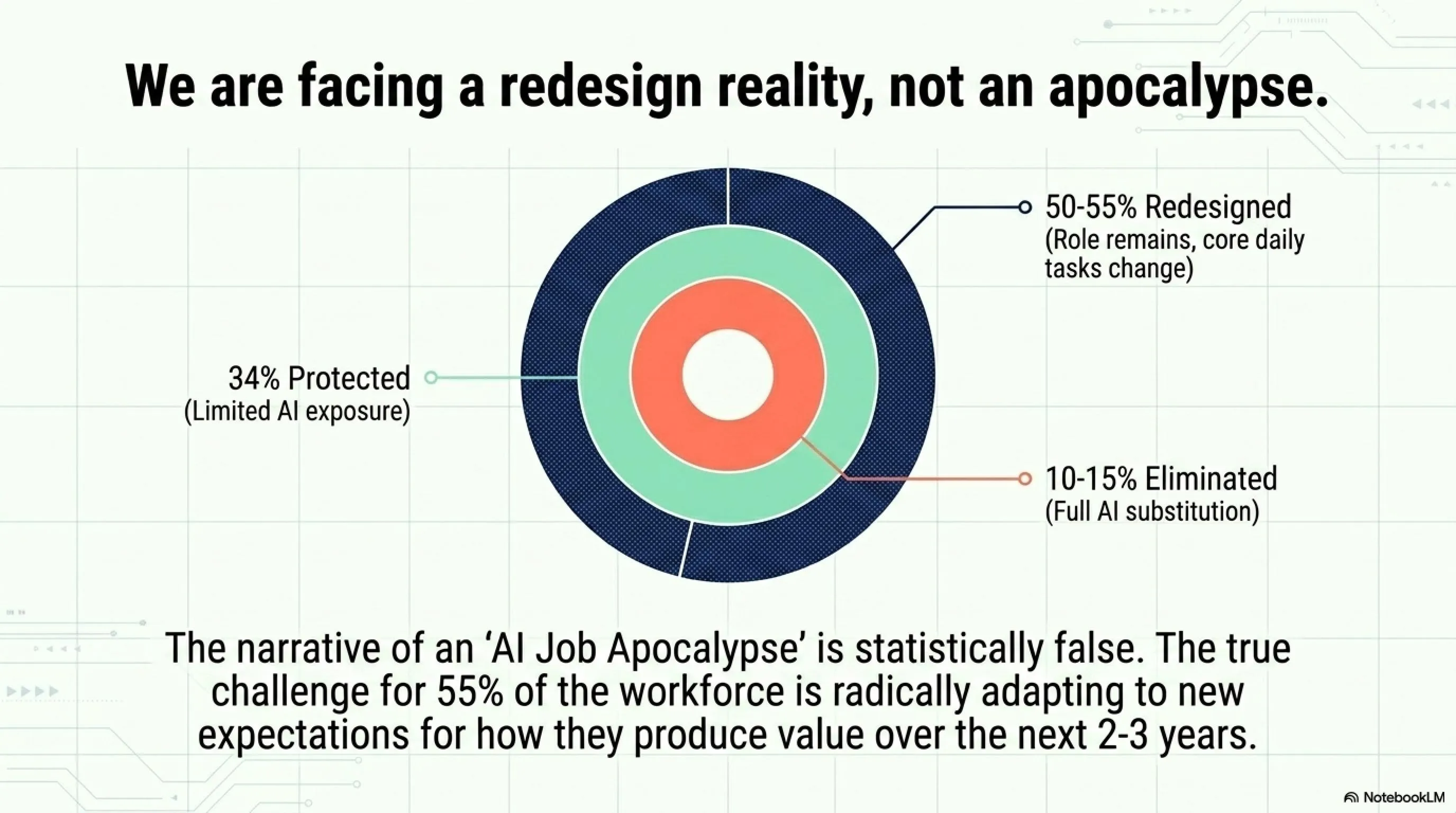
🔄 50-55% of US jobs will be redesigned in next 2-3 years
❌ 10-15% of jobs will be fully eliminated
This article provides 14 visual elements, comparison tables, real statistics, expert analysis, and actionable survival strategies. Your roadmap to surviving the AI job apocalypse. ☕

🔥 The AI Job Apocalypse: Understanding the 16,000 Monthly Figure
The headline number is 16,000 US jobs per month. That's Goldman Sachs's April 2026 estimate of how many American workers are losing their jobs to AI-driven automation monthly. It's not a projection based on theoretical models or academic speculation — it's derived from current displacement data synthesized across US industries and occupations, with Gen Z workers taking a disproportionate share of the impact.
To put this in scale: the US labor market employs roughly 160 million workers. 16,000 monthly job cuts represents 0.01% of the workforce per month, or approximately 192,000 workers annually. At the macro level, this is a rounding error — which is precisely why aggregate unemployment statistics have remained stable even as specific occupational groups feel meaningful pressure. The paradox is real: headline stability masking structural transformation.
🎯 Tekin Analysis: Why This Number Is Misleading
The 16,000 figure doesn't capture the full picture of displacement. It counts direct eliminations — positions that existed and were subsequently cut. What it doesn't count: the hiring slowdown, where positions that would have been created simply aren't, because AI is handling what those hires would have done.
This mechanism is quieter but its long-term impact is more profound: labor market compression without rising unemployment. Employers aren't firing existing workers en masse — they're simply not replacing them when someone leaves. The headcount shrinks gradually through attrition rather than layoffs, making the transformation nearly invisible in traditional labor statistics.
The Real Story: For every job directly eliminated (counted in the 16,000), there are likely 2-3 positions that simply never get posted because AI has absorbed the workload. This "shadow displacement" could mean the actual impact is closer to 50,000-60,000 positions per month when you account for both direct cuts and hiring compression.
📊 Timeline: From Prediction to Reality
💼 What This Means for American Workers
The United States accounts for approximately 60% of TekingGame's readership, making this analysis particularly relevant for American professionals. The 16,000 monthly figure represents a fundamental shift in how companies think about human capital:
- Finance sector: 40% of companies expect AI-driven workforce reductions by Q4 2026
- Tech sector: Already experiencing the impact — 77,999 jobs cut in H1 2025 alone
- Professional services: Entry-level positions declining 14% year-over-year
- Customer service: AI agents handling 60-80% of routine inquiries
For American workers in AI-exposed fields, the question is no longer "if" but "when" and "how much." The data suggests the transformation is already underway, with the pace accelerating through 2026 and 2027.

🤔 The Unemployment Paradox: Why the Data Looks Fine But Displacement Is Real
This is the central paradox of 2026's AI displacement story, and it has a specific, data-driven explanation. Anthropic's March 2026 paper by Massenkoff and McCrory tracked unemployment rates for the most AI-exposed occupations versus the least exposed from 2016 through 2025. Their finding: no systematic increase in unemployment in the most exposed occupations since ChatGPT launched in late 2022.
The statistical framework they employed could detect a "Great Recession for white-collar workers" scenario — where unemployment in the top exposure quartile doubled from 3% to 6% — and would show it clearly in the data. That pattern hasn't appeared. Yet we know from Goldman Sachs that 16,000 jobs per month are being eliminated. How do we reconcile these seemingly contradictory facts?
The answer lies in understanding the mechanisms of quiet displacement — ways that AI is reshaping the labor market without triggering the traditional signals we associate with job loss.
🔍 The Two Mechanisms of Silent Displacement
1️⃣ Fewer Separations, Fewer Hires (Attrition-Based Reduction)
Employers are not firing their existing financial analysts, customer service teams, or data processors en masse. Instead, they're using AI tools to increase output per worker, which means when someone leaves voluntarily or retires, they don't always replace them. The headcount shrinks gradually through attrition rather than layoffs.
Real-world example: A financial services firm that previously employed 50 junior analysts to process quarterly reports now employs 35, with AI handling the data aggregation and initial modeling. When 15 analysts left over 18 months, only 5 were replaced. No layoffs occurred, but the workforce contracted by 30%.
2️⃣ Entry-Level Hiring Compression (The Gen Z Effect)
The starting positions that build careers — the data analyst role, the junior programmer job, the customer service associate — are being replaced by AI coverage of those specific tasks. Employers don't need as many people to do the entry-level work when AI handles a substantial portion of it.
Real-world example: A tech company that historically hired 20 junior developers annually now hires 8, with GitHub Copilot and Cursor AI handling much of the routine coding work. The 8 who are hired start at a higher skill threshold, expected to supervise AI outputs rather than write boilerplate code.
Both mechanisms keep the unemployment rate stable while meaningfully compressing the labor market for certain workers. This is why traditional labor statistics fail to capture the full scope of AI's impact.
📈 Key Statistics: The Gap Between Unemployment and Displacement
(Stable since 2022)
(Ages 22-25, since 2022)
Direct AI elimination
(MIT, 11.7% of jobs)
💡 Mid-Article Summary: The Paradox Explained
The unemployment paradox exists because AI displacement operates through mechanisms that don't trigger traditional unemployment signals. Workers aren't being fired en masse — they're simply not being replaced when they leave, and new positions aren't being created at historical rates. This creates labor market compression without rising unemployment, making the transformation nearly invisible in headline statistics while profoundly affecting specific occupational groups and age cohorts.
👶 Gen Z on the Frontlines: The 14% Entry-Level Hiring Decline
This is the sharpest signal in the current data, and it's worth understanding precisely because it reveals the future trajectory of AI's labor market impact. Brynjolfsson, Chandar, and Chen (2025) found a 6-16% fall in employment among workers aged 22 to 25 in AI-exposed occupations. Anthropic's team ran a parallel analysis tracking how often young workers (22-25) started new jobs in high-exposure versus low-exposure fields.
Since ChatGPT's release in late 2022, the job-finding rate for this age group entering exposed occupations has fallen by roughly half a percentage point per month, amounting to approximately a 14% decline from 2022 baseline levels. The same effect does not appear for workers over 25. Goldman Sachs's April 2026 analysis confirms this: Gen Z workers are disproportionately represented in the 16,000 monthly displacement figure.
⚠️ Why Gen Z Is Taking the Hardest Hit: The Mechanism Explained
The mechanism is specific and structural. Young workers entering AI-exposed fields tend to start with the tasks that AI now handles most effectively:
- Processing customer inquiries: AI chatbots and voice agents handle 60-80% of routine queries
- Generating reports from structured data: Tools like Claude, GPT-4, and specialized analytics AI
- Writing code to well-defined specifications: GitHub Copilot, Cursor, Replit Agent
- Drafting routine documents: Legal briefs, marketing copy, financial summaries
If employers are using AI to cover those task loads, they have less reason to hire the 23-year-old to do them. This creates a structural problem: the traditional entry points into professional careers are contracting precisely when Gen Z is entering the workforce in large numbers.
This doesn't show up as youth unemployment — many of these workers are staying in school longer, shifting to lower-exposure fields, or taking positions below their qualification level. It shows up as fewer entry points into careers in finance, programming, data analysis, marketing, and customer operations.
📊 Comparison Table: Impact Across Age Groups
🎓 What This Means for University Students and Recent Graduates
For workers currently in university programs targeting AI-exposed fields, this data should factor into expectations about entry-level competition in 2026 and 2027. The traditional career ladder — where you start with routine tasks and gradually take on more complex work — is being disrupted.
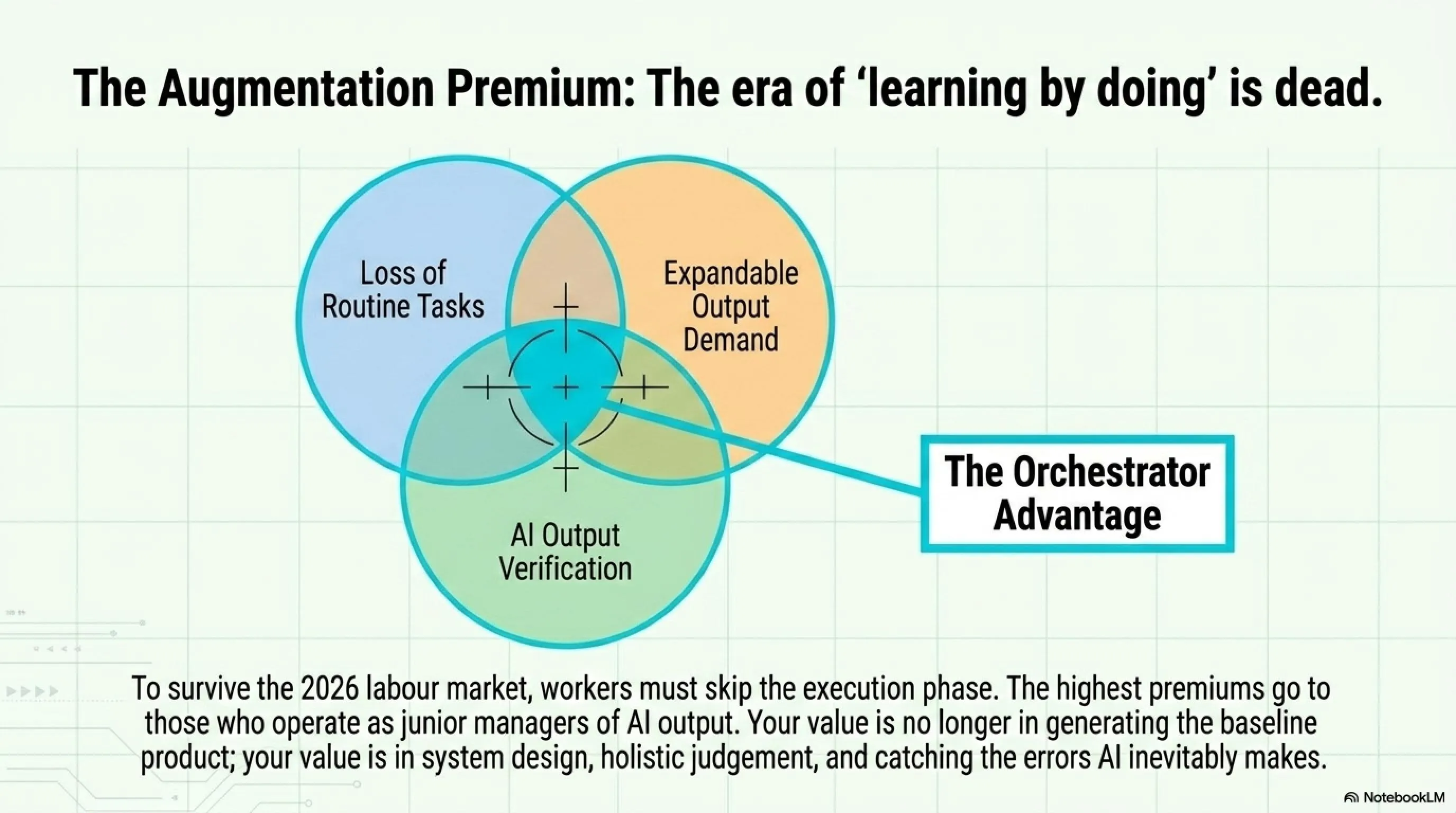
The new reality: Entry-level positions now require skills that were previously considered mid-level. New hires are expected to supervise AI outputs, catch errors, handle edge cases, and contribute to strategic thinking from day one. The "learning by doing routine tasks" phase is being compressed or eliminated entirely.
Actionable insight: Students should focus on building demonstrable AI fluency (not just familiarity) and developing skills in areas where AI currently struggles: complex judgment, creative problem-solving, cross-functional coordination, and client relationship management.

🎯 Which Occupations Face the Most Displacement: The Data Breakdown
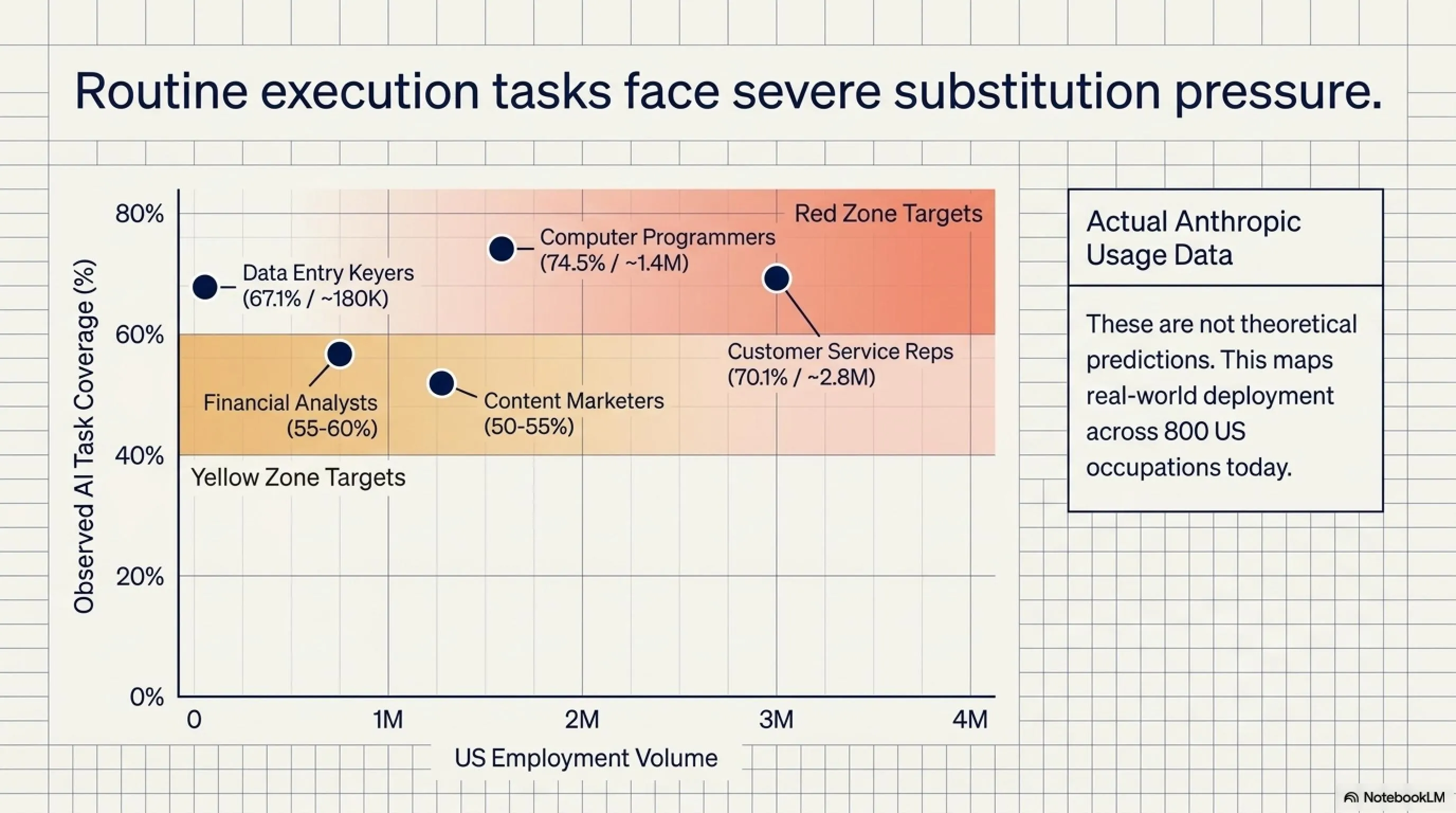
Not all AI-exposed occupations are experiencing the same pattern. Anthropic's comprehensive analysis of 800 US occupations reveals that displacement is concentrated in fields where three conditions converge:
The Three Conditions for High Displacement Risk
1. Tasks Are Well-Defined and Separable from Human Judgment
Data entry, customer inquiry handling, document processing, and code generation for specified requirements are all highly automatable in ways that broad analytical work or client-facing judgment is not. When a task can be clearly specified with inputs and expected outputs, AI can handle it reliably.
2. Volume of Work Is High
AI tools produce the clearest ROI in roles where the same type of task is repeated hundreds or thousands of times — customer service, sales outreach, medical record coding, financial report preparation. High-volume, repetitive work is where automation economics work best.
3. On-Ramp Structure Depends on Junior Employees
Fields where junior workers "learn by doing" the automatable tasks are seeing the most pronounced entry-level hiring compression, even when senior positions remain stable. This creates a structural problem: how do you develop senior talent when the traditional development path is being automated away?
📊 AI Task Coverage Table: High-Risk Occupations
🔍 The Theoretical vs Observed Exposure Gap
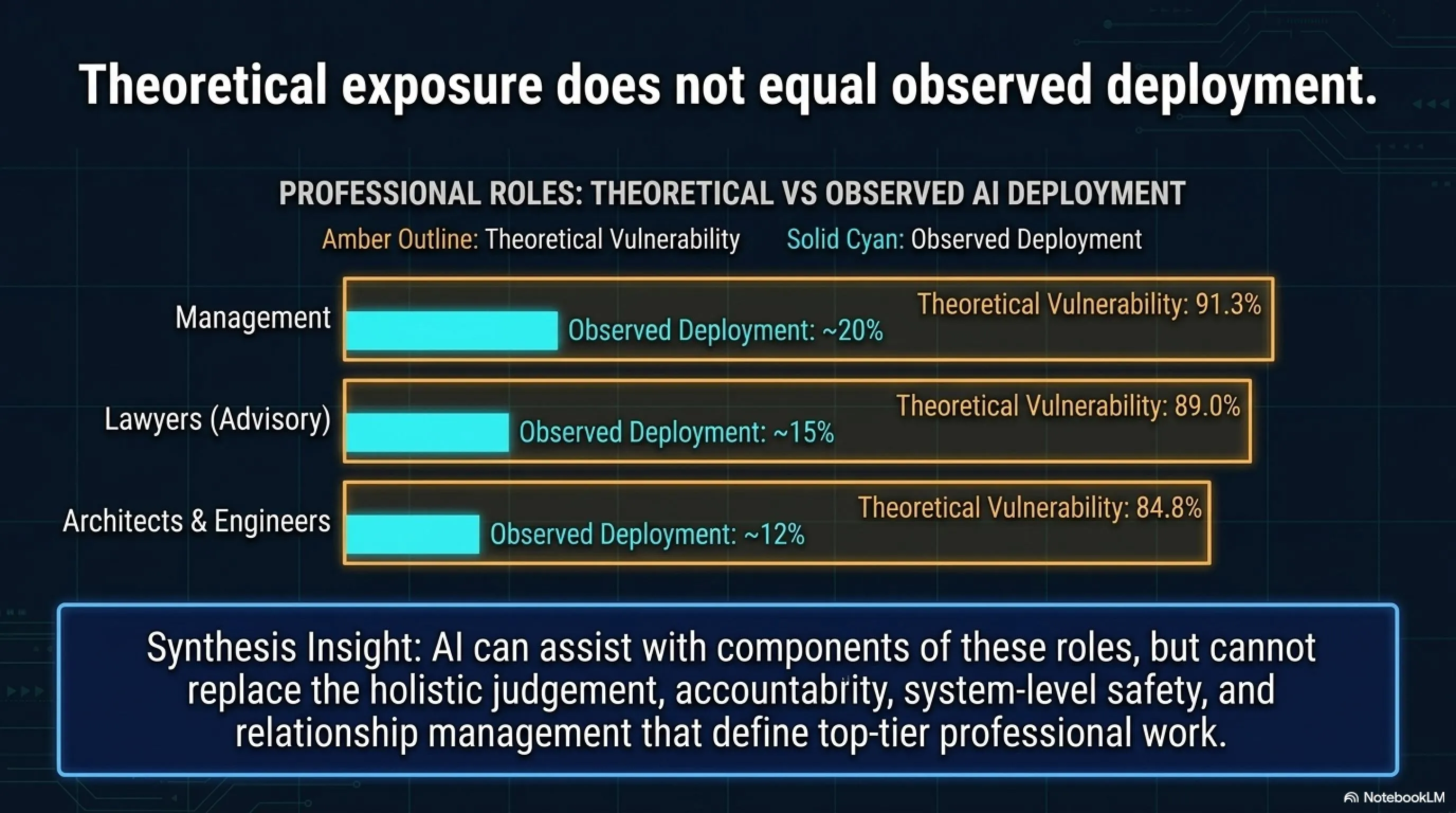
Notably, fields with high theoretical AI exposure but complex judgment requirements show much lower actual deployment despite their theoretical vulnerability:
- Lawyers: 89% theoretical exposure, ~15% observed — legal judgment, client relationships, and courtroom advocacy remain human-dominated
- Architects & Engineers: 84.8% theoretical, ~12% observed — system-level design and safety accountability require human oversight
- Management roles: 91.3% theoretical, ~20% observed — strategic decision-making and people management resist automation
The gap between theoretical and observed exposure reveals a critical insight: AI can assist with many tasks in these roles, but cannot yet replace the holistic judgment, accountability, and relationship management that defines professional work at the highest levels.

⚖️ Substitution vs Augmentation: The Critical Difference That Determines Your Career
📚 Classified & Related Dossiers in TekinGame
If you wish to explore beyond this report and delve into cybernetic frontiers and autonomous AI architectures, do not miss these three exclusive deep-dives in the Tekin Garage:
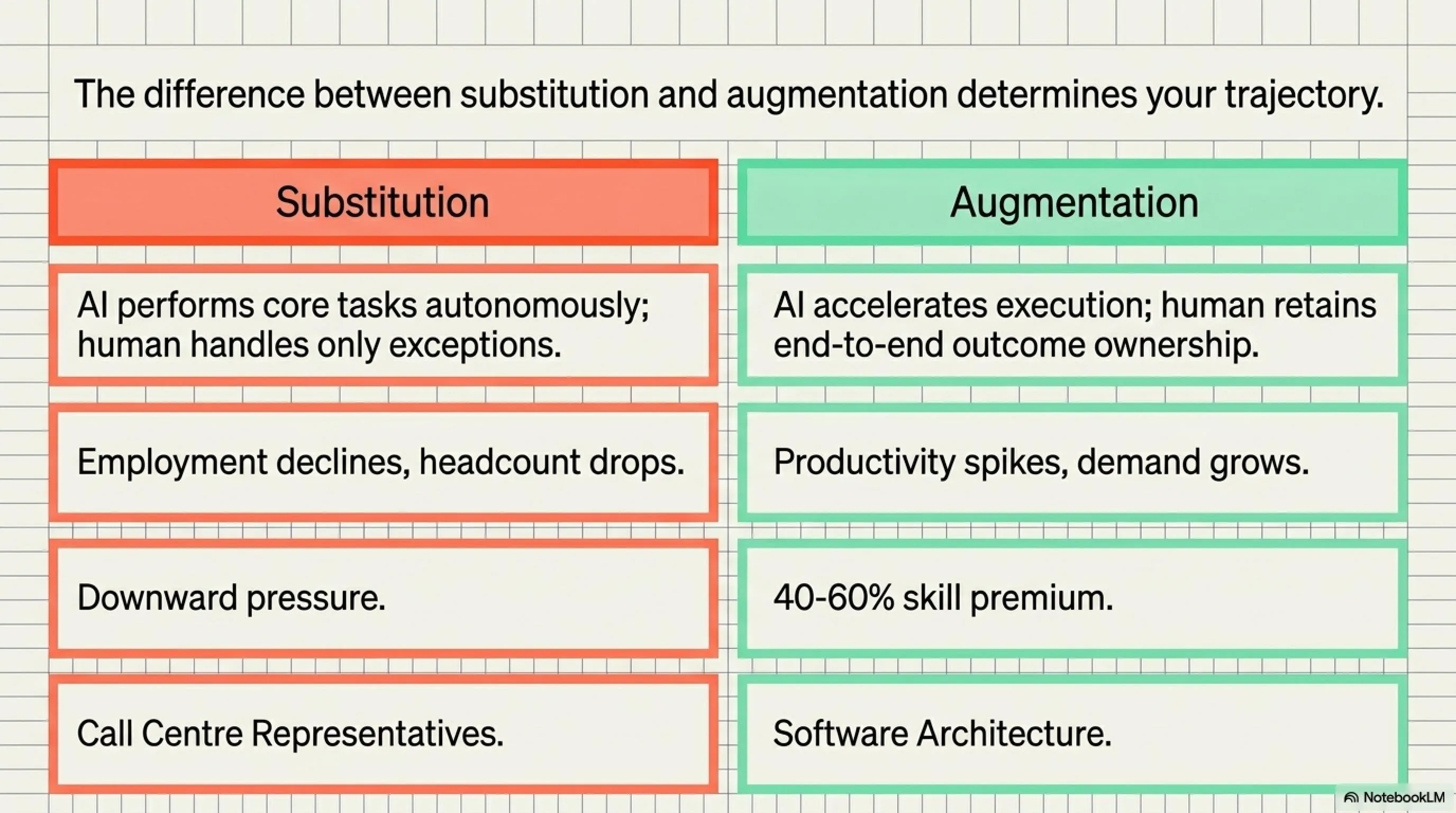
To understand why some jobs are being eliminated while others are growing, we must grasp the distinction between substitution and augmentation. BCG's April 2026 research provides the clearest framework for understanding this critical difference, and it has profound implications for career planning.
The distinction isn't about whether AI can perform tasks in your role — it almost certainly can. The distinction is about whether AI can perform the core value-creating work of your role autonomously, or whether it accelerates your work while you retain ownership of outcomes.
❌ Substitution
Definition: AI can perform core tasks autonomously, and the workflow can be clearly bifurcated between system and human.
Example — Call Center Representatives: AI handles first-line interactions (account lookups, policy explanations, scripted troubleshooting), humans focus on escalations and exceptions. Total headcount declines as AI absorbs routine volume.
Outcome: Employment declines, downward wage pressure, need for reskilling into different roles.
Key indicator: When someone asks "what does a human do that AI can't?" and the answer is "handle exceptions," that role faces substitution risk.
✅ Augmentation
Definition: AI accelerates work but doesn't replace the system-level judgment required to own outcomes end-to-end.
Example — Software Engineers: AI dramatically accelerates code generation and testing (GitHub Copilot, Cursor), but system design, architectural judgment, tradeoffs between performance and cost, and translation of business needs into technical solutions remain human-owned.
Outcome: Employment stable or grows, productivity increases, wage premiums for AI skills.
Key indicator: When AI makes you faster but you still own the outcome and are accountable for results, that's augmentation.
🥊 PROS & CONS Battle: Substitution vs Augmentation
✅ Augmentation Benefits
- ✓ Employment remains stable or grows
- ✓ Productivity increases per worker
- ✓ Wage premiums for AI skills (40-60%)
- ✓ Work shifts toward higher-level thinking
- ✓ Higher job satisfaction (less repetitive work)
- ✓ Career advancement opportunities expand
❌ Substitution Drawbacks
- ✗ Direct employment reduction
- ✗ Downward wage pressure
- ✗ Need for complete reskilling
- ✗ Loss of institutional knowledge
- ✗ High job insecurity
- ✗ Limited career progression options
🔄 50-55% of Jobs Will Be Redesigned, Not Eliminated: The BCG Framework
BCG's key finding is this: over the next 2-3 years, 50-55% of US jobs will be reshaped by AI. For many employees, this will mean that they retain the same or a similar role but face radically new expectations for how they work and what they produce. This is not about job elimination — it's about job transformation.
Only 10-15% of jobs will be fully eliminated. This level of potential job loss is considerable and creates an important call to action for business leaders and workers alike, but it's not the "apocalypse" scenario that some headlines suggest. The real story is more nuanced: massive transformation with selective elimination.
(Role remains, tasks change)
(Full AI substitution)
(Limited AI exposure)
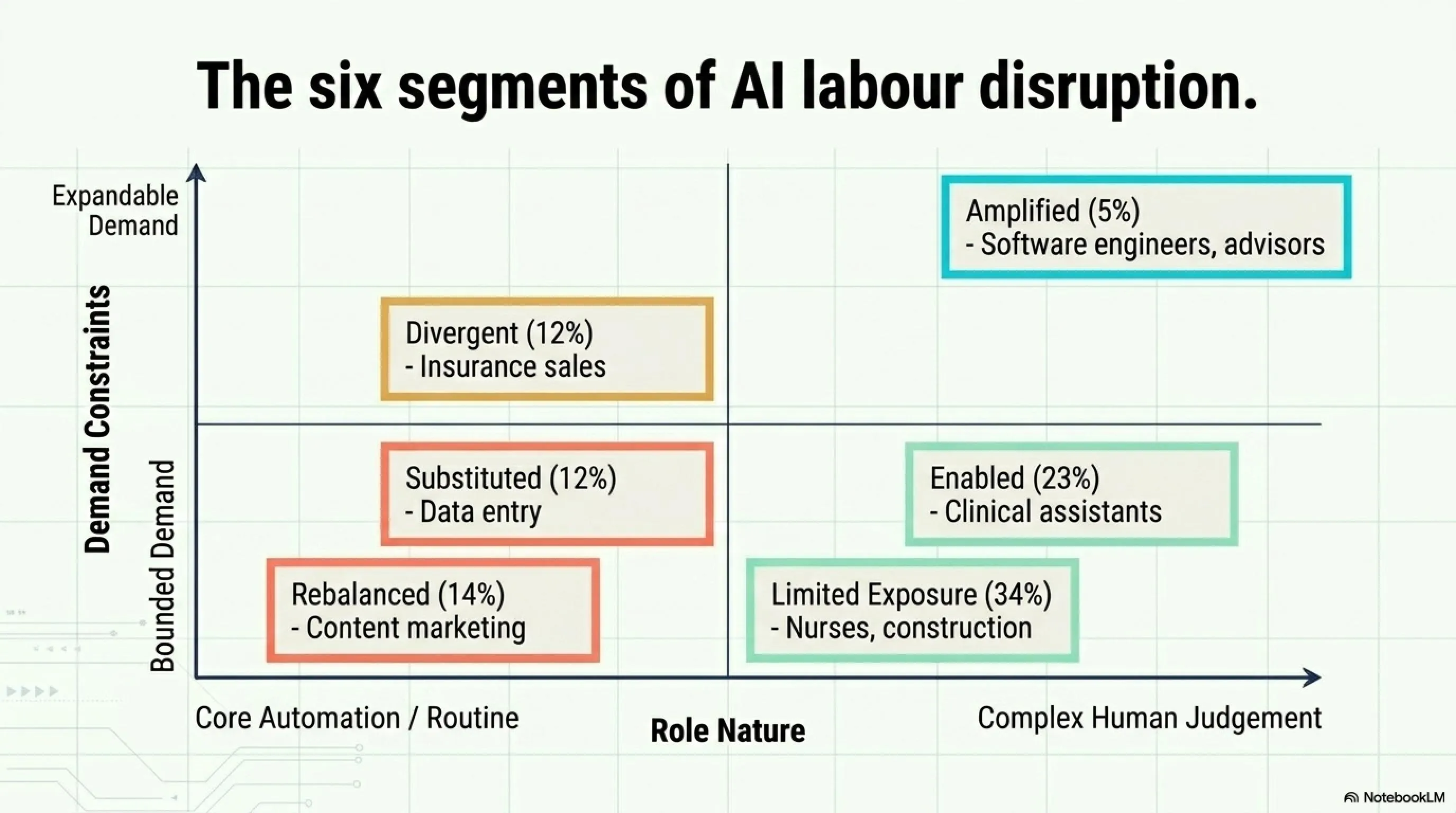
📊 BCG's Six Categories of AI Role Transformation: Where Does Your Job Fit?
The BCG Henderson Institute created a proprietary framework called "AI Labor Disruption Segments" comprising six categories. Understanding which category your role falls into is critical for career planning, skill development, and realistic expectations about the future.
The Six Categories of Role Transformation
1️⃣ Amplified Roles — 5% of Jobs
Definition: When AI augments human capabilities and demand expands, employment may remain stable or grow. Humans remain central to value creation.
Examples: Software engineers, lawyers (advisory), academic researchers, architects
Why amplified: Software engineering illustrates expandable demand. Organizations face persistent unmet need for digital products and automation. As AI reduces cost and time to build software, organizations build more. Output expands and job volume remains stable or grows because humans continue to play a meaningful role in system design, architecture, and product decisions.
Outcome: Wage inflation may develop as higher productivity increases competition for skilled talent. Career advancement accelerates.
2️⃣ Rebalanced Roles — 14% of Jobs
Definition: When AI augments work but demand is bounded, headcount may remain steady while roles are redesigned. Routine tasks automate while more complex responsibilities expand.
Examples: Content marketing, academic research, some analytical roles
Why rebalanced: Content marketing illustrates bounded demand. Demand is constrained by marketing budgets and strategic priorities. With audience fragmentation and AI reshaping customer journeys, brands need more targeted content. Marketer roles expand from channel-specific to omnichannel specialists who think through end-to-end campaigns, but total headcount remains relatively stable.
Outcome: As work shifts toward higher-value activities, skill requirements rise and upskilling becomes essential.
3️⃣ Divergent Roles — 12% of Jobs
Definition: Where AI substitutes for human tasks but demand remains expandable, the effect on employment becomes uneven. Entry-level and junior positions are more exposed to automation in the short term.
Examples: Insurance sales agents, IT support technicians
Why divergent: Insurance sales illustrates this dynamic. AI automates routine activities like lead qualification, quote generation, and policy comparisons — tasks often handled by entry-level employees. Significant protection gaps remain, particularly in life insurance and small business coverage. By lowering distribution costs, AI allows insurers to reach underserved customers, expanding market participation. Some routine roles decline, while others shift toward advisory work for complex products and long-term client relationships.
Outcome: Entry-level positions decline unless workers can be quickly upskilled, while higher-skilled roles persist or grow. This creates a structural tension in career development.
4️⃣ Substituted Roles — 12% of Jobs
Definition: Only when demand is capped and AI directly substitutes for human workers in core tasks do roles fall into this category. Efficiency gains convert into net job losses.
Examples: Financial analysts (some), call center representatives, data entry keyers
Why substituted: Financial analyst roles (certain types) illustrate bounded demand with high automation. The volume of financial analysis is largely tied to existing reporting cycles, investment mandates, and internal decision processes. When AI automates routine modeling, data aggregation, and initial interpretation, the output doesn't expand proportionally. Productivity gains are more likely to reduce the number of analysts required than to drive additional hiring.
Outcome: Employment declines, downward wage pressure develops for positions that remain. Workers need redeployment pathways and transition support.
5️⃣ Enabled Roles — 23% of Jobs
Definition: AI becomes embedded in day-to-day activities, reshaping how tasks are performed, but not fundamentally altering how work is structured.
Examples: Clinical assistants, lab technicians
Why enabled: Clinical assistants illustrate this dynamic. Their work remains hands-on or patient-facing, but AI increasingly supports documentation, workflow coordination, and aspects of diagnostic analysis. Clinical assistants may use AI for real-time note-taking and patient intake. Over time, effective use of these AI tools becomes part of the role, raising expectations for productivity and accuracy without fundamentally changing its nature.
Outcome: Workers are expected to use AI to improve efficiency. Continuous upskilling becomes essential as AI capabilities evolve.
6️⃣ Limited-Exposure Roles — 34% of Jobs
Definition: Both the technical feasibility of automation and the scope for AI-driven productivity gains remain limited. Work is often highly contextual, relationship-driven, or dependent on physical human presence.
Examples: Physicians, teachers, construction workers, nurses
Why limited exposure: Physicians and teachers require the ability to form complex judgments, engage in interpersonal interactions, and adapt in real-time to individual needs. AI may assist in limited, task-specific ways (diagnostic support, lesson planning), but it won't meaningfully reshape either role. The core of the work — patient care and instruction — remains fundamentally human.
Outcome: These roles are less likely to be significantly reshaped in the near term. Job security remains high.

💰 AI's Impact on Wages and Compensation: The Bifurcation Story
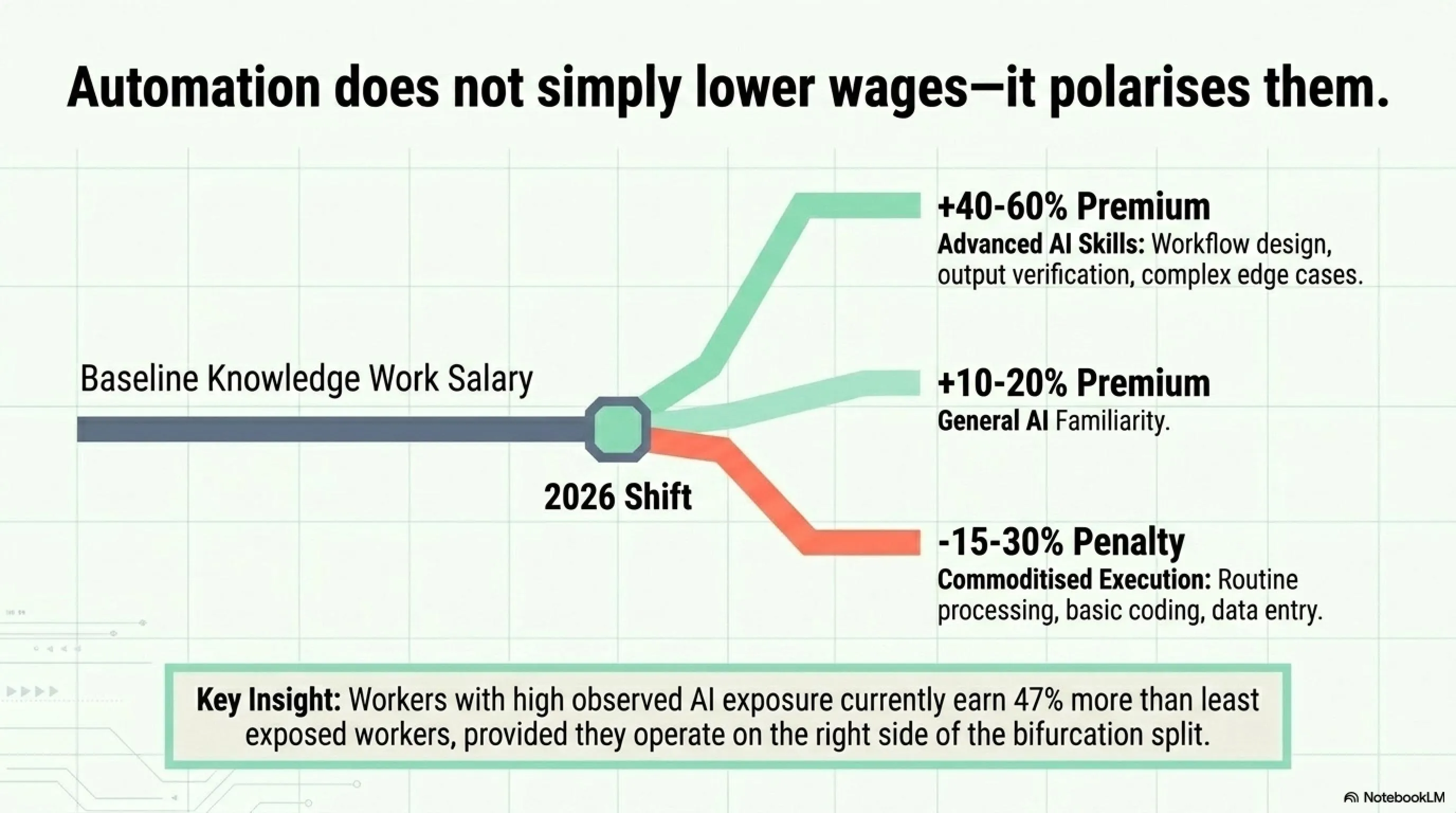
The compensation picture is more complex than "AI is lowering wages." Workers in the most AI-exposed occupations currently earn 47% more than the least exposed group — median $32.69/hour versus $22.23/hour. High observed AI exposure is correlated with higher pay, not lower, because AI is concentrating in knowledge-work roles that have historically commanded premiums.
But within those roles, the wage structure is bifurcating. Workers who have developed demonstrable AI skills — prompt engineering, AI workflow design, output verification and quality control — are seeing premiums of 40-60% compared to peers without those skills. Workers performing the specific routine tasks that AI is absorbing are facing compensation pressure as supply-demand dynamics shift.
💡 The Practical Question for American Workers
The practical question is not "does my industry pay well?" but "which specific tasks in my role are being automated, and is my skill profile above or below market median accounting for that shift?"
This calculation also changes depending on where you work. A $95K salary in Austin, Texas covers meaningfully more ground than the same number in San Francisco or New York. Cost of living adjustments matter more in a bifurcating wage environment.
Key insight: Workers in AI-exposed fields who want to understand whether their specific skills are trending toward premium or commodity need to benchmark against active job postings, not survey averages. The market is moving too fast for historical data to be reliable.

🛡️ Survival Strategies for Entry-Level Workers and Job Seekers
If you're entering an AI-exposed field or currently early in your career in one, there are specific, data-supported strategies that can improve your odds of thriving rather than merely surviving.
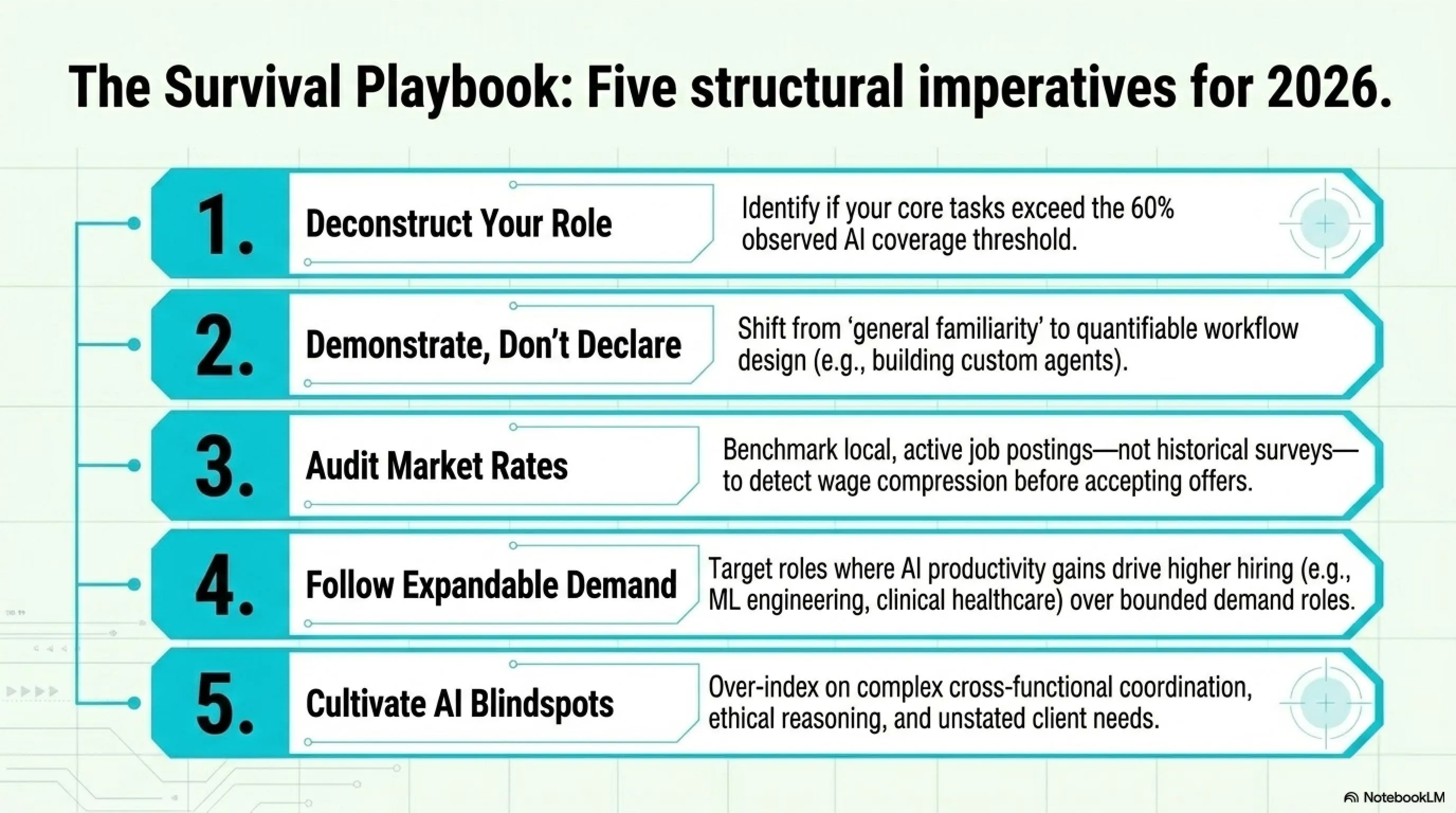
5 Critical Survival Strategies
1️⃣ Know Which Tasks in Your Target Role Are Automating Fastest
Customer inquiry handling, data entry, routine document drafting, and code generation for specified requirements are the highest-automation tasks. Roles structured around these tasks face the most compression.
Roles where the core work is judgment, client relationships, error-catching, or architectural decision-making face much less compression. Position yourself toward the latter.
Actionable step: Review Anthropic's AI exposure data for your target occupation. If observed coverage exceeds 60%, focus on developing skills in the 40% that AI doesn't handle well.
2️⃣ Develop Demonstrable AI Skill, Not General Familiarity
The wage bifurcation favors workers who can show they produce better outputs using AI tools, rather than workers who have merely used AI tools. The ability to design workflows, verify AI outputs, and handle edge cases that AI gets wrong is a concrete, marketable skill.
Examples of demonstrable AI skills:
- Building custom GPTs or AI agents for specific workflows
- Prompt engineering that consistently produces production-quality outputs
- Quality control systems for AI-generated content
- Integration of AI tools into existing business processes
Actionable step: Build a portfolio of AI-assisted projects where you can demonstrate measurable improvements in speed, quality, or cost. Quantify the impact.
3️⃣ Check Your Market Rate Before Accepting Any Offer
Entry-level salaries in some AI-exposed fields have been suppressed by reduced hiring competition. Knowing what comparable roles actually pay in your city for your specific skill profile — from job postings, not salary surveys — matters more in a compressed market than in a tight one.
The gap between what companies offer and what the market actually pays has widened in 2026. Companies are testing whether they can hire at lower rates given reduced competition. Don't accept the first offer without benchmarking.
4️⃣ Consider Whether Your Target Field Has Growing or Contracting Entry-Level Demand
Software developers, despite high theoretical AI exposure, are projected by BLS to grow approximately 11% through 2034. Customer service representatives are projected to contract by roughly 5%. These projections reflect independent analysis of where AI displacement is and isn't changing employment demand.
Fields with growing demand despite AI: Software development, data science (oversight roles), AI/ML engineering, cybersecurity, healthcare (clinical roles), electricians, HVAC technicians
Fields with contracting demand: Customer service, data entry, basic financial analysis, routine legal work, telemarketing
5️⃣ Build Skills in Areas Where AI Currently Struggles
AI in 2026 still struggles with:
- Complex judgment: Situations requiring weighing multiple competing priorities with incomplete information
- Creative problem-solving: Novel situations without clear precedents
- Cross-functional coordination: Managing stakeholders with conflicting interests
- Client relationship management: Building trust and understanding unstated needs
- Ethical reasoning: Navigating gray areas where rules don't provide clear answers
Key insight: The most valuable workers in 2027 will be those who can do what AI can't, while using AI to accelerate what it can do. This is the augmentation advantage.
🔮 The Future of Work: What's Coming Next
The actual scale of what's happening helps to hold both parts of the story at once:
❌ What IS Happening
- AI is automating specific task categories across knowledge-work occupations
- Entry-level hiring is compressing
- Headcount is reducing through attrition
- 16,000 jobs/month in US are being eliminated
- Displacement is real, concentrated, and accelerating
✅ What IS NOT Happening
- Mass layoffs of existing workers in high-exposure occupations
- Systematic unemployment increases in affected fields
- Collapse of white-collar employment comparable to manufacturing
- Complete "apocalypse" scenario
- Immediate replacement of all exposed roles
🎯 Final Verdict
The gap between these two realities is where most of the public confusion lives. Headlines about specific layoffs or AI-driven cuts compete with headline unemployment data showing stability. Both are true simultaneously.
The more useful question for any individual worker is not "will AI cause mass layoffs?" but "how is AI specifically changing the demand for my specific skills in my specific field?" The answer varies widely by role, seniority level, industry, and which tasks within the role are most automatable.
The 16,000 monthly figure will likely grow as AI capabilities expand and adoption deepens. The workers best positioned in that environment are those who understand exactly which of their skills are above, at, or below market median, and can use that data to navigate compensation and career decisions before the market moves for them.

❓ Frequently Asked Questions (FAQ)
How many jobs has AI taken so far?
Goldman Sachs's April 2026 estimate puts current AI-driven job cuts at approximately 16,000 per month in the United States. On an annual basis, that's roughly 192,000 jobs.
Anthropic's Economic Index data also shows a 14% decline in job-finding rates for workers aged 22-25 entering high-exposure occupations since ChatGPT's launch, which represents hiring compression beyond direct layoffs. When you account for both direct elimination and hiring compression, the actual impact could be 2-3x the headline figure.
Will AI cause mass layoffs?
The current data doesn't support that conclusion as a near-term outcome. Anthropic's research found no systematic increase in unemployment in the most AI-exposed occupations since late 2022.
Goldman Sachs's displacement figure of 16,000/month is real but represents a small fraction of total US employment (0.01% monthly). The more prevalent mechanism is hiring compression — fewer new positions — rather than mass termination of existing workers.
However, BCG projects that 10-15% of jobs will be fully eliminated over the next 2-3 years, which is significant. This won't happen all at once, but through gradual attrition and selective cuts.
Which jobs is AI already replacing?
The roles with the highest observed AI task coverage in 2026:
- Computer programmers (74.5%) — code generation, testing, debugging
- Customer service representatives (70.1%) — inquiry handling, troubleshooting
- Data entry keyers (67.1%) — data processing, form filling
- Financial analysts (55-60%) — routine modeling, report generation
- Content marketers (50-55%) — content creation, social media
These are the fields where AI tools are most actively handling work tasks in professional settings today, according to Anthropic's usage data across 800 occupations.
Is Gen Z most affected by AI job displacement?
Yes, the current data shows the clearest displacement signal among workers aged 22-25 in high-exposure fields. A 14% drop in job-finding rates for this age group, with no equivalent effect for workers over 25, suggests that entry-level positions in AI-exposed fields are contracting as employers use AI to handle what those hires would have done.
This creates a structural problem: the traditional entry points into professional careers are contracting precisely when Gen Z is entering the workforce in large numbers. Many are responding by staying in school longer, shifting to lower-exposure fields, or accepting positions below their qualification level.
How do I know if my job is at risk?
The best starting point is understanding your specific role's observed exposure score from Anthropic's data, then assessing which specific tasks in your role are highest-exposure and whether your skill profile skews toward those or toward the judgment and oversight work AI is handling less.
Three key questions:
- Are my core tasks repetitive and codifiable?
- Does my role require complex judgment or human relationships?
- Do I have demonstrable AI skills that differentiate me from peers?
If you answered "yes" to the first question and "no" to the other two, your role faces higher substitution risk. The solution is to develop skills in areas where AI currently struggles while using AI to accelerate the automatable parts of your work.
What jobs are growing despite AI exposure?
Software developers (projected +11% through 2034), electricians (+11%), and healthcare roles with high physical or judgment components are among the fields with positive BLS employment projections despite AI's expansion.
Productivity gains from AI tools appear to be expanding total demand in some software development contexts rather than eliminating positions. The continued growth of software engineering headcount in the years following ChatGPT's 2022 introduction illustrates this phenomenon.
Key insight: Jobs where AI augments rather than substitutes, and where demand is expandable rather than bounded, are most likely to see employment growth despite high AI exposure.
📚 Complete Coverage: Related TekingGame Articles
For deeper understanding of AI's impact on the tech industry and workforce, read these related articles:
📖 Sources and References
Primary Sources:
Goldman Sachs Research (April 2026), Anthropic Economic Index (March 2026), BCG Henderson Institute AI Labor Disruption Report (April 2026), MIT Technology Review, World Economic Forum Future of Jobs Report 2025, PayScope AI Job Market Analysis, Bureau of Labor Statistics (BLS), PwC Global AI Jobs Barometer 2025, Brynjolfsson, Chandar, and Chen (2025), Massenkoff and McCrory (Anthropic, March 2026)
Research and Analysis: TekingGame Editorial Team — The AI Job Apocalypse 2026
🌐 Stay Connected With Us
For the latest tech, gaming, and gadget news, follow us on social media:
🌐 Stay Connected With Us 🎮✨
For the latest tech, gaming, and gadget news, follow us on our official social media channels:
Additional Gallery: 🤖💼 The AI Job Apocalypse: 16,000 US Jobs Lost Monthly & Survival Guide