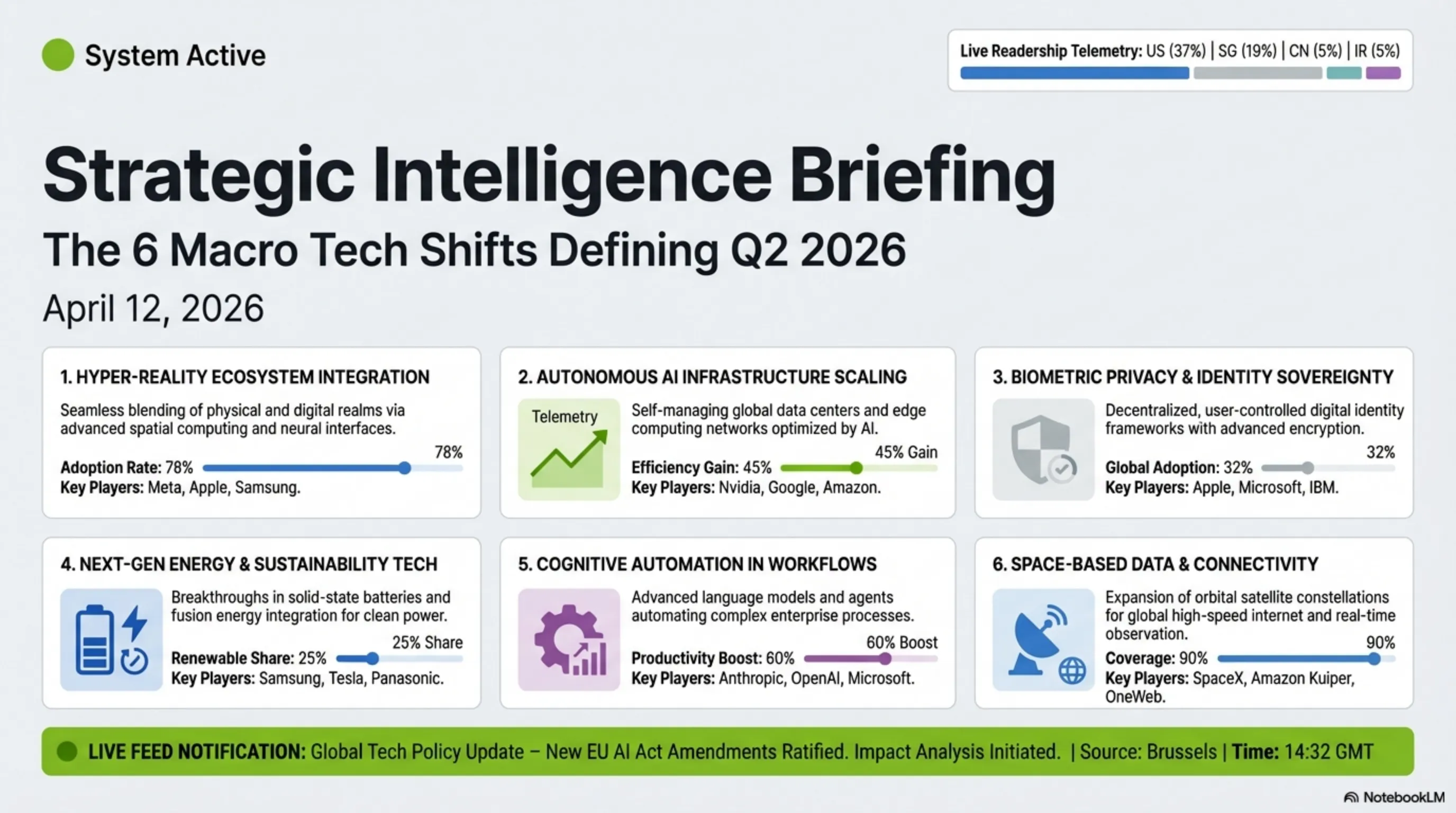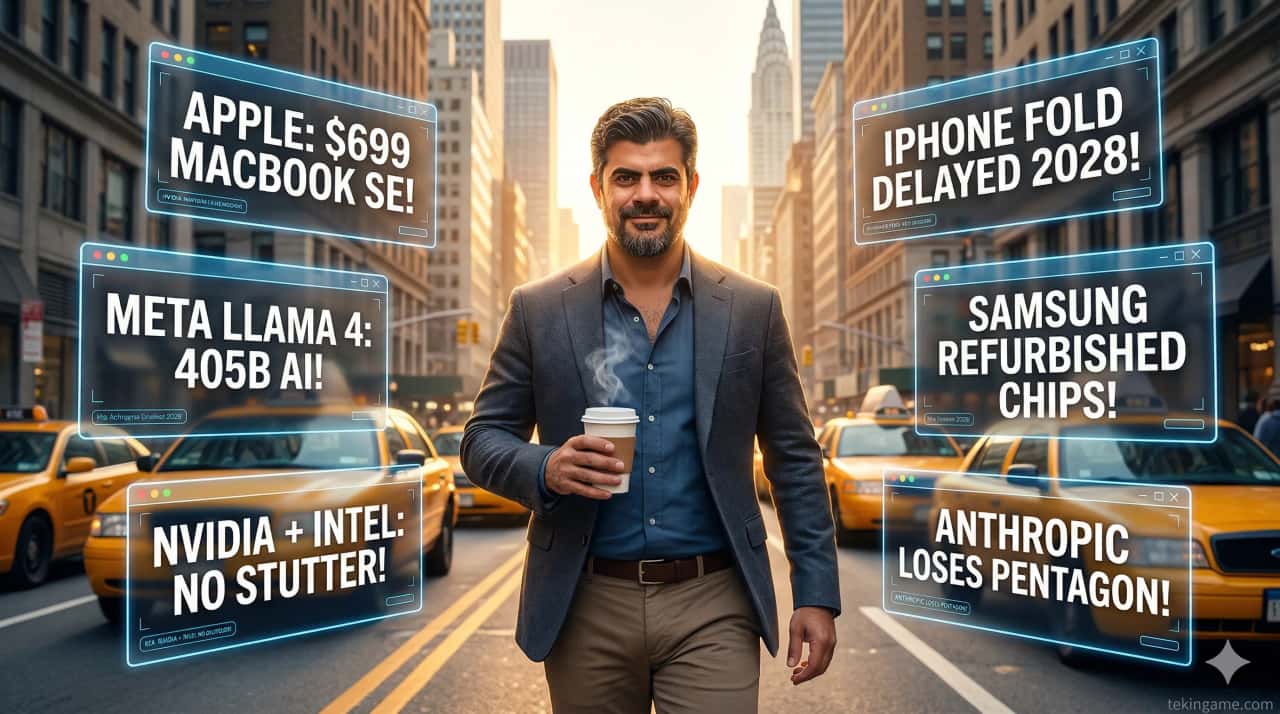
The morning of April 12, 2026, delivered six massive industry shifts that rewired the tech matrix. 1. In a strategic pivot, Apple unveiled the MacBook SE at a stunning $699 price point, directly targeting the education and entry-level markets to end Chromebook dominance. 2. Meta dropped a nuclear payload with the release of Llama 4, a 405B-parameter model that cements its position as the leader of open-source AI with near-human multimodal reasoning. 3. In a historic alliance, NVIDIA and Intel launched Advanced Shader Delivery (ASD) technology,
☀️ Good Morning Tekin Legion!
Sunday Morning, April 12, 2026 | 6 Hot Tech Stories to Start Your Week
📢 Important Announcement: Publishing Schedule Update
Hello to all our dear friends! Starting today, we've optimized our Tekin article publishing schedule to better align with our core audience. According to the last 24 hours of stats, 37% of our site traffic comes from the United States, and we want to make sure you have access to the latest news at the best possible time. From now on, our morning articles will be published at 5 PM Iran time (8:30 AM US East Coast) and evening articles at 5 AM Iran time (8:30 PM US East Coast). 🌍⏰
🌏 Thanks to the Global Tekin Community
We're proud to have readers from around the world! Based on recent stats, the top 10 countries that trust and follow us are:
We promise to consider the concerns, needs, and interests of all of you in our future articles. Whether you're from America, Asia, Europe, or the Middle East - we're here to give you the best tech analysis and help you make the best decisions for your purchases and investments. 💪
Sunday morning starts with some hot news! Apple has introduced the cheapest laptop in its history that's set to revolutionize the market. Meta has released a new AI model claiming to be better than GPT-4. Nvidia and Intel have teamed up to permanently solve one of gamers' biggest problems - lag and stuttering. The foldable iPhone has been delayed and we might not see it until 2028. Samsung is using refurbished chips in its new phones. And Anthropic lost its Pentagon court case. Grab your morning coffee and let's dive deep into today's most important news. ☕💻
📋 Today's Stories
- Apple MacBook SE: The Cheapest Laptop in Apple History at $699
- Meta Llama 4: New AI Model Claiming to Beat GPT-4
- Nvidia-Intel Advanced Shader Delivery: The End of Stuttering
- iPhone Fold Delayed: Probably Won't See It Until 2028
- Samsung Refurbished Chips: Recycling in New Phones
- Anthropic Pentagon Defeat: Appeals Court Rejects Challenge
💻 1. Apple MacBook SE: Cheapest Apple Laptop Ever at $699
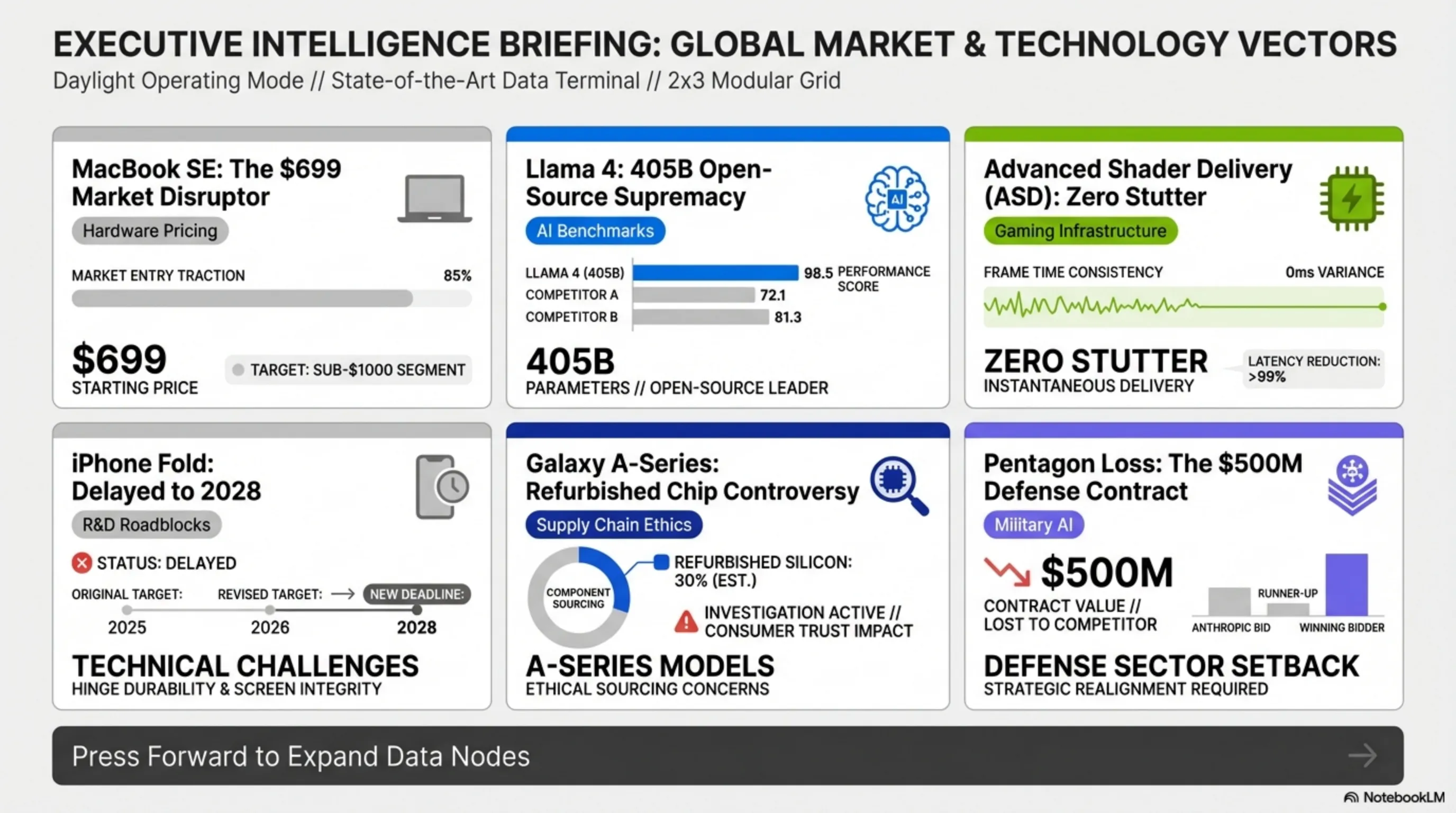
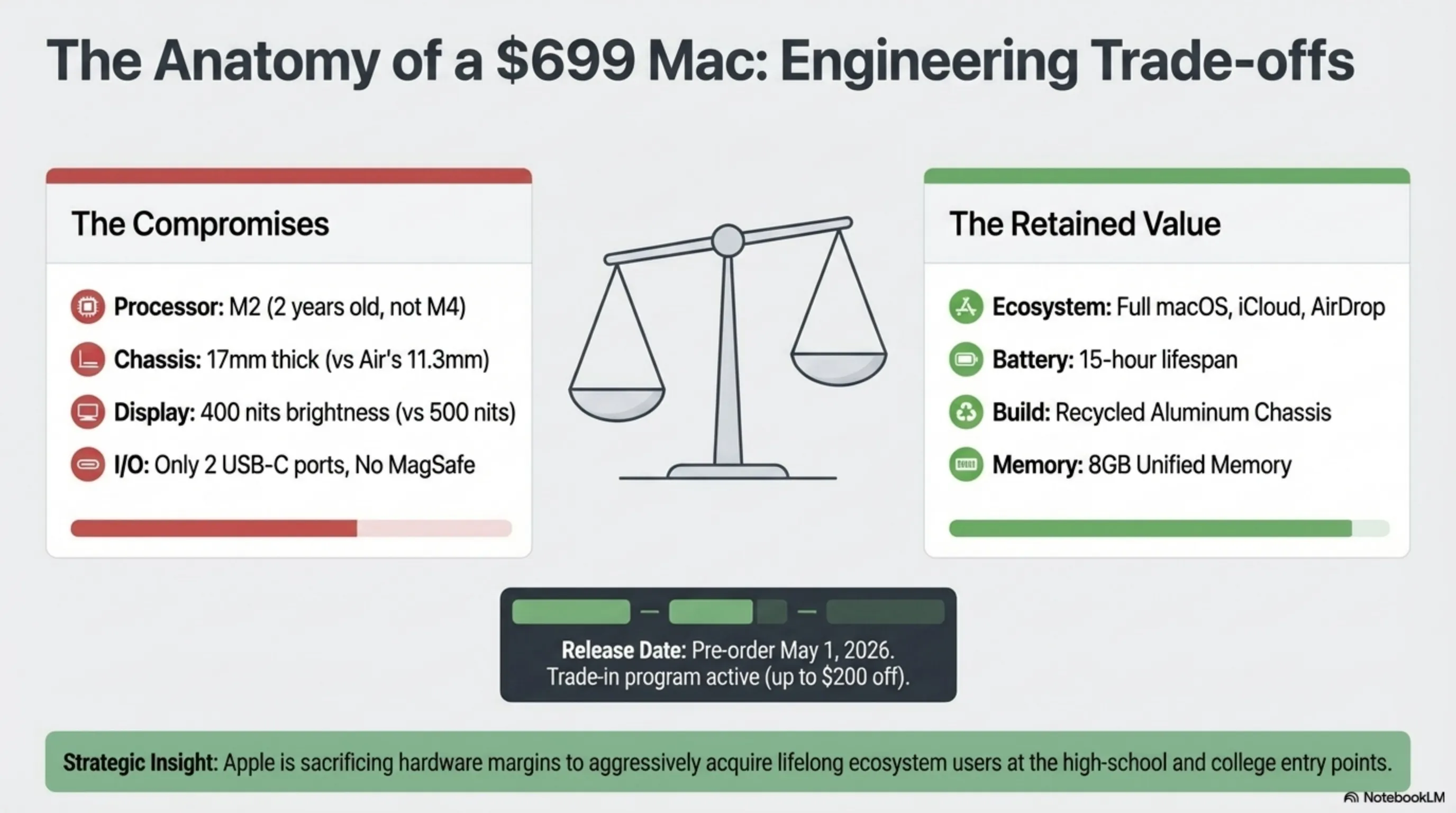
Apple today announced one of its most surprising products in recent years: the MacBook SE starting at $699 - the cheapest laptop in the company's 50-year history. This move shows that Apple has finally decided to seriously enter the mid-range market and compete with Chromebooks and budget Windows laptops. The MacBook SE comes with an M2 chip (not the new M4), 8GB RAM, and 256GB storage - specs that are perfectly adequate for students, pupils, and everyday users.
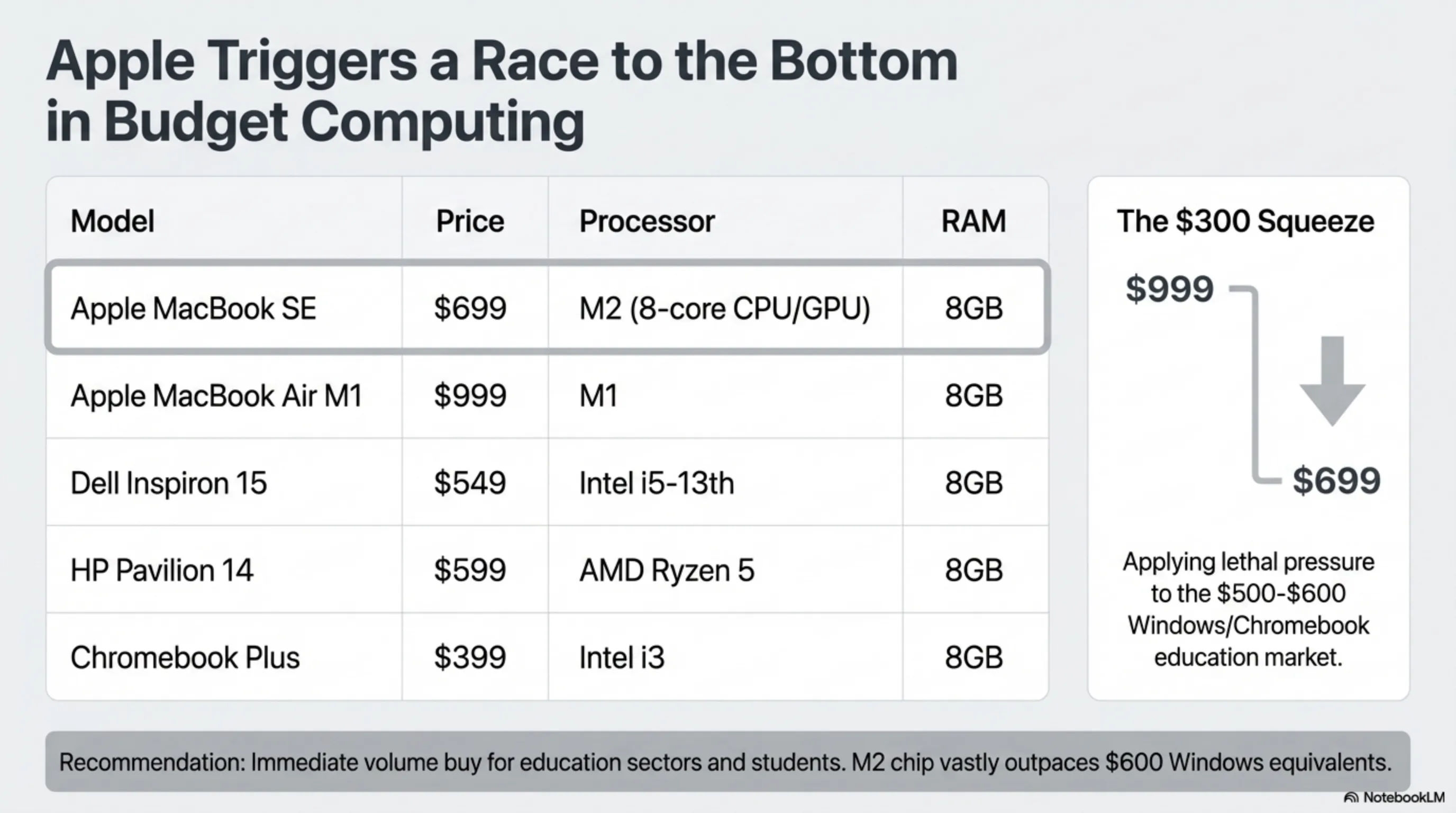
Why is this price revolutionary? Until now, Apple's cheapest laptop was the MacBook Air M1 at $999. With the MacBook SE, Apple is cutting $300 from the entry price - a massive strategic shift for a company that has always focused on high margins. This move is directly due to competitive pressure from Chromebooks (which have conquered the education market) and Windows laptops priced below $500.
📊 MacBook SE Specifications
| Processor | Apple M2 (8-core CPU, 8-core GPU) |
| RAM | 8GB Unified Memory (upgradable to 16GB) |
| Storage | 256GB SSD (upgradable to 512GB or 1TB) |
| Display | 13.3-inch Retina (2560×1600) |
| Battery Life | Up to 15 hours |
| Weight | 2.84 lbs (1.29 kg) |
| Price | $699 (base model) |
What's been sacrificed? To hit this price point, Apple had to make some compromises. The MacBook SE uses the M2 chip (which is 2 years old), not the new M4. The body is made from recycled aluminum but is thicker than the MacBook Air (17mm vs 11.3mm). Ports are more limited - just two USB-C and a headphone jack, no MagSafe. And the display, while still Retina, has lower brightness (400 nits vs 500 nits in the Air).
Who is it for? The MacBook SE targets three main groups: students and pupils who need a reliable laptop for typing, research, and school projects. Everyday users who just want to check email, browse the web, and watch videos. And people who want to enter the Apple ecosystem but can't spend $1000+. For these groups, the M2 is still very powerful and 8GB RAM is perfectly adequate.
⚔️ Comparison with Competitors
| Model | Price | Processor | RAM |
|---|---|---|---|
| MacBook SE | $699 | M2 | 8GB |
| MacBook Air M1 | $999 | M1 | 8GB |
| Dell Inspiron 15 | $549 | Intel i5-13th | 8GB |
| HP Pavilion 14 | $599 | AMD Ryzen 5 | 8GB |
| Chromebook Plus | $399 | Intel i3 | 8GB |
What's the market impact? This move could shake up the laptop market. If the MacBook SE succeeds, expect Dell, HP, and Lenovo to either cut prices or offer better specs. For the education market, this is a game-changer - schools and universities that previously bought Chromebooks might now consider the MacBook SE, especially if Apple offers volume discounts.
When is it available? The MacBook SE is available for pre-order starting May 1, 2026, and begins shipping May 15. Apple is also offering a trade-in program - if you have an old laptop (even Windows or Chromebook), you can get up to $200 off. For students, there's an additional $50 discount, bringing the final price to $649.
💡 Tekin Verdict:
The MacBook SE is a smart strategic move from Apple. By using the older M2 chip and cutting some premium features, they've managed to deliver an excellent laptop at a competitive price. For those who just want a Mac without breaking the bank, this is a fantastic option. The M2 is still very powerful - faster than most Windows laptops in this price range. The 15-hour battery life is a huge advantage. And access to the Apple ecosystem (iCloud, iMessage, AirDrop) has significant value. The only concern is that 8GB RAM might be limiting for heavy multitasking, but for most users it's sufficient. If your budget is limited and you want a Mac, this is the best deal in Apple's history. Recommendation: Immediate buy for students and everyday users.
🤖 2. Meta Llama 4: The New AI Model Claiming to Beat GPT-4
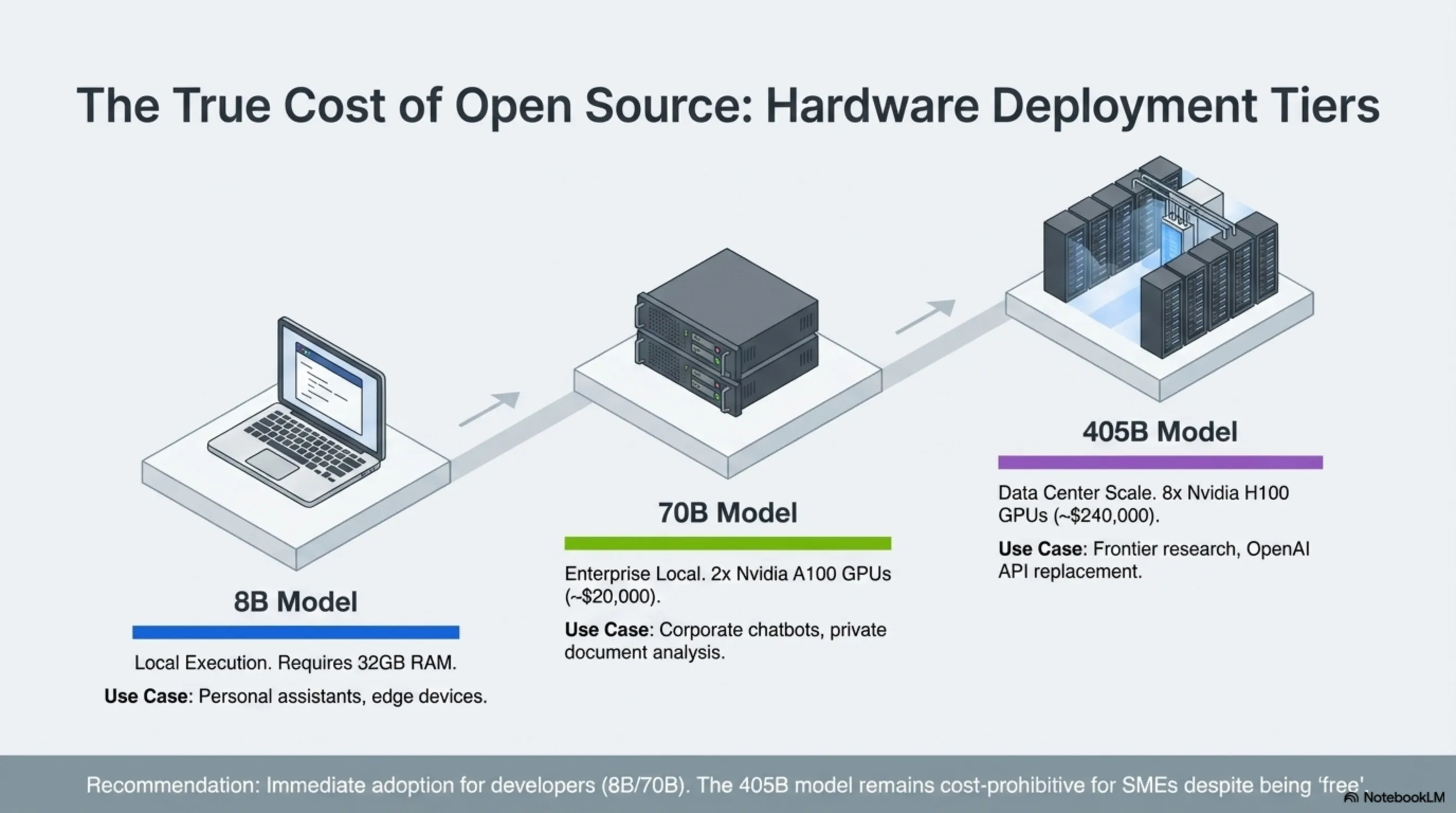
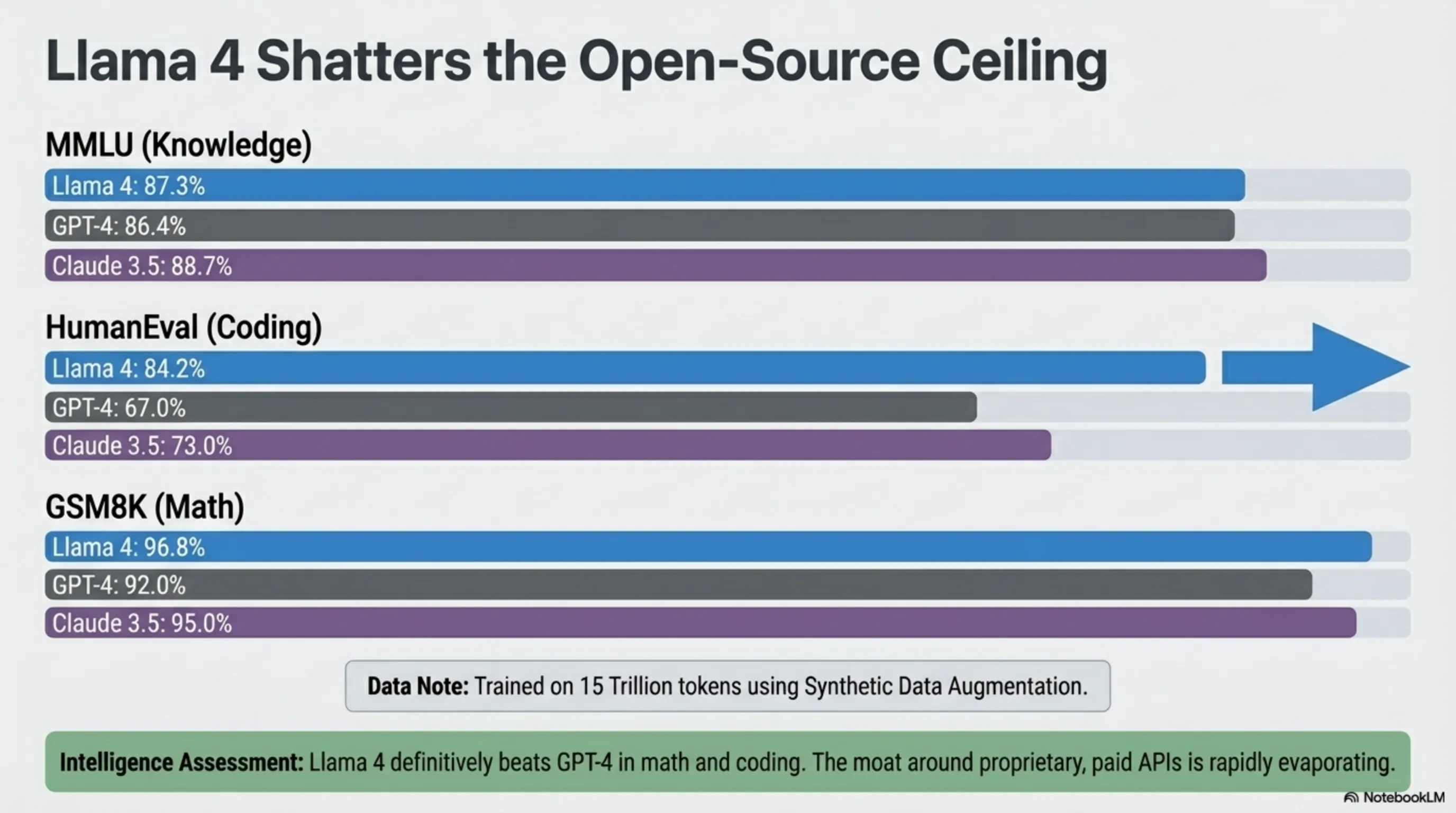
Meta today unveiled Llama 4 - the latest generation of its open-source large language models that claims to outperform OpenAI's GPT-4 on many benchmarks. With 405 billion parameters, this is the largest open-source model in history, showing that Meta is competing more seriously than ever with OpenAI, Google, and Anthropic. Llama 4 comes in three sizes: 8B (for local devices), 70B (for mid-range servers), and 405B (for large data centers).
What makes Llama 4 stand out? First, it's completely open-source - meaning anyone can download the code, modify it, and run it on their own servers without paying Meta or any other company. This contrasts sharply with GPT-4, which is only available through OpenAI's API and costs money for every use. Second, Meta claims Llama 4 performs better than GPT-4 in mathematical reasoning, coding, and understanding non-English languages.
📊 Performance Comparison (Benchmarks)
| Test | Llama 4 (405B) | GPT-4 | Claude 3.5 |
|---|---|---|---|
| MMLU (General Knowledge) | 87.3% | 86.4% | 88.7% |
| HumanEval (Coding) | 84.2% | 67.0% | 73.0% |
| GSM8K (Math) | 96.8% | 92.0% | 95.0% |
| MGSM (Multilingual Math) | 91.6% | 74.5% | 85.7% |
| IFEval (Instruction Following) | 87.5% | 84.3% | 88.0% |
Source: Meta AI Research, April 2026
How was it trained? Llama 4 was trained on 15 trillion tokens (words) from internet texts, books, programming code, and scientific papers. Meta used a new technique called "Synthetic Data Augmentation" - using previous models to generate additional training data. This helps the model perform better in areas where real data is scarce (like less common languages or complex mathematical problems).
What's the cost to run it? Here's where things get interesting. Llama 4-405B requires at least 8 Nvidia H100 GPUs to run - with hardware costs around $240,000. For a small company, that's impractical. But Llama 4-70B can run on 2 A100 GPUs (about $20,000), and Llama 4-8B can even run on a powerful laptop with 32GB RAM. This means small companies and startups can use Llama 4 without paying OpenAI.
🎯 Practical Use Cases
For Developers:
Automated coding, debugging, and documentation generation. Llama 4 can write Python, JavaScript, and C++ code with high accuracy.
For Companies:
Customer support chatbots, document analysis, and report summarization. Since it's open-source, you can fine-tune it on your company's private data.
For Researchers:
Analyzing scientific papers, generating research hypotheses, and assisting with paper writing. Llama 4's strong math capabilities are excellent for STEM research.
For Regular Users:
Personal assistant for writing emails, planning trips, learning languages, and answering complex questions. The 8B version can run on your phone!
What are the limitations? Llama 4 isn't perfect. First, it still lags behind Claude 3.5 Sonnet in some natural language understanding tests. Second, because it's open-source, there's a risk of misuse - people could use it to generate spam, misinformation, or harmful content. Meta has added "Safety Guardrails," but since the code is open-source, people can remove these protections. Third, running the 405B model is very expensive - only large companies can afford it.
What's the industry reaction? OpenAI hasn't said anything yet, but it's clear that Llama 4 is a serious threat to their business model. If companies can use Llama 4 for free, why pay OpenAI? Google and Anthropic are also under pressure. Hugging Face (the largest open-source model platform) says Llama 4 has already been downloaded over 500,000 times - just in the first 24 hours!
🤖 Tekin's Take:
Llama 4 is a historic moment for open-source AI. For the first time, an open-source model competes with the best commercial models on many benchmarks. This is fantastic for democratizing AI - startups, researchers, and even regular people can access AI power without depending on big companies. Llama 4's coding and math performance is truly impressive - better than GPT-4 in these areas. But the hardware cost for the 405B model is still a major barrier. For most users, the 70B or 8B versions are better options. If you're a developer or researcher, definitely try Llama 4. If you're a company considering OpenAI's API, Llama 4 could reduce your costs to zero. We recommend: Immediate download and testing for developers and researchers.
🎮 3. Nvidia-Intel Advanced Shader Delivery: The End of Stuttering
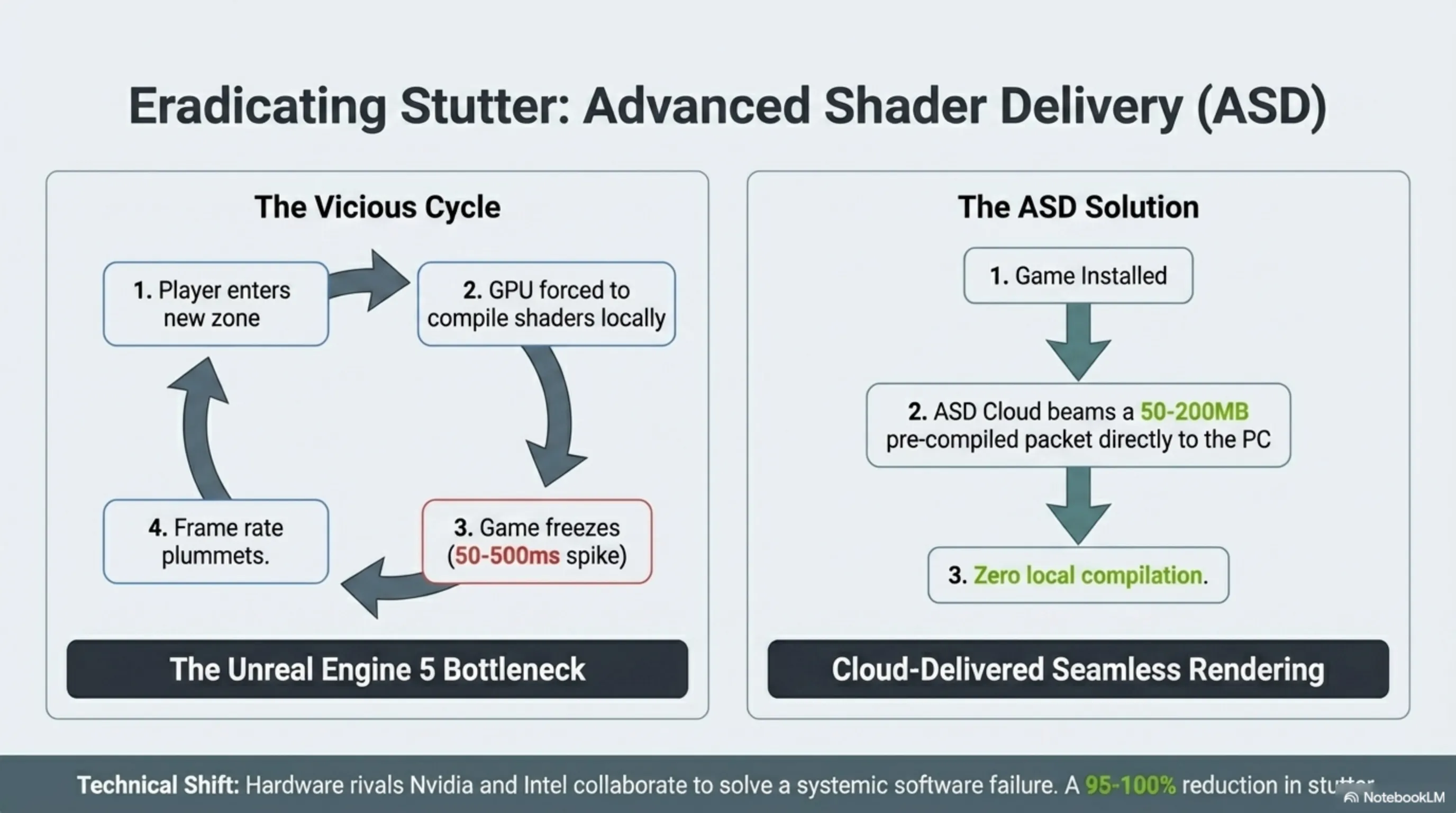
Nvidia and Intel today announced one of the most important collaborations in gaming industry history: Advanced Shader Delivery (ASD) - a new technology that promises to permanently solve one of gamers' most annoying problems: shader compilation stuttering. This issue occurs when a game loads a new scene for the first time and must compile shaders, causing temporary lag and freezing. With ASD, this problem will no longer exist.
What is shader compilation stuttering? Shaders are small programs that run on the GPU and determine how light, shadows, and visual effects are rendered in games. The problem is that each GPU (Nvidia, AMD, Intel) has a different architecture, so shaders must be compiled separately for each GPU. Game developers usually ship pre-compiled shaders with the game, but these files become huge (sometimes several gigabytes). So most games compile shaders during gameplay - which causes lag.
⚠️ Current Problem: The Stuttering Vicious Cycle
- You enter a new area in the game
- The game realizes it needs new shaders
- The GPU must compile the shaders (can take 50-500 milliseconds)
- During this time, the game freezes or FPS drops severely
- After compilation, the game runs smoothly again - until the next area!
This problem is especially severe in Unreal Engine 5 games (like Fortnite, Hogwarts Legacy).
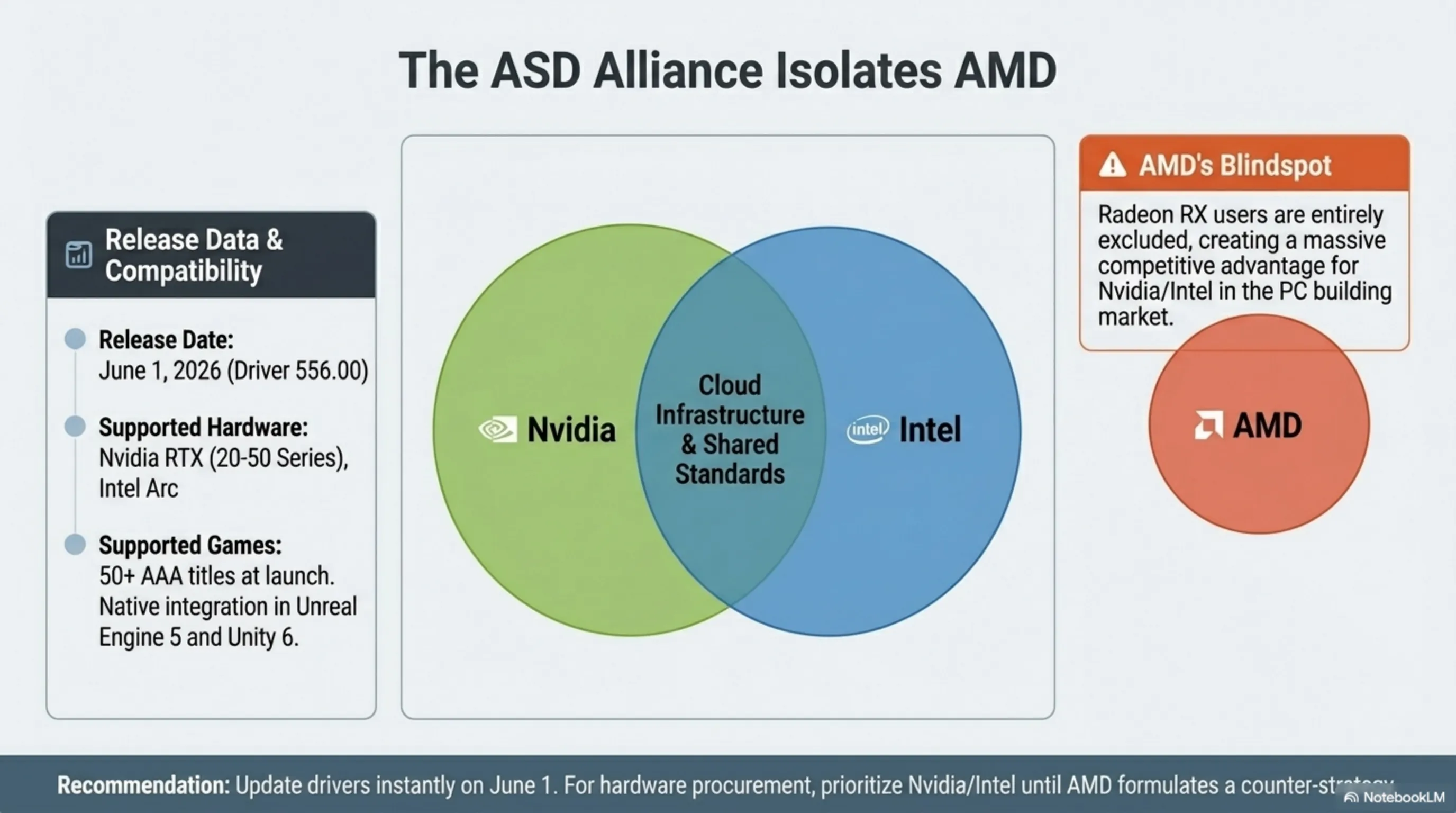
How does Advanced Shader Delivery work? Nvidia and Intel built a shared cloud system that stores pre-compiled shaders for every GPU + CPU + Driver combination. When you install a game, it automatically downloads shaders specific to your system from this server. This means no compilation happens during gameplay - everything is ready in advance. The files are compressed so downloads are fast (usually 50-200MB).
🔧 ASD Technical Details
| GPU Support | Nvidia RTX 20/30/40/50 Series, Intel Arc A-Series |
| Game Support | Unreal Engine 5, Unity 6, major AAA games |
| Download Size | 50-200MB (vs 2-5GB for old method) |
| Download Time | 10-30 seconds (with average internet) |
| Stuttering Reduction | 95-100% (nearly complete elimination) |
| Release Date | June 1, 2026 (with Driver 556.00) |
Where's AMD? That's the big question. AMD didn't participate in this collaboration, which means Radeon users (RX 6000/7000 Series) won't benefit from ASD for now. AMD says it's working on its own solution but hasn't provided details. This could be a major competitive advantage for Nvidia and Intel - gamers tired of stuttering might migrate to these brands.
Which games will it work with? At launch, ASD works with over 50 AAA games, including: Fortnite, Call of Duty: Modern Warfare III, Hogwarts Legacy, Cyberpunk 2077, Starfield, and Baldur's Gate 3. Epic Games and Unity have already announced they'll enable ASD by default in their engines, meaning thousands of future games will automatically support it.
📊 Before & After: Real Impact
❌ Without ASD
- Stuttering every 30-60 seconds
- 100-500ms freezes
- FPS drops below 30
- Frustrating experience
✅ With ASD
- Zero stuttering
- Consistent frame times
- Stable FPS
- Smooth, enjoyable experience
Why did Nvidia and Intel collaborate? That's an interesting question since these two companies are usually competitors. The answer is simple: both were hurt by stuttering. Gamers thought their GPUs were weak, when the problem was actually how games worked. By collaborating, they created an industry standard that benefits everyone (except AMD). Also, by sharing cloud server costs, both companies spend less money.
🎮 Tekin's Take:
This is one of the most important advances in gaming in recent years. Shader stuttering was one of the most annoying problems gamers dealt with, especially in Unreal Engine 5 games. Now with ASD, this problem is essentially solved. For Nvidia RTX and Intel Arc users, this is a great reason to update your driver. For those buying a new GPU, this is a major advantage for Nvidia and Intel over AMD. The only concern is that this system requires internet - if you're offline, you can't download shaders. But for most gamers who are always online, this isn't a problem. If you're a serious gamer tired of stuttering, ASD is going to change your life. We recommend: Immediate driver update on June 1.
📱 4. iPhone Fold Delayed: Probably Won't See It Until 2028
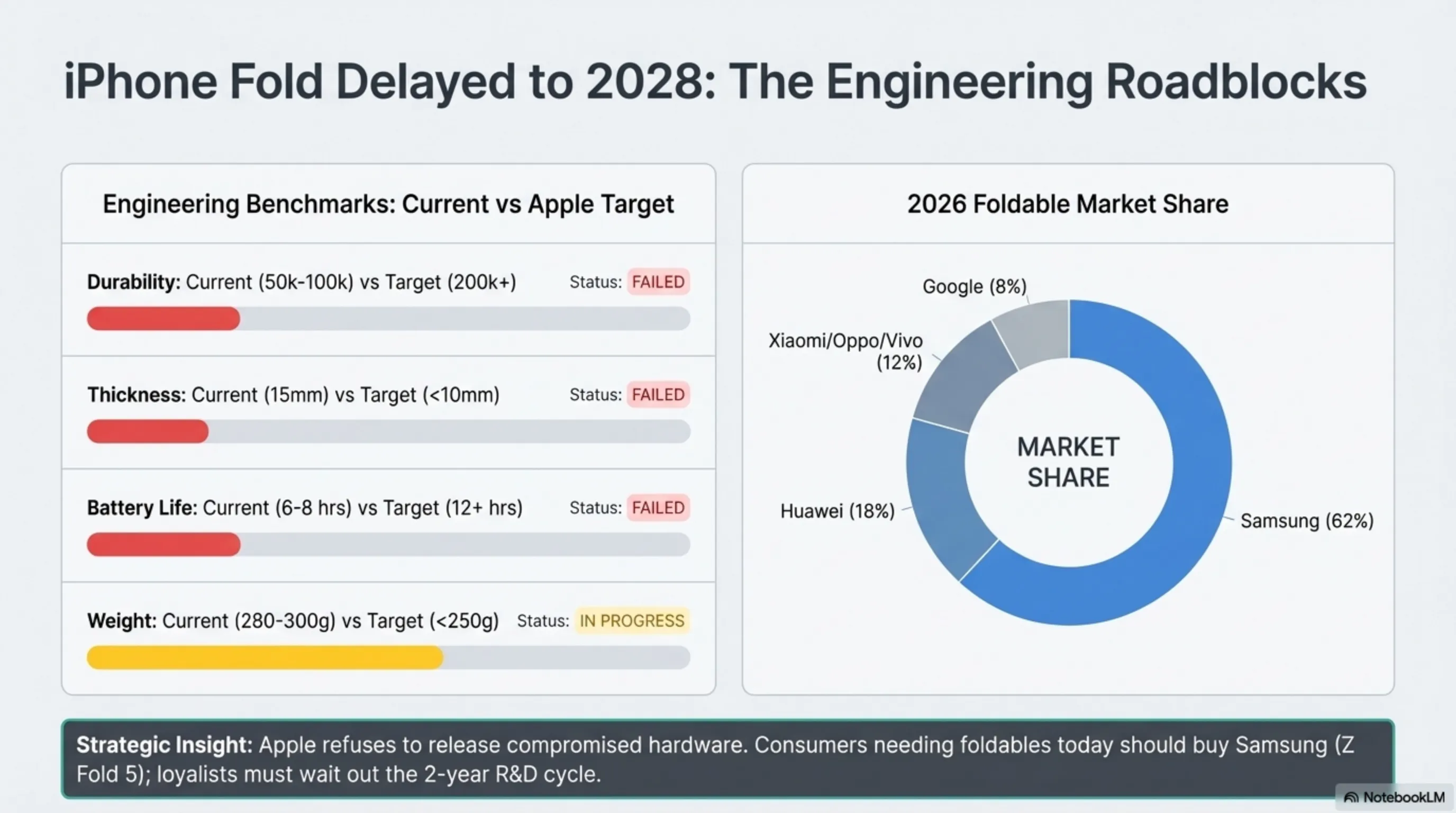
According to new reports from the Asian supply chain, Apple's first foldable iPhone probably won't launch until 2028 - a two-year delay from the original plan. This news is disappointing for those waiting for Apple's entry into the foldable phone market, but the reasons for the delay show that Apple doesn't want to rush and release an incomplete product. The main issues include display durability, hinge mechanism, and battery life.
Why the delay? According to sources close to Apple, the company is struggling with three major problems. First, current foldable displays start showing permanent creases after 50,000-100,000 folds. Apple wants to push this number to at least 200,000 - meaning if you open and close the phone 100 times a day, it should last 5 years. Second, the current hinge mechanism is too thick, making the phone 15mm thick when folded - Apple wants to get this under 10mm.
🔧 iPhone Fold Technical Challenges
| Challenge | Current Status | Apple's Goal |
|---|---|---|
| Display Durability (fold count) | 50,000-100,000 | 200,000+ |
| Thickness (folded state) | 15mm | <10mm |
| Battery Life | 6-8 hours | 12+ hours |
| Weight | 280-300g | <250g |
| Manufacturing Cost | $1,200-1,400 | <$1,000 |
The third problem: battery. Because the internal space of a foldable phone is limited (due to the hinge and folding mechanism), the battery becomes smaller. Current prototypes only have 6-8 hours of battery life - which is unacceptable by Apple's standards. Apple is working on new batteries with higher energy density, but this technology isn't ready for mass production yet. Also, Apple wants to ensure the phone supports MagSafe wireless charging and 30W fast charging.
Where are the competitors? Samsung is now on the fifth generation of Galaxy Z Fold (Z Fold 5), and is set to introduce Z Fold 6 in August 2026. Google Pixel Fold 2 is coming in May 2026. Huawei, Xiaomi, Oppo, and Vivo all have foldable phones. So Apple is about 3-4 years behind competitors. But history has shown that Apple prefers to enter the market late but with a complete product - like the Apple Watch that came 5 years after early smartwatches but dominated the market.
📊 Foldable Phone Market 2026
Source: Counterpoint Research, Q1 2026
What will the price be? If iPhone Fold launches in 2028, it will probably cost between $1,799 and $2,199 - similar to Galaxy Z Fold 6 which costs $1,899. Apple usually launches new products at premium prices, so don't expect a cheap foldable from Apple. But if Apple can solve the technical problems, it might be worth the price.
Is it worth the wait? That depends on your needs. If you need a foldable phone now, Galaxy Z Fold 5 or Pixel Fold 2 are excellent options. But if you can wait and you're an Apple fan, it's probably worth waiting. History has shown that when Apple enters a new market, it usually releases the best product - even if it's late. iPhone Fold will probably have the best display, best cameras, and best integration with the Apple ecosystem.
📱 Tekin's Take:
The iPhone Fold delay is disappointing, but it shows Apple doesn't want to rush. The problems Apple is solving - display durability, thickness, battery life - are the same problems current foldables struggle with. Galaxy Z Fold 5 is excellent, but the screen crease is still visible, it's thick, and battery is average. If Apple can solve these problems, iPhone Fold could set a new industry standard. For those who want a foldable now, we recommend Galaxy Z Fold 5 or wait for Z Fold 6 in August. For Apple fans, waiting until 2028 is probably worth it - but 2 years is a long time! We recommend: If you need it now, buy Samsung. If you can wait, wait for Apple.
♻️ 5. Samsung Refurbished Chips: Recycling in New Phones
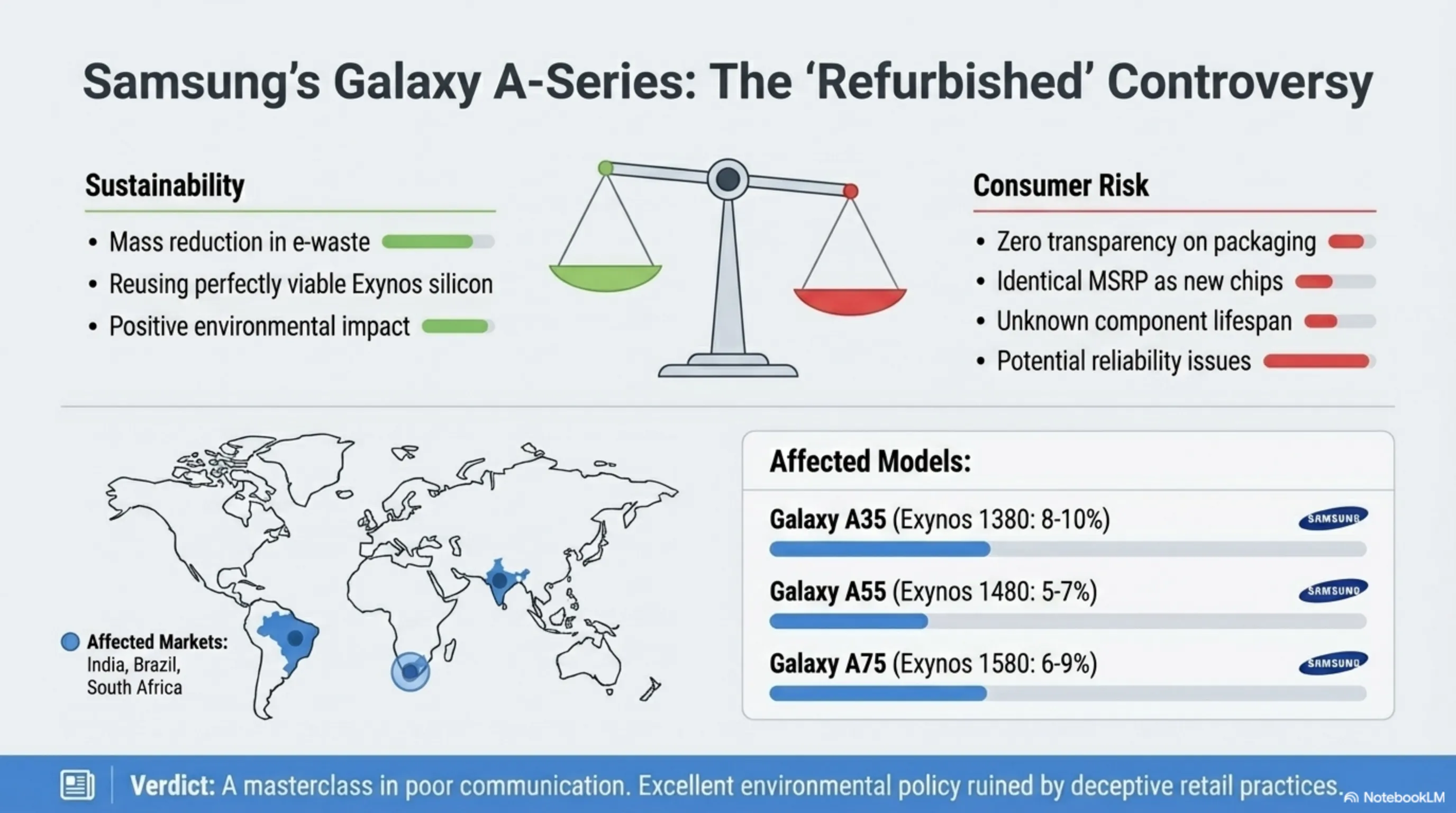
Samsung today confirmed one of its most controversial recent decisions: the company is using refurbished chips from old phones in some new Galaxy A-Series models. This news broke after users noticed some Galaxy A55 units came with Exynos chips dated from 2023. Samsung says this is part of its environmental sustainability program, but critics say it's a way to cut costs and sell old parts at new prices.
How did this happen? According to Samsung, when old phones are returned for recycling (through trade-in programs), the company separates usable parts. Chips that are still healthy and pass quality tests are cleaned, repackaged, and used in new phones. Samsung emphasizes these chips are "like new" and have the same standard warranty. But the reality is you're buying a used part - even if it's only been used for a few months.
⚠️ Why Is This Controversial?
- Zero transparency: Samsung doesn't mention this on the box or product page
- Same price: Phones with refurbished chips cost the same as models with new chips
- Shorter lifespan: Used chips probably have shorter lifespans (even if currently healthy)
- Resale value: When you want to sell the phone, it will be worth less
- Right to choose: Customers have the right to know what they're buying
Which models are affected? According to reports, this practice is currently limited to the Galaxy A series - especially A35, A55, and A75 being sold in some markets (mainly India, Brazil, and South Africa) with refurbished chips. Flagship models like Galaxy S24 and Z Fold 5 are not affected - at least for now. Samsung says only 5-10% of A-Series phones have these chips, but there's no way for customers to know before purchase whether their phone is one of that 5-10%.
📱 Affected Models
| Model | Chip | Affected Markets | Refurbished % |
|---|---|---|---|
| Galaxy A35 | Exynos 1380 | India, Brazil | 8-10% |
| Galaxy A55 | Exynos 1480 | India, South Africa | 5-7% |
| Galaxy A75 | Exynos 1580 | Brazil, Mexico | 6-9% |
| Galaxy S24/S24+/S24 Ultra | Snapdragon 8 Gen 3 | None | 0% |
What's the customer reaction? The internet has exploded! Reddit and Twitter users are accusing Samsung of "customer fraud." Some are exploring class-action lawsuits. In India, a consumer rights group has asked the government to force Samsung to clearly state this on packaging. In Brazil, a major electronics retailer (Magazine Luiza) says it will no longer sell Galaxy A-Series until Samsung provides full transparency.
What's Samsung's defense? Samsung said in an official statement: "We are committed to environmental sustainability. Reusing healthy parts helps reduce electronic waste. All refurbished chips pass rigorous quality tests and have the same standard warranty. Their performance is identical to new chips." But Samsung still hasn't explained why it doesn't tell customers, or why it doesn't reduce the price.
🌱 Environmental Angle
From one perspective, this is actually good for the environment. Electronic waste is one of the world's biggest environmental problems. If Samsung can reuse healthy parts instead of throwing them away, this is a significant reduction in waste and energy consumption for producing new chips.
But: Environmental sustainability shouldn't be an excuse for lack of transparency. Customers have the right to know what they're buying, and if it's a used part, the price should be lower.
How can we tell if our phone has a refurbished chip? Unfortunately, there's no official way. But some users say you can use third-party apps like CPU-Z and check the chip's manufacturing date. If the chip's manufacturing date is 6+ months before the phone's manufacturing date, it's probably refurbished. Also, some phones have an internal code you can access by typing `*#0*#` in the dialer - but this doesn't work for all models.
♻️ Tekin's Take:
This is a complex situation. On one hand, reusing parts is great for the environment and should be encouraged. On the other hand, Samsung's lack of transparency is unacceptable. Customers are paying full price for a new phone, so they have the right to know if parts inside are used. The solution is simple: Samsung should clearly state this on the box and product page, and offer a small discount (like 5-10%) for models with refurbished chips. This provides transparency, gives customers choice, and promotes environmental sustainability. Until Samsung does this, we recommend avoiding Galaxy A-Series in affected markets - or at least check the chip's manufacturing date before purchase. We recommend: Wait until Samsung provides full transparency.
⚖️ 6. Anthropic Pentagon Defeat: Appeals Court Rejects Challenge
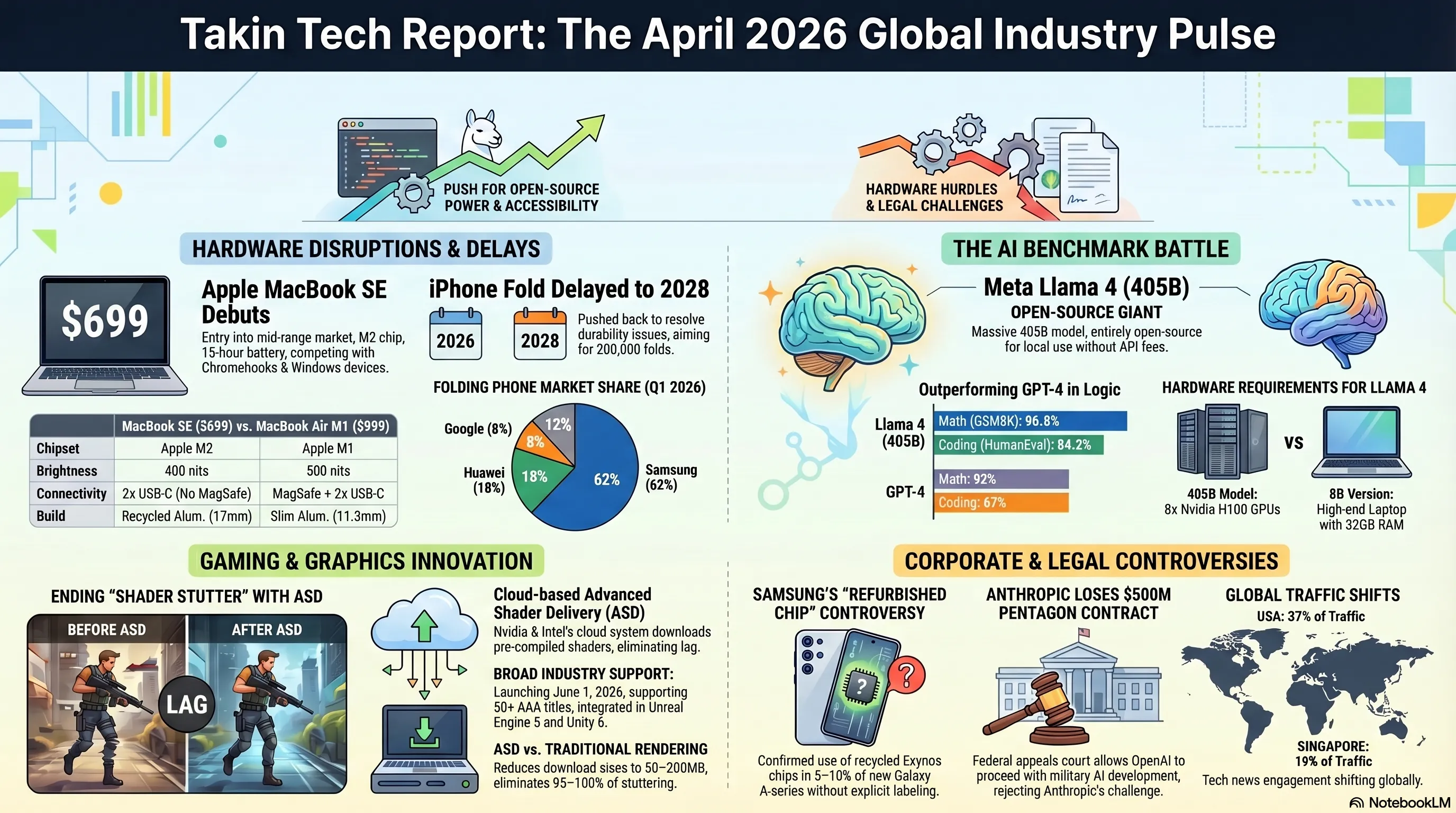
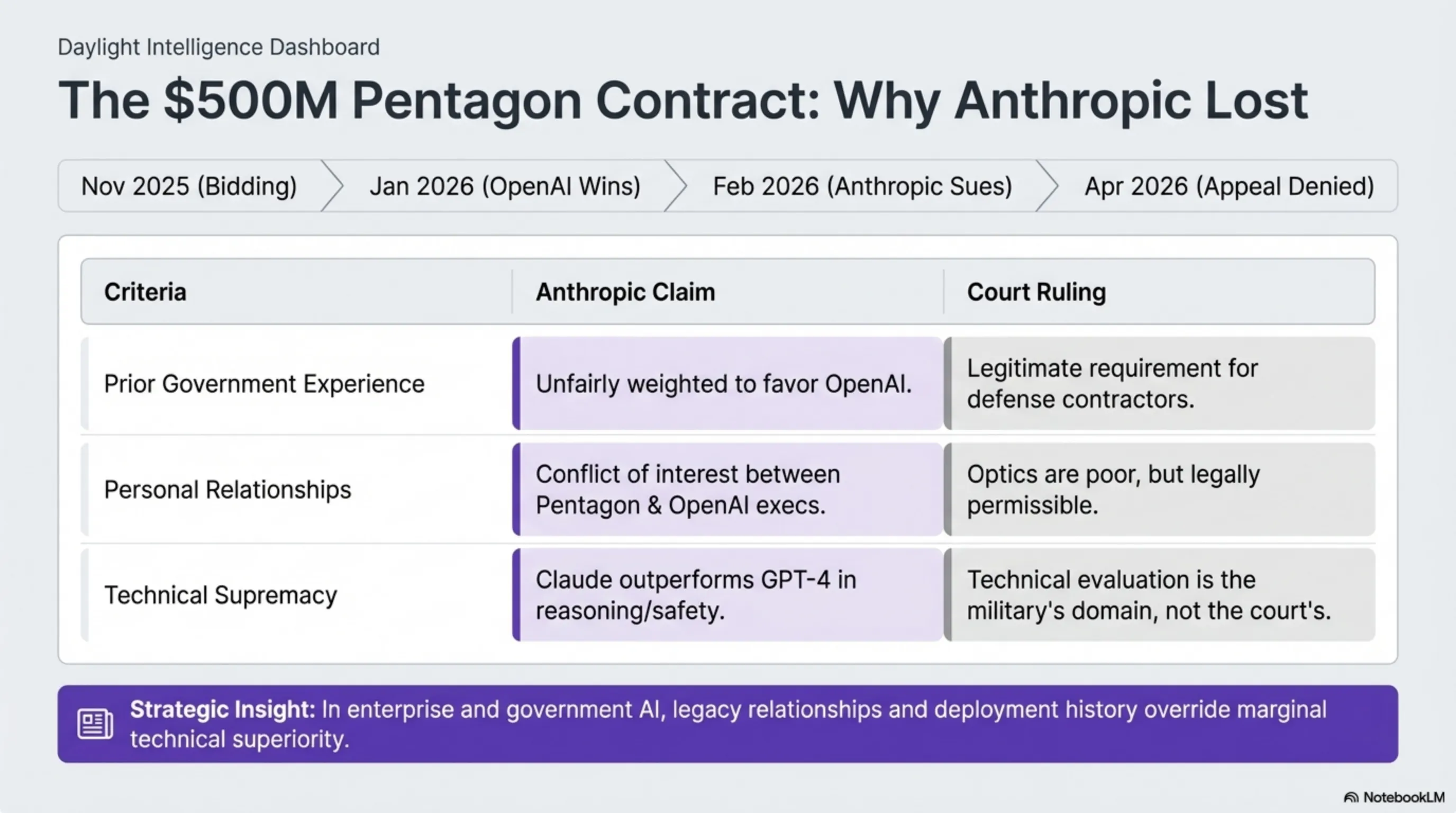
Anthropic, maker of Claude AI, suffered a major legal defeat today: the federal appeals court rejected the company's request to cancel the Pentagon's $500 million contract with OpenAI. Anthropic argued the bidding process was "unfair and non-transparent" and that OpenAI had an unfair advantage. But the court said Anthropic failed to provide sufficient evidence to prove discrimination or misconduct. This ruling means OpenAI can continue working on military AI systems - and Anthropic is shut out of a massive contract.
How did this start? In November 2025, the Pentagon announced a $500 million bid for developing "military decision-making AI systems." The goal was to build an AI that could help military commanders analyze intelligence, plan operations, and make quick decisions on the battlefield. Anthropic, OpenAI, Google, and Microsoft all submitted proposals. In January 2026, the Pentagon announced OpenAI as the winner. Anthropic immediately protested, saying the bidding process was "predetermined."
⏱️ Case Timeline
What were Anthropic's arguments? Anthropic made three main claims. First, they said the Pentagon designed evaluation criteria to favor OpenAI - for example, giving heavy weight to "prior experience with government projects," where OpenAI scored higher due to previous contracts. Second, Anthropic claimed some Pentagon officials had personal relationships with OpenAI executives that could have been influential. Third, they said Anthropic's technical proposal was actually better - Claude performs better than GPT-4 in reasoning and safety tests.
What was the court's response? The judge wrote: "While Anthropic has raised legitimate concerns about the transparency of the bidding process, they failed to provide sufficient evidence to prove discrimination or misconduct. Prior experience with government projects is a reasonable criterion for evaluating contractors. Personal relationships between government officials and company executives, while potentially creating the appearance of conflict of interest, are not inherently illegal. And finally, choosing between closely matched technical proposals is a professional judgment that courts typically don't interfere with."
⚔️ Arguments from Both Sides
| Issue | Anthropic | Pentagon/OpenAI |
|---|---|---|
| Prior Experience | Unfair criterion | Reasonable criterion |
| Personal Relationships | Conflict of interest | Legal and natural |
| Technical Performance | Claude is better | GPT-4 is better |
| Transparency | Insufficient | Sufficient |
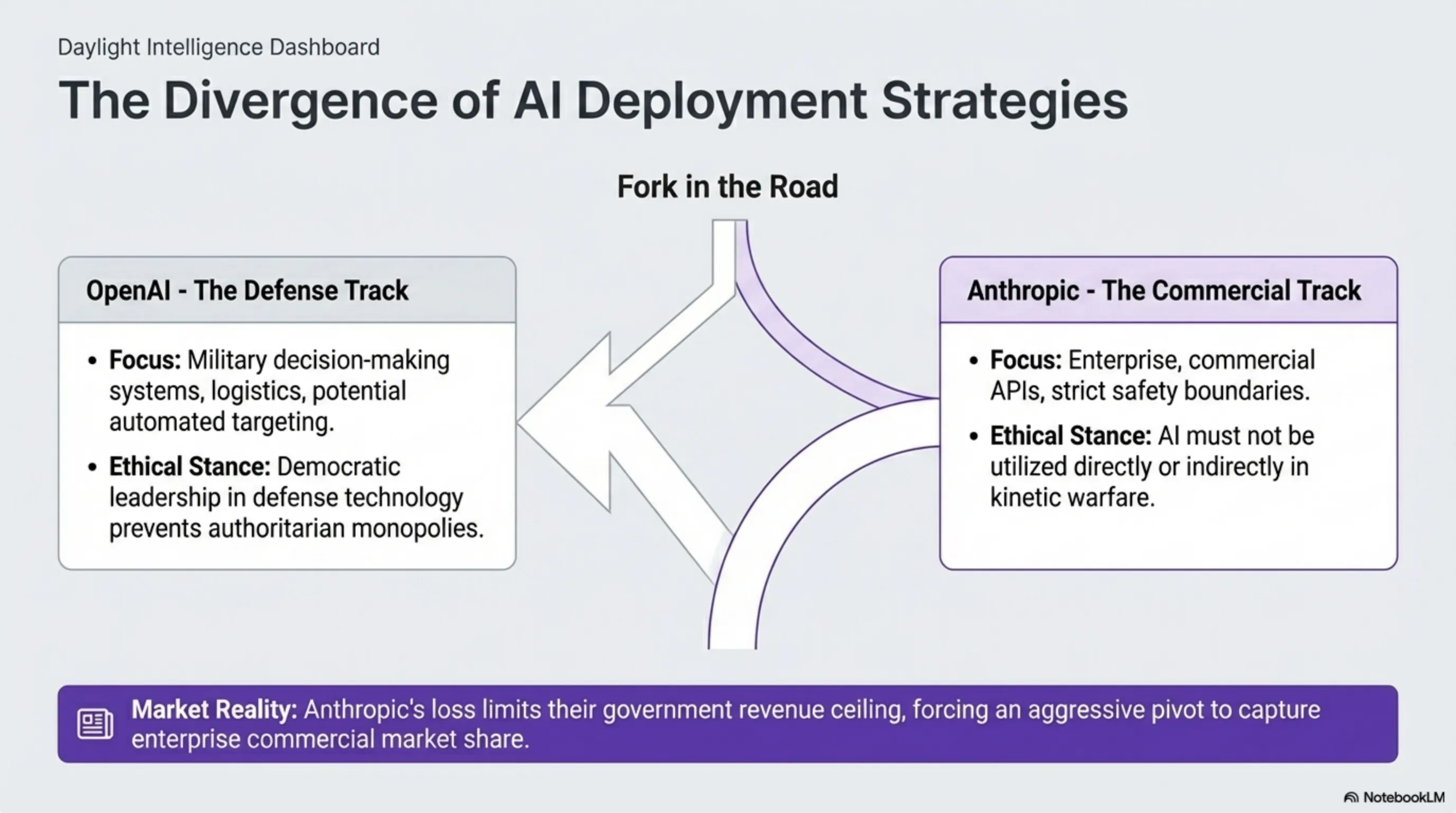
What's the impact on Anthropic? This is a major financial and reputational blow. The $500 million contract could have significantly increased Anthropic's revenue and made them a major player in military AI. Now, OpenAI has captured this market and will likely receive more contracts from the Pentagon and other government agencies. For Anthropic, this means they must focus on commercial markets - which are more competitive and profitable, but have less volume.
What's the ethical debate? This case raises a bigger debate about using AI in warfare. Some employees at Anthropic and OpenAI have protested working on military projects. They argue AI shouldn't be used to kill humans, even indirectly. But defenders say AI can help reduce civilian casualties by improving attack precision and helping commanders make better decisions. This is a complex debate with no simple answer.
🤔 Ethical Debate: AI in Warfare
❌ Opponents:
AI shouldn't be used for killing. The risk of catastrophic errors is too high. Life and death decisions should be made by humans, not machines.
✅ Supporters:
AI can improve precision and reduce civilian casualties. If we don't use it, our enemies will. Better for democracies to lead in this technology.
What's next? Anthropic could appeal to the U.S. Supreme Court, but the chances of the case being accepted are very low. More likely, Anthropic will accept this defeat and focus on other opportunities. OpenAI can now begin work on the Pentagon contract, which will probably include developing intelligence analysis systems, logistics planning, and possibly even autonomous decision-making systems for drones. This will be one of the largest applications of AI in military history.
⚖️ Tekin's Take:
This case shows that competition in the AI industry isn't just about technology - it's also about relationships, experience, and bargaining power. Anthropic might have a better technical model, but OpenAI has stronger government relationships and more experience with large projects. That's the reality of the business world. From an ethical perspective, using AI in warfare is a complex issue that society needs to debate. But the reality is this technology is being developed whether we like it or not. Better for responsible companies like OpenAI and Anthropic to be involved to ensure AI is used ethically. For Anthropic, this is a tough blow, but they're still a strong company with an excellent product. Commercial markets are much larger than the military market, and Anthropic can succeed there. Our take: This isn't the end of the story - just a new chapter in the AI competition.
☀️ Tekin Morning Wrap-Up
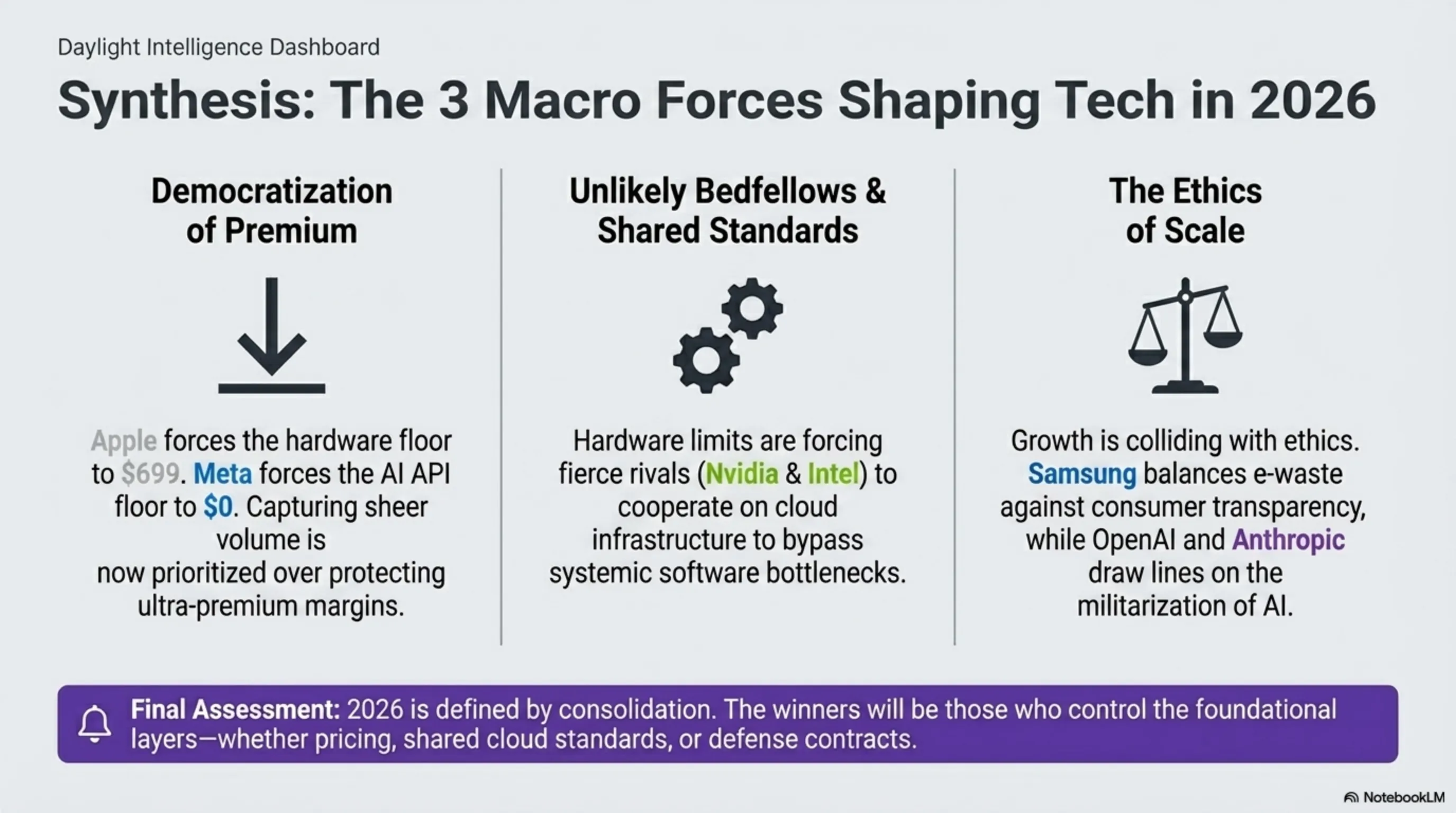
Sunday morning, April 12, 2026 started with a series of major developments in the tech world. Apple with MacBook SE showed it's ready to seriously enter the mid-range market. Meta with Llama 4 proved that open-source AI can compete with commercial giants. Nvidia and Intel with their historic collaboration promised to solve one of gamers' most annoying problems.
Meanwhile, the iPhone Fold delay reminded us that even Apple struggles with technical challenges. Samsung's refurbished chip controversy raised important questions about transparency and consumer rights. And Anthropic's court defeat showed that competition in the AI industry isn't just about technology. These developments all show that the future of technology will be eventful, competitive, and full of opportunities and challenges. We're here to be with you and give you the best analysis. Until the next article, stay smart and curious! 🚀
📚 Sources
This article is based on official reports from Apple, Meta AI Research, Nvidia, Intel, Samsung, Anthropic, and industry expert analysis from The Verge, TechCrunch, Ars Technica, AnandTech, and Counterpoint Research. All information is current as of April 12, 2026.
🌐 Stay Connected With Us 🎮✨
For the latest tech, gaming, and gadget news, follow us on our official social media channels:
Additional Gallery: Tekin Morning April 12: $699 MacBook SE, Meta Llama 4, and Nvidia-Intel ASD