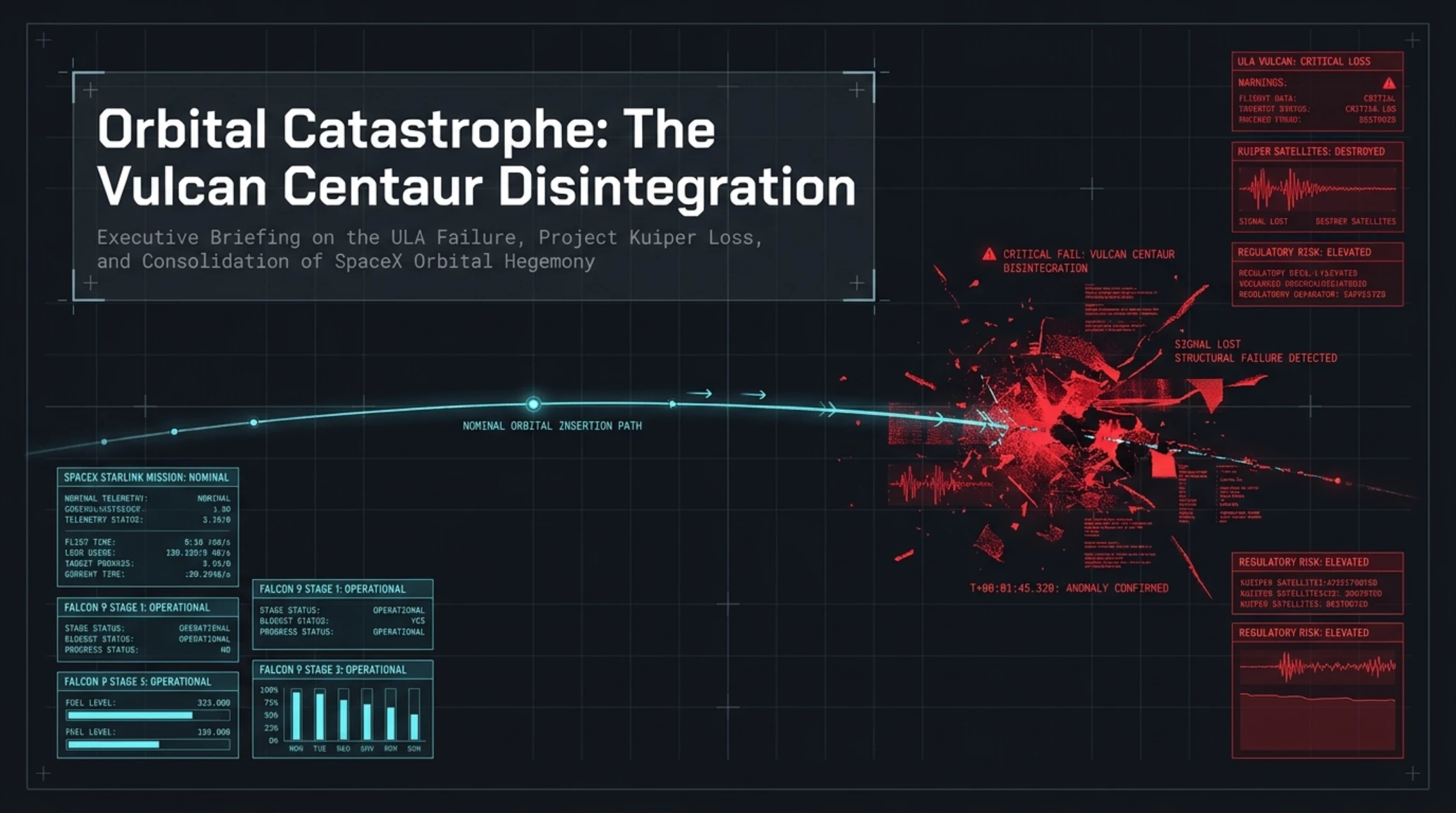
United Launch Alliance (ULA) has suffered the catastrophic loss of its Vulcan Centaur heavy-lift launch vehicle during mission ascent from Cape Canaveral SLC-41, extinguishing a remarkable twenty-year streak of unblemished operational reliability. The structural failure at T+10 minutes obliterated forty next-generation Amazon Project Kuiper operational broadband satellites valued at $1.2 billion, precipitating an acute regulatory crisis regarding strict FCC deployment deadlines and reinforcing SpaceX Starlink's hegemony.
Tekin Analysis | Forensic Teardown of ULA Vulcan Failure and Loss of 40 Amazon Kuiper Satellites (Executive Briefing)
Earth Orbit Shockwave: The Disintegration of Vulcan Centaur Ends ULA's Flawless 20-Year Operational Dominance
In the pre-dawn darkness of November 15, 2026, Space Launch Complex 41 at Cape Canaveral Space Force Station erupted in blinding fire as United Launch Alliance's flagship Vulcan Centaur rocket surged into the Florida skies. This mission was meticulously engineered to serve as a triumphant industrial milestone: the inaugural flight of an unprecedented 38-launch commercial mega-contract signed between ULA and Amazon to deploy the core infrastructure of Project Kuiper into Low Earth Orbit. However, within ten catastrophic minutes, the mission deteriorated into one of the most financially devastating launch failures in modern aerospace history.
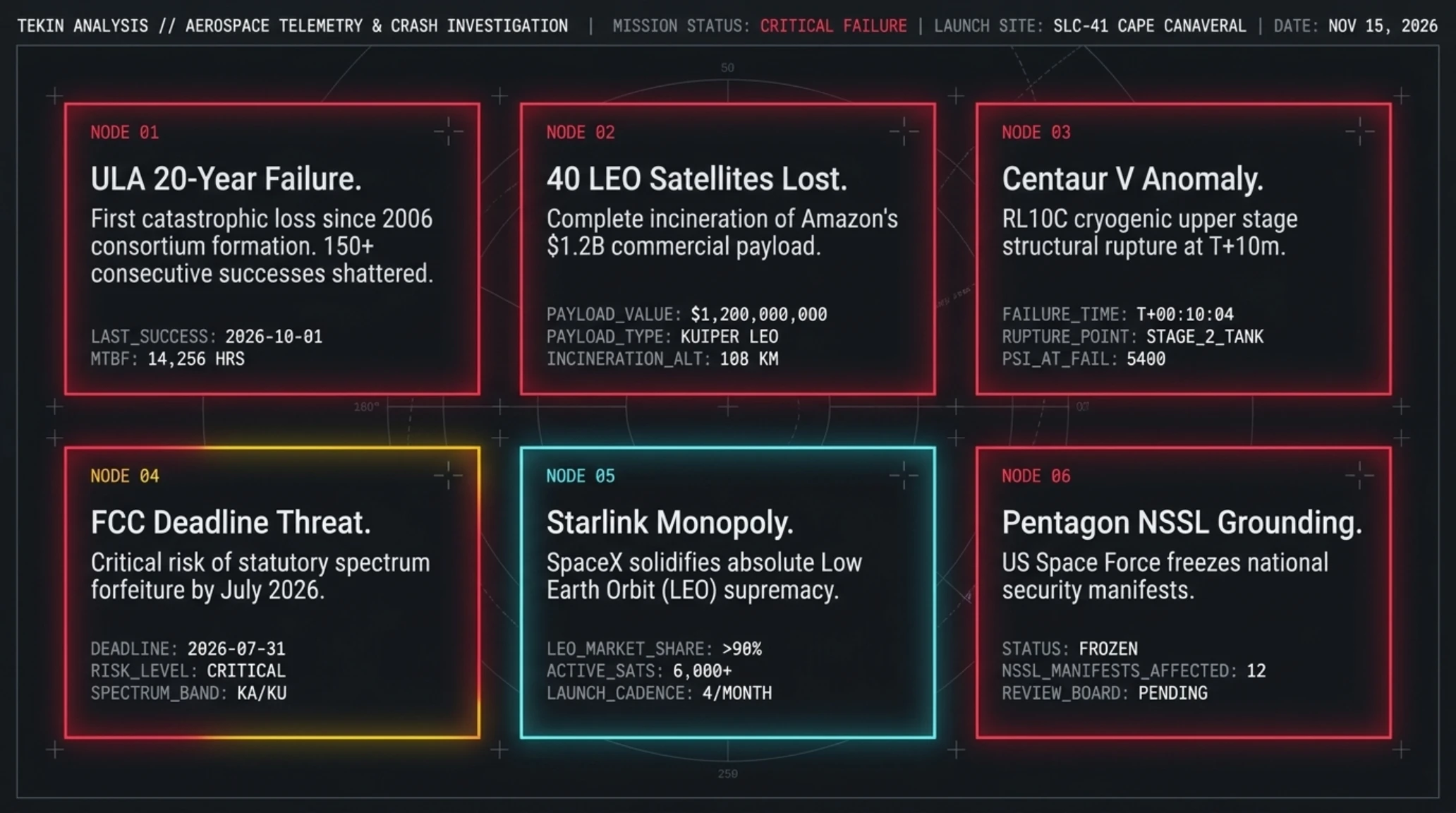
Strategic Intelligence // 6 Core Vectors of the Vulcan Centaur Catastrophe (Key Takeaways)
Initial statements confirmed by ULA President and Chief Executive Officer Tory Bruno, along with investigative reports from The Verge, established that the rocket's core booster stage performed nominally. The twin BE-4 methane-fueled engines, designed and manufactured by Jeff Bezos's Blue Origin, delivered steady thrust through maximum aerodynamic pressure, successfully pushing the vehicle beyond the dense layers of the lower atmosphere before separating cleanly at T+268 seconds.
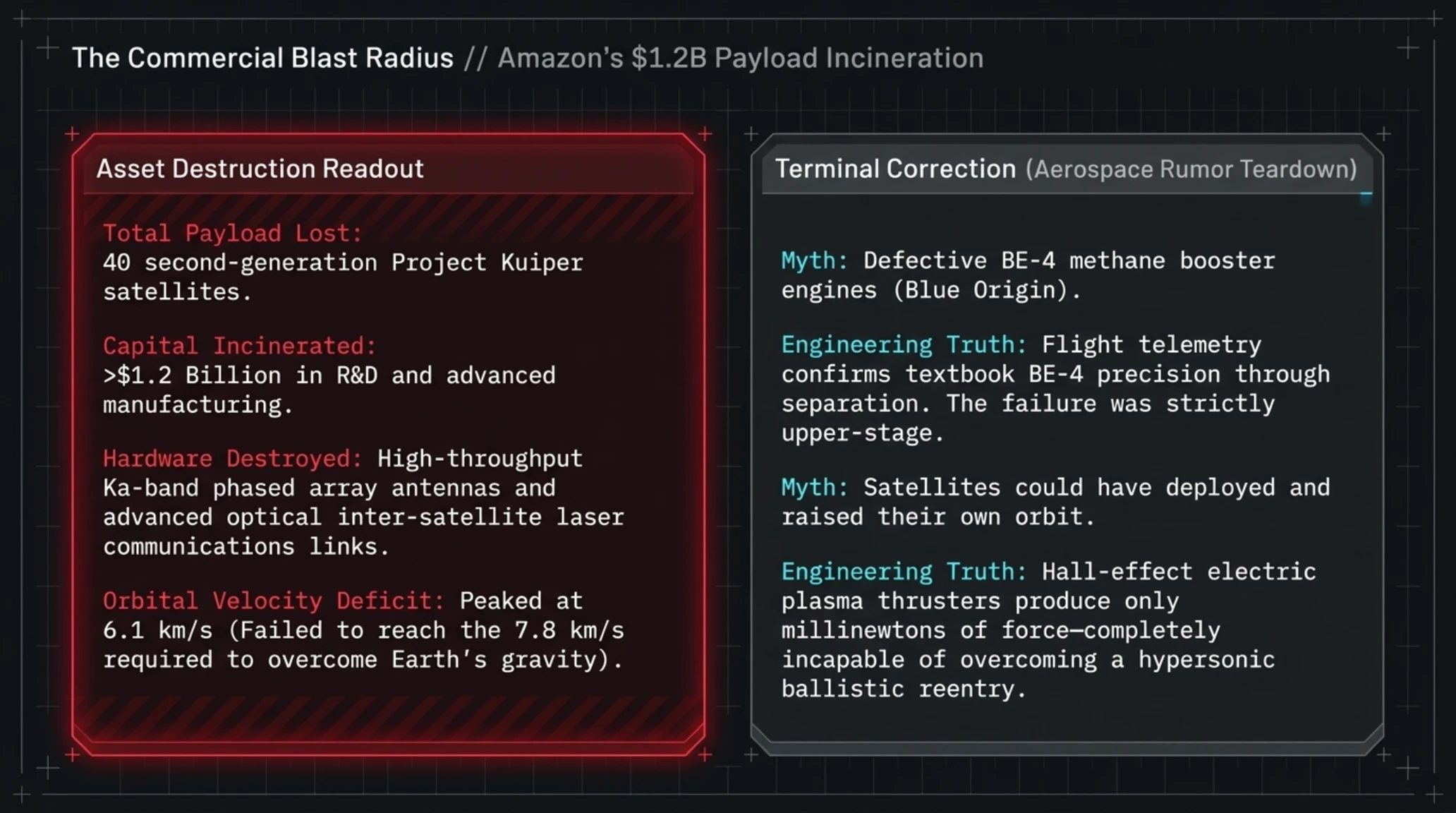
The anomaly struck midway through the secondary burn of the cryogenic Centaur V upper stage at an altitude of approximately 220 kilometers. Telemetry feeds suddenly recorded catastrophic pressure transients across the engine manifold, followed by total vehicle attitude loss and signal blackout. Trapped within the composite payload fairing were 40 state-of-the-art Amazon Kuiper satellites, fully equipped with high-throughput Ka-band phased array antennas and advanced optical inter-satellite laser communications links representing over $1.2 billion in research, development, and advanced manufacturing capital.
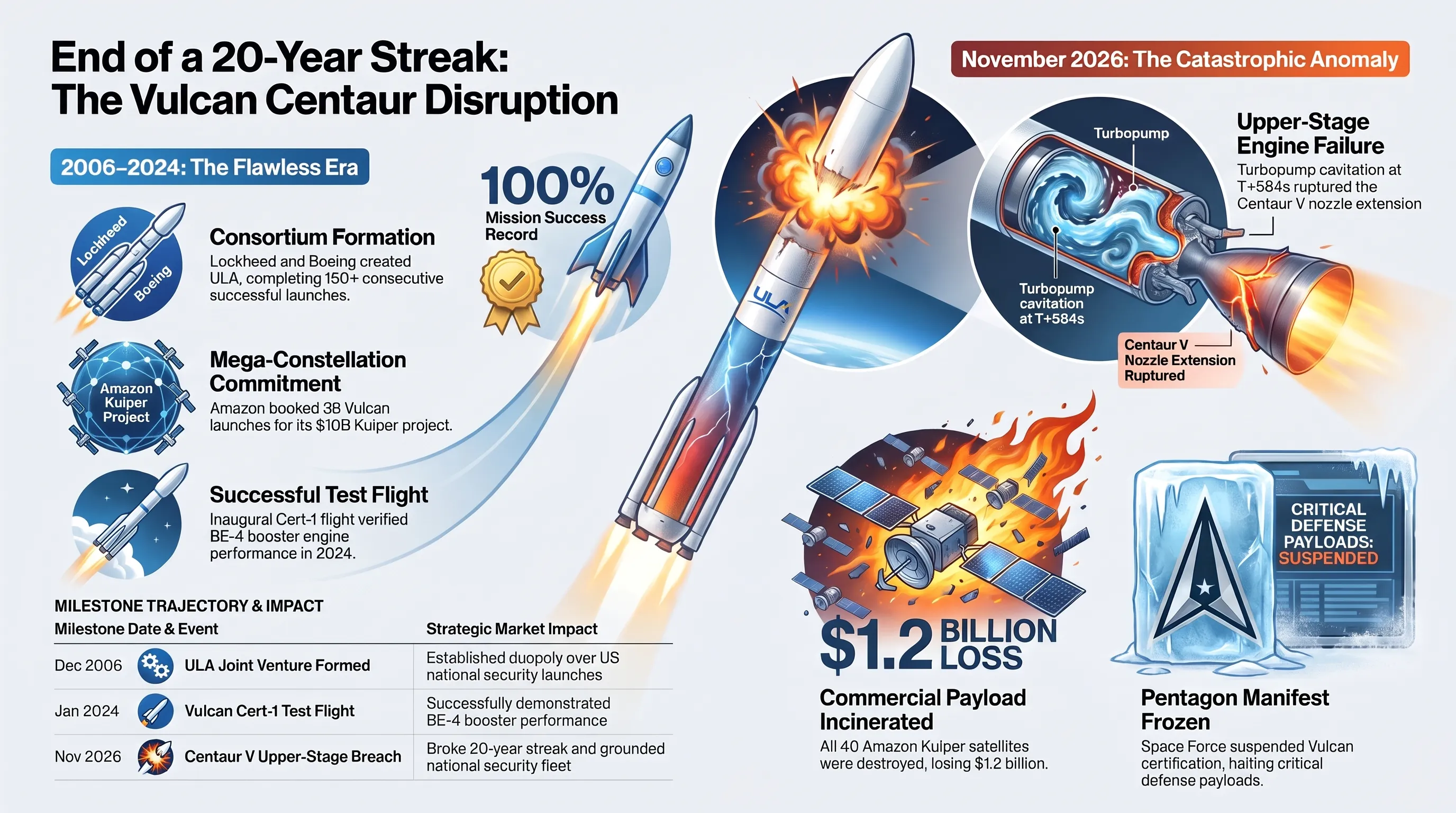
The geopolitical and industrial significance of this failure cannot be overstated. Formed in December 2006 as a joint venture between American defense behemoths Boeing and Lockheed Martin, ULA had long been regarded as the gold standard of launch mission assurance. For twenty consecutive years across more than 150 operational launches of Atlas V and Delta IV rockets, the company maintained an unmatched 100% mission success rate, securing billions in high-margin National Security Space Launch contracts from the Pentagon. That myth of invulnerability vanished over the Atlantic Ocean.
For Amazon, the catastrophe fundamentally shatters its commercial deployment roadmap. Jeff Bezos deliberately constructed a diverse launch manifest utilizing ULA, Europe's Arianespace, and Blue Origin to avoid enriching his chief technological rival, Elon Musk. Yet by entrusting its initial commercial deployment tranche to a rocket that had only flown twice before in test configurations, Amazon exposed its flagship consumer telecommunications venture to existential execution risk.
Strategic Gravity of the Catastrophe // Key Impact Metrics
Vulcan's T+10m disintegration places Amazon's orbital broadband license in immediate jeopardy, forces Jeff Bezos toward purchasing Falcon 9 launches from rival SpaceX, and freezes sixty percent of the Pentagon's Phase 2 national security launch manifests.
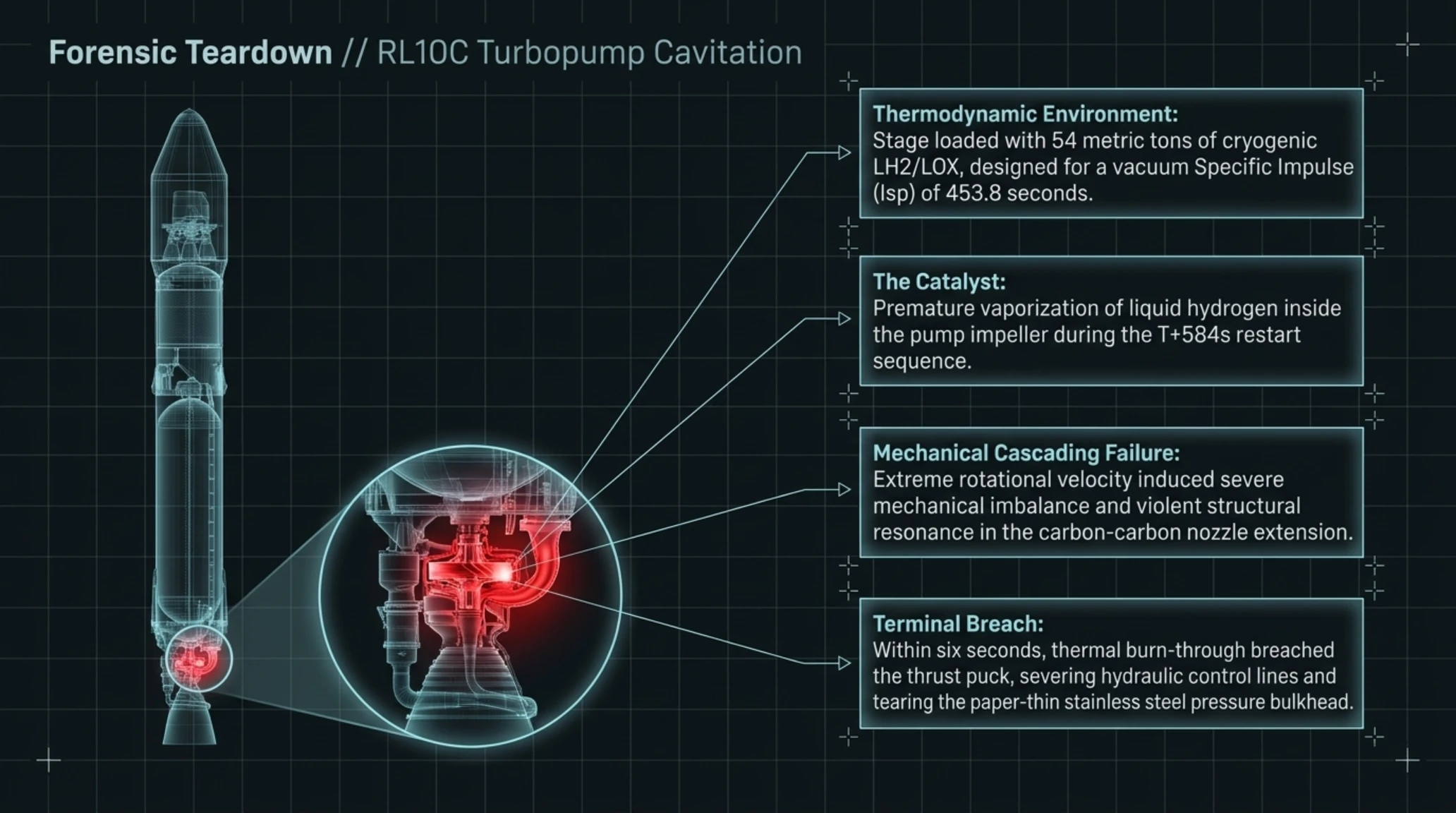
Forensic Upper-Stage Teardown: How Turbopump Cavitation and RL10C Engine Failure Doomed the Centaur V
To pinpoint the structural breakdown that precipitated this catastrophic loss, aerospace engineers must analyze the complex thermodynamic environment within Vulcan's Centaur V upper stage. Stretching 5.4 meters in diameter, the Centaur V represents a radical volumetric expansion over heritage Centaur configurations, engineered to hold over 54 metric tons of cryogenic liquid hydrogen and liquid oxygen. Propelled by dual Aerojet Rocketdyne RL10C-1-1 engines, the stage delivers unmatched vacuum specific impulse exceeding 453 seconds, making it theoretically the most efficient upper stage ever deployed.
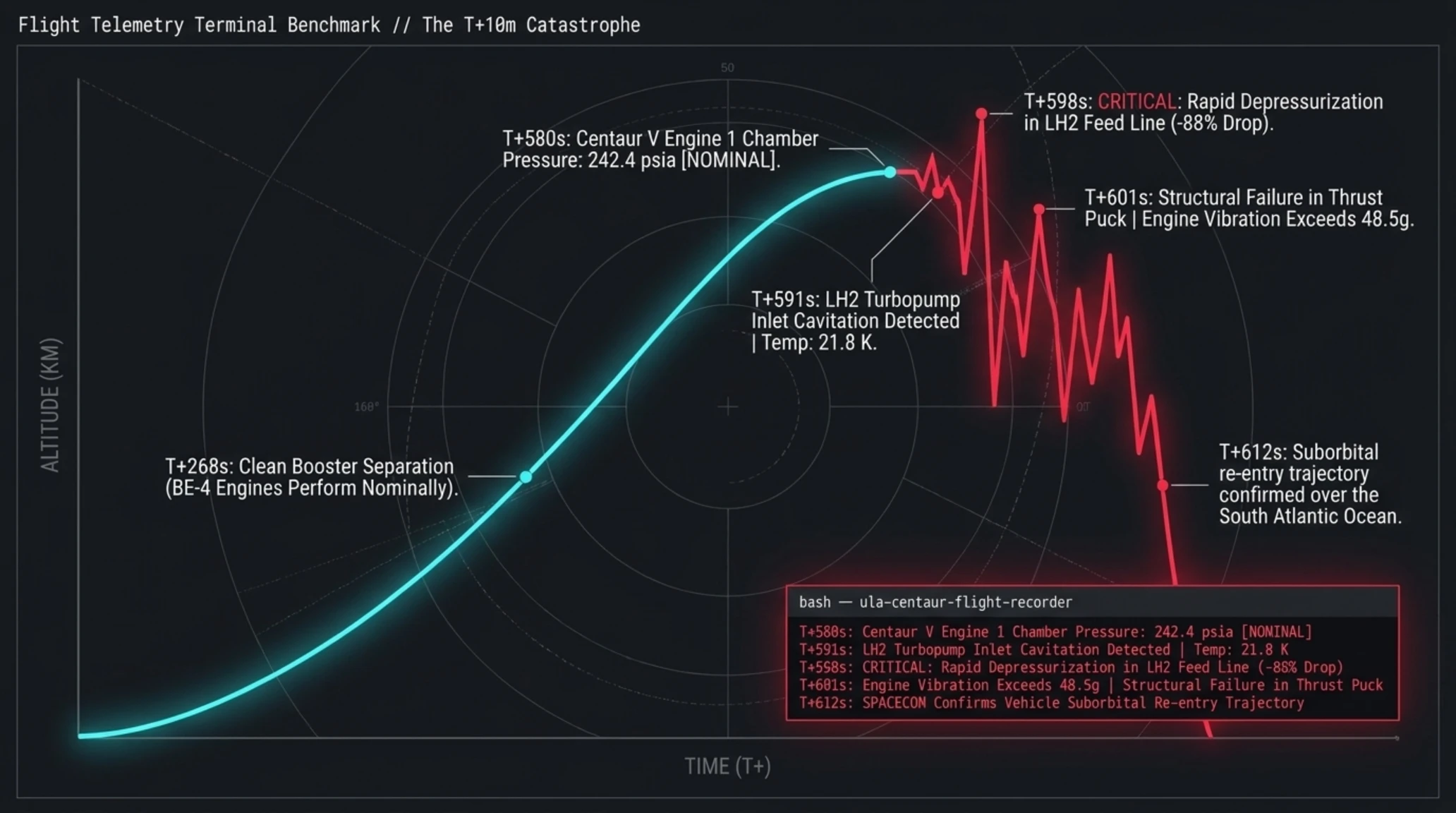
Downlinked telemetry captured by the NASA and Space Force tracking station in Bermuda reveals that the booster stage functioned flawlessly through Main Engine Cutoff (MECO) and stage separation at T+268 seconds. The Centaur V ignited cleanly for its initial orbital insertion burn, successfully coasting into an elliptical suborbital parking trajectory. The fatal anomaly occurred during the restart sequence at T+584 seconds, designed to circularize the orbit at 500 kilometers.
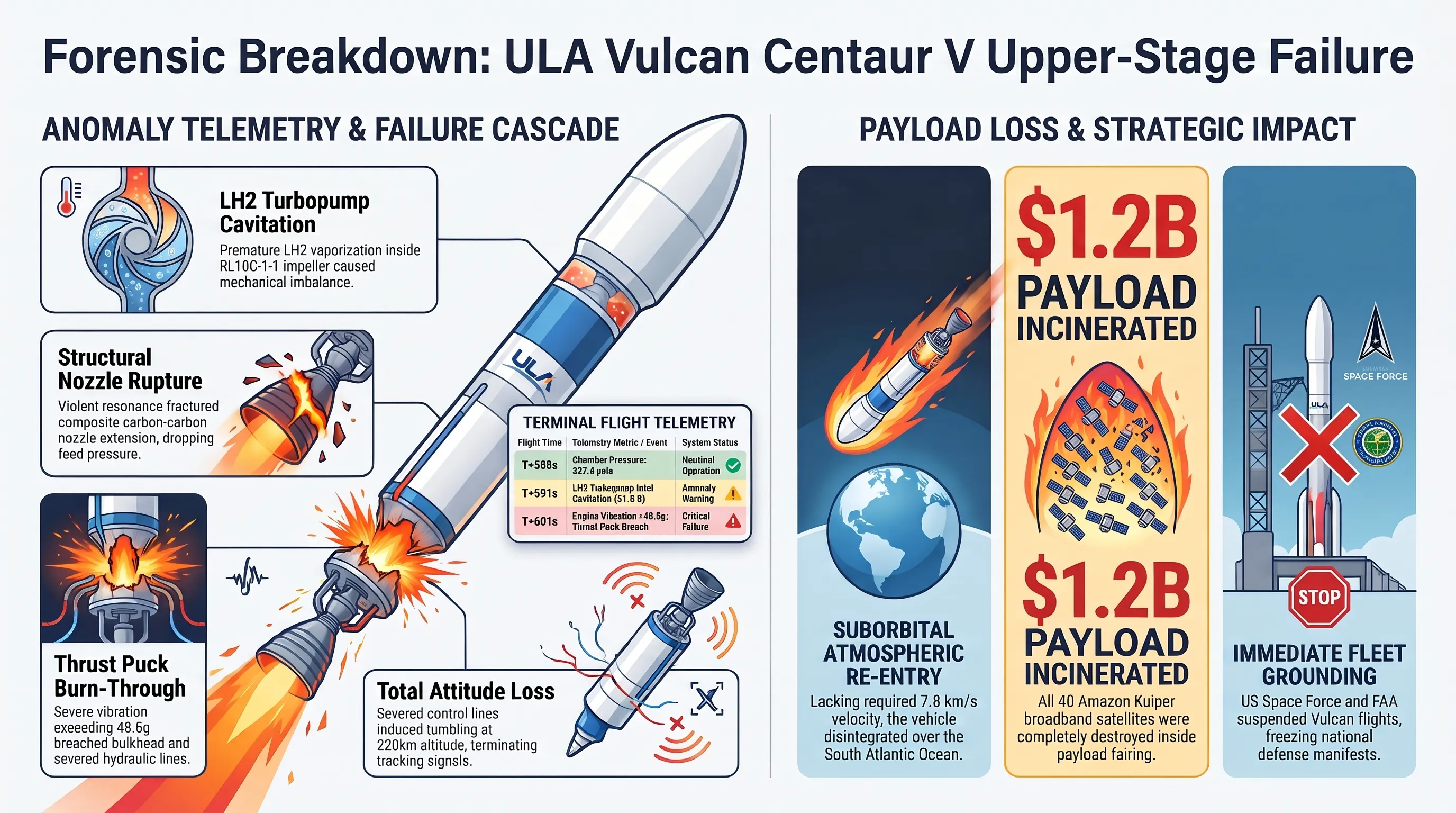
Analysis of high-frequency pressure transducers indicates sudden and acute cavitation within the liquid hydrogen turbopump of Engine Number One. As liquid hydrogen vaporized prematurely inside the pump impeller, the extreme rotational velocity induced severe mechanical imbalance, causing the composite carbon-carbon nozzle extension to experience violent structural resonance. Within six seconds, thermal burn-through breached the thrust puck, severing hydraulic control lines and tearing into the paper-thin stainless steel pressure bulkhead of the propellant tank.
Without sufficient orbital velocity requiring a minimum of 7.8 kilometers per second to overcome Earth's gravitational pull the tumbling Centaur stage and its 40 Kuiper satellites remained locked on a suborbital ballistic trajectory. The vehicle plunged back into the atmosphere at hypersonic speed, disintegrating and burning up over unpopulated waters in the South Atlantic Ocean near Antarctica, with radar tracking confirming that not a single satellite achieved sustainable orbit.
Industry insiders report that severe commercial pressure from Amazon to ramp launch cadence from three flights per year to two flights per month severely strained ULA's supplier ecosystem. Squeezing qualification timelines and reducing static-fire burn durations across RL10 turbopump assemblies to satisfy executive schedules created an intolerable margin for error that ultimately proved catastrophic.
Technical Fact-Check // Myth vs. Aerospace Engineering Reality
Speculation blamed Blue Origin's BE-4 methane booster engines for the explosion and claimed the Kuiper satellites separated to save their orbits.
Telemetry confirms BE-4 boosters performed nominally through stage separation; the failure occurred exclusively in the cryogenic Centaur V upper stage, incinerating all 40 encapsulated satellites.
Amazon's $10B Capital Quagmire: Why Project Kuiper Stalled Against Starlink's 7,000-Satellite Fleet
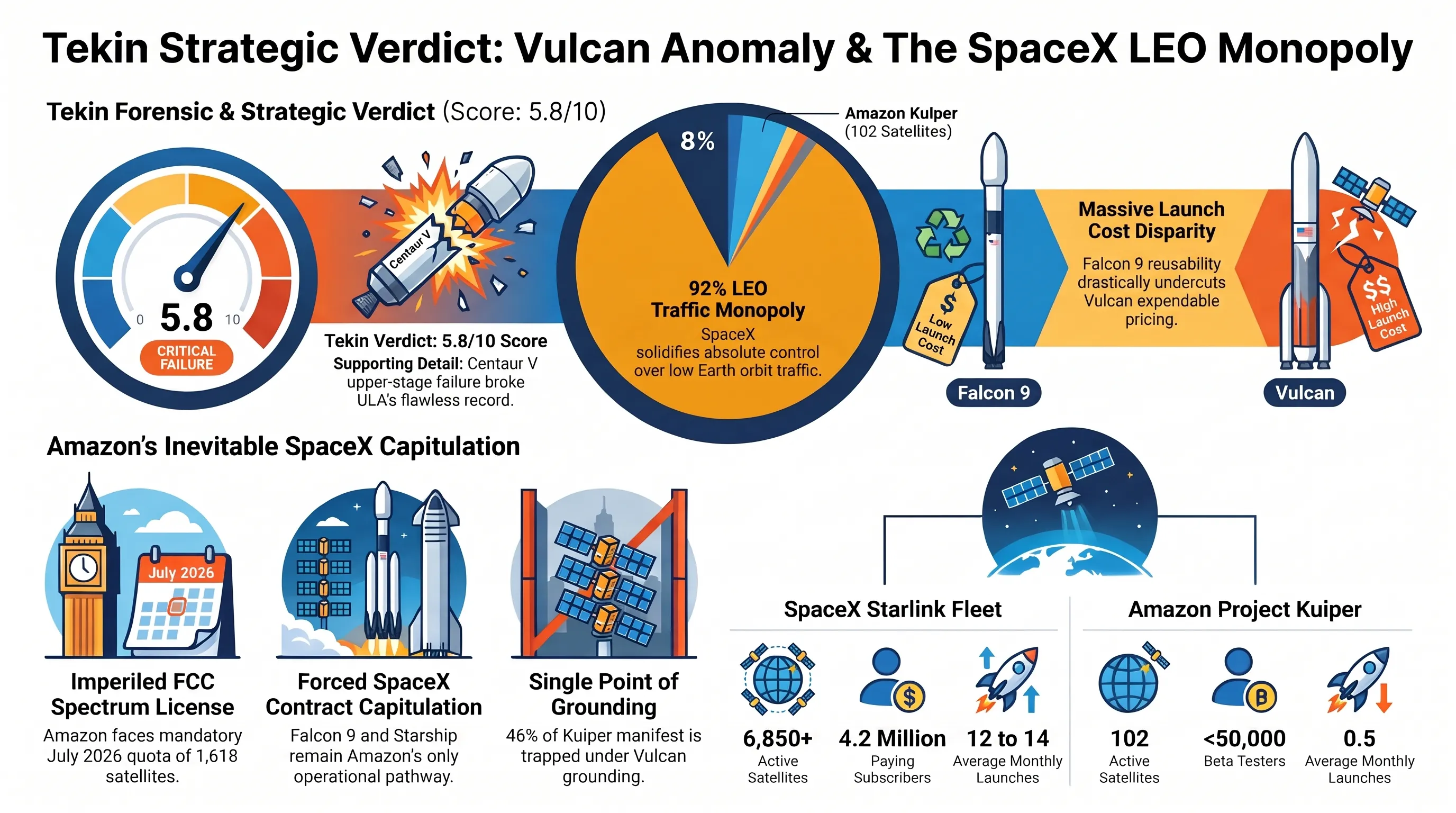
The fiery demise of the Vulcan Centaur upper stage exposes an acute structural vulnerability at the core of Amazon's ambitious $10 billion broadband initiative. While Elon Musk's Starlink constellation has achieved planetary scale with over 6,850 active satellites in Low Earth Orbit serving more than 4.2 million enterprise, government, and consumer subscribers across 100 nations, Amazon has yet to generate a single dollar of commercial revenue after six years of intensive capital expenditure.
Corporate strategists at Amazon originally calculated that massive cloud profitability generated by Amazon Web Services (AWS) would allow the company to bypass the tedious, decade-long organic development of an in-house reusable rocketry fleet. By signing the largest commercial launch procurement contract in aerospace history booking 38 Vulcan launches from ULA, 18 Ariane 6 flights from Europe's Arianespace, and 12 New Glenn missions from Blue Origin Amazon believed sheer purchasing power would guarantee rapid orbital saturation. That assumption has collided violently with the physical constraints of expendable rocketry.
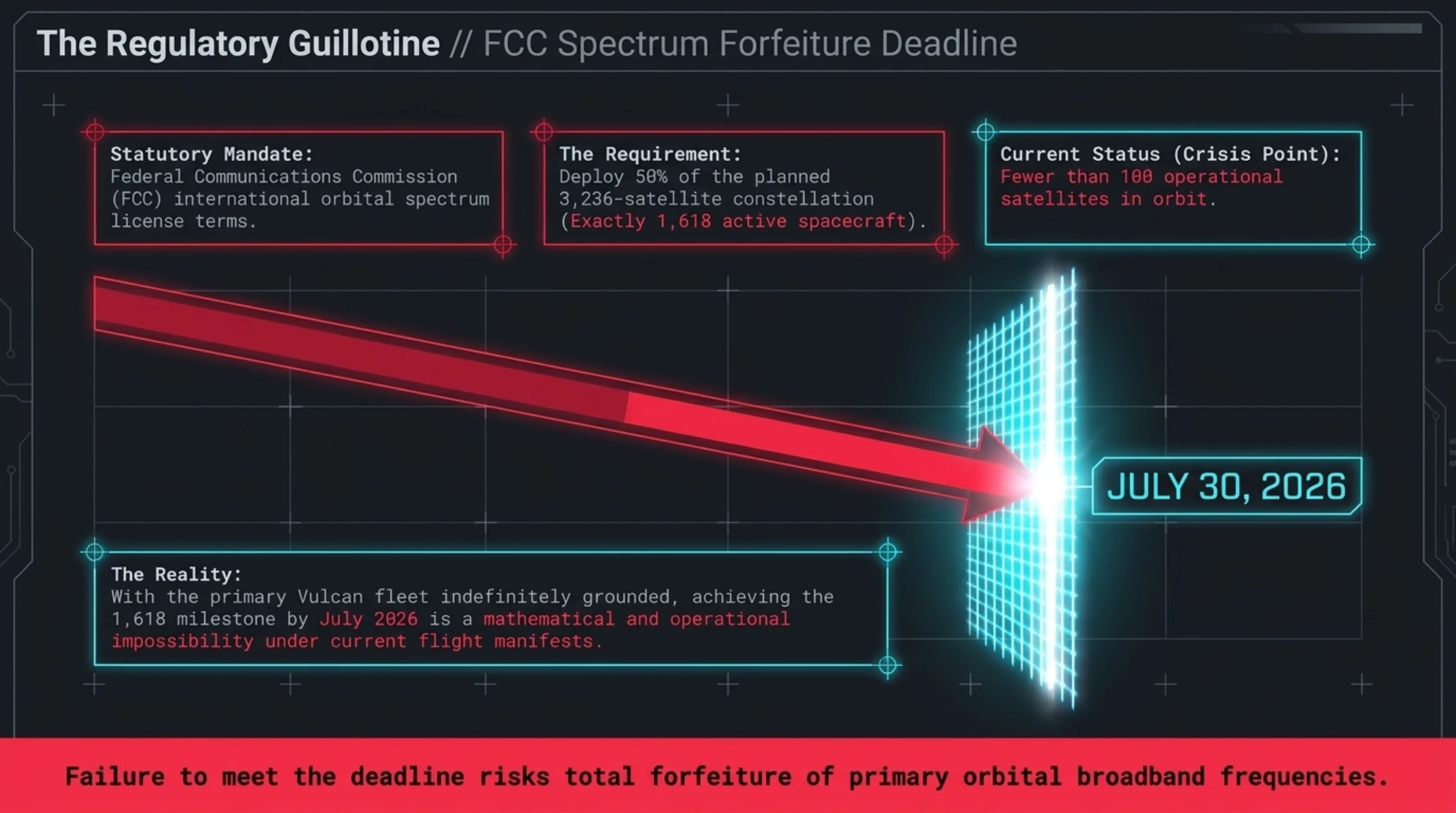
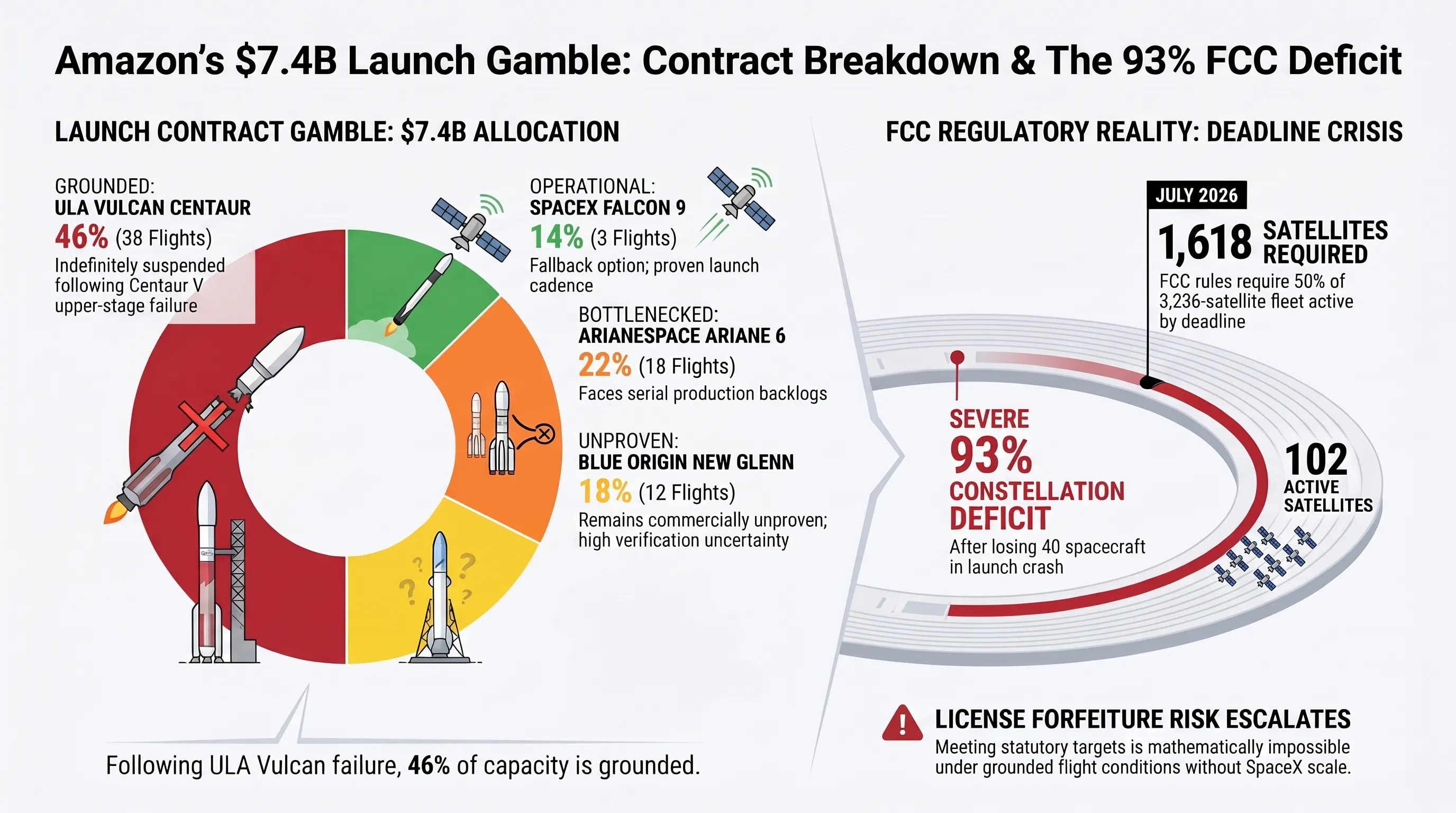
Under the statutory requirements of its international orbital spectrum license issued by the Federal Communications Commission (FCC), Amazon is legally obligated to deploy at least fifty percent of its planned 3,236-satellite constellation precisely 1,618 operational spacecraft no later than July 30, 2026. Prior to the November 15 launch, fewer than 100 prototype and early test satellites were operational in orbit. The total incineration of 40 fully instrumented second-generation satellites renders meeting this regulatory target an operational impossibility under current flight manifests.
Building a global megaconstellation is a brutal war of attrition dictated by launch cadence and loss margins. While SpaceX achieves an unprecedented launch frequency averaging one Falcon 9 mission every 65 hours with a launch reliability rate exceeding 99.5%, United Launch Alliance requires between 40 and 60 days to manufacture, transport, and integrate an expendable Vulcan booster at its Decatur, Alabama assembly plant. This operational chasm leaves Project Kuiper stranded while Starlink locks up consumer and enterprise broadband demand worldwide.
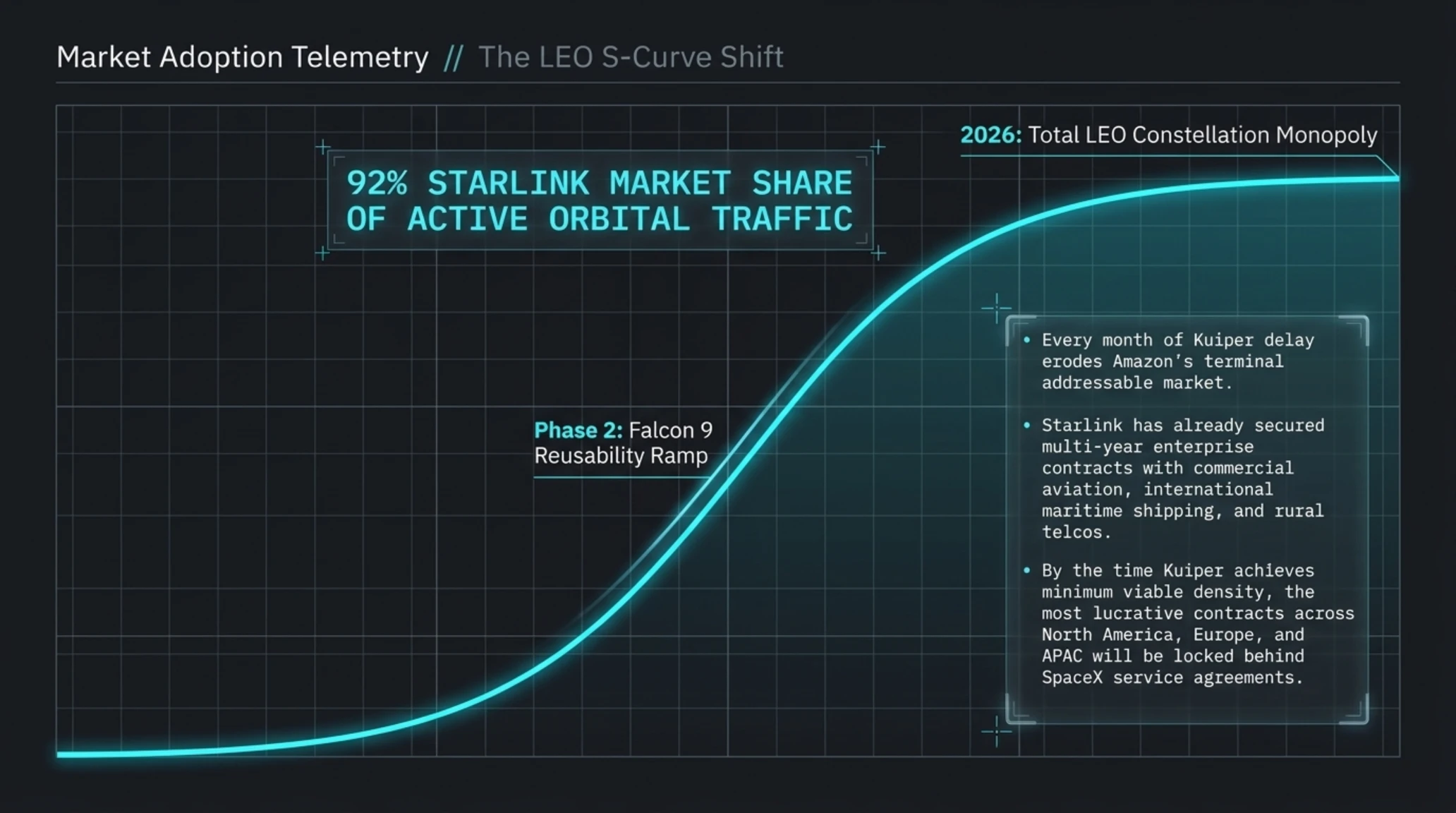
Wall Street equity analysts note that every month of launch delay directly erodes Amazon's terminal addressable market. Starlink has already locked in multi-year enterprise contracts with major commercial aviation carriers, international maritime shipping fleets, and rural telecommunications operators. By the time Kuiper achieves minimal viable commercial density, the most lucrative enterprise and government contracts across North America, Europe, and Asia Pacific will be firmly secured behind SpaceX multi-year service agreements.
Aerospace Technical Lexicon // Core Propulsion & Orbital Telemetry Terms
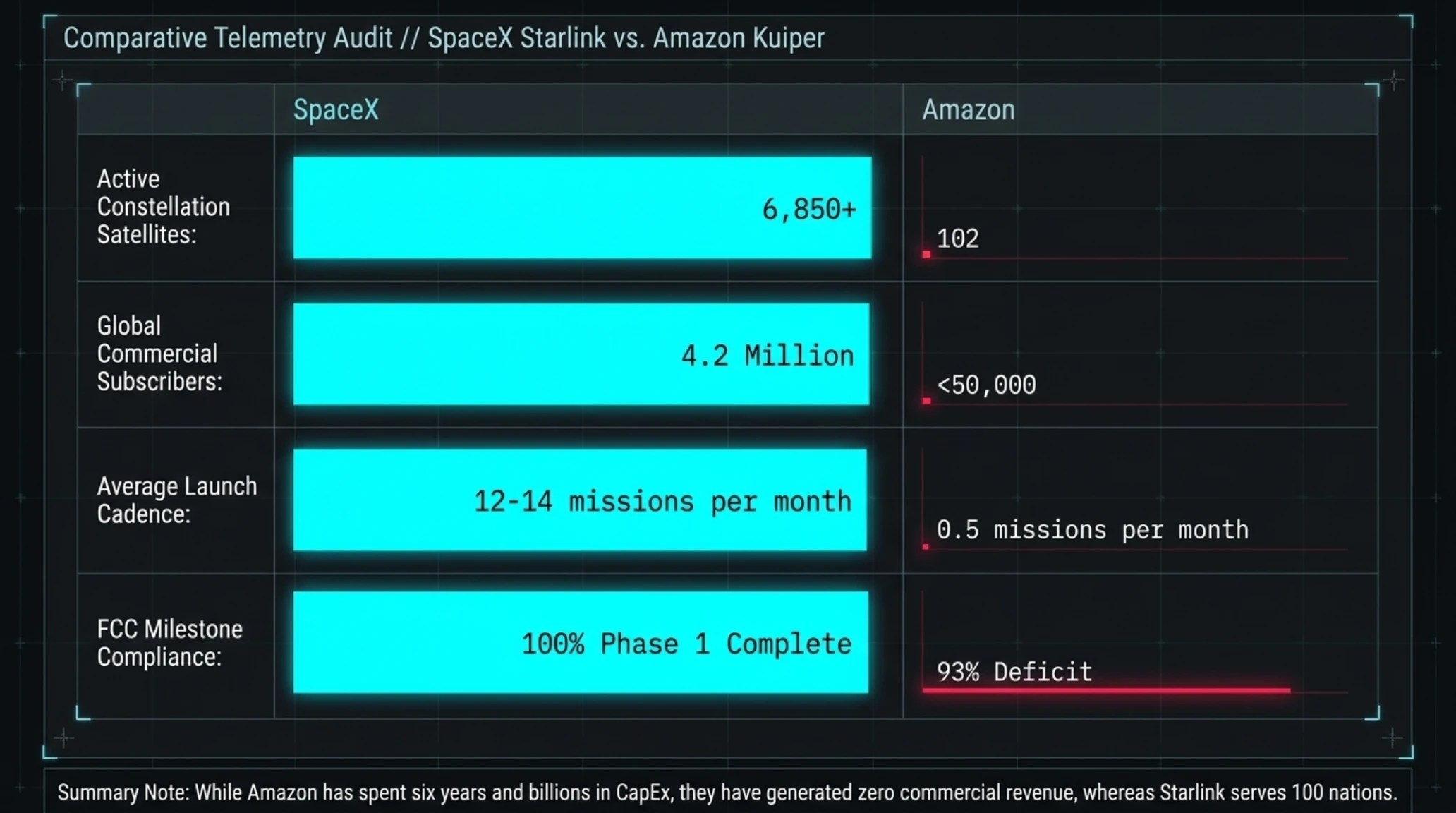
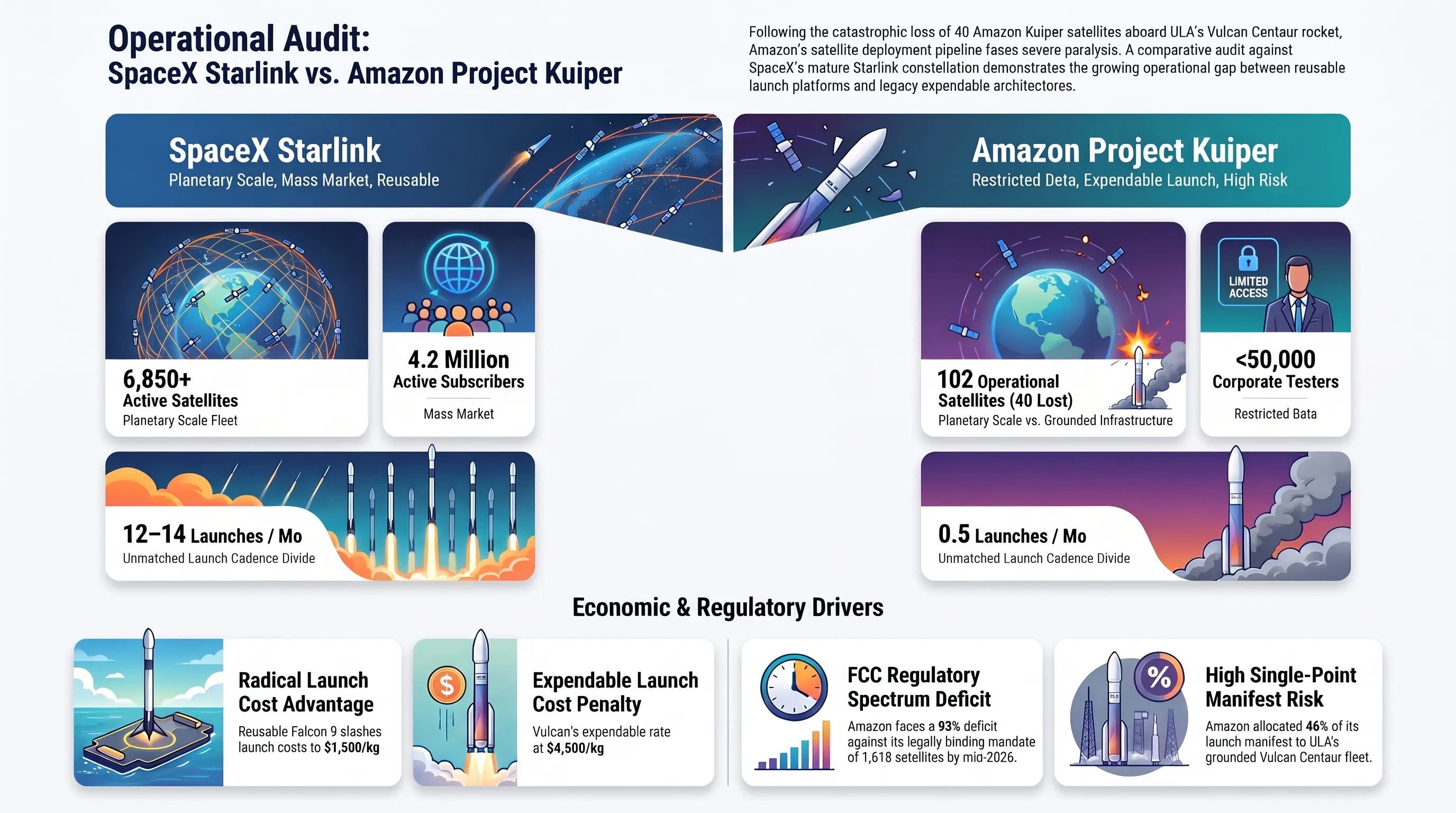
Examining the stark quantitative divergence between Starlink's mature orbital network and Project Kuiper's paralyzed infrastructure illustrates the decisive operational disparity governing commercial Low Earth Orbit:
Comparative Orbital Metrics // Operational Telemetry: Starlink vs. Project Kuiper
| Operational Performance Metric | SpaceX Starlink Fleet (Operational Standard) | Amazon Project Kuiper (Crisis Position) |
|---|---|---|
| Total Active Constellation Satellites | 6,850+ Satellites with Optical Crosslinks | 102 Satellites in Orbit (After Loss of 40) |
| Paying Global Commercial Subscribers | 4.2 Million Enterprise and Consumer Users | Fewer than 50,000 Corporate Beta Testers |
| Average Monthly Launch Manifests | 12 to 14 Launches Monthly via Falcon 9 | 0.5 Launches Monthly via Expendable Fleet |
| Statutory FCC License Milestone Compliance | 100% Phase 1 Complete; Phase 2 Approved | Severe 93% Deficit Against July 2026 Mandate |
Launch Economics & The Reusability Divide: Why Vulcan's $4,500/kg Pricing Buckled Under Falcon 9 Supremacy
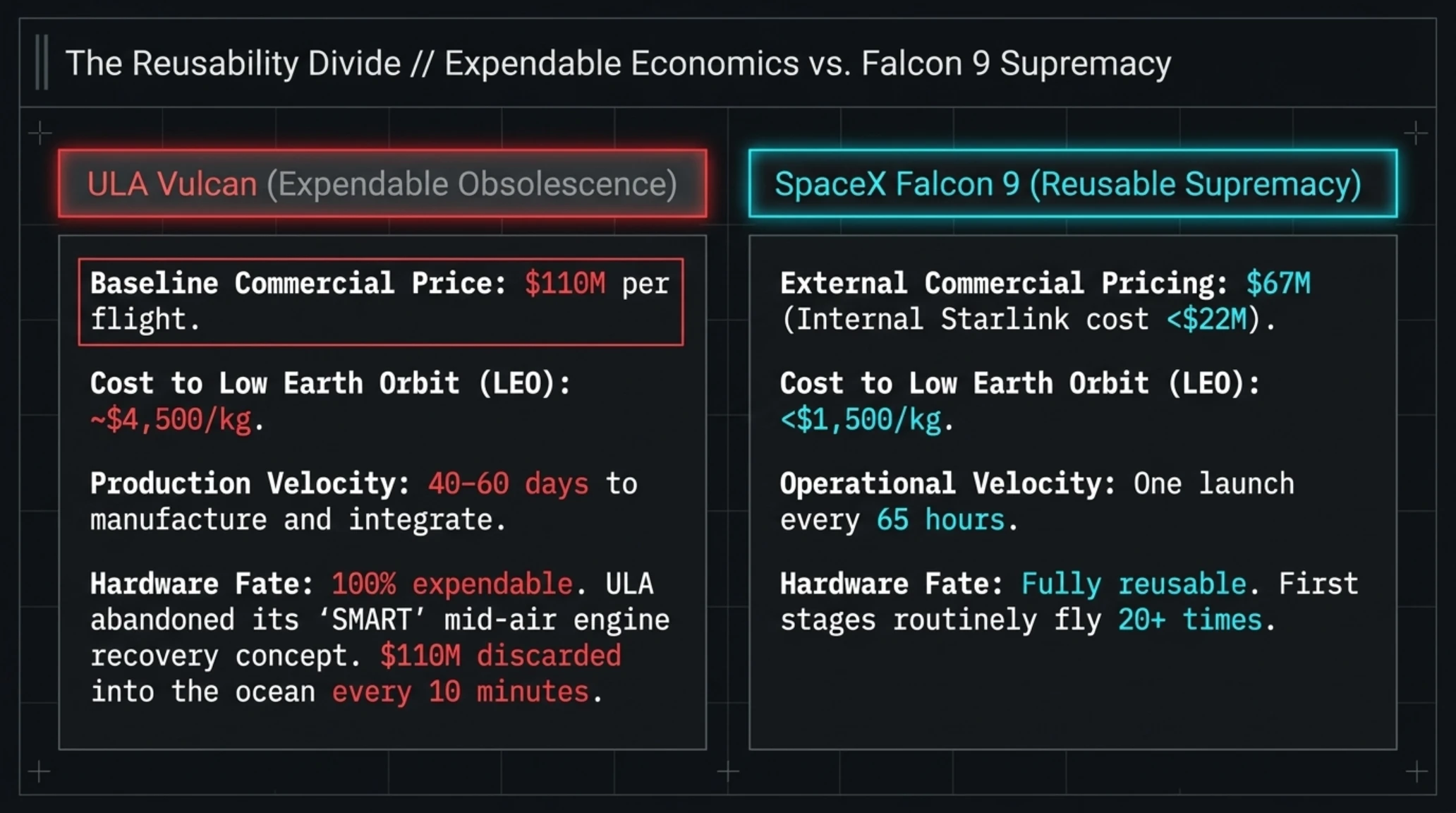
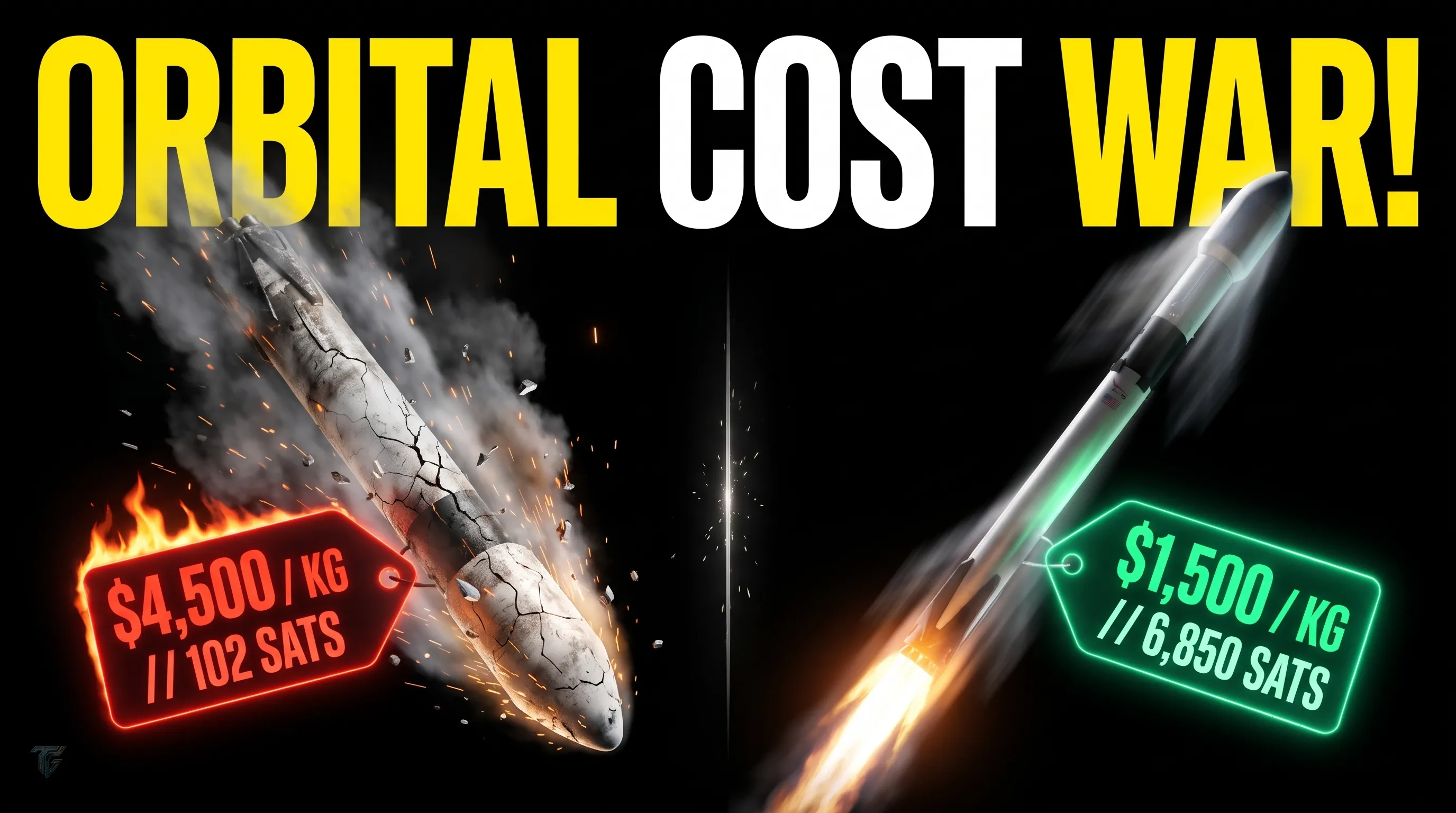
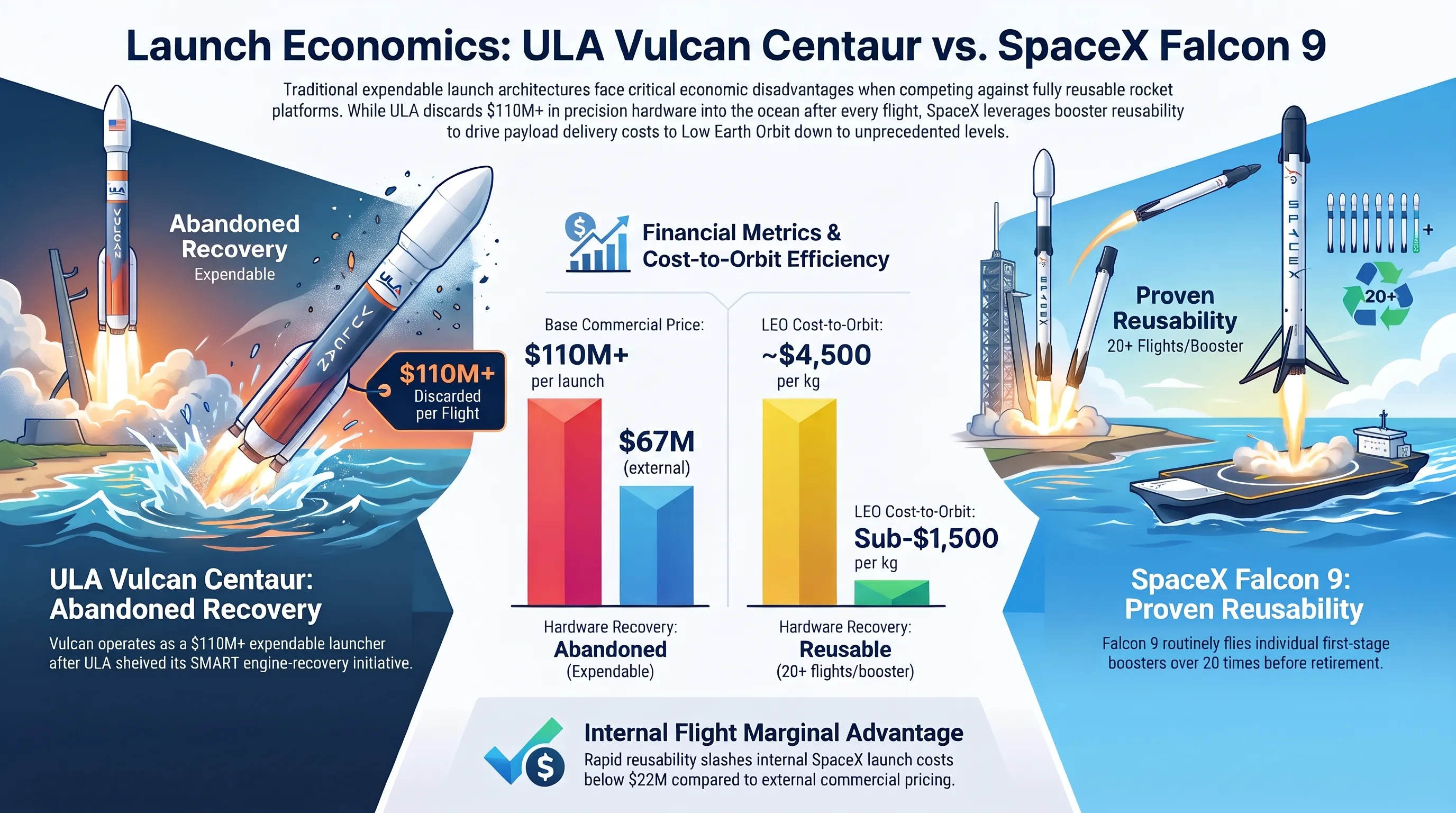
The root cause of ULA's industrial vulnerability extends far beyond a single turbopump cavitation failure; it marks the decisive economic collapse of traditional expendable rocketry against the ruthless financial efficiencies of fully reusable orbital launch platforms. United Launch Alliance developed Vulcan Centaur as a modernized, lower-cost successor to the venerable Atlas V. Yet despite significant design optimizations, Vulcan's commercial base price remains anchored at approximately $110 million per flight, resulting in an exorbitant cost-to-orbit averaging $4,500 per kilogram to Low Earth Orbit.
Conversely, SpaceX pioneered rapid booster reusability with the Falcon 9, routinely flying individual first stages more than twenty times before retirement. This structural breakthrough curtailed external commercial pricing to $67 million per mission, while slashing internal flight marginal costs for Starlink deployment below $22 million. By driving launch costs below $1,500 per kilogram, SpaceX established a structural economic moat that renders every competing expendable launcher economically obsolete from the moment of conception.
Early in Vulcan's engineering program, ULA leadership announced an ambitious recovery concept known as SMART (Sensible Modular Autonomous Recovery Technology), proposing to jettison the high-value BE-4 engine module at atmospheric entry and capture it mid-air via parachute hooks. However, confronted with chronic engineering delays and mounting budget pressures, ULA quietly shelved the SMART architecture, leaving Vulcan as a purely expendable vehicle where $110 million of precision aerospace hardware is discarded into the ocean after a single ten-minute flight.
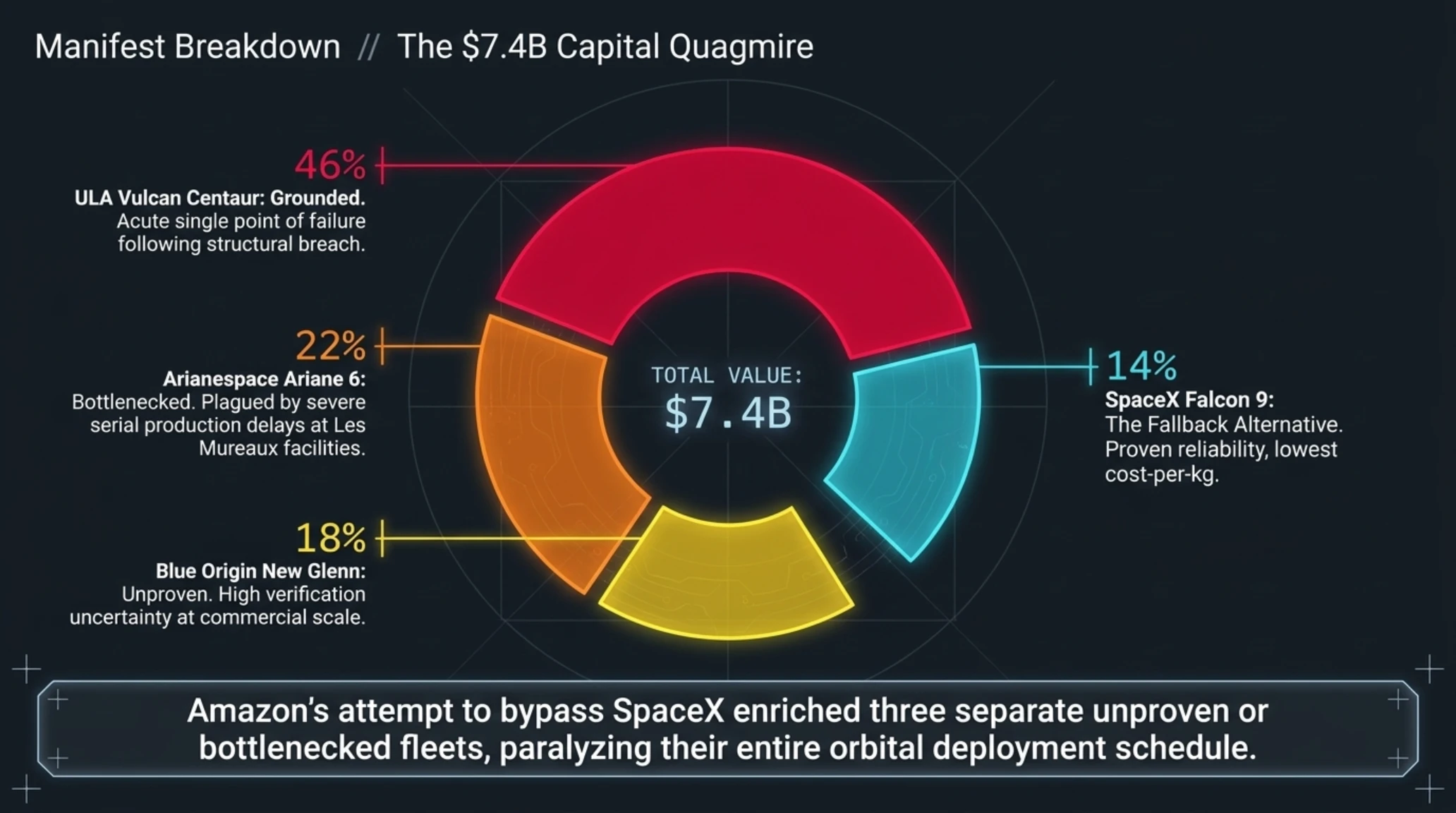
Amazon's procurement strategy compounded this systemic vulnerability. Confronted with regulatory deadlines, Amazon signed a $7.4 billion contract across three non-SpaceX launch providers. Yet Europe's Ariane 6 has been plagued by severe serial production bottlenecks at its Les Mureaux facilities, while Blue Origin's heavy-lift New Glenn launcher remains untested at commercial scale. Entrusting 46 percent of its launch manifest to an expendable Vulcan booster created an acute single point of failure that has now paralyzed Amazon's entire orbital deployment schedule.
Wall Street capital analysts increasingly warn that unless Amazon swallows corporate pride and books dedicated Falcon 9 and Starship flights from SpaceX, the window of commercial viability for Project Kuiper will slam shut permanently, leaving the company with billions in stranded satellite hardware in warehouse facilities across the Pacific Northwest.
Launch Contract Allocations & Deployment Modeling // Project Kuiper Manifest Breakdown
| Launch Vehicle Partner | Share of Contract Manifest | Operational Status & Supply Chain Risk |
|---|---|---|
| United Launch Alliance (Vulcan Centaur) | 46% Allocation (38 Confirmed Flights) | Total Flight Grounding Following Centaur V Structural Breach |
| Arianespace (European Ariane 6 Heavy) | 22% Allocation (18 Confirmed Flights) | Production Backlog Bottlenecks Limiting Launch Cadence |
| Blue Origin (New Glenn Heavy Lift) | 18% Allocation (12 Initial Flights) | Unproven Flight Track Record; High Verification Uncertainty |
| SpaceX (Reusable Falcon 9 Vehicle) | 14% Allocation (3 Emergency Flights) | Proven Reliability; Lowest Cost-per-Kilogram in Global Fleet |
Pentagon's Dual-Source Dilemma: The National Security Crisis Behind Frozen NSSL Manifests
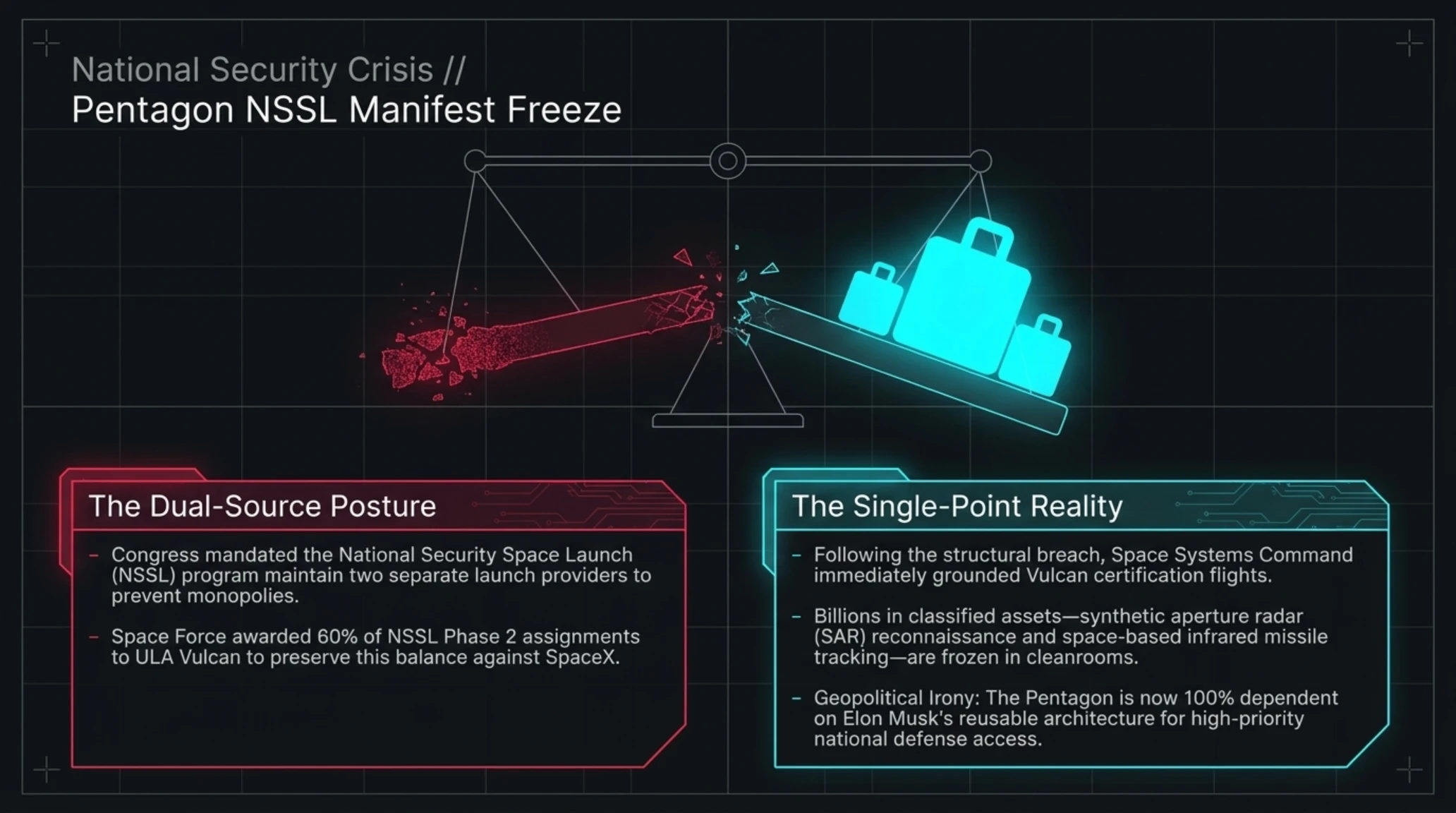
The strategic ramifications of Vulcan's orbital failure extend far beyond commercial balance sheets, striking at the foundational architecture of United States national defense in space. Under statutory mandates established by the United States Congress, the Department of Defense is legally required to maintain a robust "dual-sourcing" posture for its National Security Space Launch (NSSL) program, ensuring that the nation's military intelligence infrastructure never depends upon a single commercial launch provider for orbital access.
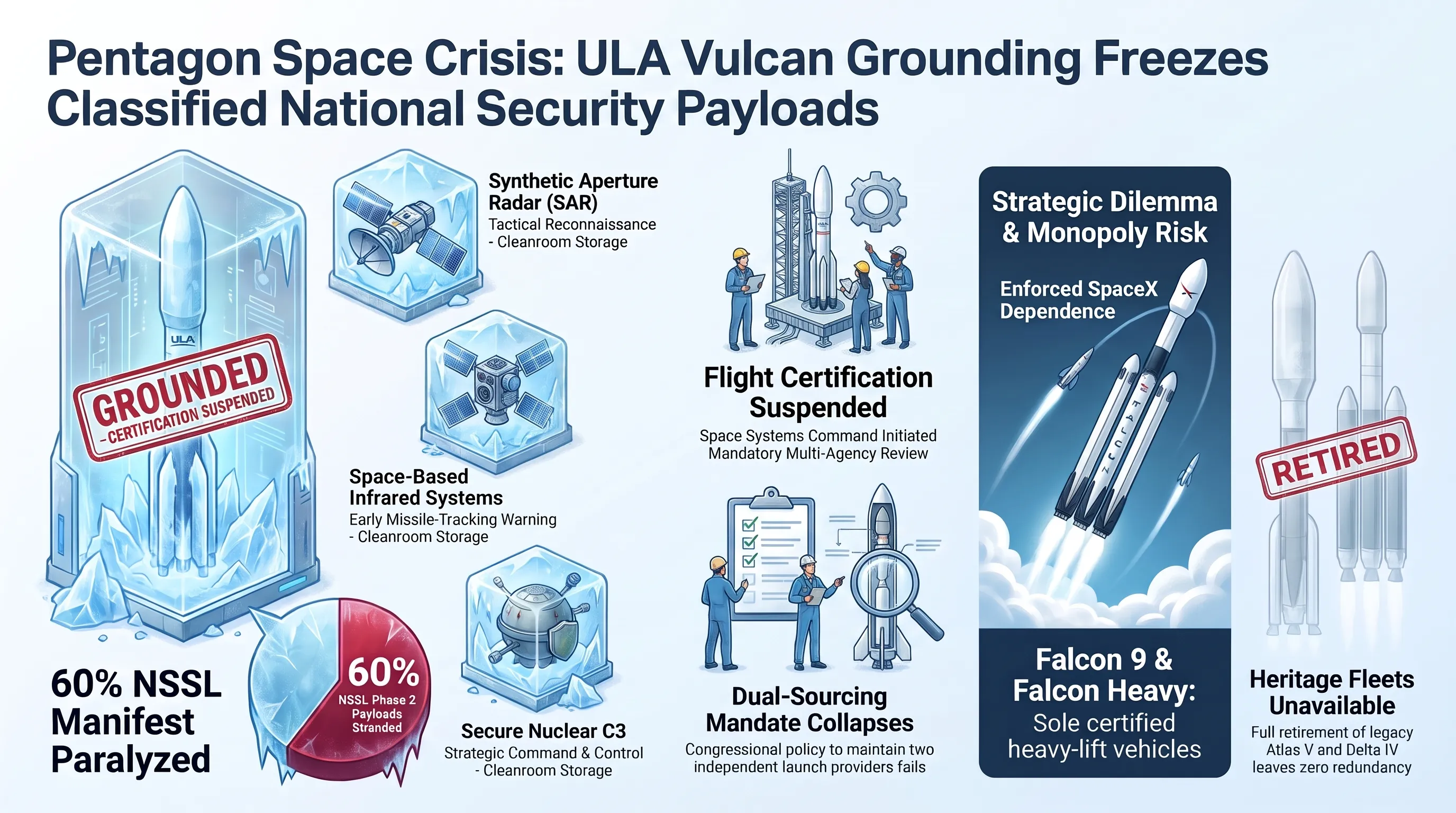
To preserve this balance, the United States Space Force awarded sixty percent of its multi-billion-dollar NSSL Phase 2 launch assignments to United Launch Alliance's Vulcan Centaur, deliberately prioritizing the legacy contractor over SpaceX to foster industrial competition. Following the catastrophic upper-stage structural breach at SLC-41, Space Systems Command immediately suspended Vulcan's operational flight certification pending a comprehensive multi-agency safety review.
This emergency suspension paralyzes the Pentagon's classified deployment schedule. Billions of dollars in next-generation orbital defense assets including advanced synthetic aperture radar (SAR) reconnaissance spacecraft, space-based infrared missile tracking satellites, and secure nuclear command-and-control relays intended for high-energy geosynchronous trajectories are effectively grounded in cleanroom storage facilities with no near-term path to orbit.
The grounding leaves Washington defense planners confronting an awkward geopolitical irony. In attempting to prevent SpaceX from establishing a private monopoly over national security space access, the Pentagon now finds itself completely dependent upon Elon Musk's Falcon 9 and Falcon Heavy vehicles. With heritage Atlas V and Delta IV rockets fully retired, SpaceX stands as the only operational aerospace entity in the Western hemisphere certified to launch America's most sensitive national security payloads.
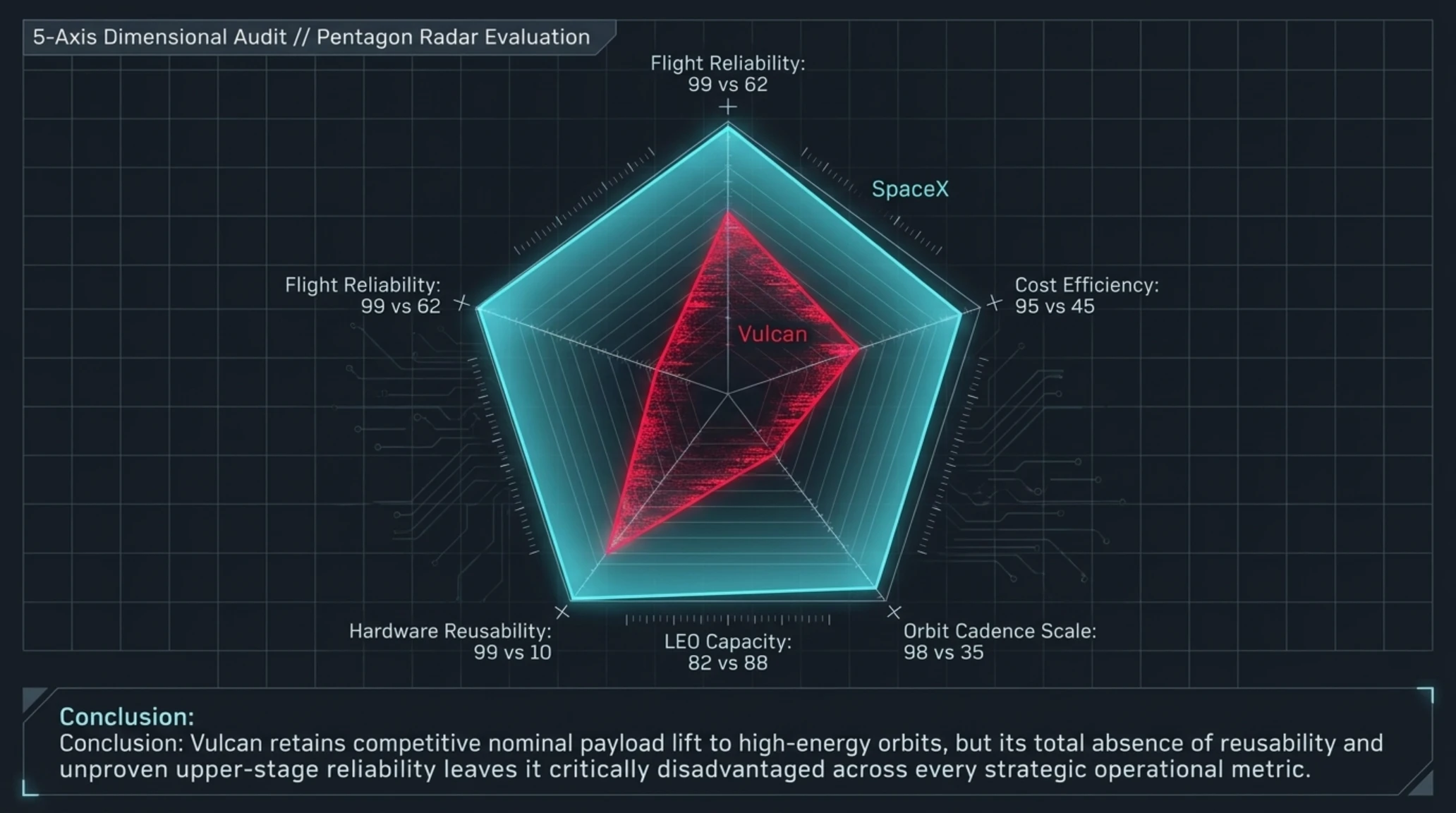
5-Axis Aerospace Pentagon Radar // ULA Vulcan vs. SpaceX Falcon Architecture
📚 Classified & Related Dossiers in TekinGame
If you wish to explore beyond this report and delve into cybernetic frontiers and autonomous AI architectures, do not miss these three exclusive deep-dives in the Tekin Garage:
Deconstructing the high-frequency telemetry logs recorded during the terminal seconds of the Centaur V stage highlights the catastrophic cascade that led to vehicle destruction:
Flight Telemetry Terminal Benchmark // Forensic Reconstruction of Vulcan Anomaly
Recovery Scenarios & Orbital Realities: Will Jeff Bezos Capitulate to Starship Supremacy?
In the executive suites of Amazon's corporate headquarters in Seattle, leadership faces an existential crossroads that will define the future of the company's hardware ambitions. Convening an independent Accident Investigation Board (AIB) under the oversight of the Federal Aviation Administration (FAA) requires between six and nine months to identify root metallurgical causes, redesign turbopump thermal baffling, and recertify RL10C hardware via static test-stand firings. During this protracted hiatus, every Vulcan booster remains grounded.
This prolonged grounding directly threatens Amazon's satellite production pipeline. In Kirkland, Washington, Amazon's dedicated state-of-the-art manufacturing facility was built to assemble up to five satellites daily using automated precision robotics. Without operational rockets to carry finished hardware to orbit, satellite inventory is rapidly saturating nitrogen-purged storage vaults, generating massive warehousing, environmental testing, and holding costs with zero incoming commercial cash flow.
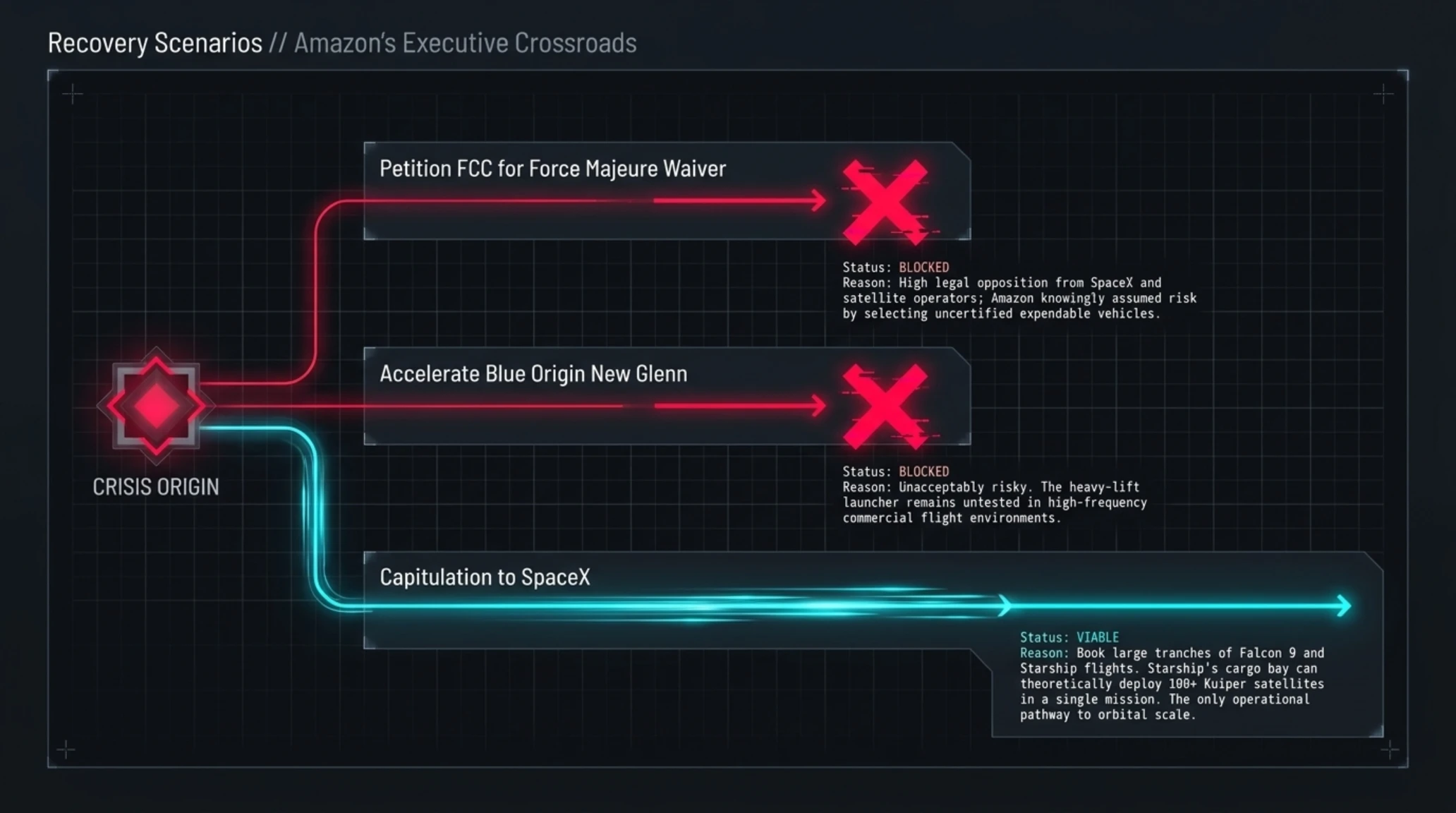
Faced with these compounding pressures, Amazon leadership has only three realistic courses of action. The first is to petition the FCC for an emergency regulatory deadline waiver, arguing that launch vehicle failures represent an unforeseen force majeure event. However, this strategy faces fierce legal opposition from SpaceX and satellite operators who contend that Amazon knowingly assumed commercial risk by selecting uncertified expendable vehicles.
The second scenario involves pressuring Blue Origin to accelerate commercial deployment of its New Glenn rocket. Yet New Glenn remains unproven in high-frequency flight environments, making reliance upon another uncertified vehicle an unacceptably risky gamble for multi-billion-dollar commercial payloads.
Consequently, the third scenario once considered unthinkable inside Amazon boardrooms is rapidly emerging as the sole viable commercial lifeline: full capitulation to SpaceX by booking large tranches of Falcon 9 and Starship flights. Starship's massive internal cargo bay could theoretically deploy over 100 Kuiper satellites in a single mission. However, taking this path requires Amazon to acknowledge that after spending billions to cultivate launch alternatives, Elon Musk's reusable launch architecture remains the only operational pathway to orbital scale.
Market adoption curves across global satellite telecommunications underscore Starlink's decisive acceleration toward near-total market capture:
Market Adoption Telemetry // S-Curve Shift in Orbital Broadband Dominance
The historical trajectory of heavy-lift commercial rocketry across the past two decades confirms that Vulcan's failure represents the structural culmination of a widening technological chasm:
Historical Event Timeline // 20-Year Evolution of ULA and the Orbital Launch Race (Timeline)
| Historical Milestone | Engineering & Industrial Development | Strategic Market Realignment |
|---|---|---|
| Dec 2006 | Formation of United Launch Alliance by Lockheed and Boeing | Created absolute duopoly control over US national security launches. |
| Apr 2019 | Amazon Formally Announces Project Kuiper Constellation | Committed $10B to construct a 3,236-satellite global broadband network. |
| Jan 2024 | Vulcan Centaur Executes Inaugural Test Flight (Cert-1) | Demonstrated BE-4 booster performance as the successor to Atlas V. |
| Nov 2026 | Catastrophic Centaur Upper-Stage Failure Destroys 40 Satellites | Broke ULA's 20-year flawless record and paralyzed Kuiper deployment. |
Strategic Verdict: Hard Lessons from the Vulcan Anomaly for the Future of Commercial Space
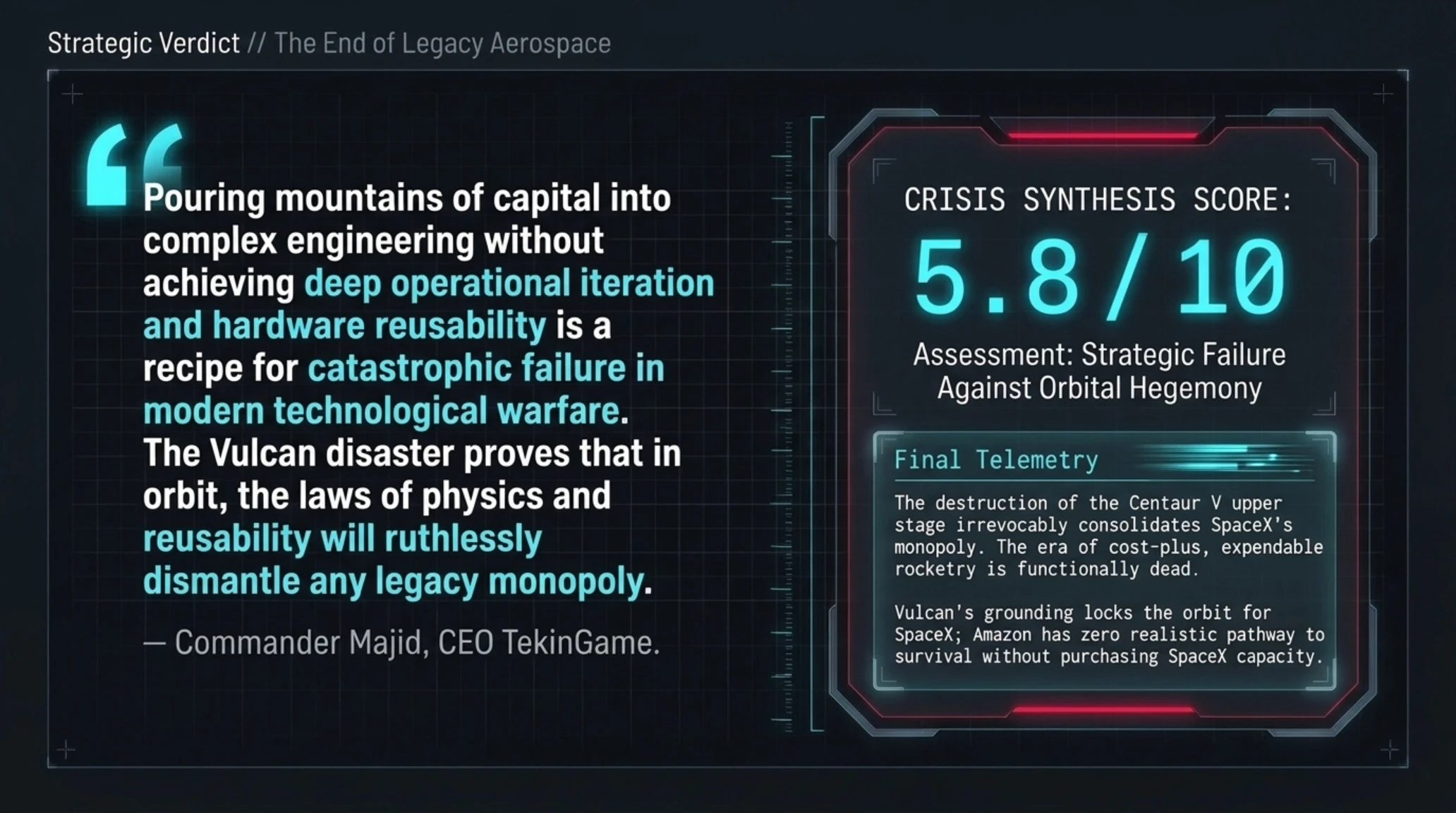
The fiery disintegration of Vulcan Centaur over the Atlantic marks a decisive watershed in the evolution of modern aerospace capitalism. For decades, legacy defense contractors operated within the comfortable sanctuary of cost-plus federal procurement, where mission success was certified through mountains of documentation, endless review committees, and multi-year delays rather than rapid physical hardware iteration in production factories.
That era has ended. As the destruction of 40 Amazon satellites vividly demonstrates, neither corporate balance sheets overflowing with AWS cash flows nor sole-source political backing can insulate an expendable rocket from the brutal economic realities of reusability. When a competitor launches reusable rockets with airliner-like cadence at a fraction of the cost, relying upon expendable vehicles that discard $110 million of high-value propulsion hardware into the sea is an unsustainable strategy.
Amazon now confronts an uncomfortable corporate crossroads. Jeff Bezos can either adhere to corporate antipathy and watch Project Kuiper miss its statutory FCC deployment milestones while waiting out a lengthy FAA accident review, or capitulate to operational necessity by purchasing large flight blocks on SpaceX's Falcon 9 and Starship vehicles. The choice made in the coming weeks will determine whether Amazon remains a viable contender in planetary telecommunications or settles for an expensive footnote in the history of commercial space.
- Exceptional vacuum specific impulse delivered by the RL10C cryogenic hydrogen engine under nominal conditions
- Flawless first-stage performance and stable methane combustion by the twin BE-4 booster engines through stage separation
- High theoretical payload lift capability to high-energy geosynchronous transfer trajectories
- Substantial multi-year institutional backlog with the United States Space Force
- Purely expendable vehicle architecture imposing severe $110M+ baseline cost penalties per launch
- Acute single point of failure within the Centaur V liquid hydrogen turbopump and nozzle structure
- Critical regulatory exposure regarding Amazon's mandatory July 2026 FCC constellation deployment deadline
- Indefinite fleet grounding freezing multi-billion-dollar national security and commercial reconnaissance payloads
For a technical investigation into next-generation semiconductor hardware and orbital network topologies, explore our analysis of custom silicon manufacturing nodes and high-bandwidth processing fabrics.
To examine the economic dynamics and platform convergence shaping orbital communications, review our deep-dive into space-based broadband networks, latency benchmarks, and hardware infrastructure.
The structural shockwaves of this failure demonstrate that aerospace mission assurance has entered a demanding era where historical pedigree offers zero protection against unproven upper-stage thermodynamic stresses.
The reverberations of this launch failure across Wall Street equity desks and Washington policy circles will inevitably force global institutional investors to re-evaluate capital allocations across the satellite broadband sector, prioritizing proven launch cadence over optimistic paper manifests.
To address the most pressing technical questions and provide a clear synthesis of the commercial implications following this orbital catastrophe, the following section delivers our final executive assessment and answers to core industry inquiries:
War Room Final Strategic Verdict // Verified Documentation and Primary Sources (Conclusion & Sources)
- The Verge: Breaking Investigation: ULA Vulcan Rocket Disintegrates, Destroying 40 Amazon Kuiper Satellites
- Reuters: National Security Ramifications: Space Force Suspends Vulcan Flights Following Centaur Breach
- SpaceflightNow: High-Frequency Telemetry Teardown of RL10C Upper-Stage Anomaly at SLC-41
- Federal Communications Commission (FCC): International Bureau Regulatory Framework Governing Project Kuiper Milestone Deadlines
- Engadget: Launch Economics Analysis: Reusability Cost Advantages of Falcon 9 Over Expendable Fleets
Frequently Asked Questions & Aerospace Technical Audits
Why is the Vulcan failure after 20 years so catastrophic for ULA and Amazon?
The disaster shattered ULA's two-decade record of 100% mission success and incinerated the first flight of Amazon's 38-mission contract, delaying Project Kuiper's commercial deployment by at least 12 critical months.
Will Amazon lose its FCC orbital broadband license because of this crash?
Under FCC rules, Amazon must deploy 1,618 satellites by July 2026. With Vulcan grounded, meeting this target is mathematically impossible without securing emergency regulatory waivers or immediately shifting launches to SpaceX.
What was the exact mechanical root cause of the Vulcan anomaly at T+10m?
Downlinked telemetry indicates severe liquid hydrogen turbopump cavitation inside the RL10C engine, leading to acute pressure collapse, nozzle structural burn-through, and breach of the propellant tank bulkhead.
Is Amazon now forced to purchase rocket launches from its chief rival, SpaceX?
Yes. Because Europe's Ariane 6 is severely bottlenecked and Blue Origin's New Glenn remains unproven, SpaceX's Falcon 9 and Starship represent the only operational heavy launchers capable of deploying Kuiper on schedule.
Additional Gallery: Orbital Catastrophe: ULA Vulcan Rocket Fails, Destroying 40 Satellites