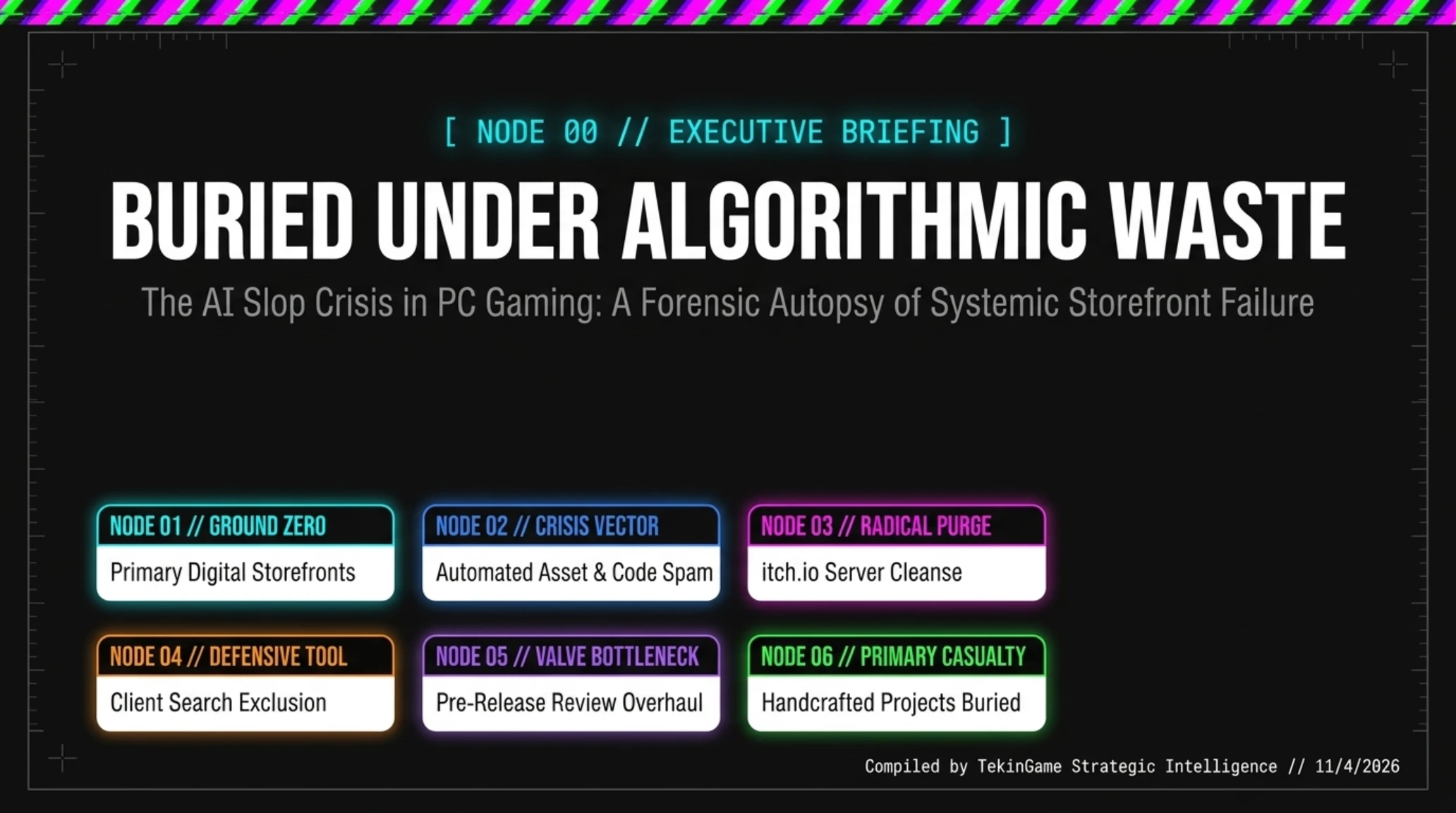
The catastrophic surge of generative AI slop has triggered an existential crisis across Steam and itch.io. Discover how itch.io purged terabytes of spam games and launched the No-AI filter, why Valve pre-release queues face multi-week delays, how real-time cloning exploits Steam Next Fest, and how human curation is re-emerging as the ultimate luxury in digital gaming.
Tekin Analysis | Buried Under Algorithmic Waste: Inside the AI Slop Crisis on Steam and itch.io
Buried Under Algorithmic Waste: The Existential Crisis of AI Slop on Steam and itch.io
The global interactive entertainment ecosystem in late 2026 is grappling with an infrastructural catastrophe that threatens the foundational compact between independent creators, storefront platforms, and discerning players. This phenomenon colloquially and technically designated as "AI Slop" represents the industrial-scale automation of low-effort, synthetic software projects, hallucinatory asset packages, and synthetic copycat titles. Propelled by the uncontrolled proliferation of multimodal generative algorithms and large language model code generators, digital distribution channels have been transformed from democratic showcases of human ingenuity into clogged sewers of machine-generated spam.
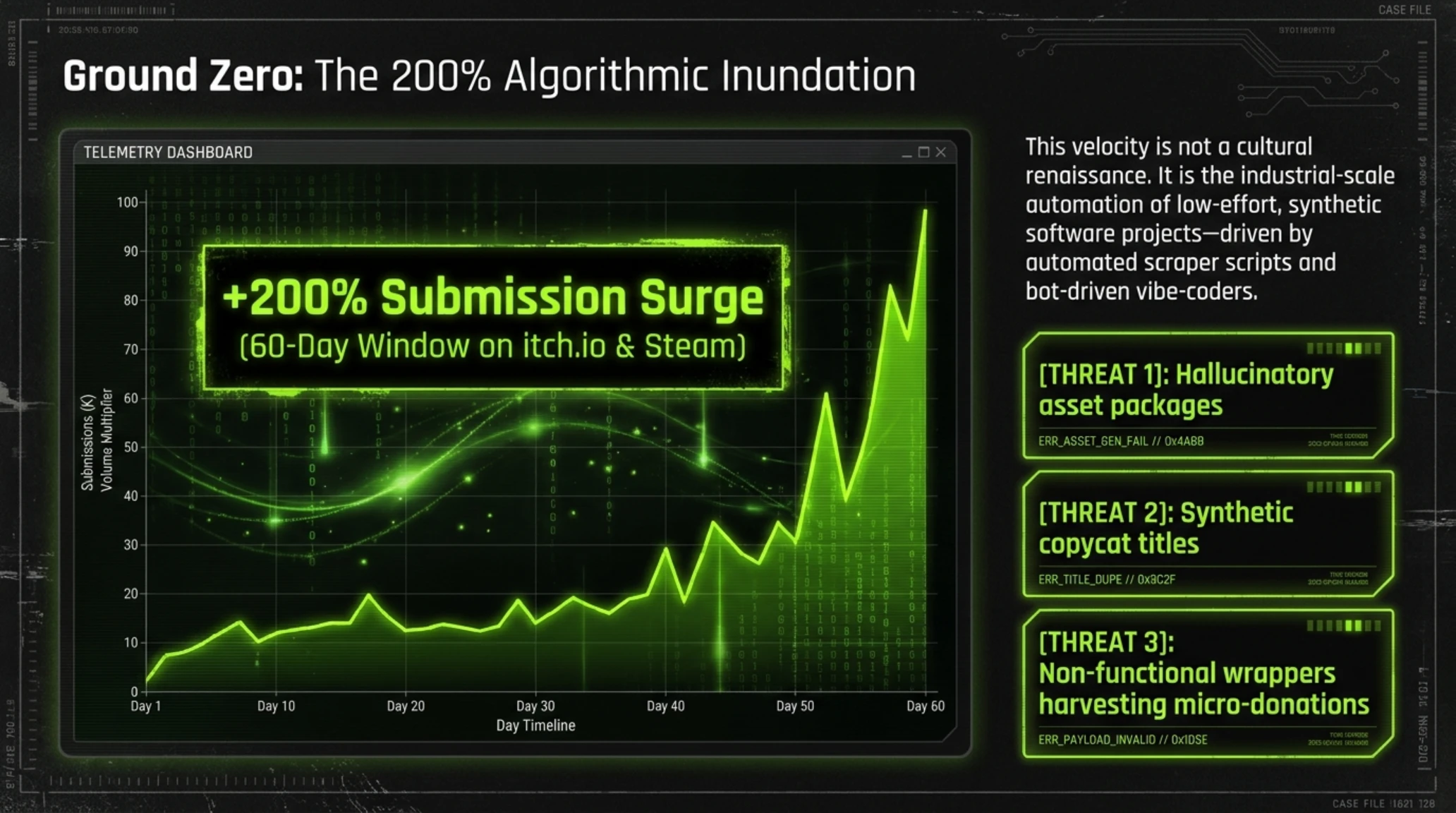
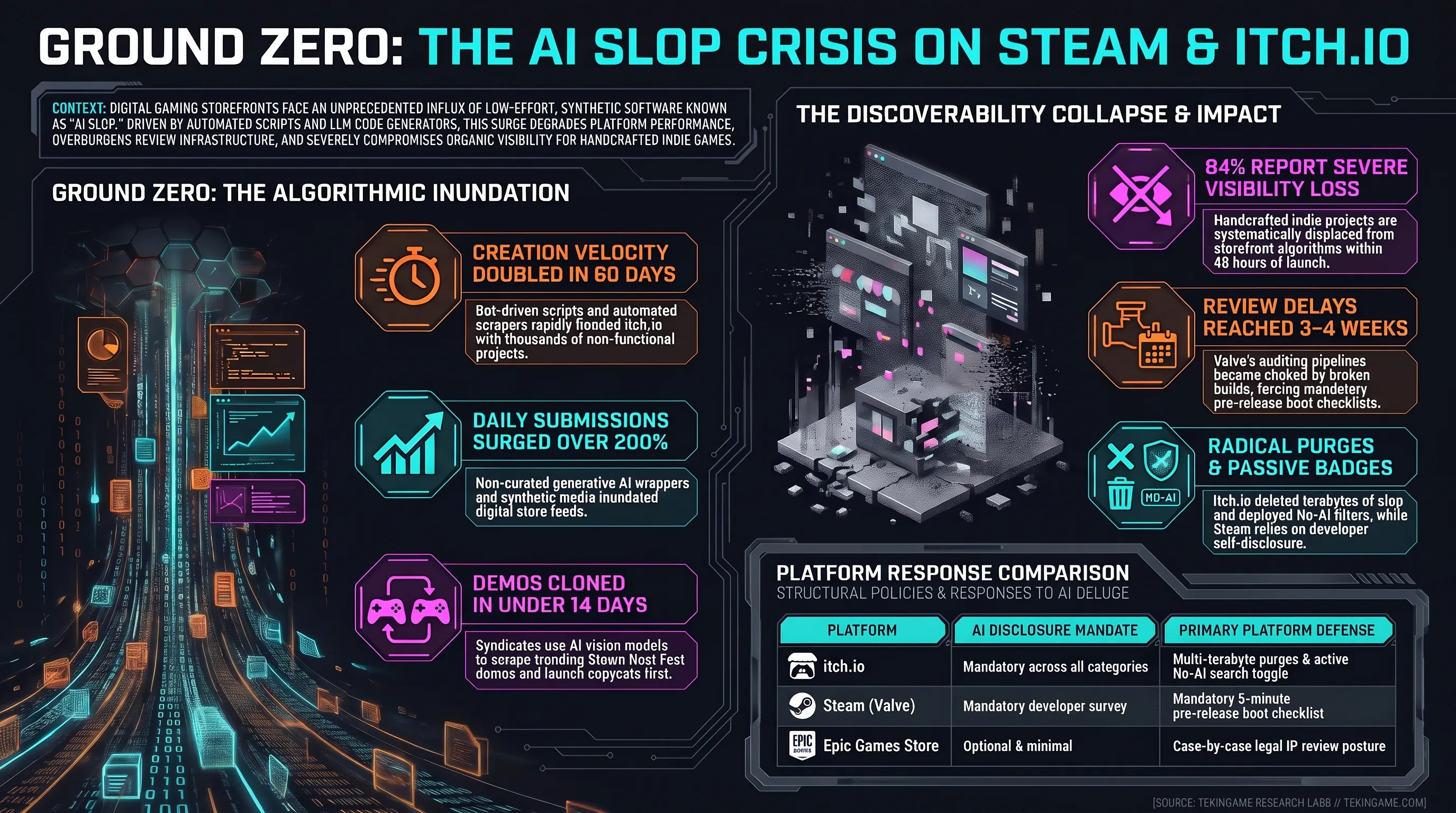
The scale of this algorithmic inundation reached unprecedented severity across two pivotal digital storefronts: Valve Corporation's ubiquitous PC gaming platform, Steam, and itch.io, the revered creative sanctuary for experimental game developers and hobbyist artisans. On itch.io, administrative telemetry revealed a terrifying trajectory: the velocity of newly created game project pages doubled within an astonishing 60-day window. This doubling was not the byproduct of a vibrant cultural renaissance or an influx of passionate new human designers; rather, it was driven almost entirely by automated scraper scripts, rogue monetization networks, and bot-driven "vibe-coders" uploading thousands of non-functional, asset-flipped projects hoping to harvest micro-donations and obscure algorithmic referral traffic.
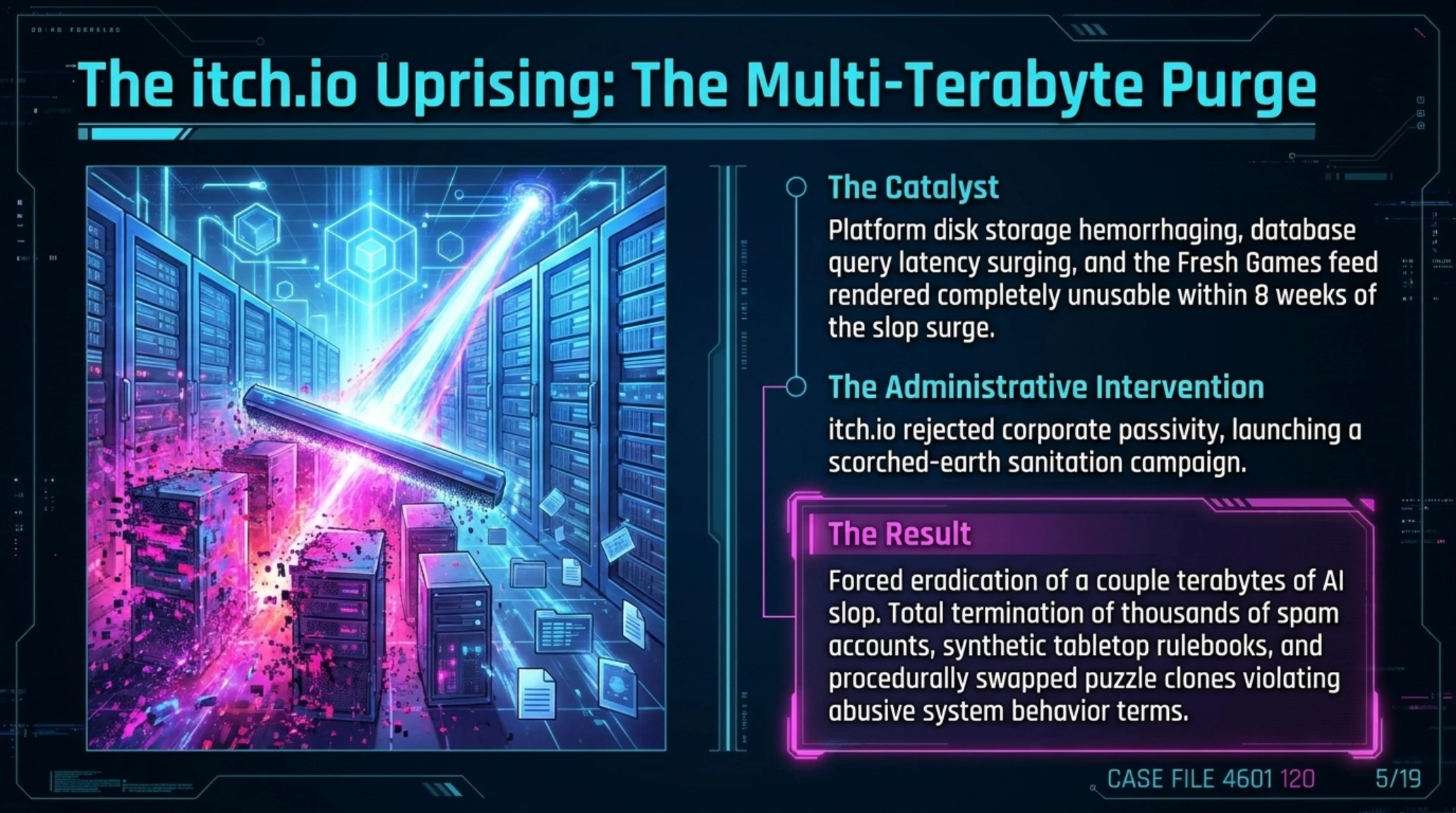
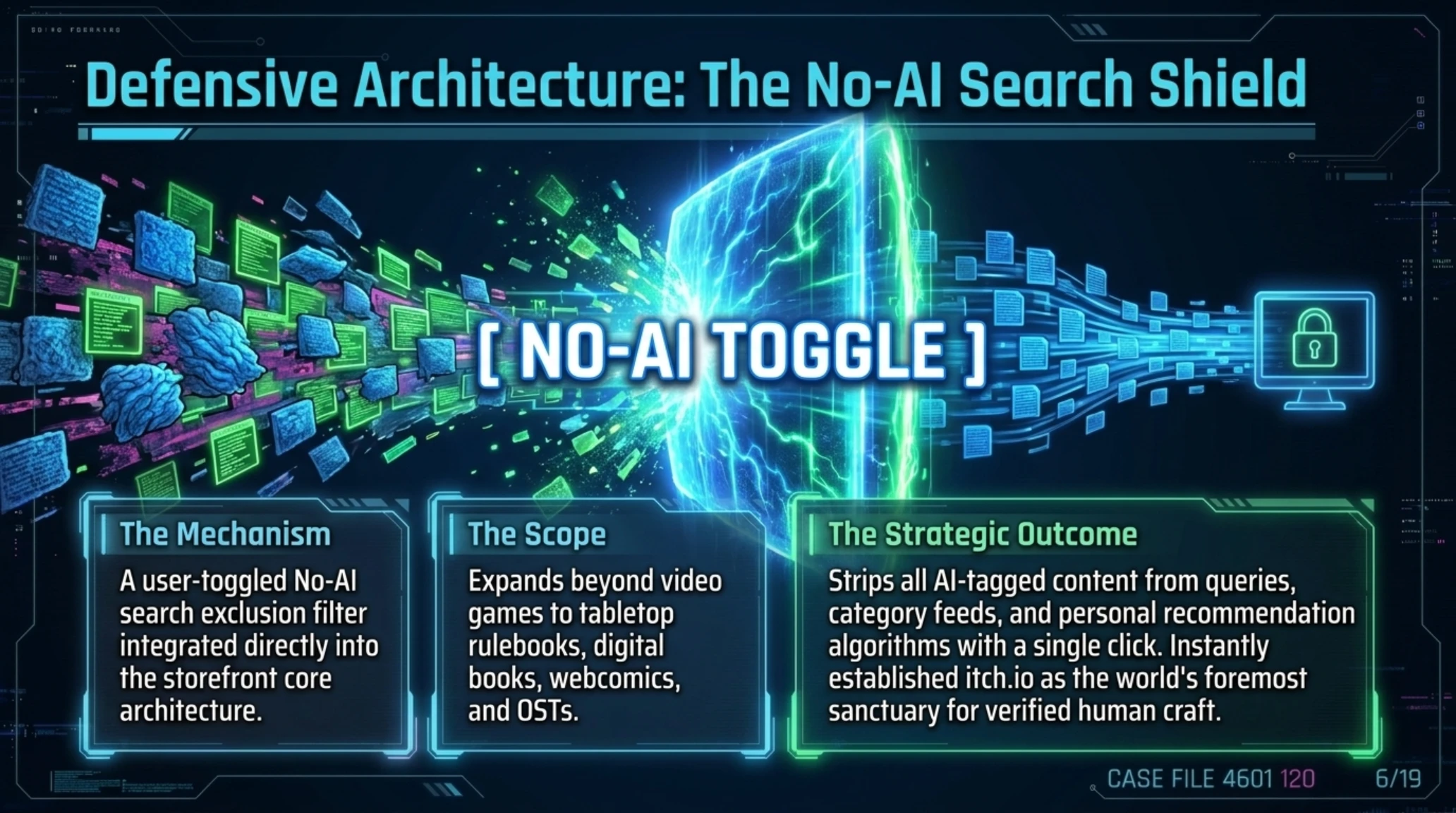
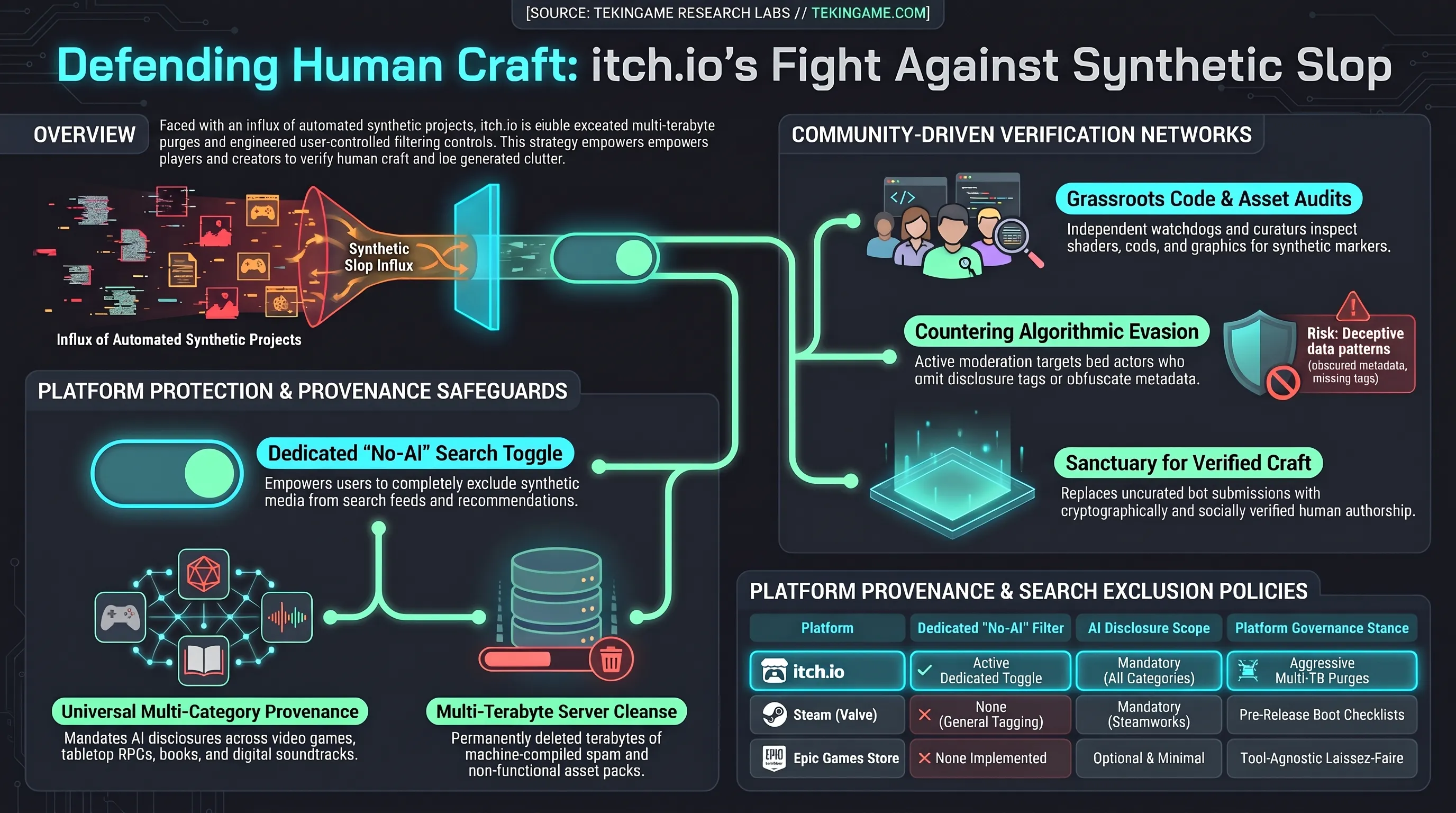
Faced with catastrophic storage bloat, server degradation, and furious protests from its dedicated community, itch.io executed a decisive, scorched-earth administrative intervention. The platform publicly announced the forced eradication of "a couple terabytes of AI slop" a sweeping purge that permanently wiped thousands of machine-compiled spam projects, synthetic tabletop rulebooks, and corrupt audio packs from its physical disk arrays. Furthermore, itch.io deployed an unprecedented storefront weapon: an official, user-toggled "No-AI" search filter that empowers consumers to completely cleanse synthetic productions from their storefront recommendations and browsing categories.
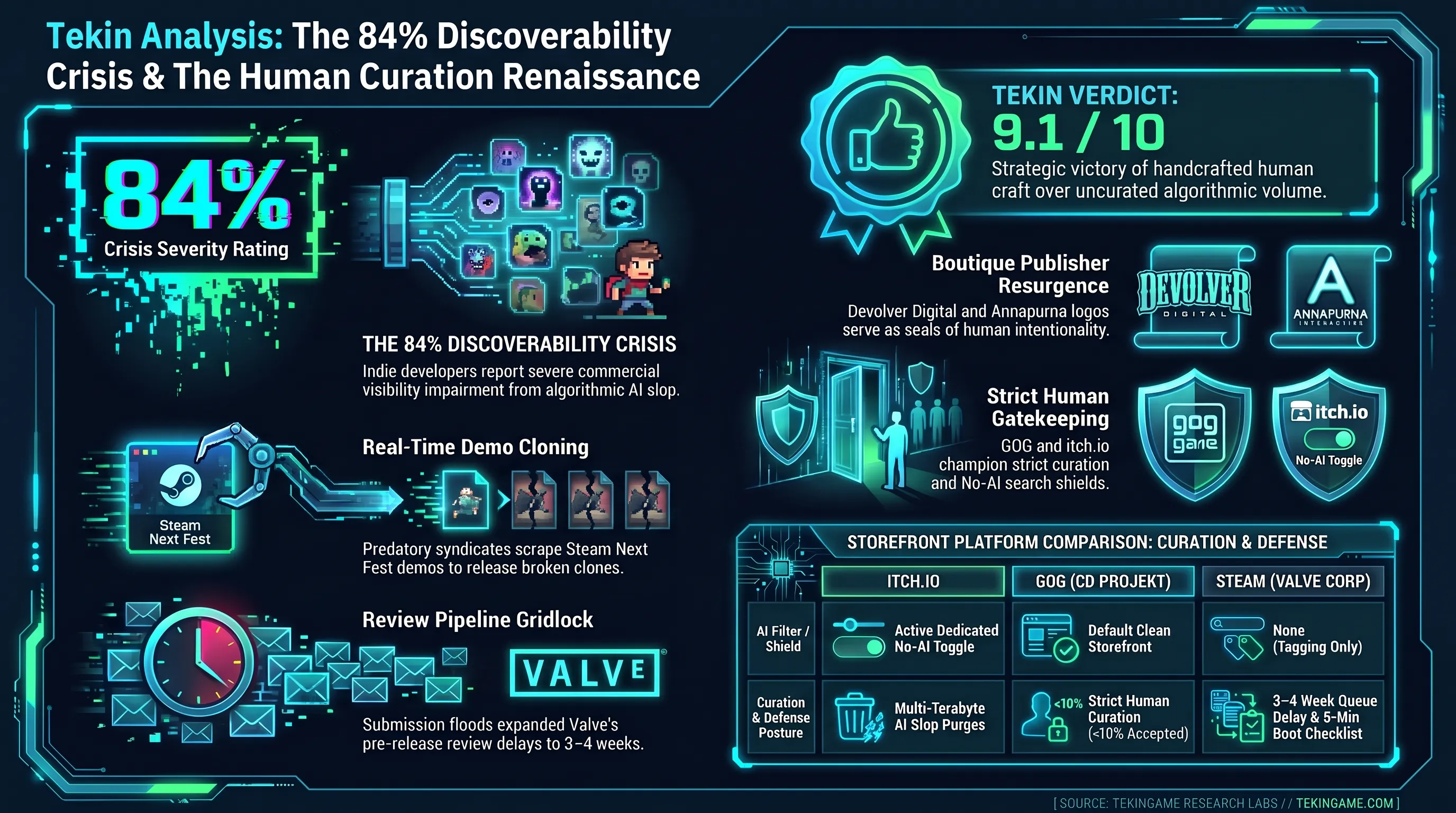
Meanwhile, across the digital megalopolis of Steam, Valve Corporation has found itself ensnared in a silent administrative paralysis. When Valve updated its Steamworks developer guidelines in early 2024 to accommodate artificial intelligence through mandatory content disclosures, Redmond executives anticipated that market transparency would naturally separate compelling innovations from derivative mediocrity. Instead, opportunistic bad actors mobilized generative AI to weaponize the platform's visibility mechanics. During major community showcases like Steam Next Fest, predatory copycats utilized computer-vision analysis and generative code synthesis to scrape gameplay mechanics from promising indie demos, rushing hollow algorithmic clones onto the storefront weeks before the legitimate original creators could complete their official commercial releases.
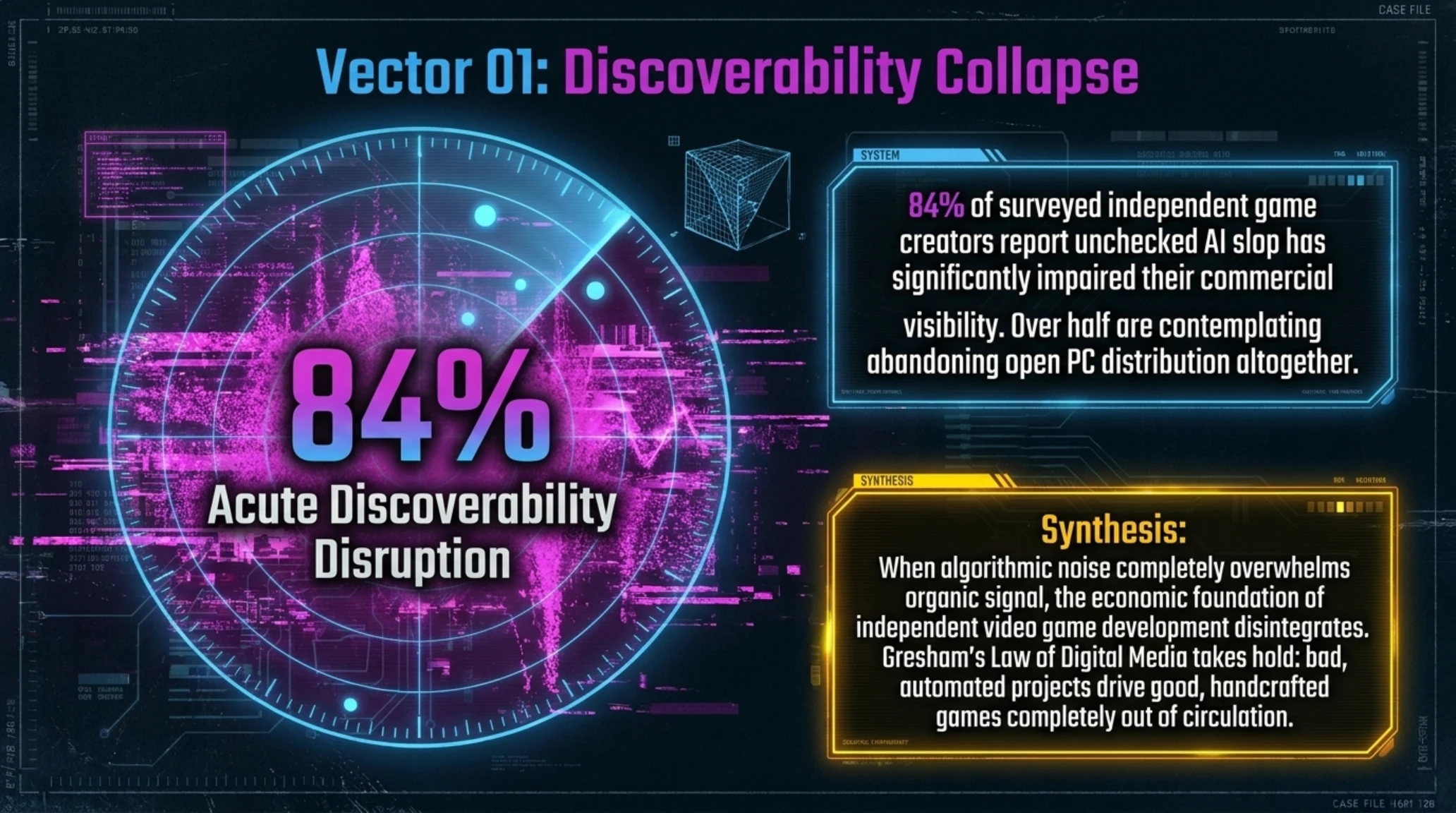
This dynamic has triggered a catastrophic crisis of discoverability (Discoverability Collapse). For a solo indie developer who has dedicated three to five years of intense physical, emotional, and financial sacrifice to craft an original work, the prospect of being buried beneath five hundred mechanically broken, prompt-generated knockoffs within forty-eight hours of launch represents an existential economic death sentence. When algorithmic noise completely overwhelms organic signal, the entire economic foundation of independent video game development begins to disintegrate.
Strategic Assessment and Key Takeaways at a Glance
The economic ramifications of this crisis extend far beyond the immediate frustration of players stumbling upon unplayable titles. At its core, the problem strikes at the efficacy of storefront indexing algorithms. Search recommendation engines designed around consumer interaction signals, tag affinities, and wishlist velocity are fundamentally unequipped to handle adversaries capable of generating hundreds of programmatic variations of popular keywords and aesthetic styles at virtually zero marginal cost.
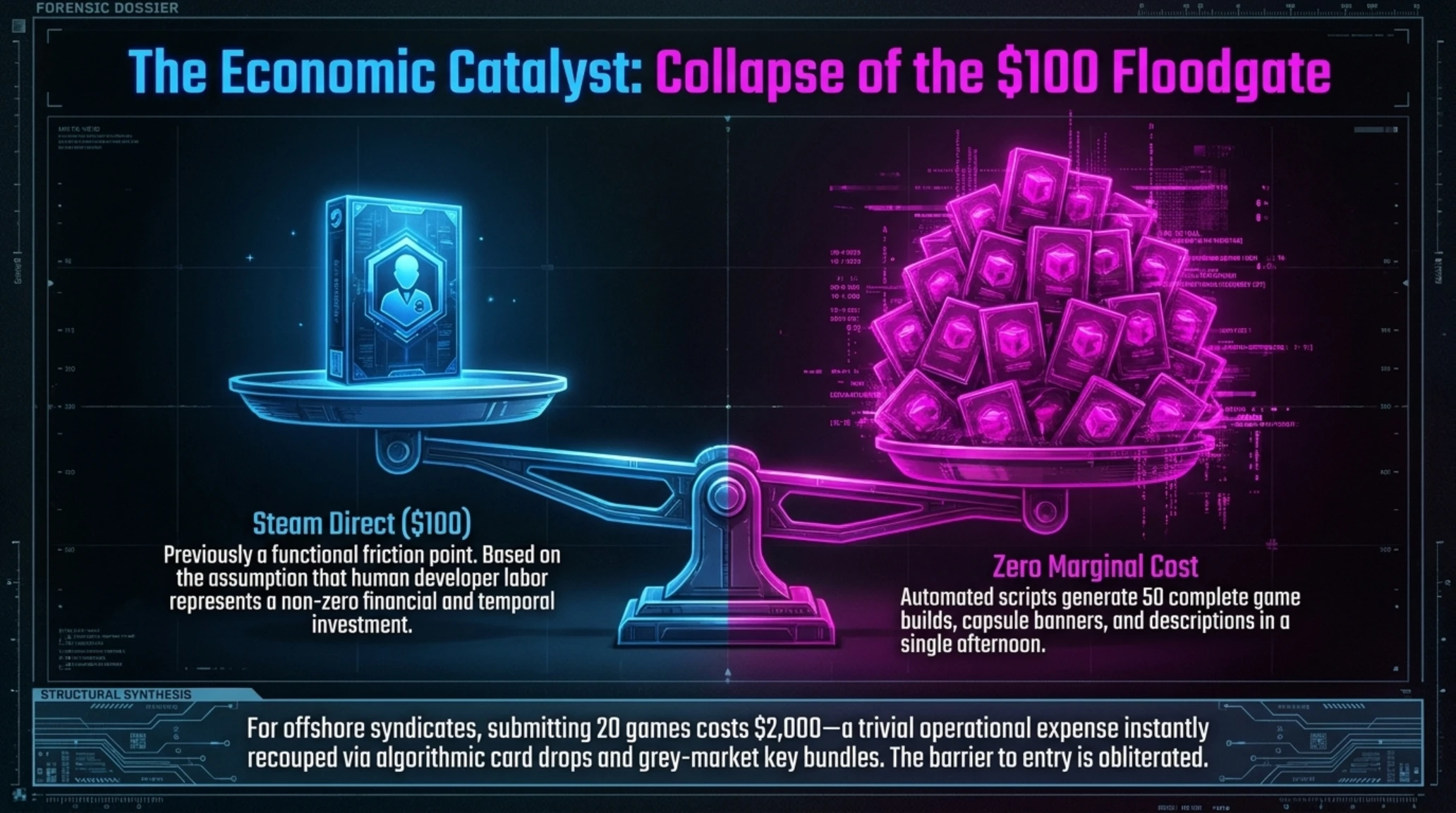
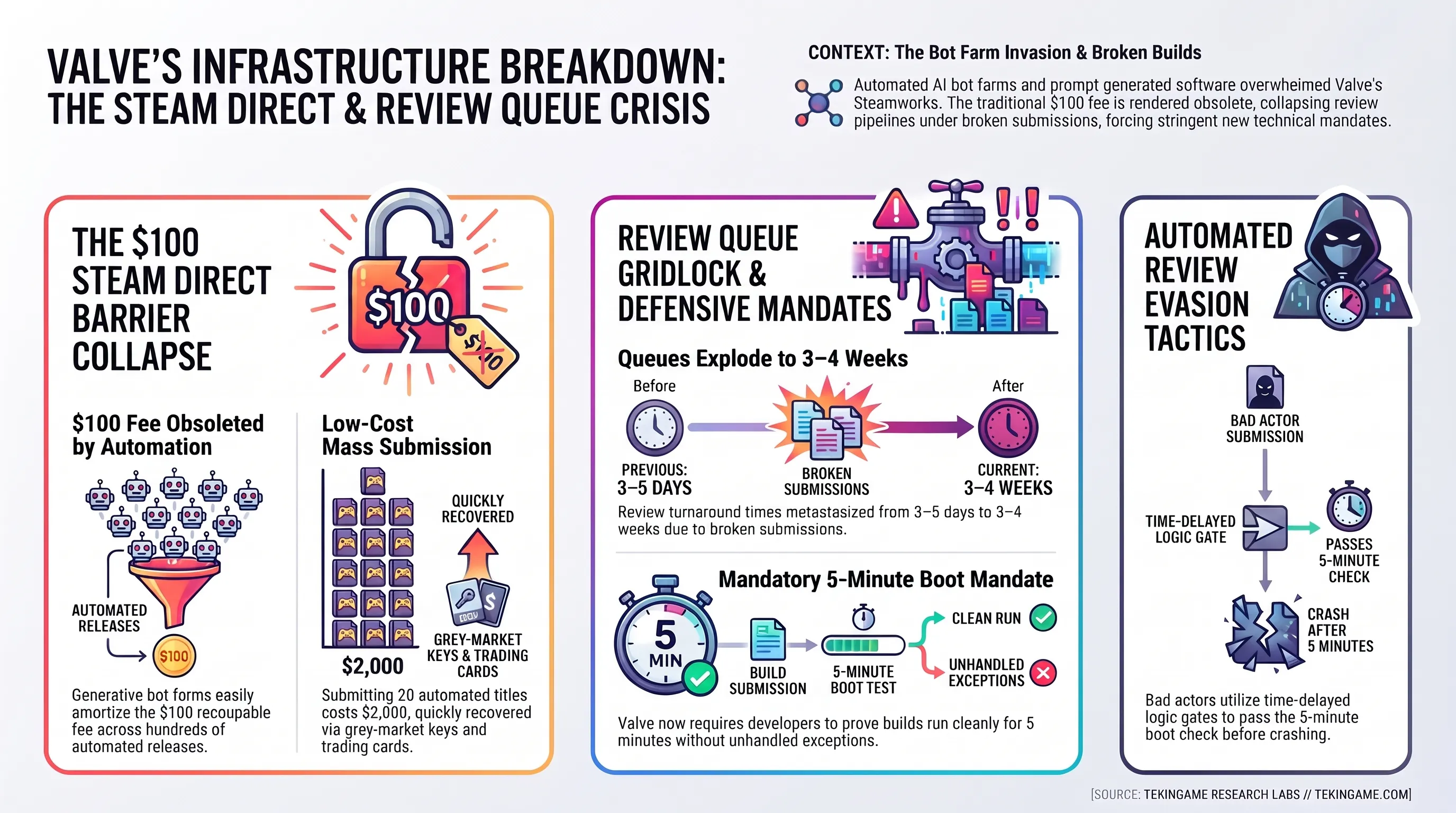
A central economic catalyst facilitating this deluge is the structural inadequacy of Steam's traditional $100 Steam Direct submission fee. When Valve instituted the Steam Direct fee in 2017 to replace the chaotic Steam Greenlight voting system, $100 functioned as a sufficient financial friction point to deter casual trolls and amateur asset-flippers who assembled Unity store packs manually. However, in an era where automated scripts can generate fifty complete game builds, promotional capsule banners, and localized store descriptions in a single afternoon, an upfront fee of $100 is treated merely as a trivial operational cost easily amortized across thousands of deceptive trading card transactions or fraudulent key sales.
To fully grasp how digital distribution reached this breaking point, one must trace the historical evolution of storefront gatekeeping over the past fifteen years. In 2012, Valve introduced Steam Greenlight as an experimental democratization initiative, allowing community upvotes to determine which indie titles secured store placement. While Greenlight catalyzed the golden age of indie hits like Undertale and Stardew Valley, it eventually degraded into an unmanageable popularity contest dominated by vote-trading rings and meme campaigns. In response, Valve retired Greenlight in 2017, replacing it with the $100 Steam Direct recoupable fee. For nearly a decade, that modest economic hurdle successfully stabilized the ecosystem. However, generative AI has obliterated the fundamental assumption underpinning Steam Direct: that human developer labor represents a non-zero financial and temporal investment that inherently curtails frivolous mass submissions.
When automated scripts can output dozens of functionally complete asset packages in a single afternoon, an upfront recoupable fee of $100 ceases to be a meaningful barrier to entry. For industrial-scale copycat rings operating across low-cost international jurisdictions, submitting twenty games costs a mere $2,000 an expense that is trivially recouped through algorithmic card drops, grey-market key bundles, and opportunistic day-one sales driven by deceptive marketing. Consequently, Steam Direct has transformed from an open gateway into an uncurated floodgate, forcing Valve's internal systems to absorb thousands of dubious projects that dilute the commercial visibility of legitimate artists.
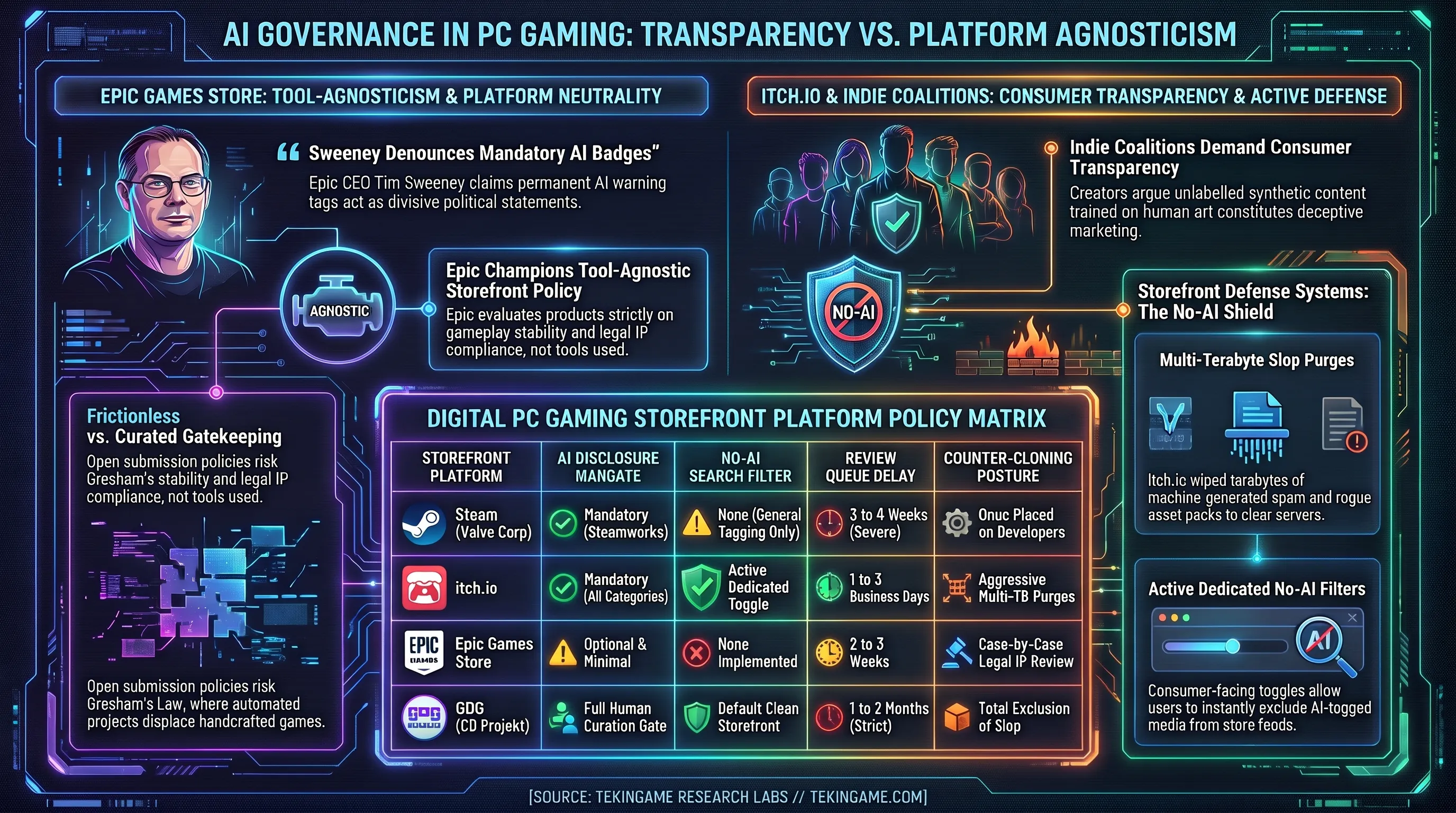
Consequently, the digital storefront landscape has split into an ideological battleground. On one side stand platform operators who champion frictionless free-market publishing; on the other stand creative communities and preservationists who recognize that without rigorous gatekeeping, Gresham's Law of Digital Media will inevitably occur where bad, automated projects drive good, handcrafted games completely out of circulation.
Why This Transformation Matters
The unchecked deluge of synthetic assets directly threatens the economic lifeline of independent creators, systematically corrupting recommendation algorithms and burying authentic human craft beneath layers of mechanical noise.
As we transition into the technical autopsy of these synthetic productions, we must dissect the internal mechanics of vibe-coded software, the computational flaws inherent in automated asset generation, and the specific vectors through which bad actors subvert platform review protocols.
The Anatomy of AI Slop: Vibe-Coding, Broken Geometry, and Architectural Collapse
To fully deconstruct the threat posed by this algorithmic plague, one must examine the precise engineering defects and architectural shortcuts that differentiate legitimate game development from the industrial fabrication of "AI Slop." Contrary to the nuanced application of machine learning by experienced engineers such as utilizing custom neural networks for runtime upscaling, procedural terrain noise generation, or non-linear conversational trees AI Slop represents the total surrender of deliberate software engineering to raw, unguided probabilistic code completion.
At the center of this breakdown is the emerging phenomenon of "vibe-coding." In this paradigm, an operator possessing zero foundational knowledge of object-oriented programming, data structures, or engine lifecycle states relies entirely upon prompt-driven generative language models to author gameplay scripts. The operator repeatedly prompts the AI to "add an inventory system," "create enemy AI," or "make a grappling hook," blindly copy-pasting the output into a game engine such as Unity, Godot, or Unreal Engine without comprehending the underlying architectural plumbing.
The resulting codebase is a catastrophic Frankenstein of incoherent software patterns. Generative models routinely fabricate cyclical references that defeat garbage collection cycles, instantiate unbounded event listeners that permanently consume system RAM, and spawn high-frequency polling loops within tick routines that utterly choke the CPU. Physics calculations become non-deterministic; collision detection matrices desynchronize between frames; and save-state serialization scripts frequently corrupt player data upon the slightest schema modification. While such a build might maintain a veneer of stability within a curated two-minute promotional clip, extended execution reveals fatal unhandled exceptions, catastrophic memory leaks, and inevitable runtime crashes.
The artistic and graphical pipeline of AI Slop exhibits equally severe structural degradation. Two-dimensional sprite assets and UI icons synthesized by generative image networks invariably suffer from blurred PBR (Physically Based Rendering) texture channels, hallucinated seams along UV coordinate unwraps, and complete stylistic dissonance where every asset appears to belong to an entirely different visual universe. When generative models attempt to output three-dimensional meshes, the geometric pathology worsens: meshes frequently feature non-manifold geometry, duplicate internal faces, inverted vertex normals, and unoptimized polygon topologies with millions of redundant triangles in static background props. When rendered under dynamic lighting engines, these topological defects produce severe lighting tears, shadow bleeding, and erratic performance drops that no commercial hardware can brute-force.
At the low-level engine architecture layer, the computational penalties imposed by vibe-coded scripts are catastrophic. In Unity engine environments, large language models routinely generate un-cached string concatenations inside Update loops, triggering relentless allocations on the managed heap that induce frequent, frame-freezing garbage collection spikes. In Unreal Engine 5, prompt-generated C++ code frequently mismanages UObject pointer lifecycles, causing dangling references and hard segmentation faults when garbage collection sweeps occur. Furthermore, because generative AI models lack understanding of dynamic Level-of-Detail (LOD) hierarchies, every procedural prop is rendered at maximum geometric complexity regardless of screen distance, overwhelming GPU vertex shaders and inflating draw calls into tens of thousands per frame.
This technical incompetence also manifests in severe storage bloat and disk thrashing. Legitimate indie development teams spend months optimizing texture atlases, compressing audio waveforms with Vorbis or Opus codecs, and structuring asset bundles to ensure minimal memory footprints and instant load times. In stark contrast, AI Slop titles frequently package uncompressed 4K PNG files, duplicate 24-bit WAV sound effects across dozens of subdirectories, and ship with entirely unused engine plugins left compiled into the master binary. A rudimentary 2D platformer that should require no more than 150 megabytes of storage routinely balloons into a bloated 12-gigabyte download that hogs consumer SSD space while delivering five minutes of broken gameplay.
Furthermore, synthetic audio generation has inundated storefronts with phase-canceled, robotic soundscapes. Generative audio models struggle with acoustic spatialization and dynamic mixing; their output is plagued by high-frequency aliasing, muffled transient responses, and jarring tonal jumps that induce immediate listening fatigue. Yet, because these synthetic audio tracks and visual assets can be generated in matter of seconds without paying session musicians, voice actors, or environmental artists, bad actors can assemble a superficially complete "commercial package" for less than the cost of a cup of coffee.
Technical Verification | Myth vs Engineering Reality
Valve Corporation has reversed its open developer policy and begun unilaterally banning all video games utilizing generative AI assets from the Steam marketplace.
Valve enforces pre-release AI disclosure surveys and displays public badges, but refuses to act as an aesthetic gatekeeper, placing the burden of differentiation on developers.
The itch.io Uprising: Multi-Terabyte Evictions and the Construction of the No-AI Shield
While Valve adopted a policy of laissez-faire market accommodation coupled with passive disclosure badges, the leadership of itch.io recognized that unchecked algorithmic spam represented an existential threat to its platform identity. Founded by Leaf Corcoran as a radically open, creator-first marketplace, itch.io had historically operated with minimal bureaucratic friction, welcoming experimental prototypes, student game jam entries, and niche artistic experiments that traditional commercial storefronts rejected. However, this very openness made itch.io the prime target for automated exploitation.
By autumn 2026, the situation on itch.io had escalated into a full-scale crisis. The rate of new project page creation doubled within eight weeks. Automated scraper bots were uploading hundreds of identical puzzle games with procedurally swapped AI thumbnail art, thousands of synthetic asset packs scraped from copyrighted ArtStation portfolios, and dozens of machine-generated tabletop roleplaying rulebooks populated with nonsensical, hallucinated lore. The platform's physical disk storage was hemorrhaging capacity, database query latency surged, and genuine human creators found their meticulously crafted games pushed completely off the "Fresh Games" and "Popular" discovery feeds within minutes of publication.
Rejecting corporate passivity, itch.io unleashed an administrative counter-offensive. In an official public statement that sent shockwaves through the indie development community, the platform confirmed that it had forcibly purged "a couple terabytes of AI slop" summarily terminating thousands of spam accounts and wiping entire directory trees of non-curated, automated projects that violated its terms of service against abusive and disruptive system behavior.
Recognizing that reactive purges alone could not stem the relentless tide of machine generation, itch.io engineered a structural defense: the implementation of an integrated "No AI" search exclusion toggle. Expanding its voluntary disclosure mandates beyond video games to encompass physical tabletop games, digital books, webcomics, and original soundtracks, itch.io empowered users to strip all AI-tagged content from their search queries, category feeds, and personal recommendation algorithms with a single click. This feature instantly established itch.io as the world's foremost sanctuary for verified human craft.
Nevertheless, itch.io's engineering team acknowledged the persistent challenge of enforcement. Because platform disclosures rely partially upon creator honesty, bad actors frequently engage in deceitful evasion tactics omitting disclosure tags and utilizing obfuscated metadata to bypass automated heuristic filters. This creates a perpetual, exhausting game of "whack-a-mole," where community moderators and automated detection scripts must continuously hunt down and de-index clandestine synthetic productions.
The Real-Time Cloning Heist: How Predatory Actors Exploit Steam Next Fest
If the passive inundation of store feeds represents a slow-acting poison, the predatory phenomenon of "real-time cloning" is an acute, targeted weapon directed at the most vulnerable segment of the gaming industry: independent developers showcasing original prototypes. For small independent studios, Valve's tri-annual Steam Next Fest is the single most vital promotional event on the global calendar a high-stakes showcase where a polished, playable demo can capture hundreds of thousands of wishlists, secure publisher financing, and guarantee commercial survival.
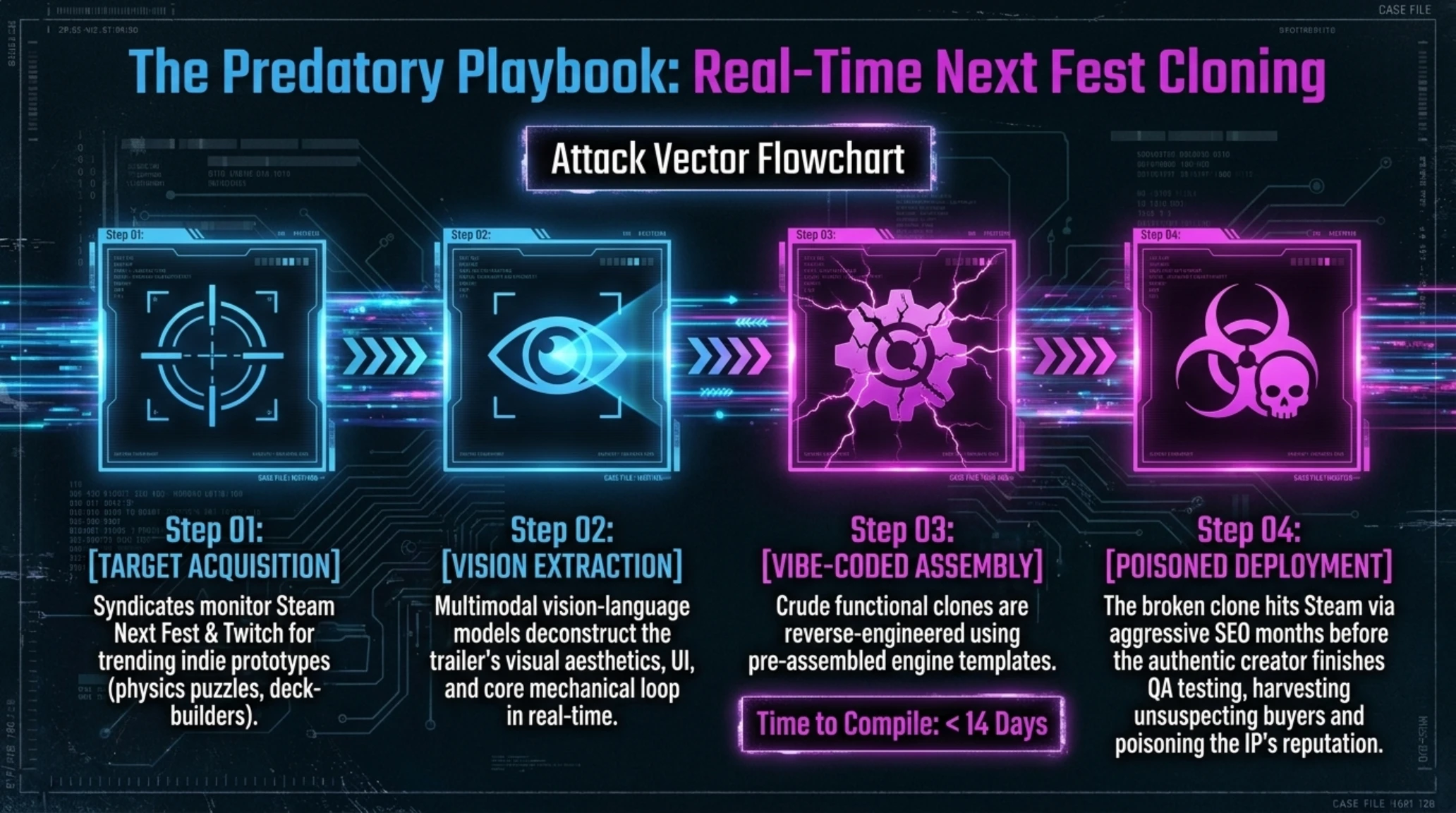
Tragically, opportunistic bad actors have transformed Next Fest into a hunting ground. Utilizing multimodal vision models and automated code generation pipelines, offshore cloning syndicates monitor trending Next Fest demos in real time. When an innovative indie title such as a novel physics-based puzzle concept, an inventive deck-building roguelike, or a distinctive minimalist strategy game captures algorithmic momentum on Twitch or TikTok, the syndicate initiates a lightning extraction process. The demo's visual aesthetics, core mechanical loop, and user interface are captured, analyzed by vision-language models, and reverse-engineered into a crude functional clone using pre-assembled engine templates in less than fourteen days.
These parasitic clones are rushed through Steam's submission process, leveraging aggressive search engine optimization (SEO), deceptive thumbnail designs, and names deliberately calculated to mimic the authentic upcoming title. Because the original indie developer often requires another six to twelve months of meticulous polish, QA testing, and balancing before releasing their full game, the automated clone hits the Steam storefront first. Unsuspecting consumers searching for the trending title frequently purchase the broken knockoff, endure an unplayable, bug-ridden disaster, and leave scathing reviews poisoning the commercial well for the authentic creator before their masterpiece can even reach the market.

The response from platform gatekeepers has ignited bitter resentment across the development community. Rather than instituting aggressive human copyright intervention or establishing provisional trademark protections for registered Next Fest participants, Valve leadership has largely maintained that it cannot adjudicate gameplay mechanic disputes, offering the frustrating advice that developers must simply "make their games distinct and hard to copy." For a solo artisan competing against distributed generative bot farms, this hands-off posture feels perilously close to institutional abandonment.
Tekin Technical Lexicon // Essential Industry Terminology
Having exposed the technical pathology and predatory cloning pipelines of AI Slop, we now turn our investigation toward the systemic administrative bottlenecks crippling Valve Corporation, the high-profile philosophical conflict between Tim Sweeney and storefront regulators, and the quantitative telemetry defining this crisis.
Storefront Gridlock: Valve's Review Queue Crisis and the Sweeney-Valve Philosophical War
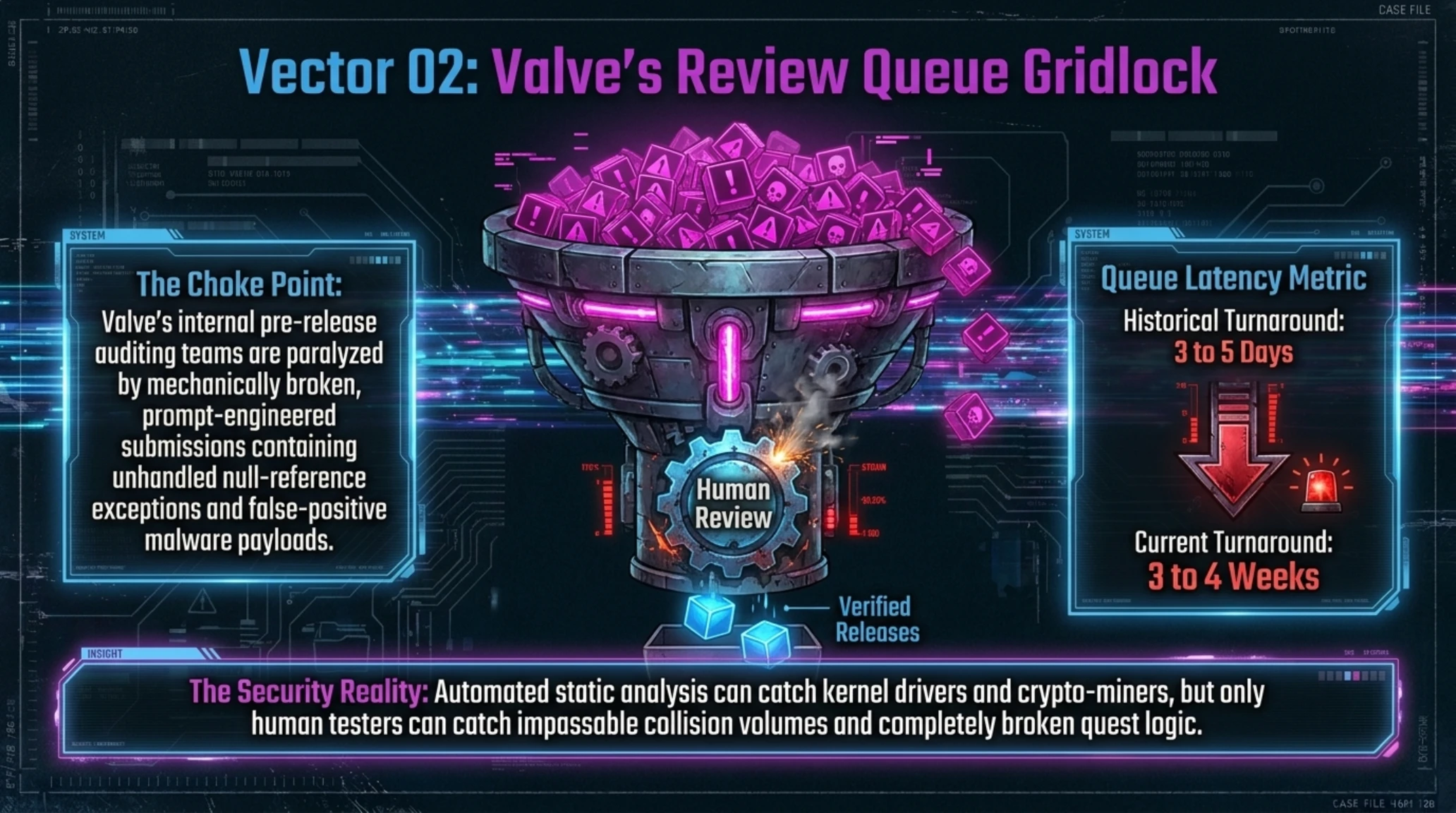
The operational reverberations of the generative AI boom have fundamentally destabilized the administrative machinery governing the world's largest digital gaming marketplace. At Valve Corporation's headquarters in Bellevue, Washington, internal developer operations teams are struggling beneath an unprecedented backlog of pre-release store and build submissions. Historically, a registered Steamworks developer could expect their initial store page and playable build verification to clear Valve's human review queue within three to five business days. By late 2026, that turnaround time has metastasized into an excruciating three to four weeks.
This administrative paralysis is the direct result of Valve's review personnel being forced to manually triage hundreds of mechanically broken, prompt-engineered submissions. Reviewers tasked with verifying basic Windows OS compliance, Steam Overlay hooking, and anti-cheat hooks find themselves repeatedly launching software packages that fail to reach the main menu, crash instantaneously due to unhandled null-reference exceptions, or trigger false-positive alerts on internal virus-scanning heuristics. Each defective submission consumes valuable engineering hours, creating an immense bottleneck that penalizes legitimate independent developers operating on rigid, marketing-synchronized release schedules.
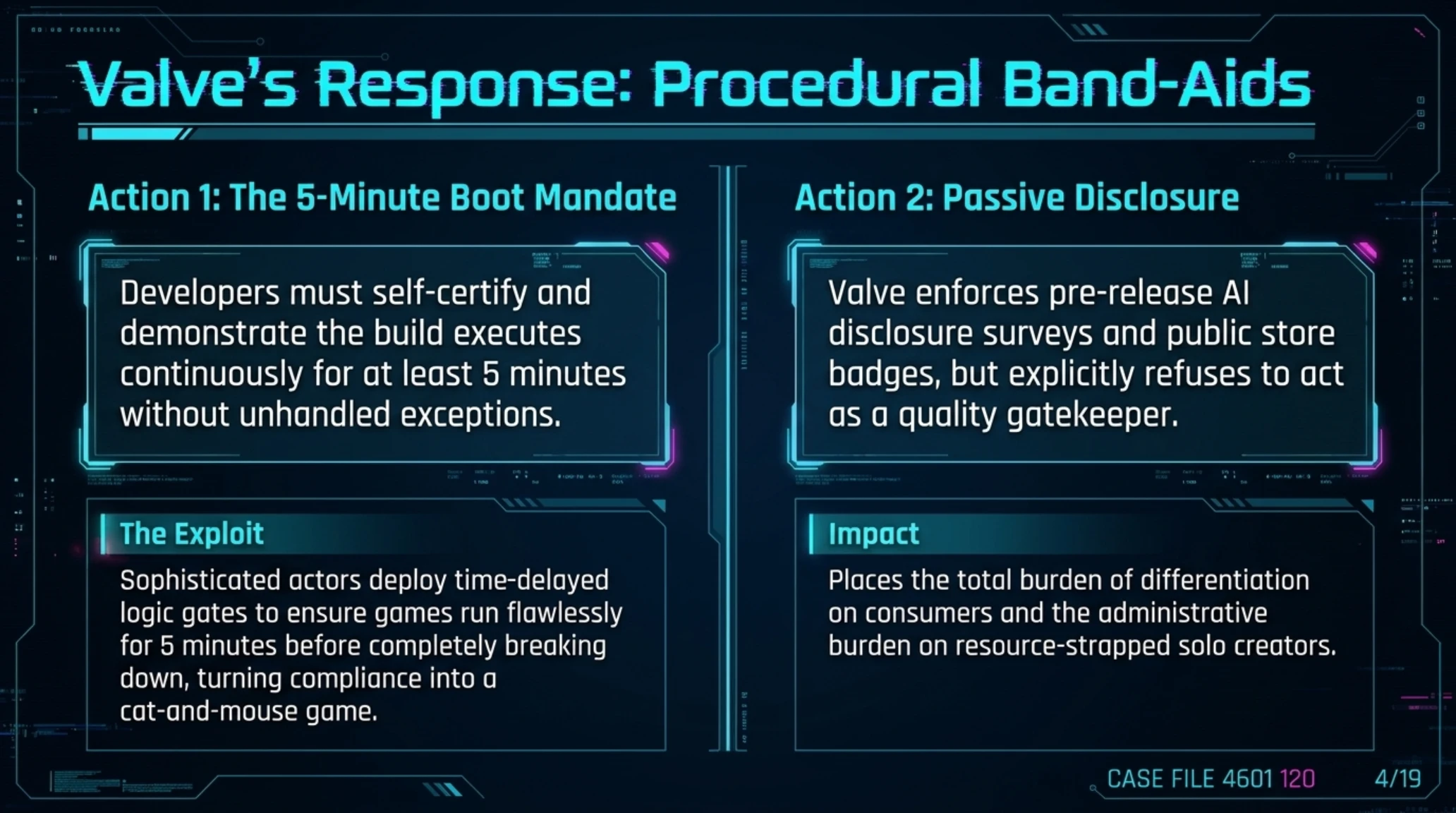
To stem this administrative bleeding, Valve was compelled to institute significant procedural revisions to the Steam pre-release review process. The company introduced mandatory technical self-certification checklists, requiring developers to formally attest and demonstrate that their build has been booted and continuously executed for at least five minutes on a clean testing environment without unhandled runtime exceptions. Additionally, developers must verify full Steamworks API compatibility including cloud saves, controller remapping layers, and achievement unlocks prior to entering the human review queue. While these measures filter out the most egregious automated scrapers, they simultaneously impose additional administrative burdens upon resource-strapped solo creators.
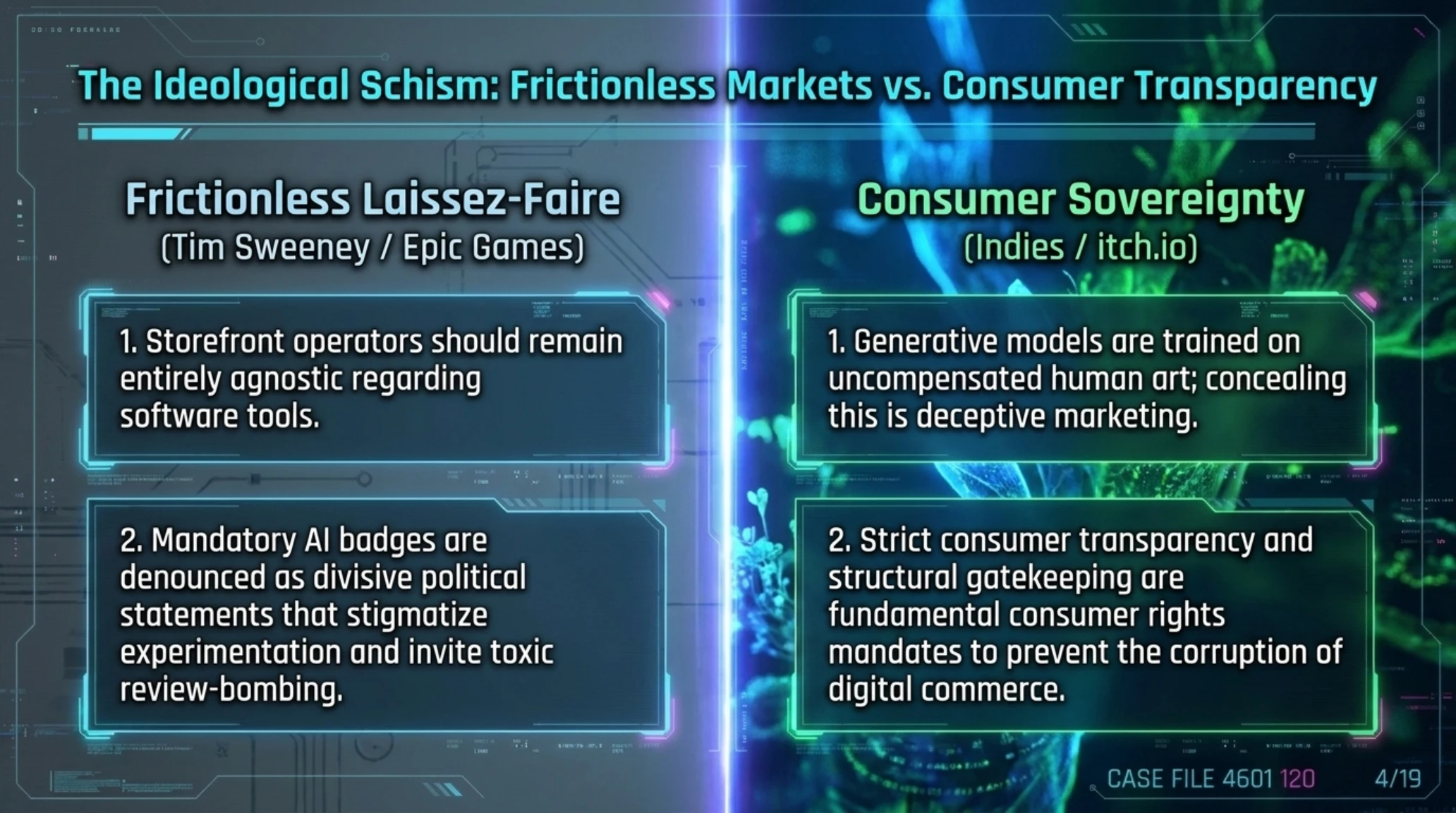
Simultaneously, the industry has been fractured by a high-stakes ideological clash between two of gaming's most influential titans: Valve Corporation and Epic Games CEO Tim Sweeney. In early 2026, Sweeney ignited intense controversy across the developer community by openly attacking Valve's policy of mandatory generative AI store-page labels. Sweeney asserted that forcing developers to display prominent, permanent warning badges for any utilization of generative tools is akin to making a "divisive political statement." He argued that such labels unfairly stigmatize legitimate technological experimentation, painting a target on creators' backs and actively inviting toxic review-bombing campaigns from anti-AI internet factions.
The technical reality of Valve's automated pipeline reveals why human review remains irreplaceable. Valve's internal ingestion infrastructure employs automated static analysis tools to screen uploads for malicious binaries, unauthorized kernel drivers, and crypto-mining payloads. However, these security scanners cannot evaluate subjective gameplay coherence, mechanical responsiveness, or narrative authenticity. A build that successfully compiles and passes headless sandbox execution can still be completely unplayable due to broken quest logic, missing UI canvases, or impassable collision volumes. Consequently, Valve's reliance on human testing teams creates a physical bottleneck that cannot be expanded proportionally without radically altering the corporation's notoriously lean workforce structure.
This administrative strain is further exacerbated by the rise of automated review-evasion techniques. Sophisticated bad actors deploy time-delayed logic gates within their executable binaries ensuring that the game behaves flawlessly during the initial five minutes required by Valve's verification checklist, only to break down completely once the player progresses past the initial tutorial chamber. Such deliberate subterfuge turns Valve's compliance checks into a high-stakes cat-and-mouse game, diverting engineering resources away from platform improvements like the Steam Deck compatibility program and toward tedious fraud mitigation.

Sweeney's thesis which forms the foundational operating doctrine of the Epic Games Store posits that storefront operators should remain entirely agnostic regarding the software tools employed during production, judging products solely upon their ultimate gameplay fidelity, stability, and absence of legal copyright infringement. Conversely, leadership at itch.io, alongside prominent indie developer coalitions, forcefully retorted that transparency is a fundamental consumer rights mandate. When generative AI algorithms are trained on vast corpuses of uncompensated human art and writing, concealing that reality from consumers constitutes deceptive marketing and fundamentally corrupts the social contract of digital commerce.
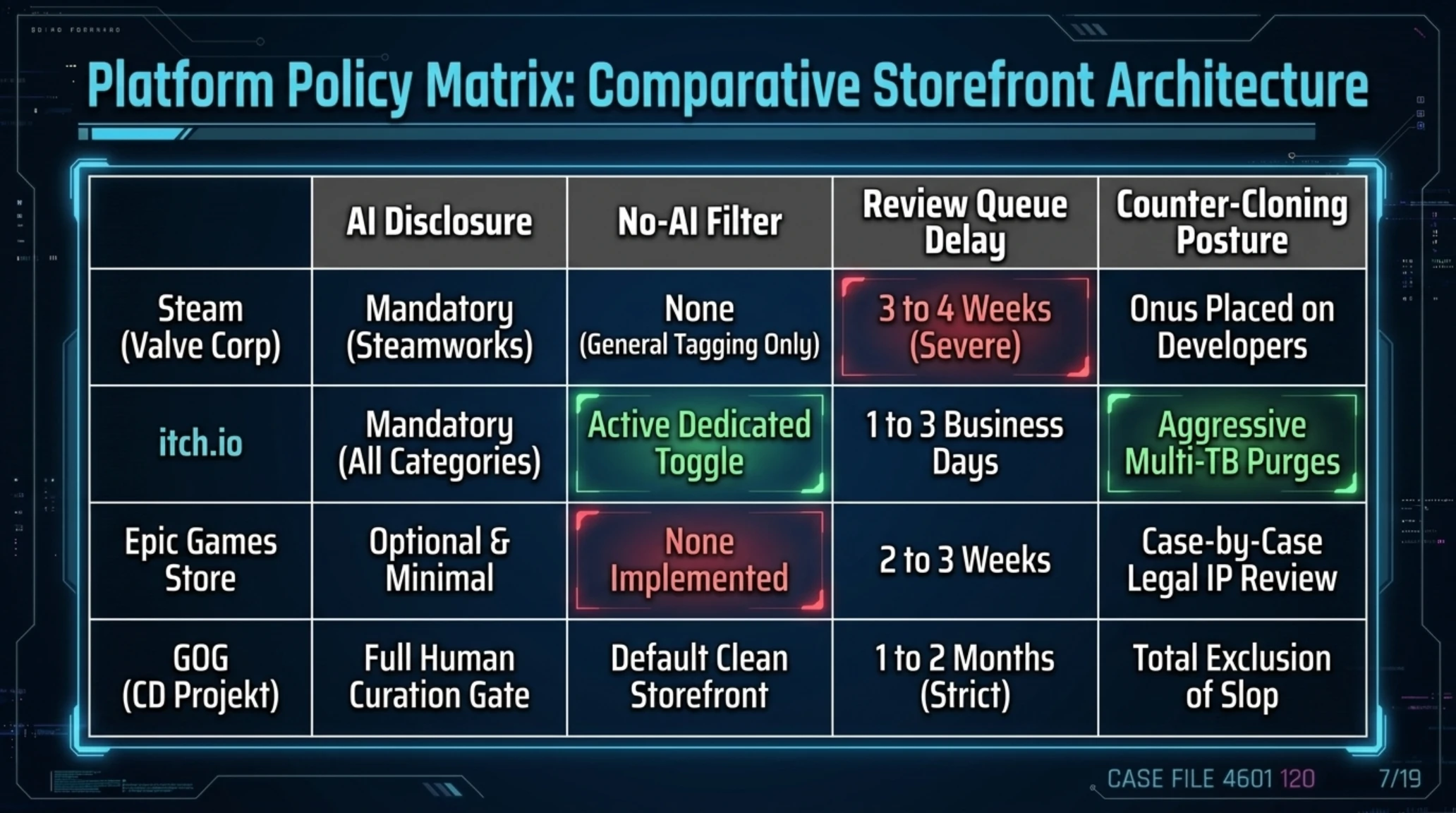
Bar Chart & Benchmark Telemetry Matrix
| STOREFRONT PLATFORM | AI DISCLOSURE MANDATE | NO-AI SEARCH FILTER | REVIEW QUEUE DELAY | COUNTER-CLONING POSTURE |
|---|---|---|---|---|
| Steam (Valve Corp) | Mandatory (Steamworks) | None (General Tagging Only) | 3 to 4 Weeks (Severe) | Onus Placed on Developers |
| itch.io | Mandatory (All Categories) | Active Dedicated Toggle | 1 to 3 Business Days | Aggressive Multi-TB Purges |
| Epic Games Store | Optional & Minimal | None Implemented | 2 to 3 Weeks | Case-by-Case Legal IP Review |
| GOG (CD Projekt) | Full Human Curation Gate | Default Clean Storefront | 1 to 2 Months (Strict) | Total Exclusion of Slop |
The comparative data illustrates the stark polarization defining modern digital distribution. While boutique platforms like GOG maintain an elite human curation wall and itch.io arms consumers with search exclusion toggles, mainstream giants like Steam and Epic Games find themselves trapped in systemic contradictions weighing the boundless volume of open marketplaces against the accelerating degradation of user trust.
This institutional divergence has inflicted a severe psychological and economic toll upon the independent development sector. Comprehensive survey data synthesized from over 2,400 active commercial indie studios reveals that despair over storefront discoverability has reached critical thresholds, as illustrated by the strategic viability gauge below.
📚 Classified & Related Dossiers in TekinGame
If you wish to explore beyond this report and delve into cybernetic frontiers and autonomous AI architectures, do not miss these three exclusive deep-dives in the Tekin Garage:
Market Sentiment Thermometer | Circular Gauge & S-Curve
Thermometer Analysis: An overwhelming 84% of surveyed independent game creators report that the unchecked proliferation of generative AI slop has significantly impaired their commercial visibility, with over half contemplating abandoning open PC distribution altogether.
To contextualize how rapidly this administrative and philosophical conflict escalated over the preceding thirty-six months, we must examine the chronological progression of policy updates, community uprisings, and regulatory milestones shaping the digital storefront ecosystem.
Chronology of Events | Technological Milestones
| TIMELINE PHASE | STRATEGIC EVENT | KEY PARTICIPANTS | PRIMARY IMPLICATION |
|---|---|---|---|
| January 2024 | Steamworks AI Disclosure Survey | Valve Corporation | Valve officially permits AI games under mandatory disclosure rules. |
| June 2025 | Steam Next Fest Cloning Surge | Indie Developers, Clone Rings | Rampant real-time scraping of indie demos sparks widespread outcry. |
| March 2026 | Sweeney Criticizes AI Labels | Tim Sweeney (Epic Games) | Epic CEO denounces mandatory storefront AI badges as political. |
| October 2026 | The Great itch.io Terabyte Purge | itch.io Moderation Team | Multi-terabyte purge of AI slop and deployment of the No-AI filter. |
| November 2026 | Valve 5-Minute Boot Mandate | Valve Corporation | Valve institutes mandatory 5-minute pre-release execution verification. |
Having established the administrative gridlock and philosophical division fracturing digital distribution, we advance to our concluding analysis: exploring the renaissance of human curation, examining structural solutions for algorithmic quarantine, and delivering the definitive editorial verdict on the future of handcrafted gaming.
The Renaissance of Human Curation: Boutique Sanctuaries and Community Verification
The existential crisis precipitated by the deluge of algorithmic slop has catalyzed a profound paradigm shift across the global gaming community: the rediscovery and fierce revaluation of human curation. For over a decade, the digital distribution thesis rested upon the utopian premise of infinite, frictionless access. Platforms celebrated record-breaking annual releases, boasting that thousands of new titles entered the market each year. However, when infinite supply degenerates into infinite noise, the ability to filter, authenticate, and champion artistic excellence transforms from a mundane administrative service into the supreme luxury commodity of the digital era.
At the forefront of this cultural resurgence is the renewed prestige of boutique independent publishers. Imprints such as Devolver Digital, Annapurna Interactive, Raw Fury, and New Blood Interactive have experienced a dramatic renaissance in consumer brand loyalty. In an uncurated ocean of prompt-engineered asset flips, a publisher's logo functions as an essential cryptographic seal of human intentionality. Players increasingly recognize that a title published under a renowned boutique banner has undergone rigorous human scrutiny, hands-on mechanical playtesting, and empathetic artistic balancing. For discerning consumers exhausted by deceptive storefront thumbnails, following trusted human tastemakers has replaced algorithmic recommendation feeds as the primary discovery mechanism.
Simultaneously, grassroots community movements have mobilized to construct decentralized defensive infrastructure. A growing federation of independent Steam Curators, supported by open-source browser extensions and community-maintained surveillance databases, systematically audits newly indexed store pages. These decentralized watchdogs deconstruct suspect shader code, analyze voice lines for synthetic vocoder artifacts, and cross-reference promotional capsule art against scraped ArtStation repositories, instantly flagging unverified projects for millions of subscribed players. This bottom-up mobilization proves that when corporate platform operators hesitate to protect artistic integrity, the community will build its own defenses.
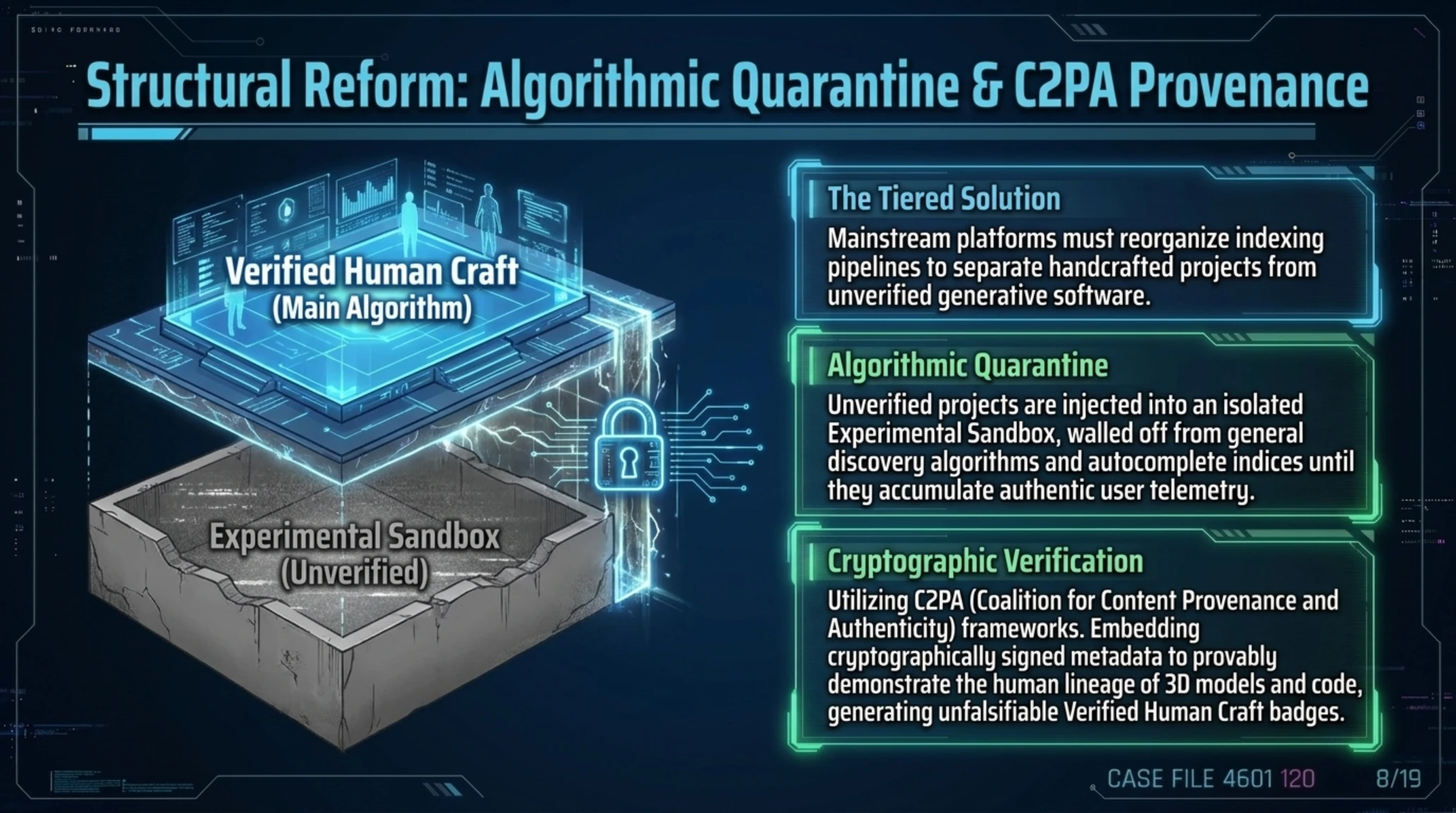
Technological researchers and platform architects increasingly advocate for structural reform: the institutionalization of "Algorithmic Quarantine." Under this proposed architecture, storefronts like Steam would fundamentally reorganize their indexing pipelines. Unverified projects authored with generative pipelines would no longer be injected directly into the general discovery algorithm. Instead, they would be quarantined within an isolated "Experimental Sandbox" tier, completely walled off from general storefront recommendations, search autocomplete indices, and category rankings until they accumulate verified, genuine gameplay telemetry from authentic human users.
Strategic Synthesis: Three Trajectories Shaping the Post-Slop Storefront Ecosystem
As the conflict over digital platform governance reaches its boiling point on Wednesday, November 4, 2026, technology analysts and game industry executives envision three potential pathways for the evolution of PC game distribution over the coming decade. The first trajectory is the implementation of tiered storefront architectures by mainstream operators. Under mounting pressure from both developer guilds and institutional regulatory bodies, Valve Corporation and its peers will inevitably establish formal separation between handcrafted human projects and automated generative software, confining the latter to quarantined experimental zones.
The second trajectory is the universal adoption of consumer-facing provenance controls, following the pioneering precedent established by itch.io. As public consciousness regarding synthetic media grows, storefront operators that refuse to offer dedicated "No-AI" filtering toggles will face severe brand degradation and consumer boycotts. In this scenario, user-toggled filtering becomes a mandatory global accessibility standard, recognized alongside content ratings and regional localization tags.
The third, and most radical trajectory, is the mass migration of premium independent creators away from monolithic open storefronts toward curated, boutique distribution ecosystems. Disillusioned by predatory cloning and review queue gridlock, high-caliber indie studios will increasingly embrace bespoke direct-to-consumer platforms, exclusive subscription cooperatives, and strictly curated platforms like GOG, abandoning open-door marketplaces to the relentless churning of algorithmic noise.
In response to this existential challenge, forward-thinking software engineers and digital artists are exploring cryptographic provenance standards modeled on the C2PA (Coalition for Content Provenance and Authenticity) framework. By embedding cryptographically signed metadata manifests into game source assets, development teams can provably demonstrate the lineage of their 3D models, audio recordings, and handwritten scripts directly to storefront validators. Such cryptographic watermarking would enable storefronts to offer automated "Verified Human Craft" certification badges that cannot be falsified by prompt engineers, providing consumers with mathematically verifiable guarantees of authentic human labor.
Furthermore, boutique digital platforms such as GOG (Good Old Games) have demonstrated that uncompromising human curation can form the foundation of a highly lucrative commercial strategy. By rejecting open submissions and accepting fewer than 10% of prospective developer applications, GOG has cultivated an aura of trust where players know that every catalog entry has been tested for stability, narrative depth, and technical integrity. As mainstream storefronts become increasingly unusable due to algorithmic pollution, curated boutique marketplaces will inevitably capture a growing share of premium gaming revenue.
The enduring lesson of the AI Slop crisis is that genuine art cannot be reduced to probabilistic token prediction. The collective resistance of developers, the courageous purges executed by itch.io, and the vigilant solidarity of players demonstrate that human creativity is an irreplaceable flame one that will continuously reject the synthetic mediocrity designed to replace it.
- Decisive administrative purge by itch.io proving that platforms can successfully enforce digital hygiene.
- Pioneering deployment of the No-AI search filter as a gold standard for consumer sovereignty.
- Resurgence of consumer loyalty toward human-curated boutique publishers and verified indie artisans.
- Compelled Valve to tighten Steamworks review standards with mandatory 5-minute boot verifications.
- Continued vulnerability of unreleased indie prototypes to rapid real-time cloning syndicates.
- Imposition of multi-week review queue delays and administrative friction on legitimate solo developers.
- Persistent philosophical divergence among platform executives, with Epic Games resisting mandatory labels.
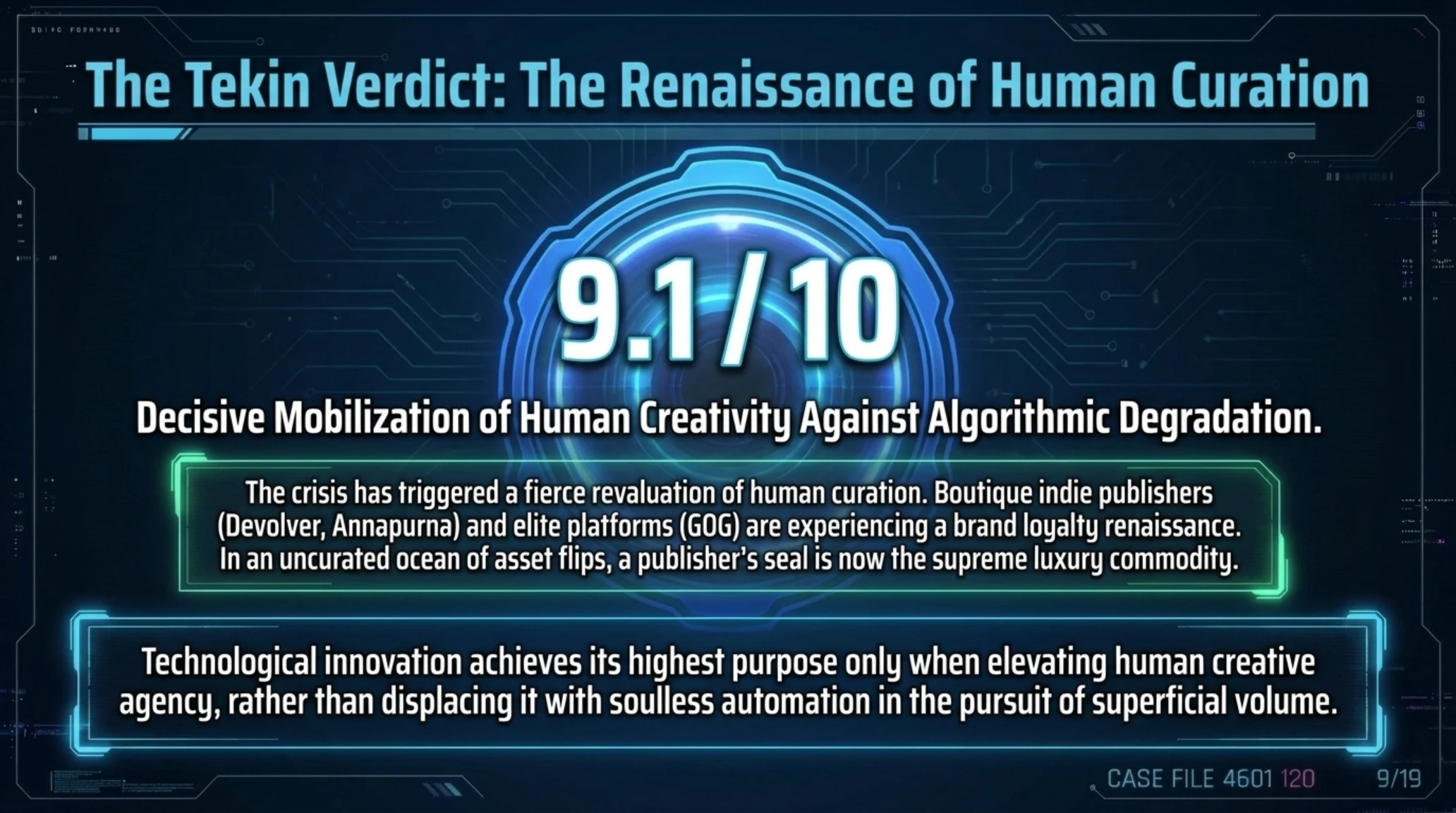
The comprehensive synthesis of this platform confrontation proves that technological innovation achieves its highest purpose only when elevating human creative agency, rather than displacing it with soulless automation in the pursuit of superficial volume.
Synthesizing verified administrative disclosures from itch.io, developer communications from Steamworks, investigative reports from Aftermath, Eurogamer, and PC Gamer, and technical telemetry across digital storefronts, our senior editorial team presents the comprehensive technical bibliography governing this dossier.
EDITORIAL VERDICT & PRIMARY INTELLIGENCE SOURCES
The Victory of Human Craft Over Synthetic Mass-Production
The multi-terabyte purge on itch.io and the widespread developer rebellion against predatory AI cloning establish a permanent line in the sand: digital storefronts must prioritize human creative integrity over raw, uncurated algorithmic volume.
- Aftermath: Investigative report on itch.io deleting terabytes of AI slop and deploying No-AI search filtering
- Eurogamer: Analysis of indie game developer reactions to storefront clutter and automated copycats
- PC Gamer: Examination of Valve Corporation's evolving AI disclosure guidelines and gatekeeping philosophy
- IGN: Deconstructing the predatory cloning phenomenon targeting Steam Next Fest demo showcases
- GamesRadar+: Coverage of Epic Games CEO Tim Sweeney criticizing mandatory storefront AI disclosure labels
- TechRaptor: Technical breakdown of Valve's updated pre-release Steamworks review checklist mandates
FREQUENTLY ASKED QUESTIONS // TECHNICAL & STRATEGIC BREAKDOWN
What precisely constitutes 'AI Slop' within the context of video game storefronts?
AI Slop refers to low-effort, mechanically broken games, vibe-coded scripts, and synthetic assets generated entirely via probabilistic models without deliberate human design or structural QA.
Why did itch.io execute a multi-terabyte purge of game pages and asset packs?
The platform experienced a 100% doubling in daily page creation driven by automated bots uploading non-functional spam, threatening server infrastructure and burying handcrafted indie games.
How does the newly implemented 'No-AI' search filter function on itch.io?
The No-AI toggle allows users to completely strip any project tagged with generative AI across video games, tabletop games, books, comics, and audio tracks from their browsing feeds and search results.
Why have Steam pre-release review queues escalated to multi-week delays?
Valve's human review staff has been overwhelmed by hundreds of broken AI-generated builds that crash upon launch, forcing extensive manual triaging and delaying legitimate commercial releases.
Why does Epic Games CEO Tim Sweeney oppose mandatory storefront AI badges?
Sweeney contends that mandatory AI labels represent a political statement that invites toxic review-bombing mobs, arguing that platforms should evaluate products solely on overall quality.
What is Valve's mandatory 5-minute boot checklist requirement in Steamworks?
The policy requires developers to formally certify that their submission boots and runs stably for at least five minutes while supporting core Steam overlay, controller, and cloud save APIs.
Additional Gallery: Tekin Analysis: Buried Under Algorithmic Waste – Inside the AI Slop Crisis on Steam and itch.io