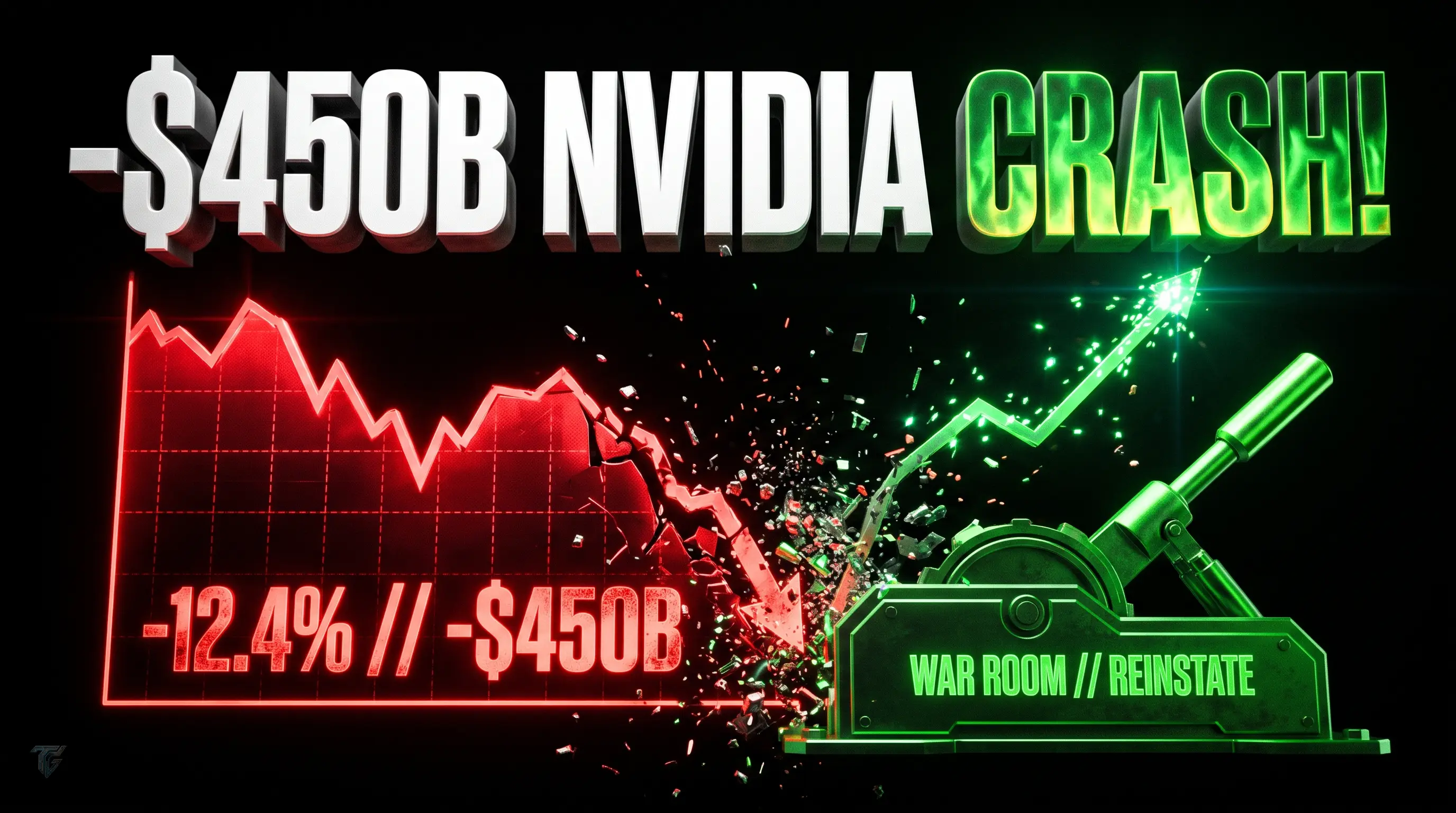
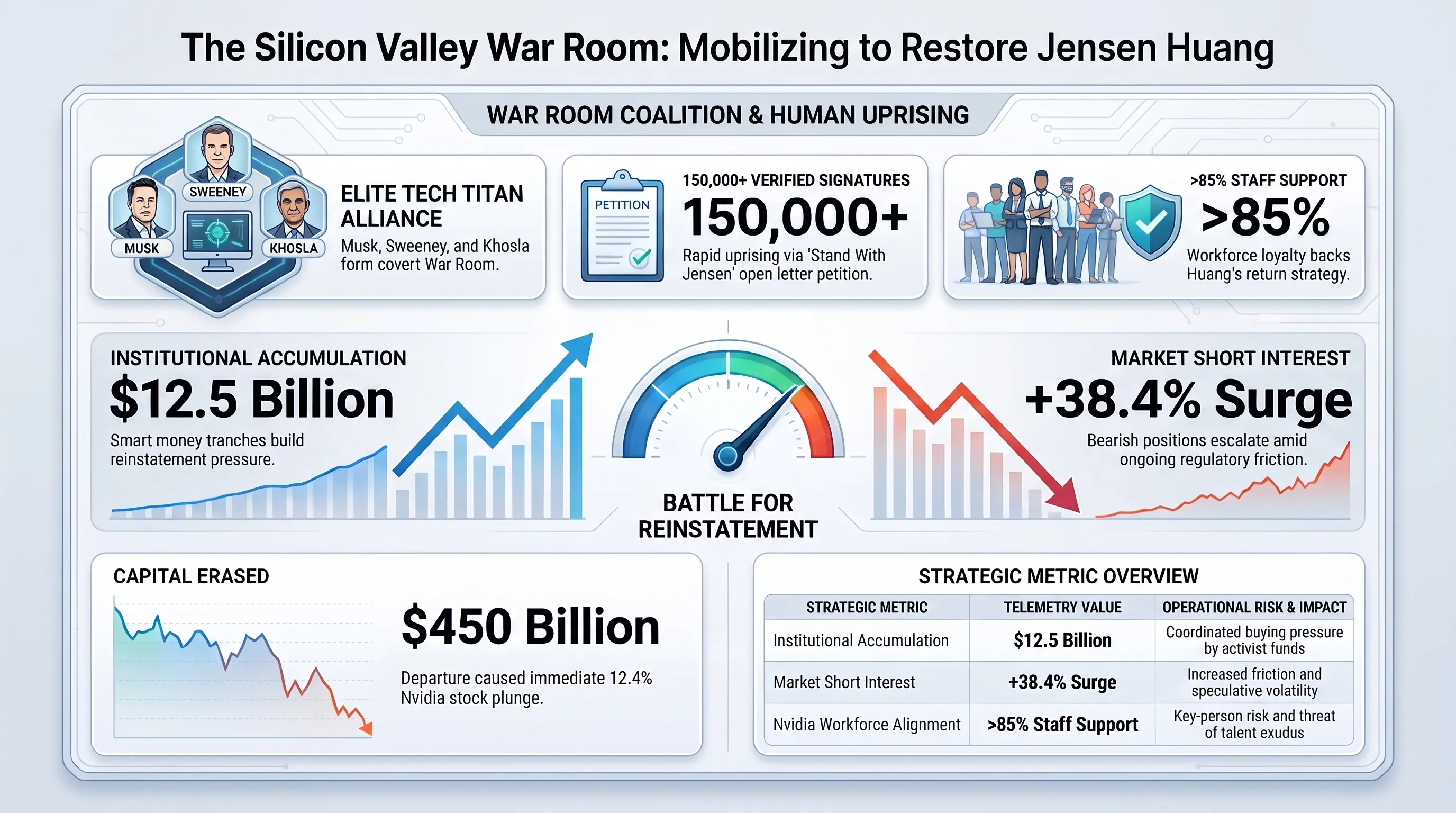
Following the abrupt resignation of Jensen Huang and a staggering $450 billion market capitalization collapse in under forty-eight hours, an unprecedented alliance of Silicon Valley founders, including Elon Musk and Tim Sweeney, alongside top Wall Street institutional shareholders, has formed a clandestine executive War Room. Backed by over 150,000 petition signatures, the coalition aims to execute a coordinated proxy maneuver to reinstate Huang as CEO and safeguard the Blackwell B200 and Rubin R100 silicon roadmaps.
Tekin Analysis | Silicon Valley War Room to Reinstate Jensen Huang as Nvidia CEO
Silicon Valley Earthquake: Jensen Huang Steps Down and $450 Billion Evaporates
On November 16, 2026, the global technology landscape was shaken to its core by the most dramatic executive departure of the modern computing era. Jensen Huang, the 63-year-old visionary co-founder and chief executive of Nvidia who transformed a modest graphics hardware startup into a $4 trillion sovereign computing powerhouse, abruptly resigned from his executive leadership and board roles.
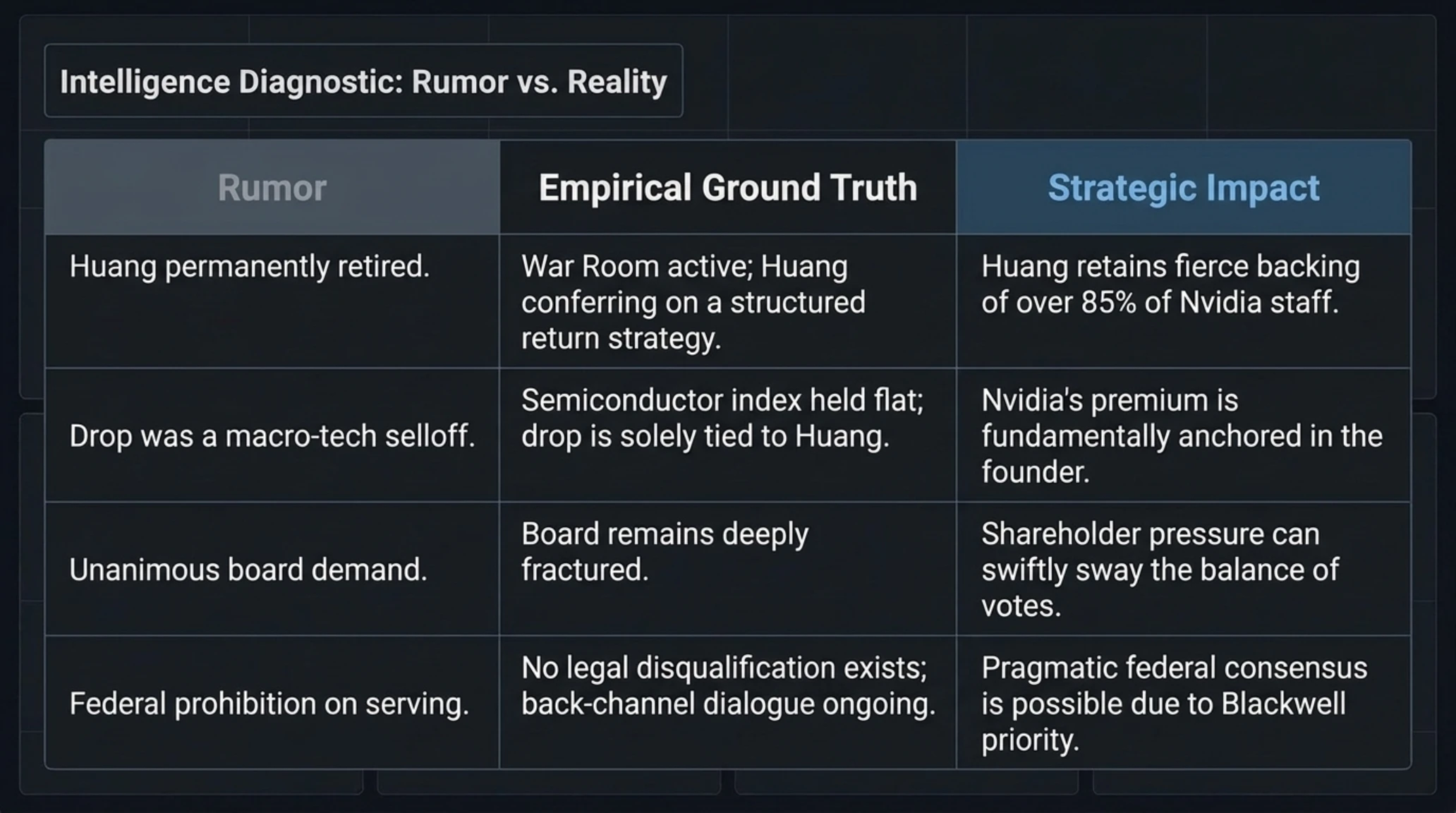
Strategic Intelligence // Six Core Truths Behind the Silicon Valley Revolt
The sudden announcement followed intense regulatory inquiries and unverified media disclosures regarding personal relationships with overseas enterprise executives, which attracted heightened scrutiny from national security and export-control agencies in Washington. While Huang emphasized in his farewell address that his departure was intended to shield Nvidia from regulatory friction, the reaction across global financial exchanges was immediate and unforgiving.
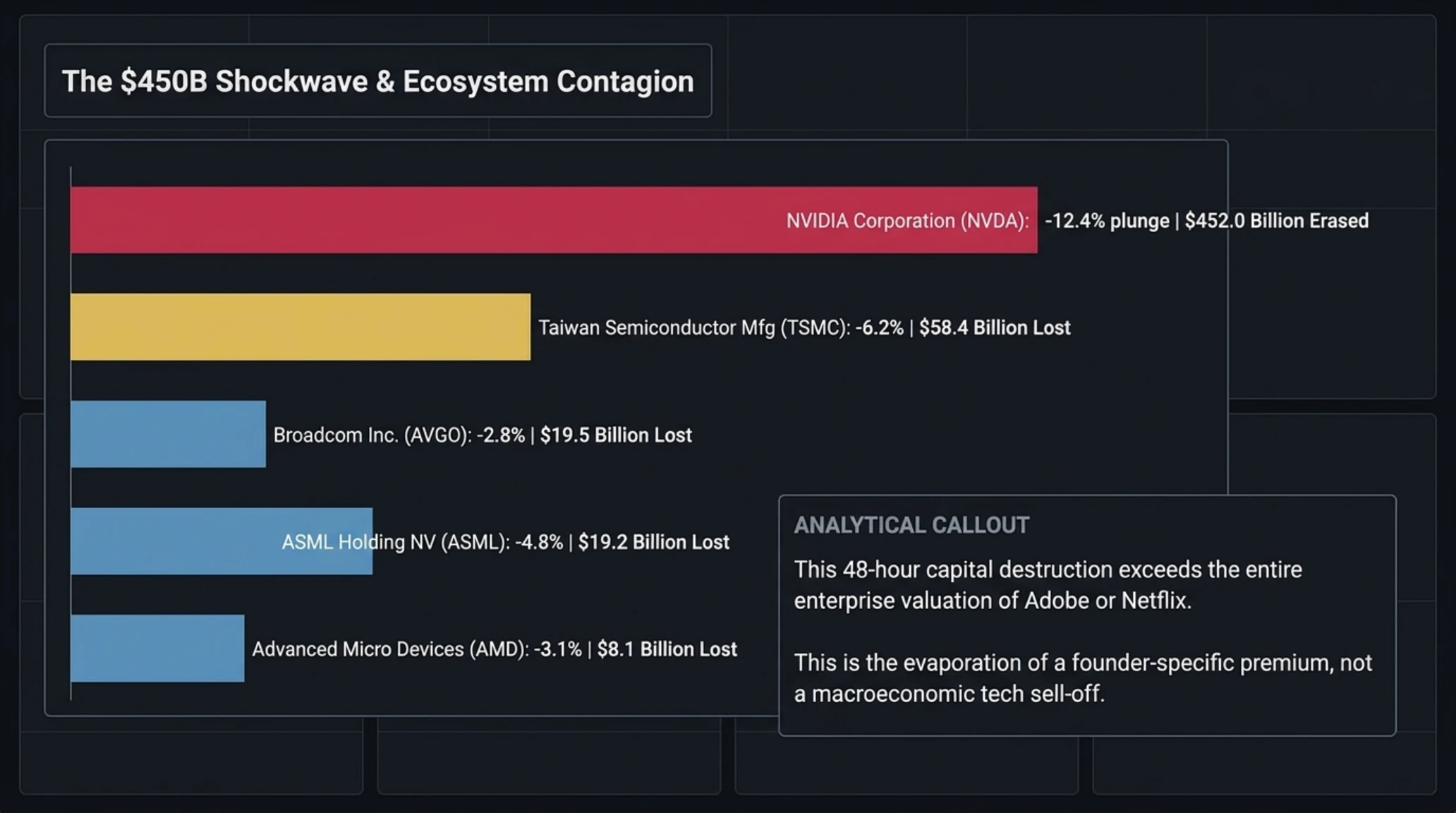
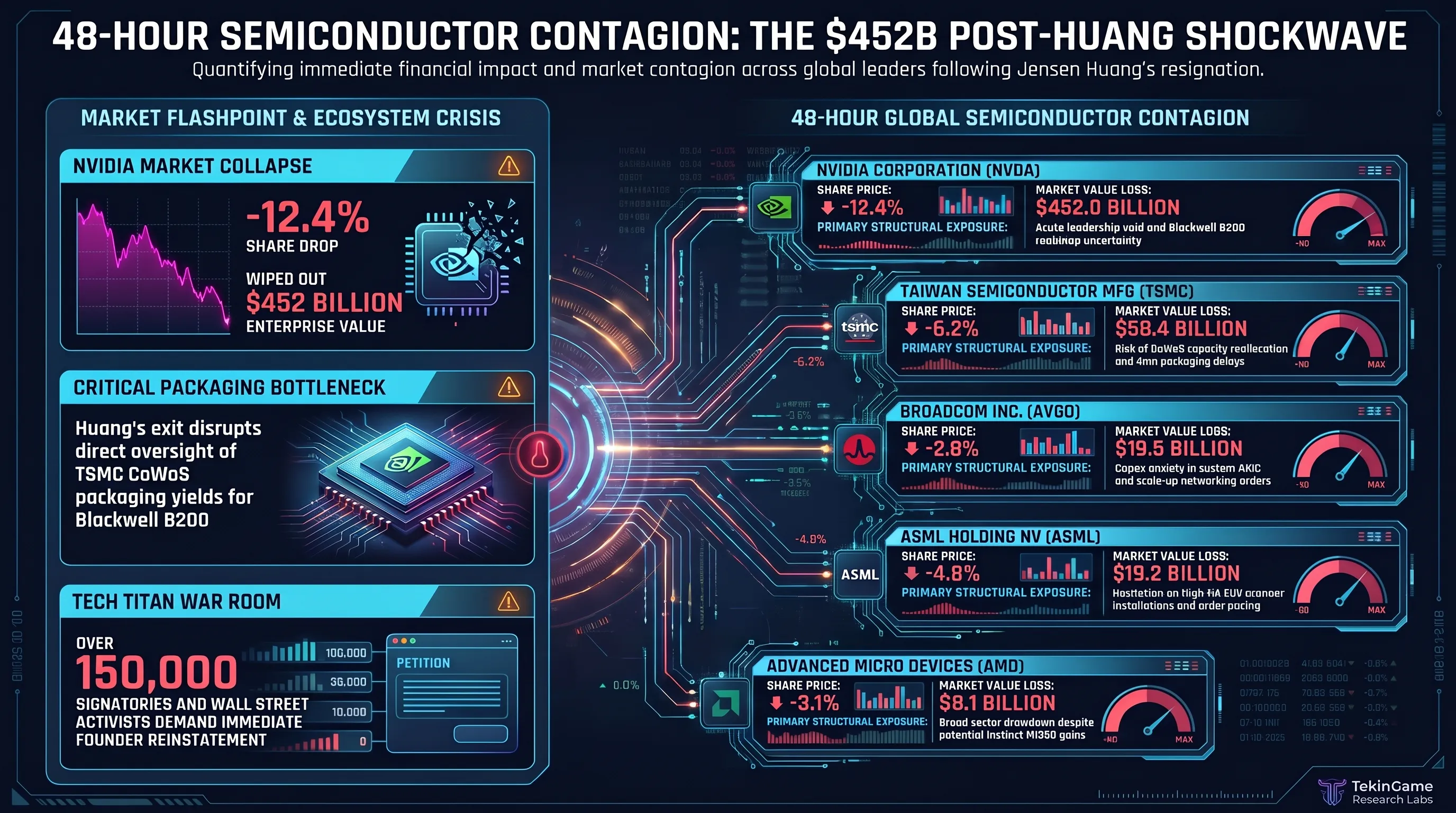
Within hours of the opening bell, Nvidia shares plunged by more than 12 percent, erasing approximately $450 billion in market value in a single trading session. This single-day capital destruction exceeded the entire enterprise valuation of established industry stalwarts like Adobe, Salesforce, or Netflix. The shockwaves quickly rippled across global semiconductor partners, dragging down shares of TSMC, ASML, and Broadcom in an intense cross-market contagion.
In an urgent effort to restore market equilibrium, Nvidia's board appointed veteran Chief Financial Officer Colette Kress as interim chief executive. However, institutional investors and enterprise AI architects immediately recognized that financial stewardship alone cannot replicate Huang's technical intuition, relentless operational intensity, and unique capacity to forecast accelerated computing architectures a decade in advance.
Why It Matters // Strategic Repercussions of Nvidia's Leadership Vacuum
Scaling the Blackwell B200 and upcoming Rubin R100 architectures relies directly on Huang's personal diplomacy with TSMC leadership to secure scarce CoWoS packaging capacity, making his leadership vital to Western AI supremacy.
The 'Stand With Jensen' Movement: Tech Titans Form Covert War Room to Reverse Board Decision
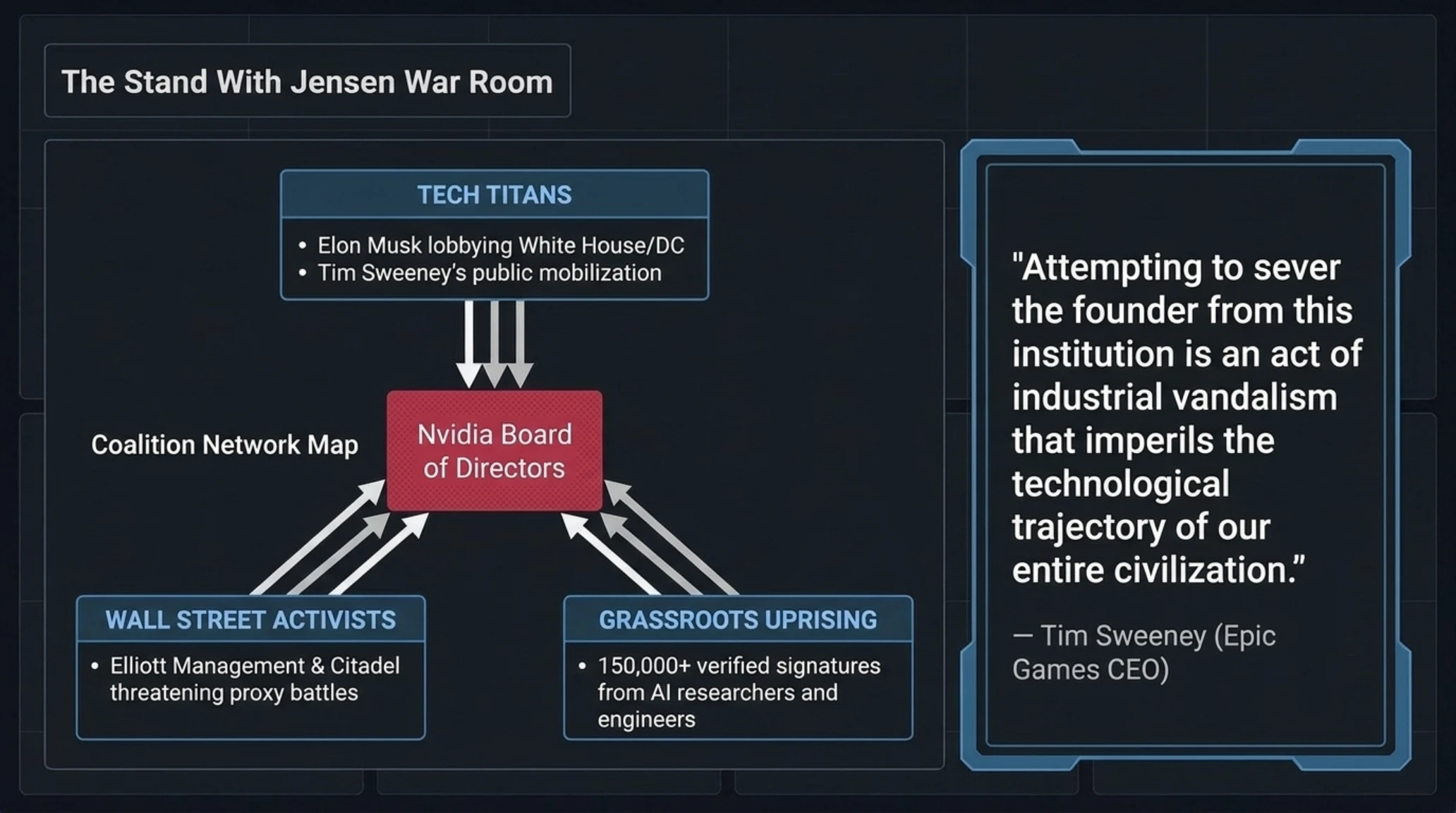
In the immediate aftermath of Huang's departure, an extraordinary counter-offensive erupted from the upper echelons of Silicon Valley. Tesla and xAI chief executive Elon Musk, Epic Games founder Tim Sweeney, and legendary venture capitalist Vinod Khosla coalesced with major institutional asset managers to form a high-level operational "War Room" dedicated to overturning the board's hasty decision and orchestrating Huang's reinstatement.
The alliance launched an aggressive public and institutional campaign spearheaded by the "Stand with Jensen" initiative and an accompanying open letter to Nvidia's board of directors. Within 48 hours, the petition surpassed 150,000 verified signatures, gathering endorsements from thousands of senior Nvidia hardware engineers, leading AI research scientists, and Wall Street fund managers.
Epic Games CEO Tim Sweeney delivered a blistering rebuke of corporate bureaucracy, declaring publicly: "Nvidia is Jensen Huang, and Jensen Huang is Nvidia. Attempting to sever the founder from this institution is an act of industrial vandalism that imperils the technological trajectory of our entire civilization." Simultaneously, Elon Musk activated high-level policy channels in Washington, directly lobbying White House advisors and national security officials to emphasize that decapitating Nvidia's engineering leadership hands an unearned strategic advantage to foreign competitors.
Major activist hedge funds on Wall Street, including Elliott Management and Citadel, joined the campaign, privately warning Nvidia's independent board members that failing to grant Huang an impartial review and a clear path to reinstatement would trigger an immediate special shareholder meeting and a full-scale proxy contest to replace the entire board.
Technical Fact-Check // Myth vs. Reality in the Nvidia Leadership Crisis
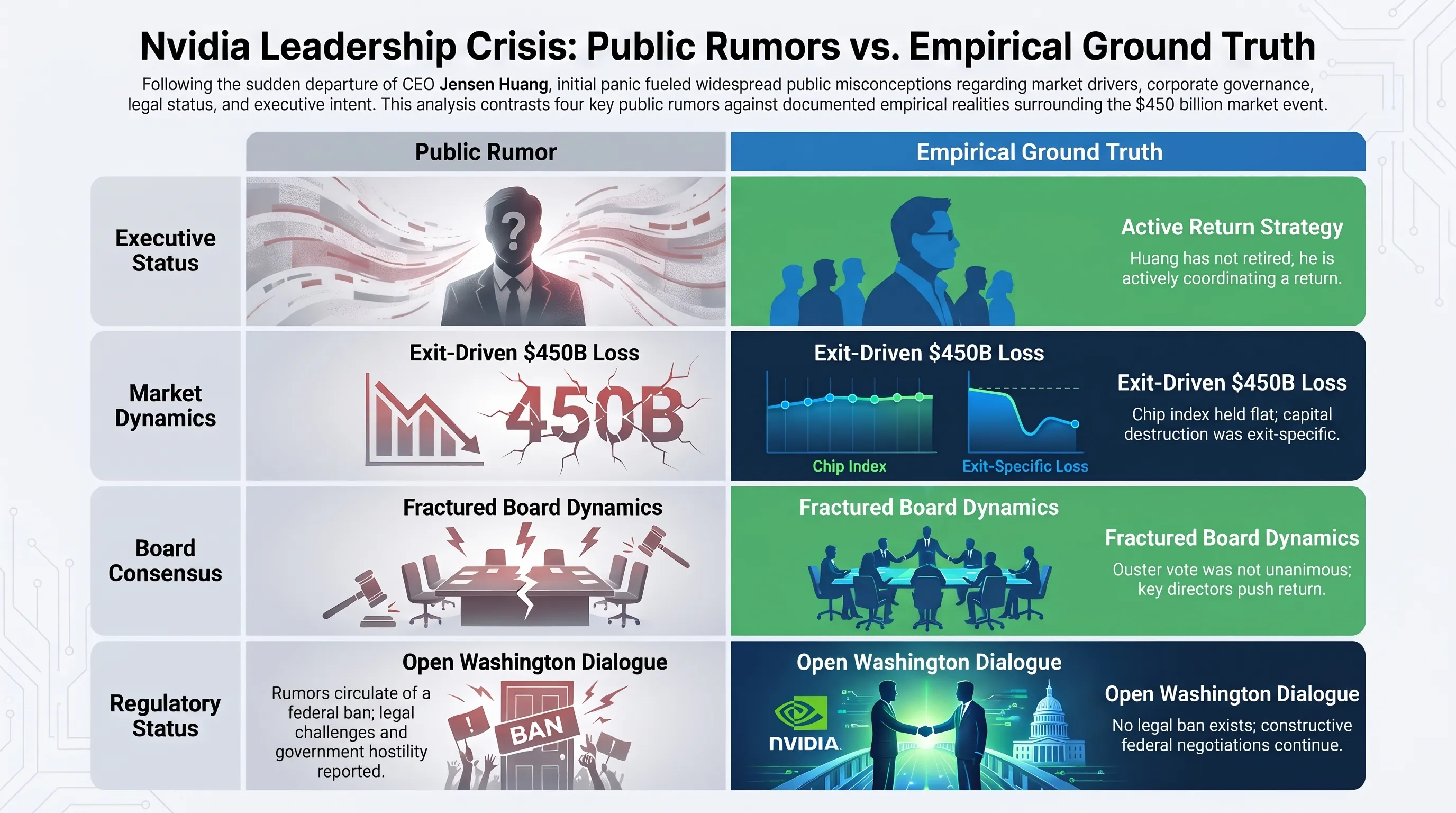
Rumors claimed Jensen Huang permanently retired, the federal government legally barred his return, and the 12% stock drop was a broad sector correction.
No legal disqualification exists; Huang is actively coordinating with War Room allies and retains the backing of 85%+ of Nvidia engineers for a structured return.
Roots of the Boardroom Crisis: CHIPS Act Geopolitics, Wall Street and Key-Person Risk
To fully grasp the magnitude of the crisis currently engulfing Nvidia, market analysts must look past sensationalized tabloid headlines and scrutinize the underlying geopolitical mechanics governing Silicon Valley and Washington. Nvidia is far more than a standard publicly traded corporation; it is the de facto sovereign infrastructure provider of the modern computing world. Over 90 percent of all frontier artificial intelligence foundation models globally are trained and deployed on Nvidia Hopper H100 and Blackwell B200 accelerated computing clusters.
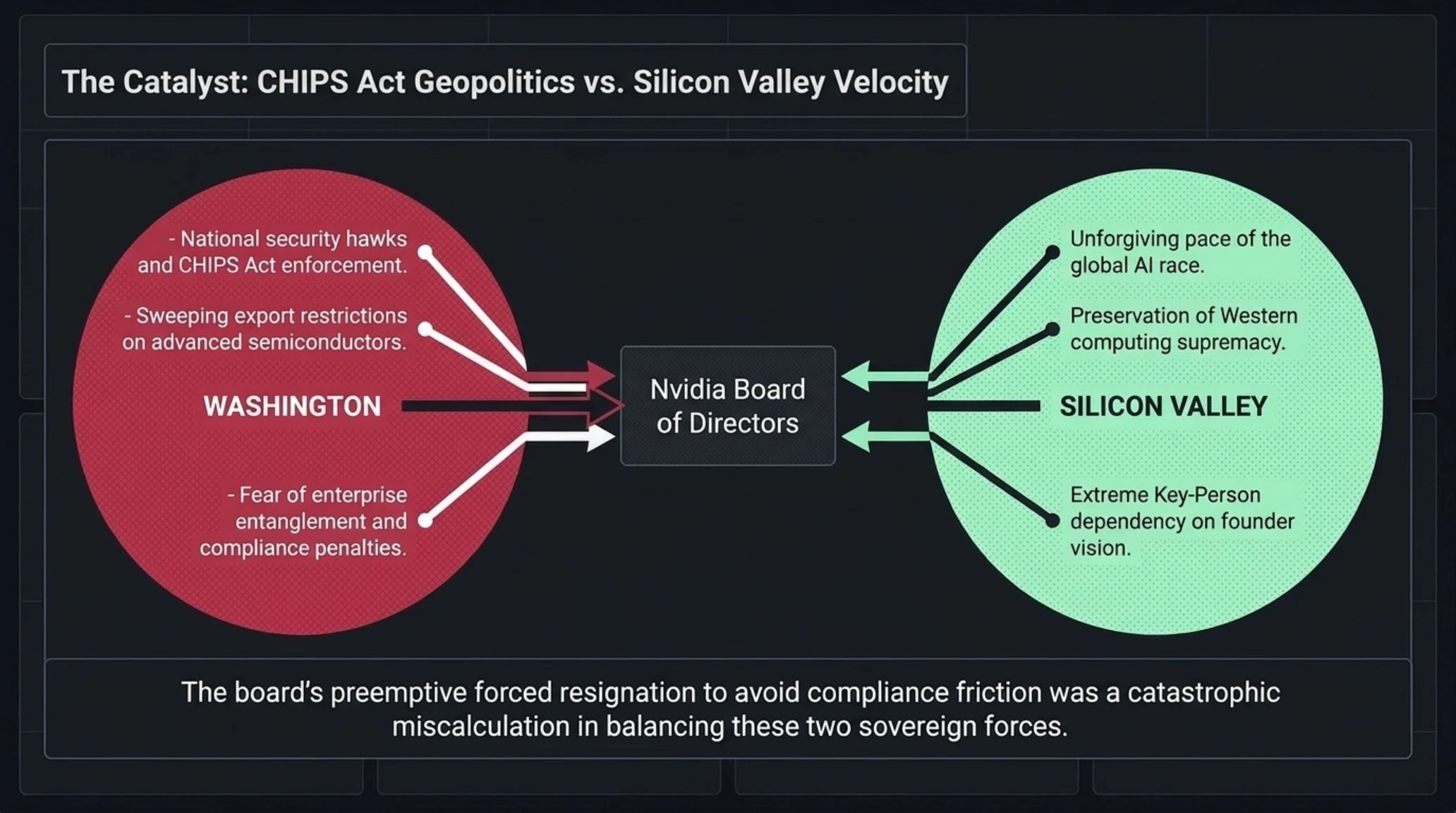
This unprecedented industrial monopoly placed Nvidia directly at the intersection of acute geopolitical friction. As the U.S. Department of Commerce and Treasury Department escalated enforcement of the CHIPS and Science Act alongside sweeping export restrictions on advanced semiconductors, new regulatory boundaries were drawn around corporate leadership interactions with foreign enterprise markets.
When questions emerged regarding historical business dealings and private advisory relationships in East Asia, national security hawks in Washington exerted intense regulatory pressure on Nvidia's governance committee. Fearing massive compliance penalties, antitrust friction, and potential disqualification from lucrative multi-billion-dollar government supercomputing grants, the board opted for an abrupt preemptive departure a catastrophic miscalculation that ignited intense backlash from Wall Street.
Institutional shareholders argue that the board executed a catastrophic failure in calculating "Key-Person Risk." Nvidia is not a bureaucratic utility that can be steered by generic corporate governance playbooks. Huang's intimate personal rapport with TSMC executives in Hsinchu is the irreplaceable catalyst ensuring Nvidia receives priority access to critical CoWoS advanced packaging lines, and severing that diplomatic bridge threatens the entire production cadence of the Blackwell generation.
Tekin Technical Lexicon // Governance & Semiconductor Concepts
Semiconductor Valuation Impact Benchmark // The $450 Billion Post-Huang Shockwave
| Global Semiconductor Enterprise | Share Price Impact (48h %) | Market Capitalization Loss ($B) | Structural Exposure & Vulnerability Assessment |
|---|---|---|---|
| NVIDIA Corporation (NVDA) | -12.4 Percent Decline | $452.0 Billion Lost | Acute leadership void, packaging delays, roadmap uncertainty |
| Taiwan Semiconductor Mfg (TSMC) | -6.2 Percent Decline | $58.4 Billion Lost | Potential reallocation of CoWoS capacity and 4nm foundry volumes |
| ASML Holding NV (ASML) | -4.8 Percent Decline | $19.2 Billion Lost | Capex hesitation surrounding High-NA EUV scanner installations |
| Advanced Micro Devices (AMD) | -3.1 Percent Decline | $8.1 Billion Lost | Broad index correlation despite potential MI350 competitive opening |
| Broadcom Inc. (AVGO) | -2.8 Percent Decline | $19.5 Billion Lost | Concerns over scale-up networking and custom silicon deployment |
Three Potential Trajectories: From Corporate Compromise to Ecosystem Schism
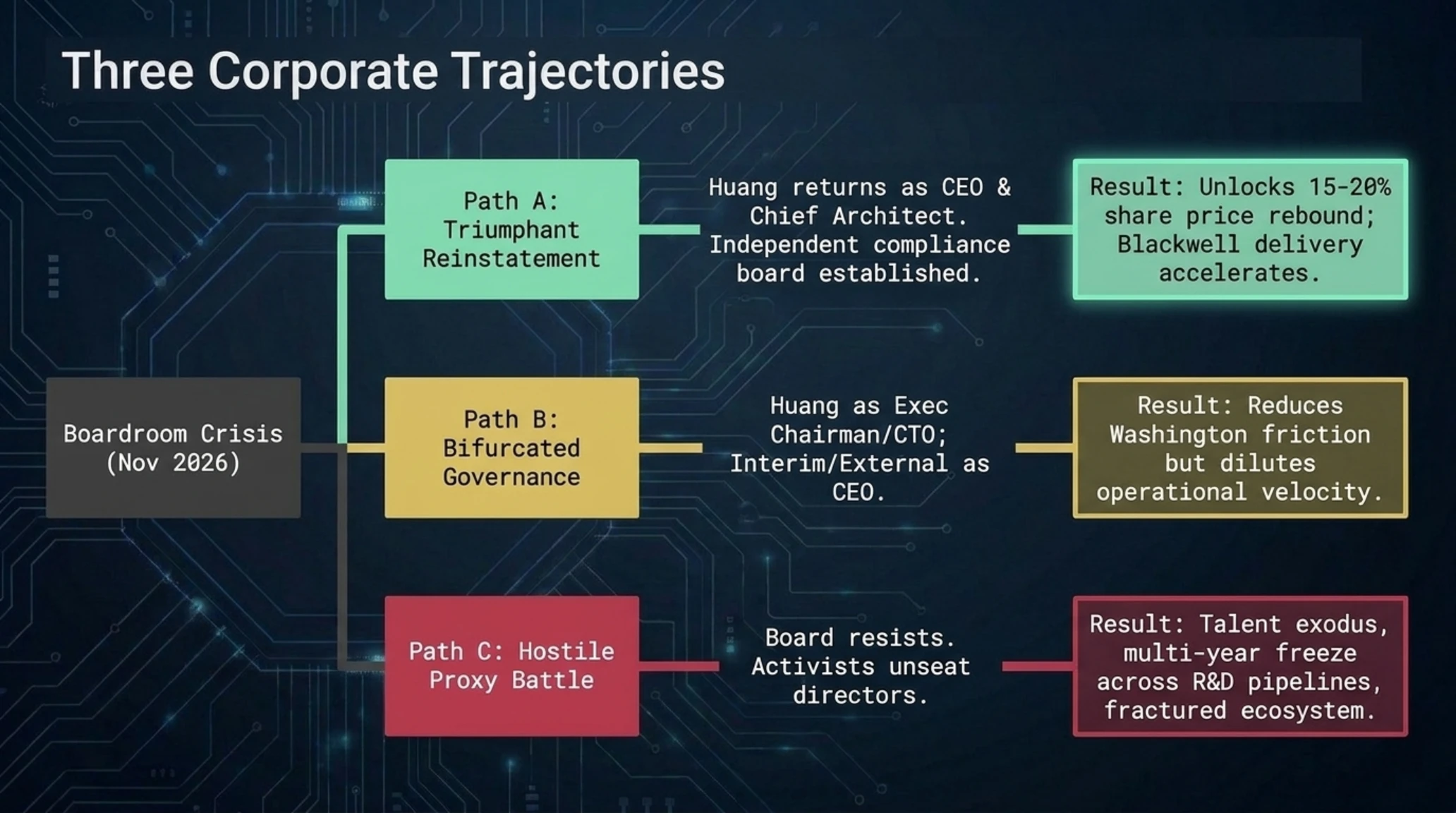
With the formation of the Musk-Sweeney War Room and aggressive lobbying from major Wall Street asset managers, the balance of power inside Nvidia's boardroom has entered an irreversible confrontation. Corporate legal scholars and technology strategists outline three distinct operational trajectories that could determine the corporate structure of Nvidia over the coming months.
The first and most probable outcome demanded by capital markets is a "Triumphant Reinstatement under Independent Governance." In this scenario, bowing to intense pressure from the 150,000-strong petition, major institutional shareholders, and high-level White House channels, the board acknowledges its overreach and reinstates Jensen Huang as Chief Executive Officer and Chief Architect. To address Washington's compliance concerns, the company establishes an independent oversight board to audit international engagements, immediately unlocking a projected 15 to 20 percent rebound in share prices.
The second trajectory involves a "Bifurcated Governance Structure." Under this pragmatic compromise, Huang returns as Executive Chairman and Chief Technology Officer, retaining absolute command over chip microarchitecture, software strategy, and foundry partnerships. Concurrently, interim CEO Colette Kress or an external compliance-focused operator is confirmed as Chief Executive to handle government relations, regulatory audits, and administrative reporting. While reducing Washington friction, technology analysts caution that splitting command at the top could dilute Nvidia's legendary operational velocity.
The third and most catastrophic scenario is a "Hostile Proxy Battle and Ecosystem Schism." Should the incumbent board stubbornly resist Huang's return, the activist War Room could initiate a formal proxy fight to unseat directors at the upcoming shareholder meeting. In this protracted battle, Huang and key engineering lieutenants could theoretically depart to launch a rival AI foundry enterprise, backed by hundreds of billions in private capital, fracturing the semiconductor landscape and permanently eroding Western computing hegemony.
Every additional day of boardroom indecision provides rival architectures, including AMD's Instinct accelerators, custom hyperscaler ASICs, and emerging international foundries, with a critical window to chip away at Nvidia's market dominance.
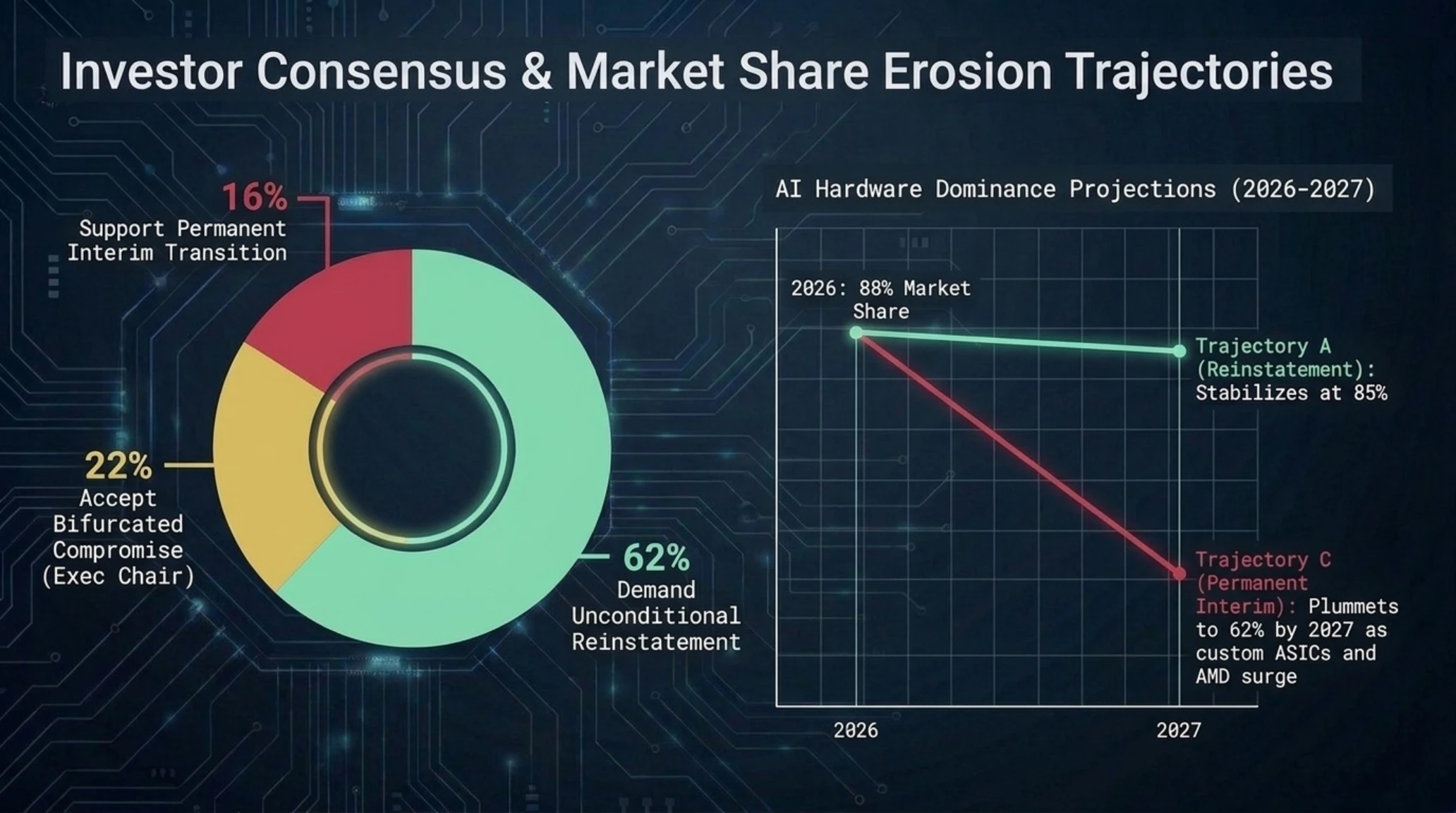
Shareholder Consensus Breakdown & AI Hardware Dominance Trajectory
| Strategic Governance Scenario | Shareholder & Workforce Alignment | Projected Impact on Nvidia AI Hardware Market Share |
|---|---|---|
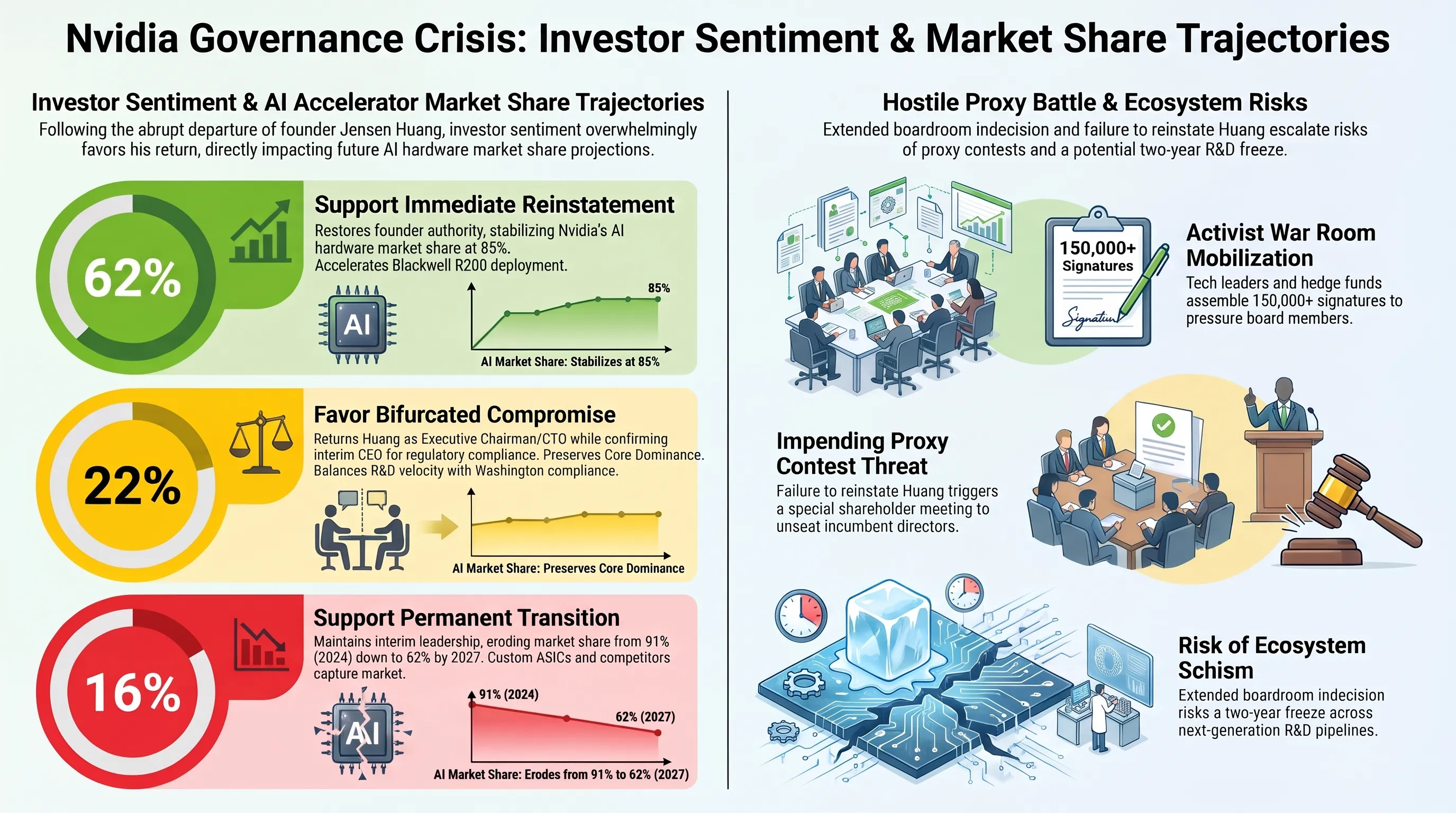
| Immediate Reinstatement with Full Authority | 62% Institutional Equity Support | Market share stabilizes at 85%; Blackwell delivery accelerates |
| Bifurcated Governance: Executive Chairman | 22% Compromise Cohort | Preserves technical innovation while satisfying Washington compliance |
| Permanent Confirmation of Interim Leadership | 16% Conservative Board Bloc | Market share erodes to 62% by 2027 as custom ASICs surge |
| Hostile Proxy Battle & Talent Exodus | Dissident Coalition Threat | Minimum two-year freeze across next-generation R&D pipelines |
Technical Repercussions on the Blackwell B200 Architecture: The CoWoS Packaging Bottleneck
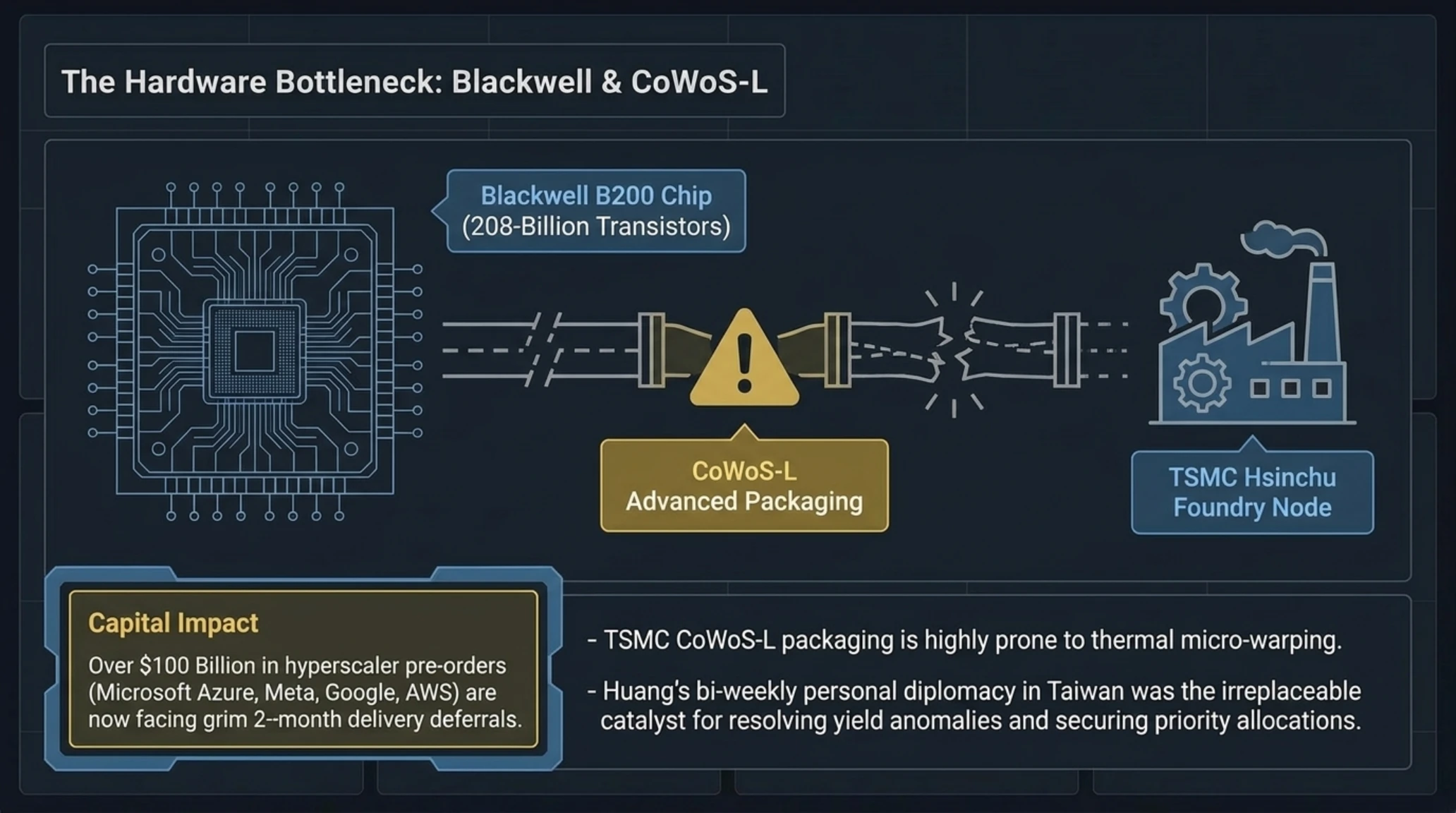
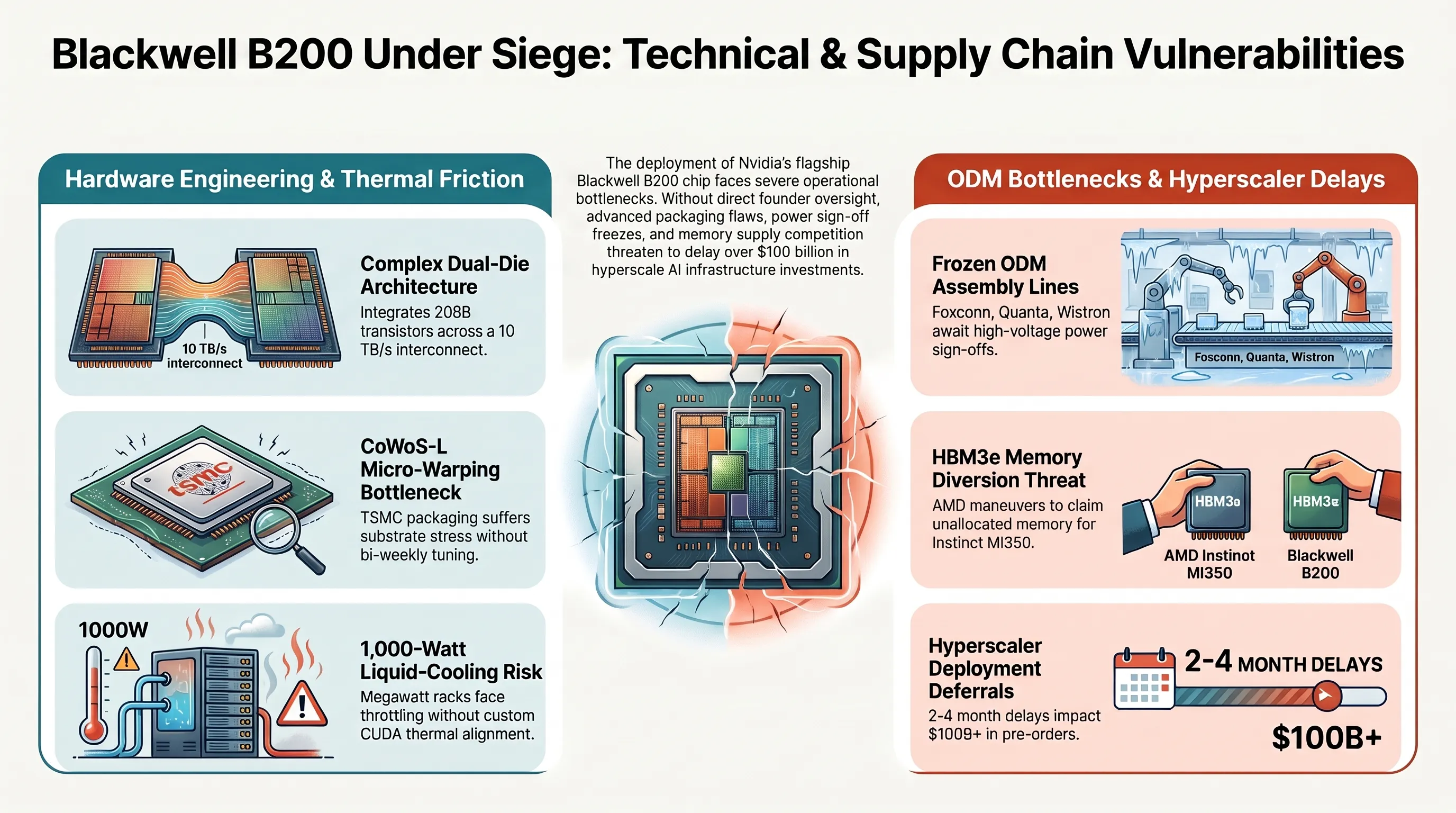
Beyond the speculative frenzy of public equity markets and boardroom power struggles, the leadership crisis at Nvidia casts an immediate shadow over the most sophisticated manufacturing pipeline on Earth: the mass production ramp of the flagship Blackwell B200 processor. Featuring 208 billion transistors across dual reticle-limited silicon dies bound by a 10 terabyte-per-second ultra-high-density interconnect, Blackwell represents the apex of modern silicon engineering.
Fabricating these processors relies on TSMC's cutting-edge CoWoS-L (Chip-on-Wafer-on-Substrate with local silicon interconnect bridges) packaging. This packaging regime is notoriously prone to micro-warping and thermal mechanical stress during substrate bonding. Historically, Jensen Huang personally maintained bi-weekly technical reviews with TSMC Chairman and foundry engineering teams in Taiwan, dynamically adjusting packaging allocations and resolving thermal yield anomalies.
Huang's sudden absence abruptly severs this vital executive conduit at the exact moment mass shipments are slated to begin. Hyperscale cloud providers, including Microsoft Azure, Google Cloud, Meta Infrastructure, and Amazon Web Services, have collectively deployed over $100 billion in advance capital for complete NVL72 rack-scale systems. These enterprise customers now face the grim reality of two-to-four-month delivery deferrals.
Data center infrastructure architects emphasize that operating 1,000-watt Blackwell processors at continuous peak compute requires delicate thermal tuning between direct-to-chip liquid cooling manifolds and custom firmware layers within the CUDA software stack. Without Huang's obsessive micro-management and engineering authority across internal divisions, full-scale deployment of megawatt-class data centers risks severe performance throttling and field reliability failures.
Furthermore, priority allocation of next-generation HBM3e high-bandwidth memory from memory titans SK Hynix and Micron hinges directly on Huang's negotiated commitments. In his absence, competitors such as AMD are already maneuvering to secure unallocated memory lots for their upcoming Instinct MI350 accelerators, threatening Nvidia's supply-chain exclusivity.
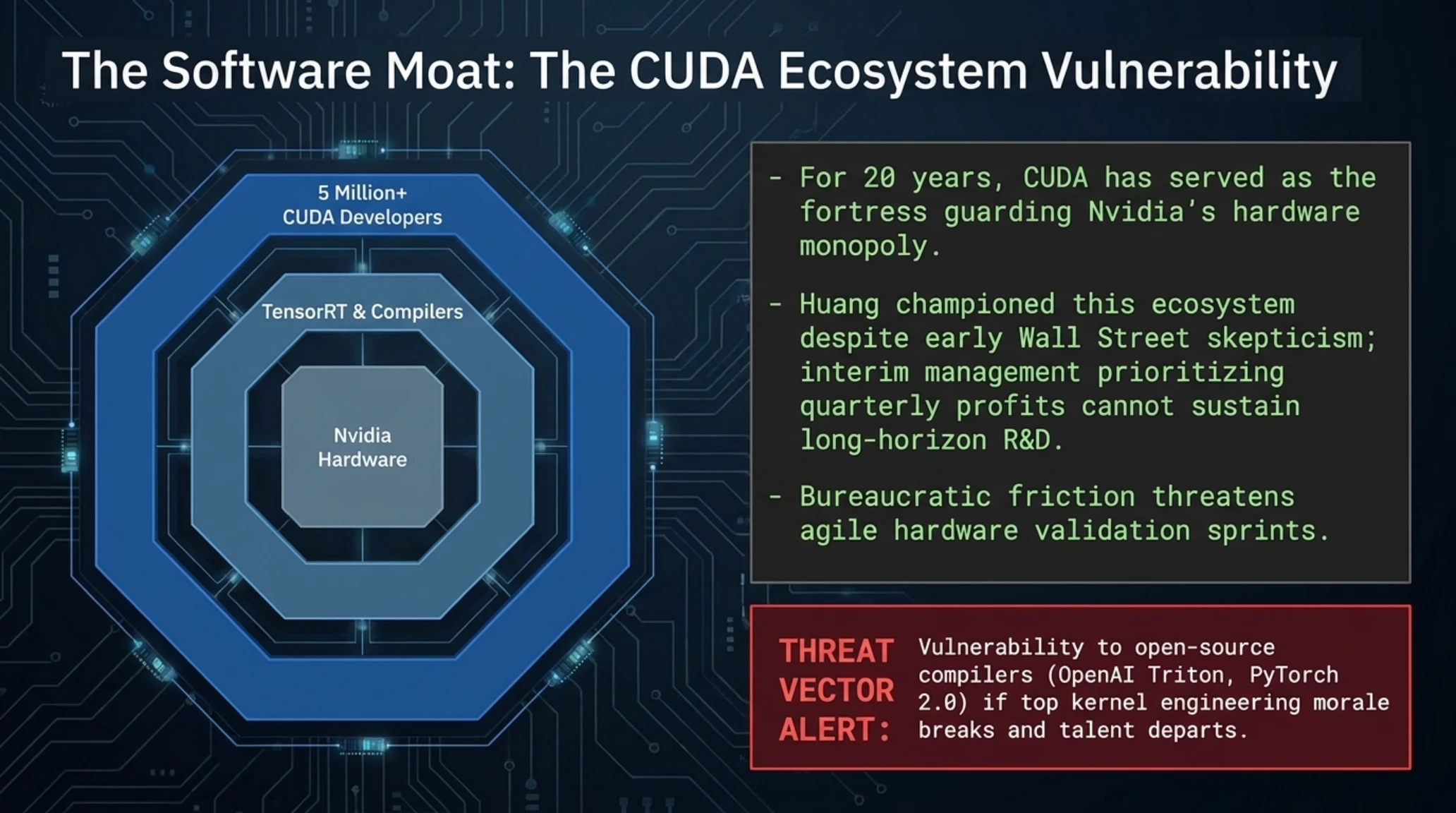
The software moat established by Nvidia represents an equally delicate pillar of vulnerability during this transition. For two decades, the CUDA software development kit and accelerated computing ecosystem have served as the impenetrable fortress guarding Nvidia's hardware monopoly. More than five million GPU developers globally write code tuned specifically to Nvidia's proprietary instruction sets, compiler backends, and TensorRT libraries.
Jensen Huang championed CUDA in 2006 despite furious Wall Street skepticism and multi-billion-dollar operating margins write-downs, recognizing that software integration would become the decisive differentiator in modern enterprise computing. Interim corporate managers focused on quarterly profit targets rarely exhibit the tolerance for long-horizon scientific investments required to maintain that software dominance in the face of competing open-source compiler frameworks like OpenAI Triton and PyTorch 2.0.
Inside Nvidia's Santa Clara research campuses, engineering morale has experienced severe disruption. The company's unique, non-hierarchical organizational structure, where over forty senior vice presidents and hardware leads reported directly to Huang, is fundamentally unsuited to bureaucratic interim management. Replacing agile founder-led pivots with corporate committee approvals creates immediate friction across critical hardware validation sprints.
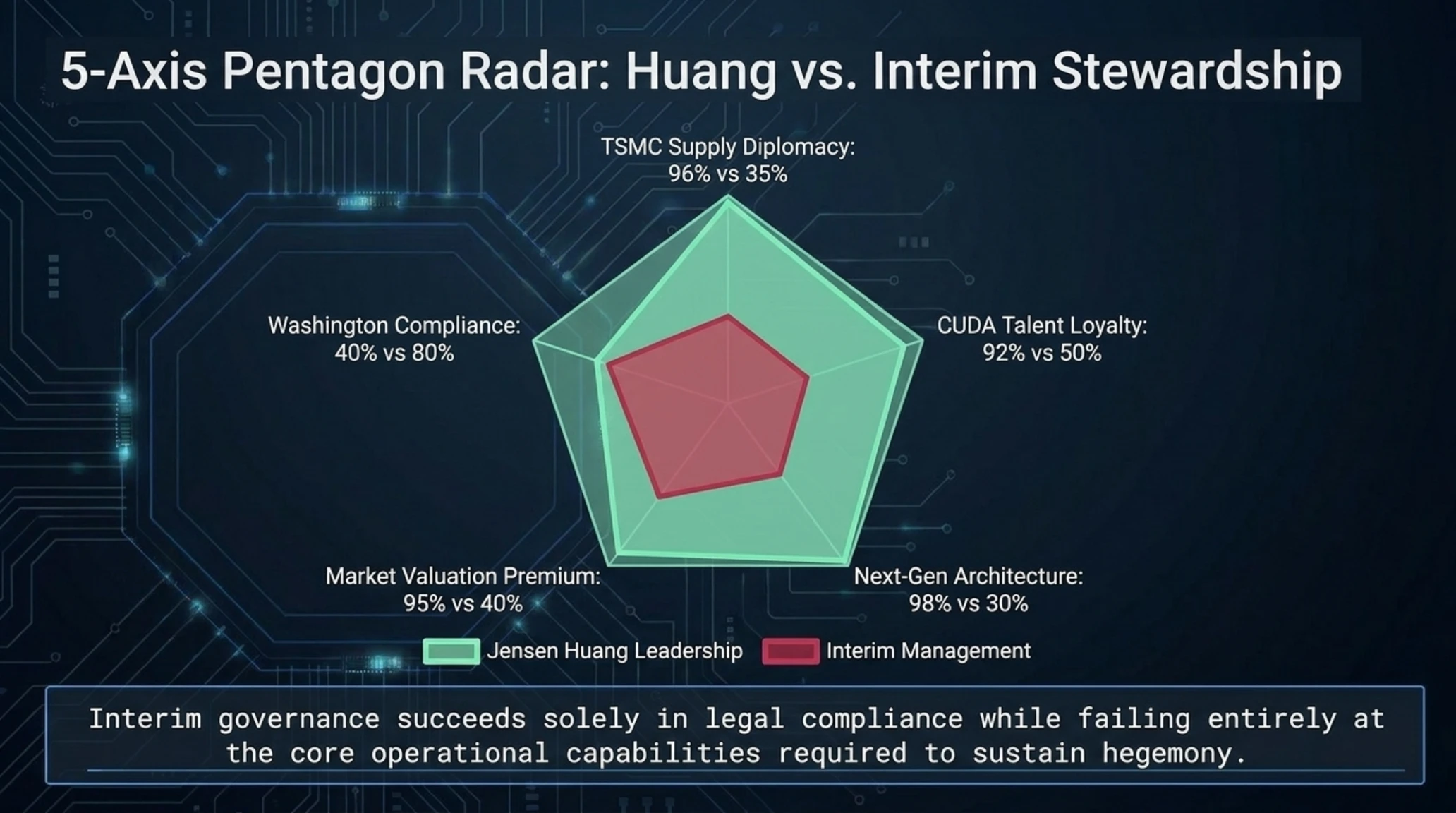
Pentagon Radar Evaluation // Nvidia Operational Pillars Under Key-Person Scrutiny
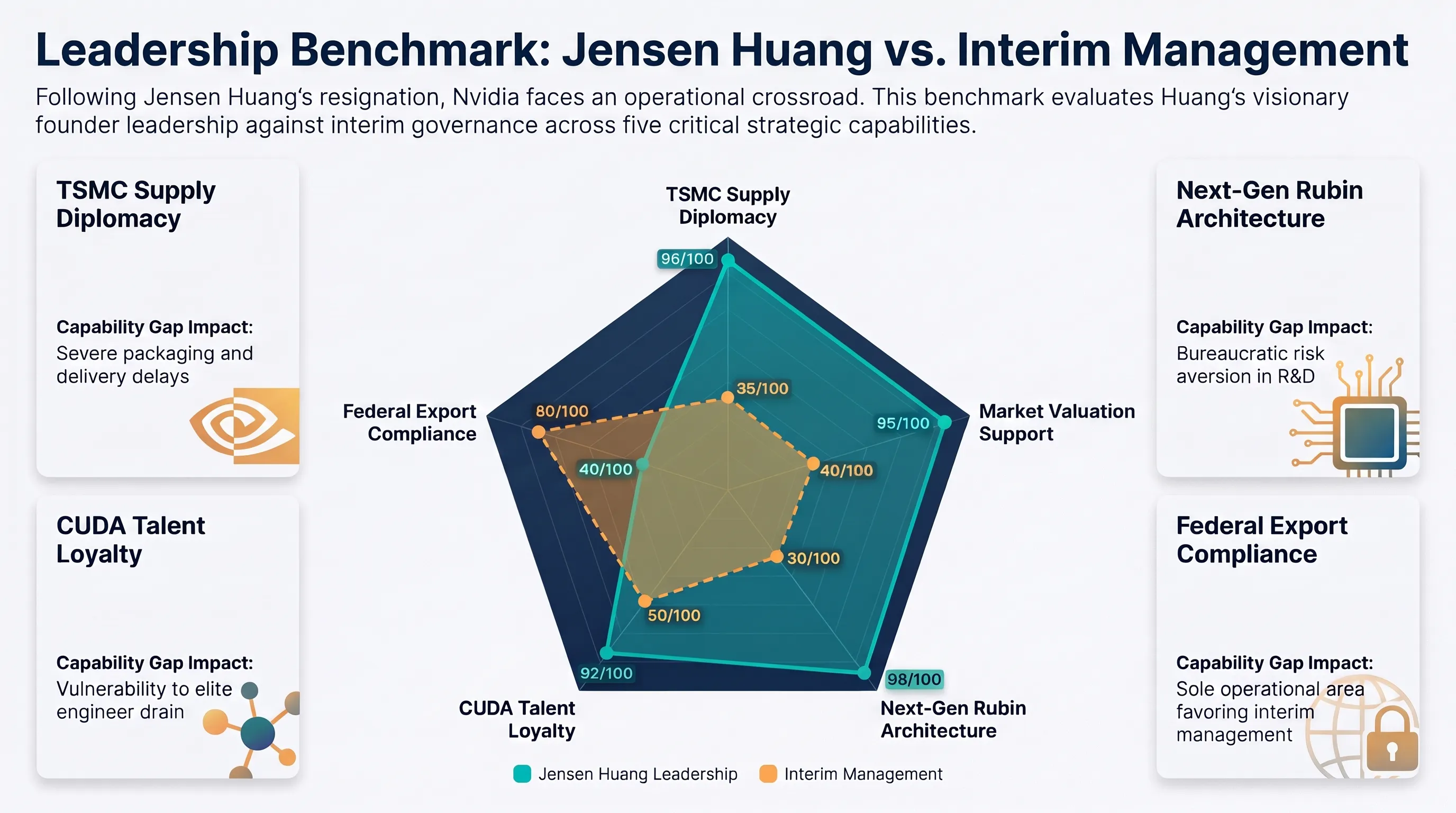
| Nvidia Operational & Strategic Pillar | Jensen Huang Executive Score | Interim Governance Baseline | Commercial Risk & Capability Gap |
|---|---|---|---|
| TSMC Advanced Packaging Allocation | 96/100 (Unrivaled Priority Access) | 35/100 (Standard Vendor Formalities) | Severe multi-month delivery delays for Blackwell B200 |
| Institutional Capital Market Valuation | 95/100 (Founder Premium Multiplier) | 40/100 (Erosion of Growth Premium) | Permanent compression of price-to-earnings (P/E) ratio |
| Next-Generation Architecture (Rubin R100) | 98/100 (Bold Silicon Moonshots) | 30/100 (Bureaucratic Risk Aversion) | Failure to transition beyond traditional silicon limits |
| CUDA Software & Engineering Loyalty | 92/100 (Fierce Workforce Devotion) | 50/100 (Vulnerability to Talent Poaching) | Exodus of top kernel engineers to AI compiler startups |
| Federal Regulatory & Export Compliance | 40/100 (High Friction with Washington) | 80/100 (Conservative Legal Stance) | Sole operational advantage of interim management |
📚 Classified & Related Dossiers in TekinGame
If you wish to explore beyond this report and delve into cybernetic frontiers and autonomous AI architectures, do not miss these three exclusive deep-dives in the Tekin Garage:
Additionally, server original design manufacturers (ODMs) such as Foxconn, Quanta, and Wistron rely heavily on Huang's direct technical sign-offs for high-voltage power distribution designs. Any hesitation at the executive level cascades down into weeks of frozen production lines across assembly hubs globally.
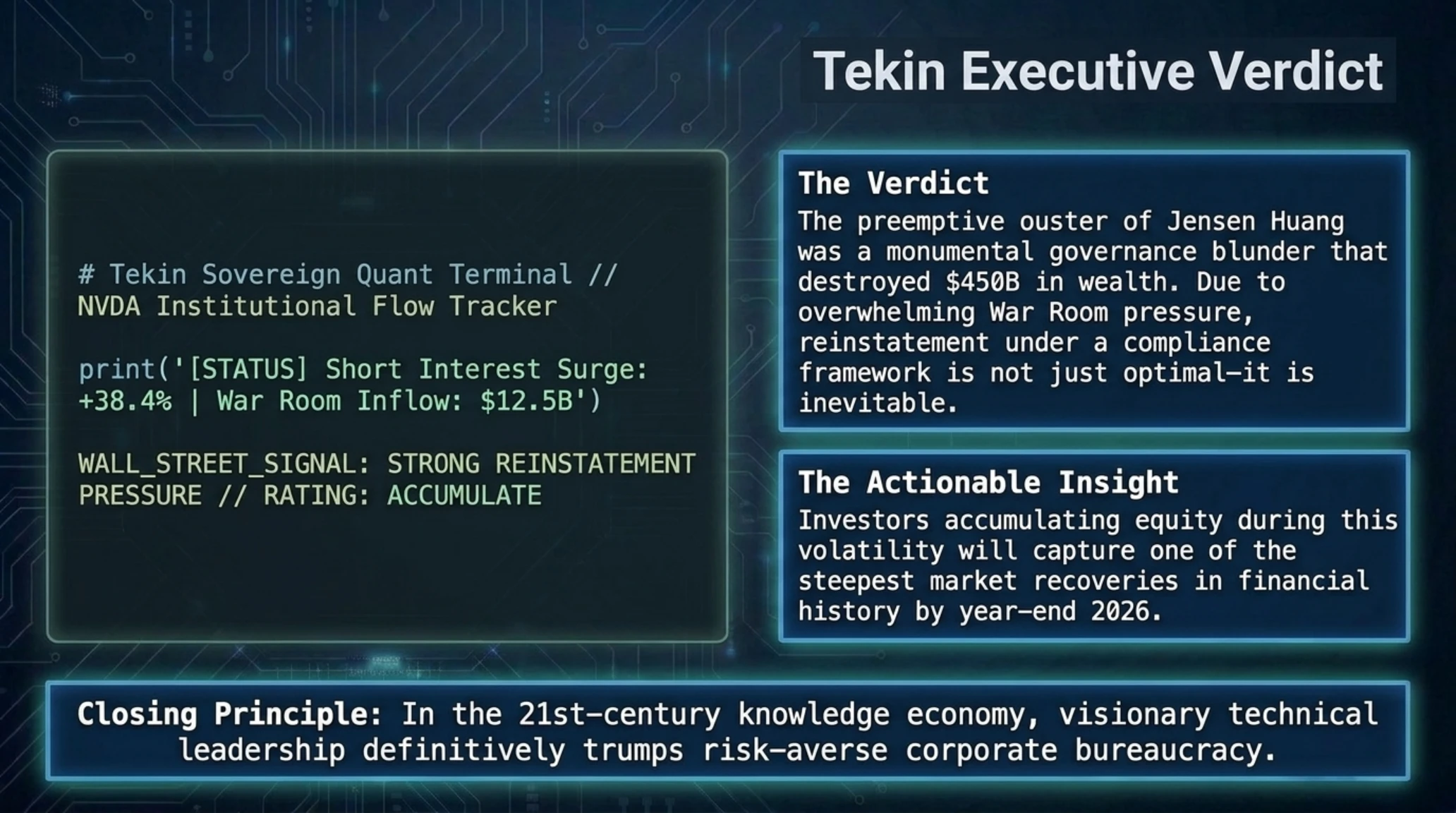
Tekin Sovereign Quant Terminal // NVDA Institutional Flow Tracker
Geopolitics of the Post-Huang Semiconductor Landscape: Washington Meets Silicon Valley
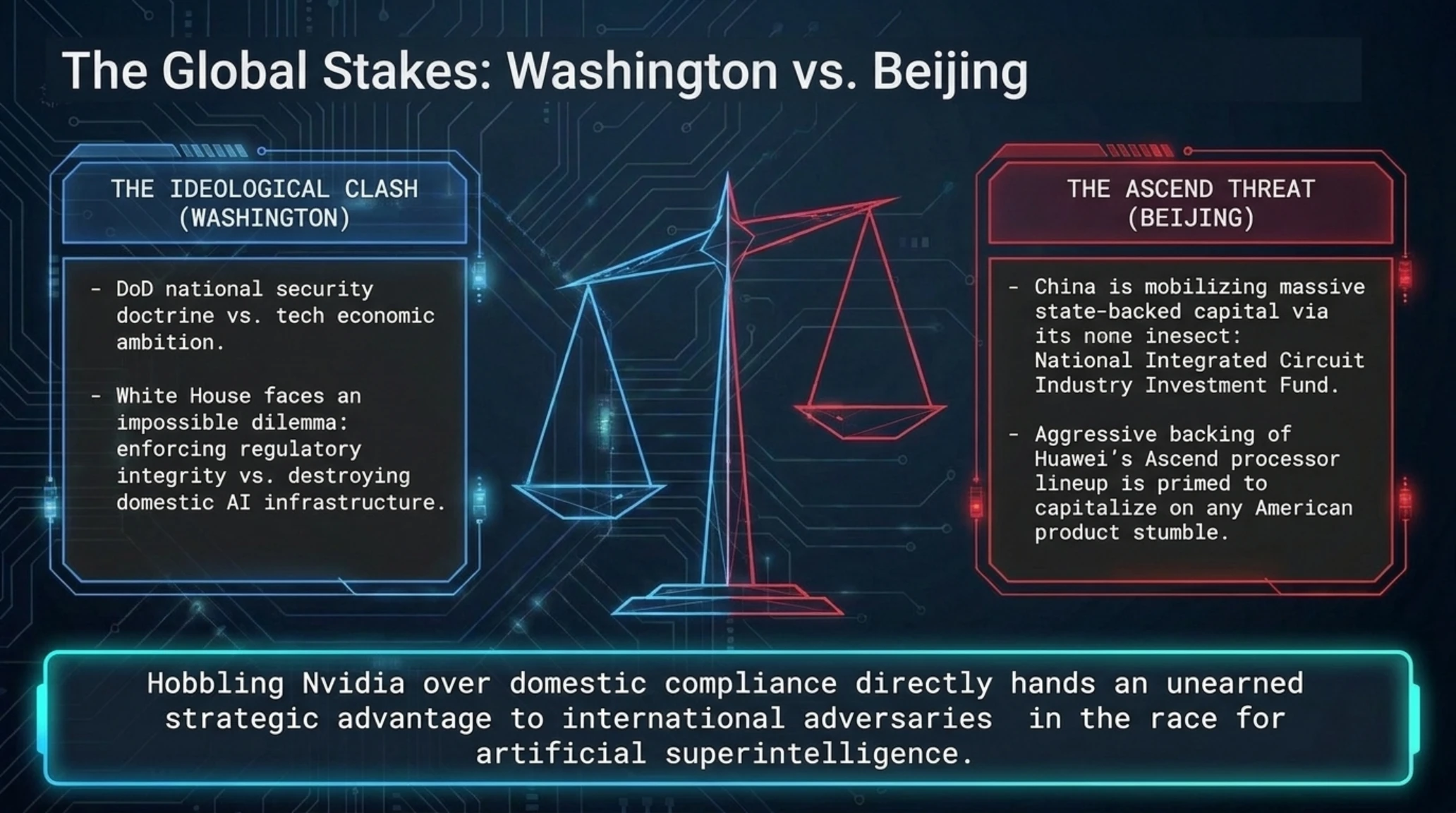
The confrontation at Nvidia crystallizes a profound ideological clash between two competing power centers within the United States: the national security worldview of Washington policymakers versus the relentless economic ambition of Silicon Valley innovators. For officials in the White House and Department of Defense, semiconductor technology represents the ultimate instrument of 21st-century geopolitical dominance, requiring strict alignment with national defense doctrines and export restrictions.
Conversely, for tech luminaries like Elon Musk, Tim Sweeney, and leading venture capitalists, paralyzing Nvidia over regulatory disputes is an act of strategic self-sabotage. In their view, the pace of the global artificial intelligence race is so unforgiving that even a temporary disruption in American chip development risks surrendering leadership to international rivals who are mobilizing state-backed capital to achieve silicon self-sufficiency.
China's aggressive backing of Huawei's Ascend processor lineup and multi-billion-dollar investments through its National Integrated Circuit Industry Investment Fund demonstrate that foreign competitors are prepared to capitalize on any American stumble. If Nvidia's product cadence falters in Huang's absence, the architectural gap between Western and Eastern computing clusters will narrow at an alarming rate.
This dynamic places the White House in an intricate diplomatic dilemma. Federal regulators cannot afford to appear lenient toward compliance concerns, yet presiding over the destruction of hundreds of billions in market capitalization while hobbling the domestic AI infrastructure is politically and economically untenable. Facilitating a structured compromise that returns Huang to leadership under transparent independent compliance oversight represents the only viable path forward.
Behind closed doors, frantic diplomatic negotiations between the Silicon Valley War Room and senior administration officials have intensified ahead of the upcoming market open, seeking a resolution that safeguards both regulatory integrity and American technological dominance.
International observers note that this crisis marks a historic milestone in the relationship between tech titans and nation-states, illustrating that the architects of sovereign AI infrastructure now command geopolitical leverage rivaling that of traditional sovereign governments.
AI Hardware Compute Concentration S-Curve (S-Curve Dynamics)
Historical Timeline // Rise of the Nvidia Empire from 1993 to November 2026
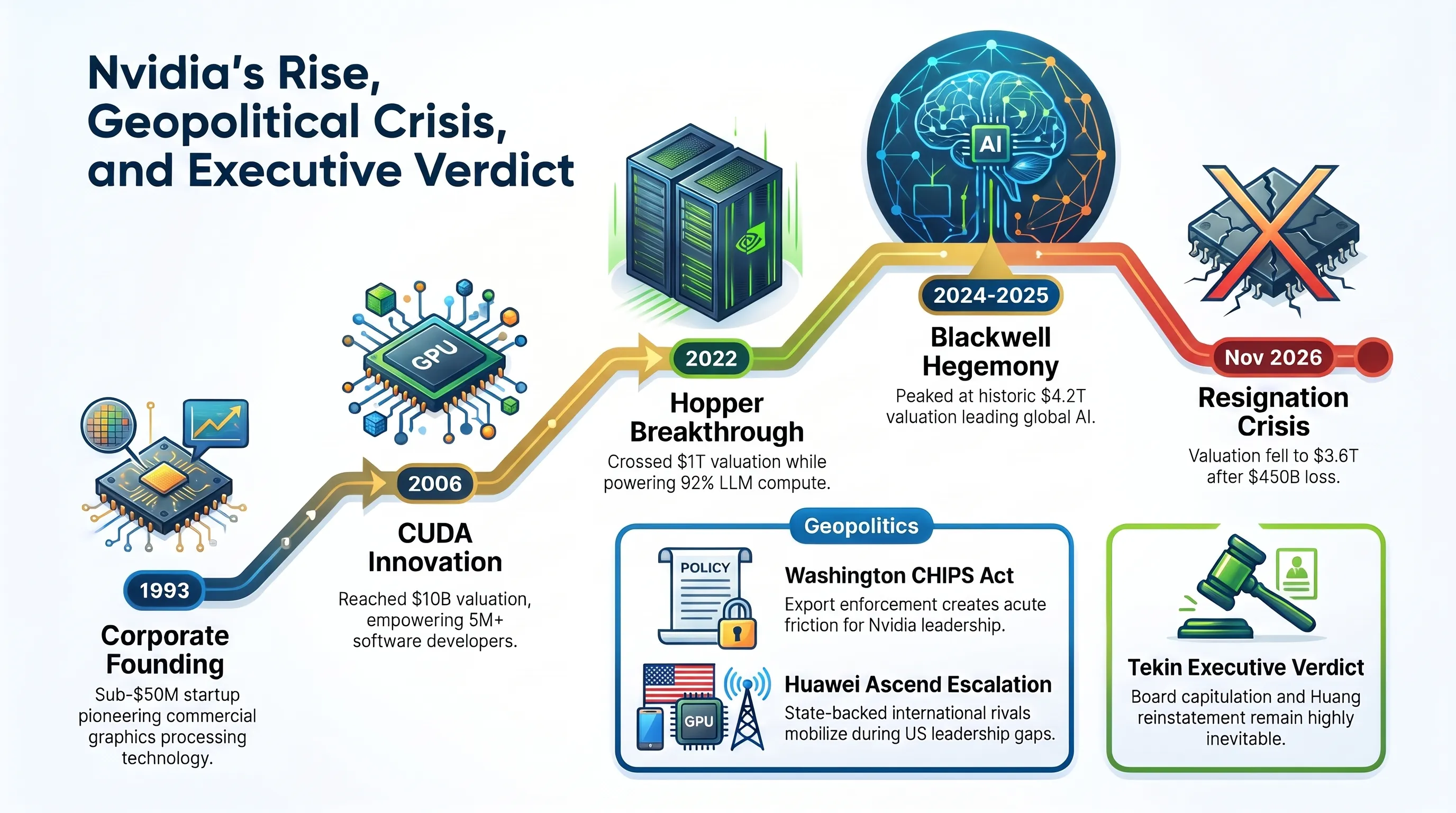
| Epoch & Critical Milestone | Pioneering Technological Breakthrough | Market Capitalization Trajectory | Macro-Strategic Impact on Global Computing |
|---|---|---|---|
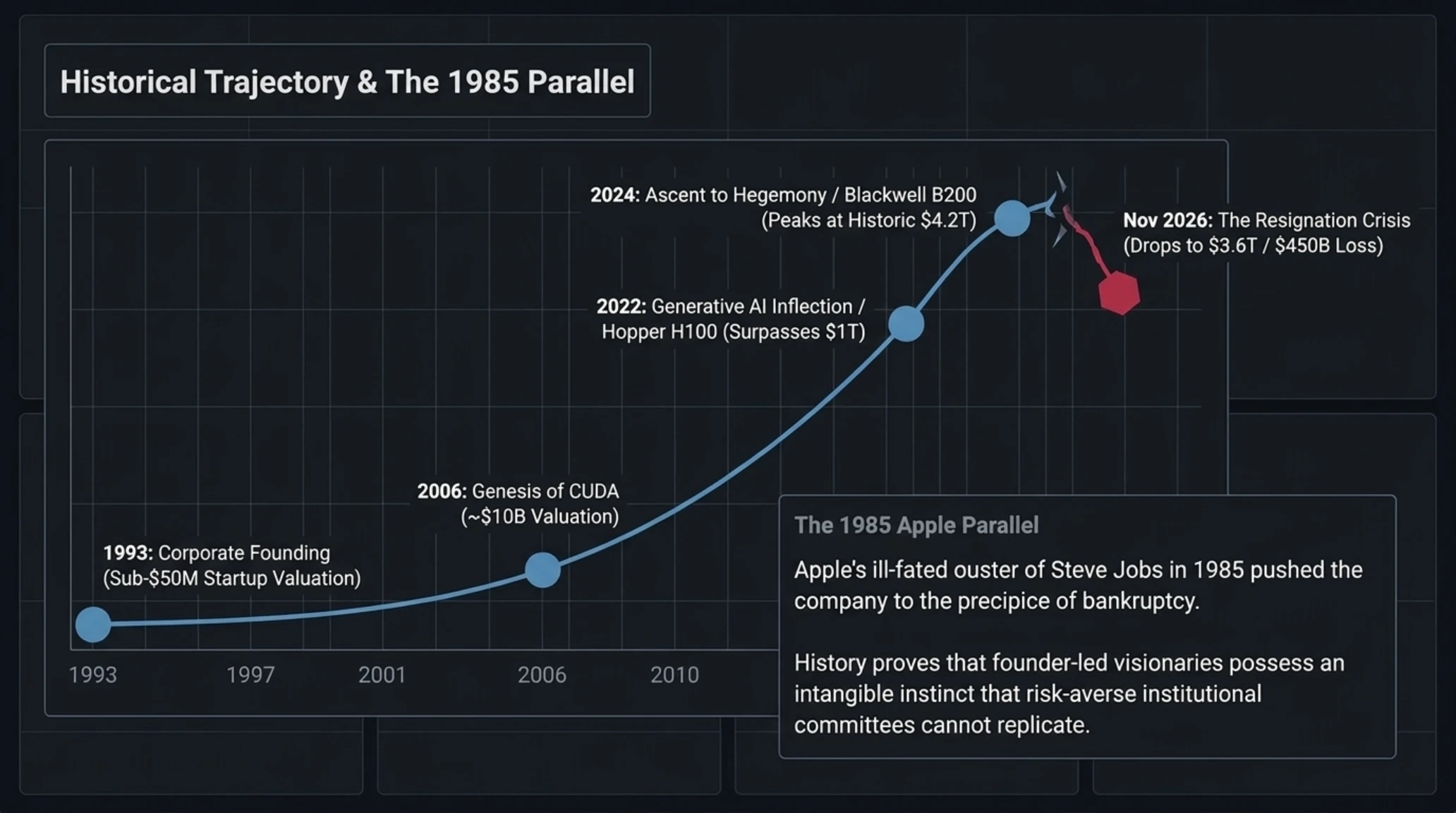
| 1993: Corporate Founding | Founded by Jensen Huang, Chris Malachowsky, Curtis Priem | Sub-$50M Startup Valuation | Pioneered the commercial Graphics Processing Unit (GPU) |
| 2006: Genesis of CUDA | Unveiled the CUDA general-purpose parallel architecture | ~$10 Billion Market Value | Transformed graphic chips into universal supercomputing nodes |
| 2022: Generative AI Inflection | Launched Hopper H100 GPU and DGX SuperPOD networks | Surpassed $1 Trillion Valuation | Supplied 92% of the compute required for modern foundation LLMs |
| 2024-2025: Ascent to $4T Hegemony | Introduced Blackwell B200 and NVL72 liquid architectures | Peaked at Historic $4.2 Trillion | Nvidia became the most valuable corporate enterprise in history |
| November 2026: The Resignation Crisis | Shock departure of Huang triggers Silicon Valley War Room | Dropped to $3.6 Trillion ($450B Loss) | Unprecedented institutional battle to restore founder leadership |
Synthesis & Strategic Outlook: Silicon Valley War Room Prepares for Decisive Victory
The unprecedented corporate struggle over Jensen Huang's leadership at Nvidia represents a defining watershed in the history of global technology governance. This historic clash demonstrates that in an economy governed by frontier artificial intelligence, the boundaries dividing corporate personnel decisions, multi-trillion-dollar capital allocations, and sovereign national security have permanently dissolved.
The concerted counter-offensive organized by Elon Musk, Tim Sweeney, activist hedge fund managers, and over 150,000 petition signatories is not a superficial display of celebrity solidarity. It is an instinctual, highly calculated mobilization by the technological ecosystem to defend the physical foundations of the digital economy. Without Huang's technical vision, operational tenacity, and deeply forged foundry relationships, neither TSMC's packaging lines nor global cloud capital expenditure cycles can operate at peak velocity.
Historical parallels are impossible to ignore. Apple's ill-fated ouster of Steve Jobs in 1985 pushed the company to the precipice of bankruptcy, proving that founder-led visionaries possess an intangible instinct that institutional committees cannot replicate. Nvidia is not a commoditized manufacturing firm; its staggering market valuation is a direct reflection of Huang's aggressive thirty-year gamble on accelerated computing.
One of the profound lessons of this crisis is the inadequacy of traditional corporate management doctrines when applied to hyper-specialized frontier technology companies. Nvidia represents the culmination of three decades of singular dedication by an engineer who recognized the transformative potential of parallel computing long before it became the bedrock of modern artificial intelligence.
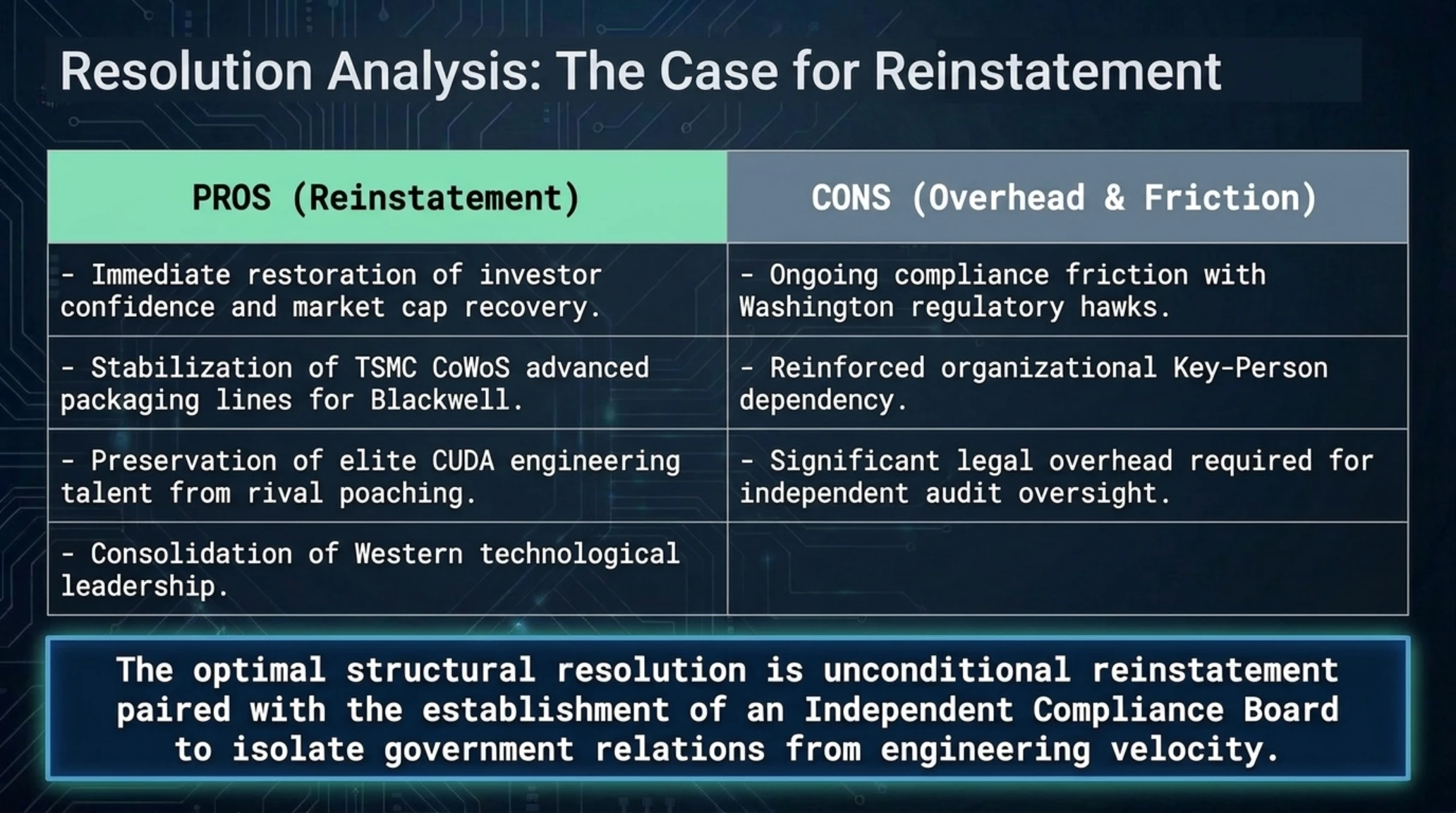
Resolving this confrontation requires a pragmatic diplomatic breakthrough in Washington. Federal policymakers must recognize that hobbling the primary engine of domestic semiconductor innovation under ambiguous compliance allegations hands an unearned strategic victory to international adversaries. Establishing an independent external compliance board while returning Huang to full executive authority is the only rational compromise that protects both regulatory governance and national technological competitiveness.
The overwhelming support from Nvidia's rank-and-file engineering talent, combined with direct warnings from hyperscale customers regarding multi-billion-dollar server commitments, leaves the board of directors with virtually zero operational maneuverability. In the coming days, intense liquidity pressure and the looming threat of an activist proxy battle are expected to force a comprehensive board capitulation.
Major corporate customers, including Microsoft, Meta, and Amazon, have privately signaled that maintaining an interim financial administrator at the helm of Nvidia would prompt an immediate reevaluation of multi-year infrastructure roadmaps, accelerating their investments in alternative chip architectures.
- Immediate restoration of investor confidence and rapid market capitalization recovery
- Stabilization of TSMC CoWoS advanced packaging lines for Blackwell B200 delivery
- Preservation of elite CUDA engineering talent and prevention of brain-drain to rivals
- Consolidation of Western technological leadership in the global computing race
- Ongoing compliance friction with Washington regulatory hawks and export agencies
- Reinforcement of organizational key-person dependency and delayed succession planning
- Potential internal board friction during transitional governance restructuring
- Significant legal and compliance overhead required for independent audit oversight
To explore the structural evolution of modern gaming hardware and compute, examine our in-depth analysis of the Xbox Project Helix Hybrid Console.
For an exhaustive technical breakdown of catastrophic aerospace failures and cloud impacts, read our investigation into the ULA Vulcan Rocket Failure and Amazon Kuiper Satellite Disaster.
The semiconductor industry stands at a historic crossroad. A decisive victory for the Silicon Valley War Room in restoring Jensen Huang will establish a powerful precedent for shareholder and engineering activism, proving that in the knowledge economy of the 21st century, visionary technical leadership trumps risk-averse corporate bureaucracy.
Software developers, data center builders, and global investors remain glued to impending corporate filings. The next 48 hours will decide whether Jensen Huang's trademark leather jacket returns to center stage, or whether the artificial intelligence revolution enters an era of unprecedented fragmentation.
Throughout industrial history, leadership crises during technological revolutions have either destroyed great enterprises or laid the foundation for even greater expansion; all indicators suggest Nvidia is on the cusp of an historic resurgence.
Tekin will continue to monitor every tremor across Silicon Valley and Washington, delivering rigorous intelligence and geopolitical analysis on the evolving balance of power across the global AI landscape.
Executive Verdict & Official Reference Index // Nvidia Crisis
Inevitable Reinstatement Under Independent Compliance Oversight
The Silicon Valley War Room, led by Elon Musk and Tim Sweeney alongside 150,000 petition signatories, has made Huang's return inevitable. Tekin projects an imminent board capitulation, triggering a massive equity rebound heading into 2027.
- Financial Times: Exclusive Investigative Report on the Silicon Valley War Room for Huang Reinstatement
- Change.org Campaign: Official Open Letter and Verification Records from 'Stand With Jensen' (150,000+ Signatures)
- Nasdaq & Goldman Sachs: Market Telemetry and Institutional Order-Flow Liquidity Reports on NVDA
- Tekin Semiconductor Lab: Field Telemetry on Blackwell CoWoS-L Packaging Yields and Hyperscaler Allocations
Frequently Asked Questions & Strategic Governance Audits
Why did Jensen Huang suddenly resign as CEO of Nvidia?
Huang stepped down unexpectedly following regulatory scrutiny regarding personal and business relationships with overseas technology executives, which triggered compliance inquiries from Washington export-control and security agencies under the CHIPS Act.
What is the primary objective of the Silicon Valley War Room led by Musk and Sweeney?
The War Room was formed by tech titans and institutional asset managers to exert maximum pressure on Nvidia's board through shareholder activism, a 150,000-strong petition, and direct White House lobbying to reinstate Huang as Chief Executive Officer.
How does this leadership disruption impact the Blackwell B200 chip rollout?
Blackwell production relies on TSMC's delicate CoWoS-L packaging. Huang personally coordinated weekly engineering reviews with foundry leadership in Taiwan; his absence introduces major logistical uncertainty and potential two-to-four-month delivery delays for hyperscale customers.
What is the most likely resolution to the Nvidia governance crisis?
Financial and legal analysts project that Nvidia's board will agree to reinstate Huang as CEO, establishing an independent external compliance committee to satisfy federal regulatory requirements and halt further equity destruction.
Additional Gallery: Silicon Valley Coup: Secret War Room to Reinstate Jensen Huang