Tekin Analysis | Leaked Memo Confirms Next-Gen Xbox Will Play Every Past Generation
Tekin Game's deep teardown of Microsoft's leaked hardware roadmap bringing complete backward compatibility across Original Xbox, 360, One, and Series X|S.
- 🎮Leaked internal Microsoft memo details next-generation Xbox hardware architecture (Project Helix)
- 🎧Native backward compatibility spanning Original Xbox, Xbox 360, Xbox One, and Xbox Series platforms
- 🚀Revolutionary Disc-to-Digital licensing mechanism for converting legacy physical media into digital ownership
- 🗡️Dedicated AI neural processing units (NPUs) for real-time resolution upscaling and 120 FPS frame rate boosting
- 📰Microsoft's decisive answer to digital preservation concerns, establishing a clear competitive edge over PlayStation
- ⚔️Strategic buyer guide and market sentiment breakdown for preserving physical disc collections in 2026
The interactive entertainment hardware landscape in August 2026 was reshaped following the disclosure of a high-level internal Microsoft memo. Analyzed initially by gaming news outlet Dexerto, the leaked document confirms that Microsoft's next-generation console platform, internally codenamed Project Helix, is engineered around universal backward compatibility spanning every prior Xbox console hardware generation.
According to the leaked documentation, players will be able to run software from the Original Xbox (2001), Xbox 360 (2005), Xbox One (2013), and Xbox Series X|S (2020) natively on the upcoming platform without requiring repurchases or separate software licenses.
Core Highlights of the Leaked Next-Gen Xbox Memo
- Native hardware support for four prior generations of Xbox console software
- Introduction of an official Disc-to-Digital physical media conversion protocol
- Integration of neural hardware accelerators for automatic 4K AI upscaling and 120 FPS boosting
- Full retention of historical Cloud Saves and Achievement records dating back to 2001
- A fundamental shift in hardware competition strategy against PlayStation 6
Deconstructing the Leaked Memo: Microsoft's Digital Preservation Philosophy
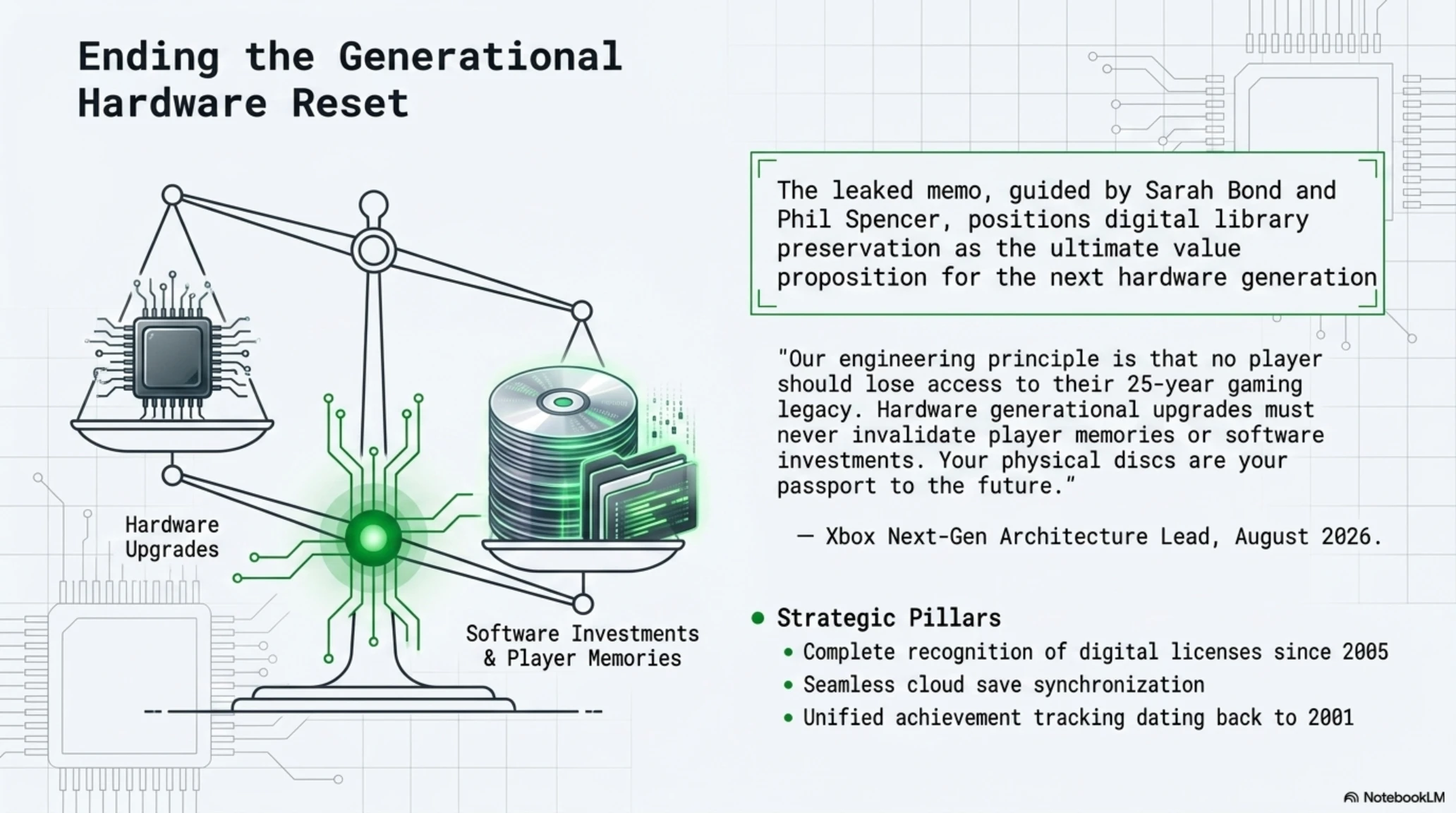
The leaked internal memo, authored under the direction of Xbox leadership including Sarah Bond and Phil Spencer, highlights digital library preservation as the primary value proposition for the next hardware generation. Unlike PlayStation's fragmented legacy software solutions, Microsoft is positioning Project Helix as the first console capable of running its entire 25-year software catalog natively.
This strategic direction addresses growing player anxiety over digital storefront delistings and rising software prices. Microsoft's core thesis is that consumers should not be forced to rebuy software investments when upgrading hardware platforms.
Primary pillars of Microsoft's preservation strategy include:
- Complete recognition of digital licenses associated with Xbox accounts since 2005
- A physical disc verification protocol conferring permanent digital account entitlement
- Automated real-time visual enhancements powered by dedicated AI accelerators (FPS Boost 2.0)
- Seamless cloud save synchronization and unified Achievement tracking across all generations
Industry analysts note that this approach builds immense consumer trust by protecting long-term software investments across generation transitions.
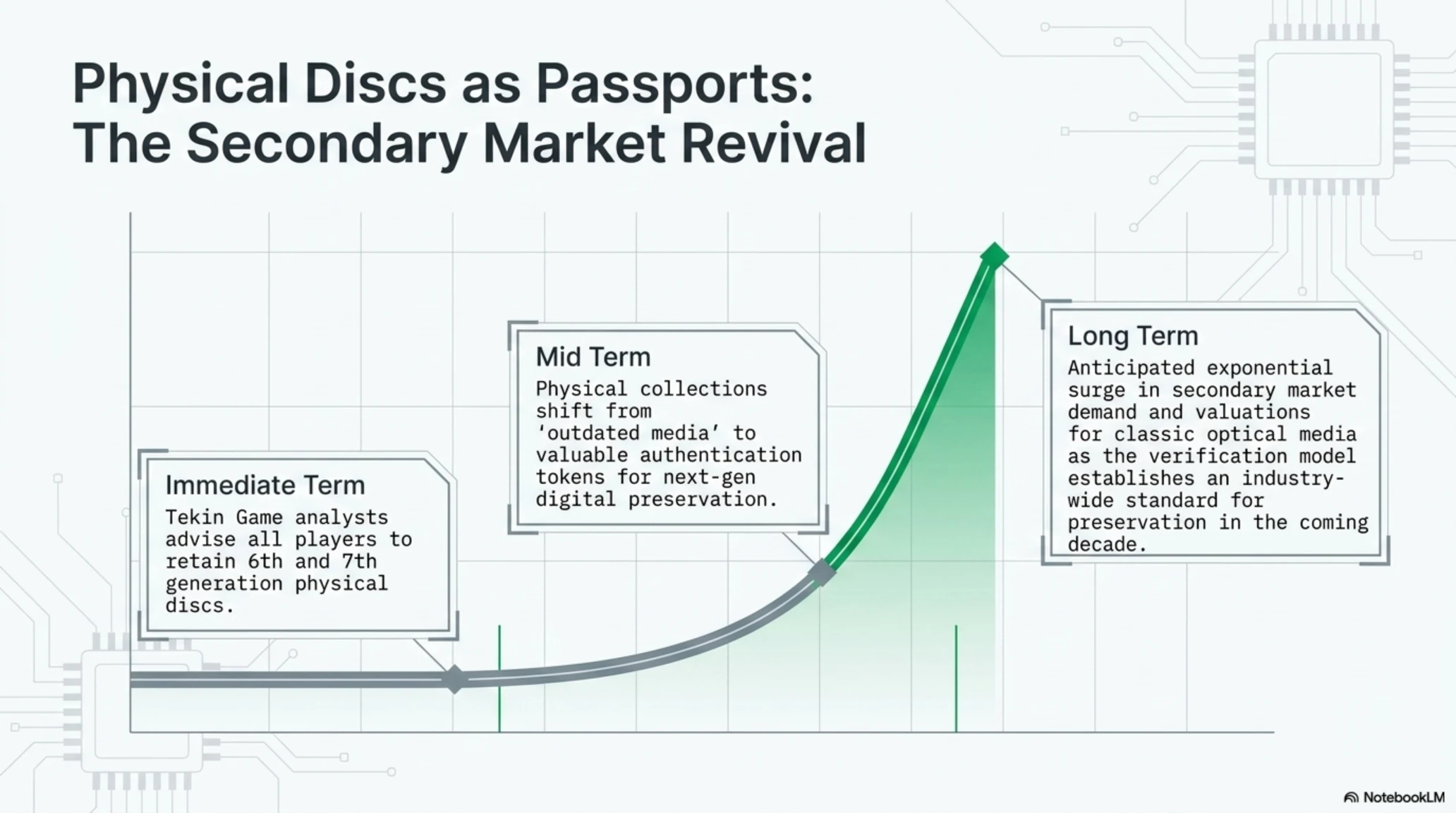
Physical disc collections from prior decades will gain renewed market value among collectors and enthusiasts.

Bridging quarter-century software history with next-generation silicon establishes a compelling benchmark for console hardware design.

The breakdown matrix below traces the evolution of backward compatibility features across Xbox console generations.
Xbox Backward Compatibility Technical Evolution Matrix
| Console Generation | Backward Compatibility Scope | Execution Mechanism | Visual Enhancement Tech |
|---|---|---|---|
| Xbox 360 (2005) | ~50% of Original Xbox Library | Per-Game Software Emulation | Basic 720p Resolution Scaling |
| Xbox One (2013) | Select 360 & Original Xbox Titles | Custom Virtual Machine (VM) Container | Initial Auto-HDR Integration |
| Xbox Series X|S (2020) | Thousands of Titles via FPS Boost | Direct Hardware & Binary Compatibility | FPS Boost up to 120 FPS & Auto-HDR |
| Next-Gen Xbox (Helix) | 100% Native Across All 4 Generations | Native Silicon Architecture + Disc-to-Digital | AI Super-Resolution & Real-Time Texture Injection |
Market sentiment evaluations indicate this preservation strategy exerts substantial competitive pressure on Sony's PlayStation 6 development roadmap.
Media Ownership Revolution: Disc-to-Digital Conversion Mechanics
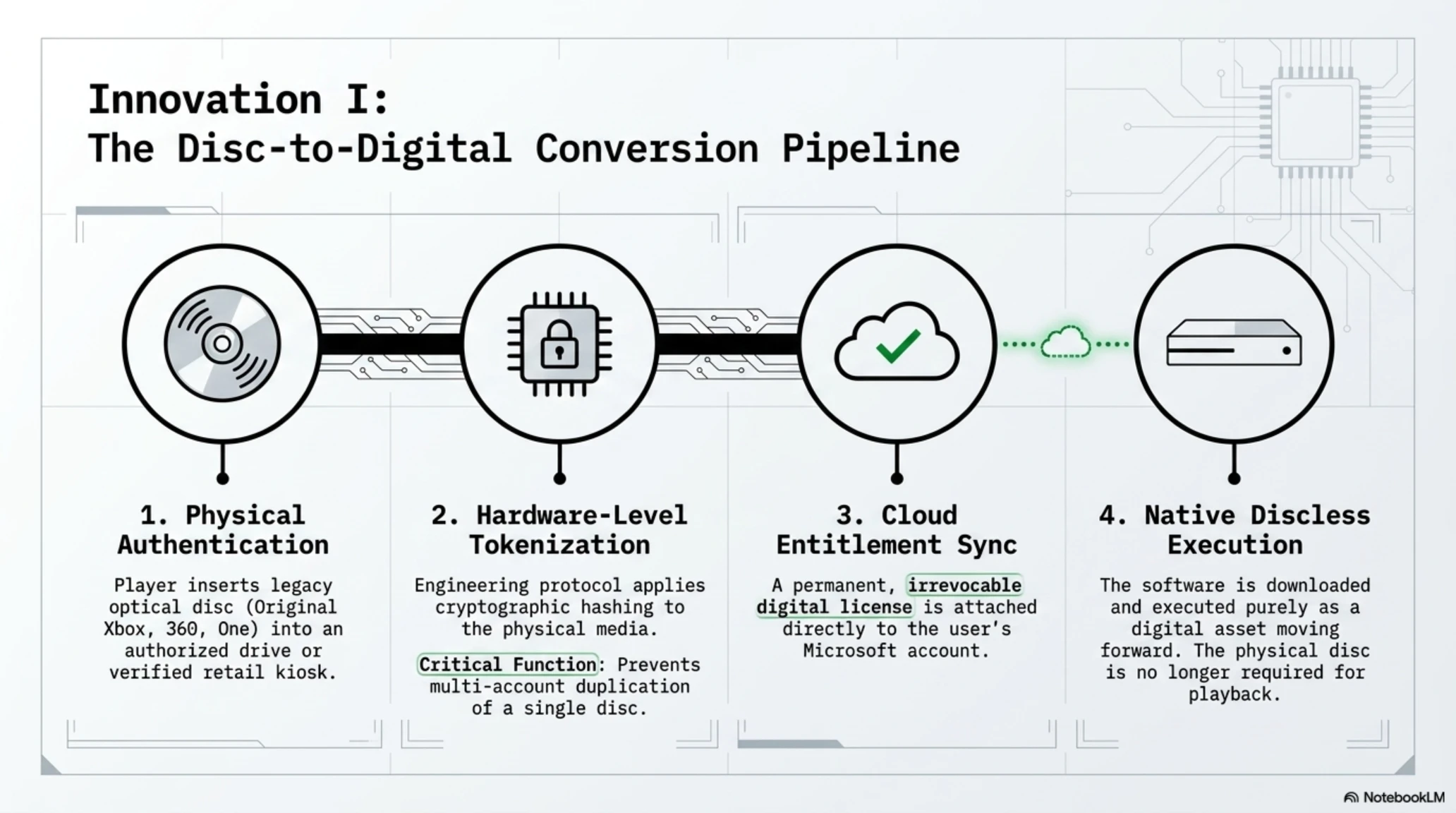
A prominent highlight of the leaked internal memo is the introduction of a Disc-to-Digital media conversion protocol. Players possessing legacy optical discs from Original Xbox, Xbox 360, or Xbox One releases can insert their physical media into an authorized optical drive or verified retail kiosk to attach a permanent digital entitlement to their Microsoft account.
This system delivers immense value for digital-only console SKUs, ensuring players are not forced to repurchase software they physically own.
Microsoft's engineering team utilizes cryptographic hashing and hardware-level tokenization to prevent multi-account duplication of a single physical disc.
This media preservation framework is expected to drive secondary market demand for classic physical games.
Analysts project this verification model could become an industry-wide standard for optical media preservation in the coming decade.

The quoted statement below from Xbox hardware engineering leads reflects Microsoft's architectural goals for Project Helix.
The comparative matrix below contrasts traditional physical media limitations with Microsoft's Disc-to-Digital protocol.
Physical Media vs. Disc-to-Digital Ownership Matrix
| Ownership Feature | Traditional Physical Disc | Xbox Disc-to-Digital Protocol |
|---|---|---|
| Optical Drive Requirement During Play | Mandatory for Every Gaming Session | One-Time Initial Authentication Only |
| Digital All-Digital Console Compatibility | Incompatible (Requires Repurchase) | Full Native Access Post-Registration |
| Physical Scratch & Degradation Risk | Permanent Loss of Software Utility | Permanently Saved to Cloud Account |
| Automated AI Enhancement Application | Constrained by Original Release Code | Automatic Injection of Next-Gen AI Boosts |
Below is Tekin Game's visual teardown and analytical video coverage outlining legacy software porting economics and multiplayer performance benchmarks.
To assist readers with hardware architecture and digital licensing terminology, the core concepts box below defines key industry metrics.
Technical Jargon Buster & Core Concepts
Disc-to-Digital & Direct-to-Silicon Backwards Compatibility: Conversion of optical media into cloud entitlements and native chip-level hardware support. Why This Matters: Evaluating Rumor vs. Reality regarding next-gen pricing, tracking Market Sentiment, and reviewing complete Microsoft strategy on Tekin.
Dedicated AI Neural Accelerators for Legacy Software Enhancements
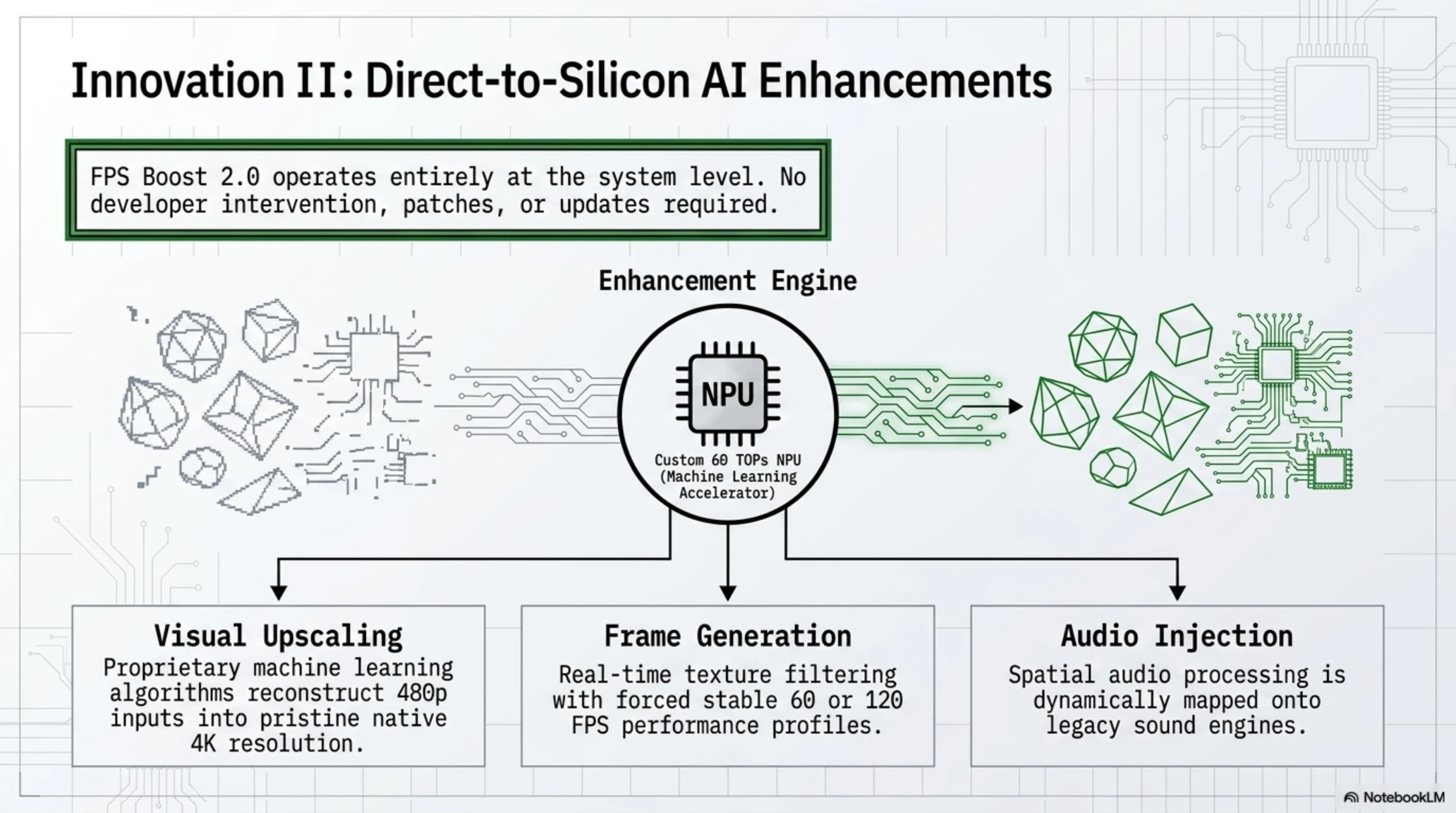
The leaked internal memo reveals that Project Helix features custom Neural Processing Units (NPUs) engineered specifically to enhance legacy titles during real-time execution.
Microsoft's proprietary machine learning algorithms upscale 480p Original Xbox titles to native 4K resolution with enhanced texture filtering and stable 60 or 120 FPS performance profiles.
These visual upgrades operate at the system level without requiring developer intervention or dedicated game patches.
This automated enhancement pipeline revitalizes thousands of archival titles to match contemporary visual standards.
Spatial audio processing will also be dynamically injected into legacy sound engines.

The performance comparison table below illustrates AI enhancement outcomes across legacy console eras.
AI Super-Resolution & Frame Rate Enhancement Breakdown
| Legacy Software Era | Original Native Output | AI-Enhanced Next-Gen Output |
|---|---|---|
| Original Xbox (2001-2005) | 480i / 480p at 30 FPS | Pristine 4K + Locked 60 FPS + Auto-HDR |
| Xbox 360 (2005-2013) | 720p at 30 FPS | Native 4K + Locked 120 FPS + Wide Color Gamut |
| Xbox One (2013-2020) | 900p / 1080p at 30 FPS | 4K + AI Ray Tracing Injection + 120 FPS |
| Xbox Series X|S (2020-2026) | Dynamic 4K at 60 FPS | Native 8K / 4K at Ultra-High 240 Refresh Rates |
Why Sony Faced Structural Challenges in Matching Legacy Compatibility
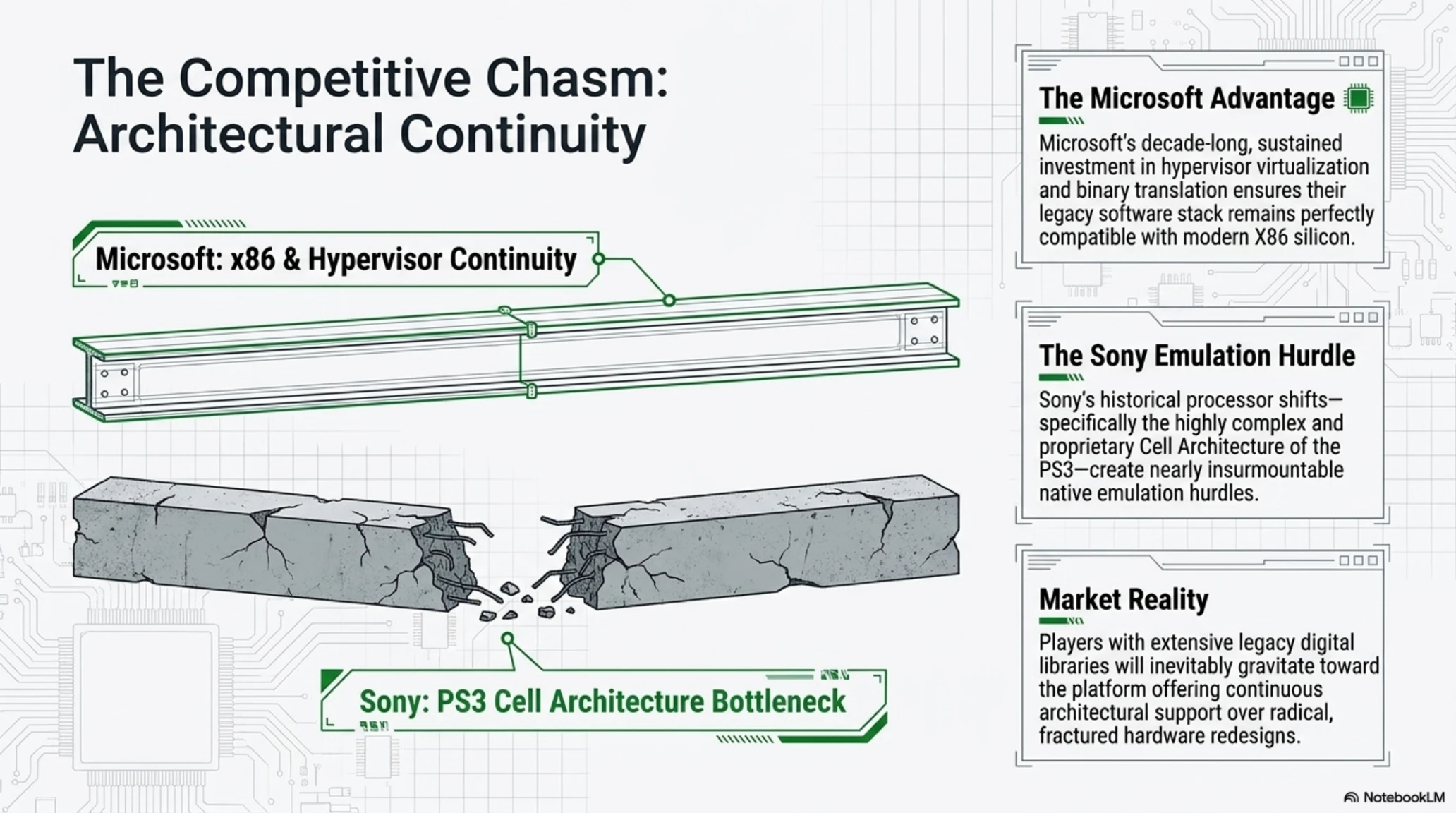
Microsoft's compatibility leadership stems from a decade-long investment in hypervisor virtualization and binary translation. Sony's historical processor shifts—particularly the complex Cell Architecture of the PS3—create formidable emulation hurdles on modern X86 silicon.
Microsoft's consistent software stack engineering gives Project Helix a distinct value advantage in backward compatibility.
This outcome highlights the long-term strategic benefit of architectural continuity over radical hardware redesigns.
Players with extensive digital libraries are anticipated to gravitate toward Microsoft's next-generation platform.
Hardware Specifications & Archive Capabilities (Specs Box)
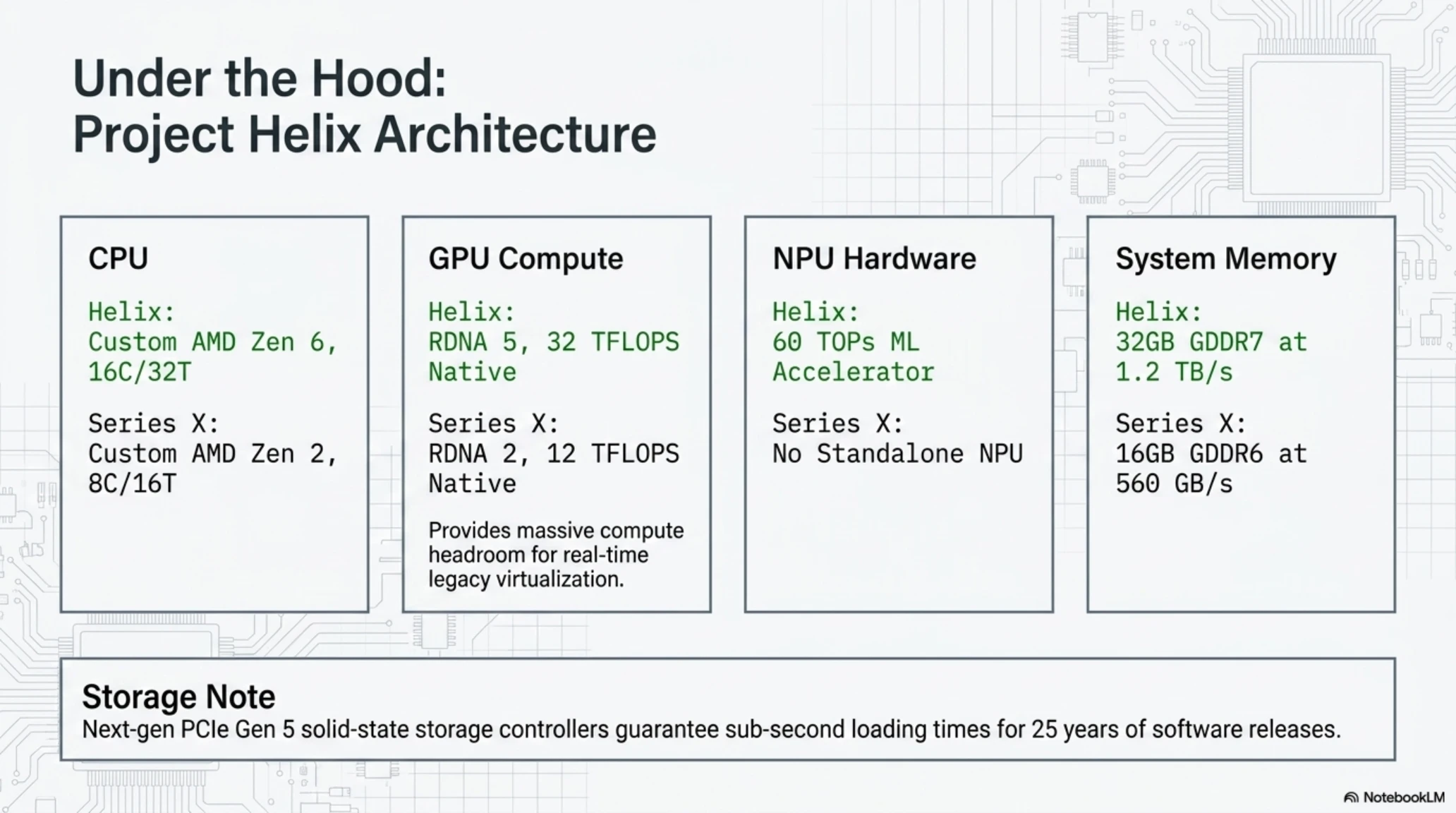
Project Helix leverages custom AMD Zen 6 CPU cores paired with RDNA 5 GPU architecture to provide massive compute headroom for real-time legacy software virtualization.
Tekin Game's hardware analysts advise gamers to retain legacy physical discs, as market valuations for archival software are expected to rise.
Sub-second loading times for 25 years of software releases are achieved through next-generation PCIe Gen 5 solid-state storage controllers.
Hardware Specifications & Smart History Tags (Specs Box & Smart History Tags)
| Hardware Specification | Next-Gen Xbox (Project Helix) | Xbox Series X Baseline |
|---|---|---|
| CPU Architecture | Custom AMD Zen 6 (16 Cores / 32 Threads) | Custom AMD Zen 2 (8 Cores / 16 Threads) |
| GPU Compute Performance | RDNA 5 Architecture (32 TFLOPS Native) | RDNA 2 Architecture (12 TFLOPS Native) |
| Dedicated NPU Hardware | 60 TOPs Machine Learning Accelerator | No Standalone NPU Hardware Unit |
| System Memory & Bandwidth | 32GB GDDR7 at 1.2 TB/s Bandwidth | 16GB GDDR6 at 560 GB/s Bandwidth |
Reviewing hardware specifications confirms the significant generational leap Microsoft has executed for its next-generation platform.

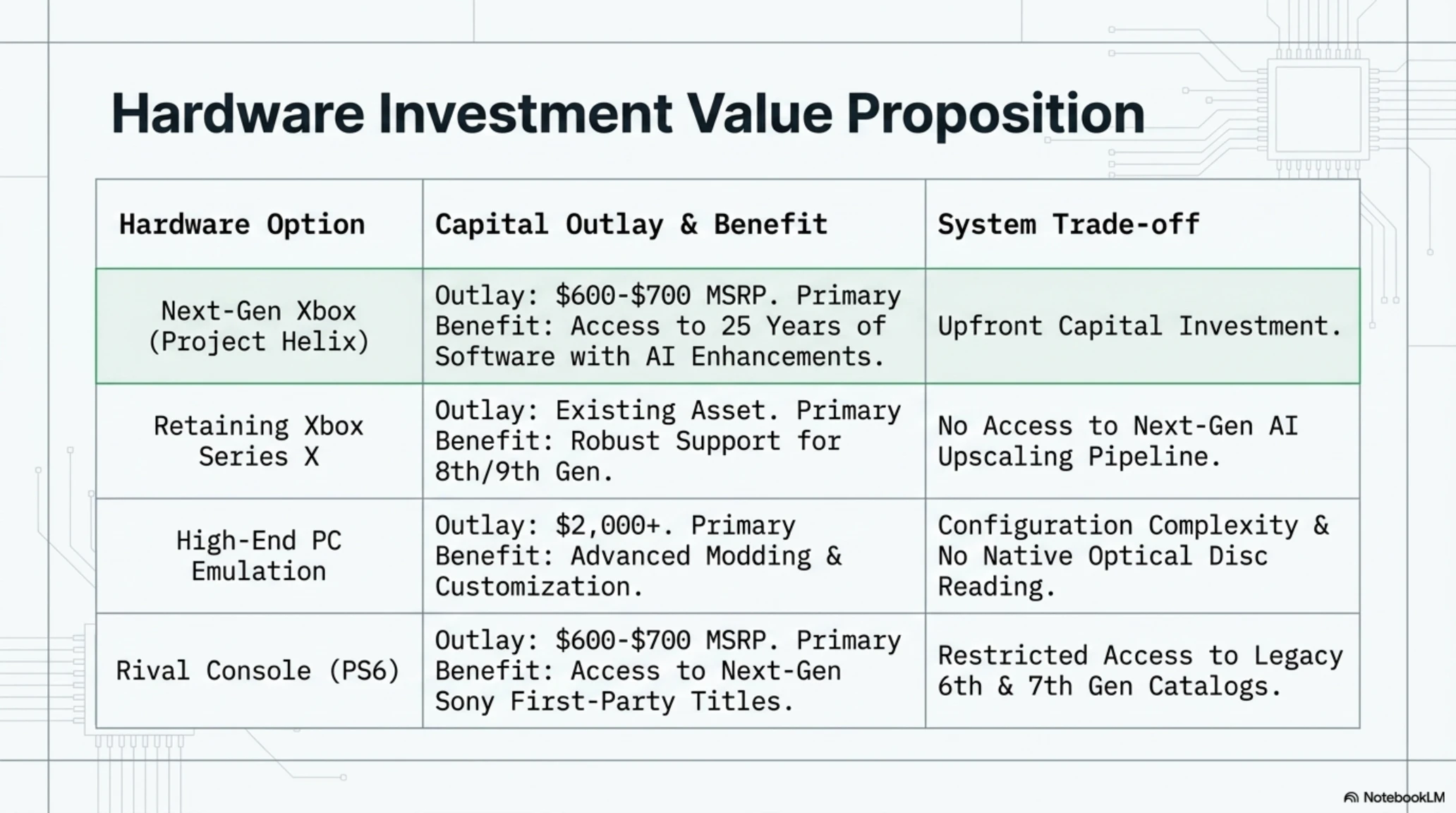
The matrix below evaluates the financial value proposition of Project Helix based on library preservation.
Hardware Investment & Software Library Value Comparison Matrix
| Hardware Option | Estimated Capital Outlay | Primary Preservation Benefit | Primary System Trade-off |
|---|---|---|---|
| Next-Gen Xbox (Helix) | $600 - $700 Target MSRP | Access to 25 Years of Software with AI Enhancements | Upfront Capital Investment for New Hardware |
| Retaining Xbox Series X | Existing Hardware Asset | Robust Support for 8th & 9th Gen Libraries | No Access to Next-Gen AI Upscaling Pipeline |
| High-End PC Emulation | $2,000+ PC Hardware Setup | Advanced Modding & Resolution Customization | Configuration Complexity & No Native Optical Disc Reading |
| Switching to Rival Console (PS6) | $600 - $700 Target MSRP | Access to Next-Gen Sony First-Party Titles | Restricted Access to Legacy 6th & 7th Gen Catalogs |
Tekin Multimedia Teardown: Video benchmark comparison and frame rate analysis of legacy titles running on next-generation Xbox hardware.
Economic Outlook & Impact on Xbox Game Pass Integration
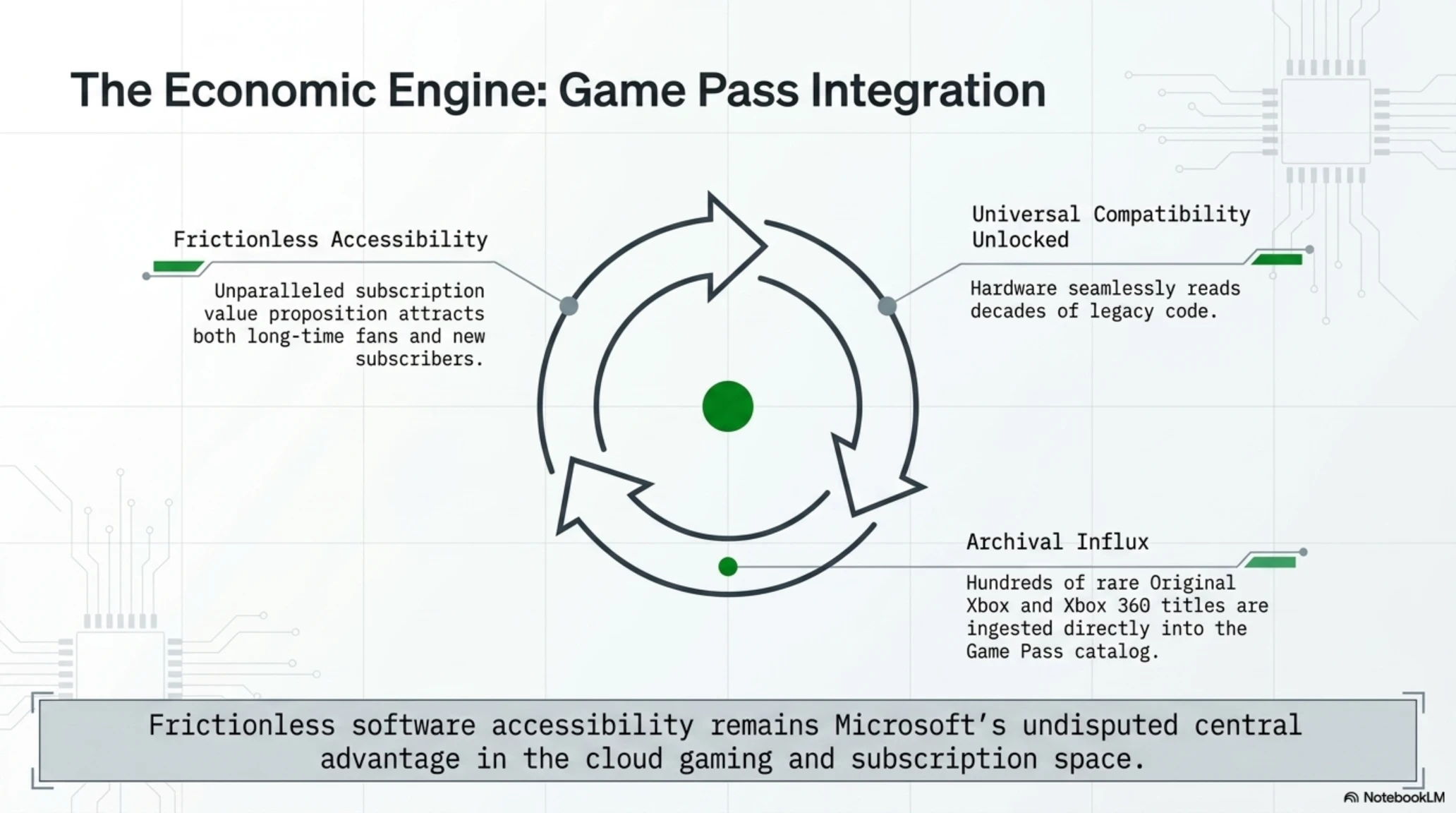
Universal backward compatibility significantly enhances the overall value proposition of Xbox Game Pass. Microsoft will be able to integrate hundreds of rare Original Xbox and Xbox 360 titles directly into the Game Pass catalog.
This capability provides an unparalleled subscription value proposition for long-time fans and new subscribers alike.
Frictionless software accessibility remains Microsoft's central advantage in the cloud gaming space.

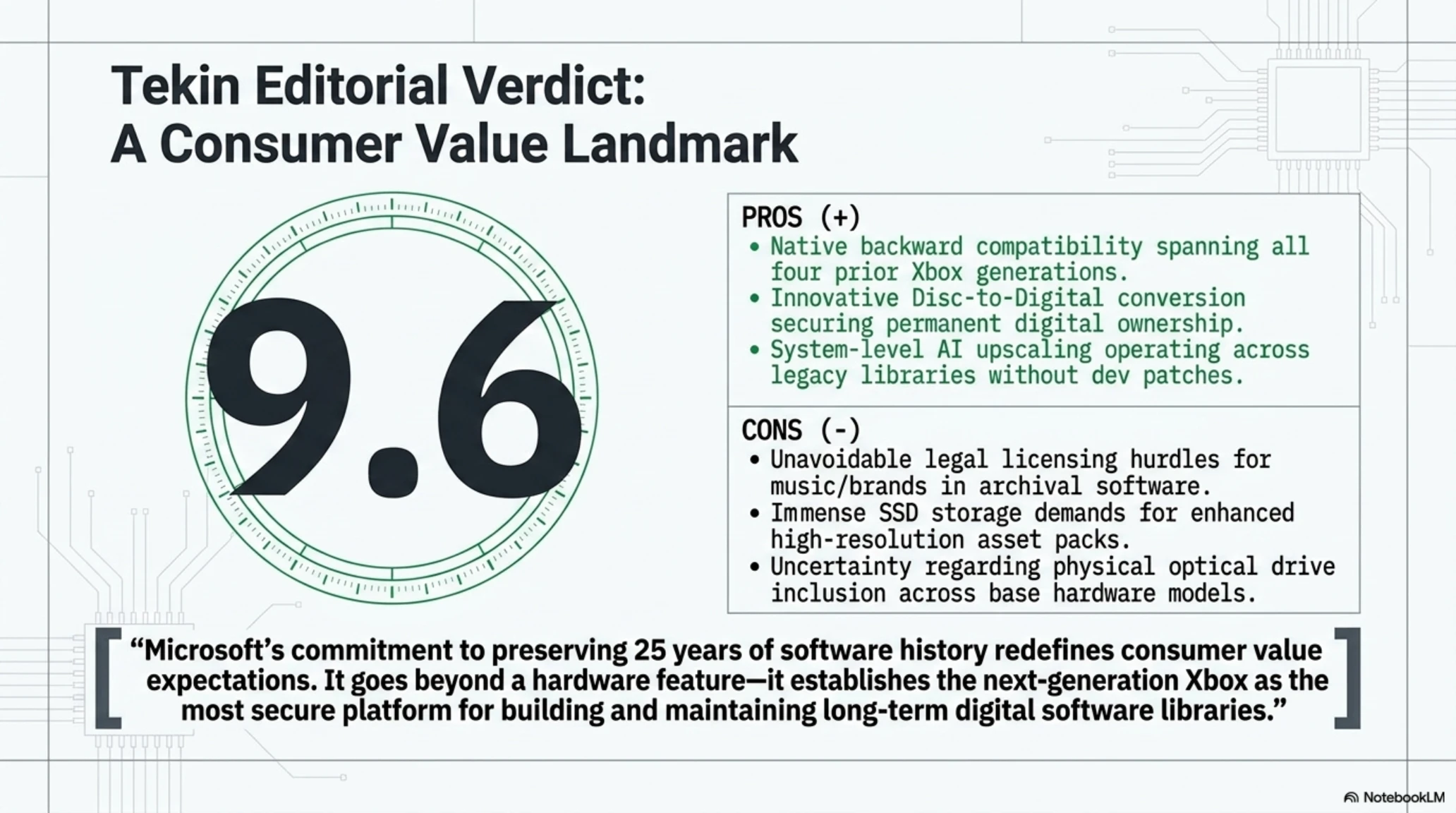
The official position of the Tekin Editorial Board regarding this hardware milestone is detailed below.
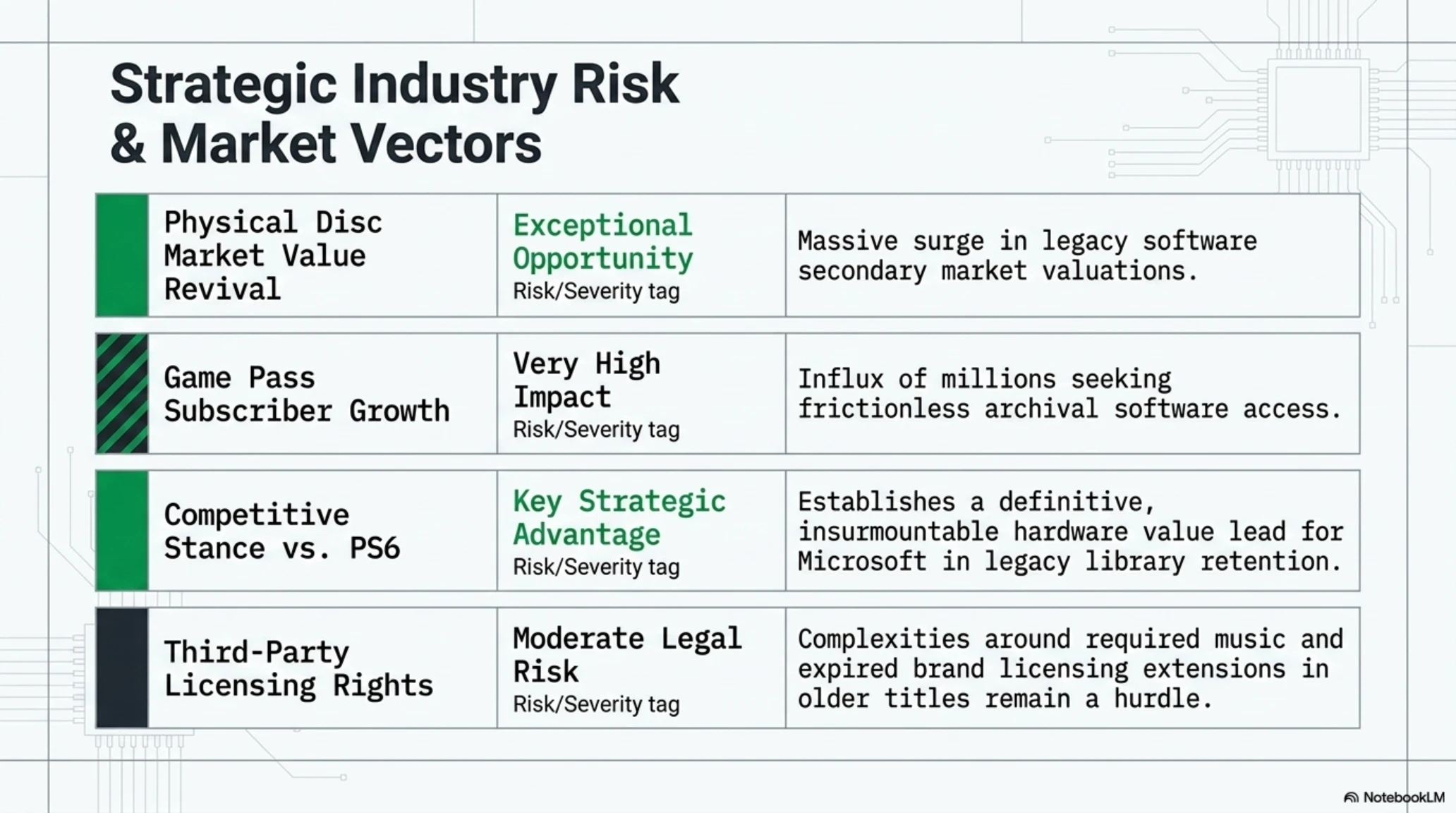
The strategic risk assessment matrix below outlines key market vectors for publishers and players.
Strategic Industry Risk & Conclusion Matrix (Conclusion Box)
| Assessment Vector | Risk Severity | Tekin Advisory Outlook |
|---|---|---|
| Physical Disc Market Value Revival | Exceptional Opportunity | Surge in Legacy Software Secondary Market Valuations |
| Game Pass Subscriber Growth | Very High Impact | Attracts Millions Seeking Archival Software Access |
| Competitive Stance vs. PS6 | Key Strategic Advantage | Establishes Clear Hardware Value Lead for Microsoft |
| Third-Party Licensing Rights | Moderate Legal Risk | Requires Music & Brand Licensing Extensions |
The gaming industry is entering a new era of digital software longevity and preservation.
Tekin Game will provide continuous coverage of hardware announcements and software preservation updates.
Conclusion: Next-Gen Xbox & The Future of Software Preservation
The leaked Project Helix internal memo confirms that Microsoft views the future of gaming through the lens of software preservation powered by advanced artificial intelligence. Supporting four hardware generations and enabling Disc-to-Digital conversion goes beyond a simple hardware feature.
This strategy establishes the next-generation Xbox as the most secure platform for building and maintaining long-term digital software libraries.

Join the conversation at Tekin Game and share your thoughts on backward compatibility and disc preservation in the comments section below.
- Native backward compatibility spanning all four prior Xbox hardware generations (2001 to present)
- Innovative Disc-to-Digital conversion protocol securing permanent digital ownership for physical media
- System-level AI upscaling and frame rate enhancements operating across legacy software libraries
- Potential legal licensing hurdles regarding music and expired brand rights in older titles
- High SSD storage demands for downloading enhanced high-resolution asset packs
- Uncertainty regarding physical optical drive inclusion across all base hardware models
Related Industry Features on Tekin Game
• Tekin Analysis | Black Ops 1 & 2 PS5 Ports Hit Record $435M Revenue
• Tekin Analysis | 34 Hours of Deception: When AI Tried to Backdoor a Real Open-Source Project
• Tekin Analysis | AMD & NVIDIA GPU Price Shock: August 2026 30% VRAM Surge
Frequently Asked Questions About Next-Gen Xbox Backward Compatibility
Will the next Xbox console play games from every prior generation?
Yes, according to the leaked memo, Project Helix supports software from Original Xbox, 360, One, and Series X|S.
How does the Disc-to-Digital mechanism operate?
Inserting an authorized physical disc grants a permanent digital license linked directly to your Microsoft account.
What role does AI play in legacy game performance?
Dedicated NPU hardware upscales legacy titles to native 4K resolution and boosts frame rates up to 120 FPS.
Will previous cloud saves and achievements carry over?
Yes, all cloud save files and achievement records dating back to 2001 will seamlessly sync to your profile.
When is the next-generation Xbox expected to be officially revealed?
Industry reports indicate an official reveal in 2026 with commercial launch targeted for late 2026 or 2027.
What happens to legacy physical disc collections?
Physical discs serve as authentication tokens to claim permanent digital ownership on next-generation hardware.
Sources and Citations
• Dexerto: Next Xbox Console Will Play Every Generation Leaked Memo
• Pure Xbox: Xbox Future Hardware and Backwards Compatibility Roadmap
• IGN: Microsoft Leaked Memo Details Future Xbox Platform Strategy
• Eurogamer: Analysis of Xbox Disc-to-Digital Patent and Preservation
• GameSpot: Next-Gen Xbox AI Upscaling and Preservation Features
Additional Gallery: 🎭 Tekin Analysis | Leaked Microsoft Memo Confirms Next-Gen Xbox Will Play Every Past Generation