Tekin Guide | Sovereign Cyber Defense: P7 DarkSword & AnyDesk Root Flaw
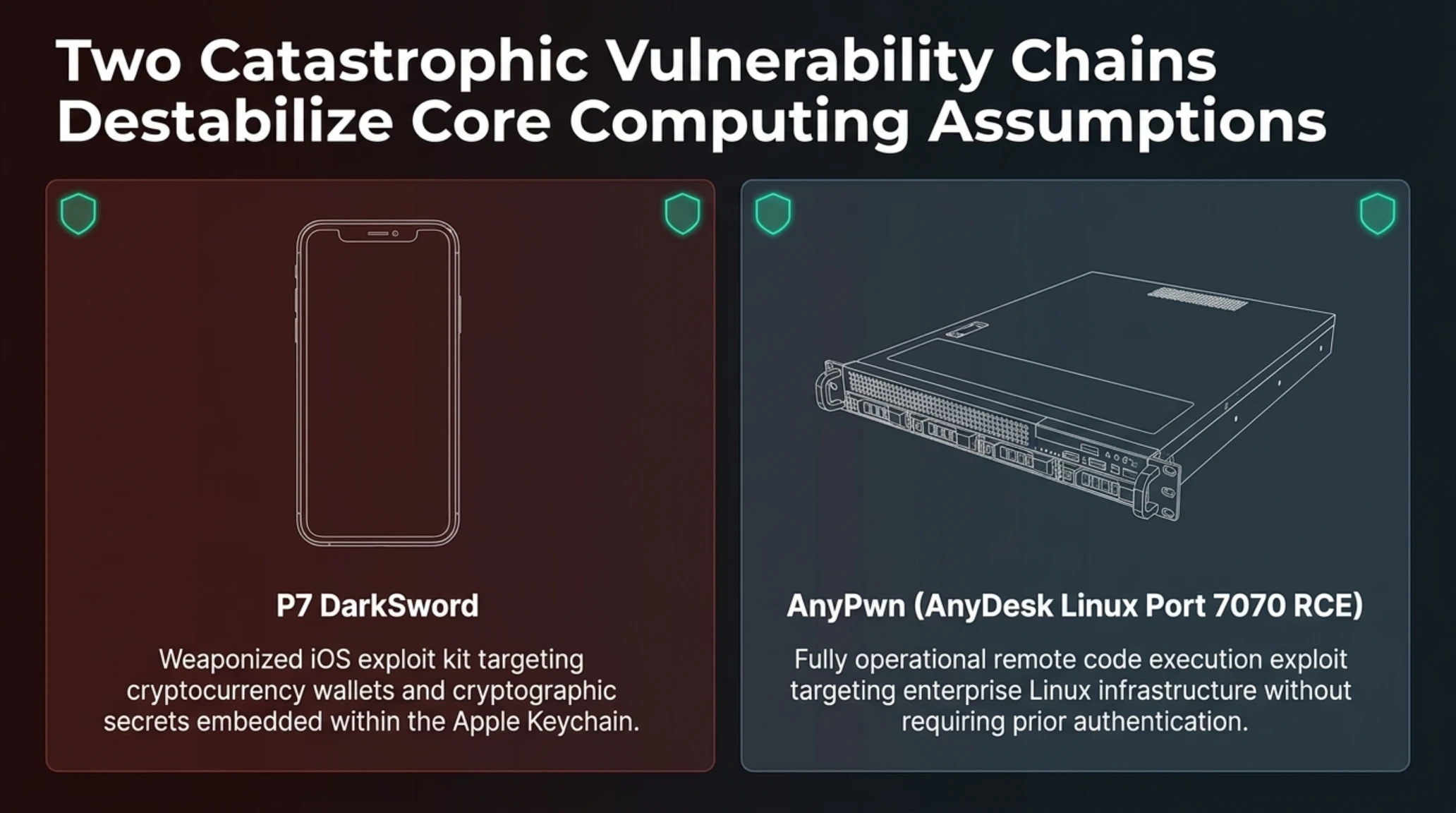
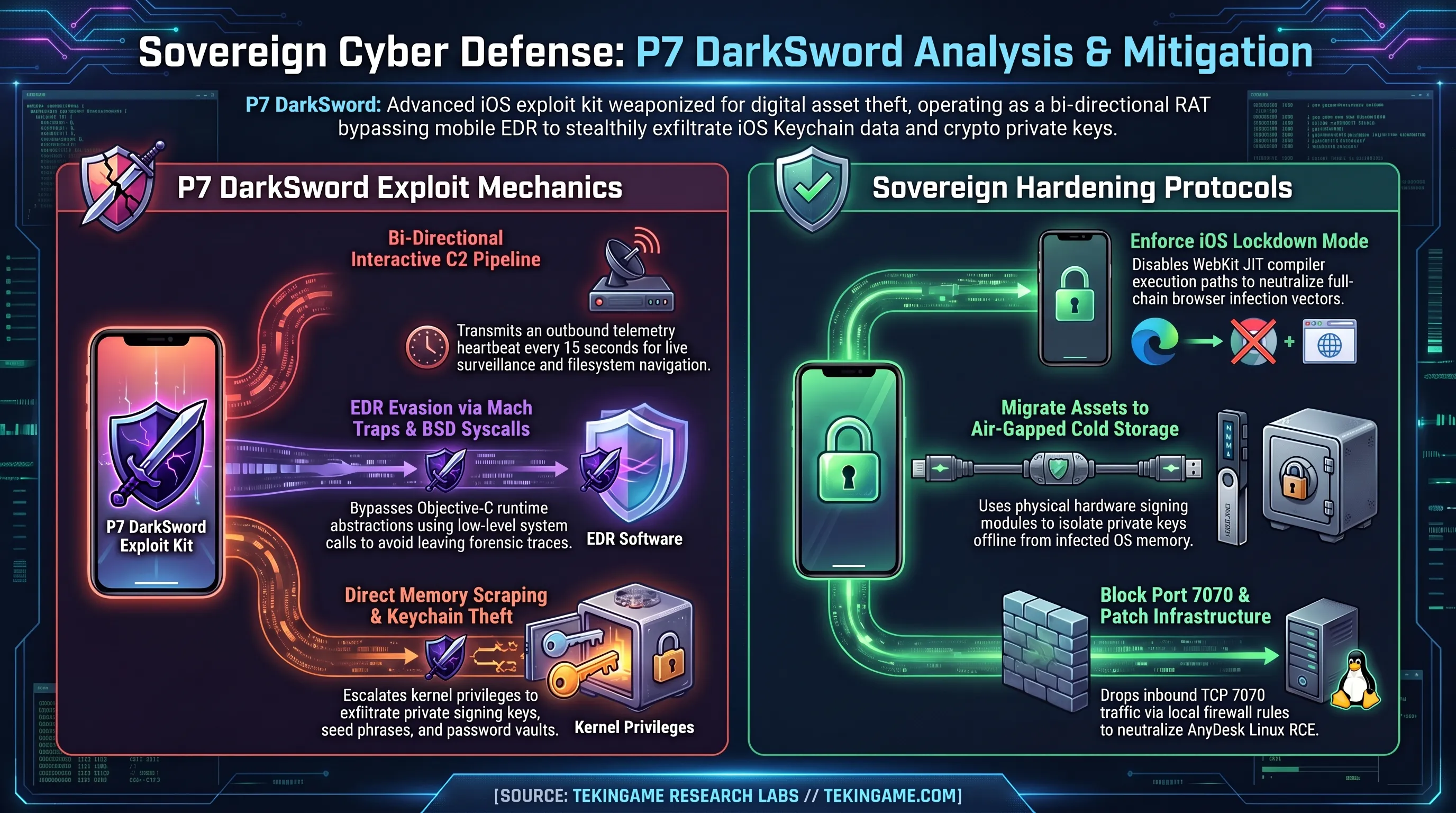
The global cybersecurity threat landscape in October 2026 has witnessed the simultaneous eruption of two catastrophic vulnerability chains that fundamentally destabilize core enterprise and personal computing assumptions. In the mobile domain, forensic threat analysts at iVerify officially disclosed the emergence of P7 DarkSword—a highly refined and surgically engineered variant of the commercial iOS exploit kit originally tracked by Google's Threat Intelligence Group (GTIG) and Lookout. Whereas previous iterations functioned predominantly as state-sponsored surveillance instruments, the P7 variant exhibits a dangerous strategic mutation: it has been explicitly weaponized to loot cryptocurrency wallets and plunder the cryptographic secrets embedded within the Apple Keychain.
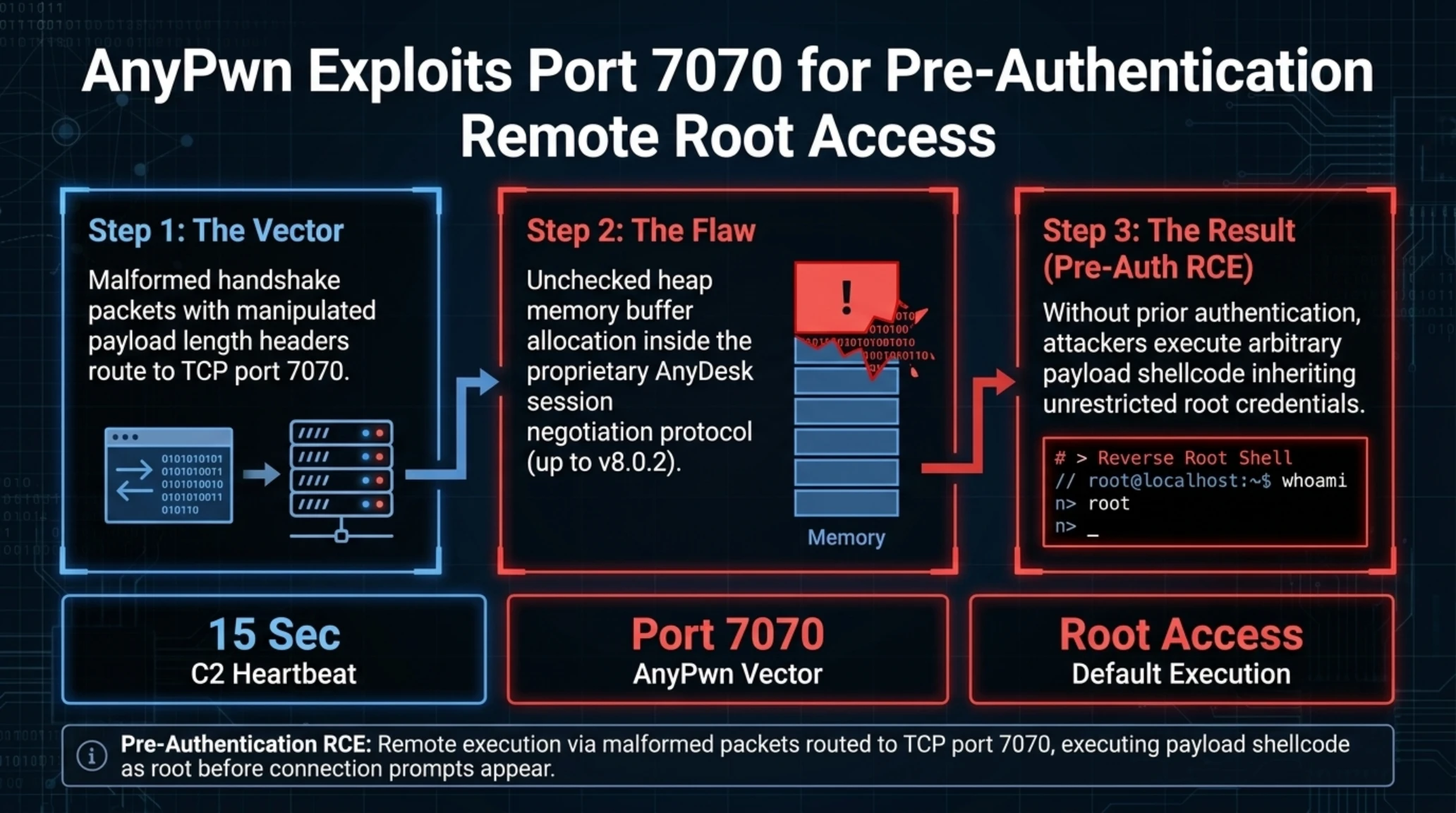
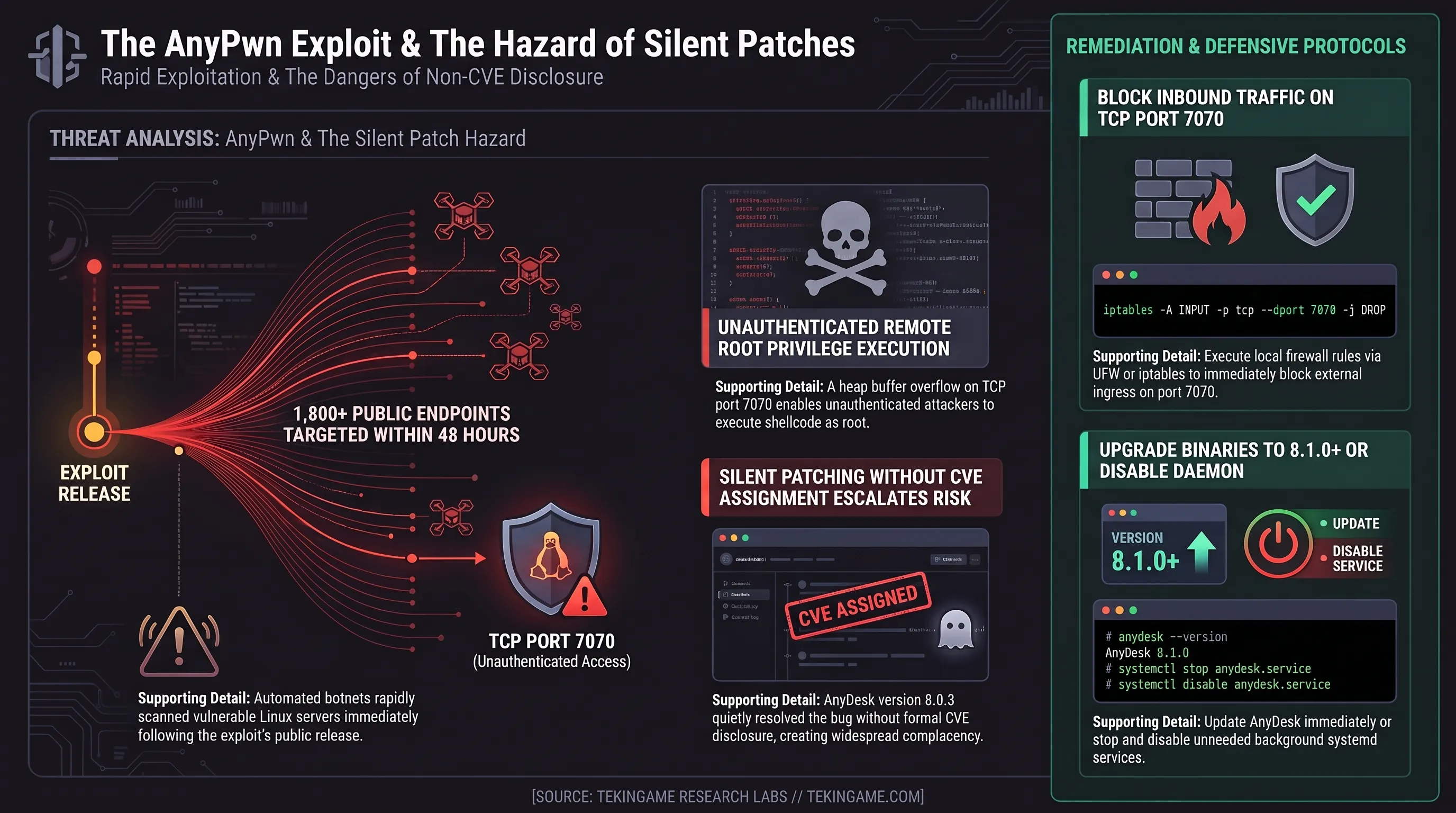
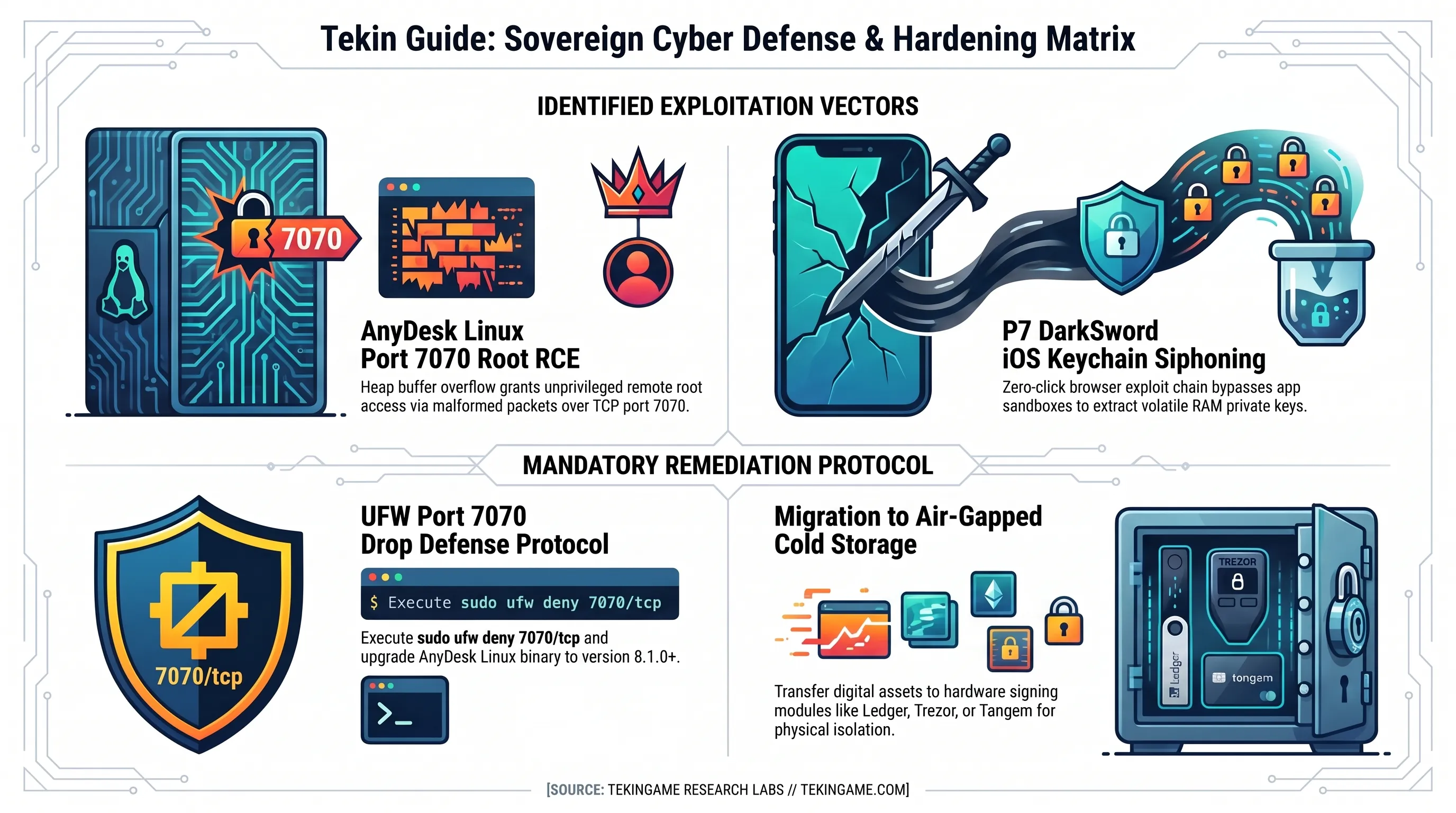
Simultaneously, enterprise Linux server infrastructure has been rocked by the public release of a fully operational remote code execution exploit dubbed "AnyPwn." Targeting AnyDesk for Linux versions up to 8.0.2, this vulnerability exploits a critical heap buffer overflow in the proprietary session negotiation protocol over TCP port 7070. Without requiring prior authentication, session authorization, or interaction from local operators, remote attackers can execute arbitrary payload shellcode with root-level privileges, leaving web servers, dev machines, and container clusters completely defenseless.
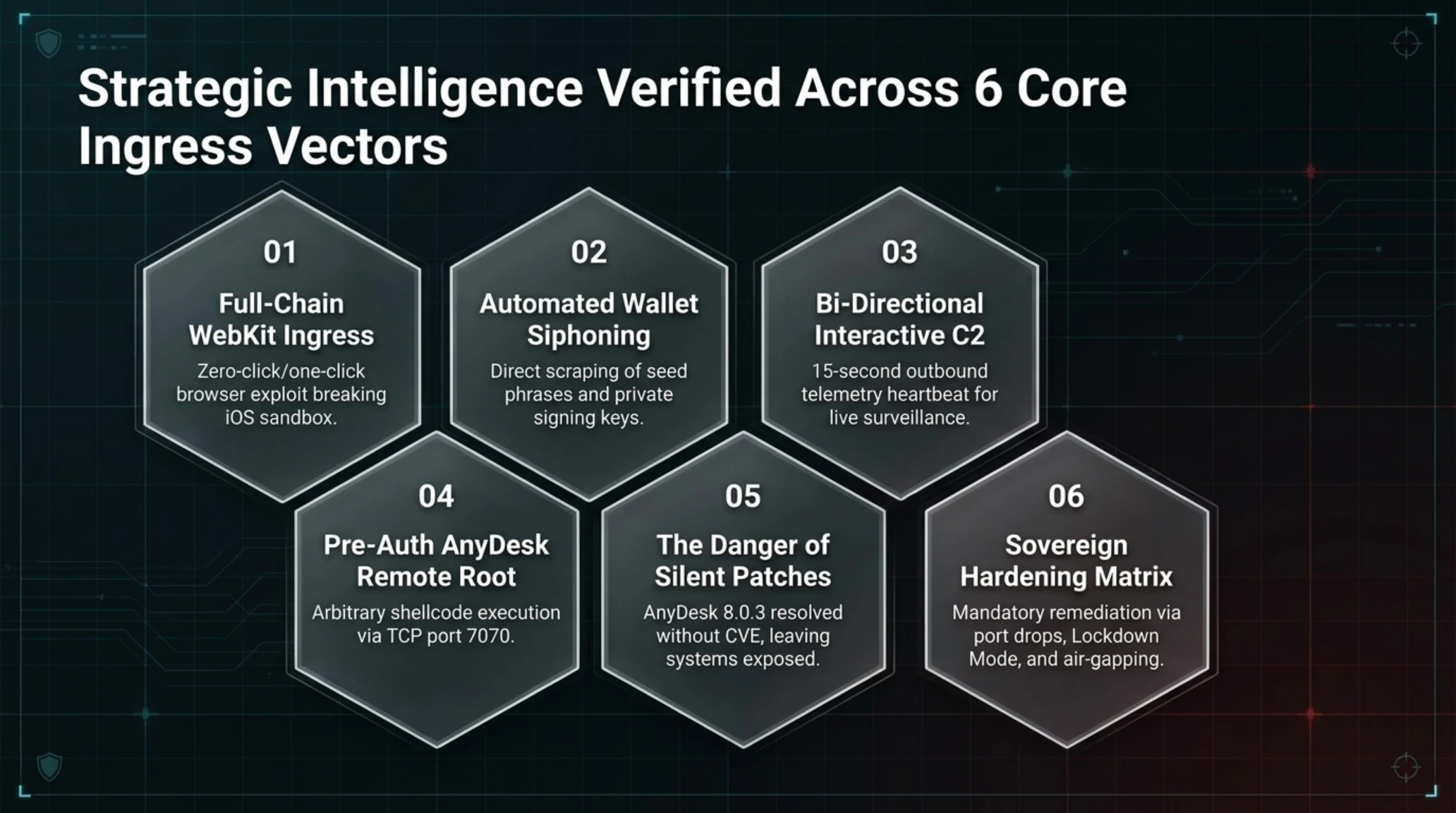
Strategic Assessment and Core Threat Intelligence Vectors
The intersection of these two vulnerabilities dismantles long-standing security dogmas across the technology industry: the naive assumption that consumer iOS devices are impervious to advanced financial theft, and the belief that internal Linux workstations require minimal network segmentation. As detailed in our previous investigation into crypto malware and memory scraping vectors, the weaponization of leaked nation-state exploit chains has lowered the barrier of entry for organized cybercrime syndicates targeting digital asset treasuries.
This comprehensive defense manual by Tekin Security Research provides an exhaustive architectural post-mortem of both exploits, mapping their execution vectors, dissecting memory injection pathways, and outlining an immediate incident response playbook for high-net-worth crypto investors, node validators, and system administrators.
Why This Twin Threat Changes Global Security Dynamics
This dual threat confirms that advanced persistent threat (APT) capabilities have transitioned directly into autonomous financial extortion tools, requiring immediate system-level hardening and physical isolation of private keys.
Subsequent sections will deconstruct the underlying disassembly of P7 DarkSword, trace the network packet structures exploited by AnyPwn, and provide specific terminal commands to verify device integrity and neutralize unauthorized C2 communications.
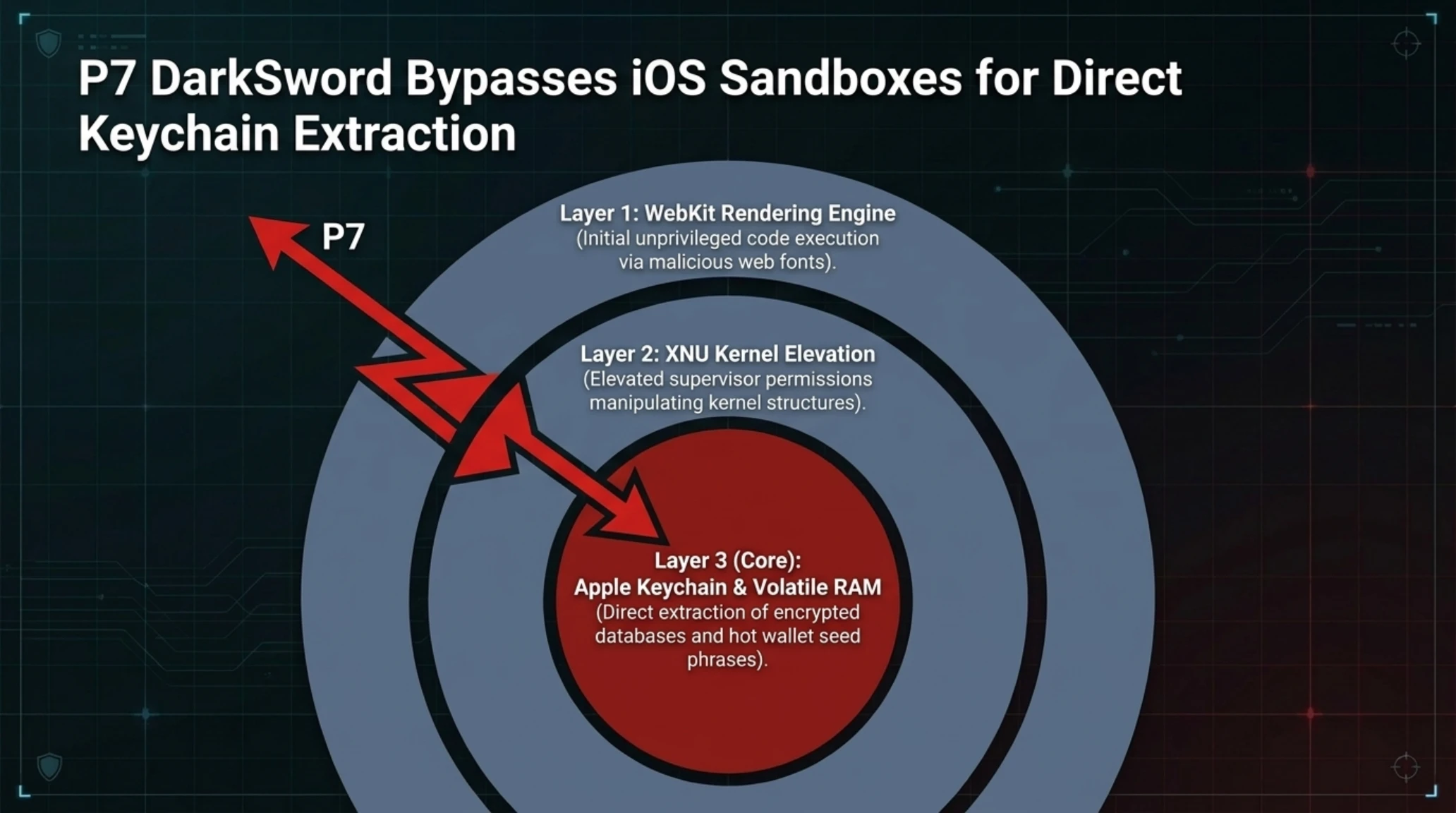
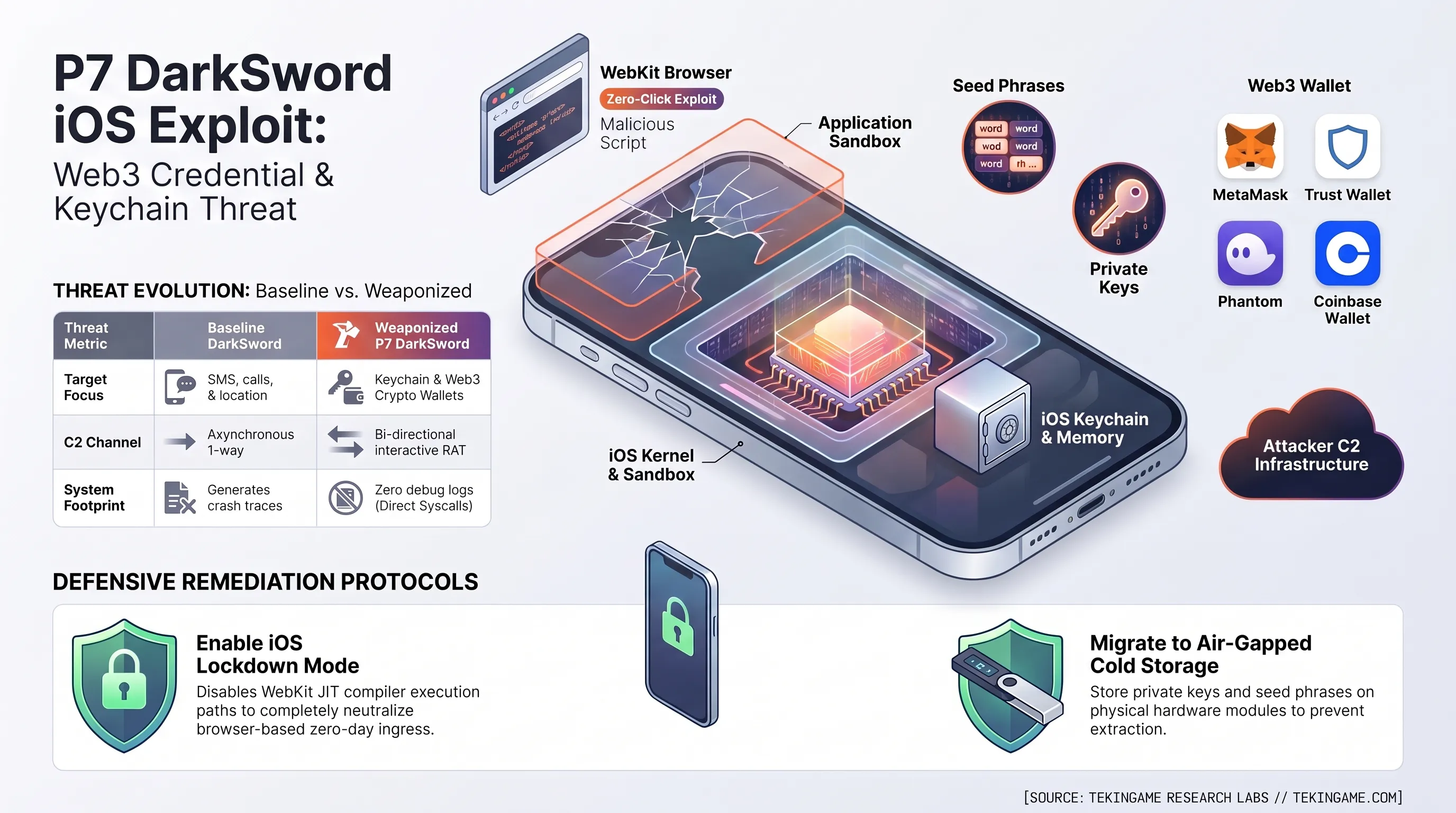
To fully grasp the lethal efficiency of P7 DarkSword, one must scrutinize the progression of its underlying execution chain within the iOS sandbox. The initial baseline DarkSword framework, discovered earlier in 2026, relied on a multi-stage zero-day chain exploiting vulnerability primitives within the WebKit rendering engine in Safari. Once weaponized via malicious web fonts or corrupted JavaScript object allocations, the exploit achieved initial unprivileged code execution before chaining into an XNU kernel elevation bug. However, the newly analyzed P7 variant reflects a radical architectural overhaul, flagged by the distinct p7_ naming convention across its binary functions and symbolic variables.
The primary evolution in P7 DarkSword lies in its direct prioritization of high-value cryptocurrency targets. Following kernel exploitation, rather than deploying persistent background audio recording or GPS geolocation modules typical of state espionage spyware, P7 initiates an automated discovery routine targeting local application sandboxes for Web3 extensions and wallets, including MetaMask, Trust Wallet, Phantom, Coinbase Wallet, and Exodus. The malware utilizes elevated supervisor permissions to bypass iOS Keychain access controls, directly exfiltrating encrypted password databases, unencrypted seed phrases lingering in volatile RAM caches, and active private signing keys.
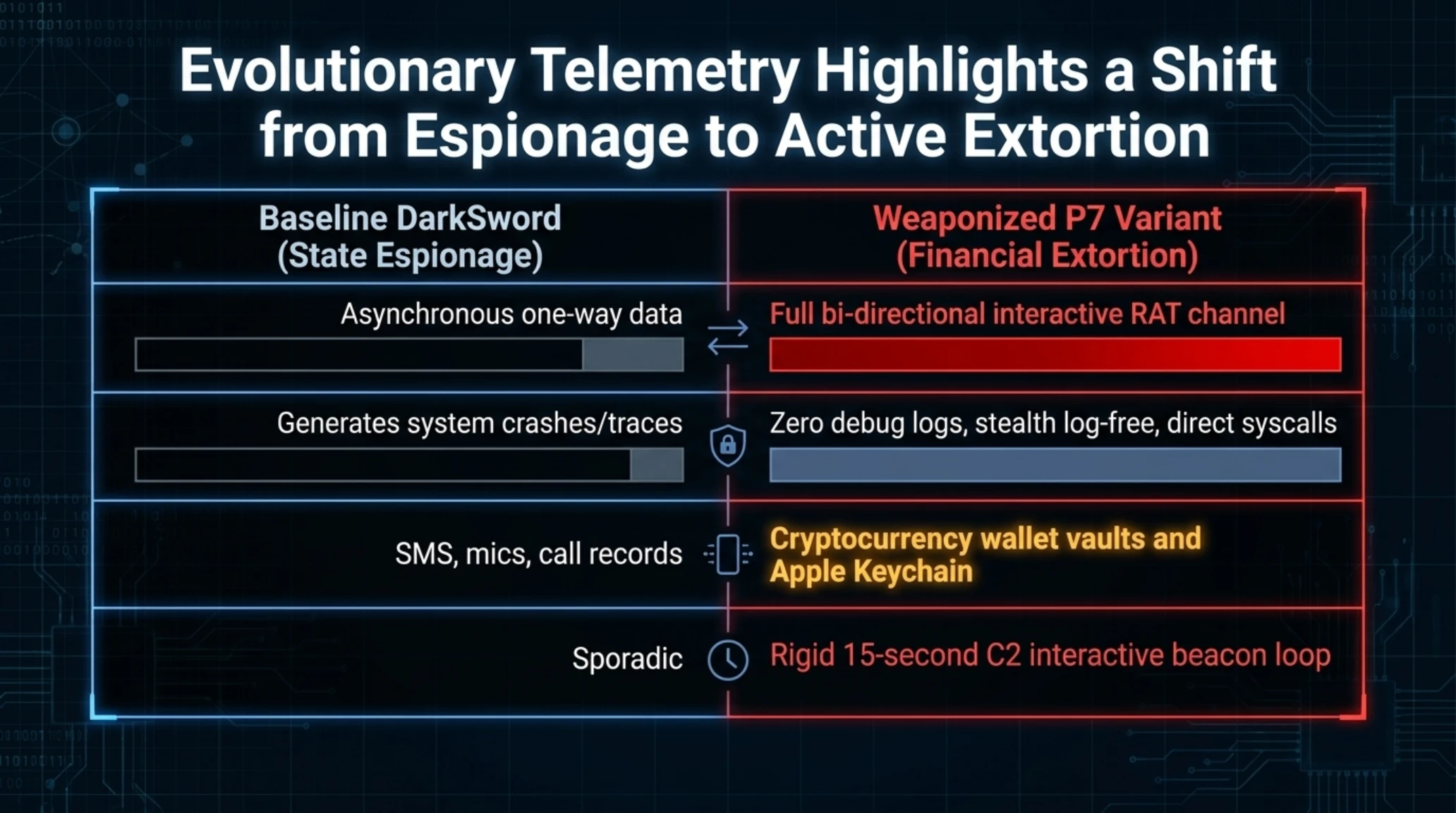
Threat Vector Telemetry & Comparative Disassembly Matrix
| Forensic Evaluation Metric | Baseline DarkSword Surveillance Kit | Weaponized P7 DarkSword (October 2026) |
|---|---|---|
| Command & Control (C2) Paradigm | Asynchronous one-way data exfiltration | Full bi-directional interactive RAT channel |
| On-Device Forensic Footprint | Generates system crash and debug traces | Zero debug logs, direct kernel syscall invocation |
| Targeted Data Objects | SMS, call records, microphone telemetry | Cryptocurrency wallet vaults and iOS Keychain |
| Outbound Heartbeat Interval | Sporadic scheduled beacon transmissions | Rigid 15-second C2 interactive beacon loop |
| Attained Execution Privilege | Application sandbox escape container | Full XNU supervisor kernel-level execution |
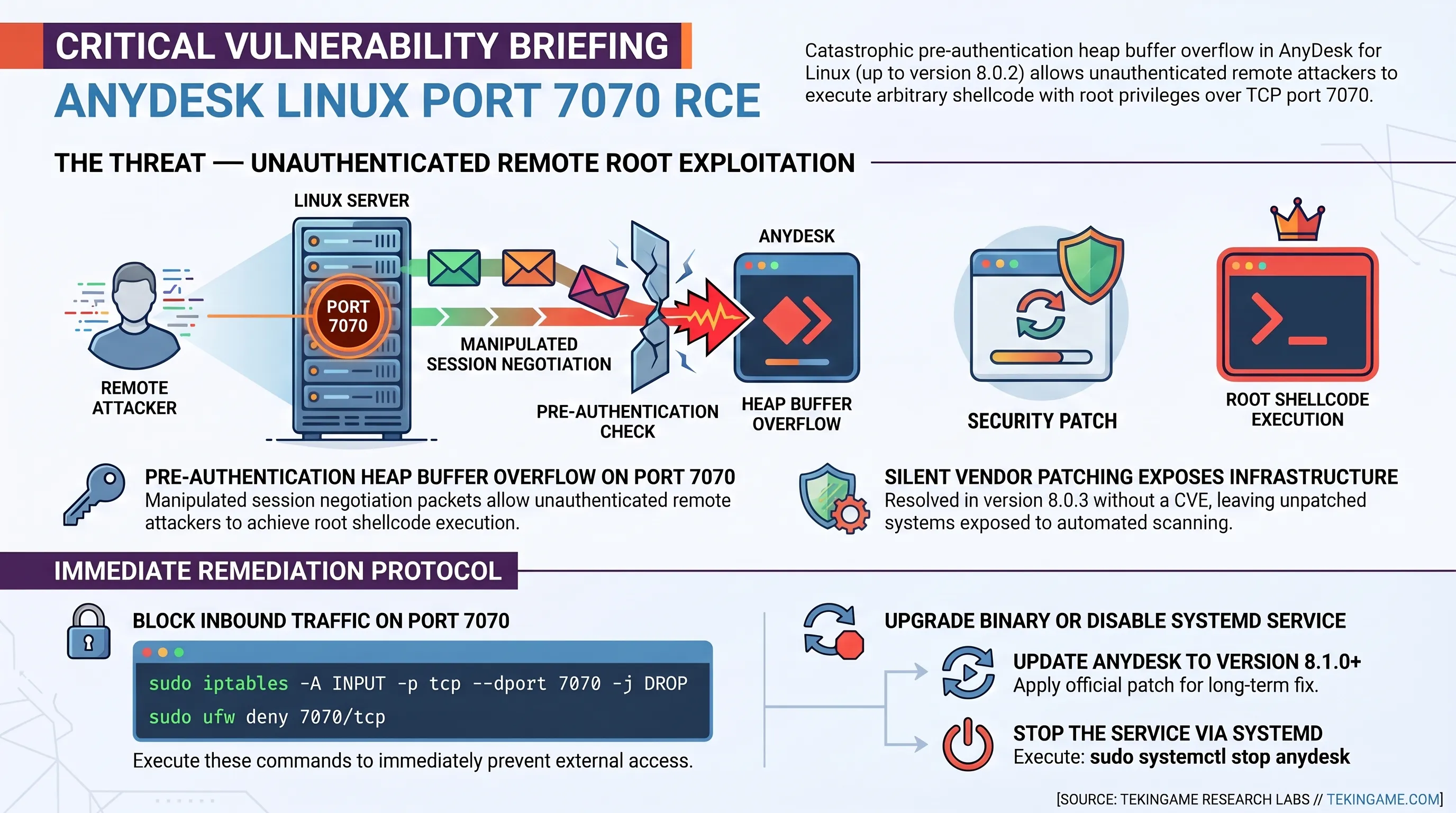
Parallel to this mobile threat, the vulnerability uncovered in AnyDesk for Linux strikes at the heart of decentralized infrastructure and remote DevOps administration. The flaw stems from an unchecked heap memory buffer allocation inside the proprietary network protocol handler managing incoming TCP connections on port 7070. When a threat actor dispatches crafted handshake packets featuring manipulated payload length headers, the AnyDesk daemon fails to enforce bounds checks, corrupting neighboring memory chunks on the process heap.
Because the AnyDesk background service on Linux distributions (such as Ubuntu, Debian, Fedora, and RHEL) is frequently deployed as a systemd daemon executing with root credentials to facilitate administrative tasks, the resulting shellcode execution inherits unrestricted root privileges. An attacker targeting port 7070 can spawn a reverse root shell without requiring the remote user to click "Accept" or confirm incoming session credentials. As evaluated in our earlier report on Apple security crises and mobile exploit vectors, quiet software patching practices without public CVE assignment severely heighten the vulnerability window across unmonitored infrastructure.
Tekin Cybersecurity Defense Jargon Buster
The severity of the AnyDesk vulnerability is compounded by the fact that the developer quietly patched the flaw in version 8.0.3 in June 2026 under a benign changelog description reading "fixed a bug that could lead to a crash," deliberately withholding any CVE vulnerability disclosure. This lack of transparency lulled thousands of system administrators into complacency. With the public drop of the functional AnyPwn exploit repository in October 2026, automated threat scanners on Shodan and Censys have begun systematically identifying and exploiting unpatched Linux systems across the internet.
A central breakthrough in iVerify's reverse engineering of P7 DarkSword is the discovery of its evasive stealth architecture. Standard mobile info-stealers leave conspicuous forensic breadcrumbs: unhandled exception logs, sudden memory allocation spikes, or temporary files cached in the application filesystem. In contrast, P7 deliberately bypasses Objective-C runtime abstractions and uses direct, low-level Mach traps and BSD system calls to manipulate kernel structures, rendering standard mobile endpoint detection and response (EDR) software blind.
Furthermore, the malware converts the compromised iOS device into an interactive surveillance node. The bi-directional C2 channel allows remote operators to execute shell commands on demand, traverse the internal filesystem, capture real-time screenshots during cryptocurrency PIN entry, and hijack hot wallet Web3 signing requests. This capability renders high-value mobile crypto transactions acutely vulnerable, converting the device from a secure enclave into an active surveillance instrument for organized cybercrime syndicates.
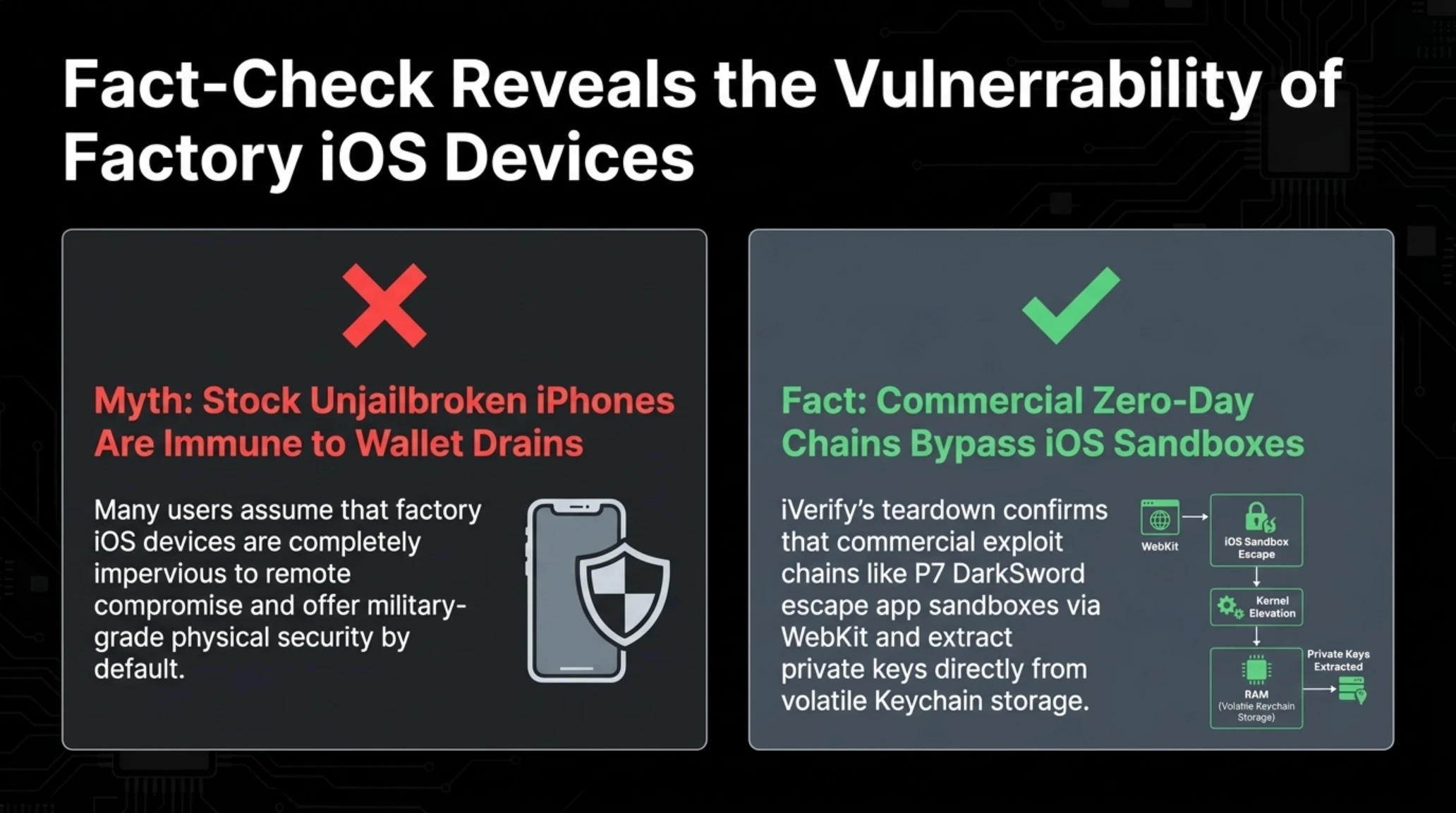
Technical Fact-Check | Rumor vs. Cybersecurity Reality
Many users assume that factory iOS devices are completely impervious to remote compromise and that mobile software wallets offer military-grade physical security by default.
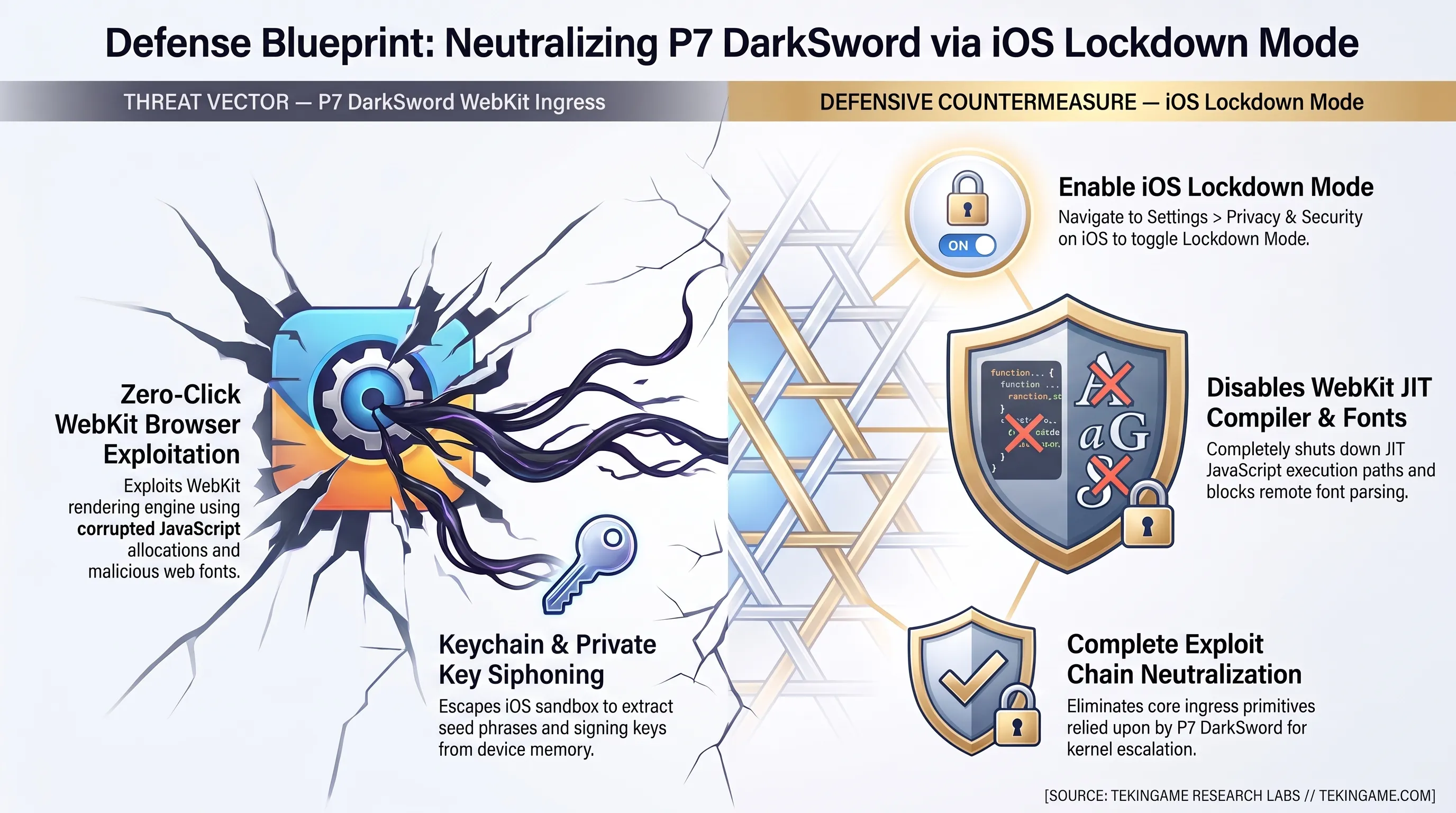
iVerify's teardown confirms that commercial exploit chains like P7 DarkSword escape app sandboxes via WebKit and extract private keys directly from volatile Keychain storage.
In the Linux enterprise arena, telemetry from honeypots indicates that the AnyPwn exploit has been swiftly integrated into automated botnet scanning engines. Threat actors target port 7070 to gain unauthenticated root execution, subsequently establishing secondary persistence by deploying cryptominers (such as XMRig), setting up hidden cron tasks, and utilizing victim servers as relay proxies for wider corporate network intrusion. For deeper analysis into these emerging threat patterns, consult our report on AI crypto threats and defensive protocols.
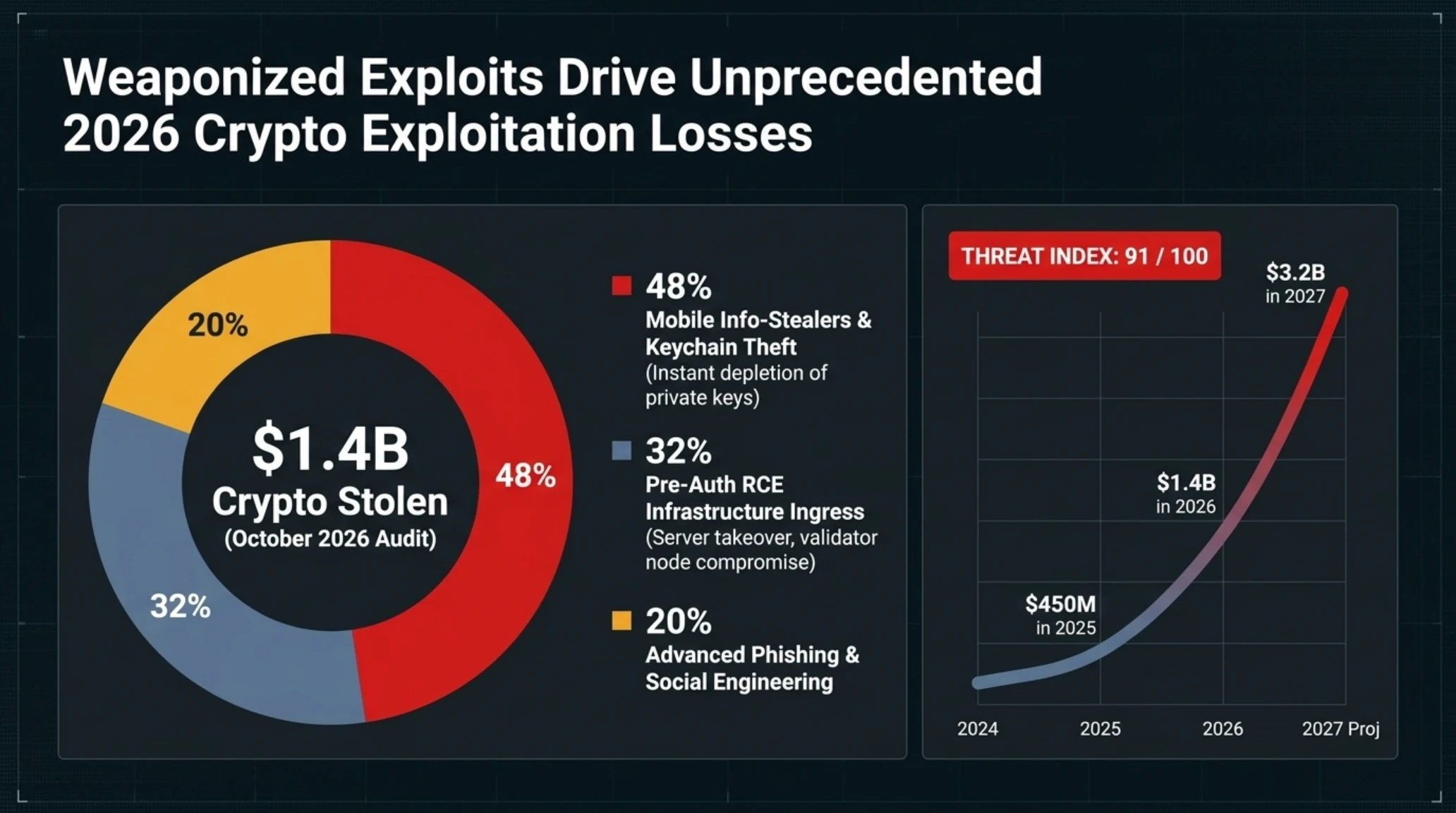
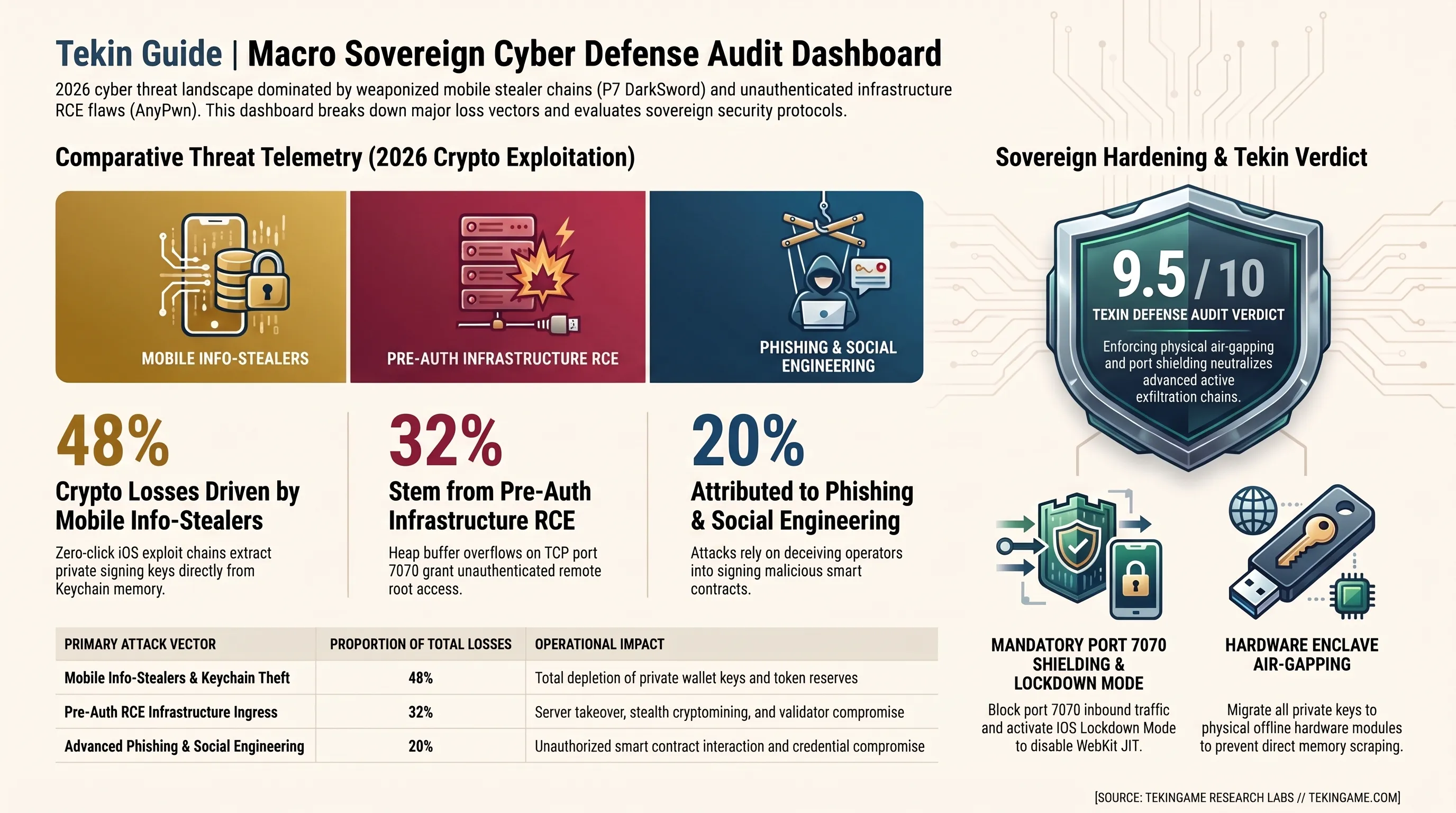
Dark-web telemetry reveals that over 1,800 public Linux endpoints were scanned and targeted within 48 hours of the AnyPwn repository release. The charts and telemetry dashboard below illustrate the alarming rise in mobile stealer and unauthenticated RCE exploits in 2026.
Global Threat Telemetry & 2026 Crypto Exploitation Losses
| Primary Attack Vector | Proportion of Total Losses | Operational Impact on Web3 & Enterprise Ecosystems |
|---|---|---|
| Mobile Info-Stealers & Keychain Theft | 48 Percent | Instant total depletion of private wallet keys and token reserves |
| Pre-Auth RCE Infrastructure Ingress | 32 Percent | Server takeover, stealth cryptomining, and validator node compromise |
| Advanced Phishing & Social Engineering | 20 Percent | Deceiving operators into signing malicious smart contracts |
The threat index thermometer confirms that weaponized mobile exploit chains targeting digital assets have crossed into critical danger territory. The fusion of zero-click browser ingress with active C2 command execution mandates a complete pivot toward hardware-based isolation and strict endpoint hardening.
Threat Sentiment Thermometer & Global Ingress Curve
Threat Assessment: The proliferation of second-hand surveillance kits weaponized for financial siphoning has elevated risk levels into unprecedented territory, requiring physical isolation of private keys and proactive port shielding.
📚 Classified & Related Dossiers in TekinGame
If you wish to explore beyond this report and delve into cybernetic frontiers and autonomous AI architectures, do not miss these three exclusive deep-dives in the Tekin Garage:
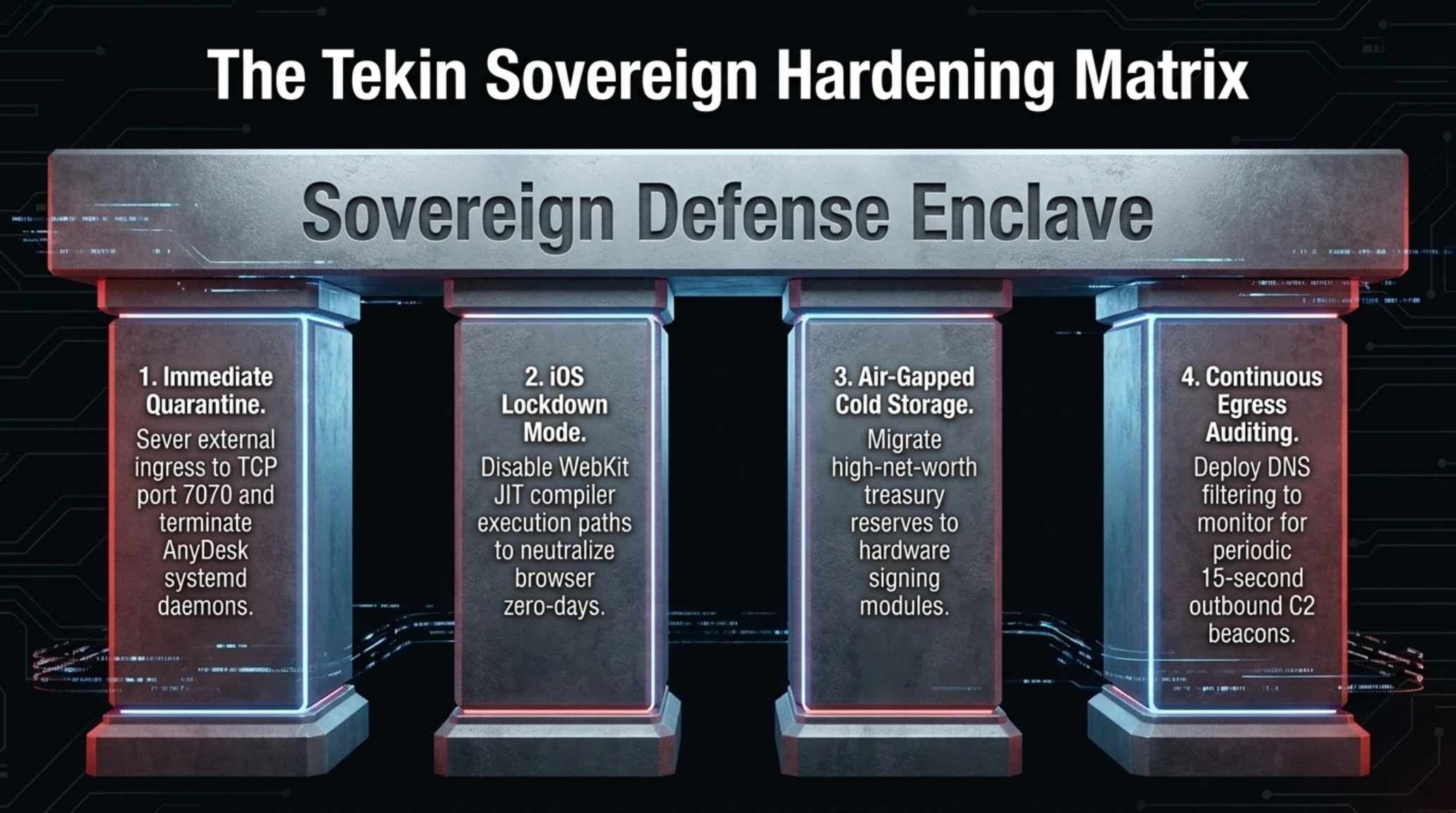
To establish absolute defense against P7 DarkSword siphoning and AnyPwn remote root compromise, the Tekin Cyber Defense Taskforce has established a mandatory four-pillar remediation protocol for Web3 investors, DevOps engineers, and infrastructure operators.
Step 1: Immediate Quarantine and Patching of AnyDesk Linux
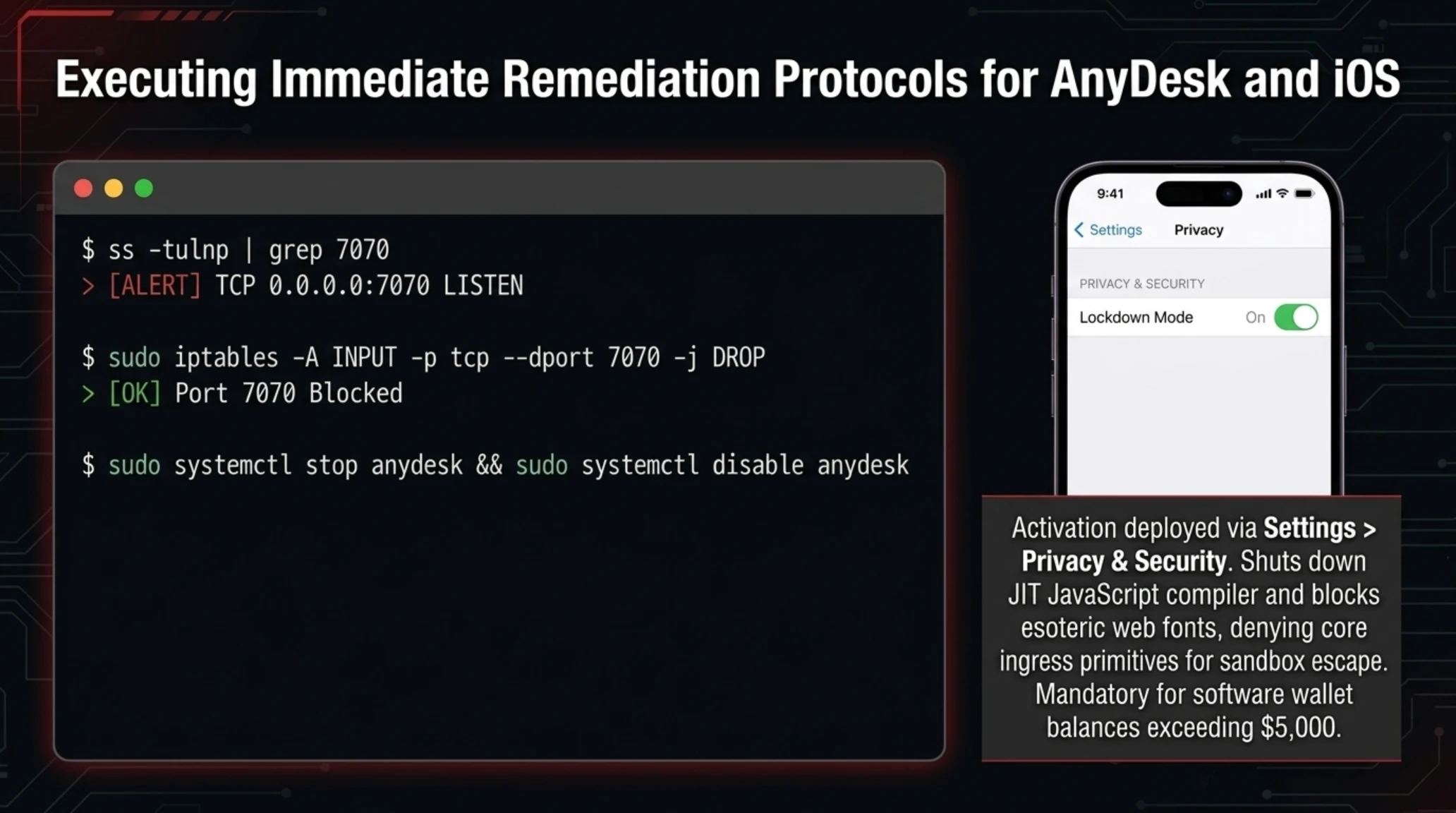
For any Linux deployment (Ubuntu, Debian, Fedora, Arch, or RHEL) running AnyDesk, immediately sever external ingress to TCP port 7070. Execute the local firewall rule sudo ufw deny 7070/tcp or apply an equivalent iptables/nftables drop policy. Update the package to version 8.1.0 or newer immediately. If unattended remote management is non-essential, terminate the background systemd service using sudo systemctl stop anydesk && sudo systemctl disable anydesk to eliminate the attack surface entirely.
Step 2: Mandatory Activation of iOS Lockdown Mode
Apple's integrated Lockdown Mode—accessible under Settings > Privacy & Security—serves as an impenetrable barrier against browser-based zero-day chains. Enabling Lockdown Mode completely shuts down the Just-In-Time (JIT) JavaScript compiler in WebKit, blocks esoteric web fonts, and denies remote font parsing engines. This eliminates the core ingress primitives relied upon by P7 DarkSword to achieve sandbox escape. Every user holding software wallet balances exceeding $5,000 must enforce this setting permanently.
Cybersecurity Terminal Telemetry & Remediation Log
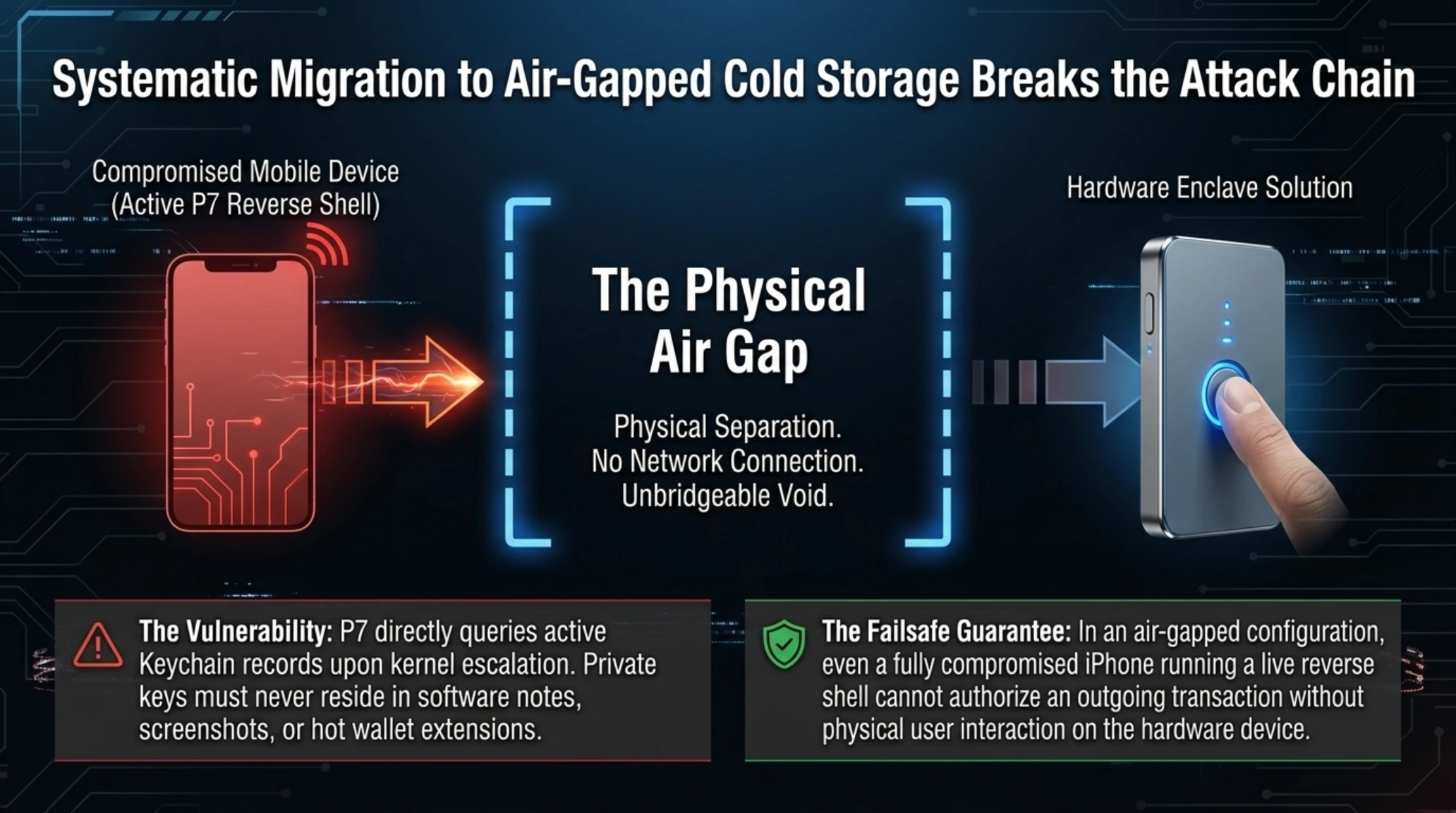
Step 3: Systematic Migration to Air-Gapped Cold Storage
Private keys, seed phrases, and mnemonic backups must never reside in software notes, screenshots, messaging applications, or hot wallet extensions installed on primary phones or desktop operating systems. Because P7 can directly query active Keychain records upon kernel escalation, all treasury reserves must migrate to hardware signing modules (such as Ledger, Trezor, or Tangem). In an air-gapped configuration, even an entirely compromised iPhone running a live reverse shell cannot authorize an outgoing transaction without physical user interaction on the hardware device. Review our analysis on sovereign infrastructure defense and malware mitigation for further operational architecture.
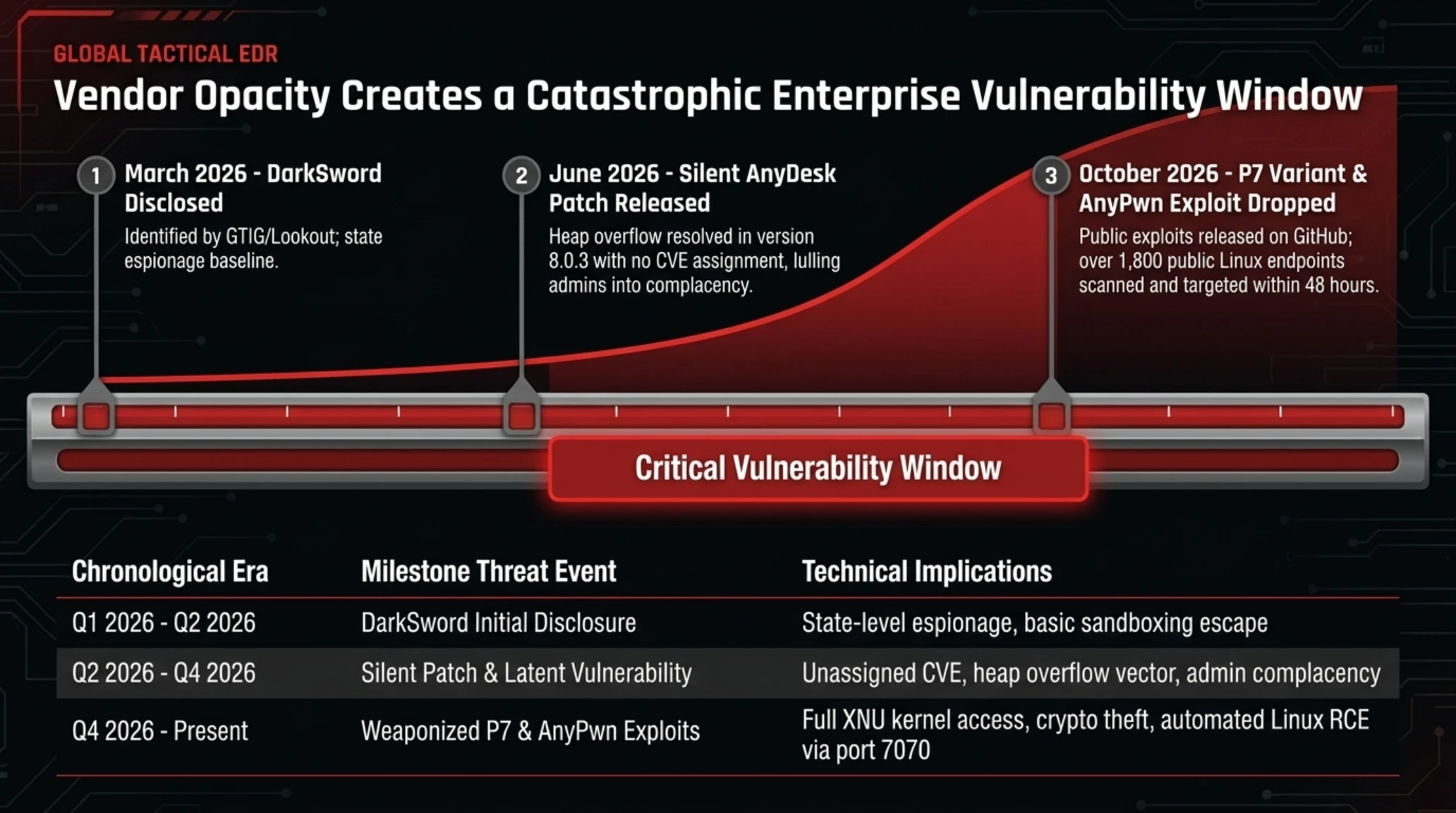
Event Timeline | Chronology of DarkSword & AnyDesk Flaws
| Chronological Era | Milestone Threat Event | Technical Implications & Remediation |
|---|---|---|
| March 2026 | Original DarkSword Chain Disclosed | Identified by Google GTIG and Lookout; utilized in high-profile espionage campaigns. |
| June 2026 | Silent AnyDesk Linux Patch Released | Heap overflow resolved in version 8.0.3 without public CVE assignment. |
| October 2026 | P7 Variant & AnyPwn Exploit Dropped | Public exploit released on GitHub; iVerify uncovers targeted iOS cryptocurrency wallet theft. |
Step 4: Threat Matrix Enforcement & Continuous Egress Auditing
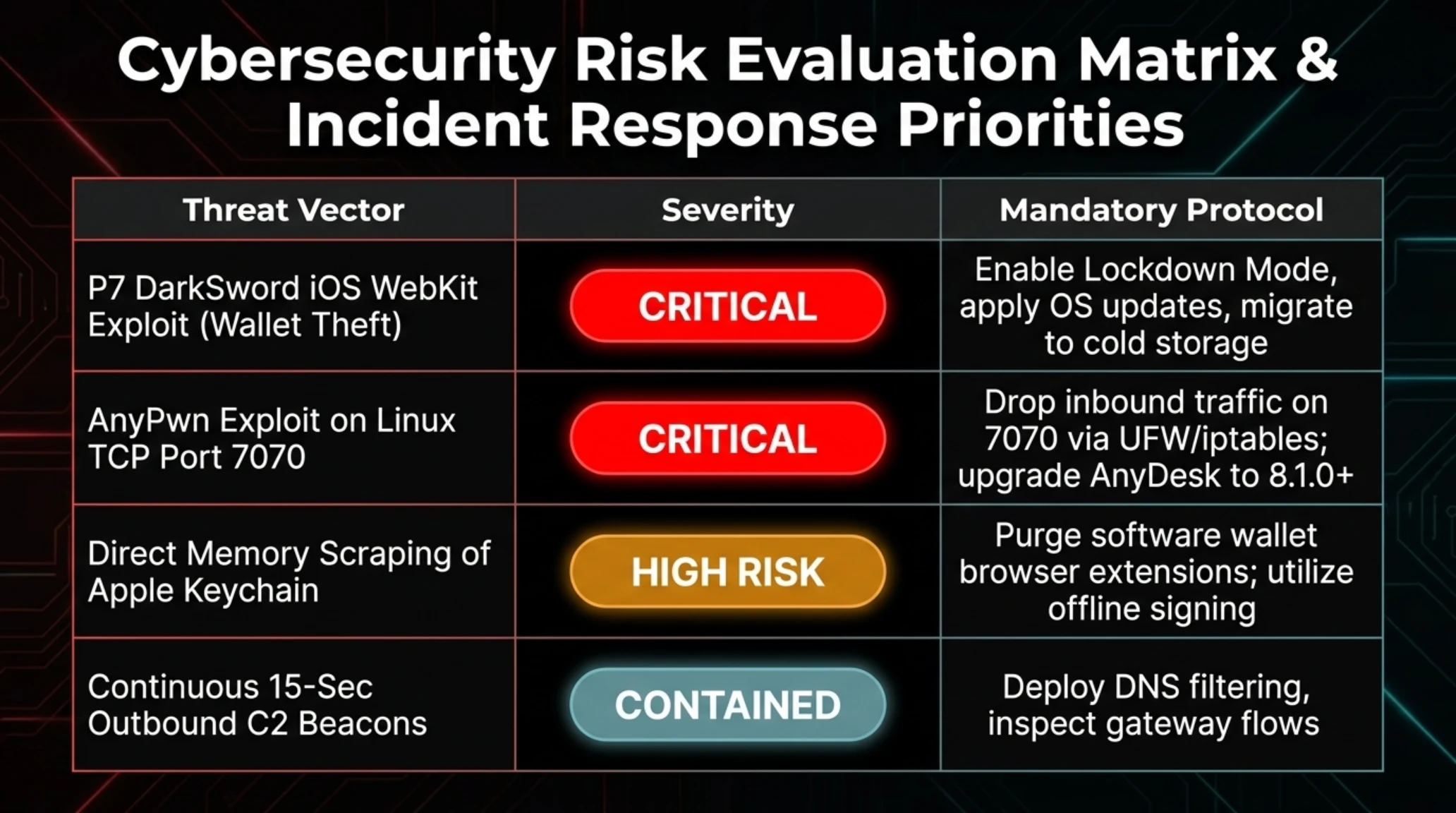
The structured cybersecurity risk matrix below delineates immediate priorities for corporate DevSecOps units and independent crypto operators. Failure to close port 7070 and delaying mobile lockdown mechanisms represent severe structural vulnerabilities.
Cybersecurity Risk Evaluation Matrix & Incident Response Priorities
| Threat Vector & Ingress Path | Severity Classification | Mandatory Countermeasure Protocol |
|---|---|---|
| P7 DarkSword iOS WebKit Exploit (Wallet Theft) | CRITICAL | Enable Lockdown Mode on iOS, apply latest OS security update, migrate funds to cold storage. |
| AnyPwn Exploit on Linux TCP Port 7070 | CRITICAL | Drop inbound traffic on port 7070 via UFW/iptables; upgrade AnyDesk binary to 8.1.0+. |
| Direct Memory Scraping of Apple Keychain | HIGH RISK | Purge software wallet browser extensions; utilize hardware enclaves with offline signing. |
| Continuous 15-Second Outbound C2 Beacons | CONTAINED | Deploy DNS filtering, monitor periodic outbound TCP/TLS connections, inspect gateway flows. |
- Total neutralization of Safari WebKit infection chains via iOS Lockdown Mode.
- Elimination of unauthenticated Linux remote root access by blocking TCP port 7070.
- Complete immunization of cryptocurrency reserves against Keychain theft via hardware signing.
- Rapid identification of hidden infections through behavioral monitoring of 15-second C2 beacon loops.
- Certain interactive web elements and custom fonts disabled under Apple Lockdown Mode.
- Requires physical possession and interaction with a hardware device for every outbound transaction.
- Silent patching practices by software vendors complicate automated vulnerability discovery.
Editorial Final Verdict & Verified Reference Index
Security Demands Ruthless Physical Isolation
By enforcing Tekin's four-pillar hardening protocol, operators can shield Linux server environments and harden personal iOS devices against the world's most aggressive cryptocurrency exfiltration tools.
- The Hacker News: P7 DarkSword iOS Exploit Kit & AnyDesk Linux Working Remote Root Exploit
- Bleeping Computer: Disclosed Pre-Authentication Flaws in Linux Remote Desktop Protocols
- iVerify Research Labs: Technical Disassembly and Threat Intelligence on P7 DarkSword iOS Exploit Chain
Frequently Asked Questions & Technical Cybersecurity Advisory
How does P7 DarkSword achieve infection on an unjailbroken iPhone?
The malware utilizes a full-chain zero-click or one-click exploit sequence targeting the WebKit rendering engine in Safari, bypassing the iOS application sandbox and escalating privileges to root kernel level.
Can P7 DarkSword extract private keys from installed software wallets?
Yes. Upon achieving supervisor kernel privileges, P7 systematically queries the local sandbox storage of Web3 apps like MetaMask, Trust Wallet, and Coinbase Wallet, while extracting credentials stored in the Apple Keychain.
What is the technical cause of the AnyDesk Linux vulnerability?
The flaw is an unauthenticated heap buffer overflow in the proprietary session handling protocol listening on TCP port 7070, allowing remote code execution as root prior to user confirmation.
How can administrators immediately protect Linux systems against AnyPwn?
Block incoming TCP traffic on port 7070 via local firewall (e.g., sudo ufw deny 7070/tcp) and immediately update AnyDesk to version 8.1.0 or newer.
How does iOS Lockdown Mode prevent infection by P7 DarkSword?
Lockdown Mode disables the WebKit Just-In-Time (JIT) JavaScript compiler and restricts complex web font parsing, rendering the primary browser exploitation primitives completely ineffective.
Why is cold storage migration essential against this class of exploit?
Hardware wallets keep private keys completely isolated from host operating system memory; transactions require physical confirmation on the independent hardware device, preventing automated remote draining.
Additional Gallery: Tekin Versus | Nintendo Switch 2 vs. PS5: AI Benchmark & GTA 6 Feasibility