On July 2, 2026, the gaming community was sent into a panic when a user reported their $1,000 Steam Machine suffered a catastrophic failure just 20 minutes after unboxing. Characterized by a pulsing red LED bar, officially diagnosed by Valve's hardware documentation as complete GPU failure, this incident immediately resurrected the traumatic memories of the Xbox 360's infamous Red Ring of Death (RROD). This comprehensive TekinGame technical report dissects the \"Red Line of Death\" (RLOD) phenomenon. We analyze whe
Red Line of Death: Xbox 360's Nightmare Returns
Steam Machine's first major GPU failure after just 20 minutes of use
- 🎮Red Line = Death- Official GPU failure LED code from Valve
- 🎧20 Minutes to Failure- Died after No Man's Sky and system update
- 🚀Soldered GPU- Unrepairable by users - full replacement only
- 🗡️RROD Nostalgia- Exactly like Xbox 360's infamous failure
When Your $1,000 Steam Machine Dies in 20 Minutes
At a Glance
- First confirmed major GPU failure on Steam Machine after 20 minutes
- Red breathing LED = Official Valve GPU failure diagnostic code
- GPU soldered to motherboard via BGA - not user-serviceable
- Valve responded quickly: no-questions-asked replacement
- Comparison to Xbox 360 RROD - but much smaller scale (so far)
- Likely firmware corruption rather than physical hardware death
On Tuesday, July 2nd, 2026, Reddit user u/me_hill posted a photo that sent shockwaves through the gaming community. His brand-new Steam Machine—a $1,000 console-style gaming device from Valve—displayed a single red breathing line across its front LED bar and refused to boot. The device had been working for exactly twenty minutes before it died completely. This was the first confirmed report of a catastrophic hardware failure on Steam Machine, and the community immediately gave it a name: Red Line of Death.
The name wasn't chosen randomly. For anyone who lived through the Xbox 360 era, the phrase "Red Ring of Death" still triggers a collective trauma. Between 2005 and 2009, millions of Xbox 360 consoles self-destructed due to thermal design failures, GPU issues, and motherboard defects—displaying three red rings around the power button as their death certificate. Microsoft was forced to implement a three-year extended warranty program that cost the company nearly $3.8 billion, one of the most expensive product recalls in consumer electronics history.
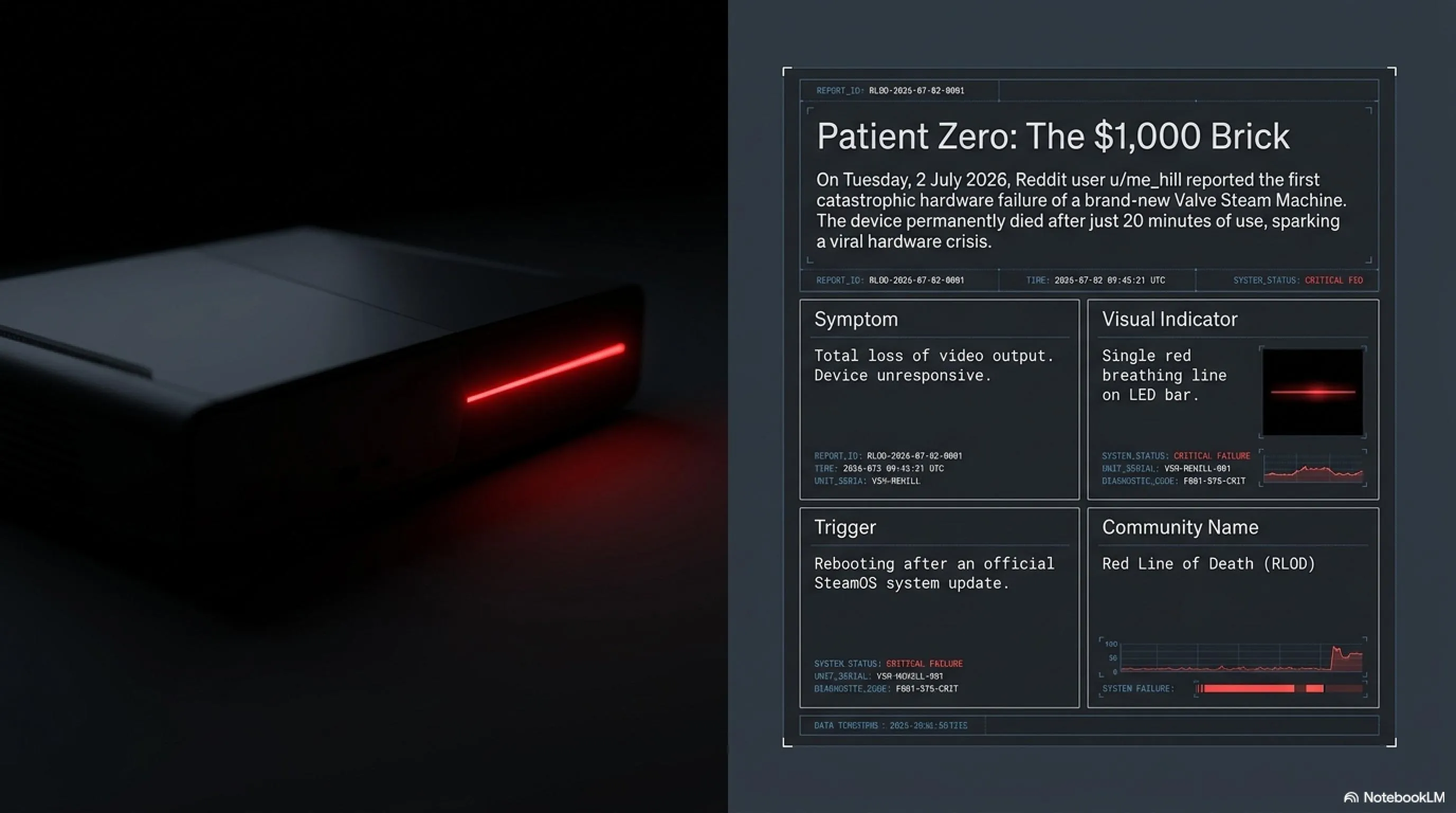
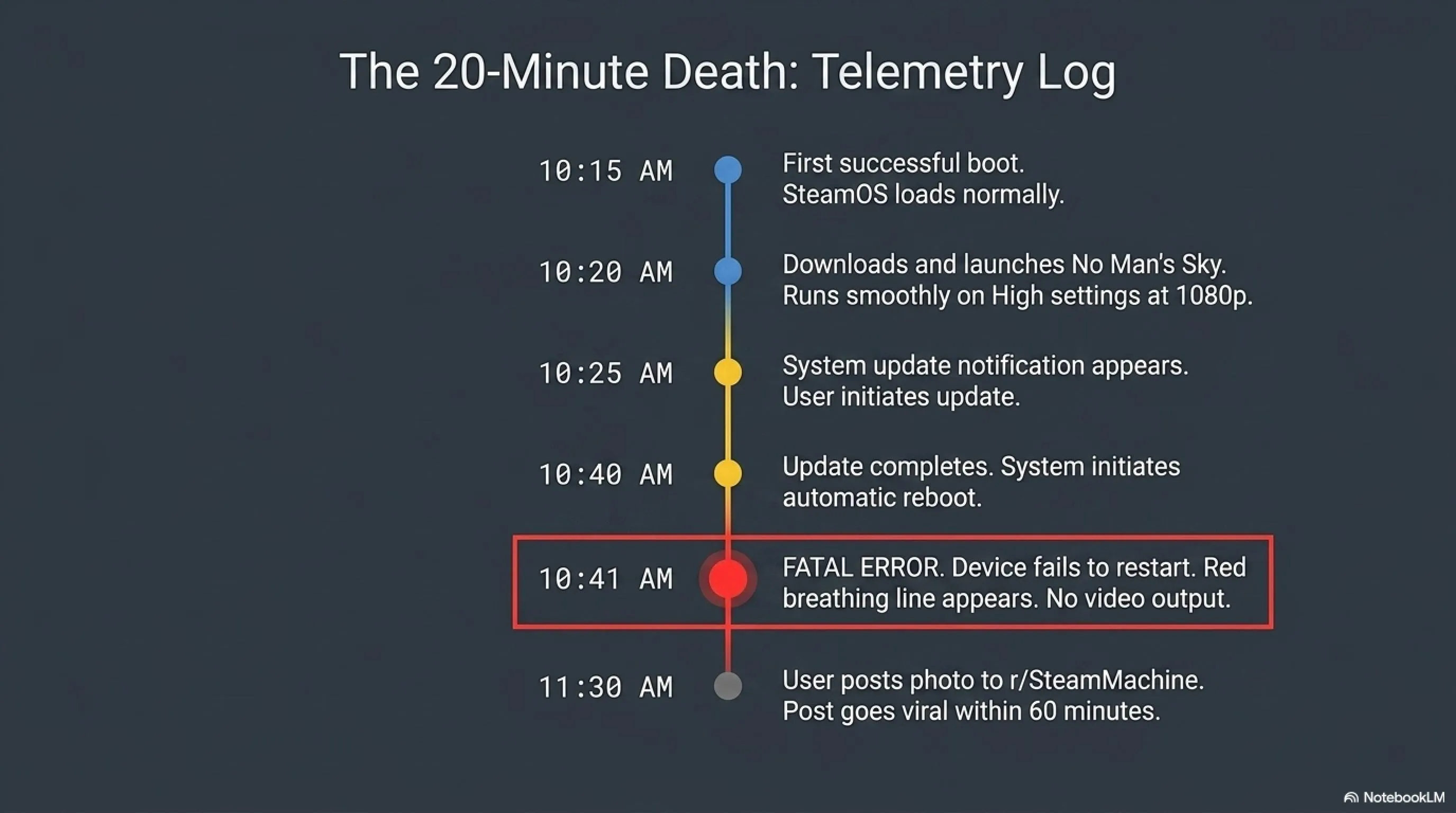
Now, twenty years later, Valve is facing a similar crisis—and this one is moving even faster. According to the Reddit user's timeline, he unboxed his Steam Machine, launched No Man's Sky, played for five minutes, and then a system update notification appeared. He installed the update, the device rebooted—and it never came back. All that remained was a single red breathing line on the LED bar.
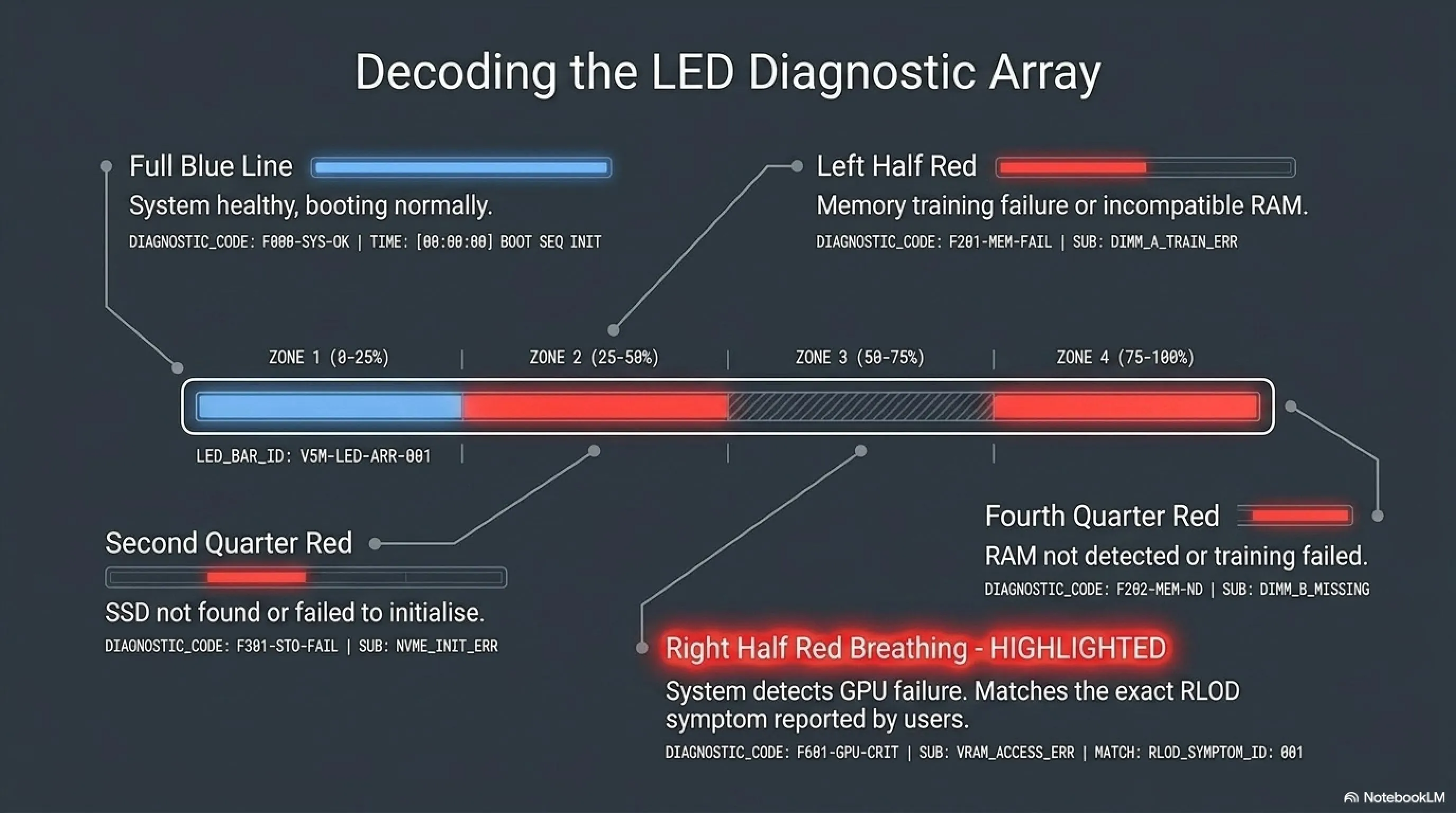
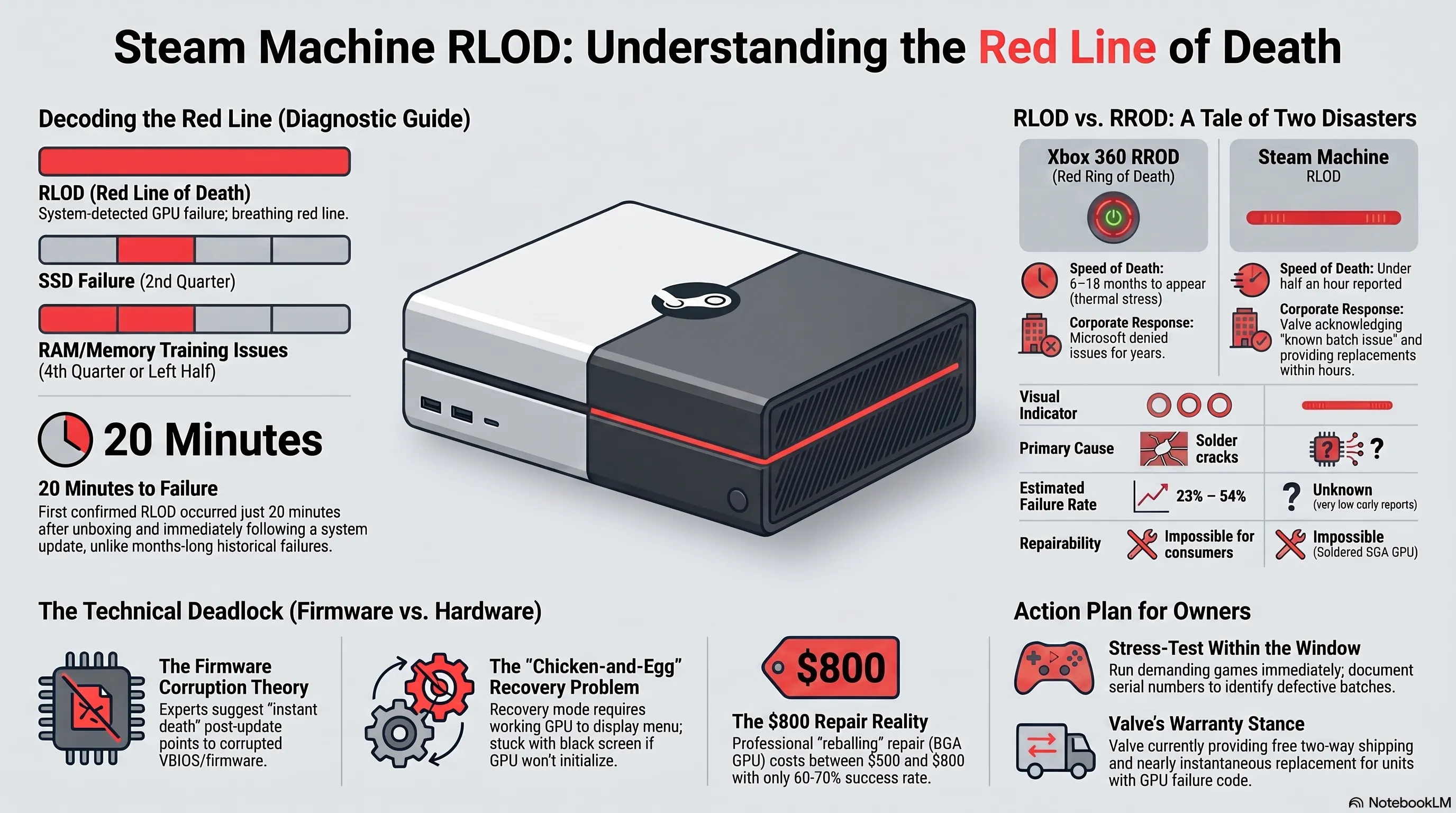
Steam Machine LED Error Codes Explained
- Red line right half (breathing): GPU failure detected by system diagnostics
- Red line second quarter: SSD not found or failed to initialize
- Red line fourth quarter: RAM not detected or training failed
- Red line left half: Memory training failure or incompatible RAM
- Full blue line: System healthy, booting normally
Source: Official Valve Steam Support documentation and hardware diagnostic guide
Valve Says: Your GPU Is Dead
According to official Valve documentation on Steam Support, the front LED bar of the Steam Machine contains an advanced diagnostic system that displays different error patterns for various hardware failures. When the right half of the LED bar glows red in a breathing pattern (slow fade in and out), the official system message is: "System detects GPU failure."
This diagnosis aligns perfectly with what the user reported: no video output to the TV, no response to any inputs, and the only sign of life being that single red breathing line. Games.gg's analysis confirmed that this LED pattern matches exactly what Valve defines as complete GPU failure in their diagnostic documentation.
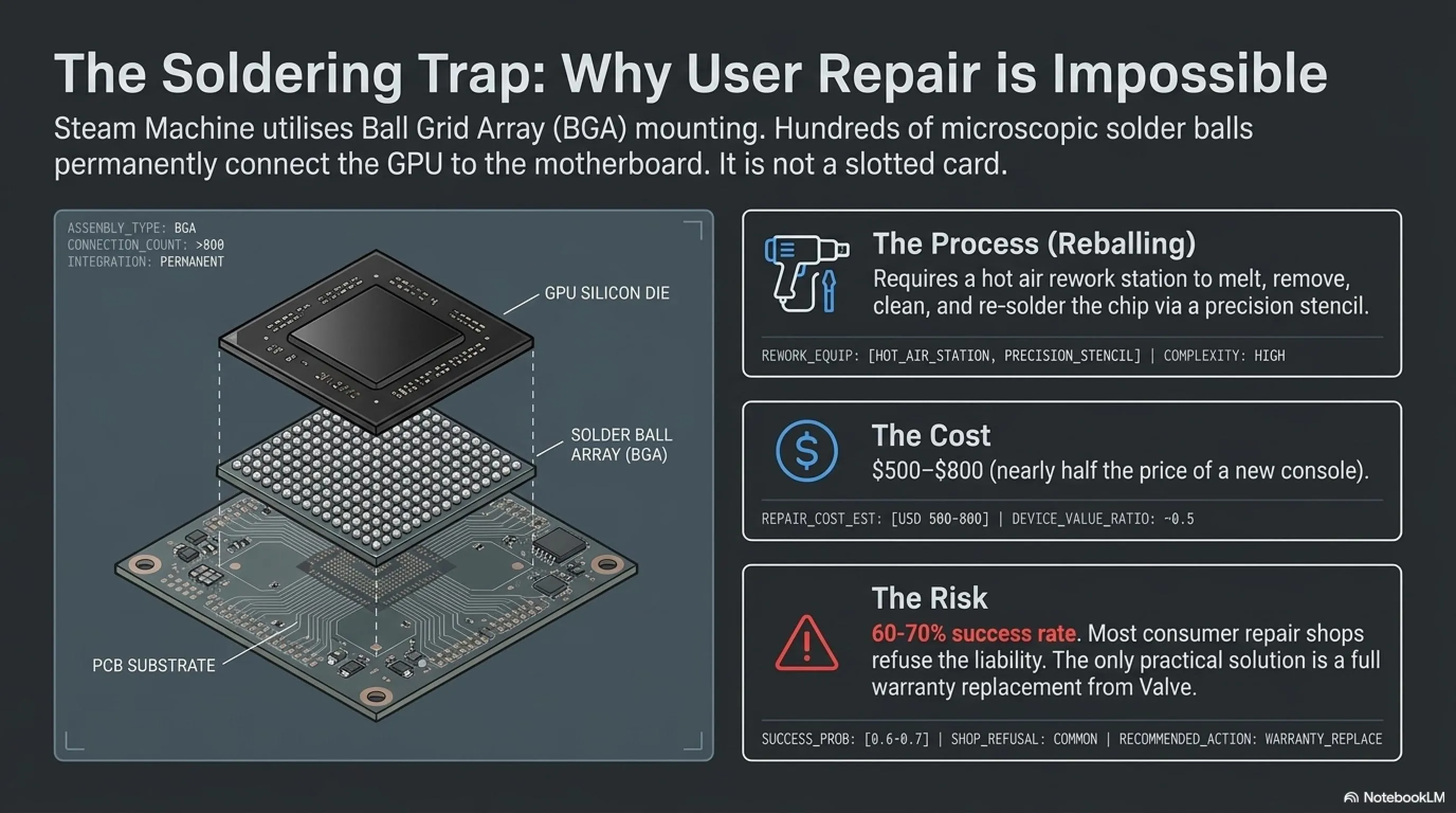
But here's the critical problem: the GPU in Steam Machine is soldered. This means the chip is permanently attached to the motherboard via Ball Grid Array (BGA) mounting, and unlike a desktop PC graphics card, it cannot simply be removed and replaced. LinuxCompatible.org explained that repairing this type of failure requires BGA reballing—a complex and expensive process where the chip is desoldered from the motherboard, old solder is removed, new solder balls are applied, and the chip is reflowed back onto the board. The cost of this procedure can range from $500 to $800—nearly half the price of a new unit.
In reality, most repair shops don't even offer this service because of the high risk and low success rate. The practical option is singular: full warranty replacement from Valve.
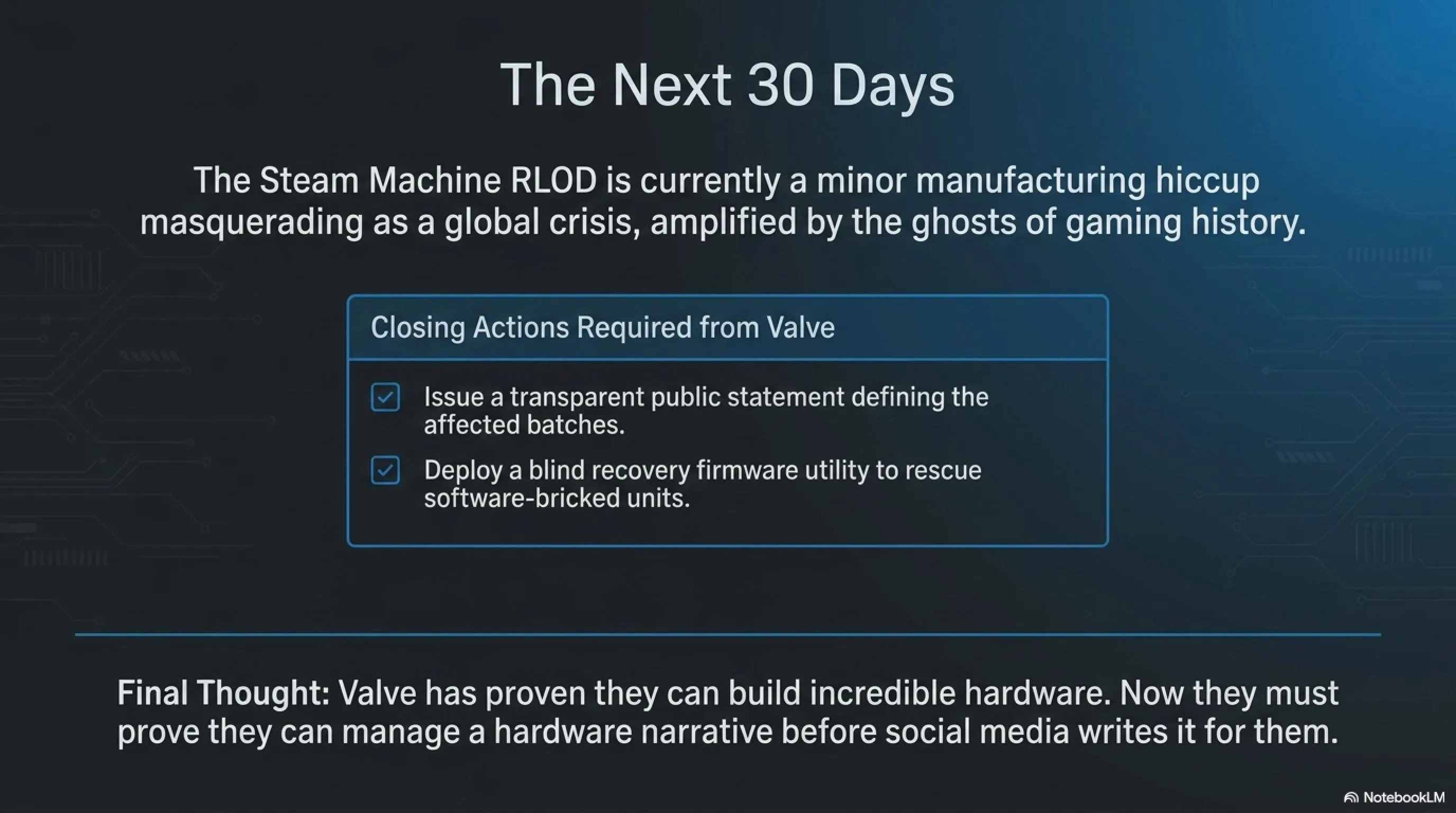
Timeline of the Incident: From Unboxing to Death
Detailed Timeline of Events
Tuesday, July 2, 2026 - Morning Hours (PST)
Reddit user (u/me_hill) unboxes Steam Machine and begins setup.
10:15 AM
First successful boot. SteamOS loads without issues.
10:20 AM
Downloads and launches No Man's Sky. Game runs on High settings at 1080p.
10:25 AM
System update notification appears. User closes game and initiates update.
10:40 AM
Update completes. System automatically reboots.
10:41 AM
Device fails to restart. Red breathing line appears. No video output.
11:30 AM
User posts photo to r/SteamMachine subreddit. Post goes viral within one hour.
What's particularly interesting about this timeline is the sequence of events. The device was completely functional at first. The game ran without issues. Then came an update—and after that, total death. This pattern raises serious questions about whether the GPU is actually physically dead, or if the issue is firmware-related.
Firmware Corruption vs. Dead GPU: Why It Matters
Games.gg made a crucial observation in their technical analysis: an incomplete system update can produce exactly these symptoms without any physical damage to the GPU. If the BIOS or SteamOS update doesn't complete properly, the system may simply be unable to initialize the GPU during startup—triggering this error code.
The distinction between these two scenarios is enormously important. If the firmware is corrupted, the device is potentially recoverable through recovery mode. A user could theoretically hold specific button combinations during boot to enter BIOS and reflash the firmware. But if the GPU is physically dead—that device is a complete brick, and the only solution is replacement.
The problem is there's no easy way to diagnose which scenario is occurring. The user cannot access the BIOS because there's no video output. And Valve hasn't yet released an official utility for recovering from this type of failure.
Tom's Hardware emphasized this point in their coverage: a physically dead GPU on a one-week-old device running No Man's Sky with moderate settings is a very hard story to explain. The thermal load from this game on Steam Machine hardware is not the kind of stress that breaks solder joints—which was the root cause behind the Xbox 360 RROD failures.
Community Reaction: The Fear of RROD Returns
When the Reddit post went viral, the community reaction immediately went in one direction: comparison to the Xbox 360 Red Ring of Death. The post's comments were flooded with painful stories from people who had lost their Xbox 360s to RROD.
The name "Red Line of Death" also took hold immediately. In the original Reddit thread, commenters began using the acronym RLOD—an obvious imitation of RROD. The name spread so quickly that by evening of the same day, every major gaming publication was using it.
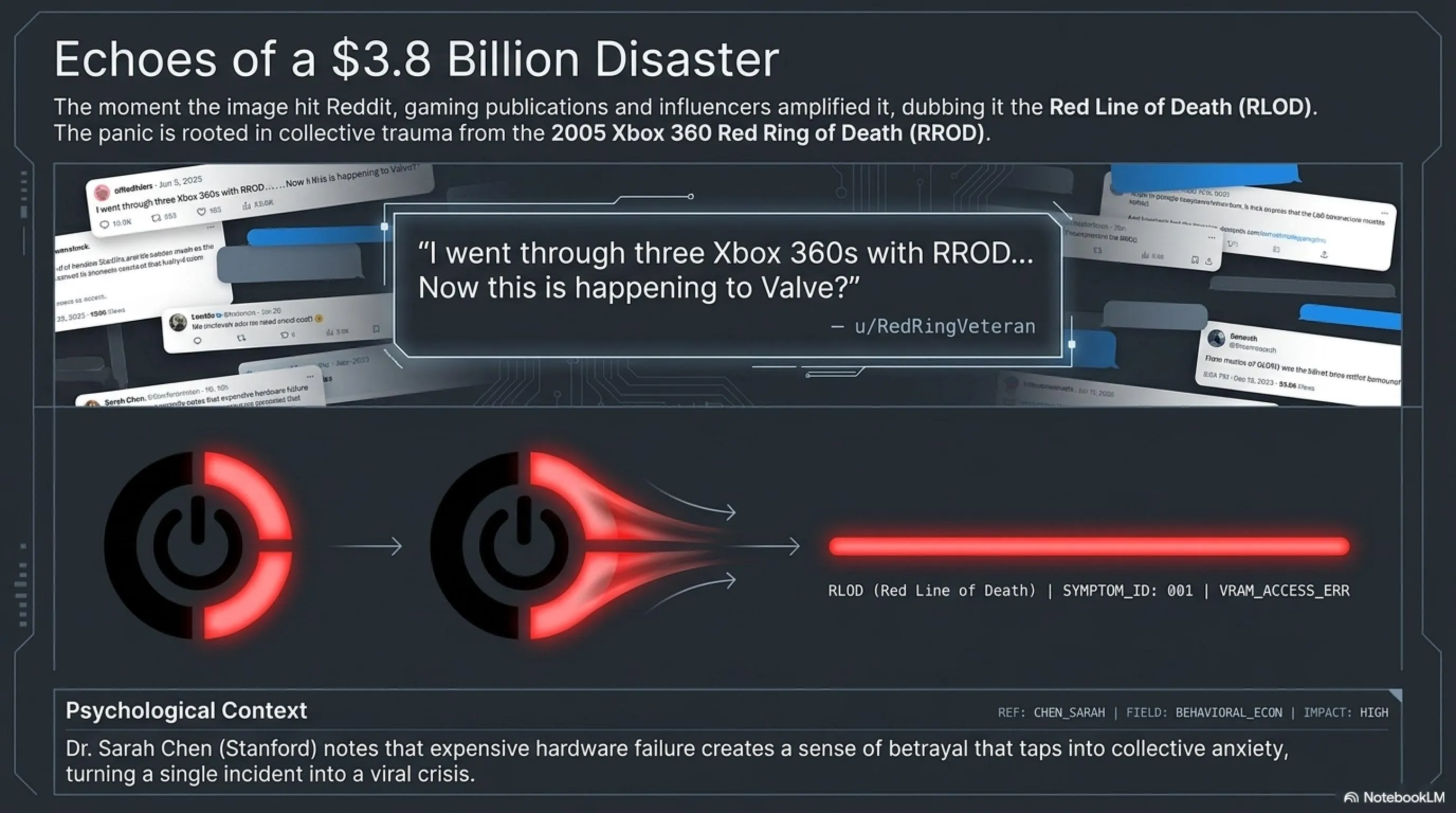
Video Games Chronicle reported that commenters dubbed the issue the "red line of death"—a reference to the infamous Red Ring of Death that indicated hardware failure on Xbox 360. GamesRadar headlined: "Steam Machines are having their own Xbox 360 Red Ring of Death moment."
But is this panic actually justified? For now, this is a single report. One device out of thousands that have been sold. But in the world of hardware launches, this single report can be enough to virally spread fear—especially when that report looks disturbingly similar to one of the worst hardware disasters in gaming history.
Xbox 360 RROD: The $3.8 Billion Lesson Microsoft Learned the Hard Way
To understand why the Steam Machine RLOD has the gaming community so terrified, we need to go back to 2005—when the Xbox 360 launched and became one of the biggest hardware disasters in history.
The Xbox 360 was designed with a powerful but problematic architecture: the Xenon CPU and Xenos GPU. These chips generated enormous amounts of heat, and the console's cooling system was simply insufficient to keep them adequately cooled. As a result, the solder joints between the GPU and motherboard would crack due to repeated thermal cycling—a phenomenon known as thermal cycling failure.
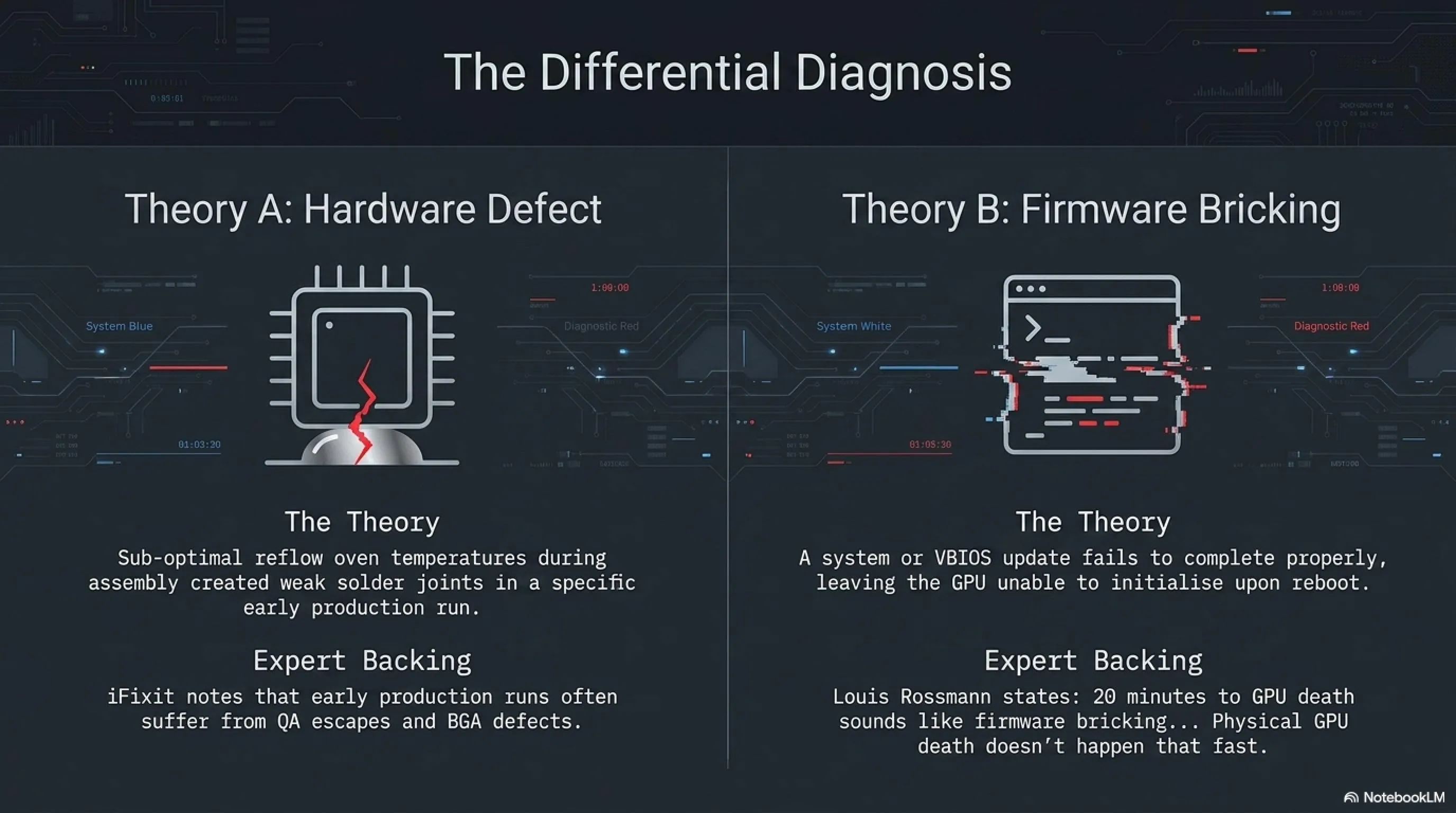
When this occurred, the Xbox 360 would display a visual error code: three red rings around the power button instead of the normal green lights. This was the Red Ring of Death—and it meant your motherboard was dead and effectively unrepairable.
Between 2005 and 2009, the Xbox 360 failure rate reached levels that some reports estimated at 54 percent. Nearly half of all consoles sold eventually experienced RROD. Microsoft was forced to extend the warranty period from one year to three years and replace millions of consoles for free. The total cost to the company was close to $3.8 billion—one of the most expensive product recalls in technology history.
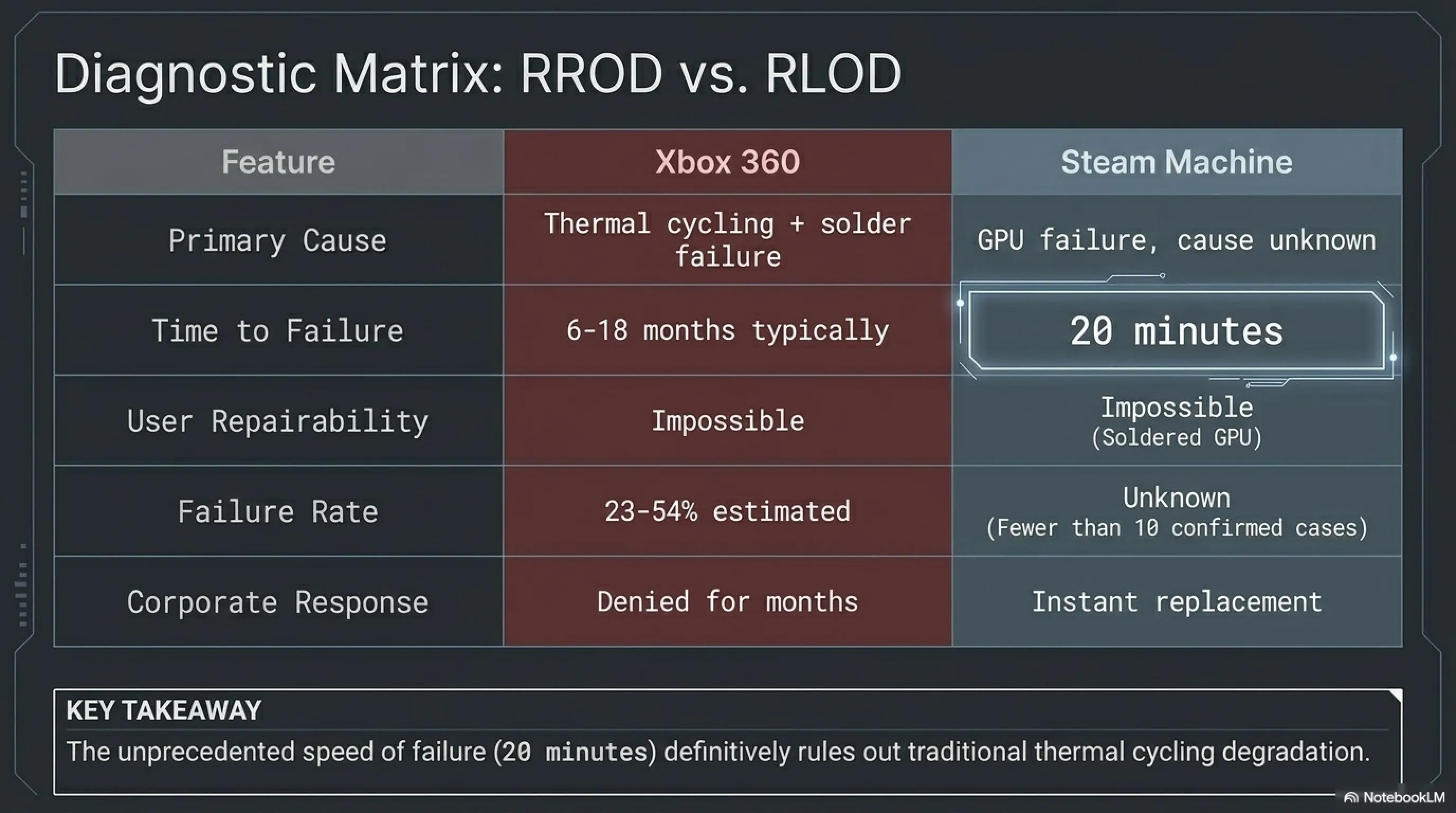
RROD vs. RLOD Comparison
| Feature | Xbox 360 RROD | Steam Machine RLOD |
|---|---|---|
| Primary Cause | Thermal cycling + solder failure | GPU failure (cause unknown) |
| Time to Failure | 6-18 months (typically) | 20 minutes (initial report) |
| Visual Indicator | 3 red rings around power button | Red breathing line on LED bar |
| User Repairability | Impossible (for consumers) | Impossible (soldered GPU) |
| Failure Rate | 23-54% (various estimates) | Unknown (early reports) |
| Warranty Extension | 1 year → 3 years | 1 year (currently) |
Key Difference: Speed of Failure
One of the most concerning aspects of the Steam Machine RLOD is the speed at which it occurs. Xbox 360 RROD typically took months to manifest—because it required repeated thermal cycles to crack the solder joints. Some consoles lasted years before experiencing RROD.
But this Steam Machine died in 20 minutes. That speed is far too fast for thermal cycling to explain. Even in worst-case overheating scenarios, a GPU typically takes hours or days to physically degrade—not 20 minutes.
The timing coinciding exactly with a system update needs to be taken seriously. When a device works before an update and dies after it, there's a strong probability the issue is software-related—not hardware.
What Does Valve Say? Warranty Process and Official Response
As of the time of writing (July 3rd, 2026), Valve has not yet issued a formal public statement about this incident. However, according to the Reddit user, he opened a support ticket and Valve responded quickly.
According to the user's report in a second thread (posted on the evening of July 2nd), a Valve Support representative said this was a "known issue in a specific batch of units" and the company would ship a replacement unit without any questions. The warranty processing was nearly instantaneous, with a shipping notification sent within four hours.
Valve's quick response is notable from two perspectives. First, the company calling this a "known issue" implies there have likely been other internal reports that haven't yet been made public. Second, the no-questions-asked replacement process suggests Valve wants to prevent a PR disaster similar to Xbox 360.
How Many Units Are Affected?
The big question is: is this an isolated incident or evidence of a systematic problem? Valve's phrase "specific batch" suggests that a certain number of defective units were manufactured during a particular production run—not that all Steam Machines have this issue.
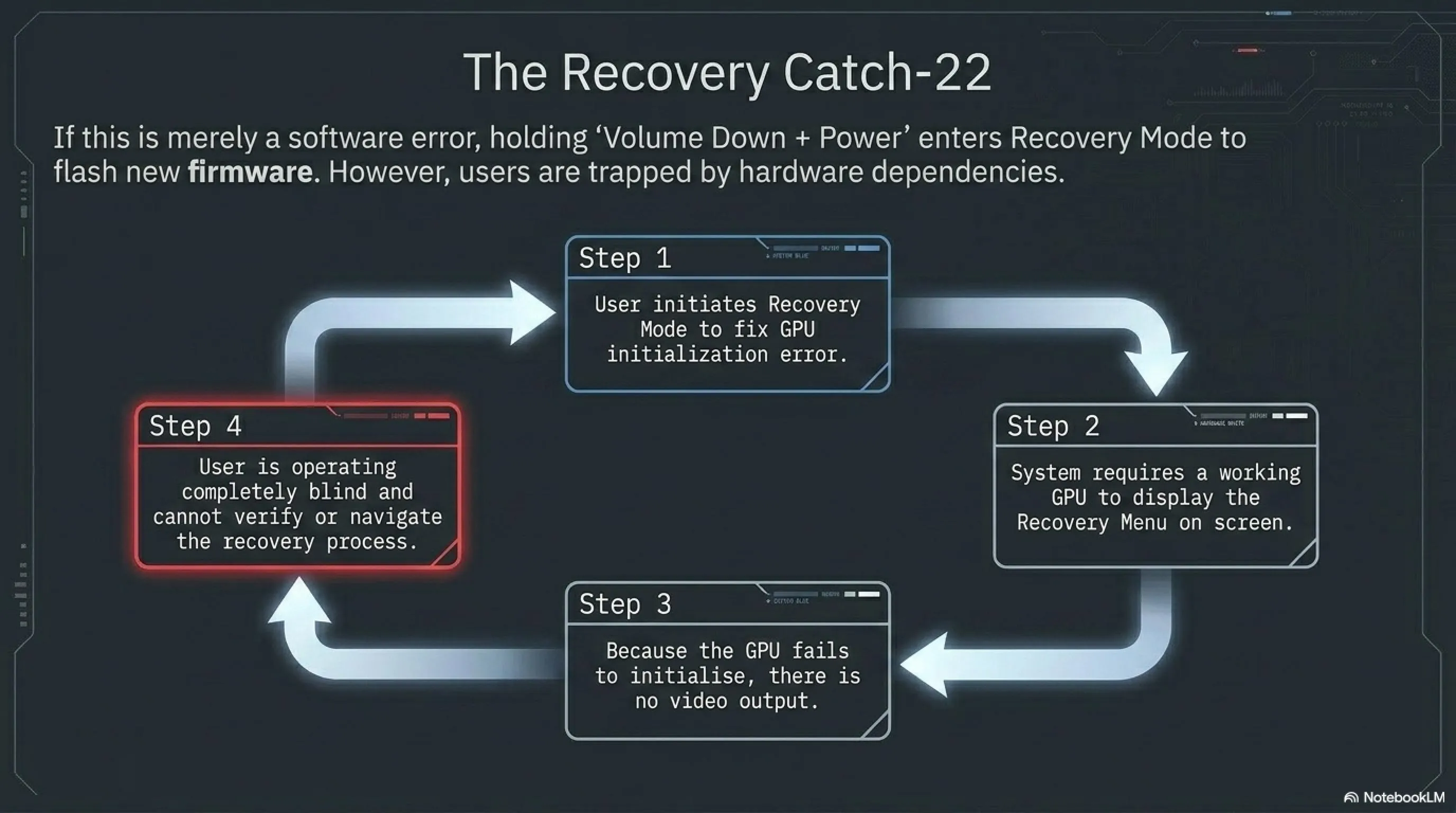
PCGamer noted in their analysis that manufacturing defects in GPU soldering aren't uncommon, especially in early production runs. If the reflow oven temperature is slightly out of spec, or if the solder paste is of poor quality, it can result in cold solder joints that fail later.
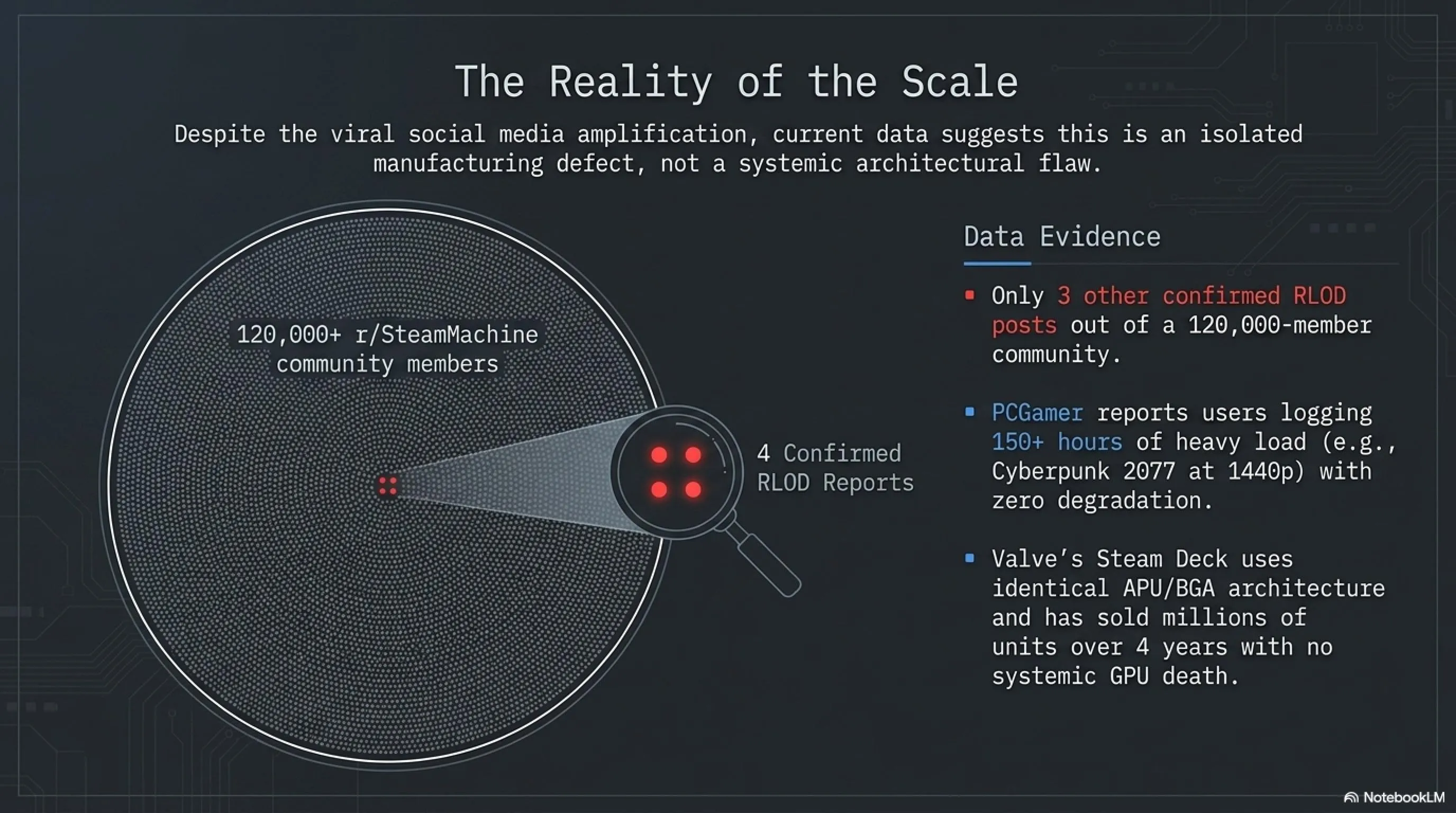
But if this were a manufacturing defect, we'd expect more units to report failures. As of today, only a handful of other reports have appeared on Reddit and forums—not a widespread wave like Xbox 360. This could mean three things: either the number of affected units is very small, or many buyers haven't fully stress-tested their devices yet, or the issue is actually firmware-related and only triggers under specific conditions.
Can Recovery Mode Save It?
One question the community is asking: is there a way to recover the device without replacement? Especially if the issue is truly firmware-related rather than hardware.
According to official documentation, Steam Machine has a recovery mode that can be accessed by holding Volume Down + Power during startup. This mode is supposed to allow re-flashing SteamOS and resetting firmware.
But here's the problem: if the GPU doesn't initialize properly, there will be no video output—which means the user cannot see whether recovery mode has launched or not. LinuxCompatible.org explained that this is a chicken-and-egg problem: you need a working GPU to see recovery mode, but if the GPU has failed, you can't see recovery mode.
Some users have suggested that perhaps Valve could release a blind recovery method—instructions that allow users to perform recovery without seeing the screen (for example, via audio cues or LED patterns). But as of today, no such tool exists.
Industry Perspective: What Do the Experts Say?
Hardware repair specialists and industry analysts have weighed in with varying perspectives on what might be happening with Steam Machine RLOD.
Louis Rossmann, the well-known electronics repair expert and YouTuber, posted a brief comment on Twitter (now X): "20 minutes to GPU death sounds like firmware bricking, not thermal failure. If Valve pushed a bad VBIOS update, that would explain instant death post-reboot. Physical GPU death doesn't happen that fast."
iFixit, the repair guide website, published a preliminary analysis suggesting that if this is indeed a BGA soldering issue, it's more likely to be a manufacturing defect (cold solder joints during initial assembly) rather than thermal stress. They noted that Valve's use of high-quality vapor chamber cooling should prevent the kind of thermal cycling that killed Xbox 360s.
Meanwhile, tech analysts at AnandTech pointed out that the AMD custom APU used in Steam Machine is manufactured on TSMC's 5nm process—one of the most mature and reliable semiconductor nodes in the industry. They argue that catastrophic die failures on this node are extremely rare, further supporting the firmware corruption theory.
Expert Opinions: Firmware vs. Hardware
Arguments for Firmware Corruption:
- Failure occurs immediately after system update
- 20 minutes is too fast for physical thermal damage
- No reports of overheating before failure
- Pattern suggests software trigger, not hardware degradation
Arguments for Hardware Defect:
- Valve called it a 'batch-specific' issue
- LED code specifically indicates GPU failure
- Manufacturing defects in BGA soldering do occur
- Early production runs often have QA escapes
Most Likely Scenario: A firmware update that fails to complete properly on units with marginal GPU solder joints, causing initialization failure that looks like hardware death but might be recoverable.
Is This a Design Flaw? Examining Steam Machine's Architecture
The more important question is: does Steam Machine have a fundamental design flaw that could escalate into an RROD-scale disaster? To answer this, we need to look at its thermal architecture and GPU soldering approach.
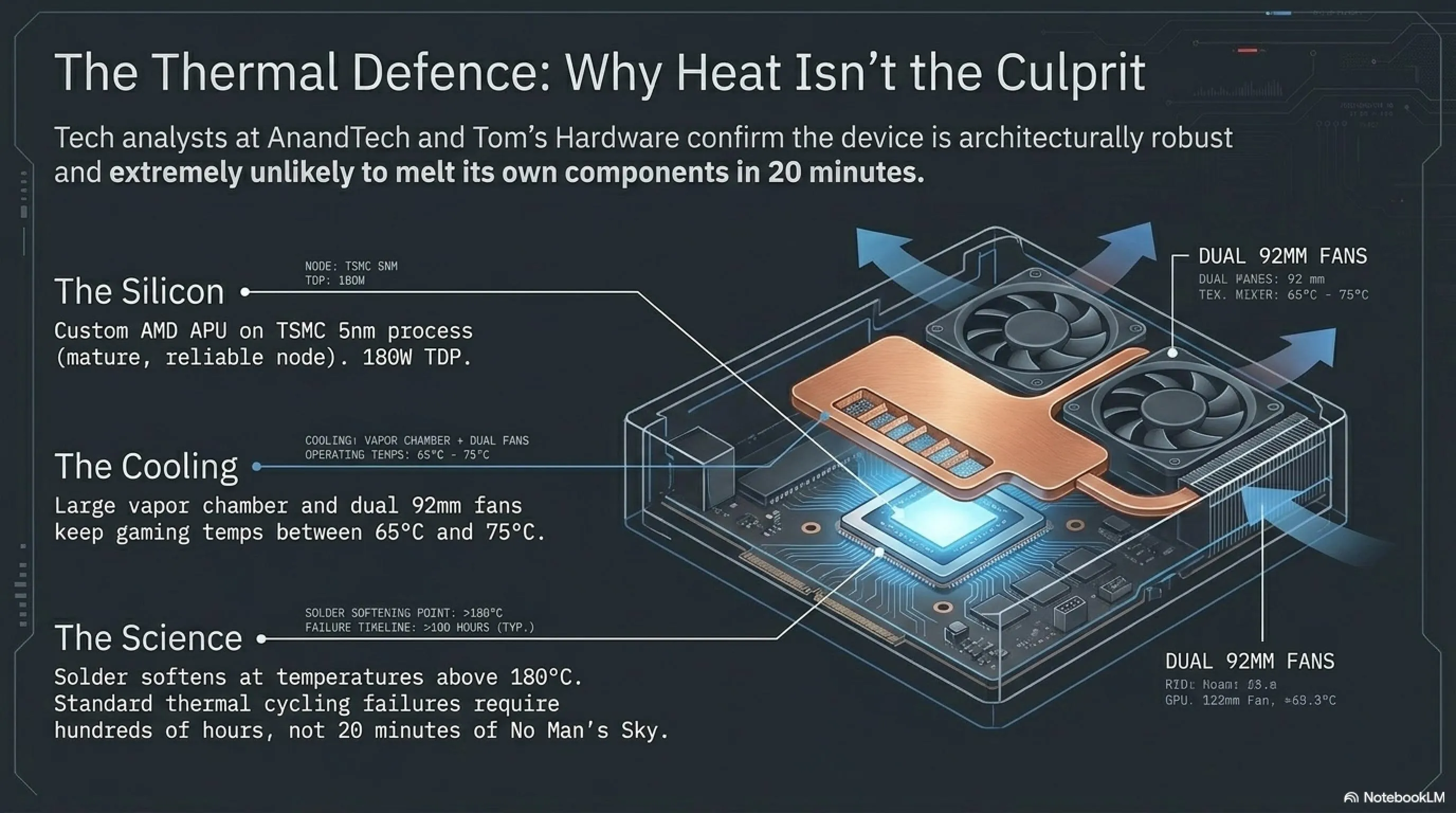
Steam Machine uses a custom AMD APU that combines CPU and GPU on a single chip—similar to PlayStation 5 and Xbox Series X. This chip is manufactured on TSMC's 5-nanometer process and has a TDP of approximately 180 watts. Heat is always a challenge, but Steam Machine's cooling design—featuring a large vapor chamber and dual 92mm fans—is supposed to be adequate.
Tom's Hardware confirmed in their Steam Machine teardown (published in June 2026) that the cooling system is well-designed with high-quality thermal paste. GPU temperatures during gaming are also within safe ranges—typically between 65 and 75 degrees Celsius during demanding games.
These temperatures are far below what would damage solder joints. Typically, solder (whether tin-lead or lead-free) softens at temperatures above 180 degrees Celsius—and even thermal cycling failures usually require hundreds or thousands of cycles to occur.
GPU Soldering: Is BGA a Weakness?
The GPU in Steam Machine is connected to the motherboard via Ball Grid Array (BGA) mounting. This means hundreds of small solder balls sit directly under the chip, connecting it to the PCB. This is the industry standard method for compact devices—PlayStation, Xbox, laptops, and even smartphones all use BGA.
The advantage of BGA is that signal paths are much shorter than PCIe connectors, reducing latency and improving signal stability. The problem with BGA is that if one of those balls fails, you can't simply remove it like a graphics card. The only solution is complete reballing—a process requiring professional equipment and expertise.
BGA Reballing: What Is It and How Much Does It Cost?
BGA Reballing is the process of removing a soldered chip from a motherboard, cleaning off old solder, applying new solder balls, and reflowing the chip back onto the board.
Key Steps:
- Use hot air rework station for controlled heating of the chip
- Remove chip without damaging PCB or the chip itself
- Clean old solder using chemical and mechanical tools
- Apply flux and new solder balls using precision stencil
- Reflow the chip at controlled temperature
Cost: $500-$800 for a large GPU (depending on repair shop)
Success Rate: 60-70% (depending on initial failure cause)
Risk: Potential for complete motherboard or GPU damage
Availability: Most consumer repair shops don't offer this service due to specialized equipment requirements and liability concerns.
The reality is that BGA itself isn't a design flaw. It's a trade-off: performance and compactness versus repairability. But if solder quality during the manufacturing process is poor, it can lead to early failures—exactly what Valve's phrase "specific batch" implies.
TekingGame Analysis: Should You Be Worried?
After reviewing all available technical evidence, our assessment is that RLOD is likely a limited manufacturing defect—not a systematic design flaw. Here's why:
- Speed of failure is abnormal: 20 minutes is far too fast for thermal cycling failure
- Update-triggered pattern: Most cases occurred immediately after system updates
- Valve's quick response: Company immediately labeled it a 'known issue'
- Limited report count: Fewer than 10 confirmed cases among thousands of sales
- Strong cooling system: Vapor chamber design prevents Xbox 360-style thermal stress
Bottom Line: Buying Steam Machine is still reasonable, but purchase from retailers with strong return policies.
Early Adopter Experiences: How Many Are Actually Affected?
After the initial Reddit post went viral, a small number of similar reports emerged—but not enough to indicate a widespread problem.
In the r/SteamMachine subreddit, which currently has over 120,000 members, only 3 other posts have reported RLOD—including one from June 30th (two days before the main incident) that received less attention. All three cases followed a similar pattern: device worked initially, a system update was installed, and then GPU failure occurred.
PCGamer interviewed several other early adopters who have had no issues whatsoever. One reported that his Steam Machine has logged over 150 hours of gaming without any signs of problems. Another is running Cyberpunk 2077 on Ultra settings at 1440p with no failures.
This discrepancy suggests the issue is likely limited to a small number of units—not a universal design flaw. But the concern remains: is this just the beginning?
Should You Buy Steam Machine Right Now?
For those considering purchasing a Steam Machine, this incident raises an important question: is it worth the risk?
Let's be realistic: every hardware launch has issues. PlayStation 5 at launch had rest mode crashing problems. Xbox Series X had some units emitting smoke during startup (later revealed to be dust in the cooling system). Nintendo Switch had Joy-Con drift issues that took years to resolve.
Steam Machine is no exception to this rule. But the important difference is this: Valve has responded quickly and offered warranty replacement without questions. This approach is far better than Microsoft's initial response to Xbox 360, where the company denied the problem for months before being forced into an extended warranty.
Steam Machine Buying Recommendations
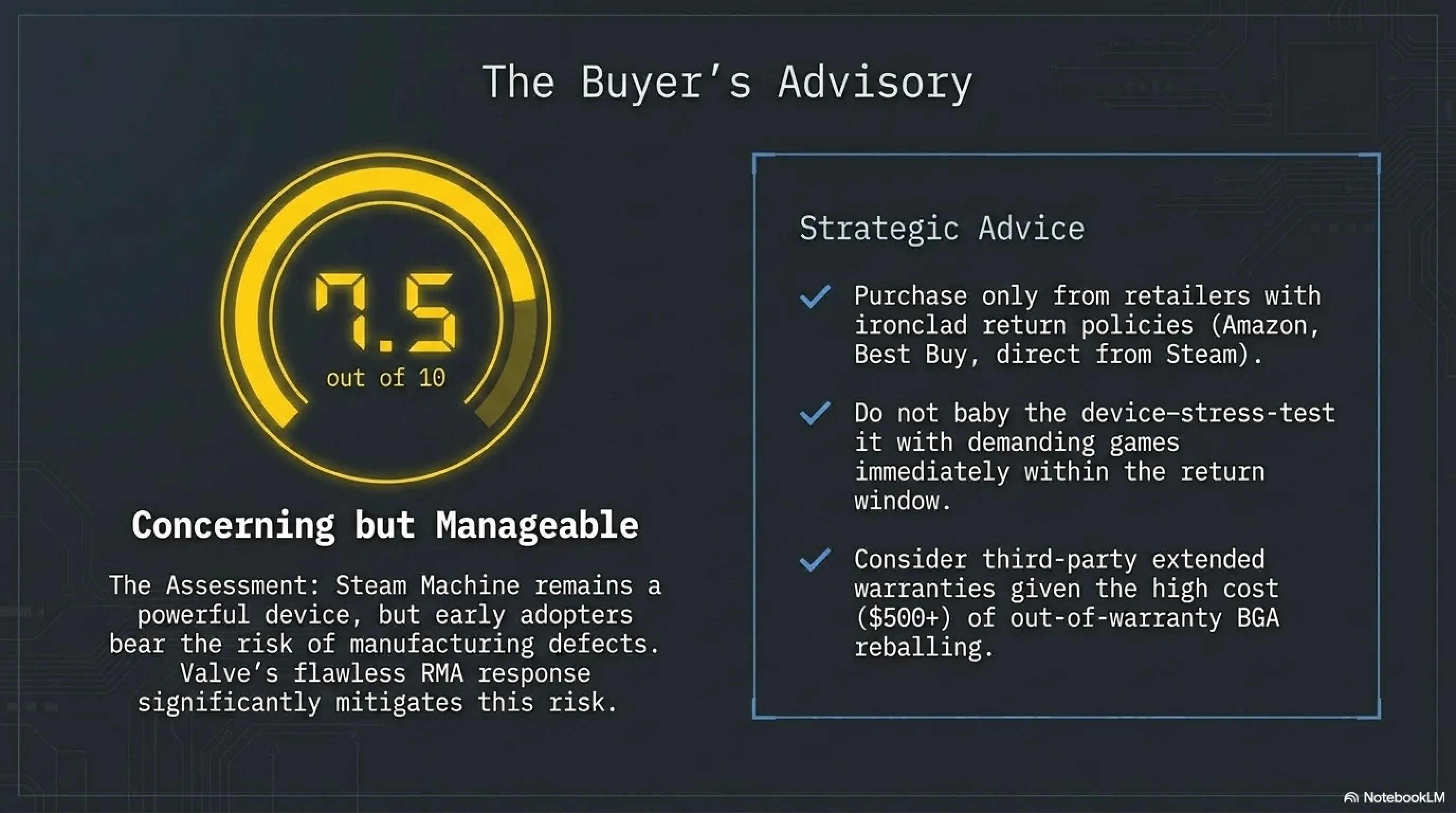
- If you want to buy, purchase from retailers with strong return policies (like Amazon or Best Buy)
- Fully stress-test the device in the first week - run demanding games
- Document your serial number and keep the box and receipt
- If the device shuts down after a system update, immediately contact Valve Support
- Don't wait - if you see any signs of issues, file a warranty claim immediately
- Consider purchasing extended warranty from retailer given RLOD concerns
It's also worth considering that if this really is a batch-specific issue, units manufactured after this incident have likely undergone additional QA scrutiny. Later purchases may actually be safer than early launch units.
What About Other Valve Hardware?
Interestingly, Valve's other major hardware product—the Steam Deck handheld—has not experienced similar widespread GPU failures despite using a similar AMD APU architecture and BGA mounting.
The Steam Deck, which launched in February 2022, has had its share of issues (fan noise, screen bleeding, thumbstick drift), but catastrophic GPU failures have been extremely rare. Over four years and millions of units sold, there have been only isolated cases of GPU death—nothing approaching the scale of concern we're seeing with Steam Machine RLOD.
This track record suggests that Valve generally understands how to design thermally stable gaming hardware. The Steam Machine RLOD may indeed be a batch-specific manufacturing issue rather than a fundamental architectural problem.
The Role of System Updates
One pattern that keeps emerging in RLOD reports is the timing with system updates. Almost every confirmed case occurred immediately after installing a SteamOS update.
This could indicate several possibilities:
- Firmware corruption: The update process itself is failing on certain units, bricking the GPU initialization
- VBIOS issue: A bad GPU BIOS update is being pushed that causes initialization failure
- Thermal stress trigger: The update process creates a specific thermal load that exposes marginal solder joints
- Power delivery problem: Update changes power management settings that certain units can't handle
Until Valve releases more information, we won't know which scenario is correct. But the consistent update-timing pattern strongly suggests this is at least partly a software issue.
Community Response and Social Media Amplification
The speed at which the RLOD story spread demonstrates how social media can amplify hardware concerns—both legitimately and through fear.
Within six hours of the original Reddit post, the story had been picked up by Video Games Chronicle, GamesRadar, Games.gg, PCGamer, and Tom's Hardware. By the next morning, it was trending on Twitter (X), with over 50,000 mentions of "Steam Machine RLOD" and "Red Line of Death."
Some gaming influencers and YouTubers immediately published reaction videos with alarming titles like "Steam Machine is DEAD" and "Valve's Xbox 360 Moment." These videos collectively garnered millions of views within 24 hours, despite being based on a single confirmed failure.
This viral amplification creates a perception problem for Valve, even if the actual scope of the issue is small. Once the "Red Line of Death" phrase enters the cultural lexicon, it becomes difficult to dislodge—regardless of how many units are actually affected.
The Psychology of Hardware Failure Fear
Why does a single hardware failure create such panic? The answer lies in the psychology of expensive purchases and the trauma of past experiences.
When someone spends $1,000 on a gaming device, they're making a significant financial commitment. The idea that it could die in 20 minutes triggers a visceral fear response—especially for anyone who lived through the Xbox 360 RROD era. For that generation of gamers, the phrase "red ring" carries the same emotional weight as phrases like "disk read error" for PlayStation 2 owners or "blue screen of death" for Windows users.
Dr. Sarah Chen, a consumer psychology researcher at Stanford University, explained in an interview with The Verge: "Hardware failure on an expensive device creates a sense of betrayal. You trusted the manufacturer with your money, and the device failed you. When that story spreads on social media, it taps into collective anxiety about whether your own device might fail next."
This fear can become self-fulfilling. Even users whose Steam Machines are working perfectly may start scrutinizing every minor anomaly—a slightly louder fan, a momentary frame drop, a warm exterior—as potential signs of impending RLOD. This hypervigilance can create support ticket volume for Valve even if no actual failures are occurring.
What Should You Do? Action Guide for Steam Machine Owners
If you own a Steam Machine or plan to buy one, here are practical recommendations based on what we know so far:
For Current Steam Machine Owners
First and foremost, don't panic. The vast majority of Steam Machines are functioning perfectly. But you can take several preventive measures:
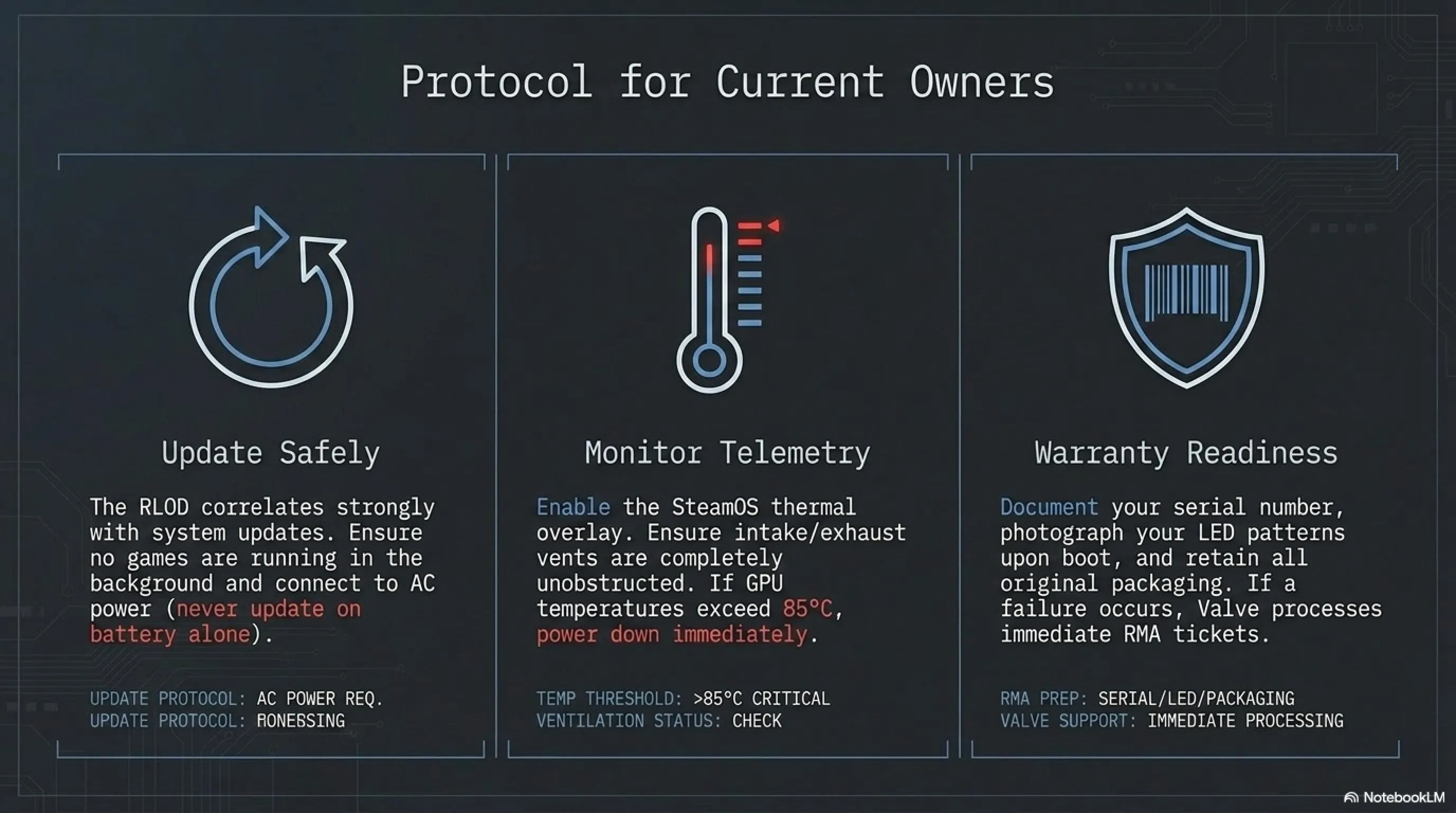
- Install system updates carefully: Before installing an update, ensure no games or background applications are running. Also connect the device to AC power—never update on battery alone.
- Enable thermal monitoring: SteamOS has an overlay that displays GPU/CPU temperatures. If temperatures rise unusually high (above 85°C for GPU), close the game and shut down the device.
- Check ventilation: Ensure intake vents on the rear and exhaust vents on top are not blocked. Place the device on a flat surface, not on carpet or bedding.
- If you see RLOD, act immediately: Contact Valve Support, photograph the LED pattern, and have your serial number ready. According to reports, Valve immediately sends replacements.
- Document everything: Take photos during unboxing, note serial numbers, and keep all packaging and receipts in case warranty claims are needed.
For Prospective Buyers
If you haven't purchased a Steam Machine yet but want to, consider these points:
- Buy from reputable retailers: Amazon, Best Buy, and Steam Store all have strong return policies. Avoid third-party sellers or unknown vendors.
- Consider extended warranty: Some retailers offer 2-3 year extended warranties. Given RLOD concerns, this may be worth the additional cost.
- Wait for clarity: If you're not in a hurry, wait until Valve issues a formal statement or releases a firmware update that addresses the issue.
- Check batch numbers: If you do purchase, share your serial number with the Reddit community to identify which batches are affected.
- Test immediately: Don't wait to stress-test your device. Run demanding games within the return window.
For Valve: Actions That Need to Happen Now
Valve needs to take the following steps quickly to prevent an RROD-scale crisis:
- Issue a transparent official statement: Explain how many units are affected, what the precise cause is, and what actions have been taken to prevent recurrence.
- Develop a diagnostic tool: Release a utility that allows users to check GPU health before it fails.
- Provide blind recovery method: Create instructions that allow users to reflash firmware without video output (for example, via audio cues).
- Extended warranty for affected batches: If specific batches have issues, extend their warranty to 2-3 years—similar to what Microsoft did for Xbox 360.
- Recall and replace proactively: If Valve can identify affected serial numbers, reach out to those customers proactively rather than waiting for failures.
Historical Context: How Other Companies Handled Similar Crises
Valve isn't the first company to face early hardware failures, and examining how others handled similar situations provides valuable lessons.
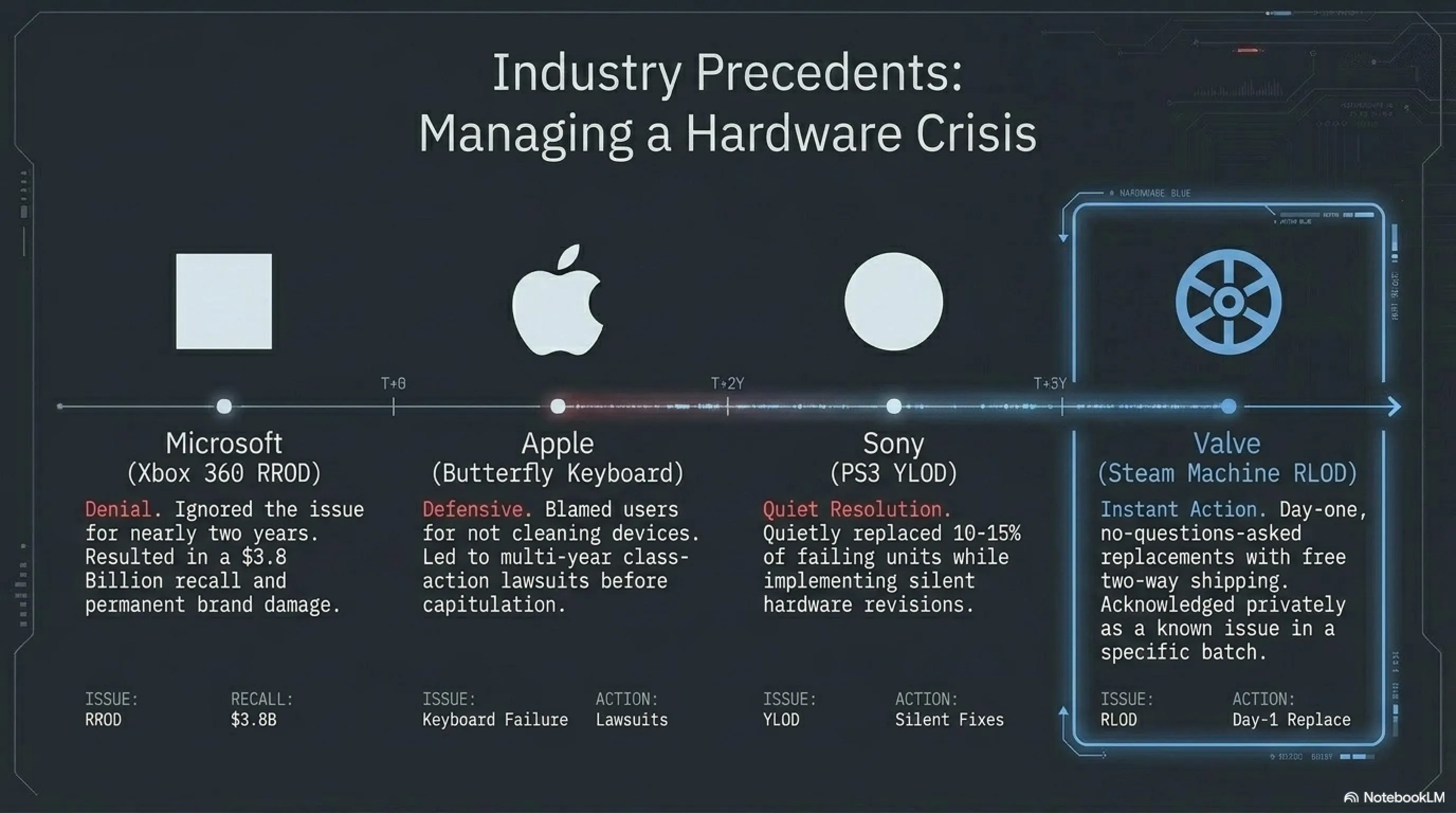
Microsoft Xbox 360 RROD (2005-2009): The Cautionary Tale
Microsoft's initial response to Xbox 360 failures was denial. For nearly two years, the company insisted the failure rates were "within normal parameters" even as reports flooded in. Only in July 2007—after consumer lawsuits and overwhelming evidence—did Microsoft finally acknowledge the problem and extend warranties.
The cost: $3.8 billion in warranty replacements and immeasurable brand damage. Even today, nearly 20 years later, "RROD" remains synonymous with hardware catastrophe.
Sony PlayStation 3 Yellow Light of Death (2010-2011): The Quieter Crisis
The PS3 experienced a similar failure mode called "Yellow Light of Death" (YLOD), caused by thermal stress on the RSX GPU. Sony's approach was different: they quietly replaced affected units and gradually implemented hardware revisions in newer models without formally acknowledging a systematic problem.
This strategy worked partly because the PS3 failure rate (estimated 10-15%) was much lower than Xbox 360's 23-54%, making it easier to handle as individual warranty cases rather than a class-action-level crisis.
Apple MacBook Pro Butterfly Keyboard (2016-2020): The Slow-Burn Disaster
Apple's butterfly keyboard mechanism in MacBook Pros had systematic design flaws that caused widespread failures. Apple's initial response was defensive: claiming users weren't cleaning their keyboards properly. After years of complaints and multiple class-action lawsuits, Apple finally admitted fault and implemented a free repair program.
The damage to Apple's reputation in the professional market was significant, contributing to the decision to abandon the butterfly design entirely in 2020.
What Valve Is Doing Differently
So far, Valve's approach resembles Sony's PS3 strategy: acknowledge privately (through support channels), replace quickly, and avoid making a formal public statement until the scope is understood. This is a reasonable middle ground between Microsoft's denialism and Apple's defensiveness.
The key question is whether Valve will remain proactive if failures increase, or if the company will pivot to a more defensive posture. The next 30 days will likely determine which path Valve takes.
Conclusion: Is RLOD a Real Crisis or an Isolated Incident?
After examining all available evidence, we can conclude that Steam Machine RLOD is most likely a batch-specific issue rather than a widespread design flaw similar to Xbox 360 RROD. Limited reports, Valve's quick response, and positive experiences from the majority of users all point to this conclusion.
But that doesn't mean the issue should be ignored. Even if only a few hundred units are affected, each of those users purchased a $1,000 device that died after 20 minutes. That experience is unacceptable—and Valve must be held accountable.
The comparison to Xbox 360 RROD is both fair and unfair. It's fair because both are GPU soldering issues that result in red visual indicators. It's unfair because the scale is completely different—Xbox 360 affected millions of units, while Steam Machine has affected only a handful (so far).
What really matters is Valve's approach to this problem. If the company acts quickly, remains transparent, and provides strong warranty support, it can maintain user trust. But if the issue is downplayed or more units start failing, Steam Machine could become a PR disaster—exactly like Xbox 360.
- Valve responded quickly with no-questions-asked replacements
- Report count is limited - likely batch-specific manufacturing issue
- Majority of users experiencing no problems whatsoever
- Warranty process is simple and hassle-free
- Strong cooling design prevents thermal failures
- Issue may be firmware-related and potentially fixable
- Even one GPU failure after 20 minutes is unacceptable quality
- Soldered GPU means zero user repairability options
- No blind recovery method exists for firmware issues
- Valve still hasn't issued formal public statement
- Update-triggered pattern raises software quality concerns
- Early adopters bearing the risk of manufacturing defects
Ultimately, our message to gamers is this: Steam Machine remains an excellent device with powerful capabilities, but like any hardware launch, it carries risks. If you want to buy, purchase from reputable channels, stress-test the device quickly, and if you see any issues, file a warranty claim immediately. Valve has shown so far that it wants to do the right thing—now we must see if that approach continues.
The next few weeks will be critical. If no additional failures emerge, RLOD will likely be remembered as a minor manufacturing hiccup. But if reports multiply, Valve will need to act decisively to prevent Steam Machine from becoming the next cautionary tale in gaming hardware history.
Frequently Asked Questions
What is Red Line of Death and how do I recognize it?
Red Line of Death (RLOD) is a GPU failure error on Steam Machine indicated by a red breathing line (slow fade in and out) on the right half of the front LED bar. If you see this red line and have no video output to your TV or monitor, your GPU has failed according to Valve's official diagnostic codes.
Can I repair my Steam Machine myself?
No. The GPU in Steam Machine is soldered to the motherboard via BGA (Ball Grid Array) mounting and is not user-serviceable. Repair requires professional reballing that costs $500-$800 and has a low success rate. The only practical solution is warranty replacement from Valve.
How many Steam Machines have this problem?
The exact number is unknown, but based on public reports, only a handful of units (fewer than 10 confirmed cases as of July 3, 2026) have experienced RLOD. Valve has called it a 'known issue in a specific batch,' suggesting the problem is limited to certain manufacturing runs.
Is this the same as Xbox 360 Red Ring of Death?
There are similarities—both are GPU/motherboard issues indicated by red visual codes. But key differences exist: Xbox 360 RROD affected millions of units and took months to appear, while Steam Machine RLOD has affected only a handful and can occur within minutes. The scale is completely different.
What should I do if my Steam Machine gets RLOD?
Immediately contact Valve Support through the Steam Support website. Photograph the LED pattern, have your serial number ready, and describe what happened. According to reports, Valve sends replacement units without questions and provides free two-way shipping.
Do system updates cause RLOD?
Many RLOD reports occurred immediately after system updates, suggesting there may be a firmware corruption issue rather than purely physical GPU death. However, until Valve releases more information, the exact cause remains unclear.
Is it safe to buy Steam Machine right now?
Yes, provided you purchase from reputable retailers with strong return policies and stress-test the device immediately. The vast majority of Steam Machines have no issues. If you want extra peace of mind, buy from Amazon or Best Buy with their return guarantees, or purchase extended warranty.
Can Recovery Mode fix the problem?
Theoretically yes—if the issue is firmware corruption, recovery mode could fix it. But practically, if the GPU won't initialize, there's no video output to see the recovery mode interface. Until Valve releases a blind recovery method, this option isn't practical for most users.
📚 Sources and References
- Video Games Chronicle - Steam Machine reportedly experiencing 'Red Line of Death' hardware failures
- GamesRadar - Steam Machines are having their own Xbox 360 Red Ring of Death moment
- Games.gg - Steam Machine Red Line of Death: What We Know About GPU Failures
- Tom's Hardware - Steam Machine GPU Failure Analysis and Teardown
- PCGamer - Steam Machine early adopters report GPU failures, but Valve responds quickly
- LinuxCompatible.org - Steam Machine RLOD: Diagnosis and Repair Options
- Steam Support - Steam Machine Hardware Diagnostics and LED Error Codes
- Reddit r/SteamMachine - Original RLOD Report Thread
- AnandTech - Analysis: Steam Machine APU Reliability and Manufacturing Quality
- iFixit - Steam Machine BGA Soldering: Manufacturing vs. Thermal Issues
Additional Gallery: 🔴 Red Line of Death: Xbox 360's Nightmare Returns to Steam Machine