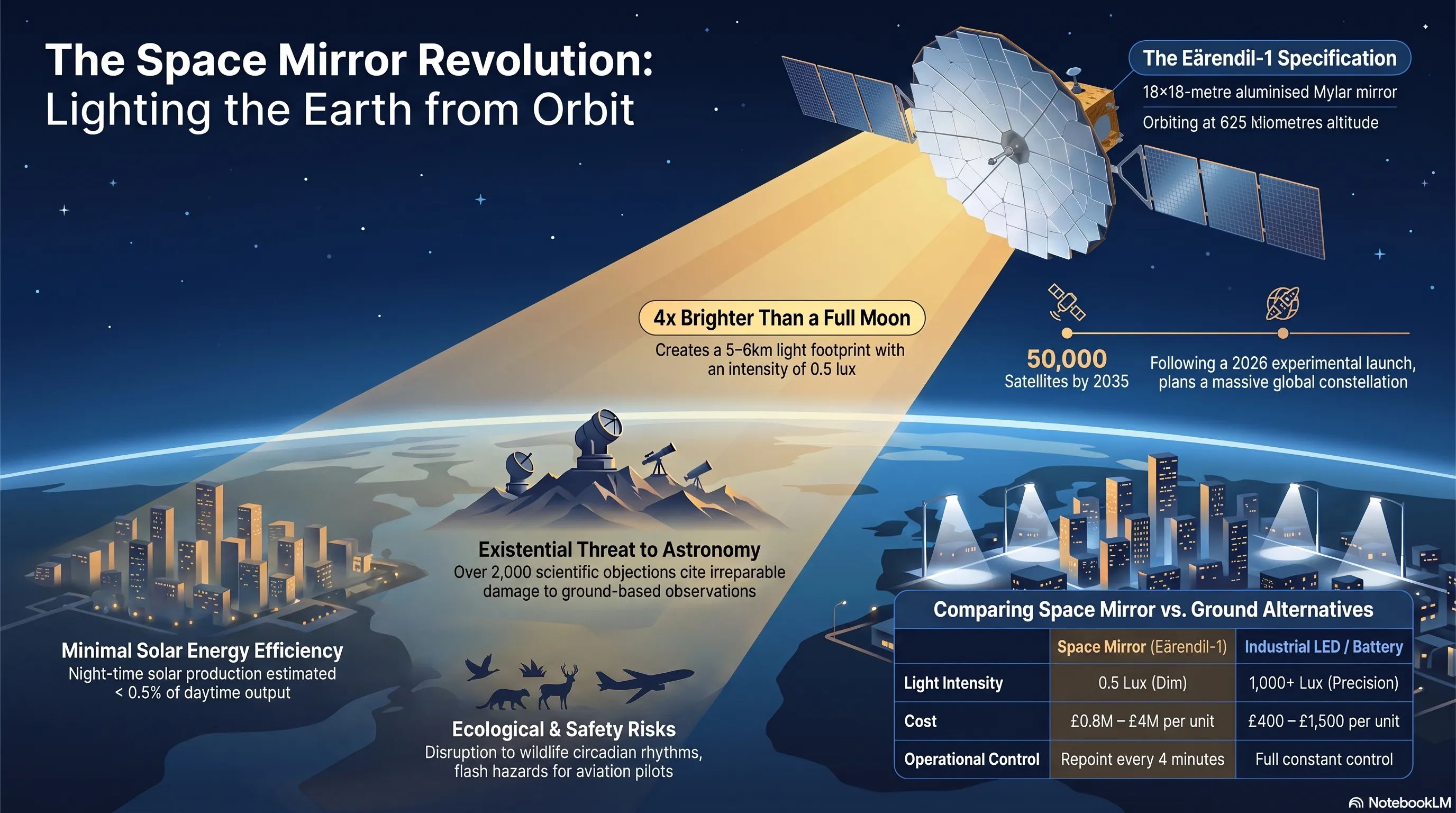
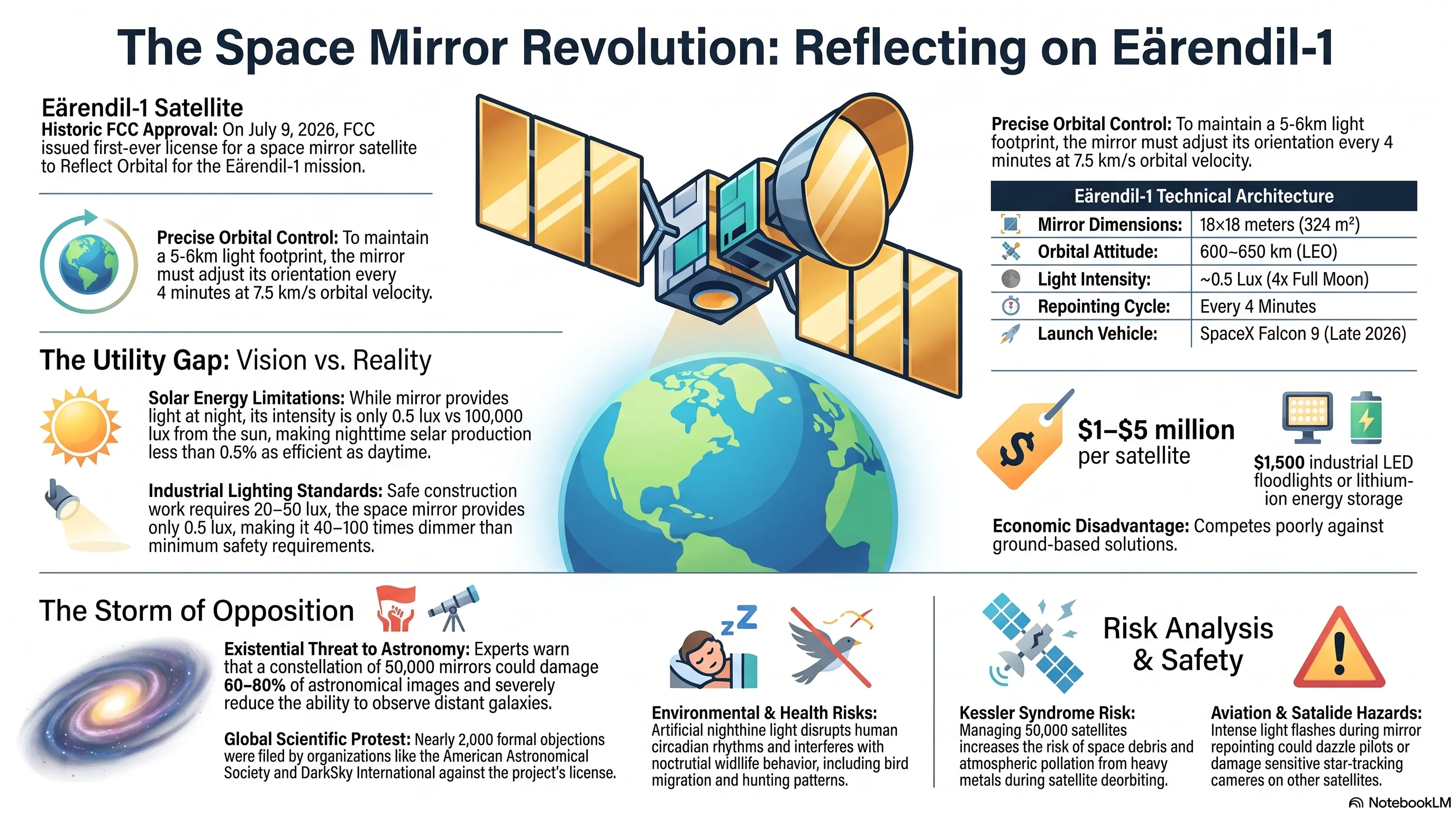
On July 9, 2026, the FCC issued the first-ever space mirror satellite license. Reflect Orbital's Eärendil-1 plans to reflect sunlight to Earth at night using an 18-meter aluminized Mylar mirror. Despite nearly 2,000 objections from astronomers and environmentalists, this controversial project aims to test orbital illumination from a 625km altitude. Will their vision of 50,000 satellites by 2035 revolutionize solar energy, or destroy ground-based astronomy?
Reflect Orbital Space Mirror: When FCC Turned Night Into Day
Eärendil-1 satellite with 18-meter mirror gets approval to reflect sunlight to Earth at night
- 🎮🛰️ Historic Approval- FCC issued first-ever space mirror satellite license on July 9, 2026
- 🎧🔆 Technical Specs- 18×18 meter aluminized Mylar mirror at 625km altitude
- 🚀💡 Light Coverage- 4 times brighter than full moon over 5-6 kilometer area
- 🗡️🔬 Scientific Opposition- Nearly 2,000 objections filed by astronomers and environmentalists
- 📰🚀 Future Vision- Reflect Orbital plans to deploy 50,000 satellites by 2035
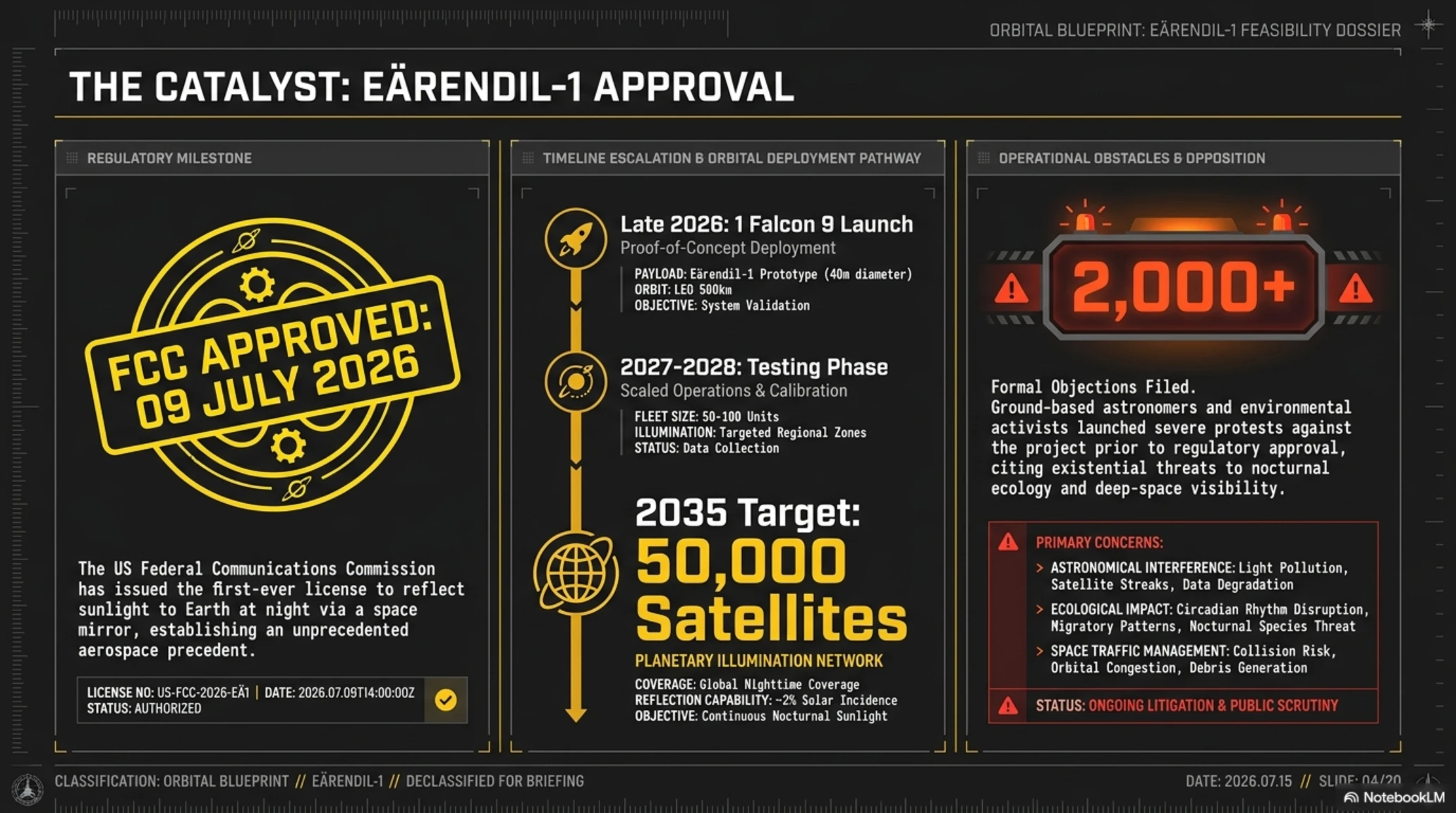
On July 9, 2026, the U.S. Federal Communications Commission (FCC) made a decision that could mark a turning point in space engineering history: approving the construction, launch, and operation of the first mirror satellite designed to reflect sunlight back to Earth at night. California-based startup Reflect Orbital, with its product named Eärendil-1, is set to begin an experiment that could literally turn night into day.
I'm Majid Ghorbaninejad, advanced systems architect at TekiNGame, and in this comprehensive analysis, I'll examine the technical, economic, social, and environmental dimensions of this controversial project. This technology has the potential not only to revolutionize the solar energy industry but also to permanently alter the night sky.
💡 At a Glance: The Space Light Revolution
- FCC granted Reflect Orbital launch approval on July 9, 2026
- 18×18 meter mirror will orbit at 625 kilometers altitude
- Reflected light is 4 times brighter than full moon, covering 5-6km
- Nearly 2,000 objections from astronomers and environmental activists
- Launch via SpaceX Falcon 9 in late 2026
- Ultimate goal: 50,000 satellites by 2035
Chapter One: Technical Architecture — When Science Meets Audacity
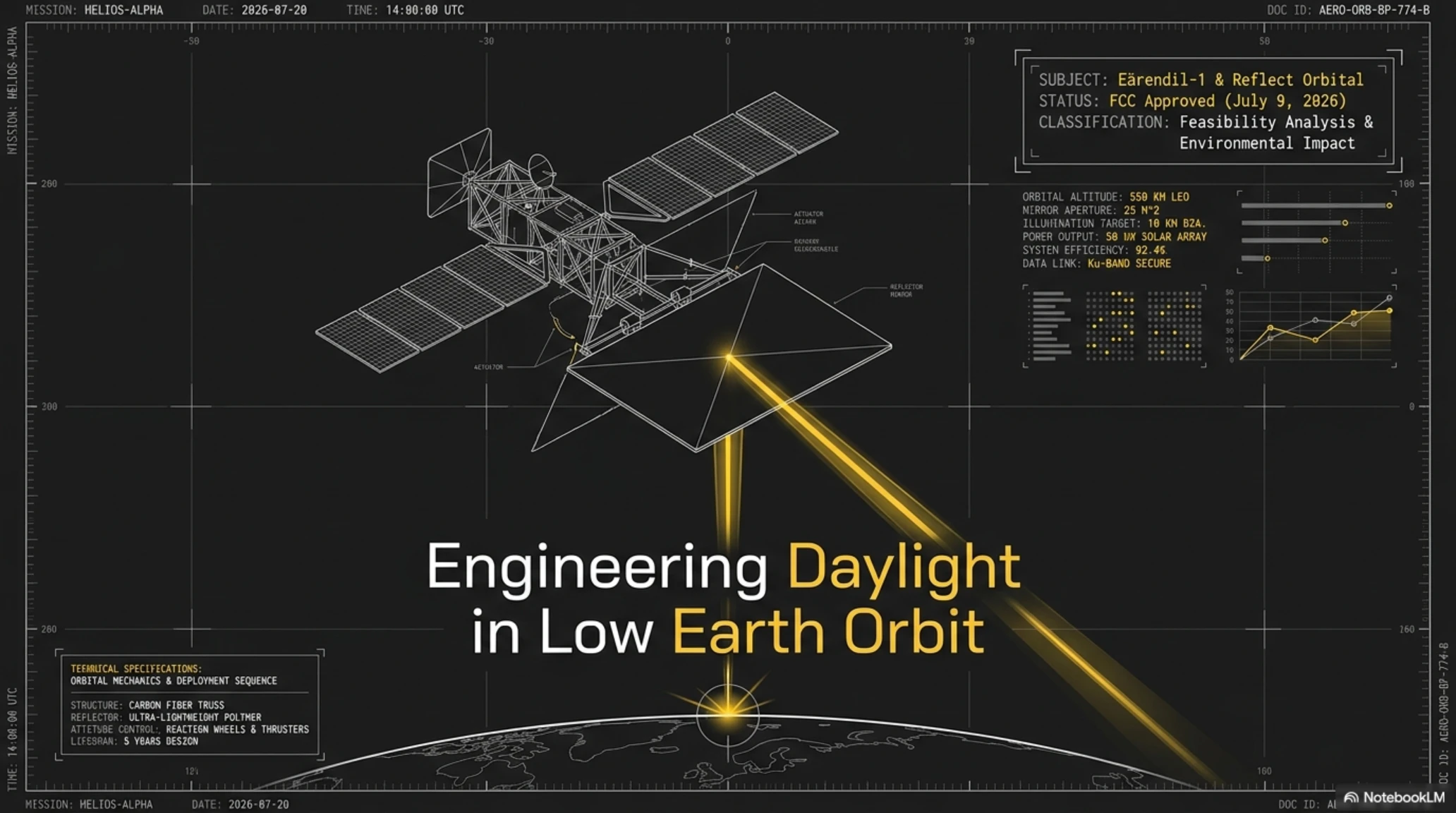
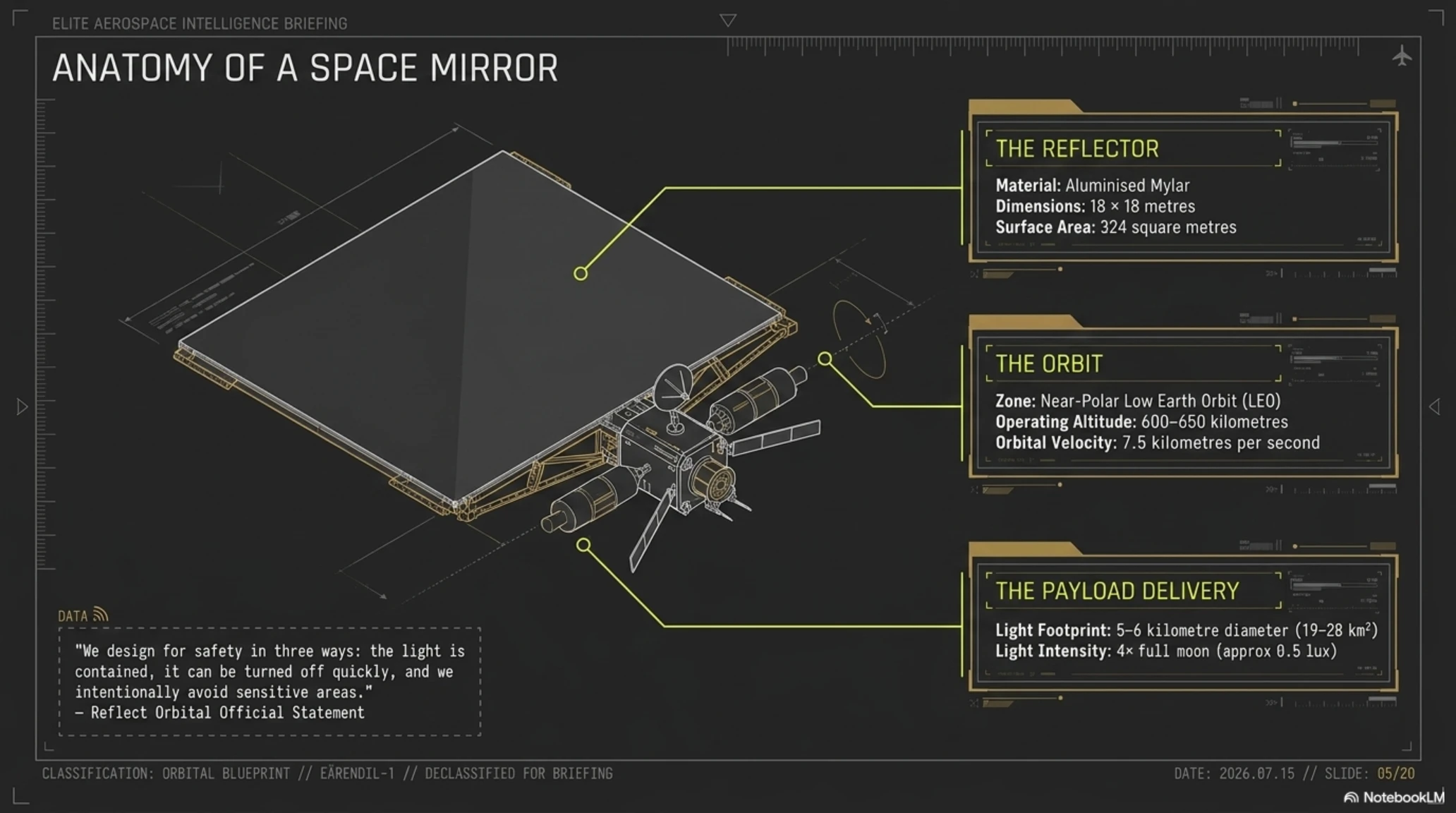
Eärendil-1 (named after the legendary Lord of the Rings character) is an experimental satellite that will be placed in low Earth orbit (LEO) at approximately 625 kilometers altitude. The heart of this technology is a steerable thin-film reflector measuring 18×18 meters (about 60×60 feet), made of aluminized Mylar with a surface area of 324 square meters.
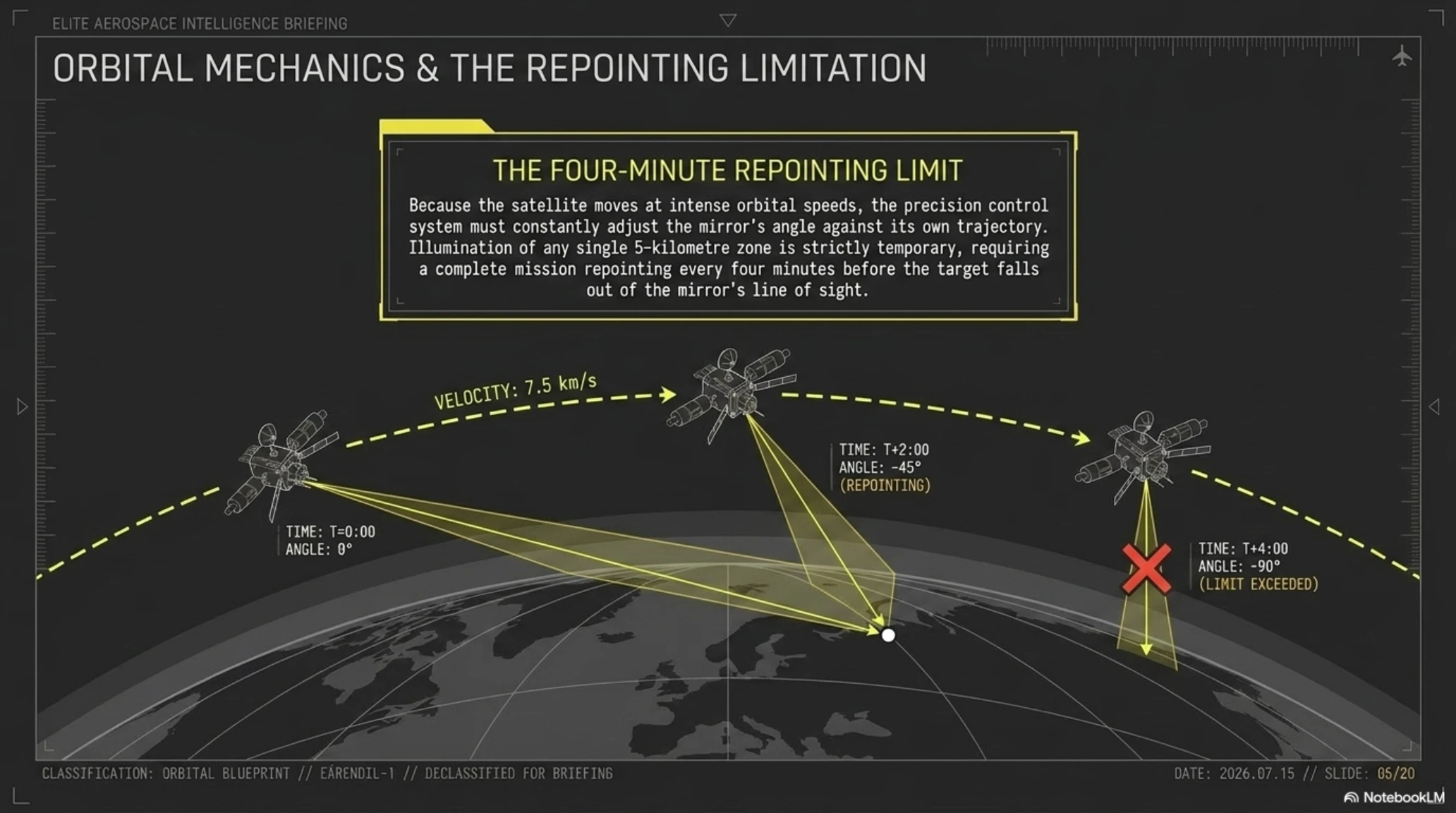
After launch, this mirror will unfold from the satellite's compact body and use precision control systems to direct sunlight to specific points on Earth. According to published technical specifications, the satellite can illuminate areas with a diameter of 5 to 6 kilometers, but this illumination is temporary and requires readjustment every four minutes.
Eärendil-1 Technical Specifications: Infrastructure Deep Dive
| Parameter | Value | Details |
|---|---|---|
| Mirror Dimensions | 18×18 meters | 324 square meter surface |
| Orbital Altitude | 600-650 kilometers | Low Earth Orbit (LEO) |
| Orbit Type | Near-Polar | Global coverage |
| Light Footprint Diameter | 5-6 kilometers | Approximately 19-28 km² |
| Light Intensity | 4× full moon | Approximately 0.5 lux |
| Repointing Time | 4 minutes | Due to orbital motion |
| Mirror Material | Aluminized Mylar | Thin-film reflector |
| Launch Vehicle | SpaceX Falcon 9 | Late 2026 launch |
Ben Nowack, CEO and co-founder of Reflect Orbital, describes the concept as using satellites with very large mirrors that unfold from a compact package inside each spacecraft and then steer reflected sunlight onto specific sites at night.
Orbital Mechanics and Control Challenges
One of the most complex aspects of this project is the precise control of the mirror's orientation in space. The satellite moves in orbit at approximately 7.5 kilometers per second, so the control system must constantly adjust the mirror's angle to reflect sunlight to the desired point on Earth.
In March 2024, Reflect Orbital conducted a preliminary experiment: they mounted a 6 square meter mirror on a hot air balloon and used robotic control to direct sunlight to ground-based solar panels during astronomical twilight. This proof-of-concept demonstrated that the technology is feasible.
Chapter Two: Use Cases — From Lifesaving to Energy Production
Reflect Orbital claims this technology could have diverse applications ranging from rescue operations to construction. But how close is reality to these claims?
Nighttime Solar Energy: Is It Possible?
The primary goal of this project is to overcome one of solar energy's biggest limitations: no production at night. Large solar farms could use these satellites to receive additional light during evening hours or even at night.
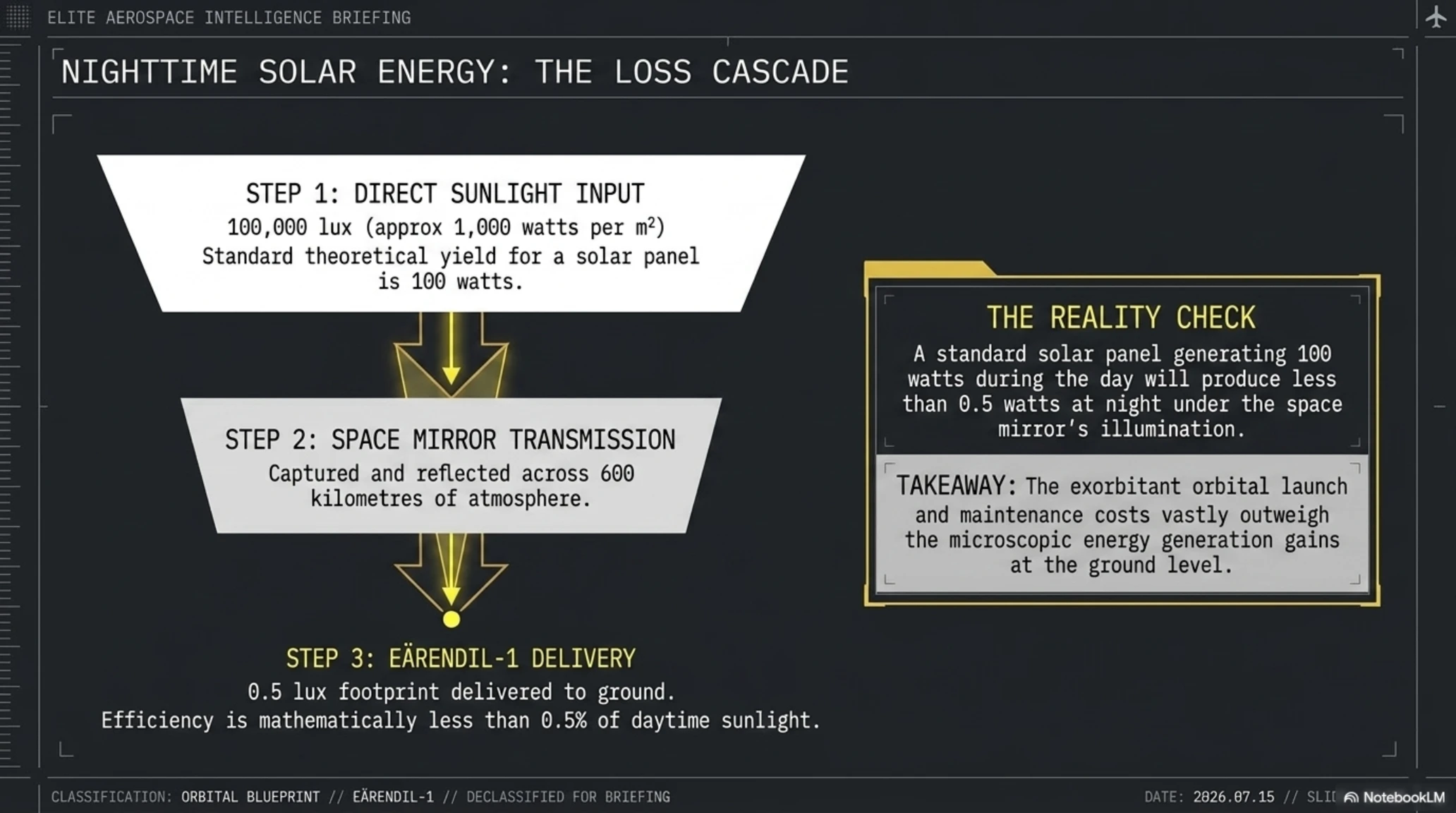
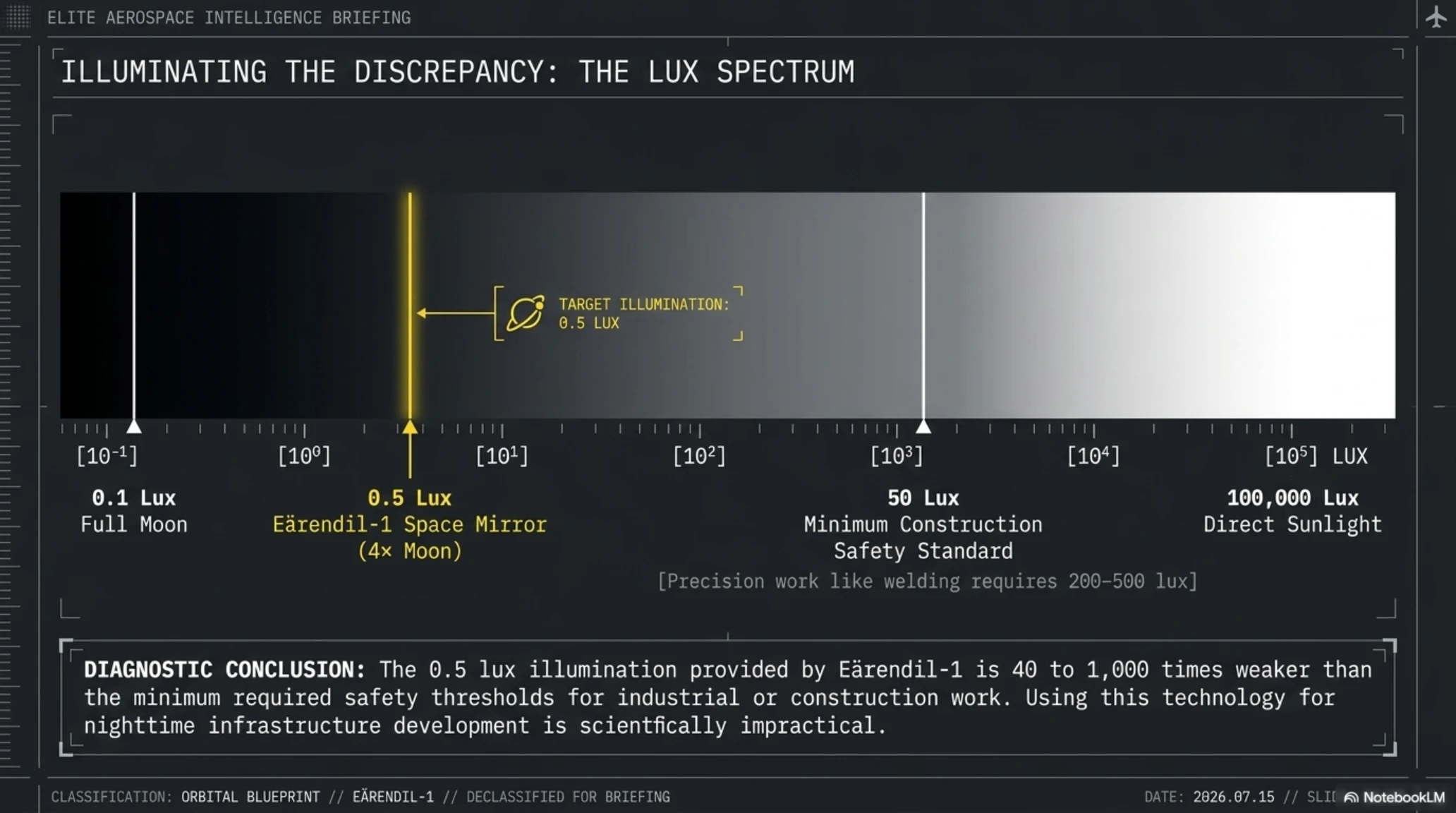
However, numerical analysis shows this solution still has serious limitations. The reflected light is only 4 times brighter than a full moon, which compared to direct sunlight (about 100,000 lux) is extremely weak. This means that even with full coverage, nighttime energy production will be far less than daytime.
Energy Calculation: Reality Behind the Claims
- Direct sunlight: Approximately 100,000 lux (1000 watts per square meter)
- Full moon light: Approximately 0.1 lux
- Space mirror light: Approximately 0.4-0.5 lux (4× moon)
- Estimated efficiency: Less than 0.5% of daytime sunlight
- Result: 100-watt solar panel during day → less than 0.5 watts at night with space mirror
- Economic challenge: Launch and maintenance costs versus limited energy production
Search and Rescue Operations
One more appealing application is using this technology to illuminate disaster-stricken areas at night. Search and rescue teams could use space-based light to find missing persons in mountains, forests, or earthquake-damaged areas.
This application seems more logical as it requires temporary and flexible coverage. However, critics point out that helicopters equipped with powerful spotlights or lighting drones are more efficient and faster solutions.
Nighttime Construction Projects
Reflect Orbital claims that construction projects could use this light to conduct nighttime work without diesel generators, cutting completion time in half. But reality is more complex.
The 0.5 lux illumination is insufficient for precise construction work. Safety standards for nighttime work require a minimum of 20 to 50 lux, which the space mirror doesn't even approach. Therefore, this application appears more like a marketing idea than a practical solution.
Reality of Industrial Lighting Standards
- General construction work: 20-50 lux minimum required
- Precision work (welding, painting): 200-500 lux
- Space mirror light: 0.5 lux (40-1000× less!)
- Industrial LED floodlight: 1000+ lux at $500-2000 price
- Conclusion: Space mirror is impractical for nighttime construction
- Temporary rescue and emergency operations in remote areas without infrastructure
- Solar energy supplementation during twilight hours
- Emergency lighting in natural disaster-affected areas
- No fossil fuel needed for light generation
- Precise targeting capability to specific locations
- Testing innovative space technologies
- Very weak light intensity for industrial applications
- High economic cost versus limited output
- Time limitation: repointing every 4 minutes
- Ineffective in cloudy or foggy conditions
- Limited coverage: only 5-6 kilometers
- Cheaper and more efficient alternatives exist
Chapter Three: The Storm of Opposition — Why Scientists Are Worried
The FCC's decision was met with a wave of protest. During the regulatory review process, nearly 2,000 public comments were filed, most opposing the project. Leading organizations in this opposition included the American Astronomical Society (AAS), DarkSky International, and the Royal Astronomical Society.
Existential Threat to Astronomy
Astronomers are concerned that even a single mirror satellite could increase light pollution and seriously impact ground-based observatories. Tony Tyson, a researcher at UC Davis and chief scientist for the Vera C. Rubin Observatory, warns: "Ground-based observatories already have to contend with thousands of satellites in low Earth orbit that interfere with astronomical observations."
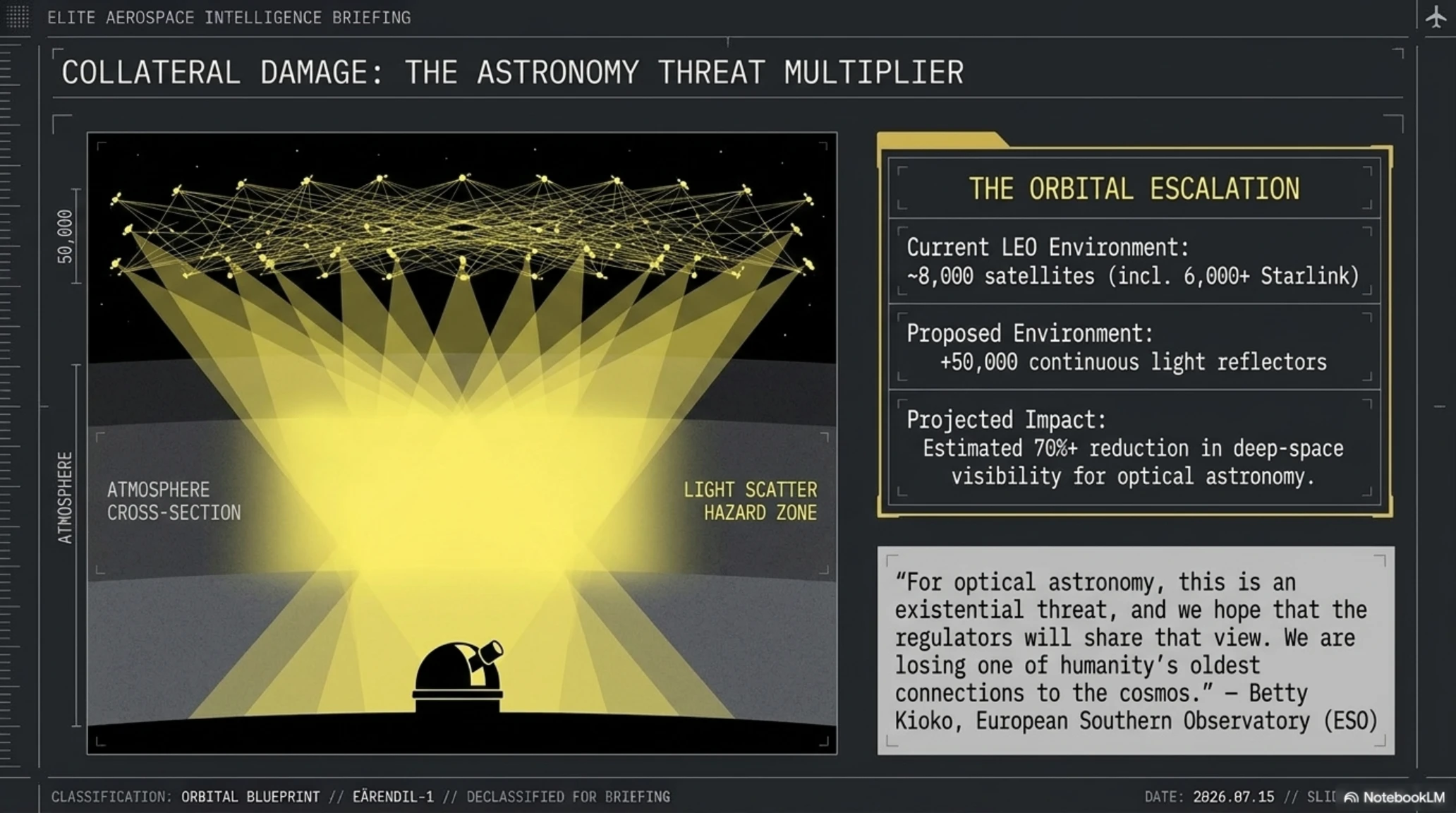
Betty Kioko, institutional affairs officer for the European Southern Observatory (ESO), stated ahead of the FCC decision: "For optical astronomy, this is an existential threat, and we hope that the regulators will share that view."
Space Light Pollution Stats: A Look at the Current Crisis
| Parameter | Current Status 2026 | With 50,000 Space Mirrors |
|---|---|---|
| Active Satellites | Approximately 8,000 satellites | +58,000 |
| Starlink Satellites | 6,000+ | Still active |
| Interference in Astronomical Observation | 15-20% images damaged | 60-80% estimated |
| Ability to Observe Distant Galaxies | 30% reduction | 70%+ reduction |
| Artificial Light Exposure Duration | Few seconds (satellite pass) | Several minutes (continuous illumination) |
Environmental and Health Threats
Concerns aren't limited to astronomy. Environmental researchers warn that artificial nighttime light could disrupt circadian rhythms in humans and animals. Many animal species depend on darkness for hunting, migration, and reproduction.
Research has shown that light pollution can directly affect human health, causing sleep disorders, increased cancer risk, and cardiovascular problems. Now imagine a night sky covered with thousands of shining mirrors.
Aviation Safety Hazards
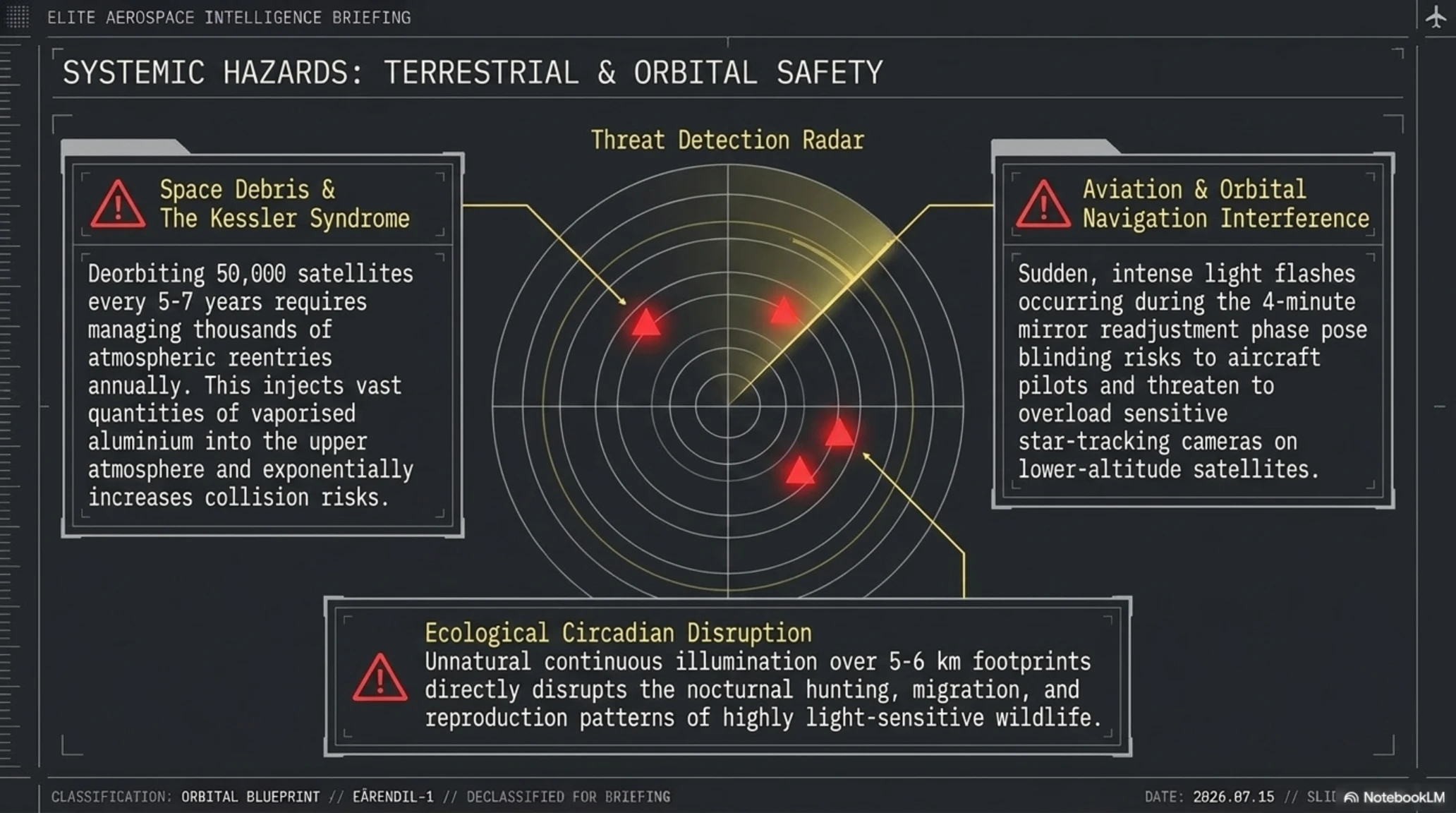
Another serious concern is potential interference with aviation safety. During the mirror repointing process (which happens every 4 minutes), intense light flashes may occur that could disturb pilots, drivers, or star-tracking cameras on lower-altitude satellites.
Sensitive sensors in research telescopes as well as star-tracking cameras on lower satellites could suffer overload and damage. This is a serious technical issue for which no definitive solution has been provided yet.
Risk Analysis: Real Danger Scenarios
- Sudden light flashes: Possibility of intense momentary light during mirror readjustment
- Navigation system interference: Star tracker cameras on satellites and aircraft
- Damage to optical equipment: Telescope sensors from light overload
- Disruption to bird migration: Changes to nocturnal migration routes
- Sensitive habitat problems: Wildlife dependent on nighttime darkness
- Lack of complete control: Uncertainty in light targeting precision
Chapter Four: The FCC Decision — Why Was the License Granted Despite Objections?
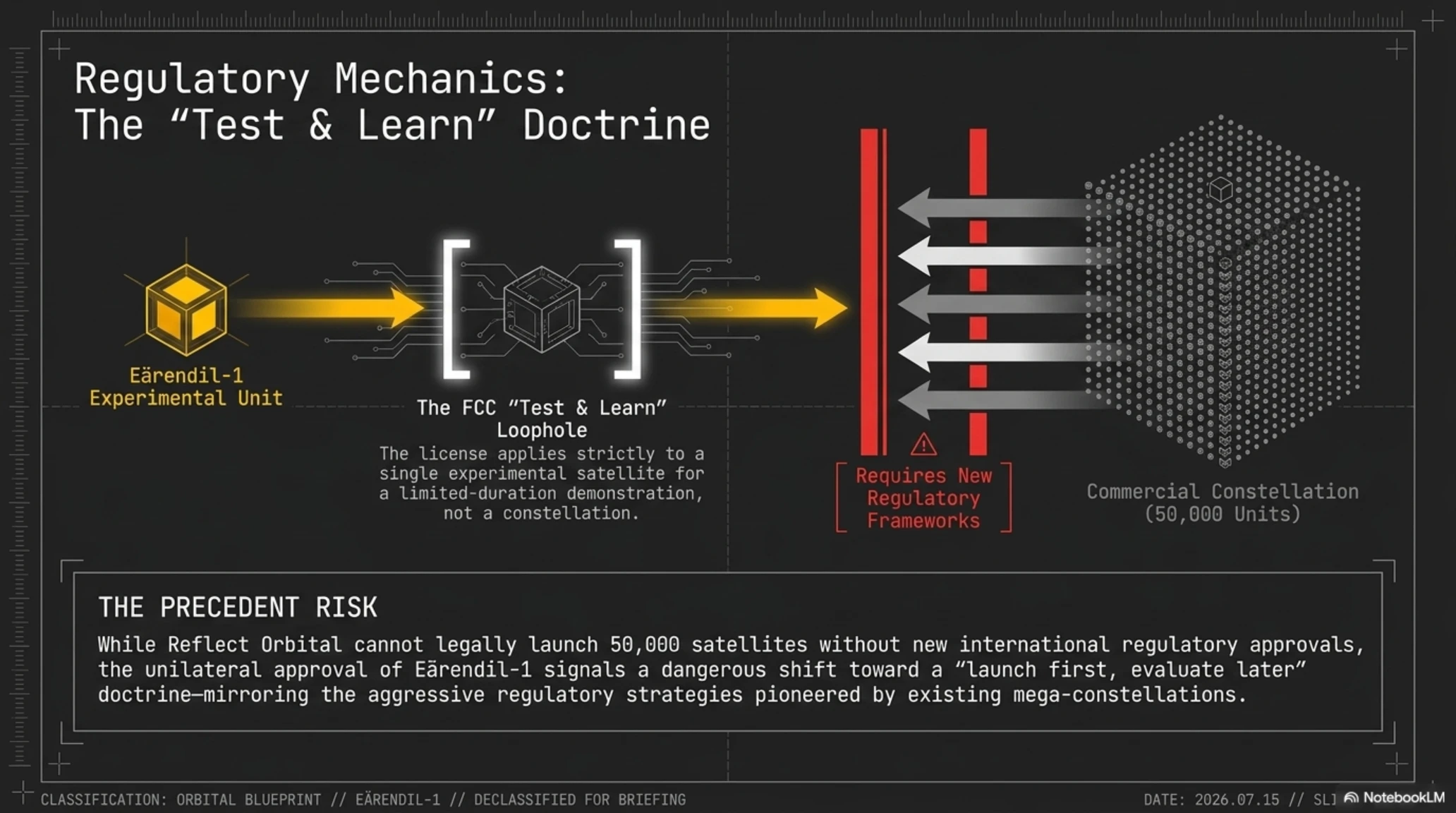
Despite the flood of objections, the FCC ultimately granted Reflect Orbital a license. But why? In its decision, the agency stated that this license is only for a single experimental satellite, not a commercial constellation. In other words, the FCC considers this a limited-duration technology demonstration whose results will help determine whether the concept is technically viable and identify challenges associated with any future developments.
The FCC emphasized that any future deployment of multiple satellites would require new regulatory approvals. This means Reflect Orbital cannot launch 50,000 satellites without additional licenses.
Reflect Orbital Project Timeline: From Idea to Launch
| Date | Event | Description |
|---|---|---|
| September 2024 | Public Project Introduction | WIRED published the first comprehensive report on Reflect Orbital |
| March 2024 | Hot Air Balloon Test | 6 square meter mirror tested on balloon, directing light to solar panels |
| January 2026 | Official FCC Application | Reflect Orbital filed application for radio frequency license and launch |
| July 9, 2026 | FCC Approval | License to build, launch, and operate Eärendil-1 issued |
| Late 2026 | Falcon 9 Launch | Satellite launch with SpaceX rocket is scheduled |
| 2027-2028 | Testing and Evaluation Phase | Collection of operational data and technology effectiveness |
| 2035 | Ultimate Goal | Deployment of 50,000 satellites (if successful and with subsequent licenses) |
Historical Precedent: Is This the First Time?
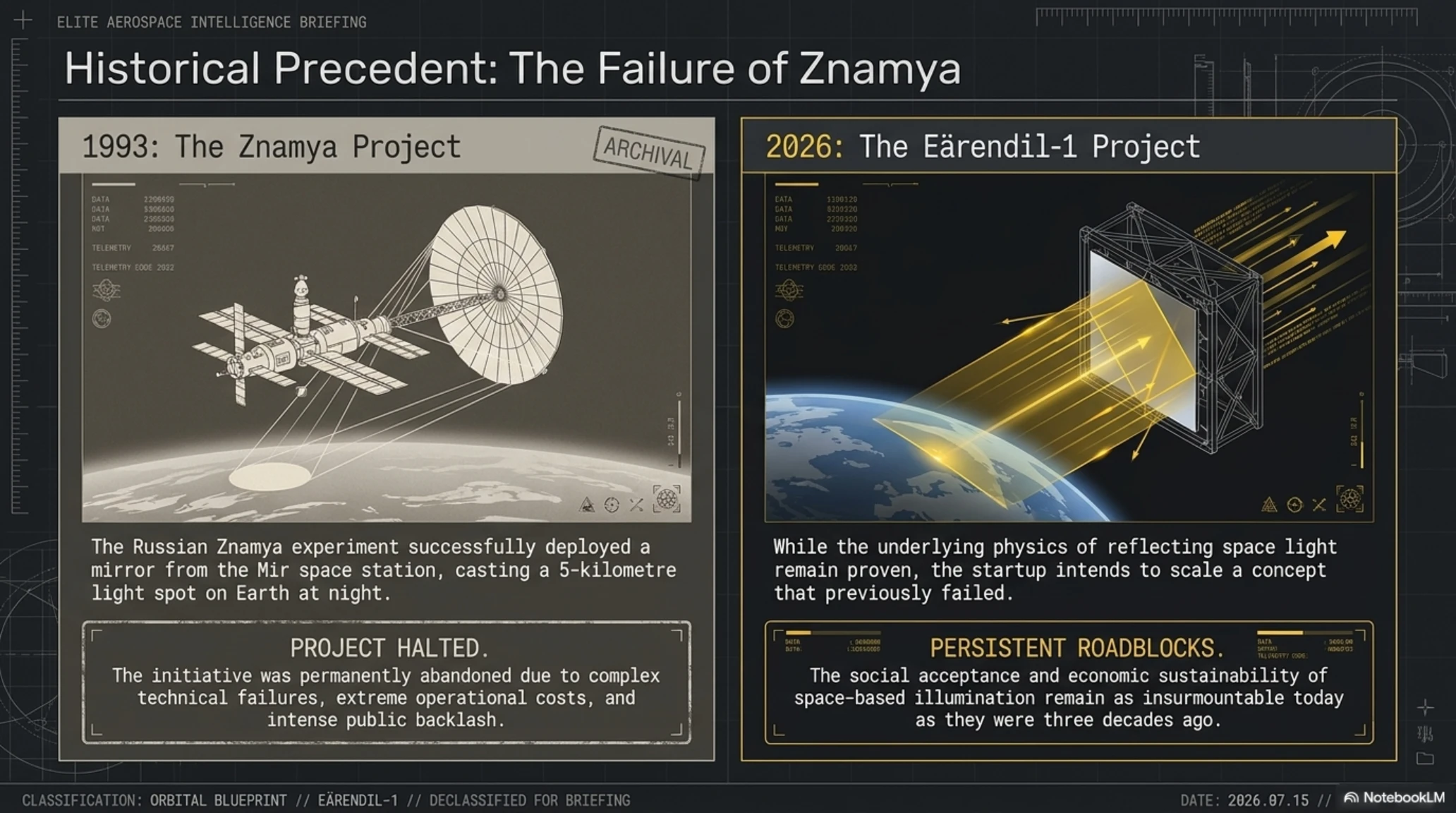
The idea of reflecting sunlight from space isn't new. In the 1990s, Russia executed a project called Znamya, which involved deploying space mirrors to illuminate cities. In 1993, a 20-meter mirror was released from the Mir space station and created a 5-kilometer light spot on Earth at night.
However, the Znamya project was halted due to technical problems and public concerns. Now, decades later, the technology has advanced but the concerns remain.
Chapter Five: Project Economics — Does the Business Model Make Sense?
One of the most important questions to ask is: How is this project supposed to become profitable? The cost of launching a satellite to low Earth orbit with Falcon 9 is between $1 to $5 million (depending on rideshare). If Reflect Orbital wants to launch 50,000 satellites, launch costs alone could range from $50 to $250 billion.
These costs don't include satellite manufacturing, maintenance, remote control, replacement of failed satellites, and insurance costs. Now the question is: Who is willing to pay for "sunlight at night"?
Revenue Model: Who Are the Potential Customers?
Reflect Orbital has targeted several customer segments:
Target Markets and Revenue Potential
- Solar power plants: Purchasing additional time for energy production. Medium potential, as batteries are cheaper.
- Rescue and emergency organizations: Payment for temporary lighting. Low potential, small and irregular market.
- Construction projects: Nighttime work without generators. Low potential, insufficient light intensity.
- Special events: Lighting for festivals and shows. Medium potential but small market.
- Military/government contracts: Nighttime military operations. High potential but controversial.
- Commercial advertising: Logos in the night sky? High potential but ethically questionable.
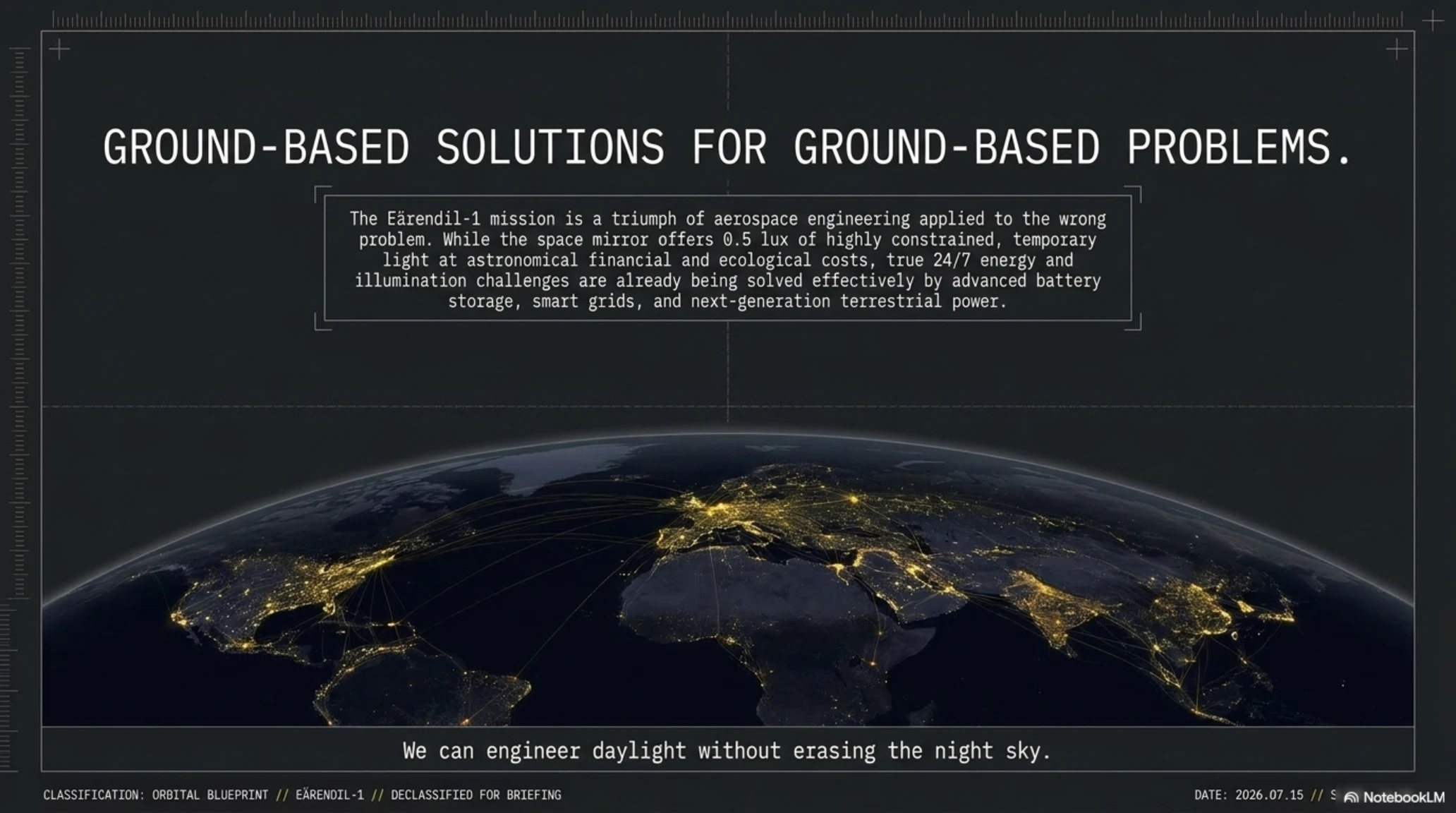
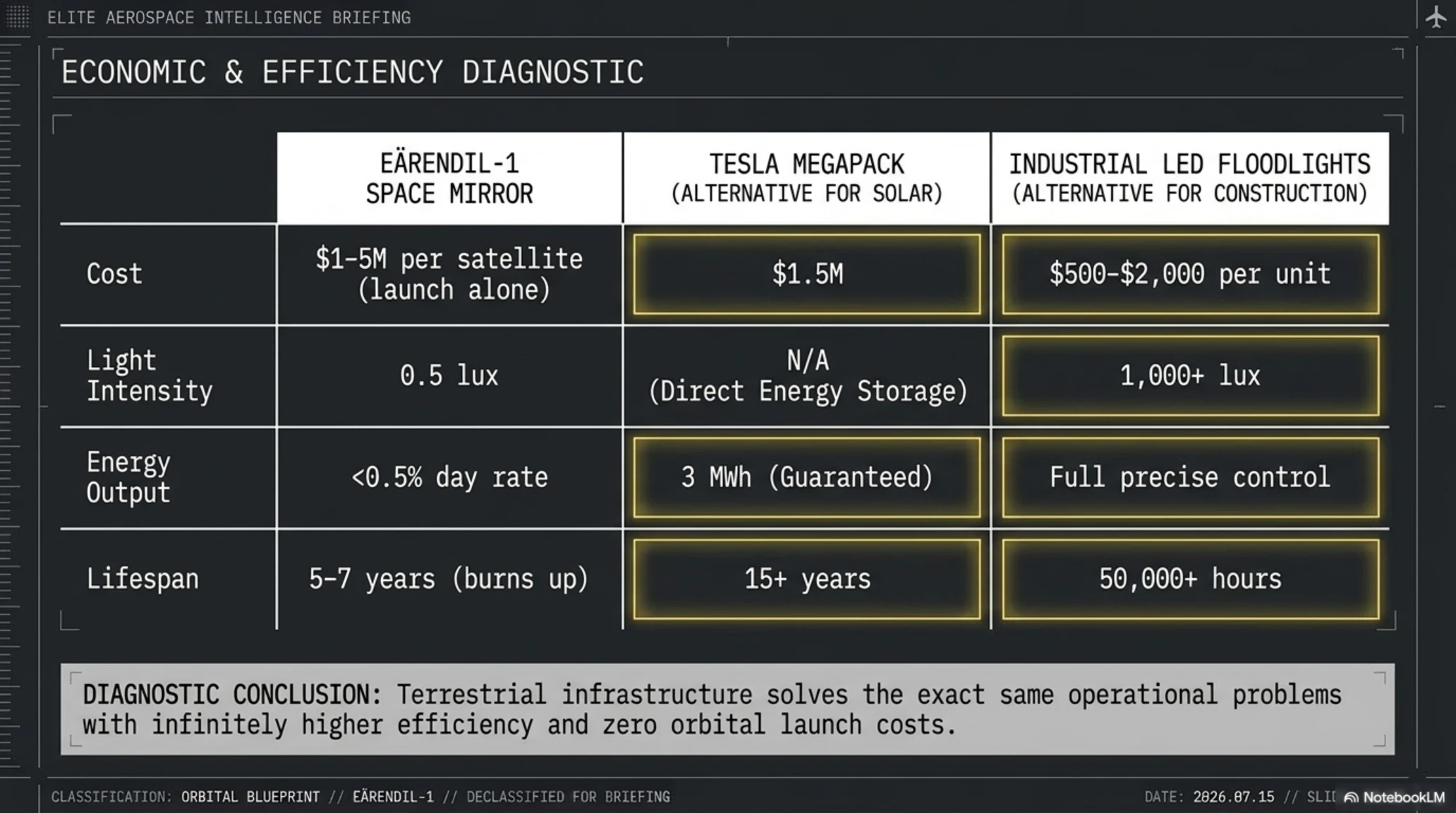
The reality is that most of these applications have cheaper and more efficient alternatives. For solar power plants, lithium-ion batteries are becoming cheaper and more efficient every day. For rescue operations, helicopters and drones provide more immediate solutions. For construction, powerful and affordable LED floodlights are available.
Cost-Benefit Analysis: Comparison with Alternatives
| Metric | Value | Unit |
|---|---|---|
| Space Mirror Cost (estimated) | $1-5M | per satellite |
| Tesla Megapack Battery Cost | $1.5M | 3 MWh |
| Industrial LED Floodlight Cost | $500-2000 | per unit |
| Space Mirror Light Intensity | 0.5 lux | 4× moon |
| Industrial LED Light Intensity | 1000+ lux | full control |
| Satellite Useful Life | 5-7 years | needs replacement |
Investors and Supporters
Precise details about Reflect Orbital's investors aren't public, but CEO Ben Nowack has a background in the space and technology industry. Obtaining FCC approval indicates the company has sufficient financial and technical readiness for at least one experimental launch.
However, the path from one experimental satellite to a 50,000-satellite constellation is very long. The company must prove that the business model is viable and profitable, which given current economic analyses, appears to be a major challenge.
- Genuine technological innovation in space engineering
- Limited but useful emergency application possibilities
- Testing new concepts for next-generation technologies
- Potential for technical improvements in future generations
- Opportunity for learning for the space industry
- Job creation and scientific research
- Unclear and questionable economic model
- Serious threat to astronomy and scientific research
- Environmental and public health risks
- High cost versus cheaper alternatives
- Widespread opposition from the scientific community
- Likelihood of becoming mass light pollution
Chapter Six: Future Outlook — A Sky Full of Mirrors
If Eärendil-1 succeeds and Reflect Orbital receives subsequent licenses, we may witness a fundamental transformation of the night sky. Imagine in 2035, thousands of shining mirrors moving across the sky, illuminating parts of Earth every night.
For some, this scenario represents a hopeful technological future, but for many others, it's a nightmare. Researchers warn that if this trend continues, ground-based astronomy may end within a few decades.
The Dark Sky Movement: Growing Resistance
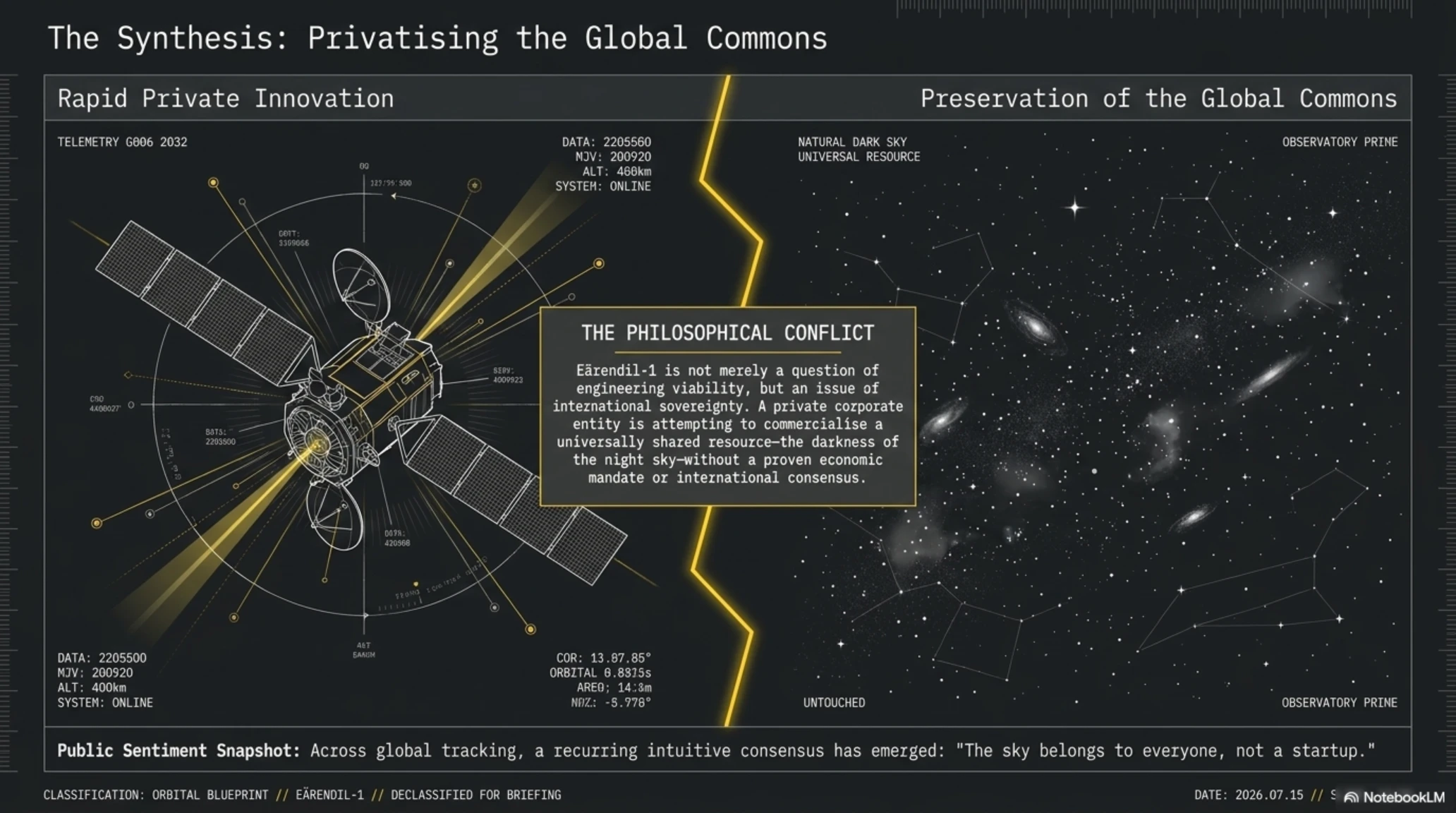
Organizations like DarkSky International have been fighting to protect the night sky for years. They argue that the night sky is humanity's shared heritage and shouldn't be monopolized by private companies.
This movement now faces a new challenge: not just light pollution from cities, but light pollution from space. And this time, turning off the lights isn't enough.
Better Alternatives: Less Destructive Technologies
Instead of illuminating Earth from space, there are other solutions that are less destructive and more efficient:
Alternative Technologies: Better Ground-Based Solutions
- Advanced batteries: Store solar energy for night use, no light pollution
- Smart grids: Transfer energy from daylit regions to dark ones
- Generation IV nuclear: Sustainable 24/7 production with zero emissions
- Efficient LEDs: Targeted lighting with minimal energy consumption
- Lighting drones: For temporary rescue operations
- Geothermal energy: Sustainable source in suitable regions
Technical Challenges Ahead
Even if we set aside economic and environmental issues, Reflect Orbital faces serious technical challenges. Precise control of the mirror's orientation in space, thermal management of the thin film, preventing tears or damage to the mirror, and synchronizing multiple satellites for continuous coverage are all problems that must be solved.
Additionally, the system must be able to operate in various atmospheric conditions. Clouds, fog, and air pollution can severely reduce efficiency. And unlike a ground-based power plant that can be repaired on-site, repairing a satellite in space is extremely costly and difficult.
Space Debris: An Overlooked Problem
Every satellite must be deorbited after its useful life (typically 5 to 7 years). With 50,000 satellites, this means managing thousands of atmospheric reentries each year. If some of these satellites become space debris, there's a risk of collision with other satellites and creating a chain reaction (Kessler Syndrome).
Furthermore, burning thousands of satellites in the atmosphere could inject heavy metals like aluminum into the upper atmosphere, whose long-term effects are not yet fully understood.
Comparison with Existing Constellations
| Constellation | Current Count | Final Goal | Primary Purpose |
|---|---|---|---|
| Starlink (SpaceX) | 6,000+ | 42,000 | Global Internet |
| OneWeb | 600+ | 6,372 | Internet |
| Project Kuiper (Amazon) | In development | 3,236 | Internet |
| Reflect Orbital | 0 (experimental) | 50,000 | Sunlight reflection |
Social and Cultural Implications
Beyond science and economics, this project raises deep social and philosophical questions. The night sky has been part of human experience for thousands of years. Poetry, music, religion, and science have all been shaped under the influence of the starry sky.
Do we have the right to change this heritage for future generations? Can a private company decide what the night sky looks like? These are questions that must be answered before thousands of space mirrors are launched.
Public Opinion: What Are People Saying?
Public reactions to this project are diverse. Some see it as a bold step toward the future, while others view it as a form of corporate intrusion on public resources. On social media, hashtags like #SaveTheNightSky and #ReflectOrbital are both rapidly expanding.
Interestingly, many ordinary users who don't have a deep understanding of technical aspects are intuitively concerned. "The sky belongs to everyone, not a startup" is one of the recurring comments across various platforms.
Global Perspective: Other Countries' Reactions
This project was only licensed in the United States, but its impacts are global. Reflect Orbital's satellites can shine light to any point on Earth (with limitations), which is an international sovereignty issue.
Can countries prevent artificial space light from entering their airspace? Are current international space laws sufficient? These are questions that international organizations like the United Nations must address.
Conclusion: At the Intersection of Ambition and Responsibility
The Reflect Orbital project is a perfect symbol of our era's dilemmas. On one hand, it represents human innovation, bold thinking, and efforts to solve real problems. On the other, it demonstrates the dangers of unchecked technological advancement without considering long-term consequences.
Eärendil-1 will soon be launched and the world will watch. If it succeeds, we may be at the beginning of a revolution in how we use space. If it fails or has negative impacts beyond expectations, it may be a lesson for future generations.
But one thing is certain: This isn't just a technical or economic decision. It's a decision about the kind of future we want to build and the kind of world we want to leave to our children.
Frequently Asked Questions
What is Eärendil-1 and when will it launch?
Eärendil-1 is Reflect Orbital's first experimental satellite equipped with an 18×18 meter aluminized Mylar mirror. It's scheduled to launch in late 2026 aboard a SpaceX Falcon 9 rocket into low Earth orbit (600-650 kilometers altitude). Its purpose is to reflect sunlight to specific points on Earth at night.
Why are astronomers opposed to this project?
Astronomers are concerned about increasing space light pollution. Even a single mirror satellite could disrupt telescopic observations, and if 50,000 satellites are launched, ground-based astronomy could become impossible. Nearly 2,000 objections from scientific organizations were sent to the FCC, but the license was still issued.
Can this technology really produce nighttime solar energy?
Technically yes, but with severe limitations. The reflected light is only 4 times brighter than a full moon (about 0.5 lux), while direct sunlight is about 100,000 lux. This means solar panels would only produce about 0.5% of their daytime capacity at night. Lithium-ion batteries for energy storage are far more efficient and cost-effective.
Who benefits from this technology?
Reflect Orbital has targeted markets including solar power plants, rescue and emergency organizations, nighttime construction projects, and potentially government/military contracts. However, economic analysis shows that most of these applications have cheaper and more efficient alternatives. A sustainable business model has not yet been proven.
Is this project dangerous for the environment?
Researchers are concerned about several issues: first, disruption to circadian rhythms of animals and plants that depend on nighttime darkness. Second, sudden light flashes during mirror readjustment that could disturb pilots and wildlife. Third, space debris and atmospheric pollution from thousands of satellites reentering the atmosphere. Fourth, damage to astronomical and satellite sensors.
Why did the FCC grant the license despite objections?
The FCC limited this license to a single experimental satellite, not a commercial constellation. The agency stated this is a technology experiment whose results will help assess technical feasibility and associated challenges. Any subsequent deployment requires new licenses. This is a 'test and learn' approach that may set an important precedent for similar projects.
Can other countries prevent artificial light entry?
This is a legal gray area. Current space treaties did not anticipate such scenarios. The satellite is in international space, but its light can reach other countries' airspace. International organizations must develop new legal frameworks to manage such technologies.
What happened to previous similar projects?
Russia executed the Znamya project in the 1990s, which involved launching a 20-meter mirror from the Mir space station. The mirror successfully created a 5-kilometer light spot, but the project was halted due to technical problems and public concerns. This shows the technical concept is feasible, but social acceptance and economic sustainability are the main challenges.
Sources and References
- Wired: The US Approves the Launch of a Mirror Satellite - July 11, 2026
- Space.com: FCC gives Reflect Orbital permission to launch space mirror - July 10, 2026
- Phys.org: US approved giant space mirror to test sunlight on demand - July 11, 2026
- Independent: Reflect Orbital cleared to install giant mirror satellite - July 11, 2026
- SatNews: FCC Authorizes Reflect Orbital's Light-Reflection Test Satellite - July 12, 2026
- TechSpot: FCC approves giant mirror satellite to beam sunlight to Earth - July 10, 2026
- EarthSky: Giant space mirror approved to test sunlight on demand - July 12, 2026
- Reflect Orbital Wikipedia - Last updated 2026
Additional Gallery: Reflect Orbital Space Mirror: When FCC Turned Night Into Day