Tekin Analysis deconstructs CVE-2026-6460, a foundational 22-year-old type confusion vulnerability (CWE-843, CVSS 8.8) in PostgreSQL that enables authenticated remote code execution via FmgrInfo function pointer hijacking. Alongside patching 52 discrete security flaws and officially retiring PostgreSQL 14 (EOL), the advisory mandates an unprecedented recompilation of all third-party C extensions including pgvector, PostGIS, and TimescaleDB.
Tekin Analysis | Anatomy of PostgreSQL 22-Year Type Confusion Flaw; CVE-2026-6460 RCE and C-Extension Rebuild Mandate
For more than three decades, PostgreSQL has served as the unquestioned gold standard of relational data persistence, powering global financial ledgers, hyper-scale cloud fabrics across Amazon Web Services and Microsoft Azure, and next-generation AI platforms utilizing Supabase and Neon. Built on uncompromising ACID compliance and sophisticated multi-version concurrency control (MVCC), the system has cultivated a reputation for unyielding reliability. However, in November 2026, the database engineering ecosystem experienced an existential seismic event: the PostgreSQL Global Development Group published an extraordinary 52-vulnerability maintenance release, headlined by the discovery of a critical memory safety flaw dating back twenty-two years to the codebase's formative architectural reorganization.
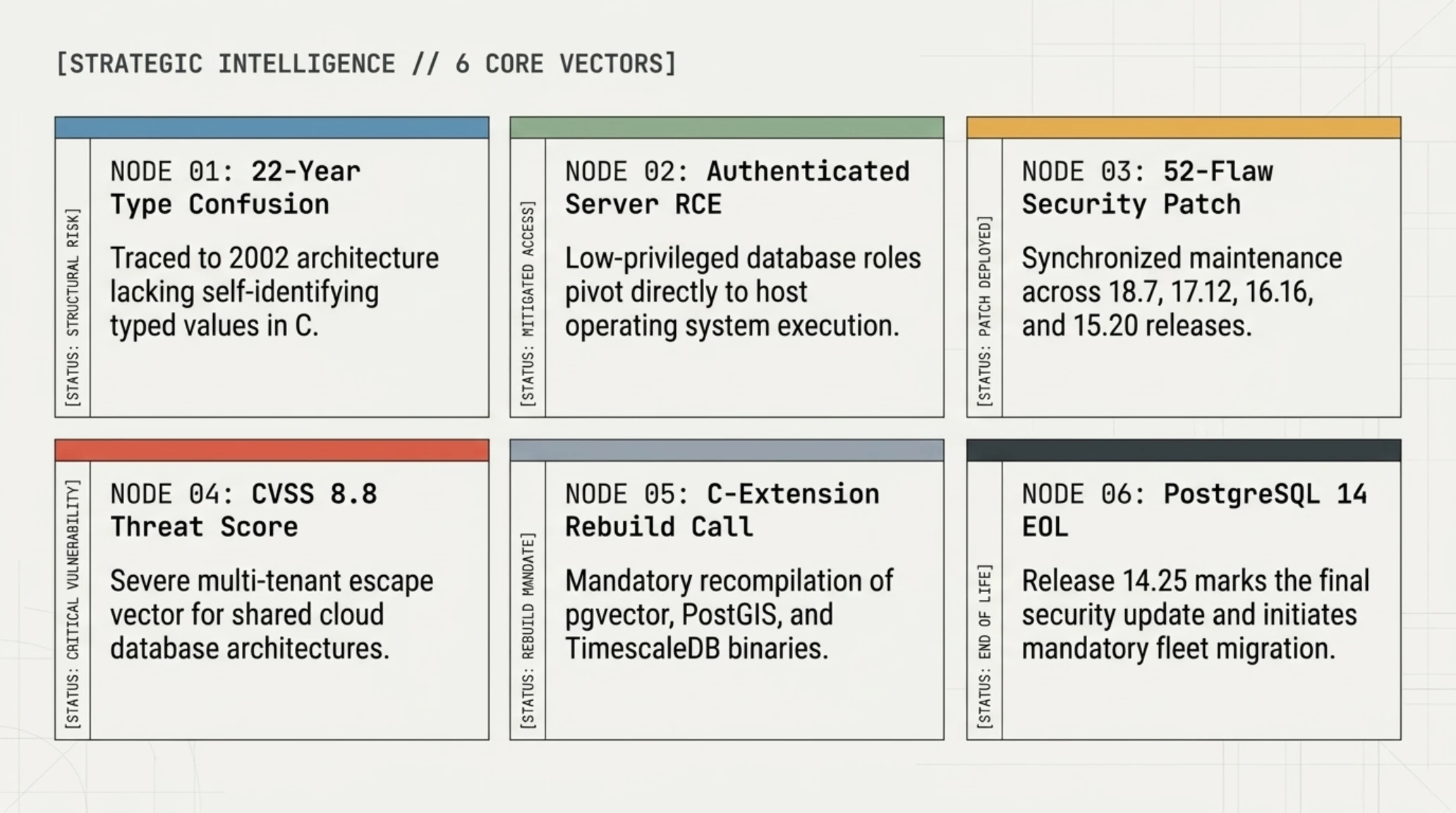
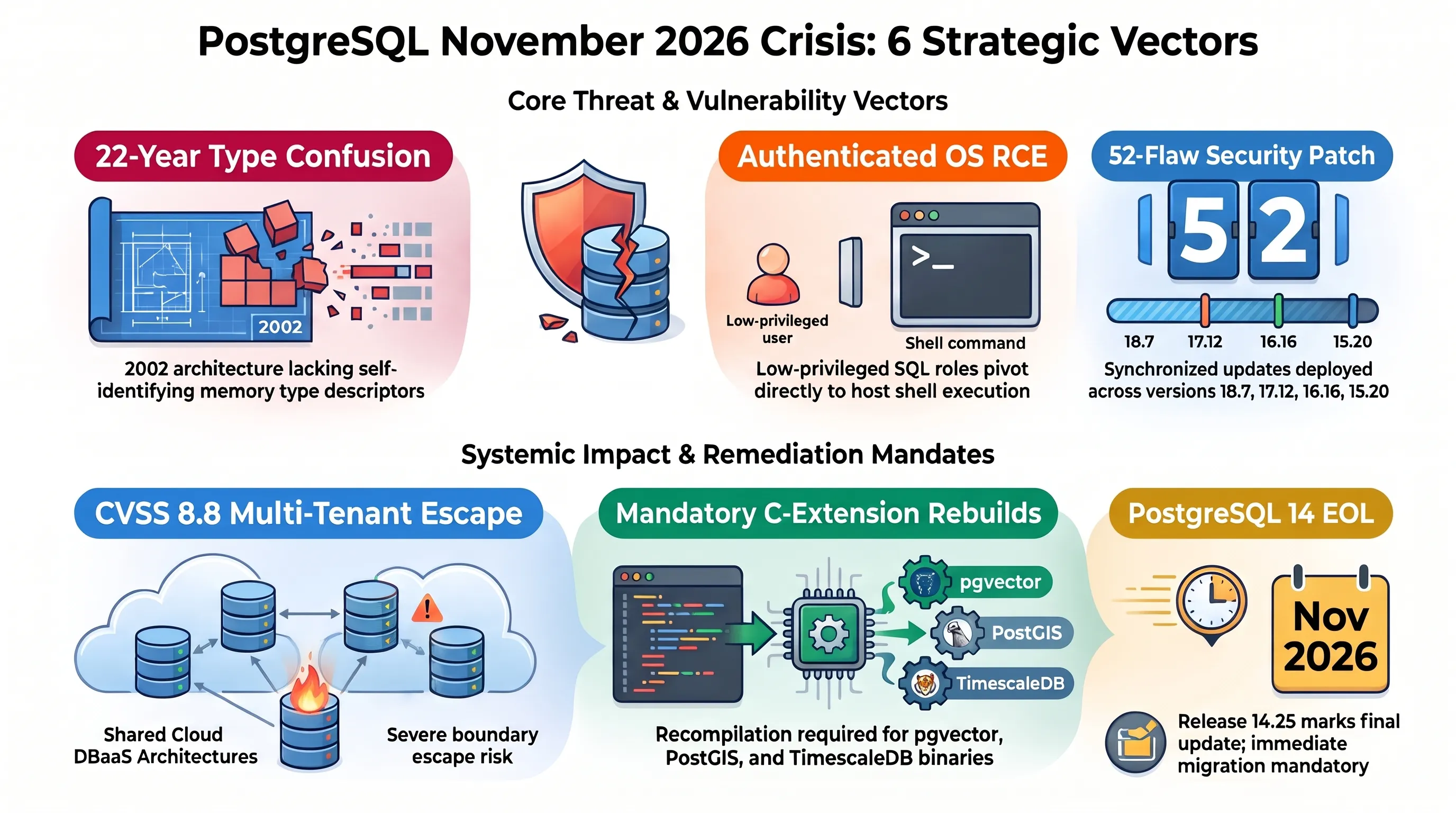
Designated under the Common Vulnerabilities and Exposures database as CVE-2026-6460 with a high-severity CVSS v3.1 score of 8.8, the bug represents an archetypal type confusion vulnerability (CWE-843) embedded within the C-language data dictionary handling. The flaw enables an authenticated database user with basic object creation privileges to manipulate memory pointer references via Data Definition Language (DDL) transactions, escaping the relational sandbox to execute arbitrary native machine code under the operating system permissions of the postgres service. Crucially, the security advisory issued an urgent directive extending far beyond standard binary packaging: full institutional remediation structurally requires recompiling all installed third-party C-language extensions against the updated system headers.
Strategic Assessment and Executive Vectors at a Glance
Historic Root Cause: Type Confusion in Core DDL Memory Handling
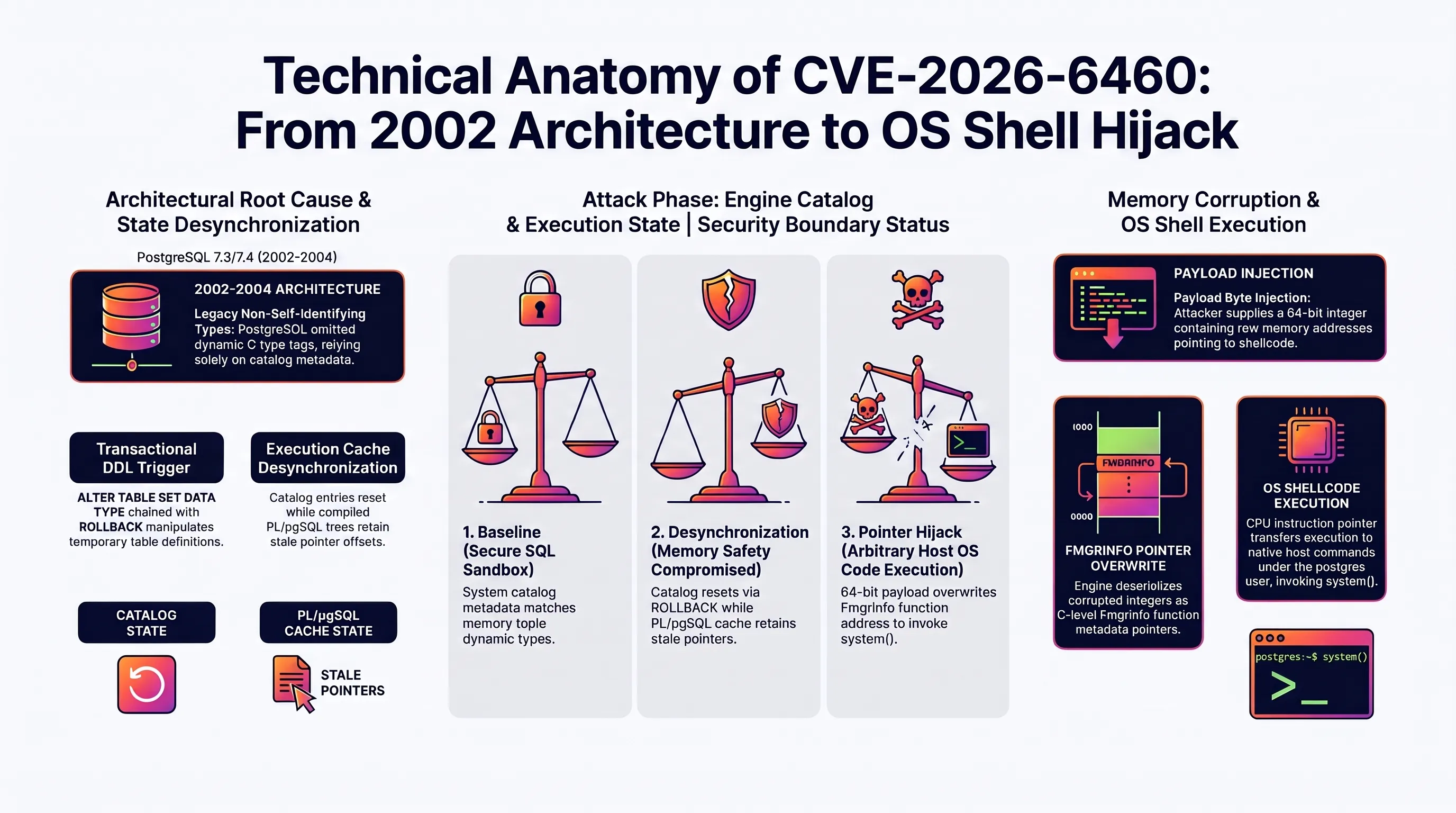
Deconstructing CVE-2026-6460 requires tracing the architectural history of PostgreSQL back to the releases of versions 7.3 and 7.4 between 2002 and 2004. During this era, systems architects prioritized extreme computational throughput on limited hardware resources, establishing an internal representation where typed values within table columns, PL/pgSQL function arguments, and memory tuples were deliberately not self-identifying. In this legacy architecture, raw memory bytes do not encapsulate dynamic runtime type tags; rather, the engine relies strictly on relational catalog metadata stored within system tables such as `pg_type` and `pg_attribute` to interpret memory addresses.
This design invariant remained safe under conventional transactional operations because the query execution engine assumed total synchronicity between catalog definitions and heap tuple deserialization. However, modern penetration research revealed that complex Data Definition Language (DDL) sequences specifically involving `ALTER TABLE ... SET DATA TYPE` chained with transactional rollback semantics (`ROLLBACK`) and cached PL/pgSQL variable references create a dangerous temporal state desynchronization. The execution cache retains stale type signatures while catalog entries fluctuate, allowing an attacker to manipulate low-level memory offsets:
Type confusion manifests when the engine deserializes an attacker-supplied 64-bit integer, treating the raw data not as a numerical literal, but as a direct C-level memory address pointing to a function metadata structure. When the database server attempts to invoke the cached routine, it follows the attacker's corrupted pointer, transferring CPU instruction execution directly into memory regions containing crafted binary shellcode. This completely dissolves the boundary between user-space SQL querying and native operating system execution.
Why This Infrastructure Shift Changes Everything
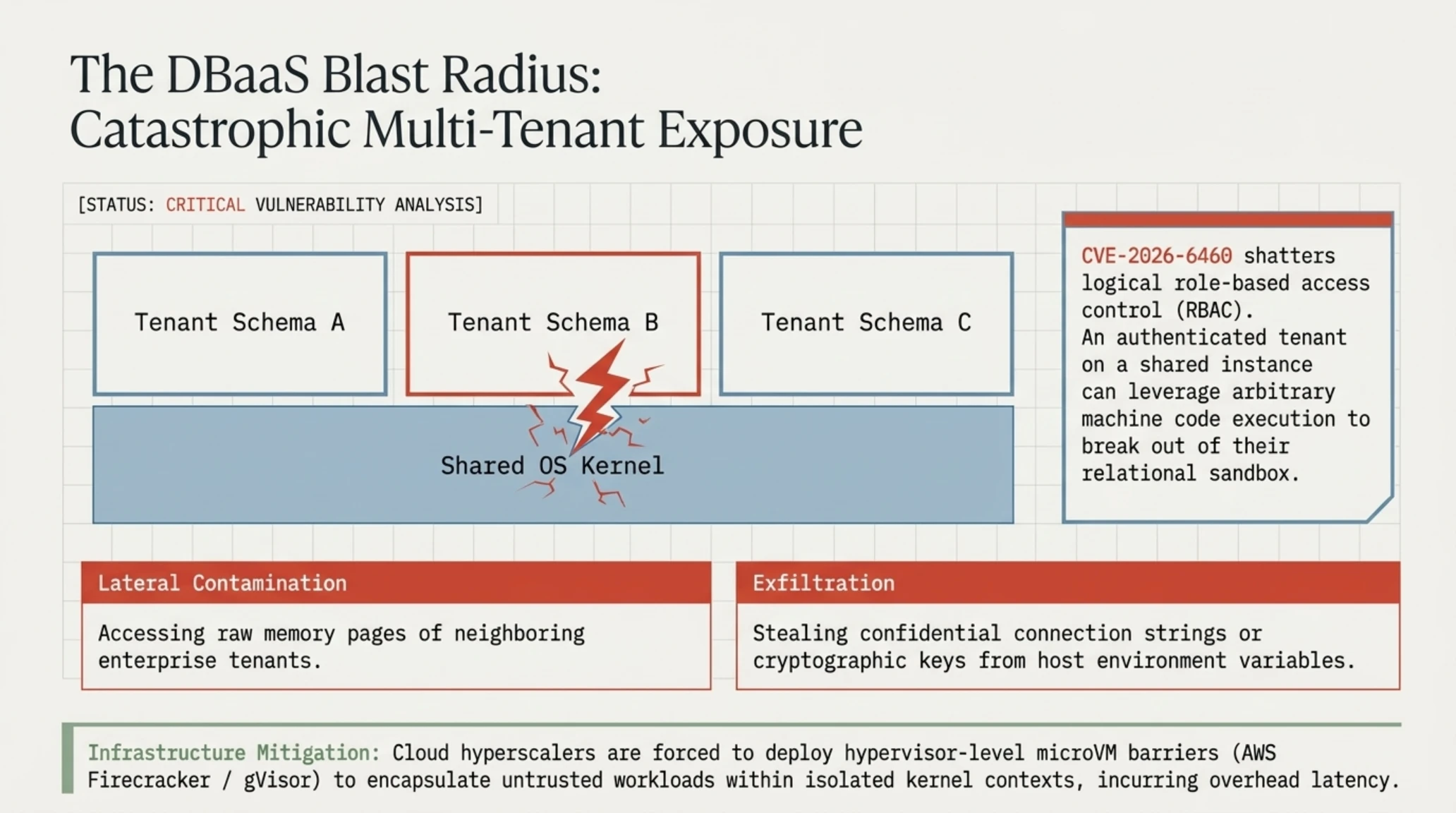
The macroeconomic ramifications of this vulnerability are heavily amplified by the modern cloud paradigm of Database-as-a-Service (DBaaS). On platforms where multiple enterprise clients share underlying database clusters segregated purely by PostgreSQL role permissions and schemas, an unprivileged user possessing table creation rights can completely break out of their tenant boundary, compromising the memory space of adjacent enterprise workloads.
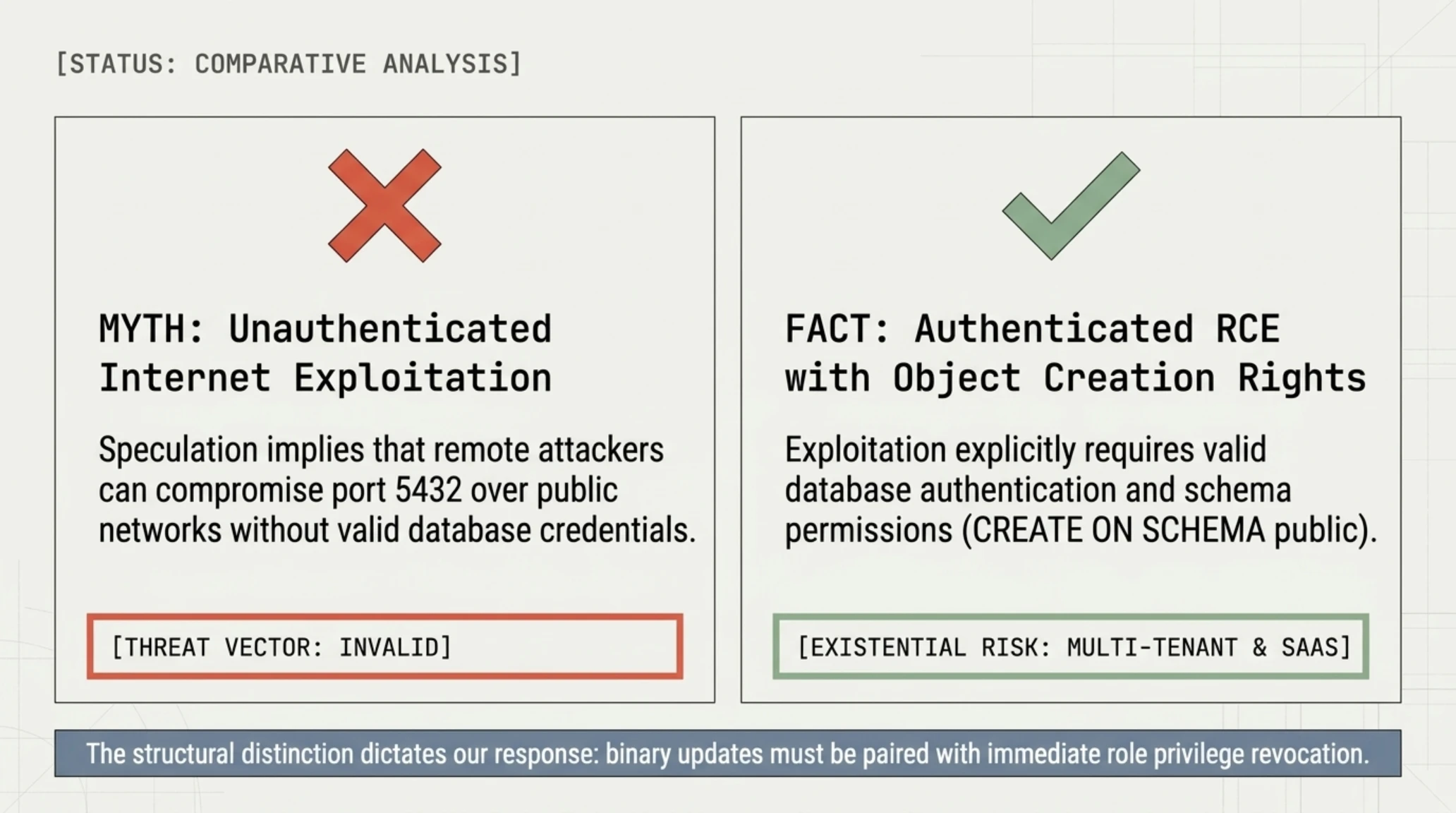
Technical Ground Truth | Myth vs. Engineering Reality
This subtle distinction between unauthenticated remote network worms and authenticated multi-tenant breakout underscores why enterprise database administrators must implement layered defense protocols, ensuring that binary updates are reinforced with immediate role privilege revocation across public schemas.
Glossary of Advanced Memory Safety and Systems Terms
Exploit Mechanics: From DDL Transactions to Operating System Execution
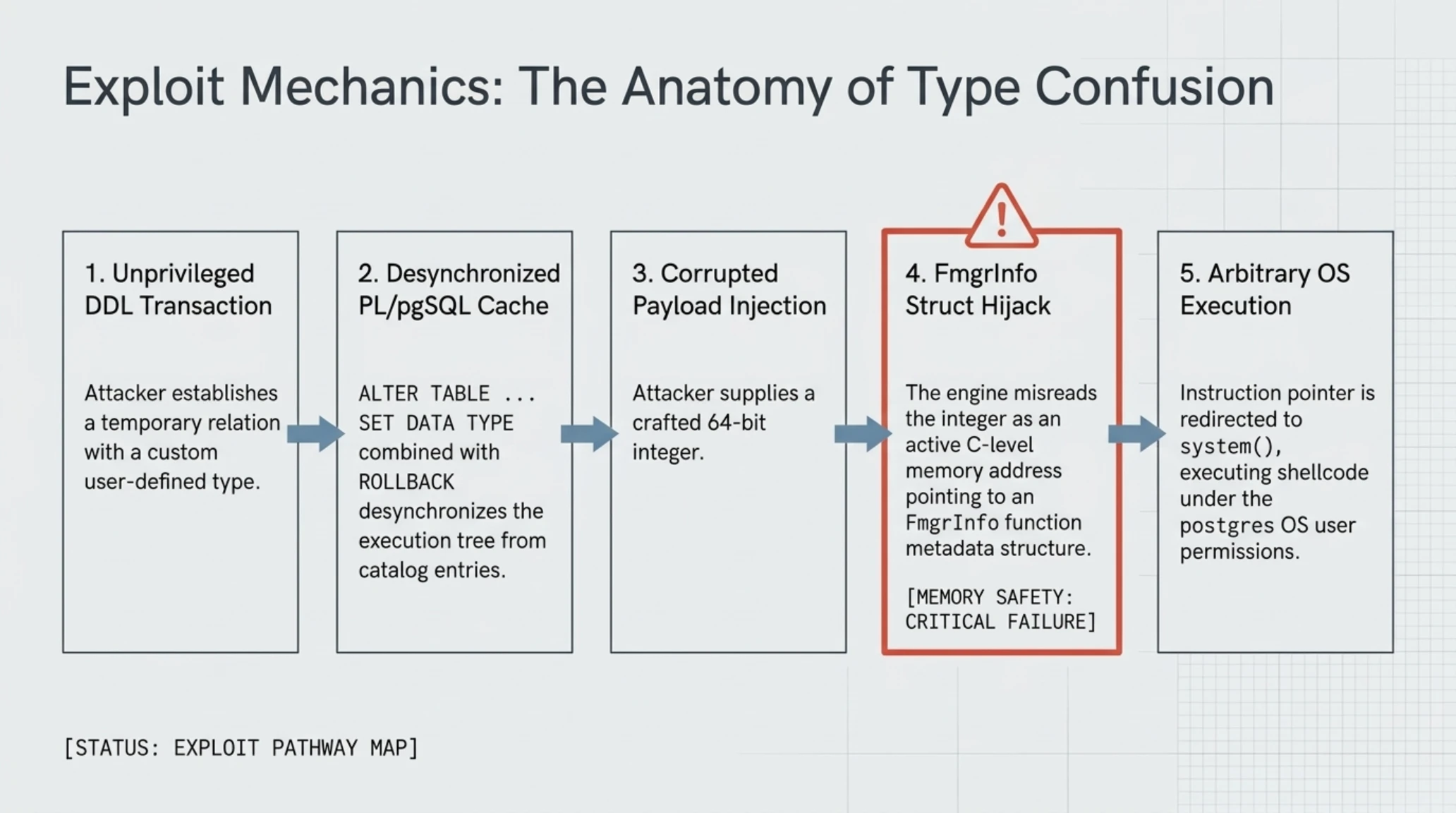
Detailed forensic deconstruction of the CVE-2026-6460 exploit chain reveals how an authenticated actor can orchestrate benign SQL statements into an inescapable arbitrary code execution vector. The attack vector commences with an unprivileged database session possessing standard table creation rights. The adversary defines a temporary relation with a customized user-defined type, followed by the declaration of a procedural PL/pgSQL function that caches local variables mapped directly to that structural descriptor.
Subsequently, the attacker executes an adversarial transactional sequence combining structural alterations via `ALTER TABLE ... SET DATA TYPE` with strategic transaction rollbacks. This desynchronizes PostgreSQL's internal execution state: while the system catalog purges or resets the temporary type definition, the compiled execution tree retained within the PL/pgSQL function cache maintains its pointer offsets. When the adversary supplies controlled 64-bit numerical payload bytes, the engine misinterprets them as an active pointer to the internal `FmgrInfo` struct:
Within PostgreSQL's C runtime, `FmgrInfo` holds the resolved virtual memory address of the C function designated for execution. By corrupting this pointer, the adversary redirects the CPU's instruction pointer directly to system utility wrappers such as `system()` or custom executable heap buffers. Consequently, the database backend executes arbitrary machine instructions with the full operational privileges of the host OS `postgres` user, enabling shell access, credential exfiltration, and lateral host movement.
Benchmark Comparison and Enterprise Database Security Matrix
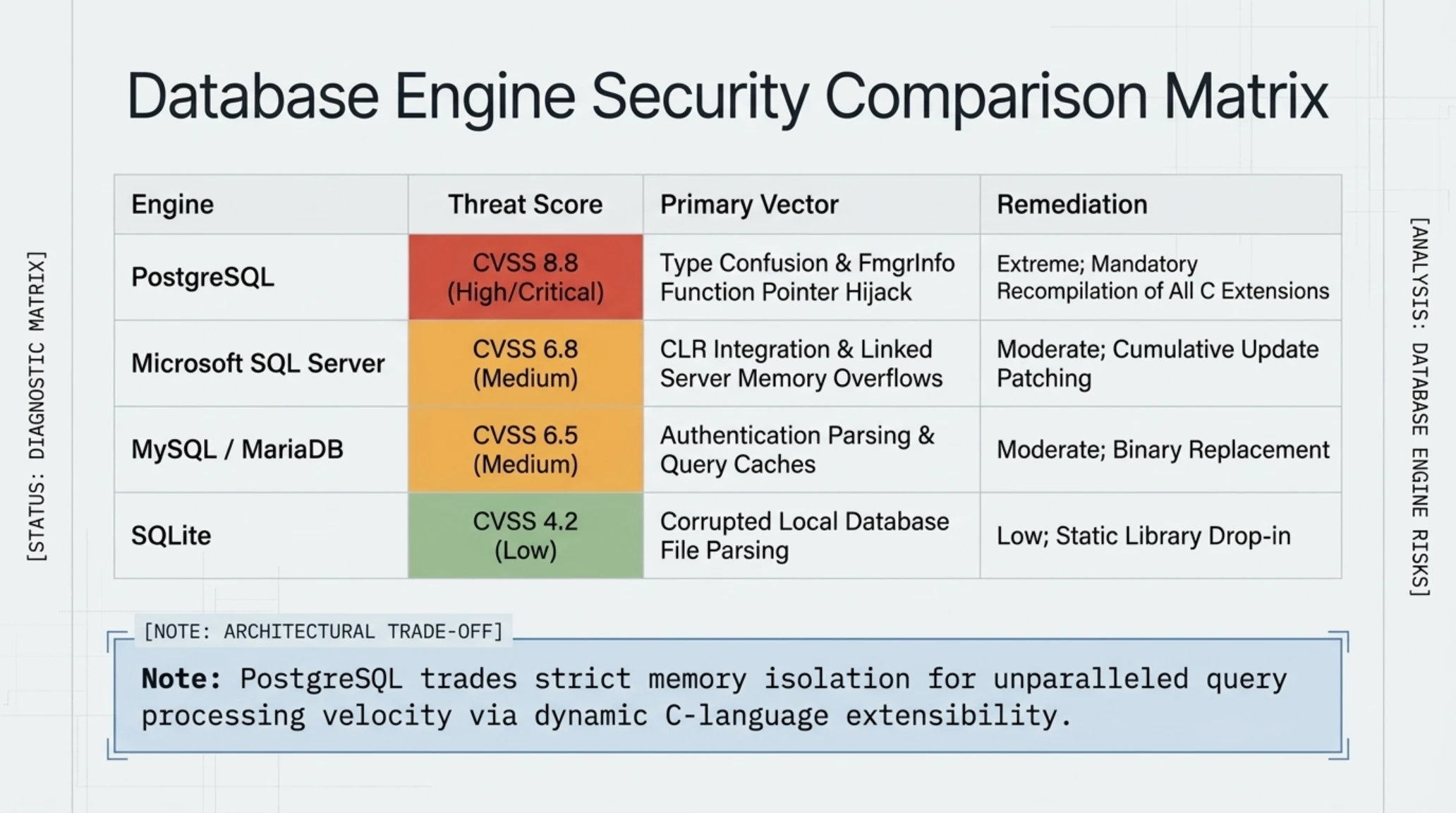
| Database Engine | Latest Severity Score (CVSS) | Primary Attack Vector | Remediation Complexity |
|---|---|---|---|
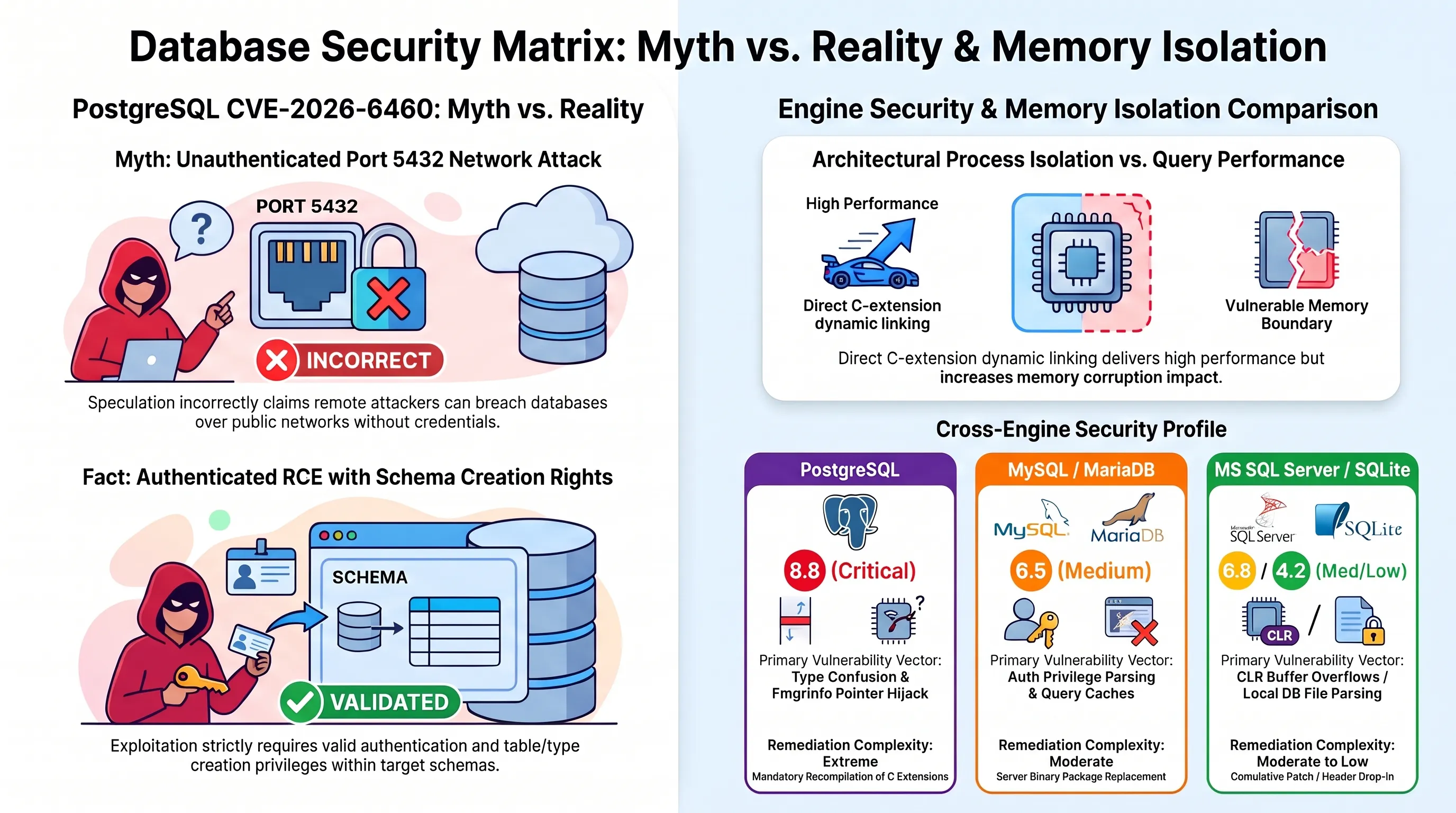
| PostgreSQL (CVE-2026-6460) | 8.8 (High / Critical) | Type Confusion & FmgrInfo Function Pointer Hijack | Extreme; Mandatory Recompilation of All C Extensions |
| MySQL / MariaDB | 6.5 (Medium) | Authentication Privilege Parsing & Query Caches | Moderate; Server Binary Package Replacement |
| SQLite (Embedded Engine) | 4.2 (Low) | Local Corrupted Database File Parsing Edge Cases | Low; Static Library Header Drop-in Replacement |
| Microsoft SQL Server | 6.8 (Medium) | CLR Integration & Linked Server Memory Buffer Overflows | Moderate; Cumulative Update Patching & Service Restart |
The structural divergence between PostgreSQL and competitive database engines centers on its dynamic C-language extensibility. While rival relational systems isolate plug-in logic inside sandboxed worker processes or embedded virtual machines, PostgreSQL links shared object libraries directly into the primary execution process space, trading strict memory isolation for unparalleled query processing velocity.
The C-Extension Recompilation Mandate: PostGIS, pgvector, and TimescaleDB
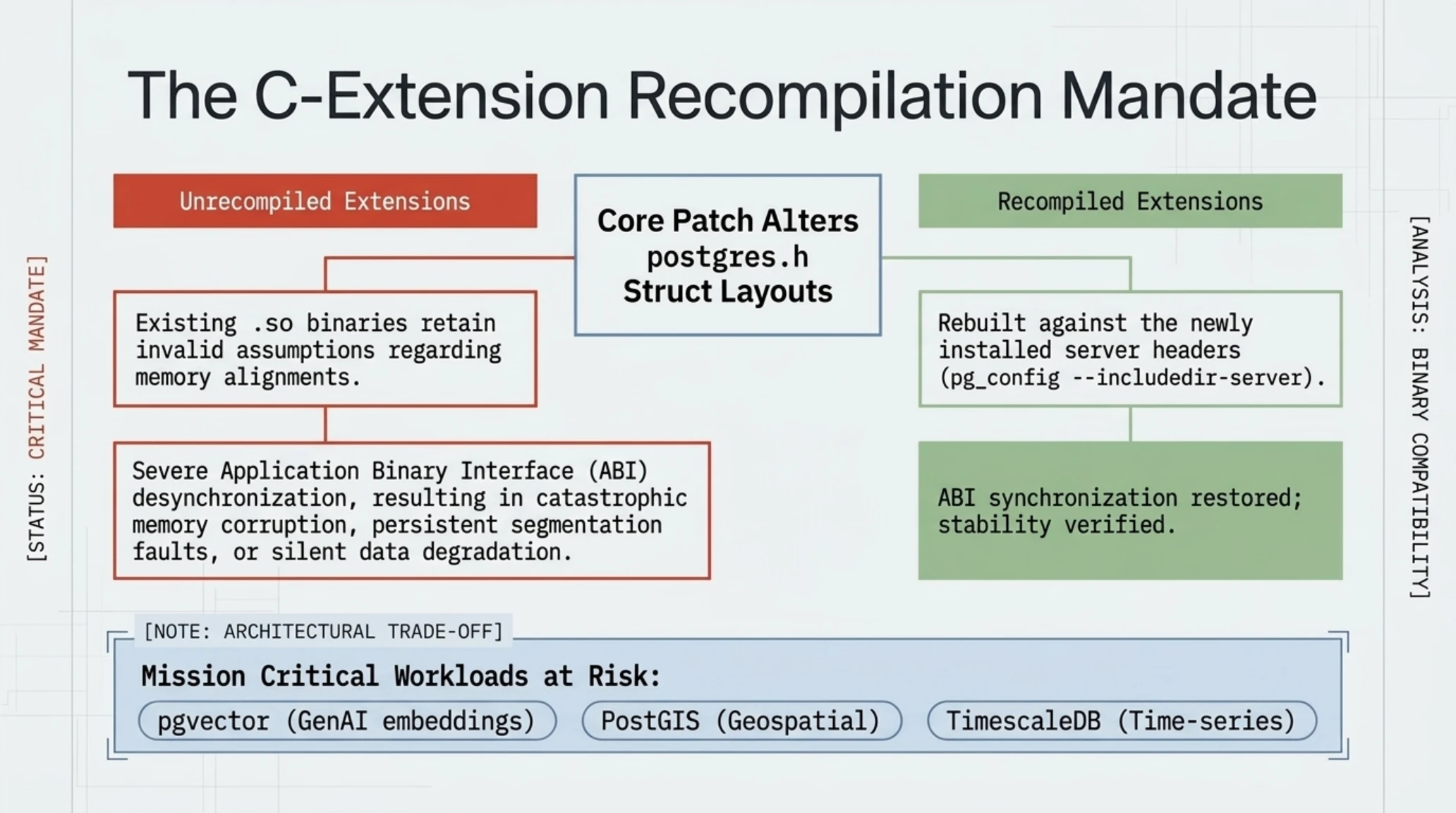
The defining operational headache of the November 2026 security release is the explicit mandate requiring the total recompilation of all third-party C-language extensions. In production deployments worldwide, PostgreSQL instances rarely operate in a bare-metal default state; modern analytical and machine learning workloads rely heavily on ecosystem staples such as `pgvector` for generative AI vector embeddings, `PostGIS` for geospatial computations, and `TimescaleDB` for high-throughput time-series analysis.
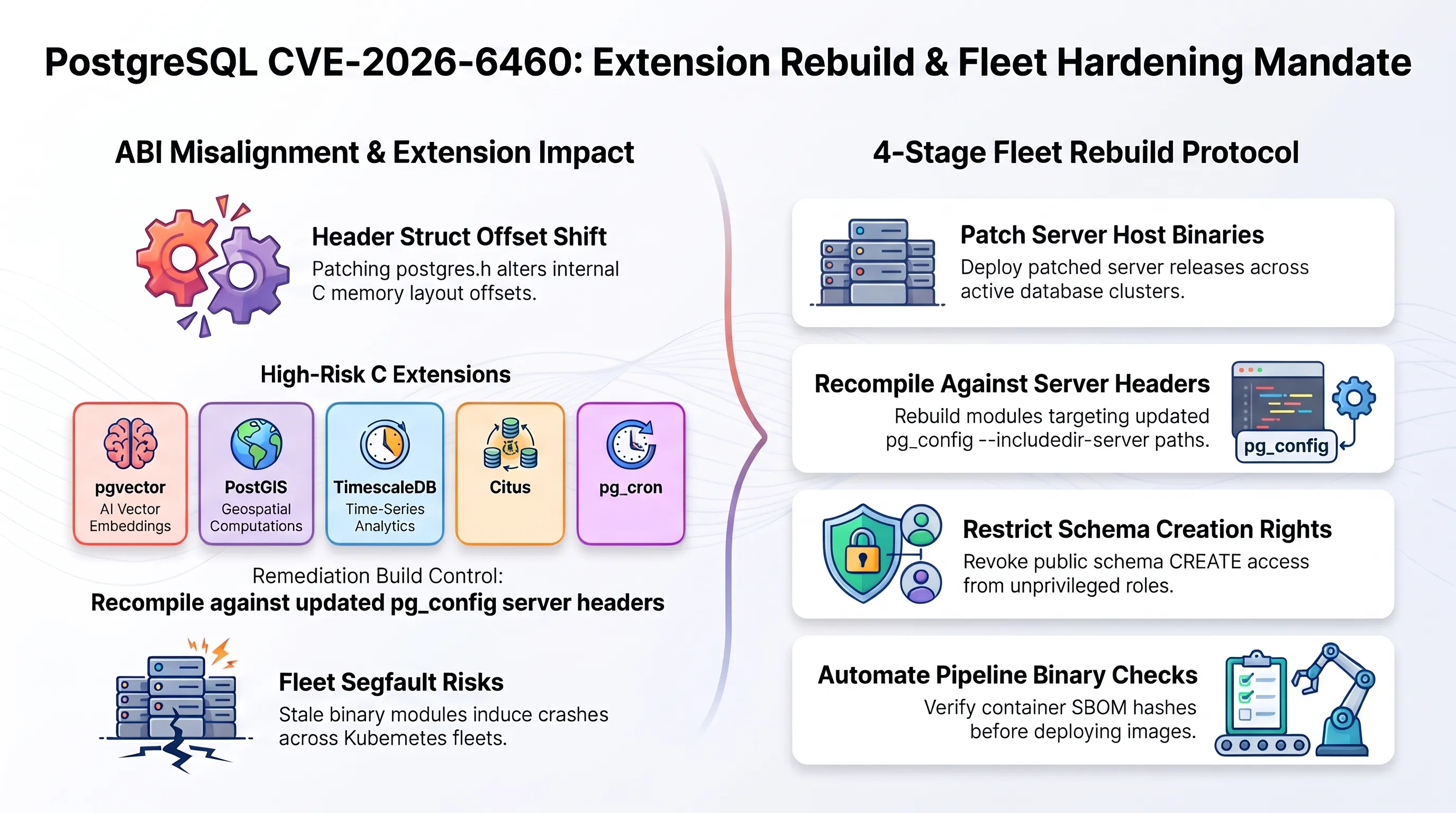
Because the core patch fundamentally alters the internal struct layouts and type tracking definitions within the primary `postgres.h` and catalog headers, existing compiled `.so` binaries retain invalid assumptions regarding memory alignments. If an enterprise operator updates the database server binaries but fails to recompile third-party C extensions against the newly patched headers, severe Application Binary Interface (ABI) desynchronization occurs. This mismatch leads to catastrophic memory corruption, persistent segmentation faults, or silent data degradation under high-concurrency workloads:
For Site Reliability Engineers managing massive multi-region Kubernetes deployments managed by operators like CloudNativePG or Zalando, this mandate transforms a routine patch cycle into a coordinated pipeline overhaul. Every base container image housing compiled extensions must be systematically rebuilt, regression tested, and deployed across production fleets.
In large-scale database infrastructure, ABI compatibility is governed by binary struct alignment rules dictated by the C preprocessor and platform compiler toolchains. When PostgreSQL maintainers altered internal struct layouts within core catalog headers, they modified memory offsets that third-party extensions rely upon during direct pointer dereferencing. If an un-recompiled extension binary attempts to read a field from a modified struct, it reads memory from unintended byte boundaries, triggering fatal segmentation faults or silent write operations into adjacent memory allocations.
Moreover, the operational friction of rebuilding C extensions cascades through multi-stage CI/CD deployment pipelines. In complex enterprise topologies where database instances run across mixed Linux distributions from Debian and Alpine to Red Hat Enterprise Linux and Amazon Linux 2023 compilation dependencies such as LLVM, Clang, and specific GCC compiler flags must match the host database build environment exactly. A single mismatch in compiler optimization levels or header versions can re-introduce subtle runtime instability or unpatched pointer dereference paths.
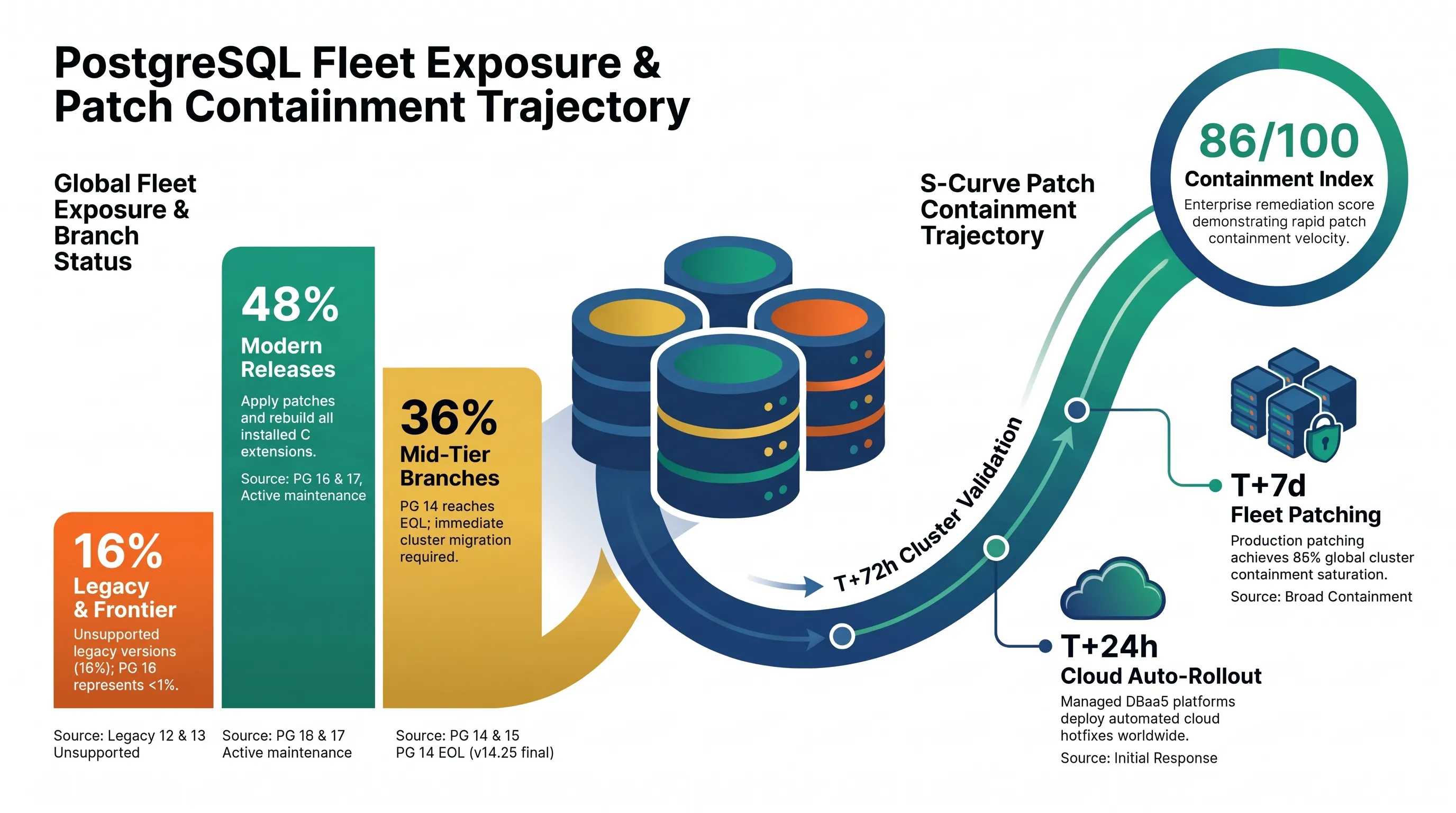
This clear acknowledgment from the core development group highlights the reality of maintaining long-lived systems infrastructure. To appreciate the scale of enterprise clusters exposed to this operational challenge, an analysis of active global version distributions is essential:
Donut Telemetry, Version Distribution, and Cluster Risk Matrix
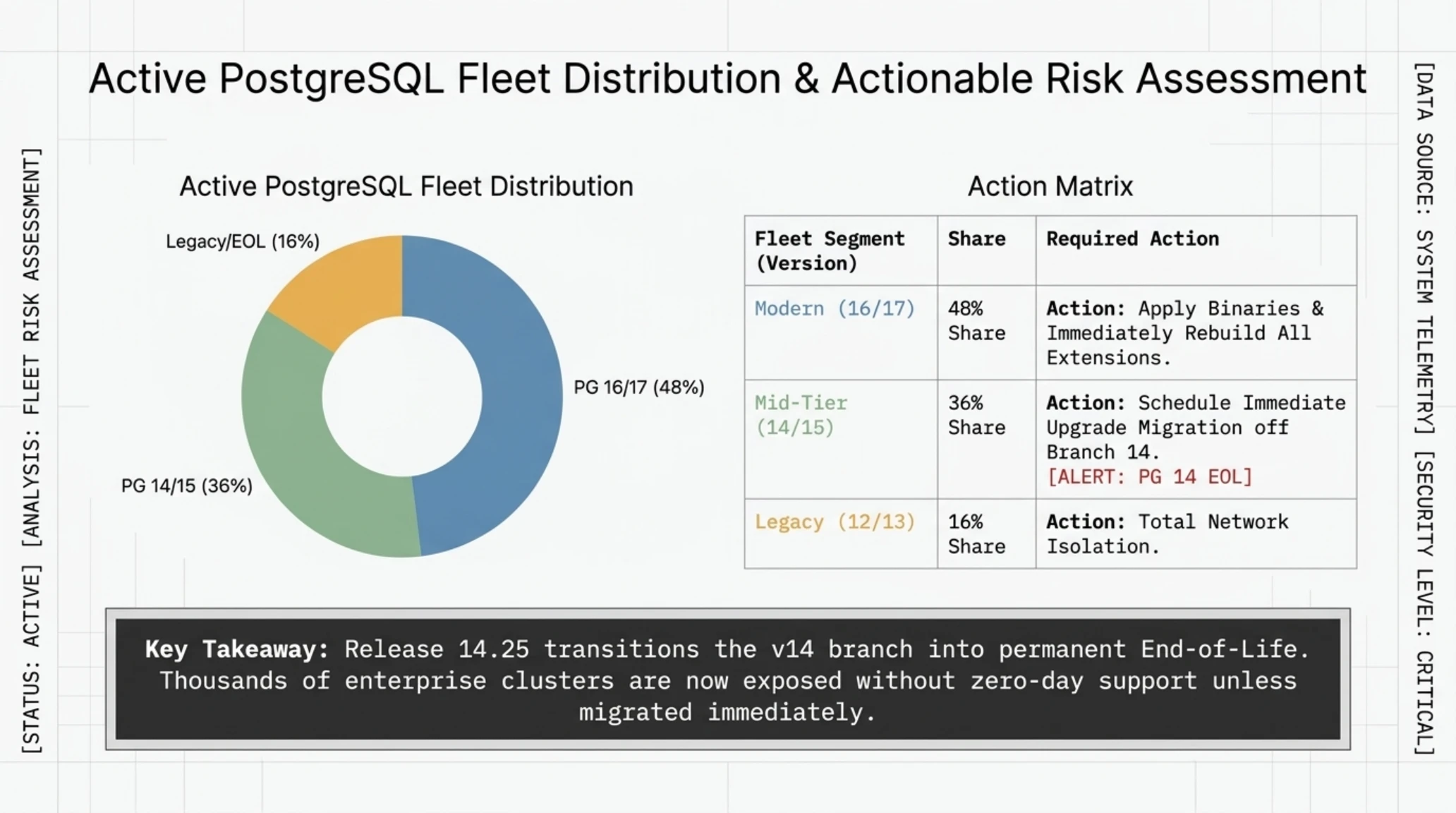
| Release Branch | Global Production Share | Support Lifecycle Status | Urgent Operational Action Required |
|---|---|---|---|
| Modern Releases (16 & 17) | 48% of Deployments | Active Maintenance; Releases 16.16 & 17.12 Live | Apply Binaries & Immediately Rebuild All Extensions |
| Mid-Tier Releases (14 & 15) | 36% of Deployments | PG 14 Reaches End-of-Life; 15.20 Live | Schedule Immediate Upgrade Migration off Branch 14 |
| Legacy EOL Releases (12 & 13) | 16% of Deployments | Permanently Unsupported; Zero Security Patches | Total Network Isolation & Priority Database Migration |
| Frontier Branch (PostgreSQL 18) | <1% of Deployments | Active Development; Hardened FmgrInfo Isolation & Type Layouts | Track Upstream Git Commits & Validate Test Environments |
The statistical audit underscores that more than half of global production clusters inhabit a high-risk operational posture. Organizations operating on obsolete releases must accelerate modern platform migrations to prevent systemic infrastructure compromise.
The 52-Flaw Patch Avalanche and the Official Retirement of PostgreSQL 14
The simultaneous remediation of 52 discrete security defects in a single synchronized release represents an extraordinary event in the history of the PostgreSQL Global Development Group. While international cybersecurity headlines remain fixated on the 22-year-old CVE-2026-6460 type confusion flaw, the November 2026 maintenance batch addresses a vast attack surface across the entire database subsystem. Among the patched flaws are privilege escalation vectors within logical replication slots that permitted low-privileged users to attain superuser status, alongside query planner resource exhaustion vulnerabilities allowing malformed recursive CTEs to induce catastrophic denial-of-service kernel panics.
Concurrently, the release of PostgreSQL 14.25 officially marks the final curtain call for one of the most widely deployed database branches in enterprise history. Introduced in autumn 2021, PostgreSQL 14 achieved massive institutional adoption across global banking and logistics sectors due to its pioneering B-Tree index deduplication and enhanced parallel query capabilities. With this final release, the v14 branch transitions into permanent End-of-Life (EOL) status. Thousands of enterprise clusters operating on version 14 will no longer receive upstream security fixes for zero-day vulnerabilities, leaving legacy workloads severely exposed unless system administrators immediately orchestrate major version upgrades.
Enterprise cloud operations centers visualizing automated database fleet management highlight the immense logistical coordination required to apply these updates at scale:
This convergence of active vulnerability remediation and lifecycle termination creates acute compliance exposure for organizations subject to strict regulatory regimes including PCI-DSS, SOC 2 Type II, and HIPAA. Operating unpatched databases containing known high-severity remote code execution vectors constitutes an immediate audit failure, forcing enterprise IT organizations into emergency maintenance windows.
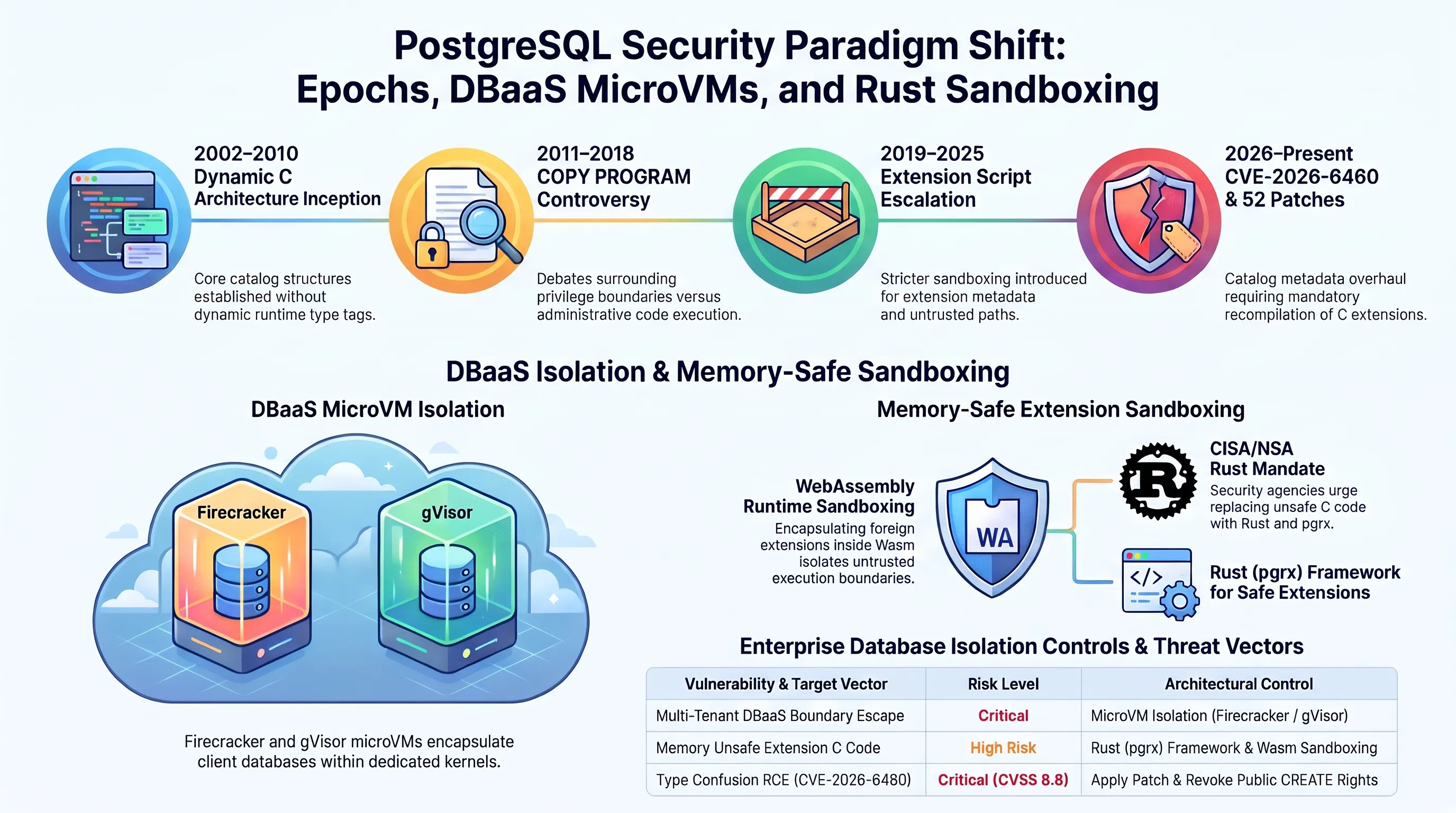
The vulnerability landscape is further complicated by multi-tenant cloud architectures where heterogeneous organizations share common database server infrastructure. In modern Database-as-a-Service (DBaaS) environments and containerized micro-architectures, platform providers frequently rely on role-based access control and schema-level isolation to separate untrusted customer workloads. CVE-2026-6460 shatters these logical isolation boundaries: an authenticated tenant on a shared instance can leverage arbitrary machine code execution to break out of their tenant sandbox, access raw memory pages belonging to neighboring enterprise tenants, and exfiltrate confidential connection strings or cryptographic keys stored in host environment variables.
Consequently, cloud hyperscalers have been forced to deploy hypervisor-level microVM barriers such as AWS Firecracker and Google gVisor to encapsulate untrusted customer database workloads within isolated kernel contexts. While this defense-in-depth approach mitigates host compromise, it incurs measurable overhead in virtualization latency and memory allocation density, highlighting the deep architectural friction between lightweight database tenancy and rigorous multi-tenant memory security.
📚 Classified & Related Dossiers in TekinGame
If you wish to explore beyond this report and delve into cybernetic frontiers and autonomous AI architectures, do not miss these three exclusive deep-dives in the Tekin Garage:
Database Threat Profile and Defense-in-Depth Risk Matrix
| Vulnerability Vector & Target | Severity & Threat Score | Technical Mitigation & Architecture Control |
|---|---|---|
| Type Confusion RCE (CVE-2026-6460) | Critical (CVSS 8.8) | Apply patched binary and revoke public schema CREATE privileges. |
| Multi-Tenant DBaaS Boundary Escape | Critical | Isolate client databases inside dedicated microVMs (Firecracker / gVisor). |
| Unrecompiled C Extension ABI Corruption | High Risk | Recompile all dynamic modules against patched server include headers. |
| Query Planner Algorithmic DoS | Mitigated / Stable | Enforce statement_timeout boundaries and monitor active lock queues. |
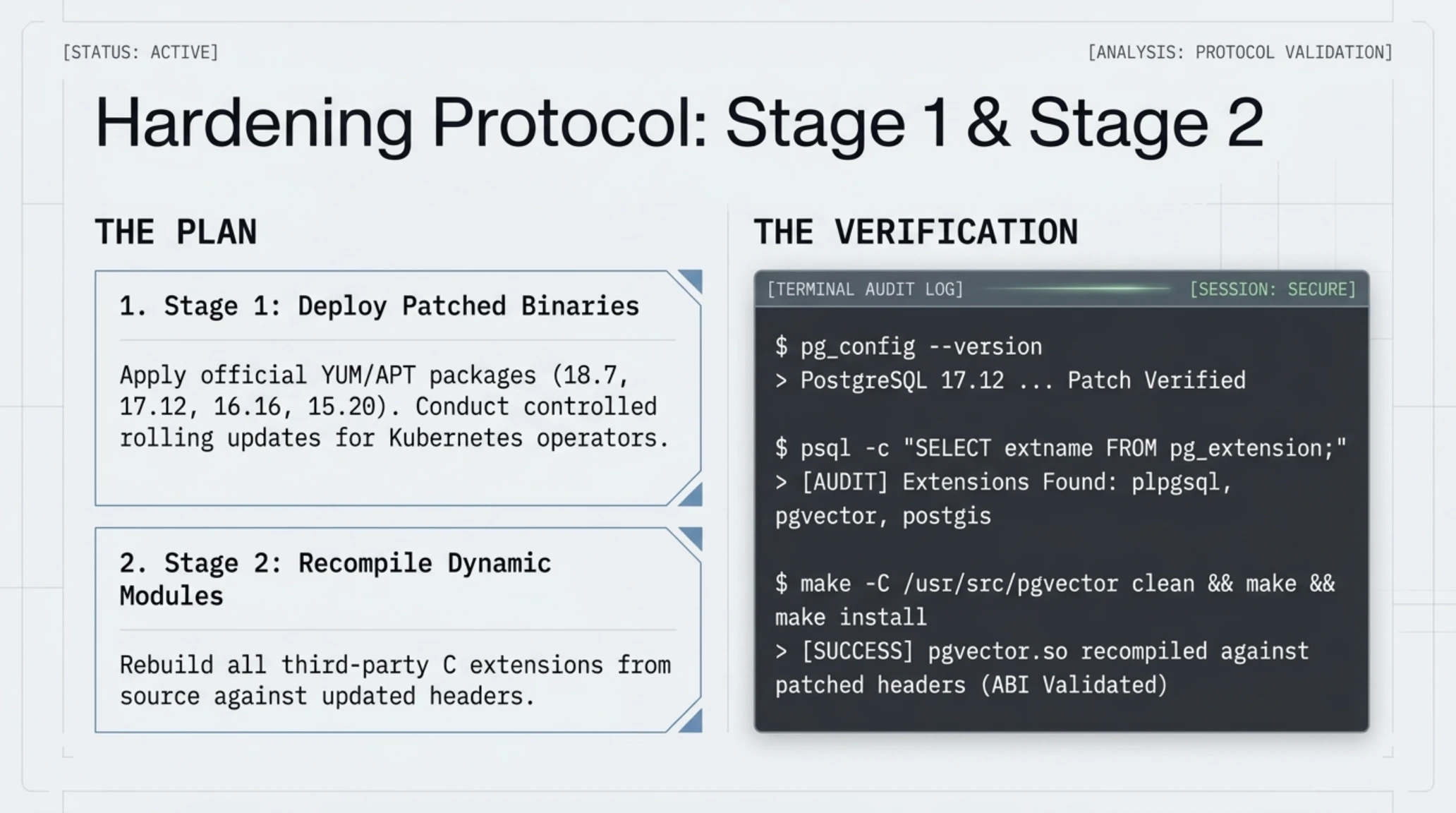
Diagnostic terminal audits and server telemetry logs demonstrate how infrastructure engineers systematically verify extension binaries against updated system headers:
Cyber Terminal and PostgreSQL Extension Rebuild Audit Log
Automated verification pipelines represent the only deterministic method to validate that running container clusters are entirely free from memory pointer vulnerabilities.
Memory Safety vs. Legacy C: The Rust Modernization Imperative
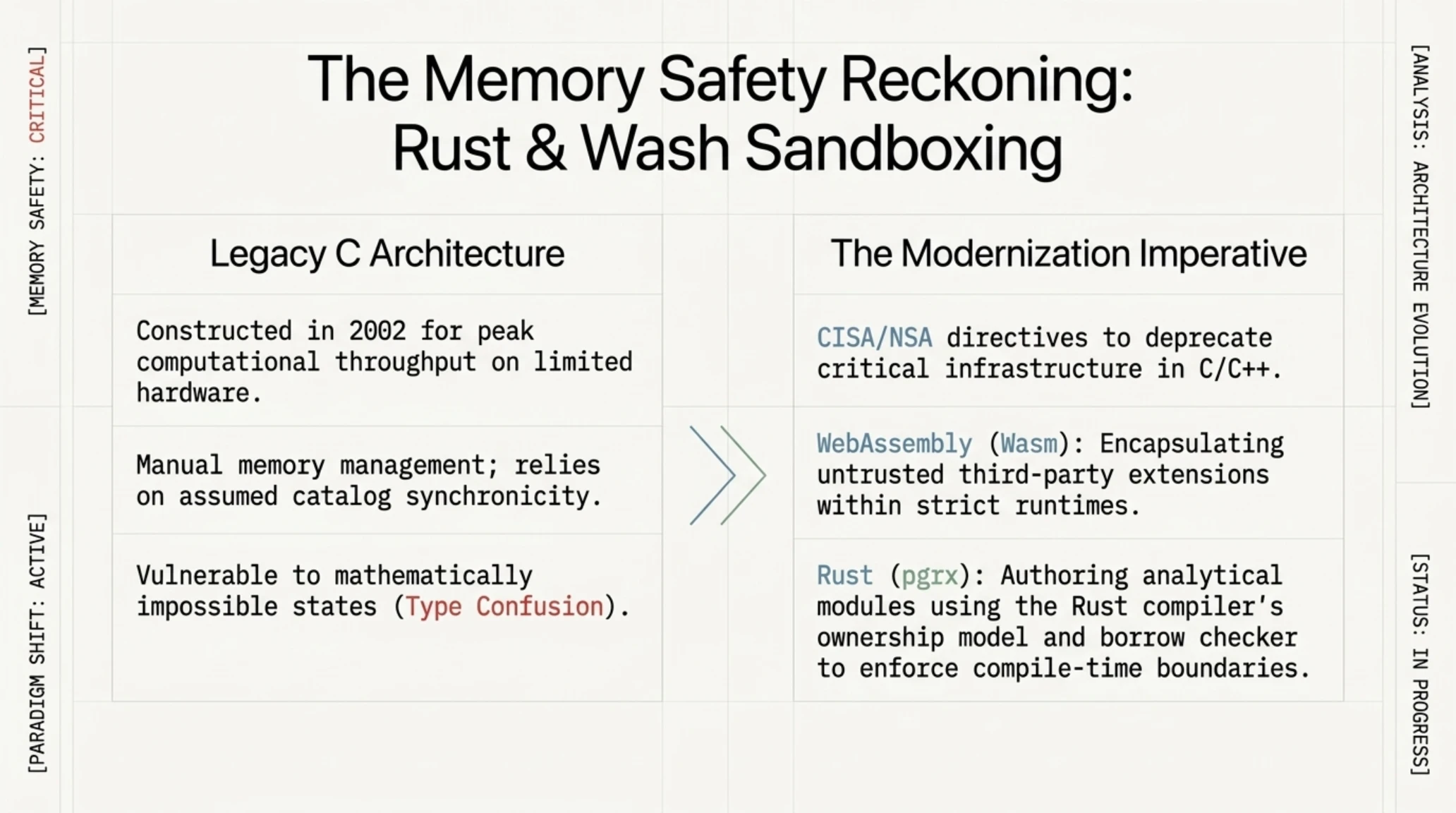
The unearthing of a two-decade-old type confusion flaw in the crown jewel of open-source relational computing has reignited the broader systems engineering debate surrounding memory-unsafe languages. Leading international security agencies, including the Cybersecurity and Infrastructure Security Agency (CISA) and the National Security Agency (NSA), have repeatedly urged global enterprises to deprecate critical infrastructure software written in manual memory-managed languages such as C and C++ in favor of memory-safe alternatives such as Rust.
Advocates of modernization contend that had PostgreSQL's type catalog and procedural extension layers been constructed within a memory-safe programming paradigm, the Rust compiler's strict ownership model and borrow checker would have rendered arbitrary typecasting and pointer tampering mathematically impossible at compile time:
Nevertheless, PostgreSQL's veteran architects maintain that thirty years of micro-architectural optimizations and battle-tested C code cannot simply be discarded overnight without introducing severe performance regressions and concurrency bottlenecks. Instead, the consensus favors a pragmatic intermediate architecture: encapsulating untrusted third-party extensions within WebAssembly (Wasm) runtimes or authoring new analytical modules using Rust frameworks like `pgrx` to establish impenetrable process memory boundaries:
This ongoing evolution reflects the healthy adaptation of open-source software to modern threat landscapes. Industry telemetry confirms that enterprise database administrators have mobilized with remarkable speed to absorb these critical protections:
Market Sentiment, Adoption S-Curve, and Remediation Velocity
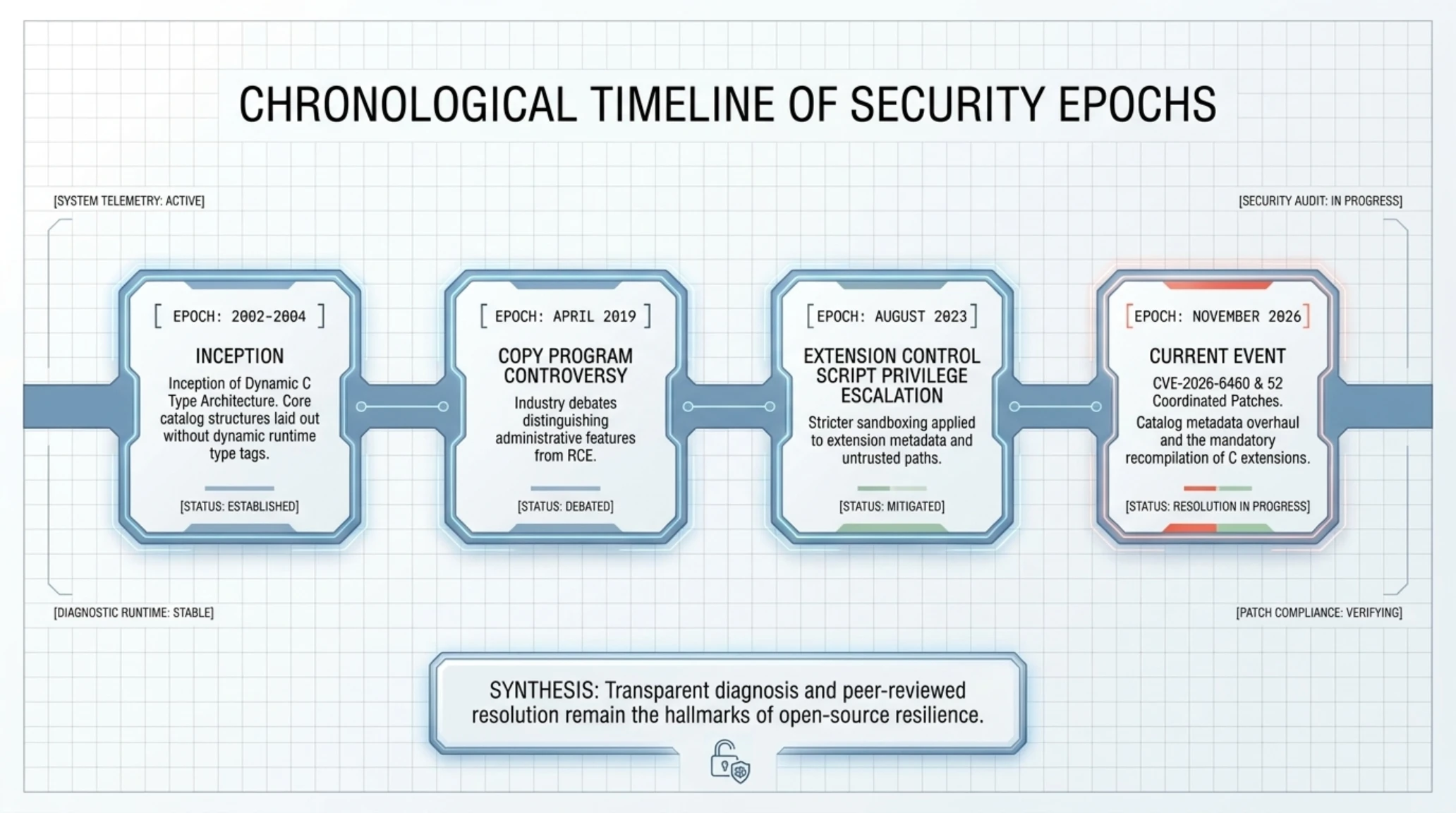
Reviewing historical security milestones reveals how PostgreSQL has consistently maintained transparency and engineering rigor across its generational lifespan:
Chronological Timeline of Key PostgreSQL Security Epochs
| Epoch / Milestone | Key Technical Event & Vulnerability | Architectural Lesson & Security Impact |
|---|---|---|
| 2002 - 2004 | Inception of Dynamic C Type Architecture | Core catalog structures laid out without dynamic runtime type tags. |
| April 2019 | COPY PROGRAM Controversy (CVE-2019-9193) | Heated industry debates distinguishing administrative features from RCE. |
| August 2023 | Extension Control Script Privilege Escalation | Stricter sandboxing applied to extension metadata and untrusted paths. |
| November 2026 | CVE-2026-6460 & 52 Coordinated Patches | Catalog metadata overhaul and the mandatory recompilation of C extensions. |
These milestones prove that open-source stewardship excels precisely because defects are publicly diagnosed, peer reviewed, and surgically resolved with permanent transparent fixes.
Emergency Hardening Protocol for Database Administrators and Cloud Architects
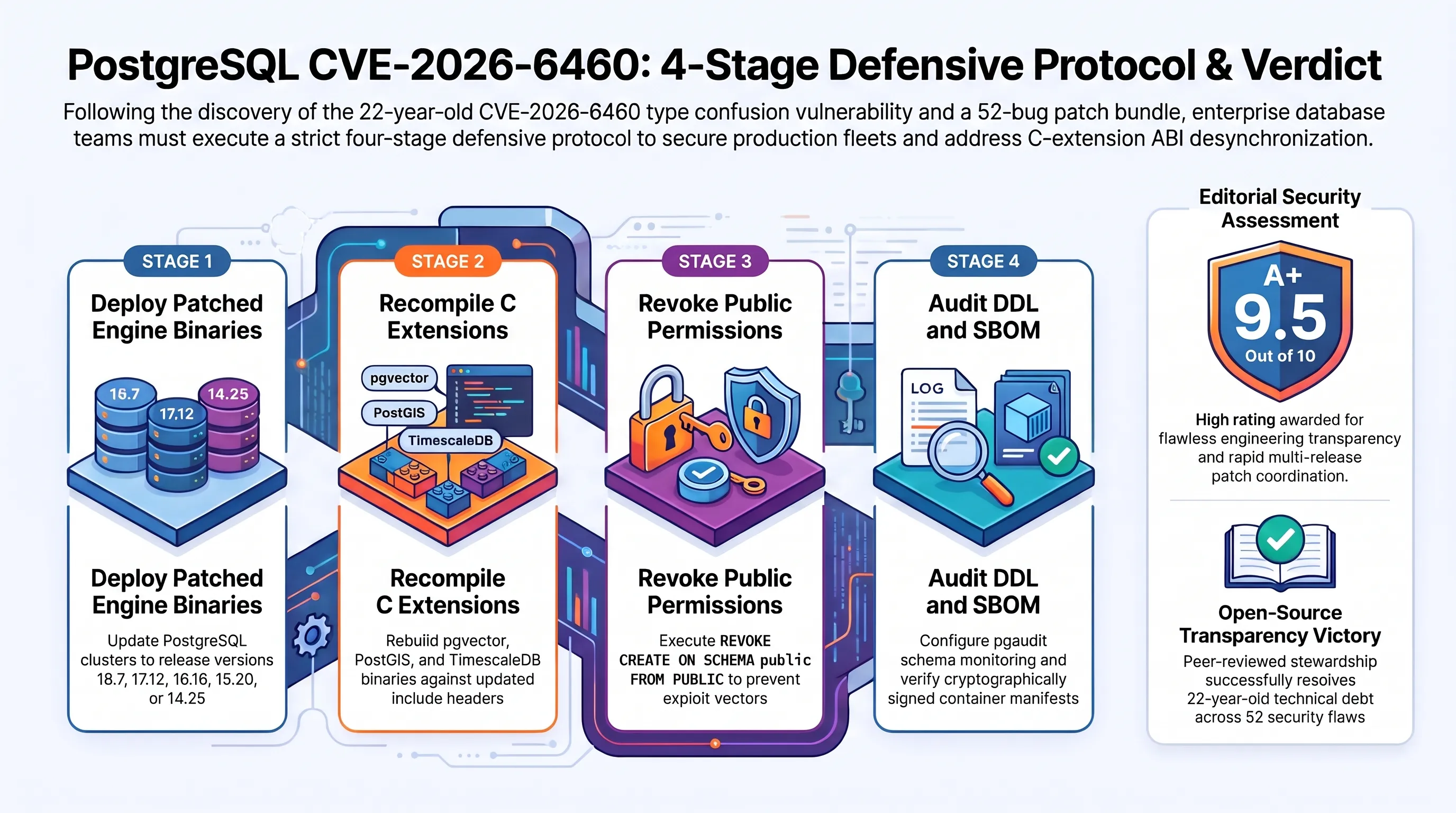
To decisively neutralize the critical CVE-2026-6460 vulnerability and harden enterprise database estates against the broader 52-flaw attack surface, database administrators (DBAs), site reliability engineers, and cloud architects must execute a coordinated four-stage defensive protocol. Remediation efforts must avoid treating this incident as a routine package update; the failure to address secondary shared object libraries leaves database servers entirely vulnerable to exploitation.
Stage one mandates the immediate deployment of patched binaries distributed through official PostgreSQL Global Development Group repositories (APT, YUM) or downstream enterprise vendor packages. Target versions include 18.7 for frontier deployments, 17.12 and 16.16 for primary production clusters, 15.20 for transitional workloads, and 14.25 for legacy installations. In containerized environments orchestrated via Kubernetes operators such as CloudNativePG, engineers must conduct controlled rolling updates, validating replica synchronization prior to executing controlled primary failovers.
Stage two constitutes the operationally critical mandate: the complete recompilation of all third-party C-language extensions. Every dynamic module compiled from source especially mission-critical analytical extensions including `pgvector`, `PostGIS`, `TimescaleDB`, `Citus`, and `pg_cron` must be rebuilt against the newly installed server headers located in `pg_config --includedir-server`. Administrators must verify that the compiled `.so` files reflect updated timestamps and symbol tables before restarting database clusters:
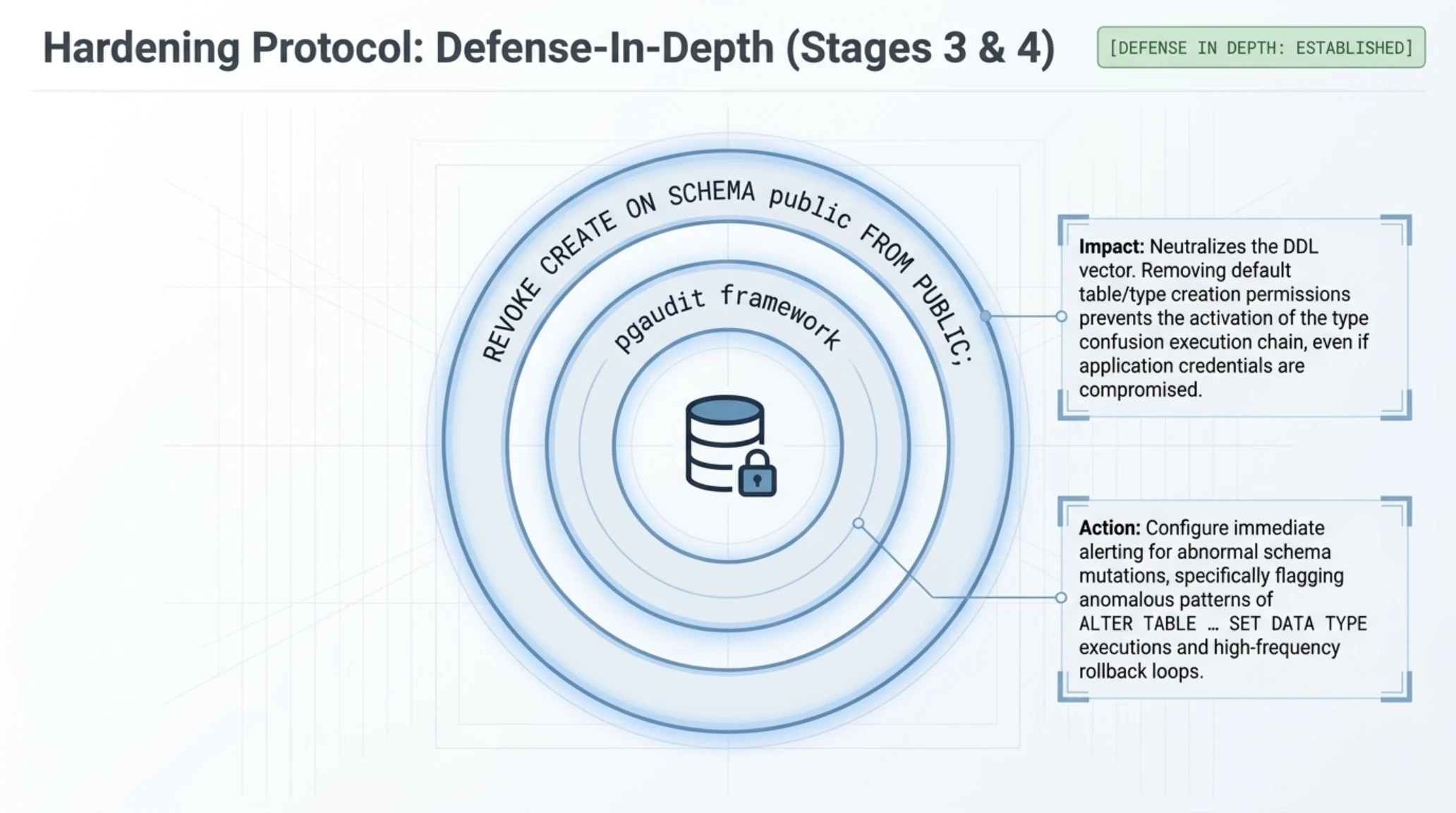
Stage three enforces the principle of least privilege across relational schemas. Executing `REVOKE CREATE ON SCHEMA public FROM PUBLIC;` immediately removes default table and type creation permissions from unprivileged database roles. This control serves as an unbreakable defense-in-depth barrier: even if an adversary compromises application database credentials, the inability to define temporary custom types prevents the activation of the type confusion execution chain.
Stage four establishes comprehensive DDL transaction auditing. Utilizing audit logging frameworks such as `pgaudit`, security teams should configure immediate alerting for abnormal schema mutations, specifically flagging anomalous patterns of `ALTER TABLE ... SET DATA TYPE` executions and high-frequency rollback loops.
In addition to runtime privilege revocation, enterprise platform engineering teams must establish continuous binary provenance verification. Modern containerized deployments should incorporate automated Software Bill of Materials (SBOM) scanners and dynamic memory verification hooks into their GitOps delivery workflows. By enforcing cryptographically signed container manifests and verifying that dynamic shared libraries match expected build hashes, organizations prevent the accidental deployment of stale extension binaries that could silently re-open the type confusion exploit window.
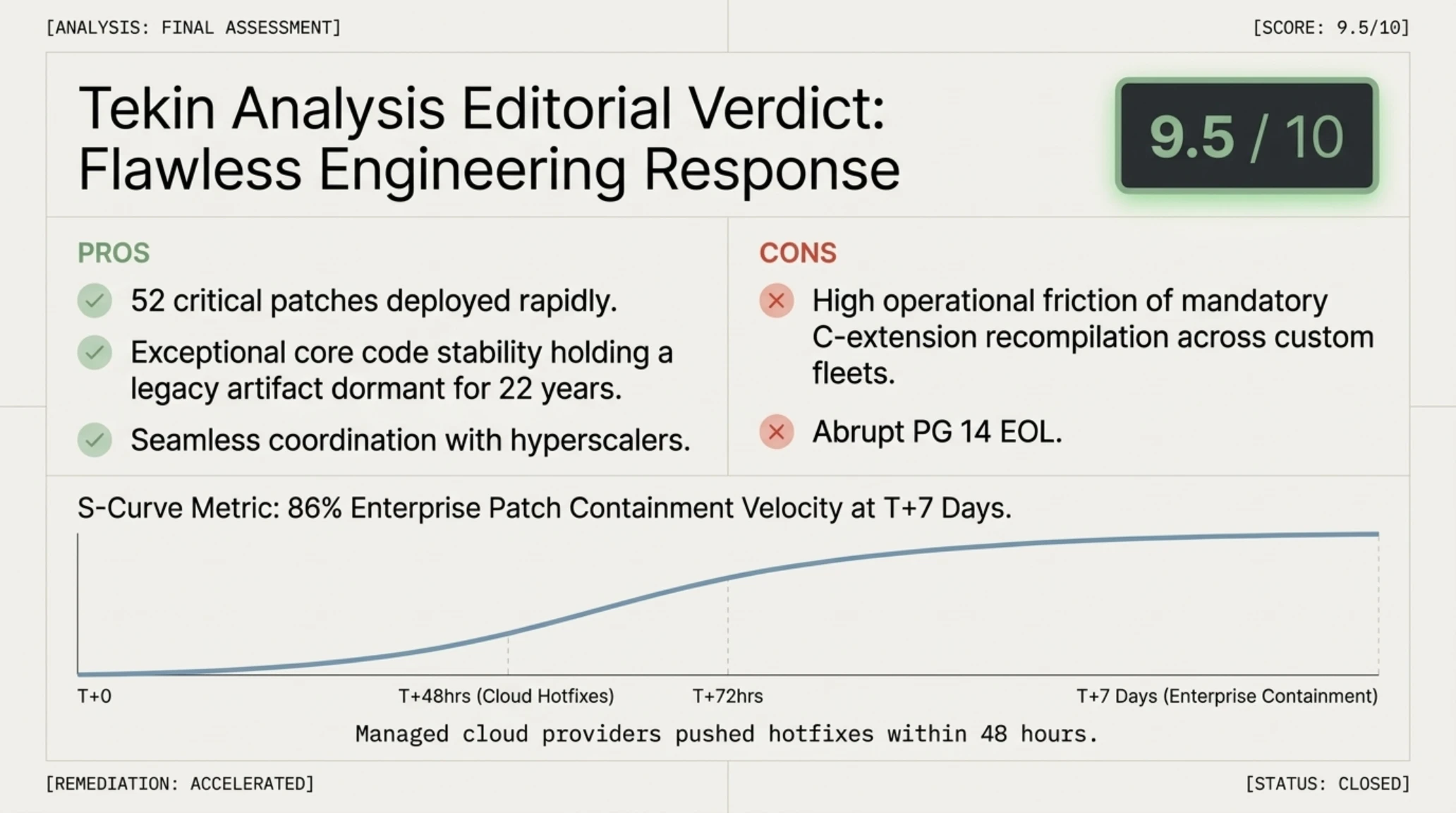
A multi-dimensional appraisal of the PostgreSQL Global Development Group's incident response demonstrates the unparalleled integrity of open-source peer review:
- Rapid coordinated deployment of 52 critical patches across all active database branches.
- Exemplary transparency documenting the type confusion mechanism and C extension rebuild requirements.
- Exceptional core code stability that kept this legacy artifact dormant for twenty-two years.
- Seamless coordination with hyperscale cloud providers to push synchronized managed updates.
- High operational friction requiring mandatory recompilation of C extensions across custom fleets.
- Abrupt End-of-Life retirement of the widely deployed PostgreSQL 14 enterprise branch.
- Elevated multi-tenant isolation risk for lightweight DBaaS and shared hosting providers.
Strategic Verdict: Open-Source Transparency Triumph Over Technical Debt
The disclosure and swift resolution of CVE-2026-6460 marks a defining milestone in the maturity of open-source enterprise infrastructure. Within proprietary, closed-source database architectures, architectural flaws of comparable antiquity frequently languish in binary obscurity for decades, leaving corporate customers oblivious to silent exploitation by state-sponsored actors and cyber syndicates. In stark contrast, open-source governance ensures that when a foundational defect is discovered, reproduction harnesses, regression test cases, binary patches, and architectural mitigations are immediately subjected to peer scrutiny across the global engineering community:
This incident provides enduring lessons for the next generation of systems architects: from the imperative of designing self-identifying memory types to the necessity of sandboxing foreign function interfaces. PostgreSQL has reinforced its status as the world's most trusted relational data engine not through an illusory promise of infallible perfection, but through the courage to confront generational technical debt with transparent, unyielding engineering excellence.
Continuous database telemetry confirms that production clusters worldwide have successfully absorbed these updates, fortifying global cloud platforms for the next computational era:
The synthesis of rigorous code hygiene and rapid community coordination ensures that enterprise data architectures emerge from this crisis stronger, faster, and more resilient than ever before:
Editorial Verdict and Official Sources Dossier
- PostgreSQL Global Development Group (Official): Official Security Advisory for November 2026 Releases and CVE-2026-6460 Mitigation Guidance
- The Hacker News Cybersecurity Journal: PostgreSQL Patches 52 Flaws Including 22-Year-Old Bug Enabling Authenticated Remote Code Execution
- National Vulnerability Database (NIST NVD): Comprehensive Technical Analysis of CVE-2026-6460 High-Severity Type Confusion Flaw
Frequently Asked Questions: PostgreSQL CVE-2026-6460 Security Advisory
How does CVE-2026-6460 enable remote code execution?
The vulnerability stems from a type confusion condition within PostgreSQL internal data dictionary handling. By executing crafted DDL statements combined with transaction rollbacks, an authenticated user tricks the server into misinterpreting user-controlled bytes as FmgrInfo function pointers, redirecting execution to arbitrary machine code with OS-level postgres user privileges.
Why is updating the core PostgreSQL binaries insufficient to secure a cluster?
The security patch alters internal struct layouts and type tracking within core C headers. Third-party C extensions compiled against pre-patch headers will suffer from severe ABI desynchronization in memory, leading to crashes or continued exploitability unless all extensions like pgvector and PostGIS are recompiled against updated headers.
Can unauthenticated attackers exploit this vulnerability over the public internet?
No; exploitation strictly requires an authenticated session and permissions to create temporary database objects or tables. However, the threat is critical for multi-tenant cloud environments, SaaS platforms, and shared DBaaS architectures where untrusted tenants share common database instances.
Is PostgreSQL 14 still receiving security patches?
PostgreSQL 14.25 represents the final official security update for branch 14, which has now officially reached End-of-Life (EOL). While 14.25 patches CVE-2026-6460, the branch will receive no further security fixes, making migration to versions 16 or 17 an urgent enterprise priority.
What immediate mitigation can be applied if a server cannot be immediately rebooted?
Administrators should execute REVOKE CREATE ON SCHEMA public FROM PUBLIC across all databases. This prevents unprivileged roles from creating the temporary relations and types necessary to initiate the type confusion exploit sequence.
Which PostgreSQL extensions require immediate recompilation?
All C-language shared object extensions that interact with native data types or index access methods must be recompiled, including pgvector, PostGIS, TimescaleDB, Citus, pg_cron, and pg_stat_statements.
Additional Gallery: Tekin Analysis: PostgreSQL 22-Year RCE Bug & 52 Patches