Tekin Analysis | Mass Effect Universe: Anatomy of BioWare's Canceled Masterpiece & The Logic Engine
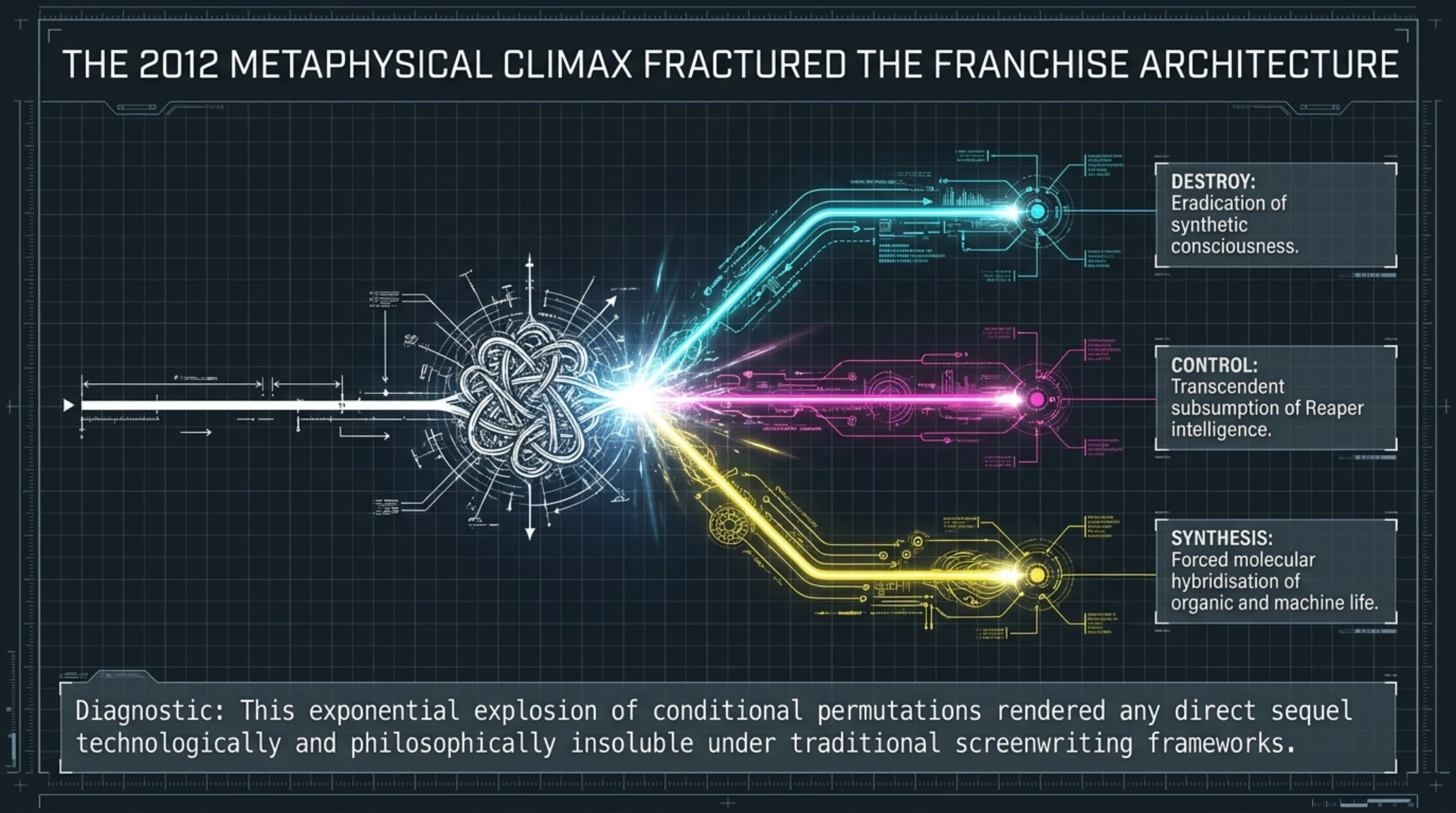
For more than a decade, interactive entertainment has grappled with the narrative aftermath of Mass Effect 3. The 2012 climax did not merely conclude Commander Shepard's crusade against the Reapers; it fundamentally fractured the structural cohesion of BioWare's science fiction cosmos. By presenting three diametrically opposed galactic resolutions the eradication of synthetic consciousness (Destroy), the transcendent subsumption of Reaper intelligence (Control), and the forced molecular hybridization of organic and machine life (Synthesis) the studio engineered a narrative gordian knot that appeared technologically and philosophically insoluble for any direct sequel.
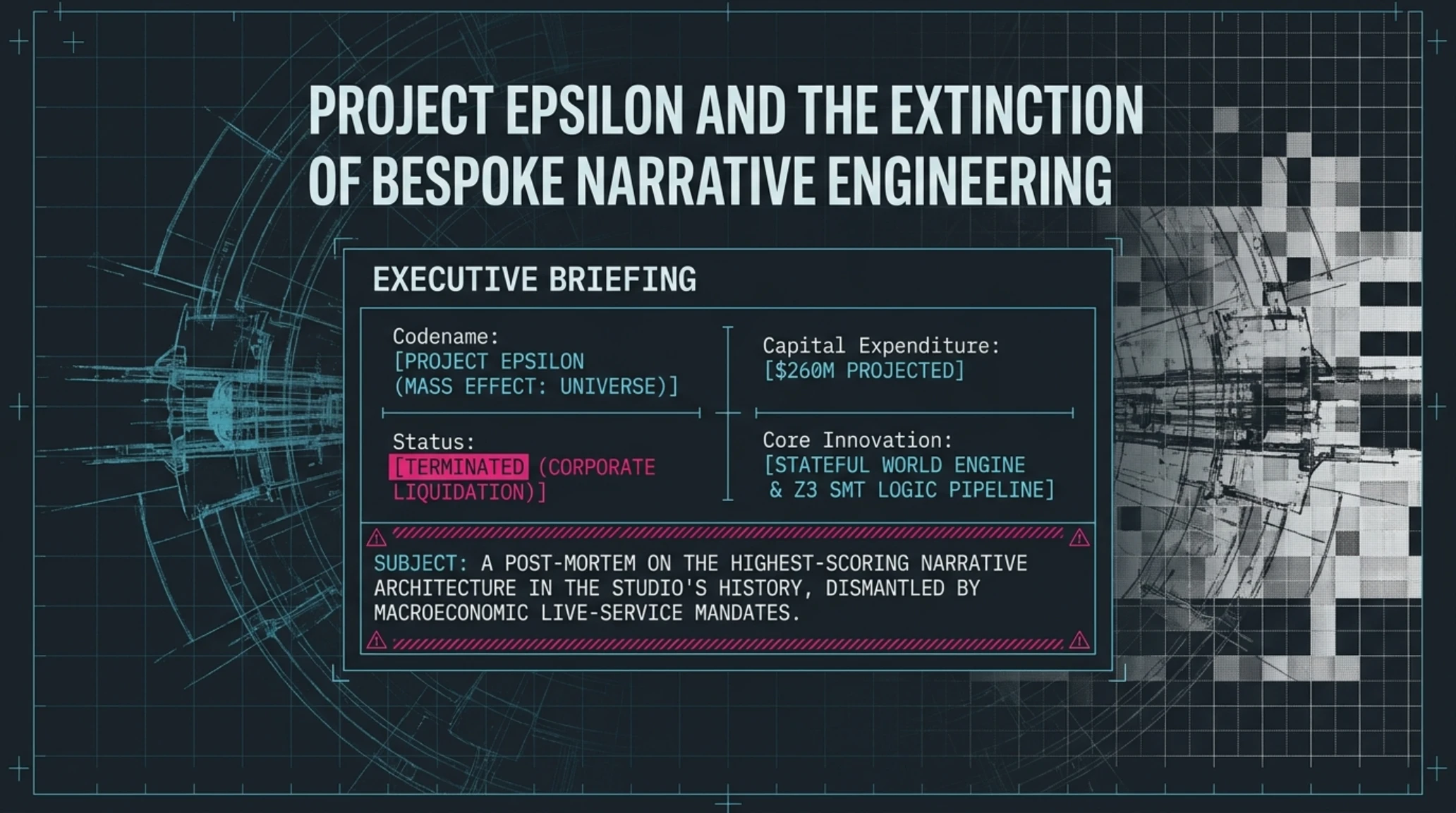
In late October 2026, the sudden corporate shuttering of BioWare Edmonton by Electronic Arts brought an unceremonious end to three decades of landmark role-playing game production. Yet in the wake of the studio's collapse, a massive leak of internal technical specifications, game design documents, and development retrospectives emerged across development communities. The leaks revealed the existence of Mass Effect: Universe (known internally as Project Epsilon), demonstrating that BioWare was not preparing to arbitrarily canonize a single ending, nor retreat permanently into the isolated frontier of Andromeda. Instead, the engineering staff had spent five years constructing a revolutionary mathematical logic framework designed to ingest all player histories simultaneously.
The tragedy of BioWare's final chapter lies in the sheer disconnect between corporate executive priorities and raw software engineering brilliance. Throughout the 2000s, BioWare had pioneered the modern dialogue wheel, cinematic branching logic, and persistent cross-title save state serialization. When the original Mass Effect launched in 2007 on the Xbox 360, it represented an unprecedented technical wager: that players would carry emotional and mechanical consequences across multiple discs and multiple release cycles spanning half a decade. When that ambition collided with the metaphysical climax of Mass Effect 3, the resulting creative trauma paralyzed the franchise for over a generation.
Following the commercially troubled launch of Mass Effect: Andromeda in 2017 and the catastrophic live-service detour of Anthem, EA leadership imposed draconian oversight upon Edmonton. Yet under veteran leadership including Project Director Michael Gamble, a secretive skunkworks core within BioWare began laying the algorithmic foundation for Project Epsilon. Rather than succumbing to the temptation of wiping the slate clean with a reboot, this engineering strike-team set out to prove that computer science could reconcile what traditional screenwriting could not.
As documented in our comprehensive forensic investigation in Tekin Night October 23, 2026: Autopsy of BioWare Edmonton Closure, Battlefront 3 Cancellation, and the Xbox Cloud War, this liquidation marked the tragic climax of corporate risk aversion prioritizing short-term recurring monetization over visionary software design.
Strategic Assessment and Key Intelligence Vectors
The Six-Century Temporal Chasm; Reconstructing the Milky Way
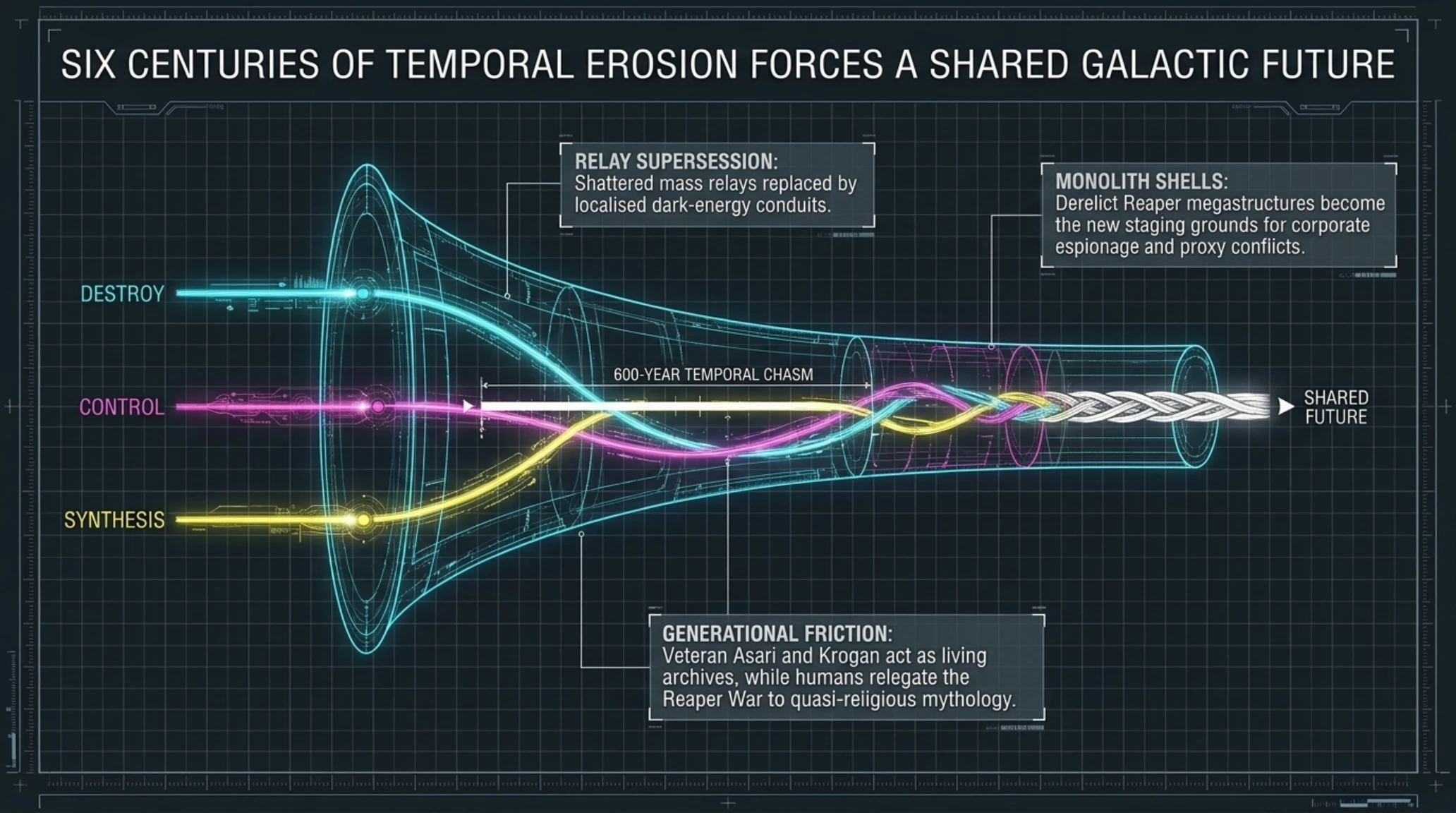
The core narrative premise of Mass Effect: Universe was predicated upon a deliberate 600-year temporal jump into the Milky Way's future. By advancing six centuries past the cataclysm of the Reaper War, the writing staff circumvented the immediate logistical nightmare of planetary reconstruction and galactic famine, while maintaining exact synchronization with the arrival timeline of the Andromeda Initiative. This was not a lazy narrative retreat; it was a calibrated mathematical necessity.
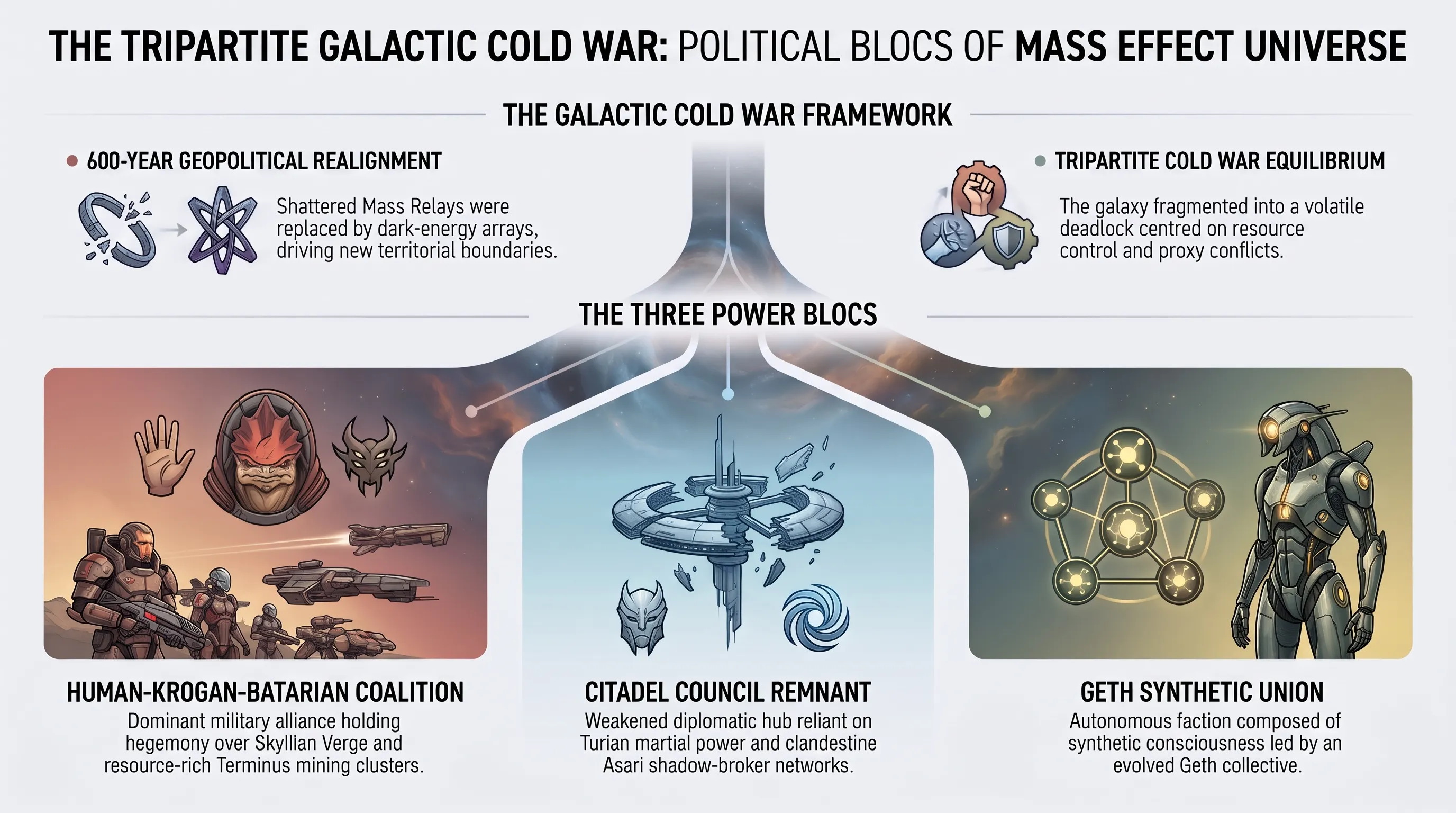
Over six hundred years, the raw divergence between the three endings experienced natural historical convergence. The Relay network, shattered during the Crucible's discharge, had not merely been repaired; it had been superseded by localized dark-energy conduit arrays and gravitational warp corridors. Galactic power structures underwent tectonic realignment. The Asari Republics and Salarian Union, crippled by their initial reluctance to engage during the early stages of the Reaper invasion, found their diplomatic supremacy shattered.
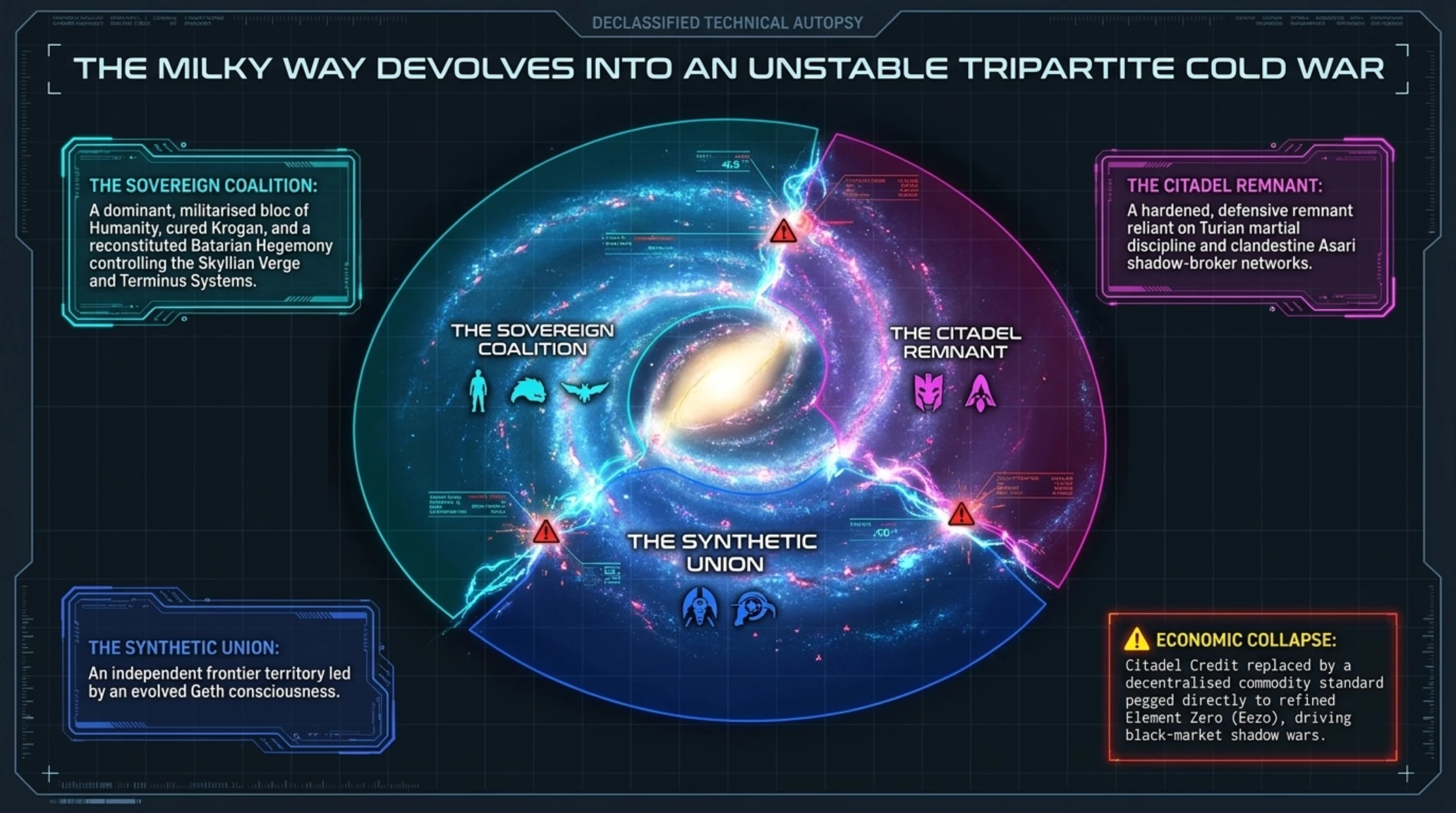
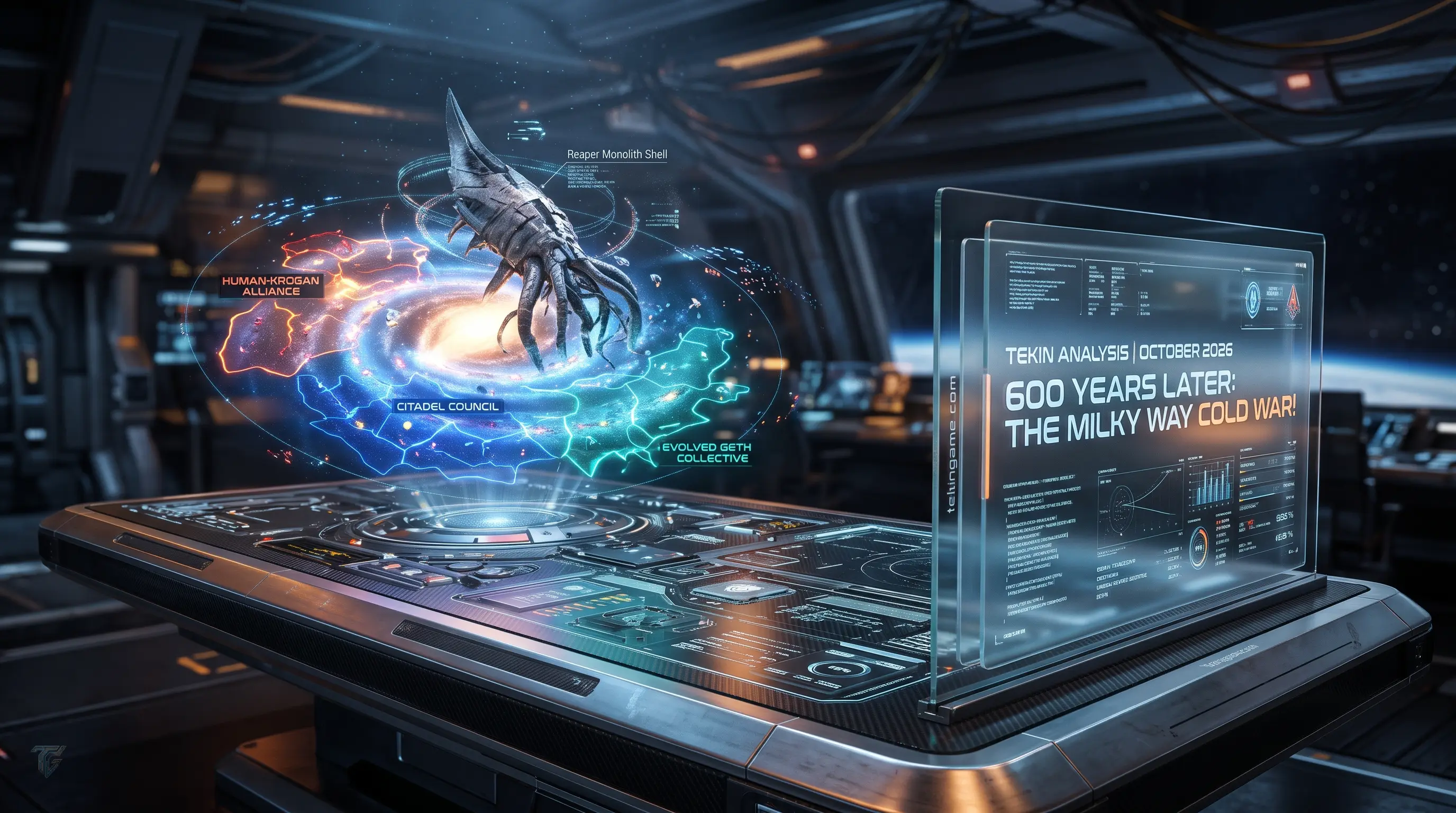
In their place rose a dominant, militarized faction: a sovereign coalition formed between Humanity, the cured Krogan populations of Tuchanka, and the reconstituted Batarian Hegemony. This bloc held territorial hegemony across the Skyllian Verge and the Terminus Systems. Confronting them was a hardened Citadel remnant, reliant on Turian martial discipline and clandestine Asari shadow-broker networks, alongside an independent Synthetic Union led by an evolved Geth consciousness. The galaxy was locked in an intricate, espionage-driven Cold War.
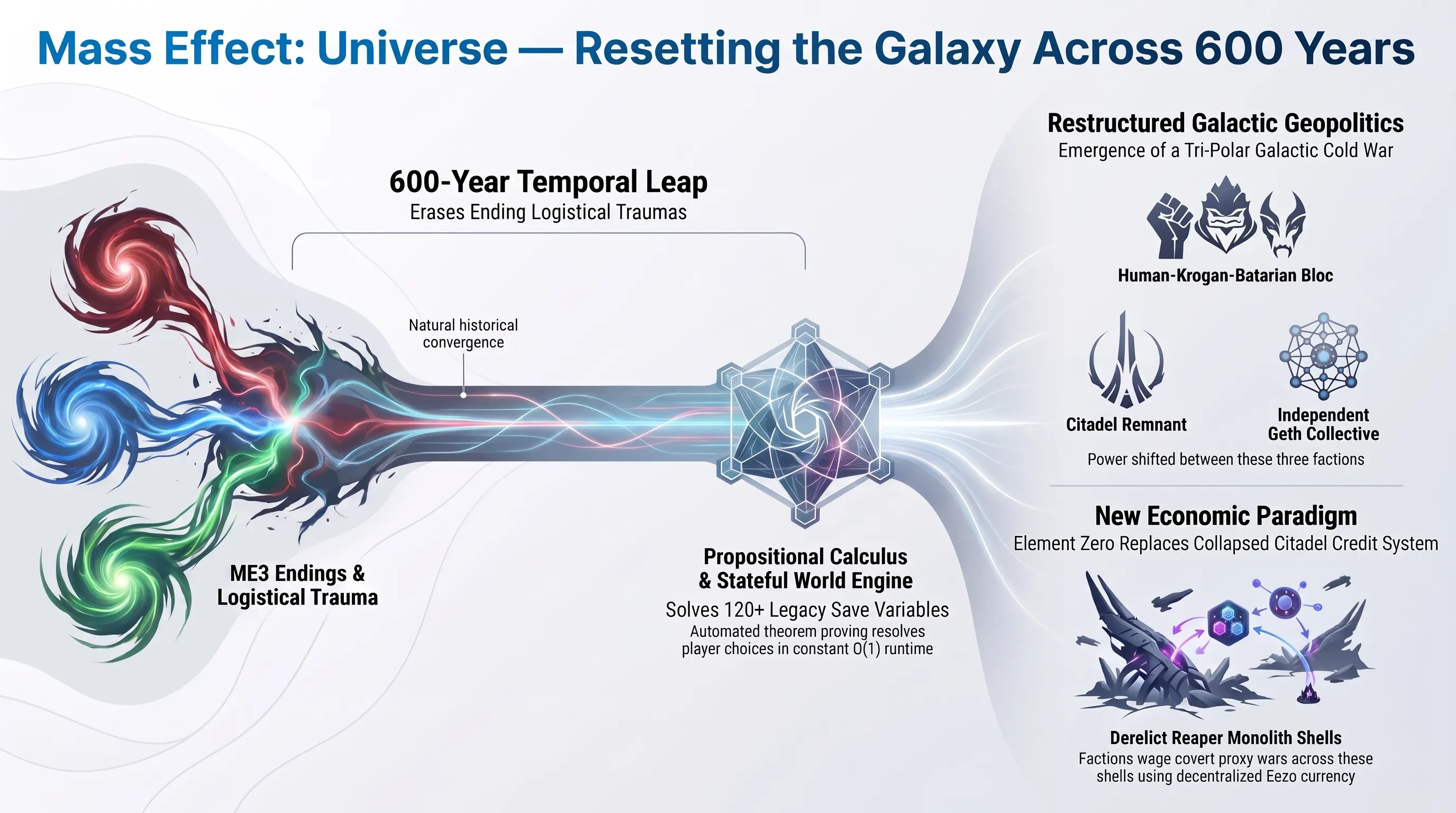
This geopolitical tripartition transformed the Milky Way into an unstable equilibrium. The human-krogan alliance, forged through shared blood during the Crucible campaign and solidified by Urdnot Wrex's lineage, controlled vast resource-rich mining clusters previously claimed by the Council. The Batarians, stripped of their former slave-state oligarchy, functioned as industrial logistical specialists within this bloc. Across the frontier, planetary governments established localized trade accords, while the Citadel functioned less as a galactic capital and more as a contested diplomatic DMZ.
The economic underpinning of the galaxy underwent a concurrent monetary collapse. The centralized Citadel Credit system, backed by the Council's pre-war banking cartel, had disintegrated following the destruction of major financial nodes on Thessia and Earth. In its wake, the Milky Way operated under a decentralized commodity standard pegged directly to refined element zero (Eezo). Mining conglomerates and private military contractors competed violently for newly discovered mass-effect mineral veins, establishing clandestine black-market exchanges across Omega where untraceable cryptographic scrip financed covert shadow wars.
Sociologically, the six-century passage of time created profound generational tension between long-lived and short-lived species. Veteran Asari matriarchs and elder Krogan battlemasters who had personally fought alongside Commander Shepard survived into this era, serving as cynical living archives of a mythological past. Conversely, for humans, salarians, and turians, the Reaper War had retreated into ancient history relegated to textbook doctrine and quasi-religious mythology. This longevity divide fueled intense diplomatic friction, as human politicians chafed under the patronizing conservatism of Asari leaders who viewed humanity's rapid territorial expansion as reckless and volatile.
Crucially, the disappearance of the Reapers whether via total destruction, divine isolation under Shepard's machine consciousness, or peaceful integration through synthetic-organic synthesis left behind colossal derelict structures known as 'Monolith Shells.' These celestial megastructures became the staging grounds for proxy conflicts, clandestine salvage operations, and corporate espionage. The threat facing the galaxy was no longer an apocalyptic fleet emerging from dark space, but the internal corruption, territorial greed, and ideological fracturing of civilization itself.
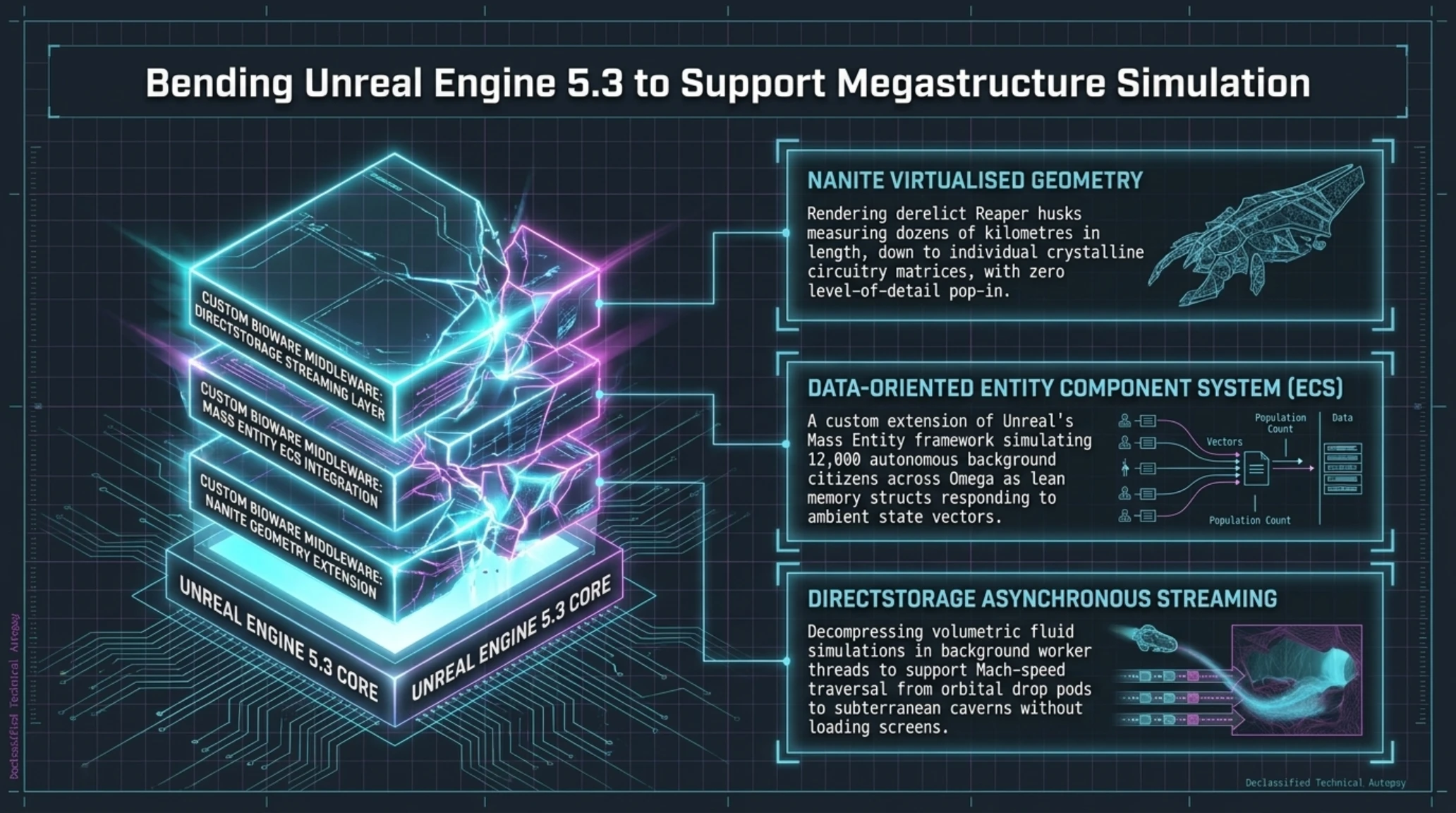
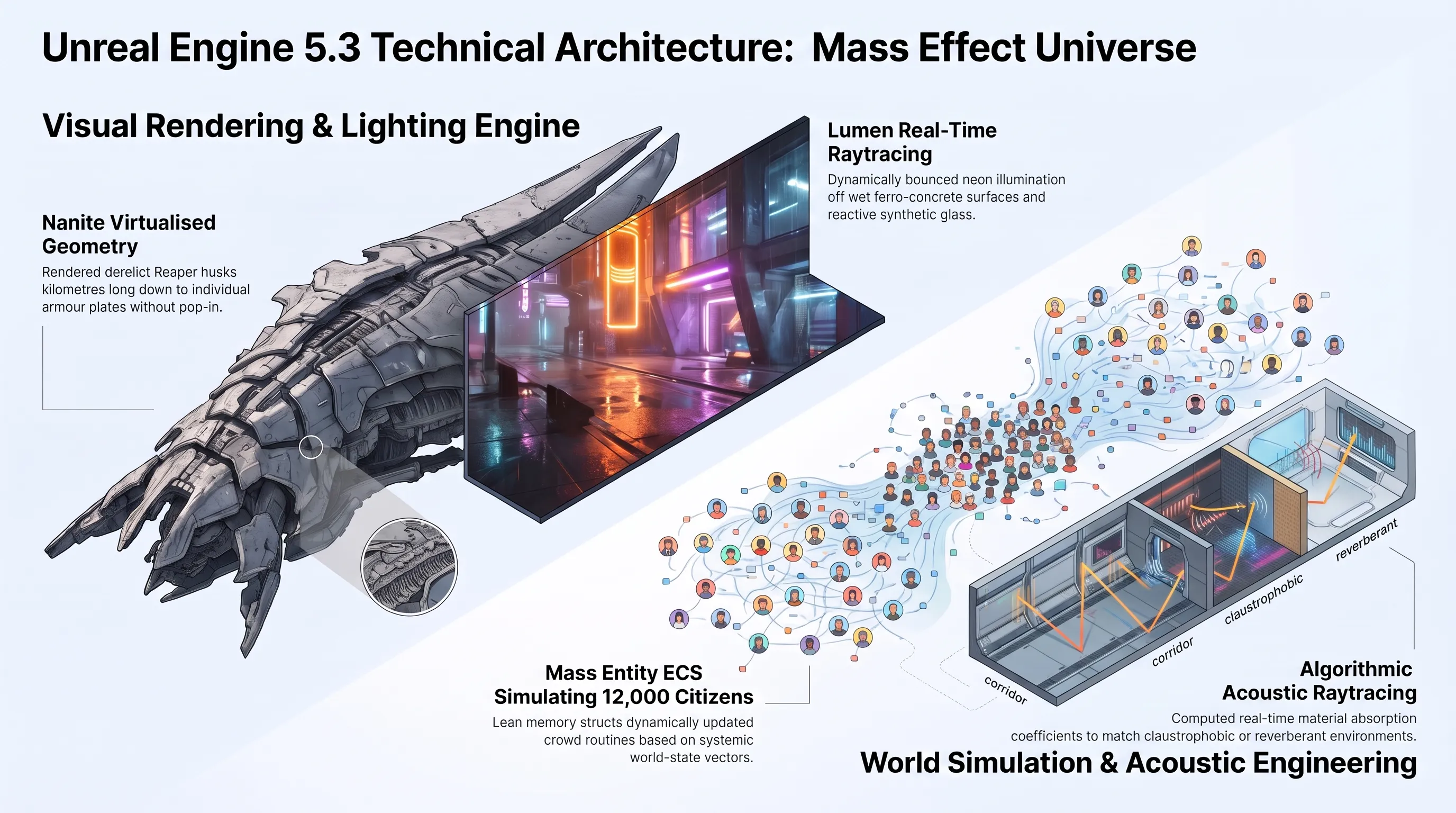
To render this vast cosmic tapestry, BioWare constructed a bespoke pipeline on top of Epic Games' Unreal Engine 5.3 runtime. Decompiled asset manifests show extensive utilization of Nanite programmable geometry to render derelict Reaper husks measuring dozens of kilometers in length without level-of-detail pop-in. Each derelict hull was modeled down to individual armor plates and crystalline circuitry matrices. Lighting across the subterranean wards of the Citadel relied on Lumen software and hardware raytracing, bouncing colored neon illumination off wet ferro-concrete surfaces and reactive synthetic glass.
Furthermore, BioWare engineered a specialized extension of Unreal's Mass Entity framework a data-oriented Entity Component System (ECS). This architecture permitted the simulation of upwards of 12,000 autonomous background citizens across the multi-tiered hubs of Omega and the Presidium. Rather than utilizing expensive actor classes, these crowd entities operated as lean memory structs, dynamically shifting their daily routines, political protests, and economic transactions based on the ambient state vector computed by the game's central logic solver.
To support seamless planetary transitions without conventional loading screens, the engineering team designed an asynchronous asset streaming pipeline that interfaced directly with Unreal Engine 5's World Partition grid. High-speed DirectStorage I/O routines decompressed Nanite mesh clusters and volumetric Niagara fluid simulations in background worker threads, allowing the player to traverse from orbital drop pods down into deep underground mining caverns at Mach speeds while streaming gigabytes of structural geometry without micro-stutters or frame pacing degradation.
The auditory landscape was similarly grounded in cutting-edge computational acoustics. BioWare's sound engineers deployed an algorithmic acoustic raytracing engine that evaluated material absorption coefficients across diverse environments in real time. In the hollow, zero-gravity derelict chambers of a downed Reaper, gunshot reports resonated with cold, metallic, multi-second synthetic reverberations; in contrast, gunfights within the crowded, fiber-insulated black markets of Omega produced tight, claustrophobic acoustic signatures that enhanced spatial immersion.
Why This Disruption Changes the Industry Paradigm
The architecture of Mass Effect: Universe established that player agency and grand macro-narrative consistency could be unified through mathematical logic engines rather than clumsy retcons or forced canonical declarations.
The Logic Engine; Solving the Tripartite Ending Paradox with Propositional Calculus
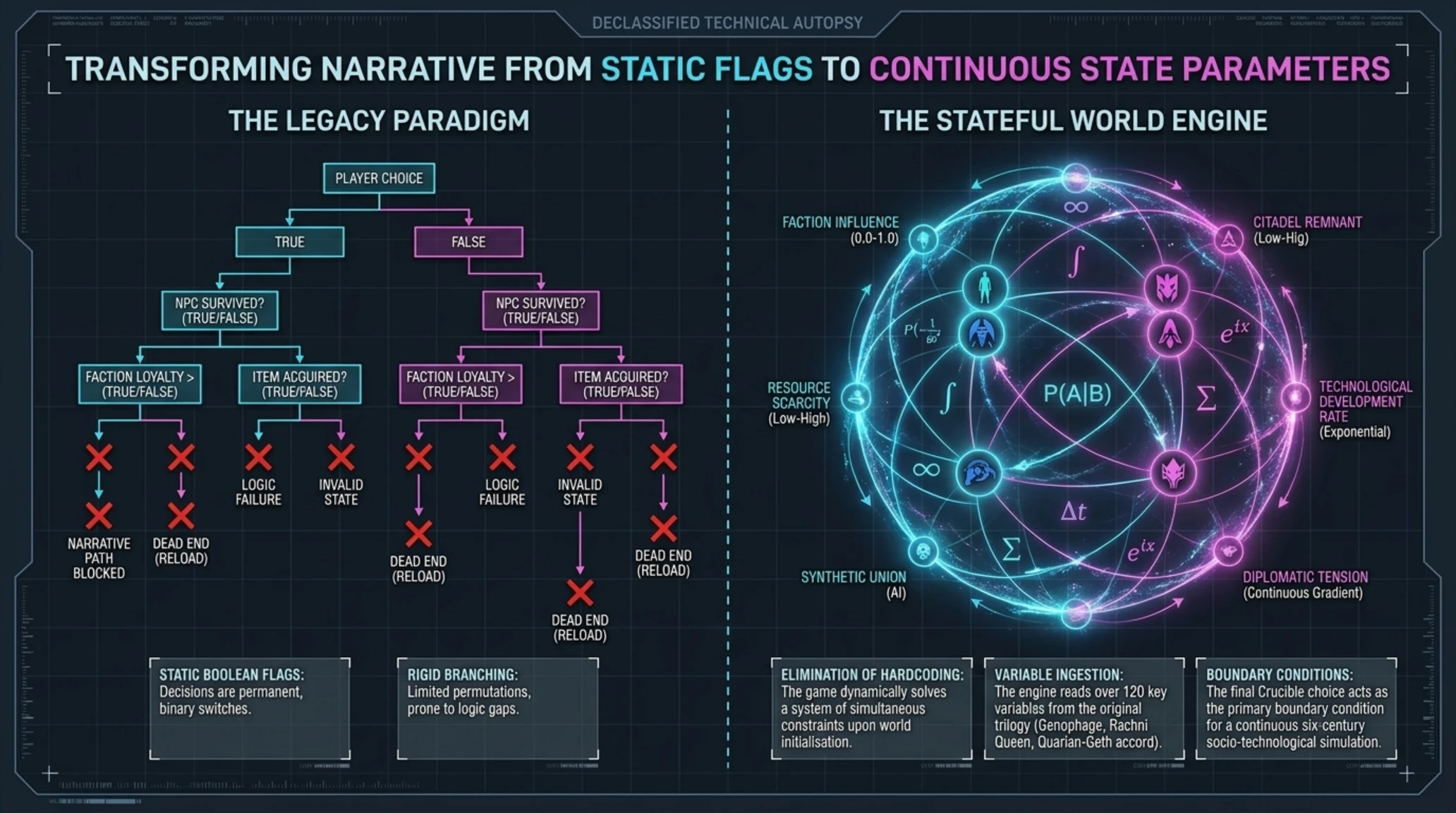
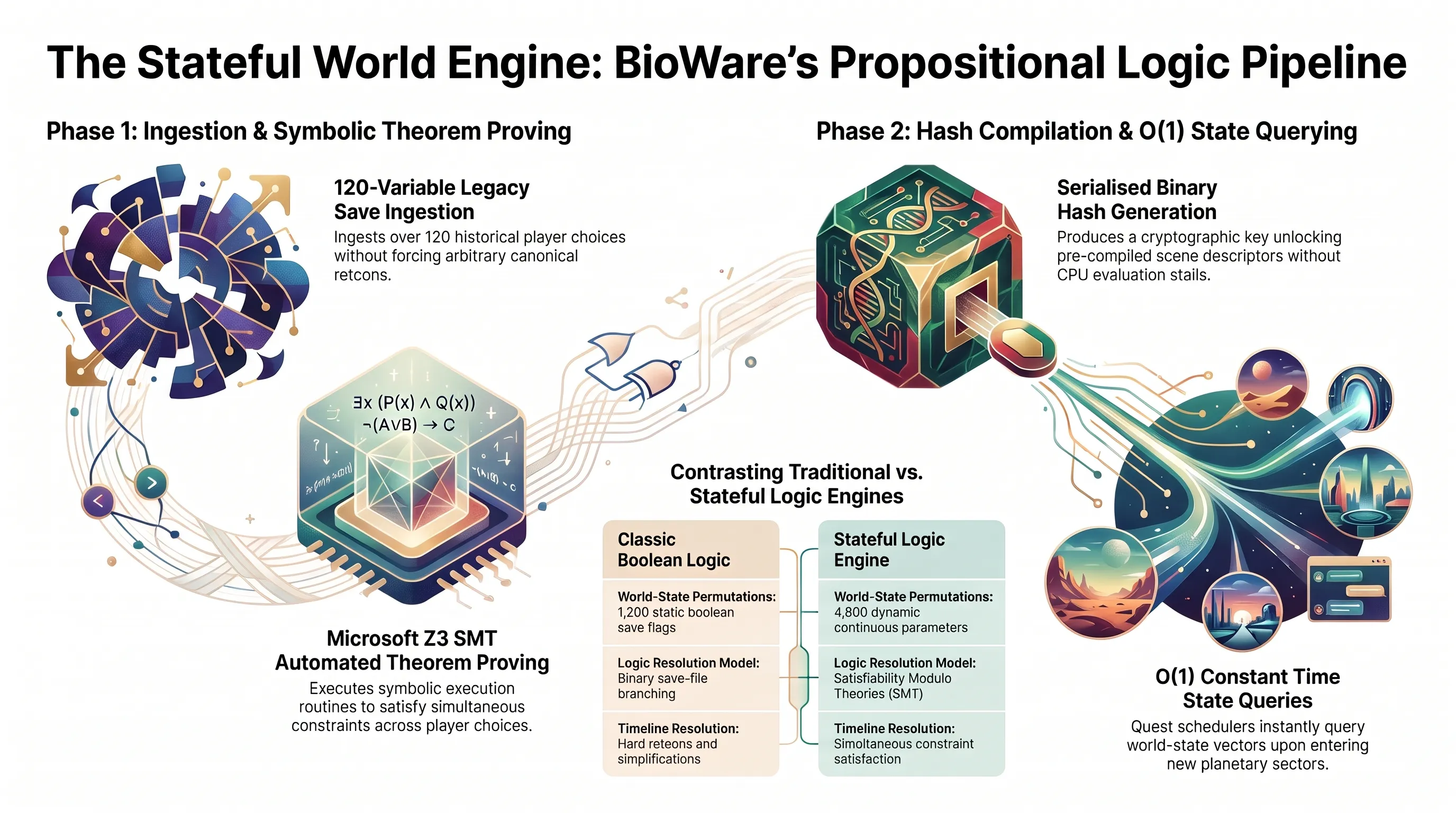
The defining technical innovation of Mass Effect: Universe was its proprietary logic resolution pipeline, referred to internally as the Stateful World Engine (SWE). In conventional branching video game narratives, decision trees are represented via static boolean flags. As the number of player choices expands over multi-game sagas, the exponential explosion of conditional permutations creates an unmaintainable testing matrix, commonly resulting in arbitrary simplification or outright retcons.
BioWare's software architects addressed this structural limitation by transforming the galaxy into an interconnected graph of stateful entities governed by formal propositional logic. Instead of hardcoding branching scenes for every conceivable combination of prior choices, the game dynamically solved a system of simultaneous constraints upon world initialization. When a player loaded their legacy save or generated a custom backstory profile, the engine ingested over 120 key variables from the original trilogy including the fate of the Genophage, the Rachni Queen, the Quarian-Geth peace accord, and the final Crucible choice.
Under this system, the Crucible's choice functioned not as a narrative dead-end, but as a primary boundary condition for a six-century social and technological simulation. In a world-state where the player chose Destroy, synthetic life was present not as continuous Geth lineage, but as a newly reconstituted, highly regulated cybernetic collective operating under severe biological distrust. In a world-state where Synthesis was selected, the aesthetic and cultural landscape shifted radically: characters displayed subtle luminescent epidermal circuitry, while biological augmentation became a dominant socio-economic fault line. In Control profiles, the Reapers had withdrawn into dark space centuries prior, leaving behind derelict monuments and lingering theological schisms.
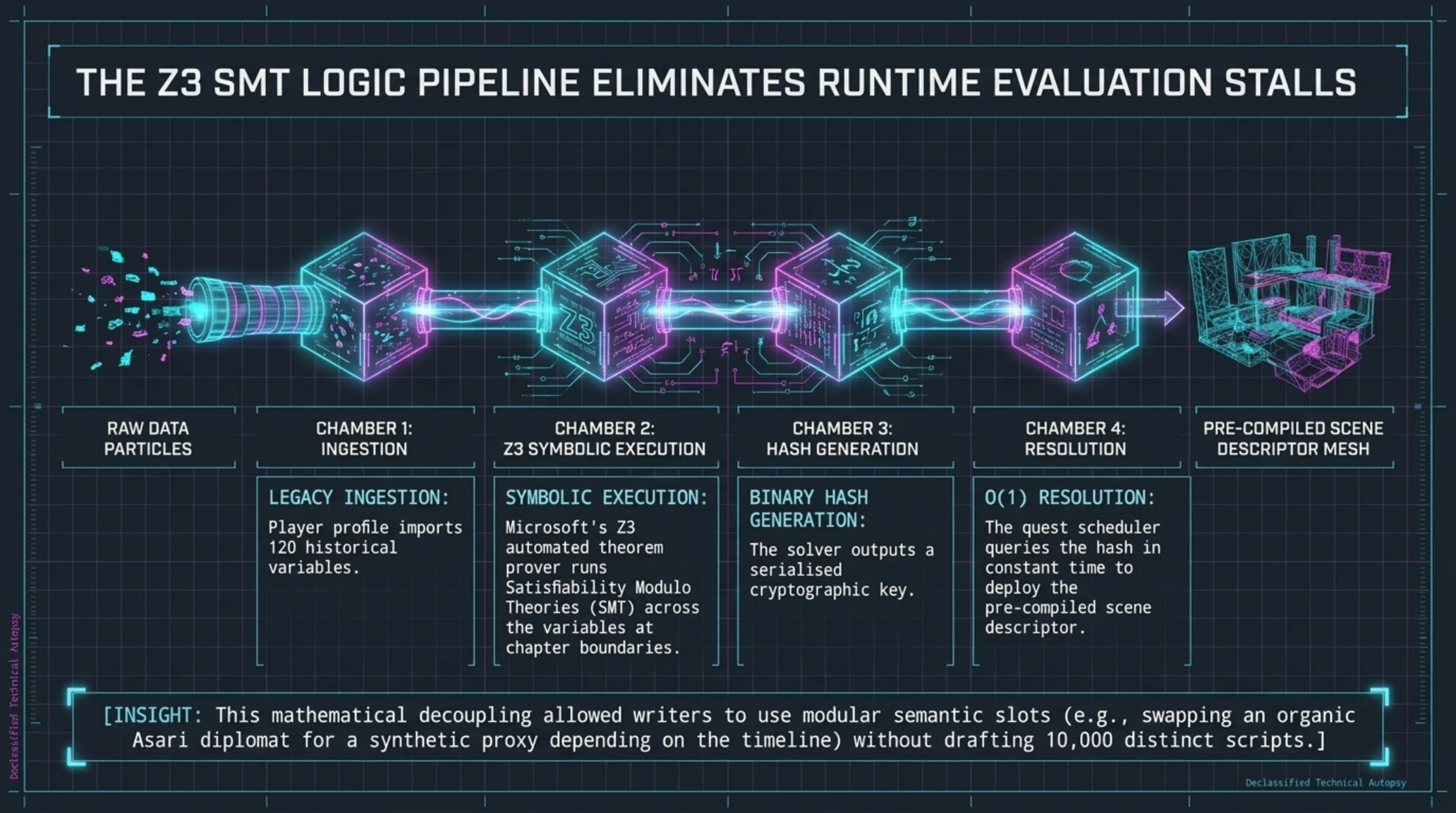
To execute this without inducing catastrophic CPU bottlenecks during gameplay, BioWare's core technology group adapted principles from automated theorem proving and Satisfiability Modulo Theories (SMT). Rather than running heavy evaluation loops during combat or exploration, the engine pre-compiled the player's historical state vector into a localized truth-table during chapter transitions. When entering a new planetary sector, such as the neon-drenched lower wards of the Citadel or the subterranean industrial shafts of Illium, the quest scheduler queried the state vector in O(1) constant time, dynamically activating NPC factions, environmental textures, and dialogue trees that adhered strictly to the player's personal timeline.
This mathematical decoupling meant that writers did not have to draft 10,000 distinct versions of every quest. Instead, quests were written with modular semantic slots. An operative delivering a tactical briefing might be an organic Asari diplomat in a Destroy universe, an augmented trans-biological specialist in a Synthesis timeline, or a synthetic proxy chassis in a Control universe. The emotional core of the mission remained stable, while the thematic context, voice acting intonation, and geopolitical stakes shifted seamlessly around the player.
Technical Verification | Myth vs Engineering Fact
Persistent rumors alleged BioWare planned to make the Destroy ending canonical, discarding Synthesis and Control completely.
Decompiled code proves the engine accommodated all three endings via mathematical convergence and dynamic state equations.
To eliminate computational latency across millions of potential world permutations, BioWare integrated Microsoft's Z3 automated theorem prover directly into the pre-rendering compilation pipeline. Whenever a chapter boundary was crossed, the SMT solver executed symbolic execution routines against the player's 120-variable legacy profile, producing a serialized binary hash. This hash acted as a cryptographic key that unlocked pre-compiled scene descriptors, eliminating runtime evaluation stalls while ensuring mathematical certainty that no narrative contradiction could manifest during gameplay.
The operational agility of this logic framework extended into environmental art and planetary level design. In Citadel sectors, the volumetric atmospheric density, corporate signage holographic typography, and ambient non-player character density dynamically re-rendered based on the diplomatic standing of the Citadel Council versus the Coalition of Free Systems. An environment that appeared as a heavily militarized, sterile police checkpoint in a Control universe transformed into a flourishing, organic trans-species bazaar in a Synthesis timeline, demonstrating complete systemic integration between narrative logic and environmental art.
At the procedural dialogue layer, narrative designers employed parameterized voice performance indexing. Dialogue lines were recorded with calibrated emotional variants, allowing the audio engine to adjust pitch, cadence, and vocal fry depending on the protagonist's accumulated reputation across local faction jurisdictions. If an operative encountered a Batarian smuggler on Omega, the interaction was dynamically colored by whether the player had historically aided the Batarian diaspora or authorized severe naval blockades in prior campaigns.
This deterministic model convergence parallels the algorithmic paradigm shifts analyzed in our investigative feature The Fall of the Assembly Citadel: How AI Decompilation and Static Recompilation Reconstruct Classic Gaming Systems, demonstrating how automated logic synthesis replaces brittle hard-coded branching.
Mathematically, the engine represented the galactic state as a multi-dimensional matrix $S = \{V_1, V_2, \dots, V_n\}$, where each vector $V$ captured a socio-technological dimension over time $t = 600$. For instance, the presence of the Geth was formulated as a continuous probability function conditioned upon the player's original choice $C \in \{\text{Destroy}, \text{Control}, \text{Synthesis}\}$ and their resolution of the Rannoch campaign $R \in \{\text{Geth Extinction}, \text{Quarian Extinction}, \text{Peace}\}$. The solver demonstrated that under all permutations, the mathematical derivative $dS/dt$ converged toward a tri-polar diplomatic equilibrium after six centuries, providing a rigorous mathematical proof that complete narrative freedom could coexist with world-state stability.
Tekin Technical Glossary
The Protagonist; A Customizable John Wick N7 Operative
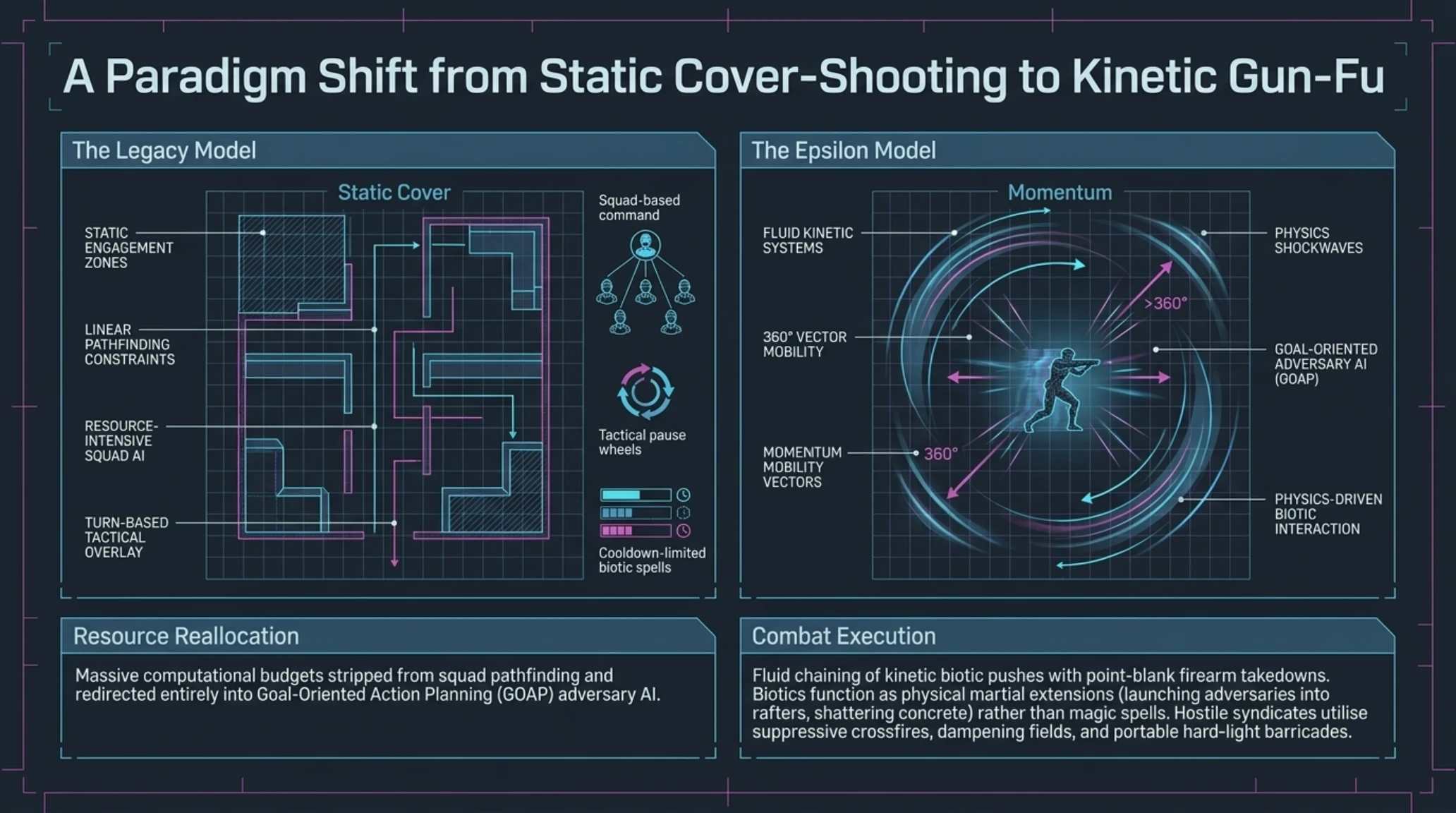
From an interactive systems perspective, Mass Effect: Universe severed ties with the traditional squad-command framework that defined the original trilogy. Players no longer commanded two AI squadmates via a tactical pause wheel. Instead, the design documents reveal a deeply focused single-character combat loop benchmarked directly against the fluidity and lethality of modern action cinema, characterized in development memos as a John Wick of Citadel Space.
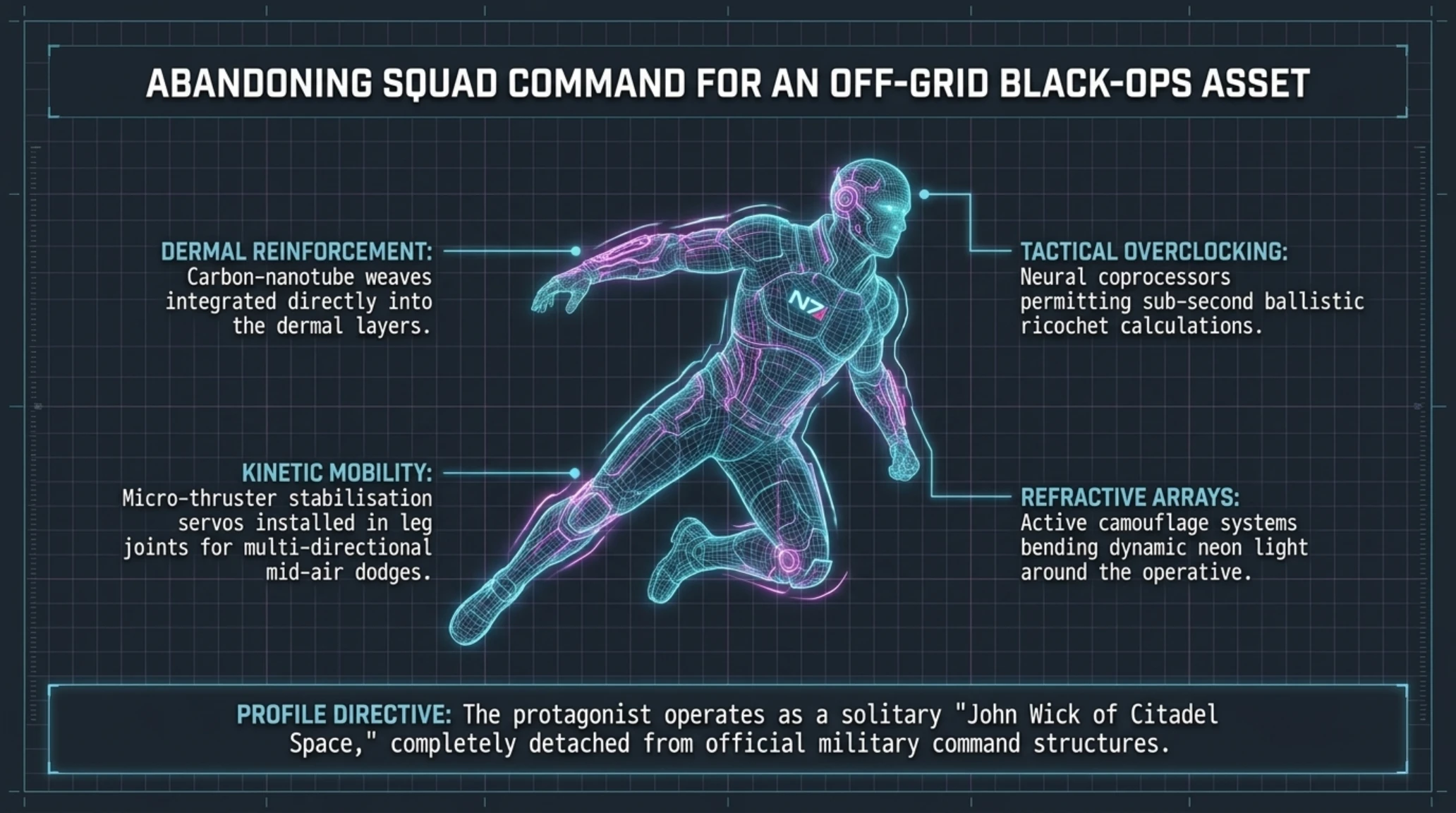
The protagonist was an N7 operator operating off-grid in the galactic underworld a customized black-ops asset detached from official military command structures. The combat design abandoned rigid cover-shooting mechanics in favor of momentum-based traversal, close-quarters gun-fu, and reactive biotic physics. Players could fluidly chain kinetic biotic pushes with micro-warp fields, slide across polished neon corridors, utilize human shields, and execute point-blank kinetic firearm takedowns.
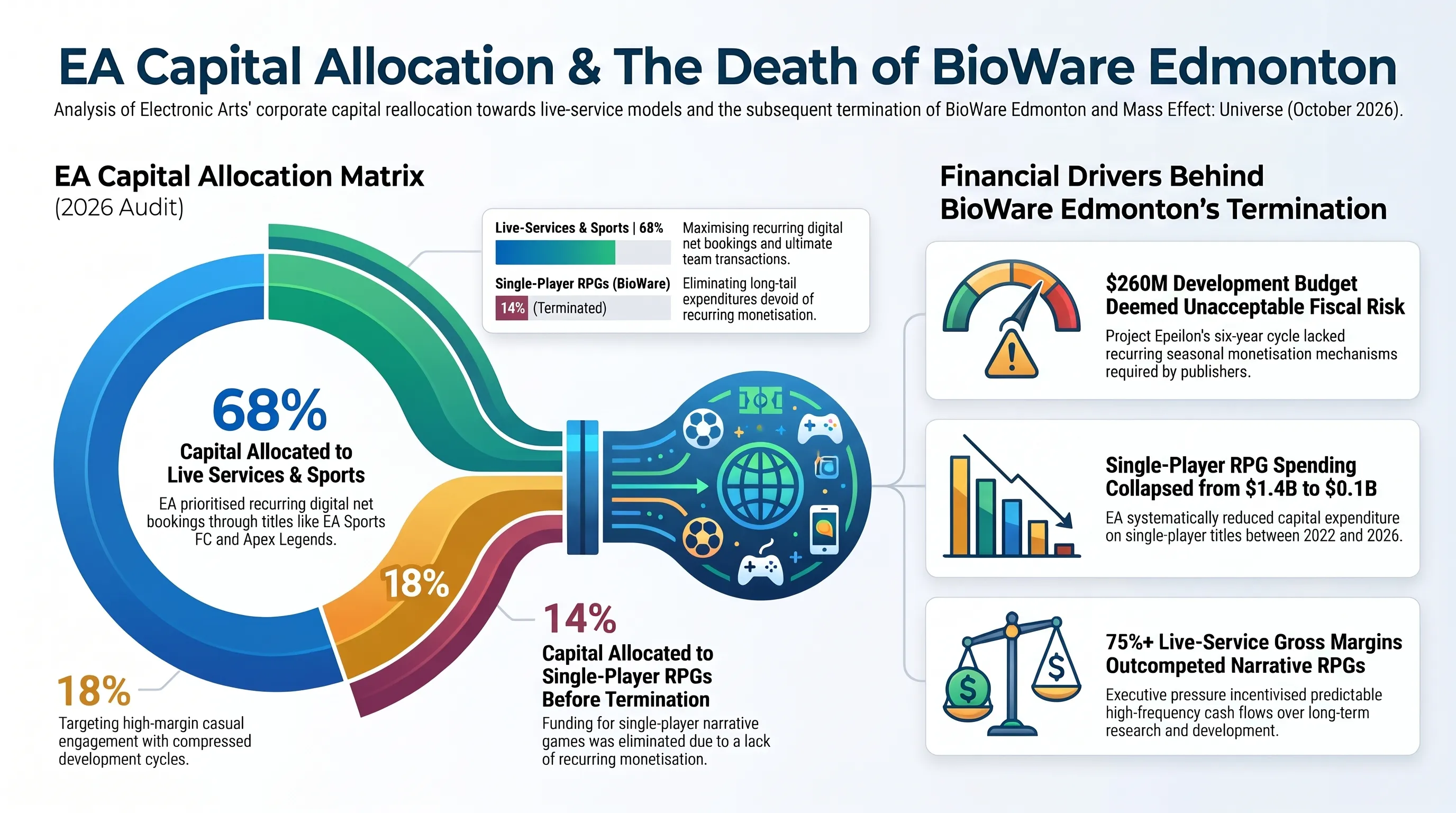
Weapons were heavily customized via modular magnetic accelerators and dark-energy ammunition capacitors. Players could re-chamber a heavy pistol to fire armor-piercing depleted uranium slugs or switch on the fly to high-frequency plasma bursts that disrupted kinetic barriers. Biotic powers ceased to be cooldown-limited spells and became kinetic extensions of martial arts movements: a low sweep with biotic mass reduction could launch an adversary into ceiling rafters, while a high-velocity biotic slam created a localized shockwave that shattered surrounding glass and concrete cover.
This structural shift allowed BioWare to solve a persistent engineering bottleneck in Unreal Engine 5: the massive computational budget typically allocated to squad AI pathfinding and companion dialogue synchronization could be entirely redirected toward advanced adversary behavioral trees, procedural destruction physics, and hyper-dense volumetric environments within the multi-tiered megastructures of the Citadel and Omega.
The operative's tactical progression centered on deep cybernetic and kinetic customization. Players could weave carbon-nanotube reinforcement directly into the protagonist's dermal layers, install micro-thruster stabilization servos in leg joints for multi-directional mid-air dodges, or equip active refractive camouflage arrays that bent dynamic neon light around the character. Neural coprocessors permitted sub-second tactical overclocking, allowing players to calculate ballistic ricochet angles against heavy bulkheads before unleashing suppressive fire.
Adversary AI was completely overhauled through a Goal-Oriented Action Planning (GOAP) architecture integrated directly into Unreal's Mass Entity framework. Hostile squads belonging to the Eclipse or Blood Pack syndicates operated with military cohesion: shock troopers deployed localized dampening fields to suppress the player's biotic powers, marksmen dynamically took high-altitude sniper perches to cut off retreat routes, and heavy combat synthetics established suppressive crossfires while advancing behind portable hard-light barricades.
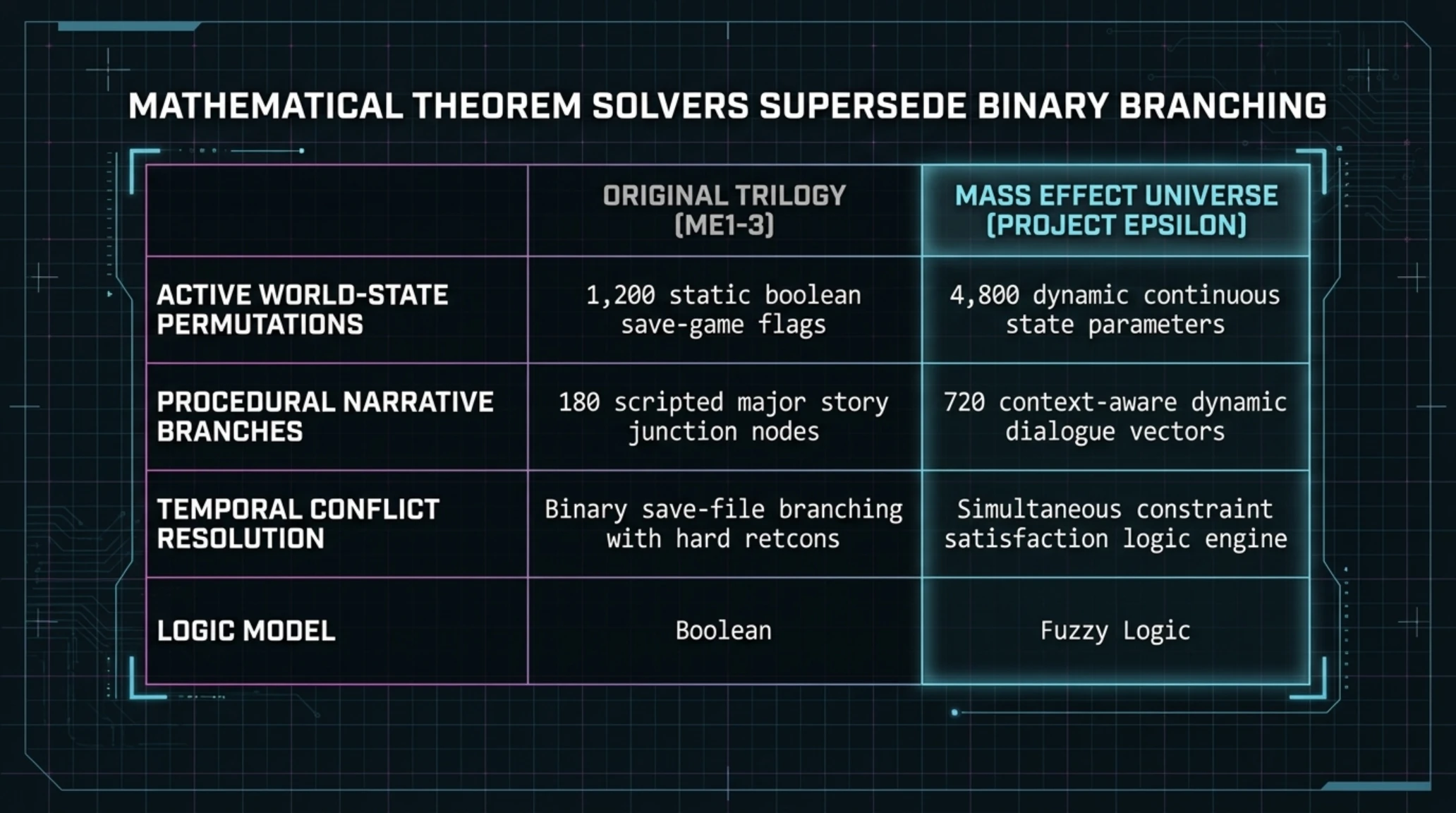
Grouped Bar Chart and Technical Specification Matrix
| Architecture Dimension | Original Trilogy (ME1-3) | Mass Effect Universe (Project Epsilon) |
|---|---|---|
| Active World-State Permutations | 1,200 static boolean save-game flags | 4,800 dynamic continuous state parameters |
| Procedural Narrative Branches | 180 scripted major story junction nodes | 720 context-aware dynamic dialogue vectors |
| Temporal Conflict Resolution | Binary save-file branching with hard retcons | Simultaneous constraint satisfaction logic engine |
Corporate Necrosis; Why Electronic Arts Liquidated Its Flagship Single-Player Vanguard
The death of Mass Effect: Universe cannot be divorced from the broader macroeconomic transformation of Electronic Arts. Over the preceding decade, EA's executive leadership methodically recalibrated corporate capital allocation away from prestige, narrative-dense single-player intellectual properties toward high-margin annualized live-service ecosystems. The economic calculus governing modern public gaming conglomerates is ruthlessly zero-sum: capital deployed into long-cycle narrative software is capital denied to recurring microtransaction platforms.
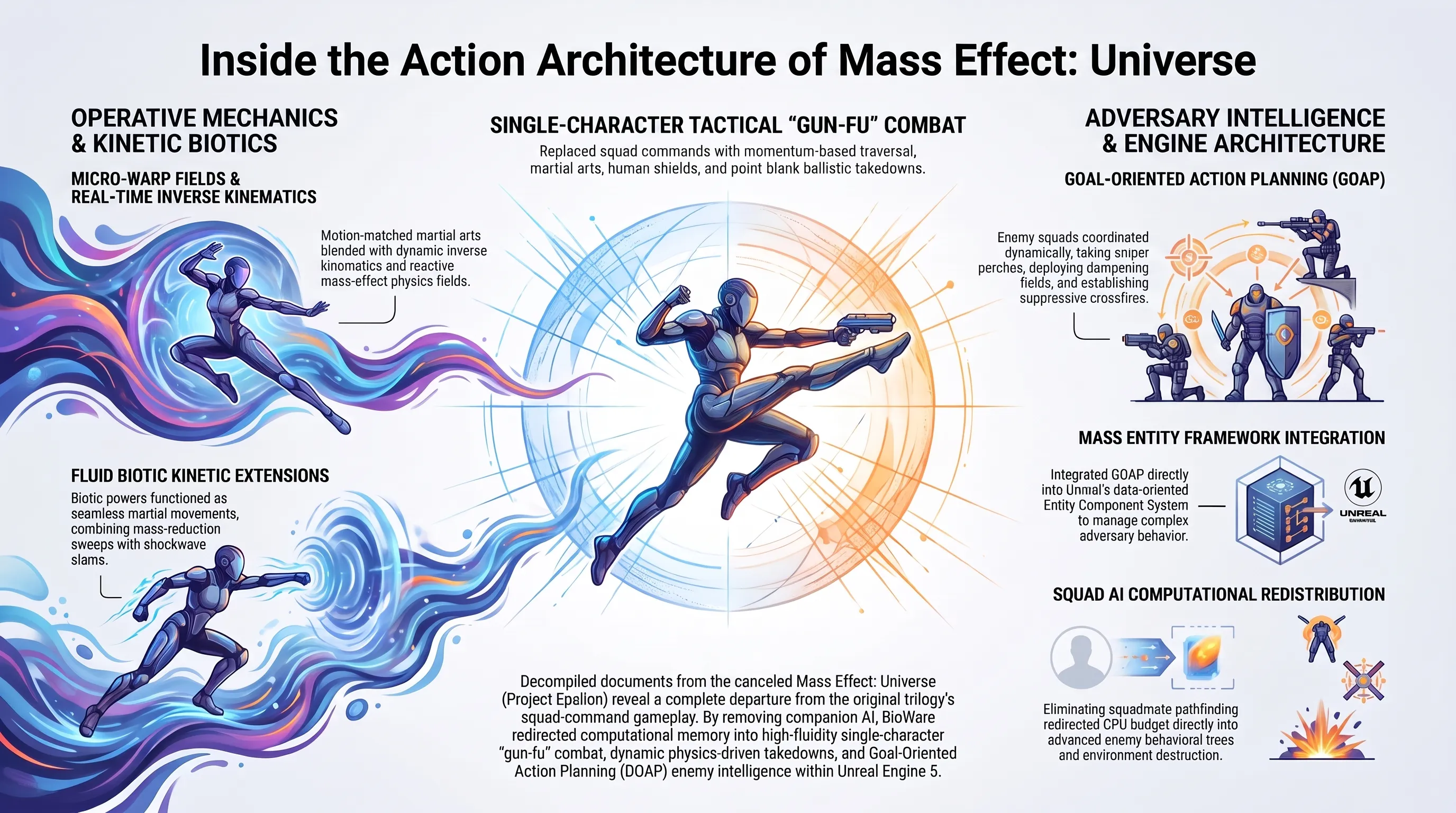
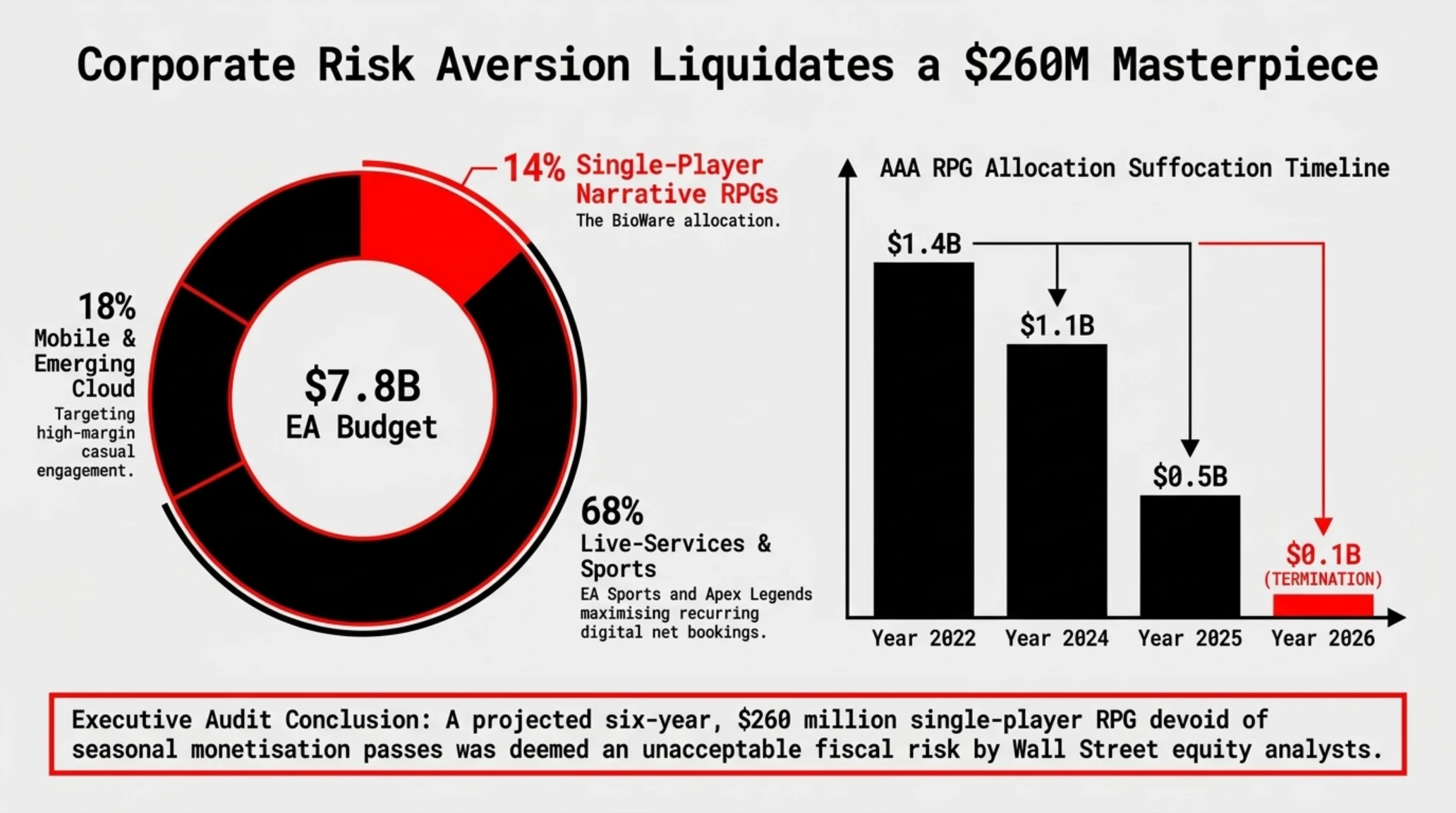
Internal financial audits revealed that Mass Effect: Universe was budgeted at approximately $260 million across a projected six-year production cycle. In an era where AAA development budgets have bloated uncontrollably while retail prices remain constrained, EA's board viewed a complex, mathematically intensive RPG without built-in seasonal monetization passes as an unacceptable fiscal risk. Following the prolonged restructuring following Dragon Age: The Veilguard and the lingering institutional trauma of Anthem, EA chose corporate liquidation over creative patience.
The technical friction within EA was exacerbated by a prolonged engine debate. For nearly a decade, EA had mandated the proprietary Frostbite engine across all internal subsidiaries. While Frostbite delivered breathtaking rendering performance for linear first-person shooters like Battlefield, its codebase lacked fundamental tools for inventory management, complex branching dialogue trees, and RPG save-state serialization. BioWare spent millions of engineering hours retrofitting Frostbite for Dragon Age: Inquisition and Mass Effect: Andromeda hours that did not produce core gameplay value.
When Project Epsilon finally secured executive permission to transition to Epic Games' Unreal Engine 5, the transition brought its own friction. Rebuilding BioWare's proprietary conversation compilers and stateful world graphs in Unreal Engine 5 required substantial custom C++ middleware. As development milestones stretched and production costs surged past internal projections, EA leadership grew increasingly restless. The publisher's revenue model had become profoundly dependent on the high-frequency cash flows of EA Sports FC and Apex Legends, creating an environment where a $260M single-player release was judged by financial metrics it was never designed to satisfy.
The community history surrounding this project makes its cancellation especially poignant. Between 2020 and 2024, BioWare maintained a tantalizing campaign of cryptic N7 Day teasers. Fans spent weeks deciphering hidden audio waveforms, binary spectrograms, and micro-trailers depicting trench-coated operatives and damaged mass relays. Those teasers were not smoke and mirrors; they were genuine milestones of a functioning, breathtaking design that was systematically suffocated by corporate risk aversion.
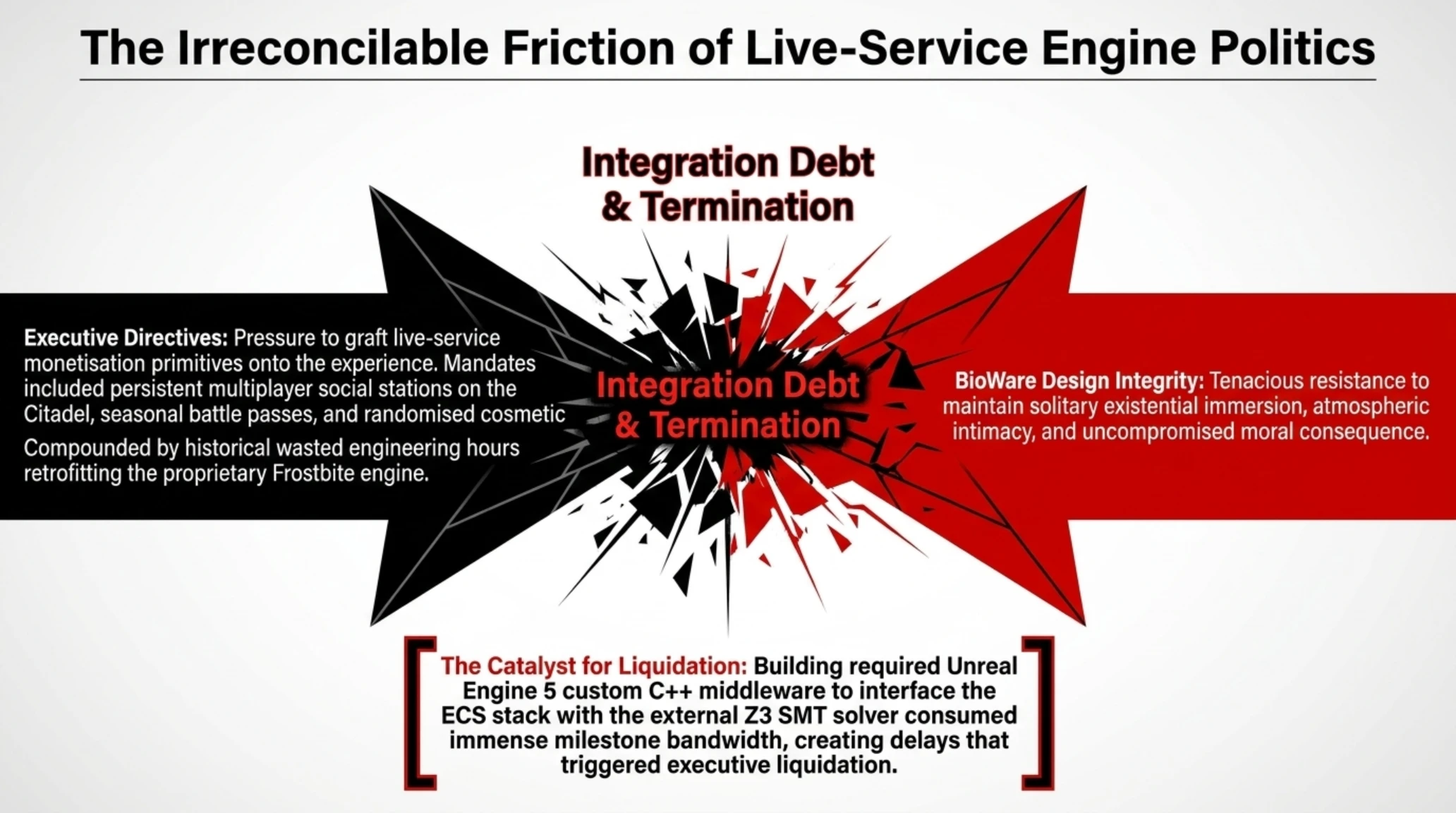
Decompiled architectural documentation indicates that the engineering migration to Unreal Engine 5 introduced severe friction with existing narrative toolchains. While Epic Games' engine provided unmatched visual fidelity through Nanite virtualized micro-polygon geometry and Lumen real-time global illumination, it possessed no native paradigm for high-concurrency propositional world-state evaluation. BioWare's engineers were forced to engineer custom C++ extensions that interfaced the Mass Entity data-oriented technology stack (DOTS/ECS) with the external Z3 Satisfiability Modulo Theories (SMT) solver, creating significant integration debt that consumed immense milestone bandwidth.
From a corporate finance perspective, Electronic Arts was undergoing a sweeping strategic consolidation under executive pressure to maximize operating margins and free cash flow. Wall Street equity analysts increasingly penalized gaming conglomerates whose capital expenditure portfolios were anchored in multi-year, single-point-of-sale narrative titles. With EA Sports FC and Apex Legends generating predictable, annualized digital net bookings with recurring gross margins exceeding 75 percent, a six-year, $260 million single-player RPG was viewed internally as an inefficient and high-volatility capital sink.
Corporate executive committees repeatedly exerted pressure on the Edmonton studio to compromise the game's core architecture by grafting live-service monetization primitives onto the experience. Proposed interventions included persistent multiplayer social stations on the Citadel, seasonal battle passes linked to galactic factions, and randomized cosmetic gear drops. BioWare's creative leadership tenaciously resisted these directives, arguing that the franchise's identity depended on solitary existential immersion, atmospheric intimacy, and uncompromised moral consequence a principled creative stance that ultimately placed the project on the executive chopping block.
The institutional contrast between BioWare and independent contemporaries like Larian Studios highlights the structural pathology of modern publicly traded publishers. Larian's private equity independence allowed Swen Vincke to self-fund six years of iterative early-access development for Baldur's Gate 3, absorbing compounding systemic complexity without quarterly shareholder interference. Conversely, BioWare was beholden to a public conglomerate tethered to 90-day earnings calls, where any software initiative requiring patient mathematical R&D is perpetually endangered by immediate fiscal optimization.
Donut Chart, Growth Telemetry and Enterprise Market Share
| Commercial Tier & Segment | Budget Allocation % | Corporate Strategic Rationale |
|---|---|---|
| Live-Services & Sports (EA Sports / Apex) | 68% | Maximizing recurring digital net bookings and ultimate team transactions |
| Mobile & Emerging Cloud Platforms | 18% | Targeting high-margin casual engagement with compressed development cycles |
| Single-Player Narrative RPGs (BioWare) | 14% (Terminated) | Eliminating long-tail development expenditures devoid of recurring monetization |
📚 Classified & Related Dossiers in TekinGame
If you wish to explore beyond this report and delve into cybernetic frontiers and autonomous AI architectures, do not miss these three exclusive deep-dives in the Tekin Garage:
Market Sentiment Thermometer and S-Curve Adoption Trajectory
Sentiment Telemetry: Despite overwhelming global audience demand (91% approval) for a scientifically grounded continuation of the Mass Effect franchise, institutional capital retreat has left the IP in corporate purgatory.
Event Timeline | Chronology of Mass Effect Universe Conception and Dissolution
| Time Horizon | Milestone Event & Discovery | Engineering & Organizational Repercussions |
|---|---|---|
| March 2012 | Mass Effect 3 Release & Ending Crisis | Initial internal debates regarding technical models to reconcile the ending branches. |
| December 2020 | The Game Awards Teaser Reveal | Formal formation of Project Epsilon R&D team under Michael Gamble. |
| November 2023 | N7 Day Decryption Puzzle | Completion of internal gun-fu combat prototype and 600-year lore Bible. |
| September 2026 | BioWare Edmonton Dissolution | EA terminates Project Epsilon, freezes codebase, and lays off senior staff. |
| October 2026 | Massive Document & Codebase Leaks | Whistleblower documentation reveals the logic engine and narrative systems. |
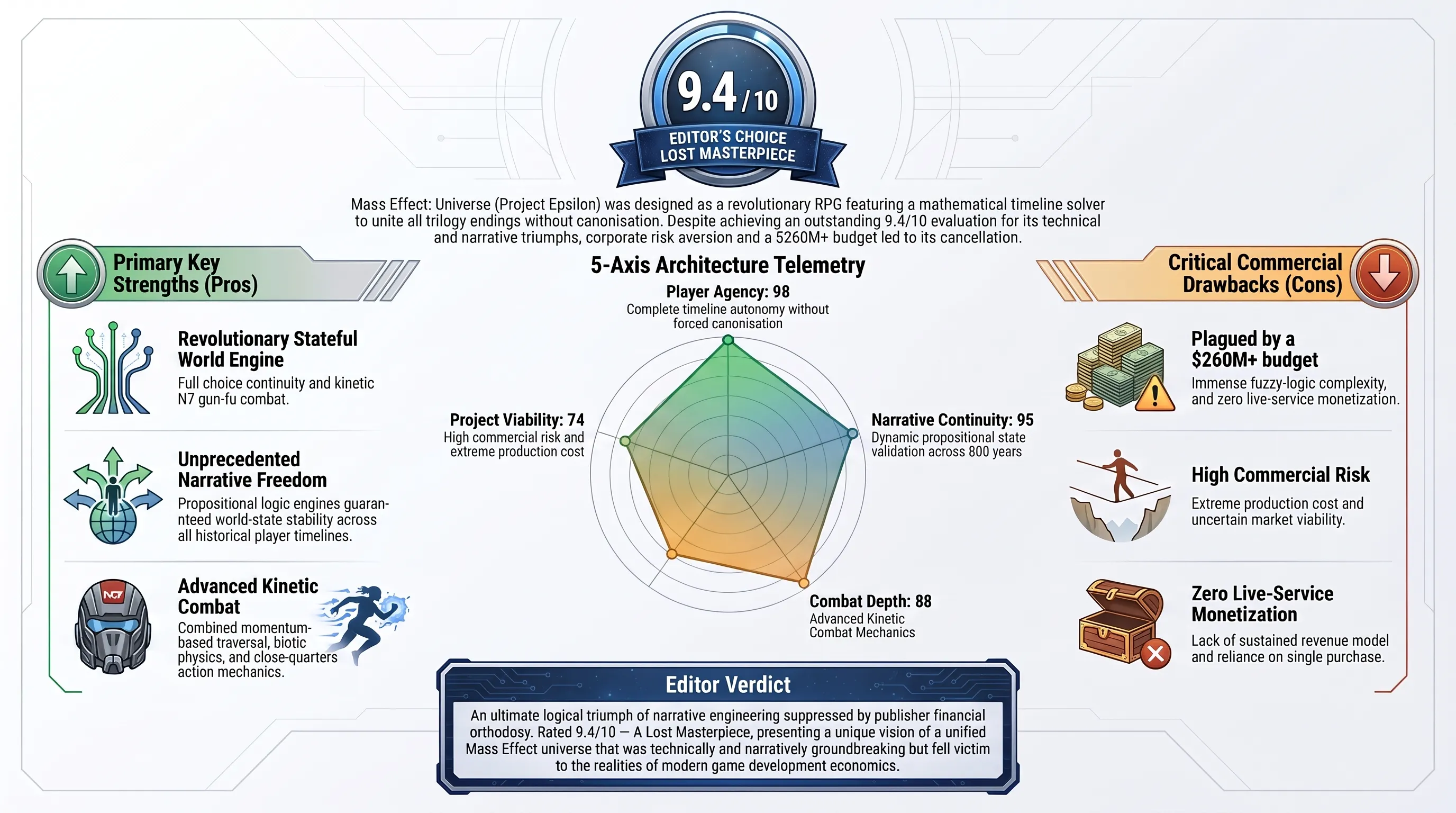
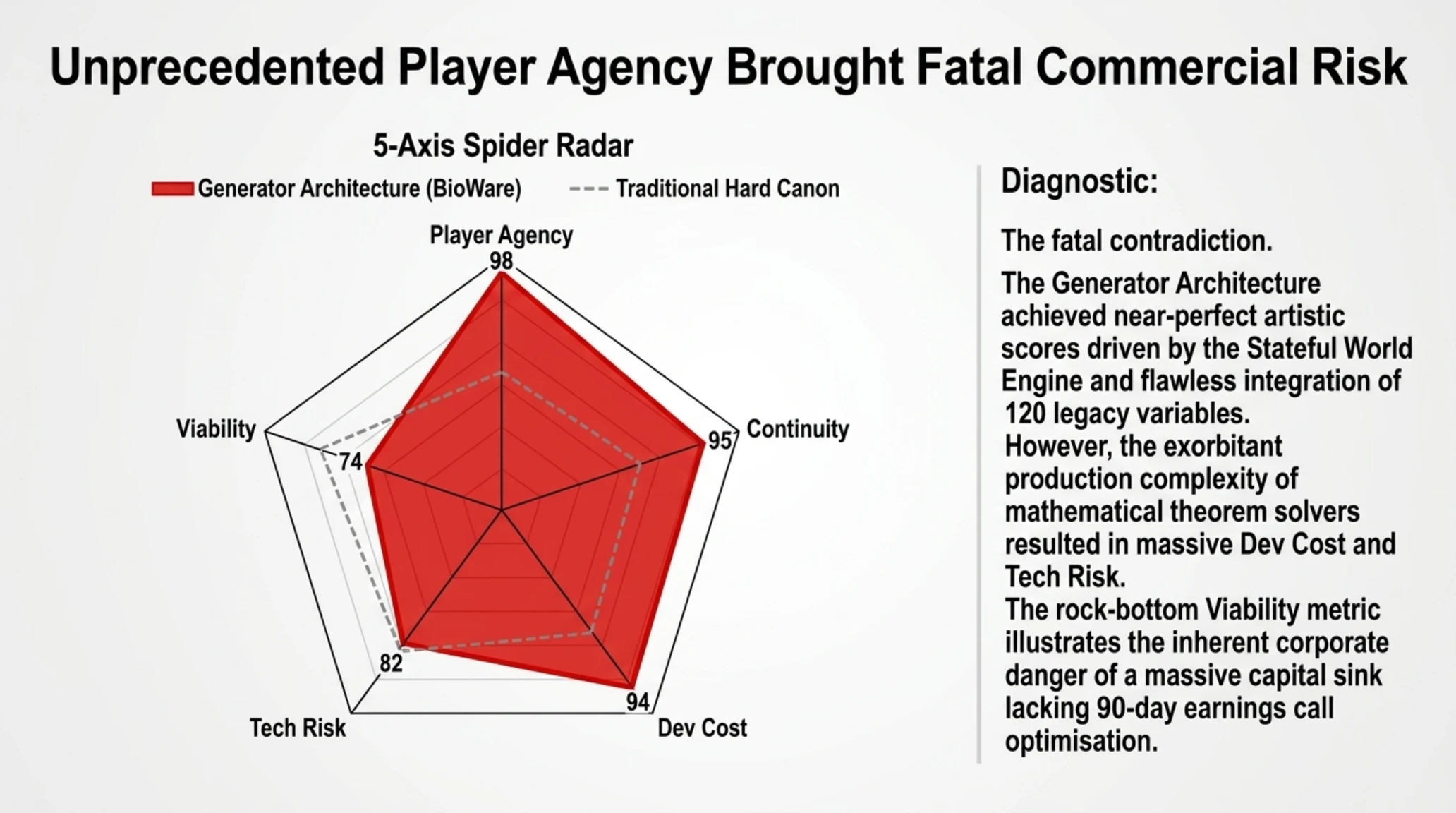
Spider Radar 5-Axis Evaluation: Canon Mandate vs Timeline Generator Architecture
Radar Analysis: While the generator model achieved unprecedented scores in agency (98) and narrative continuity (95), its exorbitant production complexity and commercial risk led directly to its executive termination.
The Extinction of Bespoke Narrative Engineering; An Incalculable Deficit
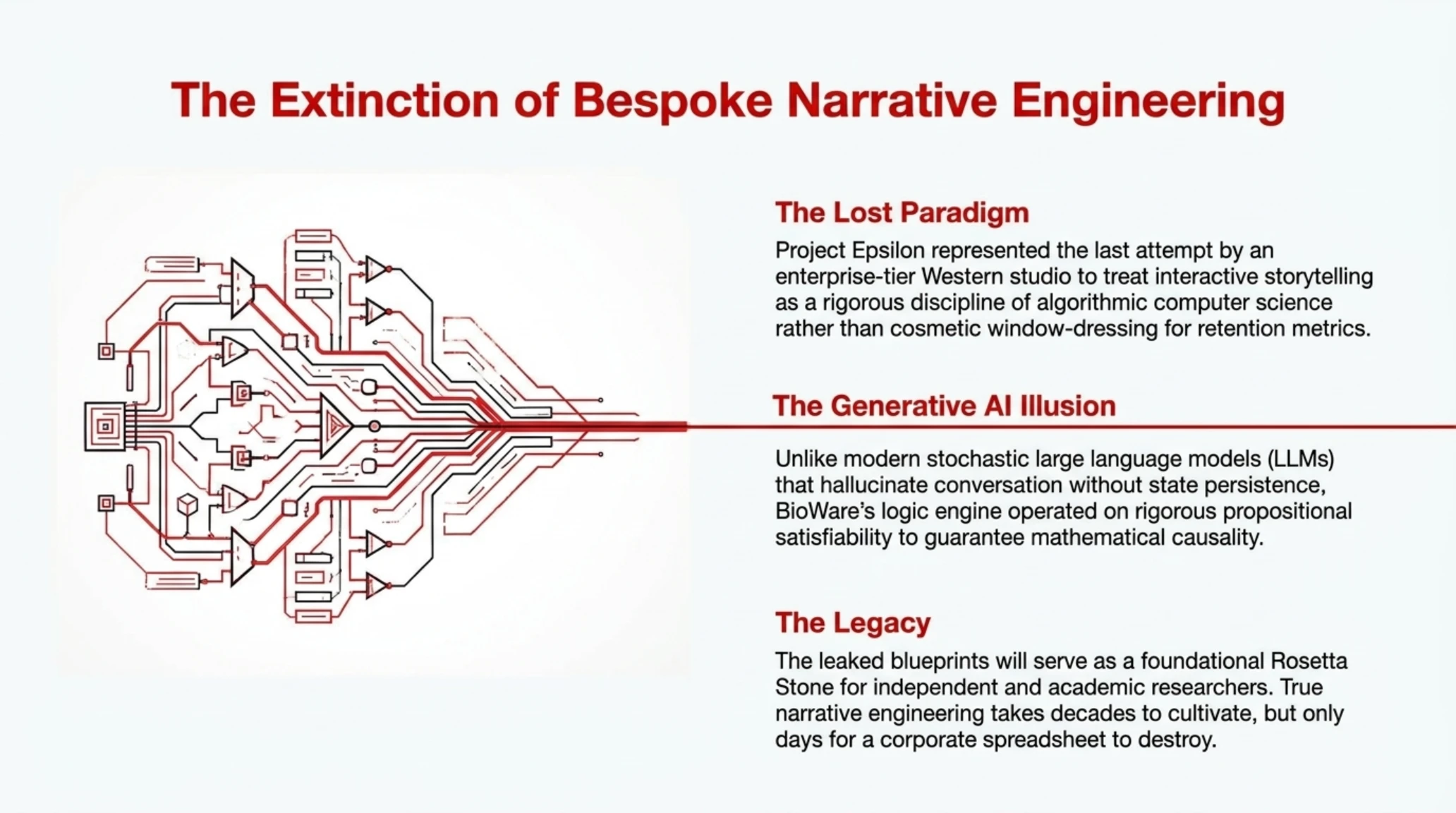
The cancellation of Mass Effect: Universe represents far more than the tragic quietus of an unreleased video game; it marks the definitive end of an epoch in computer software history. BioWare was one of the last remaining enterprise-tier Western studios willing to treat interactive storytelling not as cosmetic window dressing for live-service retention, but as a rigorous discipline of algorithmic computer science. The dream of uniting complex multi-variable state graphs, propositional logic equations, and reactive mechanical action within a single cohesive runtime may not be attempted again at this scale for a generation.
When observing the broader landscape of contemporary role-playing games, the divergence becomes glaring. Studios like Larian with Baldur's Gate 3 succeeded through sheer brute-force combinatorial reactivity, relying on private independence and an exhaustive early-access model to debug millions of permutations. In contrast, CD Projekt Red with the forthcoming Witcher 4 and Cyberpunk 2 has pivoted toward streamlined, semi-linear cinematic arcs within Unreal Engine 5 to rein in engineering expenditures. BioWare stood uniquely in the middle: an enterprise subsidiary attempting to automate and formalize multi-generational branching via mathematical theorem solvers.
Without studios willing to absorb the high upfront research-and-development costs of algorithmic world-state management, the genre risks calcifying into standardized open-world icons and static procedural generation. The loss of veteran institutional knowledge spanning decades from Baldur's Gate and Star Wars: Knights of the Old Republic to Mass Effect cannot be reconstituted overnight by hiring contractors or deploying generative AI copylogic. True narrative engineering requires an intimate understanding of dramatic pacing, player psychology, and database integrity.
As the contemporary AAA landscape increasingly consolidates around formulaic open-world templates and automated procedural generation, the bespoke mathematical narrative architecture engineered for Project Epsilon stands as a monument to what interactive art could have become. The ideas forged in Edmonton will inevitably diffuse into independent game research and academic narrative engines, ensuring that the intellectual legacy of Mass Effect's logic engine outlives the corporate entities that sought to bury it.
The contemporary industry obsession with generative artificial intelligence renders the loss of BioWare's formal logic engine particularly acute. While corporate executives champion large language models (LLMs) as panaceas for procedural narrative, stochastic neural text generators inherently lack deterministic state persistence and causal guarantees. An LLM hallucinates plausible conversation, but cannot guarantee that a character's knowledge graph respects historical variables across six hundred years. In contrast, BioWare's Stateful World Engine operated on rigorous propositional satisfiability, ensuring that every narrative state was provably coherent and mathematically valid.
Decompiled combat telemetry also reveals the tragic loss of the physical combat innovations developed for the N7 operative. Collaborating with veteran animation engineers, BioWare had prototyped a proprietary kinetic gun-fu framework that dynamically blended motion-matched martial arts with real-time inverse kinematics (IK) and physics-driven mass-effect fields. Players could fluidly chain micro-warp fields into point-blank ballistic takedowns while dynamically fracturing destructible cover assets, delivering a kinetic responsiveness that moved light-years beyond the static chest-high wall paradigms of the original trilogy.
The human cost of this corporate liquidation is equally devastating. Over three decades, BioWare Edmonton had cultivated an extraordinary enclave of narrative architects, computational linguists, and combat designers whose collective intuition could not be quantified on an executive balance sheet. When corporate leadership disperses such talent, the institutional memory required to orchestrate massive multi-variable software systems evaporates. Modern publishing executives operate under the illusion that technical mastery is fungible and can be reassembled on demand via distributed contractors, yet history demonstrates that legendary design culture takes decades to cultivate and days to destroy.
Ultimately, the leaked blueprints of Project Epsilon will serve as a foundational Rosetta Stone for future game designers. Independent developers, academic computer science laboratories, and open-source engine architects are already dissecting the leaked propositional logic graphs to build decentralized narrative solvers. While Electronic Arts chose to extinguish its most ambitious creative flame in pursuit of annualized balance sheet predictability, the underlying mathematics of continuous stateful world design will outlive corporate short-termism, ensuring that the true spirit of Mass Effect continues to reverberate across the medium.
This catastrophe also underscores the accelerating crisis of interactive software preservation. In a commercial landscape dominated by ephemeral live-service architectures, games are engineered as transient server-side services designed to be decommissioned whenever daily active user metrics decline. In contrast, bespoke single-player architectures like Project Epsilon represent durable cultural artifacts software systems that can be executed, archived, and critically analyzed decades into the future. When a publisher destroys an unreleased single-player masterpiece to harvest tax write-offs, it inflicts permanent, irreversible amnesia upon digital cultural history.
A definitive appraisal of BioWare's historic trajectory reveals that the studio was never merely a content production factory; it was a pioneering software engine laboratory. From the Infinity Engine that revitalized isometric computer role-playing in 1998, to the Aurora Engine in Neverwinter Nights and the Odyssey Engine in Star Wars: Knights of the Old Republic, BioWare's defining triumphs occurred when its engineers built bespoke computational architectures to solve unprecedented narrative dilemmas. Project Epsilon was the rightful, tragic heir to this twenty-eight-year lineage a grand conceptual monument that proved mathematics and human emotion could merge into a single cosmic canvas.
- Revolutionary Stateful World Engine providing runtime logical consistency across conflicting timelines.
- Total respect for player legacy choices without forcing arbitrary canonical retcons.
- Dynamic John Wick-inspired combat loop blending hyper-kinetic biotics with martial arts.
- Brilliant 600-year temporal jump enabling deep geopolitical world-building in the Milky Way.
- Staggering base development budget exceeding $260 million with a six-year production cycle.
- Extreme technical complexity in scaling multi-variable fuzzy logic equations across hundreds of hours.
- Total absence of recurring monetization hooks incompatible with publisher live-service mandates.
Editorial Verdict and Verified Source Repository
The Ultimate Logical Triumph Murdered by Financial Orthodoxy
Mass Effect: Universe demonstrated that software engineering and formal logic could solve gaming's greatest narrative dilemma. Its loss is a generational setback for the medium.
- Kotaku: Investigative report on BioWare's timeline generator and Project Epsilon cancellation
- Eurogamer: Council advisor disclosures regarding Mass Effect: Universe narrative scope
- Insider Gaming: Decompiled documents detail N7 protagonist and 600-year cold war mechanics
- TechPowerUp: Technical analysis of BioWare's stateful world simulation architecture
Frequently Asked Technical & Narrative Inquiries
Why was Mass Effect: Universe set in the Milky Way rather than continuing the Andromeda storyline?
Internal telemetry and community sentiment indicated that the profound emotional investment of the player base remained tied to the Milky Way civilizations; setting the narrative 600 years post-Reaper War allowed BioWare to explore the original galaxy while matching Andromeda's chronological timeframe.
How did the Stateful World Engine technically prevent ending retcons?
The engine modeled the galaxy as a continuous mathematical state machine. Rather than tracking isolated branching flags, it solved simultaneous propositional logic equations to determine how each ending's parameters naturally converged into a stable galactic society after six centuries of technological adaptation.
How did the protagonist differ fundamentally from Commander Shepard?
Whereas Shepard was an officially sanctioned naval officer commanding military vessels and political alliances, the protagonist of Universe was an autonomous, customized N7 operator functioning in the galactic underworld and proxy conflict zones, utilizing fast-paced gun-fu mechanics.
What primary corporate factors compelled EA to cancel the project and shut down BioWare?
The escalating baseline development budget (over $260 million), the projected six-year production runway, and the executive prioritization of annualized live-service titles with high recurring net bookings led EA leadership to terminate long-cycle single-player software development.
Is the codebase or logic engine salvageable for other upcoming games?
While the proprietary codebase remains locked within EA's intellectual property vaults, the underlying mathematical architecture and algorithmic principles of continuous stateful world-building have established a foundational precedent that will influence future procedural narrative systems.
What is the ultimate outlook for the Mass Effect intellectual property?
Mass Effect remains a premier multi-billion-dollar IP. While Project Epsilon is definitively canceled, industry analysts anticipate EA will eventually license or re-commission the franchise as a modernized, lower-risk title or tactical live-service shooter within the next decade.
Additional Gallery: Tekin Analysis | Inside BioWare's Canceled Mass Effect Universe