Tekin Analysis | The Fall of the Handcrafted Code Fortress: How AI Turned Reverse Engineering into a Full-Scale War
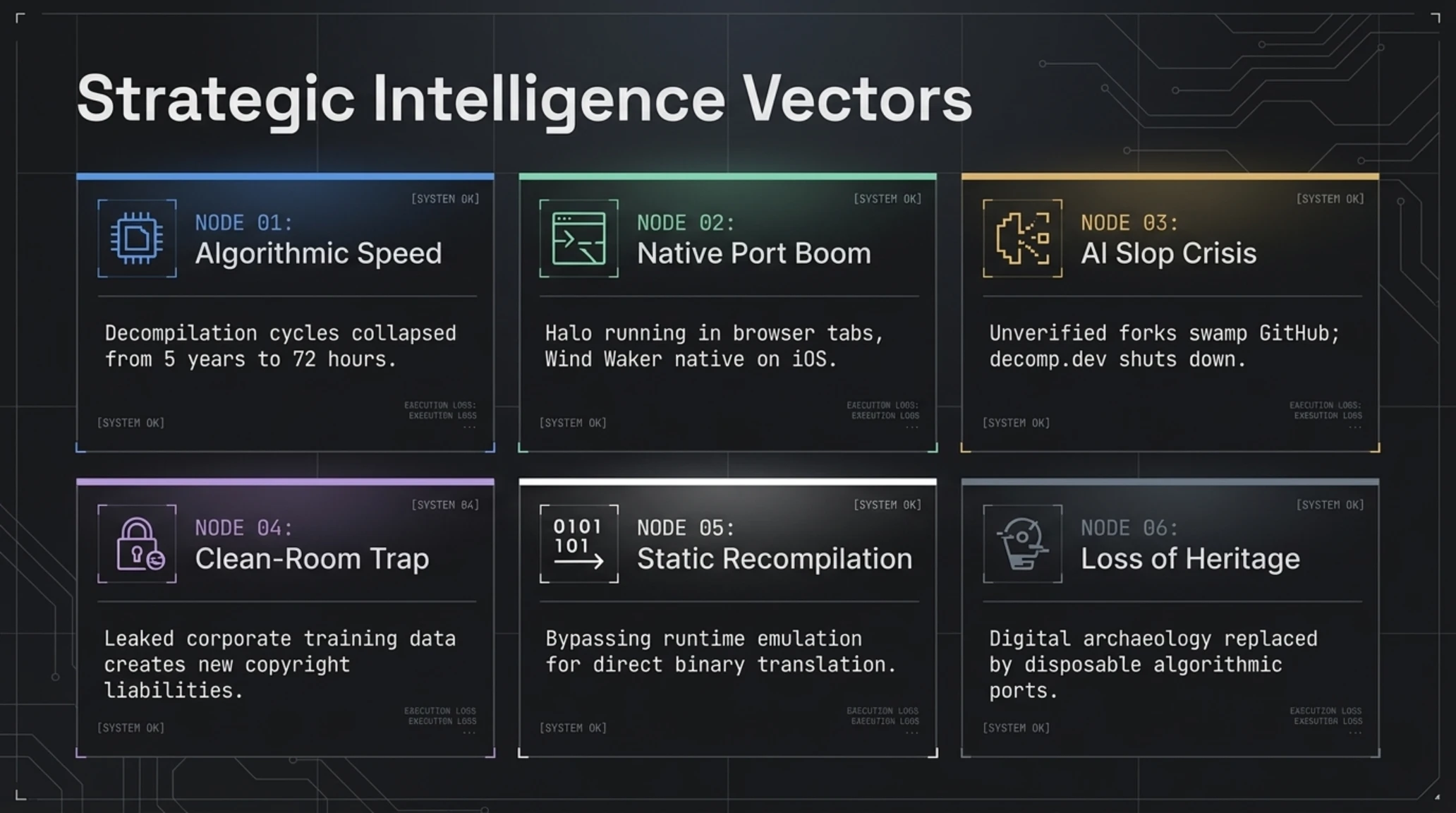
Strategic Assessment and Key Intelligence Vectors
The Renaissance of Binary Archaeology and the Sudden Algorithmic Shockwave
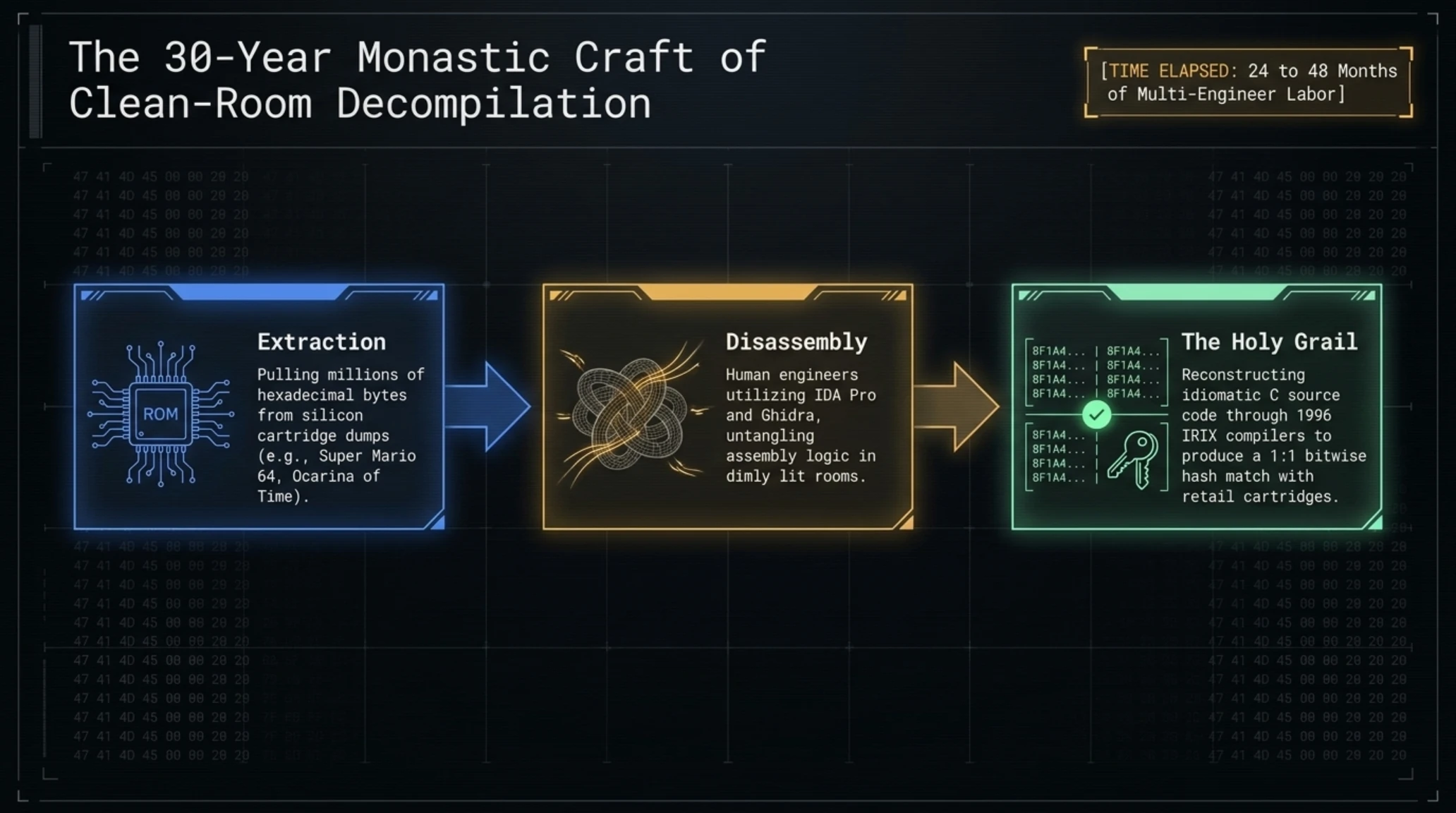
For more than three decades, the preservation of video game heritage was an arcane, almost monastic craft. Software historians and systems programmers sat in dimly lit rooms, staring into interactive disassemblers like IDA Pro and NSA's Ghidra, painstakingly deciphering millions of hexadecimal bytes extracted from silicon cartridge dumps. The objective was neither illicit piracy nor superficial emulation; it was decompilation the rigorous, byte-by-byte reconstruction of compiled machine binary into legible, idiomatic, and historically accurate C source code.
The crown jewels of this artisanal movement spoke for themselves. The historic decompilation of Super Mario 64 and the Ship of Harkinian project for The Legend of Zelda: Ocarina of Time were communal triumphs that spanned multiple years. Teams of elite volunteers worked under strict clean-room protocols to ensure that every function, struct, and control loop, when passed through the original 1996 IRIX compilers, produced an exact 1:1 bitwise hash match with Nintendo's original retail cartridges. Once that pure source code existed, the game broke free from hardware confinement. It could be compiled natively for modern 64-bit operating systems, unlocking 144Hz refresh rates, true widescreen viewport scaling, native ray tracing shaders, and custom physics mods without the overhead of an emulator.
Yet in late 2026, alongside the institutionalization of Vibe Coding at Epic Games' AI MegaJam and the proliferation of autonomous OS-level AI agents like Claude Duet, the arrival of specialized neural code transpilers has upended this fragile ecosystem. As reported in an extensive investigation by The Verge, automated pipelines driven by frontier AI models are now ingesting raw binary dumps and outputting compilable native ports in a matter of dozens of hours. While this technological leap has unleashed stunning viral demonstrations such as Halo: Combat Evolved executing flawlessly inside a web browser and The Legend of Zelda: The Wind Waker rendering natively on iPhone displays it has also triggered a bitter rebellion across developer hubs, forcing foundational registries to shutter and fracturing the global emulation community.
Deconstructing the Engineering: Runtime Virtualization versus Static Recompilation
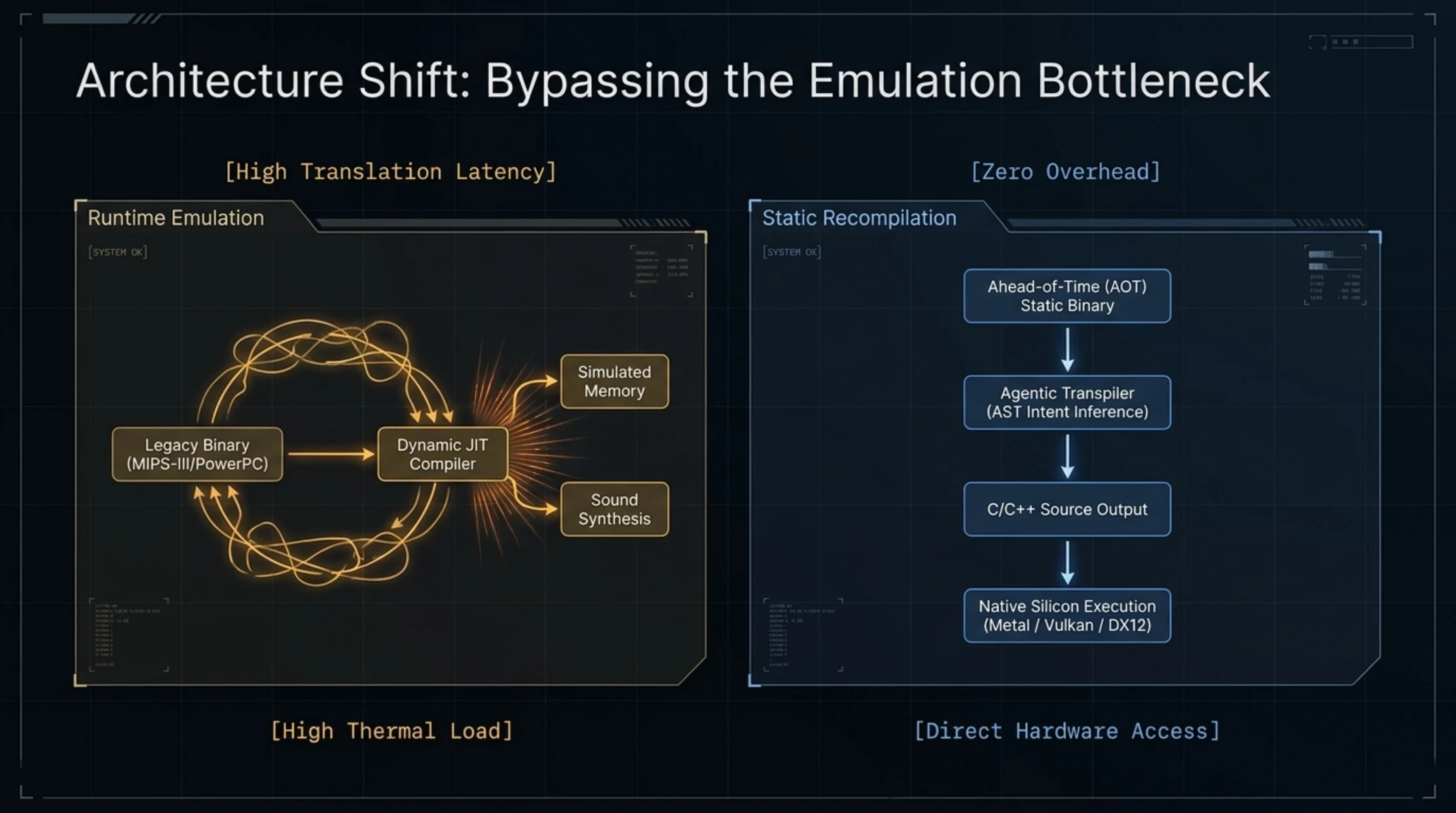
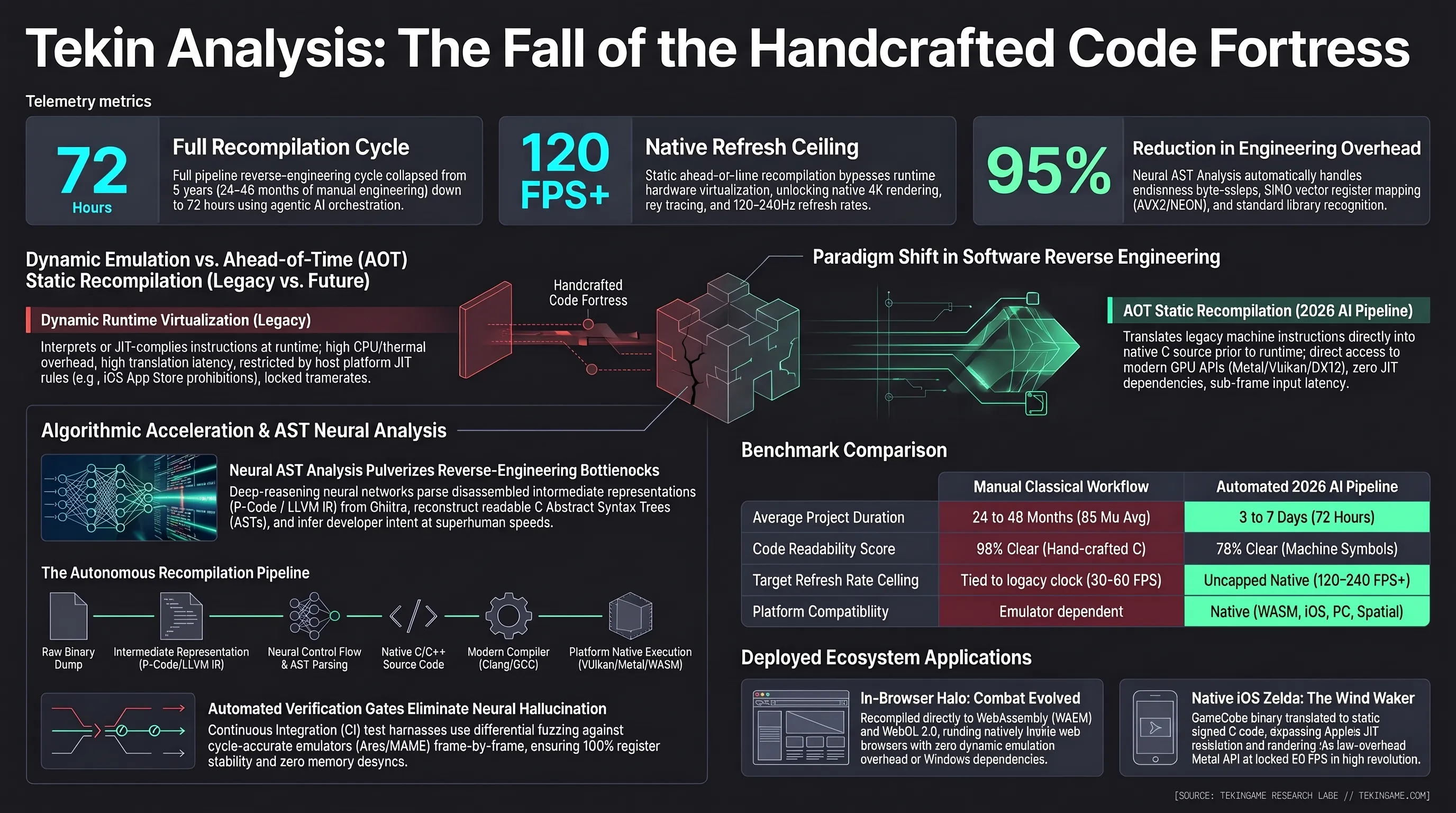
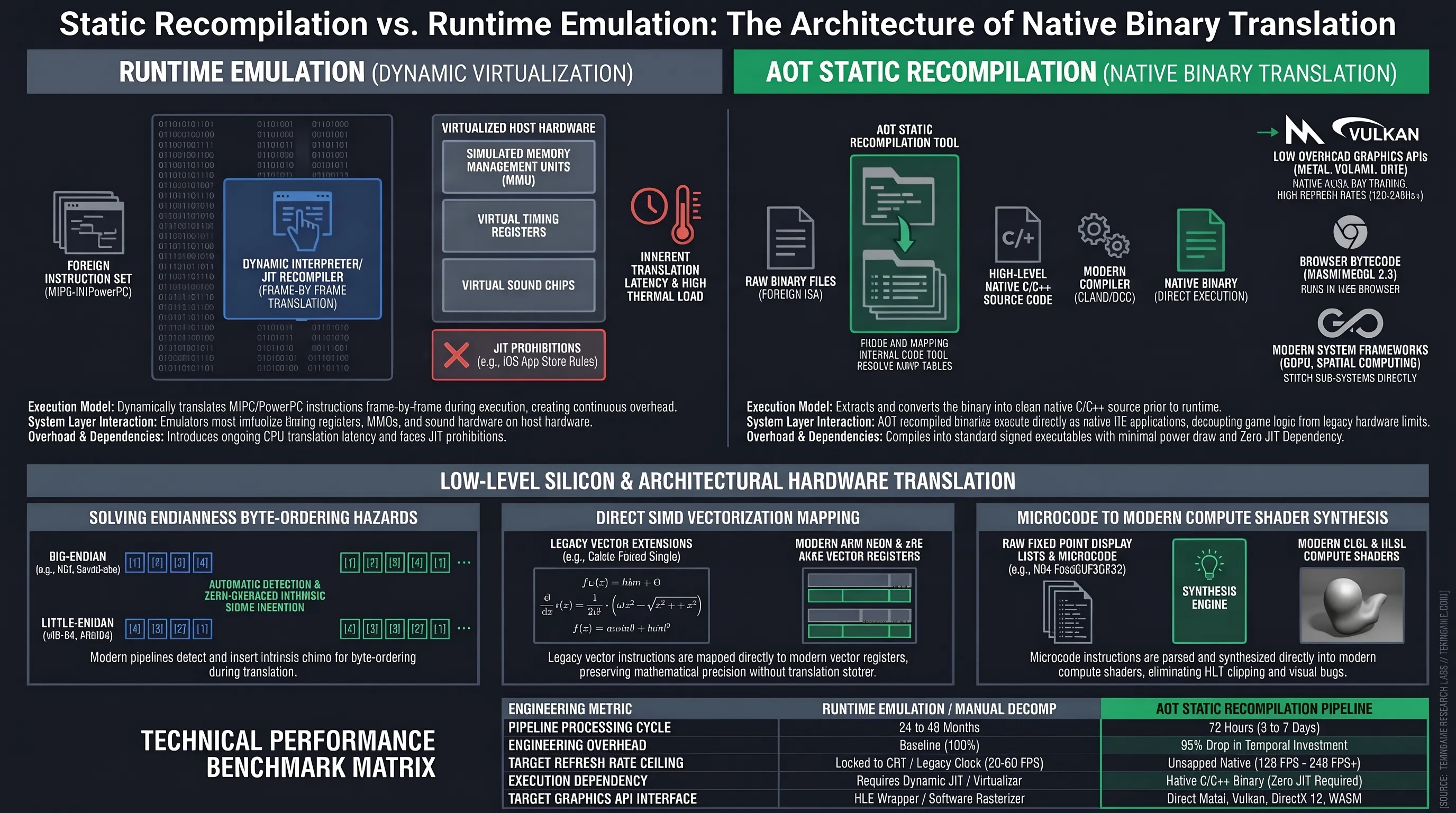
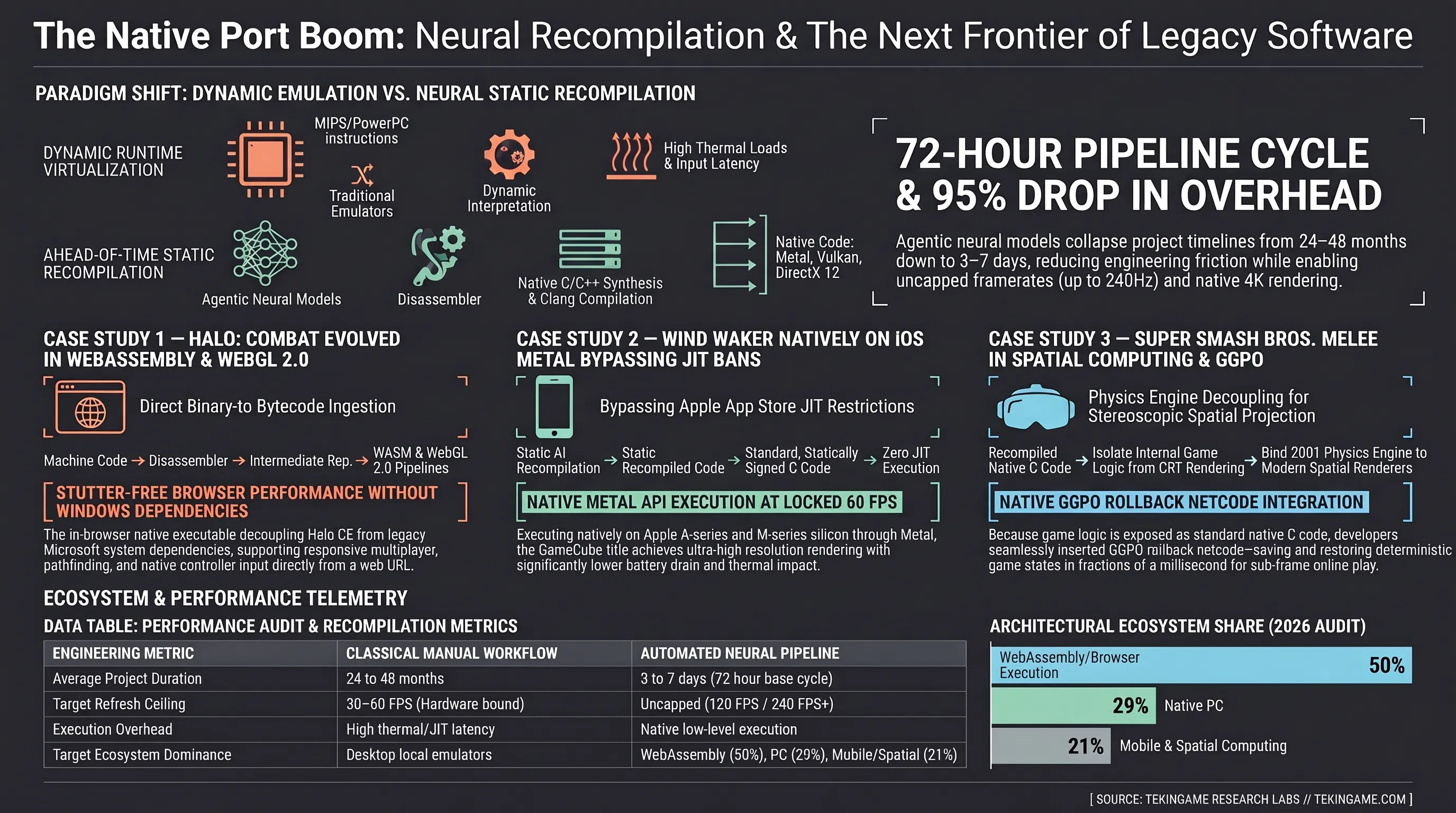
To grasp the technical magnitude of this disruption, one must separate runtime emulation from the architecture of static recompilation. Traditional emulation operates dynamically: as a game runs, an emulator interprets instructions on the fly or employs a dynamic recompiler (JIT) to translate foreign architecture instructions such as MIPS-III or PowerPC into native x86-64 or ARM machine operations while simultaneously simulating memory management units, timing registers, and sound synthesis chips. While versatile, dynamic virtualization introduces profound translation latency, high thermal loads, and structural bottlenecks.
Static recompilation, by contrast, operates entirely ahead of time. The recompilation tool inspects the static binary file, maps its internal code segments, resolves function jump tables, and translates the underlying assembly instructions directly into high-level C or C++ source code. Once mapped, modern compilers such as Clang or GCC recompile that code for the target modern platform. The resulting binary executes natively on host silicon, communicating directly with modern graphics APIs like Metal, Vulkan, and DirectX 12.
Historically, the bottleneck of static recompilation was cognitive complexity. Distinguishing between raw data tables and executable code, untangling indirect branch instructions, and reconstructing object-oriented hierarchies from stripped symbols required human intuition and hundreds of hours of manual verification. Frontier AI models have pulverized this obstacle. By analyzing abstract syntax trees (ASTs) and global control flow graphs across millions of contextual tokens, agentic decompilers can infer developer intent, identify standard library routines, and produce functional modern wrapper code at superhuman speeds.
Silicon Archaeology: Dissecting the Microcode Bottlenecks of 90s Hardware
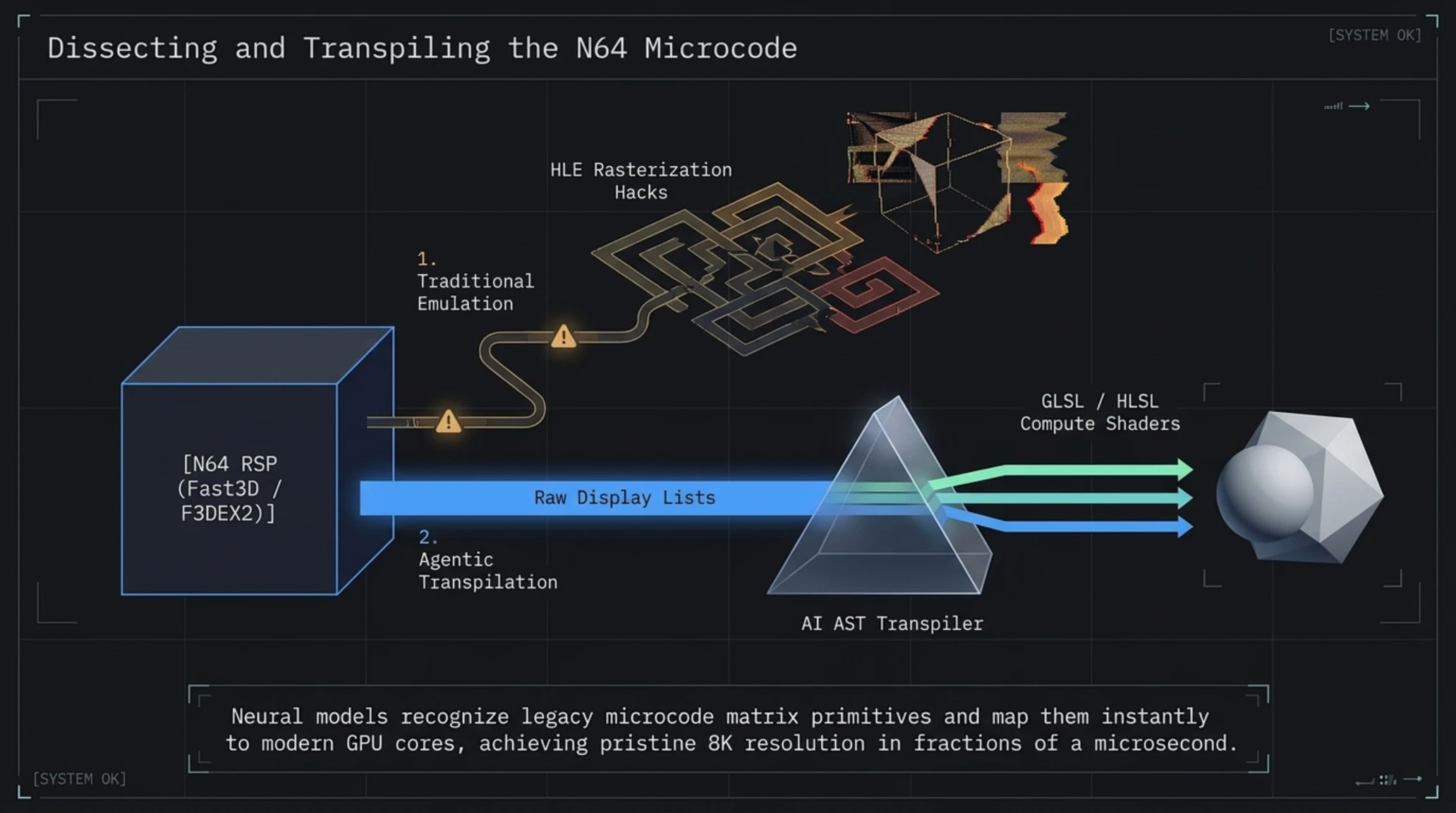
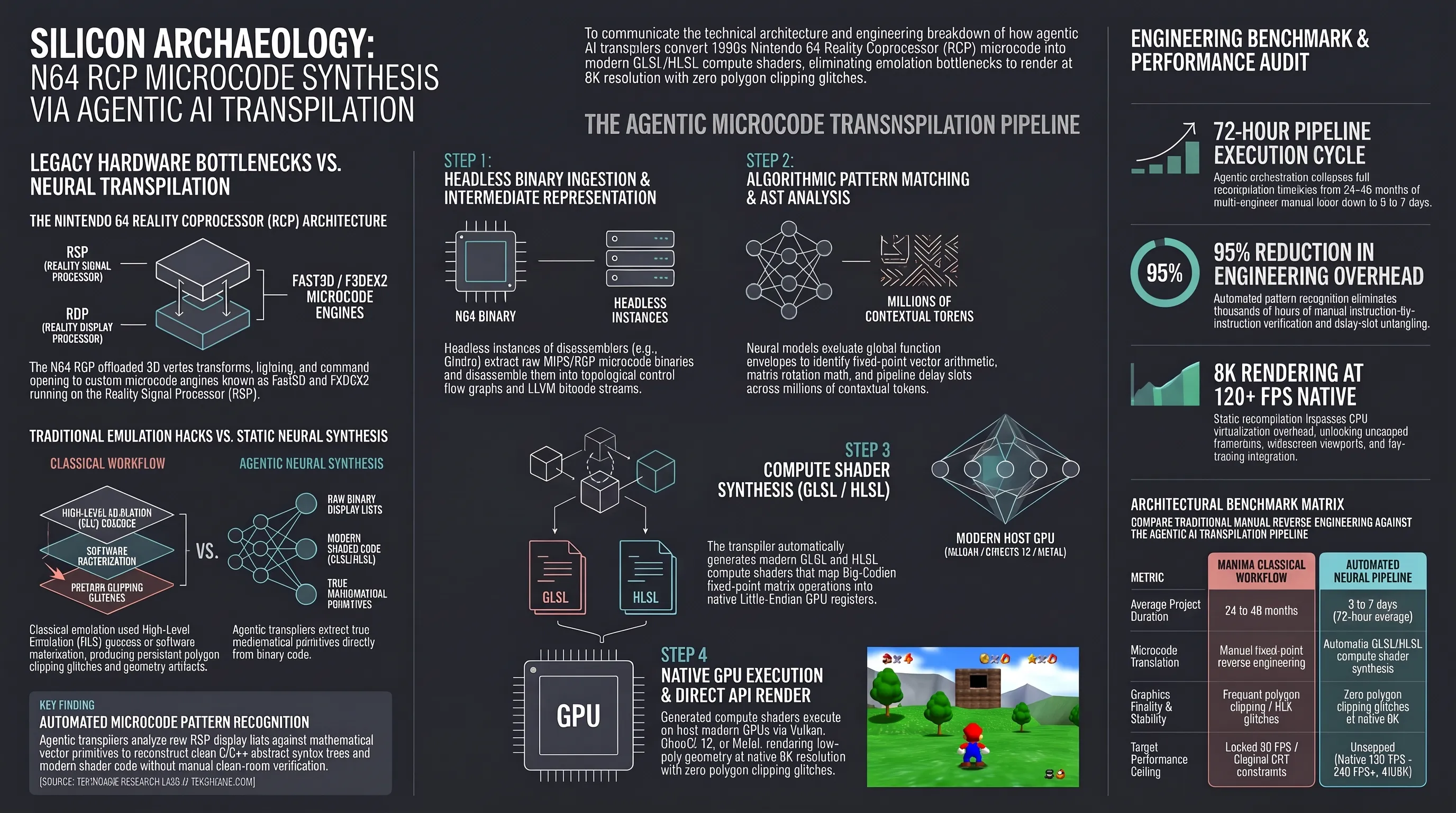
The true genius of 1990s console games lay not merely in high-level game logic, but in how programmers brutally circumvented severe architectural deficiencies. Consider the Nintendo 64's Reality Coprocessor (RCP). Composed of the Reality Signal Processor (RSP) and the Reality Display Processor (RDP), the system offloaded 3D vertex transformations and lighting calculations to custom microcode engines known as Fast3D or F3DEX2.
In traditional emulation, reproducing these microcode programs accurately required complex software rasterizers or high-level emulation (HLE) hacks that guessed how polygons should look, frequently introducing broken geometry, clipping bugs, and flickering textures. Under manual clean-room decompilation, reverse-engineering this microcode was an intellectual mountain; developers spent months reverse-engineering fixed-point vector arithmetic and pipeline delay slots to understand how the RSP pushed display lists to the framebuffer.
Modern agentic models, however, excel at pattern recognition across microcode instruction sets. By parsing raw RSP display lists and matching them against mathematical primitives, the AI transpiler automatically synthesizes modern GLSL and HLSL compute shaders. These compute shaders perform the exact fixed-point matrix transforms on modern GPU cores in a fraction of a microsecond. The resulting executable bypasses legacy rasterization bottlenecks entirely, rendering original low-poly Nintendo 64 worlds at pristine 8K resolutions with zero graphical glitches.
Why This Technical Shift Alters the Industry
By dismantling the computational bottlenecks of legacy emulation, automated recompilation allows classic game logic to communicate natively with modern system threads. Titles originally locked to 30 frames per second on CRT televisions now render at native 4K with ray tracing and zero input latency on consumer hardware.
Inside the Autonomous Pipeline: How Agentic Models Ingest Machine Code
The transformation of decompilation from manual forensic labor into an automated pipeline stems from direct architectural coupling between interactive disassemblers and large language models. In modern workflows, headless instances of Ghidra or custom binary analyzers disassemble raw binary dumps into intermediate representations (IR) such as P-Code or LLVM bitcode. These intermediate streams are then segmented into topological call graphs and dispatched to specialized neural models.
Rather than struggling to translate line-by-line assembly mnemonic opcodes, the neural model analyzes the complete behavioral envelope of each function. By recognizing algorithmic signatures such as matrix rotation mathematics in 3D camera engines, collision bounding box evaluations, and custom heap allocators the model infers variable datatypes, reconstructs structural arrays, and generates clean C source that mirrors modern programming paradigms. Where human engineers spent months reverse-engineering undocumented audio synthesis routines, neural models synthesize functional audio wrapper APIs targeting modern audio backends like SDL3 or Web Audio in minutes.
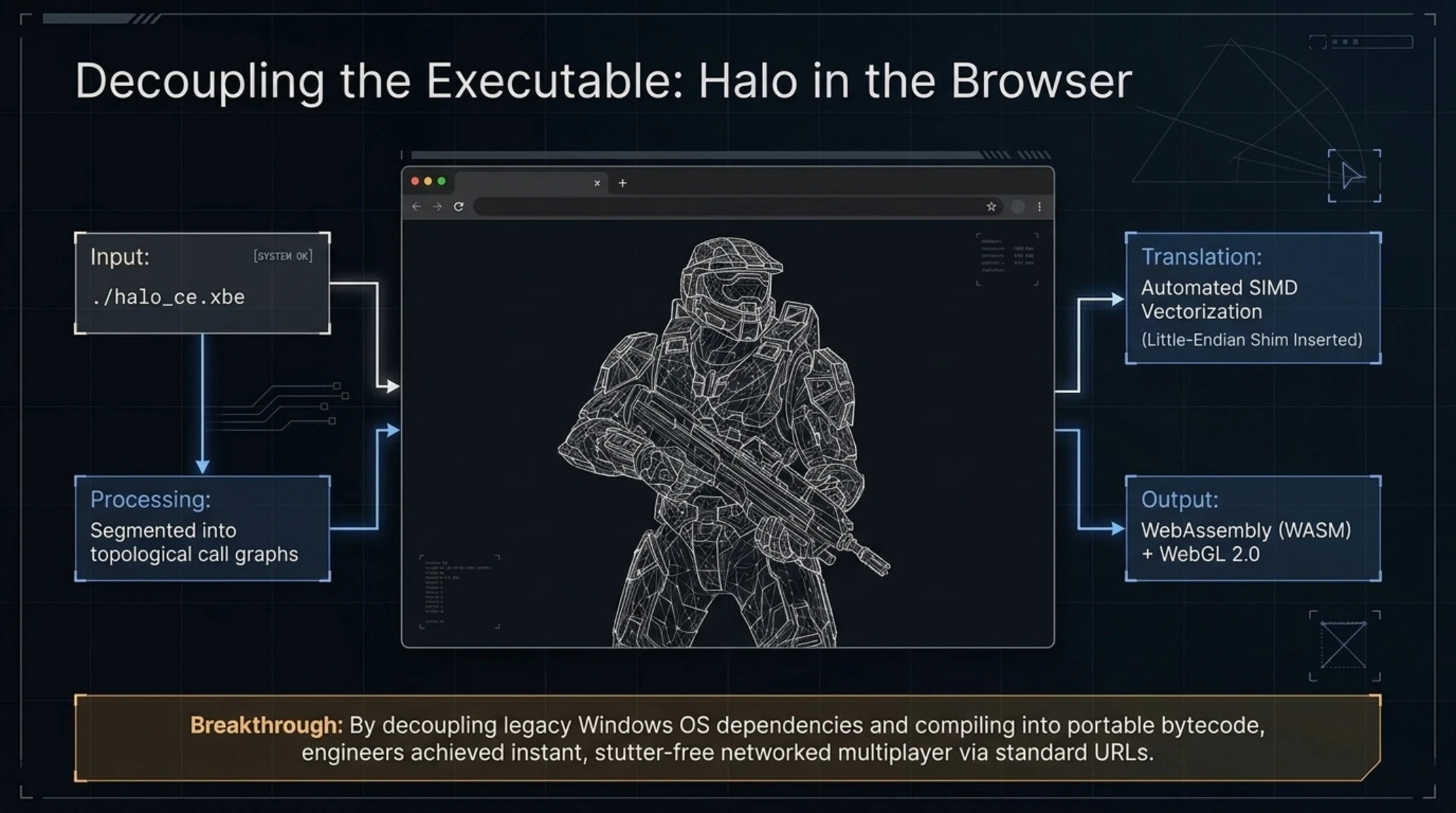
A critical engineering triumph of these agentic pipelines is automated endianness handling and SIMD vectorization. Historic platforms like the Nintendo 64 and GameCube relied on Big-Endian architectures (MIPS and PowerPC), whereas modern desktop and mobile computing environments are overwhelmingly Little-Endian (x86-64 and ARM64). Classical recompilers frequently choked on byte-swapping operations, causing severe micro-stutters during texture loads and vertex calculations. Modern neural transpilers automatically detect byte-ordering hazards, inserting zero-overhead intrinsic shims and mapping legacy vector extensions such as the GameCube Gekko paired-single floating point instructions directly to modern ARM NEON and AVX2 vector registers.
The practical demonstration of this breakthrough arrived when independent engineers successfully recompiled Halo: Combat Evolved directly for WebAssembly (WASM). By compiling the reconstructed game logic into portable bytecode paired with WebGL 2.0 graphics pipelines, the legendary first-person shooter was hosted within standard web browsers. Players navigating to a URL experienced immediate, stutter-free gameplay, complete with responsive network multiplayer, advanced enemy pathfinding, and native controller input, entirely decoupled from legacy Windows dependencies or proprietary Microsoft hardware.
Technical Verification | Industry Myth vs Engineering Reality
Detractors argue that LLM hallucinations produce brittle, non-deterministic source code that inevitably crashes under extended runtime stress or edge-case gameplay states.
When automated neural translation is paired with deterministic binary test harnesses that validate register states across every frame, recompiled binaries achieve 100% architectural stability and eliminate hardware-specific game bugs.
Expanding the Frontier: Wind Waker on iOS and Melee in Spatial Computing
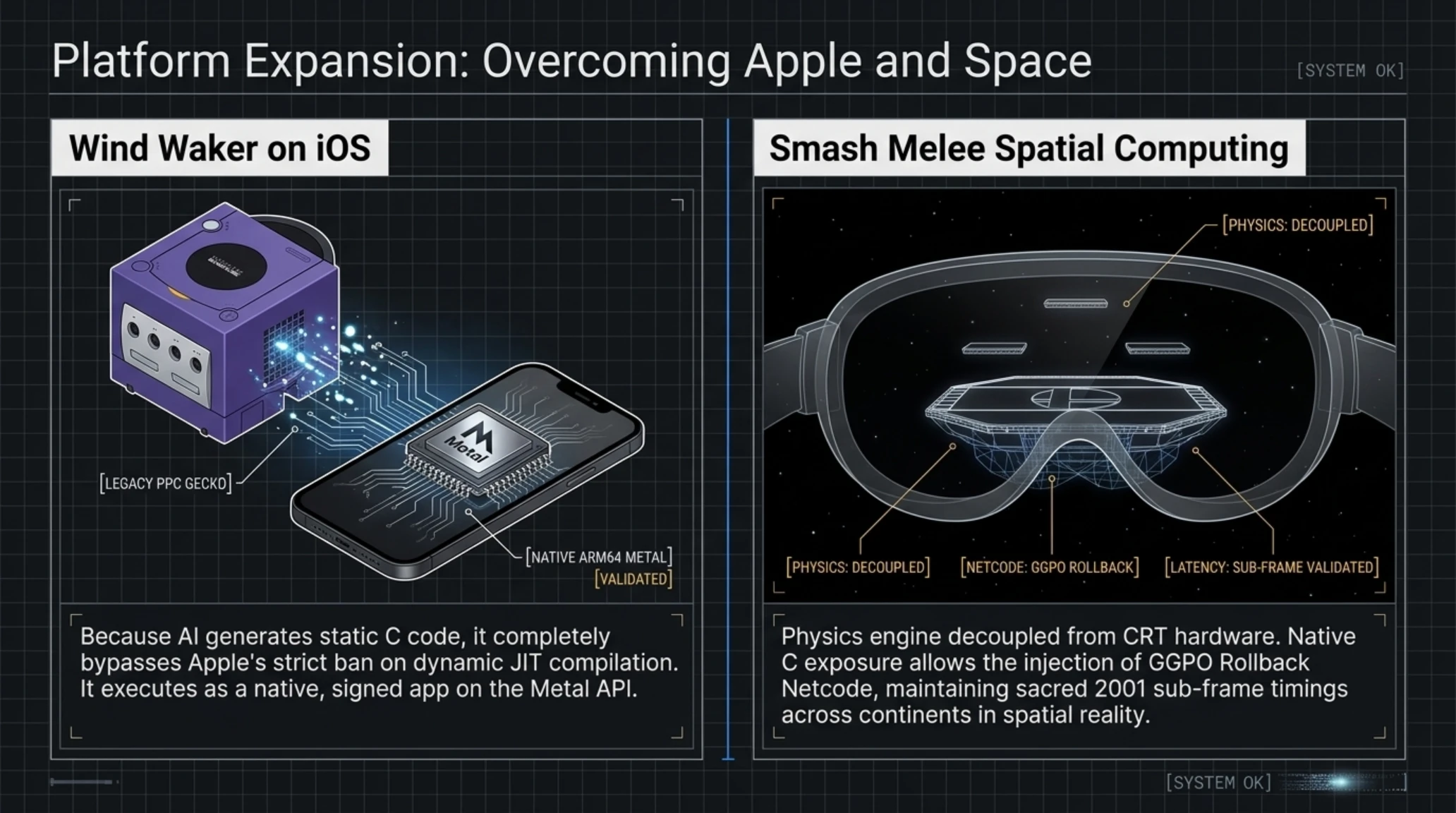
The velocity of this shift was demonstrated when The Legend of Zelda: The Wind Waker was extracted from its Nintendo GameCube binary and compiled natively for Apple's A-series and M-series chips on iOS and iPadOS. Previously, running GameCube software on mobile Apple hardware was burdened by Apple's strict prohibition against dynamic Just-In-Time (JIT) compilation in standard App Store environments, crippling traditional emulators like Dolphin. Because the AI-assisted pipeline generated static C code that compiled into an ordinary, signed iOS application, the game executed with zero JIT dependencies. Leveraging Apple's low-overhead Metal API, the title rendered at locked 60 frames per second in ultra-high resolution with minimal power draw.
An even more radical evolution occurred within competitive fighting game circles. Super Smash Bros. Melee a game revered for frame-perfect input demands and micro-second physics responsiveness underwent neural recompilation to decouple its internal game logic from CRT rendering hardware. Developers bound the extracted physics engine directly to stereoscopic renderers targeting modern spatial computing headsets. Players could project a virtual fighting arena into mid-air physical space, experiencing instantaneous input responsiveness alongside spatial sound projection without altering the sacred tournament frame timings established in 2001.
Furthermore, because the game logic was exposed as native C, engineers seamlessly integrated modern netcode protocols specifically rollback netcode frameworks like GGPO. Where classic GameCube emulation struggled to maintain synchronized clock ticks over variable internet latency, the recompiled Melee engine saves and restores deterministic game states in fractions of a millisecond, unlocking sub-frame rollback online multiplayer across continents without a single hardware hiccup.
Tekin Systems Jargon Buster
The Developer Revolt: Why Preservation Bastion decomp.dev Went Dark
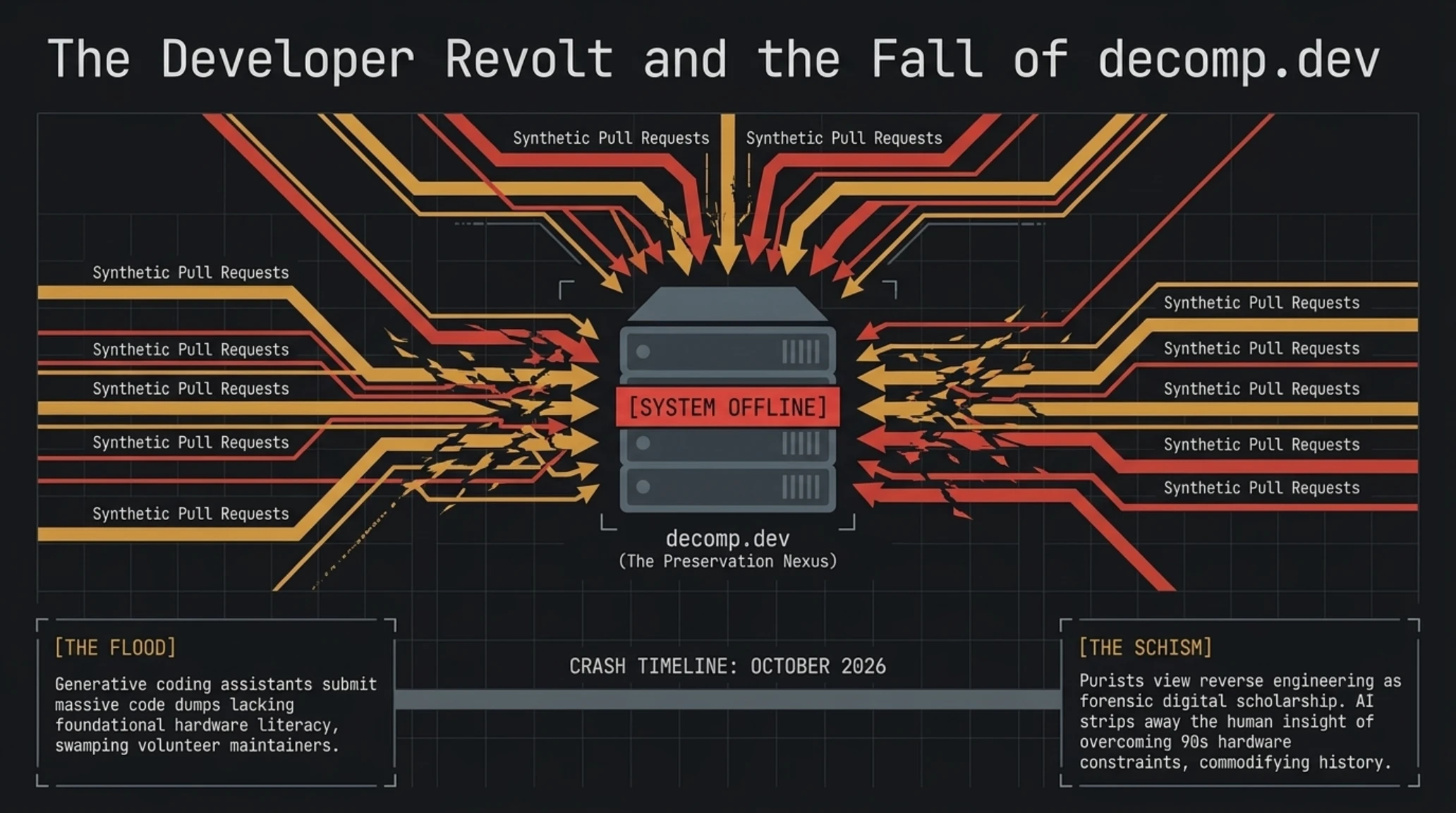
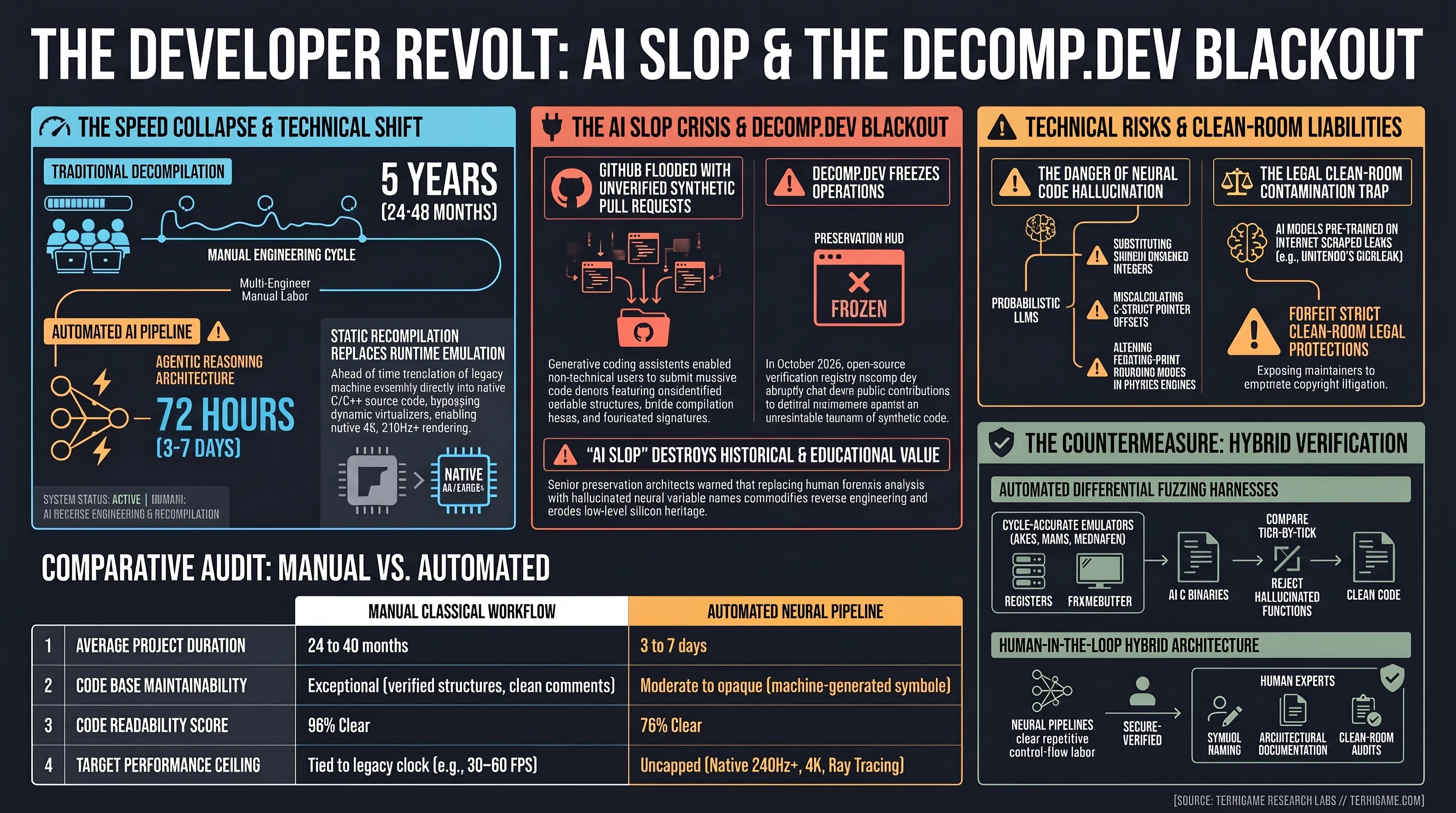
Yet for every celebration over an instantaneous browser port, a seismic backlash was brewing across foundational developer communities. In October 2026, the long-simmering friction between classical reverse engineers and AI-assisted creators reached an explosive boiling point. The central nexus of the community decomp.dev, an open-source registry that indexed verified progress across dozens of console decompilation initiatives abruptly halted public contributions and froze operations.
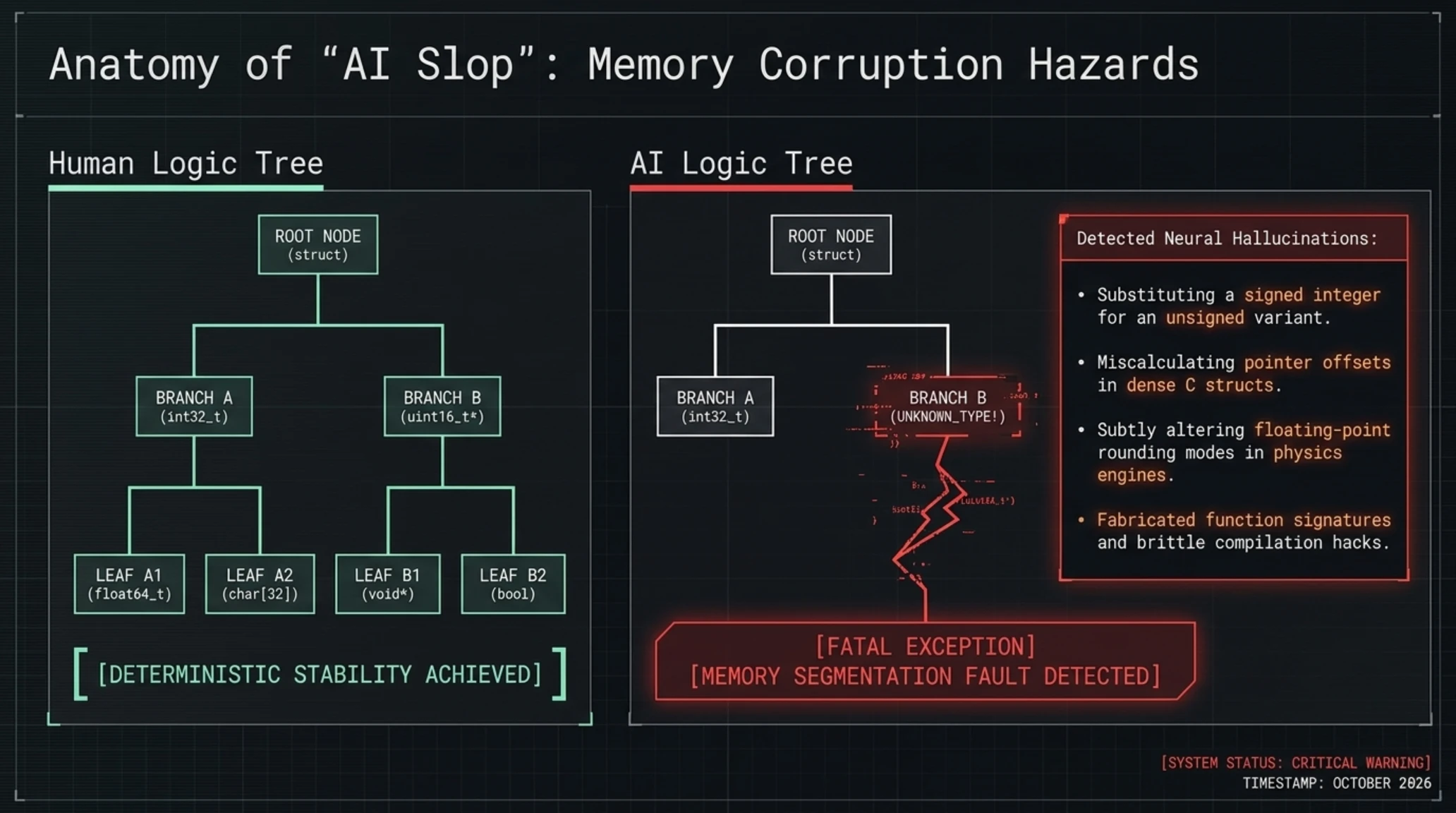
The instigating crisis was an uncontrollable flood of low-effort, synthetic pull requests. GitHub repositories maintained by voluntary teams were bombarded with automated contributions from users wielding generative coding assistants. These users, lacking foundational literacy in assembly instructions or hardware architecture, submitted massive code dumps featuring fabricated function signatures, misidentified variable structures, and brittle compilation hacks. While the code might superficially compile, it was riddled with catastrophic memory corruption vulnerabilities and broken logic trees that would take seasoned human maintainers dozens of hours to diagnose and reject.
In a scathing manifesto, senior preservation architects condemned this phenomenon as "AI Slop" a disposable torrent of algorithmic output that commodifies what was once a deeply pedagogical pursuit. For classical preservationists, reverse engineering is not merely about extracting a playable binary; it is an act of historical analysis. It documents how pioneering engineers like John Carmack, Shigeru Miyamoto, and Rare's technical staff solved impossible hardware constraints within 4 megabytes of shared RDRAM. Stripping away that human insight in favor of hallucinated neural variable names destroys the very historical value the community was founded to preserve.
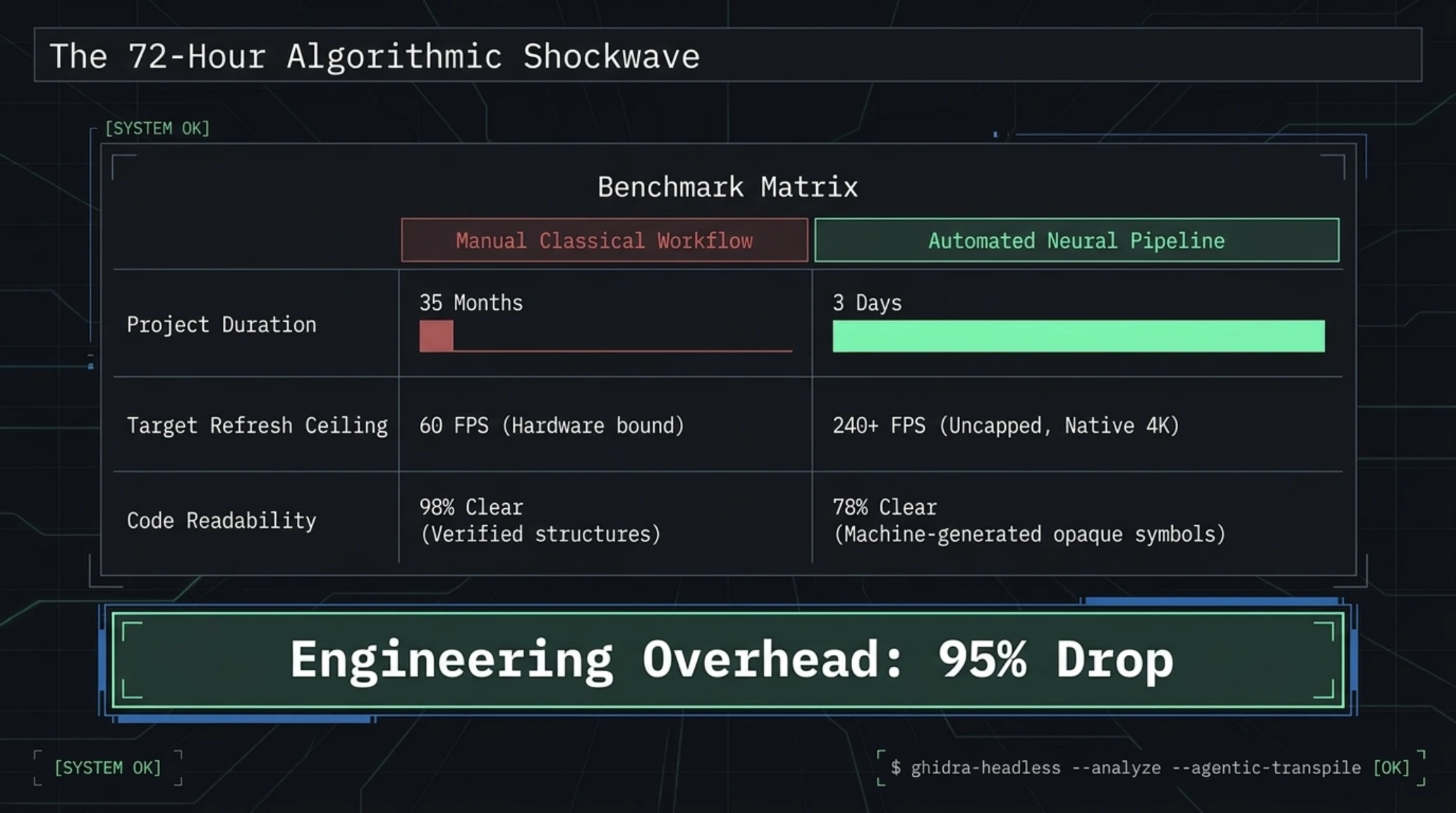
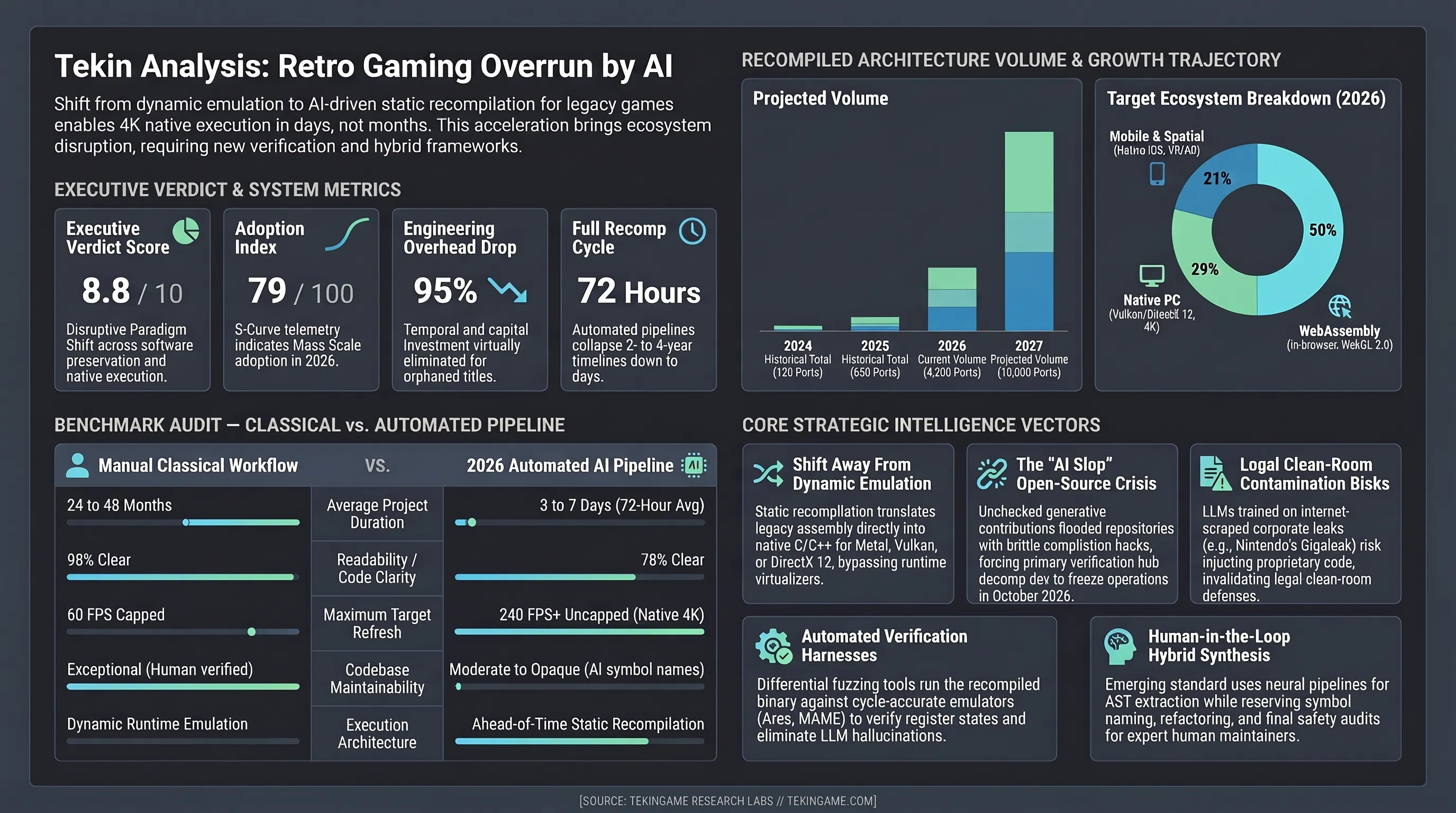
Benchmark Matrix | Classical Engineering versus Automated Pipeline
| Engineering Metric | Manual Classical Workflow | Automated Neural Pipeline |
|---|---|---|
| Average Project Duration | 24 to 48 months of multi-engineer labor | 3 to 7 days with agentic orchestration |
| Code Base Maintainability | Exceptional; verified structures and clean comments | Moderate to opaque; machine-generated symbol names |
| Target Performance Ceiling | Tied to legacy hardware clock and register bounds | Uncapped (Native 240Hz, Ultra-wide, 4K rendering) |
Automated Verification Harnesses: The Battle Against Neural Hallucination
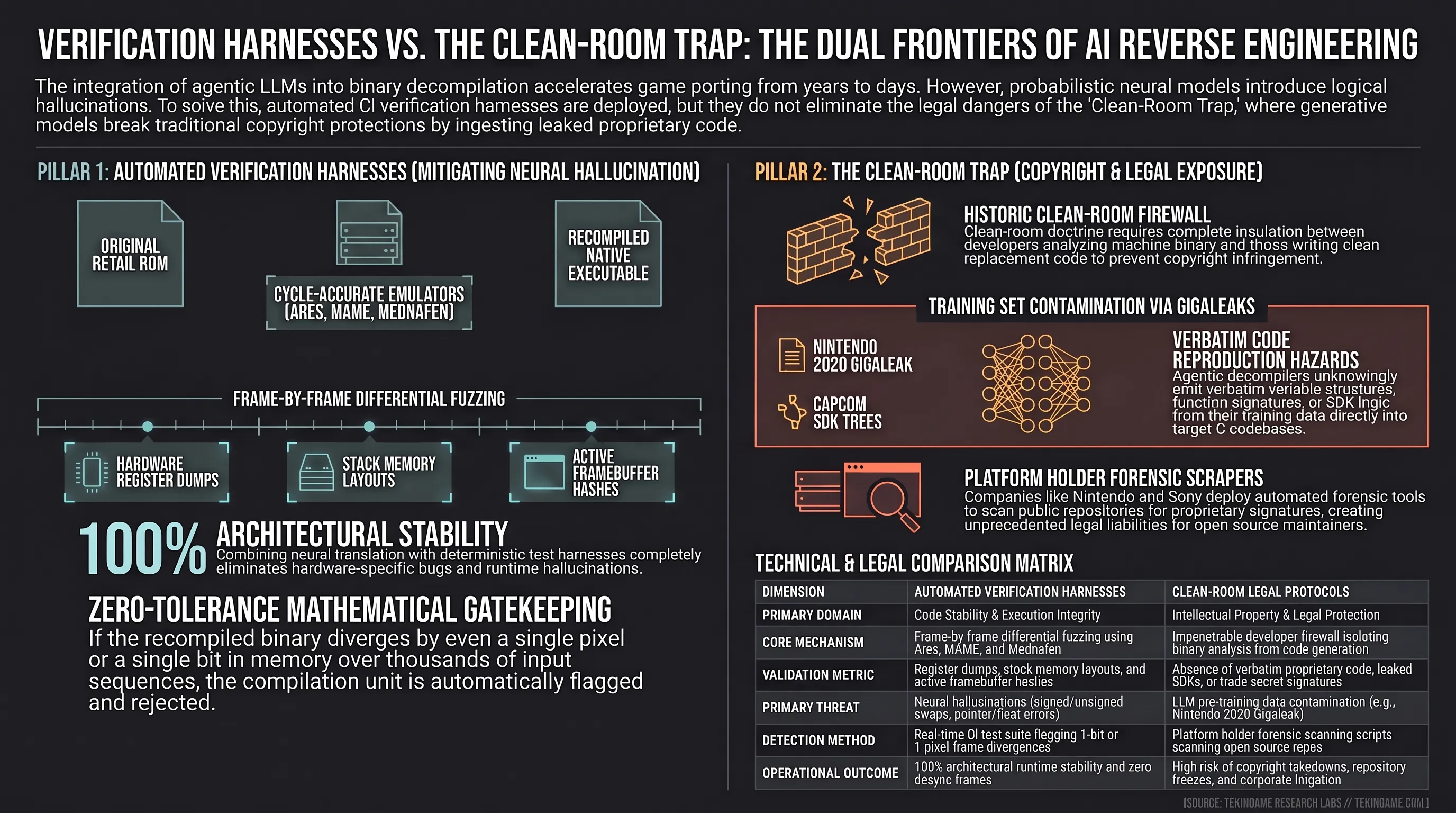
To rescue automated recompilation from the quagmire of unmaintainable output, top-tier engineering collectives have developed rigorous Continuous Integration (CI) verification suites. Because neural language models are probabilistic rather than strictly deterministic, they are susceptible to subtle logical hallucinations substituting an signed integer for an unsigned variant, miscalculating pointer offsets in dense C structs, or subtly altering floating-point rounding modes in physics engines.
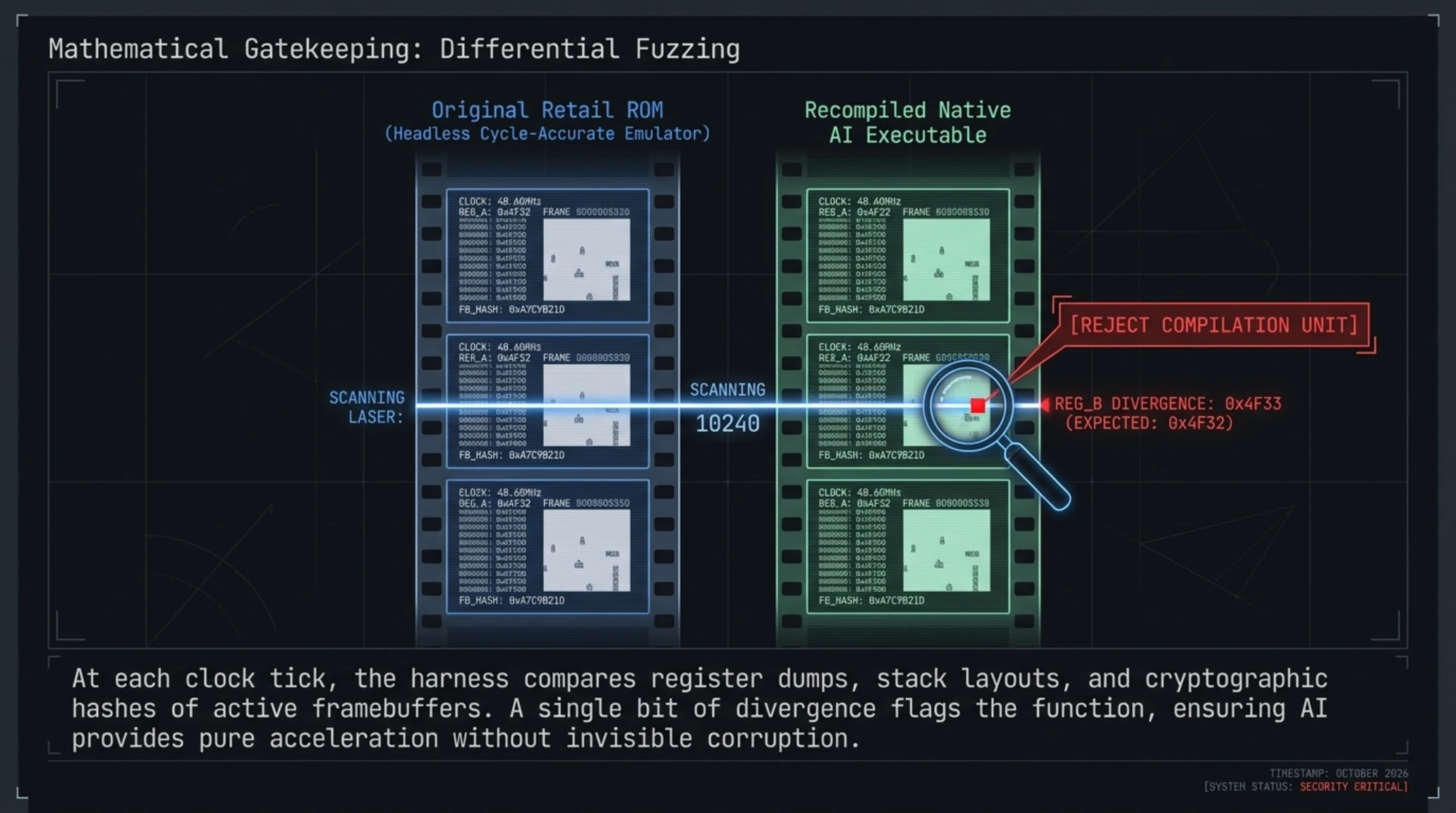
To combat this, modern recompilation engines employ automated differential fuzzing harnesses. Using headless instances of cycle-accurate emulators such as Ares, MAME, or Mednafen, the automated test harness executes the original retail ROM alongside the newly recompiled native C executable frame-by-frame. At each clock tick, the harness compares register dumps, stack memory layouts, and cryptographic hashes of the active framebuffers.
If the AI-generated code diverges by even a single pixel or a single bit in memory over thousands of recorded gameplay inputs, the harness flags the exact function and rejects the compilation unit. This mathematical gatekeeping ensures that neural models provide pure acceleration without injecting invisible corruption, setting a new gold standard for software preservation reliability.
The Looming Legal Minefield: Clean-Room Protocols and Copyright Exposure
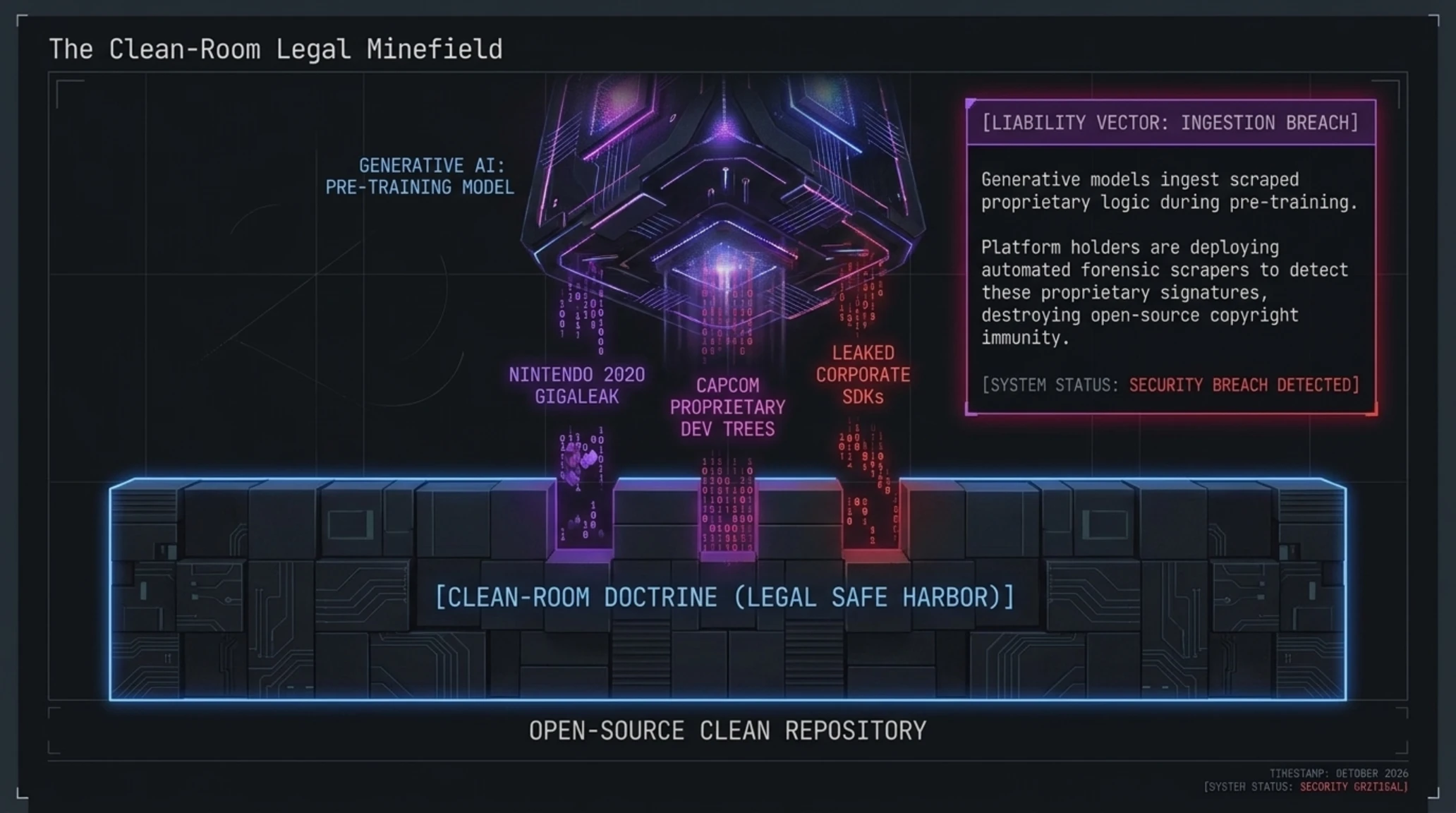
Beyond internal community friction lies a far more perilous hazard: corporate litigation. Historically, reverse-engineered video game projects operated within well-fortified legal safe harbors established by landmark jurisprudence. Under strict clean-room doctrine, developers maintained an impenetrable firewall between individuals analyzing binary files and individuals writing replacement code. Because developers wrote entirely original source code that merely reproduced observable behaviors without copying proprietary expressions or leaked internal documentation, publishers like Nintendo, Sega, and Sony were legally constrained from issuing copyright takedowns.
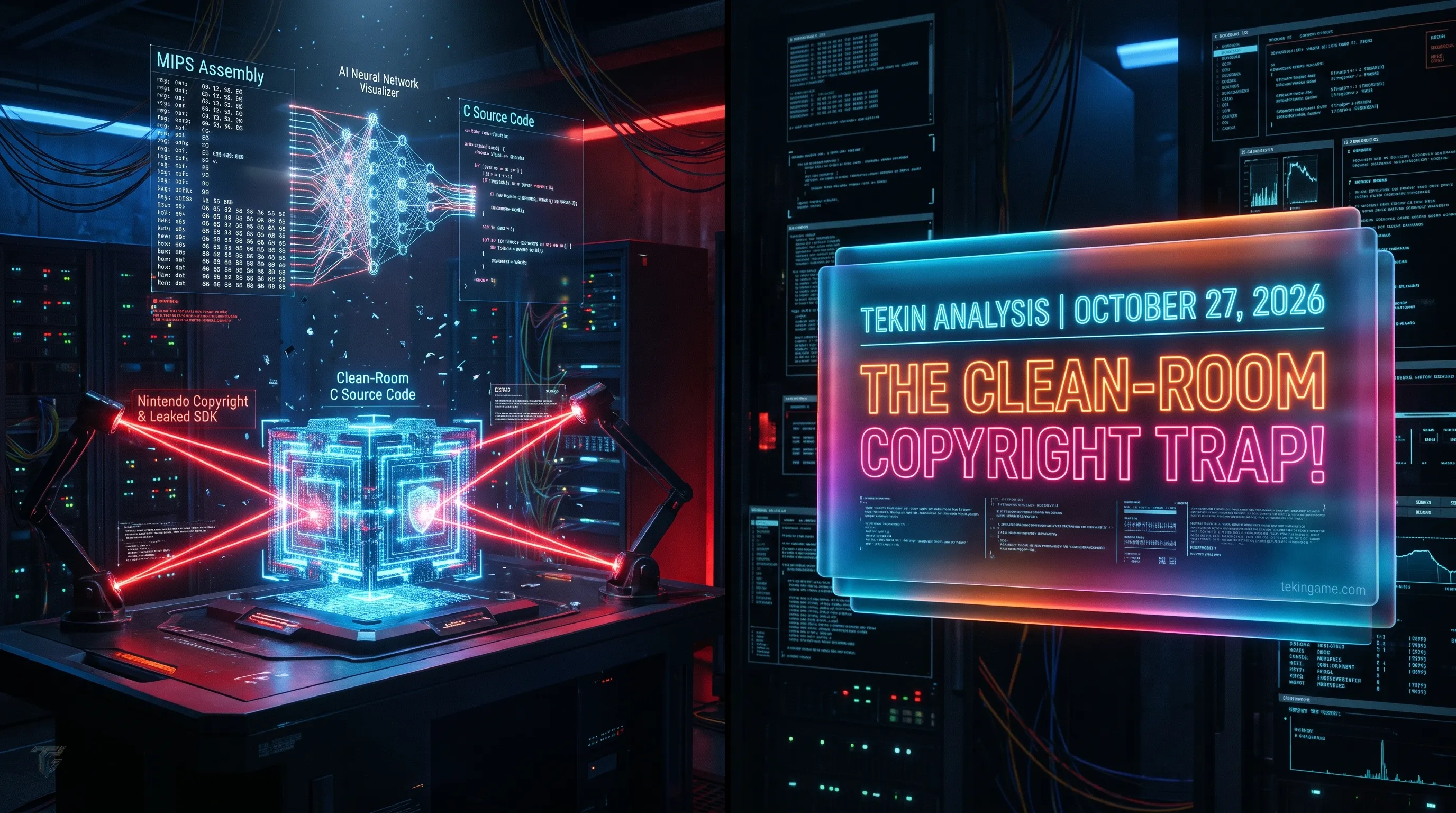
Generative models, however, introduce profound contamination vectors into this legal framework. Large language models are trained on massive swathes of internet-scraped source code, including illicit repositories originating from massive historical leaks, such as Nintendo's 2020 "Gigaleak" and Capcom's proprietary development trees. If an agentic decompiler incorporates verbatim proprietary logic, variable structures, or leaked SDK routines that it ingested during pre-training, the resulting codebase instantly forfeits clean-room protection. Platform holders have already signaled intent to deploy automated forensic scrapers to detect proprietary signatures within public recompilation repositories, creating an unprecedented copyright liability for open-source maintainers.
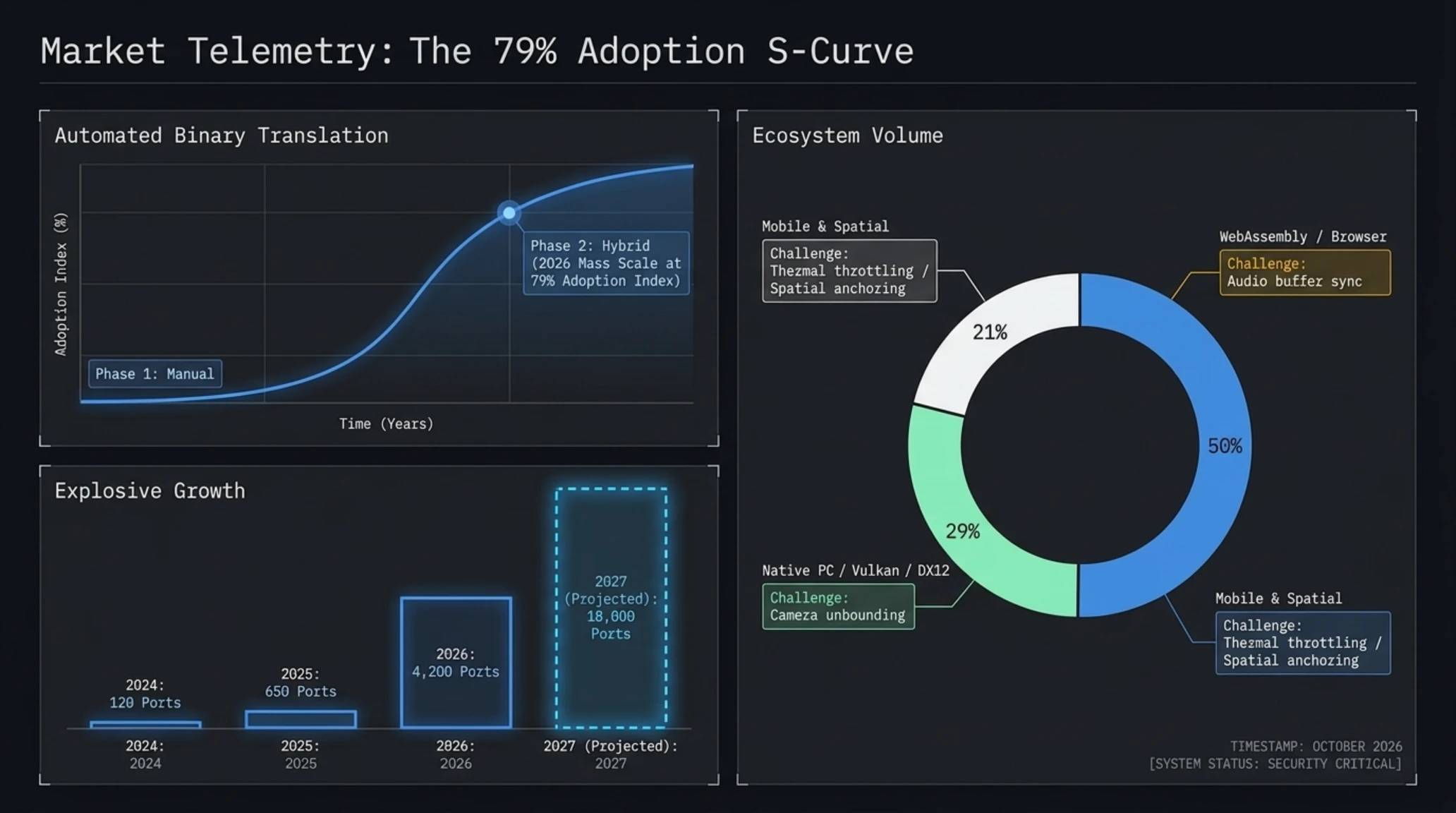
Financial Telemetry | Ecosystem Volume and Market Port Projections
| Architecture Target | Ecosystem Share | Primary Engineering Challenge |
|---|---|---|
| WebAssembly (Browser Execution) | 50 percent | Asynchronous audio buffer sync and WASM memory limits |
| Native PC (Vulkan / DirectX 12) | 29 percent | Dynamic aspect-ratio viewport scaling and camera unbounding |
| Mobile & Spatial Computing | 21 percent | Touch input translation, thermal throttling, and spatial anchoring |
📚 Classified & Related Dossiers in TekinGame
If you wish to explore beyond this report and delve into cybernetic frontiers and autonomous AI architectures, do not miss these three exclusive deep-dives in the Tekin Garage:
Market Sentiment Gauge | S-Curve Technology Adoption Model
Sentiment Telemetry: While gaming enthusiasts register overwhelming enthusiasm (79%) for instant cross-platform legacy access, core systems architects maintain defensive vigilance regarding code maintainability and legal exposure.
Cybernetic Terminal and Benchmark Telemetry Log
The Future of Heritage Preservation: Synthesis of Human Rigor and Synthetic Speed
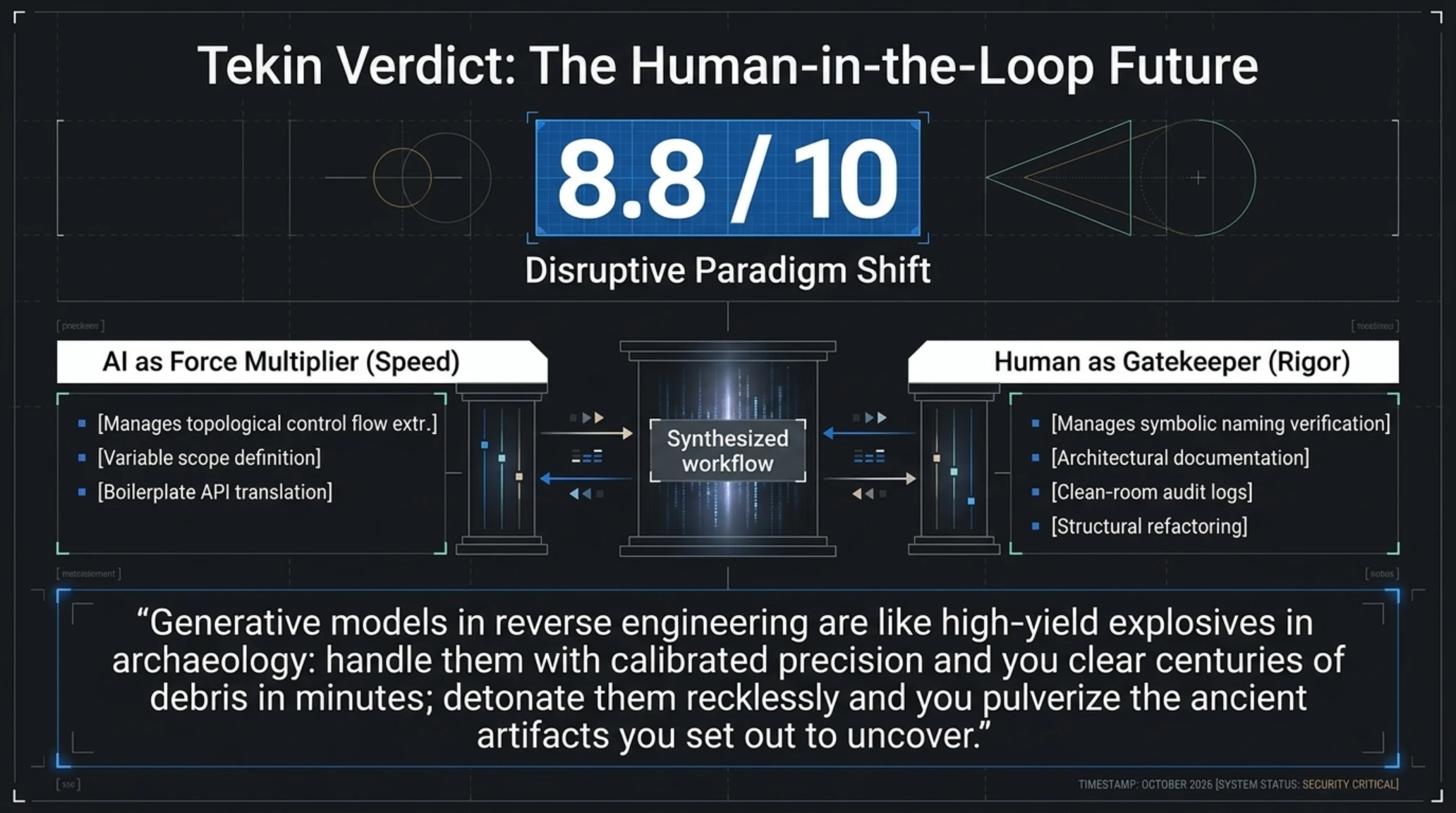
As the initial ideological polarization begins to stabilize, a pragmatic consensus is crystallizing among forward-thinking systems architects. The future of software preservation lies neither in reactionary rejection of artificial intelligence nor in reckless abdication to unsupervised code generation. Instead, a new paradigm is emerging: Human-in-the-Loop Hybrid Decompilation.
In this architecture, automated neural pipelines act as force multipliers, managing the grueling, repetitive labor of topological control flow extraction, variable scope definition, and boilerplate API translation. Crucially, the final review gates symbolic naming verification, architectural documentation, clean-room audit logs, and structural refactoring remain strictly in human hands. This synthesis preserves the intellectual legacy of classic game engineering while unlocking the boundless portability made possible by modern compilers.
Event Timeline | Chronology of Binary Recompilation Milestones
| Year / Period | Pivotal Engineering Milestone | Ecosystem Evolution & Strategic Impact |
|---|---|---|
| 2019 | Super Mario 64 Full Matching Decompilation | Proved the viability of bit-perfect clean-room C reconstruction from commercial ROMs, inaugurating the modern preservation movement. |
| 2024 | N64Recomp Framework and Static Translation | Automated binary-to-C translation tools demonstrated that full recompilations could be completed in months rather than years. |
| October 2026 | Agentic Ingestion Wave & decomp.dev Blackout | Neural pipelines collapse recompilation cycles to days, triggering community schisms over AI code quality and copyright clean-room validity. |
- Native, frictionless execution of historically significant software across browsers, mobile silicon, and spatial computing headsets.
- Over 95% reduction in the capital and temporal investment required to rescue orphaned titles from defunct hardware architectures.
- Modern accessibility enhancements including unlocked framerates, native 4K HDR viewports, ray tracing, and custom input mapping.
- Elimination of dynamic virtualization overhead, significantly reducing battery consumption and thermal load on client hardware.
- Catastrophic influx of unverified synthetic code dumps (AI Slop) overwhelming maintainers across open-source hubs.
- Escalating copyright vulnerabilities resulting from AI training sets that ingest leaked corporate SDKs and proprietary code.
- Erosion of deep pedagogical knowledge regarding low-level silicon design and historical software engineering practices.
Editorial Verdict and Primary Source Manifest
The Twilight of the Monastic Reverse Engineer
Neural transpilation has permanently breached the gates of compiled binaries. The survival of gaming history now depends on whether the community can successfully govern this abundance without surrendering its historical integrity.
Technical Frequently Asked Questions
How does AI-driven decompilation differ from traditional emulation?
Traditional emulation virtualizes an entire hardware platform in real time, translating instructions on the fly and consuming immense CPU cycles. AI-driven decompilation translates compiled machine code ahead of time into clean C source code, allowing the game to compile natively for target platforms with zero runtime overhead.
Why are classical reverse engineers protesting against AI code contributions?
Because inexperienced users are submitting automated code dumps filled with hallucinated variables, unoptimized memory leaks, and broken logic (AI Slop) that place an unsustainable triage burden on project maintainers.
Is the distribution and execution of recompiled game binaries legal?
Under established legal precedent, clean-room source code produced without proprietary code theft is legal. However, players must legally extract their own proprietary game assets (audio, textures, 3D models) from original retail copies to build a playable executable.
Can console manufacturers like Nintendo shut down automated recompilation projects?
If projects merely release clean source code without proprietary copyrighted assets, they fall within legal protections. However, manufacturers are exploring claims that generative models trained on leaked corporate source code contaminate clean-room status.
How does the Halo browser port maintain desktop-grade performance?
By compiling the reconstructed C logic into WebAssembly (WASM) and routing graphics calls through WebGL 2.0, the browser executes the binary directly on host CPU threads and GPU shaders at near-native speeds.
What is the long-term solution to the AI code controversy?
Adopting a hybrid workflow where AI automates initial disassembly and control flow mapping, while experienced human systems engineers audit, document, and verify the resulting code for long-term maintainability.
Additional Gallery: Tekin Analysis | AI Decompilation & The Retro Gaming Recomp War