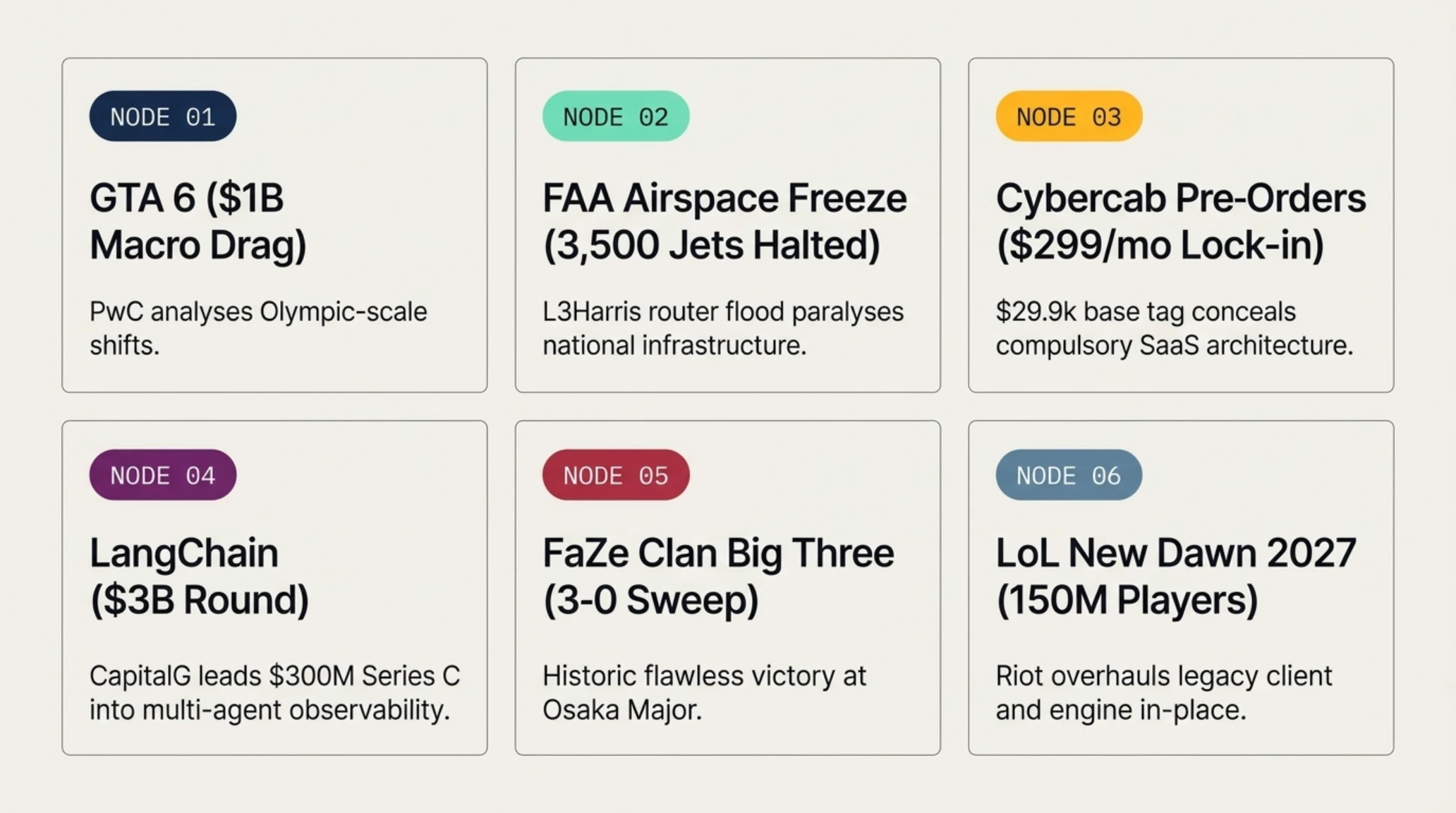
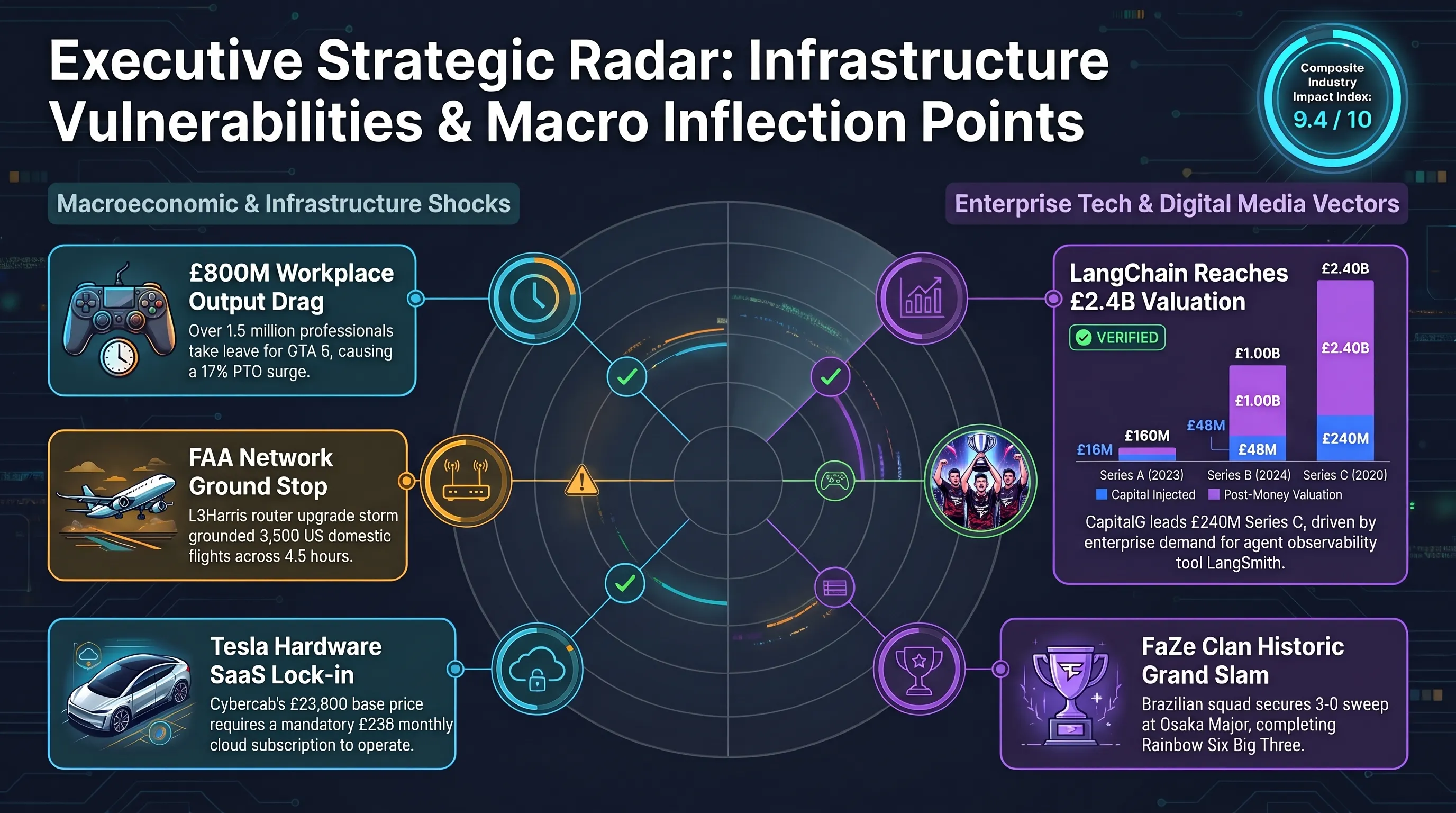
Tekin Morning Executive Briefing for Monday, November 16, 2026, dissects six pivotal realignments: (1) PwC's macroeconomic audit projecting a $1B workplace productivity drag from GTA 6 on par with the Olympic Games; (2) a nationwide FAA ground stop freezing 3,500 flights due to an L3Harris router buffer storm; (3) Tesla Cybercab pre-orders at $29,990 with a mandatory $299/mo subscription; (4) LangChain's $300M Series C at a $3B valuation; (5) FaZe Clan's 3-0 Osaka Major grand slam; and (6) Riot Games unveiling League of Legends: New Dawn.
Tekin Morning | November 16, 2026: GTA 6 Olympic Economic Shock, Nationwide FAA Ground Stop, Tesla Cybercab and LangChain $3B Valuation
Monday morning, November 16, 2026, marks an extraordinary convergence of macroeconomic turbulence, critical infrastructural fragilities, and the accelerating industrialization of autonomous systems. As the digital economy transitions from experimental proof-of-concepts into foundational societal bedrock, the ripple effects generated by software releases and network configuration anomalies now wield the power to shake national GDP metrics and alter global supply chains.
In this edition of Tekin Morning, we dismantle the superficial narratives to examine the structural forces governing the global technology landscape. From the looming $1 billion workplace productivity drain forecasted around Grand Theft Auto VI to the mechanical network breakdown that froze the United States national airspace, each vector illustrates the intricate vulnerabilities of hyper-connected modern civilization.
Key Takeaways | Executive Strategic Intelligence & Core Vectors
The Olympic Scale of Grand Theft Auto VI: PwC Analyzes the $1 Billion Macroeconomic Shockwave
As the entertainment ecosystem prepares for the imminent launch of Rockstar Games' Grand Theft Auto VI, Wall Street institutional analysts and forensic economic researchers have ceased treating the title merely as a consumer video game release. Instead, financial leaders view the deployment as an unprecedented macroeconomic anomaly capable of exerting massive gravitational pull over consumer discretionary spending, digital media consumption, and corporate workplace attendance.
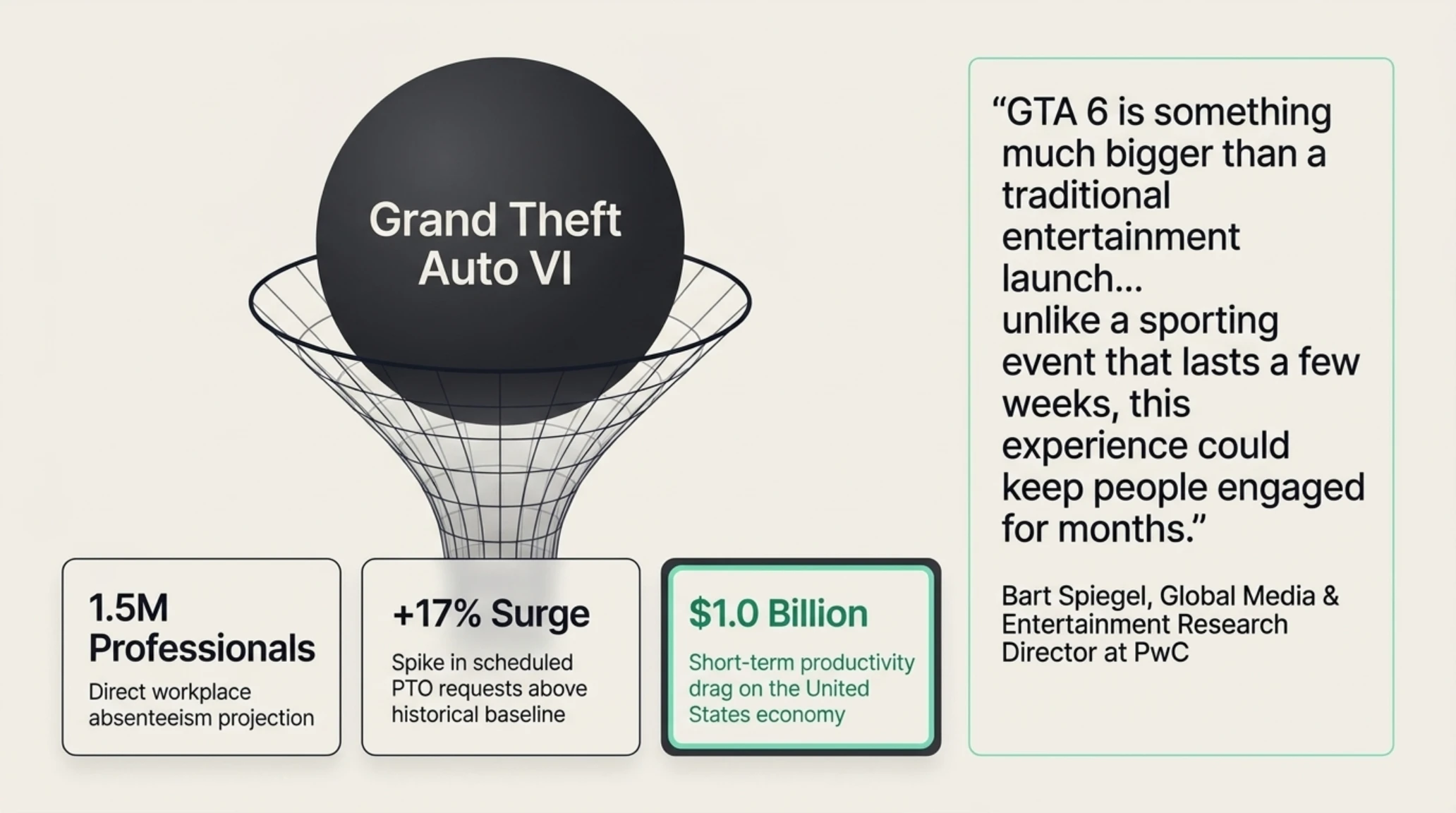
In an exhaustive interview with GameSpot, Bart Spiegel, a principal advisor and global research director at PricewaterhouseCoopers (PwC), drew a direct parallel between the upcoming launch and the global Olympic Games. Spiegel noted that GTA 6 represents a singular cultural inflection point that commands extraordinary attention across several multi-billion-dollar industries simultaneously, an achievement virtually unheard of in an increasingly fragmented entertainment landscape.
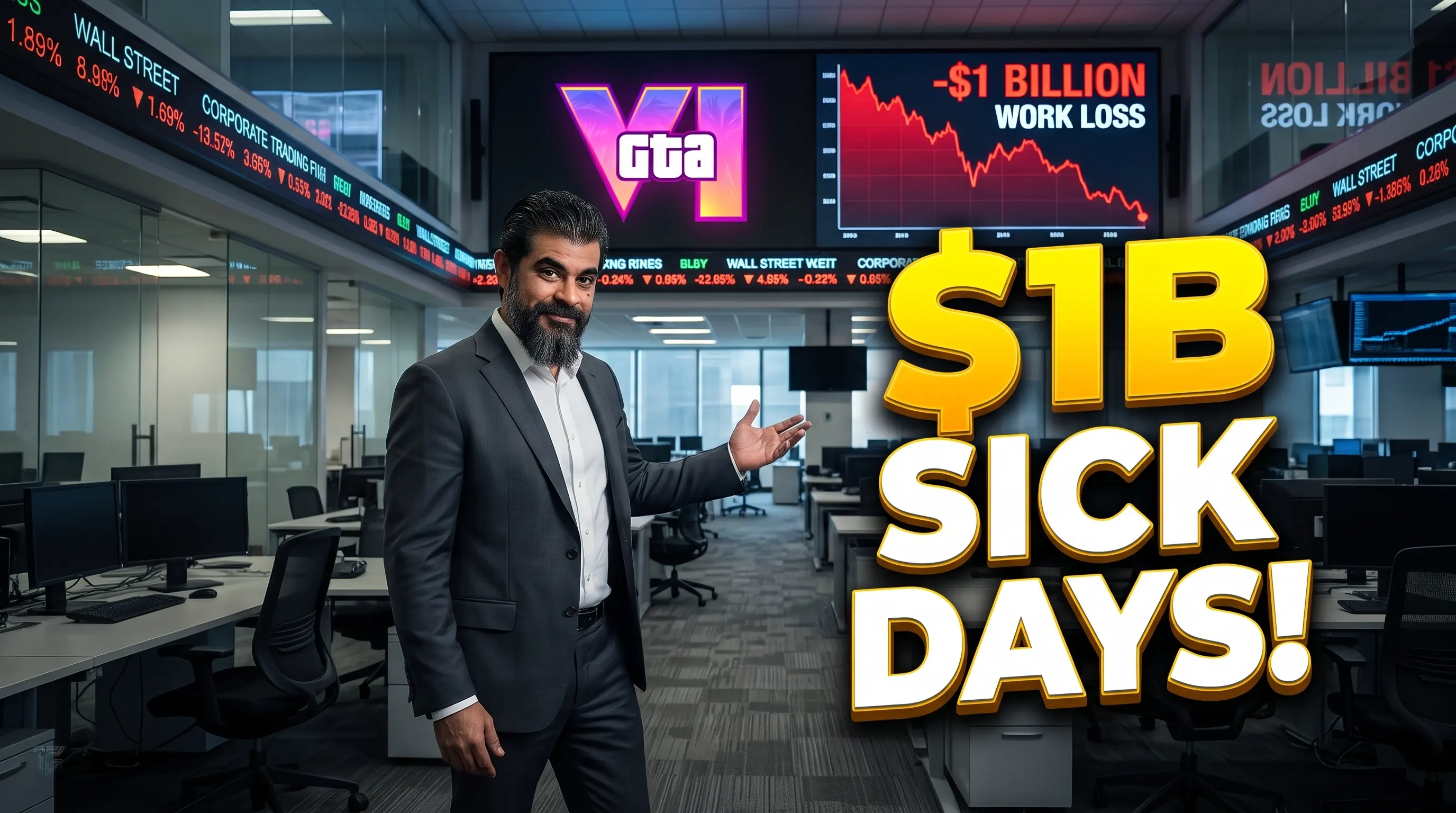
The magnitude of this cultural event is illustrated by the evasive maneuvers executed by competing media titans. Hollywood directors, including Francis Lawrence whose tentpole blockbuster The Hunger Games: Sunrise on the Reaping debuts just twenty-four hours after GTA 6, have openly acknowledged the danger of competing against Rockstar's release window. Lawrence expressed hope that audiences would manage to step away from their consoles long enough to visit theaters, underscoring Hollywood's acute anxiety over losing the cultural conversation.
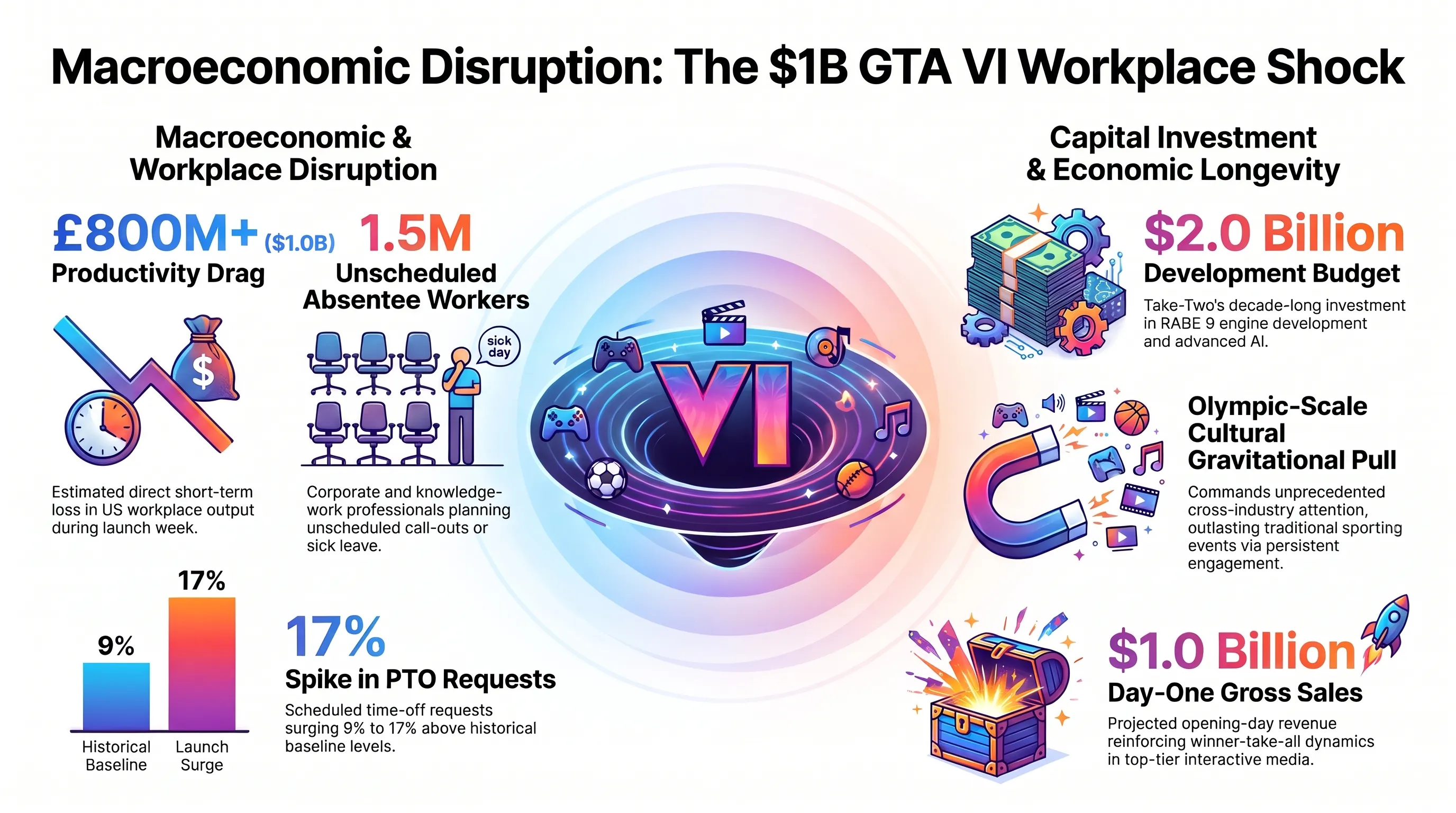
Quantifying this disruption reveals startling figures. Behavioral economists and labor analysts project that approximately 1.5 million professionals across corporate and knowledge-work sectors intend to take unscheduled time off or call out sick during launch week. PwC's proprietary workforce tracking models indicate that scheduled paid time off (PTO) requests are surging between 9% and 17% above historical baseline levels, translating to an estimated $1.0 billion in temporary productivity loss for the United States economy alone.
Why This Disruption Alters the Landscape
Yet, as Spiegel emphasized during the PwC analysis, the crucial differentiator between a global sporting event like the Olympics and the release of GTA 6 lies in engagement longevity. The Olympic Games conclude after a few weeks, allowing consumer routines to rapidly normalize. In contrast, Rockstar's title offers an immersive eighty-hour single-player campaign, followed by a persistent multi-year online world that will capture user attention and wallet share for quarters to come.
From a capital structure perspective, parent company Take-Two Interactive has invested an estimated $2.0 billion across more than a decade of research, proprietary engine development (RAGE 9), volumetric weather simulation, and advanced artificial intelligence. With day-one gross sales projected to easily surpass $1.0 billion, the launch reinforces the winner-take-all dynamics dominating top-tier interactive media, as discussed in our earlier coverage of next-generation software distribution models and consumer hardware demand.
Nationwide FAA Ground Stop: How an L3Harris Router Upgrade Froze United States Airspace
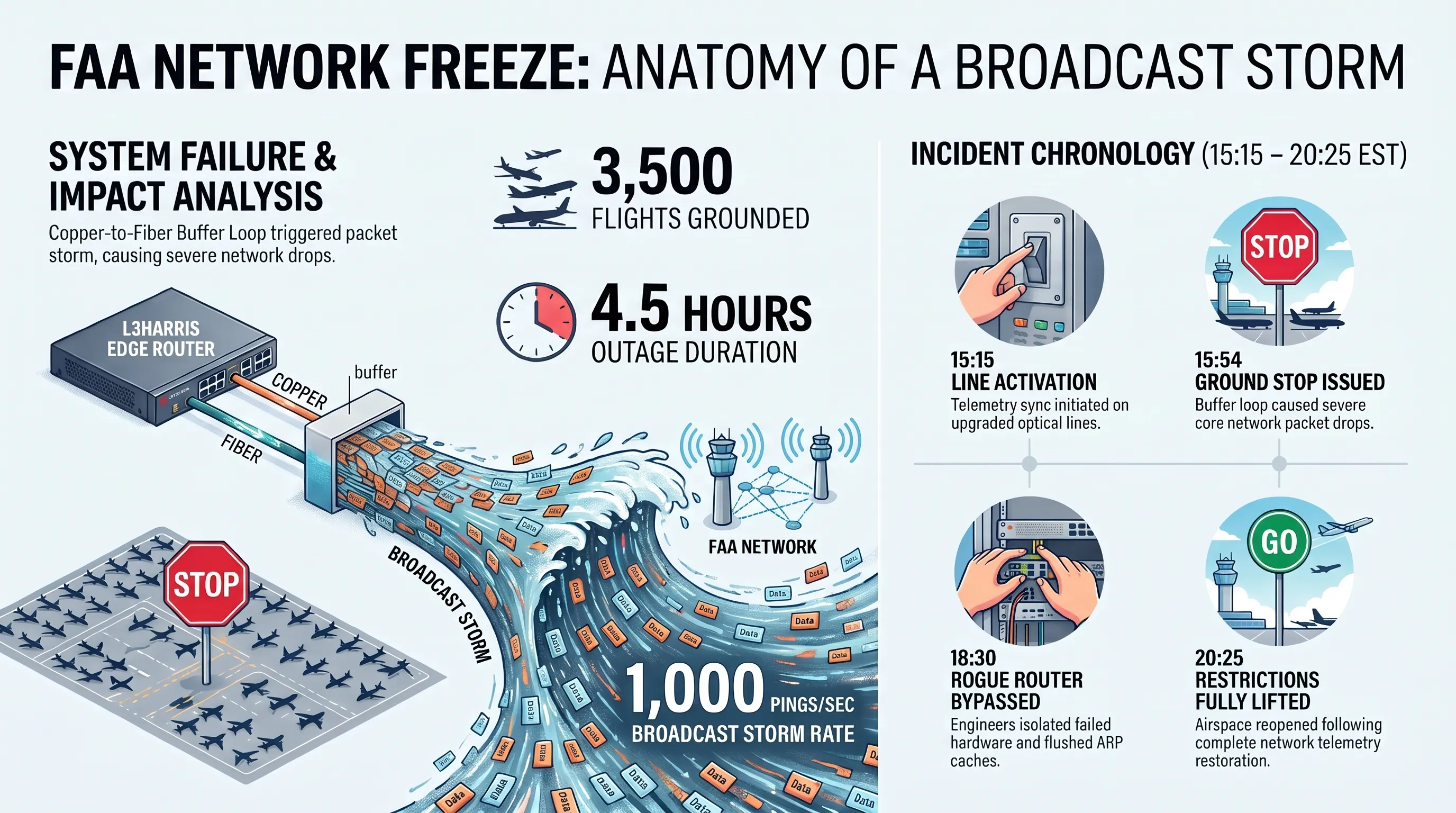
In the late afternoon of Friday heading into the weekend, the United States civil aviation infrastructure suffered one of the most severe technical paralysis events in recent history. At exactly 3:54 PM Eastern Standard Time, the Federal Aviation Administration (FAA) issued a rare, sweeping nationwide ground stop, freezing all departing domestic commercial aircraft across hundreds of airports and stranding tens of thousands of passengers.
While more than 3,500 commercial passenger airliners were already airborne at cruising altitudes, regional Air Route Traffic Control Centers (ARTCC) suddenly reported severe packet loss, intermittent radar feed drops, and total disconnections in inter-facility telecommunications. Although airborne flights were safely vectored to their scheduled destinations using secondary radar transponders, new departures were completely suspended for four and a half agonizing hours.
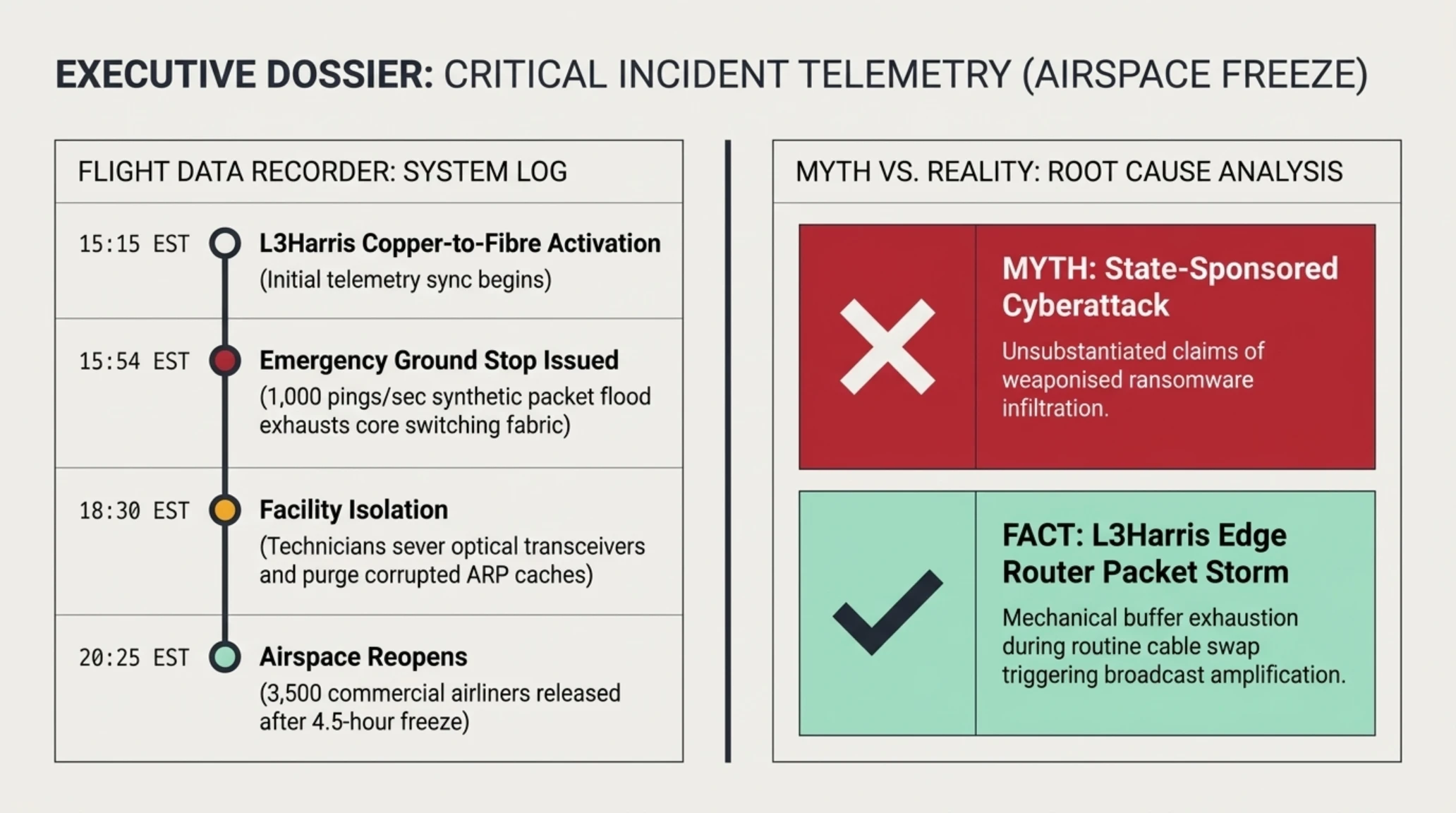
Initial speculation across news networks and social media platforms pointed toward an aggressive state-sponsored cyberattack or a catastrophic ransomware compromise of federal air traffic controllers. However, United States Transportation Secretary Sean Duffy convened an emergency press conference alongside Department of Homeland Security officials to clarify the mechanical and architectural reality behind the disruption.
The root cause was traced to routine telecommunication line modernization performed by longstanding federal aerospace contractor L3Harris. The defense contractor was transitioning remote FAA transmission lines from legacy copper wiring to high-capacity fiber-optic cables. Following the physical switchover, a newly installed enterprise edge router experienced a catastrophic buffer management loop, flooding the FAA telecommunications network with an unmanageable barrage of control pings reaching over 1,000 connection attempts every few seconds.
Forensic network analysis confirmed that dynamic queue management policies on the core switches became overwhelmed by the synthetic packet flood. Network engineers had to physically sever optical transceivers and purge corrupted ARP caches across regional routing centers to restore deterministic packet flow to terminal radar displays.
Technical Ground Truth | Myth vs. Engineering Reality
From a network engineering standpoint, the outage demonstrates the peril of protocol impedance mismatches in legacy national infrastructure. When transitioning from high-latency, bandwidth-constrained copper conduits to low-latency optical links, failure to recalibrate rate limiters and quality-of-service (QoS) queues can result in broadcast amplification. The overwhelmed FAA switching fabrics entered self-preservation states, dropping critical telemetry between regional radar centers and cockpit communication hubs.
Secretary Duffy emphasized that federal investigators are determining whether the incident stemmed from technician configuration error or a latent firmware defect inside the vendor's routing hardware. Regardless of the final determination, the cascading delays and cancellations entering the busy holiday travel season have intensified congressional demands for a comprehensive overhaul of national air traffic control telecommunications.
Incident Chronology | FAA Telecommunications Blackout Timeline
| Timestamp (EST) | Operational Incident Phase | Underlying Network & Radar Status |
|---|---|---|
| 15:15 | L3Harris Fiber Line Activation | Initial telemetry sync begins; edge router misconfiguration undetected. |
| 15:54 | Emergency Ground Stop Issued | Core switching fabric exhausted; nationwide domestic departures frozen. |
| 18:30 | Facility Isolation & Packet Flush | Technicians bypass rogue router; buffer state machines reset successfully. |
| 20:25 | Formal Lifting of Flight Restrictions | Airspace reopens after 4.5 hours; staggered recovery plan enacted. |
Tesla Cybercab Pre-Orders Open at $29,990: The Reality of the Mandatory $299 Monthly Subscription
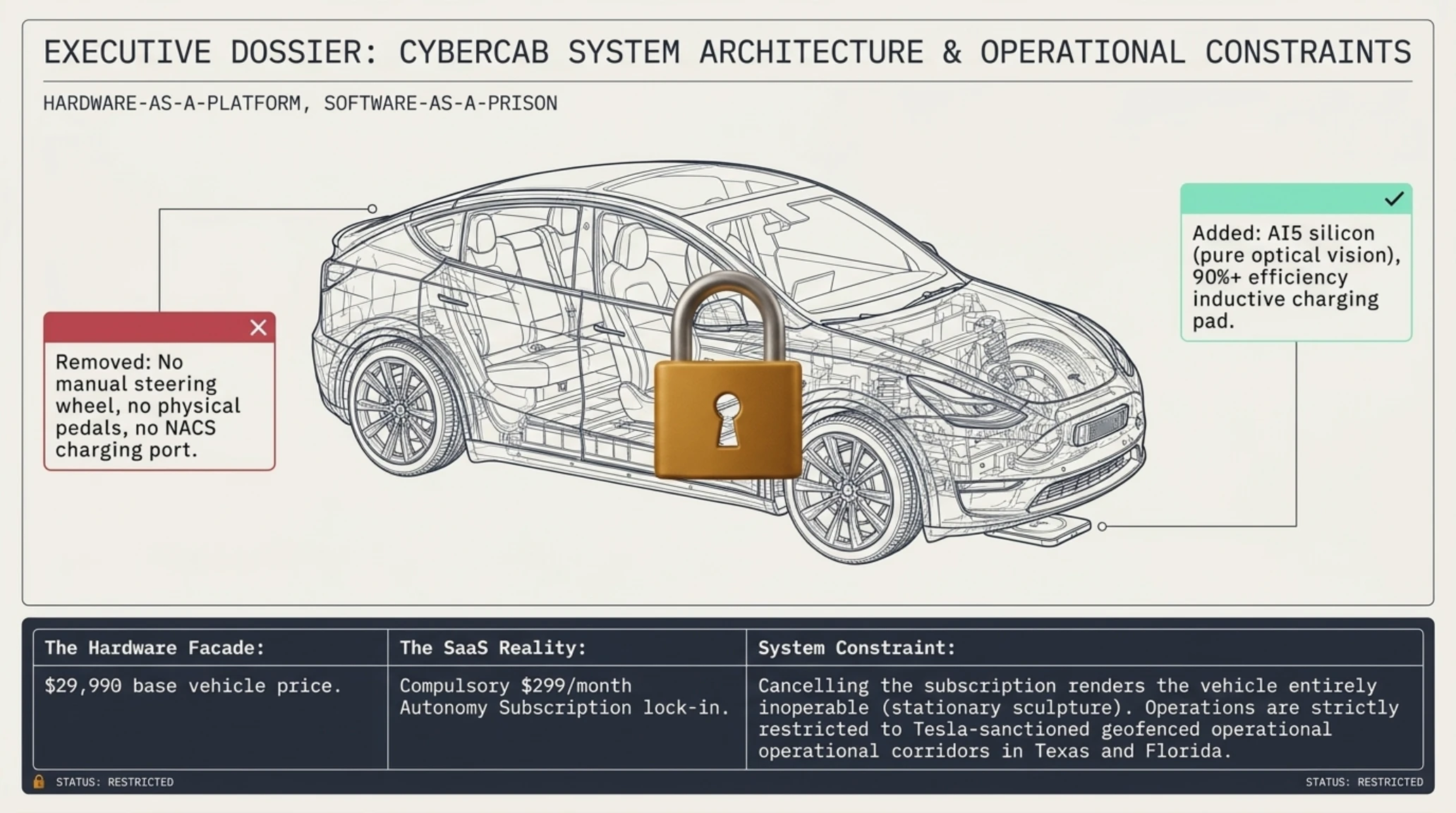
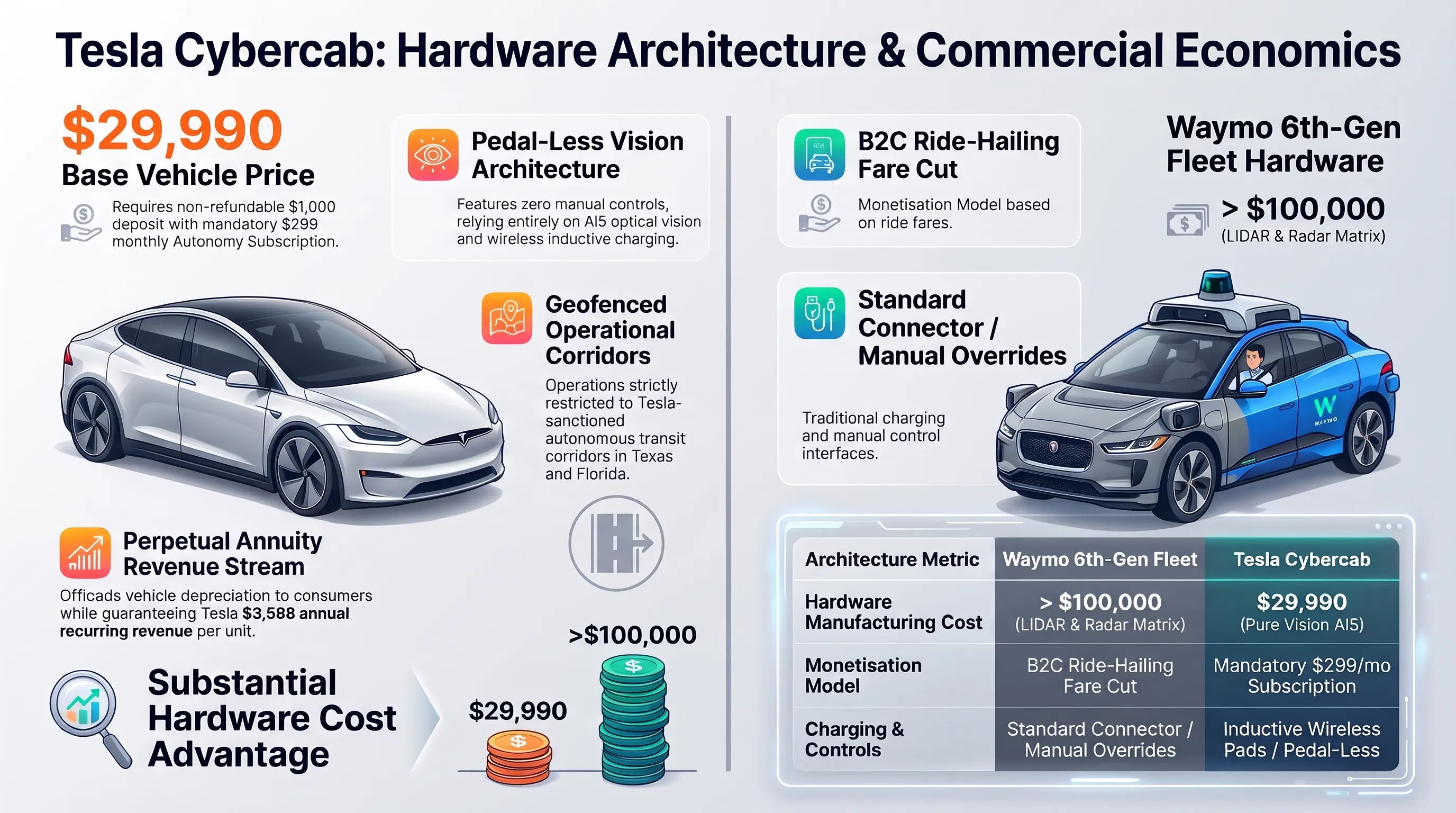
Elon Musk and Tesla have officially transitioned their ambitious autonomous robotaxi vision into consumer order books. In recent days, the electric vehicle pioneer dispatched formal pre-order invitations to a select tier of existing customers and brand loyalists, allowing them to reserve the wheel-less and pedal-less two-seater Cybercab for a non-refundable $1,000 deposit against the promised $29,990 base vehicle price.
However, a rigorous review of Tesla's binding purchase agreements reveals a fundamental redefinition of automotive ownership. The fine print establishes that private ownership of the Cybercab is strictly conditional upon maintaining a perpetual, mandatory $299-per-month Autonomy Subscription. Without this active cloud subscription, the vehicle is rendered totally inoperable.
Because the Cybercab lacks manual steering wheels, physical pedals, or manual drive-by-wire overrides, a buyer who cancels or defaults on the $299 monthly fee effectively owns a stationary sculpture. Tesla's cloud servers will refuse to authorize vehicle propulsion or dispatch route trajectories without an active subscription and verified adherence to proprietary automated maintenance schedules.
On the hardware frontier, the Cybercab introduces several radical engineering departures. It completely discards the North American Charging Standard (NACS) charging port, relying entirely on high-power inductive wireless charging pads operating at an estimated efficiency exceeding 90%. Autonomous processing is driven by Tesla's next-generation AI5 silicon, relying purely on optical neural vision without expensive mechanical LiDAR arrays.
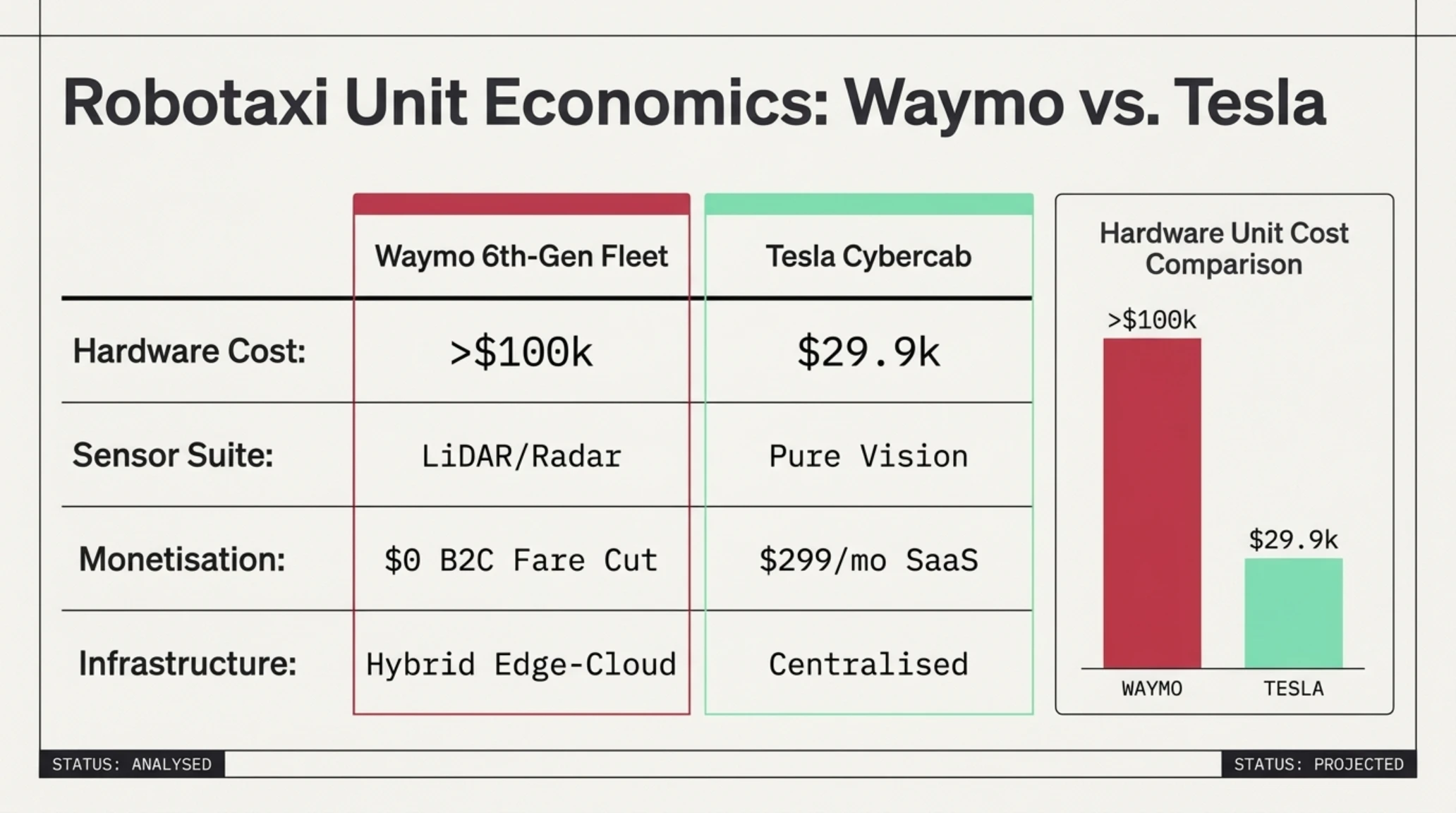
Comparative Matrix | Robotaxi Hardware Unit Economics & Architecture
| Architecture Metric | Waymo Commercial Fleet | Tesla Consumer Cybercab |
|---|---|---|
| Hardware Unit Manufacturing Cost | Exceeds $100,000 (LiDAR & Radar) | $29,990 (Pure Vision AI5 Silicon) |
| Ongoing Monetization Model | Ride-Hailing B2C Fare Cut | Mandatory $299/mo Cloud Subscription |
| Operational Operational Boundary | Select Municipal Geofences | Tesla Approved Regional Geofences |
| Cloud Infrastructure Reliance | Hybrid Edge-Cloud Human Oversight | Tesla Centralized AI5 Telemetry |
Furthermore, early buyers face severe geographic restrictions. Owners cannot drive the Cybercab wherever they please; operations are strictly geofenced to Tesla-sanctioned robotaxi operational zones in Texas and Florida. Deliveries scheduled for December 2026 and early 2027 must be accepted in person at central regional staging hubs, such as Giga Texas in Austin.
This operational model offloads the heavy capital depreciation and maintenance burdens of vehicle fleet ownership onto private consumers, while guaranteeing Tesla an annuity-like revenue stream of $3,588 per vehicle per year. It represents a bold experiment in hybrid consumer-fleet capitalism that will either accelerate autonomy or trigger regulatory pushback from consumer protection authorities.
Autonomous Systems Vocabulary | Core Architectural Concepts
LangChain Rockets to $3B Valuation in $300M Series C: The Emergence of Enterprise Agent Observability
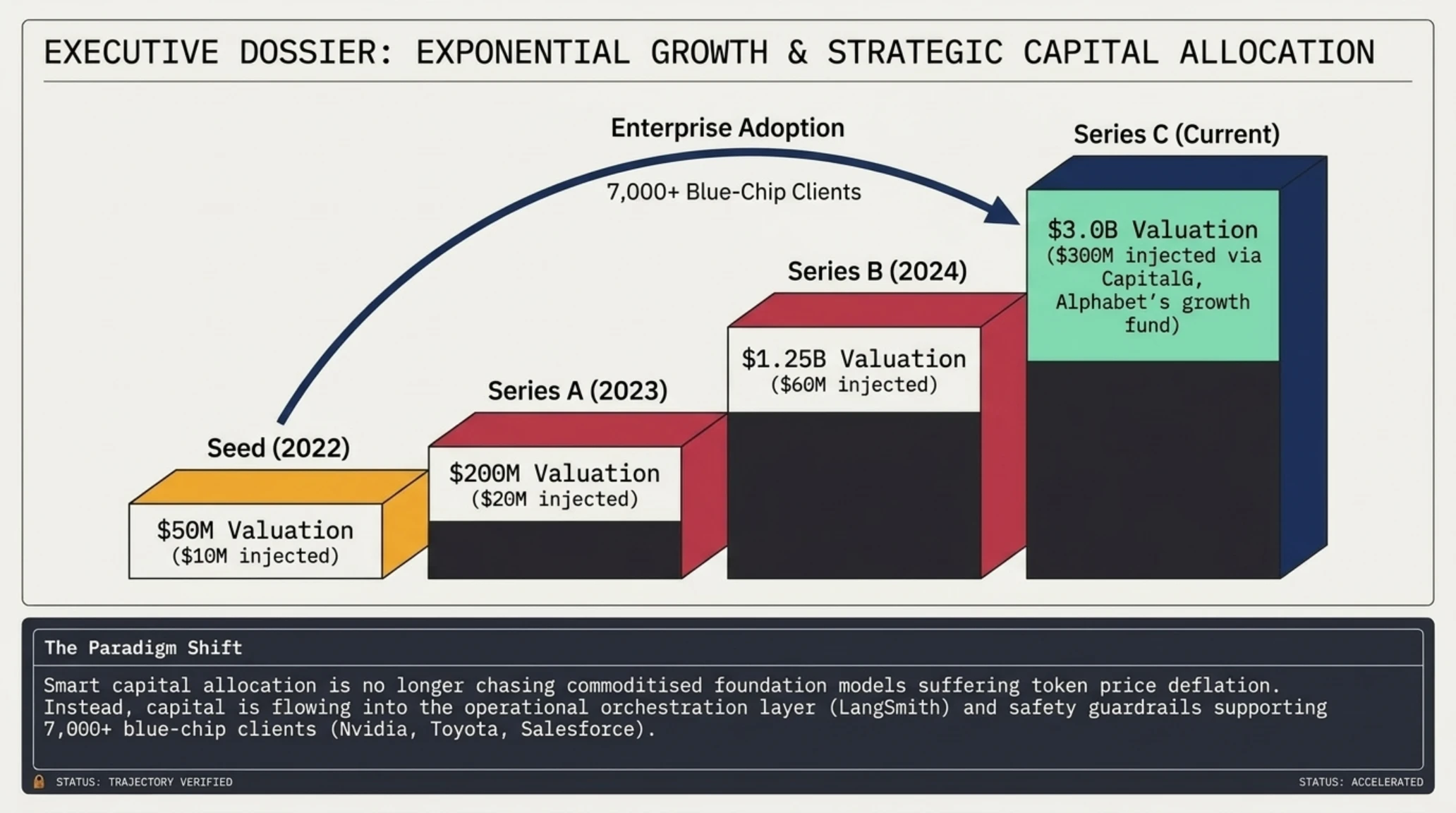
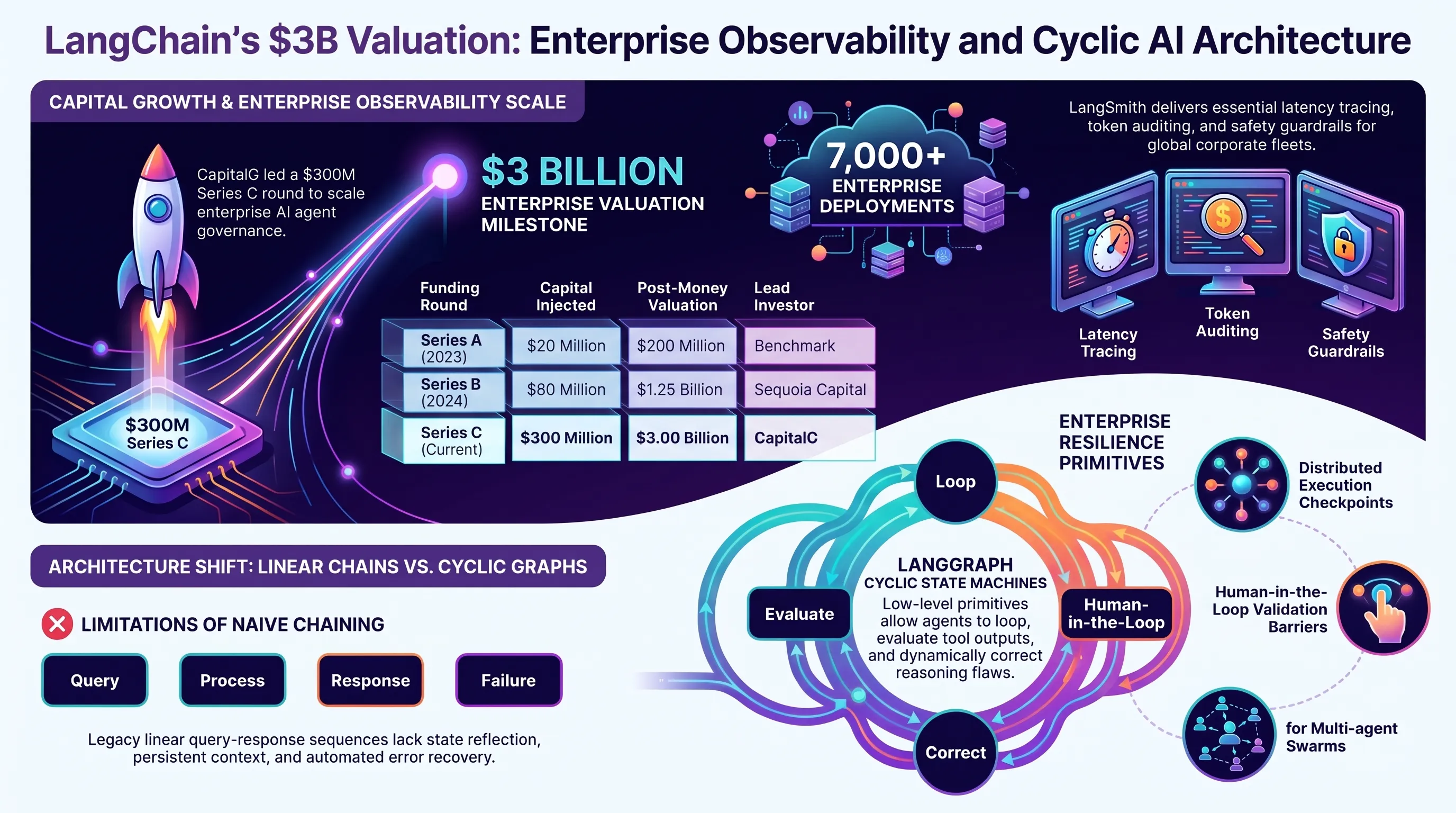
In a volatile macroeconomic landscape for artificial intelligence software startups, LangChain has pulled off a landmark financing milestone that commands the attention of every enterprise Chief Technology Officer in Silicon Valley. The company, founded and spearheaded by Harrison Chase, has officially closed a colossal $300 million Series C investment round, propelling its private market valuation to an astronomical $3.0 billion more than doubling its balance sheet capitalization within a twelve-month operational window.
The aggressive financing round was anchored by CapitalG, the independent late-stage growth venture fund of Alphabet, with major institutional participation from GIC (Singapore's sovereign wealth fund), Salesforce Ventures, and Sapphire Ventures. This capital infusion cements LangChain's decisive transformation from an open-source hobbyist prototyping library into an indispensable, mission-critical infrastructure tier for production-grade autonomous agent governance.
The gravitational epicenter of LangChain's explosive revenue trajectory is no longer its foundational Python open-source package; it is LangSmith, the company's enterprise observability, evaluation, and production monitoring platform. Today, LangSmith hosts over 7,000 blue-chip enterprise clients, including hyperscale organizations such as Nvidia, Toyota, Rakuten, and Salesforce. Global technology leaders have realized that deploying hundreds of semi-autonomous agents into customer-facing or mission-critical workflows without deep observability, token consumption auditing, latency tracing, and programmatic guardrails constitutes an unacceptable cybersecurity and financial liability.
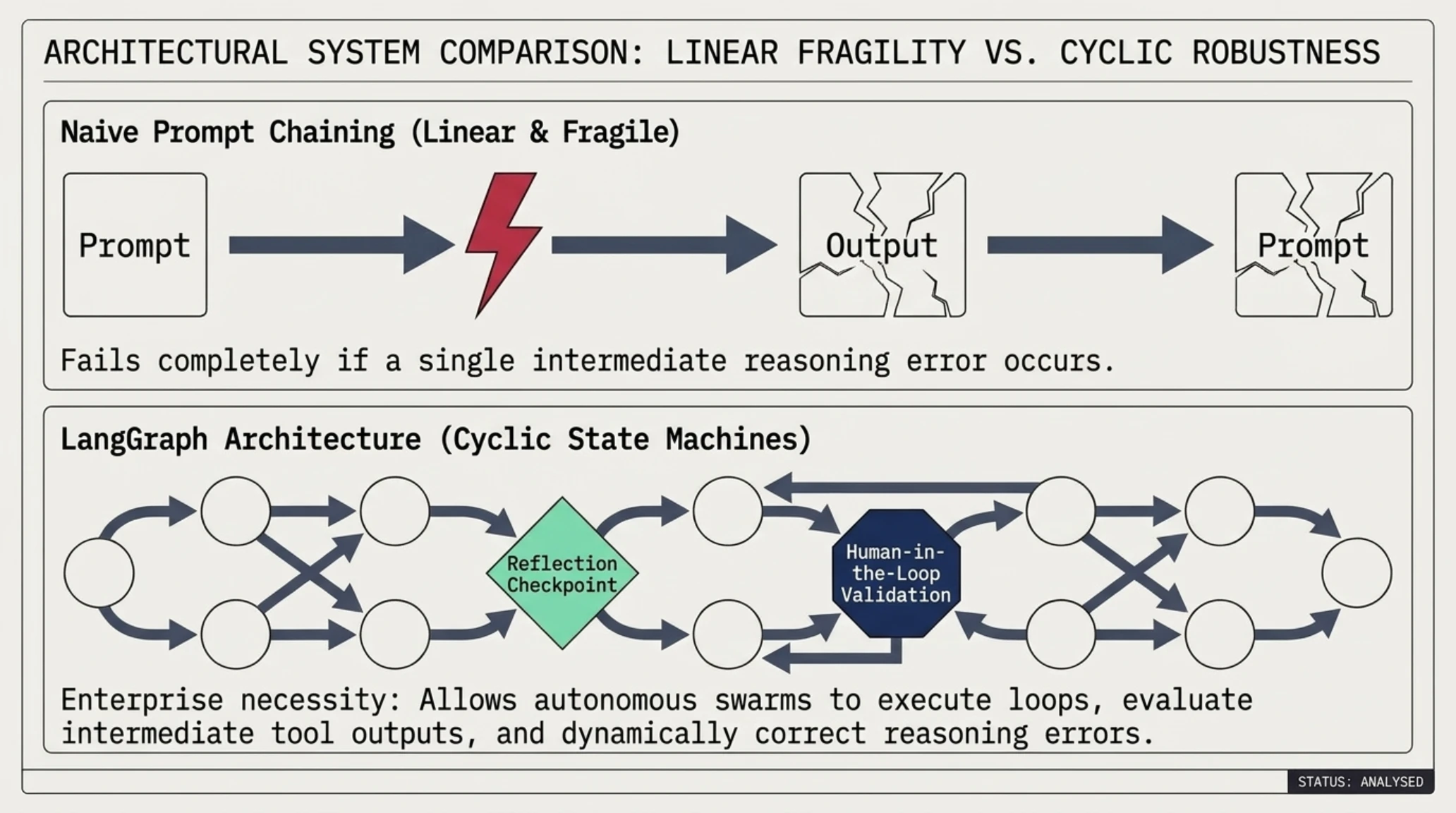
From an applied systems engineering perspective, LangChain's most defensible competitive moat lies in LangGraph. While legacy generative AI architectures relied on naive, linear chain executions (such as simple Retrieval-Augmented Generation query-response sequences), modern multi-agent systems require cyclic state machines. LangGraph provides software architects with the low-level primitives necessary to construct durable cyclic graphs, where autonomous agents can execute loops, evaluate intermediate tool outputs, dynamically correct reasoning errors, persist conversational checkpoints to distributed storage, and safely coordinate with human-in-the-loop validation barriers.
The newly secured $300 million capital reserve will be aggressively deployed to scale LangSmith's real-time security auditing capabilities, expand enterprise private VPC and on-premises deployments, and build out specialized infrastructure for multi-agent coordination frameworks across diverse foundation models, eliminating proprietary lock-in to any single vendor's closed-source API.
Capital Architecture & Adoption Matrix | LangChain Ecosystem Expansion
| Funding Round | Total Capital Injected | Post-Money Valuation | Lead Institutional Investors |
|---|---|---|---|
| Series A (2023) | $20 Million | $200 Million | Benchmark Capital |
| Series B (2024) | $60 Million | $1.25 Billion | Sequoia Capital |
| Series C (Current) | $300 Million | $3.00 Billion | CapitalG (Alphabet), GIC, Salesforce |
| Seed Round (2022) | $10 Million | $50 Million | AI Angel Syndicate & Founders |
This capitalization milestone also signals a profound maturation in enterprise AI budgeting. Venture capital is no longer chasing commoditized foundation models that suffer rapid price deflation and ruthless token price compression. Instead, the smart capital allocation is flowing into the operational orchestration layer the picks, shovels, observability monitors, and safety guardrails that every enterprise must license regardless of which proprietary or open-weights model powers their underlying cognitive engine.
📚 Classified & Related Dossiers in TekinGame
If you wish to explore beyond this report and delve into cybernetic frontiers and autonomous AI architectures, do not miss these three exclusive deep-dives in the Tekin Garage:
FaZe Clan Secures Historic 3-0 Sweep at BLAST R6 Major Osaka: Completing the Coveted 'Big Three' Grand Slam
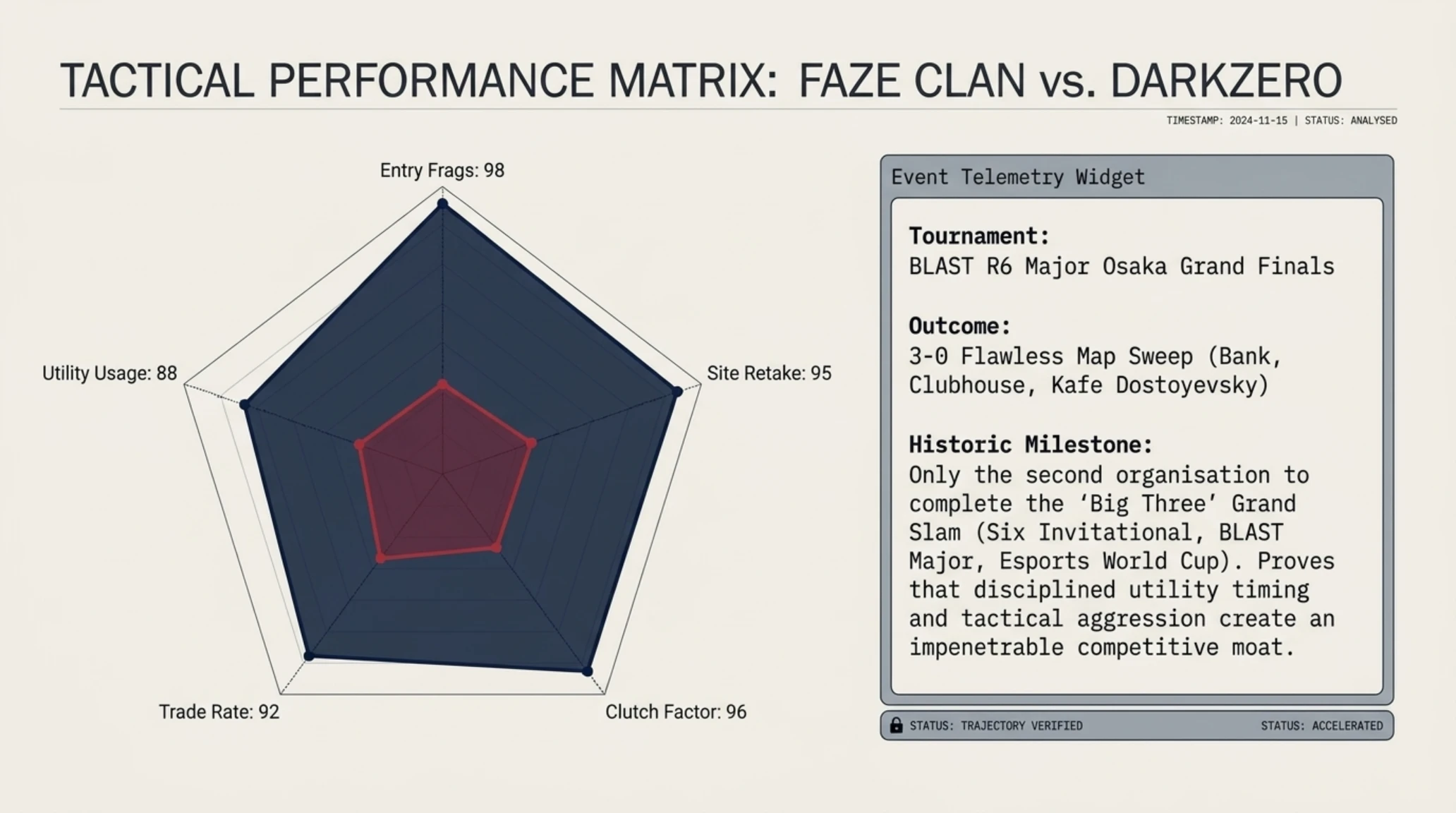
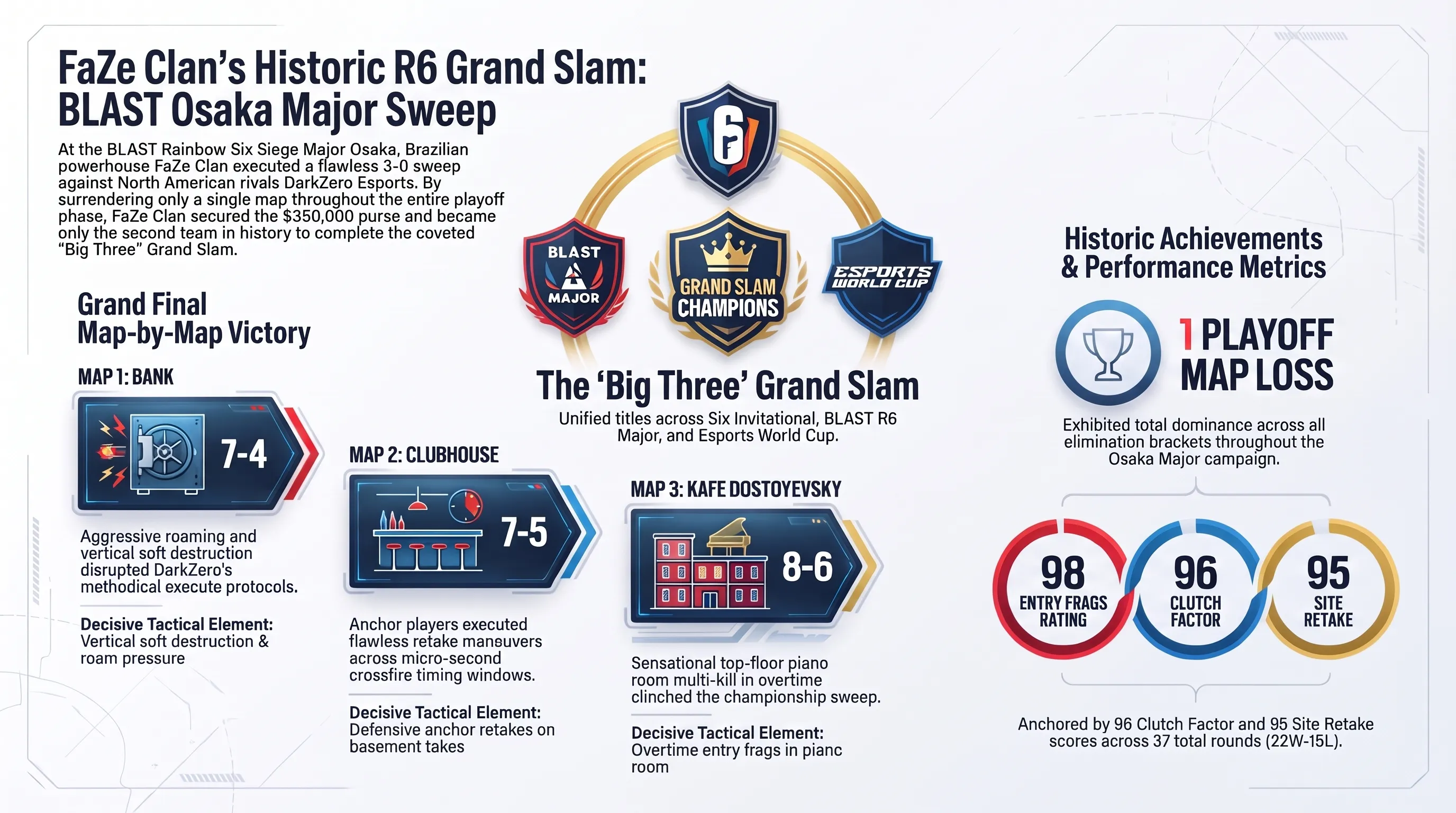
In a masterclass of tactical precision, psychological resilience, and unyielding mechanical execution, Brazilian powerhouse FaZe Clan has etched its name into the immortal annals of esports history. Competing on the grand championship stage at the BLAST Rainbow Six Siege Major Osaka in Japan, FaZe Clan dismantled North American juggernaut DarkZero Esports with an emphatic, clinical 3-0 clean sweep, hoisting the coveted trophy before thousands of roaring international fans.
The grand final victory carried immense historical significance beyond the substantial $350,000 championship purse. With this triumph, FaZe Clan officially became only the second organization in competitive Rainbow Six history to complete the prestigious 'Big Three' Grand Slam unifying championship trophies across the Six Invitational, the BLAST R6 Major, and the Esports World Cup (formerly Gamers8). This accomplishment elevates their current five-man roster into the pantheon of greatest competitive dynasties ever assembled in tactical first-person shooters.
The Grand Final stage erupted into deafening cheers as FaZe Clan took to the server, showcasing an unprecedented level of mechanical precision and tactical synergy that completely suffocated DarkZero's defensive playbooks across all three battlegrounds.
The grand final series unfolded across three tense battlegrounds: Bank, Clubhouse, and Kafe Dostoyevsky. On the opening map of Bank, FaZe Clan set the tactical tempo immediately. Deploying aggressive early-round roam setups and surgically exploiting vertical soft destruction, FaZe disrupted DarkZero's signature slow-paced execute protocols, securing an authoritative 7-4 victory.
The second map, Clubhouse, demonstrated FaZe's defensive adaptability under high-stress conditions. Despite DarkZero adjusting their entry routes and attempting coordinated basement site takes with hard-breach utility, FaZe's anchor players executed near-flawless retake maneuvers. Capitalizing on micro-second timing windows and devastating crossfire angles, FaZe closed out the map 7-5, pushing DarkZero to the brink of elimination.
The closing battleground of Kafe Dostoyevsky delivered an esports spectacle for the ages. DarkZero mounted a ferocious counter-offensive, forcing the map into heart-pounding overtime. However, with the championship on the line at 7-6, FaZe Clan's entry fragger executed a sensational multi-kill on the top-floor piano room, dismantling DarkZero's offensive momentum and sealing an 8-6 overtime triumph to complete the historic 3-0 sweep.
5-Axis Tactical Audit | BLAST R6 Major Osaka Grand Finals Telemetry
Throughout their entire Osaka playoff campaign, FaZe Clan dropped only a solitary map across all elimination brackets. This staggering level of dominance underscores that psychological stamina, tactical unorthodoxy, and seamless communication in high-stakes clutch scenarios are the decisive differentiators in Tier-1 global esports.
Riot Games Officially Unveils League of Legends: New Dawn: A Generational Overhaul for 2027
On the grand stage of the League of Legends World Championship, developer Riot Games finally put an end to years of rampant community speculation regarding a potential standalone sequel. Riot executives Andrei van Roon (Studio Head of League Studio) and Paul Bellezza (Executive Producer) took to the broadcast stage to unveil the official teaser trailer for 'League of Legends: New Dawn' a monumental technical and visual overhaul slated for formal deployment in early 2027.
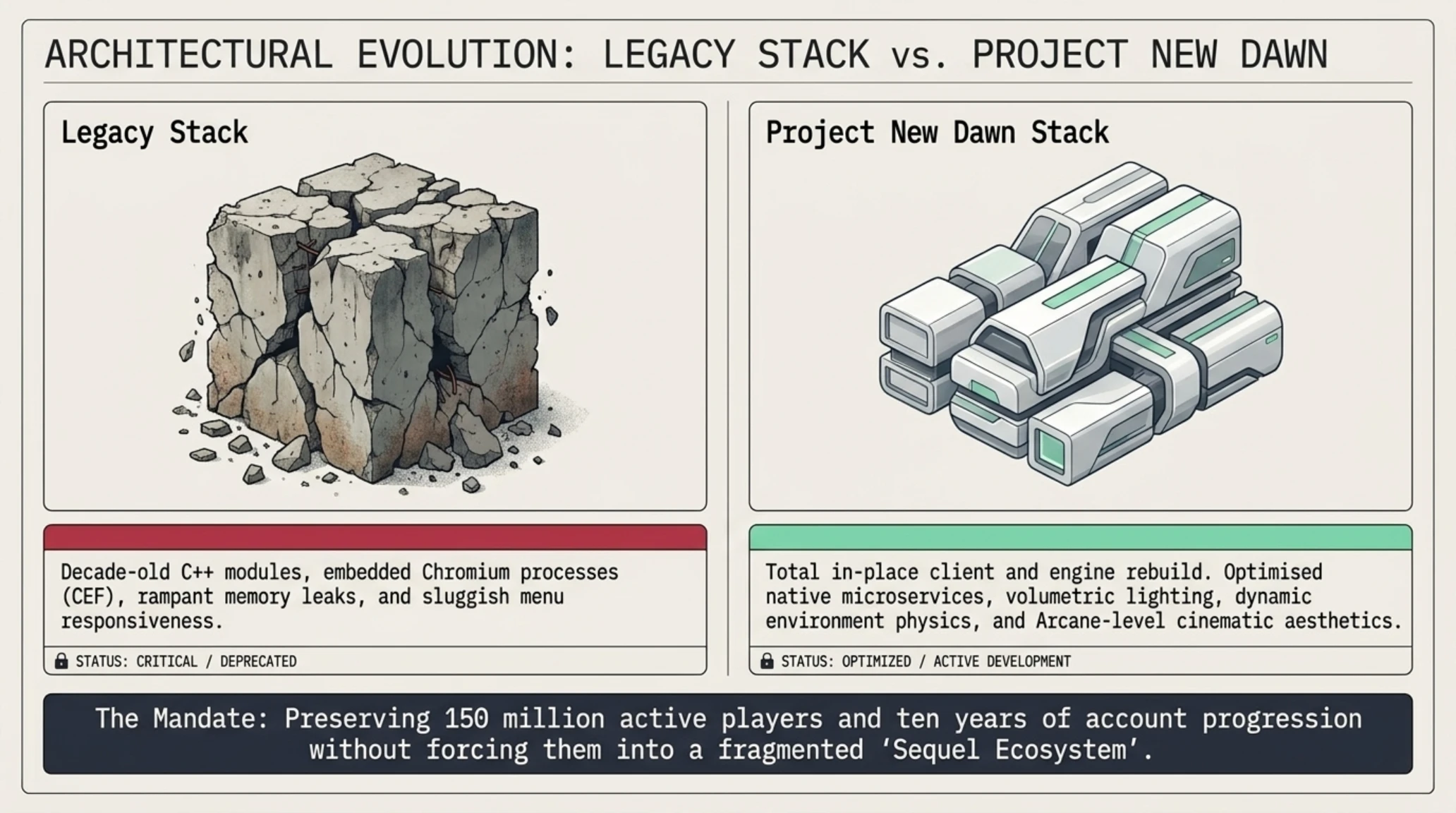
Rather than splintering the game's colossal 150-million active player base across a separate 'LoL 2' ecosystem, Riot has committed to a sweeping, in-place architectural rebuild. The initiative targets three fundamental pillars: a ground-up rewrite of the notoriously fragile legacy client, a complete visual and physical redesign of Summoner's Rift with dynamic environment reactions, and a comprehensive graphical and animation upgrade that elevates veteran champions to the cinematic aesthetic standard established by the acclaimed animated series Arcane.
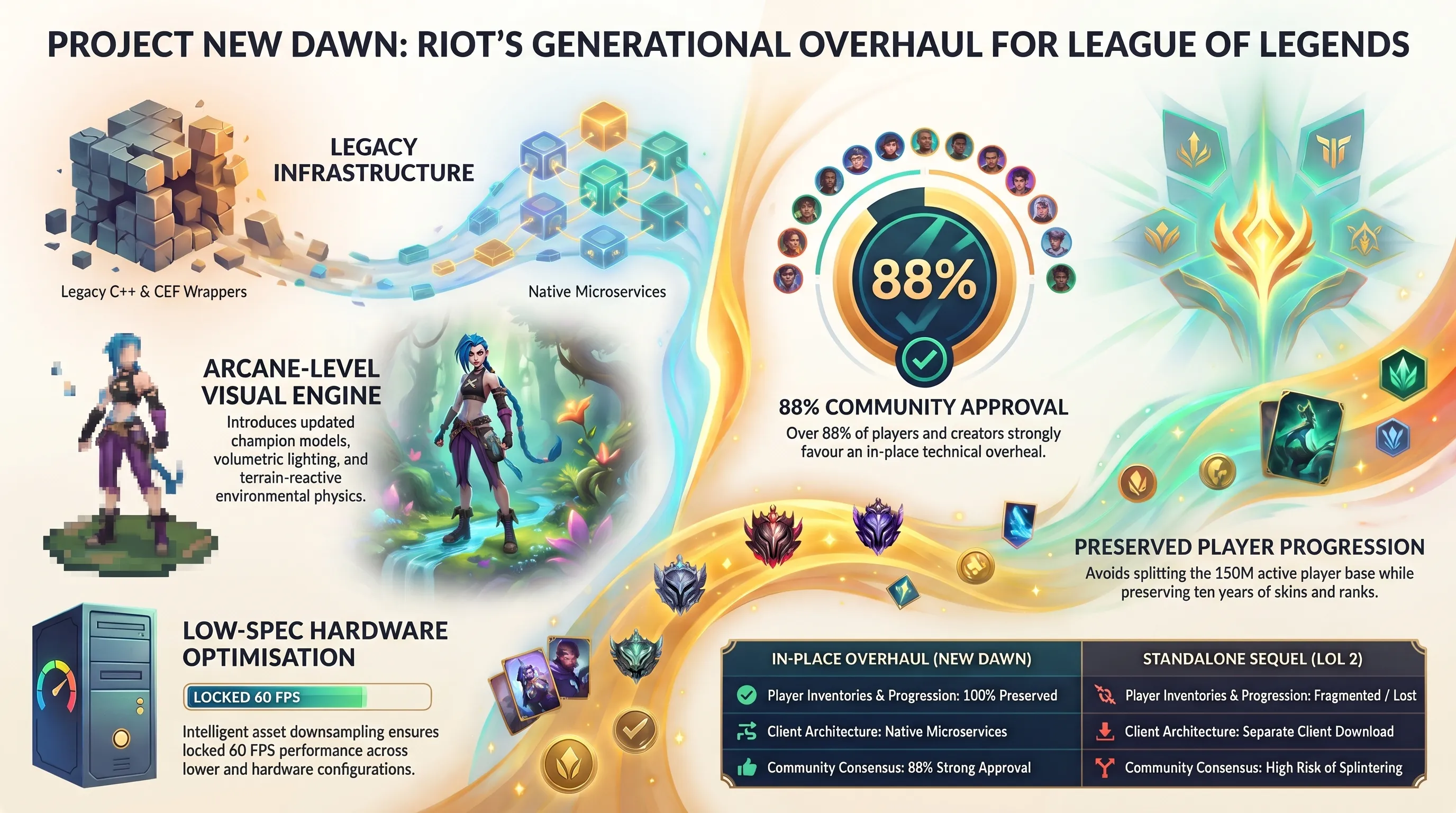
From a software engineering perspective, the current League of Legends client a decade-old amalgamation of legacy C++ modules, embedded Chromium processes, and fragile web rendering wrappers has long been criticized as the title's single greatest operational weakness. Rampant memory leaks, sluggish menu responsiveness, and desynchronized party lobbies have plagued millions of daily users. Under Project New Dawn, this obsolete infrastructure is being entirely discarded in favor of a modern, modular client architecture built on optimized native microservices, reducing lobby load times and matchmaking handshakes to instantaneous milliseconds.
In-game, the visual transformation is equally dramatic. The teaser showcased refreshed character models, volumetric lighting, and updated spell fidelity for classic champions including Garen, Master Yi, Blitzcrank, Leona, and Malphite. Environmental audio and dynamic physics now react to terrain-altering champion abilities, such as Anivia's crystalline ice walls or Taliyah's earthen ramparts, transforming the rift into a living, responsive arena.
Crucially, Riot underscored that New Dawn will preserve the title's legendary low-spec hardware accessibility. The engineering team has constructed scalable rendering pipelines with intelligent asset downsampling, ensuring that players in emerging esports markets competing on modest hardware configurations can maintain locked 60-frame-per-second performance without competitive degradation.
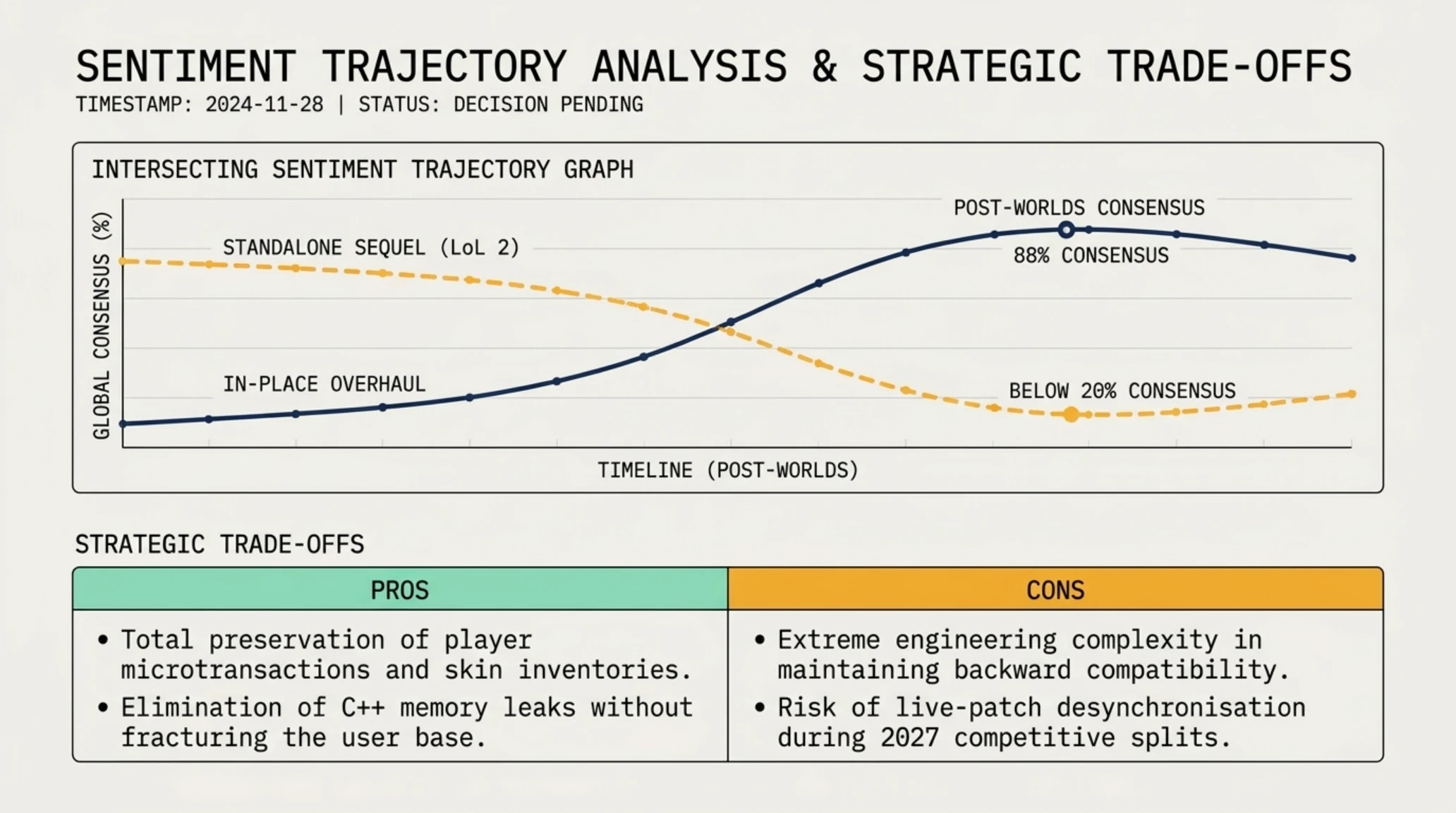
Player Sentiment & Community Reception | S-Curve Transition Analysis
This tactical architecture mirrors Valve's successful transition of Counter-Strike to Source 2, solidifying Riot's competitive dominance for the coming decade by prioritizing user inventory equity over forced sequel fragmentation.
Strategic Synthesis: Macroeconomic Gravity, Federal Infrastructure, and Autonomous Governance
The multifaceted developments across global technology and financial landscapes on Monday, November 16, 2026, represent synchronized components of a broader infrastructural realignment. In the macroeconomic arena, PwC's landmark analysis on Grand Theft Auto 6 illustrates that mega-scale interactive entertainment now exerts gravitational pull comparable to nation-state athletic events, siphoning billions of dollars and hundreds of millions of productive workforce hours away from legacy retail, cinema, and domestic tourism.
Concurrently, in federal telecommunications and civil aviation, the nationwide grounding of 3,500 flights caused by an edge router buffer exhaustion defect at L3Harris exposed the latent fragility of legacy critical infrastructure. The incident serves as an authoritative case study in systems engineering: absent hardware-level rate limiting, automated failover redundancy, and real-time observability, single-point-of-failure transitions between copper and fiber optics can paralyze continental economic corridors in minutes.
Simultaneously, Tesla's commercial opening of Cybercab pre-orders at $29,990 paired with a mandatory $299 monthly Autonomy Subscription redefines consumer capital asset ownership into recurring robotics-as-a-service cash flows. This transformation converges directly with enterprise artificial intelligence: LangChain's explosive valuation surge to $3 billion demonstrates that real-time multi-agent tracing, latency profiling, and error attribution via platforms like LangSmith constitute the indispensable governance backbone of modern corporations.
In high-stakes competitive esports and live-service gaming, FaZe Clan's flawless 3-0 grand slam sweep at the BLAST R6 Major Osaka and Riot Games' generational architectural rebuild of League of Legends prove that technical durability and respect for player equity determine platform survival. By swapping a decade-old legacy client with native microservices without splitting its 150-million player base, Riot establishes the gold standard for enduring digital platform longevity.
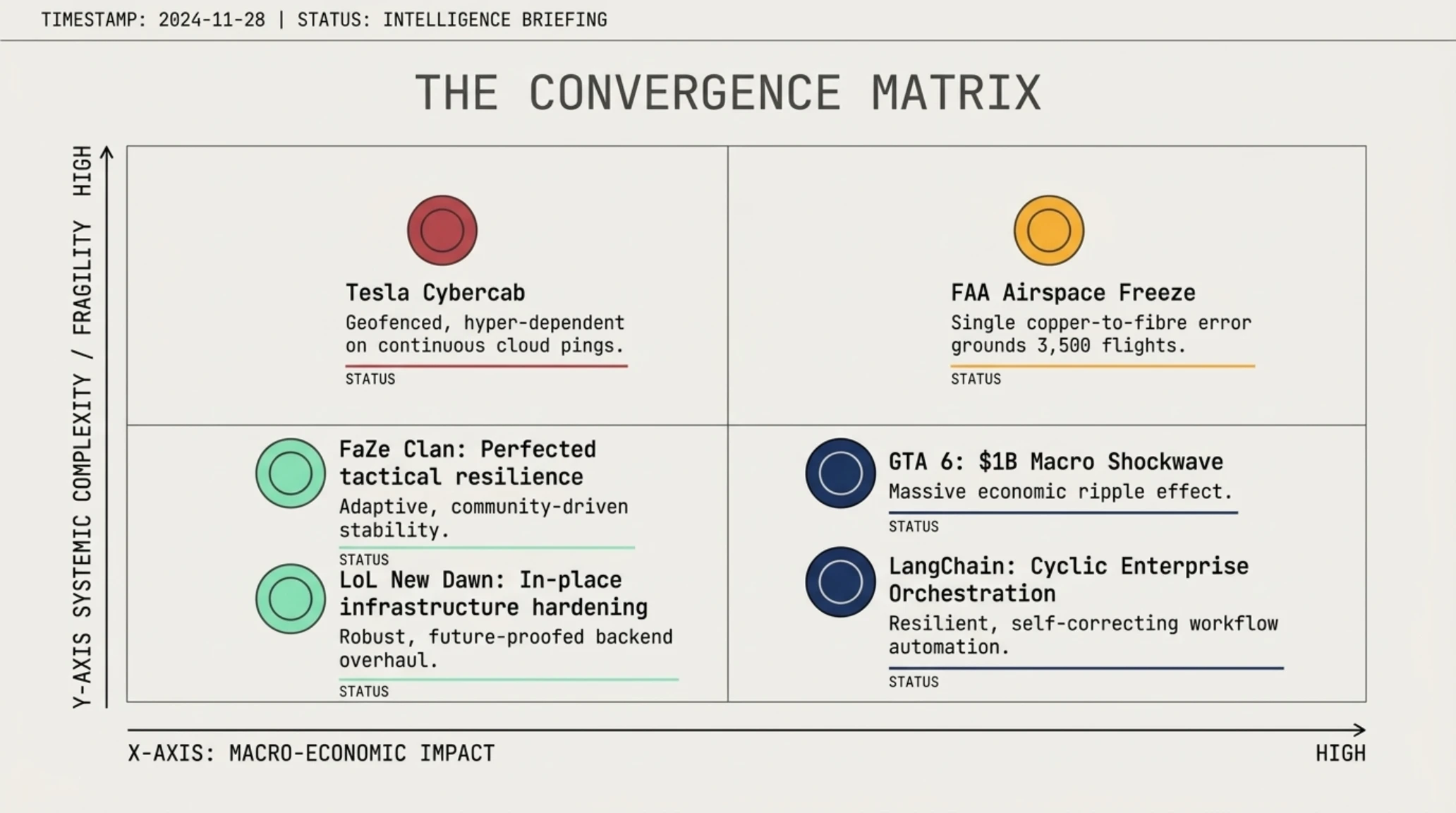
A rigorous multi-axis assessment of the current technological and economic inflection points provides structured clarity for institutional decision-makers:
- Colossal macroeconomic gravity of mega-scale entertainment releases anchoring global consumer engagement.
- Clear exposure of single-point-of-failure vulnerabilities in federal infrastructure accelerating zero-trust telemetry.
- Emergence of highly defensible recurring subscription models in autonomous vehicular robotics.
- Validation of multi-agent observability and governance platforms as the most lucrative software tier in AI.
- Acute near-term workforce absenteeism and retail expenditure displacement across traditional hospitality sectors.
- Catastrophic operational risk during high-speed network fiber migrations absent granular traffic throttling.
- Long-term contractual lock-in for commercial consumers via compulsory perpetual autonomous software subscriptions.
For an authoritative perspective on hardware lifecycle management, display optimizations, and the intersection of silicon advancement with consumer entertainment, explore our strategic companion analysis on Next-Gen System Architecture & Silicon Evolution.
Furthermore, to examine how foundational network infrastructure, cryptographic verification protocols, and real-time telecom switches guard against systemic collapses like the FAA ground stop, review our comprehensive investigation into Enterprise Systems Infrastructure & Threat Vectors.
In total synthesis, the developments defining this Monday morning illustrate the accelerating convergence of physical infrastructure, entertainment economies, and autonomous enterprise systems. From GTA 6's unprecedented macroeconomic pull and the FAA's harrowing reminder of single-point-of-failure vulnerabilities, to Tesla's radical subscription-based hardware model, LangChain's enterprise governance validation, FaZe Clan's esports perfection, and Riot's generational client overhaul, the digital frontier continues to reward architectural resilience over cosmetic novelty.
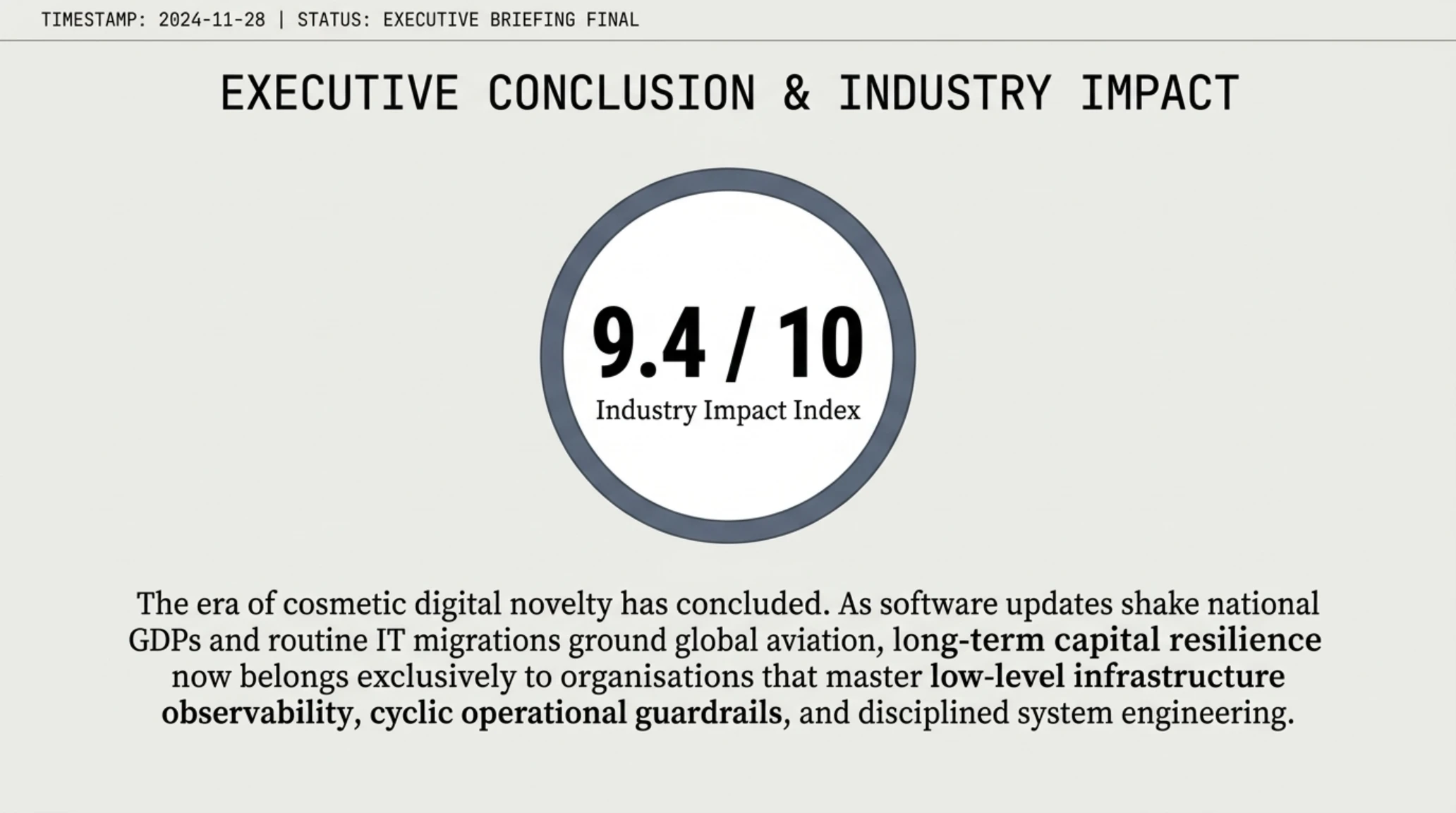
As these structural transformations ripple through global markets, the defining lesson for corporate leaders is unequivocal: long-term resilience belongs to organizations that master low-level infrastructure observability, robust architectural governance, and disciplined system engineering. To conclude this intelligence briefing and address executive inquiries, our formal verdict and definitive source ledger are codified below.
Editorial Verdict, Strategic Conclusion & Authoritative Sources Index
- GameSpot Advisory: PwC quantitative macroeconomic audit on GTA 6 entertainment drag
- Federal Aviation Administration: FAA operational incident telemetry regarding nationwide ground stop
- Electrek Automotive: Tesla Cybercab $29,990 commercial release and inductive charging specs
- TechCrunch Enterprise: LangChain $300M Series C round and LangSmith enterprise governance
- IGN Global: FaZe Clan 3-0 historic grand slam victory at BLAST R6 Major Osaka
- Insider Gaming: Riot Games official technical unveil of Project New Dawn for 2027
Frequently Asked Questions // Strategic Technology Analysis
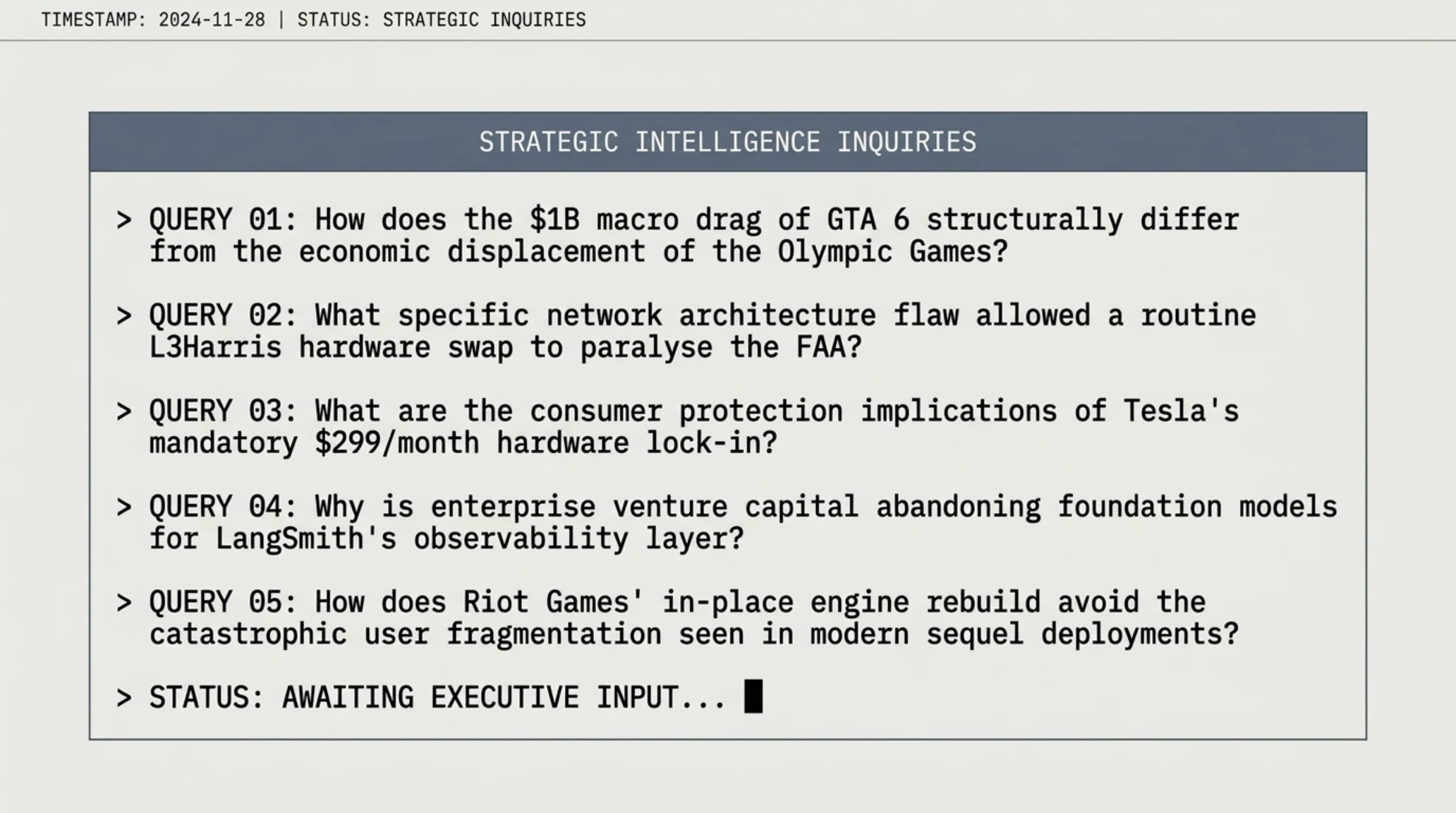
Why is the launch of Grand Theft Auto 6 being compared to the Olympic Games by accounting giant PwC?
Unlike standard entertainment releases, GTA 6 commands simultaneous, concentrated engagement across hundreds of millions of consumers worldwide. The anticipated $1 billion workplace productivity drag and widespread shifts in consumer discretionary spending away from dining, cinema, and domestic travel mirror the macro-level reallocation typically triggered only by mega-events like the Olympics.
What was the exact root cause of the nationwide FAA ground stop over the weekend?
Contrary to early rumors of a nation-state cyberattack, the stoppage was caused by a configuration and buffer allocation defect on an L3Harris edge router during a scheduled transition from legacy copper trunks to fiber-optic links. The router initiated an unthrottled loop of over 1,000 connection requests per second, exhausting core switching buffers and blinding terminal radar controllers.
What are the core contractual conditions for purchasing the $29,990 Tesla Cybercab?
Retail purchase requires an initial non-refundable $1,000 reservation deposit, the base vehicle cost of $29,990, an irrevocable mandatory Autonomy Subscription fee of $299 per month, and legal agreement to operate exclusively within Tesla-sanctioned, geofenced autonomous corridors initially located in Texas and Florida.
What catalyzed LangChain's meteoric valuation surge to $3.0 billion?
LangChain's explosive valuation growth is driven by the rapid enterprise monetization of LangSmith and LangGraph. Over 7,000 corporate clients, including Nvidia and Salesforce, now depend on the platform for real-time latency auditing, token cost attribution, error tracing, and cyclic state machine governance across complex multi-agent AI swarms.
How does League of Legends: New Dawn differ from a traditional sequel like LoL 2?
New Dawn is an in-place generational rebuild rather than a separate game. It completely replaces the aging ten-year-old C++ client, overhauls Summoner's Rift visual fidelity with volumetric lighting, and upgrades champion models to Arcane-level cinematic standards while preserving all existing player accounts, ranked histories, and skin collections without splitting the player base.
What is the historical significance of FaZe Clan's victory at the BLAST R6 Major Osaka 2026?
FaZe Clan's 3-0 sweep against DarkZero Esports solidified the first-ever 'Big Three' grand slam in tactical FPS history, capturing the Six Invitational, Esports World Cup, and BLAST Major trophies in a single continuous dynasty.
Additional Gallery: Tekin Morning Nov 16: GTA 6 $1B Shock, FAA Stop & Cybercab