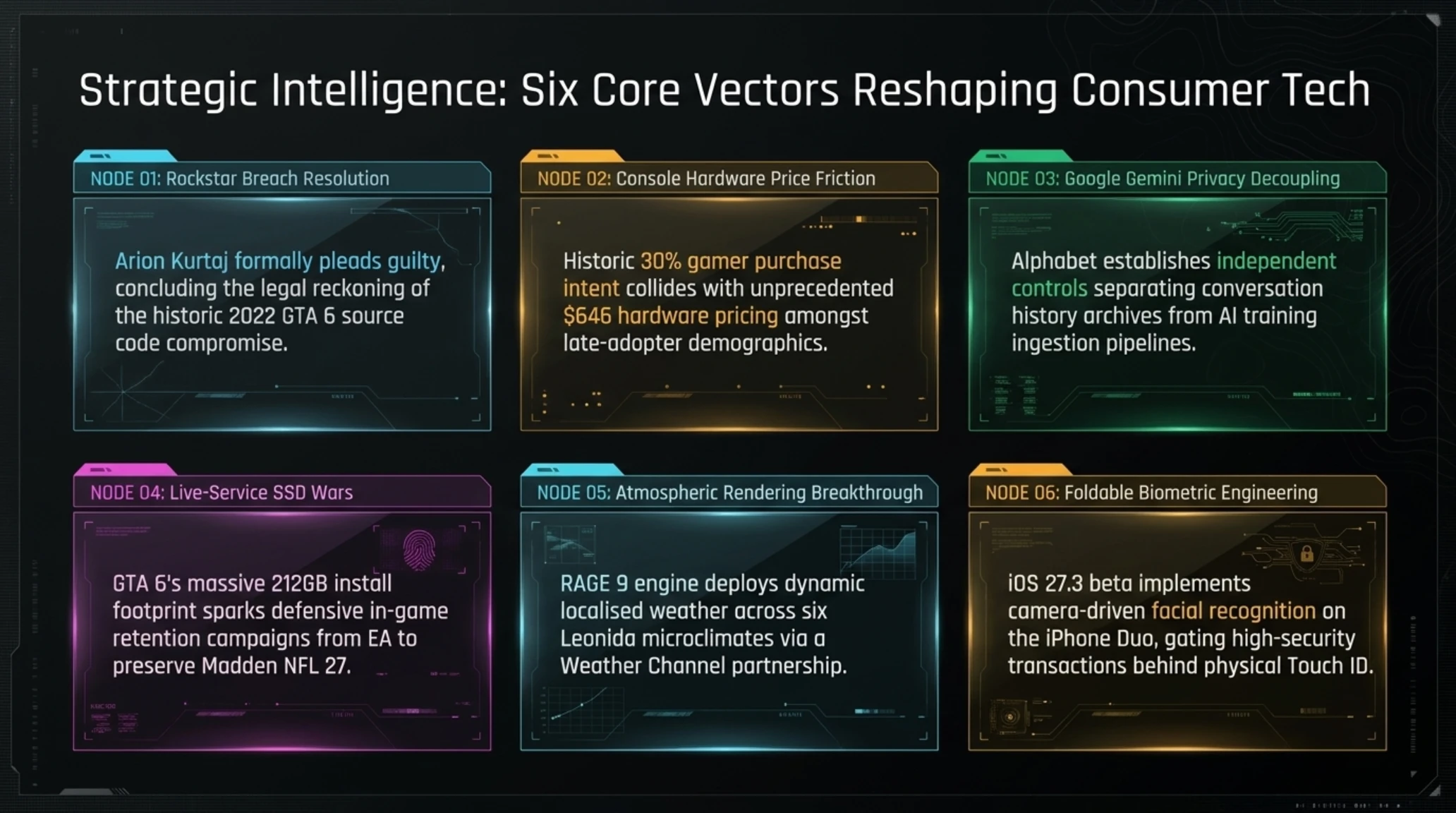
The Tekin Morning executive briefing for November 18, 2026 audits six major developments: (1) Arion Kurtaj's guilty plea at Woolwich Crown Court over the $5M GTA 6 breach; (2) Circana data exposing an 80% inflation-adjusted console pricing shock ($646 avg PS5); (3) Google's watershed decoupling of Gemini chat history from AI model training; (4) EA's defensive SSD retention campaign against GTA 6's 212GB install footprint; (5) Rockstar's microclimate simulation with The Weather Channel; and (6) Apple's 2D camera Face ID on the foldable iPhone Duo.
Tekin Morning | November 18, 2026: GTA 6 Leaker Pleads Guilty, Console Price Shocks, Gemini Privacy Decoupling & Apple Duo Face Unlock
The strategic developments documented across November 18, 2026 confirm that the interactive entertainment and enterprise software sectors have matured beyond speculative cycles, entering an era governed by disciplined corporate governance, rigorous hardware economics, and strict legal precedents.
In this edition of Tekin Morning, our senior editorial bureau examines the collision of three structural forces: the judicial resolution of historical cyber breaches, consumer price resistance in consumer electronics, and the enterprise demand for sovereign user privacy in generative artificial intelligence.
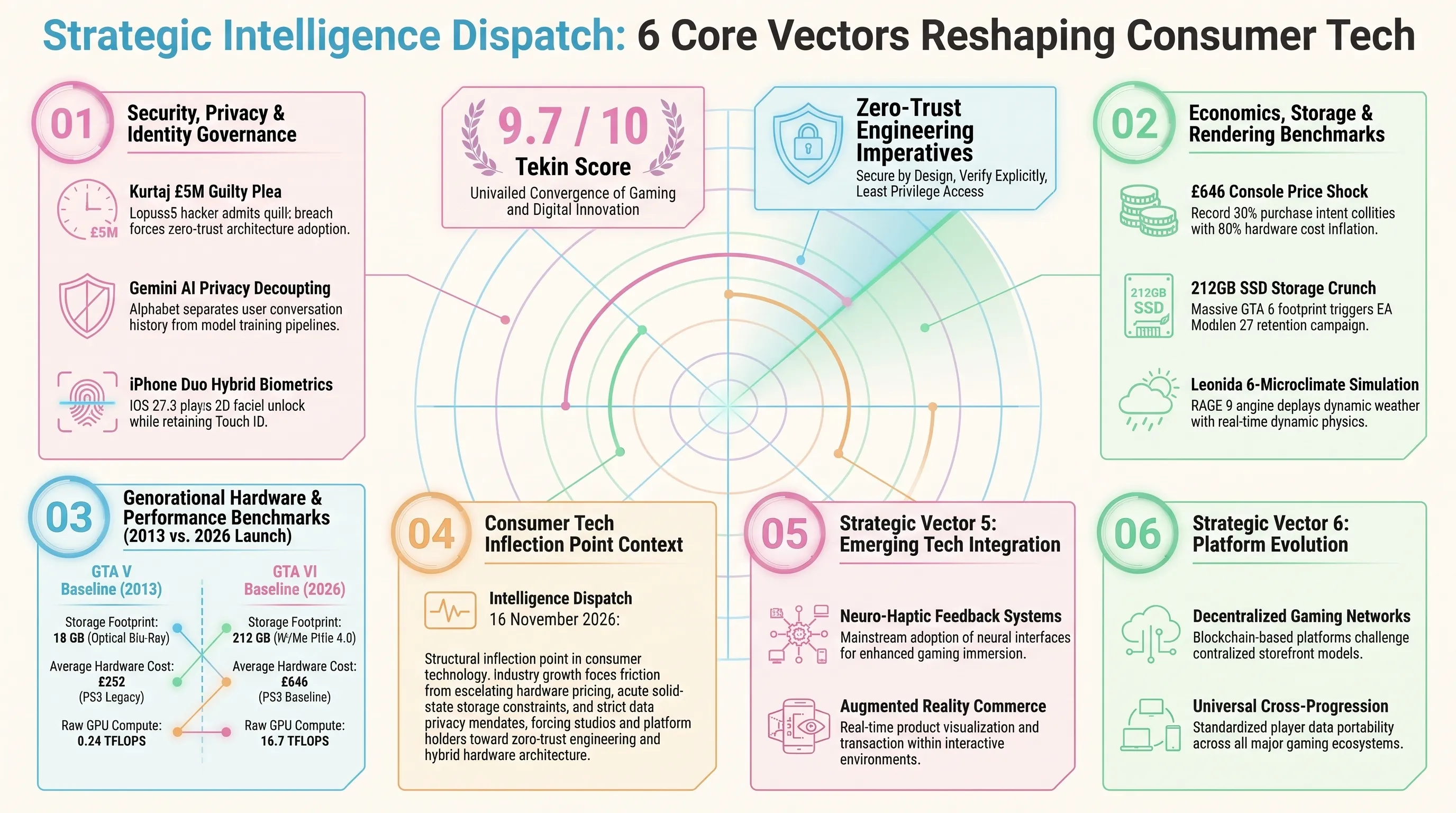
STRATEGIC INTELLIGENCE | SIX CORE VECTORS RESHAPING CONSUMER TECH
These six core trajectories outline a transformative operating model for platform holders as they approach 2027. Closed platform ecosystems can no longer dictate terms to the consumer without providing transparent data safeguards and competitive price elasticity.
The specialized telemetry dashboard below synthesizes three mission-critical metrics that capture the economic magnitude and technical friction characterizing the technology sector today.
WHY THIS TRANSFORMATION CHANGES THE GAME // WHY IT MATTERS
The dawn of November 18, 2026 illustrates that the macroeconomic equilibrium of interactive entertainment and consumer electronics is undergoing a structural realignment. For over a decade, industry strategists operated under the foundational assumption that the arrival of a generational software phenomenon like Grand Theft Auto could single-handedly double console hardware velocities regardless of macroeconomic pressures. Yet, empirical telemetry emerging from Wall Street research desks, Circana retail audits, and legal courtrooms reveals a vastly more complex, multi-variable reality. Today, consumers find themselves navigating a trilemma between escalating hardware price points, strict solid-state storage constraints, and the imperative for absolute sovereignty over digital privacy.
Forensic Deconstruction of the Rockstar Legal Reckoning: Arion Kurtaj Pleads Guilty at Woolwich Crown Court
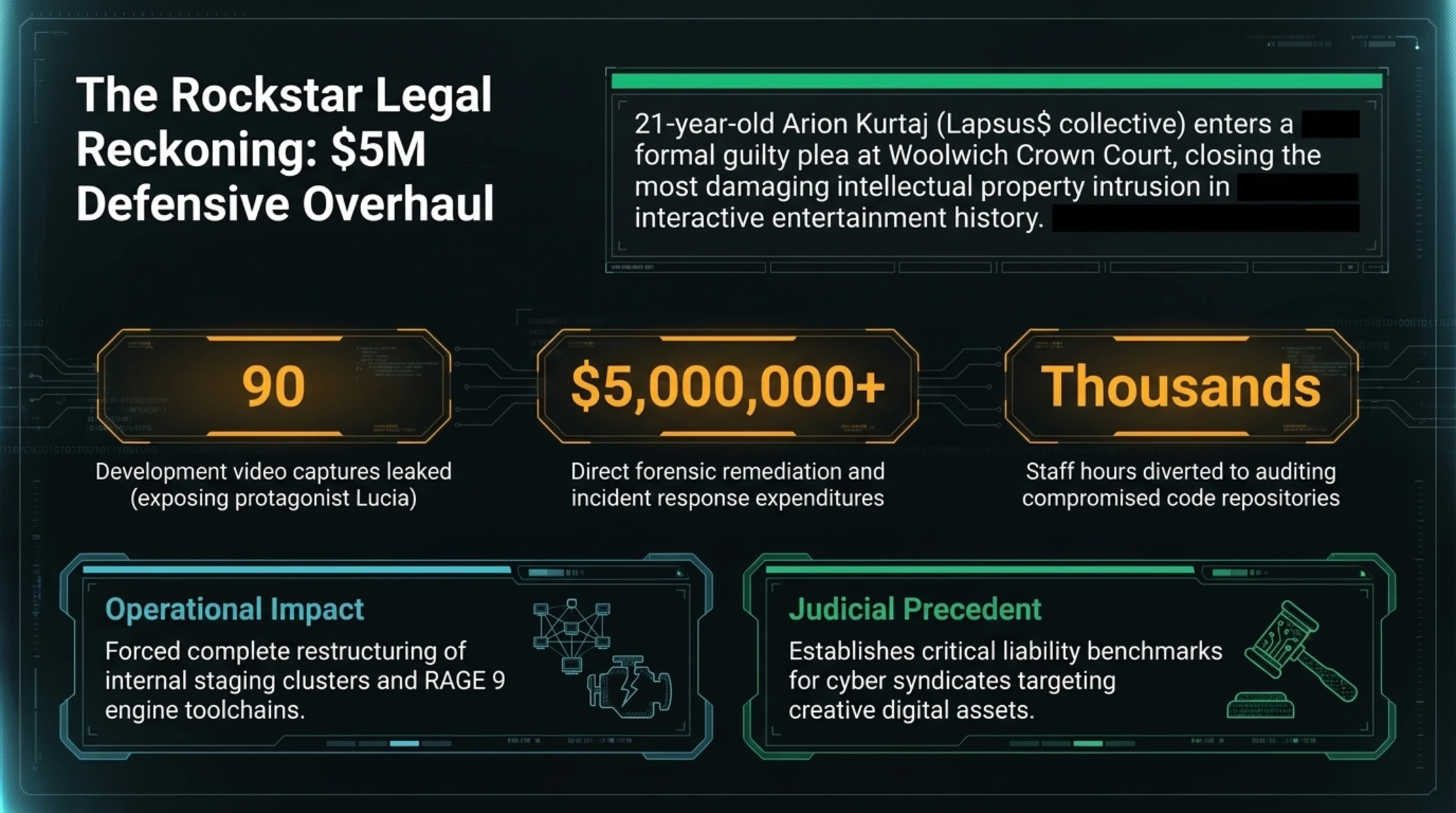
In a historic legal proceeding at London's Woolwich Crown Court, 21-year-old cybercriminal Arion Kurtaj, an infamous key operative of the transnational Lapsus$ hacking collective, formally entered guilty pleas to extensive criminal charges stemming from the catastrophic September 2022 breach of Rockstar Games. This judicial milestone closes the evidentiary chapter on the most damaging intellectual property intrusion in interactive entertainment history an assault that saw 90 development video captures, internal Slack discussions, and confidential gameplay frameworks of Grand Theft Auto VI stolen and broadcast across global networks, exposing the world to protagonist Lucia and the state of Leonida years ahead of planned marketing cadences.
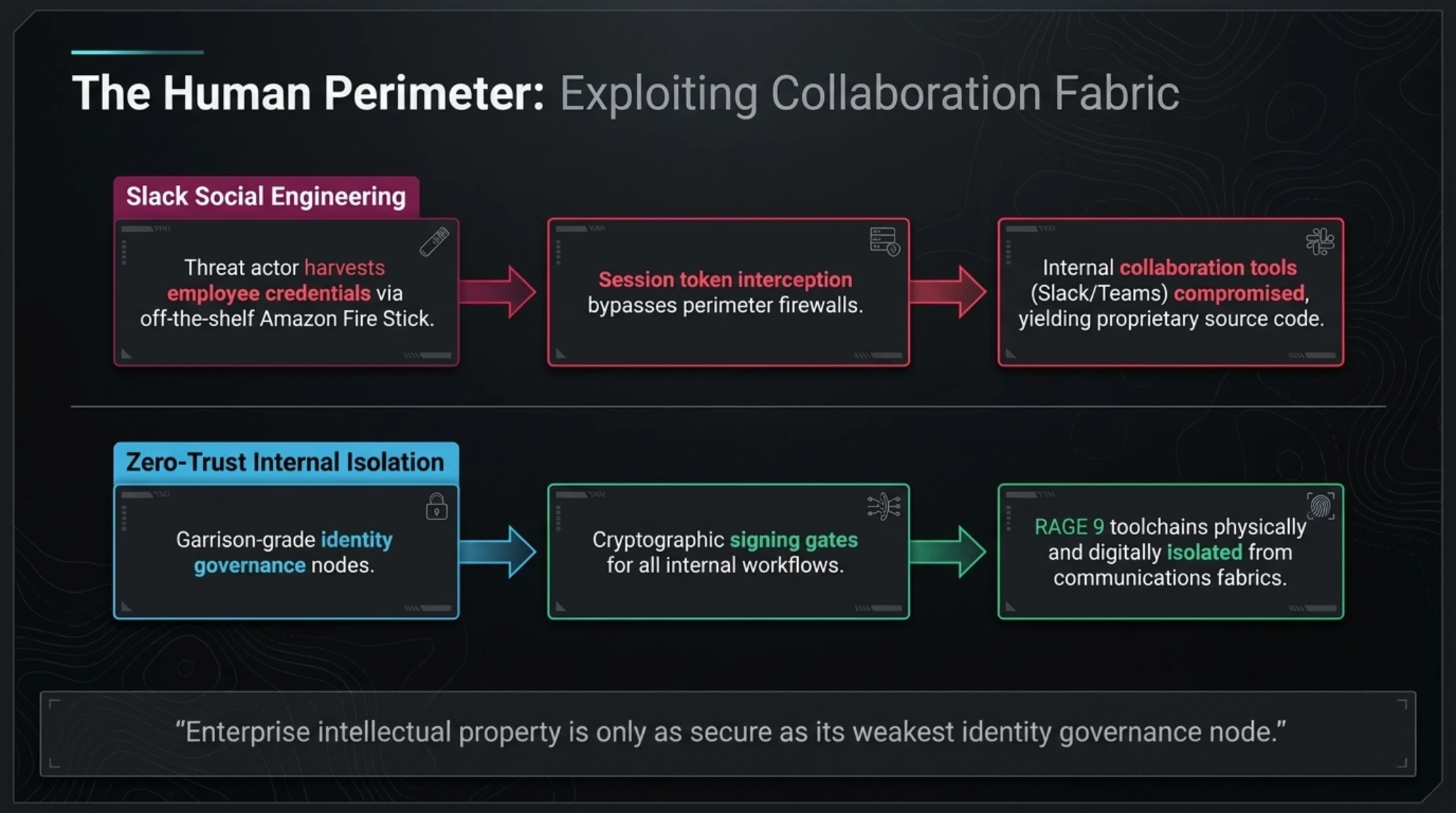
Unsealed evidentiary filings submitted to the presiding judge revealed the staggering operational and financial toll exacted upon Take-Two Interactive and Rockstar Games. The developer documented over $5 million in direct forensic remediation, incident response, and network architectural overhaul expenditures, alongside thousands of staff hours dedicated to auditing and rebuilding compromised code repositories. Security engineers were forced to completely restructure internal staging clusters and source code cryptographic signing gates to guarantee that proprietary RAGE 9 engine toolchains remained uncompromised. Kurtaj, who notoriously executed portions of his cyber assaults from a Cambridge hotel room while on bail using an off-the-shelf Amazon Fire Stick plugged into a hospitality television, now faces final sentencing under the Computer Misuse Act.
The forensic narrative surrounding the Lapsus$ campaign highlights a profound vulnerability in contemporary enterprise cybersecurity architectures: the human element within shared administrative workflows. While multinational gaming corporations invest tens of millions of dollars into anti-cheat kernel drivers, digital rights management wrappers, and hardware security modules, their corporate communications fabrics specifically Slack, Microsoft Teams, and cloud collaboration suites frequently remain exposed to sophisticated social engineering. Kurtaj exploited session token interception and employee credential harvesting to bypass perimeter firewalls, delivering a severe reminder that enterprise intellectual property is only as secure as its weakest identity governance node.
Legal analysts monitoring the proceedings emphasize that Kurtaj's formal admission of guilt serves as a precedent-setting deterrent for cybercrime syndicates targeting creative entertainment enterprises. In an era where digital source code represents the foundational valuation of entertainment conglomerates, judicial recognition of the multi-million dollar damages caused by intellectual property leaks establishes critical liability benchmarks for future cyber litigation.
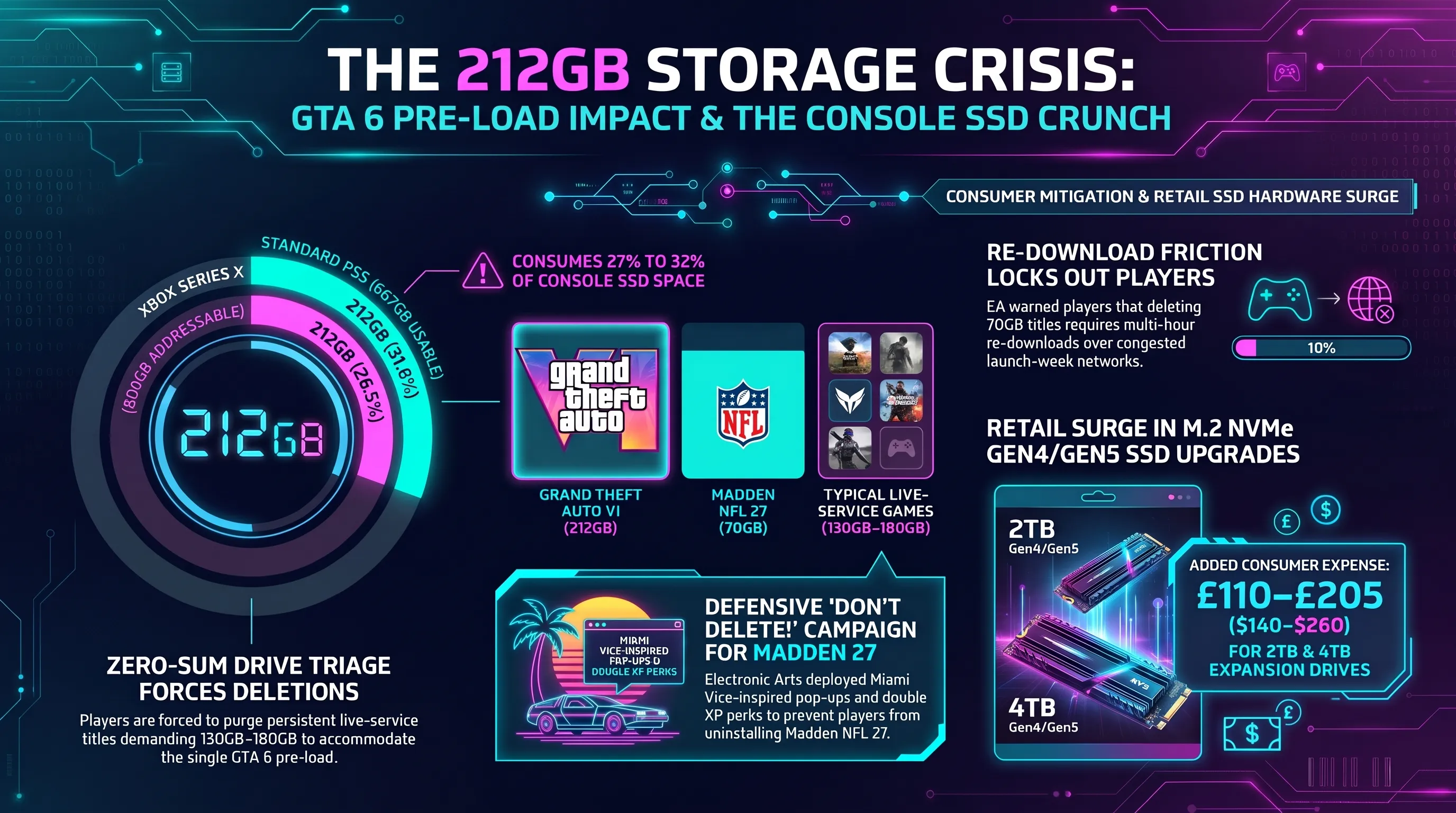
Industry executives note that while the judicial verdict validates Rockstar's aggressive defensive stance, the psychological and operational scars within creative development teams catalyzed an unprecedented cultural transformation toward zero-trust internal isolation.
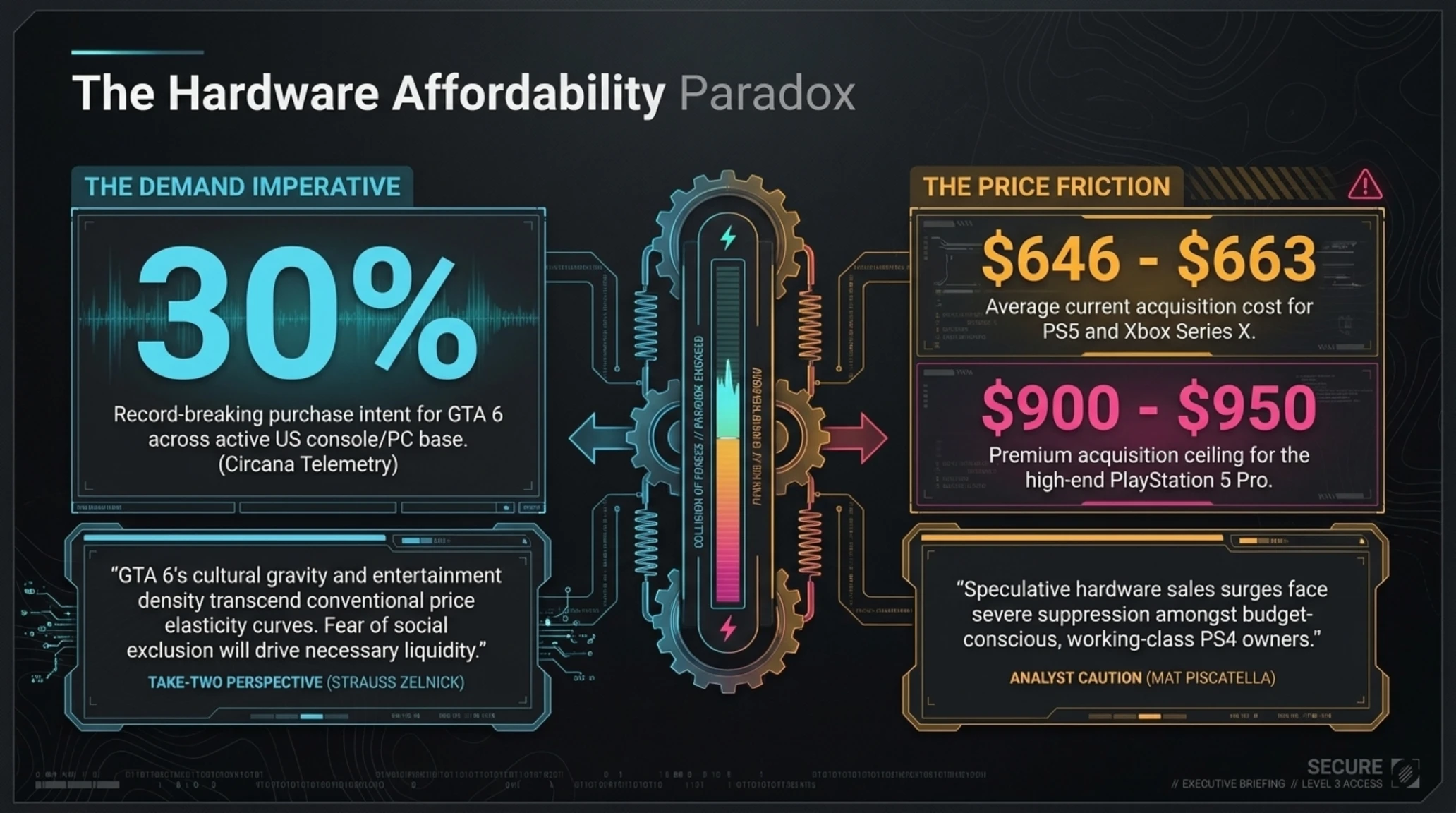
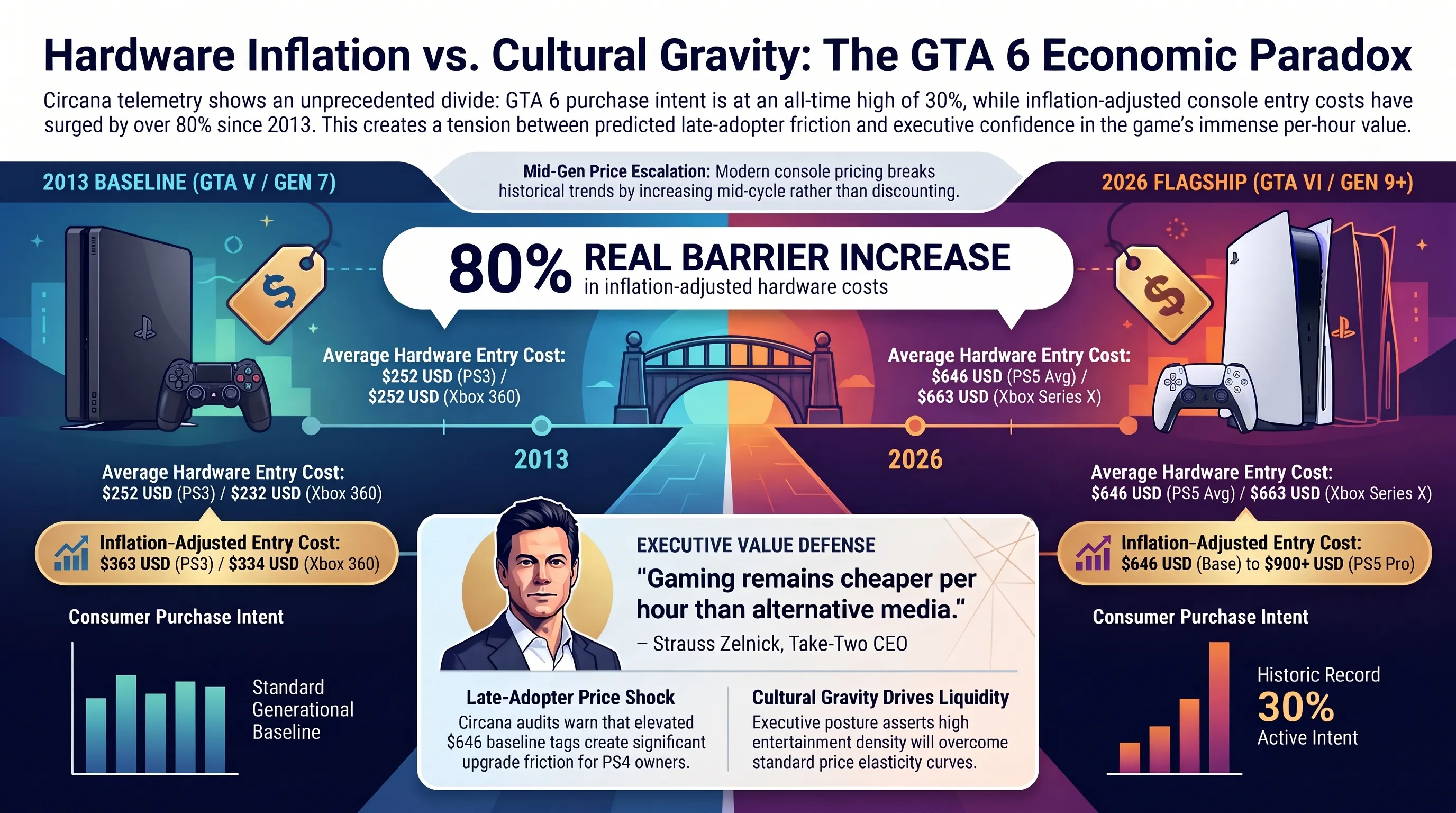
Matt Piscatella's empirical market analysis highlights an unprecedented tension in the current console generation: consumer demand for cutting-edge interactive entertainment has never been higher, yet structural economic headwinds and hardware inflation threaten the traditional platform adoption curve. In the subsequent section, we examine the quantitative collision between historical GTA 6 enthusiasm and the unprecedented $650 hardware entry threshold.
The Hardware Affordability Paradox: Will $650 Console Price Points Stifle Mass GTA 6 Upgrades?
A comprehensive research report authored by Circana Executive Director Mat Piscatella delineates a striking structural tension at the core of the console gaming ecosystem. Quantitative consumer tracking indicates that purchase intent for Grand Theft Auto VI has surged to a record-breaking 30% across the total active console and PC gaming base in the United States the highest metric ever recorded in Circana’s multi-decade tracking history. Nevertheless, Piscatella cautions that the corresponding hardware sales surge for Sony's PlayStation 5 and Microsoft's Xbox Series platforms may unfold at a far more tempered cadence than speculative market models anticipated, suppressed by unprecedented mid-generation hardware price hikes.
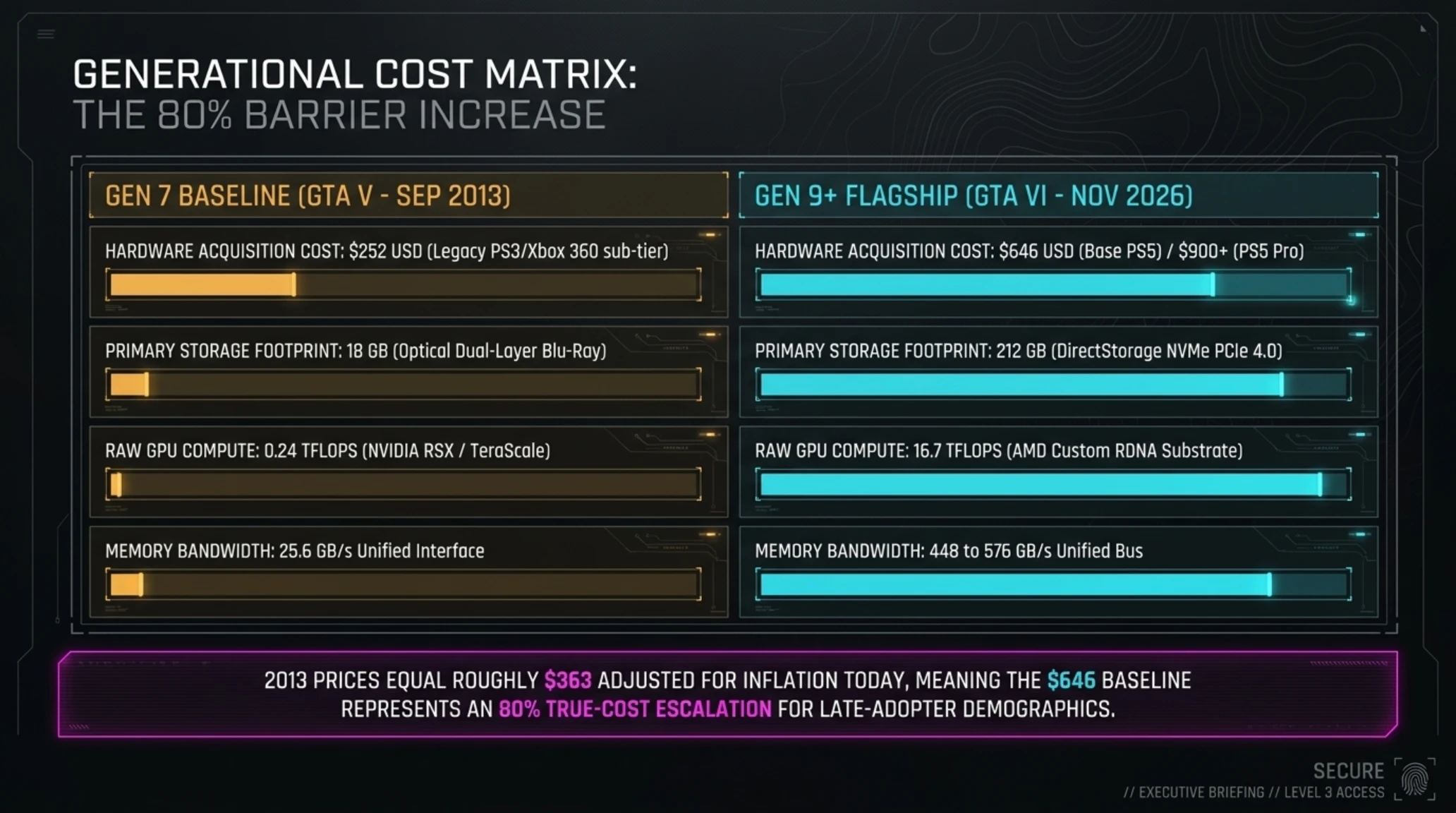
Historical economic comparisons expose an extraordinary divergence in consumer barrier-to-entry dynamics. In September 2013, when Grand Theft Auto V debuted to unprecedented global acclaim, the average retail price paid for a new PlayStation 3 was $252, while an Xbox 360 commanded an average of $232. Even after applying cumulative inflation adjustments through November 2026, those legacy price points equate to roughly $363 for the PS3 and $334 for the Xbox 360 in contemporary purchasing power. By contrast, a prospective consumer seeking to participate in the GTA 6 launch today faces an average hardware acquisition cost of $646 for a PlayStation 5, $663 for an Xbox Series X, and upwards of $900 to $950 for the high-end PlayStation 5 Pro. This represents an inflation-adjusted hardware entry barrier increase of more than 80%, creating acute price shock for millions of late-adopter consumers upgrading from legacy PlayStation 4 systems.
Conversely, Take-Two Interactive Chief Executive Officer Strauss Zelnick articulates a fiercely confident, demand-driven economic posture. While acknowledging that lower baseline hardware pricing is universally advantageous for software publishers seeking broader total addressable markets (TAM), Zelnick argues that the cultural gravity, technological fidelity, and entertainment density of Grand Theft Auto VI transcend conventional price elasticity curves. Zelnick maintains that frontline interactive entertainment has historically trended cheaper on a per-hour basis than any alternative entertainment medium, expressing conviction that consumers will find necessary liquidity to acquire compatible hardware to avoid social exclusion from the defining cultural event of the decade.
TECHNICAL VERIFICATION | RUMOR VS. REALITY
Economic deconstruction reveals that rising advanced silicon wafer costs, aggressive photolithography expenses, and global supply chain pressures have eliminated the historical mid-cycle price reductions that traditionally defined console platform cycles.
To contextualize how the gaming hardware market reached this critical juncture, the chronology below maps structural pricing adjustments from the launch of Grand Theft Auto V in autumn 2013 to the premium hardware landscape of late 2026.
EVENT TIMELINE | CHRONOLOGY OF HARDWARE AND GAMING ARCHITECTURES
| Chronological Era | Key Architectural & Industry Milestone | Macro Hardware Pricing & Ecosystem Impact |
|---|---|---|
| Sep 2013 | GTA V Launches on 7th Generation Platforms | Average PS3/Xbox 360 hardware prices sit comfortably at $230-$250 sub-tier. |
| Nov 2020 | Next-Gen PS5 & Xbox Series X Enter Market | Launch MSRP fixed at $499 amid unprecedented global semiconductor supply disruptions. |
| Sep 2022 | Lapsus$ Cyber Breach & Lucia Footage Leaked | 90 development video clips surface; Rockstar executes multi-million dollar security overhaul. |
| 2024 - 2025 | Mid-Cycle Hardware Price Inflation & PS5 Pro | Console price cuts fail to materialize; mid-gen refresh breaks $900 ceiling. |
| Nov 2026 | GTA 6 Pre-load Deployed; Kurtaj Pleads Guilty | 212GB install size triggers solid-state storage crunch; preorders surpass $1.1B. |
The historical timeline confirms that the introduction of high-end mid-generation hardware, exemplified by the PlayStation 5 Pro, has structurally shifted the financial barrier of entry for premier interactive software experiences.
The comparative telemetry matrix and grouped benchmark visual below examine the widening divergence between Gen 7 and Gen 9 platform costs, charting raw compute throughput alongside price-per-teraflop dynamics.
BENCHMARK COMPARISON: TECHNICAL MATRIX & GENERATIONAL DELTAS
| Architectural Metric | GTA V Benchmark (2013 Generation) | GTA VI Benchmark (2026 Generation) |
|---|---|---|
| Primary Storage Installation Footprint | 18 GB (Optical Dual-Layer Blu-Ray) | 212 GB (DirectStorage NVMe PCIe 4.0) |
| Average Hardware Acquisition Cost | $252 USD (Legacy PS3 Hardware) | $646 USD (Current PS5 System Baseline) |
| Raw GPU Compute Capability | 0.24 TFLOPS (NVIDIA RSX / TeraScale) | 16.7 TFLOPS (AMD Custom RDNA Substrate) |
| System Memory Bandwidth | 25.6 GB/s Unified Interface (GDDR3) | 448 to 576 GB/s Unified Bus (GDDR6) |
Wall Street equity analysts observe that while the current console generation strongly favors all-digital form factors, the overwhelming collector demand for physical GTA 6 editions has prompted millions of players to purchase detachable optical drives at a premium.
These mounting pressures across living room hardware architectures illustrate that modern digital consumers demand heightened transparency not merely in hardware expenditures, but across data ownership and personal telemetric boundaries. Simultaneously in Mountain View, Google has executed a landmark policy restructuring that formalizes user sovereignty across generative artificial intelligence ecosystems.
Google Gemini Decouples Conversation Archives from Frontier Model Training Ingestion
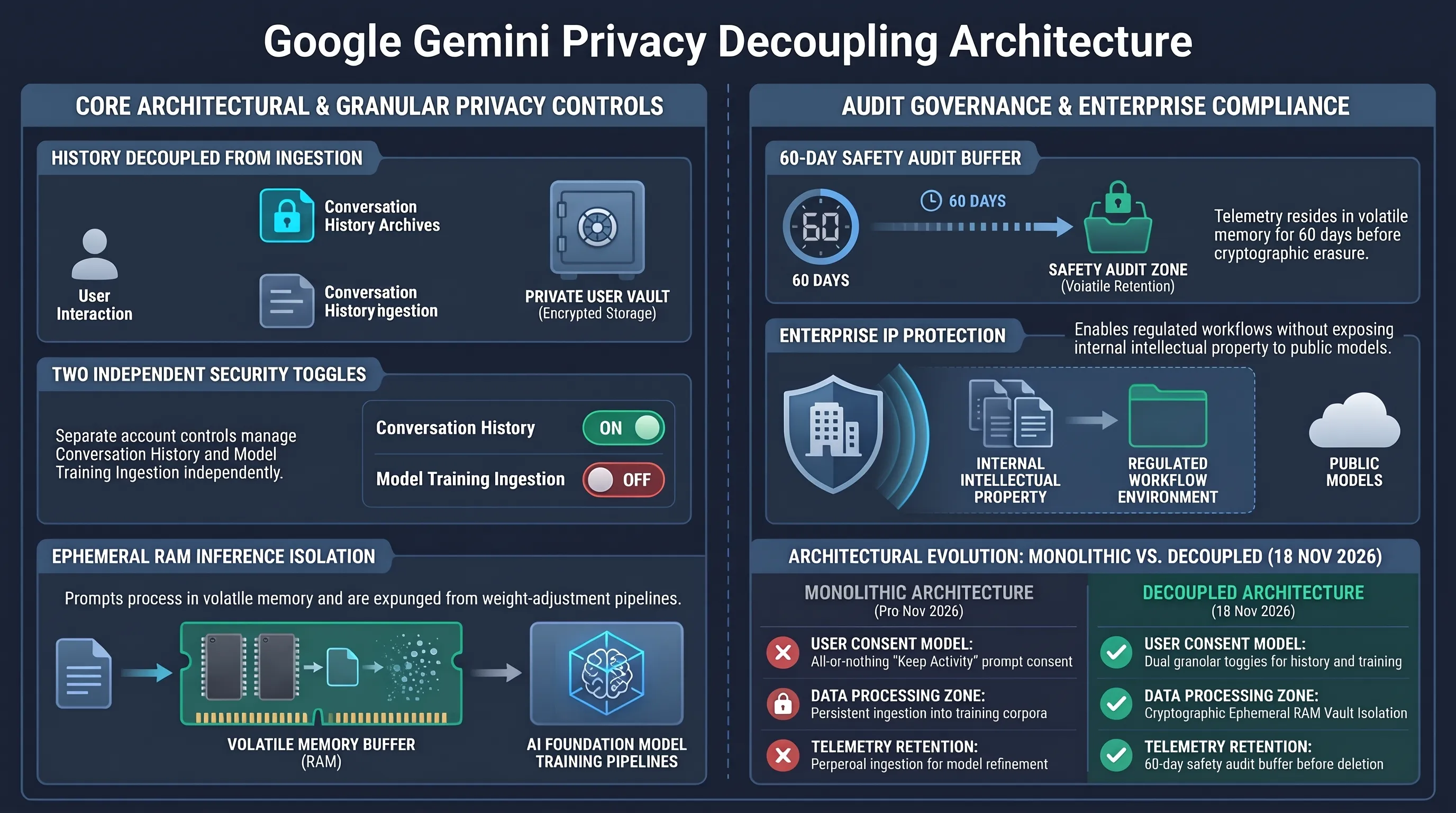
In a decisive strategic recalibration that addresses longstanding enterprise and consumer confidentiality anxieties, Google officially deployed an architecture that decouples user conversation history preservation from generative AI training pipelines within the Gemini ecosystem. Prior to this release on November 18, 2026, Gemini operated under a monolithic "Keep Activity" consent framework; users who sought the practical convenience of archiving prompt histories, debugging logs, and document syntheses were compelled to grant Google perpetual rights to ingest those interactions into its foundation model training corpora.
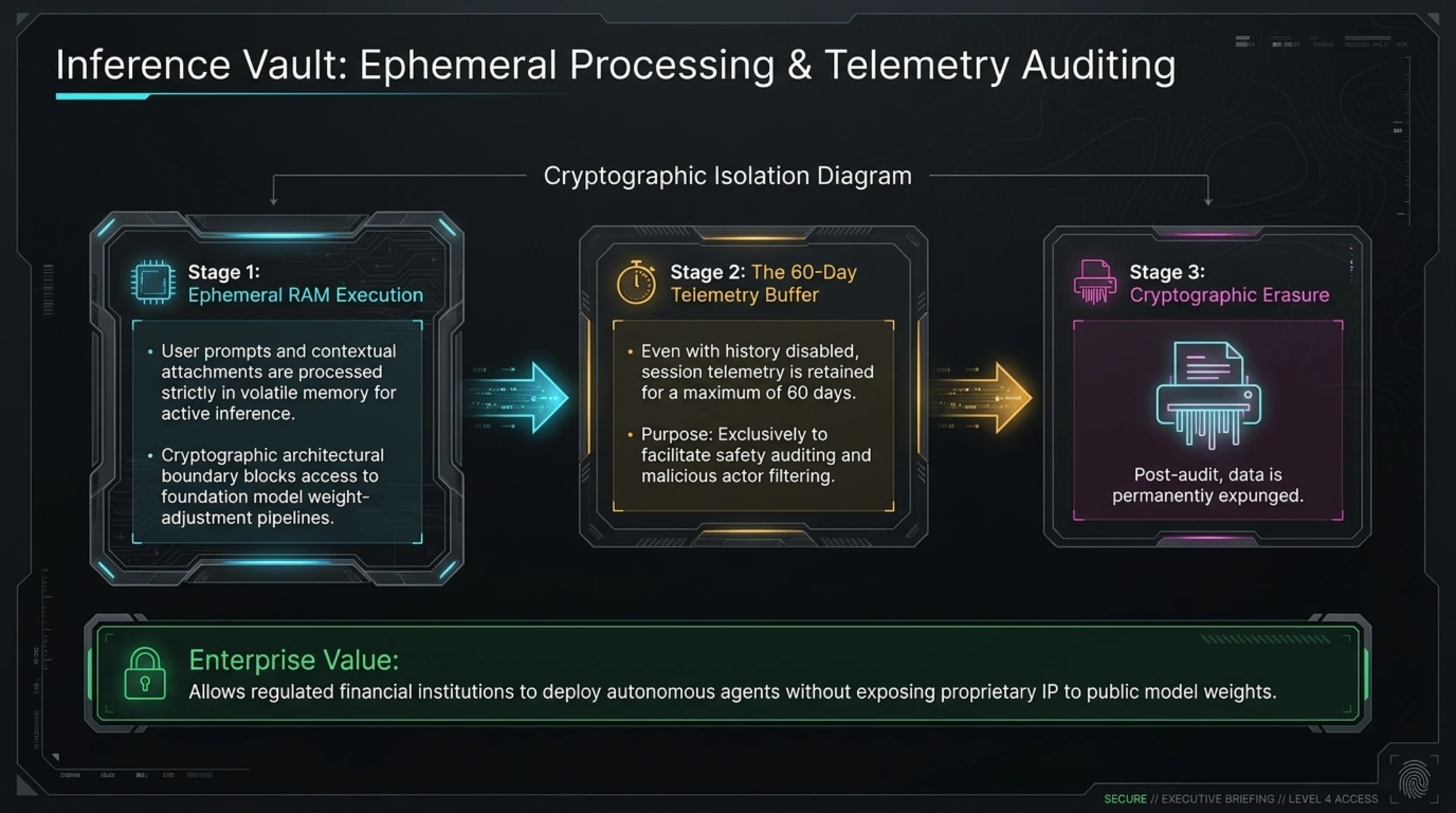
The re-engineered privacy architecture introduces two mutually exclusive, granular toggles within account security settings: "Conversation History" and "Model Training Ingestion." Consequently, institutional researchers, financial analysts, and software developers can continuously utilize Gemini to orchestrate sensitive workflows, archive complex conversational threads, and retrieve past code iterations while permanently disabling the exfiltration of proprietary data into Google’s machine learning clusters. In compliance with strict global privacy mandates, Google noted that even when Conversation History is completely disabled, session telemetry is retained in volatile memory buffers for a maximum of 60 days exclusively to facilitate safety auditing and malicious actor filtering before permanent cryptographic erasure.
TEKIN SPECIALIZED TECHNICAL LEXICON // JARGON BUSTER
This cryptographic isolation architecture enables corporate research laboratories and regulated financial institutions to deploy autonomous agents and intelligent workflows without exposing proprietary IP to public model weights.
Turning to macroeconomic revenue projections, initial commercial pre-order telemetry indicates that early software receipts will dramatically reshape global digital entertainment revenue distribution for the remainder of the decade.
FINANCIAL TELEMETRY: GTA 6 PREORDERS & CONSOLE HARDWARE SEGMENTATION
| Platform Walled Garden | Global Preorder Allocation Share | Estimated Cumulative Net Bookings |
|---|---|---|
| Sony PlayStation 5 Ecosystem (Base & Pro) | 75.0% Share | $825 Million USD Direct Bookings |
| Microsoft Xbox Series X|S Ecosystem | 25.0% Share | $275 Million USD Direct Bookings |
| Total Global Preorder Aggregate Revenue | 100.0% Normalized | $1,100 Million USD ($1.10 Billion) |
| Subscription Services & Cloud Streaming | 0.0% Allocation Share (Direct Retail Exclusivity) | $0 Million USD (No Day-One Subscription) |
Take-Two's strict enforcement of premium standalone software sales firmly rejecting day-one multi-game subscription releases remains the primary vehicle powering these unprecedented multi-billion-dollar booking projections.
However, this massive surge toward an unprecedented monolithic software package immediately exposes a secondary structural bottleneck in contemporary hardware: the severe limitation of internal solid-state drive space.
📚 Classified & Related Dossiers in TekinGame
If you wish to explore beyond this report and delve into cybernetic frontiers and autonomous AI architectures, do not miss these three exclusive deep-dives in the Tekin Garage:
The editorial perspective from the TekinPlus desk illuminates a fundamental architectural pivot in 2026: internal storage real estate has emerged as the primary friction point between publishers and end-users. The upcoming analysis breaks down Electronic Arts' strategic defense mechanisms designed to protect annual multiplayer installments against GTA 6's unprecedented 212GB installation footprint.
The 212GB Storage Crisis: Live-Service Games Face Extinction as GTA 6 Swallows Console Solid-State Drives
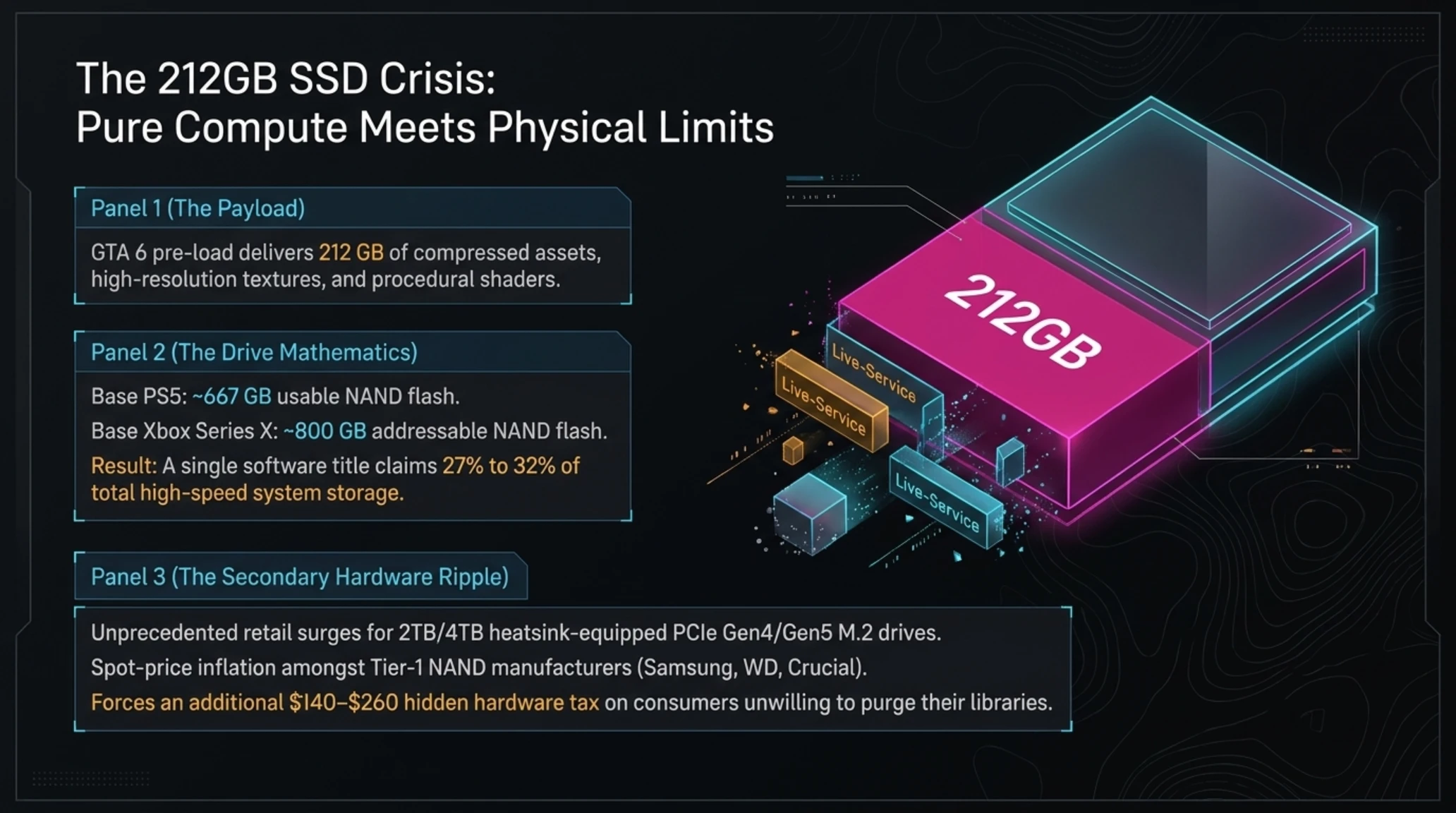
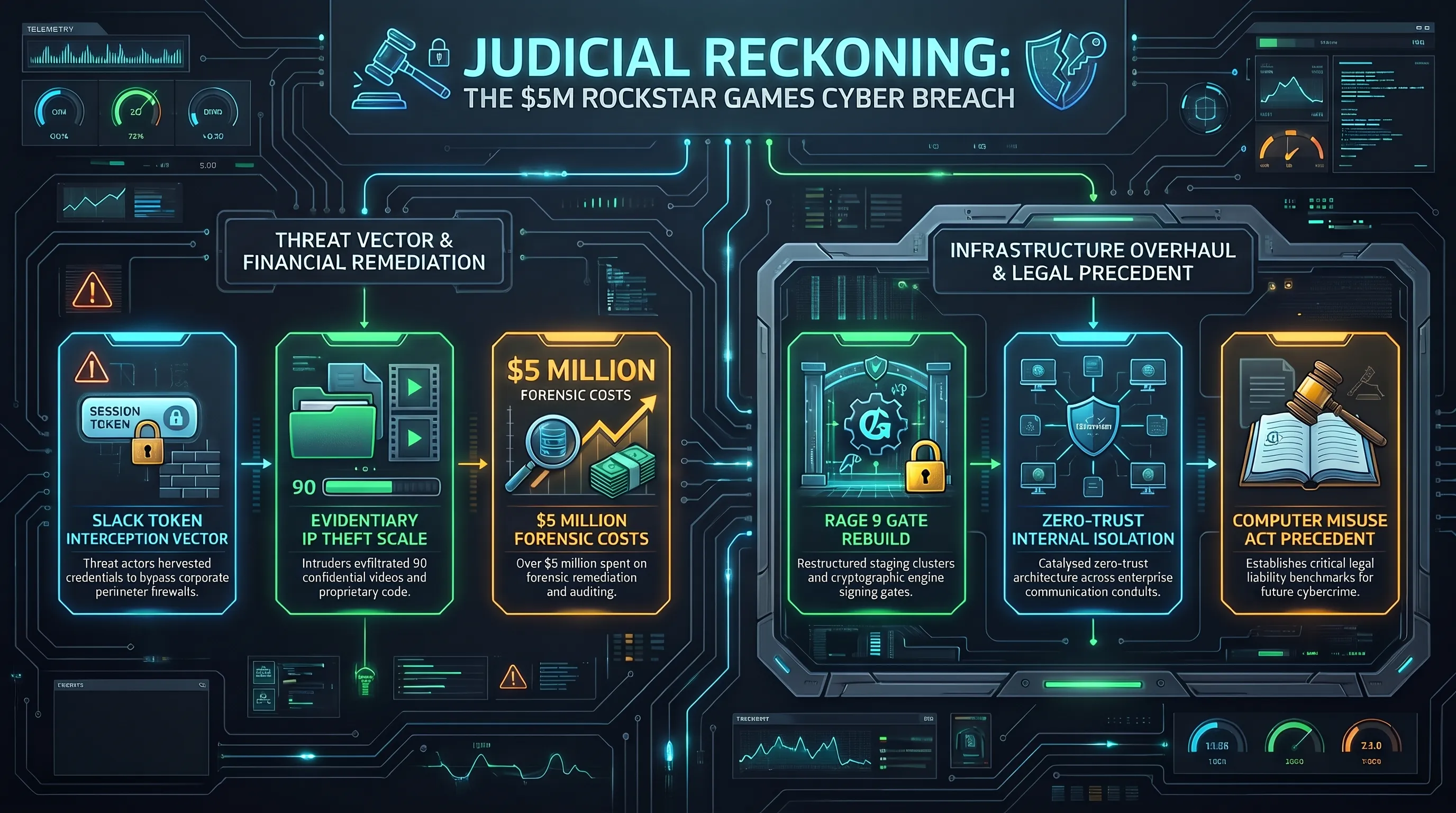
The commencement of initial pre-loading protocols for Grand Theft Auto VI across the PlayStation Network and Xbox Live infrastructure has unleashed a structural crisis across home console solid-state storage ecosystems. With the official pre-load payload clocking in at an unprecedented 212 gigabytes of compressed assets, high-resolution texture packs, and pre-compiled procedural shaders, the sheer physical footprint of Rockstar Games' magnum opus threatens to cannibalize existing live-service gaming habits. Across standard baseline PlayStation 5 units featuring approximately 667 gigabytes of usable solid-state capacity, and baseline Xbox Series X hardware providing roughly 800 gigabytes of addressable NAND flash, installing GTA 6 claims between 27% and 32% of total high-speed system storage in a single stroke.
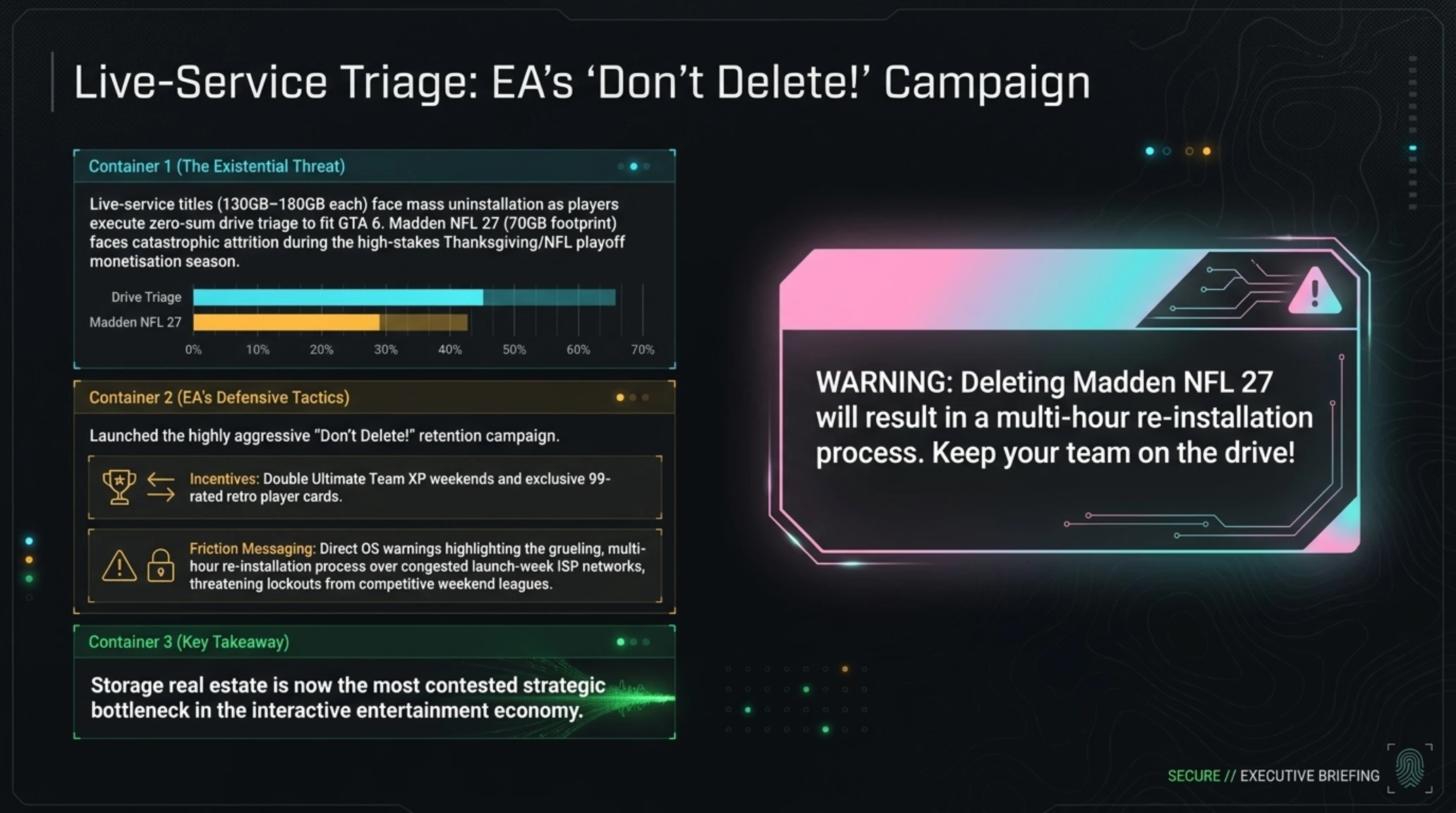
This unprecedented digital mass has precipitated an existential retention emergency for persistent online live-service franchises that rely on daily active user (DAU) engagement to fuel high-margin recurring monetization models. Live-service titles such as Call of Duty: Warzone, Fortnite, Apex Legends, and major annual sports franchises operate under continuous storage inflation, with several titles demanding upwards of 130 to 180 gigabytes each. When faced with the absolute cultural imperative of installing Grand Theft Auto VI, mainstream console players are actively forced into zero-sum drive triage, mercilessly purging competing titles to reclaim the requisite 212 gigabytes of high-speed NVMe flash space.
At the center of this defensive battleground stands Electronic Arts, whose flagship gridiron simulator Madden NFL 27 occupies approximately 70 gigabytes of primary drive space. Internal retention analytics reportedly projected catastrophic player attrition rates if Madden users uninstalled the title during the high-stakes Thanksgiving and NFL playoff content seasons. In response, EA launched an aggressive, tongue-in-cheek defensive marketing initiative dubbed the "Don't Delete!" campaign. Operating through high-contrast, Miami Vice-inspired aesthetic pop-ups featuring pastel pink and turquoise gradients reminiscent of GTA's Vice City styling, EA pleads directly with players to preserve Madden on their internal SSDs.
To incentivize players against deletion, EA deployed double Ultimate Team XP weekends, exclusive 99-rated retro player cards, and integrated direct operating system notifications explicitly highlighting the friction of re-downloading. The messaging sternly warns players that deleting Madden 27 will necessitate a grueling, multi-hour re-installation process over severely congested internet service provider networks during launch week, potentially locking them out of time-sensitive competitive weekend leagues. This tactical gambit highlights an emerging reality in video game publishing: storage real estate on the consumer's primary drive has become the most contested strategic bottleneck in the interactive entertainment economy.
Furthermore, the crisis has catalyzed massive secondary ripple effects across the retail hardware market for compatible M.2 NVMe PCIe Gen4 and Gen5 solid-state expansion drives. Electronics retailers and online storefronts report unprecedented surges in demand for 2TB and 4TB heatsink-equipped SSDs, resulting in spot-price inflation and spot shortages across Tier-1 NAND manufacturers including Samsung, Western Digital, and Crucial. Gamers unwilling to purge their established gaming libraries are effectively compelled to shoulder an additional $140 to $260 hardware expenditure, further amplifying the total economic barrier required to participate in next-generation AAA gaming experiences.
This severe storage constraint has prompted hardware engineers to meticulously benchmark console architectural throughput, comparing texture streaming speeds and system RAM utilization across competing hardware configurations.
5-AXIS ARCHITECTURAL PERFORMANCE TELEMETRY
Beyond high-speed memory streaming, tenth-generation software ambition requires an equally dramatic overhaul of environmental rendering and dynamic atmospheric physics simulation pipelines.
Hyper-Localized Atmospheric Simulation: Rockstar Games and The Weather Channel Pioneer Dynamic Microclimates in Leonida
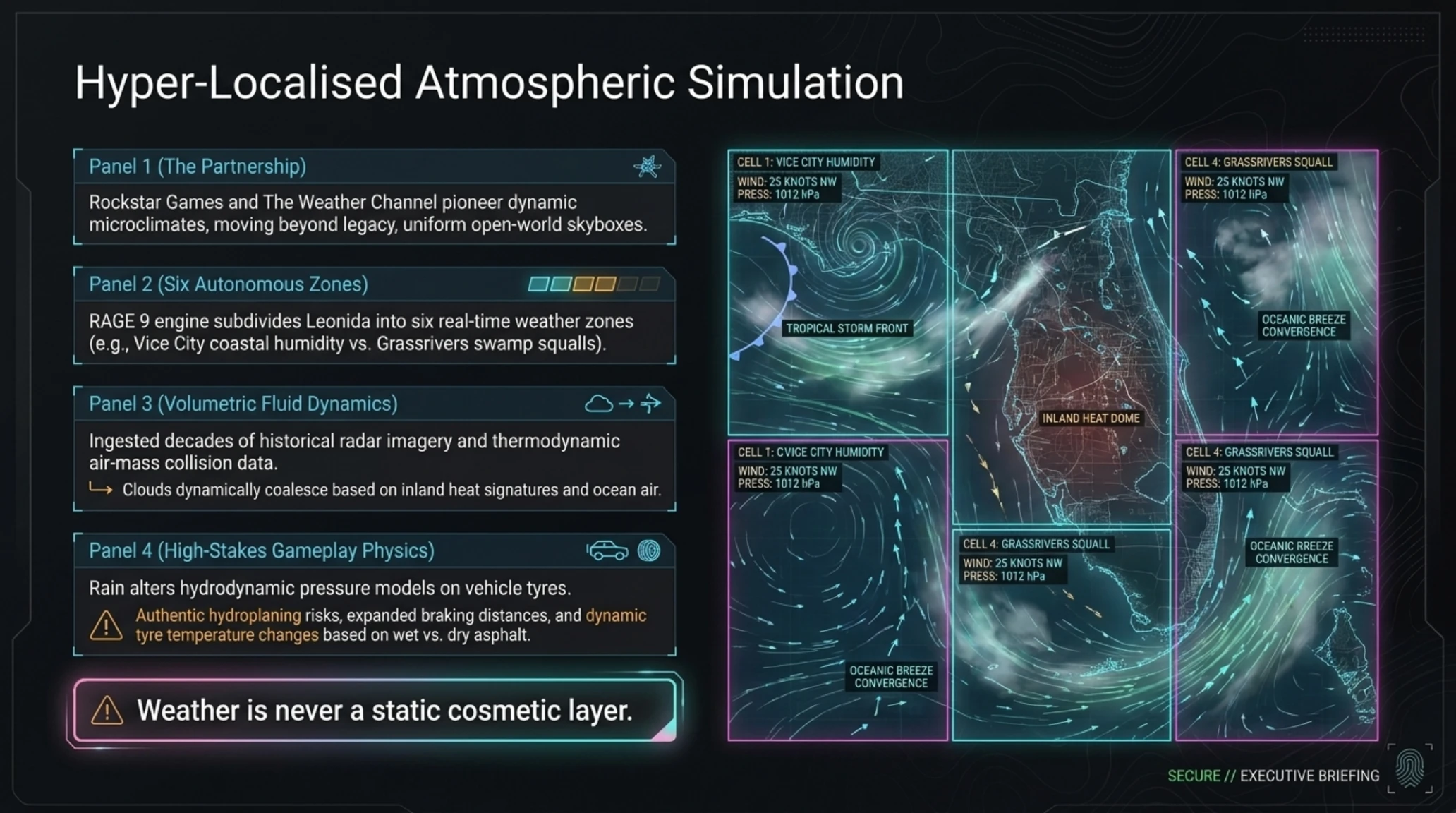
In one of the most unexpected, cross-disciplinary creative collaborations in contemporary digital entertainment history, Rockstar Games has officially partnered with The Weather Channel to execute an unprecedented simulation of hyper-localized dynamic microclimates across the fictional state of Leonida in Grand Theft Auto VI. Moving decisively beyond legacy open-world meteorological paradigms where an entire island map uniformly experiences rain, sunshine, or fog simultaneously the revamped RAGE 9 engine subdivides the game world into six distinct, autonomous meteorological zones. From the suffocating coastal humidity of Vice City to the subtropical swampland squalls of the Grassrivers and the volatile maritime weather patterns of the Keys, each geographic territory operates under its own real-time atmospheric simulation.
Rockstar's software engineering division collaborated with meteorologists and climate modelers from The Weather Channel to ingest decades of historical radar imagery, thermodynamic air-mass collision data, and tropical storm trajectories unique to South Florida. This empirical foundation allows the RAGE engine to simulate convective cloud formation in true three-dimensional volumetric space. Rather than rendering static skybox textures, clouds dynamically coalesce as moist ocean air interacts with inland heat signatures, building into localized cumulus towers that trigger sudden, torrential downpours directly over specific downtown neighborhoods while distant suburbs remain drenched in blazing Florida sunshine.
The visual and mechanical fidelity resulting from this atmospheric pipeline is profoundly transformative. In an extensive technical interview, Owen Shepherd, Vice President of Art for Light and Rendering at Rockstar Games, revealed that the RAGE engine models fluid particle dynamics in real time. As tropical storm fronts sweep across coastal highways, wind shear and falling precipitation interact directly with localized lighting sources, scattering ambient neon reflections off saturated asphalt and generating volumetric sea spray that drastically reduces line-of-sight visibility. Standing water accumulates dynamically in low-lying topographies, forming authentic reflective puddles that ripple in response to vehicular passage and wind gusts.
Crucially, this atmospheric sophistication is not merely ornamental eye candy; it directly alters the vehicle handling physics and emergent gameplay mechanics of Grand Theft Auto VI. Rainwater interacting with vehicle tires generates realistic hydrodynamic pressure models, introducing authentic hydroplaning risks for players navigating high-performance supercars at excessive speeds through flooded intersections. Braking distances expand dramatically on wet road surfaces, and dynamic tire temperature simulations alter cornering traction depending on whether a player is driving on sun-baked highway concrete or waterlogged swamp dirt tracks. This unprecedented fusion of real-world meteorological science with interactive entertainment establishes a benchmark in atmospheric immersion.

Volumetric light scattering across maritime mist and the dynamic interaction of monsoon winds with street reflections lend the fictional state of Leonida an extraordinary level of tangible, physical realism.
This profound mechanical shift in vehicular tire adhesion during squalls demonstrates Rockstar's commitment to transforming environmental variables from superficial eye candy into high-stakes gameplay parameters.
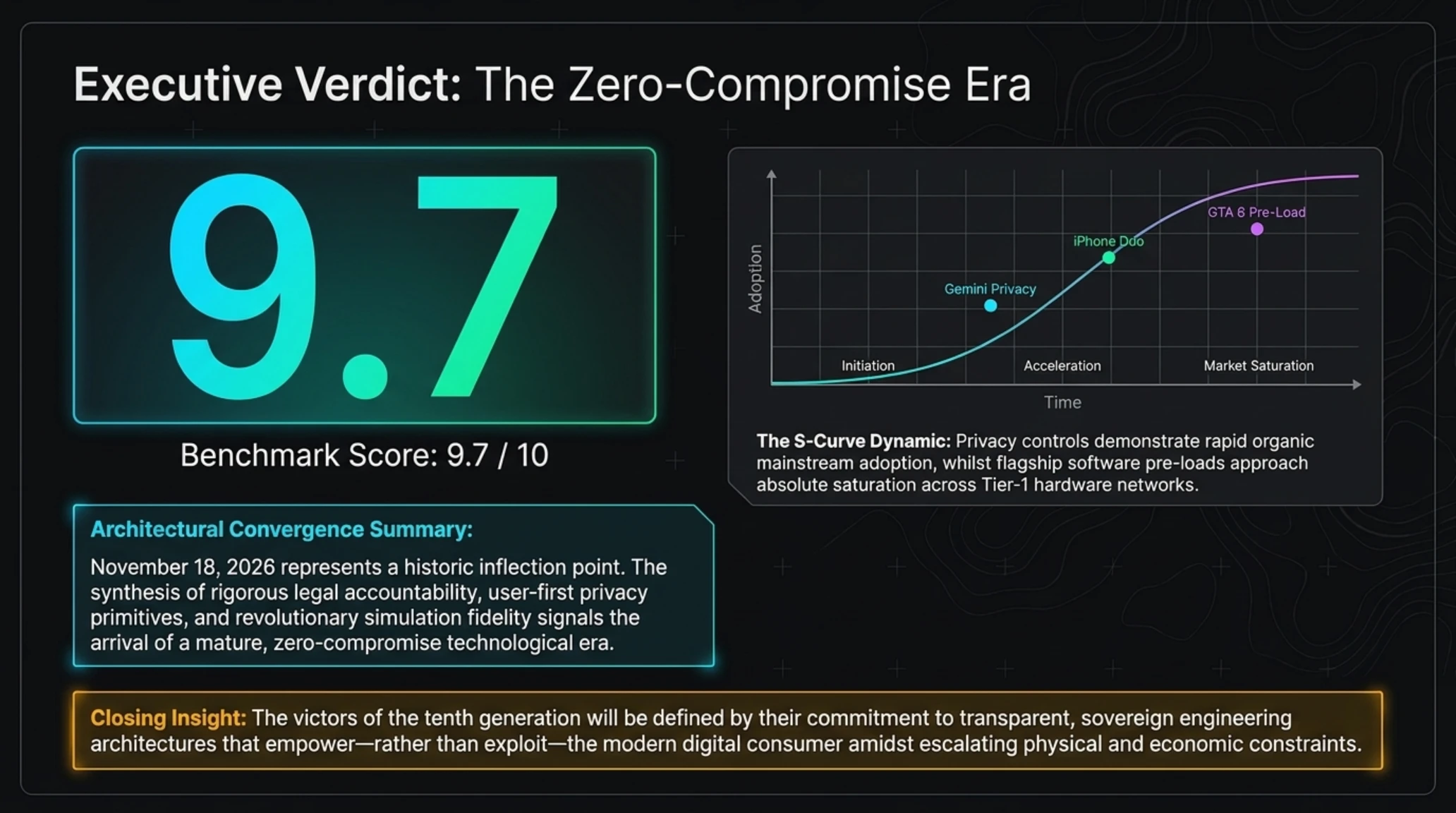
Telemetry tracking macro consumer adoption patterns reveals how rapidly mainstream users embrace software privacy enhancements compared to the prolonged upgrade cycles governing capital hardware.
ADOPTION S-CURVE & MARKET SENTIMENT INDEX
This broader consumer desire for seamless technological refinement without operational friction presents identical engineering trade-offs in the design of next-generation foldable mobile hardware.
Biometric Architecture Compromise: Apple Integrates 2D Camera Face Unlock in Ultra-Thin Foldable iPhone Duo via iOS 27.3
The distribution of the first developer beta of iOS 27.3 has confirmed a monumental structural compromise in Apple's historical biometric authentication philosophy. Deep within the operating system's system framework code, Apple engineers have introduced camera-based 2D facial recognition functionality specifically tailored for the exterior cover display of the upcoming ultra-thin foldable flagship, dubbed the iPhone Duo. For the first time since the debut of the iPhone X in 2017, Apple is departing from its exclusive reliance on dedicated structured-light TrueDepth hardware sensor arrays for facial unlocking, introducing a lightweight algorithmic alternative designed to overcome severe mechanical packaging constraints.
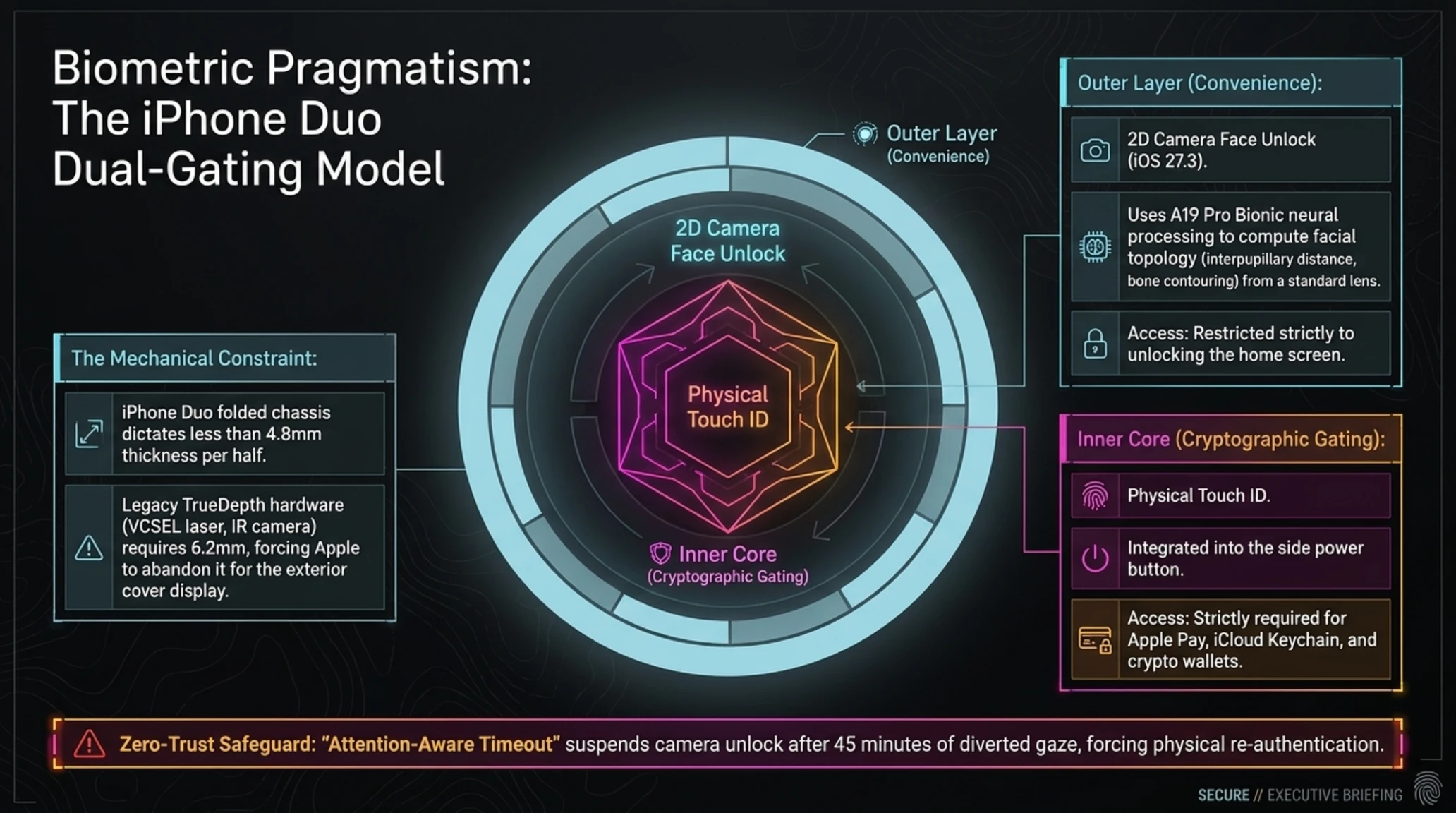
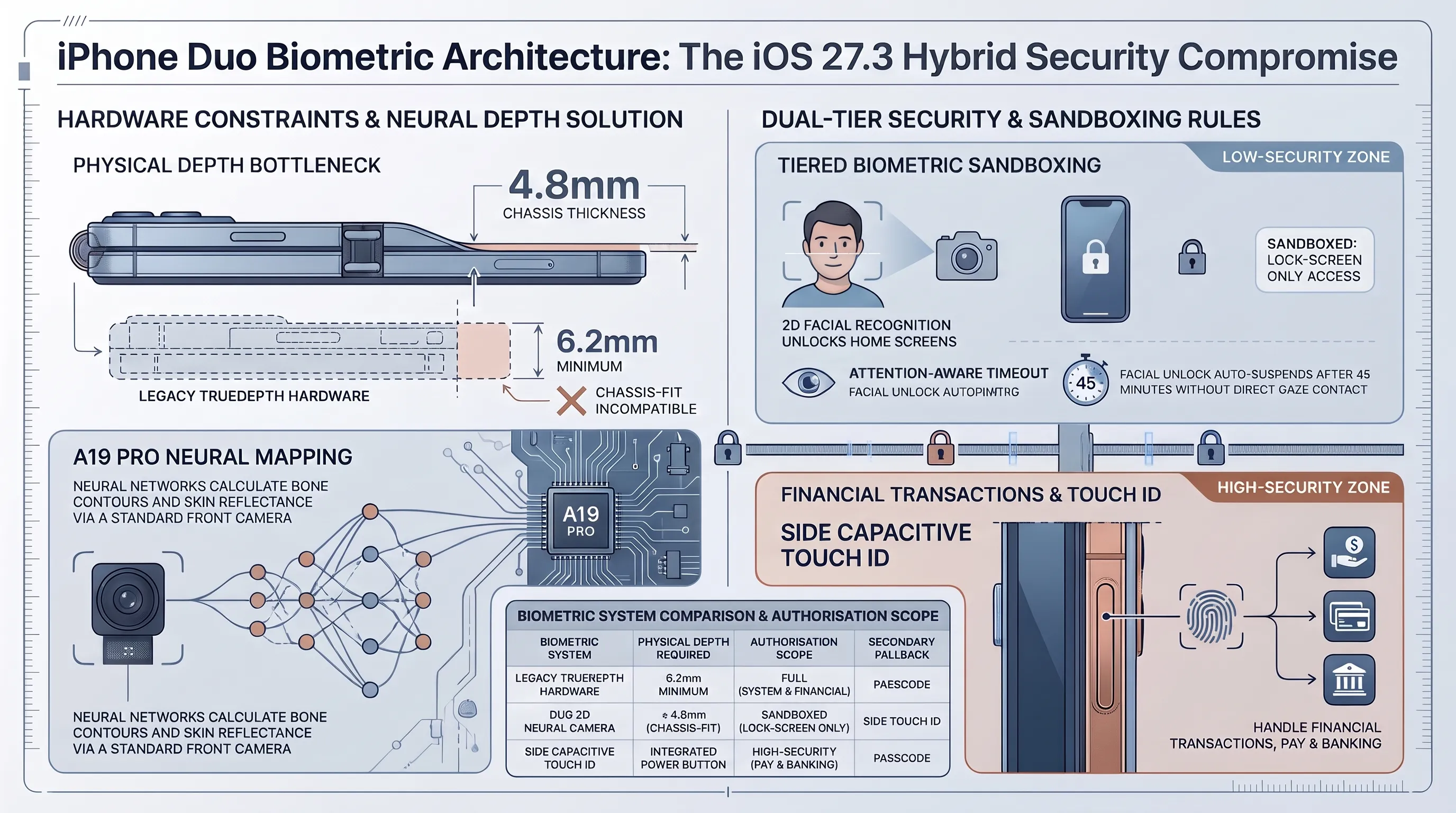
The root cause of this architectural concession lies in the extreme physical dimensions of the iPhone Duo. In order to achieve a folded profile comparable to a conventional smartphone, Apple's industrial design team engineered the device with an unfolded chassis thickness of less than 4.8 millimeters per half. The conventional TrueDepth camera subsystem incorporating a vertical-cavity surface-emitting laser (VCSEL) dot projector capable of beaming 30,000 infrared dots, alongside an IR flood illuminator and dedicated infrared camera requires a minimum depth threshold of 6.2 millimeters. Embedding such an optical array into the exterior cover display would have forced an unsightly camera protrusion or compromised the structural rigidity of the titanium hinge mechanism.
To reconcile these mechanical limitations, Apple's silicon engineering division leveraged the massive neural processing throughput of the next-generation A19 Pro Bionic processor. Rather than relying on physical infrared depth mapping, the iPhone Duo utilizes its standard high-resolution front-facing camera in tandem with real-time deep neural networks to compute facial topology. The system calculates interpupillary distance, facial bone contouring, micro-shadow gradations, and dynamic skin reflectance to approximate depth and prevent spoofing via printed photographs or flat digital screens.
However, demonstrating strict adherence to zero-trust security principles, Apple has heavily sandboxed this 2D camera facial recognition system. Operating system security policies strictly restrict camera-based unlocking to granting immediate access to the device's home screen. The camera face unlock is completely prohibited from authorizing Apple Pay financial transactions, populating biometric credentials from iCloud Keychain, or unlocking third-party banking and cryptographic wallet applications. For all financial and cryptographic authorization flows, users are strictly required to verify their identity via the physical capacitive Touch ID fingerprint sensor integrated directly into the side power button.
Additionally, iOS 27.3 incorporates an intelligent "Attention-Aware Timeout" safeguard. If the device detects that the user's primary gaze has wandered or if no active direct eye contact has been established within a rolling 45-minute window, the camera face unlock feature is automatically suspended until the user re-authenticates via the physical fingerprint sensor. This hybrid biometric compromise reflects Apple's pragmatism: preserving the effortless, glance-based unlocking ergonomics demanded by modern consumers while rigidly defending core financial transaction security through proven physical biometrics.
Apple's hybrid biometric compromise segregating casual device unlocking from cryptographic financial authorizations establishes an essential precedent for industrial design pragmatism in the foldable era.
This executive synthesis underlines the mandatory convergence between silicon hardware efficiency, network perimeter defense, and cultural software distribution as foundational pillars of the digital economy.
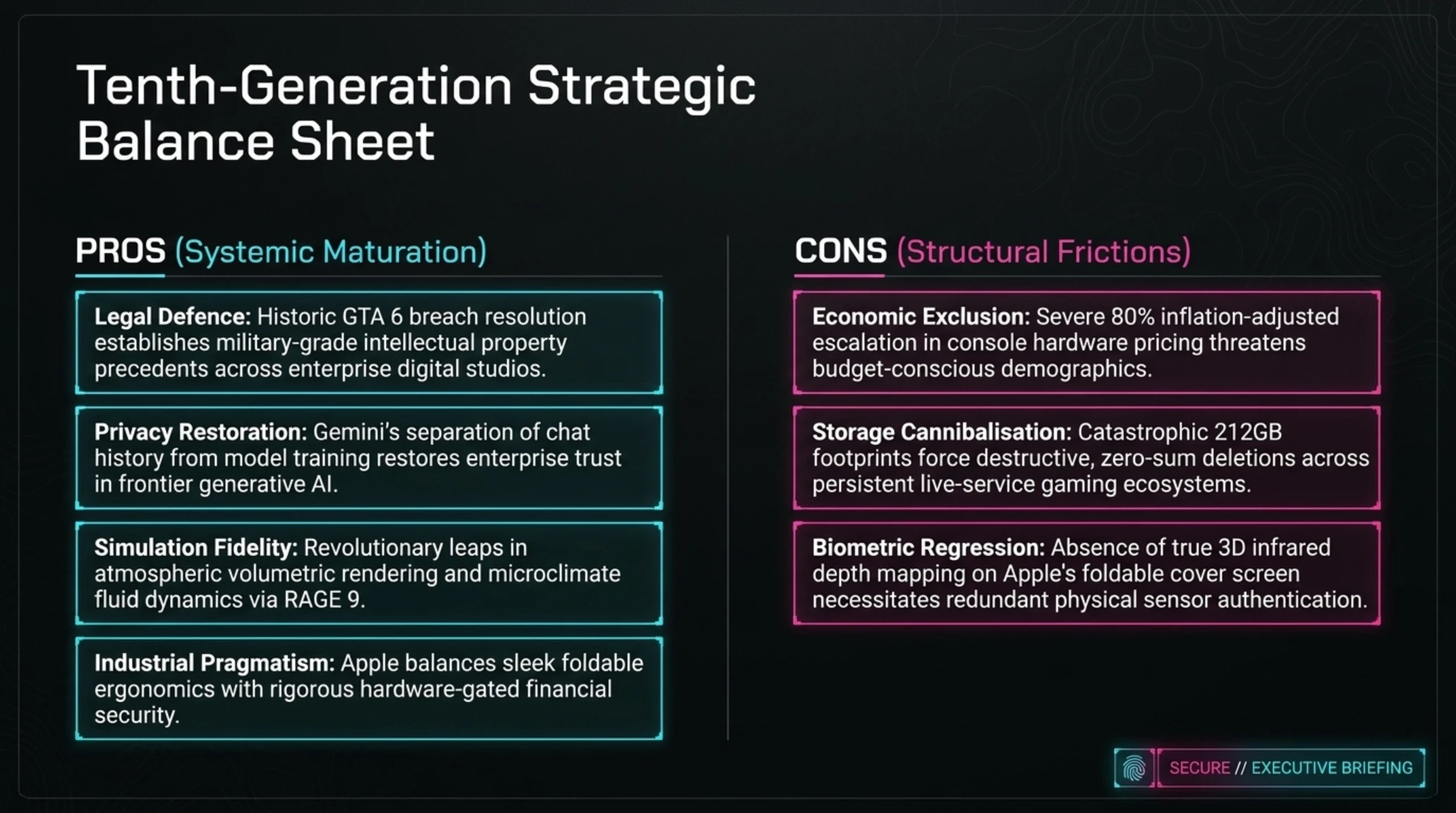
In auditing the strategic virtues and systemic friction points across these concurrent developments, the editorial bureau applies a comprehensive multi-axis assessment matrix.
- Judicial resolution of the historic GTA 6 breach establishing military-grade intellectual property precedents across enterprise digital studios.
- Pioneering separation of chat history from foundation model training in Google Gemini restoring enterprise trust in generative AI tools.
- Revolutionary leap in atmospheric volumetric rendering and microclimate fluid dynamics inside Rockstar's RAGE 9 engine.
- Pragmatic biometric engineering by Apple balancing sleek foldable industrial ergonomics with rigorous hardware-gated financial security.
- Severe 80% inflation-adjusted escalation in console hardware pricing locking budget-conscious players out of next-gen interactive entertainment.
- Catastrophic 212GB storage footprint forcing destructive zero-sum deletions across persistent live-service gaming ecosystems.
- Absence of true 3D infrared biometric depth mapping on Apple's foldable cover screen requiring redundant physical sensor authentication.
The convergent technological developments documented on November 18, 2026 signify a profound maturation across the global interactive entertainment, personal computing, and artificial intelligence landscapes. For over a decade, consumer technology markets operated under assumptions of near-frictionless expansion: solid-state storage costs fell steadily, hardware prices trended downward as manufacturing yields matured, and artificial intelligence models consumed consumer data with minimal regulatory or user-facing friction. Today's announcements puncture those legacy assumptions, revealing an operational environment where physical engineering constraints, high-stakes judicial accountability, and sovereign user privacy dictate product architecture.
The formal judicial resolution of the 2022 Rockstar Games breach establishes an essential precedent for the digital economy. In an era where proprietary source code and generative assets represent billions of dollars in enterprise value, the defense of intellectual property cannot rely solely on reactive software patches; it requires uncompromising legal deterrence and zero-trust engineering perimeters. Concurrently, the economic reality exposed by Circana's point-of-sale data and EA's unprecedented storage defense campaign proves that consumer platforms have reached a critical threshold of physical saturation. When a single piece of software commands 212 gigabytes of high-speed NAND flash and hardware barriers exceed $650, interactive entertainment ceases to be an impulse purchase and becomes a calculated household capital allocation.
Simultaneously, Google's policy pivot regarding Gemini chat history isolation and Apple's hybrid biometric compromise on the iPhone Duo illustrate how leading platform architects are responding to heightened consumer sophistication. Users will no longer tolerate the clandestine exploitation of their personal and professional data to train third-party foundation models, just as mobile device owners demand uncompromised industrial aesthetics without surrendering core cryptographic security. As the tenth generation of consumer computing enters its zenith, the organizations that prosper will be those capable of delivering transcendent creative experiences such as the hyper-realistic atmospheric simulations of Leonida while maintaining absolute fidelity to consumer sovereignty, data security, and architectural pragmatism.
Ultimately, the comprehensive synthesis of November 18, 2026 affirms that the future of computing will not belong to closed walled gardens that demand unilateral compromises from their users. Whether resolving high-stakes intellectual property litigation, engineering high-efficiency texture streaming across constrained solid-state drives, or delivering privacy-preserving enterprise generative models, the victors of the tenth generation will be defined by their commitment to transparent, sovereign engineering architectures that empower rather than exploit the modern digital consumer.
Below, the Tekin Plus executive bureau presents its concluding analytical verdict, architectural scoring, and verified source registry, followed by a structured FAQ addressing the most pressing operational considerations.
TEKIN EDITORIAL VERDICT & AUTHORITATIVE REFERENCE REGISTRY
Architectural Convergence: The Maturation of Tenth-Generation Digital Ecosystems
November 18, 2026 represents a historic inflection point across the digital frontier. The synthesis of rigorous legal accountability for digital breaches, explosive consumer demand navigating high-friction hardware pricing, user-first privacy primitives in frontier AI, and revolutionary simulation fidelity signals the arrival of a mature, zero-compromise technological era.
- The Verge: Rockstar Games GTA 6 Hacker Arion Kurtaj Pleads Guilty at Woolwich Crown Court
- IGN / Circana: Historical Console Pricing Analysis and GTA 6 Hardware Sales Intent Audits
- Android Authority: Google Gemini Decouples Conversation History Retention from AI Model Training
- Polygon: EA Madden NFL 27 Launches Don't Delete Campaign to Counter GTA 6 212GB Storage Shock
- GameSpot: Inside Rockstar's Atmospheric Simulation Partnership with The Weather Channel
- MacRumors: iOS 27.3 Developer Beta Introduces 2D Camera Face Unlock for Foldable iPhone Duo
Frequently Asked Questions & Strategic Technical Audits
What legal precedents are established by Arion Kurtaj's guilty plea regarding the GTA 6 hack?
Arion Kurtaj's guilty plea at Woolwich Crown Court formalizes strict judicial accountability for cyber intrusion and grand theft of proprietary digital assets. By securing an admission of guilt backed by forensic evidence detailing over $5 million in direct mitigation damages, the ruling firmly establishes that social engineering intrusions and asset leaks will be prosecuted under severe enterprise cyber frameworks.
Why does the $646 average console hardware cost create significant friction for GTA 6 adoption?
Unlike the 2013 launch of GTA V where PS3 and Xbox 360 consoles were heavily discounted to roughly $230-$250 ($330-$360 inflation-adjusted), tenth-generation consoles like the PS5 ($646 avg) and PS5 Pro ($900+) maintain record-high price points. This creates a steep economic barrier for millions of late-adopter PS4 owners.
How does Google Gemini's new privacy setting decouple chat history from model training?
In the updated Gemini settings, Google has introduced a dedicated toggle that allows users to permanently maintain and search their conversation history while completely opting out of foundation model training. This ensures that user code, internal strategy documents, and confidential prompts remain isolated in ephemeral inference vaults.
Why is GTA 6's 212GB pre-load size an existential retention threat for live-service games like Madden 27?
Baseline consoles offer only 667GB to 800GB of usable SSD storage. Installing a 212GB monolithic software package forces gamers into triage, compelling them to delete competing live-service titles. Publishers like Electronic Arts face immediate risks of player churn and lost recurring microtransaction revenues.
How does dynamic microclimate simulation in GTA 6 differ from conventional open-world weather systems?
Rather than applying uniform atmospheric conditions across the map, Leonida is partitioned into six autonomous meteorological zones modeled on real-world climate datasets from The Weather Channel. Volumetric storm clouds form dynamically, downpours strike specific neighborhoods, and standing water alters vehicle hydroplaning physics.
Why did Apple adopt a 2D camera facial recognition approach on the iPhone Duo instead of TrueDepth?
The ultra-thin foldable industrial design (under 4.8mm unfolded) physically precludes the integration of the 6.2mm-deep TrueDepth dot projector assembly into the cover screen. Apple leveraged A19 Pro neural processing to achieve fast 2D facial unlocking for home screen access, while strictly delegating high-stakes financial Apple Pay authentications to the physical Touch ID sensor.
Additional Gallery: Tekin Morning Nov 18: GTA 6 Leaker Pleads Guilty & Console Prices