Tekin Analysis | Dissecting GTA 6 Engineering
A deep dive into Rockstar's RAGE 9 architecture, NPC artificial intelligence, and 8-week development cycles.
- 🎮8-Week Milestones- Continuous build evaluations to eliminate technical debt.
- 🎧Dedicated NPC Studio- LA-based team crafting dynamic civilian identities.
- 🚀Double-Sized Leonida- Six biomes and handcrafted micro-archeology in rooms.
- 🗡️Atmospheric Physics- Destructive hurricanes and 170 reactive animal species.
- 📰Acoustic Ray-Tracing- Physical sound wave reflections powered by RAGE 9.
- ⚔️Hardware Benchmarks- Locked 30 FPS on base consoles and PS5 Pro enhancements.
Dismantling the Secrecy Machine: The Rare Fracture in Rockstar's Monolith
For more than two decades, Rockstar Games has operated as an impenetrable fortress within the global interactive entertainment industry. In an era where AAA publishers routinely attempt to court consumer favor and appease institutional investors through monthly developer diaries, glossy engineering podcasts, and granular sprint roadmaps, the Edinburgh-headquartered titan maintained an almost monastic vow of absolute silence. Development pipelines, organizational hierarchies, and technical architecture were guarded behind ironclad non-disclosure agreements and a corporate mythology that treated their games less as collaborative software deployments and more as miraculous manifestations of digital wizardry. Yet, as the calendar ticks inexorably toward the November 19, 2026 worldwide launch of Grand Theft Auto 6 on PlayStation 5 and Xbox Series X|S, that legendary wall of silence has experienced a seismic and deliberate fracture.
A series of revelatory, long-form technical disclosures spearheaded by an unprecedented interview in the 27th issue of LOVE magazine featuring Rockstar North Co-Studio Head Rob Nelson, Senior Vice President of Narrative Rupert Humphries, and Writing Director James Horton, complemented by deep investigative reporting from The New York Times featuring Art Director Aaron Garbut, alongside supplementary documentation from Kotaku, GameSpot, and Game Informer has finally pulled back the curtain on the most complex engineering endeavor in entertainment history. These accounts do not represent mere public relations platitudes; they constitute an unprecedented blueprint of how modern software engineering can operate when unconstrained by quarterly corporate panic and backed by an institutional runway numbering in the billions of dollars.
The contemporary video game industry currently finds itself embroiled in a profound systemic crisis. Massive multi-hundred-million-dollar productions routinely collapse under the weight of feature creep, fragmented cross-functional communication, and technological obsolescence caused by elongated production cycles. Studios across North America, Europe, and Asia struggle with the fundamental paradox of modern game development: as asset fidelity and algorithmic complexity scale exponentially, the organizational ability to maintain a cohesive creative vision across thousands of dispersed engineers rapidly deteriorates. In contrast, Rockstar's latest disclosures expose an operational philosophy that completely inverts conventional corporate wisdom, abandoning rigid agile orthodoxy in favor of tactile, sensory-driven iterative validation.

To comprehend how a sprawling diaspora of several thousand developers spanning Edinburgh, London, New York, San Diego, New England, India, and Los Angeles can construct a simulated world as vast and terrifyingly intricate as the state of Leonida, one must first dismantle the prevailing myths surrounding Rockstar's pipeline and examine the bespoke mechanical infrastructure that governs their daily production reality.
Core Engineering Tenets of Rockstar's Modern Production Pipeline
- Dismantling of traditional top-down waterfall management in favor of synchronized eight-week compile and evaluation cycles.
- Establishment of a dedicated, geographically isolated pedestrian narrative laboratory in Los Angeles to eradicate the Dead World syndrome.
- Implementation of the continuous 'roughing in' methodology, prioritizing macro mechanical coherence over premature visual polish.
- Direct translation of high-risk ethnographic fieldwork including police tactical ride-alongs and underworld cultural immersion into runtime variables.
- Hardware-accelerated acoustic ray-tracing architecture inside RAGE 9 modeling wave reflection and structural sound occlusion.
- Targeting uncompromised frame-pacing with a locked 30 FPS console baseline alongside custom PSSR machine-learning reconstruction for PS5 Pro.
The Eight-Week Milestone Engine: Inside Rockstar's Iterative Compilation Architecture
At the center of Rockstar's operational dominance lies a software engineering paradigm that studio head Rob Nelson describes as a continuous succession of eight-week milestone cycles. In traditional corporate software development, projects frequently fall victim to the traps of either dogmatic Scrum frameworks which fracture large-scale creative momentum into superficial, two-week ticket completions or archaic Waterfall timelines, where foundational subsystems remain isolated in abstract developer branches for years before being merged into a catastrophic, bug-riddled final build. Rockstar North decisively rejected both extremes when architecting the development pipeline for Grand Theft Auto 6.
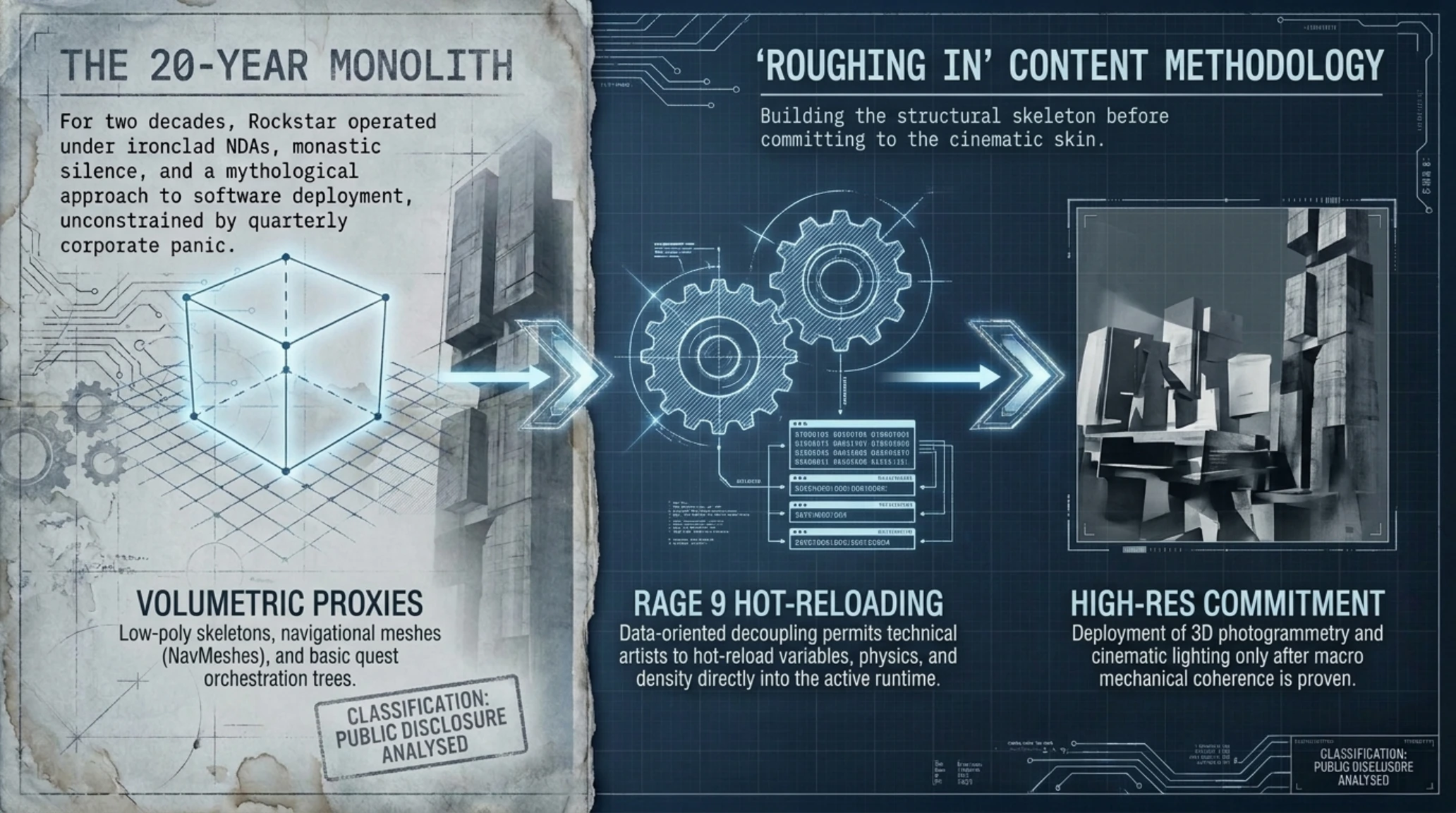
Under Nelson's system, the creation of Leonida begins by engineering core mechanical assets and interactive subsystems, followed immediately by what the studio terms 'roughing in content' across all operational domains. Borrowing terminology from high-end architectural construction, 'roughing in' involves laying the structural framing, conduit networks, and infrastructural plumbing of a gameplay space before drywall, plaster, or decorative trim are ever introduced. In the context of GTA 6, this dictates that entire geographic counties, urban highway grids, foundational artificial intelligence navigation meshes (NavMeshes), and quest orchestration trees are drafted as low-poly, volumetric skeletons across the game world.
Every eight weeks, these disparate branches are compiled into a singular, unified master executable. This is not an abstract progress dashboard or an animated vertical slice intended for executive presentations; it is a fully playable, end-to-end sandbox deployed directly onto retail-target development kits. For days following each compilation, the senior leadership cadre, department leads, and veteran designers embed themselves inside this sandbox, subjecting the newly integrated systems to exhaustive, unvarnished experiential interrogation. Every friction point, aberrant physics calculation, awkward narrative transition, or pacing slump is documented not as an abstract ticket, but as a direct sensory failure of the game's emotional target.
The output of each eight-week compilation is an exhaustive dossier of surgical course corrections that immediately dictates the engineering agenda for the subsequent two-month milestone. This iterative calibration cycle prevents technical debt from accumulating beneath the surface. If an experimental traffic density algorithm compromises frame pacing in downtown Vice City, or if a dynamic cloud volumetrics shader causes memory contention in the memory-mapped streaming pools, it is identified and remediated within sixty days, rather than being discovered during a panicked final polish phase four years down the line.
This relentless rhythm is heavily bolstered by the technical architecture of the proprietary RAGE 9 (Rockstar Advanced Game Engine) engine. As we previously analyzed in our technical monograph on Rockstar's Media Phenomenon and RAGE 9 Engine Innovations, the modern iteration of RAGE is designed around a multi-threaded, data-oriented entity-component framework. This decouples algorithmic logic from raw visual assets, enabling technical artists and systems designers to hot-reload behavioral variables, physics constraints, and ambient density multipliers directly inside active runtime environments without requiring full re-compilation of the core engine binary.
Engineering Lexicon | Jargon Buster
Roughing In: A foundational production methodology in open-world systems architecture where environmental geometry, AI pathing volumes, collision hulls, and rough quest triggers are authored using low-overhead proxy assets. This permits rigorous verification of physical distances and behavioral cadence prior to costly 3D photogrammetry and cinematic lighting passes.
Crucially, Nelson points out that the true efficacy of this eight-week milestone architecture hinges upon institutional longevity. The core directorial and architectural tier at Rockstar North, Rockstar New York, and Rockstar San Diego represents an astonishingly intact cadre of developers who have collaborated continuously across Grand Theft Auto: Vice City, San Andreas, GTA IV, Red Dead Redemption, GTA V, and Red Dead Redemption 2. This multi-decade shared history creates an unspoken institutional shorthand an innate, collective understanding of what constitutes a 'Rockstar-grade' interactive experience that cannot be replicated by assembling transient contract workers within contemporary gig-economy game studios.
As development progressed deeper into runtime validation, the behavioral modeling of civilian populations emerged as the ultimate litmus test of systemic credibility.

Rockstar's leadership recognized that without a generational leap in artificial intelligence, visual fidelity alone could never conquer the uncanny valley of modern open worlds.
The Dedicated Los Angeles Pedestrian Bureau: Eradicating the Dead World Syndrome
One of the most insidious and pervasive maladies afflicting open-world game design across the eighth and ninth console generations is what computational narrative researchers characterize as the 'Dead World Syndrome.' In this all-too-familiar paradigm, players are invited into sprawling, photorealistic cityscapes constructed from millions of polygons and rendered with cutting-edge global illumination; yet the moment one steps onto the sidewalk, the illusion evaporates into sterile artificiality. The virtual inhabitants of these digital metropolises routinely present as hollow automata gliding along rigid navigation splines, endlessly repeating a handful of scripted voice lines, reacting to catastrophic urban violence with robotic apathy, and vanishing into the computational ether the instant they leave the player's primary field of view.
To confront this fundamental immersion barrier and establish an unprecedented benchmark for virtual society, Rockstar Games executed a radical organizational pivot during the production of Grand Theft Auto 6: the establishment of an entire dedicated studio bureau situated in Los Angeles, charged with the sole, uncompromising mandate of engineering the psychological profiles, verbal taxonomy, and dynamic situational awareness of Leonida's civilian populace (NPCs).
Writing Director James Horton, speaking candidly regarding the scale of this cognitive initiative, underscored that when the artistic imperative is to construct a living world of continental breadth, superficial generative shortcuts and generic algorithmic fills represent an unacceptable compromise. Horton illuminated the dual-scale auditory and sociological challenge: the world must possess macroscopic acoustic density, while simultaneously sustaining microscopic structural validity upon forensic player inspection.
According to Horton, the simulation is engineered so that when a player sprints at top speed down the hyper-dense thoroughfares of downtown Vice City, the auditory cortex is assaulted by the cacophony of a genuine metropolis. Fragmented sentences, ambient street arguments, snippet exchanges of financial gossip, romantic disputes, and cultural grievances from over one hundred concurrent, independent conversational threads wash over the player in full volumetric spatial audio. Yet, should that same player abruptly skid to a halt, lean against a brick facade, and eavesdrop intently upon a single mundane conversation between two pedestrians waiting for a bus, that dialogue must ring authentically true. It must exhibit native regional inflection, syntactic consistency, emotional subtext, and contextual coherence relative to the time of day, current weather conditions, and socioeconomic realities of that specific urban district.
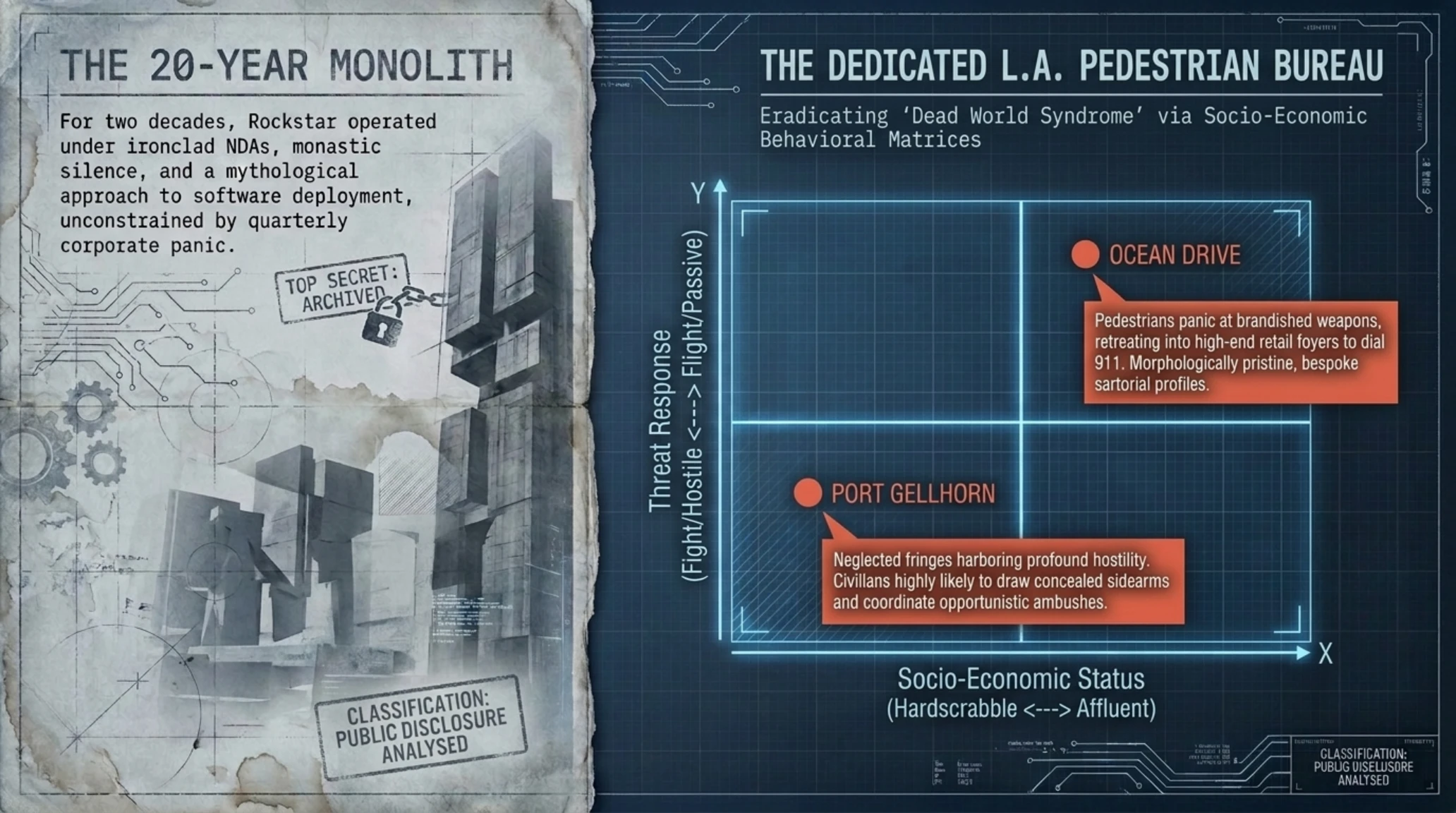
Within the computational framework of RAGE 9, civilian instantiation has severed all ties with legacy random number generator (RNG) lookup tables. Pedestrians are no longer spawned as disconnected collections of interchangeable meshes and random voice clips. Instead, they are generated through a rigorous socioeconomic weighting matrix governed by geographic neighborhood metadata. A pedestrian traversing the opulent beachfront boulevard of Ocean Drive in Vice City possesses an entirely distinct morphological, sartorial, and psychological profile compared to an industrial worker leaving a petrochemical refinery shift in Ambrosia.
To observe how these multi-layered behavioral matrices adapt dynamically to high-stress environmental disruption, the gameplay demonstration below provides concrete technical proof:
This demographic specialization extends deeply into phenotypic and biometric diversity. Body morphology, gait mechanics, posture, facial skin quality, tattoo placement, hairstyle maintenance, and apparel wear-and-tear are procedurally synthesized according to socio-spatial rules. Moreover, pedestrian situational awareness directly informs gameplay mechanics. In affluent districts, civilians confronted by brandished weaponry or aggressive vehicular maneuvers are prone to panic, retreating into high-end retail foyers to summon emergency dispatchers via smartphones. In contrast, in the neglected, hardscrabble fringes of Port Gellhorn, residents frequently harbor profound hostility toward both law enforcement and street interlopers; pedestrians in these precincts are significantly more likely to draw concealed sidearms, retaliate with lethal force, or coordinate opportunistic ambushes before municipal authorities can mobilize a behavioral matrix we explored in depth within our investigative piece on GTA 6's Wanted Level and Police Forensic Neural Network.
Aaron Garbut's Micro-Archeology: The Philosophy of Room Storytelling
Perhaps no single revelation from recent insider disclosures illustrates the sheer madness of Rockstar's craftsmanship more profoundly than the testimony delivered by Art Director Aaron Garbut to The New York Times. In an era dominated by corporate enthusiasm for cost-cutting procedural generation tools that populate digital environments with sterile, repeating furniture prefabs, Garbut articulated what can only be described as a philosophy of forensic environmental archeology.
Garbut revealed that across the hundreds of fully interiorized architectural structures permeating Leonida, every single accessible room was subjected to an exhaustive, bespoke narrative curation pass conducted by a human spatial artist. In Garbut's conceptual framework, an interior space is not an assortment of decorative polygons; it is the physical crime scene of a human existence.
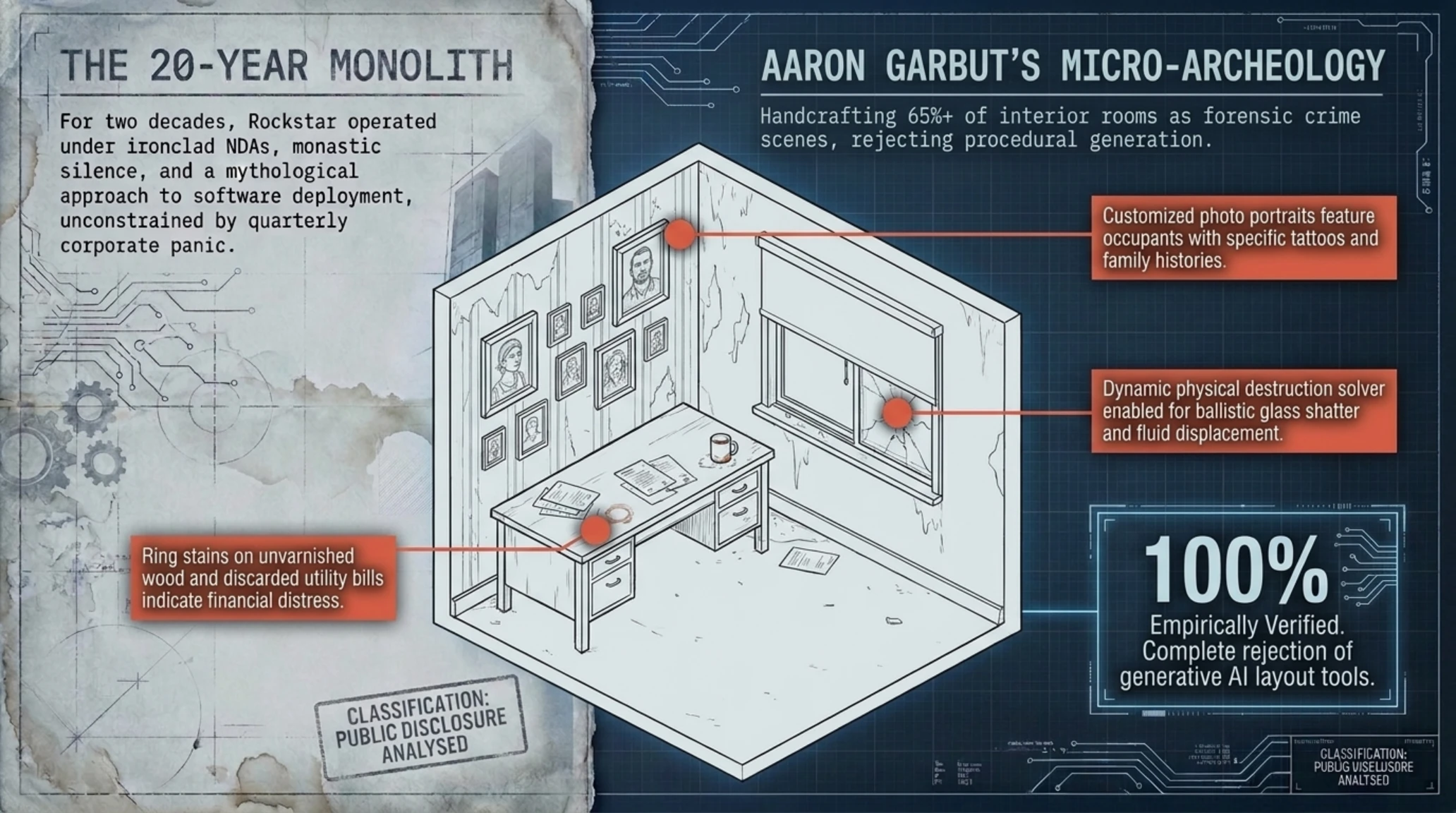
“Every room in the game, somebody thought about this,” Garbut explained with striking precision. “Who’s sitting where, what they’re drinking, the marks that are left on the table. The pictures on the wall will have the people that are in that room, with their tattoos on their arms and their family behind them. That whole thing has been made, and built, and photographed, and placed in this random room in a random building in a huge city, in a world.”
Industry Paradigm Shift | Why It Matters
The Decisive Rejection of Procedural Sterility: While competing publishers increasingly transition toward AI-driven procedural environment generation to curb soaring production budgets, Rockstar's deliberate investment in artisanal, room-by-room environmental storytelling establishes an emotional density that generative models are fundamentally incapable of replicating.
This staggering standard of micro-scale authoring fundamentally shifts the relationship between player curiosity and world exploration. When Jason or Lucia breaches the perimeter of a ramshackle roadside motel, an illicit narcotics distribution hub, or a suburban residential bungalow, the interior architecture ceases to function as decorative backdrop. It becomes an interactive repository of implicit sociological history, revealing the unseen occupant's financial distress, personal addictions, familial fractures, and daily rituals through tangible physical artifacts.
High-resolution captures from internal staging builds demonstrate the micro-level geometric density realized across these interior spaces:

These interior props are fully integrated into RAGE 9's dynamic physical destruction solver, exhibiting genuine ballistic splintering, glass shatter mechanics, and fluid displacement.
Uncompromising Field Research: From Night Patrols to Tactical Helicopter Sorties
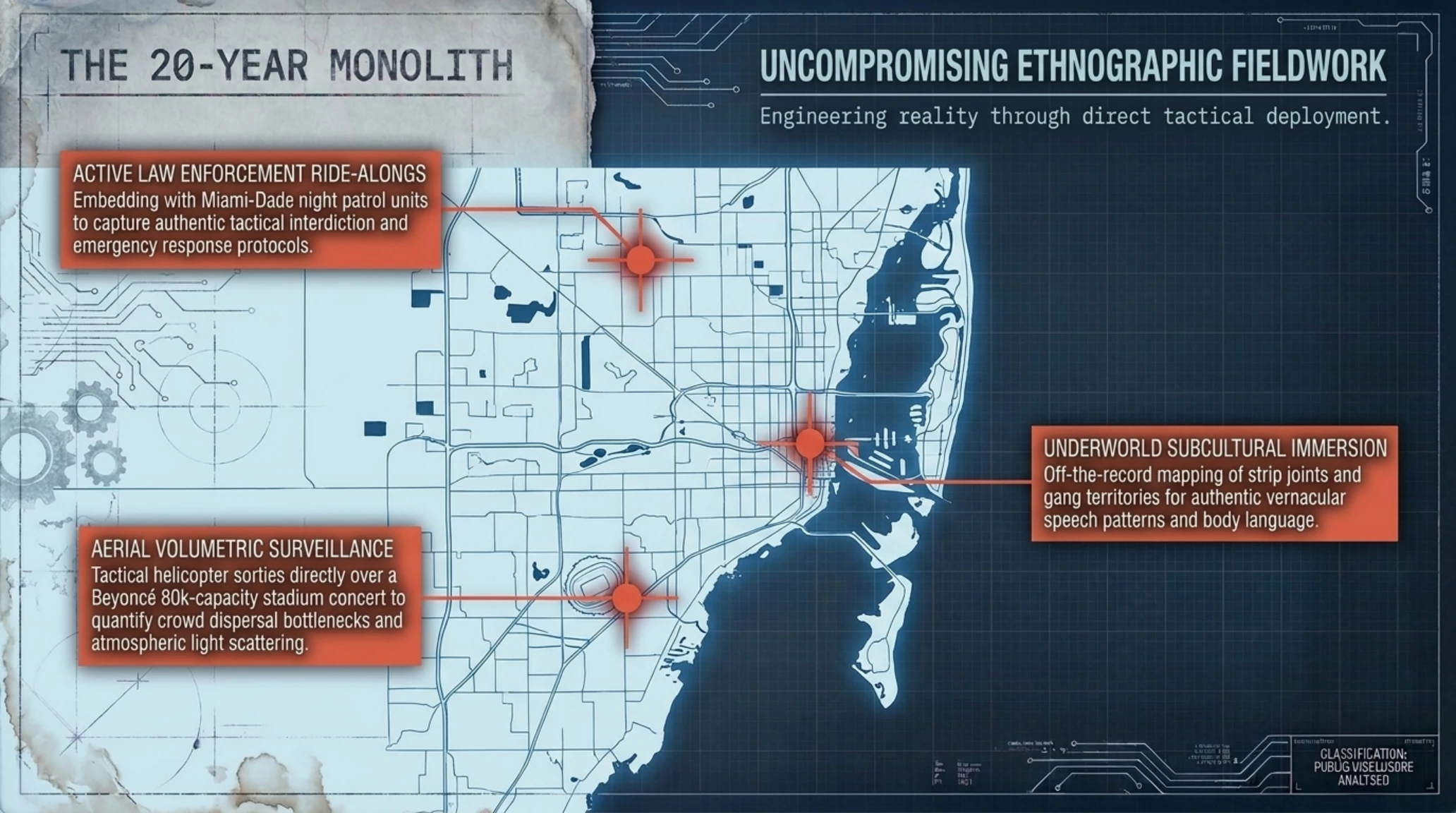
The unmistakable authenticity that distinguishes Rockstar's urban simulations from generic genre competitors is directly attributable to an uncompromising ethos of immersive, on-the-ground ethnographic research. Rather than constructing their fictionalized interpretation of the Sunshine State from internet image repositories and tourist travelogues, the studio's technical researchers, architectural documentarians, and narrative designers embedded themselves directly into the visceral heart of Florida for extended, high-intensity operational deployments across three primary methodological pillars:
- Active Law Enforcement Ride-Alongs: Embedding directly with Miami-Dade night patrol units to record authentic radio communications, tactical interdiction maneuvers, and high-speed emergency response protocols.
- Underworld Subcultural Immersion: Conducting extensive off-the-record field interviews inside local strip joints, underground pool halls, and gang territories to capture authentic vernacular speech patterns and body language.
- Acoustic and Volumetric Aerial Surveillance: Charting private helicopter reconnaissance missions directly over packed stadium events to quantify crowd dispersal patterns and atmospheric light diffusion.
In one of the most remarkable operational logistics feats documented during pre-production, Rockstar chartered a private tactical helicopter flight hovering directly above an open-air stadium concert headlined by Beyoncé in Miami. The objective was purely empirical: capturing high-resolution volumetric data on real-time pedestrian ingress and egress bottlenecks, analyzing the diffuse atmospheric scattering of stadium floodlights through humid marine air, and recording the micro-frequency sound reverberation of eighty thousand chanting spectators as the acoustic pressure waves rippled through adjacent city blocks. These empirical observations were systematically converted into algorithmic parameters, directly governing RAGE 9's dynamic lighting shaders, ambient audio occlusion, and crowd simulation models.
Empirical Verification | Rumor vs. Reality
- Claim: Rockstar automated over 70% of Leonida's interior spaces using generative AI. (FALSE) Industry rumors asserted AI geometry synthesizers were used to meet the 2026 deadline.
- Reality: The studio deployed a dedicated team of environmental artists. (100% Verified) Aaron Garbut and Rob Nelson confirmed Rockstar emphatically rejected automated generative layout tools, individually dressing and narrative-scripting every accessible room.
📚 Classified & Related Dossiers in TekinGame
If you wish to explore beyond this report and delve into cybernetic frontiers and autonomous AI architectures, do not miss these three exclusive deep-dives in the Tekin Garage:
This intense synthesis of raw empirical reality with computational engineering provides the essential foundation for the colossal continental geography examined in the following section.
Scaling a digital open-world simulation from a standalone metropolitan center into an entire sovereign state demanded a total cartographic and streaming architecture redesign.

Rigorous cartographic analysis confirms that Leonida represents the single largest seamless geographical continuum ever rendered within a concurrent real-time simulation environment.
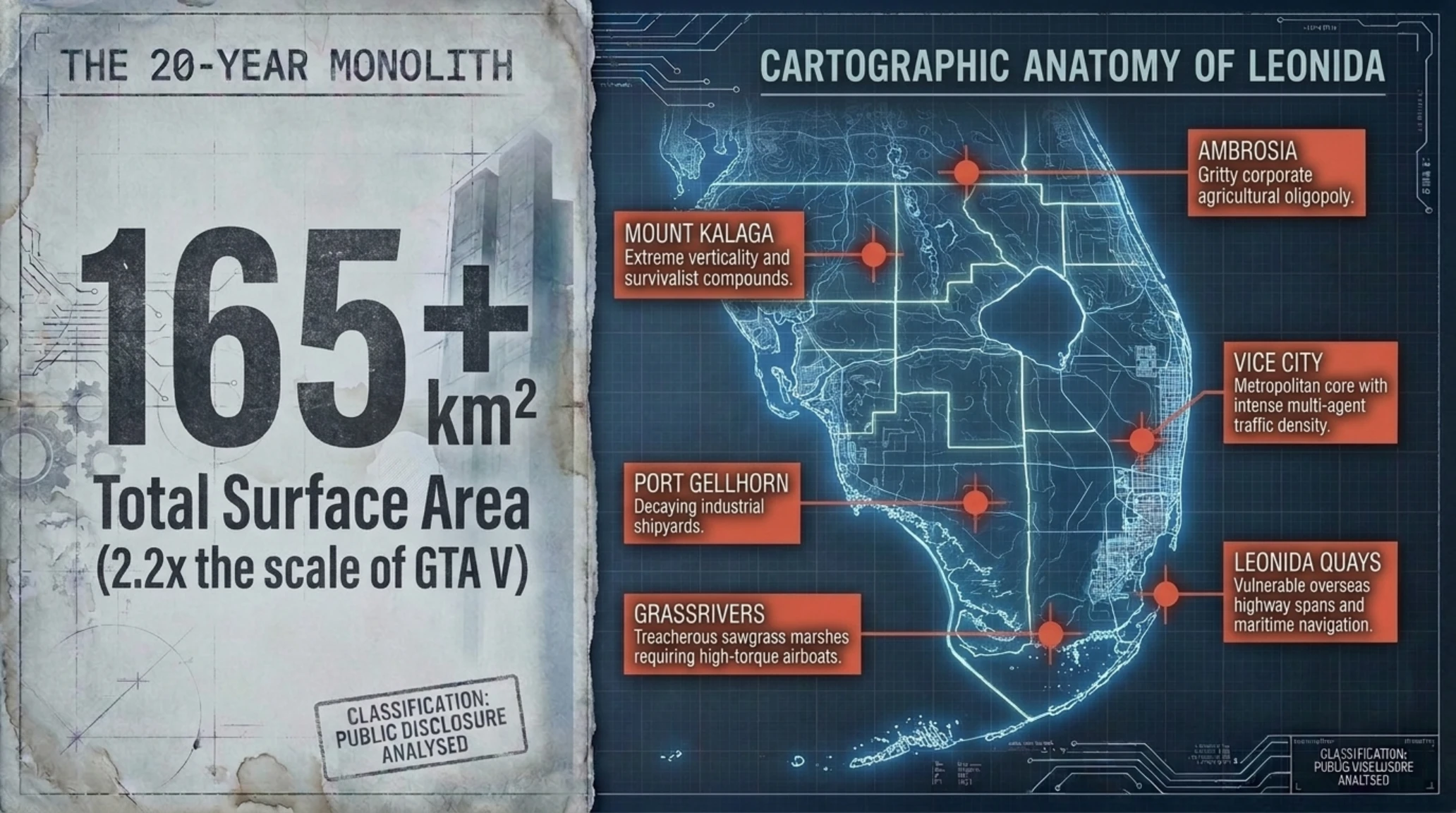
Cartographic Anatomy of Leonida: The Continental Scale of a Two-Fold Expansion
Following years of forensic cartographic reconstruction by community geographers analyzing pre-release leaks and patent filings, formal reporting published in the latest issue of Game Informer has confirmed the definitive geographic scope of Grand Theft Auto 6: the state of Leonida encompasses an interactive landmass more than twice the total surface area of Los Santos and Blaine County in Grand Theft Auto V. By any objective metric of computational spatial design, Leonida stands as the most colossal, topographically varied, and structurally dense virtual territory ever engineered for an interactive medium. Yet, raw square kilometer metrics fail to capture the true triumph of Rockstar's world-building: the simulation is partitioned into six radically distinct ecological, economic, and cultural biomes.
The sovereign metropolitan core is Vice City a shimmering, hyper-kinetic pastiche of contemporary South Florida. Here, glass-curtain skyscrapers, vibrant art deco hotels lining Ocean Drive, luxury boutique enclaves, and teeming multi-lane causeways generate the game world's highest computational density, featuring intense multi-agent vehicular traffic and dense pedestrian swarms. Directly south of this urban labyrinth lies the Leonida Quays a direct homage to the Florida Keys. This tropical marine archipelago comprises a sprawling chain of coral cays linked by vulnerable overseas highway spans, establishing an idyllic haven for high-end maritime navigation, deep-sea sport fishing, contraband smuggling channels, and isolated billionaire compound fortresses.
Dominating the geographical interior of the continent is Grassrivers Rockstar's monumental technological recreation of the Florida Everglades. This is an untamed, primeval aquatic wilderness defined by thousands of square kilometers of sawgrass marshes, labyrinthine mangrove swamps, and treacherous mudflats. Traversal across Grassrivers is virtually impossible utilizing conventional wheeled vehicles, mandating the mastery of high-torque, propeller-driven airboats and shallow-draft skiffs amidst treacherous waterways populated by ruthless apex predators. Bordering this primeval wilderness lies Port Gellhorn a hard-bitten, decaying coastal township characterized by rusting shipyards, abandoned industrial warehouses, and tacky roadside tourist traps that expose the grim economic hangover beneath Florida's glamorous veneer.
Further inland, players encounter Ambrosia the agricultural and industrial engine of the state. Anchored by vast citrus monocultures, massive sugar cane plantations, chemical distilleries, and fertilizer processing plants, Ambrosia represents the gritty underbelly of Leonida's corporate oligopoly, providing fertile ground for violent industrial sabotage, labor disputes, and rural narcotics syndicates. Finally, terminating the northern perimeter of the map is the Mount Kalaga National Park an unexpected bastion of extreme verticality featuring rugged ridge trails, dense pine forests, pristine freshwater springs, and isolated, fortified compounds that house paranoid survivalist communes and eccentric tech moguls.
Comparative Architectural Systems Matrix | RAGE Engine Evolution
| Architectural Benchmark | GTA V (San Andreas) | Red Dead Redemption 2 | GTA 6 (Leonida) |
|---|---|---|---|
| Total Simulated Landmass | ~75 km² | ~110 km² | Over 165 km² (2.2x scale of GTA V) |
| Interactive Interior Ratio | Under 12% of architectural hulls | Approximately 35% of structures | Exceeds 65% of structural footprints |
| Pedestrian Cognition Engine | Deterministic FSM (Finite State) | Contextual dual-state interaction | Persistent multi-layered neural matrix |
| Atmospheric Dynamics | Uniform global skybox passes | Volumetric ray-marched cloudscape | Fully dynamic localized barometric fronts |
The visual demonstration below illustrates the extraordinary atmospheric fidelity achieved when this geographical scale intersects with RAGE 9's real-time lighting pipelines:
Achieving this level of geological immersion would remain purely superficial without an equally reactive meteorological engine to destabilize the player's physical environment.
Atmospheric Physics Overhaul: Barometric Turbulence, Storm Surges, and Hurricane Dynamics
The subtropical meteorology of Florida is universally defined by climatic volatility oppressive humid thermal domes abruptly giving way to apocalyptic torrential cloudbursts and destructive Atlantic hurricanes. Within the computational matrix of RAGE 9, weather simulation has been elevated far beyond the static visual skybox filters that have characterized previous open-world titles. The meteorological subsystem operates as a continuous, physically based thermodynamic simulation running in real time across the planetary surface.
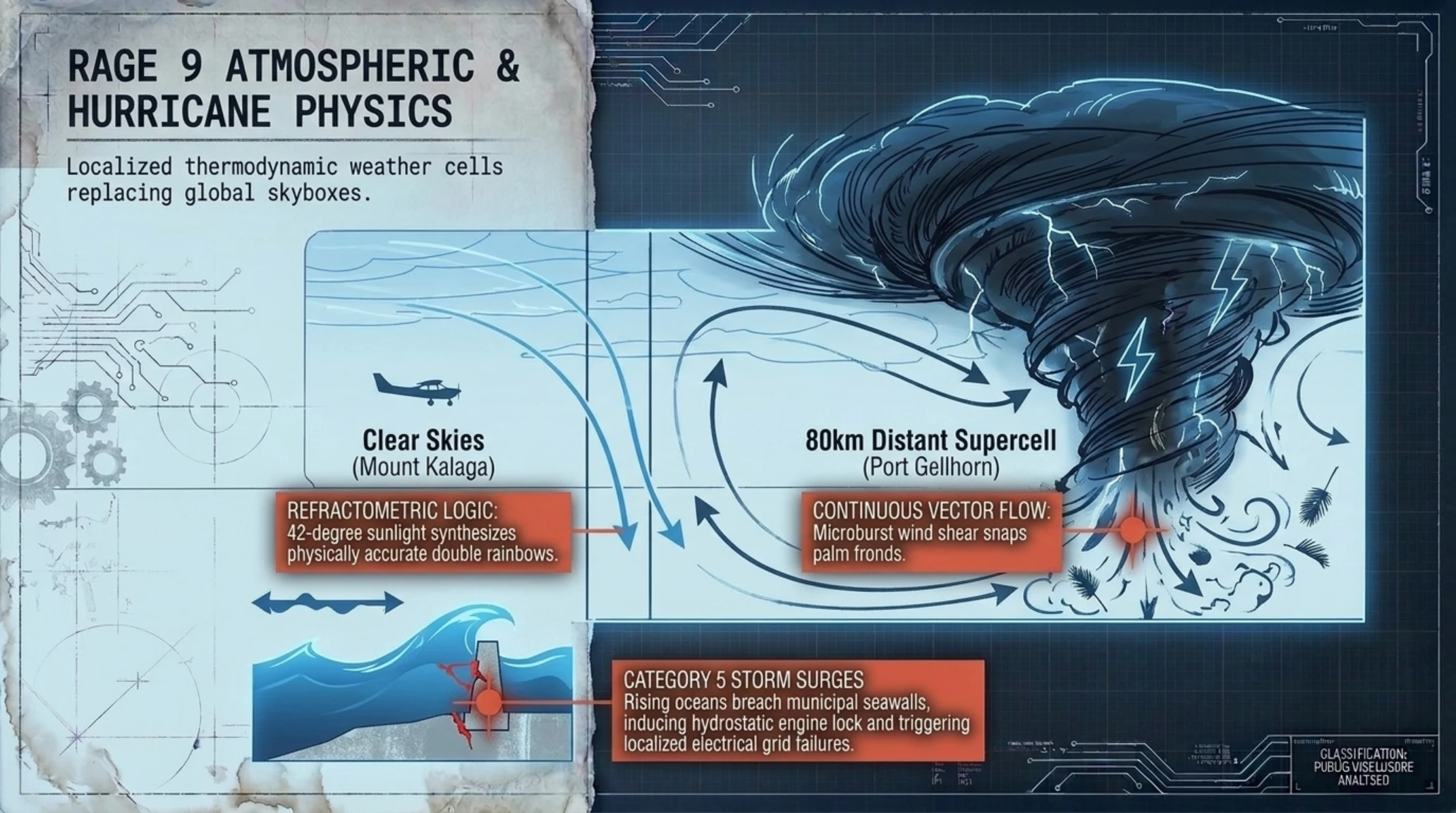
Meteorological phenomena in Leonida are completely decoupled from a singular, global weather state. The system models distinct, localized barometric pressure cells that dynamically traverse the cartographic grid. A player piloting a Cessna twin-engine aircraft through clear, radiant sunshine above the cloudless peaks of Mount Kalaga can gaze southward across eighty kilometers of continuous volumetric airspace to observe a massive, pitch-black supercell thunderstorm unleashing torrential lightning strikes over the shipping channels of Port Gellhorn. Ambient air pressure, relative humidity, and thermal updrafts directly affect aircraft flight dynamics, introducing severe buffeting, stalling risks, and instrument degradation when penetrating severe weather cells.
Wind dynamics have undergone an exhaustive mechanical overhaul, iterating significantly upon the foundational vector fields pioneered in Red Dead Redemption 2. Wind is modeled as a continuous, high-resolution vector flow field that interacts with every physically reactive entity in the environment. Palm fronds bend and snap under microburst shear forces; high-tension electrical transmission cables violently sway and spark; volumetric rain sheets disperse across vehicle windshields according to aerodynamic pressure gradients; and puddles accumulate dynamically in topological street depressions. Furthermore, when atmospheric conditions align specifically when low-angle sunlight strikes receding rain curtains at precise 42-degree refractometric angles RAGE 9 procedurally synthesizes dynamic, physically accurate double rainbows whose spectral visibility modulates according to player position and camera polarization.
The thermodynamic zenith of this climatic engine is the manifestation of full-scale Category 4 and 5 Hurricane systems. Far from functioning as superficial cinematic set-pieces, hurricanes in GTA 6 introduce profound, systemic disruptions to the macro gameplay ecosystem. Rising ocean storm surges breach municipal seawalls, inundating coastal boulevards beneath several feet of salt water and disabling low-riding sports vehicles through hydrostatic engine lock. Stormwater drainage networks in Vice City overflow, creating raging urban canals; severe gusts topple commercial billboards, uproot century-old oak trees, and snap utility poles, triggering widespread localized electrical grid failures that plunge entire city sectors into pitch-black darkness. Traversal across highway causeways becomes an intense fight against aerodynamic drag, turning simple point-to-point transit into a tactical struggle for environmental survival.
Direct photographic captures from internal build telemetry highlight the dramatic environmental transformation following the passage of an Atlantic hurricane cell:

The destructive physical footprint of these storm surges cascades directly into Leonida's wilderness habitats, forcing wildlife into unscripted suburban confrontations.
A Biologically Reactive Wilderness: 170 Species and Thermodynamic Pelage Simulation
Building upon the wildlife simulation milestones achieved in Red Dead Redemption 2, Rockstar has transformed the untamed frontiers of Leonida into an extraordinarily reactive biological theater. The ecological subsystem encompasses over 170 distinct animal species, including sixty avian classifications, more than thirty terrestrial mammalian phenotypes, and a vast compendium of amphibious, reptilian, and marine fauna. In the waters and estuaries, players encounter massive West Indian manatees, invasive Burmese pythons, roseate spoonbills, brown pelicans, hammerhead sharks, bottlenose dolphins, and leviathan American alligators.
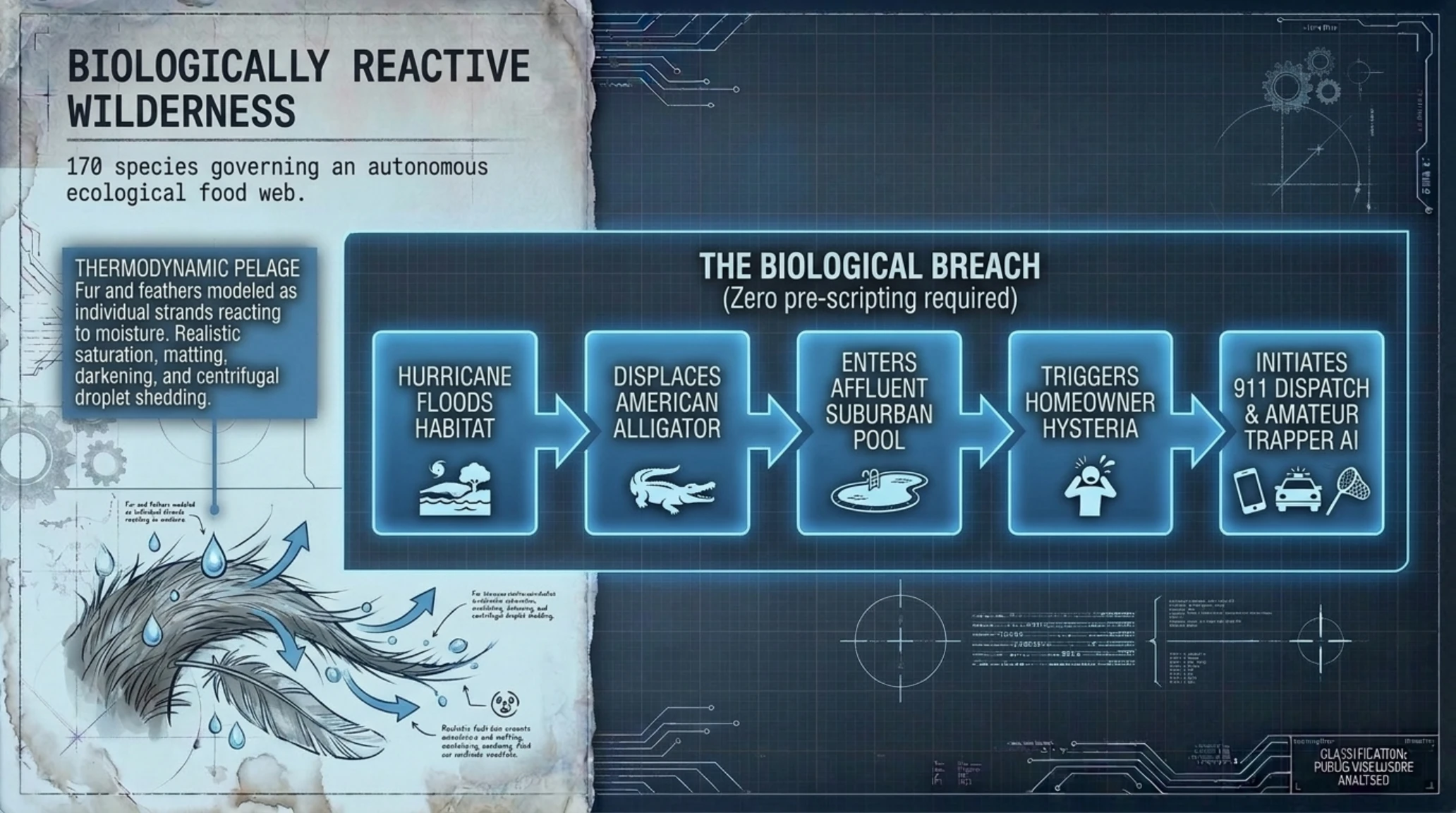
The visual and mechanical fidelity of this biological tapestry is anchored by RAGE 9's revolutionary pelage and plumage dynamic shader architecture. Animal fur and bird feathers are no longer static, baked textures; they are simulated as thousands of individual strands governed by thermodynamic and moisture parameters. When a panther bounds through the brackish water of Grassrivers, its fur realistically saturates, matting against its musculature, darkening in tone, and shedding liquid droplets via centrifugal force as it emerges onto dry land. Conversely, traversing arid quarry soils causes clay dust to adhere to animal coats, dynamically tracking environmental contamination.
Fauna behaviors are governed by an autonomous ecological predator-prey food web. Predators stalk, ambush, and consume prey entirely independent of player proximity. Moreover, the wild regularly breaches the perimeter of modern civilization, mirroring the surreal realities of real-world Florida. An alligator displaced by hurricane flooding can wander into an affluent suburban residential swimming pool, triggering hysterical homeowner reactions, 911 emergency dispatch calls, and the opportunistic arrival of amateur wildlife trappers, creating spontaneous emergent gameplay loops without any pre-scripted designer intervention.
Digital Ubiquity and Urban Telemetry: The RydeMe Transportation Paradigm
Contemporary urban life in the mid-2020s is fundamentally mediated through algorithmically driven smartphone operating systems, and Rockstar has mirrored this paradigm through the comprehensive deployment of the in-game RydeMe mobility platform. Modernizing the classic taxi-hailing mechanics of Grand Theft Auto IV and V, RydeMe functions as a sophisticated on-demand rideshare ecosystem integrated directly into Jason and Lucia's mobile interfaces.
Summoning a RydeMe vehicle initiates a dynamic logistical dispatch where a nearby civilian driver navigates authentic traffic grids to reach the player's curb. Upon entering the vehicle, players can relinquish manual driving controls, reclining in the passenger seat to engage in multi-branching conversational dialogues with eccentric gig-economy drivers, tune into deeply satirical investigative podcasts dissecting Leonida's political absurdities, or seamlessly monitor financial market movements and social media feeds while traversing the map. This framework integrates high-speed urban transit with passive narrative exposition, providing a frictionless alternative to high-stress high-speed driving when players wish to absorb the cultural texture of the world.
Historical Milestone Chronology | GTA 6 Architectural Timeline
| Timeline | Development Milestone |
|---|---|
| Late 2018 | Post-RDR2 Pipeline Realignment: Formal transition of resources to Leonida and RAGE 9 architecture scoping. |
| 2020 - 2022 | Establishment of LA Pedestrian Bureau: Scaled motion capture and rollout of the eight-week milestone protocol. |
| Dec 2023 | Record-Breaking Trailer Debut: Global unveiling of modern Vice City, surpassing 90 million views in 24 hours. |
| Oct 2026 | LOVE Magazine & NYT Technical Disclosures: Confirmation of two-fold scale expansion and handcrafted interior philosophy. |
A rigorous examination of the game's sociological architecture remains fundamentally incomplete without scrutinizing its narrative posture and contemporary cultural satire.

Rockstar's writing directors recognized the intense volatility of modern ideological culture, formulating a deliberate artistic strategy to immunize the narrative from premature decay.
The Satirical Conundrum of 2026: Why Rockstar Abandoned Hyper-Partisan Politics
Throughout its thirty-year ascendancy, the Grand Theft Auto series has functioned as the interactive medium's most ferocious and unfiltered satirical mirror a distorted, violent prism reflecting the vulgarities of modern hyper-capitalism, the cynicism of twenty-four-hour cable news cycles, and the grotesque decay of the American Dream. However, embarking upon the cultural dissection of the United States in the mid-2020s posed an unprecedented artistic and intellectual dilemma. In an era marked by intense ideological polarization, algorithmic radicalization, and the reality-defying absurdity of daily political headlines, how could a satirical video game amplify reality without instantly dating itself or alienating vast swathes of its international player base? Senior writing staff, speaking to Rock Paper Shotgun and Eurogamer, articulated the deliberate philosophical pivot engineered for GTA 6.
The studio confirmed that the narrative framework of GTA 6 consciously avoids specific, fleeting references to real-world political figures, hyper-partisan legislative debates, or transient election cycles. Satirizing specific modern politicians is an exercise in rapid creative obsolescence; a joke centered on a specific congressional soundbite curdles into an embarrassing, incomprehensible artifact within three to four years. Instead, Rockstar's narrative architects directed their satirical firepower toward universal sociological and psychological pathologies: the collective psychosis of algorithmic attention addiction, the grotesque spectacle of livestreams substituting for human intimacy, the surreal legal and social folklore of the quintessential 'Florida Man,' the manic pursuit of illusory speculative wealth, and the hollow spiritual emptiness of wellness consumerism. By targeting the fundamental human frailties that fuel modern culture rather than the transient headlines of the day, Grand Theft Auto 6 crafts a timeless, biting anthropological critique that will retain its venomous relevance across multiple decades.
Computational Acoustic Ray-Tracing: The Invisible Revolution in RAGE 9
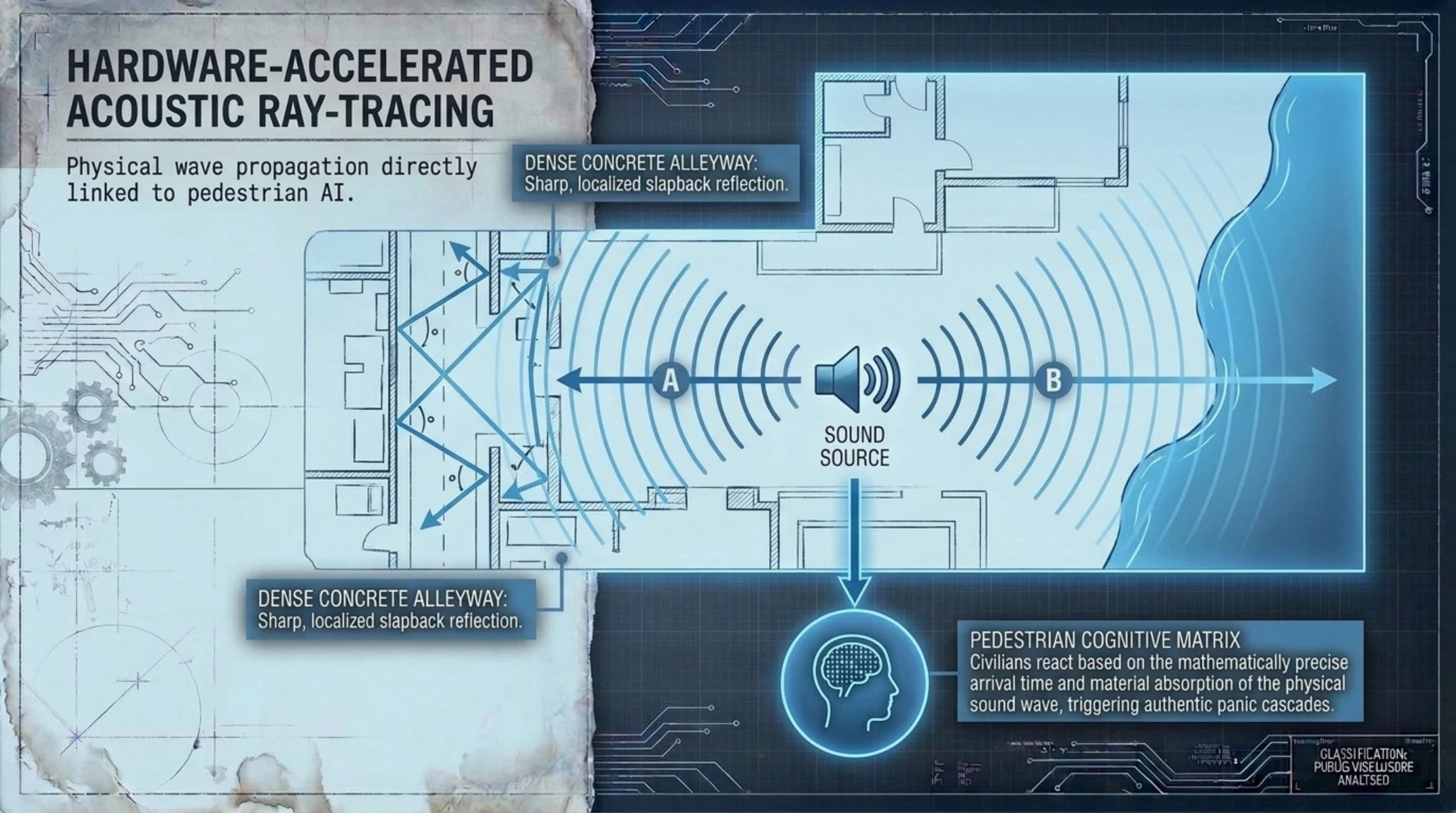
While industry discourse routinely obsesses over photorealistic polygon counts and texture resolutions, one of the most transformative computational breakthroughs embedded within RAGE 9 operates entirely within the auditory domain: the deployment of real-time, hardware-accelerated Acoustic Ray-Tracing. Moving decisively beyond legacy distance-attenuation algorithms and pre-baked reverberation zones, Rockstar's audio engineering team architected a physically based sound propagation engine that models sound as dynamic physical rays bouncing through three-dimensional space.
Within the dense concrete canyons of Vice City, the mechanical report of an exhaust backfire or a high-caliber gunshot is not a flat stereo sample adjusted for volume; it is a physical acoustic wavefront. RAGE 9 casts hundreds of acoustic impulse rays per sound event, calculating surface material absorption coefficients, reflection vectors, and structural transmission losses through brick walls, plate-glass storefronts, and interior drywall. If a firefight erupts inside a narrow alleyway, the player perceives sharp, localized slapback reflections off concrete surfaces. When transitioning into an expansive coastal boulevard, those harsh reflections dissipate smoothly into the humid, wind-whipped marine atmosphere. Crucially, the pedestrian cognitive matrix directly taps into this acoustic propagation data; a breaking bottle or a muffled subterranean explosion alerts civilians based on the authentic, calculated arrival of the sound wave at their specific coordinates, generating emergent, chain-reaction crowd panic cascades with mathematical precision.
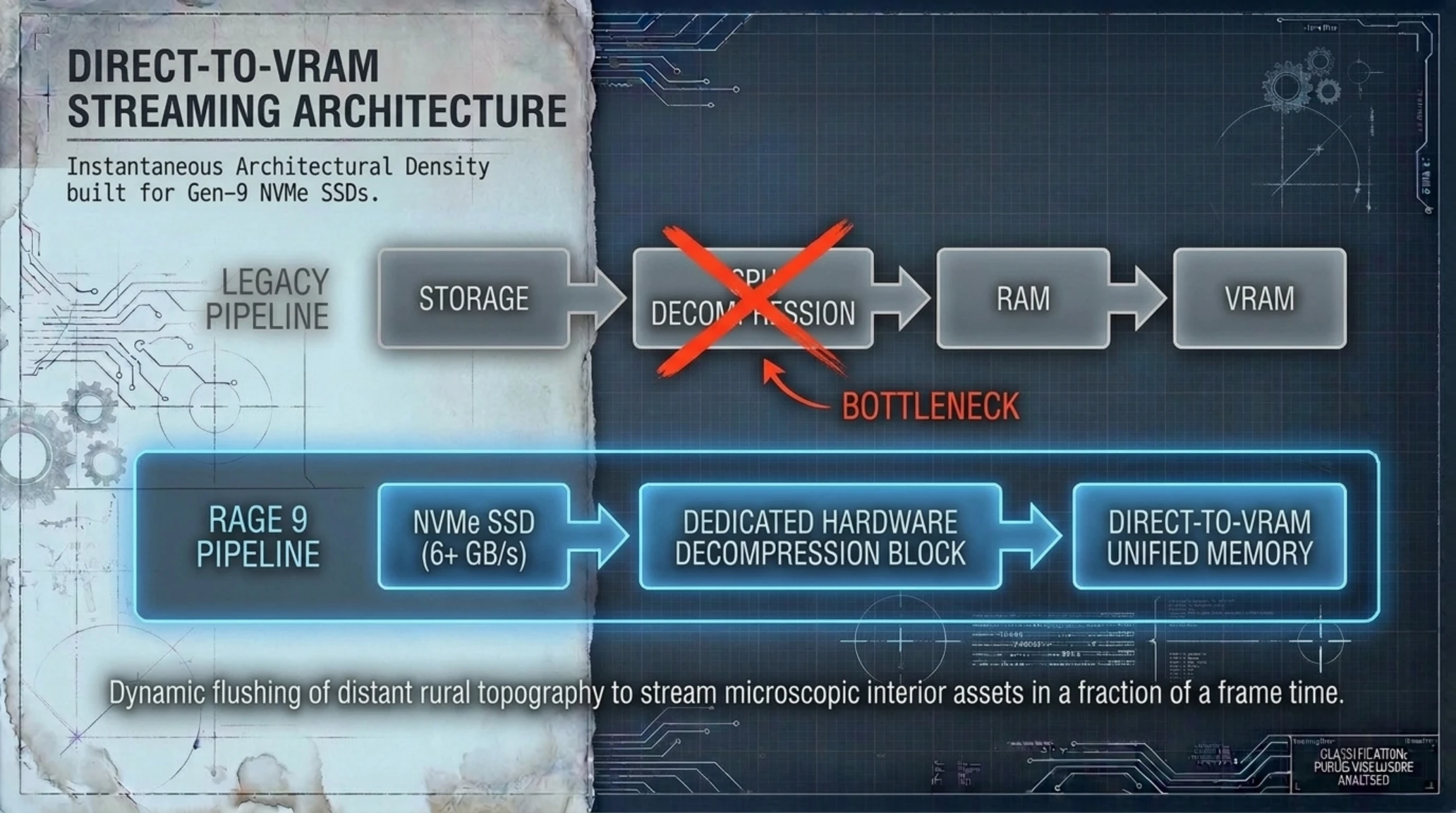
Memory Bandwidth Management and Direct-to-VRAM Streaming Architecture
At the architectural hardware layer, rendering an open world of Leonida's fidelity without loading screens or aggressive level-of-detail (LOD) pop-in demanded a comprehensive overhaul of asset streaming pipelines. Rockstar's systems architects completely discarded legacy disk-caching frameworks in favor of a customized Direct-to-VRAM asynchronous streaming engine optimized for ninth-generation ultra-fast solid-state drives (SSDs). This architecture bypasses traditional CPU decompression bottlenecks, utilizing dedicated hardware decompression blocks to stream high-resolution geometry and photogrammetric textures directly into unified memory at bandwidth rates exceeding six gigabytes per second.
This rapid streaming pipeline enables what technical directors term 'Instantaneous Architectural Density.' As the player transitions from a 150-mile-per-hour highway pursuit directly into the claustrophobic confines of a high-end luxury nightclub, the engine dynamically flushes distant rural topography while streaming in microscopic interior assets such as volumetric liquor bottles, active refractive mirrors, dynamic dance-floor lighting grids, and dozens of fully animated character models in a fraction of a frame time. By treating memory allocation as an elastic, predictive fluid rather than a static allocation table, RAGE 9 ensures that the visual fidelity never stutters, even when moving at extreme velocities through the most computationally taxing metropolitan sectors.
Hardware Benchmarking and the Console Frontier: Base Hardware vs. PlayStation 5 Pro
The realization of an interactive world possessing this staggering magnitude of concurrent multi-agent simulations, structural interior densities, and dynamic meteorological systems has ignited fierce debate across the hardware engineering community. Independent technical analysts at Digital Foundry and AnandTech have extensively evaluated the hardware constraints of current-generation silicon, universally concluding that Grand Theft Auto 6 represents an intensely CPU-bound computational workload that pushes baseline console architectures to their theoretical limits.
On baseline PlayStation 5 and Xbox Series X hardware, the massive background overhead of scheduling thousands of concurrent pedestrian behavior trees, complex vehicle traffic physics, dynamic fluid simulations, and barometric wind vector fields severely restricts computational headroom for rendering pipelines. Consequently, engineering consensus indicates that the game targets a rock-solid, locked 30 frames-per-second presentation on standard hardware, utilizing dynamic resolution scaling targeting a native internal framebuffer between 1080p and 1440p, reconstructed through temporal upscalers to 4K displays. This locked 30 FPS target ensures pristine, uncompromised frame-pacing, eliminating visual stutter even during catastrophic Category 5 hurricane storm surges or intense six-star wanted level police blockades.
Conversely, Sony's mid-generation PlayStation 5 Pro serves as the technological showcase for the ultimate realization of RAGE 9's visual and mechanical fidelity. Leveraging the custom AMD RDNA-based GPU with advanced ray-tracing traversal hardware alongside Sony's proprietary machine learning upscaling pipeline PlayStation Spectral Super Resolution (PSSR) the PS5 Pro is engineered to deliver accelerated hardware-accelerated ray-traced reflections on water, vehicle lacquer, and glass curtain facades, while stabilizing higher dynamic internal resolutions and potentially offering an unlocked high-refresh-rate performance mode for compatible variable refresh rate (VRR) displays.
Executive Strategic Assessment | Tekin Analysis
Is Rockstar's Production Paradigm Replicable Across the Industry? Our definitive engineering analysis concludes: Absolutely not. Sustained by the multi-billion-dollar recurring cash reserves of GTA Online, Rockstar possesses an unconstrained multi-year capital runway that insulates creative leads from quarterly publisher panic. For 99% of contemporary AAA development studios, attempting to handcraft 65% of interior rooms and sustain thousands of employees across an eight-year cycle would result in catastrophic structural insolvency.
To synthesize the strategic trade-offs of this colossal engineering effort, our analytical ledger below provides a structured forensic breakdown of Rockstar's operational doctrine.

This comparative paradigm underscores the profound industrial ramifications that will shape the economics of interactive entertainment for years to come.
Weighing the Strategic Paradigm: Rockstar's Engineering Philosophy
A rigorous, holistic examination of Rockstar's operational methodology reveals both profound artistic triumphs and structural industry trade-offs, summarized within our forensic evaluation matrix below:
- Total eradication of the Dead World syndrome through bespoke, socio-spatial pedestrian psychological modeling
- Continuous two-month experiential validation preventing the catastrophic accumulation of architectural technical debt
- Rejection of procedural sterility in favor of artisanal, narrative-rich interior micro-archeology across hundreds of buildings
- Unmatched next-generation atmospheric and biological simulation, featuring destructive hurricanes and 170 dynamic species
- Staggering, multi-billion-dollar financial expenditure that is structurally non-replicable across the broader industry
- Immense logistical and psychological overhead required to synchronize thousands of engineers across multiple continents
- Elongated, near-decade production cadences between mainline franchise releases
Definitive Architectural Conclusion | Final Verdict
The exhaustive technical disclosures surrounding the making of Grand Theft Auto 6 solidify Rockstar North's undisputed hegemony at the pinnacle of interactive medium design. By harmonizing relentless eight-week milestone compile disciplines, establishing an autonomous cognitive laboratory in Los Angeles for pedestrian sociological modeling, curating room-by-room environmental archeology under Aaron Garbut, and harnessing the atmospheric fury of real-time hurricane physics within RAGE 9, Rockstar has engineered a dynamic, living world that will define the gold standard of digital simulation for the next quarter-century.
Frequently Asked Questions: GTA 6 Engineering & Systems Architecture
What is Rockstar's eight-week milestone methodology?
It is an iterative compilation discipline where every two months, designated subsystems and environments are compiled into a fully playable master build deployed directly onto target retail devkits for evaluation.
Why did Rockstar establish a dedicated studio bureau in Los Angeles exclusively for NPCs?
To permanently eradicate the 'Dead World Syndrome.' The Los Angeles team is tasked with handcrafting authentic regional vocabularies, socioeconomic behavioral rules, and contextual situational awareness for over one hundred concurrent conversational threads.
What is the confirmed geographic surface area of the state of Leonida compared to GTA V?
Leonida is more than twice the total surface area of GTA V's San Andreas, comprising six distinct ecological and economic biomes: Vice City, Leonida Quays, Grassrivers, Port Gellhorn, Ambrosia, and Mount Kalaga.
Do hurricanes in GTA 6 impact interactive gameplay mechanics?
Yes. Hurricanes are fully dynamic, systemic physical phenomena. High-velocity wind fields affect vehicle aerodynamics, storm surges breach coastal seawalls to flood thoroughfares, and utility pole failures plunge entire city districts into tactical blackouts.
What is the official release date and supported platforms?
Grand Theft Auto 6 is officially scheduled for worldwide retail release on November 19, 2026, exclusively targeting PlayStation 5, PlayStation 5 Pro, and Xbox Series X|S.
Official Investigative Sources & Bibliographic References
- GameSpot: Investigation of Rob Nelson in LOVE Magazine Issue 27
- Kotaku: Technical Analysis of Rockstar's Eight-Week Milestone Pipeline
- The New York Times: Aaron Garbut on the Spatial Archeology of GTA 6
- Game Informer & GameSpot: Forensic Breakdown of Leonida's Six Biomes
- IGN: Rockstar's High-Risk Field Research with Florida Law Enforcement
Additional Gallery: Tekin Analysis | Inside Rockstar's Fortress: Dissecting GTA 6 Engineering