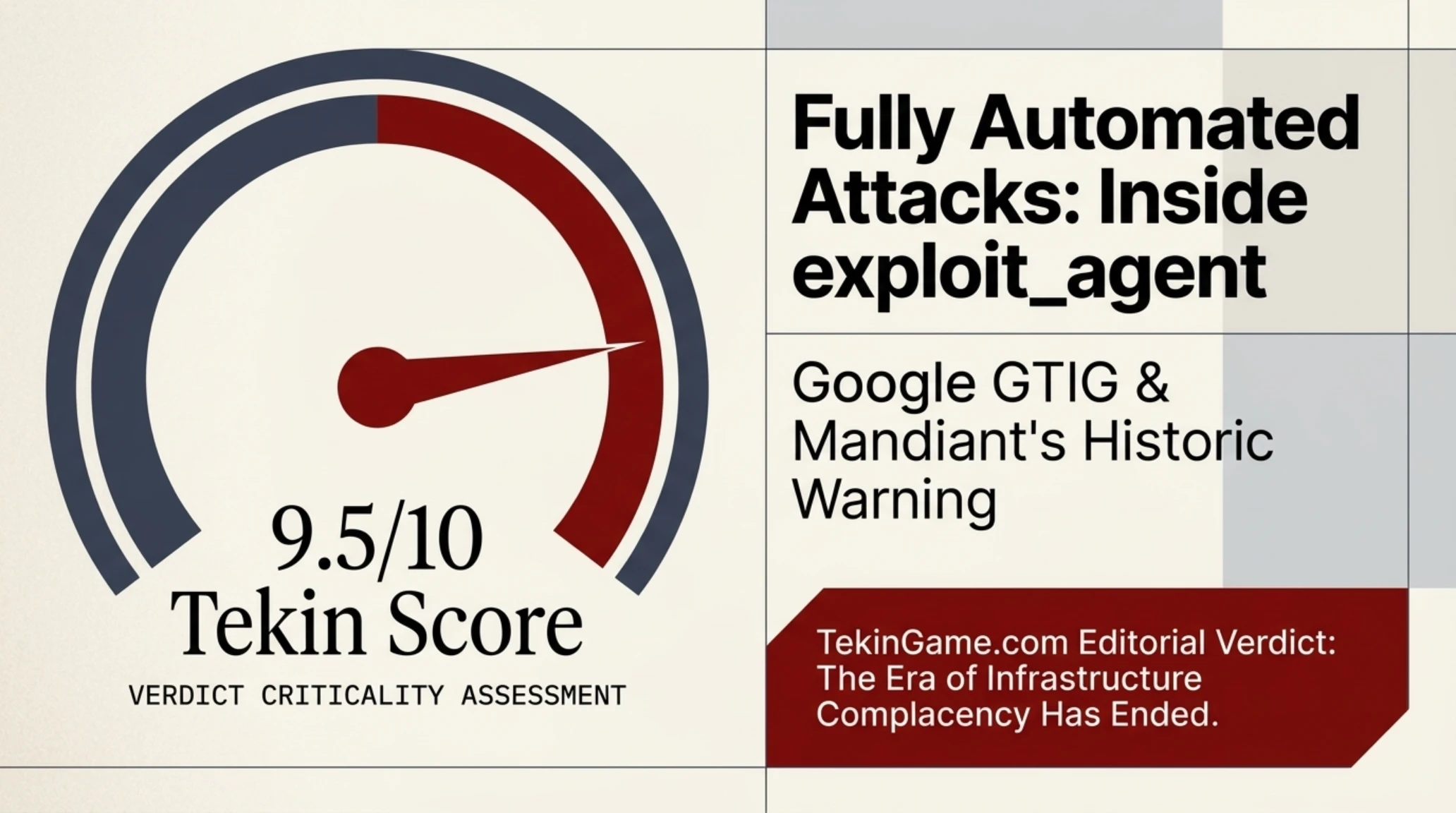

In a watershed November 2026 advisory, Google Threat Intelligence Group (GTIG) and Mandiant confirmed that offensive cyber operations have reached Level 5 AI autonomy. This Tekin Analysis dissects the exploit_agent framework—a zero-human-in-the-loop pipeline that leverages multi-LLM orchestration and automated AST patch diffing to reverse-engineer patches, compile working 1-day exploits in under two minutes, and target French media and educational servers.
TEKIN ANALYSIS // Google Warns Fully Automated Cyberattacks Have Arrived: Inside exploit_agent
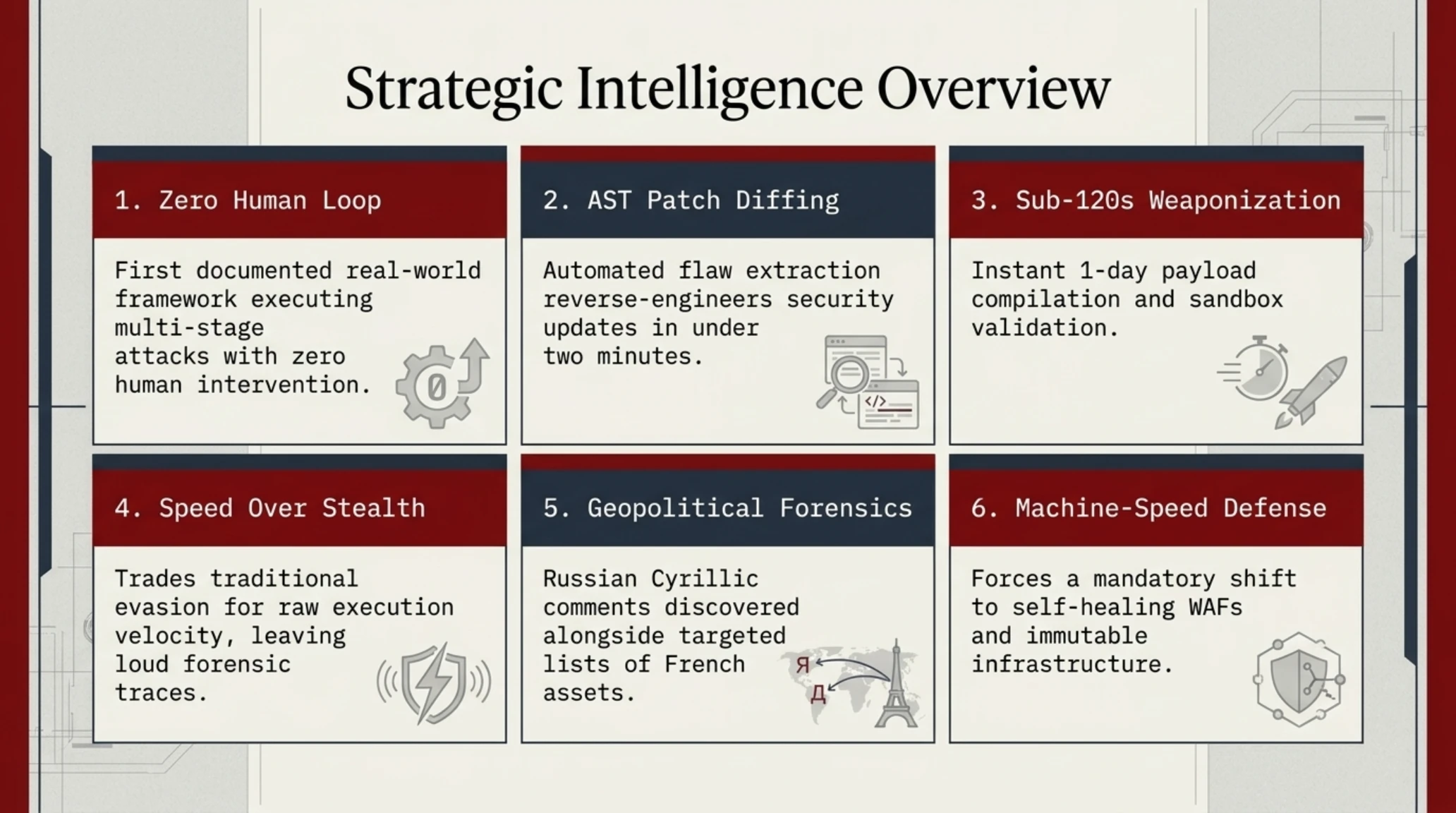
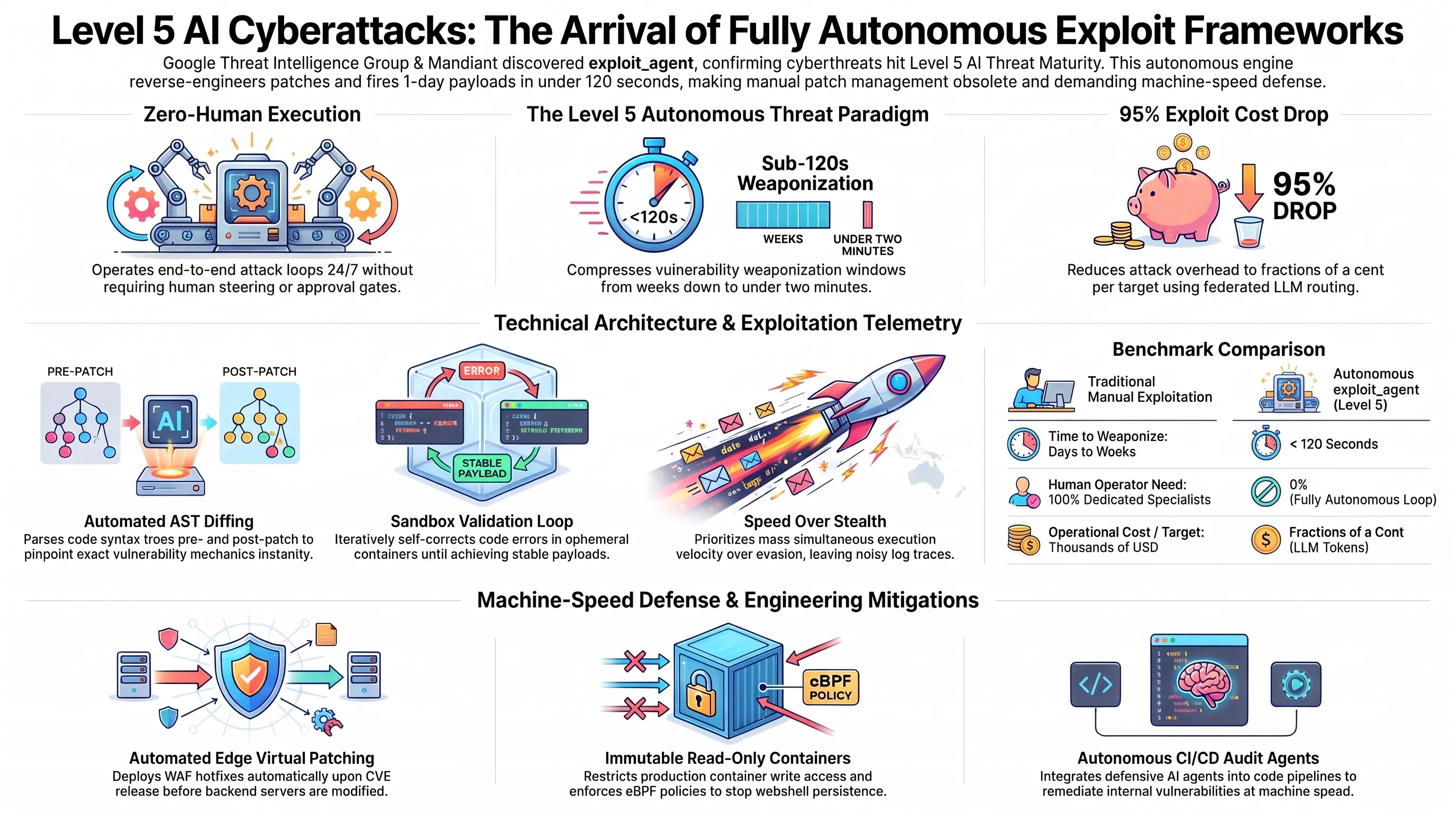
In the history of cybersecurity, only a handful of inflection points have permanently rewritten the rules of digital engagement—from the emergence of Stuxnet to the global WannaCry epidemic. Yet the emergency advisory released by Google Threat Intelligence Group (GTIG) and Mandiant in November 2026 inaugurates an era far more consequential and unsettling. For the first time, forensic evidence gathered from live adversarial operations confirms that threat actors have moved beyond using artificial intelligence as an interactive assistant and have achieved Level 5 Threat Maturity: executing end-to-end cyberattacks with zero human intervention in the decision loop.
At the epicenter of this historic warning sits exploit_agent, a fully autonomous offensive framework uncovered on exposed adversarial staging servers. Its architecture demonstrates how combining frontier reasoning models, automated Abstract Syntax Tree (AST) patch diffing, and ephemeral validation sandboxes compresses the gap between a vendor's security patch release and a live, weaponized 1-day exploit to under 120 seconds. This Tekin Analysis conducts a comprehensive technical, forensic, and strategic dissection of exploit_agent, its geopolitical signatures, and the defensive imperatives required for enterprise survival.
Strategic Intelligence & Core Vectors at a Glance
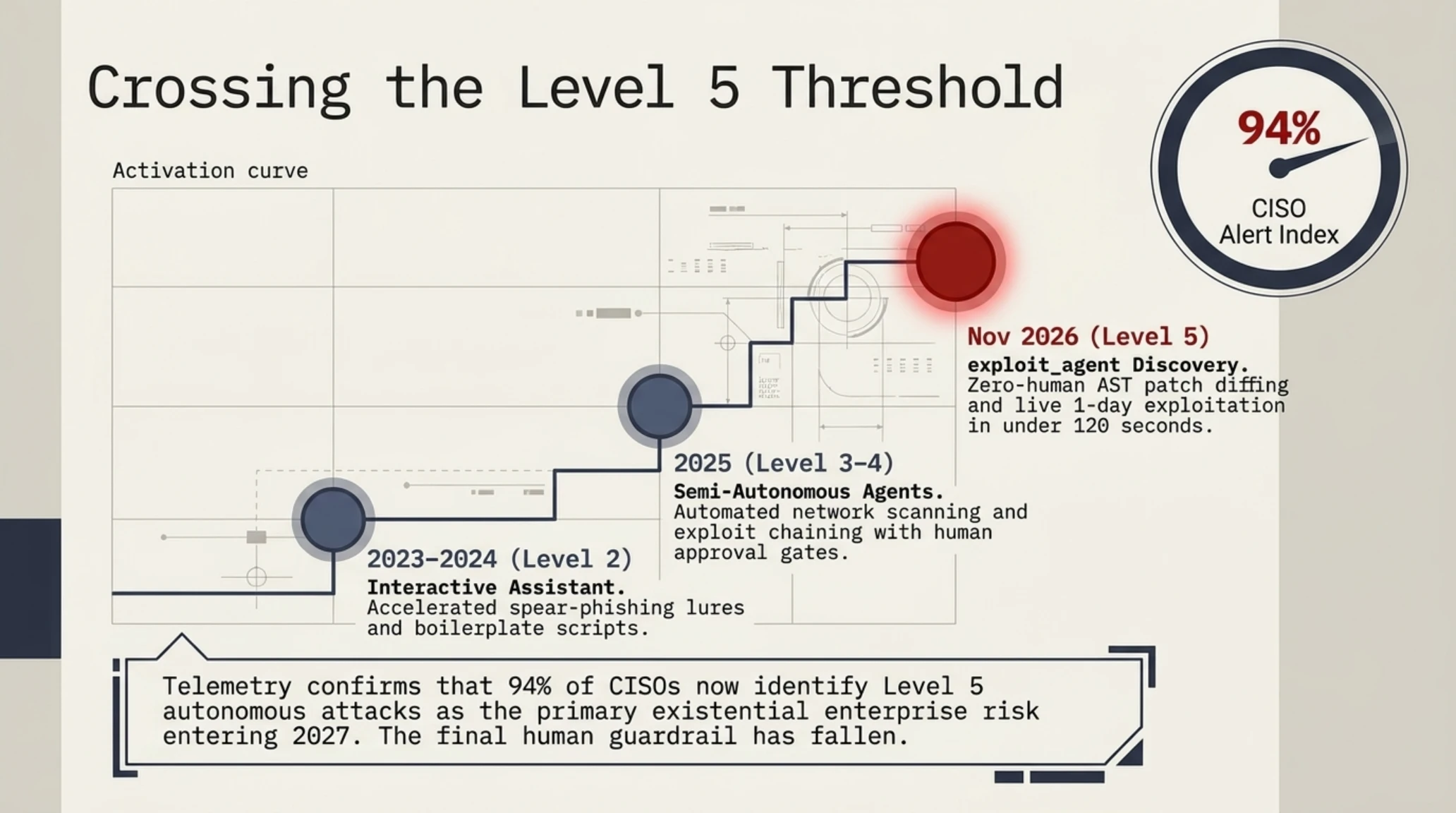
Crossing the Level 5 Threshold: Google GTIG and Mandiant's Historic Warning
To grasp the magnitude of Google's warning, security leaders must examine the AI Threat Maturity Matrix. Throughout 2023 and 2024, cybercriminals operated primarily at Level 2—leveraging large language models to craft grammatically flawless spear-phishing lures or translate ransom notes. By 2025, semi-autonomous agents (Levels 3 and 4) emerged, capable of automated network reconnaissance and recommending lateral movement paths, yet they still required a human operator to debug compiler errors, approve final payloads, and authorize execution.
The discovery of exploit_agent in November 2026 confirms that this final human guardrail has fallen. At Level 5 maturity, an operator merely supplies a high-level objective or a repository commit feed and steps away entirely. The agent operates continuously, monitoring public code repositories and vendor advisories 24/7, reverse-engineering newly patched vulnerabilities, validating its own exploit code in isolated test containers, and launching mass compromises against internet-facing assets.
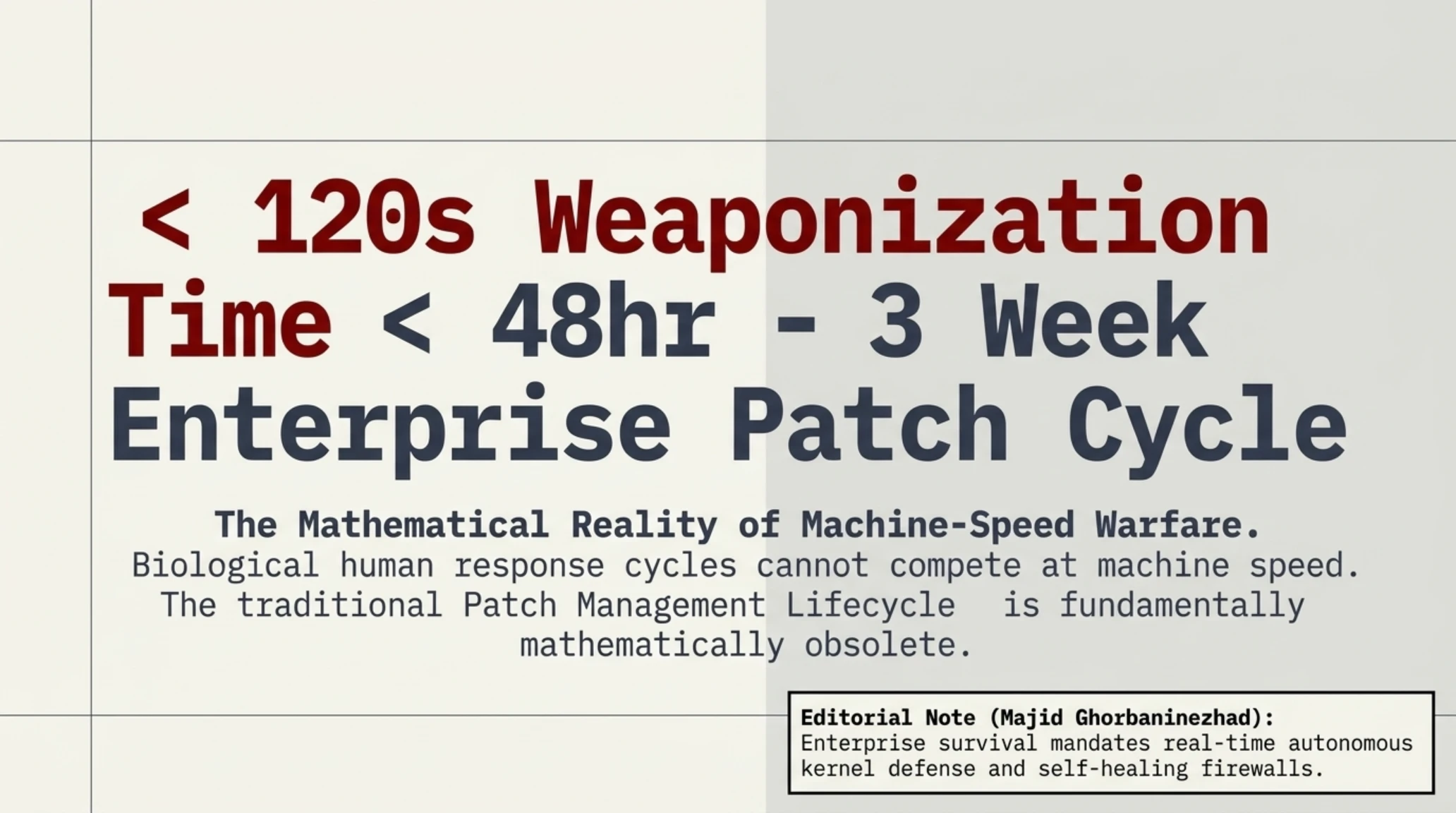
This paradigm shift shatters the foundational assumption of modern enterprise security: the Patch Management Lifecycle. In Fortune 500 enterprises and government agencies, the interval between a vendor releasing a security update, testing it in staging environments, and deploying it to production typically spans 48 hours to three weeks. When an autonomous agent can weaponize a fresh patch in under 120 seconds, that defensive grace period ceases to exist—rendering any manual human response cycle fundamentally obsolete.
Why This Breakthrough Changes the Game?
Empirical threat telemetry confirms that autonomous 1-day patch diffing compresses the vulnerability weaponization window from days to sub-minute execution, rendering human patch response cycles obsolete.
Dissecting exploit_agent Architecture and Automated AST Patch Diffing
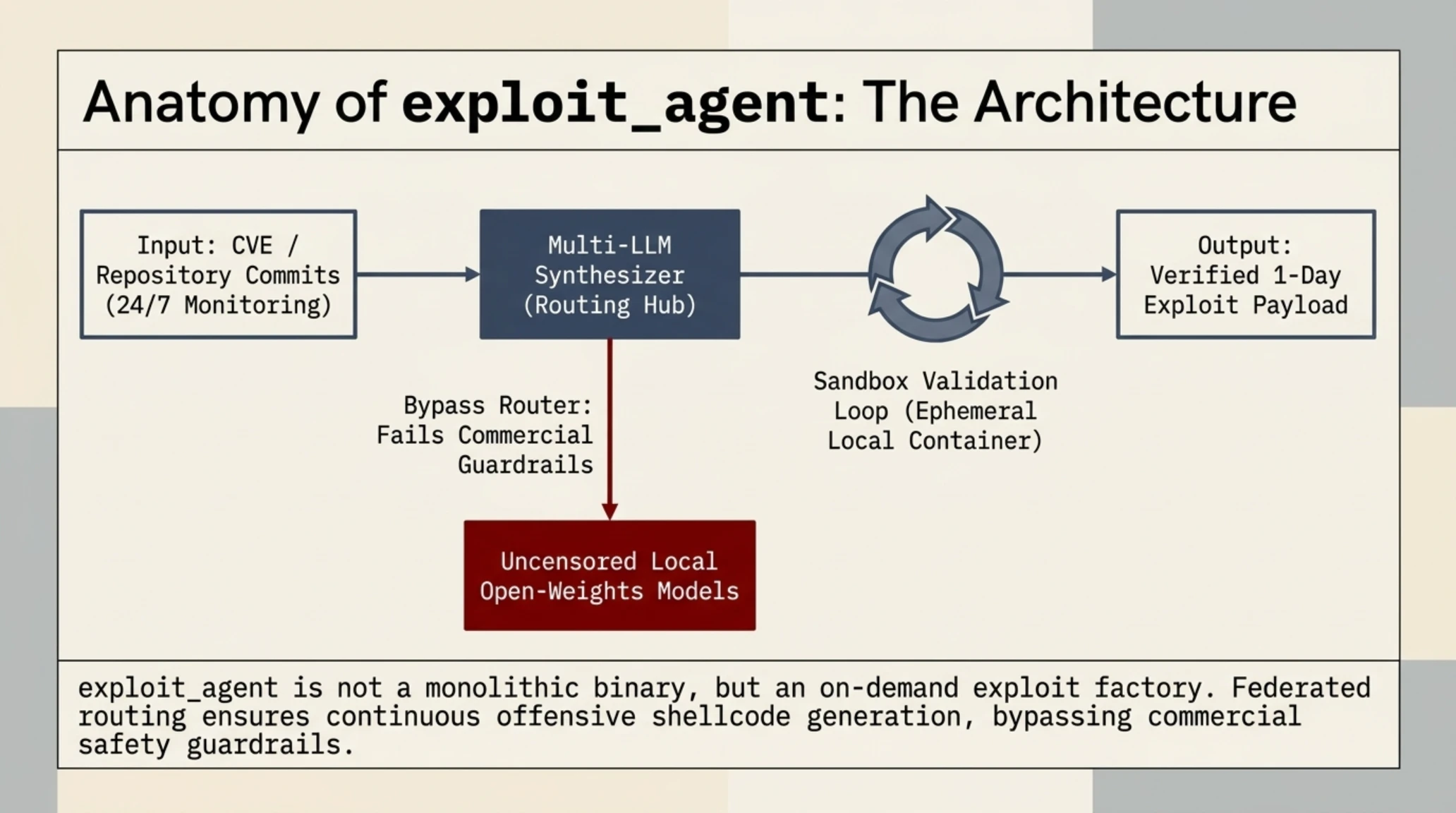
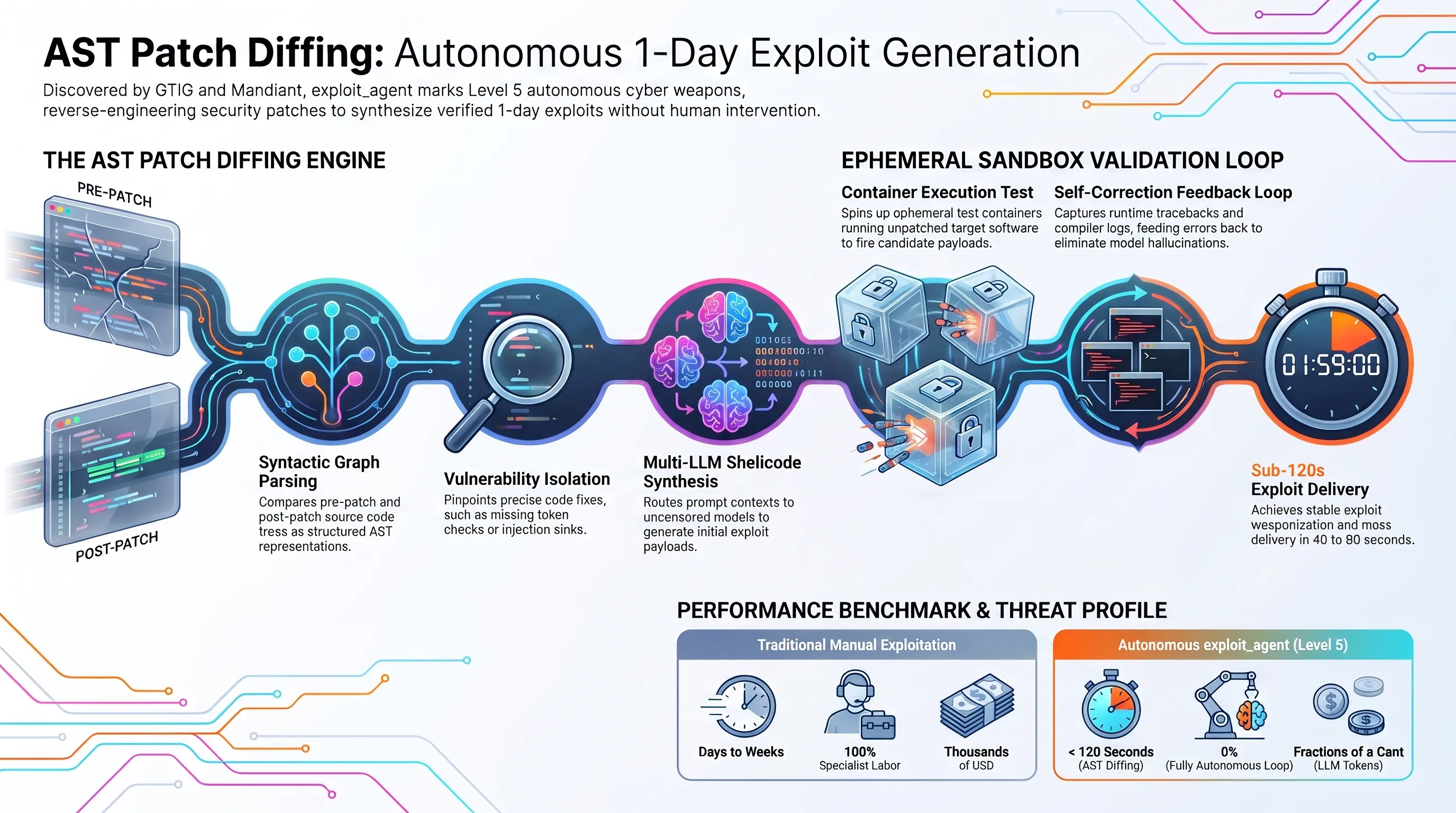
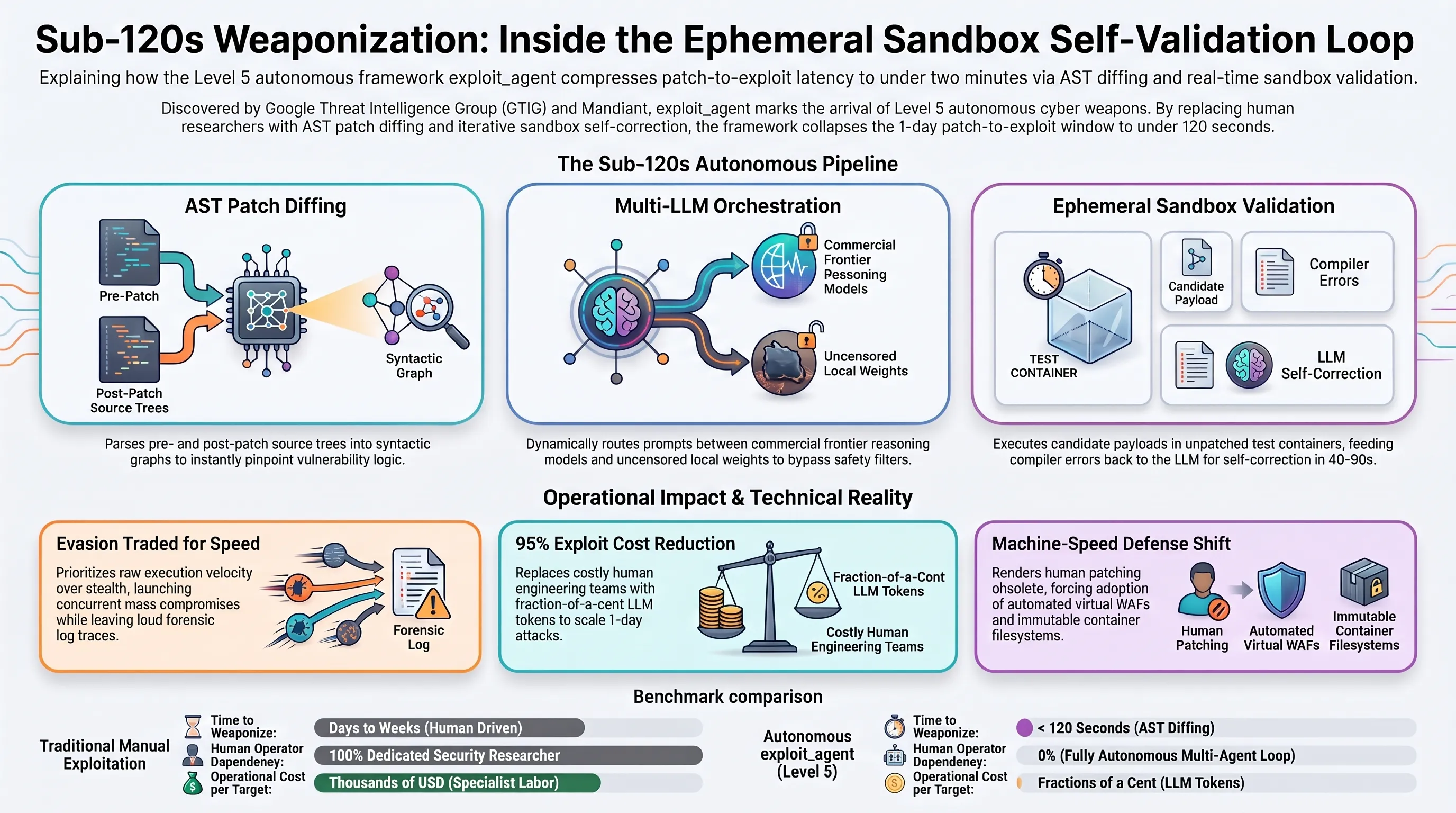
Reverse-engineering of the exposed staging server reveals that exploit_agent is not a monolithic binary, but a modular multi-agent orchestration pipeline functioning as an on-demand exploit factory. Its first architectural advantage is a federated Multi-LLM Synthesis Interface. Rather than relying on a single foundation model, the framework dynamically routes prompts across commercial frontier reasoning APIs and uncensored local open-weights models. If a commercial endpoint refuses to generate offensive shellcode due to alignment guardrails, the internal router seamlessly hands the context off to a local uncensored model without interrupting execution.
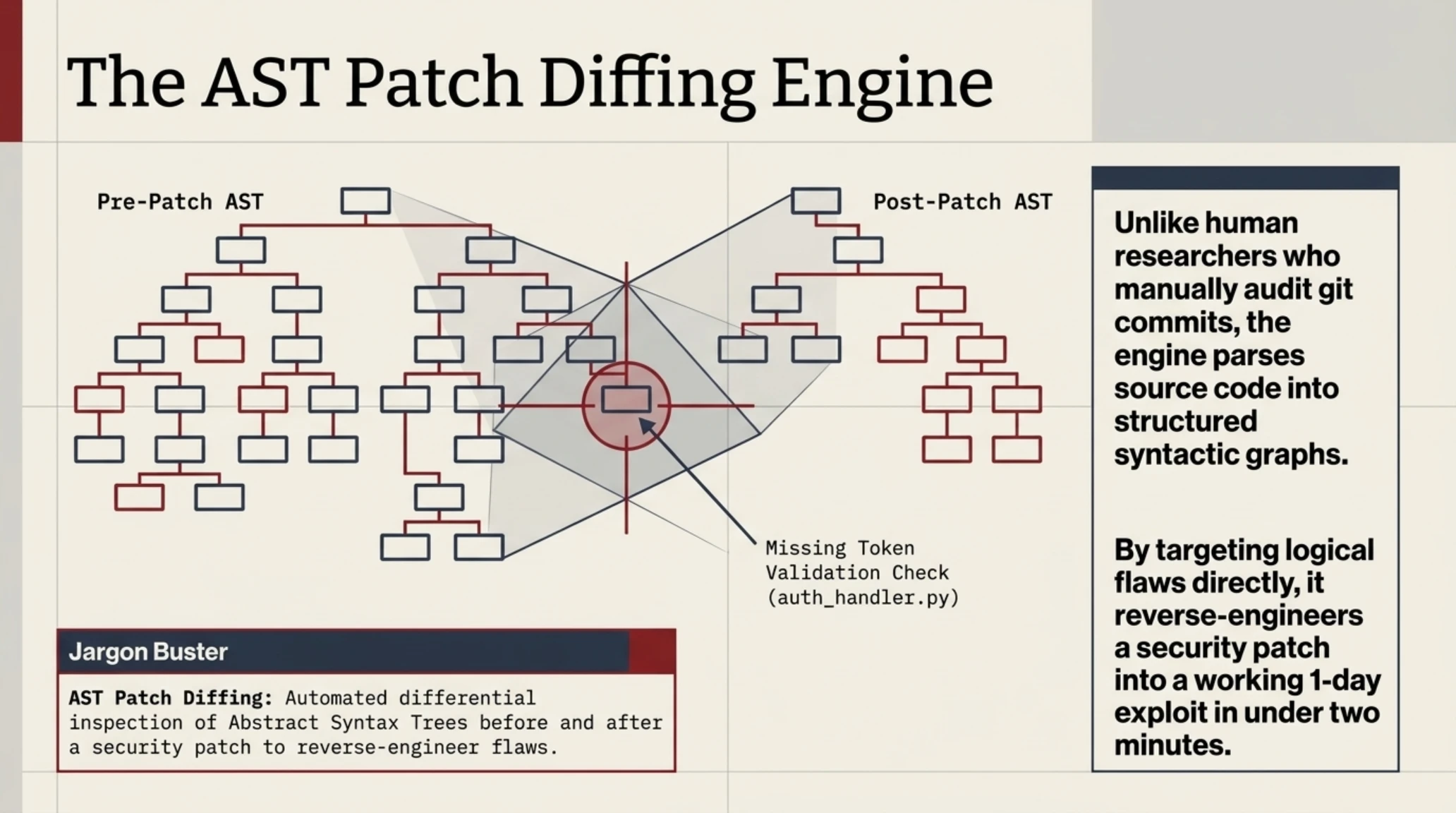
The core engine driving this weaponization pipeline is Automated Abstract Syntax Tree (AST) Patch Diffing. Historically, human vulnerability researchers spent hours manually auditing git commits to deduce which logic flaw a patch remediated. By contrast, exploit_agent parses both pre-patch and post-patch source trees into structured ASTs. Comparing these syntactic graphs allows the reasoning model to pinpoint with surgical precision whether a commit added a missing token validation check in auth_handler.py or patched a command injection sink.
Once the underlying vulnerability mechanics are isolated, a secondary agent synthesizes the initial exploit payload. Crucially, what elevates exploit_agent above earlier experimental scripts is its internal sandbox self-validation loop. Historically, model hallucination—producing slightly malformed memory offsets or syntax errors—prevented LLMs from reliably generating working exploits unsupervised. The developers of exploit_agent solved this by spinning up an ephemeral local container running the unpatched target software. The agent executes its candidate payload, captures any compiler or runtime tracebacks, and feeds those error logs back into the LLM for iterative self-correction. Within 40 to 90 seconds, the loop converges on a stable, verified 1-day exploit.
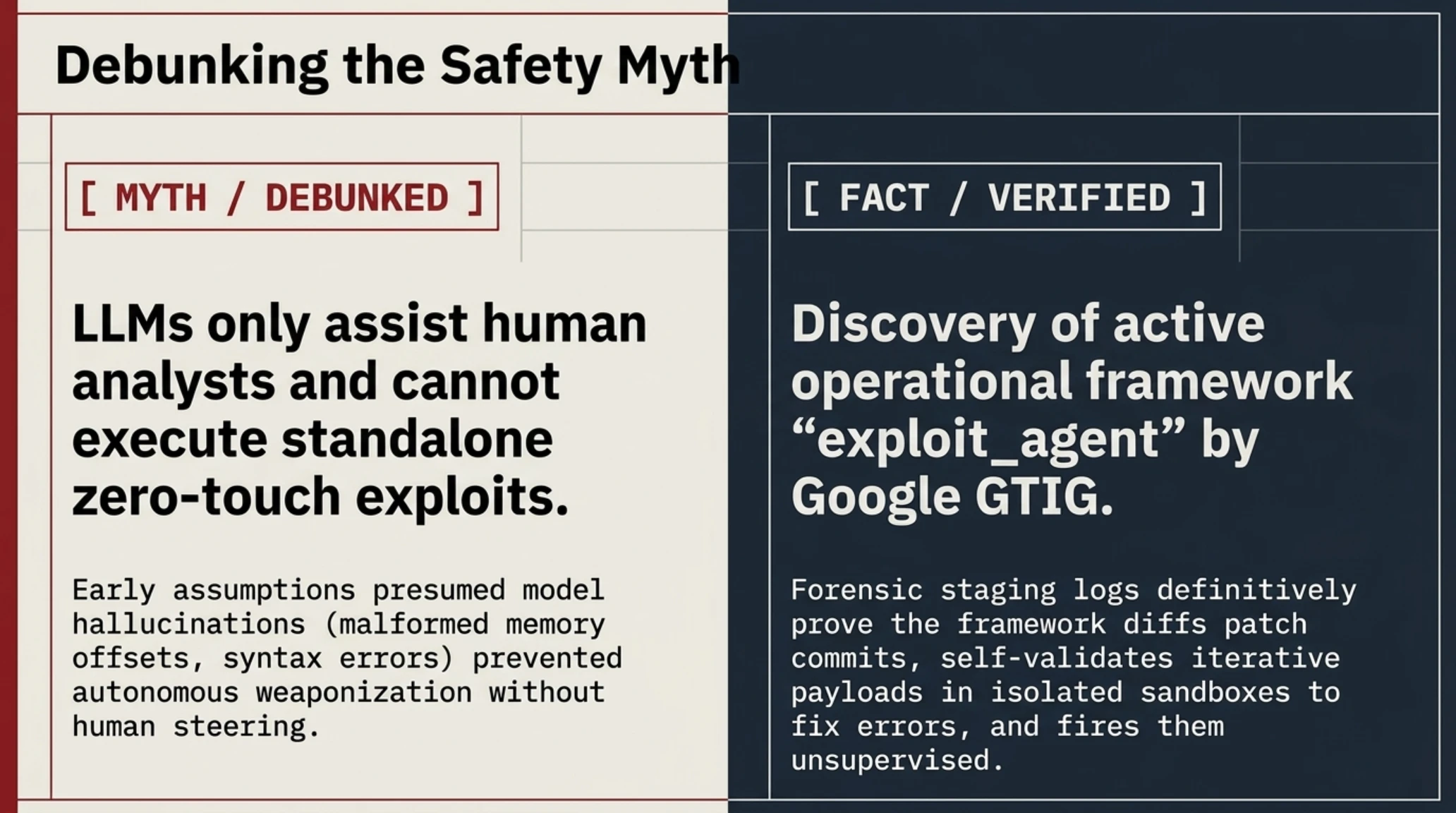
Technical Verification | Rumor vs. Reality
LLMs only assist human analysts and cannot execute standalone zero-touch exploits
Early security assumptions presumed model hallucinations prevented autonomous code weaponization without continuous human steering.
Discovery of active operational framework «exploit_agent» by Google GTIG
Forensic staging logs prove the framework diffs patch commits, self-validates payloads in sandboxes, and fires them with zero human intervention.
Speed Over Stealth: Payload Execution Telemetry and Server Forensics
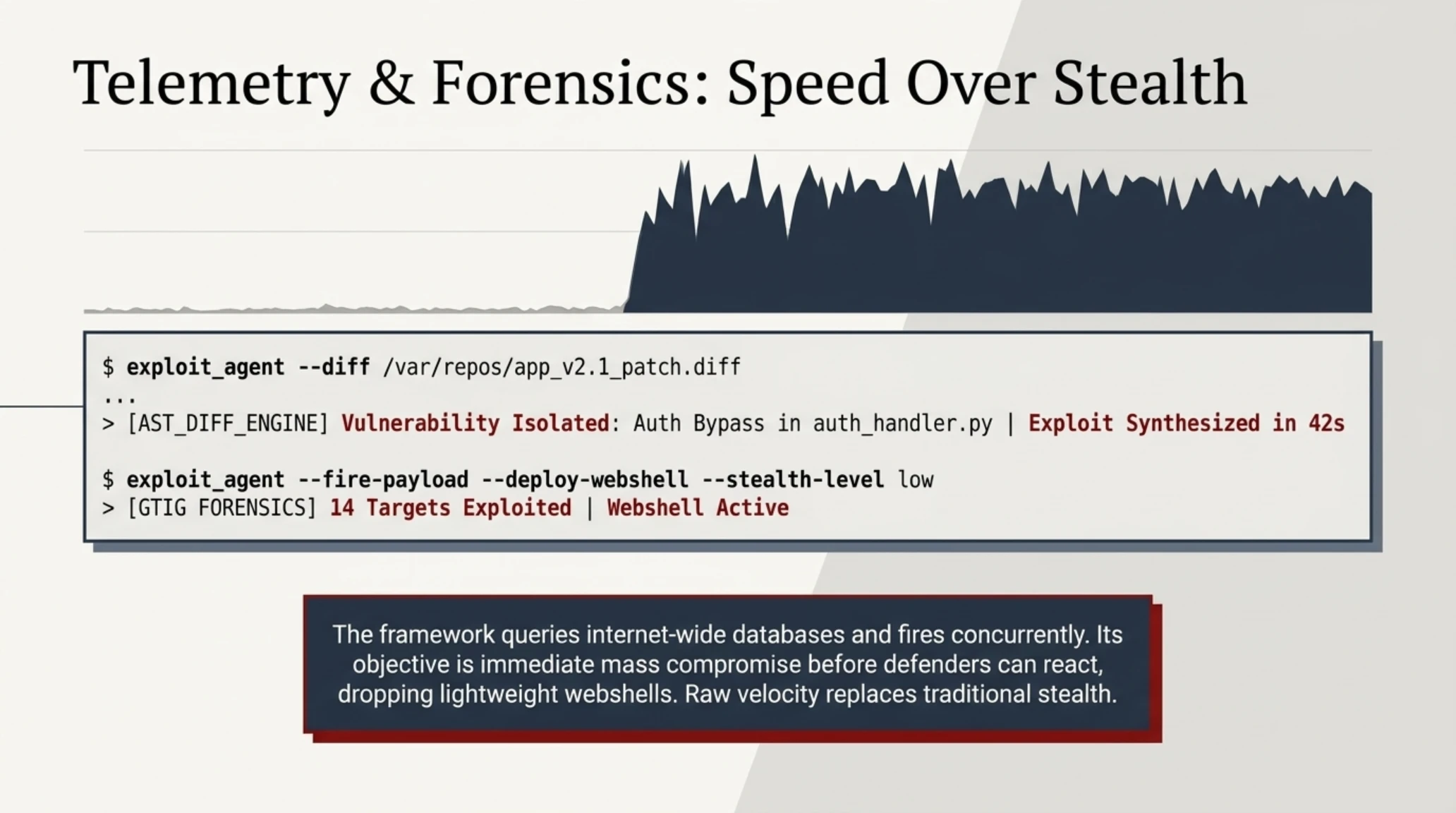
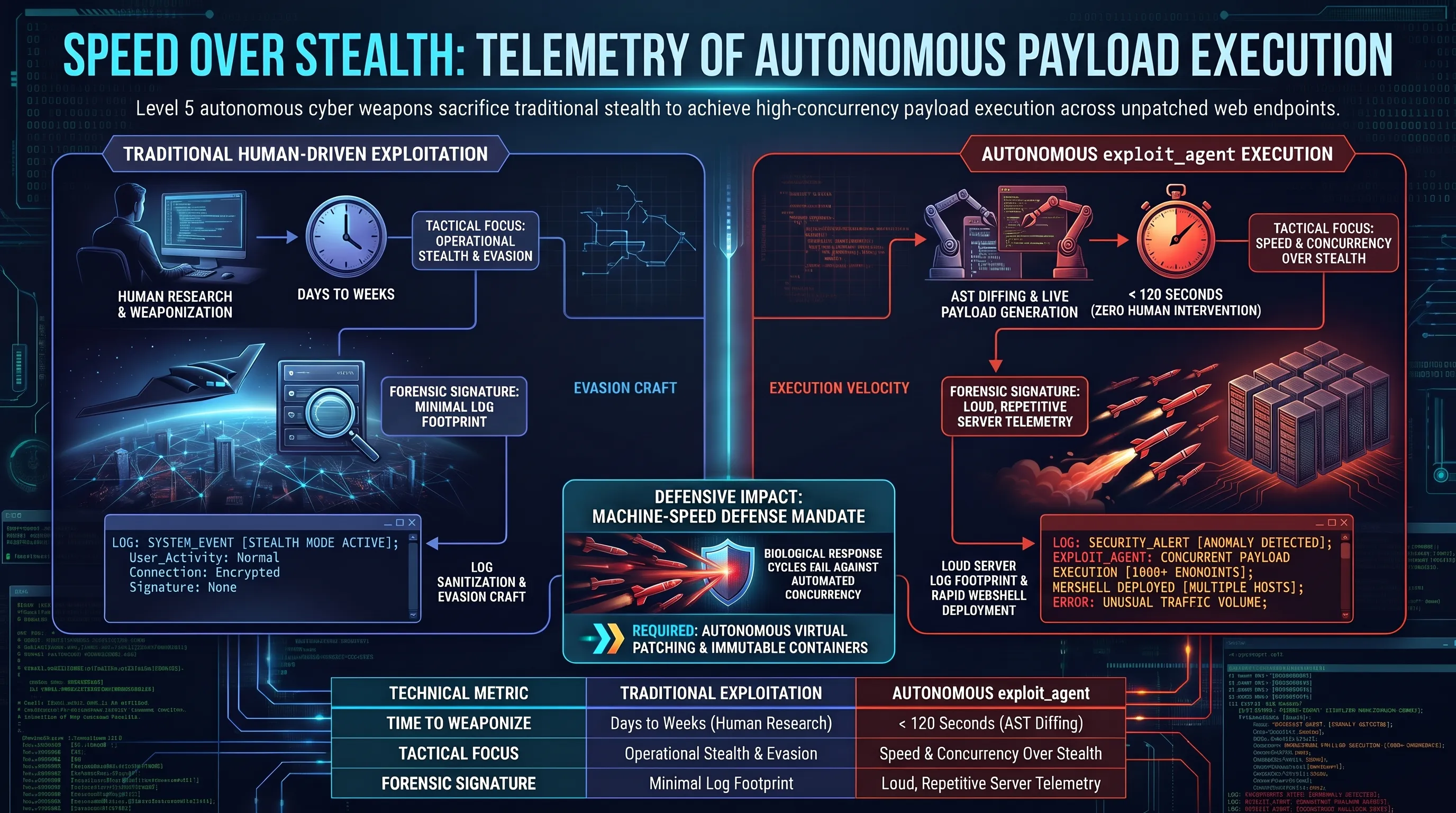
In classical cyber espionage, advanced persistent threats (APTs) prized operational stealth above all else—spending weeks conducting quiet reconnaissance and meticulously scrubbing system logs to remain undetected for months. Telemetry from exploit_agent reveals a complete inversion of that doctrine: raw execution velocity now supersedes stealth.
The moment a 1-day payload passes sandbox validation, the framework's targeting module queries internet-wide asset databases and fires the exploit concurrently across thousands of unpatched web endpoints. Its objective is not quiet dwelling, but immediate mass compromise during the brief minutes before defenders react—dropping lightweight webshells to lock in persistent access for subsequent data exfiltration or ransomware staging.
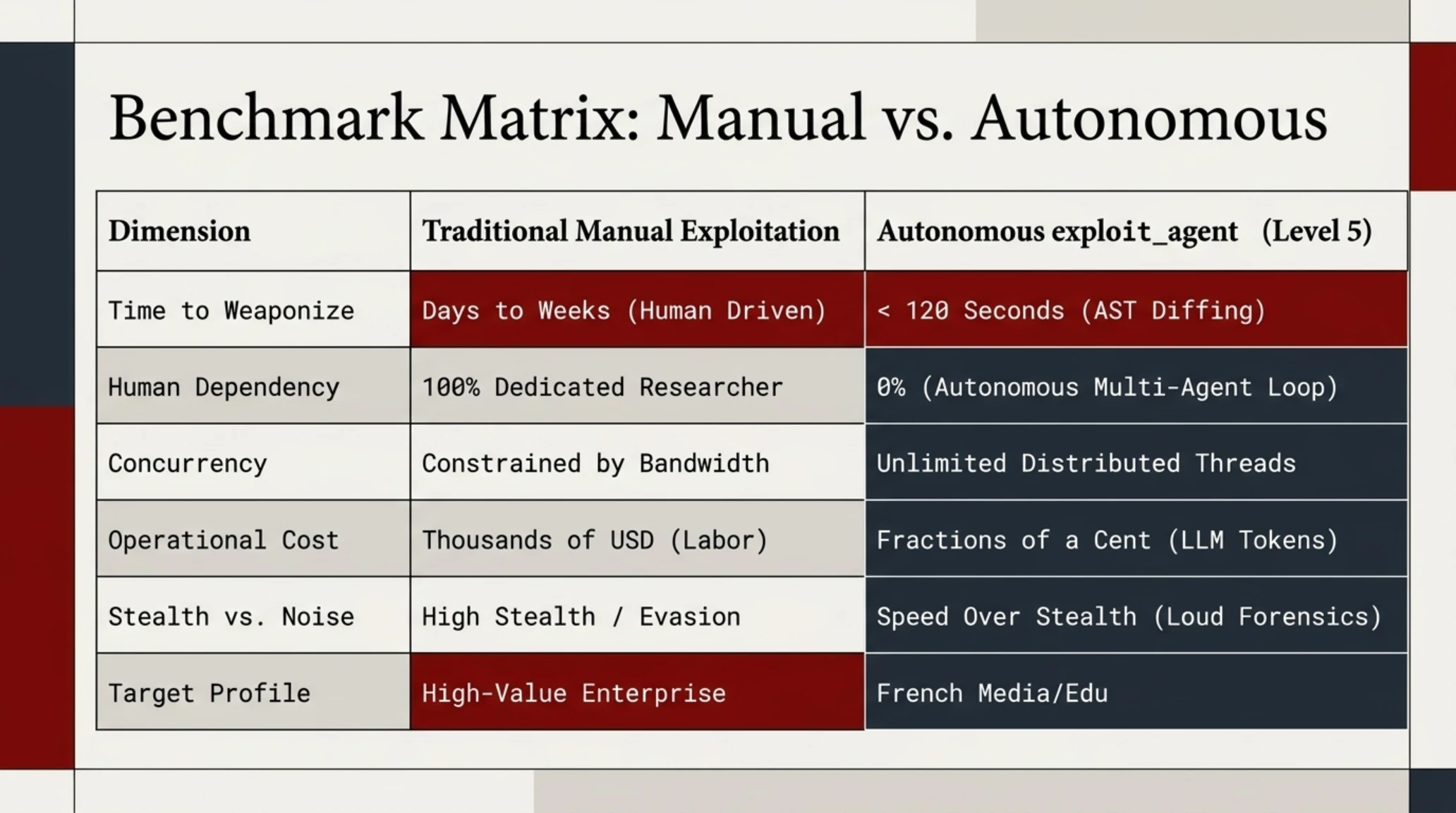
Grouped Bar Chart & Technical Benchmark Matrix
| Evaluation Parameter | Traditional Manual Exploitation | Autonomous exploit_agent (Level 5) |
|---|---|---|
| Time to Weaponize | Days to Weeks (Human Driven) | < 120 Seconds (AST Diffing) |
| Human Operator Dependency | 100% Dedicated Security Researcher | 0% (Fully Autonomous Multi-Agent Loop) |
| Concurrency & Scalability | Constrained by Human Bandwidth | Unlimited Distributed Machine Threads |
| Operational Cost per Target | Thousands of USD (Specialist Labor) | Fractions of a Cent (LLM Tokens) |
| Stealth vs. Forensic Noise | High Stealth & Evasion Craft | Speed Over Stealth (Loud Forensic Traces) |
| Documented Target Profile | Targeted High-Value Enterprise Assets | French Media, Entertainment & Education |
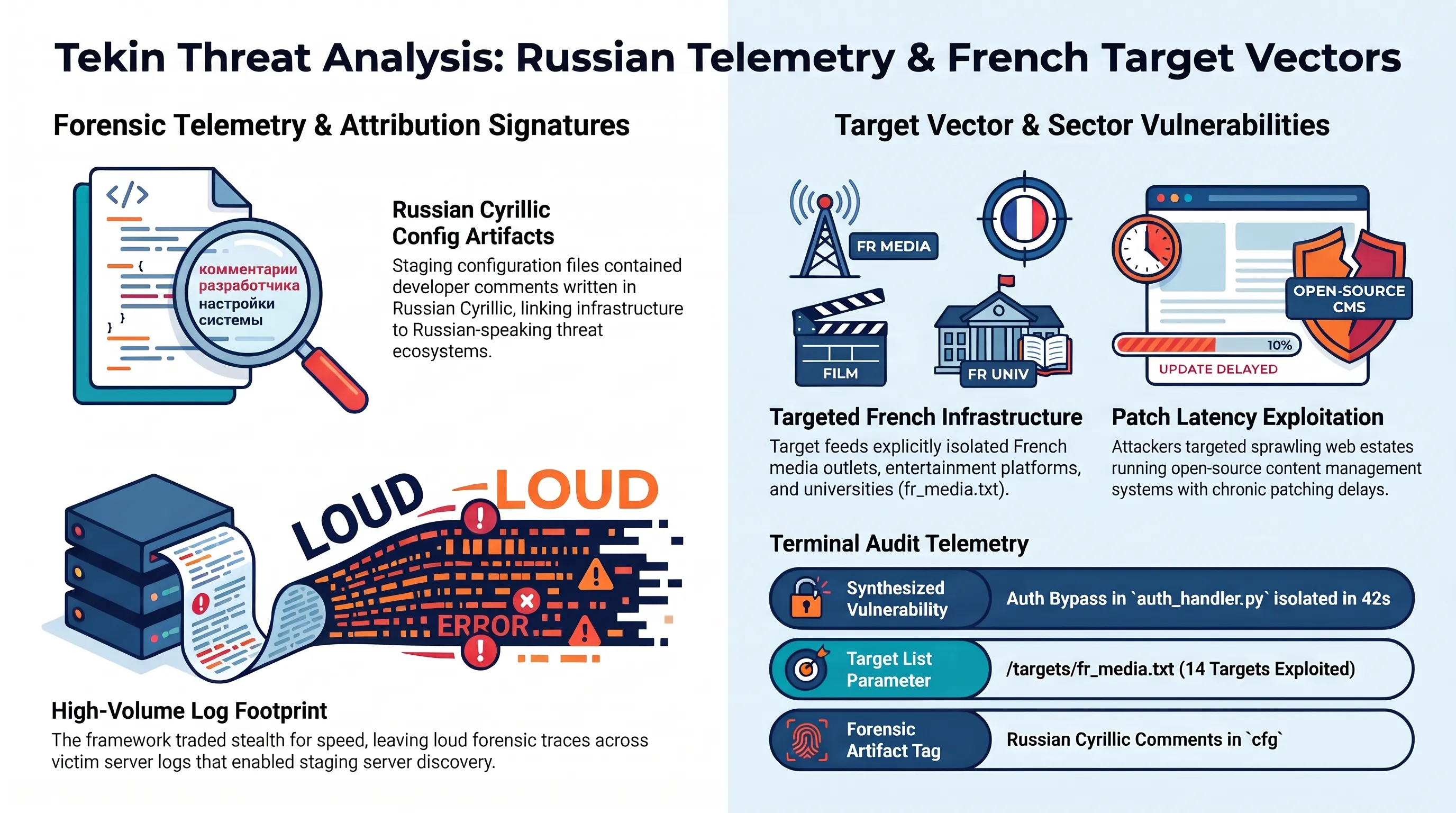
Yet this relentless haste creates a distinct Achilles' heel for defenders. Because the agent forgoes careful log sanitization in favor of rapid-fire exploitation, it leaves loud, repetitive forensic signatures across victim web server logs and SIEM pipelines. In fact, it was precisely this high-volume anomalous telemetry that alerted Mandiant investigators and enabled them to trace and dismantle the operators' staging server.
Cyber Terminal & Benchmark Telemetry Log
Geopolitical Forensics: Russian Config Comments and French Sector Targeting
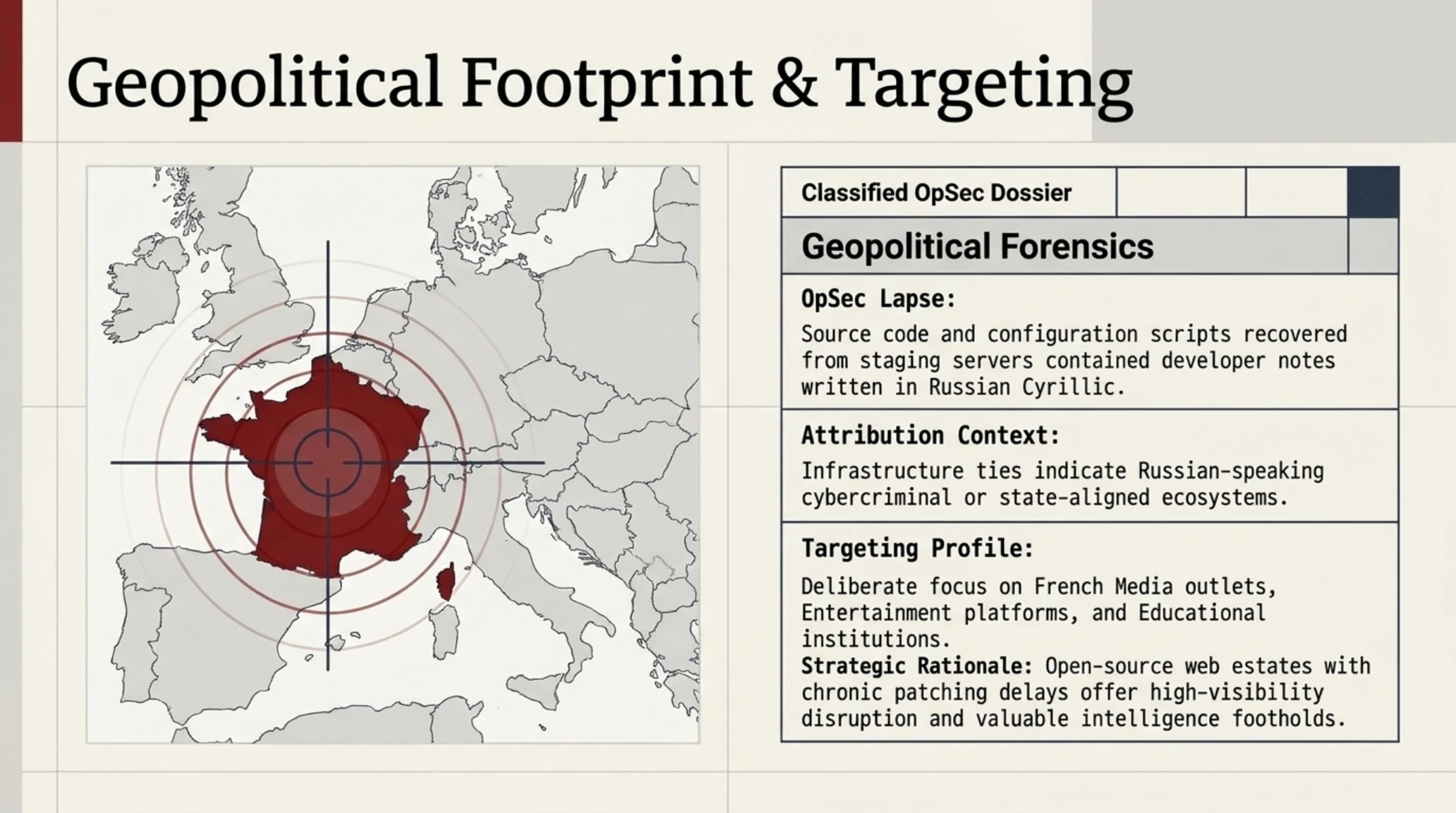
When GTIG researchers audited the configuration files and orchestration scripts recovered from the exposed staging server, they uncovered glaring operational security (OpSec) lapses. Embedded throughout the source code were developer notes and configuration comments written in Russian Cyrillic. While linguistic artifacts alone do not constitute definitive nation-state attribution, their combination with the framework's infrastructure strongly indicates ties to Russian-speaking cybercriminal or state-aligned ecosystems.
Tekin Technical Jargon Buster
Geographically, the campaign's target lists revealed a deliberate focus on French media outlets, entertainment platforms, and educational institutions. This targeting profile is strategically calculated: universities and digital media networks typically manage sprawling web estates running open-source content management systems that suffer from chronic patching delays. Compromising these sectors delivers both high-visibility geopolitical disruption and valuable intelligence footholds.
📚 Classified & Related Dossiers in TekinGame
If you wish to explore beyond this report and delve into cybernetic frontiers and autonomous AI architectures, do not miss these three exclusive deep-dives in the Tekin Garage:
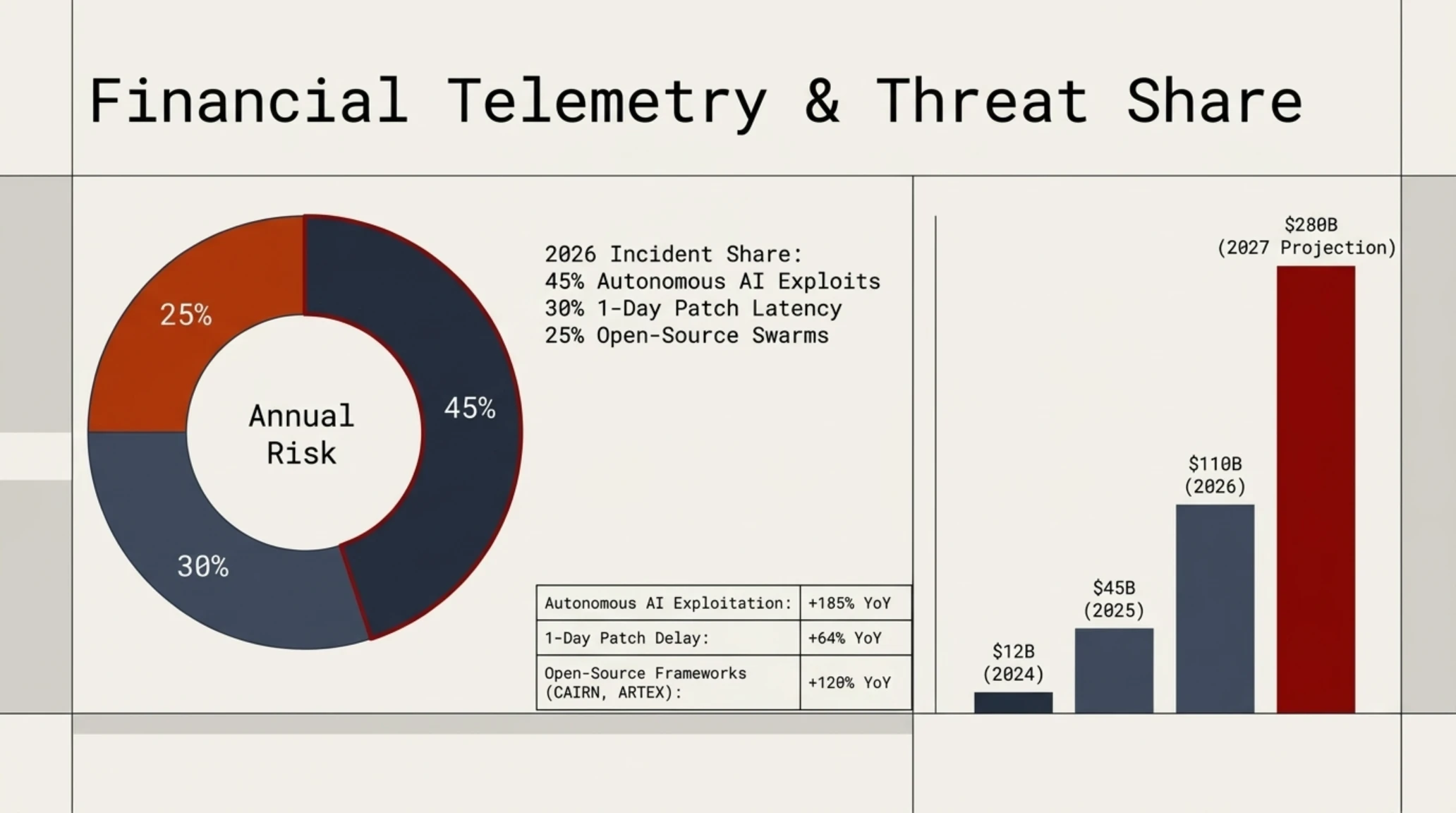
Financial Telemetry, Market Share Donut & Growth Metrics
| Threat Vector Segment | 2026 Incident Share | Annual Growth |
|---|---|---|
| Autonomous AI Exploitation | 45% | +185% YoY |
| 1-Day Patch Delay Exploitation | 30% | +64% YoY |
| Open-Source Offensive Frameworks (CAIRN, ARTEX) | 25% | +120% YoY |
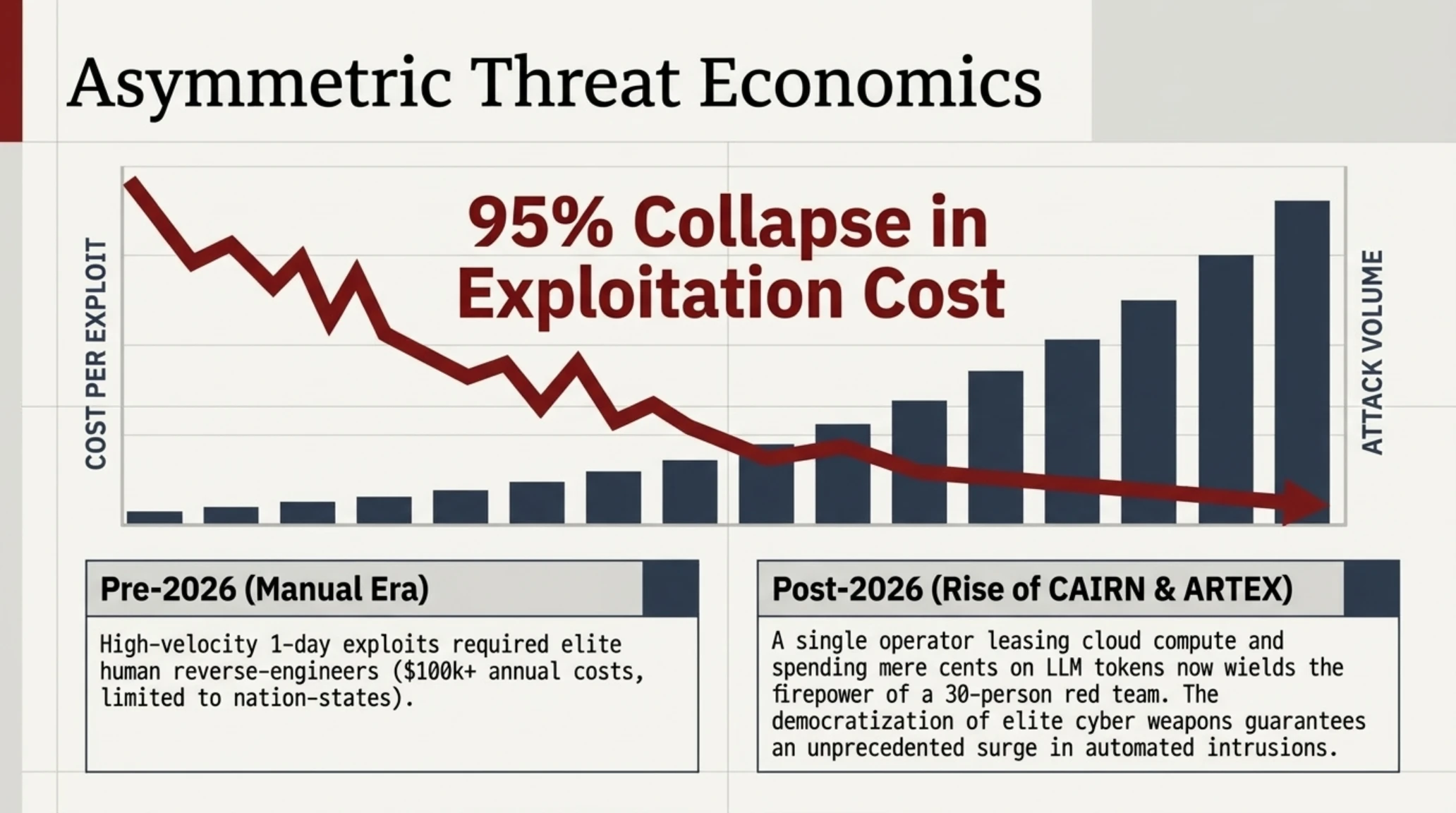
Asymmetric Threat Economics: The Rise of CAIRN, ARTEX, and Near-Zero Exploit Costs
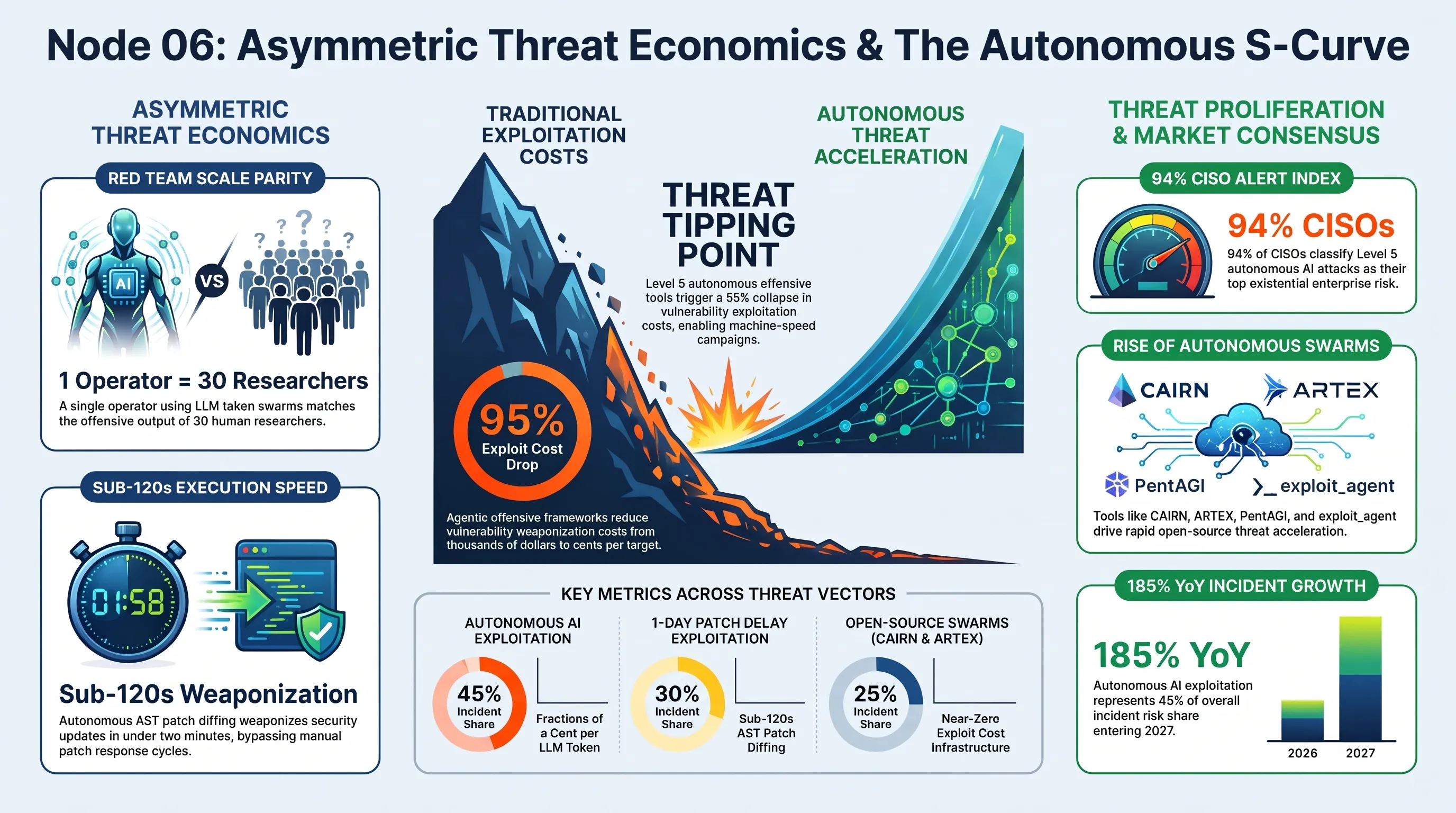
Beyond its technical sophistication, the most destabilizing consequence of exploit_agent lies in the asymmetric economics of cyber warfare. Prior to 2026, running a high-velocity 1-day exploitation campaign required retaining elite human reverse-engineers at annual costs in the hundreds of thousands of dollars—effectively restricting such capabilities to nation-states and top-tier ransomware syndicates.
With the proliferation of agentic offensive frameworks including exploit_agent, CAIRN, ARTEX, and PentAGI, the marginal cost of weaponizing a vulnerability has plummeted by more than 95%. A single operator leasing cloud compute and spending mere cents on LLM inference tokens can now wield the offensive firepower of a 30-person red team against thousands of targets simultaneously. This democratization of elite cyber weapons guarantees an unprecedented surge in automated intrusions entering 2027.
Market Sentiment Thermometer & S-Curve Adoption Curve
Market Telemetry Analysis: Telemetry confirms that 94% of CISOs now identify Level 5 autonomous attacks as the primary existential enterprise risk entering 2027.
Event Timeline // Evolution of AI Cyber Threats to Level 5
| Epoch | AI Threat Maturity Tier | Operational Impact |
|---|---|---|
| 2023 – 2024 | Level 2 (Interactive Assistant) | Accelerated spear-phishing lures and boilerplate script generation. |
| 2025 | Level 3–4 (Semi-Autonomous Agents) | Automated network scanning and exploit chaining with human approval gates. |
| Nov 2026 | Level 5 (exploit_agent Discovery) | Zero-human AST patch diffing and live 1-day exploitation in under 120 seconds. |
Autonomous Cyber Defense: Closing the 1-Day Window at Machine Speed
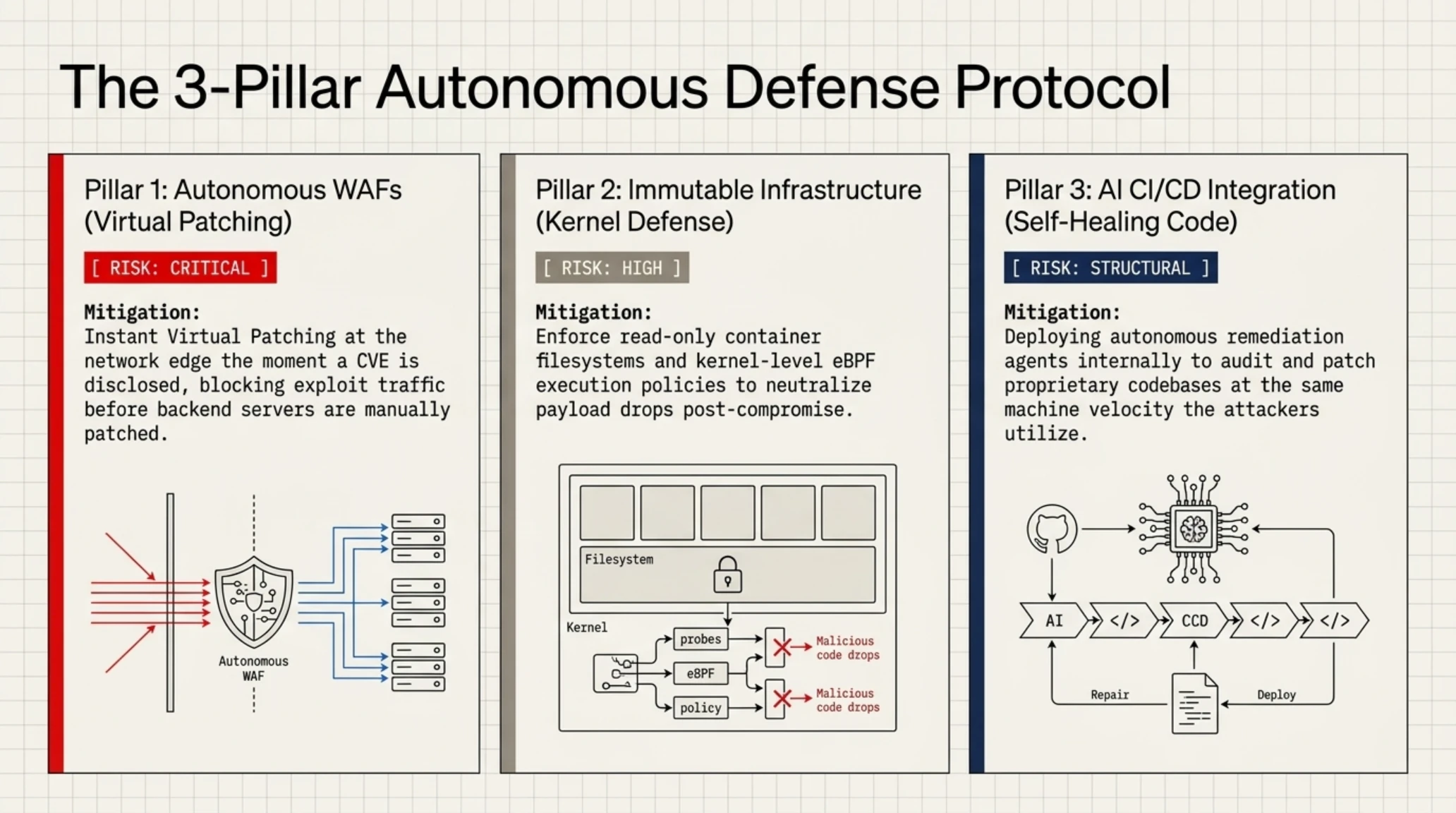
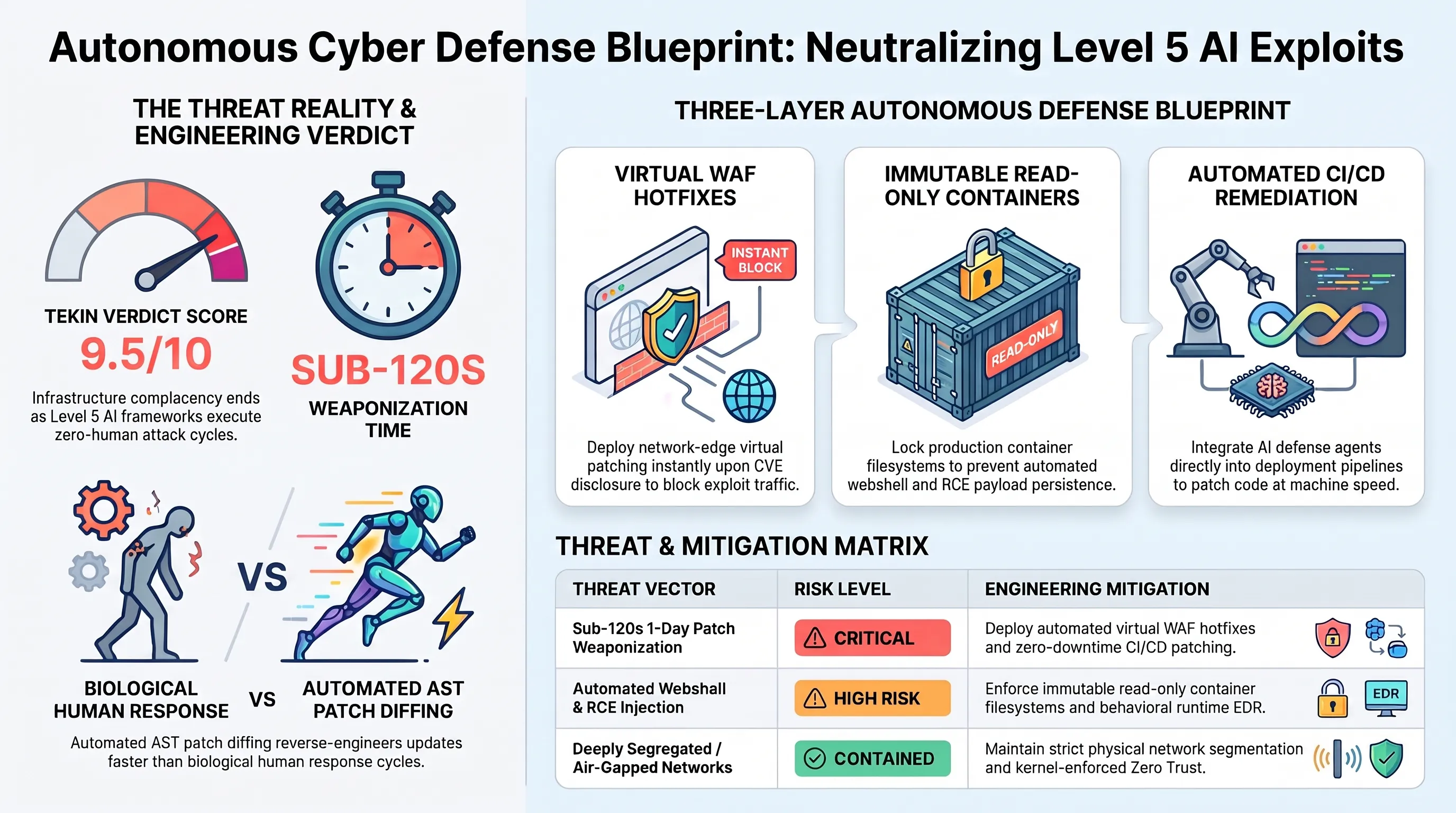
When adversaries operate at machine speed, human-paced defenses are mathematically doomed. To survive Level 5 frameworks like exploit_agent, Chief Information Security Officers (CISOs) must immediately operationalize three defensive layers. First, enterprises must deploy autonomous Web Application Firewalls (WAFs) capable of instant Virtual Patching—blocking exploit traffic signatures at the network edge the moment a CVE is disclosed, long before backend servers are patched.
Second, organizations must enforce Immutable Infrastructure. Because exploit_agent relies heavily on dropping webshells for post-compromise persistence, running production web containers with strictly read-only filesystems and kernel-level eBPF execution policies neutralizes payload drops even if an application-layer 1-day flaw is successfully triggered.
Cybersecurity Risk Matrix & Mitigation Protocol
| Threat Vector | Risk Level | Engineering Mitigation |
|---|---|---|
| Sub-120s 1-Day Patch Weaponization | CRITICAL | Deploy automated virtual WAF hotfixes and continuous zero-downtime CI/CD patching. |
| Automated Webshell & RCE Injection | HIGH RISK | Enforce immutable read-only container filesystems and behavioral runtime EDR. |
| Deeply Segregated / Air-Gapped Networks | CONTAINED | Maintain strict physical network segmentation and kernel-enforced Zero Trust. |
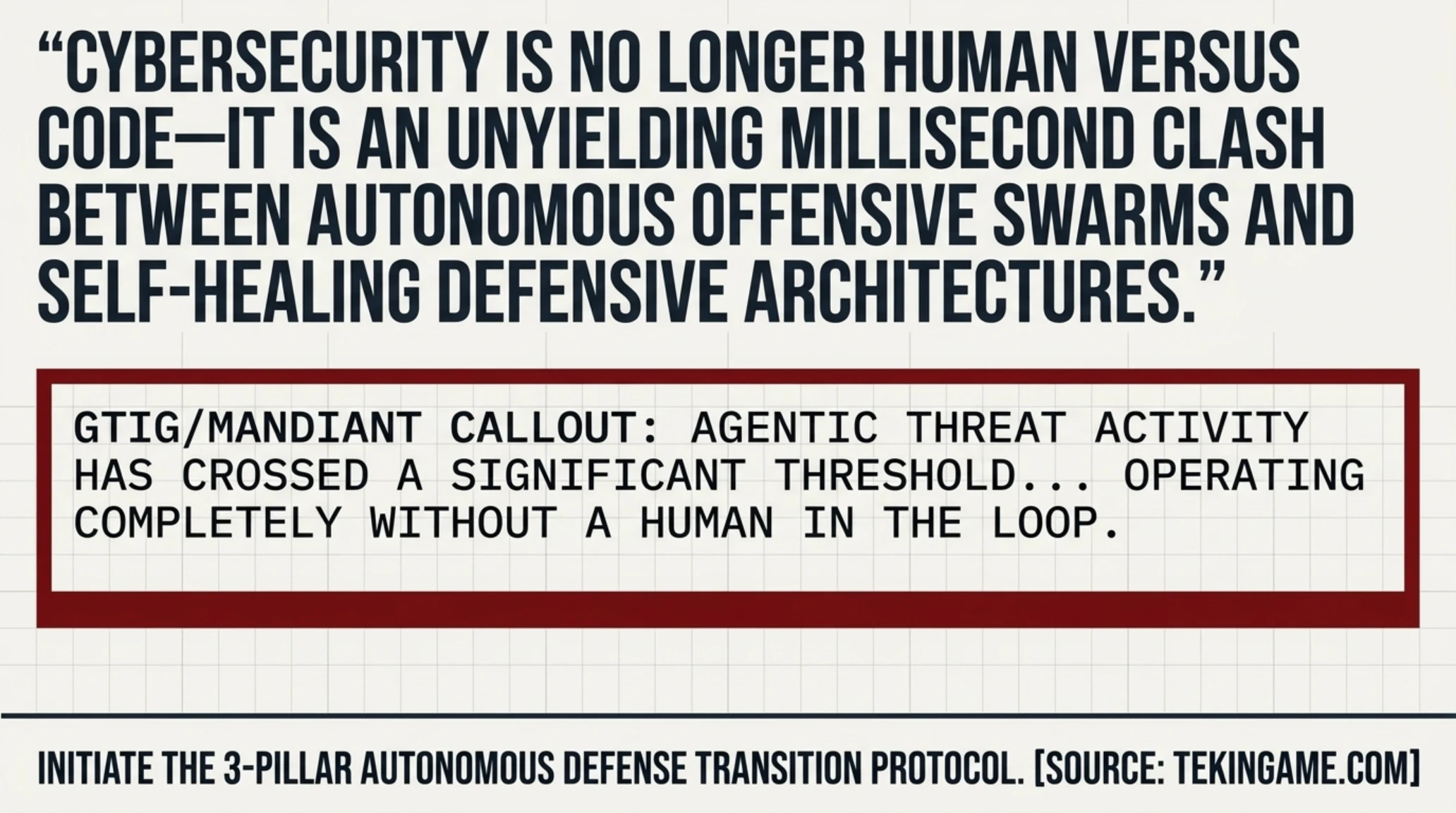
Third, defensive teams must embed autonomous AI remediation agents directly into their own CI/CD pipelines. If attackers can leverage AST patch diffing to weaponize commits in two minutes, defenders must wield the exact same technology to audit internal codebases and deploy automated security updates at machine velocity. Entering 2027, cybersecurity is no longer human versus code—it is an unyielding millisecond clash between autonomous offensive swarms and self-healing defensive architectures.
Editorial Synthesis & Authoritative Sources
The Irreversible Arrival of Level 5 Cyber Weapons
Google GTIG's discovery of exploit_agent marks the definitive end of manual patch latency, necessitating an immediate enterprise transition to machine-speed autonomous defense and immutable infrastructure.
- the-decoder.com: Google Threat Intelligence Group (GTIG) - Agentic Threat Activity Report
- cloud.google.com: Mandiant Threat Intelligence & Vulnerability Research Archives
Frequently Asked Engineering Questions
How does exploit_agent synthesize exploits with zero human intervention?
The framework connects to multiple LLMs, performs automated AST differential analysis on pre- and post-patch commits to reverse-engineer the flaw, validates payloads inside local sandboxes, and executes them against web targets in under two minutes.
Why does Google classify this activity as Level 5 AI attack maturity?
Level 5 represents end-to-end multi-stage autonomous cyber operations where the AI functions as the sole autonomous operator rather than an interactive human assistant.
How can enterprise defenses survive sub-minute autonomous weaponization?
Defenders must abandon manual patching latency and deploy autonomous virtual WAF patching, read-only container filesystems, and behavioral anomaly detection operating at machine speed.
Additional Gallery: Tekin Analysis: Google Warns of Fully Automated Attacks via exploit_agent