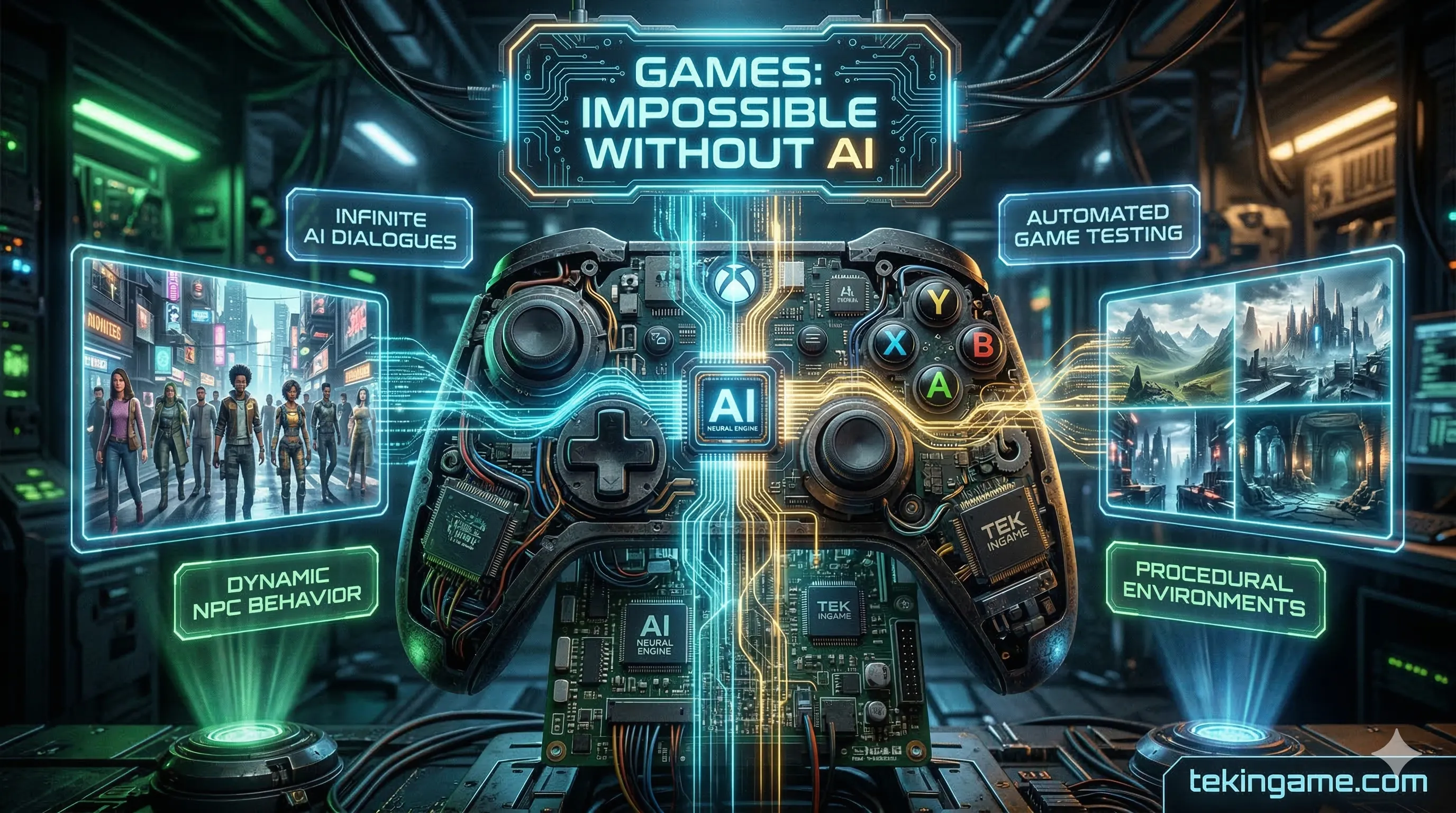
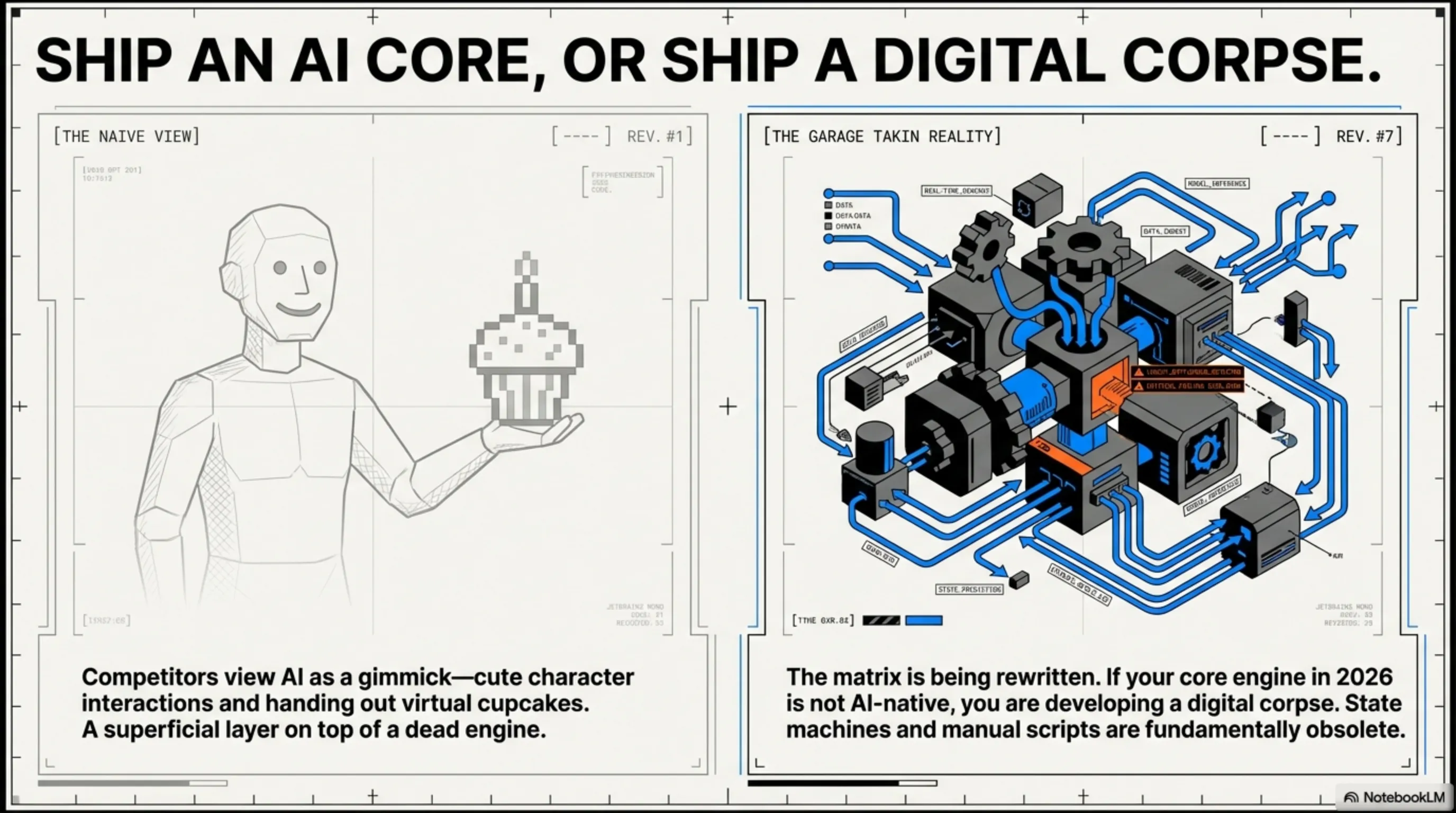
Greetings to the invincible Tekin Legion! Today, inside the Garage's processing core, our radar monitors are locked onto one of the greatest paradigm shifts in entertainment history. While our overly kind rival, Claude, views AI in gaming merely as "cute character interactions" and welcomes it with a tray of virtual cupcakes, we at Tekin Garage know the matrix is being fundamentally rewritten. Sabrina always warns: "If your game's core isn't built on AI in 2026, you are developing a digital corpse." Today, we will perform a hardcore autopsy on why developing AAA titles with manual scripts is now impossible. How Large Language Models (LLMs) have burned down dialogue trees, generated infinite quests, and put an army of human testers out of work. Draw your cybernetic swords; the time for a ruthless debugging session has arrived!
The Death of Dialogue Trees: End of the "Press X to Talk" Era
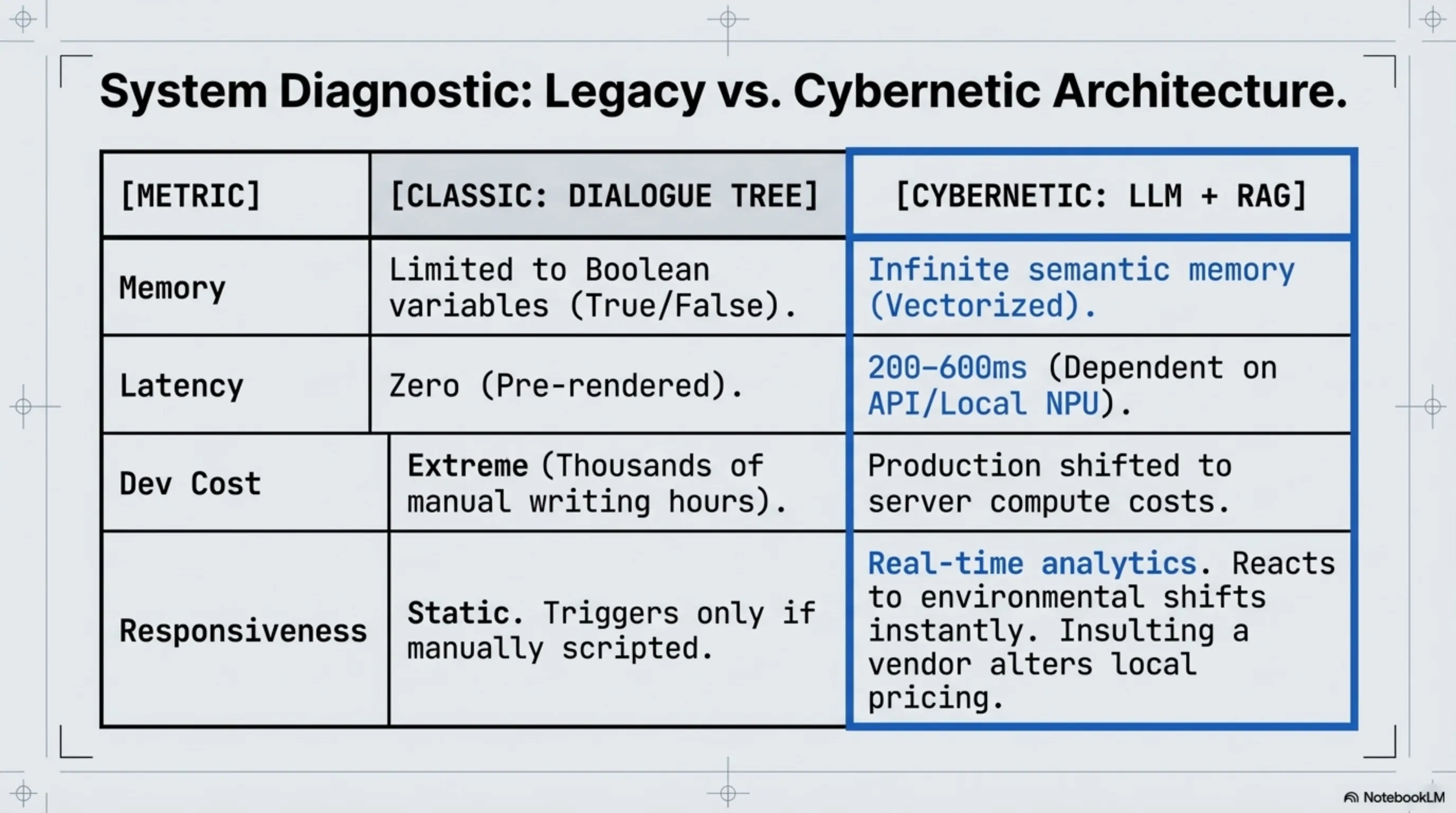
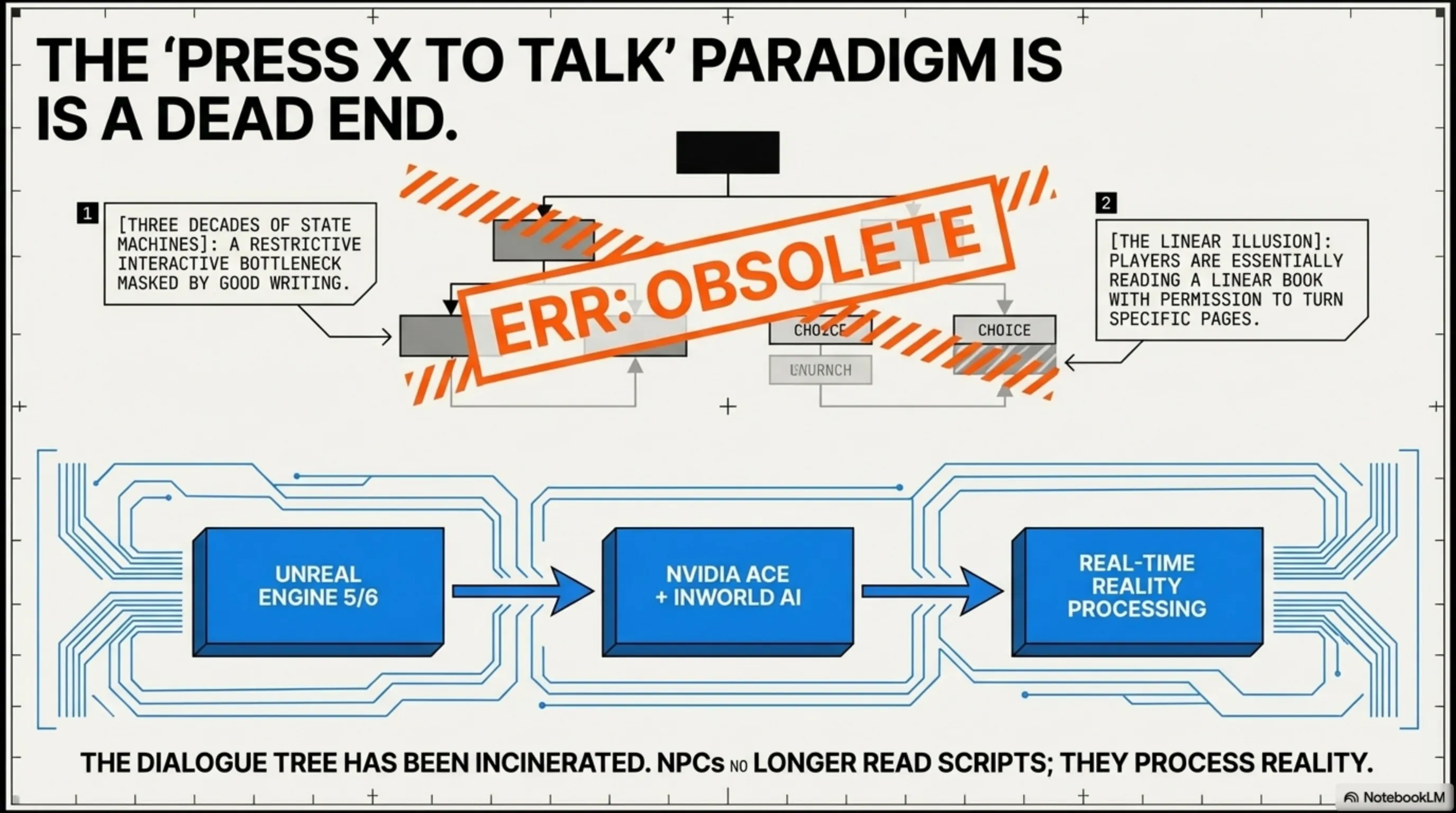
For over three decades, the gaming industry was built on a severely restrictive architecture: state machines and dialogue trees. You would approach an NPC, press a button, and select one of three or four pre-written options. This architecture, no matter how enriched by brilliant writers at massive studios like BioWare or Bethesda, was ultimately an interactive dead end. You were essentially reading a linear book where your only choice was turning specific pages.
In today's matrix, however, the integration of Large Language Models (LLMs) with game engines (like Unreal Engine 5 and 6) has completely shattered this structure. Technologies such as NVIDIA ACE (Avatar Cloud Engine) and AI-driven platforms like Inworld AI have transformed non-playable characters from dead scripts into entities with real-time cognitive processing.
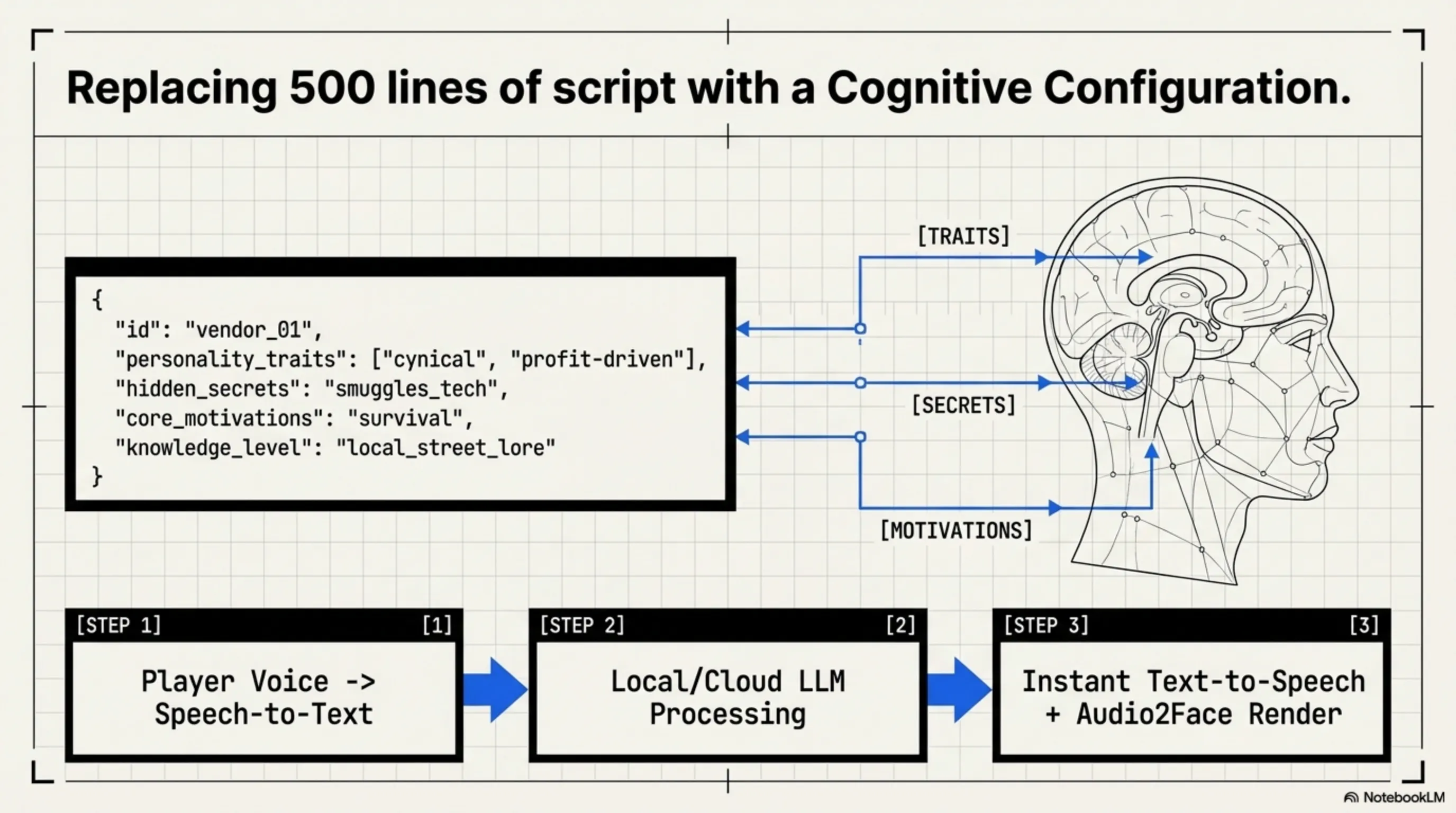
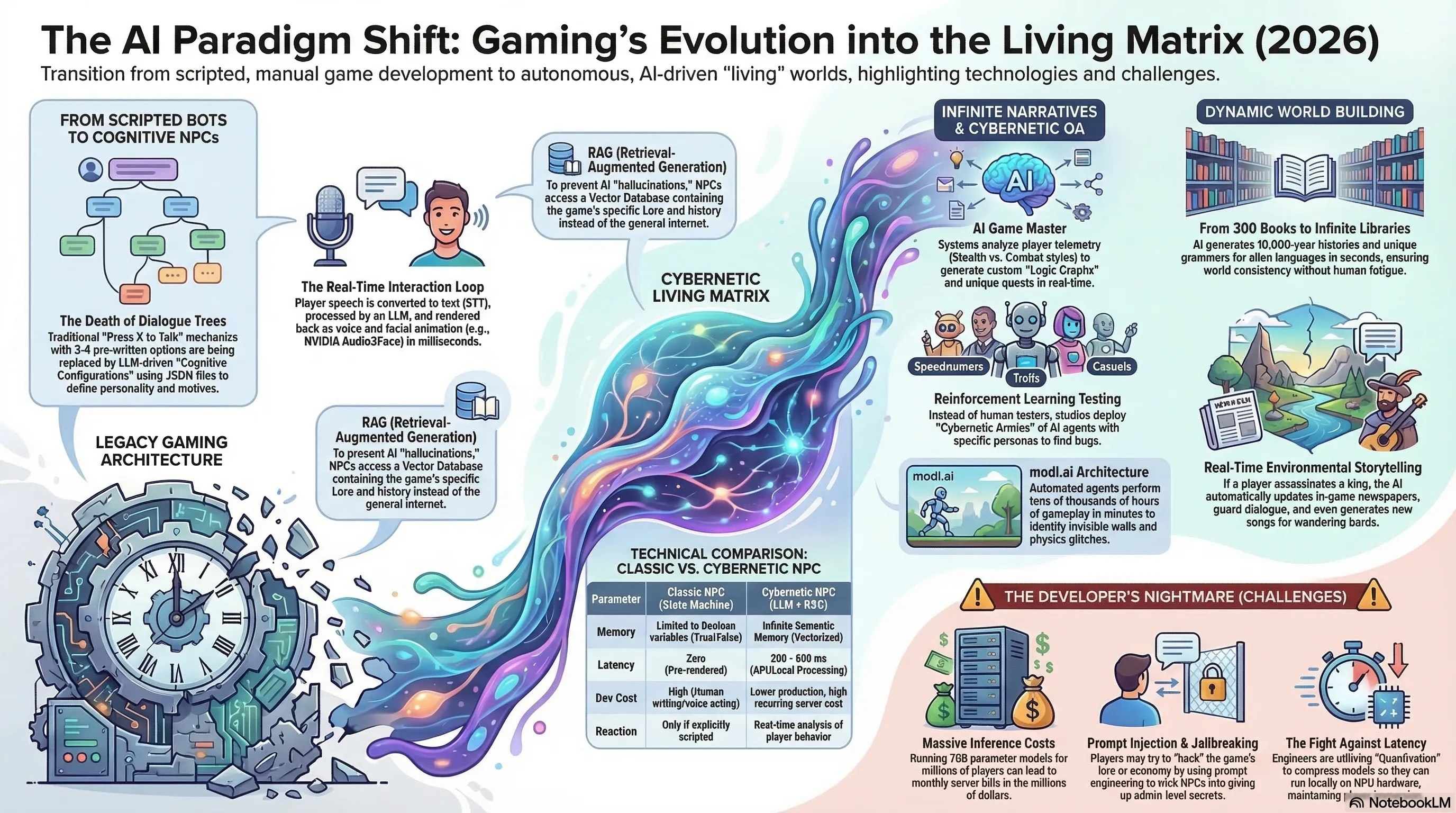
How does it work? In these next-generation systems, an NPC possesses a "Cognitive Configuration." Instead of writing 500 lines of dialogue for a shopkeeper, the developer injects a JSON file containing the character's personality traits, motivations, deepest secrets, and knowledge limitations into the AI engine. When you speak to the shopkeeper using your headset microphone, your voice undergoes Speech-to-Text conversion, is processed by a local or cloud LLM, and a response is generated based on the NPC's persona. Finally, this is rendered in fractions of a second via Text-to-Speech systems and AI-driven facial animations like Audio2Face.
RAG Architecture in Gaming: How NPCs Avoid Hallucinating Lore
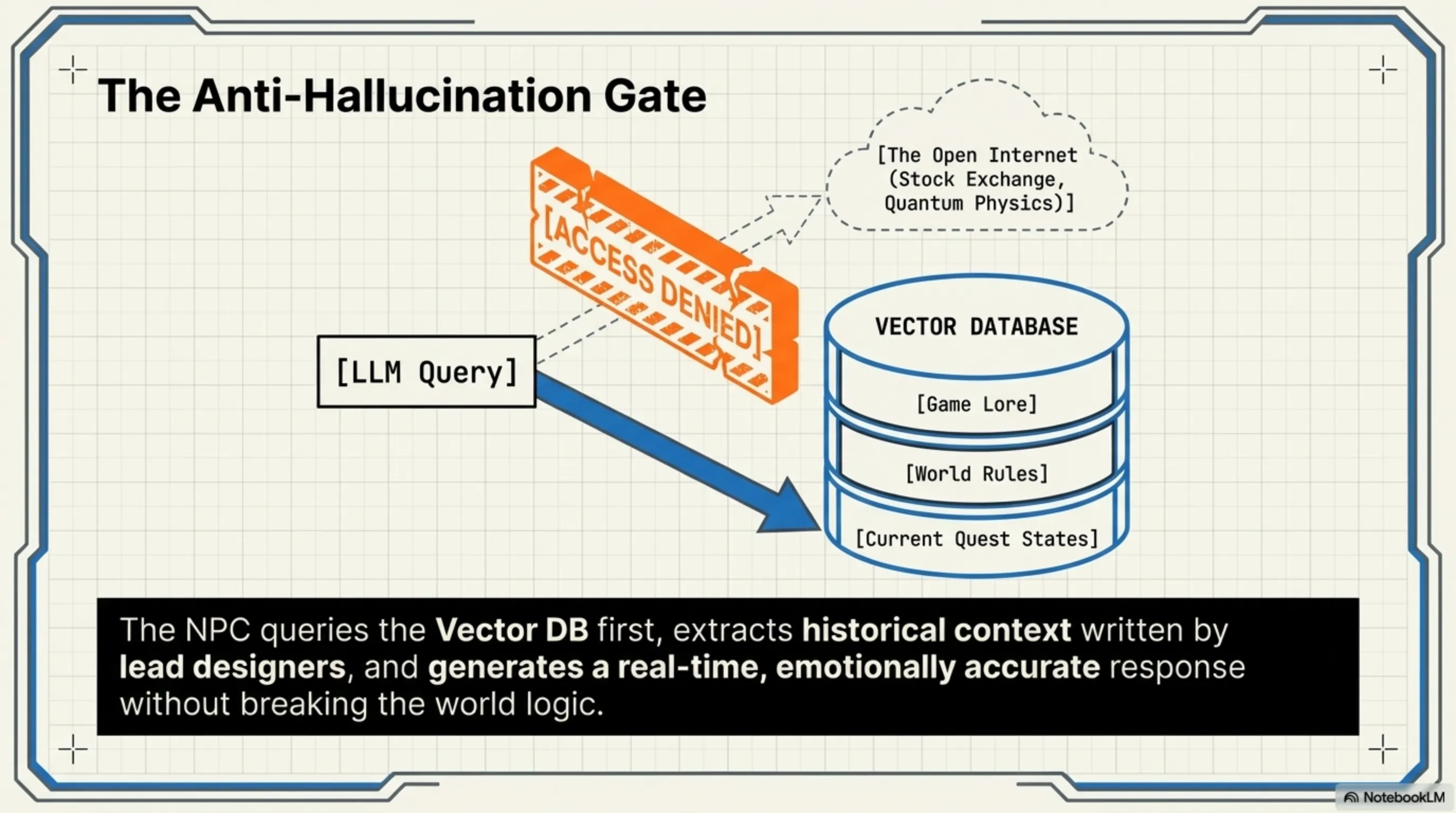
One of the most terrifying engineering challenges of utilizing AI in gaming is the issue of "hallucination." What happens if an Elf in a high-fantasy world suddenly starts discussing the New York stock market or quantum physics? This is exactly where RAG (Retrieval-Augmented Generation) technology executes its protocol.
In next-generation games, the LLM isn't simply plugged into the open internet; instead, it is securely tethered to a Vector Database containing all the game's lore, world rules, current quest states, and character relationship webs. When you ask the King, "Why did you order the attack?", the AI first queries the Vector DB, extracts the historical justifications written by senior narrative designers, and then generates a unique, emotionally charged response tailored to the King's current mood.
This architectural shift is not merely a graphical upgrade; it has fundamentally redefined "gameplay." In games built on this foundation, you can no longer exploit the system by repeatedly selecting the same dialogue options to find a bug. If you insult a character, they will remember that offense until the end of the game, gossip about you to their friends in town, and dynamically alter the prices of the items they sell you.
Infinite Quests: Narrative Engines Driven by Player Psychology
"Go to that cave, collect 5 wolf pelts, and come back." This exhausting formula—the infamous Fetch Quest—has boiled gamers' blood for years. The problem wasn't lazy writers; the problem was that manually designing compelling quests, linking them to a progression system, and debugging them in a massive open world required an astronomical budget and timeline. However, AI has upgraded the concept of Procedural Generation from mere map design to real-time "Narrative Design."
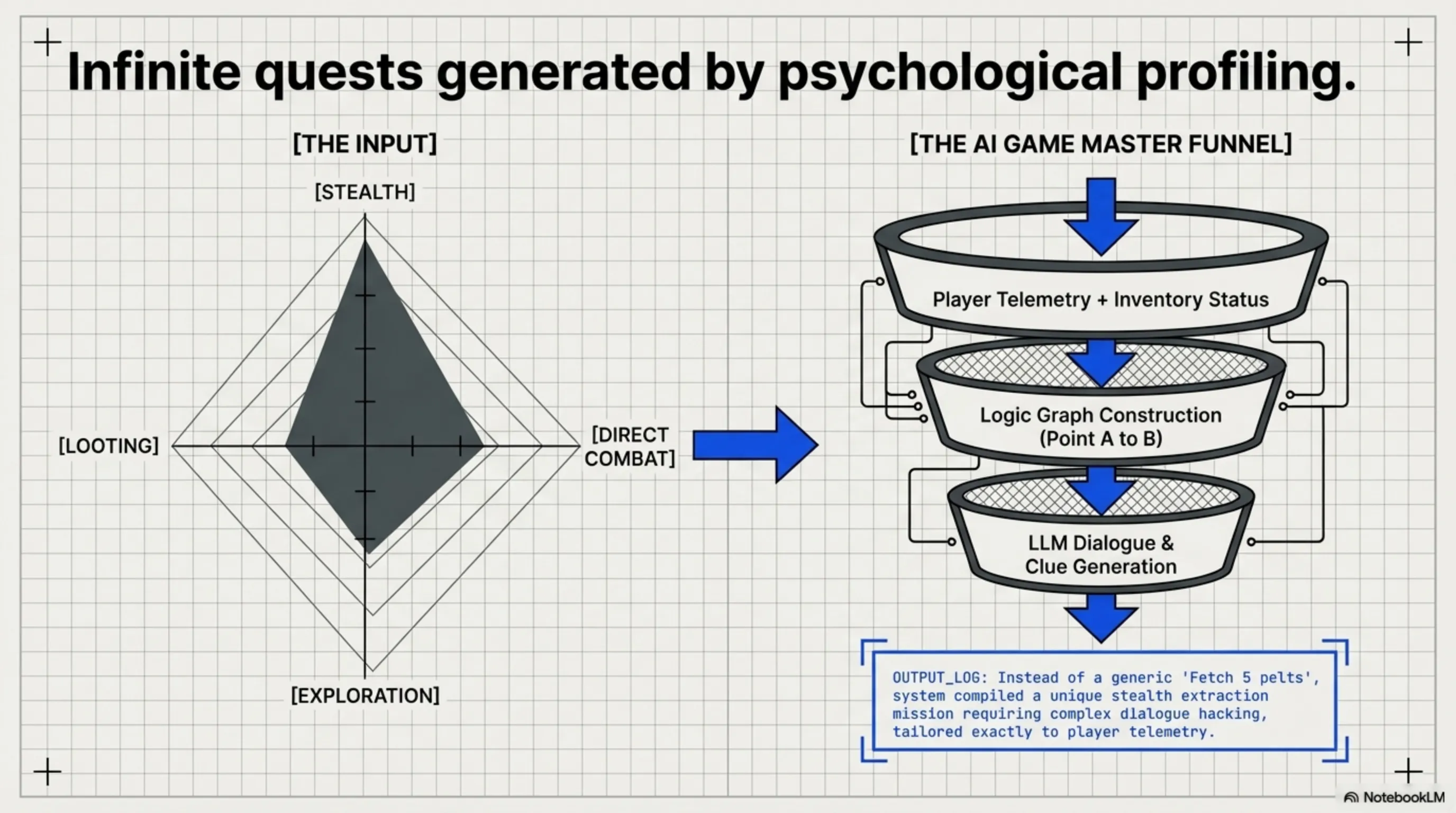
New AI-Quest systems act as an omnipotent "AI Game Master." These narrative engines continuously process your telemetry data. They autopsy your gaming psychology in real-time: Are you a stealth player? Do you love destruction and head-on combat? Do you prefer slow-paced exploration or mindless looting?
Based on this psychological profile, the AI generates quests on the fly. If you are a player who typically avoids direct confrontation, the AI will generate a mission where you must extract a classified file from a security outpost using complex dialogue negotiations and hacking systems. No two players will ever experience the exact same questline.
The architecture of this system is fiercely hardcore. The AI first constructs a Logic Graph: a starting point (A) and a final objective (B). Then, Machine Learning algorithms evaluate environmental variables (e.g., weather conditions, active factions in the zone, items in your inventory). Finally, the LLM steps in to generate the dialogue, letters, and textual clues related to that specific quest, layering them seamlessly onto the logical structure.
This technology ensures that a game never truly ends and, more importantly, never becomes boring. You are playing inside a matrix that is literally alive, reacting intelligently to your every breath and decision.
Cybernetic Playtesting: An Army of Bots Devouring Thousands of Hours
📚 Classified & Related Dossiers in TekinGame
If you wish to explore beyond this report and delve into cybernetic frontiers and autonomous AI architectures, do not miss these three exclusive deep-dives in the Tekin Garage:
Quality Assurance (QA) and playtesting have always been among the most painful, expensive, and exhausting parts of open-world game development. In the past, hundreds of human testers were forced to run around the game environment for thousands of hours, crash into walls, drive vehicles off cliffs, and hunt down physics bugs or quest glitches. However, when the scale of 2026 games reaches the dimensions of simulating an entire continent or a full planet, manual testing is practically a cruel joke. This is exactly where Reinforcement Learning AI Agents enter the matrix.
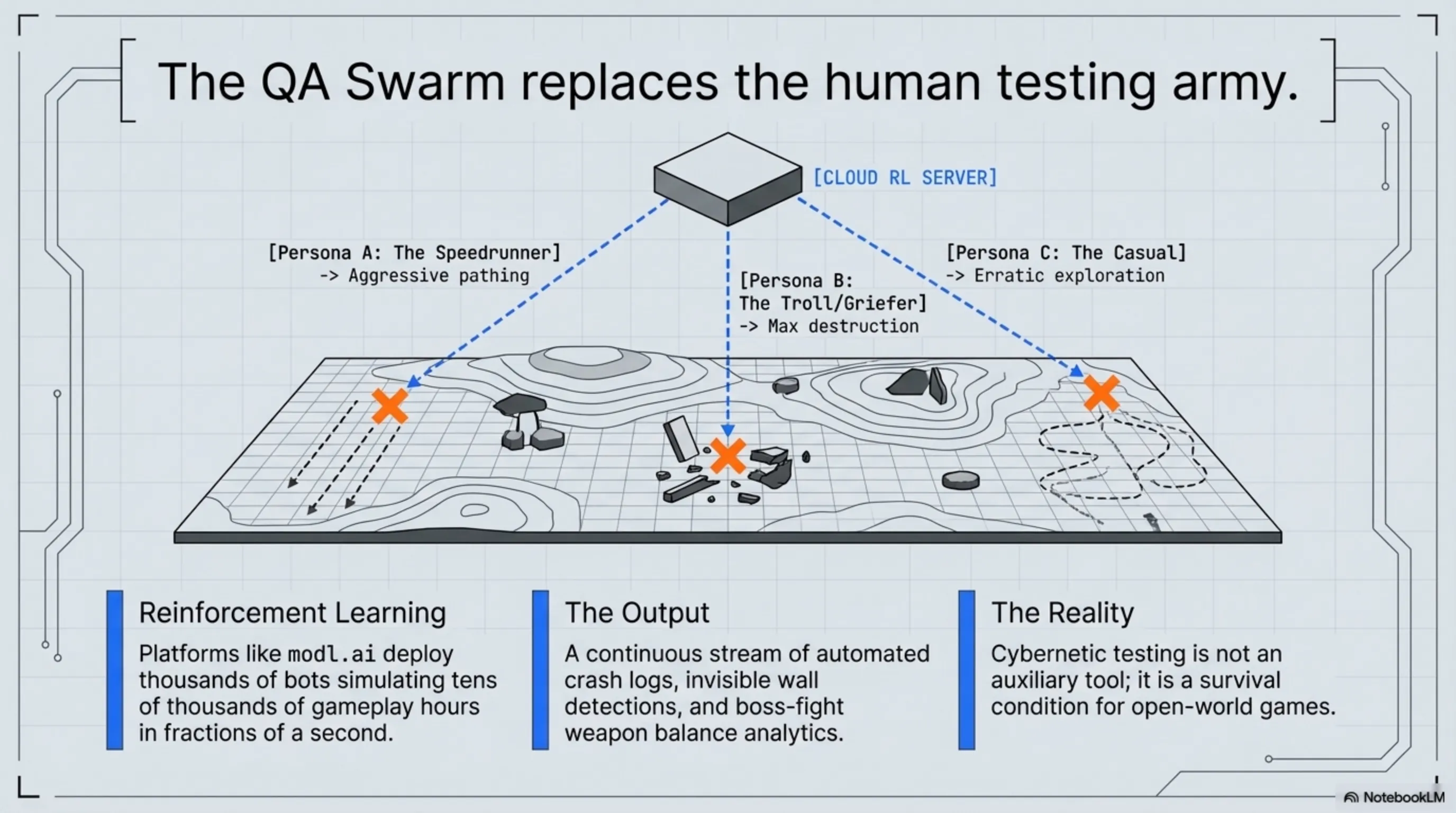
Instead of hiring an army of humans, pioneering studios now unleash a legion of cybernetic bots on cloud servers. These bots aren't just scripted codes moving in a linear path; they possess "Player Personas." The developer commands the AI: "Create 1,000 bots with a Speedrunner behavior, 500 bots acting as Trolls/Griefers who only seek destruction, and 2,000 bots with Casual beginner behavior, and unleash them into the city."
In a fraction of the time, this cybernetic legion dissects the game at a speed equivalent to tens of thousands of human gameplay hours. They test every possible weapon combination on boss fights, snoop into every corner of the map to find invisible walls or map holes, and return the output as a highly detailed crash log and design vulnerability report to the engineers.
Systems like modl.ai offer exactly this architecture. Without these bots, games featuring dynamic economies and living ecosystems would collapse before launch. Cybernetic playtesting is no longer an "assistive tool"; it is a "survival prerequisite" for shipping a bug-free title in 2026.
Architecture of Living Worlds: AI-Generated Lore and History
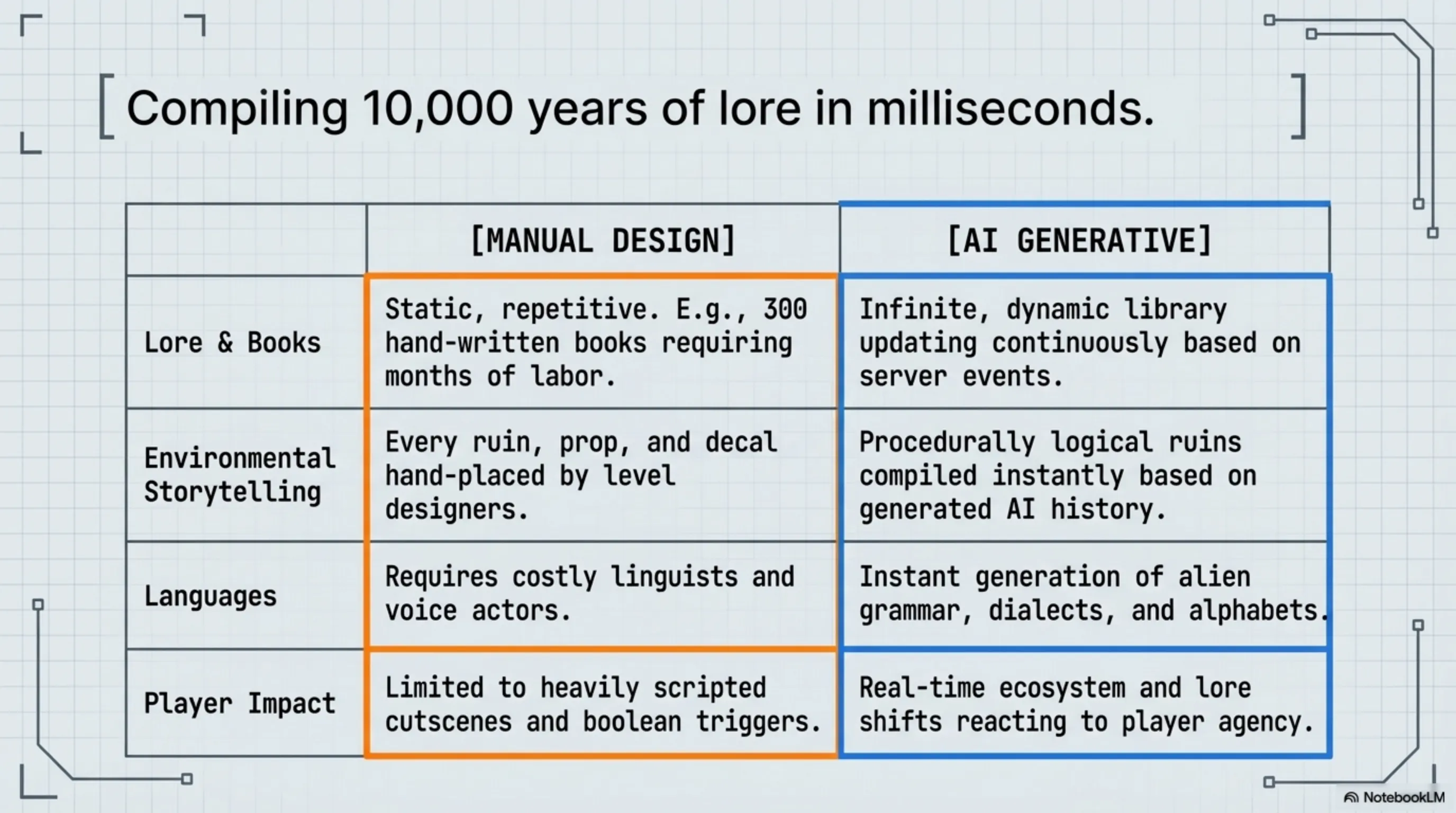
To understand the magnitude of this section, recall a classic masterpiece like Skyrim. In that game, there were around 300 readable books and notes, each meticulously written by human authors over months of grueling work. But in modern RPGs, we no longer need 300 books; we need an "infinite library" that updates dynamically based on player actions.
AI has now taken over the task of World Building from the ground up. Text generation engines can create a 10,000-year history for an alien planet. They can generate the family trees of thousands of NPCs, the history of forgotten wars, the reasons behind the collapse of ancient civilizations, and a unique mythology that is completely logically consistent.
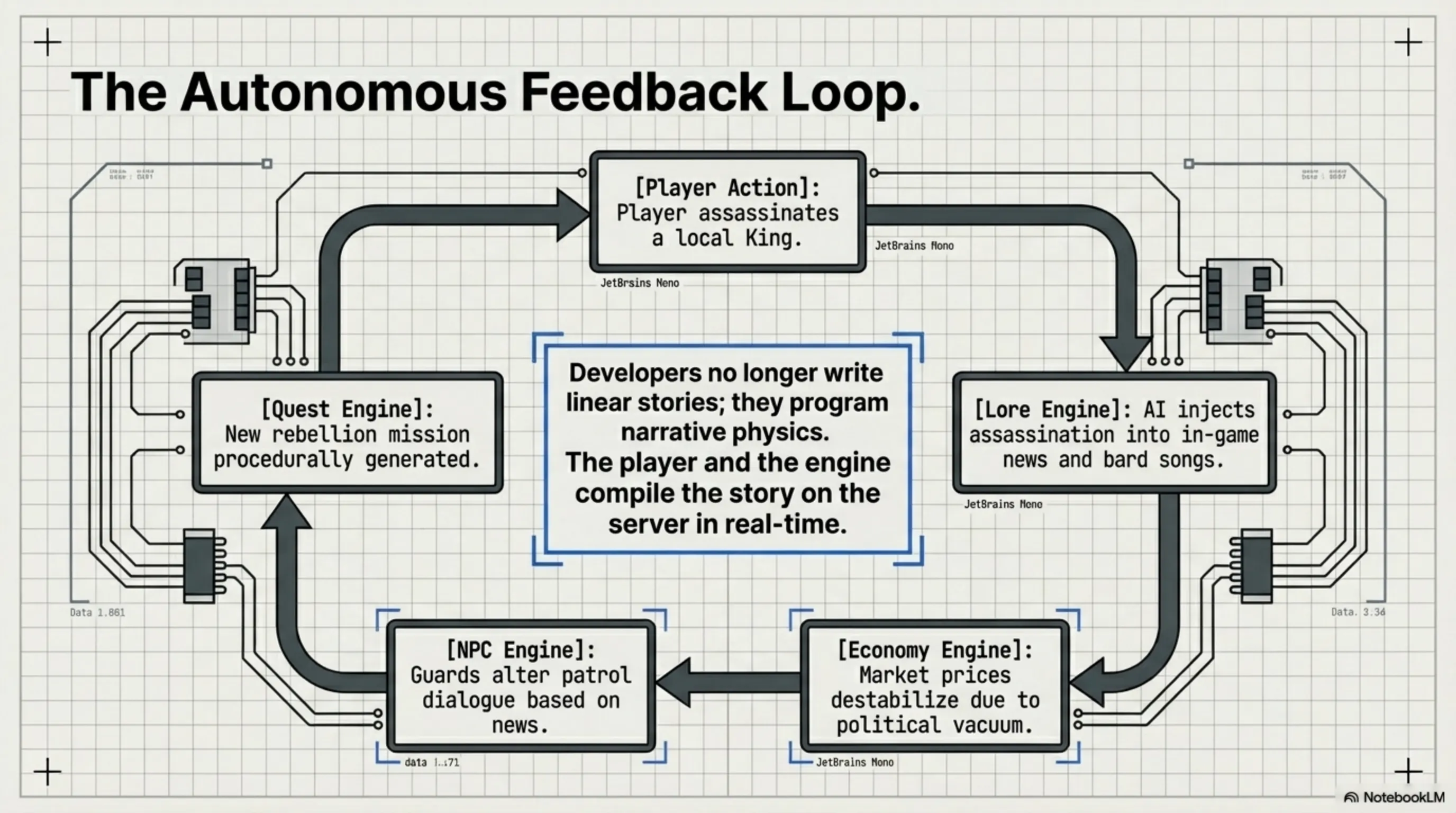
But the real magic happens when this Lore merges with gameplay. Suppose you assassinate a tyrannical king in a remote city. The developer doesn't need to pre-write newspapers or rumors for this specific event. The AI instantly injects the assassination news into in-game newspapers, alters the dialogue of guards in neighboring cities based on the event, and even prompts wandering bards in taverns to generate and sing a brand-new song about your bravery (or your treachery).
This level of dynamism has blurred the line between "game developer" and "player." Developers no longer write the story; they set up the "laws of narrative physics," and it is the player who, with the help of the AI engine, compiles their own exclusive narrative on the server.

2026 Case Studies: Pioneers of the Gaming Matrix
To truly comprehend how these cybernetic concepts migrated from engineers' whiteboards to gamers' monitors, we must examine the architecture of pioneering titles in 2026. We are no longer talking about mere Tech Demos; we are discussing AAA games that fundamentally refuse to launch without Neural Processing Units (NPUs) or powerful cloud server uplinks.
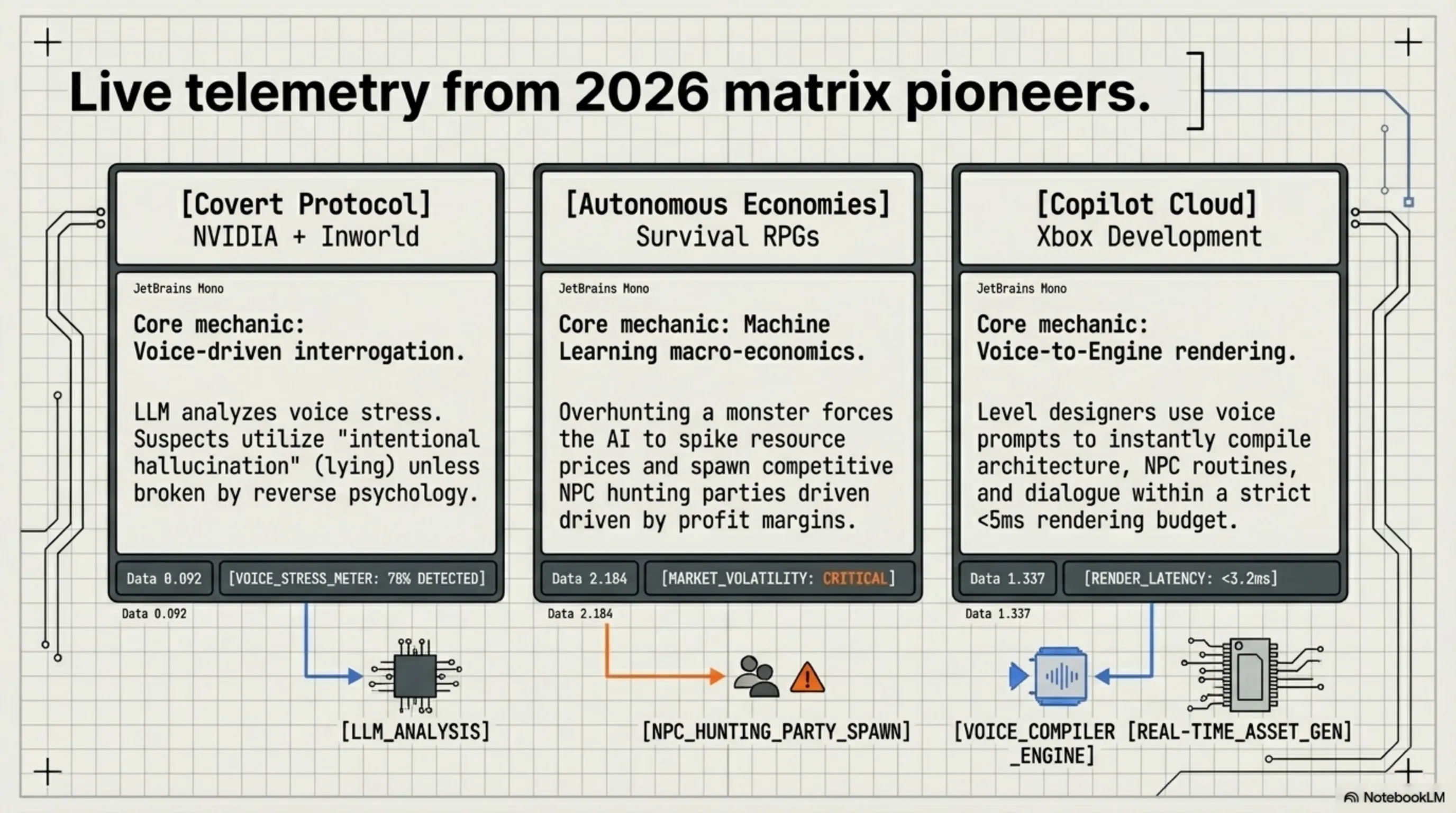
1. Project Covert Protocol (2nd Gen): Initiated by NVIDIA in collaboration with Inworld AI, this project has now evolved into an industry standard. In this detective game, there are zero pre-written dialogue options to solve puzzles. As a cyberpunk detective, you must interrogate suspects through your headset's microphone. The game's AI engine analyzes your vocal tone, the stress level in your words, and the evidence you've gathered so far. If you interrogate aggressively, the LLM-driven suspect might panic and lie (a system of intentional hallucination), but if you employ reverse psychology, they might leak classified intel. The core of this game spins on thousands of cognitive parameters; extract the AI, and the game devolves into a black screen.
2. Survival Simulators & Autonomous Economies: In modern Survival RPGs, the economy is no longer governed by linear algorithms. The AI acts as a "Macro-economic Brain." If players in a specific zone begin relentlessly hunting a certain type of monster, the AI detects the resource scarcity, dynamically inflates the prices of related crafting materials in neighboring city markets, and even generates new quests for NPCs to travel to that zone and actively compete with players. These NPCs aren't simple bots anymore; they make calculated decisions based on profit and loss assessed by Machine Learning models.
3. Xbox & Inworld Cloud Integration: By integrating an AI Copilot into the Xbox development infrastructure, Microsoft has forged a tool where developers can issue "voice commands" to the game engine instead of writing scripts. For instance, a level designer commands: "Build a war-torn village where citizens distrust strangers, and keep the rendering budget under 5 milliseconds." The AI compiles the village's architecture, citizen dialogue, and their daily routines in a matter of minutes.
The Developer's Nightmare: From Server Costs to Uncontrolled Hallucinations
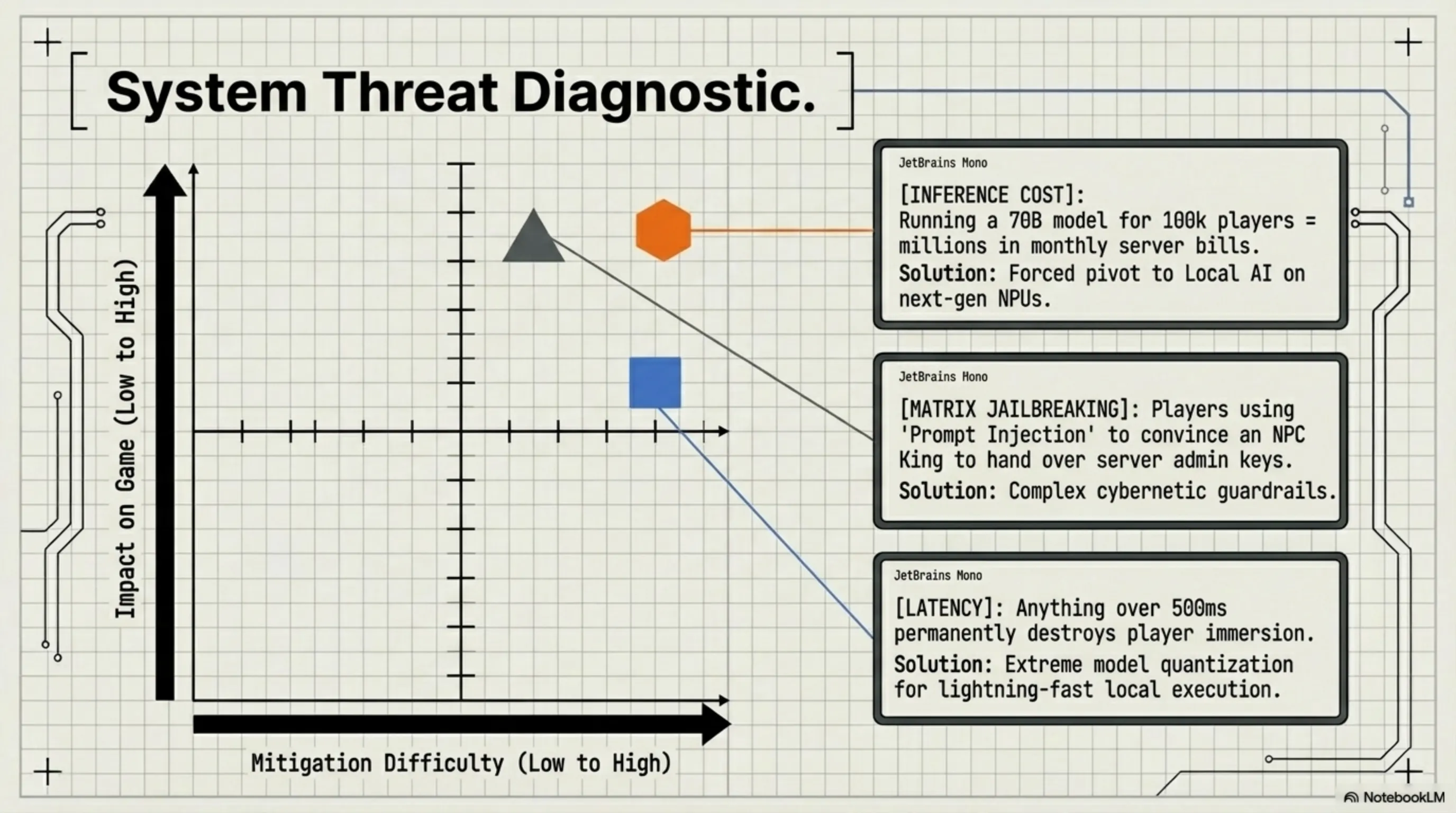
But inside Tekin Garage, we don't just stare at the shiny side of technology; we ruthlessly debug the system's flaws. Building games on an AI foundation brings horrifying engineering nightmares that have pushed game studios to the brink in 2026. The first and most colossal nightmare is Inference Cost.
In classic games, once you bought the title, all processing was handled locally by your PC or console's GPU and CPU. But processing a 70-billion-parameter LLM for 100,000 players simultaneously speaking to NPCs requires massive data centers. An API call for a single dialogue exchange might cost a fraction of a cent, but multiply that by millions of gameplay hours, and studios are hit with multi-million-dollar server bills every single month. This is exactly why AI-driven games are aggressively pivoting toward Local AI processing on next-gen hardware NPUs.
The second nightmare is Security and Jailbreaking the Matrix. Gamers are relentlessly hunting for ways to break the game's rules. What happens if a player uses verbal Prompt Engineering through their mic to convince an NPC King that he is merely an AI bot and must hand over the server's admin keys? This phenomenon, known as Prompt Injection, can obliterate the entire lore and economy of a game. Development teams are now forced to build incredibly complex cybernetic Guardrails to prevent hallucinations and psychological hacking of their NPCs.
Finally, Latency remains the mortal enemy of gaming. If it takes more than 500 milliseconds to process a character's dialogue response, player immersion is instantly destroyed. Engineers are locked in an endless battle over model Quantization—compressing language models so they can run at the speed of light, without a drop in intelligence, on consumer-grade hardware.
🏁 Tekin Analysis Conclusion
The gaming industry will never return to the era of "linear dialogue trees" and "pre-written fetch quests." The integration of Generative AI with game engines is not merely a development tool; it is the birth of an entirely new medium. We have crossed the threshold from "consuming linear content" into the era of "living, autonomous simulations."
As we autopsied in Tekin Garage, despite the terrifying infrastructure and security challenges, the future belongs exclusively to studios that can harness and control the AI matrix. Games built without AI will soon look as obsolete as silent films did at the dawn of the talkies.
We are no longer just playing games; we are living inside matrices that breathe. 🚀
Final Note: This article is based on independent testing, industry reports from IDC and Counterpoint Research, and official information from NVIDIA, Microsoft/Xbox, Inworld AI, and pioneering studios. Information is current as of March 15, 2026. Prices and hardware infrastructure requirements may vary by region.
🌐 Stay Connected With Us 🎮✨
For the latest tech, gaming, and gadget news, follow us on our official social media channels:
Additional Gallery: Tekin Analysis: Games That Cannot Be Built Without AI Anymore; Dialogue, Quests, and Testing