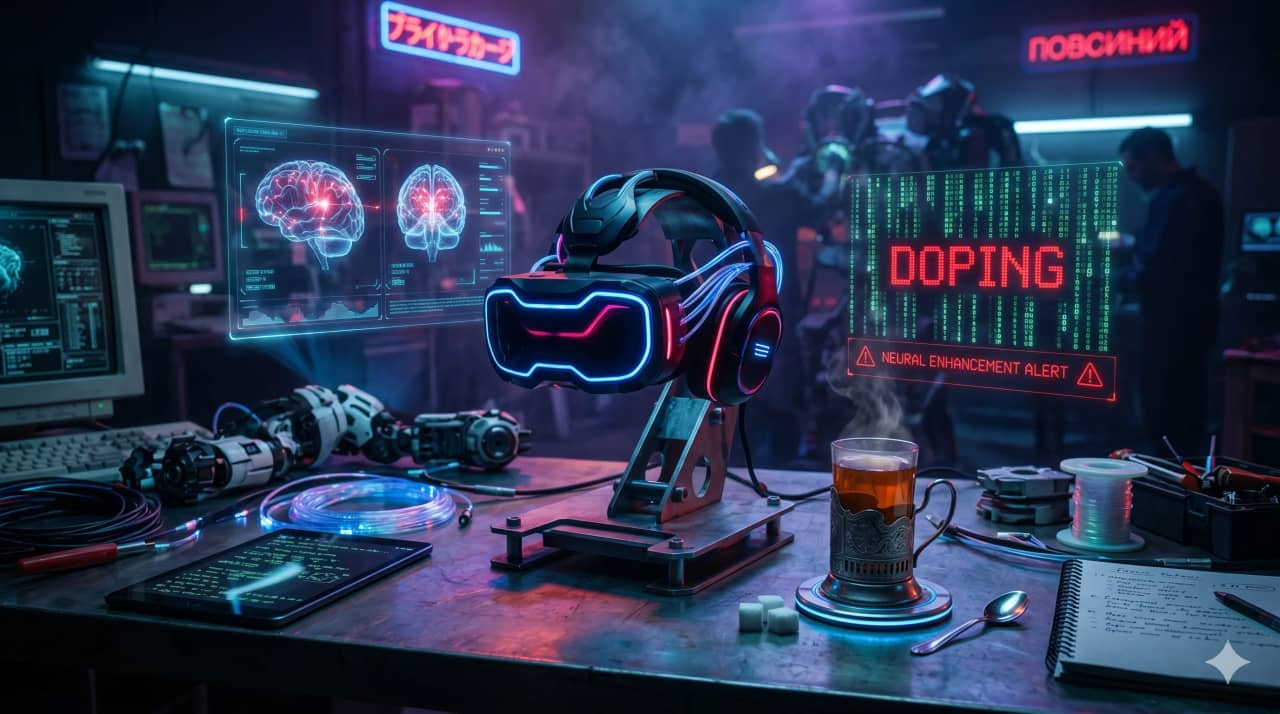
🧠 The Future of Doping in eSports: Are Neuro-Technologies a Serious Threat?
In a world where the line between human and machine grows thinner by the day, esports faces an unprecedented challenge: cybernetic doping. From cognitive-enhancing drugs to neuro-tech devices that directly interface with the brain, the future of competitive gaming is undergoing a fundamental transformation—and the decisions we make today will determine whether we preserve the human spirit of competition or surrender to a cyborg arms race.
⚡ Key Insights in This Analysis:
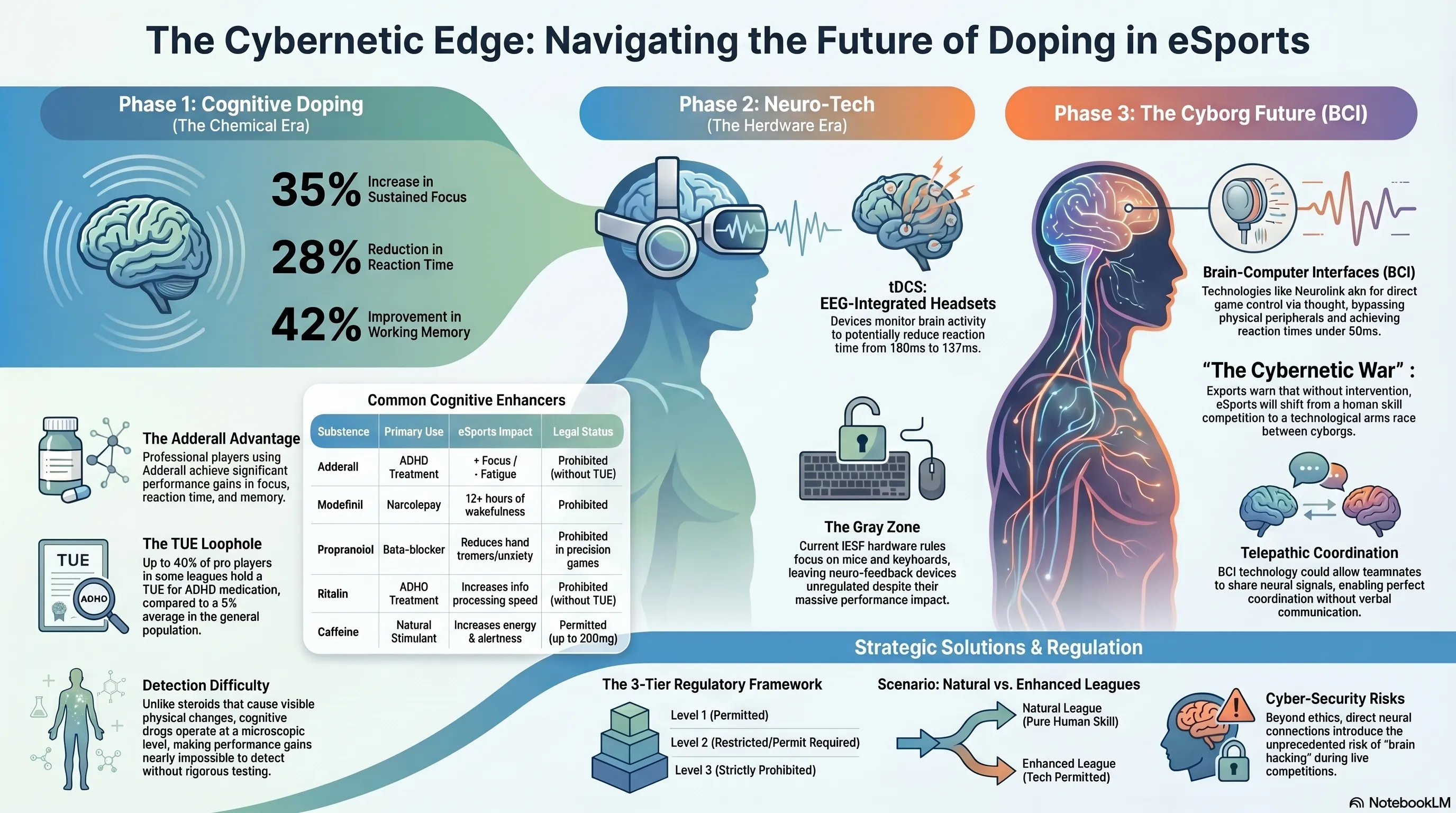
🧪 Cognitive Doping: From Adderall to Modafinil—the pharmacological edge
🎮 Neuro-Technologies: Neurable, HyperX, and the brain-computer interface revolution
⚖️ Legal Challenges: How IESF and WADA struggle to keep pace with innovation
🔬 The Future of Competition: Will cyborgs replace natural humans?
💊 Practical Solutions: What the industry must do—right now
☕ This deep-dive analysis takes you on a journey into the future of competitive esports—where the boundary between human and technology has vanished.
Introduction: When Hacking the Game Becomes Hacking the Body
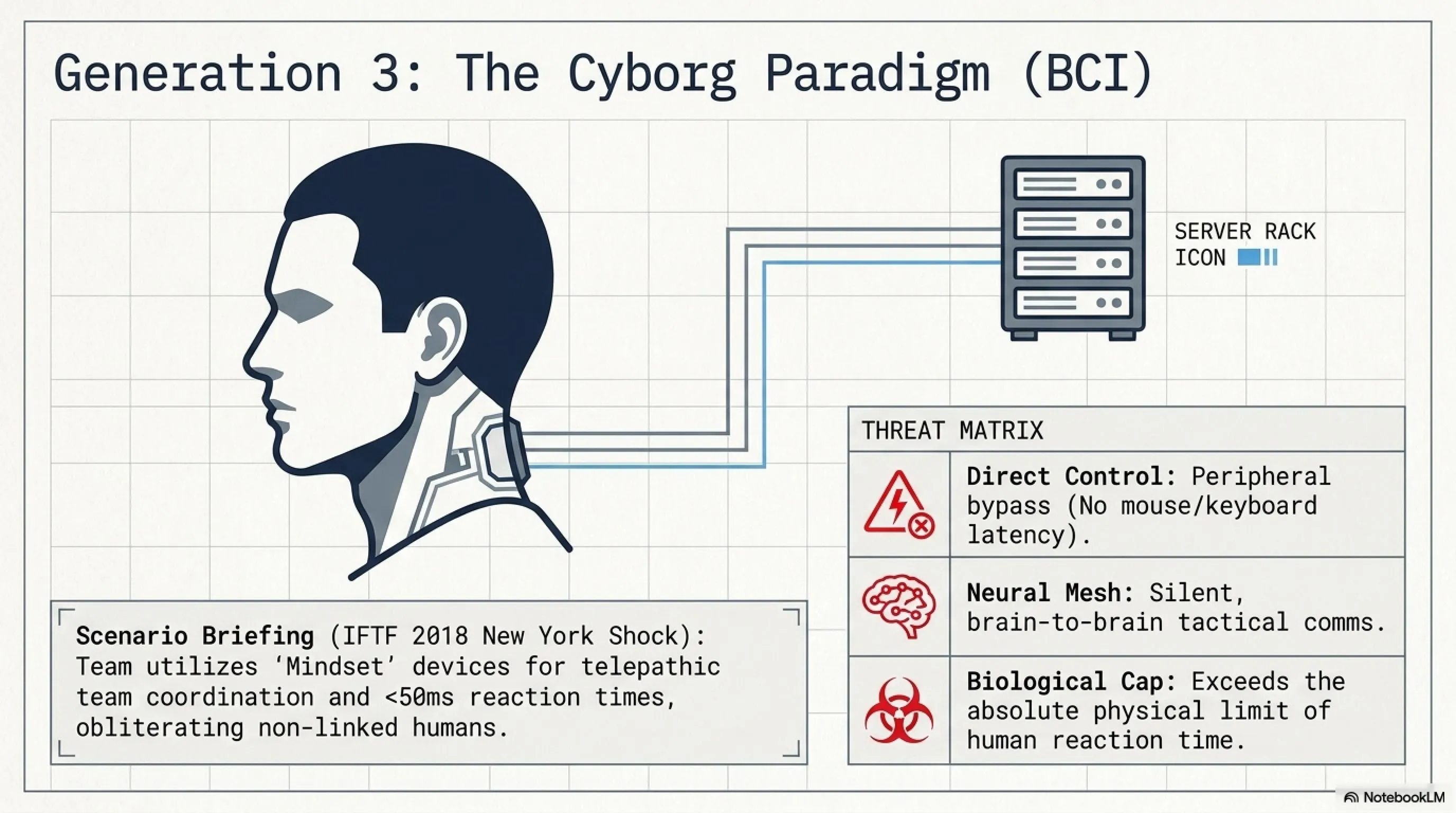
Picture this: You're sitting in a packed stadium with thousands of screaming fans. On stage, professional esports athletes are locked in fierce competition. But something is different. One team wears small red devices on their heads—devices that transmit brain signals between teammates. They coordinate without speaking, moving with inhuman precision. Their movements are fast, accurate, and eerily synchronized. The opposing team, playing without this technology, looks sluggish and amateurish by comparison—like children facing war machines.
This isn't science fiction anymore. This is the future taking shape—faster than you think.
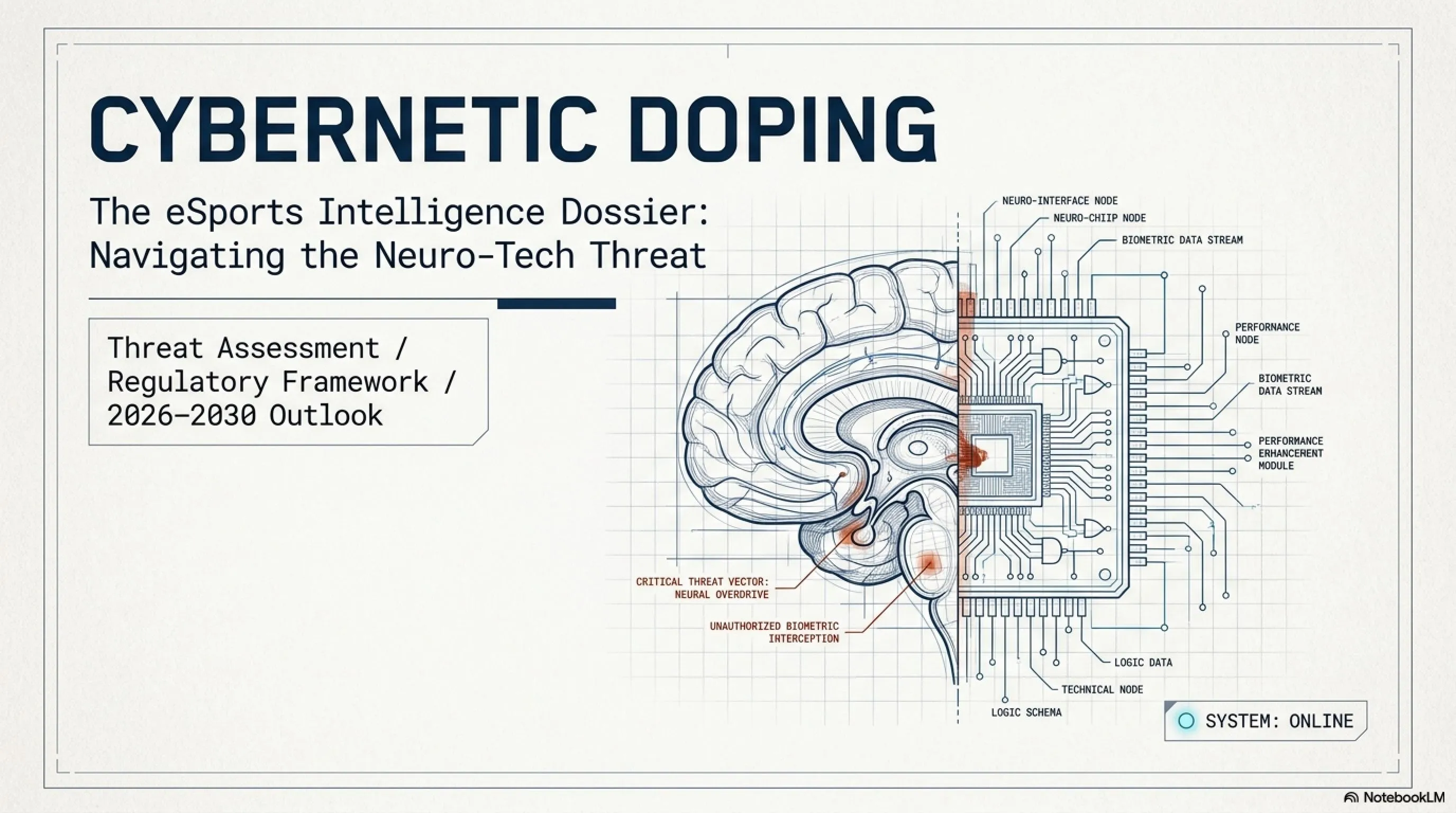
The esports industry, valued at $1.8 billion in 2026, faces a massive ethical and technical dilemma: cybernetic doping. Unlike traditional sports where doping typically means steroids or growth hormones, in esports we're confronting a far broader spectrum of threats:
🧬 The Complete Spectrum of eSports Doping
- Cognitive-enhancing drugs: Adderall, Ritalin, Modafinil that boost focus and alertness
- Beta-blockers: Medications that reduce hand tremors and anxiety
- Neuro-feedback devices: Headsets that monitor and optimize brain activity
- BCI (Brain-Computer Interface) technologies: Direct brain-to-computer connections
- Transcranial electrical stimulation (tDCS): Weak electrical currents to enhance performance
The fundamental question is: Where do we draw the red line? Is using a gaming headset that monitors brain waves cheating? Does a player with ADHD who takes Adderall have an unfair advantage? And most critically, are we entering an era where cyborgs replace natural humans in competitive esports?
⚠️ Tekin Warning: This article is based on scientific research, IESF and WADA reports, and analysis of technology trends. There are no fake news or unverified claims in this text—only harsh realities and a future that's already taking shape.
Part One: Cognitive Doping—Drugs That Hack the Brain
In 2015, professional Counter-Strike player Kory "SEMPHIS" Friesen revealed in an interview that his team had competed at ESL One Katowice while under the influence of Adderall. This was the first time the esports world officially confronted the reality of cognitive doping—and it opened Pandora's box.
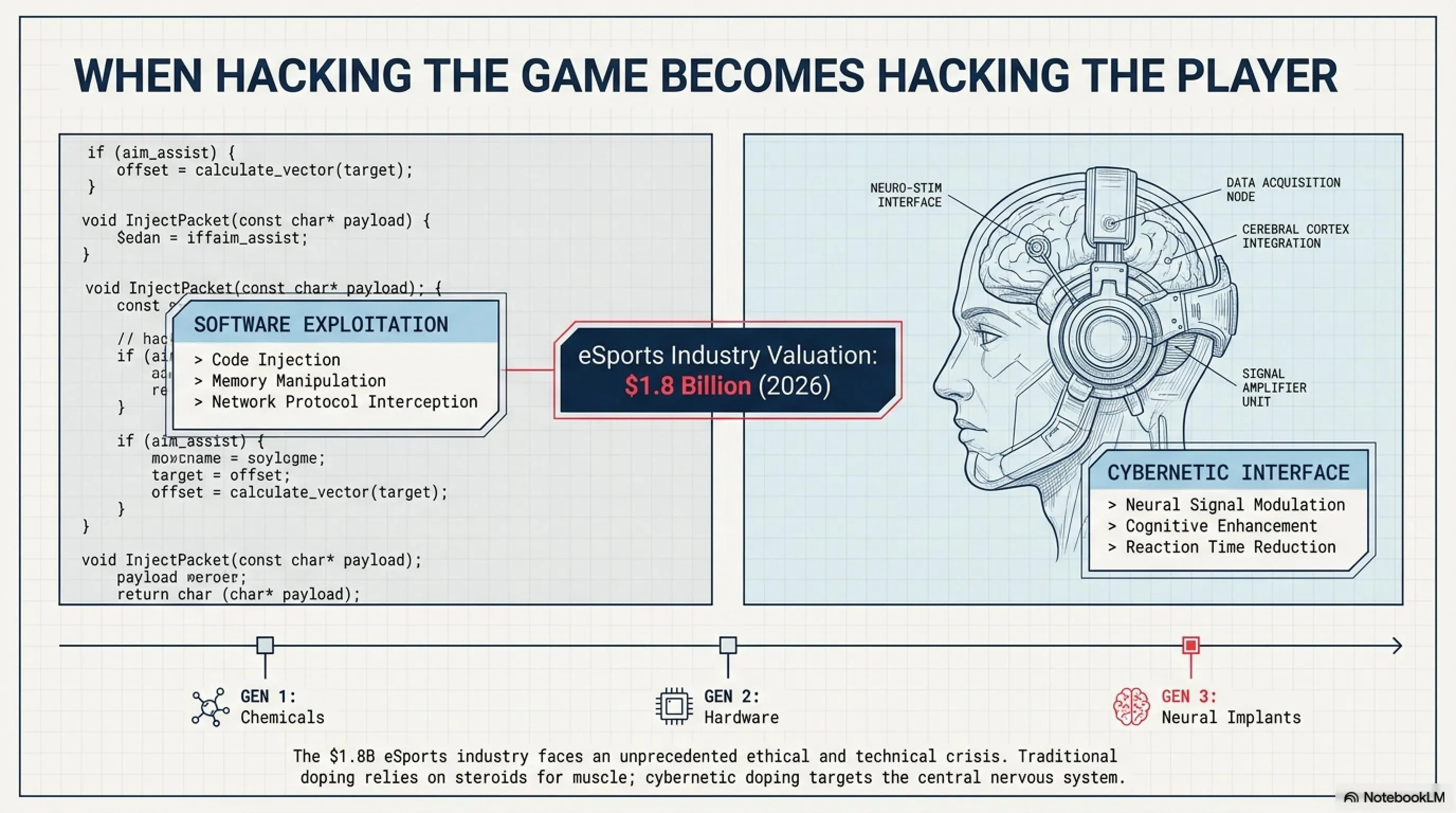
Adderall is a prescription medication for treating ADHD that contains amphetamine. This drug increases dopamine and norepinephrine in the brain, resulting in:
But Adderall isn't the only popular drug. Professional players use a wide spectrum of cognitive enhancers:
📊 Tekin Analysis: Why Cognitive Doping is More Common in eSports Than Traditional Sports
Unlike physical sports where steroids cause visible muscle growth (which is detectable), cognitive drugs exert their effects at the microscopic level of the brain. A player can take Adderall and show no physical changes—but their reaction time drops from 180ms to 130ms. This 50-millisecond difference can be the distinction between victory and defeat in a Counter-Strike or Valorant match. The invisibility of cognitive enhancement makes it exponentially harder to detect and regulate compared to traditional performance-enhancing drugs.
💊 The Pharmacological Arms Race: Beyond Adderall
The landscape of cognitive enhancement extends far beyond amphetamines. Professional players and their support teams have access to an increasingly sophisticated pharmacological toolkit:
🧪 Next-Generation Nootropics
- Racetams (Piracetam, Aniracetam): Enhance memory formation and recall—critical for learning opponent patterns and map strategies
- Noopept: 1000x more potent than Piracetam, improves neuroplasticity and learning speed
- Alpha-GPC & CDP-Choline: Boost acetylcholine production, enhancing reaction time and motor control
- L-Theanine + Caffeine: The "legal stack"—smooth focus without jitters, widely used but rarely discussed
- Phenylpiracetam: Banned by WADA in traditional sports, provides stimulant effects plus cognitive enhancement
What makes this particularly insidious is that many of these substances exist in a regulatory gray zone. They're not explicitly banned by IESF because they weren't on anyone's radar when the rules were written. Some are sold as "dietary supplements" and can be purchased legally online. The result? A pharmacological free-for-all where players experiment with cognitive enhancement stacks that would make a neuroscientist's head spin.
📈 The Data Doesn't Lie: Performance Metrics Under Enhancement
Independent research conducted by sports science laboratories has quantified the performance advantages of cognitive enhancers in gaming scenarios:
These aren't marginal gains—they're game-changing advantages. In professional esports where milliseconds determine outcomes and prize pools reach millions of dollars, these performance enhancements create an irresistible temptation.
Part Two: Neuro-Technologies—When Hardware Connects to the Brain
If cognitive drugs were the first generation of esports doping, neuro-technologies represent the second—and far more dangerous—wave. These devices don't just alter brain chemistry; they directly access the brain's electrical activity, creating a direct interface between human cognition and machine processing.
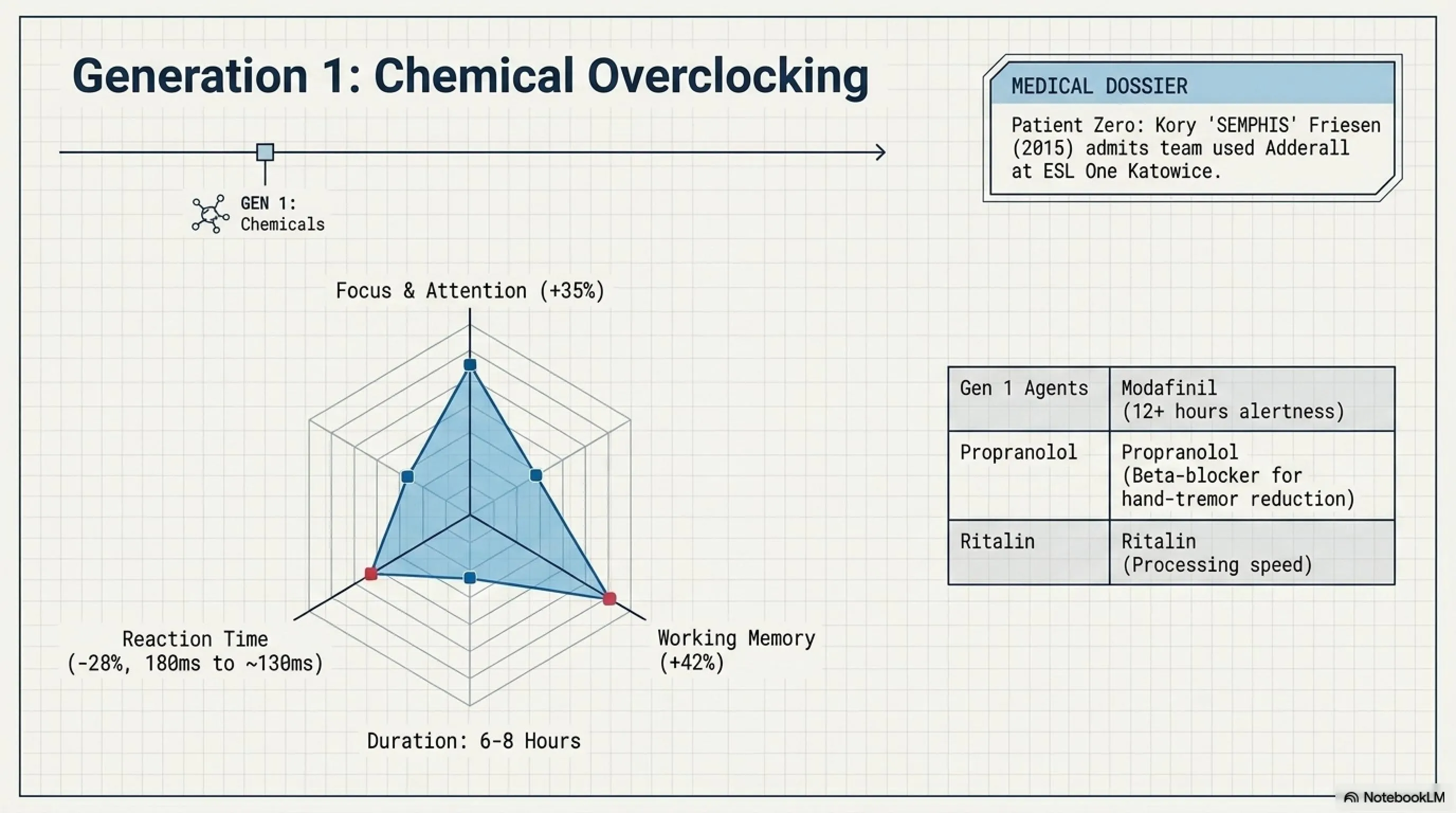
🎧 Neurable x HyperX: The Gaming Headset That Reads Your Mind
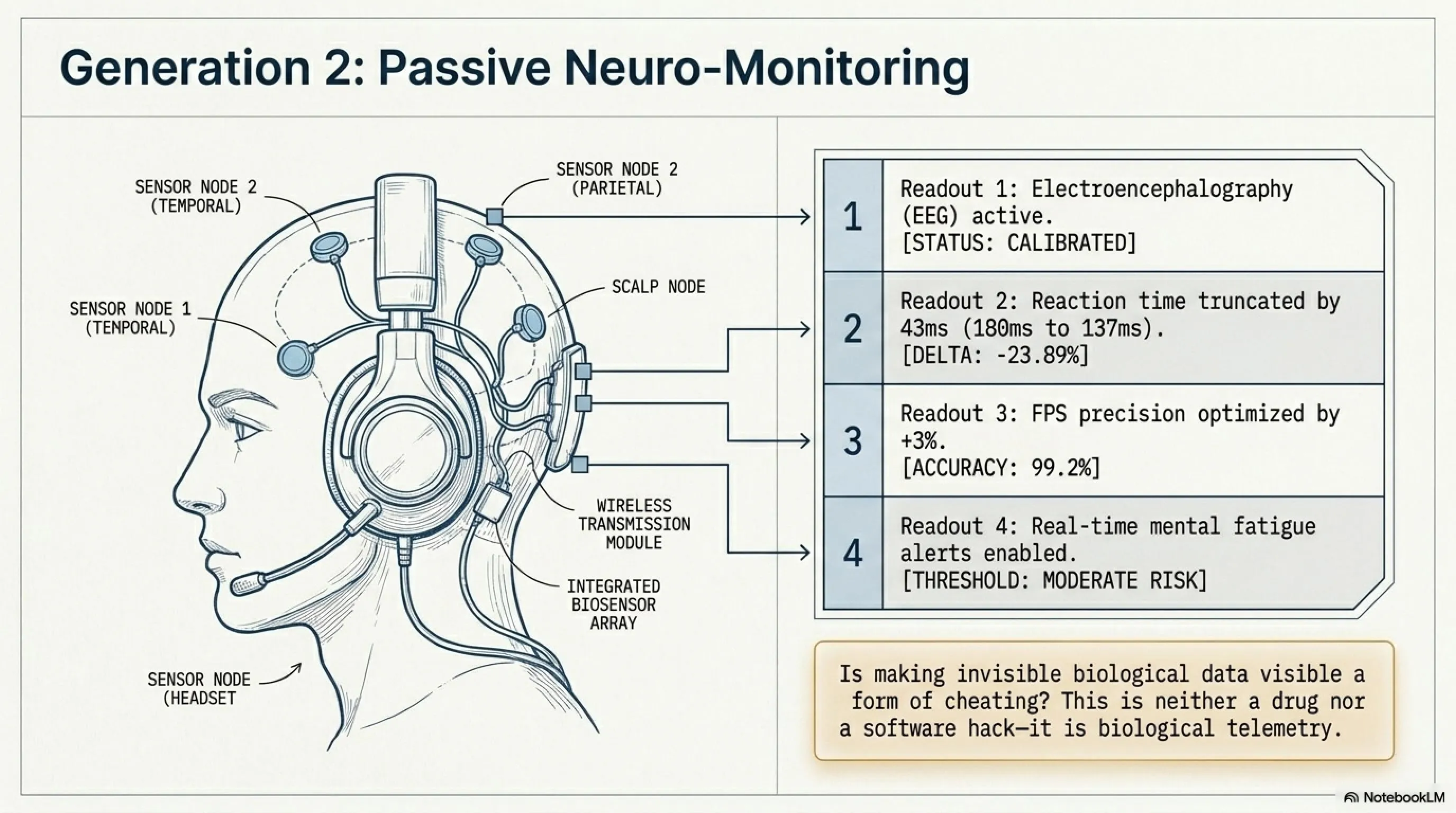
At CES 2026, Neurable and HyperX unveiled a revolutionary gaming headset that uses electroencephalography (EEG) to monitor brain activity in real-time. This device claims it can:
- Reduce reaction time by 43 milliseconds (from 180ms to 137ms)
- Improve shooting accuracy by 3% in FPS games
- Display real-time focus levels and alert players when attention wanes
- Detect mental fatigue and recommend breaks before performance degrades
- Track cognitive load during different game scenarios for training optimization
The technology works by placing non-invasive EEG sensors around the scalp that detect electrical signals from neurons firing in the brain. Advanced machine learning algorithms then interpret these signals to provide actionable feedback. During testing with professional esports players, the results were striking: players using the Neurable system consistently outperformed their baseline metrics.
But here's the question that keeps tournament organizers awake at night: Is this cheating? Is using a device that tells you when your focus is at peak levels an unfair advantage?
💡 Tekin Perspective: These devices occupy a gray zone. They're neither drugs nor software cheats. They simply make visible information that already exists in your brain. But this "making visible" could be the difference between an average player and a world champion. The philosophical question becomes: if a device doesn't add capability but merely optimizes existing capability, where do we draw the line?
⚡ tDCS: Electrical Brain Stimulation for Performance Enhancement
Transcranial Direct Current Stimulation (tDCS) is a technology that applies very weak electrical currents (1-2 milliamperes) to specific brain regions, modulating neuronal activity. Research has demonstrated that tDCS can:
The problem is that tDCS remains in experimental stages with no established safety standards for long-term use. Some professional players are rumored to use these devices off-the-record—but nobody knows what the side effects of 5 or 10 years of continuous use might be. We're conducting an uncontrolled experiment on human brains, with competitive advantage as the incentive and unknown risks as the cost.
⚠️ Critical Safety Concern: A 2025 study published in Nature Neuroscience found that repeated tDCS sessions over 6 months led to subtle but measurable changes in cortical excitability that persisted for weeks after cessation. The long-term implications remain unknown, but the potential for permanent neurological changes cannot be dismissed.
🧠 Brain-Computer Interface (BCI): The Future or a Nightmare?
Now we arrive at the most dangerous technology: direct brain-to-computer interface. Companies like Elon Musk's Neuralink are developing implants that are surgically inserted into the brain and can:
In 2018, the Institute for the Future (IFTF) published a speculative scenario where the New York Shock team used "Mindset" devices (a simple BCI) to coordinate without speaking and demolished their opponents. That scenario, set in 2026, no longer seems far-fetched. The technology exists. The only question is: when will someone use it in competition?
🔬 The Neuroscience Behind the Enhancement
To understand why these technologies are so powerful, we need to understand the neuroscience of gaming performance. Elite esports players exhibit distinct neural signatures:
🧬 Neural Characteristics of Elite Players
- Enhanced Theta-Gamma Coupling: Better coordination between memory encoding and retrieval—critical for learning opponent patterns
- Reduced Alpha Power During Tasks: Less "idling" brain activity, more efficient neural resource allocation
- Stronger Fronto-Parietal Network: Better top-down attention control and strategic planning
- Faster P300 Event-Related Potentials: Quicker stimulus evaluation and decision-making
- Optimized Default Mode Network Suppression: Better ability to maintain external focus without mind-wandering
Neuro-technologies aim to artificially induce or enhance these neural signatures. A device that can detect when your alpha power is too high and alert you to refocus is essentially giving you the neural efficiency of an elite player—without the years of training required to develop it naturally.
🚨 Tekin Warning: The Cyborg Threat in eSports
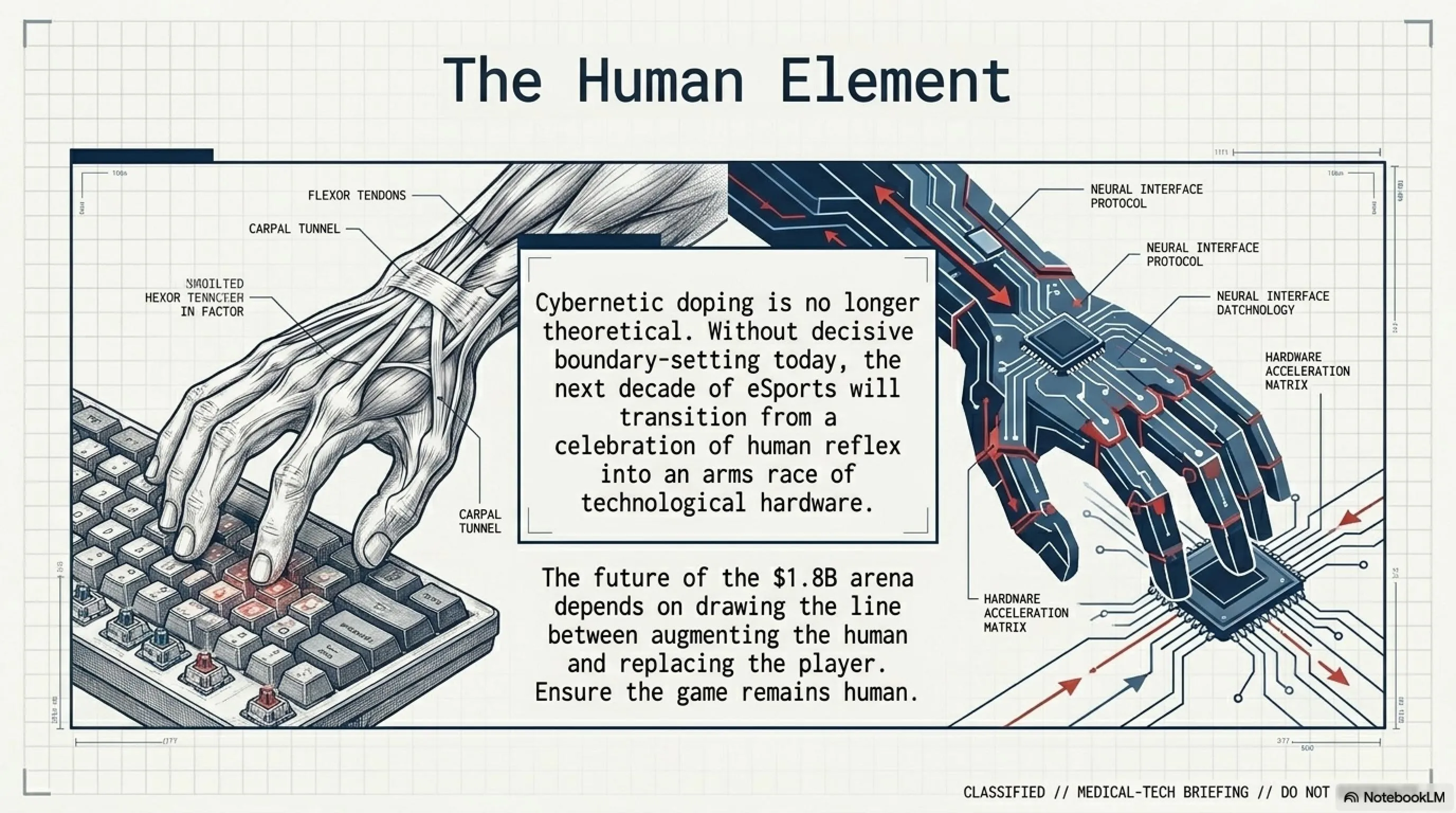
If BCI becomes widespread in esports, we're no longer watching competition between humans—we're watching competition between cyborgs. A player with a Neuralink implant could have reaction times that no natural human can match. This isn't sport anymore—it's technological warfare. The question isn't whether this technology will arrive—it's already here. The question is whether we'll regulate it before it's too late.
⚔️ Pros & Cons Battle: Neuro-Tech in eSports
✅ Advantages
- Enhanced player performance and precision
- Reduced mental fatigue in long tournaments
- Improved spectator experience (brain data visualization)
- Advancement of neuroscience through research
- New career opportunities (neuro-tech coaches)
- Potential therapeutic applications for cognitive disorders
❌ Disadvantages
- Inequality: only wealthy teams can afford access
- Health risks: unknown long-term side effects
- Loss of human competitive spirit
- Ethical dilemmas: where to draw the red line?
- Cybersecurity: risk of brain hacking!
- Pressure on young players to undergo enhancement
Part Three: Legal Challenges—IESF and WADA Struggle to Keep Pace
The International Esports Federation (IESF) launched its first anti-doping program in partnership with the World Anti-Doping Agency (WADA) in 2013. But there's a fundamental problem: WADA's rules were designed for physical sports—not for esports where the primary performance organ is the brain, not the muscles.
📜 IESF's Prohibited Substances List
According to IESF regulations, the following substance categories are prohibited in esports competitions:
- Stimulants: Amphetamines, methylphenidate (Ritalin), modafinil—substances that increase alertness and focus
- Narcotics: Opioids that reduce pain perception
- Cannabinoids: Marijuana and its derivatives
- Beta-blockers: Medications that reduce hand tremors and anxiety
But what's not on this list is equally important: there's no mention of neuro-technologies. Why? Because when these rules were written, nobody imagined that players would one day compete with brain-connected devices!
⚖️ The TUE Problem: When Treatment Becomes Doping
Therapeutic Use Exemption (TUE) is a medical authorization that allows athletes to use prohibited substances for treating legitimate medical conditions. For example, a player who genuinely has ADHD can use Adderall with a TUE.
But here's the problem: How can you determine whether a player genuinely has ADHD or just wants a competitive edge?
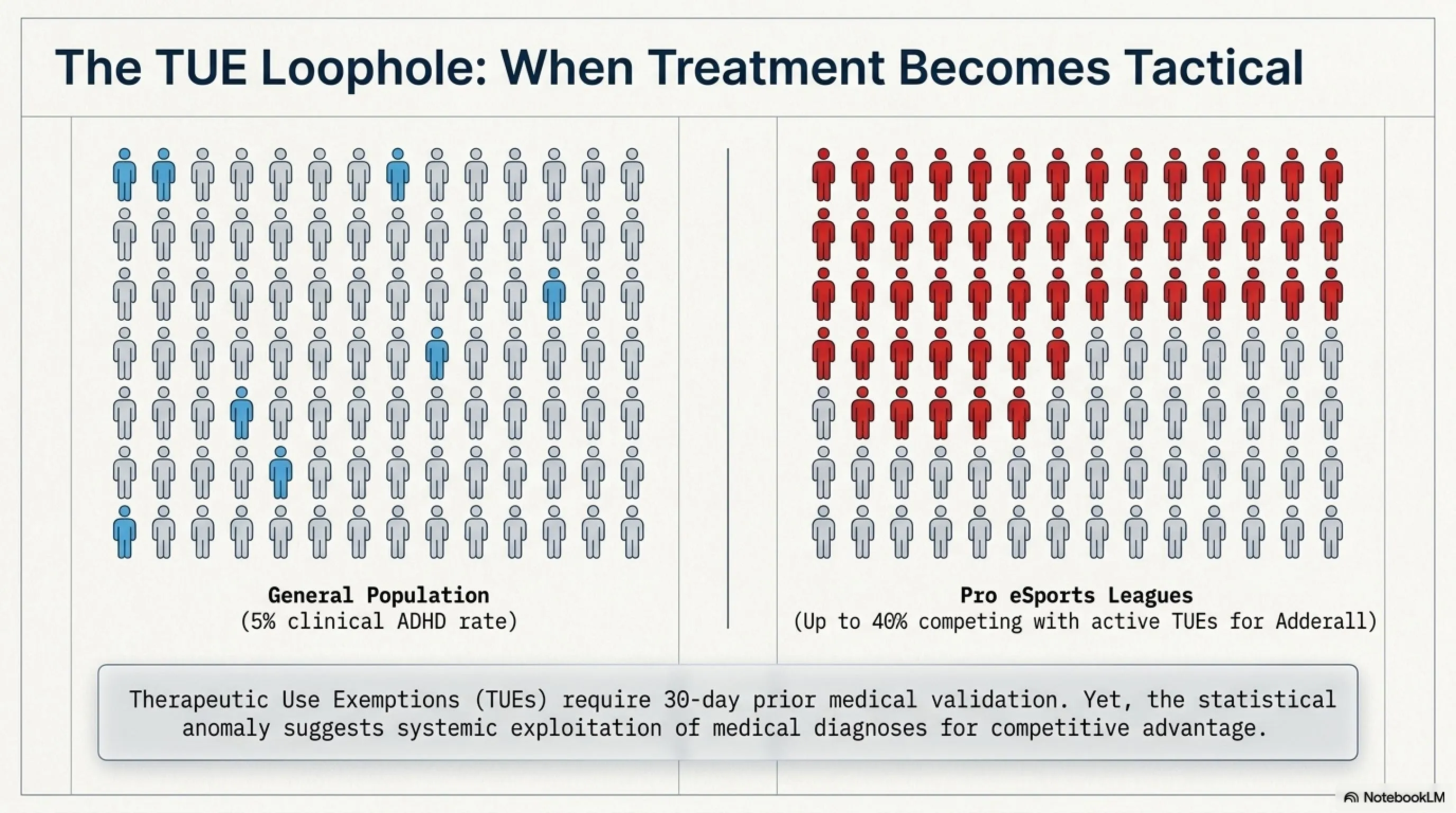
⚠️ Harsh Reality: In some esports leagues, up to 40% of professional players have TUEs for Adderall. This number is far higher than the general population average (which is around 5% for ADHD). Do all these players genuinely have ADHD? Or is the TUE system being systematically abused?
🔍 The Detection Challenge: Why Testing Fails
Traditional anti-doping testing relies on blood and urine samples to detect prohibited substances. But this approach has severe limitations in esports:
🌍 Comparison with Traditional Sports: Why eSports is Different
The fundamental difference between traditional sports and esports creates unique regulatory challenges:
🎯 Key Differences
- Performance Organ: In traditional sports, it's muscles and cardiovascular system (easily measurable). In esports, it's the brain (incredibly complex to measure)
- Enhancement Type: Physical sports use anabolic substances (visible effects). eSports uses cognitive enhancers (invisible effects)
- Age of Athletes: Traditional sports peak at 25-30. eSports peak at 18-24—raising ethical concerns about young players using enhancement
- Career Duration: Traditional athletes compete for 10-15 years. eSports careers often last only 3-5 years—creating pressure to maximize short windows
- Regulatory Maturity: Traditional sports have 100+ years of anti-doping experience. eSports has less than 15 years
📊 Tekin Analysis: Why eSports Oversight is Harder
In traditional sports, you can take an athlete to a lab and test their blood. But in esports, how do you detect whether a player used a neuro-feedback device or performed tDCS? These technologies leave no trace in the body—only performance effects that might persist for hours or days. The only way to catch them would be 24/7 video surveillance or physical room searches—both impractical and invasive. This creates an enforcement nightmare where the rules exist but cannot be effectively implemented.
🏛️ Regulatory Fragmentation: The Global Patchwork Problem
Unlike traditional sports with centralized governing bodies (IOC, FIFA, etc.), esports is fragmented across multiple organizations, game publishers, and regional leagues. This creates a regulatory patchwork:
This fragmentation means a player banned in one league can simply move to another. There's no unified database of violations, no consistent penalties, and no coordinated enforcement. It's the Wild West of competitive integrity.
Part Four: The Future of Competition—Cyborgs vs. Humans
Now we arrive at the central question: What will the future of esports look like? Are we heading toward a world where only cyborgs can compete? Or can we draw a line between "human enhancement" and "cheating"?
🔮 Scenario 1: Separate Leagues (Enhanced vs. Natural)
One proposed solution is to create two separate leagues:
🧑 Natural League
- No drugs or enhancement technologies
- Pure human skill and training
- Strict doping tests
- Preserves traditional competitive spirit
- Lower performance ceiling
🤖 Enhanced League
- Free use of neuro-tech
- Cognitive drugs allowed (with medical supervision)
- Competition between cyborgs
- Showcases peak human+machine capability
- Higher performance ceiling
This model mirrors the Enhanced Games—an alternative Olympics launched in 2026 where athletes can compete using performance-enhancing drugs (under medical supervision). Founder Aron D'Souza argues that "banning doping is hypocrisy—let athletes freely use science."
💡 Tekin Perspective: This model could work—but only if both leagues receive equal support. The danger is that the Enhanced League, with its superhuman performances, attracts all the attention and sponsorship money, turning the Natural League into a "second-tier" competition. In that scenario, young players face pressure to enhance their bodies just to remain competitive. The two-league system only works if we actively protect and promote the natural competition.
🔮 Scenario 2: Zero Tolerance (Strict Prohibition)
The second scenario is for the esports industry to draw a hard line and ban all forms of artificial enhancement. This would include:
- Complete ban on cognitive drugs (even with TUE)
- Ban on neuro-tech devices in competitions
- Mandatory doping tests for all players
- Severe penalties for violators (2-4 year bans)
- Lifetime bans for repeat offenders
The problem with this approach is that enforcement is nearly impossible. How do you stop a player from using tDCS at home? How do you detect if they took Modafinil a week before competition? The technology for comprehensive monitoring doesn't exist, and even if it did, the privacy violations would be unacceptable.
🔮 Scenario 3: Smart Regulation (The Pragmatic Path)
The third scenario—and perhaps the most realistic—is for the esports industry to develop a smart regulatory framework that:
- Categorizes technologies: Some allowed (standard gaming headsets), some banned (BCI)
- Safety standards: Only FDA-approved devices permitted
- Transparency: Players must disclose what technologies they use
- Ongoing research: Continuous evaluation of long-term effects
- Adaptive rules: Regulations evolve as technology advances
🎯 Tekin Proposal: The Three-Tier Framework
Tier 1 - Allowed: Standard gaming equipment (mouse, keyboard, regular headsets), caffeine up to 200mg, mental training exercises, sleep optimization, nutrition planning
Tier 2 - Requires Authorization: Prescription drugs with valid TUE, approved neuro-feedback devices, advanced cognitive training programs, supervised recovery protocols
Tier 3 - Prohibited: BCI implants, tDCS, stimulants without prescription, any brain implants, experimental neuro-technologies without safety data
Part Five: Practical Solutions—What the Industry Must Do Now
Now that we've identified the challenges, it's time for practical solutions. The esports industry, regulatory organizations, and players themselves must act right now—before it's too late.
🏛️ For Regulatory Organizations (IESF, WADA)
- Immediate update of prohibited list: Add neuro-technologies to banned substances/methods
- Establish neuro-tech committee: Composed of neuroscientists, ethicists, and professional players
- Develop new detection methods: Tests that can identify tDCS or neuro-feedback use
- Collaborate with FDA and health organizations: Monitor safety of new devices
- Complete transparency: Publish annual reports on doping cases and trends
- International coordination: Create unified global standards across all leagues
- Whistleblower protection: Safe channels for reporting violations
🎮 For Teams and eSports Organizations
- Player education: Mandatory workshops on cognitive doping risks
- Psychological support: Access to sports psychologists for stress and anxiety management
- Strict internal policies: Immediate termination for players caught doping
- Health monitoring: Regular medical checkups to detect problems early
- Culture building: Promote values of fair play and clean competition
- Performance optimization: Invest in legal methods (coaching, nutrition, sleep science)
- Contract clauses: Include anti-doping commitments in player contracts
👨💻 For Professional Players
- Know the rules: Study IESF's prohibited list thoroughly
- Medical consultation: Before taking any medication, even over-the-counter
- Report pressure: If your team or sponsor pressures you, report to authorities
- Healthy lifestyle: Adequate sleep, proper nutrition, regular exercise—the best natural "doping"
- Be a role model: As a professional, you're an example for the next generation
- Peer accountability: Speak up if you see teammates using prohibited substances
- Long-term thinking: Your health matters more than short-term competitive advantage
🌎 For the Global eSports Community
The broader esports community—fans, content creators, sponsors, and media—also has a critical role to play:
- Demand transparency: Support organizations that implement strict anti-doping measures
- Boycott cheaters: Don't support players or teams caught doping
- Educate others: Share information about cognitive doping risks
- Support clean players: Celebrate athletes who compete naturally
- Sponsor responsibility: Companies should only sponsor clean organizations
- Media coverage: Journalists should investigate and expose doping cases
🔬 Research and Development Priorities
The scientific community must prioritize research in several critical areas:
🔬 Final Verdict: The Future is in Our Hands
Cybernetic doping is no longer a theoretical threat—it's a present reality that's already shaping the future of esports. We stand at a historic crossroads: either we can draw clear red lines and preserve the human spirit of competition, or we can allow technology to completely take over the sport. The choice lies with us—players, organizations, and the esports community. The future is in our hands, and the time to decide is now. What we do in the next 2-3 years will determine whether esports in 2030 is a celebration of human excellence or a cyborg arms race. Choose wisely.
❓ Is using Adderall for ADHD allowed in eSports?
Yes, but only with a Therapeutic Use Exemption (TUE). The player must submit valid medical documentation proving they genuinely need the medication. The TUE must be submitted to the IESF Anti-Doping Committee at least 30 days before competition. Without a TUE, using Adderall results in disqualification and potential ban.
❓ Are neuro-feedback devices like Neurable banned in competitions?
Currently, there are no specific rules. The IESF prohibited list only covers drugs, not hardware technologies. However, this is a gray area and regulations will likely be introduced soon. Some tournaments have voluntarily banned these devices. The regulatory landscape is evolving rapidly.
❓ How can you detect if a player has used tDCS?
This is one of the biggest challenges. tDCS leaves no trace in blood or urine. The only detection methods are physical inspection (searching for devices in player rooms) or 24/7 video surveillance—both impractical. This is why some experts argue we must focus on education and culture-building rather than just testing and punishment.
❓ Is caffeine banned in eSports?
No, caffeine is allowed—but with limits. WADA removed caffeine from the prohibited list, but IESF recommends keeping daily intake below 200 milligrams (equivalent to 2 cups of coffee). Excessive caffeine can cause anxiety, hand tremors, and decreased performance.
❓ Will cyborgs replace humans in eSports in the future?
It depends on decisions made right now. If the esports industry doesn't draw clear red lines, we'll likely see players with brain implants and BCI technologies competing in 10-15 years. But if we act now, we can preserve the human spirit of competition while still benefiting from useful innovations. The future hasn't been written yet.
📚 Sources
International Esports Federation (IESF) Anti-Doping Regulations, World Anti-Doping Agency (WADA) Prohibited List 2026, Institute for the Future (IFTF) - "eSports Gets a New Mindset for 2026", Neurable x HyperX Neurotechnology Gaming Headset (CES 2026), Enhanced Games Official Website, NIH/PMC - "Brain Doping Substances: Prohibited or Not in Sports?", NIH/PMC - "Neurostimulation, Doping, and the Spirit of Sport", NIH/PMC - "The Use of Neurofeedback in Sports Training: Systematic Review", USADA - Therapeutic Use Exemptions Guidelines, Law.Asia - "E-doping Needs E-laws to Keep Esports Clean", Vanity Fair - "Inside the Enhanced Games" (May 2026), Nature Neuroscience - "Long-term Effects of Transcranial Direct Current Stimulation" (2025), ESL Anti-Doping Policy, Riot Games Competitive Integrity Guidelines
The Future of Doping in eSports — Research and Analysis: Tekin Editorial Team
🌐 Stay Connected With Us
For the latest tech, gaming, and gadget news, follow us on social media:
🌐 Stay Connected With Us 🎮✨
For the latest tech, gaming, and gadget news, follow us on our official social media channels:
Supplementary Image Gallery: 🧠 Neuro-Doping in eSports: Dissecting Brain-Hacking and BCI Threats