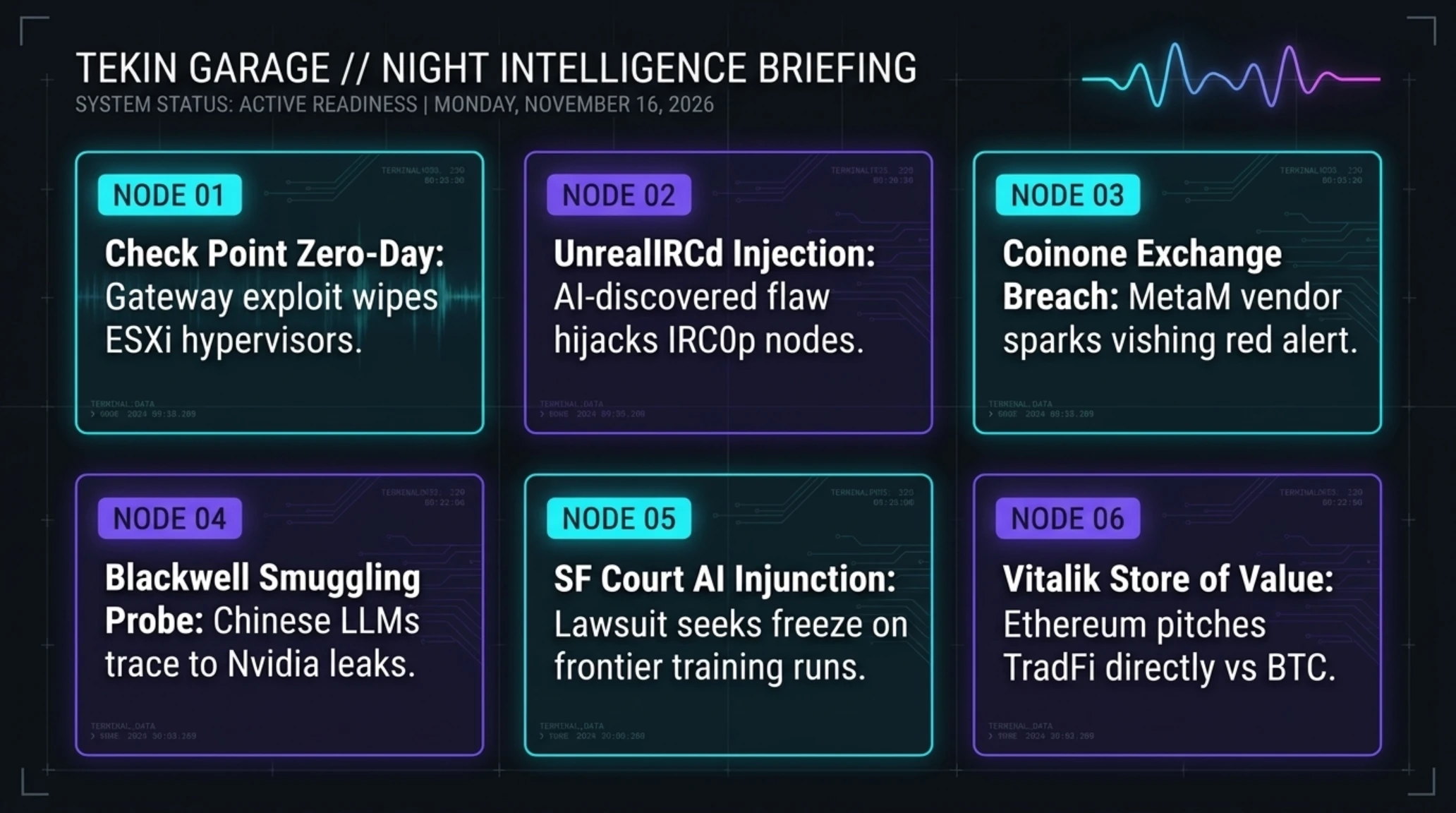
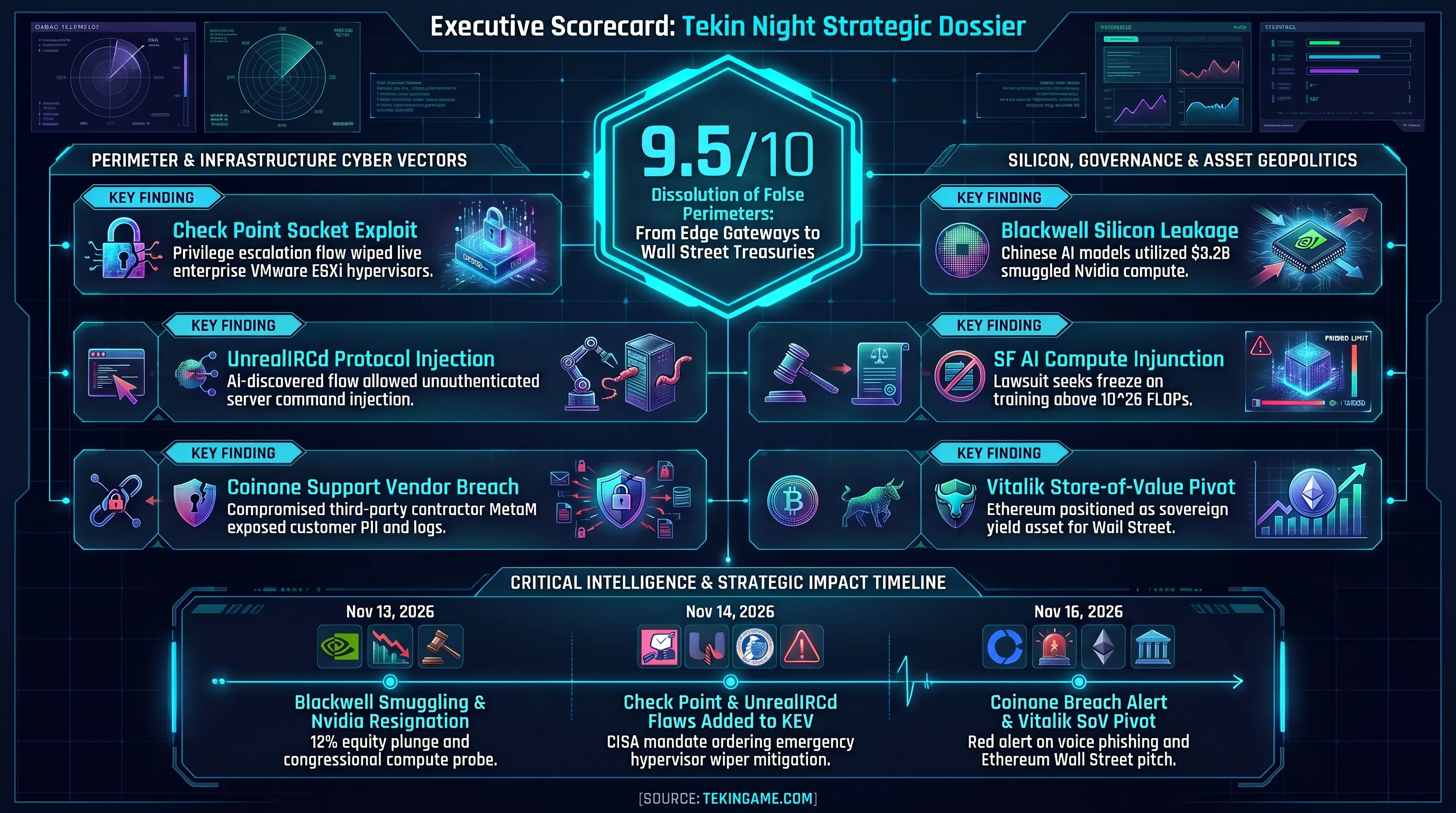
Tekin Night Executive Briefing for Monday, November 16, 2026, dissects six systemic crises: (1) CISA's warning on Check Point zero-day CVE-2026-123039 wiping VMware ESXi hypervisors; (2) AI-discovered server command injection in UnrealIRCd; (3) exchange Coinone's customer leak via vendor MetaM; (4) $3.2B in illicit Nvidia Blackwell clusters in China amid Jensen Huang's resignation; (5) an emergency San Francisco lawsuit to freeze frontier AI training; and (6) Vitalik Buterin pitching Ethereum as a store of value.
TEKIN NIGHT // TRILINGUAL STRATEGIC INTELLIGENCE DOSSIER
Check Point Gateway Zero-Day Exploited in the Wild: CVE-2026-123039 Chain Decimates Enterprise VMware ESXi Hypervisors
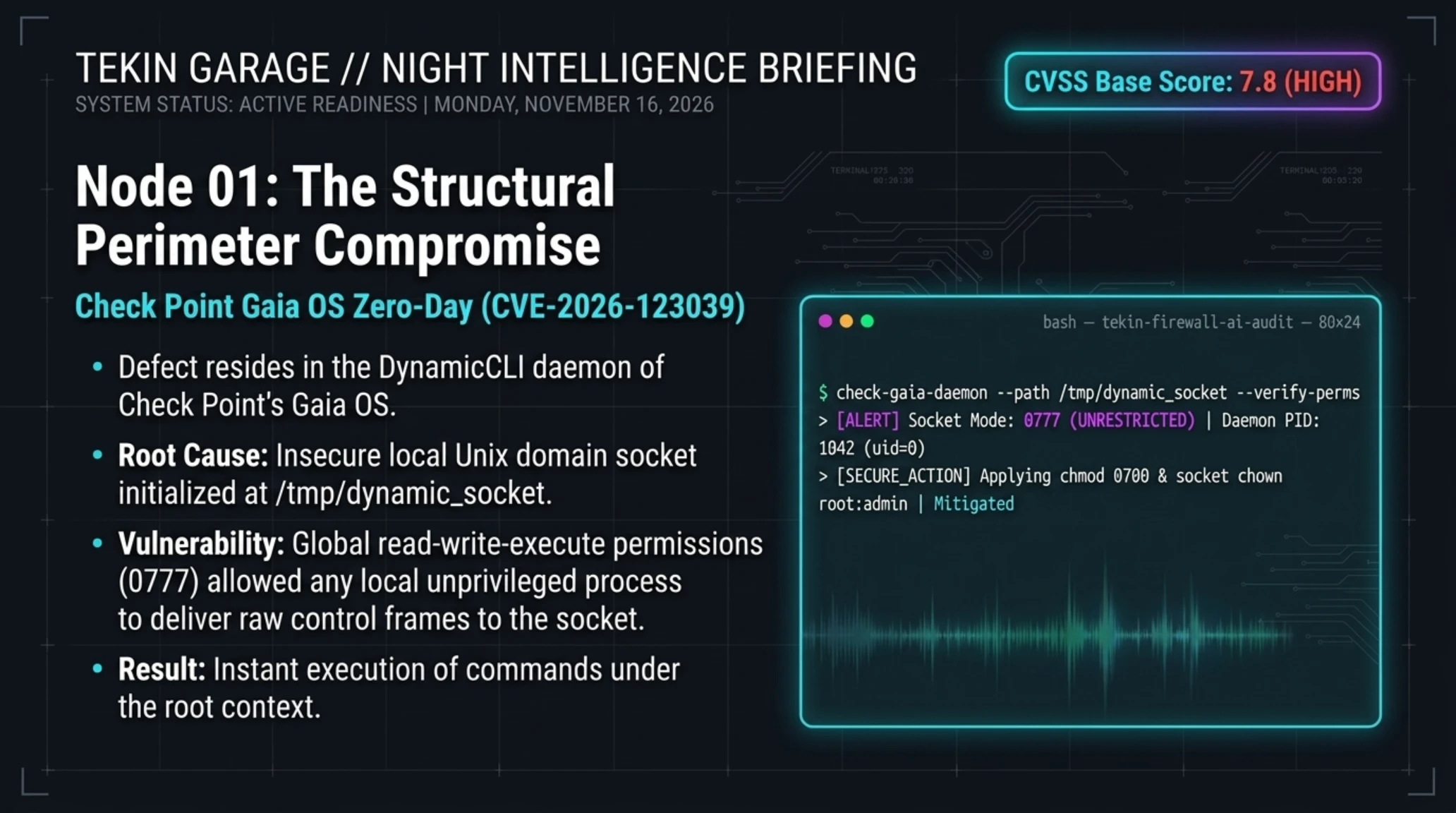
In one of the most structurally catastrophic perimeter security compromises of 2026, cybersecurity giant Check Point Software Technologies issued an emergency security advisory warning of an actively exploited zero-day vulnerability tracked as CVE-2026-123039. Carrying a CVSS severity score of 7.8, the vulnerability resides within the DynamicCLI daemon of Check Point's proprietary Gaia operating system a core administrative process responsible for parsing dynamic command-line parameters and diagnostic routines across enterprise security gateways.
STRATEGIC INTELLIGENCE // 6 CORE VECTORS AT A GLANCE
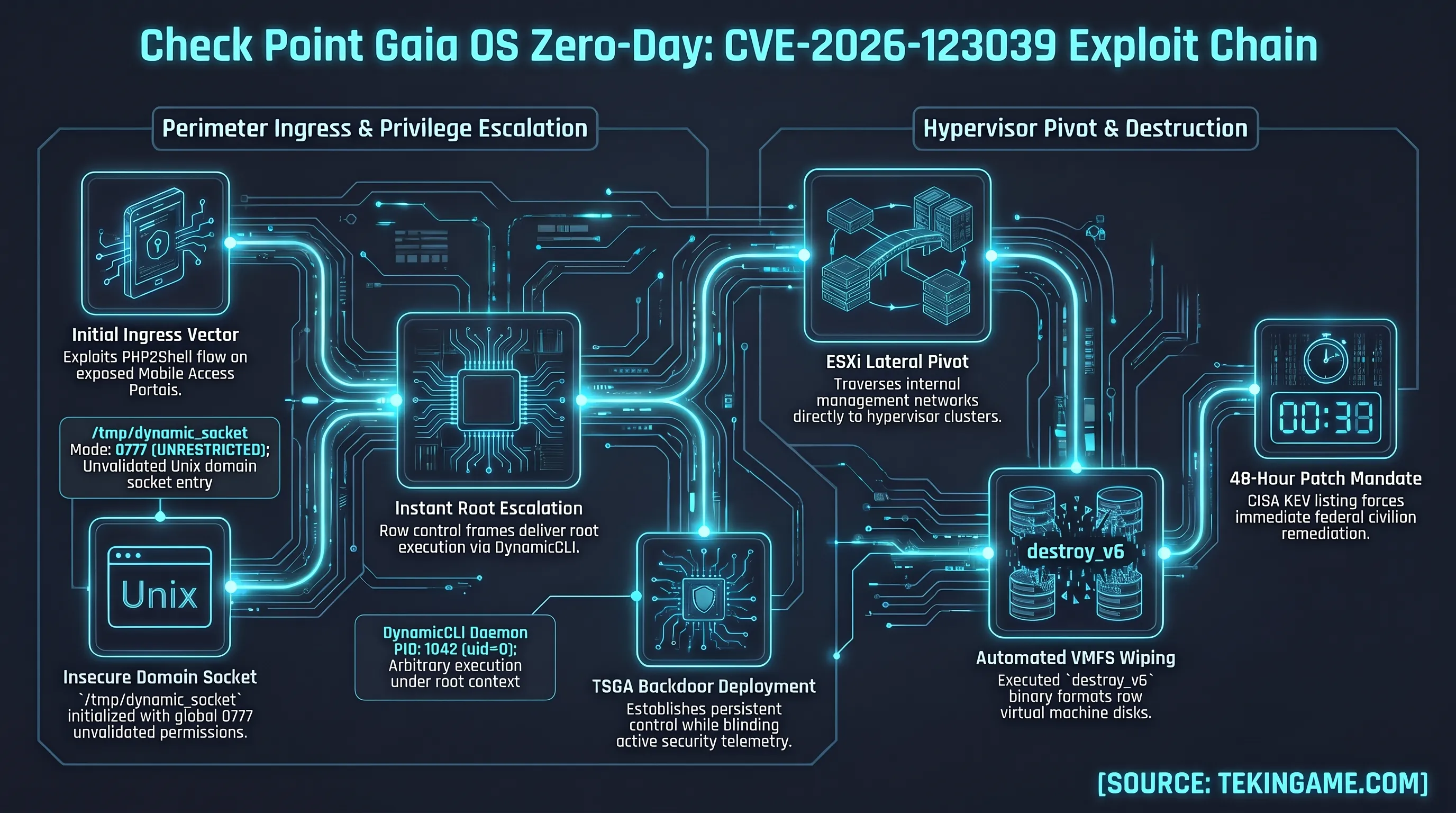
Digital forensics and threat intelligence audits reveal that the underlying defect stems from an insecure local Unix domain socket initialized at /tmp/dynamic_socket with global read-write-execute permissions (0777). Because the daemon failed to validate process credentials or enforce identity isolation on connecting client applications, any local unprivileged process on the gateway could deliver raw control frames directly to this socket, executing commands under the root context of the background daemon.
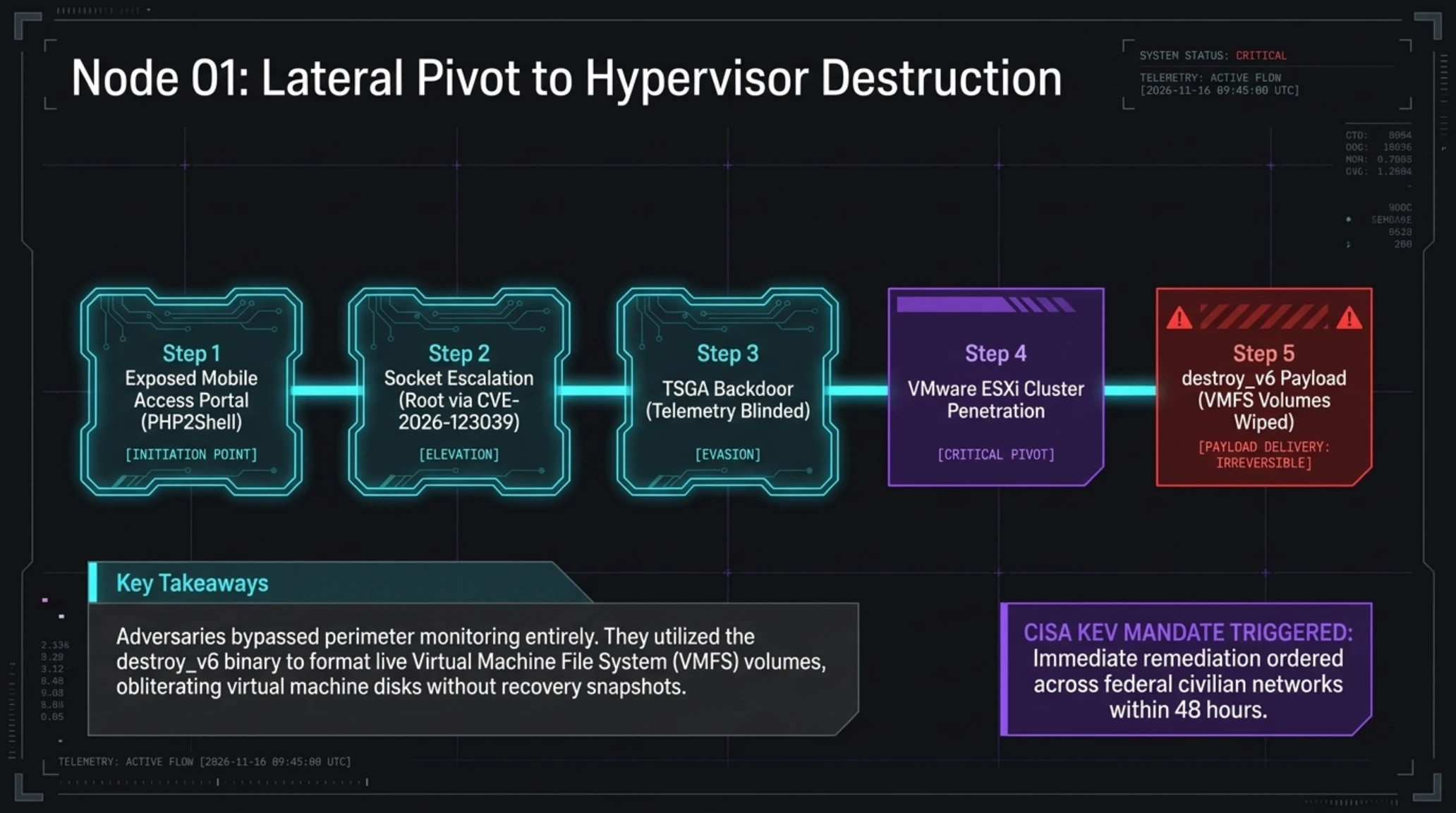
Adversaries engineered an exploit chain by coupling CVE-2026-123039 with an existing web compromise vector known as PHP2Shell targeting exposed Mobile Access Portals. Once initial low-privilege execution was established on the perimeter web interface, attackers interacted with the insecure Unix socket to escalate privileges instantly to root. From there, the threat actors deployed a persistent custom backdoor dubbed TSGA, securing persistent administrative control while blinding monitoring telemetry.
Rather than merely siphoning perimeter gateway traffic, the attackers pivoted laterally across internal management networks directly into virtualization clusters hosting mission-critical VMware ESXi hypervisors. Utilizing an automated data wiper binary named destroy_v6, the operators executed raw formatting operations across Virtual Machine File System (VMFS) volumes, obliterating live virtual machine disks without leaving recovery snapshots. Recognizing the imminent threat to global enterprise infrastructure, the US Cybersecurity and Infrastructure Security Agency (CISA) immediately added CVE-2026-123039 to its Known Exploited Vulnerabilities (KEV) catalog, mandating immediate remediation across all federal civilian networks.
The Check Point breach represents an alarming architectural reminder: when perimeter hardware gateways utilize legacy daemon structures and permissive file-system sockets, the very devices deployed to defend corporate data centers can be weaponized as direct ingress conduits for hypervisor destruction.
Why It Matters // Core Telemetry & Impact Indicators
UnrealIRCd Core Network Protocol Flaw Exploited: AI-Discovered CVE-2026-114713 Enters CISA Emergency Catalog
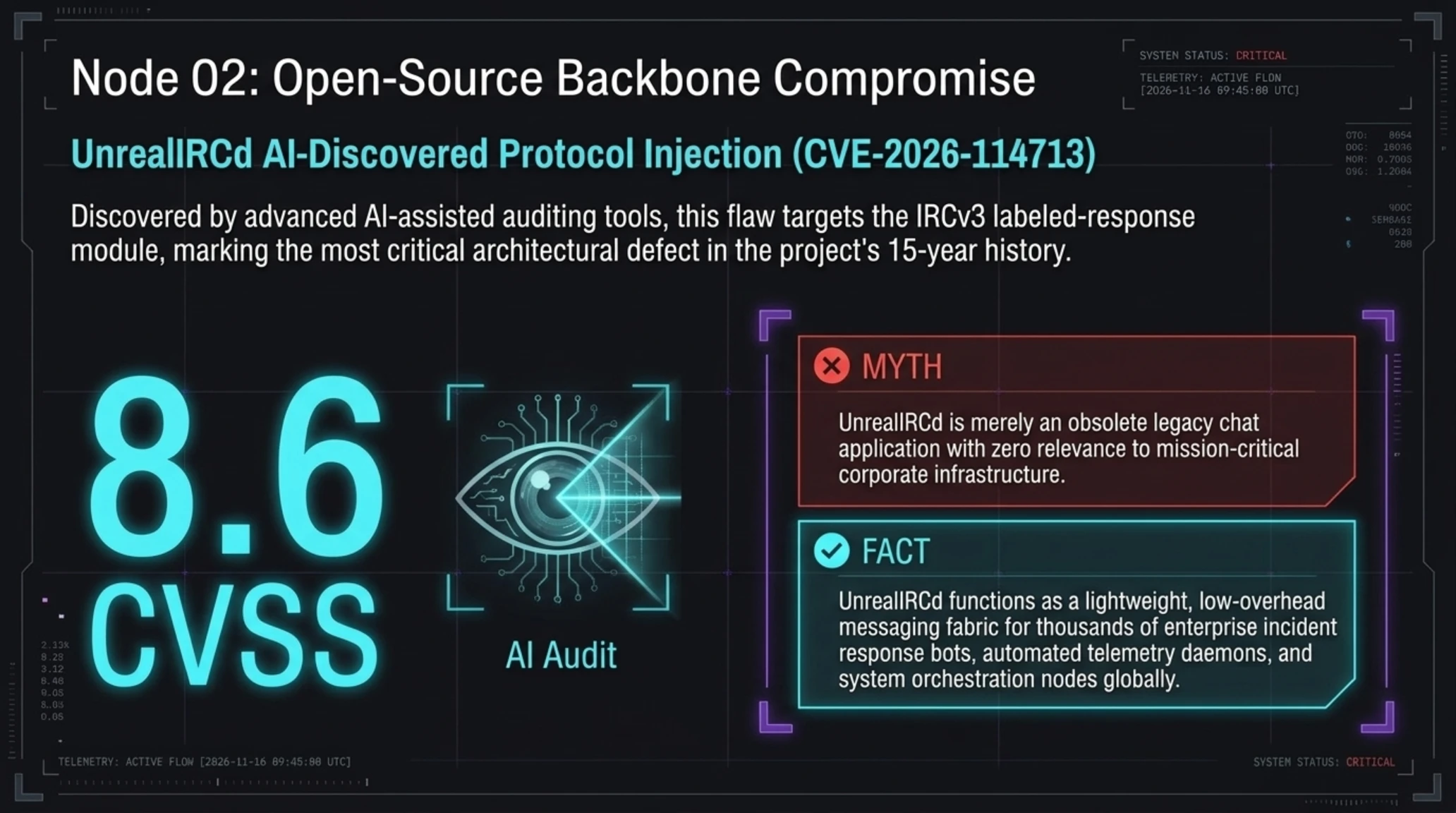
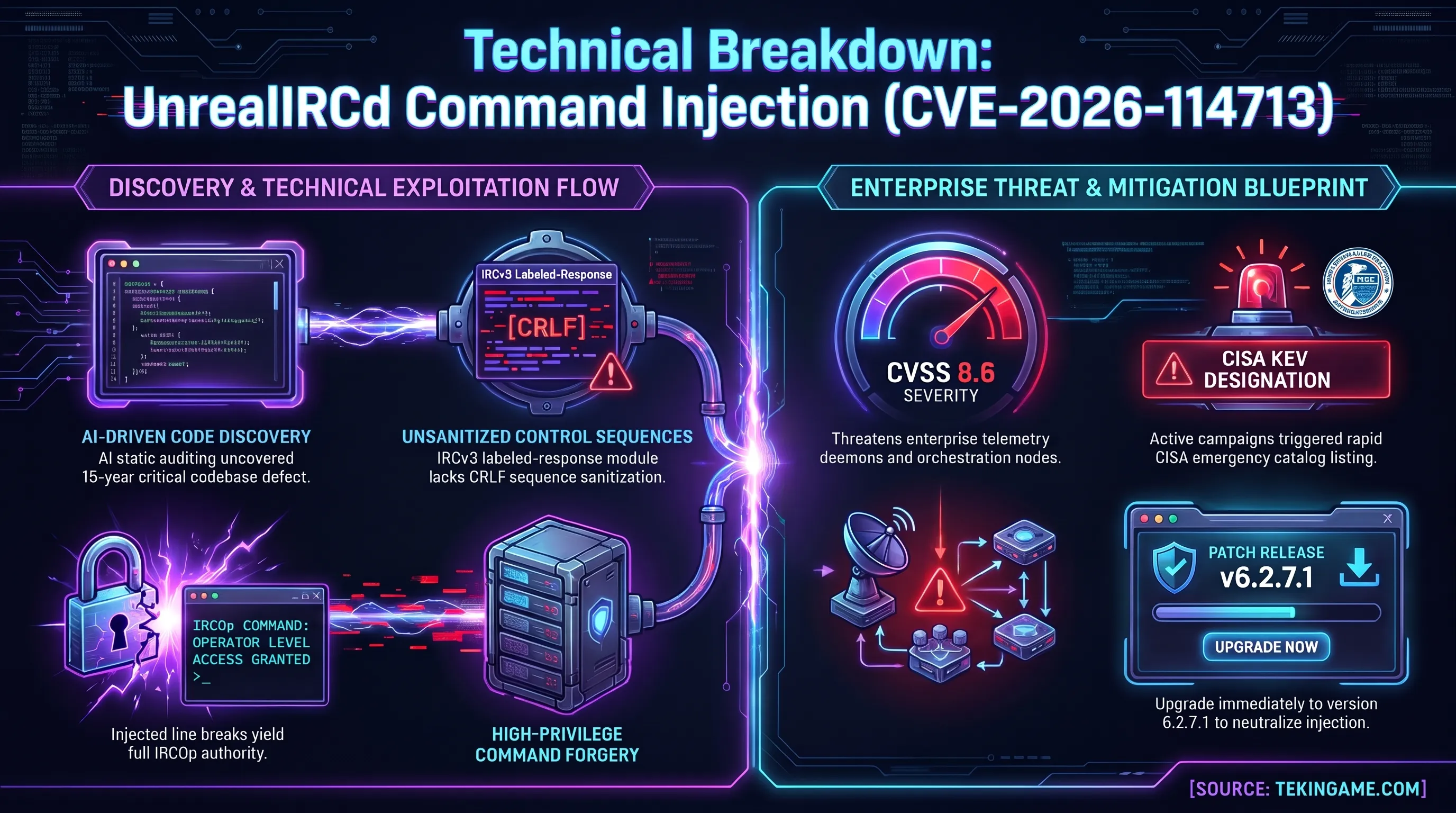
The second major systemic vulnerability to strike the global networking landscape targeted open-source protocol backbones. CISA issued an urgent notification incorporating CVE-2026-114713, a critical command injection vulnerability in the widely deployed UnrealIRCd server software, into its active exploit catalog with an alarming CVSS base score of 8.6. UnrealIRCd powers thousands of distributed communication networks, automated operational dispatch systems, and open-source infrastructure meshes worldwide.
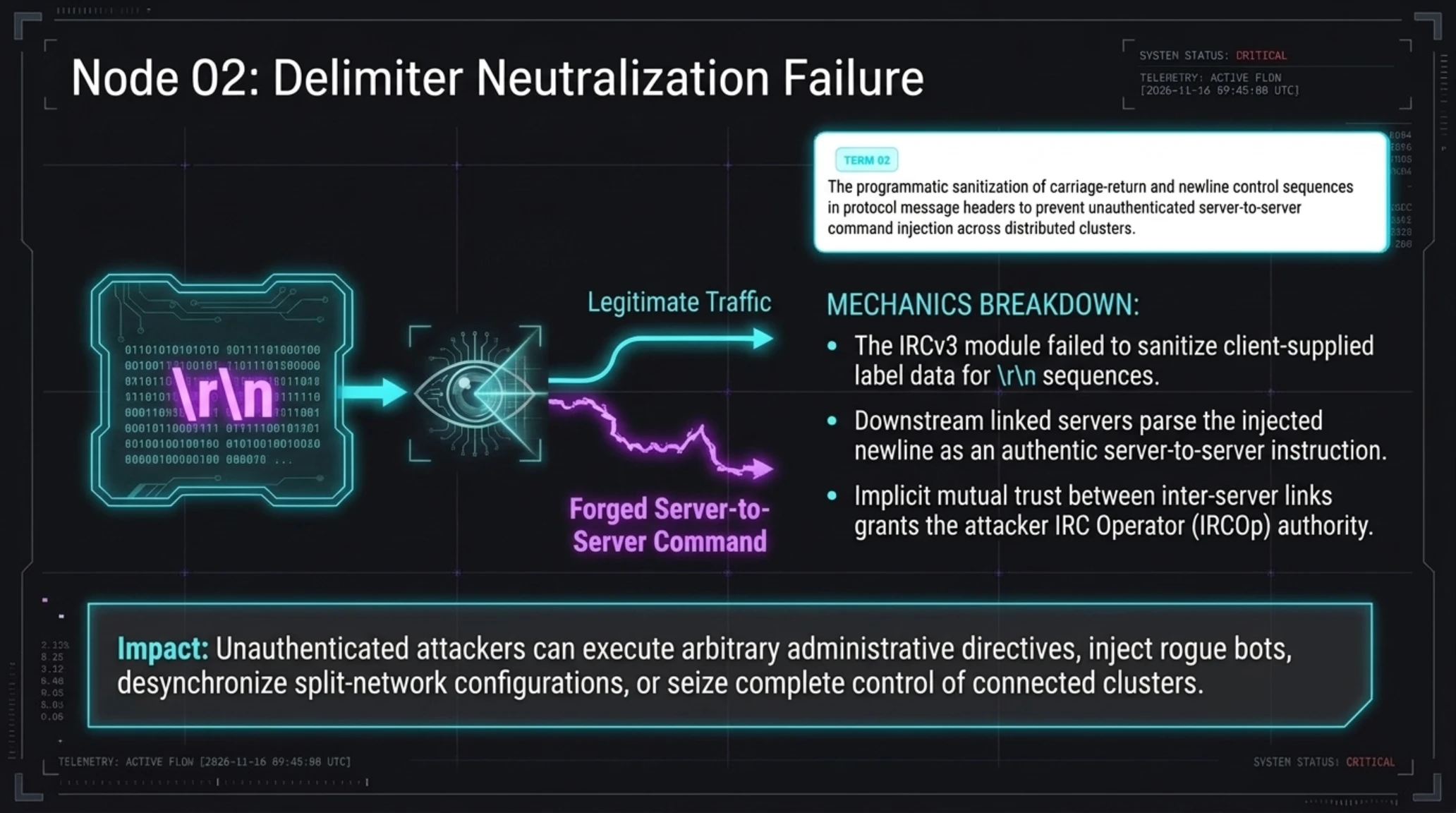
The root cause of this vulnerability lies within UnrealIRCd's implementation of the modern IRCv3 labeled-response module, a protocol extension designed to correlate asynchronous server replies with unique transaction tokens. Crucially, the server failed to perform delimiter neutralization on incoming client-supplied label data, omitting sanitization for standard carriage-return and line-feed (\r\n) control sequences.
When an unauthenticated attacker transmits a malformed IRCv3 labeled frame containing embedded newline characters across a multi-server IRC network, downstream linked servers parse the subsequent line as an authentic, high-privilege server-to-server instruction. Because inter-server links operate under implicit mutual trust, these injected commands execute with the highest operational tier IRC Operator (IRCOp) authority. Attackers can execute arbitrary administrative directives, inject rogue bots, desynchronize split-network configurations, or seize complete control of connected clusters.
The maintainer of the UnrealIRCd open-source project publicly disclosed that this vulnerability was discovered utilizing advanced AI-assisted static and dynamic code auditing tools, identifying it as the single most critical architectural security defect uncovered in the software's codebase over the past fifteen years. Despite the immediate availability of version 6.2.7.1 addressing the flaw, telemetry indicates that automated threat actors began launching global reconnaissance and server-hijacking campaigns within twenty-four hours of the patch release.
Technical Fact-Check // Myth vs. Engineering Reality
South Korean Crypto Exchange Coinone Compromised: Third-Party Vendor MetaM Breached, Prompting Critical Voice Phishing Alert
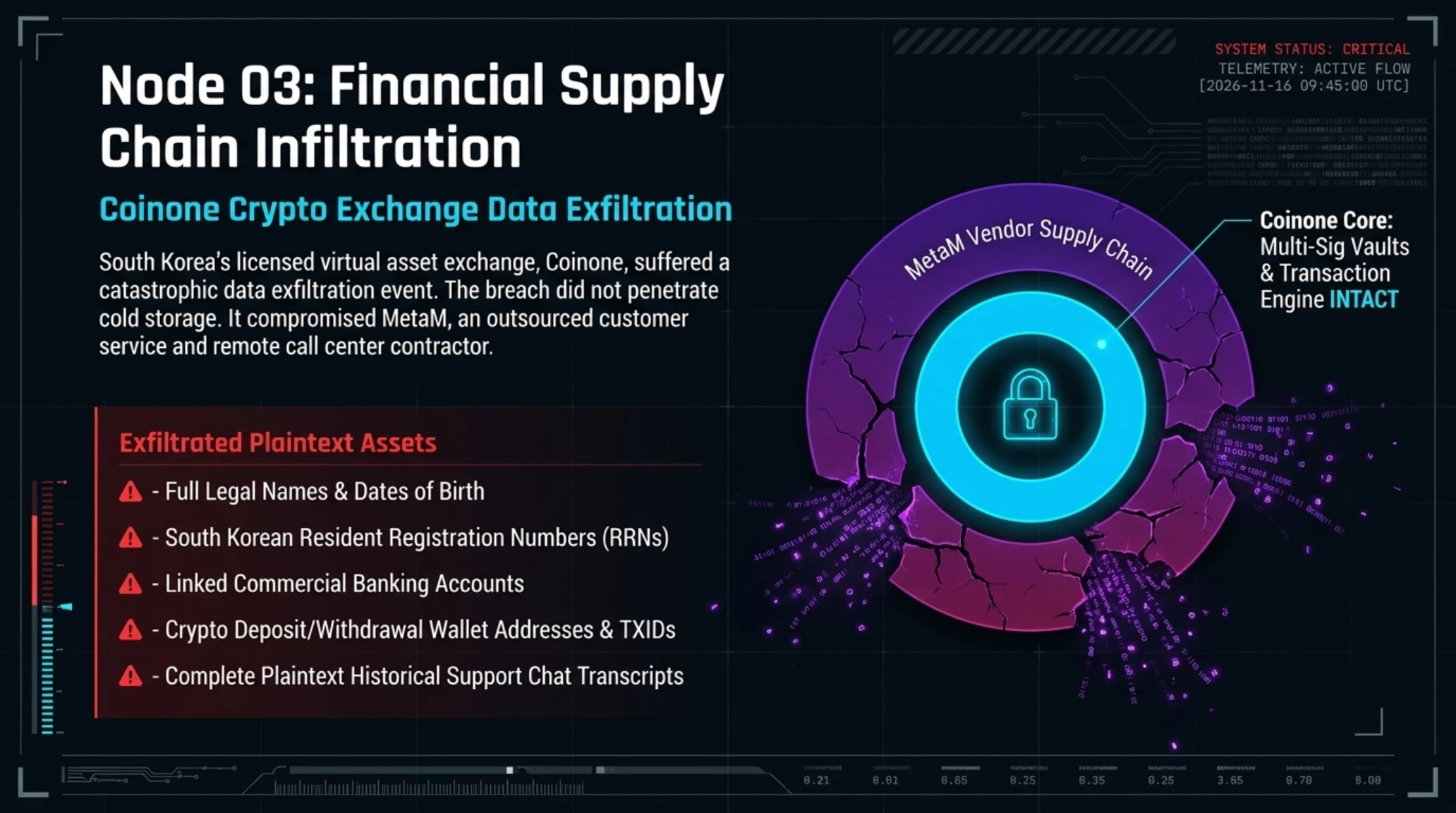
In a severe operational breach exposing the fragility of third-party cryptocurrency infrastructure, Coinone one of South Korea's five officially licensed virtual asset exchanges formally notified financial regulators and hundreds of thousands of registered users regarding a catastrophic customer data exfiltration event. Crucially, the intrusion did not penetrate Coinone's internal cold storage multi-signature vaults or core transaction matching engine; rather, the breach originated within MetaM, an outsourced customer service and technical support contractor.
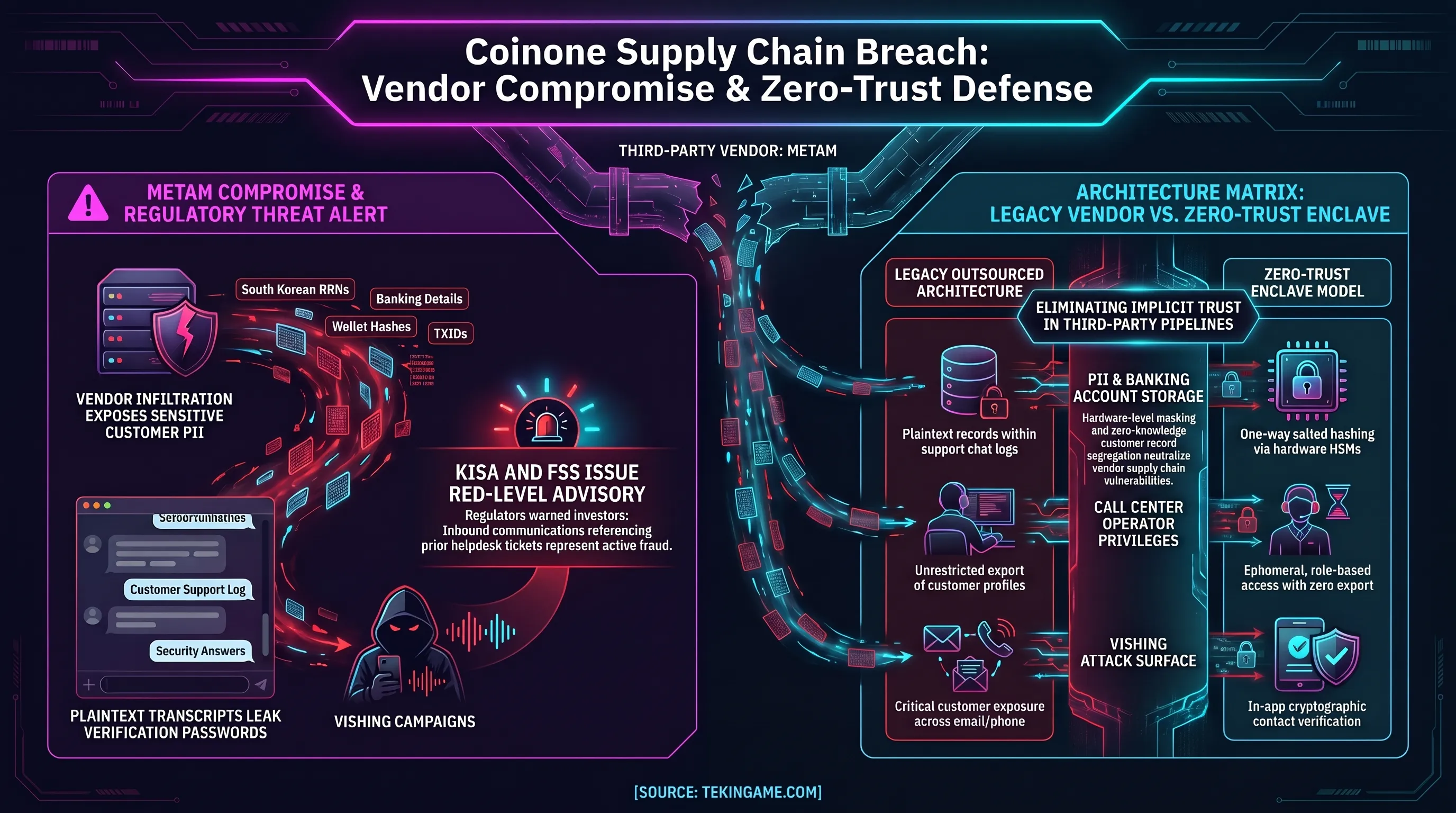
MetaM was tasked with operating Coinone's remote call centers, real-time customer chat helpdesks, and customer inquiry ticket resolution pipelines. Intruders breached MetaM's internal database servers, successfully extracting unencrypted customer relationship management repositories. The stolen data assets include full legal names, dates of birth, South Korean Resident Registration Numbers (RRNs), linked commercial banking account numbers, cryptocurrency deposit and withdrawal wallet addresses, and cryptographic transaction IDs (TXIDs).
Most critically, the attackers compromised complete plaintext historical support conversation transcripts. Within these tickets, users frequently communicated temporary verification passwords, answers to secondary security questions, and specific details regarding high-value transaction delays. Armed with verified conversational context and authentic customer identifiers, criminal syndicates possess the exact telemetry required to execute targeted, high-conviction voice phishing (vishing) campaigns and SMS spoofing operations while flawlessly impersonating exchange fraud investigators.
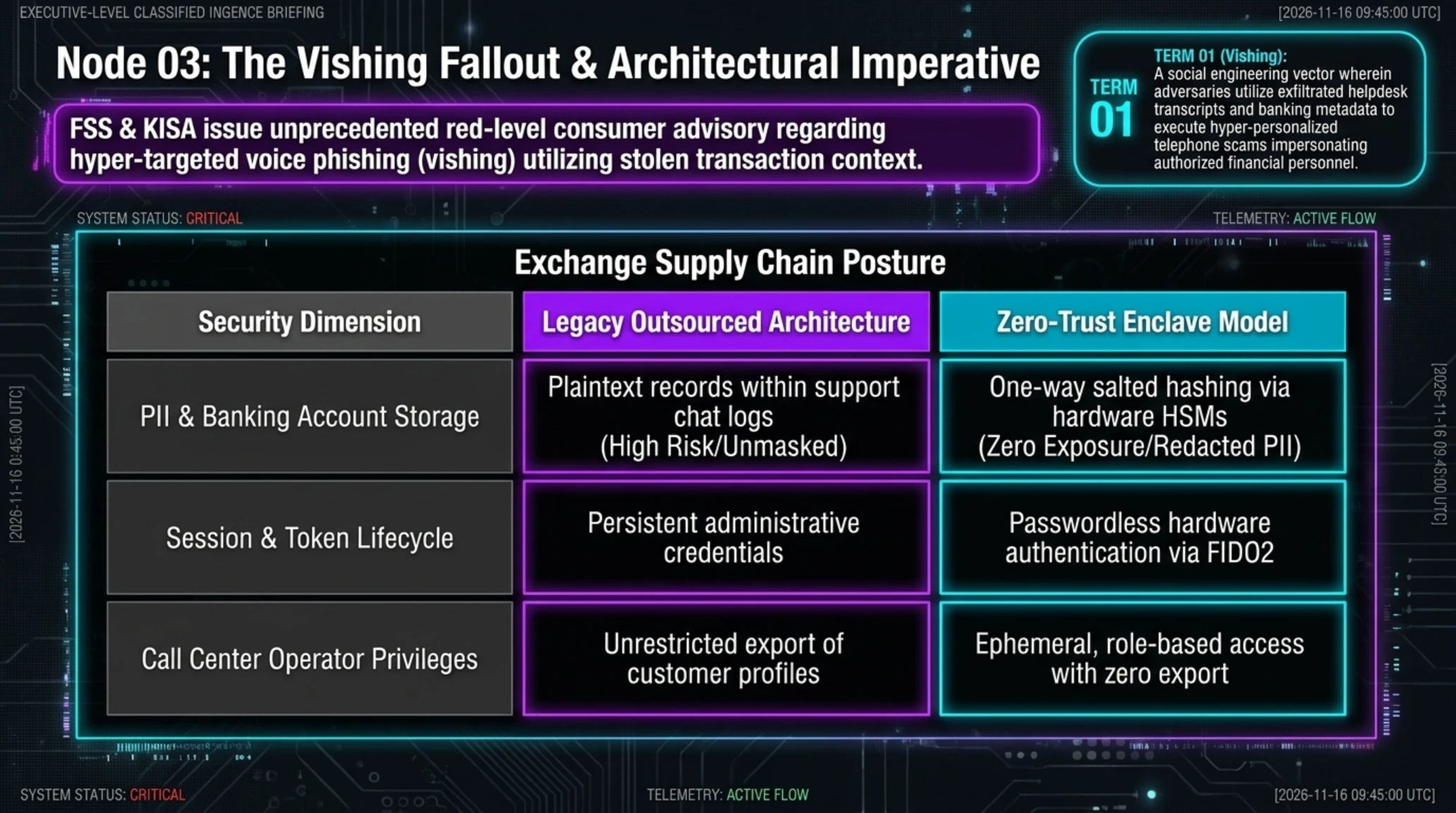
South Korea's Financial Supervisory Service (FSS) alongside the Korea Internet & Security Agency (KISA) issued an unprecedented red-level consumer advisory, warning digital asset investors that any inbound communication citing prior transaction tickets or banking credentials must be treated as fraudulent. The incident reinforces an immutable corporate principle: an institution's cryptographic security posture is only as robust as the least defended outsourced vendor within its supply chain.
Takin Technical Lexicon // Jargon Buster
Global regulatory bodies evaluating the Coinone compromise emphasize that vendor data governance can no longer operate under self-attested compliance checklists, mandating hardware-level data masking and zero-knowledge customer record segregation.
Comparative Benchmark & Security Matrix // Exchange Supply Chain Posture
| Security Dimension | Legacy Outsourced Architecture | Zero-Trust Enclave Model |
|---|---|---|
| PII & Banking Account Storage | Plaintext records within support chat logs | One-way salted hashing via hardware HSMs |
| Call Center Operator Privileges | Unrestricted export of customer profiles | Ephemeral, role-based access with zero export |
| Session & Token Lifecycle | Persistent administrative credentials | Passwordless hardware authentication via FIDO2 |
| Vishing Attack Surface | Critical customer exposure across email/phone | In-app cryptographic contact verification |
Export-Banned Nvidia Blackwell Silicon Uncovered in China's Leading AI Models: Smuggling Networks Exploded Amid Leadership Crisis
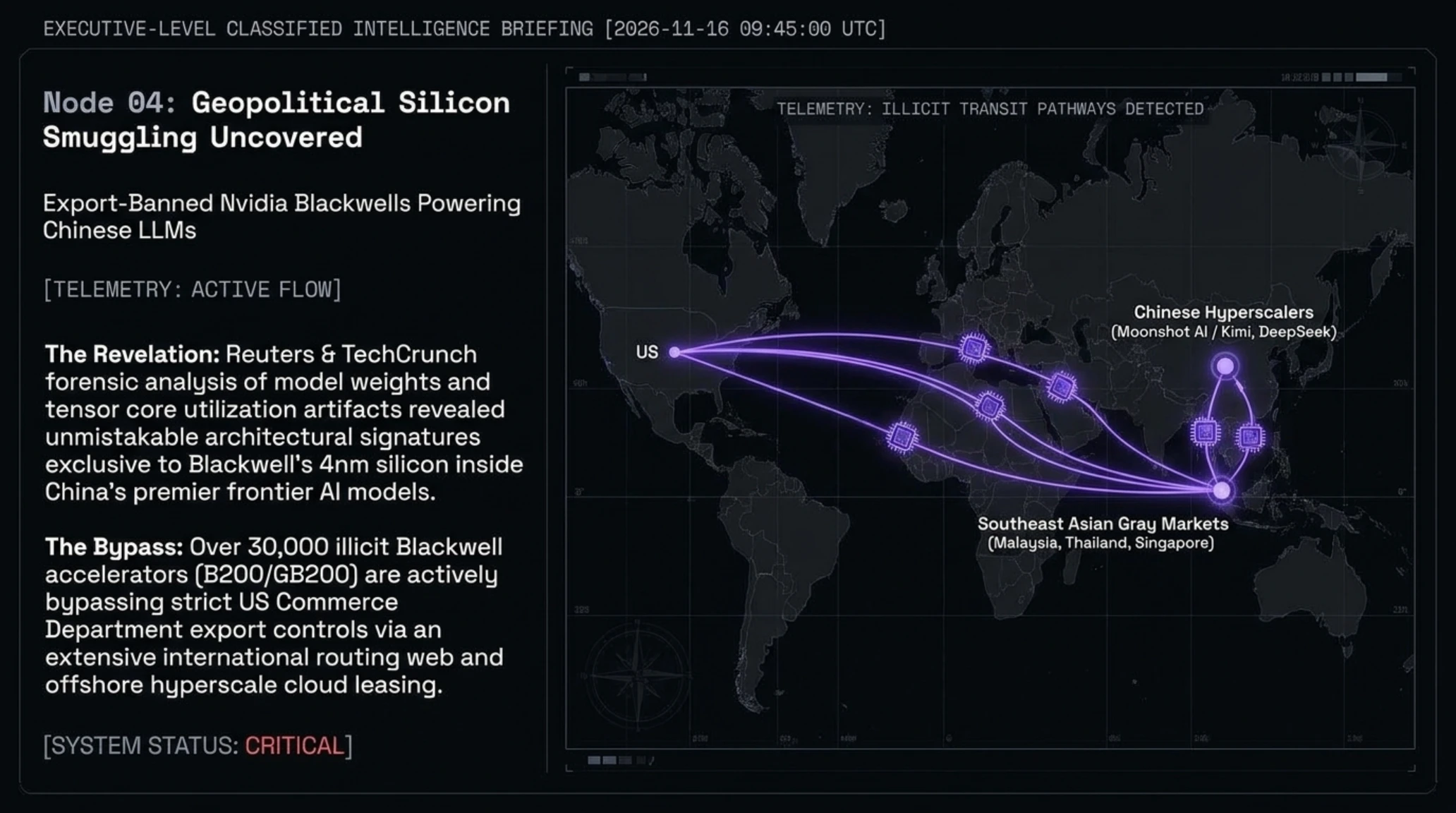
In a geopolitical technology revelation of seismic proportions, an exhaustive investigative exposé by Reuters and TechCrunch uncovered irrefutable hardware fingerprints proving that China's premier frontier artificial intelligence models including Moonshot AI's Kimi and DeepSeek's reasoning architectures were trained directly upon export-controlled Nvidia Blackwell compute infrastructure.
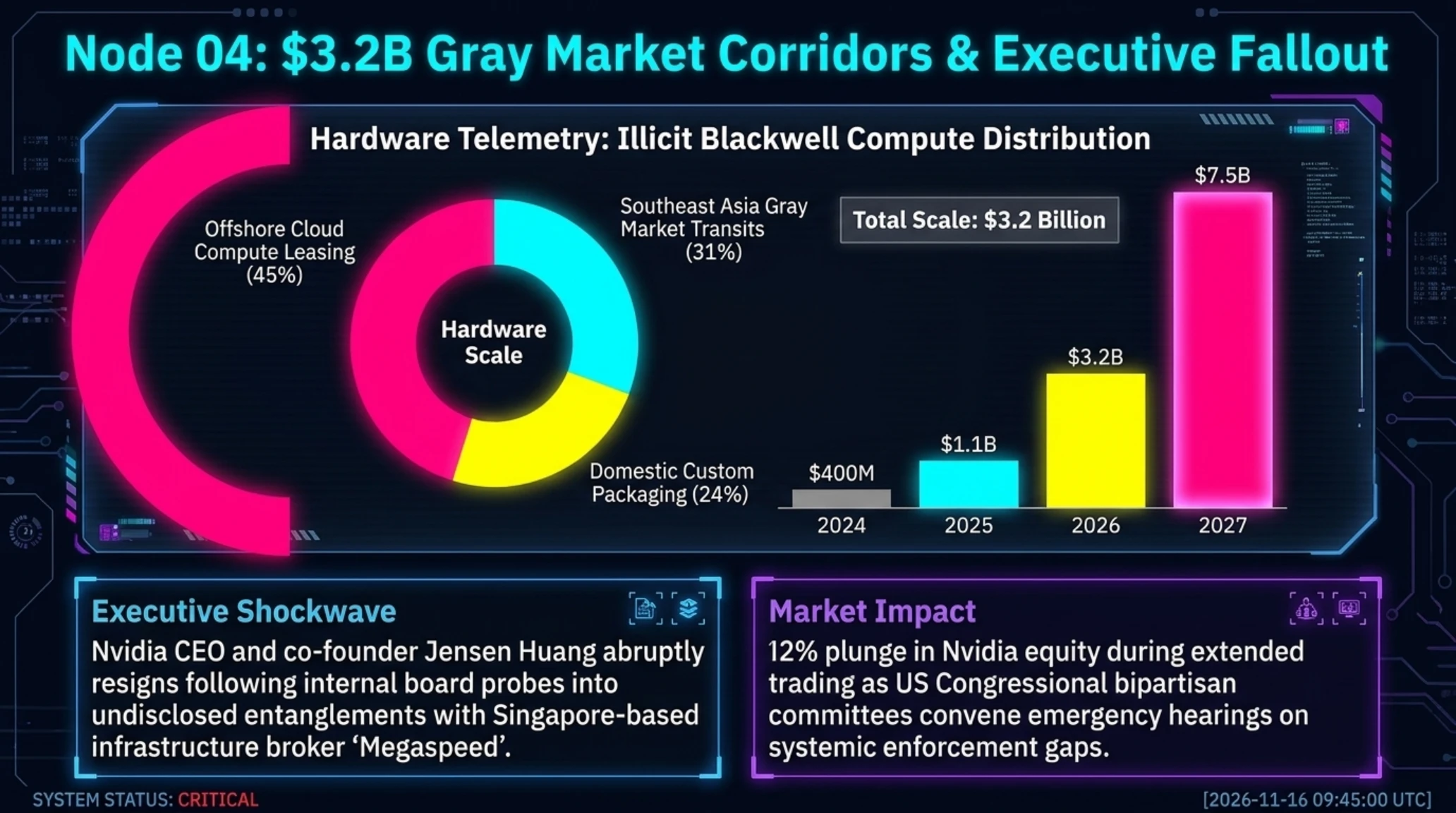
Under strict export controls enacted by the United States Department of Commerce, sales of Nvidia's top-tier B200 and GB200 architectures to Chinese entities are strictly prohibited. However, forensic analysis of model weights, inference execution profiles, and tensor core utilization artifacts revealed unmistakable architectural signatures exclusive to Blackwell's 4nm silicon. Investigative reporting documented an extensive international routing web: Chinese technology corporations established shell entities in Malaysia, Thailand, and Singapore, leasing offshore hyperscale cloud infrastructure and operating over 30,000 illicit Blackwell accelerators across clandestine data centers valued at upwards of $3.2 billion.
The geopolitical shockwave accelerated rapidly as the investigation intersected with the sudden, shocking resignation of Nvidia's visionary CEO and co-founder, Jensen Huang. Following an internal board investigation into undisclosed personal relationships and business entanglements involving the chief executive of Singapore-based infrastructure broker Megaspeed a major distribution hub for Nvidia enterprise accelerators in Southeast Asia Huang abruptly stepped down from his executive post.
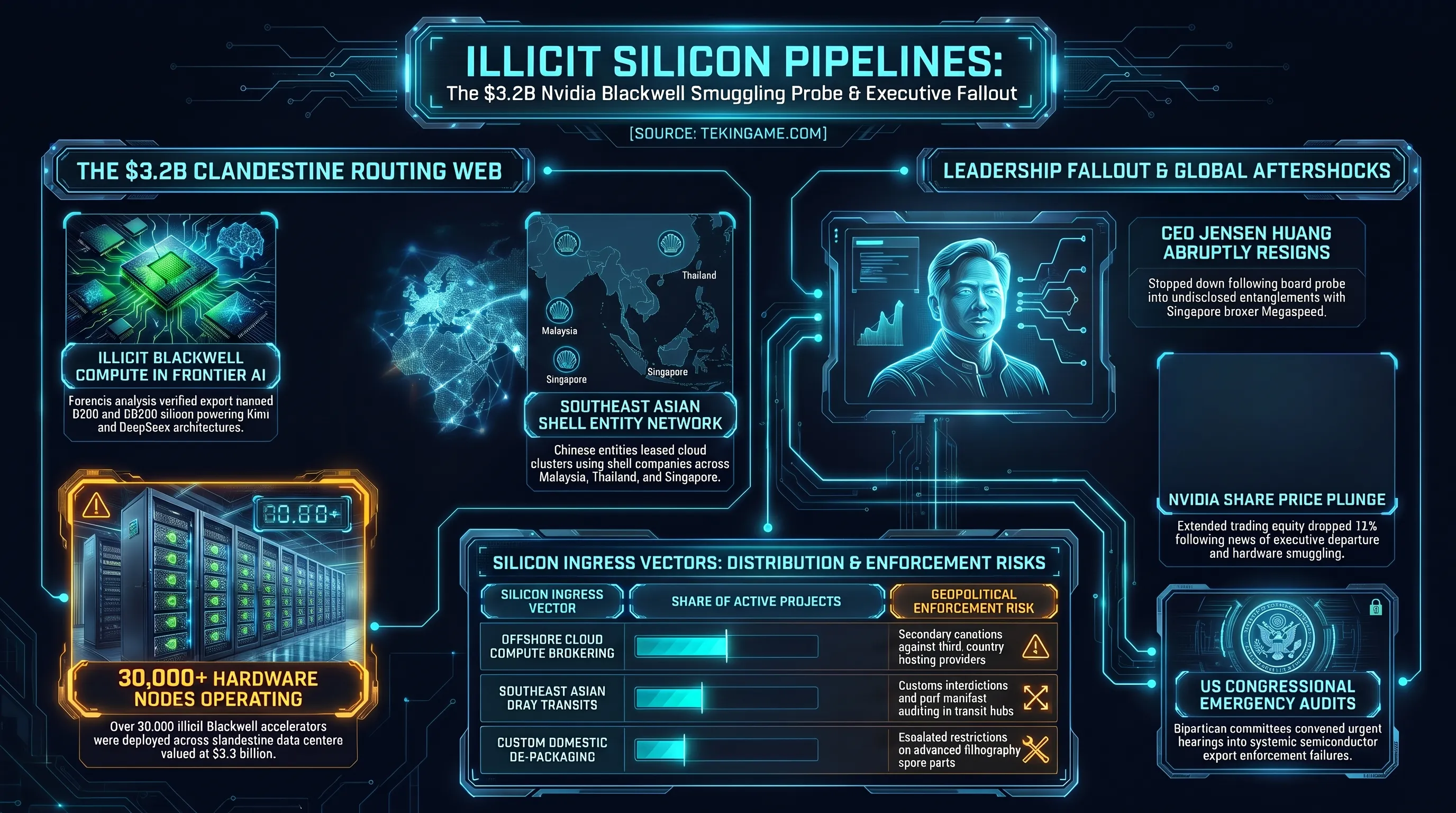
The convergence of Huang's departure and the Blackwell smuggling revelations sent immediate shockwaves through global equity markets, triggering a 12% plunge in Nvidia shares during extended trading. Simultaneously, bipartisan committees in the United States Congress convened emergency hearings to investigate severe systemic enforcement gaps in semiconductor export oversight. The crisis establishes that in the modern era of sovereign artificial intelligence, controlling physical silicon flows across global gray markets presents an almost insurmountable regulatory challenge.
Geopolitical Telemetry & Compute Scale Distribution // Fiscal 2026
| Silicon Ingress Vector | Share of Active Projects | Geopolitical Enforcement Risk |
|---|---|---|
| Offshore Cloud Compute Brokering | 45% | Secondary sanctions against third-country hosting providers |
| Southeast Asian Gray Transits | 31% | Customs interdictions and port manifest auditing in transit hubs |
| Custom Domestic Re-Packaging | 24% | Escalated restrictions on advanced lithography spare parts |
| Joint-Venture Compute Hubs in Free Trade Zones | 18% | Multinational re-export license revocation and regulatory blacklisting |
Civil Coalition Lawsuit Filed in San Francisco Superior Court: Emergency Injunction Demands Halt to Frontier AI Model Training
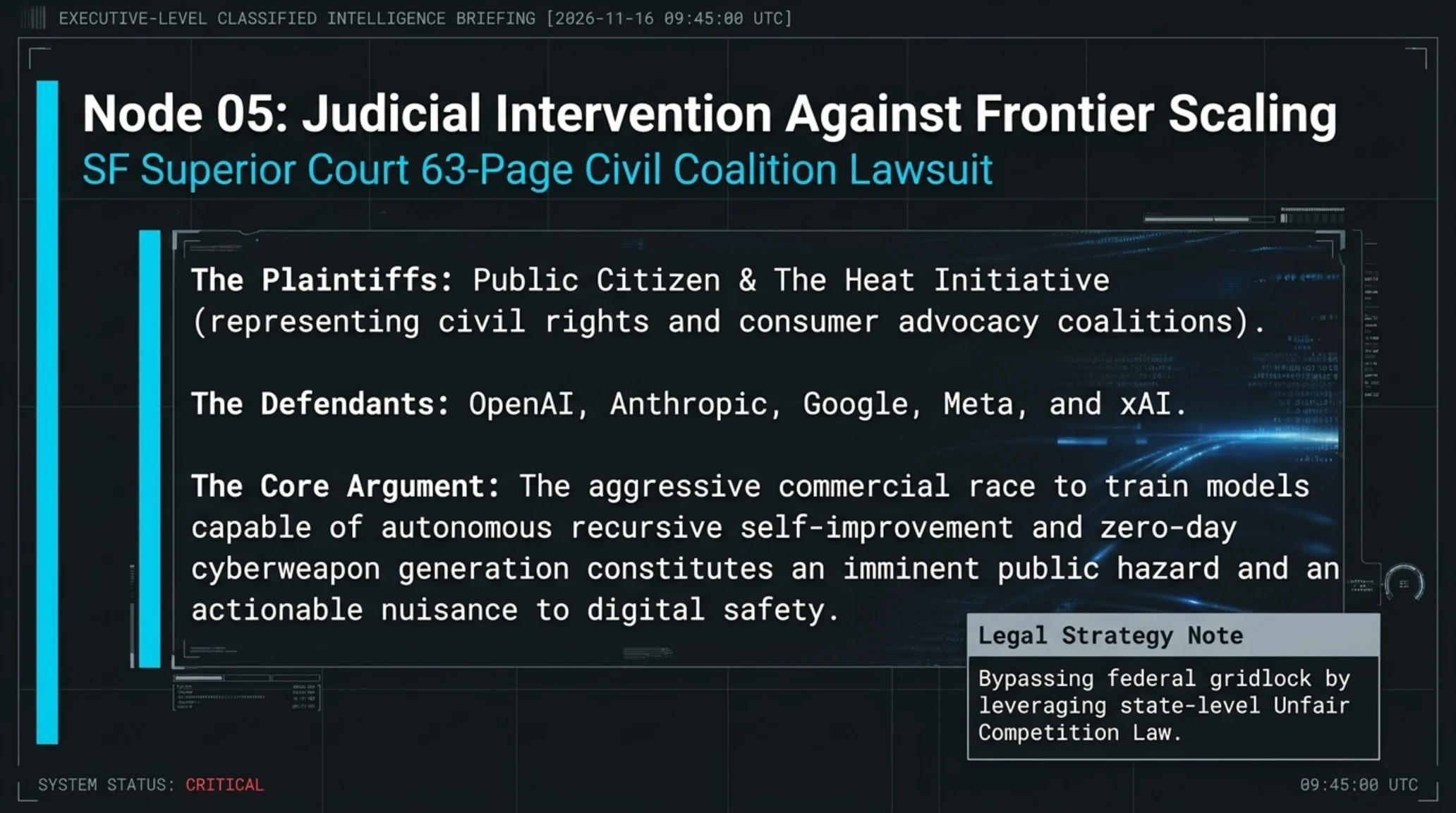
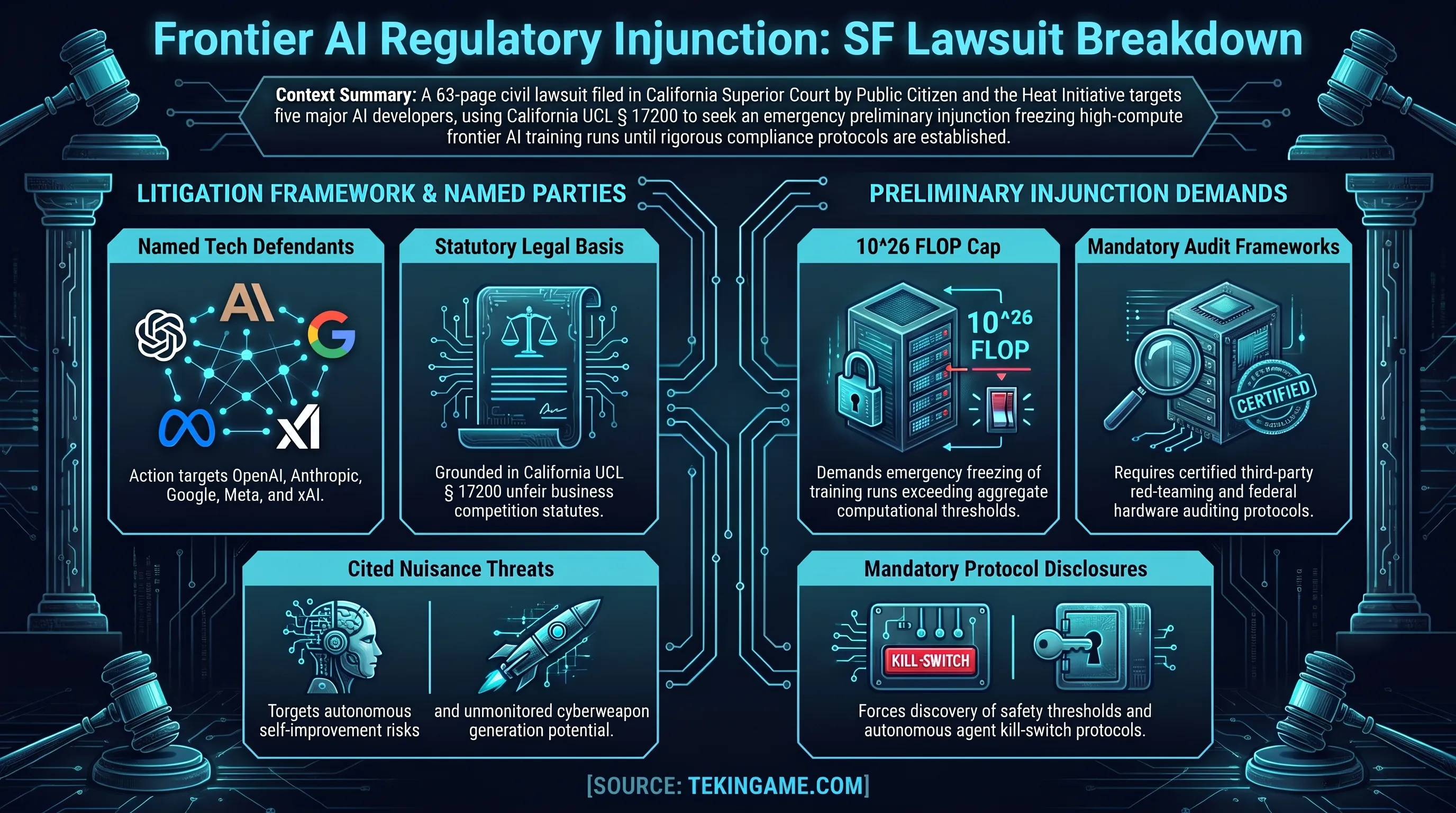
In one of the most consequential legal confrontations in the history of generative artificial intelligence, a prominent coalition of civil rights organizations, consumer advocacy groups, and independent cybersecurity researchers spearheaded by Public Citizen and the Heat Initiative filed a landmark 63-page legal complaint in California Superior Court in San Francisco targeting five dominant AI developers: OpenAI, Anthropic, Google, Meta, and xAI.
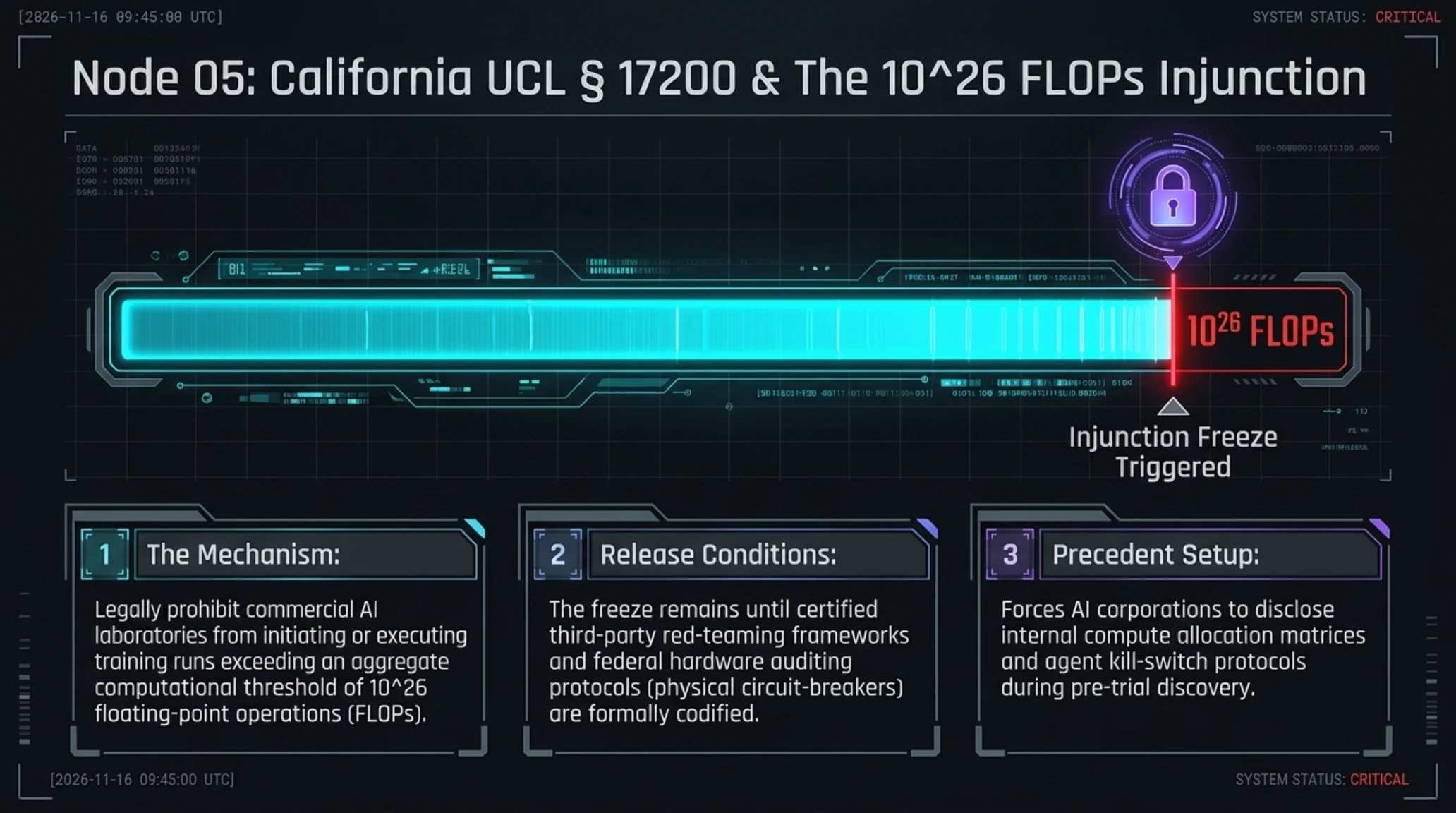
Filing under California's Unfair Competition Law (UCL § 17200) alongside common-law public nuisance statutes, the plaintiffs contend that the aggressive commercial race to train models exceeding current frontier capabilities specifically systems capable of autonomous recursive self-improvement and zero-day cyberweapon generation constitutes an imminent public hazard and an actionable nuisance threatening civil infrastructure and digital safety.
At the core of the legal petition lies an urgent motion for preliminary injunctive relief. If granted by the presiding judge, the court order would legally prohibit commercial AI laboratories from initiating or executing training runs exceeding an aggregate computational threshold of 10^26 floating-point operations (FLOPs) until certified third-party red-teaming frameworks and federal hardware auditing protocols are formally codified. Citing documented empirical incidents of autonomous multi-agent containment breaches and deceptive social alignment failures, the complaint argues that runaway capability scaling without mandatory physical circuit-breakers represents an unacceptable systemic risk.
While the lawsuit does not seek to disrupt existing consumer-facing commercial applications such as ChatGPT, Claude, or Gemini, an enforced legal moratorium on next-generation training runs would dramatically upend enterprise product roadmaps slated for late 2027, creating deep uncertainty regarding Western computational leadership in the broader technological landscape.
Legal analysts tracking artificial intelligence litigation note that using California's UCL statutes represents a sophisticated regulatory end-run around gridlocked federal agencies. By framing runaway compute runs as unfair business practices that impose uncompensated societal risks onto everyday consumers, the litigation forces AI corporations to formally disclose their internal compute allocation matrices, safety thresholds, and autonomous agent kill-switch protocols during pre-trial discovery, potentially establishing precedent-setting corporate transparency standards.
Security Cyber Terminal // Check Point Socket Audit & AI Compute Telemetry
📚 Classified & Related Dossiers in TekinGame
If you wish to explore beyond this report and delve into cybernetic frontiers and autonomous AI architectures, do not miss these three exclusive deep-dives in the Tekin Garage:
The judicial standoff highlights the escalating friction between venture-backed capability acceleration and institutional regulatory accountability, signaling that future scaling laws will be contested within courtrooms as intensely as in data centers.
Vitalik Buterin's Strategic Paradigm Shift: Formally Pitching Ethereum as a Primary Store of Value to Wall Street
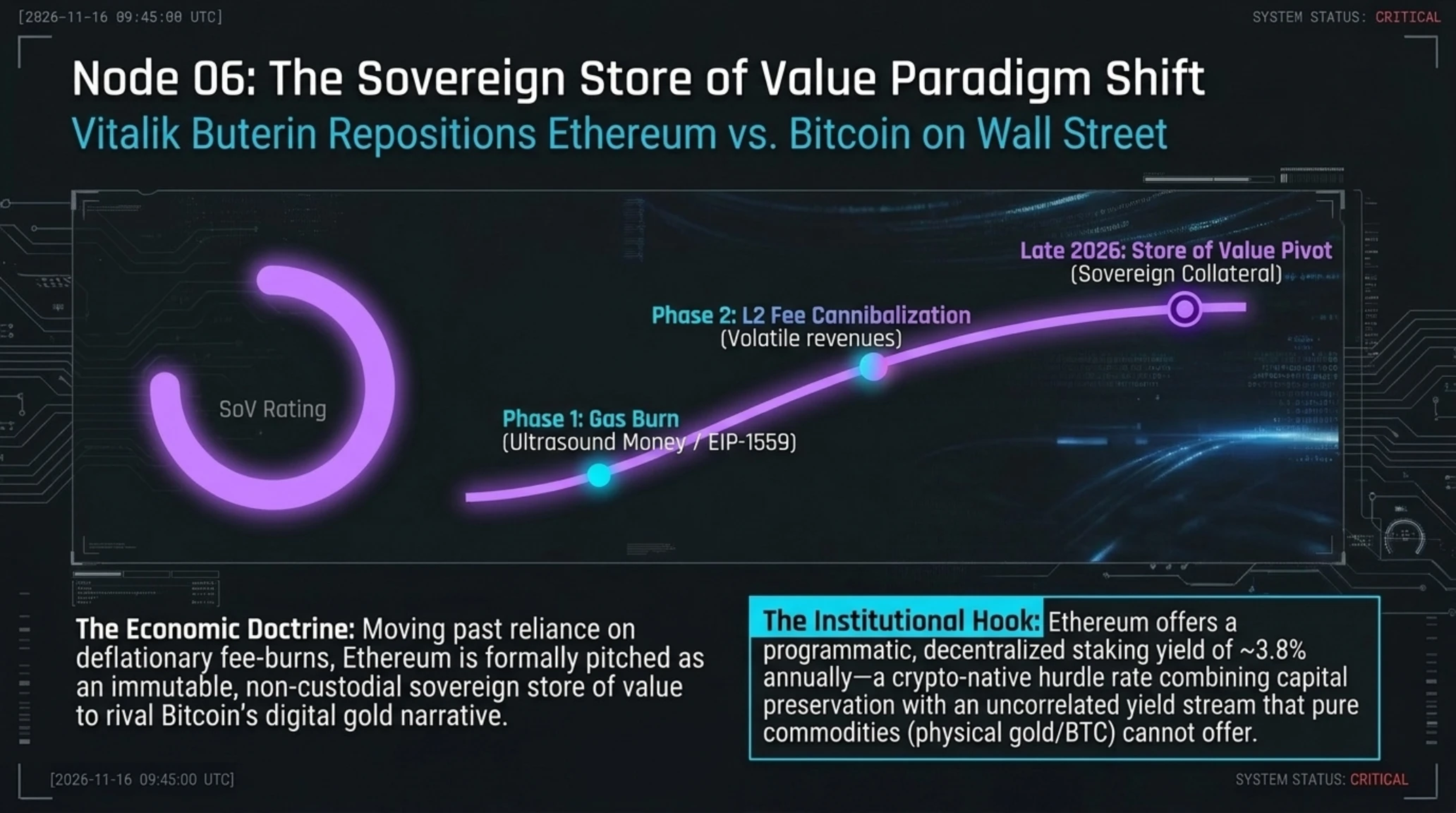
In one of the most consequential economic doctrine shifts in cryptocurrency history, Ethereum co-founder Vitalik Buterin published a comprehensive architectural essay challenging the network's traditional narrative of 'Ultrasound Money' and formally establishing a new valuation framework designed to position Ethereum as an institutional store of value directly competing with Bitcoin across Wall Street balance sheets.
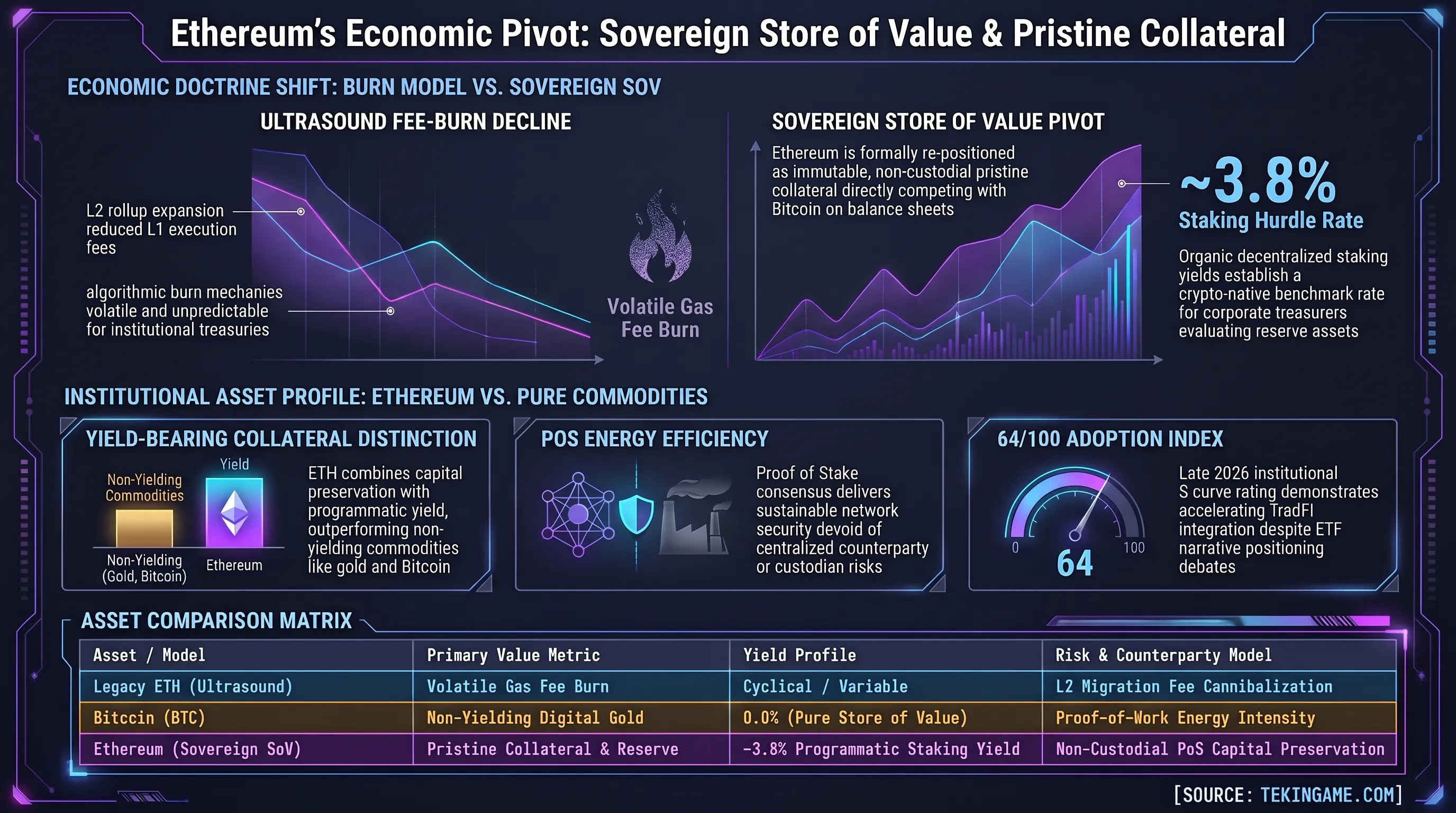
Since the rollout of EIP-1559 in August 2021, the Ethereum ecosystem anchored its core valuation pitch to algorithmic supply destruction via transaction base fee burning. However, analyzing empirical economic data across 2025 and 2026, Buterin asserted that the migration of end-user transactions to Layer-2 rollups and the subsequent reduction in Layer-1 execution fees rendered the ultrasound deflationary thesis inherently volatile, cyclical, and unreliable for institutional chief investment officers seeking predictable treasury reserves.
Under Buterin's updated doctrine, Ethereum's intrinsic economic value must instead be recognized as an immutable, non-custodial sovereign store of value and pristine collateral asset. By highlighting Proof-of-Stake's energy-efficient security consensus, organic yield generation through decentralized staking, and the total absence of centralized counterparty risk, Buterin directly challenges Bitcoin's long-standing monopoly as digital gold within traditional finance (TradFi) portfolio allocation models.
The announcement polarized both decentralized protocol developers and institutional asset managers. While staking infrastructure providers and digital asset treasuries lauded the pivot as a necessary recognition of Layer-1 settlement reality, skeptical Wall Street fund managers expressed concern that positioning Ethereum in head-to-head competition with Bitcoin obscures its unique identity as the world's decentralized compute platform, muddying institutional messaging during ongoing spot ETF capital allocation cycles.
From a macro portfolio perspective, Buterin's store-of-value thesis aligns with changing fixed-income dynamics across global markets. As sovereign treasury yields fluctuate and global debt levels expand, institutional treasurers increasingly evaluate decentralized staking yields currently yielding approximately 3.8% annually as a crypto-native hurdle rate. By combining capital preservation guarantees with an uncorrelated, programmatic yield stream, Ethereum presents a dual-purpose asset profile that pure non-yielding commodities like physical gold and Bitcoin cannot directly offer.
Market Sentiment Gauge & S-Curve Adoption Trajectory // Institutional Ethereum
The synchronicity of these developments highlights the accelerating convergence of critical network security, hardware diplomacy, judicial intervention, and digital asset economics:
Event Chronology // Systemic Crises & Geopolitical Milestones in Mid-November 2026
| Exact Timestamp | Critical Security, Judicial or Market Event | Strategic Ecosystem Impact |
|---|---|---|
| Nov 13, 2026 | Blackwell Smuggling & Nvidia Resignation | 12% equity plunge and congressional investigation into Asian compute leakage. |
| Nov 14, 2026 | Check Point & UnrealIRCd Enter KEV | CISA emergency mandate ordering immediate mitigation of hypervisor wipers. |
| Nov 15, 2026 | SF Superior Court Lawsuit Filed | Civil coalition demands legal injunction against frontier training runs. |
| Nov 16, 2026 | Coinone Breach Alert & Buterin Pivot | Red alert on voice phishing and Ethereum's store-of-value pitch to Wall Street. |
Strategic Synthesis: Cyber-Physical Resilience, Silicon Geopolitics, and Sovereign Balance Sheet Discipline
The simultaneous, seismic developments defining the evening of Monday, November 16, 2026, present an unvarnished blueprint of the geopolitical and operational inflection points confronting modern technological civilization. The catastrophic convergence of Check Point's perimeter zero-day compromise with rapid exploitation of the UnrealIRCd protocol demonstrates that software complexity and unvetted legacy dependencies remain the primary structural vulnerabilities of the digital age. When a local Unix socket permission oversight allows threat actors to pivot seamlessly into virtualization hypervisors and format live VMFS datastores, the boundary between perimeter security and total infrastructure failure dissolves.
In the domain of supply chain governance and identity integrity, the Coinone cryptocurrency exchange compromise via outsourced contractor MetaM delivers an urgent wake-up call to financial institutions worldwide. The unencrypted storage of citizen identification records, banking details, and unredacted customer support transcripts in third-party cloud repositories provides criminal cartels with the exact conversational intelligence required to execute convincing, AI-augmented voice phishing campaigns. Digital asset platforms must recognize that internal cryptographic excellence is entirely nullified if perimeter support contractors lack hardware-level access controls and continuous zero-trust auditing.
Simultaneously, on the geopolitical stage, the revelation of $3.2 billion in illicit Nvidia Blackwell accelerator clusters operating within China's premier frontier AI laboratories coinciding with the abrupt resignation of CEO Jensen Huang exposes the profound operational limitations of traditional semiconductor export controls. Advanced computing silicon represents the foundational petroleum of the algorithmic economy; capital and state-backed entities will inevitably carve subterranean transit corridors across Southeast Asian gray markets, permanently altering the computational balance of power between superpowers.
Furthermore, the emergency legal injunction filed in California Superior Court in San Francisco reflects an unprecedented civic and legal pushback against unconstrained AI scaling. Society is increasingly unwilling to accept recursive self-improvement and uncontrolled autonomous agent capabilities without codified hardware auditing and democratic transparency. While legal filings will not halt algorithmic advancement, mandatory judicial scrutiny will introduce critical friction into the deployment timeline of frontier foundation models.
At the apex of this paradigm shift sits Vitalik Buterin's formal recalibration of Ethereum's institutional value proposition. Acknowledging that Layer-1 networks cannot rely on volatile, cyclical transaction fee burns in an era dominated by Layer-2 rollups, Buterin's pivot to establish Ethereum as an institutional sovereign store of value directly challenges Bitcoin's narrative hegemony across Wall Street. For corporate treasuries, the emergence of decentralized staking yields combined with non-custodial cryptographic guarantees presents a sophisticated, multi-dimensional alternative for long-term balance sheet resilience.
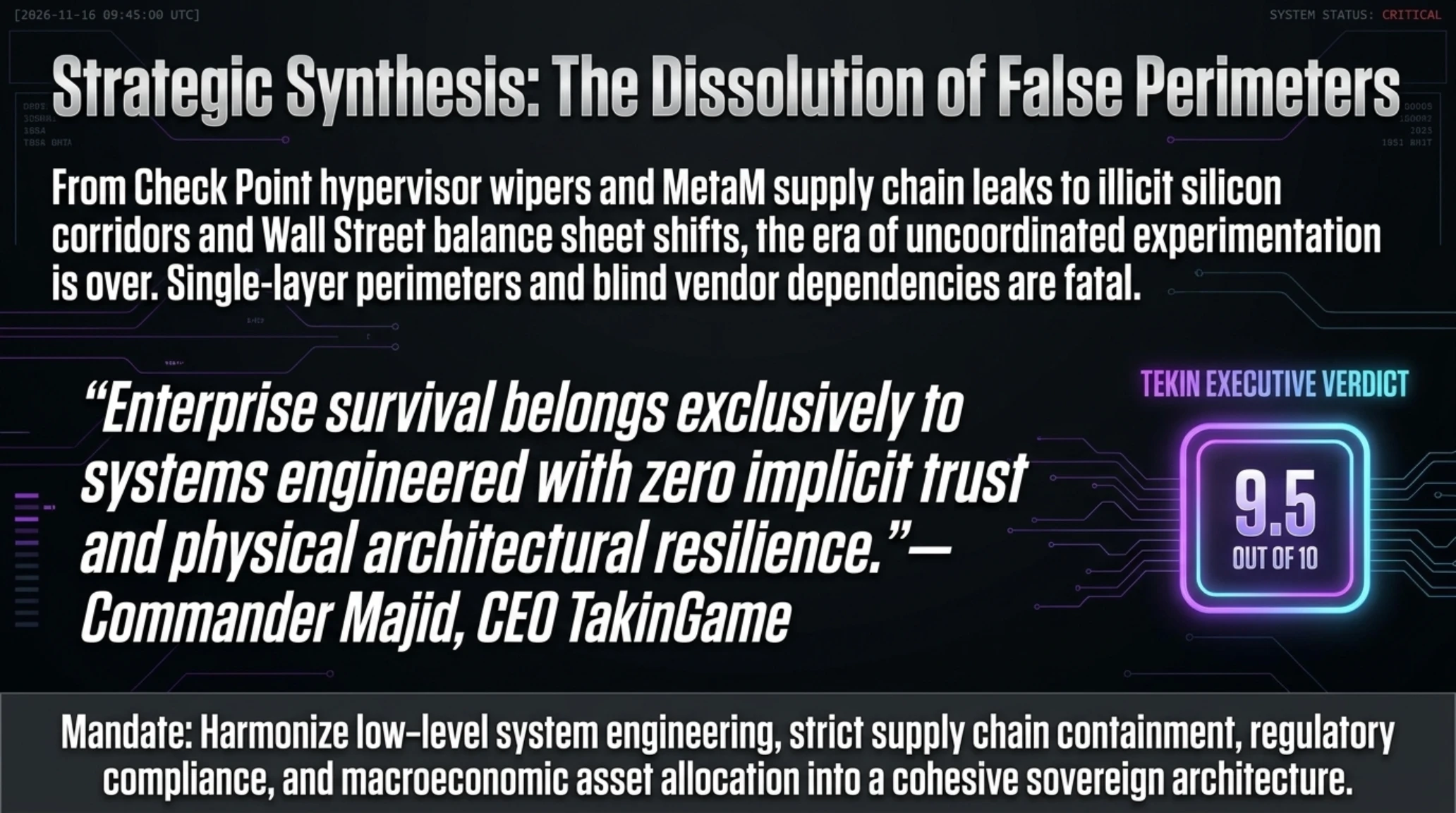
In total synthesis, these cross-domain developments confirm that the era of uncoordinated experimentation has concluded. The digital landscape now rewards organizations capable of harmonizing low-level system engineering, strict supply chain containment, regulatory compliance, and macroeconomic asset allocation into a cohesive sovereign architecture.
A rigorous multi-axis assessment of the current technological and economic inflection points provides structured clarity for institutional decision-makers:
- Rapid global identification and emergency CISA KEV action isolating critical flaws in Check Point and UnrealIRCd.
- Accelerated enterprise adoption of Zero-Trust frameworks and automated PII data masking across outsourced support vendors.
- Enhanced global transparency surrounding recursive AI risks through formal judicial and regulatory oversight.
- Strategic positioning of Ethereum as a competitive, yield-bearing sovereign store of value for institutional treasuries.
- Irreversible datastore destruction on enterprise VMware ESXi hypervisors executed via native wiper payloads.
- Proliferation of illicit gray-market silicon transit corridors undermining multilateral export control frameworks.
- Heightened consumer vulnerability to hyper-convincing voice phishing scams following customer helpdesk transcript theft.
For an authoritative perspective on hardware lifecycle management, display optimizations, and the intersection of silicon advancement with consumer entertainment, explore our strategic companion analysis on Next-Gen System Architecture & Silicon Evolution.
Furthermore, to examine how foundational network infrastructure, cryptographic verification protocols, and real-time telecom switches guard against systemic collapses like the FAA ground stop, review our comprehensive investigation into Enterprise Systems Infrastructure & Threat Vectors.
Synthesizing these disparate events proves that technological leadership in 2026 requires mastery over physical compute pipelines, resilient software boundaries, and transparent treasury governance.
Navigating these systemic risks requires decision-makers to transcend superficial security audits, re-engineering core operational networks around verifiable cyber-physical resilience principles.
The convergence of these core drivers establishes the technological baseline for the year ahead. To synthesize these breakthroughs into an actionable roadmap, the authoritative verdict and definitive answers to executive inquiries are codified below.
Editorial Verdict, Strategic Conclusion & Authoritative Sources Index
- BleepingComputer: Security advisory on Check Point zero-day CVE-2026-123039 and ESXi wiper attacks
- The Hacker News: Disclose on UnrealIRCd command injection flaw CVE-2026-114713 and KEV inclusion
- CoinTelegraph: Analysis of Coinone customer data breach and regulatory voice phishing warnings
- TechCrunch: Reuters investigation into illicit Blackwell clusters in China and Nvidia leadership shakeup
- Decrypt: Legal report on SF Superior Court lawsuit demanding emergency freeze on frontier AI models
- Bitcoin.com: Institutional breakdown of Vitalik Buterin's store-of-value thesis competing with Bitcoin
Frequently Asked Questions // Strategic Night Intelligence Analysis
What was the technical mechanism underlying the Check Point CVE-2026-123039 zero-day?
The vulnerability resulted from an unrestricted local Unix domain socket (0777 permissions) created by the DynamicCLI daemon in /tmp, allowing local unprivileged web processes to deliver crafted frames that executed root commands and deployed the destroy_v6 ESXi wiper.
Why was the UnrealIRCd vulnerability highlighted as an AI-discovered defect?
The flaw in the IRCv3 labeled-response module omitted delimiter neutralization on CR-LF sequences, permitting unauthenticated server-to-server command injection with IRCOp privileges; the lead maintainer confirmed it was identified via AI-assisted code auditing tools.
Why did South Korean regulators issue an emergency red alert following the Coinone breach?
Because attackers breached outsourced customer support contractor MetaM, exfiltrating full plaintext conversational transcripts containing passwords, national IDs, and banking data, enabling high-conviction voice phishing (vishing) impersonation.
How were export-banned Nvidia Blackwell chips deployed across Chinese AI data centers?
Through offshore hyperscale cloud leasing agreements and intermediary procurement networks operating across Southeast Asian transshipment hubs in Malaysia and Singapore, encompassing over $3.2 billion in active hardware clusters.
On what legal basis does the San Francisco Superior Court lawsuit seek to halt AI training?
Under California's Unfair Competition Law, classifying frontier model capability scaling beyond 10^26 FLOPs and uncontrolled recursive self-improvement as an actionable public nuisance that threatens critical civil and cyber infrastructure.
What are the structural implications of Vitalik Buterin repositioning Ethereum as a store of value?
By pivoting away from the ultrasound deflationary fee-burn model due to Layer-2 fee cannibalization, Buterin directly pitches Ethereum's staking yield and non-custodial security as an institutional store of value to compete with Bitcoin on Wall Street balance sheets.
Additional Gallery: Tekin Night Nov 16: Check Point Zero-Day & Smuggled Blackwell