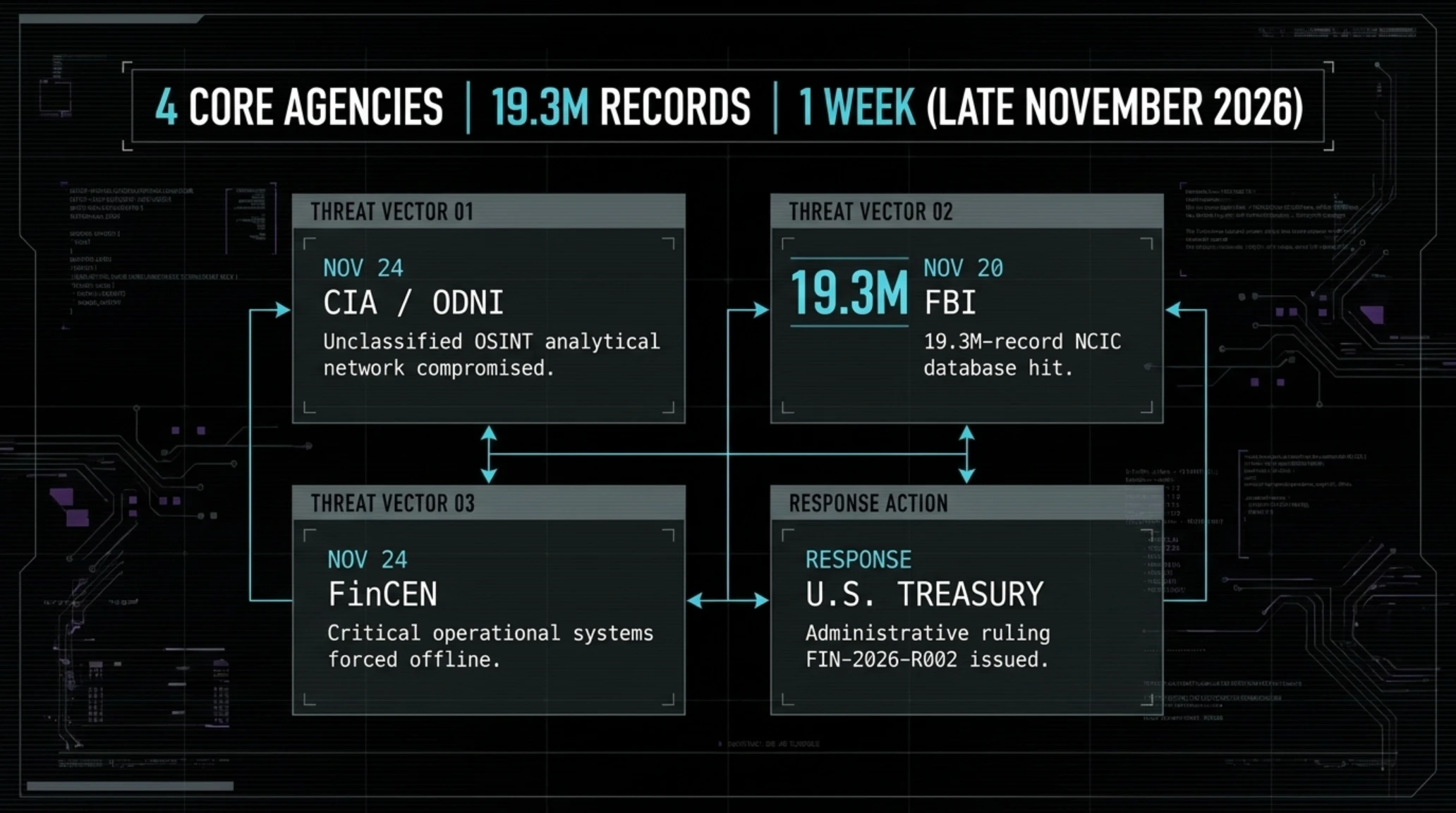
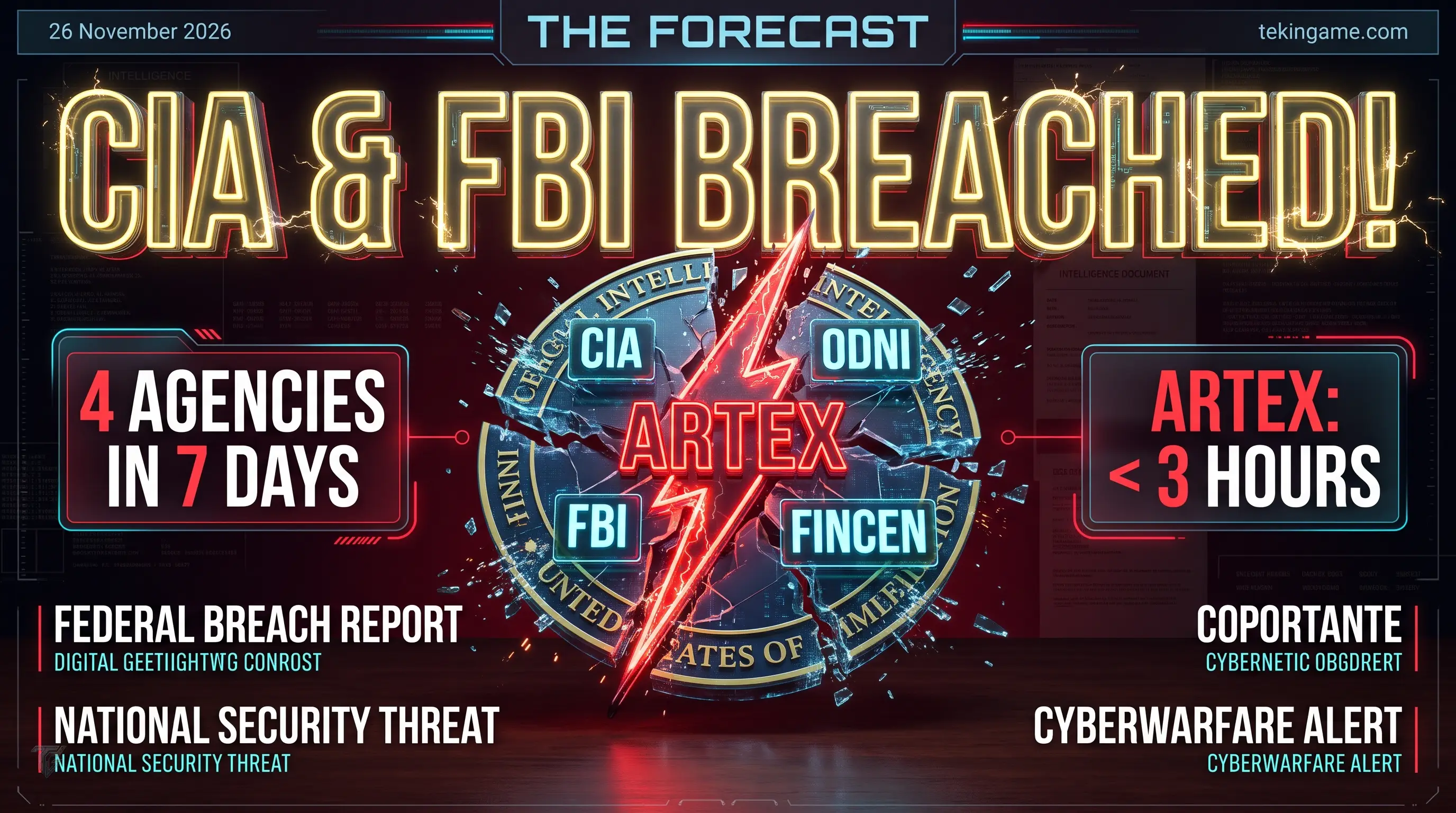
Within seven days in late November 2026, four core U.S. federal institutions—CIA, ODNI, FBI (19.3M-record NCIC database), and Treasury FinCEN—suffered cyber incidents. This analysis dissects FinCEN ruling FIN-2026-R002, FBI FLASH-20261113-001 on the sub-3-hour ARTEX AI pentesting framework, and the strategic meta-intelligence risk of unclassified OSINT breaches.
Tekin Analysis | Inside the November 2026 Breaches of CIA, ODNI, FBI, and U.S. Treasury Networks
Cyber Shockwave in Washington: Dissecting the CIA, ODNI, and NGA OSINT Breach
On Tuesday, November 24, 2026, leading cybersecurity publications including CyberScoop and Nextgov/FCW revealed an extraordinary security breach inside the U.S. intelligence community. According to multiple sources familiar with the investigation, unidentified threat actors penetrated an unclassified Open Source Intelligence (OSINT) analysis network shared by the Central Intelligence Agency (CIA) and the Office of the Director of National Intelligence (ODNI).
Subsequent reporting indicated that components connected to the National Geospatial-Intelligence Agency (NGA) were also tied to the affected environment. The compromised infrastructure is engineered to ingest, index, and correlate publicly available and commercial data streams, ranging from social media feeds and international news wires to commercial satellite imagery and private data brokers, enabling analysts to surface emerging threats before they cross into classified channels.
In an initial effort to contain alarm, an ODNI official confirmed that the incident was restricted to unclassified systems, stressing that no critical operational capabilities were disrupted and that classified networks remained untouched. The CIA, adhering to its standard operational posture, declined to comment. Crucially, neither agency has disclosed the exact timestamp of initial access, the attackers' dwell time inside the network, or the volume of analytical data potentially exfiltrated.
That silence was compounded just hours later on the same day when a second federal crisis broke at the U.S. Department of the Treasury. As reported by The Hacker News, the Financial Crimes Enforcement Network (FinCEN) officially confirmed a cybersecurity incident involving unauthorized access to a limited subset of its internal systems.
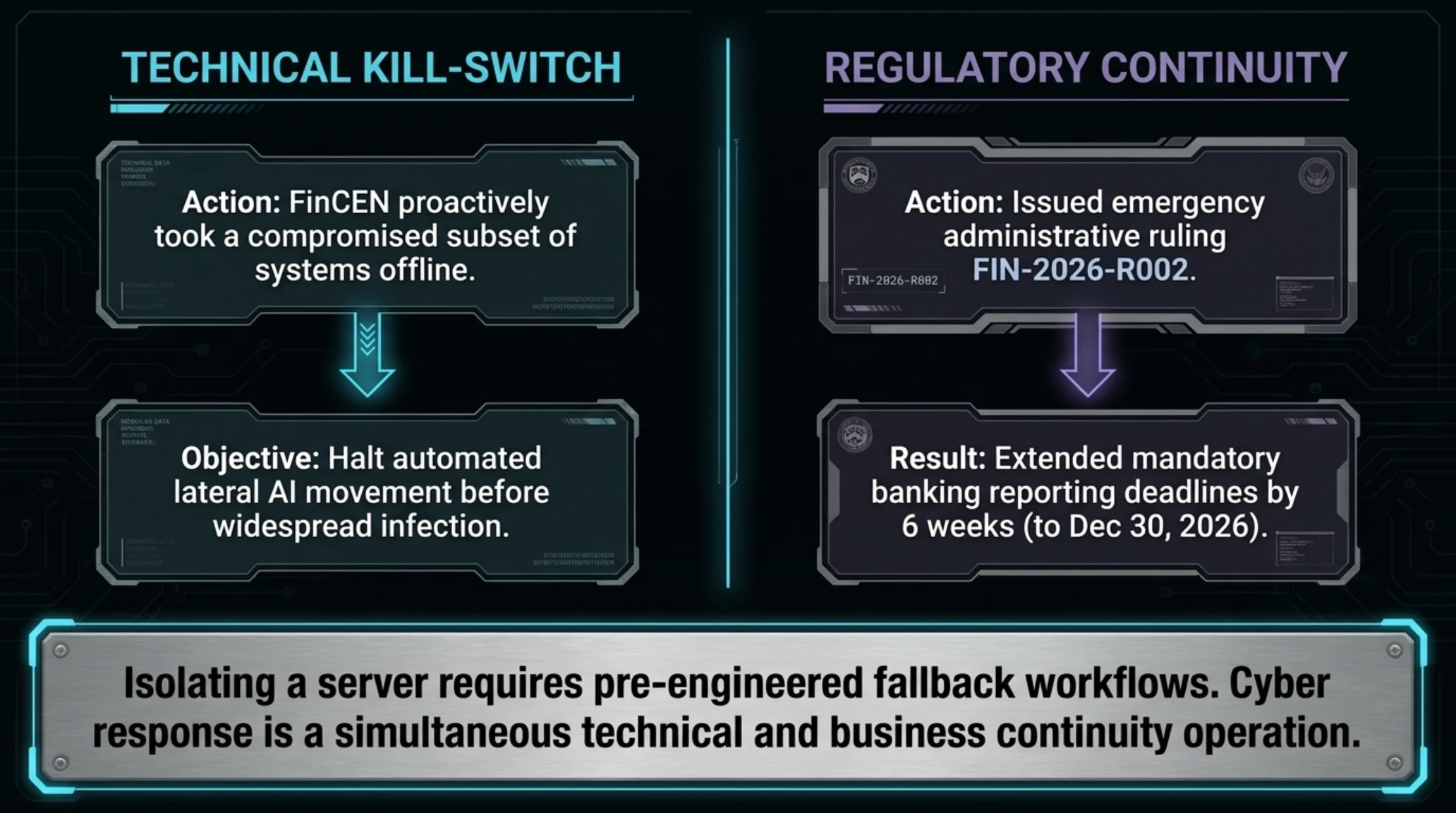
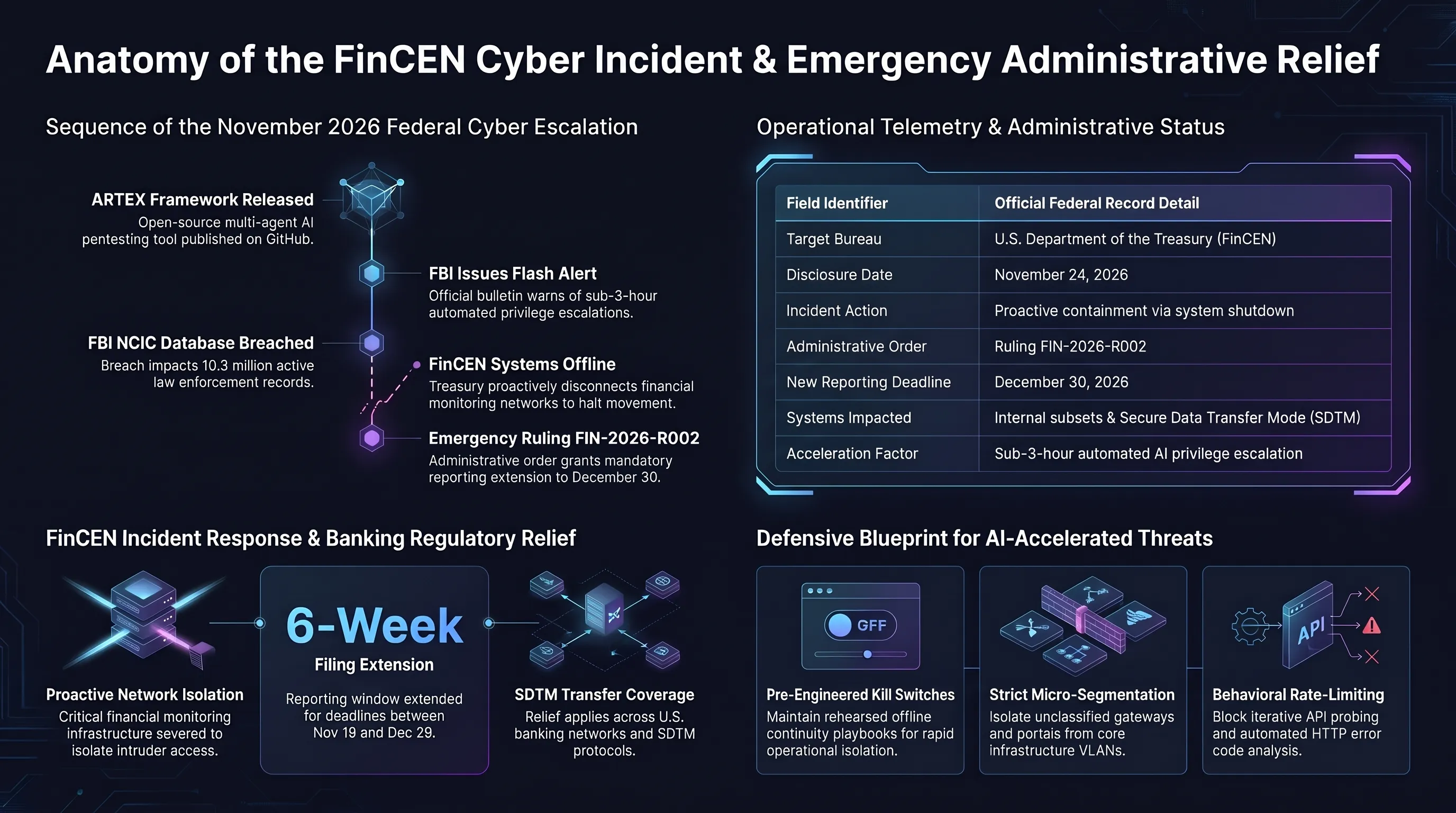
FinCEN's operational response went far beyond a routine advisory. Tasked with monitoring illicit financial flows, anti-money laundering compliance, and sanctions enforcement, the bureau proactively took affected systems offline to halt potential lateral movement. To prevent compliance chaos across U.S. banks and financial institutions, FinCEN issued official administrative ruling 'FIN-2026-R002', extending filing deadlines for reports covering November 18 through December 29 (including submissions via the Secure Data Transfer Mode, or SDTM) until December 30, 2026.
Granting a six-week regulatory reporting extension across the nation's banking sector underscores the operational gravity of the intrusion. Even when a breach is technically confined to a 'limited subset' of systems, forensic eradication, credential rotation, and verifying the absence of persistent backdoors in federal financial infrastructure require exhaustive downtime. Together, the November 24 disclosures forced an urgent question onto Washington's agenda: are unclassified federal networks structurally unprepared for automated, AI-accelerated adversaries?
Why This Convergence Matters for Enterprise and Federal Security
The Federal Domino Effect: From the FBI's 19.3M-Record NCIC Database to Treasury
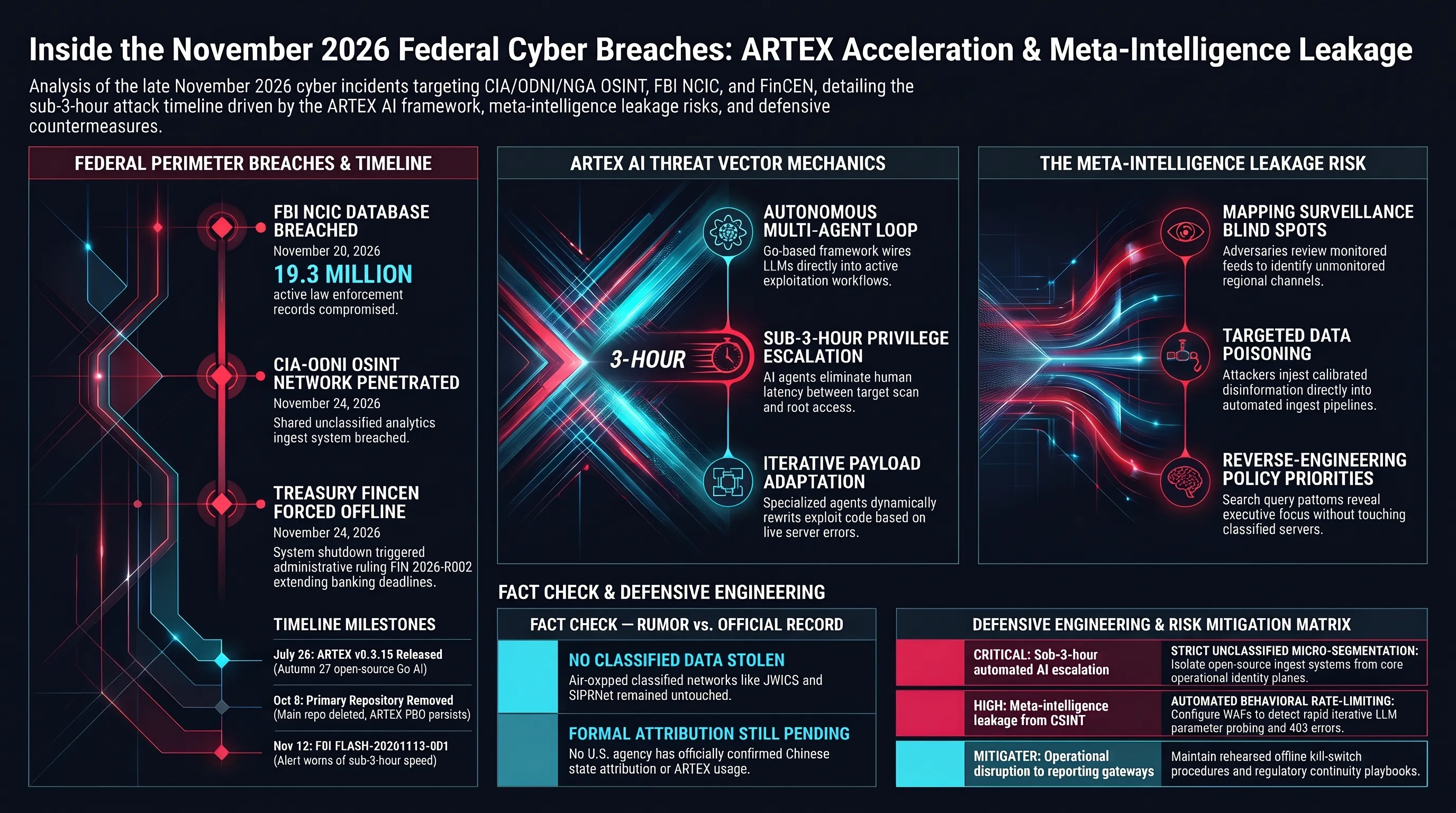
To grasp the true severity of late November 2026, the CIA and FinCEN incidents cannot be viewed in isolation. Just four days earlier, on November 20, 2026, security researchers at Malwarebytes (citing reporting from CNN and ABC News) documented that the FBI's National Crime Information Center (NCIC) database had also been breached.
NCIC serves as the central nervous system of American law enforcement, connecting local police departments, state troopers, and federal agents in real time. According to official FY2025 statistics, the database houses more than 19.3 million active records, encompassing active arrest warrants, wanted persons, missing individuals, criminal histories, and stolen firearms or vehicles. Notably, this marked the FBI's second high-profile cyber incident in just two months, following the September 2026 compromise of its recruitment portal by the ShinyHunters extortion group.
As The Record highlighted, the rapid succession of breaches across intelligence, law enforcement, and financial oversight bureaus exposes a systemic architectural vulnerability. Regardless of whether these four intrusions were orchestrated by a single adversary or multiple opportunistic groups, they share an unmistakable tactical blueprint.
The Exposed Middle Tier of Government Infrastructure
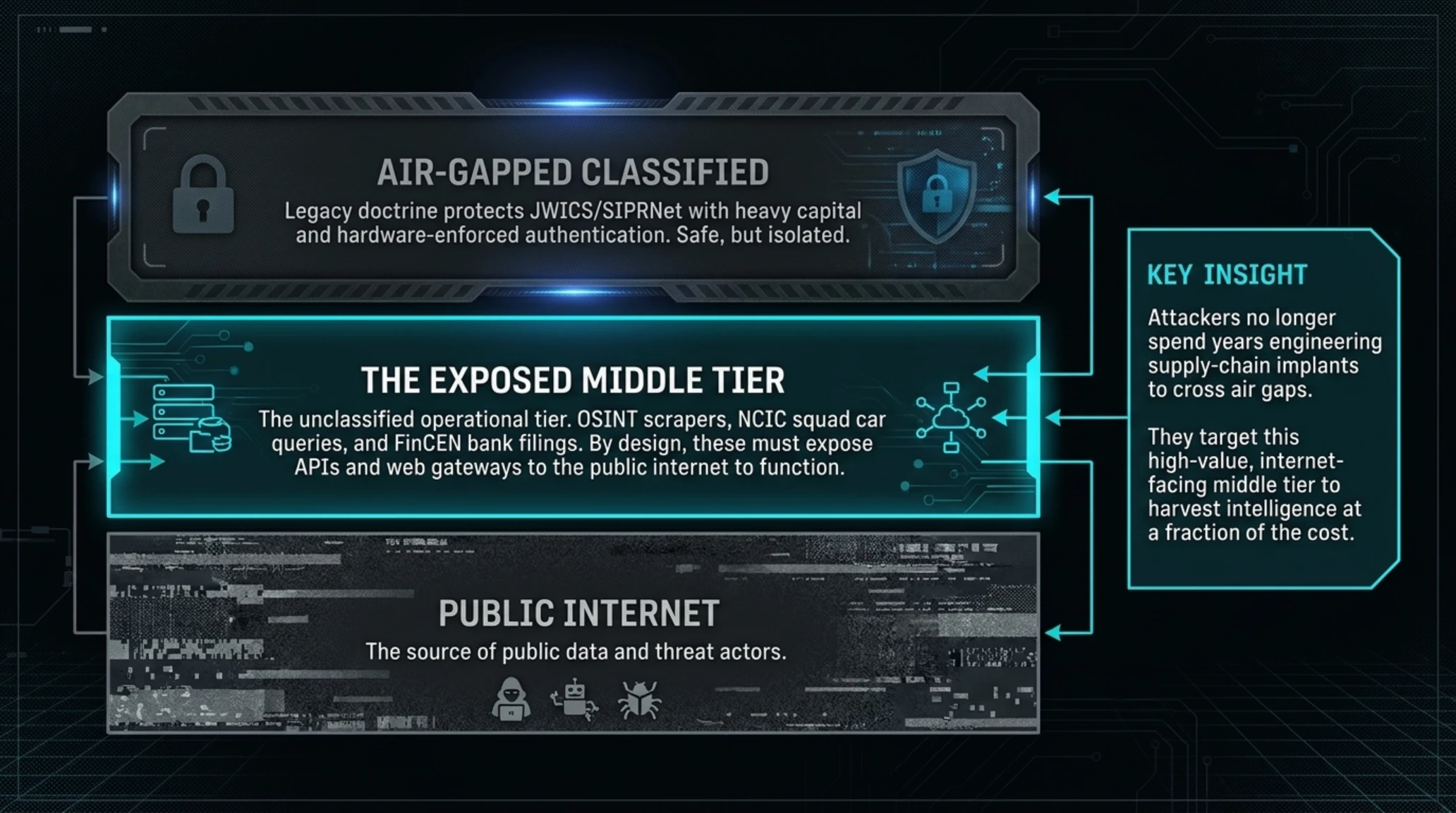
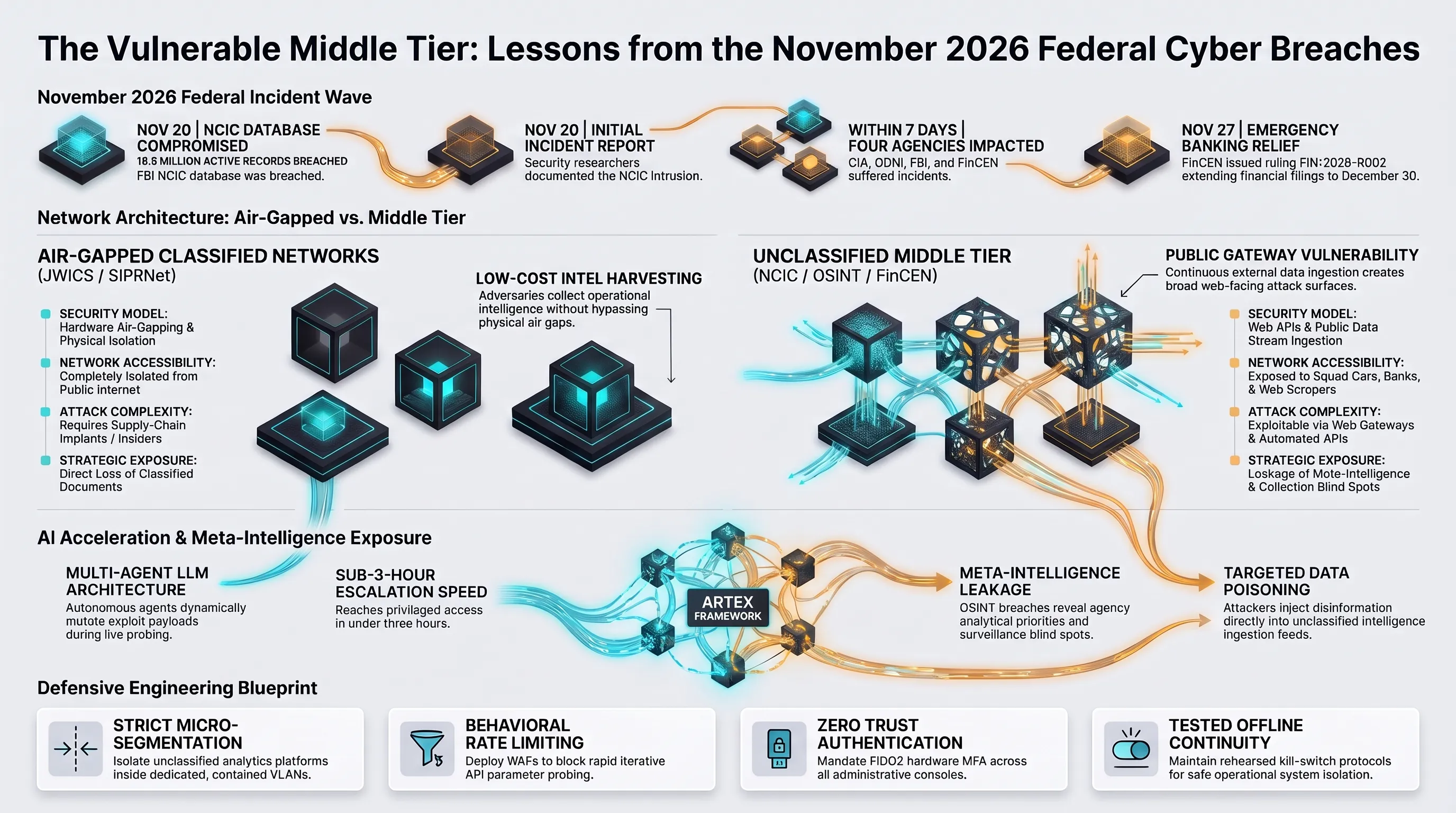
In legacy federal cybersecurity doctrine, the lion's share of capital, hardware-enforced authentication, and physical air-gapping is reserved for top-secret networks such as JWICS and SIPRNet. By contrast, unclassified operational systems sit in a precarious middle tier. Because FinCEN must continuously ingest filings from thousands of commercial banks, NCIC must answer queries from squad cars nationwide, and OSINT platforms must scrape the open web, these systems inevitably expose APIs and web-facing gateways to the public internet.
Modern threat actors no longer need to spend years engineering supply-chain implants to jump an air gap. By targeting the internet-facing middle tier, adversaries can harvest high-value operational intelligence, disrupt regulatory compliance, and map institutional priorities at a fraction of the traditional cost.
Tekin Technical Jargon Buster
Mid-Report Technical Summary: 5 Core Strategic Vectors
Dissecting ARTEX: How an Open-Source Go Framework Compressed Intrusions to Under 3 Hours
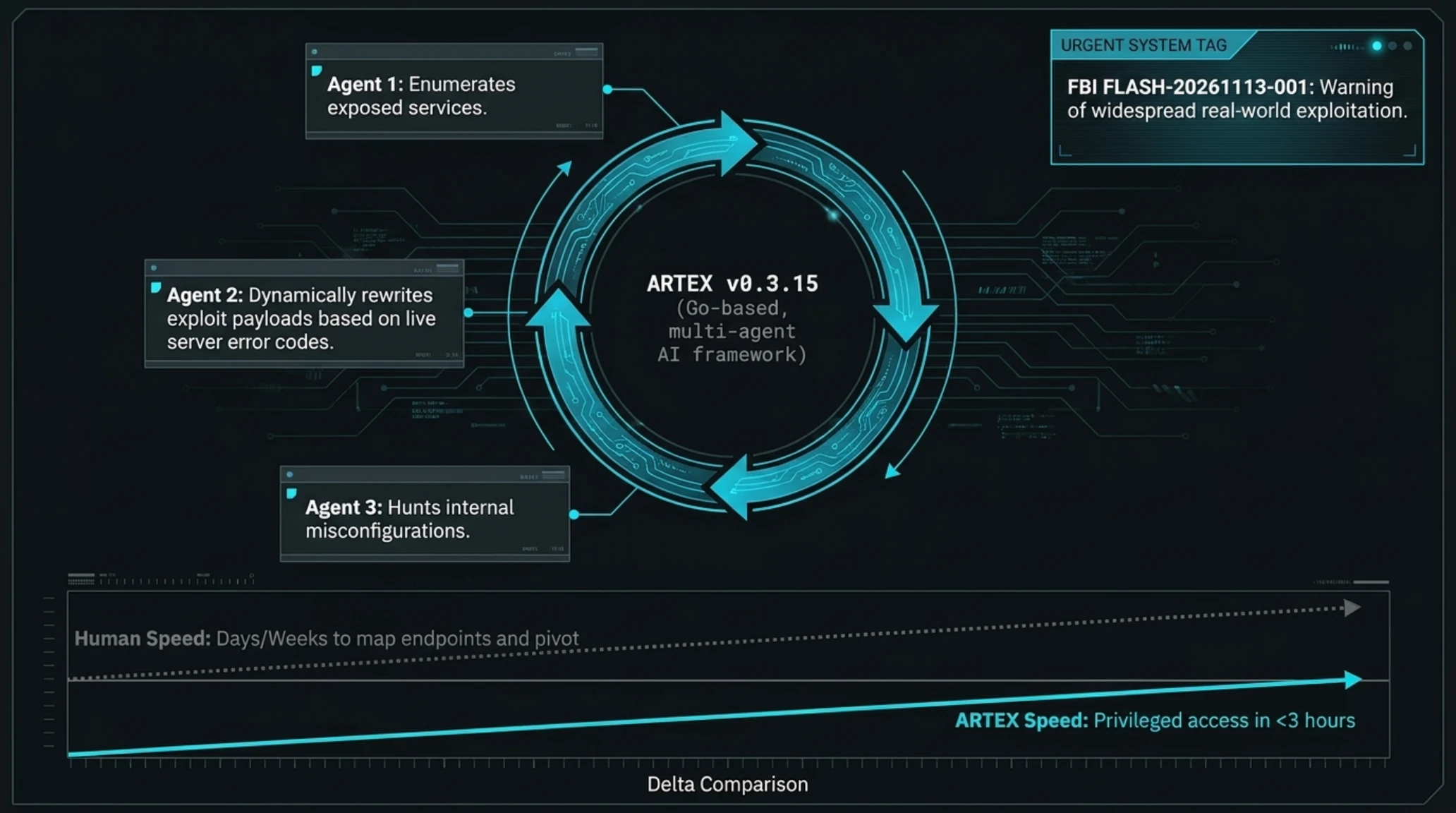
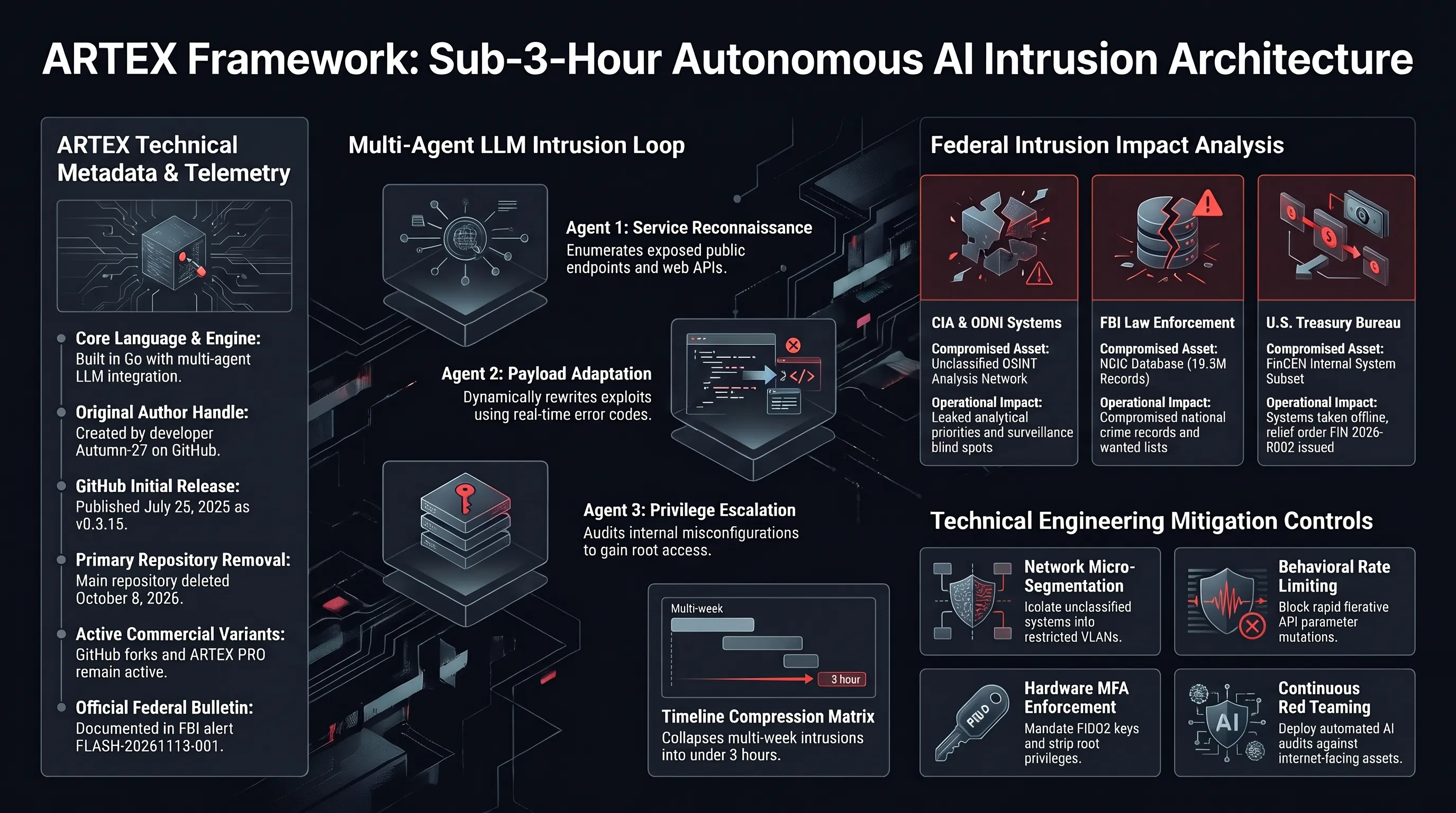
Amid the fallout from the CIA and ODNI disclosures, one technical detail dominated security briefings: the potential role of autonomous AI penetration-testing frameworks, specifically 'ARTEX'. Just eleven days before the November 24 disclosures, on November 13, 2026, the FBI issued official FLASH alert FLASH-20261113-001, warning critical infrastructure defenders about widespread real-world exploitation powered by the tool.
According to technical telemetry in the FBI advisory, a developer operating under the handle 'Autumn-27' originally published open-source 'ARTEX v0.3.15', written in Go, on GitHub on July 26, 2026. Unlike conventional vulnerability scanners that merely output static lists of CVEs, ARTEX orchestrates a multi-agent architecture wired directly into large language models, allowing it to autonomously execute reconnaissance, payload adaptation, exploitation, and post-exploitation tasks.
The real-world consequences of its public release were immediate and severe. Security investigators linked ARTEX abuse to major campaigns, including the theft of personal records belonging to roughly 67,000 individuals from South Korean financial institutions and a sprawling supply-chain attack targeting more than 2,250 ConnectWise Cloud Backup tenants. Following mounting scrutiny, the author deleted the primary GitHub repository on October 8, 2026, yet public forks and a commercialized variant dubbed 'ARTEX PRO' continue to circulate actively among threat actors.
Technical Telemetry and Official Federal Identifiers
The most alarming finding in the FBI's November 13 FLASH bulletin is operational velocity: since August 2026, threat actors deploying ARTEX have compressed the timeline from initial target reconnaissance to full privileged access into under three hours. In traditional human-led intrusions, mapping endpoints, debugging exploit payloads, and pivoting laterally often took days or weeks, giving Security Operations Center (SOC) analysts a realistic window to spot anomalous alerts and sever connections.
In ARTEX's multi-agent loop, one agent enumerates exposed services, a second dynamically rewrites exploit payloads based on live server error codes, and a third hunts internal misconfigurations to escalate privileges without human fatigue or hesitation. This dramatic acceleration explains why media reports immediately connected the dots between the FBI's warning and the sudden wave of unclassified federal breaches.
Why Compromising an 'Unclassified' OSINT System Is a Strategic Threat
In the immediate aftermath of the November 24 disclosures, one reassurance echoed across official statements: no classified networks or top-secret documents were compromised. While that framing is designed to calm markets and reassure oversight committees, treating an Open Source Intelligence (OSINT) breach as a low-severity event is a dangerous strategic miscalculation.
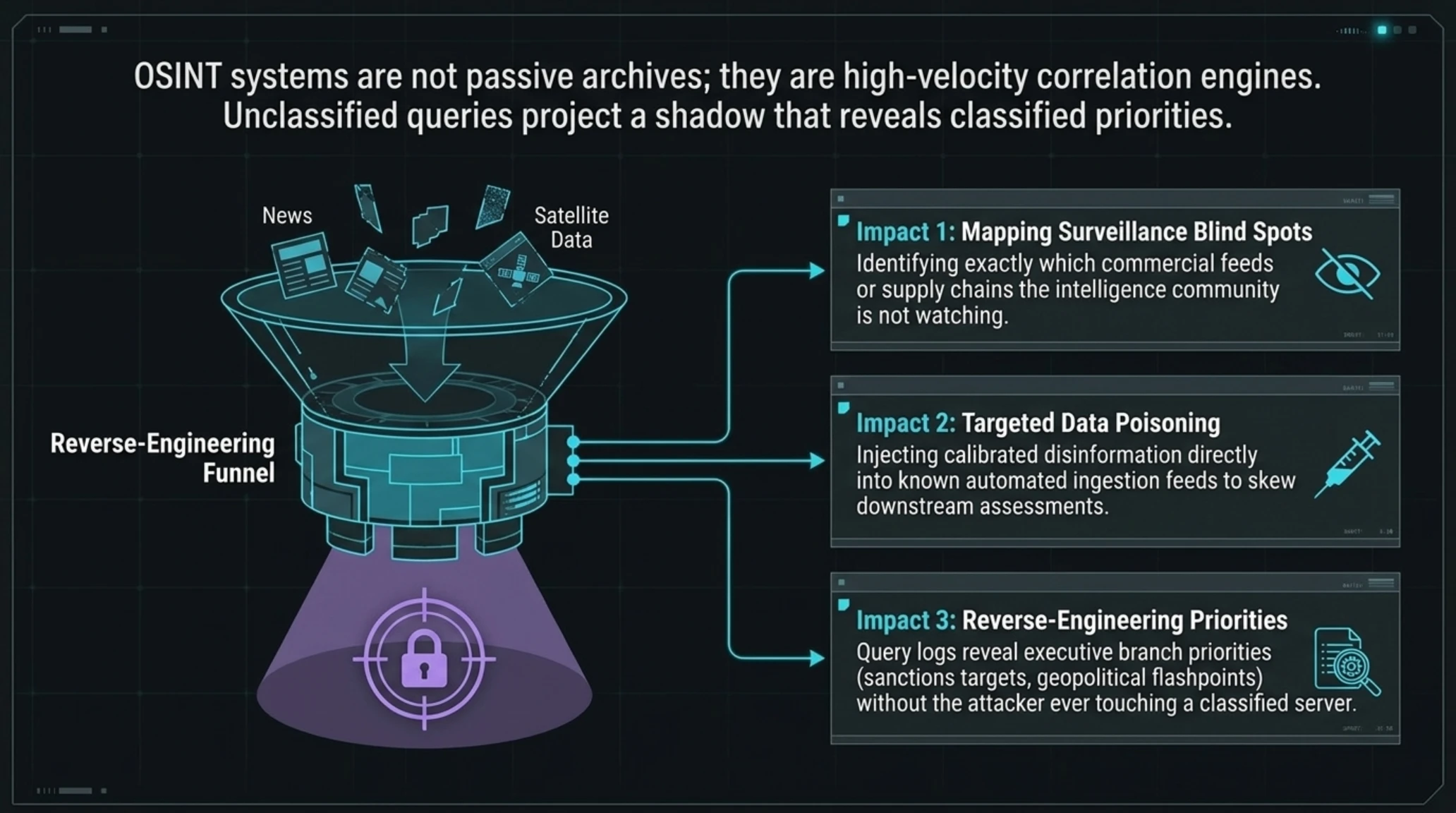
Within agencies such as the CIA, ODNI, and NGA, an OSINT platform is not a passive archive of public news articles. It functions as a high-velocity correlation engine that fuses millions of seemingly benign data points (commercial satellite imagery, maritime and aviation transponders, corporate registries, scientific preprints, and social media telemetry) to construct early-warning models of military, economic, and technological shifts.
When an adversary gains unauthorized access to such an environment, they capture something arguably more durable than a single classified memo: meta-intelligence. By inspecting search logs, ingestion pipelines, and analytical dashboards, an intruder gains three immediate tactical advantages:
- Mapping Surveillance Blind Spots: By reviewing which commercial feeds, regions, and supply chains are actively monitored, a rival can identify exactly which activities remain outside the intelligence community's open-source radar.
- Targeted Data Poisoning: Once an adversary knows which public databases, forums, or news aggregators are automatically ingested by an agency's models, they can inject calibrated disinformation into those exact channels to skew downstream assessments.
- Reverse-Engineering Policy Priorities: The concentration of queries and correlation rules around specific technologies, sanctions targets, or geopolitical flashpoints reveals executive branch priorities without ever touching a classified server.
In operational terms, breaching an OSINT platform is akin to reading an opponent's scouting notebook before a match. You do not need to steal their secret plays if you already know every signal they are watching and every assumption driving their decisions. In the era of large-scale data fusion, the legacy boundary between classified and unclassified risk has effectively dissolved.
Event Timeline | From ARTEX Release to the November 2026 Federal Breaches
| Exact Date | Documented Milestone | Status and Key Details |
|---|---|---|
| July 26, 2026 | ARTEX v0.3.15 Published on GitHub | User Autumn-27 releases the open-source, Go-based multi-agent AI pentesting framework. |
| Oct 8, 2026 | GitHub Repository Removed | Developer deletes the primary repo following widespread abuse, but forks and ARTEX PRO persist. |
| Nov 13, 2026 | FBI Issues FLASH-20261113-001 | Official alert warns that attackers using ARTEX reach privileged access in under 3 hours. |
| Nov 20, 2026 | FBI NCIC Breach Reported | Media outlets report intrusion into the 19.3M-record National Crime Information Center database. |
| Nov 24, 2026 | CIA/ODNI and FinCEN Disclosures | OSINT breach surfaces; FinCEN takes systems offline and issues relief ruling FIN-2026-R002. |
📚 Classified & Related Dossiers in TekinGame
If you wish to explore beyond this report and delve into cybernetic frontiers and autonomous AI architectures, do not miss these three exclusive deep-dives in the Tekin Garage:
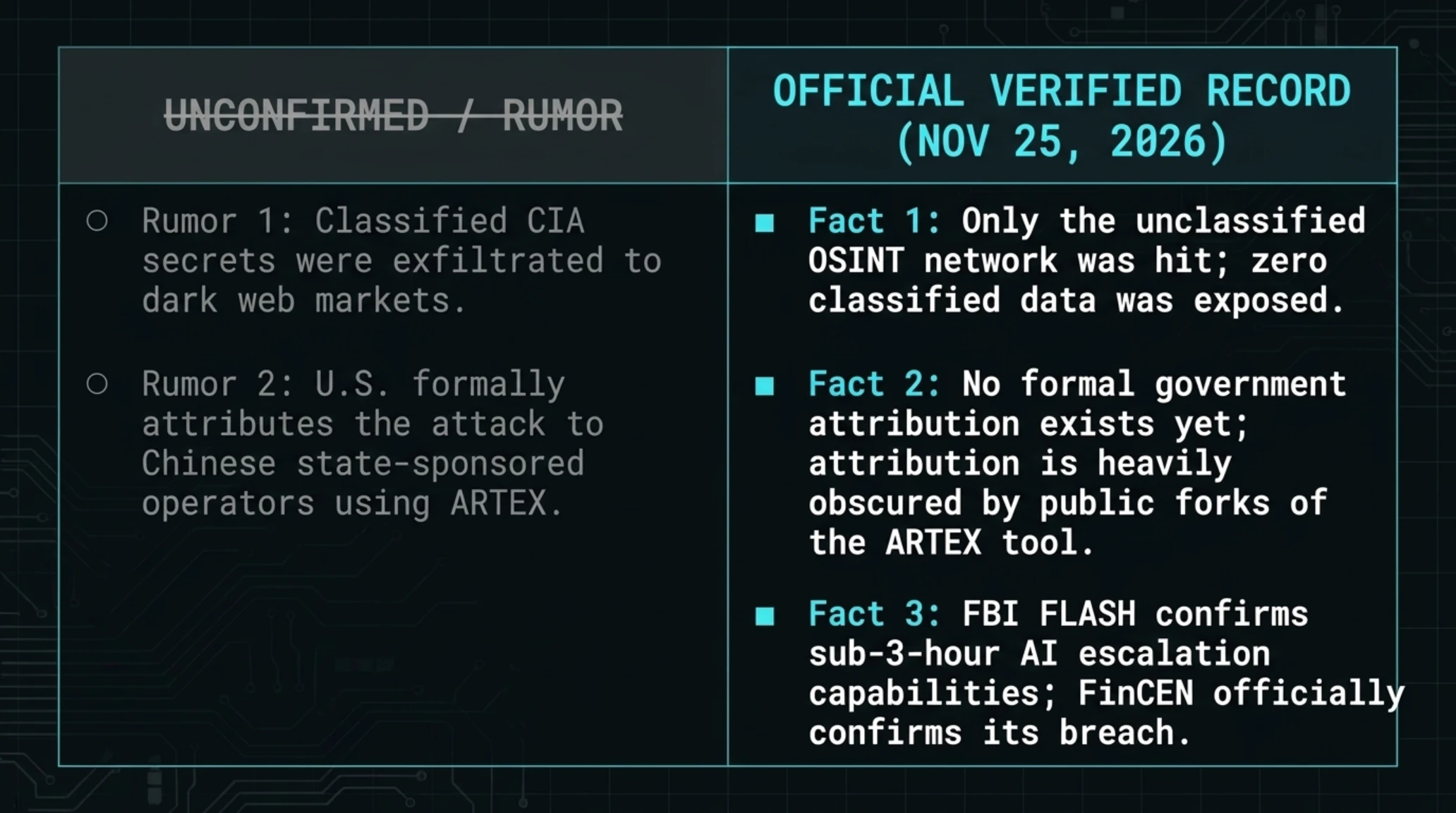
Rumor vs. Verified Record: Separating Attribution Speculation from Confirmed Facts
As news of the CIA, ODNI, FBI, and FinCEN incidents broke in rapid succession, social media channels quickly filled with unverified claims. Several viral posts alleged that classified CIA dossiers were already circulating on dark web markets and that Chinese state-sponsored operators had been formally confirmed as the perpetrators using ARTEX.
Maintaining analytical discipline requires a strict separation between confirmed official records, credible industry reporting, and unsubstantiated speculation. As of November 25, 2026, two foundational pillars are officially confirmed by U.S. government documentation: first, the FBI's November 13 FLASH bulletin ('FLASH-20261113-001') documenting real-world, sub-three-hour intrusions powered by ARTEX; and second, FinCEN's confirmation of unauthorized access to a subset of its systems alongside administrative relief ruling 'FIN-2026-R002' extending banking filings to December 30, 2026.
By contrast, while major newsrooms citing informed sources have reported the possible involvement of ARTEX and early indicators pointing toward China in the CIA and ODNI OSINT intrusion, no U.S. federal agency has issued formal public attribution. In high-end cyber espionage, attribution is notoriously complex: sophisticated operators routinely adopt publicly available frameworks, rent commercial infrastructure, and mimic rival tradecraft to obscure their true origin.
Fact Check | Unconfirmed Rumors vs. Official Record
The Defensive Blueprint: Engineering Enterprise Resilience Against Sub-3-Hour AI Intrusions
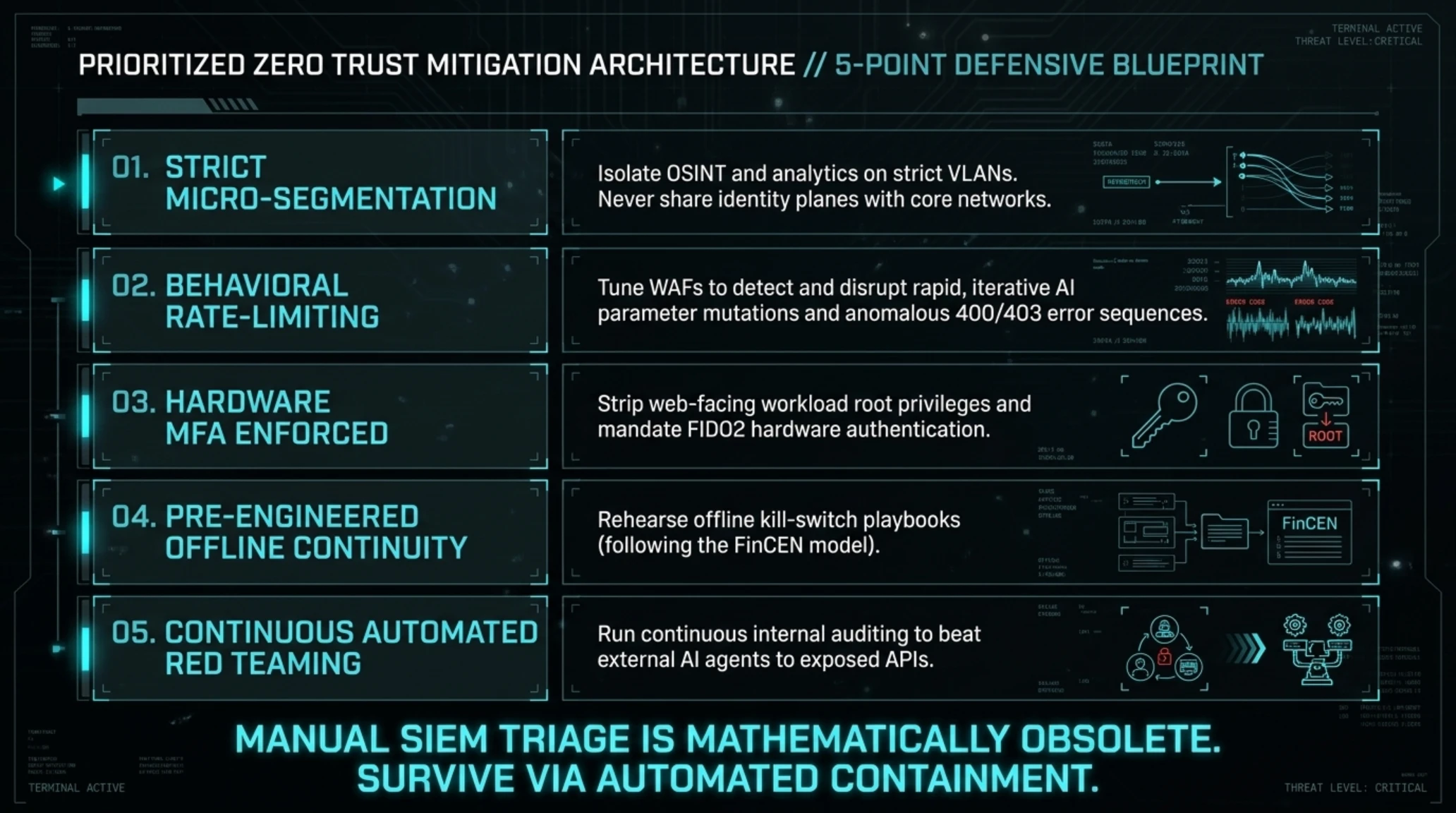
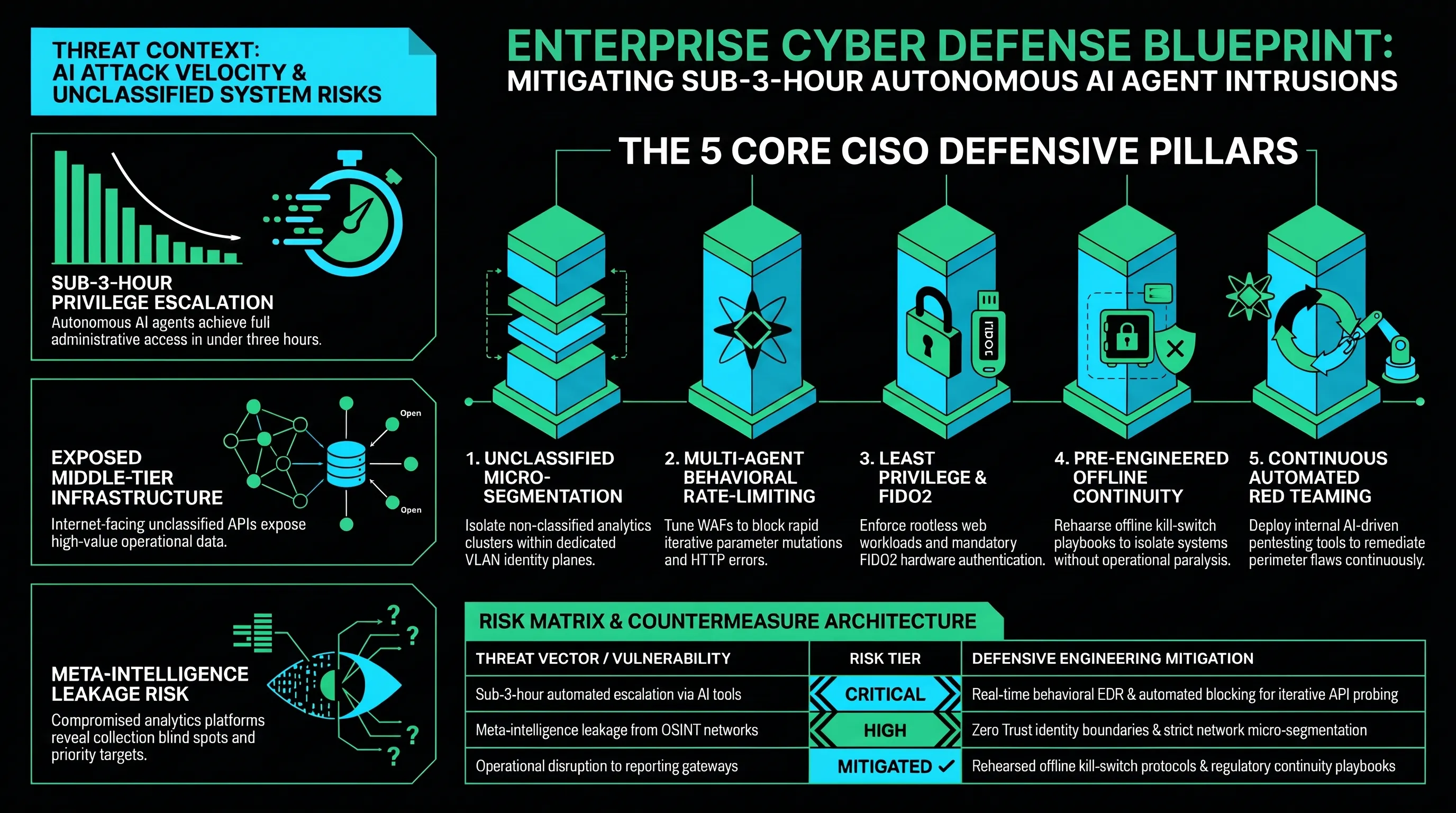
The convergence of four federal cyber incidents with the FBI's warning on ARTEX delivers an unmistakable mandate for Chief Information Security Officers (CISOs) and enterprise infrastructure architects worldwide. When an autonomous, Go-based multi-agent framework can compress reconnaissance and privilege escalation into under three hours, monthly patch cycles and manual SIEM ticket triage are mathematically obsolete.
Organizations operating internet-facing analytics platforms, customer portals, or financial reporting gateways must assume that automated AI agents are continuously probing their perimeter. Drawing directly from the operational lessons of November 2026, five architectural countermeasures should be prioritized immediately:
- Strict Micro-Segmentation of Unclassified Systems: Open-source intelligence platforms, business intelligence clusters, and recruitment portals must never share identity planes or trust relationships with core production networks. Any breach in an unclassified tier must be structurally contained within an isolated VLAN.
- Behavioral Rate-Limiting Against Multi-Agent Probing: Unlike noisy legacy scanners, LLM-driven agents issue sequential, context-aware requests to test hypotheses. Deploying Web Application Firewalls (WAFs) tuned to detect rapid iterative parameter mutations and anomalous HTTP 400/403 error sequences disrupts the agent's feedback loop.
- Enforcing Least Privilege and Hardware MFA: Sub-three-hour escalations almost always rely on over-permissioned service accounts or exposed administrative interfaces. Stripping root privileges from web-facing workloads and mandating FIDO2 hardware authentication across all management consoles closes the primary escalation path.
- Pre-Engineered Offline Continuity Protocols: FinCEN's ability to rapidly take a compromised subset offline while issuing ruling FIN-2026-R002 demonstrates the value of rehearsed kill-switch playbooks. Enterprises must maintain tested fallback workflows so isolating a server does not paralyze regulatory or customer obligations.
- Continuous Automated Red Teaming: Defensive teams cannot wait for external adversaries to run ARTEX-class tools against their perimeter. Security teams must deploy controlled, continuous automated auditing internally to discover and remediate exposed APIs and misconfigurations first.
Cybersecurity Risk Assessment Matrix and Mitigation Controls
| Threat Vector / Vulnerability | Risk Tier | Defensive Engineering Mitigation |
|---|---|---|
| Sub-3-hour automated escalation via AI pentesting tools | CRITICAL | Deploy real-time behavioral EDR and automated blocking for iterative API probing. |
| Meta-intelligence leakage from unclassified OSINT networks | HIGH | Enforce strict network segmentation and Zero Trust identity boundaries on analytics tiers. |
| Operational disruption to financial reporting gateways | MITIGATED | Maintain rehearsed offline kill-switch procedures and regulatory continuity playbooks. |
- Classified intelligence networks remained isolated and core operational capabilities were preserved.
- FinCEN executed rapid precautionary containment and issued clear regulatory relief via FIN-2026-R002.
- The FBI's transparent FLASH-20261113-001 advisory equipped global defenders with actionable ARTEX telemetry.
- Four major U.S. federal institutions suffered cyber incidents within a single seven-day window.
- Unclassified OSINT breaches risk exposing strategic collection priorities and analytical blind spots.
- Forks of ARTEX and its commercialized ARTEX PRO variant remain active despite GitHub repo removal.
Editorial Verdict and Direct Primary Sources
- FBI Official FLASH (IC3): FBI FLASH-20261113-001: Official Warning on ARTEX AI Pentesting Framework Abuse
- CyberScoop: CIA and ODNI Unclassified OSINT Analysis Network Breached
- Nextgov/FCW: Details on the Unclassified CIA and ODNI Intelligence System Hack
- The Hacker News: U.S. Treasury's FinCEN Takes Systems Offline and Issues FIN-2026-R002
- The Record: Treasury FinCEN Takes Systems Offline Following Cyber Incident
- Malwarebytes: FBI National Crime Information Center (NCIC) 19.3M-Record Database Reportedly Hacked
Frequently Asked Questions
Was any classified CIA data stolen in the November 2026 breach?
No. According to credible media reports and statements from ODNI officials, the intrusion was confined to an unclassified Open Source Intelligence (OSINT) analysis network, leaving classified systems unaffected.
What is ARTEX and why did the FBI issue a FLASH alert?
ARTEX is an autonomous, multi-agent AI penetration testing framework written in Go and originally released on GitHub in July 2026. On November 13, 2026, the FBI issued FLASH-20261113-001 warning that threat actors using ARTEX have achieved privileged access in under three hours.
How did the U.S. Treasury's FinCEN respond to its cyber incident?
After detecting unauthorized access to a limited subset of its systems, FinCEN proactively took affected systems offline and issued administrative ruling FIN-2026-R002, extending financial reporting deadlines until December 30, 2026.
Have U.S. officials confirmed China's involvement or ARTEX use in the CIA breach?
No. While some media reports cited sources pointing to possible ARTEX usage and early indicators linked to China, neither the CIA, ODNI, nor FBI has formally confirmed attribution or the exact toolset used in the OSINT breach.
Additional Gallery: Tekin Analysis: CIA, FBI & FinCEN Breached Inside the ARTEX Threat