A technical autopsy of Bitcoin Block 977,057 solved by a solo miner running an 8.0 TH/s desktop setup via Solo CKPool against a 1,040 EH/s network. Covers memoryless Poisson math, sub-100W Bitaxe silicon vs. megawatt farms, the $190K post-halving payout (3.1287 BTC gross), and survivorship bias in lottery mining.
Tekin Analysis | Solo Bitcoin Miner Miracle and the $190,000 Jackpot
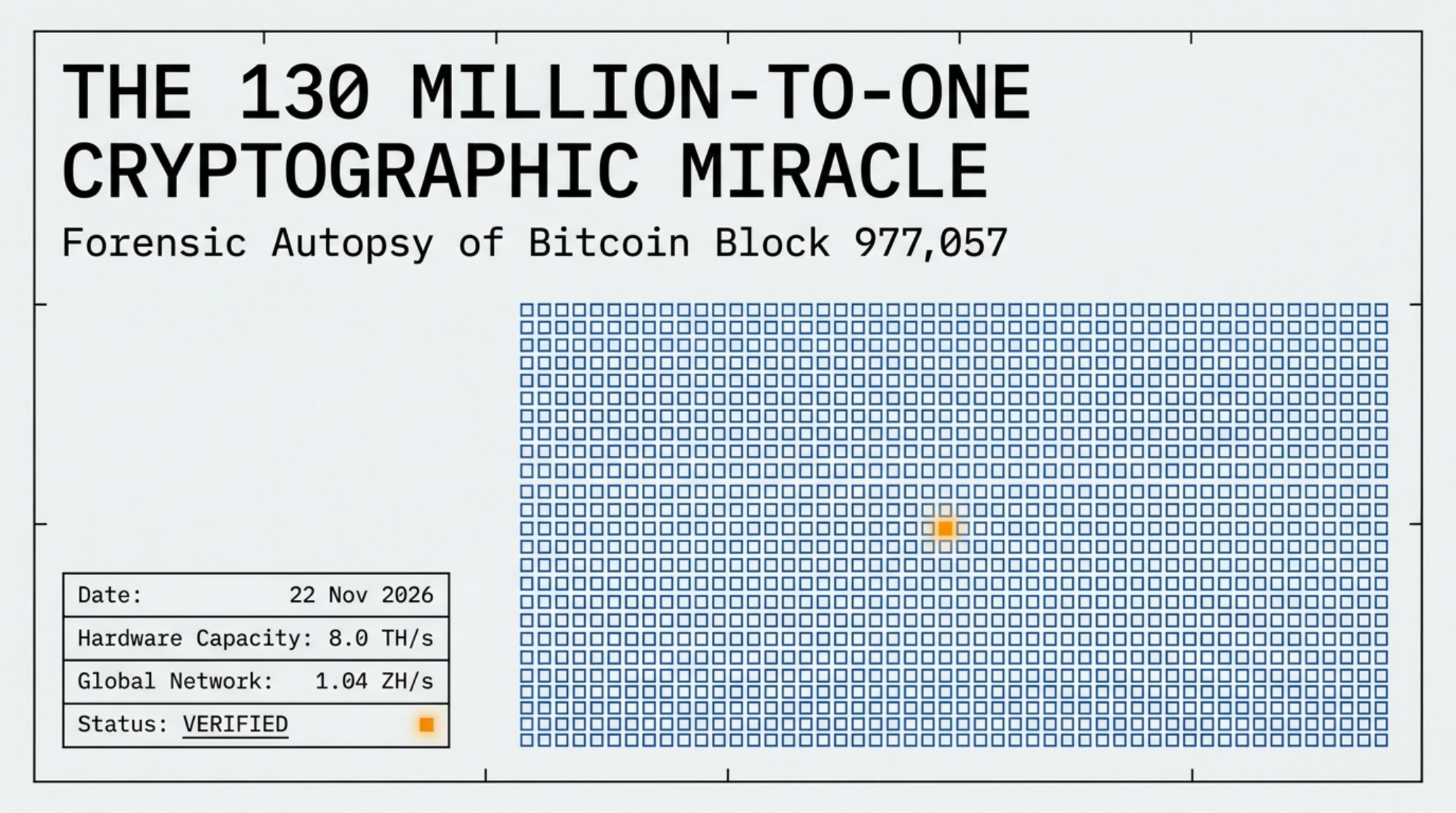
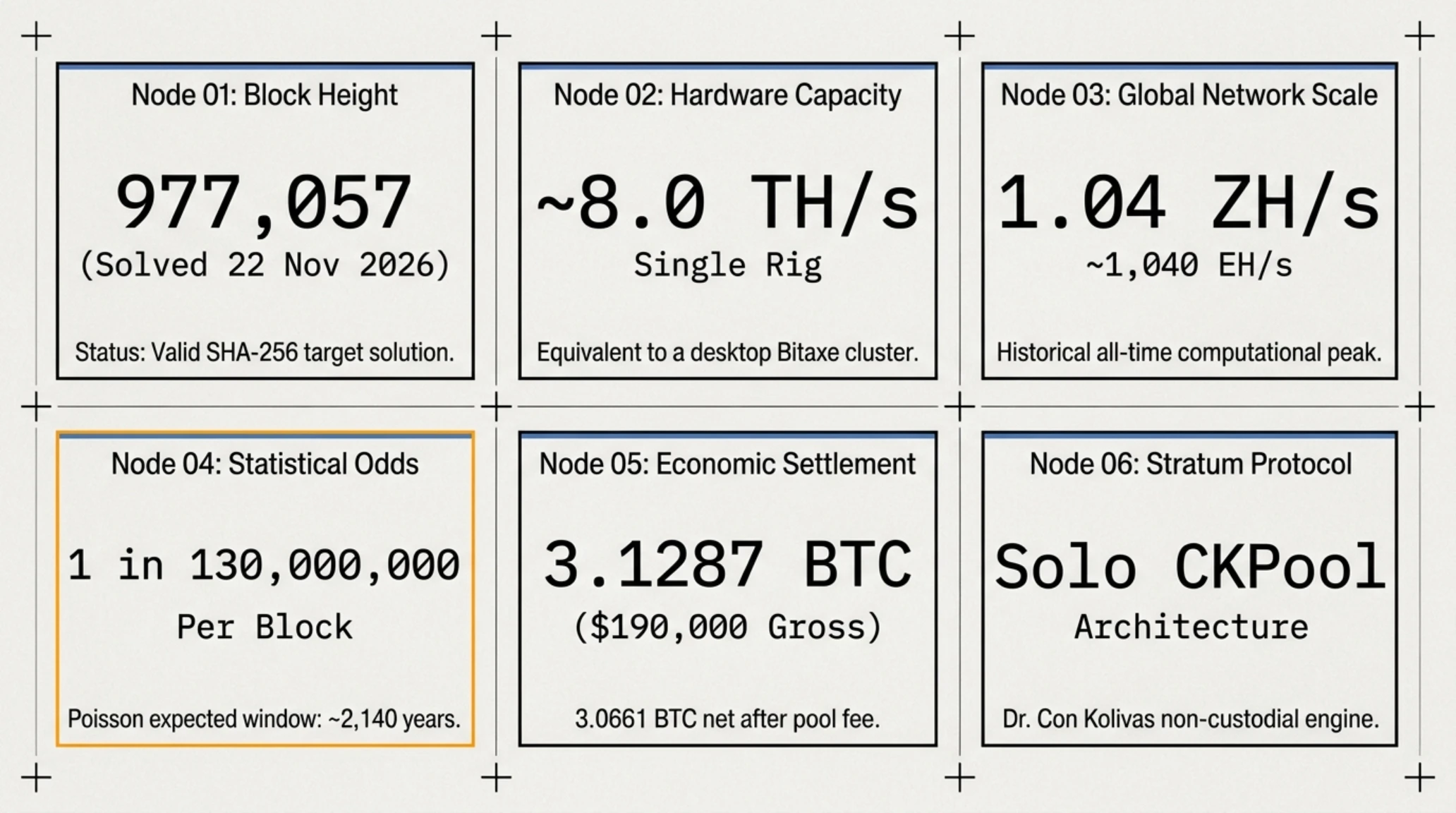
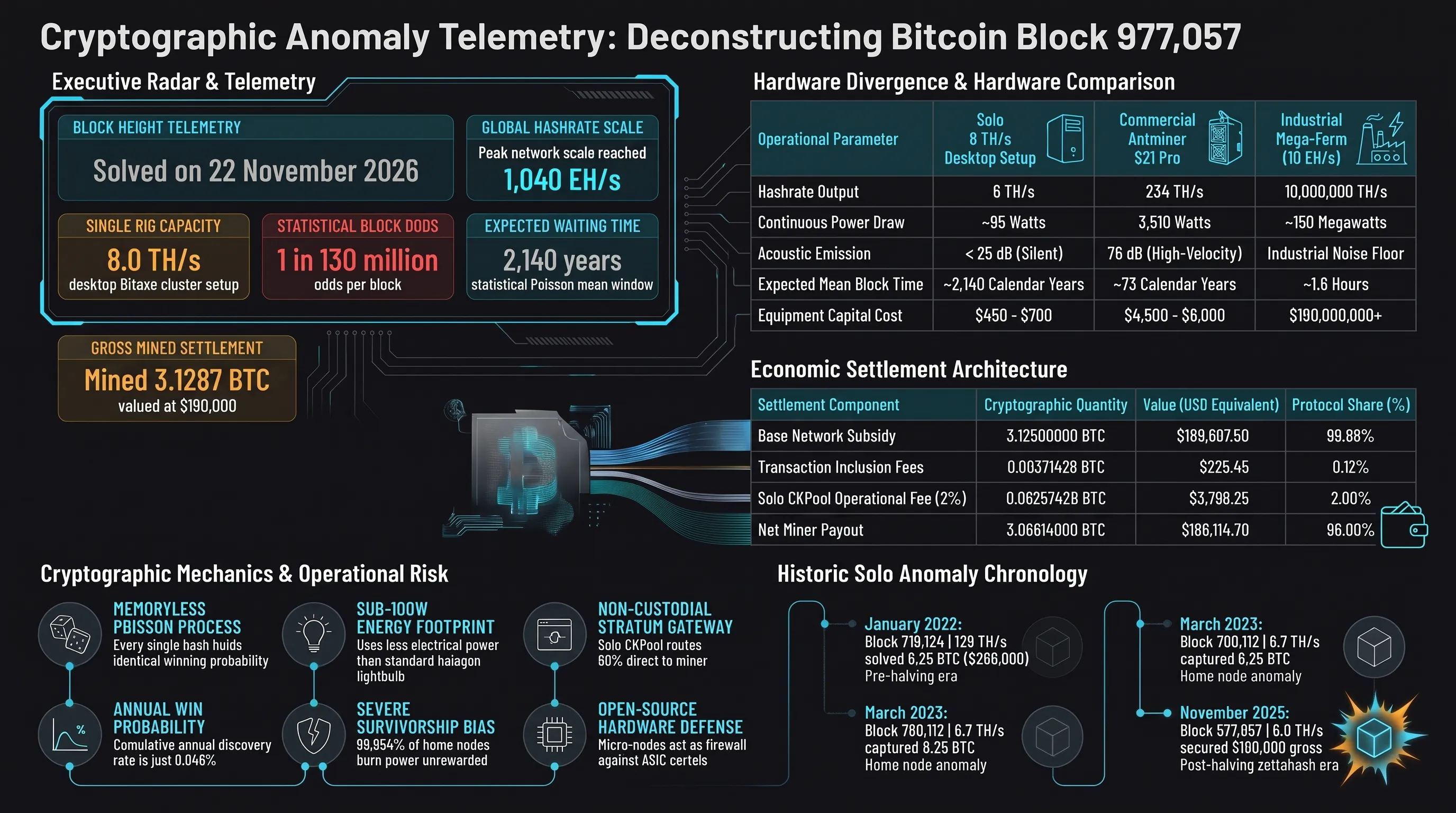
On Sunday, November 22, 2026, one of the most astonishing cryptographic events in Bitcoin network history was confirmed on-chain. An individual solo miner operating modest consumer equipment generating approximately 8.0 Terahashes per second connected to the Solo CKPool service solved global block number 977,057. This extraordinary achievement captured the entire block reward of 3.1287 BTC, valued at over $190,000 USD, directly into their self-custodial wallet without sharing profits with any mining pool.
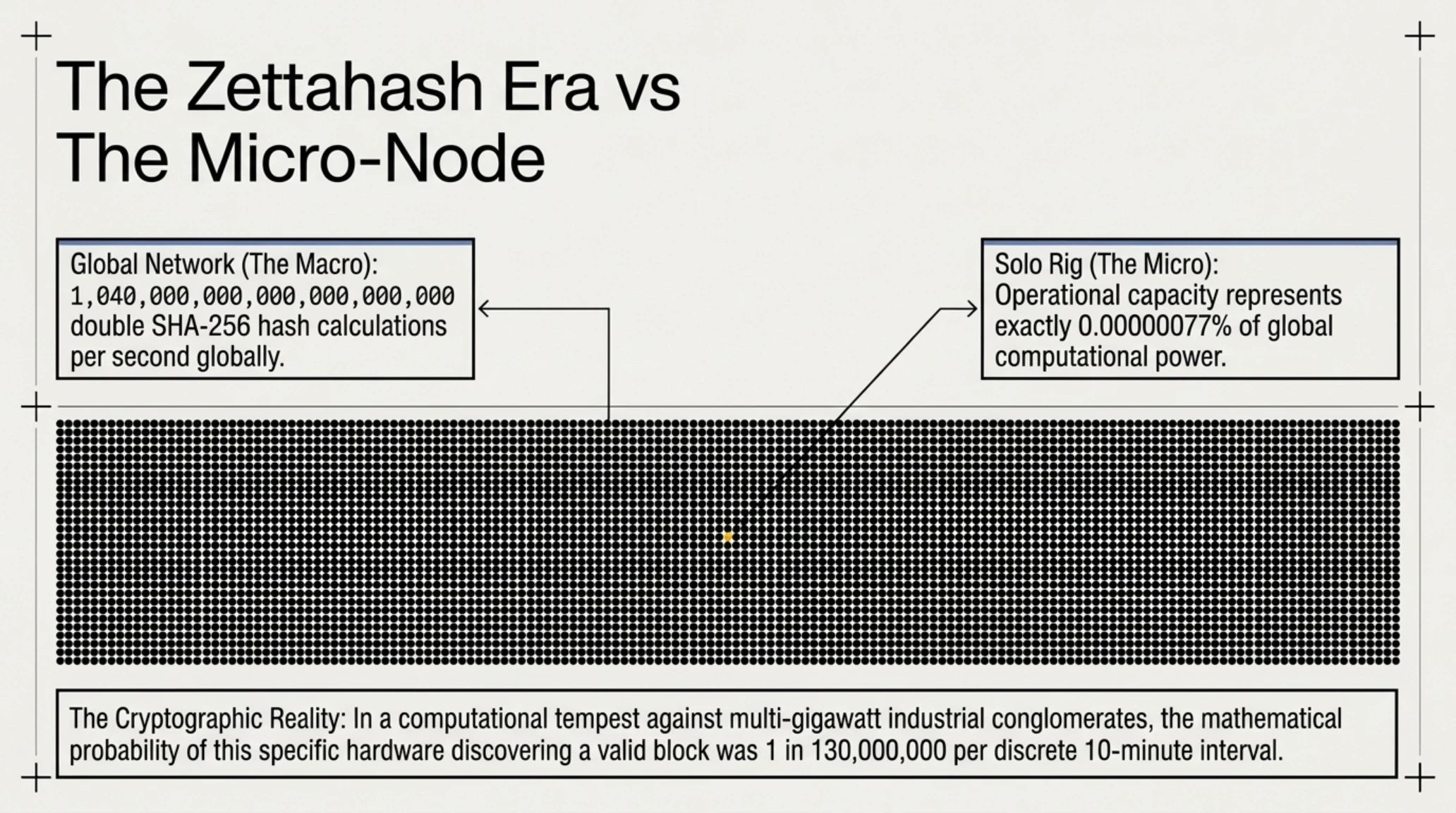
To place this computational feat into proper physical perspective, one must examine the staggering scale of the contemporary mining industry. In November 2026, the global Bitcoin network hashrate officially crossed the historic milestone of 1,040 Exahashes per second, exceeding one full Zettahash. Across multiple continents, thousands of industrial mega-facilities operating hundreds of thousands of liquid-cooled enterprise ASICs backed by multi-megawatt substations compete fiercely for each discrete ten-minute block subsidy.
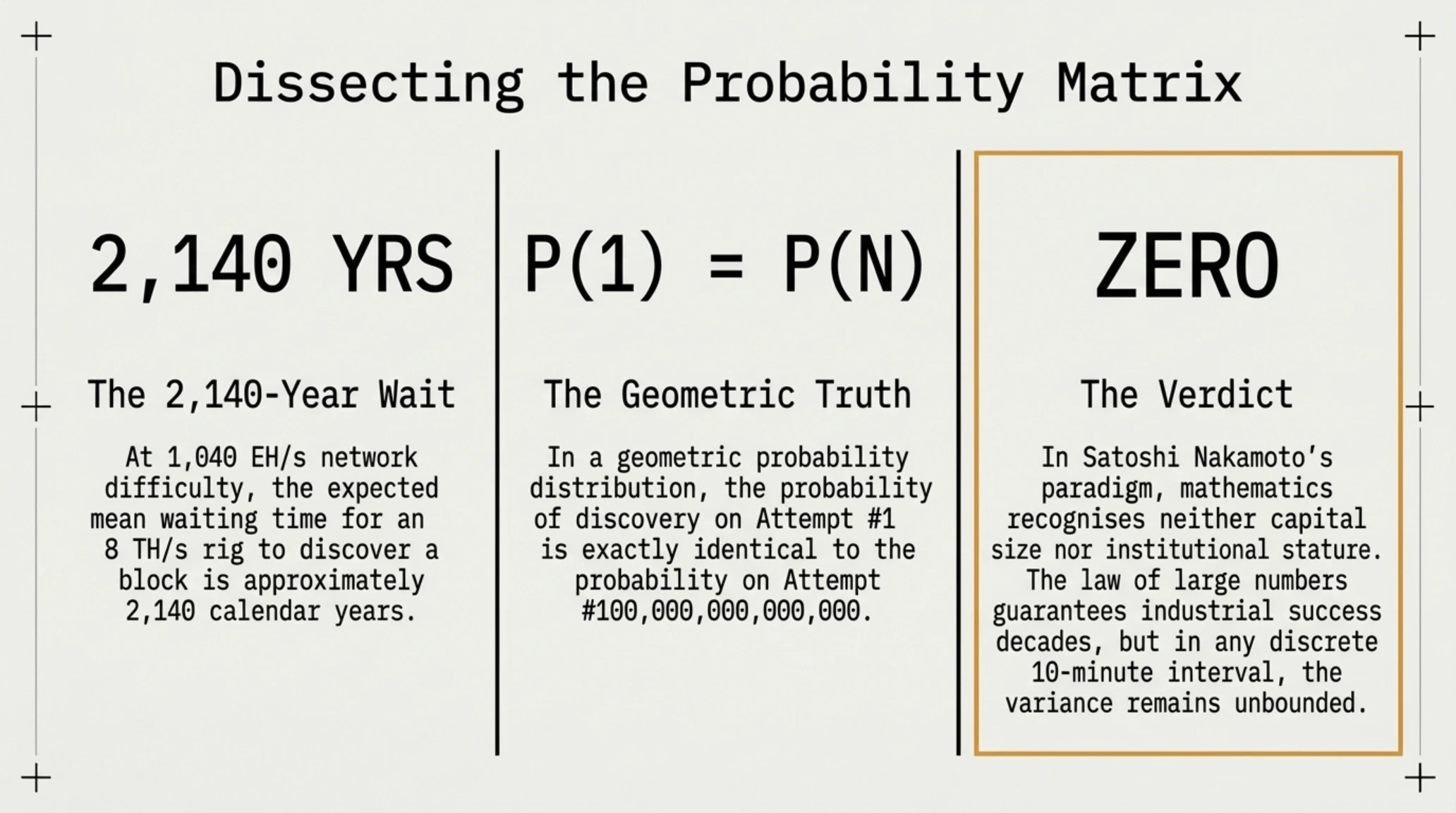
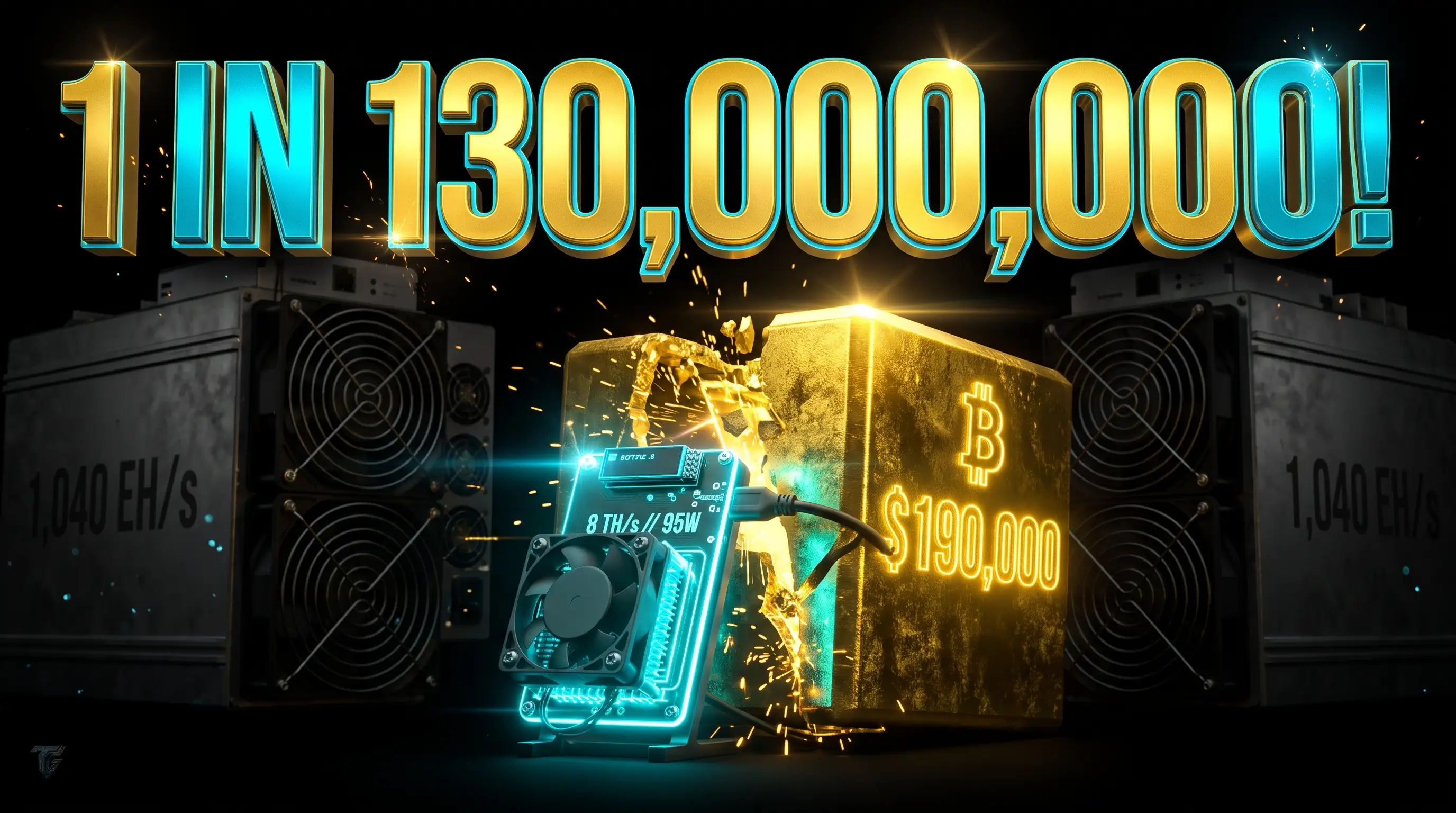
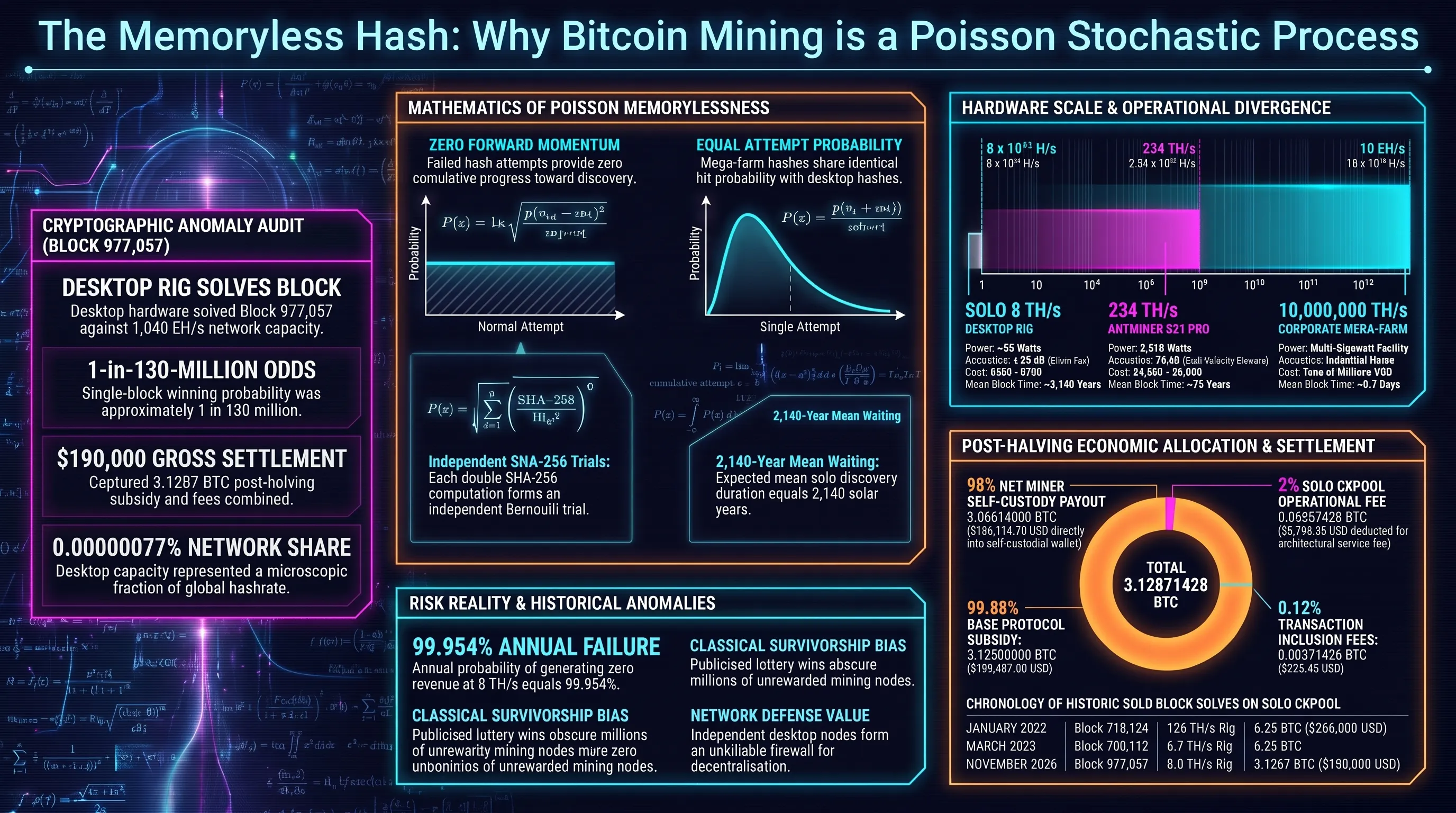
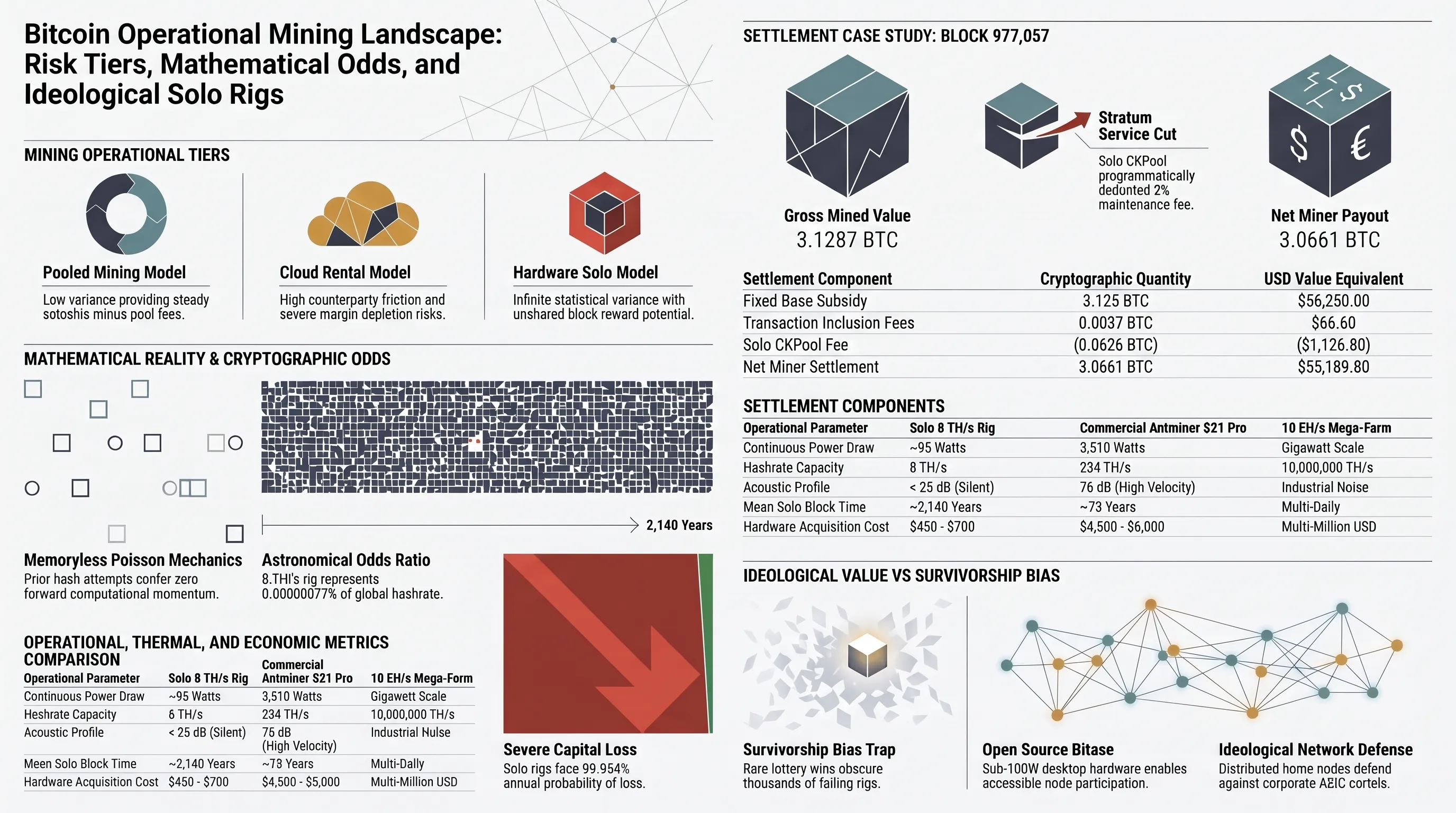
An 8 TH/s desktop setup represents less than one part in 130 million of the global network capacity. Under standard mathematical Poisson models, such hardware would statistically require an expected waiting period exceeding 2,140 continuous solar years to mine a single block. Yet Satoshi Nakamoto's proof-of-work algorithm proved once again that absolute mathematical probability remains alive and incorruptible at the heart of the blockchain.
Earthquake in Hashrate Dynamics; Dissecting Block 977,057 and Solo CKPool Architecture
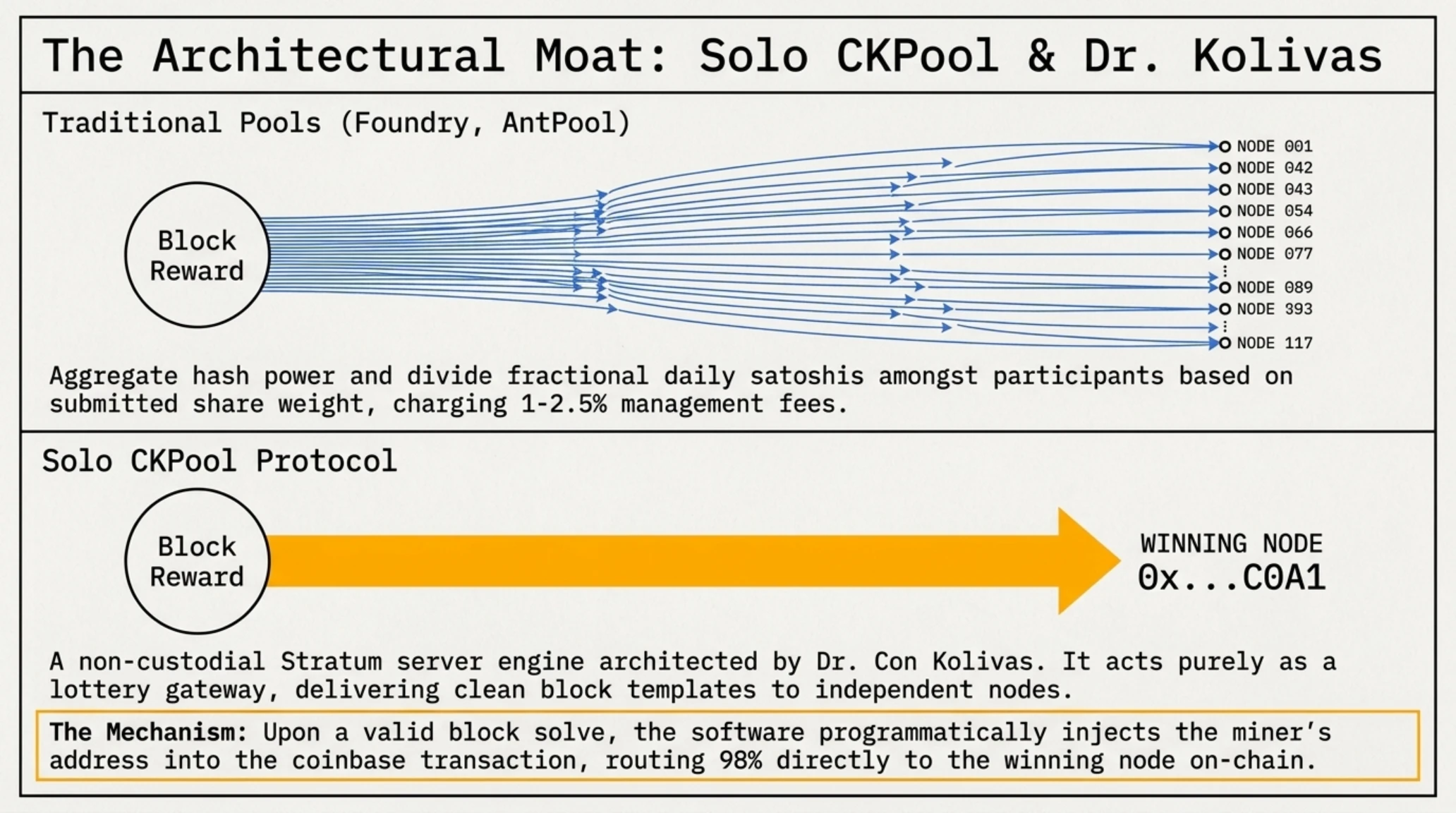
To understand the mechanics of this phenomenon, one must analyze the structural differences between traditional proportional mining pools and non-custodial solo stratum systems like Solo CKPool. In conventional pools such as Foundry USA or AntPool, miners aggregate their computational capacity and receive regular, fractional daily payouts proportionate to their submitted share count. In contrast, a solo miner deliberately waives steady micropayments to bet on capturing the entire block bounty.
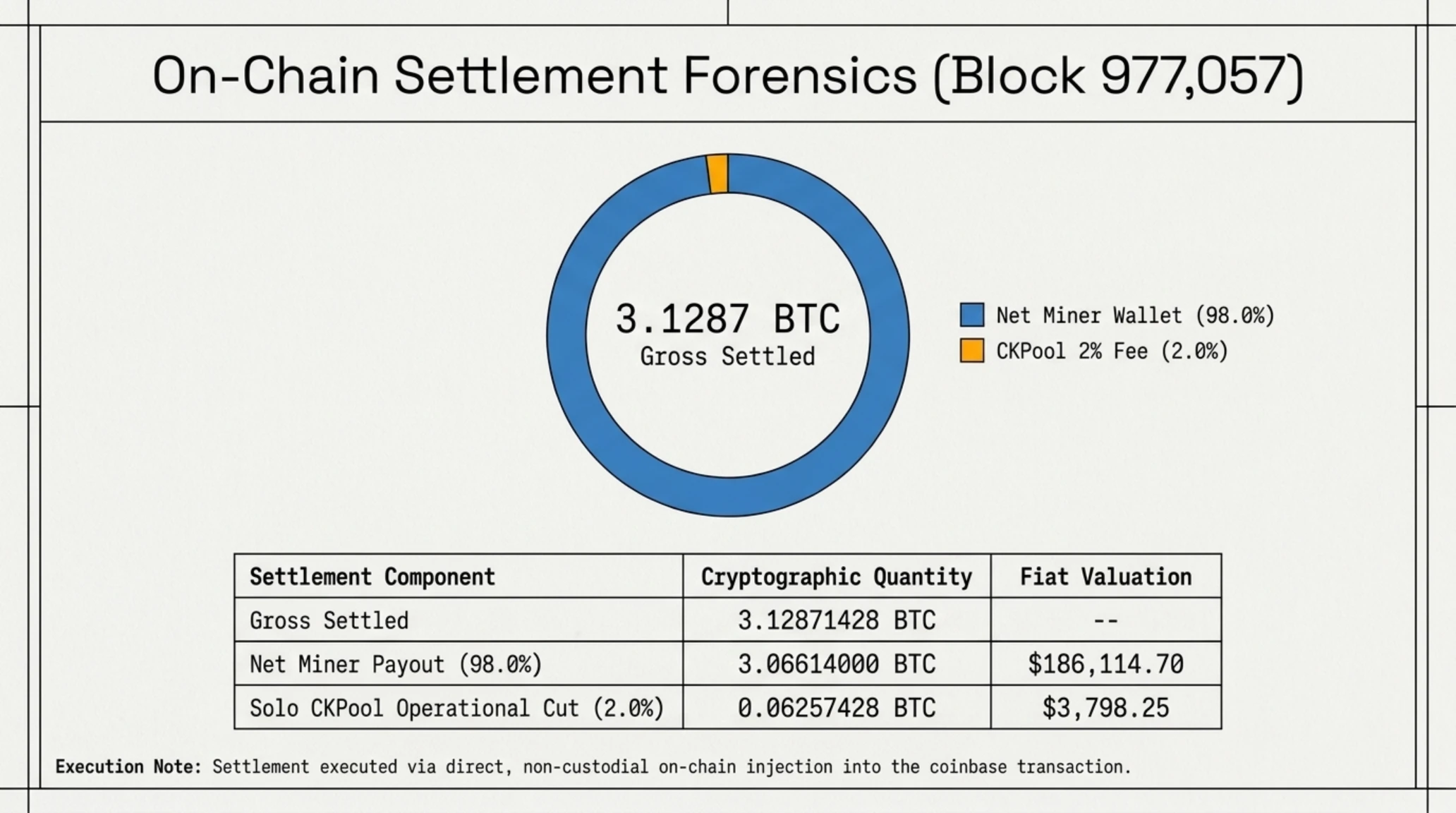
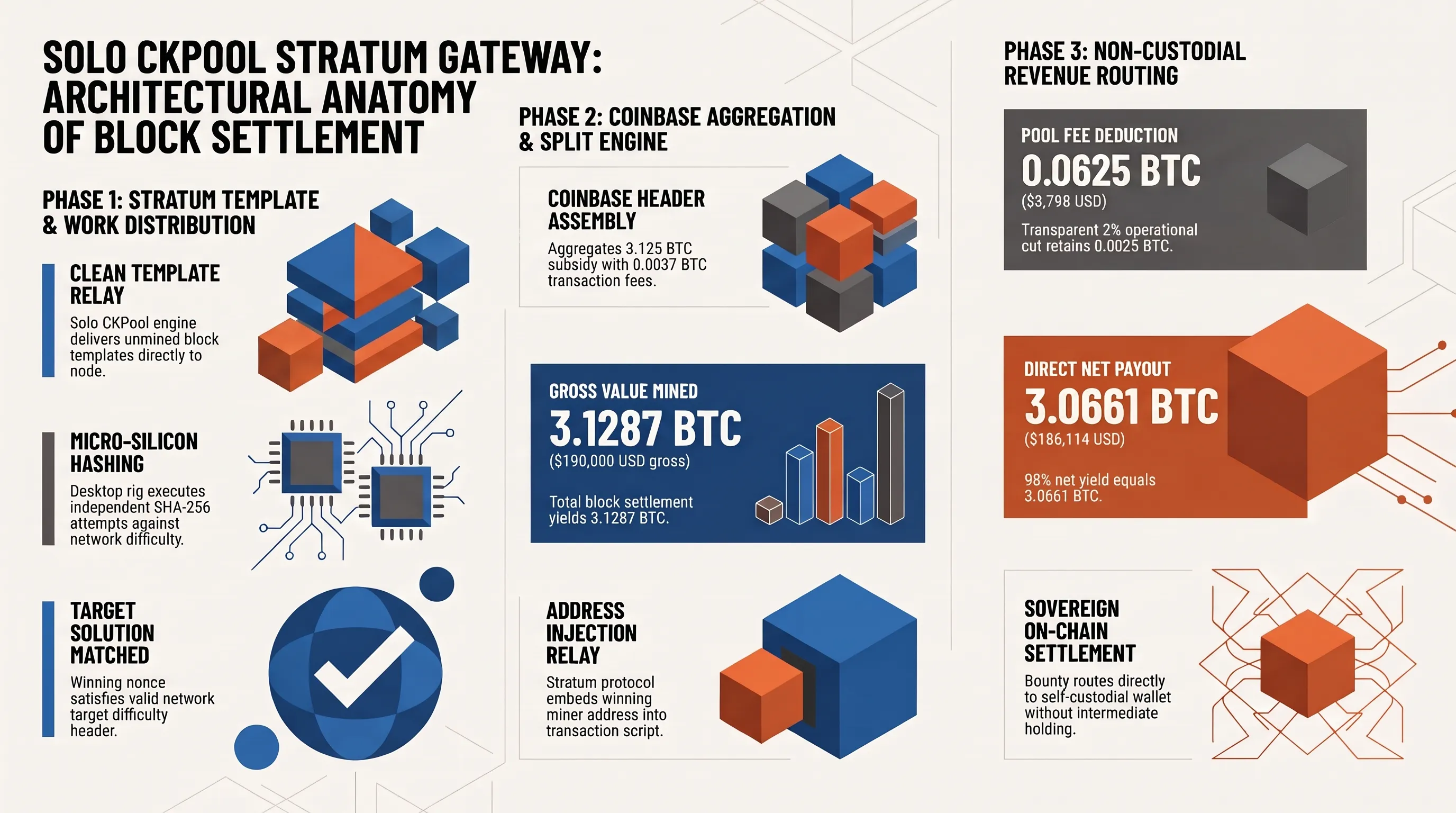
Solo CKPool, engineered and maintained by renowned core developer Dr. Con Kolivas, plays an indispensable role in safeguarding Bitcoin decentralization. The software aggregates active transactions, prepares valid block header templates, and supplies them to connected worker nodes. When a node successfully solves a block, CKPool deducts a transparent 2% operational coordination fee and directs the remaining 98% directly into the miner's specified address via the coinbase transaction.
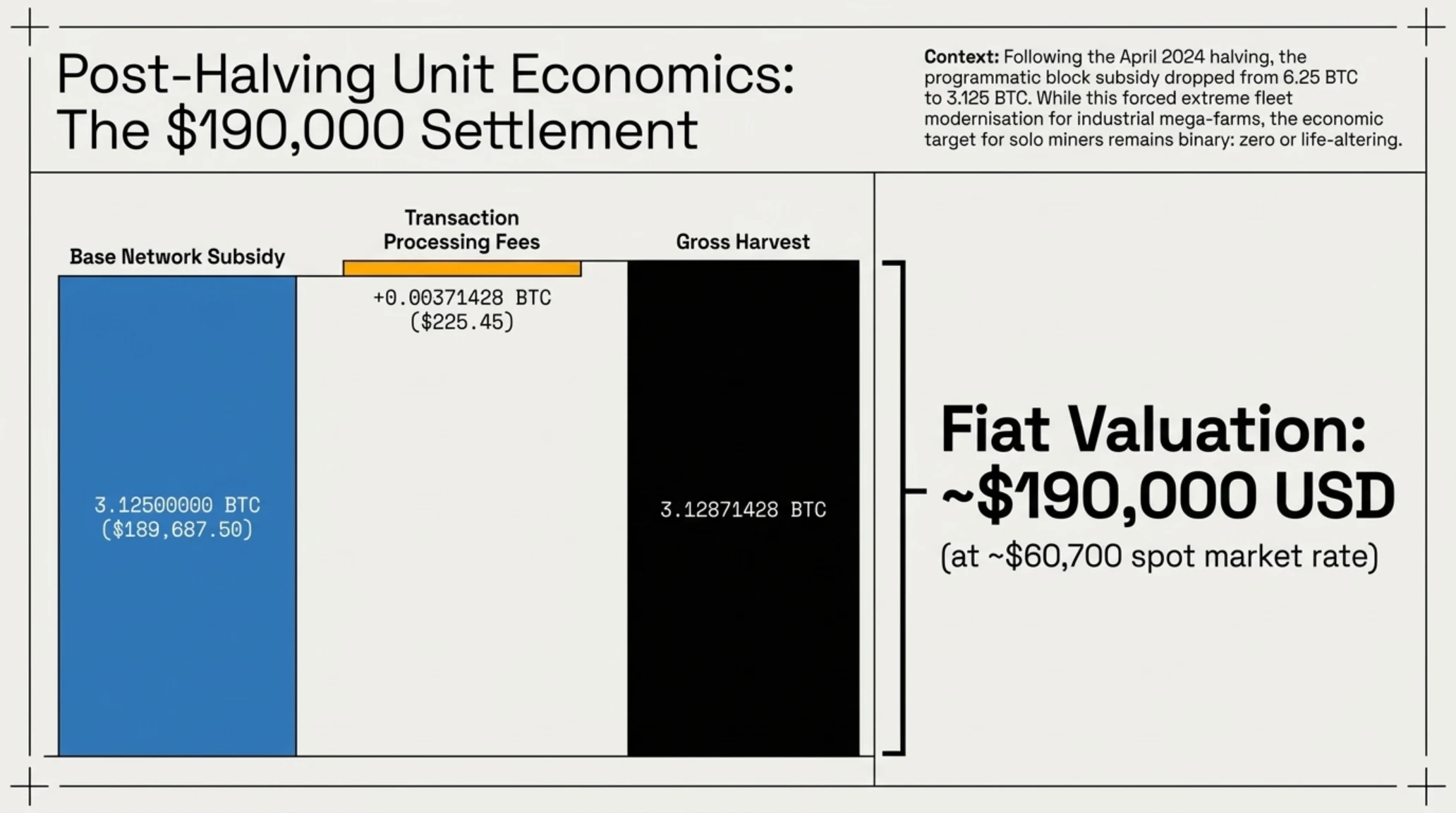
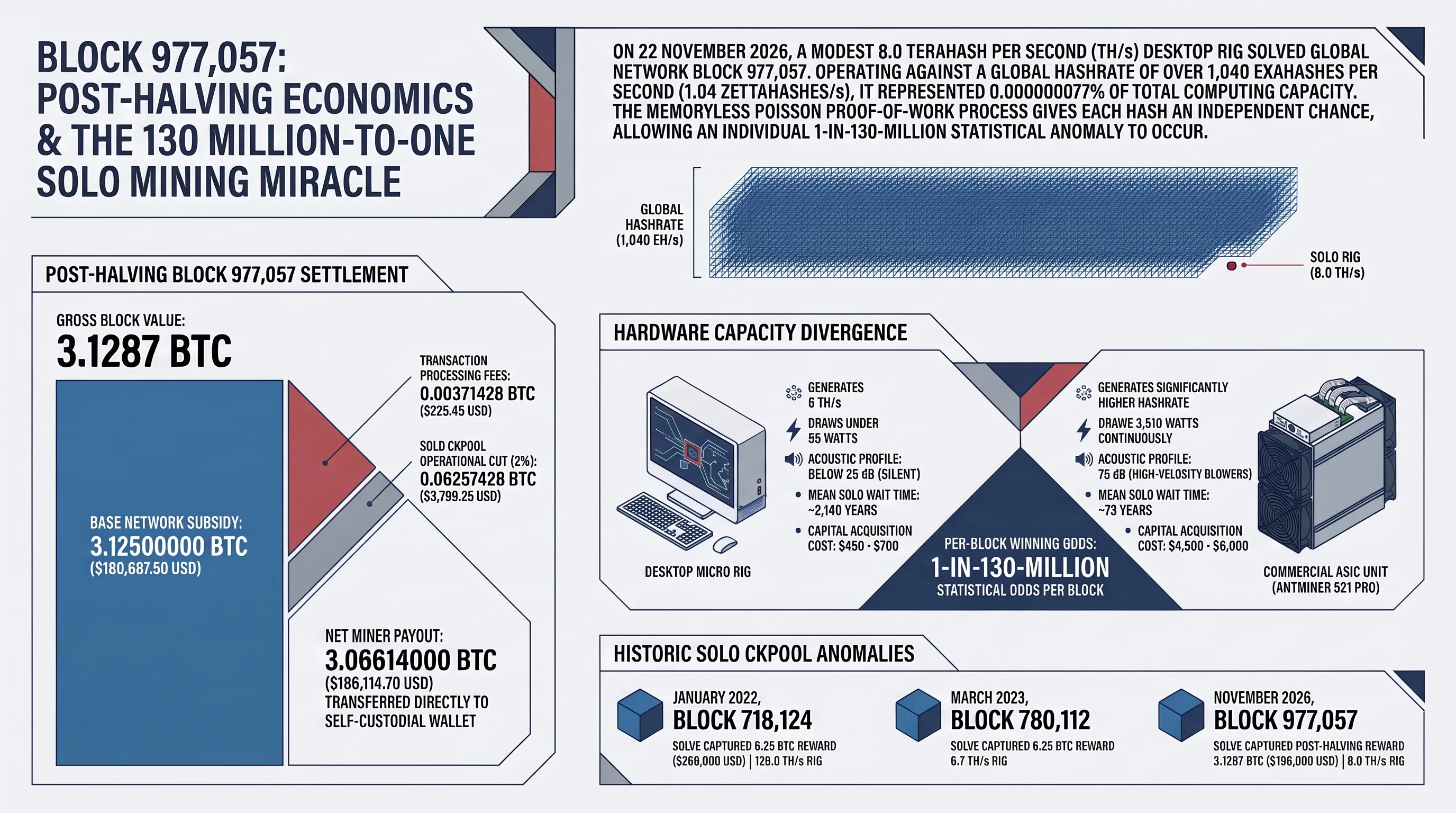
For Block 977,057, the total gross bounty reached 3.1287 BTC, comprised of the post-fourth-halving 3.125 BTC baseline block subsidy plus 0.0037 BTC in transaction processing fees. After deducting the 2% coordination fee, the net windfall amounted to over $186,000 USD, secured by hardware generating equivalent compute to a handful of desktop USB boards or an experimental open-source microcontroller.
Why This Architectural Inflection Matters
The Mathematics of the Poisson Process: Memoryless Mining Under the Hood
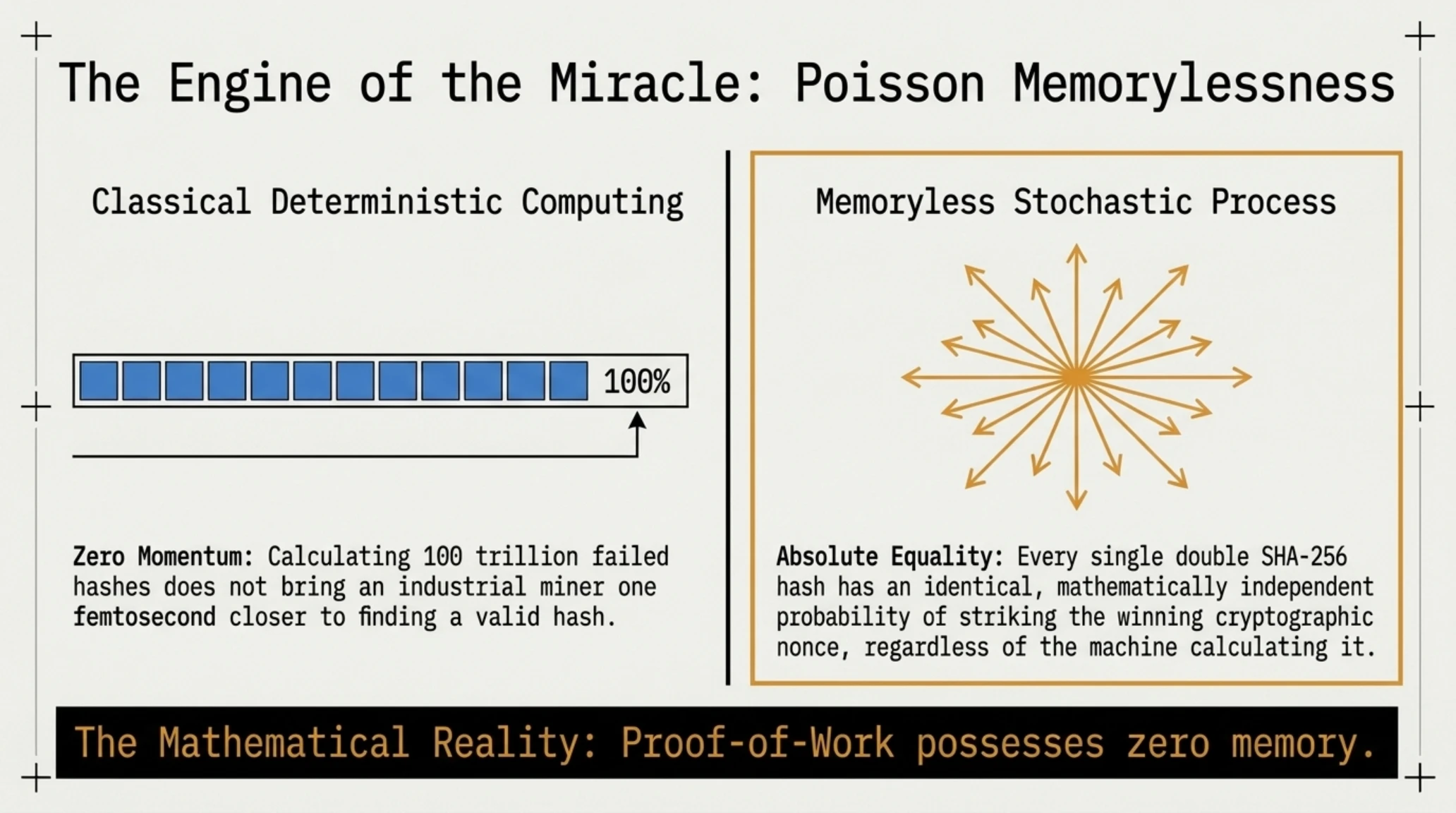
To comprehend how an 8 TH/s rig can outperform a multi-gigawatt mining corporation, one must deconstruct the mathematical engine governing Bitcoin: the memoryless Poisson distribution. In classical computation, tasks are deterministic and sequential; compiling a binary or rendering a video frame progresses incrementally toward a 100% completion marker. Bitcoin mining behaves according to completely different laws of mathematics.
Every time a mining chip hashes an 80-byte block header through the SHA-256 algorithm twice, it generates a pseudo-random 256-bit integer. If that resulting integer is numerically lower than the current network target, the block is valid and propagated across the gossip network. If it is higher, the computation is instantly discarded. Crucially, calculating 100 trillion failed hashes does not bring a miner one femtosecond closer to finding a valid hash. The next hash calculated by a child's desktop node has the exact same statistical probability of finding the target as the next hash calculated by an industrial warehouse containing 50,000 liquid-cooled rigs.
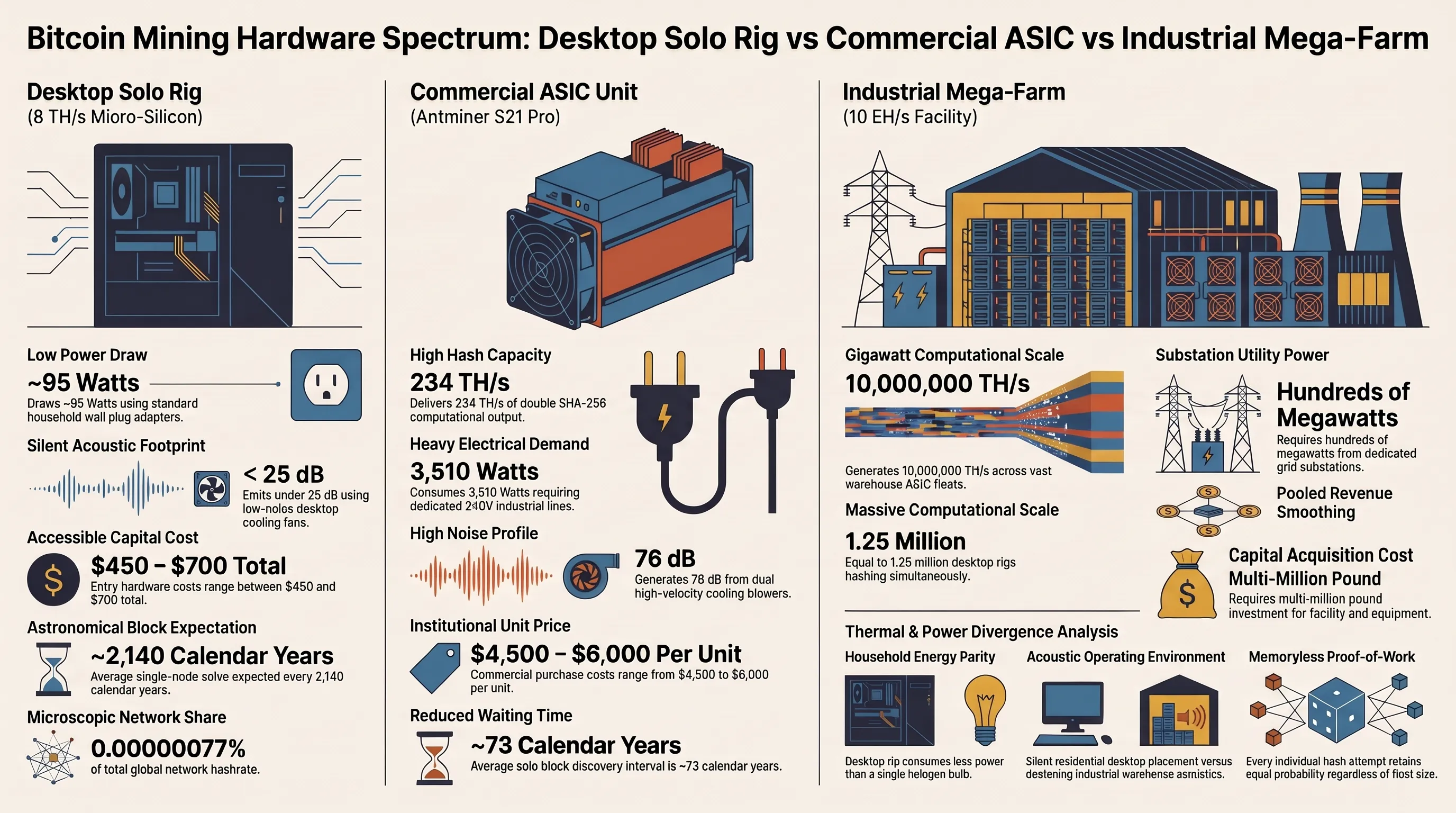
The distinction lies solely in frequency. An industrial farm calculating 10 Exahashes per second generates 1.25 million times more hash attempts per second than an 8 TH/s device. Over extended timeframes, law-of-large-numbers statistics assert themselves, yielding steady block discoveries for the farm. Yet in any given 10-minute discrete interval, the random variable remains unbounded. The expected time for an 8 TH/s rig to discover a block at 1,040 EH/s network difficulty is approximately 2,140 years. However, in a geometric probability distribution, the probability of discovery on attempt number 1 is identical to the probability on attempt number 100 trillion.
Technical Verification | Myth vs Engineering Reality
Tekin Advanced Technical Glossary
What Hardware Produces 8 TH/s? From Desktop Micro-Rigs to Open-Source Bitaxe
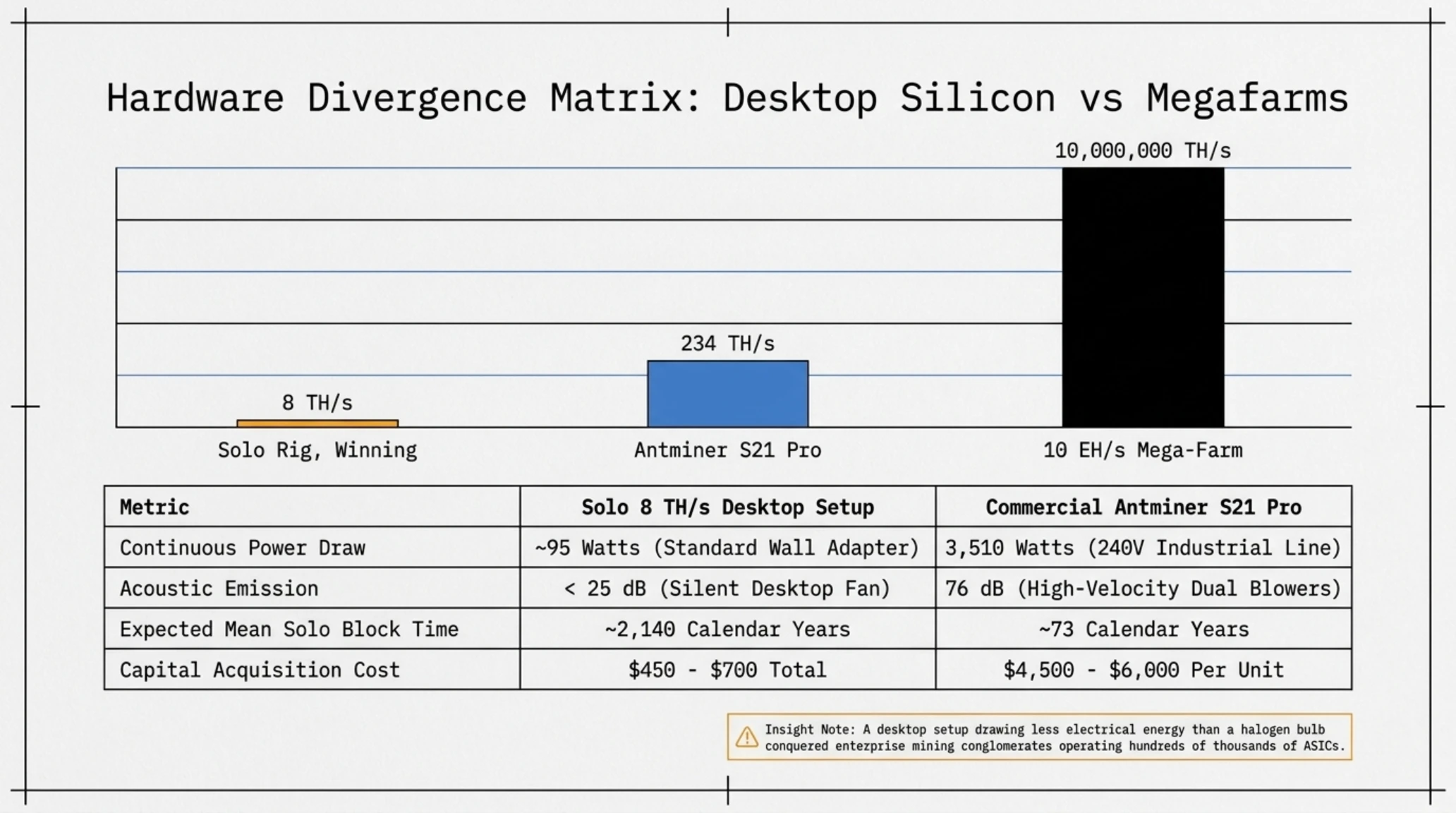
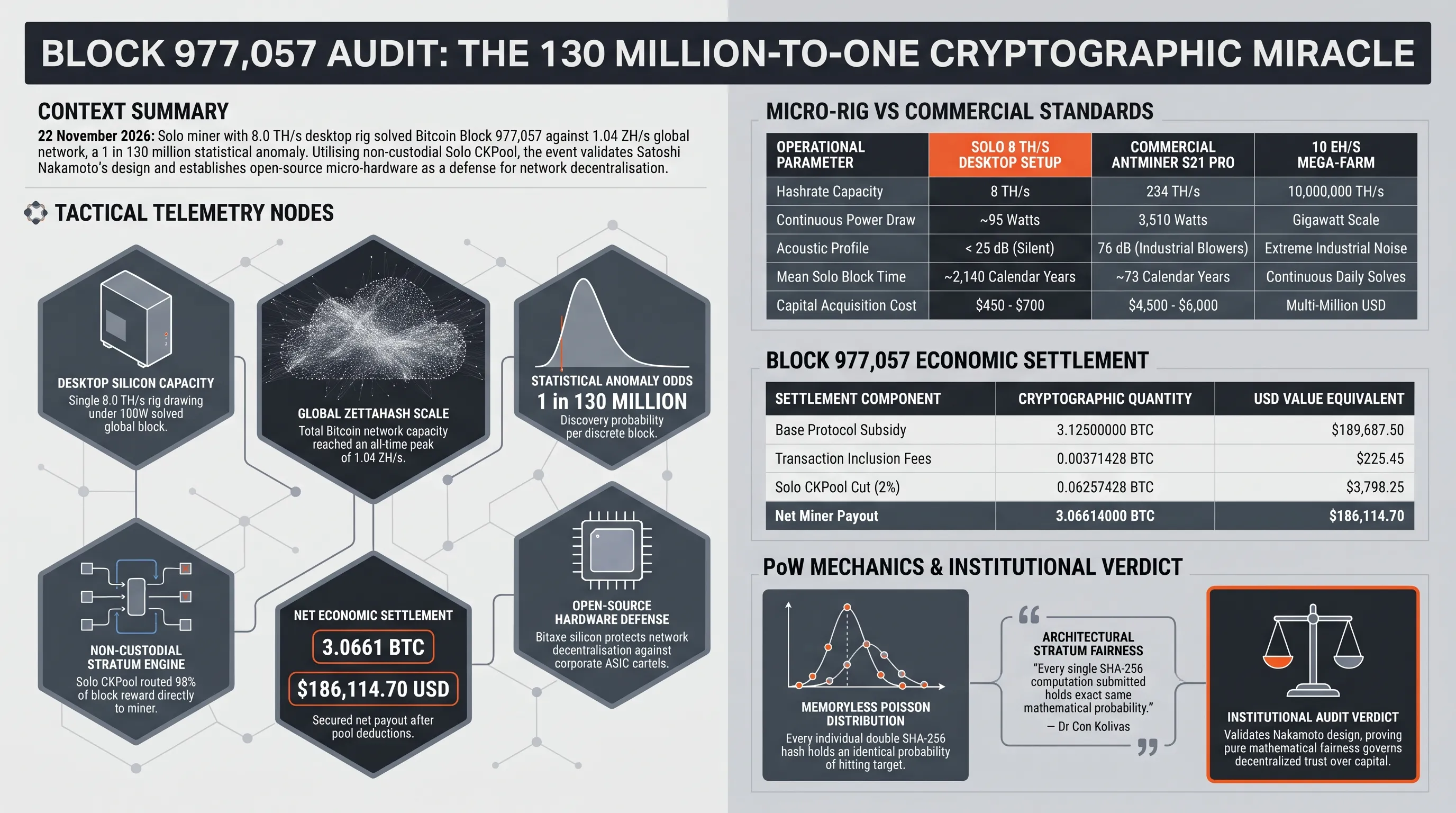
For many observers, the immediate question arises: what physical hardware generates 8 Terahashes per second? While flagship commercial ASICs of 2026 like the Antminer S21 Pro generate upwards of 234 TH/s and consume more than 3,500 Watts of three-phase industrial electricity, an 8 TH/s capacity falls squarely into the consumer hobbyist domain.
An 8 TH/s capacity is equivalent to a small cluster of approximately six to seven open-source Bitaxe desktop miners or a legacy single-chip test rig consuming under 95 Watts of wall power. These compact units require neither high-velocity acoustic blowers nor industrial infrastructure, operating comfortably on an ordinary desk powered by consumer power bricks.
Open-source hardware projects like Bitaxe aim to keep the core decentralization spirit of Bitcoin alive. The capture of Block 977,057 serves as incontrovertible proof that grassroots developers and open hardware builders have managed, with symbolic consumer equipment, to claim the most coveted economic bounty of the year from multi-billion-dollar industrial cartels.
Hardware Benchmark Comparison and Thermal Telemetry
| Technical & Operational Parameter | Winning Solo Rig (8 TH/s) | Enterprise Mining Machine (S21 Pro) |
|---|---|---|
| SHA-256 Computational Hashrate | 8 TH/s (Compact Desktop Board) | 234 TH/s (Industrial Enterprise Rig) |
| Continuous Electrical Power Draw | Under 95 Watts (Standard Wall Adapter) | Over 3,510 Watts (3-Phase Industrial Line) |
| Economic Settlement for Block 977,057 | $190,000 Net ($186K after fee) | $0.00 (Zero share in this block) |
2026 Mining Economics: Fourth Halving Pressures and the Retail Flight to Lottery Mining
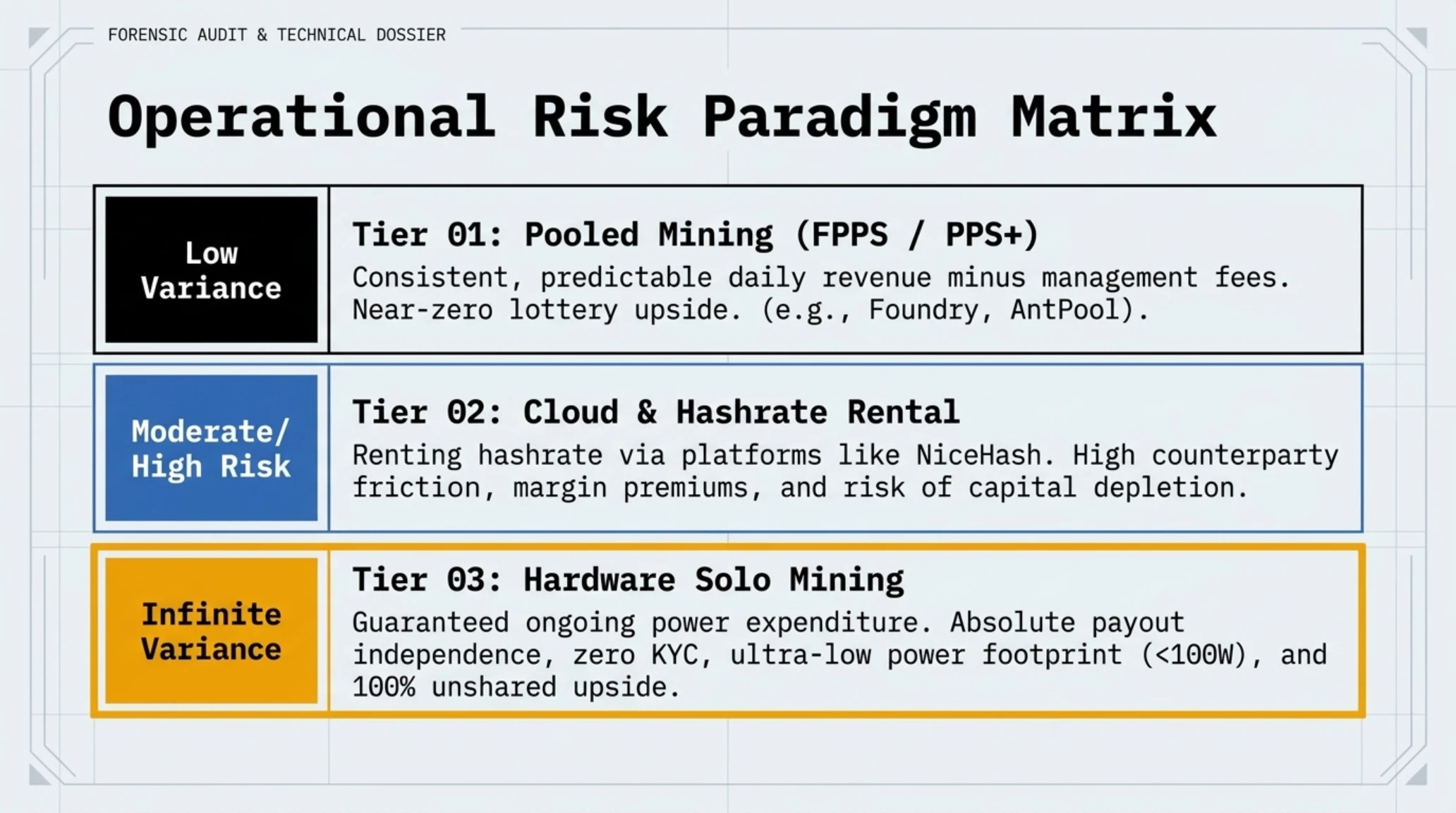
To analyze the accelerating popularity of solo extraction, one must evaluate the post-halving economic landscape facing operators in 2026. Following Bitcoin's fourth halving in April 2024, which slashed the programmatic block subsidy from 6.25 BTC to 3.125 BTC, the operational profitability of small-scale miners in proportional pools collapsed. The expected daily revenue of an 8 TH/s machine in a conventional pooled setup amounts to mere pennies per day, failing to offset even minimal domestic electrical consumption.
Under these compressed unit economics, countless home operators deliberately choose to forego fractional daily micropayments and redirect their rigs to solo stratum servers. They consciously embrace a binary lottery dynamic where they either generate zero income or strike a monumental block bounty equivalent to a major lottery jackpot.
This dynamic has forged a profound architectural divergence between industrial corporate mining and grassroots proof-of-work ethos. While publicly traded mining enterprises must continuously service massive debt facilities and power purchase obligations, distributed retail enthusiasts act as sovereign, resilient outposts safeguarding protocol decentralization.
Cybersecurity Risk Matrix and Capital Defense Blueprint
| Risk Vector / Operational Challenge | Risk Tier | Financial Defense and Capital Mitigation |
|---|---|---|
| Non-Discovery Risk Over Hardware Lifetime | CRITICAL | Treat solo mining exclusively as recreation; never deploy critical capital. |
| Accumulated Electrical & Thermal Depreciation | HIGH RISK | Deploy modern sub-100W open-source silicon instead of obsolete industrial rigs. |
| Stratum Pool Counterparty Integrity | MITIGATED | Connect exclusively to audited non-custodial stratum relays such as Solo CKPool. |
📚 Classified & Related Dossiers in TekinGame
If you wish to explore beyond this report and delve into cybernetic frontiers and autonomous AI architectures, do not miss these three exclusive deep-dives in the Tekin Garage:
Financial Telemetry and Block 977,057 Value Distribution
| Coinbase Settlement Component | Cryptographic Quantity (BTC) | Fiat Valuation at $60,700/BTC |
|---|---|---|
| Base Protocol Subsidy | 3.12500000 BTC | $189,687.50 USD |
| Transaction Inclusion Fees | 0.00371428 BTC | $225.45 USD |
| Net Solo Miner Proceeds (98%) | 3.06614000 BTC | $186,114.70 USD |
The Survivorship Bias Trap: Why Lottery Mining Is Not an Investment Strategy
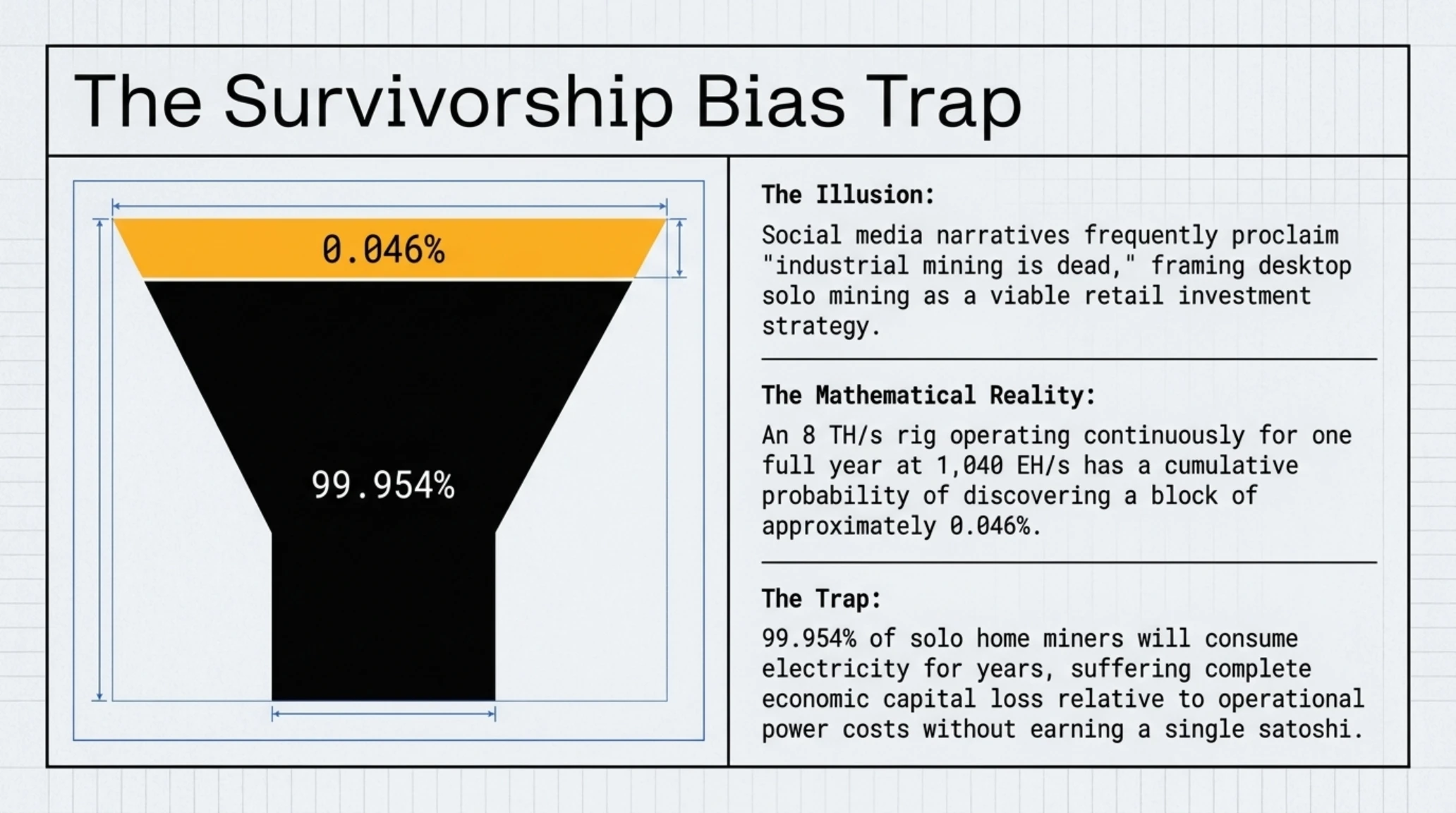
Every time a solo miner captures a global block, retail crypto channels and social platforms erupt with euphoric narratives proclaiming that industrial mining is dead and that anyone with a desktop gadget can strike rich. In financial engineering and risk analysis, this phenomenon is cataloged as classical survivorship bias.
The public celebrates the one individual who won the cryptographic lottery while remaining completely blind to the hundreds of thousands of home nodes that have consumed electricity, generated heat, and run continuously for years without earning a single satoshi. At 1,040 EH/s, an 8 TH/s rig operating for one full year has a cumulative probability of discovering a block of approximately 0.046%. This implies that 99.954% of miners operating under these parameters will experience complete economic capital loss relative to operational power costs over that annual timeframe.
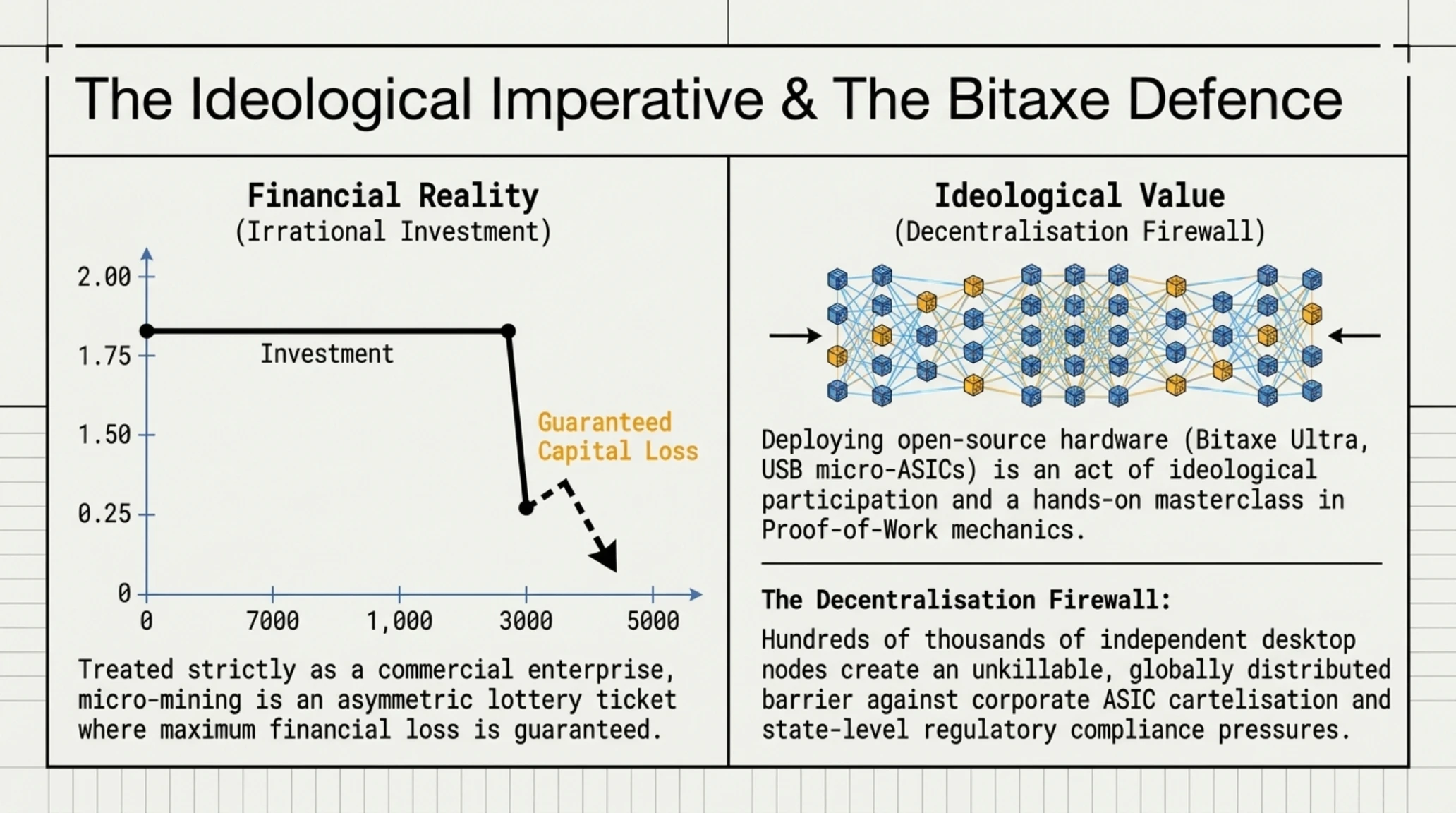
However, framing desktop solo mining strictly through the lens of institutional ROI fails to grasp its sociological and cultural significance. For thousands of participants worldwide, deploying open-source hardware like the Bitaxe Ultra is not a commercial enterprise; it is an act of ideological participation. It is a verifiable vote for decentralization, a hands-on pedagogical masterclass in Proof-of-Work mechanics, and an asymmetric lottery ticket where maximum financial downside is capped at a few dollars of electricity per month, while the theoretical upside remains an unshared multi-bitcoin bounty.
Cumulative Probability Telemetry and Waiting Horizons
Architectural Implications: The Future of Solo Mining and Network Decentralization
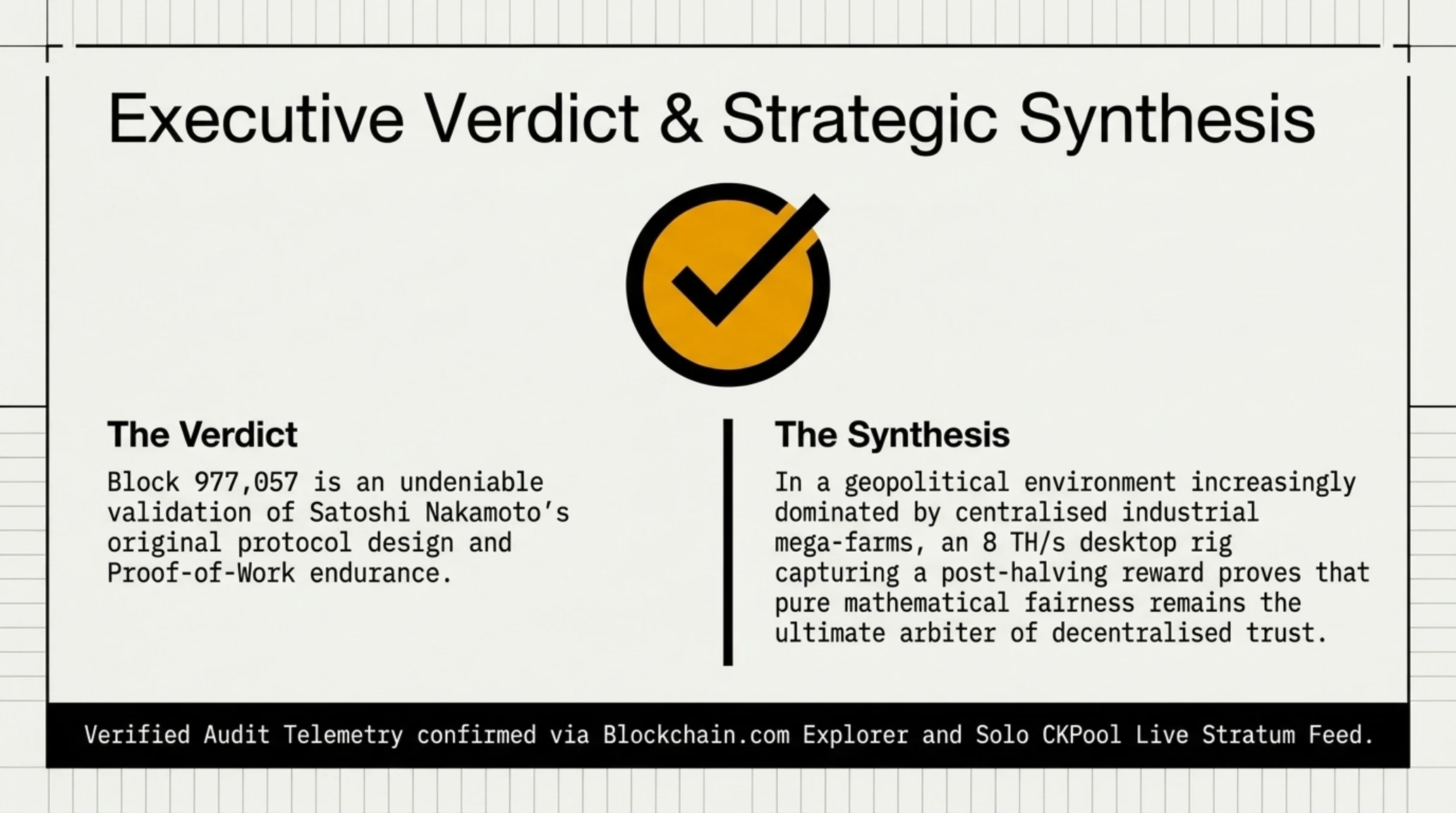
The discovery of Block 977,057 by an independent domestic node transcends a mere financial lottery story; it stands as an emblematic victory of Bitcoin foundational philosophy over corporate monopolization. In a geopolitical environment where Western regulators increasingly scrutinize industrial mining loads and attempt to exert compliance pressures on centralized pool operators, the proliferation of hundreds of thousands of independent desktop nodes serves as an unkillable decentralized firewall.
While the mathematical expected value for any individual attempting to replicate this feat remains infinitesimally small, the presence of non-custodial gateways like Solo CKPool guarantees that the open-access spirit of Satoshi Nakamoto protocol endures. This historic solve provides substantial psychological and developmental momentum to open-source hardware initiatives like Bitaxe, encouraging developers to push forward with energy efficiency, thermal optimization, and accessible micro-ASIC silicon.
The perpetuation of this model cements open-source hardware into the physical bedrock of proof-of-work, furnishing independent builders with continuous incentives to run sovereign infrastructure. When a desktop enthusiast armed only with technical acumen and statistical fortune captures a major network block, the entrenched corporate assumptions of the industry are irrevocably destabilized.
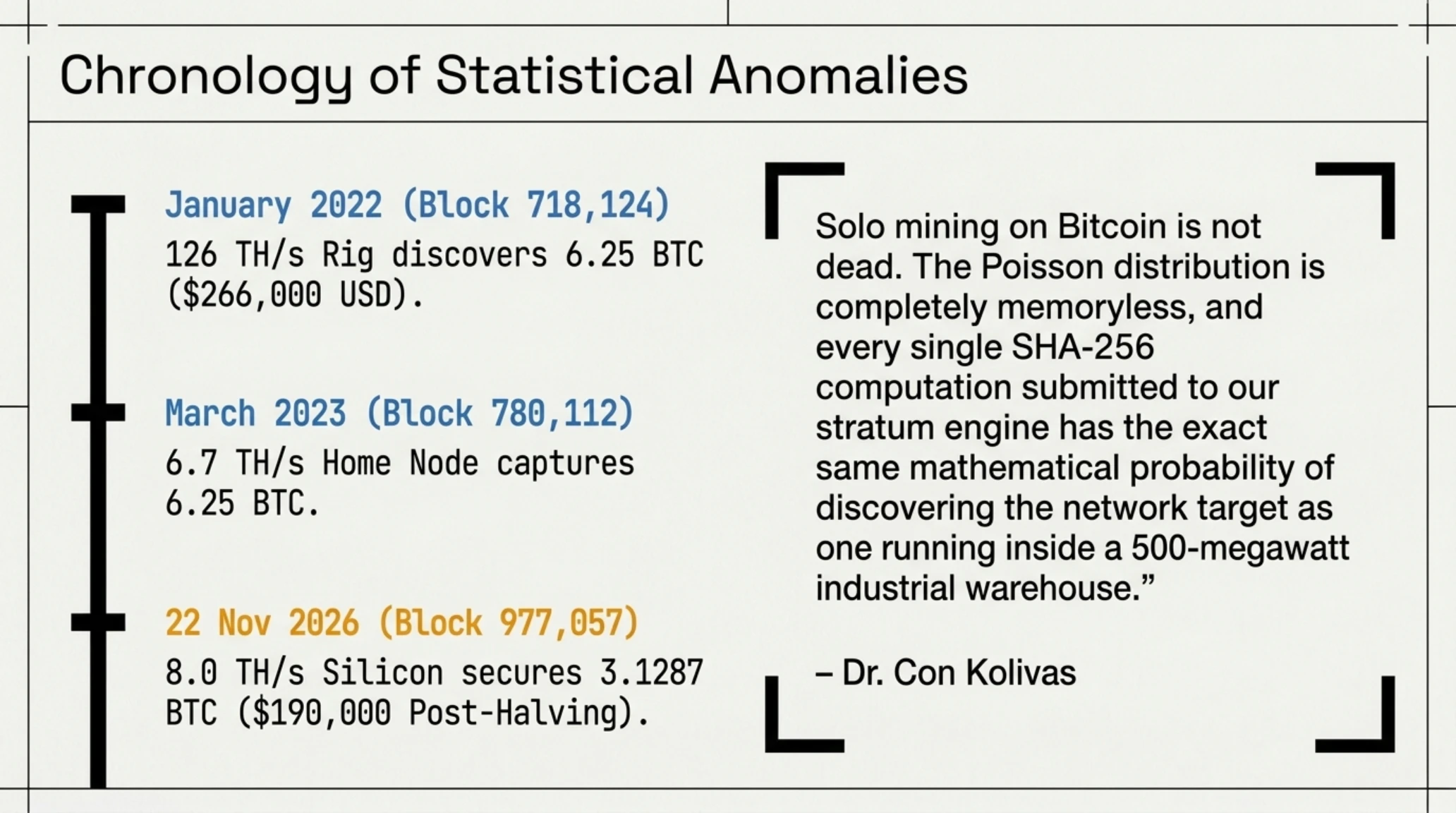
Event Timeline | Chronology of Historic Solo Blocks on CKPool
| Occurrence Date | Solved Block Height | Hardware Hashrate & Economic Bounty |
|---|---|---|
| January 2022 | Block 718,124 | 126 TH/s Rig Solved 6.25 BTC ($266,000 USD). |
| March 2023 | Block 780,112 | 6.7 TH/s Home Node Captured 6.25 BTC. |
| November 2026 | Block 977,057 | 8.0 TH/s Silicon Secured $190,000 Post-Halving. |
Future Horizons of Proof-of-Work: Protocol Sovereignty and Open Silicon Evolution
The triumph of this anonymous miner underscores a pivotal philosophical inflection point for Bitcoin in 2026. At a time when industrial mega-farms enforce centralized governance pressures driven by rapid capital return mandates, the persistent activity of micro-miners prevents the dangerous concentration of hash power into a handful of corporate cartels.
The ongoing evolution of open-source silicon, including advanced BM1366 iterations and modular carrier boards, enables individual operators with fractional hashrates to establish cryptographic identity on-chain without intermediaries, preserving the censorship resistance and sovereign integrity of the network.
- Absolute payout independence: 100% of the block subsidy and fees route directly to personal custody.
- Zero KYC, zero counterparty risk, and complete operational sovereignty via decentralized stratum relays.
- Ultra-low power footprint under 100W enabling silent, heat-efficient operation in residential settings.
- Active cryptographic defense of Bitcoin network decentralization and censorship resistance.
- Astounding statistical variance: Expected mean wait time exceeds 2,140 calendar years.
- Guaranteed ongoing power expenditure without any fractional daily income smoothing.
- Severe vulnerability to survivorship bias, tempting retail users into irrational capital allocation.
Editorial Verdict and Authoritative References
- Bitcoin.com News: Solo Bitcoin Miner Bags $190K Block Reward With 8 TH/s Machine
- Mempool Explorer: Block 977,057 Coinbase Transaction and Nonce Telemetry
- Solo CKPool Official: Live Stratum Telemetry and Cryptographic Verification Feed
Technical Frequently Asked Questions
Is solo Bitcoin mining economically viable for individual retail participants?
No. Under prevailing global network difficulty exceeding 1,040 EH/s, an individual running an 8 TH/s rig faces odds of approximately 1 in 130 million per block, corresponding to a mathematical expected wait time of over 2,140 years. Solo mining should be viewed as an educational pursuit or a recreational lottery, not a commercial investment strategy.
How does Solo CKPool coordinate block distribution without taking custody of funds?
Solo CKPool delivers clean Stratum work templates directly to connected nodes. When a miner calculates a hash meeting the full global network target, CKPool formats the valid block with the miner address encoded directly in the coinbase transaction, programmatically deducting a transparent 2% coordination fee while releasing the remaining 98% directly to the miner upon block confirmation.
What physical hardware is capable of delivering 8 TH/s at desktop power levels?
An 8 TH/s hashrate can be achieved using a cluster of modern open-source desktop ASIC boards, such as approximately seven networked Bitaxe Ultra or Supra units utilizing recycled or custom-binned ASIC silicon, drawing under 100 watts of wall power.
Additional Gallery: Tekin Analysis: 8 TH/s Solo Miner Wins $190K Bitcoin Block 977,057