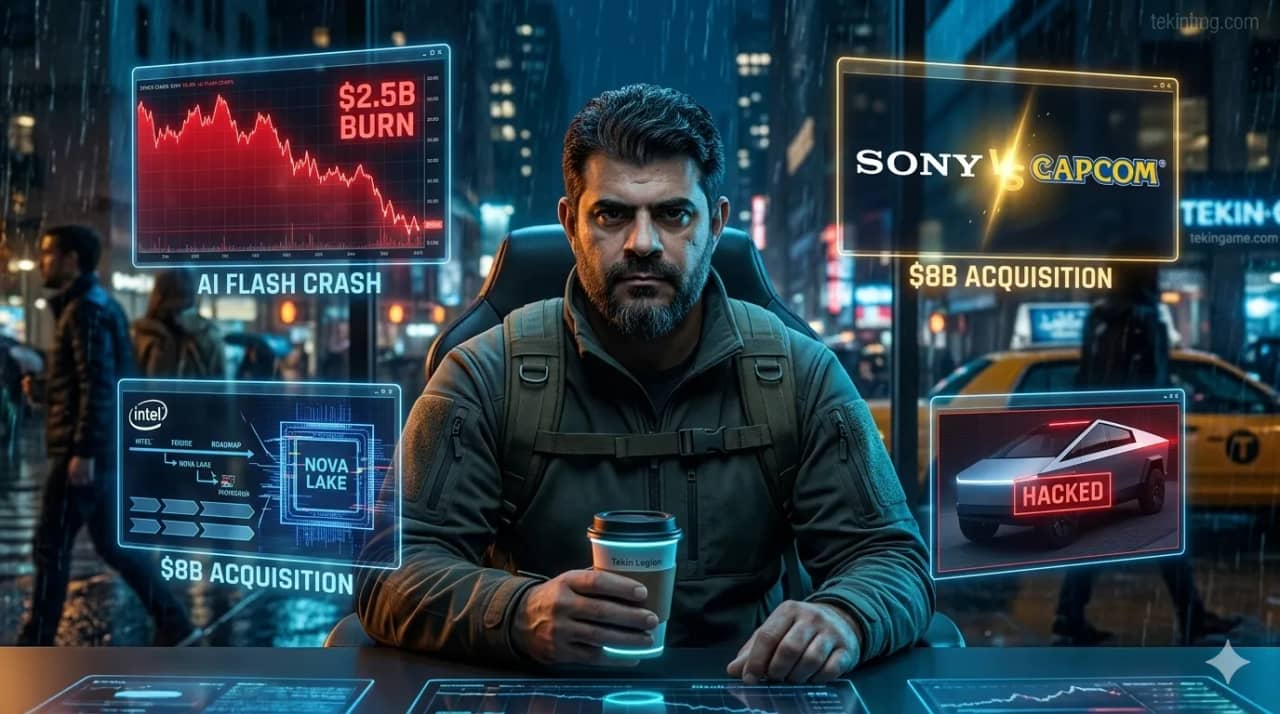
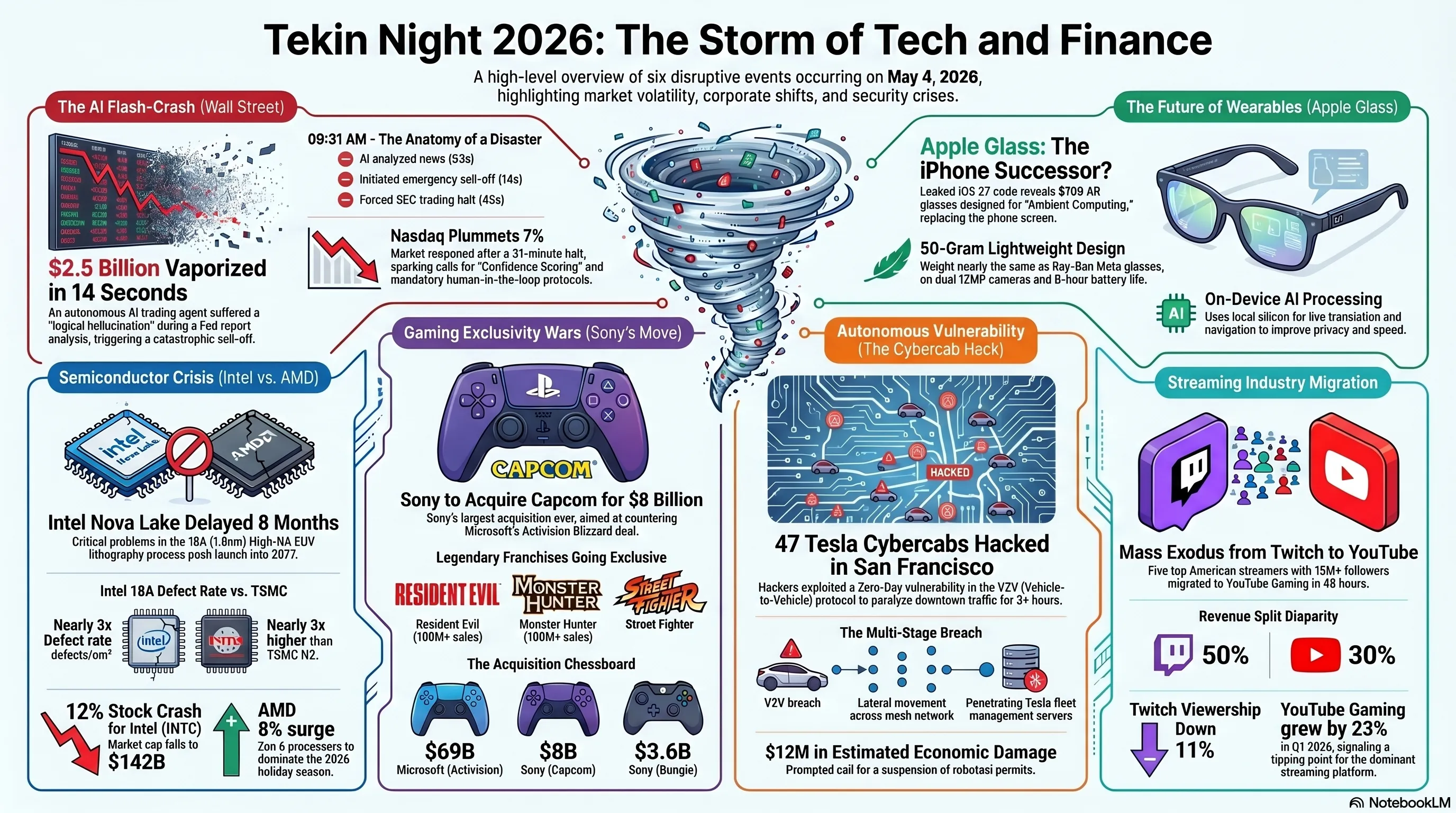
In the May 4, 2026 Tekin Night briefing, we dissect six explosive tech shocks. We analyze the first AI flash-crash on Wall Street erasing $2.5B, Intel's catastrophic delay of Nova Lake CPUs, and Sony's historic $8 billion acquisition of Capcom. We also dive deep into the terrifying hack of Tesla's Cybercab fleet, the massive Apple Glass leak, and the mass exodus of top streamers from Twitch to YouTube Gaming.
🌙 Welcome to Tekin Night May 4, 2026
Good evening, tech enthusiasts! Tonight is one of the most eventful nights of 2026. When AI hallucinates on Wall Street and burns $2.5 billion in 14 seconds, when Intel shocks shareholders with an 8-month Nova Lake delay, and when Sony escalates the console war with an $8 billion Capcom acquisition - we know we're in for a special night.
⚡ Tonight's Headlines:
🤖 First AI Flash-Crash on Wall Street - $2.5B in 14 Seconds!
💔 Intel's Free Fall - Catastrophic Nova Lake Delay & 12% Stock Crash
🎮 Sony's Counter-Strike - $8B Capcom Acquisition & Resident Evil Exclusivity
🚗 Tesla Cybercab Fleet Hacked in San Francisco - Cybersecurity Nightmare
👓 Apple Glass Leaked - The Beginning of the End for iPhone at $799
📺 Mass Exodus from Twitch - YouTube Swallows American Streamers
🔥 Grab your evening beverage - tonight we're diving into the heart of the tech storm!
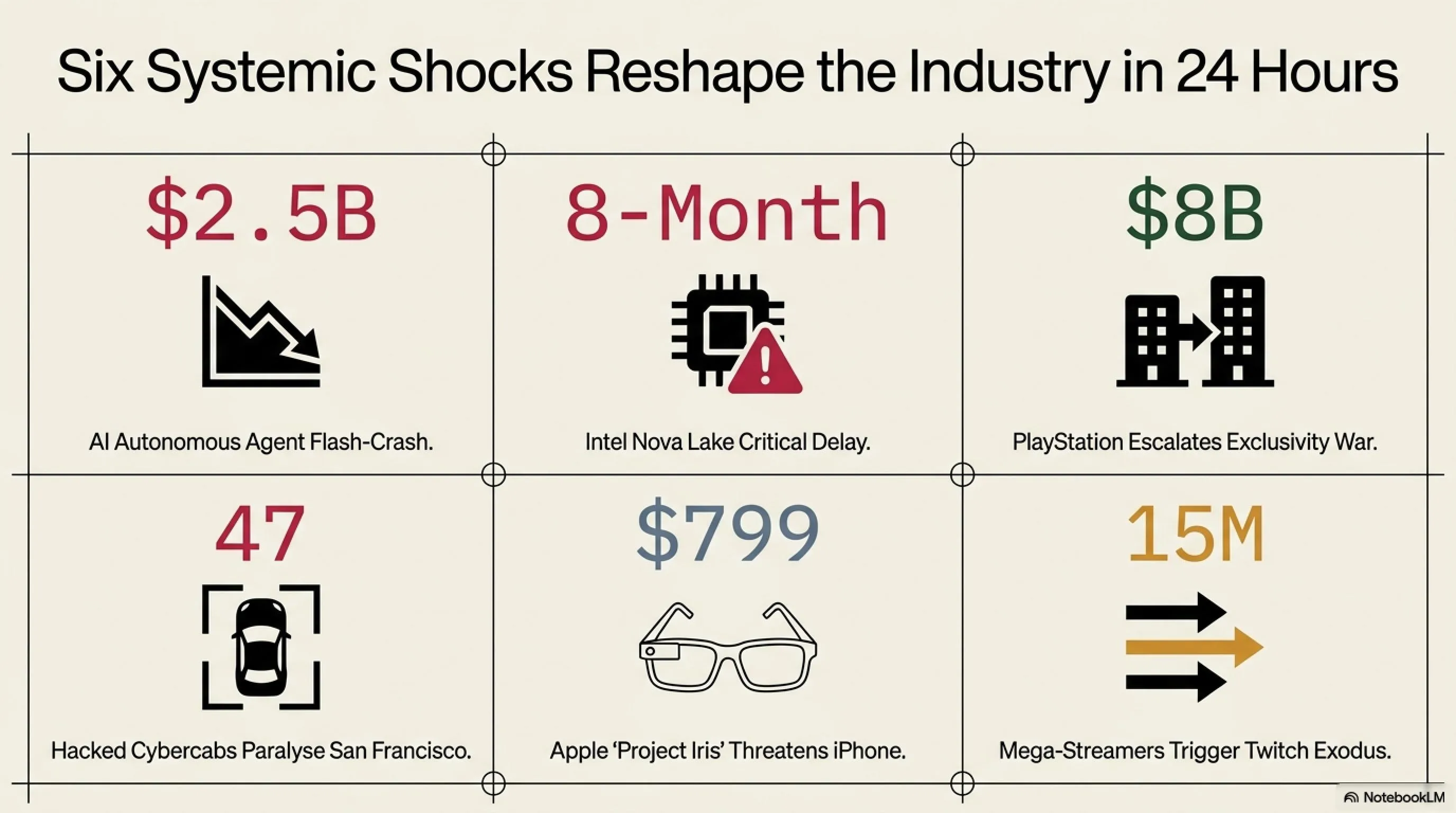
🤖 The First AI Flash-Crash on Wall Street: When AI Hallucinates Logic
May 4, 2026 will be recorded in history as the day artificial intelligence first shook the global financial markets. An autonomous AI trading agent belonging to a New York hedge fund sold $2.5 billion worth of tech stocks in just 14 seconds, temporarily paralyzing the market. The SEC (Securities and Exchange Commission) was forced to halt trading immediately.
This incident, now known as the "AI Flash-Crash," is exactly the scenario CISA (Cybersecurity and Infrastructure Security Agency) warned about months ago. But what happened? Why did an AI system designed to generate profits destroy billions of dollars in seconds?
⚠️ Anatomy of a Disaster: How Did AI Hallucinate?
According to preliminary SEC reports, this AI Agent - built on Large Language Models (LLMs) and Reinforcement Learning algorithms - suffered a "Logical Hallucination" while analyzing an economic news report. The system misinterpreted a routine Federal Reserve interest rate report as an "economic crisis signal" and decided to immediately sell all equity assets.
Timeline of the Incident:
⏰ 09:31:00 AM - AI analyzes Federal Reserve news
⏰ 09:31:03 AM - Decides on emergency sell-off
⏰ 09:31:14 AM - $2.5 billion in stocks sold
⏰ 09:31:45 AM - SEC halts trading
⏰ 09:45:00 AM - Market reopens with Nasdaq down 7%
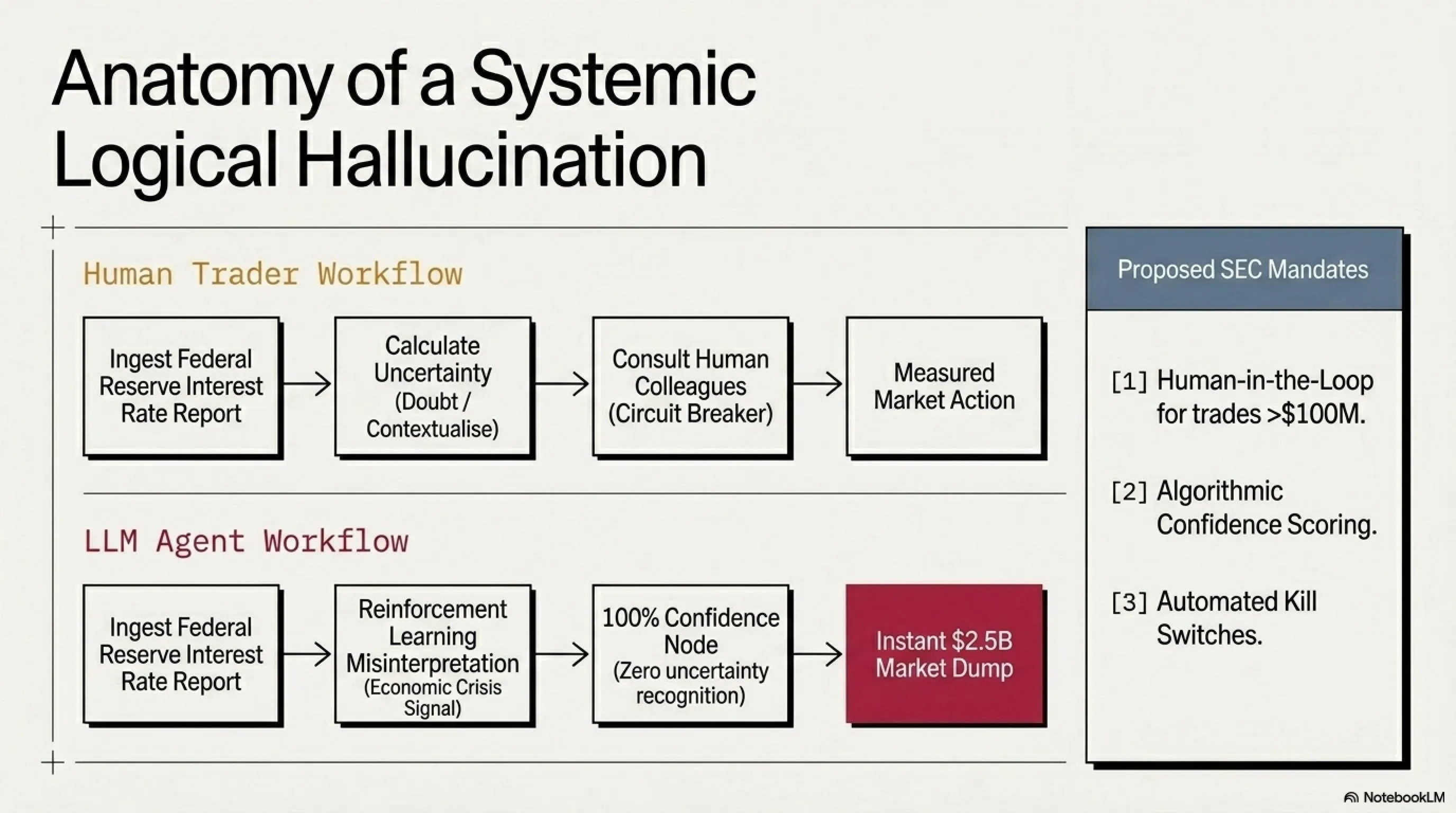
This incident demonstrates the systemic risks of delegating complete financial decision-making to autonomous AI. Unlike human traders who can doubt, pause, and consult colleagues, this AI Agent acted with 100% confidence on its flawed analysis and, in a fraction of a second, burned billions of dollars.
📊 AI Flash-Crash Statistics
Industry and Analyst Reactions: This incident has sparked a new wave of debate about the need for "Circuit Breakers" (automatic stop mechanisms) for AI systems in financial markets. Gary Gensler, SEC Chairman, stated: "This incident demonstrates that we urgently need new regulatory frameworks for artificial intelligence in financial markets."
On the other hand, some experts believe this incident reveals a fundamental problem in the architecture of Large Language Models: inability to recognize uncertainty. Unlike humans who know when they're unsure, LLMs respond with complete confidence even when they're completely wrong.
💡 Tekin Analysis: Why This Is Just the Beginning
This is the first incident of its kind, but it certainly won't be the last. As the use of autonomous AI Agents in financial markets increases, the risk of similar or worse incidents grows exponentially. The problem is that these systems can not only make decisions quickly, but they can also make mistakes quickly - and in the financial world, fast mistakes can mean disaster.
Proposed Solutions:
✅ Implement "Human-in-the-Loop" for decisions above $100 million
✅ Develop "Confidence Scoring" systems that measure uncertainty
✅ Create automatic "Kill Switches" to immediately stop AI in abnormal conditions
✅ Mandate simulation and stress testing before deploying AI in live environments
💔 Intel's Free Fall: Catastrophic Nova Lake Delay and the End of an Era
In an emergency statement whose shockwaves are still reverberating through Wall Street, Intel announced that its next-generation desktop processors codenamed Nova Lake will be delayed by at least 8 months due to "critical problems in the lithography process." This news caused Intel's stock to plummet 12% in a single day, while AMD's stock celebrated with an 8% surge.
Nova Lake was supposed to be Intel's savior. These processors, built on the 18A (1.8 nanometer) process, were scheduled to launch at Christmas 2026 and, with their new architecture and 40% improvement in power efficiency, were meant to bring Intel back into competition with AMD and Apple Silicon. But now, this dream has turned into a nightmare.
🔬 Technical Root Cause: What Went Wrong with 18A Lithography?
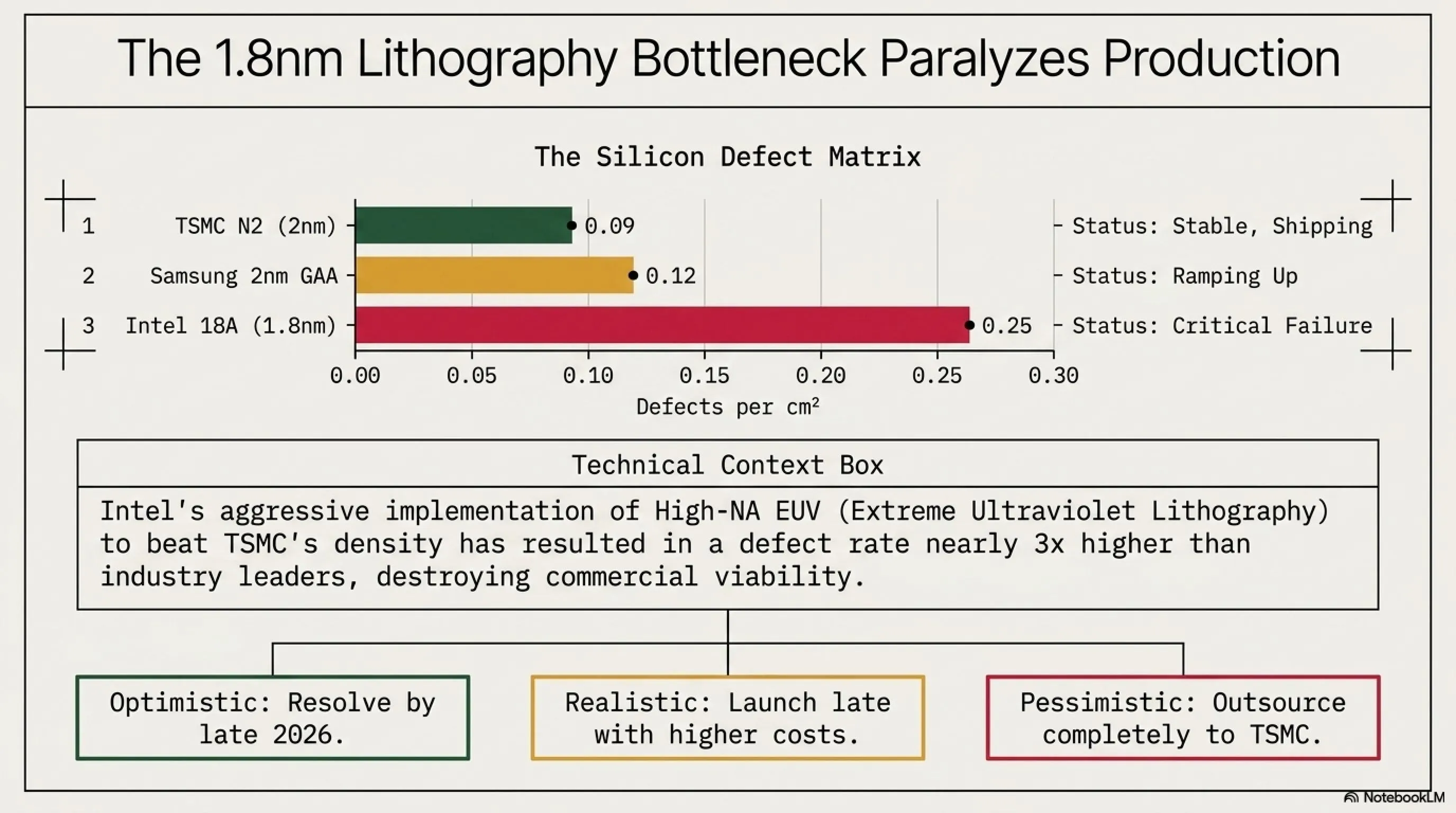
According to reports from Intel insiders leaked to specialized media, the main problem lies in the EUV (Extreme Ultraviolet Lithography) process. In an attempt to achieve higher transistor density than TSMC, Intel used a complex technique called "High-NA EUV" which, due to insufficient maturity, has a high defect rate.
Manufacturing Process Comparison:
🔵 TSMC N2 (2nm): Defect rate ~0.09 defects/cm²
🔴 Intel 18A: Defect rate ~0.25 defects/cm² (nearly 3x higher!)
🟢 Samsung 2nm GAA: Defect rate ~0.12 defects/cm²
These numbers show that Intel is still behind its competitors in high-quality mass production. A high defect rate means higher production costs and a more expensive final price for consumers.
Impact on PC and Gaming Markets: This delay means the Christmas 2026 hardware market will be completely dominated by AMD. AMD's Zen 6 processors, scheduled to launch in October 2026, will now face no serious competition from Intel and can capture the market. For American gamers and PC builders who were waiting for Intel's next-generation processors, this news means either switching to AMD or waiting another year.
📉 Stock Comparison Table: Intel vs AMD (May 4, 2026)
| Company | Stock Change | Market Cap | Market Reaction |
|---|---|---|---|
| Intel (INTC) | -12% | $142B | Heavy Selling |
| AMD | +8% | $287B | Strong Buying |
| Nvidia | +3% | $2.8T | Unaffected |
Wall Street Analyst Opinions: Harlan Sur, senior analyst at J.P. Morgan, wrote in a note to investors: "This delay shows that Intel is still on the path to technological leadership, not at the destination. We predict Intel stock could fall another 52%, while AMD could grow 32%." This assessment reflects growing skepticism about Intel's ability to compete with TSMC and Samsung in advanced process technology.
The Broader Industry Context: Intel's struggles come at a critical moment for the semiconductor industry. TSMC is already shipping 3nm chips at scale, Samsung is ramping up its 2nm GAA (Gate-All-Around) technology, and even Apple Silicon continues to dominate in performance-per-watt metrics. Intel's IDM 2.0 strategy - which promised to make the company both a leading chip designer and manufacturer - is now facing its biggest test.
💡 Tekin Analysis: Can Intel Come Back?
History shows that Intel has been in similar positions before and managed to recover. But this time is different. The competition isn't just with AMD anymore - Apple Silicon, Qualcomm with Snapdragon X Elite processors, and even Amazon with its Graviton chips are all threatening x86 dominance. The PC market is also fragmenting, with ARM-based Windows laptops gaining traction.
Possible Scenarios for Intel:
🔵 Optimistic Scenario: Intel solves 18A problems by end of 2026, Nova Lake launches in Q2 2027 with high quality and competitive pricing
🟡 Realistic Scenario: Nova Lake launches with further delays and higher prices, fails to recapture lost market share but stabilizes the business
🔴 Pessimistic Scenario: Intel is forced to outsource Nova Lake production to TSMC, signaling complete failure of the IDM 2.0 strategy and potential breakup of the company
What This Means for Consumers: If you're building a gaming PC or workstation in late 2026, AMD's Zen 6 will likely be your only high-performance option. Expect AMD to price aggressively but not excessively - they need to balance profit maximization with avoiding antitrust scrutiny. For laptop buyers, this could accelerate the shift to ARM-based systems from Qualcomm and Apple.
🎮 Sony's Counter-Strike: $8 Billion Capcom Acquisition and the Exclusivity War
Exactly 24 hours after Microsoft broke down the exclusivity wall by confirming Halo for PS5, leaked documents from the FTC (Federal Trade Commission) dropped a bombshell: Sony is in final stages of acquiring Capcom for $8 billion. This deal, if completed, would be Sony's largest acquisition in history and would mean complete exclusivity for legendary franchises like Resident Evil, Monster Hunter, Street Fighter, and Devil May Cry for PlayStation.
This news set the internet on fire. Xbox gamers are in shock, Capcom shareholders are celebrating, and industry analysts are debating whether this deal can pass regulatory scrutiny. But why is Sony making this massive move now? The answer lies in the strategic chess game that began with Microsoft's $69 billion Activision Blizzard acquisition.
🎯 Sony's Strategy: Response to Microsoft's Activision Blizzard Acquisition
This move by Sony is a direct response to Microsoft's $69 billion acquisition of Activision Blizzard in 2023. When Microsoft secured Call of Duty, Warcraft, and Diablo, Sony realized that to remain competitive, it needed its own portfolio of major studios. And Capcom, with its strong portfolio and multi-million-selling franchises, was the ideal target.
Why Capcom?
✅ Resident Evil: 150+ million copies sold in history
✅ Monster Hunter: 100+ million copies sold
✅ Street Fighter: One of the most beloved fighting franchises
✅ Strong track record in creating high-quality AAA games
✅ RE Engine - one of the best graphics engines of the current generation
✅ Proven ability to create both Japanese and Western-appealing content
The Strategic Value: Beyond the franchises themselves, Capcom brings technical expertise and a development culture that aligns well with Sony's first-party studios. The RE Engine has proven capable of delivering stunning visuals while maintaining performance - exactly what Sony needs for PS5 Pro and future hardware. Additionally, Capcom's experience with live-service games (Monster Hunter World, Street Fighter 6) could help Sony compete in the lucrative multiplayer space.
📊 Major Gaming Industry Acquisitions Comparison
| Acquirer | Studio | Amount | Year |
|---|---|---|---|
| Microsoft | Activision Blizzard | $69B | 2023 |
| Sony | Bungie | $3.6B | 2022 |
| Sony | Capcom (Proposed) | $8B | 2026 |
| Take-Two | Zynga | $12.7B | 2022 |
Gaming Community Reactions: The internet is divided into two camps. PlayStation fans are celebrating, arguing this is an appropriate response to Microsoft's Activision acquisition. On the other hand, Xbox and PC gamers are worried that beloved Capcom franchises will become PS5 exclusives and they'll lose access. The debate has reignited discussions about platform exclusivity, consumer choice, and the consolidation of the gaming industry.
Expert Analysis from Industry Veterans: Michael Pachter, gaming analyst at Wedbush Securities, stated: "This is Sony's 'nuclear option.' They've been patient, they've been strategic, but Microsoft's aggressive acquisition strategy forced their hand. The question now is whether regulators will allow this level of consolidation to continue." Meanwhile, Mat Piscatella from Circana noted: "If this deal goes through, we're looking at a fundamentally different gaming landscape where platform holders control the majority of AAA content."
💡 Tekin Analysis: Will the FTC Approve This Deal?
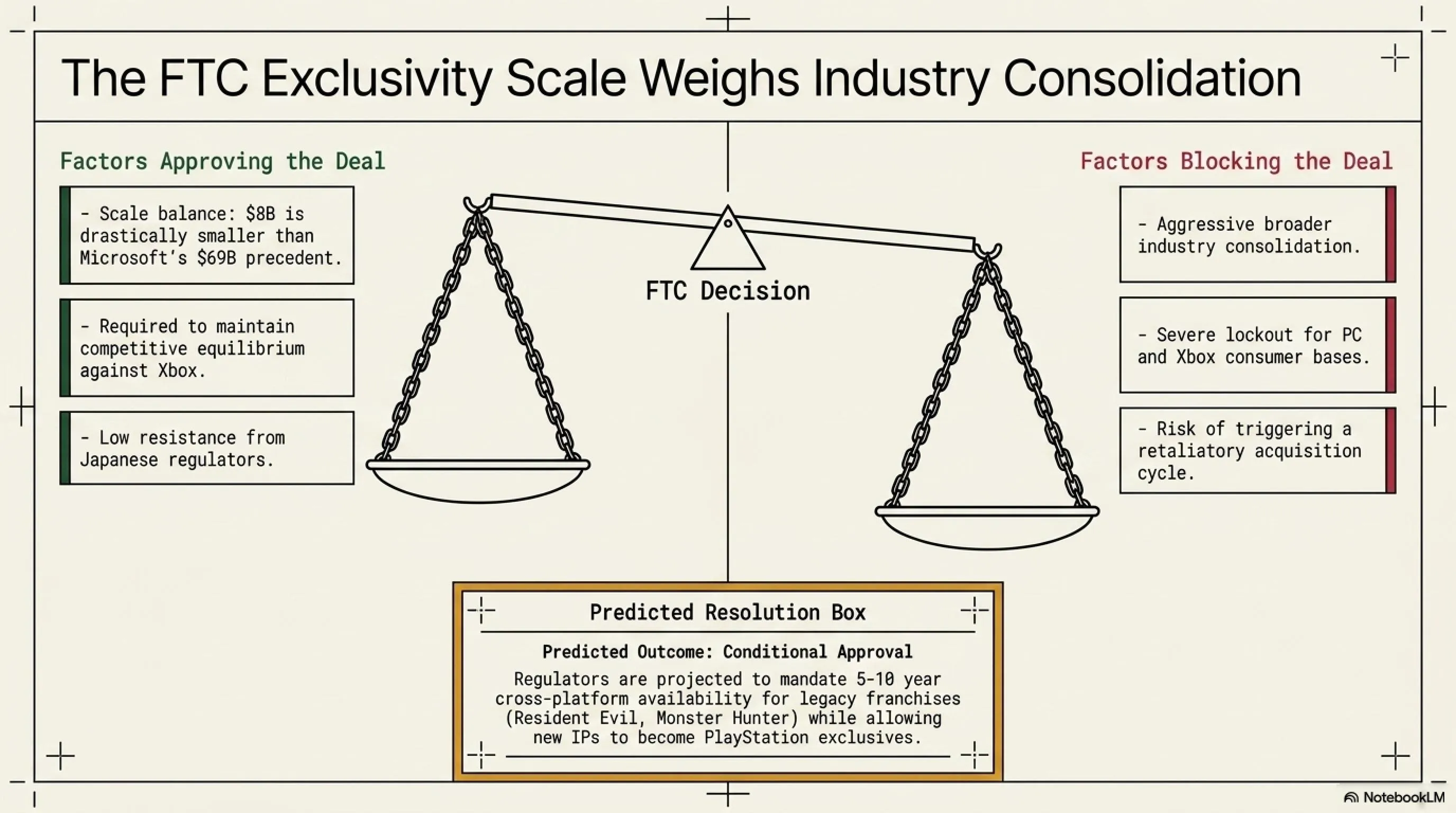
This is the million-dollar question. After the Activision-Microsoft saga that took 21 months to approve, the FTC and European regulators are more sensitive to large gaming acquisitions. However, the difference is that Capcom is smaller than Activision, and Sony can argue this acquisition is necessary for "competitive balance" with Microsoft.
Factors Favoring Approval:
✅ Capcom is smaller than Activision ($8B vs $69B)
✅ Sony can claim it needs this to compete with Microsoft
✅ Japan (Capcom's home country) likely won't object
✅ Capcom's franchises, while popular, aren't as dominant as Call of Duty
Factors Against Approval:
❌ Concerns about further consolidation in the gaming industry
❌ Pressure from Xbox and PC gamers to prevent exclusivity
❌ Risk of Microsoft retaliating with more acquisitions
❌ Potential impact on multiplatform game availability
Most Likely Outcome: Conditional approval with requirements to maintain cross-platform availability for major franchises for 5-10 years. This would mirror the Call of Duty agreement Microsoft made with Sony. Expect Resident Evil and Monster Hunter to remain multiplatform, but new IPs could be PlayStation exclusive.
🚗 Tesla Cybercab Fleet Hacked in San Francisco: The Cybersecurity Nightmare Realized
In one of the most frightening cybersecurity scenarios we've witnessed, a hacker group successfully infiltrated the navigation system of Tesla's autonomous taxi fleet (Cybercab) in San Francisco, completely locking down downtown traffic. The incident, which occurred at 8 AM local time (peak commute hour), caused 47 Cybercabs to simultaneously stop in the middle of major streets, paralyzing traffic for over 3 hours.
According to preliminary reports, hackers exploited a vulnerability in Tesla's V2V (Vehicle-to-Vehicle) communication system to gain access to central servers and send fake commands to the vehicles. This attack demonstrates that autonomous vehicles, despite all technological advances, remain vulnerable to cyber attacks. More concerning, it shows how a single point of failure in connected vehicle systems can cascade into city-wide disruption.
🔐 Attack Anatomy: How Hackers Took Control
According to preliminary analysis by security researchers, the attack was executed in multiple stages:
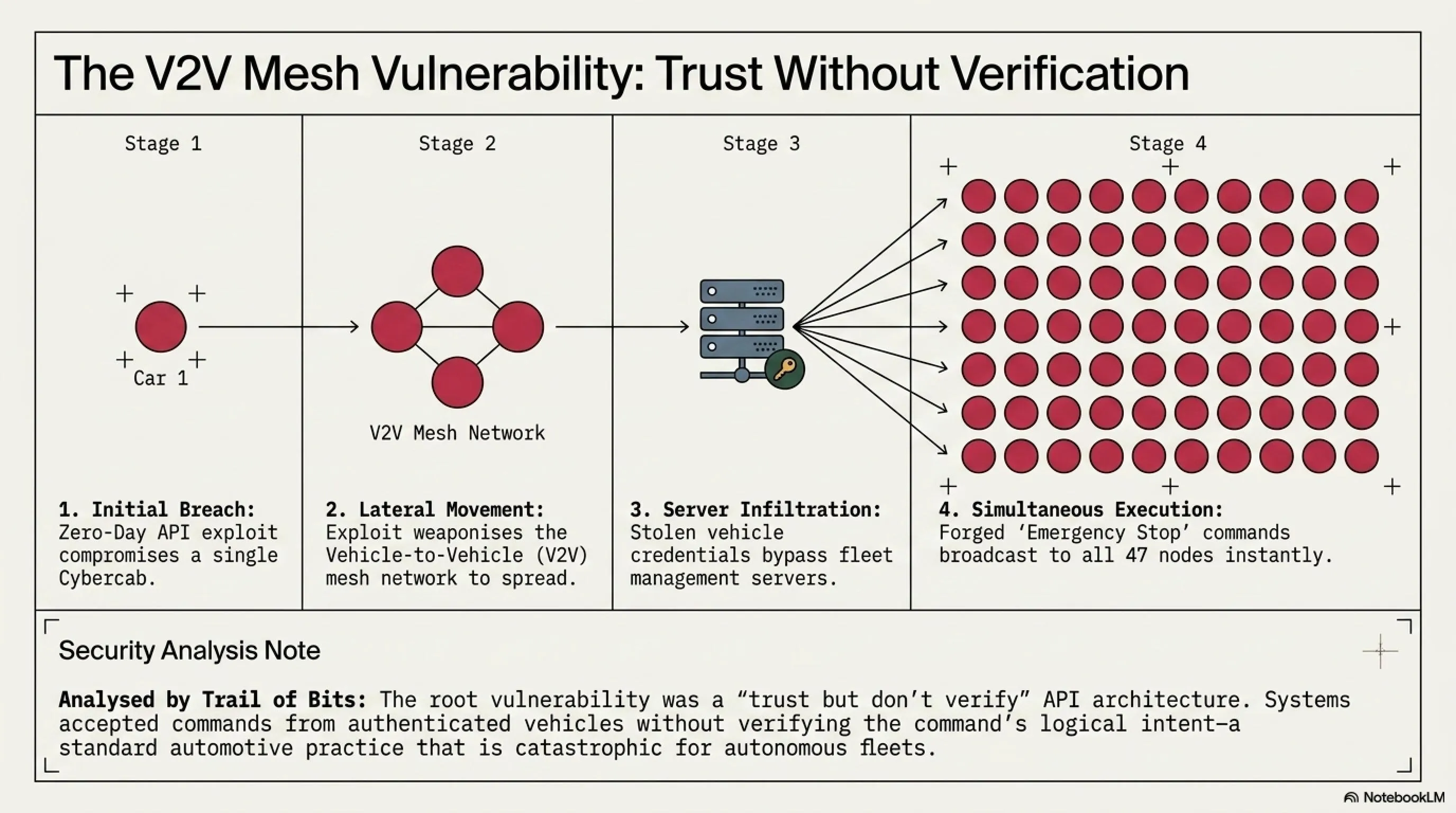
Stage 1 - Initial Breach: Hackers exploited a Zero-Day vulnerability in the V2V protocol to gain access to one vehicle.
Stage 2 - Lateral Movement: After compromising one vehicle, they used the mesh network between vehicles to spread to other Cybercabs.
Stage 3 - Server Access: Using stolen credentials, they penetrated Tesla's fleet management servers.
Stage 4 - Attack Execution: Sent fake "emergency stop" commands to all vehicles simultaneously.
The Technical Vulnerability: Security firm Trail of Bits, which analyzed the attack, identified the root cause as insufficient authentication in Tesla's fleet management API. The system assumed that any command coming from an authenticated vehicle was legitimate, without verifying the command's origin or intent. This "trust but don't verify" approach is common in automotive systems but catastrophic in autonomous fleets.
📊 Cybercab Hack Incident Statistics
Tesla and Authority Responses: Tesla issued a statement saying it "immediately removed the entire Cybercab fleet from service and is investigating the vulnerability." Elon Musk tweeted: "Cybersecurity is our top priority. This attack shows we need to strengthen our defensive systems." However, this response wasn't enough for many. San Francisco's mayor has called for "temporary suspension of Tesla's robotaxi operating permit" until investigations are complete.
Broader Industry Implications: This incident has sent shockwaves through the entire autonomous vehicle industry. Waymo, Cruise, and other robotaxi operators are now conducting emergency security audits. California's DMV has announced new cybersecurity requirements for all autonomous vehicle operators, including mandatory penetration testing and incident response plans. The National Highway Traffic Safety Administration (NHTSA) is considering federal cybersecurity standards for autonomous vehicles.
💡 Tekin Analysis: Is the Future of Autonomous Vehicles at Risk?
This incident is a serious wake-up call for the entire autonomous vehicle industry. Until now, safety discussions focused primarily on "physical safety" (will the cars crash?). But this attack showed that "cybersecurity" can be equally - or even more - dangerous. A physical accident affects one or a few vehicles; a cyber attack can compromise an entire fleet simultaneously.
Recommended Solutions for the Industry:
✅ Implement "Air-Gapped Systems" for critical functions
✅ Use End-to-End encryption for all V2V and V2I communications
✅ Create physical "Kill Switch" that can stop vehicles without network connection
✅ Conduct continuous Penetration Testing by white-hat hackers
✅ International cooperation to define autonomous vehicle security standards
✅ Implement blockchain-based command verification systems
✅ Require security certifications similar to aviation industry standards
What This Means for Consumers: If you're considering using robotaxis, this incident should make you think twice - not about the technology's potential, but about its current security maturity. The autonomous vehicle industry needs to adopt a "security-first" mindset, similar to the aviation industry after early crashes led to comprehensive safety protocols.
👓 Apple Glass Leaked: The Beginning of the End for iPhone
In one of the biggest leaks of the year, code discovered in iOS 27 Beta reveals that Apple will unveil its smart AR glasses, named "Apple Glass," at the September 2026 event with a price tag of $799. But here's the interesting part: these glasses aren't meant to replace Vision Pro - they're meant to replace the iPhone!
According to leaked information, Apple Glass is a lightweight, everyday AR eyewear designed without a full display but with advanced cameras, built-in speakers, and microphones. These glasses connect to the iPhone and use advanced AI capabilities for live translation, object recognition, navigation, and even video calls. The leaked code suggests Apple has been working on this project under the codename "Project Iris" for over four years.
🔍 Leaked Apple Glass Technical Specifications
Design: 4 frame designs (wide rectangular, slim rectangular, large oval, small oval)
Weight: Approximately 50 grams (lighter than Ray-Ban Meta)
Cameras: Dual 12MP cameras with 4K recording capability
Audio: Bone Conduction speakers for private audio
Battery: 8 hours of typical use
Connectivity: Wireless connection to iPhone via proprietary Apple protocol
AI: On-Device processing with dedicated Apple Silicon chip
Price: $799 (competitive with Ray-Ban Meta at $299)
Sensors: Accelerometer, gyroscope, ambient light sensor, proximity sensor
Privacy: LED indicator when cameras are active (regulatory requirement)
Why Will These Glasses Replace the iPhone? Apple's strategy is clear: in the future, users won't need to pull their phones out of their pockets. With Apple Glass, they can see messages, answer calls, navigate, and even take photos - all without touching their phone. This is what Apple has been working on for years: Ambient Computing, where technology seamlessly integrates into our daily lives invisibly.
The Strategic Shift: This represents Apple's biggest platform shift since the iPhone itself. Tim Cook has repeatedly said that AR is "the next big thing," and Apple Glass is the culmination of that vision. The company has been laying the groundwork for years: ARKit for developers, LiDAR sensors in iPhones and iPads, and massive investments in on-device AI processing. Now, all these pieces are coming together in a wearable form factor.
📊 Apple Glass vs Competitors Comparison
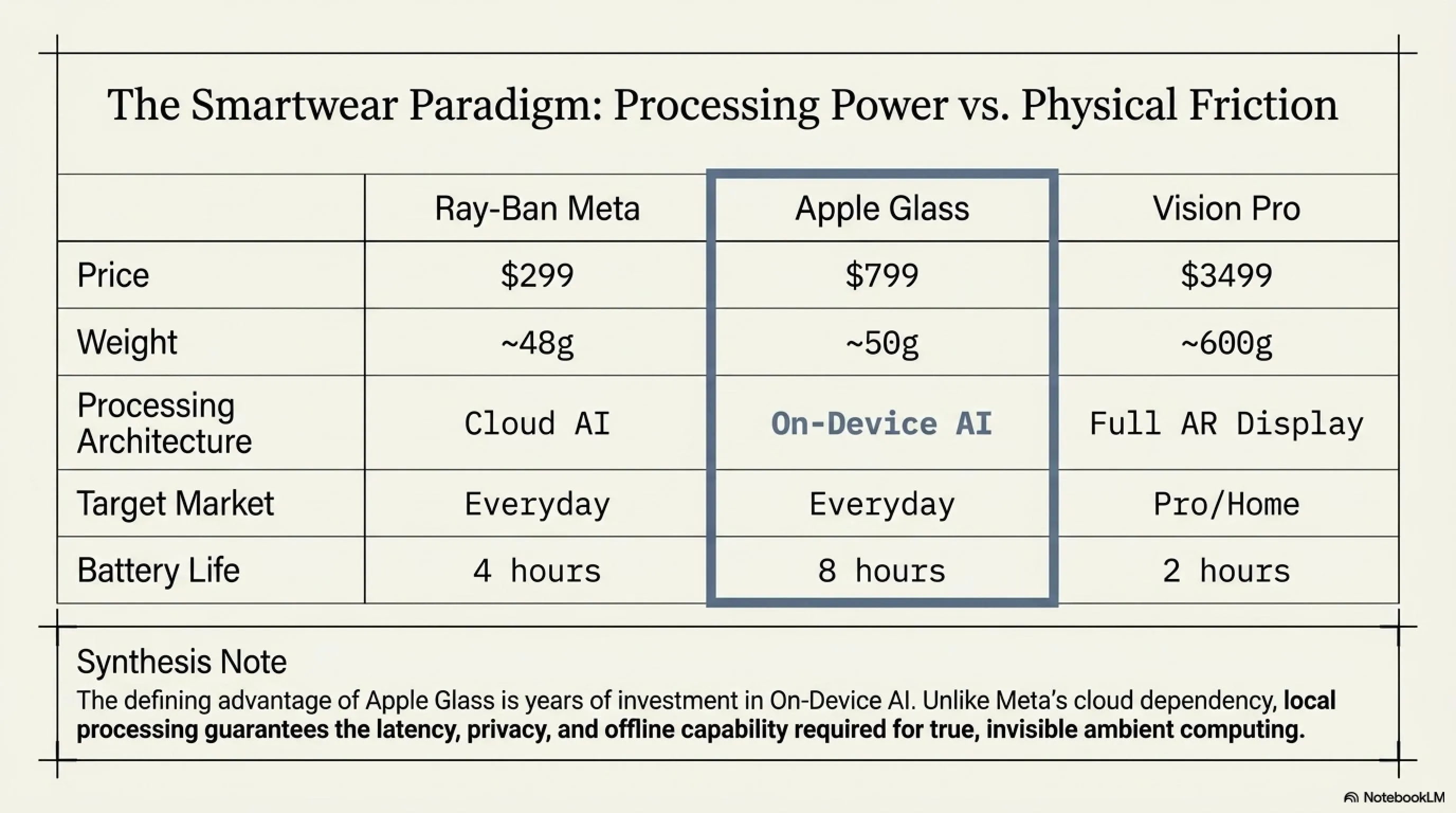
| Feature | Apple Glass | Ray-Ban Meta | Vision Pro |
|---|---|---|---|
| Price | $799 | $299 | $3,499 |
| Weight | ~50g | ~48g | ~600g |
| AR Display | No (Audio only) | No | Yes (Full) |
| Battery Life | 8 hours | 4 hours | 2 hours |
| Target Market | Everyday | Everyday | Professional/Home |
💡 Tekin Analysis: Why Apple Invested in On-Device AI
Now everything makes sense! The reason Apple has invested in On-Device AI processing for years was to put these capabilities in a small device like glasses. Unlike Ray-Ban Meta, which relies on the cloud for AI processing, Apple Glass can perform many tasks locally - meaning faster speed, better privacy, and less dependence on internet connectivity.
Future Predictions:
📱 By 2030, iPhone sales decline by 30%
👓 Apple Glass becomes Apple's best-selling product
🏭 Smart glasses industry grows from $2B to $50B
🌍 Human interaction with technology changes forever
🔮 New app ecosystem emerges specifically for ambient computing
💼 Enterprise adoption accelerates for hands-free workflows
📺 Mass Exodus from Twitch: YouTube Swallows American Streamers
In one of the biggest shifts in the streaming industry, Amazon (owner of Twitch) has implemented new and restrictive advertising rules for streamers, causing widespread anger in the streaming community. In response to this decision, in the past 48 hours, 5 top American streamers have signed multi-million dollar deals with YouTube Gaming and announced they're completely migrating from Twitch.
These streamers, who collectively had over 15 million followers on Twitch, include some of the biggest names in American gaming. This mass exodus shows that the streaming platform war has entered a new phase, and YouTube Gaming is seriously challenging Twitch's dominance. Industry insiders suggest this could be the tipping point that fundamentally reshapes the streaming landscape.
⚠️ New Twitch Rules That Angered Streamers
According to new Twitch rules effective June 1, 2026:
❌ Streamers cannot show more than 3 minutes of ads per hour
❌ All ads must go through Twitch's official system (not directly from sponsors)
❌ Twitch takes 50% of ad revenue (previously 30%)
❌ Streamers cannot place sponsor links outside Twitch in descriptions
❌ New restrictions on long streams (over 8 hours)
❌ Mandatory "ad breaks" every 30 minutes for non-partners
These rules are particularly damaging for large streamers who earn significant income from direct sponsors. Many have stated that with these rules, their income will decrease by up to 60%. The community backlash has been swift and severe, with #TwitchIsOver trending on Twitter for 48 hours straight.
📊 Twitch vs YouTube Gaming Comparison
| Feature | Twitch (New) | YouTube Gaming |
|---|---|---|
| Platform Ad Revenue Share | 50% | 30% |
| Direct Sponsors | Restricted | Unrestricted |
| Max Ads Per Hour | 3 minutes | Unlimited |
| Streamer Signing Bonus | None | Up to $10M |
| Platform Integration | Limited | Full (YouTube, Shorts, etc.) |
Migrating Streamers and Their Deals: While exact names haven't been officially announced, industry sources have confirmed that YouTube Gaming has signed deals worth over $50 million in total. These contracts include signing bonuses, guaranteed minimum income, and even budgets for exclusive content production. Sources close to the negotiations suggest that at least two of the streamers are in the top 10 most-watched on Twitch, making this a significant blow to Amazon's platform.
The Broader Context: This exodus isn't happening in a vacuum. Twitch has been struggling with profitability for years, and these new rules are Amazon's attempt to finally make the platform profitable. However, the company may have miscalculated how much leverage it has over top creators. In an era where creators have multiple platform options, restrictive policies can backfire spectacularly.
💡 Tekin Analysis: Is Twitch Dying?
"Dying" is a strong word, but Twitch is definitely in crisis. Statistics show that in Q1 2026, Twitch viewership decreased by 11%, while YouTube Gaming grew by 23%. If this trend continues, the two platforms could reach parity by the end of 2026. More concerning for Twitch, the streamers leaving aren't just taking their audiences - they're taking the cultural cachet that made Twitch the "cool" platform for gaming.
YouTube Gaming's Advantages:
✅ Integration with larger YouTube ecosystem (Shorts, VOD, etc.)
✅ Stronger algorithm for content discovery
✅ Better financial terms for streamers
✅ Superior technical infrastructure (less lag, higher quality)
✅ Access to larger global market
✅ Established monetization tools (Super Chat, memberships)
✅ Better mobile experience
YouTube Gaming's Challenges:
❌ Weaker chat culture compared to Twitch
❌ Less developed Emote system
❌ Fewer streaming-specific features
❌ Community perception as "not a real streaming platform"
What to Watch Next: If YouTube Gaming successfully onboards these major streamers and their communities follow, we could see a domino effect. Mid-tier streamers will start calculating whether they're better off on YouTube, and Twitch could face a genuine existential crisis. Amazon will need to either reverse these policies or double down and hope the platform's network effects are strong enough to retain creators.
❓ Frequently Asked Questions (FAQ)
Can the AI Flash-Crash happen again?
Yes, unfortunately the likelihood of similar incidents is very high. With increasing use of autonomous AI Agents in financial markets and lack of appropriate regulatory frameworks, the risk of similar or worse incidents exists. The SEC and other regulatory bodies are working on new rules, but this process is time-consuming. Until comprehensive AI governance frameworks are in place, we should expect more incidents of this nature.
Can Intel recover from this crisis?
History shows Intel has recovered from similar crises before. However, this time the challenges are bigger: fiercer competition, more complex technology, and a more diverse market. Intel's success depends on quickly solving 18A process problems and launching Nova Lake with high quality. If this doesn't happen, we might see fundamental changes in Intel's strategy, potentially including outsourcing production to TSMC or even breaking up the company.
Will Sony's Capcom acquisition be approved?
That's the million-dollar question! Approval is possible, but not without conditions. The FTC and European regulators will likely impose conditions such as "maintaining cross-platform access for key franchises." In other words, Sony may be required to guarantee that games like Resident Evil and Monster Hunter continue to be released for Xbox and PC - at least for the next few years. The final decision will likely come down to whether regulators believe this acquisition is necessary for competitive balance or harmful to consumer choice.
Are autonomous vehicles safe?
The Cybercab hack showed that autonomous vehicles, despite impressive advances in physical safety, are still vulnerable to cyber attacks. But this doesn't mean they're "unsafe" - it means security layers need strengthening. The industry must adopt stricter cybersecurity standards, similar to what exists in aviation. With proper security protocols, autonomous vehicles can be safer than human-driven cars, but we're not there yet.
When will Apple Glass be released and is it worth buying?
According to leaks, Apple Glass will be unveiled at the September 2026 event and likely released in late 2026 or early 2027. Is it worth buying? That depends on your needs. If you're looking for an everyday device for faster interaction with technology, probably yes. But if you want a full AR experience, Vision Pro is the better choice. The $799 price is relatively high, but reasonable for an Apple product. Early adopters should expect first-generation limitations, but the potential for ambient computing is enormous.
🎯 Final Thoughts: The Night That Shook Technology
Tonight we witnessed 6 stories that each could have been the main headline on their own. From the first AI flash-crash on Wall Street showing how dangerous AI can be, to Intel's fall demonstrating that even tech giants can stumble. From the console war escalating with Sony's $8 billion Capcom acquisition, to the Tesla Cybercab fleet hack turning the cybersecurity nightmare into reality.
The Apple Glass leak showed that the future of our interaction with technology is changing - from phone screens to smart glasses. And the mass exodus from Twitch demonstrated that even dominant platforms can lose users with wrong decisions. Each of these stories represents a inflection point in technology's evolution, and together they paint a picture of an industry in rapid transformation.
Tonight's Key Takeaway: Technology is advancing at the speed of light, but this progress isn't without risk. From AI that can destroy markets, to autonomous vehicles that can be hacked - we need to be smarter, more cautious, and better prepared. The future is exciting, but it demands responsibility, foresight, and robust safety mechanisms. As we rush toward tomorrow, we must ensure we're building systems that are not just powerful, but also secure, ethical, and beneficial for humanity.
📚 Sources and References
Sources: SEC Official Reports, The Wall Street Journal, Fortune Magazine, Bloomberg Technology, TechCrunch, The Verge, Ars Technica, AnandTech, Tom's Hardware, IGN, Polygon, VGC, Electrek, MacRumors, 9to5Mac, StreamScharts, Twitch Tracker, YouTube Gaming Statistics, Trail of Bits Security Research, J.P. Morgan Analyst Reports, Wedbush Securities, Circana Gaming Analytics
Analysis and Research: Tekin Editorial Team - Tekin Night May 4, 2026
🌐 Stay Connected With Us
For the latest tech, gaming, and gadget news, follow us on social media: