In the May 20, 2026 Tekin Morning briefing, we dissect six explosive tech stories. We analyze Google's groundbreaking launch of Gemini 3.5 Flash, a model 67x cheaper than its predecessor, and the new Google AI Studio app builder. Furthermore, we explore the persistent cloud assistant Gemini Spark, cybersecurity startup Ocean launching with $28M to fight AI phishing, Apple's revolutionary accessibility update enabling eye-controlled wheelchairs via Vision Pro, and a terrifying Google Search Console bug that caused panic among SEO professionals w
🌅 Welcome to Tekin Morning May 20, 2026
Good morning, tech enthusiasts! It's Wednesday, May 20, 2026, and we're bringing you six explosive stories from the world of technology. Google I/O 2026 took place yesterday, and Google transformed the AI landscape with the introduction of Gemini 3.5 Flash. From building Android apps in 5 minutes to an AI assistant that works even when your laptop is off—everything is in this comprehensive report!
⚡ Today's Headlines:
🚀 Gemini 3.5 Flash: Google's Most Powerful Coding Model
📱 AI Studio: Build Android Apps Without Coding
⚡ Gemini Spark: 24/7 Assistant with Gmail Integration
🛡️ Ocean: $28M to Combat AI Phishing
♿ Apple: Eye-Controlled Wheelchair in Vision Pro
🐛 Widespread Google Search Console Bug
☕ Grab your coffee and get ready for an exciting journey through the world of technology!
🚀 Google I/O 2026: Gemini 3.5 Flash and the New Age of AI Agents
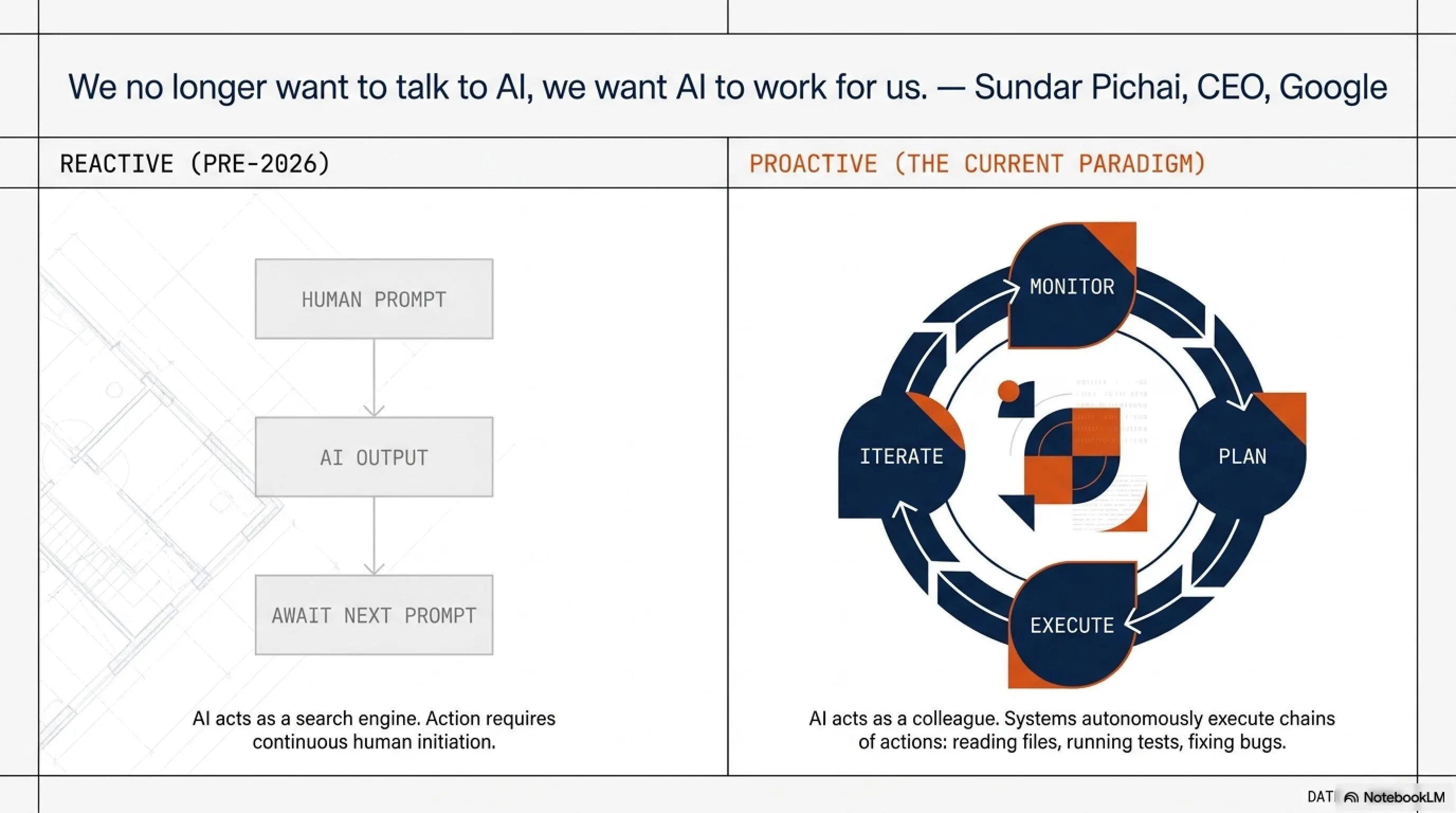
Google I/O 2026, held on May 19, wasn't just another developer conference—it marked a turning point in artificial intelligence history. Sundar Pichai, Google's CEO, sent a clear message to the industry by declaring the end of the chatbot era and the beginning of the AI Agent age: "We no longer want to talk to AI, we want AI to work for us."
At the heart of this transformation is Gemini 3.5 Flash—a model that, according to Koray Kavukcuoglu, DeepMind's Chief Technologist, "outperforms our latest frontier model, Gemini 3.1 Pro, on nearly all benchmarks." This is a bold claim because typically, lighter and faster models (Flash) can't compete with flagship models (Pro). But Gemini 3.5 Flash breaks that rule.
What makes this announcement particularly significant is the timing and competitive landscape. OpenAI's GPT-4 Turbo has dominated the coding space for months, while Anthropic's Claude 3.5 Sonnet has been gaining ground with developers. Google needed a response that wasn't just competitive—it needed to be revolutionary. Gemini 3.5 Flash appears to be exactly that.
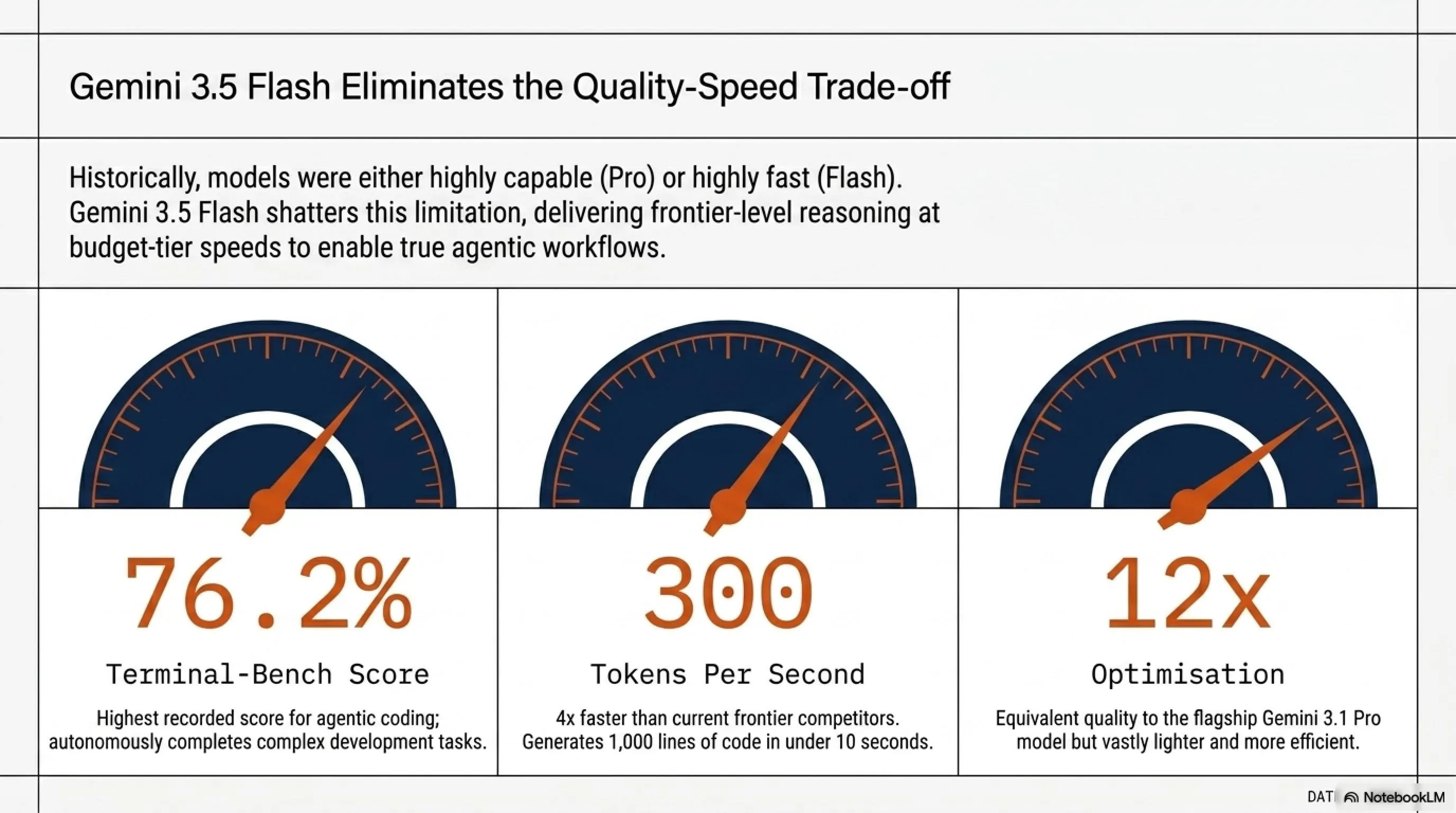
📊 Gemini 3.5 Flash: By the Numbers
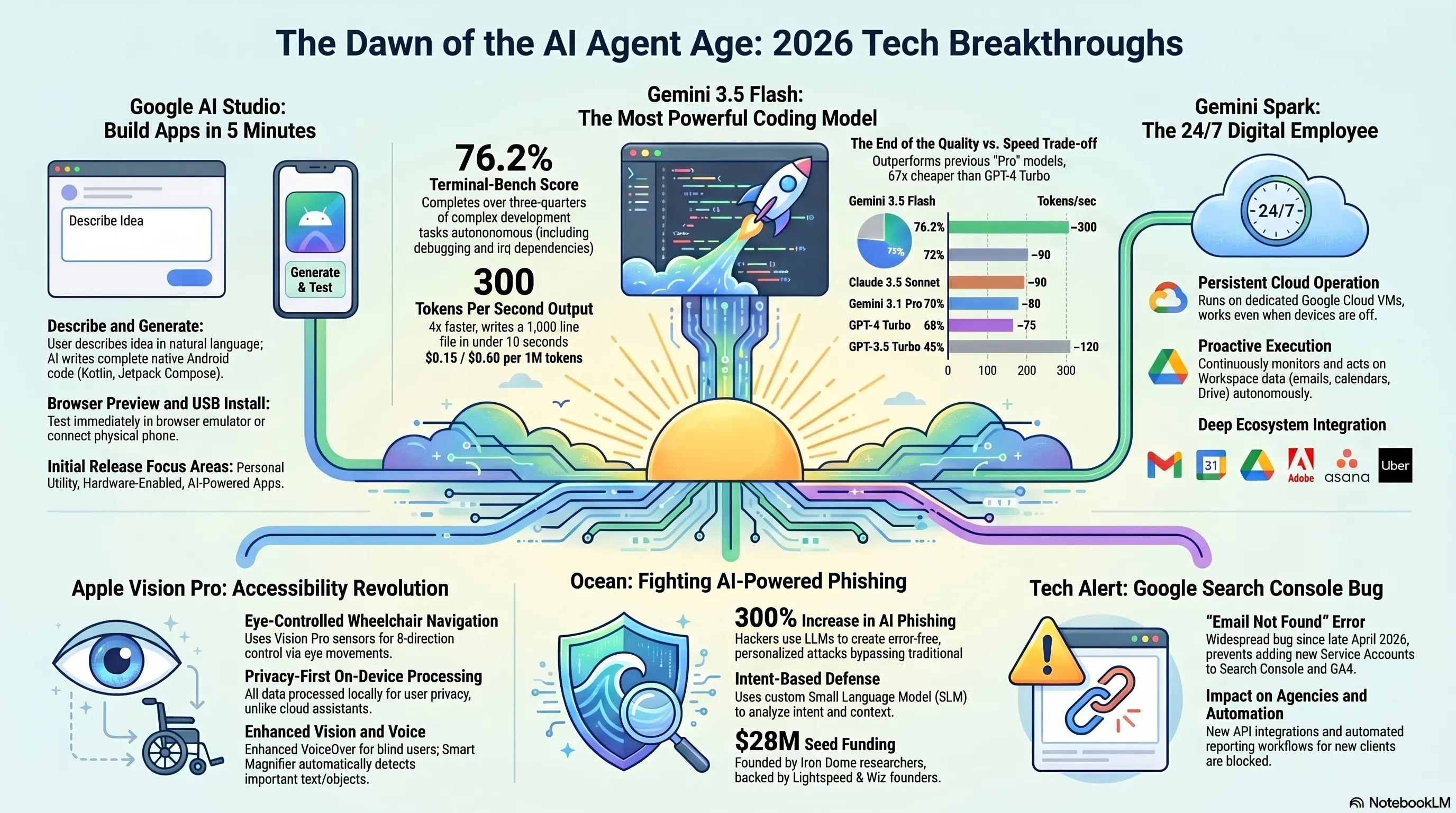
But why do these numbers matter? Terminal-Bench is a new benchmark that measures AI models' ability to execute real-world tasks in a terminal environment—not just writing code, but running it, debugging, installing dependencies, and solving problems. A 76.2% score means Gemini 3.5 Flash can autonomously complete more than three-quarters of complex software development tasks without human intervention.
The 300 tokens per second speed is equally revolutionary. For comparison, GPT-4 Turbo generates around 70-80 tokens per second. This means Gemini 3.5 Flash can write a 1,000-line code file in less than 10 seconds—a speed that transforms the AI experience from "waiting" to "real-time collaboration."
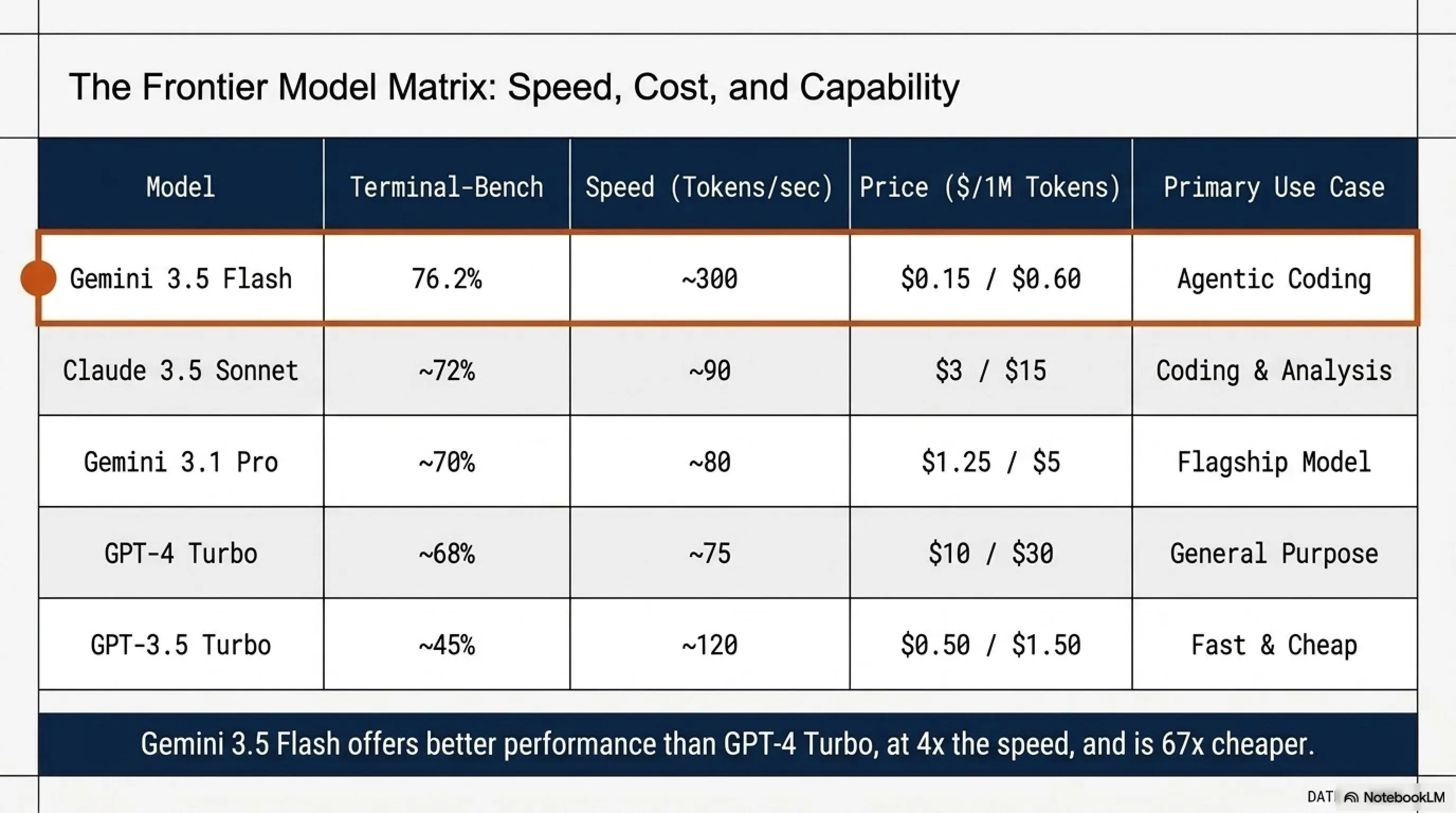
What's particularly interesting is Google's strategic positioning. By making Flash—traditionally the "budget" tier—outperform Pro, Google is essentially saying: "You no longer have to choose between quality and speed." This is a direct challenge to OpenAI's pricing model, where GPT-4 Turbo costs $10/$30 per million tokens compared to Gemini 3.5 Flash's $0.15/$0.60.
🔬 Tekin Analysis: Why Gemini 3.5 Flash Is a Game-Changer
Until now, AI models were either powerful (like GPT-4 and Claude 3 Opus) or fast (like GPT-3.5 Turbo). Gemini 3.5 Flash is the first model to deliver both. This marks the end of the "quality vs. speed" trade-off. You can now have a model that writes complex code and responds in a fraction of a second.
But the more important point is this: Gemini 3.5 Flash is designed for agentic workflows. This means not just answering questions, but executing chains of actions: reading files, writing code, running tests, fixing bugs, and even deploying. This is what OpenAI is pursuing with GPT-4 Turbo and Anthropic with Claude 3.5 Sonnet, but Google has leaped ahead with 4x speed.
For American developers and startups, this means projects that used to take weeks can now be completed in days. For enterprises, it means complete automation of CI/CD pipelines and a 70-80% reduction in time-to-market. For the broader tech ecosystem, it signals that the "AI coding assistant" is evolving into an "AI software engineer."
The competitive implications are profound. GitHub Copilot, powered by OpenAI, has been the dominant coding assistant. But if Google can integrate Gemini 3.5 Flash into Android Studio, Chrome DevTools, and Cloud Console, it could shift the balance of power in developer tools—a market worth tens of billions annually.
🎯 Gemini 3.5 Flash vs. The Competition
As the table shows, Gemini 3.5 Flash occupies a unique position: better performance than GPT-4 Turbo, 4x faster, and 67x cheaper! While it's slightly more expensive than GPT-3.5 Turbo, the massive quality difference (76.2% vs. 45%) makes the price increase entirely justified.
The pricing strategy is particularly aggressive. At $0.15 for input and $0.60 for output per million tokens, Google is essentially saying: "You can have frontier-model quality at Flash-model prices." This puts enormous pressure on OpenAI and Anthropic to either match the price or demonstrate clear superiority in quality.
🌍 The Broader Context: The AI Arms Race Intensifies
Gemini 3.5 Flash's launch comes at a critical moment in the AI industry. OpenAI has been relatively quiet since GPT-4 Turbo's release, while Anthropic has been gaining market share with Claude 3.5 Sonnet's superior coding capabilities. Google needed a response that would not only match but exceed the competition—and Gemini 3.5 Flash appears to deliver exactly that.
The shift from chatbots to agents represents a fundamental change in how we think about AI. Chatbots are reactive—they respond to queries. Agents are proactive—they execute tasks. This distinction matters because it changes the value proposition from "AI as a search engine" to "AI as a colleague." The economic implications are staggering: if AI can autonomously handle 70-80% of routine coding tasks, the productivity gains could add trillions to global GDP.
For American tech workers, this raises both opportunities and concerns. On one hand, AI agents can handle the tedious parts of software development—boilerplate code, bug fixes, documentation—freeing developers to focus on architecture and innovation. On the other hand, it raises questions about job displacement and the future of entry-level programming positions. The industry will need to adapt quickly, with emphasis shifting from "writing code" to "directing AI agents" and "system design."
⚠️ Important Note for Developers: While Gemini 3.5 Flash is powerful, it's not infallible. Early testing shows it excels at well-defined tasks but can struggle with ambiguous requirements or novel problems. The best results come from treating it as a junior developer who needs clear instructions and oversight, not as a replacement for human judgment and creativity.
📱 Google AI Studio: Build Android Apps in 5 Minutes
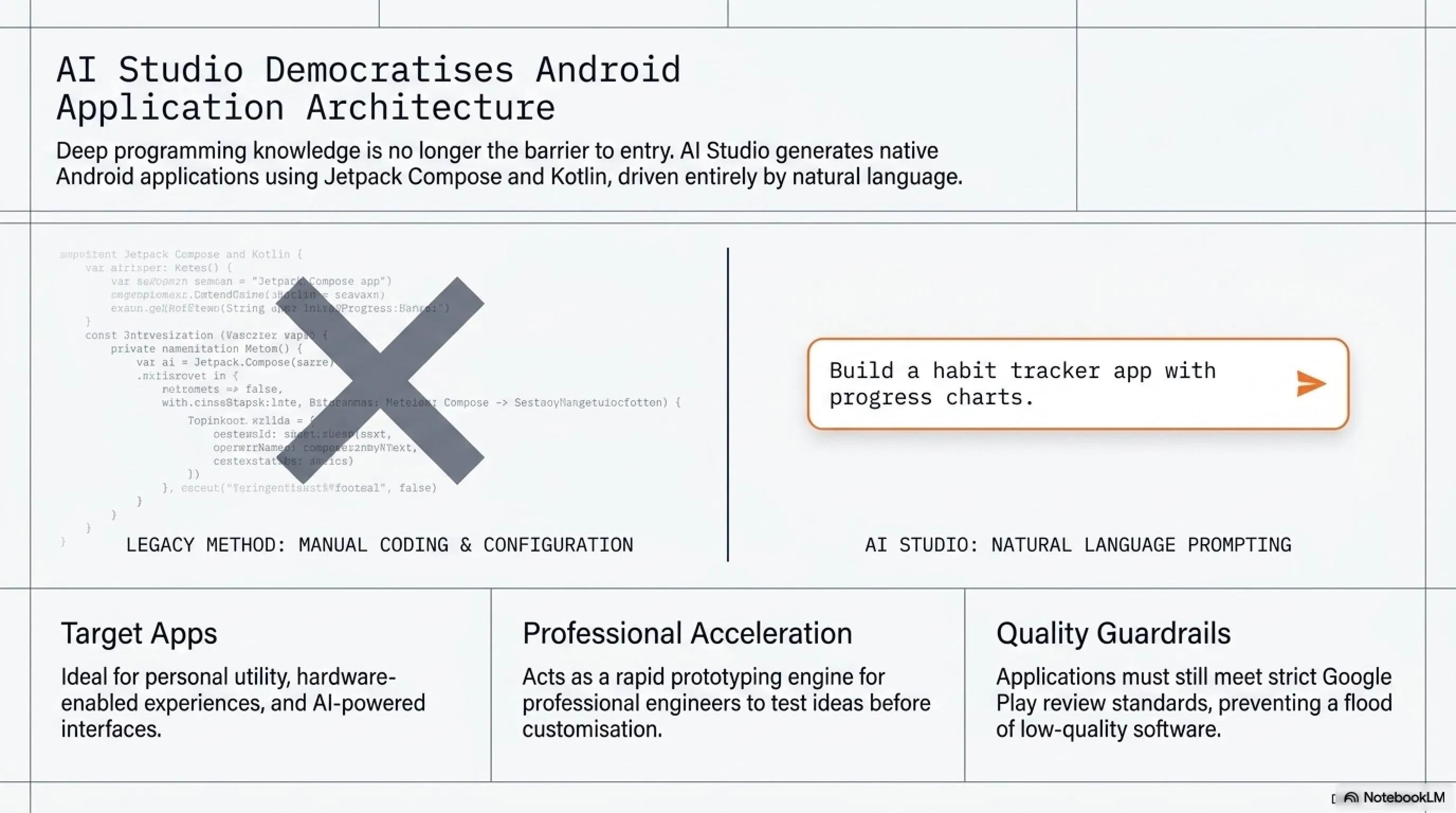
If you thought Gemini 3.5 Flash was the only surprise at Google I/O, think again. Google introduced a new capability in Google AI Studio that democratizes software development to an unprecedented degree: the ability for anyone—even without coding knowledge—to build fully native Android applications in minutes.
This web-based tool, running directly in your browser, compresses a process that typically takes weeks into minutes. You simply describe your app idea in natural language, and AI Studio generates complete application code using Android development best practices—including Jetpack Compose, Kotlin, and standard APIs.
The implications are profound. Until now, building a mobile app required either learning to code (months of study) or hiring developers (thousands of dollars). AI Studio removes both barriers. A graphic designer can turn their idea into an app. A marketer can build a landing page app. A teacher can create an educational app for students. The democratization of software development is no longer a future promise—it's happening now.
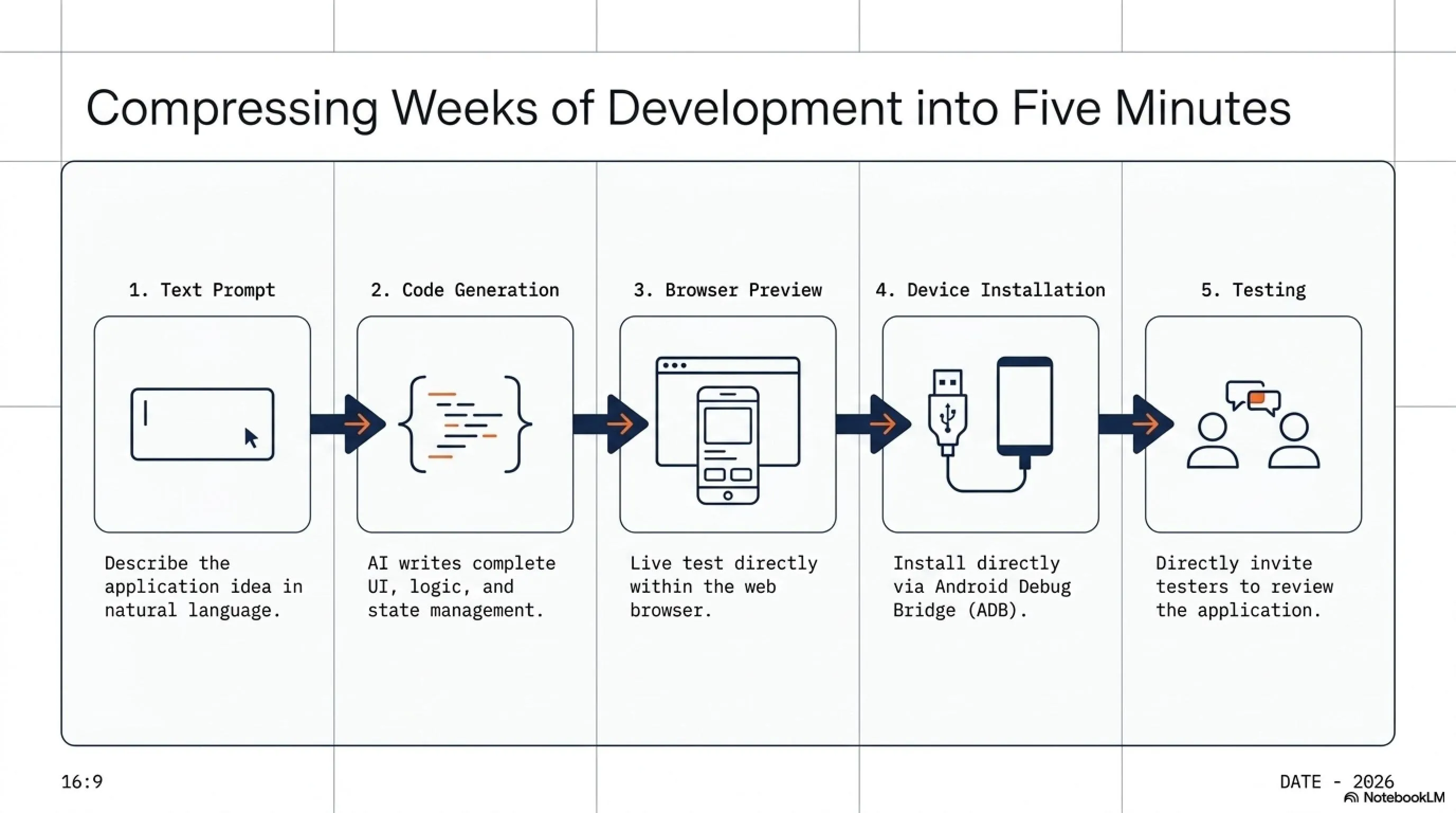
⚡ How Google AI Studio Works
Step 1 - Text Prompt: Describe your app idea. For example: "Build a habit tracker app where I can log daily habits and see progress charts."
Step 2 - Code Generation: AI Studio writes complete application code using Kotlin and Jetpack Compose. This includes UI, logic, state management, and even database integration.
Step 3 - Browser Preview: An Android Emulator opens inside your browser, allowing you to test the app live without installing anything.
Step 4 - Real Device Installation: Connect your Android phone via USB and install the app directly from AI Studio using ADB (Android Debug Bridge).
Step 5 - Invite Testers: In the near future, you'll be able to invite testers directly from AI Studio to try your app before publishing.
But this doesn't mean the end of professional developers. On the contrary, this tool is incredibly useful for professional developers too. They can use AI Studio to build rapid prototypes, test new ideas, and then transfer the generated code to their main project for customization. It's similar to how Photoshop didn't end graphic design—it made designers more productive.
🎯 Limitations and Realities
Of course, Google AI Studio isn't a magic solution for building any type of application. Google stated in a blog post that this "initial release" focuses on three categories of apps:
- Personal Utility Apps: Habit trackers, study quizzes, to-do lists, note-taking, and time management apps
- Hardware-Enabled Experiences: Apps that use camera, GPS, sensors, or Bluetooth functionality
- AI-Powered Experiences: Apps that leverage Gemini API for natural language processing, image recognition, or content generation
Additionally, if you want to publish your app on Google Play, it must meet Google's quality and review standards. Mia Carter, a Google spokesperson, told The Verge: "App quality continues to be a top priority for Google Play, and we will not be changing any of our review processes and standards. AI Studio simply lowers the barrier to entry for creating high-quality Android apps. Apps created with AI Studio will still need to meet these strict quality and review standards on Google Play."
This is an important safeguard. The last thing the Android ecosystem needs is a flood of low-quality, AI-generated apps cluttering the Play Store. By maintaining strict review standards, Google ensures that democratization doesn't come at the cost of quality.
🔬 Tekin Analysis: The Future of Software Development
Google AI Studio represents a fundamental shift in the software industry. Until now, app development required deep programming knowledge, familiarity with frameworks, and weeks of work. Now, a graphic designer can turn their idea into an app. A marketer can build a landing page app. A teacher can create an educational app for students.
But this doesn't mean the end of developers. Just as Photoshop didn't end graphic design but became a powerful tool in designers' hands, AI Studio does the same for developers: it increases speed, automates repetitive tasks, and allows them to focus on more complex problems.
For the American tech ecosystem, this is a golden opportunity. Startups can build MVPs faster, test ideas more quickly, and reach market with lower costs. Students can implement their ideas without needing months of programming study. And professional developers can multiply their productivity several times over.
The competitive landscape is also shifting. Apple has been rumored to be working on similar tools for iOS development, while Microsoft has been integrating AI into Visual Studio. The race to democratize software development is on, and Google has taken a significant lead with AI Studio.
🛠️ Android CLI: New Tool for AI Agents
Alongside AI Studio, Google also released version 1.0 of the Android Command-Line Interface (CLI). This tool allows AI agents to directly interact with Android Studio and leverage its capabilities. In other words, AI agents can now:
- Retrieve Android development knowledge via the "android studio" command
- Create, build, and test Android projects autonomously
- Access various Android Studio tools and capabilities
- Refactor code and perform automatic optimizations
- Automatically implement documentation and best practices
This means in the near future, you'll be able to tell an AI agent: "Build a complete e-commerce app with shopping cart, online payment, and admin panel"—and the agent will autonomously handle all steps: from architecture design to writing code, testing, and even deployment. This is the future of agentic development, and it's arriving faster than most people expected.
💡 Practical Tip: If you want to try Google AI Studio right now, visit aistudio.google.com. With a Google account, you can start for free (with limitations). The free tier includes enough quota for experimentation and learning.
⚡ Gemini Spark: The 24/7 AI Assistant That Never Sleeps
The third major announcement at Google I/O 2026 was the introduction of Gemini Spark—an agentic personal assistant that, according to Josh Woodward, VP of Google Labs, "works for you even when your laptop is off or your phone is locked."
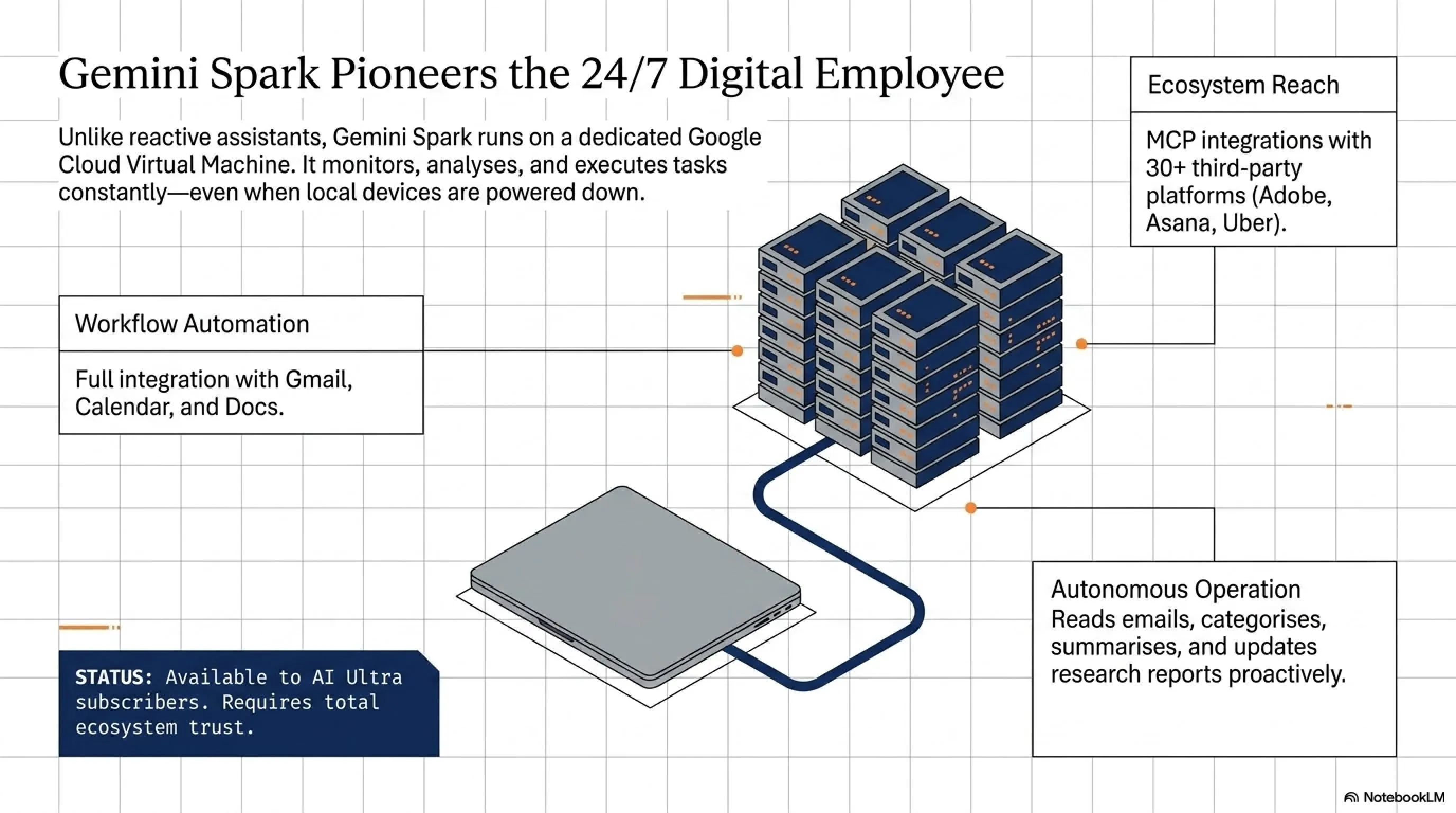
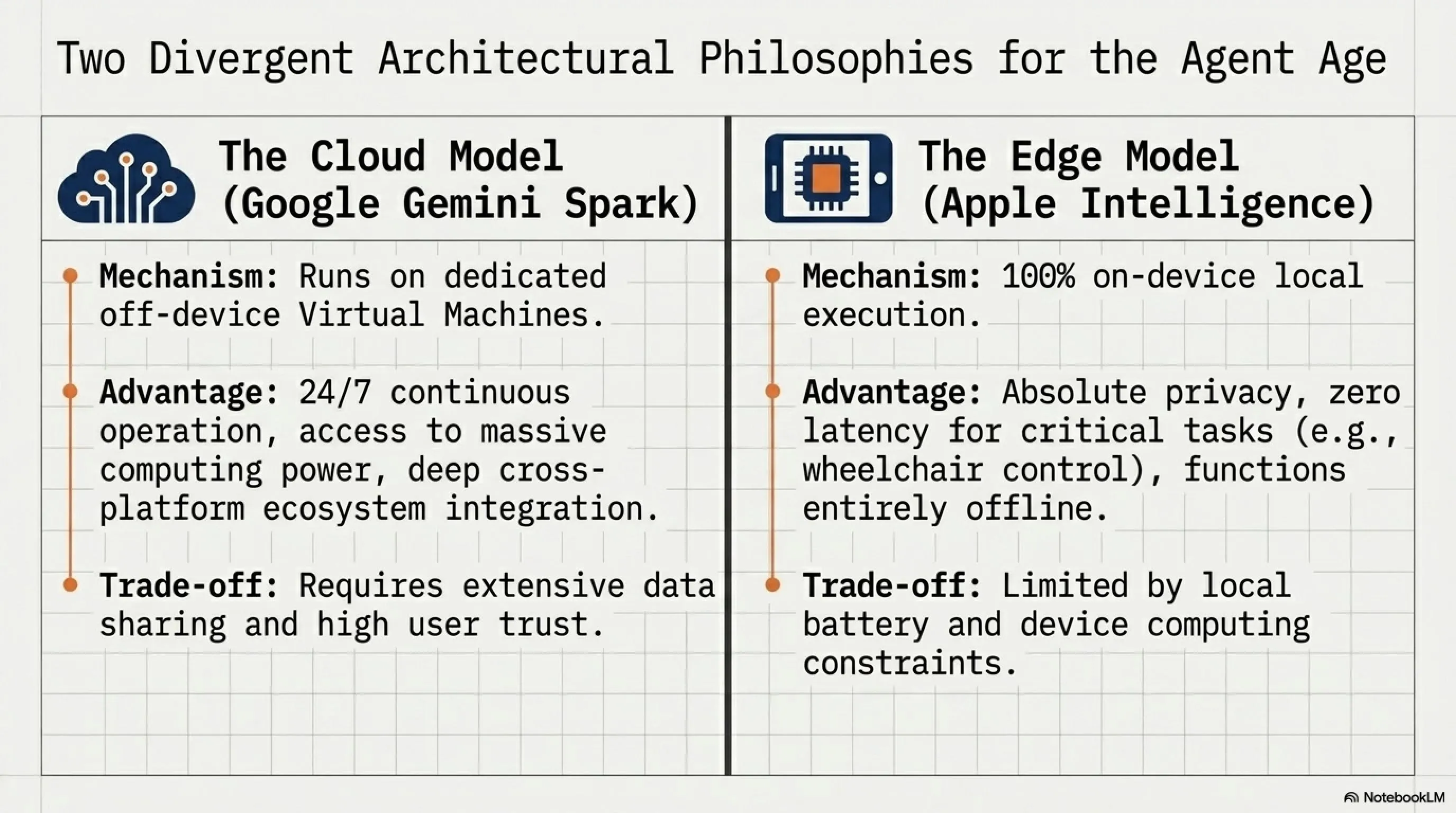
Gemini Spark is built on Gemini 3.5 models and an agentic harness from Google Antigravity. But what distinguishes it from other AI assistants is that it runs on a dedicated virtual machine in Google Cloud—not on your device. This means Spark can work 24/7 without interruption, even if all your devices are turned off.
This is a fundamentally different approach from Siri, Alexa, or even ChatGPT. Those assistants are reactive—they only work when you actively engage with them. Spark is proactive—it continuously monitors, analyzes, and acts on your behalf. It's less like a chatbot and more like a digital employee who never clocks out.
🌟 Key Capabilities of Gemini Spark
🎯 Real-World Use Cases for Gemini Spark
Gemini Spark isn't a chatbot—it's a digital employee that can autonomously handle complex tasks. Here are some real-world examples of its capabilities:
The key point is that Spark doesn't just work once—it continuously operates in the background. For example, if you say "Send me a summary of important emails every morning," Spark will do this every day without needing to be reminded. This persistent, autonomous operation is what distinguishes it from traditional AI assistants.
The architecture is also noteworthy. By running on dedicated Google Cloud VMs rather than user devices, Spark can perform computationally intensive tasks without draining your battery or requiring your devices to be on. It's essentially a cloud-based digital assistant that's always working, always learning, and always ready to help.
🔬 Tekin Analysis: Spark vs. The Competition
Gemini Spark is a direct competitor to OpenClaw (from OpenAI) and Claude Projects (from Anthropic). But the key difference is deep integration with Google's ecosystem. While OpenClaw requires complex setup and manual connection to various services, Spark is integrated with Gmail, Calendar, Drive, and other Google services from the start.
This gives Google a significant advantage for users already in the Google ecosystem. If you use Gmail for email, Google Calendar for scheduling, and Google Drive for storage, Spark can immediately start working without any configuration. It knows your email patterns, understands your schedule, and has access to your documents—all with your permission, of course.
The competitive landscape is fascinating. Microsoft has Copilot integrated into Office 365, OpenAI has ChatGPT with plugins, and Anthropic has Claude with computer use. But Google's advantage is the breadth and depth of its ecosystem. With over 3 billion active users across Gmail, Calendar, and Drive, Google has more data and more integration points than any competitor.
The privacy implications are significant, though. Giving an AI agent access to your emails, calendar, and documents requires enormous trust. Google has stated that Spark processes data with privacy protections and user consent, but the potential for misuse or data breaches is real. Users will need to carefully consider the trade-off between convenience and privacy.
Important note: Spark is currently only available to AI Ultra subscribers (Google's premium subscription) and will launch next week. Pricing hasn't been officially announced, but industry estimates suggest $20-30 per month.
⚔️ PROS & CONS: Gemini Spark
✅ Advantages
- Works 24/7 without device being on
- Complete Google Workspace integration
- Support for 30+ third-party platforms
- Runs on dedicated VM (high security)
- Learns from user behavior
- Complete workflow automation
⚠️ Disadvantages
- Requires AI Ultra subscription (paid)
- Significant privacy concerns
- Dependency on Google ecosystem
- Still in early stages (may have bugs)
- Requires complete trust in AI
- Potential for AI errors with consequences
🛡️ Ocean: $28M to Fight AI-Powered Phishing
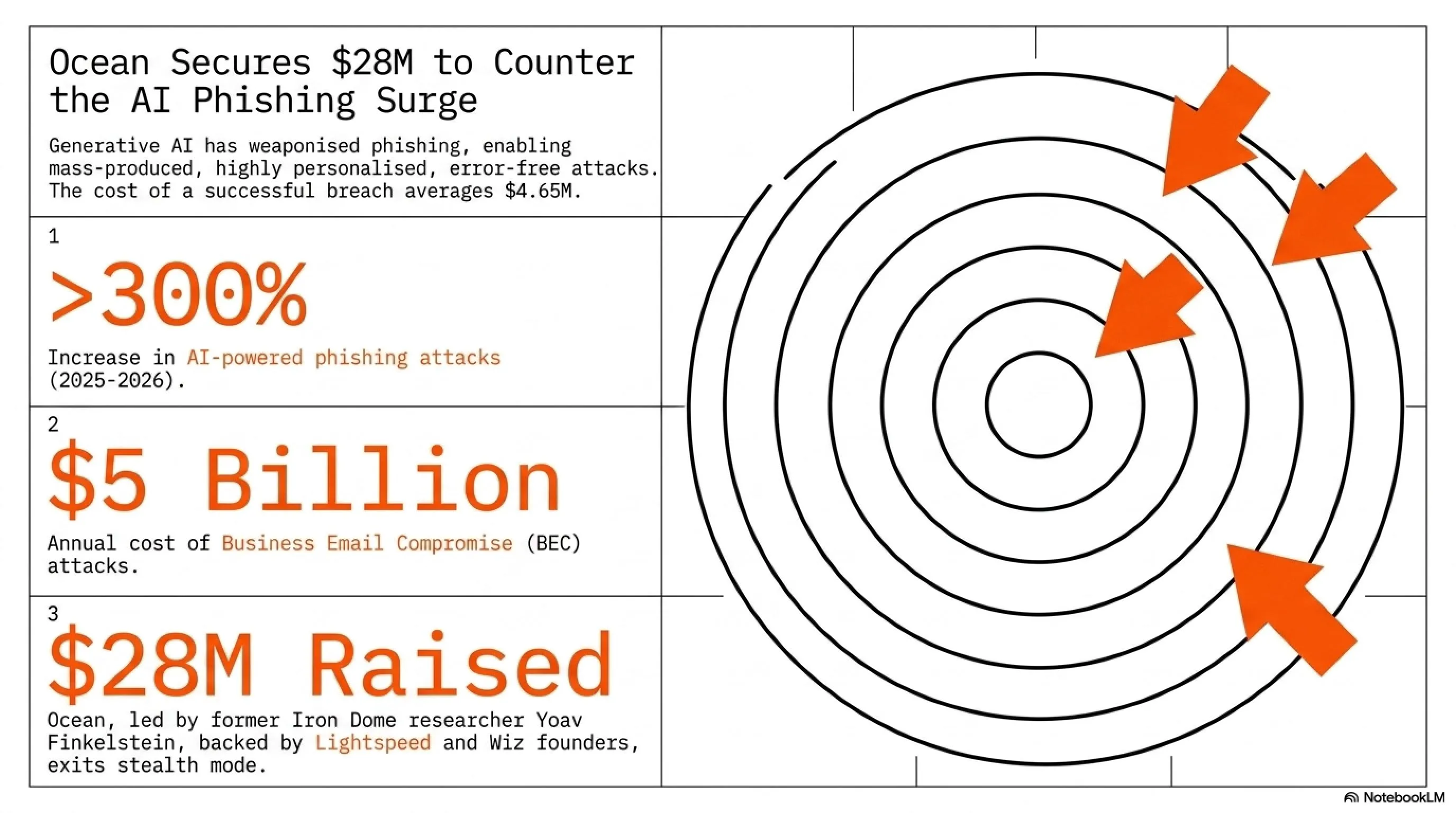
While Google is building AI tools to improve productivity, an Israeli startup called Ocean is building AI tools to combat AI-powered security threats. The company emerged from stealth on May 19, 2026, having raised $28 million in funding from Lightspeed Venture Partners.
The founder's story, Yoav Finkelstein, is itself a movie script. He was a teenage hacker, then became a researcher for Israel's Iron Dome missile defense system, and is now a cybersecurity entrepreneur. He founded Ocean in 2023 to combat the new wave of AI-powered phishing attacks.
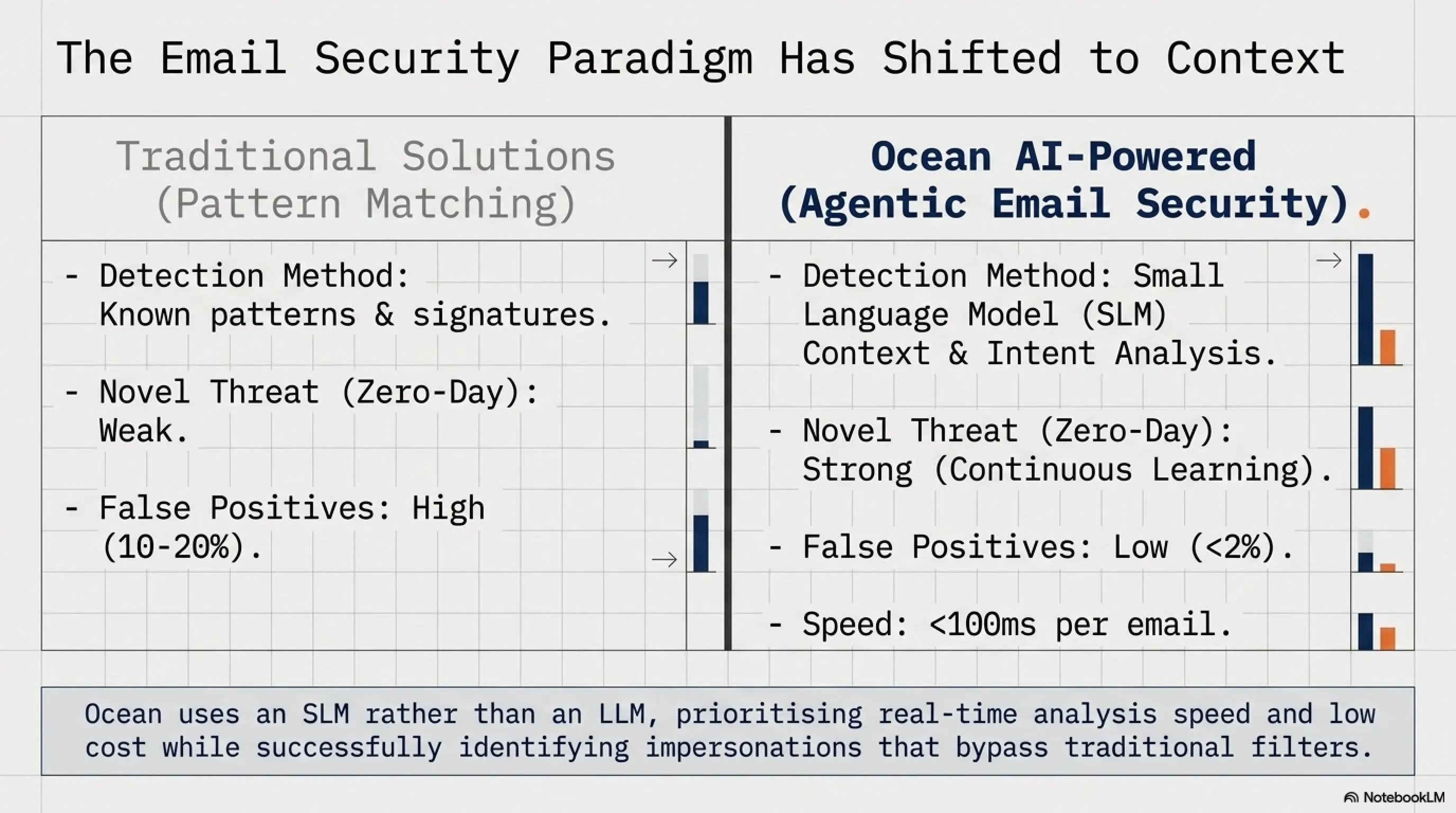
The timing is critical. As AI models like GPT-4 and Claude become more sophisticated, hackers are using them to create phishing emails that are virtually indistinguishable from legitimate communications. Traditional email security solutions, which rely on pattern matching and known signatures, are increasingly ineffective against these AI-generated attacks.
🚨 Why AI Phishing Is a Serious Threat
Until a few years ago, phishing attacks were easy to spot: spelling errors, poor grammar, suspicious links. But with the advent of large language models like GPT-4 and Claude, hackers can now create phishing emails that are:
- Completely professional and error-free
- Personalized for each individual (using publicly available information)
- Accurate simulation of real people's writing styles
- Use of context and company information to increase credibility
- Mass production at very low cost
According to security reports, AI-powered phishing attacks increased by more than 300% in 2025-2026!
🔍 How Ocean Works
Ocean is an Agentic Email Security platform that uses a custom small language model (SLM). Unlike traditional solutions that only look for known patterns, Ocean comprehensively analyzes every incoming email:
- Context Analysis: Examines email content in the context of previous communications and organizational structure
- Intent Recognition: Determines the sender's true intent (is this a legitimate request or an attempt at fraud?)
- Impersonation Analysis: Identifies impersonation attempts, even if sent from a legitimate domain
- Organizational Data Review: Compares against typical communication patterns within the organization
- Risk Scoring: Determines threat level and appropriate action (block, warn, or allow)
The interesting point is that Ocean uses a small language model, not a large one like GPT-4. The reason is speed and cost. Small models can analyze each email in a fraction of a second, while using large models would be expensive and slow. This is a smart architectural decision that prioritizes real-time protection over theoretical capability.
Ocean's approach is fundamentally different from traditional email security. Instead of asking "Does this email match a known threat pattern?" Ocean asks "Does this email make sense in the context of this organization's communication patterns?" This contextual understanding is what allows it to catch novel attacks that traditional systems miss.
🔬 Tekin Analysis: Why Ocean Matters
Ocean demonstrates that AI is a double-edged sword. Just as hackers use AI to create more sophisticated attacks, security companies must use AI to defend. This is an AI arms race, and Ocean is positioning itself at the forefront of the defensive side.
The $28 million funding round, led by Lightspeed Venture Partners with participation from Wiz founders (one of the most successful cybersecurity startups, recently valued at $12 billion), signals strong industry confidence. The presence of Iron Dome researchers and Israeli intelligence veterans on the team adds credibility—these are people who understand sophisticated threats.
For American enterprises, the threat is real and growing. Business Email Compromise (BEC) attacks cost companies over $5 billion annually, and AI is making these attacks more sophisticated and harder to detect. Ocean claims it can reduce BEC attacks by up to 95%, which, if true, represents enormous value for enterprises.
The broader implication is that cybersecurity is entering a new era. The old model of "build a wall and keep the bad guys out" doesn't work when the bad guys have AI that can impersonate your CEO. The new model requires AI that understands context, intent, and organizational behavior—exactly what Ocean is building.
💰 Funding Details
♿ Apple: Accessibility Revolution with Eye-Controlled Wheelchairs
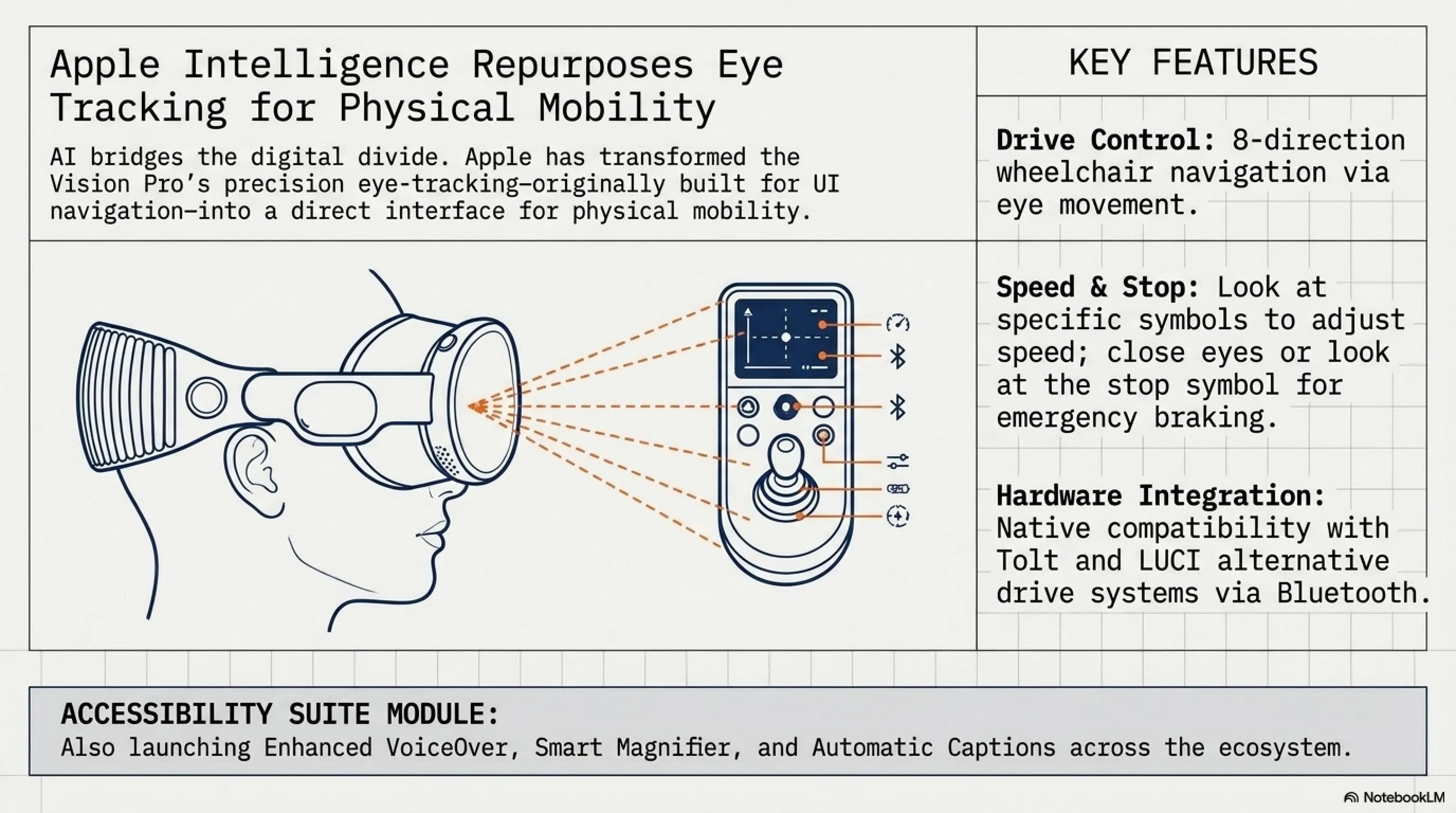
While Google and startups focus on productivity and security, Apple once again demonstrated that technology can genuinely transform lives. On May 19, 2026, Apple announced a suite of new accessibility features powered by Apple Intelligence, with the most significant being eye-controlled power wheelchair functionality for Vision Pro.
This feature, called Power Wheelchair Control for Apple Vision Pro, uses Vision Pro's precision eye-tracking system as an alternative input method for users who cannot operate a joystick. Users can control their wheelchair in 8 directions and stop or pause movement—all using only eye movements.
The technology is remarkable in its simplicity and effectiveness. Vision Pro's eye-tracking system, which was originally designed for UI navigation, has been repurposed to control physical mobility devices. The system works with Tolt and LUCI alternative drive systems in the United States via Bluetooth and wired connections, with plans to expand to more systems and regions.
🎯 How Eye-Controlled Wheelchair Works
1. Precision Eye Tracking: Vision Pro uses advanced sensors to track eye movements with millimeter precision.
2. Direction Detection: The user looks at one of 8 directions (forward, backward, left, right, and 4 diagonal directions) to issue movement commands.
3. Speed Control: By looking at different symbols, users can adjust movement speed.
4. Emergency Stop: Looking at the stop symbol or closing eyes immediately halts the wheelchair.
5. Integration with Existing Systems: This feature is compatible with Tolt and LUCI systems in the US and works via Bluetooth or wired connection.
🌟 Other New Accessibility Features
Wheelchair control was just one part of Apple's announcement. The company also introduced several other features, all powered by Apple Intelligence:
- Enhanced VoiceOver: Uses AI for more accurate descriptions of images and scenes for blind users
- Smart Magnifier: Intelligent magnification with automatic detection of important text and objects
- Improved Voice Control: More precise voice control with better understanding of context and user intent
- Accessibility Reader: Automatic text reading with more natural, adjustable voices
- Automatic Captions: Generate captions for uncaptioned videos across the Apple ecosystem
What's particularly noteworthy is Apple's commitment to on-device processing. All these AI-powered features run locally on the device, not in the cloud. This means faster response times, better privacy, and functionality even without an internet connection. It's a different approach from Google's cloud-based Spark, and it reflects Apple's longstanding emphasis on privacy.
🔬 Tekin Analysis: Why Accessibility Matters
Apple has always been a leader in accessibility, but these announcements show that AI can take accessibility to an entirely new level. Eye-controlled wheelchair functionality is something that existed only in science fiction just a few years ago. Now it's real, and it's coming to market this year.
For people with disabilities, these technologies aren't just "cool features"—they're fundamental improvements in quality of life. The ability to control a wheelchair without hands or a joystick means more independence, more freedom, and more human dignity. This is technology at its best: solving real problems for real people.
The broader implication is that AI is making technology more accessible, not less. There's been concern that AI might create a digital divide, but Apple's approach shows the opposite: AI can bridge gaps and enable people who were previously excluded from technology. The Vision Pro, which costs $3,499, is expensive, but for someone who gains mobility independence, it's priceless.
Apple's on-device processing approach also sets an important precedent. While cloud-based AI (like Google's Spark) offers more power and continuous operation, on-device AI offers privacy, speed, and reliability. For accessibility features, where latency and privacy are critical, on-device processing is the right choice.
Important note: Apple emphasized that all these features work with complete privacy protection. AI processing happens on-device, and no data is sent to Apple's servers. This is a significant differentiator from cloud-based solutions.
💡 Message for Developers: Accessibility isn't a "nice to have"—it's a requirement. When building apps or websites, always follow WCAG standards. This isn't just an ethical responsibility; it's also a competitive advantage. The market of users with disabilities is enormous and underserved. Building accessible products opens your market to millions of additional users.
🐛 Google Search Console Bug: The "Email Not Found" Saga
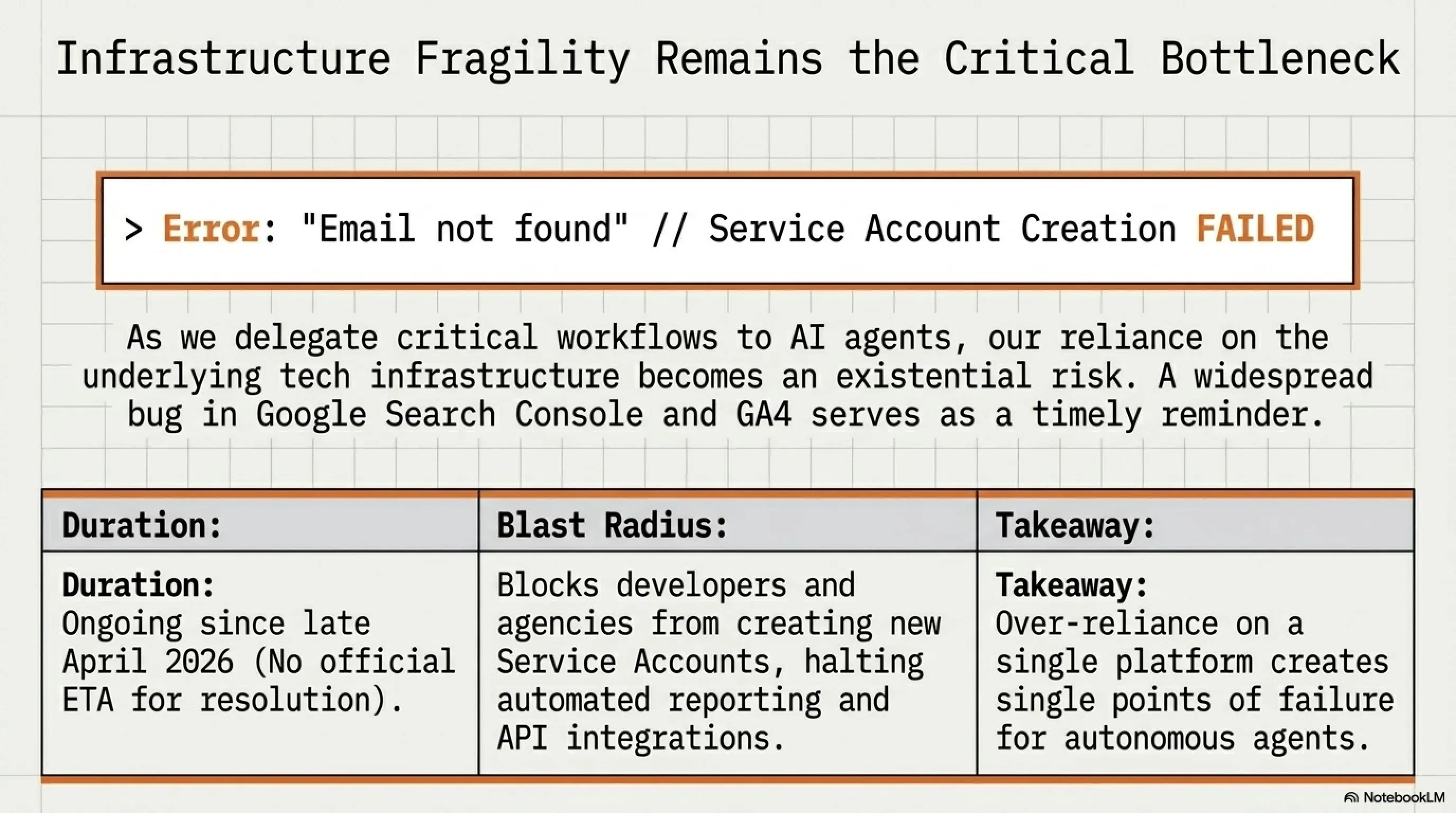
Our final story today is a widespread bug in Google Search Console that began in late April 2026 and continues to this day. This bug prevents new Service Accounts from being added to Search Console and Google Analytics 4, displaying the cryptic error message "Email not found".
This issue is particularly frustrating for developers and digital marketing agencies that need API access. Service Accounts are typically used for automated reporting, integration with third-party tools, and managing multiple websites. When they don't work, entire workflows grind to a halt.
⚠️ Bug Details
Start Time: Late April 2026 (approximately 3 weeks ago)
Impact: All newly created Service Accounts are not recognized by Search Console and GA4
Error Message: "Email not found" - even when the Service Account email is correct
Status: Google has officially acknowledged the issue and escalated it to senior engineering teams
Temporary Solution: None! You must wait for Google to fix the bug
Old Service Accounts: Continue to work - only new accounts are affected
🔍 Why This Bug Matters
This bug might not matter to average users, but for developers, digital marketing agencies, and companies using automation, it's a serious problem:
- Digital Marketing Agencies: Cannot onboard new clients
- Developers: Cannot set up new API integrations
- Large Companies: Cannot create new access for different teams
- Third-Party Tools: Cannot connect to Search Console
- Automated Reporting: Impossible for new projects
Google has stated in the Search Console support community that it has escalated the issue to senior engineering teams and is working on a fix. However, no specific timeline for resolution has been announced. Based on past experience with similar bugs, resolution typically takes 2-6 weeks.
What makes this particularly frustrating is the lack of communication. Google acknowledged the bug but hasn't provided regular updates or a timeline. For agencies with clients waiting to launch new campaigns, or developers with projects on hold, this uncertainty is costly. It's a reminder that even tech giants aren't immune to bugs, and that over-reliance on any single platform carries risk.
💡 Temporary Workarounds
1. Use Existing Service Accounts: If you already have Service Accounts, use them - they continue to work.
2. Manual User Addition: Instead of Service Accounts, add users manually with personal emails (though this doesn't work for automation).
3. Use OAuth: For some use cases, you can use OAuth instead of Service Accounts.
4. Wait: Unfortunately, the best solution is to wait for Google to fix the bug.
📢 Update: To track the status of this bug, visit the Google Search Central Community. You can also check the Google Search Status Dashboard for service status updates.
📊 Mid-Article Summary: Today's News at a Glance
Today we witnessed six significant stories, each shaping the future of technology in different ways:
- Gemini 3.5 Flash: Demonstrated that AI Agents are the future of artificial intelligence, not chatbots
- Google AI Studio: Made software development democratization a reality
- Gemini Spark: Elevated the concept of personal assistant to "24/7 digital employee"
- Ocean: Reminded us that AI is a double-edged sword - both tool and threat
- Apple Accessibility: Proved that technology can genuinely transform lives
- Google Bug: Reminded us that even tech giants are human and make mistakes
❓ How does Gemini 3.5 Flash differ from GPT-4 Turbo?
Key differences include: 1) 4x faster speed (300 tokens/sec vs. 75 tokens/sec), 2) Better performance in agentic coding (76.2% vs. ~68% on Terminal-Bench), 3) Much lower price ($0.15/$0.60 vs. $10/$30 per million tokens), 4) Specifically designed for AI Agents and autonomous task execution. While GPT-4 Turbo is still stronger in some general tasks, for coding and automation, Gemini 3.5 Flash has the edge.
❓ Can I use Google AI Studio to build production apps?
Yes, but with caveats. AI Studio generates production-quality code using Jetpack Compose and Kotlin with best practices. However, the initial release focuses on personal utility apps, hardware-enabled experiences, and AI-powered apps. Complex enterprise applications may require additional customization. Also, if you want to publish on Google Play, your app must meet Google's quality standards, which haven't changed. AI Studio lowers the barrier to entry but doesn't eliminate quality requirements.
❓ When will Gemini Spark be available and how much will it cost?
Gemini Spark will be available next week (late May 2026) for Google AI Ultra subscribers. The AI Ultra subscription is estimated to cost around $20-30 per month (exact pricing hasn't been officially announced). This subscription includes access to the most powerful Gemini models, Spark, and other premium features. For users already paying for Google Workspace, this may be bundled or offered at a discount.
❓ Is Ocean affordable for small businesses?
Ocean hasn't announced public pricing yet, but as an enterprise-grade solution, it's likely more suitable for medium to large companies. For small businesses and startups, cheaper solutions like Proofpoint, Mimecast, or even built-in filters in Gmail and Microsoft 365 may be sufficient. However, if your company is a target for sophisticated attacks or handles sensitive data, investing in Ocean could be worthwhile. The cost of a successful phishing attack (average: $4.65 million according to IBM) far exceeds the cost of prevention.
❓ When will the Google Search Console bug be fixed?
Unfortunately, Google hasn't announced a specific timeline. The bug started in late April (about 3 weeks ago) and continues. Google has only said it escalated the issue to senior engineering teams and is working on it. Based on past experience, similar bugs typically take 2-6 weeks to resolve. The best approach is to regularly check the Google Search Status Dashboard and follow discussions in the Search Central Community forum.
🎯 Final Thoughts: The Future That Started Today
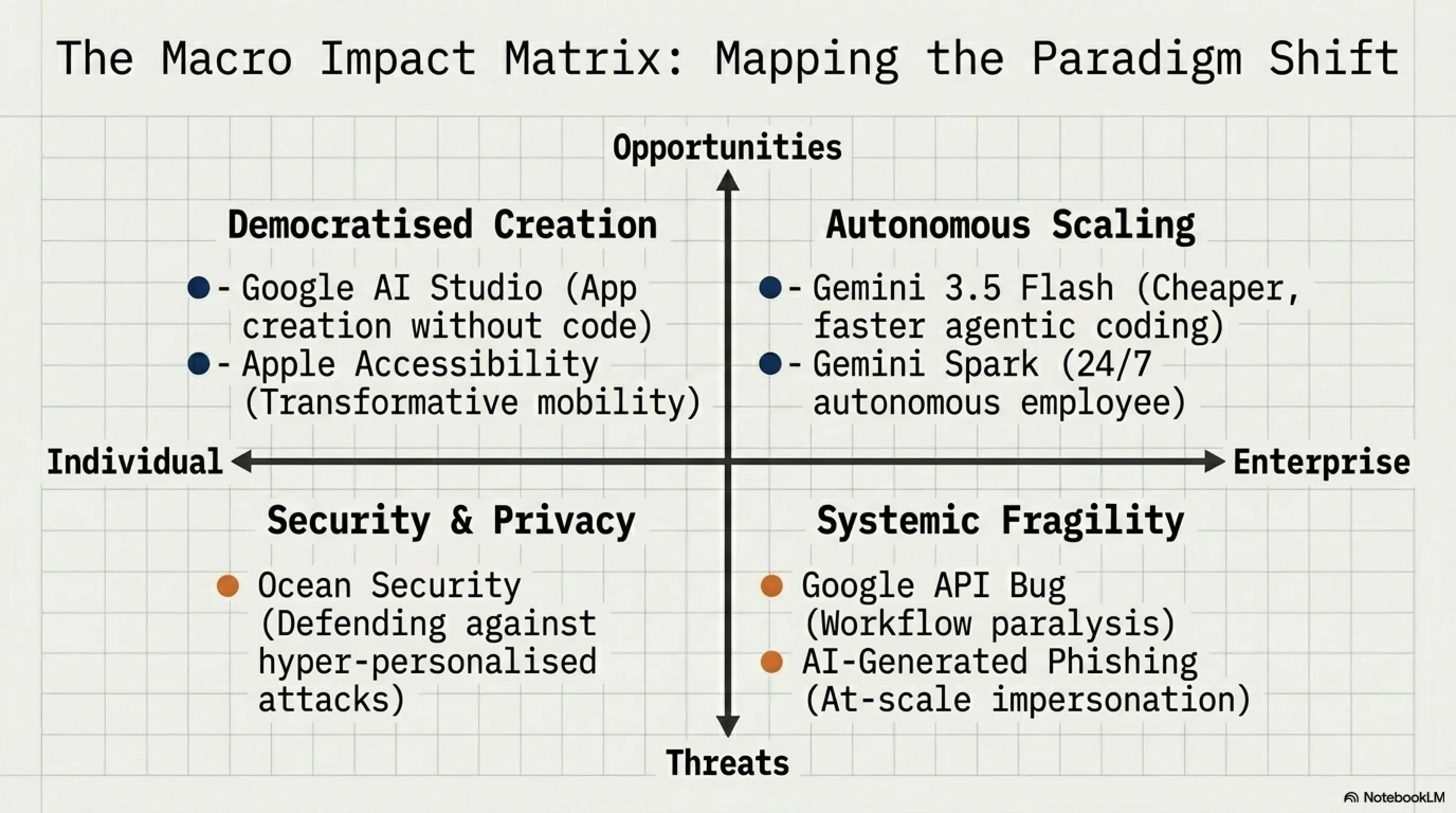
Google I/O 2026 wasn't just a conference—it was a turning point in artificial intelligence history. With the introduction of Gemini 3.5 Flash, Google declared that the era of "talking to AI" has ended and the age of "working with AI" has begun. This is a fundamental transformation.
Google AI Studio demonstrated that deep programming knowledge is no longer required to build applications. Gemini Spark proved that AI assistants can genuinely work 24/7 for us. Ocean reminded us that with every new technology comes new threats. And Apple once again showed that technology should serve humanity, not the other way around.
For the American tech ecosystem, these developments represent both opportunity and challenge. The opportunity is clear: AI tools that can multiply productivity several times over. The challenge is equally clear: adapting to a world where AI handles tasks that humans used to do, and figuring out what humans should focus on instead.
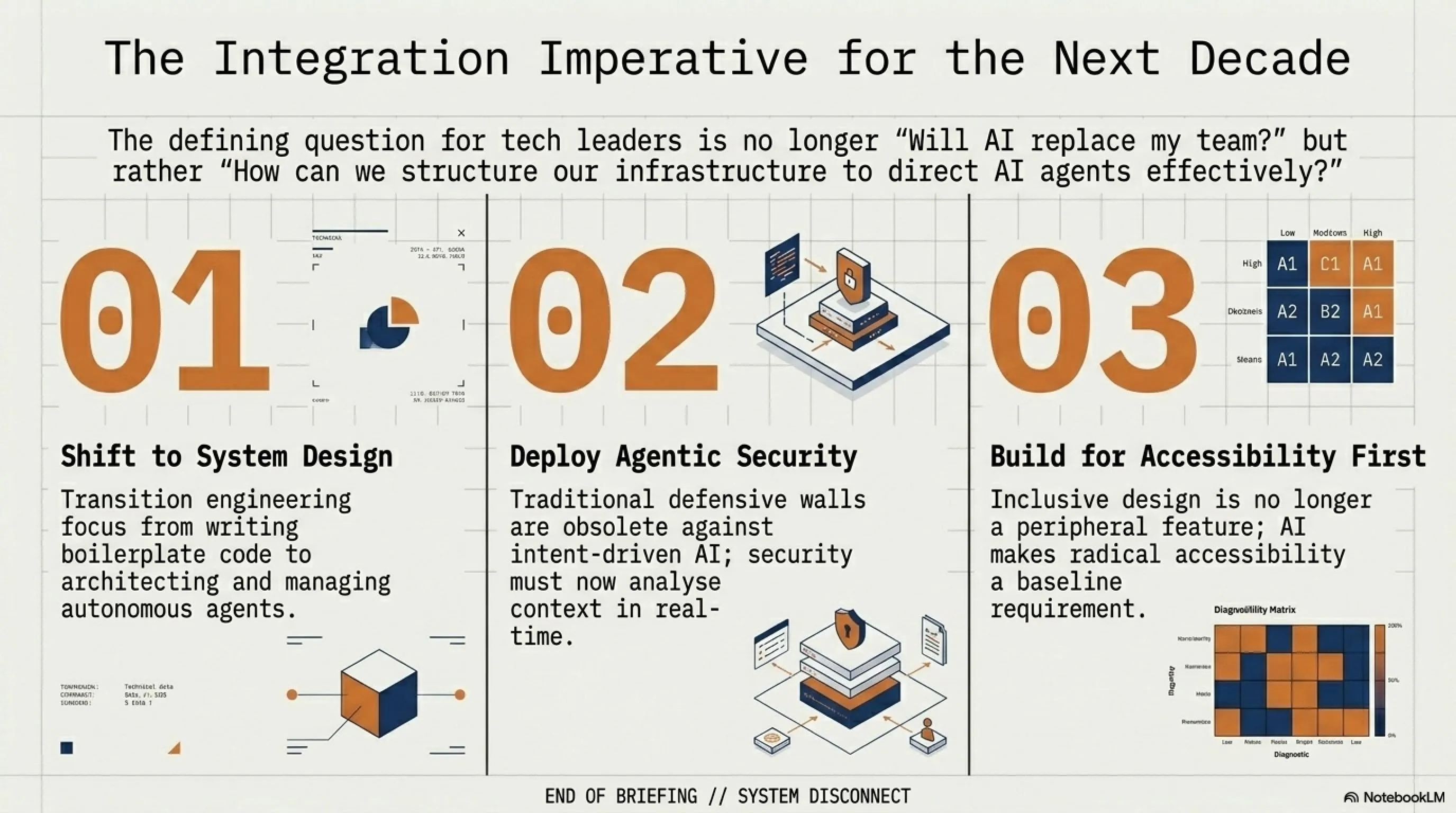
The winners in this new era won't be those who resist AI or fear it, but those who learn to collaborate with it effectively. The question isn't "Will AI replace me?" but rather "How can I use AI to become 10x more effective?" Today, May 20, 2026, was a day when that future moved one step closer to reality.
One thing is certain: the next decade will be defined by how well we integrate AI into our workflows, our businesses, and our lives. The companies and individuals who master this integration will thrive. Those who don't will be left behind. The choice is ours.
📚 Sources and References
Google I/O 2026 & Gemini 3.5 Flash:
- TechCrunch: "With Gemini 3.5 Flash, Google bets its next AI wave on agents, not chatbots"
- Wired: "Everything Announced at Google I/O 2026: Gemini, Search, Smart Glasses"
- Google Official Blog: "Gemini 3.5: Frontier Intelligence with Action"
- Ars Technica: "Gemini 3.5 Flash might be fast enough for gen AI to make sense"
- The Next Web: "Google launches Gemini 3.5 Flash, its fastest agentic AI model"
- CNBC: "Google debuts new AI models, personal AI agents"
Google AI Studio & Android App Builder:
- TechCrunch: "Google's AI Studio now lets anyone build Android apps in minutes"
- The Verge: "Google can now vibe-code you an Android app"
- 9to5Google: "Google AI Studio can now build Android apps"
- Phone Arena: "Google just made it possible to build a real Android app without code"
- WinBuzzer: "Google AI Studio Now Lets Users Build Android Apps in Minutes"
Gemini Spark:
- TechCrunch: "Google introduces Gemini Spark, a 24/7 agentic assistant with Gmail integration"
- The Next Web: "Google launches Gemini Spark agentic AI assistant at I/O 2026"
- The Verge: "Google is launching its own version of OpenClaw"
- CNBC: "Google debuts new AI models, personal AI agents"
- Yahoo Tech: "Google launches Gemini Spark personal AI agent at I/O 2026"
Ocean Security:
- TechCrunch: "From teen hacker to Iron Dome researcher, this founder raised $28M to fight AI phishing"
- Yahoo Finance: "Ocean Raises $28M as Enterprises Confront AI-Powered Email Attacks"
- Business Insider: "Ocean Raises $28M to Expand AI-Native Email Security Platform"
- Pulse2: "$28 Million Raised For Agentic Email Security Platform"
- CityBiz: "Ocean Raises $28M to Expand AI-Native Email Security Platform"
Apple Accessibility:
- Apple Newsroom: "Apple unveils new accessibility features with Apple Intelligence"
- 9to5Mac: "Apple announces AI-powered accessibility features and eye-controlled wheelchair"
- Engadget: "Apple's New Accessibility Feature Lets Vision Pro Users Control Wheelchair"
- MacRumors: "Apple Previews New Accessibility Features Powered by Apple Intelligence"
- PCMag: "Apple's New Accessibility Features Include Wheelchair Control for Vision Pro"
Google Search Console Bug:
- Piunikaweb: "Google confirms 'email not found' bug breaking Search Console service accounts"
- Insider Paper: "Google Admits 'Email Not Found' Bug Affecting Search Console and Analytics 4"
- Google Search Central Community: Official bug reports and discussions
- Google Search Status Dashboard: Service status updates
Research and Analysis: Tekin Editorial Team | Publication Date: May 20, 2026
🌐 Stay Connected With Us
For the latest tech, gaming, and gadget news, follow us on social media:
📸 Instagram 🆔 Telegram Arabia 🆔 Telegram Global 🆔 Telegram Iran 💬 Direct Contact 📧 majid@tekingame.com🌐 Stay Connected With Us 🎮✨
For the latest tech, gaming, and gadget news, follow us on our official social media channels:
Supplementary Image Gallery: 🌅 Tekin Morning May 20: Gemini 3.5 Flash, Apple Eye-Control & Ocean Security