
Good morning, Tekin Legion! From Lenovo's foldable gaming console that changes the rules to Tesla swapping US-built Model 3s for Chinese imports — your March 9, 2026 tech breakfast is ready.
[IMAGE_PLACEHOLDER_1]Lenovo Legion Go Fold: When Gaming Goes Foldable!
MWC 2026 Barcelona witnessed one of the boldest innovations of the year: Lenovo Legion Go Fold — the world's first handheld gaming console with a foldable display. This is no longer just a regular handheld; it's a three-in-one device that can be a handheld, tablet, and even a mini-laptop. One moment you have a 7.7-inch console in your hands, the next moment an 11.6-inch screen for cinematic gaming.
The beating heart of Legion Go Fold is a foldable OLED display that expands from 7.7 inches to 11.6 inches — nearly 50% larger! This is the same technology Lenovo used in the ThinkPad Fold, but this time optimized for gaming. The screen can be split vertically (like Nintendo DS), opened horizontally (like a tablet), or transformed into a mini-laptop with a detachable keyboard.
But Legion Go Fold isn't just a foldable screen. This device features detachable controllers — exactly like Nintendo Switch, but more powerful. The right controller has a small display that can serve as a touchpad, performance metrics display, or customizable hotkeys. This means you can see FPS, temperature, and CPU/GPU usage without leaving your game.
| Feature | Legion Go Fold | Steam Deck | ROG Ally |
|---|---|---|---|
| Display | 7.7" → 11.6" OLED | 7" LCD | 7" LCD |
| Processor | Intel Core Ultra 7 258V | AMD Custom APU | AMD Z1 Extreme |
| RAM | 32GB | 16GB | 16GB |
| Foldable | Yes | No | No |
| Controllers | Detachable | Fixed | Fixed |
Legion Go Fold's specs are professional-grade for a handheld: Intel Core Ultra 7 258V processor — one of Intel's latest chips with Meteor Lake architecture optimized for power efficiency and gaming. 32GB RAM sufficient for multitasking and AAA games. 48Whr battery that Lenovo claims covers 3-4 hours of heavy gaming. And of course, a detachable keyboard you can use for typing or productivity work.
"Legion Go Fold shows that the future of portable gaming doesn't necessarily have a fixed form factor. This device can be whatever you need: a handheld for the subway, a tablet for bed, a laptop for the cafe." — Tekin Analysis
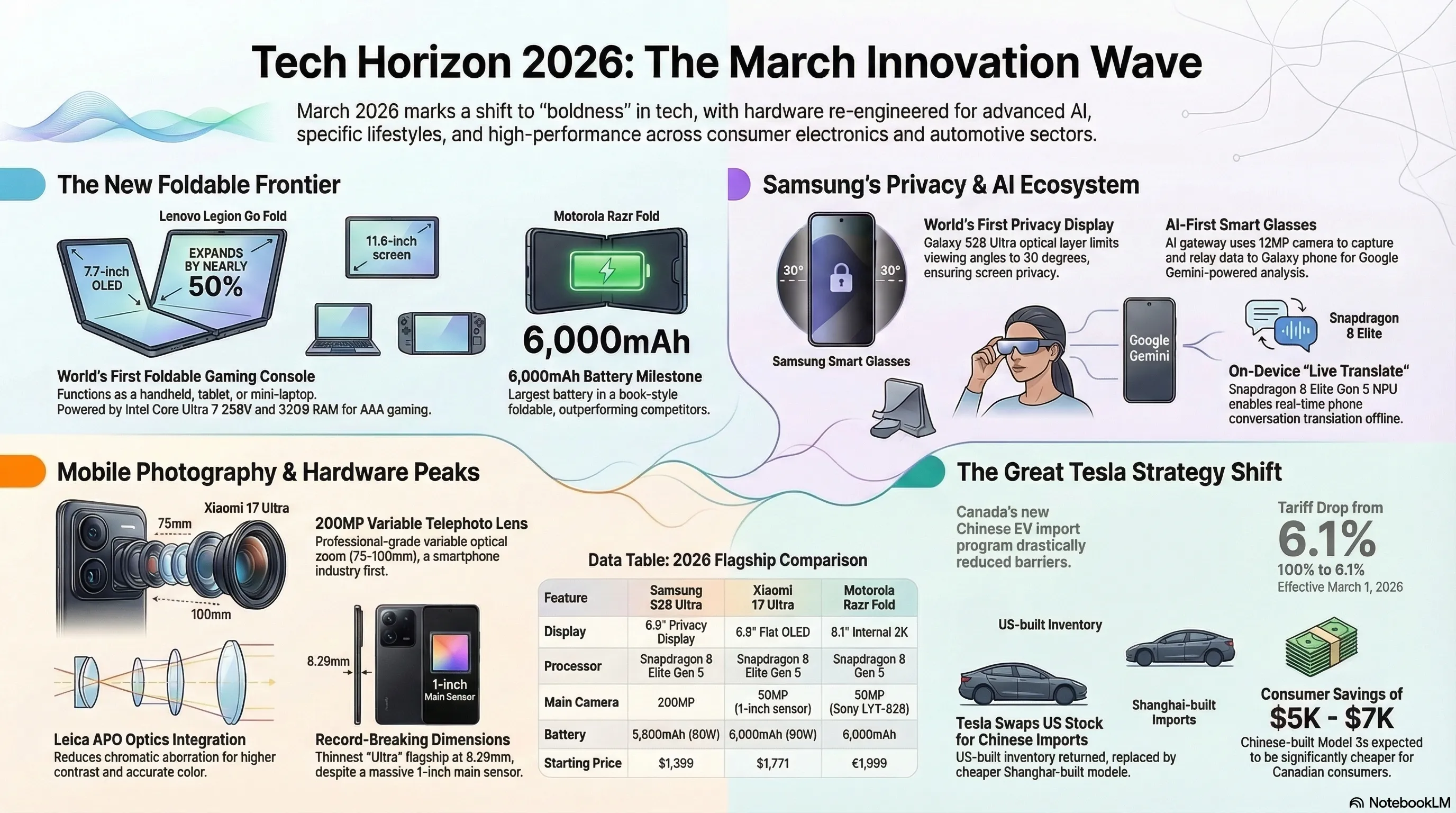
Of course, challenges exist. First, durability: how resistant is a foldable screen in a gaming device that might drop or get hit? Lenovo says it used stainless steel hinges and titanium protection, but we'll have to see. Second, price: Lenovo hasn't announced pricing yet, but analysts predict between $1,200-1,500 — double the Steam Deck! Third, game library: Legion Go Fold runs Windows, so it has access to Steam, Epic, and Xbox Game Pass, but how will games optimize for a foldable screen?
Legion Go Fold is currently a "concept," but Lenovo said it will launch "in Q4 2026." That's about 9 months away. If Lenovo can keep the price under $1,500 and prove durability, this could be a real game-changer. As we saw in the Vision Pro failure article, bold innovations don't always succeed — but when they do, they transform the industry.
📊 Summary: Legion Go Fold
✅ Innovation: World's first foldable gaming handheld
✅ Display: 7.7" → 11.6" foldable OLED
✅ Power: Intel Core Ultra 7 + 32GB RAM
⚠️ Challenge: High price, uncertain durability
📅 Launch: Q4 2026
Tesla Model 3 Canada: When China Becomes Cheaper Than America!
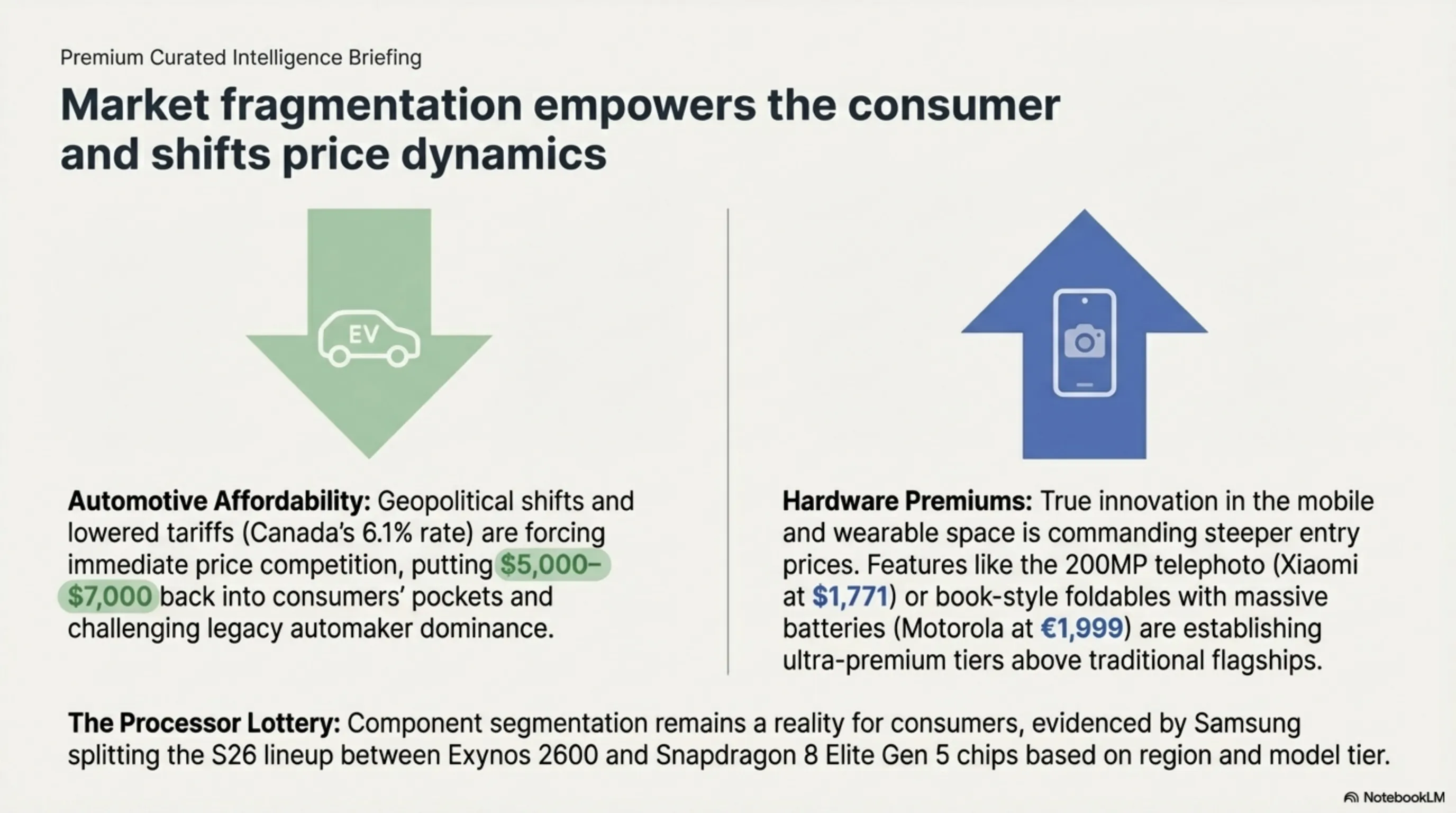
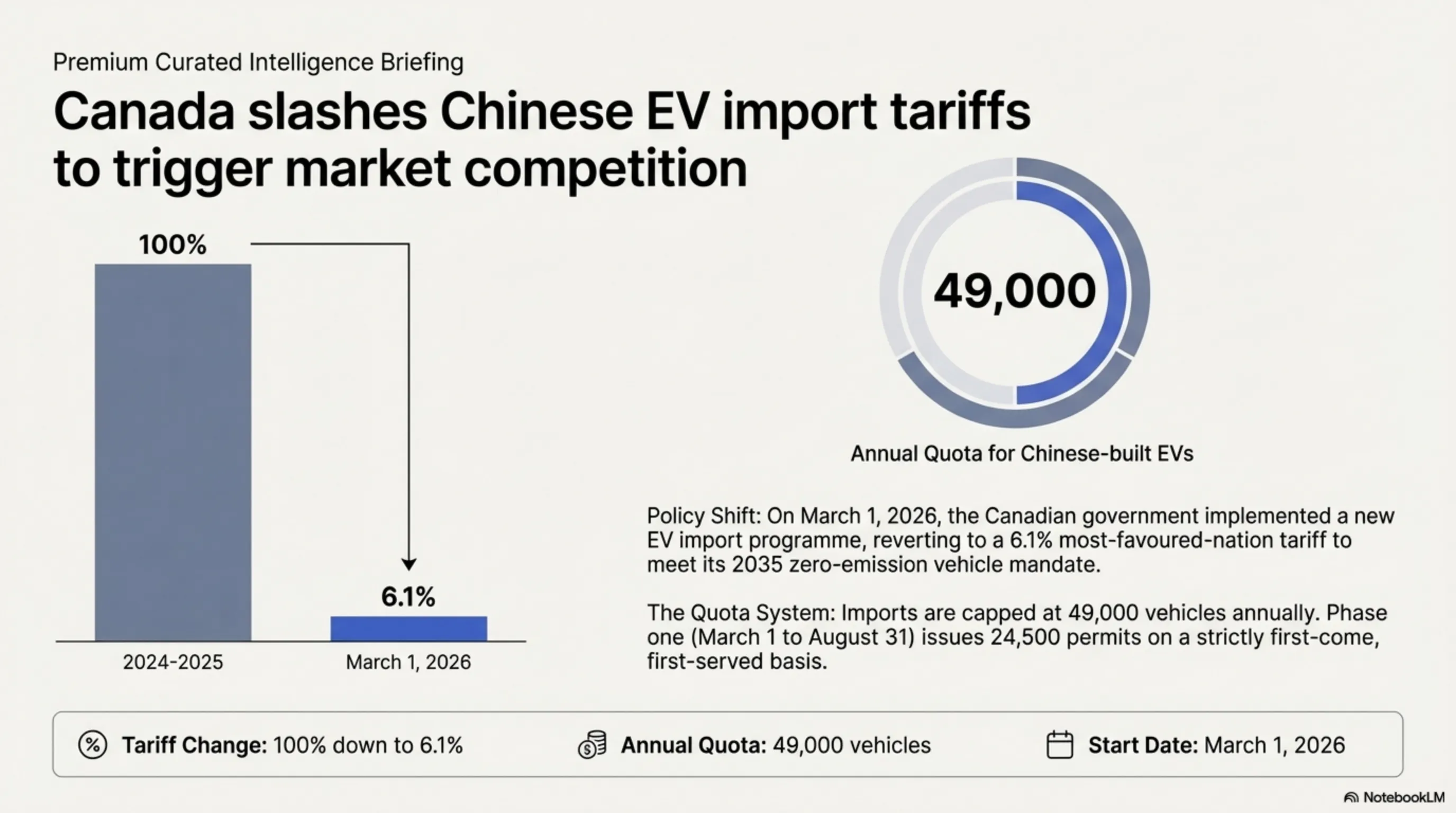
A stunning move from Tesla in Canada: the company removed all US-built Model 3 inventory from its Canadian website and sent them back to the United States. The reason? Canada just launched a new Chinese EV import program that reduced tariffs from 100% to 6.1%. And Tesla wants to be first in line to sell cheaper Shanghai-built Model 3s to Canada!
This story started on March 1, 2026 — the day the Canadian government officially implemented the new China EV import program. Under this program, up to 49,000 Chinese-built electric vehicles can enter Canada annually at a 6.1% tariff (most-favoured-nation tariff) — compared to the 100% tariff that had been in effect since late 2024. This 100% tariff had effectively stopped Chinese EV imports, but now the gates are open again.
Tesla reacted immediately. According to reports from Electrek and Drive Tesla Canada, Tesla removed all US-built Model 3s available in Canada from sale and sent them back to the United States. Now if you go to Tesla Canada's website, you can't select a ready Model 3 from inventory — you can only place a new order. And that new order will likely be a Model 3 built at Gigafactory Shanghai.
"This is a smart strategic move from Tesla. Why sell more expensive US-built Model 3s when you can bring the same product cheaper from China? Canadians will be happy, Tesla makes more profit." — Tekin Market Analysis
Canada's import program is implemented in two phases. Phase one runs from March 1 to August 31, 2026, issuing 24,500 import permits — on a first-come, first-served basis. This means whichever company applies first gets the permits. By sending back US-built Model 3s, Tesla is clearly preparing to grab the most permits. Phase two runs from September to the end of 2026, issuing another 24,500 permits.
Why did Canada do this? Multiple reasons exist. First, consumer pressure: Canadians want access to cheaper EVs, and Chinese cars like BYD, NIO, and XPeng offer competitive prices. Second, environmental goals: Canada committed to selling only zero-emission vehicles by 2035, and to reach this goal, it needs cheaper EVs. Third, political pressure: China and Canada are negotiating to improve trade relations, and this program is part of that.
| Feature | Before (2024-2025) | After (2026) |
|---|---|---|
| China EV Tariff | 100% | 6.1% |
| Annual Quota | 0 | 49,000 |
| US Model 3 | Available | Returned to US |
| Chinese Model 3 | Blocked | Coming |
| Expected Price | $55,000+ | $48,000-52,000 |
But this isn't just for Tesla. Chinese companies like BYD, NIO, XPeng, and Li Auto are also planning to take advantage of this opportunity. BYD, the world's largest EV maker, has already announced it's "extremely interested in the Canadian market." NIO also said it's "exploring entry options." If these companies enter, Canada's EV market will be completely transformed.
The impact on the US auto industry is also significant. American automakers like GM, Ford, and Stellantis are worried that cheap Chinese EVs will conquer the North American market. They've asked the US government to impose higher tariffs, but for now, Canada has chosen a different path. This could be the start of a new trade war — or perhaps a new cooperation.
For Canadian consumers, this is great news. Chinese-built Model 3 will likely be $5,000-7,000 cheaper than the US version. And if BYD and NIO also enter, competition increases and prices drop further. As we saw in the ChatGPT exodus article, consumers have power — and when they have more options, brands must compete.
📊 Summary: Tesla Model 3 Canada
✅ Tariff: Reduced from 100% to 6.1%
✅ Quota: 49,000 Chinese EVs per year
✅ Tesla: Returned US-built Model 3s
✅ Price: $5-7K cheaper
📅 Start: March 1, 2026
Samsung Galaxy S26: Launches Tomorrow with World's First Privacy Display
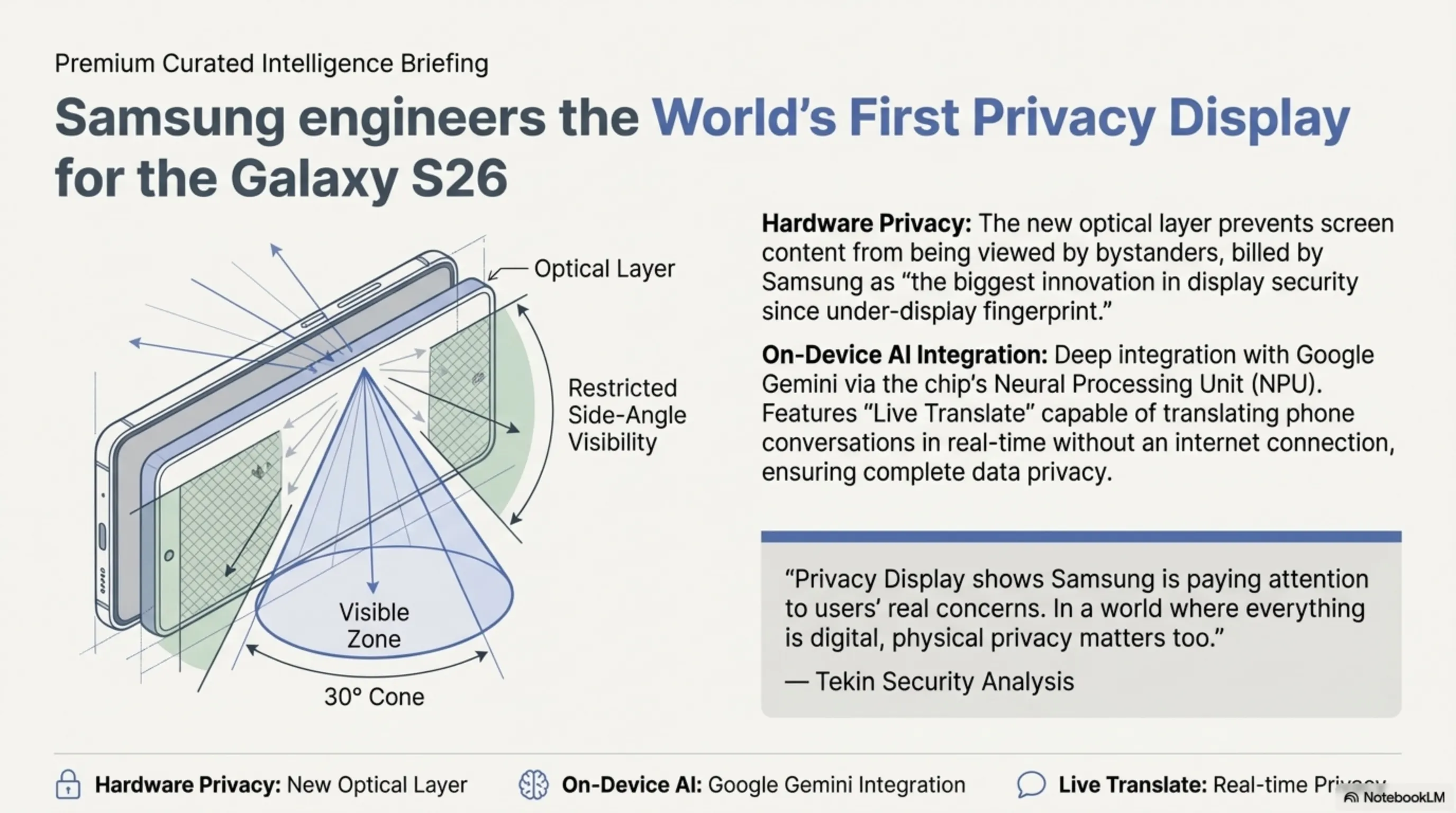
Tomorrow — March 11, 2026 — is the day Samsung Galaxy S26 officially becomes available to the public. After the announcement on February 25, it's now time to see if this new Samsung flagship can meet expectations. And one of the most attractive features of S26 Ultra is something no other phone has: the world's first Privacy Display.
Privacy Display is a new technology that prevents screen content from being viewed from side angles. Imagine you're on the subway or in a cafe reading sensitive messages — with Privacy Display, only you can see the screen, not someone sitting next to you. This technology works using a special optical layer that limits viewing angle to 30 degrees. Samsung says this is "the biggest innovation in display security since under-display fingerprint."
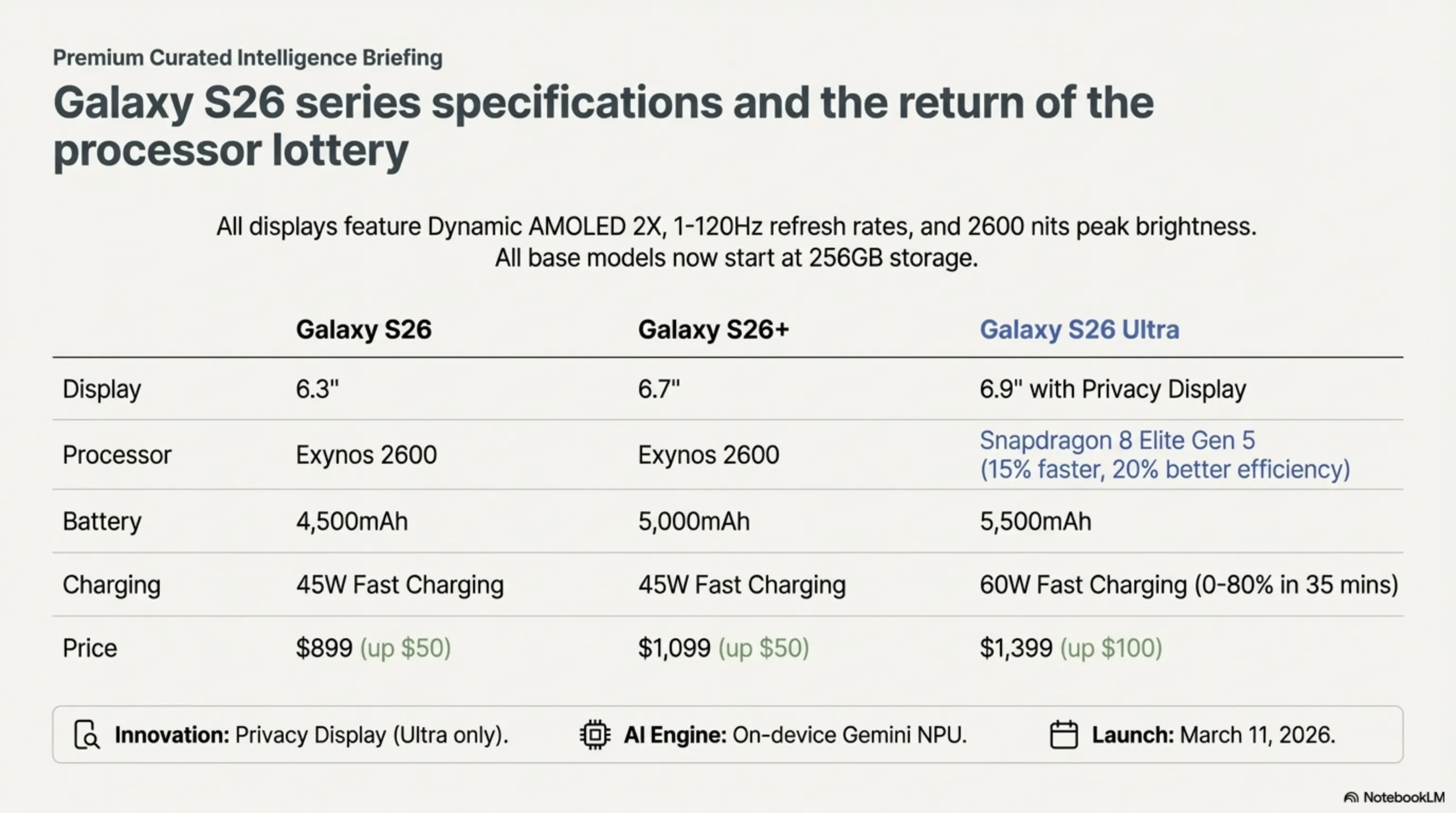
But S26 isn't just Privacy Display. The S26 series includes three models: S26 base with a 6.3-inch display (increased from 6.2 inches in the previous generation), S26+ with a 6.7-inch display, and S26 Ultra with a 6.9-inch display. All displays are Dynamic AMOLED 2X with adaptive 1-120Hz refresh rate and 2,600 nits peak brightness — meaning they're clear and readable even in direct sunlight.
"Privacy Display shows Samsung is paying attention to users' real concerns. In a world where everything is digital, physical privacy matters too." — Tekin Security Analysis
The processors are also interesting. S26 Ultra uses Snapdragon 8 Elite Gen 5 for Galaxy — a customized version of Qualcomm's latest chip made exclusively for Samsung. This chip is 15% faster than Snapdragon 8 Elite Gen 4 and has 20% better power efficiency. But S26 and S26+ use Exynos 2600 — Samsung's in-house chip offered in some markets (like Europe and Middle East). This means we have the processor "lottery" again — some users get Snapdragon, some get Exynos.
Charging has also improved. S26 Ultra now supports 60W fast charging (up from 45W) and 25W wireless charging (up from 15W). This means you can charge the 5,500mAh battery from 0 to 80% in 35 minutes. S26 and S26+ also have larger batteries: 4,500mAh and 5,000mAh respectively.
| Feature | S26 | S26+ | S26 Ultra |
|---|---|---|---|
| Display | 6.3" | 6.7" | 6.9" |
| Processor | Exynos 2600 | Exynos 2600 | Snapdragon 8 Elite Gen 5 |
| Battery | 4,500mAh | 5,000mAh | 5,500mAh |
| Fast Charging | 45W | 45W | 60W |
| Privacy Display | No | No | Yes |
| Starting Price | $899 | $1,099 | $1,399 |
AI capabilities have also expanded. S26 integrates with Google Gemini and can perform complex tasks like real-time translation, text summarization, and content generation. One of the most attractive features is "Live Translate" which can translate phone conversations live — even without internet connection! This is done using the NPU (Neural Processing Unit) on the chip, meaning high speed and complete privacy.
Prices have also increased. S26 base starts at $899 (up $50), S26+ at $1,099 (up $50), and S26 Ultra at $1,399 (up $100). But the good news is all models start with 256GB storage — there's no more 128GB version. This means more value for your money.
Is it worth upgrading? If you have S25, probably not — the changes are incremental. But if you have S23 or older, S26 Ultra with Privacy Display, 60W charging, and Snapdragon 8 Elite Gen 5 is a significant upgrade. As we saw in the Agentic AI revolution article, AI is becoming an inseparable part of smartphones — and S26 is leading in this area.
📊 Summary: Galaxy S26
✅ Innovation: World's first Privacy Display
✅ Charging: 60W fast (Ultra)
✅ AI: Gemini with Live Translate
⚠️ Price: $50-100 increase
📅 Launch: Tomorrow March 11
Samsung Smart Glasses: When Your Glasses Become AI
Samsung had an unexpected announcement at MWC 2026: Smart Glasses — Samsung's first smart glasses set to launch in late 2026. These glasses aren't a VR headset like Vision Pro, nor a complex AR display. They're simple glasses with a camera and one goal: becoming an AI gateway for your Galaxy phone.
Samsung Smart Glasses design is minimal — similar to regular glasses, but with a small 12-megapixel camera in the corner. This camera is positioned at eye level and can capture what you see. But unlike Meta Ray-Ban which records video and photos, Samsung Smart Glasses are designed for AI. The camera sends what you see to your Galaxy phone, and the phone uses Google Gemini to analyze it and give you useful information.
Practical examples are attractive. Imagine you're in a foreign restaurant and the menu is in a language you don't know. Just look at the menu, and Smart Glasses translate it to your language and tell you through earbuds. Or imagine you're in a museum looking at a painting. Smart Glasses can recognize the painting and give you historical information about it. Or even simpler: look at a product in a store, and Smart Glasses search prices in other stores for you.
"Samsung Smart Glasses show that the future of wearables isn't necessarily complex displays. Sometimes just a camera and a smart connection is enough." — Tekin Wearable Analysis
Technical specs are simple: 12MP camera, 155mAh battery (enough for 4-6 hours of use), Qualcomm AR1-class chip for initial processing, and Bluetooth connection to Galaxy phone. Weight is about 50 grams — almost like regular glasses. And for privacy, there's a physical cover over the camera that you can close when you don't want to record.
The important point is that Smart Glasses depend on Galaxy phone. All AI processing is done on the phone, not on the glasses. This means the glasses stay light and cheap, but means you must always have your phone with you. Samsung says this is "a conscious choice" because "Galaxy phones have enough processing power and there's no need to duplicate it in glasses."
Samsung Smart Glasses' main competitor is Meta Ray-Ban Smart Glasses which has been on the market since 2023. But there's an important difference: Ray-Ban is designed for photos and videos (with added AI capability), while Samsung is designed for AI (with added photo and video capability). This means Samsung is more suitable for practical uses like translation, navigation, and shopping, while Ray-Ban is more for content creation.
Price hasn't been announced yet, but analysts predict between $299-399 — cheaper than Vision Pro ($3,499) but more expensive than Ray-Ban ($299). Launch is predicted for Q4 2026, likely alongside Galaxy S27. As we saw in the Neuralink article, wearables are becoming an important part of our digital lives — and Samsung wants to be a leader in this market.
📊 Summary: Samsung Smart Glasses
✅ Camera: 12MP eye-level
✅ AI: Google Gemini (processing on Galaxy)
✅ Battery: 155mAh (4-6 hours)
✅ Privacy: Physical camera cover
📅 Launch: Q4 2026
Xiaomi 17 Ultra: New Camera King with 200MP Telephoto
If you thought you'd seen everything in the mobile camera world, Xiaomi 17 Ultra at MWC 2026 proved you wrong. This phone was introduced with a 200-megapixel telephoto with variable optical zoom — the world's first phone with this technology. This is no longer just a camera phone; it's a professional camera that happens to make calls!
The heart of Xiaomi 17 Ultra's camera system is the 200MP telephoto with 75-100mm variable optical zoom. This means you can move between 3.2x to 4.3x optical zoom without losing quality. This technology, which Xiaomi calls "variable telephoto," works using a moving lens system — exactly like professional DSLR cameras. And with 200 megapixels, you can crop even more and reach 10x or 20x digital zoom without quality drastically decreasing.
But the telephoto is just part of the story. Xiaomi 17 Ultra's main sensor is a Light Fusion 1050L with 1-inch size — one of the largest mobile sensors on the market. This 50-megapixel sensor with f/1.67 aperture and LOFIC HDR technology can capture extraordinary dynamic range. This means even in scenes with bright light and deep shadows, details of both are preserved.
"Xiaomi 17 Ultra shows the megapixel war isn't over yet — but this time with meaning. 200MP in a telephoto with variable optical zoom means unprecedented flexibility for photographers." — Tekin Camera Analysis
Leica APO lenses also play an important role. Xiaomi and Leica have been collaborating since 2022, but Xiaomi 17 Ultra is the first phone to use Leica APO (Apochromatic) lenses. These lenses are designed to reduce chromatic aberration — meaning more accurate colors, higher contrast, and more clarity. Leica also provides two color profiles: "Leica Authentic" for natural colors and "Leica Vibrant" for more saturated colors.
The ultrawide camera is also notable: 50MP with 115-degree field of view and f/2.2 aperture. This is great for landscape, architecture, and group photography. And the 50MP selfie camera with autofocus can take portrait photos with natural bokeh. Overall, Xiaomi 17 Ultra has a quad camera system that can cover any type of photography.
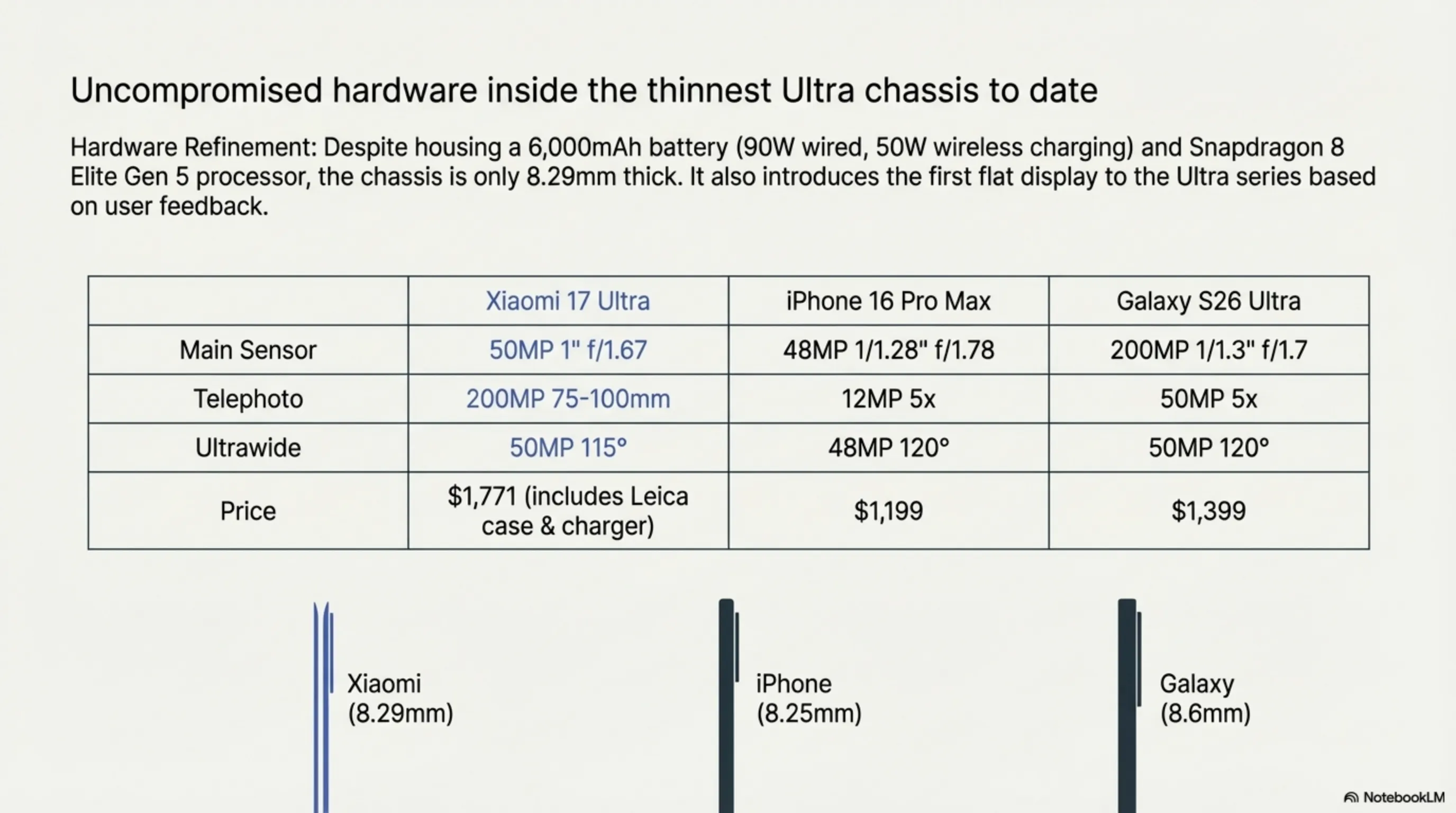
| Camera | Xiaomi 17 Ultra | iPhone 16 Pro Max | Galaxy S26 Ultra |
|---|---|---|---|
| Main | 50MP 1" f/1.67 | 48MP 1/1.28" f/1.78 | 200MP 1/1.3" f/1.7 |
| Telephoto | 200MP 75-100mm | 12MP 5x | 50MP 5x |
| Ultrawide | 50MP 115° | 48MP 120° | 50MP 120° |
| Lens | Leica APO | Apple | Samsung |
| Price | $1,771 | $1,199 | $1,399 |
But Xiaomi 17 Ultra isn't just a camera. It's a complete flagship: 6.9-inch OLED display with 120Hz refresh rate, Snapdragon 8 Elite Gen 5 processor, 16GB RAM, 512GB or 1TB storage, and 6,000mAh battery with 90W fast charging and 50W wireless. And interestingly, Xiaomi 17 Ultra is the thinnest Ultra model ever: only 8.29mm thick — slimmer than iPhone 16 Pro Max (8.25mm) and Galaxy S26 Ultra (8.6mm).
Another innovation of Xiaomi 17 Ultra is the first flat display in the Ultra series. Previous models all had curved displays, but Xiaomi listened to user feedback saying flat displays are better for typing and gaming. This is a small but important change showing Xiaomi pays attention to user opinions.
Xiaomi 17 Ultra (Leica Edition) price is $1,771 — more expensive than iPhone 16 Pro Max but cheaper than some other flagships. This price includes a Leica leather case, a 90W charger, and one year of Xiaomi Cloud Premium subscription. Global launch started February 28 and is available in Europe, Asia, and Middle East. As we saw in the deepfake and elections article, camera technology is becoming a tool for truth and transparency — and Xiaomi 17 Ultra is leading this path.
📊 Summary: Xiaomi 17 Ultra
✅ Telephoto: 200MP with 75-100mm optical zoom
✅ Sensor: 1" Light Fusion 1050L
✅ Lens: Leica APO optics
✅ Thickness: 8.29mm (thinnest Ultra)
📅 Price: $1,771
Motorola Razr Fold: First Book-Style Foldable with 6,000mAh Battery
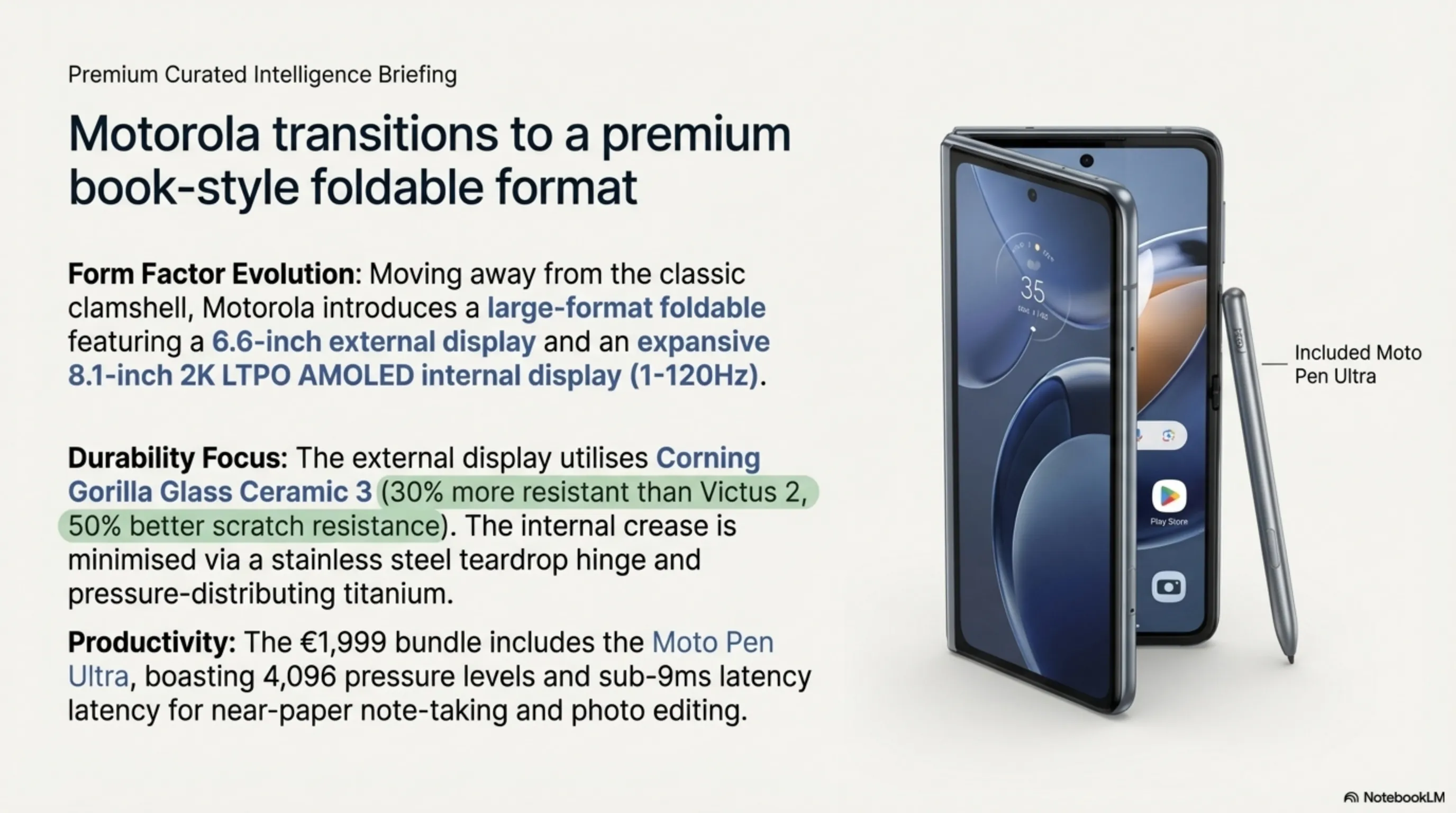
Motorola finally entered the book-style foldable game! After years of making flip phones like Razr, Motorola at MWC 2026 introduced its first book-style foldable phone: Motorola Razr Fold. This phone with a 6.6-inch external display and 8.1-inch internal display directly competes with Galaxy Z Fold 6 and Pixel Fold 2. And it has one key advantage: the largest battery in a foldable — 6,000mAh!
Razr Fold's design is different from flip Razrs. This is a large phone that opens like a book, not like a clamshell. The 6.6-inch external display is protected with Corning Gorilla Glass Ceramic 3 — the first use of this new glass in a phone. This glass is 30% more resistant than Gorilla Glass Victus 2 and 50% better against scratches. This means you can use Razr Fold closed without worrying about scratches.
The 8.1-inch internal display is 2K LTPO AMOLED with adaptive 1-120Hz refresh rate. Motorola claims the display crease in Razr Fold is less than competitors — thanks to a stainless steel teardrop hinge and a titanium internal display that distributes pressure evenly. In hands-on tests, the crease was indeed less visible — but we'll have to see after 6 months or a year of use.
"Razr Fold shows Motorola is serious about foldables. The 6,000mAh battery is a game-changer — this is the first foldable that can cover a full day of heavy work without charging." — Tekin Foldable Analysis
The 6,000mAh battery is the largest battery in a foldable. For comparison, Galaxy Z Fold 6 has a 4,400mAh battery, and Pixel Fold 2 has a 4,800mAh battery. This means Razr Fold can work 30-40% longer. Motorola claims with normal use, Razr Fold can work 1.5 days without charging — something no other foldable can claim.
Razr Fold's specs are also professional: Snapdragon 8 Gen 5 processor (Qualcomm's latest chip), 16GB RAM, 1TB storage (only one version), and a triple camera system with a 50MP Sony LYT-828 main sensor. This is the same sensor used in Xiaomi 14 Ultra and has excellent quality. There's also a 50MP telephoto camera with 3x optical zoom and a 50MP ultrawide with 120-degree field of view.
| Feature | Razr Fold | Galaxy Z Fold 6 | Pixel Fold 2 |
|---|---|---|---|
| External Display | 6.6" | 6.3" | 6.2" |
| Internal Display | 8.1" 2K | 7.6" 2K | 8.0" 2K |
| Battery | 6,000mAh | 4,400mAh | 4,800mAh |
| Processor | Snapdragon 8 Gen 5 | Snapdragon 8 Gen 4 | Tensor G5 |
| Storage | 16GB / 1TB | 12GB / 512GB | 12GB / 256GB |
| Price | €1,999 | $1,899 | $1,799 |
One interesting feature of Razr Fold is support for Moto Pen Ultra — a stylus sold separately (but included in the €1,999 bundle). This pen is similar to Samsung's S Pen and can be used for note-taking, drawing, and photo editing. Motorola says Moto Pen Ultra has 4,096 pressure levels and less than 9ms latency — almost like writing on paper.
Motorola also released a special FIFA World Cup 26 Collection version of Razr Fold. This version comes with national team colors, FIFA logo, and a special leather case. The price is the same €1,999, but only a limited number are produced. This is a smart marketing move because the 2026 World Cup is being held in North America and Motorola wants to take advantage of this opportunity.
Razr Fold launch started in early March in Europe. North America launch is planned for Q2 2026, and Asia and Middle East launch for Q3 2026. Motorola said "demand has been much higher than expected" and there may be stock shortages in the first months. As we saw in the GTA 6 crisis article, when a product is really good, demand can outpace supply.
📊 Summary: Motorola Razr Fold
✅ Display: 6.6" external, 8.1" internal 2K
✅ Battery: 6,000mAh (largest in foldables)
✅ Camera: 50MP Sony LYT-828 triple
✅ Pen: Moto Pen Ultra (included)
📅 Price: €1,999
Conclusion: An Exciting Morning of Innovation
The morning of March 9, 2026 showed that the tech industry is still full of amazing innovations. From Lenovo Legion Go Fold redefining portable gaming, to Tesla changing its supply chain strategy to exploit new tariffs. From Samsung Galaxy S26 with the world's first Privacy Display, to Samsung Smart Glasses bringing AI to our eyes. From Xiaomi 17 Ultra with revolutionary 200MP telephoto, to Motorola Razr Fold with the largest battery in a foldable.
What's common among all these news? Boldness. Companies are no longer settling for incremental innovations — they're pushing boundaries. Lenovo put a foldable screen in a gaming handheld. Tesla changed its production strategy in a few days. Samsung invented a new privacy technology. Xiaomi built a camera system that competes with professional cameras. And Motorola proved it can compete with giants in the foldable market.
The main question: are these innovations good for us? Is a foldable handheld really better than a regular handheld? Is Privacy Display an essential feature or just a gimmick? Is 200MP telephoto worth the high price? Time and the market will answer these questions. But one thing is certain: the tech world is never boring. And we're happy to witness these innovations.
🌐 Stay Connected With Us 🎮✨
For the latest tech, gaming, and gadget news, follow us on our official social media channels: