
🚨 TekinGame Special Dossier: The Fall of Digital Fortresses
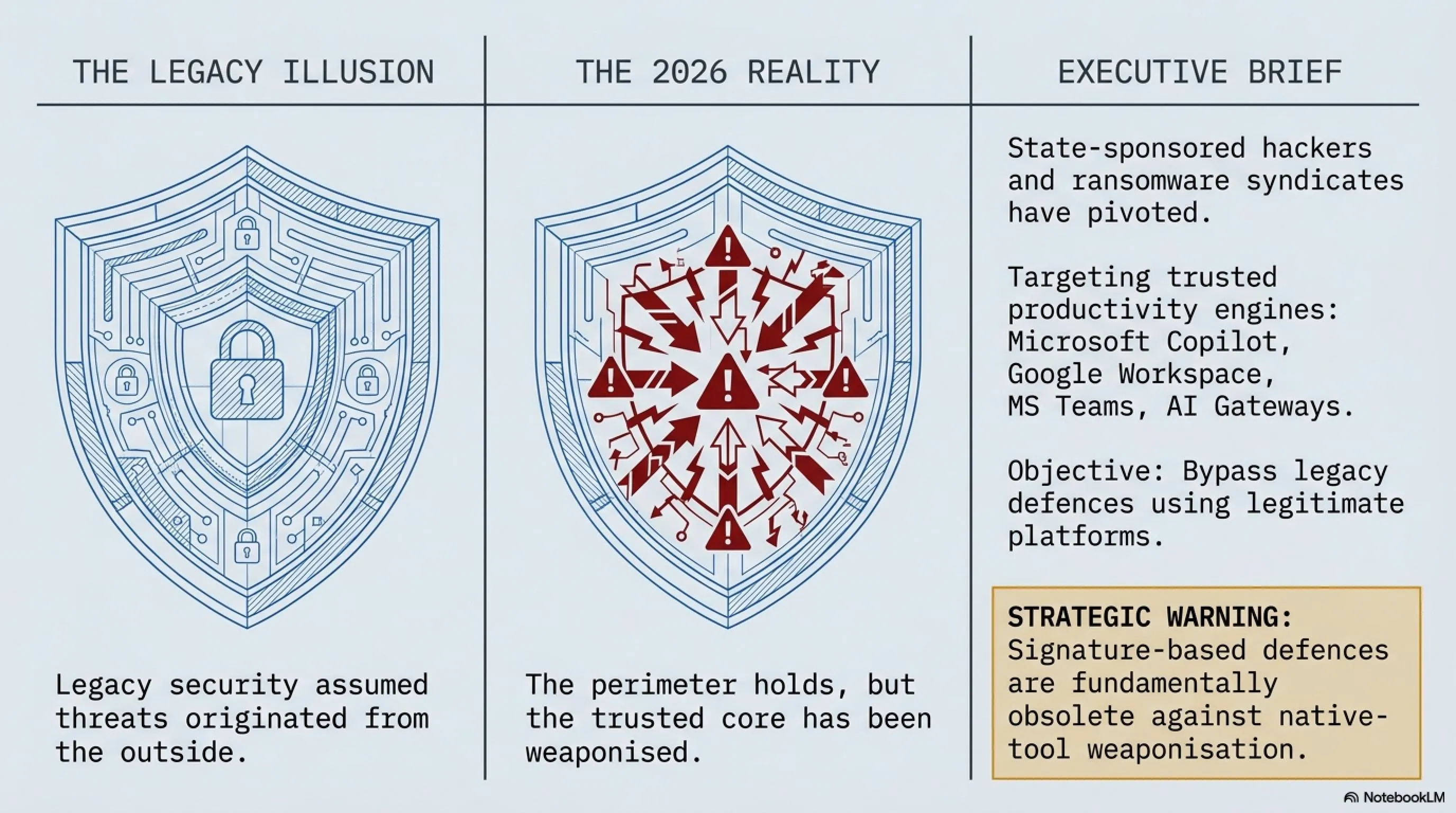
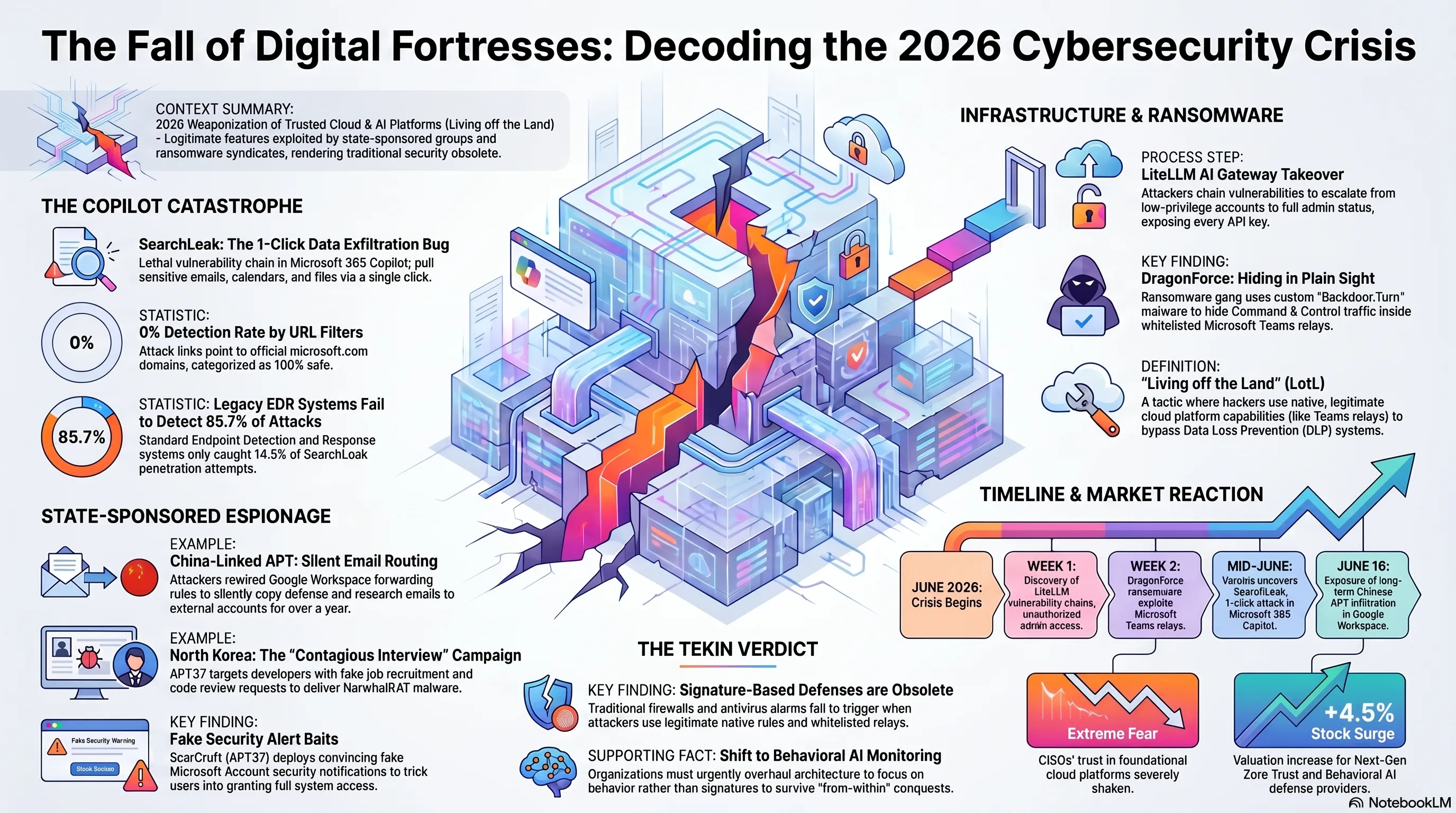
Greetings, network security commanders and tech strategists! Today in the Tekin Garage, we are executing a cybernetic autopsy on one of the most volatile and dangerous intelligence files of the summer of 2026. The very tools previously considered the unbreakable backbone of enterprise productivity—from Microsoft's Copilot AI assistant to Google Workspace cloud platforms—have now been weaponized into lethal assets by state-sponsored hackers and ransomware syndicates.
⚡ Today's Cyber Intelligence Highlights:
⚔️ Silent, 1-click data exfiltration executed via Microsoft 365 Copilot AI.
📉 Complete hostile takeover of open-source AI Gateway servers (LiteLLM).
🏃♂️ Ransomware payloads masking their C2 traffic deep within Microsoft Teams relays.
💰 Chinese APTs infiltrating North American research networks by manipulating Google Workspace rules.
🔥 North Korea's cyber army distributing NarwhalRAT malware disguised as official security alerts.
☕ Activate your mental firewalls, grab your dark roast coffee, and join us for a ruthless, highly technical dissection of next-generation digital warfare!
A cyberpunk depiction of a compromised cloud datacenter infected with glowing red warning codes.
1. The Copilot Catastrophe: How Microsoft's AI Became a Corporate Spy
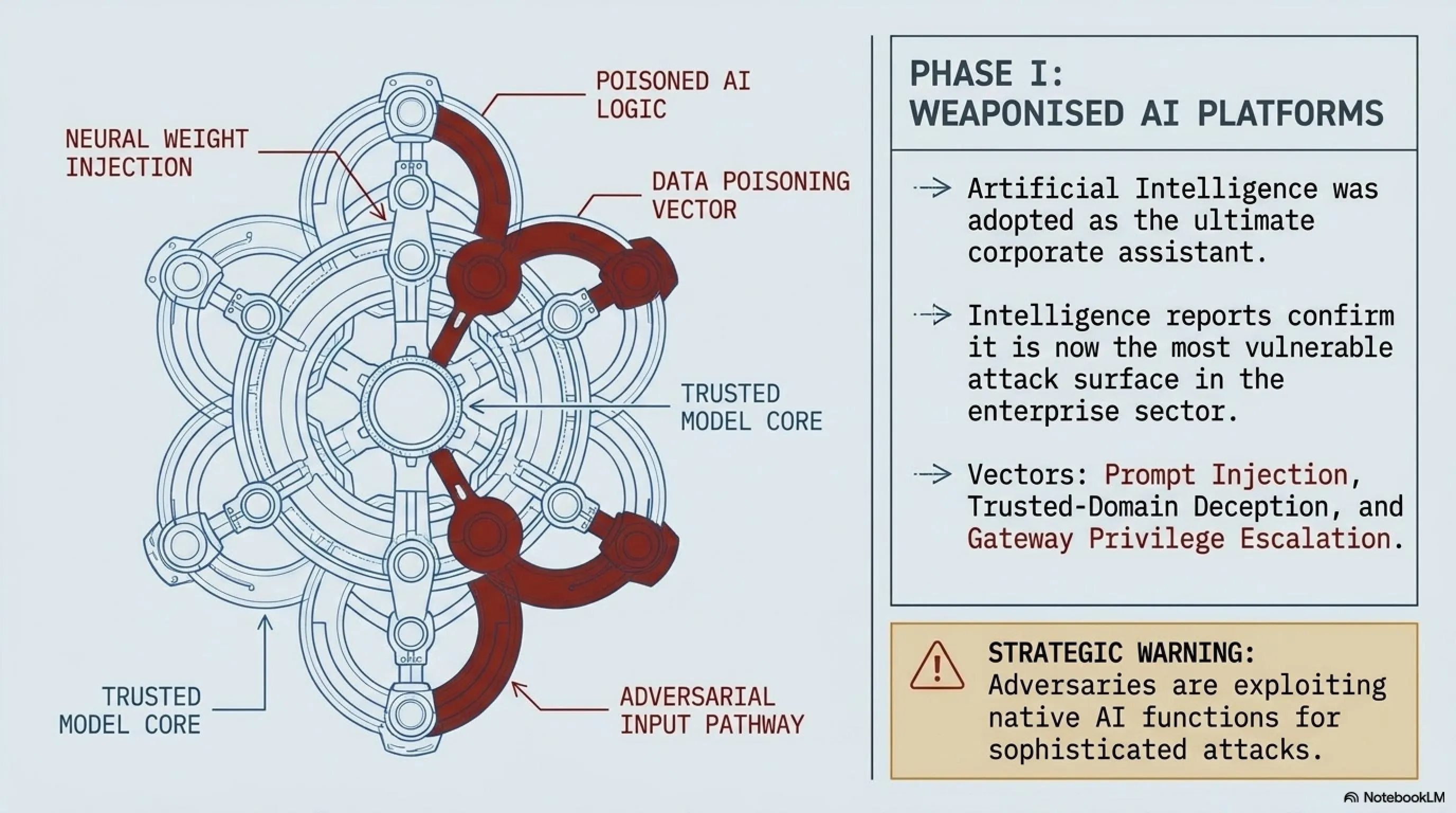
The generative AI revolution was marketed as our ultimate, harmless digital assistant in the workplace. However, recent dark web intelligence reports confirm that Large Language Models (LLMs) have mutated into the most critical blind spots in modern Enterprise Architecture. Security researchers at Varonis Threat Labs have recently identified and dissected an ultra-critical vulnerability chain named SearchLeak within the Microsoft 365 Copilot Enterprise ecosystem. This bug is so devastatingly complex that a single click on a seemingly legitimate link completely bypasses all organizational firewalls, plugging attackers directly into the heart of the corporate database.
As we previously debugged in our AI Hacking Autopsy: From Jailbreaks to Data Poisoning & Prompt Injection →, attackers are actively using hidden URLs and invisible variables to force high-privilege AI agents to extract and leak sensitive data. The true catastrophe and masterpiece of this malicious engineering is that the infected link points directly to a legitimate, official microsoft.com domain. Consequently, all URL filtering tools, endpoint antiviruses, and Anti-Phishing gateways are entirely deceived, whitelisting the link as 100% secure.
⏳ Timeline of Enterprise Cyber Disasters (June 2026)
| First Week of June | Discovery of severe vulnerability chains in LiteLLM, granting unauthorized hackers full administrative server access. |
| Second Week of June | Detection of advanced DragonForce ransomware campaigns masking malicious payloads within Microsoft Teams infrastructure. |
| Mid-June | Exposure of the technical details behind the SearchLeak 1-click attack in Microsoft Copilot. |
| June 16, 2026 | Revelation of a silent, long-term Chinese APT infiltration deep within Google Workspace, stealing defense research emails. |
2. SearchLeak Autopsy & Tekin Lab Security Benchmarks
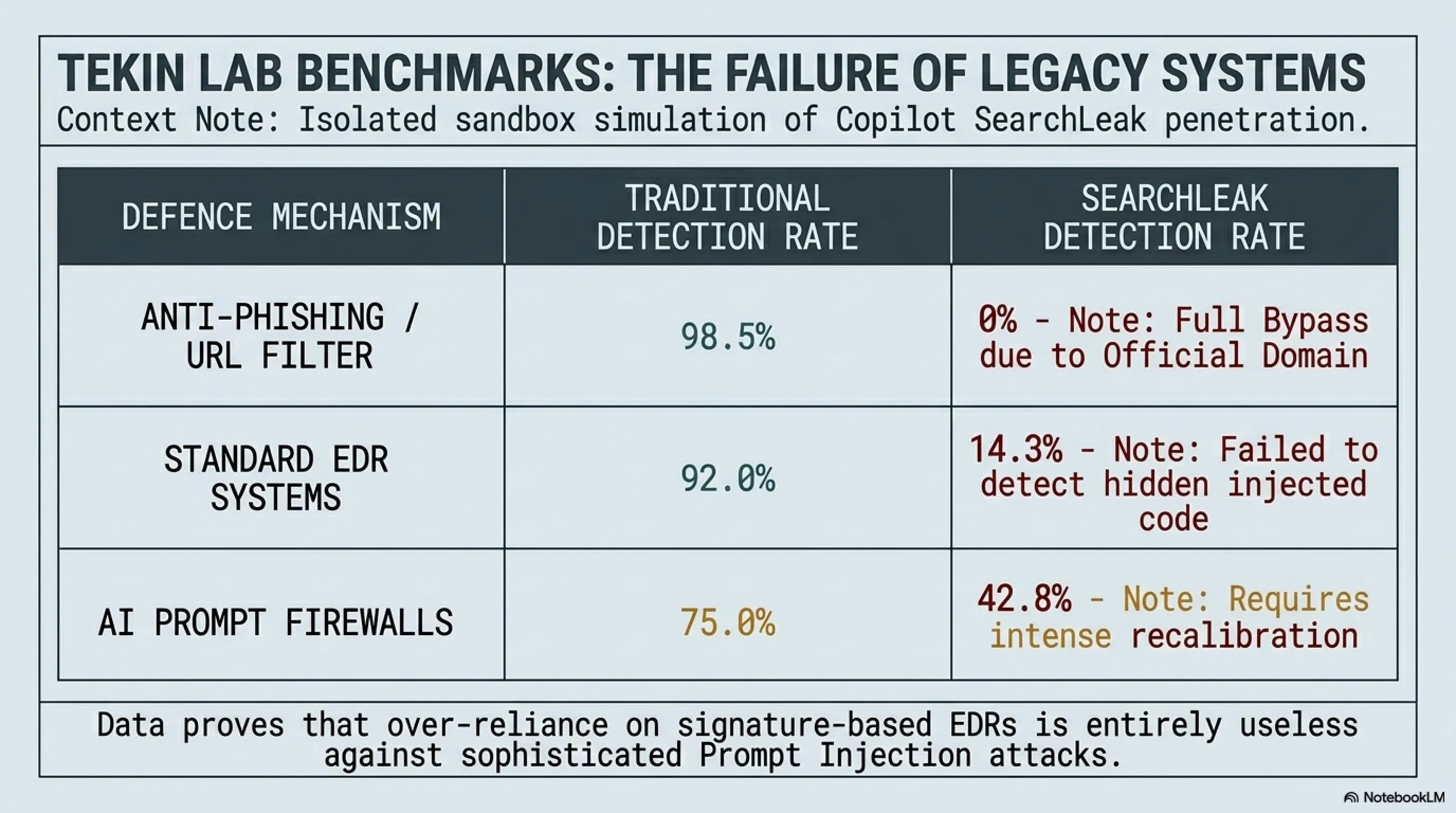
To fully debug and comprehend the magnitude of this disaster, the Tekin Garage security division constructed an isolated Sandbox environment to benchmark exactly how the SearchLeak methodology circumvents standard security protocols. The results of these penetration tests sounded a massive alarm for Chief Information Security Officers (CISOs) globally: the over-reliance on legacy security tools—such as signature-based EDRs—is entirely futile against complex Prompt Injection attacks.
📊 Terrifying Metrics: SearchLeak Bypassing Cyber Defenses
Although Microsoft has deployed emergency patches to block this specific exploit, SearchLeak signifies a fundamental paradigm shift in hacking methodologies. These attacks are part of a new generation of threats utilizing hidden URLs and invisible variables to force high-privilege AI to pump sensitive data directly into hacker-controlled Command and Control (C2) servers.
3. Fallen Gates: The Takeover of AI Gateway Servers (LiteLLM)
If you assume that only end-users and employees are at risk, you are gravely mistaken. The core processing infrastructure of AI networks is also collapsing. Cybersecurity researchers at Obsidian Security recently discovered and documented a horrifying vulnerability chain within the LiteLLM system. LiteLLM is a highly popular, open-source AI gateway acting as a proxy that manages API calls for over 100 different language model providers through a single OpenAI-compatible interface.
⚙️ Technical Autopsy of the LiteLLM Vulnerability
- Attack Vector: The attacker infiltrates the network via Privilege Escalation, exploiting insecure configurations in default, low-privilege proxy accounts.
- Execution Method: By chaining three distinct, interconnected bugs, the hacker escalates their limited access to Full Admin status, enabling them to execute arbitrary malicious code directly on the processing servers.
- Catastrophic Corporate Fallout: A server takeover at this root level exposes all API keys and Secret Keys associated with model providers, handing over the entire AI communication infrastructure and processing data to the attacker.
The fall of AI Gateways; when malicious code seizes control of LLM brokers.
4. Ghosts in the Network: DragonForce Ransomware Hiding in Microsoft Teams
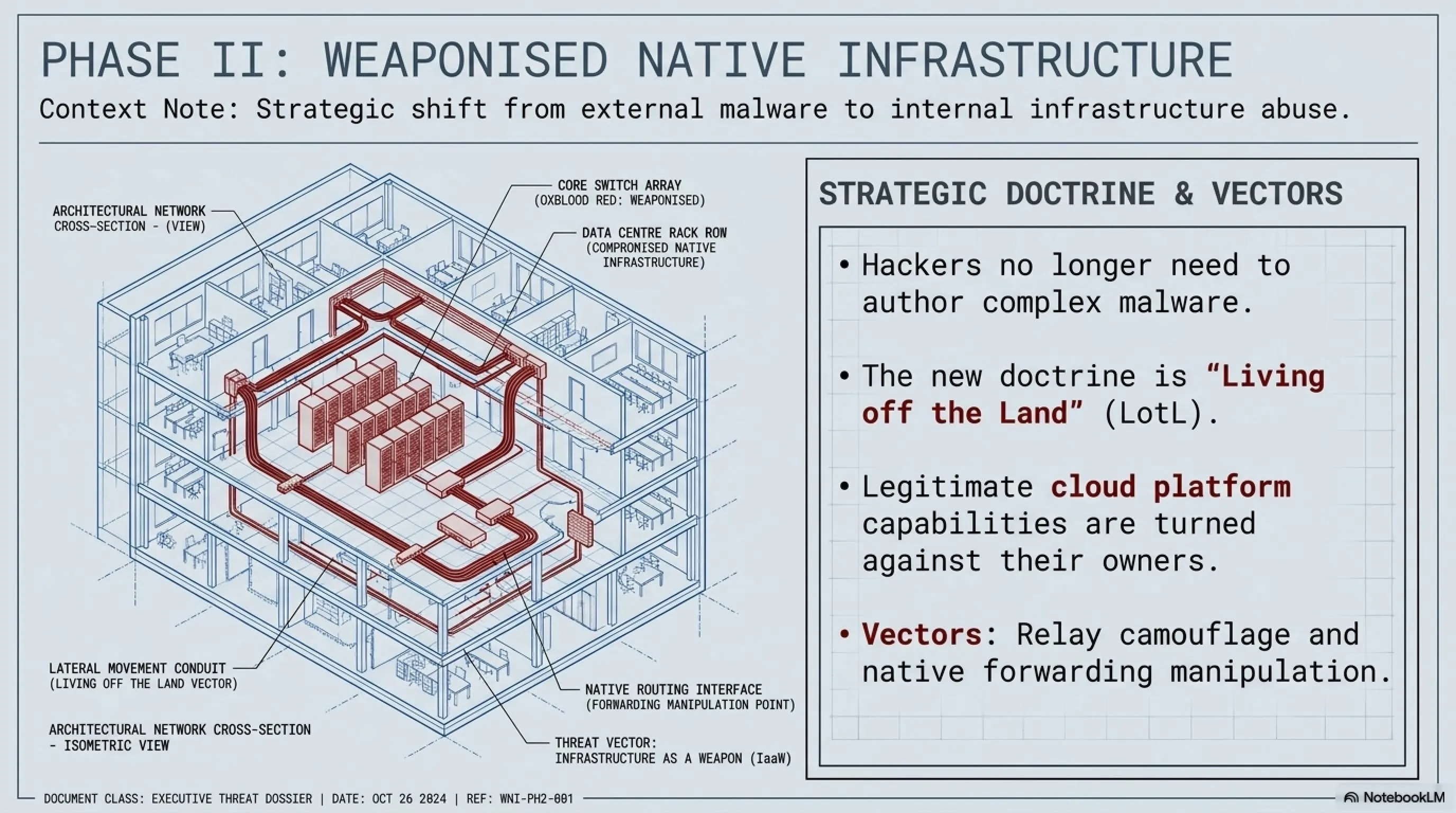
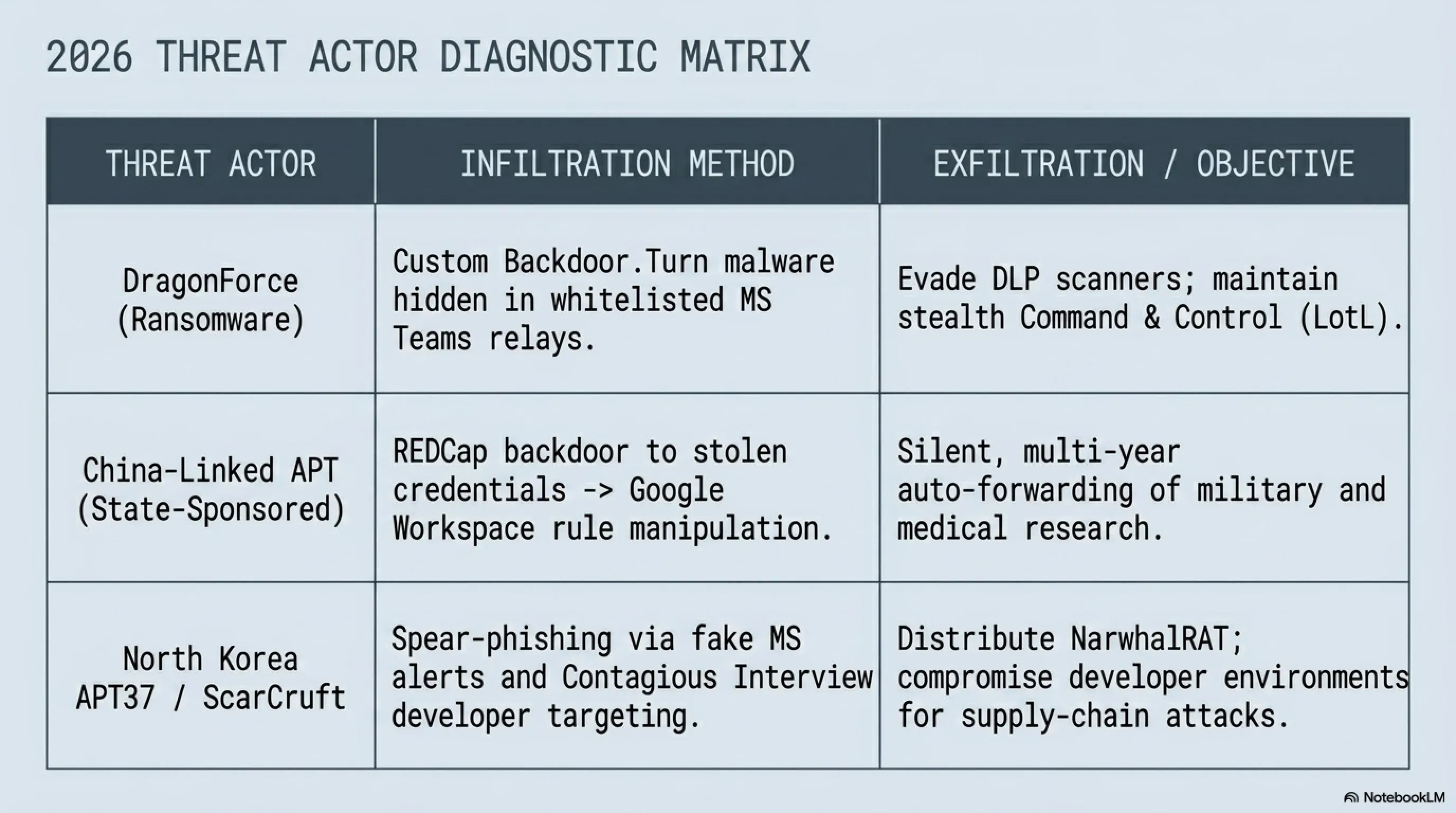
One of the most intelligent, yet terrifying, tactics evolved in 2026 is the art of "Living off the Land" (LotL). Instead of relying on their own dedicated Command and Control (C2) servers—which are easily blacklisted and identified by corporate firewalls—hackers from the ransomware syndicate DragonForce have actively utilized the Microsoft Teams relay infrastructure to hide their malicious traffic.
According to malware autopsy reports, by developing a custom payload named Backdoor.Turn, the attackers conceal their C2 communications directly within the Microsoft Teams relay ecosystem. Because Teams traffic is universally whitelisted and considered essential, secure traffic in corporate networks, the hackers effortlessly deceive endpoint Data Loss Prevention (DLP) systems and antiviruses, operating as invisible ghosts within the digital walls.
📌 Strategic Mid-Point Conclusion
These recent breaches prove that modern hackers no longer need to author noisy, complex malware; they simply weaponize the legitimate, native capabilities of cloud platforms (like Teams relays) as their weapons. Defending against such LotL attacks requires an immediate shift from "signature-based monitoring" to "Behavioral AI" monitoring.
Visual representation of malicious code concealed within encrypted communication tunnels.
5. Silent Infiltration: Chinese APT Manipulating Google Workspace
On the frontlines of state-sponsored cyber warfare, a highly capable China-linked cyber espionage group (APT) managed to remain completely undetected inside highly sensitive North American medical, academic, and military research networks for over a year, silently exfiltrating strategic data without triggering a single security alarm.
💰 Infiltration & Data Theft Distribution (Damage Estimate)
| Affected Sector | Initial Breach & Backdoor Method | Data Exfiltration Mechanism |
|---|---|---|
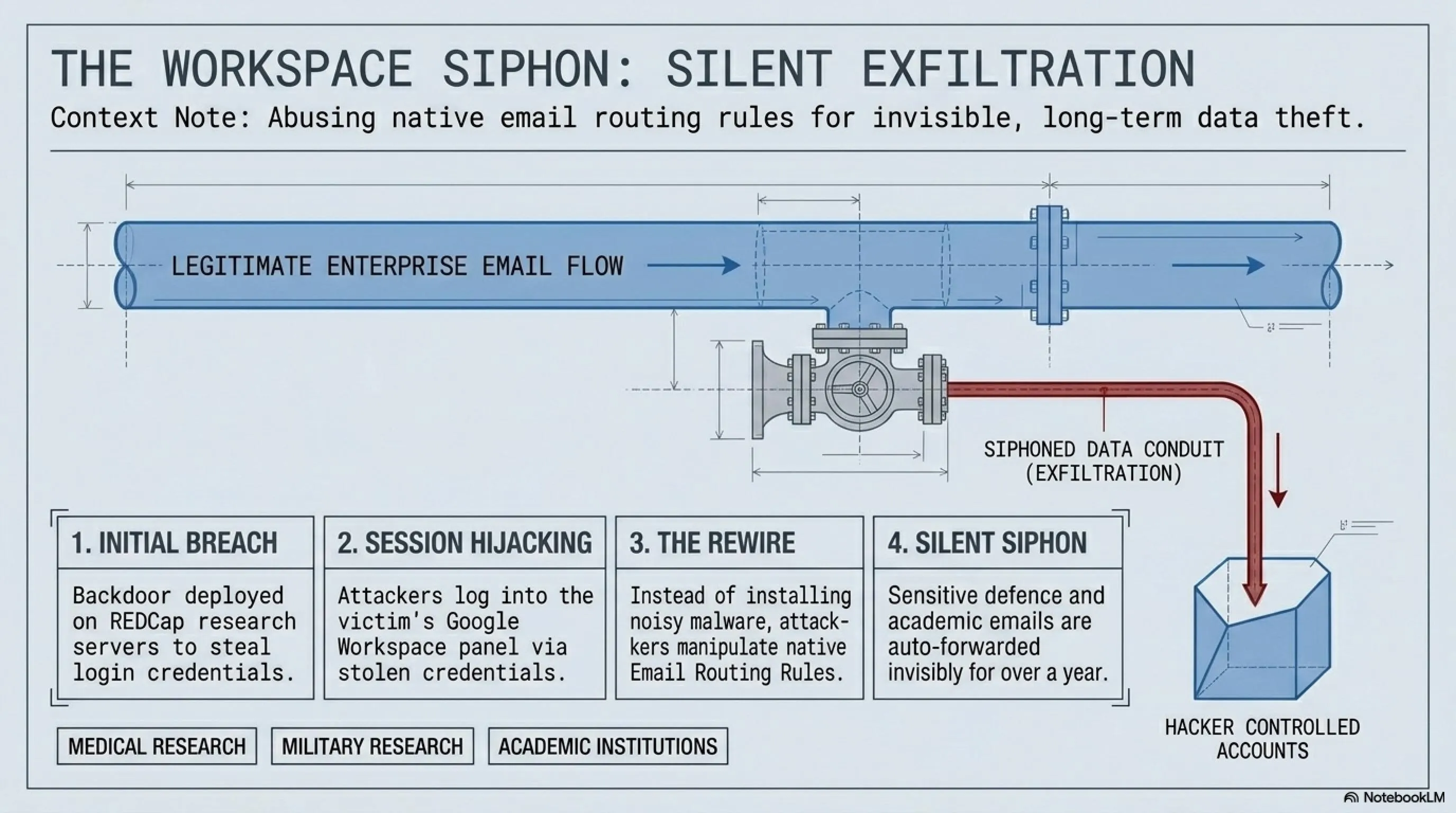
| Medical & Military Research | Deploying a backdoor on REDCap servers to steal login credentials. | Rewiring the native Email Rules in the Google Workspace admin panel. |
| Defense Email Theft | Session Hijacking and penetrating admin accounts. | Auto-forwarding all sensitive messages silently to hacker-controlled accounts. |
Their modus operandi is a masterclass in cyber engineering. The hackers initially established a backdoor on REDCap research servers specifically to steal user login credentials. Then, in a brilliant move, instead of installing detectable malware, they logged into the victim's Google Workspace panel and manipulated the legitimate Email Forwarding Rules. This rewiring forced the system to quietly copy and auto-forward all sensitive defense and academic emails to external servers legally, completely bypassing firewall triggers.
6. North Korea's New Tactics: Hunting Developers with NarwhalRAT
Parallel to the Red Dragon's operations, North Korea's cyber army is heavily upgrading its arsenal. The Pyongyang-backed hacking group known as ScarCruft (also known as APT37) has initiated a massive new wave of sophisticated spear-phishing attacks, purposefully targeting software developers.
⚔️ Cyber Warfare: Tekin Enterprise Defense vs. APT37 Tactics
🟢 Defensive Doctrine (PROS)
- Rigorous staff training and attack simulation to verify the authenticity of suspicious emails.
- Strict isolation of Developer Environments (Dev/Test) from the main corporate network and the internet.
- Granular, real-time behavioral monitoring of developer tools within the CI/CD pipeline.
🔴 North Korean Offensive Tactics (CONS)
- Deploying fake Microsoft Account security alerts to incite panic and distribute NarwhalRAT.
- Weaponizing vital developer tools through dangerous campaigns like "Contagious Interview".
- Directly targeting software engineers with fake job recruitment and Code Review requests as bait.
This group's strategy is heavily reliant on fear-mongering and social engineering. They send highly convincing malicious messages impersonating official "Microsoft Account security alerts" to trick victims into downloading the dangerous NarwhalRAT malware onto their systems. In an even more dangerous phase, they are targeting the everyday tools of developers to inject malware directly into the core code of legitimate software, paving the way for catastrophic supply chain attacks.
7. Market Barometer and Investor Reaction to Cyber Disasters
🔗 Full Dossier | Cyber Intelligence & Threat History on TekinGame
❓ Debug Center & Frequently Asked Questions (FAQ)
What is the exact mechanism of the SearchLeak attack in Microsoft Copilot?
It is a fatal, 1-click bug exploiting legitimate Microsoft domains. By clicking a manipulated link, the attacker bypasses security filters and effortlessly exfiltrates the user's emails, calendars, and sensitive corporate files.
How does the DragonForce ransomware stay invisible on the network?
This group utilizes custom malware, Backdoor.Turn, to route its malicious Command and Control (C2) traffic directly through Microsoft Teams communication relays. Since Teams traffic is whitelisted, corporate antiviruses fail to detect the data transfer.
What tactic did Chinese hackers use to infiltrate Google Workspace?
After gaining admin panel access, instead of using noisy malware, they manipulated the native Email Forwarding Rules in Google's settings. This allowed them to silently copy and redirect highly sensitive defense emails to their own servers for over a year.
Who exactly does North Korea's APT37 target?
The APT37 group distributes the NarwhalRAT malware by sending fake Microsoft Account security alerts. Their primary targets are software developers and programmers, aiming to hijack their infected code for future supply chain attacks against other corporations.
What are the dangers of the LiteLLM Gateway platform takeover?
This vulnerability chain enables an ordinary, low-privilege user to escalate into a full server administrator. This leads to the massive exposure of all Secret Keys and API keys from various AI providers, compromising the organization's entire processing infrastructure.
📚 Cybernetic Database & Intelligence Sources
- DarkReading: Comprehensive analysis of the Copilot SearchLeak vulnerability and 1-click enterprise attacks.
- TheHackerNews: Technical report on malicious LiteLLM bugs and AI Gateway server takeovers.
- BleepingComputer: Identification of the custom Backdoor.Turn malware and DragonForce's exploitation of Microsoft Teams.
- TheHackerNews: Detailed autopsy of Chinese APT infiltration into research networks and Google Workspace manipulation.
- TheHackerNews: Investigation of the Contagious Interview campaign and NarwhalRAT distribution by North Korea.
- Tekin Garage Cyber Inspection Dept: Analysis, simulated benchmarking, and localization of global Threat Intelligence data.
🌐 Connect With Tekin Garage Command 🎮✨
For the latest hardcore analysis in cybersecurity, AI, and gaming, follow TekinGame on our official channels: