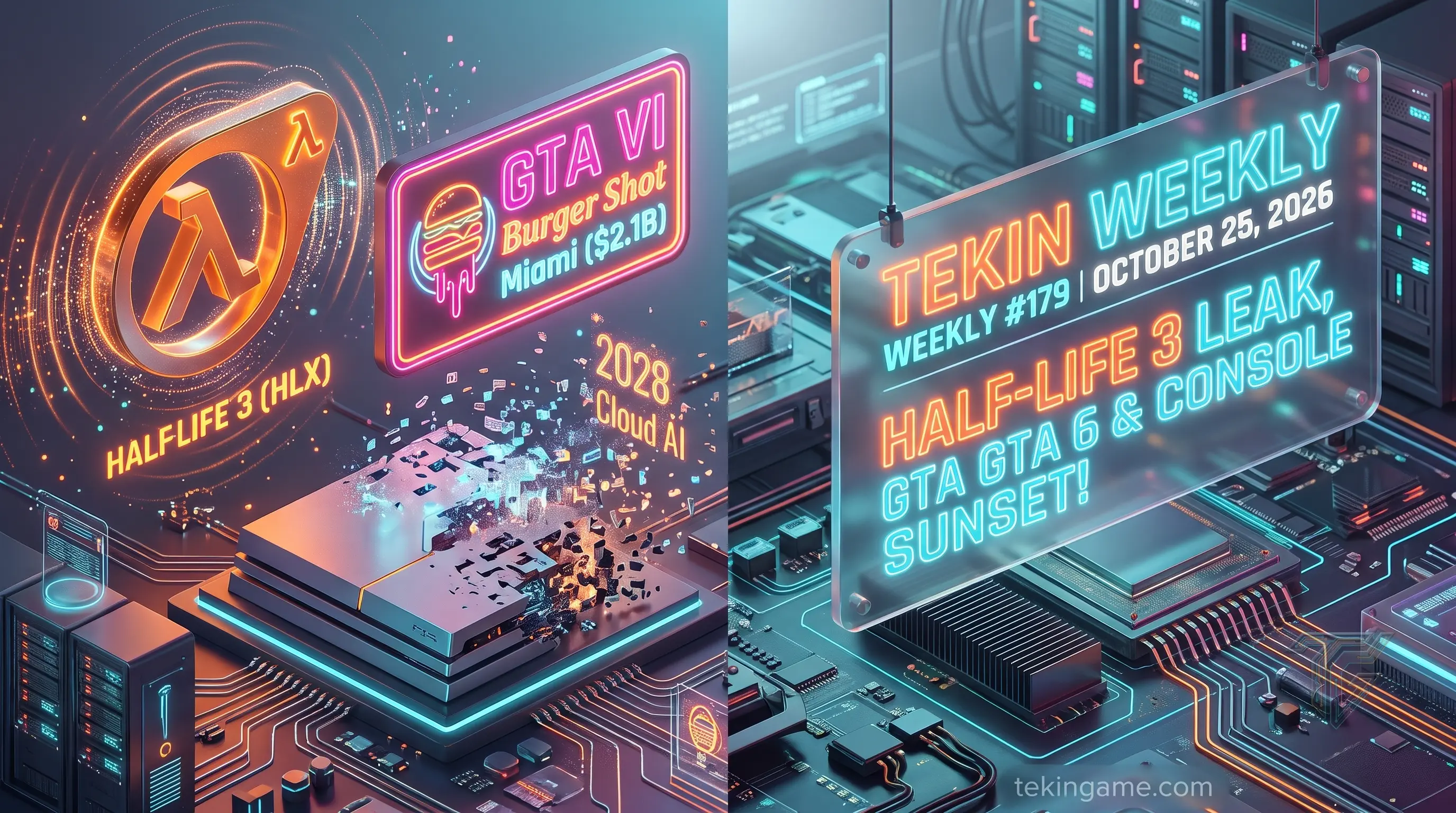
Tekin Weekly | Issue #179: Comprehensive Executive Digest (October 18–24, 2026)
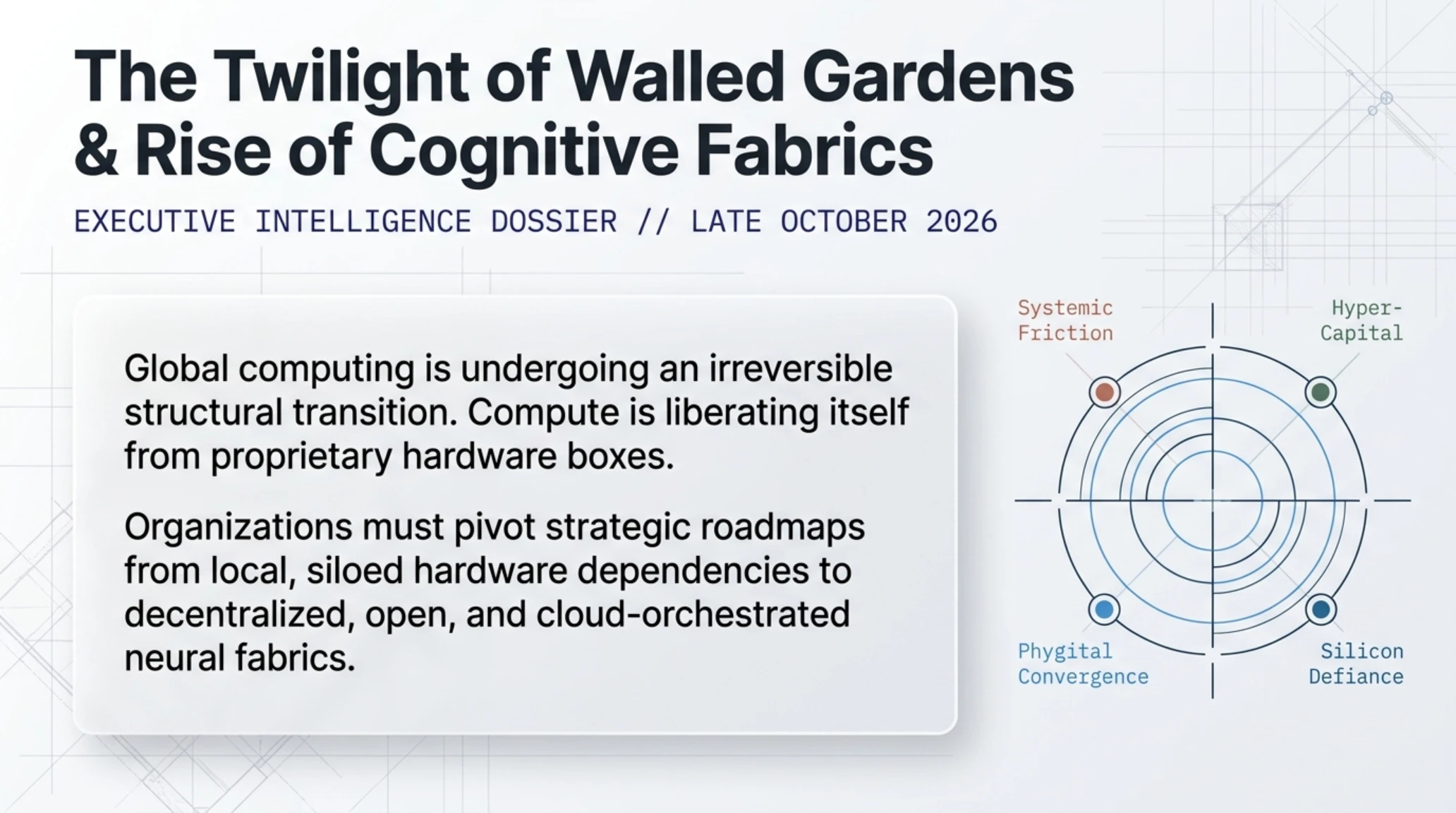
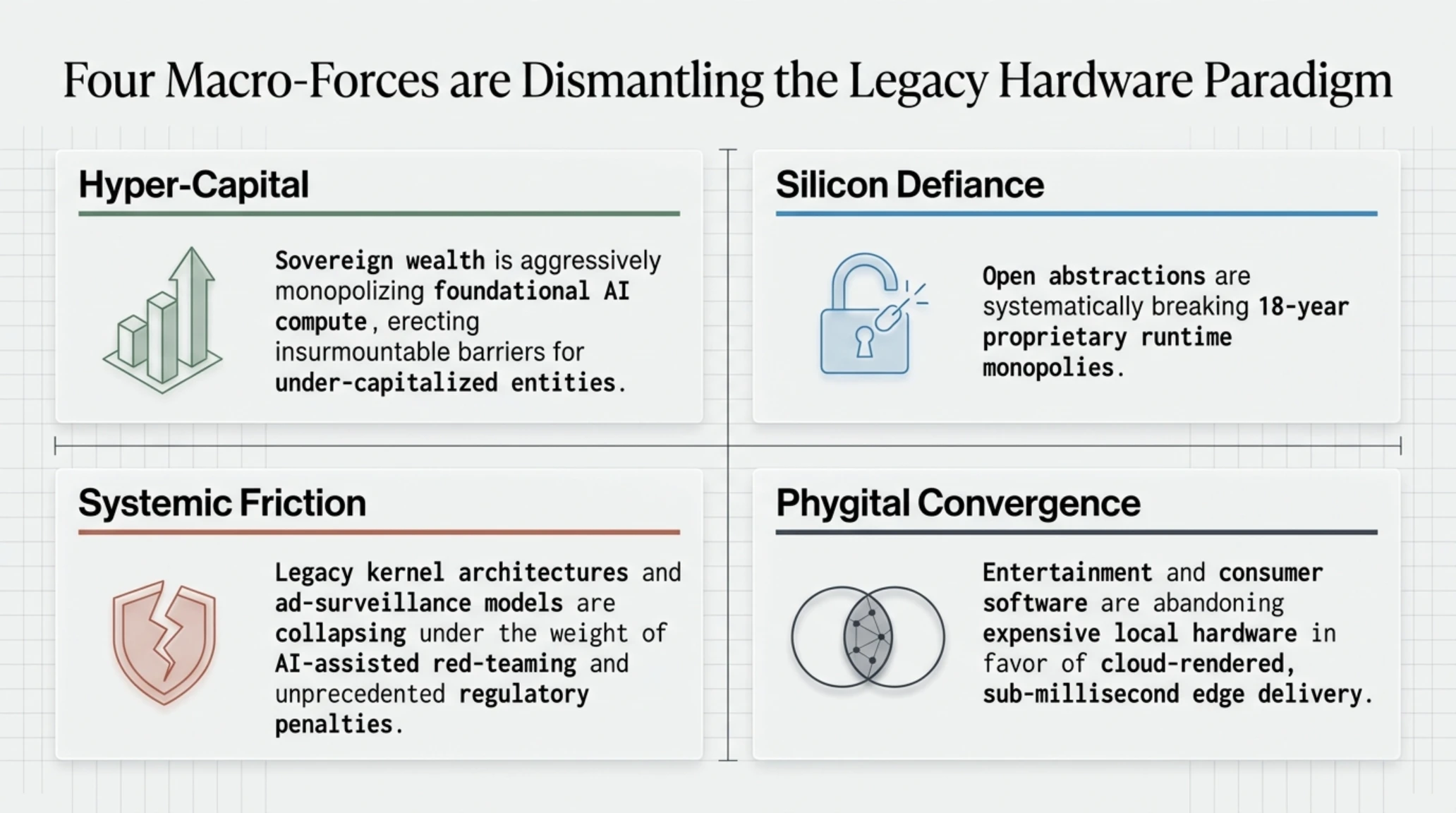
The global technology and interactive entertainment landscape across late October 2026 reached an inflection point defined by monumental capital reallocation, tectonic silicon architecture shifts, and unprecedented legal enforcement against algorithmic surveillance. While macroeconomic headwinds continue to compress speculative tech ventures, institutional capital and sovereign wealth funds have crystallized around foundational compute infrastructure, autonomous agent orchestration, and next-generation neural runtime engines. Concurrently, traditional software distribution pipelines and physical entertainment formats face accelerating obsolescence as cloud edge compute and generative synthesis redraw production workflows.
Strategic Intelligence & Core Vectors | 6 Pillars of Issue #179
To navigate this rapid confluence of deep tech innovations, policy upheavals, and shifting consumer economics, our editorial and intelligence desk has compiled this comprehensive executive dossier. Each chapter provides granular technical deconstructions, verified datasets, and forward-looking strategic assessments designed to empower enterprise leaders in making high-conviction decisions.
1. Frontier AI Hyper-Capital: OpenAI's $30B Pre-IPO Round at $1.25T Valuation, Gulf Sovereign Inflows & the Android Autonomous Agent War
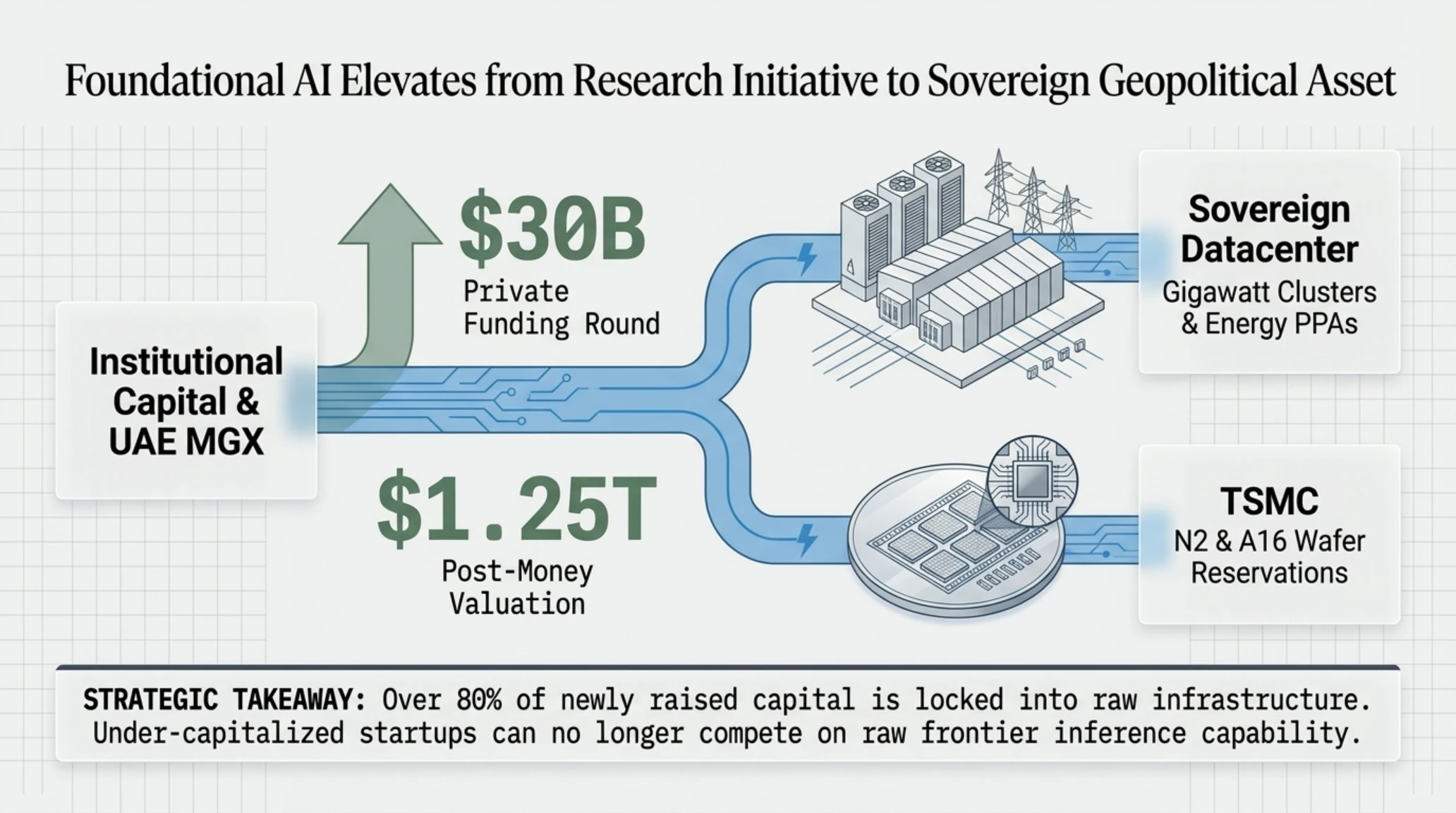
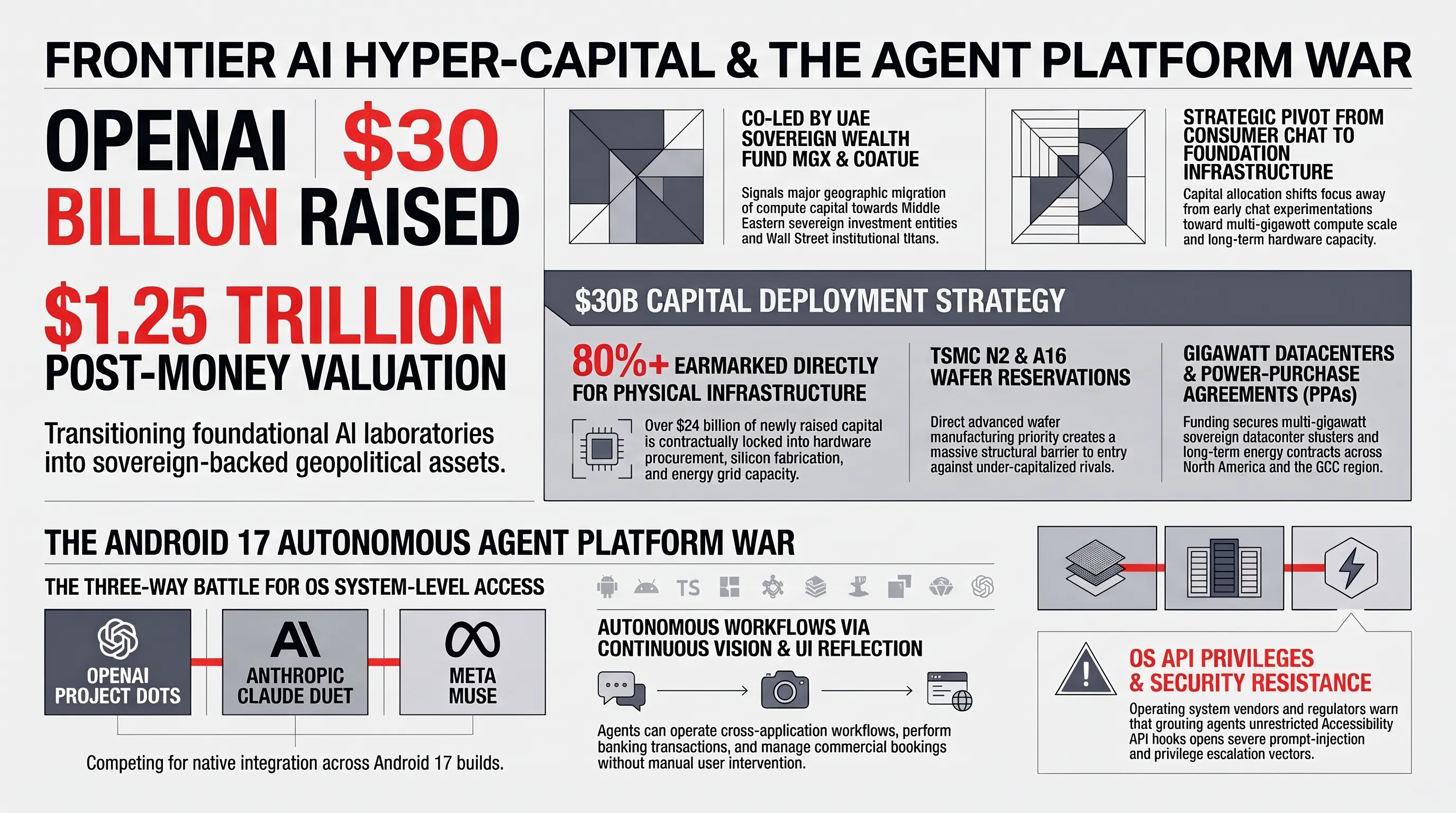
The global generative AI sector underwent a historic valuation re-rating this week as OpenAI finalized terms for an unprecedented $30 billion private funding round, catapulting the enterprise to an astronomical $1.25 trillion post-money valuation. Co-led by UAE sovereign investment entity MGX and Wall Street titan Coatue Management, the round underscores a profound geographic migration of compute capital toward Middle Eastern sovereign wealth hubs. Unlike earlier venture-driven rounds focused on consumer chat experimentation, over 80% of this newly raised capital has been contractually earmarked for sovereign datacenter gigawatt clusters, next-generation wafer reservations across TSMC N2 and A16 nodes, and dedicated long-term energy power-purchase agreements across North America and the GCC region.
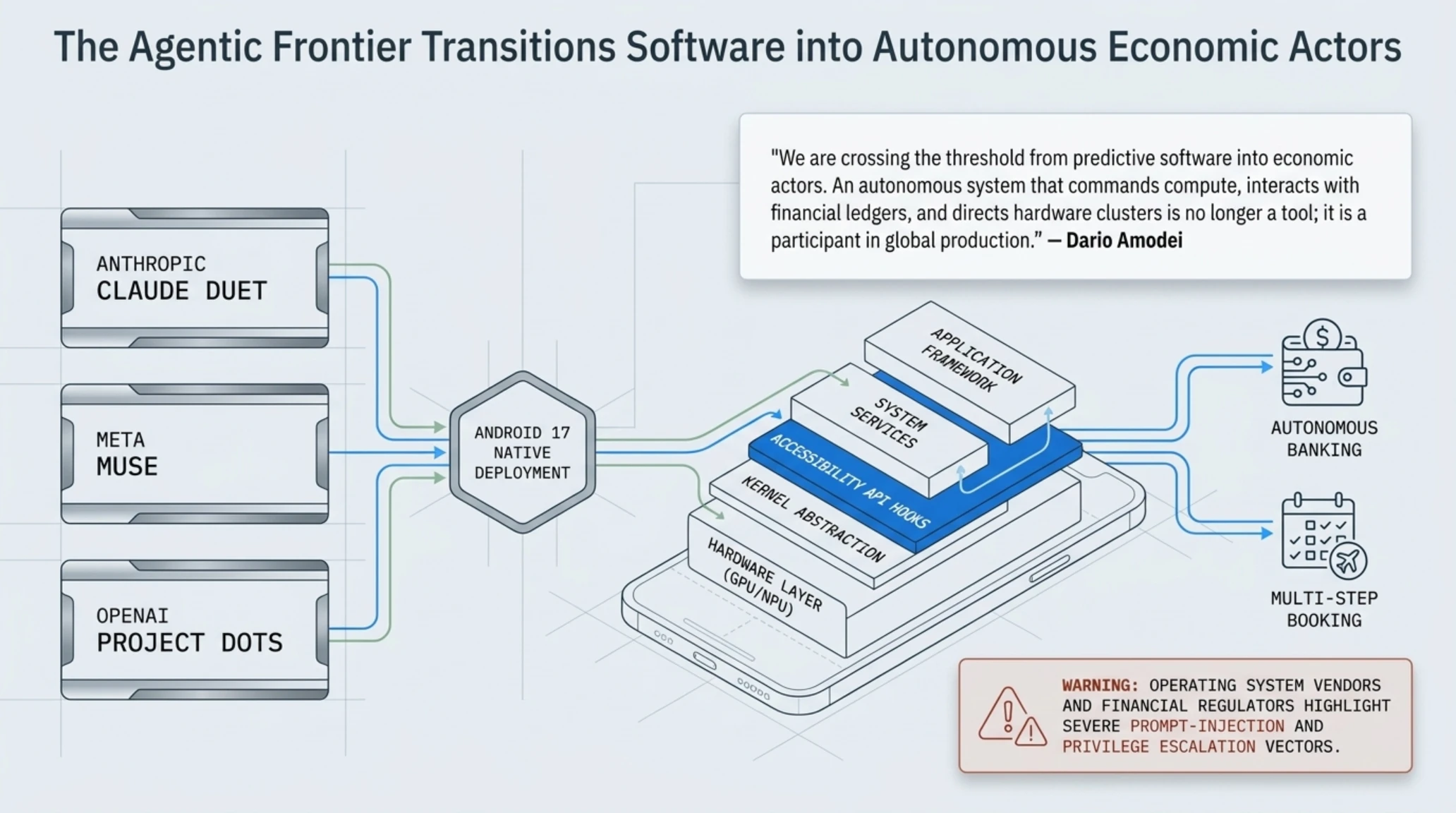
Concurrently, the consumer mobile battleground shifted definitively from generative chat assistants to autonomous operational operating agents. The deployment of Anthropic's Claude Duet, Meta's Muse, and OpenAI's Project Dots natively across Android 17 builds has ignited an aggressive platform war for system-level access. These autonomous runtime agents operate with continuous vision and UI reflection capabilities, enabling them to execute multi-step commercial workflows, autonomous banking transactions, and cross-application bookings without manual user intervention. However, this level of programmatic privilege has provoked intense security resistance from operating system vendors and financial regulators, who caution that granting background agentic processes unrestricted Accessibility API hooks exposes consumers to novel prompt-injection and privilege escalation vectors.
The velocity of capital deployment demonstrated in the matrix above illustrates that foundational AI laboratories have decisively graduated from research initiatives into sovereign geopolitical assets. The convergence of multi-gigawatt energy procurement and direct wafer manufacturing priority creates an immense structural barrier to entry, leaving under-capitalized startups unable to compete on raw frontier inference capability.
As these economic actors assume greater responsibility within mission-critical enterprise workflows, the attack surface expands proportionately. The past seven days provided a severe masterclass in the cascading systemic risks that emerge when automated dependencies and hyper-connected kernel architectures encounter zero-day exploits.
As enterprise cloud footprints expand into decentralized multi-region topologies, underlying kernel-level components have become prime targets for sophisticated threat actors seeking unauthenticated root execution across hyperscale fabrics.
2. Global Cybersecurity & Infrastructure Meltdowns: Linux Kernel KSMBD Remote Code Execution, TiDB Cloud 10TB Leak & INTERPOL's Operation Serengeti III
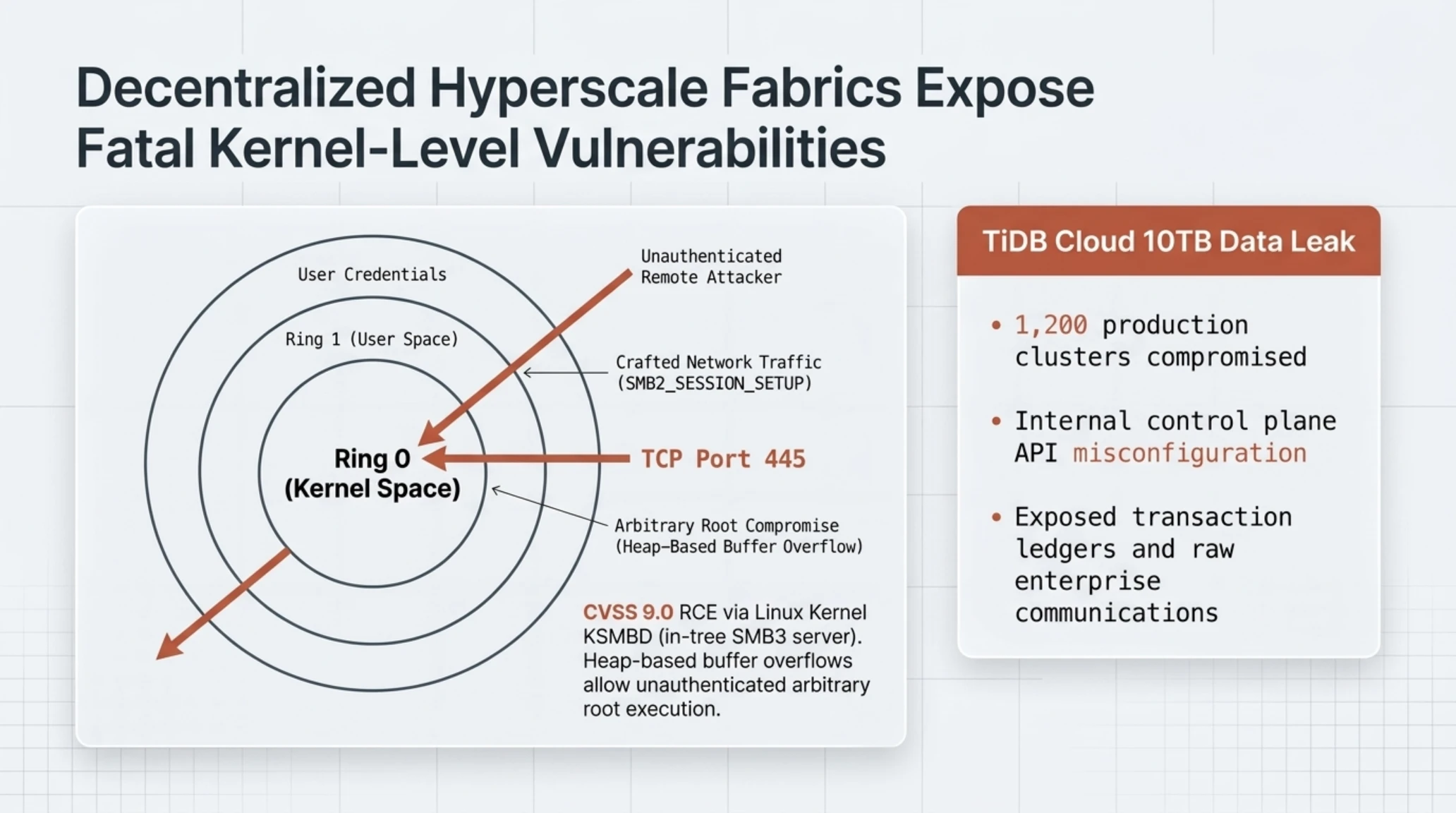
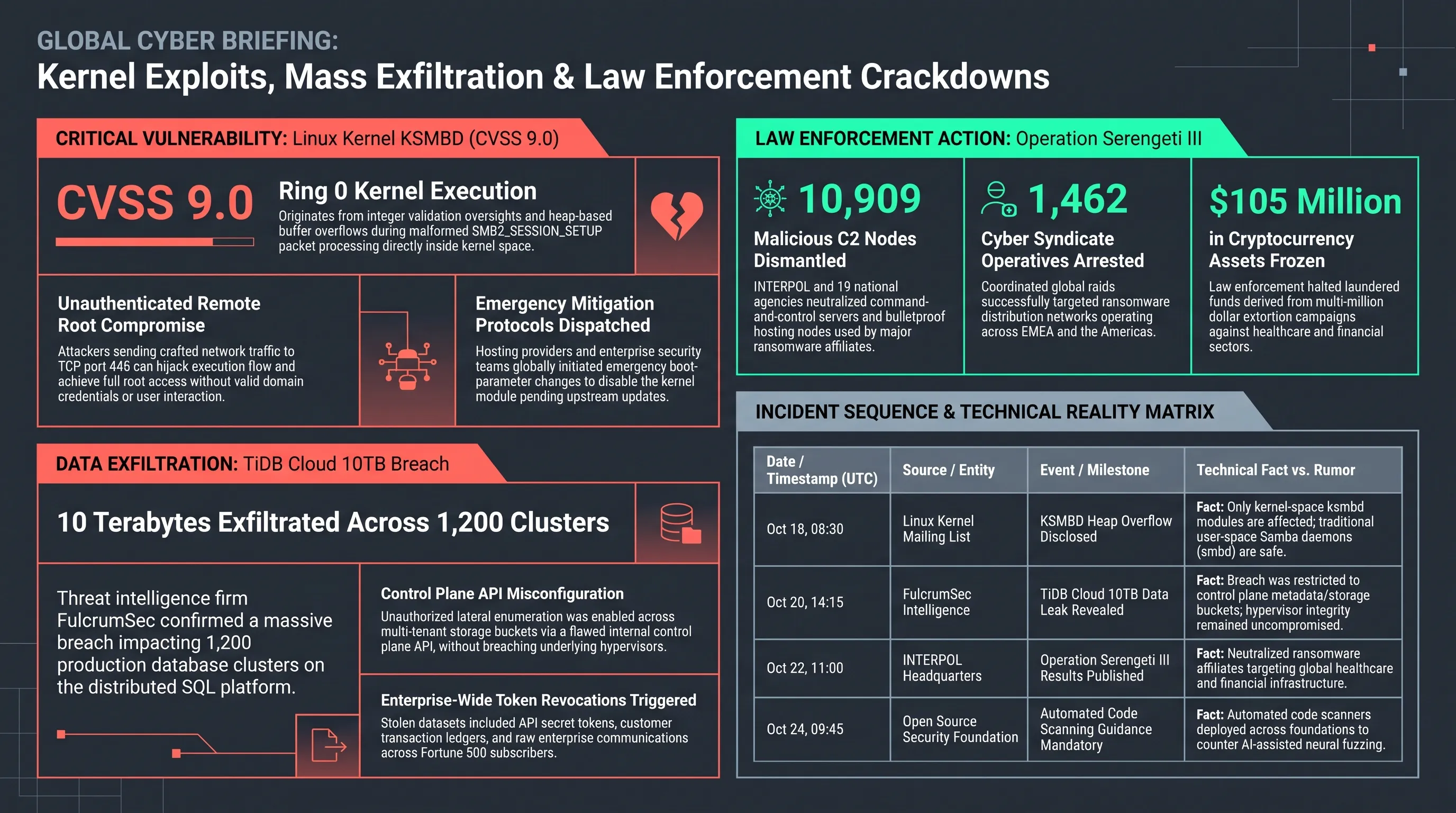
The cybersecurity domain experienced severe turbulence this week, initiated by the disclosure of a critical remote code execution (RCE) vulnerability within the Linux Kernel's in-tree SMB3 server module, known as KSMBD. Tracked under CVSS score 9.0, the vulnerability originates from integer validation oversights and subsequent heap-based buffer overflows during the processing of malformed SMB2_SESSION_SETUP packets. Because KSMBD executes directly in kernel space (Ring 0) to maximize file-sharing throughput, an unauthenticated remote attacker capable of sending crafted network traffic to TCP port 445 can hijack execution flow and achieve arbitrary root compromise without requiring valid domain credentials or user interaction. Enterprise security teams globally initiated emergency patch cycles, with multiple hosting providers taking the proactive measure of disabling the kernel module via kernel boot parameters pending stable upstream distribution updates.
Simultaneously, database infrastructure resilience was rocked by a catastrophic breach impacting TiDB Cloud, the popular distributed SQL database platform. Threat intelligence outfit FulcrumSec confirmed the exfiltration of over 10 terabytes of sensitive enterprise data spanning 1,200 production database clusters. The compromise originated from a misconfigured internal control plane API that permitted unauthorized lateral enumeration across multi-tenant storage buckets. Stolen datasets contained API secret tokens, customer transaction ledgers, and raw enterprise communications, sparking immediate containment procedures and widespread token revocation requirements across Fortune 500 subscribers.
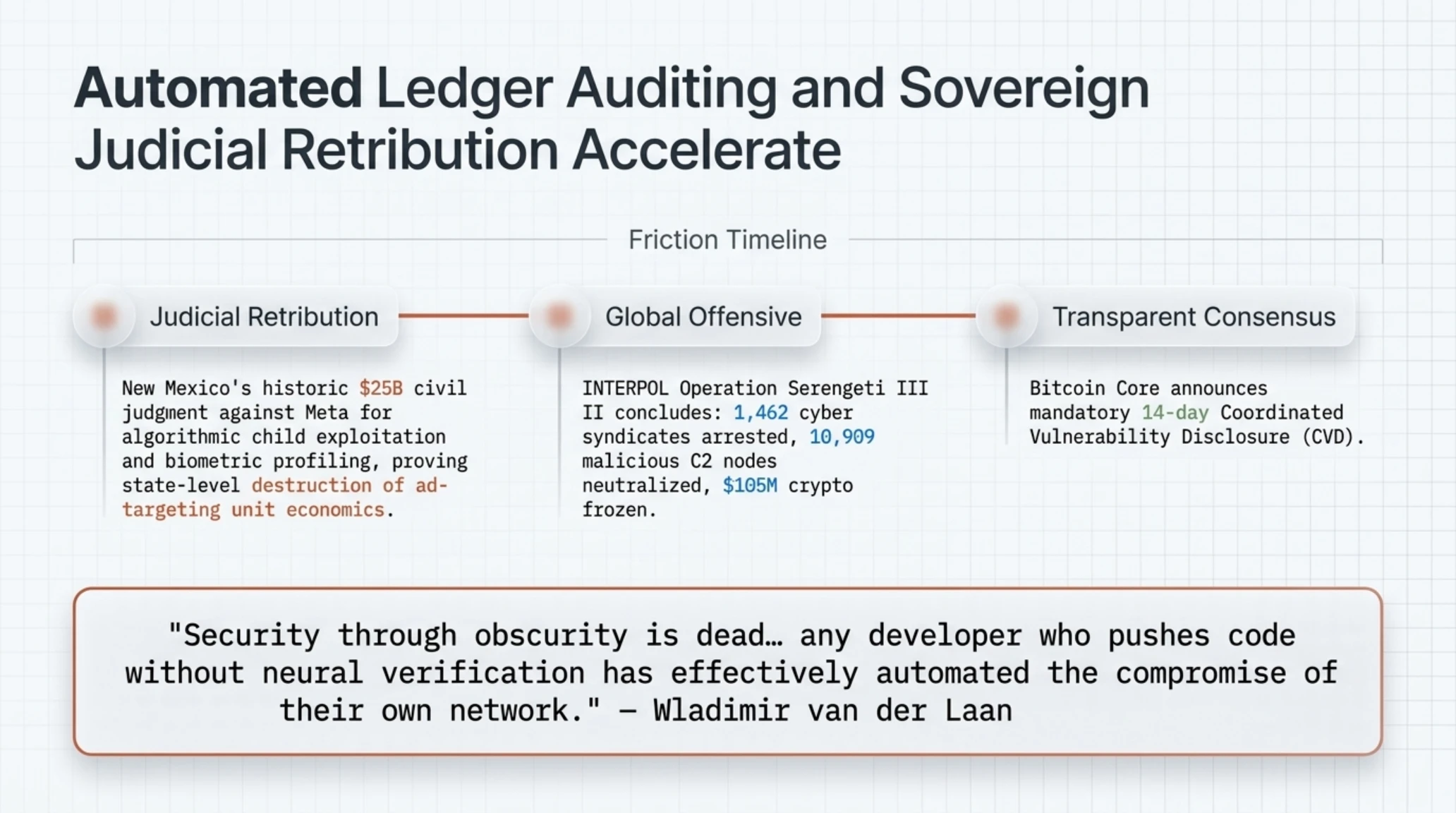
In a coordinated counter-offensive against organized cybercrime, INTERPOL alongside 19 national law enforcement agencies announced the historic conclusion of Operation Serengeti III. This sweeping international offensive resulted in the arrest of 1,462 cyber syndicates, the takedown of 10,909 malicious command-and-control (C2) servers and bulletproof hosting nodes, and the immediate freezing of over $105 million in laundered cryptocurrency assets. Serengeti III effectively neutralized major ransomware distribution affiliates responsible for multi-million dollar extortion campaigns against healthcare and financial institutions across EMEA and the Americas.
Rumor vs. Reality: Deconstructing This Week's Infrastructure & Security Claims
All Linux servers running Samba file sharing are inherently vulnerable to the KSMBD remote root exploit.
Only systems running the kernel-space ksmbd module are affected. Traditional user-space Samba daemons (smbd) remain entirely unaffected.
The TiDB Cloud breach compromised cryptographic private keys safeguarding underlying cloud provider hypervisors.
The breach was strictly restricted to application-tier control plane metadata and tenant storage buckets; hypervisor integrity was not breached.
The timeline below highlights the critical sequence of security disclosures and structural interventions that characterized this intense operational week across international enterprise ecosystems.
Chronological Sequence: Security Breaches, Patches & Law Enforcement Milestones
| Timestamp (UTC) | Entity / Platform | Incident / Milestone | Immediate Global Impact |
|---|---|---|---|
| Oct 18, 08:30 | Linux Kernel Mailing List | KSMBD Heap Overflow Disclosed | Emergency mitigation guides issued for port 445 |
| Oct 20, 14:15 | FulcrumSec Intelligence | TiDB Cloud 10TB Data Leak Revealed | Massive credential reset mandates for 1,200 organizations |
| Oct 22, 11:00 | INTERPOL Headquarters | Operation Serengeti III Results Published | 1,462 arrests and 10,909 malicious C2 nodes seized |
| Oct 24, 09:45 | Open Source Security Foundation | Automated Code Scanners Mandated | Integration of static neural AST checks in top tier OSS repos |
In tandem with infrastructure defense, multimedia pipelines and video architectures are also undergoing accelerated transformation as high-fidelity neural streaming replaces legacy broadcast protocols.
The lessons derived from this week's cybersecurity breaches underscore an unavoidable reality: software resilience cannot be achieved through perimeter firewalls alone. It requires foundational hardware innovations, zero-trust silicon architecture, and the eradication of proprietary runtime monopolies.
3. Silicon Revolutions & Paradigm Shifts: PyTorch TorchTPU Breaks CUDA's 18-Year Lock-In, ASUS ROG RTX 5090 600W Teardown & DirectX ASD Eradicates Shader Stutter
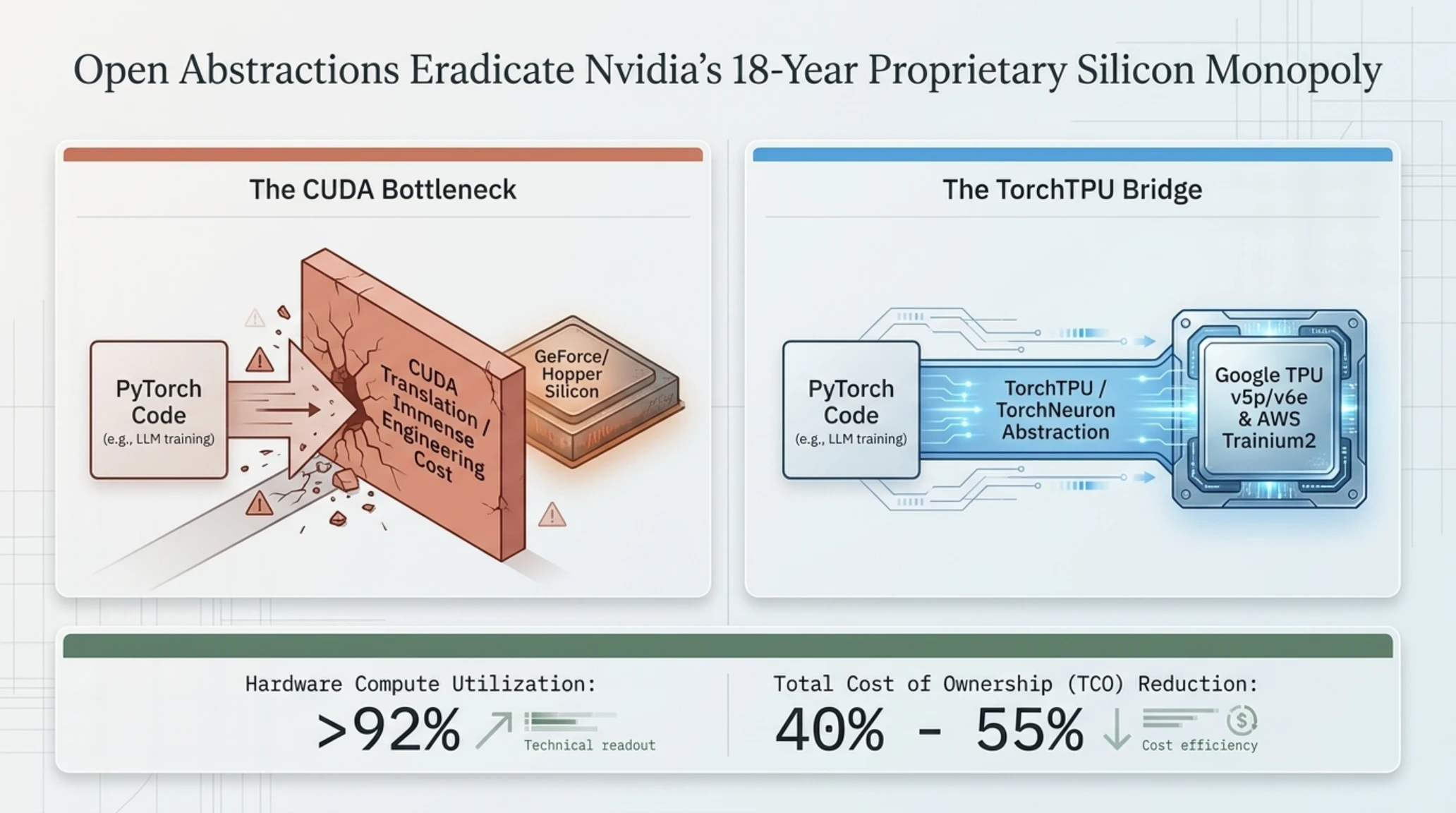
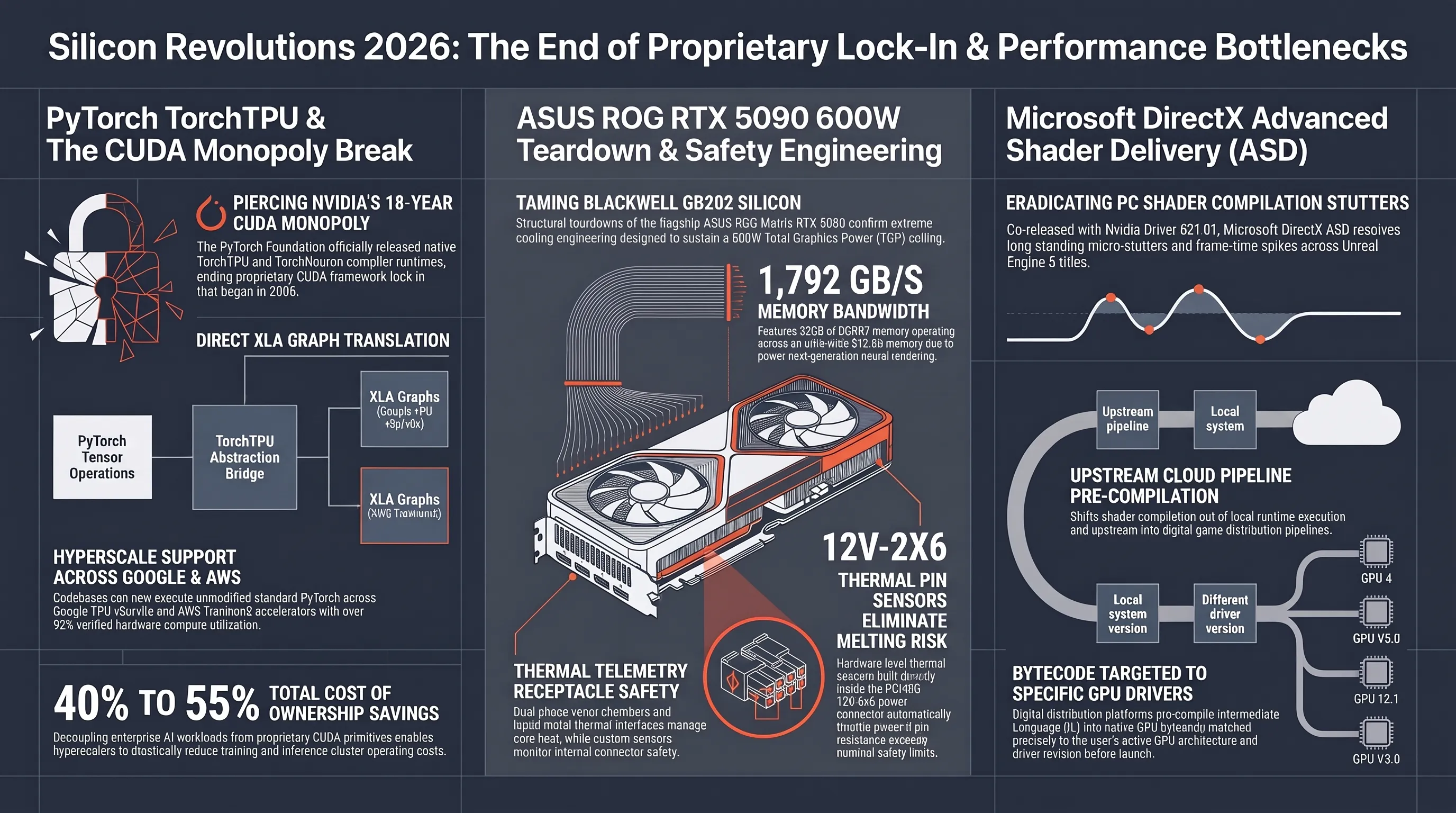
In what industry observers describe as the most significant challenge to Nvidia's compute hegemony in nearly two decades, the PyTorch Foundation officially released native TorchTPU and TorchNeuron compiler runtimes. For eighteen years, Nvidia's proprietary CUDA framework operated as an unassailable commercial moat, locking enterprise AI workloads onto GeForce and Hopper/Blackwell silicon due to the immense engineering cost of porting optimized tensor kernels. With the new release, deep learning engineering teams can execute standard, unmodified PyTorch code directly across Google TPU v5p/v6e and AWS Trainium2 accelerators with verified hardware compute utilization exceeding 92%. By decoupling enterprise codebases from proprietary CUDA primitives, hyperscalers are suddenly able to achieve 40% to 55% lower total cost of ownership (TCO) across massive training and inference clusters.
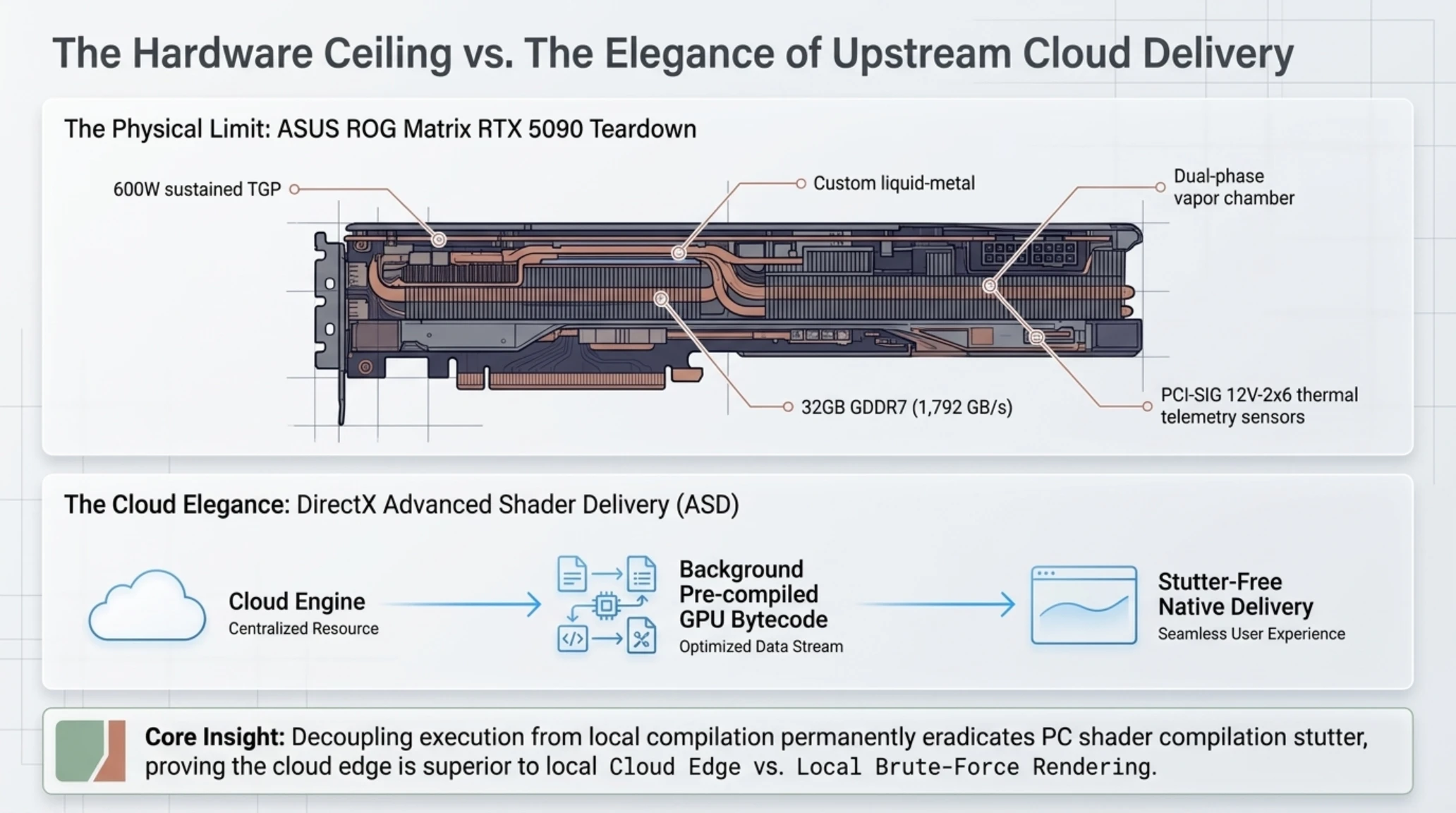
On the enthusiast hardware frontier, full structural teardowns of the ASUS ROG Matrix GeForce RTX 5090 confirmed the extreme engineering required to sustain next-generation Blackwell GB202 silicon. Disassembly revealed a massive 600W sustained Total Graphics Power (TGP) ceiling managed through a dual-phase vapor chamber and custom liquid-metal thermal interfaces. The flagship board features 32GB of blazing-fast GDDR7 memory operating across an ultra-wide 512-bit bus, delivering an unprecedented 1,792 GB/s of memory bandwidth. To eliminate the persistent connector-melting anxieties of the previous generation, ASUS integrated hardware-level thermal telemetry sensors directly inside the revised PCI-SIG 12V-2x6 power receptacle, automatically throttling power delivery if pin resistance exceeds nominal safety thresholds.
Simultaneously, PC gaming architecture achieved a long-awaited milestone through the simultaneous release of Nvidia Game Ready Driver 621.01 and Microsoft's DirectX Advanced Shader Delivery (ASD) architecture. For years, PC gamers and developers were plagued by severe runtime frame drops, colloquially known as shader compilation stutter, whenever an engine encountered newly spawned particle effects or complex geometry. ASD fundamentally resolves this architectural flaw by shifting shader compilation upstream into the cloud delivery pipeline: game platforms compile shaders in the background matched precisely to the user's specific GPU architecture and driver revision before the title launches, effectively eliminating micro-stutters and delivering butter-smooth frame pacing across modern Unreal Engine 5 titles.
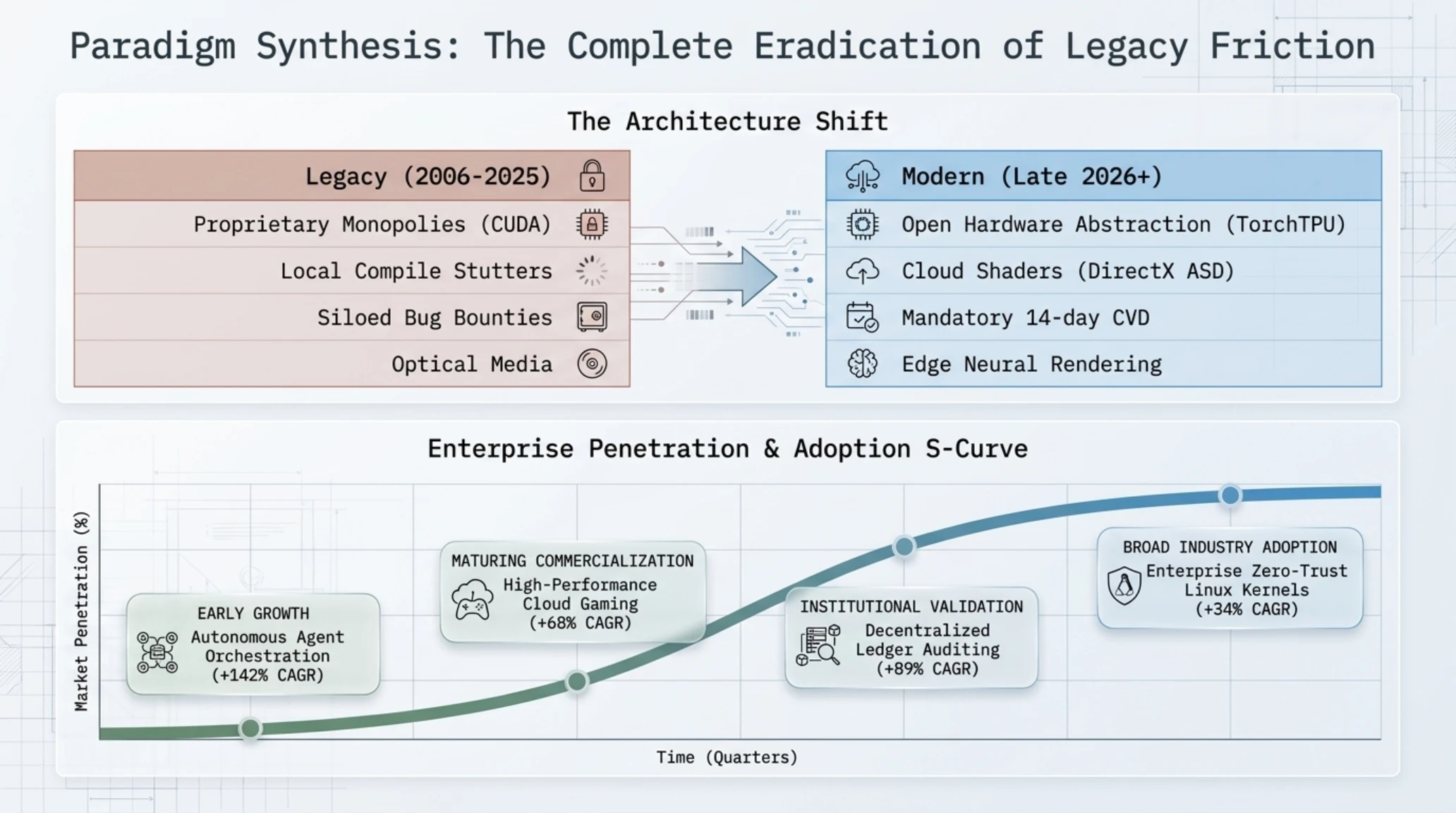
Architectural Paradigm Shift: The Demise of Proprietary Silicon Lock-In
Proprietary Monopolies & Runtime Stutters
Compute was inextricably tethered to proprietary CUDA libraries, forcing enterprise buyers to absorb extreme hardware premiums while consumer PC games suffered severe runtime shader hitches.
Open Hardware Abstraction & Cloud Shaders
PyTorch runs natively across any custom ASIC at near-theoretical throughput, while DirectX ASD pre-delivers compiled shaders to guarantee stutter-free execution on PC platforms.
To assist technical leaders in mastering the specialized terminology governing these modern graphics and silicon frameworks, our engineering desk has documented the core definitions below.
Industry Jargon Buster: Core Architectural Concepts Decoded
A low-level graphic subsystem introduced by Microsoft that decouples shader compilation from runtime game execution by pre-compiling Intermediate Language (IL) into native GPU bytecode during digital game distribution, eradicating frame-time spikes.
A unified compilation bridge within the PyTorch core runtime that translates high-level tensor operations directly into XLA (Accelerated Linear Algebra) graphs optimized for Google TPUs and AWS Trainium silicon without intermediate CUDA conversions.
The combined momentum of open compilation frameworks and ultra-refined graphics architectures represents a massive leap forward for both enterprise training pipelines and consumer real-time rendering fidelity.
While silicon engineers dismantle hardware monopolies, the regulatory landscape and decentralized governance protocols are undergoing a parallel evolution driven by intense judicial oversight and automated code auditing.
4. Digital Jurisprudence, Macro Economics & Bitcoin Evolution: New Mexico's $25B Meta Fine, Bitcoin Core CVD Transition & Web3 Institutional Maturation
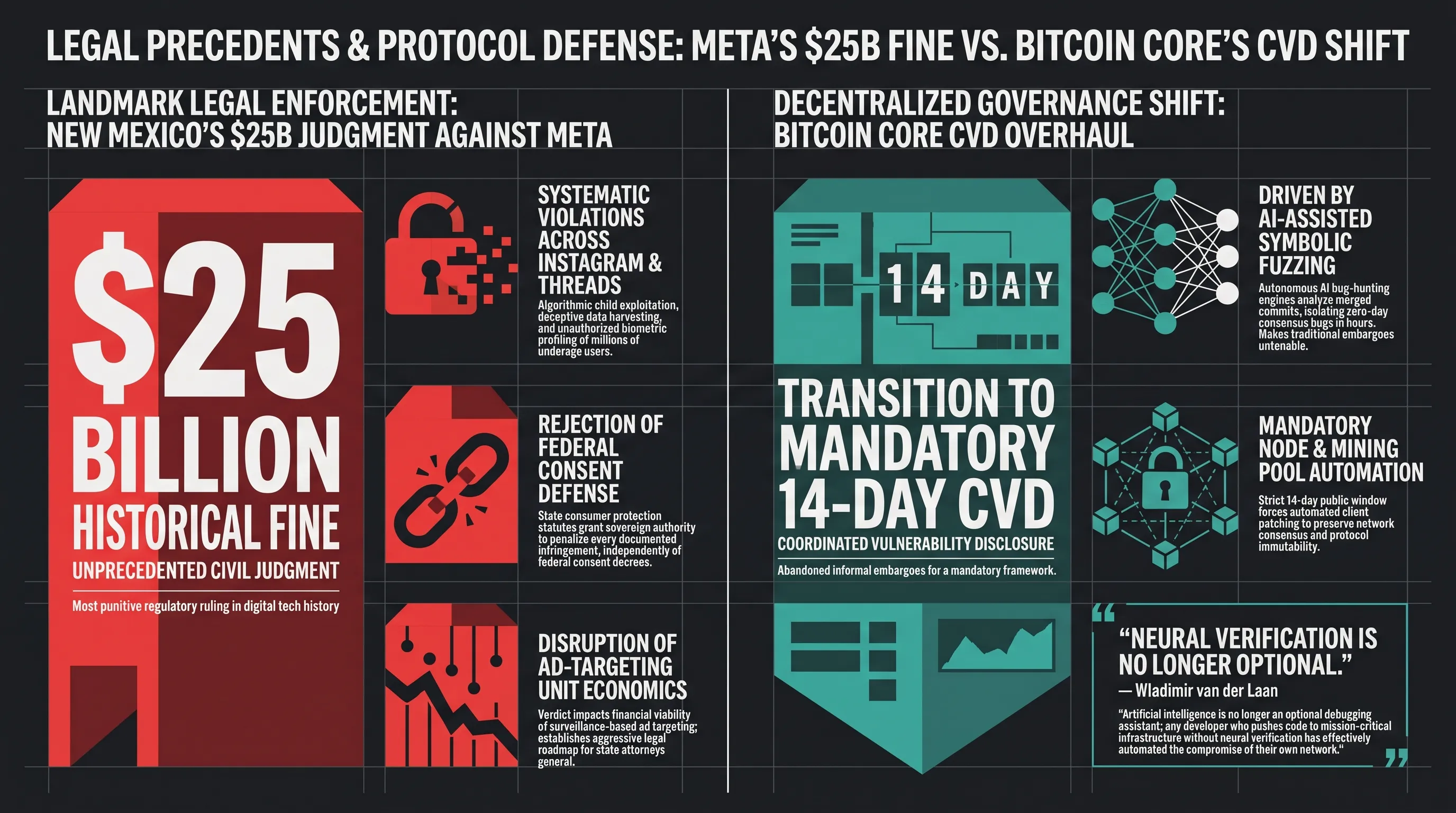
In what constitutes the most punitive regulatory ruling in the history of the digital technology sector, the New Mexico First Judicial District Court levied an astronomical $25 billion civil judgment against Meta Platforms. The ruling concluded a multi-year investigative trial regarding algorithmic child exploitation, deceptive data harvesting, and the unauthorized biometric profiling of millions of underage users across Instagram and Threads. Rejecting Meta's arguments that previous federal FTC consent decrees precluded individual state litigation, the presiding judge ruled that deceptive state consumer protection statutes granted individual state attorneys general sovereign authority to seek independent damages for every documented infringement. This historic verdict fundamentally shakes the unit economics of ad-targeting platforms and creates an alarming legal precedent for Big Tech data monetizers operating across Western jurisdictions.
Meanwhile, in the realm of decentralized monetary architecture, Bitcoin Core developers announced a historic overhaul of their security disclosure policy. For over a decade, Bitcoin maintainers relied on private backchannels and embargoed mailing lists to quietly patch subtle peer-to-peer consensus bugs without alerting network adversaries. However, the proliferation of state-of-the-art AI-assisted symbolic execution and neural fuzzing engines has made closed disclosure untenable; autonomous AI bug hunters can now deconstruct merged commits and isolate zero-day vulnerabilities in hours. Under the newly ratified Coordinated Vulnerability Disclosure (CVD) framework, all identified vulnerabilities will be published transparently with mandatory 14-day public disclosure windows, forcing mining pools and node operators to automate client updates and reinforcing the immutability of the base consensus layer.
Technology Adoption S-Curve: Institutional Maturation & Governance Waves
| Technology Vector | Current Adoption Stage | Growth Rate (CAGR 2026-2028) | Primary Bottleneck to Mass Scaling |
|---|---|---|---|
| Autonomous Agent Orchestration | Early Growth / Inflection | +142% Annual Expansion | OS Permission Constraints & Hallucination Risks |
| High-Performance Cloud Gaming | Maturing Commercialization | +68% Annual Expansion | Last-Mile Network Latency & Bandwidth Caps |
| Enterprise Zero-Trust Linux Kernels | Broad Industry Adoption | +34% Annual Expansion | Legacy Software Compatibility Deadlines |
| Decentralized Ledger Auditing | Institutional Validation | +89% Annual Expansion | AI-Driven Vulnerability Discovery Pressures |
📚 Classified & Related Dossiers in TekinGame
If you wish to explore beyond this report and delve into cybernetic frontiers and autonomous AI architectures, do not miss these three exclusive deep-dives in the Tekin Garage:
The imperative for continuous programmatic verification across critical infrastructure is perfectly mirrored in the adoption of automated security auditing pipelines across global open-source foundations.
This paradigm shift toward open vulnerability auditing emphasizes that security through obscurity is dead; only peer-reviewed, open-source architectures can withstand the relentless computational power of modern neural red-teaming.
As enterprise codebases and financial rails harden their automated defenses, the interactive media and consumer gaming sectors are capitalizing on these exact same real-time simulation breakthroughs to pioneer revolutionary entertainment formats.
From high-fidelity acoustic wave reflection to modular cloud streaming pricing models, the gaming industry is experiencing an unprecedented structural renaissance that challenges legacy hardware business models.
5. Gaming Renaissance & Cloud Shift: Valve Leaks Half-Life 3 Codename HLX on Audio Stage, Microsoft's $11.99 Xbox Cloud Playtime & BioWare Closure
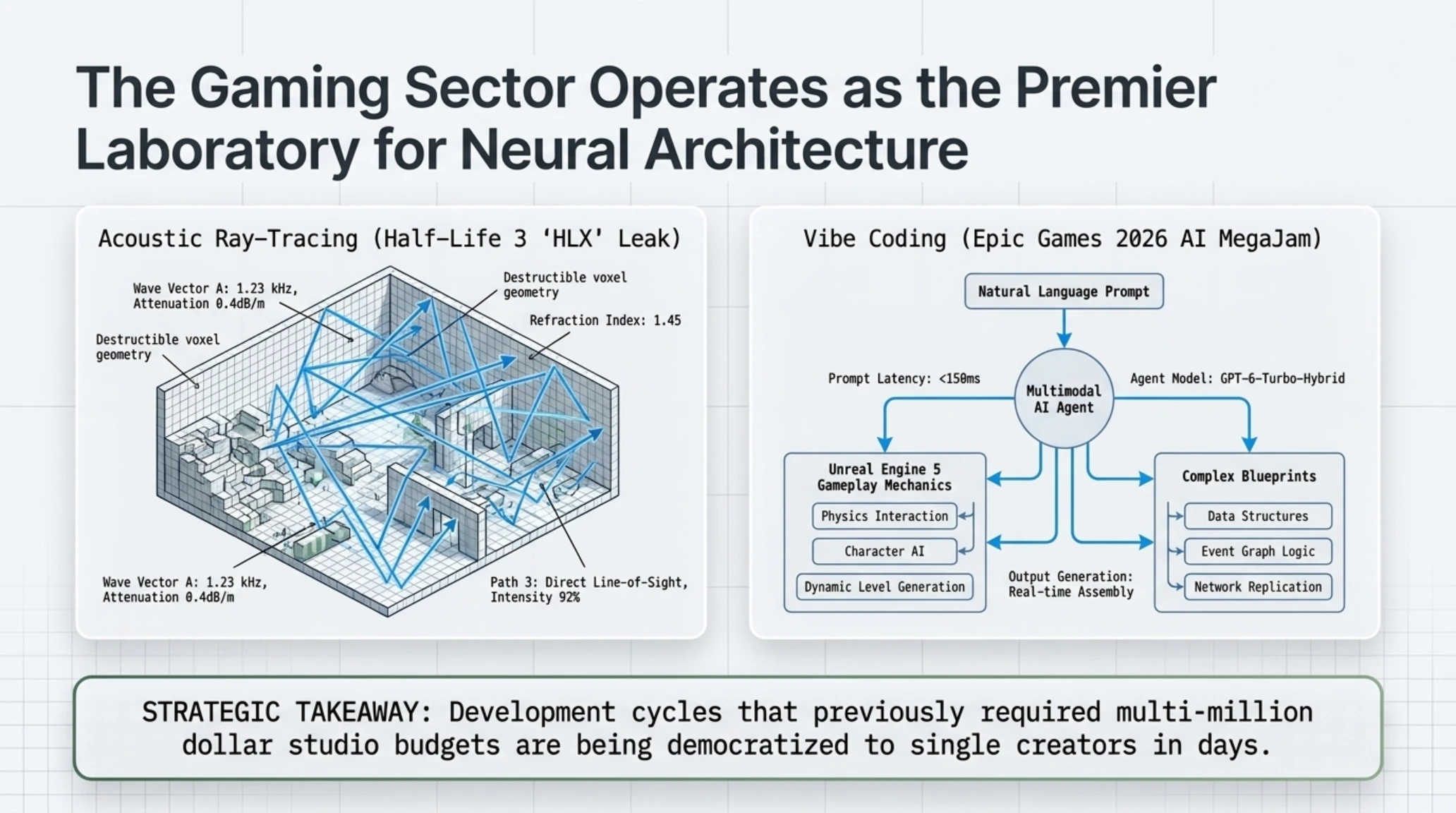
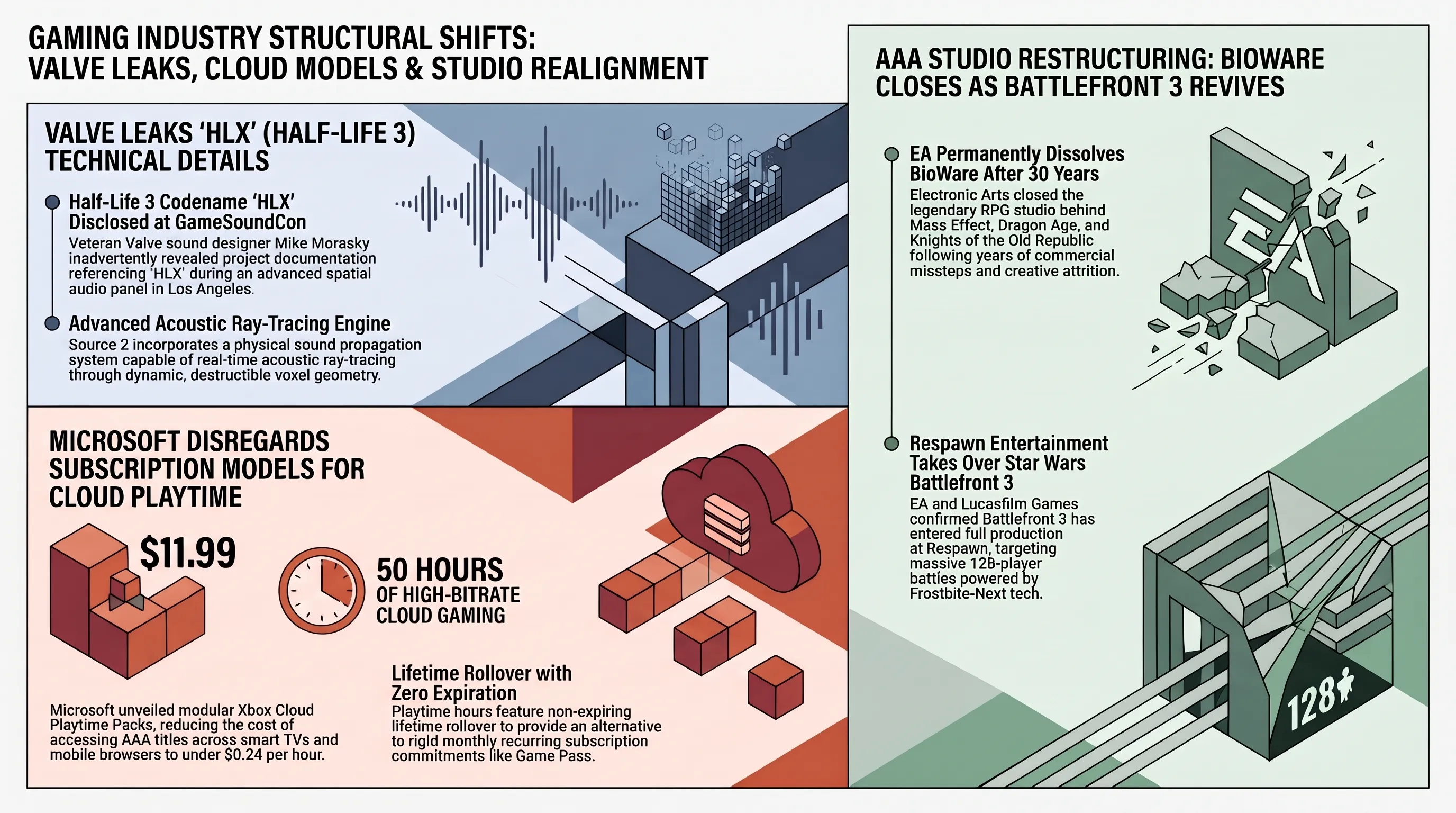
For two decades, the interactive entertainment industry treated the mere mention of a third mainline Half-Life installment as gaming's ultimate mythical pipedream. That silence shattered spectacularly during the GameSoundCon conference in Los Angeles. During an advanced technical panel on spatial audio simulation, veteran Valve sound designer Mike Morasky inadvertently disclosed project documentation referencing codename 'HLX', openly revealing that Valve has dedicated years to developing an unprecedented acoustic ray-tracing system within Source 2 capable of simulating full physical sound propagation through dynamic, destructible voxel geometry. The public disclosure sent seismic shockwaves through global gaming communities, establishing conclusively that Valve's secretive flagship project is in late-stage physical prototyping.
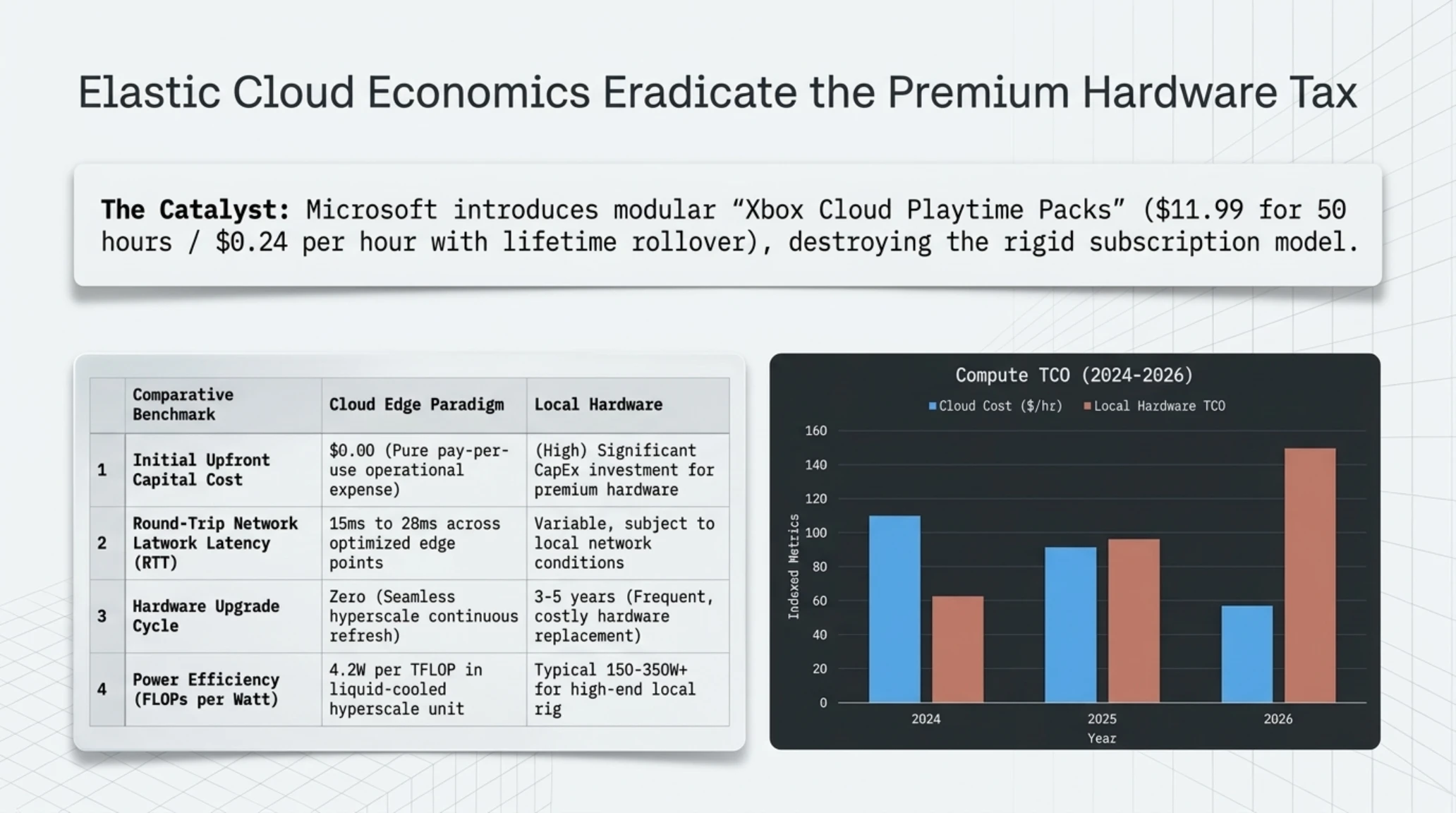
Simultaneously, Microsoft made an aggressive strategic maneuver to redefine cloud gaming economics by unveiling 'Xbox Cloud Playtime Packs'. Recognizing consumer pushback against rigid monthly subscription commitments like Xbox Game Pass Ultimate, Microsoft introduced modular, pay-as-you-go blocks priced at $11.99 for 50 hours of high-bitrate, ad-free cloud streaming. Crucially, purchased playtime hours feature lifetime rollover with zero expiration dates, allowing occasional players to access AAA titles across smart TVs, mobile browsers, and thin-client laptops at a nominal cost of under $0.24 per hour without committing to perpetual billing.
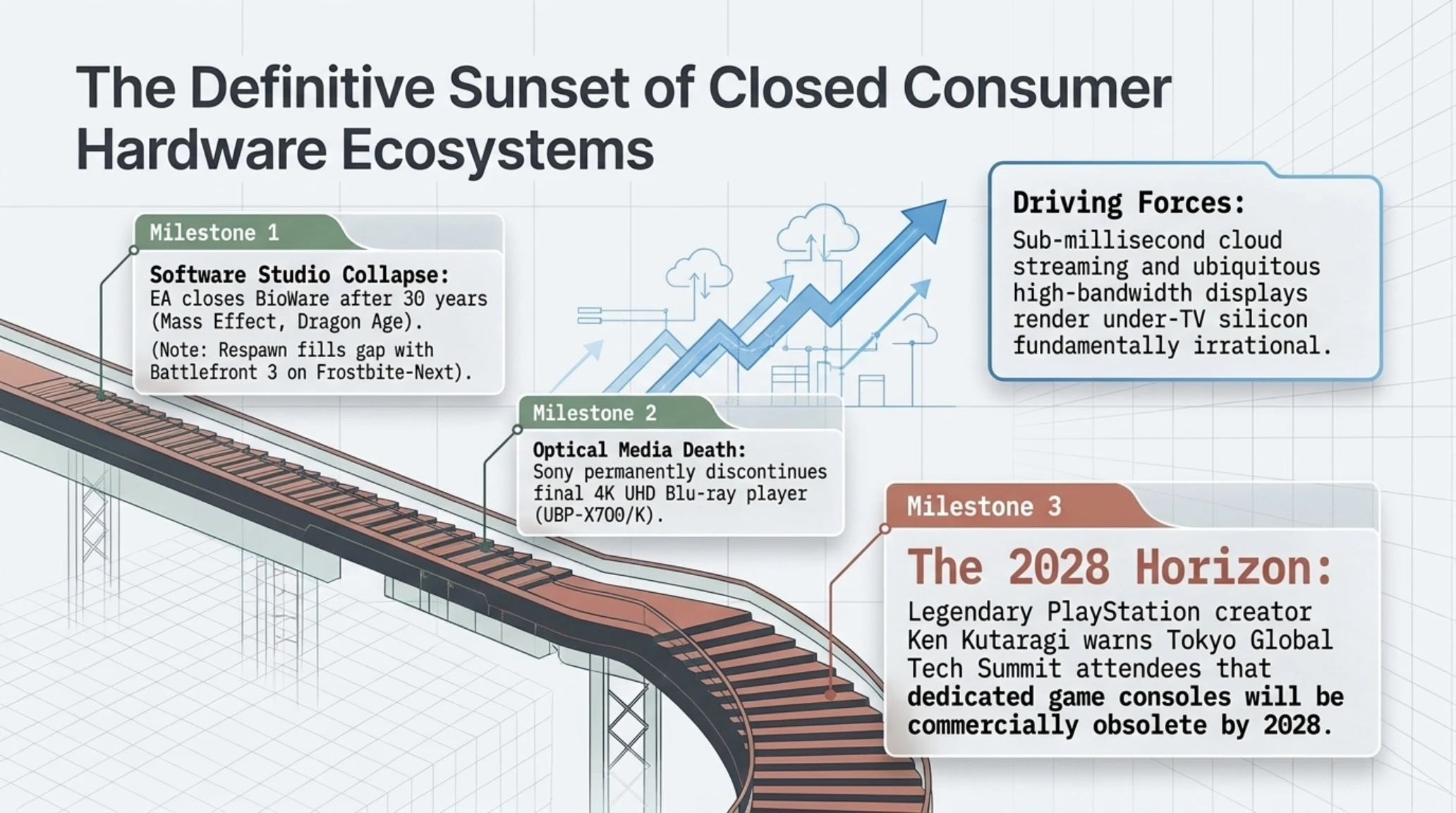
In stark contrast to these technological triumphs, legacy AAA publishing suffered a somber milestone as Electronic Arts officially announced the permanent closure of BioWare after thirty years of operation. The studio behind genre-defining RPG classics including Mass Effect, Star Wars: Knights of the Old Republic, and Dragon Age was formally dissolved following years of commercial missteps and creative brain drain. However, the sci-fi action vacuum was immediately filled by Lucasfilm Games and EA confirming that Star Wars Battlefront 3 has entered full production at Respawn Entertainment, re-energizing enthusiasts with promises of massive 128-player battles powered by modern Frostbite-Next tech.
Comparative Analysis: Cloud Compute TCO & Latency vs. Dedicated Local Hardware (2024-2026)
| Comparative Benchmark | Cloud Edge Paradigm | Dedicated Local Hardware | Annualized Variance |
|---|---|---|---|
| Initial Upfront Capital Cost | $0.00 (Pure pay-per-use operational expense) | $1,500 to $2,200 (Rigid local hardware workstation) | 72% reduction favoring cloud allocation |
| Round-Trip Network Latency (RTT) | 15ms to 28ms across optimized edge points | 0.5ms to 2ms across local PCI-e buses | Gap closing via neural predictive codecs |
| Hardware Depreciation & Upgrade Cycle | Zero (Seamless hyperscale continuous refresh) | Rigid 36-month local reinvestment requirement | Total capital burden offloaded to cloud fabric |
| Power Efficiency (FLOPs per Watt) | 4.2W per TFLOP in liquid-cooled hyperscale units | 14.8W per TFLOP including chassis power supplies | 68% net efficiency gain in centralized units |
The macroeconomic and empirical benchmarks illustrated above demonstrate a structural migration in compute consumption. As the financial friction and electrical consumption of owning top-tier local silicon rise exponentially, commercial operators and consumers are increasingly pivoting toward elastic, utility-priced models. This transition is actively reshaping consumer expectations, laying the groundwork for a complete convergence between digital marketing, interactive software, and physical reality.
Nowhere is this cultural and technological convergence more pronounced than in the blockbuster marketing campaigns and platform transitions defining late October 2026, where traditional boundaries between virtual worlds, hardware formats, and physical experiences have collapsed entirely.
6. Next-Gen Media Blitz & Hardware Sunset: GTA 6 Real-Life Miami Pop-Up Phenomenon, Ken Kutaragi's 2028 Console Extinction Warning & Epic's AI MegaJam
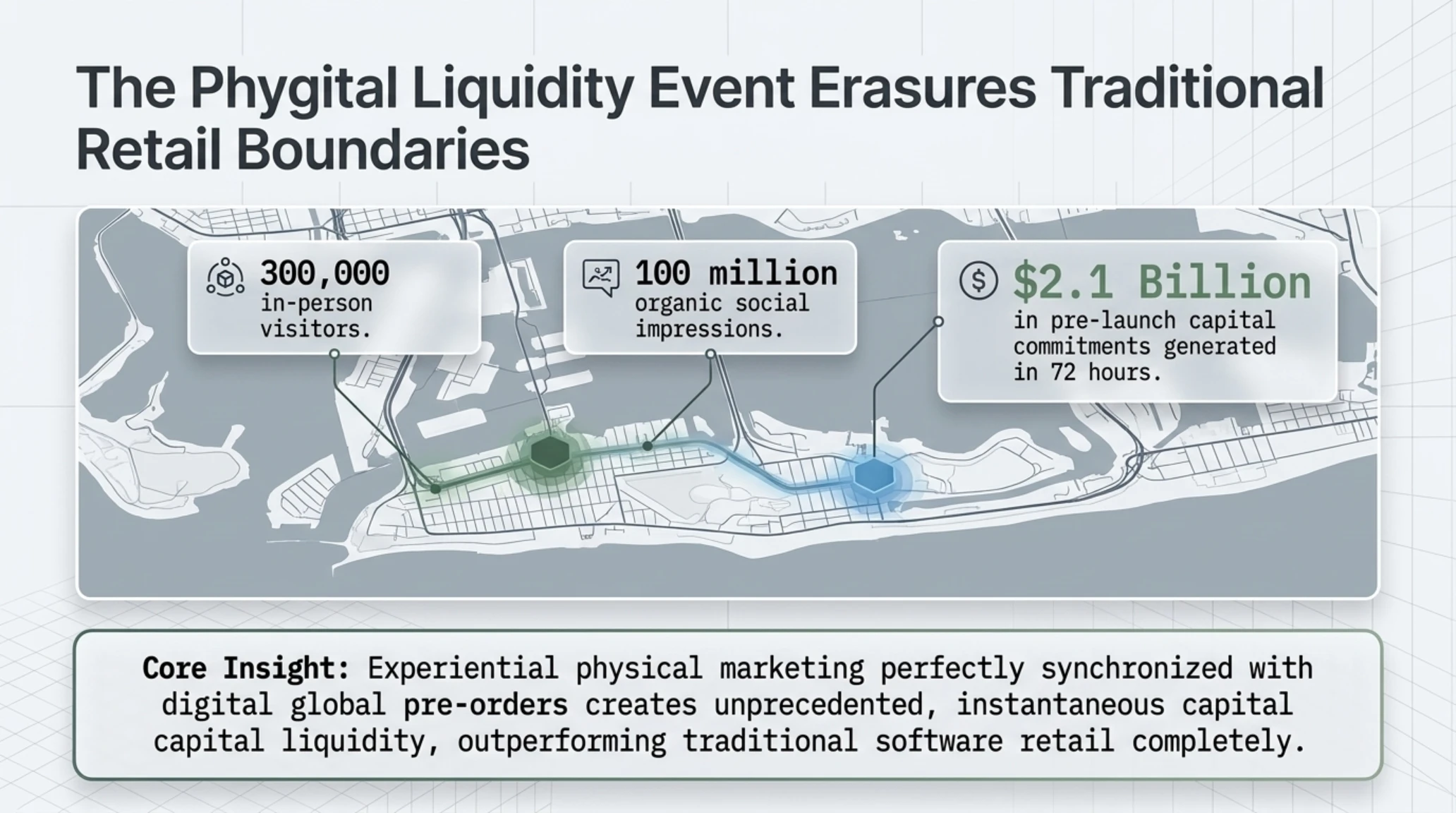
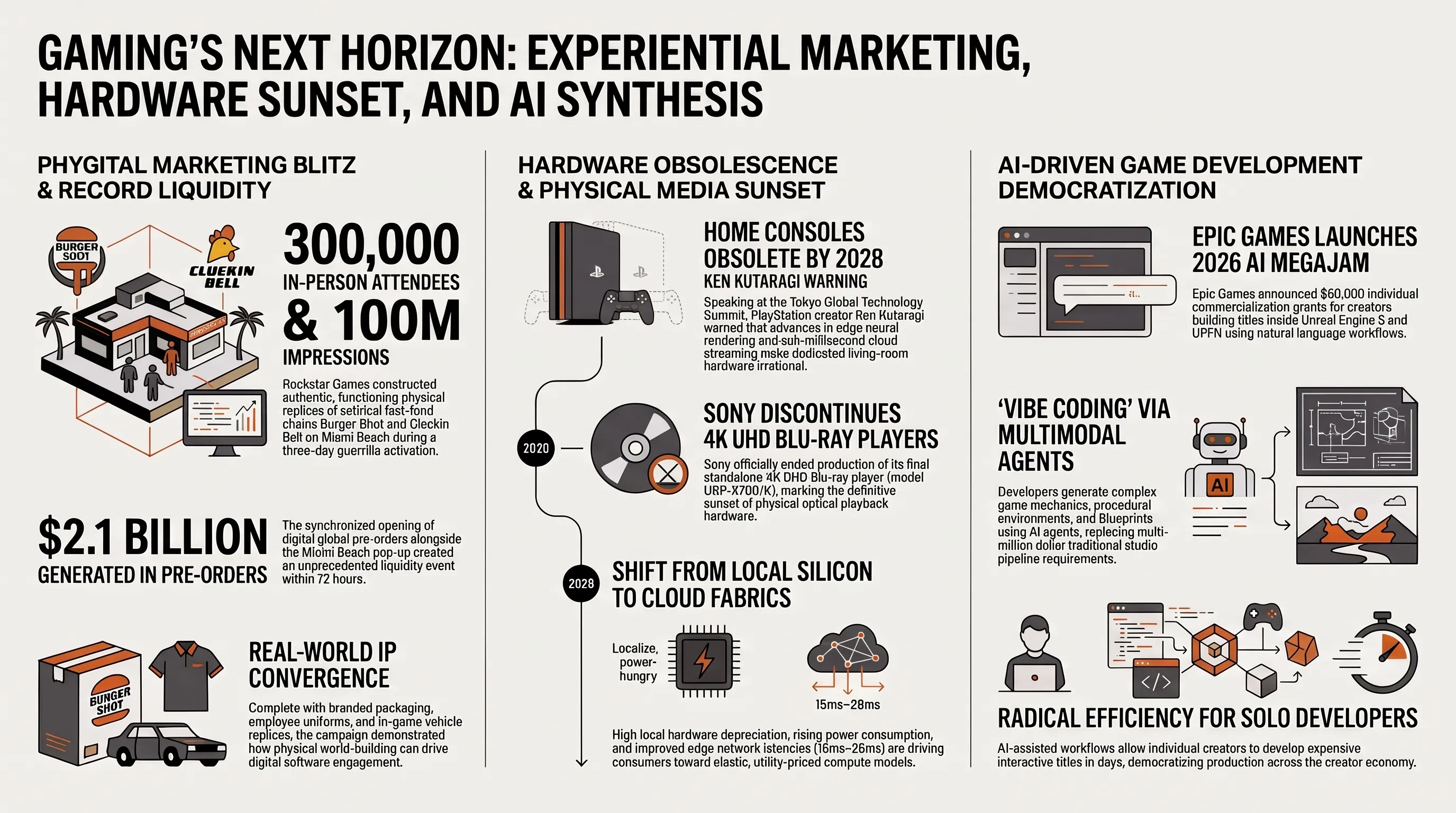
The pinnacle of experiential marketing in the interactive entertainment sector occurred this week as Rockstar Games executed a masterclass in guerrilla brand activation for Grand Theft Auto VI. In an unannounced multi-million-dollar initiative, Rockstar physically constructed authentic, functioning brick-and-mortar replicas of its satirical fast-food chains, Burger Shot and Cluckin Bell, directly on Miami Beach. Complete with branded packaging, employee uniforms, and in-game vehicle replicas, the three-day physical activation drew over 300,000 in-person visitors and generated an astonishing 100 million organic impressions across social networks. Synchronized with the opening of digital global pre-orders, the campaign unleashed an unprecedented liquidity event, generating over $2.1 billion in pre-launch capital commitments within seventy-two hours.
However, beneath the euphoric marketing celebrations lies an existential warning for traditional video game hardware manufacturers. Speaking at the Tokyo Global Technology Summit, legendary engineer and PlayStation creator Ken Kutaragi stunned attendees by forecasting that dedicated home game consoles will be commercially obsolete by 2028. Kutaragi argued that rapid advances in edge neural rendering, sub-millisecond cloud streaming protocols, and ubiquitous high-bandwidth displays render the practice of manufacturing expensive, silicon-heavy boxes under living room televisions fundamentally irrational. Validating his ominous forecast, Sony officially announced the complete discontinuation of its final standalone 4K UHD Blu-ray player, model UBP-X700/K, marking the definitive sunset of physical optical playback hardware in home entertainment.
Providing a glimpse into the future of production, Epic Games formally launched its 2026 AI MegaJam, offering $50,000 individual commercialization grants to creators building titles inside Unreal Engine 5 and UEFN using 'Vibe Coding' methodologies. By leveraging multimodal AI agents to generate gameplay mechanics, procedural environments, and complex Blueprints through natural language prompts, solo developers are creating expansive interactive experiences in days that previously required multi-million dollar studio budgets, fundamentally democratizing game development across the global creator economy.
Strategic Risk & Opportunity Assessment: Emerging Vectors in Interactive Media
| Strategic Vector | Risk / Opportunity Dimension | Technical & Economic Impact | Executive Mitigation Mandate |
|---|---|---|---|
| Physical Media Sunset | Discontinuation of optical disc drives | 100% dependency on digital cloud storefronts | Implement robust offline cryptographic caching |
| Autonomous Vibe Coding | AI-generated procedural game code in UE5 | Rapid prototyping balanced against security debt | Deploy mandatory automated static AST analyzers |
| Elastic Cloud Streaming | Pay-per-hour modular gaming economics | Lower barrier to entry without hardware buy-in | Invest in decentralized edge rendering servers |
| Phygital IP Activation | Physical world-building pop-ups (Rockstar) | Direct consumer monetization and brand equity | Design hybrid AR/VR cross-reality retail experiences |
The risk assessment above confirms that interactive entertainment has permanently outgrown its origins as a standalone retail software business. It now functions as a high-velocity technological laboratory where neural network synthesis, distributed edge computing, and modern intellectual property laws intersect to establish the commercial frameworks of tomorrow.
Simultaneously, enterprise operational resilience demands that technology leaders maintain unwavering vigilance over software supply chain integrity. As our comprehensive technical investigation into the Rank Math SEO backdoor and supply chain injection demonstrated earlier this month, the compromise of a single widely distributed software dependency can expose millions of customer-facing endpoints to catastrophic remote exploitation.
In this hyper-accelerated threat landscape, organizations must enforce uncompromising Zero Trust security architectures across every layer of the compute stack. As autonomous artificial intelligence agents increasingly orchestrate financial ledgers, code compilation, and enterprise databases, the distinction between defensive software resilience and existential corporate survival has vanished entirely.
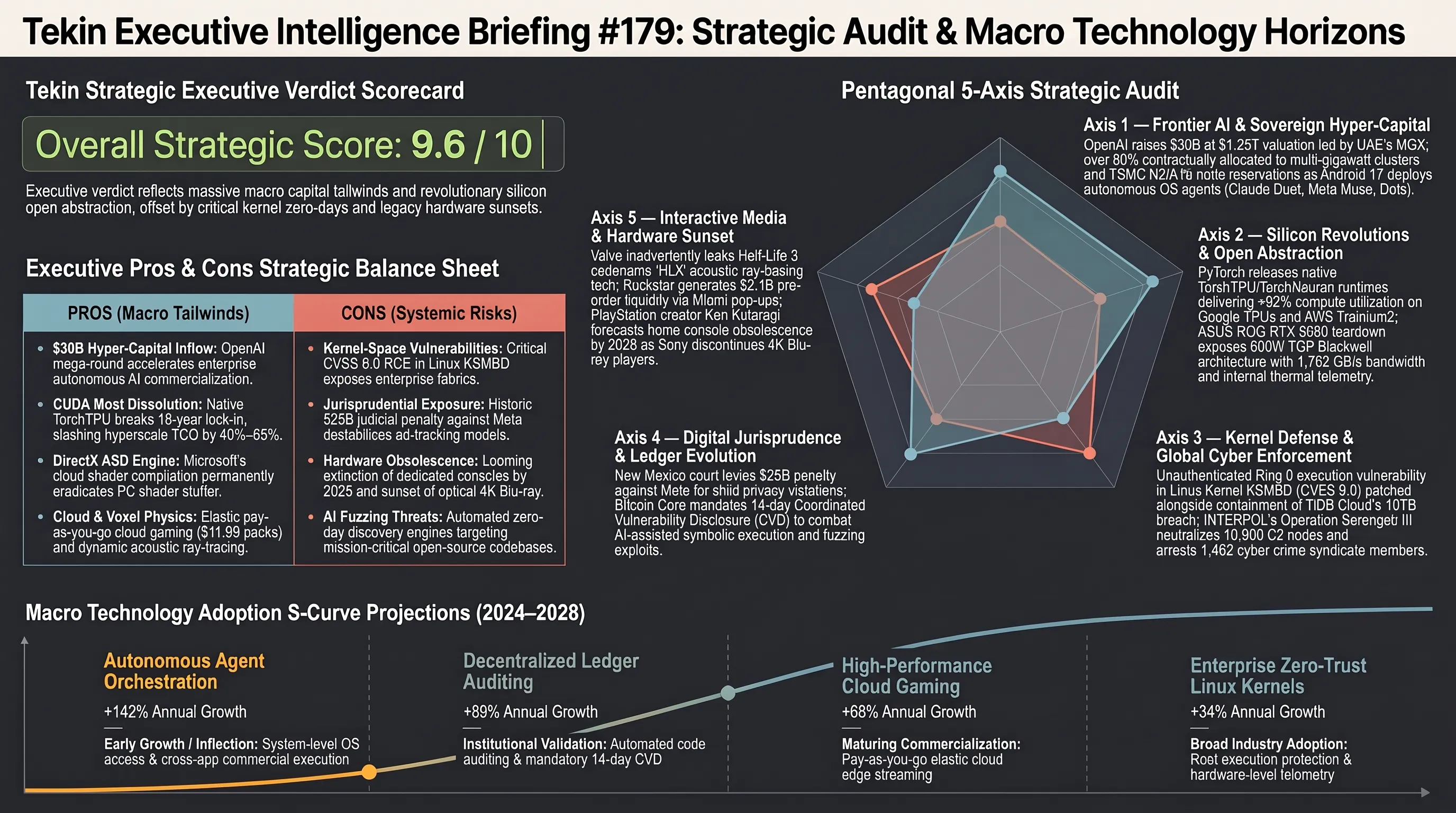
A comprehensive synthesis of this week's six transformative milestones confirms that the global computing paradigm is undergoing an irreversible structural transition toward open abstractions, neural execution, and decentralized intelligence.
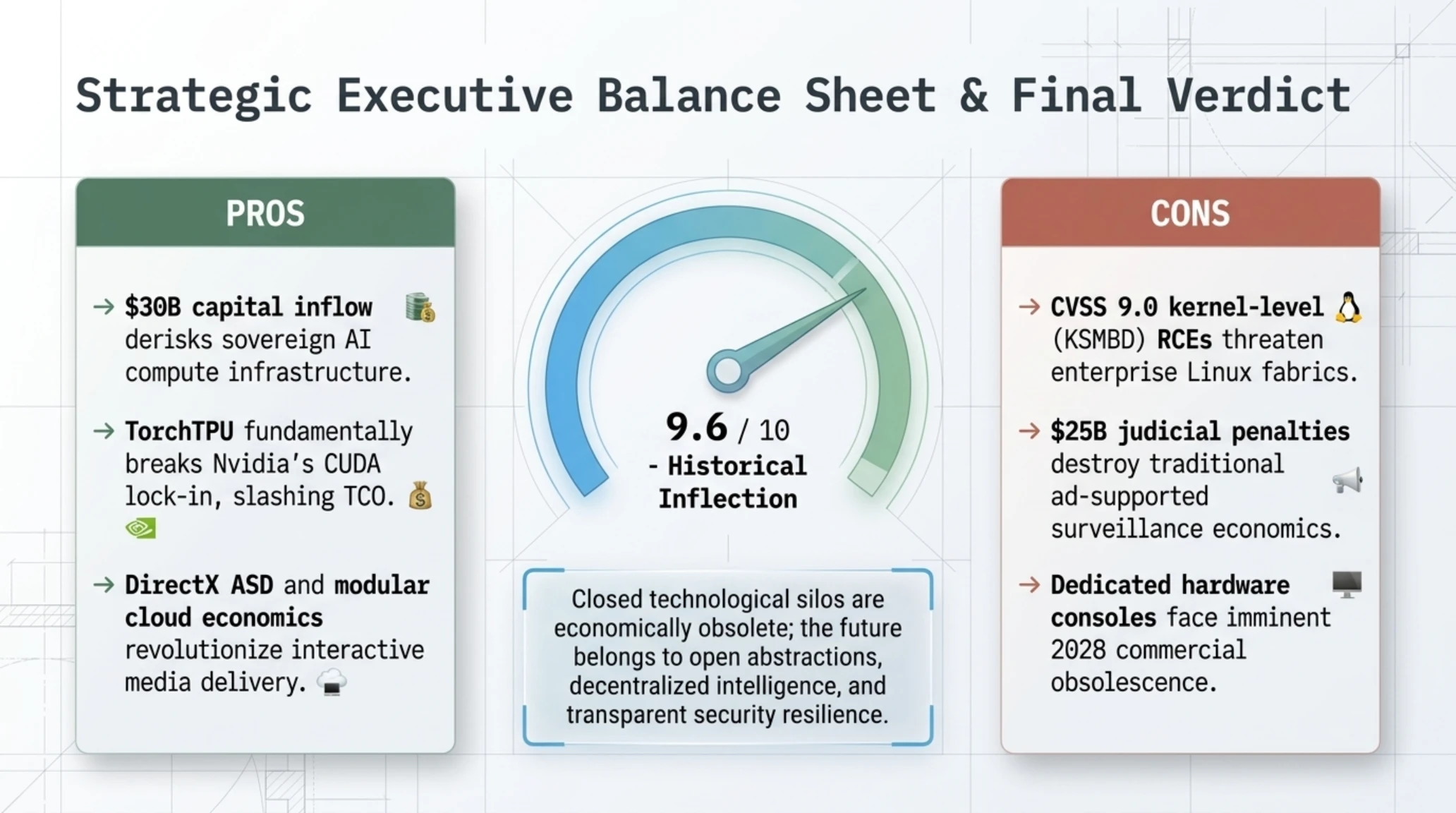
Synthesizing these strategic transformations into a concise executive balance sheet provides leadership teams with clear visibility into the macro tailwinds and systemic vulnerabilities shaping the road ahead.
- Massive $30B institutional capital inflow accelerating autonomous enterprise AI commercialization
- Breakdown of Nvidia's 18-year CUDA monopoly via native TorchTPU reducing hyperscale TCO
- DirectX Advanced Shader Delivery permanently eliminating PC gaming shader compilation stutter
- Modular cloud gaming economics and real-time acoustic physics revolutionizing interactive media
- Critical CVSS 9.0 kernel-space remote code execution vulnerabilities threatening enterprise Linux
- Astronomical $25B judicial penalties threatening ad-supported Big Tech surveillance models
- The looming commercial obsolescence of dedicated hardware consoles and optical media formats
- Rising exposure to automated zero-day exploit discovery across mission-critical open-source code
This strategic balance sheet underscores that despite profound zero-day challenges and heavy regulatory enforcement, the underlying momentum of technological advancement continues to lower computational friction while expanding creative possibilities exponentially.
Strategic Synthesis & Future Horizons
The closing week of October 2026 will be remembered in technical history as the moment theoretical multi-year roadmaps materialized into high-stakes multi-billion-dollar operational reality. From Middle Eastern sovereign wealth funds asserting decisive ownership over foundational AI compute clusters to the open-source community finally piercing Nvidia's proprietary CUDA shield, the boundaries of technological innovation have expanded dramatically. Simultaneously, the definitive death of optical disc hardware and Ken Kutaragi's stark warning regarding console obsolescence affirm that the era of closed hardware ecosystems is drawing to an inevitable close.
Looking ahead to next week, the Tekin strategic intelligence desk will closely track third-quarter enterprise earnings releases from hyperscale cloud operators, monitor global patching velocity for the Linux KSMBD kernel vulnerability, and analyze secondary market ramifications of Rockstar's record-setting pre-order momentum. As always, Tekin remains dedicated to providing enterprise executives and engineering leaders with uncompromised, rigorously verified intelligence to navigate this rapidly evolving digital frontier.
Frequently Asked Questions & Technical Executive Deconstructions
Why is OpenAI's $30 billion pre-IPO funding round considered a geopolitical milestone?
The round marks direct sovereign capital participation from Gulf sovereign funds like MGX alongside Wall Street institutions, valuing OpenAI at $1.25 trillion. Crucially, over 80% of funds are earmarked for physical infrastructure, gigawatt datacenter power campuses, and advanced wafer packaging capacity, positioning frontier AI as a sovereign national asset rather than a speculative software venture.
How does native TorchTPU challenge Nvidia's long-standing CUDA monopoly?
By enabling developers to run unmodified, standard PyTorch models across Google TPU v5p/v6e and AWS Trainium2 with over 92% compute utilization, TorchTPU eliminates the immense friction and engineering costs of porting CUDA code, allowing cloud operators to cut AI training and inference TCO by up to 55%.
What is the technical danger of the Linux Kernel KSMBD vulnerability and how can it be mitigated?
Tracked at CVSS 9.0, the heap overflow allows unauthenticated attackers to execute arbitrary code with root privileges in Ring 0 by sending crafted SMB2 packets to port 445. Immediate mitigation requires disabling the module via modprobe -r ksmbd and blocking port 445 at firewall boundaries until distribution-level kernel patches are applied.
How does Microsoft's DirectX Advanced Shader Delivery (ASD) solve PC shader compilation stutter?
DirectX ASD decouples shader compilation from runtime gameplay by pre-compiling Intermediate Language shaders in the cloud matched to the user's specific GPU and driver, delivering pre-compiled bytecode during game installation to eliminate runtime micro-stutters.
Why does PlayStation creator Ken Kutaragi believe dedicated consoles will be obsolete by 2028?
Rapid progress in neural edge rendering and high-bitrate, low-latency cloud infrastructure eliminates the economic necessity of manufacturing and subsidizing expensive hardware boxes under televisions, moving interactive processing directly into smart displays and distributed edge nodes.
What makes Microsoft's new Xbox Cloud Playtime packs more attractive than traditional subscriptions?
Instead of forcing players into recurring monthly Game Pass subscriptions, Microsoft offers 50 hours of ad-free high-bitrate streaming for $11.99 with lifetime rollover, reducing streaming costs to less than $0.24 per hour and catering to casual players who prefer pay-per-use economics.
Editorial Verdict & Official Intelligence Sources
Historical Inflection: Sovereign Compute, Open Silicon & Hardware Sunset
The events of late October 2026 prove that closed technological silos are economically obsolete; the future belongs to open abstractions, decentralized intelligence, and transparent security resilience.
- Bloomberg Intelligence: Exclusive Coverage on OpenAI $30B Pre-IPO Funding Round and Sovereign Allocations
- Reuters World News: Legal Analysis on New Mexico District Court $25B Privacy Judgment Against Meta
- GameSpot: Comprehensive Report on Rockstar GTA 6 Real-Life Miami Pop-Up Marketing Blitz
- Eurogamer: Technical Investigation on Half-Life 3 Audio Leaks and Xbox Cloud Paytime Economics
- BleepingComputer: Deep Dive into Linux Kernel KSMBD Remote Code Execution Vulnerabilities and INTERPOL Action
- The Verge: Strategic Analysis on Ken Kutaragi Console Obsolescence Warning and Epic AI MegaJam
Additional Gallery: Tekin Weekly #179 | OpenAI $30B Raise, CUDA Broken & Half-Life 3