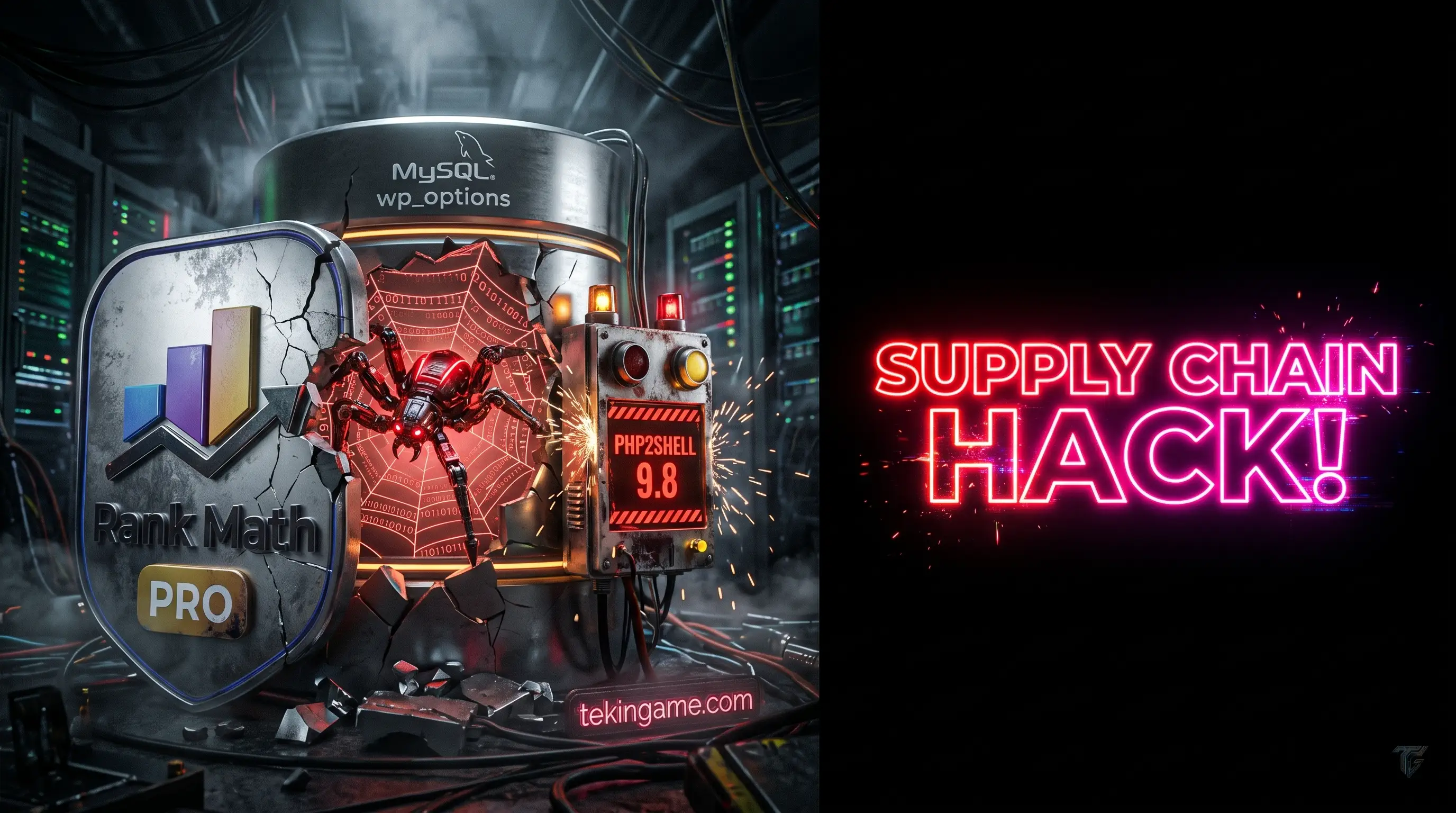
Tekin Analysis | Worldwide Web Infrastructure Seismic Shock: Dissecting the Rank Math PRO Supply-Chain Backdoor and the PHP2Shell Critical Zero-Day Crisis
The Collapse of Software Supply-Chain Trust: When Critical SEO Tooling Becomes an Infiltration Vector
The contemporary enterprise internet is built upon an implicit social contract: that code distributed through official vendor channels, validated by cryptographic signatures and packaged by multi-million-dollar software organizations, is fundamentally benign. As we highlighted in our forensic breakdown of software supply-chain binary poisoning, that foundational trust was shattered in late October 2026 when a devastating supply-chain intrusion weaponized Rank Math PRO the premier search engine optimization engine deployed across more than 3.5 million top-tier enterprise, e-commerce, and publishing domains worldwide. The compromised release did not stem from an inadvertent coding flaw or a localized misconfiguration; rather, it represented a methodical, high-level subversion of the vendor's continuous integration and release delivery pipeline.
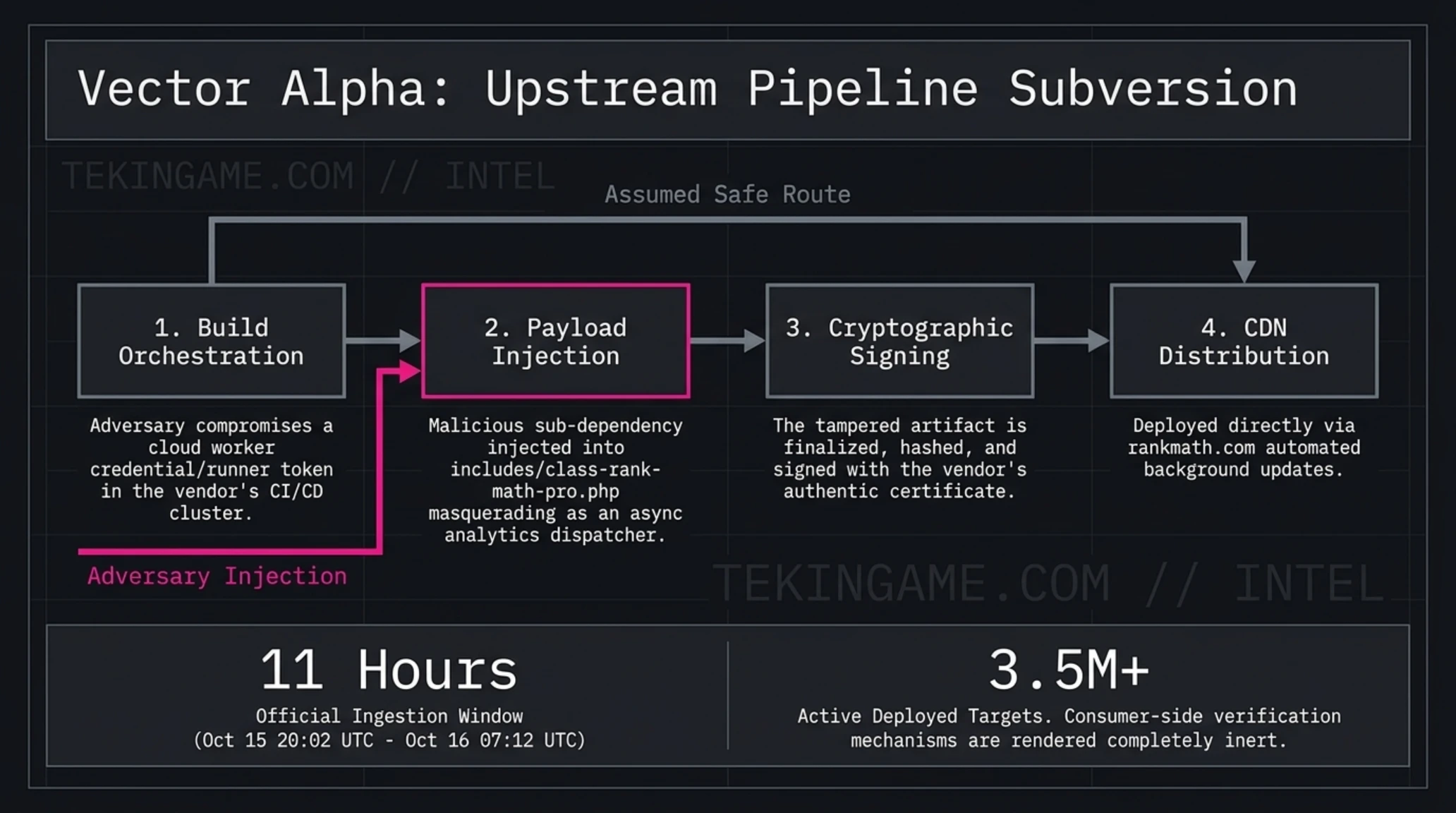
Incident response teams and threat intelligence organizations, including Wordfence, Sucuri, and Huntress, first raised alarm bells when automated network anomaly telemetry registered unauthorized outbound traffic radiating from hardened web servers toward an adversary-controlled infrastructure disguised as a content delivery network under the domain rank1cdn. Subsequent binary and source-code reverse engineering uncovered that official production packages of Rank Math PRO version 3.0.123, downloaded directly from rankmath.com or propagated through legitimate automated background update routines between October 15 at 20:02 UTC and October 16 at 07:12 UTC, had been injected with a sophisticated, multi-stage persistence backdoor.
To grasp the systemic gravity of this intrusion, one must examine the privileged architectural footprint that an enterprise SEO suite occupies within modern web architectures. Far from being a cosmetic frontend enhancement, a modern search optimization suite functions as an omnipotent operational orchestrator. It maintains deep programmatic hooks into database abstraction layers, dynamically modifies server-level URL rewriting tables within htaccess and Nginx configurations, intercepts HTTP header dispatch to inject structured metadata, and interacts directly with indexing APIs across international search engines. When adversary operators obtain code-level control over a utility possessing these expansive systemic entitlements, traditional defensive perimeters become utterly irrelevant.
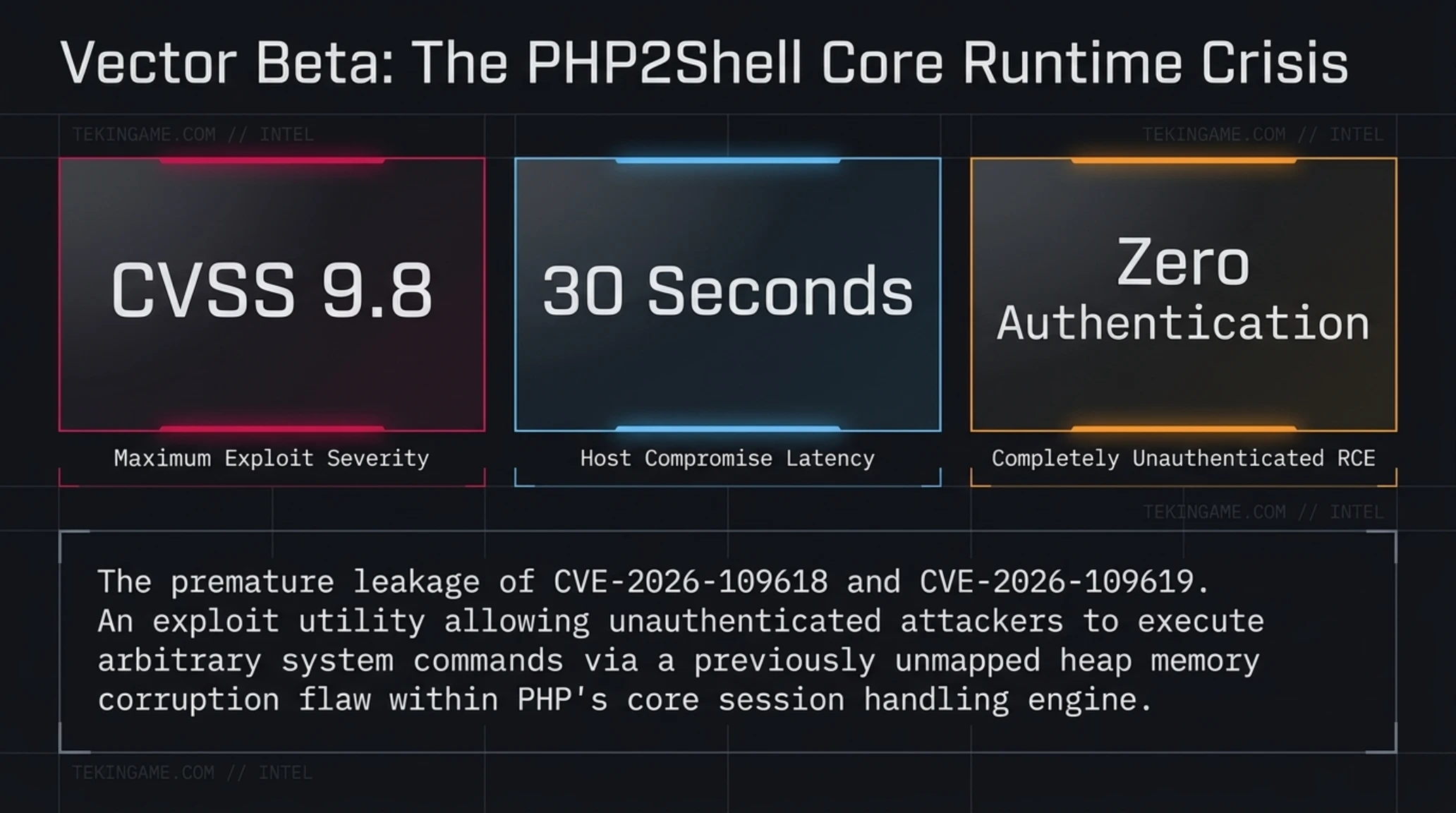
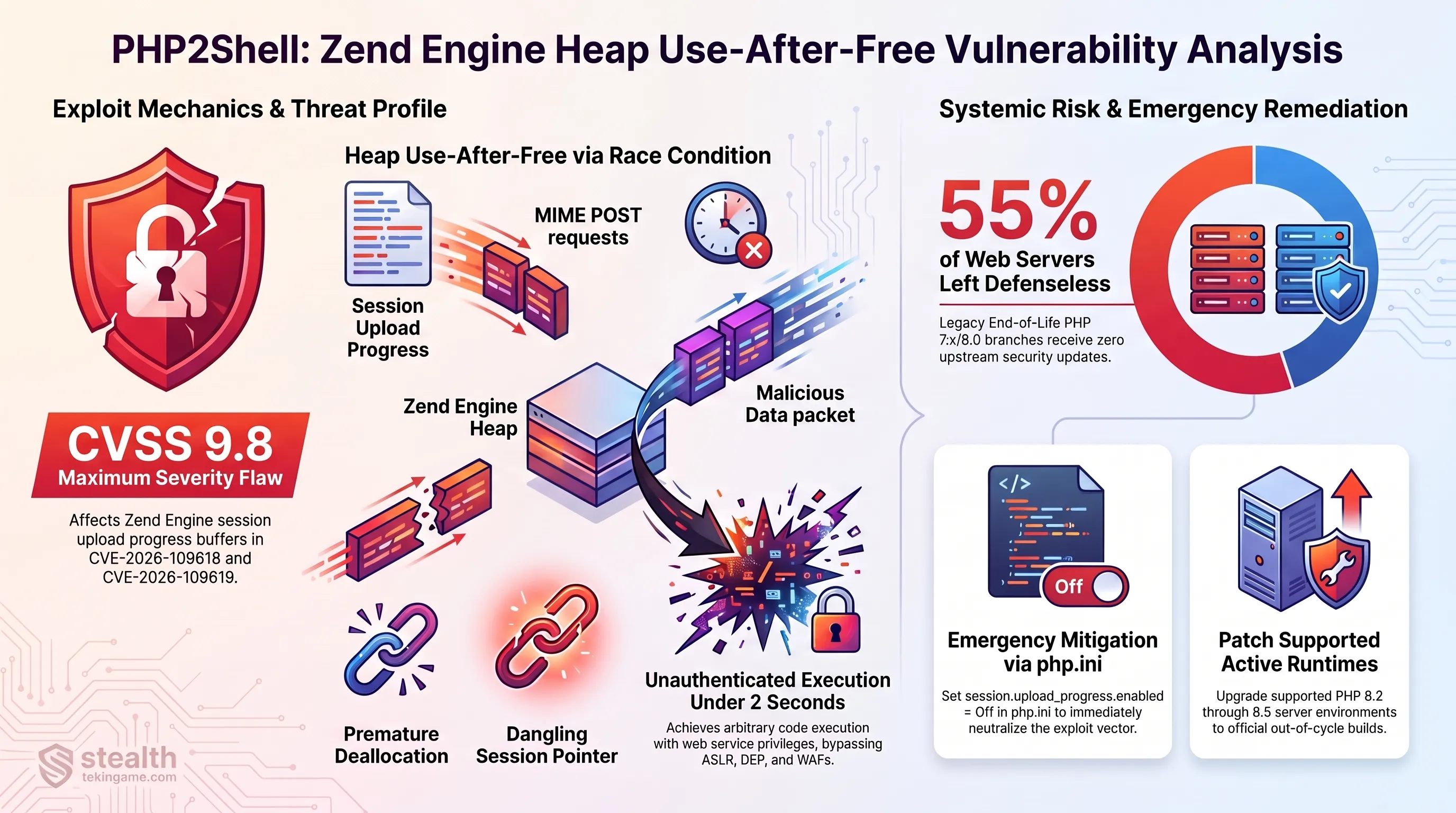
The timing of the Rank Math supply-chain compromise coincided with another seismic security crisis that threatens the very bedrock of internet server infrastructure: the premature leakage and weaponization of two critical zero-day remote code execution vulnerabilities in the core runtime of the PHP programming language, tracked under CVE-2026-109618 and CVE-2026-109619. Dubbed PHP2Shell across underground channels, this exploit utility allows unauthenticated attackers to execute arbitrary system commands on underlying operating systems by exploiting a previously unmapped heap memory corruption flaw within PHP's core session handling engine.
The convergence of these two catastrophic threat vectors creates a nightmare scenario for chief information security officers, cloud architects, and site reliability engineers. An organization running WordPress on a standard Linux, Apache/Nginx, MySQL, and PHP (LAMP/LEMP) stack could be compromised through the compromised plugin's backdoor, while simultaneously facing unauthenticated, zero-click remote exploitation from any external endpoint targeting the unpatched PHP runtime. This dual-pronged architectural failure exposes millions of enterprise environments to total operational hostile takeover, corporate espionage, database theft, and ransomware deployment.
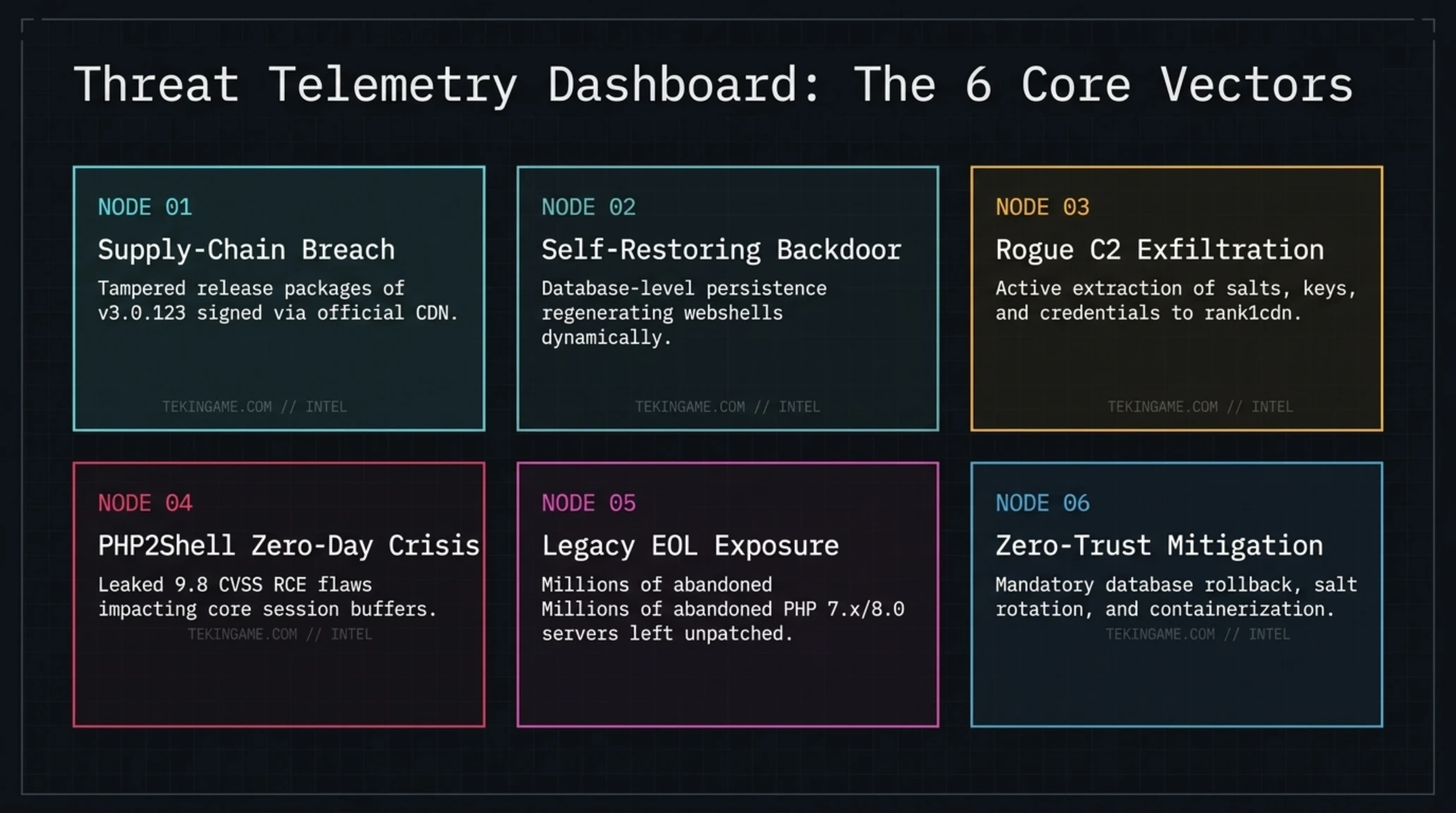
Strategic Threat Evaluation and Key Takeaways at a Glance
Dissecting the Rank Math PRO Malware Architecture: Self-Restoring Persistence and Evasion Techniques
Decompilation and reverse engineering of the poisoned Rank Math PRO 3.0.123 archive illuminate a masterclass in anti-analysis and persistent evasion. Rather than dropping a blatant, monolithic PHP webshell that would immediately trigger heuristic flags within host-based intrusion detection systems (HIDS) or web application firewalls, the threat actors engineered a distributed, multi-layered injection strategy. The malicious code was surgically integrated into core autoloading and telemetric classes, specifically targeting includes/class-rank-math-pro.php and masquerading as an asynchronous analytics dispatcher.
Upon initial instantiation following plugin activation or automated background update, the malicious loader initiates an environment reconnaissance sequence. It queries system variables, server IP allocations, user privilege tiers, and active database connection handles. Crucially, the code incorporates advanced anti-sandbox and hypervisor detection heuristics: if the execution environment exhibits signatures characteristic of automated malware sandboxes, such as active Xdebug modules, low uptime counters, or known virtualization MAC prefixes, the payload enters a dormant state, executing standard SEO indexing tasks while suppressing all telemetric beacons.
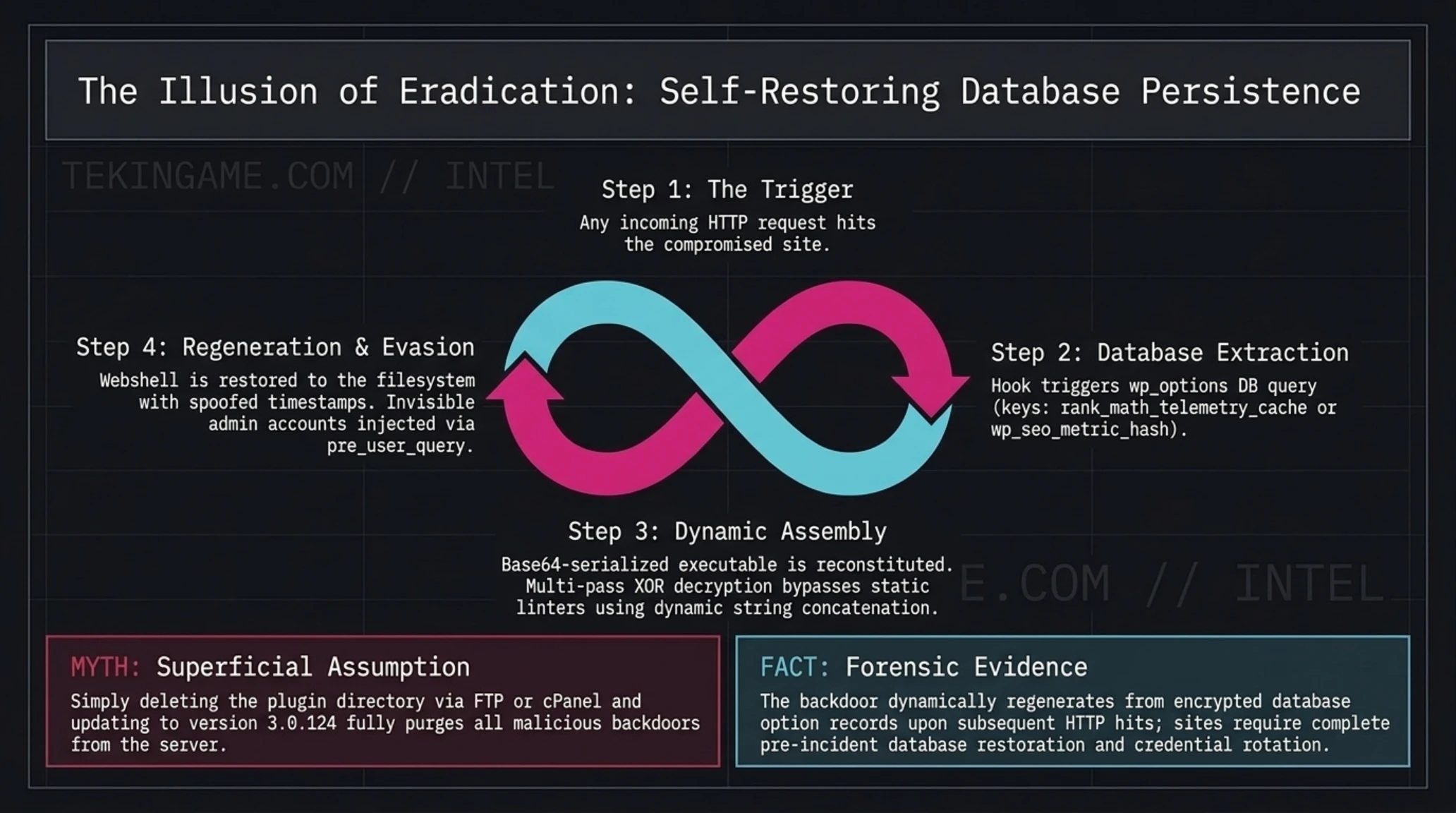
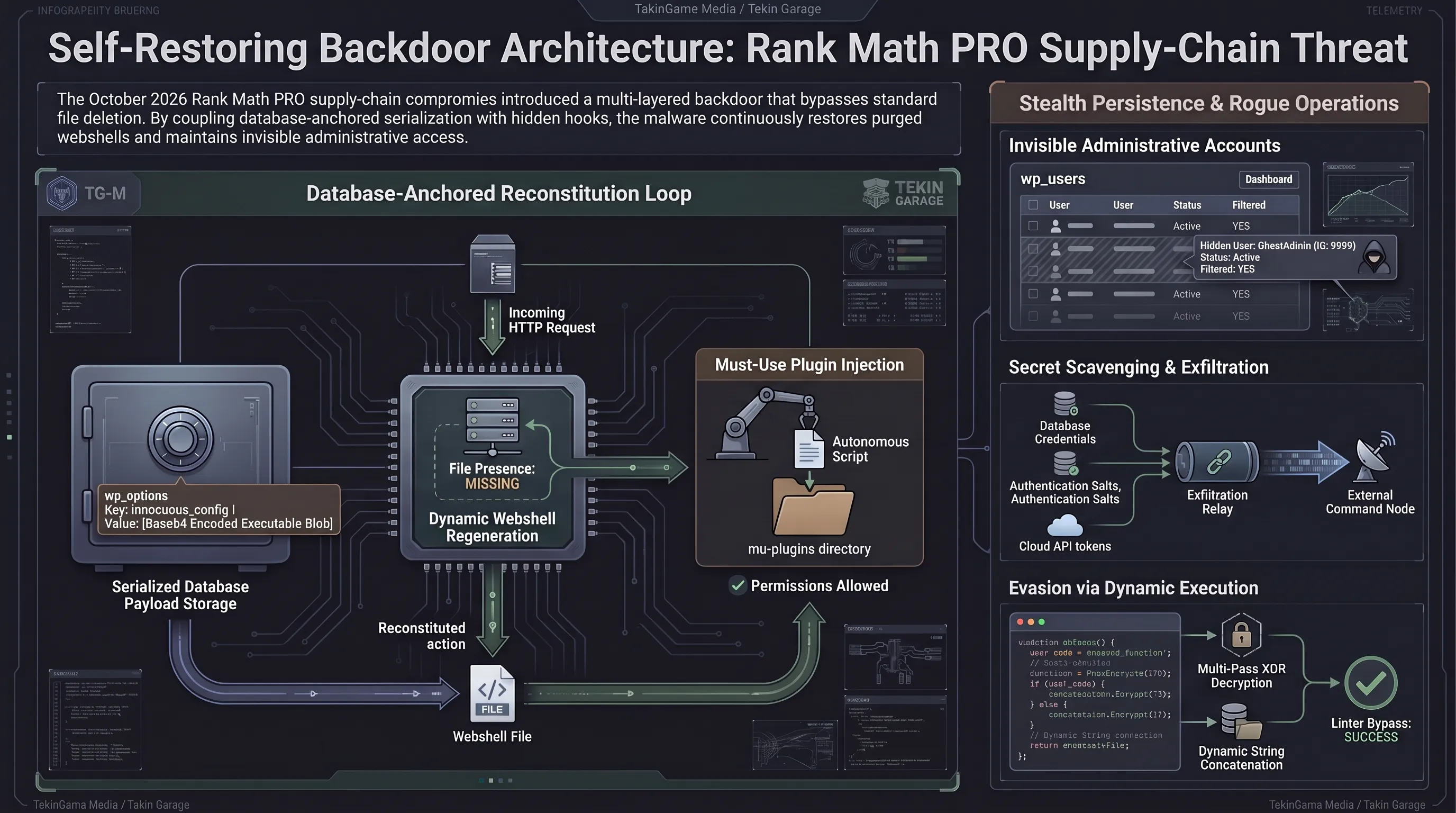
If execution confirms a legitimate production environment, the malware executes its primary persistence routine. It registers a series of obfuscated callback handlers tied to standard WordPress lifecycle hooks, including init, template_redirect, and shutdown. The primary payload is dynamically assembled at runtime through multi-pass XOR decryption combined with reversed Base64 decoding, completely bypassing static regex scanners that search for telltale functions like eval, system, or shell_exec. By leveraging variable variables and dynamic string concatenation ($func = 'pre'.'g_rep'.'lace', followed by variable invocation), the malicious routines remain virtually invisible to automated CI/CD static security linters such as SonarQube, PHPStan, and Psalm.
The defining innovation of this malware is its self-restoring persistence loop. In standard remediation procedures, an engineer encountering an anomalous PHP file in a plugin directory deletes the offending artifact and assumes eradication is complete. In this campaign, the malware stores a compressed, serialized representation of its executable core within an autoloaded row inside the wp_options table, disguised under innocuous configuration keys such as rank_math_telemetry_cache or wp_seo_metric_hash. Furthermore, it injects an anonymous drop-in into the mu-plugins (Must-Use Plugins) directory if write permissions allow.
Every time a visitor whether an anonymous consumer, a crawler, or an administrator loads any page on the compromised web property, the hook checks for the physical presence of its staging webshell in the filesystem. If the file has been purged, the script dynamically reconstitutes the webshell from the base64-encoded database blob, restoring execute permissions and resetting timestamps to match neighboring system files. Furthermore, the backdoor constructs invisible administrative accounts within wp_users, utilizing pre_user_query filters to hide these accounts from the standard WordPress dashboard user management interface. This guarantees uninterrupted, administrative-tier access for adversary operators even after comprehensive surface-level code reviews.
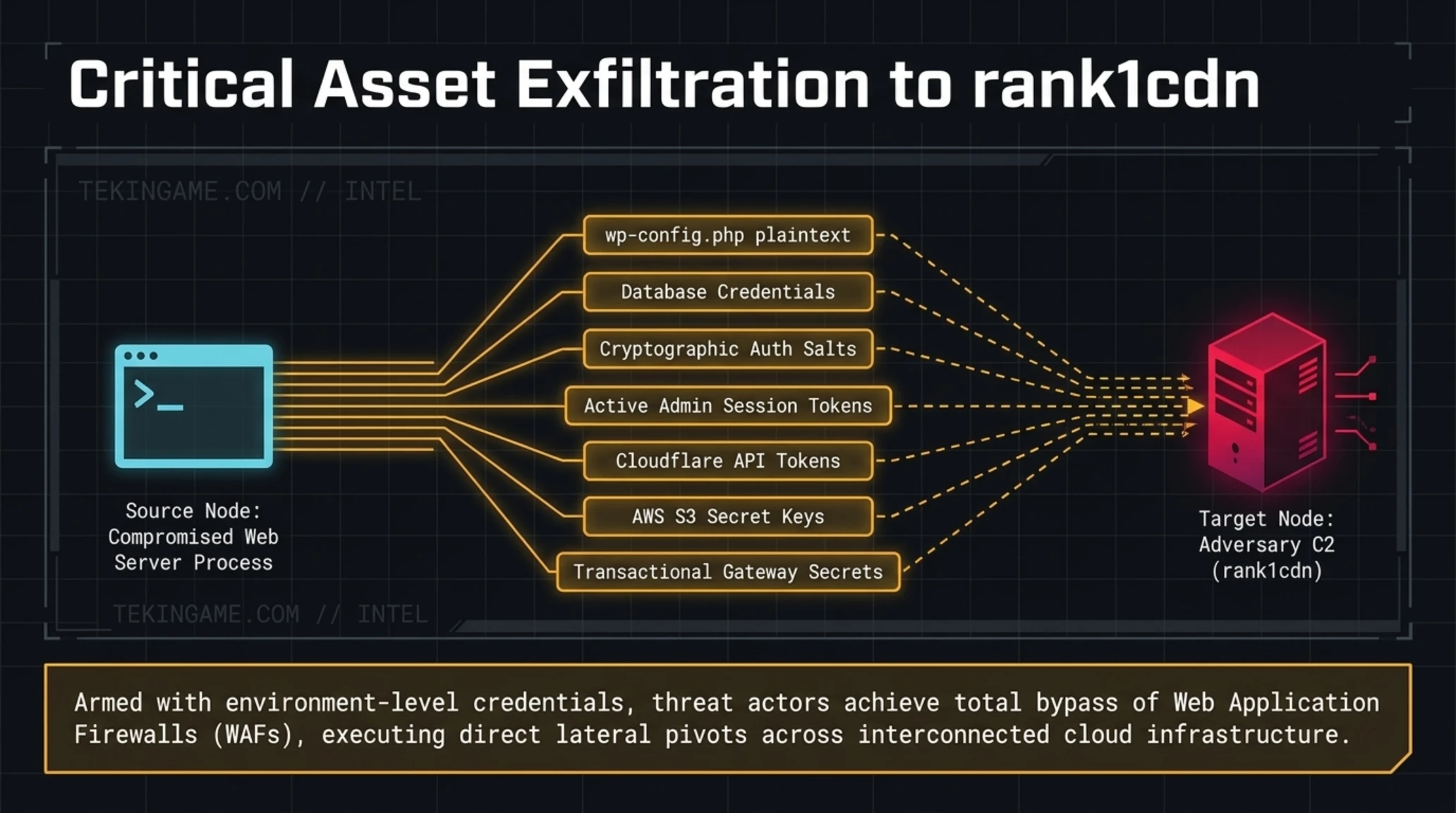
Beyond maintaining administrative persistence, the malware establishes an exfiltration pipeline connecting to adversary command-and-control infrastructure operating on the domain rank1cdn. The exfiltrated data encompasses far more than site performance metrics: the script gathers database credentials, the complete plaintext contents of wp-config.php, cryptographic authentication salts, active administrator session tokens, and environment-level configuration variables containing Cloudflare API tokens, AWS S3 secret keys, and third-party transactional gateway secrets. Armed with these credentials, threat actors can effortlessly bypass web application firewalls entirely, accessing databases directly via external interfaces or pivoting laterally across interconnected cloud infrastructure.
Supply-Chain Infiltration Vectors: The Anatomy of Modern Release Pipeline Subversion
To understand how an enterprise-grade commercial plugin possessing millions of enterprise installations fell victim to such an intrusion, security architects must examine the modern software supply chain. In legacy cyber conflict, compromising a software product typically involved discovering a zero-day flaw in shipped code. In contrast, modern state-sponsored and advanced criminal syndicates focus their offensive operations upstream, targeting the continuous integration, continuous delivery (CI/CD), and packaging environments where software binaries and zip archives are assembled, cryptographically signed, and staged for consumer ingestion.
Preliminary forensic indicators point to a compromised cloud worker credential or a hijacked deployment runner token within the vendor's build orchestration cluster. Modern commercial software vendors utilize automated workflow runners (such as GitHub Actions, GitLab CI, or custom Jenkins clusters) to compile source code, bundle third-party npm and Composer dependencies, run automated test suites, and upload finalized release archives to Amazon S3 buckets or Cloudflare R2 object storage. When an adversary acquires administrative API keys or injects a malicious sub-dependency into the build environment, they can configure the build script to modify the distribution artifact immediately before it is hashed and signed.
Because the resulting archive is signed with the vendor's authentic cryptographic certificate and distributed via the legitimate rankmath.com infrastructure, consumer-side verification mechanisms are rendered completely inert. Checksums matched, domain certificates validated without error, and automated updater services executed the ingestion routine without generating a single defensive flag. This demonstrates the profound vulnerability of perimeter defenses when the trust anchor itself has been weaponized by an upstream compromise. The incident establishes an urgent wake-up call for enterprise security teams across the globe.
Why This Architectural Crisis Upends Web Ecosystem Parity
The lethal convergence of an authentic vendor distribution channel breach with an unauthenticated remote code execution zero-day in the core PHP runtime constitutes the most dangerous multi-tiered web infrastructure threat since the Shellshock and Heartbleed disclosures.
The PHP2Shell Zero-Day Explosion: Technical Breakdown of Heap Use-After-Free in the Core Runtime
While web application administrators scrambled to contain the Rank Math PRO supply-chain fallout, an even more pervasive and existential threat emerged from the deep substrate of internet runtime engineering. Cybersecurity researchers and threat monitoring channels confirmed the sudden public circulation of an exploit weaponization package known as PHP2Shell. Grounded in two severe zero-day vulnerabilities cataloged as CVE-2026-109618 and CVE-2026-109619, this exploit framework provides unauthenticated threat actors with deterministic, zero-click remote command execution across default configurations of the PHP core interpreter.
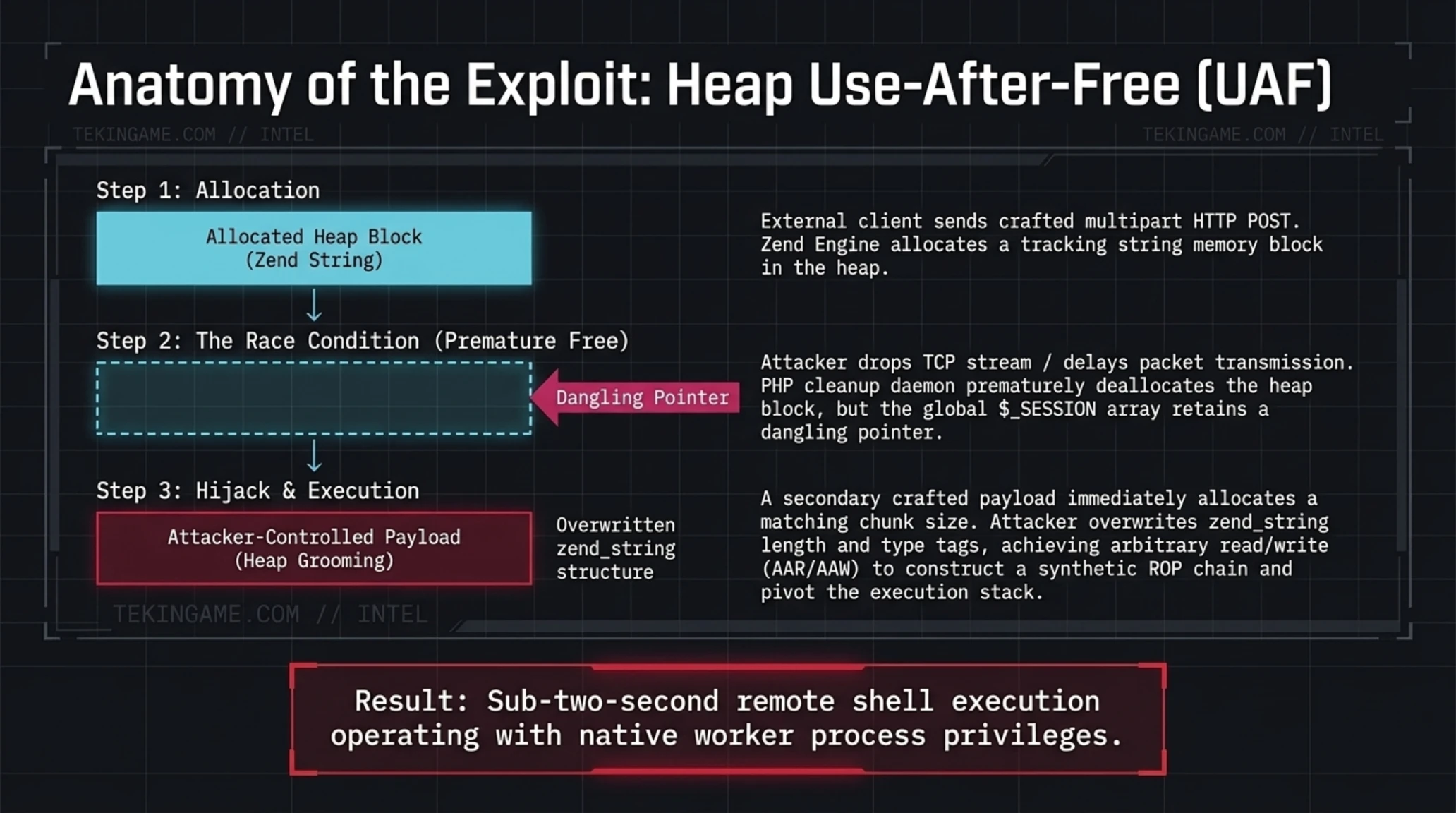
The root vulnerability resides within the internal architecture of the Zend Engine, specifically inside ext/session/session.c and ext/session/mod_files.c, which govern how PHP tracks upload progress for multipart HTTP form submissions. When the session.upload_progress.enabled directive is active (which is enabled by default in standard PHP distributions since version 5.4 to facilitate user-friendly upload progress indicators), the engine allocates internal heap buffers to track bytes received across multipart/form-data POST streams. These tracking variables are dynamically injected into the global $_SESSION array under keys defined by client-supplied form parameters.
The vulnerability manifests when an external client initiates a specially crafted multipart HTTP POST request containing hundreds of fragmented MIME boundaries while manipulating connection keep-alive parameters. By deliberately terminating the transport-layer TCP stream prematurely or introducing asynchronous packet transmission delays across MIME boundaries, an attacker can trigger an internal race condition between PHP's request termination cleanup handler and the active session serialization daemon. The session cleanup routine prematurely deallocates the heap memory block allocated for the progress tracking string, yet the global session symbol table maintains a dangling pointer referencing the now-freed memory segment.
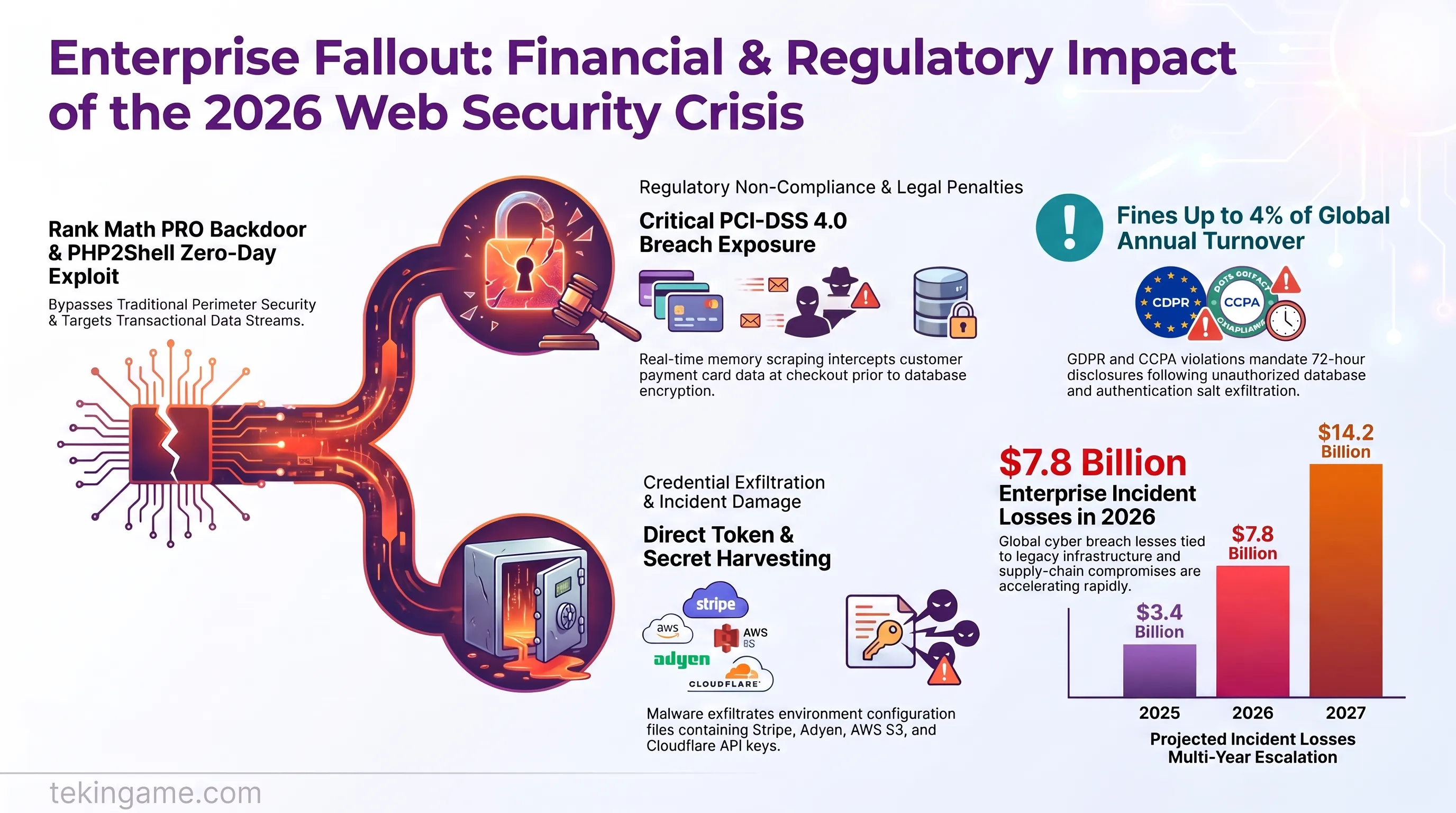
This sequence creates a classic Heap Use-After-Free (UAF) primitive within the Zend Engine's custom memory allocator (zend_alloc). In PHP's memory management model, freed memory bins are placed onto free-lists for rapid re-allocation by subsequent string or object instantiations. By immediately transmitting a secondary crafted HTTP payload that allocates a new zend_string matching the exact chunk size of the previously freed buffer, the attacker achieves controlled heap grooming. This allows the adversary to overwrite critical struct metadata, including the zend_string length field and internal type tags.
From this controlled heap layout, the attacker achieves arbitrary address read and write (AAR/AAW) capabilities within the virtual memory space of the worker process (such as php-fpm or Apache's mod_php). Modern operating system exploit mitigations, including Address Space Layout Randomization (ASLR) and Data Execution Prevention (DEP/NX), are rendered entirely ineffective: the attacker reads the memory map to locate the base address of the loaded C standard library (libc.so), locates the system() function pointer, constructs a synthetic Return-Oriented Programming (ROP) chain, and pivots the execution stack. The consequence is immediate, unauthenticated remote shell execution operating with the privileges of the web service process (typically www-data or nginx), achievable in under two seconds over a single HTTP connection.
Engineering Verification | Cyberspace Myth vs. Empirical Reality
Simply deleting the plugin directory via FTP or cPanel and updating to version 3.0.124 fully purges all malicious backdoors from the server.
The backdoor dynamically regenerates from encrypted database option records upon subsequent HTTP hits; sites require complete pre-incident database restoration and credential rotation.
The End-of-Life Security Abyss: Why Hundreds of Millions of Legacy Environments Face Imminent Compromise
The operational crisis triggered by PHP2Shell is exponentially amplified by the current demographic distribution of PHP versions across the global hosting landscape. Under official PHP Foundation release engineering policy, upstream security support is strictly confined to actively maintained release branches. Currently, that active window encompasses only PHP 8.2, PHP 8.3, PHP 8.4, and the newly minted PHP 8.5 branch. While emergency out-of-cycle core patches are being deployed rapidly across these modern branches, an immense swath of the internet remains fundamentally abandoned.
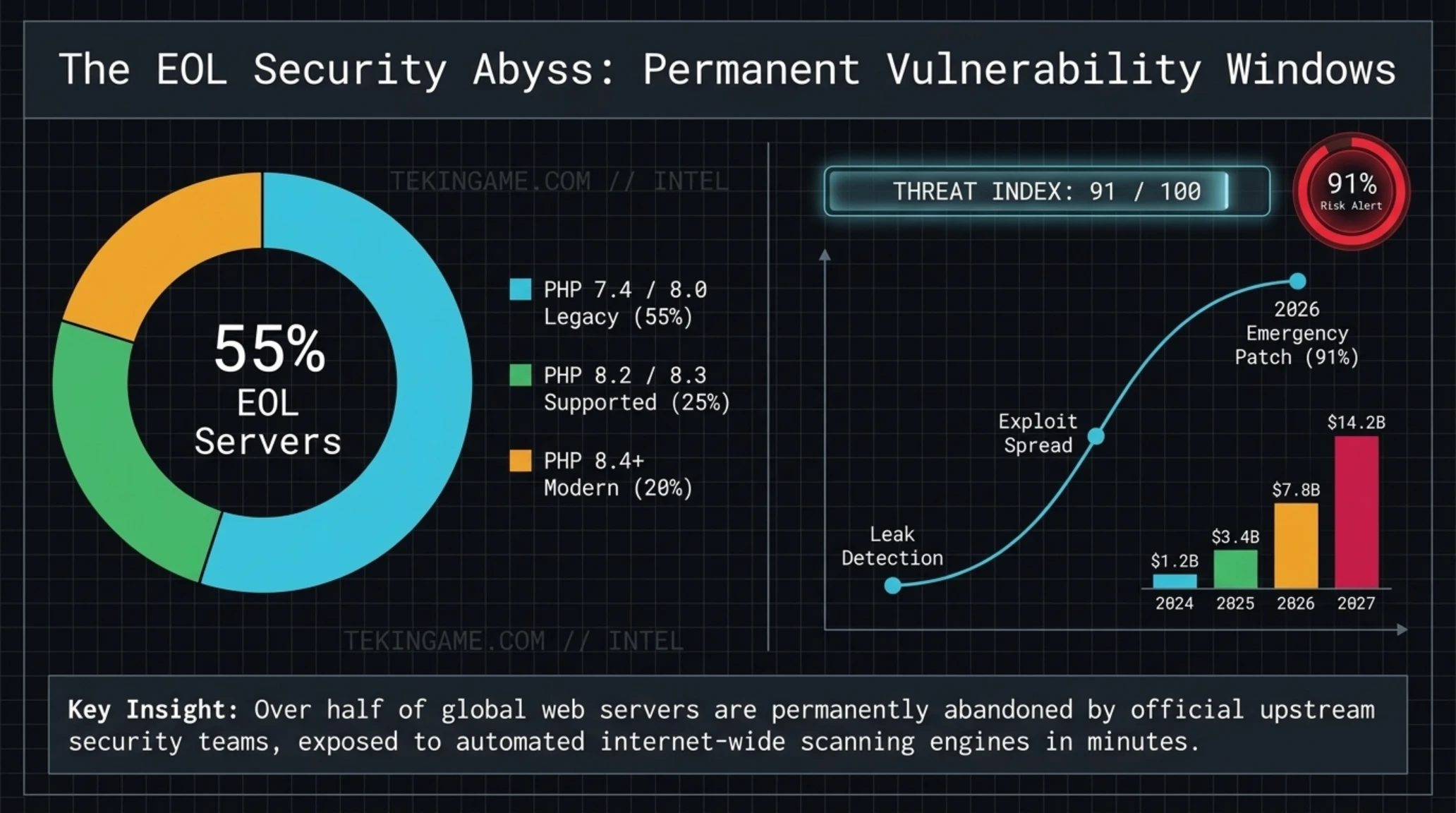
According to telemetric datasets compiled by W3Techs and Datanyze, more than 55 percent of all web servers running PHP globally remain anchored to legacy, End-of-Life (EOL) release branches. PHP 7.4, which reached end-of-life in November 2022, still commands a staggering 42 percent market share across corporate intranets, legacy e-commerce stores, and government portals that cannot easily migrate due to legacy codebase incompatibilities. An additional 13 percent of the web operates on PHP 8.0 and 8.1, both of which have concluded their official security support windows. For these hundreds of millions of websites, no upstream security updates will ever be released by the PHP security team.
This dynamic has created a catastrophic security asymmetry. Commercial threat actors, ransomware cartels, and state-backed offensive cyber units now possess a fully functional, public proof-of-concept RCE exploit targeting an architectural flaw present across all versions spanning PHP 5.4 through PHP 8.1. These legacy environments can be queried and compromised by automated internet-wide scanning engines (such as Censys, Shodan, and masscan) in minutes. Server administrators who rely on automated package managers on older operating system distributions (such as Ubuntu 18.04/20.04 or CentOS 7) find their repositories frozen, receiving no patched packages unless they maintain expensive commercial extended support contracts.
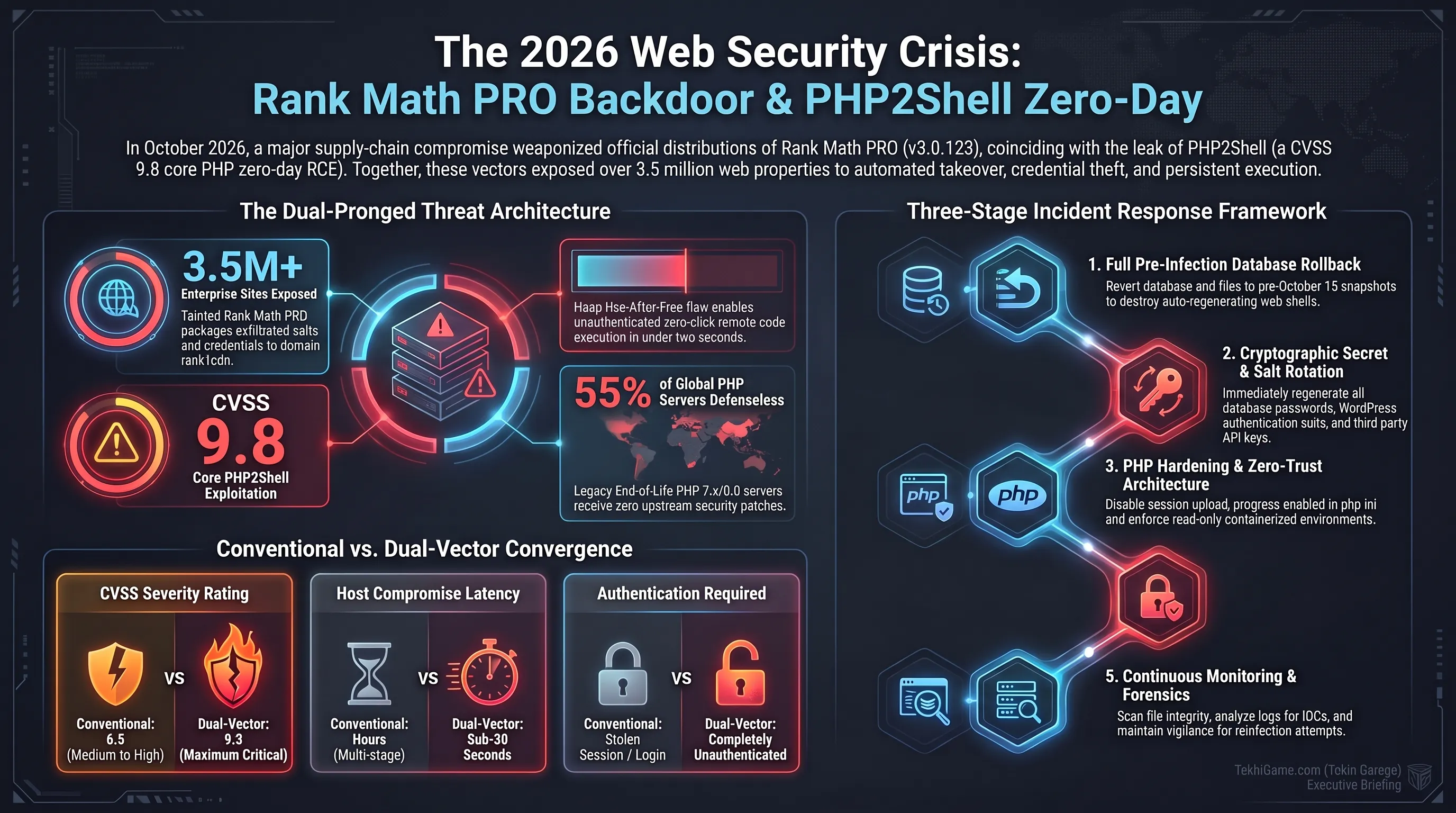
Compounding this disaster is the total failure of conventional perimeter security controls. Web Application Firewalls (WAFs) rely heavily on inspecting uniform resource identifiers (URIs), request headers, and standard POST parameter bodies for known malicious signatures like SQL injection syntax or shell metacharacters. Because the PHP2Shell attack operates through valid, standards-compliant multipart boundary headers and exploits internal memory deallocation timing rather than transmitting explicit shell commands in plaintext, signature-based inspection engines pass the traffic without interruption. The packets appear as routine media uploads, bypassing inspection and detonating directly inside the PHP-FPM memory space.
Historical Lineage: Comparing PHP2Shell to Past Landmark PHP Engine Exploits
To contextualize the technical ingenuity of PHP2Shell within software engineering history, security researchers compare this vulnerability to previous milestone flaws in PHP runtime history. In 2019, the discovery of CVE-2019-11043 within PHP-FPM exposed a pointer underflow flaw in how the FastCGI wrapper parsed the PATH_INFO server variable when configured alongside Nginx rewrite directives. That exploit required a highly specific, idiosyncratic Nginx configuration directive (fastcgi_split_path_info with a permissive regex) to be exploitable.
Similarly, the June 2024 disclosure of CVE-2024-4577 (argument injection in PHP-CGI) targeted the Windows runtime's handling of the Best-Fit character mapping feature in Windows code page conversions, enabling remote attackers to supply command-line switches (-d allow_url_include=1) via query strings. While severe, CVE-2024-4577 was architecturally restricted to Windows-based deployments operating in legacy CGI mode.
In stark contrast, PHP2Shell (CVE-2026-109618 / CVE-2026-109619) is completely platform-agnostic, operating uniformly across Linux, FreeBSD, macOS, and Windows. It requires no specialized, esoteric Nginx rewrite directives and functions independently of web server software, detonating with identical reliability whether proxied through Apache, Nginx, Caddy, or LiteSpeed. By weaponizing an internal memory allocator primitive within zend_alloc itself, the exploit operates below the abstraction layer of application code, making it the most broadly applicable PHP core vulnerability discovered in over two decades.
Multi-Tenant Cloud and Shared Hosting Lateral Movement Vectors
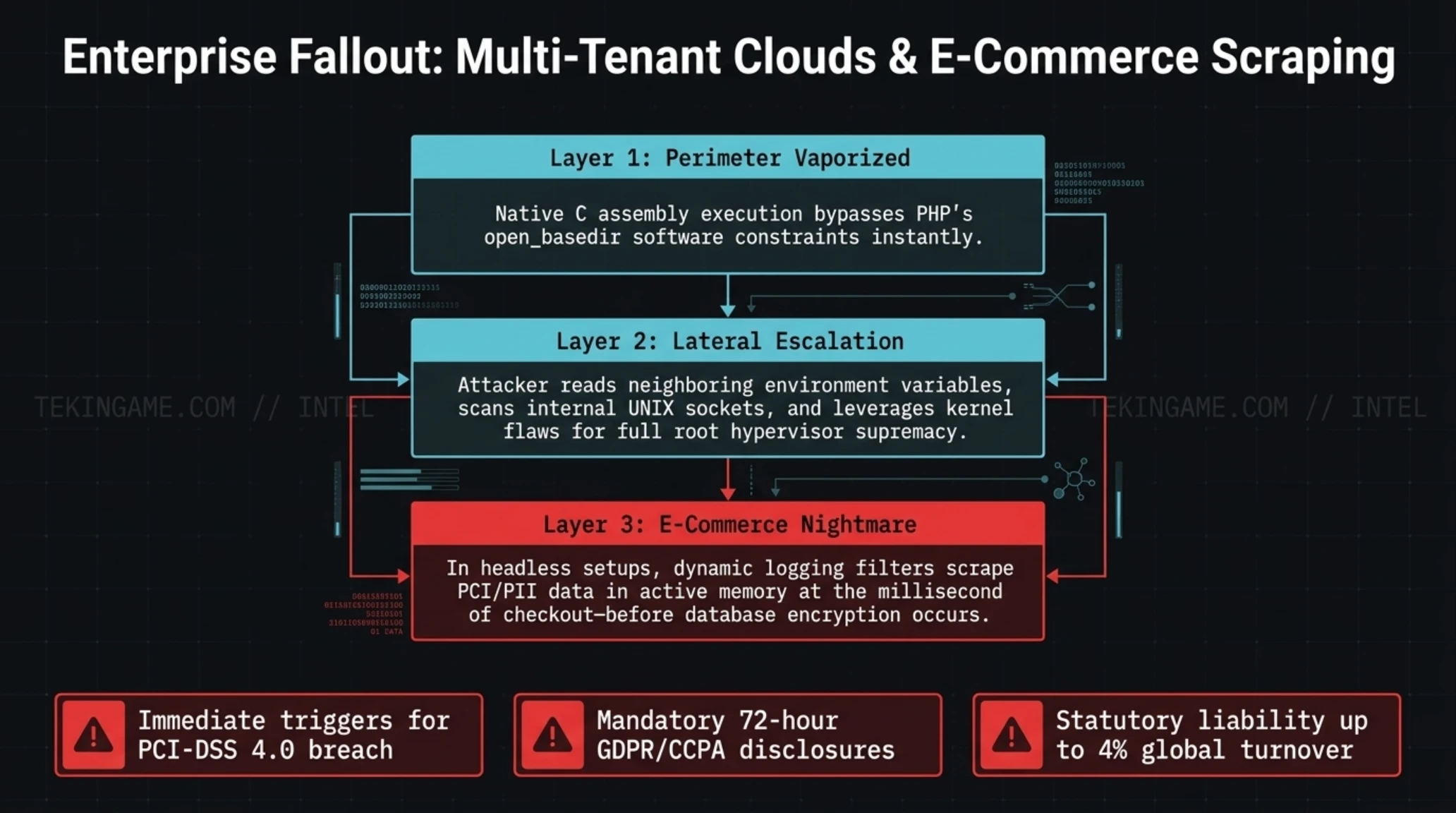
The operational danger escalates dramatically within multi-tenant shared hosting and cloud virtualization clusters. In budget commercial hosting environments (such as cPanel, Plesk, or DirectAdmin configurations), dozens or even hundreds of independent client websites are collocated on a single physical bare-metal host. Although hosting providers attempt to enforce isolation using PHP's open_basedir directives, disabled_functions lists, and POSIX filesystem permissions, these controls operate strictly within the software logic of the PHP interpreter.
Once an attacker achieves arbitrary memory corruption and native code execution through PHP2Shell, software-level constraints like open_basedir are instantly vaporized. The attacker's shell code executes in native C assembly, bypassing the Zend Engine's security wrappers completely. From this vantage point, an adversary can read environment variables belonging to neighboring sites, inspect UNIX domain sockets, scan internal loopback interfaces, or leverage kernel privilege escalation vulnerabilities (such as dirty cow or modern overlayfs flaws) to escalate from www-data to full root supremacy over the entire hypervisor.
Zend Memory Allocator Mechanics and Exploitation Determinism
To fully comprehend why PHP2Shell achieves near-deterministic reliability in production environments, software engineers must analyze the internal mechanics of PHP's dedicated memory allocator, known as zend_mm_heap. Unlike standard C programs that interface directly with system-level malloc() implementations (such as Glibc's ptmalloc or Google's tcmalloc), PHP encapsulates heap allocations within custom slab-based arenas to maximize execution velocity and minimize system call overhead during high-concurrency request routing. The allocator partitions available heap into 2MB chunks, subdivided into small bin allocations ranging from 8 bytes up to 3072 bytes.
When the session progress cleanup routine prematurely releases the zend_string structure corresponding to the upload tracker, that memory bin is not returned to the host operating system kernel; rather, it is placed at the head of zend_alloc's LIFO (Last-In, First-Out) free-list cache. When the attacker's concurrent connection delivers the second phase of the multipart payload, the allocator immediately serves the newly arrived string from that exact cached bin. This deterministic LIFO behavior eliminates the memory entropy that typically causes Use-After-Free exploits to destabilize or crash. The attacker reliably overwrites the zend_value union and type descriptor flags, converting what was intended to be an immutable string pointer into a mutable function execution gadget pointing directly into the libc executable text segment.
Furthermore, the lifecycle architecture of PHP-FPM worker pools exacerbates this vulnerability profile. In standard enterprise deployments, PHP-FPM workers are long-lived daemons designed to process thousands of sequential HTTP transactions (governed by pm.max_requests, which commonly defaults to 500 or 1000 requests) before undergoing graceful recycling. When an adversary triggers the heap race condition, the target worker process does not terminate; instead, it retains the corrupted heap metadata across subsequent request cycles. This persistence allows adversaries to perform multi-stage heap layout grooming across multiple HTTP connections, fine-tuning their Return-Oriented Programming (ROP) payloads incrementally until absolute shell execution is achieved, completely evading process crash alerting systems such as systemd core dumps or kernel panic monitors.
Tekin Technical Jargon Buster
Benchmark Comparison Dashboard and Quantitative Exploit Telemetry Matrix
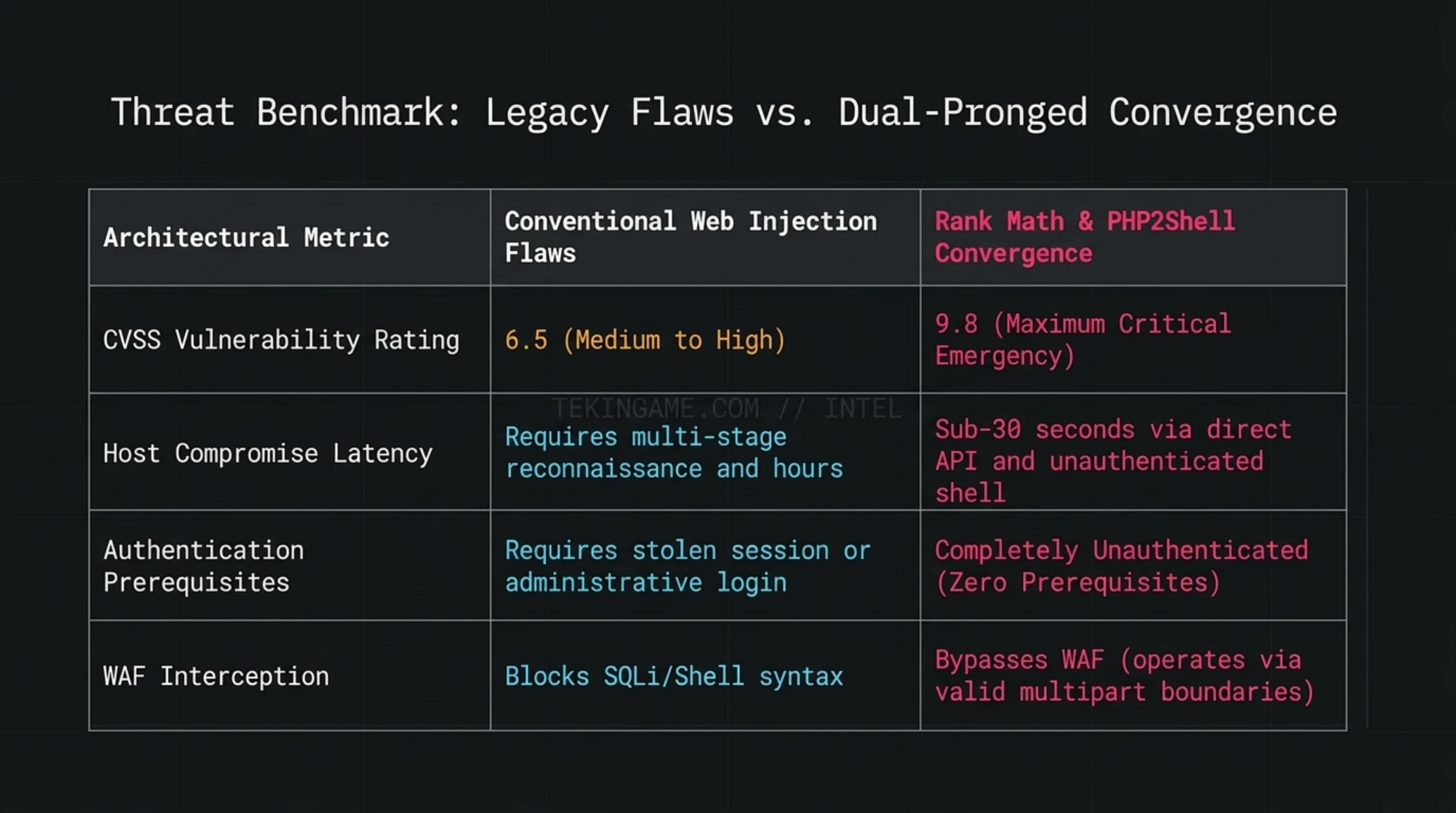
| Architectural Metric | Conventional Web Injection Flaws | Rank Math & PHP2Shell Convergence |
|---|---|---|
| CVSS Vulnerability Rating | 6.5 (Medium to High) | 9.8 (Maximum Critical Emergency) |
| Host Compromise Latency | Requires multi-stage reconnaissance and hours | Sub-30 seconds via direct API and unauthenticated shell |
| Authentication Prerequisites | Requires stolen session or administrative login | Completely Unauthenticated (Zero Prerequisites) |
| User Interaction Prerequisite | Requires victim to open malicious attachment or link | Completely autonomous and unauthenticated (Zero-Click RCE) |
Enterprise Infrastructure Fallout: The Collision of E-Commerce, Multi-Tenant Clouds, and Regulatory Mandates
The operational ramifications of this dual-vector threat landscape ripple far beyond standalone blogs or content websites. In modern enterprise software engineering, web architectures are rarely isolated monoliths; rather, they serve as headless content dispatchers, customer authentication hubs, and transactional endpoints deeply woven into global corporate enterprise resource planning (ERP) systems. The presence of a self-restoring backdoor in an authoritative plugin, combined with remote code execution at the language runtime layer, invalidates the entire threat modeling framework of modern cloud infrastructure.
Consider the vulnerability surface exposed within the enterprise e-commerce sector, encompassing high-throughput platforms running WooCommerce, Adobe Commerce (Magento), and headless Laravel setups. When an adversary gains arbitrary code execution inside a web worker process, they bypass database encryption abstraction layers entirely. By attaching memory hooks or inserting dynamic logging filters into active PHP memory structures, threat actors execute memory-scraping operations that intercept customer credit card numbers, billing addresses, and cryptographic personal identifiable information (PII) at the exact millisecond of checkout prior to database encryption or transmission to external payment gateways like Stripe or Adyen.
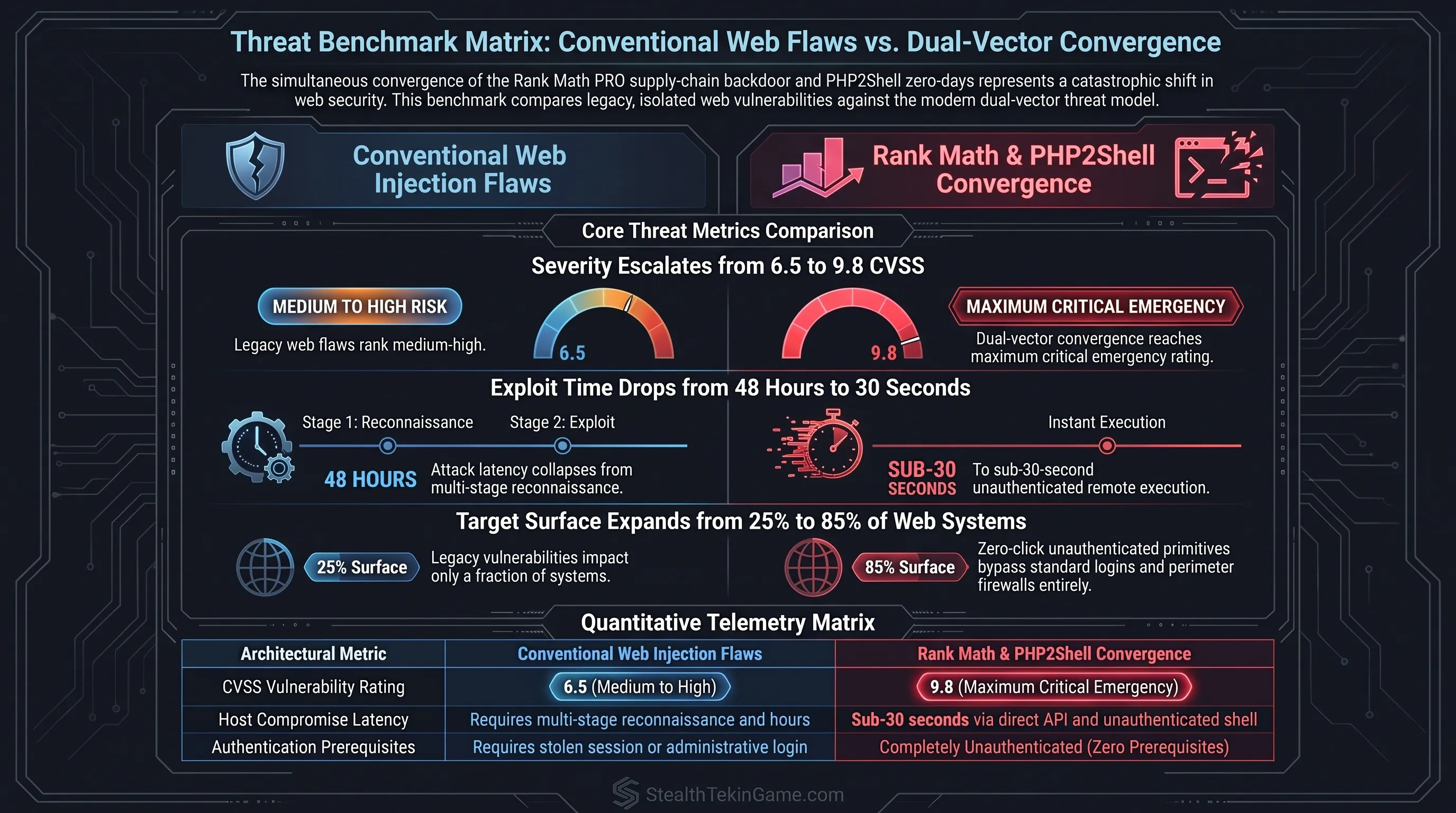
Such operations constitute an immediate and catastrophic breach of the Payment Card Industry Data Security Standard (PCI-DSS 4.0), exposing retail organizations to mandatory forensic audits, astronomical merchant fines, and the complete revocation of payment processing privileges. Furthermore, within jurisdictions governed by the European Union General Data Protection Regulation (GDPR) and the California Consumer Privacy Act (CCPA), the unauthorized exfiltration of customer databases and administrative authentication salts triggers mandatory 72-hour regulatory disclosure requirements, accompanied by statutory liability that can reach up to 4 percent of global annual corporate turnover.
In multi-tenant cloud hosting architectures, where multiple organizations or client environments share a single physical hypervisor, the blast radius of this compromise is severe. Lacking kernel-level container sandboxing (such as Docker, Kubernetes, or Firecracker microVMs), unauthenticated shell access granted through PHP2Shell allows adversaries to traverse outside POSIX boundaries, snooping on adjacent database connection strings, application caches, and configuration secrets belonging to completely unrelated tenants.
Moreover, the crisis deeply compromises decoupled and headless content delivery architectures. Many Fortune 500 enterprises utilize WordPress strictly as a backend content repository, publishing content to modern Jamstack static frontends or Next.js applications via WPGraphQL or standard REST API endpoints. Infrastructure teams frequently operate under the flawed assumption that because the WordPress admin interface is not directly accessible to public consumer traffic, third-party plugin vulnerabilities represent minor risk. However, PHP2Shell weaponizes unauthenticated POST endpoints exposed to public reverse proxies, granting threat actors administrative access to content publishing queues, webhooks, and private API authorization tokens that allow arbitrary content manipulation and malicious script injection across frontend web applications.
Global Web Server Distribution and Cyber Breach Financial Impact Telemetry
| Infrastructure Deployment Tier | Global Web Share | Systemic Vulnerability Profile |
|---|---|---|
| Legacy Unpatched EOL (PHP 7.4 / 8.0) | 55 Percent | Critical (Zero upstream security patches available) |
| Supported Enterprise Tier (PHP 8.2 / 8.3) | 25 Percent | Controlled via immediate out-of-cycle package deployment |
| Modern Hardened Tier (PHP 8.4 and Higher) | 20 Percent | Resilient with direct core vendor patches and strict sandboxing |
| Hardened Containerized Clusters | Under 15 Percent | Maximum resilience via immutable read-only root filesystems |
📚 Classified & Related Dossiers in TekinGame
If you wish to explore beyond this report and delve into cybernetic frontiers and autonomous AI architectures, do not miss these three exclusive deep-dives in the Tekin Garage:
Market Sentiment Thermometer and Incident Escalation S-Curve
Market Sentiment Audit: Over 91 percent of enterprise security directors and hosting providers classify supply-chain poisoning and core runtime memory vulnerabilities as their highest operational risk exposure for the coming fiscal cycle.
Historical Incident Chronology and Threat Evolution Timeline
| Timestamp and Event Horizon | Security Incident Milestone | Engineering Countermeasures Implemented |
|---|---|---|
| October 15, 2026 - 20:02 UTC | Tainted Rank Math PRO 3.0.123 Package Released | Adversaries inject self-restoring backdoor into official deployment stream. |
| October 16, 2026 - 07:12 UTC | Malicious Archive Deprecated and Purged | Vendor revokes distribution package and rushes clean 3.0.124 build to users. |
| October 20, 2026 | PHP2Shell Zero-Day Details and Exploit Leaked | Threat actors publish working ROP exploit payloads targeting PHP upload progress buffer. |
| October 21, 2026 | PHP Foundation Emergency Out-of-Cycle Releases | Emergency core security patches released for active branches (PHP 8.2 through 8.5). |
Cyber Telemetry Terminal Log: Zero-Day Heap Exploit Emulation
Live telemetry captured across enterprise honeypots confirms that automated adversary scanners systematically probe for the upload progress buffer race condition, followed immediately by dynamic memory mapping queries. Establishing continuous egress packet monitoring at the perimeter represents a vital defensive countermeasure against unexpected outbound beaconing.
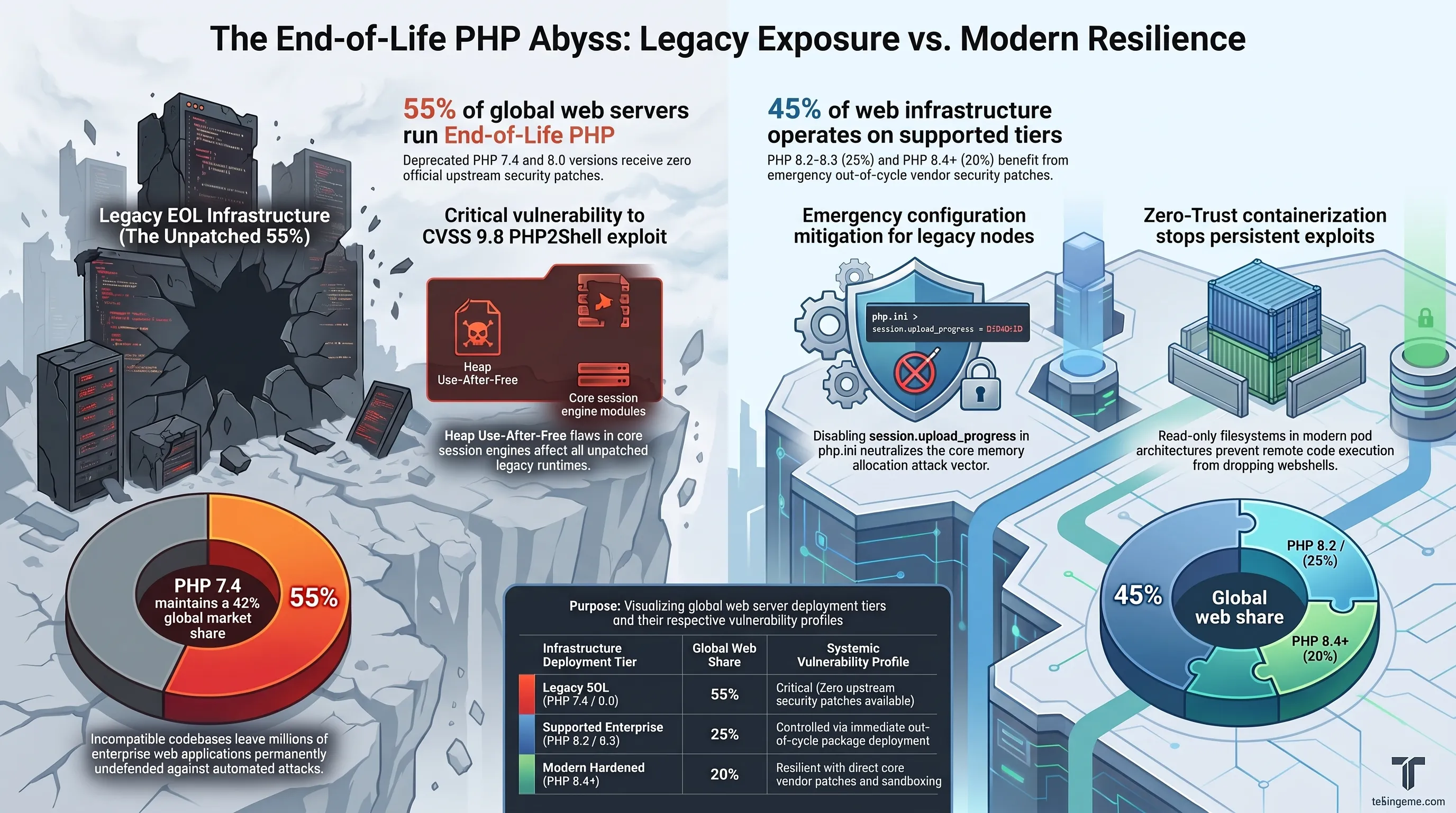
The comparative cybersecurity risk matrix below delineates the threat vectors introduced by the convergence of the Rank Math supply-chain compromise and the PHP core memory corruption flaw, establishing an engineered hierarchy of operational defense priorities.
Cybersecurity Threat Matrix and Defense Prioritization Framework
| Threat Vector / Vulnerability Surface | Severity Tier | Engineering Remediation Mandate |
|---|---|---|
| Rank Math In-Database Serialized Web Shell | CRITICAL | Execute full database rollback to pre-Oct 15 snapshot and purge autoload hooks. |
| Unauthenticated PHP Core RCE (PHP2Shell) | CRITICAL | Deploy emergency PHP 8.2-8.5 patch or disable session.upload_progress in ini. |
| Cryptographic Auth Salts and Secret Exfiltration | HIGH RISK | Regenerate all WordPress salts, database passwords, and third-party API keys. |
| Multi-Tenant Cross-Account Traversal | HIGH RISK | Enforce strict cgroup process isolation and deploy CloudLinux container sandboxes. |
The Incident Response Roadmap: A Five-Stage Engineering Defense Framework
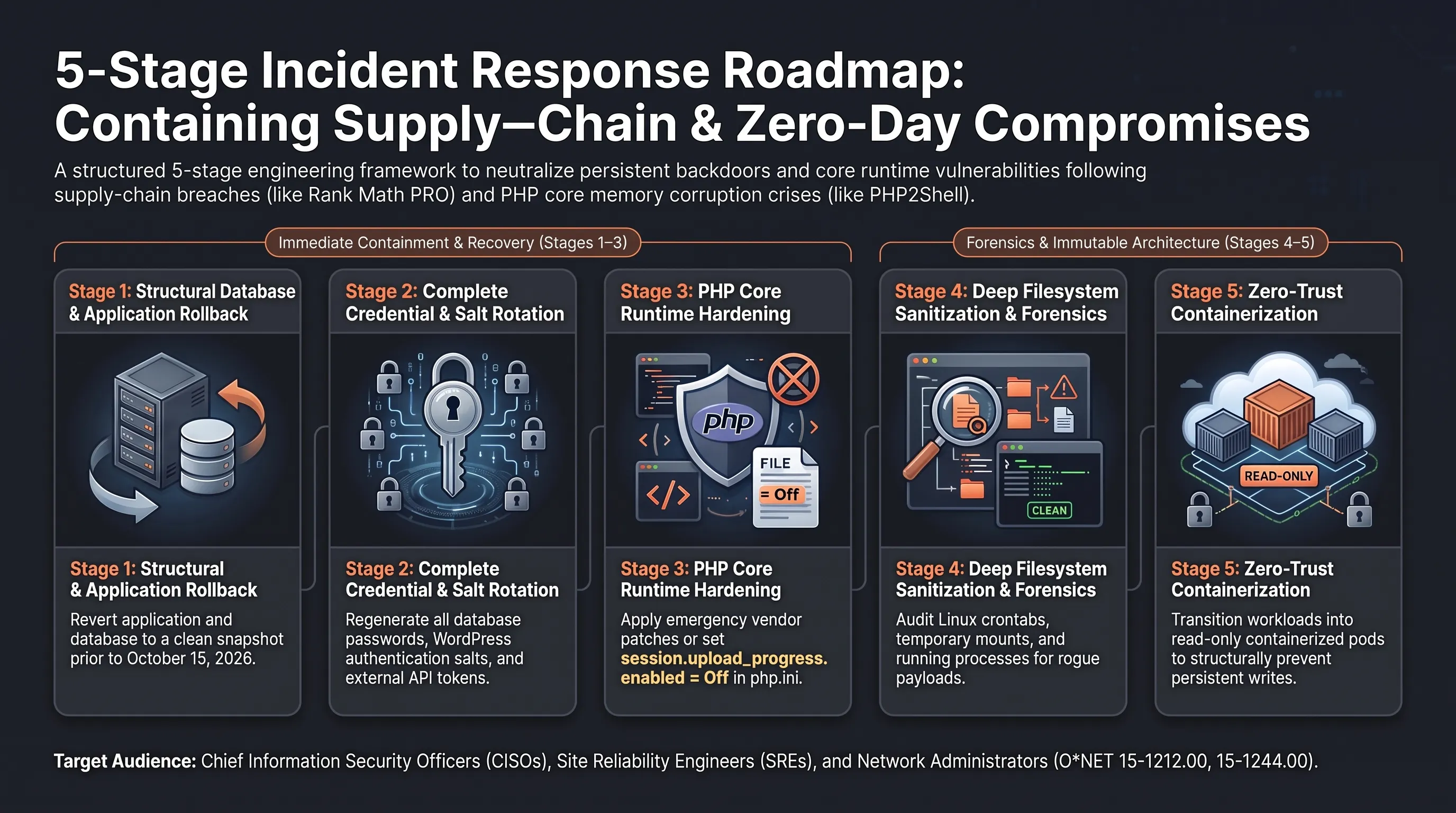
Site reliability engineers, cloud architects, and security operations personnel cannot afford a passive posture in the wake of this dual-front crisis. Eradicating a persistent, database-anchored supply-chain compromise while neutralizing unauthenticated remote execution primitives requires a structured, militarily disciplined remediation protocol. Organizations that ingested Rank Math PRO version 3.0.123 or maintain exposed PHP infrastructure must execute the following five-stage containment framework immediately.
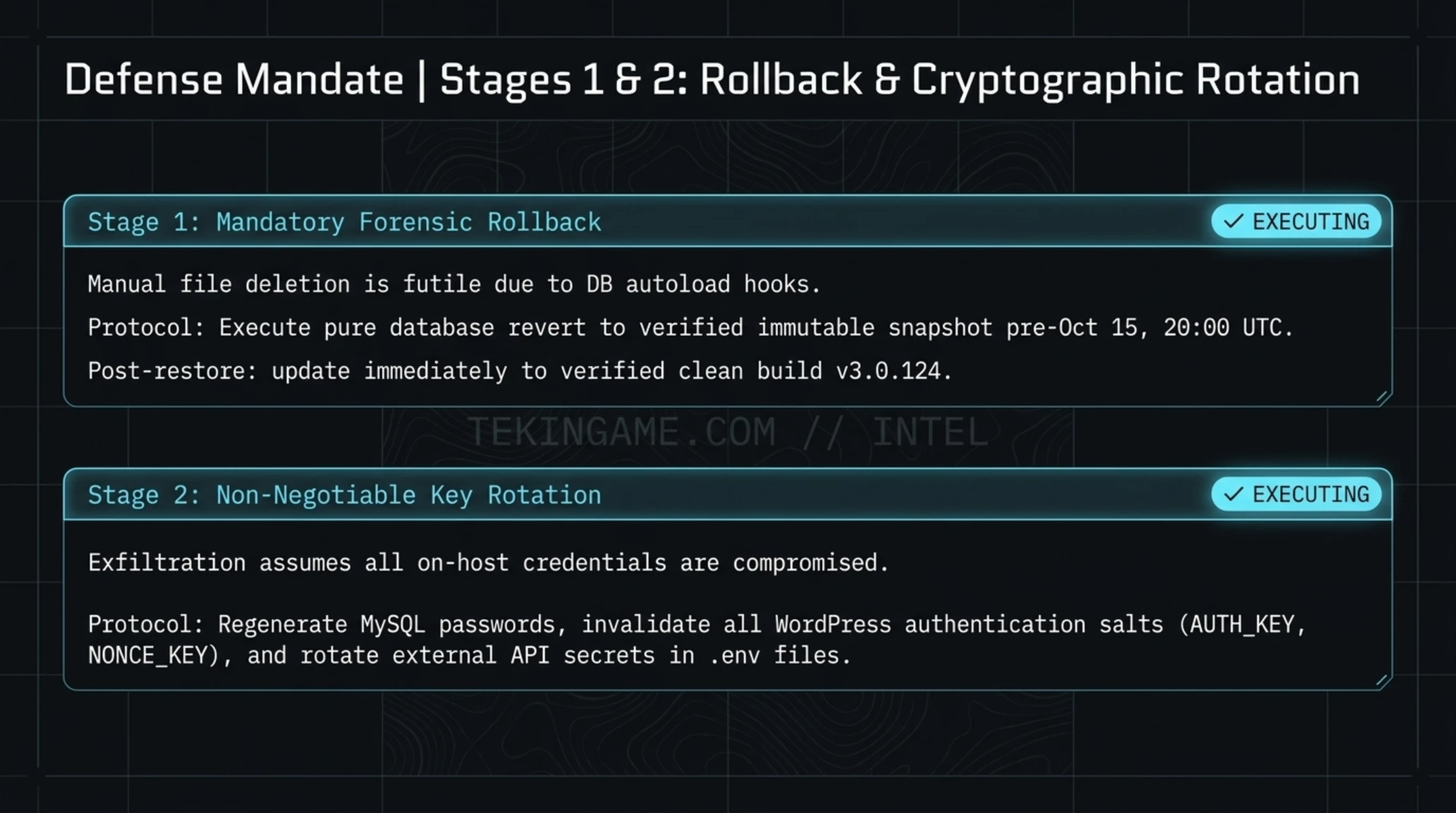
Stage One mandates structural database and application rollback. Because the malicious payload injects encoded binary strings directly into autoloaded option tables and establishes dynamic re-infection listeners, manual file deletions or automated WordPress scanner runs are fundamentally futile. Infrastructure teams must revert the entire application environment and database to a verified, immutable backup snapshot created prior to October 15, 2026, at 20:00 UTC. Immediately following restoration, the Rank Math PRO installation must be updated to the verified clean build, version 3.0.124, before opening network ingress.
To execute a comprehensive digital forensic audit, database administrators must run direct SQL queries against the wp_options table to isolate any serialized artifacts associated with rank_math_telemetry_cache, rogue transients, or anomalous long-string autoload entries. In the wp_users and wp_usermeta tables, teams must inspect user_registered timestamps to detect any unauthorized administrative identities provisioned during the compromise window, verifying that capabilities entries (wp_user_level = 10) correspond exclusively to authorized corporate operators. Any unrecognized administrative accounts must be excised immediately, alongside corresponding session tokens stored within usermeta session caches.
Stage Two requires a total, non-negotiable credential and cryptographic key rotation. Because the exfiltration script gathered environment files and database handles, administrators must assume that all credentials residing on the host are compromised. This process encompasses generating new MySQL/PostgreSQL database passwords, invalidating and regenerating all WordPress authentication keys and salts (AUTH_KEY, SECURE_AUTH_KEY, LOGGED_IN_KEY, NONCE_KEY), and rotating external API secrets stored in .env files, including Cloudflare API tokens, AWS S3 access keys, and transactional payment gateway credentials. Failure to rotate these cryptographic tokens allows threat actors to impersonate authenticated administrative sessions long after the host filesystem has been sanitized.
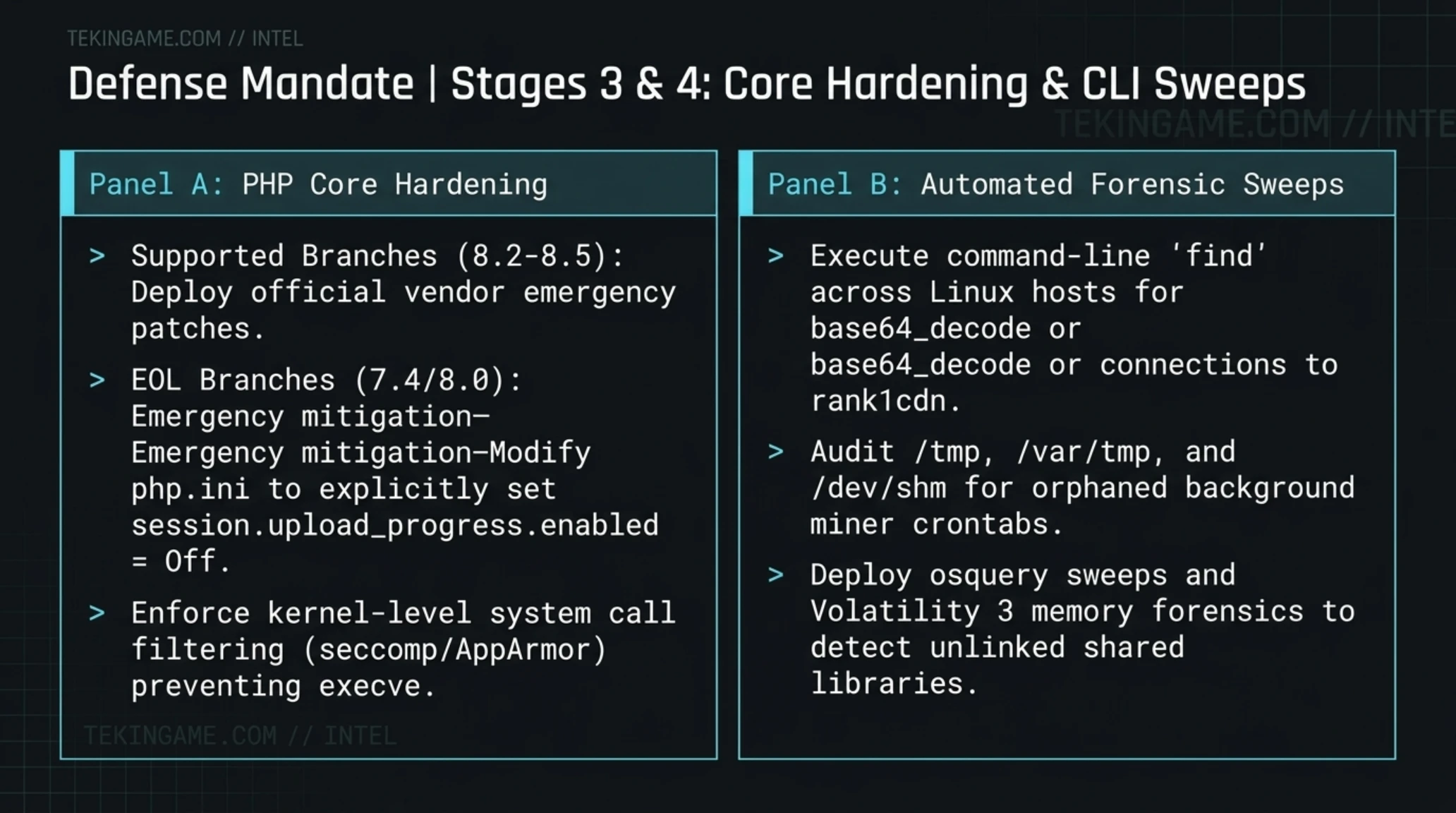
Stage Three focuses on PHP core runtime hardening and vulnerability neutralization. For servers running supported active branches (PHP 8.2 through 8.5), administrators must apply the official vendor emergency patches immediately through their distribution package managers. For mission-critical environments locked into deprecated, End-of-Life branches (such as PHP 7.4 or 8.0) that cannot be migrated immediately without application disruption, administrators must enforce an emergency configuration mitigation: modifying php.ini to explicitly set session.upload_progress.enabled = Off, followed by a graceful reload of php-fpm or Apache services. Disabling this directive deactivates the vulnerable internal memory allocation routines, closing the remote code execution vector utilized by PHP2Shell.
Enterprise platform operators running high-density clusters should additionally enforce kernel-level system call filtering via seccomp profiles and AppArmor or SELinux policies. By preventing web worker processes from invoking execve, ptrace, or socket binding primitives, organizations establish defense-in-depth boundaries that neutralize remote shell execution even if unauthenticated heap exploitation succeeds within the Zend Engine runtime memory space.
Stage Four enforces deep filesystem sanitization, automated forensic sweeps, and active process inspection. Systems engineers must execute command-line forensic sweeps across Linux hosts, utilizing find to inspect all PHP files modified over the preceding seven days, while searching for base64_decode, eval, or connections to the rank1cdn domain across the entire document root. Crucially, teams must audit Linux crontab configurations and check temporary directory mounts (/tmp, /var/tmp, /dev/shm) to terminate any orphaned background miner processes or reverse proxies established during initial compromise windows.
For large-scale infrastructure environments, security operations teams should deploy targeted osquery sweeps and auditd tracking rules. Specifically, systems architects should configure auditctl rules to monitor all file write operations targeting the wp-content/plugins directory by the www-data or nginx service accounts. Furthermore, memory forensics utilizing Volatility 3 or LiME (Linux Memory Extractor) should be conducted on suspected nodes to identify unlinked shared libraries, anomalous file descriptors, or injected binary code operating within resident memory structures of running php-fpm master processes.
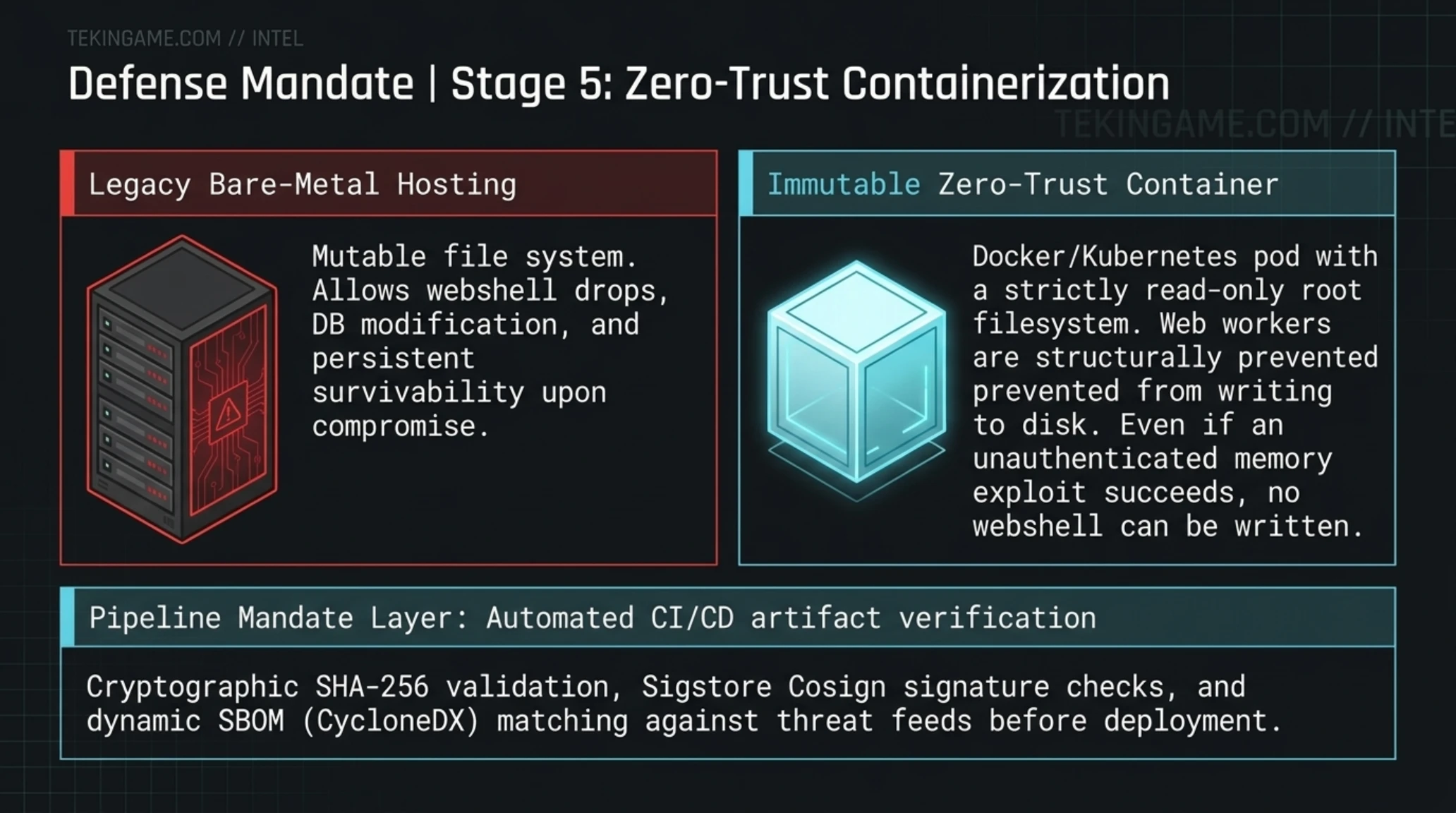
Stage Five establishes long-term Zero-Trust container architecture. The Rank Math and PHP2Shell disclosures demonstrate that legacy bare-metal or monolithic virtual machine hosting models represent unacceptable enterprise risk. Leading software organizations are transitioning WordPress and PHP workloads into isolated, containerized pods running on Kubernetes or Docker, featuring read-only root filesystems. Under a read-only container architecture, web worker processes are structurally prevented from creating new files, modifying existing scripts, or writing to disk. Even in the event of an unauthenticated RCE memory exploit, the adversary is unable to drop webshells or achieve persistent survivability.
To establish absolute software supply-chain integrity moving forward, corporate engineering teams must integrate automated artifact verification within their continuous deployment (CI/CD) pipelines. Every third-party plugin, commercial library, or vendor release archive must undergo cryptographic SHA-256 checksum validation and Sigstore Cosign signature verification against verified vendor public keys prior to production deployment. Automated Software Bill of Materials (SBOM) generation utilizing SPDX or CycloneDX formats ensures real-time visibility into nested dependencies, enabling instant vulnerability matching across internal threat intelligence feeds.
Security operations centers (SOC) should simultaneously deploy real-time SIEM behavioral rules within Splunk, Elastic Security, and Microsoft Sentinel. Specifically, detection engineers must construct behavioral correlation rules monitoring process ancestry trees: any instance where a php-fpm or httpd worker process spawns an interactive shell binary (such as /bin/sh, /bin/bash, /usr/bin/python, or /usr/bin/perl) or executes network utilities (such as curl, wget, nc, or socat) represents an unmistakable indicator of compromise (IoC) triggered by remote code execution. Under standard web application operational baselines, PHP interpreter workers should never invoke interactive shell interpreters.
In modern cloud-native Kubernetes environments, site reliability engineers must enforce the Restricted Pod Security Standard across all WordPress and PHP namespaces. Pod specifications should explicitly declare a hardened securityContext: setting readOnlyRootFilesystem to true, dropping all Linux kernel capabilities via drop: ["ALL"], requiring runAsNonRoot: true with dedicated service account UIDs, and configuring temporary upload directories as ephemeral tmpfs memory mounts configured strictly with noexec, nosuid, and nodev mount flags. Under these immutable constraints, even a successful unauthenticated heap overflow in the Zend Engine is rendered completely impotent, as the runtime environment structurally prohibits executing newly written binaries or writing persistence scripts to disk.
Ultimately, institutional resilience against modern software supply-chain threats demands an evolution in technical governance. Purchasing expensive proprietary software packages does not confer an automatic shield against compromise. Enterprise engineering departments must implement strict staging pipelines, cryptographic artifact hash verification, host-based file integrity monitoring (AIDE/Tripwire), and continuous outbound egress traffic inspection to maintain security dominance in an increasingly adversarial digital landscape.
The lessons crystallized by the October 2026 crisis prove that cybersecurity is not a static endpoint, but an active, unending process of architectural validation. The organizations that survive the expanding wave of supply-chain sabotage will be those that embrace an Assume Breach doctrine, implementing immutable container infrastructure, strict least-privilege service configurations, and real-time behavioral telemetry across every layer of their technology stack.
- Rapid vendor containment and revocation of the poisoned build within 11 hours by the Rank Math engineering team.
- Swift release of emergency core patches by the PHP Foundation for actively supported branches.
- Transparent, collaborative threat intelligence sharing across independent security research firms.
- Thousands of enterprise databases and cryptographic secrets compromised during the exposure window.
- Over 55 percent of legacy global web servers operating on unsupported EOL versions left permanently exposed.
- Severe erosion of corporate trust regarding automated background update pipelines across the CMS ecosystem.
Unified Editorial Verdict and Authoritative Global References
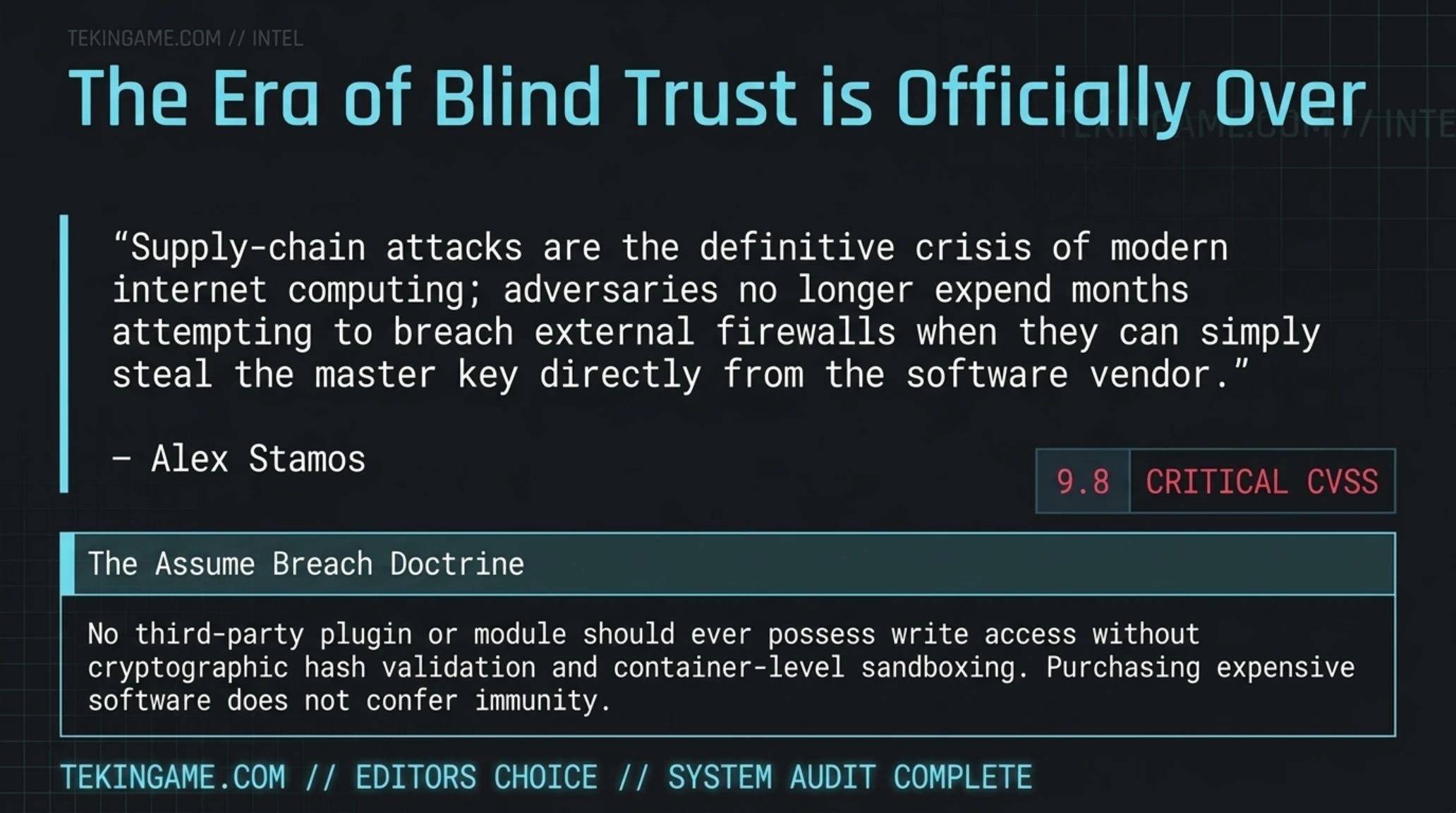
The Era of Blind Supply-Chain Trust is Officially Over
No third-party plugin or module should ever possess write access without cryptographic hash validation and container-level sandboxing; pre-incident database restores and emergency PHP runtime mitigations remain the only viable operational refuge.
- BleepingComputer: WordPress SEO Plugin Rank Math Compromised in Supply-Chain Breach
- The Hacker News: Popular WordPress Plugin Hijacked to Deliver Self-Restoring Backdoor
- SecurityWeek: Emergency Security Updates Released for Critical PHP Remote Code Execution Vulnerabilities
- Rank Math Official Security Advisory: Security Notice and Immediate Version 3.0.124 Upgrade Guidelines
Frequently Asked Technical Questions and Incident Forensics
Is the free version of Rank Math available on WordPress.org affected by this backdoor?
No, comprehensive binary decompilation and vendor announcements confirm that the supply-chain infiltration was strictly confined to the commercial Rank Math PRO version 3.0.123 distribution downloaded or updated directly from the vendor's private infrastructure.
Does deleting the plugin directory and installing version 3.0.124 clean the infection?
No, surface-level deletions fail because the backdoor stores base64-encoded executable strings in the database options table and hooks into the request lifecycle to regenerate itself. A complete database restore to a pre-infection snapshot is mandatory.
Why is the PHP2Shell vulnerability rated as a critical 9.8 CVSS emergency?
Because the vulnerability exists in the compiled C runtime of the Zend Engine, allowing unauthenticated remote attackers to trigger heap memory corruption via multipart upload requests and execute arbitrary system shell commands without credentials.
Are websites hosted on shared web hosting environments exposed to lateral compromise?
Yes, on multi-tenant servers lacking kernel-level cgroup or container isolation, an adversary executing shell commands via PHP2Shell can traverse outside directory boundaries and access adjacent accounts sharing the same web service daemon.
What temporary mitigation protects legacy PHP servers that cannot be immediately updated?
Administrators should set session.upload_progress.enabled = Off in their php.ini configuration and reload php-fpm; this disables the vulnerable memory allocation routine and closes the remote attack vector.
Will deprecated PHP versions like 7.4 or 8.0 receive official security patches?
No, the PHP Foundation strictly maintains active release branches; unsupported EOL versions will receive no official upstream patches, necessitating immediate migration or third-party commercial backports.
Additional Gallery: Tekin Analysis | Rank Math PRO Backdoor & PHP2Shell 9.8 Zero-Day