
🌙 Welcome to Tekin Night — June 18, 2026
Good evening, tech night owls! Thursday night kicks off with a full dose of the most critical and explosive technology news from around the globe. Tonight we have 6 major stories spanning cybersecurity, crypto markets, gaming, and AI—everything you need to wrap up your work week informed and energized.
⚡ Tonight's Headlines:
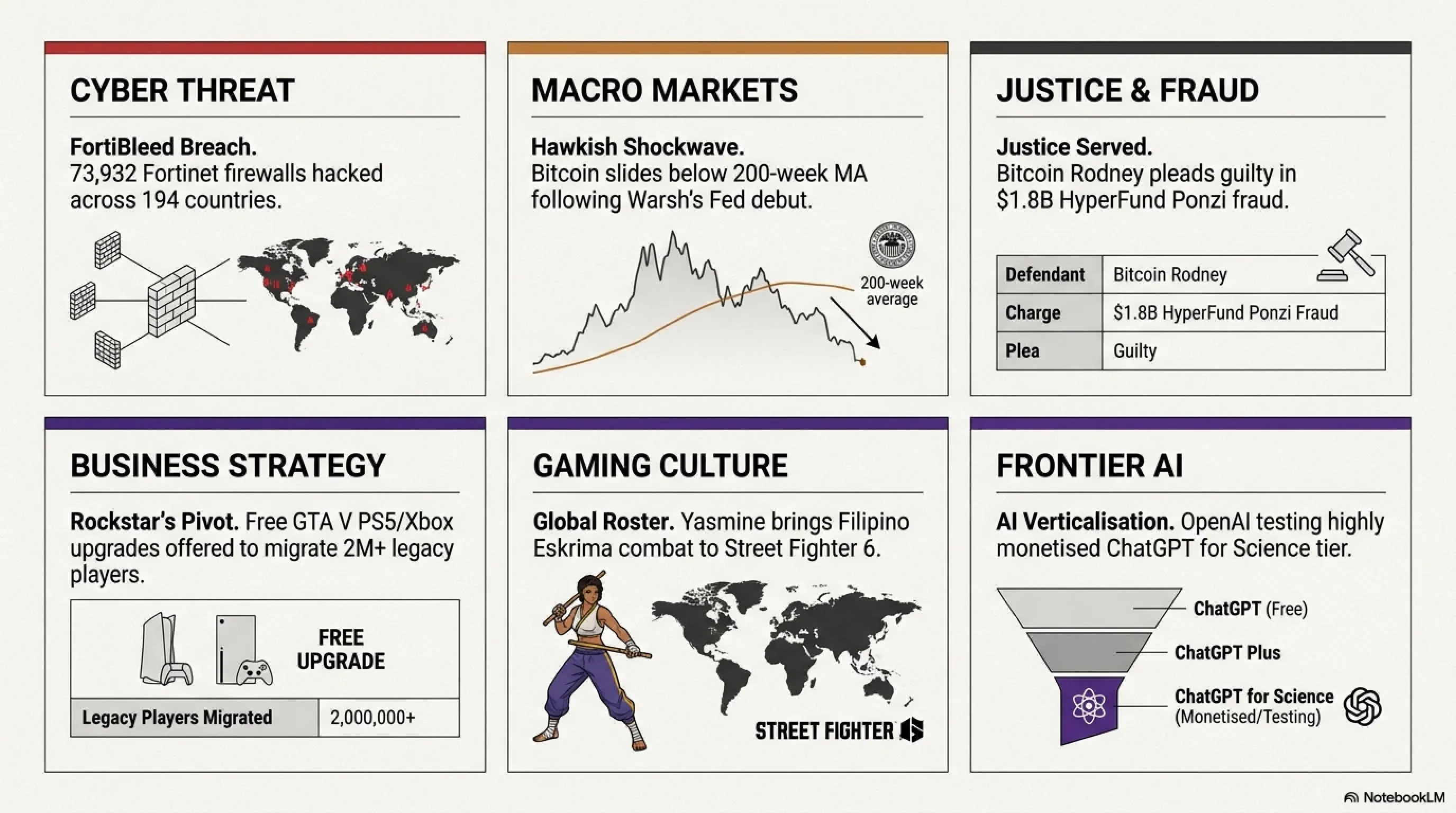
🔒 FortiBleed: 73,932 Fortinet firewalls hacked across 194 countries
📉 Bitcoin slides below 200-week MA after Warsh's hawkish Fed debut
⚖️ Bitcoin Rodney pleads guilty in $1.8B HyperFund Ponzi fraud
🎮 Rockstar offers free GTA V PS5/Xbox upgrade after years of charging
🥊 Yasmine brings Filipino Eskrima combat to Street Fighter 6
🔬 OpenAI testing ChatGPT for Science subscription tier
☕ Grab your evening coffee and buckle up for a comprehensive tech news journey!
🔒 FortiBleed: The Largest Enterprise Firewall Breach in History
In what security researchers are calling the largest enterprise network infrastructure breach in history, cybercriminals have successfully harvested working credentials for 73,932 unique Fortinet FortiGate firewalls spanning 194 countries. The campaign, dubbed "FortiBleed" by the security community, has exposed approximately half of all internet-accessible FortiGate devices worldwide—turning the first line of defense for thousands of organizations into wide-open attack vectors.
According to reports from TechCrunch, Ars Technica, and Dark Reading published June 17, 2026, the leaked database contains verified, working plaintext credentials for FortiGate firewall and VPN gateway admin panels. The dataset includes over 21,000 unique IP addresses and affects Fortune 500 companies, government agencies, and critical infrastructure operators across 15+ countries. Security researcher Volodymyr "Bob" Diachenko first discovered the dataset circulating in underground forums, with subsequent analysis by Hudson Rock confirming the authenticity and scope of the breach.
🚨 Strategic Analysis: Why FortiBleed is a National Security Crisis
FortiBleed transcends the typical data breach narrative—this is a systemic failure of perimeter defense with implications for national security, economic stability, and critical infrastructure resilience. Firewalls are meant to be the castle walls; now the keys to those walls are in enemy hands. Threat actors can infiltrate internal networks without triggering intrusion detection, exfiltrate sensitive data, deploy ransomware, or even sabotage industrial control systems—all while appearing as legitimate administrators. The attack surface isn't theoretical; it's operational and actively being exploited.
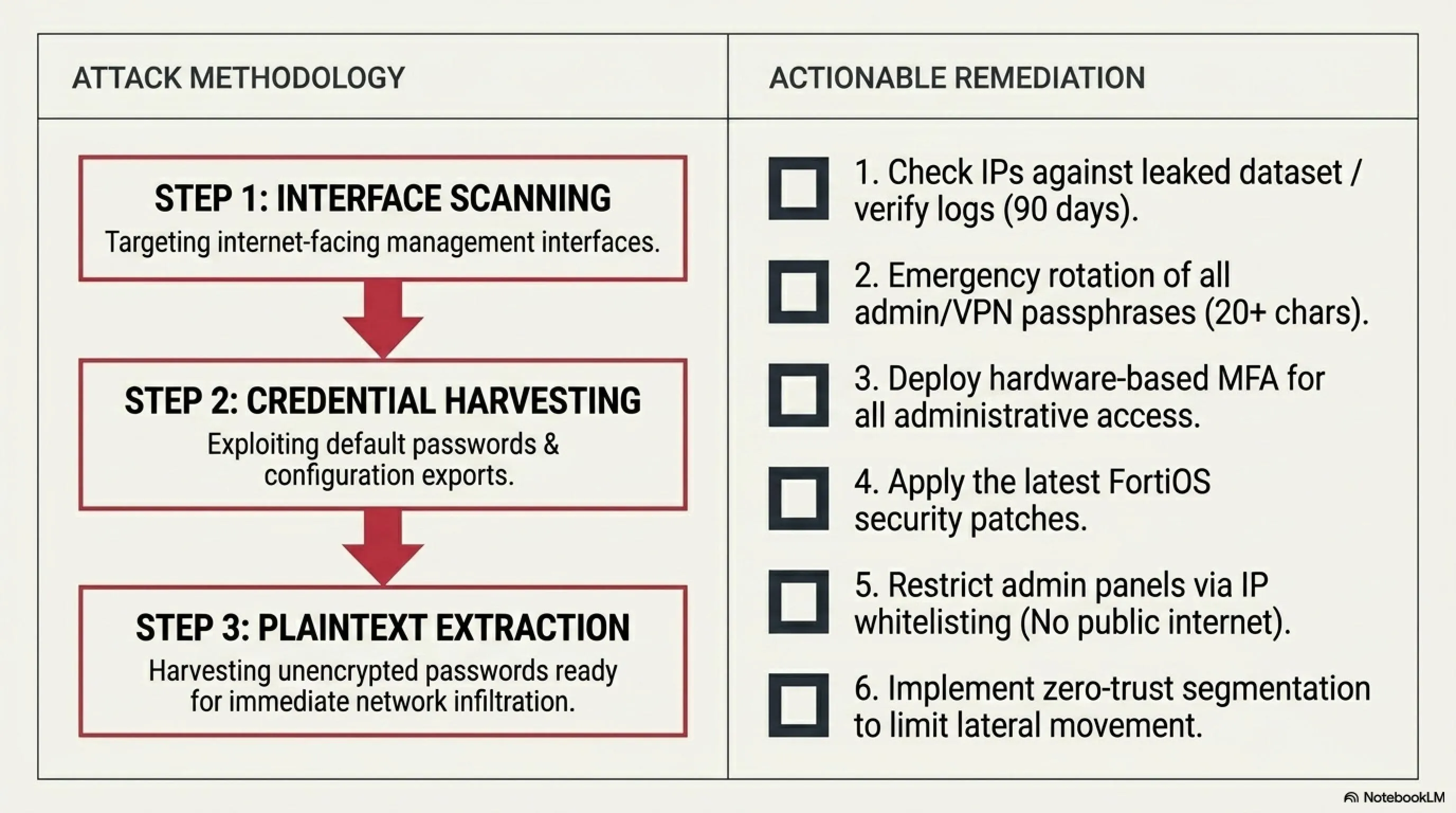
📊 Attack Methodology: How Did FortiBleed Happen?
Based on forensic analysis by security researcher Volodymyr "Bob" Diachenko and Hudson Rock's threat intelligence team, FortiBleed represents a large-scale automated credential harvesting operation targeting Fortinet FortiGate firewalls and VPN gateways. The attackers systematically scanned for internet-facing management interfaces and exploited a combination of weak default credentials, unpatched vulnerabilities, and misconfigurations to gain administrative access.
Critically, the leaked data appears to originate from device configuration exports, as it contains information only visible from within the firewall's management interface itself. This suggests attackers leveraged either zero-day vulnerabilities in FortiOS (Fortinet's operating system), previously undisclosed CVEs, or—more likely—systematic exploitation of administrator accounts still using factory defaults or easily guessable passwords. The dataset's freshness (most entries dated within the past 90 days) indicates this is an ongoing, active campaign rather than a historical data dump.
🔍 Tekin Analysis: Why Fortinet Became the Target
Fortinet commands significant market share in enterprise firewall and VPN solutions, with FortiGate devices deployed across Fortune 500 enterprises, government agencies, healthcare systems, financial institutions, energy infrastructure, universities, and military installations. Compromising a Fortinet firewall is equivalent to stealing the vault key—attackers gain unfettered access to everything behind the perimeter. The appeal to adversaries is obvious: a single credential harvest campaign yields access to thousands of high-value targets simultaneously.
The other factor is systemic negligence: many organizations deploy FortiGate devices with default credentials never changed, outdated firmware with known vulnerabilities, and management interfaces exposed directly to the internet without IP whitelisting or multi-factor authentication. Even without zero-day exploits, attackers can breach poorly configured firewalls through brute-force attacks or credential-stuffing campaigns using previously leaked password databases. FortiBleed exposes the uncomfortable truth that perimeter security is only as strong as the weakest administrative password.
🌍 Global Impact: Which Industries and Regions Are Most Affected?
According to Hudson Rock's analysis, the FortiBleed database spans virtually every critical industry sector—financial services, healthcare, energy, defense, education, manufacturing, telecommunications, and technology. Fortune 500 companies, government agencies, and critical infrastructure operators in 15+ countries are confirmed affected, with the highest concentrations in North America, Europe, and Asia-Pacific regions.
The breach poses acute risks for developing economies and nations with immature cybersecurity postures, where organizations may lack the resources or expertise to implement robust security controls. A compromised firewall in a developing nation's critical infrastructure—power grid, telecommunications backbone, financial clearing system—could enable adversaries to conduct cyber sabotage, economic espionage, or even kinetic attacks through digital means. The geopolitical implications are staggering: nation-state actors now possess a ready-made toolkit for targeting adversaries' infrastructure without attribution.
💡 Actionable Remediation Steps for Organizations
- Immediate verification: Check if your FortiGate IP addresses appear in the leaked dataset using online scanning tools or contact Fortinet security support directly
- Emergency password rotation: Change all administrative, VPN, and privileged account passwords immediately—use 20+ character randomized passphrases
- Enable MFA everywhere: Deploy multi-factor authentication (MFA) for all administrative access without exception—hardware tokens preferred over SMS
- Firmware patching: Apply latest FortiOS security patches and firmware updates released by Fortinet
- Log forensics: Review authentication logs for the past 90 days to identify unauthorized access or suspicious administrative activity
- IP whitelisting: Restrict management interface access to known IP ranges; disable public internet access to admin panels
- Network segmentation: Assume breach—implement zero-trust segmentation to limit lateral movement if perimeter is compromised
- Incident response readiness: Prepare incident response plans for potential ransomware, data exfiltration, or sabotage scenarios
📉 Bitcoin and Crypto Markets Tumble After Warsh's Hawkish Fed Debut
Cryptocurrency markets endured a punishing session on June 18, 2026, following the first Federal Open Market Committee (FOMC) meeting chaired by Kevin Warsh as the new Federal Reserve Chair. While the Fed kept the federal funds rate unchanged at 3.5-3.75%, the accompanying statement and Warsh's press conference delivered a decidedly hawkish message that sent shockwaves through risk asset markets—particularly crypto.
The critical revelation came in the Summary of Economic Projections (dot plot), which showed 9 of 18 FOMC participants now project at least one rate hike before year-end 2026, with 6 participants forecasting two hikes. This hawkish shift reflects persistent inflation concerns and represents a stark departure from market expectations for rate cuts. Warsh's explicit statement that the Fed is "committed to delivering price stability" signaled that inflation-fighting remains the paramount mandate—even at the expense of supporting risk asset valuations or economic growth.
📊 Market Carnage: Comprehensive Crypto Selloff
- Bitcoin (BTC): Down 2.2% to $64,150—briefly fell below the critical 200-week moving average ($64,700) before recovering
- Ethereum (ETH): Down 3.6%—suffered steeper losses than BTC, reflecting higher beta sensitivity to macro conditions
- XRP: Down 3.1%—regulatory overhang compounds macro headwinds
- Solana (SOL): Down ~3%—layer-1 smart contract platforms hit harder than store-of-value assets
- GMCI 30 Index: Down 2.6%—bringing year-to-date losses to nearly 36% across the broader market
- MicroStrategy (MSTR): Down 4.3% to $117.53—Bitcoin-proxy stocks amplified the selloff
- Marathon Digital (MARA): Down 2.05% to $14.13—mining stocks pressured by BTC price weakness
- Coinbase (COIN): Down ~2%—exchange equities track crypto volatility
🎙️ Warsh's Message: "Delivering Price Stability" Above All Else
In his inaugural FOMC press conference, Kevin Warsh delivered an unambiguous message: the Federal Reserve "is committed to delivering price stability" and will not prematurely ease monetary policy to support asset prices or economic growth while inflation remains above the 2% target. This rhetoric—blunt, hawkish, and purposefully devoid of dovish hedges—represents a marked tonal shift from previous Fed communications that often balanced inflation concerns with labor market and financial stability considerations.
Warsh emphasized that "inflation remains elevated and persistent" despite recent deceleration, and expressed concern that premature rate cuts could reignite inflationary pressures. He also noted that the Fed's tolerance for above-target inflation has "expired," signaling zero appetite for letting inflation run hot. This hardline stance effectively killed market expectations for 2026 rate cuts and introduced the specter of additional hikes—a nightmare scenario for leveraged risk assets like crypto that thrive in low-rate, high-liquidity environments.
🧠 Tekin Analysis: Why Bitcoin Couldn't Ride the Iran Peace Deal
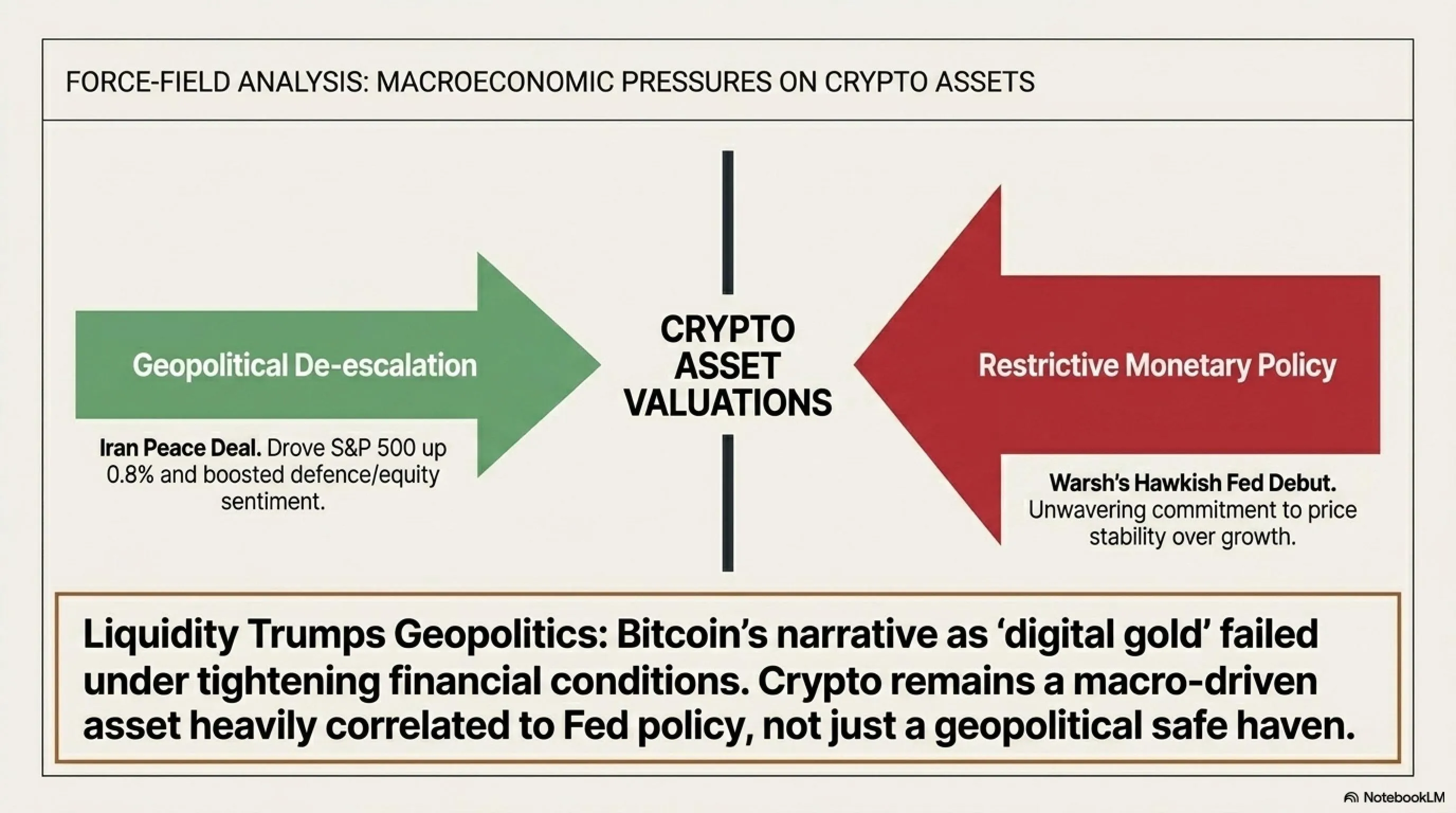
One of the session's most revealing dynamics was the divergence between equity and crypto markets following President Trump's signing of the Iran peace deal. Equity markets rallied on geopolitical de-escalation—the S&P 500 gained 0.8% and defense stocks surged—yet Bitcoin and crypto sold off sharply. Why the disconnect?
The answer: monetary policy trumps geopolitics for crypto. Bitcoin's narrative as "digital gold" and an inflation hedge collapsed under the weight of tightening financial conditions. When the Fed signals higher-for-longer rates, capital flows out of zero-yield, speculative assets (crypto) and into higher-yielding alternatives (bonds, money markets) or defensive equities. The Iran deal's positive geopolitical implications couldn't overcome the fundamental headwind of restrictive monetary policy. This episode underscores that crypto remains a macro-driven, liquidity-sensitive asset class more correlated with Fed policy than geopolitical risk premiums.
📉 The 200-Week Moving Average: Bitcoin's Critical Support Level
Bitcoin's intraday dip below the 200-week moving average (approximately $64,700) is technically significant. Historically, the 200-week MA has served as a reliable long-term support level, with violations typically signaling extended bear markets. Bitcoin briefly touched $64,308 before recovering to $64,450 by session close—a technical bounce that suggests buyers stepped in at this critical inflection point.
However, a decisive breakdown below $64,000 could trigger capitulation, as algorithmic traders and quantitative funds often use the 200-week MA as a stop-loss threshold. Further downside targets include $60,000 (psychological round number) and $58,000 (2025 cycle low). Conversely, a strong reclaim of $66,000 would negate the bearish technical breakdown and reopen upside targets toward $70,000. For now, Bitcoin trades on "thin ice"—vulnerable to further macro deterioration but not yet in full capitulation mode.
⚖️ Bitcoin Rodney Pleads Guilty in $1.8 Billion HyperFund Ponzi Scheme
In one of the largest crypto fraud prosecutions to date, Rodney Burton—widely known as "Bitcoin Rodney" in crypto influencer circles—pleaded guilty on June 16, 2026, in Maryland federal court to conspiracy to operate an unlicensed money transmitting business. Burton played a key promotional role in the HyperFund (later rebranded as HyperVerse) Ponzi scheme that defrauded investors of approximately $1.8 billion between June 2020 and January 2022. Burton personally pocketed at least $7.85 million while recruiting victims through social media, live events, and promotional videos.
HyperFund falsely claimed to operate a cryptocurrency mining operation that would generate passive daily returns for investors—typically 0.5-1% per day—with "zero risk." In reality, no mining operations existed; HyperFund was a classic Ponzi scheme that used funds from new investors to pay earlier participants. When the influx of new capital slowed, the scheme collapsed, leaving thousands of victims worldwide with devastating losses. Burton's sentencing is scheduled for July 23, 2026, and he faces a maximum of five years in federal prison.
🎭 How HyperFund Worked: Anatomy of a Global Crypto Ponzi
HyperFund (and its successor brand HyperVerse) marketed itself as a passive income platform backed by cryptocurrency mining operations. The pitch was deceptively simple and compelling:
- Daily Passive Returns: Investors were promised 0.5-1% daily returns—equivalent to 180-365% annualized—with "zero risk"
- Mining Narrative: HyperFund claimed returns were generated from sophisticated crypto mining operations and arbitrage trading
- Referral Commissions: Multi-level marketing structure rewarded participants for recruiting new investors—classic pyramid dynamics
- Investment Tiers: Packages ranged from $300 to $100,000—higher investments promised better returns and referral bonuses
- Withdrawal Restrictions: Funds were often "locked" for periods, preventing mass withdrawals that would trigger collapse
The reality: HyperFund operated no mining infrastructure whatsoever. It was a textbook Ponzi scheme—new investor deposits funded "returns" paid to earlier participants, creating the illusion of profitability. Burton and other promoters used flashy social media content, luxury lifestyle displays, and testimonials to lure victims. When recruitment slowed and withdrawals accelerated, the scheme imploded, vaporizing $1.8 billion in investor capital.
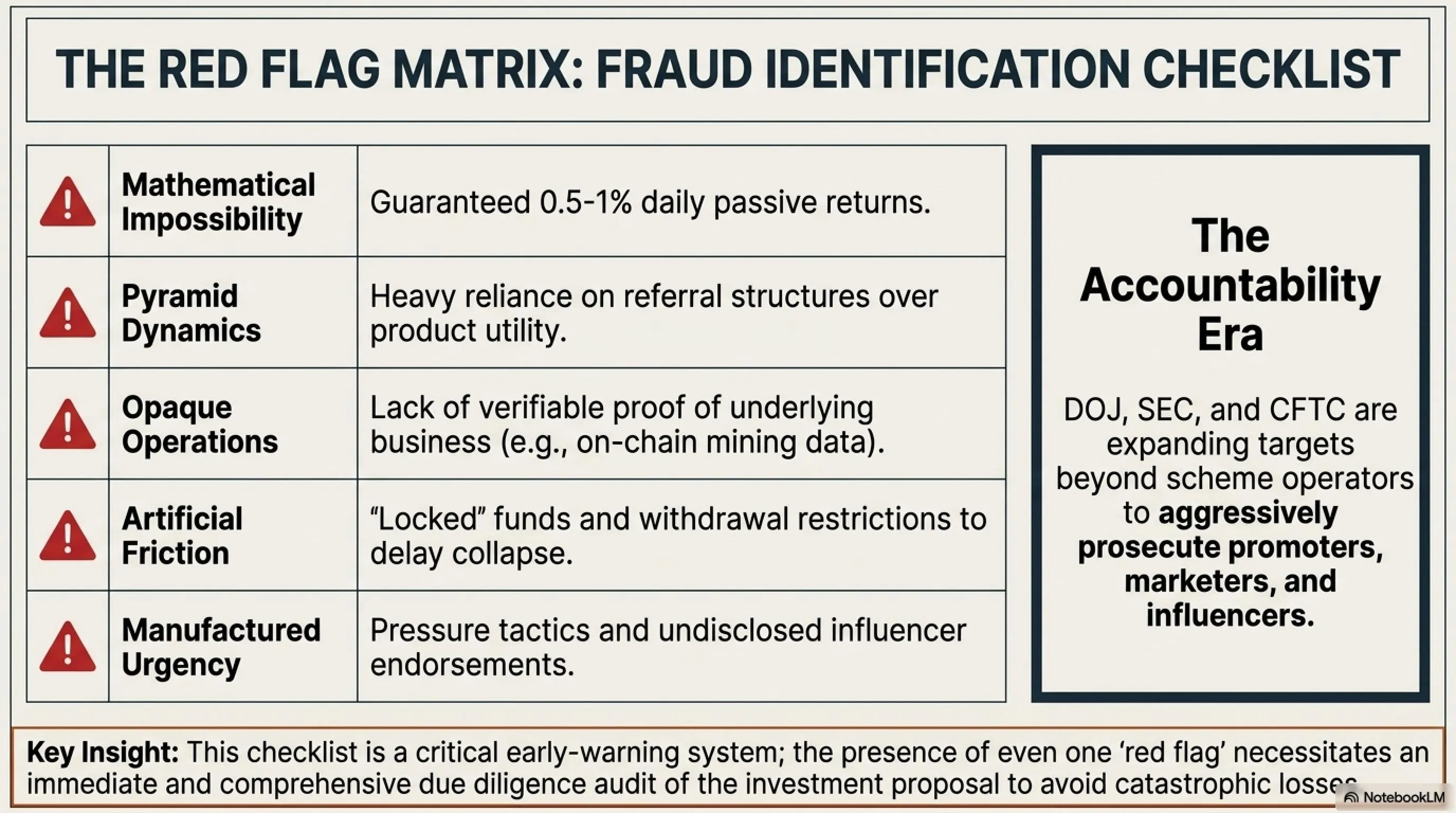
🚨 Red Flags: How to Spot Crypto Ponzi Schemes
- Guaranteed High Returns: No legitimate investment can offer 0.5-1% daily returns without substantial risk—these numbers are mathematically unsustainable
- Referral-Heavy Structure: If the focus is recruiting new participants rather than delivering a real product/service, it's likely a pyramid scheme
- Lack of Transparency: Legitimate businesses provide verifiable proof of operations—Ponzi schemes offer vague explanations and dodge accountability
- Pressure Tactics: "Limited spots," "act now," "opportunity closing soon"—urgency is designed to bypass due diligence
- Influencer Endorsements: Social media influencers promoting investment schemes without disclosing compensation is a massive red flag
- Withdrawal Restrictions: Locked funds, "vesting periods," or difficulty withdrawing capital are designed to delay the inevitable collapse
📊 Implications: Crypto Fraud Enforcement is Intensifying
Burton's guilty plea signals that crypto fraud enforcement is entering a new phase of accountability. For years, crypto influencers operated with impunity, promoting dubious projects in exchange for undisclosed payments while facing minimal legal consequences. That era is ending. The DOJ, SEC, and CFTC are now aggressively pursuing not just scheme operators but also promoters, marketers, and influencers who facilitated fraud.
This enforcement trend has several implications: (1) Crypto influencers face personal criminal liability for promoting scams, even if they weren't operators; (2) Platforms like YouTube, Twitter/X, and Instagram may face pressure to police fraudulent crypto promotions; (3) Investors should demand independent verification and due diligence rather than relying on influencer endorsements; (4) The crypto industry must self-regulate and ostracize bad actors to prevent further regulatory crackdowns. Burton's case is unlikely to be the last—expect more prosecutions targeting the crypto influencer economy in 2026-2027.
🎮 Rockstar Announces Free GTA V Upgrade After Years of Charging
In a surprising policy reversal, Rockstar Games announced on June 17, 2026, that starting June 18, owners of any PlayStation 4 version of Grand Theft Auto V or the digital Xbox One version can upgrade to the PS5 and Xbox Series X/S versions completely free. This marks a significant about-face from February 2022, when Rockstar charged $9.99 for the same upgrade path. The move comes ahead of The Kortz Center Heist major GTA Online update launching in July 2026 and sets the stage for the eventual GTA 6 release.
Rockstar's motivation is transparent: migrate the approximately 2 million active GTA Online players still on PS4 to next-gen hardware before GTA 6 arrives. By offering a frictionless upgrade path, Rockstar accelerates the transition, reduces support costs for legacy platforms, and maximizes revenue potential from players on PS5/Series X who statistically spend more on microtransactions due to improved gameplay experiences.
💰 Business Strategy: Why Rockstar Reversed Course
This decision isn't altruism—it's savvy business strategy driven by several key factors:
- GTA 6 Preparation: Rockstar wants maximum next-gen install base before GTA 6 launches—unified platform optimization reduces development complexity
- Higher ARPU on Next-Gen: PS5/Series X players exhibit higher Average Revenue Per User (ARPU) due to better UX, faster load times, and increased engagement
- Lower Support Costs: Supporting four platforms (PS4, PS5, Xbox One, Series X) is expensive—consolidating to next-gen cuts QA and maintenance overhead
- Competitive Pressure: Free-to-play competitors like Fortnite and Apex Legends offer seamless cross-gen experiences—Rockstar must match expectations
- Content Pipeline: July's Kortz Center Heist likely features next-gen-exclusive enhancements that require player migration
🎯 What This Means for the Gaming Industry
Rockstar's move sets a new precedent for how publishers manage cross-generation transitions. Charging for upgrades—as Rockstar did in 2022 and Sony did for some first-party titles—creates friction and player resentment. The industry is learning that free upgrades drive engagement, loyalty, and long-term monetization through in-game purchases, subscriptions, and DLC. Expect other live-service games (Call of Duty, FIFA/EA Sports FC, Destiny 2) to follow suit, offering free next-gen upgrades to maximize active player bases ahead of major releases.
🥊 Yasmine: Street Fighter 6 Welcomes Filipino Fighter with Eskrima Skills
Capcom unveiled gameplay footage for Yasmine, the first DLC character for Street Fighter 6 Year 4, on June 18, 2026, with a launch date set for August 3, 2026. Hailing from the Philippines, Yasmine is a high school student trained in Eskrima—the national martial art of the Philippines—and wields a crescent-shaped karambit knife as her signature weapon. She's available as part of the Year 4 Character Pass or purchasable individually with Fighter Coins.
Yasmine's backstory adds narrative depth: she trained under her grandfather (Lolo) and older brother (Kuya) but put down her karambit after her brother's mysterious disappearance. Inspiration struck when she discovered FooTube videos of a French supermodel (likely referencing Manon, an existing SF6 character), reigniting her passion to carve a path toward finding her lost sibling. Her fighting style emphasizes high-speed rush-down tactics, rapid movement, and close-range pressure—requiring opponents to track her positioning carefully or face devastating combo strings.
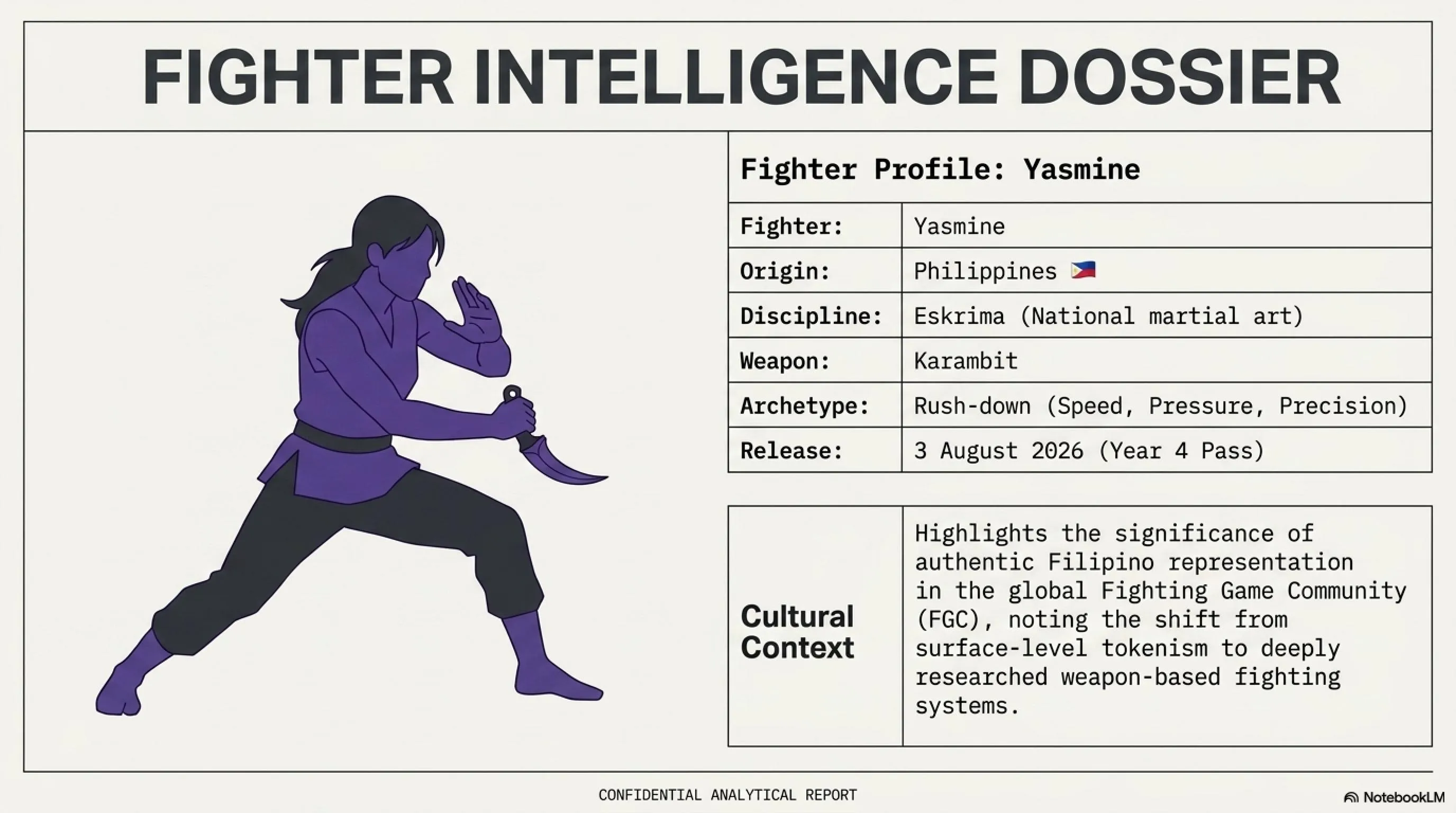
🔥 Yasmine's Playstyle: Speed, Pressure, and Precision
Yasmine embodies the rush-down archetype, specializing in relentless offensive pressure through fast movement, quick normals, and frame-trap setups. Her Eskrima training manifests in fluid motion—she circles opponents, closes distance rapidly, and chains attacks with minimal recovery. The karambit enables slash combos that keep adversaries in blockstun, creating opportunities for mixups and throw attempts. Mechanically, expect similarities to Cammy and Chun-Li but with heavier emphasis on close-range knife strikes and possibly unique stance transitions inspired by Filipino martial arts.
🌏 Representation Matters: Filipino Culture in Global Fighting Games
Yasmine's inclusion is significant for Filipino representation in mainstream gaming. The Philippines has a vibrant FGC (Fighting Game Community) presence, with strong esports scenes in Manila and Cebu, yet Filipino characters remain rare in major fighting game franchises. Tekken featured Josie Rizal (though her Eskrima moveset was limited), but Yasmine represents a more authentic integration of Filipino martial arts into competitive gameplay. Capcom's decision to spotlight Eskrima—a weapon-based fighting system with centuries of history—demonstrates cultural respect and research beyond surface-level tokenism.
🔬 OpenAI Testing ChatGPT for Science Subscription Tier
Leaked screenshots published June 17, 2026, confirm that OpenAI is testing a new subscription tier specifically designed for scientific research use cases, tentatively branded "ChatGPT for Science." While details remain scarce, the subscription appears optimized for researchers, academics, and scientific institutions, offering specialized workflows, enhanced models, and potentially integrations with scientific databases and literature repositories.
It's unclear whether ChatGPT for Science will be publicly available to all users or restricted to verified research institutions and academic affiliates. This aligns with OpenAI's broader strategy of developing vertical-specific AI products—similar to GPT-Rosalind for life sciences research, which launched earlier in 2026. Vertical specialization allows OpenAI to command premium pricing, tailor models to domain-specific requirements, and capture enterprise/institutional markets beyond consumer ChatGPT subscriptions.
🧪 Expected Capabilities and Features
- Research-Optimized UX: Interface designed for scientific workflows—literature review, hypothesis generation, methodology design
- Enhanced Model Access: Likely includes GPT-Rosalind, o-series reasoning models, and potentially domain-fine-tuned variants for physics, chemistry, biology
- Database Integrations: Direct access to PubMed, arXiv, JSTOR, Scopus, and other academic repositories for citation retrieval and verification
- Higher Usage Limits: Expanded token quotas and reduced rate limiting for intensive research applications
- Advanced Math & Symbolic Computation: Native support for LaTeX, chemical formulas, computational notebooks, and symbolic mathematics
- Collaboration Tools: Shared workspaces, version control, and export functions for research teams
💰 Pricing and Market Strategy: OpenAI's Vertical Monetization Push
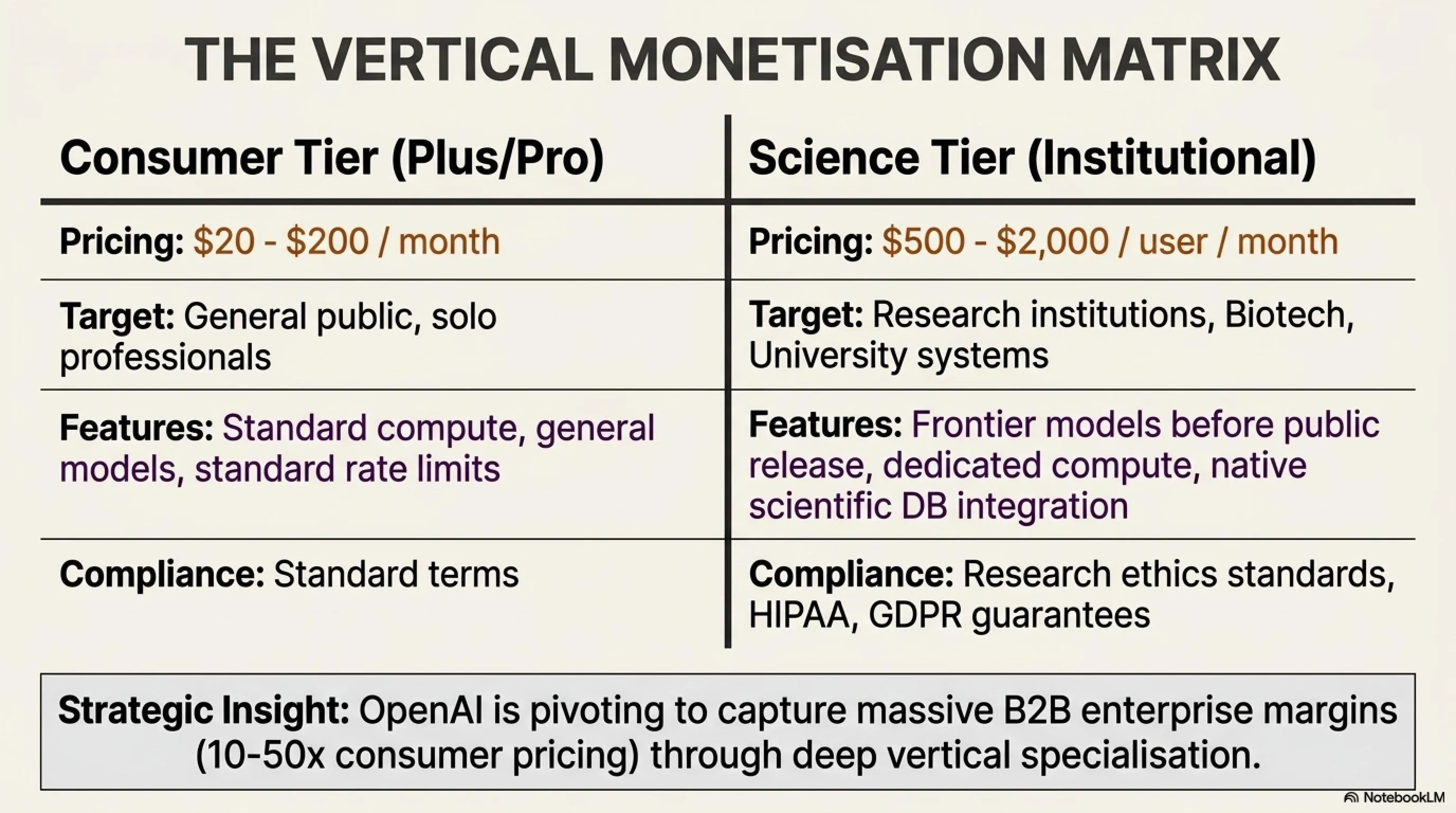
ChatGPT for Science represents OpenAI's pivot toward enterprise and institutional monetization. While consumer subscriptions (Plus at $20/month, Pro at $200/month) generate significant revenue, the real margin expansion lies in vertical-specific B2B contracts. Research institutions, pharmaceutical companies, biotech firms, and university systems have substantial budgets for AI tooling—and crucially, they're willing to pay premium prices for specialized capabilities, compliance guarantees, and white-glove support.
Expect pricing to significantly exceed consumer tiers—likely $500-$2,000 per user per month for institutional licenses, with volume discounts for large research consortia. OpenAI can justify these price points through differentiated features: access to frontier models before public release, dedicated compute resources, compliance with research ethics standards (HIPAA, GDPR), and SLAs guaranteeing uptime for mission-critical research. This strategy mirrors how enterprise software companies (Salesforce, Adobe, Microsoft) monetize vertical solutions at 10-50x consumer pricing.
🌙 Final Thoughts: A Night of Cyber Crises, Market Turbulence, and Industry Evolution
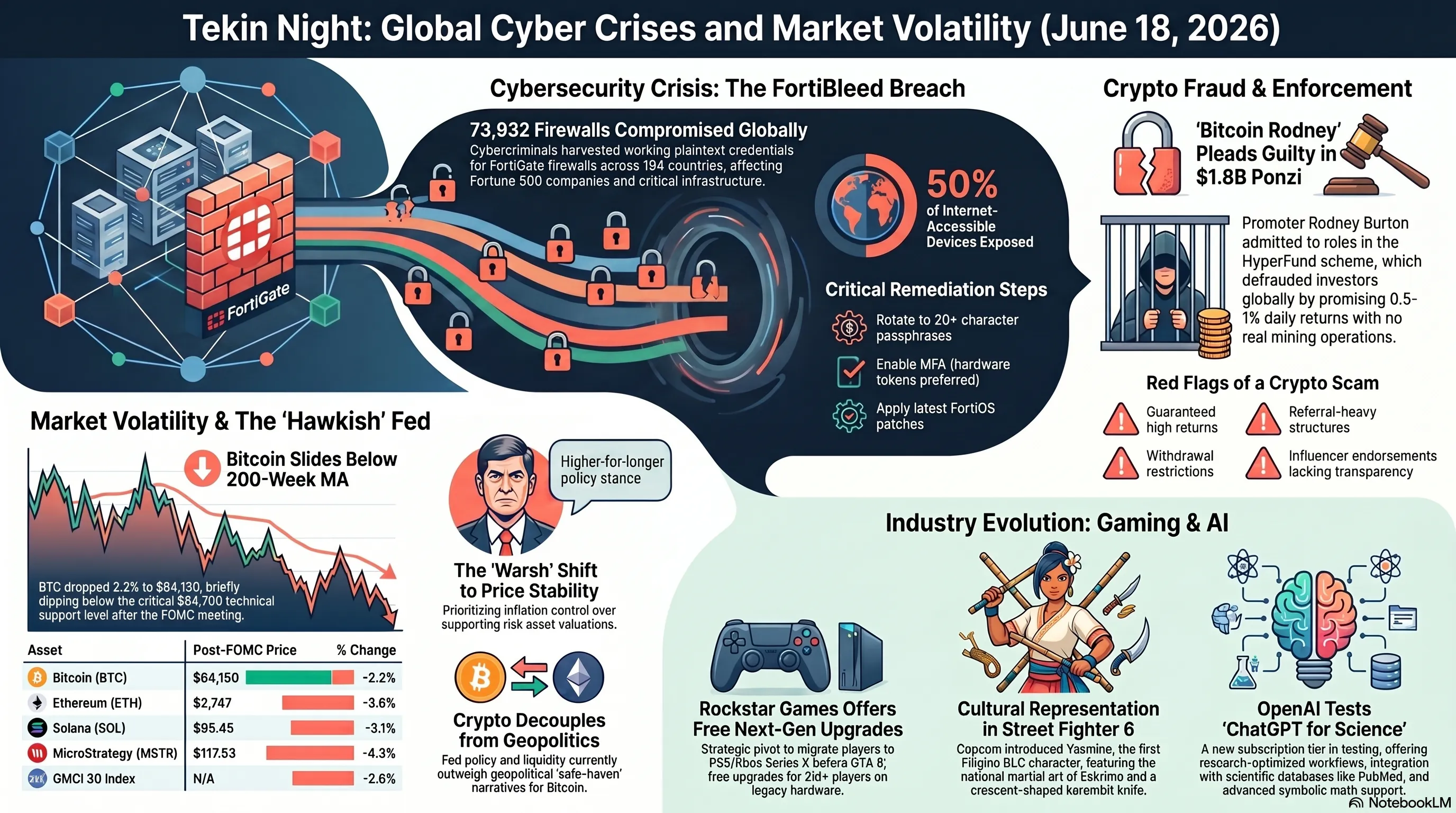
Thursday night June 18, 2026, encapsulates the volatility and complexity of the modern technology landscape. From the largest enterprise firewall breach in history (FortiBleed exposing 73,932 devices) to crypto markets reeling from hawkish Fed policy, to the prosecution of a $1.8 billion Ponzi scheme promoter, tonight's news underscores that technology operates at the intersection of security vulnerabilities, macroeconomic forces, and regulatory accountability.
Yet amid the crises, we also witnessed positive industry evolution: Rockstar adapting its monetization strategy to maximize next-gen adoption with free upgrades, Capcom expanding Street Fighter 6's roster with authentic cultural representation, and OpenAI refining its AI products for specialized vertical markets. These stories illustrate that even as existential threats emerge, innovation, competition, and user-centric business models continue advancing the state of the art.
For tech professionals globally: prioritize cybersecurity posture, prepare for sustained macro headwinds in risk assets, remain vigilant against crypto fraud, and watch how platform transitions and AI verticalization reshape competitive dynamics.
Until tomorrow morning in Tekin Morning—good night and code securely! 🌙✨
❓ How can I check if my Fortinet firewall is in the FortiBleed leak?
Contact Fortinet's security response team immediately or use third-party breach monitoring services. Review authentication logs for the past 90 days to identify unauthorized access. Simultaneously, rotate all administrative passwords, enable MFA, and apply the latest firmware patches. If your device appears in the leak, assume compromise and initiate incident response protocols including network forensics, lateral movement analysis, and potential device reimaging.
❓ Will Bitcoin recover after the hawkish Fed meeting?
Bitcoin's recovery depends on inflation trajectory and Fed policy evolution. If inflation decelerates and the Fed pivots dovish (rate cuts), Bitcoin could rally significantly. However, if inflation remains sticky and the Fed maintains or raises rates, expect continued pressure on crypto. The 200-week MA breakdown is technically concerning—a sustained move below $64K could trigger capitulation toward $58-60K. Monitor CPI prints, Fed speeches, and macro liquidity conditions closely.
❓ How do I avoid crypto Ponzi schemes like HyperFund?
Never trust "guaranteed returns" or "risk-free passive income" claims—these are mathematically impossible without fraud. Research the team's background, verify operational legitimacy (e.g., mining operations should have verifiable on-chain activity), and avoid investments heavily focused on referral recruitment. Consult independent due diligence reports, check regulatory warnings (SEC, CFTC, FinCEN), and be skeptical of influencer endorsements without transparent disclosures. If it sounds too good to be true, it is.
❓ Does the free GTA V upgrade work for physical discs?
Yes—for PlayStation, any PS4 version (physical or digital) qualifies for free PS5 upgrade. Insert the PS4 disc into PS5 to initiate the upgrade process. For Xbox, only digital Xbox One versions qualify; physical Xbox One discs do not receive free Series X|S upgrades. Download size is approximately 85GB on PS5, so ensure sufficient storage before upgrading.
❓ When will ChatGPT for Science be publicly available?
OpenAI has not announced a public launch date or availability details. Based on the leaked screenshots, ChatGPT for Science appears to be in closed beta testing with select research institutions. Public availability will likely depend on test results, pricing finalization, and regulatory compliance verification. Expect a phased rollout—initially restricted to verified academic institutions, then potentially expanded to individual researchers and paid subscribers. Monitor OpenAI's official blog and research preview program for announcements.
📚 Sources & References
- TechCrunch: Cybercriminals allegedly hacked tens of thousands of Fortinet firewalls (June 17, 2026)
- Bleeping Computer: FortiBleed leak exposes Fortinet VPN credentials for 73,000 devices
- CoinDesk: Bitcoin, Ether slide after a hawkish Fed even as Trump's signed Iran deal lifts stocks (June 18, 2026)
- CryptoTimes: Bitcoin Rodney pleads guilty in $1.8B HyperFund crypto fraud case
- Dexerto: Rockstar is giving GTA V players a free PS5/Xbox Series upgrade
- Nintendo Life: Street Fighter 6 Yasmine gameplay trailer (June 18, 2026)
- Bleeping Computer: Leak confirms OpenAI is testing a ChatGPT for Science subscription
🌐 Stay Connected With Us 🎮✨
For the latest tech, gaming, and gadget news, follow us on our official social media channels: