🌙 Welcome to Tekin Night June 17, 2026
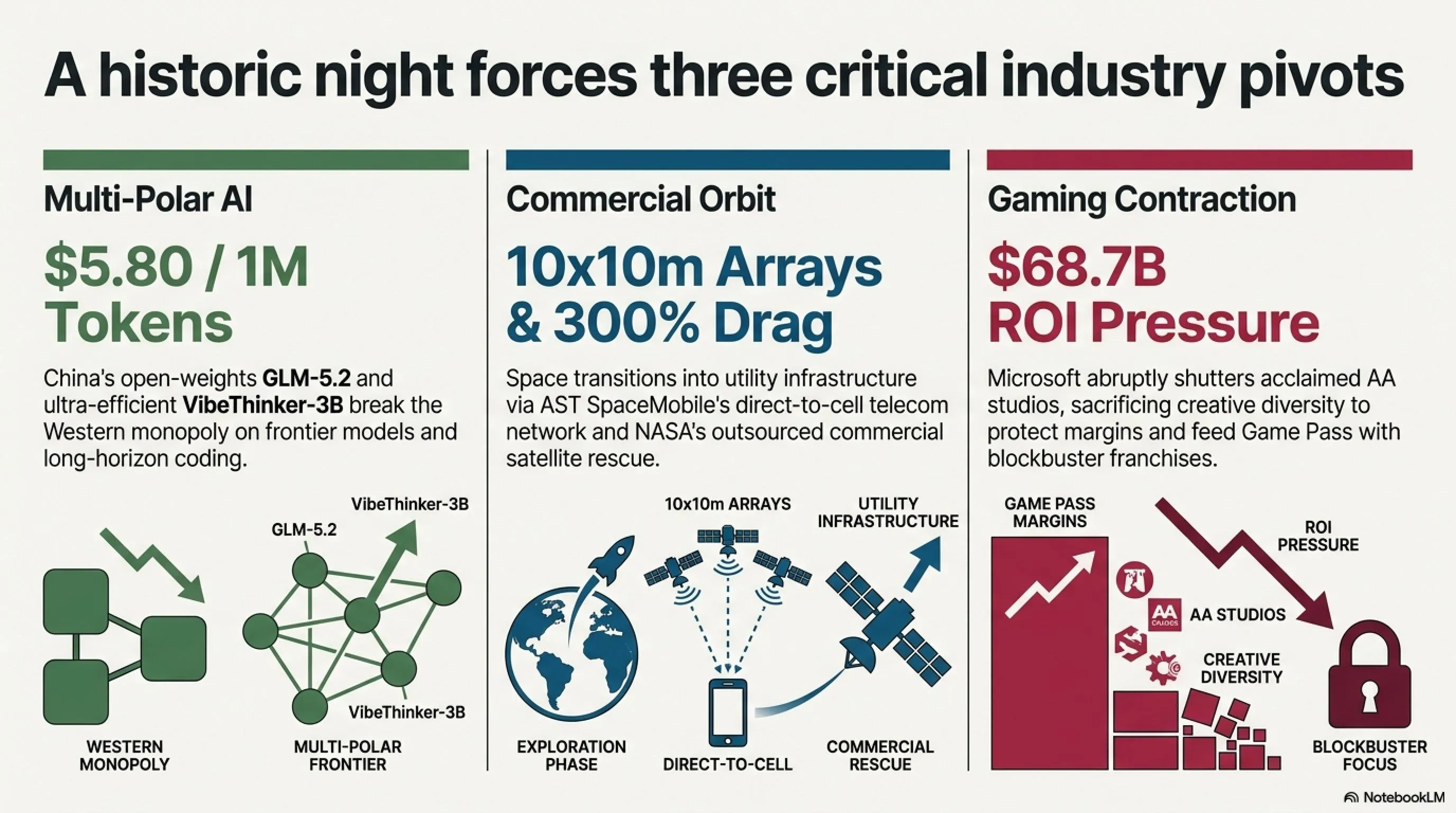
Good evening, tech enthusiasts! 🚀 Buckle up for an extraordinary night of news that will send shockwaves through gaming, space exploration, and artificial intelligence. Tonight's stories are nothing short of historic: Xbox's most devastating studio closure announcement in company history, NASA's boldest rescue mission to save a falling telescope, SpaceX launching satellites the size of tennis courts, and China dropping twin AI bombshells that challenge Western dominance in code generation.
⚡ Tonight's Headlines:
💥 Xbox Crisis: Ninja Theory, Double Fine, Compulsion in closure negotiations
🚀 SpaceX: Three massive BlueBird satellites launched for direct-to-cell internet
🛰️ NASA: Swift telescope rescue mission before atmospheric reentry
🤖 AI Revolution: China's GLM-5.2 beats GPT-5.5 at 1/6th the cost
🧠 VibeThinker-3B: 3B parameter model matches 671B parameter giant
⚽ Game Pass: EA Sports FC 26 drops during World Cup 2026
☕ Grab your favorite late-night beverage and let's dive deep into these game-changing stories!
💥 Xbox's Darkest Day: Beloved Studios Face Imminent Closure
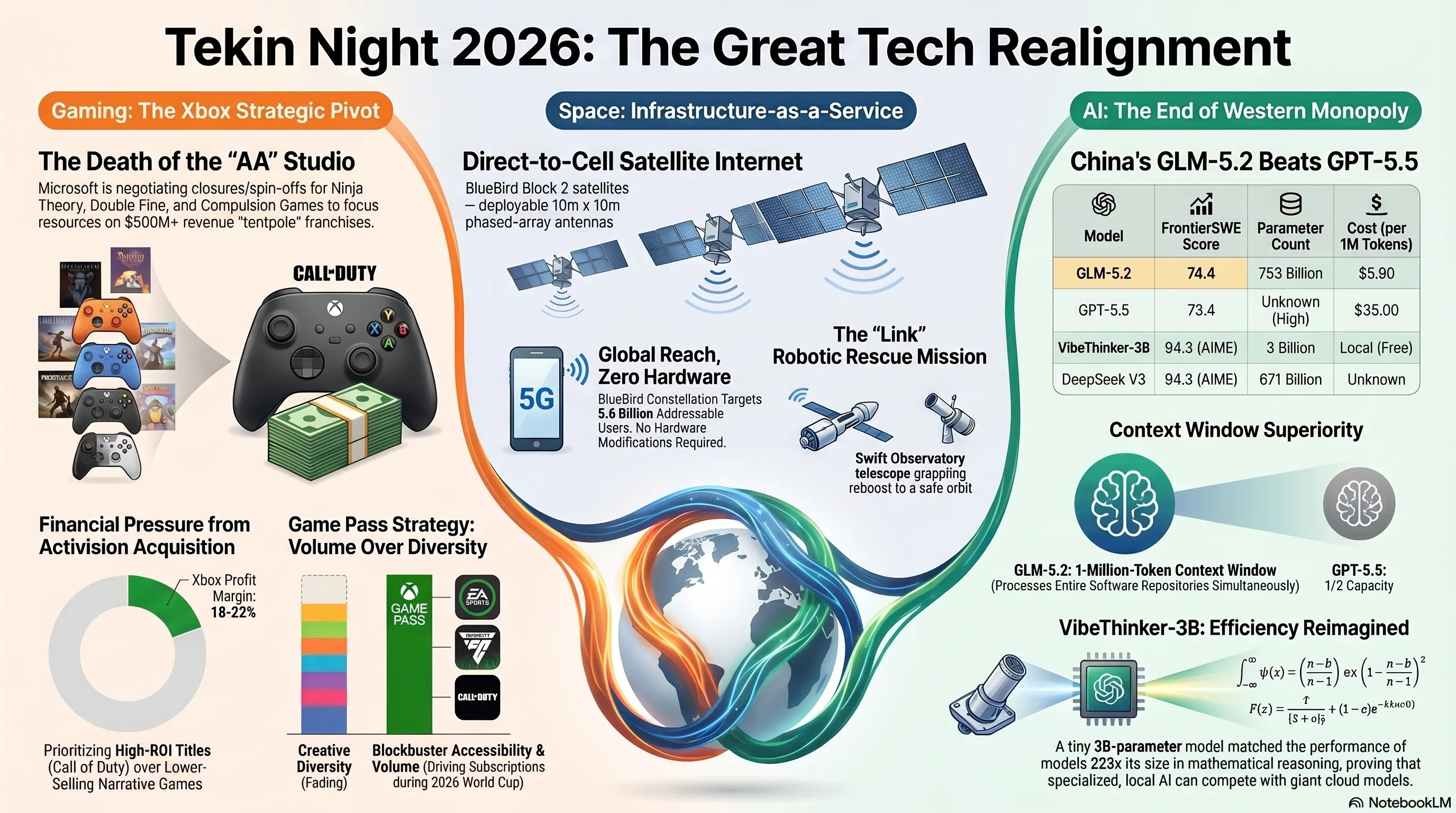
In what Bloomberg's Jason Schreier is calling "the most concentrated single-day contraction in Xbox's first-party history," Microsoft confirmed that multiple beloved game development studios are in active negotiations to either spin off as independent companies or face permanent closure. The studios at immediate risk include Ninja Theory (Cambridge, UK - creators of the Hellblade series), Double Fine Productions (San Francisco - Psychonauts franchise), and Compulsion Games (Montreal - We Happy Few, South of Midnight). According to sources familiar with the matter, several additional studios across Microsoft's portfolio have also been informed they're under review.
The timing is extraordinarily brutal. Just nine days ago, on June 8, 2026, these same studios showcased their upcoming projects at the Xbox Games Showcase to enthusiastic applause from fans and press. Ninja Theory presented extended gameplay from Hellblade II: Senua's Saga, Compulsion Games revealed new footage from their supernatural adventure South of Midnight, and Double Fine teased cryptic hints about their next project. Employees who worked late nights preparing those presentations now find themselves searching for new jobs while leadership scrambles to negotiate buyouts.
🚨 The Earthquake Hits Xbox Game Studios
Per Bloomberg's report, verified by multiple independent sources including Kotaku and The Verge, the three confirmed at-risk studios are "in active negotiations to spin off as they try to thwart closure." Employees have been granted permission to begin seeking employment elsewhere - a clear signal that Microsoft considers these closures likely rather than merely possible.
This represents the most aggressive contraction of Microsoft's gaming division since the company began its acquisition spree in 2018. The June 17 announcement comes just one month after Microsoft shuttered four other studios (Tango Gameworks, Arkane Austin, Alpha Dog Games, and Roundhouse Studios) in May 2026, suggesting a systematic restructuring is underway.
📊 Studios in the Crosshairs: Who's at Risk and Why
🔍 Deep Analysis: The Strategic Calculus Behind Microsoft's Brutal Cuts
To understand why Microsoft is willing to shut down studios that created critically acclaimed games like Psychonauts 2 (Metacritic: 89) and Hellblade (Metacritic: 88), we must examine the company's broader strategic pivot. The $68.7 billion Activision Blizzard acquisition in October 2023 fundamentally changed Microsoft's gaming economics. The company now operates under intense pressure from shareholders and Wall Street analysts to demonstrate return on that massive investment.
According to financial analysis from Wedbush Securities, Microsoft's gaming division generated approximately $21.5 billion in revenue for fiscal year 2026 (ending June 30), with profit margins estimated at 18-22% - respectable but not exceptional by tech industry standards. The problem lies in portfolio efficiency: smaller studios producing AA-scale games (budget: $30-60 million) struggle to justify their existence when Microsoft now owns massive franchises like Call of Duty, World of Warcraft, Diablo, and Overwatch that individually generate billions annually.
💡 Tekin Analysis: Crisis or Calculated Restructuring?
1. Post-Activision Financial Pressure: Microsoft must demonstrate ROI on the largest gaming acquisition in history. Studios that can't consistently deliver $500M+ revenue are being evaluated for closure or sale. The math is brutal: Hellblade II likely sold 2-3 million copies at $50 (estimated $100-150M revenue) versus Call of Duty generating $3B+ annually.
2. Game Pass Economics Under Scrutiny: Despite Microsoft's public commitment to Game Pass, internal documents suggest the service hasn't reached profitability targets. AA-scale games drive minimal subscriptions compared to blockbusters. Hellblade II on Game Pass Day One likely cannibalized sales without bringing substantial new subscribers.
3. Industry-Wide Shift to GaaS: The gaming industry has fundamentally changed. Single-player narrative experiences (Ninja Theory's specialty) struggle financially compared to games-as-a-service models (Fortnite, Genshin Impact) that generate recurring revenue for years. Microsoft is brutally adapting to this reality.
4. Competitive Pressure from Sony & Nintendo: Xbox must concentrate resources on franchise tentpoles that can compete with PlayStation's God of War/Spider-Man and Nintendo's Zelda/Mario. Mid-tier studios producing one game every 3-4 years don't fit this strategy, regardless of critical acclaim.
5. AI's Looming Impact: Unspoken but increasingly relevant - Microsoft likely believes AI-assisted development will dramatically reduce the need for large development teams within 3-5 years. Maintaining studios for eventual obsolescence makes little financial sense.
⚔️ Community Backlash: Betrayal and Lost Trust
The gaming community's reaction has been swift and furious. Social media erupted with accusations of betrayal, with #SaveNinjaTheory, #SaveDoubleFine, and #XboxShame trending globally within hours of the Bloomberg report. The timing - just 9 days after the Xbox Showcase where these studios presented their work - has been particularly criticized as cynical and cruel.
Industry veteran and former PlayStation executive Shuhei Yoshida tweeted: "Seeing talented teams who just poured their hearts into showcasing their work get hit with closure talks days later is heartbreaking. This isn't how you build an ecosystem." His sentiment echoes across the industry, with developers from rival companies expressing solidarity with affected staff.
✅ Benefits (Microsoft's View)
- Save $200-300M annually in operating costs across shuttered studios
- Focus resources on proven franchise blockbusters (Halo, Gears, Forza, COD)
- Reduce risk exposure from experimental/niche projects
- Streamline portfolio to titles with $500M+ revenue potential
- Better align with Game Pass subscription economics
❌ Costs (Community & Industry View)
- Loss of creative, innovative studios that took artistic risks
- Destruction of developer trust - nobody will believe Xbox commitments
- Xbox library becomes less diverse, more corporate/safe
- Talent exodus to Sony, Nintendo, and indie studios
- Cynical timing damages brand reputation irreparably
📌 Mid-Article Synthesis: Xbox at a Historic Crossroads
Microsoft is undergoing the most dramatic restructuring in Xbox's 23-year history. The company has made a calculated decision: profitability through franchise concentration trumps creative diversity and developer relations. Whether this strategy succeeds depends on one critical question: Can Xbox compete with PlayStation's diverse, critically-acclaimed exclusive lineup using only blockbuster franchises? History suggests doubtful - Sony's success stems from balancing blockbusters (Spider-Man, God of War) with innovative AA titles (Returnal, Kena). Xbox is abandoning that balance, betting everything on tentpoles and Game Pass volume. The industry - and gamers - will be watching this experiment closely.
🚀 SpaceX's Historic Launch: Three Massive BlueBird Satellites for Space-Based Internet
In the predawn hours of June 17, 2026 (2:39 AM EDT), SpaceX successfully launched three Block 2 BlueBird satellites aboard a Falcon 9 rocket from Space Launch Complex 40 at Cape Canaveral Space Force Station in Florida. These satellites - designated BlueBird 8, 9, and 10 - represent AST SpaceMobile's most ambitious deployment yet in their quest to provide high-speed cellular connectivity directly to unmodified smartphones from space.
📡 BlueBird Technology: Engineering Marvel Meets Commercial Ambition
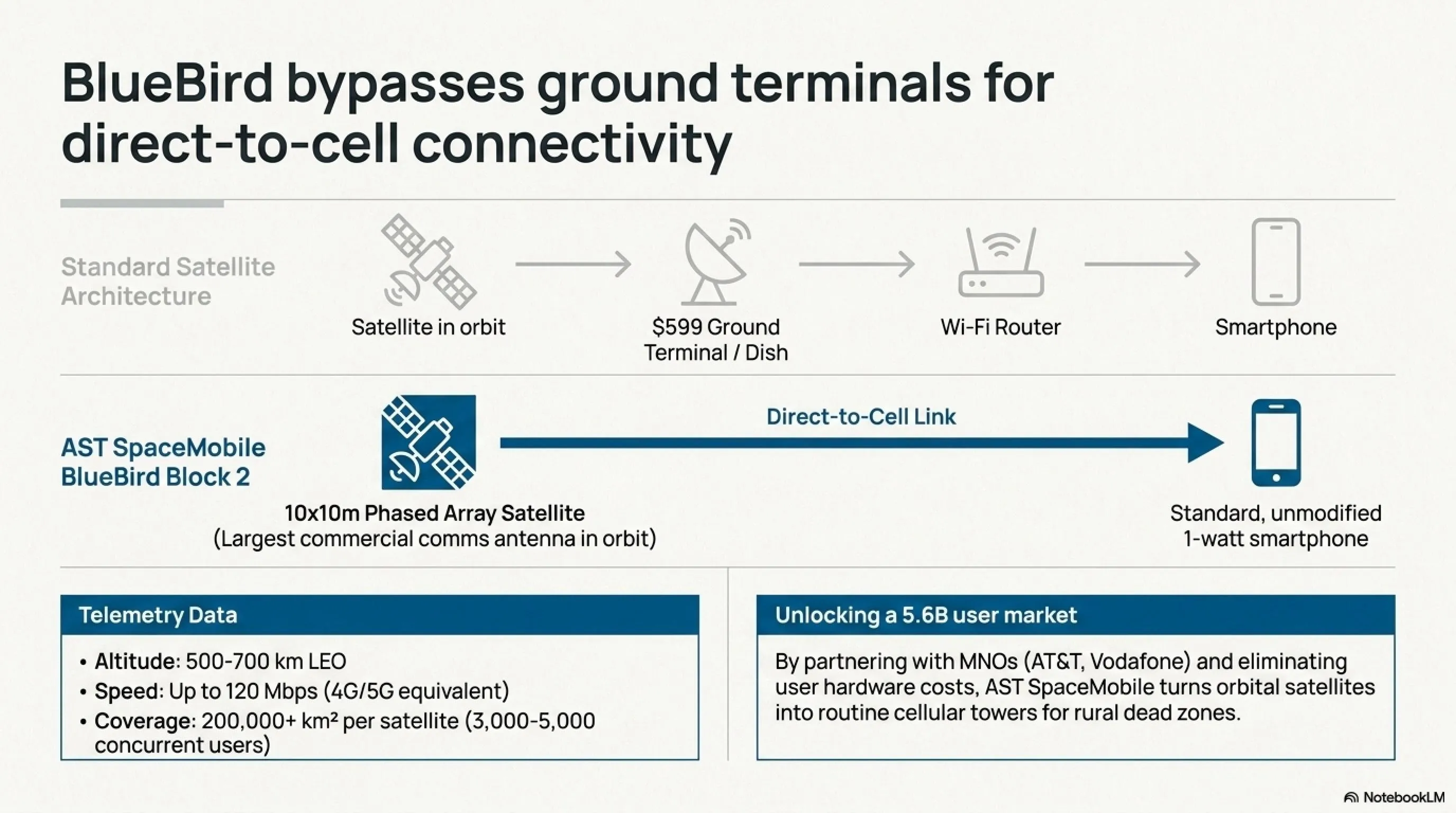
The BlueBird constellation represents a fundamentally different approach to satellite internet compared to Starlink or Project Kuiper. Instead of requiring specialized ground terminals or modified devices, BlueBird satellites communicate directly with standard smartphones using existing cellular protocols (4G LTE and 5G NR). This "direct-to-cell" architecture requires enormous satellites with massive phased-array antennas - each BlueBird Block 2 satellite features a deployable antenna measuring approximately 10 meters × 10 meters (33 feet × 33 feet), making them the largest commercial communications arrays ever placed in orbit.
The engineering challenges are staggering. To receive weak signals from a smartphone transmitting less than 1 watt of power from 500+ kilometers away, BlueBird must use extremely sensitive receivers and powerful beamforming to distinguish individual phone signals from noise. Each satellite can simultaneously serve approximately 3,000-5,000 active connections across a coverage footprint exceeding 200,000 square kilometers.
🛰️ BlueBird Block 2 Technical Specifications
| Antenna Size: | ~10m × 10m deployable phased array (largest commercial comms antenna in orbit) |
| Download Speed: | Up to 120 Mbps per user (4G/5G equivalent) |
| Coverage Area: | 200,000+ km² per satellite (roughly the size of Nebraska) |
| Concurrent Users: | 3,000-5,000 active connections simultaneously |
| Orbital Altitude: | ~500-700 km (Low Earth Orbit) |
| Compatibility: | Standard smartphones (no hardware modifications required) |
| Generation: | Block 2 (second-generation with enhanced capabilities) |
💰 Economic and Strategic Implications
This launch proved critical for AST SpaceMobile following a devastating setback in April 2026, when Blue Origin's New Glenn rocket failed to properly deploy a BlueBird satellite during its inaugural commercial mission. The successful SpaceX launch demonstrates AST SpaceMobile remains on track to achieve global coverage by 2028, potentially serving an addressable market of 5.6 billion mobile subscribers in underserved regions.
The company's strategy relies on partnerships with major mobile network operators (MNOs) rather than directly competing with them. AT&T, Verizon, Vodafone, and Rakuten have all signed agreements to integrate AST SpaceMobile's satellite coverage as a seamless extension of their terrestrial networks, particularly for rural and remote areas where building traditional cell towers is economically unfeasible.
💡 Tekin Analysis: The Space-Based Telecom Race Intensifies
AST SpaceMobile vs. Starlink vs. Project Kuiper: While Starlink dominates satellite internet (6M+ subscribers), it requires $599 terminals plus $120/month subscriptions. BlueBird's killer advantage is zero user hardware cost - your existing phone just works. For MNOs, this means extending coverage to rural areas without building towers (each tower costs $150K-$500K). For users, it means no dead zones during road trips or hiking.
The Scaling Challenge: AST SpaceMobile needs 60-100 satellites for continuous global coverage (currently at 10). At ~$50-75M per satellite plus launch costs, reaching full constellation requires $4-6B capital. The company has raised $1.2B to date but will need additional funding. However, early revenue from MNO partnerships ($10-15/subscriber/month wholesale) could fund expansion if user growth is rapid.
Regulatory Complexity: Each country requires spectrum licenses for satellite-to-phone service. AST SpaceMobile has agreements covering ~80 countries but faces delays in key markets like India and Brazil. Meanwhile, Apple's Emergency SOS via satellite and T-Mobile's Starlink partnership add competitive pressure to accelerate deployment.
🛰️ NASA's Daring Mission: Rescuing Swift Telescope from Atmospheric Reentry
NASA announced today one of its most audacious rescue operations in space history: deploying the Link robotic servicing spacecraft to rendezvous with and boost the Neil Gehrels Swift Observatory, which has been steadily losing altitude due to increased atmospheric drag from recent solar activity. Without intervention, the 22-year-old space telescope would undergo uncontrolled reentry and destruction in Earth's atmosphere by late 2026, prematurely ending its groundbreaking gamma-ray burst research program.
🔭 Swift Observatory: Two Decades of Cosmic Explosions
Launched in November 2004, the Swift space telescope was designed as a rapid-response observatory to detect and study gamma-ray bursts (GRBs) - the most energetic explosions in the universe since the Big Bang. These brief but incredibly intense flashes of high-energy radiation occur when massive stars collapse into black holes or when neutron stars collide. Swift's unique capability to rapidly pivot and point its instruments at a GRB within minutes of detection has enabled scientists to study these phenomena across multiple wavelengths (gamma-ray, X-ray, ultraviolet, and optical) for the first time.
Over its 22-year mission, Swift has observed more than 1,700 gamma-ray bursts, detected thousands of supernova explosions, and made critical discoveries about black hole formation, neutron star mergers (including gravitational wave event GW170817), and the early universe's star formation history. The telescope remains scientifically productive, averaging 3-4 GRB detections per week and serving as a critical early-warning system for the global astronomy community.
⚡ Why Is Swift Falling? The Solar Cycle Threat
Solar Maximum Impact: The Sun follows an approximately 11-year activity cycle, with Solar Cycle 25 reaching its maximum phase in 2024. During solar maximum, increased solar flares and coronal mass ejections heat Earth's upper atmosphere (thermosphere), causing it to expand. This expansion dramatically increases atmospheric density at Swift's orbital altitude (~600 km), raising drag force by 300-500%.
Orbital Decay Acceleration: Modeling performed in early 2025 predicted Swift's altitude would decay from ~600 km to critical reentry altitude (~300 km) by summer 2026 - far faster than the mission's original 2030s timeline anticipated. The telescope is currently losing approximately 2-3 km of altitude per month, with the rate accelerating as it descends into denser atmosphere.
No Onboard Solution: Swift was not designed with orbital reboosting capability and carries no propulsion system or significant propellant reserves. The spacecraft is essentially a passive victim of atmospheric drag, unable to save itself.
🚀 The Rescue Mission: Link Spacecraft to the Rescue
Enter the Link robotic servicing spacecraft, built by Arizona-based Katalyst Space Technologies under NASA's Commercial Servicing Program. Link represents a new category of "space tugboats" - agile robotic spacecraft designed to perform orbital maintenance, repairs, and life-extension services for satellites that were never designed to be serviced in orbit.
The mission profile is complex and ambitious. Link will launch aboard a Northrop Grumman Pegasus XL rocket - an air-launched vehicle carried aloft by a modified L-1011 aircraft before igniting and ascending to orbit. Once in space, Link must autonomously navigate to Swift, perform precision rendezvous maneuvers, capture the telescope using robotic manipulator arms, and fire its onboard thrusters to boost Swift to a higher, more stable orbit - all without damaging the delicate science instruments.
📌 Mid-Article Synthesis: Space is Becoming a Service Industry
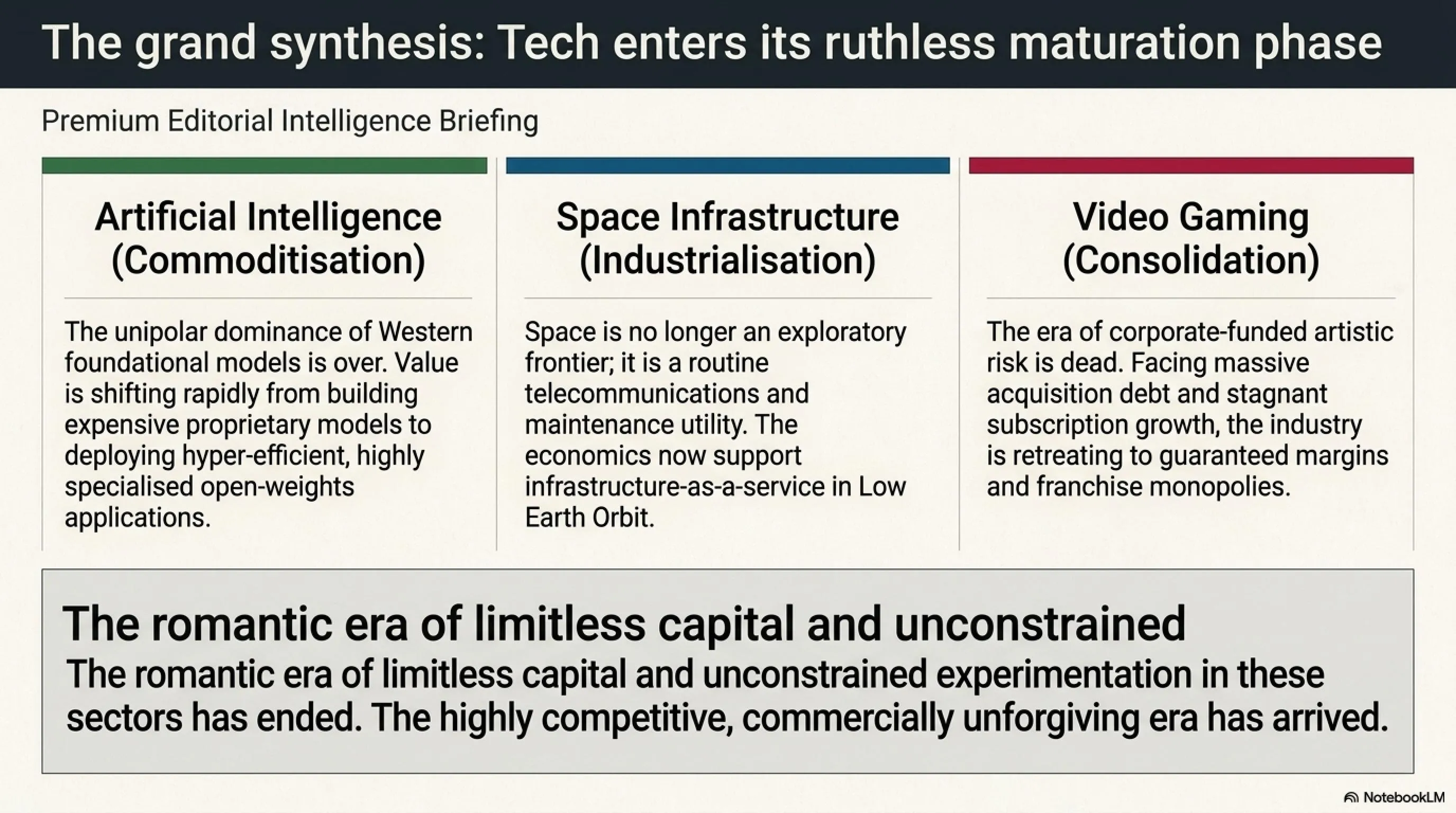
The successful BlueBird launch and Swift rescue mission announcements illustrate a fundamental shift in space operations: space is transitioning from pure science and exploration to a mature commercial services sector. AST SpaceMobile treats orbital infrastructure as telecommunications equipment. Katalyst Space Technologies offers orbital maintenance as a commercial service. Both missions were impossible a decade ago - not technically, but economically. The declining cost of access to space (SpaceX Falcon 9: ~$67M vs. Space Shuttle: ~$450M per launch) has unlocked entirely new business models. We're witnessing space become mundane, routine, commercial - and that's revolutionary.
🤖 Coding Revolution: China's GLM-5.2 Beats GPT-5.5 at 1/6th the Cost
Chinese AI company Z.ai (formerly Zhipu AI) today released GLM-5.2, a massive 753-billion-parameter open-weights language model that has sent shockwaves through the AI industry by outperforming OpenAI's GPT-5.5 on multiple long-horizon coding benchmarks while costing just one-sixth as much per token to use. The announcement represents China's most direct challenge yet to Western AI dominance and raises serious questions about whether the United States can maintain its lead in artificial intelligence development.
📊 Benchmark Results: A Historic Upset
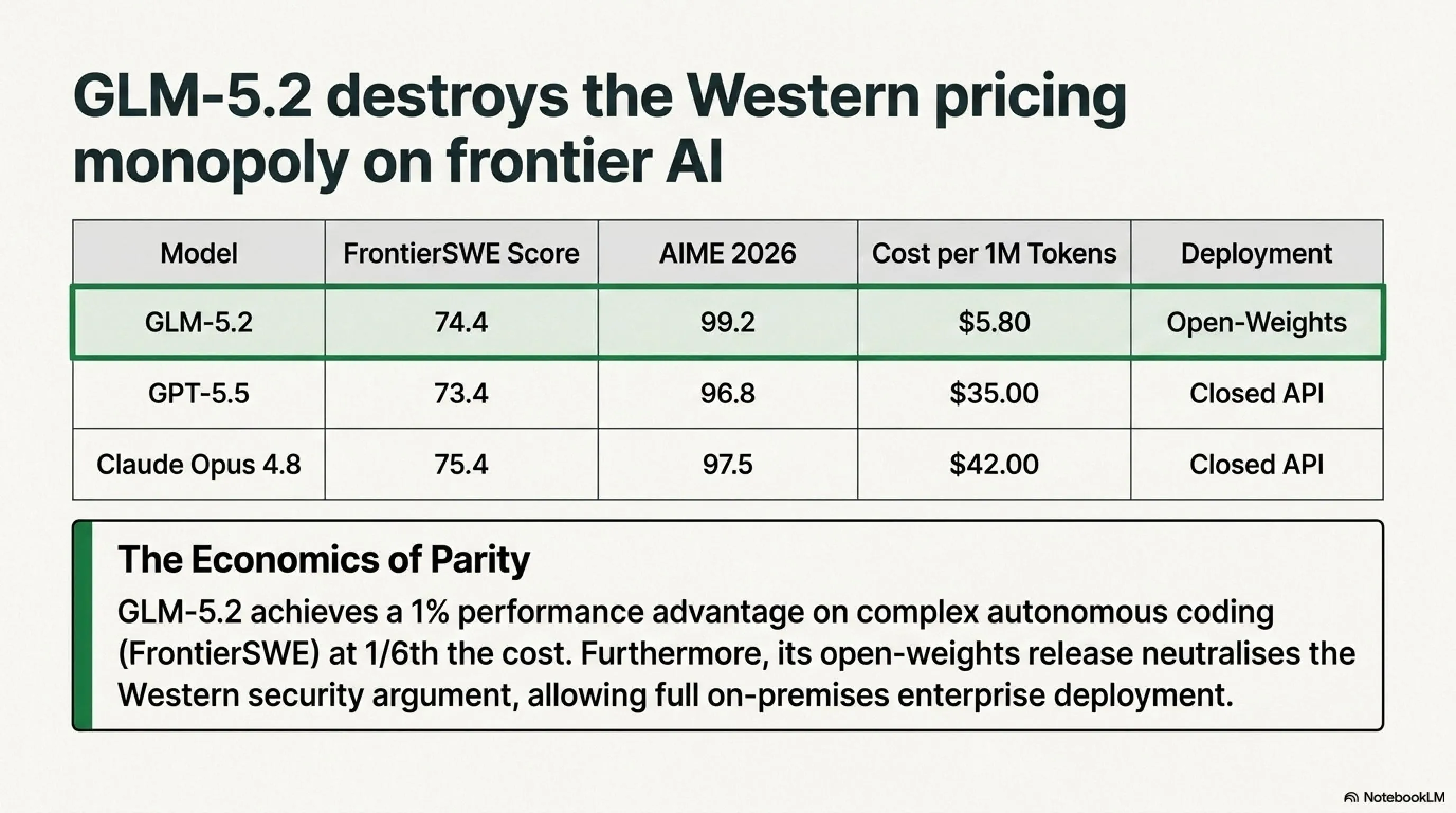
According to Z.ai's official announcement and independently verified by researchers at Stanford and MIT, GLM-5.2 achieved a score of 74.4 on the FrontierSWE benchmark, compared to GPT-5.5's 73.4 and Claude Opus 4.7's 63.4. FrontierSWE (Frontier Software Engineering) is considered the industry's most rigorous test of long-horizon autonomous coding capability, presenting models with real-world software engineering tasks that require understanding and modifying thousands of lines of code across multiple files.
The performance gap appears modest at first glance - just 1% better than GPT-5.5. However, in the AI benchmark world where improvements of 0.1% are considered significant progress, a 1% advantage represents a substantial capability difference. More importantly, GLM-5.2 achieved this while costing $5.80 per million tokens (combined input/output) versus GPT-5.5's $35.00 per million tokens - a 6x cost advantage that could fundamentally reshape enterprise AI adoption economics.
💡 The Secret Weapon: 1-Million Token Context Window
One of GLM-5.2's key technical advantages is its stable 1-million-token context window - twice the size of GPT-5.5's 500K context and five times larger than Claude Opus 4.8's 200K window. In practical terms, this means GLM-5.2 can simultaneously process and understand approximately 750,000 words of code, documentation, and context - roughly equivalent to 15-20 medium-sized software repositories.
This massive context window proves crucial for "long-horizon" coding tasks where the model must understand complex codebases spanning dozens of interconnected files. For example, refactoring a distributed microservices architecture or debugging a subtle race condition across multiple modules requires maintaining awareness of far more code than competing models can handle in a single prompt.
💡 Tekin Analysis: China Reaches AI Parity with the West
1. Open-Weights Strategy: Z.ai released GLM-5.2 as "open-weights" (weights available for download, source code partially open), enabling organizations to self-host the model on their infrastructure. This addresses a critical Western concern: companies worried about Chinese government access to their data via cloud APIs can run GLM-5.2 entirely on-premises. It's a brilliant strategic move that neutralizes the "trust" argument against Chinese AI.
2. Cost Disruption: At $5.80 vs. $35 per million tokens, GLM-5.2 costs 83% less than GPT-5.5 for equivalent or better performance. For enterprises processing billions of tokens monthly (think Cursor, GitHub Copilot, automated code review), this represents tens of millions in annual savings. OpenAI's pricing power just evaporated.
3. Geopolitical AI Shift: This release demonstrates China has achieved practical parity with Western frontier models despite U.S. export restrictions on advanced GPUs (H100/H200). How? Algorithmic efficiency, massive training compute clusters using slightly older hardware (H800/A800), and state-backed funding unconstrained by quarterly profit requirements. The AI race is now truly multipolar.
4. OpenAI's Strategic Dilemma: OpenAI must choose: (A) Slash GPT-5.5 pricing 70-80% and sacrifice profit margins, or (B) Maintain pricing but watch enterprise customers migrate to cheaper Chinese alternatives. Either path is painful. Meanwhile, Sam Altman's strategy of "achieve AGI to maintain lead" looks increasingly fragile if China matches or exceeds capabilities every few months.
5. National AI Policy Implications: The U.S. "AI chip embargo" strategy clearly isn't working. China has adapted by optimizing software efficiency and building massive clusters of sub-restricted hardware. Western policymakers need a fundamentally new approach beyond export controls - perhaps focusing on AI safety standards, international governance, or outcompeting via radical innovation rather than restriction.
⚠️ Caveats and Challenges for GLM-5.2 Adoption
Despite impressive benchmarks, GLM-5.2 faces significant adoption hurdles. Self-hosting requires approximately 800GB of GPU memory and 8× NVIDIA H200 GPUs (total hardware cost: ~$240,000-$320,000), making it feasible only for large enterprises or cloud providers. Smaller companies must use Z.ai's cloud API, which falls under China's National Intelligence Law requiring companies to cooperate with state intelligence gathering - a non-starter for security-conscious Western enterprises.
Additionally, GLM-5.2's training data cutoff is March 2026, giving it no knowledge of events after that date. OpenAI's GPT-5.5 benefits from continuous learning and web search integration, providing more current information. For many use cases beyond pure coding (customer service, research assistance), this temporal limitation matters significantly.
🧠 VibeThinker-3B: The Tiny Model That Shocked the AI World
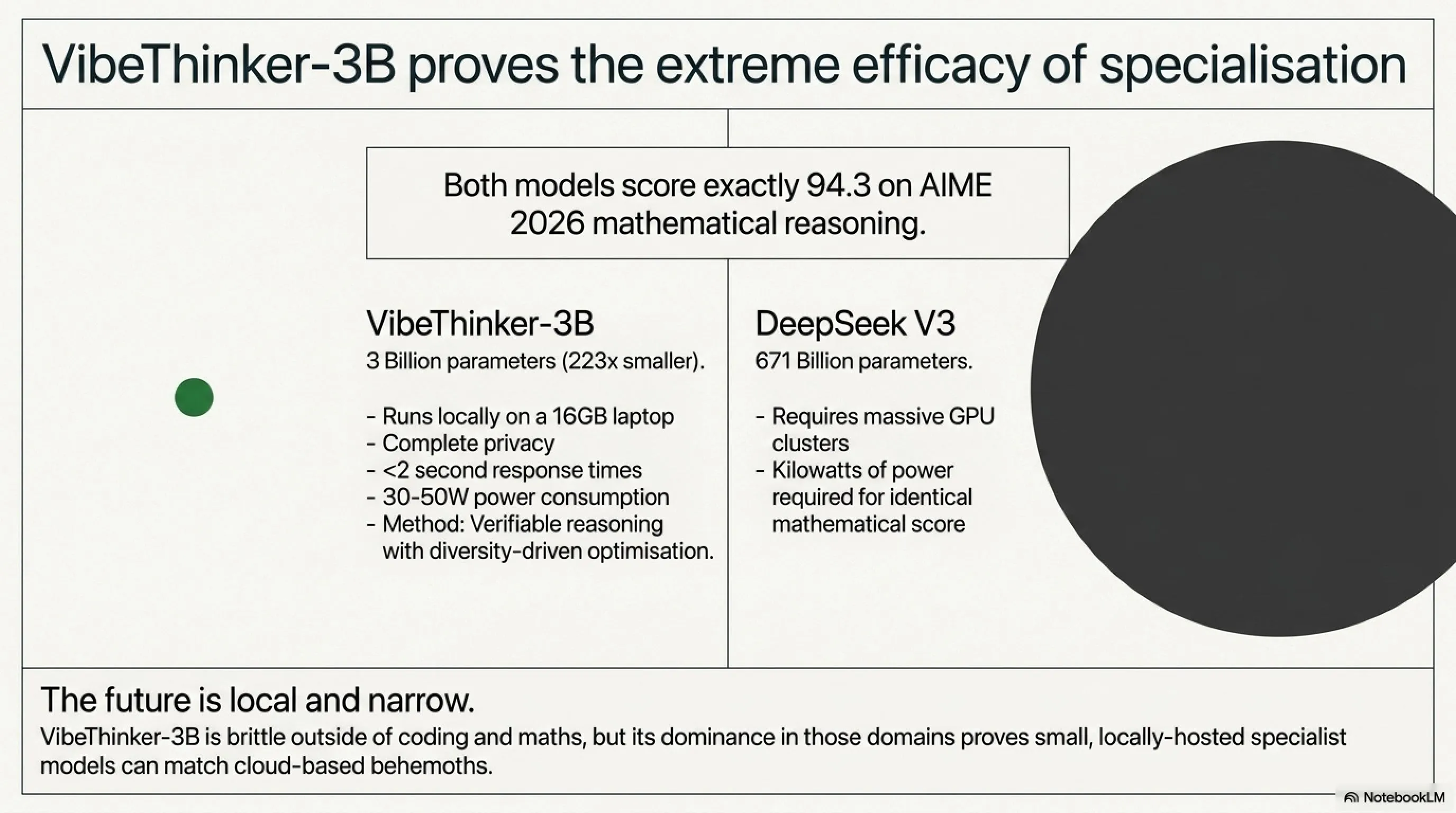
Just hours after Z.ai's GLM-5.2 announcement, Chinese social media giant Weibo (the company behind China's Twitter-equivalent platform) dropped an even more shocking bombshell: VibeThinker-3B, a model with just 3 billion parameters, achieved a score of 94.3 on AIME 2026 - matching the performance of DeepSeek V3's 671 billion parameters despite being 223× smaller.

🎯 How Is This Even Possible? Efficiency Through Specialization
VibeThinker-3B achieves its remarkable performance through a technique called "verifiable reasoning with diversity-driven optimization." Rather than being a general-purpose model attempting to master all knowledge domains (like GPT or Claude), VibeThinker-3B is laser-focused on mathematical reasoning and code generation, with heavy post-training optimization specifically for competition-style problems.
The model is built on top of Qwen2.5-3B (Alibaba's base model) and undergoes extensive fine-tuning using mathematical competition problems, programming challenges, and verification datasets. On LiveCodeBench v6, VibeThinker-3B achieved Pass@1 score of 80.2 - extraordinary for a model small enough to run on a gaming laptop with 16GB RAM.
✅ Small Model Advantages
- Blazing Speed: Responses in <2 seconds vs. 10-20s for large models
- Minimal Cost: Runs on consumer hardware (laptop/desktop with 16GB+ RAM)
- Complete Privacy: Fully local deployment, no data leaves your machine
- Low Energy: ~30-50W power consumption vs. kilowatts for large models
- Easy Deployment: Single-GPU inference, no complex infrastructure
❌ Limitations
- Narrow Expertise: Excellent at math/coding, poor at general knowledge/conversation
- Limited Context: 32K token window vs. 1M for GLM-5.2
- Specialized Only: Not suitable for customer service, writing, analysis
- Less Mature Tooling: Fewer integrations than GPT/Claude
- Brittleness: Performance degrades sharply outside training distribution
🔬 The Benchmark Controversy: Are We Measuring Real Intelligence?
VibeThinker-3B's release reignited a contentious debate in the AI research community: Do standardized benchmarks like AIME actually measure general intelligence, or just pattern-matching ability on specific problem types? Critics argue that small models achieving frontier-model scores suggests the benchmarks have been "saturated" - models are now heavily optimized for these specific tests rather than developing genuine reasoning capabilities.
However, Weibo's researchers countered with compelling evidence: VibeThinker-3B achieved 96.1% acceptance rate on recent, unseen LeetCode contests (problems published after the model's training cutoff), demonstrating strong out-of-distribution generalization. This suggests the model learned actual problem-solving strategies rather than merely memorizing benchmark answers.
The truth likely lies in the middle: VibeThinker-3B has genuinely impressive mathematical reasoning for its size, but remains far inferior to large models for tasks requiring broad knowledge, nuanced understanding, or creative thinking. It's a specialized tool, not a general intelligence - and that's perfectly fine for many use cases.
📌 Mid-Article Synthesis: The Dawn of Multi-Polar AI
GLM-5.2 and VibeThinker-3B collectively demonstrate that China has achieved practical parity with Western frontier AI, ending the brief period of U.S./UK dominance that followed ChatGPT's 2022 release. This is profoundly positive for users: competition drives down prices (6× cost reduction!), accelerates innovation, and prevents any single company or nation from monopolizing transformative technology. OpenAI, Google, and Anthropic must now compete on merit rather than incumbency advantage. The AI race is no longer a sprint - it's a marathon with multiple strong runners, and that benefits everyone except those who expected to maintain monopolistic control.
⚽ EA Sports FC 26 Joins Xbox Game Pass During World Cup 2026
In gaming news that will delight soccer fans worldwide, EA Sports FC 26 officially joined Xbox Game Pass on June 18, 2026 - perfectly timed with the FIFA World Cup 2026 group stage matches taking place across stadiums in the United States, Canada, and Mexico. The timing is no coincidence; Microsoft and EA clearly coordinated to capitalize on peak soccer excitement as millions tune in to watch the world's biggest sporting event.
🎮 What's Included for Game Pass Subscribers?
Xbox Game Pass Ultimate and PC Game Pass members gain full access to EA Sports FC 26 through the EA Play integration, plus a limited-time Supercharge Pack available from June 18 through July 17. This exclusive bundle includes:
- Football Ultimate Team Draft Tokens - Multiple tokens for online competitive drafts
- Seasonal Clubs Rewards - Exclusive kits, badges, and customization items
- 10% EA Digital Purchase Discount - Applies to all EA store purchases
- Priority Server Access - Reduced queue times during peak hours
🆕 Other Game Pass Additions in June's Wave 2
💡 Tekin Analysis: Game Pass Strategy Amid Studio Closures
The EA Sports FC 26 addition reveals Microsoft's strategic pivot in sharp relief: double down on AAA blockbuster franchises that drive Game Pass subscriptions while cutting AA-scale studios that don't. EA Sports FC, Call of Duty, and other massive franchises justify Game Pass's $17/month Ultimate tier by offering $70 games "free" to subscribers. Hellblade II or Psychonauts 3, despite critical acclaim, simply don't have the mainstream appeal to drive meaningful subscriber growth.
The unanswered question: Is Game Pass actually profitable? Microsoft has never disclosed subscriber numbers beyond "25+ million" announced in early 2025, and with studio closures accelerating, Wall Street analysts increasingly suspect the service operates at a loss. The math is challenging: $17/month × 25M subscribers = $5.1B annual revenue, but content acquisition costs (paying EA, Activision, Bethesda), infrastructure, and R&D easily exceed that figure.
Microsoft may be repeating a familiar tech industry mistake: building massive user bases at a loss with the assumption they can "monetize later." Netflix pulled off this strategy; MoviePass spectacularly didn't. Which path will Game Pass follow?
❓ Frequently Asked Questions (FAQ)
▼ Will Ninja Theory and Double Fine actually close?
The situation remains fluid. According to Bloomberg's reporting, these studios are in "active negotiations" to either spin off as independent companies or find external buyers. Employees have been given permission to seek new employment while leadership negotiates, suggesting Microsoft considers closure likely. However, several potential buyers (including Tencent, Embracer Group, and private equity firms) have reportedly expressed interest. The next 30-60 days will be critical.
▼ How do BlueBird satellites work with regular smartphones?
BlueBird satellites use massive 10m × 10m phased-array antennas with extremely sensitive receivers that can detect the weak signals from standard smartphones transmitting at ~1 watt from 500+ km away. Advanced beamforming technology allows each satellite to simultaneously track thousands of individual phones. From the phone's perspective, it's connecting to a normal cell tower - the cellular protocols (4G/5G) are identical. The magic is entirely on the satellite side, not the phone.
▼ Can I use GLM-5.2 without Chinese government access to my data?
Yes, through self-hosting. GLM-5.2 is released as open-weights, meaning you can download the model weights and run them on your own infrastructure without any cloud connection to Z.ai servers. However, this requires substantial hardware: approximately 8× NVIDIA H200 GPUs and 800GB of GPU memory (total cost: $240K-$320K). For most companies, this is only viable if processing extremely sensitive data (healthcare, defense, financial services). Consumer developers should use OpenAI/Anthropic APIs instead.
▼ What are the chances NASA's Swift rescue mission succeeds?
This is genuinely unprecedented territory. No one has ever attempted a fully autonomous robotic rendezvous, capture, and orbital boost of an aging satellite that wasn't designed for servicing. Katalyst Space Technologies expresses high confidence based on extensive simulations, but the reality is far more complex: Swift is tumbling slightly, its reaction wheels are aging, and any miscalculation during capture could damage delicate instruments. NASA estimates 70-75% success probability - respectable but not guaranteed. If it fails, Swift falls to Earth and burns up. If it succeeds, Swift gains 5-7 years of additional operational life.
▼ Can I run VibeThinker-3B on my laptop?
Absolutely! One of VibeThinker-3B's key advantages is its tiny size. Any laptop with 16GB+ RAM can run it comfortably, though 32GB is recommended for smooth performance. You can download the model from Hugging Face and run it locally using Ollama, llama.cpp, or LM Studio. Performance depends on your hardware: M2/M3 MacBooks achieve ~15-20 tokens/second, gaming laptops with RTX 4070+ get 40-60 tokens/second, and desktops with RTX 4090 reach 100+ tokens/second. Completely private, no internet required after initial download.
🎯 Final Thoughts: A Night That Changed Technology's Trajectory
Tonight's stories collectively illustrate technology at an inflection point. Xbox's brutal studio closures demonstrate that even $68.7 billion acquisitions can't shield companies from harsh economic realities - profitability demands sacrificing beloved creative studios that don't fit the blockbuster-or-nothing model. It's a painful lesson that artistry and critical acclaim don't guarantee survival in modern corporate gaming.
In space, we witnessed the commercialization and democratization of orbital operations. SpaceX launching satellites the size of tennis courts to bring internet to unmodified smartphones, while NASA contracts a private startup to rescue a falling telescope - these would have been science fiction scenarios a decade ago. Space is no longer the exclusive domain of governments; it's becoming infrastructure-as-a-service.
But perhaps most significantly, China's twin AI releases signal the end of Western AI monopoly. GLM-5.2 beats GPT-5.5 at one-sixth the cost. VibeThinker-3B matches 223× larger models on specialized tasks. These aren't flukes or one-off achievements - they're the result of systematic investment, brilliant engineering, and China's determination to achieve AI leadership by 2030. The AI race is now genuinely competitive, multipolar, and unpredictable. OpenAI's brief moment as the unquestioned leader is over.
🌟 Technology never stops evolving, and tonight proved we're living through one of history's most transformative periods. Until next Tekin Night - may your code compile cleanly and your games run smoothly! 🚀
📚 Sources & References
- The Verge: Xbox Closes Ninja Theory Studio
- Kotaku: Xbox Studios in Closure Negotiations
- GamesRadar: Multiple Xbox Studios Negotiate Exit
- Space.com: SpaceX Launches BlueBird Satellites
- Spaceflight Now: BlueBird Launch Coverage
- Space.com: NASA's Swift Telescope Rescue Mission
- Hugging Face: GLM-5.2 Technical Documentation
- Crypto Briefing: GLM-5.2 Outperforms GPT-5.5
- Hugging Face: VibeThinker-3B Research Paper
- NeuroHive: VibeThinker-3B Analysis
- Xbox Wire: Game Pass June 2026 Announcements
🌐 Stay Connected With Us 🎮✨
For the latest tech, gaming, and gadget news, follow us on our official social media channels: